



NCERT Class 8 Science Chapter 2 The Invisible Living World Beyond Our Naked Eye Notes help students revise cells, microorganisms, useful microbes, and microscope-based observations from the 2026-27 NCERT Curiosity textbook. These notes explain how tiny living forms affect food, soil, farming, digestion, and the environment.
- Best for quick revision: covers cells, bacteria, fungi, protozoa, algae, viruses, fermentation, decomposition, and nitrogen fixation.
- Useful for classwork: includes labelled diagrams, comparison tables, activity clues, and experiment answer frames.
- Free PDF: download the full chapter notes with diagrams, tables, and one-page revision charts.
Chapter2TheInvisibleLivingWorld:BeyondOurNakedEyeNotes.pdf?page=1&dpi=150)
Chapter2TheInvisibleLivingWorld:BeyondOurNakedEyeNotes.pdf?page=2&dpi=150)
Chapter2TheInvisibleLivingWorld:BeyondOurNakedEyeNotes.pdf?page=3&dpi=150)
Chapter2TheInvisibleLivingWorld:BeyondOurNakedEyeNotes.pdf?page=4&dpi=150)
Chapter2TheInvisibleLivingWorld:BeyondOurNakedEyeNotes.pdf?page=5&dpi=150)
Chapter2TheInvisibleLivingWorld:BeyondOurNakedEyeNotes.pdf?page=6&dpi=150)
Chapter2TheInvisibleLivingWorld:BeyondOurNakedEyeNotes.pdf?page=7&dpi=150)
Chapter2TheInvisibleLivingWorld:BeyondOurNakedEyeNotes.pdf?page=8&dpi=150)
Chapter2TheInvisibleLivingWorld:BeyondOurNakedEyeNotes.pdf?page=9&dpi=150)
Chapter2TheInvisibleLivingWorld:BeyondOurNakedEyeNotes.pdf?page=10&dpi=150)
Chapter2TheInvisibleLivingWorld:BeyondOurNakedEyeNotes.pdf?page=11&dpi=150)
Chapter2TheInvisibleLivingWorld:BeyondOurNakedEyeNotes.pdf?page=12&dpi=150)
Chapter2TheInvisibleLivingWorld:BeyondOurNakedEyeNotes.pdf?page=13&dpi=150)
Chapter2TheInvisibleLivingWorld:BeyondOurNakedEyeNotes.pdf?page=14&dpi=150)
Chapter2TheInvisibleLivingWorld:BeyondOurNakedEyeNotes.pdf?page=15&dpi=150)
Chapter2TheInvisibleLivingWorld:BeyondOurNakedEyeNotes.pdf?page=16&dpi=150)
Chapter2TheInvisibleLivingWorld:BeyondOurNakedEyeNotes.pdf?page=17&dpi=150)
Chapter2TheInvisibleLivingWorld:BeyondOurNakedEyeNotes.pdf?page=18&dpi=150)
Chapter2TheInvisibleLivingWorld:BeyondOurNakedEyeNotes.pdf?page=19&dpi=150)
Chapter2TheInvisibleLivingWorld:BeyondOurNakedEyeNotes.pdf?page=20&dpi=150)
Chapter2TheInvisibleLivingWorld:BeyondOurNakedEyeNotes.pdf?page=21&dpi=150)
Chapter2TheInvisibleLivingWorld:BeyondOurNakedEyeNotes.pdf?page=22&dpi=150)
Chapter2TheInvisibleLivingWorld:BeyondOurNakedEyeNotes.pdf?page=23&dpi=150)
Chapter2TheInvisibleLivingWorld:BeyondOurNakedEyeNotes_flat_MobileCard.pdf?page=1&dpi=150)
Chapter2TheInvisibleLivingWorld:BeyondOurNakedEyeNotes_flat_MobileCard.pdf?page=2&dpi=150)
Chapter2TheInvisibleLivingWorld:BeyondOurNakedEyeNotes_flat_MobileCard.pdf?page=3&dpi=150)
Chapter2TheInvisibleLivingWorld:BeyondOurNakedEyeNotes_flat_MobileCard.pdf?page=4&dpi=150)
Chapter2TheInvisibleLivingWorld:BeyondOurNakedEyeNotes_flat_MobileCard.pdf?page=5&dpi=150)
Chapter2TheInvisibleLivingWorld:BeyondOurNakedEyeNotes_flat_MobileCard.pdf?page=6&dpi=150)
Chapter2TheInvisibleLivingWorld:BeyondOurNakedEyeNotes_flat_MobileCard.pdf?page=7&dpi=150)
Chapter2TheInvisibleLivingWorld:BeyondOurNakedEyeNotes_flat_MobileCard.pdf?page=8&dpi=150)
Chapter2TheInvisibleLivingWorld:BeyondOurNakedEyeNotes_flat_MobileCard.pdf?page=9&dpi=150)
Chapter2TheInvisibleLivingWorld:BeyondOurNakedEyeNotes_flat_MobileCard.pdf?page=10&dpi=150)
Chapter2TheInvisibleLivingWorld:BeyondOurNakedEyeNotes_flat_MobileCard.pdf?page=11&dpi=150)
Chapter2TheInvisibleLivingWorld:BeyondOurNakedEyeNotes_flat_MobileCard.pdf?page=12&dpi=150)
Chapter2TheInvisibleLivingWorld:BeyondOurNakedEyeNotes_flat_MobileCard.pdf?page=13&dpi=150)
Chapter2TheInvisibleLivingWorld:BeyondOurNakedEyeNotes_flat_MobileCard.pdf?page=14&dpi=150)
Chapter2TheInvisibleLivingWorld:BeyondOurNakedEyeNotes_flat_MobileCard.pdf?page=15&dpi=150)
Chapter2TheInvisibleLivingWorld:BeyondOurNakedEyeNotes_flat_MobileCard.pdf?page=16&dpi=150)
Chapter2TheInvisibleLivingWorld:BeyondOurNakedEyeNotes_flat_MobileCard.pdf?page=17&dpi=150)
Chapter2TheInvisibleLivingWorld:BeyondOurNakedEyeNotes_flat_MobileCard.pdf?page=18&dpi=150)
Chapter2TheInvisibleLivingWorld:BeyondOurNakedEyeNotes_flat_MobileCard.pdf?page=19&dpi=150)
Chapter2TheInvisibleLivingWorld:BeyondOurNakedEyeNotes_flat_MobileCard.pdf?page=20&dpi=150)
Chapter2TheInvisibleLivingWorld:BeyondOurNakedEyeNotes_flat_MobileCard.pdf?page=21&dpi=150)
Chapter2TheInvisibleLivingWorld:BeyondOurNakedEyeNotes_flat_MobileCard.pdf?page=22&dpi=150)
Chapter2TheInvisibleLivingWorld:BeyondOurNakedEyeNotes_flat_MobileCard.pdf?page=23&dpi=150)
Chapter2TheInvisibleLivingWorld:BeyondOurNakedEyeNotes_flat_MobileCard.pdf?page=24&dpi=150)
Chapter2TheInvisibleLivingWorld:BeyondOurNakedEyeNotes_flat_MobileCard.pdf?page=25&dpi=150)
Chapter2TheInvisibleLivingWorld:BeyondOurNakedEyeNotes_flat_MobileCard.pdf?page=26&dpi=150)
Chapter2TheInvisibleLivingWorld:BeyondOurNakedEyeNotes_flat_MobileCard.pdf?page=27&dpi=150)
Chapter2TheInvisibleLivingWorld:BeyondOurNakedEyeNotes_flat_MobileCard.pdf?page=28&dpi=150)
Chapter2TheInvisibleLivingWorld:BeyondOurNakedEyeNotes_flat_MobileCard.pdf?page=29&dpi=150)
Chapter2TheInvisibleLivingWorld:BeyondOurNakedEyeNotes_flat_MobileCard.pdf?page=30&dpi=150)
Student Feedback: Many Class 8 students find this chapter easier when they connect every microbe to one role, such as decomposition, curd formation, nitrogen fixation, or disease.
The Invisible Living World Beyond Our Naked Eye Notes Overview
This chapter shows that the living world is much larger than what the unaided eye can see. A microscope helps students observe cells and microorganisms, so ideas like cell membrane, cytoplasm, nucleus, cell wall, bacteria, fungi, protozoa, algae, and viruses become easier to connect.
The notes follow the textbook sequence: first the need for lenses and microscopes, then cells as the basic unit of life, then microorganisms in water, soil, food, gut, farming, and the environment.
The Invisible Living World Beyond Our Naked Eye Video Lesson
Source: Magnet Brains on YouTube
Cells and Cell Parts in Class 8 Science Chapter 2
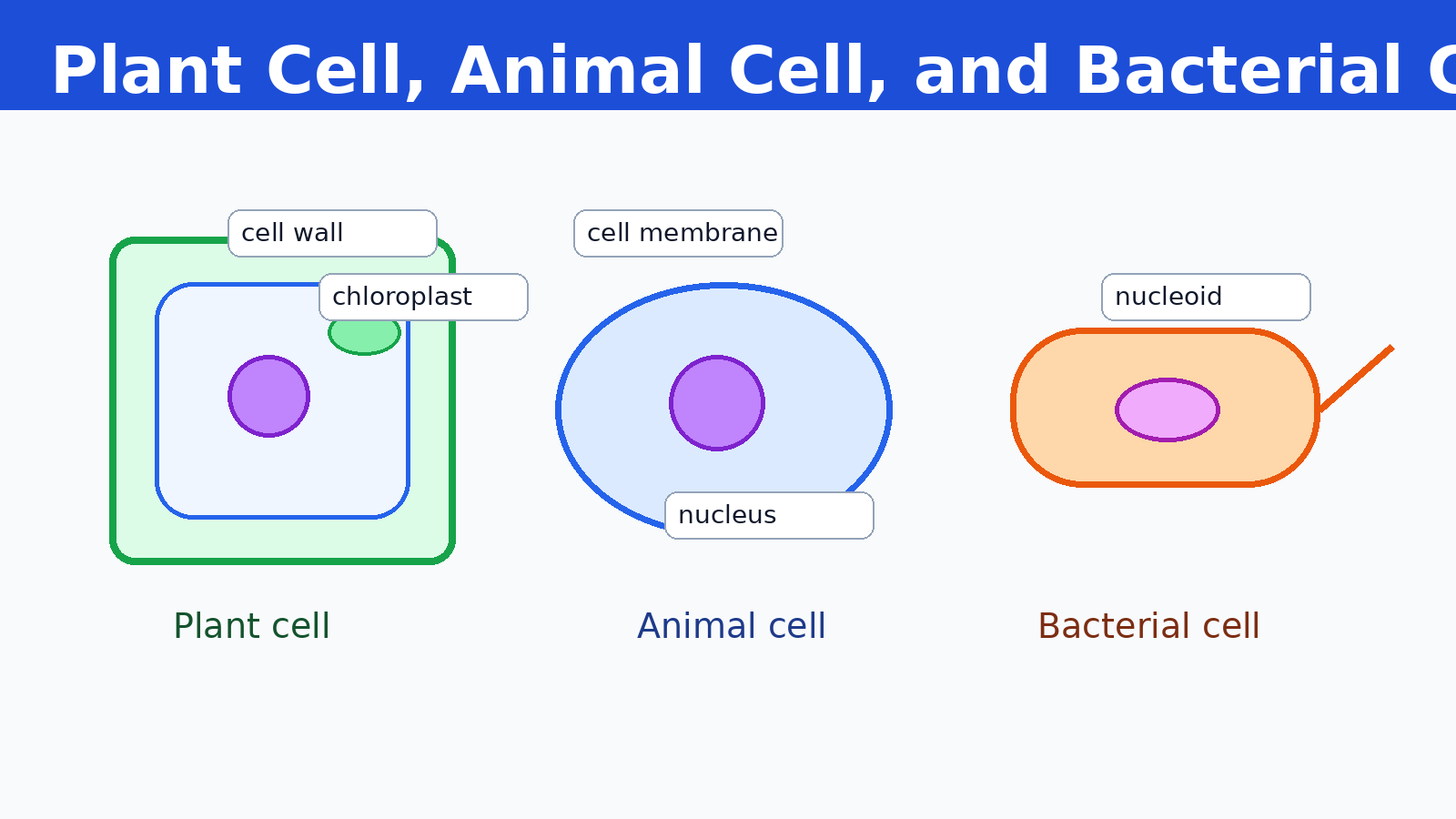
The chapter explains that all living beings are made up of cells. A typical school-level cell diagram should show the cell membrane, cytoplasm, and nucleus. Plant cells add a cell wall, large vacuole, and chloroplasts in green cells, while bacteria have a nucleoid instead of a well-defined nucleus.
| Cell type | Important parts | Exam clue |
|---|---|---|
| Plant cell | Cell wall, cell membrane, cytoplasm, nucleus, vacuole, chloroplast | Often regular in shape because of the cell wall |
| Animal cell | Cell membrane, cytoplasm, nucleus | No cell wall and no chloroplast |
| Bacterial cell | Cell membrane, cytoplasm, cell wall, nucleoid | No well-defined nucleus |
Microorganisms Around Us in The Invisible Living World
Microorganisms are tiny organisms that need a microscope for clear observation. The chapter discusses bacteria, fungi, protozoa, algae, and viruses. Students should remember that microbes are found in water, soil, air, food, inside the gut, and even in extreme conditions.
- Bacteria: may be spherical, rod-shaped, comma-shaped, or spiral.
- Fungi: include yeast and mould, and many fungi grow as filaments.
- Protozoa: often single-celled, with examples such as Amoeba and Paramecium.
- Algae: can photosynthesise and support aquatic life.
- Viruses: are acellular and multiply only inside a host cell.
Helpful Microbes in Food Farming and Environment
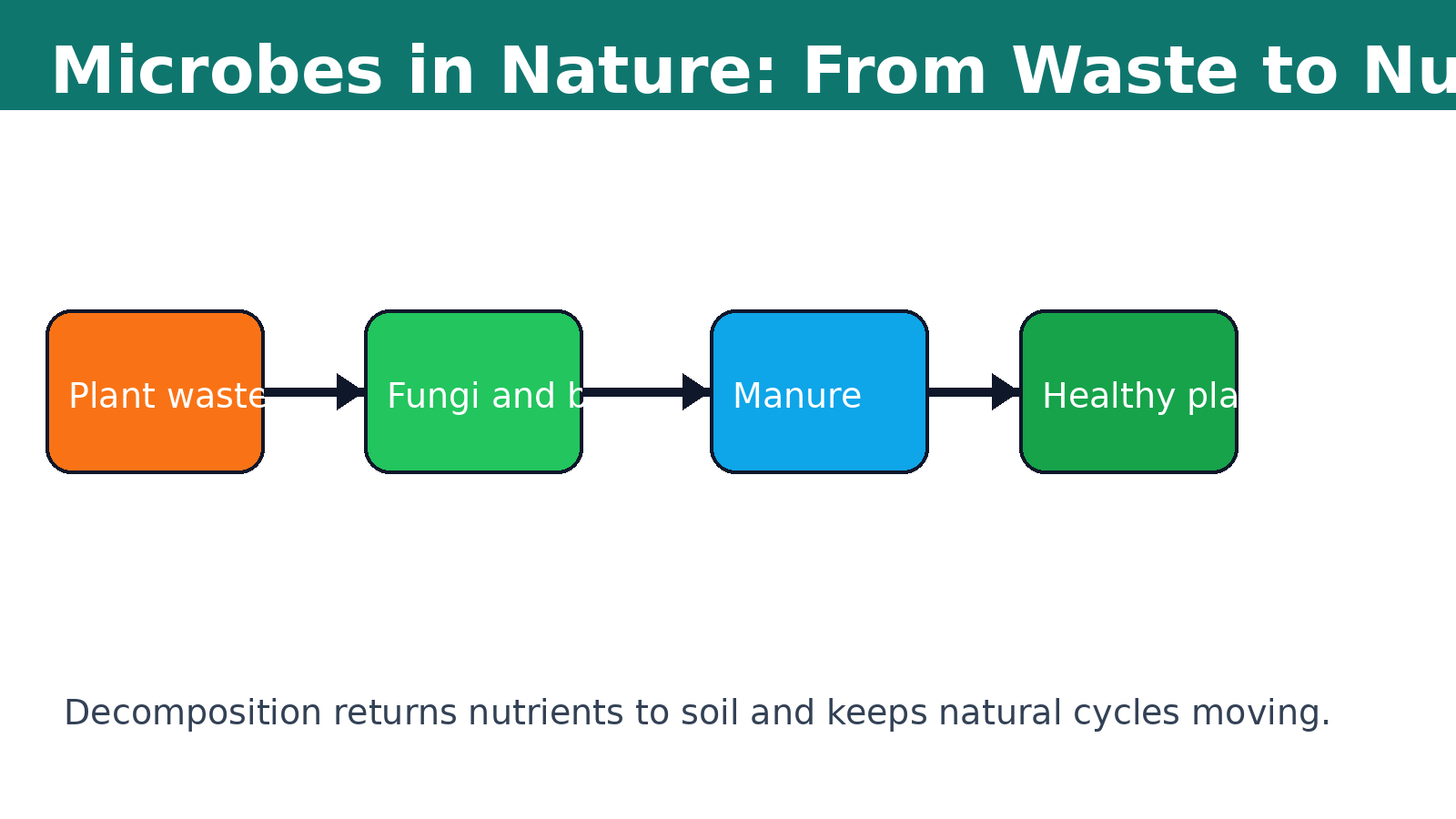
Class 8 Science Chapter 2 is not only about harmful microbes. It also explains how microorganisms form curd, raise dough, recycle nutrients, produce biogas, clean pollutants, and help plants get usable nitrogen.
| Microbe or process | Role in daily life |
|---|---|
| Yeast | Releases carbon dioxide and helps dough rise. |
| Lactobacillus | Converts milk into curd by producing lactic acid. |
| Rhizobium | Lives in legume root nodules and helps plants get nitrogen. |
| Decomposer microbes | Break down plant and animal waste into manure and nutrients. |
How These Class 8 Science Notes Help Students
These notes convert the NCERT chapter into revision-friendly blocks. The PDF includes labelled diagrams for cell parts and microbes, tables for comparing cell types, and answer frames for activity-based questions.
- Use the cell comparison table for short-answer questions.
- Use the microbe role table for one-mark and two-mark questions.
- Use the experiment answer frames for yeast, curd, pond water, and soil suspension activities.
The Invisible Living World Beyond Our Naked Eye Related Resources
| Resource | Link |
|---|---|
| NCERT Solutions | Class 8 Science Chapter 2 NCERT Solutions |
| NCERT Book PDF | Class 8 Science Chapter 2 NCERT Book PDF |
| Handwritten Notes | Class 8 Science Chapter 2 Handwritten Notes |
Class 8 Science Curiosity Notes for All Chapters
| Chapter | Notes |
|---|---|
| Chapter 1 | Exploring the Investigative World of Science Notes |
| Chapter 2 | The Invisible Living World Beyond Our Naked Eye Notes |
| Chapter 3 | Health The Ultimate Treasure Notes |
| Chapter 4 | Electricity Magnetic and Heating Effects Notes |
Student Doubts on Class 8 Science Chapter 2
The Invisible Living World Beyond Our Naked Eye Class 8 Notes FAQs
Ques. What is the main idea of The Invisible Living World Beyond Our Naked Eye?
Ans. The chapter explains that many living forms are too small to see without a microscope. It introduces cells, microorganisms, and their roles in daily life.
Ques. Which cell parts should Class 8 students remember?
Ans. Students should remember cell membrane, cytoplasm, nucleus, cell wall, vacuole, chloroplast, and nucleoid for bacteria.
Ques. How are microbes useful in this chapter?
Ans. Microbes help in curd formation, dough rising, decomposition, manure formation, biogas production, nitrogen fixation, and pollution cleanup.
Ques. Where can I download Class 8 Science Chapter 2 notes PDF?
Ans. Students can download the free PDF from this page using the PDF card above the article body.



Comments