



NCERT Class 8 Science Chapter 6 Pressure, Winds, Storms, and Cyclones Notes explain pressure, liquid pressure, atmospheric pressure, wind formation, high-speed winds, thunderstorms, lightning safety and cyclones for the 2026-27 NCERT Curiosity textbook.
- Best for quick revision: covers pressure formula, pascal, water pressure, air pressure, wind direction and storm formation.
- Useful for activity questions: includes balloon, bottle, sucker, roof, lightning and cyclone examples from the chapter.
- Free PDF: download the full notes with diagrams, tables, key terms and answer frames.
Chapter6Pressure,Winds,Storms,andCyclonesNotes.pdf?page=1&dpi=150)
Chapter6Pressure,Winds,Storms,andCyclonesNotes.pdf?page=2&dpi=150)
Chapter6Pressure,Winds,Storms,andCyclonesNotes.pdf?page=3&dpi=150)
Chapter6Pressure,Winds,Storms,andCyclonesNotes.pdf?page=4&dpi=150)
Chapter6Pressure,Winds,Storms,andCyclonesNotes.pdf?page=5&dpi=150)
Chapter6Pressure,Winds,Storms,andCyclonesNotes.pdf?page=6&dpi=150)
Chapter6Pressure,Winds,Storms,andCyclonesNotes.pdf?page=7&dpi=150)
Chapter6Pressure,Winds,Storms,andCyclonesNotes.pdf?page=8&dpi=150)
Chapter6Pressure,Winds,Storms,andCyclonesNotes.pdf?page=9&dpi=150)
Chapter6Pressure,Winds,Storms,andCyclonesNotes.pdf?page=10&dpi=150)
Chapter6Pressure,Winds,Storms,andCyclonesNotes.pdf?page=11&dpi=150)
Chapter6Pressure,Winds,Storms,andCyclonesNotes.pdf?page=12&dpi=150)
Chapter6Pressure,Winds,Storms,andCyclonesNotes.pdf?page=13&dpi=150)
Chapter6Pressure,Winds,Storms,andCyclonesNotes.pdf?page=14&dpi=150)
Chapter6Pressure,Winds,Storms,andCyclonesNotes.pdf?page=15&dpi=150)
Chapter6Pressure,Winds,Storms,andCyclonesNotes.pdf?page=16&dpi=150)
Chapter6Pressure,Winds,Storms,andCyclonesNotes.pdf?page=17&dpi=150)
Chapter6Pressure,Winds,Storms,andCyclonesNotes.pdf?page=18&dpi=150)
Chapter6Pressure,Winds,Storms,andCyclonesNotes.pdf?page=19&dpi=150)
Chapter6Pressure,Winds,Storms,andCyclonesNotes.pdf?page=20&dpi=150)
Chapter6Pressure,Winds,Storms,andCyclonesNotes_flat_MobileCard.pdf?page=1&dpi=150)
Chapter6Pressure,Winds,Storms,andCyclonesNotes_flat_MobileCard.pdf?page=2&dpi=150)
Chapter6Pressure,Winds,Storms,andCyclonesNotes_flat_MobileCard.pdf?page=3&dpi=150)
Chapter6Pressure,Winds,Storms,andCyclonesNotes_flat_MobileCard.pdf?page=4&dpi=150)
Chapter6Pressure,Winds,Storms,andCyclonesNotes_flat_MobileCard.pdf?page=5&dpi=150)
Chapter6Pressure,Winds,Storms,andCyclonesNotes_flat_MobileCard.pdf?page=6&dpi=150)
Chapter6Pressure,Winds,Storms,andCyclonesNotes_flat_MobileCard.pdf?page=7&dpi=150)
Chapter6Pressure,Winds,Storms,andCyclonesNotes_flat_MobileCard.pdf?page=8&dpi=150)
Chapter6Pressure,Winds,Storms,andCyclonesNotes_flat_MobileCard.pdf?page=9&dpi=150)
Chapter6Pressure,Winds,Storms,andCyclonesNotes_flat_MobileCard.pdf?page=10&dpi=150)
Chapter6Pressure,Winds,Storms,andCyclonesNotes_flat_MobileCard.pdf?page=11&dpi=150)
Chapter6Pressure,Winds,Storms,andCyclonesNotes_flat_MobileCard.pdf?page=12&dpi=150)
Chapter6Pressure,Winds,Storms,andCyclonesNotes_flat_MobileCard.pdf?page=13&dpi=150)
Chapter6Pressure,Winds,Storms,andCyclonesNotes_flat_MobileCard.pdf?page=14&dpi=150)
Chapter6Pressure,Winds,Storms,andCyclonesNotes_flat_MobileCard.pdf?page=15&dpi=150)
Chapter6Pressure,Winds,Storms,andCyclonesNotes_flat_MobileCard.pdf?page=16&dpi=150)
Chapter6Pressure,Winds,Storms,andCyclonesNotes_flat_MobileCard.pdf?page=17&dpi=150)
Chapter6Pressure,Winds,Storms,andCyclonesNotes_flat_MobileCard.pdf?page=18&dpi=150)
Chapter6Pressure,Winds,Storms,andCyclonesNotes_flat_MobileCard.pdf?page=19&dpi=150)
Chapter6Pressure,Winds,Storms,andCyclonesNotes_flat_MobileCard.pdf?page=20&dpi=150)
Chapter6Pressure,Winds,Storms,andCyclonesNotes_flat_MobileCard.pdf?page=21&dpi=150)
Chapter6Pressure,Winds,Storms,andCyclonesNotes_flat_MobileCard.pdf?page=22&dpi=150)
Chapter6Pressure,Winds,Storms,andCyclonesNotes_flat_MobileCard.pdf?page=23&dpi=150)
Chapter6Pressure,Winds,Storms,andCyclonesNotes_flat_MobileCard.pdf?page=24&dpi=150)
Student Feedback: Students usually revise this chapter faster when they connect one idea to the next: force creates pressure, pressure difference creates wind, and warm moist rising air creates storms.
Pressure Winds Storms and Cyclones Notes Overview
Class 8 Science Chapter 6 begins with pressure as force per unit area. It then explains why liquids push on the bottom and sides of containers, why air pressure is large, and how pressure differences make winds blow.
The chapter finally connects fast winds, storms, lightning and cyclones. These notes keep the NCERT activities central so that students can answer observation-based and reasoning-based questions.
Pressure Winds Storms and Cyclones Video Lesson
Source: Magnet Brains on YouTube
Pressure and Liquid Pressure in Class 8 Science Chapter 6
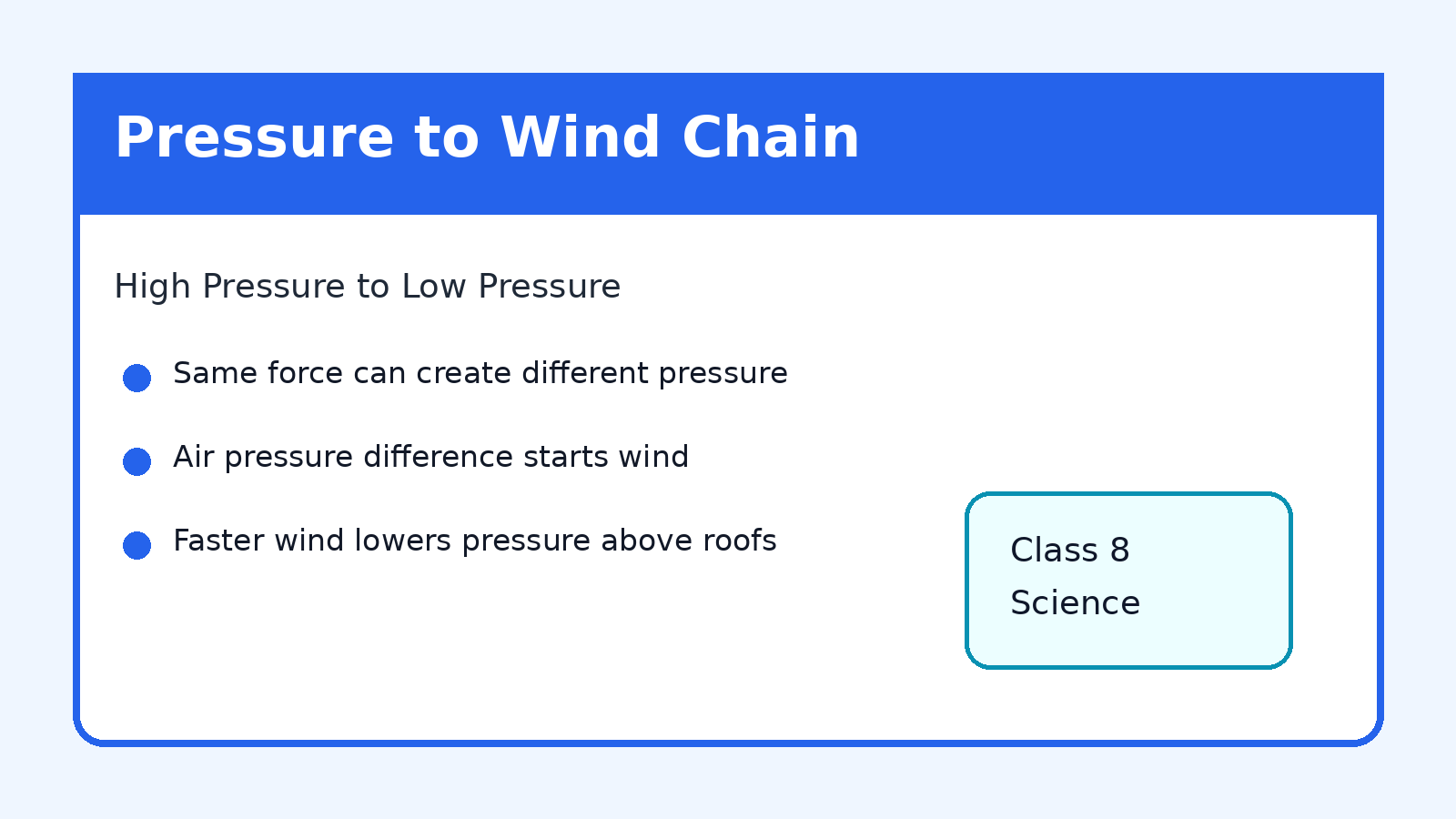
Pressure is defined as force per unit area. A broad bag strap is comfortable because the same force acts over a larger area. A pointed nail enters wood more easily because the same force acts over a smaller area and produces higher pressure.
| Idea | NCERT example | Conclusion |
|---|---|---|
| Pressure | Broad and narrow bag straps | Larger area gives lower pressure |
| Liquid pressure | Water columns in pipes | Pressure depends on height |
| Sideways liquid pressure | Holes near the bottom of a bottle | Liquid pushes container walls |
Air Pressure Wind Formation and Fast Winds
Atmospheric pressure is the pressure exerted by air around us. A rubber sucker sticks to a smooth surface because the pressure outside it is greater than the pressure inside. Wind forms when air moves from high pressure to low pressure.
- Sea breeze: during the day, air usually moves from sea to land because land heats faster.
- Land breeze: at night, air usually moves from land to sea because the sea remains warmer.
- Fast winds: high-speed winds are accompanied by lower pressure and can lift weak roofs.
Storms Lightning and Cyclones
Storms form when warm moist air rises, cools and condenses into clouds. Strong upward and downward winds can separate charges inside clouds. A sudden flow of charges produces lightning, and rapid heating of air produces thunder.
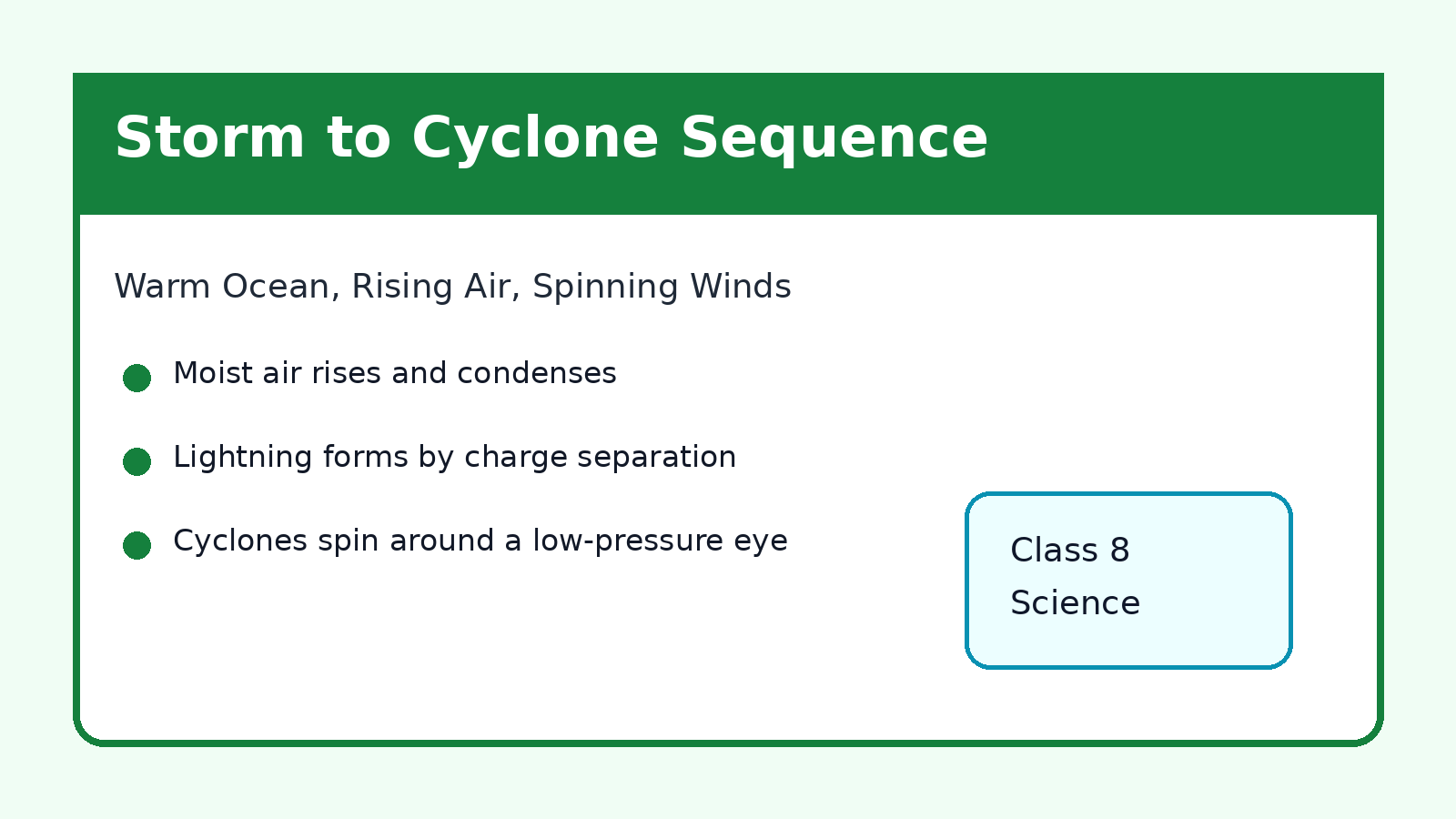
Cyclones form over warm ocean waters. Moist air rises, condensation releases heat, pressure falls further, surrounding air rushes in, and Earth's rotation makes the system spin around a low-pressure centre called the eye.
Pressure Winds Storms and Cyclones Related Resources
| Resource | Link |
|---|---|
| NCERT Solutions | Class 8 Science Chapter 6 NCERT Solutions |
| NCERT Book PDF | Class 8 Science Chapter 6 NCERT Book PDF |
| Handwritten Notes | Class 8 Science Chapter 6 Handwritten Notes |
Class 8 Science Curiosity Notes for All Chapters
| Chapter | Notes |
|---|---|
| Chapter 3 | Health The Ultimate Treasure Notes |
| Chapter 4 | Electricity Magnetic and Heating Effects Notes |
| Chapter 5 | Exploring Forces Notes |
| Chapter 6 | Pressure Winds Storms and Cyclones Notes |
Student Doubts on Class 8 Science Chapter 6
Pressure Winds Storms and Cyclones Class 8 Notes FAQs
Ques. What is pressure in Class 8 Science Chapter 6?
Ans. Pressure is force per unit area. For the same force, pressure increases when the area decreases and decreases when the area increases.
Ques. Why are overhead water tanks placed at a height?
Ans. A greater height of water column gives greater liquid pressure, so water flows from taps with a stronger stream.
Ques. How is wind formed?
Ans. Wind forms when air moves from a region of high pressure to a region of low pressure. Heating creates these pressure differences.
Ques. How does a cyclone form?
Ans. A cyclone forms over warm ocean water when moist air rises, pressure falls, surrounding air rushes in and Earth's rotation makes the system spin.



Comments