



The NCERT Class 8 Science Chapter 7 Particulate Nature of Matter notes bring together the particle model, interparticle spaces, attraction, solids, liquids, gases, diffusion and dissolving for the 2026-27 Curiosity textbook.
- Best for revision: covers chalk, sugar, containers, balloons, incense and soap activities.
- PDF includes: particle diagrams, state comparison tables and exam answer frames.
- Student cue: remember spacing, attraction and movement for most answers.
Chapter7ParticulateNatureofMatterNotes.pdf?page=1&dpi=150)
Chapter7ParticulateNatureofMatterNotes.pdf?page=2&dpi=150)
Chapter7ParticulateNatureofMatterNotes.pdf?page=3&dpi=150)
Chapter7ParticulateNatureofMatterNotes.pdf?page=4&dpi=150)
Chapter7ParticulateNatureofMatterNotes.pdf?page=5&dpi=150)
Chapter7ParticulateNatureofMatterNotes.pdf?page=6&dpi=150)
Chapter7ParticulateNatureofMatterNotes.pdf?page=7&dpi=150)
Chapter7ParticulateNatureofMatterNotes.pdf?page=8&dpi=150)
Chapter7ParticulateNatureofMatterNotes.pdf?page=9&dpi=150)
Chapter7ParticulateNatureofMatterNotes.pdf?page=10&dpi=150)
Chapter7ParticulateNatureofMatterNotes.pdf?page=11&dpi=150)
Chapter7ParticulateNatureofMatterNotes.pdf?page=12&dpi=150)
Chapter7ParticulateNatureofMatterNotes.pdf?page=13&dpi=150)
Chapter7ParticulateNatureofMatterNotes.pdf?page=14&dpi=150)
Chapter7ParticulateNatureofMatterNotes.pdf?page=15&dpi=150)
Chapter7ParticulateNatureofMatterNotes.pdf?page=16&dpi=150)
Chapter7ParticulateNatureofMatterNotes.pdf?page=17&dpi=150)
Chapter7ParticulateNatureofMatterNotes.pdf?page=18&dpi=150)
Chapter7ParticulateNatureofMatterNotes.pdf?page=19&dpi=150)
Chapter7ParticulateNatureofMatterNotes.pdf?page=20&dpi=150)
Chapter7ParticulateNatureofMatterNotes.pdf?page=21&dpi=150)
Chapter7ParticulateNatureofMatterNotes_flat_MobileCard.pdf?page=1&dpi=150)
Chapter7ParticulateNatureofMatterNotes_flat_MobileCard.pdf?page=2&dpi=150)
Chapter7ParticulateNatureofMatterNotes_flat_MobileCard.pdf?page=3&dpi=150)
Chapter7ParticulateNatureofMatterNotes_flat_MobileCard.pdf?page=4&dpi=150)
Chapter7ParticulateNatureofMatterNotes_flat_MobileCard.pdf?page=5&dpi=150)
Chapter7ParticulateNatureofMatterNotes_flat_MobileCard.pdf?page=6&dpi=150)
Chapter7ParticulateNatureofMatterNotes_flat_MobileCard.pdf?page=7&dpi=150)
Chapter7ParticulateNatureofMatterNotes_flat_MobileCard.pdf?page=8&dpi=150)
Chapter7ParticulateNatureofMatterNotes_flat_MobileCard.pdf?page=9&dpi=150)
Chapter7ParticulateNatureofMatterNotes_flat_MobileCard.pdf?page=10&dpi=150)
Chapter7ParticulateNatureofMatterNotes_flat_MobileCard.pdf?page=11&dpi=150)
Chapter7ParticulateNatureofMatterNotes_flat_MobileCard.pdf?page=12&dpi=150)
Chapter7ParticulateNatureofMatterNotes_flat_MobileCard.pdf?page=13&dpi=150)
Chapter7ParticulateNatureofMatterNotes_flat_MobileCard.pdf?page=14&dpi=150)
Chapter7ParticulateNatureofMatterNotes_flat_MobileCard.pdf?page=15&dpi=150)
Chapter7ParticulateNatureofMatterNotes_flat_MobileCard.pdf?page=16&dpi=150)
Chapter7ParticulateNatureofMatterNotes_flat_MobileCard.pdf?page=17&dpi=150)
Chapter7ParticulateNatureofMatterNotes_flat_MobileCard.pdf?page=18&dpi=150)
Chapter7ParticulateNatureofMatterNotes_flat_MobileCard.pdf?page=19&dpi=150)
Chapter7ParticulateNatureofMatterNotes_flat_MobileCard.pdf?page=20&dpi=150)
Chapter7ParticulateNatureofMatterNotes_flat_MobileCard.pdf?page=21&dpi=150)
Chapter7ParticulateNatureofMatterNotes_flat_MobileCard.pdf?page=22&dpi=150)
Chapter7ParticulateNatureofMatterNotes_flat_MobileCard.pdf?page=23&dpi=150)
Chapter7ParticulateNatureofMatterNotes_flat_MobileCard.pdf?page=24&dpi=150)
Chapter7ParticulateNatureofMatterNotes_flat_MobileCard.pdf?page=25&dpi=150)
Chapter7ParticulateNatureofMatterNotes_flat_MobileCard.pdf?page=26&dpi=150)
Chapter7ParticulateNatureofMatterNotes_flat_MobileCard.pdf?page=27&dpi=150)
Chapter7ParticulateNatureofMatterNotes_flat_MobileCard.pdf?page=28&dpi=150)
Chapter7ParticulateNatureofMatterNotes_flat_MobileCard.pdf?page=29&dpi=150)
Student Feedback: In a small Collegedunia revision check, students found this chapter easier after using the three clues: particle spacing, attraction and movement.
Particulate Nature of Matter Notes Overview
Class 8 Science Chapter 7 explains that matter is not continuous at the smallest level. Chalk powder, sugar solution and air in a balloon all point to the same idea: matter is made of extremely tiny particles.
The notes below follow the NCERT activities closely. They help students explain why sugar dissolves, why water takes container shape, why gases fill space and why fragrance spreads through a room.
Particulate Nature of Matter Video Lesson
Source: Magnet Brains on YouTube
Particles and Interparticle Spaces in Chapter 7
Matter is composed of constituent particles. A stick of chalk can be broken into smaller pieces and then into powder. The material remains chalk, but the size of each visible piece becomes smaller.
| NCERT activity | Observation | Particle idea |
|---|---|---|
| Chalk grinding | Chalk becomes fine powder | Matter has tiny constituent particles |
| Sugar dissolving | Sugar is not visible but water tastes sweet | Sugar particles spread in water |
| Ocean water | Salt is invisible but taste remains salty | Dissolved particles are still present |
Solids Liquids and Gases in Particulate Nature of Matter
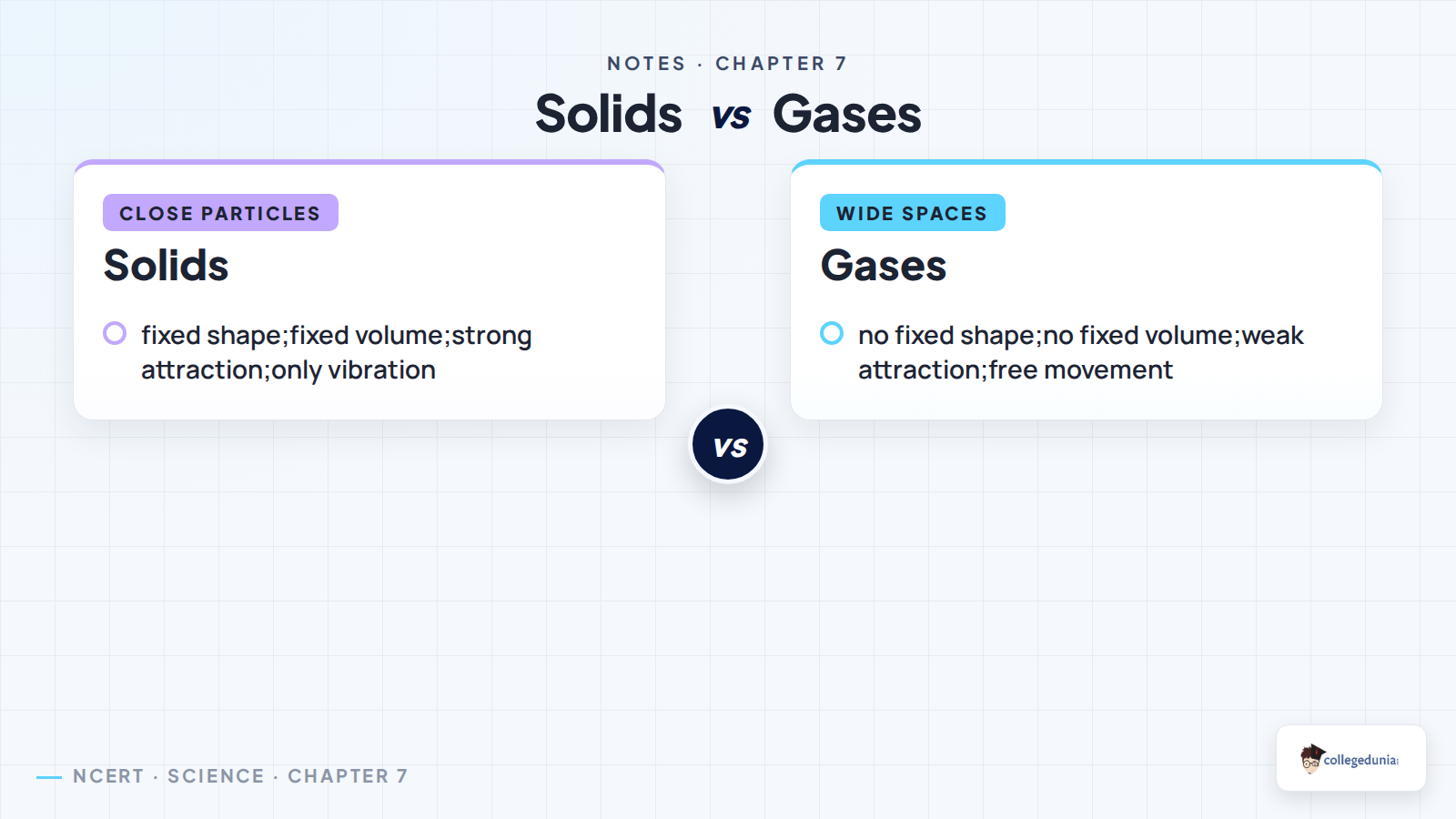
Solids have strong interparticle attraction, very small spacing and fixed particle positions. Liquids have weaker attraction and particles that move within a limited space. Gases have large spaces and particles that move freely.
- Solid: fixed shape and fixed volume because particles only vibrate.
- Liquid: no fixed shape but fixed volume because particles move past one another.
- Gas: no fixed shape or volume because particles fill the available space.
Diffusion Dissolving and Heating Effects
Particles are always moving. When heat is supplied, particle movement increases. This is why potassium permanganate spreads fastest in hot water and slowest in ice-cold water.
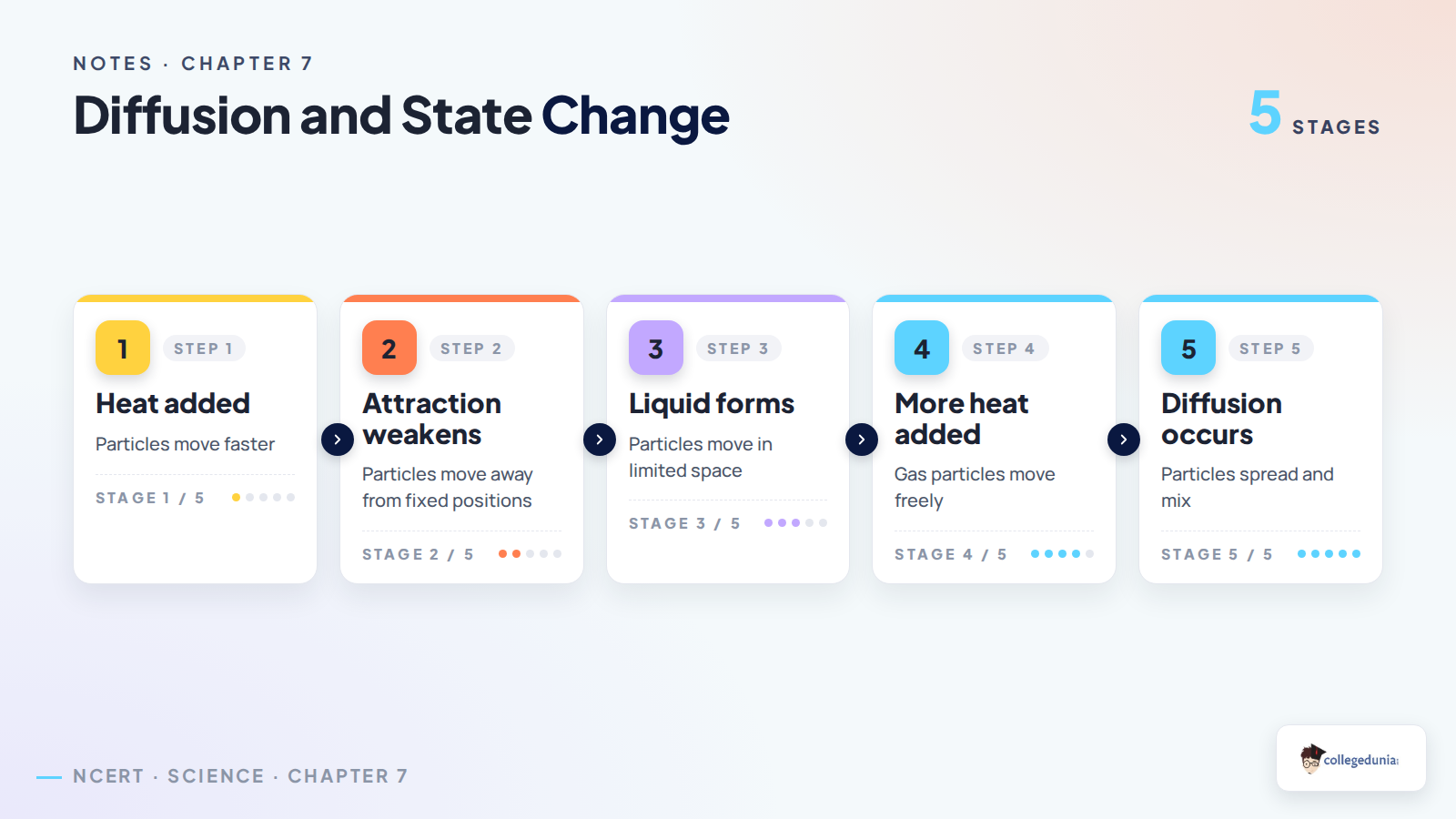
The fragrance of an incense stick spreads across a room because air particles and fragrance particles keep moving. Soap cleaning also works at the particle level because soap particles surround oil particles and help water carry them away.
Particulate Nature of Matter Related Resources
| Resource | Link |
|---|---|
| NCERT Solutions | Class 8 Science Chapter 7 NCERT Solutions |
| NCERT Book PDF | Class 8 Science Chapter 7 NCERT Book PDF |
| Handwritten Notes | Class 8 Science Chapter 7 Handwritten Notes |
Class 8 Science Curiosity Notes for All Chapters
| Chapter | Notes |
|---|---|
| Chapter 4 | Electricity Magnetic and Heating Effects Notes |
| Chapter 5 | Exploring Forces Notes |
| Chapter 6 | Pressure Winds Storms and Cyclones Notes |
| Chapter 7 | Particulate Nature of Matter Notes |
Student Doubts on Class 8 Science Chapter 7
Particulate Nature of Matter Class 8 Notes FAQs
Ques. What is the main idea of Particulate Nature of Matter?
Ans. The main idea is that matter is made of extremely tiny particles that have spaces between them, attract one another and keep moving.
Ques. Why does sugar disappear in water?
Ans. Sugar breaks into tiny particles and spreads in the spaces between water particles. It is not visible, but it is still present.
Ques. Why do gases fill all available space?
Ans. Gas particles are far apart, have very weak attraction and move freely in all directions, so they fill the space available.
Ques. Why does fragrance spread through a room?
Ans. Fragrance particles and air particles keep moving and mixing. This spreading of particles is called diffusion.



Comments