



Inside the NCERT Class 10 Hindi Sparsh Chapter 7 आत्मत्राण PDF you get the official chapter exactly as it is printed in स्पर्श भाग 2. It carries the poet page on रवींद्रनाथ ठाकुर (Ravindranath Thakur), the पाठ प्रवेश note, the full six stanza poem, all ten प्रश्न-अभ्यास questions and the 17 word शब्दार्थ list. This is the last poem of the काव्य खंड, and the download below is the 2026-27 reprint that CBSE schools follow.
- आत्मत्राण is Chapter 7 of स्पर्श भाग 2, the Hindi Course B textbook for Class 10.
- The PDF runs across five pages and closes the poetry section of the book.
- Hazariprasad Dwivedi translated the poem into Hindi from Tagore's original Bangla.


Student Feedback on the आत्मत्राण Chapter
What 11,540 Class 10 Hindi students told us about their आत्मत्राण revision in a Collegedunia poll run before the 2026 boards:
- 64% said the poem's meaning became clear only after they read the शब्दार्थ list first.
- 7 out of 10 students rated आत्मत्राण as the easiest poem to score in among the seven काव्य खंड chapters.
- 38% lost marks by writing that the poet asks God to remove his troubles. He asks for the opposite.
Source: 2026-27 Class 10 Hindi Course B student poll. Sample of 11,540 students from CBSE schools across 14 states.
What the आत्मत्राण Class 10 Sparsh Chapter PDF Contains, Page by Page
The chapter file is short but every page does a job. NCERT opens with the poet, then explains the idea in plain Hindi, then prints the poem, and only after that comes the question set. Reading it in that printed order is the fastest way to understand the poem.
| Page | What is printed there | Why it matters in the exam |
|---|---|---|
| Poet page | Life sketch of रवींद्रनाथ ठाकुर, his major works and the Rabindra Sangeet note | Feeds one mark objective questions on the poet |
| पाठ प्रवेश | Three everyday examples: the swimmer, the exam candidate, the two wrestlers | This is the ready made answer to the central idea question |
| Poem, page 38 | All six stanzas of आत्मत्राण with the translator credit | Extract based भाव स्पष्ट questions are set from these lines |
| प्रश्न-अभ्यास, pages 39 to 40 | Seven questions in part क and three भाव स्पष्ट items in part ख | Board questions repeat these almost word for word |
| योग्यता विस्तार and परियोजना कार्य | Reading suggestions and four project tasks | Used for internal assessment, not the written paper |
| शब्दार्थ list | 17 difficult words with their Hindi meanings | Directly tested in one mark and two mark word meaning questions |
Tip: read the पाठ प्रवेश page before the poem. NCERT wrote it as a bridge, and students who skip it usually misread the first line.
आत्मत्राण Chapter Explained in Hindi
Source: Magnet Brains on YouTube
आत्मत्राण Poem Text with Stanza by Stanza Meaning in Simple Hindi
Here is the complete poem as printed in स्पर्श भाग 2. It has six stanzas and the whole prayer turns on one word: त्राण, which means rescue or protection. The poet uses it in the title but then refuses to ask for it.
विपदाओं से मुझे बचाओ, यह मेरी प्रार्थना नहीं
केवल इतना हो (करुणामय)
कभी न विपद में पाऊँ भय।
दुःख-ताप से व्यथित चित्त को न दो सांत्वना नहीं सही
पर इतना होवे (करुणामय)
दुःख को मैं कर सकूँ सदा जय।
कोई कहीं सहायक न मिले
तो अपना बल पौरुष न हिले;
हानि उठानी पड़े जगत् में लाभ अगर वंचना रही
तो भी मन में ना मानूँ क्षय।।
मेरा त्राण करो अनुदिन तुम यह मेरी प्रार्थना नहीं
बस इतना होवे (करुणामय)
तरने की हो शक्ति अनामय।
मेरा भार अगर लघु करके न दो सांत्वना नहीं सही।
केवल इतना रखना अनुनय,
वहन कर सकूँ इसको निर्भय।
नत शिर होकर सुख के दिन में
तव मुख पहचानूँ छिन-छिन में।
दुःख-रात्रि में करे वंचना मेरी जिस दिन निखिल मही
उस दिन ऐसा हो करुणामय,
तुम पर करूँ नहीं कुछ संशय।।
अनुवाद: हजारीप्रसाद द्विवेदी
Each stanza adds one step to the same request. Read the six meanings below in order and the poem stops feeling difficult.
- Stanza 1: Do not save me from troubles. Just let me never feel fear when trouble arrives.
- Stanza 2: Do not comfort my hurt mind. Let me defeat sorrow on my own instead.
- Stanza 3: If no helper comes, let my own strength and courage stay firm.
- Stanza 4: Do not rescue me daily. Give me the healthy strength to swim across myself.
- Stanza 5: Do not lighten my load. Let me carry it without fear.
- Stanza 6: In happy days let me bow and remember you every moment. On the night when the whole world deceives me, let me never doubt you.
The last stanza is the one examiners like most. The poet's real test of faith is not the good day but the night when निखिल मही, the entire earth, turns away from him.
रवींद्रनाथ ठाकुर and the Hazariprasad Dwivedi Translation Behind आत्मत्राण
The poet page in Sparsh is short, and almost every line of it can become a one mark question. रवींद्रनाथ ठाकुर was born in Calcutta on 7 May 1861 into a well off family and was taught at home. He was sent abroad to study law but came back without sitting the examination. He died on 7 August 1941.
- He was the first Indian to win the Nobel Prize in Literature, awarded in 1913 for his poetry collection गीतांजलि, whose English rendering appeared a year earlier in 1912.
- He wrote close to one thousand poems and two thousand songs, and folk culture is the strongest note in his work.
- His love for painting, music and dance led to a separate stream of music called रवींद्र संगीत.
- He founded शांतिनिकेतन in 1901, an educational and cultural institution treated as one of its kind, which grew into Visva-Bharati in 1921.
- Other works named in the chapter: नैवेद्य, पूरबी, बलाका, क्षणिका, चित्रा, सांध्यगीत, काबुलीवाला, and the novels गोरा and घरे बाइरे.
The poem in your book is not the original. Tagore wrote it in Bangla in the early 1900s, and the lines belong to the same devotional phase as the Bengali गीतांजलि of 1910. आचार्य हजारीप्रसाद द्विवेदी (1907 to 1979) translated it into Hindi. NCERT adds a line about why this matters: a good translation keeps the आत्मा, the soul, of the original poem intact. If a question asks who translated आत्मत्राण, the answer is Dwivedi, not Tagore.
Why आत्मत्राण Reads Differently from Every Other प्रार्थना गीत in Sparsh
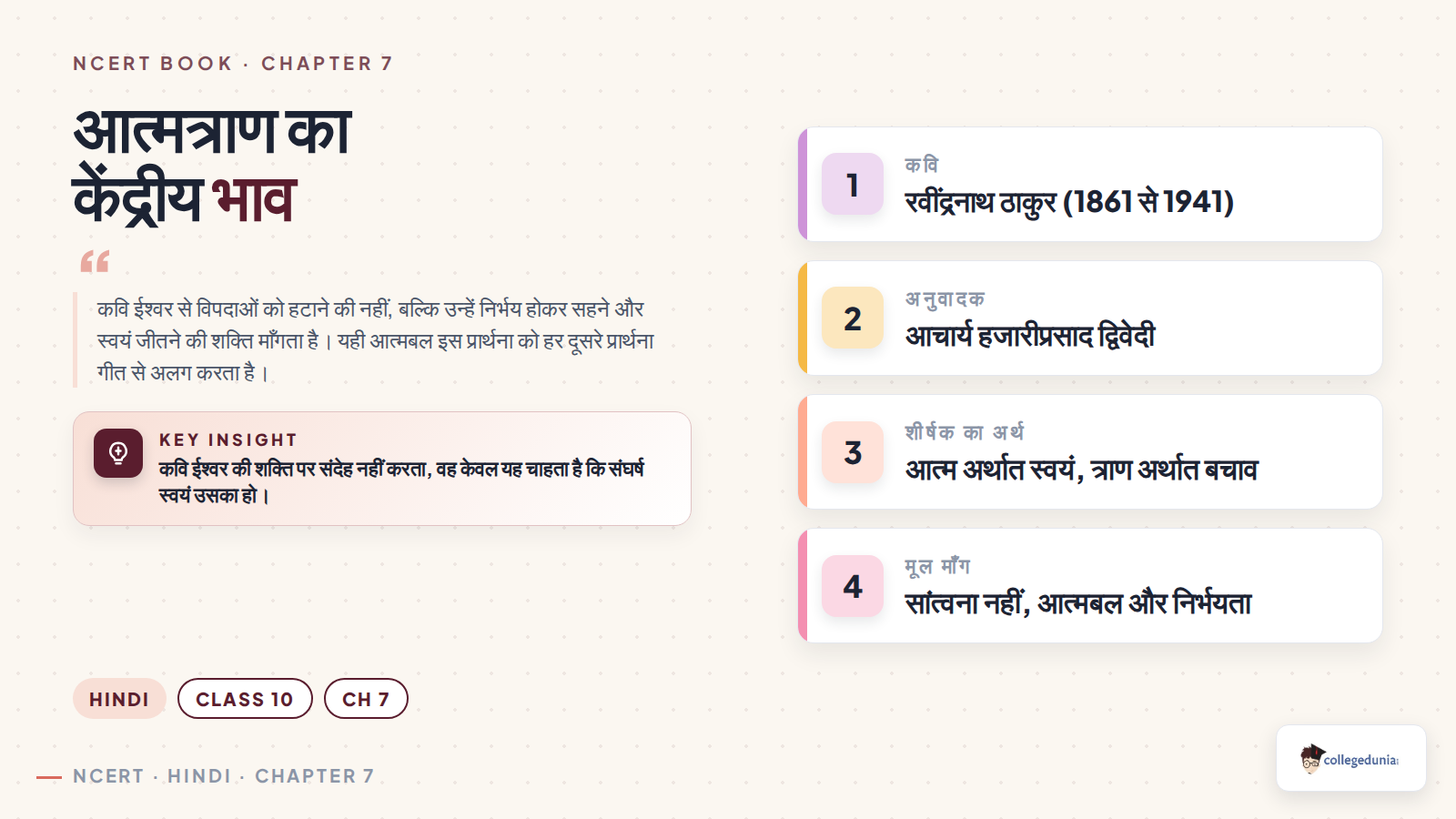
Most prayer poems ask God to take the trouble away. आत्मत्राण does the opposite, and question 7 of the प्रश्न-अभ्यास asks you to explain exactly that difference. The title itself carries the answer: आत्म means self and त्राण means rescue, so the poem is about rescuing yourself.
| A usual प्रार्थना गीत asks for | आत्मत्राण asks for |
|---|---|
| Save me from troubles | Let me not feel fear inside trouble |
| Comfort me when I am sad | Let me win over sorrow myself |
| Send me a helper | If no helper comes, let my courage hold |
| Make my burden lighter | Let me carry the burden without fear |
| Protect me every day | Give me the strength to swim across |
The poet never doubts God's power. He believes प्रभु can do everything. He simply does not want God to do it for him. What he wants is आत्मबल, self strength, and the confidence that he will not blame God even on his worst night. That single idea answers questions 1, 2, 5 and 7 of the exercise.
आत्मत्राण शब्दार्थ: Every Difficult Word Printed in the Sparsh Chapter
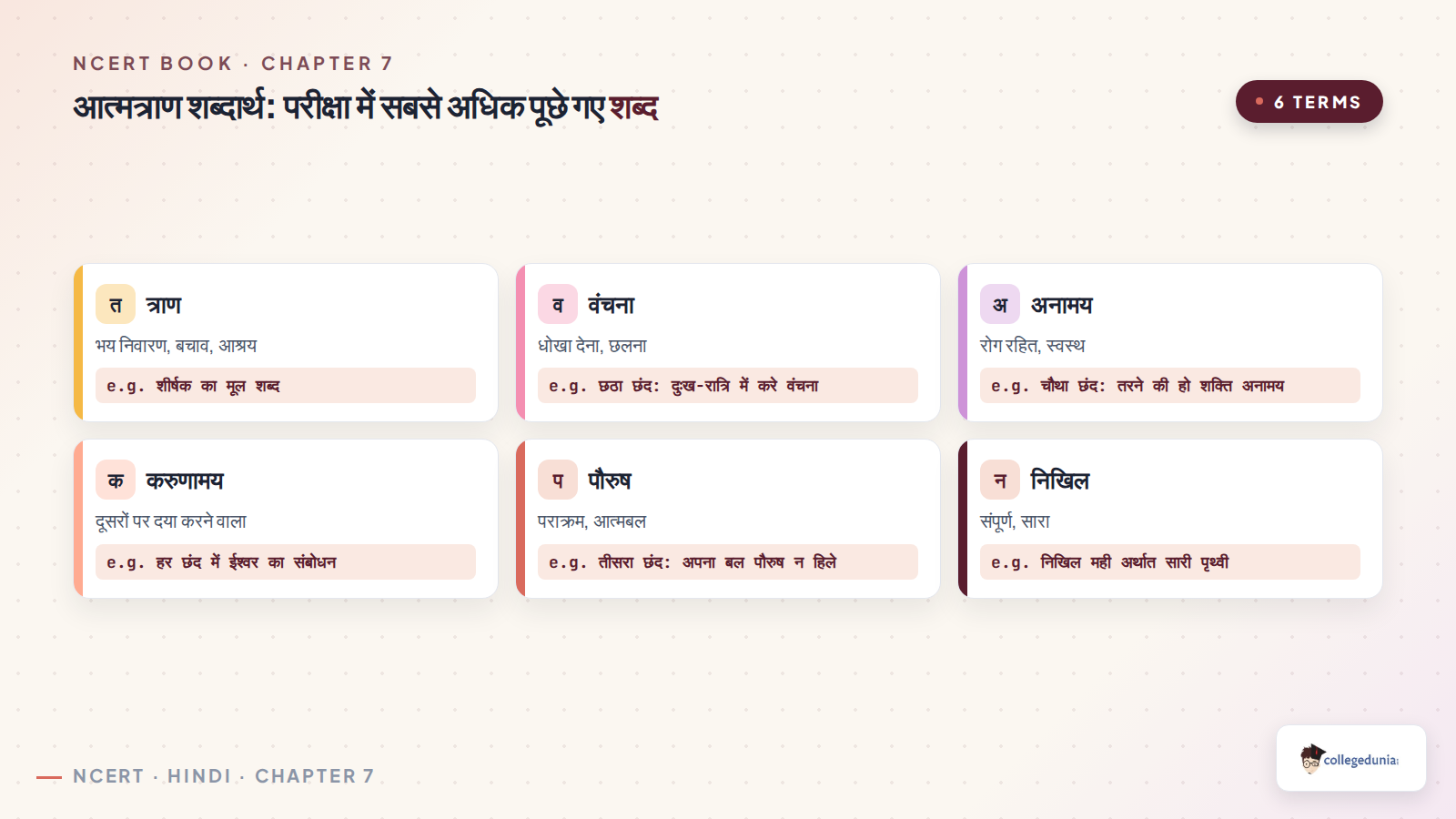
NCERT prints 17 word meanings at the end of the chapter. These are the highest return lines in the whole PDF because they turn up as direct one mark questions and also unlock the stanza meanings.
| शब्द | अर्थ | शब्द | अर्थ |
|---|---|---|---|
| विपदा | विपत्ति, मुसीबत | अनुदिन | प्रतिदिन |
| करुणामय | दूसरों पर दया करने वाला | अनामय | रोग रहित, स्वस्थ |
| दुःख ताप | कष्ट की पीड़ा | सांत्वना | ढाँढ़स बँधाना, तसल्ली देना |
| व्यथित | दुखी | अनुनय | विनय |
| सहायक | मददगार | नत शिर | सिर झुकाकर |
| पौरुष | पराक्रम | दुःख रात्रि | दुख से भरी रात |
| क्षय | नाश | वंचना | धोखा देना, छलना |
| त्राण | भय निवारण, बचाव, आश्रय | निखिल | संपूर्ण |
| संशय | संदेह |
Learn त्राण, वंचना and अनामय first. Those three words carry the meaning of the title, the sixth stanza and the fourth stanza respectively, so they show up in more answers than any other word on the list.
प्रश्न-अभ्यास of आत्मत्राण and What Each Question Actually Tests
The exercise has two parts. Part क has seven questions and part ख has three भाव स्पष्ट items built on quoted lines. Board papers reuse these with very small changes, so answering them in your own words is real practice, not extra work.
| Question | What it asks | What it tests |
|---|---|---|
| क.1 | कवि किससे और क्या प्रार्थना कर रहा है | The central idea in two or three sentences |
| क.2 | Meaning of विपदाओं से मुझे बचाओ, यह मेरी प्रार्थना नहीं | Line level interpretation |
| क.3 | What the poet prays for when no helper is found | Stanza 3 recall on बल and पौरुष |
| क.4 | The अनुनय made at the end | Stanza 6 and the meaning of संशय |
| क.5 | सार्थकता of the title आत्मत्राण | Title justification, a repeat favourite |
| क.6 | What you do besides praying to fulfil your wishes | Personal response, marked on reasoning |
| क.7 | How this prayer differs from other prayer songs | Comparison and originality |
| ख.1 to ख.3 | भाव स्पष्ट for three quoted extracts | Extract based writing, usually four marks |
Question 5 on the title is the single most repeated one from this chapter. Keep a three line answer ready: आत्म means self, त्राण means rescue, and the poet asks for the strength to rescue himself instead of asking to be rescued.
आत्मत्राण Weightage in the Class 10 Hindi Course B Board Paper
The Class 10 Hindi Course B paper carries 80 marks in writing plus 20 marks of internal assessment. स्पर्श भाग 2 sits in the पाठ्यपुस्तक section, and the काव्य खंड of that section usually carries around 14 marks split across an extract question and short answer questions.
| Section of the paper | Approximate marks | Where आत्मत्राण can appear |
|---|---|---|
| अपठित गद्यांश और काव्यांश | 10 | Not applicable |
| व्याकरण | 16 | Not applicable |
| गद्य खंड, स्पर्श भाग 2 | Around 16 | Not applicable |
| काव्य खंड, स्पर्श भाग 2 | Around 14 | Extract question, short answer, word meaning |
| लेखन | 24 | Occasionally as an essay theme on आत्मविश्वास |
- Most common shape: one two mark question on the title or the central idea.
- Second most common: a four mark भाव स्पष्ट built on stanza 3 or stanza 6.
- Least common but easiest: a one mark word meaning from the शब्दार्थ list.
Common Mistakes Students Make in the आत्मत्राण Chapter
Avoid these five in the board answer sheet:
- Writing that the poet asks God to remove his troubles. He clearly says यह मेरी प्रार्थना नहीं.
- Saying the poet has lost faith in God. He asks not to doubt God even on the darkest night.
- Naming Tagore as the person who wrote the Hindi lines. The Hindi is Hazariprasad Dwivedi's translation.
- Mixing up त्राण with तरण. त्राण is rescue, तरना is to swim across.
- Explaining the poem in English in a Hindi paper. Answer in Hindi and quote the poem's own words.
A quick fix for the first one: underline the words नहीं and केवल इतना in your own copy of the PDF. Those two words carry the poem's whole argument.
How to Use the आत्मत्राण Sparsh PDF in a Three Block Revision Plan
This chapter is short, so it does not need days. Around 45 minutes of focused work is enough to make it board ready, and the printed order of the PDF gives you the sequence for free.
- Block 1, 15 minutes. Read the poet page and the पाठ प्रवेश note. Write the swimmer, exam and wrestler examples in one line each. They are your opening for any central idea answer.
- Block 2, 15 minutes. Cover the शब्दार्थ list and read the poem once. Then uncover the list and read it again. The second reading is where the meaning lands.
- Block 3, 15 minutes. Answer questions क.1, क.5 and क.7 in writing. Those three cover the central idea, the title and the comparison, which is most of what the paper asks.
Repeat block 3 a week before the paper. Students who wrote these three answers by hand twice reported the fastest recall in the poetry section.
How the आत्मत्राण Chapter PDF Works with Notes, Solutions and Handwritten Notes
The book PDF gives you the original text and the question list. It does not give you model answers or a summary. Those live on the other Collegedunia pages for the same chapter, and using them together is faster than reading any single one alone.
| Resource | What it adds beyond the book PDF | Link |
|---|---|---|
| NCERT Solutions | Written answers to all seven प्रश्न-अभ्यास questions and the three भाव स्पष्ट extracts | आत्मत्राण Class 10 NCERT Solutions |
| Revision Notes | Stanza summary, central idea, काव्य सौंदर्य points and the poet's key facts in one place | आत्मत्राण Class 10 Notes |
| Handwritten Notes | A topper's handwritten revision pages with colour coded stanza meanings and word lists | आत्मत्राण Class 10 Handwritten Notes |
Also Check: the कर चले हम फ़िदा chapter PDF just before this one, and बड़े भाई साहब, which opens the prose section.
All 14 Chapters of Class 10 Hindi Sparsh Part 2 in NCERT Book PDF Format
स्पर्श भाग 2 has 14 chapters. The first seven are poems and the last seven are prose. Every chapter below opens the same official NCERT file for the 2026-27 session.
| Chapter | NCERT Book PDF |
|---|---|
| Chapter 1 | कबीर, साखी Class 10 NCERT Book PDF |
| Chapter 2 | मीरा, पद Class 10 NCERT Book PDF |
| Chapter 3 | मनुष्यता Class 10 NCERT Book PDF |
| Chapter 4 | पर्वत प्रदेश में पावस Class 10 NCERT Book PDF |
| Chapter 5 | तोप Class 10 NCERT Book PDF |
| Chapter 6 | कर चले हम फ़िदा Class 10 NCERT Book PDF |
| Chapter 7 | आत्मत्राण Class 10 NCERT Book PDF |
| Chapter 8 | बड़े भाई साहब Class 10 NCERT Book PDF |
| Chapter 9 | डायरी का एक पन्ना Class 10 NCERT Book PDF |
| Chapter 10 | तताँरा वामीरो कथा Class 10 NCERT Book PDF |
| Chapter 11 | तीसरी कसम के शिल्पकार शैलेंद्र Class 10 NCERT Book PDF |
| Chapter 12 | अब कहाँ दूसरे के दुख से दुखी होने वाले Class 10 NCERT Book PDF |
| Chapter 13 | पतझर में टूटी पत्तियाँ Class 10 NCERT Book PDF |
| Chapter 14 | कारतूस Class 10 NCERT Book PDF |
आत्मत्राण Class 10 Hindi Sparsh Chapter 7 NCERT Book PDF FAQs
Questions Class 10 Students Ask Most About the आत्मत्राण Chapter PDF
Ques. Where can I download the NCERT Class 10 Hindi Sparsh Chapter 7 आत्मत्राण PDF?
Ans. You can download it free from the card at the top of this page. It is the official NCERT chapter file from स्पर्श भाग 2 for the 2026-27 session, with the poet page, the poem, the प्रश्न-अभ्यास set and the शब्दार्थ list all included.
Ques. Who wrote आत्मत्राण and who translated it into Hindi?
Ans. रवींद्रनाथ ठाकुर (1861 to 1941), who won the Nobel Prize in Literature in 1913 for गीतांजलि, wrote the poem in Bangla. आचार्य हजारीप्रसाद द्विवेदी translated it into Hindi. The Hindi lines you read in Sparsh are Dwivedi's translation, and this is a common one mark question.
Ques. What is the meaning of the title आत्मत्राण?
Ans. आत्म means self and त्राण means rescue or protection. Together the title means rescuing yourself. It fits the poem because the poet asks for the strength to face trouble on his own instead of asking God to remove it.
Ques. What is the central idea of the आत्मत्राण poem?
Ans. The poet believes God can do everything but does not want God to do everything for him. He asks for fearlessness in trouble, courage when no helper comes, the strength to carry his own burden, and faith that does not break even when the whole world deceives him.
Ques. How many stanzas and how many questions does the आत्मत्राण chapter have?
Ans. The poem has six stanzas. The प्रश्न-अभ्यास has seven questions in part क and three भाव स्पष्ट extracts in part ख, so ten questions in total, plus योग्यता विस्तार and four परियोजना कार्य tasks.
Ques. Is आत्मत्राण part of the 2026-27 Class 10 Hindi syllabus?
Ans. Yes. आत्मत्राण is Chapter 7 of स्पर्श भाग 2, the Hindi Course B textbook, and it is part of the काव्य खंड in the 2026-27 session. The PDF on this page is the current reprint that CBSE schools follow.
Ques. How is आत्मत्राण different from other prayer songs?
Ans. A usual prayer asks for troubles to be removed. आत्मत्राण asks for inner strength instead. The poet says विपदाओं से मुझे बचाओ, यह मेरी प्रार्थना नहीं, which means saving me from troubles is not my prayer. That reversal is what makes it stand out.
Ques. What does the line तरने की हो शक्ति अनामय mean?
Ans. अनामय means healthy or free of illness. The poet asks for healthy, unbroken strength to swim across the difficulties of life himself, rather than asking to be carried across. It is the fourth stanza and a frequent भाव स्पष्ट extract.
Ques. How many word meanings are given in the आत्मत्राण शब्दार्थ list?
Ans. The chapter ends with 17 word meanings, from विपदा and करुणामय to वंचना, निखिल and संशय. Learning them first makes the six stanzas much easier to read, and they are also asked directly in one mark questions.
Ques. How many marks does the काव्य खंड carry in the Class 10 Hindi Course B paper?
Ans. The written paper is 80 marks with 20 marks of internal assessment. The काव्य खंड of स्पर्श भाग 2 usually carries around 14 of those marks, split between an extract based question and short answer questions, so a short poem like आत्मत्राण is worth full preparation.



Comments