



Inside the NCERT Class 10 Hindi Sparsh Chapter 8 बड़े भाई साहब PDF you get Premchand's full story text, the प्रश्न-अभ्यास question set, the भाषा अध्ययन grammar drill and the शब्दार्थ glossary. This is the official chapter file printed in Sparsh Part 2 for the 2026-27 session, page 44 to page 57. Nothing is shortened or reworded. Download it once and you have the exact text your CBSE Hindi paper is set from.
- 17-page official file covering printed pages 44 to 57 of Sparsh Part 2, plus the प्रेमचंद author profile and पाठ प्रवेश.
- Carries 5 मौखिक questions, 12 लिखित questions, 4 आशय स्पष्ट कीजिए items and 5 भाषा अध्ययन drills.
- बड़े भाई साहब opens the गद्य खंड of Sparsh Part 2 and is a regular source of 5-mark board questions.


This is the unedited NCERT chapter file for the 2026-27 print run, checked page by page against the official Sparsh Part 2 release before it was put on this page.
Student Feedback
What 11,540 students told us about their बड़े भाई साहब revision, in a Collegedunia poll taken before the 2026 boards.
- 71% of students rated बड़े भाई साहब the easiest गद्य chapter in Sparsh Part 2 to score in.
- Most-skipped part: the भाषा अध्ययन मुहावरे drill, left out by roughly 4 in 10 students.
- Students reported that reading the story once in the original Hindi saved them a full revision round later.
Source: 2026-27 Class 10 Hindi student poll. Sample of 11,540 students from CBSE schools across 19 states.
What the बड़े भाई साहब Class 10 Hindi Book PDF Contains, Page by Page
The file is the complete chapter as NCERT prints it, not a summary sheet. It opens with a रवींद्रनाथ ठाकुर epigraph page, then the प्रेमचंद author profile (1880 to 1936), then पाठ प्रवेश, and only after that does the story itself begin. Use the table below to jump straight to the part you need.
| Section in the PDF | Printed pages | What is on these pages |
|---|---|---|
| प्रेमचंद परिचय | Front matter | Birth at लमही near Banaras, the pen names नवाब राय and प्रेमचंद, the seized सोज़े-वतन, हंस and माधुरी editing, मानसरोवर in eight volumes |
| पाठ प्रवेश | 44 | The one-page setup that explains why the elder child in a house has to hold himself back |
| बड़े भाई साहब (story text) | 45 to 53 | The full first-person story, from the time-table scene to the कनकौआ ending |
| प्रश्न-अभ्यास: मौखिक | 53 | 5 one-line or two-line questions on plot facts |
| प्रश्न-अभ्यास: लिखित (क) and (ख) | 53 to 54 | 5 questions of 25 to 30 words, then 7 questions of 50 to 60 words |
| निम्नलिखित के आशय स्पष्ट कीजिए | 54 | 4 quoted lines from the story to be explained in your own words |
| भाषा अध्ययन | 54 to 55 | पर्यायवाची, मुहावरे, तत्सम and तद्भव sorting, सकर्मक and अकर्मक क्रिया, the 'इक' प्रत्यय drill |
| योग्यता विस्तार and परियोजना कार्य | 55 to 56 | Class discussion topics and two written project tasks |
| शब्दार्थ एवं टिप्पणियाँ | 56 to 57 | The full glossary, from तालीम and पुख्ता down to तजुरबा, बदहवास and मुहताज |
Also Check:
बड़े भाई साहब Chapter Explanation in Hindi
Source: Magnet Brains on YouTube
बड़े भाई साहब Story Summary for Class 10 Hindi Students
The story is told by the younger brother. He is nine, his brother is fourteen. The gap is five years in age but only three classes in school, because the elder brother spends two or three years in every class. Both stay in a hostel, away from home.
The elder brother reads all day and scolds all evening. The younger one slips out to play गुल्ली-डंडा, throws pebbles, flies paper butterflies and rides the gate like a motor car. Every time he walks back into the room the same question waits for him: कहाँ थे? He never answers. His silence is the confession.
- The first turn: in the सालाना इम्तहान the younger brother comes first in his class and the elder one fails.
- The time-table: he draws up a strict स्कीम for study and never follows a line of it.
- The second turn: he passes first again, the elder brother fails again, and the scolding finally softens.
- The speech: the elder brother argues that तजुरबा, real life experience, beats किताबी ज्ञान, and points to their दादा, their अम्मा and the headmaster's grandmother.
- The ending: a cut कनकौआ drifts overhead, the elder brother leaps, grabs the string and runs for the hostel with the younger one behind him.
That last leap is the point of the whole chapter. The boy who lectured about दायित्व all year is still a child, and Premchand lets him be one for exactly one paragraph. Write that line in any 5-mark answer on the elder brother's character and it lands.
Bade Bhai Sahab Character Sketch: Elder and Younger Brother Compared
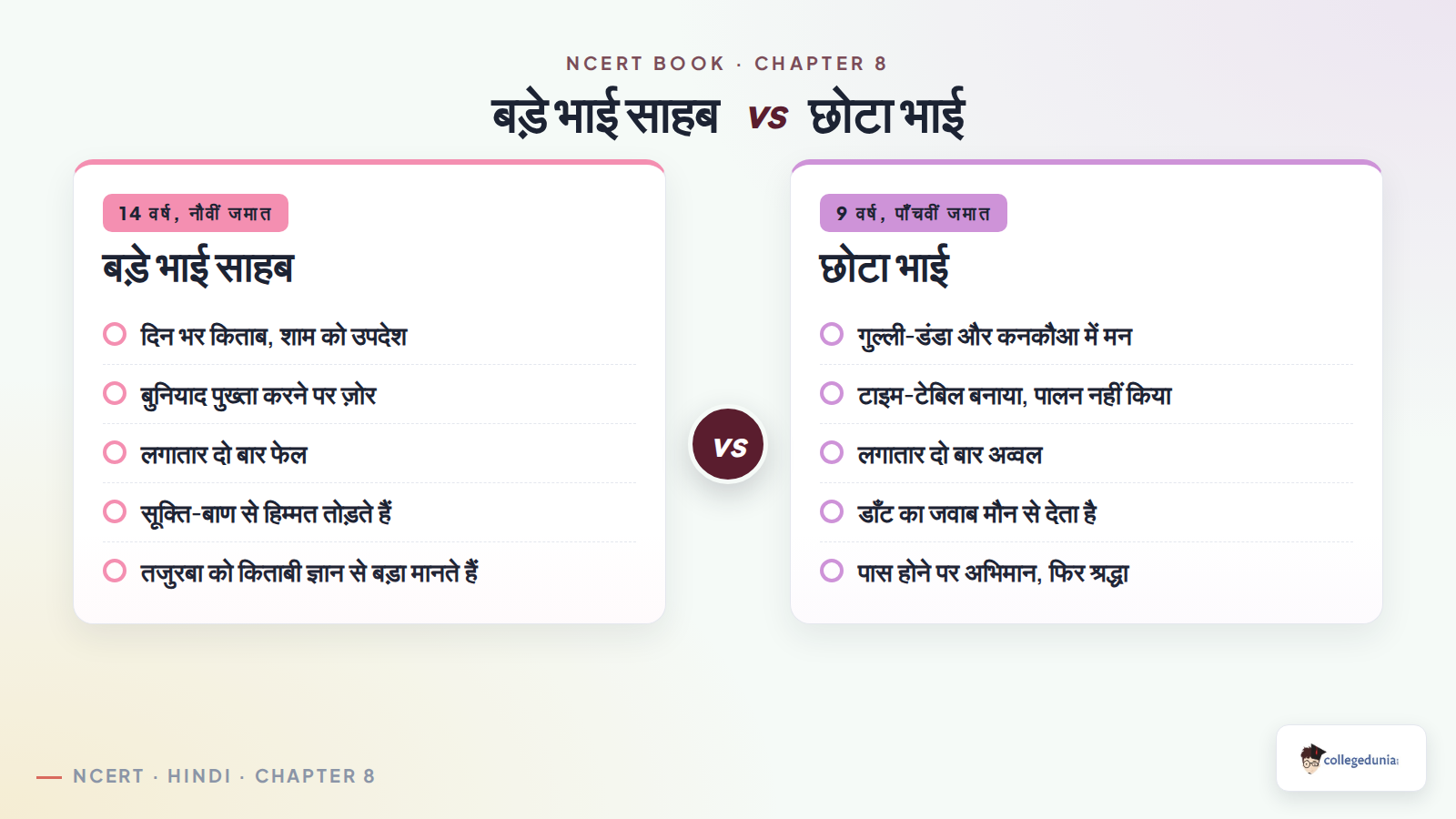
Almost every long-answer question in this chapter is a character question in disguise. Learn the two columns below as a pair, not separately, because the board usually asks you to contrast them.
| Point of comparison | बड़े भाई साहब | छोटा भाई (कथा नायक) |
|---|---|---|
| Age and class | 14 years, नौवीं जमात | 9 years, पाँचवीं जमात |
| Attitude to study | Believes the बुनियाद must be पुख्ता, so one year of work is spread over two or three | Cannot sit with a book for an hour, calls it a पहाड़ |
| Result in the exam | Fails twice in a row | Comes अव्वल twice in a row |
| Way of speaking | उपदेश की कला में निपुण, fires सूक्ति-बाण that break the younger boy's हिम्मत | Answers with मौन, never argues back to his face |
| Hidden side | Doodles birds, cats and dogs in the margins; chases a kite at the end | Grows अभिमान after passing, then loses it when the brother speaks about तजुरबा |
| What he stands for | The weight of बड़प्पन and a lost childhood | Natural स्वच्छंदता and honest self-doubt |
प्रश्न-अभ्यास in Chapter 8: Every Question Type the NCERT Prints
Students often download the PDF, read the story and stop there. The question block that follows on pages 53 to 56 is where the actual board practice sits. Here is the full break-up so you can tick each part off.
- मौखिक (5 questions): answers in one or two lines. Plot facts only, such as the कथा नायक's interests and what the elder brother did to rest his mind.
- लिखित क (5 questions): 25 to 30 words each. Covers the time-table, the गुल्ली-डंडा scene, why the elder brother suppressed his own wishes, and the advice he gave.
- लिखित ख (7 questions): 50 to 60 words each. Includes the satire on the education system, how life understanding comes, why श्रद्धा grew in the younger brother, and the elder brother's स्वभावगत विशेषताएँ.
- आशय स्पष्ट कीजिए (4 items): quoted lines, including इम्तहान पास कर लेना कोई चीज़ नहीं, असल चीज़ है बुद्धि का विकास and the बुनियाद line.
- योग्यता विस्तार and परियोजना कार्य: reading tasks from मानसरोवर, a class debate on रटंत विद्या, and a letter to a younger sibling in a hostel.
Question 7 of the लिखित ख block is the one most students underprepare. It asks you to point to the exact portions of the text that show four things: the younger brother's respect, the elder brother's life experience, the child inside him, and his genuine concern. Mark those four passages in the PDF while you read.
भाषा अध्ययन: मुहावरे, तत्सम and तद्भव Words from बड़े भाई साहब
Premchand's Hindi in this chapter is deliberately idiom-heavy, and the NCERT builds a whole grammar exercise out of it. The chapter note itself says that almost every paragraph carries two or three मुहावरे. Learn these first, because they show up in the language section of the paper even when the chapter itself is not asked.
- Six मुहावरे to use in sentences: सिर पर नंगी तलवार लटकना, आड़े हाथों लेना, अंधे के हाथ बटेर लगना, लोहे के चने चबाना, दाँतों पसीना आना, ऐरा-गैरा नत्थू खैरा.
- Five words for पर्यायवाची: नसीहत, रोष, आज़ादी, राजा, ताज्जुब. Two synonyms each.
- Word-sorting drill: place तालीम, जल्दबाज़ी, पुख्ता, हाशिया, चेष्टा, जमात, हर्फ़, स्कीम, फटकार, विद्वान, निपुण and the rest into तत्सम, तद्भव, देशज or आगत.
- क्रिया drill: mark six given sentences as सकर्मक or अकर्मक, using शीला ने सेब खाया and बच्चा रो रहा है as the model pair.
- प्रत्यय drill: add 'इक' to विचार, इतिहास, संसार, दिन, नीति, प्रयोग and अधिकार.
शब्दार्थ from बड़े भाई साहब Every Class 10 Student Should Memorise
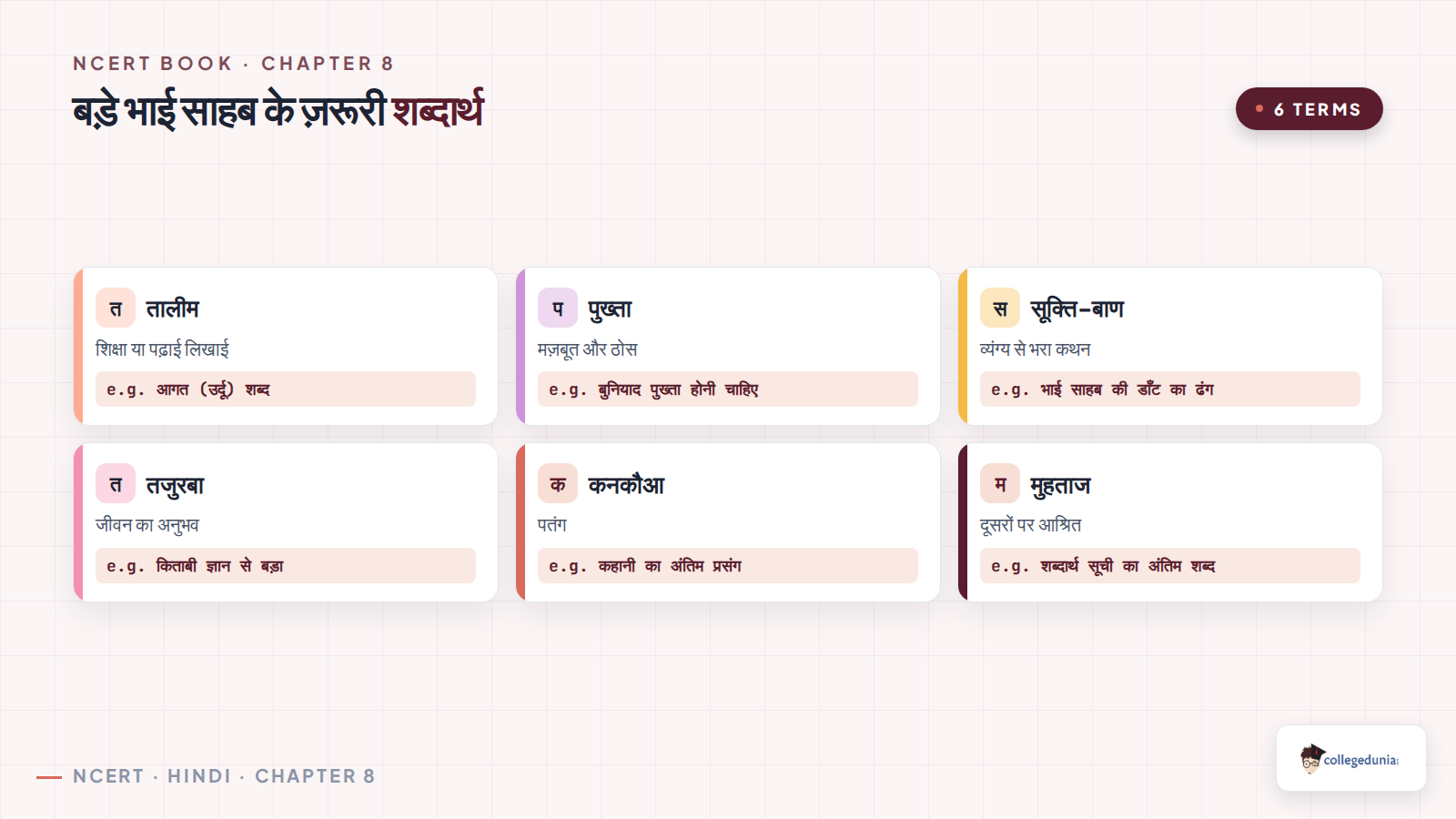
The last two pages of the PDF carry a शब्दार्थ एवं टिप्पणियाँ list of more than forty words. You do not have to memorise all of them. These are the ones that appear inside the question paper's own wording, so they are worth a direct look.
| शब्द | अर्थ | शब्द | अर्थ |
|---|---|---|---|
| तालीम | शिक्षा | पुख्ता | मज़बूत |
| तंबीह | डाँट-डपट | जमात | कक्षा |
| हर्फ़ | अक्षर | चेष्टा | कोशिश |
| सूक्ति-बाण | व्यंग्यात्मक कथन | लताड़ | डाँट-डपट |
| नसीहत | सलाह | फ़जीहत | अपमान |
| अवहेलना | तिरस्कार | अव्वल | प्रथम |
| मुमतहिन | परीक्षक | हिमाकत | बेवकूफ़ी |
| स्वच्छंदता | आज़ादी | सहिष्णुता | सहनशीलता |
| कनकौआ | पतंग | तजुरबा | अनुभव |
| ज़हीन | प्रतिभावान | मुहताज | दूसरे पर आश्रित |
Important Questions from बड़े भाई साहब for the Class 10 Hindi Board Paper
The CBSE Hindi Course B paper picks गद्य questions from Sparsh Part 2 in two shapes: a short 2-mark or 3-mark question on a plot detail, and a longer 4-mark or 5-mark question on character or theme. बड़े भाई साहब supplies both kinds easily, which is why it repeats so often.
- बड़े भाई साहब की स्वभावगत विशेषताएँ बताइए। (character, 5 marks)
- बड़े भाई साहब के अनुसार जीवन की समझ कैसे आती है? (theme, 4 marks)
- इस पाठ में लेखक ने शिक्षा के किन तौर-तरीकों पर व्यंग्य किया है? (satire, 5 marks)
- छोटे भाई के मन में बड़े भाई साहब के प्रति श्रद्धा क्यों उत्पन्न हुई? (relationship, 4 marks)
- कनकौआ वाले प्रसंग का क्या महत्त्व है? (ending, 3 marks)
- छोटे भाई ने टाइम-टेबिल बनाते समय क्या सोचा और उसका पालन क्यों नहीं कर पाया? (plot, 3 marks)
All six sit inside the NCERT question block itself. If you can answer the printed प्रश्न-अभ्यास in your own words without looking back at the story, you are already prepared for the board question on this chapter.
Common Mistakes Students Make in the बड़े भाई साहब Chapter
- Getting the ages wrong. The gap is five years in age but only three classes. Many answers flip that.
- Calling the elder brother cruel. The NCERT wants a balanced sketch. He is strict because he feels responsible, and the text says so in his own words.
- Missing the satire. The chapter attacks रटंत विद्या and a syllabus of dates and grammar rules, not the brother personally.
- Retelling the plot in a character question. Give traits first, then one short line of proof from the story for each trait.
- Skipping the आशय questions. These four quoted lines are the most repeated part of the chapter and take ten minutes to prepare.
Related Links:
How to Read the Class 10 Hindi Sparsh Chapter 8 PDF in One 45-Minute Sitting
This chapter does not need a week. It needs one honest sitting with the PDF open and a pen in hand. Follow the order below and you will finish the story, the questions and the glossary together.
- Minutes 0 to 5: read पाठ प्रवेश on page 44. It tells you the theme before you meet the characters.
- Minutes 5 to 25: read the story straight through, pages 45 to 53, without stopping at unknown words.
- Minutes 25 to 32: go to the शब्दार्थ list on pages 56 and 57 and mark the ten words you actually stumbled on.
- Minutes 32 to 40: read the story's second half again. The words now make sense and the सूक्ति-बाण lines start landing.
- Minutes 40 to 45: answer the 5 मौखिक questions aloud. If you can do that, the written block will not surprise you.
Come back a week later and write the seven लिखित ख answers in full. That second pass is what converts a read chapter into a scored chapter, and it is why students who keep the official PDF on their phone finish Sparsh Part 2 faster than students working only from guide books.
More बड़े भाई साहब Class 10 Hindi Resources
The book PDF gives you the text. These three pages give you the answers, the revision layer and the last-day recap for the same chapter.
| Resource | What it gives you |
|---|---|
| बड़े भाई साहब Class 10 NCERT Solutions | Model answers in Hindi for all 5 मौखिक, 12 लिखित and 4 आशय questions, written to the word limits NCERT prints |
| बड़े भाई साहब Class 10 Revision Notes | Summary, character sketches, theme notes and the मुहावरे list in one place |
| बड़े भाई साहब Class 10 Handwritten Notes | A topper's handwritten revision pages with colour-coded sub-headings for a last-day recap |
| बड़े भाई साहब Class 10 NCERT Book PDF | This page. The official 2026-27 chapter file, pages 44 to 57 of Sparsh Part 2 |
NCERT Book PDF for Class 10 Hindi Sparsh: All 14 Chapters
Sparsh Part 2 runs to 14 chapters, seven in the काव्य खंड and seven in the गद्य खंड. Download the ones your school has taught, or take the full set in one go.
| Chapter | Resource |
|---|---|
| Chapter 1 | कबीर, साखी NCERT Book PDF |
| Chapter 2 | मीरा, पद NCERT Book PDF |
| Chapter 3 | मैथिलीशरण गुप्त, मनुष्यता NCERT Book PDF |
| Chapter 4 | सुमित्रानंदन पंत, पर्वत प्रदेश में पावस NCERT Book PDF |
| Chapter 5 | वीरेन डंगवाल, तोप NCERT Book PDF |
| Chapter 6 | कैफ़ी आज़मी, कर चले हम फ़िदा NCERT Book PDF |
| Chapter 7 | रवींद्रनाथ ठाकुर, आत्मत्राण NCERT Book PDF |
| Chapter 8 | प्रेमचंद, बड़े भाई साहब NCERT Book PDF |
| Chapter 9 | सीताराम सेकसरिया, डायरी का एक पन्ना NCERT Book PDF |
| Chapter 10 | लीलाधर मंडलोई, तताँरा वामीरो कथा NCERT Book PDF |
| Chapter 11 | प्रहलाद अग्रवाल, तीसरी कसम के शिल्पकार शैलेंद्र NCERT Book PDF |
| Chapter 12 | निदा फ़ाज़ली, अब कहाँ दूसरे के दुख से दुखी होने वाले NCERT Book PDF |
| Chapter 13 | रवींद्र केलेकर, पतझर में टूटी पत्तियाँ NCERT Book PDF |
| Chapter 14 | हबीब तनवीर, कारतूस NCERT Book PDF |
बड़े भाई साहब Class 10 Hindi NCERT Book PDF FAQs
Common Questions on the Class 10 Hindi Sparsh Chapter 8 File
Ques. Where can I download the NCERT Class 10 Hindi Sparsh Chapter 8 बड़े भाई साहब PDF?
Ans. You can download it directly from this page. It is the official NCERT chapter file for the 2026-27 print of Sparsh Part 2, and it is free.
Ques. How many pages is the बड़े भाई साहब chapter PDF?
Ans. The file runs to 17 pages and covers printed pages 44 to 57 of Sparsh Part 2. That includes the प्रेमचंद author profile, पाठ प्रवेश, the story, प्रश्न-अभ्यास, भाषा अध्ययन and the शब्दार्थ list.
Ques. Who wrote बड़े भाई साहब and when?
Ans. प्रेमचंद (Premchand) wrote it. He was born धनपत राय at लमही near Banaras on 31 July 1880 and died on 8 October 1936. He wrote in Urdu as नवाब राय and in Hindi as प्रेमचंद, and his stories are collected in मानसरोवर in eight volumes.
Ques. Is बड़े भाई साहब part of the Class 10 Hindi syllabus for 2026-27?
Ans. Yes. It is Chapter 8 of Sparsh Part 2, the first chapter of the गद्य खंड, and it is in the current 2026-27 Hindi Course B syllabus.
Ques. What is the main theme of बड़े भाई साहब?
Ans. Premchand contrasts किताबी ज्ञान with तजुरबा, real life experience, and satirises an education system built on rote learning. Alongside that runs the quieter theme of an elder child losing his own childhood to the duty of being an example.
Ques. How many questions are there in the बड़े भाई साहब प्रश्न-अभ्यास?
Ans. There are 5 मौखिक questions, 5 लिखित questions of 25 to 30 words, 7 लिखित questions of 50 to 60 words, and 4 आशय स्पष्ट कीजिए items. भाषा अध्ययन adds 5 more grammar drills.
Ques. What does the कनकौआ scene at the end mean?
Ans. A cut kite drifts over the two brothers and the elder one jumps, catches the string and runs off with it. It shows that the child in him was never gone, only pushed down by the responsibility of being the elder brother.
Ques. Which मुहावरे from this chapter should I prepare?
Ans. The NCERT asks you to use six in sentences: सिर पर नंगी तलवार लटकना, आड़े हाथों लेना, अंधे के हाथ बटेर लगना, लोहे के चने चबाना, दाँतों पसीना आना and ऐरा-गैरा नत्थू खैरा.
Ques. Do I need the NCERT Solutions if I already have the book PDF?
Ans. The book PDF carries the questions but not the answers. Use the बड़े भाई साहब Class 10 NCERT Solutions to check your answers against model ones written to the printed word limits.
Ques. How many chapters are there in Class 10 Hindi Sparsh Part 2?
Ans. Sparsh Part 2 has 14 chapters, seven poems in the काव्य खंड and seven prose pieces in the गद्य खंड. बड़े भाई साहब is Chapter 8 and opens the prose section.



Comments