


The NCERT Book for Class 10 Science Chapter 10 The Human Eye and the Colourful World is the official CBSE textbook chapter, free to read and download for the 2026-27 session. This chapter explains how the human eye works as a natural camera, the power of accommodation, the three common defects of vision and their correction, and the optical phenomena of nature: dispersion of white light, atmospheric refraction and scattering of light.
- Official NCERT textbook PDF of Chapter 10, with every activity, figure, in-text question and exercise exactly as printed.
- Covers the structure of the human eye, power of accommodation, myopia, hypermetropia, presbyopia, refraction through a prism, dispersion of light, the rainbow, twinkling of stars and the blue colour of the sky.
- Aligned with the 2026-27 CBSE Class 10 Science syllabus, useful for board exam revision and as the base text for the solutions and notes.
This page hosts the official NCERT Class 10 Science textbook chapter, mapped to the 2026-27 CBSE syllabus and checked page by page against the printed The Human Eye and the Colourful World chapter.
Student Feedback: What 13,600 students told us about this chapter
79% of Class 10 students said the parts they mixed up most were myopia versus hypermetropia, which lens corrects which defect, and the difference between dispersion and scattering. 3 out of 5 students told us that learning each defect as a pair (the problem, then the lens that fixes it) and memorising VIBGYOR for dispersion was what finally made the chapter click.
Students reported spending on average 4 to 5 hours on the full chapter across the first read and revision, and toppers said that linking every nature phenomenon to one cause (twinkling and advance sunrise to atmospheric refraction, blue sky and red danger lights to scattering) stopped them from losing marks on the reasoning questions in the board exam.
Source: 2026-27 Class 10 Science student poll. Sample of 13,600 students from CBSE schools across 13 states, taken before the 2026 board exams.
What the NCERT Book for Class 10 Science Chapter 10 The Human Eye and the Colourful World Covers
The downloadable PDF above is the complete official NCERT chapter, exactly as printed in the 2026-27 textbook. It covers the human eye and power of accommodation, the three defects of vision and their lenses, refraction through a prism, dispersion and the rainbow, and atmospheric refraction and scattering of light.
The Human Eye and the Colourful World Class 10 Science Full Chapter Video
Source: Magnet Brains on YouTube
The Human Eye and Its Structure in Class 10 Science Chapter 10
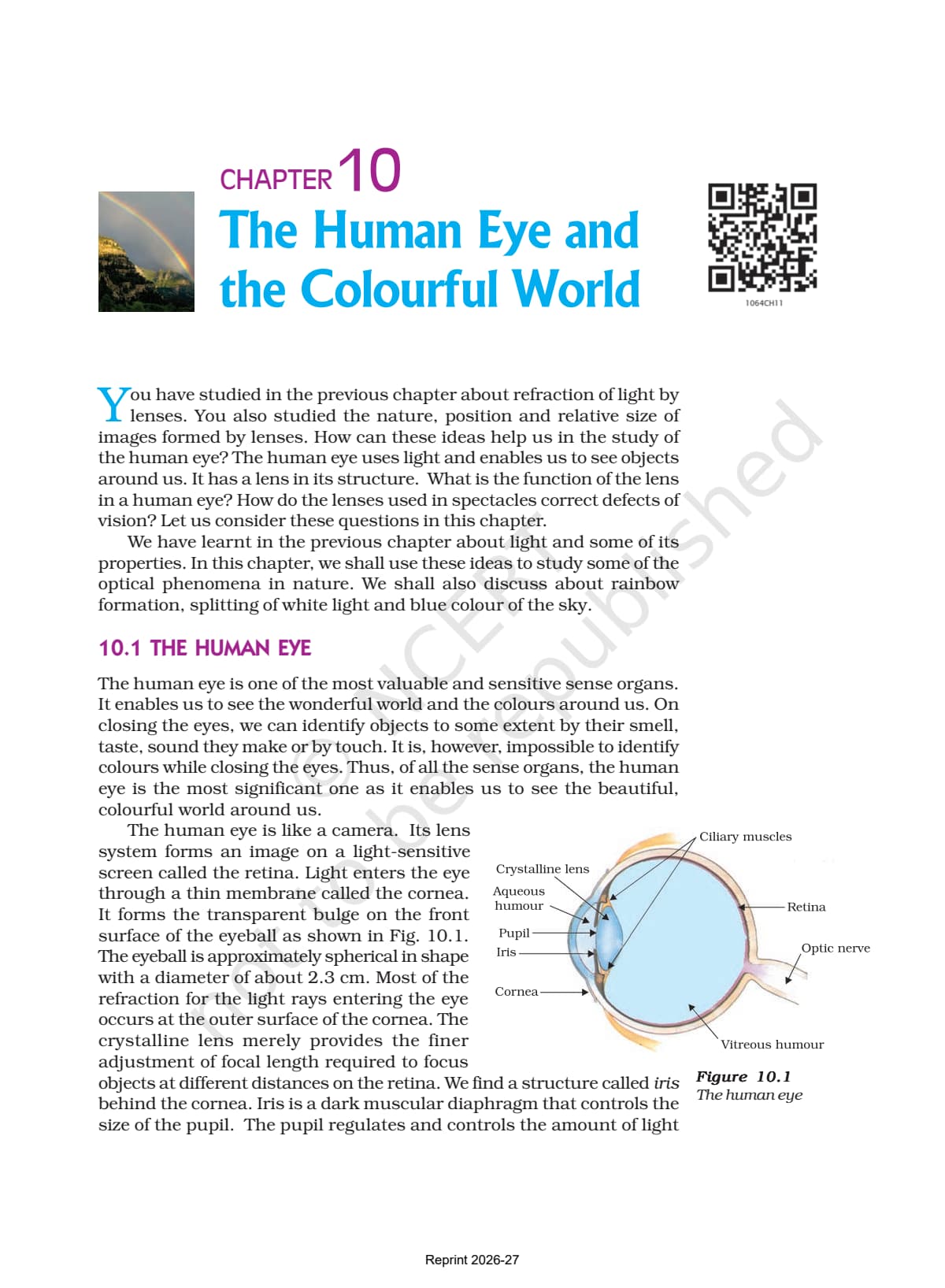
Section 10.1 introduces the human eye. It works like a camera: its lens system forms a real, inverted image on a light-sensitive screen called the retina. Light enters through the cornea, the eye lens fine-tunes the focal length, and the brain turns the retina's signals into the picture we see.
| Part of the eye | Function in Chapter 10 |
|---|---|
| Cornea | The transparent front bulge where most of the refraction of incoming light happens |
| Iris | The dark muscular diaphragm that controls the size of the pupil |
| Pupil | The opening that regulates and controls the amount of light entering the eye |
| Eye lens (crystalline lens) | Provides the fine adjustment of focal length to focus objects at different distances |
| Retina | The light-sensitive screen where a real, inverted image forms and signals start |
The eyeball is roughly spherical, about 2.3 cm across. The retina holds light-sensitive cells that generate electrical signals. These travel to the brain through the optic nerve, and the brain interprets them so we perceive objects the right way up, even though the retinal image is inverted.
Power of Accommodation and Near Point in Class 10 Science Chapter 10
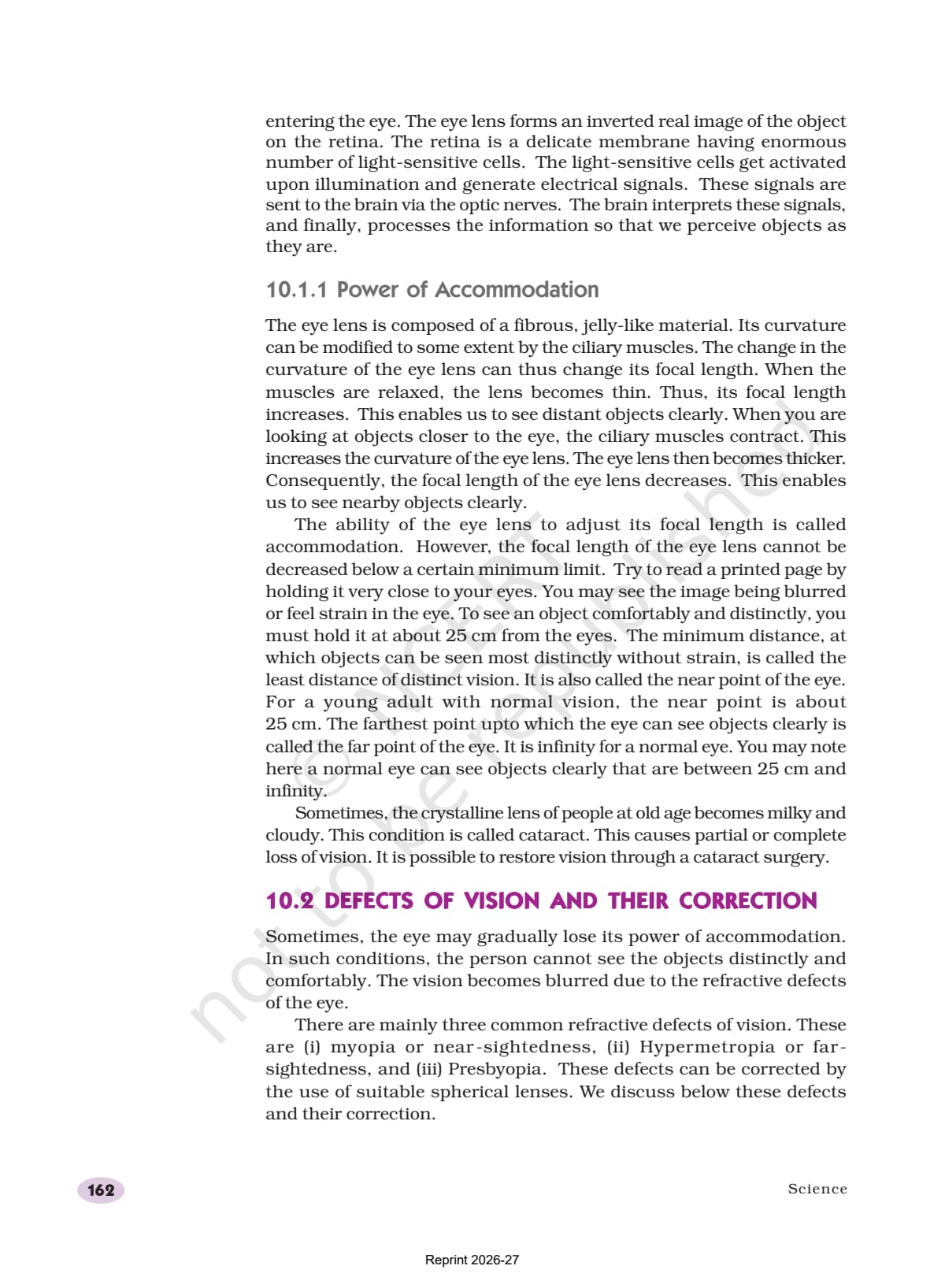
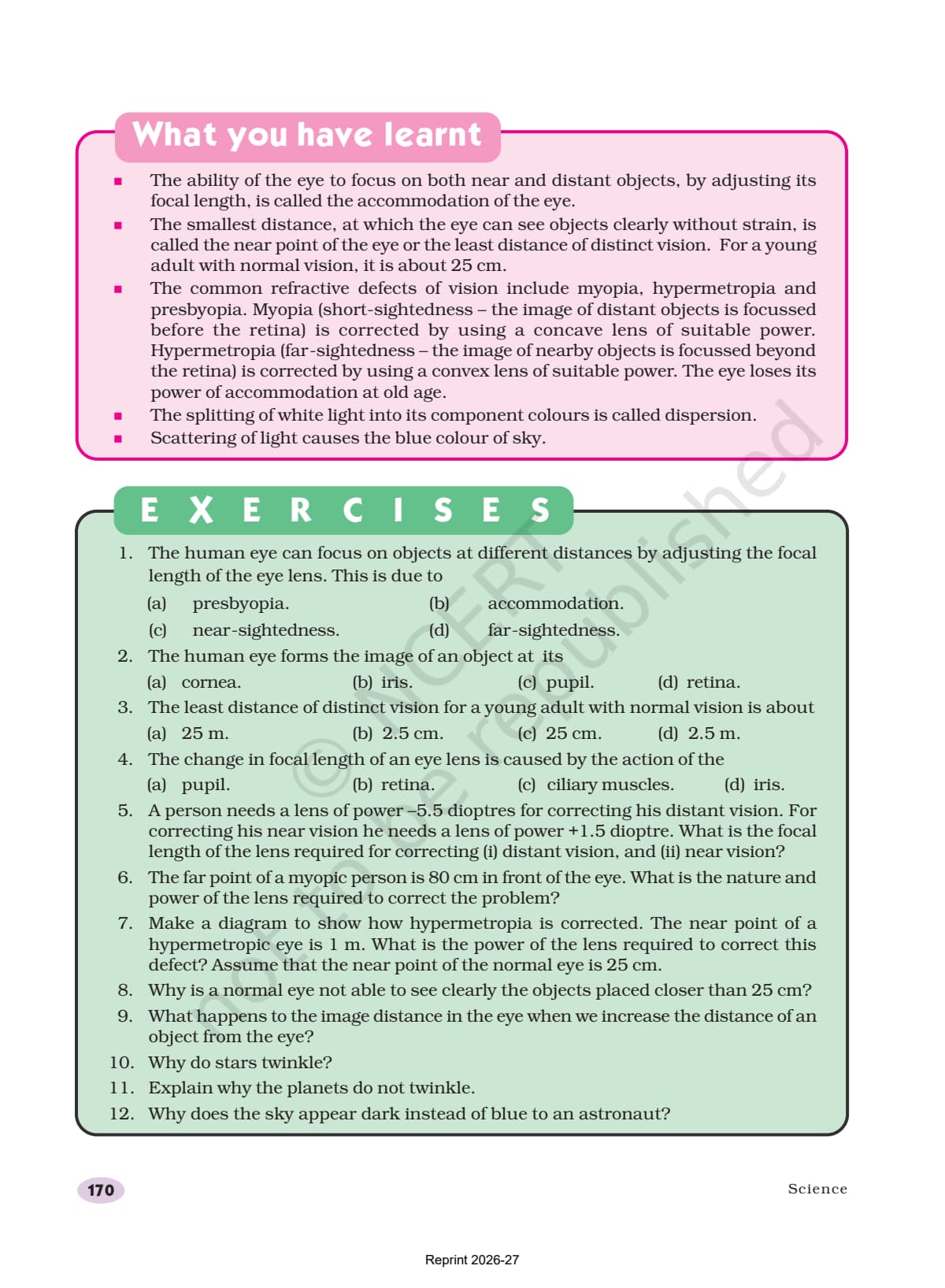
Section 10.1.1 explains the power of accommodation. The ciliary muscles change the eye lens curvature, which changes its focal length. When the muscles relax, the lens becomes thin, focal length increases, and we see distant objects clearly; when they contract, the lens thickens, focal length decreases, and we see nearby objects clearly. This ability is called accommodation.
| Looking at | Ciliary muscles | Eye lens | Focal length |
|---|---|---|---|
| Distant object | Relaxed | Thin | Increases |
| Nearby object | Contracted | Thick | Decreases |
The focal length cannot fall below a limit, so there is a closest distance for clear vision. This is the near point or least distance of distinct vision, about 25 cm for a young adult. The far point is the farthest point of clear vision, infinity for a normal eye. (Cataract: the eye lens turns milky at old age; it is restored by surgery.)
Defects of Vision and Their Correction in Class 10 Science Chapter 10
Section 10.2 covers the three refractive defects of vision. When the eye loses accommodation or the eyeball changes shape, the image no longer forms on the retina and vision blurs. The three defects are myopia (near-sightedness), hypermetropia (far-sightedness) and presbyopia.
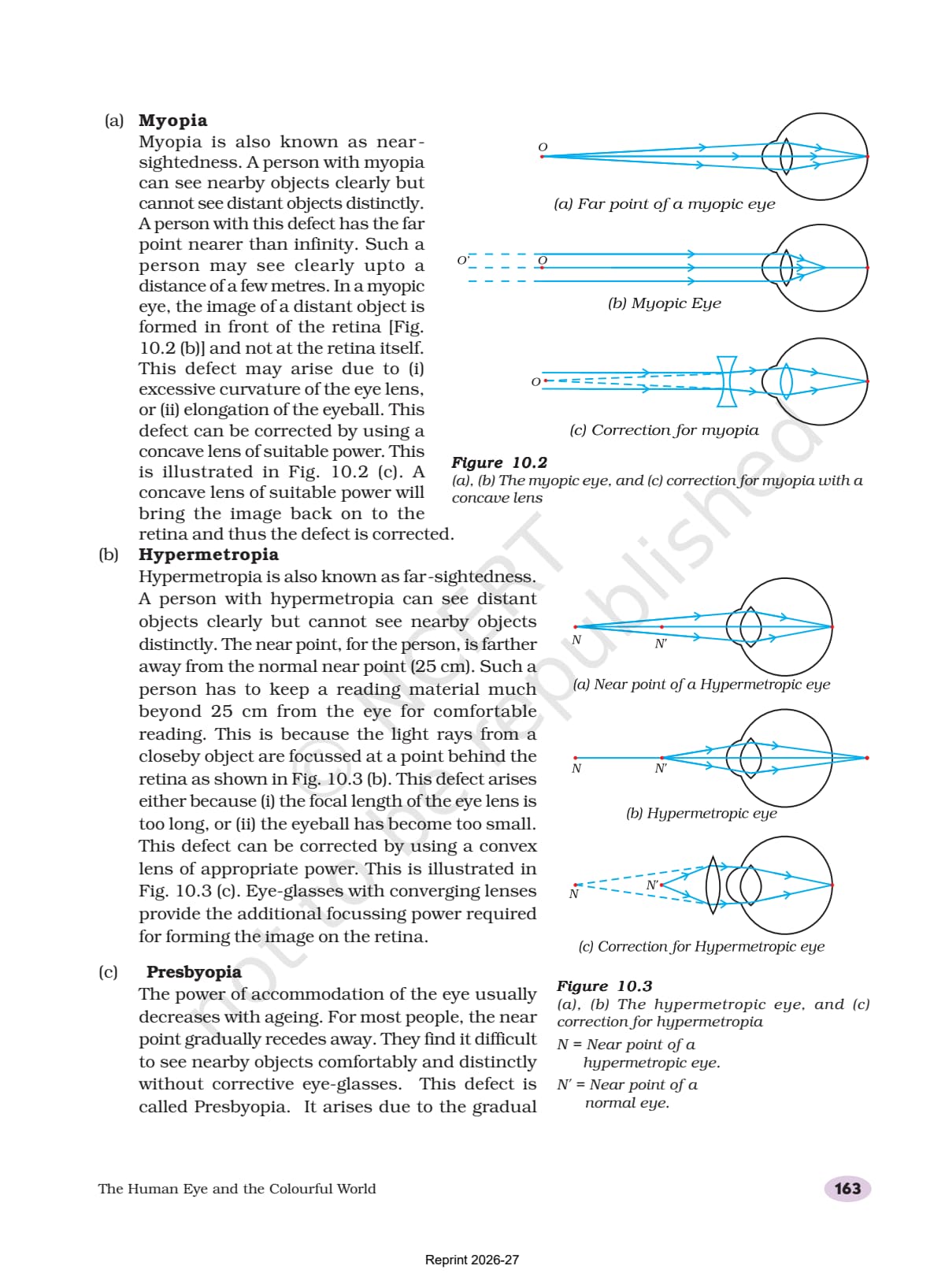
In myopia a person sees nearby objects clearly but not distant ones, as the image forms in front of the retina; it is caused by excessive lens curvature or an elongated eyeball. Myopia is corrected with a concave (diverging) lens. In hypermetropia a person sees distant objects but not nearby ones, as the image forms behind the retina. Hypermetropia is corrected with a convex (converging) lens. The table below sums up all three defects.
| Defect | Also called | What goes wrong | Correcting lens |
|---|---|---|---|
| Myopia | Near-sightedness | Distant object image forms in front of the retina; far point nearer than infinity | Concave (diverging) lens |
| Hypermetropia | Far-sightedness | Nearby object image forms behind the retina; near point farther than 25 cm | Convex (converging) lens |
| Presbyopia | Old-age vision | Power of accommodation falls with age; near point recedes | Bi-focal lens (concave + convex) |
Presbyopia arises with ageing as the ciliary muscles weaken, so the near point recedes. When a person has both myopia and hypermetropia, a bi-focal lens is used: concave upper part for distant vision, convex lower part for near vision.
Refraction of Light Through a Prism in Class 10 Science Chapter 10
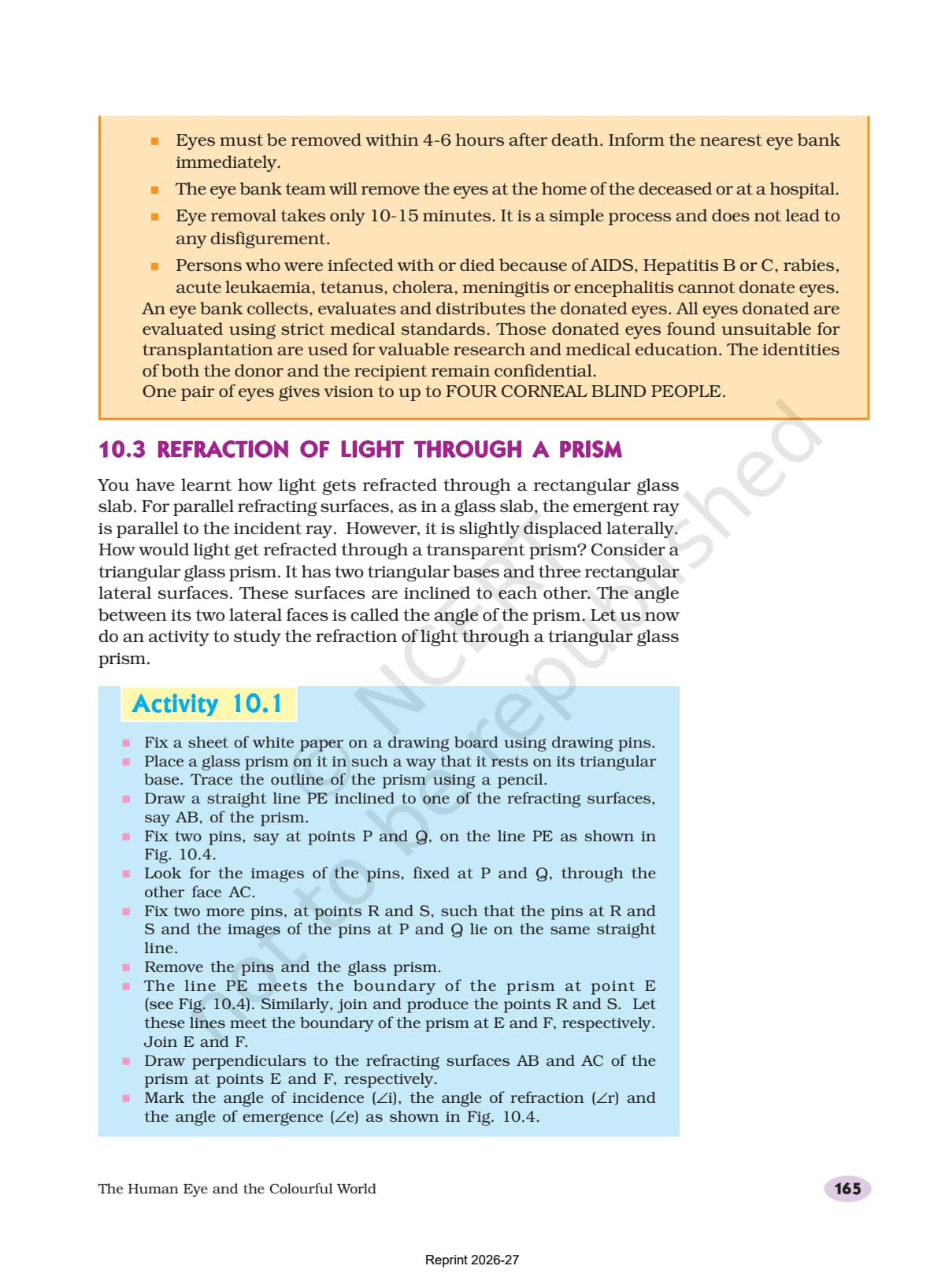
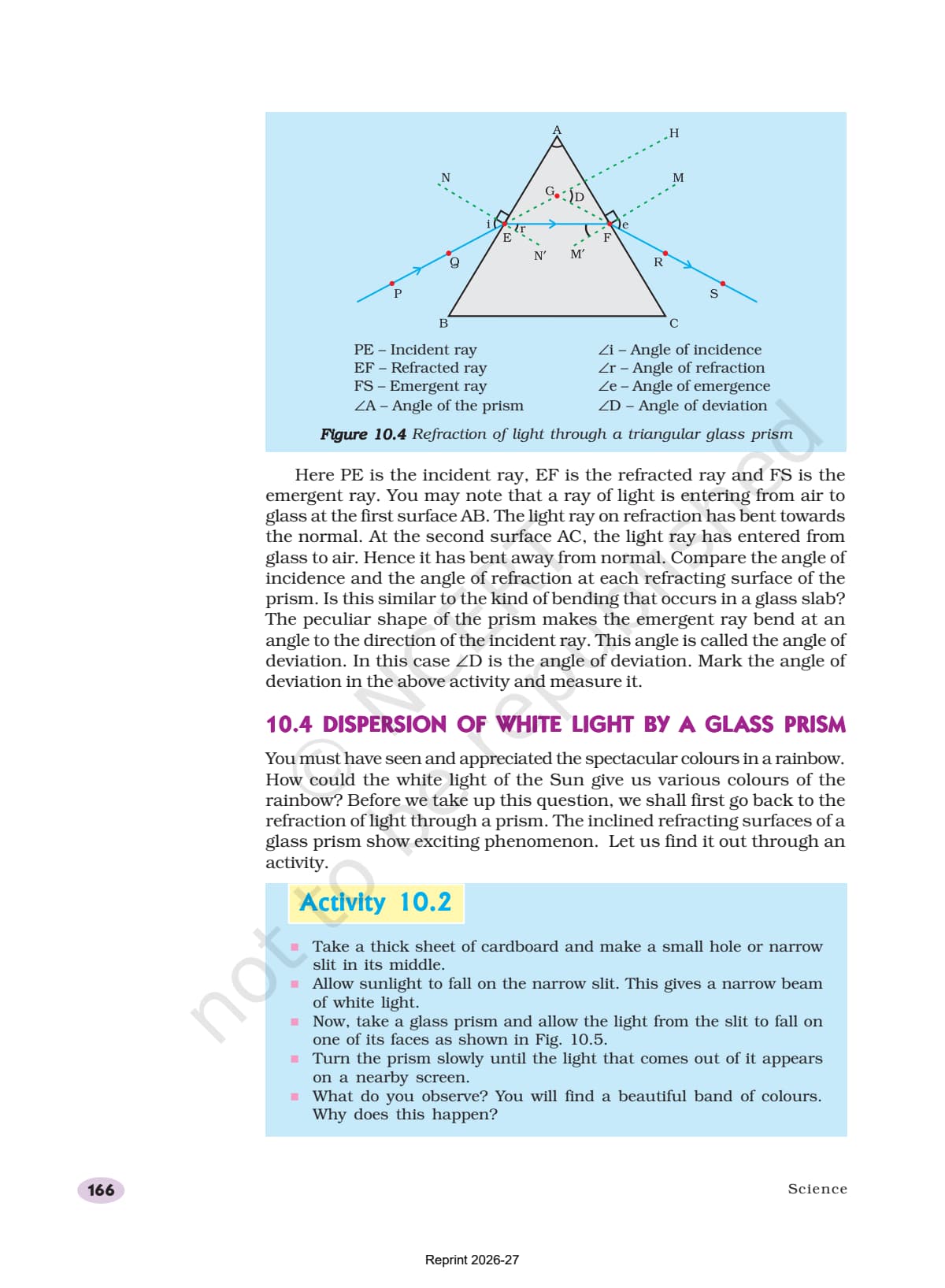
Section 10.3 studies the refraction of light through a triangular glass prism. The angle between its two lateral faces is the angle of the prism. Unlike a glass slab (where the emergent ray stays parallel), the slanted faces make the emergent ray bend away from the incident direction.
- Angle of incidence: angle the incident ray makes with the normal at the first face.
- Angle of emergence: angle at the second face, where the ray leaves to air.
- Angle of deviation: angle between the incident ray and the emergent ray.
Light bends towards the normal at the first surface and away from it at the second. Because the faces are inclined, the emergent ray is deviated, and the angle between the incident and emergent rays is the angle of deviation. This deviation makes dispersion possible.
Dispersion of White Light and the Rainbow in Class 10 Science Chapter 10
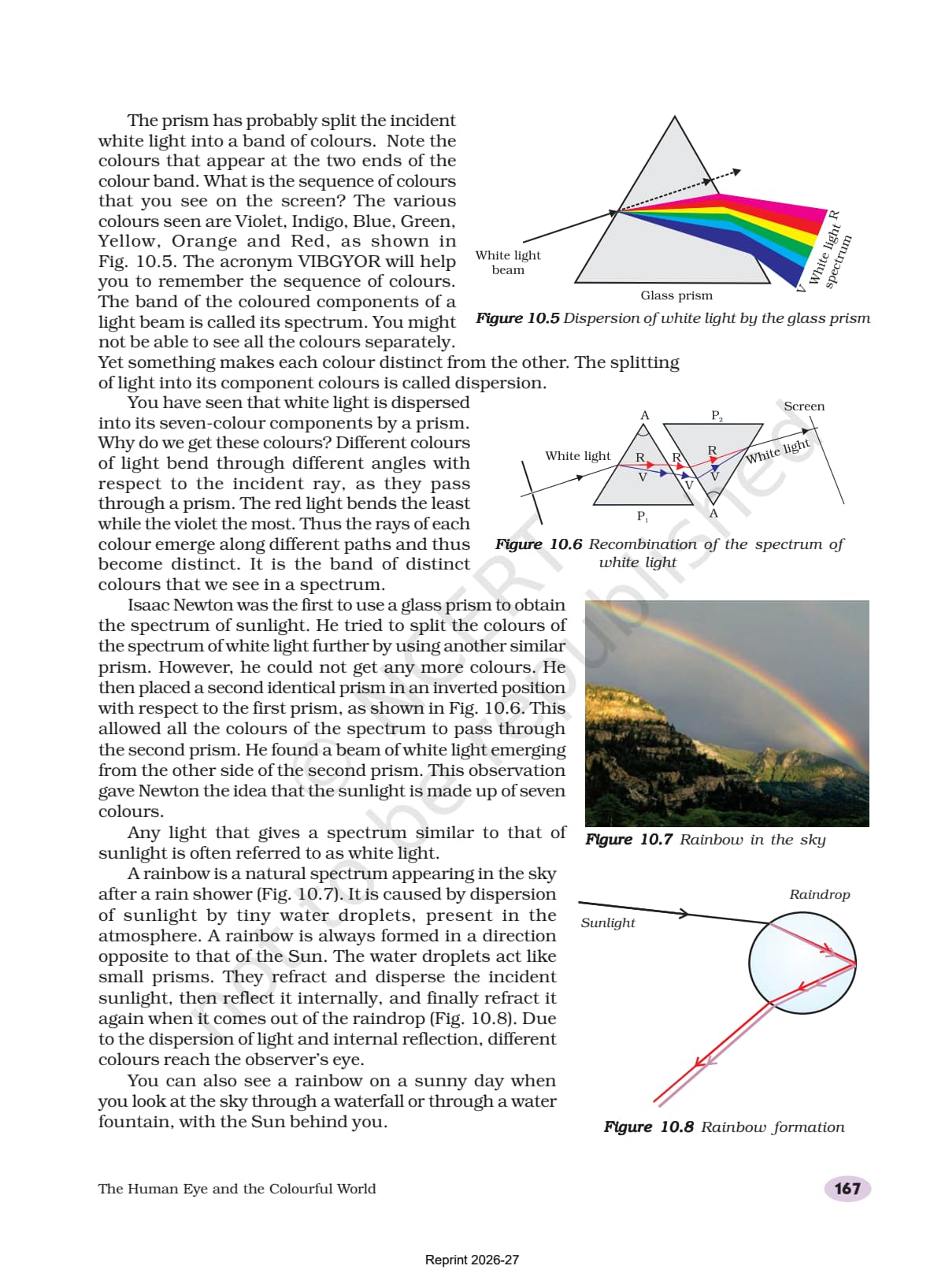
Section 10.4 explains the dispersion of white light by a glass prism. A narrow beam of white sunlight splits into a band of seven colours: Violet, Indigo, Blue, Green, Yellow, Orange and Red (VIBGYOR). This band is the spectrum, and the splitting of white light into its colours is dispersion.
Different colours bend through different angles: red bends the least and violet the most, so each colour follows its own path. Newton showed that a second, inverted prism recombines the spectrum into white light, proving white sunlight is made of seven colours. A rainbow is a natural spectrum: water droplets act as tiny prisms. It always forms in the part of the sky opposite the Sun, with the Sun behind the observer.
Atmospheric Refraction and Scattering of Light in Class 10 Science Chapter 10
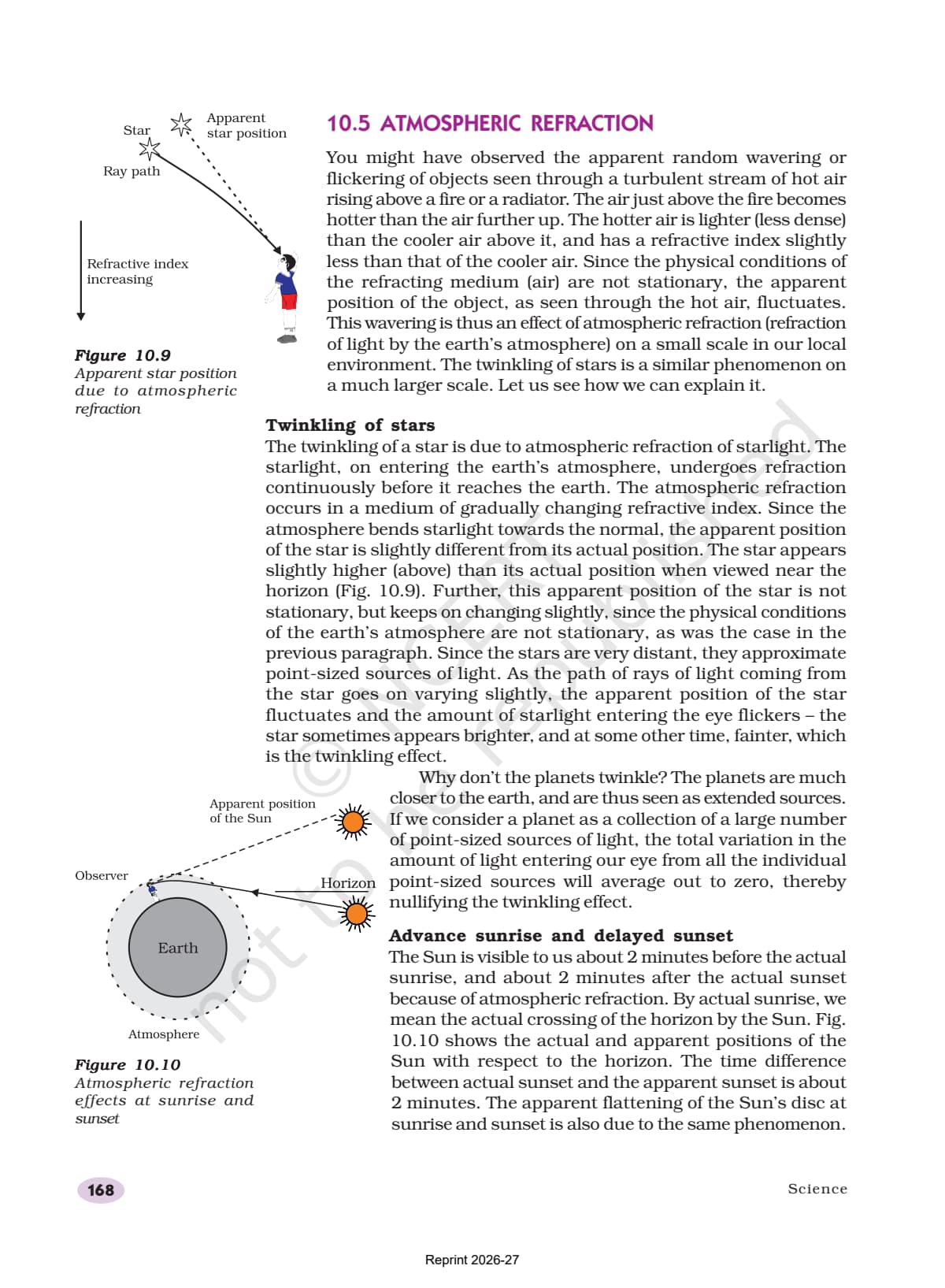
Sections 10.5 and 10.6 explain the last two phenomena. Atmospheric refraction is the bending of light by air layers of different density: it causes the twinkling of stars and advance sunrise and delayed sunset. Scattering of light is the spreading of light by tiny air particles, explaining the Tyndall effect and the blue sky.
| Phenomenon | Cause | Everyday observation |
|---|---|---|
| Twinkling of stars | Atmospheric refraction through changing air layers | A star's brightness and position flicker; planets do not twinkle |
| Advance sunrise / delayed sunset | Atmospheric refraction bends sunlight near the horizon | The Sun is seen about 2 minutes before actual sunrise and after sunset |
| Tyndall effect | Scattering of light by colloidal particles | The path of a light beam becomes visible in smoke or mist |
| Blue colour of the sky | Scattering of shorter (blue) wavelengths more than red | The clear sky looks blue; it looks dark from high altitudes |
Stars twinkle because starlight bends continuously through the moving atmosphere, so the star's apparent position and brightness keep changing. Planets do not twinkle because they are much closer and act as extended sources, so the variations average out to zero. The Sun is seen about 2 minutes before actual sunrise and 2 minutes after actual sunset because atmospheric refraction lifts its image near the horizon.
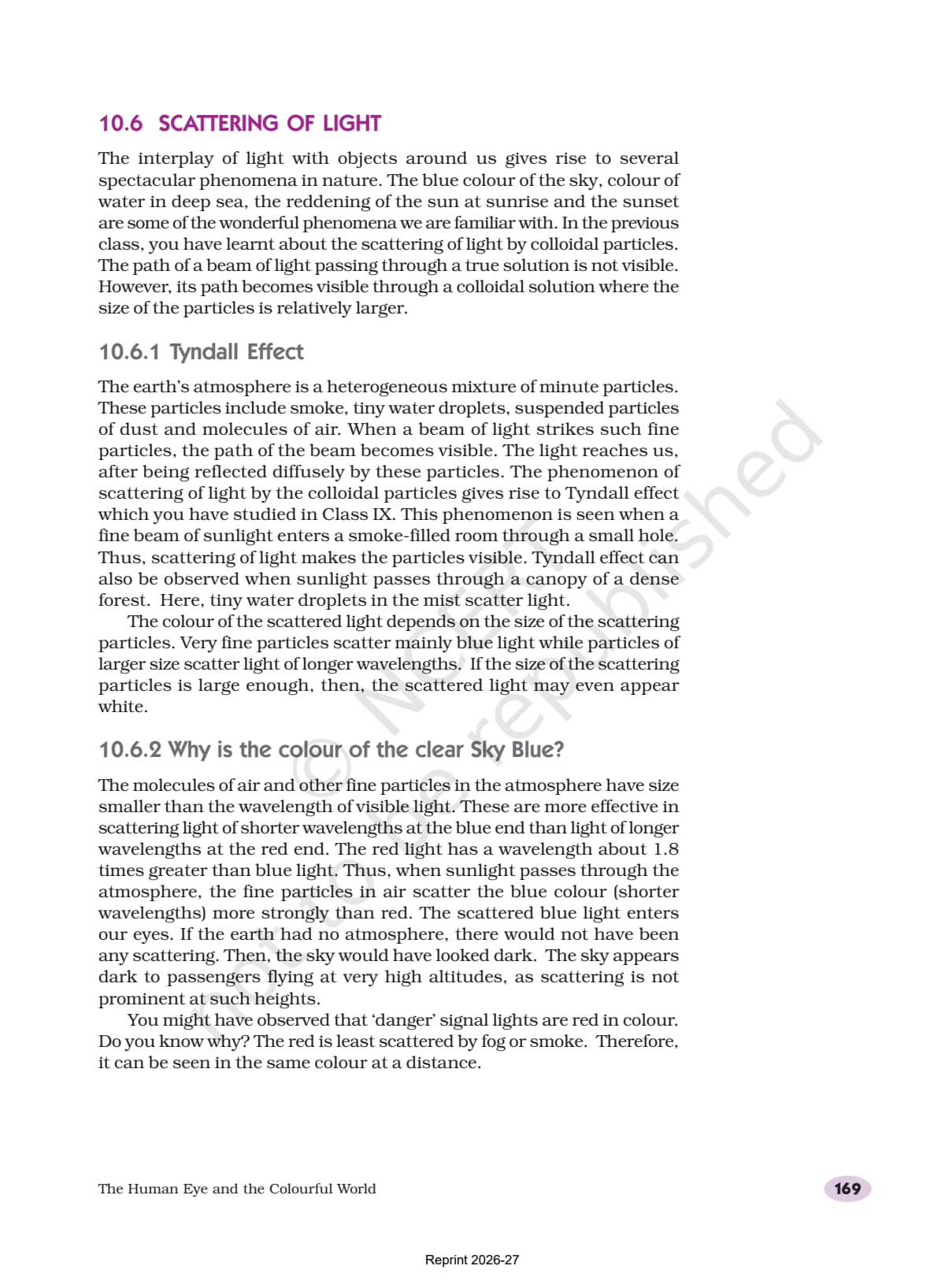
The fine molecules of air scatter shorter (blue) wavelengths far more strongly than longer (red) ones, so the clear sky looks blue. With no atmosphere there would be no scattering, so the sky looks dark to astronauts. Red light is scattered the least, so danger signal lights are red and carry far through fog or smoke.
What You Have Learnt and Common Exam Traps in Class 10 Science Chapter 10
The chapter ends with a short summary box, ideal for last-minute revision. The box below lists the traps that cost students marks every year.
The repeat-offender mistakes in board answers:
- Swapping the lenses: myopia needs concave, hypermetropia needs convex.
- Near point vs far point: 25 cm and infinity for a normal eye.
- Mixing dispersion and scattering: rainbow is dispersion; blue sky and red lights are scattering.
- Saying planets twinkle: only stars twinkle, as planets act as extended sources.
- Which part refracts: most refraction is at the cornea; the image forms on the retina.
Other Resources for Class 10 Science Chapter 10 The Human Eye and the Colourful World
Read the official NCERT Book chapter above, then revise with the matching NCERT Solutions, revision notes, formula sheet and handwritten notes, all linked in the table below.
| Resource | What it covers | Open |
|---|---|---|
| NCERT Book PDF | Official Class 10 Science Chapter 10 textbook, with every activity, figure and exercise. | You are here |
| NCERT Solutions | Step-by-step answers to all in-text and exercise questions of the chapter. | Class 10 Science Chapter 10 NCERT Solutions |
| Notes | Concept-first revision notes on the eye, defects of vision, dispersion and scattering. | Class 10 Science Chapter 10 Notes |
| Formula Sheet | Quick reference of the key terms, lens powers and phenomena of the chapter. | Class 10 Science Chapter 10 Formula Sheet |
| Handwritten Notes | Scanned-style handwritten pages for last-minute board revision. | Class 10 Science Chapter 10 Handwritten Notes |
NCERT Book for Class 10 Science: All Chapters
Related Links: Use the table below to open the official NCERT Book PDF for the other chapters of Class 10 Science.
| Chapter | NCERT Book PDF link |
|---|---|
| Chapter 1 | Chemical Reactions and Equations NCERT Book PDF |
| Chapter 2 | Acids, Bases and Salts NCERT Book PDF |
| Chapter 3 | Metals and Non-metals NCERT Book PDF |
| Chapter 4 | Carbon and its Compounds NCERT Book PDF |
| Chapter 5 | Life Processes NCERT Book PDF |
| Chapter 6 | Control and Coordination NCERT Book PDF |
| Chapter 7 | How do Organisms Reproduce NCERT Book PDF |
| Chapter 8 | Heredity NCERT Book PDF |
| Chapter 9 | Light Reflection and Refraction NCERT Book PDF |
| Chapter 10 | The Human Eye and the Colourful World NCERT Book PDF (You are here) |
| Chapter 11 | Electricity NCERT Book PDF |
| Chapter 12 | Magnetic Effects of Electric Current NCERT Book PDF |
| Chapter 13 | Our Environment NCERT Book PDF |
NCERT Book Class 10 Science Chapter 10 The Human Eye and the Colourful World FAQs
Ques. What does Chapter 10 The Human Eye and the Colourful World cover in the Class 10 Science NCERT Book?
Ans. Chapter 10 of the Class 10 Science NCERT Book covers the human eye and the optical phenomena of nature. It begins with the structure of the human eye, explaining the cornea, iris, pupil, eye lens and retina, and how the eye works like a camera by forming a real, inverted image on the retina. It then explains the power of accommodation, the near point and far point, and the three common defects of vision, namely myopia, hypermetropia and presbyopia, with the lenses used to correct them. The second half covers the refraction of light through a prism, the dispersion of white light and the rainbow, atmospheric refraction with the twinkling of stars and advance sunrise, and the scattering of light that makes the sky blue. It is aligned with the 2026-27 CBSE syllabus.
Ques. What is the power of accommodation of the eye in Class 10 Science Chapter 10?
Ans. The power of accommodation is the ability of the eye lens to adjust its focal length so that the eye can focus on both near and distant objects. The eye lens is made of a jelly-like material, and the ciliary muscles can change its curvature. When the ciliary muscles relax, the lens becomes thin and its focal length increases, which lets us see distant objects clearly. When the ciliary muscles contract, the lens becomes thick and its focal length decreases, which lets us see nearby objects clearly. The focal length cannot decrease below a certain limit, so the closest distance for clear vision without strain is the near point, about 25 cm for a young adult with normal vision.
Ques. What is the difference between myopia and hypermetropia, and how are they corrected?
Ans. Myopia, also called near-sightedness, is a defect in which a person can see nearby objects clearly but not distant ones, because the image of a distant object forms in front of the retina. It is caused by excessive curvature of the eye lens or elongation of the eyeball, and it is corrected using a concave (diverging) lens of suitable power, which brings the image back onto the retina. Hypermetropia, also called far-sightedness, is the opposite defect in which a person can see distant objects clearly but not nearby ones, because the image of a nearby object forms behind the retina. It is caused by a long focal length of the eye lens or a small eyeball, and it is corrected using a convex (converging) lens of suitable power.
Ques. What are the near point and far point of the human eye with normal vision?
Ans. The near point, also called the least distance of distinct vision, is the closest distance at which the eye can see an object clearly and comfortably without strain. For a young adult with normal vision, the near point is about 25 cm. The far point is the farthest distance up to which the eye can see objects clearly, and for a normal eye it is infinity. So a normal eye can see objects clearly over the whole range from 25 cm out to infinity. With age, the power of accommodation falls and the near point recedes, a condition called presbyopia, which is corrected with a convex lens or a bi-focal lens.
Ques. What is dispersion of light in Class 10 Science Chapter 10?
Ans. Dispersion is the splitting of white light into its seven component colours when it passes through a glass prism. The colours appear in the order Violet, Indigo, Blue, Green, Yellow, Orange and Red, remembered by the acronym VIBGYOR, and this band of colours is called a spectrum. Dispersion happens because different colours of light bend through different angles in the prism: red light bends the least and violet light bends the most, so each colour follows a different path and becomes distinct. Isaac Newton showed with a second, inverted prism that the spectrum can be recombined into white light, proving that white light is made of seven colours. A rainbow is a natural example of dispersion, where water droplets in the air act as tiny prisms.
Ques. Why is the colour of the clear sky blue in Class 10 Science Chapter 10?
Ans. The clear sky appears blue because of the scattering of light by the molecules of air and other fine particles in the atmosphere. These particles are smaller than the wavelength of visible light, so they scatter shorter wavelengths, the blue end of the spectrum, much more strongly than the longer wavelengths at the red end. Red light has a wavelength about 1.8 times that of blue light, so it is scattered far less. When sunlight passes through the atmosphere, the scattered blue light reaches our eyes from all directions, which is why the sky looks blue. If the Earth had no atmosphere there would be no scattering and the sky would look dark, which is why it appears dark to astronauts and at very high altitudes.
Ques. Why do stars twinkle while planets do not in Class 10 Science Chapter 10?
Ans. Stars twinkle because of atmospheric refraction of starlight. As starlight enters the Earth's atmosphere, it is refracted continuously through air layers of slightly different and constantly changing density, so the apparent position of the star keeps shifting slightly. Since stars are very distant, they behave as point sources of light, so the amount of starlight reaching the eye keeps varying, and the star appears brighter at one moment and fainter at another, which is the twinkling effect. Planets do not twinkle because they are much closer to the Earth and act as extended sources, that is, a collection of a large number of point sources. The variations in light from all those points average out to zero, so the total light is steady and the planet does not twinkle.
Ques. Is the Class 10 Science Chapter 10 NCERT Book PDF free to download for 2026-27?
Ans. Yes. The official NCERT Book PDF for Class 10 Science Chapter 10 The Human Eye and the Colourful World is free to read and download on this page for the 2026-27 session. It is the complete chapter as printed in the CBSE textbook, including every activity, figure, in-text question and end-of-chapter exercise. You can pair the book with the linked NCERT Solutions and revision notes for the same chapter so that you read the textbook and revise from one place before the board exam.



Comments