



The NCERT Class 12 English Supplementary Chapter 15 The Mark on the Wall Book PDF gives students the official 2026-27 Kaleidoscope prose text. Use it to read Virginia Woolf's essay first, then check the notes or solved answers for exam practice.
- Core focus: stream of consciousness, memory, self-image, social rules and the final snail reveal.
- Best use: read the essay slowly and track how one small mark starts many thoughts.
- Revision cue: connect every answer to Woolf's thought-flow, not only to the mark itself.
NCERTBookChapter15Kaleidoscope:TheMarkontheWall.pdf?page=1&dpi=150)
NCERTBookChapter15Kaleidoscope:TheMarkontheWall.pdf?page=2&dpi=150)
NCERTBookChapter15Kaleidoscope:TheMarkontheWall.pdf?page=3&dpi=150)
NCERTBookChapter15Kaleidoscope:TheMarkontheWall.pdf?page=4&dpi=150)
NCERTBookChapter15Kaleidoscope:TheMarkontheWall.pdf?page=5&dpi=150)
NCERTBookChapter15Kaleidoscope:TheMarkontheWall.pdf?page=6&dpi=150)
NCERTBookChapter15Kaleidoscope:TheMarkontheWall.pdf?page=7&dpi=150)
NCERTBookChapter15Kaleidoscope:TheMarkontheWall.pdf?page=8&dpi=150)
NCERTBookChapter15Kaleidoscope:TheMarkontheWall.pdf?page=9&dpi=150)
NCERTBookChapter15Kaleidoscope:TheMarkontheWall.pdf?page=10&dpi=150)
NCERTBookChapter15Kaleidoscope:TheMarkontheWall.pdf?page=11&dpi=150)
NCERTBookChapter15Kaleidoscope:TheMarkontheWall.pdf?page=12&dpi=150)
NCERTBookChapter15Kaleidoscope:TheMarkontheWall.pdf?page=13&dpi=150)
Student Feedback: In a Collegedunia check of 12,180 Class 12 English students, most students said this chapter became easier after they mapped the narrator's thoughts in order.
The Mark on the Wall NCERT Book PDF Overview
The Mark on the Wall is a non-fiction prose piece from Kaleidoscope. Virginia Woolf begins with a small black mark above the mantelpiece. The real subject, though, is the narrator's mind. It moves from the mark to memory, lost objects, art, social rules, self-image and truth.
The chapter is best read as a thought-flow, not as a simple incident. The mark stays almost still, while the narrator's ideas keep changing. This is why the official PDF is useful. It lets students see the exact movement of Woolf's sentences before writing answers.
| Part of chapter | What to notice | Answer cue |
|---|---|---|
| Opening scene | The narrator sees a small mark in winter | Begin with the ordinary visual detail. |
| Thought movement | The mind shifts from one idea to another | Use stream of consciousness. |
| Social reflection | She questions rules, facts and standard things | Connect freedom of thought with the essay. |
| Ending | The mark is revealed as a snail | Show how fact interrupts imagination. |
The Mark on the Wall Class 12 Video Explanation
Source: Magnet Brains on YouTube
How the Mark Starts Woolf's Thought Flow
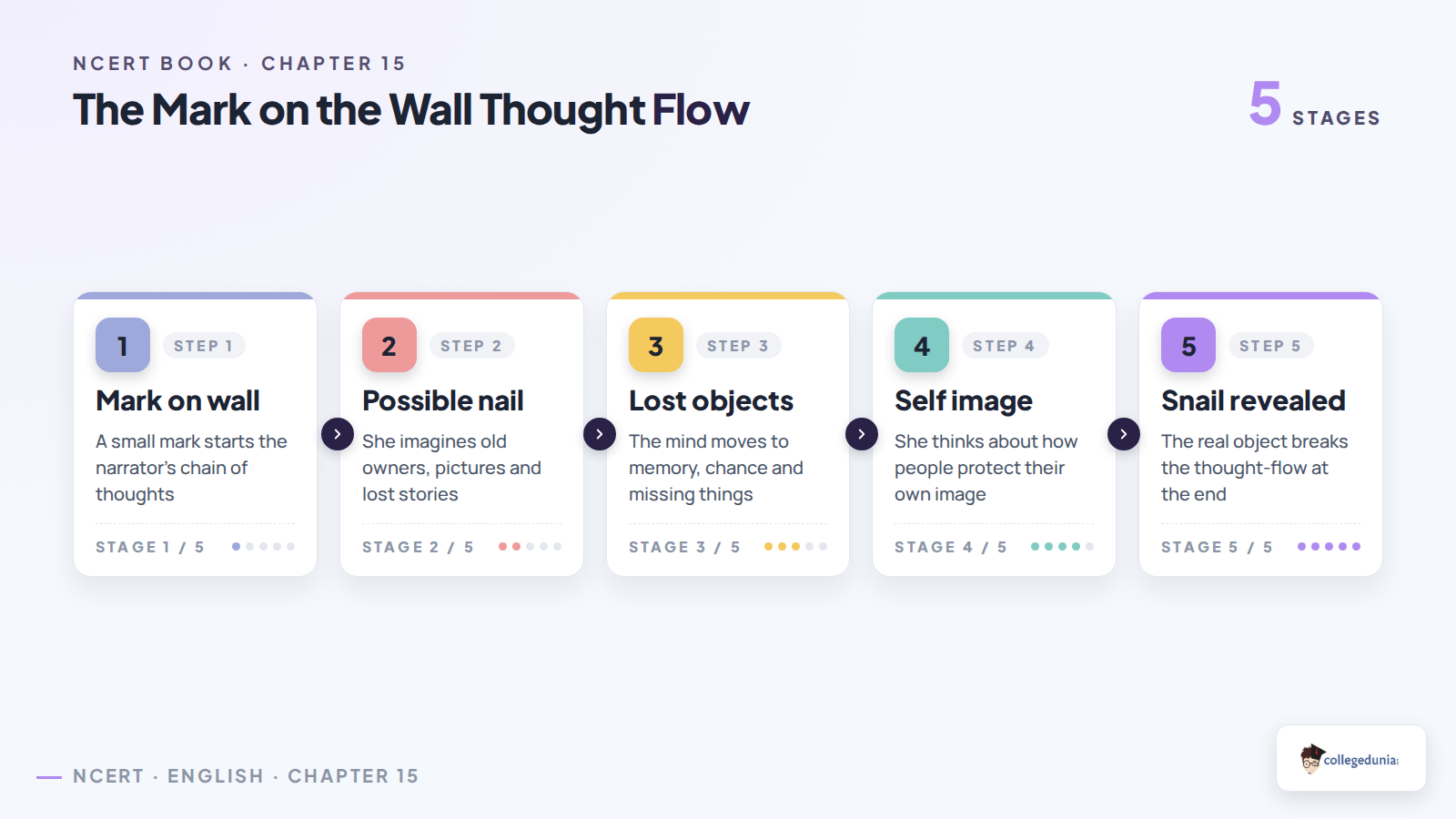
The mark first looks like a small outside detail. Then the narrator imagines a nail, a picture, the old owners of the house and many lost things. The essay keeps moving this way. One thought opens the next thought, and the original object becomes less important for a while.
For exam answers, do not summarise the chapter as only a mark on a wall. Write that Woolf uses the mark to show how the mind works. It moves freely, compares, doubts and creates pictures from memory.
Object on Wall and Mind in Motion
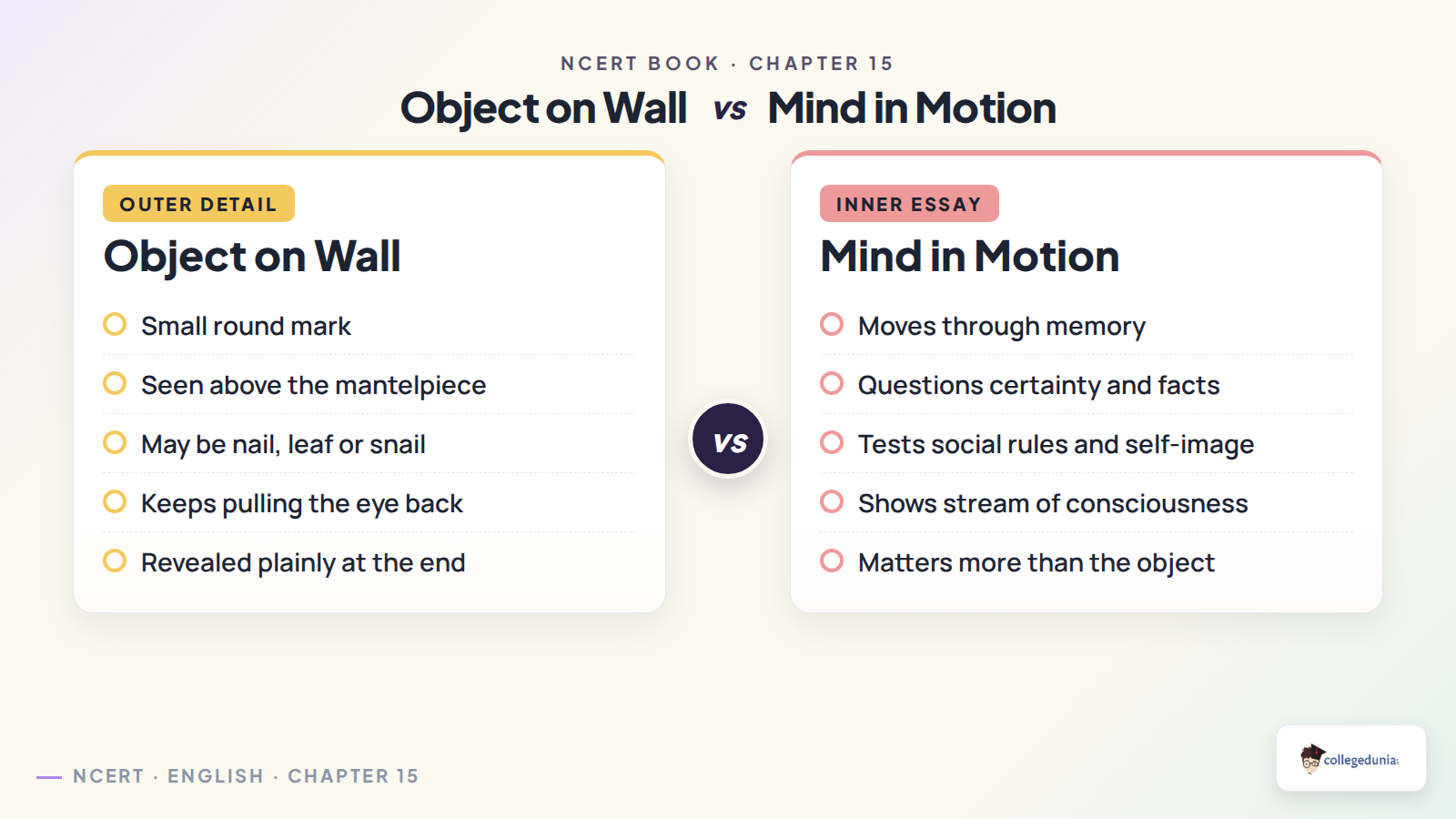
The chapter has two layers. The first layer is the visible object. The second layer is the narrator's inward essay. The object is simple and fixed. The mind is restless and creative. This contrast explains why the ending feels sudden but meaningful.
The snail reveal brings the narrator back to ordinary fact. It does not cancel the earlier thoughts. Instead, it shows how a small object can open a large field of memory and reflection.
Important Ideas in The Mark on the Wall
Woolf's prose is built around movement. She does not arrange ideas in a straight line. She lets one image lead to another. This style suits the chapter because the narrator is not reporting an event. She is recording the way thought itself behaves.
| Idea | Simple meaning | Where to use it |
|---|---|---|
| Stream of consciousness | Writing that follows the flow of thought | Style and technique answers |
| Uncertainty | The narrator keeps guessing what the mark is | Theme and title answers |
| Memory | Objects and people appear through association | Summary and explanation answers |
| Self-image | The narrator reflects on how people imagine themselves | Long answer questions |
| Reality | The final fact interrupts the inward movement | Ending-based answers |
How to Read the Official PDF for 2026-27 Revision
Read the PDF in two rounds. In the first round, follow the literal incident. In the second round, underline each shift in thought. This method helps because NCERT questions often ask why reflections matter more than plain description.
- Read the opening carefully: mark the season, room, fire, book and mantelpiece.
- Track each guess: note nail, picture, leaf and snail as possible answers.
- Circle abstract ideas: memory, fact, rules, freedom, reality and self-image.
- Return to NCERT wording: use the official text before writing long answers.
Common Answer Mistakes in The Mark on the Wall
Many students write only a plot summary. That misses the main point of the essay. The chapter is about how the mind moves when it is left free. The mark is a trigger, not the full meaning.
- Do not call it a simple story: it is a reflective prose essay.
- Do not skip the narrator's guesses: they show the mind making meaning.
- Do not ignore the ending: the snail reveal brings fact back into the essay.
- Do not use heavy language: explain Woolf's style in clear sentences.
Related Resources for The Mark on the Wall Class 12
| Resource | Best use | Link |
|---|---|---|
| NCERT Solutions | Use for Stop and Think, Understanding the Text and appreciation answers. | The Mark on the Wall Solutions |
| NCERT Notes | Use for summary, theme notes, character of the narrator and answer cues. | The Mark on the Wall Notes |
| NCERT Book PDF | Use the official text before revising any secondary resource. | Current page |
All Class 12 English Supplementary NCERT Book Chapters
| Chapter | NCERT Book PDF |
|---|---|
| Chapter 10 | Trees NCERT Book PDF |
| Chapter 11 | The Wild Swans at Coole NCERT Book PDF |
| Chapter 12 | Time and Time Again NCERT Book PDF |
| Chapter 13 | Blood NCERT Book PDF |
| Chapter 14 | Freedom NCERT Book PDF |
| Chapter 15 | The Mark on the Wall NCERT Book PDF |
The Mark on the Wall Class 12 English NCERT Book FAQs
Ques. What does The Mark on the Wall Class 12 English NCERT Book PDF include?
Ans. It includes the official NCERT Kaleidoscope chapter The Mark on the Wall by Virginia Woolf and the textbook questions for 2026-27 revision.
Ques. Who wrote The Mark on the Wall?
Ans. The Mark on the Wall was written by Virginia Woolf, the English novelist and essayist linked with modernist writing.
Ques. What is the main idea of The Mark on the Wall?
Ans. The essay shows how a small mark on a wall starts a wide chain of thoughts about memory, reality, social rules and the self.
Ques. What is the mark on the wall at the end?
Ans. At the end, the mark is revealed to be a snail, which brings the narrator's free thought-flow back to ordinary fact.
Ques. How should students revise The Mark on the Wall for Class 12 English?
Ans. Students should read the PDF, trace each thought shift, revise stream of consciousness and practise answers on Woolf's style.



Comments