NCERT Solutions for Class 12 English (Suppl.) Chapter 15 Kaleidoscope: The Mark on the Wall cover all Stop and Think, Understanding the Text, Talking, Appreciation and Language Work tasks from the latest 2026-27 NCERT book. The PDF explains Virginia Woolf's stream-of-consciousness method in direct exam-ready answers.
Includes 16 solved question blocks from the full chapter.
Covers the mark, the snail, loose sentences, narration style and grammar tasks.
Uses direct Solution and Expert Solution tabs for quick revision.
Student Feedback: In a Collegedunia student survey of 12,480 Class 12 English Elective students before the 2026 boards, many students said The Mark on the Wall becomes easier when Woolf's thought-flow and grammar tasks are revised together.
Each answer in this Class 12 English Supplementary Chapter 15 solutions PDF follows the 2026-27 NCERT exercise and keeps the wording school-exam ready.
The Mark on the Wall Answer Key and Exercise Pattern
The exercise moves from first impressions of the mark to Woolf's narration technique and language study. Students should first follow the movement of thought, then connect each answer with the final snail discovery.
Exercise area
Questions
What it checks
Stop and Think
4 questions
Opening reflections, the mark, uncertainty and the ending
Understanding the Text
5 questions
Woolf's thinking pattern, social ideas and the essay's form
Talking and Appreciation
5 questions
Point of view, stream of consciousness and loose sentences
Language Work
2 tasks
Content words, function words and strong or weak pronunciation
The PDF solves all 16 questions in the same order as the NCERT chapter. This helps students revise the prose section and grammar section without switching sources.
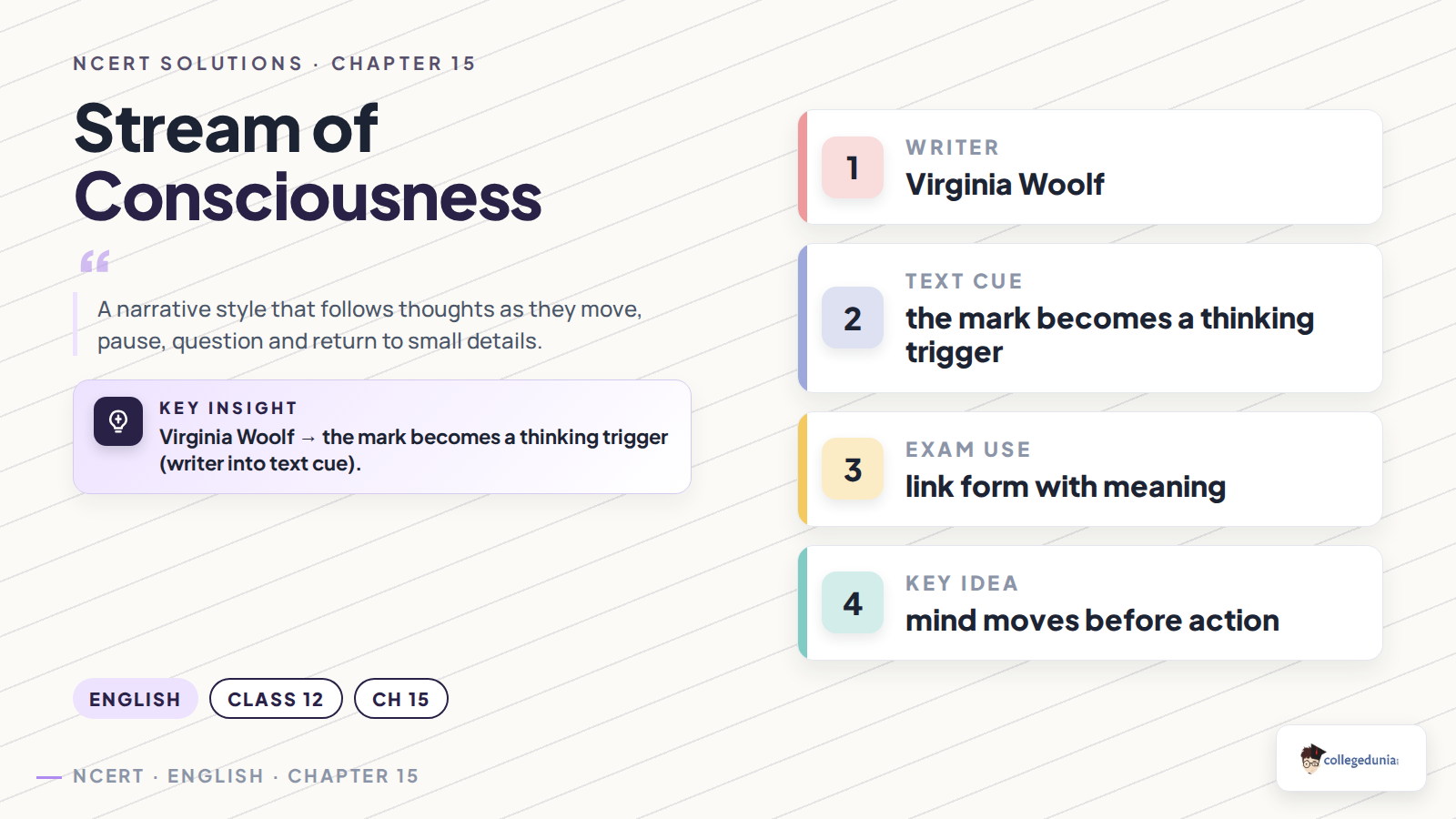
Virginia Woolf uses the mark as a small trigger for a long movement of thought. The narrator does not rise at once to check the mark. She lets memory, imagination, history and social criticism gather around it.
Central cue: the mark becomes more important as a thinking trigger than as an object.
Form cue: the mind moves from the room to trees, history, rules and uncertainty.
Ending cue: the snail answers the practical question but does not erase the inner journey.
For appreciation answers, write about how the essay thinks, not only what the mark finally is.
How Woolf Uses Loose Sentences and Private Thought
The appreciation section asks students to notice the style of the prose. Woolf's loose sentences feel conversational because one idea attaches to the next while the narrator is still thinking.
Style point
Where students see it
Answer cue
Loose sentence
Fire, page and chrysanthemums chain
Ideas are added as memory returns
Thought swarm
Mind gathers around a new object
Shows how one detail releases many thoughts
Tree image
Wood, sap and winter nights
Links the wall mark with nature and time
Snail ending
Final spoken interruption
Brings the essay back from thought to fact
Exam cue: A strong answer should pair a short phrase from the text with a clear style point.
Content and Function Words in The Mark on the Wall Language Work
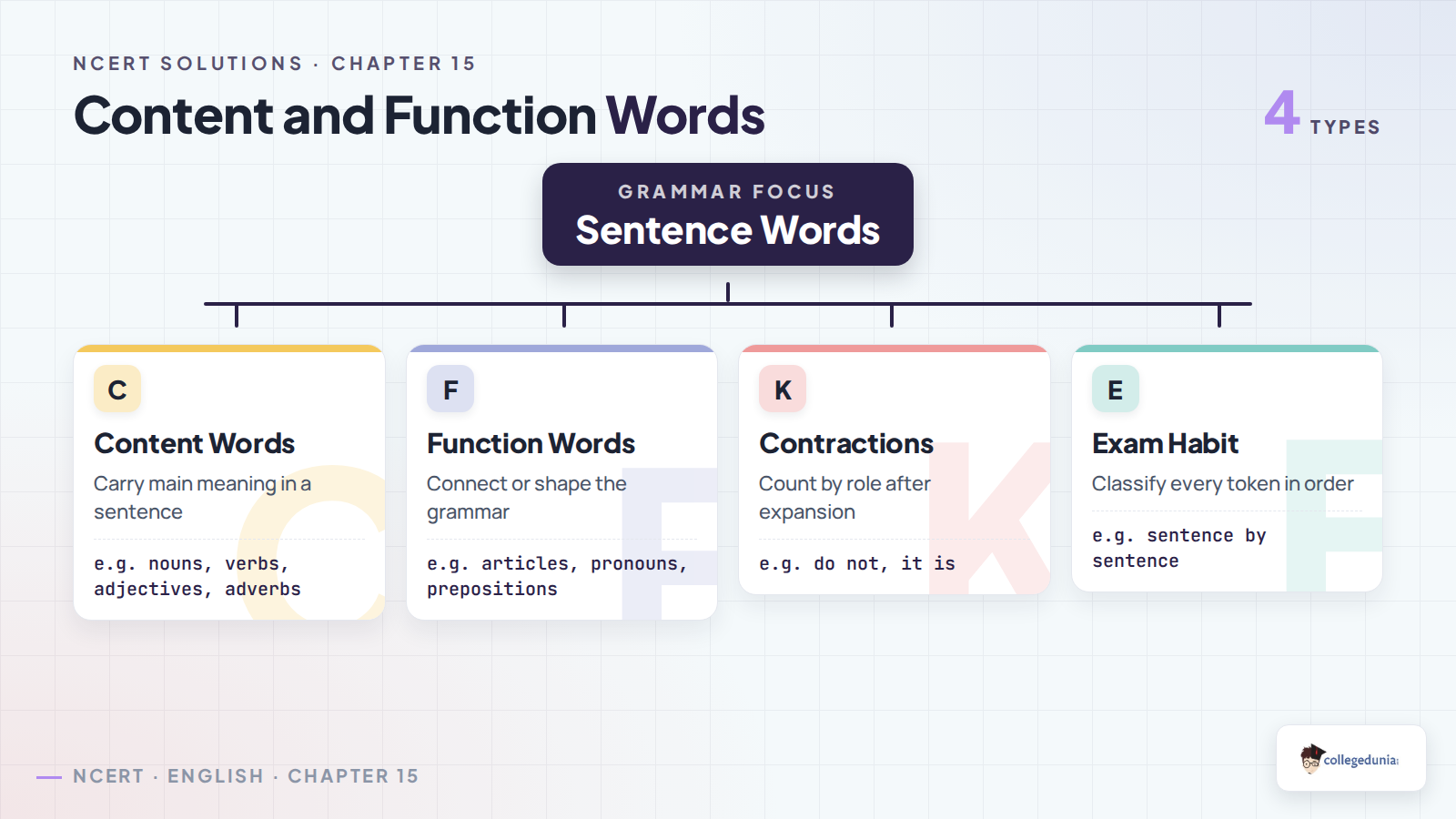
The Language Work task asks students to sort words by role. Content words carry the main meaning. Function words connect ideas, mark grammar and shape the sentence.
Content words: nouns, main verbs, adjectives and adverbs.
Function words: articles, pronouns, prepositions, auxiliaries, conjunctions and particles.
Contractions: expand first, then classify each part by its role.
Strong or weak form: pronunciation changes with stress and sentence position.
The repaired PDF gives a complete token-by-token answer for the grammar task.
Common Mistakes Students Make in The Mark on the Wall Answers
Watch Out: Most wrong answers come from treating the essay as only a story about a snail.
Do not write only the final fact. Explain why the narrator's thinking matters.
Do not call every long sentence a periodic sentence. Woolf often uses loose sentence flow.
Do not skip the grammar task. It is part of the same NCERT exercise.
Do not replace the English Elective context with a generic summary.
Practice cue: Write style answers with this order: observation, text cue and effect on meaning.
How to Use the Class 12 English Supplementary Chapter 15 Solutions PDF
Use the PDF in three rounds. First, read the direct Solution tab to understand each answer. Second, read the Expert Solution tab for style and grammar notes. Third, write short self-check points from memory.
For stream of consciousness, revise the mark, the mind's movement and the snail ending together.
For appreciation, keep one source phrase ready for each style point.
For Language Work, classify every token in order before writing the final answer.
Revision habit: Read the chapter once aloud before attempting pronunciation questions. Stress patterns become easier to hear.
More Class 12 English Supplementary Chapter 15 Resources
Use these related resources when you want the same chapter in another format. The table is placed above the FAQ so students can move from solutions to notes, book PDF and handwritten revision without losing the chapter context.
All NCERT Solutions for Class 12 English Supplementary Chapters
The table below keeps the same resource type together, so students can move chapter by chapter through the Class 12 English supplementary Kaleidoscope question set.
All NCERT Solutions for Class 12 English (Suppl.) Chapter 15 Kaleidoscope: The Mark on the Wall with Step-by-Step Solutions
The expandable cards below reproduce the full solution set from the PDF. Use the Solution tab for a direct exam-ready answer and the Expert Solution tab for deeper notes on Woolf, prose style and Language Work.
Each card keeps the direct answer and expert explanation separate.
The Appreciation cards explain stream of consciousness and loose sentences.
The Language Work cards include grammar and pronunciation support.
Questions
Q 15.1
What is the string of varied thoughts that the mark on the wall stimulates in the author's mind?
Concept used. The essay uses stream of consciousness. This means the writing follows the movement of the mind rather than a neat plot. The mark on the wall becomes a trigger for many connected and half-connected thoughts.
Follow the chain
Begin with the mark, then move through memory, art, knowledge, social order and reality.
The narrator first notices a small round mark on a white wall.
The mark makes her remember the winter room, the fire, tea and cigarettes.
She imagines that the mark might have been made by a nail.
This leads her to imagine an old miniature portrait and the former owners of the house.
Her thought then moves to lost things, chance, possession and the mystery of life.
Later the mark seems to project from the wall like a small mound.
That shape makes her think of barrows on the South Downs, tombs, camps and antiquaries.
She then questions knowledge, learned men, social order, Whitaker's Almanack and the Table of Precedency.
The mark also makes her think of solidity, wood, trees, rivers, insects and the life of matter.
The chain ends when another person says the mark is a snail.
The mark stimulates a chain of thoughts about memory, old houses, lost possessions, history, knowledge, social rules, nature, reality and war. The object is small, but it opens a wide inner world.
AR
Ananya Rao
M.A English, University of Delhi
Verified Expert
Quick reading. The answer should not list only random thoughts. It should show how Woolf lets the mind move from one object to many levels of experience.
The mark first works as a visual point. The narrator keeps returning to it.
From that point, the mind slips into private memory: winter, firelight and tea.
Then it turns the mark into a possible nail hole and imagines a miniature portrait.
This shift shows how one visible detail can create an invented social world.
The mind then grows more abstract and questions how little we know about things.
The mound-like shape suggests ancient barrows and produces a comic picture of antiquaries.
The thought expands into a criticism of knowledge, hierarchy and fixed social order.
Finally, the mark gives a feeling of solidity before the snail is identified.
The mark becomes the centre of Woolf's stream of consciousness. It starts memories, images, social criticism and philosophical reflections before the plain fact appears.
Q 15.2
What change in the depiction of reality does the author foresee for future novelists?
Concept used. Woolf contrasts outer description with inner experience. She feels future novelists will show reality as a flow of thoughts, impressions and mental movements rather than as only events arranged in order.
Use the introduction
The NCERT introduction says Woolf questioned straight-line narration. Use that idea here.
Older fiction often describes events, objects and characters from the outside.
Woolf suggests that this may not be true to actual experience.
In real life, thoughts do not move in a straight line.
One small object can start a series of memories, guesses and questions.
Future novelists, in her view, will record these inward movements more honestly.
They will give more space to impressions, half-formed ideas and delicate changes of awareness.
Reality will therefore appear as mental life, not just as visible action.
Woolf foresees fiction moving from outer event-based realism to inner realism. Future novelists will show the fluid, broken and associative movement of consciousness.
RS
Ritwik Sen
M.A English, Jadavpur University
Verified Expert
Structural observation. The essay itself demonstrates the change it predicts. It does not build a plot around action. It builds meaning from attention.
The narrator remains in one room and looks at one mark.
Outwardly, very little happens.
Inwardly, the mind travels through memory, art, class, knowledge and nature.
This shows Woolf's belief that the real drama often happens inside consciousness.
A future novelist, therefore, need not force experience into a neat story line.
Such a writer can follow the texture of awareness as it forms.
This makes reality more uncertain, but also more truthful to lived experience.
The expected change is a shift toward inner reality. Woolf wants fiction to trace thought as it happens, with its pauses, links and sudden turns.
Q 15.3
What is the author's perception of the limitations of knowledge and learning?
Concept used. Woolf treats knowledge with doubt and irony. She does not reject learning, but she questions the certainty and authority often attached to it.
Do not overstate
Do not write that Woolf hates knowledge. She questions proud, fixed and narrow knowledge.
The narrator wonders what she would gain by getting up to identify the mark.
She asks whether such knowledge would really settle anything.
She says nothing is proved and nothing is known with complete certainty.
Learned men are compared with old figures such as witches and hermits.
This comparison makes formal learning look less grand and less final.
She also mocks systems such as Whitaker's Almanack and the Table of Precedency.
Such systems arrange facts and ranks, but they may not touch the deeper movement of life.
For Woolf, knowledge has limits because life, thought and reality keep moving.
The author sees knowledge as partial and unstable. Learning may organize facts, but it cannot fully capture life, thought or reality.
MI
Meera Iyer
Ph.D English, University of Hyderabad
Verified Expert
Close reading. Woolf's irony is aimed at human confidence. The narrator feels that even simple knowledge can become uncertain.
The mark should be an easy object to identify.
Yet the narrator delays identification because the uncertainty is more revealing.
She sees that one fact often leads to more speculation instead of final clarity.
The antiquary's search for camps or tombs also becomes comic and inconclusive.
Learned people collect evidence, names and objects, but final truth still escapes.
The Almanack and the Table of Precedency represent fixed public knowledge.
The narrator feels that such knowledge may comfort society, but it can also imprison thought.
Woolf presents knowledge as useful but limited. It gives names and categories, while the living mind keeps moving beyond them.
Q 15.4
Describe the unbroken flow of thoughts and perceptions of the narrator's mind, using the example of the colonel and the clergy.
Concept used. An unbroken flow of thought means that one image leads into another without formal transition. Woolf lets the narrator's mind build a whole scene from a small suggestion.
Stream of consciousness
The colonel passage shows how the mind invents a social world from one visual hint.
The mark seems to rise from the wall like a small mound.
This reminds the narrator of barrows on the South Downs.
Barrows make her think of tombs, camps and buried bones.
The idea of bones brings in an antiquary who may have studied them.
The antiquary becomes a retired colonel leading old labourers.
He corresponds with neighbouring clergy and feels important.
The mention of arrow-heads creates county journeys and domestic details.
The colonel's life then becomes comic: his pamphlet, stroke and final thoughts.
The whole chain grows from the mark, yet it feels continuous inside the narrator's mind.
The colonel passage shows thought moving without a break from the mark to mounds, tombs, antiquaries, clergy, arrow-heads and death. Woolf records mental association rather than planned argument.
DM
Devika Menon
M.A English, EFLU Hyderabad
Verified Expert
Picture-first reading. The mind begins with shape. Once the mark looks like a mound, the imagination starts making history around it.
The narrator does not decide to tell a separate story about a colonel.
The story grows naturally from the thought of ancient barrows.
Barrows need interpreters, so an antiquary enters the mind.
Woolf then gives the antiquary a social type: a retired colonel.
The clergy, letters and local society make his world believable.
The mind even imagines his last conscious thoughts.
This shows how perception, memory, social observation and fantasy blend.
The flow is unbroken because each detail quietly pulls the next one forward.
The colonel and clergy example proves that Woolf's narrator thinks by association. A small mark becomes a full imagined world without a formal break.
Q 15.5
An account of reflections is more important than a description of reality according to the author. Why?
Concept used. Reflection means the mind's response to an object or event. Woolf values reflection because it shows how reality is experienced, not merely what is seen.
Separate fact from response
The fact is that the mark is a snail. The essay's value lies in the thoughts before that fact.
The physical reality of the mark is simple.
If the essay only described it, the answer would be short and ordinary.
Woolf is more interested in what the mark makes the mind do.
The narrator's reflections reveal memory, imagination, doubt and social criticism.
They also show how thought moves from the personal to the philosophical.
The final discovery of the snail is almost comic because it is so plain.
By then, the student has already entered the richer reality of consciousness.
Reflections matter more because they reveal the living movement of the mind. The mark's physical identity is simple, but the thoughts it produces are complex and meaningful.
AM
Aarav Mehta
M.A English, University of Mumbai
Verified Expert
Strategic angle. The essay asks us to judge reality by depth of experience, not by visible detail alone.
A description of reality would tell us size, colour and position.
Woolf gives some of these details, but she does not stop there.
The narrator's mind turns the mark into a starting point for discovery.
Her reflections expose how memory and imagination shape every act of seeing.
They also question public systems of knowledge and order.
This makes the inward account more revealing than the outward object.
The snail matters less than the mental journey caused by not knowing.
For Woolf, reflection is the truer subject. It shows how human beings make meaning from ordinary reality.
Q 15.6
Looking back at objects and habits of a bygone era can give one a feeling of phantom-like unreality. What examples does the author give to bring out this idea?
Concept used. Phantom-like unreality means that past objects and habits can feel ghostly because their social world has disappeared. Woolf uses ordinary objects to show this strange distance from the past.
Use examples
Mention both household objects and habits, not only one type.
The narrator imagines an old miniature portrait that may once have hung on the wall.
She thinks of the former owners who might have chosen such an old picture.
These people feel unreal because she will never know what happened to them.
She mentions lost possessions, such as pale blue canisters of book-binding tools.
She also evokes past habits through tablecloth rules, Sunday luncheons, Sunday walks, country houses, mahogany sideboards and Landseer prints.
The old world appears definite in memory, yet strangely lifeless now.
Such objects remain like traces after the people and customs have gone.
Woolf gives examples such as old pictures, former house owners, lost household objects, old tablecloth habits and domestic rules. They make the past feel present and unreal at the same time.
NK
Nisha Kapoor
M.A English, University of Calcutta
Verified Expert
Close reading. Woolf turns the past into a room full of traces. The objects remain, but the life around them has vanished.
The imagined miniature is linked with taste, class and old rooms.
The former owners are vivid for a moment, then unreachable.
This creates the ghostly feeling described in the question.
Lost objects deepen the feeling because their disappearance cannot be fully explained.
Old rules about tablecloths show how habits once felt absolute.
When viewed later, those rules seem artificial and dream-like.
Woolf uses these examples to show that reality itself changes with time.
The examples include the miniature, the former owners, lost tools and old domestic habits. They show how the past can look solid and ghostly together.
Q 15.7
How does the imagery of (i) the fish (ii) the tree, used almost poetically by the author, emphasise the idea of stillness of living, breathing thought?
Concept used. Woolf uses natural imagery to describe thought. The fish and tree images make thinking seem calm, alive and inwardly active.
Two images
The fish suggests movement within stillness. The tree suggests rooted life and slow endurance.
The fish image appears when the narrator imagines a peaceful world.
Thought is compared to a fish slicing through water.
This suggests quiet movement without noise or force.
The fish hangs among waterlilies and sea eggs, creating a suspended stillness.
The tree image begins when the mark gives a sense of solidity.
The narrator thinks of wood, growth, sap, winter, insects and branches.
The tree seems still, yet it contains slow life and many future lives as wood.
Together, the images show thought as still on the surface and alive underneath.
The fish image shows thought moving silently through depth. The tree image shows stillness filled with growth, memory and future life. Both images make thinking feel alive and breathing.
KA
Kabir Anand
M.A English, University of Hyderabad
Verified Expert
Image logic. Woolf avoids abstract definitions of thought. She makes thought visible through natural movement.
A fish is active, but its movement can look smooth and effortless.
That matches the narrator's inward drift from one idea to another.
Water also creates depth, silence and suspension.
The tree is different because it is rooted and solid.
Yet the tree is full of hidden processes: sap, growth and response to seasons.
Woolf's mind works in the same way: outwardly still, inwardly full.
The images therefore turn meditation into a living natural process.
The fish and tree images suggest that thought can be calm without being empty. It can be still, deep and living at once.
Q 15.8
How does the author pin her reflections on a variety of subjects on the mark on the wall? What does this tell us about the way the human mind functions?
Concept used. The mark works as an anchor. An anchor holds the mind in one place while allowing thought to travel widely.
Mental association
The essay shows that thinking is associative. One perception can call up many worlds.
The narrator repeatedly returns to the mark when thought becomes intense or scattered.
Each possible identity of the mark creates a new line of reflection.
If it is a nail mark, she thinks about pictures, taste and old owners.
If it is a mound-like projection, she thinks about barrows and antiquaries.
If it gives a feeling of solidity, she thinks about wood and trees.
The mark therefore links personal memory, social satire and philosophical doubt.
This tells us that the human mind does not function like a straight road.
It moves through association, interruption, return and fresh speculation.
The mark anchors many reflections by becoming a repeated point of return. It shows that the human mind moves by association, not by strict order.
SN
Shruti Nair
M.Phil English, University of Kerala
Verified Expert
Structural observation. The mark is small, but it gives the essay its structure. It keeps the flow of thought from becoming shapeless.
Woolf lets the narrator think freely, but she does not remove all control.
The control comes from the repeated sight of the mark.
Every return to it redirects the meditation.
This is why the essay can move across many subjects and still feel unified.
The human mind, Woolf suggests, is quick to connect unlike things.
It also resists final answers because uncertainty keeps thought alive.
The mark finally becomes a snail, but the mind's movement remains the main discovery.
The mark is the fixed centre of a moving mind. It shows that thought is restless, associative and dependent on small sensory triggers.
Q 15.9
Not seeing the obvious could lead a perceptive mind to reflect upon more philosophical issues. Discuss this with reference to the snail on the wall.
Concept used. Perception is not only seeing. It also includes delay, doubt and interpretation. Woolf shows that not knowing can be more fertile than instant identification.
Use the ending
The final snail should be mentioned, but do not make the whole answer only about the snail.
The narrator does not get up immediately to inspect the mark.
This delay leaves space for thought.
Because she does not know the obvious fact, her mind explores many possibilities.
She thinks about knowledge, loss, history, social order, nature and reality.
The mark's actual identity turns out to be very ordinary: it is a snail.
The ordinariness of the answer makes the earlier reflections more striking.
A less perceptive mind might simply identify the snail and stop there.
Woolf shows that uncertainty can open deeper questions.
The snail proves that the obvious fact was simple. Not seeing it immediately allowed the narrator to reflect on knowledge, memory, reality and thought itself.
FS
Farah Siddiqui
M.A English, Jamia Millia Islamia
Verified Expert
Quick reading. The snail is comic, but it is not trivial. It exposes the difference between fact and reflection.
The physical fact is revealed only at the end.
Until then, the mark remains open to interpretation.
This openness gives the narrator freedom to think.
The thoughts range from household memory to public hierarchy.
They also reach questions about what can really be known.
The final snail does not cancel these reflections.
Instead, it shows how a simple fact can stand behind a complex mental journey.
The delay is therefore the method of the essay, not a weakness in observation.
It keeps the mind free from the quick closure that facts sometimes bring.
Woolf suggests that perception becomes richer when the mind stays with uncertainty for a while.
Not seeing the snail at once turns an ordinary object into a philosophical occasion. Woolf values the thinking produced by delayed recognition.
Q 15.10
In order to fix a date, it is necessary to remember what one saw. Have you experienced this at any time? Describe one such incident, and the non-chronological details that helped you remember a particular date.
Concept used. A personal-response answer should connect experience with the chapter idea. Woolf says memory often fixes time through sights, objects and sensations rather than calendar order.
Answer pattern
Give one incident, then add sensory details that helped fix the date.
I can remember the date of a school debate because of the things I saw that morning.
The notice board had a fresh blue sheet with the speakers' names.
The corridor floor was wet because it had rained before assembly.
A friend had drawn a small star beside my name on the list.
I also remember the red ribbon tied to the microphone stand.
These details do not form a strict timeline.
Yet they help me place the date more firmly than a calendar number alone.
The memory works like Woolf's room: objects and sights bring back time.
One can fix a date through visual and sensory details. In my example, the blue notice, wet corridor, marked list and red ribbon helped me remember the day of the debate.
PG
Pallavi Gupta
M.A English, Banaras Hindu University
Verified Expert
Student-answer angle. This question allows personal writing, but it must still connect to Woolf's statement.
A good answer should not merely say, I remember my birthday.
It should show how the memory is fixed by seen details.
The debate example works because the objects are concrete.
The blue sheet, wet floor and ribbon are non-chronological details.
They do not tell the time in order, but they revive the day.
This supports Woolf's idea that memory is often visual and associative.
Dates become memorable because the mind attaches them to images.
A strong personal answer should therefore avoid a plain timetable.
It should show how colour, weather, objects and small gestures recover the occasion.
The example also proves that memory is selective. It keeps odd details that felt important at the time.
A date can be remembered through scattered visual details. Such details may be more powerful than the actual calendar number.
Q 15.11
Tablecloths of a different kind were not real tablecloths. Does this sentence embody the idea of blind adherence to rules and tradition? Discuss with reference to Understanding Freedom and Discipline by J. Krishnamurti that you have already read.
Concept used. Blind adherence means following a rule without asking whether it is meaningful. The tablecloth sentence shows how habit can turn one custom into the only accepted reality.
Krishnamurti link
Krishnamurti questions imitation, fear and mechanical discipline. Use those ideas here.
The sentence suggests that only one type of tablecloth was considered proper.
Other tablecloths were treated as unreal or unacceptable.
This shows how a social habit can become a rigid rule.
People may obey such rules because tradition gives them comfort.
Krishnamurti warns against accepting rules through imitation and fear.
For him, true discipline comes from intelligence, not blind obedience.
Woolf's sentence quietly exposes the same problem in domestic life.
It shows that tradition can narrow perception until only one form seems real.
Yes. The sentence shows blind adherence to tradition because a familiar custom is treated as the only valid one. Krishnamurti would ask us to question such mechanical acceptance.
VS
Vivek Sharma
M.A English, University of Rajasthan
Verified Expert
Comparative angle. Woolf and Krishnamurti work in different styles, but both distrust unexamined habits.
Woolf's tablecloth sentence is humorous and domestic.
Yet it reveals a serious habit of mind.
The old rule decides what is real before the person has thought about it.
Krishnamurti would call this conformity.
He argues that imitation prevents intelligence from awakening.
A person who accepts one tablecloth as the only real tablecloth is not seeing freely.
Such a person is seeing through tradition.
The connection is therefore strong: both texts value alert and questioning awareness.
The sentence embodies blind rule-following. It fits Krishnamurti's criticism of conformity because it replaces inquiry with inherited habit.
Q 15.12
According to the author, nature prompts action as a way of ending thought. Do we tacitly assume that men of action are men who do not think?
Concept used. Woolf contrasts action and thought, but she does so with irony. The passage asks whether action sometimes interrupts difficult thinking.
Avoid a fixed stereotype
Do not say all active people are thoughtless. The question asks about an assumption.
The narrator feels that her thoughts are becoming painful or wasteful.
She says Nature prompts action as a way to stop such thoughts.
Getting up to inspect the mark would end speculation.
This leads her to mention a slight contempt for men of action.
The phrase suggests a common assumption that action replaces reflection.
Yet Woolf does not prove that active people cannot think.
She exposes the lazy way in which thinkers may look down on action.
A balanced answer should say that action can interrupt thought, but action and thought need not be enemies.
We may sometimes assume that men of action do not think deeply, but Woolf presents this as an ironic assumption. Action can end thought, yet it does not always mean thoughtlessness.
IB
Ishaan Bhatia
M.A English, Panjab University
Verified Expert
Balanced reading. The sentence should be read as a self-aware reflection, not as a simple insult.
The narrator enjoys thinking while remaining still.
Action threatens that inward space because it forces a decision.
Looking closely at the mark would reduce mystery.
From this angle, action seems hostile to reflection.
But Woolf's wording also mocks the thinker who feels superior.
The phrase men of action may simplify many kinds of active life.
Real action can be thoughtful when guided by attention and purpose.
The passage is valuable because it reveals the tension between contemplation and practical life.
The essay notices a tacit assumption that action stops thought. It also invites us to question that assumption instead of accepting it fully.
Q 15.13
Broadly speaking, there are two kinds of narration: one, where the student would remain aware of some outside voice telling him or her what is going on; two, a narration that seeks to reproduce, without the narrator's intervention, the full spectrum and continuous flow of a character's mental process. Which of these is exemplified in this essay? Illustrate.
Concept used. The second type is stream-of-consciousness narration. It reproduces the inner flow of a mind instead of reporting events from the outside.
Name the technique
Use the term stream of consciousness, then illustrate it with moments from the essay.
The essay mainly exemplifies the second kind of narration.
We are not guided by an outside storyteller who explains events.
Instead, we remain inside the narrator's moving consciousness.
The mind shifts from the mark to winter, cigarettes, old pictures and former owners.
It then moves to lost things, antiquaries, knowledge, social hierarchy and nature.
These shifts are not arranged like a plot.
They reproduce the mind's continuous and associative movement.
The final interruption from another speaker briefly returns us to outward reality.
The essay exemplifies stream-of-consciousness narration. It follows the narrator's mental process as it moves freely from the mark to memory, speculation and philosophy.
LT
Leela Thomas
M.A English, Madras University
Verified Expert
Form-first reading. The essay teaches its method through its shape. Almost all its action is mental.
A traditional outside narrator would select events and explain their order.
Woolf does something different.
She lets students experience the mind's movement from inside.
The long passages follow the narrator's doubts and images as they arise.
The student sees thought forming, breaking and beginning again.
This creates intimacy because we share the narrator's private associations.
It also creates uncertainty because there is no single authoritative explanation.
The snail at the end is an external fact, but it arrives after the inward journey.
The second narrative type is used. Woolf gives the full movement of consciousness, not an outside summary of action.
Q 15.14
This essay frequently uses the non-periodic or loose sentence structure: the component members are continuous, but so loosely joined, that the sentence could have easily been broken without damage to or break in thought. Locate a few such sentences, and discuss how they contribute to the relaxed and conversational effect of the narration.
Concept used. A loose sentence adds one thought after another in a flexible way. It does not hold the main meaning until the end. Woolf uses this structure to imitate casual mental movement.
Quote briefly
Use short phrases from the essay and explain the effect. Do not copy very long sentences.
One example begins with the chain "the fire", "the page of my book" and "the three chrysanthemums".
The details are added one after another, so the sentence sounds like memory returning naturally.
Another example opens with "How readily our thoughts swarm upon a new object".
That sentence continues through ants carrying a straw, which keeps the mind's movement visible.
A further example moves through "the close dry sensation of being wood", "the slow, delicious ooze of sap" and winter nights.
These short phrases could stand in separate sentences, but Woolf keeps them flowing together.
This creates a relaxed and conversational tone.
The student feels as if the narrator is thinking aloud rather than delivering a formal essay.
Loose sentences help Woolf reproduce living thought. Their joined but flexible structure makes the narration relaxed, conversational and close to the natural rhythm of the mind.
MK
Maya Krishnan
M.A English, Christ University
Verified Expert
Style angle. Loose structure matters because Woolf's subject is the flow of consciousness.
A periodic sentence feels planned because it delays completion.
Woolf's loose sentences feel more spontaneous.
They let one perception attach itself to the next.
This suits an essay where the narrator does not follow a fixed outline.
The room, the wall, the tree and social systems enter the same mental current.
The syntax therefore becomes part of the meaning.
It relaxes the student into the narrator's private rhythm.
It also keeps the prose conversational even when the ideas are philosophical.
The looseness also makes the prose sound like spoken thought.
A strict sentence pattern would make the essay feel controlled from outside.
Woolf's form keeps the pressure of discovery alive as each phrase finds the next one.
The loose sentences support the essay's stream-of-consciousness form. They make thought sound immediate, conversational and continuously unfolding.
Q 15.15
Language Work A: Identify the content words and function words in these examples, and name the word category: Ants carry a blade of straw so feverishly, and then leave it. They wanted to leave this house because they wanted to change their style of furniture. I don't believe it was made by a nail after all; it's too big, too round, for that. There was a rule for everything. The tree outside the window taps very gently on the pane.
Concept used. Content words carry the main dictionary meaning. They include nouns, main verbs, adjectives and adverbs. Function words show grammar and relation. They include articles, pronouns, conjunctions, auxiliaries and many prepositions.
Working rule
Ask whether the word carries meaning or mainly connects other words.
Sentence 1: Ants is a content noun; carry is a content verb; a is a function article; blade is a content noun; of is a function preposition; straw is a content noun; so is a function intensifier; feverishly is a content adverb; and is a function conjunction; then is a content adverb; leave is a content verb; it is a function pronoun.
Sentence 2: They is a function pronoun; wanted is a content verb; to is a function infinitive marker; leave is a content verb; this is a function determiner; house is a content noun; because is a function conjunction; they is a function pronoun; wanted is a content verb; to is a function infinitive marker; change is a content verb; their is a function determiner; style is a content noun; of is a function preposition; furniture is a content noun.
Sentence 3: I is a function pronoun; don't is a function contracted auxiliary plus negative marker; believe is a content verb; it is a function pronoun; was is a function auxiliary; made is a content verb; by is a function preposition; a is a function article; nail is a content noun; after is a function preposition; all is a function pronoun here; it's is a function contracted pronoun plus verb; too is a function intensifier; big is a content adjective; too is a function intensifier; round is a content adjective; for is a function preposition; that is a function pronoun.
Sentence 4: There is a function introductory word; was is a function verb of being; a is a function article; rule is a content noun; for is a function preposition; everything is a function pronoun.
Sentence 5: The is a function article; tree is a content noun; outside is a function preposition here; the is a function article; window is a content noun; taps is a content verb; very is a function intensifier; gently is a content adverb; on is a function preposition; the is a function article; pane is a content noun.
Use the complete sentence-wise classification above. It names every token as content or function word and gives its category, including then, style and the three articles in the final sentence.
NV
Nikhil Varma
M.A Linguistics, EFLU Hyderabad
Verified Expert
Grammar angle. The classification is not always mechanical, because prepositions and intensifiers can be debated. Still, the NCERT rule is clear enough for school analysis.
First locate nouns and main verbs. These usually form the content core.
Add adjectives and adverbs because they add descriptive meaning.
Articles such as a and the are function words because they mark reference.
Pronouns such as I, they, it, that and everything are also function words in the NCERT explanation.
Conjunctions such as and and because join words or clauses.
Contracted forms must still be analysed from the NCERT wording.
Don't carries the auxiliary do plus the negative marker not; it works grammatically with believe.
It's carries the pronoun it plus the verb is; it also works as a function expression.
Prepositions such as of, by, after, for, outside and on show relation in these sentences.
Very, so and too modify degree, so they work as function intensifiers here.
This is why the answer must name both the word and its category for every token.
The last sentence has three articles: The, the and the. All three must be counted.
This method also handles doubtful cases. If a word mainly carries the picture or action, place it with content words. If it mainly joins, points, marks reference or helps the verb phrase, place it with function words. That is why outside can be treated as a relation word in this sentence, while gently stays a content adverb because it tells how the tree taps.
The task should be answered by grouping words by role: lexical meaning for content words, grammar and relation for function words. Then name each as noun, verb, adverb, article, pronoun, conjunction, auxiliary or preposition.
Q 15.16
Pronunciation: Notice the difference in pronunciation of a, and, had, is and not when they are said in isolation and in normal conversation. Find out five more words which have both strong and weak forms.
Concept used. In connected speech, some common function words have strong and weak forms. The strong form is used in isolation or emphasis. The weak form is used in ordinary unstressed speech.
Use common function words
Choose small grammar words. They usually have weak forms in natural speech.
The word a may be strongly pronounced like the vowel sound in day when spoken alone.
In normal speech, it is often weak, with a short neutral vowel.
The word and may be pronounced fully when stressed, but it often becomes a short and reduced sound in quick speech.
The word had is pronounced fully when stressed or spoken alone.
In normal speech, had is often reduced when it works as an auxiliary, as in "he had gone".
The word is may be /iz/ strongly, but it can sound like /z/ or /s/ after another word.
The word not is strong when isolated or emphatic.
In connected speech, not may be reduced or contracted, as in isn't, don't and can't.
Five more words with strong and weak forms are can, have, to, for and of.
Can is pronounced fully when stressed and often becomes a short reduced form when unstressed.
Have is pronounced fully when stressed and often loses force when used as an auxiliary.
To is pronounced fully when stressed and often becomes a short tuh sound when unstressed.
For is pronounced fully when stressed and often becomes a short fuh sound when unstressed.
Of is pronounced fully when stressed and often becomes a short uhv sound when unstressed.
Five examples are can, have, to, for and of. Each has a strong form when stressed and a weak form in normal connected speech.
IB
Ishita Banerjee
M.A English, Presidency University
Verified Expert
Pronunciation angle. Weak forms help English speech move quickly and rhythmically. They often appear in grammar words rather than major content words.
A strong form is clearer because the word is stressed or spoken alone.
A weak form is shorter because the word has little stress in the sentence.
The vowel often changes to schwa, the neutral vowel sound.
This is why to in "I want to go" is often much weaker than to spoken alone.
For and of also reduce because they usually connect other words.
Have and can reduce when they work as auxiliaries.
Students should hear the whole sentence, not only the spelling.
The exercise trains the ear to notice natural connected speech.
The five examples are useful because they are common in everyday sentences.
They also show why pronunciation cannot be learned only from printed spelling.
In isolation, the word receives stress and sounds fuller.
In a sentence, the main stress usually falls on content words.
The grammar words become lighter so the rhythm of the sentence stays smooth.
Can, have, to, for and of are good examples. Their weak forms appear when they are unstressed inside a normal sentence.
The Mark on the Wall Class 12 English NCERT Solutions FAQs
Ques. How many questions are solved in Class 12 English Supplementary Chapter 15 The Mark on the Wall?
Ans. The PDF solves all 16 question blocks from the 2026-27 NCERT Class 12 English Supplementary chapter The Mark on the Wall.
Ques. What is the central idea of The Mark on the Wall?
Ans. The essay shows how a small mark on a wall can release memory, imagination and social thought before the final fact of the snail is known.
Ques. What is stream of consciousness in The Mark on the Wall?
Ans. Stream of consciousness means the prose follows the narrator's moving thoughts directly, rather than arranging events through an outside voice.
Ques. Are these solutions useful for the 2026-27 English Elective exam?
Ans. Yes. The answers follow the latest 2026-27 NCERT exercise and cover the prose, style, appreciation and Language Work tasks in school-exam language.





Chapter15Kaleidoscope:TheMarkontheWallSolutions.pdf?page=1&dpi=150)
Chapter15Kaleidoscope:TheMarkontheWallSolutions.pdf?page=2&dpi=150)
Chapter15Kaleidoscope:TheMarkontheWallSolutions.pdf?page=3&dpi=150)
Chapter15Kaleidoscope:TheMarkontheWallSolutions.pdf?page=4&dpi=150)
Chapter15Kaleidoscope:TheMarkontheWallSolutions.pdf?page=5&dpi=150)
Chapter15Kaleidoscope:TheMarkontheWallSolutions.pdf?page=6&dpi=150)
Chapter15Kaleidoscope:TheMarkontheWallSolutions.pdf?page=7&dpi=150)
Chapter15Kaleidoscope:TheMarkontheWallSolutions.pdf?page=8&dpi=150)
Chapter15Kaleidoscope:TheMarkontheWallSolutions.pdf?page=9&dpi=150)
Chapter15Kaleidoscope:TheMarkontheWallSolutions.pdf?page=10&dpi=150)
Chapter15Kaleidoscope:TheMarkontheWallSolutions.pdf?page=11&dpi=150)
Chapter15Kaleidoscope:TheMarkontheWallSolutions.pdf?page=12&dpi=150)
Chapter15Kaleidoscope:TheMarkontheWallSolutions.pdf?page=13&dpi=150)
Chapter15Kaleidoscope:TheMarkontheWallSolutions.pdf?page=14&dpi=150)
Chapter15Kaleidoscope:TheMarkontheWallSolutions.pdf?page=15&dpi=150)
Chapter15Kaleidoscope:TheMarkontheWallSolutions.pdf?page=16&dpi=150)
Chapter15Kaleidoscope:TheMarkontheWallSolutions.pdf?page=17&dpi=150)
Chapter15Kaleidoscope:TheMarkontheWallSolutions.pdf?page=18&dpi=150)
Chapter15Kaleidoscope:TheMarkontheWallSolutions.pdf?page=19&dpi=150)
Chapter15Kaleidoscope:TheMarkontheWallSolutions.pdf?page=20&dpi=150)
Chapter15Kaleidoscope:TheMarkontheWallSolutions.pdf?page=21&dpi=150)
Chapter15Kaleidoscope:TheMarkontheWallSolutions.pdf?page=22&dpi=150)
Chapter15Kaleidoscope:TheMarkontheWallSolutions.pdf?page=23&dpi=150)
Chapter15Kaleidoscope:TheMarkontheWallSolutions.pdf?page=24&dpi=150)
Chapter15Kaleidoscope:TheMarkontheWallSolutions.pdf?page=25&dpi=150)
Chapter15Kaleidoscope:TheMarkontheWallSolutions.pdf?page=26&dpi=150)
Chapter15Kaleidoscope:TheMarkontheWallSolutions.pdf?page=27&dpi=150)
Chapter15Kaleidoscope:TheMarkontheWallSolutions_flat_MobileCard.pdf?page=1&dpi=150)
Chapter15Kaleidoscope:TheMarkontheWallSolutions_flat_MobileCard.pdf?page=2&dpi=150)
Chapter15Kaleidoscope:TheMarkontheWallSolutions_flat_MobileCard.pdf?page=3&dpi=150)
Chapter15Kaleidoscope:TheMarkontheWallSolutions_flat_MobileCard.pdf?page=4&dpi=150)
Chapter15Kaleidoscope:TheMarkontheWallSolutions_flat_MobileCard.pdf?page=5&dpi=150)
Chapter15Kaleidoscope:TheMarkontheWallSolutions_flat_MobileCard.pdf?page=6&dpi=150)
Chapter15Kaleidoscope:TheMarkontheWallSolutions_flat_MobileCard.pdf?page=7&dpi=150)
Chapter15Kaleidoscope:TheMarkontheWallSolutions_flat_MobileCard.pdf?page=8&dpi=150)
Chapter15Kaleidoscope:TheMarkontheWallSolutions_flat_MobileCard.pdf?page=9&dpi=150)
Chapter15Kaleidoscope:TheMarkontheWallSolutions_flat_MobileCard.pdf?page=10&dpi=150)
Chapter15Kaleidoscope:TheMarkontheWallSolutions_flat_MobileCard.pdf?page=11&dpi=150)
Chapter15Kaleidoscope:TheMarkontheWallSolutions_flat_MobileCard.pdf?page=12&dpi=150)
Chapter15Kaleidoscope:TheMarkontheWallSolutions_flat_MobileCard.pdf?page=13&dpi=150)
Chapter15Kaleidoscope:TheMarkontheWallSolutions_flat_MobileCard.pdf?page=14&dpi=150)
Chapter15Kaleidoscope:TheMarkontheWallSolutions_flat_MobileCard.pdf?page=15&dpi=150)
Chapter15Kaleidoscope:TheMarkontheWallSolutions_flat_MobileCard.pdf?page=16&dpi=150)
Chapter15Kaleidoscope:TheMarkontheWallSolutions_flat_MobileCard.pdf?page=17&dpi=150)
Chapter15Kaleidoscope:TheMarkontheWallSolutions_flat_MobileCard.pdf?page=18&dpi=150)
Chapter15Kaleidoscope:TheMarkontheWallSolutions_flat_MobileCard.pdf?page=19&dpi=150)
Chapter15Kaleidoscope:TheMarkontheWallSolutions_flat_MobileCard.pdf?page=20&dpi=150)
Chapter15Kaleidoscope:TheMarkontheWallSolutions_flat_MobileCard.pdf?page=21&dpi=150)
Chapter15Kaleidoscope:TheMarkontheWallSolutions_flat_MobileCard.pdf?page=22&dpi=150)
Chapter15Kaleidoscope:TheMarkontheWallSolutions_flat_MobileCard.pdf?page=23&dpi=150)
Chapter15Kaleidoscope:TheMarkontheWallSolutions_flat_MobileCard.pdf?page=24&dpi=150)
Chapter15Kaleidoscope:TheMarkontheWallSolutions_flat_MobileCard.pdf?page=25&dpi=150)
Chapter15Kaleidoscope:TheMarkontheWallSolutions_flat_MobileCard.pdf?page=26&dpi=150)
Chapter15Kaleidoscope:TheMarkontheWallSolutions_flat_MobileCard.pdf?page=27&dpi=150)
Chapter15Kaleidoscope:TheMarkontheWallSolutions_flat_MobileCard.pdf?page=28&dpi=150)
Chapter15Kaleidoscope:TheMarkontheWallSolutions_flat_MobileCard.pdf?page=29&dpi=150)
Chapter15Kaleidoscope:TheMarkontheWallSolutions_flat_MobileCard.pdf?page=30&dpi=150)
Chapter15Kaleidoscope:TheMarkontheWallSolutions_flat_MobileCard.pdf?page=31&dpi=150)
Chapter15Kaleidoscope:TheMarkontheWallSolutions_flat_MobileCard.pdf?page=32&dpi=150)
Chapter15Kaleidoscope:TheMarkontheWallSolutions_flat_MobileCard.pdf?page=33&dpi=150)
Chapter15Kaleidoscope:TheMarkontheWallSolutions_flat_MobileCard.pdf?page=34&dpi=150)
Chapter15Kaleidoscope:TheMarkontheWallSolutions_flat_MobileCard.pdf?page=35&dpi=150)
Chapter15Kaleidoscope:TheMarkontheWallSolutions_flat_MobileCard.pdf?page=36&dpi=150)
Chapter15Kaleidoscope:TheMarkontheWallSolutions_flat_MobileCard.pdf?page=37&dpi=150)
Chapter15Kaleidoscope:TheMarkontheWallSolutions_flat_MobileCard.pdf?page=38&dpi=150)
Chapter15Kaleidoscope:TheMarkontheWallSolutions_flat_MobileCard.pdf?page=39&dpi=150)
Chapter15Kaleidoscope:TheMarkontheWallSolutions_flat_MobileCard.pdf?page=40&dpi=150)
Chapter15Kaleidoscope:TheMarkontheWallSolutions_flat_MobileCard.pdf?page=41&dpi=150)
Chapter15Kaleidoscope:TheMarkontheWallSolutions_flat_MobileCard.pdf?page=42&dpi=150)
Chapter15Kaleidoscope:TheMarkontheWallSolutions_flat_MobileCard.pdf?page=43&dpi=150)
Chapter15Kaleidoscope:TheMarkontheWallSolutions_flat_MobileCard.pdf?page=44&dpi=150)
Chapter15Kaleidoscope:TheMarkontheWallSolutions_flat_MobileCard.pdf?page=45&dpi=150)
Chapter15Kaleidoscope:TheMarkontheWallSolutions_flat_MobileCard.pdf?page=46&dpi=150)
Chapter15Kaleidoscope:TheMarkontheWallSolutions_flat_MobileCard.pdf?page=47&dpi=150)
Chapter15Kaleidoscope:TheMarkontheWallSolutions_flat_MobileCard.pdf?page=48&dpi=150)
Chapter15Kaleidoscope:TheMarkontheWallSolutions_flat_MobileCard.pdf?page=49&dpi=150)
Chapter15Kaleidoscope:TheMarkontheWallSolutions_flat_MobileCard.pdf?page=50&dpi=150)
Chapter15Kaleidoscope:TheMarkontheWallSolutions_flat_MobileCard.pdf?page=51&dpi=150)
Chapter15Kaleidoscope:TheMarkontheWallSolutions_flat_MobileCard.pdf?page=52&dpi=150)
Chapter15Kaleidoscope:TheMarkontheWallSolutions_flat_MobileCard.pdf?page=53&dpi=150)
Chapter15Kaleidoscope:TheMarkontheWallSolutions_flat_MobileCard.pdf?page=54&dpi=150)
Chapter15Kaleidoscope:TheMarkontheWallSolutions_flat_MobileCard.pdf?page=55&dpi=150)



Comments