



The ncert solutions class 10 economics chapter 4 Globalisation and the Indian Economy answer every back-exercise question, as per the 2026-27 CBSE syllabus.
Chapter4GlobalisationandtheIndianEconomySolutions.pdf?page=1&dpi=150)
Chapter4GlobalisationandtheIndianEconomySolutions.pdf?page=2&dpi=150)
Chapter4GlobalisationandtheIndianEconomySolutions.pdf?page=3&dpi=150)
Chapter4GlobalisationandtheIndianEconomySolutions.pdf?page=4&dpi=150)
Chapter4GlobalisationandtheIndianEconomySolutions.pdf?page=5&dpi=150)
Chapter4GlobalisationandtheIndianEconomySolutions.pdf?page=6&dpi=150)
Chapter4GlobalisationandtheIndianEconomySolutions.pdf?page=7&dpi=150)
Chapter4GlobalisationandtheIndianEconomySolutions.pdf?page=8&dpi=150)
Chapter4GlobalisationandtheIndianEconomySolutions.pdf?page=9&dpi=150)
Chapter4GlobalisationandtheIndianEconomySolutions.pdf?page=10&dpi=150)
Chapter4GlobalisationandtheIndianEconomySolutions.pdf?page=11&dpi=150)
Chapter4GlobalisationandtheIndianEconomySolutions.pdf?page=12&dpi=150)
Chapter4GlobalisationandtheIndianEconomySolutions.pdf?page=13&dpi=150)
Chapter4GlobalisationandtheIndianEconomySolutions.pdf?page=14&dpi=150)
Chapter4GlobalisationandtheIndianEconomySolutions.pdf?page=15&dpi=150)
Chapter4GlobalisationandtheIndianEconomySolutions.pdf?page=16&dpi=150)
Chapter4GlobalisationandtheIndianEconomySolutions.pdf?page=17&dpi=150)
Chapter4GlobalisationandtheIndianEconomySolutions.pdf?page=18&dpi=150)
Chapter4GlobalisationandtheIndianEconomySolutions.pdf?page=19&dpi=150)
Chapter4GlobalisationandtheIndianEconomySolutions.pdf?page=20&dpi=150)
Chapter4GlobalisationandtheIndianEconomySolutions.pdf?page=21&dpi=150)
Chapter4GlobalisationandtheIndianEconomySolutions.pdf?page=22&dpi=150)
Each answer is built on the two channels NCERT uses, foreign trade and foreign investment by MNCs, so the wording matches what the board expects.
- 13 NCERT questions solved: 3 objective-type and 10 discussion answers, each step-by-step.
- A regular source of 1, 3 and 5 mark questions in the Class 10 Social Science paper.
- Free PDF download in Normal and HD.
Every answer here is written by Collegedunia subject experts and checked against the 2026-27 NCERT textbook.
What Class 10 Economics Chapter 4 Globalisation Covers for the Boards
This chapter explains globalisation: the rapid integration of countries through foreign trade and foreign investment by multinational corporations (MNCs). It shows how MNCs spread production, how liberalisation and the WTO pushed it forward, and why its benefits have not reached everyone.
- Production across countries: how MNCs split one product across several nations.
- MNCs: the routes used to set up, buy or control production abroad.
- Foreign trade: how it links the markets of two countries into one.
- Liberalisation and the WTO: the 1991 removal of trade barriers and push for free trade.
- Fair globalisation: why the gains were uneven, and what fairer rules change.
Globalisation Class 10 Explained in Simple Language
This short video shows how foreign trade, MNCs and liberalisation connect before you attempt the answers.
Source: Magnet Brains on YouTube
Globalisation Class 10 Chapter 4 Objective Questions: Fill-ups, Match and MCQ
The objective questions in globalisation class 10 chapter 4 test the chapter's keywords. Read each statement against the section it summarises, then lift the exact term.
| Question | Answer and the one fact that proves it |
|---|---|
| Fill in the blanks (Q11) | globalisation; foreign trade; cheap labour, resources and a large market in India; competition; investment; competition among the producers. |
| Match the following (Q12) | (i)-(b), (ii)-(e), (iii)-(d), (iv)-(c), (v)-(a). "Quotas and taxes" are trade barriers (e); Tata Motors, Infosys, Ranbaxy are Indian MNCs (d). |
| Choose the option (Q13) | (i)-(b) goods, services and investments; (ii)-(b) buy existing local companies; (iii)-(d) none of the above. Labour does not move freely. |
Tip: in MCQ (iii), the chapter's whole point is that the impact was uneven, so "none of the above" beats any "improved for X" option.
Production Across Countries and MNCs in Class 10 Economics
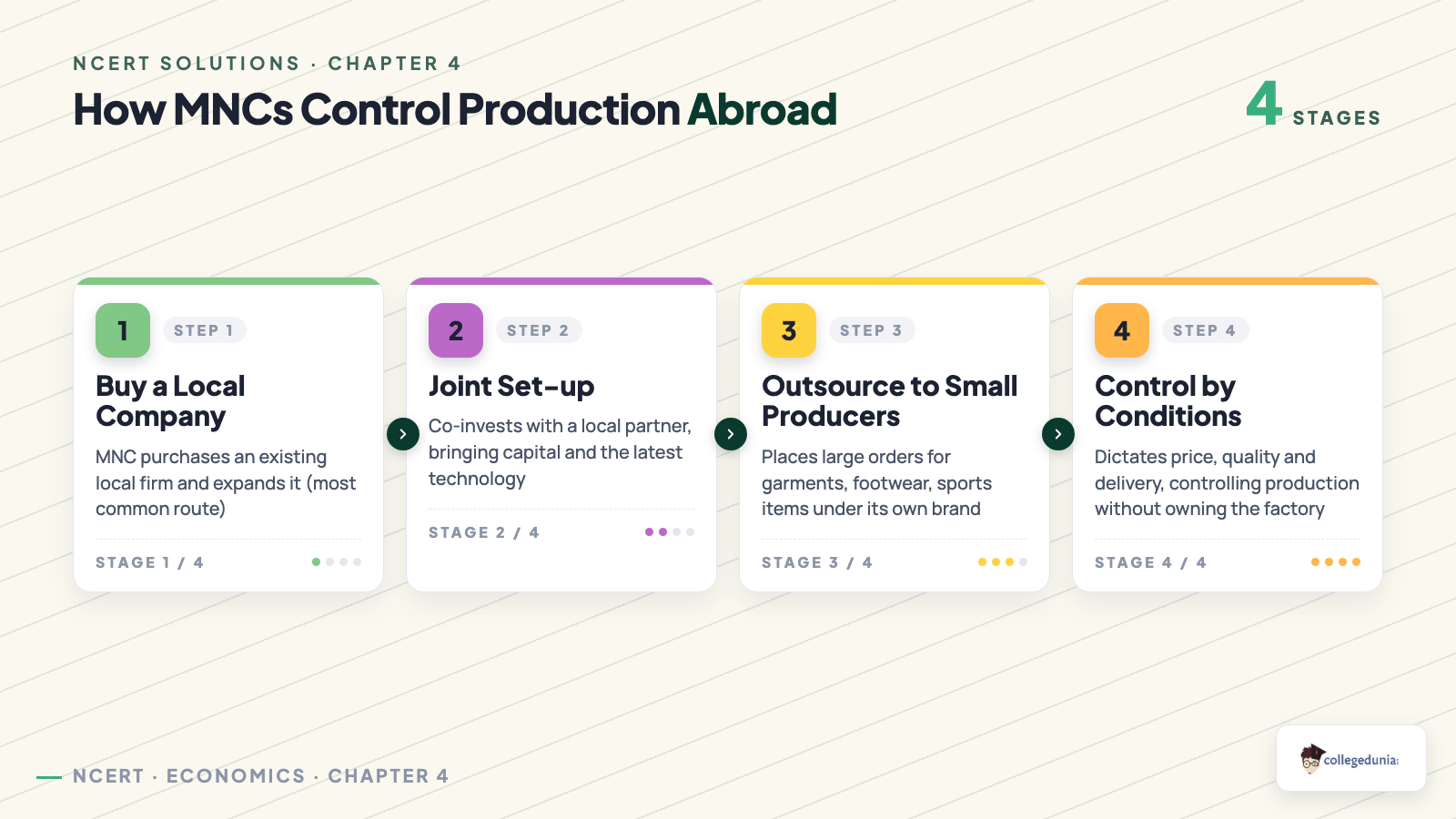
NCERT opens by showing how a multinational corporation (MNC) spreads production across nations to cut costs. Keep all four routes so you never write only one.
| Route | What the chapter wants you to remember |
|---|---|
| Joint set-up | The MNC partners with a local firm, bringing money and technology. |
| Buy a local company | An MNC buys an existing local firm and expands it. The most common route worldwide (Cargill bought Parakh Foods). |
| Outsource to small producers | For garments, footwear and sports items, the MNC orders from small units and sells under its own brand. |
| Control without ownership | Through conditions on price, quality and delivery, the MNC controls production even where it owns no factory. |
A handy rule: an MNC's routes run from full ownership at one end to control without ownership at the other. Naming this spectrum is often worth a mark.
Foreign Trade and How It Integrates Markets Across Countries
The chapter shows that foreign trade is the simplest route to integration: producers sell abroad and buyers choose foreign goods. This shared choice ties the prices of two countries together.
| Point | What it means for the board answer |
|---|---|
| Trade creates choice across borders | Producers gain an extra market abroad; buyers gain extra goods to choose from. |
| Choice links the two prices | Buyers pick wherever a good is cheaper or better, so prices in the two countries move together. |
| Markets integrate | The two markets begin to act as one, joined by foreign trade. |
| Worked example | Importing cheaper Korean smartphones ties the Indian and Korean phone markets together. |
Remember the pond-and-channel picture: trade opens a channel and prices settle to one level, like water in two joined ponds.
Liberalisation, the WTO and Why Barriers Were Removed in 1991
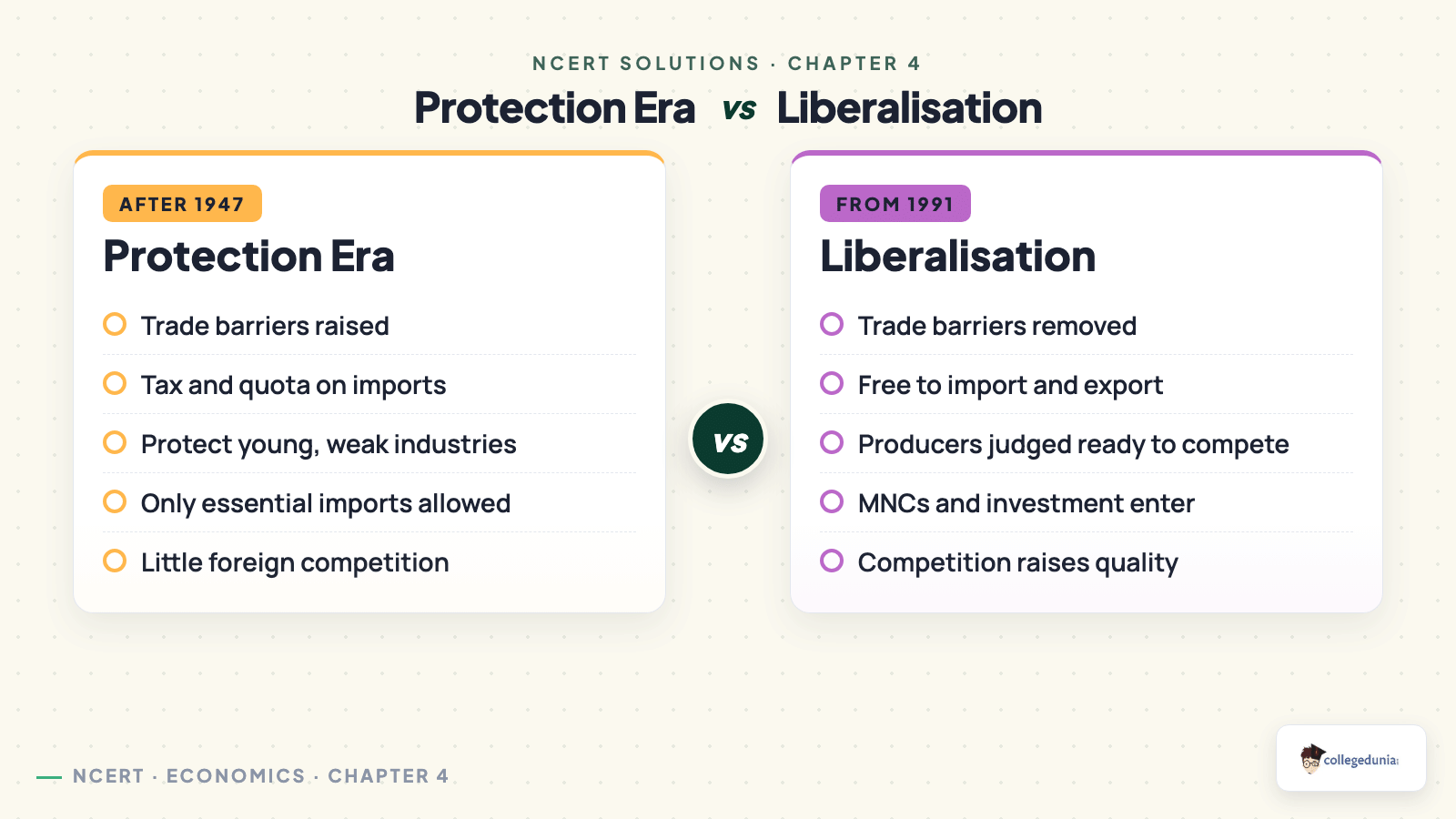
India put up trade barriers (taxes and quotas) after Independence to protect young industries, then removed them from 1991. This removal is liberalisation, and the WTO pushes countries to liberalise.
| Idea | What it adds |
|---|---|
| Why barriers were put up | To protect weak Indian industries from cheap foreign goods. |
| Why they were removed (1991) | The government judged producers ready to compete on quality. |
| Liberalisation | Removing or easing government barriers so businesses can trade and invest freely. |
| WTO | Pushes liberalisation worldwide, but rich countries often keep their own barriers. |
A memory rule: barriers were raised after 1947 to protect industry, and removed from 1991 once it had matured.
Fair Globalisation: Why the Impact Has Not Been Uniform
The chapter's high point is that the impact of globalisation has not been uniform. It helped some groups and hurt others, which is why it calls for fair globalisation.
| Group | How globalisation affected them |
|---|---|
| Gainers | Well-off consumers (more choice, lower prices); skilled producers; Indian firms that grew into MNCs (Tata Motors, Infosys, Ranbaxy). |
| Losers | Small producers in toys, tyres and batteries undercut by imports; workers in low-paid, insecure jobs. |
| The fix | Fair globalisation: rich countries drop their barriers, WTO rules are made fairer, and workers and small producers are protected. |
A full-mark answer must contrast gainers and losers, then name fair globalisation as the way forward. Describing only the benefits misses the point.
Common Mistakes Students Make in This Class 10 Economics Chapter
A few slips lose easy marks every year. Fix these before the exam.
- Reversing the dates. Barriers were raised after 1947 and removed from 1991, not the other way round.
- Listing only the benefits. The word "uniform" demands a contrast of gainers and losers.
- Saying MNCs mainly build new factories. The most common route is to buy existing local companies.
- Picking "people" in MCQ (i). Labour does not move freely; goods, services and investments do.
How to Use the NCERT Solutions Class 10 Economics Chapter 4 Page
Use this page in three short blocks so revision stays focused.
- Read and list: note every keyword (MNC, trade barrier, liberalisation, WTO) with an example.
- Attempt first: answer all 13 questions on your own before opening the solutions.
- Compare and flag: match your answer with the solution and mark the missing fact-lines.
For long-answer practice, write the "MNC routes", "liberalisation" and "impact not uniform" answers in full at least once. Each solution mirrors the board's 5-mark pattern.
Practice All NCERT Solutions for This Class 10 Economics Chapter with Step-by-Step Solutions
Open the question bank below to attempt all 13 solved questions with collapsible Solution and Expert Solution tabs. Every answer is mapped to the NCERT text, the way a board examiner expects.
All Solved Questions for this Class 10 Economics Chapter
Practise every fill-up, match, MCQ and discussion question with step-by-step solutions and an expert version.
What Students Say About This Class 10 Economics Chapter
Student Feedback
What 11,860 students told us about studying this chapter before the 2026 boards:
- 64% of students found the four routes MNCs use to control production the most confusing part.
- 58% of students got the 1991 dates for raising versus removing barriers wrong.
- Fair globalisation was left for last by about 41% of students.
Source: 2026-27 Class 10 Economics student poll, 11,860 students from CBSE schools across 15 states.
Class 10 Economics Other Resources for This Chapter
Pair these solutions with the other Class 10 Economics resources for this chapter, all linked below.
| Resource | Best used for |
|---|---|
| Globalisation and the Indian Economy Class 10 NCERT Solutions | You are reading this page |
| Globalisation and the Indian Economy Class 10 Notes | Quick concept recap before the exam |
| Globalisation and the Indian Economy Class 10 Handwritten Notes | Last-minute scanned revision |
| Globalisation and the Indian Economy Class 10 NCERT Book PDF | Reading the original chapter text |
All Chapters NCERT Solutions for Class 10 Economics (Understanding Eco Dev)
Browse the full set of ncert solutions for class 10 economics chapter by chapter.
| Chapter | NCERT Solutions |
|---|---|
| Chapter 1 | Development Class 10 NCERT Solutions |
| Chapter 2 | Sectors of the Indian Economy Class 10 NCERT Solutions |
| Chapter 3 | Money and Credit Class 10 NCERT Solutions |
| Chapter 4 | Globalisation and the Indian Economy Class 10 NCERT Solutions |
| Chapter 5 | Consumer Rights Class 10 NCERT Solutions |
Globalisation and the Indian Economy Class 10 Economics NCERT Solutions FAQs
Ques. Where can I download the ncert solutions class 10 economics chapter 4 Globalisation and the Indian Economy PDF?
Ans. You can download the globalisation class 10 ncert solutions PDF directly from this page. Both the Normal and HD versions are free, and a quick-revision read of every answer is available too.
Ques. How many questions are solved in globalisation class 10 chapter 4 question answer?
Ans. All 13 NCERT exercise questions are solved, including the fill-up, match-the-following and MCQ questions and the longer discussion questions, each with a step-by-step solution and an expert version.
Ques. Is this NCERT Solutions page aligned with the 2026-27 syllabus?
Ans. Yes. This page reflects the current 2026-27 syllabus for Class 10 Economics, and every answer is checked against the latest NCERT edition of Understanding Economic Development.
Ques. What is globalisation in Class 10 Economics Chapter 4?
Ans. Globalisation is the rapid integration of countries through foreign trade and foreign investment by MNCs. It spreads production across nations and widens the choice of goods and services available to consumers.
Ques. What are the ways in which MNCs set up or control production in other countries?
Ans. MNCs (1) jointly set up production with a local firm, (2) buy up existing local companies, (3) place large orders with small producers under their own brand, and (4) control production through conditions on price and quality even without ownership.
Ques. Why did India remove its trade barriers in 1991?
Ans. Barriers were first put up after Independence to protect young Indian industries. By 1991 the government judged producers ready to compete, so it removed the barriers (liberalisation) to raise quality through competition and to widen consumer choice.
Ques. Why has the impact of globalisation not been uniform?
Ans. Globalisation helped well-off consumers, skilled producers and Indian MNCs, but hurt many small producers and ordinary workers who faced fierce competition and job losses. Because the same process helped some and hurt others, its impact has been unequal, which is why the chapter calls for fair globalisation.



Comments