




Development is the first chapter in the Class 10 Social Science board paper.
Chapter1DevelopmentSolutions.pdf?page=1&dpi=150)
Chapter1DevelopmentSolutions.pdf?page=2&dpi=150)
Chapter1DevelopmentSolutions.pdf?page=3&dpi=150)
Chapter1DevelopmentSolutions.pdf?page=4&dpi=150)
Chapter1DevelopmentSolutions.pdf?page=5&dpi=150)
Chapter1DevelopmentSolutions.pdf?page=6&dpi=150)
Chapter1DevelopmentSolutions.pdf?page=7&dpi=150)
Chapter1DevelopmentSolutions.pdf?page=8&dpi=150)
Chapter1DevelopmentSolutions.pdf?page=9&dpi=150)
Chapter1DevelopmentSolutions.pdf?page=10&dpi=150)
Chapter1DevelopmentSolutions.pdf?page=11&dpi=150)
Chapter1DevelopmentSolutions.pdf?page=12&dpi=150)
Chapter1DevelopmentSolutions.pdf?page=13&dpi=150)
Chapter1DevelopmentSolutions.pdf?page=14&dpi=150)
Chapter1DevelopmentSolutions.pdf?page=15&dpi=150)
Chapter1DevelopmentSolutions.pdf?page=16&dpi=150)
Chapter1DevelopmentSolutions.pdf?page=17&dpi=150)
Chapter1DevelopmentSolutions.pdf?page=18&dpi=150)
Chapter1DevelopmentSolutions.pdf?page=19&dpi=150)
Chapter1DevelopmentSolutions.pdf?page=20&dpi=150)
Chapter1DevelopmentSolutions.pdf?page=21&dpi=150)
The development class 10 ncert solutions on this page answer every back-exercise question, as per the 2026-27 CBSE syllabus. Each answer keeps the indicators the NCERT text uses, from per capita income to the Human Development Index and sustainability.
- 13 NCERT questions solved: 3 MCQ-type plus short-answer and discussion questions, each step-by-step.
- A regular source of 1, 3 and 5 mark questions in the Class 10 board paper.
- Free PDF download in Normal and HD.
Every answer here is written by Collegedunia subject experts and checked against the 2026-27 NCERT textbook.
What This Class 10 Economics Chapter Covers for the Boards
This chapter teaches that development is a many-sided idea, so no single number can capture it. Income alone cannot measure progress, so we add health and education indicators along with sustainability. The solutions here keep every term, table and example you need for the board paper.
- Developmental goals: why the same change can suit one person and hurt another.
- Income and other goals: per capita income as a yardstick, plus the non-income goals of freedom, security and respect.
- National development and averages: how per capita income is found and why averages hide disparities.
- Public facilities: why money cannot buy clean air, health and schooling, and why Kerala beats Haryana.
- Human Development Index and sustainability: the UNDP measure of income, health and education, and the limited stock of resources.
Development Class 10 One-Shot Revision for Boards
This short video shows how per capita income, HDI and sustainability connect before you attempt the answers.
Source: Magnet Brains on YouTube
Development Class 10 Chapter 1 Question Answer: MCQ Section
The three multiple-choice questions in development class 10 chapter 1 test the indicators of development and the HDI table. The trick is to read every option as a set, not in isolation, and to remember that a smaller HDI rank number is better.
| Question | Answer and the one fact that proves it |
|---|---|
| Development of a country can generally be determined by | (iv) all the above. Per capita income, literacy and health status each measure a different dimension, so development is judged by all three together, which is exactly what HDI does. |
| Neighbour with better human development than India | (ii) Sri Lanka. Sri Lanka's HDI rank of 89 is far ahead of India's 130, and it beats India on income, life expectancy and schooling too. |
| Income of the fourth family if the average is Rs 5000 | (iv) Rs 6000. Total income is 5000 multiplied by 4, that is 20000; subtract the three known incomes of 14000 to get 6000. |
Tip: for any HDI question, read the rank column first. A smaller rank number is better, rank 89 ahead of rank 130, and that line usually earns the full mark.
Developmental Goals and Income vs Other Goals in Class 10 Economics
NCERT opens by showing that different people have different developmental goals, and the same change can be a goal for one group and a problem for another. Keep this two-sided logic so you never write only the income side of a goal.
| Idea | What the chapter wants you to remember |
|---|---|
| Different goals | A landless labourer wants more work and fair wages; a rich farmer wants higher crop prices. The same step can suit one and hurt the other. |
| Income goal | More income means more of the goods and services people need, so income is one important goal of development. |
| Non-income goals | People also want freedom, security, equal treatment, respect and a pollution-free environment, which money alone cannot buy. |
A handy rule: every developmental goal has an income side and a quality-of-life side. Stating both is often worth a mark.
Income, Averages and the World Bank Criterion
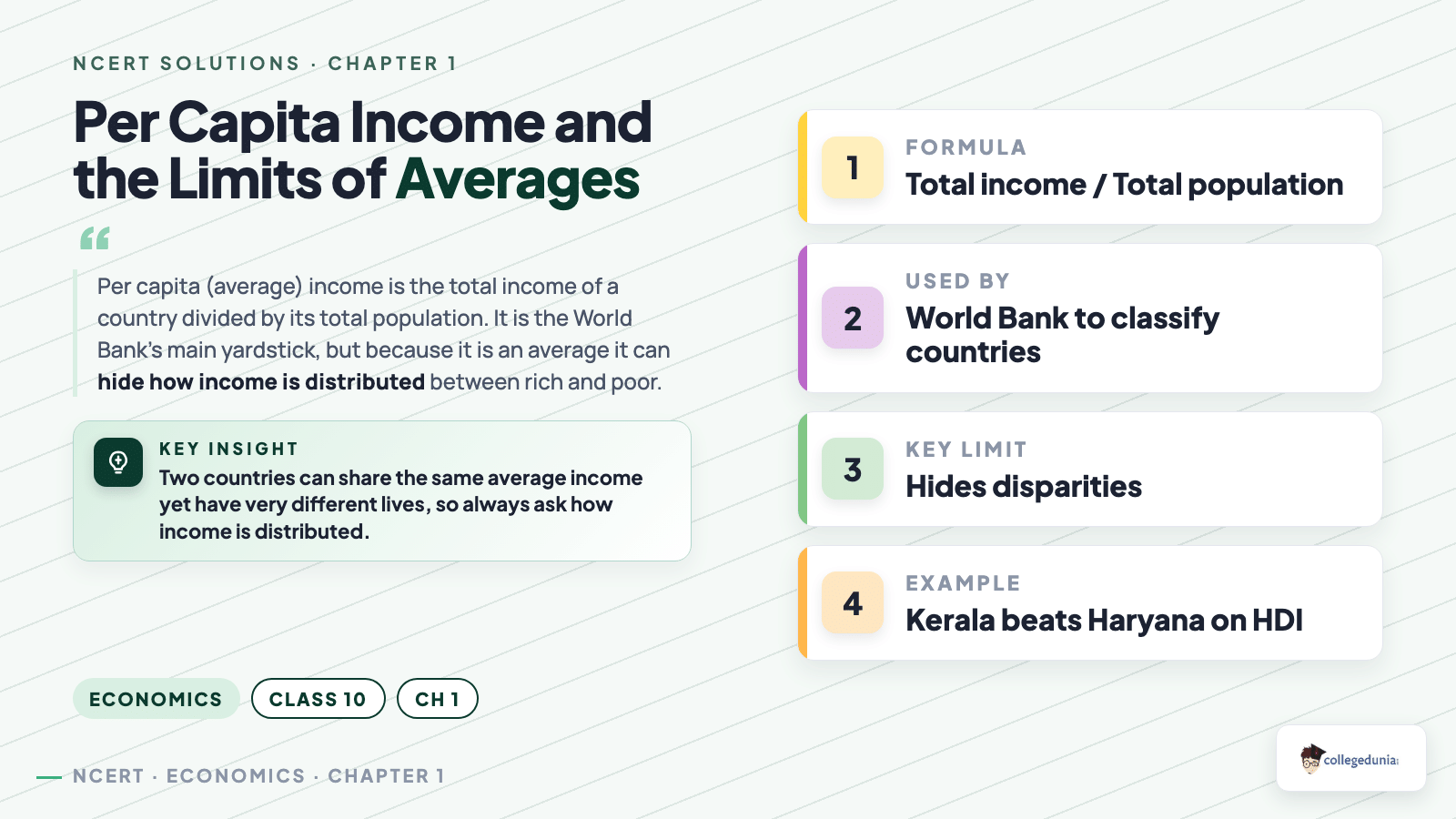
The World Bank sorts countries by per capita income, total income divided by total population. But this single figure is an average, and an average can hide how income is shared.
| Point | What it means for the board answer |
|---|---|
| Per capita income formula | Per capita income equals total income divided by total population, the World Bank's main yardstick for rich and poor countries. |
| Why averages are used | Countries have different population sizes, so dividing by population gives a like-for-like figure for comparison. |
| Limitation of averages | Two countries with the same average income can have very different spreads; the average hides disparities between rich and poor. |
| Beyond income | Money cannot buy a pollution-free environment, public health or freedom from disease, which depend on public facilities. |
Remember the Kerala versus Haryana case: lower income but a better human development ranking. This is the most-tested limitation in the chapter.
Human Development Index and Sustainability in This Chapter
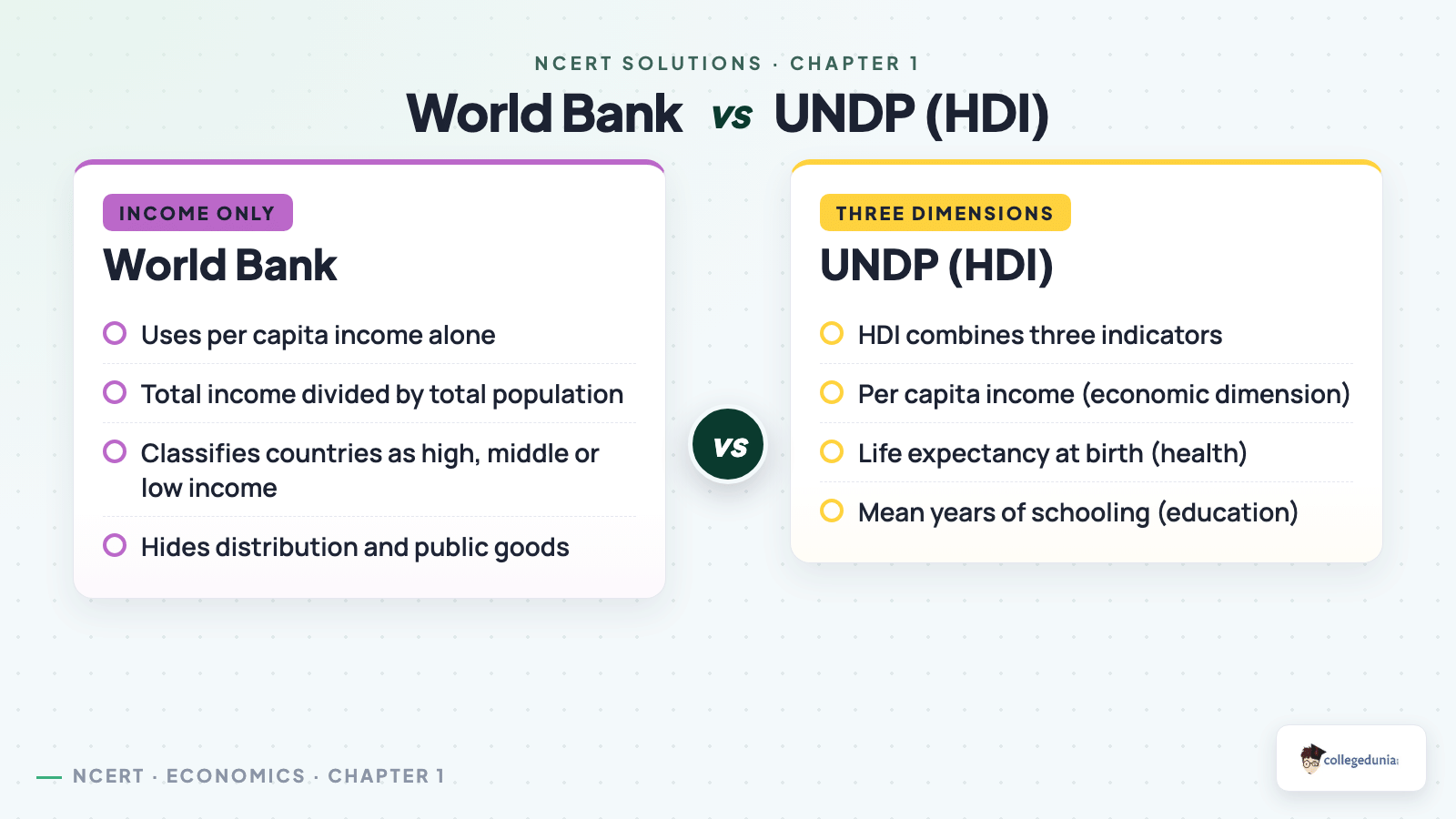
The UNDP measures development with the Human Development Index, a composite of per capita income, health (life expectancy) and education (years of schooling). The chapter then turns to sustainability, since the resources that fuel development are limited.
| Measure or idea | What it adds |
|---|---|
| World Bank criterion | Per capita income only, a single economic indicator used to classify countries. |
| UNDP: HDI | Income plus health (life expectancy at birth) plus education (mean years of schooling), a broader, people-centred measure. |
| Sustainability | Using resources to meet present needs without reducing the ability of future generations to meet theirs. |
| Resource limits | Crude-oil reserves last only about 50 more years, and groundwater can be over-used, so growth today must not rob tomorrow. |
A memory rule: World Bank uses 1 indicator (income), while UNDP uses 3 (income, health, education). Naming all three HDI components usually earns a mark.
Common Mistakes Students Make in This Class 10 Economics Chapter
A few slips lose easy marks every year. Fix these before the exam.
- Picking the larger HDI rank number as better. A smaller rank number (rank 89) is the top, not rank 130.
- Saying per capita income is useless because Kerala beats Haryana. Income is not sufficient, but it is still necessary and useful.
- Listing only income as a developmental goal. Add the non-income goals of freedom, security, equal treatment and respect.
- Treating an average as the whole story. Always pair it with how the income is distributed.
How to Use the NCERT Solutions Class 10 Economics Chapter 1 Page
Use these solutions in three short blocks so revision stays focused.
- Read and list: read the NCERT chapter and note every indicator, its formula and example.
- Attempt first: answer all 13 questions on your own before opening the solutions.
- Compare and flag: match your answer with the solution and mark the missing fact-lines.
For long-answer practice, write the World Bank versus UNDP and the sustainability answers in full at least once. Each solution mirrors the board's 5-mark pattern and doubles as a model answer for revision.
Practice All NCERT Solutions for This Class 10 Economics Chapter with Step-by-Step Solutions
Open the question bank below to attempt all 13 solved questions with collapsible Solution and Expert Solution tabs. Every answer is mapped to the NCERT text, the way a board examiner expects.
All Solved Questions for this Class 10 Economics Chapter
Practise every MCQ and discussion question with step-by-step solutions and an expert version.
What Students Say About This Class 10 Economics Chapter
Student Feedback
What 12,430 students told us about studying this chapter before the 2026 boards:
- 69% of students found the World Bank versus UNDP comparison the most confusing part.
- 61% of students got the HDI rank direction wrong, smaller rank is better.
- Sustainability of development was left for last by about 37% of students.
Source: 2026-27 Class 10 Economics student poll, 12,430 students from CBSE schools across 15 states.
Class 10 Economics Other Resources for This Chapter
Pair these solutions with the other Class 10 Economics resources for this chapter, all linked below.
| Resource | Best used for |
|---|---|
| Development Class 10 NCERT Solutions | You are reading this page |
| Development Class 10 Notes | Quick concept recap before the exam |
| Development Class 10 Handwritten Notes | Last-minute scanned revision |
| Development Class 10 NCERT Book PDF | Reading the original chapter text |
All Chapters NCERT Solutions for Class 10 Economics (Understanding Eco Dev)
Browse the full set of ncert solutions for class 10 economics chapter by chapter.
| Chapter | NCERT Solutions |
|---|---|
| Chapter 1 | Development Class 10 NCERT Solutions |
| Chapter 2 | Sectors of the Indian Economy Class 10 NCERT Solutions |
| Chapter 3 | Money and Credit Class 10 NCERT Solutions |
| Chapter 4 | Globalisation and the Indian Economy Class 10 NCERT Solutions |
| Chapter 5 | Consumer Rights Class 10 NCERT Solutions |
Development Class 10 Economics NCERT Solutions FAQs
Ques. Where can I download the development class 10 ncert solutions PDF?
Ans. You can download the development class 10 ncert solutions PDF directly from this page. Both the Normal and HD versions are free, and a quick-revision read of every answer is available too.
Ques. How many questions are solved in development class 10 chapter 1 question answer?
Ans. All 13 NCERT exercise questions are solved, including the 3 MCQ-type questions and the longer discussion questions, each with a step-by-step solution and an expert version.
Ques. Is this NCERT Solutions page aligned with the 2026-27 syllabus?
Ans. Yes. This page reflects the current 2026-27 syllabus for Class 10 Economics, and every answer is checked against the latest NCERT edition of Understanding Economic Development.
Ques. Why does the World Bank use per capita income to classify countries?
Ans. The World Bank uses per capita income, total income divided by total population, because more income is taken to mean more of the goods and services people need, and it is easy to compare across countries. Its limits are that it hides distribution, ignores public goods, and overlooks sustainability.
Ques. How is the UNDP's HDI different from the World Bank criterion?
Ans. The World Bank uses income alone, while the UNDP's Human Development Index combines income with health (life expectancy at birth) and education (mean years of schooling). HDI is therefore a broader, people-centred measure of development.
Ques. Why does Kerala have a better human development ranking than Haryana despite lower income?
Ans. Kerala has a lower infant mortality rate, higher literacy and strong public health and education, which lift its human development above what its income alone would predict. This shows per capita income is not sufficient on its own, though it remains useful.
Ques. Why is sustainability important for development in this chapter?
Ans. Sustainability matters because natural resources are limited; crude-oil reserves last only about 50 more years and groundwater can be over-used. Unless we use resources carefully, development cannot continue for future generations and environmental damage will harm everyone.



Comments