



The NCERT Solutions for Class 11 Computer Science Chapter 3 Emerging Trends cover all 14 textbook exercise questions for the 2026-27 NCERT chapter. The PDF gives clear answers for AI, machine learning, big data, IoT, cloud computing, grid computing and blockchain.
- Use these solutions after reading the NCERT chapter once and marking the main technology terms.
- The PDF includes every exercise question with a short solution and an expert solution.
- Keep examples ready for IoT, cloud, grid and blockchain questions because most answers are application-based.

Each answer in this Class 11 Computer Science Chapter 3 NCERT Solutions PDF follows the 2026-27 NCERT exercise and keeps technology examples simple.
Student Feedback: In a Collegedunia student check of 9,760 Class 11 Computer Science students, 73% said Emerging Trends became easier when every answer paired the term with one real-life use.
Emerging Trends Exercise Coverage for Class 11 Computer Science
Emerging Trends is a theory-heavy chapter, but the questions are not vague. Students need exact definitions, everyday examples and clear differences between similar technologies.
| Exercise group | What the solution covers | Best revision habit |
|---|---|---|
| Questions 1-4 | Cloud services, IoT, AI, ML and big data | Write definition plus one use |
| Questions 5-9 | Cloud vs grid, on-demand service and cloud models | Separate IaaS, PaaS and SaaS |
| Questions 10-13 | Smart school, startup cloud use, blockchain and WoT | Apply the concept to a case |
| Question 14 | IoT application matching | Match action with category |
Emerging Trends NCERT Solutions Video
Source: Magnet Brains on YouTube
Cloud Computing and Grid Computing Answers in Emerging Trends
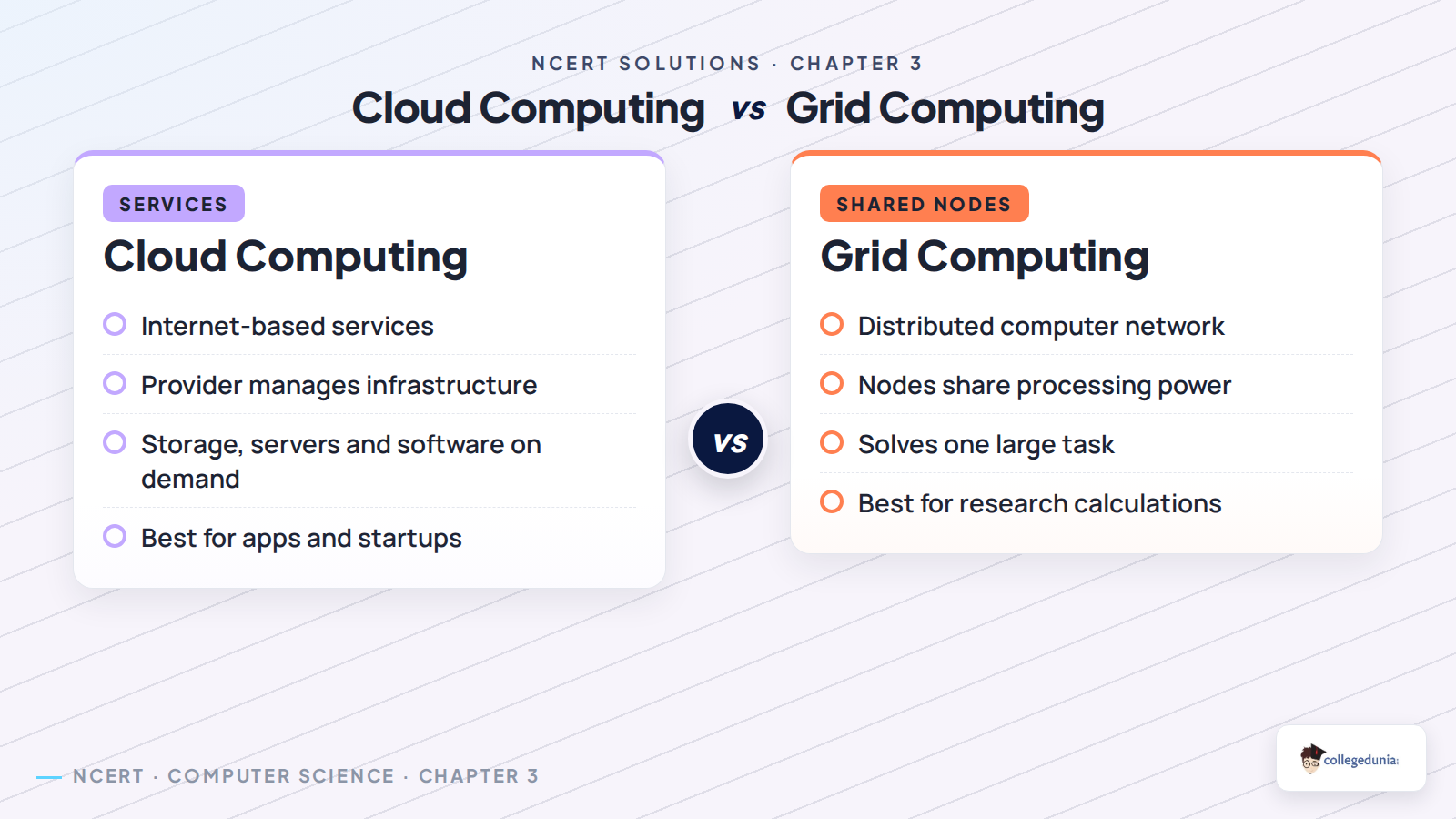
Cloud computing gives services over the Internet, while grid computing joins many distributed nodes for one large task. Cloud is service-oriented; grid is task-oriented.
- IaaS gives virtual servers, storage and networking.
- PaaS gives a ready development and deployment platform.
- SaaS gives ready software through a browser or app.
AI, IoT and Blockchain Examples for Class 11 Computer Science Chapter 3
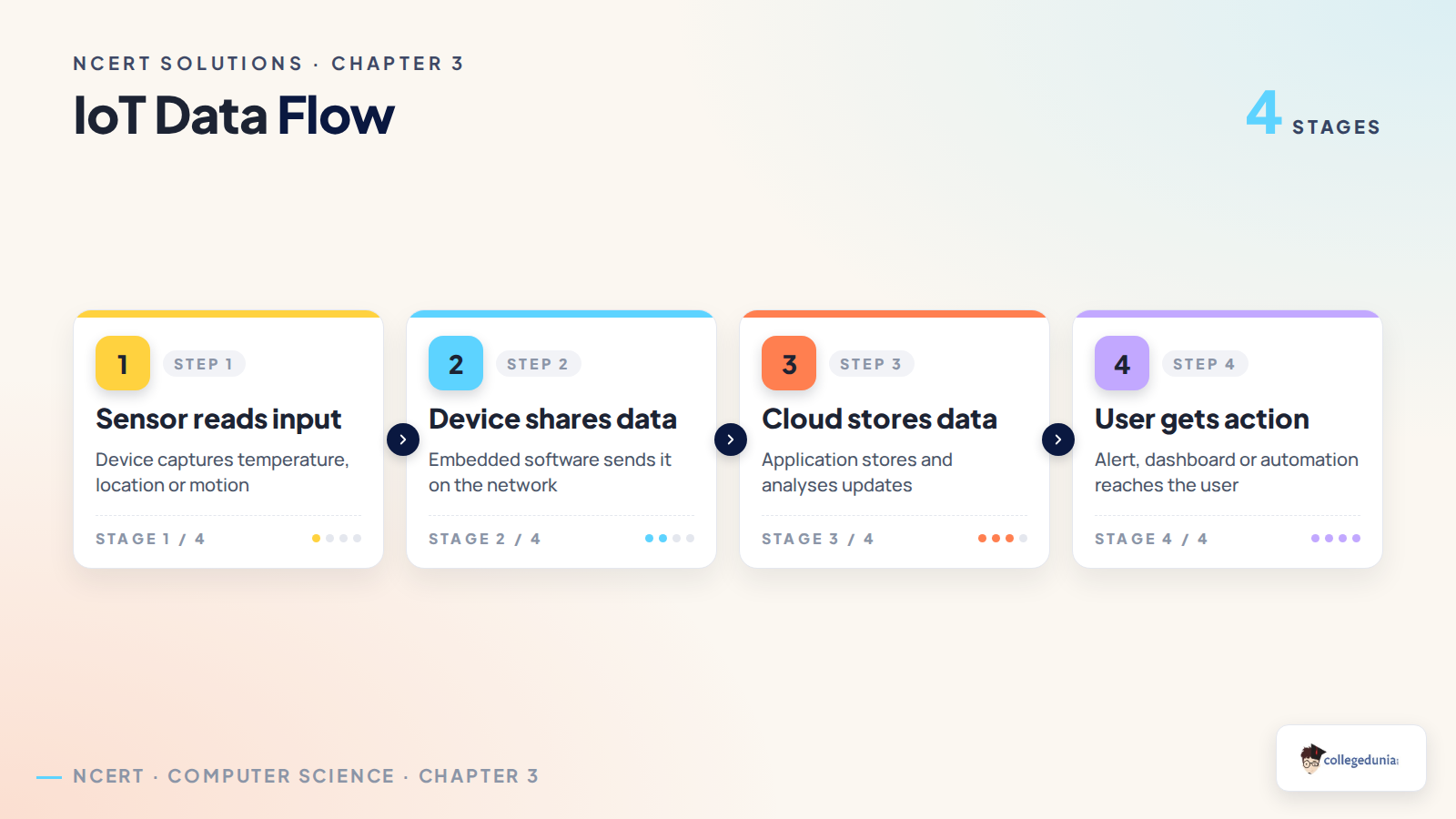
Most long answers in this chapter become stronger with examples. Maps using real-time traffic, smart door locks, bus GPS sensors and scholarship ledgers are direct examples students can reuse.
- AI simulates human-like learning, decision-making and problem solving.
- IoT connects devices that collect and exchange data.
- Blockchain keeps an authenticated shared ledger across connected nodes.
Common Mistakes in Emerging Trends NCERT Solutions
Students often mix close terms. Machine Learning is a part of AI, and WoT is the web layer that helps integrate IoT devices.
- Do not write only examples when the question asks for a definition.
- Do not call every online service SaaS. Virtual servers and storage fit IaaS.
- Do not describe blockchain as just online payment. The key idea is a shared secure ledger.
- Do not confuse a smart wearable with home automation in matching questions.
Related NCERT Class 11 Computer Science Chapter 3 Resources
| Resource | Use it for | Link |
|---|---|---|
| Notes | Revise chapter definitions and examples before solving | Emerging Trends Notes |
| NCERT Book PDF | Read the official chapter and diagrams | Emerging Trends Book PDF |
| Handwritten Notes | Revise AI, IoT, cloud and blockchain quickly | Emerging Trends Handwritten Notes |
Class 11 Computer Science NCERT Solutions Chapter-wise Links
| Chapter | NCERT Solutions |
|---|---|
| Chapter 1 Computer System | Computer System NCERT Solutions |
| Chapter 2 Encoding Schemes and Number System | Encoding Schemes and Number System NCERT Solutions |
| Chapter 3 Emerging Trends | Current chapter |
| Chapter 4 Introduction to Problem Solving | Introduction to Problem Solving NCERT Solutions |
| Chapter 5 Getting Started with Python | Getting Started with Python NCERT Solutions |
All NCERT Solutions for Class 11 Computer Science Chapter 3 Emerging Trends with Step-by-Step Solutions
Use the solved question cards below for a quick check, then download the full PDF for the expert solutions and revision-ready explanations.
Open all Emerging Trends question cards
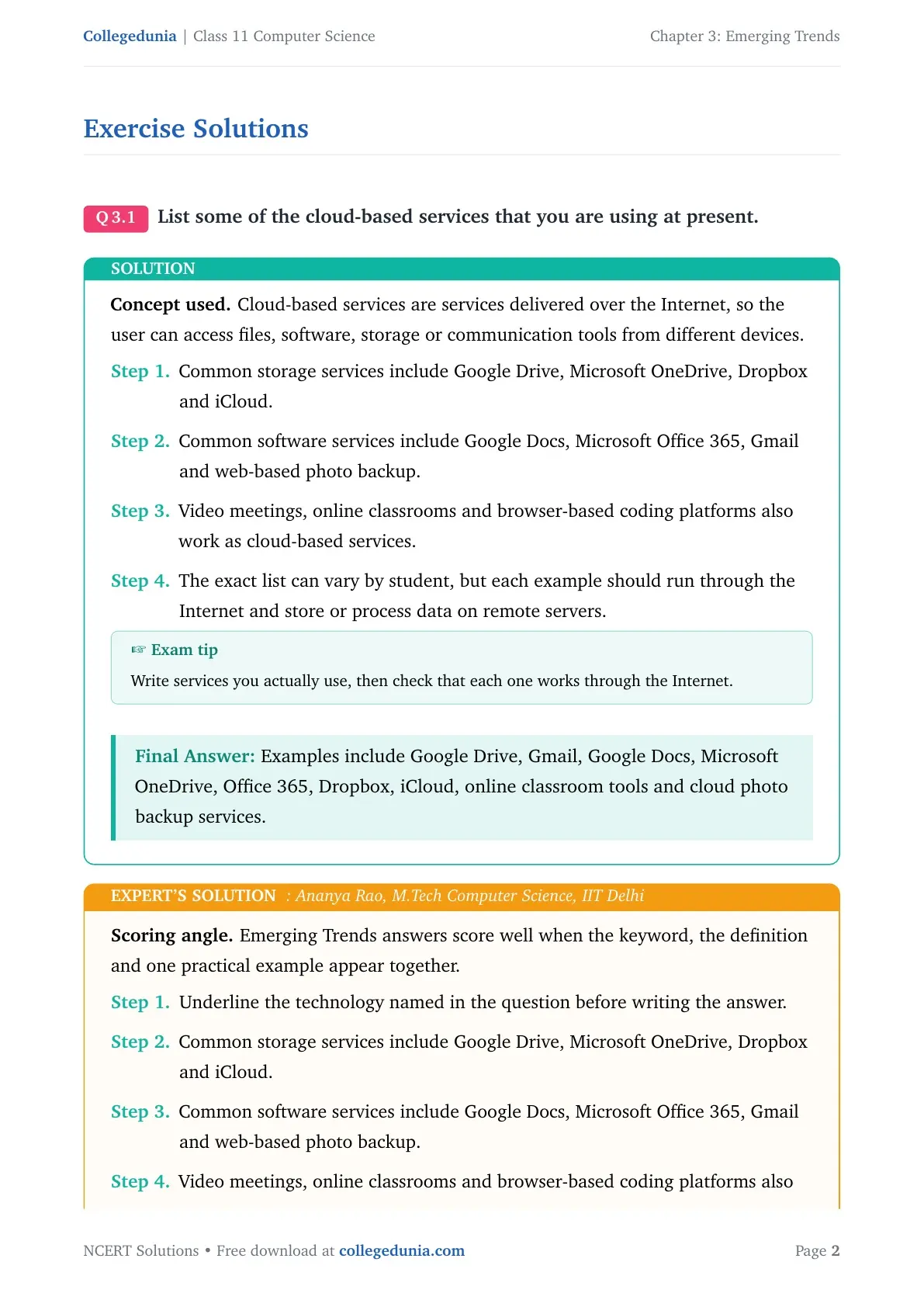
Question 1
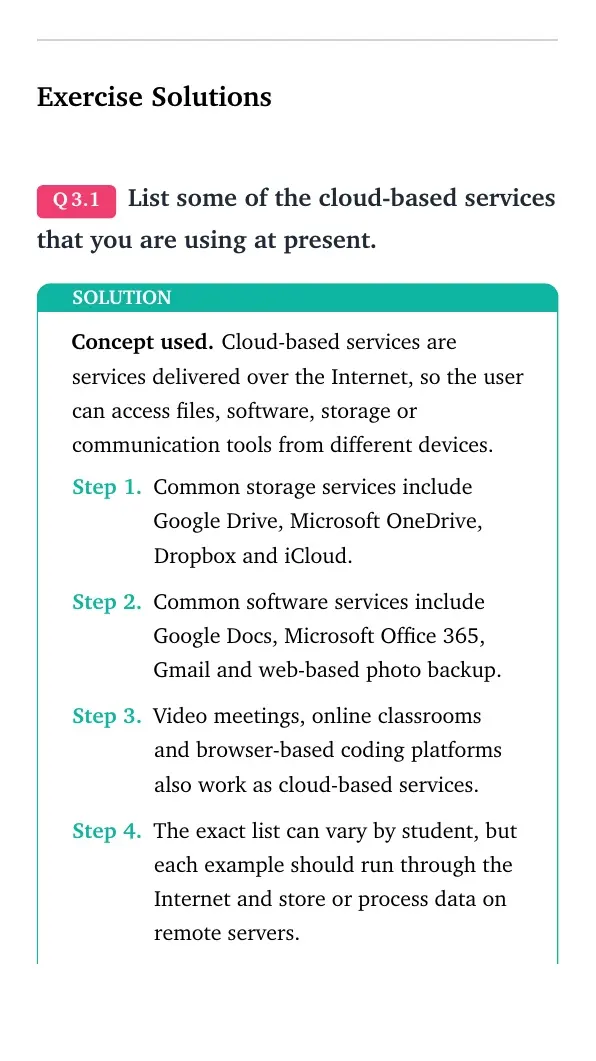
List some of the cloud-based services that you are using at present.
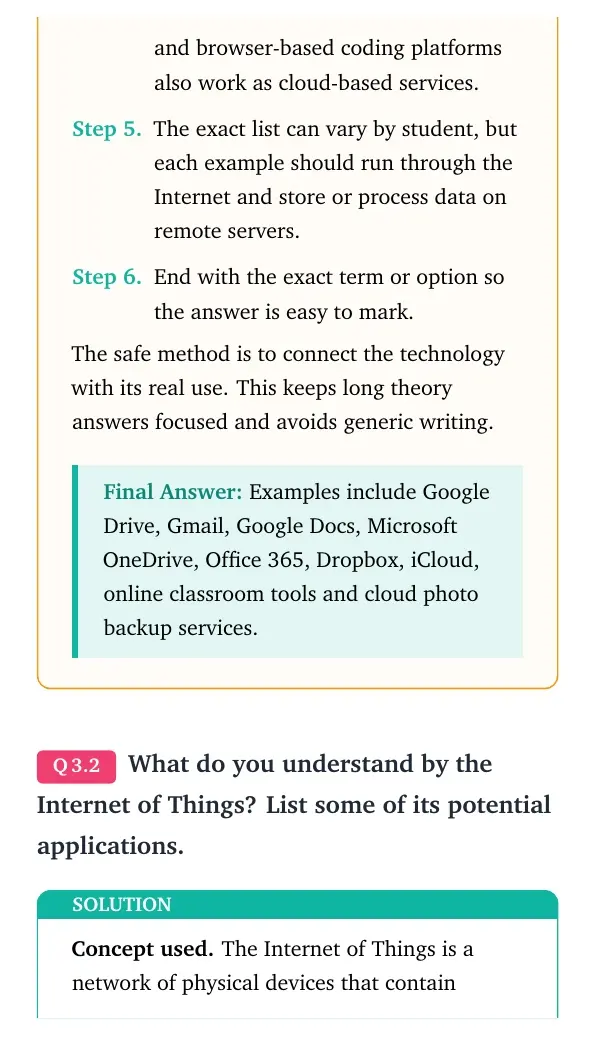
- Common storage services include Google Drive, Microsoft OneDrive, Dropbox and iCloud.
- Common software services include Google Docs, Microsoft Office 365, Gmail and web-based photo backup.
- Video meetings, online classrooms and browser-based coding platforms also work as cloud-based services.
- The exact list can vary by student, but each example should run through the Internet and store or process data on remote servers.
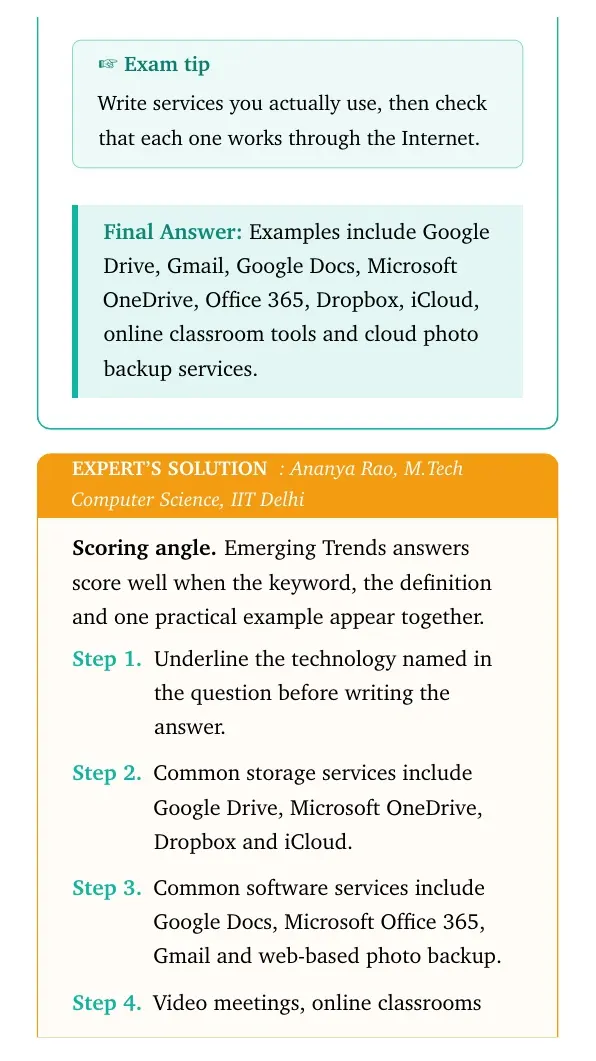
Answer: Examples include Google Drive, Gmail, Google Docs, Microsoft OneDrive, Office 365, Dropbox, iCloud, online classroom tools and cloud photo backup services.
Expert view: Identify the exact technology first, then add the definition and example.
- Common storage services include Google Drive, Microsoft OneDrive, Dropbox and iCloud.
- Common software services include Google Docs, Microsoft Office 365, Gmail and web-based photo backup.
- Video meetings, online classrooms and browser-based coding platforms also work as cloud-based services.
- The exact list can vary by student, but each example should run through the Internet and store or process data on remote servers.
Final answer: Examples include Google Drive, Gmail, Google Docs, Microsoft OneDrive, Office 365, Dropbox, iCloud, online classroom tools and cloud photo backup services.
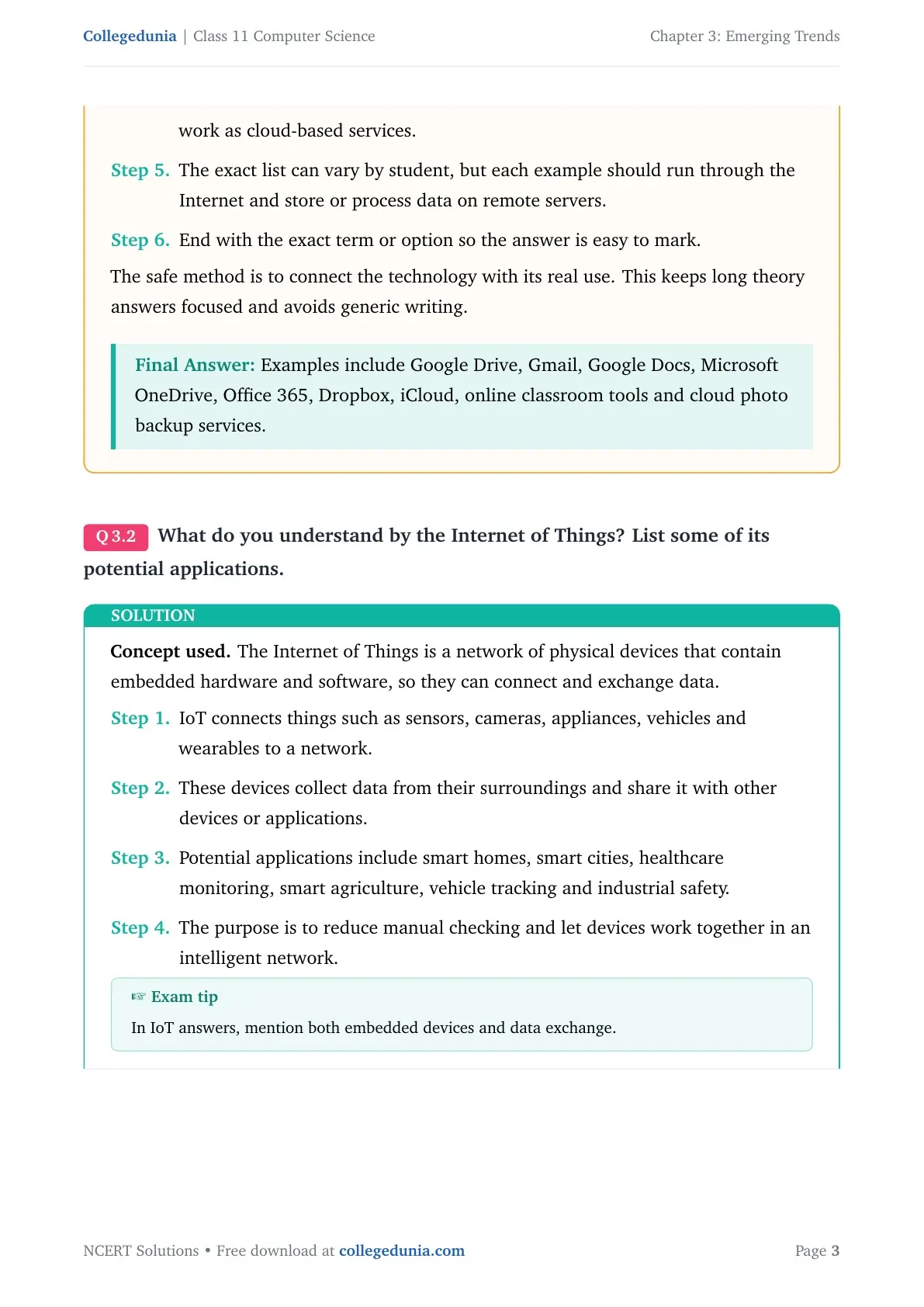
Question 2
What do you understand by the Internet of Things? List some of its potential applications.
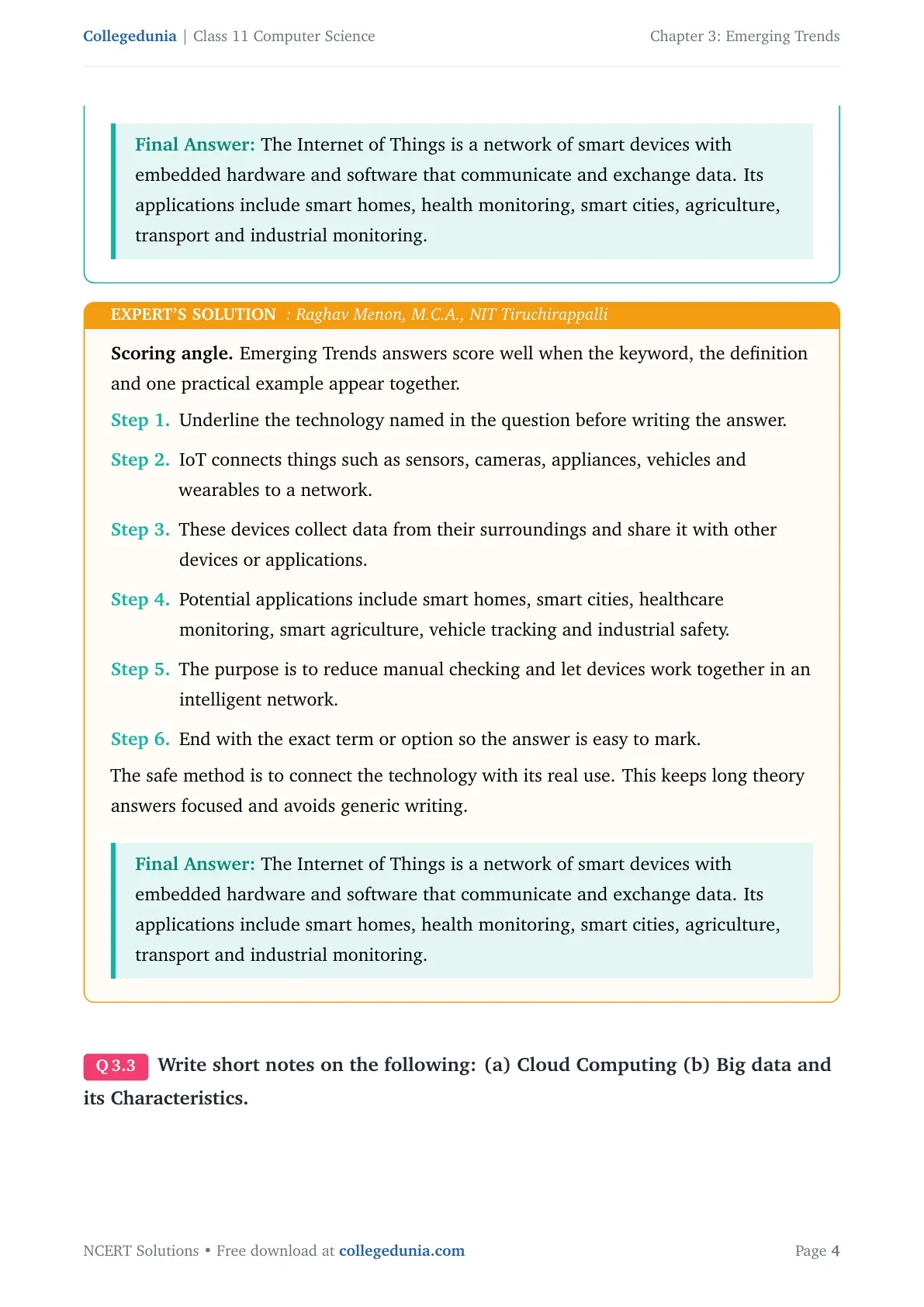
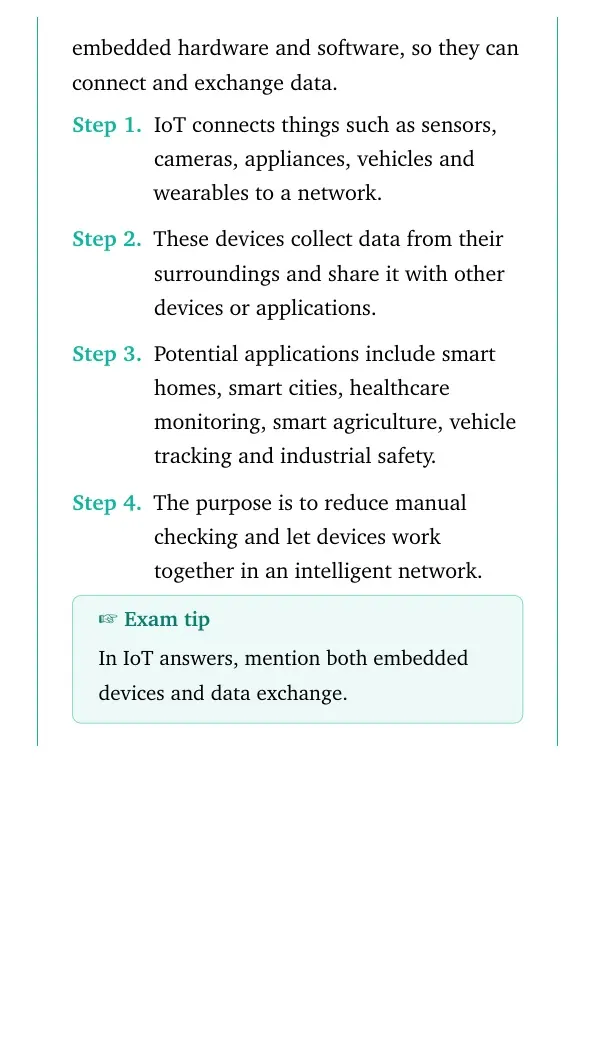
- IoT connects things such as sensors, cameras, appliances, vehicles and wearables to a network.
- These devices collect data from their surroundings and share it with other devices or applications.
- Potential applications include smart homes, smart cities, healthcare monitoring, smart agriculture, vehicle tracking and industrial safety.
- The purpose is to reduce manual checking and let devices work together in an intelligent network.
Answer: The Internet of Things is a network of smart devices with embedded hardware and software that communicate and exchange data. Its applications include smart homes, health monitoring, smart cities, agriculture, transport and industrial monitoring.
Expert view: Identify the exact technology first, then add the definition and example.
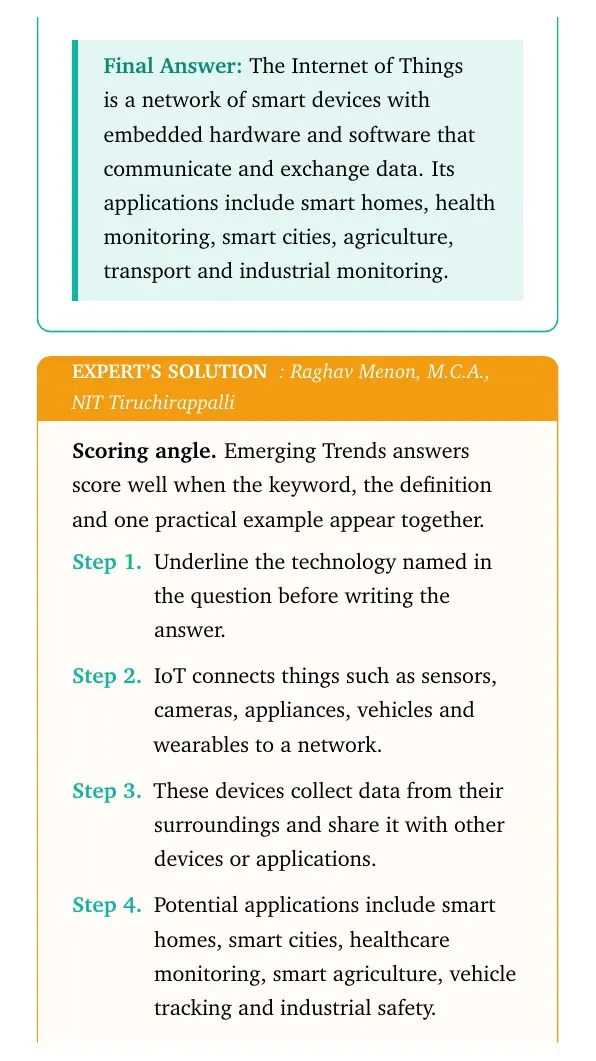
- IoT connects things such as sensors, cameras, appliances, vehicles and wearables to a network.
- These devices collect data from their surroundings and share it with other devices or applications.
- Potential applications include smart homes, smart cities, healthcare monitoring, smart agriculture, vehicle tracking and industrial safety.
- The purpose is to reduce manual checking and let devices work together in an intelligent network.
Final answer: The Internet of Things is a network of smart devices with embedded hardware and software that communicate and exchange data. Its applications include smart homes, health monitoring, smart cities, agriculture, transport and industrial monitoring.
Question 3
Write short notes on the following: (a) Cloud Computing (b) Big data and its Characteristics.
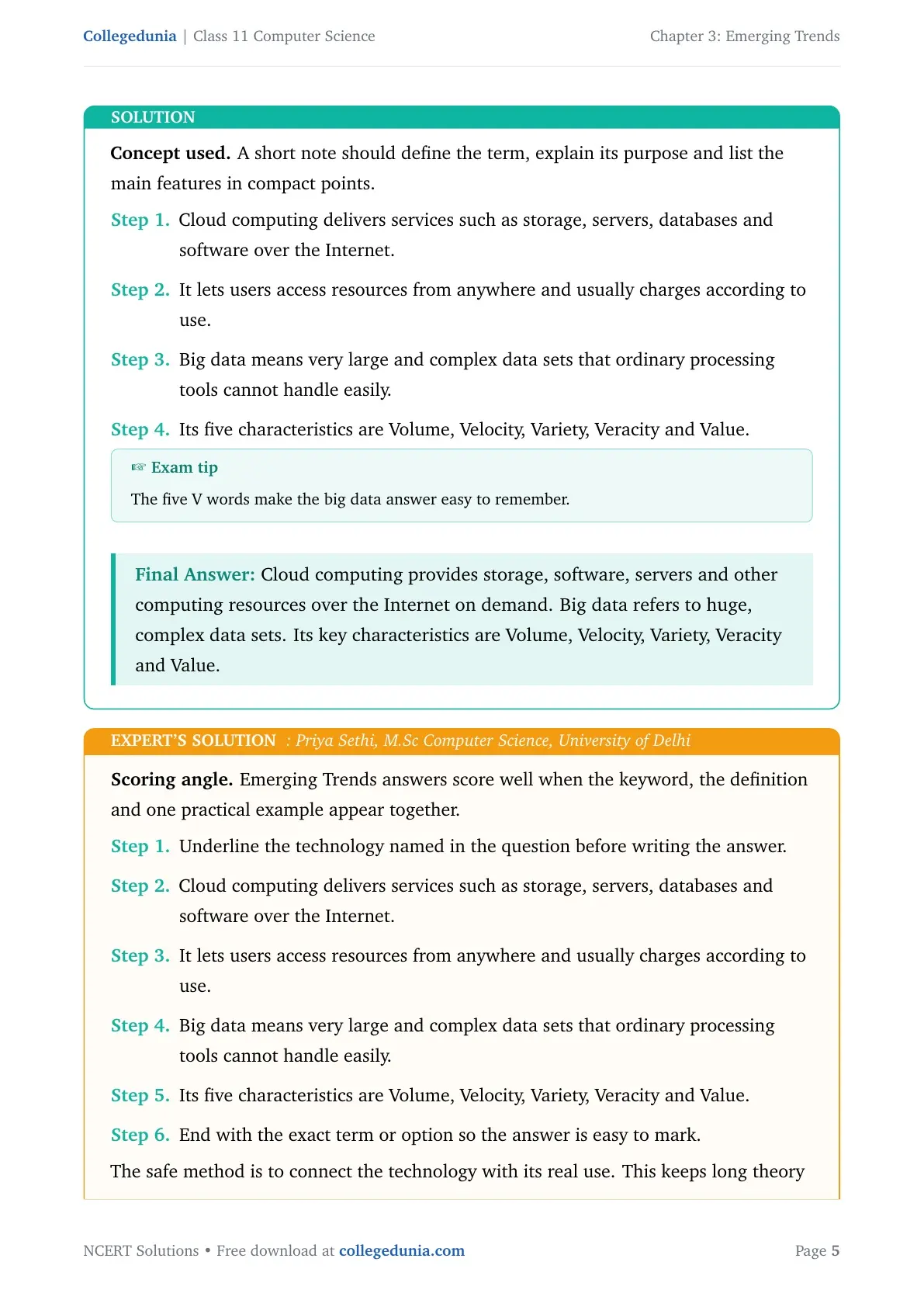
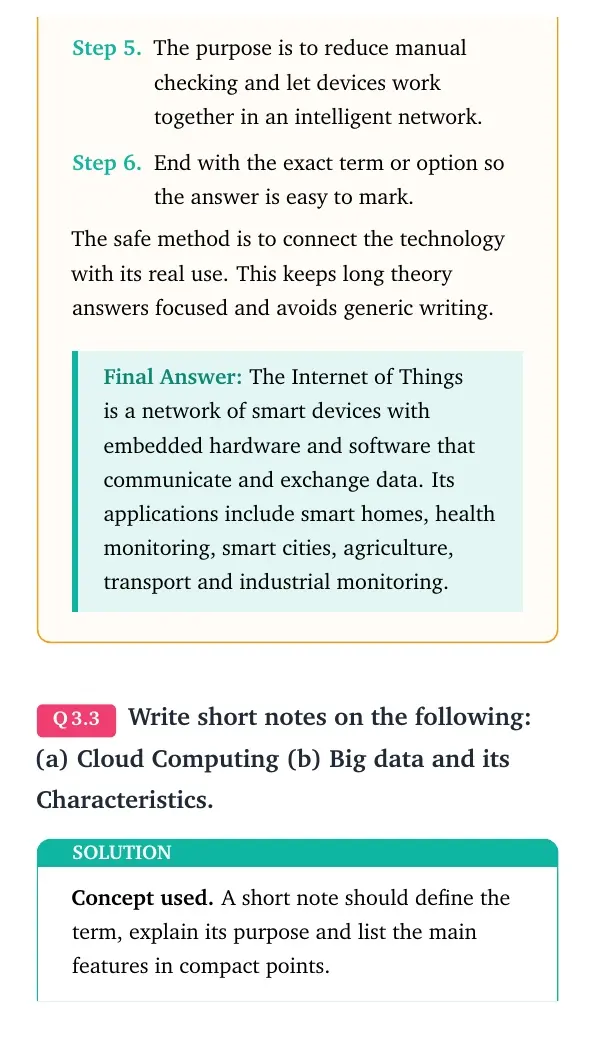
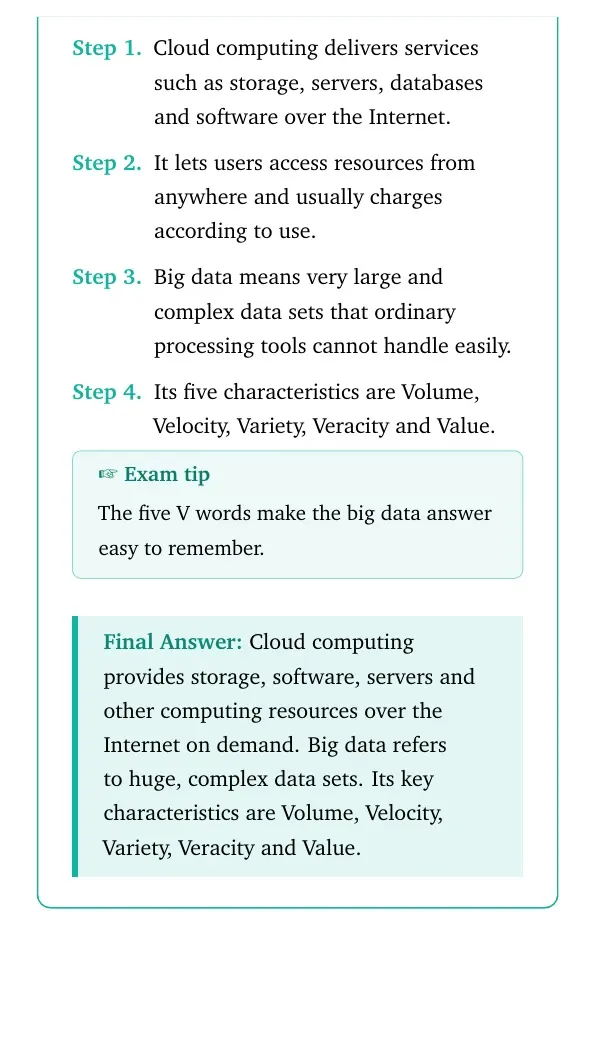
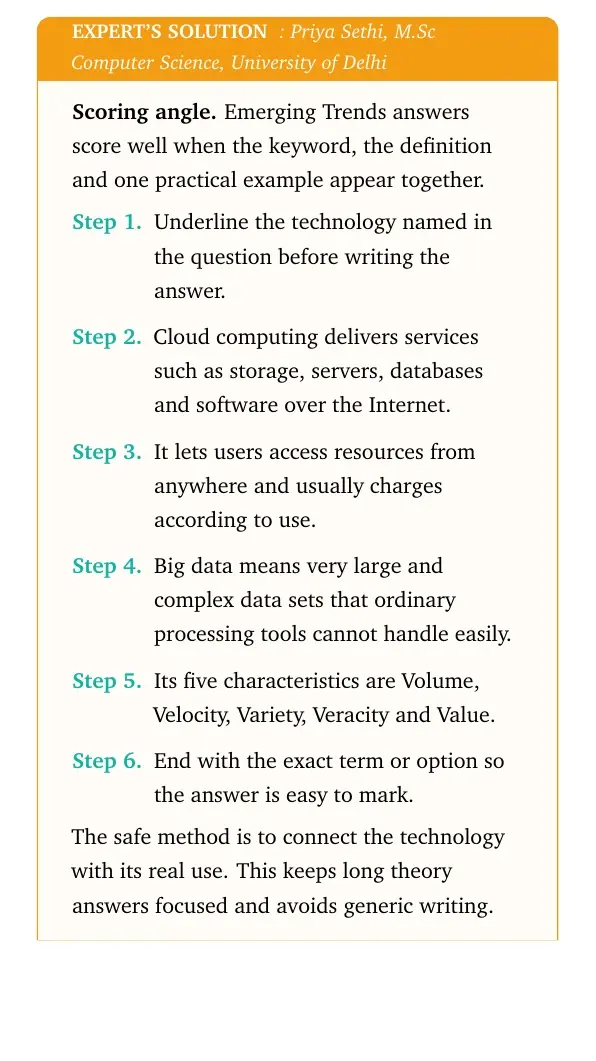
- Cloud computing delivers services such as storage, servers, databases and software over the Internet.
- It lets users access resources from anywhere and usually charges according to use.
- Big data means very large and complex data sets that ordinary processing tools cannot handle easily.
- Its five characteristics are Volume, Velocity, Variety, Veracity and Value.
Answer: Cloud computing provides storage, software, servers and other computing resources over the Internet on demand. Big data refers to huge, complex data sets. Its key characteristics are Volume, Velocity, Variety, Veracity and Value.
Expert view: Identify the exact technology first, then add the definition and example.
- Cloud computing delivers services such as storage, servers, databases and software over the Internet.
- It lets users access resources from anywhere and usually charges according to use.
- Big data means very large and complex data sets that ordinary processing tools cannot handle easily.
- Its five characteristics are Volume, Velocity, Variety, Veracity and Value.
Final answer: Cloud computing provides storage, software, servers and other computing resources over the Internet on demand. Big data refers to huge, complex data sets. Its key characteristics are Volume, Velocity, Variety, Veracity and Value.
Question 4
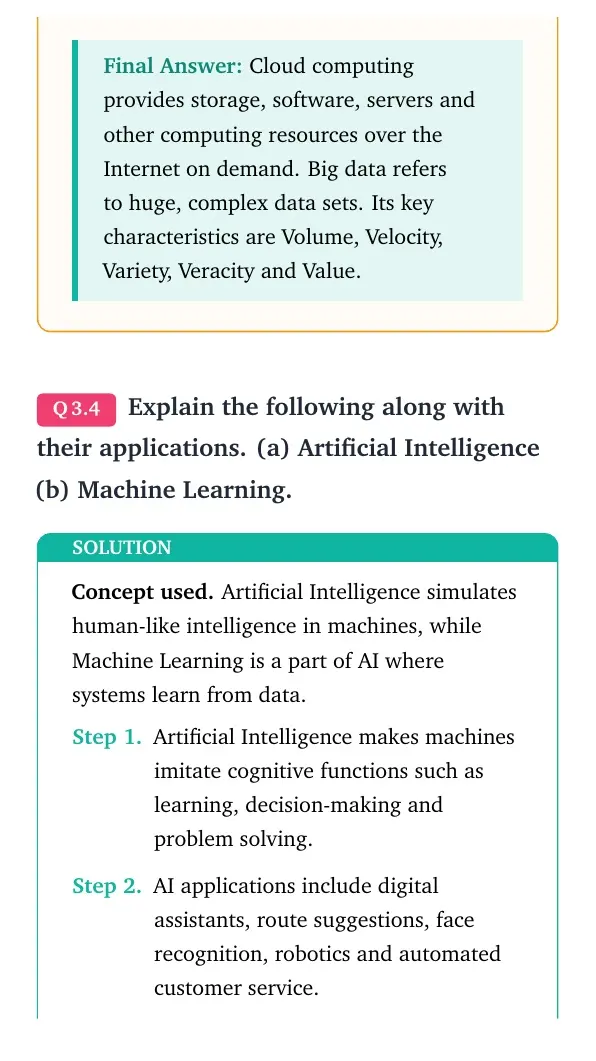
Explain the following along with their applications. (a) Artificial Intelligence (b) Machine Learning.
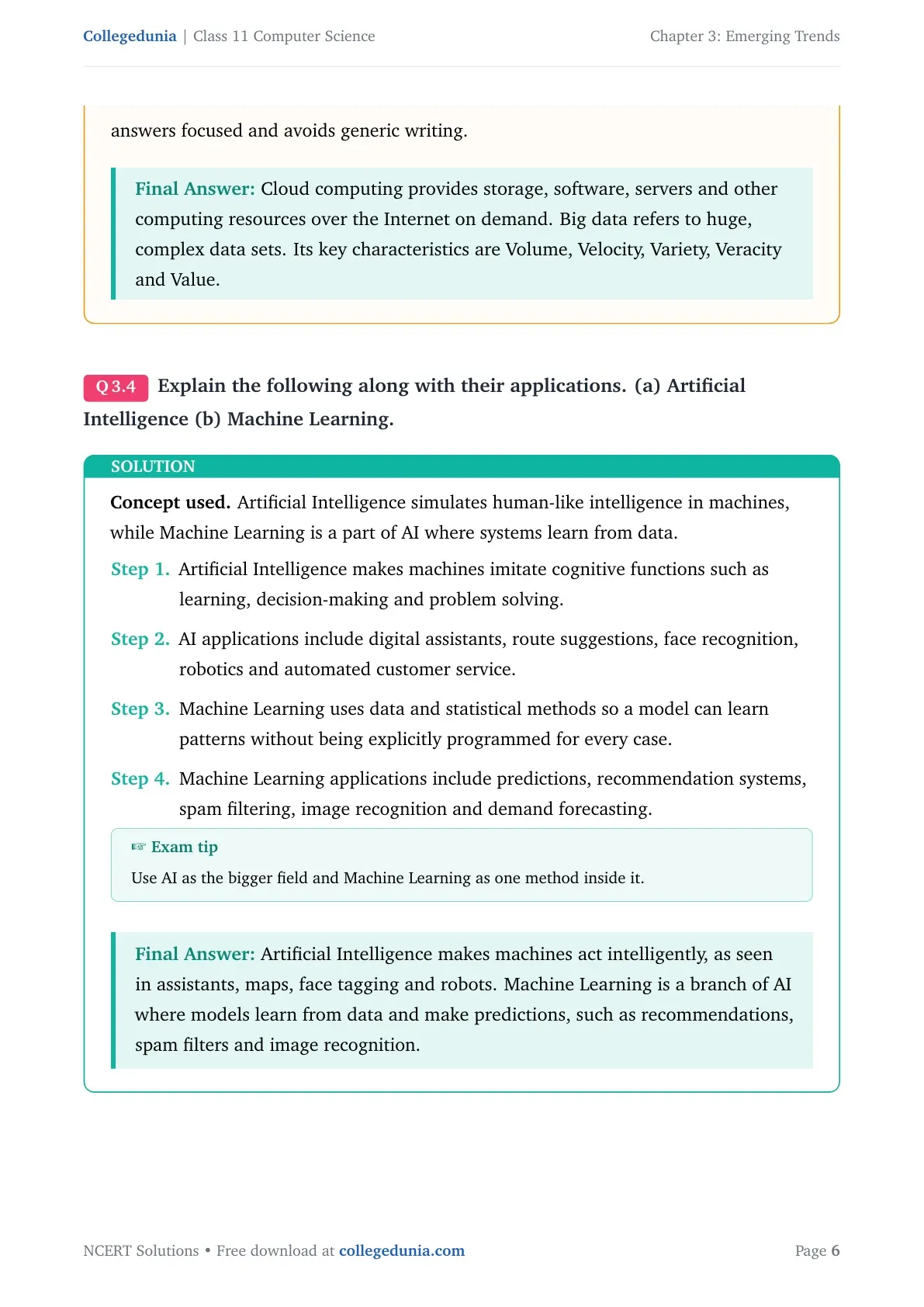
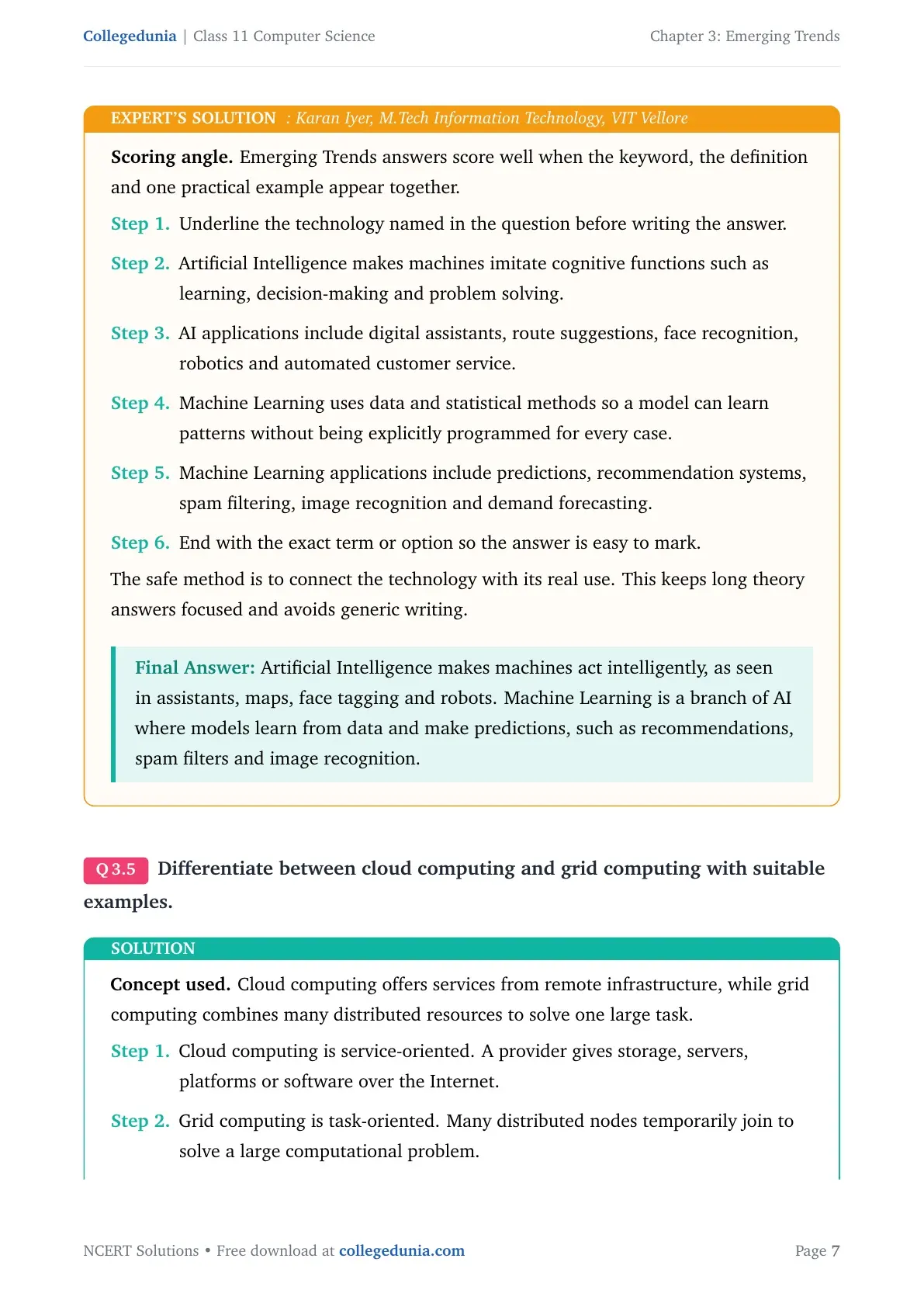
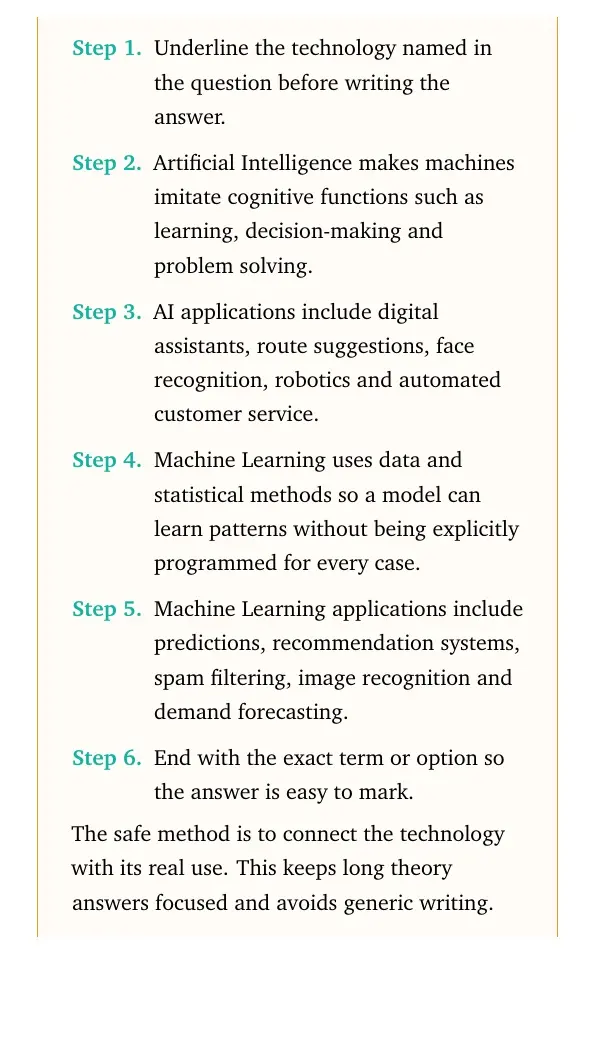
- Artificial Intelligence makes machines imitate cognitive functions such as learning, decision-making and problem solving.
- AI applications include digital assistants, route suggestions, face recognition, robotics and automated customer service.
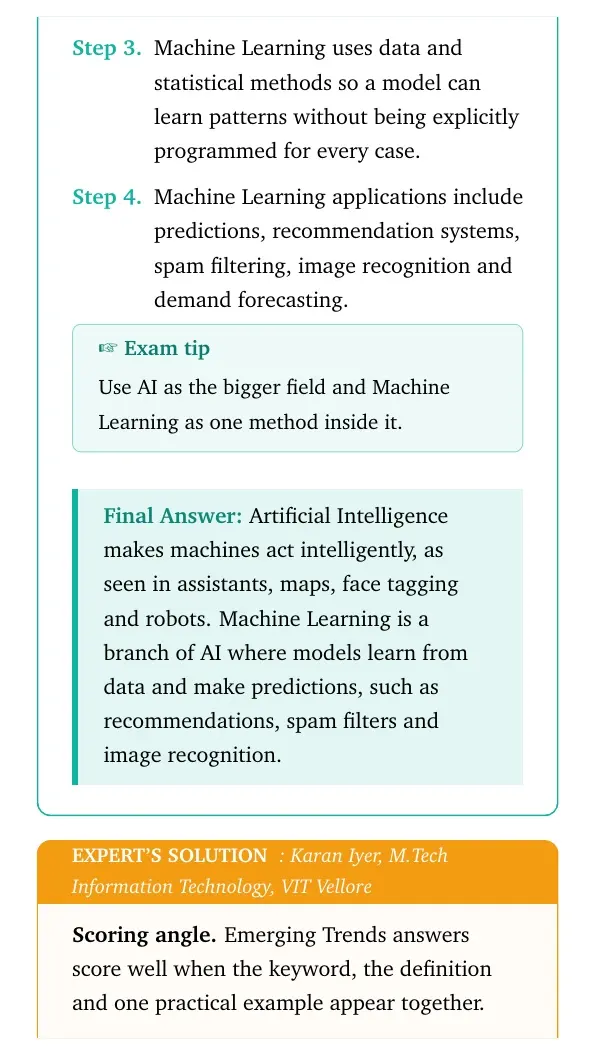
- Machine Learning uses data and statistical methods so a model can learn patterns without being explicitly programmed for every case.
- Machine Learning applications include predictions, recommendation systems, spam filtering, image recognition and demand forecasting.
Answer: Artificial Intelligence makes machines act intelligently, as seen in assistants, maps, face tagging and robots. Machine Learning is a branch of AI where models learn from data and make predictions, such as recommendations, spam filters and image recognition.
Expert view: Identify the exact technology first, then add the definition and example.
- Artificial Intelligence makes machines imitate cognitive functions such as learning, decision-making and problem solving.
- AI applications include digital assistants, route suggestions, face recognition, robotics and automated customer service.
- Machine Learning uses data and statistical methods so a model can learn patterns without being explicitly programmed for every case.
- Machine Learning applications include predictions, recommendation systems, spam filtering, image recognition and demand forecasting.
Final answer: Artificial Intelligence makes machines act intelligently, as seen in assistants, maps, face tagging and robots. Machine Learning is a branch of AI where models learn from data and make predictions, such as recommendations, spam filters and image recognition.
Question 5
Differentiate between cloud computing and grid computing with suitable examples.
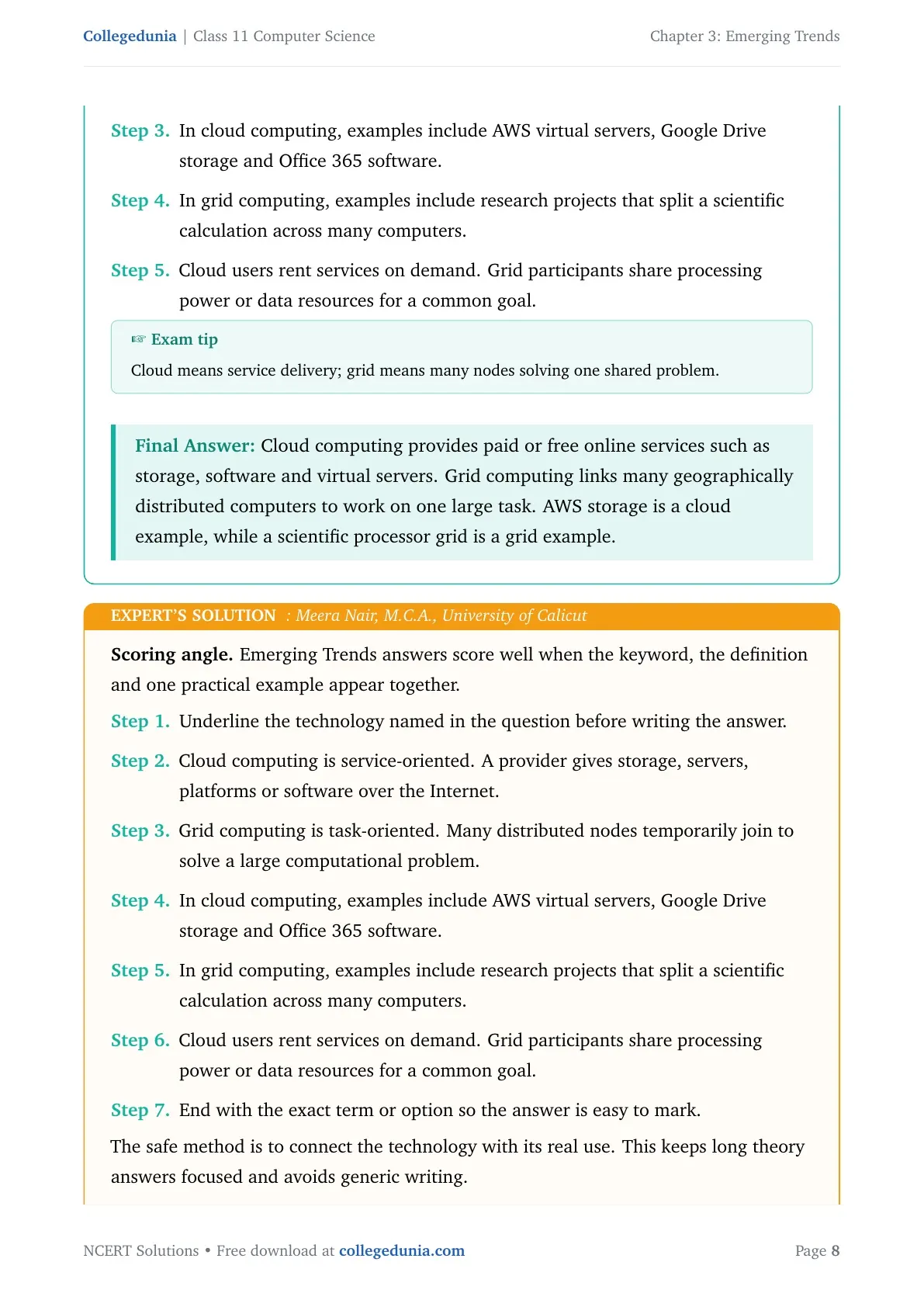
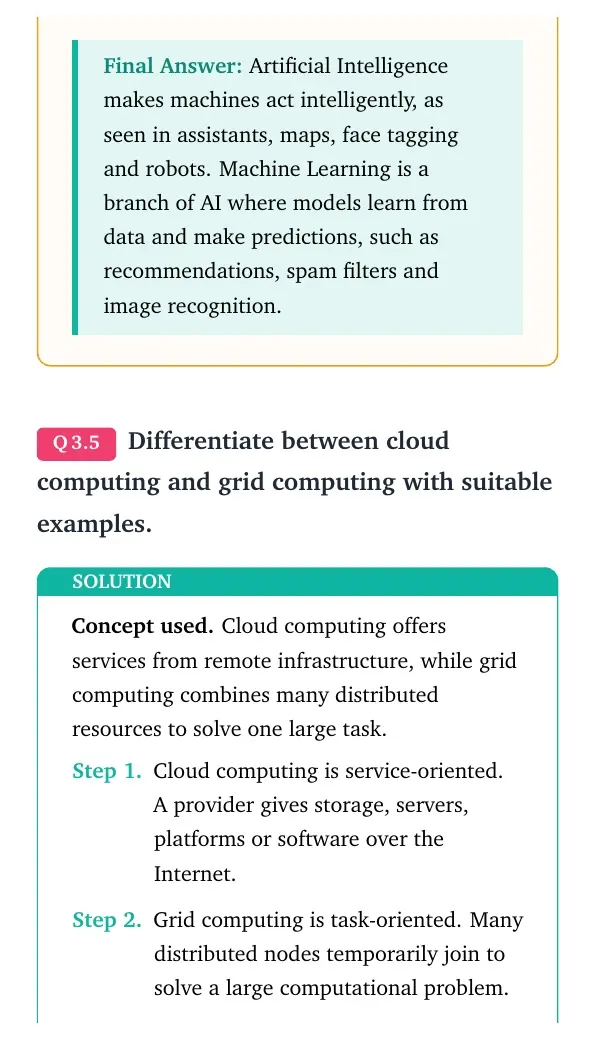
- Cloud computing is service-oriented. A provider gives storage, servers, platforms or software over the Internet.
- Grid computing is task-oriented. Many distributed nodes temporarily join to solve a large computational problem.
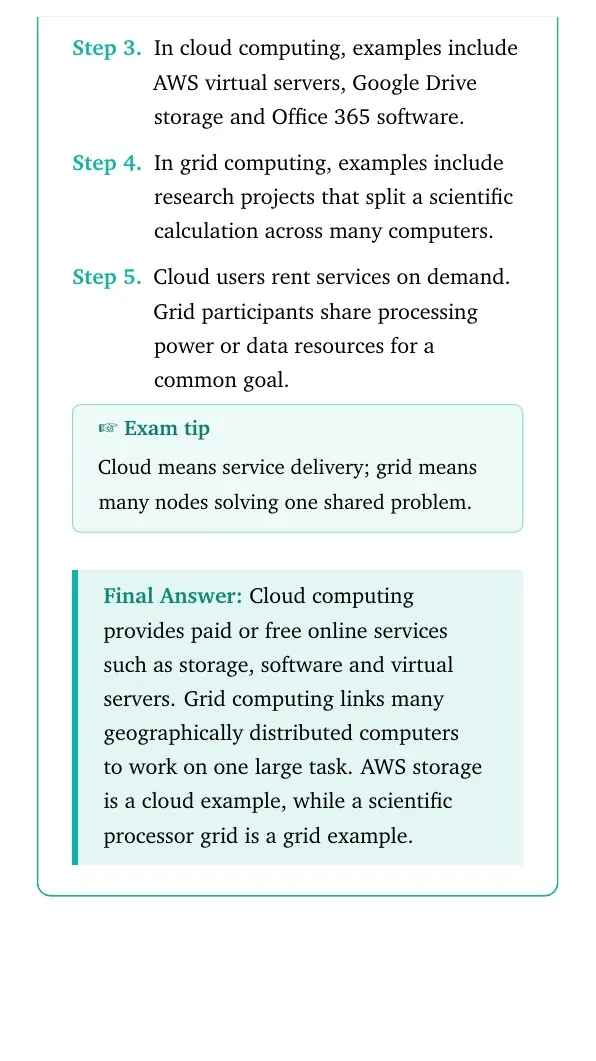
- In cloud computing, examples include AWS virtual servers, Google Drive storage and Office 365 software.
- In grid computing, examples include research projects that split a scientific calculation across many computers.
- Cloud users rent services on demand. Grid participants share processing power or data resources for a common goal.
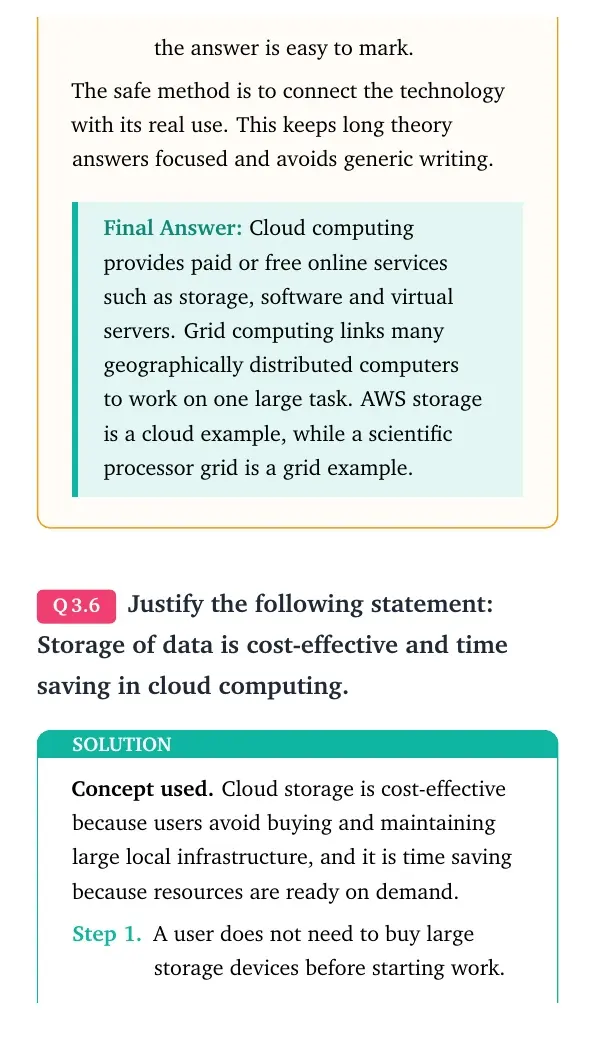
Answer: Cloud computing provides paid or free online services such as storage, software and virtual servers. Grid computing links many geographically distributed computers to work on one large task. AWS storage is a cloud example, while a scientific processor grid is a grid example.
Expert view: Identify the exact technology first, then add the definition and example.
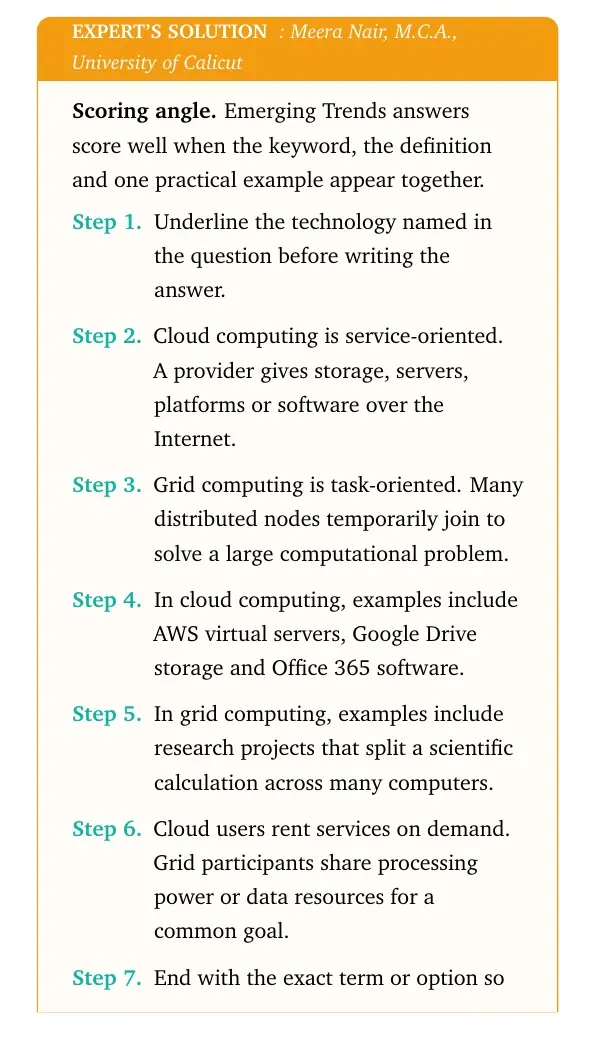
- Cloud computing is service-oriented. A provider gives storage, servers, platforms or software over the Internet.
- Grid computing is task-oriented. Many distributed nodes temporarily join to solve a large computational problem.
- In cloud computing, examples include AWS virtual servers, Google Drive storage and Office 365 software.
- In grid computing, examples include research projects that split a scientific calculation across many computers.
- Cloud users rent services on demand. Grid participants share processing power or data resources for a common goal.
Final answer: Cloud computing provides paid or free online services such as storage, software and virtual servers. Grid computing links many geographically distributed computers to work on one large task. AWS storage is a cloud example, while a scientific processor grid is a grid example.
Question 6
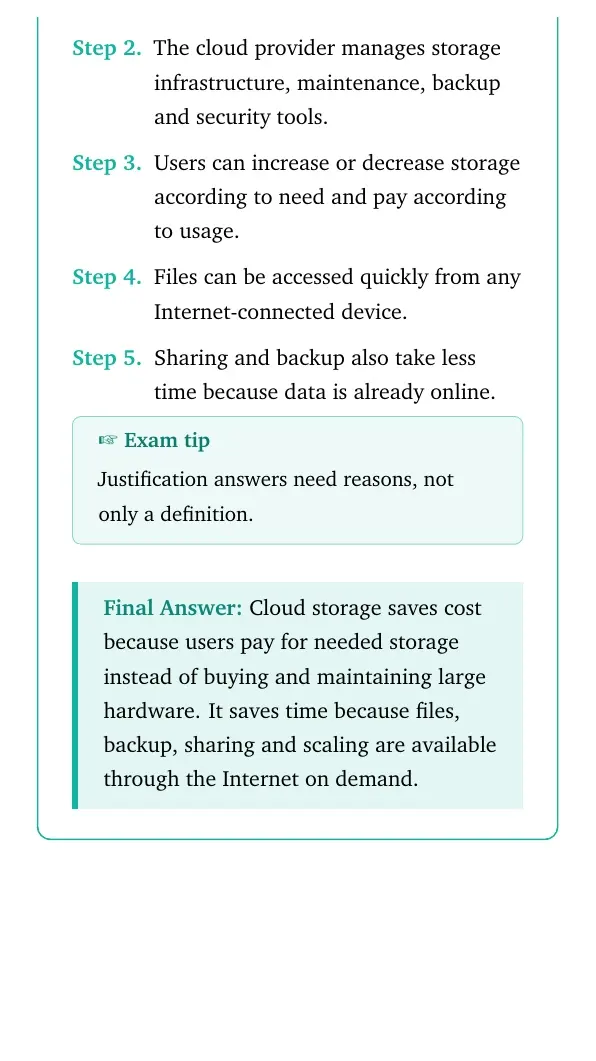
Justify the following statement: Storage of data is cost-effective and time saving in cloud computing.
- A user does not need to buy large storage devices before starting work.
- The cloud provider manages storage infrastructure, maintenance, backup and security tools.
- Users can increase or decrease storage according to need and pay according to usage.
- Files can be accessed quickly from any Internet-connected device.
- Sharing and backup also take less time because data is already online.
Answer: Cloud storage saves cost because users pay for needed storage instead of buying and maintaining large hardware. It saves time because files, backup, sharing and scaling are available through the Internet on demand.
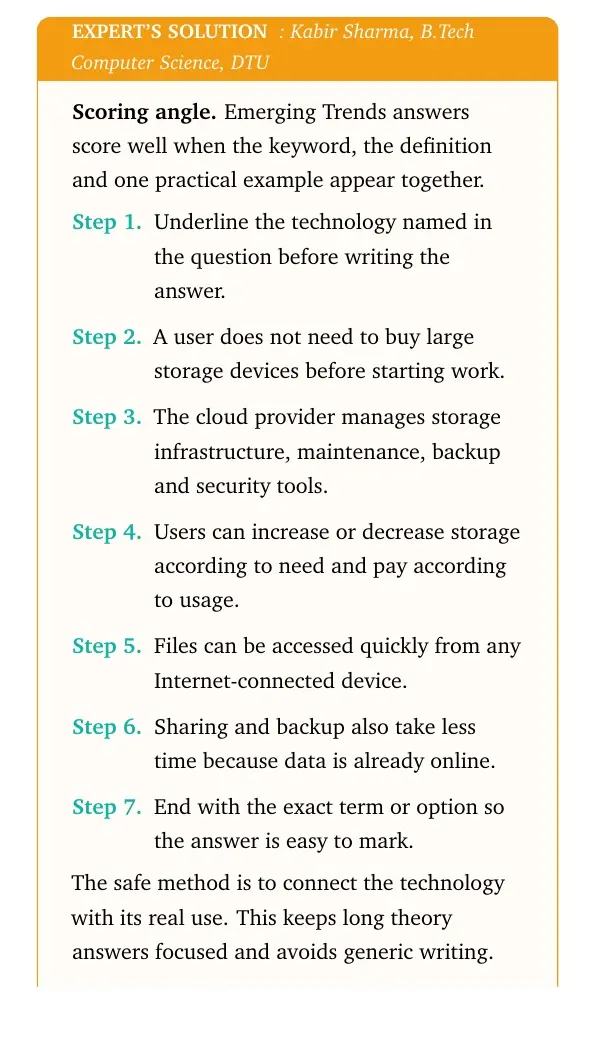
Expert view: Identify the exact technology first, then add the definition and example.
- A user does not need to buy large storage devices before starting work.
- The cloud provider manages storage infrastructure, maintenance, backup and security tools.
- Users can increase or decrease storage according to need and pay according to usage.
- Files can be accessed quickly from any Internet-connected device.
- Sharing and backup also take less time because data is already online.
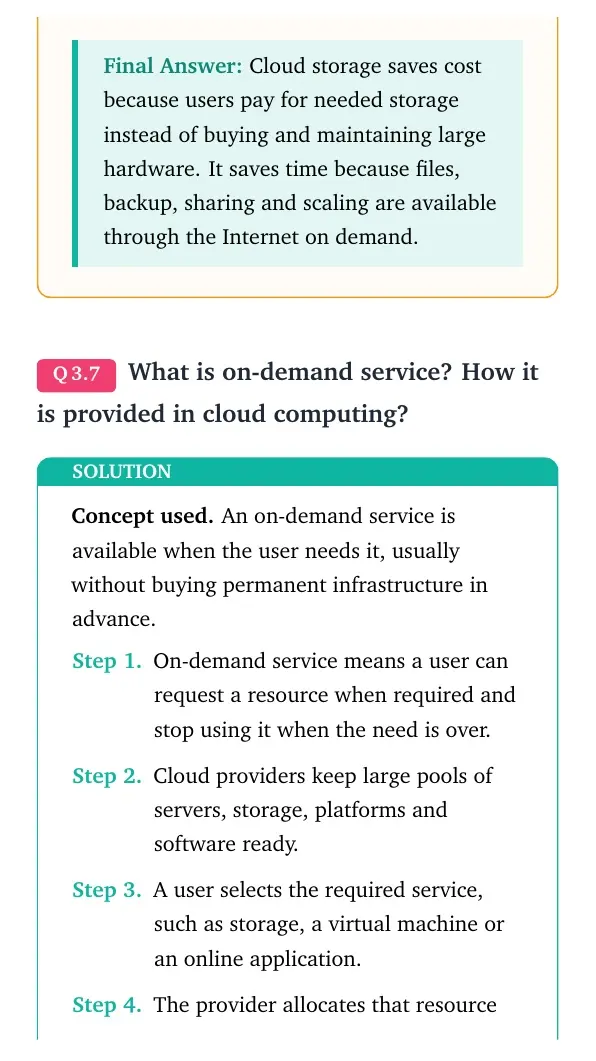
Final answer: Cloud storage saves cost because users pay for needed storage instead of buying and maintaining large hardware. It saves time because files, backup, sharing and scaling are available through the Internet on demand.
Question 7
What is on-demand service? How it is provided in cloud computing?
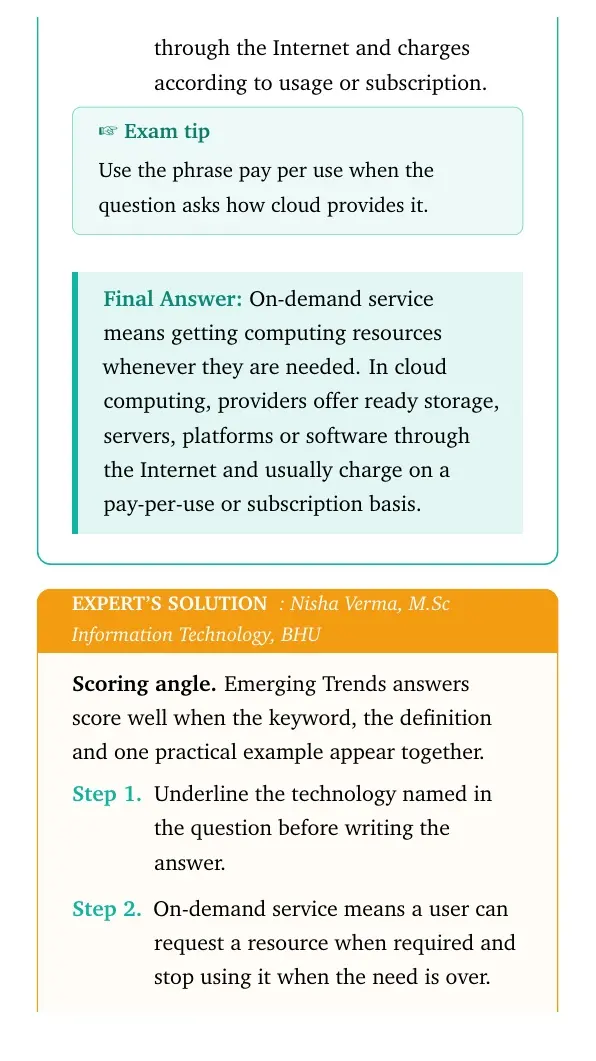
- On-demand service means a user can request a resource when required and stop using it when the need is over.
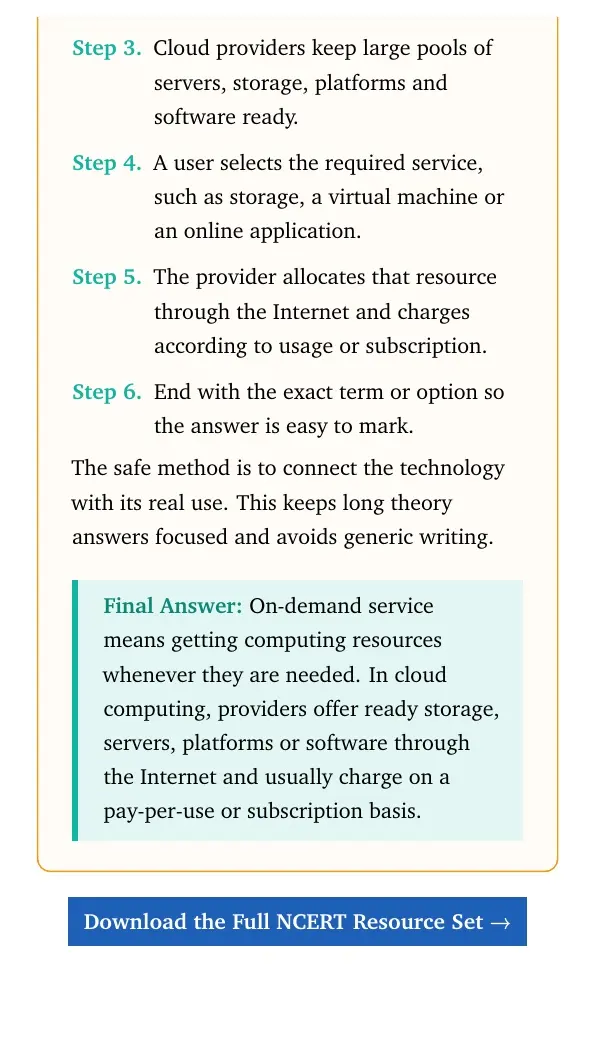
- Cloud providers keep large pools of servers, storage, platforms and software ready.
- A user selects the required service, such as storage, a virtual machine or an online application.
- The provider allocates that resource through the Internet and charges according to usage or subscription.
Answer: On-demand service means getting computing resources whenever they are needed. In cloud computing, providers offer ready storage, servers, platforms or software through the Internet and usually charge on a pay-per-use or subscription basis.
Expert view: Identify the exact technology first, then add the definition and example.
- On-demand service means a user can request a resource when required and stop using it when the need is over.
- Cloud providers keep large pools of servers, storage, platforms and software ready.
- A user selects the required service, such as storage, a virtual machine or an online application.
- The provider allocates that resource through the Internet and charges according to usage or subscription.
Final answer: On-demand service means getting computing resources whenever they are needed. In cloud computing, providers offer ready storage, servers, platforms or software through the Internet and usually charge on a pay-per-use or subscription basis.
Question 8
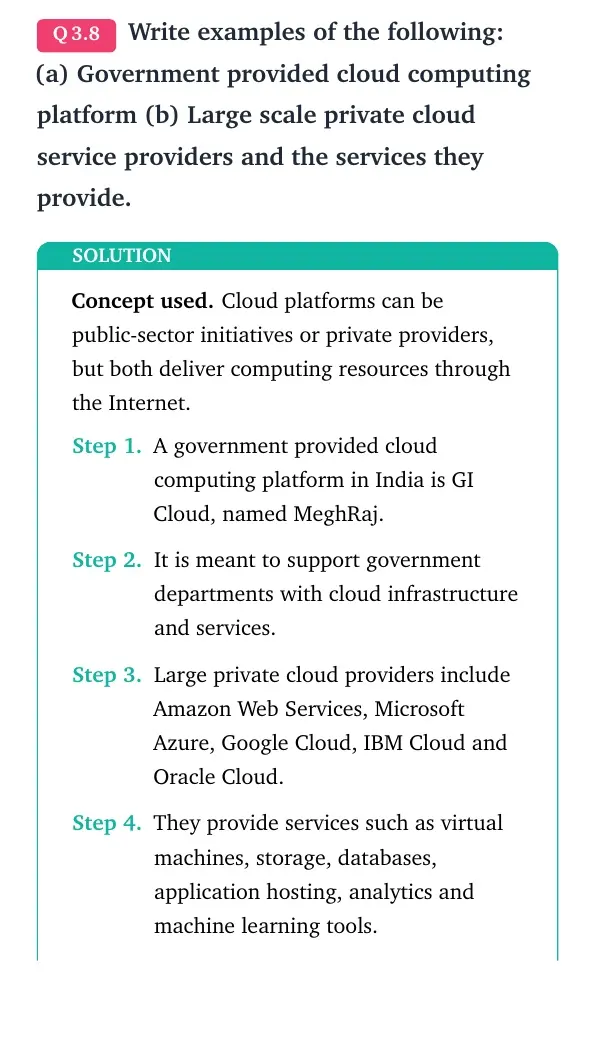
Write examples of the following: (a) Government provided cloud computing platform (b) Large scale private cloud service providers and the services they provide.
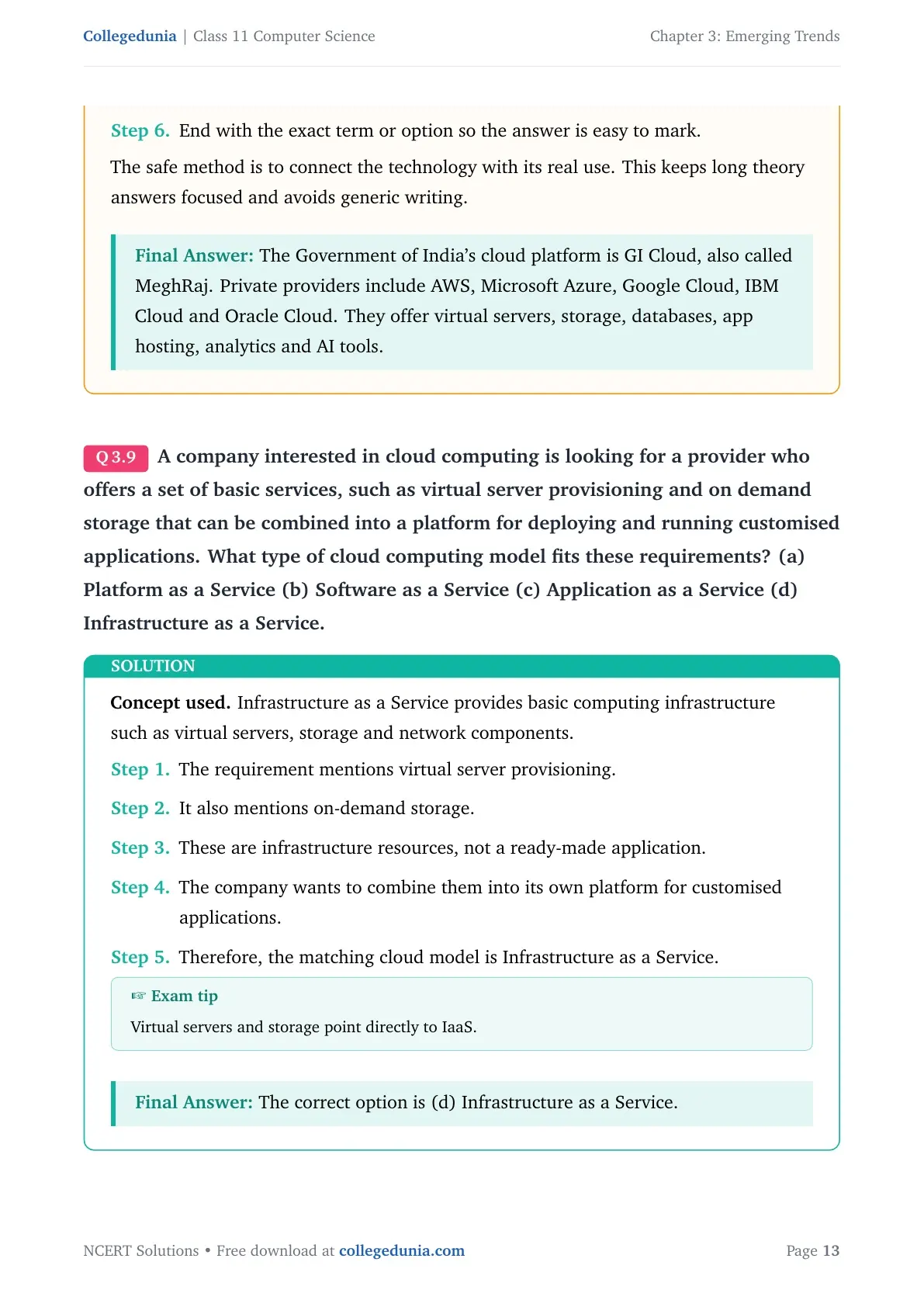
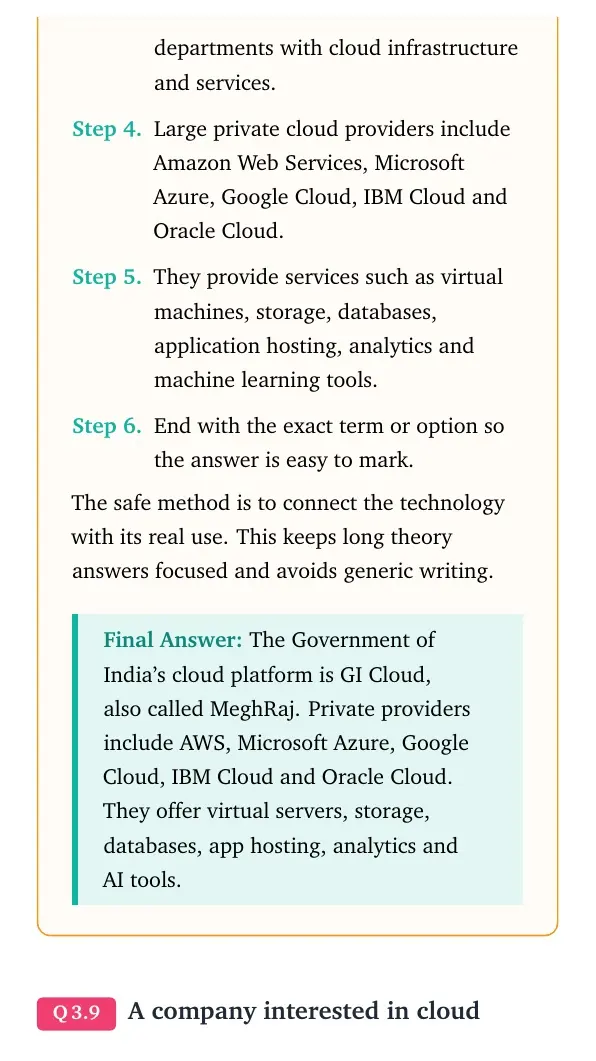
- A government provided cloud computing platform in India is GI Cloud, named MeghRaj.
- It is meant to support government departments with cloud infrastructure and services.
- Large private cloud providers include Amazon Web Services, Microsoft Azure, Google Cloud, IBM Cloud and Oracle Cloud.
- They provide services such as virtual machines, storage, databases, application hosting, analytics and machine learning tools.
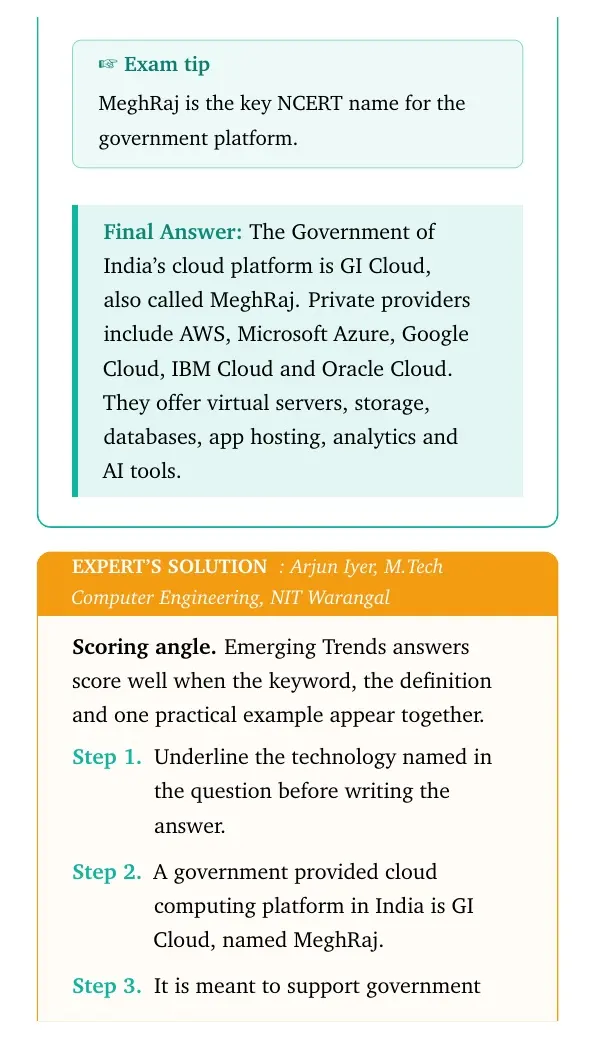
Answer: The Government of India's cloud platform is GI Cloud, also called MeghRaj. Private providers include AWS, Microsoft Azure, Google Cloud, IBM Cloud and Oracle Cloud. They offer virtual servers, storage, databases, app hosting, analytics and AI tools.
Expert view: Identify the exact technology first, then add the definition and example.
- A government provided cloud computing platform in India is GI Cloud, named MeghRaj.
- It is meant to support government departments with cloud infrastructure and services.
- Large private cloud providers include Amazon Web Services, Microsoft Azure, Google Cloud, IBM Cloud and Oracle Cloud.
- They provide services such as virtual machines, storage, databases, application hosting, analytics and machine learning tools.
Final answer: The Government of India's cloud platform is GI Cloud, also called MeghRaj. Private providers include AWS, Microsoft Azure, Google Cloud, IBM Cloud and Oracle Cloud. They offer virtual servers, storage, databases, app hosting, analytics and AI tools.
Question 9
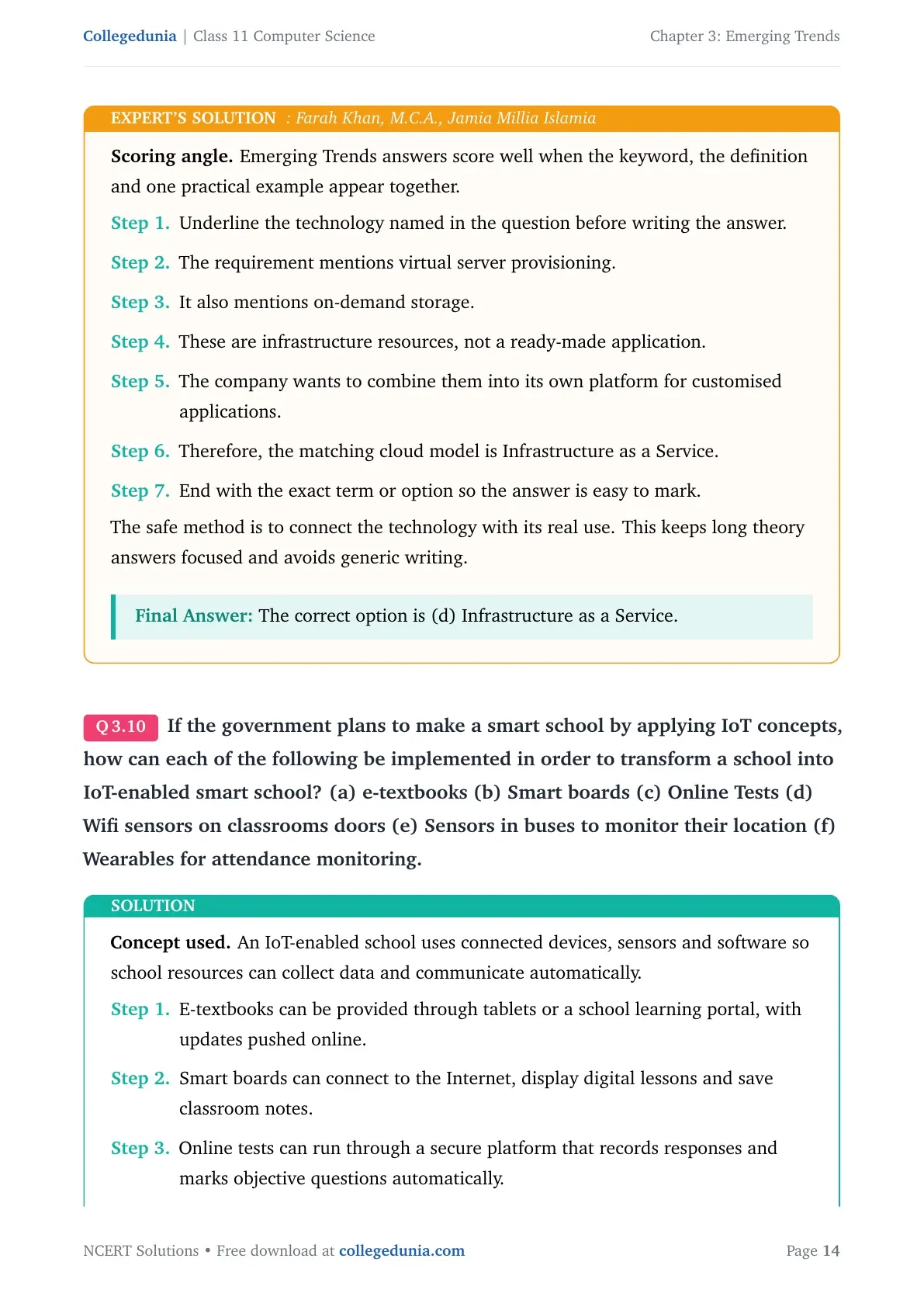
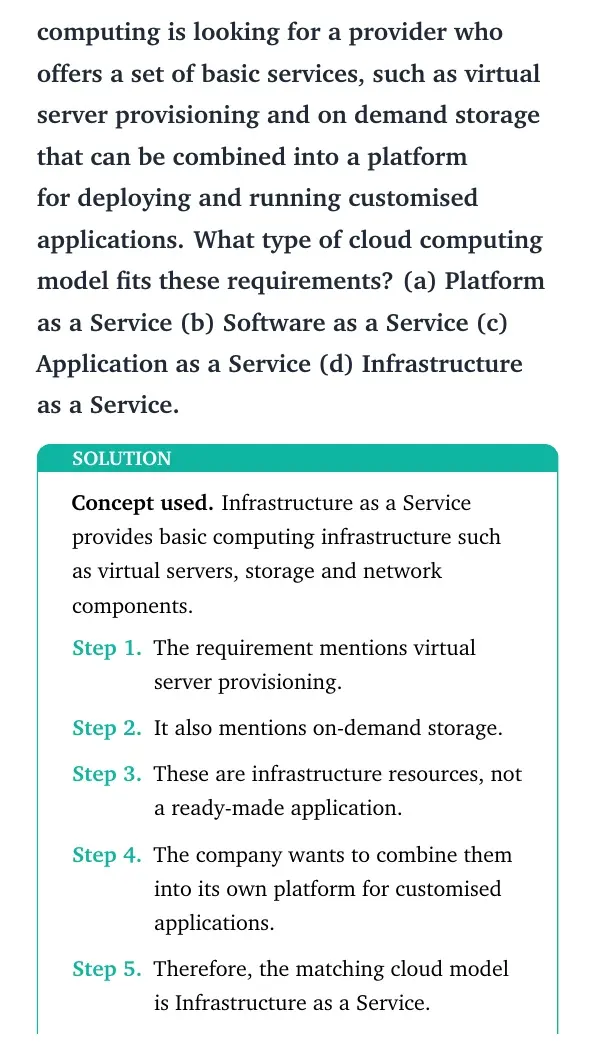
A company interested in cloud computing is looking for a provider who offers a set of basic services, such as virtual server provisioning and on demand storage that can be combined into a platform for deploying and running customised applications. What type of cloud computing model fits these requirements? (a) Platform as a Service (b) Software as a Service (c) Application as a Service (d) Infrastructure as a Service.
- The requirement mentions virtual server provisioning.
- It also mentions on-demand storage.
- These are infrastructure resources, not a ready-made application.
- The company wants to combine them into its own platform for customised applications.
- Therefore, the matching cloud model is Infrastructure as a Service.
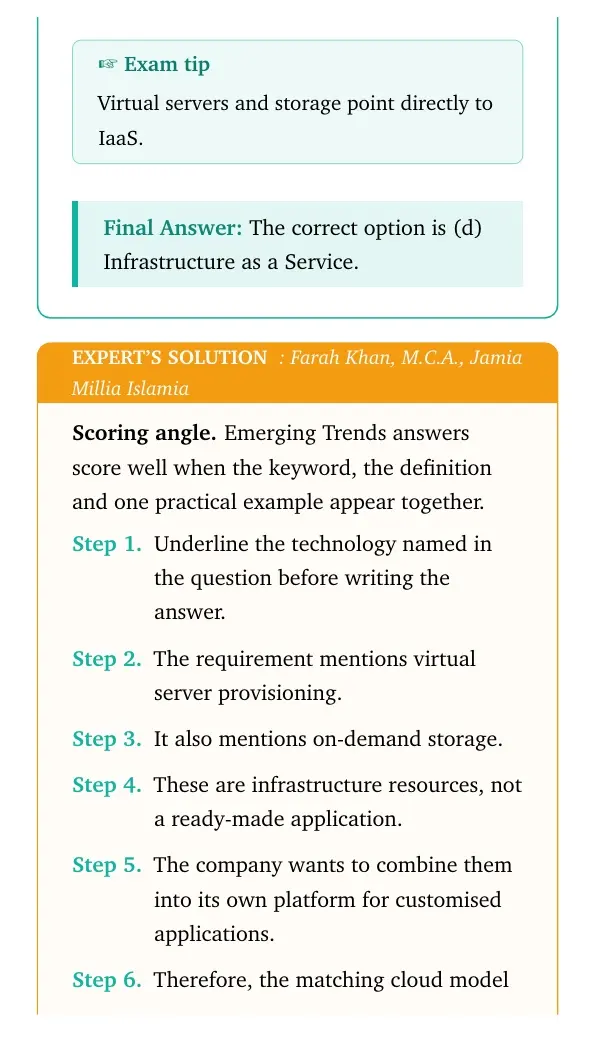
Answer: The correct option is (d) Infrastructure as a Service.
Expert view: Identify the exact technology first, then add the definition and example.
- The requirement mentions virtual server provisioning.
- It also mentions on-demand storage.
- These are infrastructure resources, not a ready-made application.
- The company wants to combine them into its own platform for customised applications.
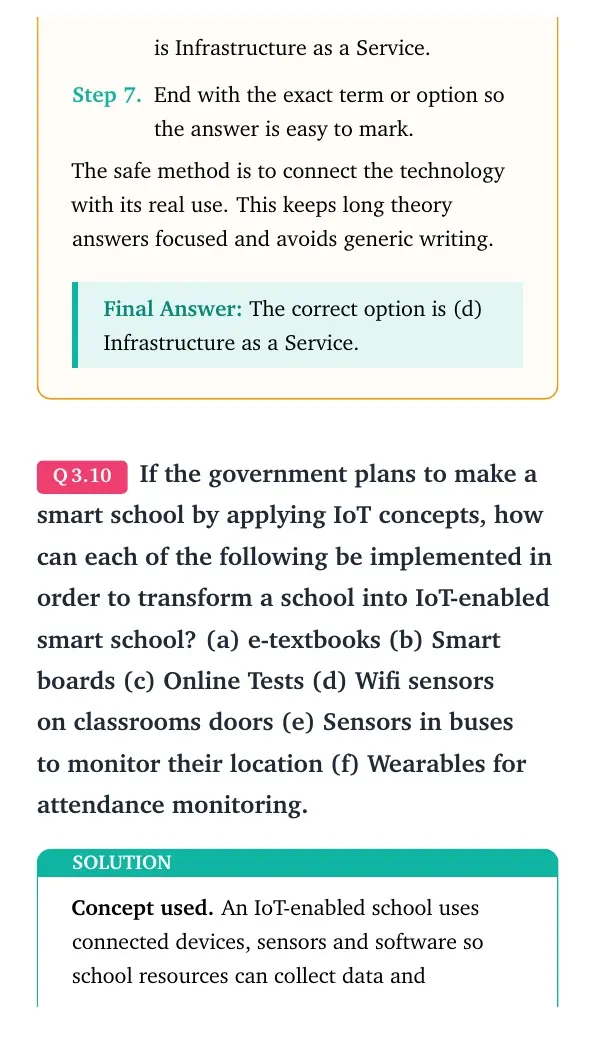
- Therefore, the matching cloud model is Infrastructure as a Service.
Final answer: The correct option is (d) Infrastructure as a Service.
Question 10
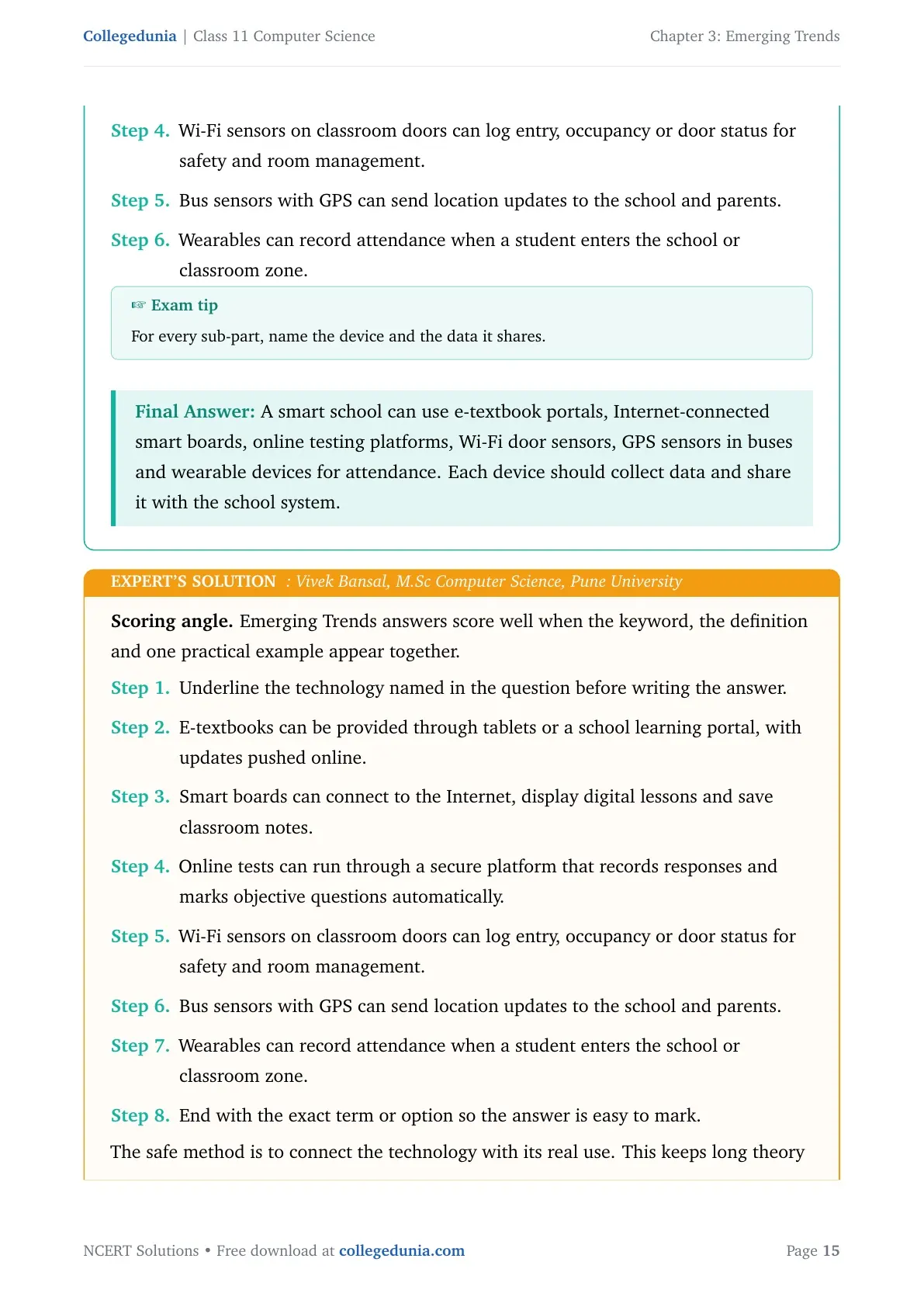
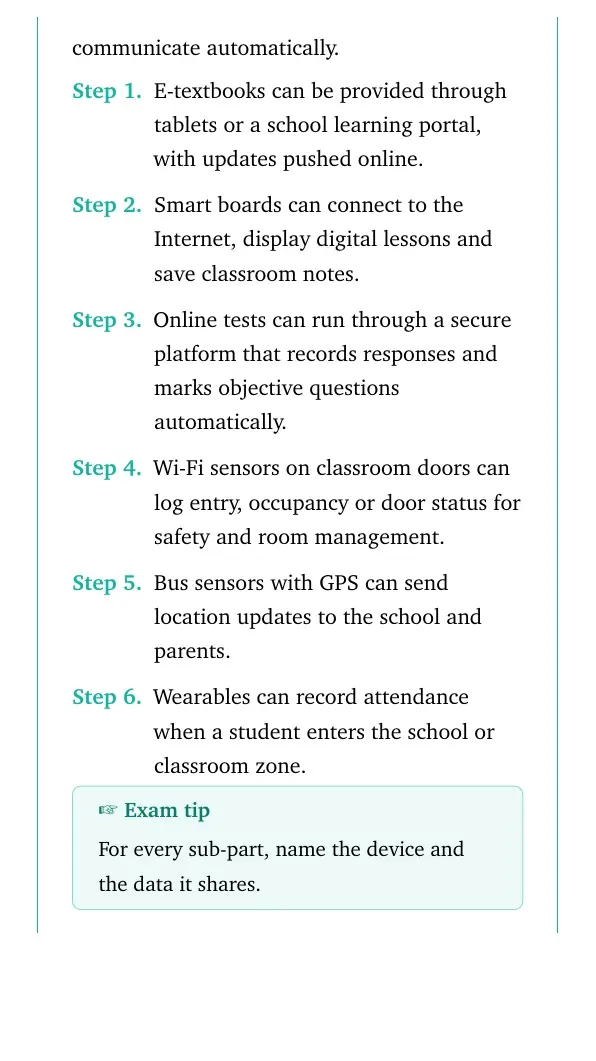
If the government plans to make a smart school by applying IoT concepts, how can each of the following be implemented in order to transform a school into IoT-enabled smart school? (a) e-textbooks (b) Smart boards (c) Online Tests (d) Wifi sensors on classrooms doors (e) Sensors in buses to monitor their location (f) Wearables for attendance monitoring.
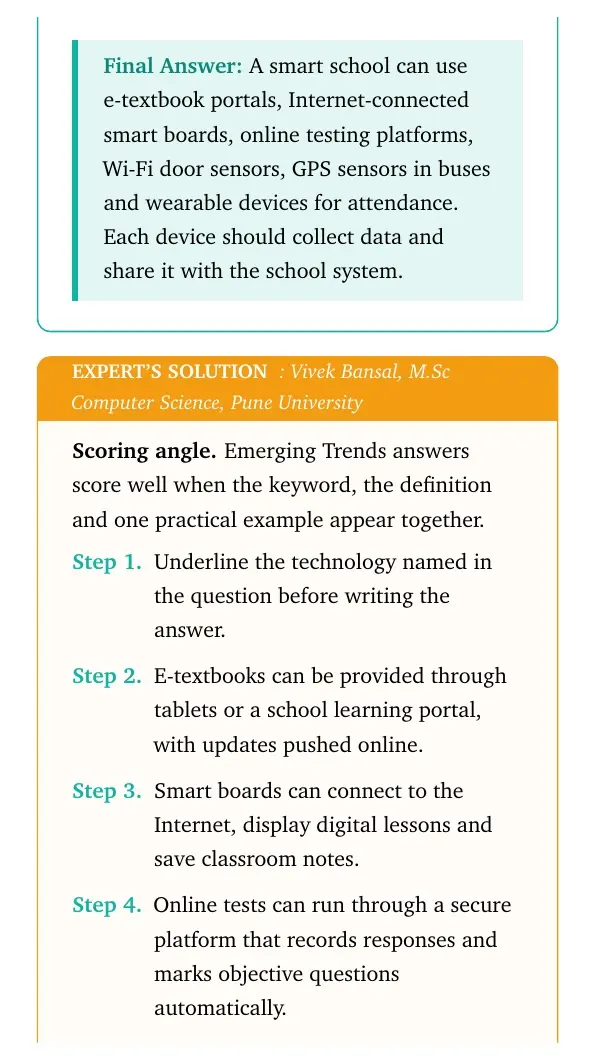
- E-textbooks can be provided through tablets or a school learning portal, with updates pushed online.
- Smart boards can connect to the Internet, display digital lessons and save classroom notes.
- Online tests can run through a secure platform that records responses and marks objective questions automatically.
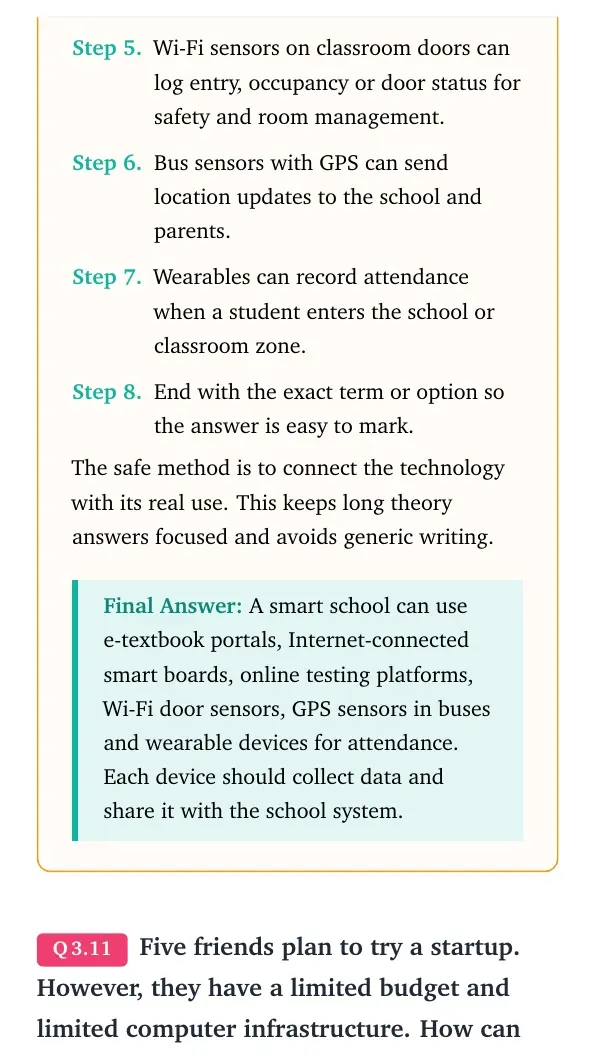
- Wi-Fi sensors on classroom doors can log entry, occupancy or door status for safety and room management.
- Bus sensors with GPS can send location updates to the school and parents.
- Wearables can record attendance when a student enters the school or classroom zone.
Answer: A smart school can use e-textbook portals, Internet-connected smart boards, online testing platforms, Wi-Fi door sensors, GPS sensors in buses and wearable devices for attendance. Each device should collect data and share it with the school system.
Expert view: Identify the exact technology first, then add the definition and example.
- E-textbooks can be provided through tablets or a school learning portal, with updates pushed online.
- Smart boards can connect to the Internet, display digital lessons and save classroom notes.
- Online tests can run through a secure platform that records responses and marks objective questions automatically.
- Wi-Fi sensors on classroom doors can log entry, occupancy or door status for safety and room management.
- Bus sensors with GPS can send location updates to the school and parents.
- Wearables can record attendance when a student enters the school or classroom zone.
Final answer: A smart school can use e-textbook portals, Internet-connected smart boards, online testing platforms, Wi-Fi door sensors, GPS sensors in buses and wearable devices for attendance. Each device should collect data and share it with the school system.
Question 11
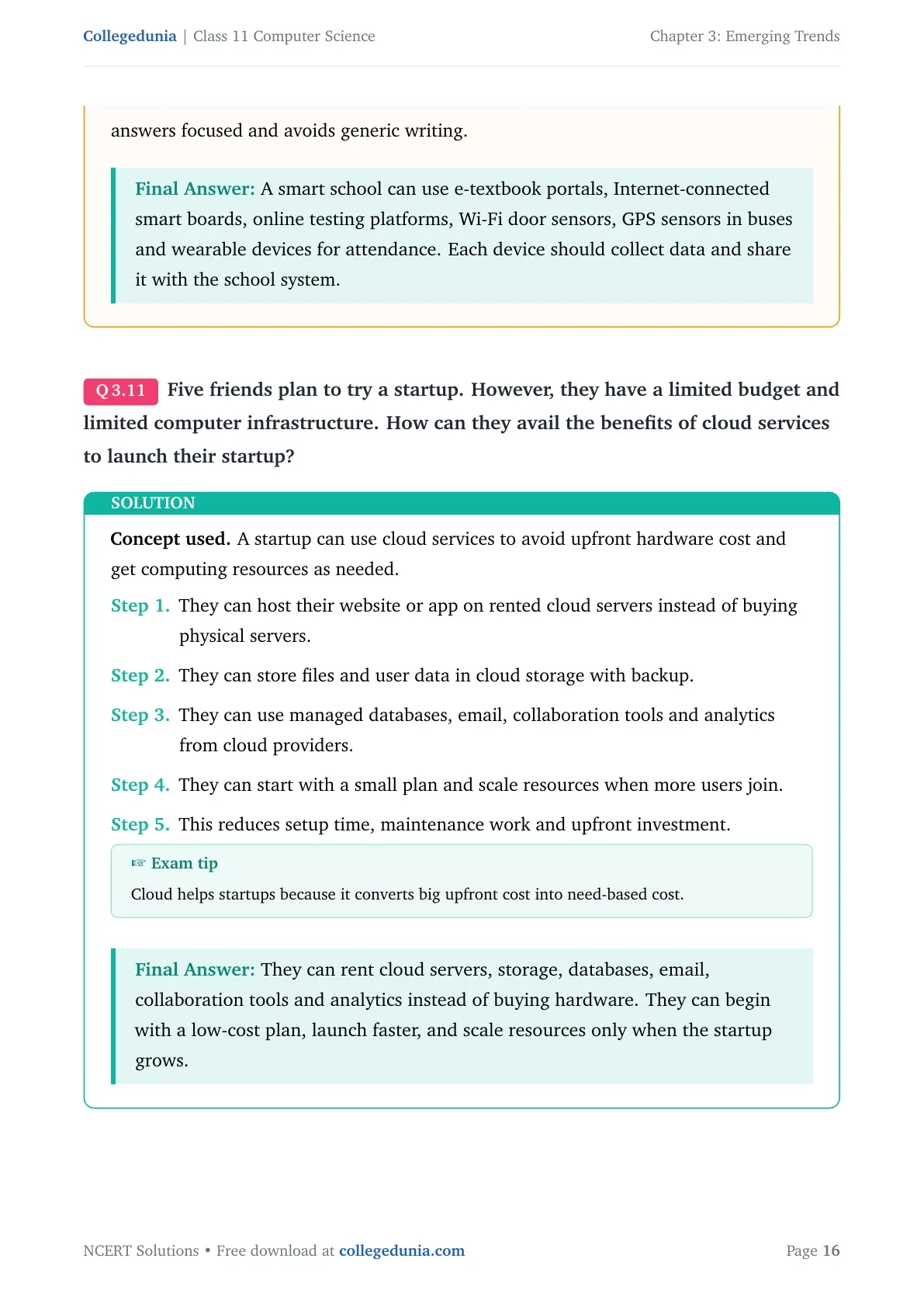
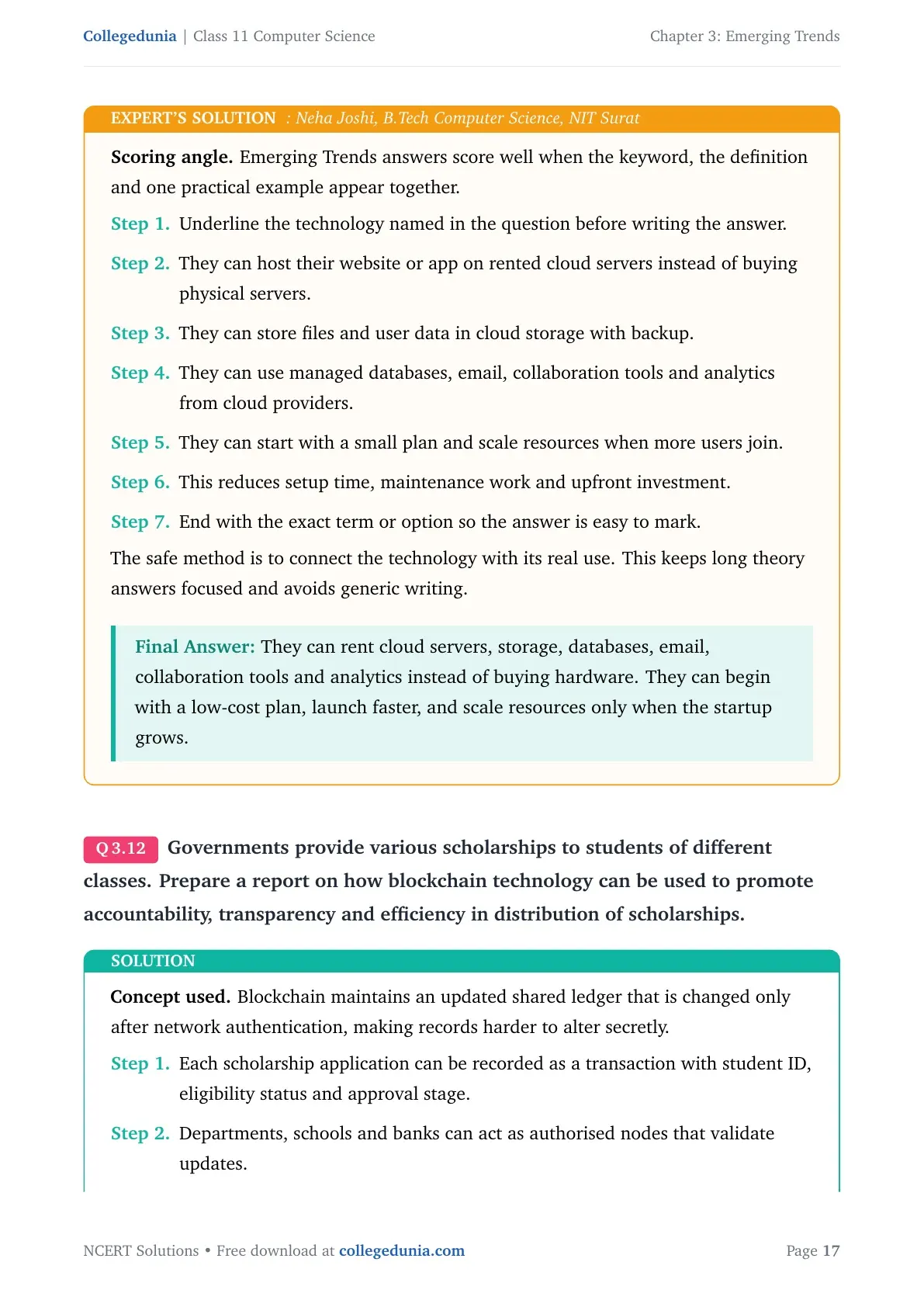
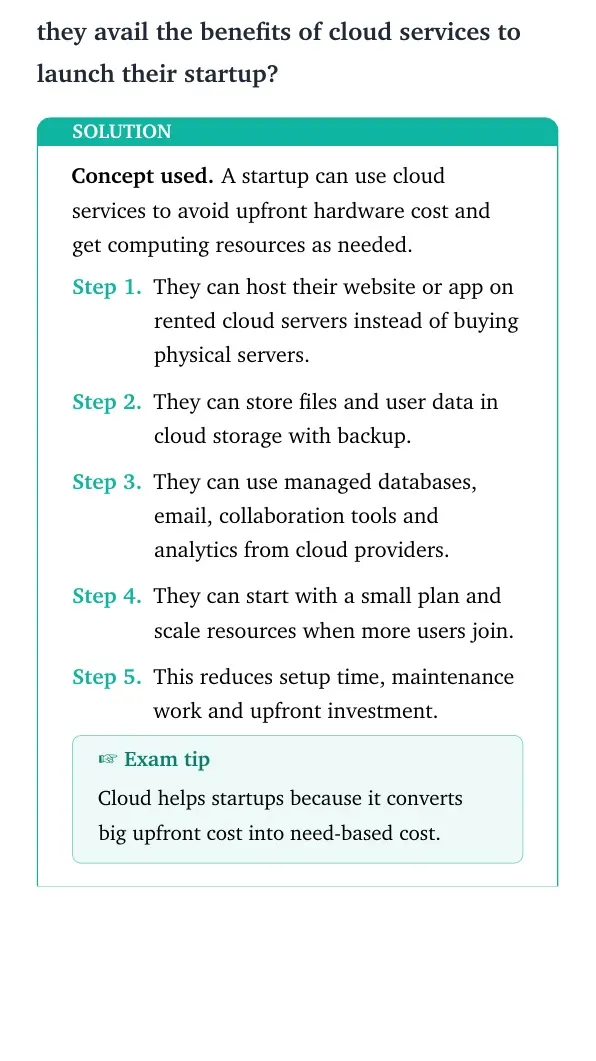
Five friends plan to try a startup. However, they have a limited budget and limited computer infrastructure. How can they avail the benefits of cloud services to launch their startup?
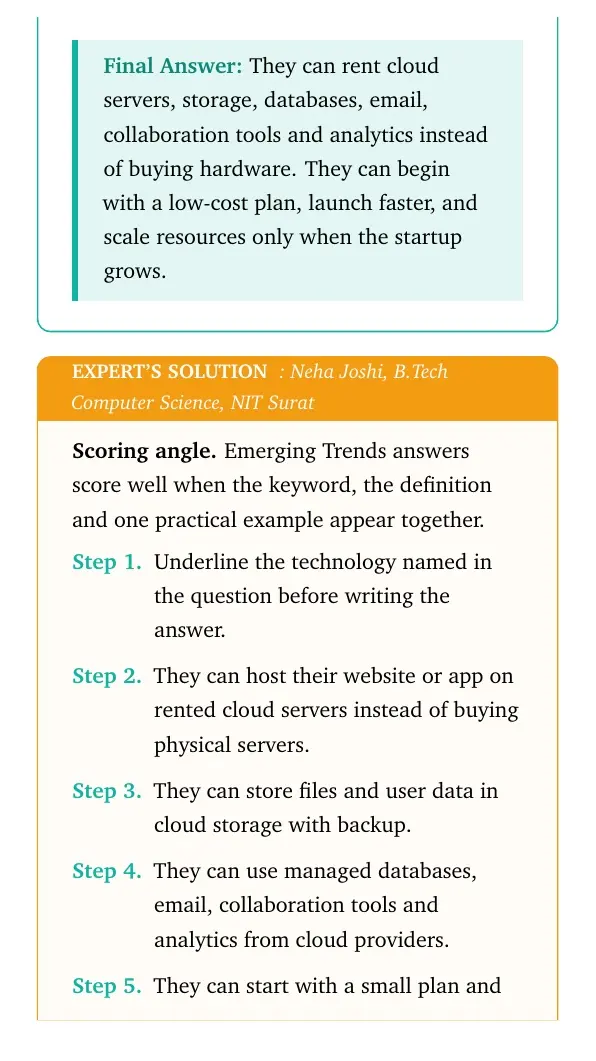
- They can host their website or app on rented cloud servers instead of buying physical servers.
- They can store files and user data in cloud storage with backup.
- They can use managed databases, email, collaboration tools and analytics from cloud providers.
- They can start with a small plan and scale resources when more users join.
- This reduces setup time, maintenance work and upfront investment.
Answer: They can rent cloud servers, storage, databases, email, collaboration tools and analytics instead of buying hardware. They can begin with a low-cost plan, launch faster, and scale resources only when the startup grows.
Expert view: Identify the exact technology first, then add the definition and example.
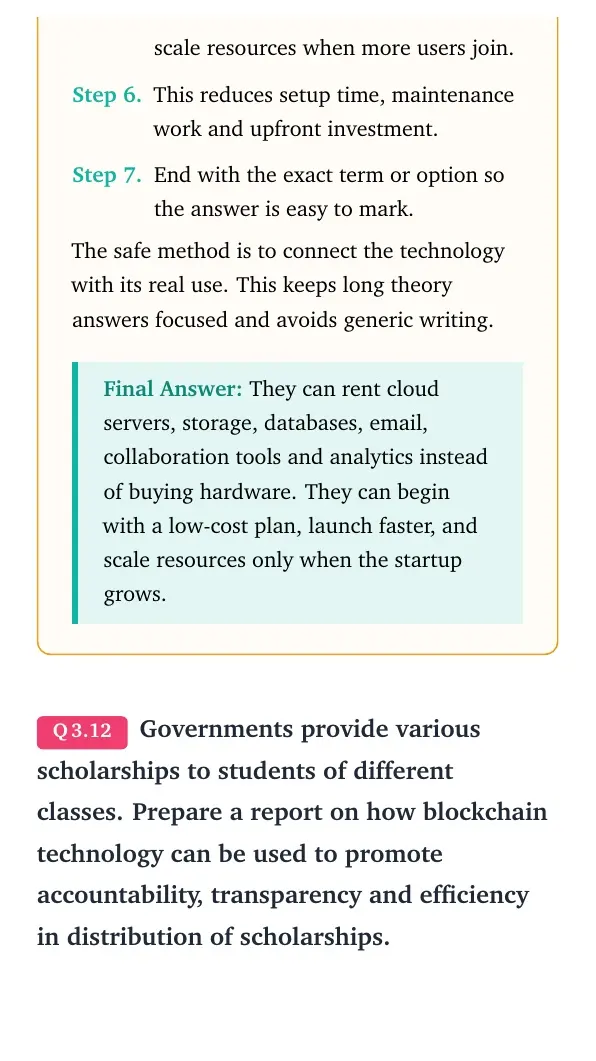
- They can host their website or app on rented cloud servers instead of buying physical servers.
- They can store files and user data in cloud storage with backup.
- They can use managed databases, email, collaboration tools and analytics from cloud providers.
- They can start with a small plan and scale resources when more users join.
- This reduces setup time, maintenance work and upfront investment.
Final answer: They can rent cloud servers, storage, databases, email, collaboration tools and analytics instead of buying hardware. They can begin with a low-cost plan, launch faster, and scale resources only when the startup grows.
Question 12
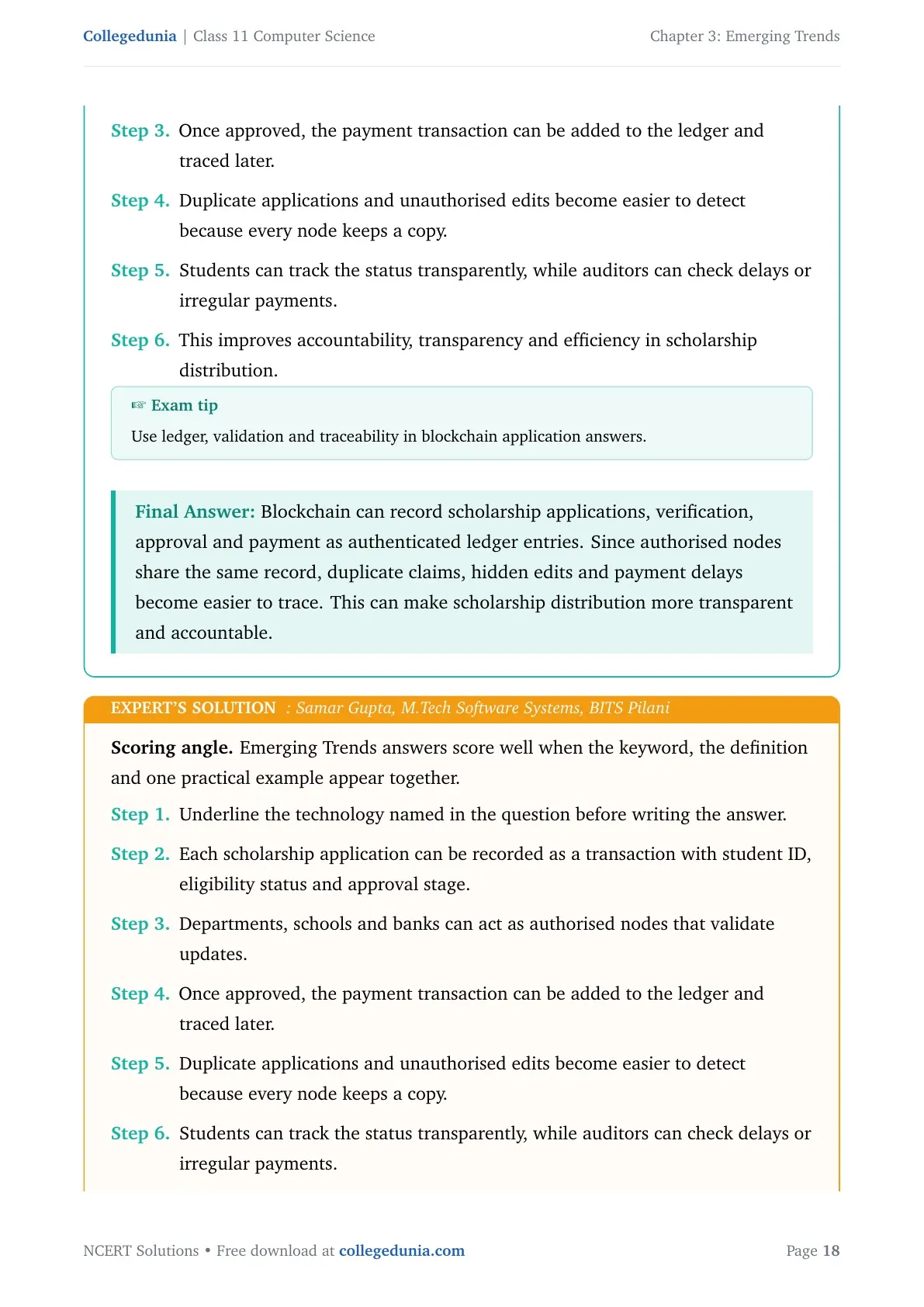
Governments provide various scholarships to students of different classes. Prepare a report on how blockchain technology can be used to promote accountability, transparency and efficiency in distribution of scholarships.
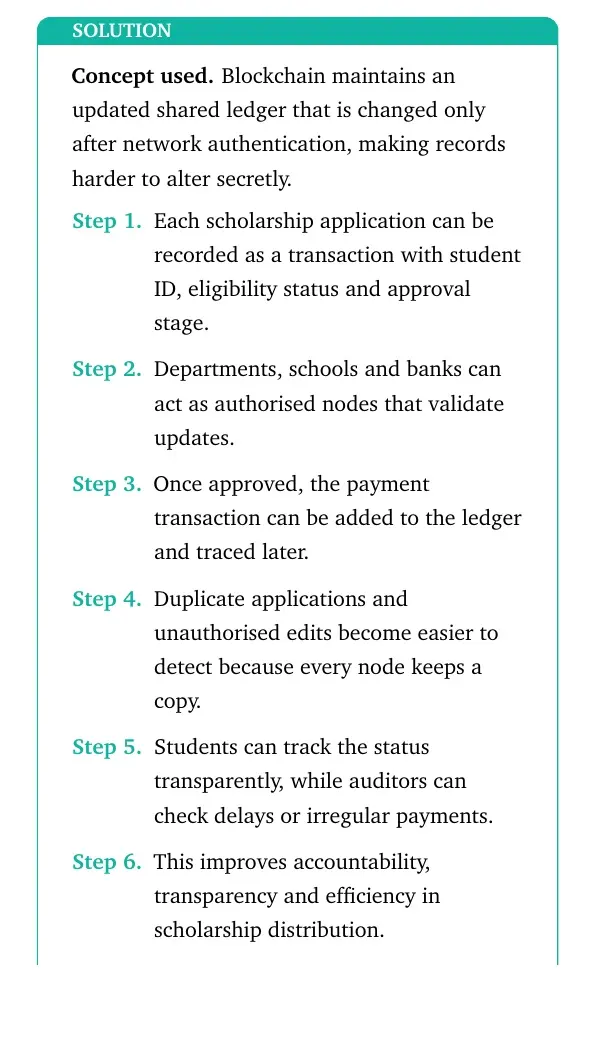
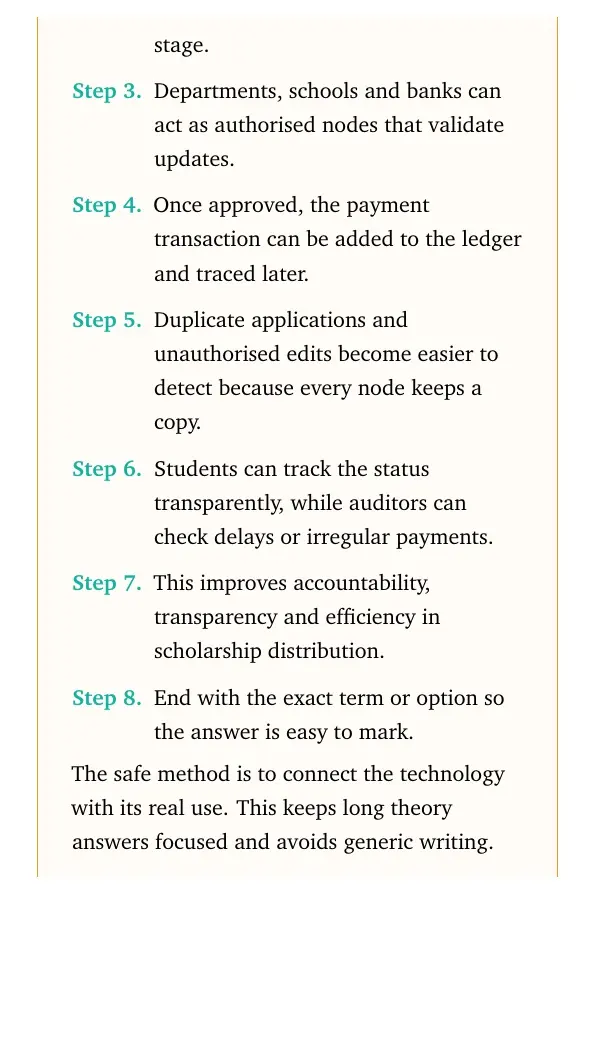
- Each scholarship application can be recorded as a transaction with student ID, eligibility status and approval stage.
- Departments, schools and banks can act as authorised nodes that validate updates.
- Once approved, the payment transaction can be added to the ledger and traced later.
- Duplicate applications and unauthorised edits become easier to detect because every node keeps a copy.
- Students can track the status transparently, while auditors can check delays or irregular payments.
- This improves accountability, transparency and efficiency in scholarship distribution.
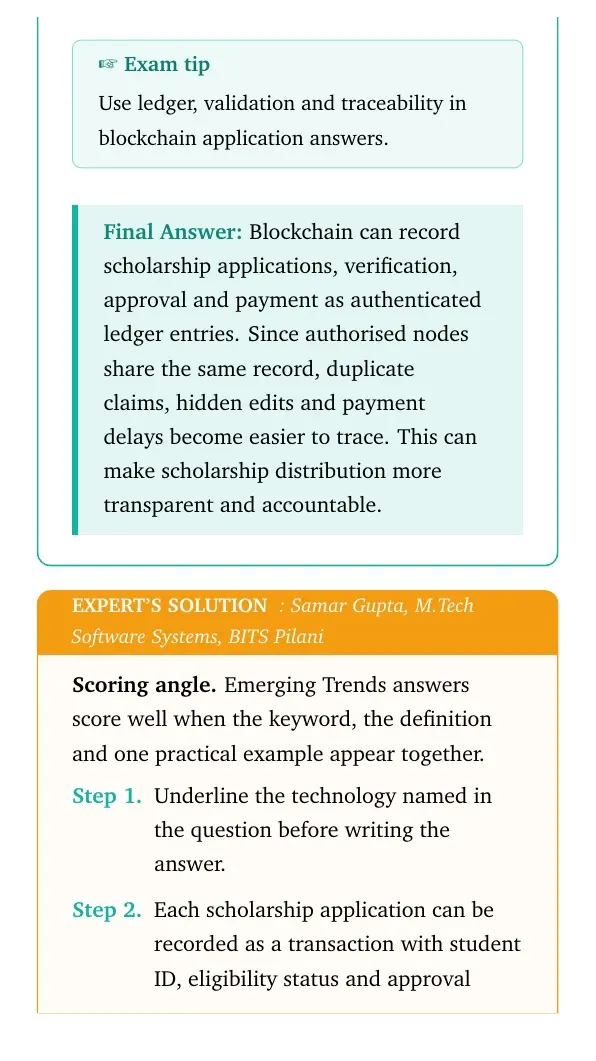
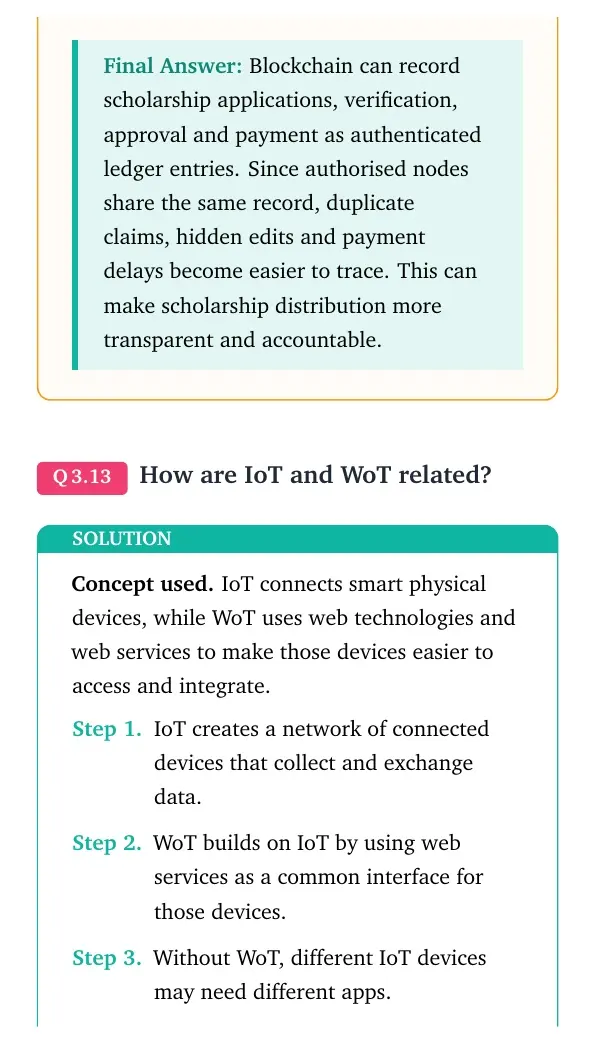
Answer: Blockchain can record scholarship applications, verification, approval and payment as authenticated ledger entries. Since authorised nodes share the same record, duplicate claims, hidden edits and payment delays become easier to trace. This can make scholarship distribution more transparent and accountable.
Expert view: Identify the exact technology first, then add the definition and example.
- Each scholarship application can be recorded as a transaction with student ID, eligibility status and approval stage.
- Departments, schools and banks can act as authorised nodes that validate updates.
- Once approved, the payment transaction can be added to the ledger and traced later.
- Duplicate applications and unauthorised edits become easier to detect because every node keeps a copy.
- Students can track the status transparently, while auditors can check delays or irregular payments.
- This improves accountability, transparency and efficiency in scholarship distribution.
Final answer: Blockchain can record scholarship applications, verification, approval and payment as authenticated ledger entries. Since authorised nodes share the same record, duplicate claims, hidden edits and payment delays become easier to trace. This can make scholarship distribution more transparent and accountable.
Question 13
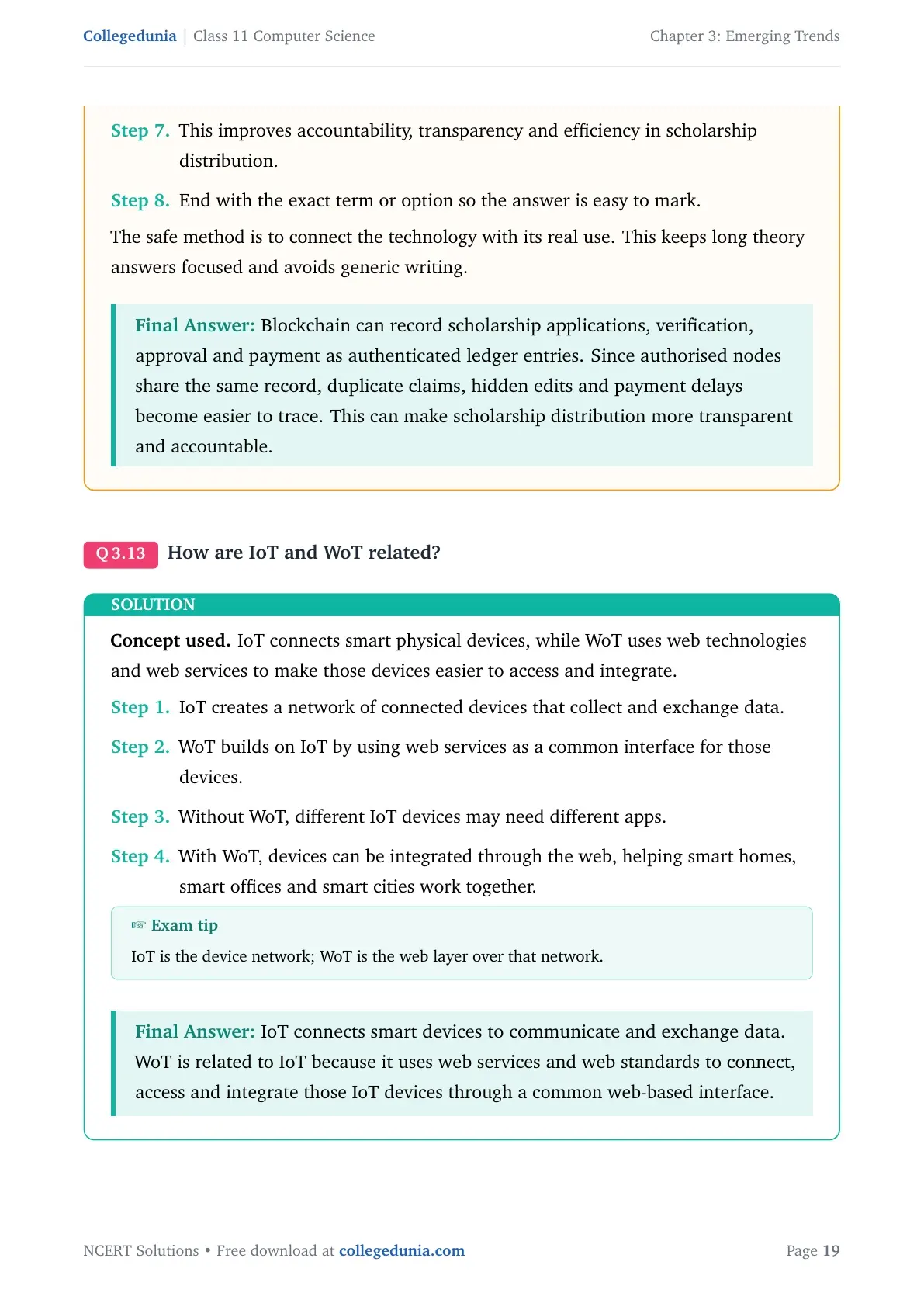
How are IoT and WoT related?
- IoT creates a network of connected devices that collect and exchange data.
- WoT builds on IoT by using web services as a common interface for those devices.
- Without WoT, different IoT devices may need different apps.
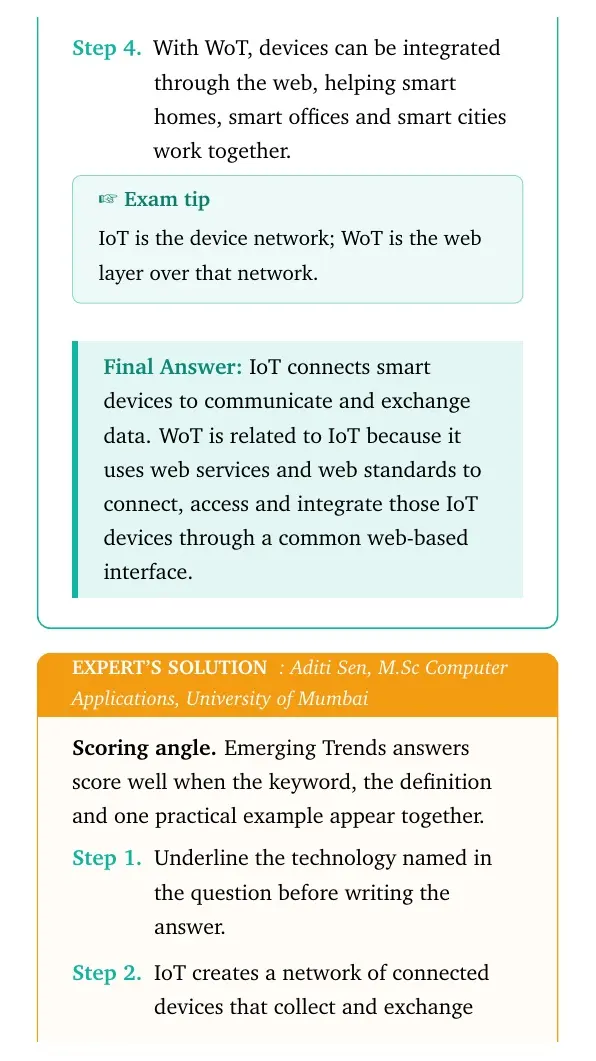
- With WoT, devices can be integrated through the web, helping smart homes, smart offices and smart cities work together.
Answer: IoT connects smart devices to communicate and exchange data. WoT is related to IoT because it uses web services and web standards to connect, access and integrate those IoT devices through a common web-based interface.
Expert view: Identify the exact technology first, then add the definition and example.
- IoT creates a network of connected devices that collect and exchange data.
- WoT builds on IoT by using web services as a common interface for those devices.
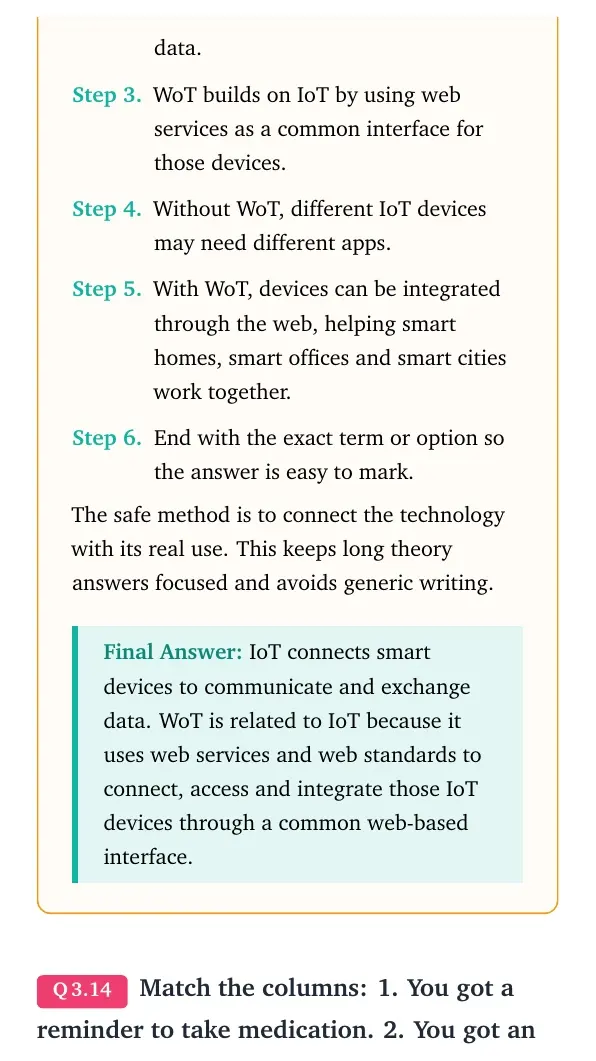
- Without WoT, different IoT devices may need different apps.
- With WoT, devices can be integrated through the web, helping smart homes, smart offices and smart cities work together.
Final answer: IoT connects smart devices to communicate and exchange data. WoT is related to IoT because it uses web services and web standards to connect, access and integrate those IoT devices through a common web-based interface.
Question 14
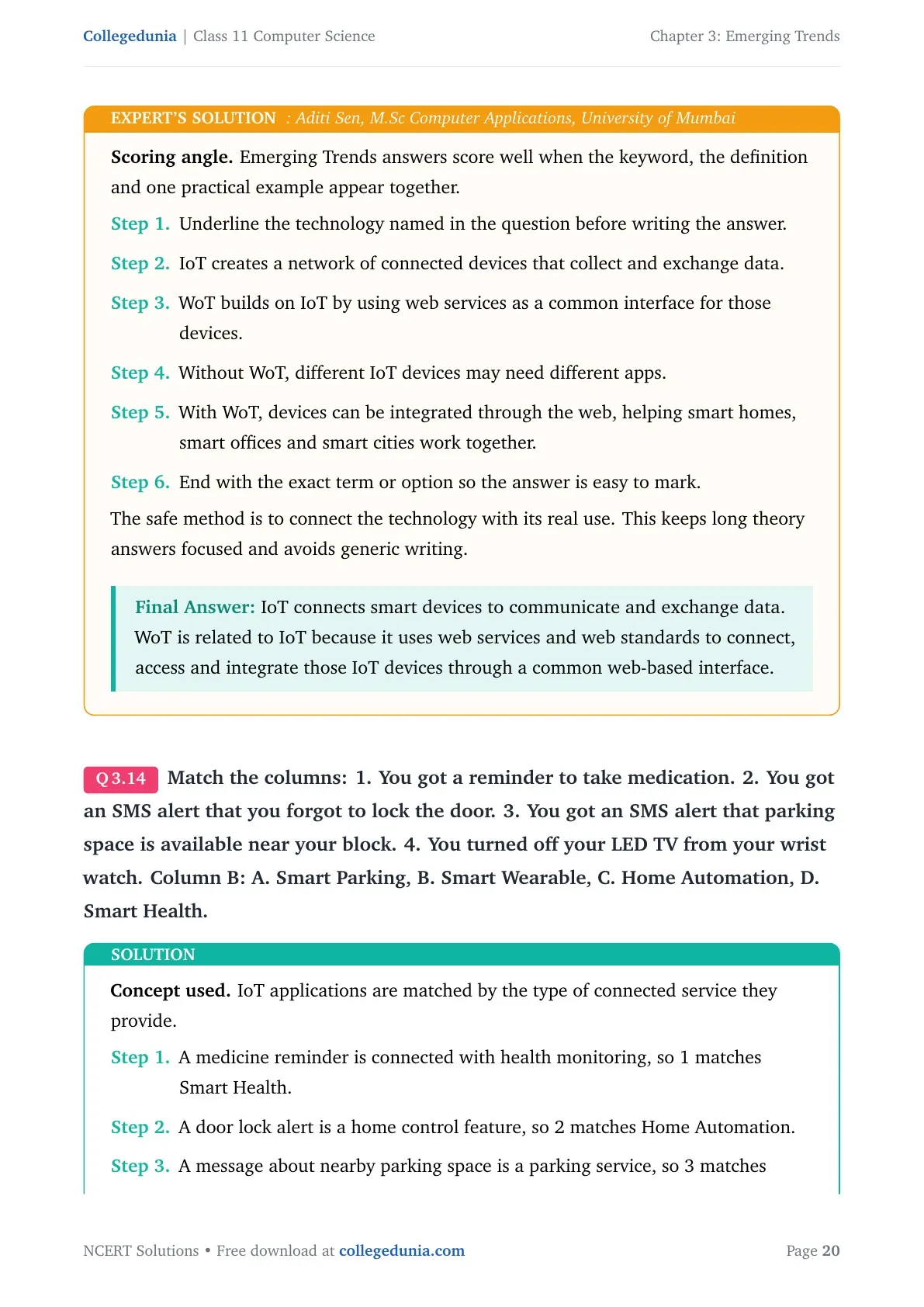
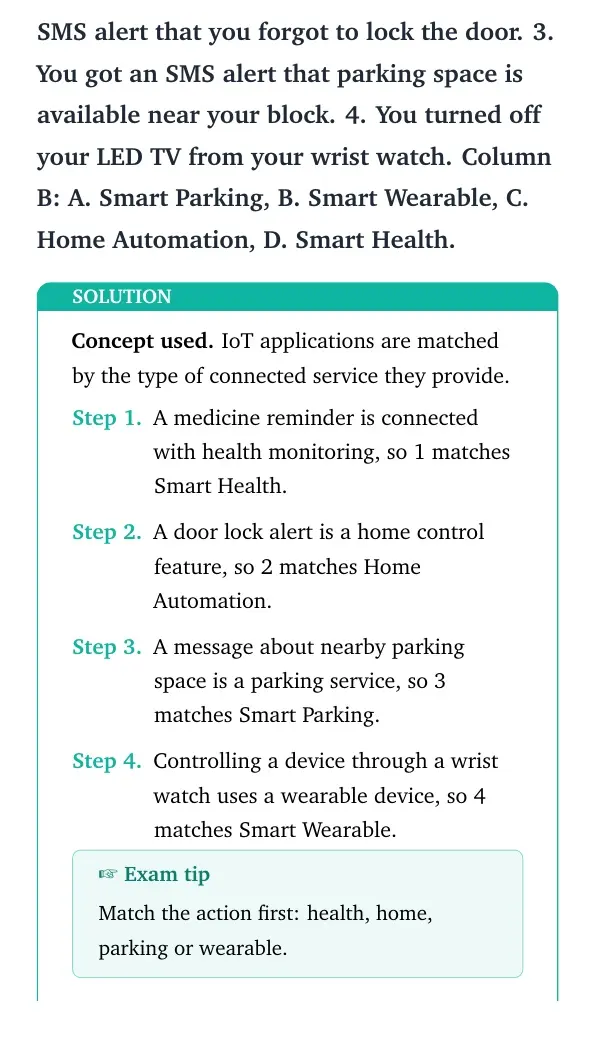
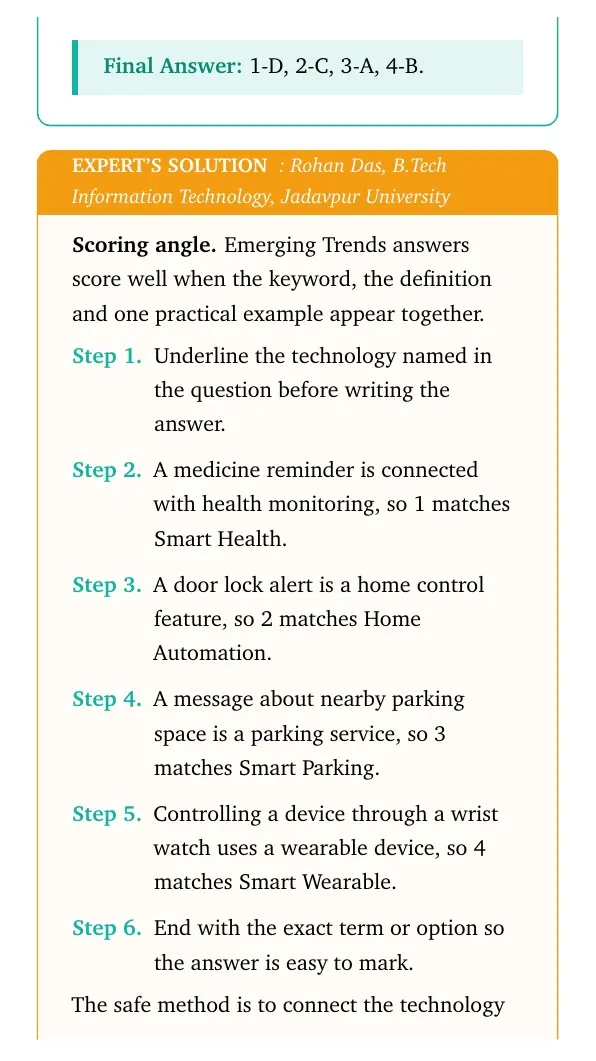
Match the columns: 1. You got a reminder to take medication. 2. You got an SMS alert that you forgot to lock the door. 3. You got an SMS alert that parking space is available near your block. 4. You turned off your LED TV from your wrist watch. Column B: A. Smart Parking, B. Smart Wearable, C. Home Automation, D. Smart Health.
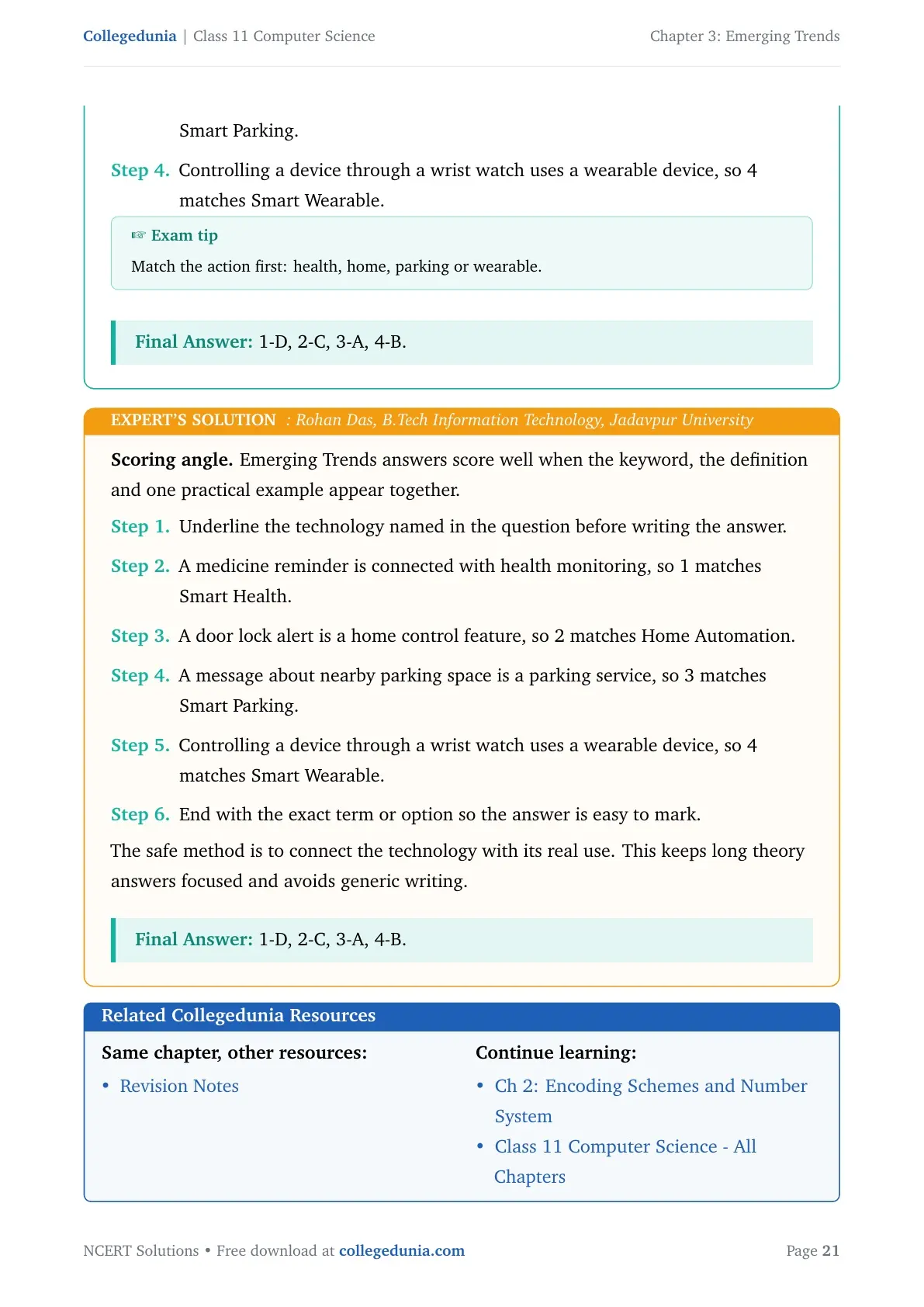
- A medicine reminder is connected with health monitoring, so 1 matches Smart Health.
- A door lock alert is a home control feature, so 2 matches Home Automation.
- A message about nearby parking space is a parking service, so 3 matches Smart Parking.
- Controlling a device through a wrist watch uses a wearable device, so 4 matches Smart Wearable.
Answer: 1-D, 2-C, 3-A, 4-B.
Expert view: Identify the exact technology first, then add the definition and example.
- A medicine reminder is connected with health monitoring, so 1 matches Smart Health.
- A door lock alert is a home control feature, so 2 matches Home Automation.
- A message about nearby parking space is a parking service, so 3 matches Smart Parking.
- Controlling a device through a wrist watch uses a wearable device, so 4 matches Smart Wearable.
Final answer: 1-D, 2-C, 3-A, 4-B.
Emerging Trends Class 11 NCERT Solutions FAQs
Ques. How many questions are solved in Class 11 Computer Science Chapter 3?
Ans. The PDF solves all 14 NCERT exercise questions from Emerging Trends.
Ques. What are the main topics in Emerging Trends?
Ans. The chapter covers AI, machine learning, NLP, big data, IoT, cloud computing, grid computing and blockchain.
Ques. Does this page follow the 2026-27 NCERT Computer Science chapter?
Ans. Yes. The answers follow the 2026-27 NCERT Class 11 Computer Science Chapter 3 exercise.
Ques. Which cloud model is important in the exercise?
Ans. Infrastructure as a Service is important because the exercise asks about virtual servers and on-demand storage.



Comments