




These Emerging Trends handwritten notes turn the whole third chapter into clean, handwritten pages for fast last-minute revision. They follow the 2026-27 NCERT syllabus and Chapter 3 of Class 11 Computer Science. Students get crisp definitions of Artificial Intelligence and Machine Learning, Natural Language Processing, immersive experiences with VR and AR, robotics, Big Data and its five V's, the Internet of Things and sensors, smart cities, cloud and grid computing, blockchain and 3D printing, all in a pen-on-paper format that is easy to skim before a Class 11 Computer Science test.
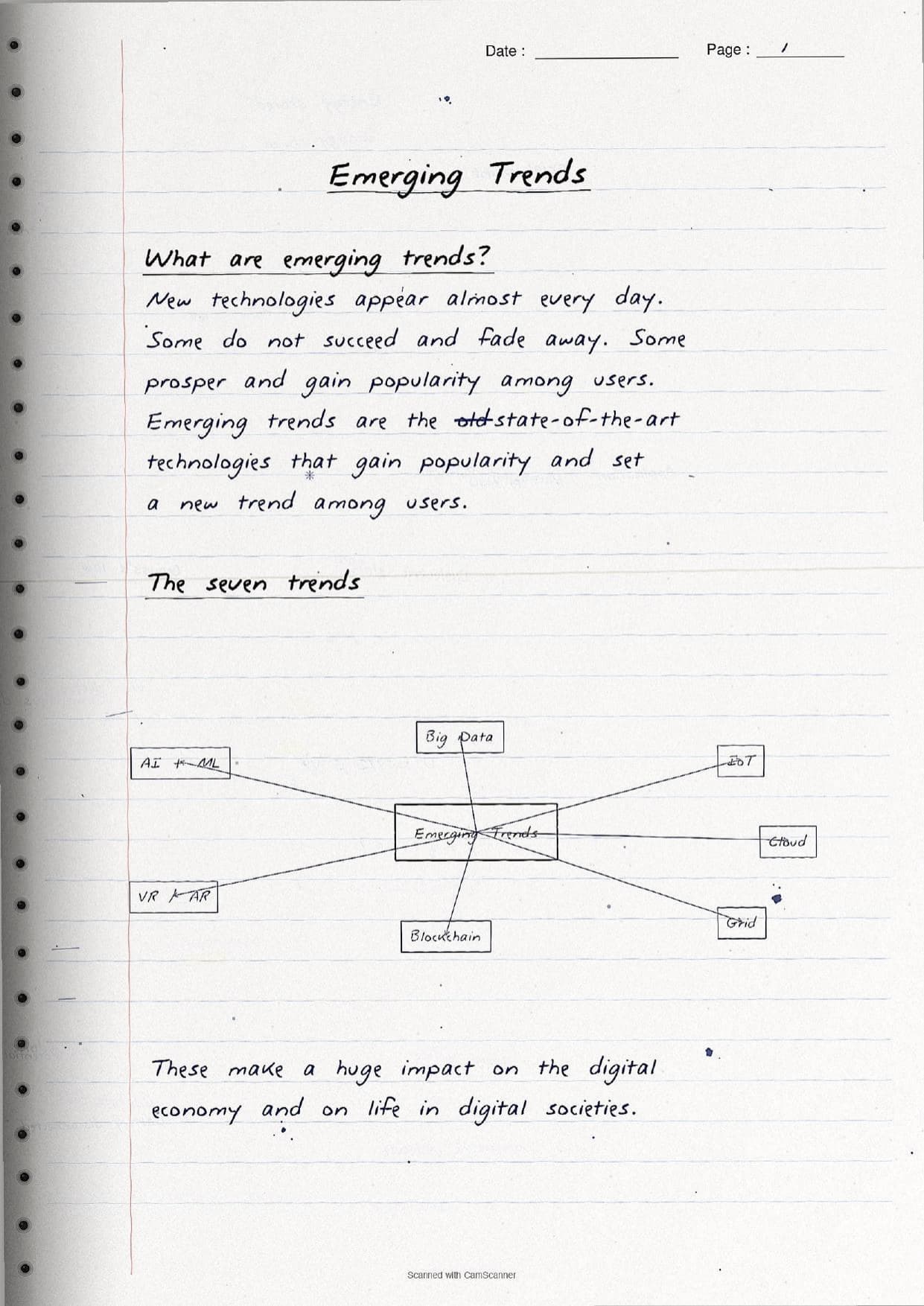
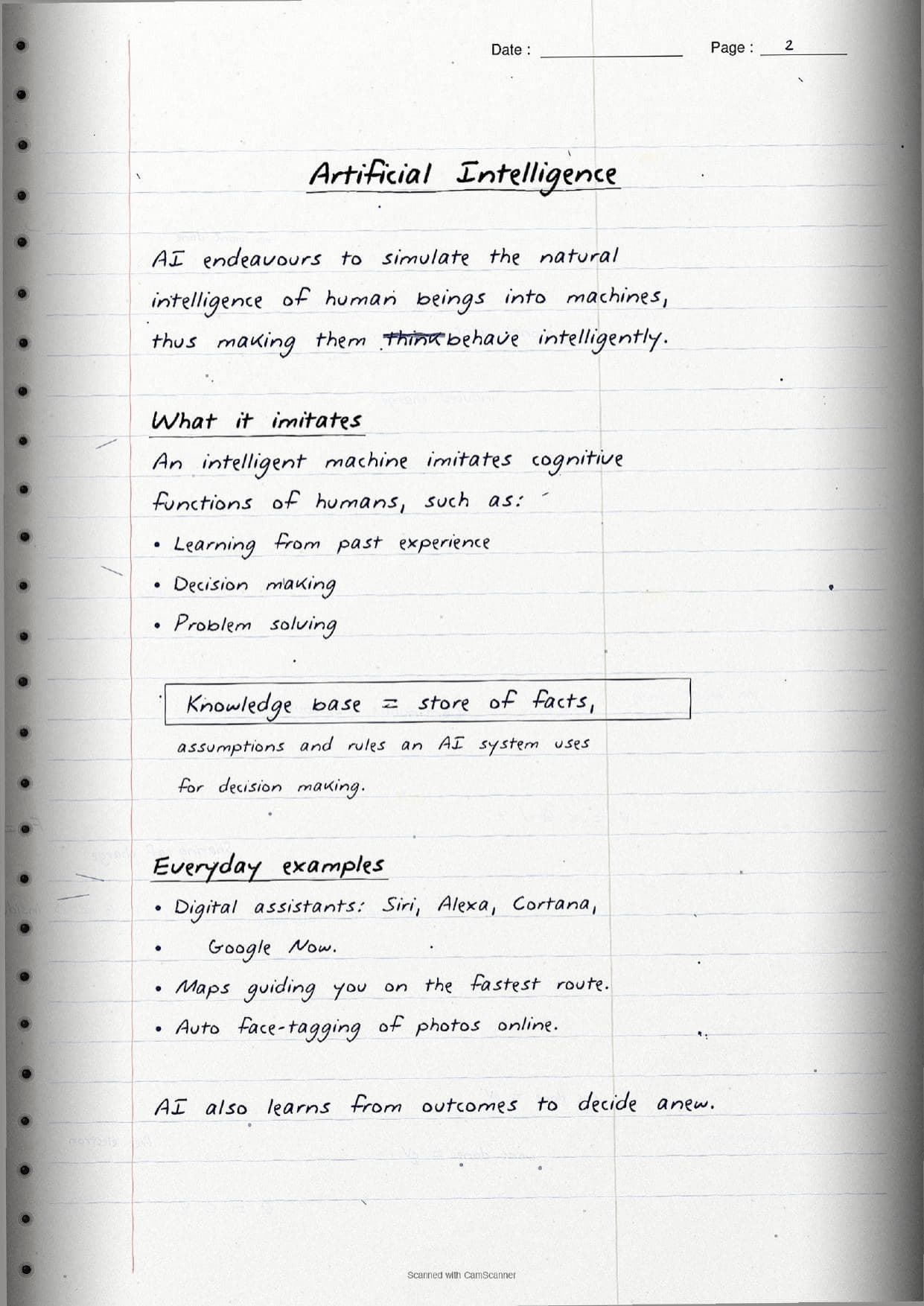
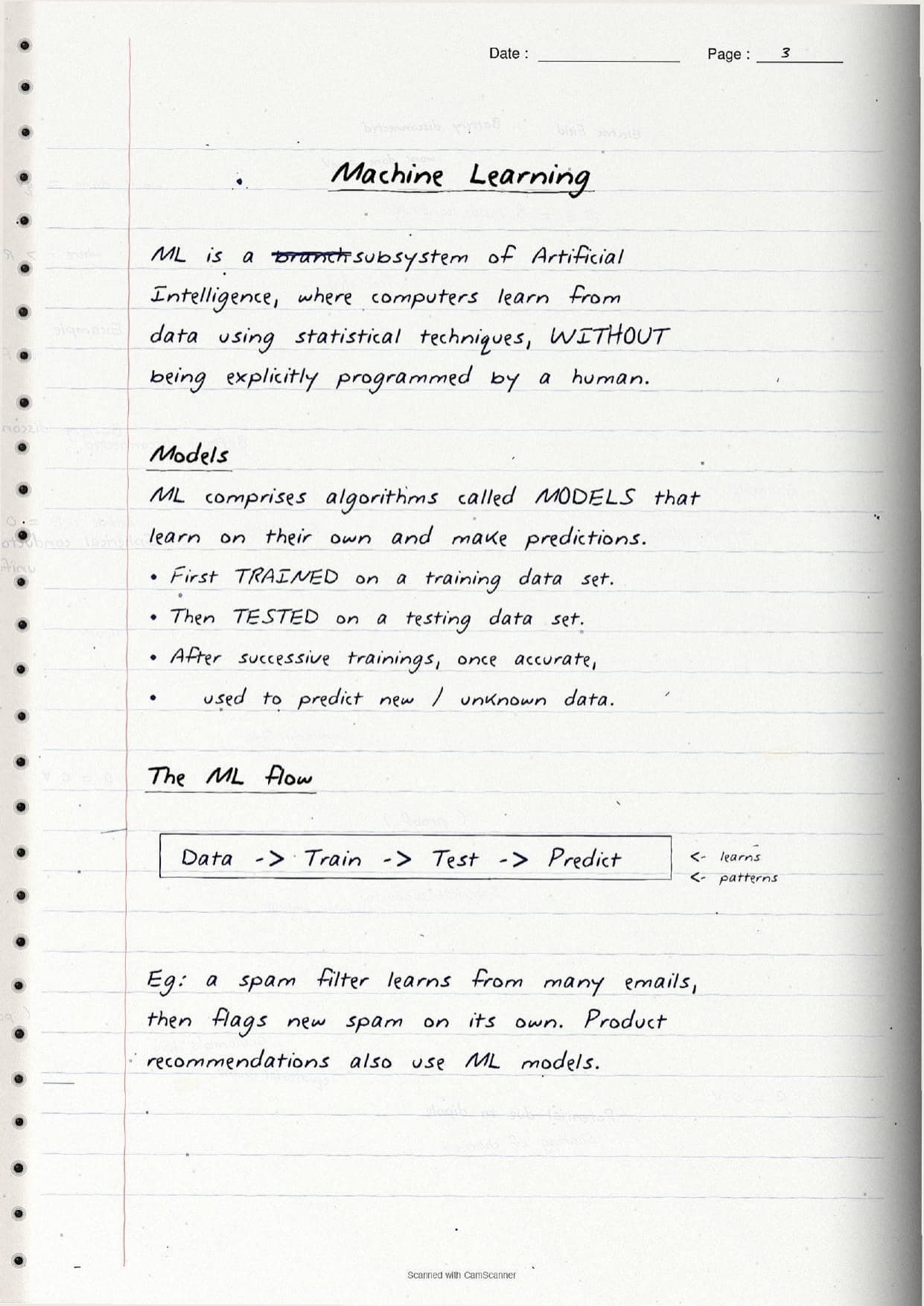
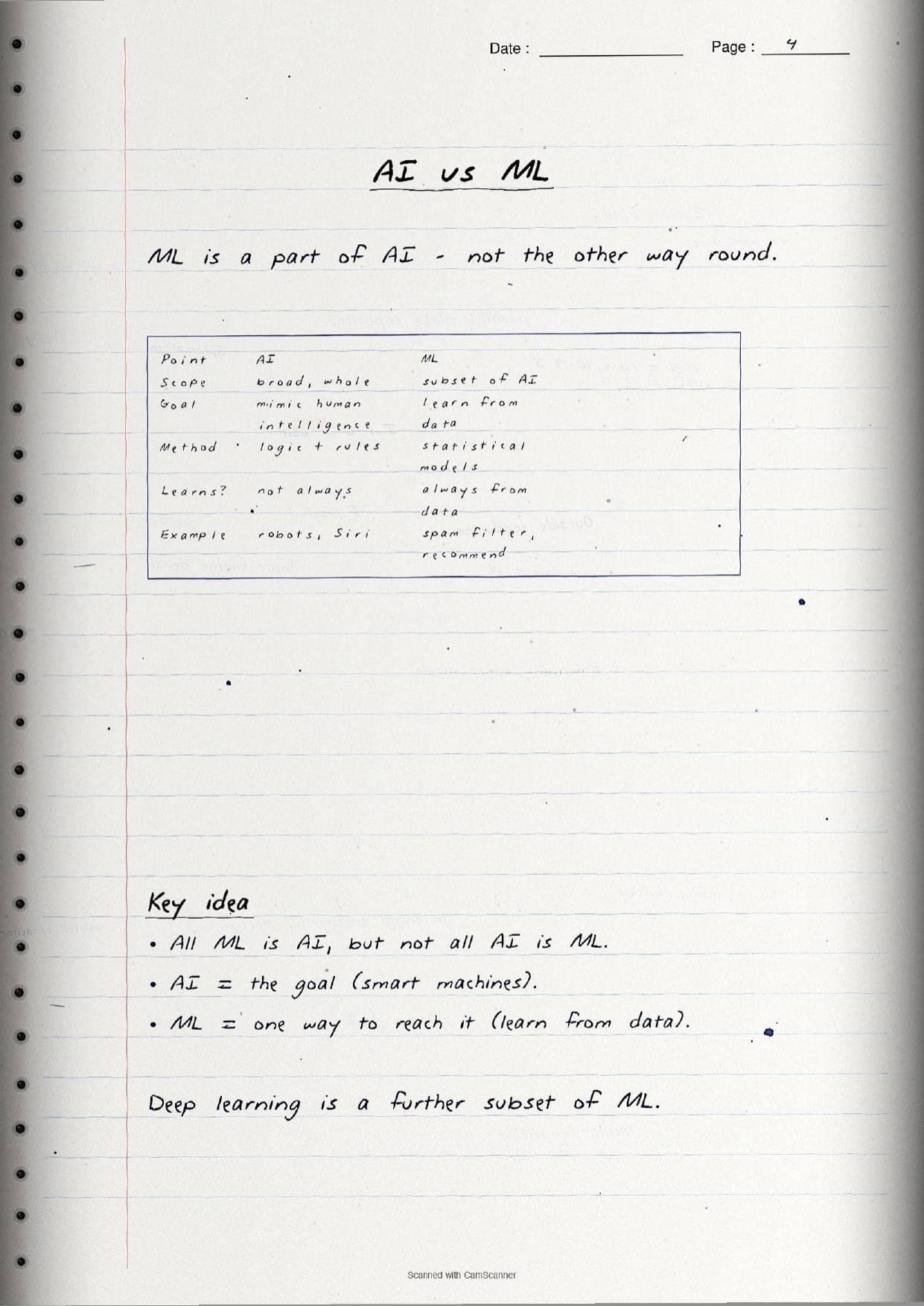
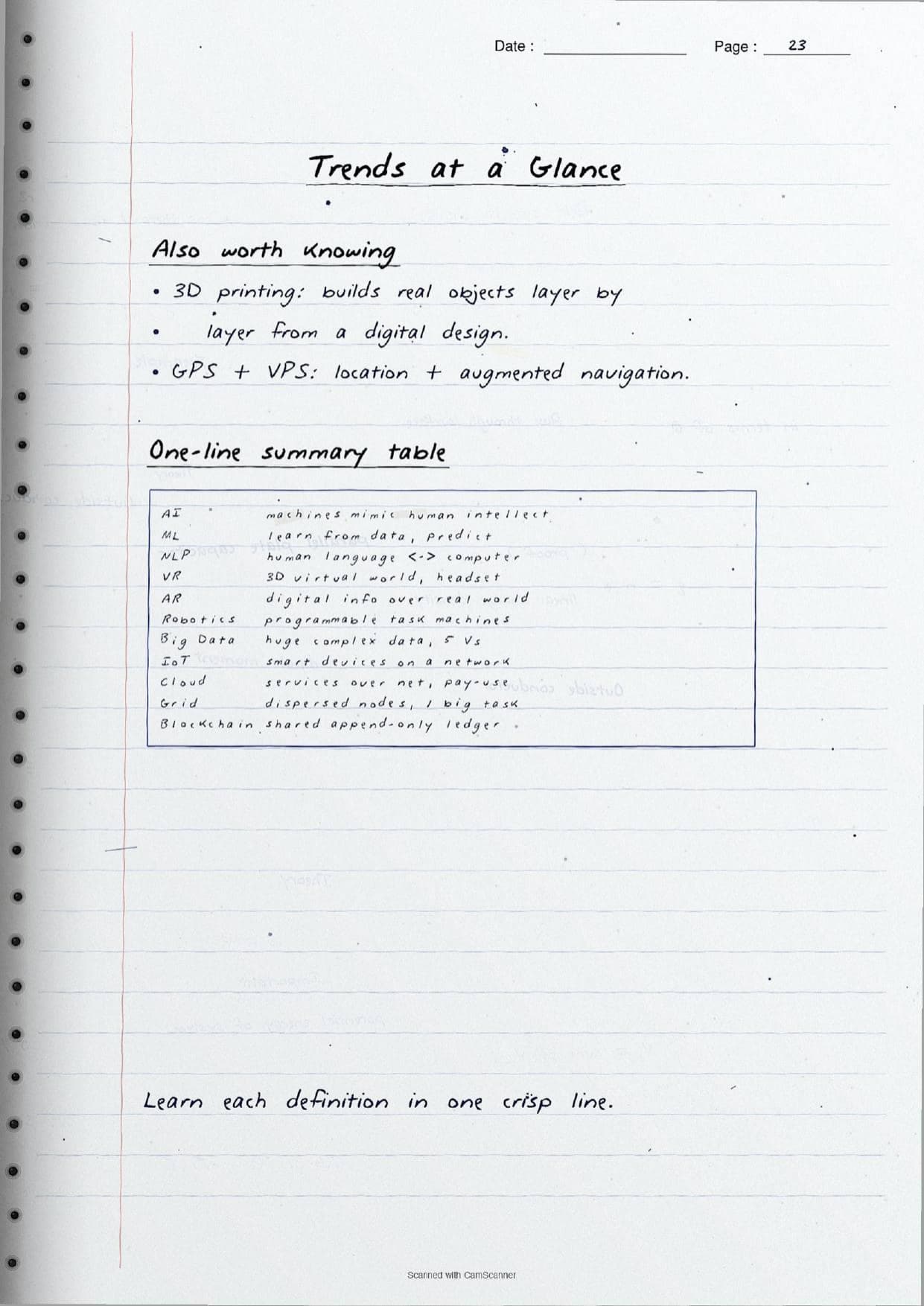
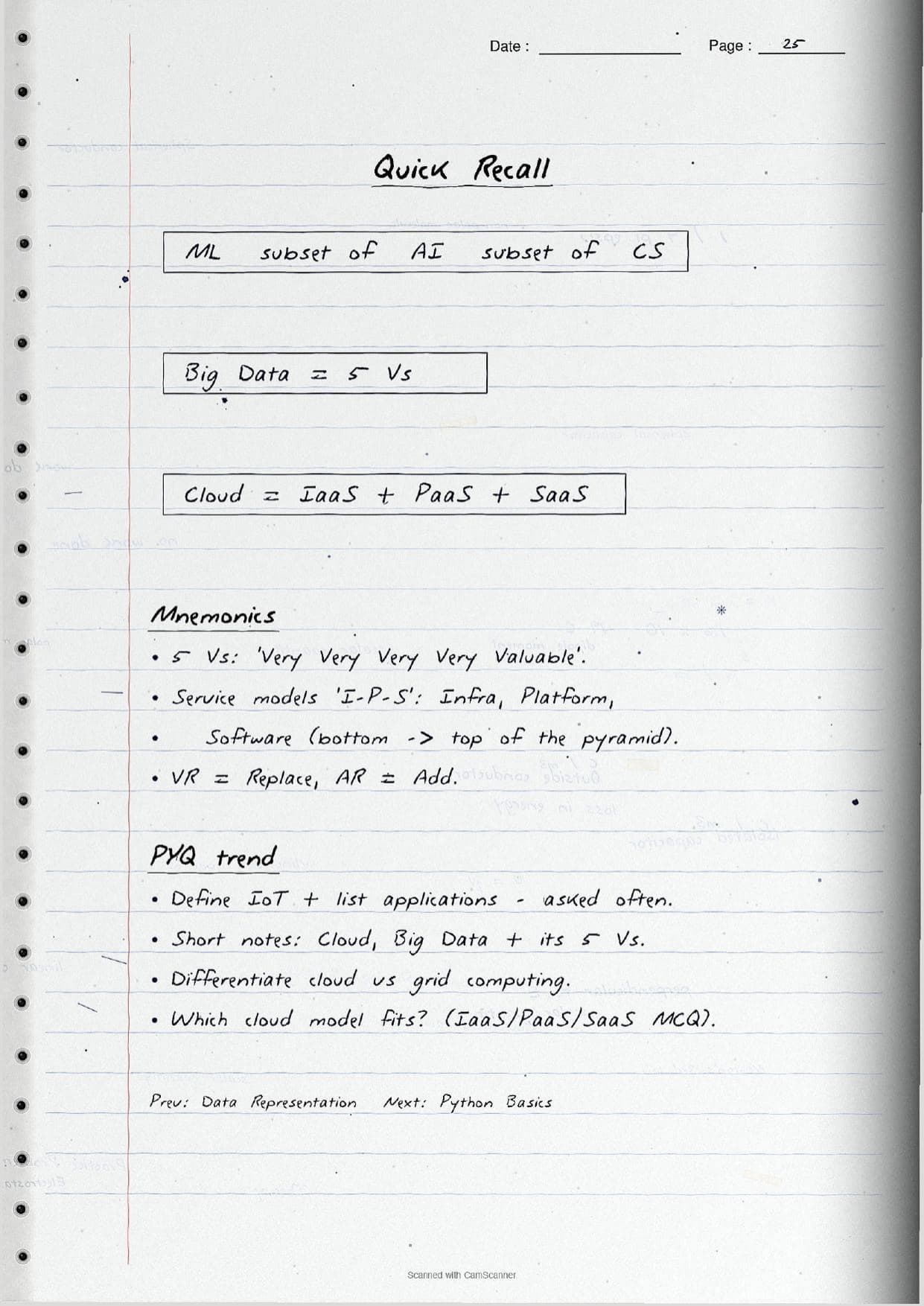
- Handwritten pages with boxed definitions, a mind map of the seven trends, and comparison tables like AI vs ML and VR vs AR traced by hand.
- This is a fully theory chapter of Class 11 Computer Science, so the terms and one-line definitions here are frequently asked in the final exam.
- Pairs with the NCERT Solutions, Notes and Book PDF linked lower on this page.
These Emerging Trends handwritten notes are prepared from the official NCERT Computer Science textbook and checked against recent CBSE Class 11 question papers.
Student Feedback: In a Collegedunia poll of 4,360 Class 11 Computer Science students, 78% of students said the handwritten comparison tables helped them tell apart AI from ML and VR from AR faster than printed text, because the boxed definitions and arrows made each one-line meaning stick.
Source: 2026-27 Class 11 Computer Science student poll. Sample of 4,360 students from CBSE schools across 9 states.
What These Emerging Trends Handwritten Notes Contain
Emerging Trends is the third chapter of Class 11 Computer Science. It is a full theory chapter with almost no code, so it rewards clear definitions and sharp comparisons rather than long programs. These handwritten notes condense every trend into handwritten pages that read like a topper's own notebook, with the hard-to-remember one-liners boxed and traced by hand.
The notes open with a mind map that fans out the seven headline trends, then take each one page by page:
- Intelligent systems: Artificial Intelligence, Machine Learning and Natural Language Processing, with an AI vs ML table written out by hand.
- Immersive and physical tech: Virtual Reality, Augmented Reality, robotics, and a VR vs AR page.
- Data and networks: Big Data and its five V's, the Internet of Things, Web of Things, sensors, smart cities, cloud computing, grid computing, blockchain and 3D printing.
Because the pages are handwritten, each definition sits in a boxed one-liner next to a small diagram rather than a wall of text. A student can flip through the Emerging Trends class 11 pages in a few minutes and still recall what every term means, how the trends relate, and where each one is used before walking into the exam.
AI, Machine Learning and NLP in the Handwritten Pages
The first block of pages settles the trio that students mix up the most. Artificial Intelligence (AI) is defined as the effort to simulate the natural intelligence of humans in machines, so a machine can imitate cognitive functions like learning from experience, decision making and problem solving. The notes box the idea of a knowledge base, the store of facts, assumptions and rules an AI system uses to decide, and list everyday examples such as digital assistants, map routing and photo face-tagging.
Machine Learning (ML) gets its own page as a subsystem of AI, where computers learn from data using statistical techniques without being explicitly programmed. The pages draw the ML flow as a boxed line so it is easy to recall.
Data → Train → Test → PredictAn ML model is first trained on a training data set, then tested on a testing data set, and once accurate it predicts new or unknown data, like a spam filter that learns from many emails. To stop the classic confusion, a full page compares the two side by side.
| Point | Artificial Intelligence | Machine Learning |
|---|---|---|
| Scope | Broad goal of smart machines | A subset of AI |
| Goal | Mimic human intelligence | Learn patterns from data |
| Method | Logic and rules | Statistical models |
| Learns? | Not always | Always, from data |
| Example | Robots, Siri | Spam filter, recommendations |
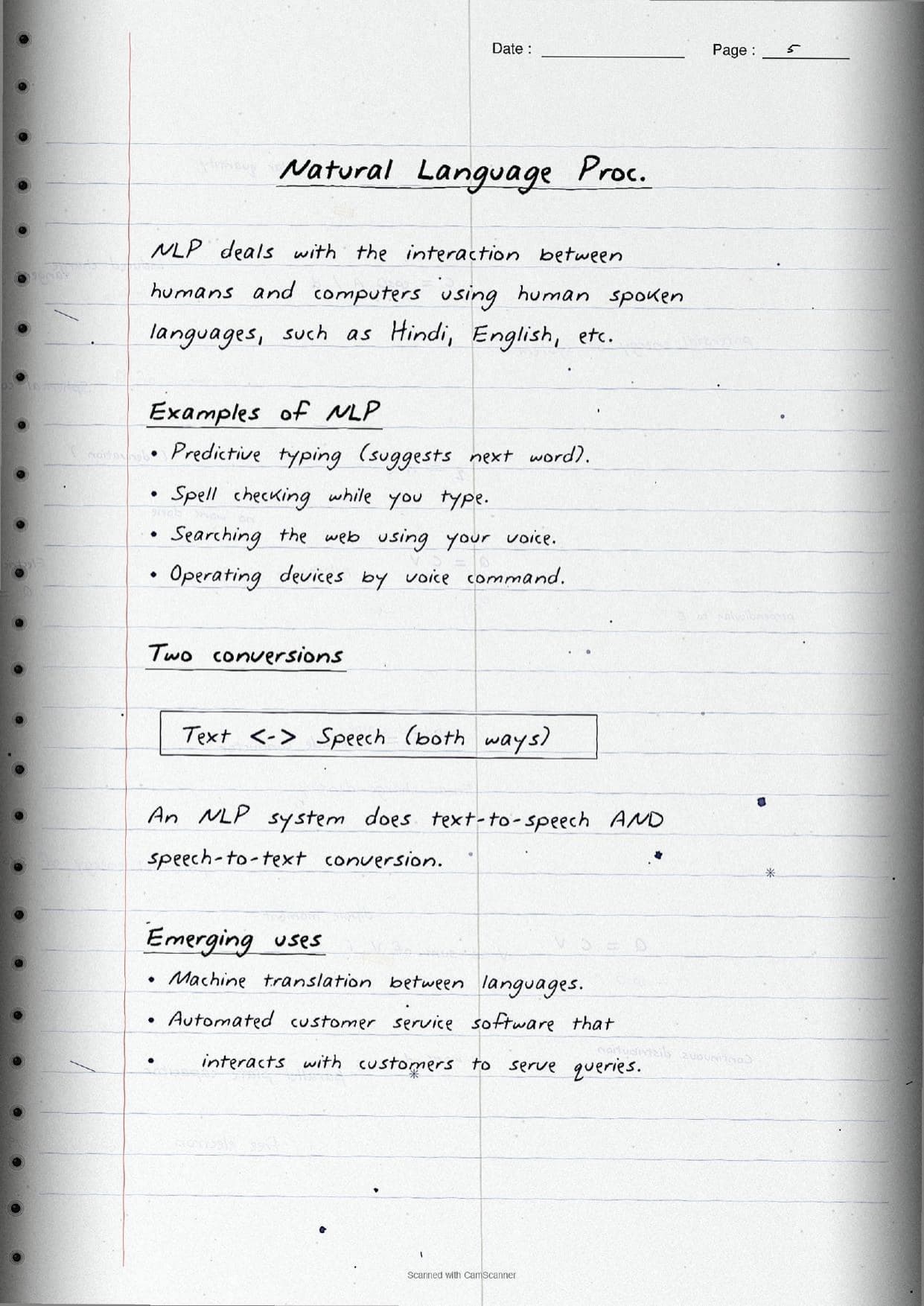
The one-line recall on the page is simple: all ML is AI, but not all AI is ML, and deep learning is a further subset of ML. Natural Language Processing (NLP) closes this block. It deals with the interaction between humans and computers using spoken languages like Hindi and English. The notes show it handles both directions of Text <-> Speech, covering predictive typing, spell check, voice search, machine translation and automated customer service software.
Immersive Tech, Big Data, IoT and Cloud in the Handwritten Pages
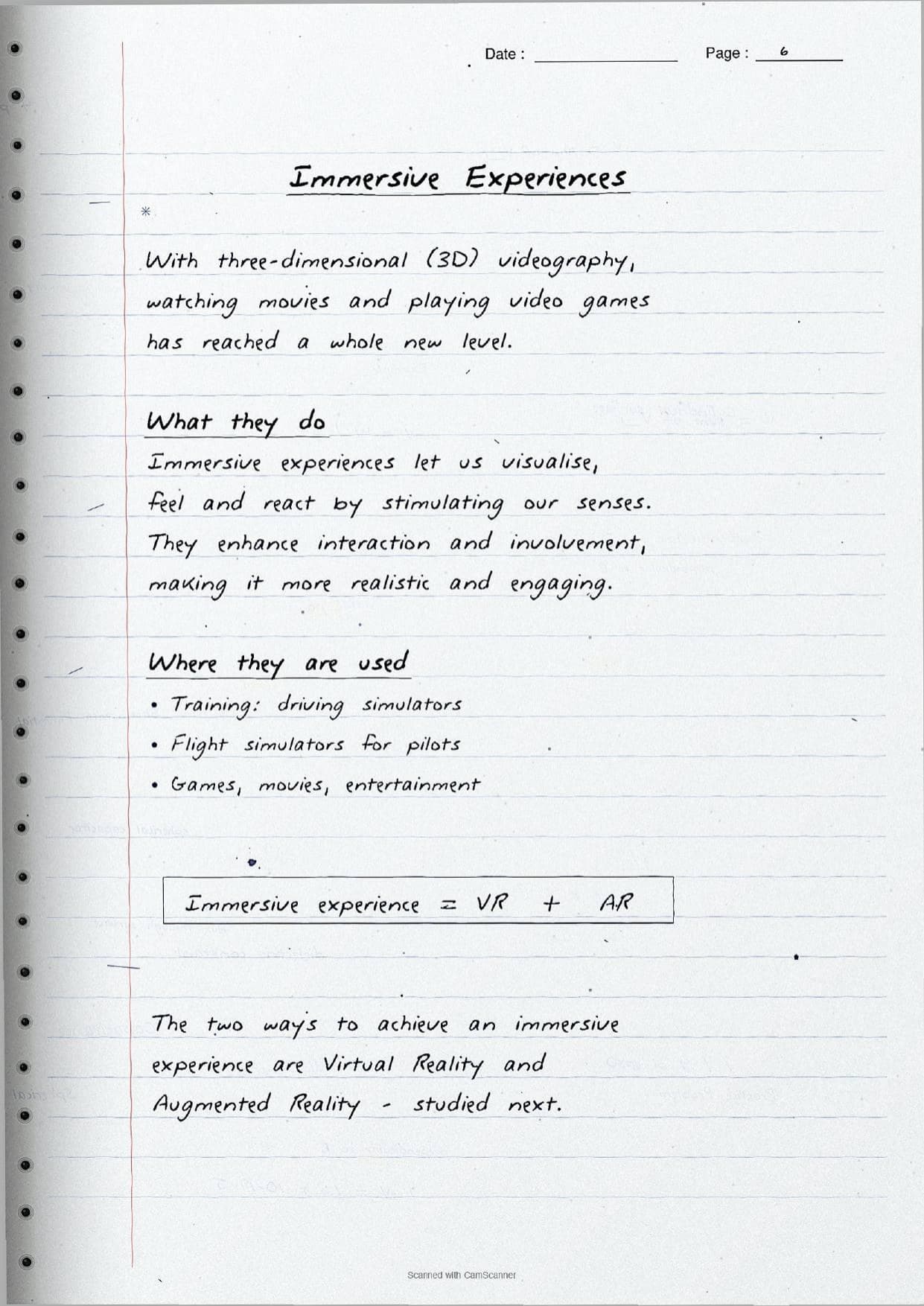
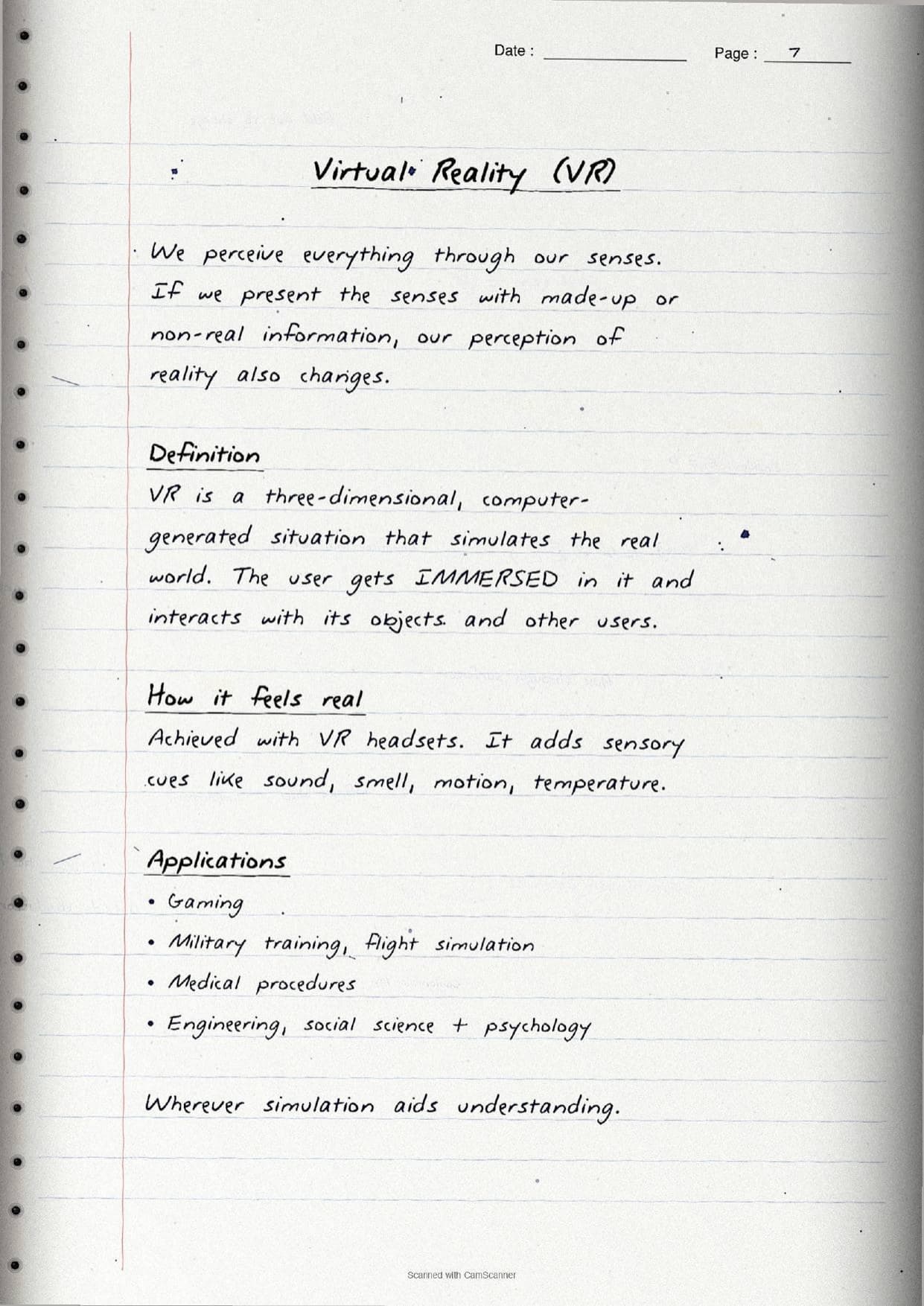
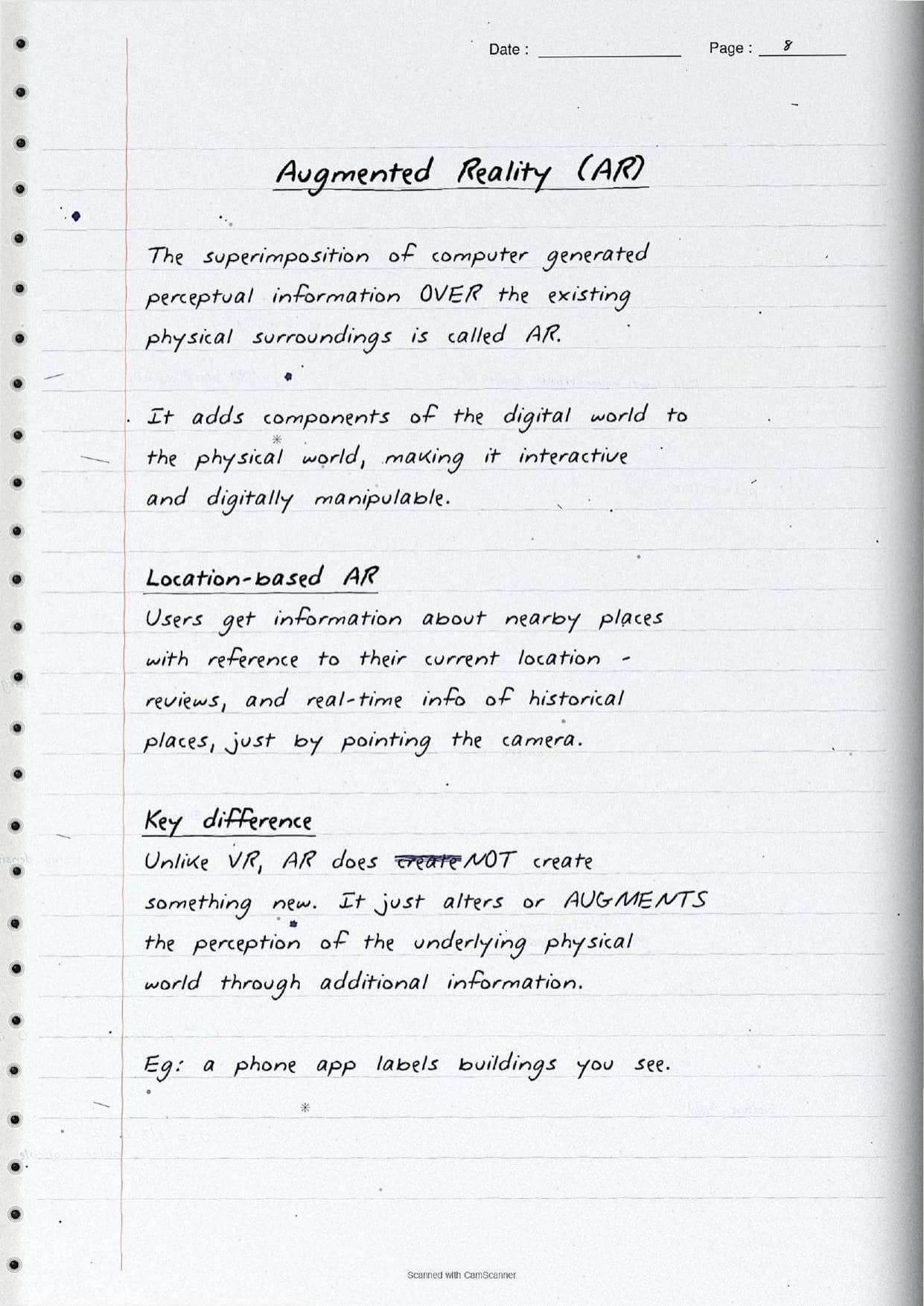
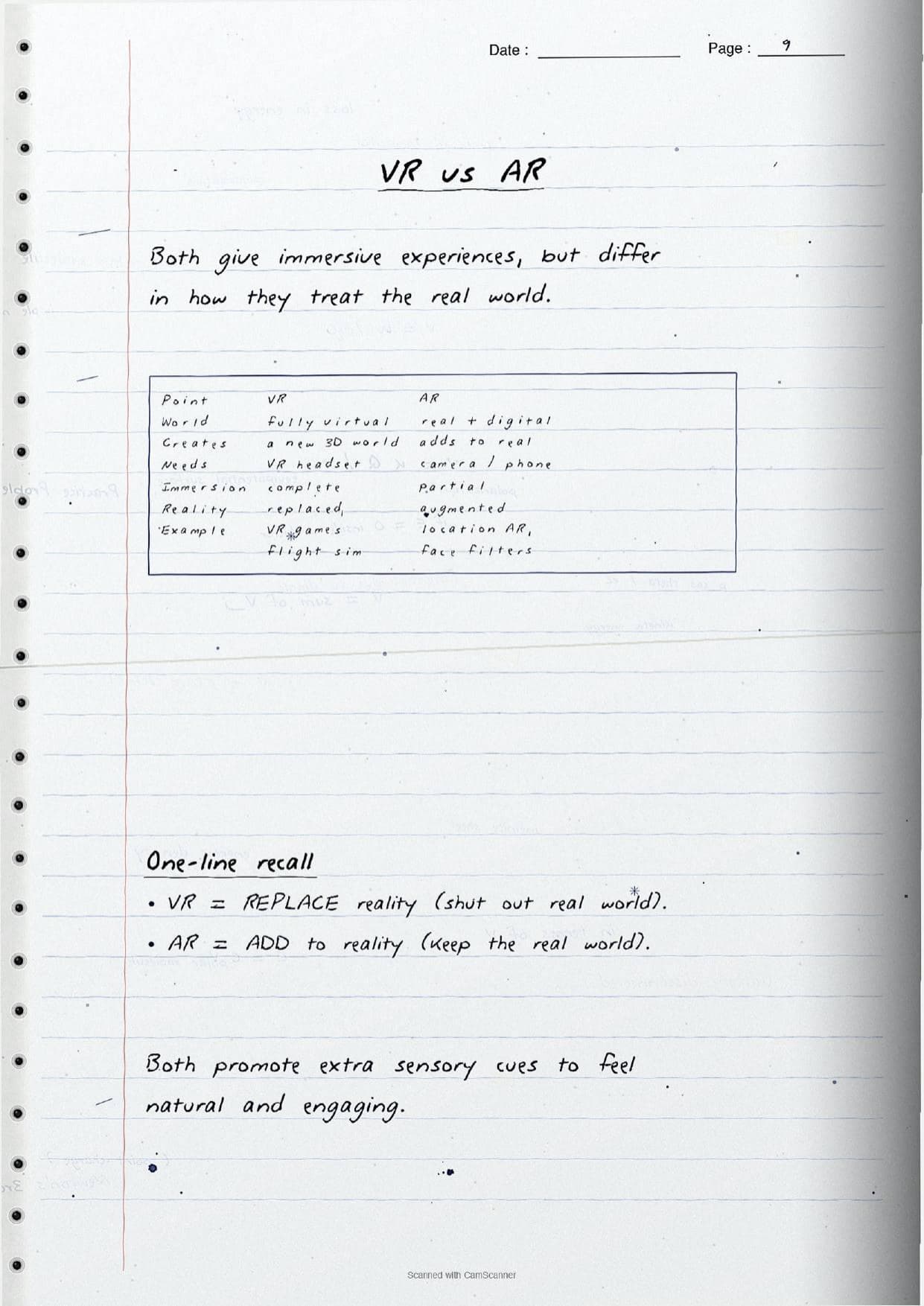
The rest of the notebook covers the trends built on data, networks and hardware. Immersive experiences use three-dimensional technology to stimulate the senses, and the pages box the key relation Immersive experience = VR + AR. Virtual Reality is a computer-generated 3D situation that simulates the real world so the user gets fully immersed through a headset, while Augmented Reality superimposes computer-generated information over the real physical surroundings. The handwritten VR vs AR table keeps them apart at a glance.
| Point | Virtual Reality | Augmented Reality |
|---|---|---|
| The world | Fully virtual, made from scratch | Real world plus digital overlay |
| Needs | VR headset | Camera or phone |
| Reality | Replaced completely | Augmented, not replaced |
| Example | VR games, flight simulator | Location AR, face filters |
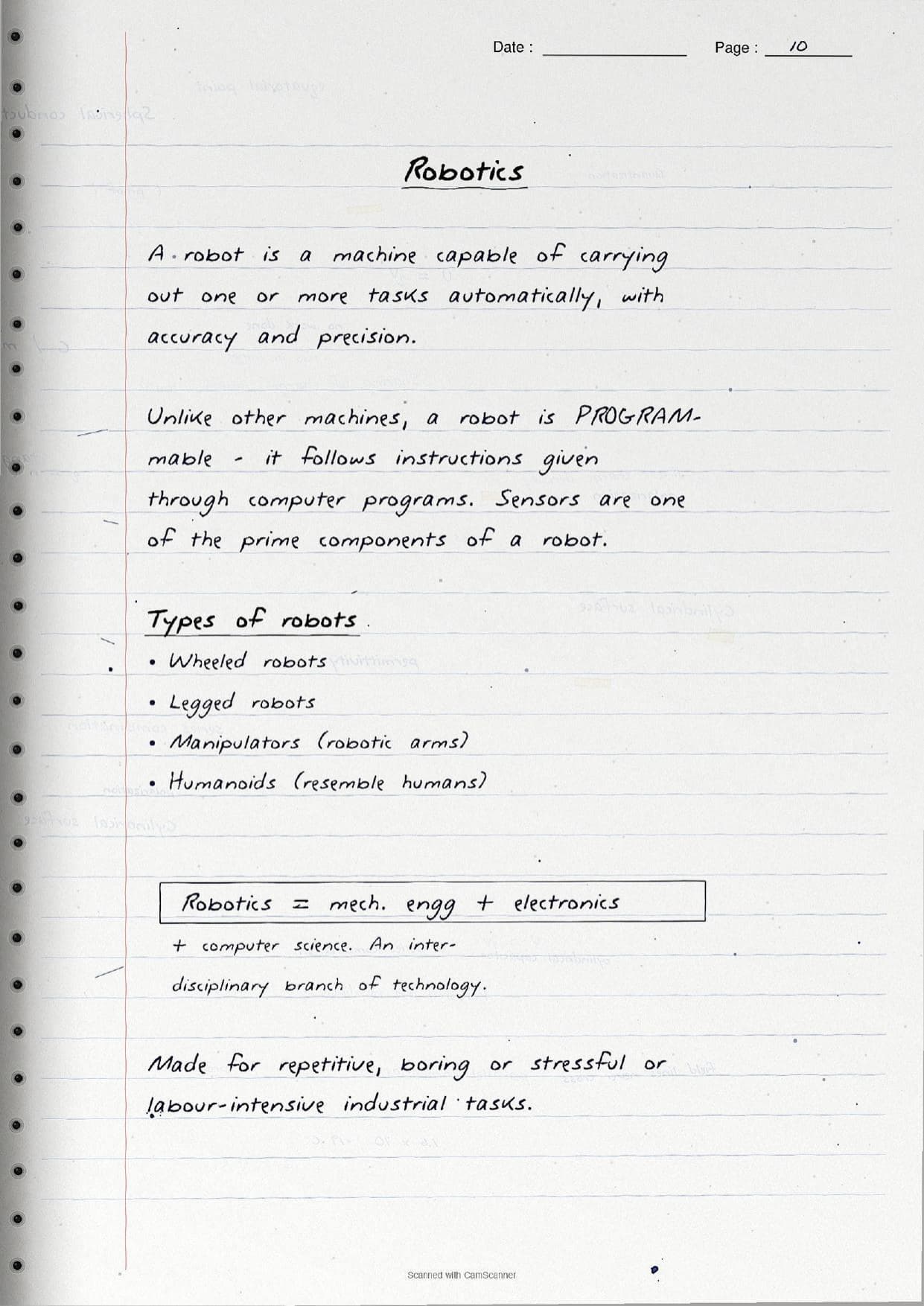
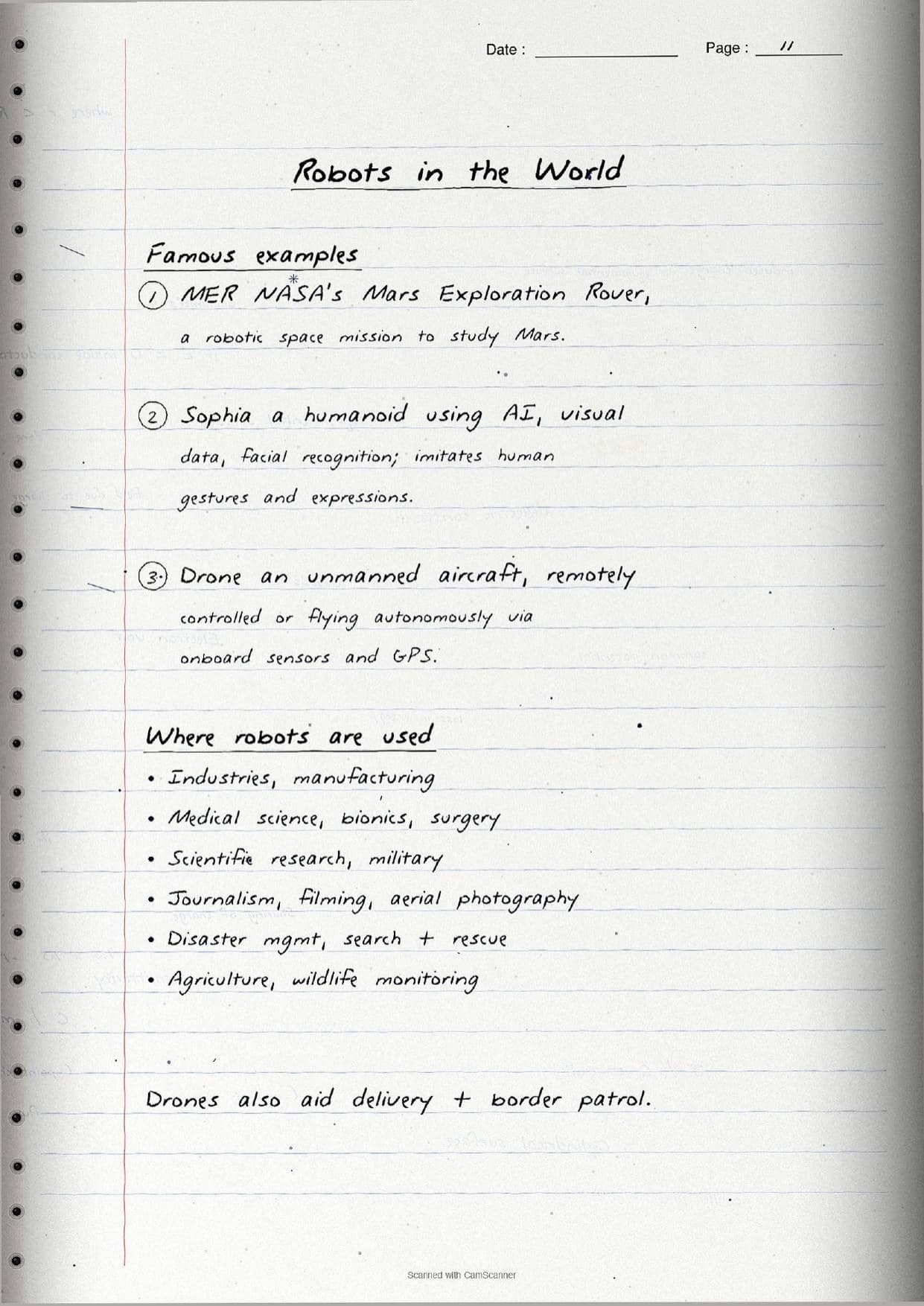
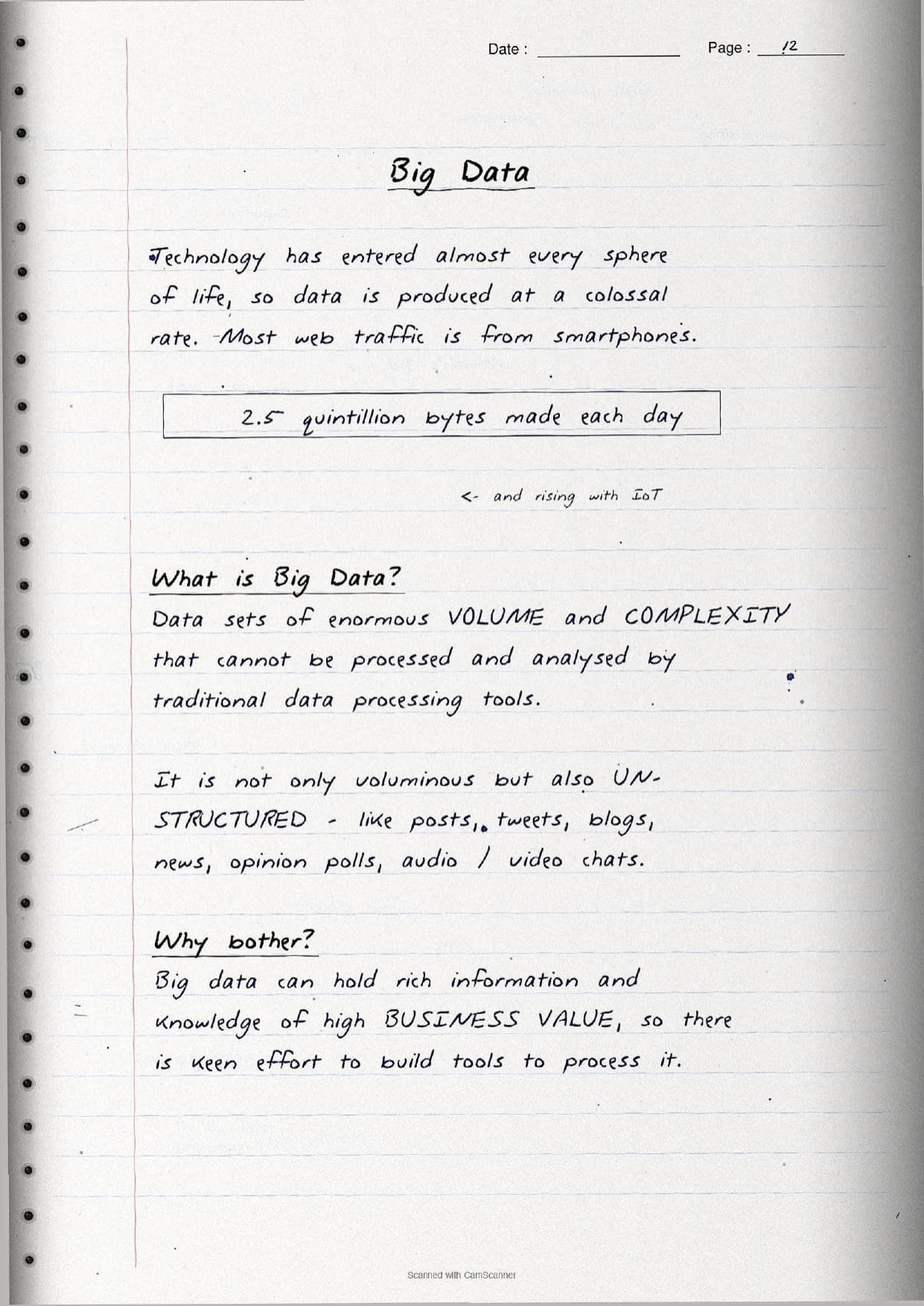
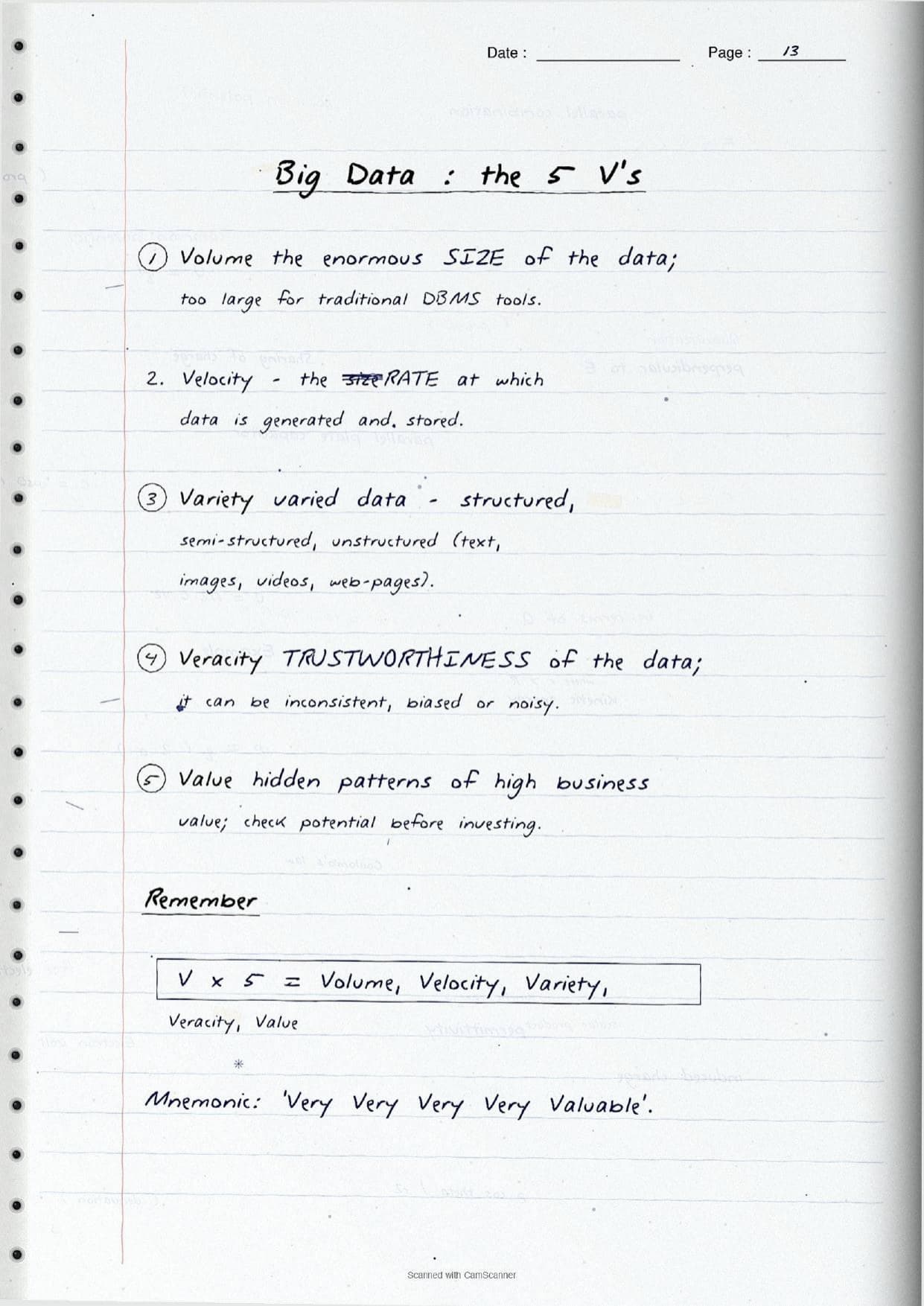
Robotics gets two pages: a robot is a programmable machine that carries out tasks with accuracy and precision, using sensors as a prime component, with famous examples like NASA's Mars rover, the humanoid Sophia and drones. The data pages then define Big Data as data sets of enormous volume and complexity that traditional tools cannot process, and box the five V's that students must memorise.
- Volume: the enormous size of the data.
- Velocity: the rate at which data is generated and stored.
- Variety: structured, semi-structured and unstructured forms.
- Veracity: the trustworthiness of the data.
- Value: the hidden business worth inside it.
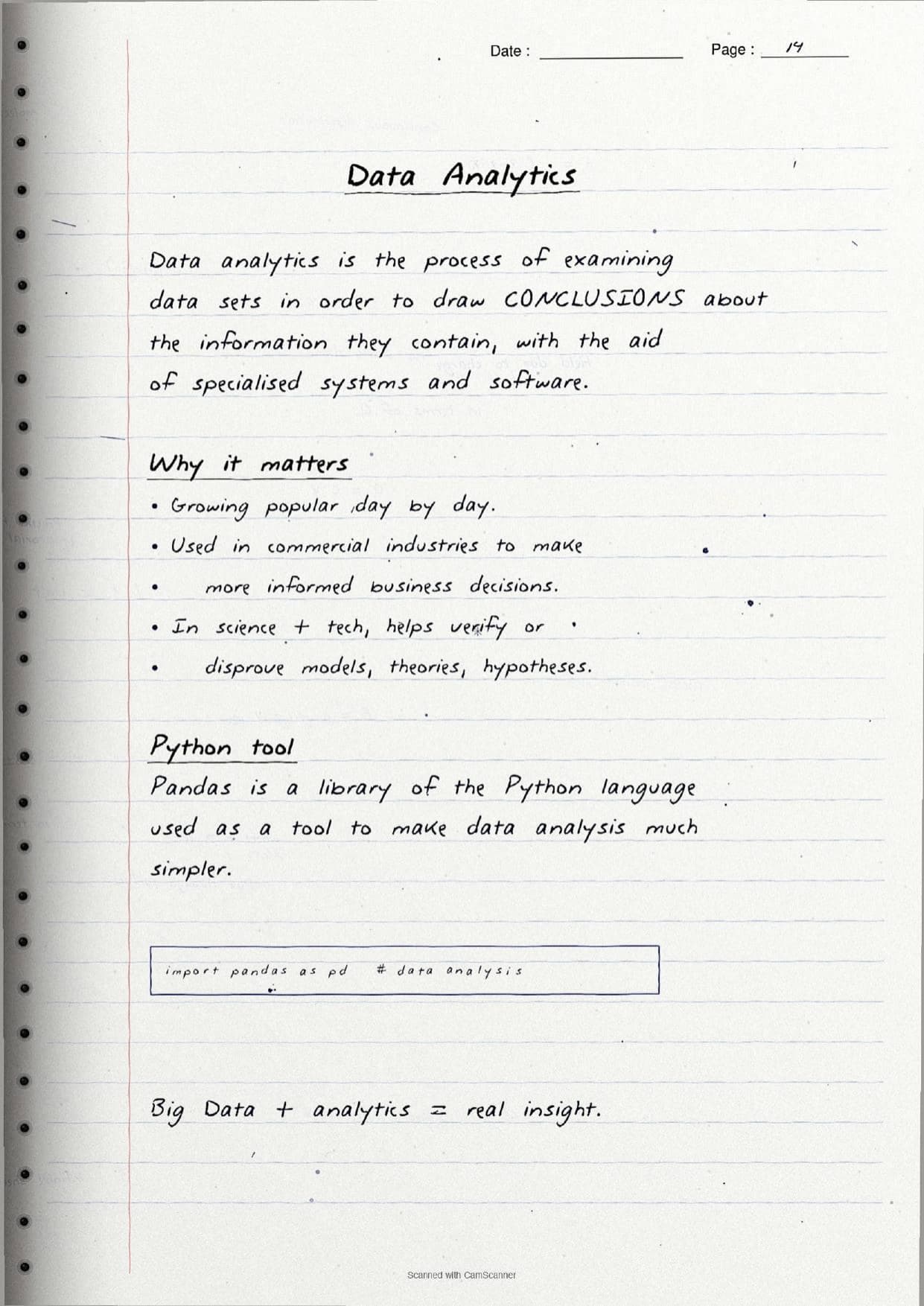
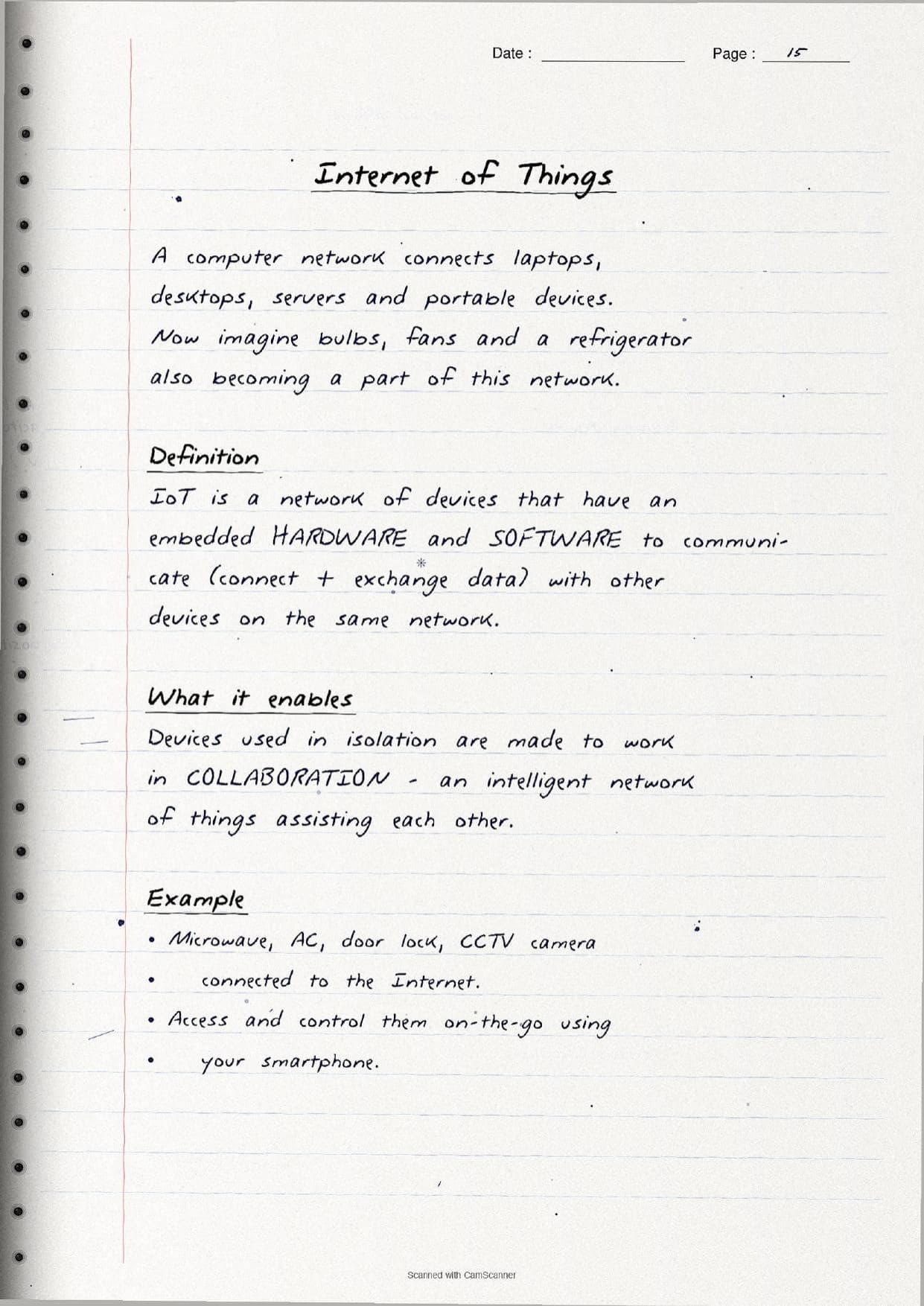
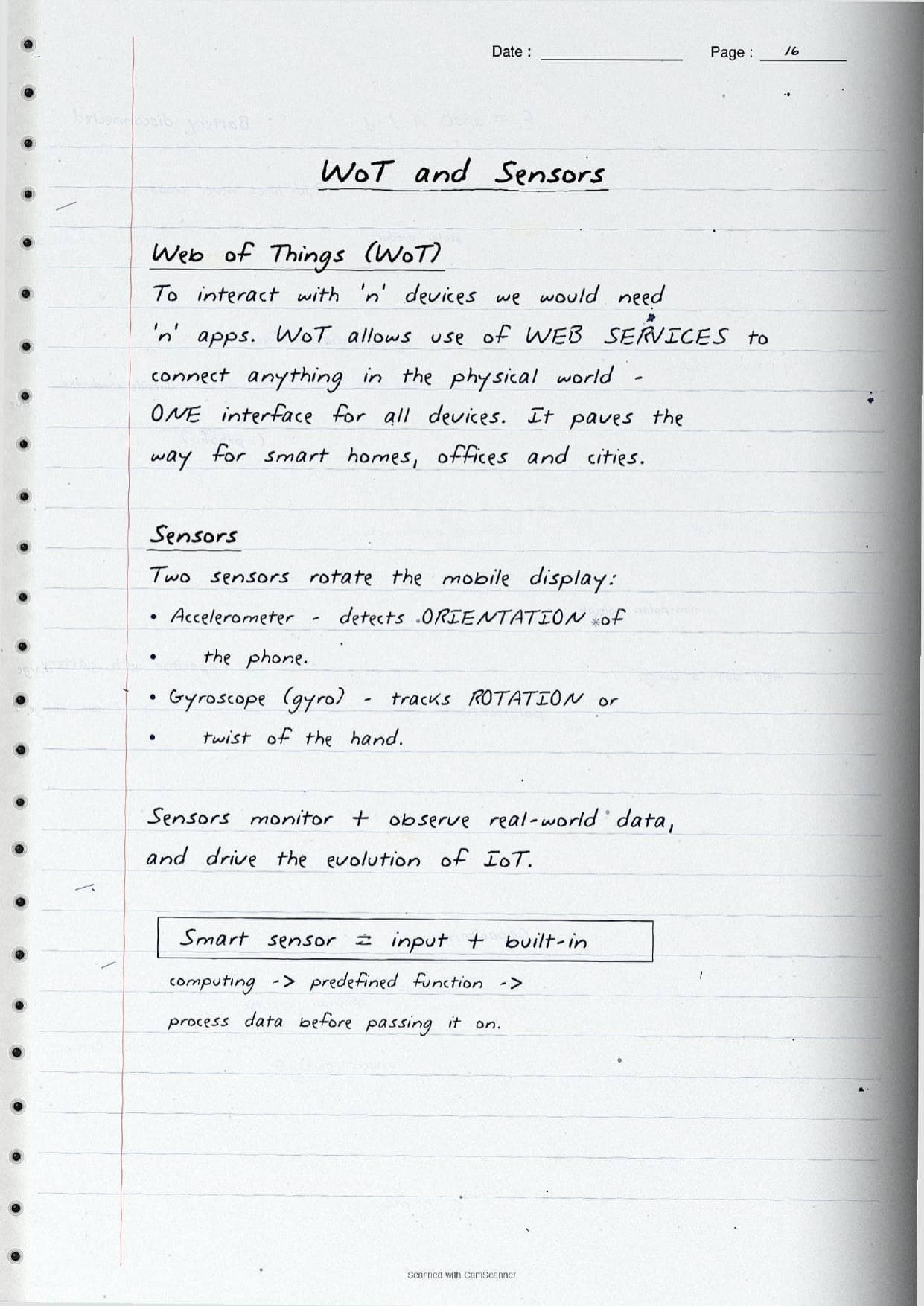
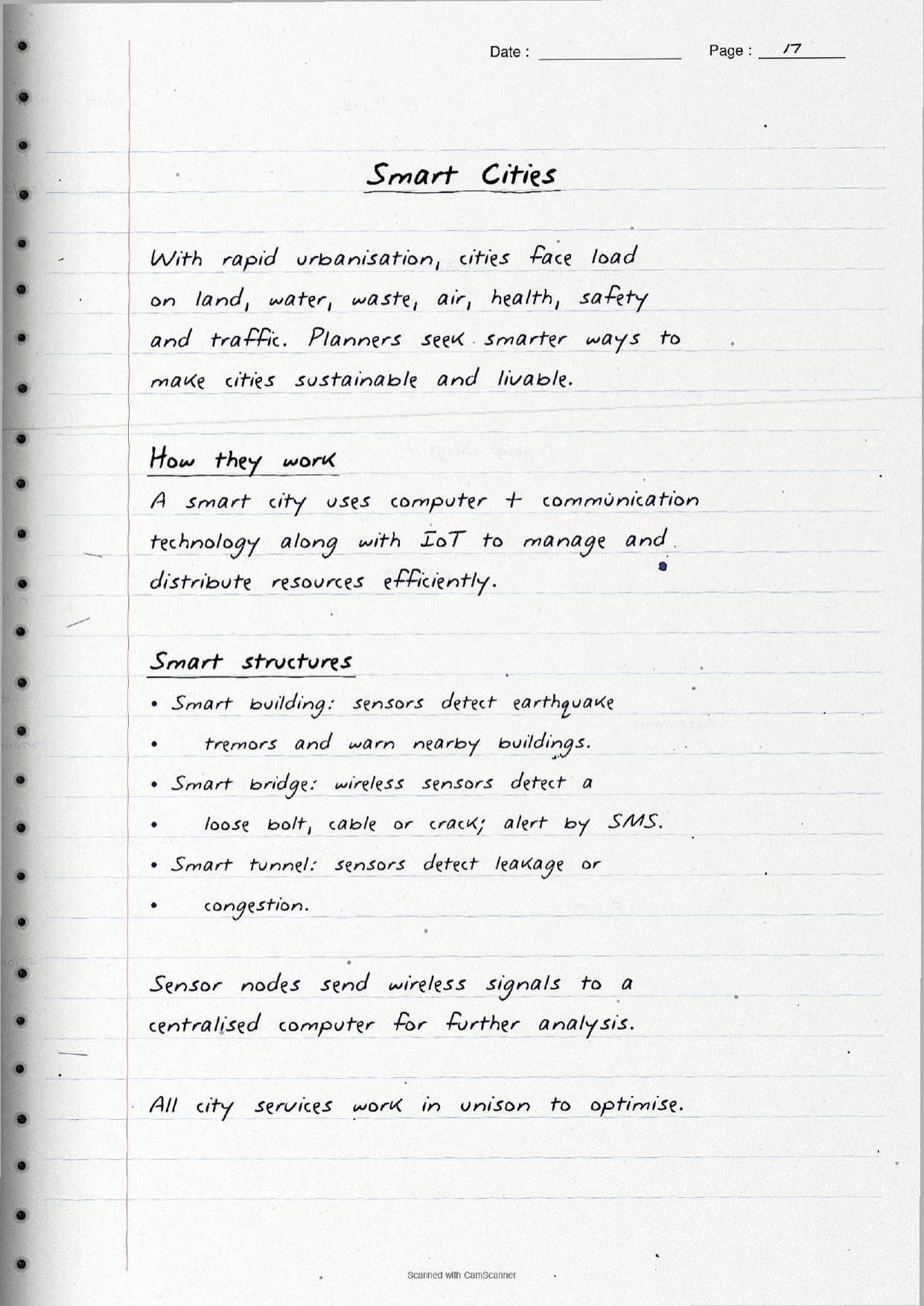
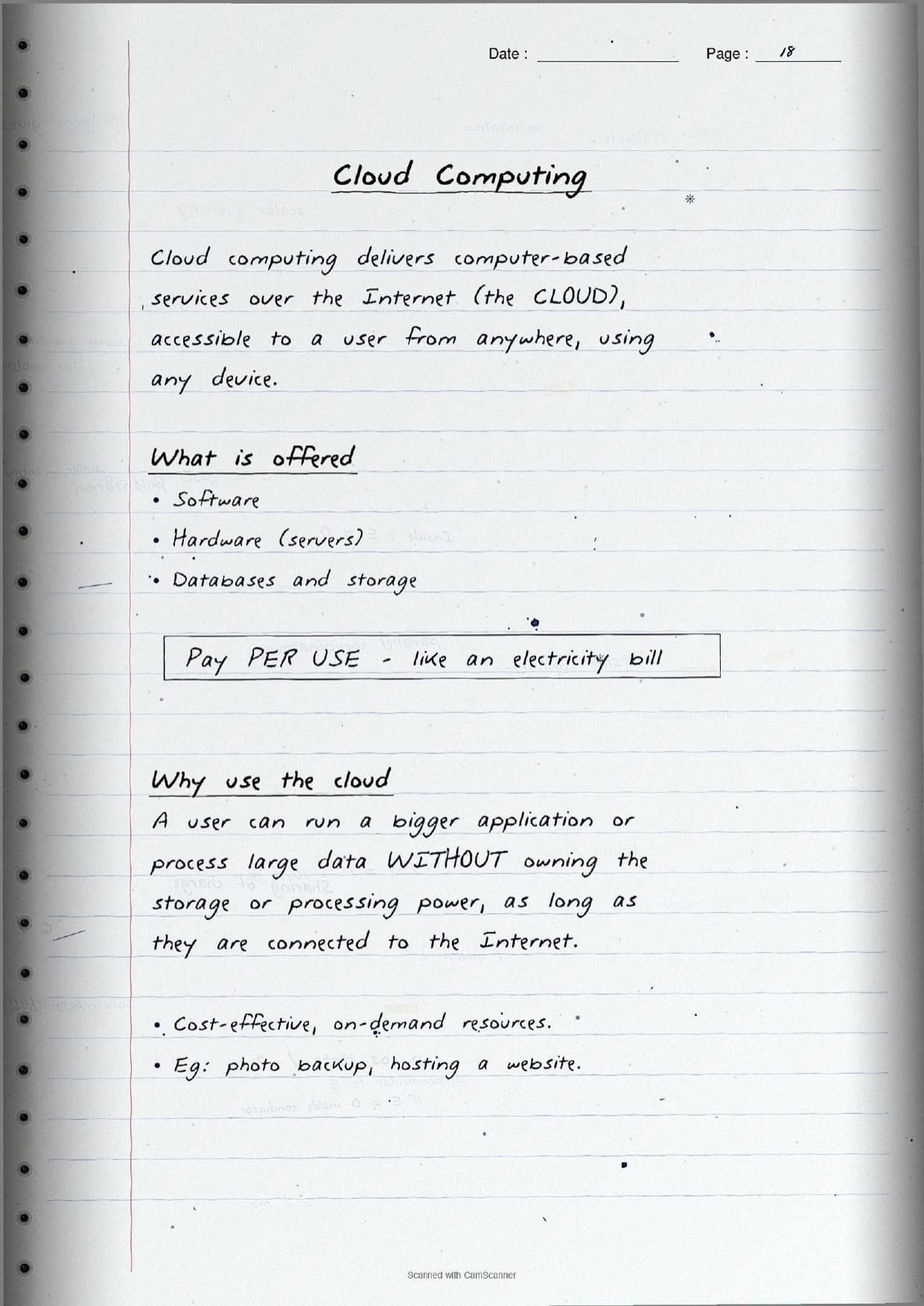
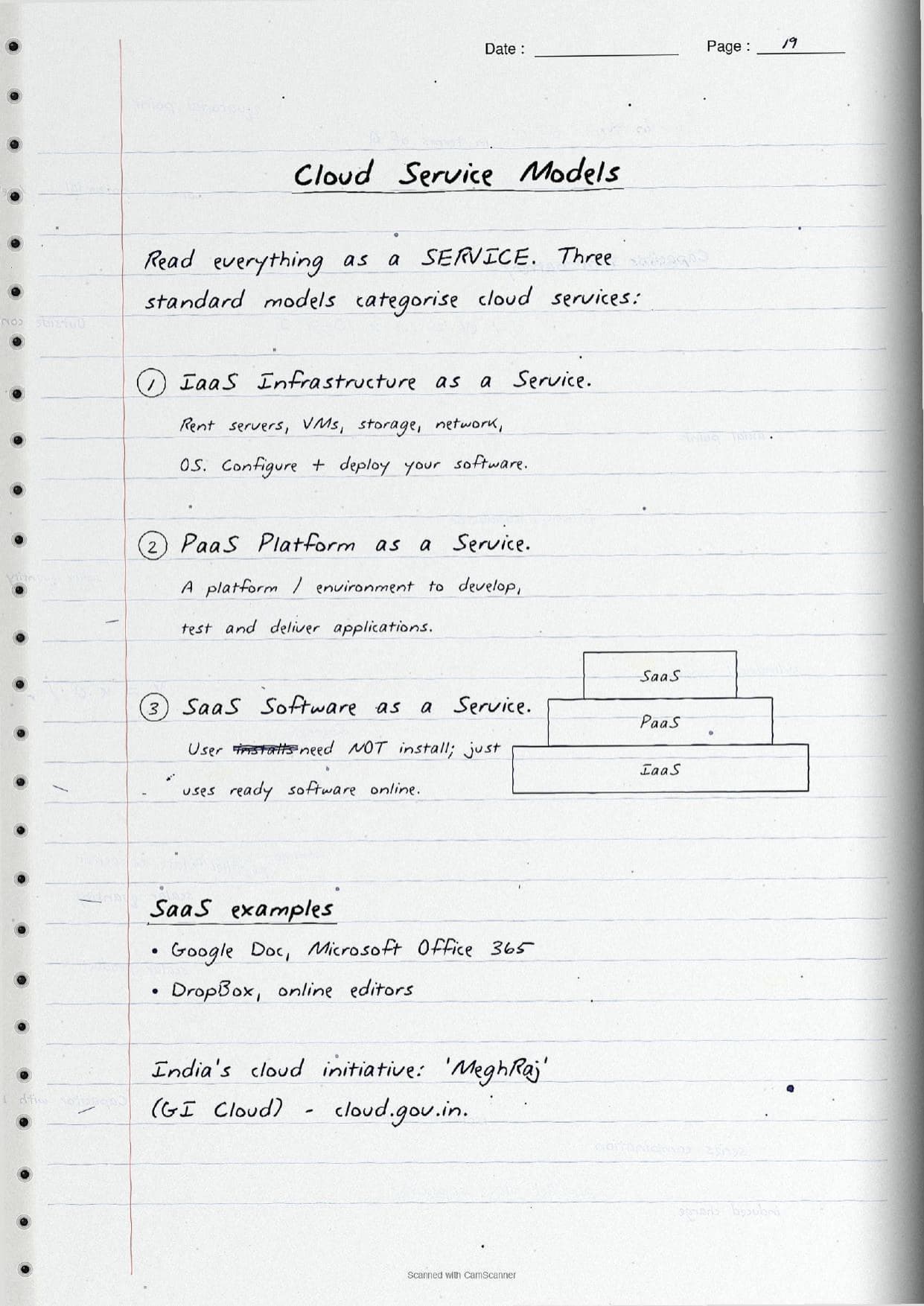
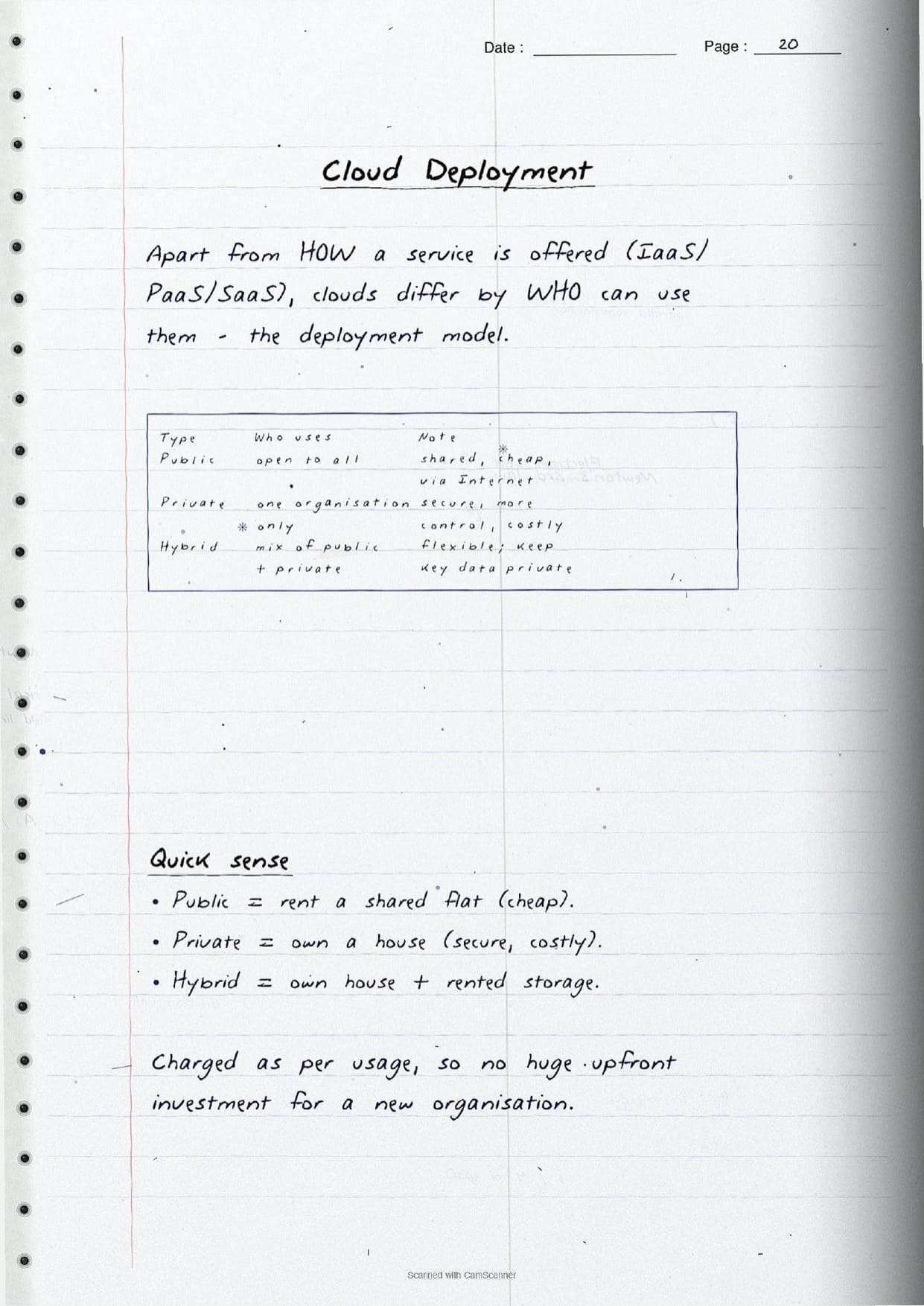
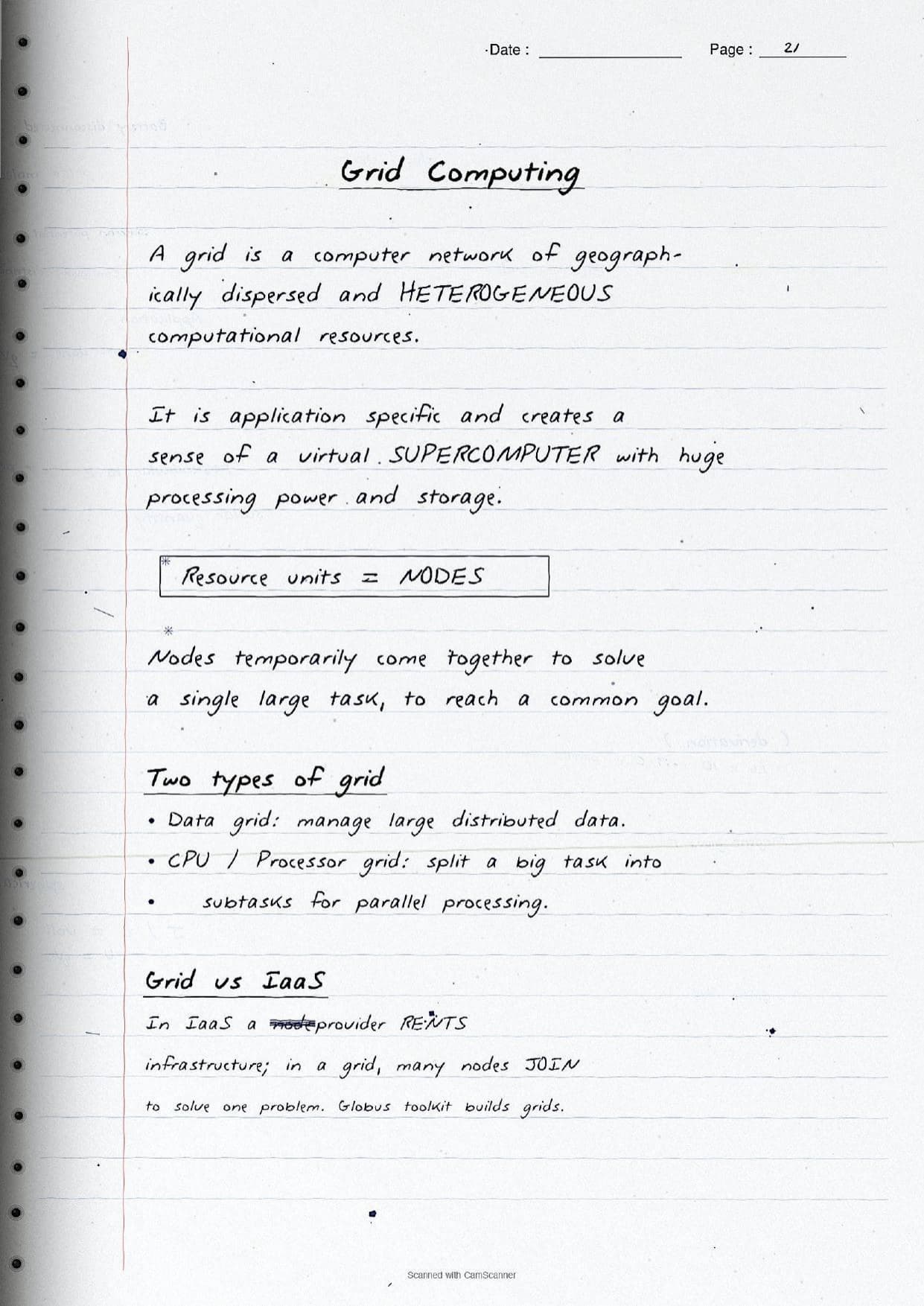
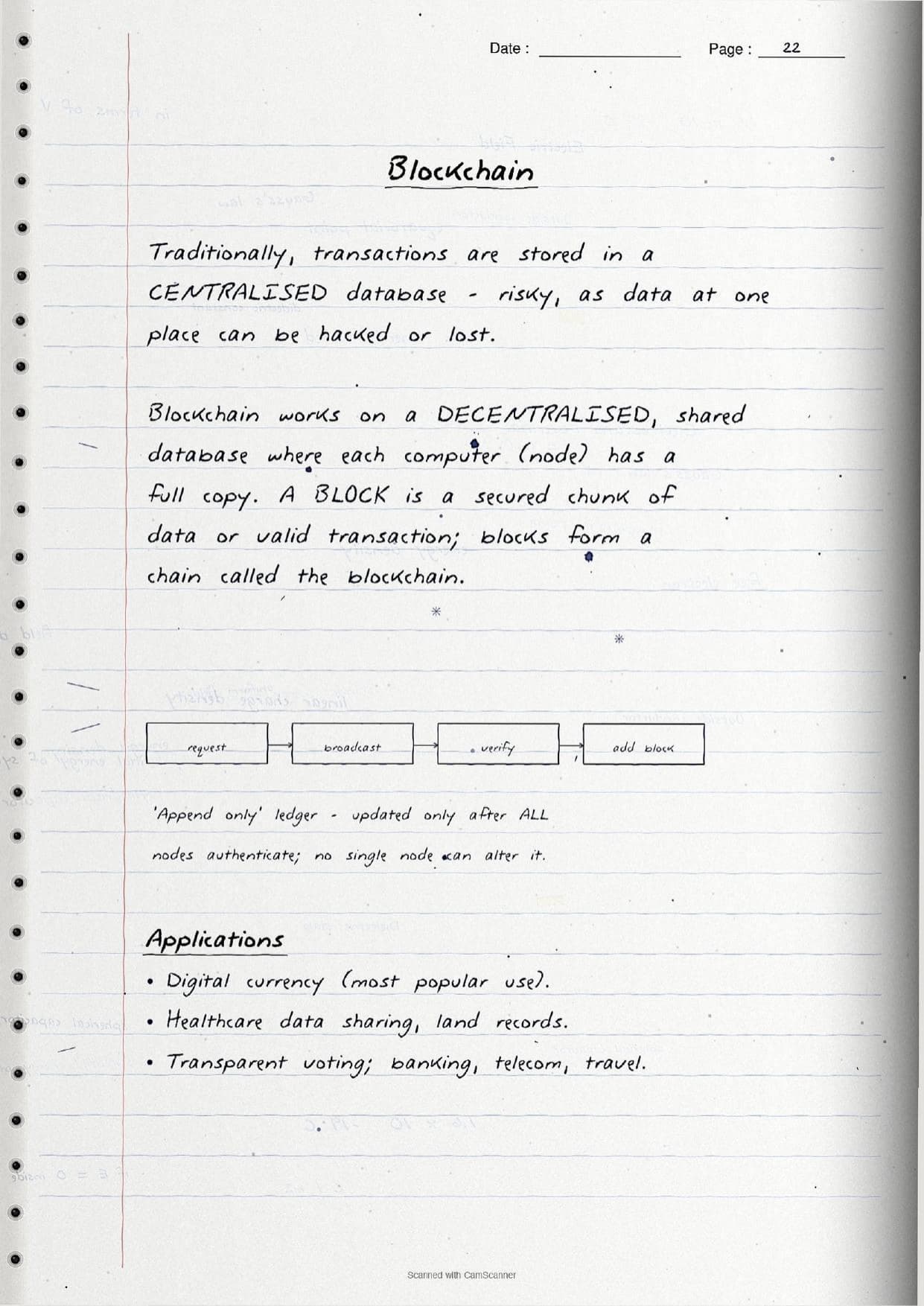
The notes tie in data analytics and note that the pandas library in Python makes analysis simpler. IoT (Internet of Things) is a network of devices with embedded hardware and software that communicate with each other, extended by the Web of Things so one interface controls many devices, driven by sensors like the accelerometer and gyroscope. That base powers smart cities, which use computing and IoT to manage resources and run smart buildings, bridges and tunnels. Finally, cloud computing delivers software, hardware and storage over the Internet on a pay-per-use basis, split into service models IaaS, PaaS and SaaS and deployment models public, private and hybrid. The last pages define grid computing as dispersed nodes joining to solve one big task, and blockchain as a decentralised, append-only ledger, along with a quick note on 3D printing.
How to Use These Handwritten Notes
Handwritten notes work best as a final-revision tool, not a first read. The steps below show how to get the most out of the Emerging Trends handwritten notes in the last days before a Class 11 Computer Science test.
- Download: tap the download card above to save the handwritten pages to your device.
- First read: read the printed Notes once so these handwritten pages act as a refresher, not a first source.
- Recall drill: cover the page and try to write the five V's and the three cloud service models from memory.
- Night before: flip through the boxed AI vs ML and VR vs AR tables for a quick last-minute recall.
Many students search for class 11 computer science chapter 3 notes on their phone the night before a test, so a saved set of handwritten pages means you can revise offline. Use the handwritten notes for speed, then check the solutions to confirm you have every definition and application right.
Common Mistakes These Notes Help You Avoid
A few errors cost marks every year in this chapter. The handwritten notes flag each one in the margin so you can fix it before the exam. These five are the most common.
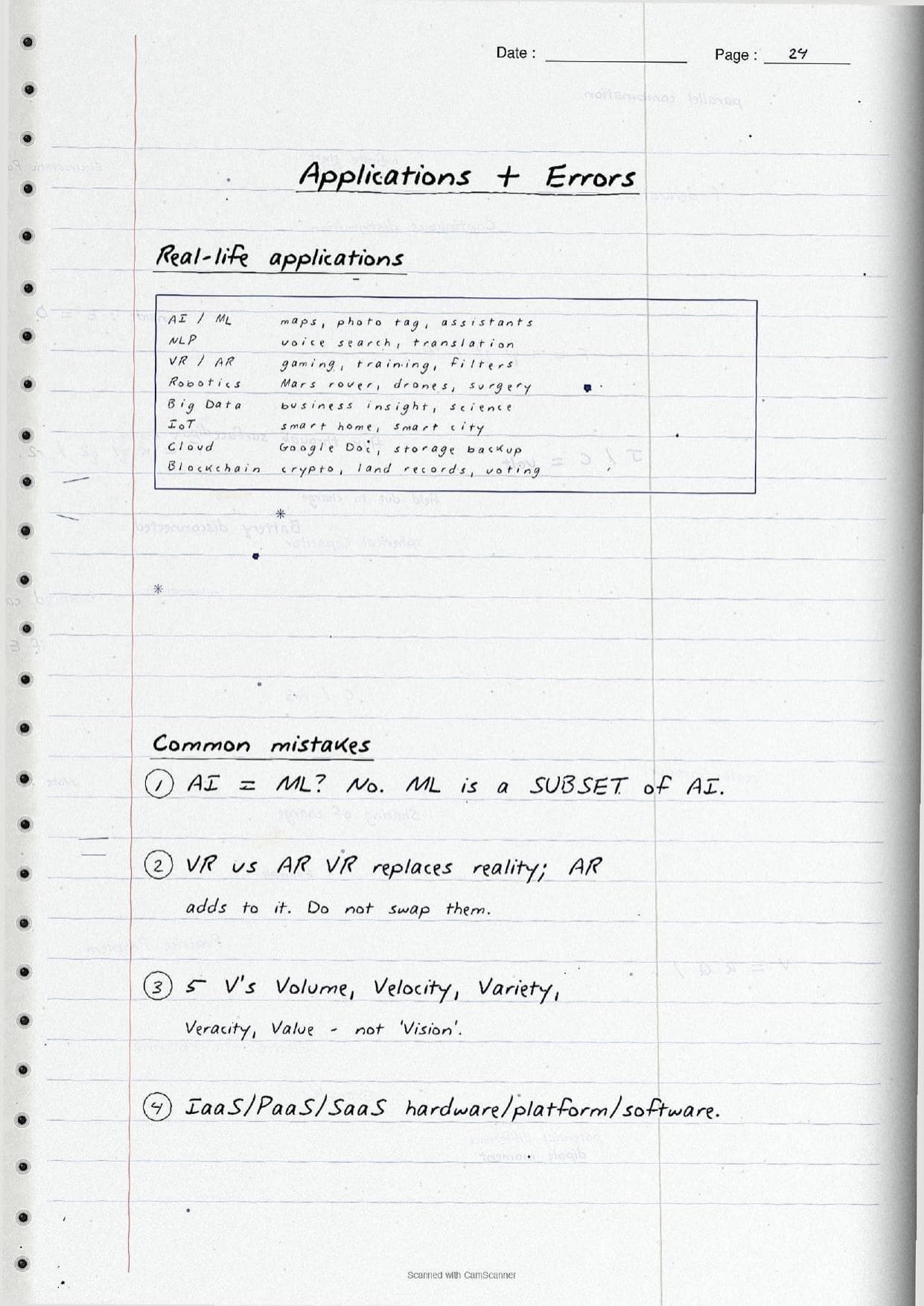
- Treating AI and ML as the same thing. ML is a subset of AI, not equal to it.
- Swapping VR and AR. VR replaces reality while AR only adds to it.
- Getting the five V's wrong. They are Volume, Velocity, Variety, Veracity and Value, not "Vision".
- Confusing the cloud service models.
IaaS,PaaSandSaaSmap to hardware, platform and software. - Mixing up cloud and grid. In IaaS a provider rents infrastructure; in a grid, many nodes join to solve one task.
Students who fix these five points usually move from average to high marks. The handwritten notes box every definition and put the comparisons in tables, so the soft points are hard to miss when you revise.
How These Handwritten Notes Pair with the Solutions and Book PDF
These handwritten notes are a fast revision tool. To prepare fully, students should use them alongside the other resources for the same chapter, all linked in the table below. Read the printed Notes, test yourself with the solutions, then use these pages for a final recall.
| Resource | Best used for |
|---|---|
| Emerging Trends NCERT Solutions | Step-by-step answers to all the chapter exercise questions |
| Emerging Trends Class 11 Notes | Quick chapter summary with every trend and definition in one place |
| Emerging Trends NCERT Book PDF | Reading the original NCERT chapter text and figures |
Tip: read the printed Notes first, then attempt the solutions, and keep these handwritten pages for the final night-before flip. Using them for recall, not for the first read, builds memory faster.
All Class 11 Computer Science Handwritten Notes by Chapter
The table links the handwritten notes for every chapter in Class 11 Computer Science, so students can move across the course in one click. Emerging Trends is highlighted.
| Chapter | Handwritten Notes |
|---|---|
| Chapter 1 | Computer System |
| Chapter 2 | Encoding Schemes and Number System |
| Chapter 3 | Emerging Trends |
| Chapter 4 | Introduction to Problem Solving |
| Chapter 5 | Getting Started with Python |
| Chapter 6 | Flow of Control |
| Chapter 7 | Functions |
| Chapter 8 | Strings |
| Chapter 9 | Lists |
| Chapter 10 | Tuples and Dictionaries |
| Chapter 11 | Societal Impact |
FAQs on Emerging Trends Handwritten Notes
Emerging Trends Class 11 Computer Science Handwritten Notes Common Questions
Ques. Where can I download the Emerging Trends handwritten notes PDF?
Ans. You can download the Emerging Trends Class 11 Computer Science handwritten notes PDF directly from this page. It is free, follows the 2026-27 NCERT syllabus, and presents AI, ML, NLP, VR, AR, robotics, Big Data, IoT, cloud, grid computing and blockchain as handwritten pages.
Ques. What is the difference between AI and ML in Class 11 Chapter 3?
Ans. Artificial Intelligence is the broad goal of making machines that mimic human intelligence, while Machine Learning is a subset of AI in which computers learn from data using statistical techniques without being explicitly programmed. The rule to remember is that all ML is AI, but not all AI is ML.
Ques. What topics do these handwritten notes cover?
Ans. They cover Artificial Intelligence and Machine Learning, Natural Language Processing, immersive experiences with Virtual Reality and Augmented Reality, robotics, Big Data and its five V's, the Internet of Things, Web of Things and sensors, smart cities, cloud computing with its IaaS, PaaS and SaaS models, grid computing, blockchain and 3D printing.
Ques. What are the five V's of Big Data?
Ans. The five V's are Volume, Velocity, Variety, Veracity and Value. Volume is the size of the data, Velocity is the rate it is generated, Variety is the different forms it takes, Veracity is its trustworthiness, and Value is the hidden business worth. The handwritten notes box all five with an easy mnemonic.
Ques. Are handwritten notes good for revising Class 11 Computer Science Chapter 3?
Ans. Yes. Handwritten notes are best for fast, last-minute revision because the boxed definitions and comparison tables like AI vs ML and VR vs AR make the ideas easy to skim. Use them after a first read of the printed Notes, not as your only source.



Comments