NCERT Solutions for Class 11 KTPI Chapter 1 Language and Literature of India cover the Let us Do prompts and project work from the 2026-27 syllabus. The chapter asks students to explain language categories, define classical languages, translate poetry, compare epics, collect Hitopadesa proverbs and plan a literary festival.
7 solved prompts are included: 3 Let us Do tasks and 4 project or activity tasks.
The chapter moves from language families and classical literature to translation, epics, proverbs and public literary activity.
The embedded question cards below give both a quick solution and a fuller expert explanation for every prompt.
Student Feedback on Class 11 KTPI Chapter 1
In a Collegedunia review poll for the 2026-27 session, 10,940 Class 11 students said the literature chapter felt easy to read but difficult to write in project form.
61% wanted a ready comparison frame for the Ramayana and the Mahabharata project.
54% confused language categories with a ranking of languages, which the chapter never supports.
7 out of 10 students found the literary festival plan easier after seeing teams, schedule and learning outcome together.
Source: 2026-27 Class 11 KTPI student feedback sample of 10,940 students from CBSE schools across 12 states.
Every answer here is checked against the Language and Literature of India chapter of the NCERT Knowledge Traditions and Practices of India textbook.
What the Class 11 KTPI Language and Literature of India Solutions Cover
Language and Literature of India is the first chapter of the Class 11 Knowledge Traditions and Practices of India course. The questions are not numbered like a Maths exercise. They appear as activity prompts under Let us Do and Project Work, so a good solution needs both content and an action plan.
Prompt block
Questions
What the answer must show
Let us Do
3
Language categories, the meaning of classical language, and a translation activity
Project Work
2
Five poets from different Indian languages and a comparison of epic retellings
Extension tasks
2
Hitopadesa proverbs and a school literary festival plan
The PDF keeps the answer order exactly as students will meet it in the textbook. The first two questions are definition-based. The next five are activity-based, so they need examples, grouping and a realistic classroom plan.
Language Families and Categories in Class 11 KTPI Chapter 1
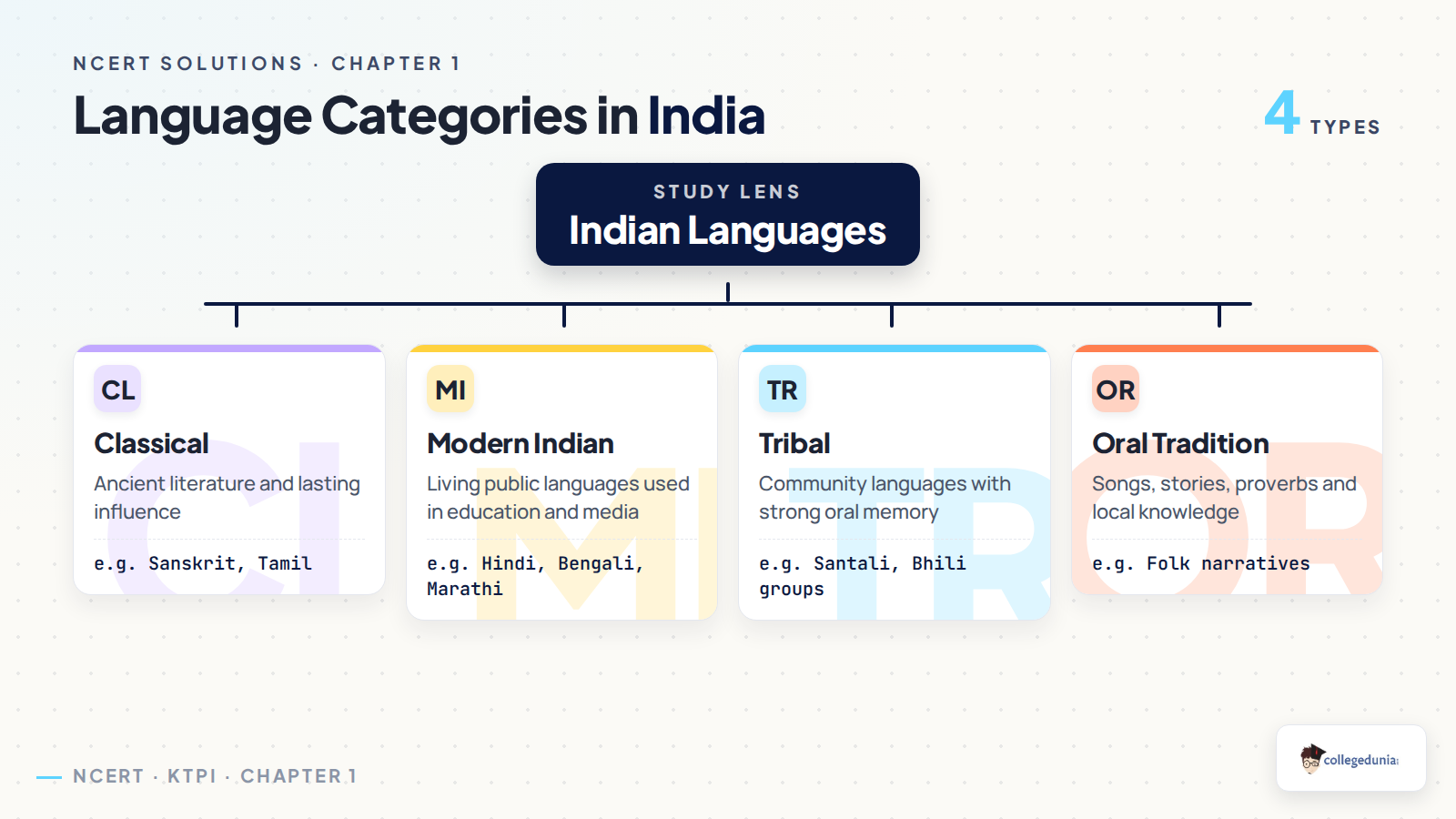
The opening question asks why languages are called classical, modern Indian, tribal or minor. The safest answer is to treat these as study categories, not marks of status. A language can be ancient, widely spoken, community based, oral, written or all of these at once.
Classical languages have deep antiquity, rich older literature and long cultural influence.
Modern Indian languages are living public languages used in education, literature, media and daily communication.
Tribal and minor languages are often spoken by smaller communities and may carry strong oral traditions.
Language families help students see historical relationships, but they do not decide the worth of a language.
The scoring sentence is simple: categories describe history, use and community base, not superiority. Add this line whenever the question asks what the categorisation means.
What Makes a Language Classical in the NCERT Chapter
A classical language is ancient, textually rich and culturally influential. Sanskrit and Tamil are the easiest examples to quote from the Indian context because both have old literature, grammar and long traditions of study. The answer should not stop at naming examples. It should state the criteria.
Criterion
How to explain it in the answer
Antiquity
The language has a very old historical record.
Early literature
It contains poetry, grammar, philosophy, drama, stories or sacred texts from an earlier period.
Independent tradition
Its literature has its own style, vocabulary and methods, not only borrowed forms.
Cultural influence
Later writers and communities continue to study and reuse the texts.
For a short answer, write: a classical language is an ancient language with a rich old literature, an independent textual tradition and lasting cultural influence. Then add Sanskrit and Tamil as examples.
Translation, Poetry and Modern Indian Languages in the Chapter
The translation activity asks students to select a poem from one language and translate it into as many languages as possible with friends. This is not a word-replacement task. Translation carries meaning, rhythm, cultural reference and feeling from one language into another.
Choose a short poem. Four to eight lines are enough for a classroom activity.
Write the literal sense first. This prevents the group from losing the central idea.
Translate into familiar languages. Hindi, English, a regional language and a home language make a practical set.
Compare what changes. Sound, idiom, word order and cultural references may not move exactly.
Present the result. Put the original and translations side by side with one note on the difficulty faced.
The answer gains weight when students name translation as a creative act. Modern Indian languages keep literature living because they let poems, stories and ideas travel across regions.
Ramayana and Mahabharata Across Indian Languages
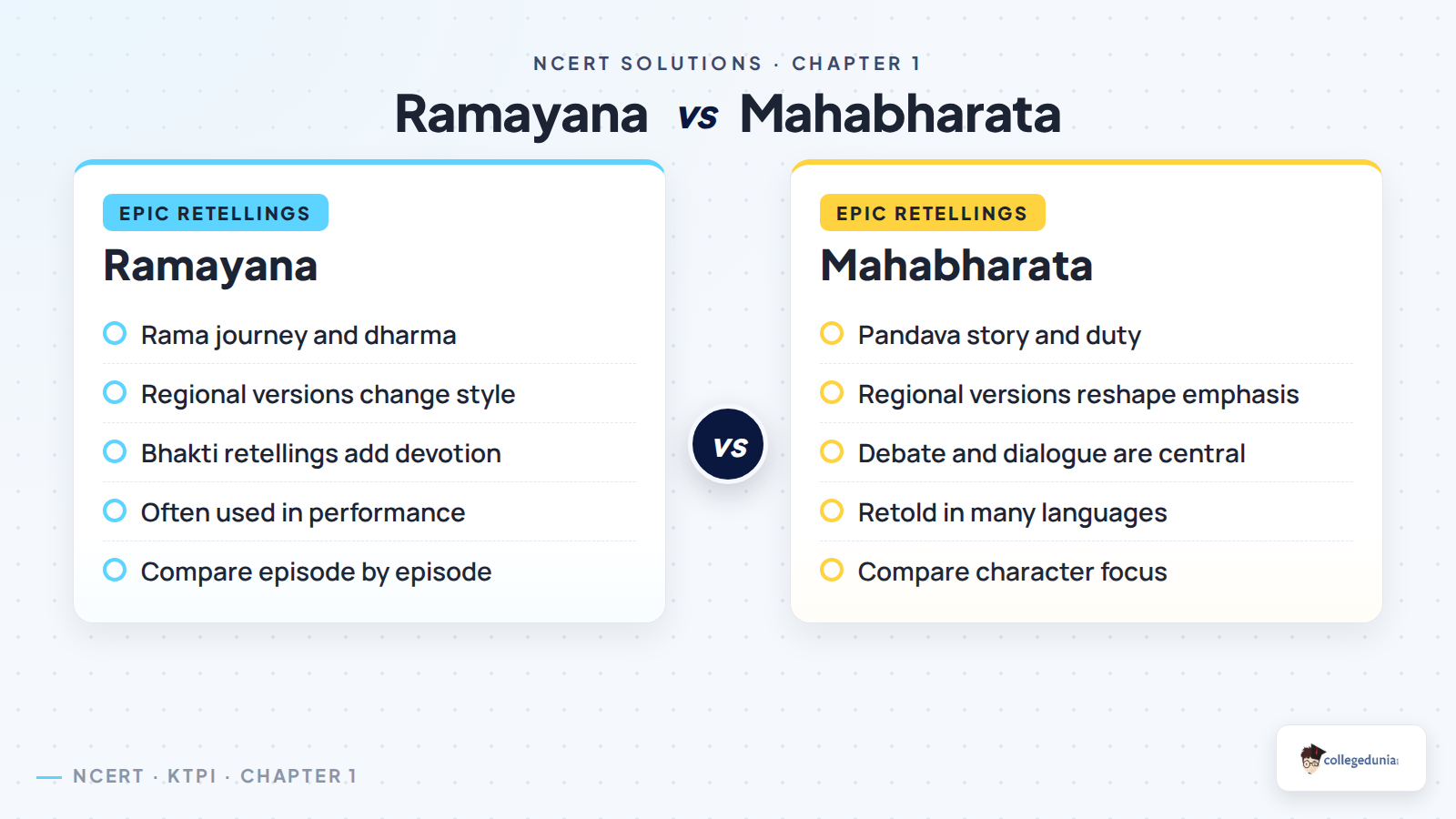
The epic project asks students to collect information on the origin and writing of the Ramayana and the Mahabharata in three or four languages. A strong answer compares continuity and change. The central story travels, but the style, emphasis and local detail change across regions.
Language tradition
Example focus
What to compare
Sanskrit
Valmiki Ramayana and Vyasa's Mahabharata
Base narrative, characters, dharma and poetic structure
Tamil
Kamban's Ramavataram
Devotional style, local imagery and poetic expansion
Hindi
Tulsidas's Ramcharitmanas
Bhakti tone, Awadhi language and public recitation culture
Bengali or Assamese
Regional retellings
Local vocabulary, performance and community memory
Do not write the project as a single story summary. Write a comparison table with columns for language, author or tradition, period, special feature and influence. That layout shows the teacher that the project is based on research.
Hitopadesa Proverbs and Oral Wisdom
The Hitopadesa task asks students to collect more proverbs to understand the idea of the book. Hitopadesa uses stories and compact sayings to teach practical conduct. The answer should therefore explain the lesson behind each proverb, not only copy the proverb.
Knowledge must be used. A proverb is meaningful when it guides action.
Friendship is proved by behaviour. The book values loyalty, help and wise judgement.
Short sayings hold memory. Proverbs survive because they are easy to repeat and apply.
Stories make advice easier. A moral wrapped in a story reaches more people than a lecture.
A neat project can carry four columns: proverb, language, literal meaning and lesson. If possible, ask family members for one proverb from a home language and mention where it is used.
How to Plan the Language and Literature Project Work
The chapter's project prompts reward organisation. For the five-poet project, pick poets from different language regions and avoid five poets from the same tradition. For each poet, write language, period, major works and central idea. The same four headings keep the chart balanced.
Project
Safe structure
Best scoring detail
Five poets
Poet, language, time, work, idea
Include at least one woman poet and one Bhakti poet
Epic retellings
Language, author or tradition, period, special feature
Compare how the same episode changes
Proverbs
Proverb, source language, meaning, lesson
Collect one proverb from home or community memory
Literary festival
Aim, teams, schedule, programme, learning outcome
Show translation, recitation, display and discussion together
For the literary festival answer, write a real school plan. Mention stage team, display team, language team, documentation team, invited speaker, parent participation and reflection cards. A festival answer without teams looks imaginary.
Common Mistakes in Class 11 KTPI Chapter 1 NCERT Solutions
Avoid these errors in the answer sheet:
Writing that classical languages are superior to other languages. The chapter values all language traditions.
Defining modern Indian languages as languages that started recently. The word modern refers to present use.
Listing poets without language, period, work and idea in the project answer.
Summarising the Ramayana and Mahabharata instead of comparing retellings in different languages.
Copying proverbs without explaining the practical lesson behind them.
Planning a literary festival with only performances and no reflection or discussion.
A quick fix is to keep one sentence ready for each answer: category, criteria, method, comparison, lesson and plan.
How These Solutions Work with Other Class 11 KTPI Resources
The solutions explain how to answer the prompts. Students should also keep the chapter PDF open because the textbook gives the examples, names and activity context. Notes and handwritten notes help with faster revision before the exam.
Resource
What it adds
Link
Chapter Notes
Short revision of language categories, classical literature, translation and project points
All NCERT Solutions for Class 11 KTPI Chapter 1 with Step-by-Step Solutions
The cards below reproduce the solved question set from the PDF. Open Check Solution for a direct answer and Expert Solution for the fuller explanation.
Questions
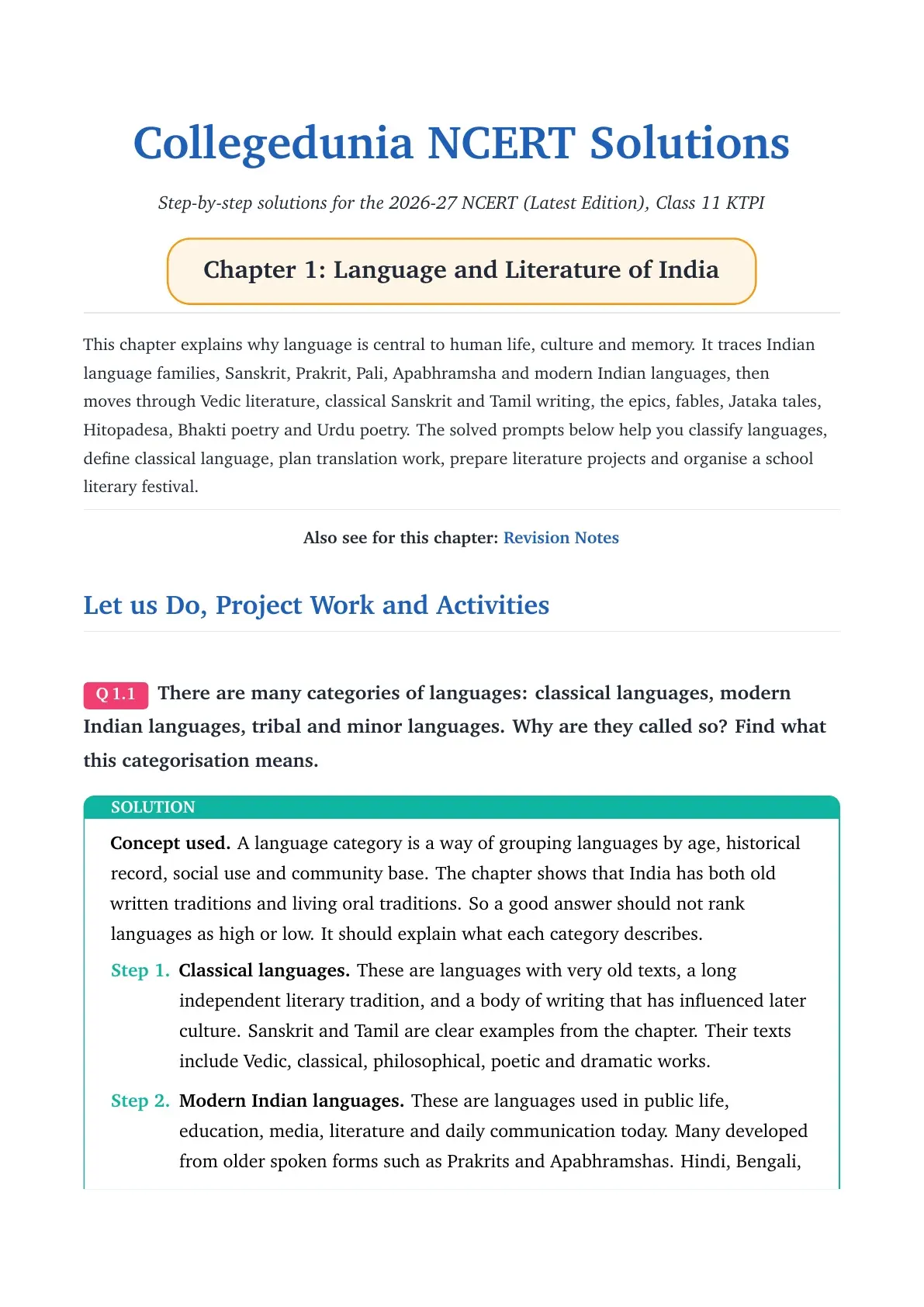
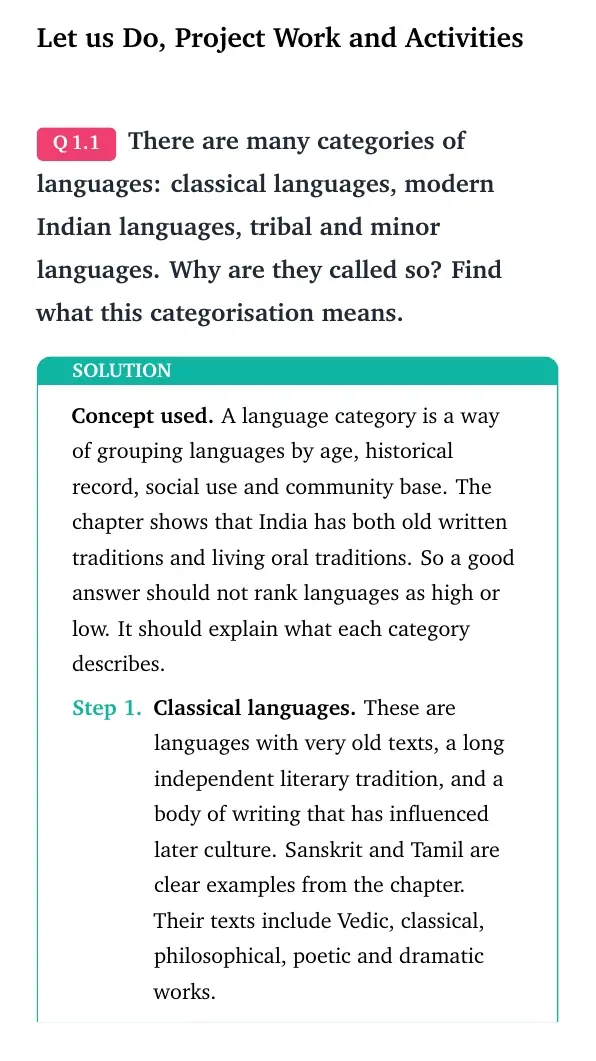
Q 1.1
There are many categories of languages: classical languages, modern Indian languages, tribal and minor languages. Why are they called so? Find what this categorisation means.
Concept used. A language category is a way of grouping languages by age, historical record, social use and community base. The chapter shows that India has both old written traditions and living oral traditions. So a good answer should not rank languages as high or low. It should explain what each category describes.
Classical languages. These are languages with very old texts, a long independent literary tradition, and a body of writing that has influenced later culture. Sanskrit and Tamil are clear examples from the chapter. Their texts include Vedic, classical, philosophical, poetic and dramatic works.
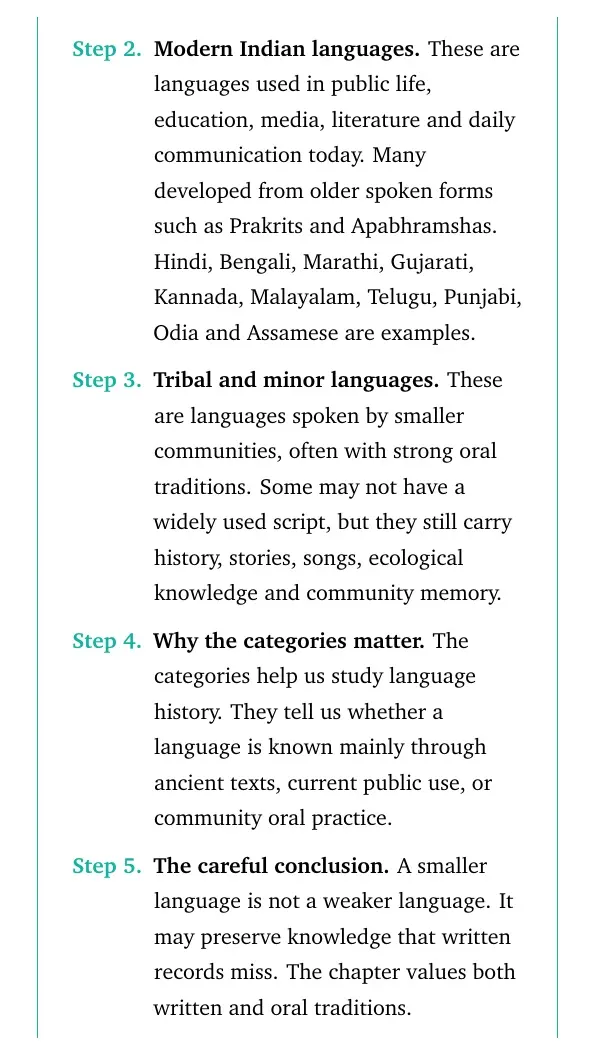
Modern Indian languages. These are languages used in public life, education, media, literature and daily communication today. Many developed from older spoken forms such as Prakrits and Apabhramshas. Hindi, Bengali, Marathi, Gujarati, Kannada, Malayalam, Telugu, Punjabi, Odia and Assamese are examples.
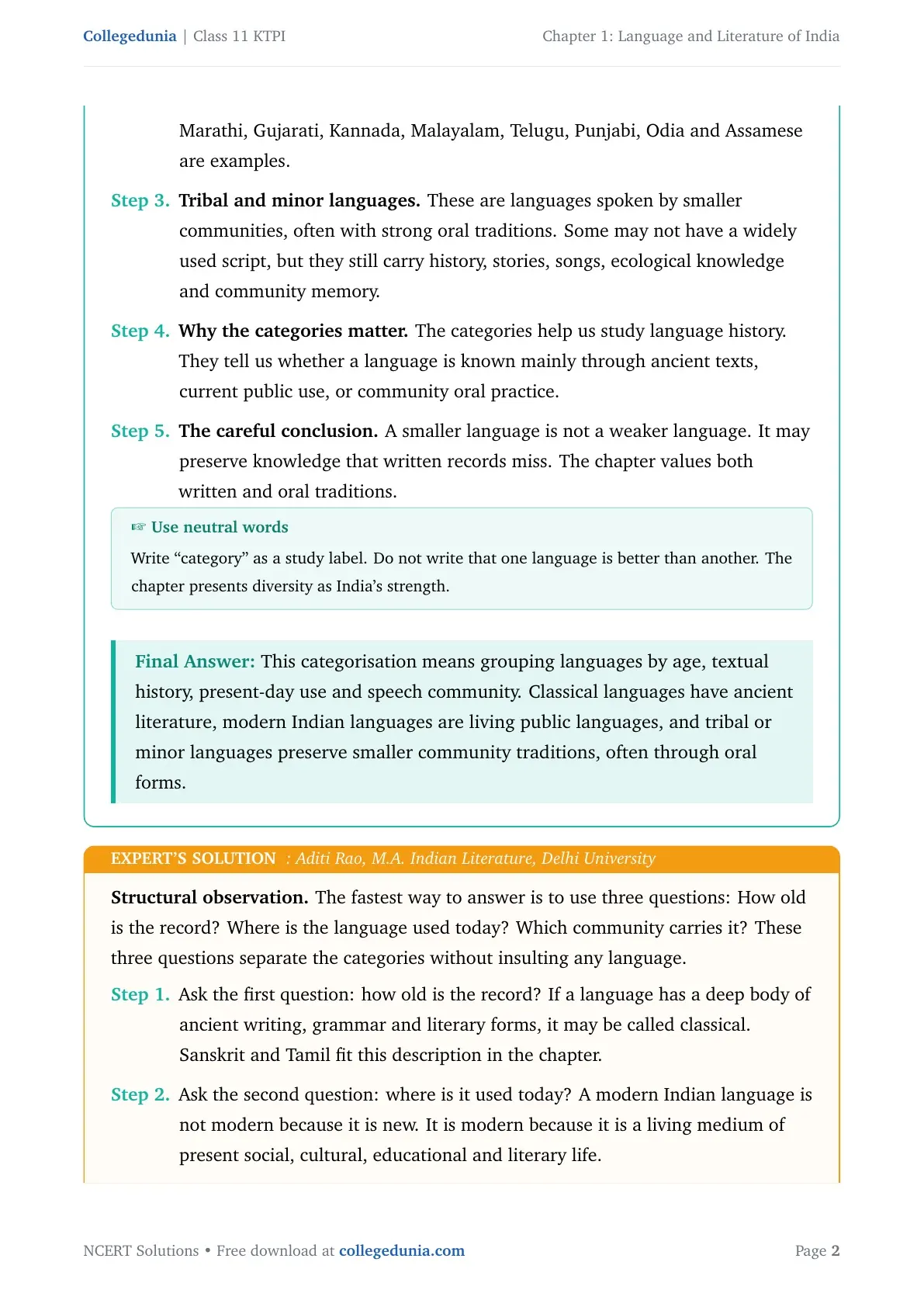
Tribal and minor languages. These are languages spoken by smaller communities, often with strong oral traditions. Some may not have a widely used script, but they still carry history, stories, songs, ecological knowledge and community memory.
Why the categories matter. The categories help us study language history. They tell us whether a language is known mainly through ancient texts, current public use, or community oral practice.
The careful conclusion. A smaller language is not a weaker language. It may preserve knowledge that written records miss. The chapter values both written and oral traditions.
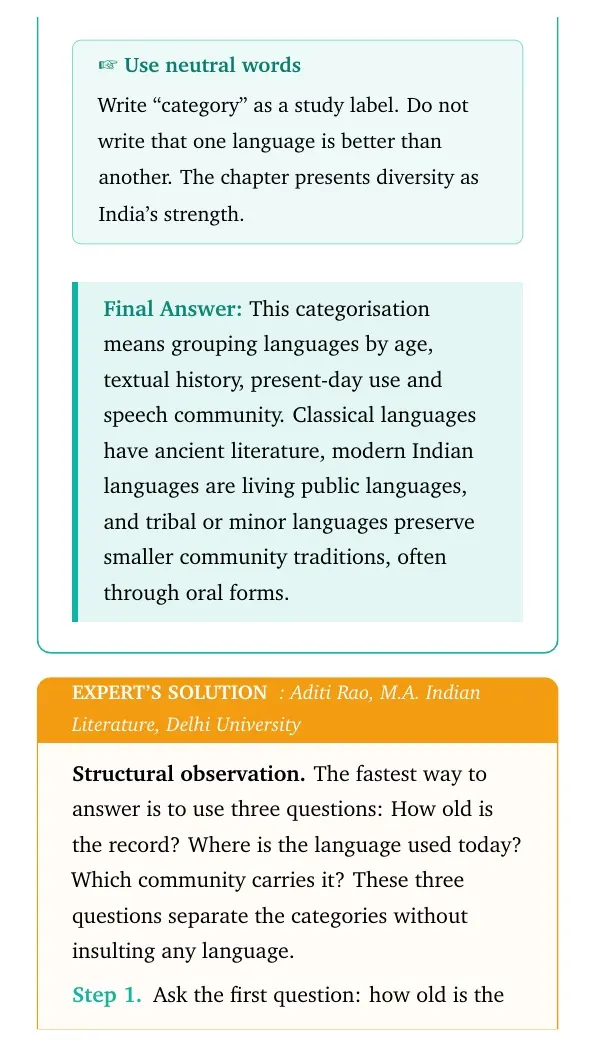
Use neutral words
Write ``category'' as a study label. Do not write that one language is better than another. The chapter presents diversity as India's strength.
This categorisation means grouping languages by age, textual history, present-day use and speech community. Classical languages have ancient literature, modern Indian languages are living public languages, and tribal or minor languages preserve smaller community traditions, often through oral forms.
AR
Aditi Rao
M.A. Indian Literature, Delhi University
Verified Expert
Structural observation. The fastest way to answer is to use three questions: How old is the record? Where is the language used today? Which community carries it? These three questions separate the categories without insulting any language.
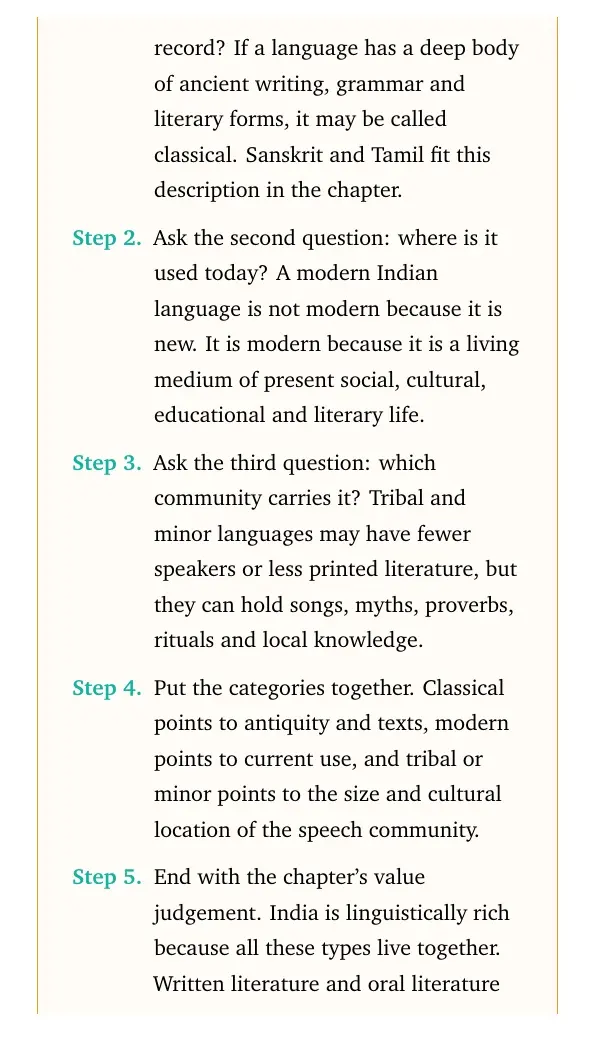
Ask the first question: how old is the record? If a language has a deep body of ancient writing, grammar and literary forms, it may be called classical. Sanskrit and Tamil fit this description in the chapter.
Ask the second question: where is it used today? A modern Indian language is not modern because it is new. It is modern because it is a living medium of present social, cultural, educational and literary life.
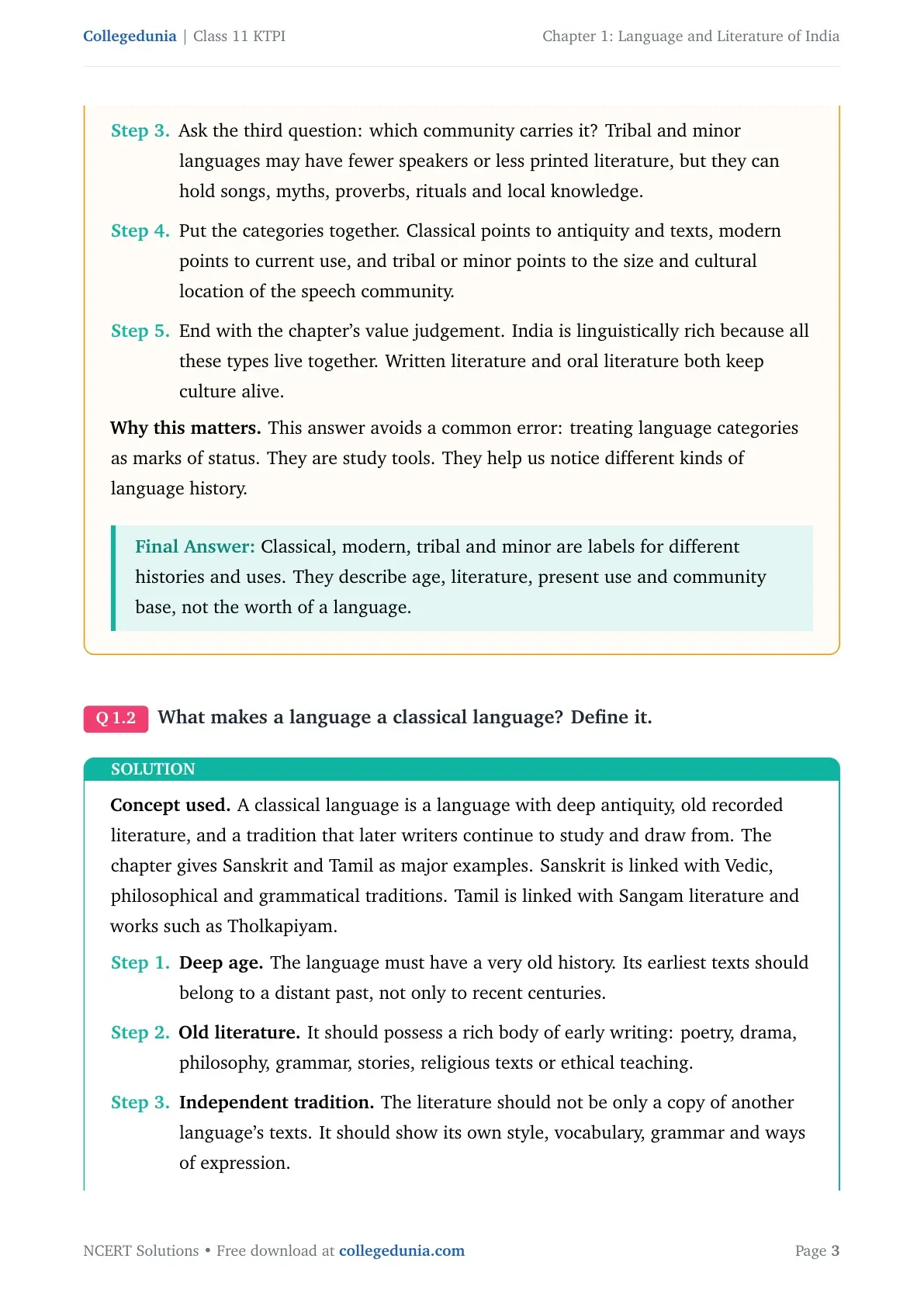
Ask the third question: which community carries it? Tribal and minor languages may have fewer speakers or less printed literature, but they can hold songs, myths, proverbs, rituals and local knowledge.
Put the categories together. Classical points to antiquity and texts, modern points to current use, and tribal or minor points to the size and cultural location of the speech community.
End with the chapter's value judgement. India is linguistically rich because all these types live together. Written literature and oral literature both keep culture alive.
Why this matters. This answer avoids a common error: treating language categories as marks of status. They are study tools. They help us notice different kinds of language history.
Classical, modern, tribal and minor are labels for different histories and uses. They describe age, literature, present use and community base, not the worth of a language.
Q 1.2
What makes a language a classical language? Define it.
Concept used. A classical language is a language with deep antiquity, old recorded literature, and a tradition that later writers continue to study and draw from. The chapter gives Sanskrit and Tamil as major examples. Sanskrit is linked with Vedic, philosophical and grammatical traditions. Tamil is linked with Sangam literature and works such as Tholkapiyam.
Deep age. The language must have a very old history. Its earliest texts should belong to a distant past, not only to recent centuries.
Old literature. It should possess a rich body of early writing: poetry, drama, philosophy, grammar, stories, religious texts or ethical teaching.
Independent tradition. The literature should not be only a copy of another language's texts. It should show its own style, vocabulary, grammar and ways of expression.
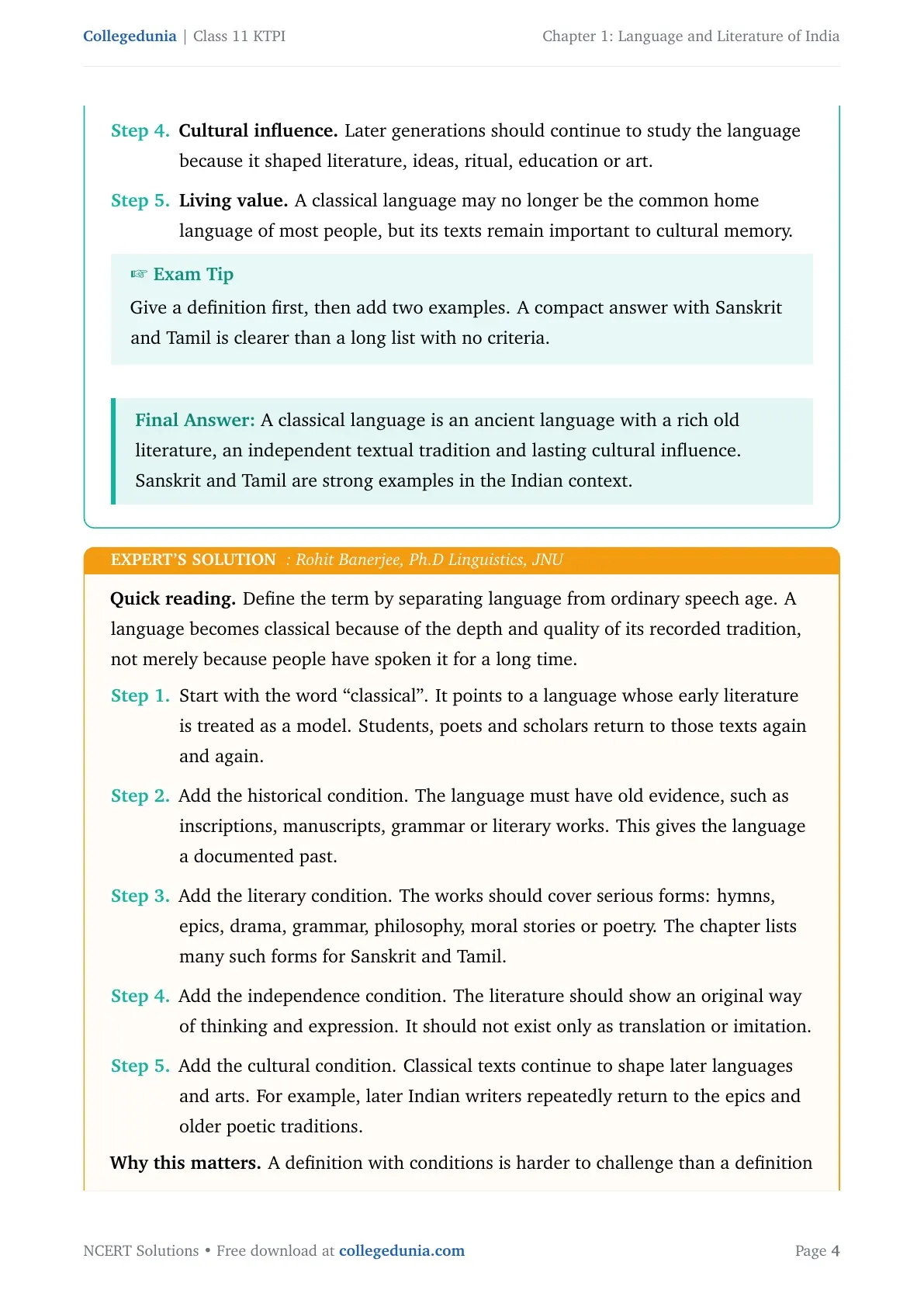
Cultural influence. Later generations should continue to study the language because it shaped literature, ideas, ritual, education or art.
Living value. A classical language may no longer be the common home language of most people, but its texts remain important to cultural memory.
Give a definition first, then add two examples. A compact answer with Sanskrit and Tamil is clearer than a long list with no criteria.
A classical language is an ancient language with a rich old literature, an independent textual tradition and lasting cultural influence. Sanskrit and Tamil are strong examples in the Indian context.
RB
Rohit Banerjee
Ph.D Linguistics, JNU
Verified Expert
Quick reading. Define the term by separating language from ordinary speech age. A language becomes classical because of the depth and quality of its recorded tradition, not merely because people have spoken it for a long time.
Start with the word ``classical''. It points to a language whose early literature is treated as a model. Students, poets and scholars return to those texts again and again.
Add the historical condition. The language must have old evidence, such as inscriptions, manuscripts, grammar or literary works. This gives the language a documented past.
Add the literary condition. The works should cover serious forms: hymns, epics, drama, grammar, philosophy, moral stories or poetry. The chapter lists many such forms for Sanskrit and Tamil.
Add the independence condition. The literature should show an original way of thinking and expression. It should not exist only as translation or imitation.
Add the cultural condition. Classical texts continue to shape later languages and arts. For example, later Indian writers repeatedly return to the epics and older poetic traditions.
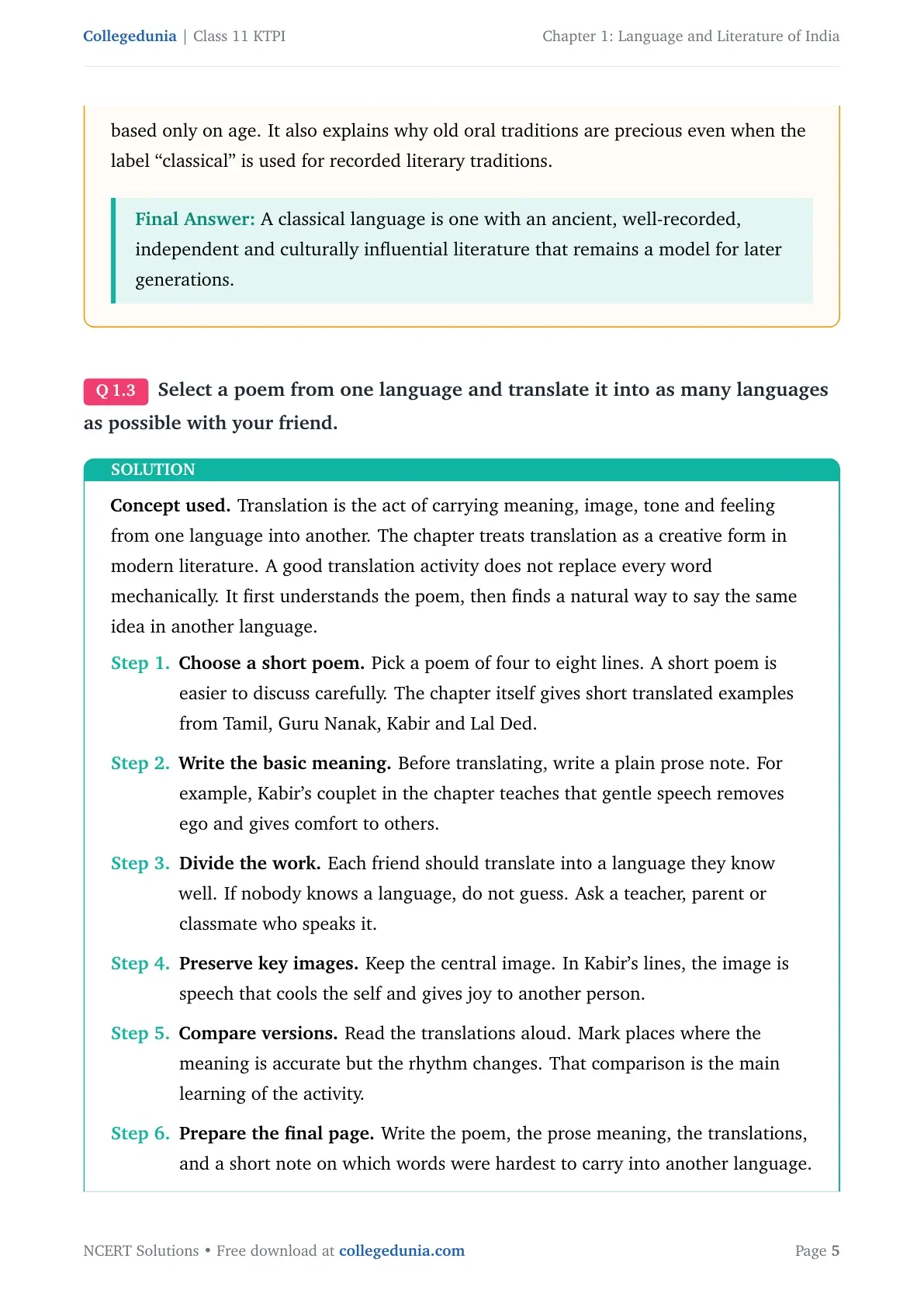
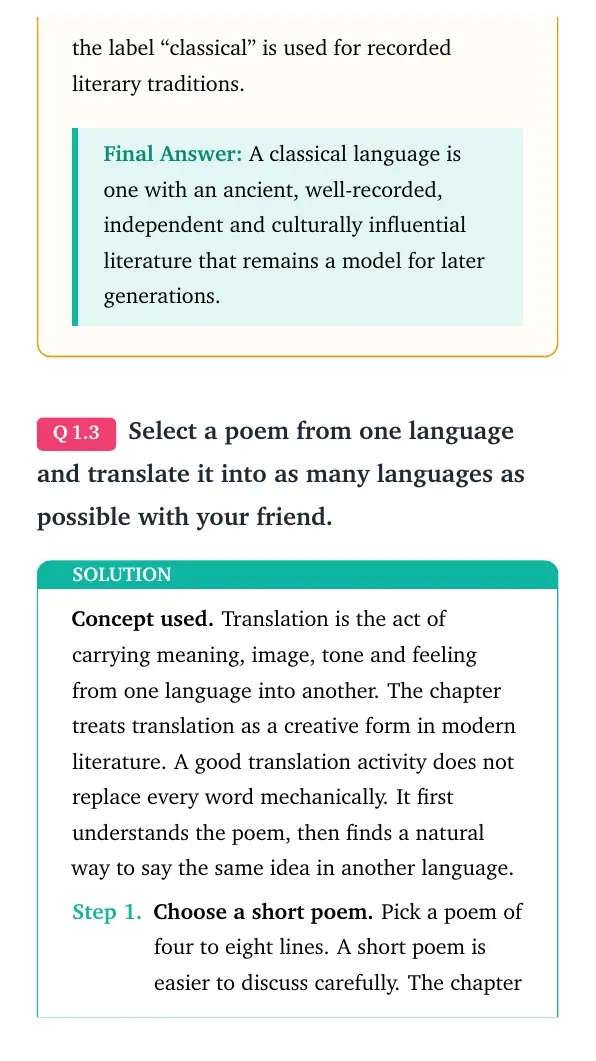
Why this matters. A definition with conditions is harder to challenge than a definition based only on age. It also explains why old oral traditions are precious even when the label ``classical'' is used for recorded literary traditions.
A classical language is one with an ancient, well-recorded, independent and culturally influential literature that remains a model for later generations.
Q 1.3
Select a poem from one language and translate it into as many languages as possible with your friend.
Concept used. Translation is the act of carrying meaning, image, tone and feeling from one language into another. The chapter treats translation as a creative form in modern literature. A good translation activity does not replace every word mechanically. It first understands the poem, then finds a natural way to say the same idea in another language.
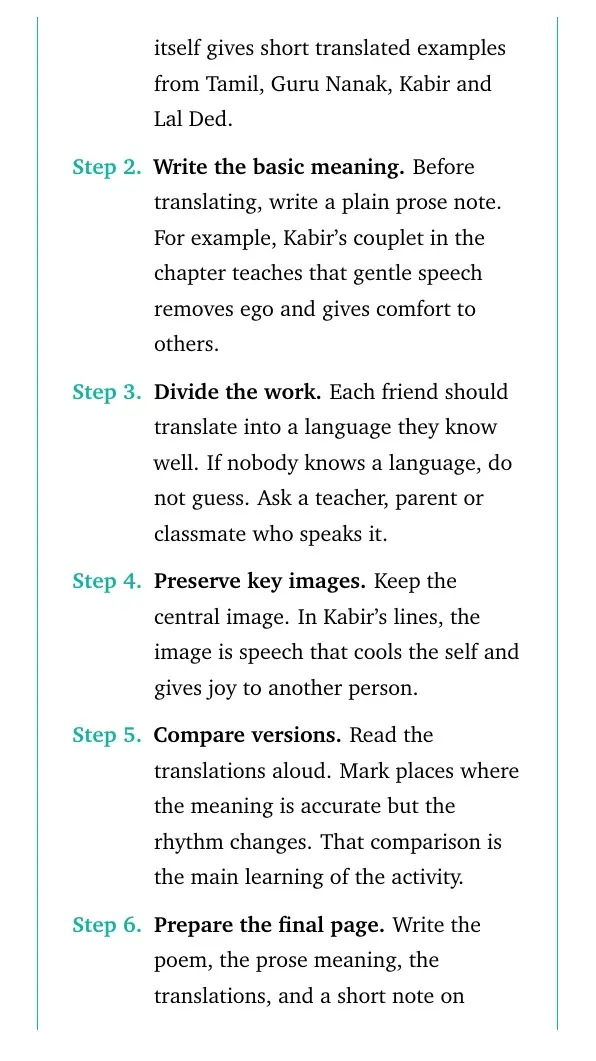
Choose a short poem. Pick a poem of four to eight lines. A short poem is easier to discuss carefully. The chapter itself gives short translated examples from Tamil, Guru Nanak, Kabir and Lal Ded.
Write the basic meaning. Before translating, write a plain prose note. For example, Kabir's couplet in the chapter teaches that gentle speech removes ego and gives comfort to others.
Divide the work. Each friend should translate into a language they know well. If nobody knows a language, do not guess. Ask a teacher, parent or classmate who speaks it.
Preserve key images. Keep the central image. In Kabir's lines, the image is speech that cools the self and gives joy to another person.
Compare versions. Read the translations aloud. Mark places where the meaning is accurate but the rhythm changes. That comparison is the main learning of the activity.
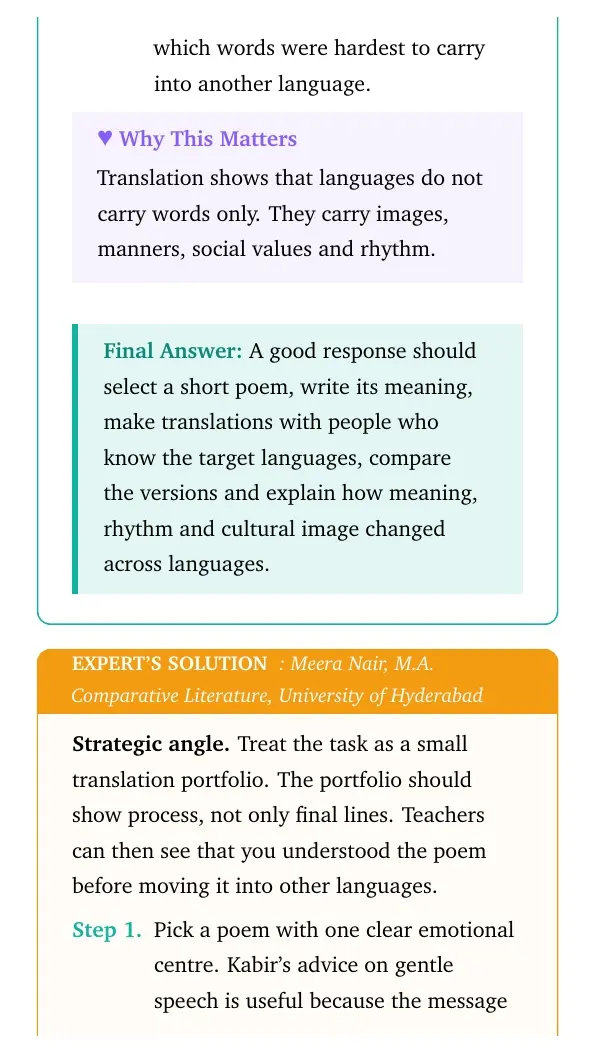
Prepare the final page. Write the poem, the prose meaning, the translations, and a short note on which words were hardest to carry into another language.
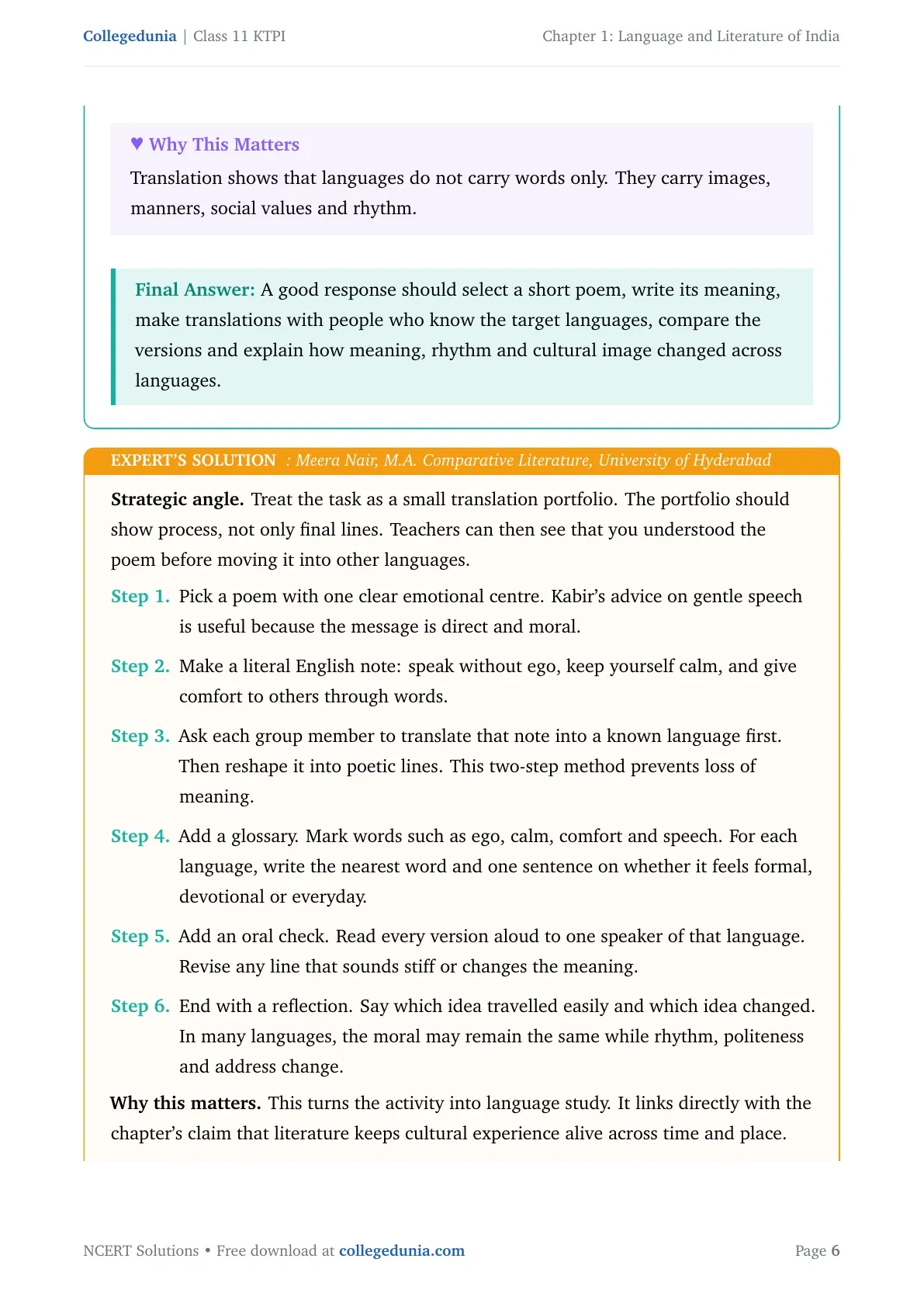
Translation shows that languages do not carry words only. They carry images, manners, social values and rhythm.
A good response should select a short poem, write its meaning, make translations with people who know the target languages, compare the versions and explain how meaning, rhythm and cultural image changed across languages.
MN
Meera Nair
M.A. Comparative Literature, University of Hyderabad
Verified Expert
Strategic angle. Treat the task as a small translation portfolio. The portfolio should show process, not only final lines. Teachers can then see that you understood the poem before moving it into other languages.
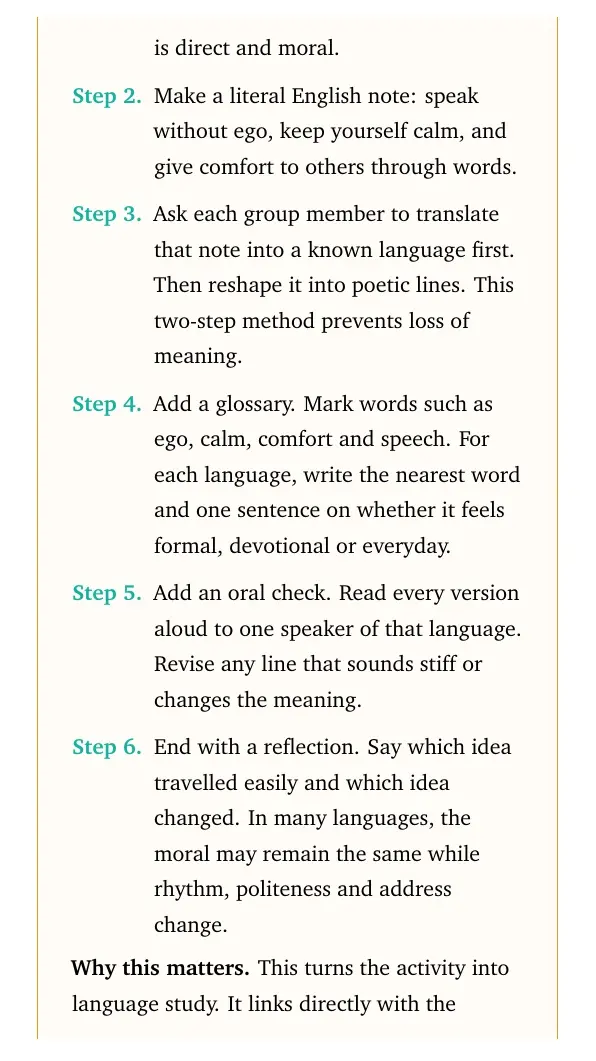
Pick a poem with one clear emotional centre. Kabir's advice on gentle speech is useful because the message is direct and moral.
Make a literal English note: speak without ego, keep yourself calm, and give comfort to others through words.
Ask each group member to translate that note into a known language first. Then reshape it into poetic lines. This two-step method prevents loss of meaning.
Add a glossary. Mark words such as ego, calm, comfort and speech. For each language, write the nearest word and one sentence on whether it feels formal, devotional or everyday.
Add an oral check. Read every version aloud to one speaker of that language. Revise any line that sounds stiff or changes the meaning.
End with a reflection. Say which idea travelled easily and which idea changed. In many languages, the moral may remain the same while rhythm, politeness and address change.
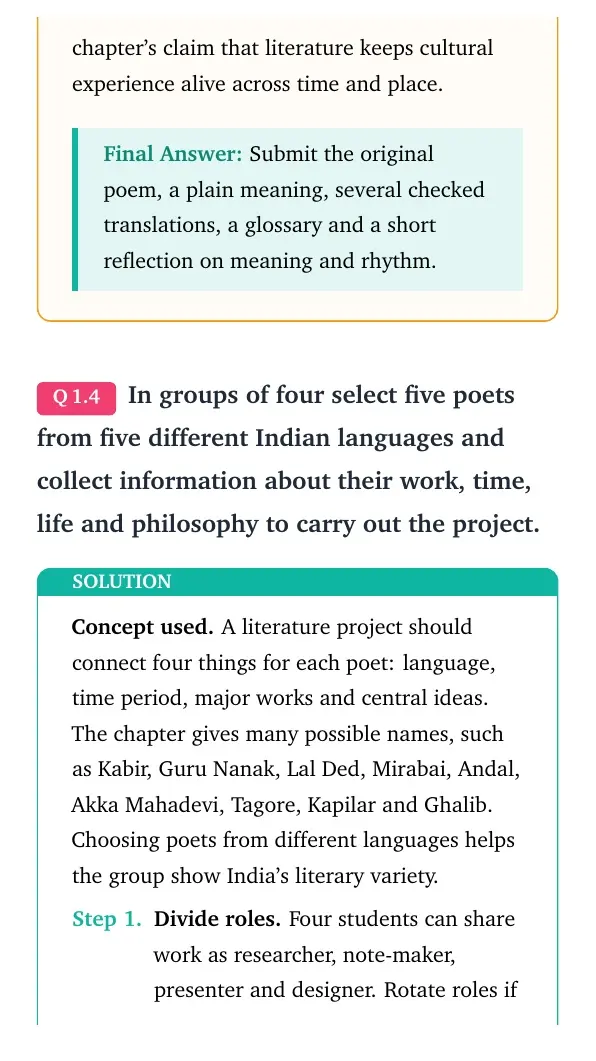
Why this matters. This turns the activity into language study. It links directly with the chapter's claim that literature keeps cultural experience alive across time and place.
Submit the original poem, a plain meaning, several checked translations, a glossary and a short reflection on meaning and rhythm.
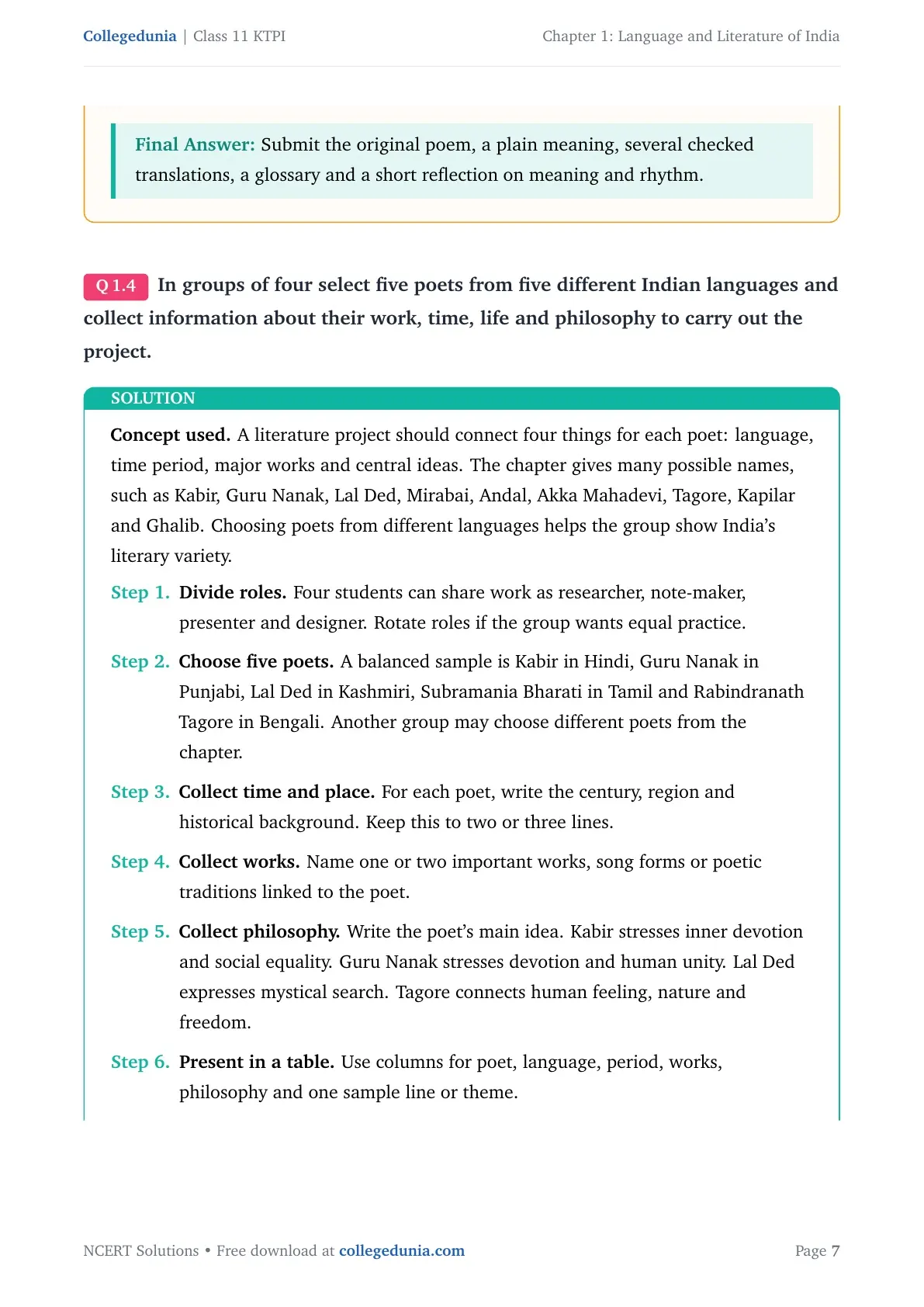
Q 1.4
In groups of four select five poets from five different Indian languages and collect information about their work, time, life and philosophy to carry out the project.
Concept used. A literature project should connect four things for each poet: language, time period, major works and central ideas. The chapter gives many possible names, such as Kabir, Guru Nanak, Lal Ded, Mirabai, Andal, Akka Mahadevi, Tagore, Kapilar and Ghalib. Choosing poets from different languages helps the group show India's literary variety.
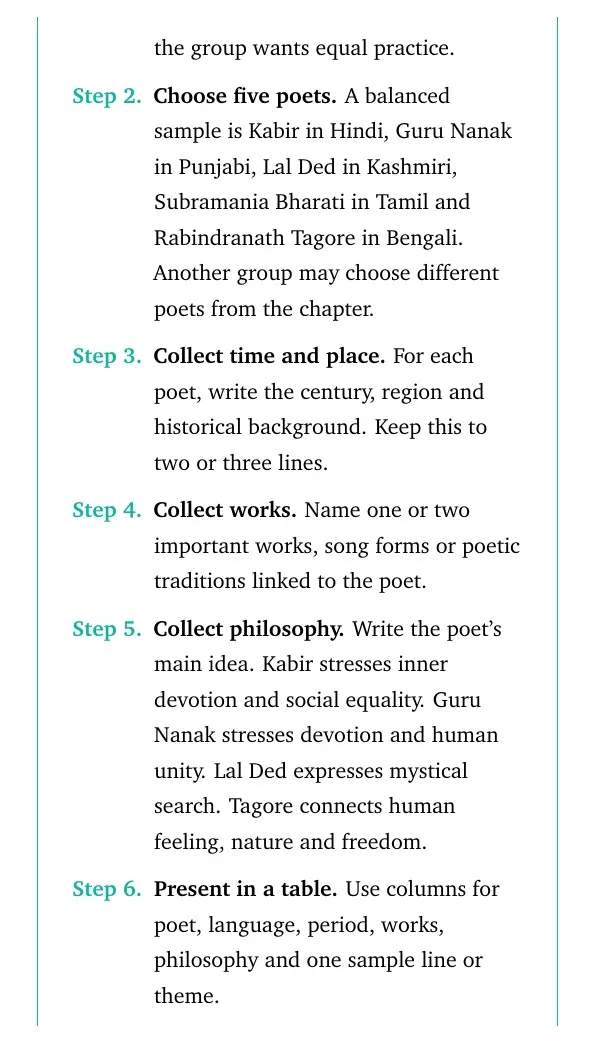
Divide roles. Four students can share work as researcher, note-maker, presenter and designer. Rotate roles if the group wants equal practice.
Choose five poets. A balanced sample is Kabir in Hindi, Guru Nanak in Punjabi, Lal Ded in Kashmiri, Subramania Bharati in Tamil and Rabindranath Tagore in Bengali. Another group may choose different poets from the chapter.
Collect time and place. For each poet, write the century, region and historical background. Keep this to two or three lines.
Collect works. Name one or two important works, song forms or poetic traditions linked to the poet.
Collect philosophy. Write the poet's main idea. Kabir stresses inner devotion and social equality. Guru Nanak stresses devotion and human unity. Lal Ded expresses mystical search. Tagore connects human feeling, nature and freedom.
Present in a table. Use columns for poet, language, period, works, philosophy and one sample line or theme.
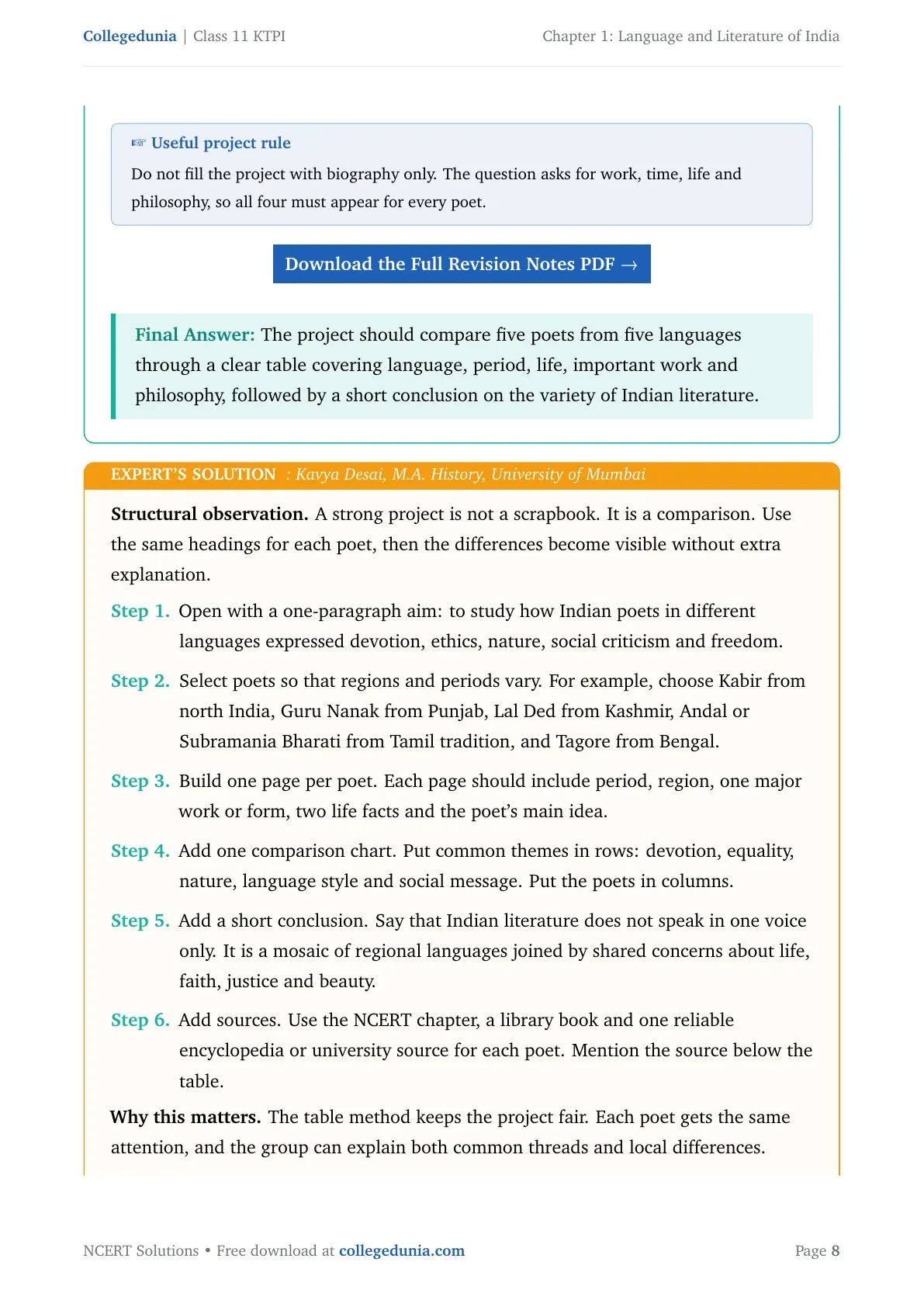
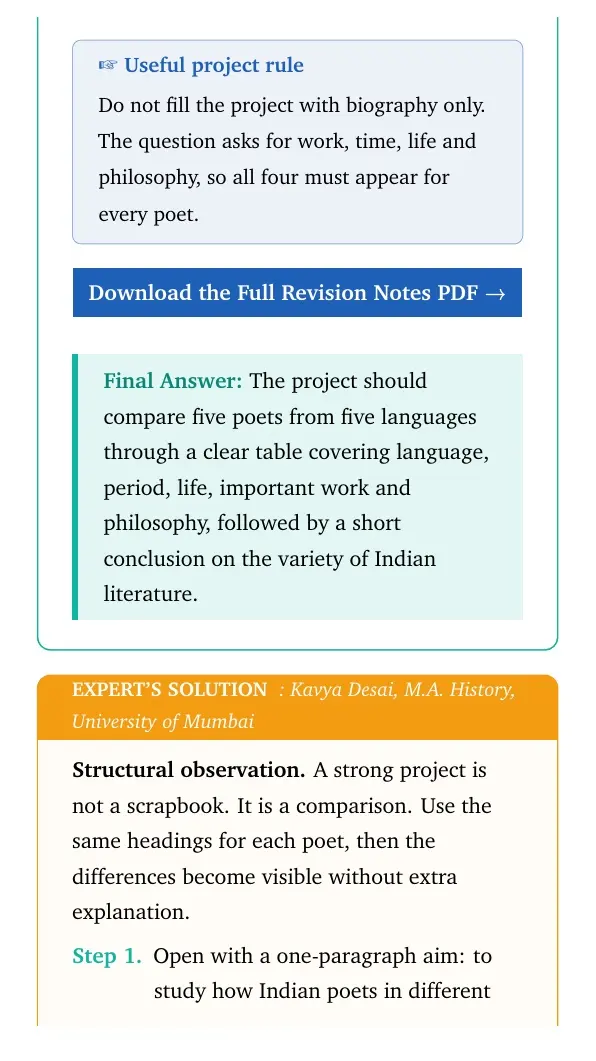
Useful project rule
Do not fill the project with biography only. The question asks for work, time, life and philosophy, so all four must appear for every poet.
Download the Full Revision Notes PDF
The project should compare five poets from five languages through a clear table covering language, period, life, important work and philosophy, followed by a short conclusion on the variety of Indian literature.
KD
Kavya Desai
M.A. History, University of Mumbai
Verified Expert
Structural observation. A strong project is not a scrapbook. It is a comparison. Use the same headings for each poet, then the differences become visible without extra explanation.
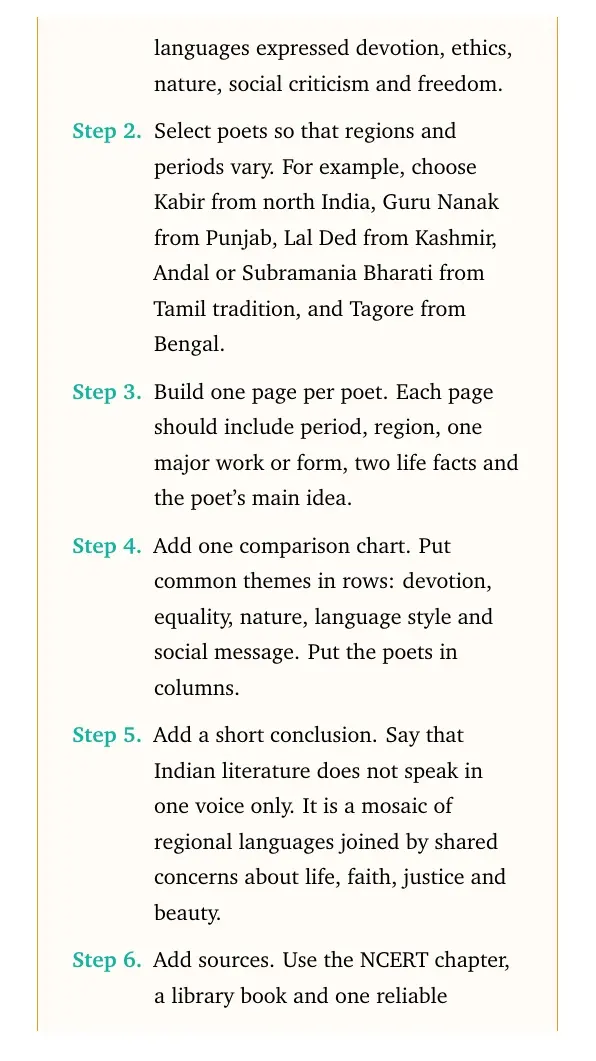
Open with a one-paragraph aim: to study how Indian poets in different languages expressed devotion, ethics, nature, social criticism and freedom.
Select poets so that regions and periods vary. For example, choose Kabir from north India, Guru Nanak from Punjab, Lal Ded from Kashmir, Andal or Subramania Bharati from Tamil tradition, and Tagore from Bengal.
Build one page per poet. Each page should include period, region, one major work or form, two life facts and the poet's main idea.
Add one comparison chart. Put common themes in rows: devotion, equality, nature, language style and social message. Put the poets in columns.
Add a short conclusion. Say that Indian literature does not speak in one voice only. It is a mosaic of regional languages joined by shared concerns about life, faith, justice and beauty.
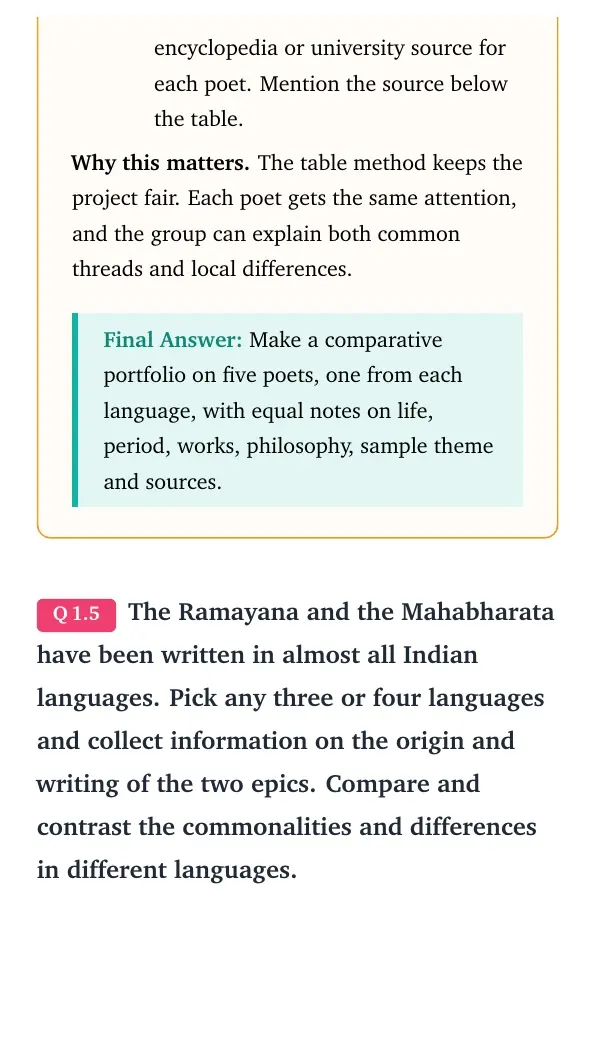
Add sources. Use the NCERT chapter, a library book and one reliable encyclopedia or university source for each poet. Mention the source below the table.
Why this matters. The table method keeps the project fair. Each poet gets the same attention, and the group can explain both common threads and local differences.
Make a comparative portfolio on five poets, one from each language, with equal notes on life, period, works, philosophy, sample theme and sources.
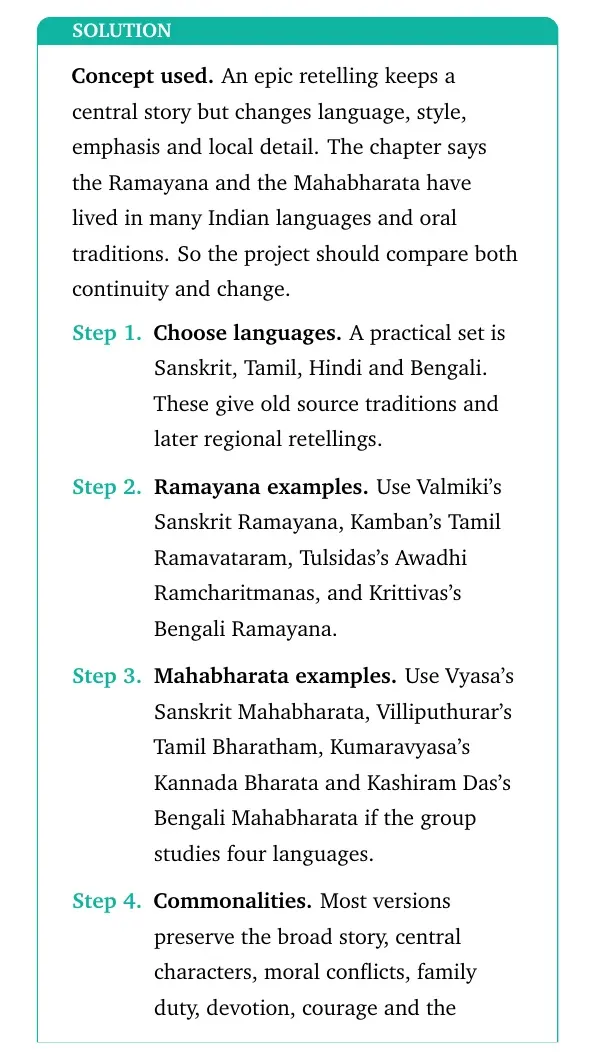
Q 1.5
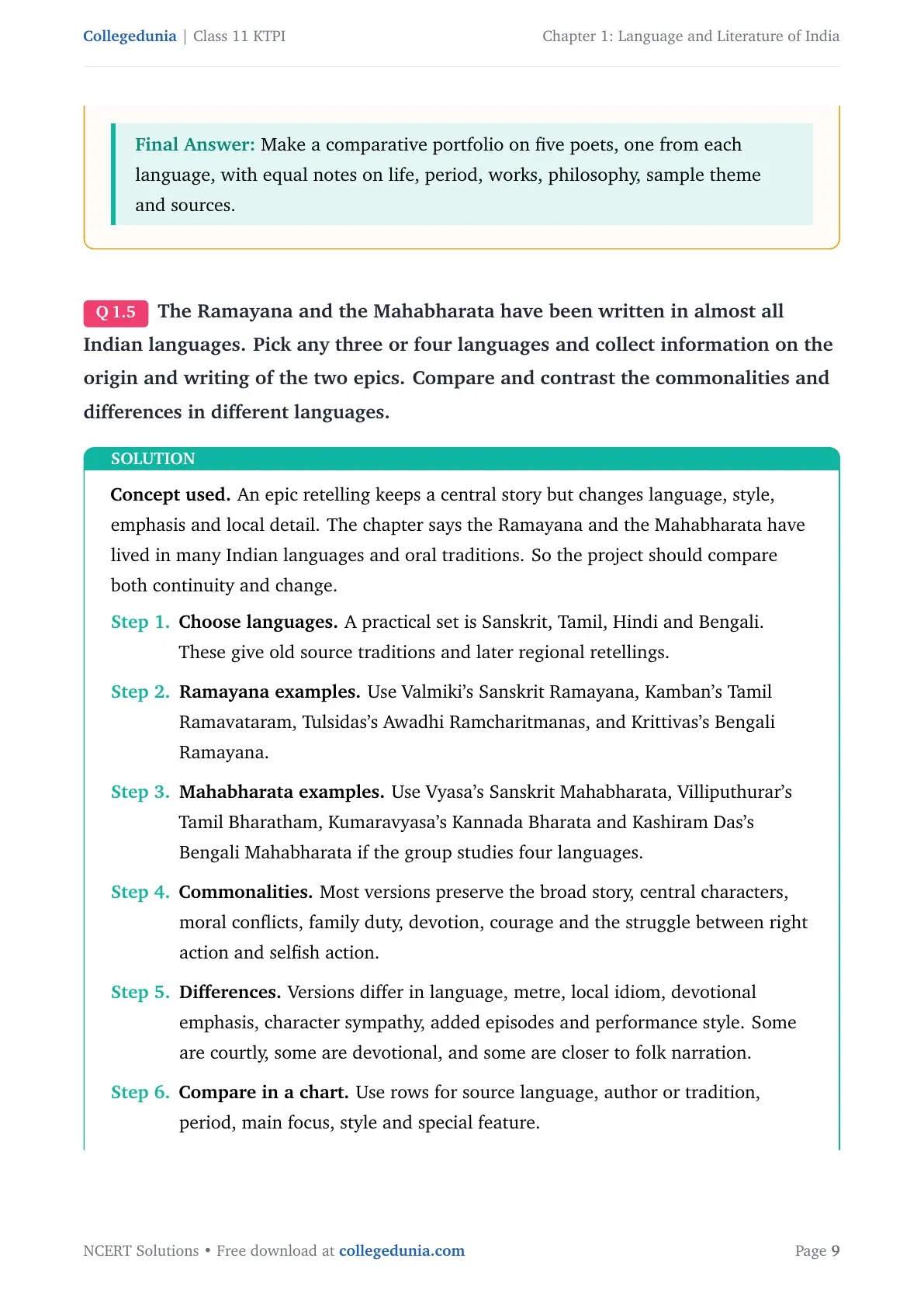
The Ramayana and the Mahabharata have been written in almost all Indian languages. Pick any three or four languages and collect information on the origin and writing of the two epics. Compare and contrast the commonalities and differences in different languages.
Concept used. An epic retelling keeps a central story but changes language, style, emphasis and local detail. The chapter says the Ramayana and the Mahabharata have lived in many Indian languages and oral traditions. So the project should compare both continuity and change.
Choose languages. A practical set is Sanskrit, Tamil, Hindi and Bengali. These give old source traditions and later regional retellings.
Ramayana examples. Use Valmiki's Sanskrit Ramayana, Kamban's Tamil Ramavataram, Tulsidas's Awadhi Ramcharitmanas, and Krittivas's Bengali Ramayana.
Mahabharata examples. Use Vyasa's Sanskrit Mahabharata, Villiputhurar's Tamil Bharatham, Kumaravyasa's Kannada Bharata and Kashiram Das's Bengali Mahabharata if the group studies four languages.
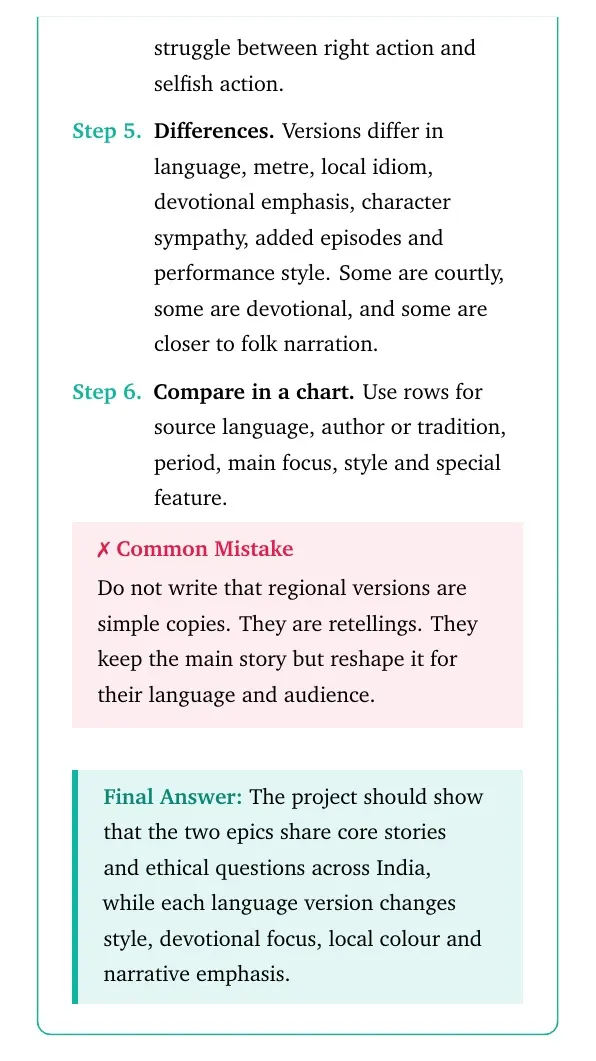
Commonalities. Most versions preserve the broad story, central characters, moral conflicts, family duty, devotion, courage and the struggle between right action and selfish action.
Differences. Versions differ in language, metre, local idiom, devotional emphasis, character sympathy, added episodes and performance style. Some are courtly, some are devotional, and some are closer to folk narration.
Compare in a chart. Use rows for source language, author or tradition, period, main focus, style and special feature.
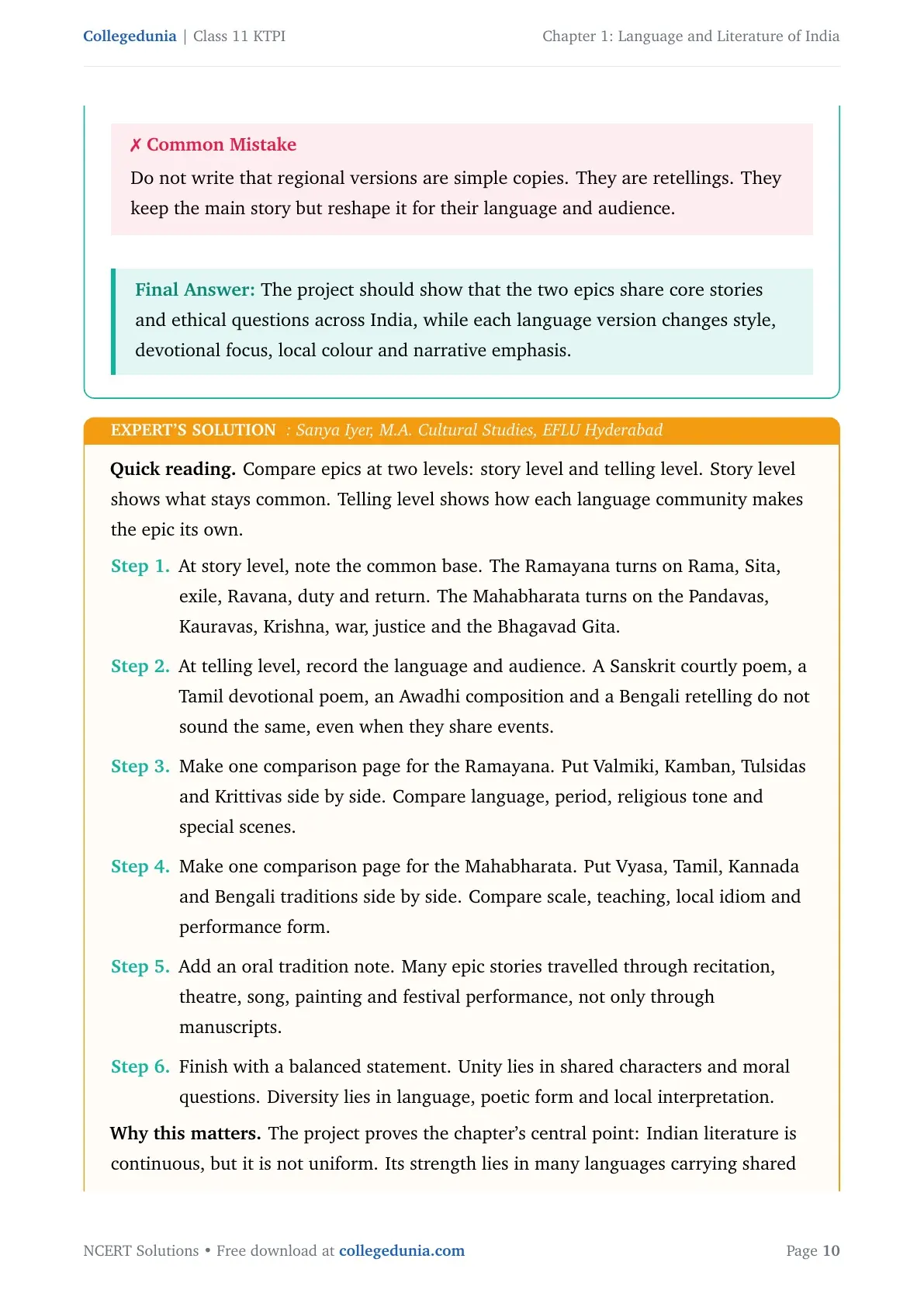
Do not write that regional versions are simple copies. They are retellings. They keep the main story but reshape it for their language and community.
The project should show that the two epics share core stories and ethical questions across India, while each language version changes style, devotional focus, local colour and narrative emphasis.
SI
Sanya Iyer
M.A. Cultural Studies, EFLU Hyderabad
Verified Expert
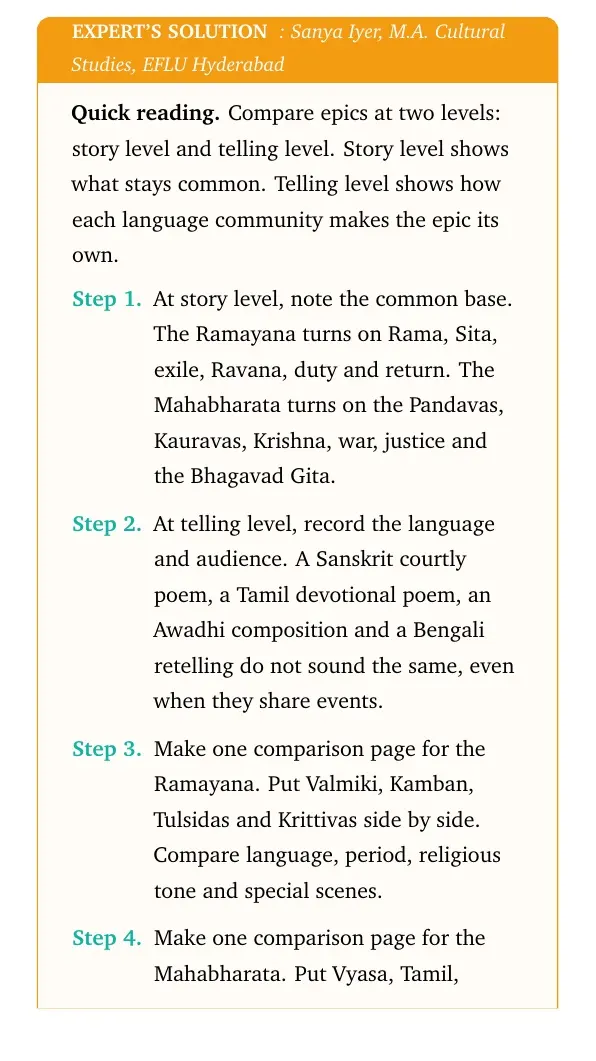
Quick reading. Compare epics at two levels: story level and telling level. Story level shows what stays common. Telling level shows how each language community makes the epic its own.
At story level, note the common base. The Ramayana turns on Rama, Sita, exile, Ravana, duty and return. The Mahabharata turns on the Pandavas, Kauravas, Krishna, war, justice and the Bhagavad Gita.
At telling level, record the language and community. A Sanskrit courtly poem, a Tamil devotional poem, an Awadhi composition and a Bengali retelling do not sound the same, even when they share events.
Make one comparison page for the Ramayana. Put Valmiki, Kamban, Tulsidas and Krittivas side by side. Compare language, period, religious tone and special scenes.
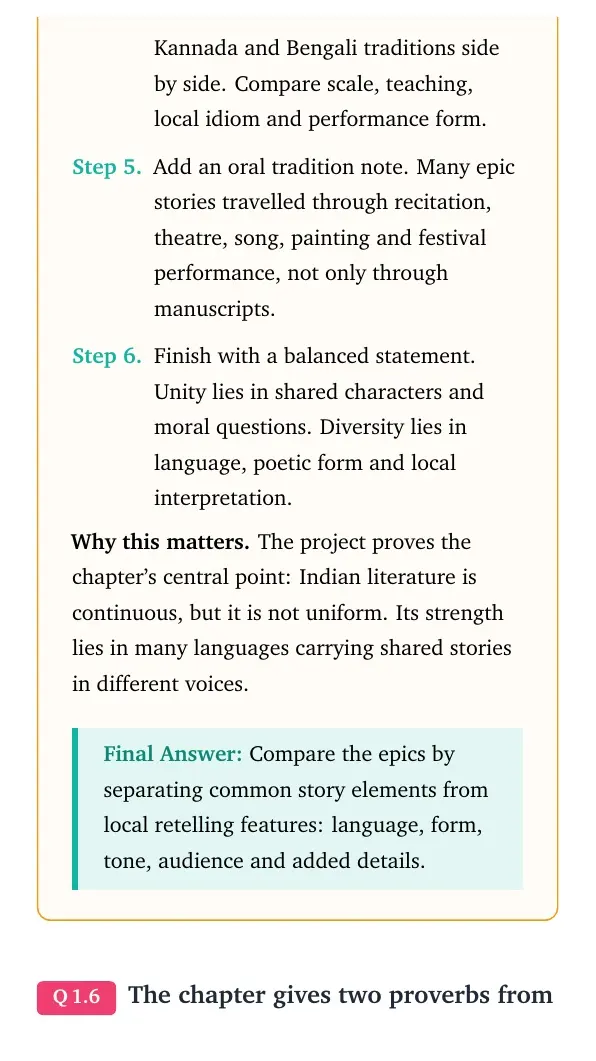
Make one comparison page for the Mahabharata. Put Vyasa, Tamil, Kannada and Bengali traditions side by side. Compare scale, teaching, local idiom and performance form.
Add an oral tradition note. Many epic stories travelled through recitation, theatre, song, painting and festival performance, not only through manuscripts.
Finish with a balanced statement. Unity lies in shared characters and moral questions. Diversity lies in language, poetic form and local interpretation.
Why this matters. The project proves the chapter's central point: Indian literature is continuous, but it is not uniform. Its strength lies in many languages carrying shared stories in different voices.
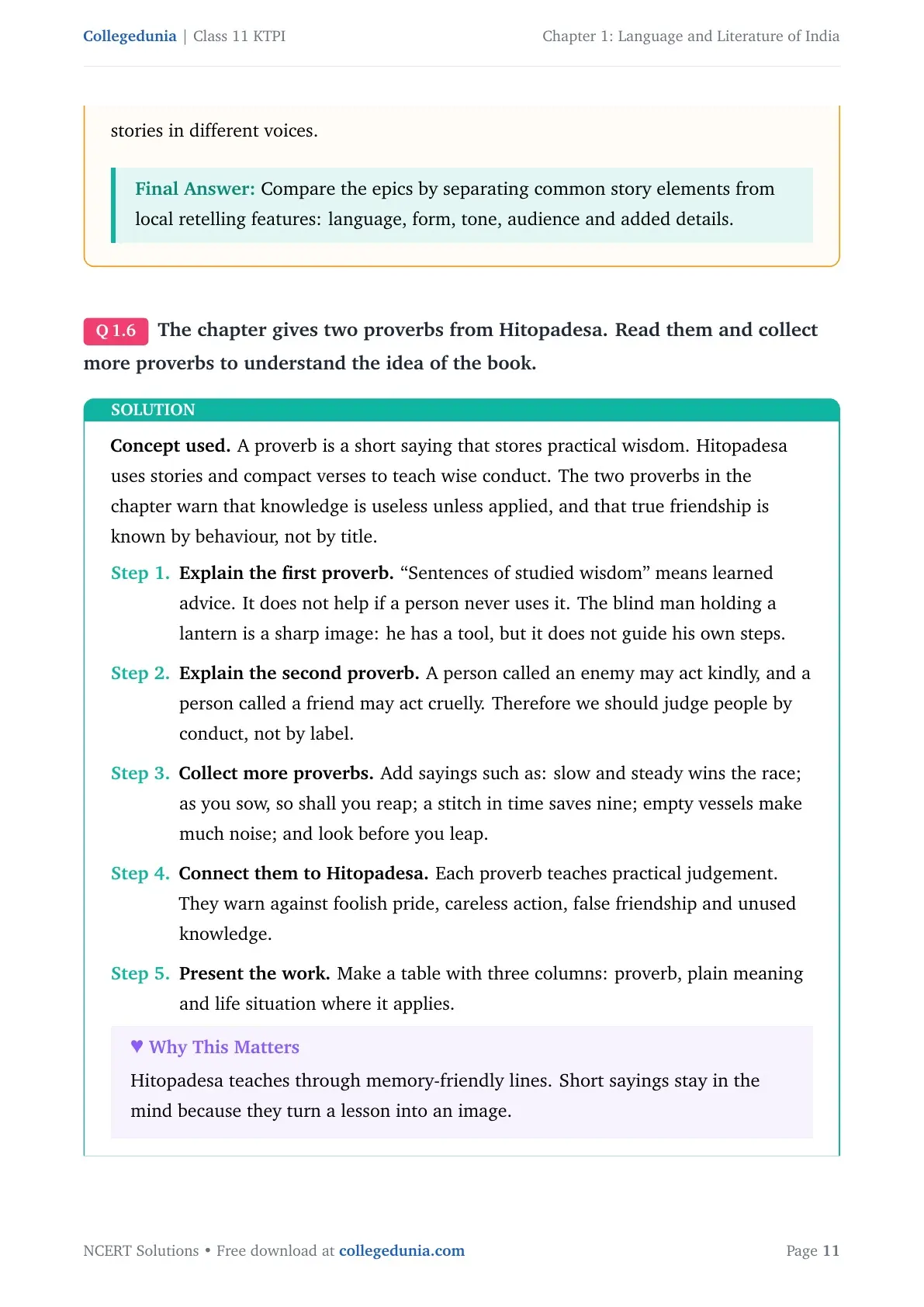
Compare the epics by separating common story elements from local retelling features: language, form, tone, community and added details.
Q 1.6
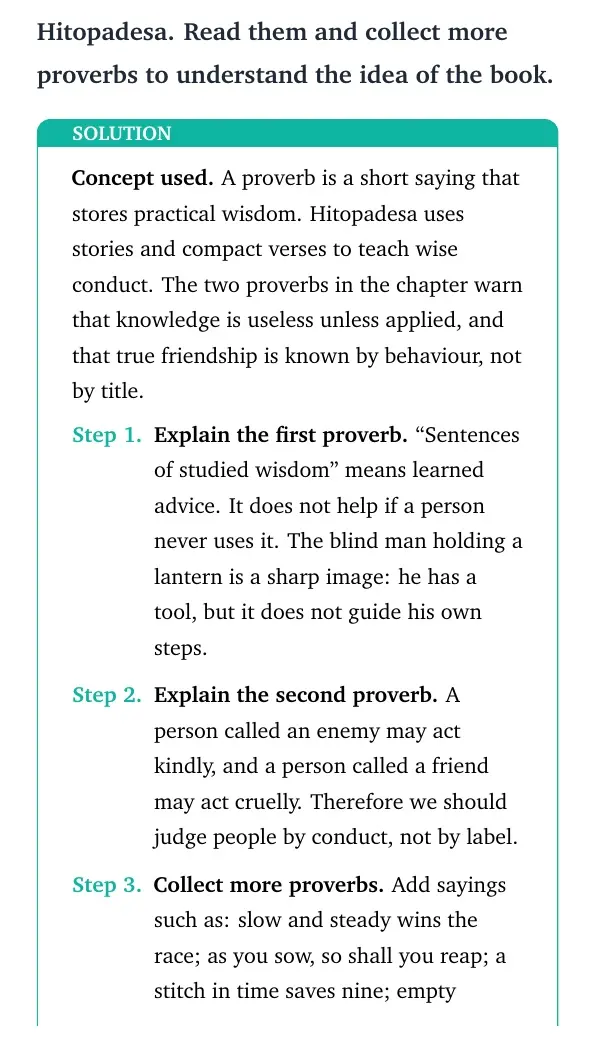
The chapter gives two proverbs from Hitopadesa. Read them and collect more proverbs to understand the idea of the book.
Concept used. A proverb is a short saying that stores practical wisdom. Hitopadesa uses stories and compact verses to teach wise conduct. The two proverbs in the chapter warn that knowledge is useless unless applied, and that true friendship is known by behaviour, not by title.
Explain the first proverb. ``Sentences of studied wisdom'' means learned advice. It does not help if a person never uses it. The blind man holding a lantern is a sharp image: he has a tool, but it does not guide his own steps.
Explain the second proverb. A person called an enemy may act kindly, and a person called a friend may act cruelly. Therefore we should judge people by conduct, not by label.
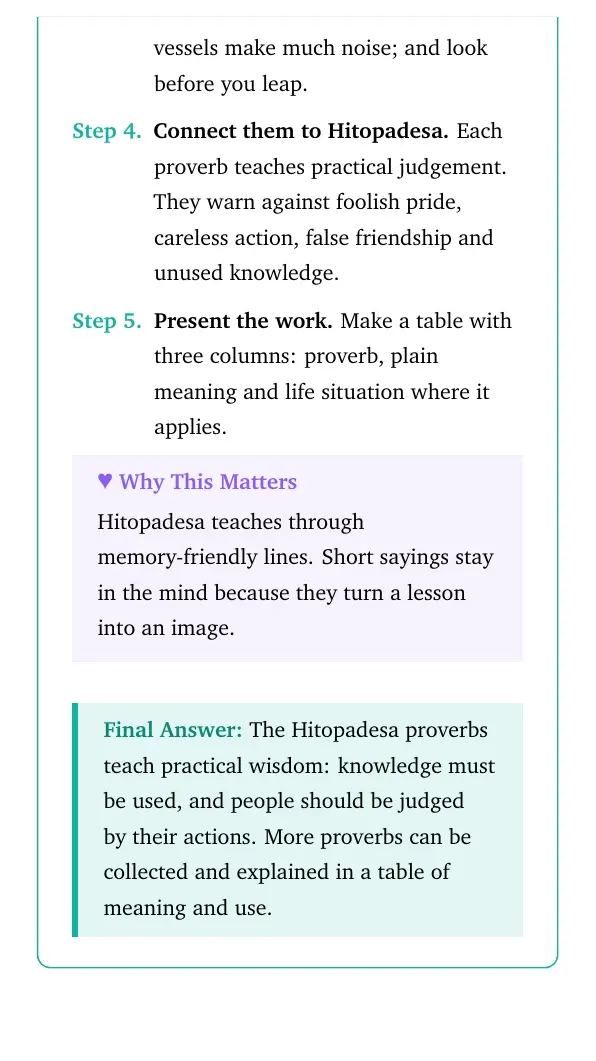
Collect more proverbs. Add sayings such as: slow and steady wins the race; as you sow, so shall you reap; a stitch in time saves nine; empty vessels make much noise; and look before you leap.
Connect them to Hitopadesa. Each proverb teaches practical judgement. They warn against foolish pride, careless action, false friendship and unused knowledge.
Present the work. Make a table with three columns: proverb, plain meaning and life situation where it applies.
Hitopadesa teaches through memory-friendly lines. Short sayings stay in the mind because they turn a lesson into an image.
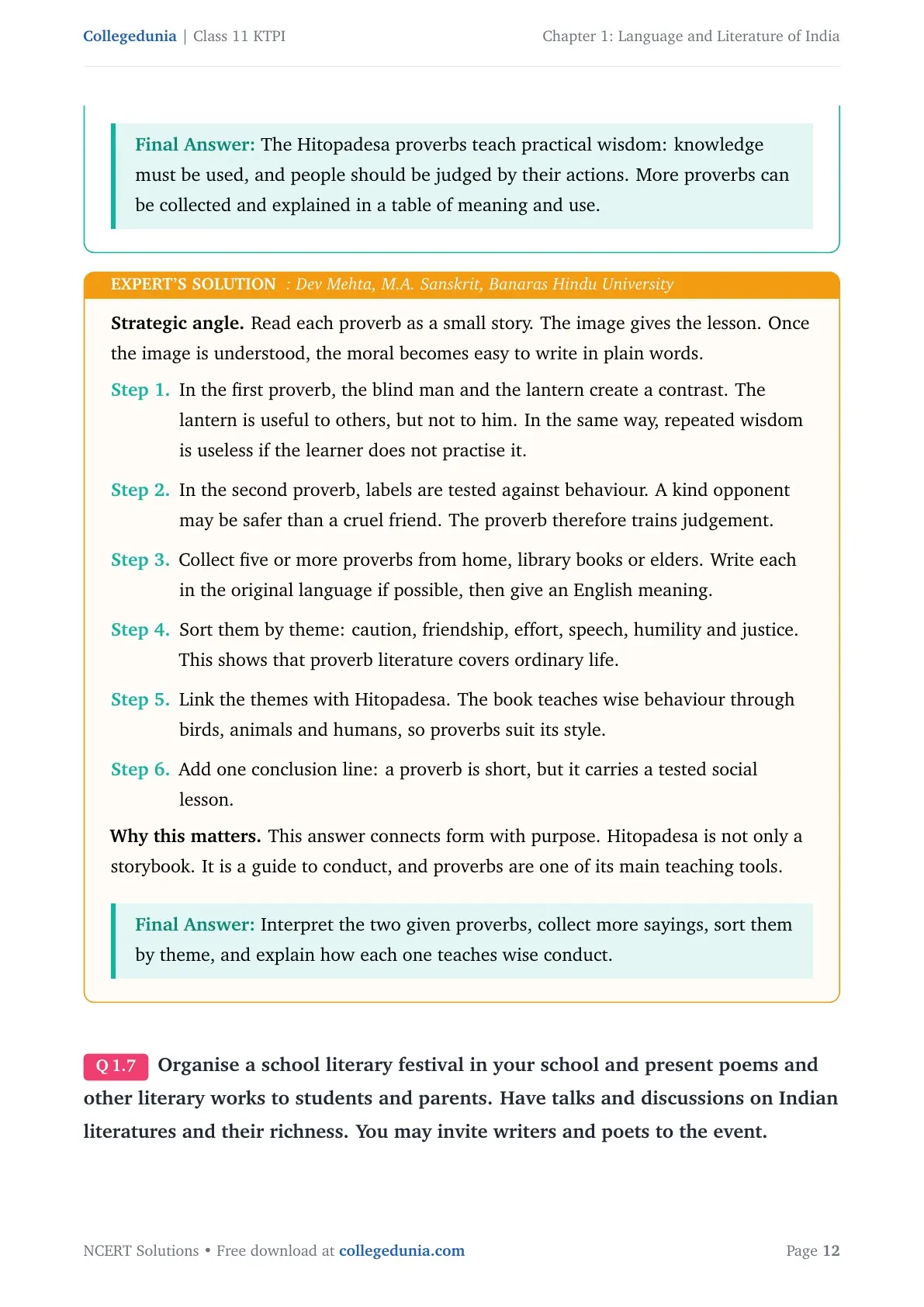
The Hitopadesa proverbs teach practical wisdom: knowledge must be used, and people should be judged by their actions. More proverbs can be collected and explained in a table of meaning and use.
DM
Dev Mehta
M.A. Sanskrit, Banaras Hindu University
Verified Expert
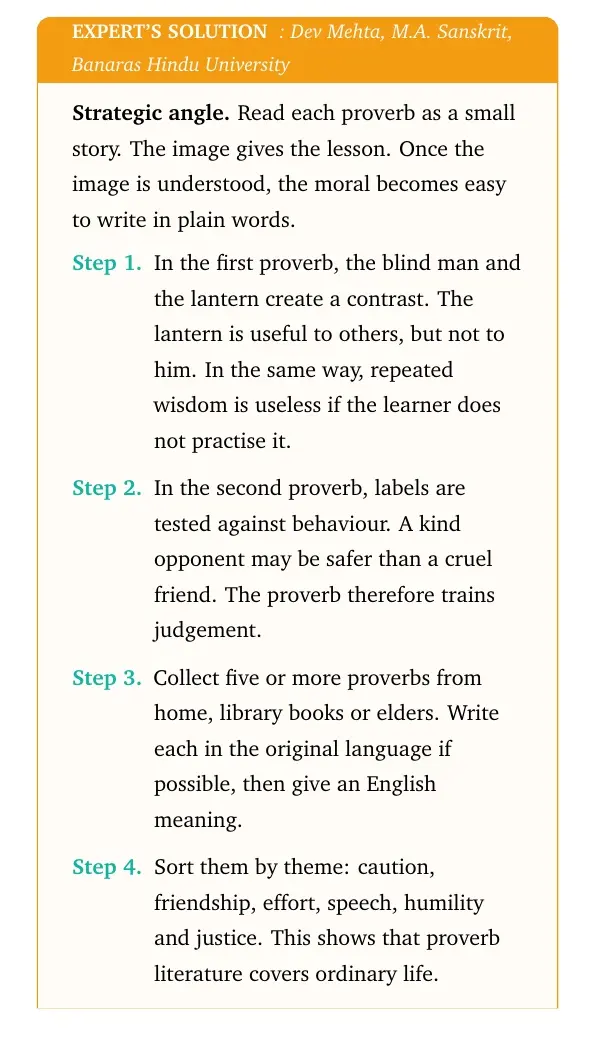
Strategic angle. Read each proverb as a small story. The image gives the lesson. Once the image is understood, the moral becomes easy to write in plain words.
In the first proverb, the blind man and the lantern create a contrast. The lantern is useful to others, but not to him. In the same way, repeated wisdom is useless if the learner does not practise it.
In the second proverb, labels are tested against behaviour. A kind opponent may be safer than a cruel friend. The proverb therefore trains judgement.
Collect five or more proverbs from home, library books or elders. Write each in the original language if possible, then give an English meaning.
Sort them by theme: caution, friendship, effort, speech, humility and justice. This shows that proverb literature covers ordinary life.
Link the themes with Hitopadesa. The book teaches wise behaviour through birds, animals and humans, so proverbs suit its style.
Add one conclusion line: a proverb is short, but it carries a tested social lesson.
Why this matters. This answer connects form with purpose. Hitopadesa is not only a storybook. It is a guide to conduct, and proverbs are one of its main teaching tools.
Interpret the two given proverbs, collect more sayings, sort them by theme, and explain how each one teaches wise conduct.
Q 1.7
Organise a school literary festival in your school and present poems and other literary works to students and parents. Have talks and discussions on Indian literatures and their richness. You may invite writers and poets to the event.
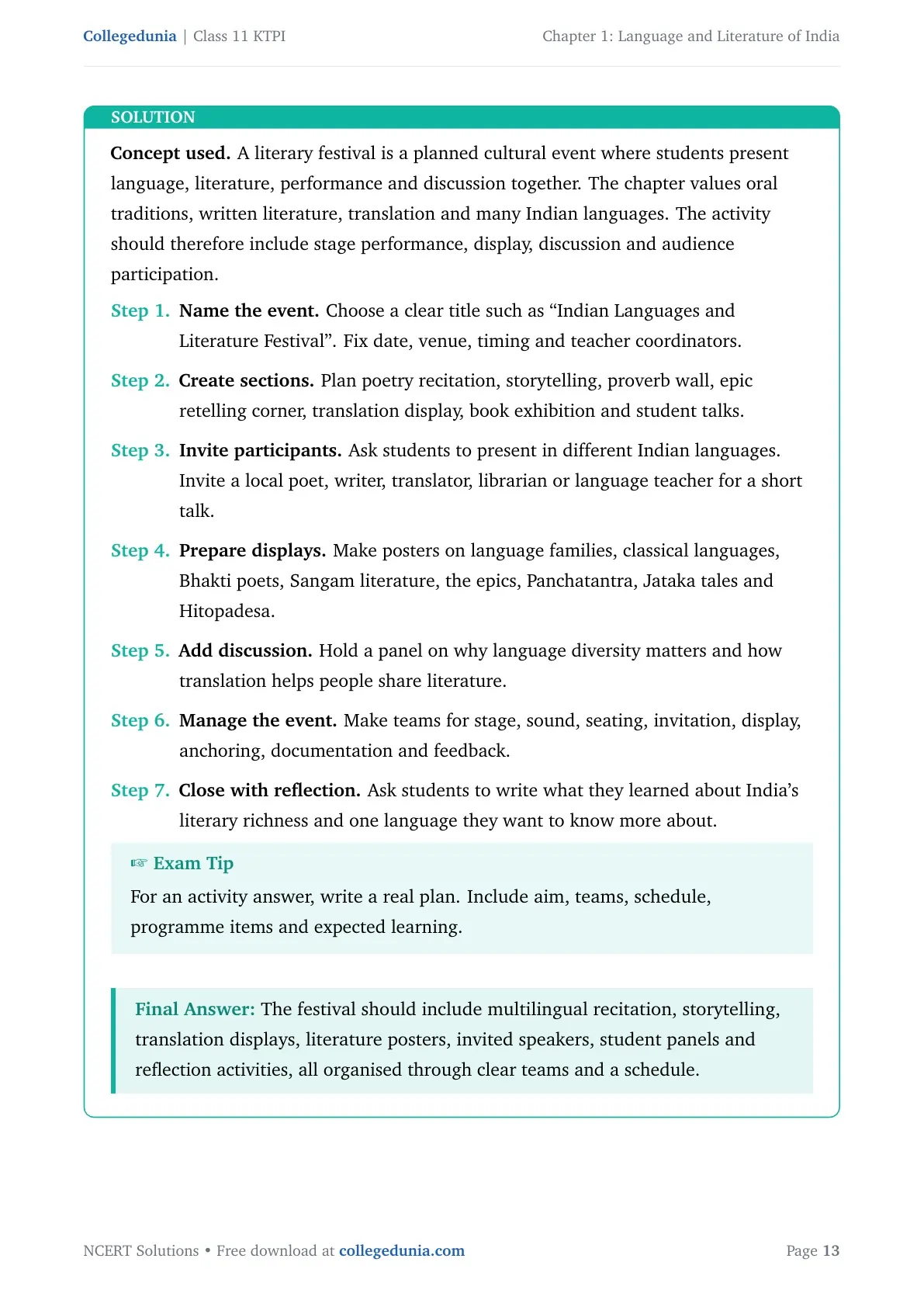
Concept used. A literary festival is a planned cultural event where students present language, literature, performance and discussion together. The chapter values oral traditions, written literature, translation and many Indian languages. The activity should therefore include stage performance, display, discussion and student participation.
Name the event. Choose a clear title such as ``Indian Languages and Literature Festival''. Fix date, venue, timing and teacher coordinators.
Create sections. Plan poetry recitation, storytelling, proverb wall, epic retelling corner, translation display, book exhibition and student talks.
Invite participants. Ask students to present in different Indian languages. Invite a local poet, writer, translator, librarian or language teacher for a short talk.
Prepare displays. Make posters on language families, classical languages, Bhakti poets, Sangam literature, the epics, Panchatantra, Jataka tales and Hitopadesa.
Add discussion. Hold a panel on why language diversity matters and how translation helps people share literature.
Manage the event. Make teams for stage, sound, seating, invitation, display, anchoring, documentation and feedback.
Close with reflection. Ask students to write what they learned about India's literary richness and one language they want to know more about.
For an activity answer, write a real plan. Include aim, teams, schedule, programme items and expected learning.
The festival should include multilingual recitation, storytelling, translation displays, literature posters, invited speakers, student panels and reflection activities, all organised through clear teams and a schedule.
IK
Ishita Kapoor
M.A. Education, Tata Institute of Social Sciences
Verified Expert
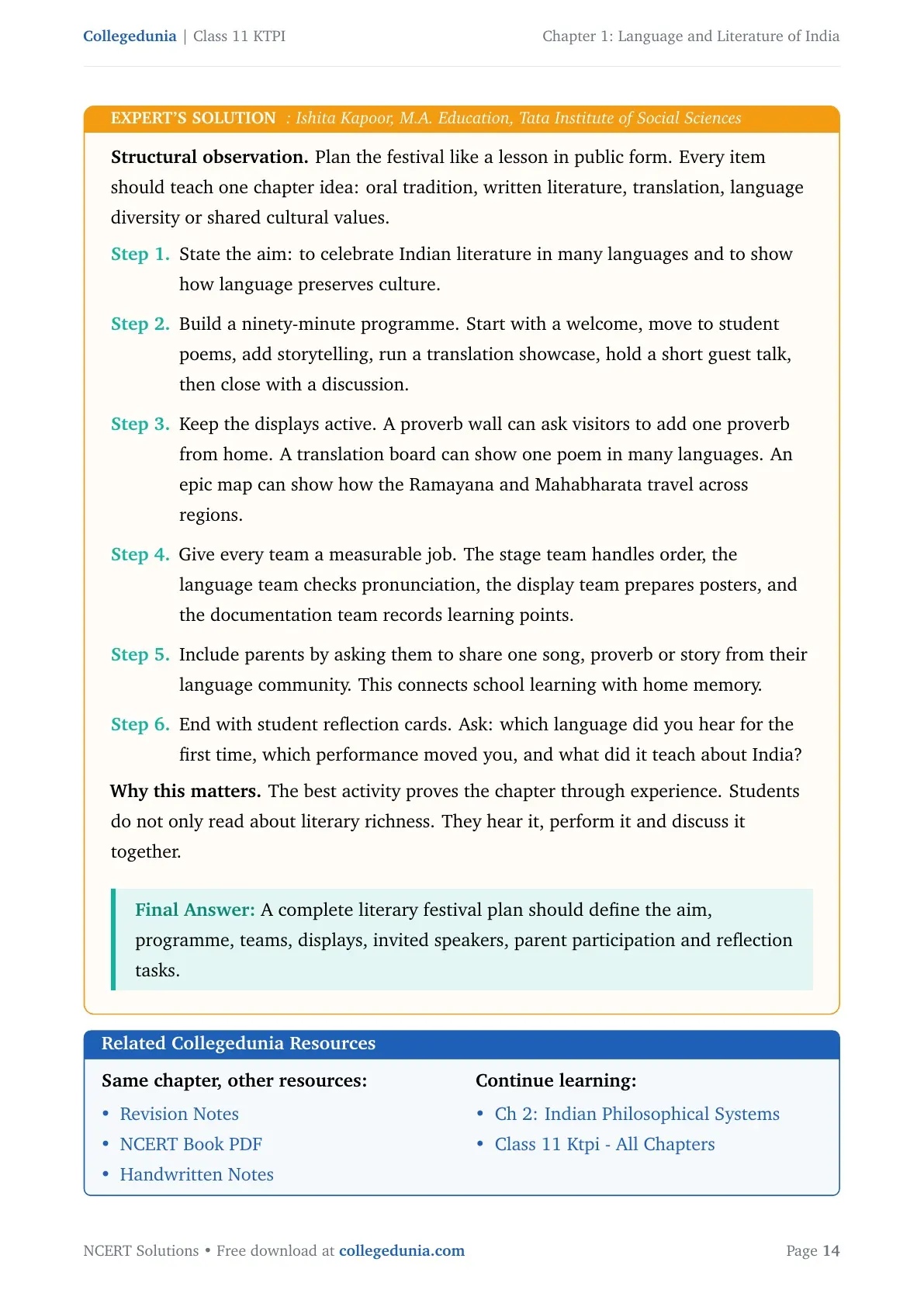
Structural observation. Plan the festival like a lesson in public form. Every item should teach one chapter idea: oral tradition, written literature, translation, language diversity or shared cultural values.
State the aim: to celebrate Indian literature in many languages and to show how language preserves culture.
Build a ninety-minute programme. Start with a welcome, move to student poems, add storytelling, run a translation showcase, hold a short guest talk, then close with a discussion.
Keep the displays active. A proverb wall can ask visitors to add one proverb from home. A translation board can show one poem in many languages. An epic map can show how the Ramayana and Mahabharata travel across regions.
Give every team a measurable job. The stage team handles order, the language team checks pronunciation, the display team prepares posters, and the documentation team records learning points.
Include parents by asking them to share one song, proverb or story from their language community. This connects school learning with home memory.
End with student reflection cards. Ask: which language did you hear for the first time, which performance moved you, and what did it teach about India?
Why this matters. The best activity proves the chapter through experience. Students do not only read about literary richness. They hear it, perform it and discuss it together.
A complete literary festival plan should define the aim, programme, teams, displays, invited speakers, parent participation and reflection tasks.
Language and Literature of India Class 11 KTPI NCERT Solutions FAQs
Questions Students Ask About Class 11 KTPI Chapter 1
Ques. How many questions are solved in Class 11 KTPI Chapter 1 Language and Literature of India?
Ans. There are 7 solved prompts in this resource. The first 3 come from Let us Do and the next 4 come from project or activity work. The downloadable PDF and the embedded cards carry the same solutions for the 2026-27 session.
Ques. What is the main idea of Language and Literature of India?
Ans. The chapter shows that India has many language traditions, including classical languages, modern Indian languages, tribal languages, oral traditions and translated literature. It asks students to see language as a carrier of culture, memory, poetry, stories and community knowledge.
Ques. What makes a language classical according to the chapter?
Ans. A classical language has deep antiquity, a rich old literature, an independent textual tradition and continuing cultural influence. Sanskrit and Tamil are useful examples to quote in the answer.
Ques. How should students write the epic comparison project?
Ans. Students should choose three or four language traditions and compare the author or tradition, period, special feature and influence of each retelling. A table is better than a single story summary because the project asks for origin and writing across languages.
Ques. Is this resource based on the 2026-27 NCERT syllabus?
Ans. Yes. The article and PDF are written for the 2026-27 Class 11 KTPI syllabus, using the NCERT chapter Language and Literature of India as the source for the prompts and answer themes.








Comments