NCERT Solutions for Class 11 KTPI Chapter 7 Introducing Ayurveda: The Science of Health and Disease cover all 7 exercise questions from the 2026-27 syllabus. The chapter explains Ayurveda as a holistic science of life, then connects its history, human and animal medicine, tridosha theory, diet, nutrition and classical texts with short-answer writing. These answers keep the NCERT sequence intact and add expert explanations for students who need fuller reasoning before writing the exercise.
7 solved questions are included with direct NCERT answers and fuller expert explanations.
The PDF follows the exercise order for Ayurveda branches, tridosha, diet, nutrition and important texts.
Question cards below let students open the direct solution first and then compare the expert route.
Student Feedback on Class 11 KTPI Chapter 7
In the 2026-27 Collegedunia KTPI review log, 9,860 Class 11 students marked Introducing Ayurveda as a chapter that needs grouped revision because it mixes history, science terms and textbook examples in one exercise.
73% wanted the three Ayurveda branches separated before answering the first question.
68% confused Vata, Pitta and Kapha until they revised them as functional principles.
6 out of 10 students asked for a period-wise list of Ayurveda texts for quick recall.
Source: 2026-27 Class 11 KTPI student feedback sample recorded for Collegedunia NCERT resource planning.
Every answer here is checked against the Introducing Ayurveda chapter of the NCERT Knowledge Traditions and Practices of India textbook.
What the Class 11 KTPI Introducing Ayurveda Solutions Cover
Chapter 7 introduces Ayurveda as a science of life and health. It does not ask students to memorise only names. The exercise expects students to connect health, disease, body functions, diet, animal care, plant care and classical medical literature in clear paragraphs.
Question group
Question numbers
What students need to show
Branches of Ayurveda
Questions 1 and 2
Separate human, animal and plant care before explaining their common principles
Body principles
Questions 3 and 5
Explain Vata, Pitta, Kapha and tridosha without turning the answer into a medical claim
History and literature
Questions 4 and 7
Name Sushruta and arrange key Ayurveda texts by period
Diet and nutrition
Question 6
Show how food, digestion, season and daily routine fit prevention and health
The downloadable PDF uses the same structure. The direct solution gives the answer needed for school work, while the expert solution adds textbook context and a cleaner writing frame.
Ayurveda Branches and Classical Literature at a Glance
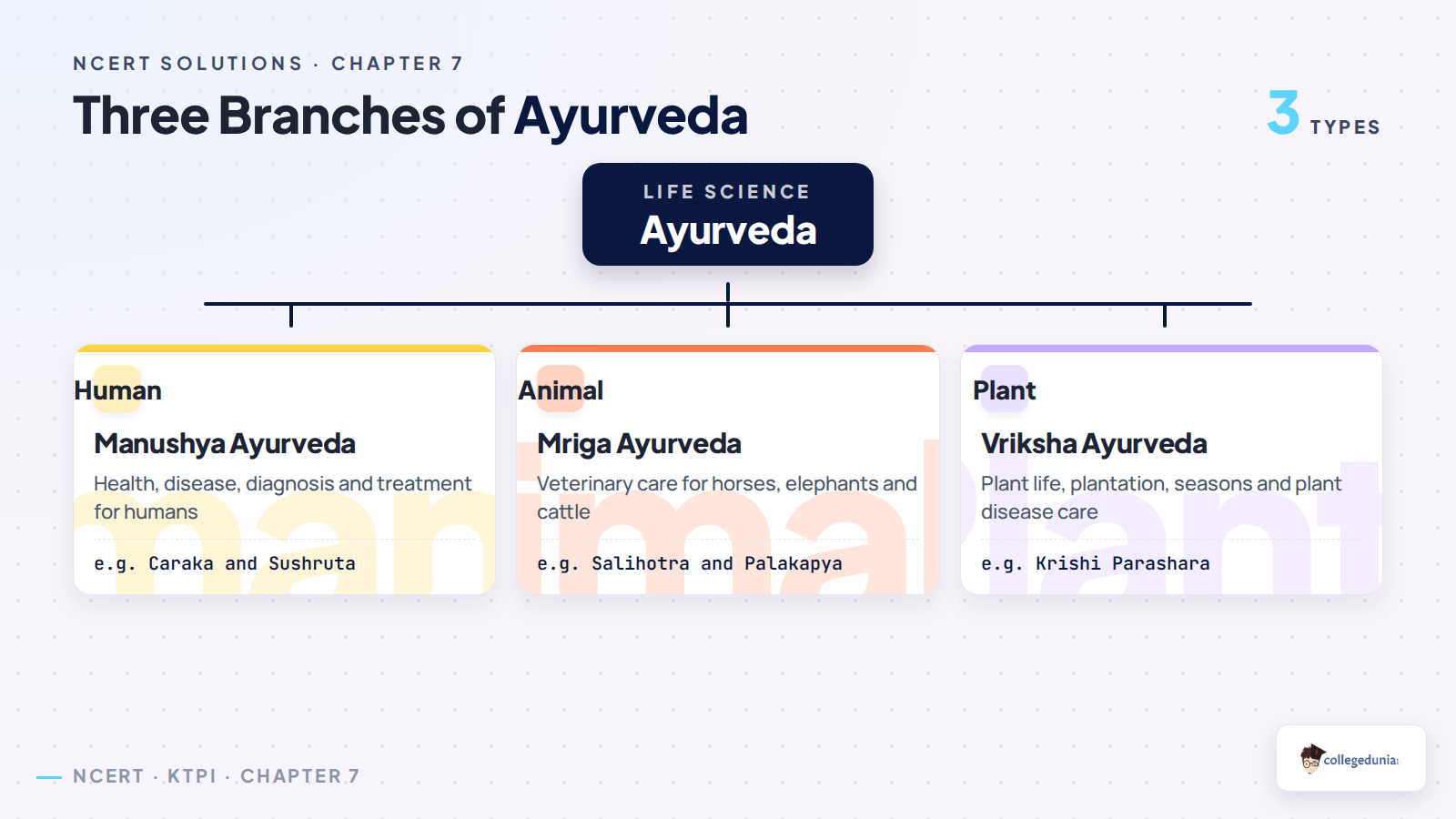
The chapter shows Ayurveda as a shared knowledge system for living beings. Ancient Indian thinkers studied patterns in nature and applied broad principles to humans, animals and plants. That is why the exercise asks separately about manusya Ayurveda and mrga Ayurveda.
Manusya Ayurveda deals with human health, disease prevention, treatment and medical texts.
Mrga Ayurveda deals with animal care, especially diagnosis and treatment of animal diseases.
Vrksa Ayurveda deals with plant life, plant health and botanical care.
When students write answers for Questions 1 and 2, this three-part split keeps the response precise and prevents all Ayurveda branches from merging into one general paragraph.
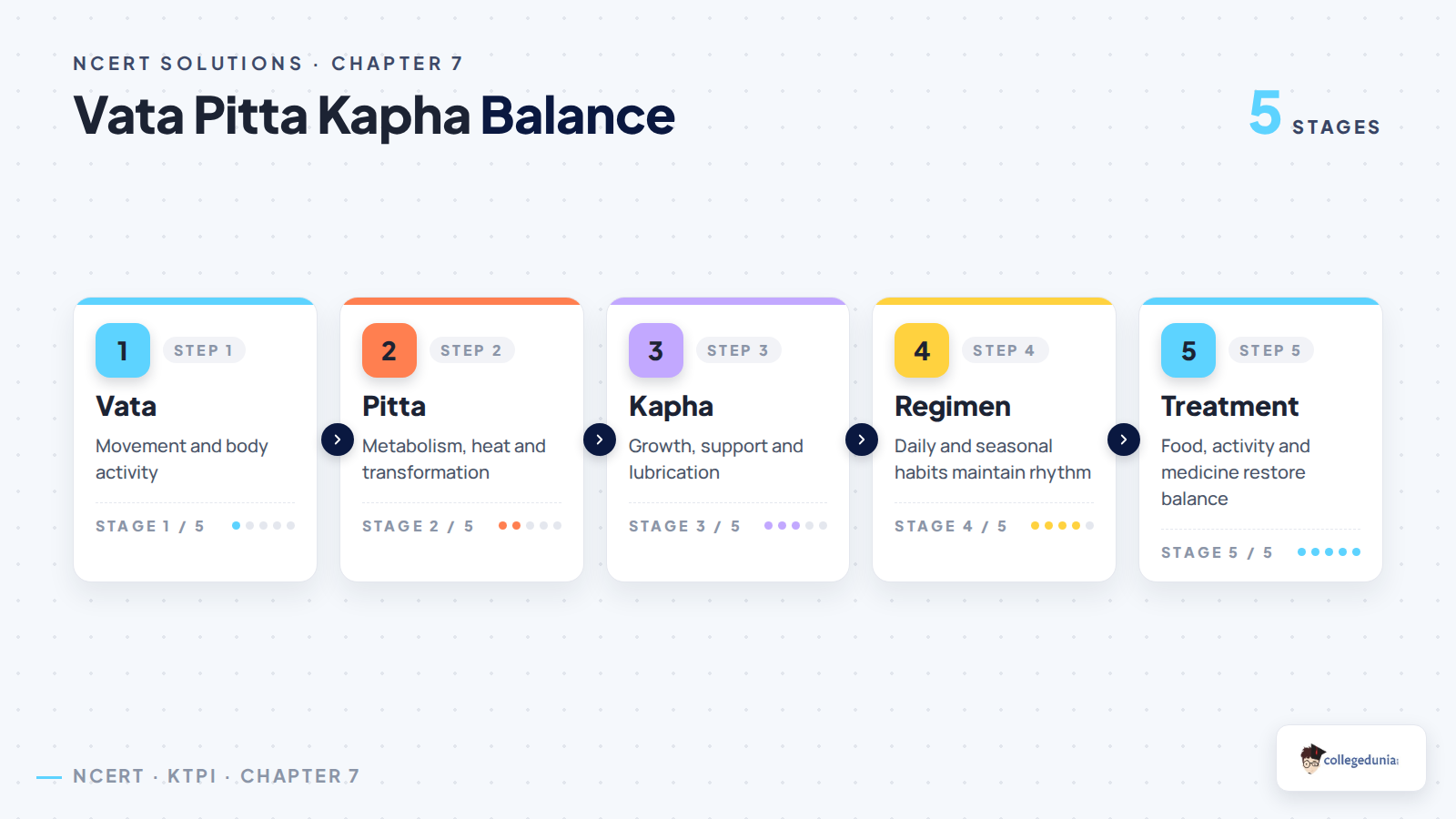
The middle questions focus on how Ayurveda explains balance. The chapter introduces Vata, Pitta and Kapha as functional principles used to understand health and disease. Students should write them as textbook ideas, not as a personal medical prescription.
Vata is linked with movement and activity in the body and mind.
Pitta is linked with transformation, digestion and metabolic activity.
Kapha is linked with structure, lubrication and stability.
For diet and nutrition, the safest answer is to connect food with digestion, season, person, routine and prevention. The chapter treats diet as part of health management, so a good answer includes both nutrition and disciplined lifestyle.
KTPI Chapter 7 Related Resources
Use the chapter-wise resources below to revise the same NCERT chapter in different formats. The textbook PDF is useful for source reading, notes help with short revision, and handwritten notes help with quick recall.
All NCERT Solutions for Introducing Ayurveda with Step-by-Step Solutions
The cards below embed every exercise answer from the chapter. Use Check Solution for the direct NCERT answer and Expert Solution for a fuller explanation.
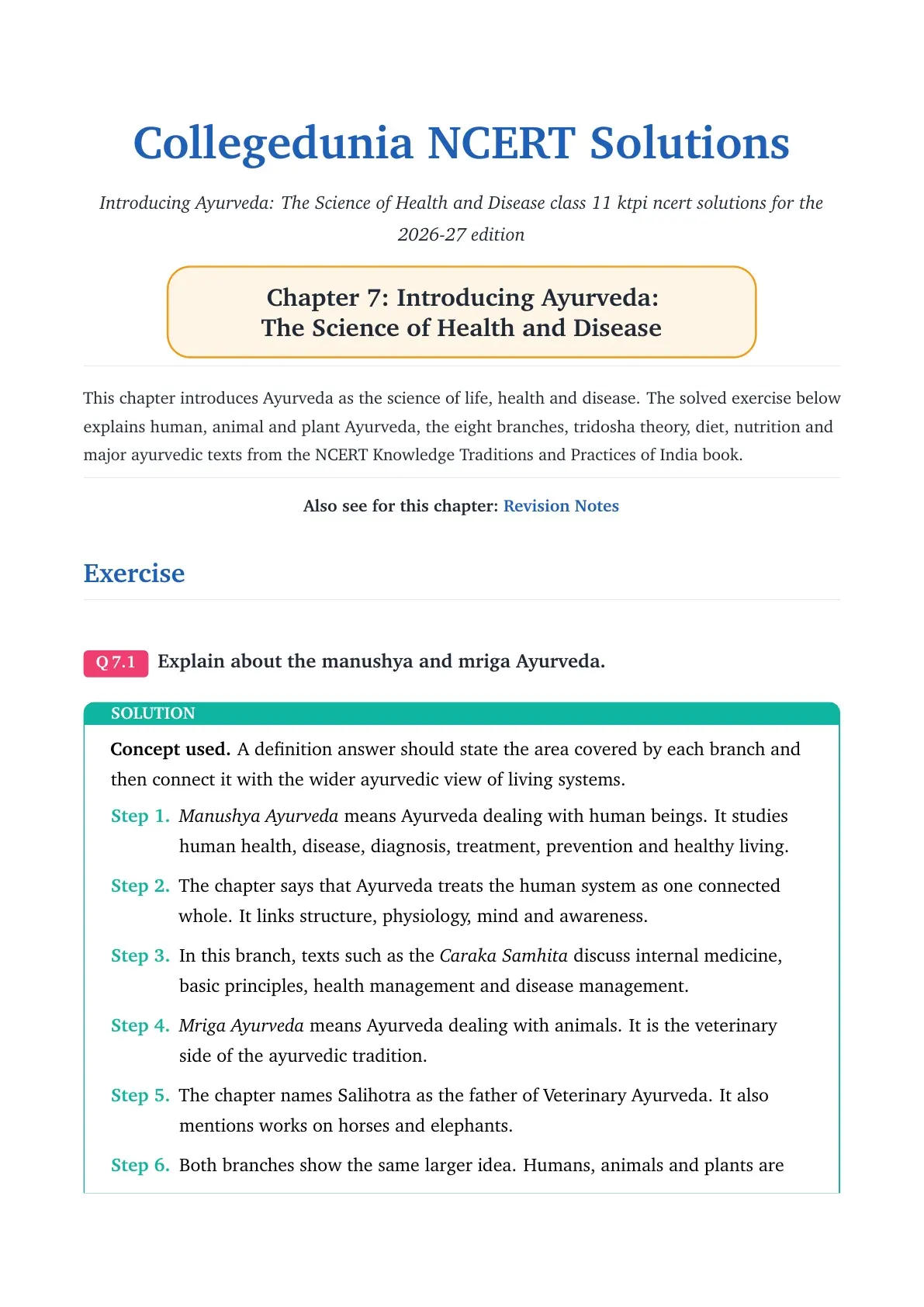
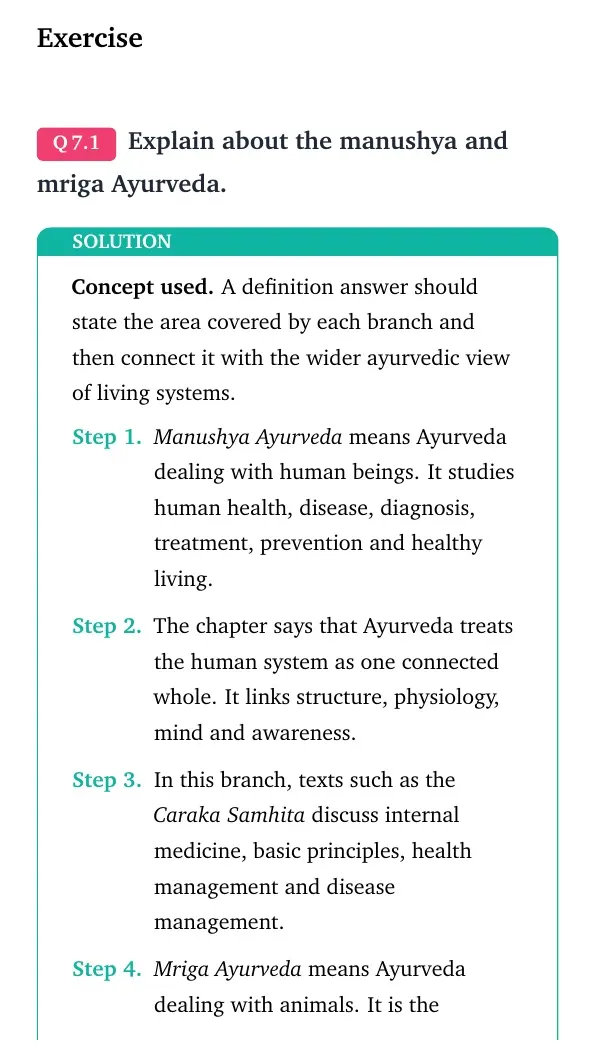
Q 7.1
Explain about the manushya and mriga Ayurveda.
Concept used. A definition answer should state the area covered by each branch and then connect it with the wider ayurvedic view of living systems.
Manushya Ayurveda means Ayurveda dealing with human beings. It studies human health, disease, diagnosis, treatment, prevention and healthy living.
The chapter says that Ayurveda treats the human system as one connected whole. It links structure, physiology, mind and awareness.
In this branch, texts such as the Caraka Samhita discuss internal medicine, basic principles, health management and disease management.
Mriga Ayurveda means Ayurveda dealing with animals. It is the veterinary side of the ayurvedic tradition.
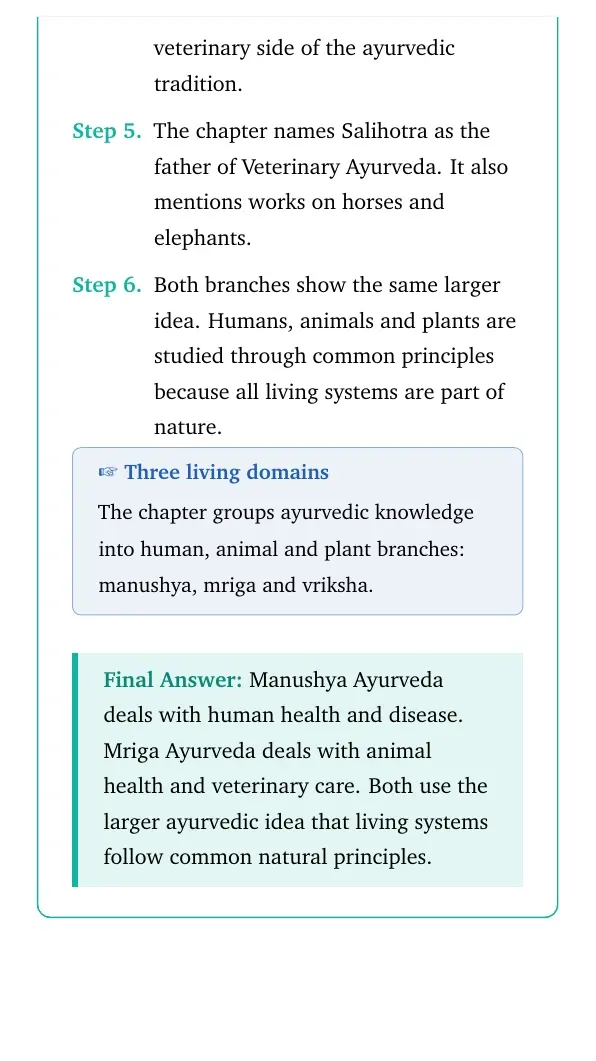
The chapter names Salihotra as the father of Veterinary Ayurveda. It also mentions works on horses and elephants.
Both branches show the same larger idea. Humans, animals and plants are studied through common principles because all living systems are part of nature.
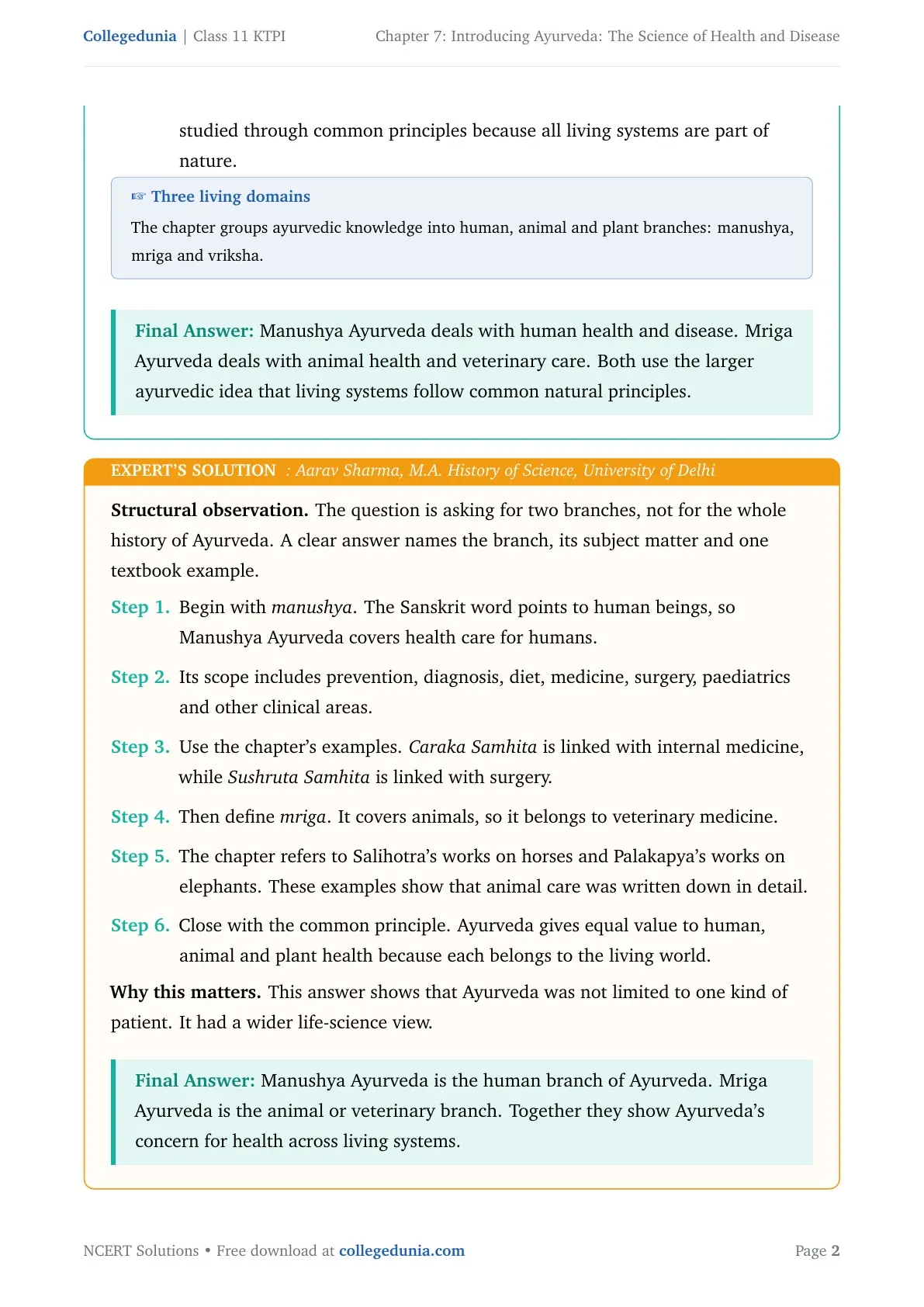
Three living domains
The chapter groups ayurvedic knowledge into human, animal and plant branches: manushya, mriga and vriksha.
Manushya Ayurveda deals with human health and disease. Mriga Ayurveda deals with animal health and veterinary care. Both use the larger ayurvedic idea that living systems follow common natural principles.
AS
Aarav Sharma
M.A. History of Science, University of Delhi
Verified Expert
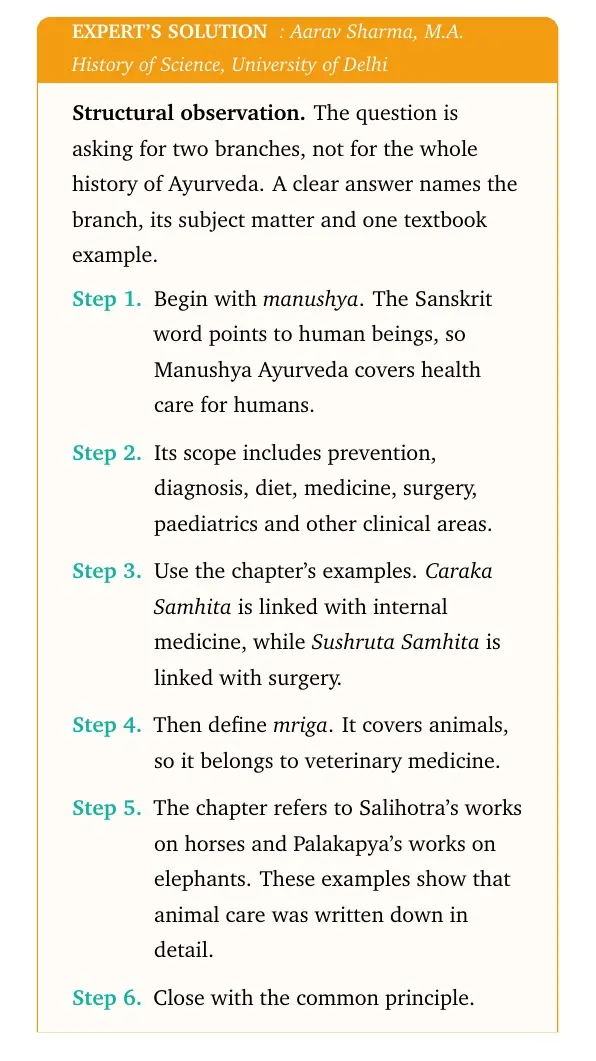
Structural observation. The question is asking for two branches, not for the whole history of Ayurveda. A clear answer names the branch, its subject matter and one textbook example.
Begin with manushya. The Sanskrit word points to human beings, so Manushya Ayurveda covers health care for humans.
Its scope includes prevention, diagnosis, diet, medicine, surgery, paediatrics and other clinical areas.
Use the chapter's examples. Caraka Samhita is linked with internal medicine, while Sushruta Samhita is linked with surgery.
Then define mriga. It covers animals, so it belongs to veterinary medicine.
The chapter refers to Salihotra's works on horses and Palakapya's works on elephants. These examples show that animal care was written down in detail.
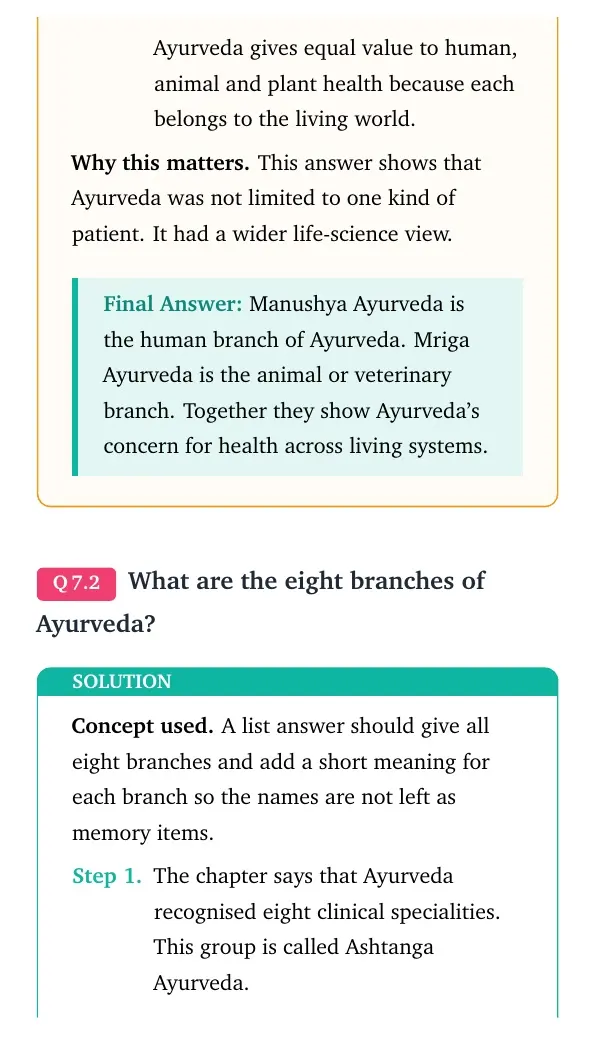
Close with the common principle. Ayurveda gives equal value to human, animal and plant health because each belongs to the living world.
Why this matters. This answer shows that Ayurveda was not limited to one kind of patient. It had a wider life-science view.
Manushya Ayurveda is the human branch of Ayurveda. Mriga Ayurveda is the animal or veterinary branch. Together they show Ayurveda's concern for health across living systems.
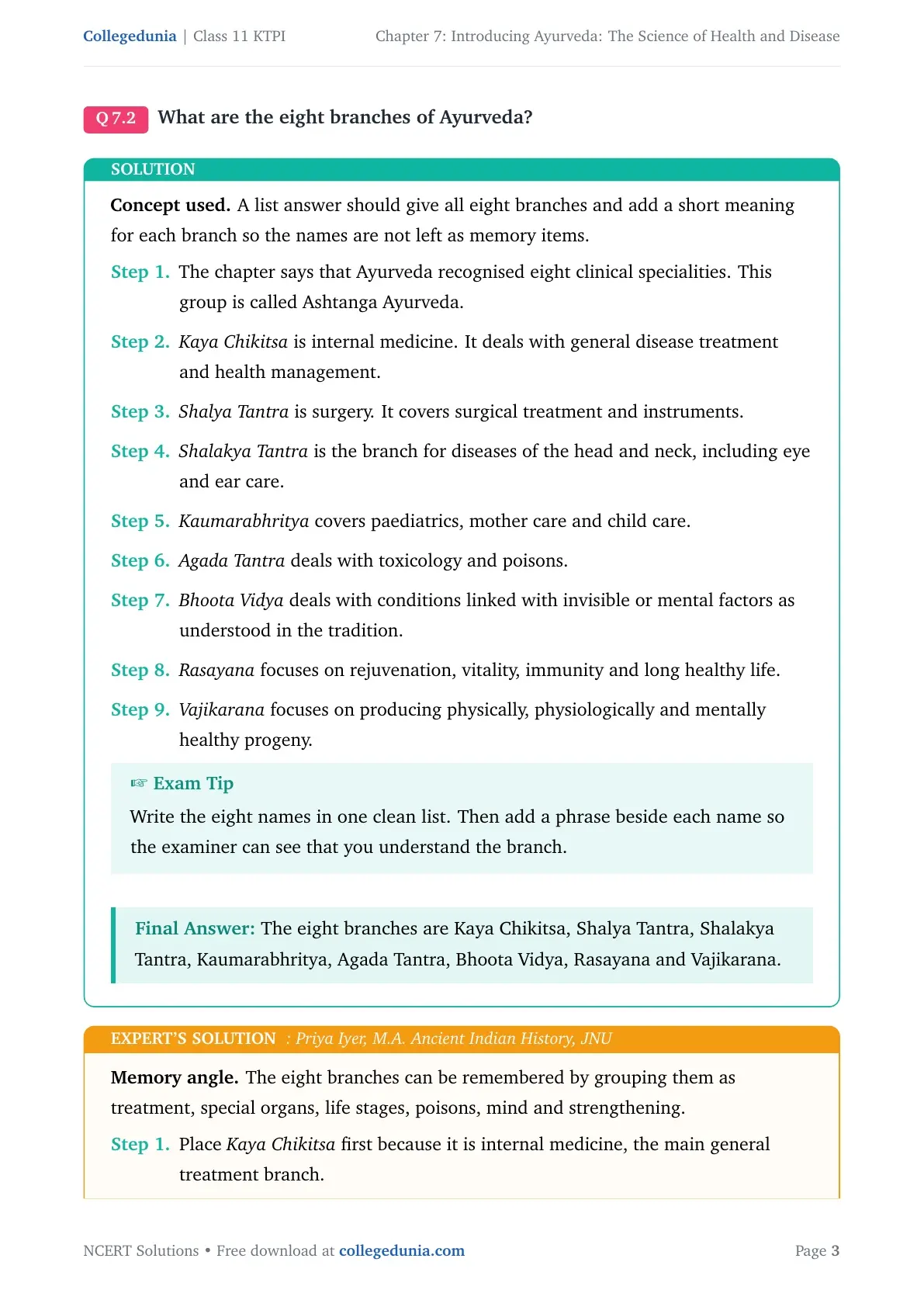
Q 7.2
What are the eight branches of Ayurveda?
Concept used. A list answer should give all eight branches and add a short meaning for each branch so the names are not left as memory items.
The chapter says that Ayurveda recognised eight clinical specialities. This group is called Ashtanga Ayurveda.
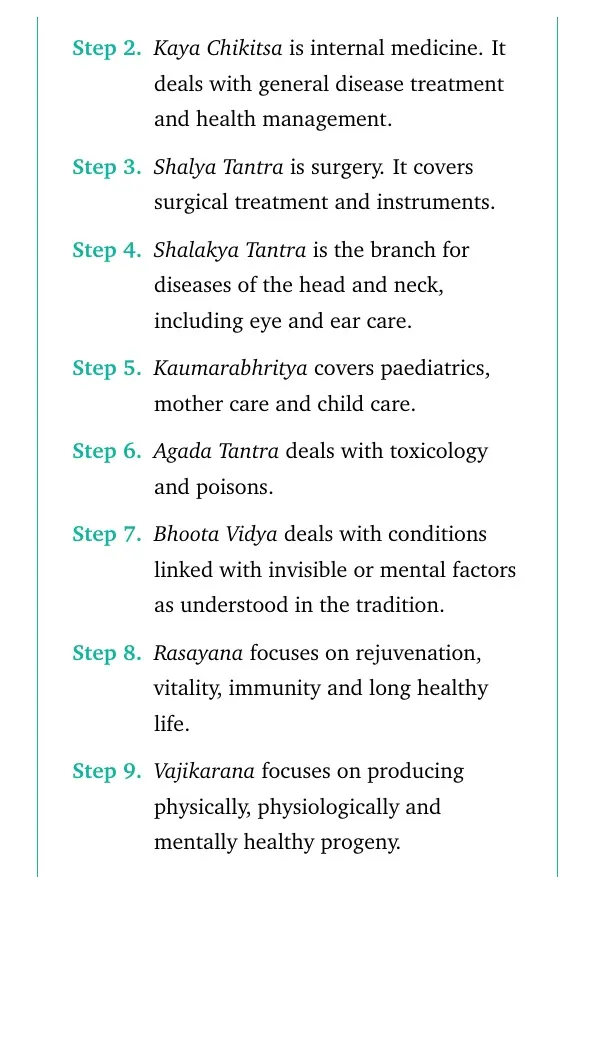
Kaya Chikitsa is internal medicine. It deals with general disease treatment and health management.
Shalya Tantra is surgery. It covers surgical treatment and instruments.
Shalakya Tantra is the branch for diseases of the head and neck, including eye and ear care.
Kaumarabhritya covers paediatrics, mother care and child care.
Agada Tantra deals with toxicology and poisons.
Bhoota Vidya deals with conditions linked with invisible or mental factors as understood in the tradition.
Rasayana focuses on rejuvenation, vitality, immunity and long healthy life.
Vajikarana focuses on producing physically, physiologically and mentally healthy progeny.
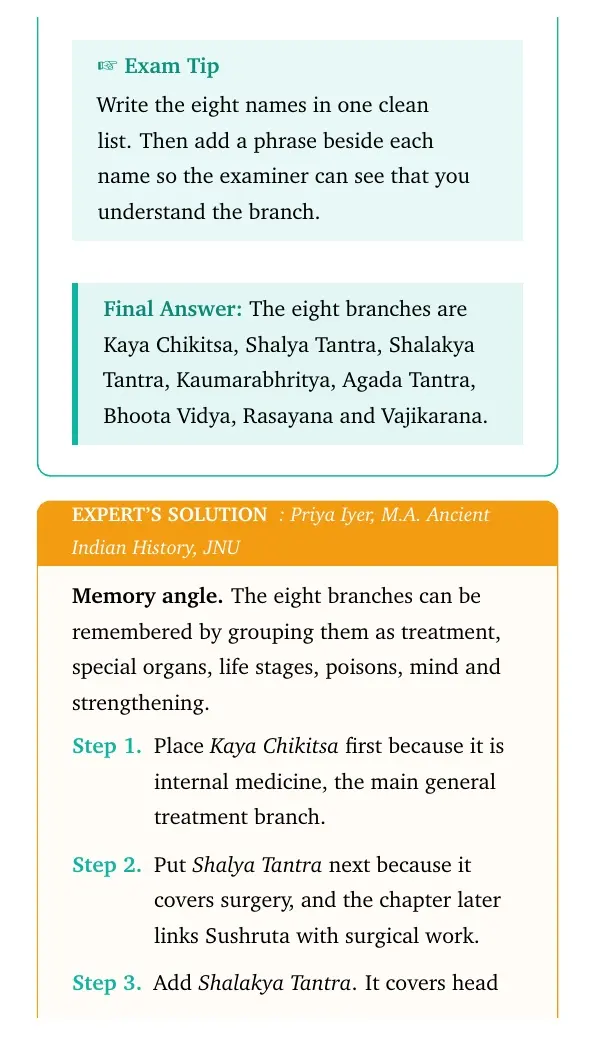
Write the eight names in one clean list. Then add a phrase beside each name so the examiner can see that you understand the branch.
The eight branches are Kaya Chikitsa, Shalya Tantra, Shalakya Tantra, Kaumarabhritya, Agada Tantra, Bhoota Vidya, Rasayana and Vajikarana.
PI
Priya Iyer
M.A. Ancient Indian History, JNU
Verified Expert
Memory angle. The eight branches can be remembered by grouping them as treatment, special organs, life stages, poisons, mind and strengthening.
Place Kaya Chikitsa first because it is internal medicine, the main general treatment branch.
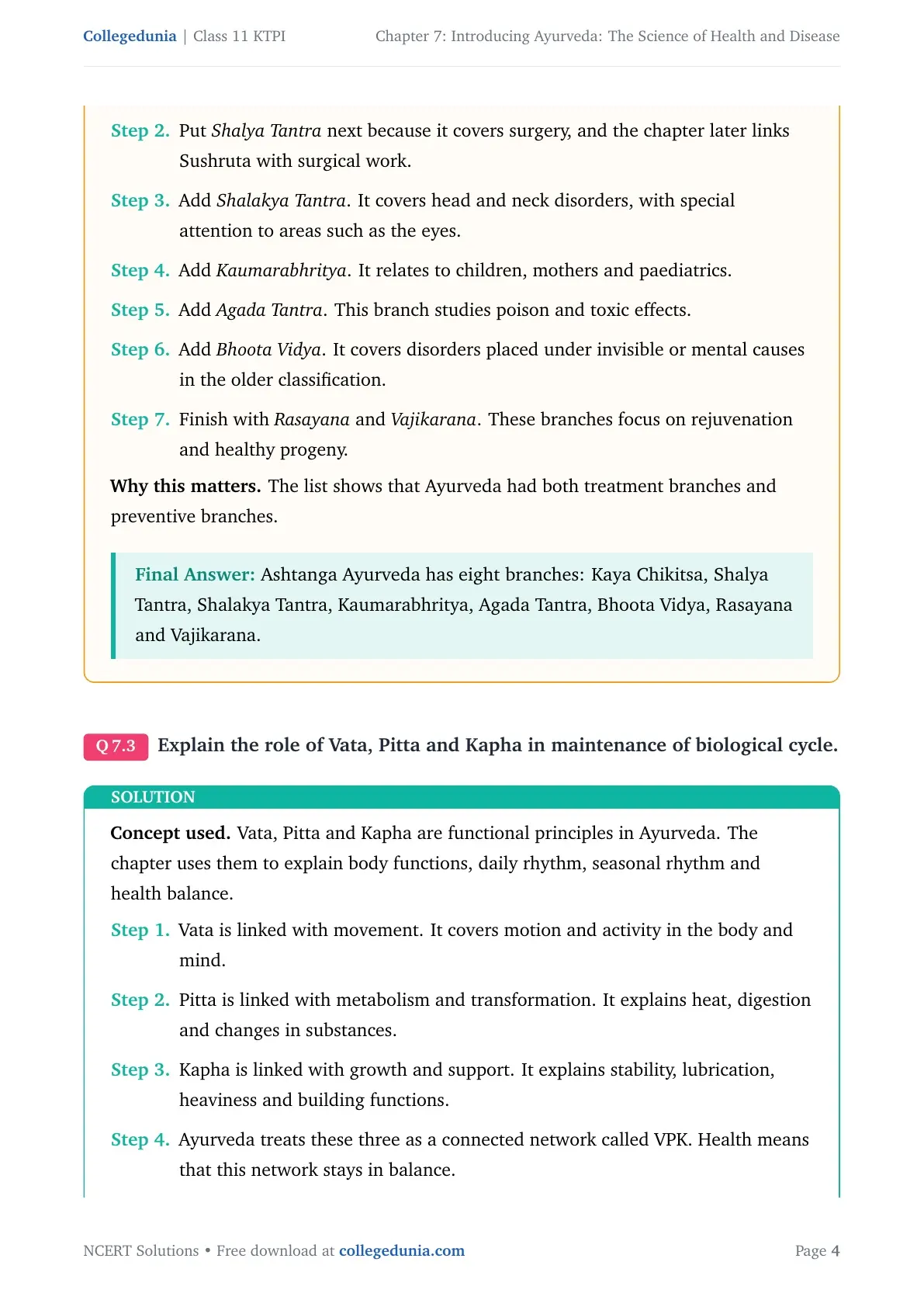
Put Shalya Tantra next because it covers surgery, and the chapter later links Sushruta with surgical work.
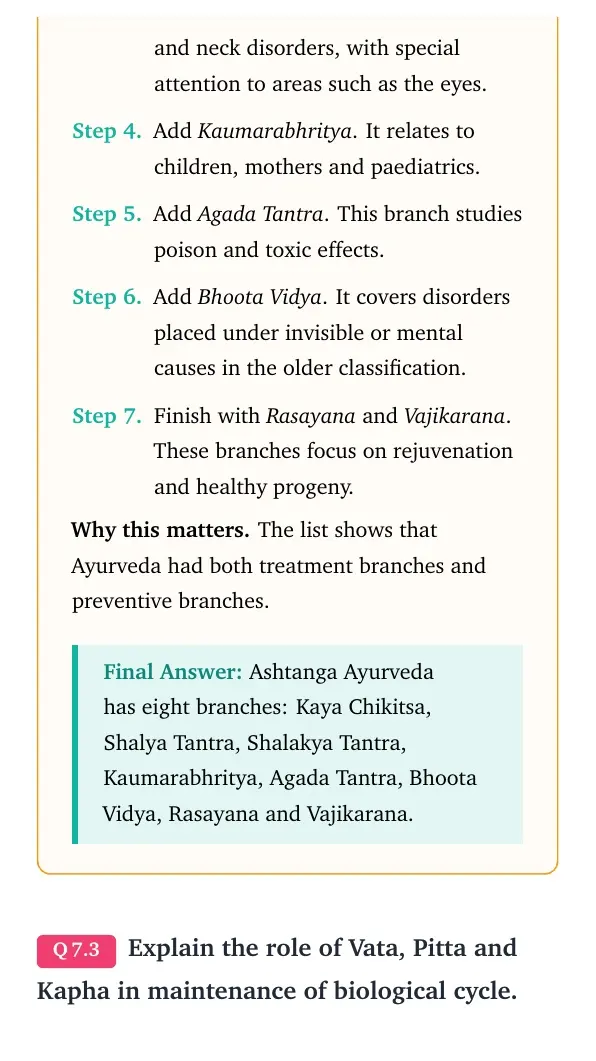
Add Shalakya Tantra. It covers head and neck disorders, with special attention to areas such as the eyes.
Add Kaumarabhritya. It relates to children, mothers and paediatrics.
Add Agada Tantra. This branch studies poison and toxic effects.
Add Bhoota Vidya. It covers disorders placed under invisible or mental causes in the older classification.
Finish with Rasayana and Vajikarana. These branches focus on rejuvenation and healthy progeny.
Why this matters. The list shows that Ayurveda had both treatment branches and preventive branches.
Ashtanga Ayurveda has eight branches: Kaya Chikitsa, Shalya Tantra, Shalakya Tantra, Kaumarabhritya, Agada Tantra, Bhoota Vidya, Rasayana and Vajikarana.
Q 7.3
Explain the role of Vata, Pitta and Kapha in maintenance of biological cycle.
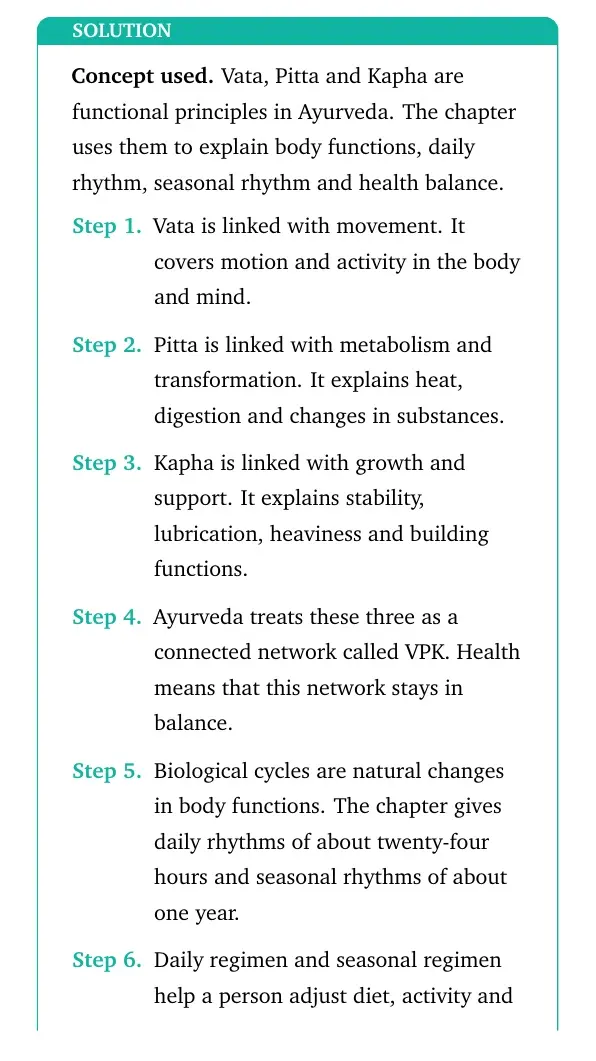
Concept used. Vata, Pitta and Kapha are functional principles in Ayurveda. The chapter uses them to explain body functions, daily rhythm, seasonal rhythm and health balance.
Vata is linked with movement. It covers motion and activity in the body and mind.
Pitta is linked with metabolism and transformation. It explains heat, digestion and changes in substances.
Kapha is linked with growth and support. It explains stability, lubrication, heaviness and building functions.
Ayurveda treats these three as a connected network called VPK. Health means that this network stays in balance.
Biological cycles are natural changes in body functions. The chapter gives daily rhythms of about twenty-four hours and seasonal rhythms of about one year.
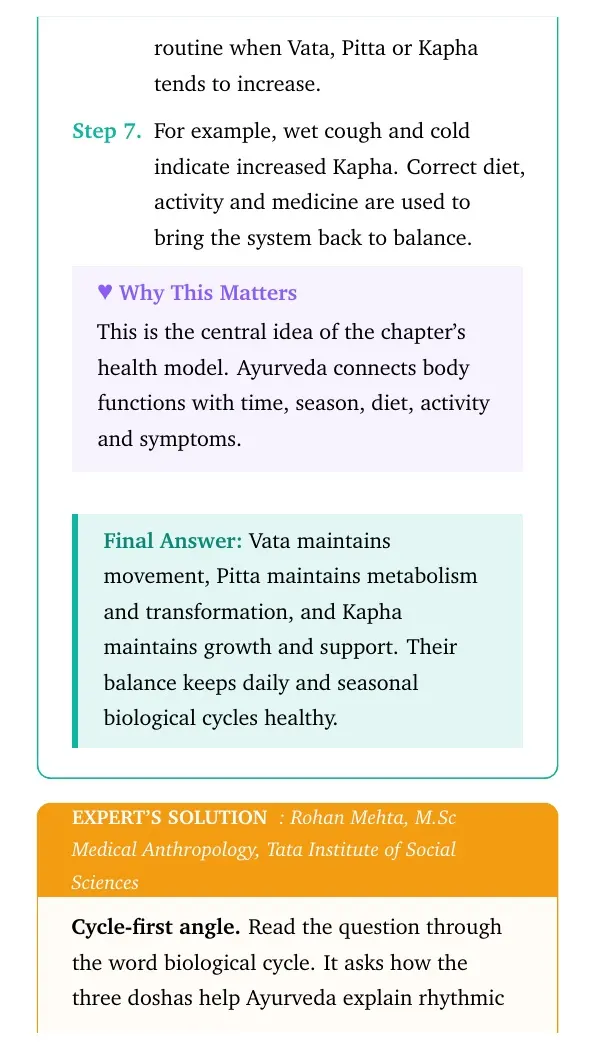
Daily regimen and seasonal regimen help a person adjust diet, activity and routine when Vata, Pitta or Kapha tends to increase.
For example, wet cough and cold indicate increased Kapha. Correct diet, activity and medicine are used to bring the system back to balance.
This is the central idea of the chapter's health model. Ayurveda connects body functions with time, season, diet, activity and symptoms.
Vata maintains movement, Pitta maintains metabolism and transformation, and Kapha maintains growth and support. Their balance keeps daily and seasonal biological cycles healthy.
RM
Rohan Mehta
M.Sc Medical Anthropology, Tata Institute of Social Sciences
Verified Expert
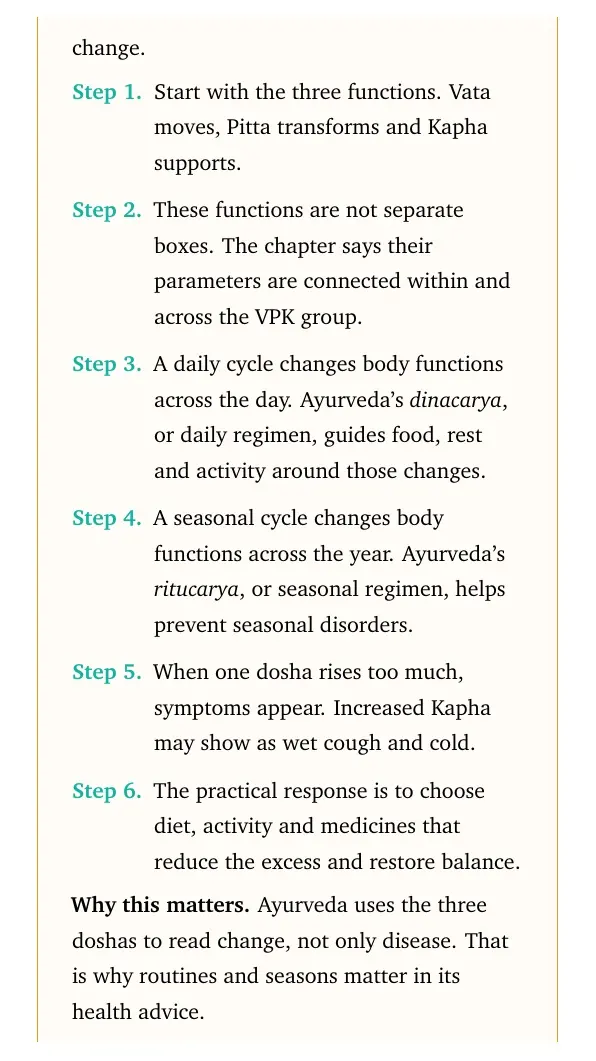
Cycle-first angle. Read the question through the word biological cycle. It asks how the three doshas help Ayurveda explain rhythmic change.
Start with the three functions. Vata moves, Pitta transforms and Kapha supports.
These functions are not separate boxes. The chapter says their parameters are connected within and across the VPK group.
A daily cycle changes body functions across the day. Ayurveda's dinacarya, or daily regimen, guides food, rest and activity around those changes.
A seasonal cycle changes body functions across the year. Ayurveda's ritucarya, or seasonal regimen, helps prevent seasonal disorders.
When one dosha rises too much, symptoms appear. Increased Kapha may show as wet cough and cold.
The practical response is to choose diet, activity and medicines that reduce the excess and restore balance.
Why this matters. Ayurveda uses the three doshas to read change, not only disease. That is why routines and seasons matter in its health advice.
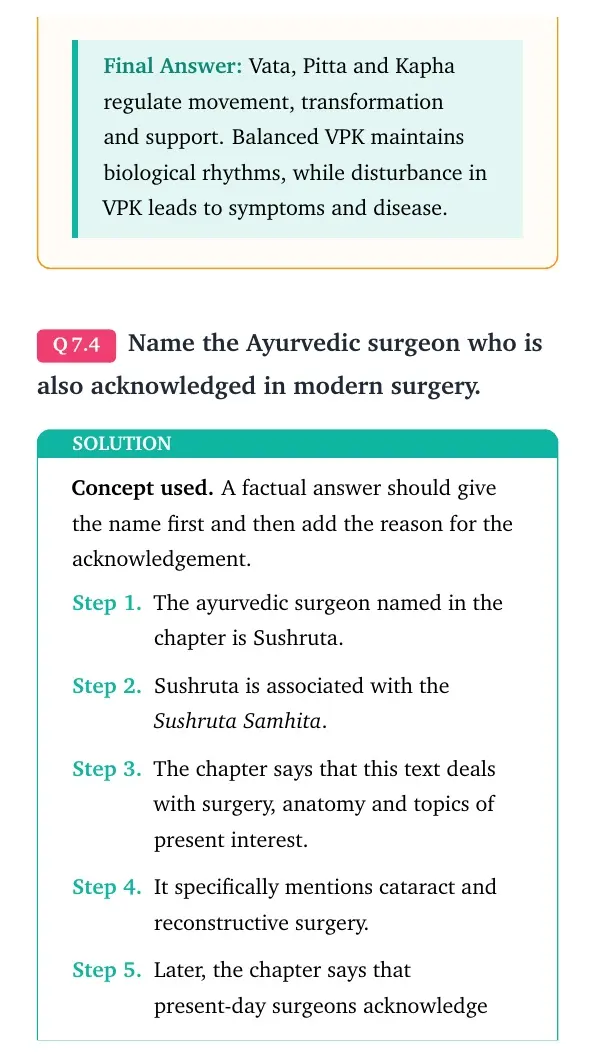
Vata, Pitta and Kapha regulate movement, transformation and support. Balanced VPK maintains biological rhythms, while disturbance in VPK leads to symptoms and disease.
Q 7.4
Name the Ayurvedic surgeon who is also acknowledged in modern surgery.
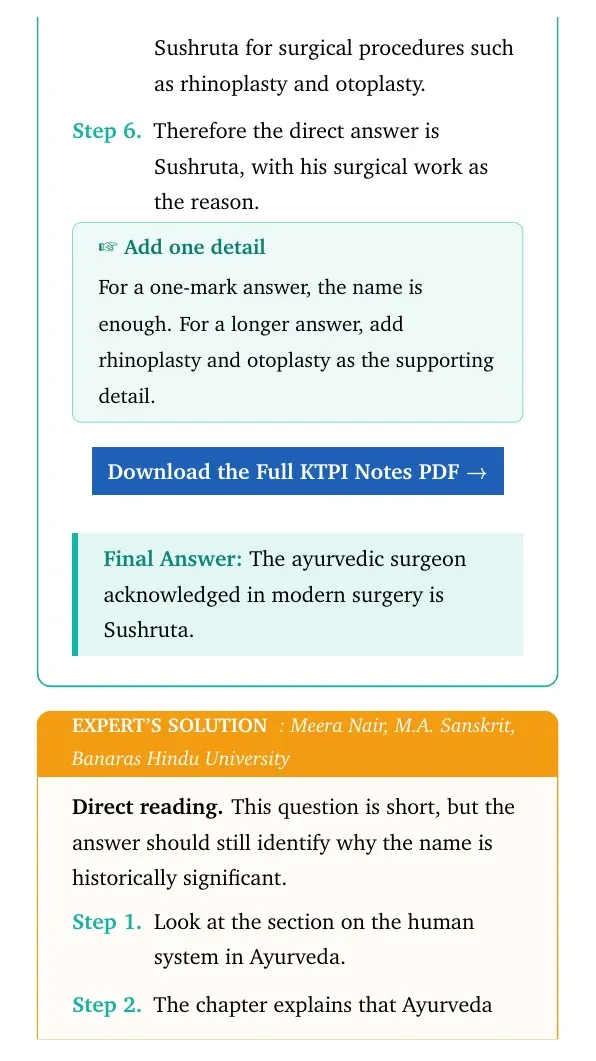
Concept used. A factual answer should give the name first and then add the reason for the acknowledgement.
The ayurvedic surgeon named in the chapter is Sushruta.
Sushruta is associated with the Sushruta Samhita.
The chapter says that this text deals with surgery, anatomy and topics of present interest.
It specifically mentions cataract and reconstructive surgery.
Later, the chapter says that present-day surgeons acknowledge Sushruta for surgical procedures such as rhinoplasty and otoplasty.
Therefore the direct answer is Sushruta, with his surgical work as the reason.
Add one detail
For a one-mark answer, the name is enough. For a longer answer, add rhinoplasty and otoplasty as the supporting detail.
Download the Full KTPI Notes PDF
The ayurvedic surgeon acknowledged in modern surgery is Sushruta.
MN
Meera Nair
M.A. Sanskrit, Banaras Hindu University
Verified Expert
Direct reading. This question is short, but the answer should still identify why the name is historically significant.
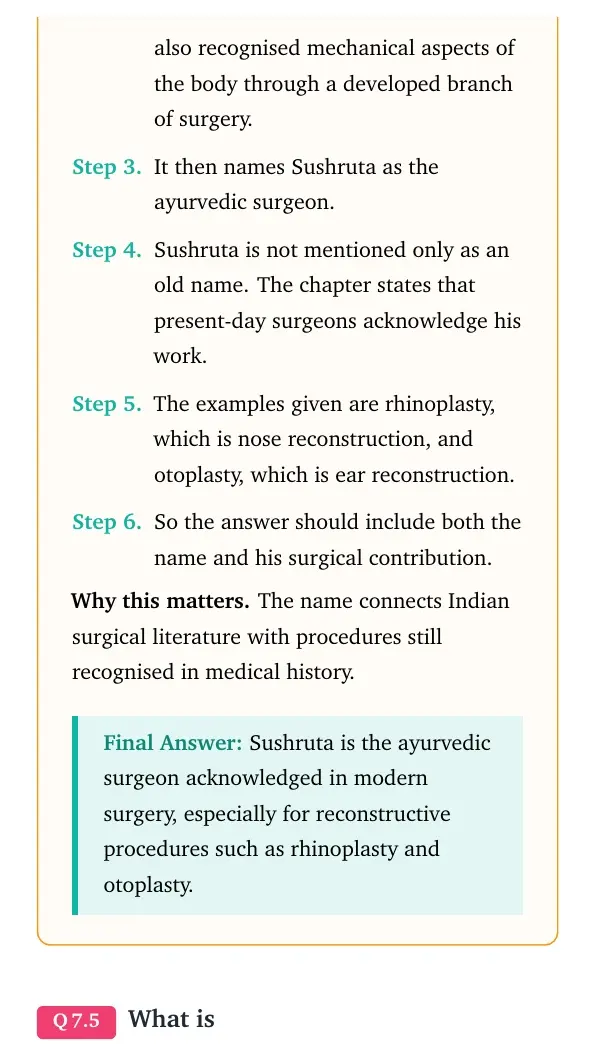
Look at the section on the human system in Ayurveda.
The chapter explains that Ayurveda also recognised mechanical aspects of the body through a developed branch of surgery.
It then names Sushruta as the ayurvedic surgeon.
Sushruta is not mentioned only as an old name. The chapter states that present-day surgeons acknowledge his work.
The examples given are rhinoplasty, which is nose reconstruction, and otoplasty, which is ear reconstruction.
So the answer should include both the name and his surgical contribution.
Why this matters. The name connects Indian surgical literature with procedures still recognised in medical history.
Sushruta is the ayurvedic surgeon acknowledged in modern surgery, especially for reconstructive procedures such as rhinoplasty and otoplasty.
Q 7.5
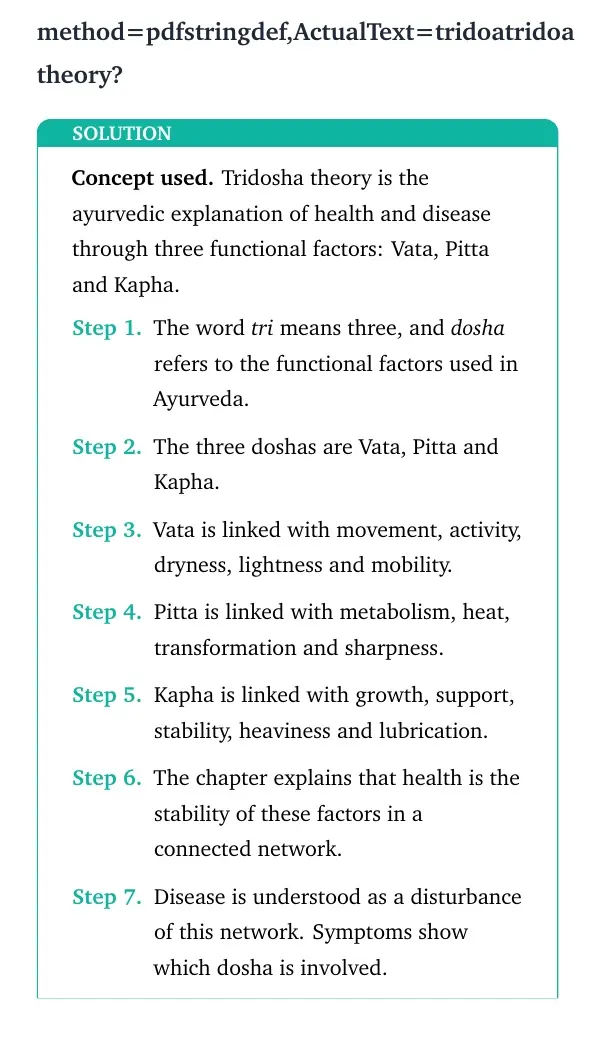
What is tridoṣa theory?
Concept used. Tridosha theory is the ayurvedic explanation of health and disease through three functional factors: Vata, Pitta and Kapha.
The word tri means three, and dosha refers to the functional factors used in Ayurveda.
The three doshas are Vata, Pitta and Kapha.
Vata is linked with movement, activity, dryness, lightness and mobility.
Pitta is linked with metabolism, heat, transformation and sharpness.
Kapha is linked with growth, support, stability, heaviness and lubrication.
The chapter explains that health is the stability of these factors in a connected network.
Disease is understood as a disturbance of this network. Symptoms show which dosha is involved.
Ayurveda classifies diet, plants, activities, seasons and symptoms in terms of Vata, Pitta and Kapha. This helps diagnosis and treatment.
Do not describe tridosha as three body parts. In the chapter, they are functional principles used to understand health and disease.
Tridosha theory explains health and disease through Vata, Pitta and Kapha. Vata governs movement, Pitta governs metabolism and transformation, and Kapha governs growth and support.
SR
Siddharth Rao
Ph.D History of Medicine, Jawaharlal Nehru University
Verified Expert
Meaning-first angle. Tridosha theory becomes simple when each dosha is connected to one main function.
Ayurveda takes a functional view of the body. It asks what processes are happening, not only what structure is present.
In that view, Vata represents movement. It helps explain motion, circulation, nerve activity and change.
Pitta represents metabolism and transformation. It helps explain heat, digestion and conversion of substances.
Kapha represents growth and support. It helps explain stability, lubrication and building of tissues.
These three work together. A healthy state means their linked properties remain steady for that person.
A disease state means some part of the VPK relation is disturbed. Ayurveda reads symptoms to identify that disturbance.
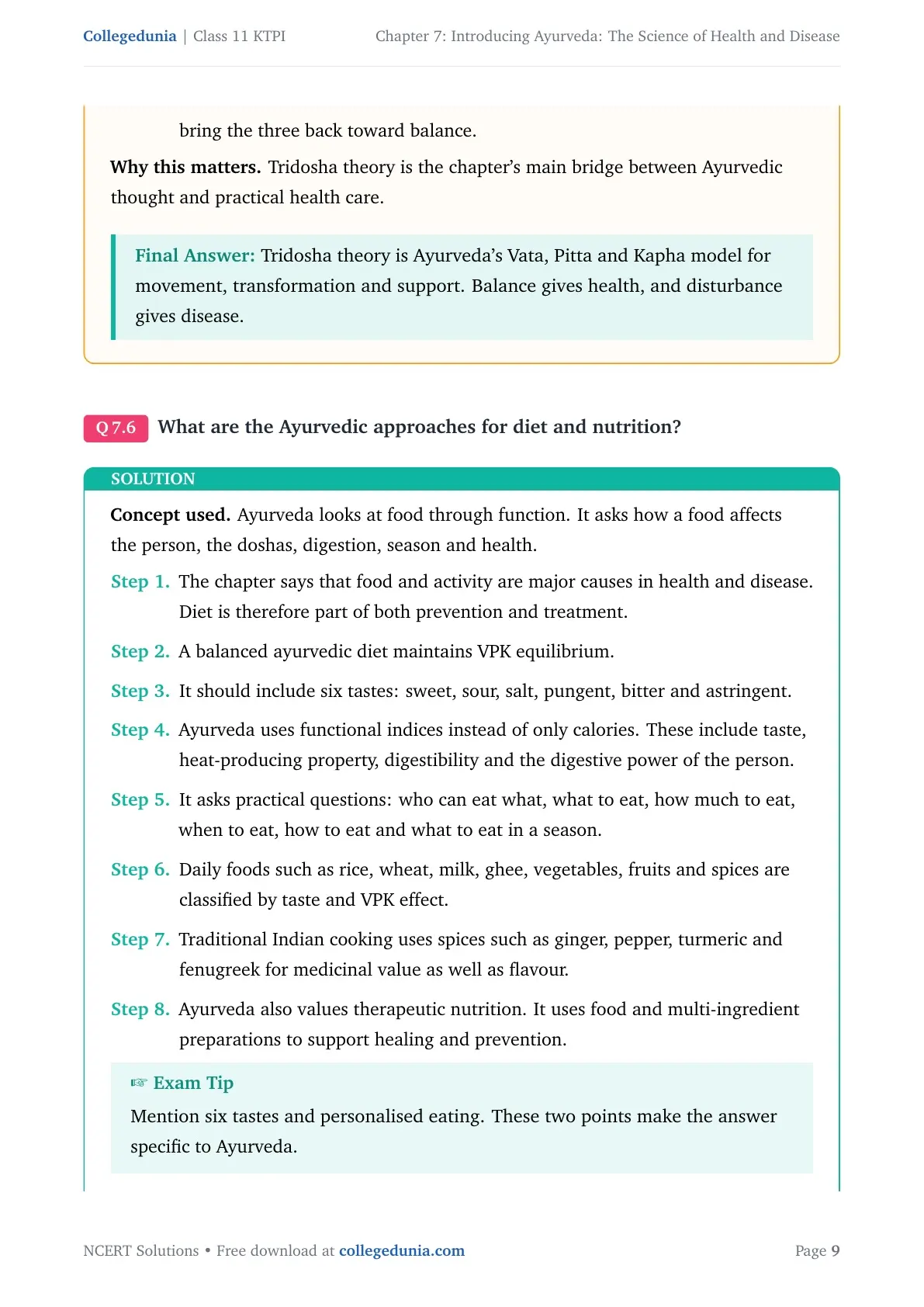
Treatment then uses food, activity, season-aware routine and medicine to bring the three back toward balance.
Why this matters. Tridosha theory is the chapter's main bridge between Ayurvedic thought and practical health care.
Tridosha theory is Ayurveda's Vata, Pitta and Kapha model for movement, transformation and support. Balance gives health, and disturbance gives disease.
Q 7.6
What are the Ayurvedic approaches for diet and nutrition?
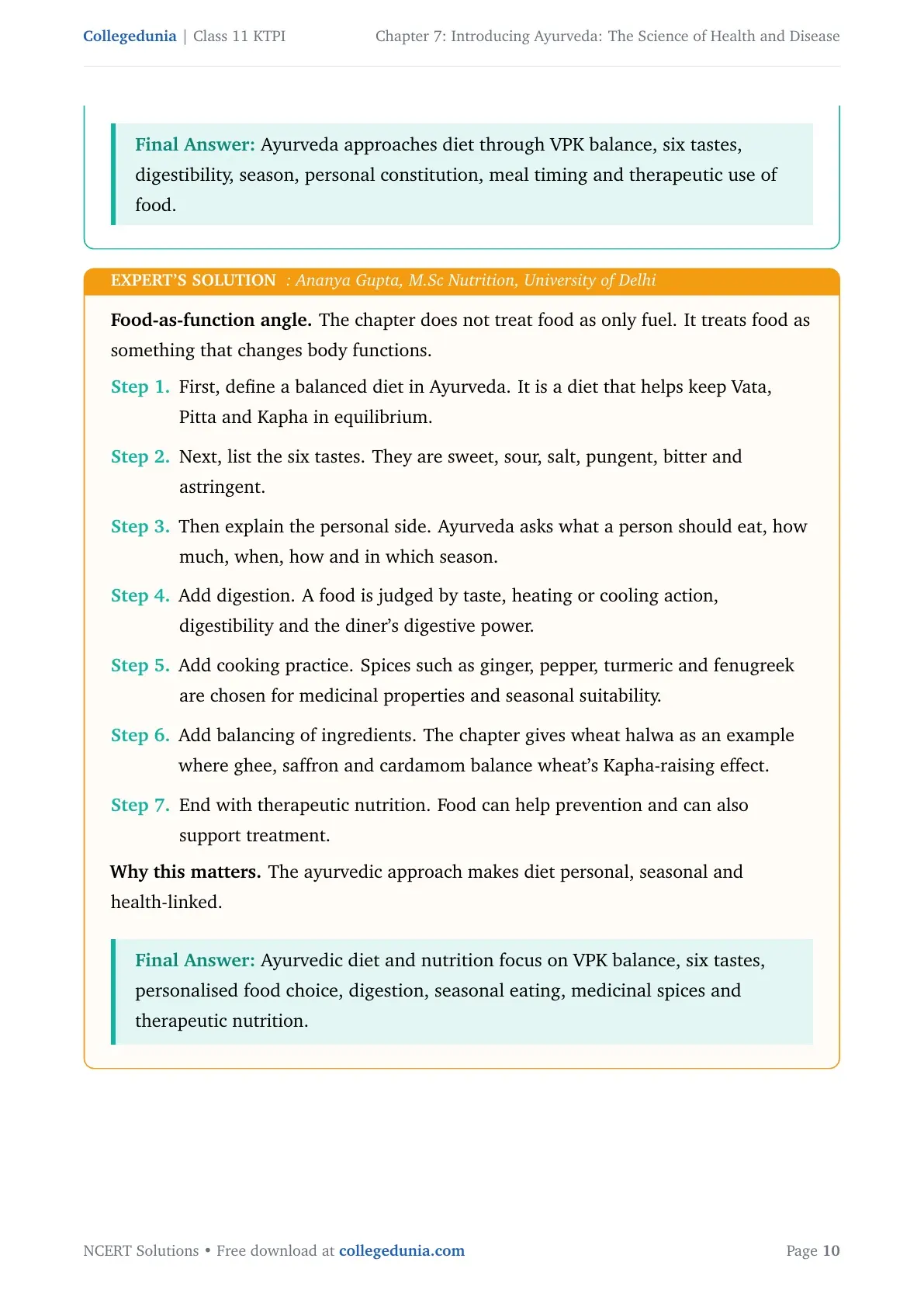
Concept used. Ayurveda looks at food through function. It asks how a food affects the person, the doshas, digestion, season and health.
The chapter says that food and activity are major causes in health and disease. Diet is therefore part of both prevention and treatment.
A balanced ayurvedic diet maintains VPK equilibrium.
It should include six tastes: sweet, sour, salt, pungent, bitter and astringent.
Ayurveda uses functional indices instead of only calories. These include taste, heat-producing property, digestibility and the digestive power of the person.
It asks practical questions: who can eat what, what to eat, how much to eat, when to eat, how to eat and what to eat in a season.
Daily foods such as rice, wheat, milk, ghee, vegetables, fruits and spices are classified by taste and VPK effect.
Traditional Indian cooking uses spices such as ginger, pepper, turmeric and fenugreek for medicinal value as well as flavour.
Ayurveda also values therapeutic nutrition. It uses food and multi-ingredient preparations to support healing and prevention.
Mention six tastes and personalised eating. These two points make the answer specific to Ayurveda.
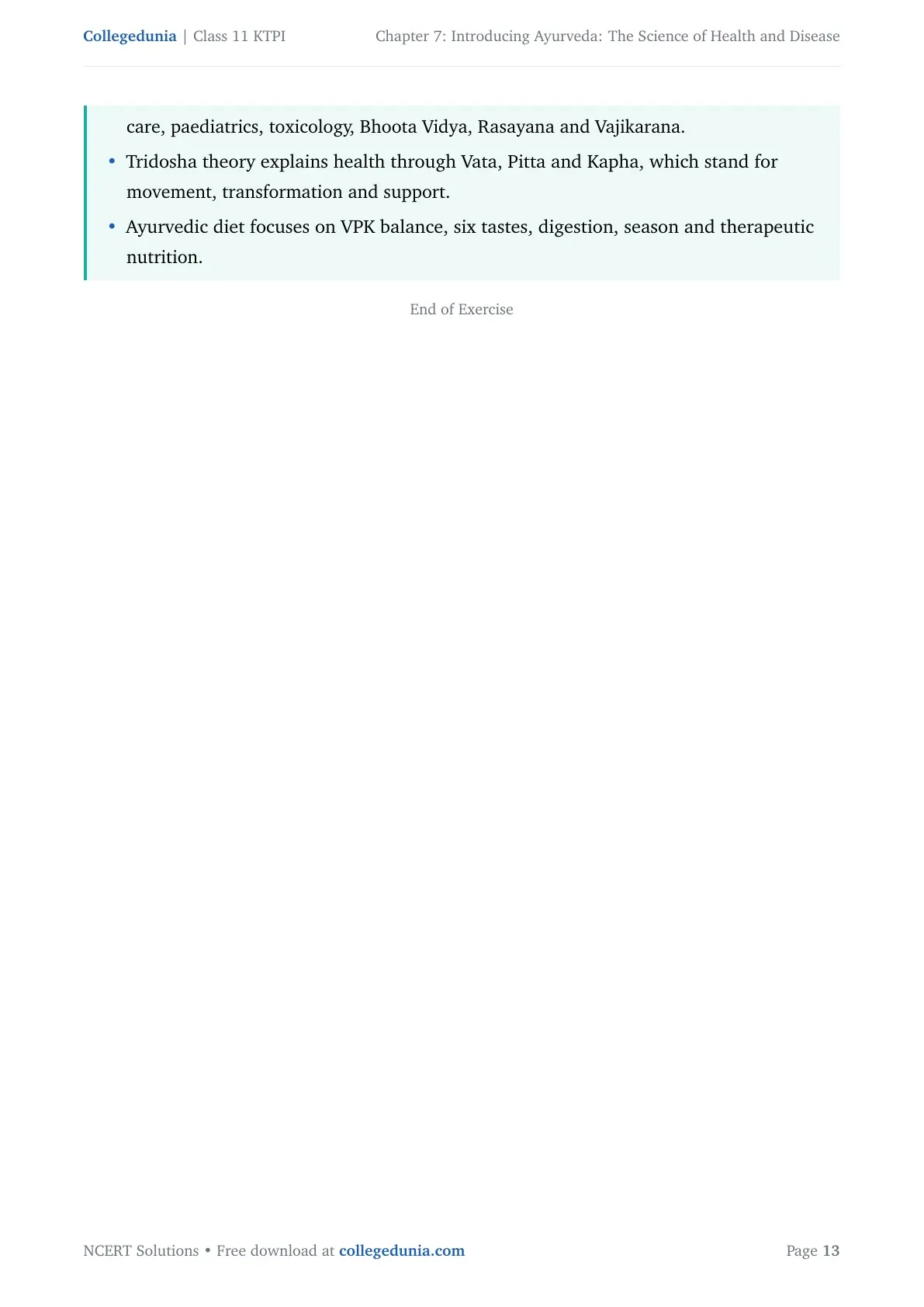
Ayurveda approaches diet through VPK balance, six tastes, digestibility, season, personal constitution, meal timing and therapeutic use of food.
AG
Ananya Gupta
M.Sc Nutrition, University of Delhi
Verified Expert
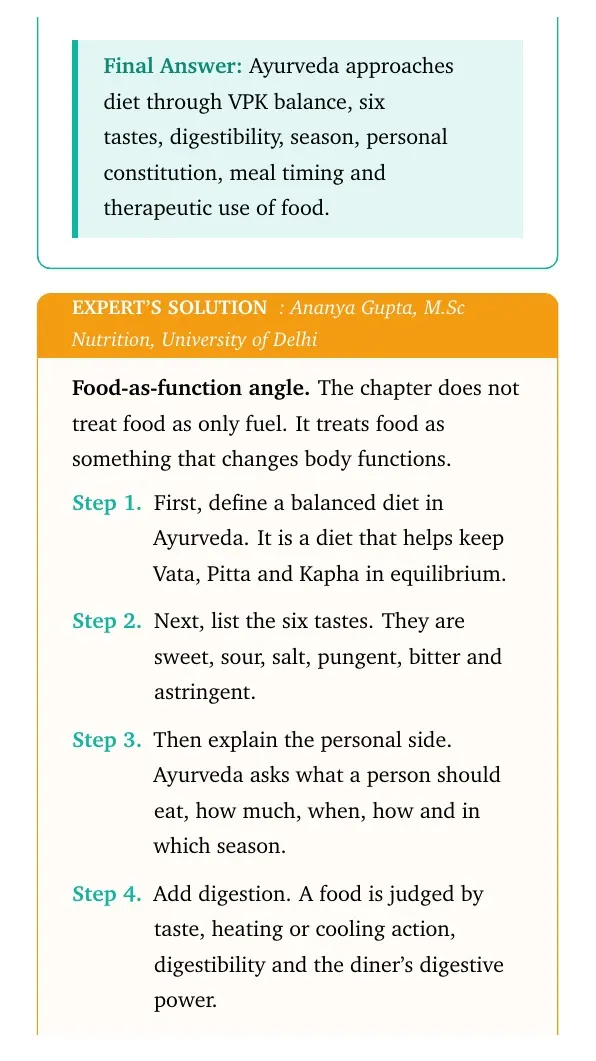
Food-as-function angle. The chapter does not treat food as only fuel. It treats food as something that changes body functions.
First, define a balanced diet in Ayurveda. It is a diet that helps keep Vata, Pitta and Kapha in equilibrium.
Next, list the six tastes. They are sweet, sour, salt, pungent, bitter and astringent.
Then explain the personal side. Ayurveda asks what a person should eat, how much, when, how and in which season.
Add digestion. A food is judged by taste, heating or cooling action, digestibility and the diner's digestive power.
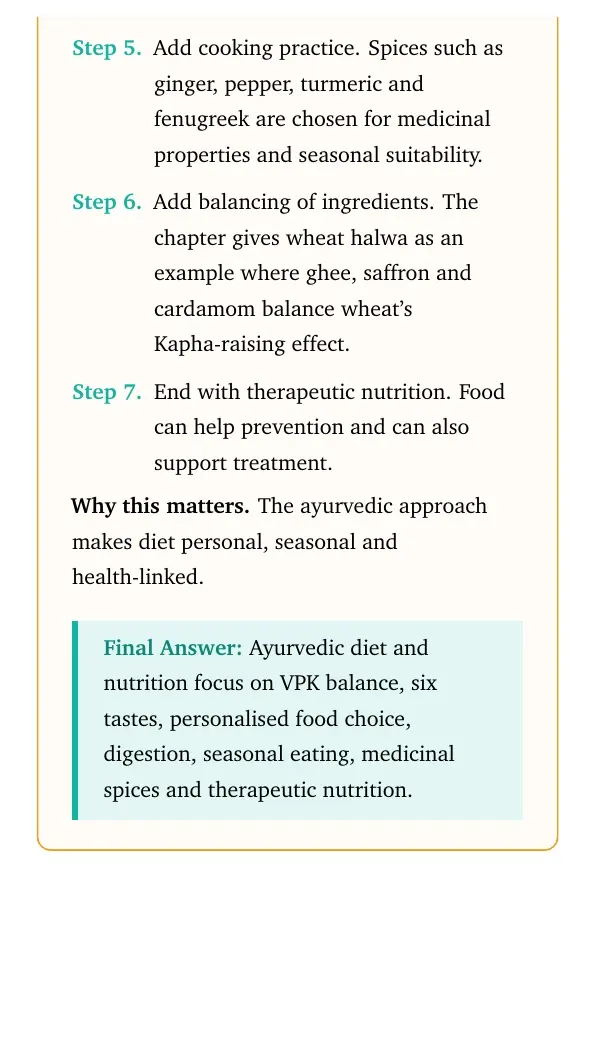
Add cooking practice. Spices such as ginger, pepper, turmeric and fenugreek are chosen for medicinal properties and seasonal suitability.
Add balancing of ingredients. The chapter gives wheat halwa as an example where ghee, saffron and cardamom balance wheat's Kapha-raising effect.
End with therapeutic nutrition. Food can help prevention and can also support treatment.
Why this matters. The ayurvedic approach makes diet personal, seasonal and health-linked.
Ayurvedic diet and nutrition focus on VPK balance, six tastes, personalised food choice, digestion, seasonal eating, medicinal spices and therapeutic nutrition.
Q 7.7
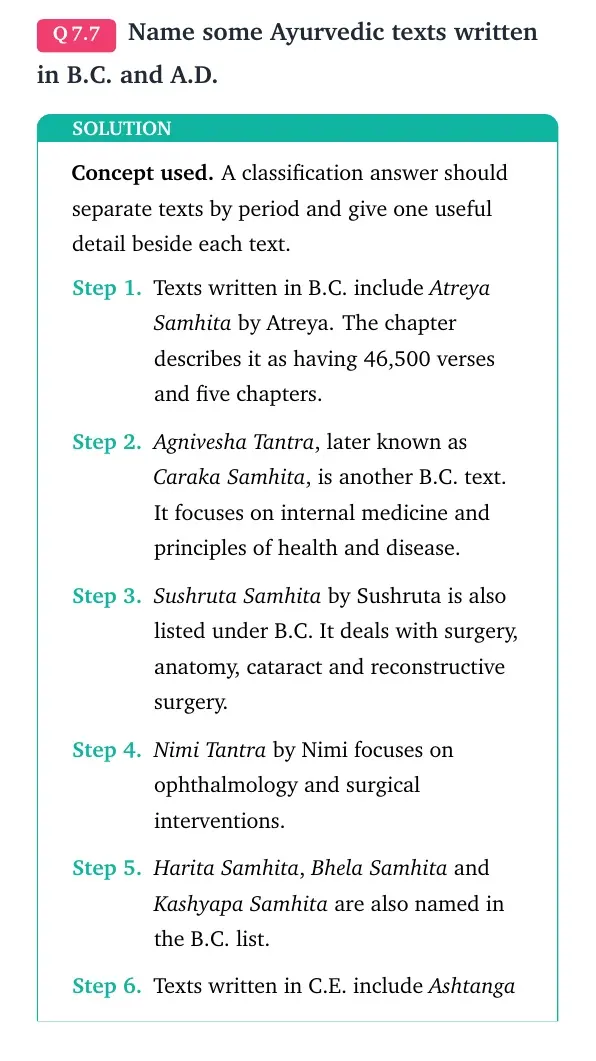
Name some Ayurvedic texts written in B.C. and A.D.
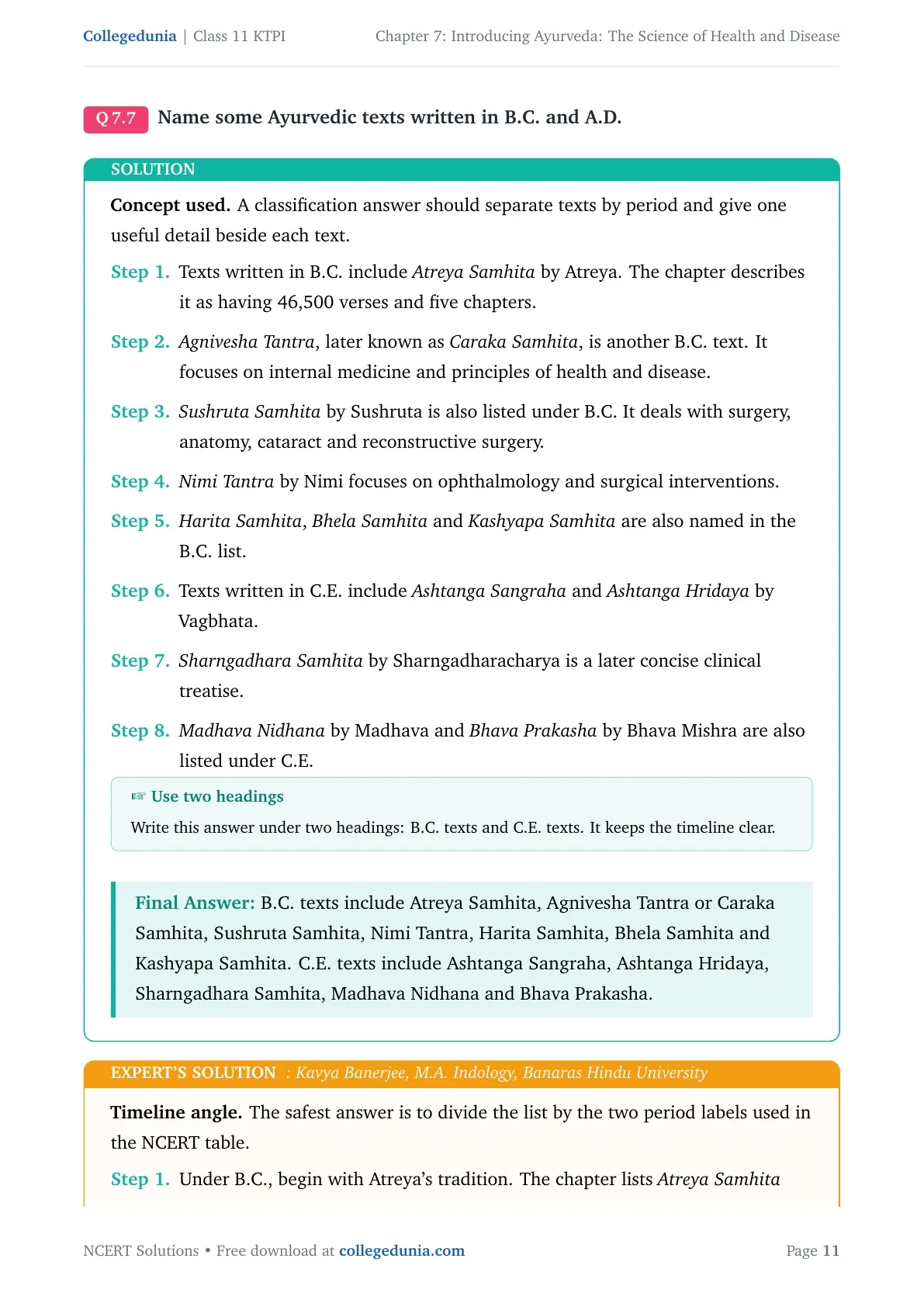
Concept used. A classification answer should separate texts by period and give one useful detail beside each text.
Texts written in B.C. include Atreya Samhita by Atreya. The chapter describes it as having 46,500 verses and five chapters.
Agnivesha Tantra, later known as Caraka Samhita, is another B.C. text. It focuses on internal medicine and principles of health and disease.
Sushruta Samhita by Sushruta is also listed under B.C. It deals with surgery, anatomy, cataract and reconstructive surgery.
Nimi Tantra by Nimi focuses on ophthalmology and surgical interventions.
Harita Samhita, Bhela Samhita and Kashyapa Samhita are also named in the B.C. list.
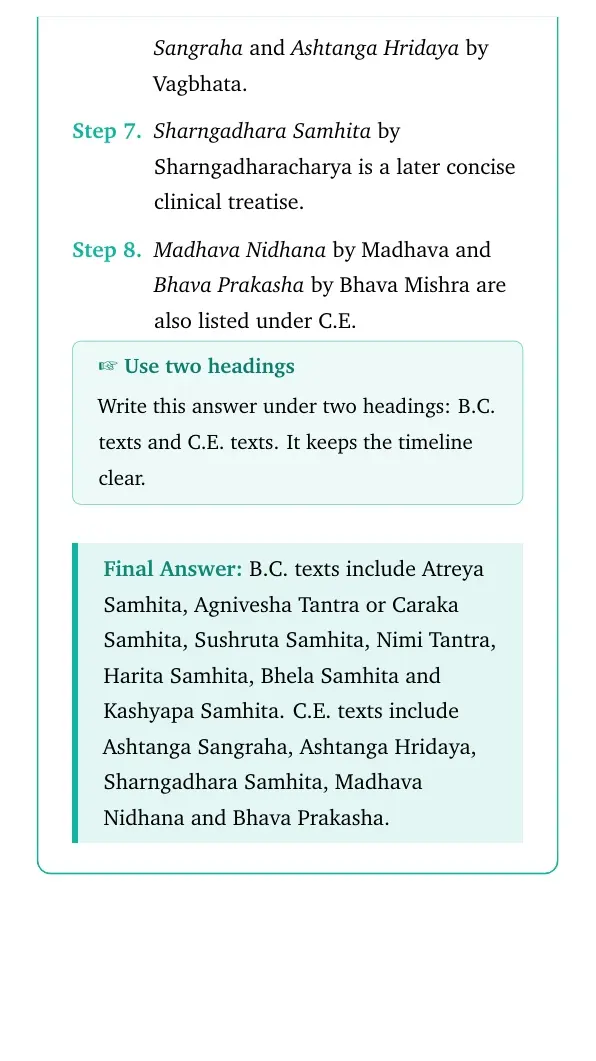
Texts written in C.E. include Ashtanga Sangraha and Ashtanga Hridaya by Vagbhata.
Sharngadhara Samhita by Sharngadharacharya is a later concise clinical treatise.
Madhava Nidhana by Madhava and Bhava Prakasha by Bhava Mishra are also listed under C.E.
Use two headings
Write this answer under two headings: B.C. texts and C.E. texts. It keeps the timeline clear.
B.C. texts include Atreya Samhita, Agnivesha Tantra or Caraka Samhita, Sushruta Samhita, Nimi Tantra, Harita Samhita, Bhela Samhita and Kashyapa Samhita. C.E. texts include Ashtanga Sangraha, Ashtanga Hridaya, Sharngadhara Samhita, Madhava Nidhana and Bhava Prakasha.
KB
Kavya Banerjee
M.A. Indology, Banaras Hindu University
Verified Expert
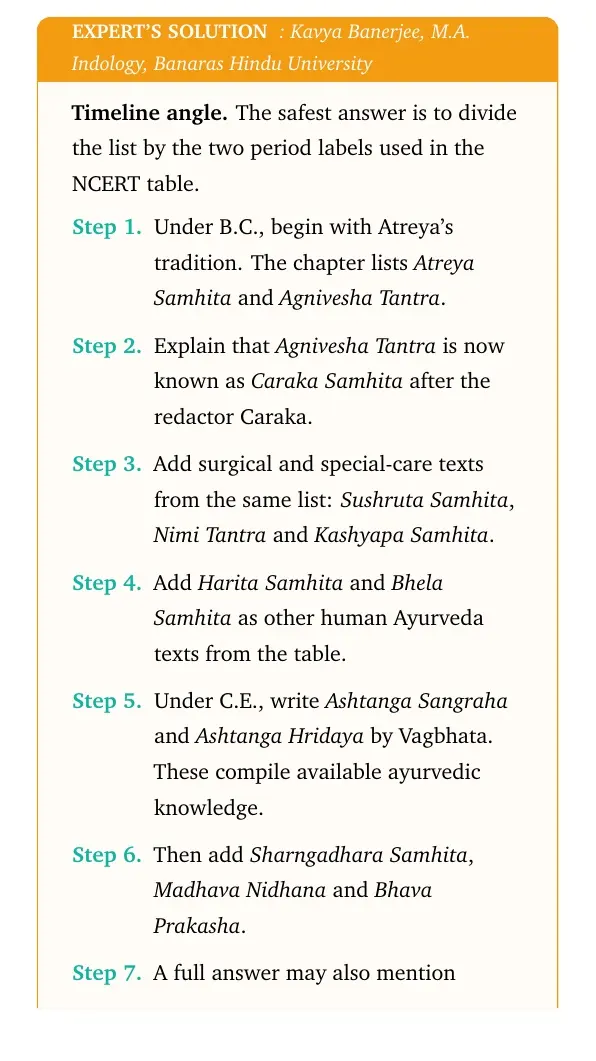
Timeline angle. The safest answer is to divide the list by the two period labels used in the NCERT table.
Under B.C., begin with Atreya's tradition. The chapter lists Atreya Samhita and Agnivesha Tantra.
Explain that Agnivesha Tantra is now known as Caraka Samhita after the redactor Caraka.
Add surgical and special-care texts from the same list: Sushruta Samhita, Nimi Tantra and Kashyapa Samhita.
Add Harita Samhita and Bhela Samhita as other human Ayurveda texts from the table.
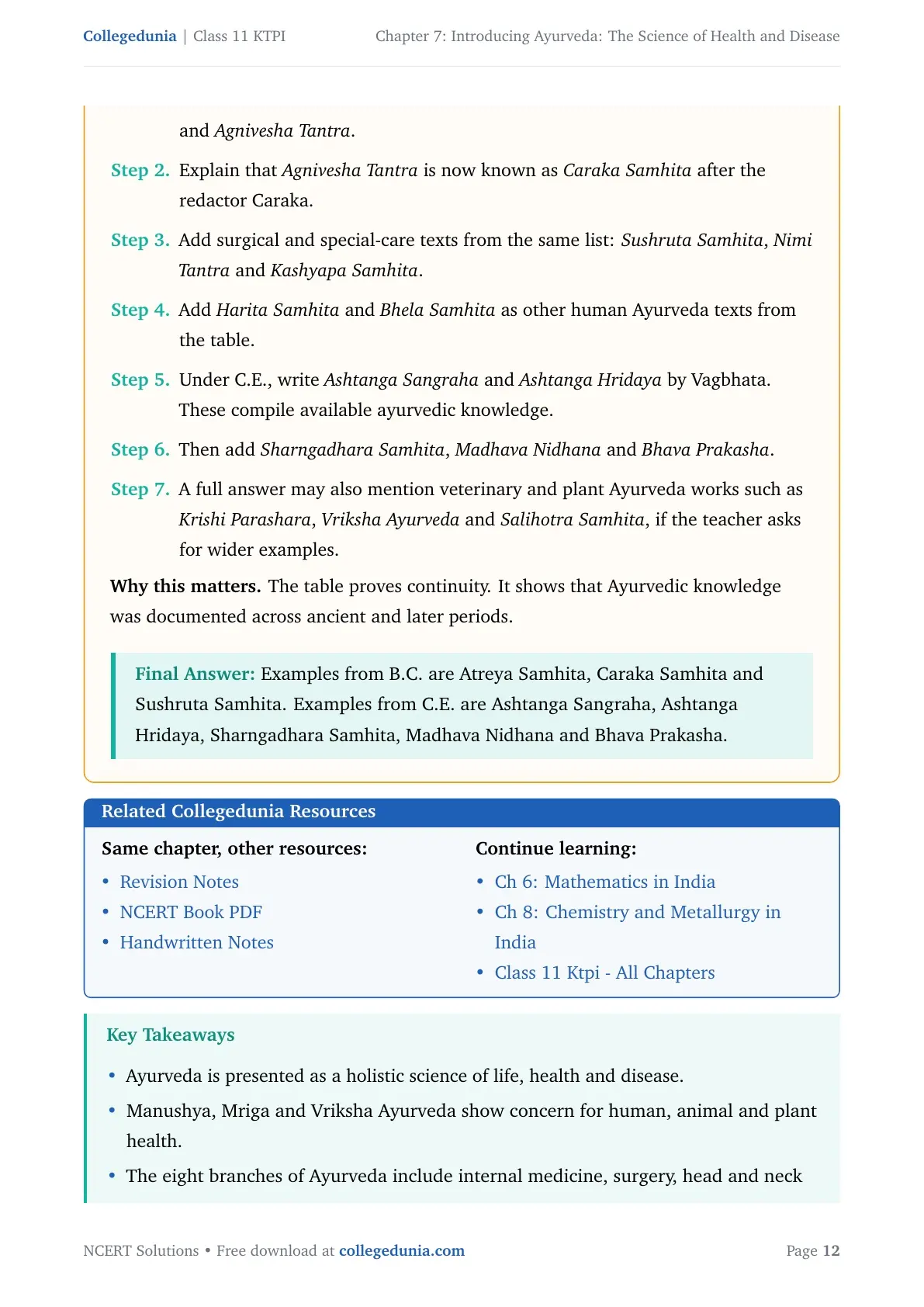
Under C.E., write Ashtanga Sangraha and Ashtanga Hridaya by Vagbhata. These compile available ayurvedic knowledge.
Then add Sharngadhara Samhita, Madhava Nidhana and Bhava Prakasha.
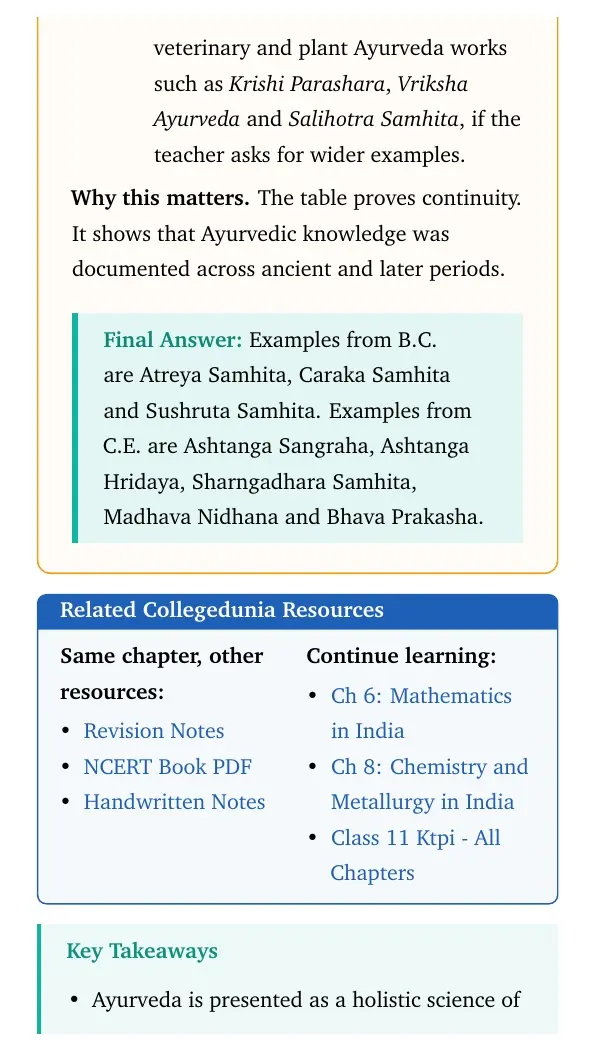
A full answer may also mention veterinary and plant Ayurveda works such as Krishi Parashara, Vriksha Ayurveda and Salihotra Samhita, if the teacher asks for wider examples.
Why this matters. The table proves continuity. It shows that Ayurvedic knowledge was documented across ancient and later periods.
Examples from B.C. are Atreya Samhita, Caraka Samhita and Sushruta Samhita. Examples from C.E. are Ashtanga Sangraha, Ashtanga Hridaya, Sharngadhara Samhita, Madhava Nidhana and Bhava Prakasha.
Class 11 KTPI Introducing Ayurveda NCERT Solutions FAQs
Ques. How many questions are solved in Class 11 KTPI Chapter 7 Introducing Ayurveda?
Ans. This article and PDF solve all 7 NCERT exercise questions from Introducing Ayurveda: The Science of Health and Disease for the 2026-27 Class 11 KTPI syllabus.
Ques. What are the most important topics in Introducing Ayurveda Class 11 KTPI?
Ans. The key topics are Ayurveda history, manusya Ayurveda, mrga Ayurveda, tridosha theory, Vata, Pitta, Kapha, diet, nutrition and classical Ayurveda texts.
Ques. What is tridosha theory in KTPI Chapter 7?
Ans. Tridosha theory explains health and disease through three functional principles called Vata, Pitta and Kapha. A balanced state supports health, while imbalance is linked with disease.
Ques. Which Ayurveda texts should I remember from this chapter?
Ans. Remember Atreya Samhita, Agnivesha Tantra or Caraka Samhita, Sushruta Samhita, Astangahrdaya, Astangasangraha, Madhava Nidana and Bhavaprakasa.
Ques. Which resources should I use with these NCERT Solutions?
Ans. Use the NCERT Book PDF for source reading, chapter notes for short revision and handwritten notes for last-minute recall before writing the exercise answers.








Comments