




The NCERT Solutions for Class 11 Sociology Chapter 10 Indian Sociologists bring together every name, date, definition and argument that the Class 11 Sociology paper actually tests. All 9 exercise questions are answered from the 2026-27 Understanding Society textbook, and each answer stays with the sociologist the question belongs to.
- Covers all 9 textbook exercise questions, the two pioneers and the four founding figures of Indian sociology.
- This chapter usually carries 8 to 10 marks in the Class 11 Sociology paper.
- Written according to the 2026-27 NCERT Understanding Society book, where this sits as Chapter 5.
Every answer in this Collegedunia compilation is curated by Class 11 Sociology teachers, checked line by line against the 2026-27 NCERT Understanding Society print, and refined against the last five years of school question papers.
Student Feedback: In a Collegedunia poll of 13,460 Class 11 Sociology students taken before the 2026-27 session exams, 68% of the students surveyed said they could not tell the four sociologists apart in the exam hall. Only 21% could list all six features of caste in Ghurye's definition.
Source: 2026-27 Class 11 Sociology student poll. Sample of 13,460 students from schools across 17 states.
How Collegedunia's Indian Sociologists Answers Help You Score in Class 11
This chapter is marked on names, positions and reasons. An answer on caste that never says who held which position loses most of its marks. Our answers keep one sociologist in front of every point.
- Every answer opens with the position the question asks about, then adds the evidence the book gives for it.
- Answers are sized by marks. A 2 mark answer stays near 40 words, a 6 mark answer runs to five clear points.
- Names, book titles and years are marked in bold, so you can build a one page revision sheet straight from the answers.
- Ghurye, Mukerji, Desai and Srinivas are never mixed inside one answer unless the question asks you to compare them.
Indian Sociologists Chapter Summary for Class 11 Sociology
Sociology came to Indian universities in 1919, at Bombay. The chapter first explains why an Indian sociology was hard to imagine in a colony, then takes up two self taught pioneers, then four founding figures who shaped the subject after independence.
| Section | What it establishes |
|---|---|
| The Indian context | Modernity in India arrived with colonial subjugation, so sociology here had a different job from sociology in Europe |
| The two pioneers | L.K. Ananthakrishna Iyer and Sarat Chandra Roy became anthropologists by accident, outside any university department |
| G.S. Ghurye | Founder of institutionalised sociology in India, known for his work on tribes, caste and race |
| D.P. Mukerji | Tradition as a living tradition, and the duty of an Indian sociologist to be an Indian first |
| A.R. Desai | A Marxist reading of Indian nationalism, and the argument that the welfare state is a myth |
| M.N. Srinivas | The village as a real social entity, and the rise of village studies after independence |
| Conclusion | Four different routes by which sociology was Indianised in a newly independent country |
Indian Sociologists NCERT Solutions Explained on Video
Source: Magnet Brains on YouTube
Why Sociology Arrived Late in India and What Questions the Colony Raised
The opening pages are the setting for every later answer, and schools turn them into a 4 mark question. Formal university teaching of sociology began in 1919 at the University of Bombay. Calcutta and Lucknow started programmes in the 1920s. The pioneers had to work out what the subject was for.
- Western sociology grew out of modernity. India was living through modernity too, but as a colony, so its first experience of the modern was tied to colonial subjugation.
- Western social anthropology grew out of curiosity about primitive cultures. India was an ancient and advanced civilisation that also had communities described as primitive inside it.
- A free India was about to begin planned development and democracy. What use could a new subject like sociology be to that project?
The line the examiner wants is that these questions were not available ready made. They took shape only through the experience of doing sociology in an Indian context, which is why the early figures had to invent both the answers and the questions.
How Ananthakrishna Iyer and Sarat Chandra Roy Came to Practise Social Anthropology
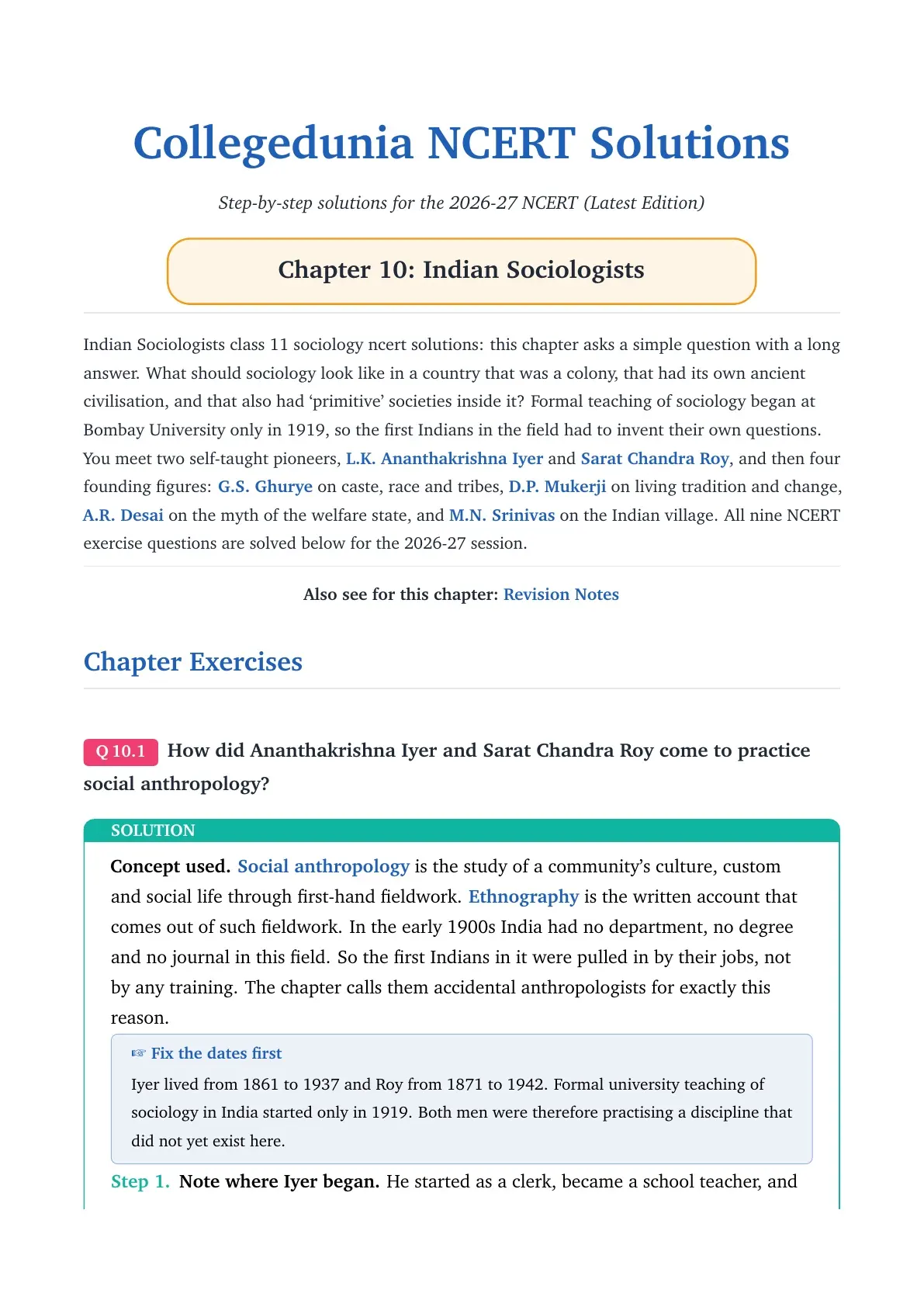
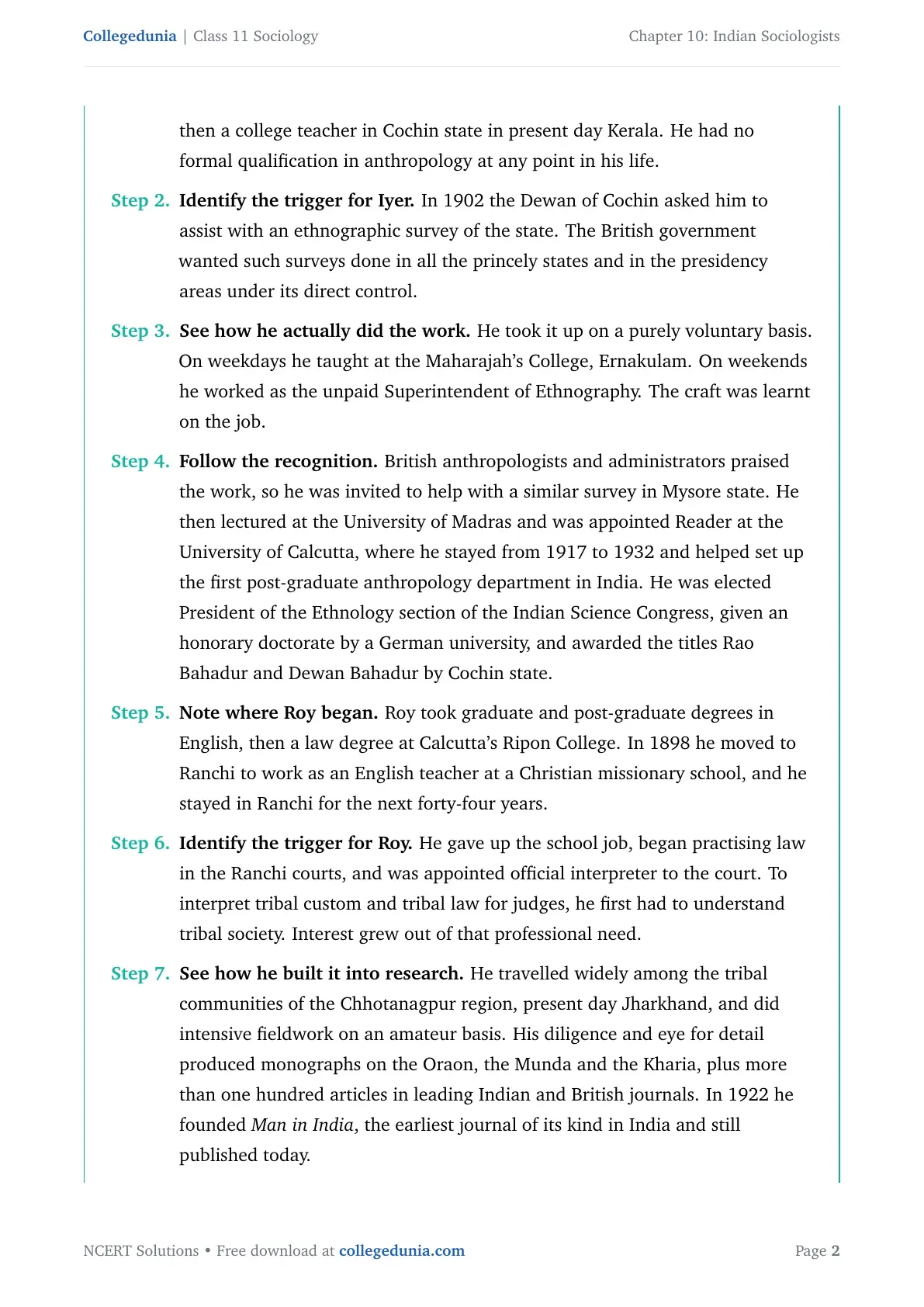
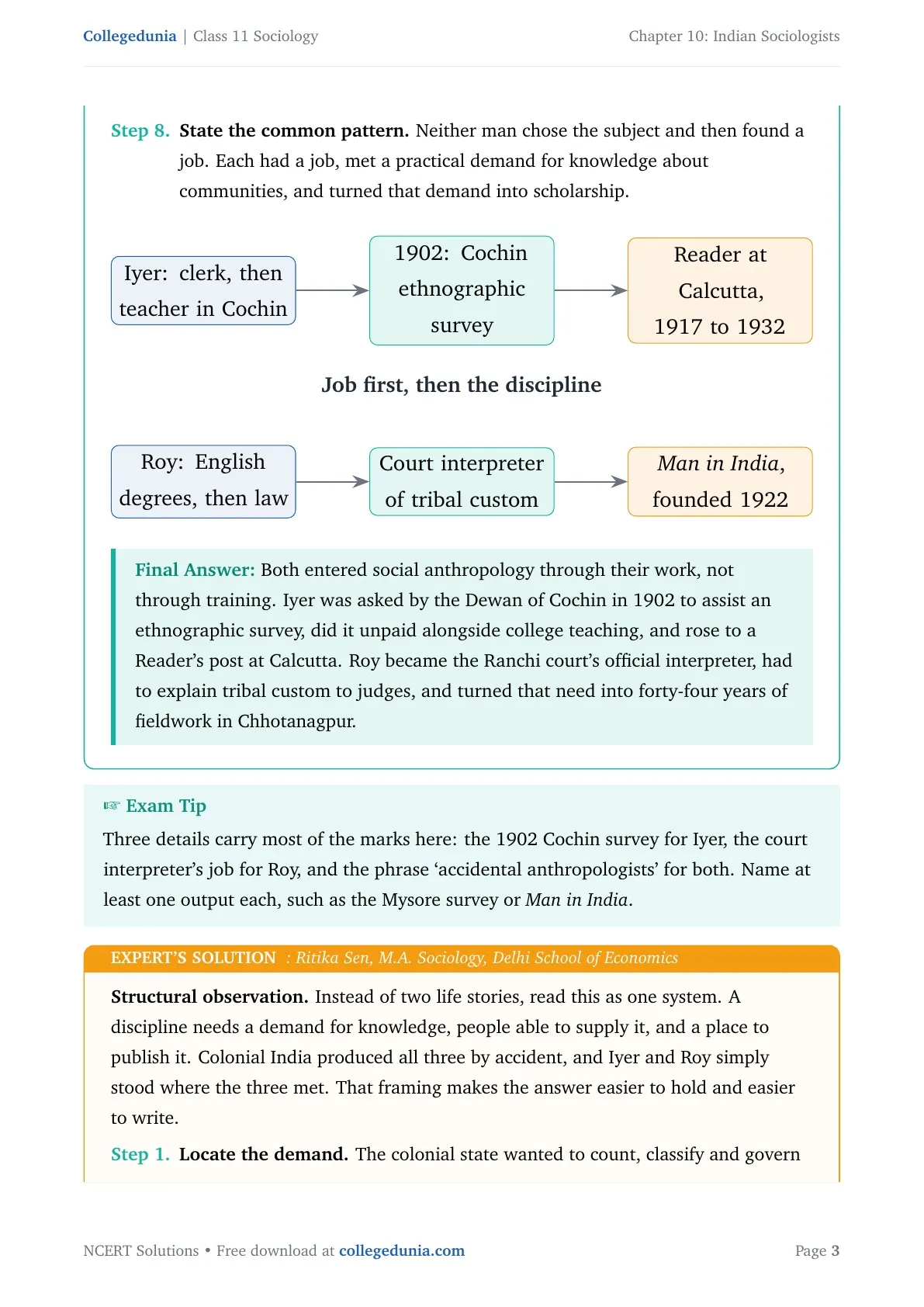
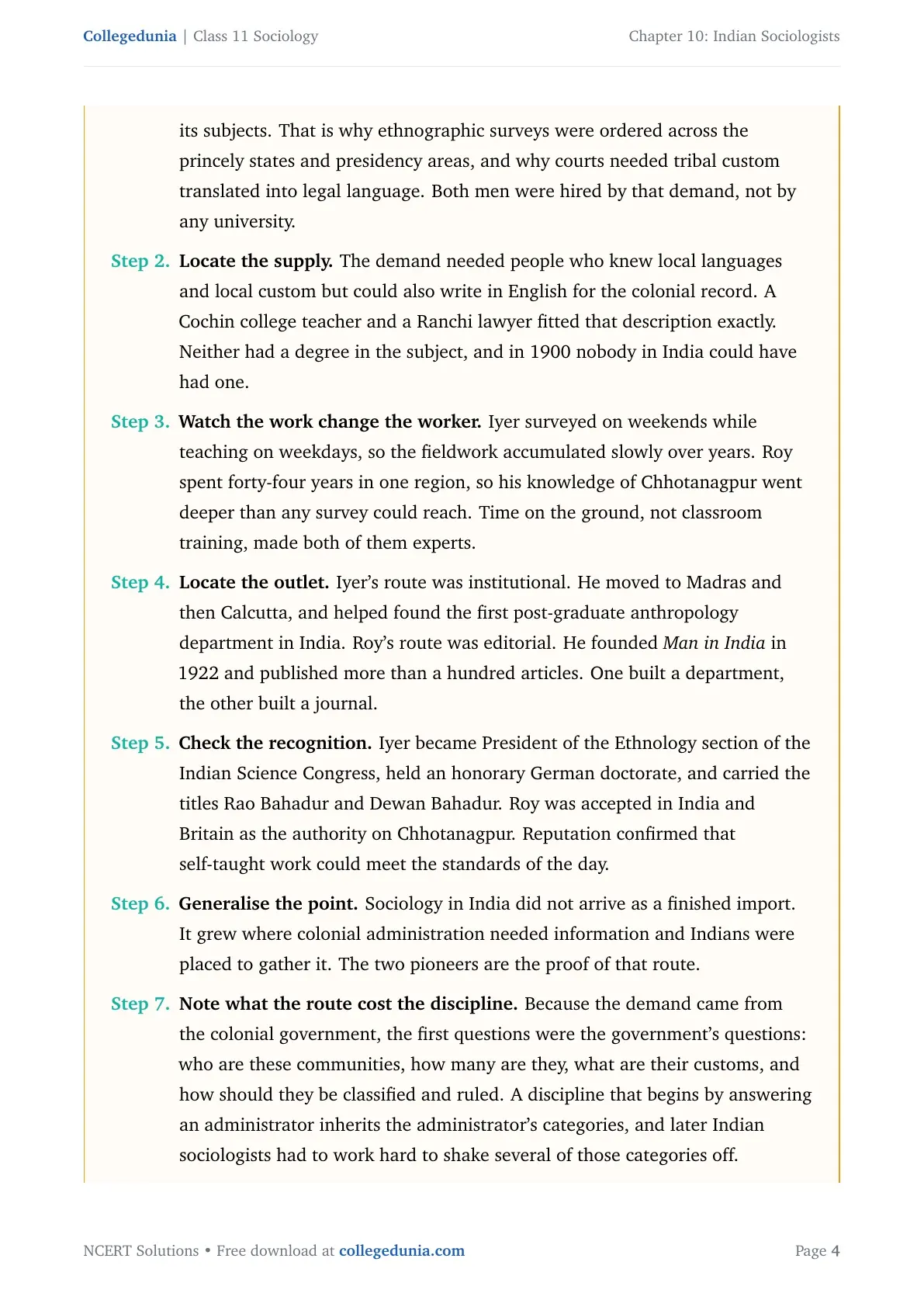
Exercise question 1 asks this directly and it is a straight recall answer. Both men were what the chapter calls accidental anthropologists. Give the career route for each, in order, and add the recognition each earned.
| Point | L.K. Ananthakrishna Iyer (1861-1937) | Sarat Chandra Roy (1871-1942) |
|---|---|---|
| Starting career | Clerk, then school teacher, then college teacher in Cochin state in present day Kerala | Degrees in English, then a law degree from Ripon College in Calcutta |
| The turning point | In 1902 the Dewan of Cochin asked him to assist with an ethnographic survey of the state | In 1898 he went to Ranchi as an English teacher at a Christian missionary school, and stayed 44 years |
| How the work was done | Purely voluntary, teaching on weekdays and working as unpaid Superintendent of Ethnography at weekends | On an amateur basis, after he was appointed official interpreter at the Ranchi courts |
| Field of study | Ethnographic surveys of Cochin, and later of Mysore state | Tribal society of the Chhotanagpur region, present day Jharkhand |
| Recognition | Reader at Calcutta from 1917 to 1932, set up India's first post graduate anthropology department, President of the Ethnology section of the Indian Science Congress | Over one hundred articles, monographs on the Oraon, the Mundas and the Kharias, founded the journal Man in India in 1922 |
Close the answer with the sentence that carries the last mark. In the early 1900s both men were practising a discipline that did not yet exist in India and that had no institutions to promote it. Neither had a formal qualification in anthropology.
G.S. Ghurye as the Founder of Institutionalised Sociology in India
Govind Sadashiv Ghurye lived from 1893 to 1983 and was born in Malvan in the Konkan region. He took Sanskrit Honours at Elphinstone College, won a University of Bombay scholarship in 1919, studied at the London School of Economics under L.T. Hobhouse and then at Cambridge under W.H.R. Rivers, whose diffusionist perspective shaped him.
- He headed the Sociology department at Bombay University for thirty five years, from 1924 onwards.
- The first Ph.D. in Sociology at an Indian university was awarded under his supervision in 1936, to G.R. Pradhan.
- He founded the Indian Sociological Society in 1951 and its journal Sociological Bulletin in 1952.
- His department was the first to combine teaching and research in the same institution, and to merge social anthropology and sociology into one composite discipline.
- He retired in 1959 but kept writing, and 17 of his 30 books were written after retirement.
- His themes ran from tribes, caste and race to kinship, family and marriage, cities, religion, and the sociology of conflict and integration.
If the question asks what influenced him, name three things: diffusionism, Orientalist scholarship on Hindu religion and thought, and nationalism along with the cultural side of Hindu identity.
The Debate on Tribal Communities: Protectionists Against Nationalists
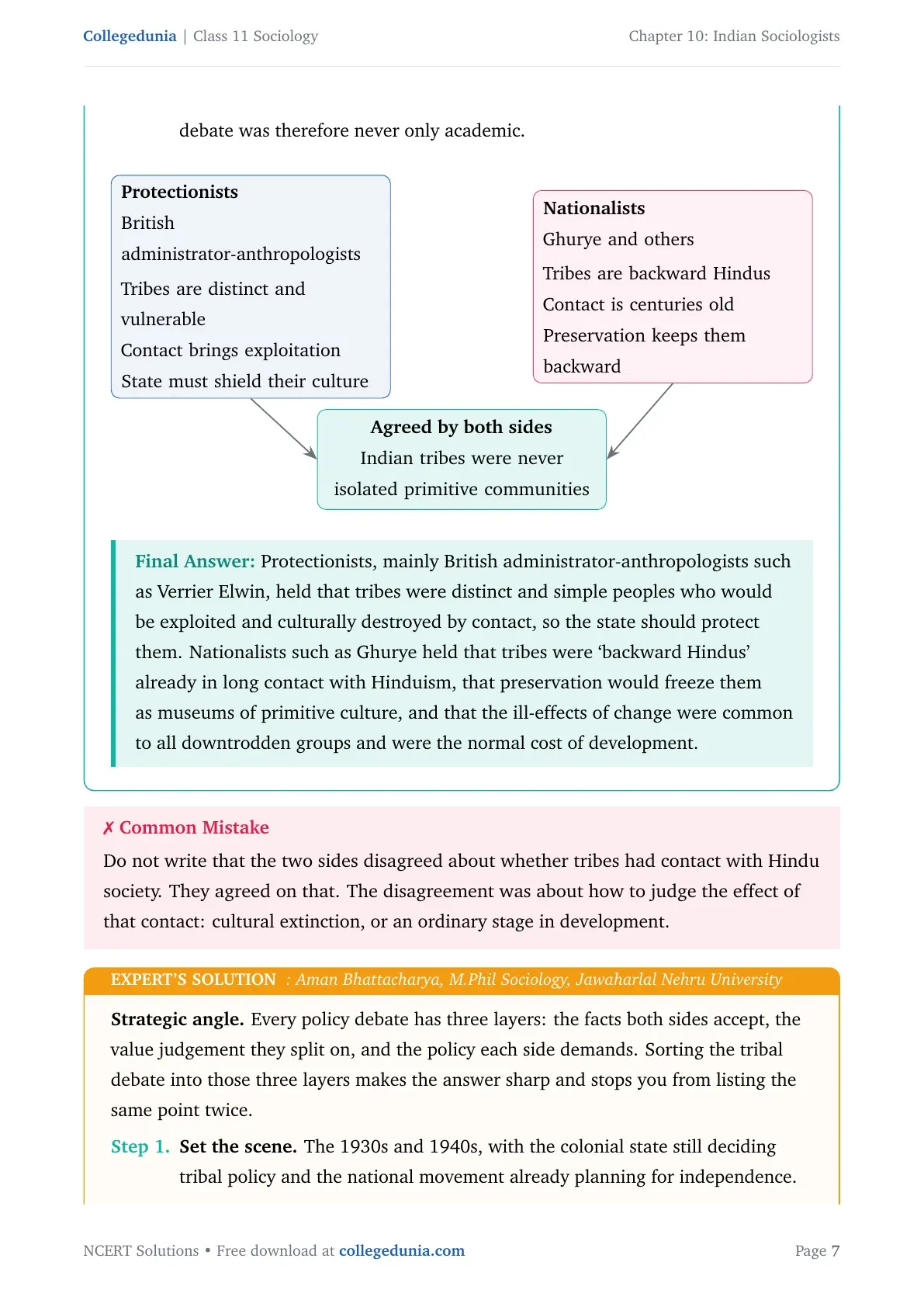
Exercise question 2 asks for the main arguments on either side, so the answer must be split into two halves of equal length. The debate ran through the 1930s and 1940s and it made Ghurye known outside sociology, mainly through his exchange with Verrier Elwin.
| Point of difference | The protectionists | Ghurye and the nationalists |
|---|---|---|
| Who held it | Many British administrator anthropologists | Nationalist Indians, with Ghurye as the best known exponent |
| What tribes were | Primitive peoples with a distinctive culture far from mainstream Hinduism | Backward Hindus, not distinct cultural groups |
| Evidence used | The innocence and simplicity of tribal life under pressure from Hindu society | Detailed evidence of constant interaction between tribal cultures and Hinduism over a long period |
| Fear or expectation | Contact would bring exploitation, cultural degradation and eventual cultural extinction | Tribes were further behind in the same process of assimilation every Indian community had gone through |
| Role of the state | The state had a duty to protect tribes and help them sustain their way of life | Attempts to preserve tribal culture kept tribals backward, as museums of primitive culture |
| View of the ill effects | Specific to tribal cultures | Common to all backward and downtrodden sections, and an inevitable difficulty on the road to development |
One sentence separates a 4 mark answer from a 6 mark one. The claim that Indian tribals were hardly ever isolated primitive communities was not really disputed by either side. The two sides differed only on how the impact of mainstream culture should be judged.
Herbert Risley and G.S. Ghurye on the Relationship Between Race and Caste in India
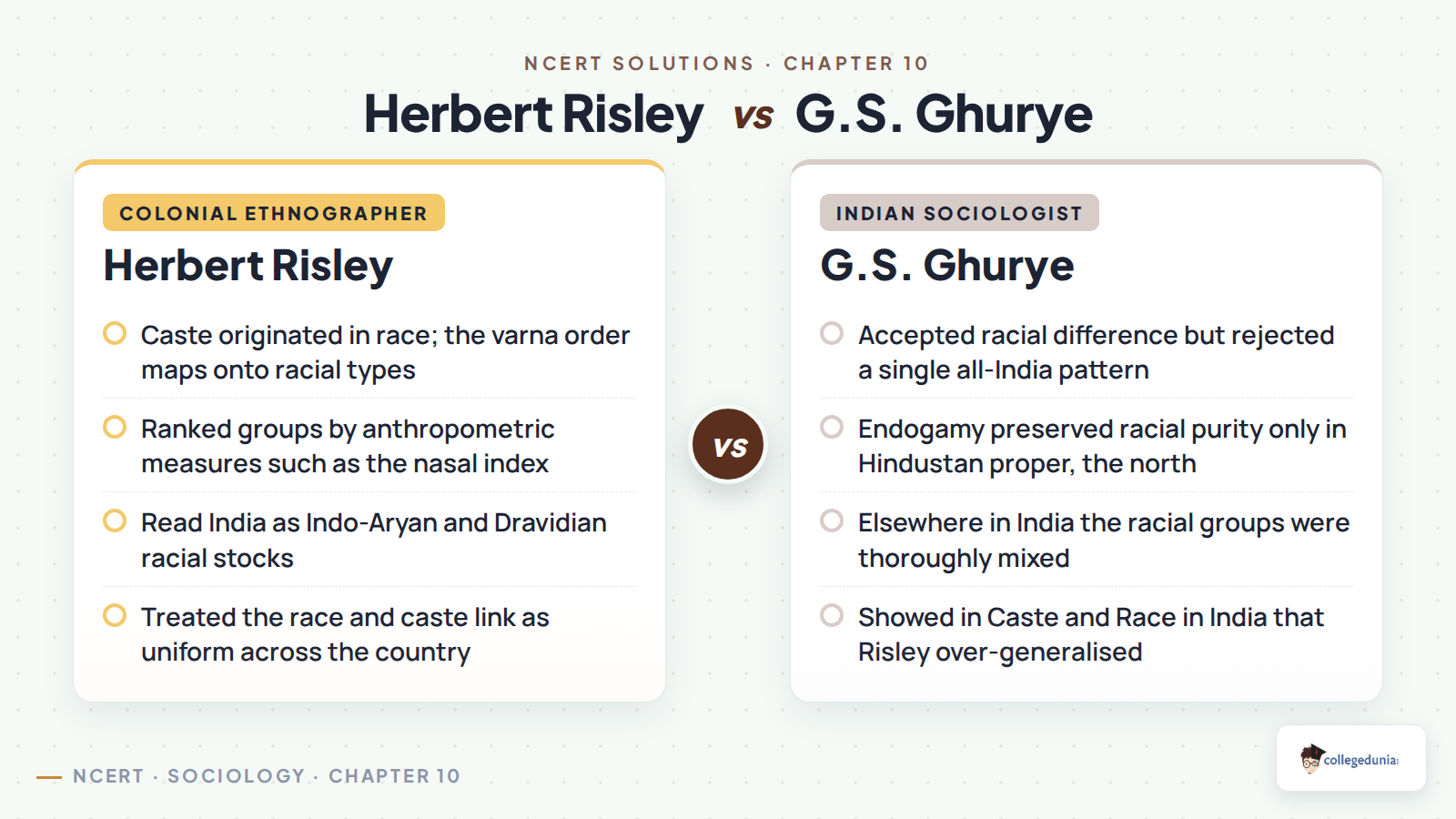
Exercise question 3 asks you to outline two positions, so name each man before each position. Ghurye's academic reputation was built on his Cambridge dissertation, published in 1932 as Caste and Race in India.
- Risley's starting point. Human beings can be divided into separate races by physical features such as the circumference of the skull, the length of the nose, and the volume of the cranium.
- Why India interested him. Caste strictly prohibits inter marriage between groups and has done so for centuries, so India looked like a unique laboratory for studying racial types.
- Risley's conclusion. Caste must have originated in race, since higher castes approximated Indo Aryan traits while lower castes seemed to be non Aryan, aboriginal or Mongoloid.
- Ghurye's partial agreement. He did not disagree with the basic argument, but held it to be only partially correct.
- Ghurye's method objection. Risley used averages alone, without considering the variation in the distribution of a measurement within a community.
- Ghurye's regional finding. The thesis was broadly true only for northern India. Elsewhere the differences in anthropometric measurements were neither large nor systematic.
Finish with the conclusion Ghurye drew. Racial purity had been preserved by the ban on inter marriage only in Hindustan proper, that is north India. In the rest of the country, endogamy was probably introduced into groups that were already racially varied. Add the honest note that the racial theory of caste is no longer believed today, though it was taken as true in the first half of the 20th century.
The Social Anthropological Definition of Caste and Its Six Features
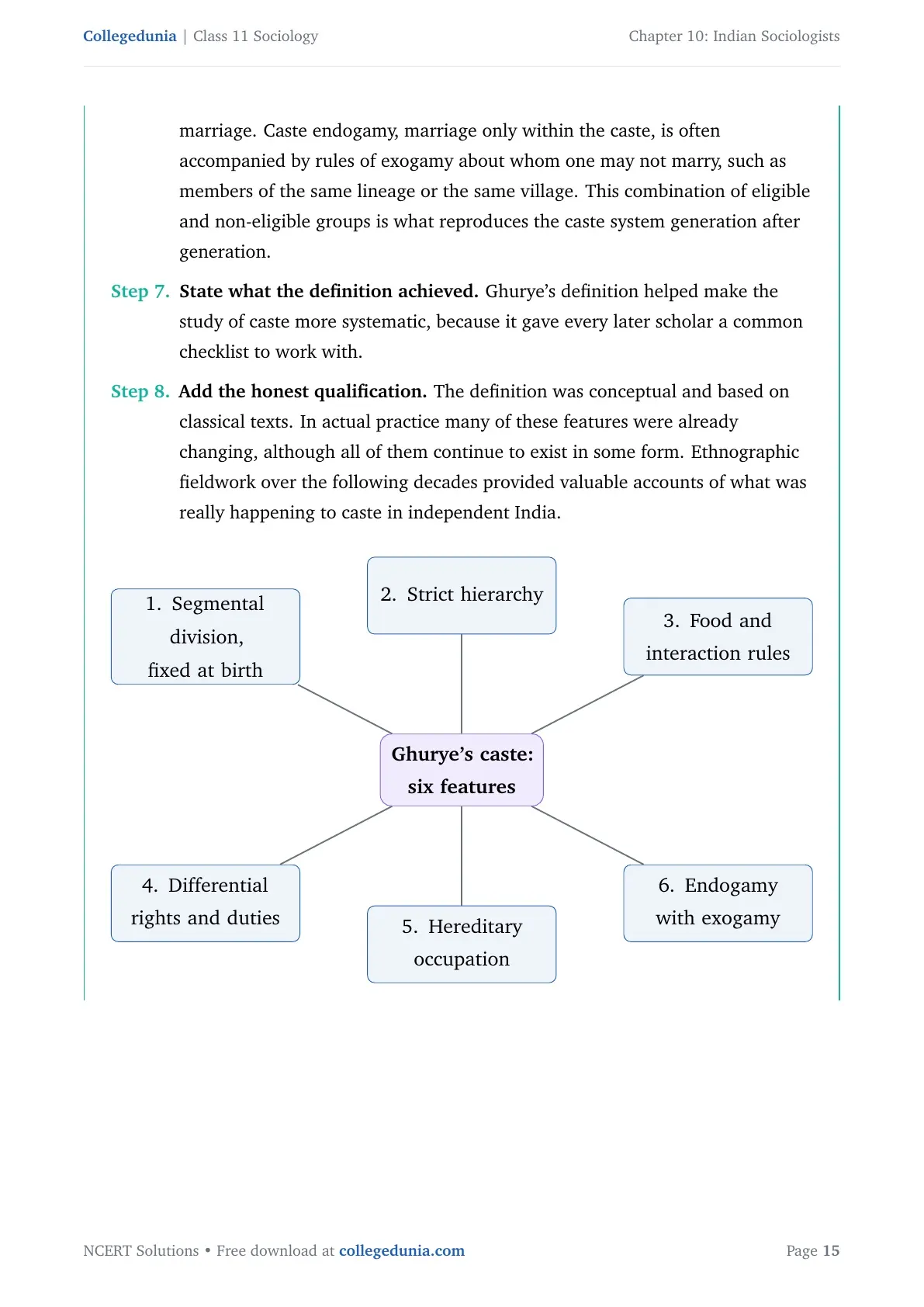
Exercise question 4 is the most predictable 6 mark question in the chapter. Ghurye offered a definition built on six features, drawn from what the classical texts prescribed. Write them as a numbered list, label first and one line of explanation after.
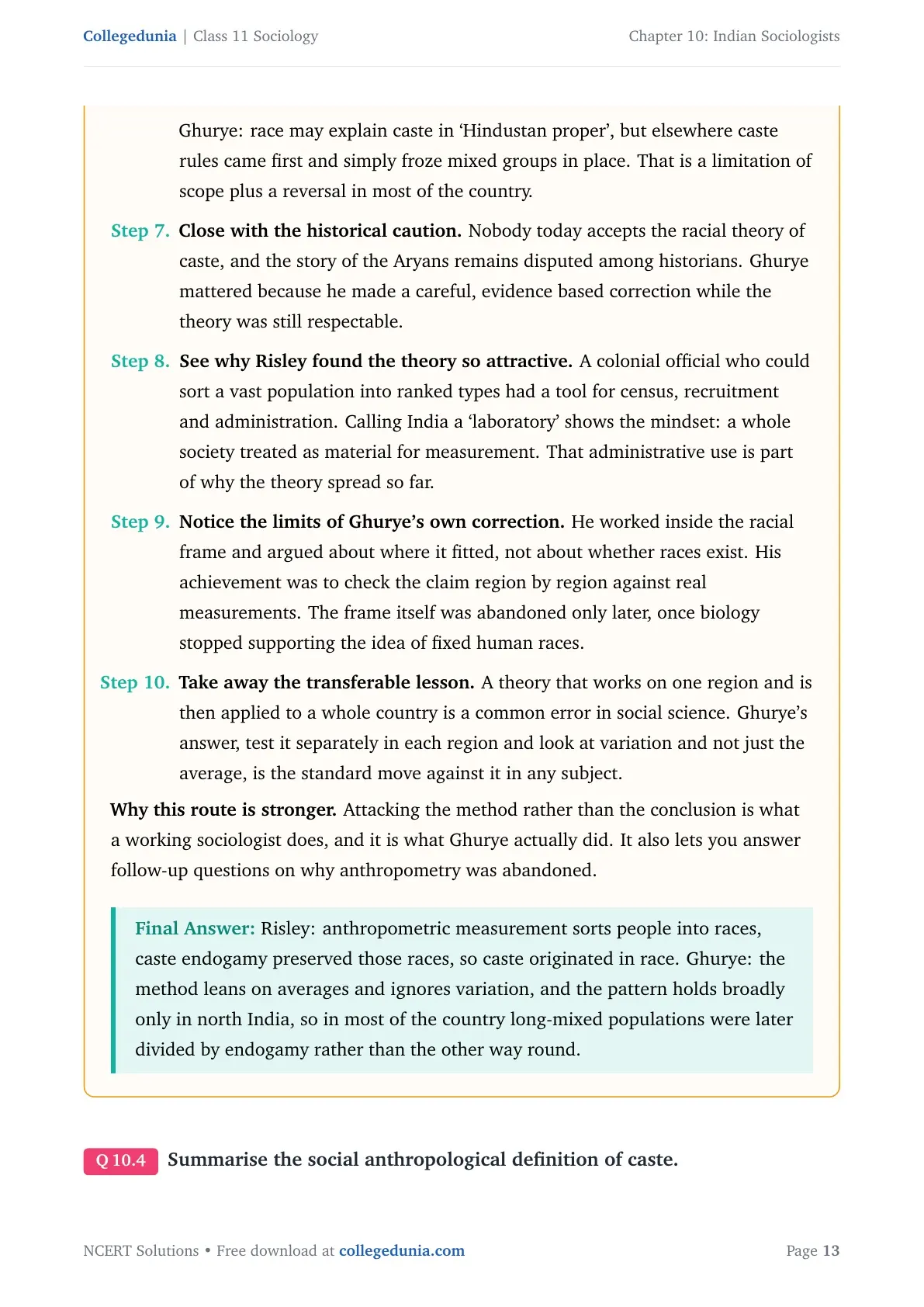
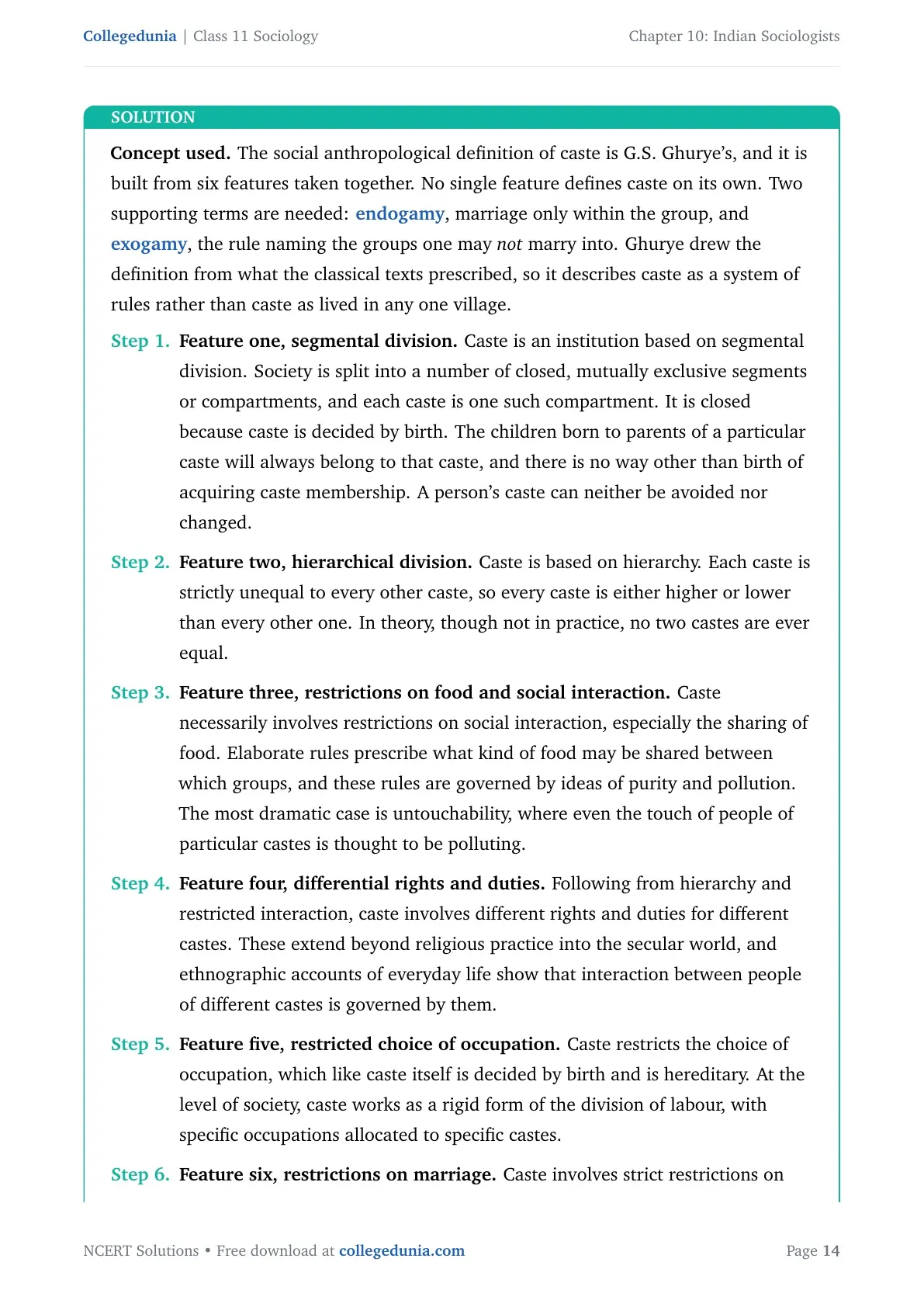
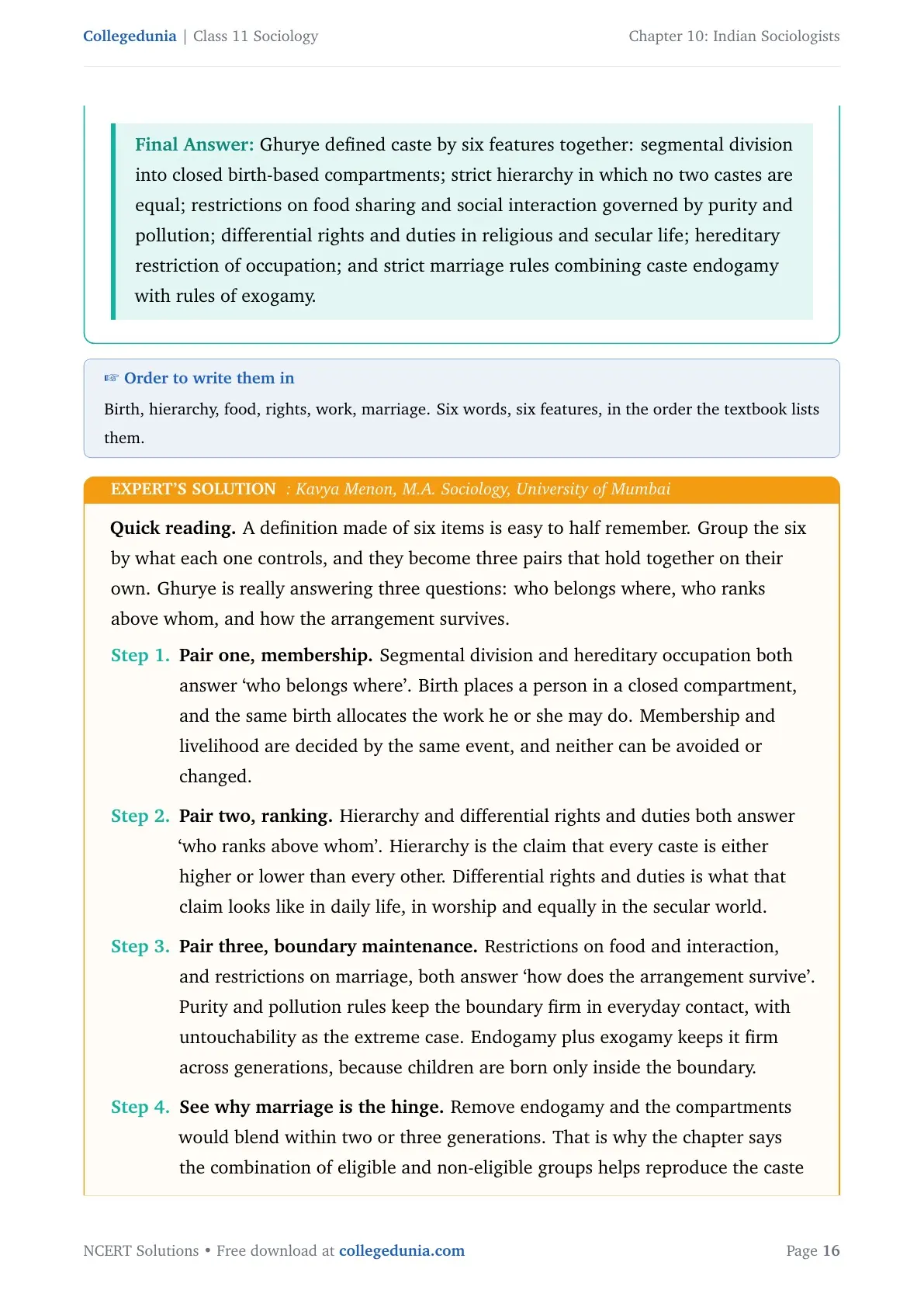
- Segmental division. Caste is divided into closed, mutually exclusive compartments. Caste is decided by birth, there is no other way of acquiring membership, and it can neither be avoided nor changed.
- Hierarchical division. Each caste is strictly unequal to every other caste. In theory, though not in practice, no two castes are ever equal.
- Restrictions on social interaction. Elaborate rules prescribe what food may be shared between which groups. These rules are governed by ideas of purity and pollution, seen most sharply in untouchability.
- Differential rights and duties. Rights and duties differ by caste and extend beyond religious practice into the secular world of everyday interaction.
- Restricted choice of occupation. Occupation is hereditary and decided by birth, so caste works as a rigid form of the division of labour with specific work allocated to specific castes.
- Strict restrictions on marriage. Caste endogamy, or marriage only within the caste, is combined with rules of exogamy about whom one may not marry. That combination reproduces the caste system.
Two closing sentences take the answer to full marks. Ghurye's definition made the study of caste more systematic. In actual practice many of these features were already changing, though all of them continue to exist in some form, which is what later ethnographic fieldwork went on to record.
D.P. Mukerji on Living Tradition and Why Indian Sociologists Must Be Rooted in It
Dhurjati Prasad Mukerji lived from 1894 to 1961. He was born into a middle class Bengali brahmin family, took degrees in History and Economics at Calcutta, and joined Lucknow University in 1924. Lucknow had the famous trinity of Radhakamal Mukerjee, D.P. Mukerji and D.N. Majumdar.
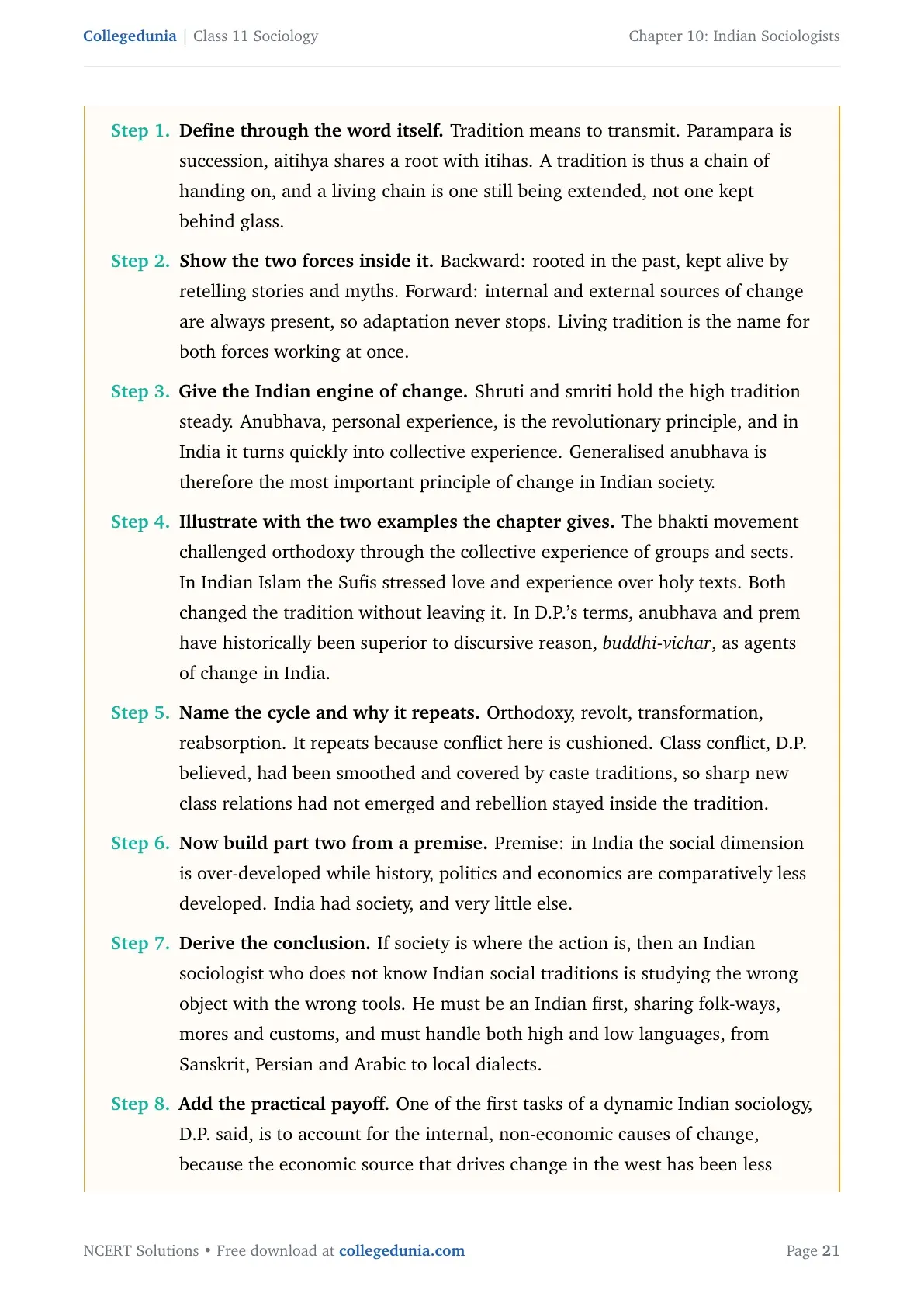
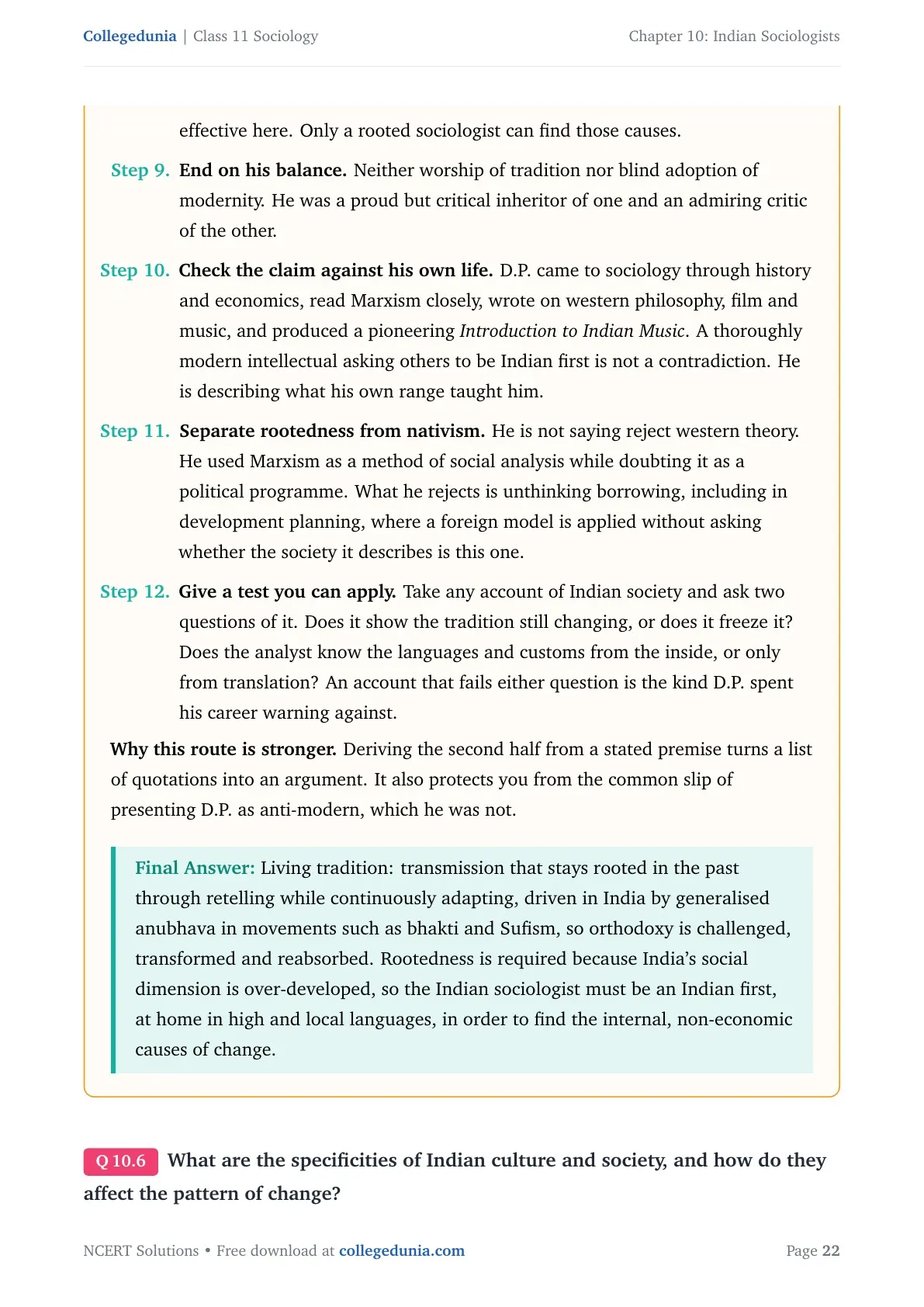
Exercise question 5 has two parts, so define the term first and give the reason second. For D.P., a living tradition maintains its links with the past but also adapts to the present, and so evolves over time. It is not oriented only towards the past.
- The root meaning of tradition is to transmit. Its Sanskrit equivalents are parampara, meaning succession, and aitihya, which shares a root with itihas or history.
- Traditions are rooted in the past and kept alive by the repeated recalling and retelling of stories and myths.
- That link with the past does not rule out change. It indicates a process of adaptation to change.
- Why the Indian sociologist must be rooted in it. D.P. held that the decisive aspect of the Indian context was social, and that each social science had to be rooted in that context.
- He wrote that it is not enough for an Indian sociologist to be a sociologist. He must be an Indian first, sharing in the folk ways, mores, customs and traditions.
- So sociologists should know both high and low languages and cultures, not only Sanskrit, Persian or Arabic but also local dialects.
His own line is worth quoting in short form. He said his conviction grew that India had had society and very little else, and that her history, economics and philosophy had always centred in social groups.
The Specificities of Indian Culture and Society and How They Affect the Pattern of Change
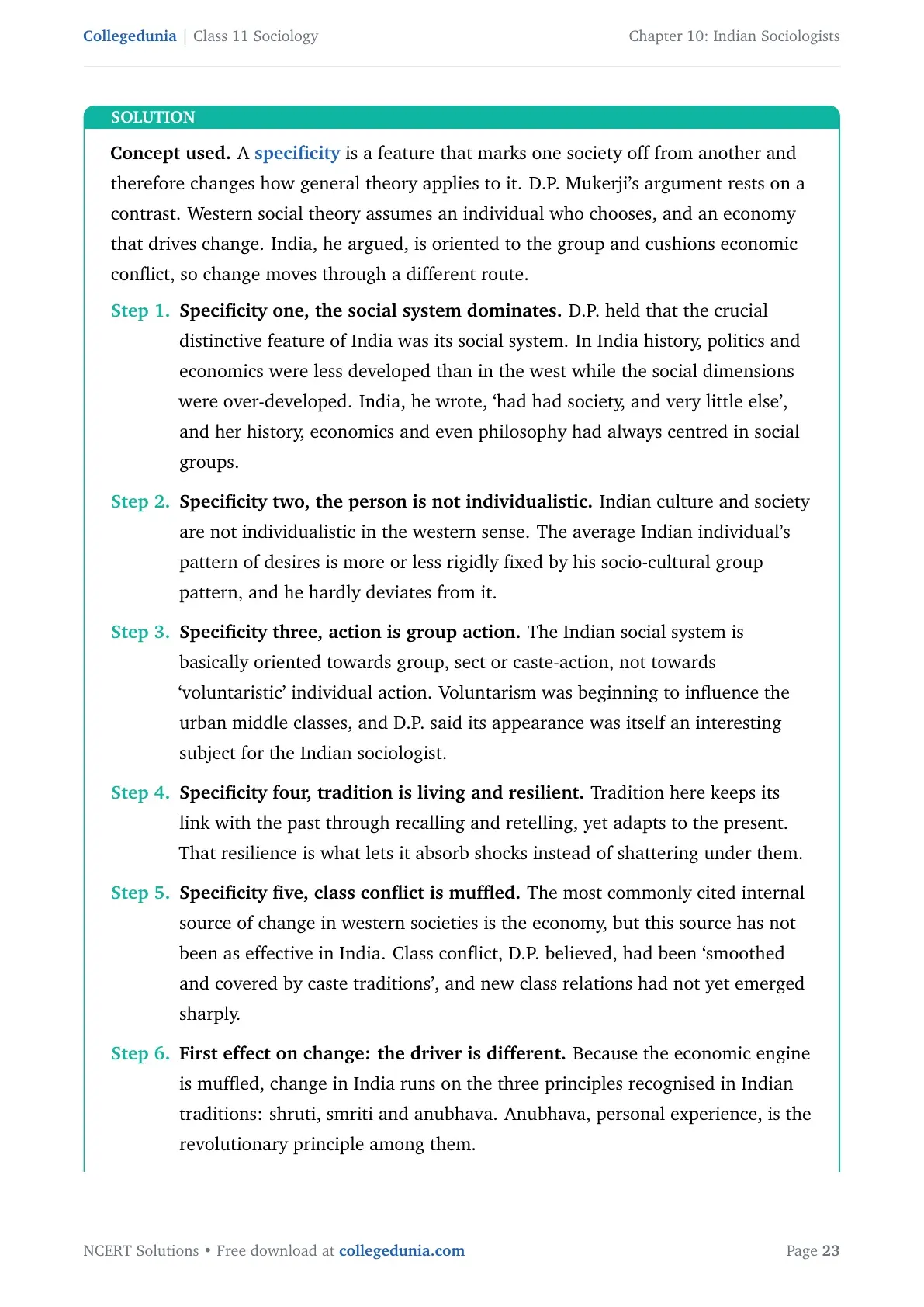
Exercise question 6 wants the specificities first and the effect on change second. D.P. argued that Indian culture and society are not individualistic in the western sense. The pattern is set by the group, not by the single person.
- The average Indian individual's pattern of desires is fixed by the socio cultural group pattern, and the person hardly deviates from it.
- The social system is oriented towards group, sect or caste action, not towards voluntaristic individual action.
- Voluntarism was beginning to influence the urban middle classes, and D.P. said its appearance was itself worth studying.
- The economy is a weak source of change here. In western societies the economy is the most cited internal source of change, but in India it has not worked that way.
- Class conflict had been smoothed and covered by caste traditions, since new class relations had not yet emerged sharply.
- So the first task of a dynamic Indian sociology was to give an account of the internal, non economic causes of change.
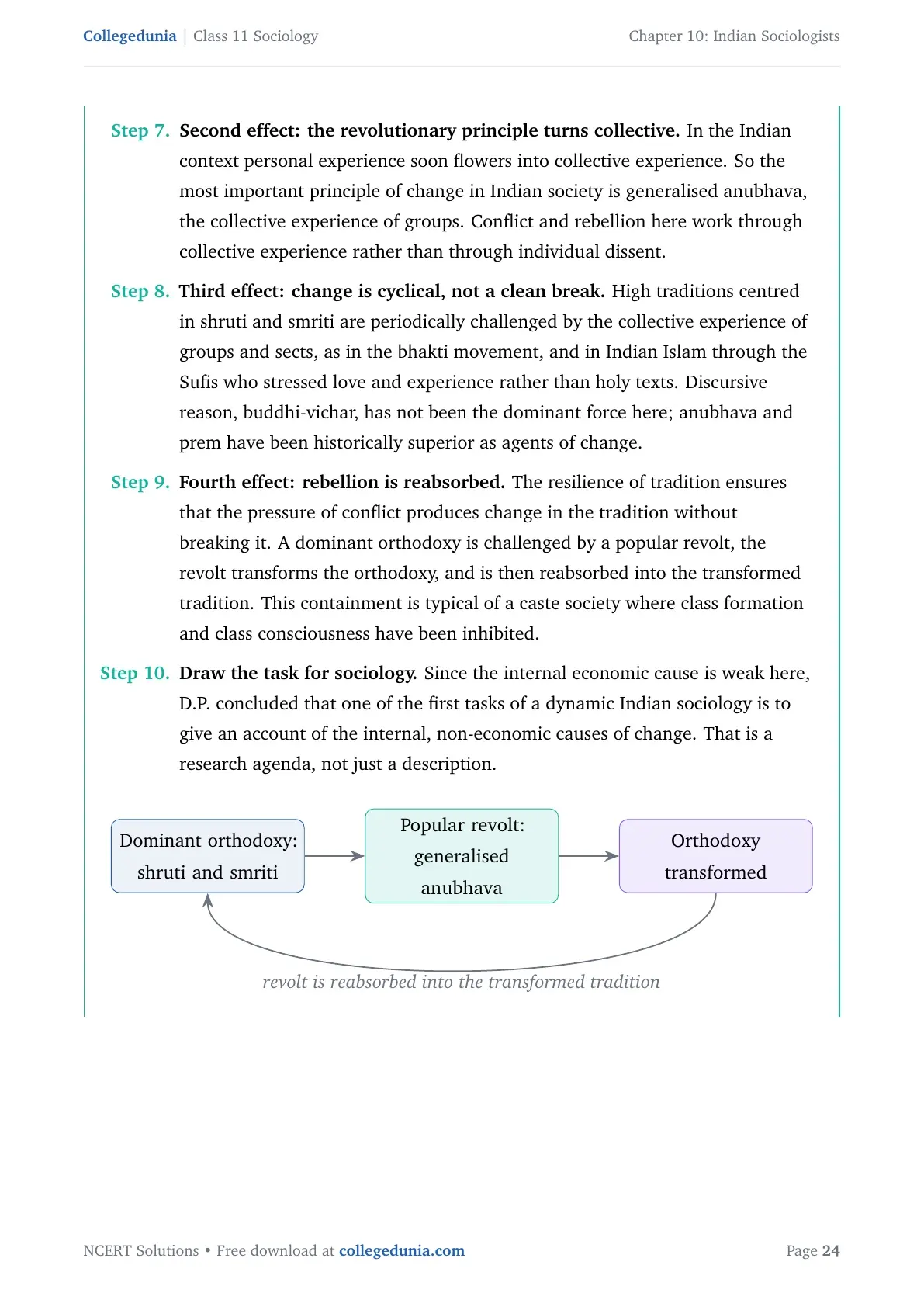
Add the pattern of change for the final mark. Conflict and rebellion in India work through collective experience, but the resilience of tradition means the pressure of conflict changes the tradition without breaking it. Dominant orthodoxy is challenged by popular revolts, the revolts transform the orthodoxy, and are then reabsorbed into the transformed tradition.
Shruti, Smriti and Anubhava as the Three Principles of Change in Indian Tradition
This is a favourite 2 mark and 4 mark question because it is a short named list. D.P. held that Indian traditions recognise three principles of change, and that one of them does the real work.
| Principle | What it stands for in the chapter |
|---|---|
| Shruti | One of the two high traditions in which the classical, textual authority is centred |
| Smriti | The second high tradition, again centred on remembered textual authority |
| Anubhava | Personal experience, and the revolutionary principle among the three |
| Generalised anubhava | Collective experience of groups, which is the most important principle of change in Indian society |
Give one example from each religion, because the book does. The high traditions were periodically challenged by the collective experience of groups and sects, as in the bhakti movement. In Indian Islam the Sufis stressed love and experience rather than holy texts and were important in bringing about change. D.P.'s conclusion is that in India, anubhava and prem, experience and love, have been historically superior to discursive reason as agents of change.
A.R. Desai on Indian Nationalism and the Marxist Reading of the Colonial Period
Akshay Ramanlal Desai lived from 1915 to 1994. He is the rare Indian sociologist who was directly involved in politics as a formal member of political parties. He was a life long Marxist, joined Marxist politics as an undergraduate at Baroda, and later worked with non mainstream Marxist groups.
- He wrote his doctoral dissertation at Bombay under G.S. Ghurye and was awarded the degree in 1946.
- The thesis appeared in 1948 as The Social Background of Indian Nationalism, his best known book.
- The book offers a Marxist analysis of Indian nationalism, giving prominence to economic processes and divisions while taking account of the specific conditions of British colonialism.
- It had critics but proved very popular and went through many reprints.
- His other themes were peasant movements and rural sociology, modernisation, urban issues, political sociology, forms of the state and human rights.
- Because Marxism was never prominent within Indian sociology, Desai was better known outside the discipline than within it, even though he was elected President of the Indian Sociological Society.
His book titles are easy marks in a 1 mark question. Rural Transition in India appeared in 1961, State and Society in India: Essays in Dissent in 1975, Peasant Struggles in India in 1979, and Agrarian Struggles in India after Independence in 1986.
What a Welfare State Is and Why A.R. Desai Calls It a Myth
Exercise question 7 has two parts and both must be answered. Desai set out the features of the welfare state in his essay The Myth of the Welfare State, then tested real states against five criteria and found them wanting.
| Feature of a welfare state | What it means |
|---|---|
| A positive state | Unlike the laissez faire state of classical liberal theory, it does not do only the minimum needed for law and order. It is interventionist and designs social policies for the betterment of society |
| A democratic state | Formal democratic institutions, especially multi party elections, are a defining feature, which is why liberal thinkers excluded socialist and communist states from the definition |
| A mixed economy | Private capitalist enterprises and state owned enterprises exist side by side. The state sector concentrates on basic goods and social infrastructure, private industry dominates consumer goods |
Now give the five test criteria. Desai asked whether the welfare state guarantees freedom from poverty, social discrimination and security for all citizens, whether it removes income inequality by redistribution and by preventing the concentration of wealth, whether it makes the capitalist profit motive subservient to the real needs of the community, whether it ensures stable development free from booms and depressions, and whether it provides employment for all.
- The verdict. Applying these tests to Britain, the USA and much of Europe, Desai found their claims greatly exaggerated.
- Even the most developed capitalist states fail to give minimum economic and social security to all citizens.
- They are unable to reduce economic inequality and often seem to encourage it.
- They have not delivered stable development free from market fluctuations.
- Excess economic capacity and high levels of unemployment are a further failure.
- So the notion of the welfare state is something of a myth.
One extra line shows balance and often earns the last mark. Desai did not take a one sided view. Writing on the Marxist theory of the state, he openly criticised the shortcomings of Communist states and argued that political liberties and the rule of law must be upheld in all genuinely socialist states.
M.N. Srinivas on the Village and the Debate with Louis Dumont
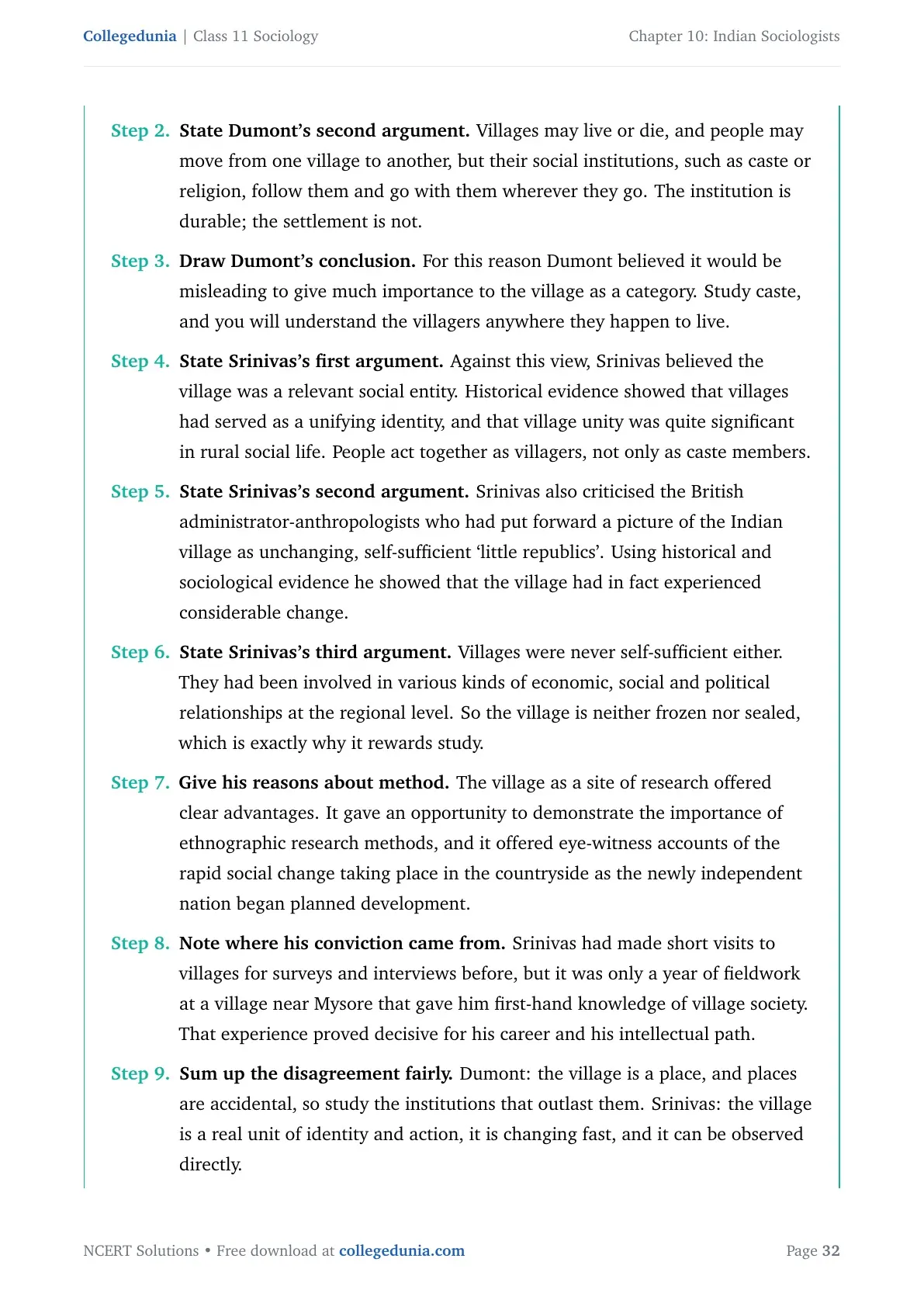
Mysore Narasimhachar Srinivas lived from 1916 to 1999 and is probably the best known Indian sociologist of the post independence era. He earned two doctorates, one at Bombay under Ghurye and one at Oxford under Radcliffe Brown and then Evans Pritchard. His Oxford thesis became Religion and Society among the Coorgs of South India.
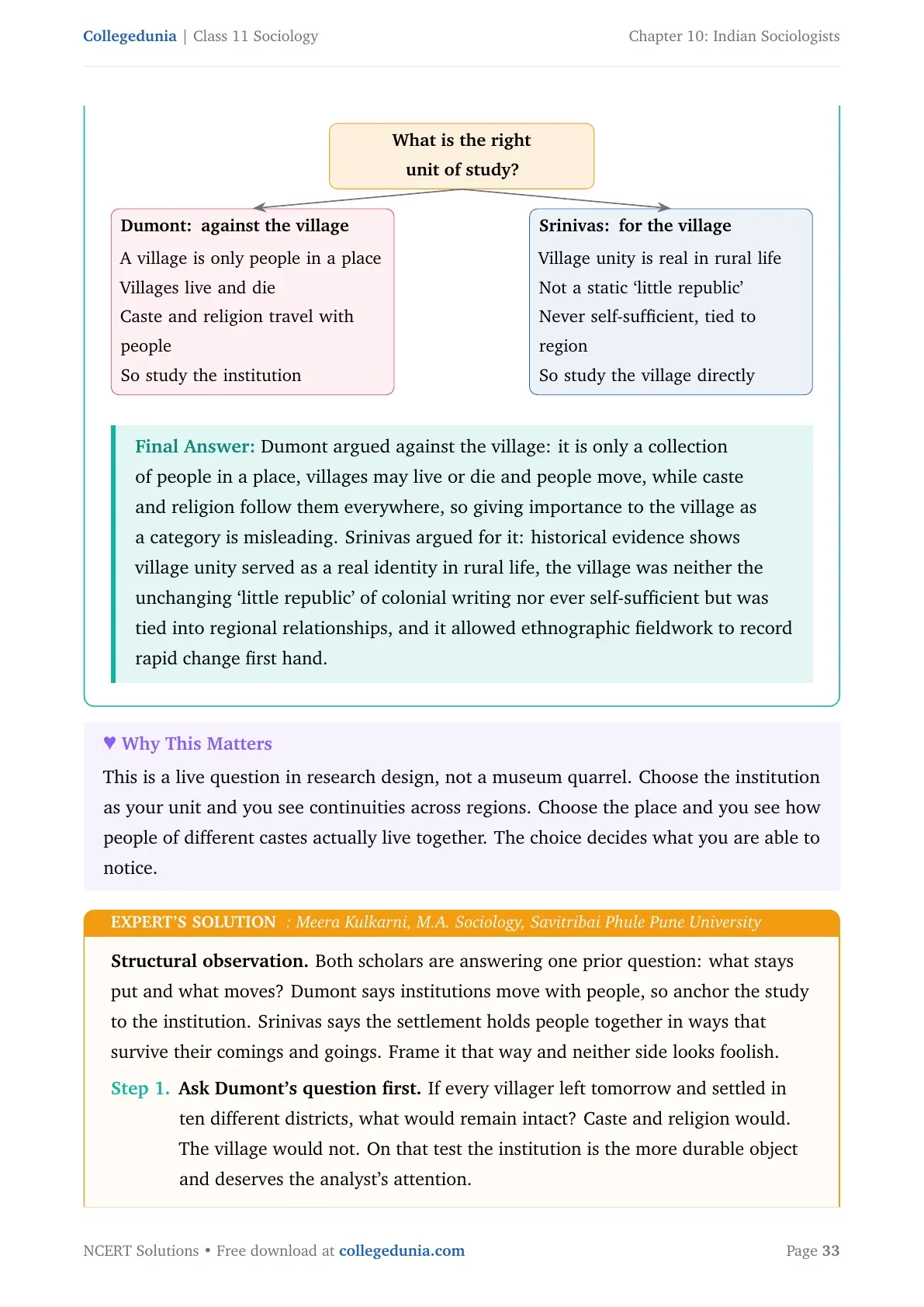
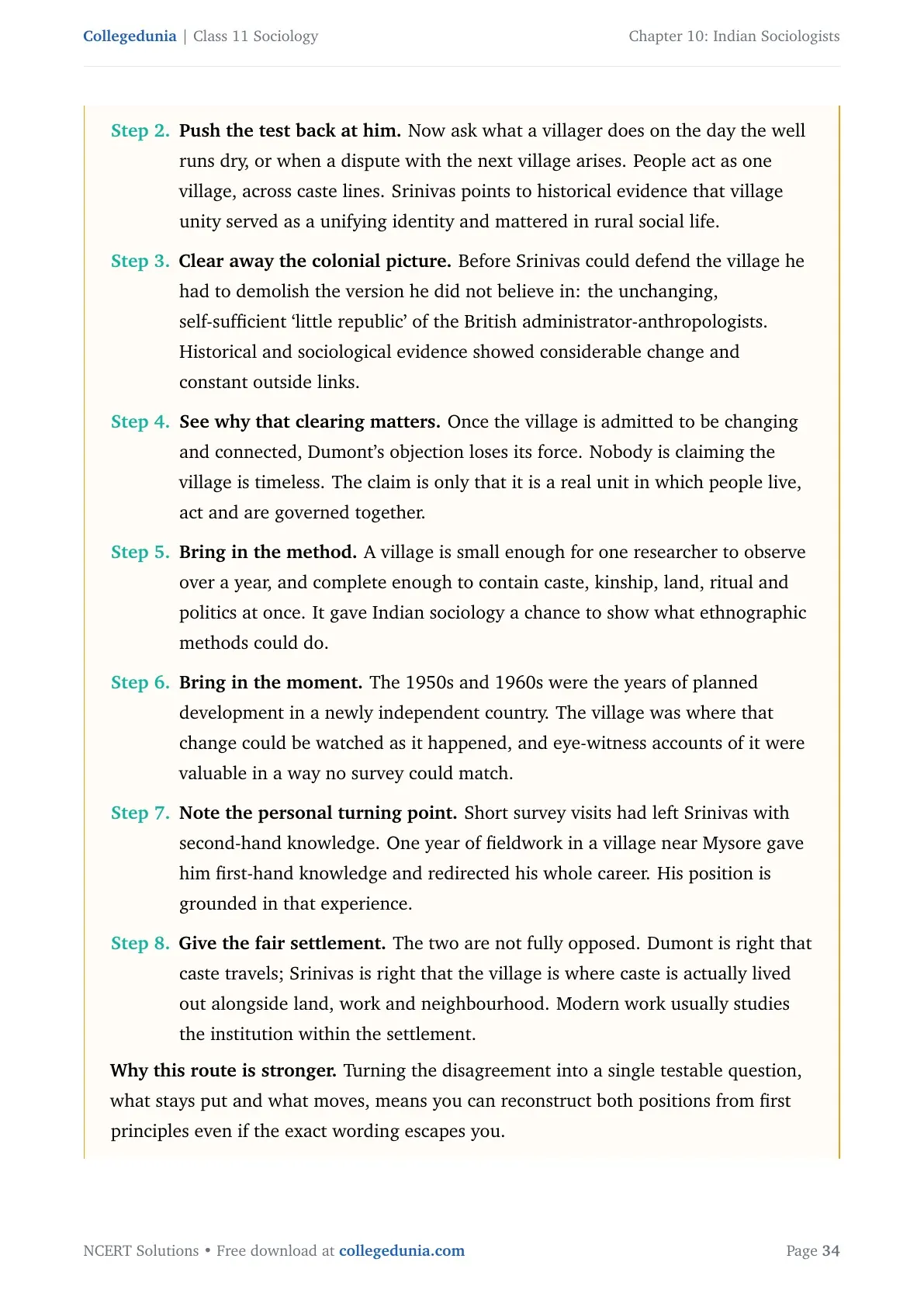
Exercise question 8 asks for arguments on both sides, so set them out as a pair. The debate is about whether the village is a useful unit of sociological research at all.
| Question | Louis Dumont, against the village | M.N. Srinivas, for the village |
|---|---|---|
| What matters most | Social institutions like caste are more important than a village | The village is a relevant social entity in its own right |
| What a village is | Only a collection of people living in a particular place | A unifying identity, with village unity significant in rural social life |
| Mobility argument | Villages may live or die and people may move, but caste and religion follow them wherever they go | Historical evidence shows villages served as a lasting identity for the people in them |
| Conclusion drawn | It is misleading to give much importance to the village as a category | The village is a valid unit of social analysis and of fieldwork |
Srinivas also attacked a second, older picture. British administrator anthropologists had described the Indian village as an unchanging, self sufficient little republic. Using historical and sociological evidence, Srinivas showed that the village had in fact experienced considerable change, and that villages were never self sufficient because they were tied into economic, social and political relationships at the regional level. Sanskritisation and dominant caste, the two concepts he is most famous for, come from this same body of village work.
The Significance of Village Studies in the History of Indian Sociology
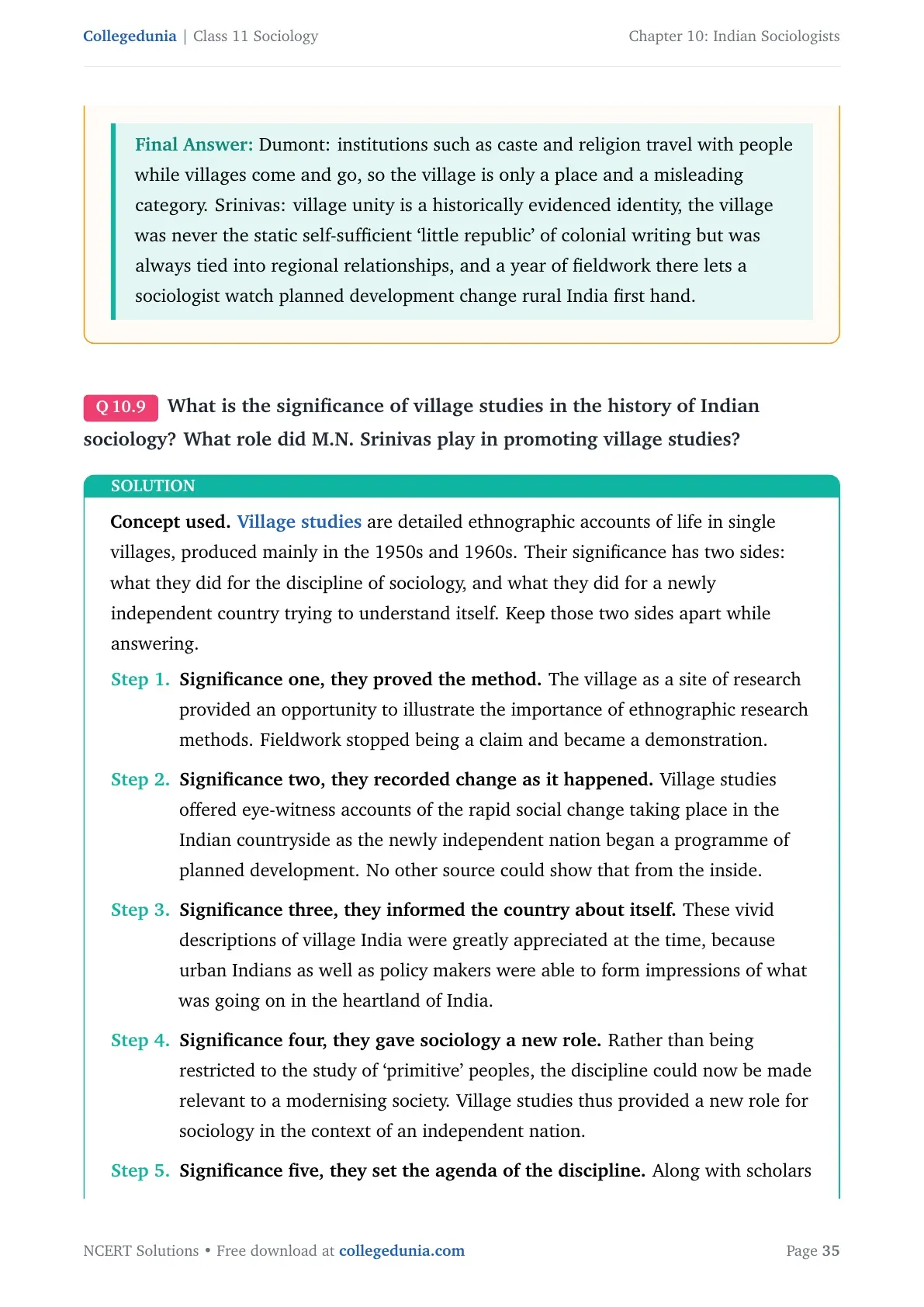
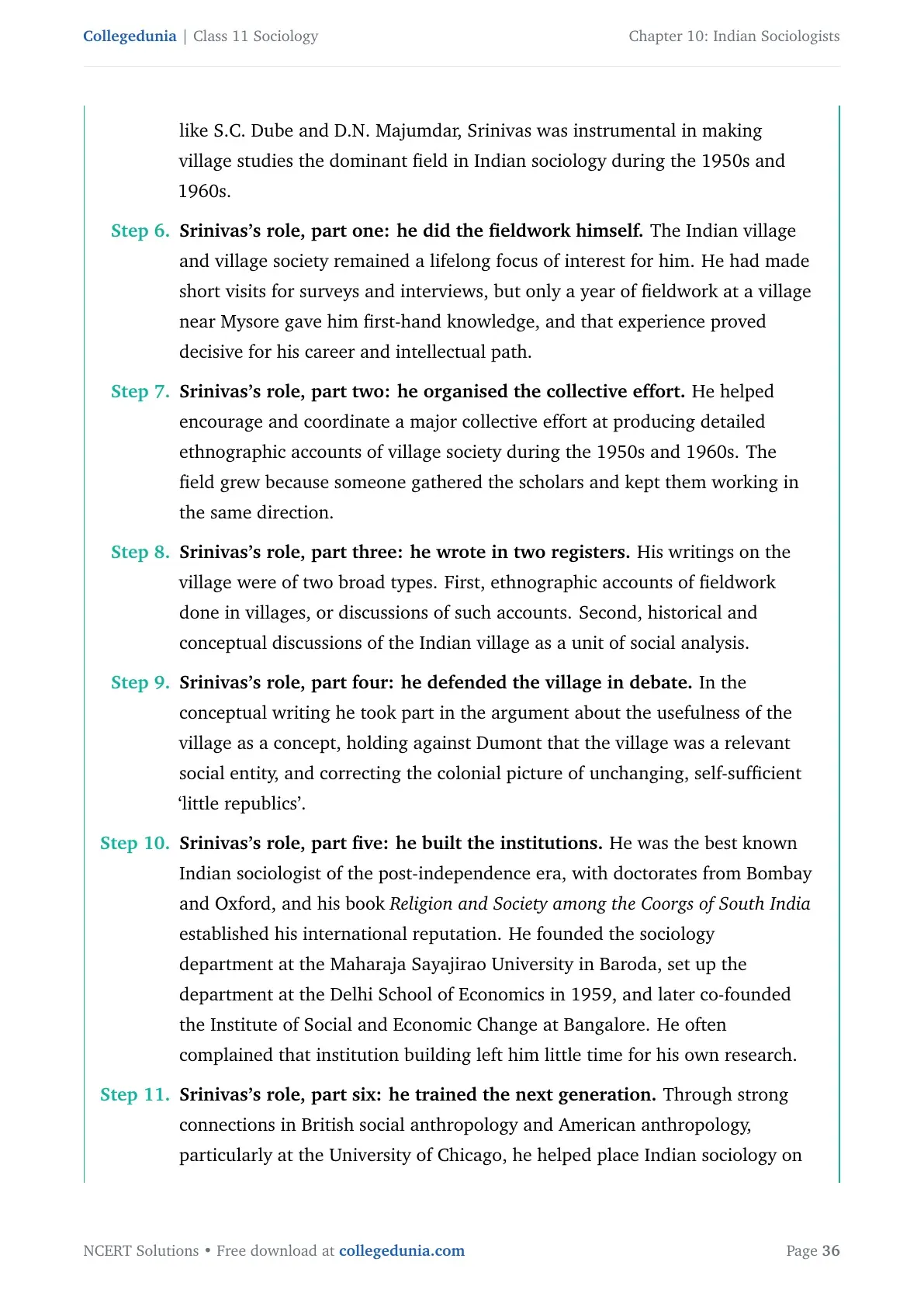
Exercise question 9 has two parts, the significance and the role Srinivas played. Take the role first, then list what village studies gave the discipline. Srinivas did short survey visits at first, but the decisive experience was a year of fieldwork in a village near Mysore.
- Srinivas coordinated a collective effort. Along with S.C. Dube and D.N. Majumdar, he pushed detailed ethnographic accounts of village society through the 1950s and 1960s.
- He made village studies the dominant field in Indian sociology during that period.
- His writing on the village came in two types, ethnographic accounts of fieldwork, and historical and conceptual discussion of the village as a unit of analysis.
- Method. Village studies showed the value of ethnographic research methods to a young discipline.
- Evidence. They gave eye witness accounts of the rapid social change in the countryside as the new nation began planned development.
- Reach. Vivid descriptions of village India let urban Indians and policy makers form impressions of what was happening in the heartland.
- A new role for the subject. Sociology was no longer restricted to the study of primitive peoples, and could be made relevant to a modernising society.
Srinivas also built institutions. He set up the department at Maharaja Sayajirao University in Baroda in 1951, another at the Delhi School of Economics in 1959, and co founded the Institute of Social and Economic Change at Bangalore in 1971. He often complained that institution building left him little time for his own research.
Ghurye, Mukerji, Desai and Srinivas Compared for the Class 11 Sociology Answer
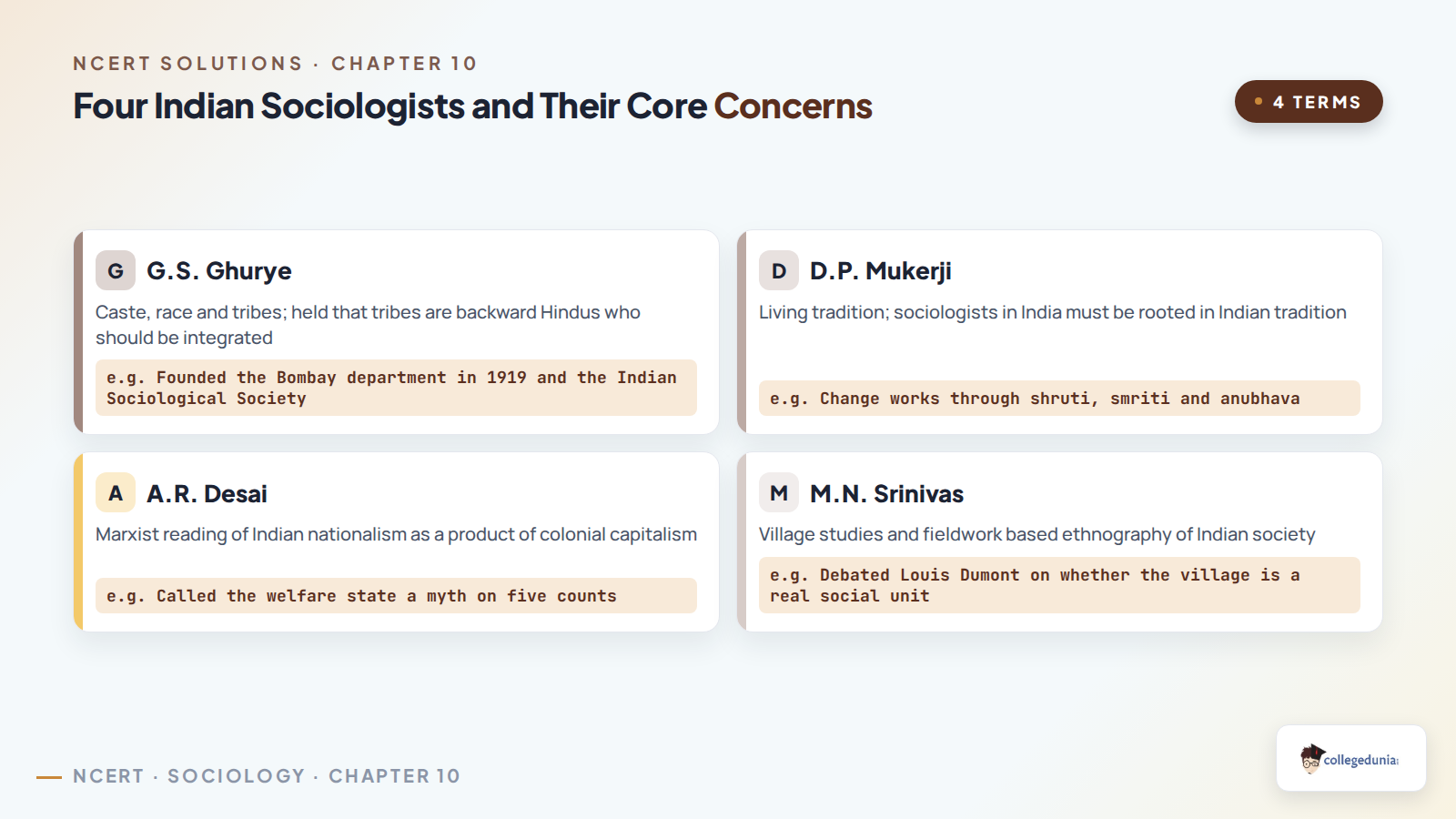
The conclusion of the chapter asks how sociology was Indianised, and schools turn that into a 6 mark comparison. The four took four different routes to the same destination, so compare them on route rather than on merit.
| Question | G.S. Ghurye | D.P. Mukerji | A.R. Desai | M.N. Srinivas |
|---|---|---|---|---|
| Years | 1893 to 1983 | 1894 to 1961 | 1915 to 1994 | 1916 to 1999 |
| Base | Bombay University | Lucknow University | Bombay University | Oxford, Baroda, Delhi, Bangalore |
| Best known work | Caste and Race in India, 1932 | Indian Tradition and Social Change, 1955 | The Social Background of Indian Nationalism, 1948 | Religion and Society among the Coorgs of South India |
| Core idea | Tribes as backward Hindus, and a six feature definition of caste | Tradition as a living tradition changed by collective experience | A Marxist reading of nationalism, and the welfare state as a myth | The village as a real and changing social entity |
| How he Indianised the subject | Began with questions set by western anthropologists, but answered them with classical texts and educated Indian opinion | A westernised modern intellectual who rediscovered Indian tradition without being blind to its faults | Offered a critical view of the Indian state at a time when such criticism was rare | Adapted training from the leading western centres and designed a new agenda for the subject |
End a comparison answer the way the book ends the chapter. It is a sign of the health and strength of a discipline when later generations learn from their predecessors and then go beyond them, and Indian sociology has subjected these four to exactly that kind of constructive criticism.
All 9 Textbook Questions Covered in These Indian Sociologists NCERT Solutions
Every exercise question at the end of the chapter is solved on this page and in the PDF. The table shows what each answer is built on, so you can revise by question rather than by section.
| Question | What it asks | Answer is built on |
|---|---|---|
| 1 | How Ananthakrishna Iyer and Sarat Chandra Roy came to practise social anthropology | The Cochin ethnographic survey of 1902, and the Ranchi court interpreter years |
| 2 | Main arguments on either side of the debate on relating to tribal communities | Protectionists against nationalists, and Ghurye's backward Hindus position |
| 3 | Positions of Herbert Risley and G.S. Ghurye on race and caste | Anthropometry, the averages objection, and the north India limit |
| 4 | Summarise the social anthropological definition of caste | The six features, from segmental division to restrictions on marriage |
| 5 | What D.P. Mukerji means by a living tradition, and why sociologists must be rooted in it | Parampara and aitihya, transmission, adaptation, and the Indian first argument |
| 6 | Specificities of Indian culture and society and their effect on the pattern of change | Group orientation, the weak economic source, and generalised anubhava |
| 7 | What a welfare state is, and why A.R. Desai is critical of its claims | The three features, the five test criteria, and the myth conclusion |
| 8 | Arguments for and against the village as a subject of research | Dumont against the village, Srinivas for it, and the little republics critique |
| 9 | Significance of village studies and the role of M.N. Srinivas | Ethnographic method, eye witness change, and a new role for the discipline |
How Indian Sociologists Appears in the Class 11 Sociology Exam Paper
This chapter sits in the Understanding Society book and is examined with the other chapters of that book. Schools set a predictable mix, so plan your revision around it.
| Question type | Usual marks | What gets asked |
|---|---|---|
| Very short answer | 1 to 2 | Define endogamy, exogamy, anthropometry, assimilation, laissez faire, living tradition |
| Short answer | 2 to 4 | Three principles of change, the three features of a welfare state, who founded Man in India |
| Long answer | 6 | Six features of caste, the tribal debate, why Desai calls the welfare state a myth |
| Comparison or source based | 4 to 6 | Risley against Ghurye on race and caste, Dumont against Srinivas on the village |
Common Mistakes Students Make in the Indian Sociologists Chapter
Watch out for these six errors. They are the reason a well written answer still scores four out of six.
- Swapping the four names. Putting Srinivas in a welfare state answer, or Desai in a village answer, costs you the whole point.
- Saying Ghurye rejected Risley completely. He agreed with the basic argument but called it only partially correct.
- Writing five features of caste. The definition lists six, and restrictions on marriage is the one most often dropped.
- Treating living tradition as an old tradition. It keeps links with the past and adapts to the present.
- Describing the welfare state as Desai's own ideal. He was critical of it from a Marxist position and called it a myth.
- Mixing up who argued what about the village. Dumont argued against the village, Srinivas argued for it.
Sample Solved Long Answer on the Welfare State for the Class 11 Sociology Exam
Question: What is a welfare state, and why is A.R. Desai critical of the claims made on its behalf? Six marks. Here is how a full mark answer is built, step by step.
- Define it as a positive state. Unlike the laissez faire state, it is interventionist and uses its powers to design and implement social policies for the betterment of society.
- Add the democratic condition. Formal democratic institutions, especially multi party elections, were treated as a defining feature.
- Add the mixed economy. Private capitalist enterprises and state owned enterprises exist side by side, with the state taking basic goods and social infrastructure.
- Name the five test criteria. Security for all, removal of income inequality, profit motive made subservient to community needs, stable development, and employment for all.
- Give the verdict with the evidence. Britain, the USA and much of Europe fail on minimum security, on inequality, on market fluctuations, and on unemployment.
- Close with the balance point. Desai was not one sided, since he also criticised Communist states and insisted on political liberties and the rule of law under socialism.
Key Terms from the Indian Sociologists Glossary Every Class 11 Student Should Know
The glossary terms are direct one mark questions and they also make your long answers precise. Learn the short form given here.
| Term | Meaning to write in the exam |
|---|---|
| Administrator anthropologists | British administrative officials in the 19th and early 20th century Indian government who took great interest in anthropological research, especially surveys and censuses. Thurston, Crooke, Risley and Hutton are the names to give |
| Anthropometry | The branch of anthropology that studied human racial types by measuring the body, particularly the volume of the cranium, the circumference of the head and the length of the nose |
| Assimilation | A process by which one culture, usually the larger or more dominant one, gradually absorbs another, so that the absorbed culture is no longer alive or visible at the end |
| Endogamy | A social institution that defines the boundary of a group within which marriage is permissible. Caste endogamy is the common example |
| Exogamy | A social institution that defines the group with which or within which marriage is prohibited, such as sapind, sagotra or village exogamy |
| Laissez faire | A French phrase meaning let be, standing for a doctrine of minimum state intervention in the economy and trust in the free market |
| Living tradition | A tradition that keeps its links with the past while adapting to the present, and so evolves over time |
How to Study Indian Sociologists for the 2026-27 Class 11 Exam
This chapter rewards structure more than reading time. Three focused sittings are enough if you use them the way described below.
- Sitting one, build four name cards. One card each for Ghurye, Mukerji, Desai and Srinivas, carrying the years, the university, one book and one core idea.
- Sitting two, learn the three lists. The six features of caste, the three features of a welfare state with its five test criteria, and the two sides of the tribal debate.
- Sitting three, practise the long answers. Write full answers to exercise questions 4, 7 and 8 without the book, then check them against the solutions on this page.
- Before the paper, revise the glossary and the pioneers. Iyer, Roy and the seven glossary terms alone cover most of the one and two mark questions.
Indian Sociologists Class 11 Resources Beyond These NCERT Solutions
Also Check: use these alongside the solutions. The notes give you the four sociologists in one place, the handwritten notes work the night before the paper, and the book PDF carries the original biographies, activities and glossary.
| Resource | Best used for | Link |
|---|---|---|
| Indian Sociologists Class 11 Notes | The two pioneers, the four founding figures and every key term in one place | Read the Indian Sociologists Class 11 Notes |
| Indian Sociologists Handwritten Notes | Last minute revision the night before the paper | Read the Indian Sociologists Handwritten Notes |
| Class 11 Sociology Understanding Society Book PDF | The original chapter text, the four biographies, activities and glossary | Download the Indian Sociologists Book PDF |
| Indian Sociologists Question and Answer Set | All 9 exercise questions with a short Solution tab and an expanded Expert Solution tab | Open the Indian Sociologists question set |
NCERT Solutions for All Class 11 Sociology Chapters
Related Links: the same answer format runs across every chapter of Class 11 Sociology, so you can move from one to the next without changing how you write.
All 9 questions with step-by-step solutions
Open the full question set for this chapter, where every exercise question comes with a short Solution tab and an expanded Expert Solution tab. Open the Indian Sociologists Class 11 question and answer set
Indian Sociologists Class 11 Sociology NCERT Solutions FAQs
Ques. How did Ananthakrishna Iyer and Sarat Chandra Roy come to practise social anthropology?
Ans. Both came to the subject by accident. Ananthakrishna Iyer was a college teacher in Cochin who was asked by the Dewan in 1902 to assist with an ethnographic survey of the state, and he did the work voluntarily as unpaid Superintendent of Ethnography at weekends. Sarat Chandra Roy was a lawyer who moved to Ranchi in 1898, became the court interpreter, and had to interpret tribal customs and laws for the court. Neither had a formal qualification in anthropology.
Ques. What were the main arguments on either side of the debate about tribal communities?
Ans. The protectionists, mostly British administrator anthropologists, held that tribes were primitive peoples with a distinctive culture far from mainstream Hinduism, and that contact would bring exploitation and cultural extinction, so the state had a duty to protect them. Ghurye and the nationalists held that tribes were backward Hindus who had interacted with Hinduism for a long time, that protection kept them backward as museums of primitive culture, and that the ill effects were common to all downtrodden sections rather than specific to tribes.
Ques. What were the positions of Herbert Risley and G.S. Ghurye on race and caste?
Ans. Risley held that human beings can be divided into races by physical measurements, that India was a laboratory for studying racial types because caste prohibits inter marriage, and that caste therefore originated in race. Ghurye did not disagree with the basic argument but called it only partially correct. He objected to the use of averages without considering variation, and showed that the thesis held broadly only for northern India, since elsewhere racial groups had been mixing for a very long time.
Ques. What is the social anthropological definition of caste given by Ghurye?
Ans. Ghurye's definition has six features. Caste is based on segmental division into closed compartments decided by birth. It is hierarchical, so no two castes are equal. It restricts social interaction, especially the sharing of food, through ideas of purity and pollution. It gives different rights and duties to different castes. It restricts the choice of occupation, which is hereditary. It places strict restrictions on marriage through endogamy combined with rules of exogamy.
Ques. What does D.P. Mukerji mean by a living tradition?
Ans. A living tradition keeps its links with the past but also adapts to the present, and so evolves over time. The root meaning of tradition is to transmit, and its Sanskrit equivalents are parampara, meaning succession, and aitihya, which shares a root with itihas. Traditions stay alive through the repeated recalling and retelling of stories and myths, and that link with the past does not rule out change.
Ques. Why did D.P. Mukerji insist that Indian sociologists be rooted in Indian tradition?
Ans. Because he believed the decisive aspect of the Indian context was social, so every social science had to be rooted in that context. He wrote that it is not enough for an Indian sociologist to be a sociologist, since he must be an Indian first and share in the folk ways, mores, customs and traditions. He also wanted sociologists to know both high and low languages and cultures, not only Sanskrit, Persian or Arabic but local dialects too.
Ques. What are the specificities of Indian culture and society, and how do they affect change?
Ans. Indian culture is not individualistic in the western sense. The individual's pattern of desires is fixed by the socio cultural group, so the system is oriented towards group, sect or caste action rather than voluntaristic individual action. The economy, the usual western source of change, has been weak here because class conflict was smoothed and covered by caste traditions. Change therefore comes through collective experience, and the pressure of conflict changes tradition without breaking it.
Ques. What are the three principles of change in Indian tradition according to D.P. Mukerji?
Ans. Shruti, smriti and anubhava. Of these, anubhava or personal experience is the revolutionary principle. In the Indian context personal experience quickly became collective experience, so the most important principle of change was generalised anubhava. The bhakti movement is the Hindu example and the Sufis, who stressed love and experience rather than holy texts, are the example from Indian Islam.
Ques. What is a welfare state?
Ans. A welfare state has three features in A.R. Desai's account. It is a positive state, so unlike the laissez faire state it is interventionist and designs social policies for the betterment of society. It is a democratic state, with multi party elections treated as a defining feature. It has a mixed economy, where private capitalist enterprises and state owned enterprises exist side by side, with the state concentrating on basic goods and social infrastructure.
Ques. Why is A.R. Desai critical of the claims made on behalf of the welfare state?
Ans. He tested real welfare states against five criteria: security from poverty and discrimination for all, removal of income inequality, the profit motive made subservient to community needs, stable development free from booms and depressions, and employment for all. Examining Britain, the USA and much of Europe, he found their claims greatly exaggerated. They fail to give minimum security, cannot reduce inequality and often encourage it, and carry high unemployment. So he concluded the welfare state is something of a myth.
Ques. What arguments were given for and against the village as a subject of sociological research?
Ans. Louis Dumont argued that institutions like caste matter more than a village, which is only a collection of people living in one place, since villages may live or die and people move but caste and religion follow them. M.N. Srinivas argued that the village was a relevant social entity, because historical evidence showed it served as a unifying identity and village unity mattered in rural social life. Srinivas also rejected the British picture of the village as an unchanging, self sufficient little republic.
Ques. What is the significance of village studies in the history of Indian sociology?
Ans. Village studies showed the value of ethnographic research methods, gave eye witness accounts of rapid social change as the new nation began planned development, and let urban Indians and policy makers see what was happening in the heartland. They gave sociology a new role in an independent nation, since the subject was no longer restricted to the study of primitive peoples. M.N. Srinivas, along with S.C. Dube and D.N. Majumdar, made village studies the dominant field of the 1950s and 1960s.
Ques. How many exercise questions are there in this Class 11 Sociology chapter?
Ans. The Understanding Society textbook gives 9 exercise questions at the end of the chapter. All 9 are solved on this page and in the downloadable PDF, along with extra short answer and comparison based practice questions that schools set in their own papers.
Ques. Are these NCERT Solutions according to the 2026-27 syllabus?
Ans. Yes. Every answer follows the 2026-27 reprint of the NCERT Class 11 Sociology Understanding Society textbook, where this chapter appears as Chapter 5. The chapter text, the four biographies, the five activities, the glossary and the 9 exercise questions are unchanged in this edition, so the answers apply to the current session.



Comments