



Doing Sociology: Research Methods is the chapter where students lose marks for writing an opinion instead of a method. The NCERT Solutions below answer all 10 exercise questions in full, according to the 2026-27 NCERT Introducing Sociology book. Every answer opens with the textbook definition and then adds the named study or example the examiner wants to see.
- Answers all 10 exercise questions, from scientific method in sociology to the features of the interview.
- This chapter usually carries 8 to 10 marks in the Class 11 Sociology paper.
- Written according to the 2026-27 NCERT Introducing Sociology book, where this sits as Chapter 5.
Every answer in this Collegedunia compilation is curated by Class 11 Sociology teachers, checked line by line against the 2026-27 NCERT Introducing Sociology print, and refined against the last five years of school question papers.
Student Feedback: In a Collegedunia poll of 13,620 Class 11 Sociology students taken before the 2026-27 session exams, 71% of the students surveyed could not separate stratification from randomisation in the sampling answer. Only 26% could write the meaning of reflexivity without opening the book.
Source: 2026-27 Class 11 Sociology student poll. Sample of 13,620 students from schools across 17 states.
How Collegedunia's Doing Sociology Research Methods Answers Help You Score in Class 11 Sociology
All 10 questions in this chapter test method vocabulary. The marker is looking for named terms like reflexivity, stratification, randomisation and triangulation, not for a general description of research. Each answer on this page is built the same way: define the term, give the textbook example, then add the limitation.
- Each answer opens with the textbook definition, since that is the line the marker checks first.
- Named scholars stay attached to their work, so Bronislaw Malinowski, William Foote Whyte, Michael Burawoy, M. N. Srinivas and S. C. Dube are never swapped around.
- Questions 6, 9 and 10 ask for strengths against weaknesses. Each answer here uses a two column shape so nothing is left out.
- The three field methods, participant observation, survey and interview, are answered as one set, because the exam almost always compares two of them.
Doing Sociology: Research Methods Chapter Summary for Class 11 Sociology
The chapter runs in five parts. It opens with why method matters, moves to the problems of objectivity, then takes the three main field methods one by one. Knowing which part a question belongs to is half the answer, because each part carries its own set of terms.
| Section | What it covers | Terms you must be able to define |
|---|---|---|
| Introduction | Why method, and not the amount of knowledge, separates the sociologist from anyone else in society | Method, lived experience, insider and outsider point of view |
| Some Methodological Issues | Objectivity against subjectivity, bias, reflexivity, multiple truths and the multi-paradigmatic nature of sociology | Methodology, objectivity, subjectivity, bias, self-reflexivity, multi-paradigmatic |
| Multiple Methods and Choice of Methods | How methods are classified and why more than one is now used on the same problem | Quantitative, qualitative, primary data, secondary data, micro and macro methods, triangulation |
| Field Work in Social Anthropology | How field work turned anthropology into a science, and what the field worker actually does | Participant observation, field work, census, genealogy, informant, field notes |
| Field Work in Sociology | Street Corner Society, factory work, and the Indian village studies of the 1950s | Bounded community, village studies, dialogic format |
| Surveys | The elements of a survey, sampling, and where the method breaks down | Survey, sample, population, stratification, randomisation, probability, margin of error, non-sampling error |
| Interview | The guided conversation, its flexibility, and its dependence on trust | Interview, questionnaire, key informant, rapport |
How Sociologists Do Research: Field Work and Surveys
Source: Let's Crack UPSC CSE on YouTube
Why Scientific Method Matters More in Sociology Than in Almost Any Other Subject
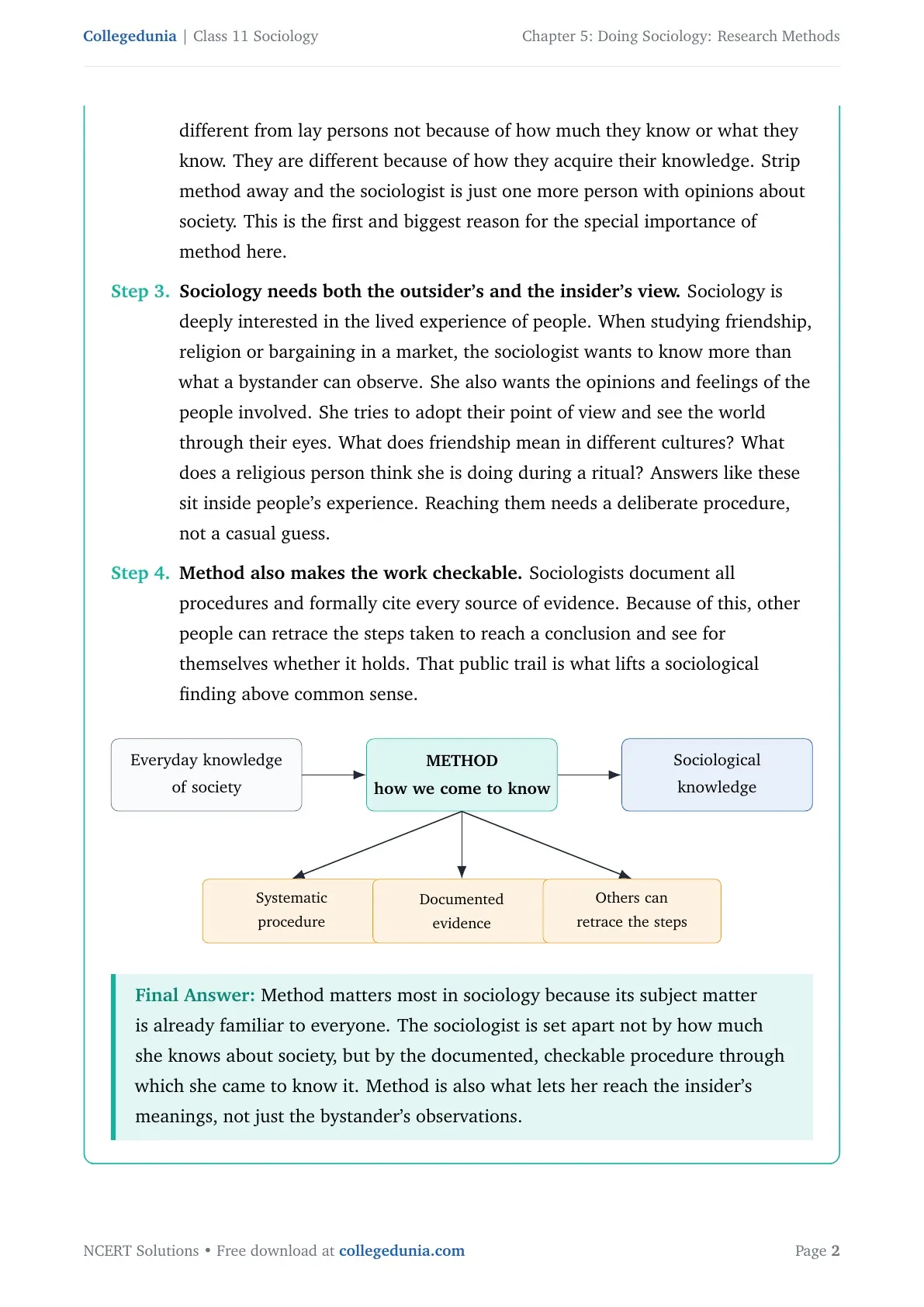
Exercise question 1 asks exactly this, so learn the argument as three linked points. Sociology deals with things that are already familiar to everyone. We all live in society and we already know a lot about social groups, institutions, norms and relationships from our own experience.
That familiarity creates the problem. If everybody already knows the subject matter, what makes the sociologist a social scientist? The crucial element is method: the procedures through which knowledge is gathered. Sociologists differ from other people not because of how much they know, but because of how they acquire what they know.
- Familiar subject matter: unlike rocks or plants, society is something every person already has an opinion about, so opinion has to be separated from evidence.
- Method is the dividing line: the claim to be scientific rests on procedure, on documentation, and on the formal citing of every source of evidence.
- Two points of view at once: sociology wants what the bystander can observe and also the opinions and feelings of the people involved.
- The textbook examples: what friendship means in different cultures, what a religious person thinks he or she is doing during a ritual, and how a shopkeeper and a customer read each other while bargaining.
Close the answer with the insider and outsider line. The need to understand both the outsider's and the insider's point of view is a second, separate reason why method carries so much weight in sociology.
Objectivity and Subjectivity in Sociology: Why Neutrality Is Harder in the Social Sciences
Exercise question 2 is a four point answer, and students who write only about bias lose half the marks. Start with the two words. Objective means unbiased and based on facts alone. Subjective means based on individual values and preferences.
Now the reason the gap opens. A geologist studying rocks and a botanist studying plants are not themselves part of the world they study. Social scientists study the world in which they live, the social world of human relations, and that creates special problems.
| Difficulty | What the textbook says | Example to quote |
|---|---|---|
| The obvious problem of bias | Sociologists are members of society and have the normal likes and dislikes that everyone has | A sociologist studying family relations is herself a member of a family, so her own experiences are likely to influence her |
| Bias without direct experience | Even with no personal experience of the group, the values and prejudices of one's own social context still work on the researcher | Studying a caste or religious community other than her own, she may carry the attitudes about that community that were common around her |
| Many versions of the truth | Things look different from different vantage points, so the social world holds competing interpretations of reality | A shopkeeper and a customer hold very different ideas of a good price; a young person and an aged person hold different notions of good food |
| A multi-paradigmatic science | Competing and mutually incompatible schools of thought coexist inside the discipline itself | The conflicting theories of society discussed earlier in the book |
Finish with the modern position, because it is worth a full mark. The old notion of an objective, disinterested social science is now widely considered outdated and can even mislead. Objectivity has to be thought of as the goal of a continuous, ongoing process rather than an already achieved end result.
How Sociologists Strive for Objectivity: Self-Examination, Documentation and Declared Bias
Exercise question 3 follows straight on from question 2, so the answers must not repeat each other. Question 2 lists the problems. Question 3 lists the three practical guards the chapter recommends, in this order.
- Rigorous and continuous self-examination. The sociologist keeps examining her own ideas and feelings about the subject of research, and tries to take an outsider's perspective on her own work.
- Careful documentation. All procedures are written down and every source of evidence is formally cited, so that other people can retrace the steps taken and see for themselves whether the conclusion holds.
- Declaring the social background. Because unconscious bias always remains possible, sociologists openly mention the features of their own social background that could be a source of bias on the topic being researched.
The third point needs one more sentence to score fully. Naming your own background alerts anyone using the study to the possibility of bias and lets them mentally compensate for it while reading the research. Do not stop at declaring the bias; say what declaring it achieves.
Reflexivity Explained, and Why It Is the Sociologist's Most Important Working Habit
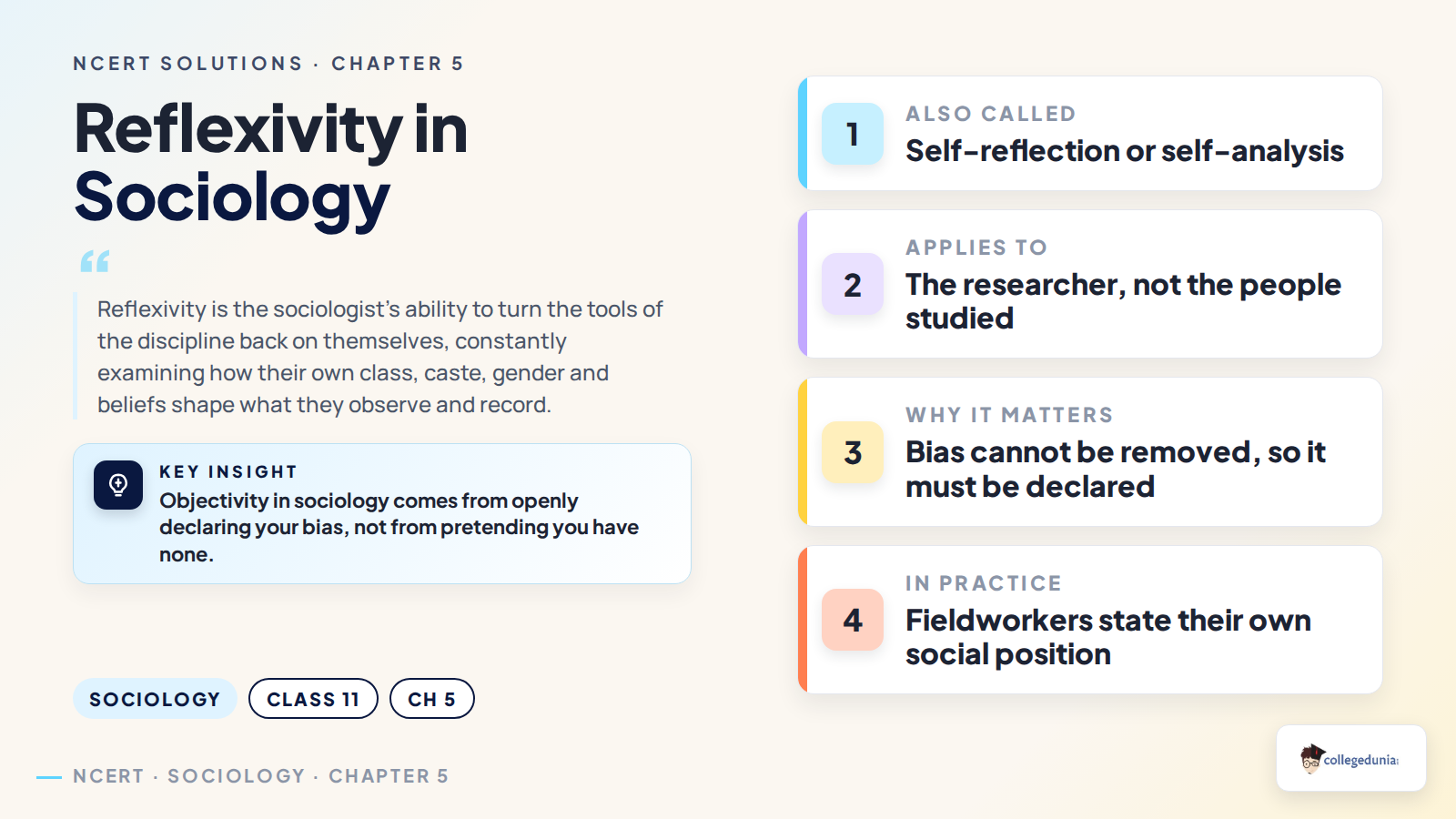
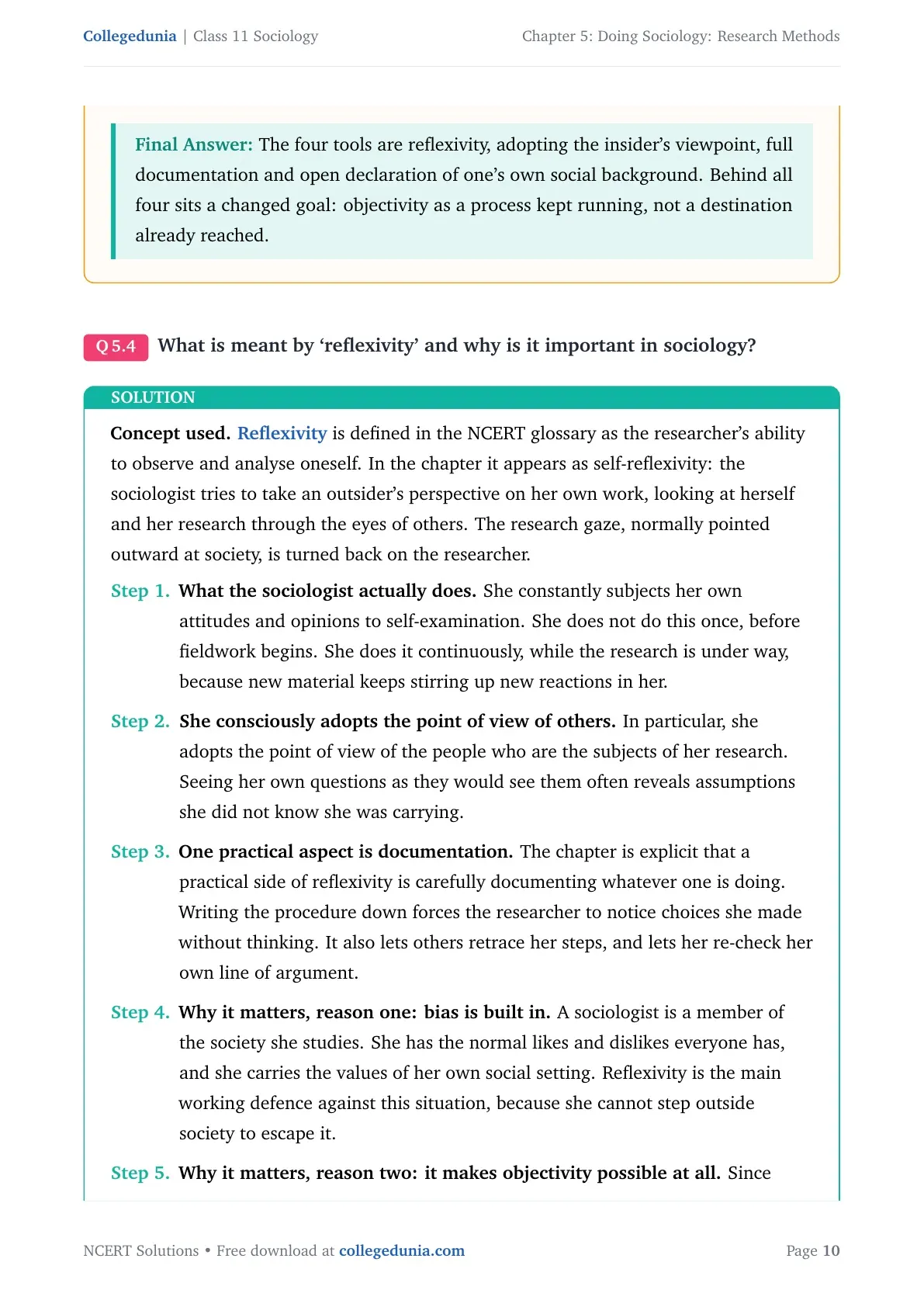
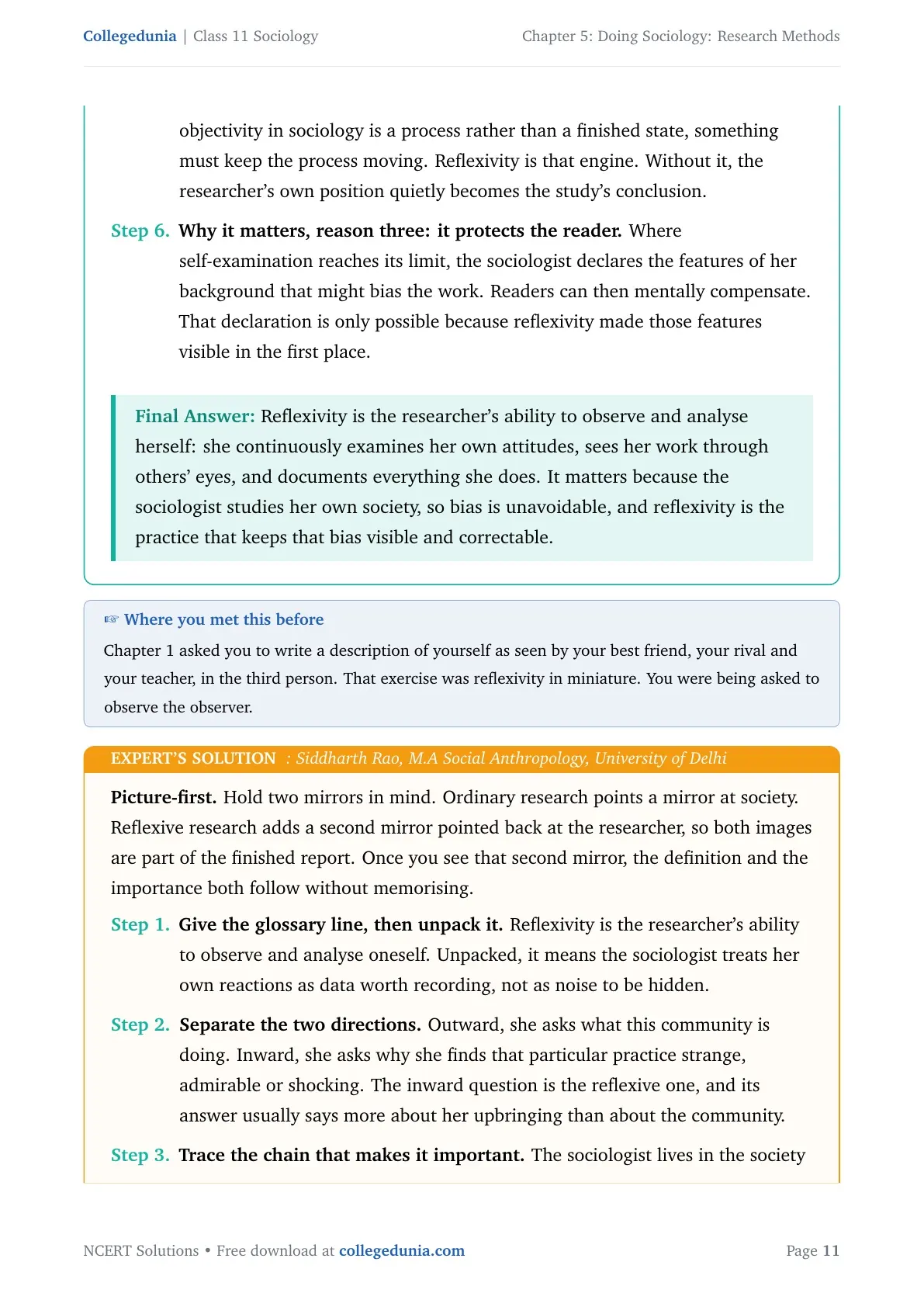
Exercise question 4 is the most commonly asked short answer from this chapter. Learn the definition word for word. Reflexivity, or self-reflexivity, is the technique by which the sociologist looks at herself and her research through the eyes of others. The glossary states it more simply as the researcher's ability to observe and analyse oneself.
- The sociologist constantly subjects her own attitudes and opinions to self-examination, and consciously tries to adopt the point of view of others, especially the people she is studying.
- The practical side of reflexivity is careful documentation of whatever is being done, since documentation is part of what makes research methods superior to casual observation.
- Documentation lets other people retrace the steps taken to reach a conclusion, and it helps the researcher check and re-check her own line of argument.
- Where reflexivity cannot reach, the sociologist falls back on declaring the social background that might be a source of bias.
- Activity 1 in the chapter is a reflexivity exercise: describe yourself as seen by your best friend, your rival and your teacher, writing in the third person.
One warning for the exam. Reflexivity is not the same as objectivity. Objectivity is the goal; reflexivity is one of the techniques used to move towards it. Students who treat the two as synonyms lose the mark for the definition.
Multiple Methods and the Choice of Method: Quantitative, Qualitative, Micro and Macro
This section is not a numbered exercise question, but school papers pull short answers from it every year. Since there are multiple truths and multiple perspectives in sociology, there are also multiple methods, and there is no single road to sociological truth.
| Way of classifying | First type | Second type |
|---|---|---|
| By what is measured | Quantitative: deals in countable or measurable variables such as proportions and averages | Qualitative: deals with abstract and hard to measure things such as attitudes and emotions |
| By what is studied | Methods that study observable behaviour | Methods that study non-observable meanings, values and interpretations |
| By source of data | Secondary data: already existing documents, records and artefacts, as in historical methods that work in archives | Primary data: fresh data produced by the study itself, as in interviews |
| By scale | Micro: small intimate settings, usually a single researcher; the interview and participant observation | Macro: large scale research with large numbers of people and investigators; survey research is the common example |
Two closing points earn marks. First, every method has its own strengths and weaknesses, so arguing about the superiority of one method is futile; the real question is whether the method suits the question being asked. Second, the recent trend is to use several methods on the same problem from different vantage points, a process called triangulation.
The chapter's own illustration is clean. To find out whether most Indian families are still joint families, a census or survey is best. To compare the status of women in joint and nuclear families, interviews, case studies or participant observation all fit.
Participant Observation: What Ethnographers Actually Do During Field Work
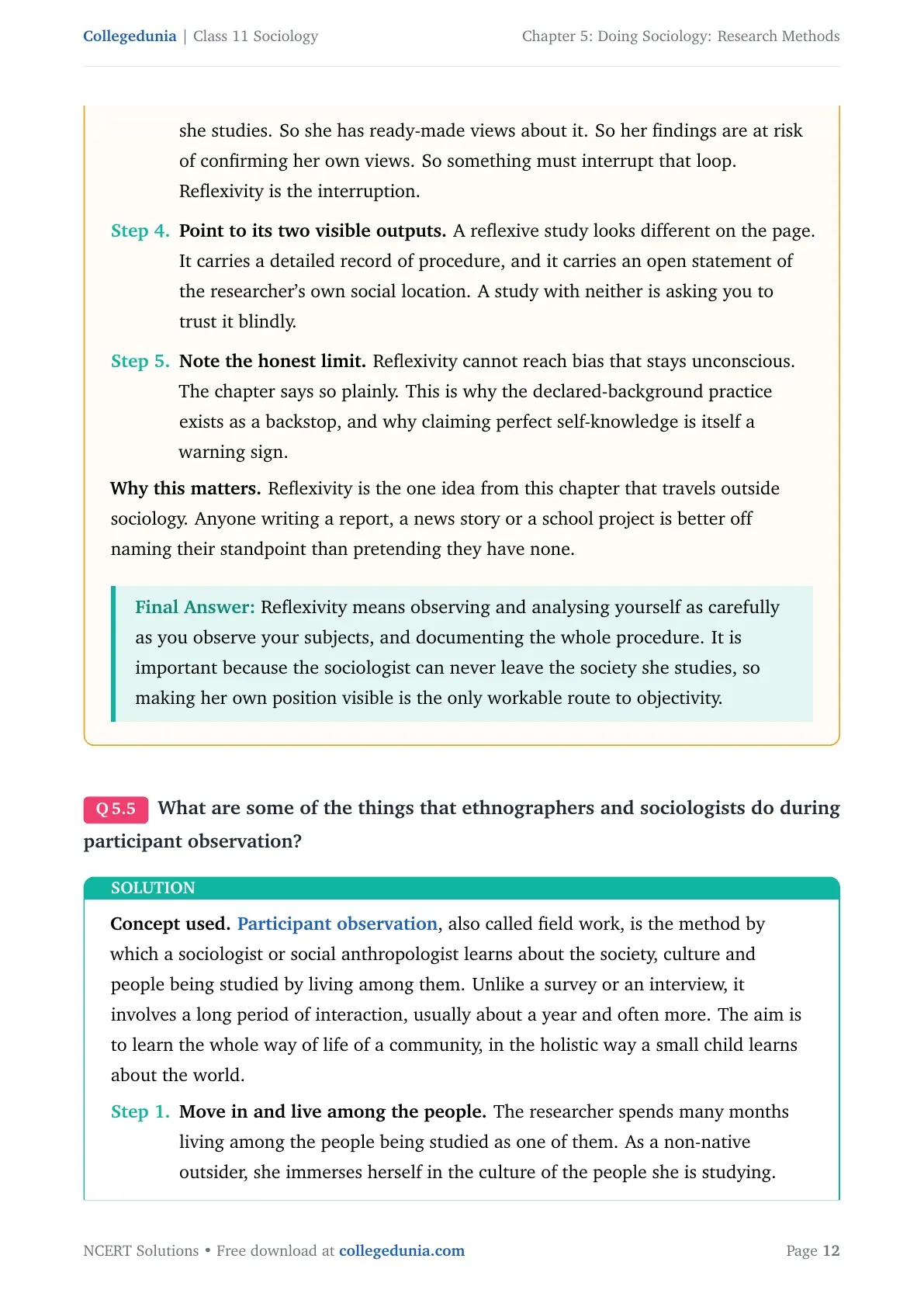
Exercise question 5 asks what ethnographers and sociologists do during participant observation, so the answer must be a list of activities, not a definition. Start with one line of definition and then move straight to the work. The field worker spends many months, usually about a year or sometimes more, living among the people being studied as one of them.
- Takes a census of the community. A detailed list of everyone living there, including sex, age group and family.
- Maps the physical layout of the village or settlement, including the location of houses and other socially relevant sites.
- Constructs a genealogy. A family tree for individual members, extended back as far as the person can remember, then cross-checked with other relatives before it is confirmed.
- Learns the local language continuously, because Malinowski held that first-hand observation must be preceded by intensive language learning.
- Observes daily life and writes detailed field notes, which must be written up every day without fail and may take the form of a daily diary.
- Asks endless questions about things the community takes for granted, learning like a child who is always asking why and what.
- Works through informants. One or two people supply most of the information; they act as the anthropologist's teachers and are called informants or principal informants.
Name the topics too, since the question says what they do. Field workers are especially interested in festivals, religious and other collective events, modes of earning a living, family relations and modes of child rearing. The overall goal is to learn about the whole way of life of a community.
Malinowski, the Trobriand Islands and the Invention of Field Work
This box is a favourite source based question, and it is short enough to learn completely. Bronislaw Malinowski, a Polish anthropologist settled in Britain, is widely believed to have established field work as the distinctive method of social anthropology, although he was not the first to use it.
- In 1914 the First World War broke out while Malinowski was visiting Australia. Poland had been annexed by Germany, so he technically became an enemy alien and the law required that he be confined to a specific place.
- He asked to serve that confinement in the Trobriand Islands in the South Pacific, and the Australian government even financed the trip.
- He spent a year and a half living in a tent in the native villages, learnt the local language, kept careful records and maintained a daily diary.
- He rejected the use of interpreters and rejected interviewing people summoned to a town or outpost. Observation had to be done in context, among the people themselves.
- From his position at the London School of Economics he campaigned to make field work a mandatory part of anthropological training, which helped the discipline gain acceptance as a rigorous science.
Set the box against what came before it. The early anthropologists were armchair scholars who organised information about communities they had never visited, taken from travellers, missionaries, colonial administrators and soldiers. James Frazer's The Golden Bough and Emile Durkheim's work on primitive religion were both built entirely on such second hand accounts.
Field Work in Indian Sociology: The Village Studies of the 1950s and 1960s
Sociologists use more or less the same techniques as anthropologists. The difference lies not in what is done but in where it is done, and in how the emphasis is spread across topics. Sociological field work also did not always involve living in, although it did mean spending most of one's time with the community.
| Study | Scholar | What to remember |
|---|---|---|
| Street Corner Society | William Foote Whyte | Lived three and a half years in an Italian-American slum, spending time with a street gang of mostly poor unemployed youth, the first American-born generation in a community of immigrants |
| Factory work in Chicago | Michael Burawoy | Worked several months as a machinist and wrote about the experience of work from the point of view of workers |
| Behind Mud Walls | William and Charlotte Wiser | A missionary couple who lived five years in a village in Uttar Pradesh, written long before the 1950s wave; William Wiser was trained as a sociologist and had written on the jajmani system |
| The Remembered Village | M. N. Srinivas | A year in a village near Mysore that he named Rampura; his field notes were destroyed in a fire, so the book was written from memory |
| Indian Village | S. C. Dube | A multi-disciplinary team at Osmania University studied Shamirpet near Secunderabad, meant both to study the village and to develop it |
| Cornell Village Study Project | Cornell University team | American social anthropologists, psychologists and linguists studied several villages in eastern Uttar Pradesh in one ambitious project |
The reasons village studies took over Indian sociology are worth two marks on their own. The village was a bounded community small enough for one person to study, anthropology was unpopular with nationalists because of its concern with the primitive, the new government wanted to develop rural India, and villages were where most Indians lived, and still do.
Strengths and Weaknesses of Participant Observation for the Class 11 Exam
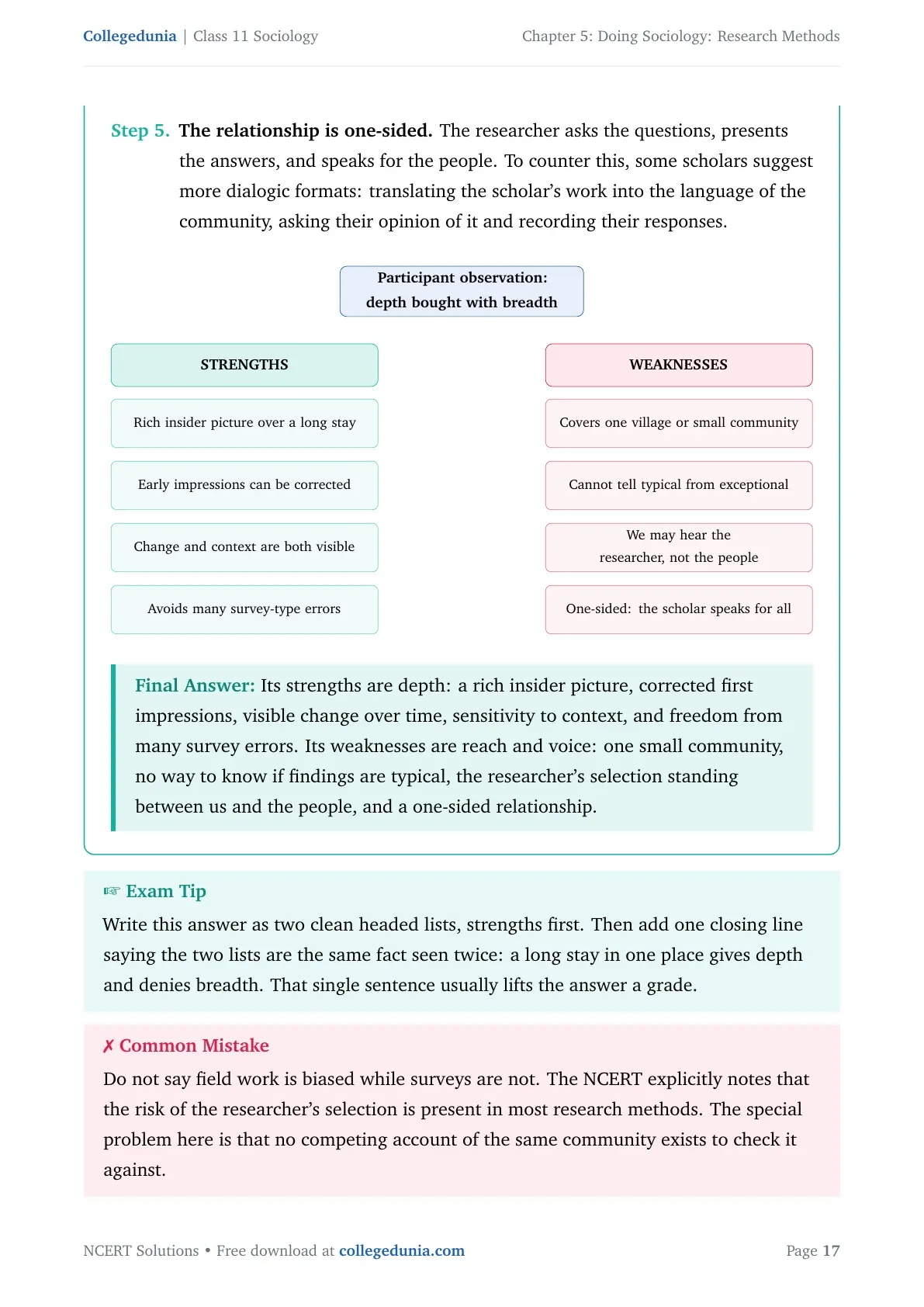
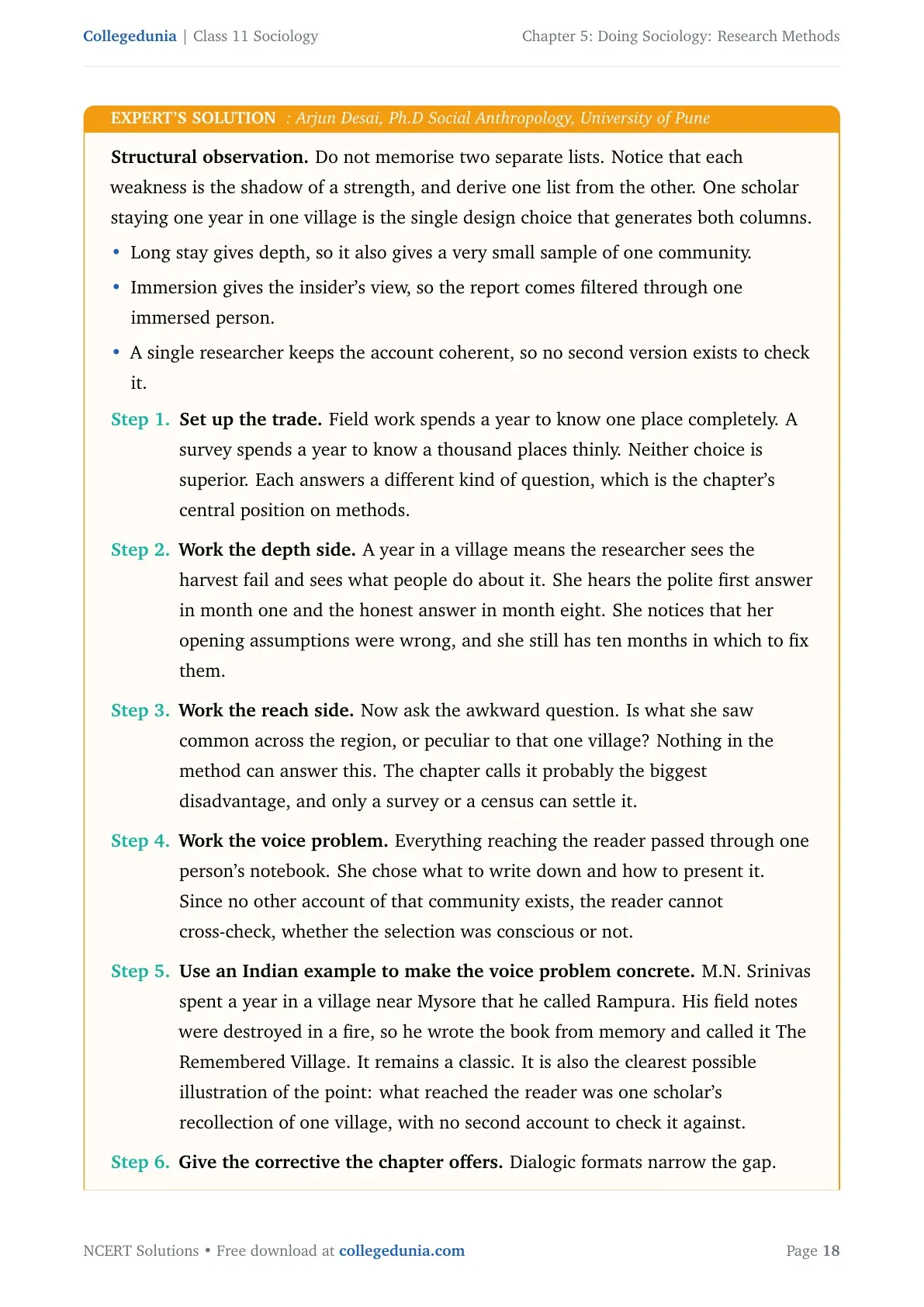
Exercise question 6 asks for both sides, so split the answer down the middle and give roughly equal space to each. The single strongest line to open with is that field work provides a very rich and detailed picture of life from the perspective of the insider.
| Strengths | Weaknesses |
|---|---|
| Gives a rich, detailed picture of life from the insider's point of view, which is the return on a large investment of time and effort | It is long drawn out and intensive, usually done by a single scholar working alone |
| Holds detailed knowledge of the field over a long period, unlike methods based on a short and quick field visit | It can only cover a very small part of the world, generally a single village or small community |
| Allows initial impressions, which are often mistaken or biased, to be corrected later | We can never be sure whether what was observed is common in the wider region or country, or is exceptional; this is the biggest disadvantage |
| Lets the researcher track changes over time and see the impact of different situations, as in a good harvest year against a bad one | We are never sure whether we are hearing the voice of the anthropologist or of the people being studied, since the scholar selects what is written down |
| Long full time engagement helps avoid many errors that surveys, questionnaires or short term observation cannot escape | The relationship is one-sided: the scholar asks the questions, presents the answers and speaks for the people |
Close with the proposed remedy, because it is the last paragraph of the section and is often ignored. Some scholars suggest dialogic formats: translating the scholar's work into the language of the community, asking for their opinion of it and recording what they say. As the gap between researcher and researched narrows, the scholar's version is more likely to be questioned, qualified or corrected by the people themselves.
The Survey Method: Basic Elements and Its Chief Advantage in Sociology
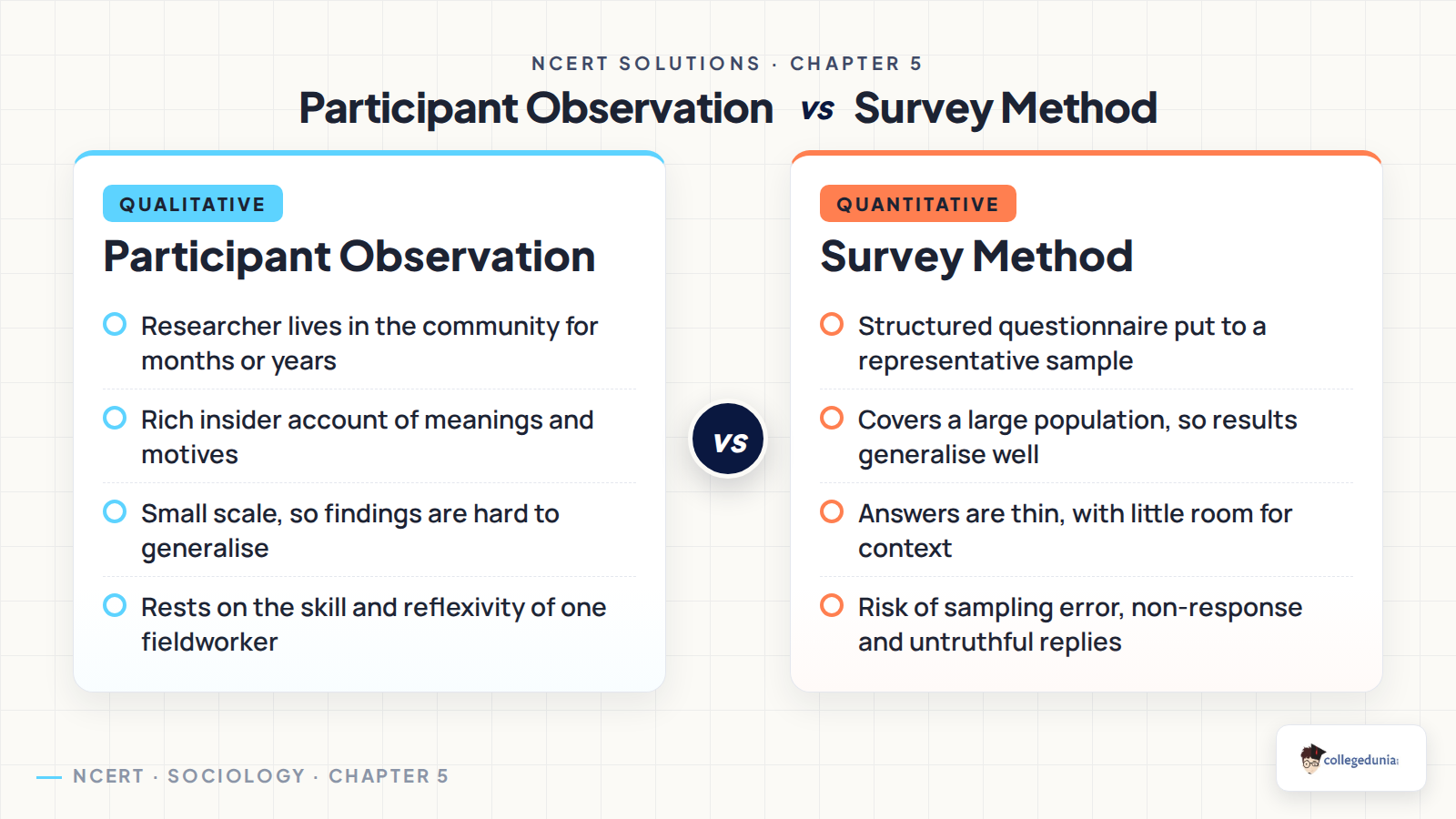
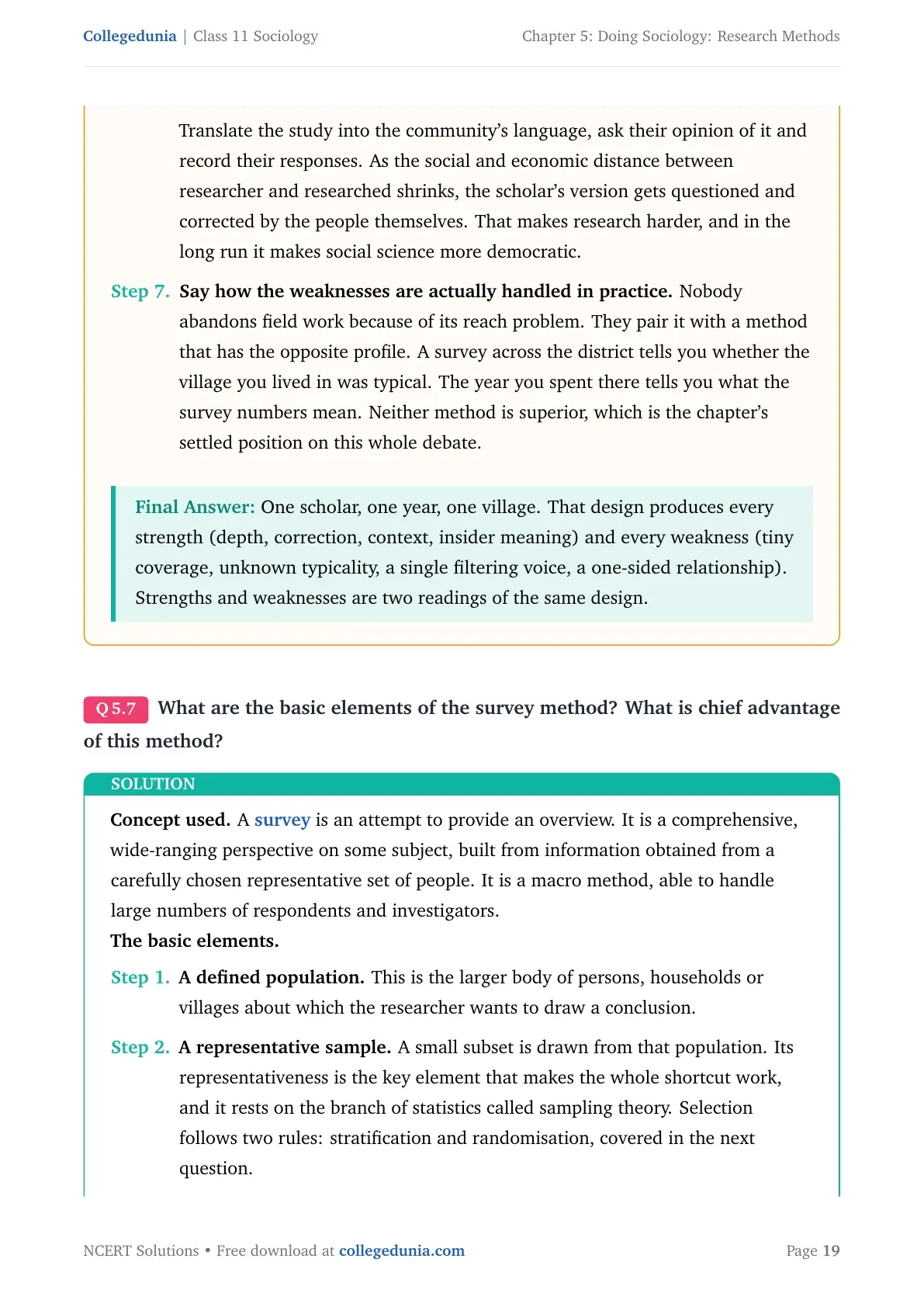
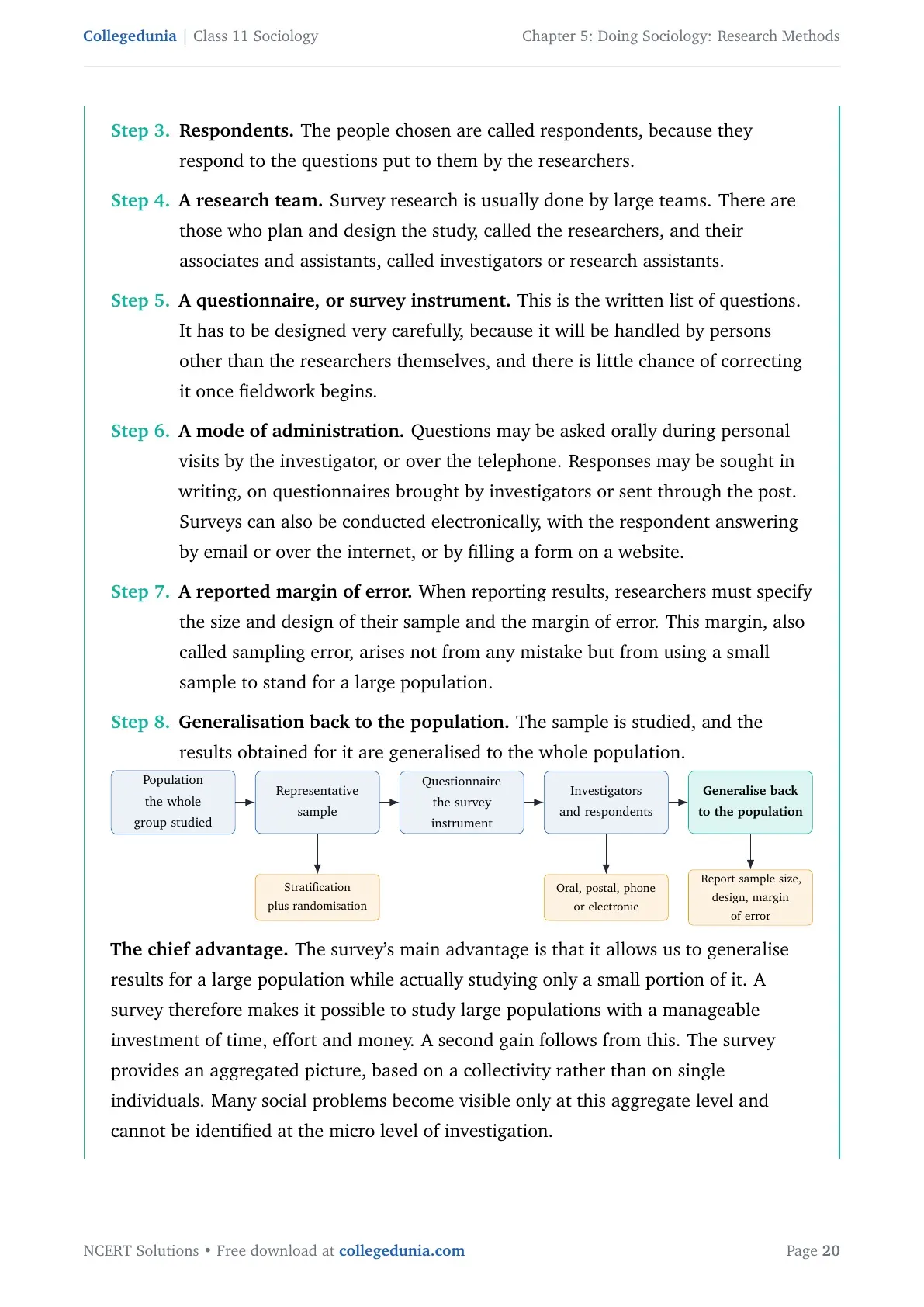
Exercise question 7 asks for the basic elements and then for the chief advantage, so answer in two clear halves. A survey is an attempt to provide an overview: a wide-ranging perspective on a subject, based on information obtained from a carefully chosen representative set of people.
- The people who answer. A carefully chosen representative set of people supply the information by answering questions put to them.
- The research team. Survey research is done by large teams, with researchers who plan and design the study and assistants called investigators or research assistants who collect the answers.
- The questionnaire. A written list of questions, sometimes called the survey instrument, which must be designed very carefully because it is handled by people other than the researchers.
- The modes of asking. Orally during personal visits, over the telephone, in writing on questionnaires carried by investigators or sent by post, and now electronically by email, internet or a website form.
- The sample. A small subset drawn from and representing a larger population, selected using sampling theory.
Now the chief advantage in one sentence. A survey allows us to generalise results for a large population while actually studying only a small portion of it, so large populations can be studied with a manageable investment of time, effort and money.
Add the aggregate point for the extra mark. The survey gives an aggregated picture, based on a collectivity rather than on single individuals. Many social problems become visible only at that level, and the chapter's example is the falling child sex ratio, which no single family can reveal.
How to Select a Representative Sample: Stratification and Randomisation Explained
Exercise question 8 has exactly two principles, and students who name only one lose half the marks. Learn them as a pair, in this order, with one example each.
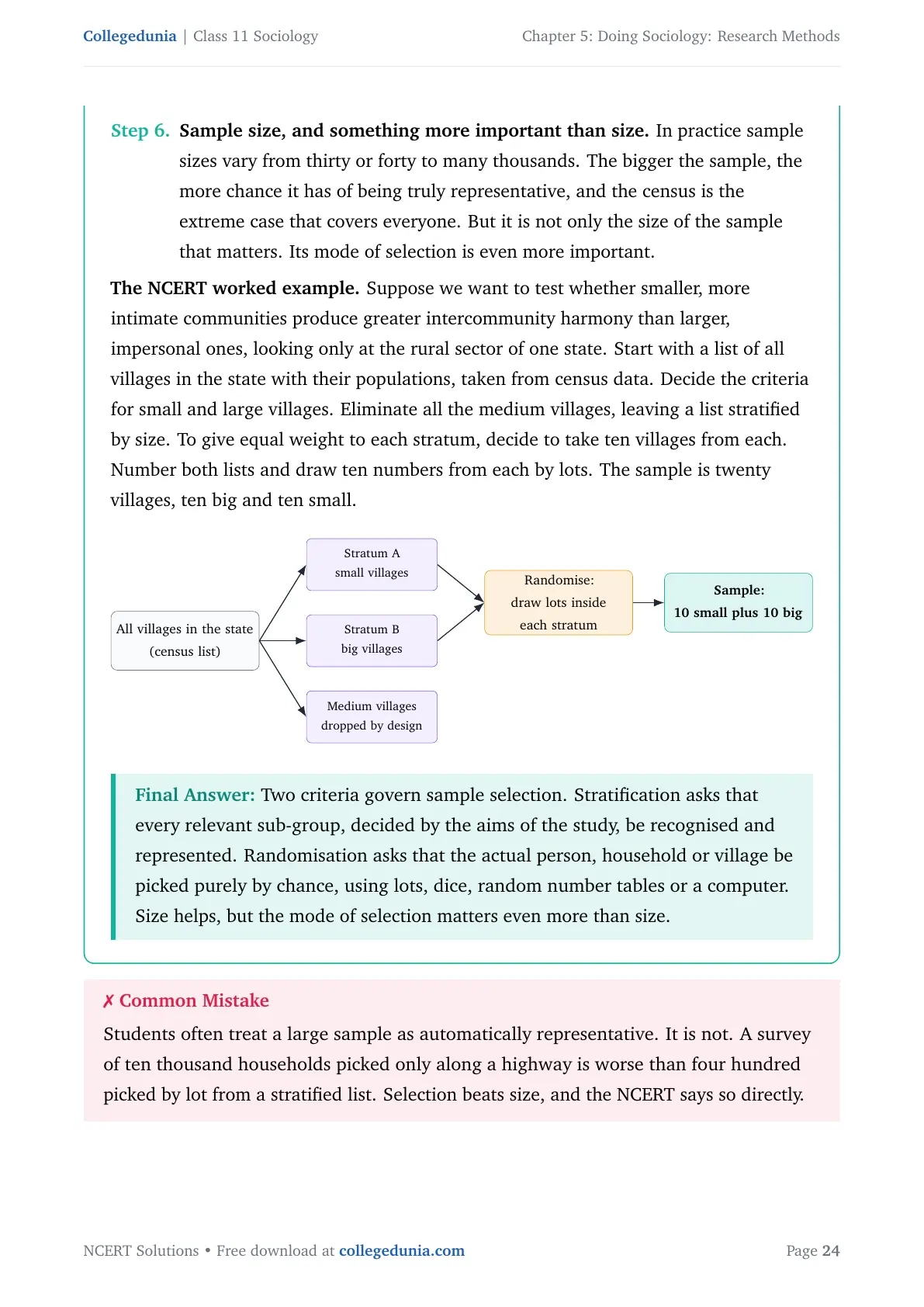
- Stratification. All the relevant sub-groups in the population must be recognised and represented in the sample, because most large populations are not homogenous. The population of India is divided into very different rural and urban sectors; a single village may be stratified by class, caste, gender, age or religion. Which strata count as relevant depends on the objectives of the study, so research on attitudes towards religion must include members of all religions, and research on trade unions must include workers, managers and industrialists.
- Randomisation. The actual unit chosen, whether a person, a household or a village, must be selected purely by chance, an idea that rests on probability. Being chosen should be a matter of luck, like winning a lottery. The common techniques are drawing lots, rolling dice, published random number tables, and random numbers generated by calculators or computers.
Say what happens when randomisation fails, since the textbook gives two clear cases. A team that picks only villages near the main highway, or mostly middle class households and households it already knows, has a purposive sample and not a random one, and the result cannot be generalised.
The worked example in the chapter is easy to reproduce. List all villages in a state with their population from census data, decide what counts as small and large, remove the medium villages, then draw lots to pick 10 small and 10 big villages. Finish with the honest caveat: the small differences that remain are called the margin of error, or sampling error, and every reported survey must specify the size and design of its sample along with that margin.
Weaknesses of the Survey Method Every Class 11 Student Should Be Able to List
Exercise question 9 is a straight list question, so give the marker separate labelled points rather than one long paragraph. The governing line is that wide coverage comes at the cost of depth of coverage.
- No depth. It is usually not possible to get in-depth information in a large survey, because the number of people covered forces the time spent on each one to be limited.
- Uneven asking. Since the questionnaire is carried around by a relatively large number of investigators, complicated questions or those needing detailed prompting are hard to ask in exactly the same way every time.
- Errors creep in. Differences in how questions are asked, or how answers are recorded, introduce errors into the survey.
- No trust between the two sides. There is no long-term relationship between the investigator and the person answering, so personal or sensitive questions cannot be asked, or get answered safely rather than truthfully.
- Non-sampling errors. These faults come from the research design or the way it was carried out rather than from sampling, they are difficult to foresee, and they can produce misleading or false estimates.
- A rigid instrument. To succeed, a survey depends on a tightly structured, inflexible questionnaire, and once it is in the field there is little chance of correction or modification.
- Dependence on goodwill. However well the questionnaire is designed, its success finally rests on the interaction between investigators and the people answering, and on their goodwill and cooperation.
Activity 4 turns this into an exam-ready warning. Be suspicious of any survey reported without its sample size, its selection method and its margin of error, because without those three figures the findings cannot be evaluated at all.
Main Features of the Interview as a Research Method in Sociology
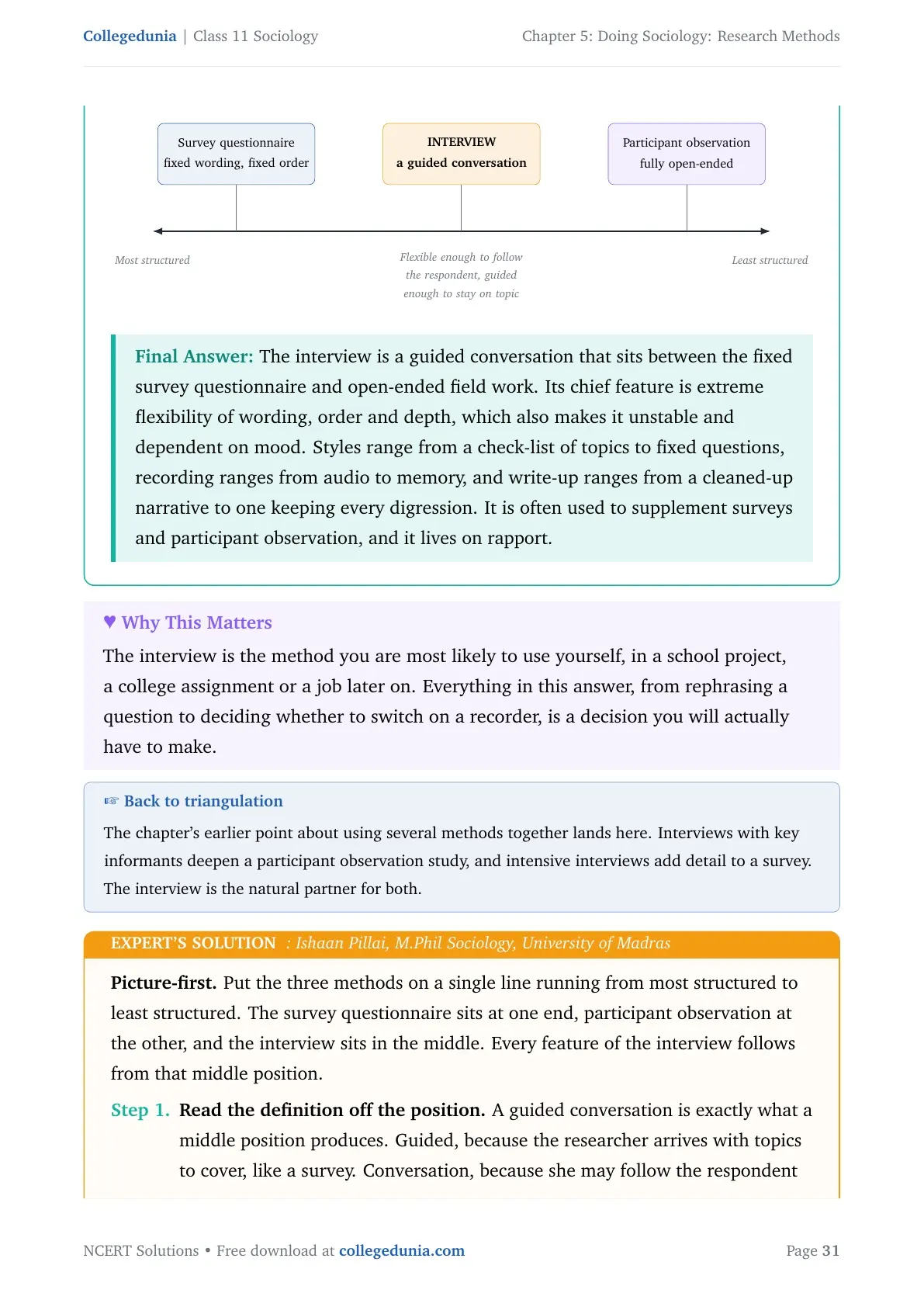
Exercise question 10 asks for the main features, so define, place and then balance. An interview is basically a guided conversation between the researcher and the person being interviewed. Its simplicity is deceptive, because it takes a lot of practice and skill to become a good interviewer.
| Feature | What the textbook says |
|---|---|
| Where it sits | Between the structured questionnaire used in surveys and the completely open-ended interaction typical of participant observation |
| Chief advantage | The extreme flexibility of the format: questions can be re-phrased or stated differently, and the order of subjects can change with the progress of the conversation |
| Flexibility in action | Subjects producing good material can be extended and built upon; those provoking unfavourable reactions can be cut short or postponed, all during the interview itself |
| Chief disadvantage | The same flexibility makes it vulnerable to changes of mood in the person being interviewed and to lapses of concentration in the interviewer; it is an unstable and unpredictable format |
| Styles of interviewing | Some prefer a loosely structured format with only a check-list of topics; others prefer more structure, with specific questions asked of everyone |
| Ways of recording | Video or audio recording, detailed note taking during the interview, or relying on memory and writing up afterwards |
| Ways of writing it up | Some edit the transcript into a cleaned up continuous narrative; others keep the flavour of the original conversation, including all the asides and digressions |
| Use with other methods | Often a supplement to participant observation and surveys: long conversations with key informants clarify field material, and intensive interviews add depth to survey findings |
Two more sentences finish the answer properly. Recording equipment often makes the person being interviewed uneasy and adds formality, yet important information can go unrecorded when less complete methods are used. And as a method the interview depends on personalised access and the degree of rapport or mutual trust between the two sides.
All 10 Textbook Questions Covered in These Doing Sociology Research Methods NCERT Solutions
Every question at the end of the chapter is a discussion question. The table shows what each one is really testing and how the answer on this page is built, so you can plan before you write.
| Question | What it asks | How the answer is built |
|---|---|---|
| Question 1 | Why the question of a scientific method is particularly important in sociology | Familiar subject matter first, then method as the dividing line, then the insider and outsider point of view with the friendship and bargaining examples |
| Question 2 | Reasons for objectivity being more complicated in the social sciences | Define objective and subjective, contrast the geologist with the social scientist, then bias, bias without direct experience, many versions of truth, and multi-paradigmatic schools |
| Question 3 | How sociologists deal with difficulties in objectivity | Three guards in order: continuous self-examination, careful documentation with cited sources, and openly declaring one's own social background |
| Question 4 | What reflexivity means and why it matters | The definition of self-reflexivity, then documentation as its practical side, then the point that reflexivity is a technique and objectivity is the goal |
| Question 5 | What ethnographers and sociologists do during participant observation | Census, map, genealogy, language learning, daily field notes, endless questioning, and work through principal informants |
| Question 6 | Strengths and weaknesses of participant observation | Insider depth and correction of impressions against small coverage, uncertain typicality, the single voice problem and the one-sided relationship |
| Question 7 | Basic elements of the survey method and its chief advantage | The people who answer, the team, the questionnaire, the modes of asking and the sample, then generalising from a small portion of a large population |
| Question 8 | Criteria for selecting a representative sample | Stratification with the rural and urban example, then randomisation with the lottery idea, then purposive samples and the margin of error |
| Question 9 | Weaknesses of the survey method | Loss of depth, uneven asking, recording errors, lack of trust, non-sampling errors, the inflexible questionnaire and dependence on cooperation |
| Question 10 | Main features of the interview as a research method | Guided conversation, its position between survey and field work, flexibility as both the strength and the weakness, styles, recording and rapport |
How Doing Sociology Research Methods Appears in the Class 11 Sociology Exam Paper
School papers treat this chapter as a definitions chapter with one long answer slot. The distribution below is what the last five years of school papers show, and it tells you where to spend revision time.
| Question type | Marks | What gets asked |
|---|---|---|
| Very short answer | 1 to 2 | Define reflexivity, sample, population, census, genealogy, probability, randomisation, questionnaire or sampling error |
| Short answer | 2 to 4 | Distinguish objectivity from subjectivity, quantitative from qualitative, primary from secondary data, micro from macro methods, sampling from non-sampling error |
| Long answer | 4 to 6 | Strengths and weaknesses of participant observation, the two principles of sample selection, the weaknesses of the survey, and the features of the interview |
| Source based | 4 | The Malinowski and Trobriand Islands box, the Street Corner Society extract, the village studies box, and the child sex ratio table |
Two named items keep returning in school papers: the two principles of sample selection and the strengths and weaknesses of participant observation. Prepare those two in writing and you have covered most of the marks this chapter carries.
Common Mistakes Students Make in the Doing Sociology Research Methods Chapter
Read this before you attempt a long answer. In the same Collegedunia poll, only 19% of students could name both principles of sample selection, and the rest wrote about sample size instead, which is not one of the two principles.
- Confusing the two meanings of stratification. Here it is a statistical idea about sub-groups in a population. It is not the sociological concept of stratification from the earlier chapter.
- Writing that a bigger sample is a better sample. Size helps, but the textbook is explicit that the mode of selection matters even more than size.
- Treating reflexivity as objectivity. Reflexivity is a technique the researcher uses on herself. Objectivity is the goal that the technique moves towards.
- Mixing up sampling and non-sampling error. Sampling error is the unavoidable margin that comes from studying a small sample. Non-sampling error comes from faults in the design or in how the study was carried out.
- Answering question 5 with a definition. The question asks what field workers do, so the answer must list activities: census, map, genealogy, language, notes, questions and informants.
- Calling one method superior. The chapter calls that argument futile. The right test is whether the method fits the question being asked.
- Dropping the named studies. Answers without Malinowski, Whyte, Burawoy, Srinivas, Dube or the Wisers read like general knowledge, and score like it too.
Sample Solved Long Answer on Sample Selection for the Class 11 Sociology Exam
Question. What are the criteria for selecting a representative sample? Answer in about 120 words for 6 marks.
- Open with the purpose, 1 mark. A sample is a small subset drawn from a larger population, and the key element that lets a survey generalise its findings is the representativeness of that sample.
- State the first principle, 1 mark. Stratification means all the relevant sub-groups in the population must be recognised and represented, because large populations are not homogenous.
- Give the stratification example, 1 mark. The population of India is divided into very different rural and urban sectors, and a single village may be stratified by class, caste, gender, age or religion.
- State the second principle, 1 mark. Randomisation means the actual person, household or village chosen must be selected purely by chance, an idea that rests on probability.
- Give the randomisation example, 1 mark. Chance is ensured by drawing lots, rolling dice, using random number tables, or using random numbers from a computer.
- Close with the failure case, 1 mark. Choosing only villages near the highway, or mostly middle class households, produces a purposive sample rather than a random one, and the results cannot be generalised.
Key Terms from the Research Methods Glossary Every Class 11 Student Should Know
The chapter glossary is the single richest source of one mark questions in the whole book, because every term is statistical and has an exact wording. Learn all eleven.
| Term | Definition to write |
|---|---|
| Census | A comprehensive survey covering every single member of a population |
| Genealogy | An extended family tree outlining familial relations across generations |
| Non-sampling error | Errors in survey results due to mistakes in the design or application of methods |
| Population | In the statistical sense, the larger body of persons, villages or households from which a sample is drawn |
| Probability | The likelihood or odds of an event occurring, in the statistical sense |
| Questionnaire | A written list of questions to be asked in a survey or interview |
| Randomisation | Ensuring that an event, such as the selection of a particular item in the sample, depends purely on chance and nothing else |
| Reflexivity | The researcher's ability to observe and analyse oneself |
| Sample | A subset or selection, usually small, drawn from and representing a larger population |
| Sampling error | The unavoidable margin of error in the results of a survey, because it is based on information from only a small sample rather than the entire population |
| Stratification | In the statistical sense, the subdivision of a population into distinct groups based on relevant criteria such as gender, location, religion or age |
How to Study Doing Sociology Research Methods for the 2026-27 Class 11 Sociology Exam
This chapter is short on argument and long on exact terms, so revision works best in three sittings rather than one. This is the plan Class 11 Sociology teachers recommend for the 2026-27 session.
- Sitting one, about 40 minutes. Read the introduction and the objectivity section. Write out the four difficulties with objectivity, then the three guards against them, then the definition of reflexivity from the glossary.
- Sitting two, about 45 minutes. Take participant observation end to end: the seven field activities, the Malinowski box, the Indian village studies, then the strengths and weaknesses as a two column table drawn from memory.
- Sitting three, about 45 minutes. Do the survey and the interview together, since the exam compares them. Learn the two sampling principles, the seven weaknesses of the survey, and the features of the interview, then attempt exercise questions 6, 8 and 9 in full.
Keep the eleven glossary terms on a single card and read them the night before the paper. Definitions carry the safest marks in this chapter, because they cannot be argued with.
Doing Sociology Research Methods Class 11 Sociology Resources Beyond These NCERT Solutions
Also Check: use these alongside the solutions. The notes page holds the topic explanations, the book PDF gives you the boxes needed for source based questions, and the question set lets you attempt each exercise question before reading the answer.
| Resource | Best used for | Link |
|---|---|---|
| Doing Sociology Research Methods Class 11 Notes | Topic by topic explanation of objectivity, reflexivity and the three field methods, with the glossary terms grouped | Read the Doing Sociology Research Methods Class 11 Notes |
| Doing Sociology Research Methods NCERT Book PDF | The original chapter text, needed for source based questions built on the Malinowski box, the Whyte extract and the sex ratio table | Download the Doing Sociology Research Methods Class 11 NCERT Book PDF |
| Doing Sociology Research Methods Question and Answer Set | All 10 exercise questions with a short Solution tab and an expanded Expert Solution tab | Open the Doing Sociology Research Methods question and answer set |
NCERT Solutions for All Class 11 Sociology Chapters
Related Links: the same answer format runs across every chapter of Class 11 Sociology, so you can move from one to the next without changing how you write. Chapters 1 to 5 come from Introducing Sociology and chapters 6 to 10 come from Understanding Society.
| Chapter | Title | Solutions |
|---|---|---|
| Chapter 1 | Sociology and Society | Sociology and Society Class 11 NCERT Solutions |
| Chapter 2 | Terms, Concepts and their Use in Sociology | Terms and Concepts in Sociology Class 11 NCERT Solutions |
| Chapter 3 | Understanding Social Institutions | Understanding Social Institutions Class 11 NCERT Solutions |
| Chapter 4 | Culture and Socialisation | Culture and Socialisation Class 11 NCERT Solutions |
| Chapter 5 | Doing Sociology: Research Methods | Doing Sociology Research Methods Class 11 NCERT Solutions (this page) |
| Chapter 6 | Social Structure, Stratification and Social Processes in Society | Social Structure and Stratification Class 11 NCERT Solutions |
| Chapter 7 | Social Change and Social Order in Rural and Urban Society | Social Change and Social Order Class 11 NCERT Solutions |
| Chapter 8 | Environment and Society | Environment and Society Class 11 NCERT Solutions |
| Chapter 9 | Introducing Western Sociologists | Introducing Western Sociologists Class 11 NCERT Solutions |
| Chapter 10 | Indian Sociologists | Indian Sociologists Class 11 NCERT Solutions |
All 10 questions with step-by-step solutions
Open the full question set for this chapter, where every exercise question comes with a short Solution tab and an expanded Expert Solution tab. Open the Doing Sociology Research Methods Class 11 question and answer set
Doing Sociology Research Methods Class 11 Sociology NCERT Solutions FAQs
Ques. How many exercise questions are there in this chapter and where can I get the answers?
Ans. The chapter ends with 10 exercise questions, and all of them are discussion questions. They cover why scientific method matters in sociology, why objectivity is complicated in the social sciences, how sociologists strive for objectivity, the meaning of reflexivity, what field workers do during participant observation, the strengths and weaknesses of that method, the elements and chief advantage of the survey, the criteria for a representative sample, the weaknesses of the survey, and the main features of the interview. All ten are answered on this page according to the 2026-27 NCERT Introducing Sociology book, and the downloadable PDF carries the same answers in a printable layout.
Ques. Why is the question of a scientific method particularly important in sociology?
Ans. More than any other discipline, sociology deals with things that are already familiar to most people, since all of us live in society and already know a lot about social groups, institutions, norms and relationships from our own experience. That raises the question of what makes the sociologist different from any other member of society. The answer is method, the procedures through which knowledge is gathered, because sociologists differ not in how much they know but in how they acquire their knowledge. A second reason is that sociology needs both the outsider's and the insider's point of view, which calls for careful method.
Ques. Why is objectivity more complicated in the social sciences?
Ans. A geologist studying rocks and a botanist studying plants are not part of the natural world they study. Social scientists study the social world of human relations in which they themselves live. That creates the obvious problem of bias, since a sociologist studying family relations is herself part of a family. Even without direct experience of the group, she may be influenced by the values and prejudices of her own social context. There are also many versions of the truth, since things look different from different vantage points, and sociology is multi-paradigmatic, so competing and mutually incompatible schools of thought coexist within the discipline.
Ques. How do sociologists try to deal with the difficulties in objectivity?
Ans. There are three guards. The first is to rigorously and continuously examine one's own ideas and feelings about the subject of research, taking an outsider's perspective on one's own work. The second is careful documentation of all procedures and the formal citing of all sources of evidence, so that other people can retrace the steps taken and check the conclusion. The third is to explicitly mention those features of one's own social background that might be a source of bias on the topic, which alerts anyone using the study and allows them to compensate for it mentally.
Ques. What is meant by reflexivity in sociology?
Ans. Reflexivity, also called self-reflexivity, is the technique by which the sociologist tries to look at herself and at her research through the eyes of others, especially the people she is studying. The chapter glossary defines it as the researcher's ability to observe and analyse oneself. It matters because the sociologist constantly subjects her own attitudes and opinions to self-examination, which is the main defence against bias. Its practical side is the careful documentation of whatever one is doing, so that the line of argument can be checked and re-checked by the researcher and by other scholars.
Ques. What do ethnographers and sociologists do during participant observation?
Ans. The field worker lives among the people being studied for many months, usually about a year or sometimes more. The work begins with a census of the community, a detailed list of everyone living there with sex, age group and family, often with a map of the physical layout of the village. Next comes a genealogy, a family tree extended back as far as people can remember and cross-checked with other relatives. Throughout, the field worker learns the local language, observes daily life, writes detailed field notes every day without fail, asks endless questions about what the community takes for granted, and depends on one or two principal informants.
Ques. What are the strengths and weaknesses of participant observation?
Ans. The main strength is that it gives a rich and detailed picture of life from the insider's perspective, held over a long period rather than in a short field visit. It allows initial impressions to be corrected, lets the researcher track changes such as the difference between a good and a bad harvest year, and avoids errors that surveys and short term observation cannot escape. The weaknesses are that it is long drawn out work by a single scholar, it covers only a small community so we cannot tell whether what was seen is typical, and we are never sure whether we are hearing the voice of the scholar or of the people studied.
Ques. What are the basic elements of the survey method and what is its chief advantage?
Ans. A survey is an attempt to provide an overview, a wide-ranging perspective on a subject based on information obtained from a carefully chosen representative set of people. Its elements are the people who answer, a large team of researchers plus investigators or research assistants, a carefully designed questionnaire sometimes called a survey instrument, a mode of asking that may be a personal visit, a telephone call, a posted form or an electronic form, and a scientifically selected sample. The chief advantage is that it allows results to be generalised for a large population while only a small portion of that population is actually studied, so large populations can be covered with a manageable investment of time, effort and money.
Ques. What are the two criteria for selecting a representative sample?
Ans. The first is stratification. All the relevant sub-groups in the population must be recognised and represented, because most large populations are not homogenous. India is divided into very different rural and urban sectors, and a single village may be stratified by class, caste, gender, age or religion. The second is randomisation. The actual person, household or village chosen must be selected purely by chance, an idea that rests on probability, and this is done by drawing lots, rolling dice, using random number tables or using random numbers from a computer. Choosing only villages near a highway gives a purposive sample, which cannot be generalised.
Ques. What are the weaknesses of the survey method?
Ans. Wide coverage comes at the cost of depth, because the large number of people covered limits the time spent on each one. Since many investigators carry the questionnaire around, complicated questions are hard to ask in exactly the same way every time, and differences in asking or recording introduce errors. There is no long-term relationship and therefore no trust, so sensitive questions are answered safely rather than truthfully. Faults in the design or its application create non-sampling errors that are hard to foresee. Finally, a survey depends on a tightly structured, inflexible questionnaire and on the goodwill and cooperation of the people answering it.
Ques. What are the main features of the interview as a research method?
Ans. An interview is a guided conversation between the researcher and the person being interviewed, and it sits between the structured questionnaire of a survey and the completely open-ended interaction of participant observation. Its chief advantage is extreme flexibility: questions can be re-phrased, the order of subjects can change, promising topics can be extended and difficult ones postponed, all during the interview itself. The same flexibility is also its weakness, since it is vulnerable to changes of mood and lapses of concentration. Styles range from a loose check-list of topics to specific questions asked of everyone, and the method depends on personalised access and mutual trust.
Ques. What is the difference between sampling error and non-sampling error?
Ans. Sampling error, also called the margin of error, is the unavoidable difference between the results of a survey and the true characteristics of the population, and it arises not from any mistake by the researchers but from using a small sample to stand for a large population. The chance of such deviations can be specified, which is why every reported survey must state the size and design of its sample along with the margin of error. Non-sampling error is different: the glossary defines it as errors in survey results due to mistakes in the design or application of methods, such as sensitive questions being answered safely rather than truthfully.
Ques. What is triangulation in sociological research?
Ans. Triangulation is the recent trend in social science of using multiple methods on the same research problem from different vantage points, described in the chapter as a process of reiterating or pinpointing something from different directions. It exists because every method has its own strengths and weaknesses, so arguing about the superiority or inferiority of methods is futile. Used together, different methods complement each other and produce a much better result than any one of them could produce alone. It is also often possible to convert one kind of method into another, or to supplement one with another.
Ques. What is a census and how is it different from a sample survey?
Ans. The glossary defines a census as a comprehensive survey covering every single member of a population, while a sample is a small subset drawn from and representing a larger population. The Indian population census, conducted every ten years, is the largest such exercise in the world and involves lakhs of investigators, so it cannot be repeated often. Many developed countries no longer conduct a full census and depend on sample surveys instead, because such surveys have been found to be very accurate. In India the National Statistical Organisation conducts sample surveys every year, and its five-yearly survey covers only about 0.06 per cent of the population yet still estimates population characteristics reliably.
Ques. Why did village studies become so important in Indian sociology?
Ans. In the 1950s many Indian and foreign scholars began working on village life, with the village acting as the equivalent of the tribal community studied by earlier anthropologists. The village was a bounded community small enough for one person to study. Anthropology was not popular with nationalists in colonial India because of its concern with the primitive, so studying villages seemed more worthwhile, and questions were being asked about the links between early anthropology and colonialism. Above all, the new government wanted to develop rural India, the national movement had been involved in village uplift, and villages were where most Indians lived and still do.



Comments