



The NCERT Solutions for Class 11 Sociology Chapter 9 Introducing Western Sociologists answer all 12 exercise questions from the 2026-27 Understanding Society textbook. Each answer is built on the thinker the question belongs to, so Marx is answered with mode of production and class struggle, Durkheim with social facts and solidarity, and Weber with interpretive sociology and the ideal type.
- Covers all 12 textbook exercise questions, the three revolutions and the biographies of the three thinkers.
- This chapter usually carries 8 to 10 marks in the Class 11 Sociology paper.
- Written according to the 2026-27 NCERT Understanding Society book, where this sits as Chapter 4.
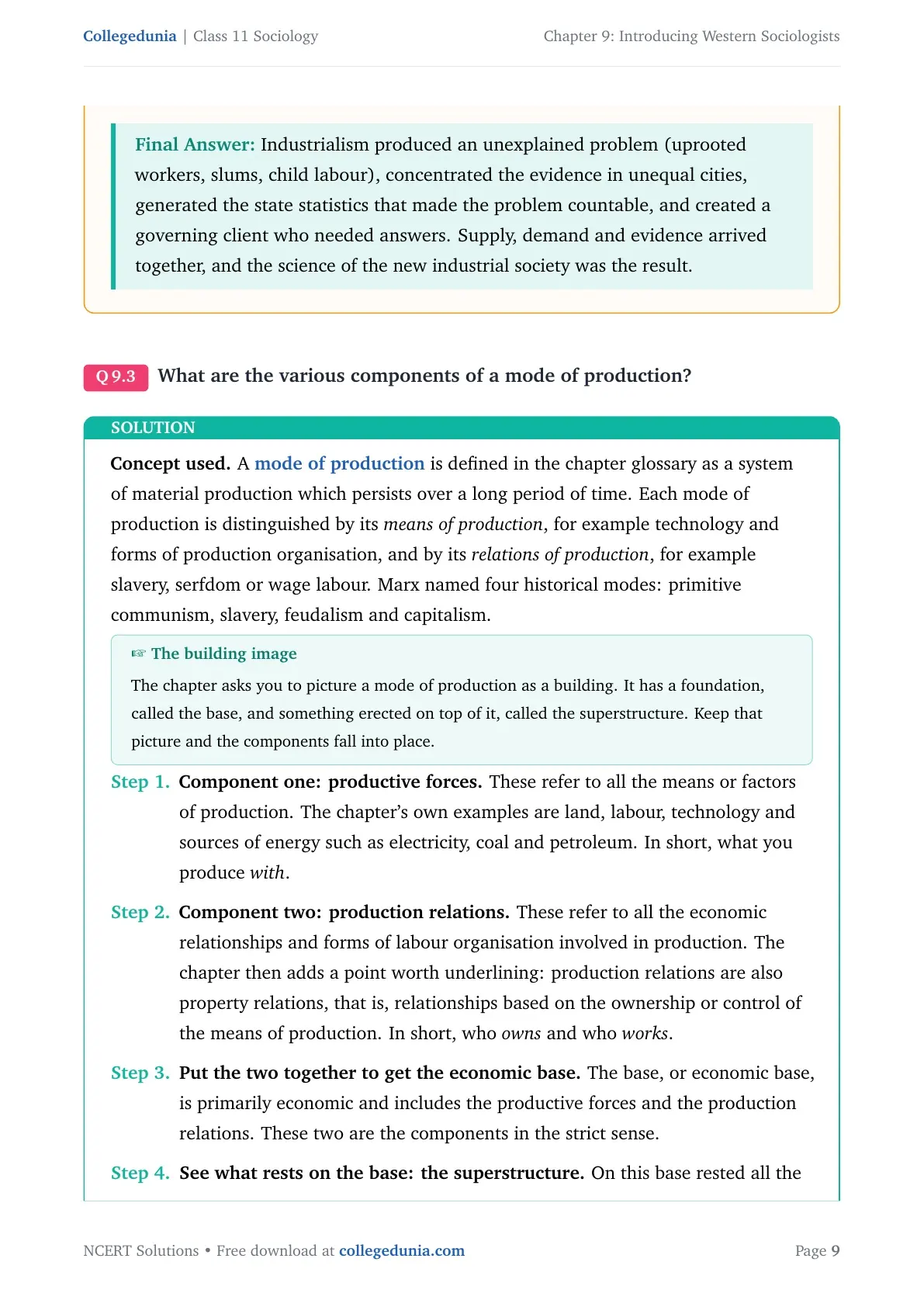
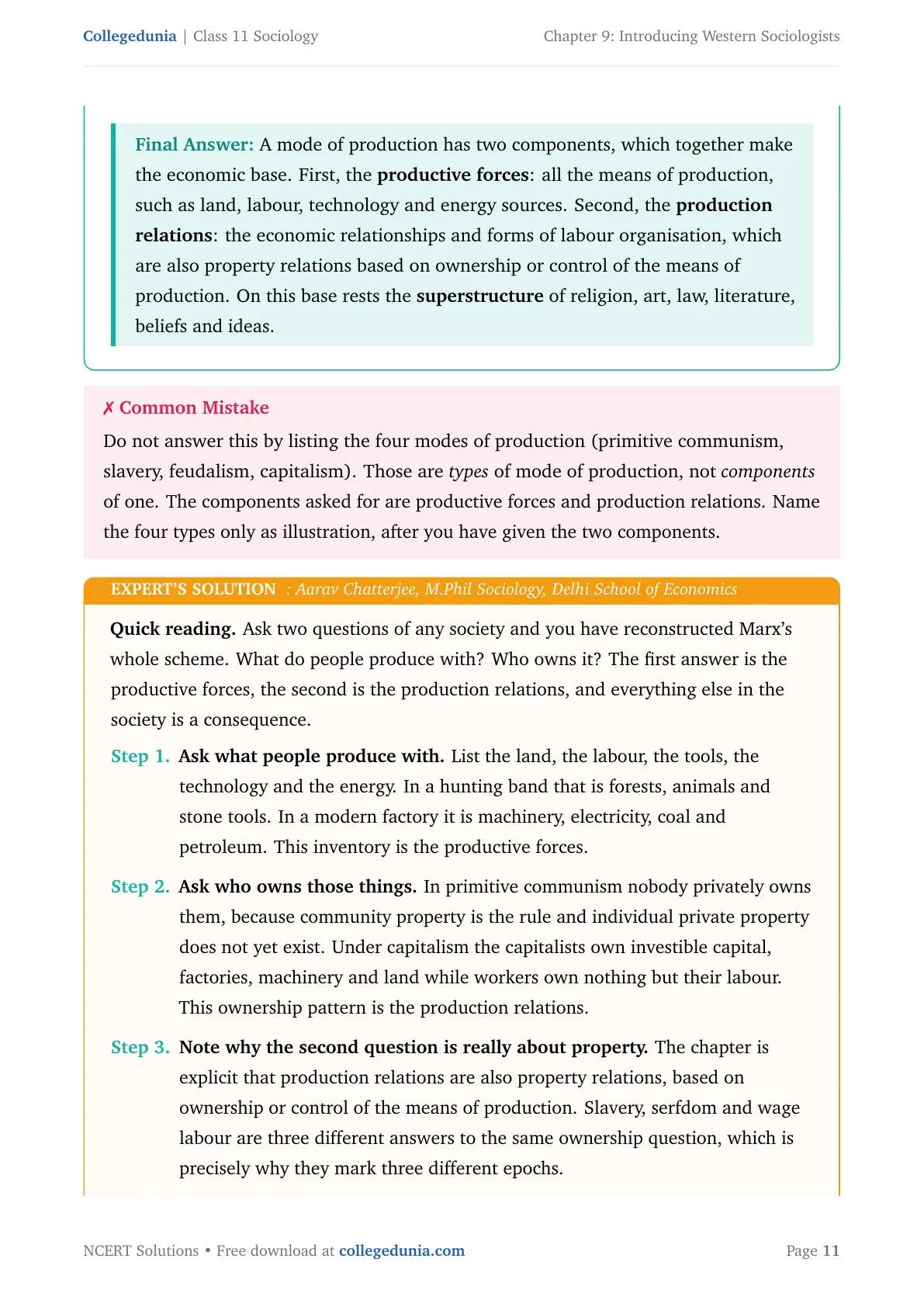
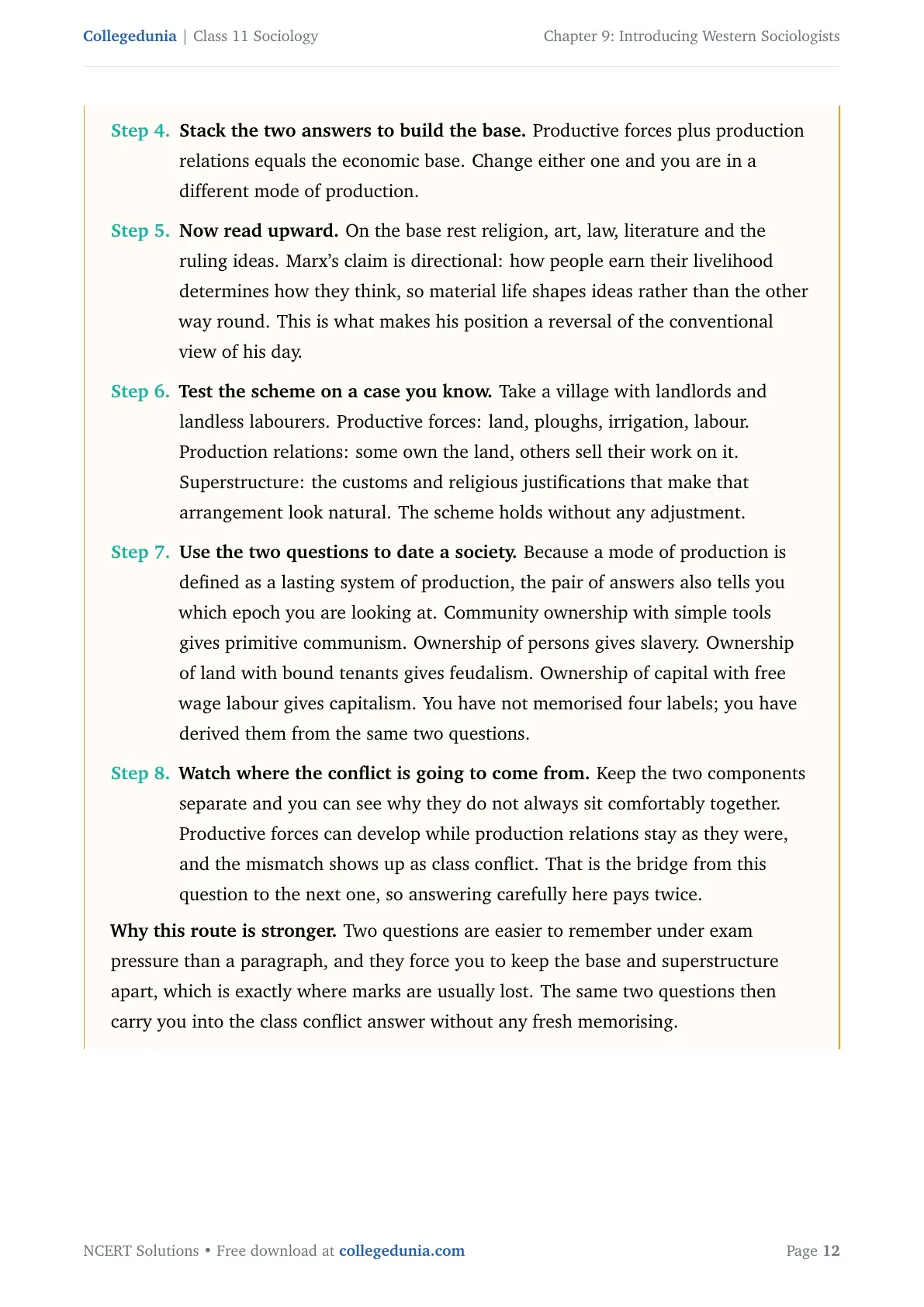
Every answer in this Collegedunia compilation is curated by Class 11 Sociology teachers, checked line by line against the 2026-27 NCERT Understanding Society print, and refined against the last five years of school question papers.
Student Feedback: In a Collegedunia poll of 14,280 Class 11 Sociology students taken before the 2026-27 session exams, 71% of the students surveyed said they mixed up Durkheim's mechanical solidarity with Marx's division of labour. Only 24% could name all five features of bureaucracy in the right order.
Source: 2026-27 Class 11 Sociology student poll. Sample of 14,280 students from schools across 19 states.
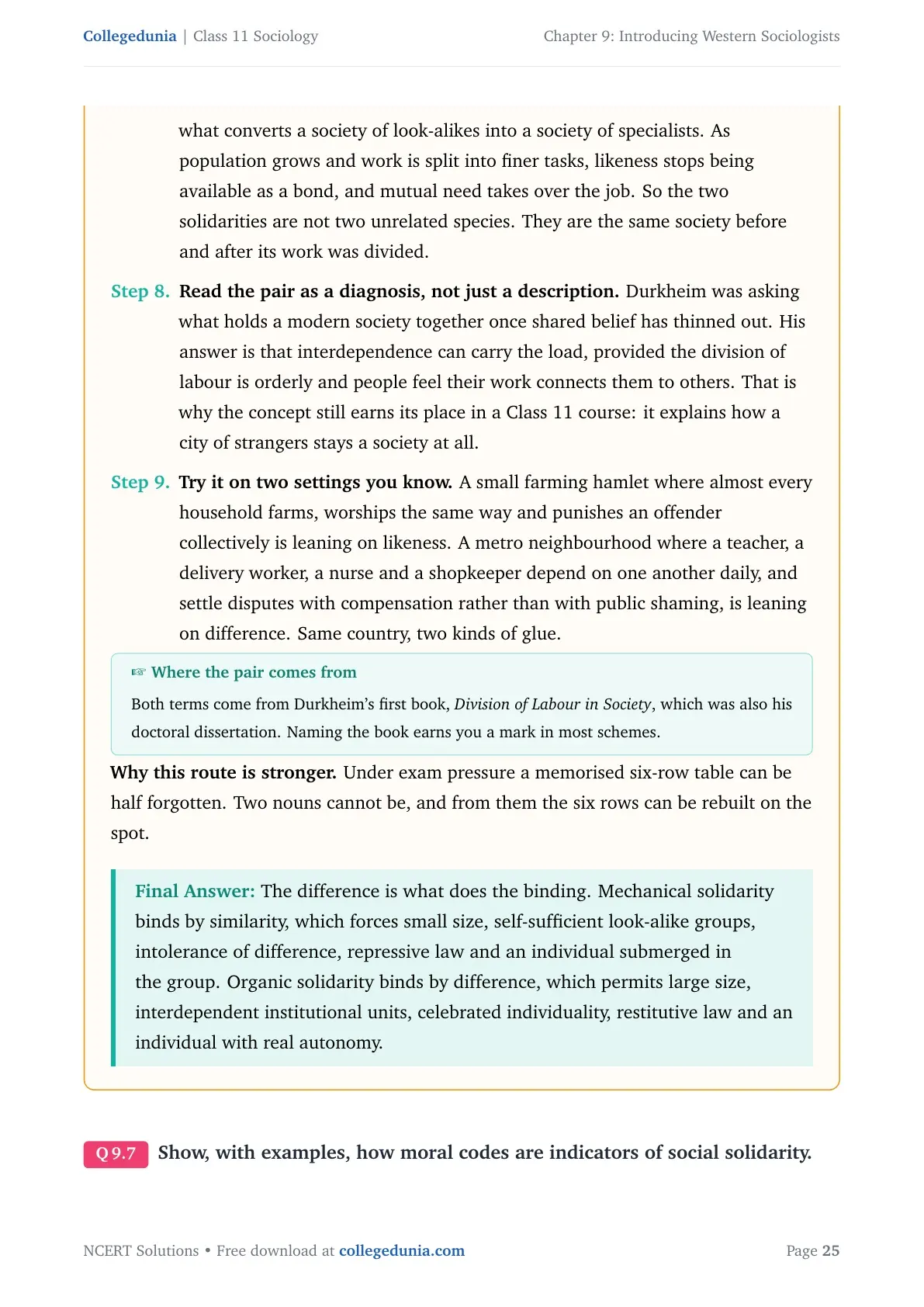
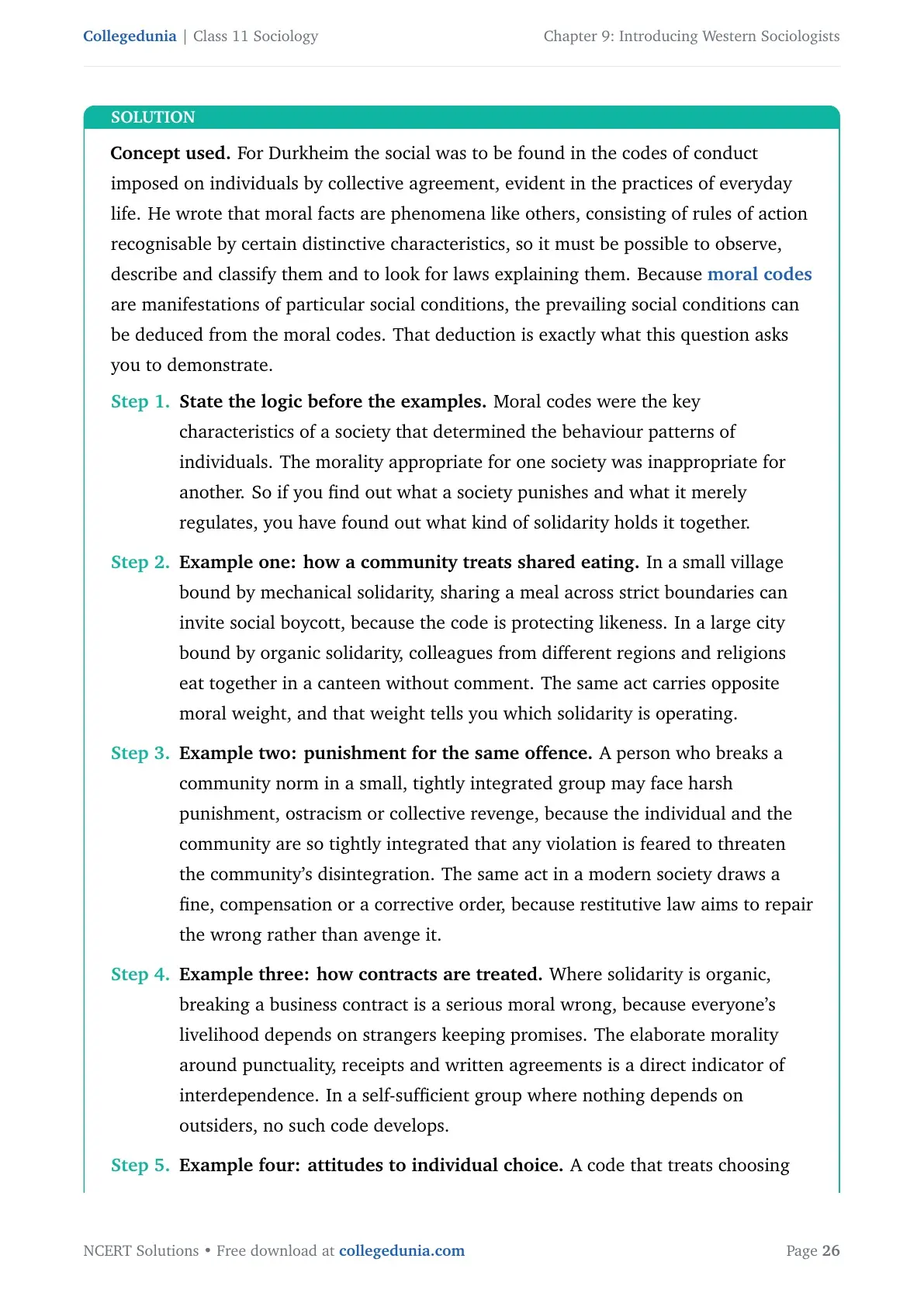
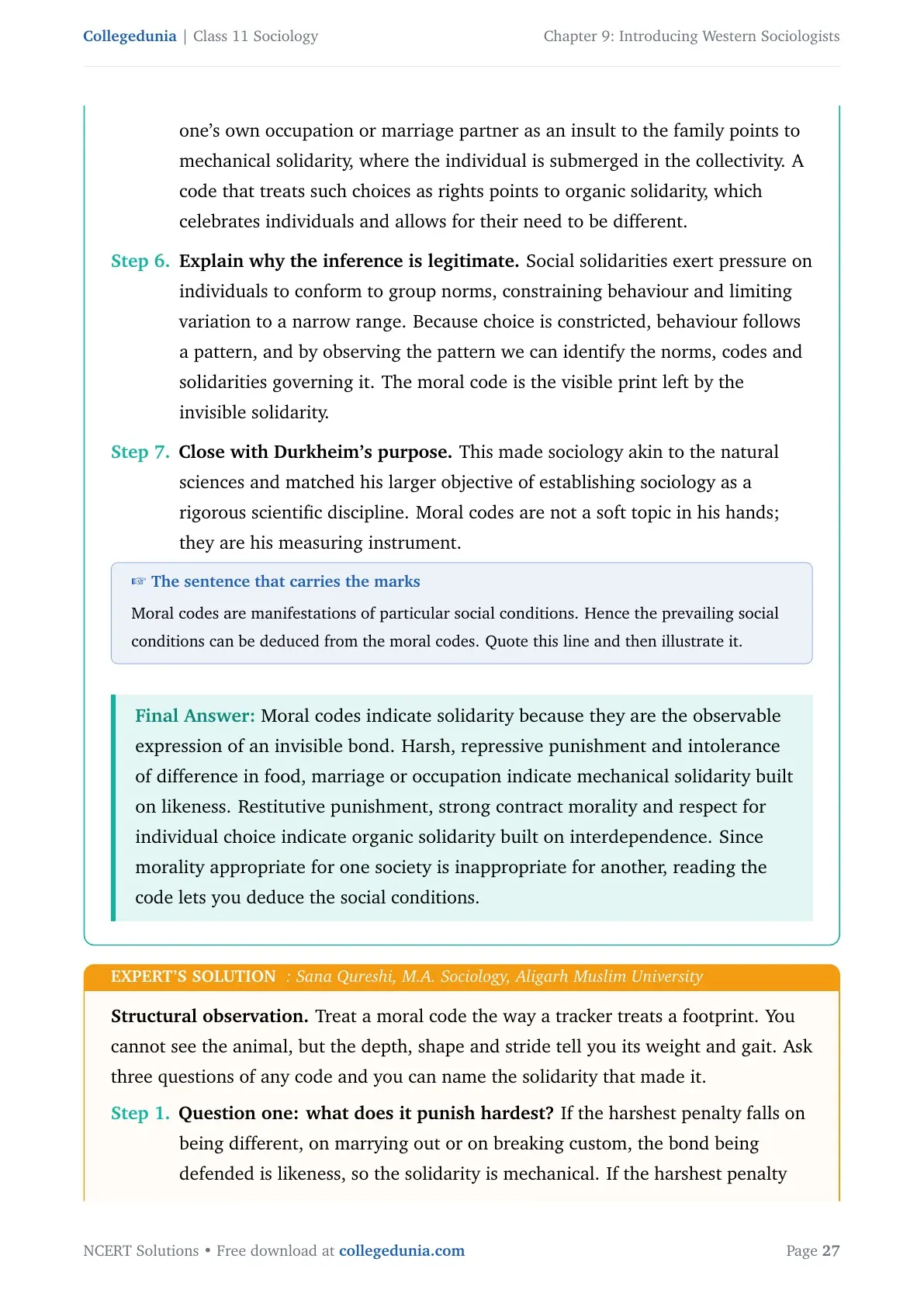
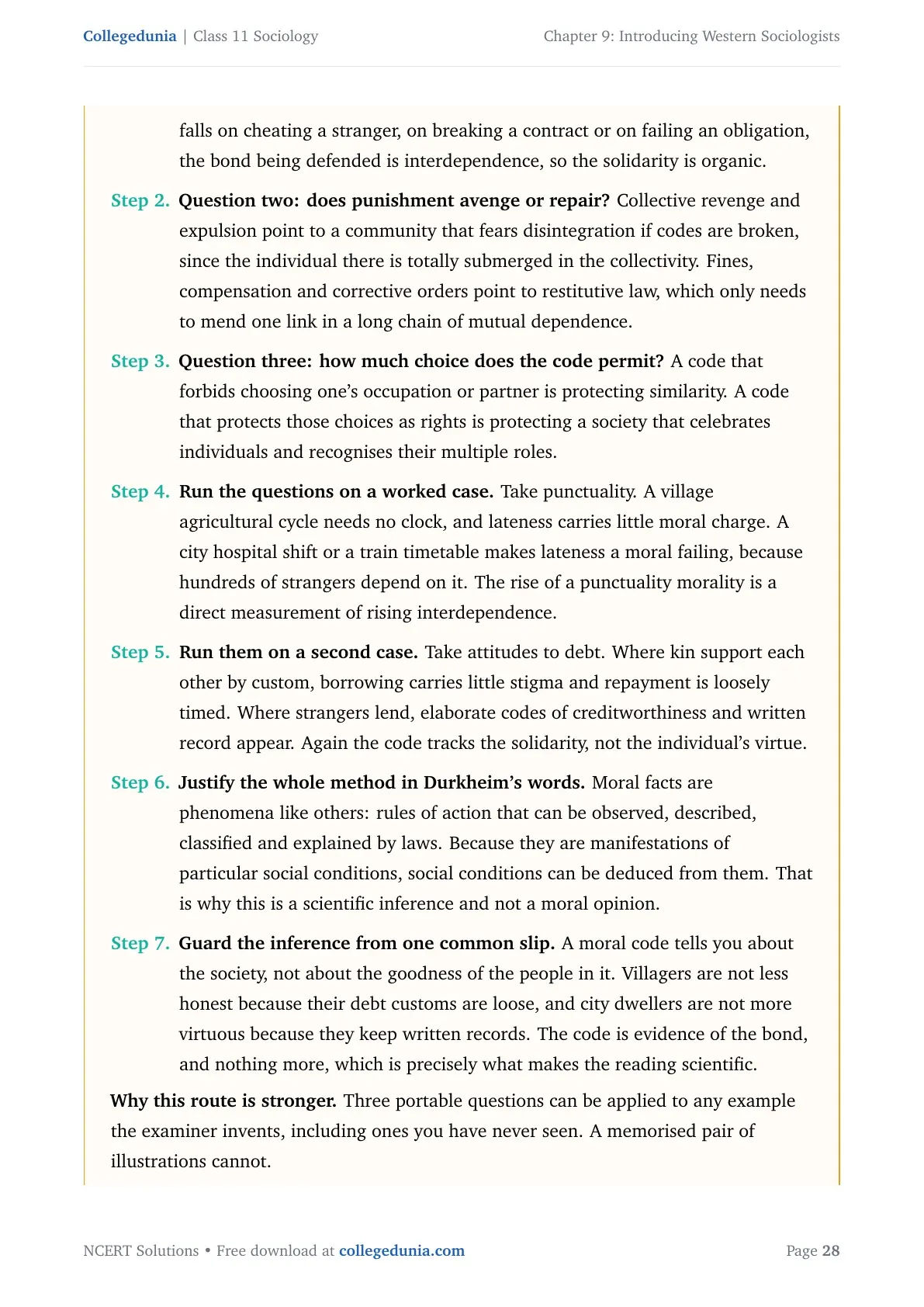
How Collegedunia's Introducing Western Sociologists Answers Help You Score in Class 11
This chapter is marked on whose idea you are using, not on how much you write. An answer about class that never names the production process loses most of its marks. Our answers keep the thinker in front of every point.
- Every answer opens with the textbook definition in the thinker's own vocabulary, then adds the example the book gives.
- Answers are sized by marks. A 2 mark answer stays near 40 words, a 6 mark answer runs to five clear points.
- Terms the examiner looks for are marked in bold, so you can build a one page revision sheet from the answers.
- Marx, Durkheim and Weber are never mixed inside one answer unless the question asks you to compare them.
Introducing Western Sociologists Chapter Summary for Class 11 Sociology
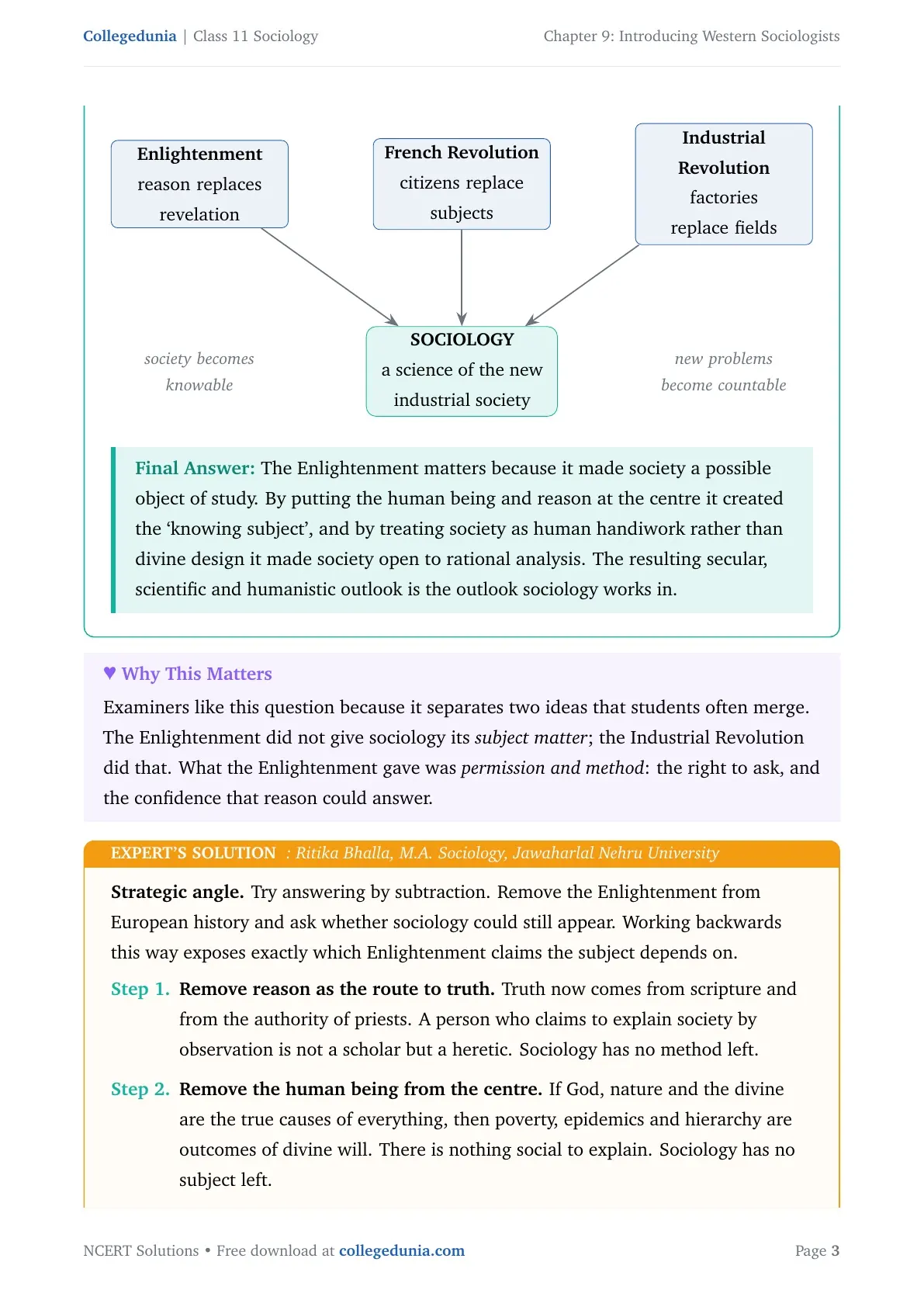
Sociology is called the child of the age of revolution. It was born in 19th century Western Europe after three changes reshaped how people lived. The chapter first explains those changes, then takes up the three thinkers who turned them into a subject.
| Section | What it establishes |
|---|---|
| The context of sociology | The Enlightenment, the French Revolution and the Industrial Revolution made the modern era possible |
| Karl Marx | Capitalism, alienation, the mode of production, and class struggle as the driving force of change |
| Class struggle and ideology | Classes form in the production process, and dominant ideology delays the conflict between them |
| Emile Durkheim | Society as a social fact, sociology as an empirical science of the emergent level |
| Division of labour | Mechanical solidarity in primitive society and organic solidarity in modern society |
| Max Weber | Interpretive sociology, empathetic understanding, value neutrality and the ideal type |
| Bureaucracy | Rational legal authority in its modern form, with five listed features |
Introducing Western Sociologists Explained for Class 11 Sociology
Source: Magnet Brains on YouTube
The Three Revolutions That Gave Birth to Sociology in Western Europe
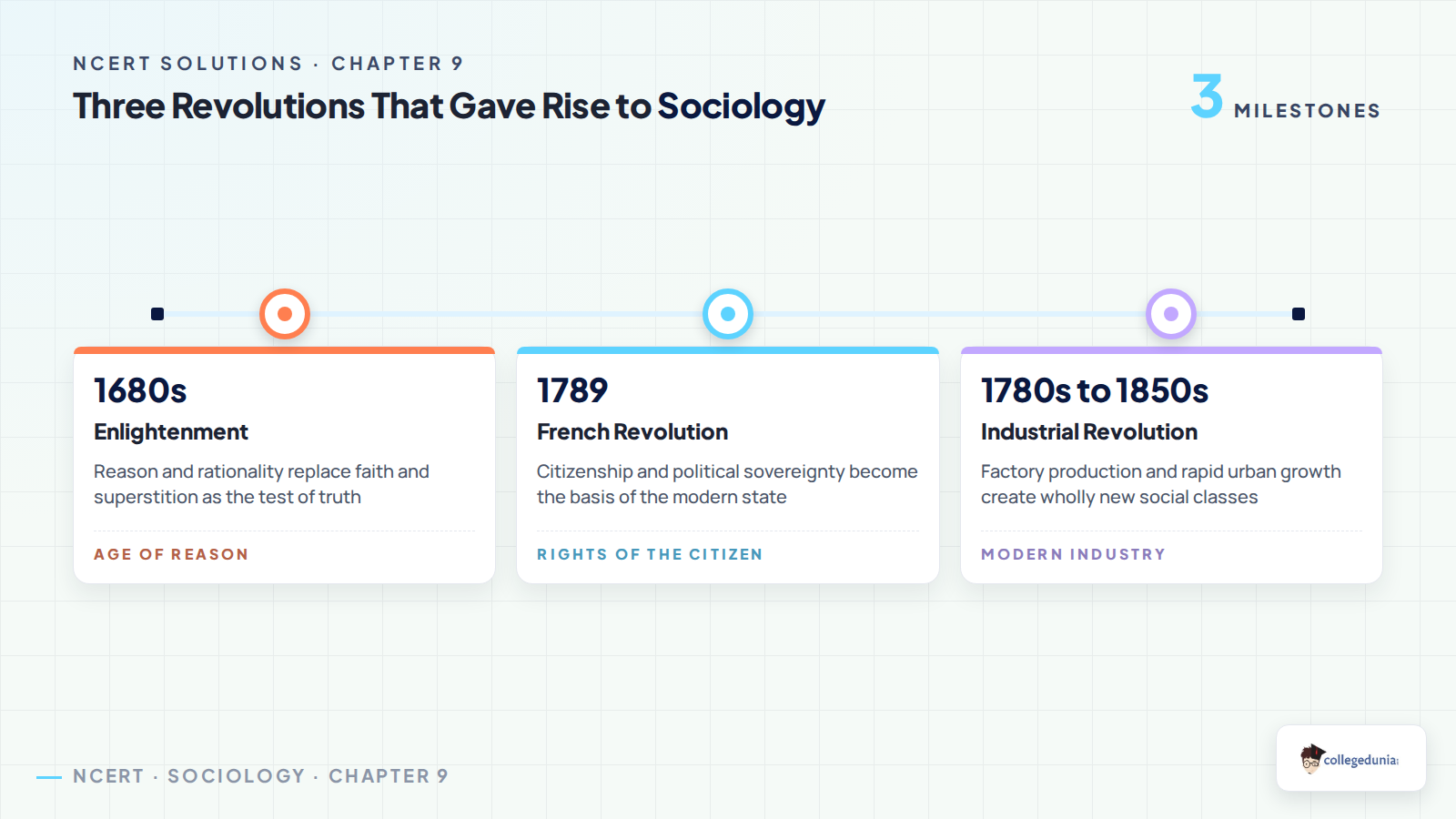
Exercise questions 1 and 2 both come out of this opening part. The book names three processes that produced modernity. Learn them as a set, because a question on any one of them expects you to place it beside the other two.
| Process | Period | What it changed |
|---|---|---|
| The Enlightenment | Late 17th and 18th centuries | Put the human being at the centre of the universe and rational thought at the centre of the human being |
| The French Revolution | 1789 | Announced political sovereignty for individuals and for nation states |
| The Industrial Revolution | Late 18th and early 19th centuries in Britain | Applied science to production and built a new way of organising labour and markets |
The French Revolution part is often skipped, so it makes an easy short answer. The Declaration of Human Rights asserted the equality of all citizens. It questioned privileges inherited by birth, and freed the serfs from bonds tied to the estates of the aristocracy. The taxes peasants paid to feudal lords and to the church were cancelled.
- Sovereign individuals became equal before the law and got rights as free citizens of the republic.
- A separation was built between the public realm of the state and the private realm of the household.
- Religion and the family became more private, while education, and schooling in particular, became more public.
- The nation state was redefined as a sovereign entity with a centralised government.
- Liberty, equality and fraternity became the watchwords of the modern state.
Why the Enlightenment Is Important for the Development of Sociology
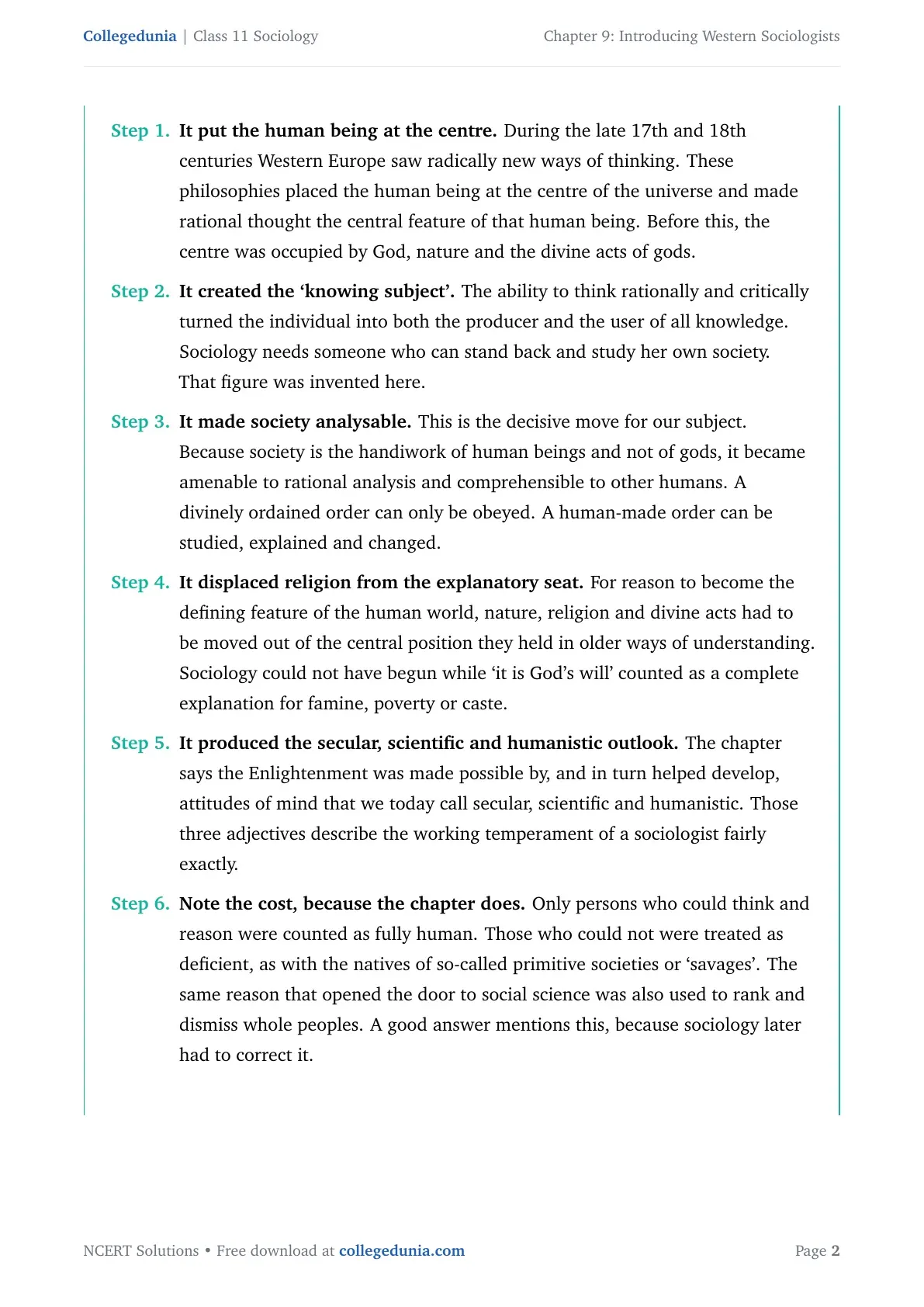
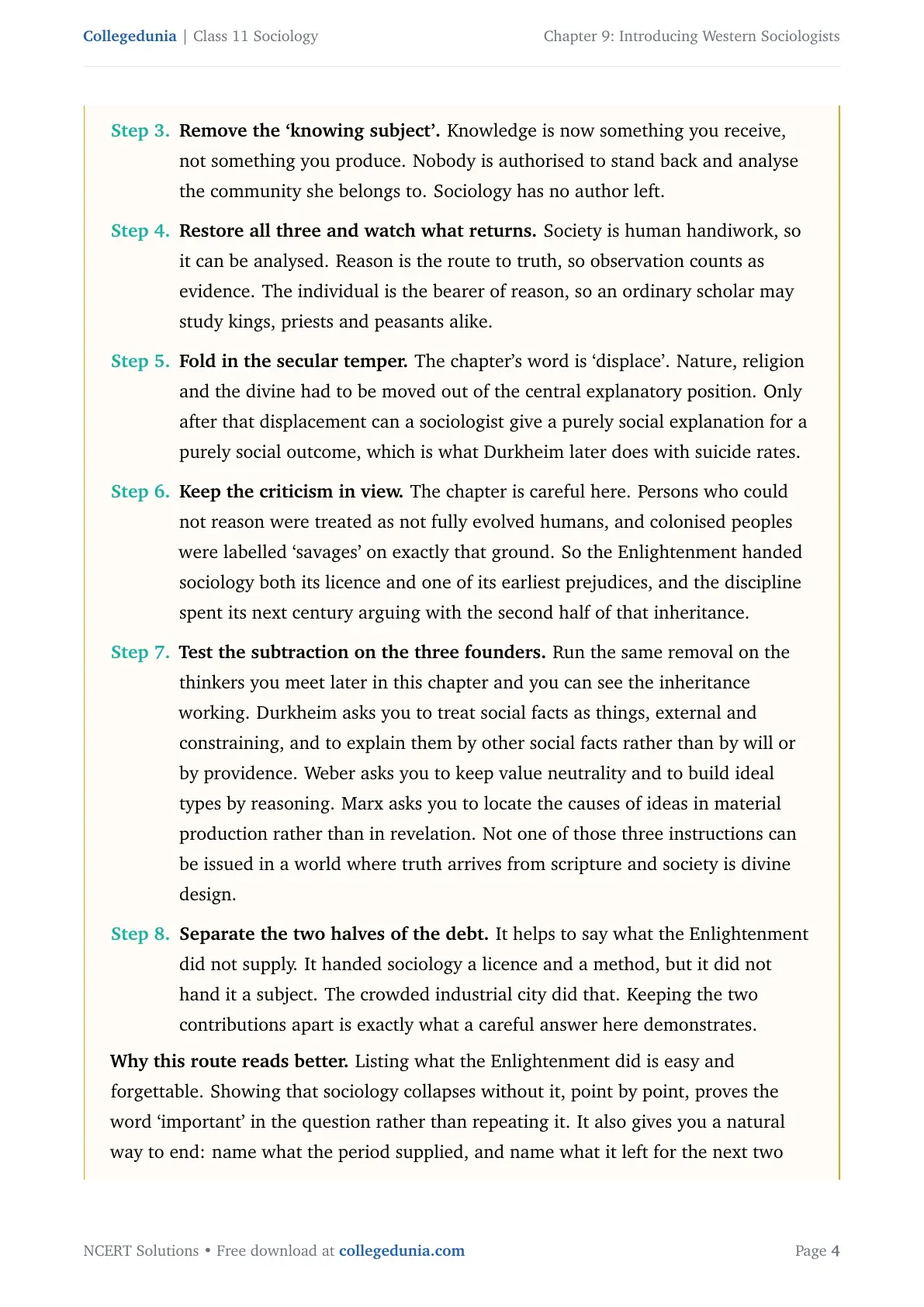
Exercise question 1 asks this directly, and it is a 4 to 6 mark answer. The point to make is that sociology needs a world that can be studied by reason. The Enlightenment supplied exactly that world. Write the answer as a chain of four steps.
- Reason replaced revelation. New philosophies made rational and critical thought the central feature of the human being.
- The human being became the knowing subject. The individual turned into both the producer and the user of all knowledge.
- Society became open to study. Being the handiwork of humans, society was open to rational analysis and could be understood by other humans.
- Nature, religion and the divine were displaced from the central position they held in earlier ways of understanding the world.
Close the answer with the sentence the book itself uses. The Enlightenment was made possible by, and in turn helped to develop, attitudes of mind we now call secular, scientific and humanistic. Add the critical note for the last mark. Only those who could think and reason were counted as fully human, so the people of so called primitive societies were treated as not fully evolved.
How the Industrial Revolution Was Responsible for Giving Rise to Sociology
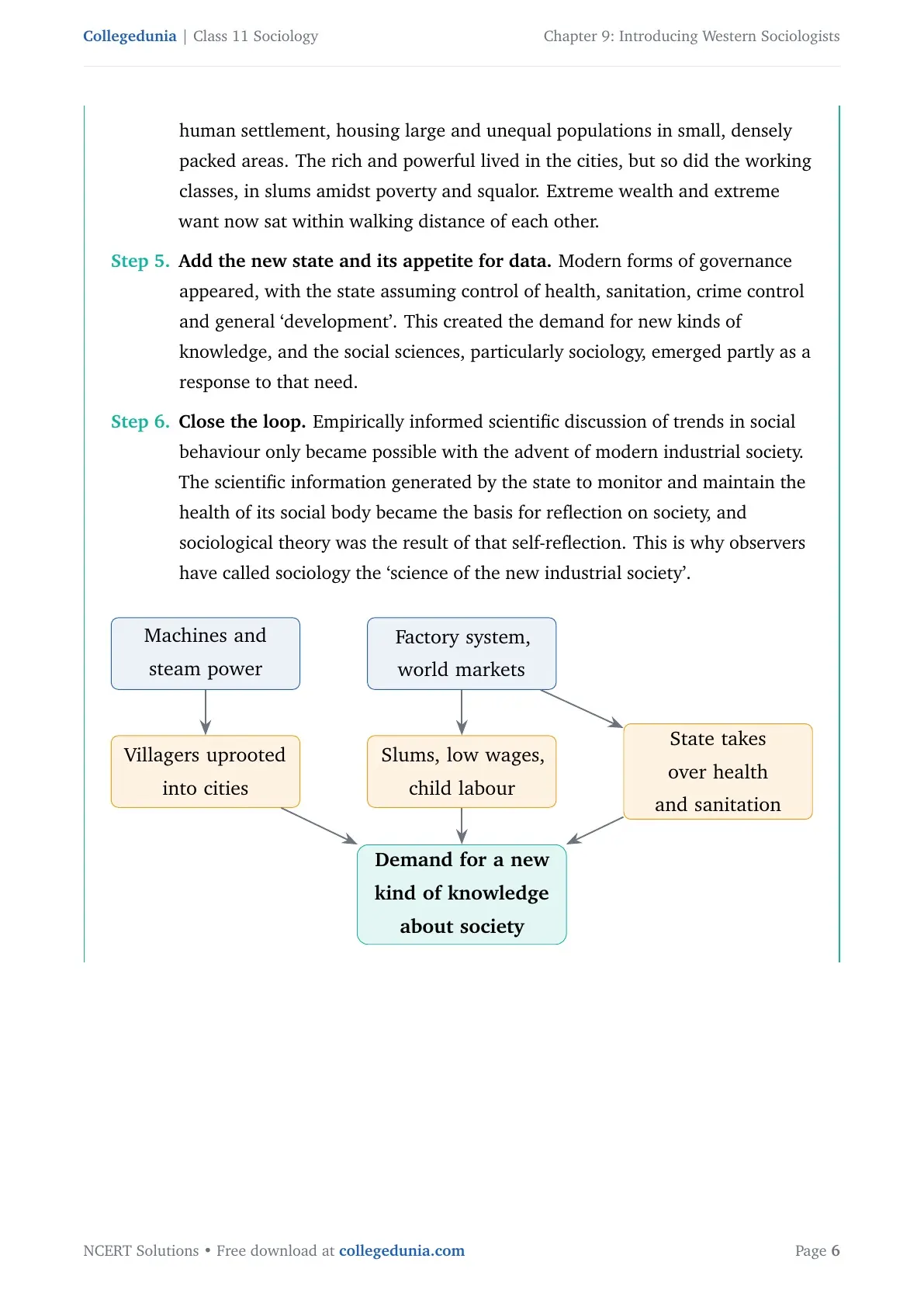
Exercise question 2 wants a link, not a description. The Industrial Revolution created new social problems, and those problems created the demand for a new kind of knowledge. Build the answer in two halves.
- The two aspects of the revolution. First, the systematic application of science and technology to production, seen in the Spinning Jenny and the steam engine. Second, new ways of organising labour and markets on a scale larger than anything in the past.
- Mass manufacture went worldwide. Goods were made on a gigantic scale for distant markets, and raw materials came from all over the world.
- Workers were uprooted. Factories in urban areas were manned by people who left rural areas to look for work.
- Low wages forced whole families in. Men, women and even children worked long hours in hazardous conditions just to survive.
- The urban began to dominate the rural. Cities and towns housed large and unequal populations in small, densely packed areas.
- The rich and the powerful lived in the cities, but so did the working classes, who lived in slums amidst poverty and squalor.
The final step carries the marks. Modern forms of governance took charge of health, sanitation, crime control and general development. That created a demand for new kinds of knowledge, and sociology emerged partly as a response to that need. This is why sociology has been called the science of the new industrial society.
Karl Marx on Capitalism and the Four Levels of Alienation
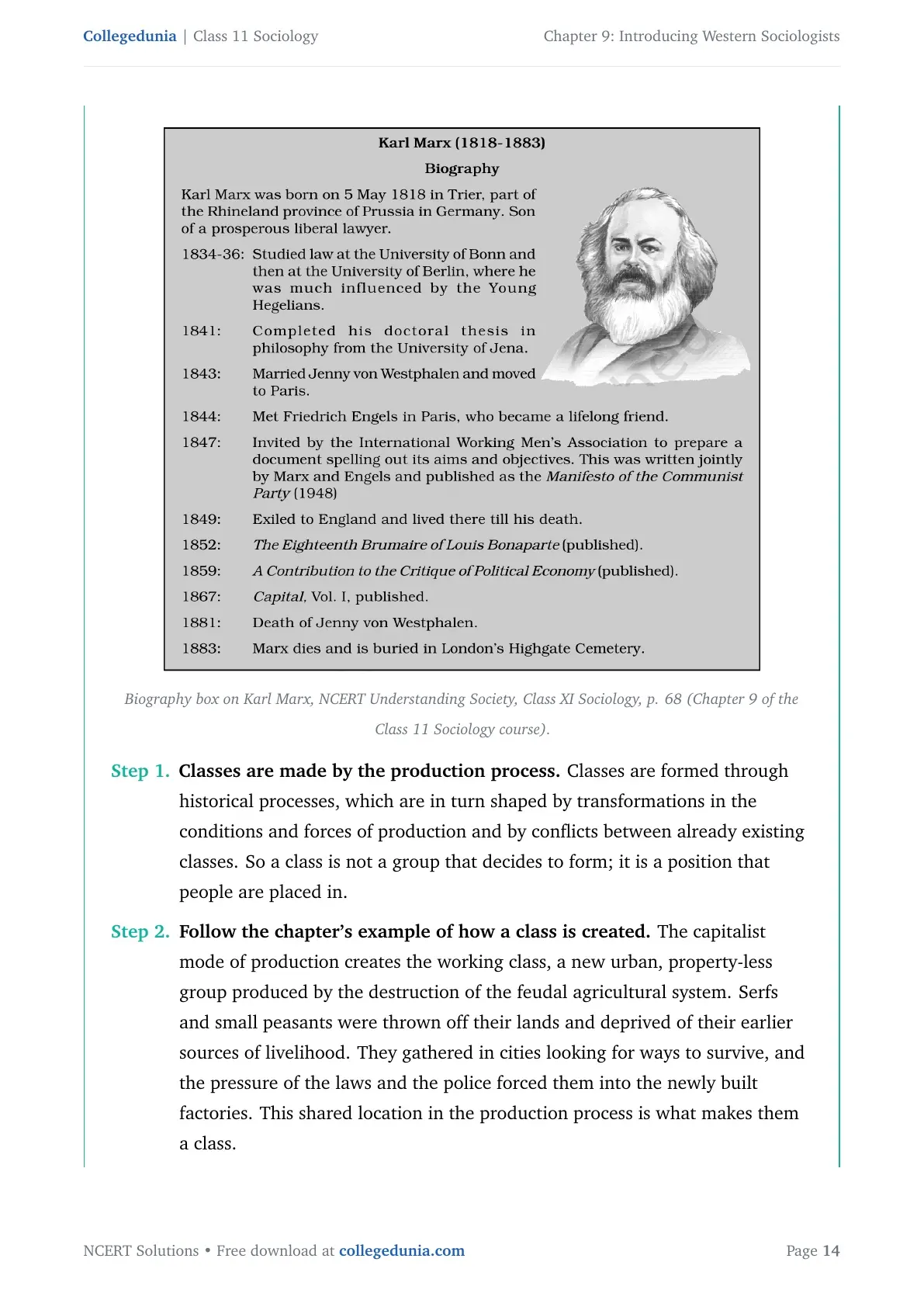
Karl Marx lived from 1818 to 1883. He was born in Trier in Germany and spent most of his productive years in exile in Britain. His radical political views got him exiled from Germany, France and Austria. He had studied philosophy but was not a philosopher, and he described himself as a social thinker who wanted an end to oppression and exploitation.
Marx argued that human society had moved through four stages. These were primitive communism, slavery, feudalism and capitalism. Capitalism was the latest phase, and Marx believed it would give way to socialism. He studied it closely so he could expose its weaknesses and bring about its downfall.
| Level of alienation | What it means in the chapter |
|---|---|
| From nature | Humans in modern capitalist society are more separated from nature than ever before |
| From each other | Capitalism breaks up older collective forms of social life, and relationships get market mediated |
| From the fruits of labour | Workers do not own what they produce, and management, not the worker, decides the content of the working day |
| From themselves | People struggle to make life meaningful in a system where they are freer but less in control |
Do not leave the answer there. Marx still called capitalism a necessary and progressive stage of human history. It created the preconditions for an equal future free of exploitation and poverty. The system would then be transformed by its own victims, the working class, who would unite and overthrow it.
The Various Components of a Mode of Production in Marx's Theory
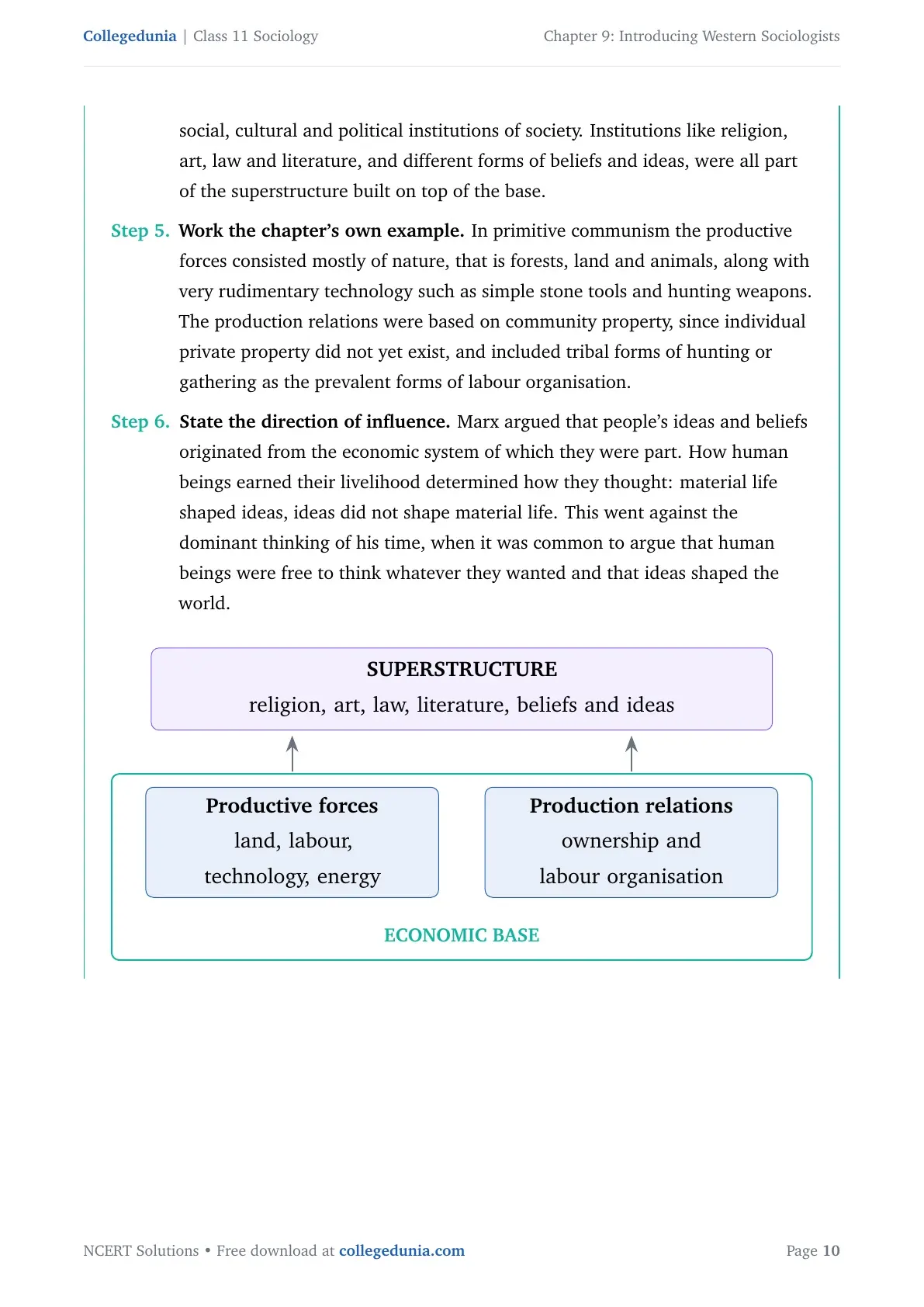
Exercise question 3 asks for the components, so the answer must be a labelled breakdown. A mode of production is a broad system of production tied to a historical period. Marx compares it to a building with a base and a superstructure built on top.
| Component | What it includes |
|---|---|
| Economic base | Made up of the productive forces and the production relations together |
| Productive forces | All the means or factors of production, such as land, labour, technology and sources of energy like electricity, coal and petroleum |
| Production relations | All the economic relationships and forms of labour organisation involved in production |
| Property relations | Production relations are also property relations, based on ownership or control of the means of production |
| Superstructure | Religion, art, law, literature and the different forms of beliefs and ideas that rest on the base |
Use the primitive communism example for the last mark. There the productive forces were mostly nature itself, forests, land and animals, with very simple stone tools and hunting weapons. Production relations rested on community property, because private property did not yet exist. Tribal hunting and gathering were the usual forms of labour organisation.
End with the claim that made Marx controversial in his own time. He argued that people's ideas and beliefs came out of the economic system they lived in. Material life shaped ideas, and ideas did not shape material life. This went against the common view then that human beings were free to think whatever they wanted.
Why Classes Come Into Conflict According to Karl Marx
Exercise question 4 is the most asked long answer from the Marx section. For Marx the best way to group people was by their position in the production process, not by religion, language or nationality. People in the same position eventually form a class, because they share the same interests and objectives.
- Classes are made by history, not by choice. They are shaped by changes in the conditions and forces of production, and by conflicts between classes that already exist.
- Capitalism created the working class. Serfs and small peasants were thrown off their land and lost their earlier source of livelihood.
- They gathered in cities looking for a way to survive, and the pressure of laws and police forced them into the newly built factories.
- The two opposed classes are set by ownership. The bourgeoisie owned the means of production, which includes investible capital, factories, machinery and land.
- The working class had lost every means of production it once owned, so it had nothing to sell but its labour for wages.
- Opposition alone is not conflict. Classes must first become subjectively conscious of their own interests and of their rivals' interests.
The Communist Manifesto is the quotable source here. Its opening lines declare that the history of all hitherto existing societies is the history of class struggle. Marx and Engels traced this through history and wrote of freeman and slave, patrician and plebeian, lord and serf, guild master and journeyman, standing in constant opposition and carrying out an uninterrupted, now hidden, now open fight.
Finish with ideology, because most students stop before it. In every epoch the ruling classes promote a dominant ideology that justifies their own domination. It may push poor people to believe they are poor because of fate or bad deeds in a previous life, not because they are exploited. Dominant ideologies can be challenged by rival worldviews, so class conflict turns into revolution only when social and political conditions allow it.
What Social Facts Are and How We Recognise Them in Durkheim's Sociology
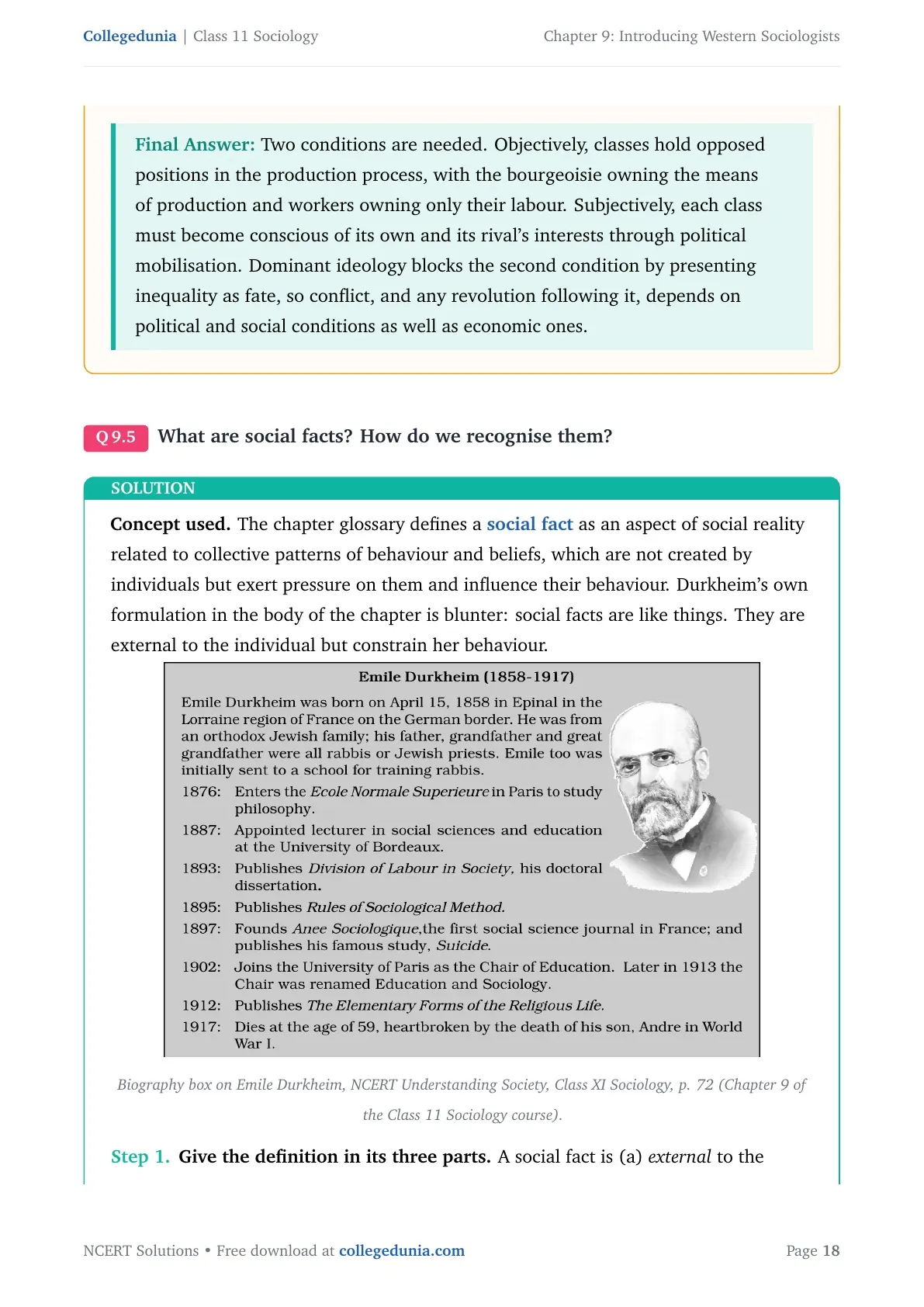
Emile Durkheim lived from 1858 to 1917. He may be treated as the founder of sociology as a formal discipline, since he became the first Professor of Sociology in Paris in 1913. He came from an orthodox Jewish family and was first sent to a rabbinical school, but declared himself an agnostic after entering the Ecole Normale Superieure in 1876.
Exercise question 5 has two parts, so give the definition first and the method second. Social facts are like things. They are external to the individual but constrain that individual's behaviour. They are collective representations that emerge when people associate with each other.
- Social facts are general, not particular to any one person, and they are independent of the individual.
- Institutions such as law, education and religion are social facts.
- Beliefs, feelings and collective practices are the everyday examples the book gives.
- We recognise them indirectly, through patterns of behaviour. Social ties limit variation, so behaviour follows a pattern and can be predicted.
- By observing those patterns we can identify the norms, codes and social solidarities behind them.
- The famous proof is Suicide, published in 1897. Each case is personal, but the average rate across hundreds of thousands of people in a community is a social fact.
Add the two defining features of Durkheim's vision of sociology if the question carries 6 marks. First, sociology studies the emergent level, the level of complex collective life. A cricket team is composed entirely of individuals but becomes much more than eleven persons. Second, sociology was to be an empirical discipline like the natural sciences, founded on observable evidence.
The Difference Between Mechanical and Organic Solidarity in Division of Labour in Society
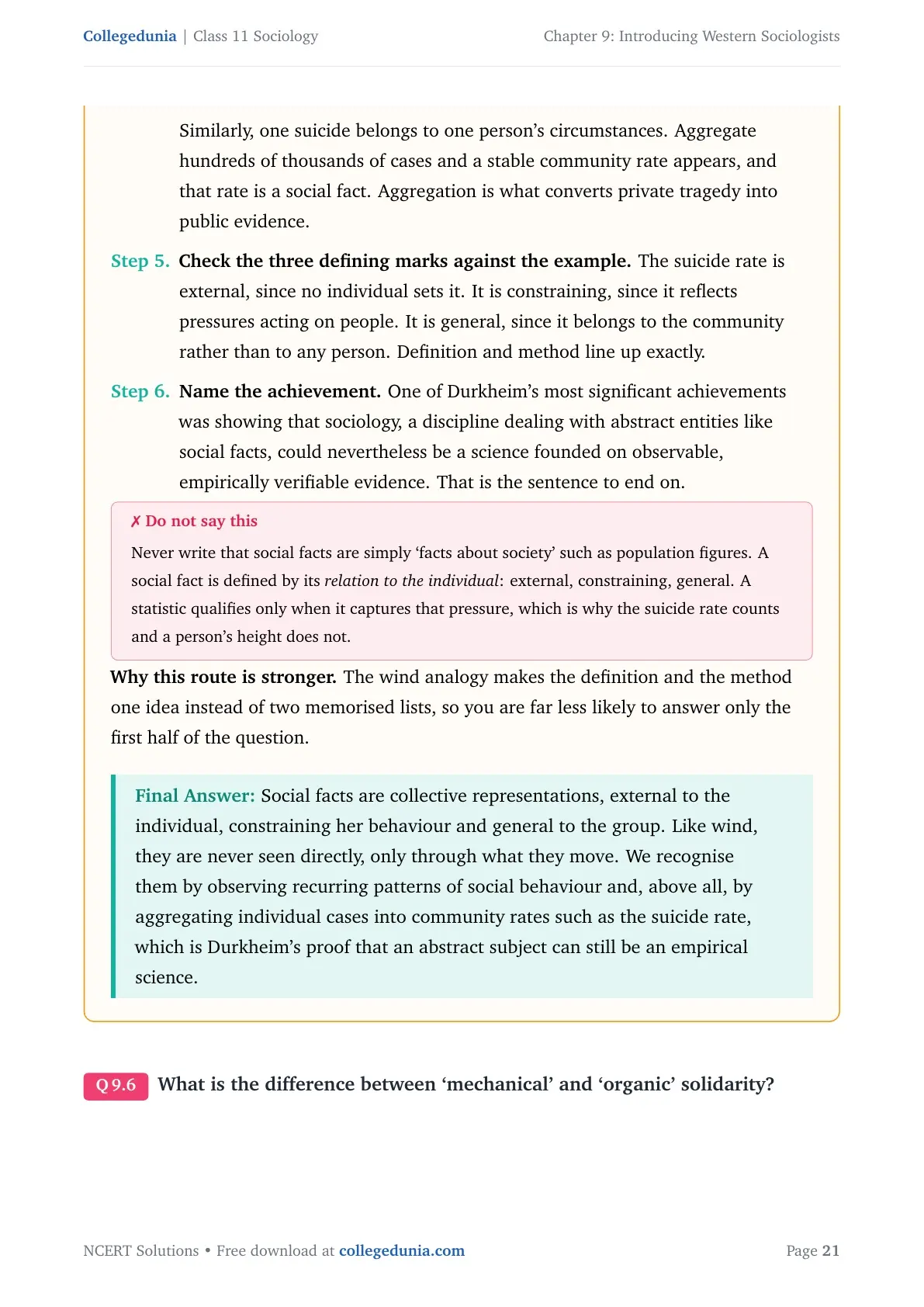
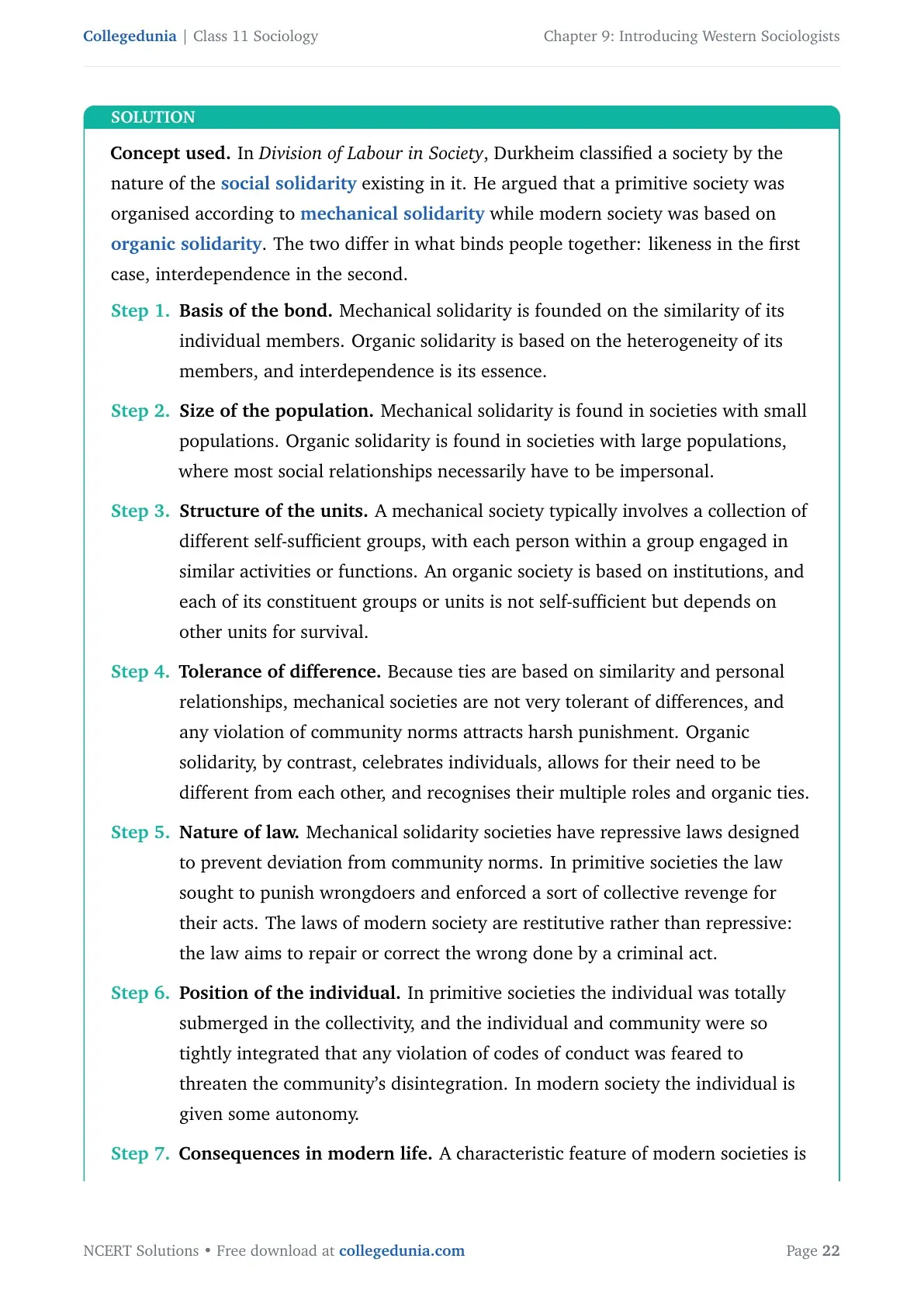
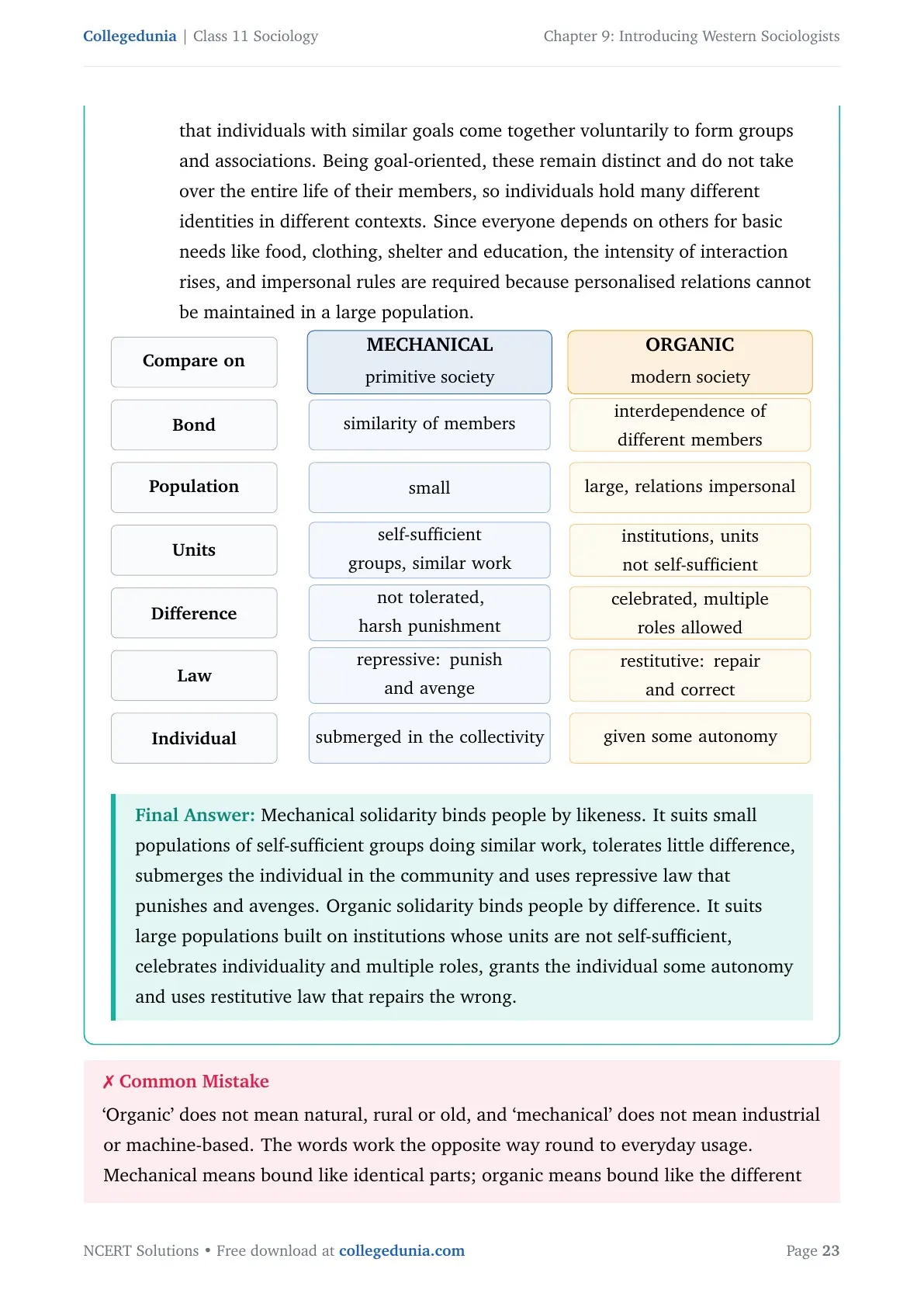
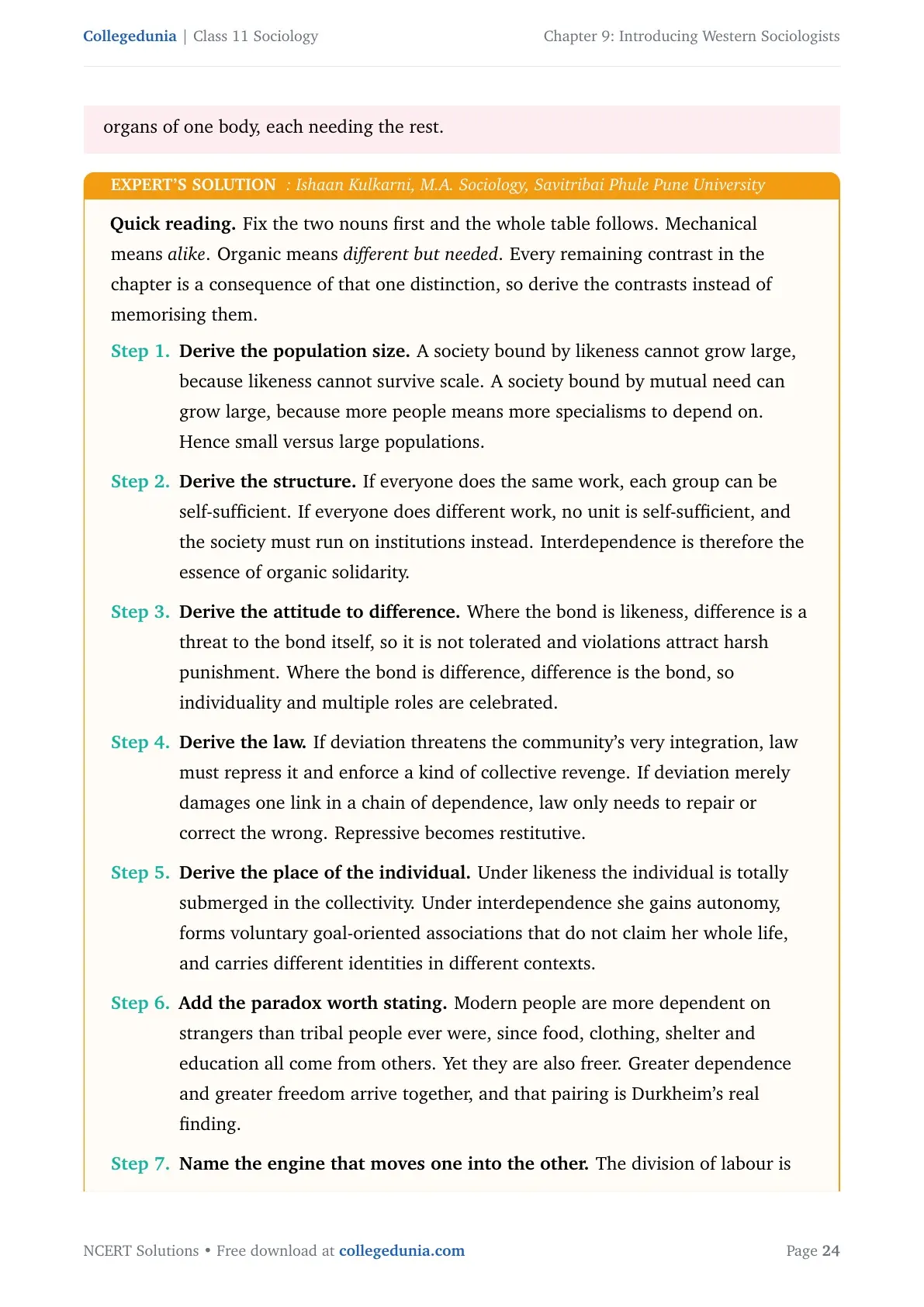
Exercise question 6 is a straight comparison, so answer it in a table or in matched pairs. In his first book, Division of Labour in Society, Durkheim classified societies by the kind of social solidarity that held them together. Primitive society ran on mechanical solidarity and modern society runs on organic solidarity.
| Point of difference | Mechanical solidarity | Organic solidarity |
|---|---|---|
| Basis | Similarity of individual members | Heterogeneity of members, and interdependence between them |
| Type of society | Primitive society with a small population | Modern society with a large population |
| Units | A collection of self sufficient groups doing similar activities | Institutions and groups that are not self sufficient and depend on one another |
| Relationships | Personal, based on similarity | Largely impersonal, governed by rules and regulations |
| Tolerance of difference | Low, since difference threatens the community | High, since being different is expected and allowed |
| Nature of law | Repressive, designed to punish and to prevent deviation from community norms | Restitutive, designed to repair or correct the wrong that was done |
| Place of the individual | Totally submerged in the collectivity | Given autonomy and a distinct identity |
One extra point lifts this answer. In modern society, people with similar goals come together voluntarily into groups and associations. These groups are built for specific goals, so they stay distinct and do not take over the whole life of a member. That is how an individual carries many different identities in different contexts.
How Moral Codes Act as Indicators of Social Solidarity, with Examples
Exercise question 7 asks you to show this with examples, so the answer needs both the argument and an illustration. Durkheim treated the social as something found in the codes of conduct that a group imposes on its members by collective agreement. Those codes are visible in the practices of everyday life.
- Durkheim wrote that moral facts are phenomena like others, made of rules of action that can be observed, described, classified and explained by laws.
- Moral codes are manifestations of particular social conditions, so the morality that suits one society does not suit another.
- The prevailing social conditions can therefore be deduced from the moral codes a society follows.
- Example one, harsh punishment. A society that punishes a small violation of custom severely is showing mechanical solidarity, because members are alike and difference feels dangerous.
- Example two, compensation. A society whose law asks a wrongdoer to repair the damage is showing organic solidarity, because members are different and depend on each other.
- Example three, contracts. Impersonal rules that govern strangers doing business point to a large population where personal ties can no longer hold people together.
This argument mattered to Durkheim for a bigger reason. It made sociology similar to the natural sciences and served his aim of building sociology as a strict scientific discipline. His secular study of social ties laid the foundation of sociology as the new science of society.
Max Weber on Interpretive Sociology, Empathetic Understanding and Value Neutrality
Max Weber lived from 1864 to 1920 and was one of the leading German social thinkers of his time. Exercise question 9 asks what is special about the objectivity needed in social science, and this section holds the whole answer.
Weber argued that the aim of the social sciences was to develop an interpretive understanding of social action. Natural sciences look for objective laws of nature. Social sciences deal with human action, and human action always carries subjective meaning, so the method has to be different.
- Social action means all meaningful human behaviour, that is, action to which the actor attaches a meaning.
- The sociologist's task is to recover the meaning the actor gave the action, by imagining themselves in the actor's place.
- Sociology is therefore a systematic form of empathetic understanding. It rests on feeling with, which is empathy, and not on feeling for, which is sympathy.
- Sociologists are meant to describe, not judge, the subjective feelings of others. Weber called this value neutrality.
- Weber admitted this is hard. Social scientists are members of society too and carry their own beliefs and prejudices.
- They must practise great self discipline, or exercise what Weber called an iron will, to stay value neutral while describing other people's values.
So the special objectivity of social science is this. It is objectivity about subjective matters. The sociologist records the meanings, values and prejudices of other people faithfully, without letting personal opinion enter the record at any point.
The Ideal Type and Weber's Three Types of Authority
The ideal type is Weber's second methodological tool and it is a favourite one mark and two mark question. An ideal type is a logically consistent model of a social phenomenon that highlights its most significant characteristics. It is a conceptual tool for analysis, not an exact copy of reality.
- An ideal type may exaggerate features that matter for analysis and ignore or downplay others.
- It should still match reality in a broad sense, since its job is to bring out important features and connections.
- It is judged by how useful it is for analysis, not by how accurate or detailed a description it gives.
- Weber used it to study the ethics of world religions and the rationalisation of the social world in different civilisations.
- In that work he suggested that the ethics of certain Protestant sects within Christianity deeply influenced the growth of capitalism in Europe.
| Type of authority | Source of the authority |
|---|---|
| Traditional | Custom and precedence |
| Charismatic | Divine sources, or the gift of grace |
| Rational legal | Legal demarcation of authority, and the type that prevails in modern times |
The link to the next question is worth one line in your answer. Rational legal authority in modern times was epitomised in the bureaucracy, which is why the chapter moves straight into bureaucracy after the three types.
The Basic Features of Bureaucracy in Max Weber's Ideal Type
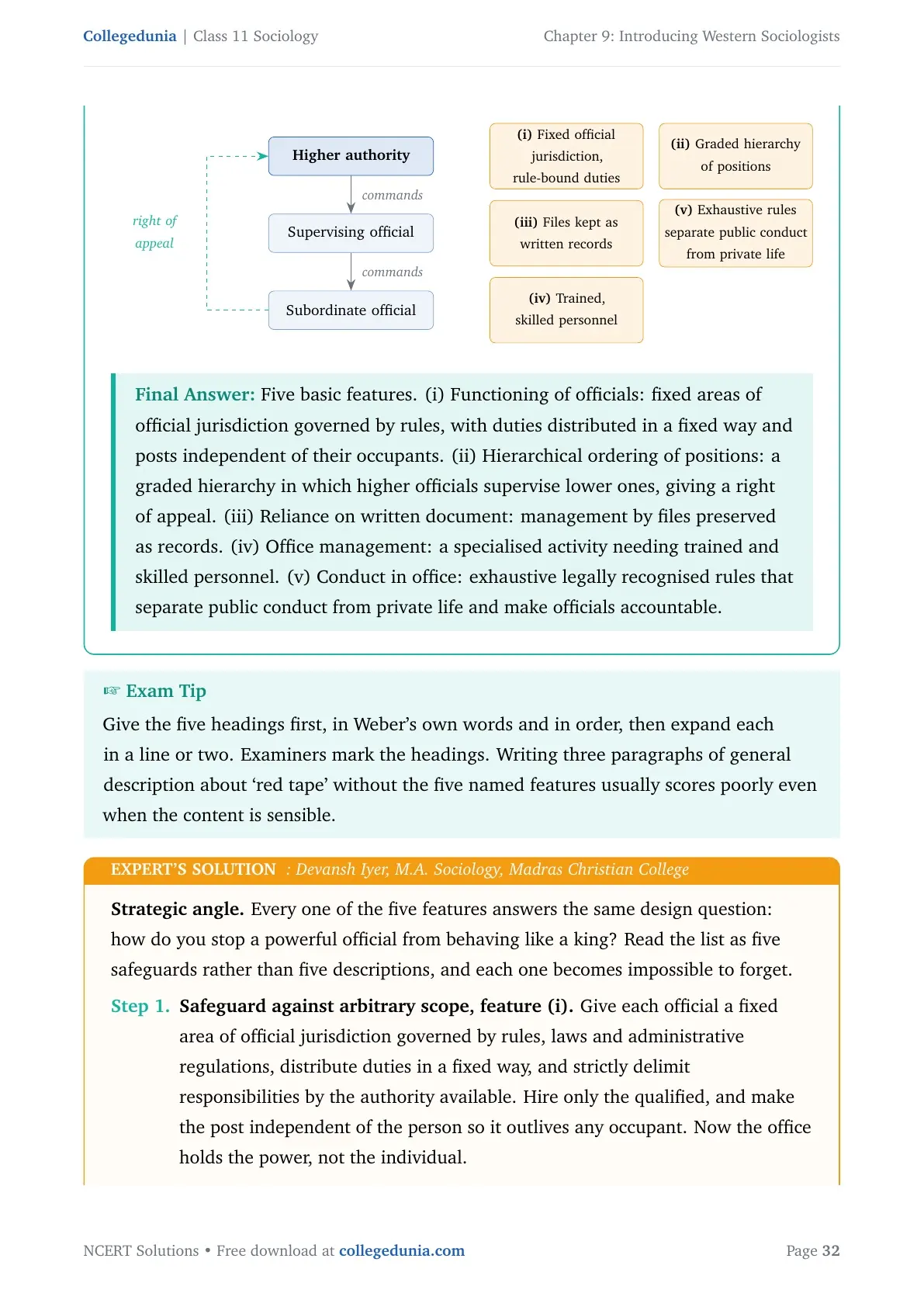
Exercise question 8 asks for the basic features, and the book gives exactly five. Write them as a numbered list with the label first and one line of explanation after it. Bureaucracy is a mode of organisation built on the separation of the public world from the domestic world.
| Feature | What the chapter says |
|---|---|
| Functioning of officials | Officials have fixed areas of official jurisdiction governed by rules, laws and administrative regulations, and only qualified people are employed |
| Hierarchical ordering of positions | Offices sit on a graded hierarchy where higher officials supervise lower ones, which allows appeal to a higher official |
| Reliance on written document | Management runs on written documents, the files, which are preserved as records in the public domain |
| Office management | A specialised modern activity that needs trained and skilled personnel to run operations |
| Conduct in office | Conduct is governed by exhaustive rules and regulations that separate public conduct from private behaviour |
Two extra sentences take this answer to full marks. Behaviour in the public domain is regulated by explicit rules, so bureaucracy restricts the power of officials and never gives them absolute power. Official positions are independent of the person holding them, so they continue beyond the tenure of any occupant.
Close with the point Weber was actually making. Because these rules and regulations have legal recognition, officials can be held accountable to their clients. The legal limits on tasks and authority constrained unbridled power, while the individual officer was still recognised for personal skill and training.
Marx, Durkheim and Weber Compared for the Class 11 Sociology Answer
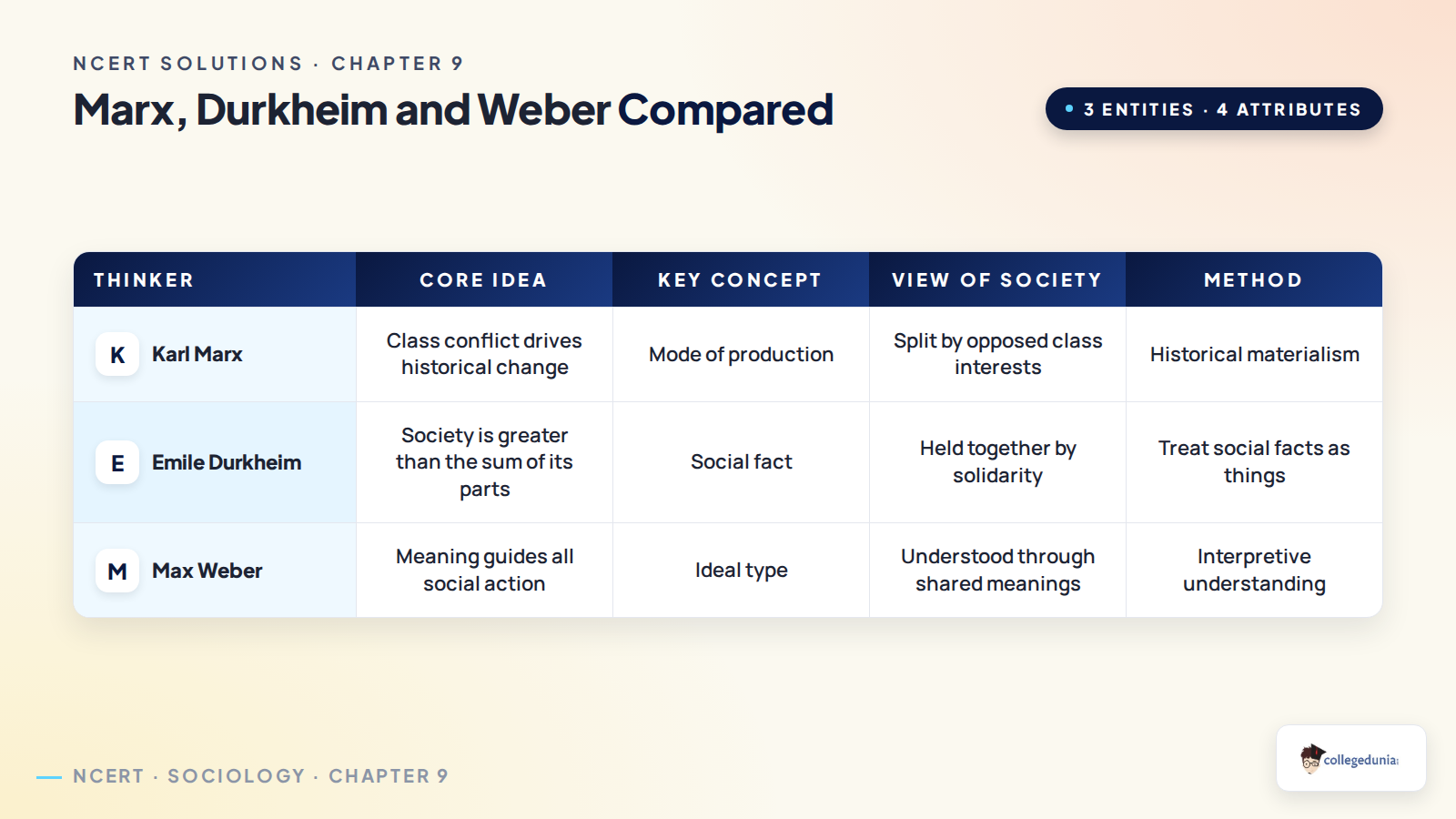
Activity 3 in the textbook asks you to compare Durkheim and Marx on the division of labour, and school papers turn that into a 6 mark question. Both agree that the social organisation of production grows more complex as society evolves. They disagree on what that complexity produces.
| Question | Karl Marx | Emile Durkheim | Max Weber |
|---|---|---|---|
| What holds society together or drives it | Conflict between classes | Solidarity built on shared moral codes | Meanings that actors attach to their own action |
| Core concept | Mode of production | Social fact | Social action and the ideal type |
| View of the division of labour | It creates opposed classes and exploitation | It creates interdependence and organic solidarity | It appears as rationalisation, seen best in bureaucracy |
| Method | Historical and economic analysis of the base and superstructure | Empirical study of behaviour patterns, as in Suicide | Empathetic understanding kept value neutral |
| The individual in modern society | More free but more alienated | Given autonomy and many identities | Recognised for skill, yet bound by rules of office |
Use one honest counter point if the question invites discussion. People from different class backgrounds do come together in groups, which strains the Marxian view. Mass communication has also standardised clothes and music across regions, which strains Durkheim's claim about individual freedom.
All 12 Textbook Questions Covered in These Introducing Western Sociologists NCERT Solutions
Every exercise question at the end of the chapter is solved on this page and in the PDF. The table shows what each answer is built on, so you can revise by question rather than by section.
| Question | What it asks | Answer is built on |
|---|---|---|
| 1 | Why is the Enlightenment important for the development of sociology | Reason, the knowing subject, society open to rational analysis |
| 2 | How was the Industrial Revolution responsible for giving rise to sociology | Factory system, urban growth, new governance and new knowledge |
| 3 | What are the various components of a mode of production | Base, productive forces, production relations, superstructure |
| 4 | Why do classes come into conflict, according to Marx | Position in production, ownership, class consciousness, ideology |
| 5 | What are social facts and how do we recognise them | External and constraining, recognised through behaviour patterns and the Suicide study |
| 6 | Difference between mechanical and organic solidarity | Similarity against interdependence, repressive against restitutive law |
| 7 | Show how moral codes are indicators of social solidarity | Moral facts as observable phenomena, punishment and compensation examples |
| 8 | What are the basic features of bureaucracy | The five features from functioning of officials to conduct in office |
| 9 | What is special about objectivity in social science | Empathetic understanding, value neutrality and the iron will |
| 10 | Ideas or theories behind recent social movements in India | Equality and rights arguments applied to movements you can name |
| 11 | What Marx and Weber wrote about India | A short research answer using the references given in the book |
| 12 | Reasons to study thinkers who died long ago | Relevance of classical ideas, and the criticism and modification they went through |
How Introducing Western Sociologists Appears in the Class 11 Sociology Exam Paper
This chapter sits in the Understanding Society book and is examined with the other chapters of that book. Schools set a predictable mix, so plan your revision around it.
| Question type | Usual marks | What gets asked |
|---|---|---|
| Very short answer | 1 to 2 | Define alienation, social fact, ideal type, mode of production, office |
| Short answer | 2 to 4 | Three types of authority, components of a mode of production, value neutrality |
| Long answer | 6 | Class conflict, mechanical against organic solidarity, features of bureaucracy |
| Comparison or source based | 4 to 6 | Marx against Durkheim on the division of labour, the Enlightenment and sociology |
Common Mistakes Students Make in the Introducing Western Sociologists Chapter
Watch out for these six errors. They are the reason a well written answer still scores four out of six.
- Mixing the thinkers. Bringing Durkheim's solidarity into a Marx question on class costs you the whole point.
- Defining class by income. For Marx, class is set by position in the production process, not by how much a person earns.
- Treating alienation as sadness. It is a structural separation from nature, from others, from the product of work, and from the self.
- Calling the ideal type a perfect type. An ideal type is an analytical model, not something desirable or accurate.
- Writing only four features of bureaucracy. The chapter lists five, and office management is the one most often dropped.
- Confusing empathy with sympathy. Weber wants feeling with the actor, never feeling for the actor.
Sample Solved Long Answer on Class Conflict for the Class 11 Sociology Exam
Question: Why do classes come into conflict according to Karl Marx? Six marks. Here is how a full mark answer is built, step by step.
- Define class first. People who occupy the same position in the social production process eventually form a class and share the same interests.
- Show how capitalism made the two classes. Serfs and small peasants lost their land, moved to cities, and were forced into factories as property less workers.
- Name the opposition. The bourgeoisie owns capital, factories, machinery and land, while workers own nothing and must sell their labour for wages.
- Add the condition for conflict. Opposed classes fight only after they become subjectively conscious of their own interests and of their rivals' interests.
- Explain the delay. The ruling class promotes a dominant ideology, so poor people may blame fate rather than exploitation for their poverty.
- Close with revolution. Given favourable social and political conditions, class conflict culminates in revolution and a dominant class is overthrown.
Key Terms from the Introducing Western Sociologists Glossary Every Class 11 Student Should Know
The glossary terms are direct one mark questions and they also make your long answers precise. Learn the short form given here.
| Term | Meaning to write in the exam |
|---|---|
| Alienation | A process in capitalist society by which human beings are separated from nature, other human beings, their work and its product, and their own self |
| Enlightenment | A period in 18th century Europe when philosophers rejected the supremacy of religious doctrines and established reason as the means to truth |
| Social fact | Aspects of social reality tied to collective patterns of behaviour and belief, not created by individuals but exerting pressure on them |
| Mode of production | A system of material production that persists over a long period, marked by its means of production and its relations of production |
| Office | In bureaucracy, a public post of impersonal and formal authority with specified powers, existing independently of the person appointed to it |
| Ideal type | A logically consistent model of a social phenomenon that highlights its most significant characteristics for analysis |
| Value neutrality | Recording the subjective values of others faithfully, without letting your own feelings or opinions affect the record |
How to Study Introducing Western Sociologists for the 2026-27 Class 11 Exam
This chapter rewards structure more than reading time. Three focused sittings are enough if you use them the way described below.
- Sitting one, fix the context. Write the three revolutions with one line each, then the four steps that link the Enlightenment to sociology. Keep it to one page.
- Sitting two, build three thinker cards. One card each for Marx, Durkheim and Weber, carrying the dates, the core concept, one book and one example.
- Sitting three, practise the long answers. Write full answers to exercise questions 4, 6 and 8 without the book, then check them against the solutions on this page.
- Before the paper, revise the glossary and the five features of bureaucracy. Those two blocks alone cover most of the one and two mark questions.
Introducing Western Sociologists Class 11 Resources Beyond These NCERT Solutions
Also Check: use these alongside the solutions. The notes give you the definitions in one place, and the question set lets you test yourself on all 12 exercises before the paper.
| Resource | Best used for | Link |
|---|---|---|
| Introducing Western Sociologists Class 11 Notes | The three revolutions, the three thinkers and every key term in one place | Read the Introducing Western Sociologists Class 11 Notes |
| Introducing Western Sociologists Question and Answer Set | All 12 exercise questions with a short Solution tab and an expanded Expert Solution tab | Open the Introducing Western Sociologists question set |
NCERT Solutions for All Class 11 Sociology Chapters
Related Links: the same answer format runs across every chapter of Class 11 Sociology, so you can move from one to the next without changing how you write.
All 12 questions with step-by-step solutions
Open the full question set for this chapter, where every exercise question comes with a short Solution tab and an expanded Expert Solution tab. Open the Introducing Western Sociologists Class 11 question and answer set
Introducing Western Sociologists Class 11 Sociology NCERT Solutions FAQs
Ques. Why is the Enlightenment important for the development of sociology?
Ans. The Enlightenment made rational and critical thought the central feature of the human being. The individual became the knowing subject, both the producer and the user of all knowledge. Since society was the handiwork of humans, it could now be studied by reason. Nature, religion and the divine were displaced from the centre, which made a secular and scientific study of society possible.
Ques. How was the Industrial Revolution responsible for giving rise to sociology?
Ans. It applied science and technology to production and organised labour and markets on a new scale. Workers were uprooted from rural areas and crowded into cities, where the rich and the working classes lived side by side in unequal conditions. Modern governments then took charge of health, sanitation and crime control, which created a demand for new knowledge about society. Sociology emerged partly as a response to that need.
Ques. What are the various components of a mode of production?
Ans. A mode of production has an economic base and a superstructure. The base holds the productive forces, which are the means of production such as land, labour, technology and sources of energy, and the production relations, which are the economic relationships and forms of labour organisation. Production relations are also property relations. The superstructure holds religion, art, law, literature and other beliefs and ideas.
Ques. Why do classes come into conflict according to Karl Marx?
Ans. Because people in the same position in the production process share the same interests, and those interests clash with the interests of the class above them. Under capitalism the bourgeoisie owns the means of production while workers own nothing and must sell their labour. Conflict starts only after a class becomes conscious of its own interests and of its rivals' interests. Given favourable conditions, that conflict culminates in revolution.
Ques. What are social facts and how do we recognise them?
Ans. Social facts are like things. They are external to the individual but constrain behaviour, and they are collective representations that emerge from the association of people. Law, education and religion are social facts, and so are beliefs, feelings and collective practices. We recognise them indirectly through patterns of behaviour. Durkheim proved this in Suicide, where the average suicide rate of a community was treated as a social fact.
Ques. What is the difference between mechanical and organic solidarity?
Ans. Mechanical solidarity rests on the similarity of members and is found in small primitive societies of self sufficient groups doing similar work. Its law is repressive and punishes deviation. Organic solidarity rests on the heterogeneity and interdependence of members in large modern societies. Its law is restitutive and tries to repair the wrong. The individual is submerged in the community under mechanical solidarity but gets autonomy under organic solidarity.
Ques. How are moral codes indicators of social solidarity?
Ans. Durkheim treated moral facts as rules of action that can be observed, described and classified. Moral codes are manifestations of particular social conditions, so the morality that suits one society will not suit another. A society that punishes small violations harshly shows mechanical solidarity. A society whose law asks the wrongdoer to repair the damage shows organic solidarity.
Ques. What are the basic features of bureaucracy according to Max Weber?
Ans. Five features. Functioning of officials within fixed areas of official jurisdiction. Hierarchical ordering of positions, where higher officials supervise lower ones. Reliance on written documents, the files, preserved as records. Office management by trained and skilled personnel. Conduct in office governed by exhaustive rules that separate public conduct from private behaviour.
Ques. What is special about the objectivity needed in social science?
Ans. Social science studies a world made of subjective meanings, values and prejudices, so it must be objective about subjective matters. Weber asked sociologists to practise empathetic understanding, which is feeling with rather than feeling for. They must record the meanings of social actors faithfully and describe rather than judge them. He called this value neutrality and said it needs an iron will.
Ques. What is an ideal type in Max Weber's sociology?
Ans. An ideal type is a logically consistent model of a social phenomenon that highlights its most significant characteristics. It is a conceptual tool for analysis and is not meant to be an exact reproduction of reality. It may exaggerate analytically important features and downplay others. It is judged by how helpful it is for analysis, not by how accurate its description is.
Ques. What is alienation in Karl Marx's theory?
Ans. Alienation is the process in capitalist society by which human beings are separated from nature, from other human beings, from their work and its product, and from their own self. Workers do not own what they produce and do not control the work process, since management decides the content of the working day. The combined result is that people struggle to make their lives meaningful.
Ques. How many exercise questions are there in this Class 11 Sociology chapter?
Ans. The Understanding Society textbook gives 12 exercise questions at the end of the chapter. All 12 are solved on this page and in the downloadable PDF, along with extra short answer and comparison based practice questions that schools set in their own papers.
Ques. Are these NCERT Solutions according to the 2026-27 syllabus?
Ans. Yes. Every answer follows the 2026-27 reprint of the NCERT Class 11 Sociology Understanding Society textbook, where this chapter appears as Chapter 4. The chapter text, the three biographies, the glossary and the 12 exercise questions are unchanged in this edition, so the answers apply to the current session.



Comments