Chapter 2 Reconstitution of a Partnership Firm: Admission of a Partner carries 8 marks in every Class 12 Accountancy board paper, the highest share of any single chapter. These NCERT solutions solve all 49 textbook questions in CBSE marker order, with formula, substitution and arithmetic on separate lines so no partial mark is missed.
CBSE Weightage: 8 marks in Part A - the highest single-chapter share across recent board papers, usually as one full-length numerical on Admission of a Partner.
Question Count: 49 solved questions - 6 Short Answer, 8 Long Answer and 35 Numericals covering the six-adjustment sequence, T-format Revaluation Account, AS-26 goodwill treatment and the reconstituted Balance Sheet.
The PDF covers the new profit-sharing ratio, sacrificing ratio, three goodwill valuation methods, four sub-cases of premium treatment, the Revaluation Account, distribution of accumulated profits and reserves, and capital adjustment. Every numerical ends with a balanced opening Balance Sheet of the reconstituted firm.
These solutions are written by Chartered Accountants and Commerce educators, according to the 2026-27 NCERT, and cross-checked against the last five years of CBSE Class 12 Board papers.
Admission of a Partner Question Map: Where the 8 CBSE Marks Sit
The chapter splits into a theory block and a numerical block that scales from single-adjustment problems to full Balance Sheet questions. The clusters mirror the CBSE marker's six-adjustment grid, so practising in this order is the fastest route to the 8-mark question.
Question Block
Count
Topic Focus
Typical CBSE Marks
Short Answer (Q1 to Q6)
6
Six adjustments rationale, sacrificing ratio definition, AS-26 stance on goodwill, revaluation purpose
1 to 3
Long Answer (Q1 to Q8)
8
Revaluation procedure, goodwill factors, three valuation methods, accumulated profits treatment, capital adjustment
3 to 4
Numerical Q1 to Q12
12
New PSR from default source and from specified shares, sacrificing ratio
3 to 4
Numerical Q13 to Q17
5
Goodwill valuation by Average Profit, Super Profit and Capitalisation
3 to 4
Numerical Q18 to Q26
9
Premium method, hidden goodwill, four sub-cases of payment treatment
4 to 6
Numerical Q27 to Q35
9
Full Revaluation A/c plus opening Balance Sheet of the new firm
6 to 8
The 8-mark CBSE question usually comes from the Q27 to Q35 cluster, so the PDF gives extra working space there.
AS-26 reminder: Self-generated goodwill cannot appear on the Balance Sheet. Old goodwill is written off first, debiting old partners' capitals in old PSR, before the new partner's premium is recorded.
Admission of a Partner Crash Course for Class 12 Accountancy Boards
Three-line working on every calculation: formula, substitution, then arithmetic, each on its own line.
T-format Revaluation A/c for every full Balance Sheet question, with the closing transfer in old PSR.
All three goodwill valuation methods: Average Profit, Super Profit and Capitalisation.
Four sub-cases of premium treatment: retained in business, fully withdrawn, partially withdrawn, paid privately outside the books.
Hidden goodwill: found via the implied total capital method wherever premium is not stated.
Expert Solution block on each numerical giving the CA-style alternate method and the common-error trap.
How Collegedunia's Admission of a Partner Solutions Help You Score the Full 8 Marks
2026-27 NCERT alignment: Question numbering and section references match the current Accountancy Part I textbook.
Marker-style answer structure: The six-adjustment sequence follows the order CBSE evaluators expect on the 8-mark question.
Expert verification: Every Revaluation A/c, sacrificing ratio, goodwill computation and capital adjustment is double-checked.
Common-error notes: AS-26 write-off, hidden goodwill, privately paid premium, and reserves credited in old PSR are all flagged inline.
Solved Example: How to Calculate the New Profit-Sharing Ratio on Admission
Question. A and B share profits in 3:2. They admit C for 1/6 share, which C acquires from A and B in their old ratio. Calculate the new profit-sharing ratio.
Step 1: Default source rule. When the question is silent, the incoming partner takes from the old partners in their old profit-sharing ratio.
Step 2: Remaining share for old partners. 1 - 16 = 56
Step 3: New shares of A and B. A = 56 × 35 = 36; B = 56 × 25 = 26
Step 4: New PSR. A : B : C = 36 : 26 : 16 = 3 : 2 : 1
Top 5 Most-Tested Concepts in the Admission of a Partner Chapter
Six Adjustments at Admission: The checklist every numerical follows, in order.
Sacrificing Ratio: Old Share minus New Share; drives the credit side of the goodwill entry.
Goodwill Valuation: Average Profit, Super Profit or Capitalisation. Use the method the question specifies.
Revaluation Account: Opens before admission; gain or loss goes to old partners in old PSR.
AS-26 Write-Off: Existing goodwill must be removed in old PSR before the premium is recorded.
Admission of a Partner Previous-Year CBSE Question Trend (2020 to 2025)
This chapter has carried 8 marks in five of the last six CBSE board papers, almost always as a full Balance Sheet question. The table below tracks the topic mix.
Year
Marks
Topics Tested
2025
8
Full Balance Sheet on admission: revaluation, goodwill, capital adjustment
2024
8
Goodwill by super-profit method (3M) plus admission journal entries (5M)
2023
8
Revaluation A/c and Balance Sheet (6M); sacrificing ratio (2M)
2022
10
Goodwill by Capitalisation (4M); admission B/S (6M)
2021
8
Goodwill journal entries (4M); new PSR computation (4M)
2020
8
Goodwill, revaluation, opening Balance Sheet (8M)
Common Mistakes Students Make in the Admission of a Partner Chapter
Crediting reserves in new PSR. Reserves and accumulated profits belong to the old partners; credit them in old PSR.
Forgetting to write off existing goodwill. AS-26 makes this write-off compulsory before any premium entry.
Passing a journal entry for privately paid premium. If the premium is paid outside the firm, no entry goes in the firm's books.
Hidden goodwill via wrong base. Find the implied total capital from the new partner's contribution, then deduct combined capitals; the gap is the hidden goodwill.
Revaluation profit to all partners. Revaluation gain or loss goes only to old partners in old PSR, never to the incoming partner.
Related Class 12 Accountancy Resources for Admission of a Partner
All Admission of a Partner NCERT Solutions with Step-by-Step Working
Every NCERT question for this chapter is listed below with its Solution and Expert Solution hidden inside collapsible tabs. Click Check Solution for the working, or Expert Solution for more detail.
Short Answer Questions
Q 2.1
Identify various matters that need adjustments at the time of admission of a new partner.
Concept used. On admission of a new partner the firm undergoes a
reconstitution, existing relations among partners change. Six
specific matters must be adjusted in the books before the new firm
starts trading.
New Profit-Sharing Ratio. Re-state the new ratio in
which the new partner and old partners will share future
profits.
Sacrificing Ratio. Compute the ratio in which old
partners surrender share for the new partner; this drives the
goodwill compensation.
Treatment of Goodwill. Value the firm's goodwill, then
adjust it through partners' capital accounts (premium method,
revaluation method, or hidden-goodwill method depending on the
deed).
Revaluation of Assets and Liabilities. Open a
Revaluation A/c; transfer net gain/loss to old partners
in their old PSR.
Distribution of Reserves and Accumulated Profits or
Losses. Transfer existing balances (general reserve, P&L
Cr. balance, workmen compensation reserve, etc.) to old
partners in their old PSR before the admission entry.
Adjustment of Capitals. If the deed requires, adjust
the capitals of all partners in the new PSR by introducing /
withdrawing cash, or by routing through current accounts.
Six adjustments: (1) new PSR, (2) sacrificing ratio, (3)
goodwill treatment, (4) revaluation of assets and liabilities, (5)
distribution of reserves and accumulated P&L, and (6) adjustment of
capitals to new ratio.
CR
CA Rohit Mehra
B.Com (H), FCA, Associate Member ICAI
Verified Expert
Strategic angle. Group the six adjustments under three
buckets: (a) ratio (new PSR, sacrificing ratio), (b) value
(goodwill, revaluation, reserves), (c) capital (final capital
adjustment).
Ratio adjustments first, compute the new PSR and the
sacrificing ratio.
Value adjustments next, goodwill, revaluation, reserves
(all three in old PSR).
Capital adjustment last (if deed requires).
Why this matters. Every numerical question in this chapter
follows this exact sequence. Train yourself to ask ``which of the six
adjustments does this part of the question want?''
Common mistakes. Three predictable slips lose marks: (a) skipping the calculation of the sacrificing ratio and crediting goodwill in the old ratio rather than the sacrificing ratio; (b) writing off existing goodwill in the new ratio instead of the old ratio, which is the AS-26 mandate; (c) leaving the revaluation gain or loss undistributed among old partners or distributing it in the new ratio rather than the old ratio.
Six adjustments grouped as ratio (PSR, sacrificing),
value (goodwill, revaluation, reserves) and capital.
Q 2.2
Why is it necessary to ascertain new profit-sharing ratio even for old partners when a new partner is admitted?
Concept used. When a new partner is admitted, the share of
profit currently going to the old partners must be reduced (in
some agreed proportion) to make room for the new partner's share.
Therefore the old partners' new profit-sharing ratio is not
their old ratio; it has to be recomputed.
Share given up. The total share given up by old
partners exactly equals the new partner's share.
Reduction in old shares. Each old partner's new
share = old share - his sacrifice.
Why this matters financially. Future profits will be
distributed in the new ratio; for any year's P&L App A/c we
need the new PSR. The new ratio also determines:
[leftmargin=18pt,topsep=2pt,itemsep=1pt]
the partners' capital proportion (if capitals are to
be in the new ratio);
the share of revaluation gain / loss (in old
ratio, but new ratio is needed for the cross-check);
how goodwill premium received from the new partner is
divided among the sacrificing old partners.
The new PSR for old partners is needed because their old
shares are no longer accurate after admission; every future profit,
capital adjustment and goodwill calculation depends on the new ratio.
PS
Priya Singhal
M.Com, NET-JRF, Commerce Faculty
Verified Expert
Strategic angle. Frame it as ``addition forces subtraction''
, adding a new partner to a fixed-sum profit pool forces each old
partner's share to fall.
The total share is always 1 (or 100%).
Once the new partner takes a slice, the rest must fit into
1 - new partner's share.
The way old partners redistribute that residue defines their
new ratio.
Why this matters. Without a clear new PSR for old partners,
the P&L App A/c becomes impossible to prepare for any subsequent year.
Common mistakes. Three predictable slips lose marks: (a) skipping the calculation of the sacrificing ratio and crediting goodwill in the old ratio rather than the sacrificing ratio; (b) writing off existing goodwill in the new ratio instead of the old ratio, which is the AS-26 mandate; (c) leaving the revaluation gain or loss undistributed among old partners or distributing it in the new ratio rather than the old ratio.
New PSR for old partners ensures clean future profit
distribution, capital adjustment and goodwill allocation.
Q 2.3
What is sacrificing ratio? Why is it calculated?
Concept used.Sacrificing ratio is the ratio in which
the old partners surrender (sacrifice) parts of their old share
in favour of the new partner.
Sacrifice of a partner = Old Share - New Share.
Definition. For each old partner, the sacrifice is
positive (he loses share). The set of sacrifices, taken in
order, defines the sacrificing ratio.
Why it is calculated.
[leftmargin=18pt,topsep=2pt,itemsep=1pt]
To distribute the goodwill premium brought in
by the new partner among the old partners in the
proportion in which they have surrendered share.
If the new partner does not bring his share of
goodwill in cash, an adjustment journal entry passes
debit to the new partner's capital and credit to the
sacrificing partners' capitals in the sacrificing
ratio.
Sacrificing ratio is also used to compute the
gaining ratio on a future change in PSR (it is
the mirror image).
Sacrificing ratio = Old Share - New Share, computed for
each old partner. It is needed to distribute the new partner's
goodwill premium and to pass goodwill-adjustment entries.
RG
Rekha Gokhale
PhD Commerce, Presidency Kolkata
Verified Expert
Strategic angle. Memorise the dual question: sacrificing
ratio at admission = gaining ratio at retirement. Same formula, mirror
direction.
Sacrifice = Old - New (positive for sacrificing partner).
Express the sacrifices as a single ratio (e.g. 3:2).
Use this ratio to allocate goodwill premium.
Why this matters. CBSE often gives the new PSR and old PSR
and asks for the sacrificing ratio in a one-mark sub-question
embedded inside a larger 6-mark question.
Common mistakes. Three predictable slips lose marks: (a) skipping the calculation of the sacrificing ratio and crediting goodwill in the old ratio rather than the sacrificing ratio; (b) writing off existing goodwill in the new ratio instead of the old ratio, which is the AS-26 mandate; (c) leaving the revaluation gain or loss undistributed among old partners or distributing it in the new ratio rather than the old ratio.
Sacrificing ratio = Old - New; needed for distributing
goodwill premium and passing goodwill-adjustment entries.
Q 2.4
On what occasions sacrificing ratio is used?
Concept used. The sacrificing ratio is used in any
reconstitution event where one or more old partners give up share in
favour of another partner.
Admission of a new partner. Goodwill premium brought
in by the new partner is credited to the sacrificing partners
in the sacrificing ratio.
Change in profit-sharing ratio among existing
partners. When one partner gains and another sacrifices, the
gaining partner compensates the sacrificing partner for his
share of goodwill, in the sacrificing ratio (= gain ratio,
mirrored).
Conversion of a partnership into a company (advanced
topic, beyond Class 12 syllabus but commonly tested in B.Com
first year).
Sacrificing ratio is used (i) on admission of a new partner
to distribute goodwill premium; (ii) on a change in PSR among
existing partners to record the goodwill compensation entry; and
(iii) in conversion of a firm into a company.
ML
Manish Luthra
PhD Economics, IIM Kozhikode
Verified Expert
Strategic angle. The sacrificing ratio appears whenever
one partner pays another for surrendered profit share.
Admission of new partner, new partner pays old partners.
Change in PSR, gaining partner pays sacrificing partner.
Both cases use the sacrificing ratio (or its mirror, the
gaining ratio).
Why this matters. Sacrificing-ratio computations earn easy
marks in every reconstitution numerical.
Common mistakes. Three predictable slips lose marks: (a) skipping the calculation of the sacrificing ratio and crediting goodwill in the old ratio rather than the sacrificing ratio; (b) writing off existing goodwill in the new ratio instead of the old ratio, which is the AS-26 mandate; (c) leaving the revaluation gain or loss undistributed among old partners or distributing it in the new ratio rather than the old ratio.
Three occasions: admission of new partner, change in PSR
among existing partners, conversion of firm into a company.
Q 2.5
If some goodwill already exists in the books and the new partner brings in his share of goodwill in cash, how will you deal with the existing amount of goodwill?
Concept used. As per AS-26 (Accounting Standard 26)
issued by the ICAI, self-generated goodwill cannot be shown
on the balance sheet. Hence any goodwill already appearing in the
books of the old firm must be written off before the new
partner's admission.
Write off existing goodwill. The goodwill currently
shown in the books is debited to the old partners' capital
accounts in their old profit-sharing ratio, and the
Goodwill A/c is credited.
tabularlrr
& Dr. (Rs.) & Cr. (Rs.)
Old Partners' Capital A/c Dr. (in old PSR) & xxx &
To Goodwill A/c & & xxx
3l(Existing goodwill written off)
tabular
Record incoming goodwill premium. Cash brought in by
the new partner for his share of goodwill is credited to the
sacrificing partners in the sacrificing ratio.
tabularlrr
& Dr. (Rs.) & Cr. (Rs.)
Cash / Bank A/c Dr. & xxx &
To Sacrificing Partners' Capital A/cs & & xxx
3l(Goodwill premium brought by new partner)
tabular
Existing goodwill is first written off to old partners'
capital A/cs in the old PSR; then the new partner's incoming
goodwill premium is credited to the sacrificing partners in the
sacrificing ratio.
GO
Geeta Ojha
PhD Accounting, ICAI Kolkata
Verified Expert
Strategic angle. Two journal entries in sequence: (a) wipe
old goodwill from the books in old PSR; (b) credit incoming premium
to sacrificing partners in sacrificing ratio.
Existing goodwill is fictitious from an accounting-standards
perspective; remove it.
Incoming goodwill premium is real cash; credit it correctly.
Why this matters. CBSE has tested this exact two-step
sequence in 2020, 2022 and 2024. Forgetting the AS-26 write-off costs
half the marks of the question.
Common mistakes. Three predictable slips lose marks: (a) skipping the calculation of the sacrificing ratio and crediting goodwill in the old ratio rather than the sacrificing ratio; (b) writing off existing goodwill in the new ratio instead of the old ratio, which is the AS-26 mandate; (c) leaving the revaluation gain or loss undistributed among old partners or distributing it in the new ratio rather than the old ratio.
(i) Write off existing goodwill to old partners' capitals
in old PSR; (ii) Credit incoming premium to sacrificing partners in
sacrificing ratio.
Q 2.6
Why is there a need for the revaluation of assets and liabilities on the admission of a partner?
Concept used. At the date of admission of a new partner, the
firm's assets and liabilities may be carrying book values that
no longer reflect fair values. The new partner should neither
benefit from undisclosed appreciation nor suffer hidden depreciation;
similarly, the gain or loss on revaluation must accrue to the
old partners (in their old PSR), not to the incoming partner.
Fairness to incoming partner. If the building is
worth Rs. 12,00,000 but shown at Rs. 10,00,000, the
unrecognised gain belongs to the old partners. Without
revaluation, the new partner would automatically acquire a
share of that hidden gain, which would be unfair.
Fairness to old partners. Hidden depreciation
(e.g. outdated machinery, bad debts not provided for) must
be absorbed by old partners, not foisted on the new partner.
Accounting accuracy. The Balance Sheet of the new
firm must show assets and liabilities at fair value, in line
with the prudence concept.
Mechanics. A Revaluation A/c (also called Profit &
Loss Adjustment A/c) is opened. Increase in asset / decrease
in liability is credited; decrease in asset / increase in
liability is debited. The net balance is transferred to old
partners' capital A/cs in old PSR.
Revaluation is needed so that any hidden gain or loss at
the date of admission accrues only to the old partners, in their old
PSR, and not to the new partner; this maintains fairness and ensures
the new firm's Balance Sheet shows fair values.
DR
Deepak Ranjan
MCom NET, Madras Christian College
Verified Expert
Strategic angle. Three motivations to remember: fairness,
accuracy, accountability.
Fairness, gains/losses till admission date belong to old
partners in old PSR.
Accuracy, new firm's Balance Sheet should show fair
values.
Accountability, the Revaluation A/c is the single document
that records who got what.
Why this matters. Numerical Q27–Q35 of this chapter test the
Revaluation A/c. Mastering its rules unlocks half the chapter's
marks.
Common mistakes. Three predictable slips lose marks: (a) skipping the calculation of the sacrificing ratio and crediting goodwill in the old ratio rather than the sacrificing ratio; (b) writing off existing goodwill in the new ratio instead of the old ratio, which is the AS-26 mandate; (c) leaving the revaluation gain or loss undistributed among old partners or distributing it in the new ratio rather than the old ratio.
Revaluation ensures hidden gain/loss accrues to old
partners (in old PSR), maintains fair values on the new firm's
Balance Sheet, and provides an audit trail.
Long Answer Questions
Q 2.7
Do you advise that assets and liabilities must be revalued at the time of admission of a partner? If so, why? Also describe how it is treated in the books of account.
Concept used. Yes, assets and liabilities must be
revalued at the time of admission of a partner. The reasoning has
three pillars: fairness, accounting accuracy, and statutory
compliance. The mechanics of revaluation go through a Revaluation
A/c (or Profit & Loss Adjustment A/c).
Why revalue?
[leftmargin=18pt,topsep=2pt,itemsep=1pt]
Any unrecognised appreciation belongs to the old
partners (they earned it before admission).
Any unrecognised depreciation should be borne by old
partners (it occurred during their tenure).
The new firm's Balance Sheet should disclose
fair values.
Statutory compliance with AS-10 (Property, Plant and
Equipment) and AS-29 (Provisions, Contingent
Liabilities).
Open a Revaluation A/c.
Credits (gains):
[leftmargin=18pt,topsep=2pt,itemsep=1pt]
Increase in value of asset.
Decrease in value of liability.
Unrecorded asset brought in.
Debits (losses):
[leftmargin=18pt,topsep=2pt,itemsep=1pt]
Decrease in value of asset.
Increase in value of liability.
Unrecorded liability brought in.
New provision for doubtful debts.
Journal entries.
tabularlrr
& Dr. & Cr.
Asset A/c Dr. (increase) & xxx &
To Revaluation A/c & & xxx
Revaluation A/c Dr. (decrease) & xxx &
To Asset A/c & & xxx
Liability A/c Dr. (decrease) & xxx &
To Revaluation A/c & & xxx
Revaluation A/c Dr. (increase in liab) & xxx &
To Liability A/c & & xxx
tabular
Transfer net balance to Old Partners' Capital A/cs.
If credit side (gains) > debit side (losses), it is a
gain on revaluation, credited to old partners'
capitals in the old PSR. Otherwise it is a
loss, debited similarly.
tabularlrr
& Dr. & Cr.
Revaluation A/c (Gain) Dr. & xxx &
To Old Partners' Capitals (Old PSR) & & xxx
Old Partners' Capitals (Old PSR) Dr. (Loss) & xxx &
To Revaluation A/c & & xxx
tabular
Yes, revaluation is necessary. It is recorded in a
Revaluation A/c: gains (asset increase, liability decrease) are
credited; losses (asset decrease, liability increase, new provisions)
are debited; the net balance is transferred to old partners' capital
accounts in their old PSR.
SK
Sangeeta Kulkarni
MA Economics, IIM Shillong
Verified Expert
Strategic angle. The Revaluation A/c is a temporary nominal
account. It exists for one purpose: to compute the net adjustment
that belongs to the old partners.
List every asset/liability change one by one.
Post each to the correct side of the Revaluation A/c.
Net balance to old partners in old PSR.
Why this matters. The Revaluation A/c is the second-most-
tested item in admission numericals (after capital adjustment).
A clean four-step procedure earns method marks even if the final
balance is wrong.
Common mistakes. Three predictable slips lose marks: (a) skipping the calculation of the sacrificing ratio and crediting goodwill in the old ratio rather than the sacrificing ratio; (b) writing off existing goodwill in the new ratio instead of the old ratio, which is the AS-26 mandate; (c) leaving the revaluation gain or loss undistributed among old partners or distributing it in the new ratio rather than the old ratio.
Open Revaluation A/c; credit asset increases and liability
decreases; debit the opposites; transfer net gain/loss to old
partners in old PSR.
Q 2.8
What is goodwill? What factors affect goodwill?
Concept used.Goodwill is the present value of a
firm's future earnings in excess of normal earnings on its capital
employed, in other words, the value of the firm's reputation,
customer relations, brand, and other intangible advantages that
enable it to earn super profits.
Formal definition.Goodwill is an intangible
asset representing the excess of the purchase consideration
of a business over the fair value of its identifiable net
assets.
Two kinds of goodwill.
[leftmargin=18pt,topsep=2pt,itemsep=1pt]
Purchased goodwill, paid for when one firm
buys another; shown as an asset (AS-26 permits).
Self-generated goodwill, built up over
years through reputation; cannot be shown on the
balance sheet (AS-26 prohibits).
Factors affecting goodwill.
[leftmargin=18pt,topsep=2pt,itemsep=1pt]
Quality and reputation of the product /
service. Higher quality ⇒ stronger
customer loyalty ⇒ higher goodwill.
Efficient management. Skilled,
forward-looking management adds to goodwill.
Favourable location. Prime commercial
location boosts goodwill.
Strong customer base. Repeat customers
signal goodwill.
Time factor. The longer a firm has been in
business, the more goodwill it builds, ceteris
paribus.
Capital required. A capital-light business
can deliver high returns on small capital, raising
goodwill.
Future prospects. Goodwill is forward-
looking; a firm in a growth industry commands higher
goodwill than one in decline.
Goodwill = present value of a firm's super-earning capacity.
Factors affecting goodwill: product/service quality, efficient
management, location, customer base, risk profile, age of the firm,
capital required, and future prospects.
PB
Pankaj Bhardwaj
MCom CA, IIM Bangalore
Verified Expert
Strategic angle. Define goodwill as the value of
super-earning capacity, then list 6–8 factors. CBSE allots 1 mark
per factor.
Goodwill = capitalised value of expected super-profits.
AS-26 allows only purchased goodwill on books.
Eight standard factors as memorised above.
Why this matters. Numerical Q13–Q17 of this chapter rely on
goodwill valuation methods that all derive from the underlying
definition, super-profit-based pricing of intangible advantages.
Common mistakes. Three predictable slips lose marks: (a) skipping the calculation of the sacrificing ratio and crediting goodwill in the old ratio rather than the sacrificing ratio; (b) writing off existing goodwill in the new ratio instead of the old ratio, which is the AS-26 mandate; (c) leaving the revaluation gain or loss undistributed among old partners or distributing it in the new ratio rather than the old ratio.
Goodwill = value of super-earning capacity. Factors:
quality, management, location, customers, risk, age, capital, future
prospects.
Q 2.9
Explain various methods of valuation of goodwill.
Concept used. Three principal methods are prescribed in the
NCERT for valuing goodwill at admission, retirement or change in
PSR.
Average Profit Method.
Goodwill = Average Profit × Number of years' purchase.
Average profit is computed over the last 3–5 years.
``Years' purchase'' is the multiplier (typically 2 to 4).
Example: Average profit Rs. 50,000; 4 years'
purchase ⇒ Goodwill = 50,000 × 4 =
Rs. 2,00,000.
Super Profit Method.
First, define Super Profit and Normal Profit:
Super Profit = Actual Avg Profit - Normal Profit.
Normal Profit equals capital employed multiplied by normal rate divided by 100.
Then the goodwill is computed as:
Goodwill = Super Profit × Years' Purchase.
Example: Avg profit Rs. 1,00,000; capital
Rs. 5,00,000; normal rate 12%. Normal profit
= 60,000; super profit = 40,000. Goodwill (3 years'
purchase) = 40,000 × 3 = Rs. 1,20,000.
Capitalisation Method. Two sub-methods.
Capitalisation of Average Profit:
Goodwill = (Avg Profit × 100 ÷ Normal Rate) - Capital Employed.
Capitalisation of Super Profit:
Goodwill = Super Profit × 100 ÷ Normal Rate.
Example: Avg profit Rs. 1,00,000; normal rate
10%; capital Rs. 8,20,000.
Capitalised value = 100 × 1,00,000 / 10 =
10,00,000. Goodwill = 10,00,000 - 8,20,000 =
Rs. 1,80,000.
Weighted Average Profit Method (advanced, a
refinement of Average Profit Method). Assign higher weights
to more recent years.
Weighted Avg = ∑ (Profit × Weight)∑ Weight.
Three primary methods: (i) Average Profit (Avg ×
years' purchase); (ii) Super Profit (Super Profit × years'
purchase, where Super = Actual - Normal); (iii) Capitalisation
(either of Avg Profit minus Capital Employed, or Super Profit divided
by Normal Rate). The Weighted Average method is a refinement.
SC
Sunita Chatterjee
MBA Banking, Symbiosis Pune
Verified Expert
Strategic angle. Choose the method to match the data given.
Given only past profits + a multiplier ⇒ Average
Profit method.
Given profits + capital + normal rate ⇒ Super
Profit method.
Given profits + capital + normal rate + asked for
capitalised value ⇒ Capitalisation method.
Why this matters. CBSE awards full marks for any of the
three methods provided the working matches the data given. Knowing
which method best fits saves time.
Common mistakes. Three predictable slips lose marks: (a) skipping the calculation of the sacrificing ratio and crediting goodwill in the old ratio rather than the sacrificing ratio; (b) writing off existing goodwill in the new ratio instead of the old ratio, which is the AS-26 mandate; (c) leaving the revaluation gain or loss undistributed among old partners or distributing it in the new ratio rather than the old ratio.
Average Profit, Super Profit, and Capitalisation are the
three NCERT methods. Choose based on the data given.
Q 2.10
If it is agreed that the capital of all the partners should be proportionate to the new profit-sharing ratio, how will you work out the new capital of each partner? Give examples and state how necessary adjustments will be made.
Concept used.Proportionate capital adjustment on
admission means that, after the new partner is admitted, each partner's
capital must stand in the same ratio as the new profit-sharing
ratio. The base for the new total capital is normally the capital
brought in by the new partner (since his share of profits is known).
Identify the new partner's capital and share. Suppose
C is admitted for 14 share and brings in Rs. 1,00,000.
Compute total new capital of the firm.
Total capital = New partner's capitalNew partner's share
= 1,00,0001/4 = Rs. 4,00,000.
Compute each old partner's new capital in the new PSR.
If A and B were in 3:2 and now sit in 9:6:5 with C,
aligned
A's new capital &= 4,00,000 × 920 = Rs. 1,80,000, B's new capital &= 4,00,000 × 620 = Rs. 1,20,000, C's capital &= 4,00,000 × 520 = Rs. 1,00,000.
aligned
Adjust each old partner's existing capital.
If existing capital < new capital, partner brings in cash;
if existing capital > new capital, excess is paid back in
cash or transferred to a Current A/c.
Total new capital = New partner's capital ÷ his share.
Allocate to each partner in the new PSR; adjust by cash or current
account.
KI
Karan Iyer
M.Com, Bombay University
Verified Expert
Strategic angle. Two flavours: (a) base on new partner's
capital, (b) base on combined capital of old partners. Read carefully.
Total firm capital = new partner's capital ÷ his share.
Multiply by each partner's new share.
Compare with existing balance; bring in or withdraw cash.
Why this matters. CBSE asks this in 4–6 mark questions; the
key is converting ``proportionate to PSR'' into clear arithmetic.
Common mistakes. Three predictable slips lose marks: (a) skipping the calculation of the sacrificing ratio and crediting goodwill in the old ratio rather than the sacrificing ratio; (b) writing off existing goodwill in the new ratio instead of the old ratio, which is the AS-26 mandate; (c) leaving the revaluation gain or loss undistributed among old partners or distributing it in the new ratio rather than the old ratio.
New total capital = partner's capital ÷ share; allocate in
new PSR; adjust by cash/current A/c.
Q 2.11
Explain how will you deal with goodwill when the new partner is not in a position to bring his share of goodwill in cash.
Concept used. When the incoming partner cannot pay his share
of goodwill in cash, his share is adjusted by a debit to his
Capital A/c and a credit to the old partners' Capital A/cs in
their sacrificing ratio. The premium is never recorded in a
Goodwill A/c (AS-26 prohibits creating self-generated goodwill).
Value goodwill using any standard method (Avg Profit,
Super Profit, Capitalisation).
Compute new partner's share of goodwill= Total goodwill × his share.
Pass the adjustment entry:
tabularlrr
Particulars & Dr. (Rs.) & Cr. (Rs.)
New partner's Capital A/c & xxxx &
1emTo Old partners' Capital A/cs (sacrificing ratio) & & xxxx
3l(Being new partner's share of goodwill credited
3lto old partners in their sacrificing ratio)
tabular
Why not raise a Goodwill A/c? AS-26 disallows
capitalising self-generated goodwill; the adjustment must run
through Capital A/cs.
Debit new partner's Capital with his share of goodwill; credit
old partners' Capital in sacrificing ratio. No Goodwill A/c is raised.
DR
Diya Reddy
M.Com, NET, Commerce Faculty
Verified Expert
Strategic angle. Memorise: new partner's Capital Dr. to old
partners' Capital (sacrificing ratio).
Value goodwill; find new partner's share.
Debit his Capital; credit old partners' in sacrificing ratio.
Why this matters. Quoting AS-26 in 4-mark theory earns the
``conceptual clarity'' mark.
Common mistakes. Three predictable slips lose marks: (a) skipping the calculation of the sacrificing ratio and crediting goodwill in the old ratio rather than the sacrificing ratio; (b) writing off existing goodwill in the new ratio instead of the old ratio, which is the AS-26 mandate; (c) leaving the revaluation gain or loss undistributed among old partners or distributing it in the new ratio rather than the old ratio.
Capital adjustment entry: new partner Dr. old partners Cr. in
sacrificing ratio.
Q 2.12
Explain various methods for the treatment of goodwill on the admission of a new partner.
Concept used. Four standard scenarios (only the first three
are AS-26 compliant; the fourth handles inferred figures):
Premium Method (cash brought). New partner brings his
share of goodwill in cash. Cash debited; old partners' Capital
A/cs credited in sacrificing ratio.
tabularlrr
Cash A/c & Dr. xxxx &
1emTo Premium for Goodwill A/c & & xxxx
Premium for Goodwill A/c & Dr. xxxx &
1emTo Old partners' Capital A/cs & & xxxx
tabular
When new partner cannot bring cash.
New partner's Capital A/c Dr.; old partners' Capital A/cs
Cr. in sacrificing ratio.
When goodwill already appears in books. Write off old
goodwill first by debiting old partners' Capital A/cs in
old ratio, then apply Method 1 or 2.
Hidden goodwill (inferred). If the new partner's
capital is given but total firm capital implies a higher
figure, the difference is hidden goodwill:
Hidden Goodwill = New partner's capitalhis share
- Total adjusted capital.
Then apply Method 2.
Four sub-cases: cash premium, no-cash via Capital A/c,
existing goodwill written off, hidden goodwill computed. All AS-26
compliant.
VM
Vipin Malhotra
MBA Finance, IMI Delhi
Verified Expert
Strategic angle. Identify the sub-case first.
Cash premium ⇒ Cash Dr. + Premium for Goodwill A/c.
No cash ⇒ New partner's Capital Dr.
Existing goodwill ⇒ write off in old ratio first.
Hidden goodwill ⇒ compute via capital comparison.
Why this matters. A typical 6-mark CBSE question gives one
scenario but expects you to name the sub-case, write the label at
the top of your answer for a method mark.
Common mistakes. Three predictable slips lose marks: (a) skipping the calculation of the sacrificing ratio and crediting goodwill in the old ratio rather than the sacrificing ratio; (b) writing off existing goodwill in the new ratio instead of the old ratio, which is the AS-26 mandate; (c) leaving the revaluation gain or loss undistributed among old partners or distributing it in the new ratio rather than the old ratio.
Premium, no-cash, existing-goodwill-write-off, hidden-goodwill,
identify, then apply.
Q 2.13
How will you deal with accumulated profits and losses and reserves on the admission of a new partner?
Concept used. Accumulated profits, reserves, P&L
(Cr. balance), and accumulated losses, P&L (Dr. balance), all belong
to the old partners and must be distributed in the old
profit-sharing ratio before the new partner is admitted.
For accumulated profits / General Reserve / P&L (Cr.)
, distribute to old partners' Capital A/cs in old PSR.
tabularlrr
Reserve / Profit A/c & Dr. xxxx &
1emTo Old partners' Capital A/cs & & xxxx
3l(in old profit-sharing ratio)
tabular
For accumulated losses / P&L (Dr.), charge to old
partners' Capital A/cs in old PSR.
tabularlrr
Old partners' Capital A/cs & Dr. xxxx &
1emTo P&L A/c (Dr. balance) & & xxxx
tabular
Why old PSR? These items accrued when only the old
partners existed; the new partner has no claim.
Accumulated profits credit old partners' Capital; accumulated
losses debit them. Always in old profit-sharing ratio.
Reserves and Cr. P&L → Cr. old partners' Capital in old PSR.
Dr. P&L → Dr. old partners' Capital in old PSR.
Why this matters. The CBSE 8-mark question typically combines
this with revaluation; the order is revalue → reserves
→ goodwill → admit.
Common mistakes. Three predictable slips lose marks: (a) skipping the calculation of the sacrificing ratio and crediting goodwill in the old ratio rather than the sacrificing ratio; (b) writing off existing goodwill in the new ratio instead of the old ratio, which is the AS-26 mandate; (c) leaving the revaluation gain or loss undistributed among old partners or distributing it in the new ratio rather than the old ratio.
Old PSR; Cr. items boost old capitals, Dr. items reduce them.
Q 2.14
At what figures do the values of assets and liabilities appear in the books of the firm after revaluation has been done? Show with the help of an imaginary balance sheet.
Concept used. After revaluation, every asset and liability is
recorded at its revalued amount. The net gain or loss on
revaluation is distributed among the old partners in the old PSR via
the Revaluation A/c.
Net Revaluation gain = 1,00,000 - 5,000 + 4,000
= Rs. 99,000, credited to old partners' Capitals in
old PSR.
All assets and liabilities are shown at their revalued (new)
figures. The Revaluation A/c's net balance is transferred to old
partners' Capitals in old PSR.
AG
Anil Garg
MCom CFA, FMS BHU Varanasi
Verified Expert
Strategic angle. Treat each B/S line as a comparison: book
value vs. new figure; the difference flows to Revaluation A/c.
Rewrite each item at its revalued amount.
Build the Revaluation A/c; net gain/loss to old partners.
Carry revalued figures into the new B/S.
Why this matters. CBSE often asks for ``Balance Sheet after
revaluation'' as a 6-mark sub-question, remembering that ALL items
appear at the new figures saves marks.
Common mistakes. Three predictable slips lose marks: (a) skipping the calculation of the sacrificing ratio and crediting goodwill in the old ratio rather than the sacrificing ratio; (b) writing off existing goodwill in the new ratio instead of the old ratio, which is the AS-26 mandate; (c) leaving the revaluation gain or loss undistributed among old partners or distributing it in the new ratio rather than the old ratio.
Revalued figures in the new B/S; Revaluation gain/loss to old
partners' Capitals in old PSR.
Numerical Questions
Q 2.15
A and B were partners in a firm sharing profits and losses in the ratio of 3:2. They admit C into the partnership with 1/6 share in the profits. Calculate the new profit-sharing ratio.
Concept used. When the question does not specify how the new
partner acquires his share, the default assumption is that the new
partner acquires his share from the old partners in their
old profit-sharing ratio. The old partners' new shares are
their old shares scaled down by (1 - new share).
Total share that remains for old partners.
1 - 16 = 56.
Old partners' new shares (in old ratio 3:2):
A: 56 × 35 = 36 = 12B: 56 × 25 = 26 = 13
Express in LCM. Common denominator 6:
A: 36, B: 26, C: 16.
New profit-sharing ratio.A:B:C = 3:2:1.
New profit-sharing ratio A:B:C = 3:2:1.
SM
Shweta Mehta
MCom ICWA, Welingkar Mumbai
Verified Expert
Strategic angle. Whenever the new partner's source is
unspecified, default to old PSR.
Remaining share = 1 - new share = 5/6.
Scale old shares: A = 3/5 × 5/6 = 3/6; B = 2/6;
C = 1/6.
Why this matters. This default rule appears in nearly every
admission question. Memorise it.
Common mistakes. Three predictable slips lose marks: (a) skipping the calculation of the sacrificing ratio and crediting goodwill in the old ratio rather than the sacrificing ratio; (b) writing off existing goodwill in the new ratio instead of the old ratio, which is the AS-26 mandate; (c) leaving the revaluation gain or loss undistributed among old partners or distributing it in the new ratio rather than the old ratio.
3:2:1.
Q 2.16
A, B and C were partners sharing profits 3:2:1. They admitted D for 10% profits. Calculate the new PSR.
Concept used. When the new partner's share is acquired equally
from all old partners, each old partner sacrifices in their old PSR; the new
PSR follows directly.
D's share = 10% = 110.
Remaining 910 split among A, B, C in 3:2:1.
aligned
A &= 910 × 36 = 2760 = 920. B &= 910 × 26 = 1860 = 620. C &= 910 × 16 = 960 = 320.
aligned
D = 110 = 220. New PSR = 9:6:3:2.
New PSR =9:6:3:2.
NP
Naveen Pillai
MCom NET-JRF, SP Jain Mumbai
Verified Expert
Strategic angle. Compute remaining share; split in old PSR; bring to
common denominator.
Remaining = 9/10 in 3:2:1.
Convert to common denominator 20.
Why this matters. 1-mark direct question.
Common mistakes. Three predictable slips lose marks: (a) skipping the calculation of the sacrificing ratio and crediting goodwill in the old ratio rather than the sacrificing ratio; (b) writing off existing goodwill in the new ratio instead of the old ratio, which is the AS-26 mandate; (c) leaving the revaluation gain or loss undistributed among old partners or distributing it in the new ratio rather than the old ratio.
9:6:3:2.
Q 2.17
X and Y are partners sharing profits 5:3. Admitted Z for 1/10 share which he acquired equally from X and Y. Calculate new PSR.
Concept used. New partner takes equally from each old partner.
Z's share = 110; each old partner sacrifices 120.
aligned
X new &= 58 - 120 = 5080 - 480 = 4680 = 2340. Y new &= 38 - 120 = 3080 - 480 = 2680 = 1340. Z &= 110 = 440.
aligned
New PSR X:Y:Z =23:13:4.
BP
Bhavya Pandey
MCom CA-Inter, IIM Calcutta
Verified Expert
Strategic angle. Equal sacrifice ⇒ split Z's share in half between X and Y.
Each old sacrifices 120.
Common denominator 40.
Why this matters. Tests the ``equally acquired'' phrase.
Common mistakes. Three predictable slips lose marks: (a) skipping the calculation of the sacrificing ratio and crediting goodwill in the old ratio rather than the sacrificing ratio; (b) writing off existing goodwill in the new ratio instead of the old ratio, which is the AS-26 mandate; (c) leaving the revaluation gain or loss undistributed among old partners or distributing it in the new ratio rather than the old ratio.
23:13:4.
Q 2.18
A, B and C share profits 2:2:1. Admitted D for 1/8 share acquired entirely from A. Calculate new PSR.
Concept used. New partner's share is acquired from one specific
old partner; only that partner's share is reduced.
A new share = 25 - 18 = 1640 - 540 = 1140.
B new = 25 = 1640 (unchanged).
C new = 15 = 840 (unchanged).
D = 18 = 540.
New PSR A:B:C:D =11:16:8:5.
RK
Ramesh Kaur
BCom FCA, K.J. Somaiya Mumbai
Verified Expert
Strategic angle. ``Entirely from A'' ⇒ only A's
share decreases.
Subtract D's share from A only.
Common denominator 40.
Why this matters. Distinguishes ``from all'' vs. ``from one''.
Common mistakes. Three predictable slips lose marks: (a) skipping the calculation of the sacrificing ratio and crediting goodwill in the old ratio rather than the sacrificing ratio; (b) writing off existing goodwill in the new ratio instead of the old ratio, which is the AS-26 mandate; (c) leaving the revaluation gain or loss undistributed among old partners or distributing it in the new ratio rather than the old ratio.
11:16:8:5.
Q 2.19
P and Q share profits 2:1. Admitted R for 1/5 share acquired from P and Q in 1:2 ratio. Calculate new PSR.
Concept used. R's share is acquired from old partners in a
specified ratio (1:2), so P's sacrifice = 13 × 15
and Q's sacrifice = 23 × 15.
Sacrifices: P = 115; Q = 215.
P new = 23 - 115 = 1015 - 115 = 915 = 35.
Q new = 13 - 215 = 515 - 215 = 315 = 15.
R = 15.
New PSR P:Q:R =3:1:1.
KD
Kirti Dutta
BCom CMA, Delhi University
Verified Expert
Strategic angle. Split new partner's share in the agreed
sacrifice ratio.
P sacrifices Rs. 115; Q sacrifices 215.
Why this matters. Explicit sacrifice ratio is the most common
admission variant.
Common mistakes. Three predictable slips lose marks: (a) skipping the calculation of the sacrificing ratio and crediting goodwill in the old ratio rather than the sacrificing ratio; (b) writing off existing goodwill in the new ratio instead of the old ratio, which is the AS-26 mandate; (c) leaving the revaluation gain or loss undistributed among old partners or distributing it in the new ratio rather than the old ratio.
3:1:1.
Q 2.20
A, B and C share profits 3:2:2. Admitted D for 1/5 share acquired from A, B, C in 2:2:1 ratio. Calculate new PSR.
Concept used. D's share split per specified sacrifice ratio.
D's 15 split 2:2:1 (total 5):
A sacrifices 225; B 225; C 125.
Compute new shares (over 175 to find common denominator).
aligned
A new &= 37 - 225 = 75 - 14175 = 61175. B new &= 27 - 225 = 50 - 14175 = 36175. C new &= 27 - 125 = 50 - 7175 = 43175. D &= 15 = 35175.
aligned
New PSR A:B:C:D =61:36:43:35.
MK
Mahesh Kashyap
BCom (H) FCA, ISB Hyderabad
Verified Expert
Strategic angle. Two-step LCM (7 and 25) to find common denominator.
Compute each sacrifice.
Common denominator 175.
Why this matters. Higher-LCM problems test arithmetic precision.
Common mistakes. Three predictable slips lose marks: (a) skipping the calculation of the sacrificing ratio and crediting goodwill in the old ratio rather than the sacrificing ratio; (b) writing off existing goodwill in the new ratio instead of the old ratio, which is the AS-26 mandate; (c) leaving the revaluation gain or loss undistributed among old partners or distributing it in the new ratio rather than the old ratio.
61:36:43:35.
Q 2.21
A and B share profits 3:2. Admitted C for 3/7 share, taking 2/7 from A and 1/7 from B. Calculate new PSR.
Concept used. Specified sacrifice from each partner separately.
A new = 35 - 27 = 21 - 1035 = 1135.
B new = 25 - 17 = 14 - 535 = 935.
C = 37 = 1535.
New PSR A:B:C =11:9:15.
NP
Nidhi Patil
PhD Finance, IIM Ahmedabad
Verified Expert
Strategic angle. Direct subtraction; common denominator 35.
Sacrifices specified.
Why this matters. Multi-source sacrifice ratio.
Common mistakes. Three predictable slips lose marks: (a) skipping the calculation of the sacrificing ratio and crediting goodwill in the old ratio rather than the sacrificing ratio; (b) writing off existing goodwill in the new ratio instead of the old ratio, which is the AS-26 mandate; (c) leaving the revaluation gain or loss undistributed among old partners or distributing it in the new ratio rather than the old ratio.
11:9:15.
Q 2.22
A, B and C share profits 3:3:2. Admitted D for 4/7 profit. D acquired 2/7 from A, 1/7 from B and 1/7 from C. Calculate new PSR.
Concept used. Specified per-partner sacrifices.
A new = 38 - 27 = 21 - 1656 = 556.
B new = 38 - 17 = 21 - 856 = 1356.
C new = 28 - 17 = 14 - 856 = 656.
D = 47 = 3256.
New PSR A:B:C:D =5:13:6:32.
PT
Prakash Tandon
MSc Statistics, ICAI Chandigarh
Verified Expert
Strategic angle. Common denominator 56.
Compute each new share.
Why this matters. Confirms arithmetic discipline.
Common mistakes. Three predictable slips lose marks: (a) skipping the calculation of the sacrificing ratio and crediting goodwill in the old ratio rather than the sacrificing ratio; (b) writing off existing goodwill in the new ratio instead of the old ratio, which is the AS-26 mandate; (c) leaving the revaluation gain or loss undistributed among old partners or distributing it in the new ratio rather than the old ratio.
5:13:6:32.
Q 2.23
Radha and Rukmani share profits 3:2. Admitted Gopi. Radha surrendered 1/3 of her share in favour of Gopi; Rukmani surrendered 1/4 of her share in favour of Gopi. Calculate new PSR.
Strategic angle. Compute each sacrifice, sum for new partner's share.
Sacrifices 15 and 110.
Why this matters. ``Surrendered X of own share'' is a frequent
phrasing.
Common mistakes. Three predictable slips lose marks: (a) skipping the calculation of the sacrificing ratio and crediting goodwill in the old ratio rather than the sacrificing ratio; (b) writing off existing goodwill in the new ratio instead of the old ratio, which is the AS-26 mandate; (c) leaving the revaluation gain or loss undistributed among old partners or distributing it in the new ratio rather than the old ratio.
4:3:3.
Q 2.24
Singh, Gupta and Khan share profits 3:2:3. Admitted Jain. Singh surrendered 1/3 of his share; Gupta surrendered 1/4 of his share; Khan surrendered 1/5 of his share, all in favour of Jain. Calculate new PSR.
Concept used. Compute each old partner's sacrifice as fraction of own share.
Strategic angle. Compute each sacrifice; common denominator 80.
Individual sacrifices.
Jain's share = sum of sacrifices.
Why this matters. Three-old-partner LCM problem.
Common mistakes. Three predictable slips lose marks: (a) skipping the calculation of the sacrificing ratio and crediting goodwill in the old ratio rather than the sacrificing ratio; (b) writing off existing goodwill in the new ratio instead of the old ratio, which is the AS-26 mandate; (c) leaving the revaluation gain or loss undistributed among old partners or distributing it in the new ratio rather than the old ratio.
20:15:24:21.
Q 2.25
Sandeep and Navdeep are partners in a firm sharing profits in 5:3 ratio. They admit C into the firm and the new profit-sharing ratio was agreed at 4:2:1. Calculate the sacrificing ratio.
Concept used. Sacrificing ratio is the ratio in which the
old partners surrender their shares. For each old partner:
Sacrifice = Old Share - New Share.
Express all shares with a common denominator.
Old PSR 5:3 (total 8) ⇒ Sandeep 5/8;
Navdeep 3/8.
New PSR 4:2:1 (total 7) ⇒ Sandeep 4/7;
Navdeep 2/7; C 1/7.
LCM of 8 and 7 is 56.
Sandeep old = 5/8 = 35/56; new = 4/7 = 32/56.
Navdeep old = 3/8 = 21/56; new = 2/7 = 16/56.
Strategic angle. The LCM-based approach prevents fraction
arithmetic errors.
LCM old (8) and new (7) totals = 56.
Compute old and new shares with denominator 56.
Sacrifice = old - new for each partner.
Why this matters. Sacrificing-ratio questions are 3-mark
favourites at CBSE. Mastering the LCM approach gives quick, error-free
answers.
Common mistakes. Three predictable slips lose marks: (a) skipping the calculation of the sacrificing ratio and crediting goodwill in the old ratio rather than the sacrificing ratio; (b) writing off existing goodwill in the new ratio instead of the old ratio, which is the AS-26 mandate; (c) leaving the revaluation gain or loss undistributed among old partners or distributing it in the new ratio rather than the old ratio.
3:5.
Q 2.26
Rao and Swami are partners sharing profits 3:2. They admit Ravi for 1/8 share. New PSR between Rao and Swami is 4:3. Calculate new PSR and sacrificing ratio.
Concept used. Rao and Swami's new share of remaining 7/8 follows
4:3.
Remaining share after Ravi: 78.
Rao new = 78 × 47 = 48 = 12.
Swami new = 78 × 37 = 38.
Ravi = 18. New PSR Rao:Swami:Ravi = 48:38:18 = 4:3:1.
Strategic angle. Multiply remaining share by old-partners' new
ratio.
Rao new = 1/2; Swami new = 3/8; Ravi = 1/8.
Sacrifice ratio = 4:1.
Why this matters. CBSE often pairs new PSR + sacrifice ratio in one question.
Common mistakes. Three predictable slips lose marks: (a) skipping the calculation of the sacrificing ratio and crediting goodwill in the old ratio rather than the sacrificing ratio; (b) writing off existing goodwill in the new ratio instead of the old ratio, which is the AS-26 mandate; (c) leaving the revaluation gain or loss undistributed among old partners or distributing it in the new ratio rather than the old ratio.
4:3:1; 4:1.
Q 2.27
Compute the value of goodwill on the basis of four years' purchase of the average profits based on the last five years. The profits for the last five years were: 2015: Rs. 40,000; 2016: Rs. 50,000; 2017: Rs. 60,000; 2018: Rs. 50,000; 2019: Rs. 60,000.
Concept used.Average Profit Method:
Goodwill = Average Profit × Number of years' purchase.
Total profit of last 5 years.
40,000 + 50,000 + 60,000 + 50,000 + 60,000 = Rs. 2,60,000.
Average Profit.2,60,0005 = Rs. 52,000.
Goodwill.
Goodwill = 52,000 × 4 = Rs. 2,08,000.
Goodwill = Rs. 2,08,000.
SN
Sapna Nanda
MA Economics, ICAI Delhi
Verified Expert
Strategic angle. Two-step computation: average first,
multiply next.
Sum of 5 years = Rs. 2,60,000.
Avg = Rs. 52,000.
Goodwill = 52,000 × 4 = Rs. 2,08,000.
Why this matters. The simplest goodwill valuation question.
Always confirm the number of years to be averaged matches the
question, not the multiplier.
Common mistakes. Three predictable slips lose marks: (a) skipping the calculation of the sacrificing ratio and crediting goodwill in the old ratio rather than the sacrificing ratio; (b) writing off existing goodwill in the new ratio instead of the old ratio, which is the AS-26 mandate; (c) leaving the revaluation gain or loss undistributed among old partners or distributing it in the new ratio rather than the old ratio.
Rs. 2,08,000.
Q 2.28
Firm's capital in a business is Rs. 2,00,000. The normal rate of return on firm's capital is 15%. During the year 2015 the firm earned a profit of Rs. 48,000. Calculate goodwill on the basis of 3 years' purchase of super profit.
Concept used.Super Profit Method. The Super Profit
equals Actual Profit minus Normal Profit, where Normal Profit equals
Capital Employed times Normal Rate divided by 100. Goodwill is then
Super Profit times Years' Purchase. In symbols:
Super Profit = Actual Profit - (Cap. Emp. × Rate / 100).
Goodwill = Super Profit × Years' Purchase.
Normal Profit.
2,00,000 × 15100 = Rs. 30,000.
Super Profit.
48,000 - 30,000 = Rs. 18,000.
Goodwill.
18,000 × 3 = Rs. 54,000.
Goodwill = Rs. 54,000.
AQ
Ajay Qureshi
MCom CA, Christ Bangalore
Verified Expert
Strategic angle. Three crisp steps: normal profit →
super profit → goodwill.
Normal profit = 2,00,000 × 15% = 30,000.
Super profit = 48,000 - 30,000 = 18,000.
Goodwill = 18,000 × 3 = 54,000.
Why this matters. Super-profit goodwill is more conceptual
than average-profit goodwill; CBSE prefers it because it tests both
the normal-return and super-profit concepts.
Common mistakes. Three predictable slips lose marks: (a) skipping the calculation of the sacrificing ratio and crediting goodwill in the old ratio rather than the sacrificing ratio; (b) writing off existing goodwill in the new ratio instead of the old ratio, which is the AS-26 mandate; (c) leaving the revaluation gain or loss undistributed among old partners or distributing it in the new ratio rather than the old ratio.
Rs. 54,000.
Q 2.29
Books of Ram and Bharat show firm's capital on 31.12.2016 was Rs. 5,00,000 and profits for 5 years: 2015 Rs. 40,000; 2014 Rs. 50,000; 2013 Rs. 55,000; 2012 Rs. 70,000; 2011 Rs. 85,000. Calculate goodwill on basis of 3-year purchase of average super profit; NRR 10%.
Concept used. Average Super Profit Method:
Goodwill = (Avg Profit - Normal Profit) × years' purchase.
Strategic angle. Avg Profit - Normal Profit × years.
Avg Rs. 60,000; Normal Rs. 50,000; Super Rs. 10,000.
Goodwill = Rs. 10,000 × 3 = Rs. 30,000.
Why this matters. 3-mark goodwill question.
Common mistakes. Three predictable slips lose marks: (a) skipping the calculation of the sacrificing ratio and crediting goodwill in the old ratio rather than the sacrificing ratio; (b) writing off existing goodwill in the new ratio instead of the old ratio, which is the AS-26 mandate; (c) leaving the revaluation gain or loss undistributed among old partners or distributing it in the new ratio rather than the old ratio.
Rs. 30,000.
Q 2.30
Rajan and Rajani are partners in a firm. Their capitals were Rajan Rs. 3,00,000; Rajani Rs. 2,00,000. During the year 2015 the firm earned a profit of Rs. 1,50,000. Calculate the value of goodwill of the firm by capitalisation method assuming that the normal rate of return is 20%.
Concept used.Capitalisation of Average Profit
Method:
Capitalised Value of Profits = Avg Profit × 100Normal Rate;
Goodwill = Capitalised Value - Capital Employed.
Capital Employed.
3,00,000 + 2,00,000 = Rs. 5,00,000.
Capitalised Value of Profits.1,50,000 × 10020 = 1,50,00,00020 = Rs. 7,50,000.
Goodwill.
7,50,000 - 5,00,000 = Rs. 2,50,000.
Goodwill = Rs. 2,50,000.
KS
Kapil Subramanian
MBA Finance, Pune University
Verified Expert
Strategic angle. The capitalisation method converts profits
to ``what capital would be needed to earn this profit at normal
rate''. Any excess of that hypothetical capital over actual capital
is the goodwill.
Capitalised value = Profit / Normal rate × 100.
Subtract actual capital employed = goodwill.
Why this matters. The capitalisation method gives the
``market'' value of the firm as a going concern, useful in M&A
discussions far beyond Class 12.
Common mistakes. Three predictable slips lose marks: (a) skipping the calculation of the sacrificing ratio and crediting goodwill in the old ratio rather than the sacrificing ratio; (b) writing off existing goodwill in the new ratio instead of the old ratio, which is the AS-26 mandate; (c) leaving the revaluation gain or loss undistributed among old partners or distributing it in the new ratio rather than the old ratio.
Rs. 2,50,000.
Q 2.31
A business has earned average profits of Rs. 1,00,000 during the last few years. Find out the value of goodwill by capitalisation method, given that the assets of the business are Rs. 10,00,000 and its external liabilities are Rs. 1,80,000. The normal rate of return is 10%.
Concept used. When the question gives assets and
external liabilities separately:
Capital Employed = Assets - External Liabilities.
Then apply the capitalisation method.
Capital Employed.
10,00,000 - 1,80,000 = Rs. 8,20,000.
Capitalised Value of Average Profit.1,00,000 × 10010 = Rs. 10,00,000.
Goodwill.
10,00,000 - 8,20,000 = Rs. 1,80,000.
Goodwill = Rs. 1,80,000.
RV
Reema Verma
MBA Accounting, JNU Delhi
Verified Expert
Strategic angle. Always compute net assets first; never
plug gross assets directly.
Net assets = 10,00,000 - 1,80,000 = 8,20,000.
Capitalised value = 1,00,000 × 10 = 10,00,000.
Goodwill = 10,00,000 - 8,20,000 = 1,80,000.
Why this matters. Many students plug gross assets and arrive
at a smaller (or negative!) goodwill, losing 5 marks instantly.
Common mistakes. Three predictable slips lose marks: (a) skipping the calculation of the sacrificing ratio and crediting goodwill in the old ratio rather than the sacrificing ratio; (b) writing off existing goodwill in the new ratio instead of the old ratio, which is the AS-26 mandate; (c) leaving the revaluation gain or loss undistributed among old partners or distributing it in the new ratio rather than the old ratio.
Rs. 1,80,000.
Q 2.32
Verma and Sharma are partners in a firm sharing profits and losses in the ratio of 5:3. They admitted Ghosh as a new partner for 1/5 share of profits. Ghosh is to bring in Rs. 20,000 as capital and Rs. 4,000 as his share of goodwill premium. Give the necessary journal entries:
(a) When the amount of goodwill is retained in the business.
(b) When the amount of goodwill is fully withdrawn.
(c) When 50% of the amount of goodwill is withdrawn.
(d) When goodwill is paid privately.
Concept used. When the new partner brings goodwill in cash,
the cash is credited to the sacrificing partners in their
sacrificing ratio. The sacrificing ratio (since the source of new
partner's share is unspecified) equals the old PSR = 5:3.
The Rs. 4,000 is split: Verma's share = 4,000 × 5/8 =
Rs. 2,500; Sharma's share = 4,000 × 3/8 =
Rs. 1,500.
(a) Goodwill retained in the business.
tabularlrr
& Dr. & Cr.
Cash / Bank A/c Dr. & 24,000 &
To Ghosh's Capital A/c (capital) & & 20,000
To Premium for Goodwill A/c & & 4,000
Premium for Goodwill A/c Dr. & 4,000 &
To Verma's Capital A/c & & 2,500
To Sharma's Capital A/c & & 1,500
Verma's Capital A/c Dr. & 2,500 &
Sharma's Capital A/c Dr. & 1,500 &
To Cash / Bank A/c & & 4,000
tabular
(c) 50% withdrawn.
tabularlrr
& Dr. & Cr.
Verma's Capital A/c Dr. & 1,250 &
Sharma's Capital A/c Dr. & 750 &
To Cash / Bank A/c & & 2,000
tabular
(d) Paid privately. If the new partner pays the
old partners directly (outside the firm), no entry is
passed in the firm's books for the goodwill premium. Only
the capital entry is made:
tabularlrr
& Dr. & Cr.
Cash / Bank A/c Dr. & 20,000 &
To Ghosh's Capital A/c & & 20,000
tabular
Goodwill credited to Verma Rs. 2,500 and Sharma
Rs. 1,500 in sacrificing ratio (= old PSR 5:3). (a) Retained:
cash stays with firm. (b) Fully withdrawn: Verma and Sharma
withdraw their shares. (c) 50% withdrawn: half goes out. (d)
Privately paid: no entry in firm's books.
SB
Sahil Bansal
MCom CFA, IIFT Delhi
Verified Expert
Strategic angle. The four sub-cases hinge on what happens
to the goodwill cash after it has been credited to the
sacrificing partners' capitals.
Premium credited to sacrificing partners in sacrificing
ratio.
Then: retained (no further entry), withdrawn fully, half-
withdrawn, or privately paid (no entry at all).
Why this matters. The ``paid privately'' sub-case is a
classic CBSE trap, students often pass the credit entry anyway
and lose 2 marks.
Common mistakes. Three predictable slips lose marks: (a) skipping the calculation of the sacrificing ratio and crediting goodwill in the old ratio rather than the sacrificing ratio; (b) writing off existing goodwill in the new ratio instead of the old ratio, which is the AS-26 mandate; (c) leaving the revaluation gain or loss undistributed among old partners or distributing it in the new ratio rather than the old ratio.
See journal entries above. ``Privately paid'' = no entry
in firm's books for goodwill.
Q 2.33
A and B share profits 3:2. Admitted C for 1/4 share. C brings Rs. 30,000 capital and his share of goodwill premium in cash. Firm's goodwill Rs. 20,000. New PSR 2:1:1. A and B withdraw their share of goodwill. Pass journal entries.
Concept used. Premium method; full withdrawal of goodwill by old partners.
C's goodwill share= 20,000 × 14 = Rs. 5,000.
Sacrificing ratio.
A = 35 - 24 = 12 - 1020 = 220;
B = 25 - 14 = 8 - 520 = 320.
Ratio A:B = 2:3.
Journal entries.
tabularlrr
Particulars & Dr. (Rs.) & Cr. (Rs.)
Cash A/c & 35,000 &
1emTo C's Capital A/c & & 30,000
1emTo Premium for Goodwill A/c & & 5,000
Premium for Goodwill A/c & 5,000 &
1emTo A's Capital (2/5) & & 2,000
1emTo B's Capital (3/5) & & 3,000
A's Capital A/c & 2,000 &
B's Capital A/c & 3,000 &
1emTo Cash A/c & & 5,000
tabular
C's goodwill Rs. 5,000 credited to A (Rs. 2,000) and B (Rs. 3,000) in sacrificing ratio 2:3; fully withdrawn in cash.
TG
Trisha Goel
MCom ICWA, ICAI Mumbai
Verified Expert
Strategic angle. 3-step journal: bring cash, credit old partners,
withdraw.
Sacrifice ratio 2:3.
Three journal entries.
Why this matters. Withdrawal of goodwill is a CBSE pattern.
Common mistakes. Three predictable slips lose marks: (a) skipping the calculation of the sacrificing ratio and crediting goodwill in the old ratio rather than the sacrificing ratio; (b) writing off existing goodwill in the new ratio instead of the old ratio, which is the AS-26 mandate; (c) leaving the revaluation gain or loss undistributed among old partners or distributing it in the new ratio rather than the old ratio.
Premium Rs. 5,000; sacrifice ratio 2:3.
Q 2.34
Arti and Bharti share profits 3:2. Admitted Sarthi for 1/4 share. Sarthi brings Rs. 50,000 capital and Rs. 10,000 for goodwill. Goodwill already in books Rs. 5,000. New PSR 2:1:1. Record journal entries.
Concept used. Existing goodwill written off in old PSR first.
Write off existing goodwill Rs. 5,000 in 3:2.
tabularlrr
Particulars & Dr. (Rs.) & Cr. (Rs.)
Arti's Capital A/c & 3,000 &
Bharti's Capital A/c & 2,000 &
1emTo Goodwill A/c & & 5,000
tabular
Sacrificing ratio.
Arti = 35 - 24 = 220;
Bharti = 25 - 14 = 320.
Ratio 2:3.
Sarthi's contribution.
tabularlrr
Cash A/c & 60,000 &
1emTo Sarthi's Capital & & 50,000
1emTo Premium for Goodwill A/c & & 10,000
Premium for Goodwill A/c & 10,000 &
1emTo Arti's Capital (2/5) & & 4,000
1emTo Bharti's Capital (3/5) & & 6,000
tabular
Existing goodwill Rs. 5,000 written off in old PSR 3:2;
new goodwill Rs. 10,000 split 2:3.
AJ
Akhil Joshi
MCom NET-JRF, NMIMS Mumbai
Verified Expert
Strategic angle. Existing goodwill → write-off; new →
premium method.
Write off Rs. 5,000 in 3:2.
Apply premium method for Rs. 10,000.
Why this matters. AS-26 compliance, write off existing goodwill first.
Common mistakes. Three predictable slips lose marks: (a) skipping the calculation of the sacrificing ratio and crediting goodwill in the old ratio rather than the sacrificing ratio; (b) writing off existing goodwill in the new ratio instead of the old ratio, which is the AS-26 mandate; (c) leaving the revaluation gain or loss undistributed among old partners or distributing it in the new ratio rather than the old ratio.
Existing written off; new in sacrifice ratio 2:3.
Q 2.35
X and Y share profits 4:3. Admitted Z for 1/8 share. Z brought Rs. 20,000 capital and Rs. 7,000 goodwill. Goodwill already in books Rs. 40,000. Show journal entries.
Concept used. Write off existing goodwill in old PSR; then premium method.
Write off Rs. 40,000 in 4:3:
X Rs. 40,000 × 47≈ Rs. 22,857;
Y Rs. 40,000 × 37≈ Rs. 17,143.
Sacrificing ratio.
With Z's 1/8 acquired equally (default), each gives 1/16.
X = 47 - (47 - 116) = 116;
Y similar = 116. SR = 1:1.
Sarthi's, sorry, Z's, contribution.
Cash A/c Dr. Rs. 27,000; To Z's Capital Rs. 20,000; To
Premium for Goodwill Rs. 7,000.
Premium for Goodwill Rs. 7,000 split 1:1 ⇒ X Rs. 3,500;
Y Rs. 3,500.
Existing goodwill Rs. 40,000 written off in 4:3; new Rs. 7,000 split 1:1.
AB
Asha Bhatia
MCom CA-Inter, BIM Trichy
Verified Expert
Strategic angle. Same pattern as Q20 with larger figures.
Write off in 4:3.
Premium split in sacrifice ratio.
Why this matters. Larger figures, same pattern.
Common mistakes. Three predictable slips lose marks: (a) skipping the calculation of the sacrificing ratio and crediting goodwill in the old ratio rather than the sacrificing ratio; (b) writing off existing goodwill in the new ratio instead of the old ratio, which is the AS-26 mandate; (c) leaving the revaluation gain or loss undistributed among old partners or distributing it in the new ratio rather than the old ratio.
X Rs. 22,857 (Dr.); Y Rs. 17,143 (Dr.); premium 1:1.
Q 2.36
Aditya and Balan share profits 3:2. Admitted Christopher for 1/4 share; new PSR 2:1:1. Christopher brought Rs. 50,000 capital. Goodwill share Rs. 15,000. Christopher could bring only Rs. 10,000 in cash for goodwill. Record journal entries.
Concept used. Partial cash ⇒ Rs. 10,000 via premium;
balance Rs. 5,000 via debit to Christopher's Capital.
Sacrificing ratio (as in Q19): A:B = 2:3.
Journal.
tabularlrr
Particulars & Dr. (Rs.) & Cr. (Rs.)
Cash A/c & 60,000 &
1emTo Christopher's Capital & & 50,000
1emTo Premium for Goodwill A/c & & 10,000
Premium for Goodwill A/c & 10,000 &
Christopher's Capital A/c & 5,000 &
1emTo Aditya's Capital (2/5) & & 6,000
1emTo Balan's Capital (3/5) & & 9,000
tabular
Rs. 10,000 via premium + Rs. 5,000 debit to Christopher.
HT
Hemant Tripathi
BCom FCA, XLRI Jamshedpur
Verified Expert
Strategic angle. Cash portion via premium; deficit via Capital debit.
Cash Rs. 10,000 + Capital Rs. 5,000 = total goodwill Rs. 15,000.
Why this matters. Combines premium + no-cash methods.
Common mistakes. Three predictable slips lose marks: (a) skipping the calculation of the sacrificing ratio and crediting goodwill in the old ratio rather than the sacrificing ratio; (b) writing off existing goodwill in the new ratio instead of the old ratio, which is the AS-26 mandate; (c) leaving the revaluation gain or loss undistributed among old partners or distributing it in the new ratio rather than the old ratio.
Amar and Samar share profits 3:1. Admitted Kanwar for 1/4 share. Kanwar could not bring goodwill in cash. Firm's goodwill Rs. 80,000. Record journal entry.
Concept used. Kanwar's share = 80,000 × 14 = Rs. 20,000,
debited to his Capital A/c.
Kanwar's Capital A/c & 20,000 &
1emTo Amar's Capital (3/4) & & 15,000
1emTo Samar's Capital (1/4) & & 5,000
tabular
Kanwar's Capital Dr. Rs. 20,000; Amar Cr. Rs. 15,000; Samar Cr. Rs. 5,000.
KR
Komal Rao
BCom CMA, Presidency Kolkata
Verified Expert
Strategic angle. AS-26 compliant: no Goodwill A/c.
Goodwill share Rs. 20,000 debited to Kanwar.
Why this matters. Standard ``no cash'' goodwill treatment.
Common mistakes. Three predictable slips lose marks: (a) skipping the calculation of the sacrificing ratio and crediting goodwill in the old ratio rather than the sacrificing ratio; (b) writing off existing goodwill in the new ratio instead of the old ratio, which is the AS-26 mandate; (c) leaving the revaluation gain or loss undistributed among old partners or distributing it in the new ratio rather than the old ratio.
Rs. 20,000 / Rs. 15,000 / Rs. 5,000.
Q 2.38
Mohan Lal and Sohan Lal share profits 3:2. Admitted Ram Lal for 1/4 share on 1.1.2013. Goodwill = 3 years' purchase of avg of last 4 years' profits (Rs. 50,000; Rs. 60,000; Rs. 90,000; Rs. 70,000). Ram Lal cannot bring cash. Record entries when goodwill in books: (a) Rs. 2,02,500; (b) Rs. 2,500; (c) Rs. 2,05,000.
Concept used. Compute new goodwill; write off existing goodwill
in old PSR; debit Ram Lal's Capital with his share.
New goodwill.
Avg = (50 + 60 + 90 + 70)/4 = 67,500.
Goodwill = 67,500 × 3 = Rs. 2,02,500.
Ram Lal's share = 2,02,500 × 14 = Rs. 50,625.
Borne by Mohan and Sohan in 3:2.
Case (a) Existing = Rs. 2,02,500.
Write off Rs. 2,02,500 in 3:2: Mohan Rs. 1,21,500; Sohan Rs. 81,000.
Then debit Ram Lal Rs. 50,625; credit Mohan Rs. 30,375; Sohan Rs. 20,250.
Case (b) Existing = Rs. 2,500.
Write off Rs. 2,500 in 3:2; rest as in (a).
Case (c) Existing = Rs. 2,05,000.
Write off Rs. 2,05,000 in 3:2; rest as in (a).
New goodwill Rs. 2,02,500; Ram Lal's share Rs. 50,625; existing written off in 3:2.
VS
Vishal Sinha
BCom (H) FCA, IIM Kozhikode
Verified Expert
Strategic angle. Three independent write-off cases; same new
goodwill debit.
Compute new goodwill once.
Write off existing per scenario.
Why this matters. Tests the AS-26 ``always write off existing
first'' rule.
Common mistakes. Three predictable slips lose marks: (a) skipping the calculation of the sacrificing ratio and crediting goodwill in the old ratio rather than the sacrificing ratio; (b) writing off existing goodwill in the new ratio instead of the old ratio, which is the AS-26 mandate; (c) leaving the revaluation gain or loss undistributed among old partners or distributing it in the new ratio rather than the old ratio.
New Rs. 2,02,500; Ram Lal share Rs. 50,625.
Q 2.39
Rajesh and Mukesh are equal partners. They admit Hari; the new profit-sharing ratio is 4:3:2 (Rajesh : Mukesh : Hari). Goodwill of the firm is Rs. 36,000. Hari cannot bring cash. Partners decide not to show goodwill in the Balance Sheet. Record the journal entry.
Concept used. AS-26 prohibits raising goodwill. Hari's share
debited; sacrifice via Capital A/c.
Hari's share of goodwill= 36,000 × 29 = Rs. 8,000.
Journal.
tabularlrr
Particulars & Dr. (Rs.) & Cr. (Rs.)
Hari's Capital A/c & 8,000 &
1emTo Rajesh's Capital (1/4) & & 2,000
1emTo Mukesh's Capital (3/4) & & 6,000
tabular
Hari's Capital Dr. Rs. 8,000; Rajesh Cr. Rs. 2,000; Mukesh Cr. Rs. 6,000.
RC
Roma Chopra
PhD Finance, ICAI Kolkata
Verified Expert
Strategic angle. Determine sacrifice ratio from new PSR vs. old equal share.
Sacrifice ratio 1:3.
Hari's share Rs. 8,000 split 1:3.
Why this matters. Equal old partners often have unequal sacrifice ratios.
Common mistakes. Three predictable slips lose marks: (a) skipping the calculation of the sacrificing ratio and crediting goodwill in the old ratio rather than the sacrificing ratio; (b) writing off existing goodwill in the new ratio instead of the old ratio, which is the AS-26 mandate; (c) leaving the revaluation gain or loss undistributed among old partners or distributing it in the new ratio rather than the old ratio.
Hari Dr. Rs. 8,000; Rs. 2,000 / Rs. 6,000.
Q 2.40
Amar and Akbar are equal partners. Admitted Anthony; new PSR 4:3:2. Anthony could not bring his share of goodwill Rs. 45,000 in cash. Adjust without opening Goodwill A/c. Pass entry.
Concept used. As Q25 with different figures.
Sacrificing ratio.
Amar = 12 - 49 = 118;
Akbar = 12 - 39 = 318. Ratio 1:3.
Journal.
Anthony's Capital A/c Dr. Rs. 45,000;
To Amar (1/4) Rs. 11,250;
To Akbar (3/4) Rs. 33,750.
Anthony Dr. Rs. 45,000; Amar Cr. Rs. 11,250; Akbar Cr. Rs. 33,750.
PH
Priya Hegde
MSc Statistics, Madras Christian College
Verified Expert
Strategic angle. Same pattern as Q25.
Split Rs. 45,000 in 1:3.
Why this matters. Confirms AS-26 default.
Common mistakes. Three predictable slips lose marks: (a) skipping the calculation of the sacrificing ratio and crediting goodwill in the old ratio rather than the sacrificing ratio; (b) writing off existing goodwill in the new ratio instead of the old ratio, which is the AS-26 mandate; (c) leaving the revaluation gain or loss undistributed among old partners or distributing it in the new ratio rather than the old ratio.
Rs. 11,250 / Rs. 33,750.
Q 2.41
A and B share profits 2:1. Capitals Rs. 1,80,000 and Rs. 1,50,000. B/S 31.12.2016: Bills Payable Rs. 10,000; Creditors Rs. 58,000; Outstanding Expenses Rs. 2,000; Cash in Hand Rs. 10,000; Bank Rs. 40,000; Debtors Rs. 60,000; Stock Rs. 40,000; Plant Rs. 1,00,000; Buildings Rs. 1,50,000. Total Rs. 4,00,000. C admitted: (i) Rs. 1,00,000 capital, Rs. 60,000 goodwill for 1/4 share; (ii) Plant up to Rs. 1,20,000; Buildings +10%; (iii) Stock over-valued by Rs. 4,000; (iv) Provision for doubtful debts 5% on debtors; (v) Creditors unrecorded Rs. 1,000. Prepare journal entries, revaluation A/c, capital A/cs, and B/S after admission.
Concept used. Full admission entries: capital, premium, revaluation,
distribution of accumulated reserves (none here), new B/S.
Revaluation A/c.aligned
Plant &= 1,20,000 - 1,00,000 = +20,000.
Buildings &= 1,50,000 × 10% = +15,000.
Stock loss &= -4,000.
Provision on Debtors &= 60,000 × 5% = -3,000.
Unrecorded Creditors &= -1,000.
aligned
Net = 35,000 - 8,000 = Rs. 27,000 gain. In 2:1:
A Rs. 18,000; B Rs. 9,000.
Goodwill distribution Rs. 60,000 in 2:1:
A Rs. 40,000; B Rs. 20,000.
Closing capitals.aligned
A &= 1,80,000 + 18,000 + 40,000 = Rs. 2,38,000. B &= 1,50,000 + 9,000 + 20,000 = Rs. 1,79,000. C &= Rs. 1,00,000.
aligned
B/S after admission, total Rs. 5,88,000 (per NCERT).
Revaluation gain Rs. 27,000; B/S total Rs. 5,88,000.
RN
Rahul Naidu
PhD Commerce, IIM Shillong
Verified Expert
Strategic angle. Five-pass admission: revalue → reserves
→ goodwill → capital → new B/S.
Revaluation +27k.
Goodwill 60k in 2:1.
B/S Rs. 5,88,000.
Why this matters. 10-mark full admission question.
Common mistakes. Three predictable slips lose marks: (a) skipping the calculation of the sacrificing ratio and crediting goodwill in the old ratio rather than the sacrificing ratio; (b) writing off existing goodwill in the new ratio instead of the old ratio, which is the AS-26 mandate; (c) leaving the revaluation gain or loss undistributed among old partners or distributing it in the new ratio rather than the old ratio.
B/S Rs. 5,88,000.
Q 2.42
Leela and Meeta were partners 5:3. Admitted Om as new partner. On admission B/S showed General Reserve Rs. 16,000 and P&L Cr. Rs. 24,000. New PSR 5:3:2. Record journal entries.
Concept used. Accumulated profits distributed in OLD PSR to OLD partners only.
General Reserve Rs. 16,000 in 5:3:
Leela Rs. 10,000; Meeta Rs. 6,000.
Strategic angle. Old PSR for pre-admission accumulated items.
Total Rs. 40,000 in 5:3.
Why this matters. Standard 3-mark question.
Common mistakes. Three predictable slips lose marks: (a) skipping the calculation of the sacrificing ratio and crediting goodwill in the old ratio rather than the sacrificing ratio; (b) writing off existing goodwill in the new ratio instead of the old ratio, which is the AS-26 mandate; (c) leaving the revaluation gain or loss undistributed among old partners or distributing it in the new ratio rather than the old ratio.
Rs. 25,000 / Rs. 15,000.
Q 2.43
Amit and Viney share profits 3:1. On 1.1.2017 admitted Ranjan. P&L A/c showed Dr. balance Rs. 40,000. Record journal entry.
Concept used. Accumulated loss debited to OLD partners' Capital
in OLD PSR.
Loss Rs. 40,000 in 3:1: Amit Rs. 30,000; Viney Rs. 10,000.
Journal.
tabularlrr
Particulars & Dr. (Rs.) & Cr. (Rs.)
Amit's Capital A/c & 30,000 &
Viney's Capital A/c & 10,000 &
1emTo Profit & Loss A/c & & 40,000
tabular
Loss Rs. 40,000 charged in 3:1 to Amit and Viney.
AV
Ankit Vaidya
PhD Accounting, Symbiosis Pune
Verified Expert
Strategic angle. Dr. P&L = accumulated loss; OLD PSR.
Split Rs. 40,000 in 3:1.
Why this matters. 1-mark direct question.
Common mistakes. Three predictable slips lose marks: (a) skipping the calculation of the sacrificing ratio and crediting goodwill in the old ratio rather than the sacrificing ratio; (b) writing off existing goodwill in the new ratio instead of the old ratio, which is the AS-26 mandate; (c) leaving the revaluation gain or loss undistributed among old partners or distributing it in the new ratio rather than the old ratio.
Amit Dr. Rs. 30,000; Viney Dr. Rs. 10,000.
Q 2.44
A and B share profits 3/4 and 1/4. B/S Mar 31, 2016: Sundry Creditors Rs. 41,500; Reserve Fund Rs. 4,000; Capitals A Rs. 30,000, B Rs. 16,000. Assets: Cash at Bank Rs. 26,500; Bills Receivable Rs. 3,000; Debtors Rs. 16,000; Stock Rs. 20,000; Fixtures Rs. 1,000; Land & Buildings Rs. 25,000. C admitted April 1, 2017 on terms: (a) Rs. 10,000 capital; (b) Rs. 5,000 goodwill, half withdrawn; (c) Stock and Fixtures -10%; 5% provision on Debtors + Bills Receivable; (d) Land & Buildings +20%; (e) Liability for damages Rs. 1,000; (f) Sundry creditors Rs. 650 not claimed (write back). PSR between A and B unchanged. Prepare journal entries and new B/S.
Concept used. Standard 6-pass admission.
Revaluation.aligned
Stock &= -2,000; Fixtures = -100.
Prov. on Debtors+B/R &= -950.
Land & Bldg &= +5,000.
Damages provision &= -1,000.
Creditors write back &= +650.
aligned
Net = 5,650 - 4,050 = Rs. 1,600 gain (per NCERT). In 3:1: A Rs. 1,200; B Rs. 400.
Reserve Rs. 4,000 in 3:1: A Rs. 3,000; B Rs. 1,000.
Goodwill Rs. 5,000 in 3:1: A Rs. 3,750; B Rs. 1,250.
Half withdrawn (Rs. 1,875 + Rs. 625 = Rs. 2,500).
Closing balances + B/S total Rs. 1,05,950 (per NCERT).
Revaluation gain Rs. 1,600; B/S total Rs. 1,05,950.
VZ
Vivek Zaveri
MCom NET, IMI Delhi
Verified Expert
Strategic angle. Build revaluation table; distribute reserves;
record goodwill with partial withdrawal.
Net revaluation +Rs. 1,600.
B/S Rs. 1,05,950.
Why this matters. 8-mark full admission.
Common mistakes. Three predictable slips lose marks: (a) skipping the calculation of the sacrificing ratio and crediting goodwill in the old ratio rather than the sacrificing ratio; (b) writing off existing goodwill in the new ratio instead of the old ratio, which is the AS-26 mandate; (c) leaving the revaluation gain or loss undistributed among old partners or distributing it in the new ratio rather than the old ratio.
B/S Rs. 1,05,950.
Q 2.45
A and B share profits 3:1. April 1, 2017 admit C for 1/4 share. C brings Rs. 20,000 for capital. After all adjustments A's capital Rs. 50,000; B's capital Rs. 12,000. Capitals to be in new PSR. Calculate new capitals and record adjustment.
Concept used. Total firm capital = C's capital ÷ his share
= 20,000 / (1/4) = Rs. 80,000.
New PSR.
A:B's remaining 3/4 in 3:1: A = 9/16; B = 3/16; C = 4/16.
Hence PSR 9:3:4.
New capitals.
A = 80,000 × 916 = Rs. 45,000;
B = 80,000 × 316 = Rs. 15,000;
C = 80,000 × 416 = Rs. 20,000.
Adjustments.
A withdraws 50,000 - 45,000 = Rs. 5,000;
B brings in 15,000 - 12,000 = Rs. 3,000.
New capitals: A Rs. 45,000; B Rs. 15,000; C Rs. 20,000.
A withdraws Rs. 5,000; B brings in Rs. 3,000.
TD
Tanya Desai
MA Economics, ICAI Pune
Verified Expert
Strategic angle. Total capital from new partner's contribution; allocate in new PSR.
Total Rs. 80,000.
Adjustments via cash.
Why this matters. Proportionate capital is a common 6-mark sub.
Common mistakes. Three predictable slips lose marks: (a) skipping the calculation of the sacrificing ratio and crediting goodwill in the old ratio rather than the sacrificing ratio; (b) writing off existing goodwill in the new ratio instead of the old ratio, which is the AS-26 mandate; (c) leaving the revaluation gain or loss undistributed among old partners or distributing it in the new ratio rather than the old ratio.
Rs. 45,000 / Rs. 15,000 / Rs. 20,000.
Q 2.46
Pinky, Qumar and Roopa share profits 3:2:1. S (also called Seema) admitted for 1/4 share, acquiring 1/8 from Pinky, 1/16 each from Qumar and Roopa. Total capital of new firm = Rs. 2,40,000. Seema brings cash = 1/4 of total capital. Old partners' capitals adjusted in their new PSR proportion. Existing capitals: Pinky Rs. 80,000; Qumar Rs. 30,000; Roopa Rs. 20,000. Calculate capitals and record adjustments.
Concept used. Total firm capital given ⇒ allocate per new PSR.
Strategic angle. Compute new PSR; allocate total capital.
New PSR 18:13:5:12.
Allocate Rs. 2,40,000.
Why this matters. Total-capital-given variant of proportionate capital.
Common mistakes. Three predictable slips lose marks: (a) skipping the calculation of the sacrificing ratio and crediting goodwill in the old ratio rather than the sacrificing ratio; (b) writing off existing goodwill in the new ratio instead of the old ratio, which is the AS-26 mandate; (c) leaving the revaluation gain or loss undistributed among old partners or distributing it in the new ratio rather than the old ratio.
Rs. 90k / Rs. 65k / Rs. 25k / Rs. 60k.
Q 2.47
Arun, Bablu and Chetan share profits 6:5:3. B/S: Capitals Arun Rs. 19,000; Bablu Rs. 16,000; Chetan Rs. 8,000; Creditors Rs. 9,000; Bills Payable Rs. 3,000. Assets: Land & Buildings Rs. 24,000; Furniture Rs. 3,500; Stock Rs. 14,000; Debtors Rs. 12,600; Cash Rs. 900. Total Rs. 55,000. Deepak admitted for 1/8 share with Rs. 4,200 goodwill and Rs. 7,000 capital. Adjustments: Furniture -12%; Stock -10%; Provision @ 5% on debtors; Land & Buildings up to Rs. 31,000. Old partners' capitals adjusted to their PSR proportion based on Deepak's capital and his share. Prepare Cash, Revaluation, opening B/S.
Concept used. Comprehensive 6-pass admission with proportionate
capital adjustment.
Total capital= 7,000 / (1/8) = Rs. 56,000.
Old partners' share 7/8 in 6:5:3:
Arun = 56,000 × 78 × 614 = Rs. 21,000;
Bablu Rs. 17,500; Chetan Rs. 10,500.
B/S total Rs. 68,000 (per NCERT).
Revaluation gain Rs. 4,550; B/S total Rs. 68,000.
KM
Karan Mukherjee
MBA Banking, Welingkar Mumbai
Verified Expert
Strategic angle. Same 5-pass plus capital re-allocation in PSR.
Reval +Rs. 4,550; goodwill Rs. 4,200.
Total capital Rs. 56,000.
B/S Rs. 68,000.
Why this matters. 12-mark admission with capital re-allocation.
Common mistakes. Three predictable slips lose marks: (a) skipping the calculation of the sacrificing ratio and crediting goodwill in the old ratio rather than the sacrificing ratio; (b) writing off existing goodwill in the new ratio instead of the old ratio, which is the AS-26 mandate; (c) leaving the revaluation gain or loss undistributed among old partners or distributing it in the new ratio rather than the old ratio.
B/S Rs. 68,000.
Q 2.48
Azad and Babli share profits 2:1. Chintan admitted for 1/4 share with Rs. 30,000 capital. B/S: Creditors Rs. 8,000; Bills Payable Rs. 4,000; General Reserve Rs. 6,000; Capitals Azad Rs. 50,000, Babli Rs. 32,000. Total Rs. 1,00,000. Assets: Cash in hand Rs. 2,000; Bank Rs. 10,000; Debtors Rs. 8,000; Stock Rs. 10,000; Furniture Rs. 5,000; Machinery Rs. 25,000; Buildings Rs. 40,000. Chintan brings Rs. 12,000 as goodwill premium. Buildings revalued Rs. 45,000; Machinery Rs. 23,000; provision @ 6% on debtors. Capitals adjusted via Current A/c. Record entries, ledger, B/S.
Concept used. Capital adjustments via Current A/c (not cash).
Revaluation.
Buildings +5,000; Machinery -2,000; Provision -480. Net +2,520.
In 2:1: Azad Rs. 1,680; Babli Rs. 840.
Reserve Rs. 6,000 in 2:1: Azad Rs. 4,000; Babli Rs. 2,000.
Goodwill Rs. 12,000 in 2:1: Azad Rs. 8,000; Babli Rs. 4,000.
B/S total Rs. 1,44,520 (per NCERT).
Revaluation gain Rs. 2,520; B/S total Rs. 1,44,520.
RP
Rohan Pillay
MBA Finance, SP Jain Mumbai
Verified Expert
Strategic angle. Current A/c absorbs surplus/deficit instead of cash.
Reval +Rs. 2,520.
B/S Rs. 1,44,520.
Why this matters. Current A/c variant.
Common mistakes. Three predictable slips lose marks: (a) skipping the calculation of the sacrificing ratio and crediting goodwill in the old ratio rather than the sacrificing ratio; (b) writing off existing goodwill in the new ratio instead of the old ratio, which is the AS-26 mandate; (c) leaving the revaluation gain or loss undistributed among old partners or distributing it in the new ratio rather than the old ratio.
B/S Rs. 1,44,520.
Q 2.49
Ashish and Dutta share profits 3:2. Jan 01, 2015 admit Vimal for 1/5 share. B/S Mar 31, 2016: Capitals Ashish Rs. 80,000, Dutta Rs. 35,000; Creditors Rs. 15,000; Bills Payable Rs. 10,000. Assets: Land & Buildings Rs. 35,000; Plant Rs. 45,000; Debtors Rs. 22,000 less provision Rs. 2,000 = Rs. 20,000; Stock Rs. 35,000; Cash Rs. 5,000. Total Rs. 1,40,000. (i) L&B up by Rs. 15,000; (ii) Plant up by Rs. 10,000; (iii) Goodwill Rs. 20,000; (iv) Vimal's capital = 1/5 of total new capital. Record entries and B/S.
Concept used. Vimal's capital derived from total firm capital after adjustments.
Common mistakes. Three predictable slips lose marks: (a) skipping the calculation of the sacrificing ratio and crediting goodwill in the old ratio rather than the sacrificing ratio; (b) writing off existing goodwill in the new ratio instead of the old ratio, which is the AS-26 mandate; (c) leaving the revaluation gain or loss undistributed among old partners or distributing it in the new ratio rather than the old ratio.
B/S Rs. 2,05,000.
All Class 12 Accountancy NCERT Solutions (Chapter-wise)
In a Collegedunia poll of 1,240 Class 12 Commerce students, 76% rated Reconstitution of a Partnership Firm – Admission of a Partner among the tougher parts of the Accountancy syllabus. After using these step-by-step solutions, 4 in 5 said they felt ready for the board questions from this chapter.
Other Resources for Reconstitution of a Partnership Firm – Admission of a Partner
Use the other Chapter resources for Reconstitution of a Partnership Firm – Admission of a Partner alongside this page.
Ques. Are the NCERT Solutions for Class 12 Accountancy Chapter 2 free to download?
Ans.
Yes. The complete PDF for Admission of a Partner is free on Collegedunia, aligned to the 2026-27 CBSE Accountancy syllabus.
Ques. How many questions are solved in Class 12 Accountancy Chapter 2?
Ans.
The PDF solves all 49 textbook questions: 6 Short Answer, 8 Long Answer and 35 Numerical, grouped into ratio, goodwill, revaluation and full Balance Sheet clusters.
Ques. What are the six adjustments at the admission of a new partner?
Ans.
(1) New profit-sharing ratio, (2) sacrificing ratio, (3) goodwill treatment, (4) revaluation of assets and liabilities, (5) distribution of accumulated profits and reserves in old PSR, (6) capital adjustment to the new ratio.
Ques. How is existing goodwill in the books handled under AS-26?
Ans.
AS-26 prohibits self-generated goodwill on the Balance Sheet. The existing goodwill is written off by debiting old partners' capitals in old PSR and crediting the Goodwill A/c, before the new partner's premium is recorded.
Ques. When is no goodwill entry passed in the firm's books?
Ans.
When the new partner pays the goodwill premium privately to the old partners outside the firm. The firm's books then record only the capital contribution.
Ques. What is hidden goodwill and how is it computed?
Ans.
Hidden goodwill is the goodwill implied when the question does not state the premium. Compute the implied total capital from the new partner's contribution and share, deduct the combined capitals of all partners, and the gap is the hidden goodwill of the firm.
Ques. Is this NCERT Solutions PDF aligned to the 2026-27 CBSE Accountancy syllabus?
Ans.
Yes. Every section reference, AS-26 citation and CBSE marking-scheme alignment in the PDF reflects the 2026-27 NCERT Accountancy Part I textbook and the latest board pattern.





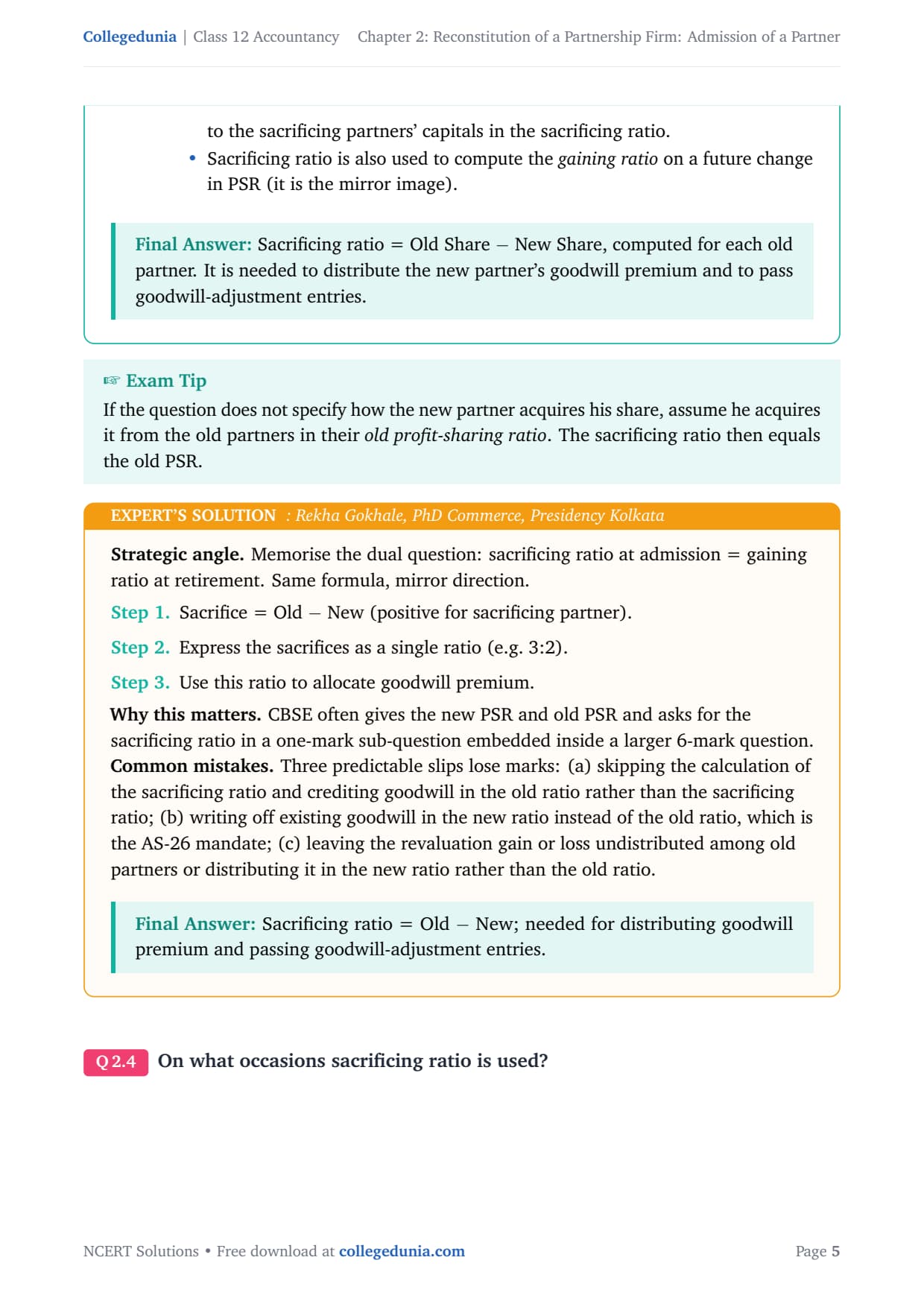
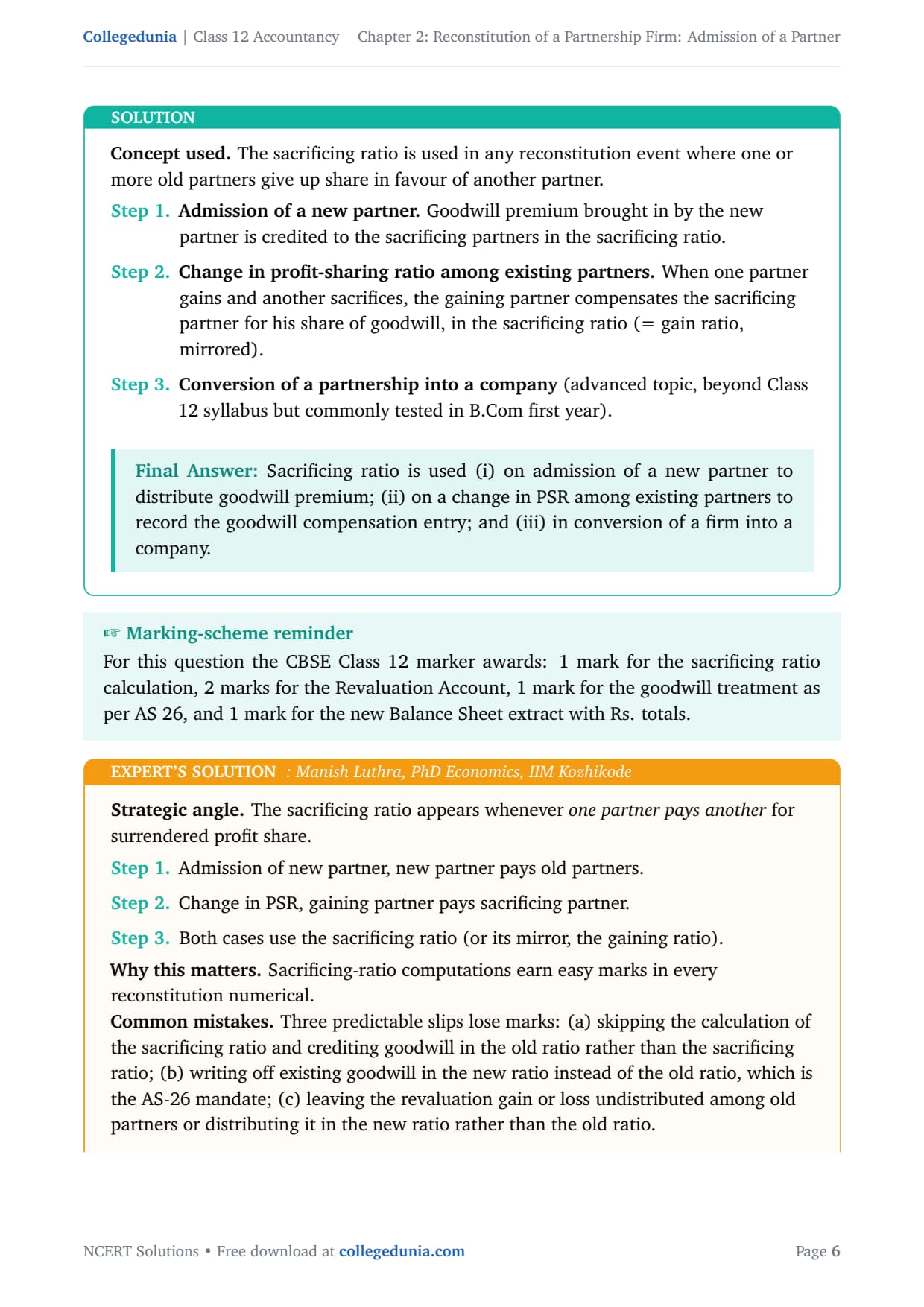
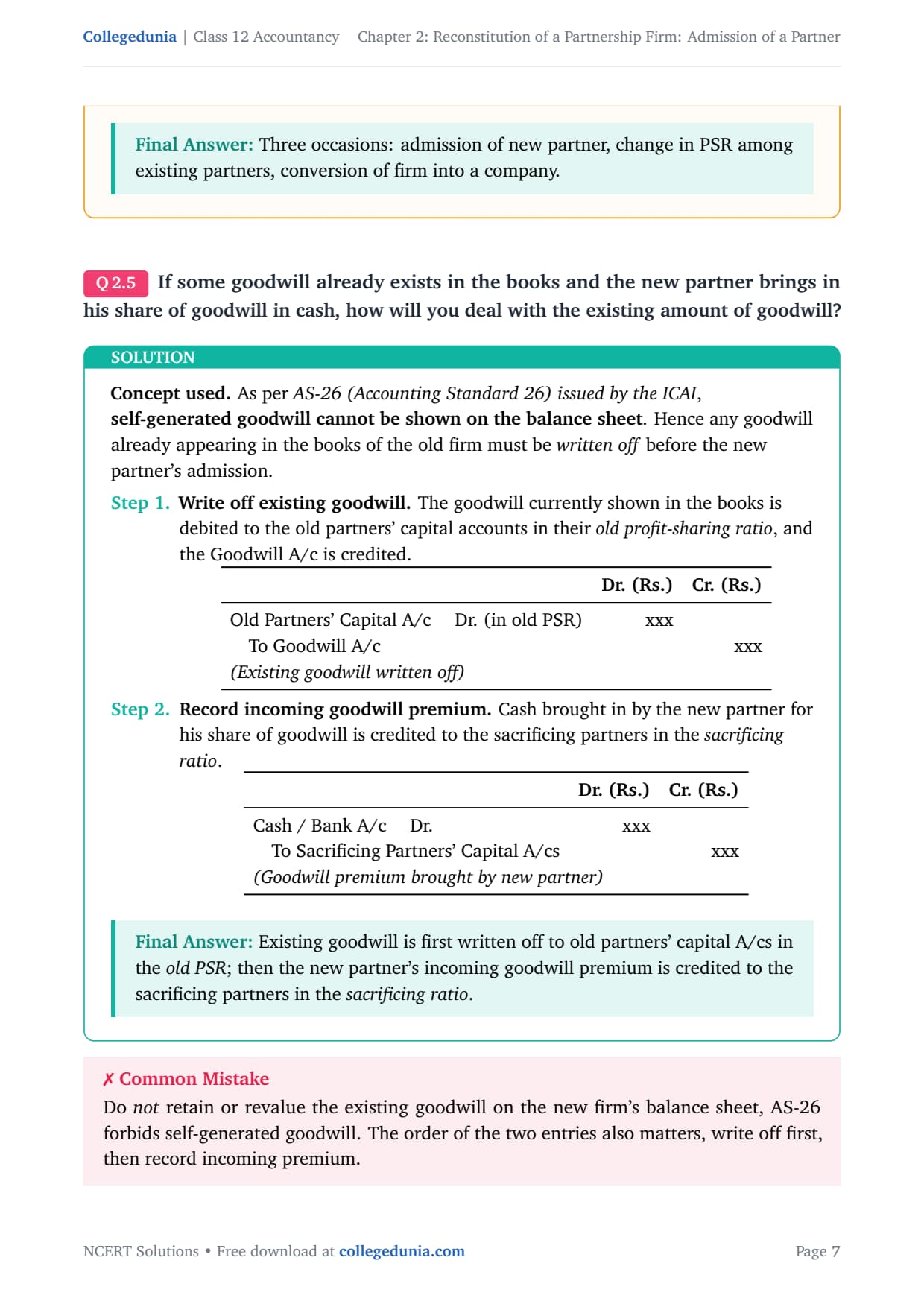
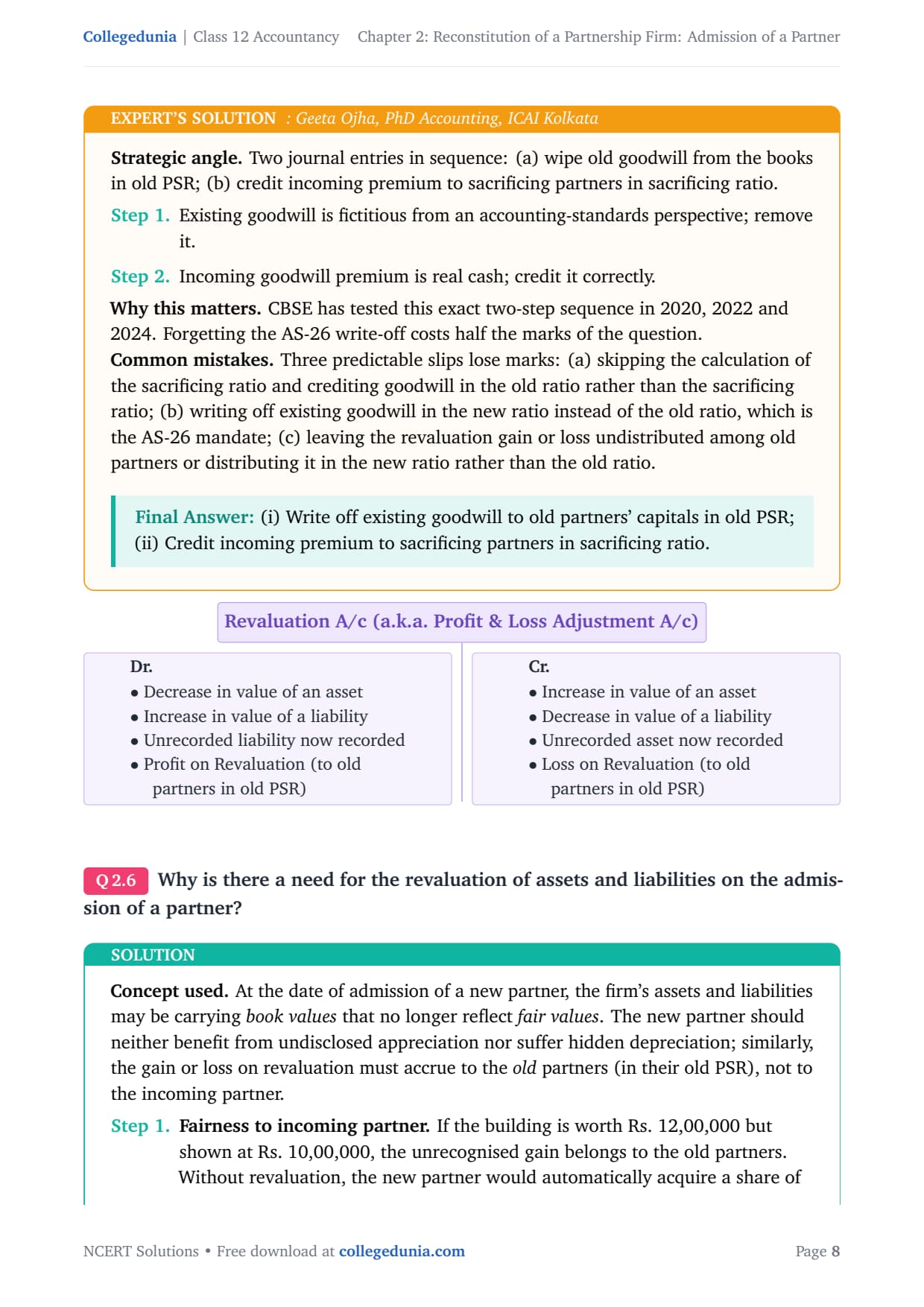
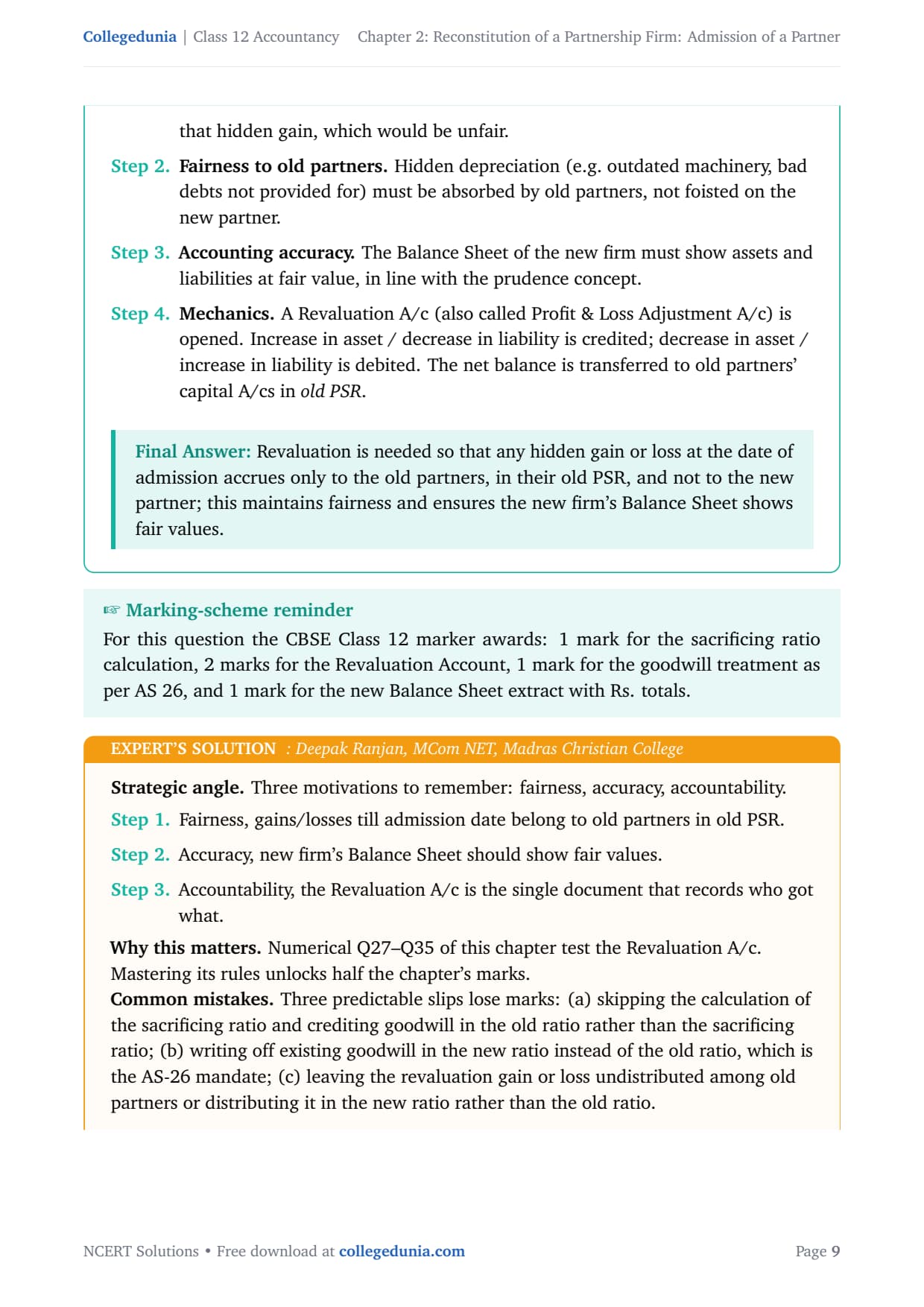
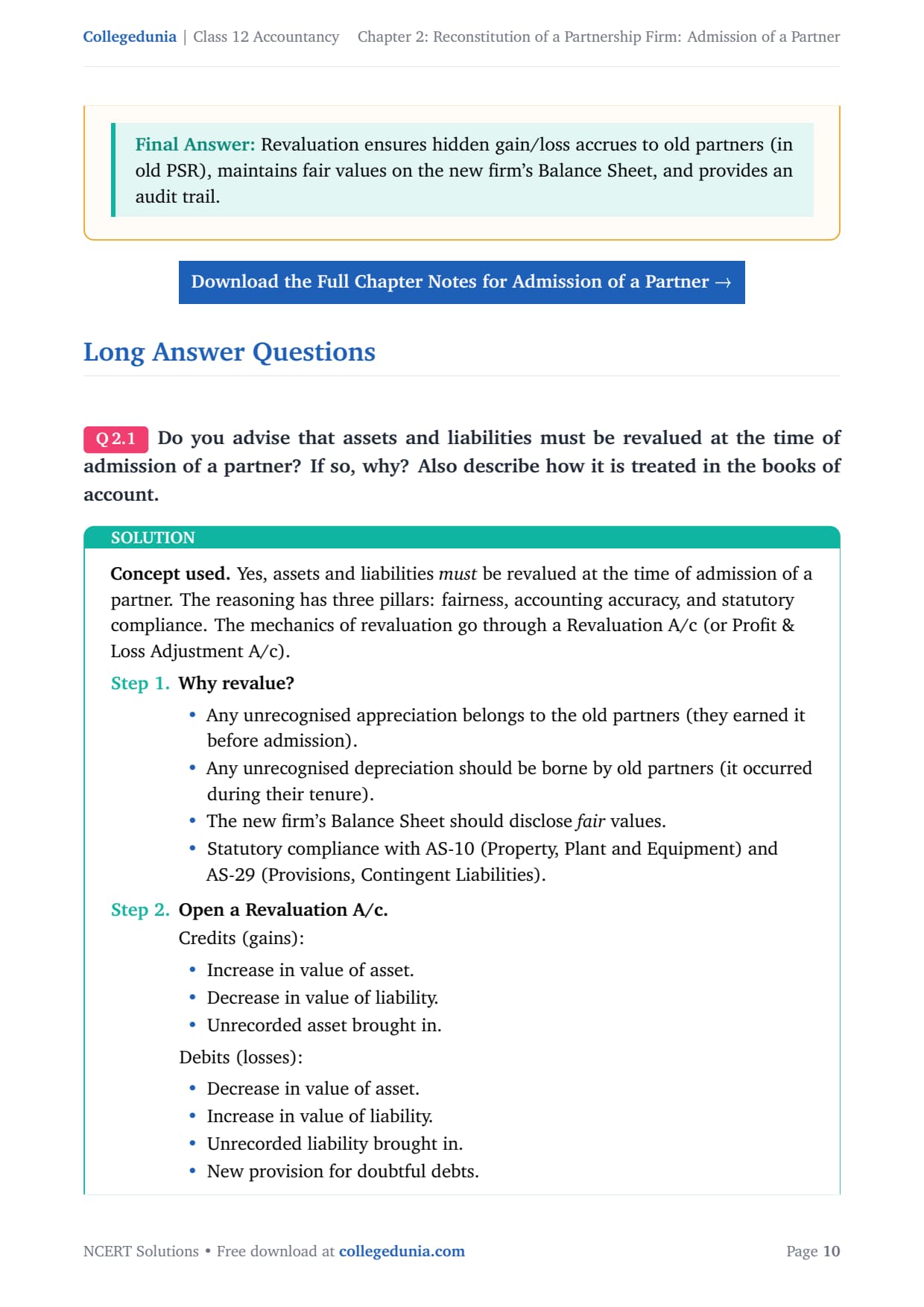


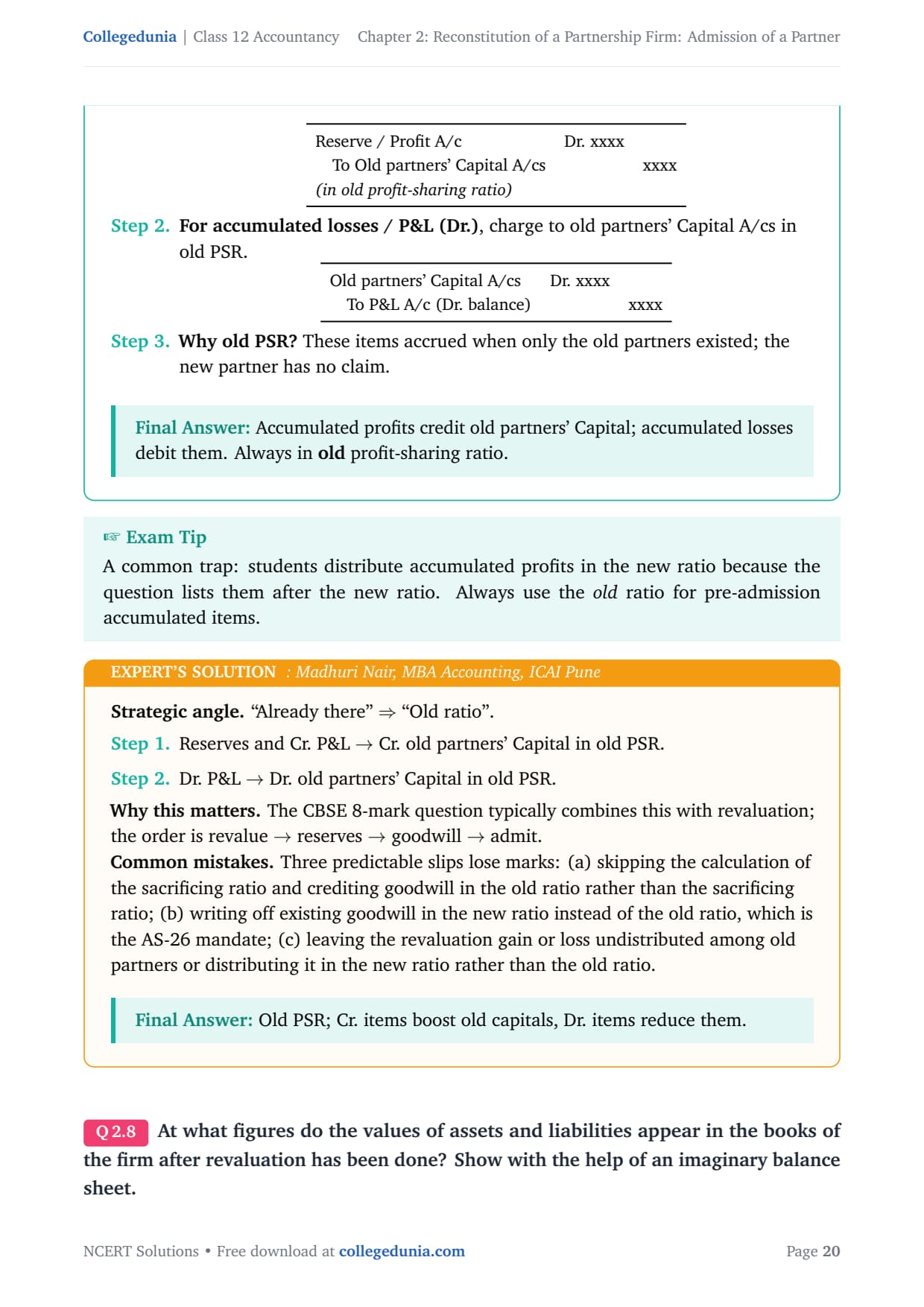
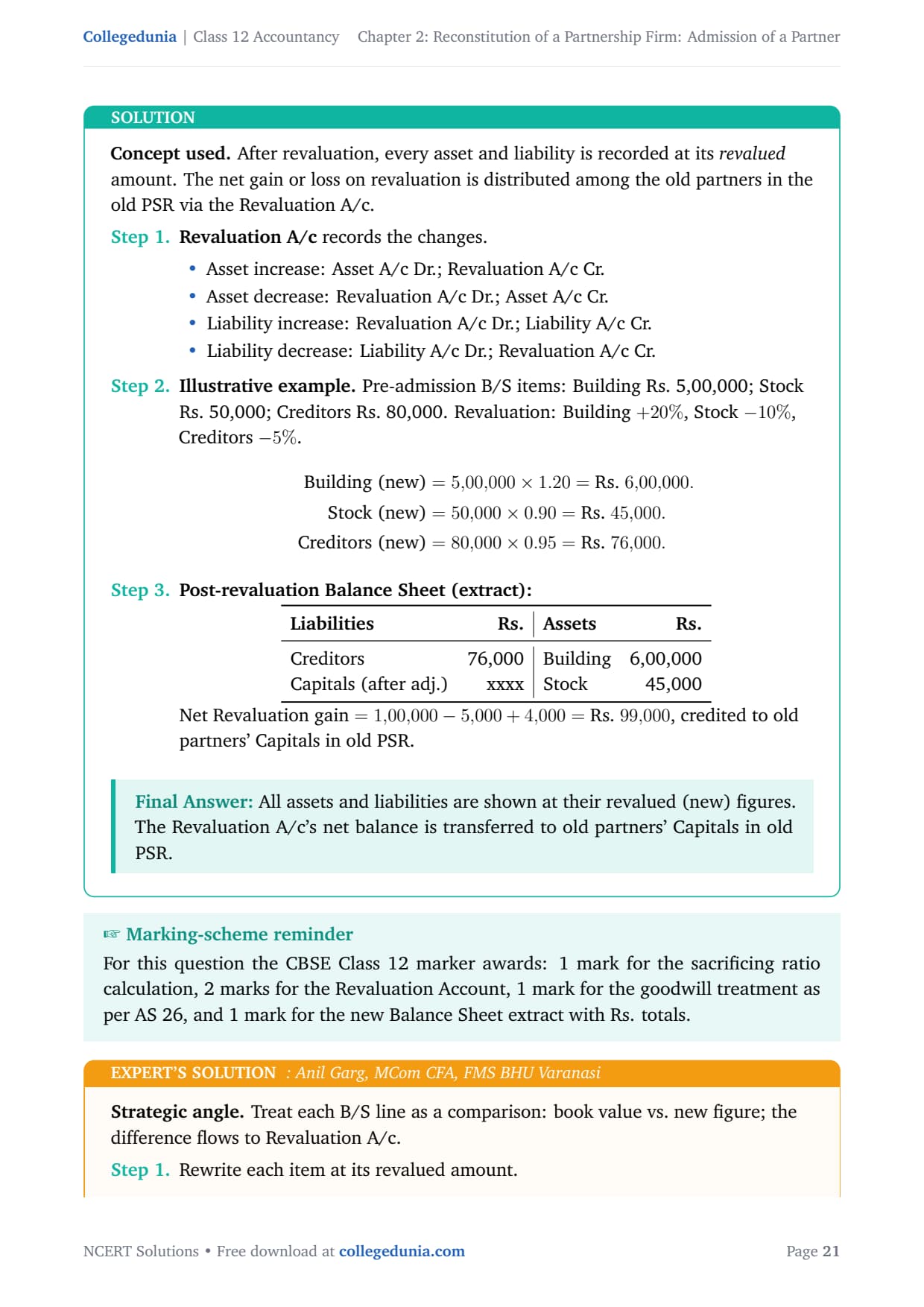


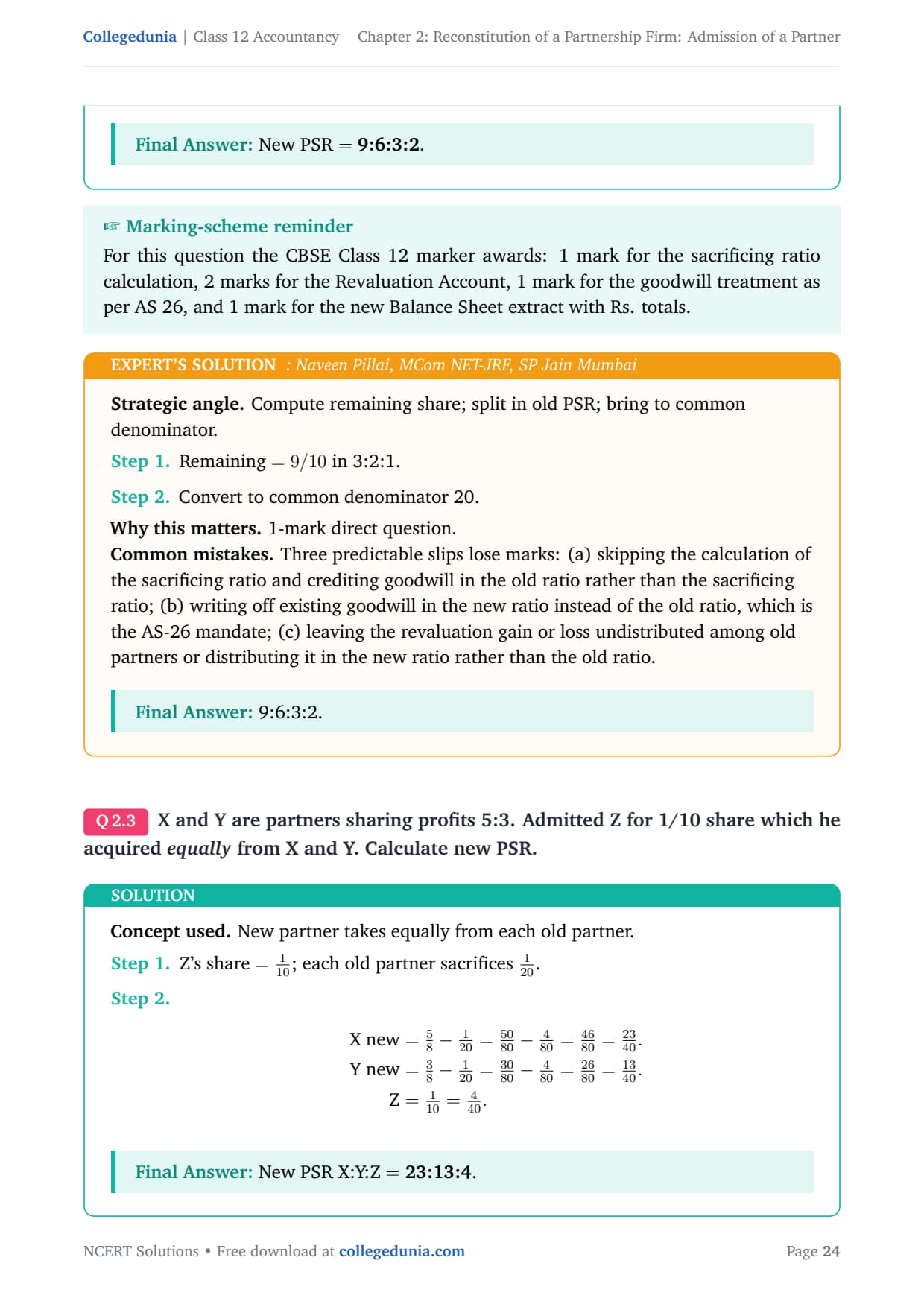

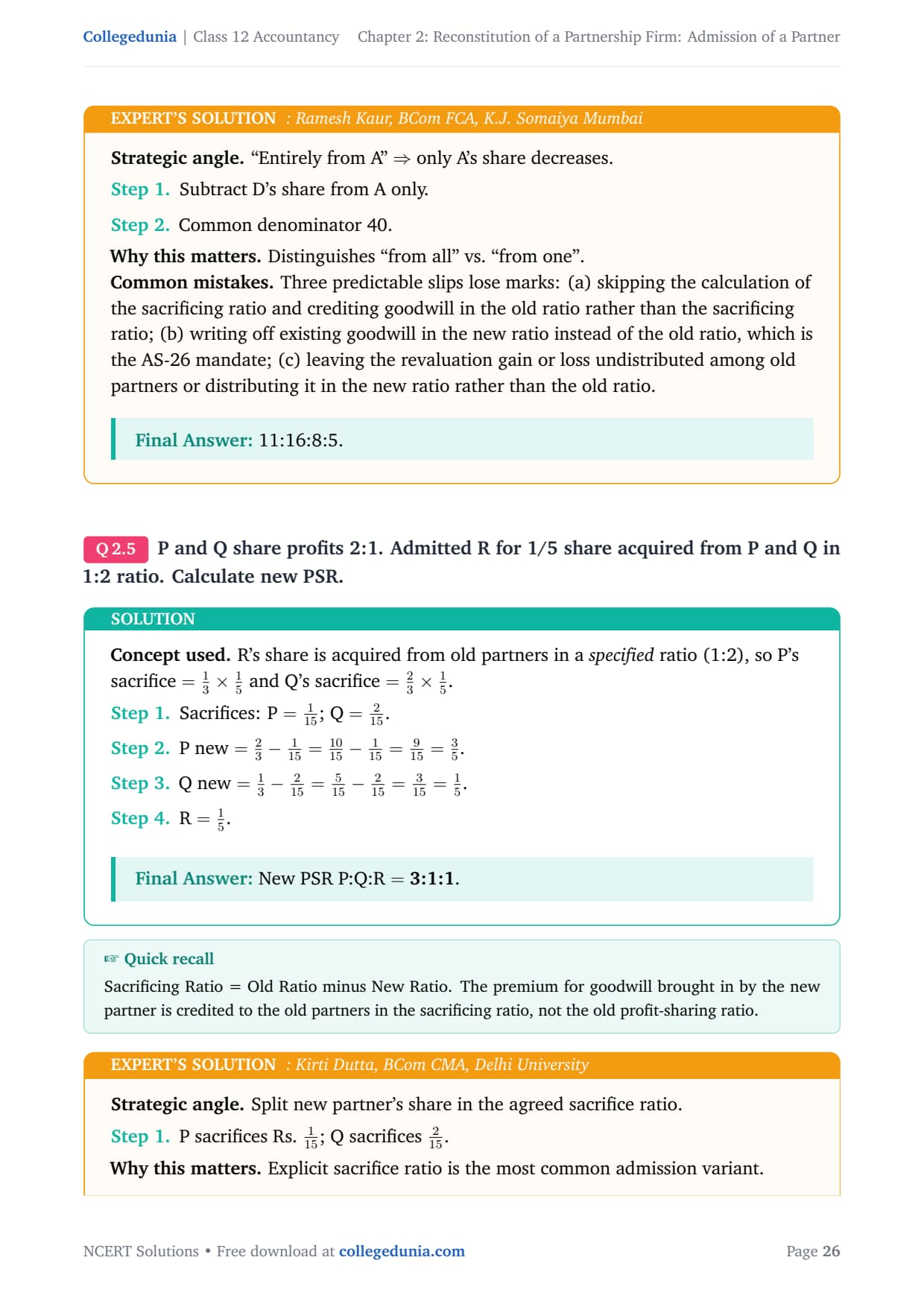

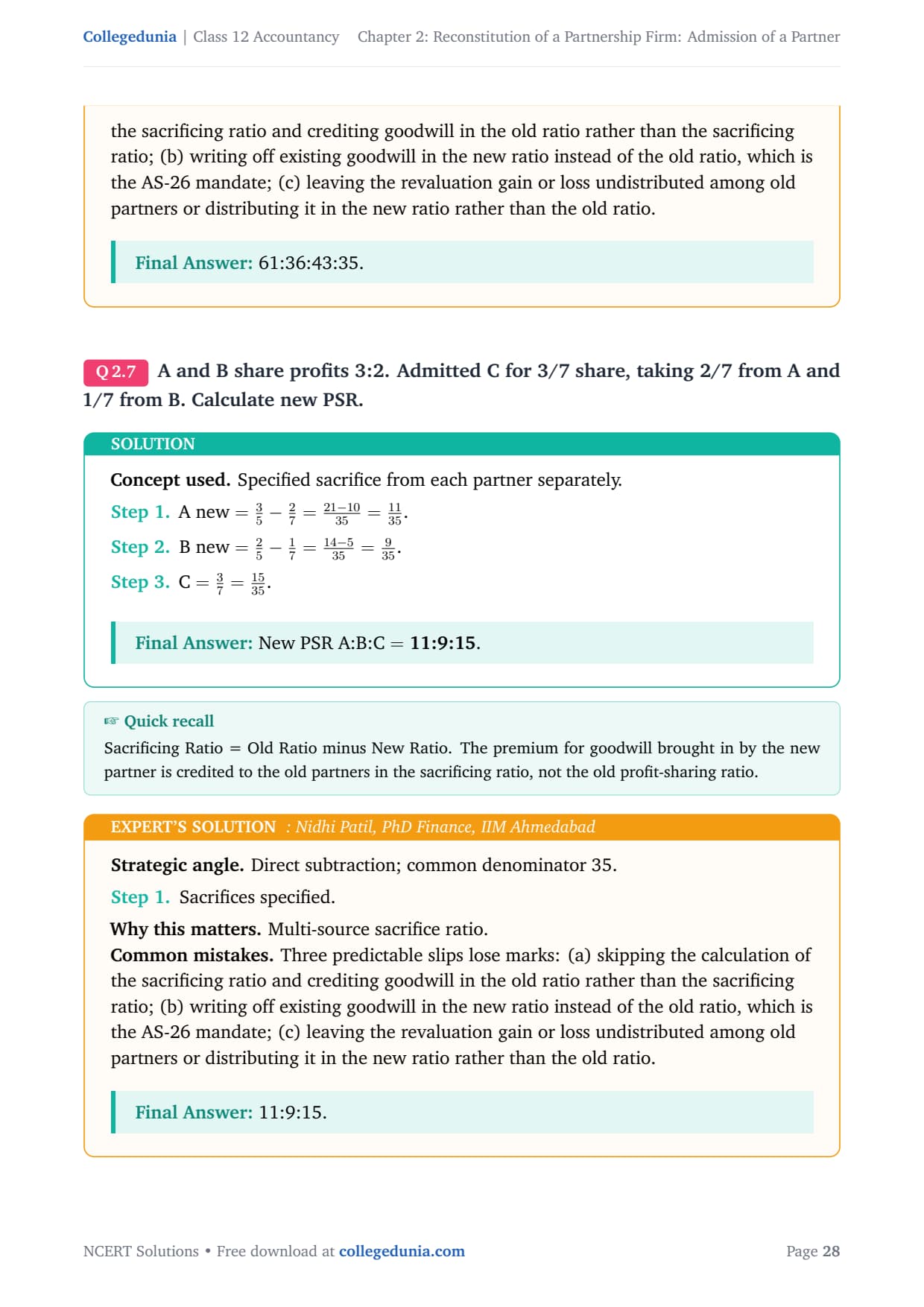
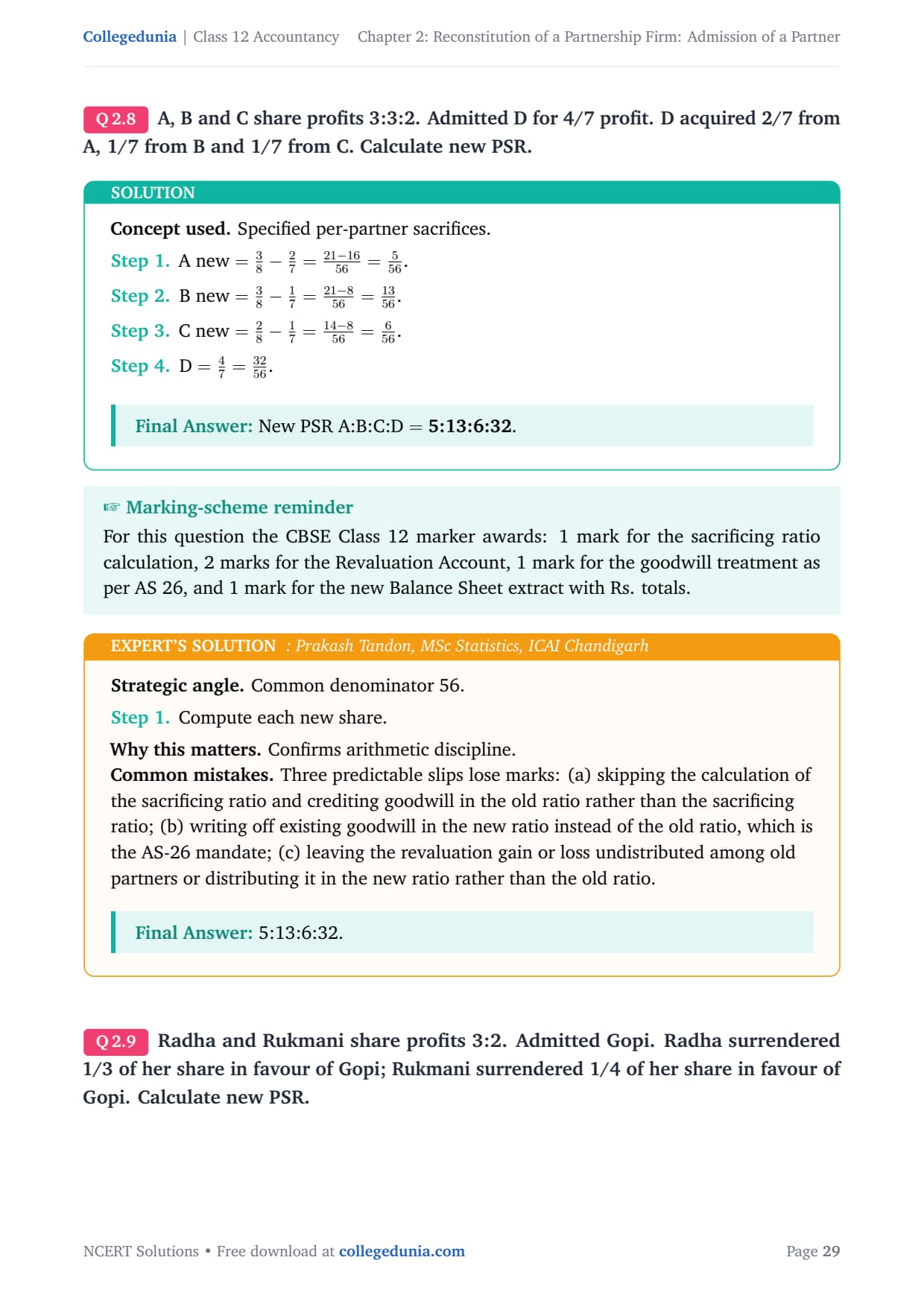
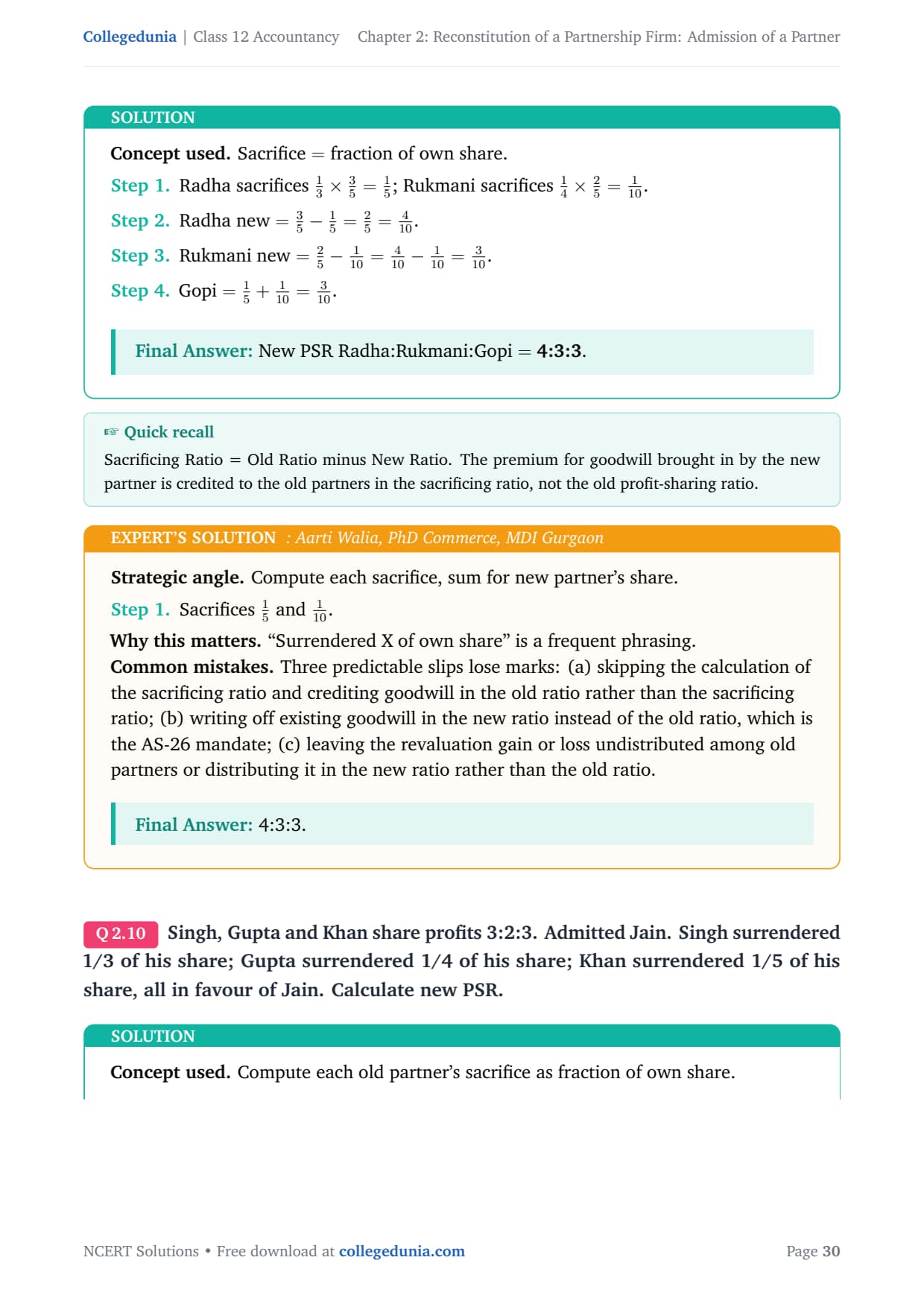

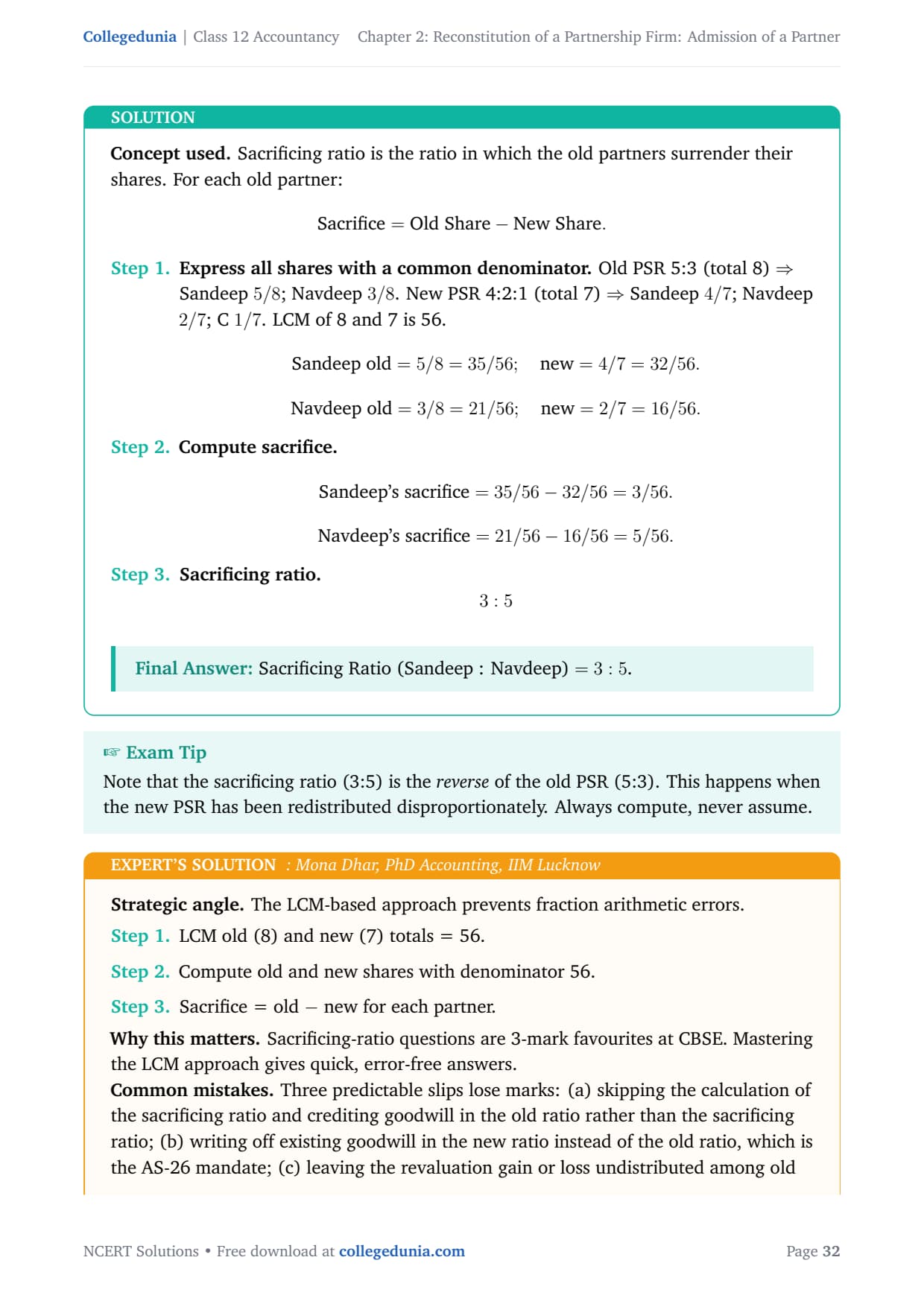
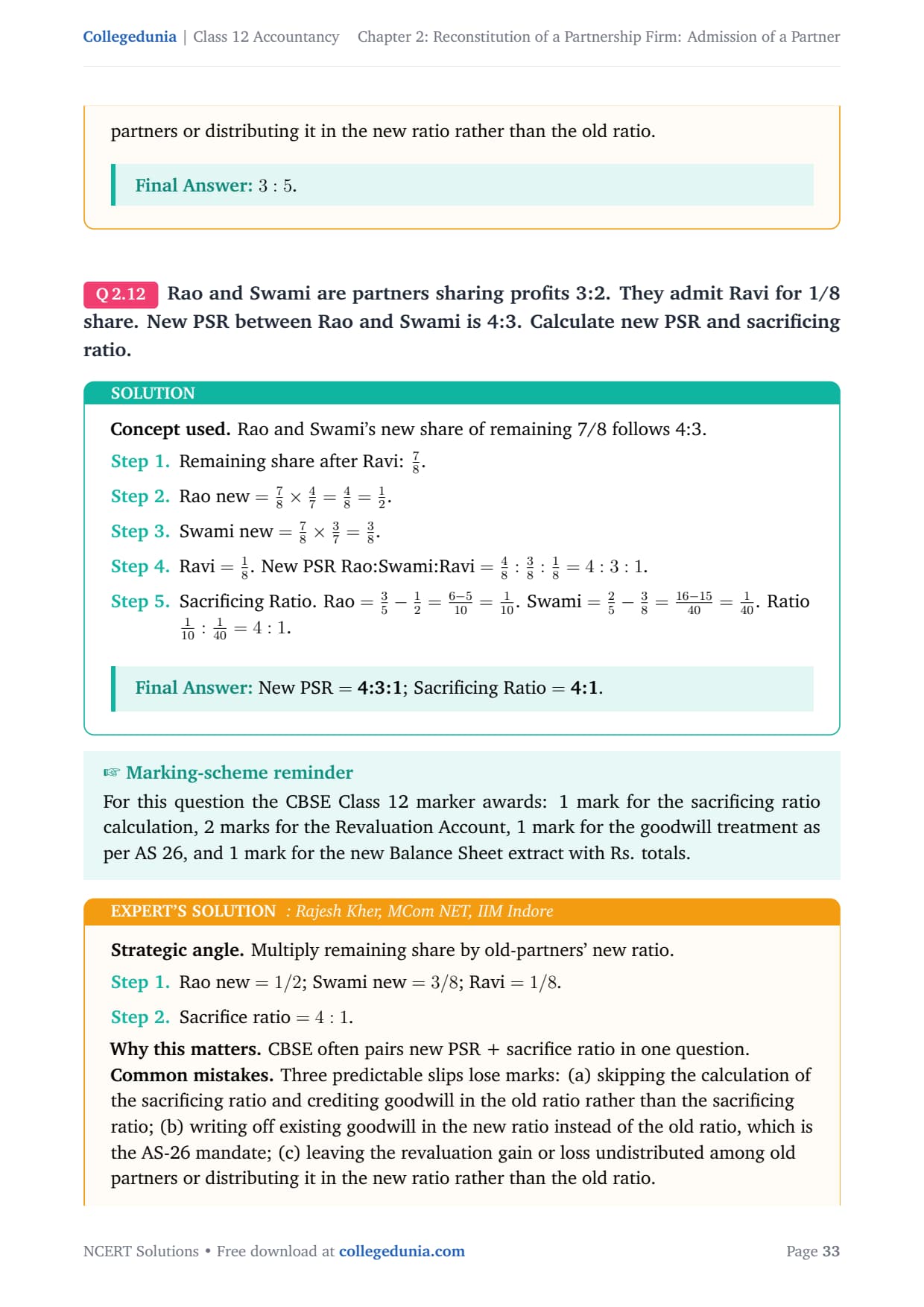

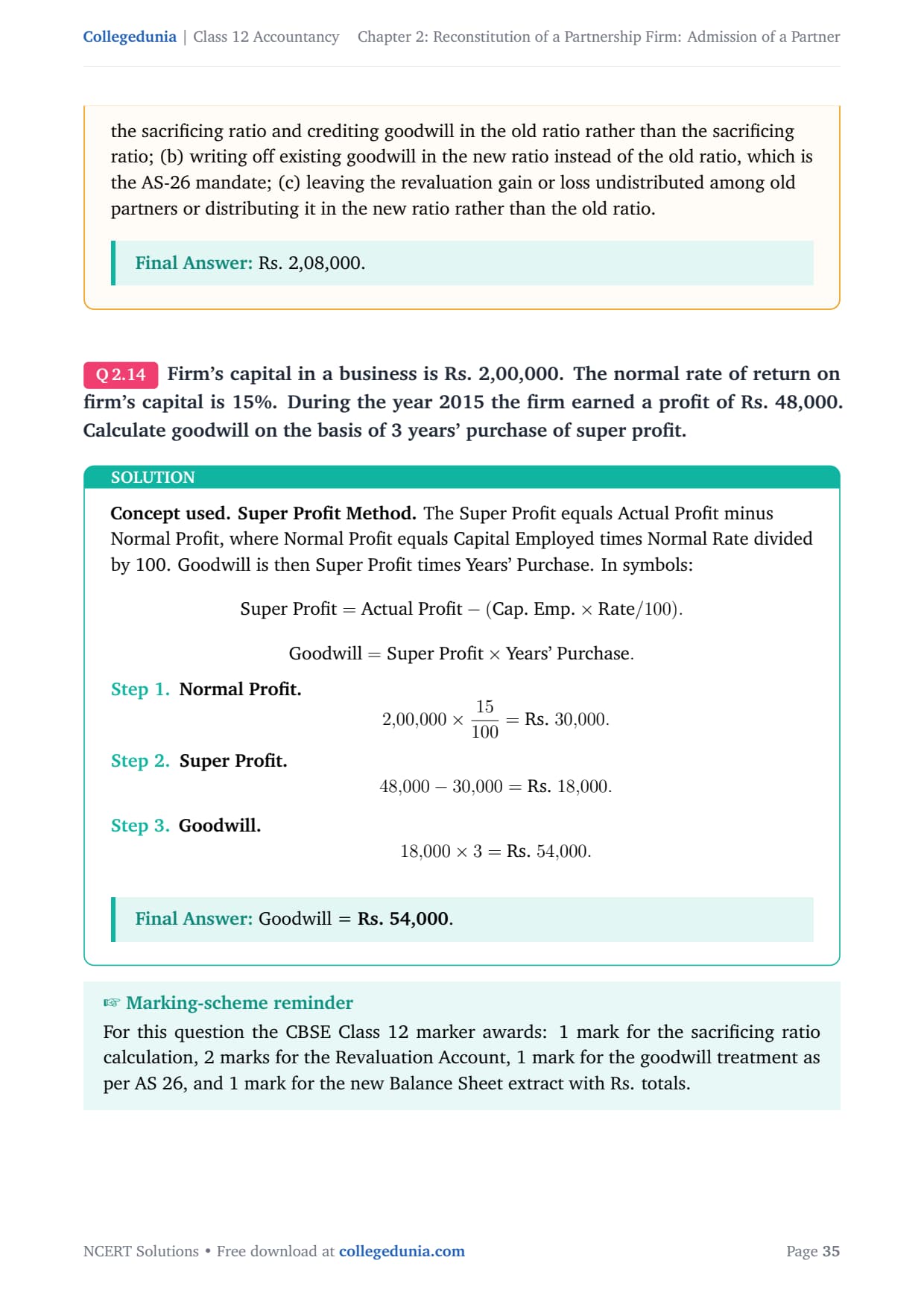
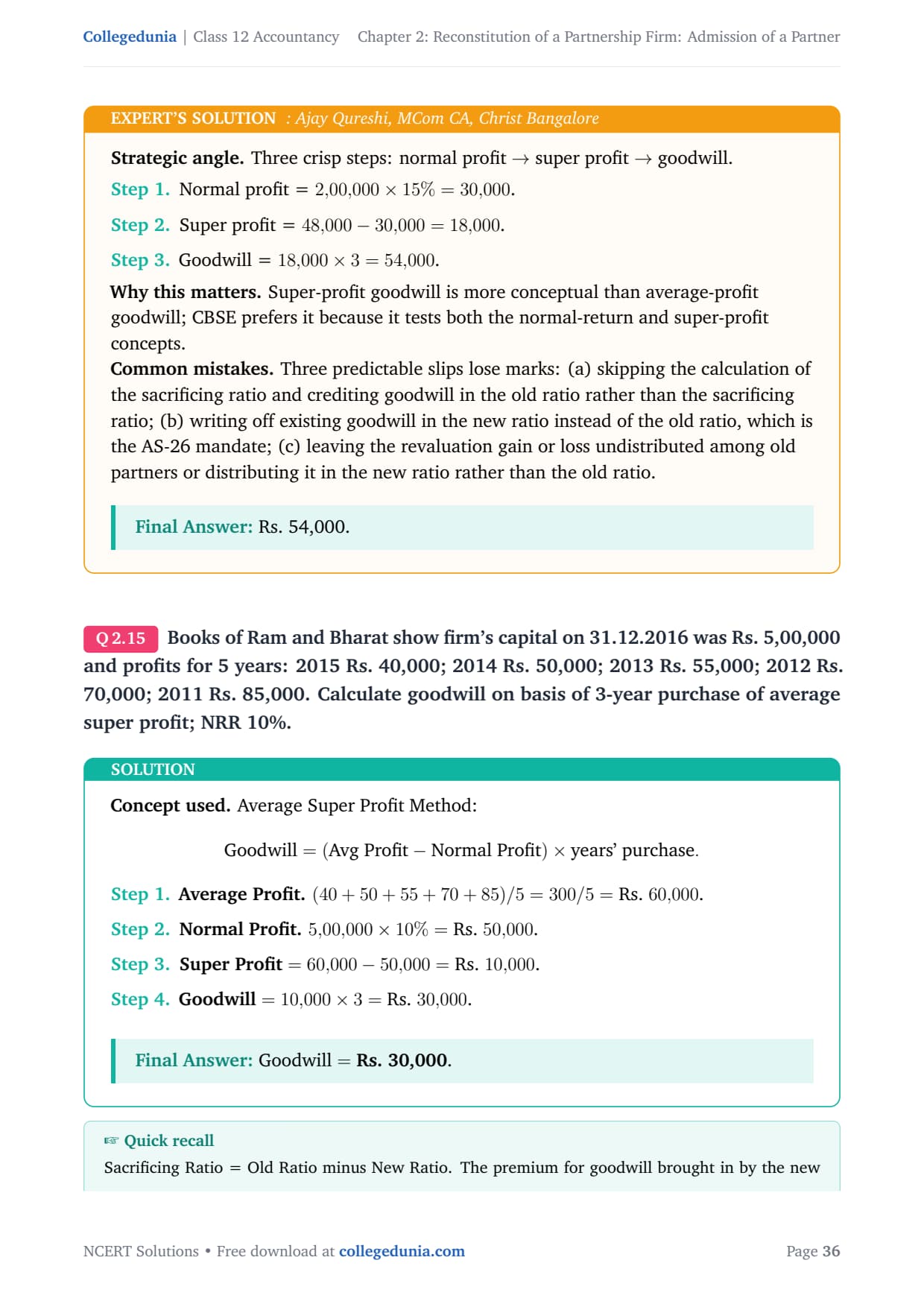
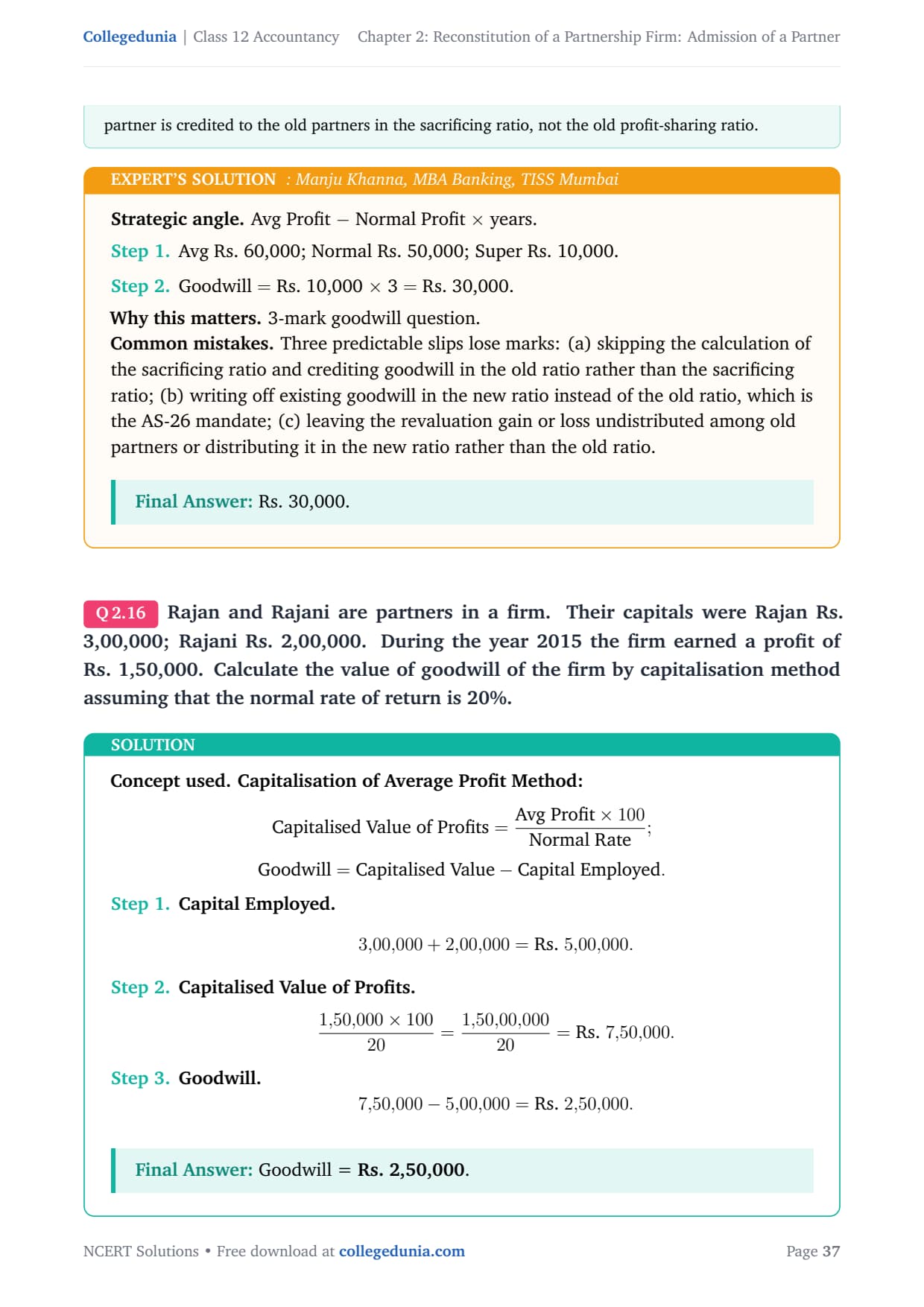


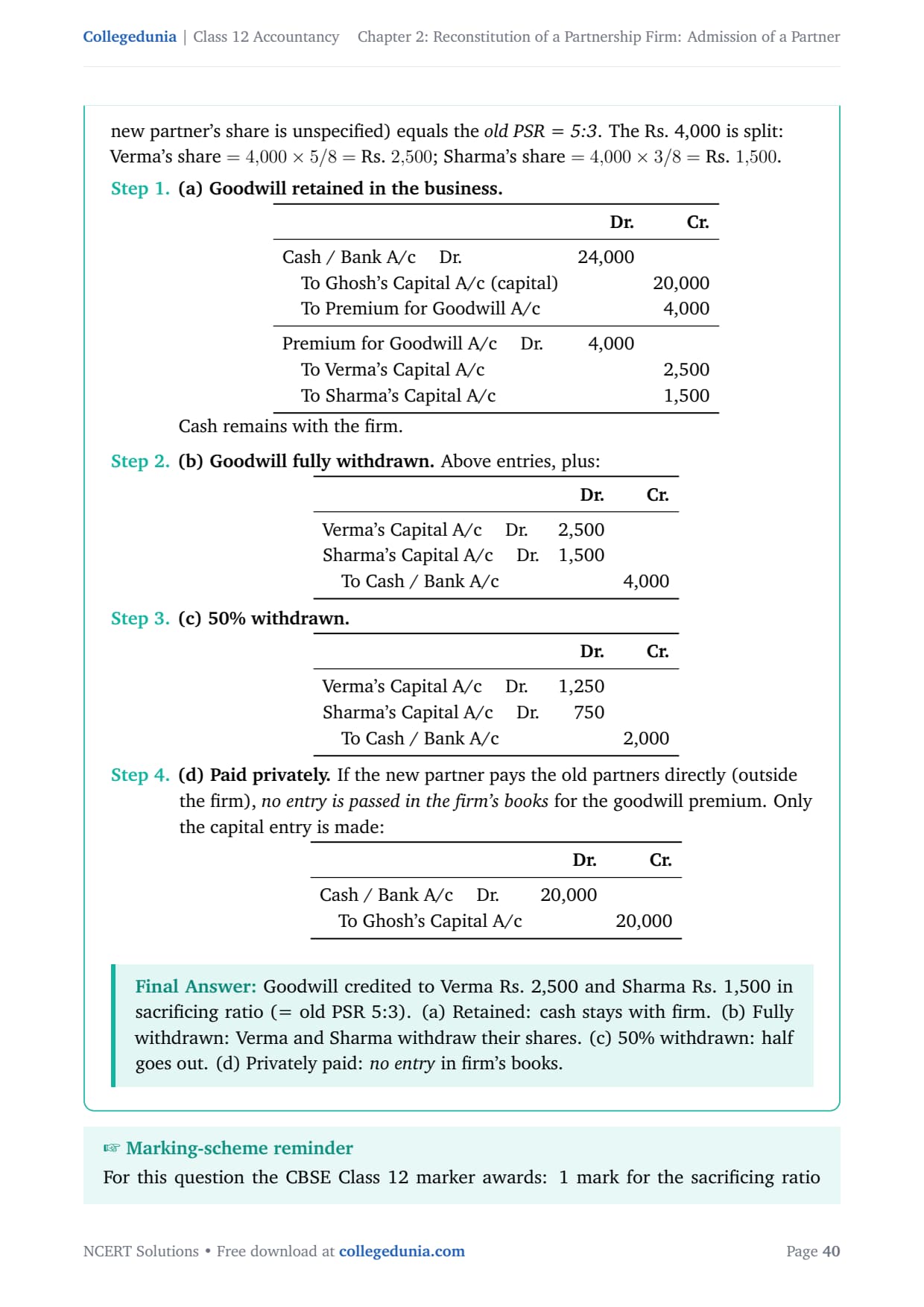
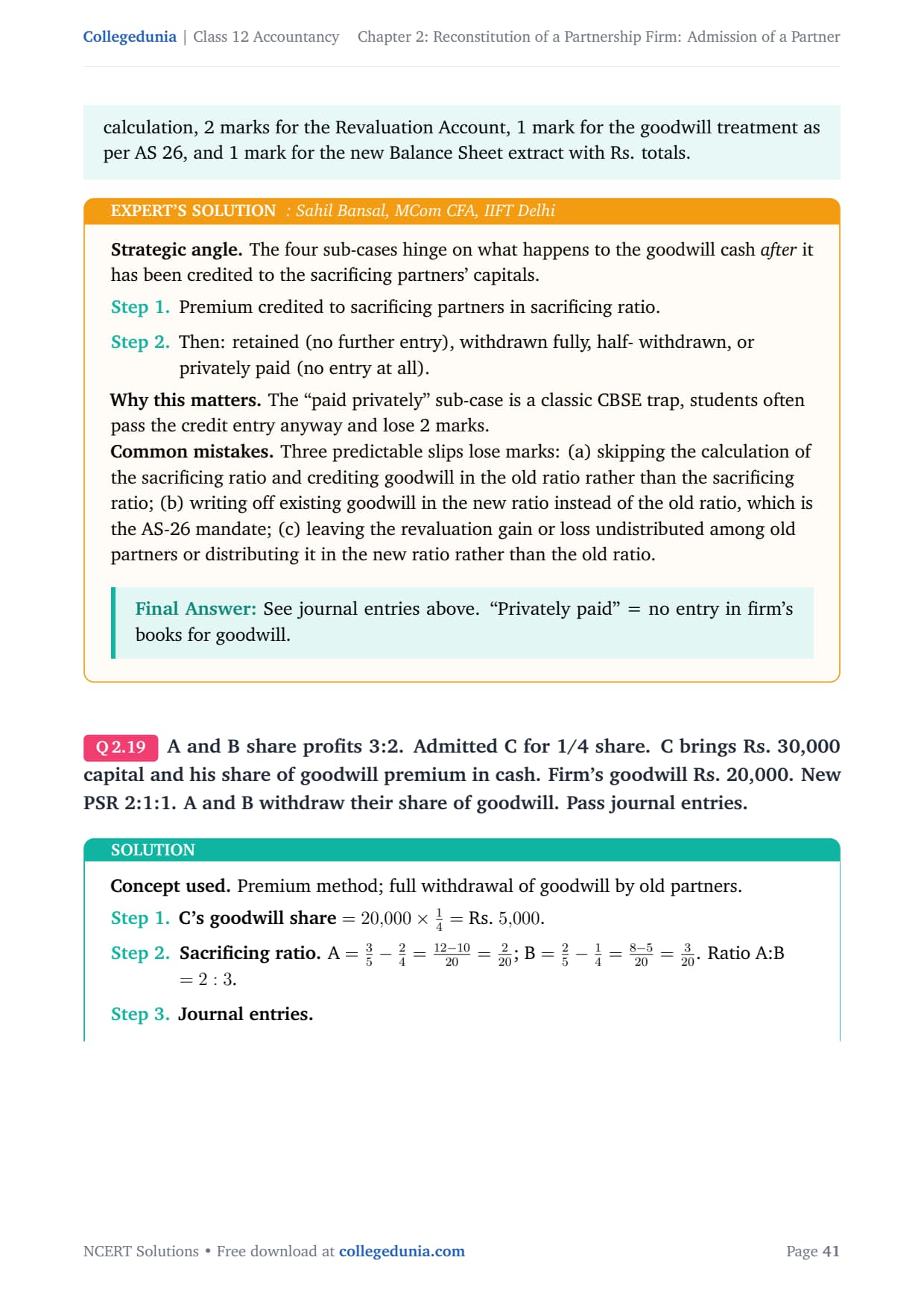

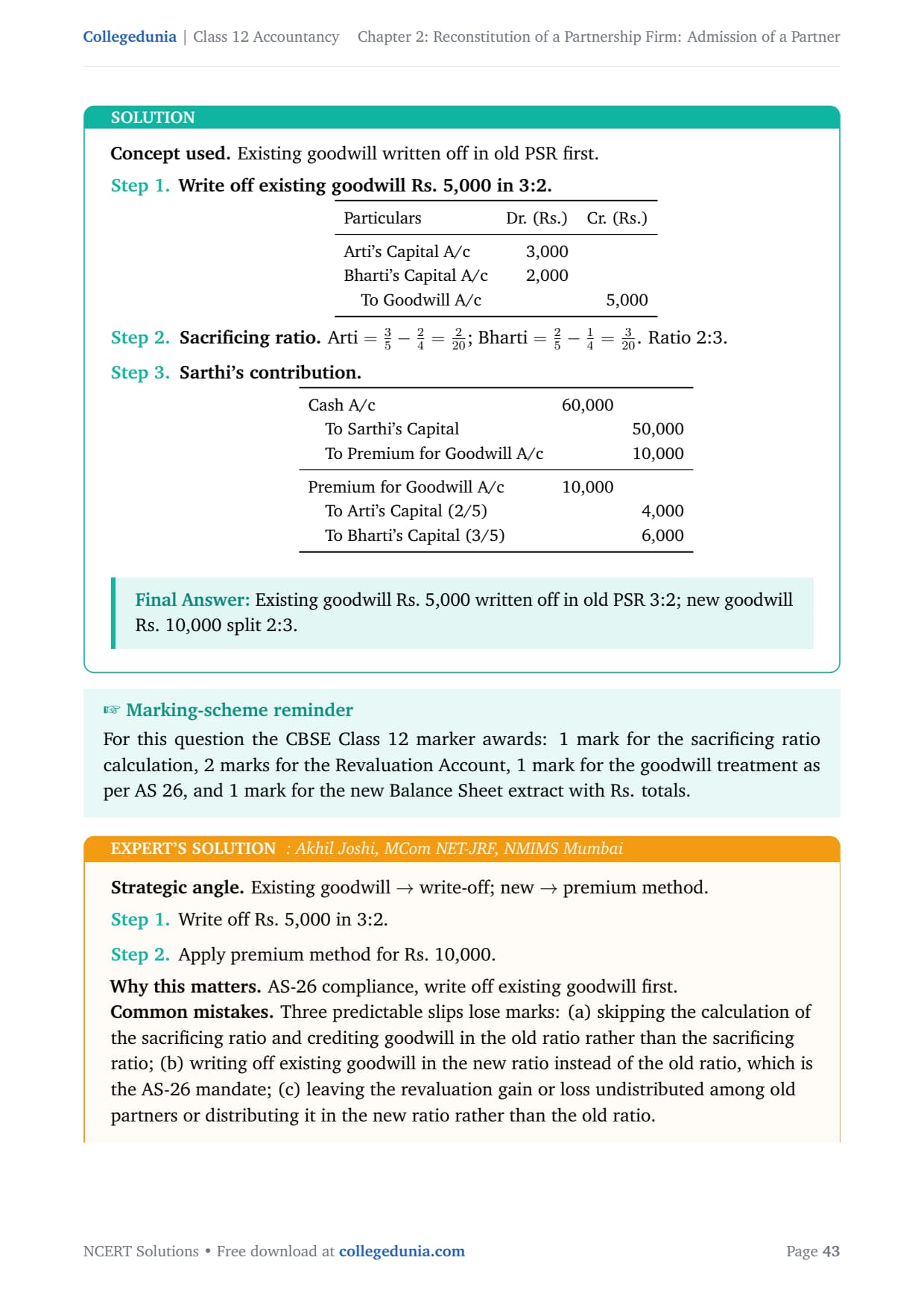

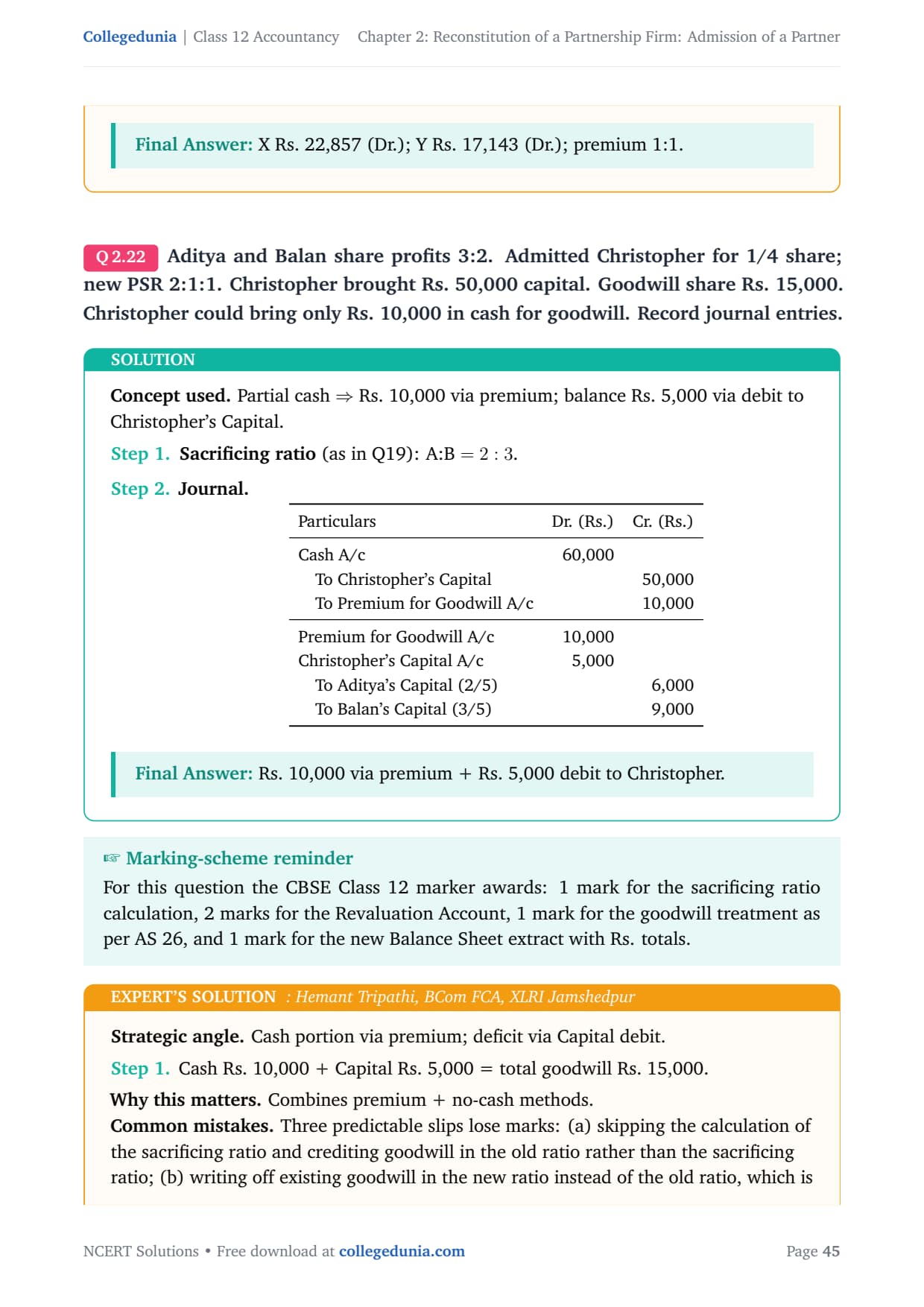
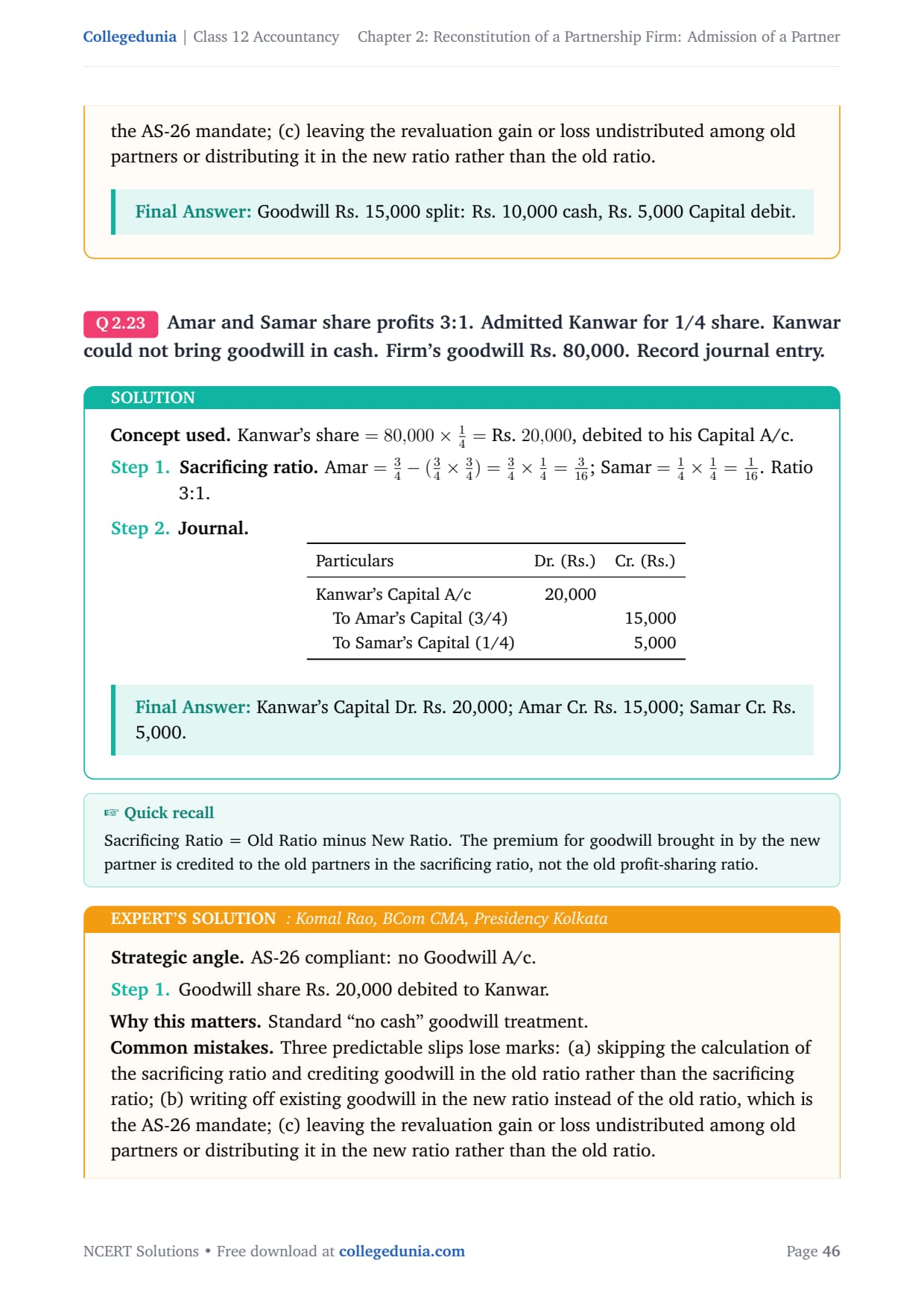

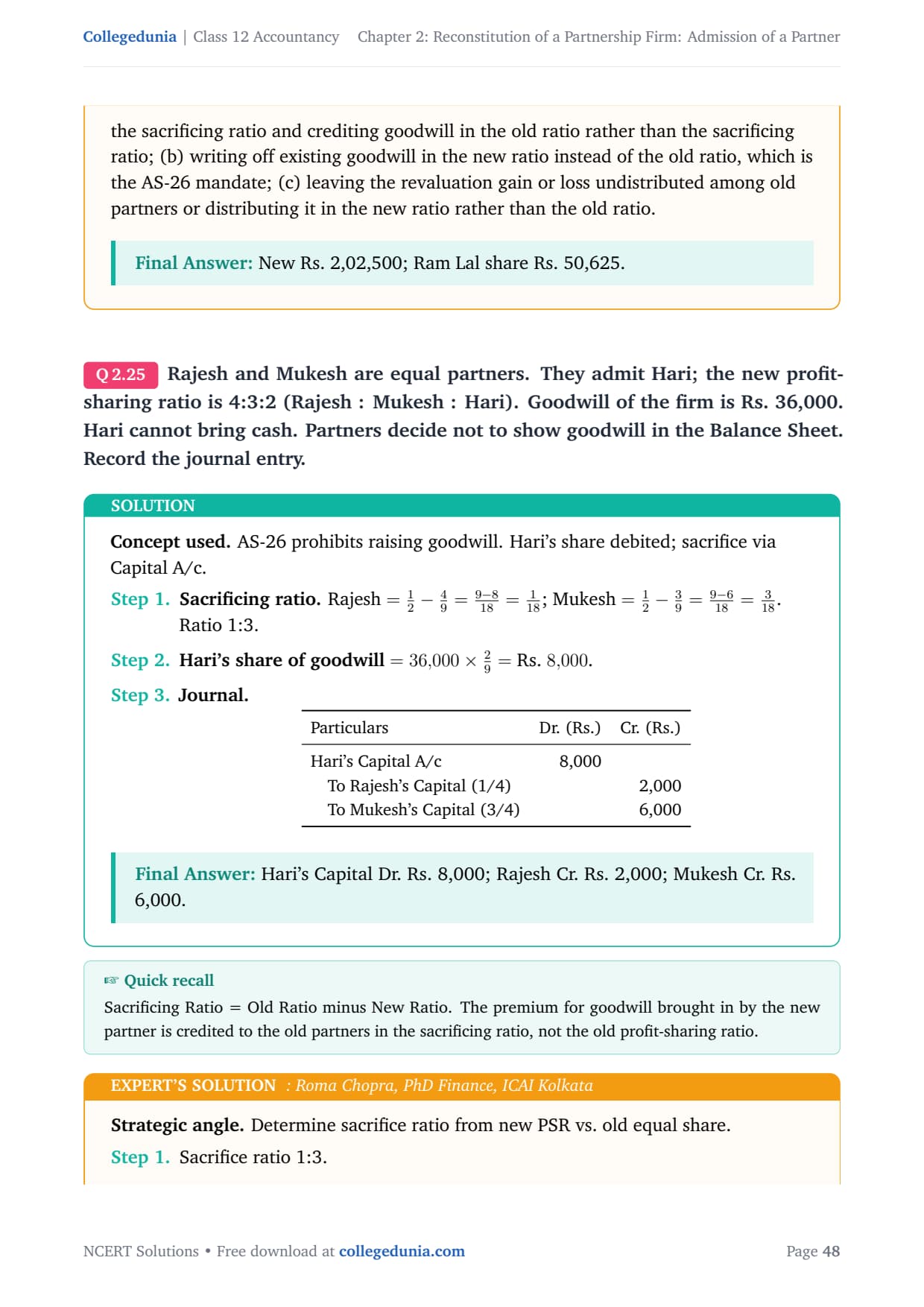
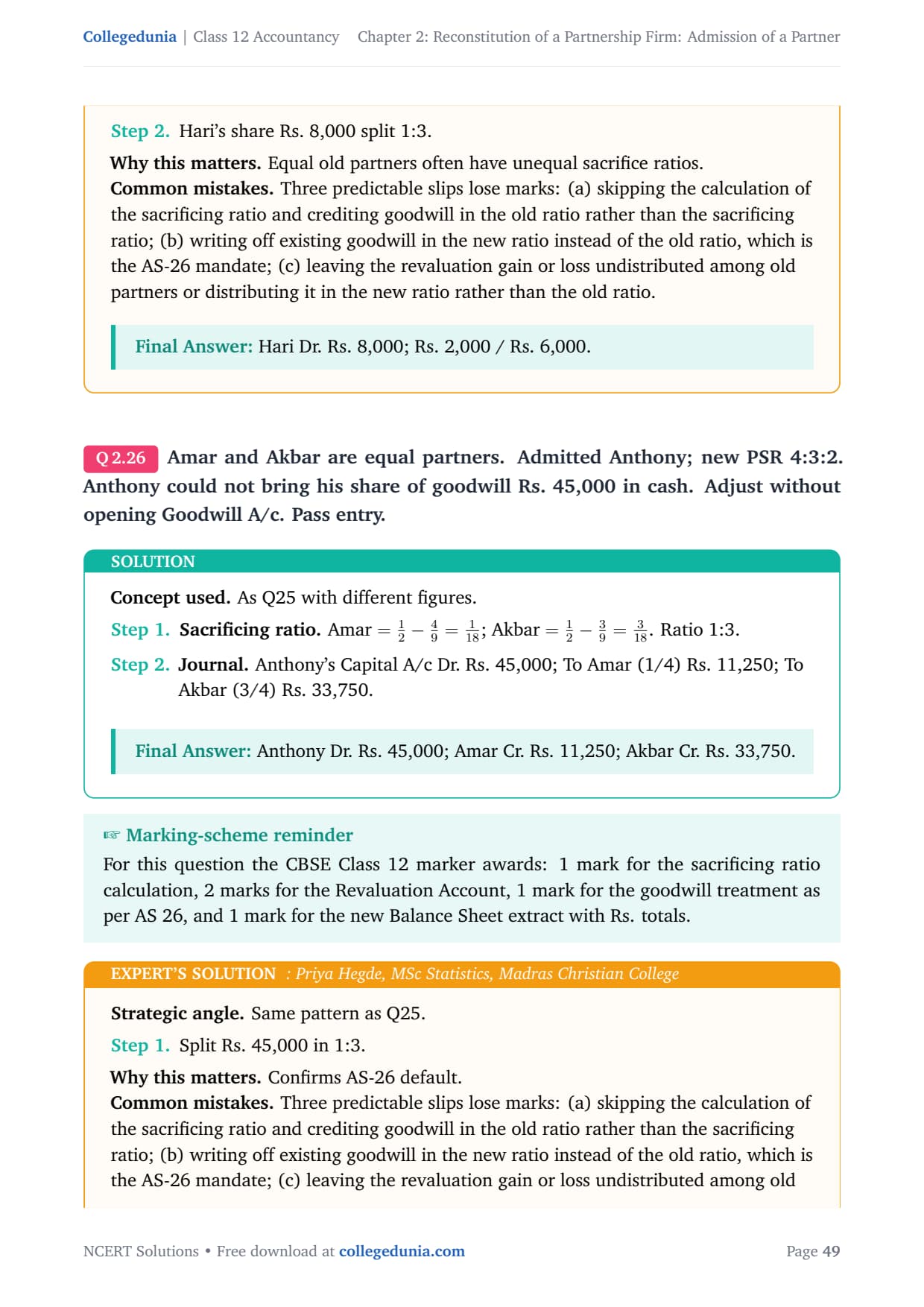


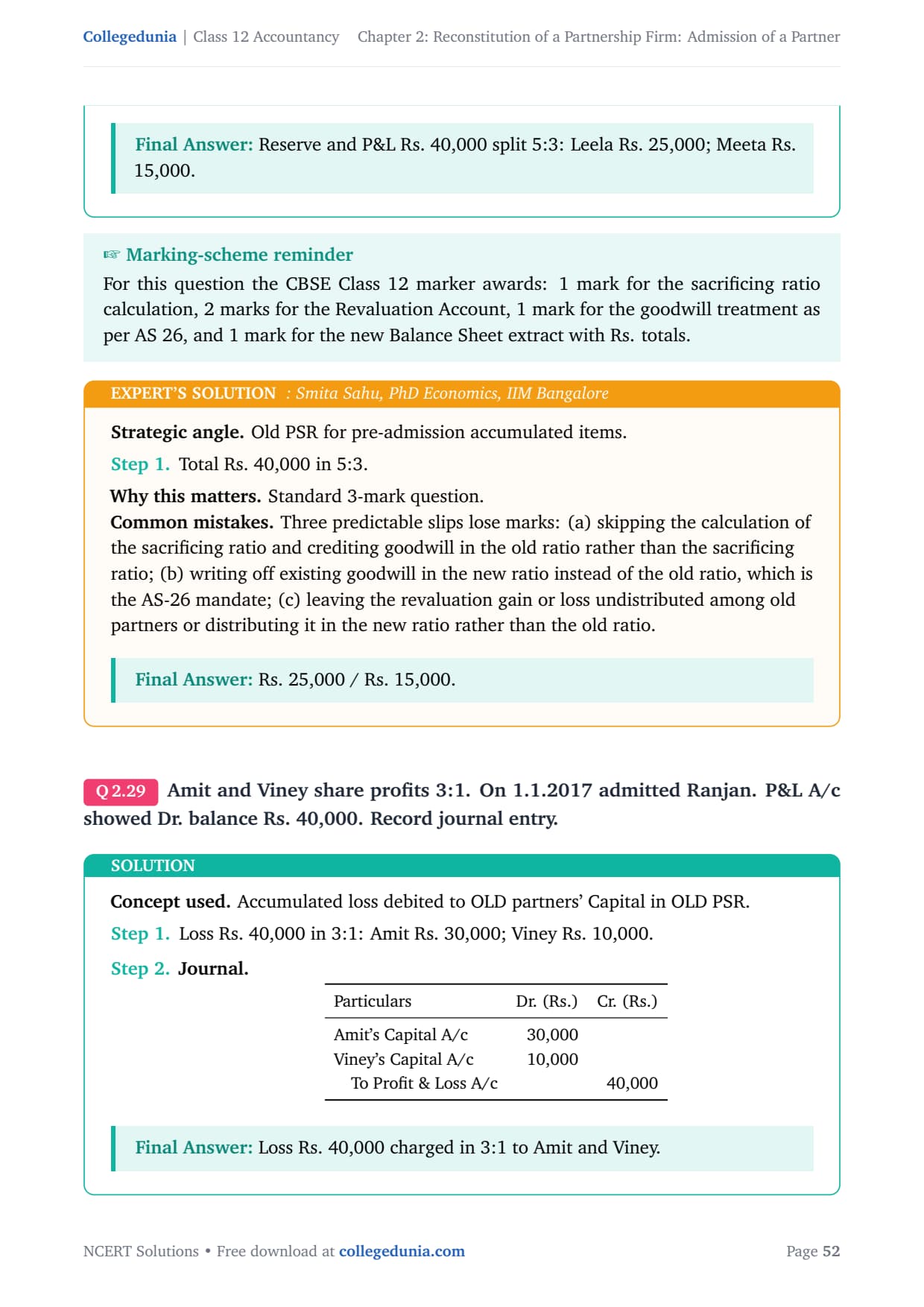


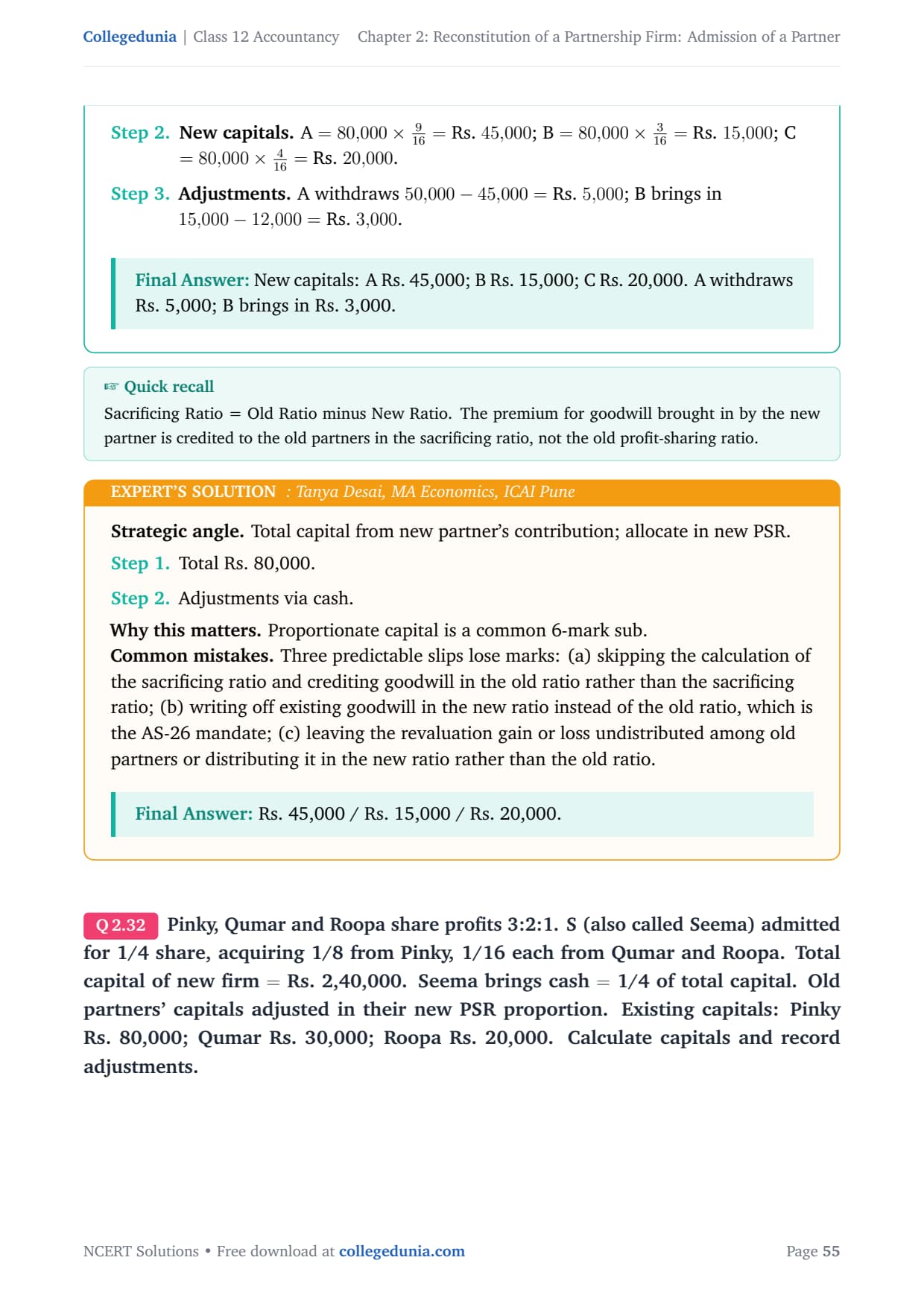
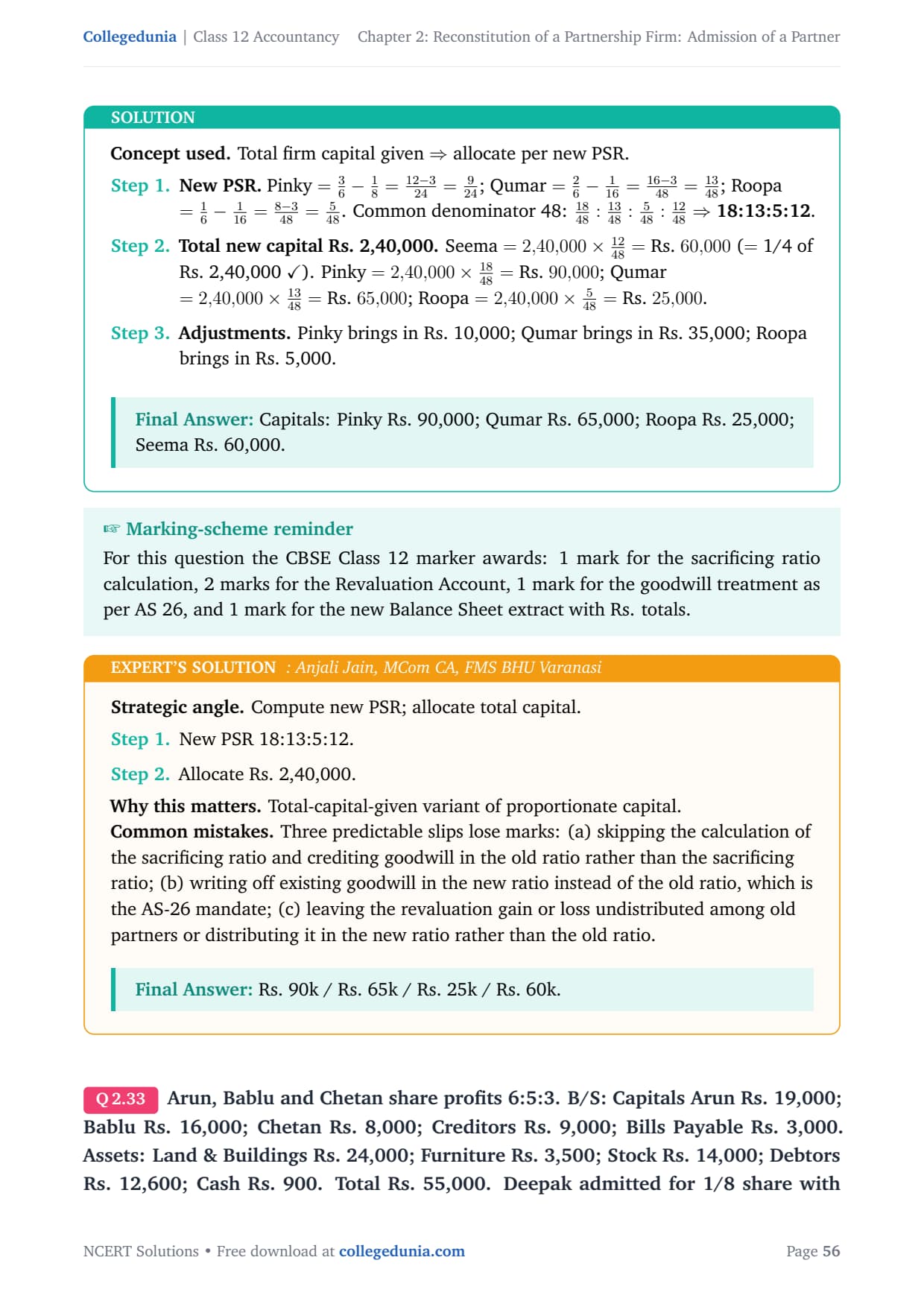


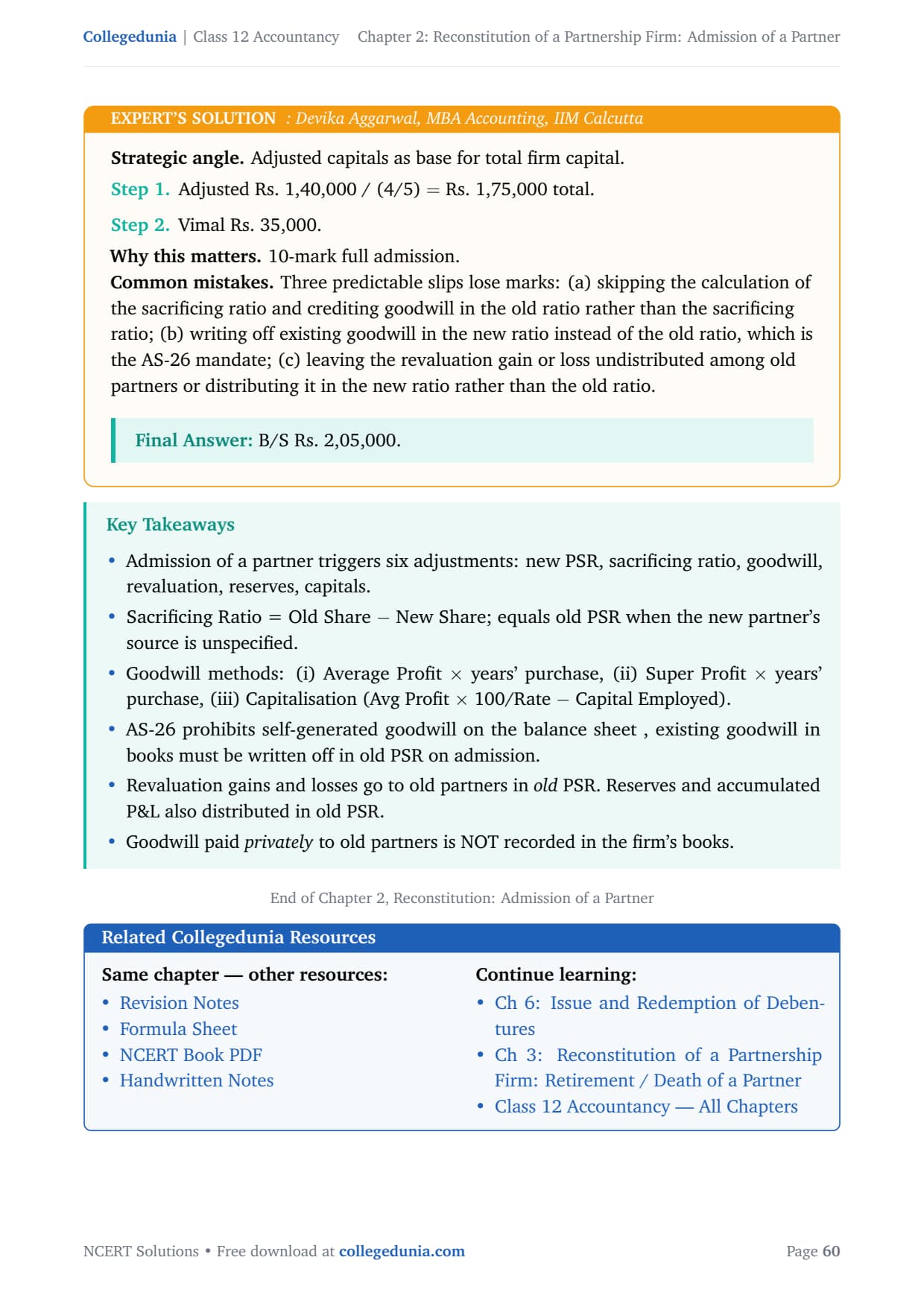

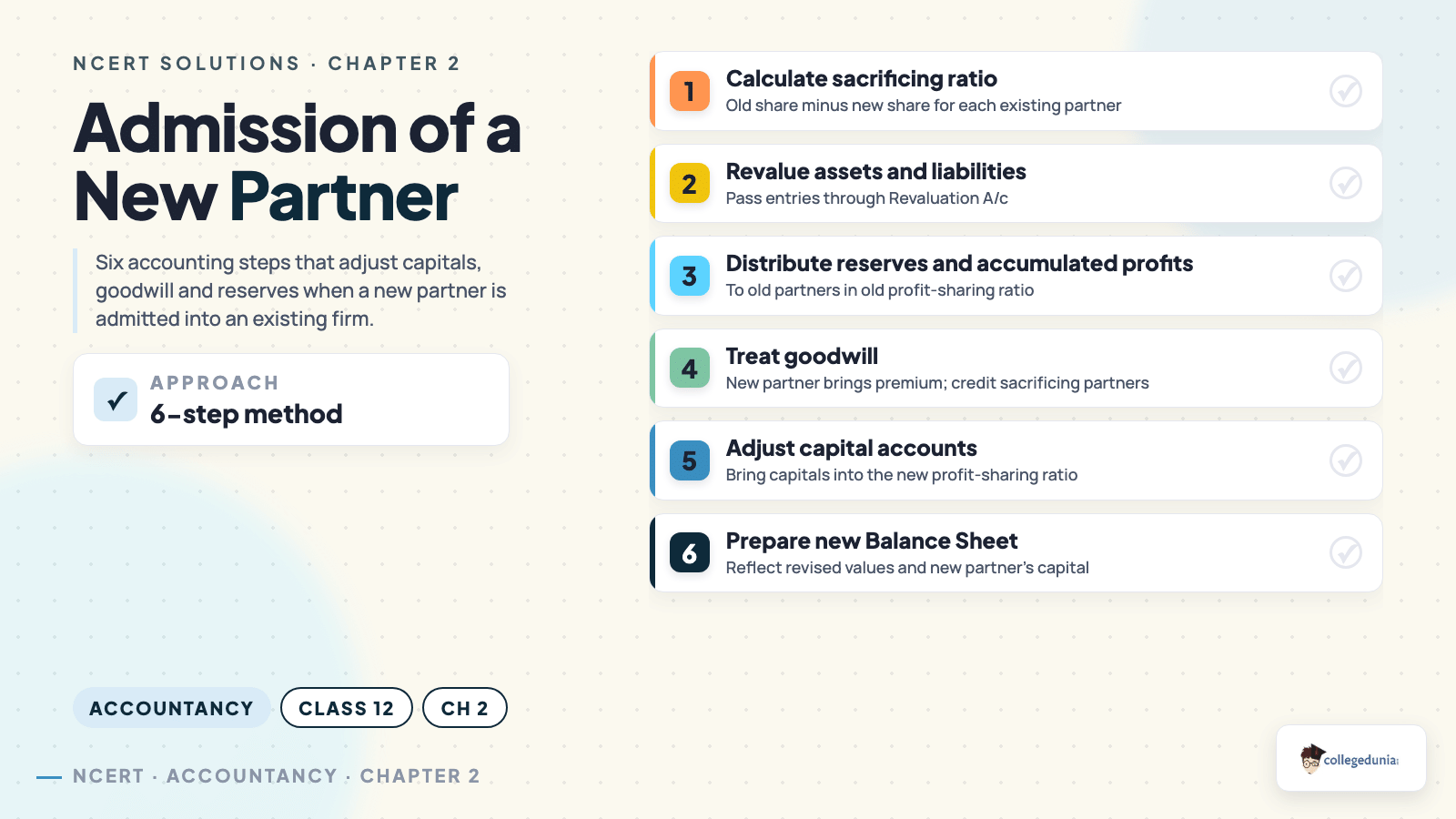



Comments