Senior Accountancy Editor, CA | Updated on - Jul 21, 2026
Retirement and death adjustments are a rewarded area of CBSE Class 12 Accountancy Part A, and most board papers carry a 6-mark numerical from this topic. These NCERT Solutions for Chapter 3, Reconstitution of a Partnership Firm: Retirement / Death of a Partner, show every Revaluation Account, gaining-ratio working, goodwill entry, and Executor's Account the 2026-27 syllabus expects, in the column order CBSE markers look for. This page hosts the free PDF along with topic-wise extracts.
CBSE Weightage:8 to 10 marks in Part A
Question Mix: 5 Short Answer + 4 Long Answer + 14 Numerical
The PDF carries solutions to all Short Answer, Long Answer, and Numerical questions of Chapter 3, with each Revaluation Account, Partners' Capital Account, Balance Sheet, and Executor's Account drawn in board-style T-format and working notes ahead of every ledger.
Reviewed by practising Chartered Accountants, mapped to the 2026-27 NCERT Accountancy reprint, and checked against the last five CBSE board papers.
Why Retirement and Death of a Partner Carries Such High Board Weightage
A retirement or death event triggers several adjustments at once, and CBSE tests them as one integrated numerical. The steps every board solution must follow are listed below.
New profit-sharing ratio for continuing partners (given, agreed, or assumed equal).
Gaining ratio = New share minus Old share, computed for each continuing partner.
Goodwill adjustment: continuing partners debited in gaining ratio, retiring or deceased partner credited with his share of firm's goodwill (AS-26 keeps Goodwill A/c off the books).
Revaluation Account + distribution of reserves, accumulated profits, and P&L (Dr.) balance in old ratio only.
Settlement: lump sum, transfer to retiring partner's Loan A/c, or instalments with interest. For death, the balance moves to the Executor's Account.
Concept anchor: Revaluation profit/loss and reserves are always shared in the OLD ratio. Goodwill is the only item adjusted via gaining ratio. Mixing the two is the most penalised slip on this chapter.
Reconstitution of a Partnership Firm Retirement Death of a Partner...
How Collegedunia's NCERT Solutions Help with Class 12 Accountancy Chapter 3
Every numerical follows the same step sequence shown above, so you learn the order CBSE markers expect.
Gaining ratio appears on its own working line, with the subtraction shown, so new-ratio confusion never occurs.
For death-of-partner sums, the Executor's Account is drawn step by step, with each instalment, interest, and balance carried forward.
Both share-of-profit methods (time basis and sales basis) are shown with separate solved problems so you can spot which one the deed demands.
Common-mistake call-outs follow each solved problem, flagging slips that cost the most marks in past board papers.
NCERT Solutions Class 12 Accountancy Chapter 3 Question-Type Breakdown
Chapter 3 in the NCERT Accountancy textbook is one integrated exercise. The table maps each cluster to the CBSE-tested sub-topics.
Section
Question Count
Sub-topic Focus
Difficulty
Short Answer
5
Modes of retirement, adjustment items, sacrificing vs gaining ratio, goodwill entitlement
Easy
Long Answer
4
Payment modes to retiring partner, amount to deceased partner, goodwill treatment, profit share on death
Medium
Numerical Q1 to Q4
4
Goodwill via gaining ratio, write-off of old goodwill, asset revaluation, reserve distribution
Easy to Medium
Numerical Q5 to Q9
5
Full retirement sums, Capital Accounts, Balance Sheet, mid-year retirement with P&L Suspense
Medium
Numerical Q10 to Q14
5
Death of partner, Executor's Account, interest, profit share, instalment payment
Hard
The 6-mark board questions mostly come from Q10 to Q14: death-of-partner problems with Executor's Account and instalment computation. Q5 to Q9 usually map to the 4-mark mid-year retirement question.
Important Topics in Class 12 Accountancy Chapter 3 Retirement / Death of a Partner
Topic
Why It Matters for the Board Exam
Gaining ratio (New − Old)
Needed in every goodwill adjustment; misuse of new ratio is a routine 1-mark cut.
Revaluation Account
Appears in nearly every numerical; profit or loss split in old ratio.
Goodwill by gaining-ratio entry (no asset raised)
AS-26 compliant; tested every year.
Share of profit till date of death
Time basis or sales basis based on deed wording; 2 to 3 marks.
Executor's Account & instalment payment
The most-asked 6-mark question; tests interest computation and ledger discipline together.
Capital adjustment of continuing partners
Through current accounts or cash brought in / withdrawn; tested inside Balance Sheet questions.
Solved Problem Walkthrough: Death of a Partner with Executor's Account
The most-asked problem here is a death-of-partner sum with instalment settlement. Below is the working sequence, using simple round figures.
Scenario: A, B and C share profits 3:2:1. C dies on 30 September 2025. As per deed, C gets share of profit on time basis (last year's profit Rs.1,80,000), interest on capital at 10% p.a., his share of goodwill (firm goodwill Rs.1,20,000), and reserves. The balance is paid in two equal annual instalments with interest at 6% p.a.
Goodwill: C's share = 1,20,000 × 1/6 = Rs.20,000. A and B (gaining 3:2) debited in that ratio; C's Capital credited Rs.20,000.
Profit till date of death: 1,80,000 × 6/12 × 1/6 = Rs.15,000 credited to C's Capital via P&L Suspense.
Reserves and revaluation profit: shared in old ratio 3:2:1; C credited with 1/6.
Executor's Account: closing Capital balance moves here; instalment 1 + interest at 6% p.a. paid 30 September 2026, balance carried forward, instalment 2 + interest paid 30 September 2027.
Marker tip: Always show the interest computation on a separate line: Interest = Principal × Rate × Time. Skipping this single line is worth a half-mark deduction even when the final figure is correct.
Previous Year CBSE Board Trends for Class 12 Accountancy Chapter 3
A five-year analysis of CBSE board papers shows a stable pattern on this chapter.
At least one 4-mark or 6-mark question is asked from Chapter 3 every year.
Death of partner + Executor's Account is the highest-frequency 6-mark theme.
Goodwill on retirement via gaining ratio appears almost every year as a 3-mark or 4-mark sub-part.
Combined sums spanning Chapter 2 (admission) and Chapter 3 (retirement) appeared in 2024 and 2023.
Theory on Section 37 of the Indian Partnership Act 1932 reappeared in 2025 as a 1-mark MCQ.
All NCERT Solutions for Reconstitution of a Partnership Firm: Retirement and Death of a Partner with Step-by-Step Working
Every NCERT textbook question for Class 12 Accountancy Chapter 3 Reconstitution of a Partnership Firm: Retirement and Death of a Partner is listed below with its full Solution and Expert Solution inside collapsible tabs. Click Check Solution for the step-by-step working, or Expert Solution for the expanded version.
Short Answer Questions
Q 3.1
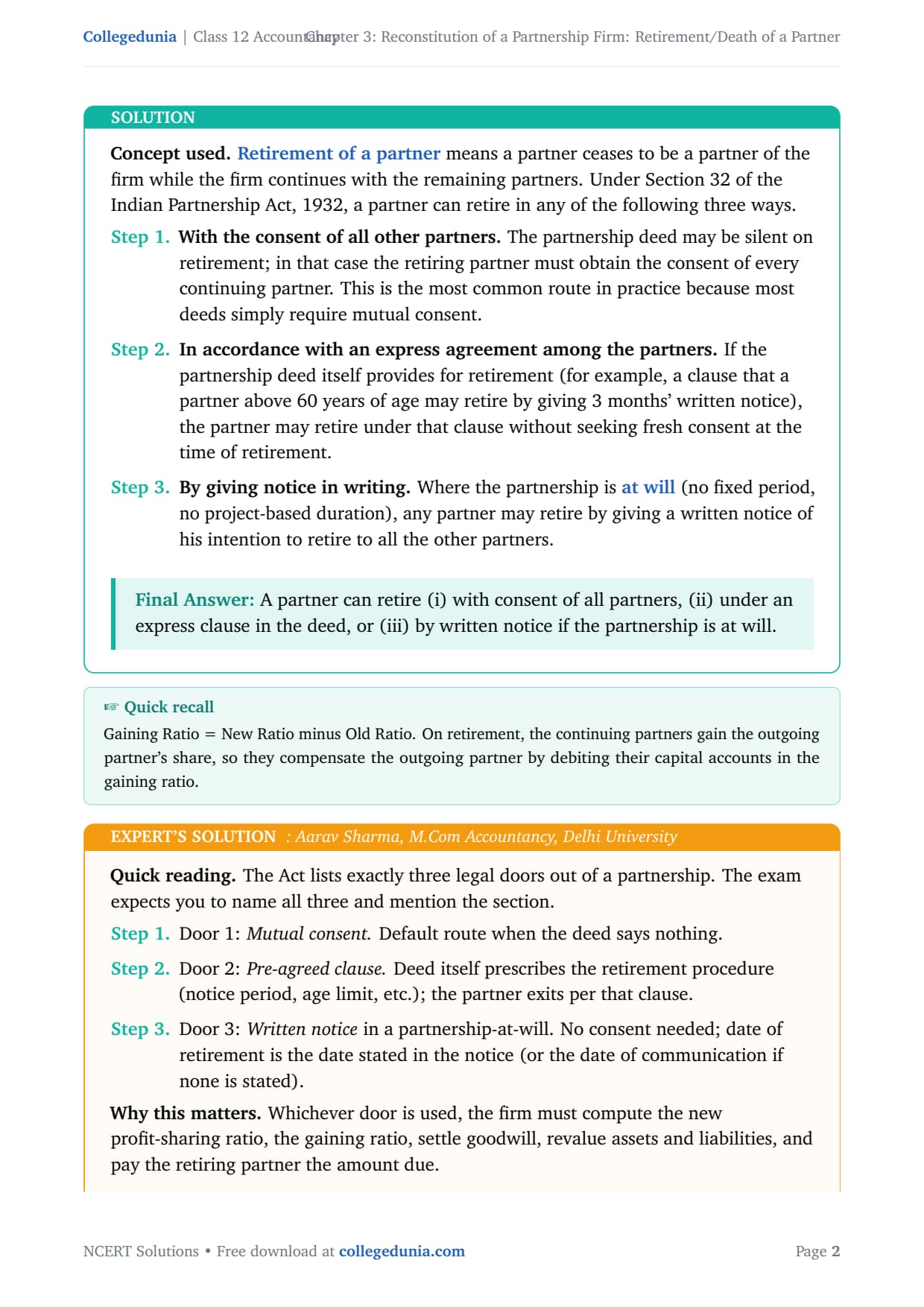
What are the different ways in which a partner can retire from the firm?
Concept used.Retirement of a partner means a partner ceases to
be a partner of the firm while the firm continues with the remaining partners.
Under Section 32 of the Indian Partnership Act, 1932, a partner can retire in any
of the following three ways.
With the consent of all other partners. The partnership deed may
be silent on retirement; in that case the retiring partner must obtain the
consent of every continuing partner. This is the most common route in
practice because most deeds simply require mutual consent.
In accordance with an express agreement among the partners. If
the partnership deed itself provides for retirement (for example, a clause
that a partner above 60 years of age may retire by giving 3 months'
written notice), the partner may retire under that clause without seeking
fresh consent at the time of retirement.
By giving notice in writing. Where the partnership is
at will (no fixed period, no project-based duration), any
partner may retire by giving a written notice of his intention to retire
to all the other partners.
A partner can retire (i) with consent of all partners, (ii) under an
express clause in the deed, or (iii) by written notice if the partnership is at
will.
AS
Aarav Sharma
M.Com Accountancy, Delhi University
Verified Expert
Quick reading. The Act lists exactly three legal doors out of a
partnership. The exam expects you to name all three and mention the section.
Door 1: Mutual consent. Default route when the deed says nothing.
Door 2: Pre-agreed clause. Deed itself prescribes the retirement
procedure (notice period, age limit, etc.); the partner exits per that
clause.
Door 3: Written notice in a partnership-at-will. No consent
needed; date of retirement is the date stated in the notice (or the date
of communication if none is stated).
Why this matters. Whichever door is used, the firm must compute the new
profit-sharing ratio, the gaining ratio, settle goodwill, revalue assets and
liabilities, and pay the retiring partner the amount due.
Common mistakes. Three predictable slips lose marks: (a) using the old ratio rather than the gaining ratio when the continuing partners adjust goodwill in favour of the outgoing partner; (b) computing the share of profit till death on the basis of past-year average without checking whether the deed specifies the turnover or time basis; (c) leaving the executor's account balance unboxed or omitting the Rs. prefix so the marker has to hunt for the settlement figure.
Three modes: mutual consent; express agreement; written notice in a
partnership-at-will.
Q 3.2
Write the various matters that need adjustments at the time of
retirement of a partner.
Concept used. On retirement, the books and equities of the firm must be
updated so that the retiring partner's exit value is fairly computed and the
continuing partners begin afresh with restated capitals. The five standard
adjustments are listed below.
New profit-sharing ratio and gaining ratio of the continuing
partners are computed. The gaining ratio
= new share - old share for each continuing partner.
Treatment of goodwill. The retiring partner is credited with his
share of goodwill; the continuing partners are debited in their gaining
ratio. If goodwill already appears in the books, it is first written off
among ALL partners in the old ratio.
Revaluation of assets and reassessment of liabilities. A
Revaluation Account is prepared. The profit or loss on
revaluation is shared among ALL partners (including the retiring partner)
in the OLD ratio.
Distribution of reserves and accumulated profits/losses
appearing on the liabilities/assets side of the balance sheet (General
Reserve, P&L A/c balance) is made among ALL partners in the OLD ratio.
Settlement of the retiring partner's account. The total amount
standing to his credit is paid either (a) immediately in lump sum, or
(b) in instalments with interest, or (c) transferred to his Loan Account.
Adjustments: new ratio + gaining ratio; goodwill; revaluation; reserves
& accumulated profits; settlement of capital.
PI
Priya Iyer
M.Com, ICAI Final-cleared
Verified Expert
Strategic angle. Think of retirement adjustments as a five-checkpoint
checklist that the exam scenario will exercise in some combination. Miss one and
the final Balance Sheet won't tally.
Checkpoint 1: ratios (new + gaining).
Checkpoint 2: goodwill (write off existing; credit retiring partner via
gaining ratio).
Checkpoint 3: revaluation gain/loss in OLD ratio.
Checkpoint 4: reserves & accumulated P&L in OLD ratio.
Why this matters. Each checkpoint touches a specific ledger: goodwill
hits capital accounts; revaluation has its own account; reserves are journalised
straight to capitals.
Common mistakes. Three predictable slips lose marks: (a) using the old ratio rather than the gaining ratio when the continuing partners adjust goodwill in favour of the outgoing partner; (b) computing the share of profit till death on the basis of past-year average without checking whether the deed specifies the turnover or time basis; (c) leaving the executor's account balance unboxed or omitting the Rs. prefix so the marker has to hunt for the settlement figure.
Five checkpoints: ratios, goodwill, revaluation, reserves, settlement.
Q 3.3
Distinguish between sacrificing ratio and gaining ratio.
Concept used.Sacrificing ratio arises on admission of
a partner and equals the share that each old partner gives up to the new
partner. Gaining ratio arises on retirement / death of a
partner and equals the share that each continuing partner picks up from the
outgoing partner.
Meaning. Sacrificing ratio = Old share - New share
(positive, since the old partner sacrifices). Gaining ratio
= New share - Old share (positive, since the continuing partner
gains).
Occasion. Sacrificing ratio is computed at the time of
admission. Gaining ratio is computed at the time of retirement or death.
Purpose. Sacrificing ratio is used to credit the sacrificing
partners with their share of the new partner's goodwill premium. Gaining
ratio is used to debit the gaining partners with their share of the
retiring/deceased partner's goodwill.
Journal direction. On admission: Dr. Cash/New partner's
Capital, Cr. Old partners (sacrificing ratio). On retirement: Dr.
Continuing partners (gaining ratio), Cr. Retiring partner.
Sacrificing ratio: Old - New, used on admission. Gaining ratio:
New - Old, used on retirement/death.
VM
Vivaan Mehta
M.Com, Symbiosis Pune
Verified Expert
Quick reading. Same idea, opposite direction. One subtracts new from
old, the other subtracts old from new. The sign tells you whether the partner
is giving up share or picking up share.
Admission ⇒ share moves OUT of old partners ⇒
sacrificing ratio.
Retirement/death ⇒ share moves INTO continuing partners
⇒ gaining ratio.
Both ratios are always positive: just subtract the smaller share from
the larger.
Why this matters. Pick the right ratio for the right goodwill journal
entry, and the capital accounts will balance.
Common mistakes. Three predictable slips lose marks: (a) using the old ratio rather than the gaining ratio when the continuing partners adjust goodwill in favour of the outgoing partner; (b) computing the share of profit till death on the basis of past-year average without checking whether the deed specifies the turnover or time basis; (c) leaving the executor's account balance unboxed or omitting the Rs. prefix so the marker has to hunt for the settlement figure.
Old - New on admission; New - Old on retirement.
Q 3.4
Why does a firm revalue assets and reassess its liabilities on
retirement or on the event of death of a partner?
Concept used.Revaluation of assets and reassessment of
liabilities brings each asset to its current fair value and each liability to
its current settlement value. The resulting profit or loss is shared in the OLD
ratio because it arose during the period the outgoing partner was still a
partner.
Fair share to the outgoing partner. Book values reflect cost
less depreciation, not current worth. If a building bought for Rs.
1,00,000 is now worth Rs. 1,50,000, the unrecognised gain of Rs.
50,000 was earned while the outgoing partner was in the firm; he is
entitled to his share.
Fair start for continuing partners. After revaluation the
balance sheet shows realistic values. Future profits/losses will be
shared by the continuing partners alone; they should not inherit a hidden
loss or windfall that pre-dates them.
Liabilities too. An undisclosed legal-damages claim of Rs.
20,000 must be brought on the books as a provision; ignoring it would
unfairly enrich the outgoing partner.
Old ratio because the gain/loss is historical. The Revaluation
A/c profit/loss is shared in the OLD ratio, never in the new ratio or
gaining ratio.
To ensure the outgoing partner is paid (and the continuing partners
take over) at fair current values; the gain/loss is shared in the OLD ratio.
AK
Aanya Kapoor
M.Com, Christ University Bangalore
Verified Expert
Structural observation. Two stakeholders: the outgoing partner who
wants the highest possible payout; the continuing partners who want a clean
opening balance sheet. Revaluation satisfies both by snapping every line item to
current value.
Identify which assets are under-valued / over-valued vs current
market value.
Identify unrecorded liabilities, contingent liabilities now crystallised.
Pass entries through Revaluation A/c; close to partners' capitals in
OLD ratio.
The balance sheet now shows fair values: continuing partners start
clean.
Why this matters. Without revaluation, the retiring partner's capital
balance reflects historical cost, not the firm's current worth.
Common mistakes. Three predictable slips lose marks: (a) using the old ratio rather than the gaining ratio when the continuing partners adjust goodwill in favour of the outgoing partner; (b) computing the share of profit till death on the basis of past-year average without checking whether the deed specifies the turnover or time basis; (c) leaving the executor's account balance unboxed or omitting the Rs. prefix so the marker has to hunt for the settlement figure.
To fairly value the firm at retirement/death; gain/loss split in OLD
ratio.
Q 3.5
Why is a retiring/deceased partner entitled to a share of goodwill of
the firm?
Concept used.Goodwill is the present value of the firm's
expected super-profits, that is, the excess of expected future profits over the
normal return on capital. It is a self-generated intangible asset that built up
over years through the joint efforts of ALL partners (including the outgoing
one).
Contribution principle. The retiring/deceased partner
contributed his time, capital and reputation to building the firm's
goodwill. He should not walk away empty-handed when the continuing
partners go on to enjoy the super-profits.
No goodwill recorded earlier. Because goodwill is
self-generated, accounting standards do not allow it to sit on the
books. So at retirement the firm valuates goodwill afresh.
Adjustment journal. The continuing partners debit their
capital accounts in the gaining ratio and credit the retiring
partner's capital with HIS share of goodwill:
Dr. Continuing partners' Capital (gaining ratio) Cr. Retiring partner's Capital (his share of goodwill)
No new asset is raised. Goodwill is NOT brought into the books
as an asset; it is only adjusted through capital accounts.
Because goodwill was jointly built by all partners and the continuing
partners will enjoy the future super-profits; the retiring partner is therefore
credited with his share via the gaining-ratio adjustment.
KJ
Karan Joshi
M.Com, Banaras Hindu University
Verified Expert
Strategic angle. Frame goodwill as the firm's accumulated
reputation rent. Every partner planted seeds; only those continuing will
keep harvesting. So the leaver gets his slice of the standing value of the
crop.
Goodwill = capitalised value of super-profits (above normal earnings).
Outgoing partner's share = (his old share) × (firm's goodwill).
Continuing partners absorb this share in their gaining ratio.
Entry: Dr. Continuing partners (gaining ratio); Cr. Retiring partner.
Why this matters. Without this credit, the firm's intangible value
would silently transfer from the retiring partner to the continuing partners,
which is legally and ethically unsound.
Common mistakes. Three predictable slips lose marks: (a) using the old ratio rather than the gaining ratio when the continuing partners adjust goodwill in favour of the outgoing partner; (b) computing the share of profit till death on the basis of past-year average without checking whether the deed specifies the turnover or time basis; (c) leaving the executor's account balance unboxed or omitting the Rs. prefix so the marker has to hunt for the settlement figure.
The retiring partner co-built the goodwill, so he is entitled to his
share at retirement; adjusted through capital accounts in the gaining ratio.
Long Answer Questions
Q 3.6
Explain the modes of payment to a retiring partner.
Concept used. The amount due to a retiring partner is the closing
credit balance of his Capital Account after all adjustments (revaluation,
reserves, goodwill, share of profit till date of retirement). This sum can be
settled in any of the four standard modes below.
Lump-sum cash payment. The entire amount is paid immediately:
Dr. Retiring partner's Capital A/c ;
Cr. Cash/Bank A/c.
Used when the firm has enough liquidity.
Payment in instalments with interest. A part is paid in cash
and the balance carries interest at the agreed rate (statutory rate is
6% p.a. if no agreement). The unpaid balance is transferred to the
retiring partner's Loan A/c; interest is credited yearly until the
balance is cleared.
Transfer to Loan A/c (full transfer). The entire balance is
treated as a loan from the retiring partner to the firm and repaid as
per agreed terms. Interest at 6% p.a. accrues unless otherwise agreed.
Journal:
Dr. Retiring partner's Capital A/c ;
Cr. Retiring partner's Loan A/c.
Payment partly in assets and partly in cash. For example,
investments held by the firm may be transferred to the retiring partner
at agreed value, and the residual paid in cash.
Four modes: (i) lump-sum cash, (ii) instalments with interest, (iii)
transfer to Loan A/c, (iv) part-assets + part-cash.
PR
Pranav Reddy
M.Com, Symbiosis
Verified Expert
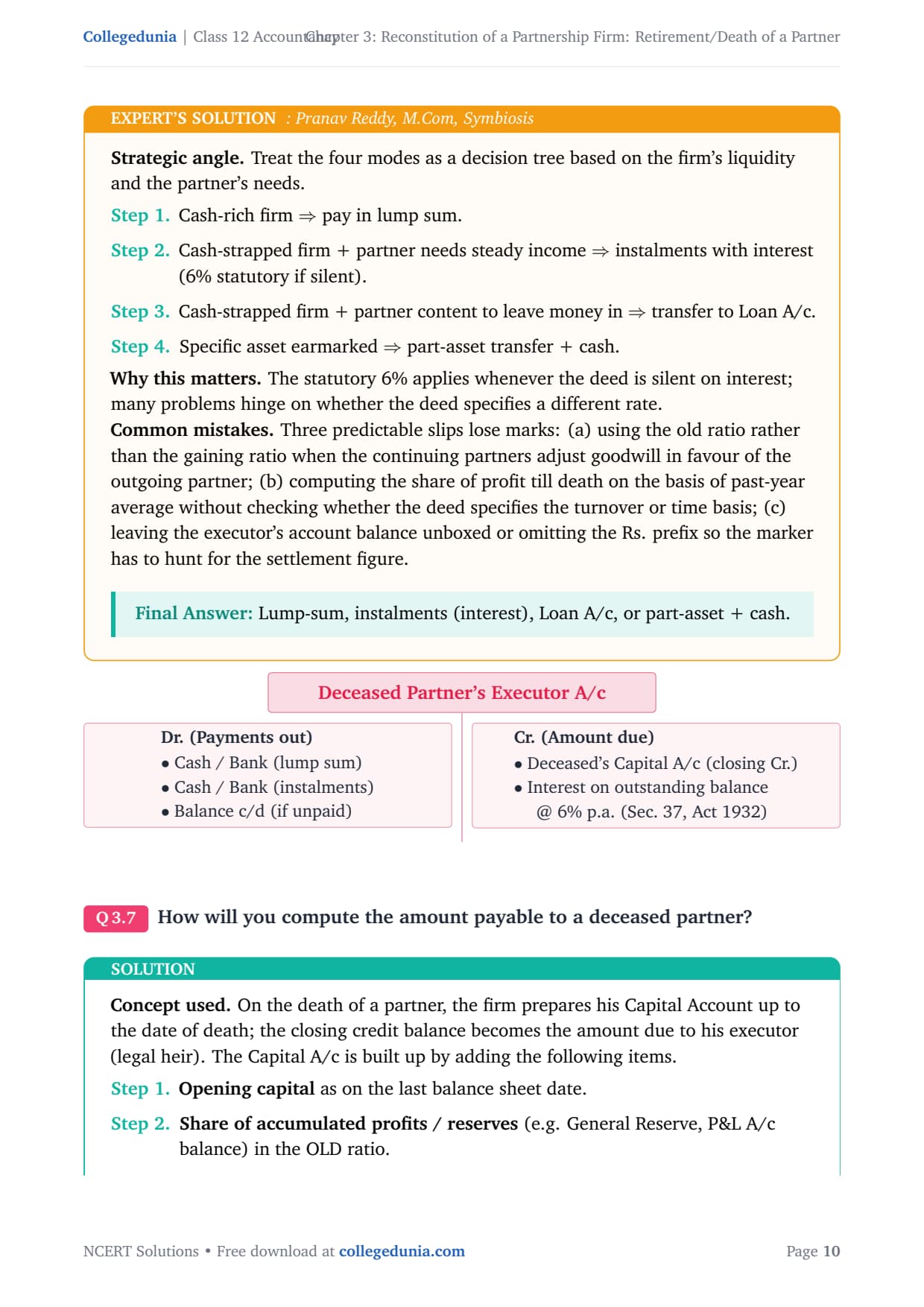
Strategic angle. Treat the four modes as a decision tree based on the
firm's liquidity and the partner's needs.
Cash-rich firm ⇒ pay in lump sum.
Cash-strapped firm + partner needs steady income ⇒
instalments with interest (6% statutory if silent).
Cash-strapped firm + partner content to leave money in
⇒ transfer to Loan A/c.
Specific asset earmarked ⇒ part-asset transfer + cash.
Why this matters. The statutory 6% applies whenever the deed is
silent on interest; many problems hinge on whether the deed specifies a
different rate.
Common mistakes. Three predictable slips lose marks: (a) using the old ratio rather than the gaining ratio when the continuing partners adjust goodwill in favour of the outgoing partner; (b) computing the share of profit till death on the basis of past-year average without checking whether the deed specifies the turnover or time basis; (c) leaving the executor's account balance unboxed or omitting the Rs. prefix so the marker has to hunt for the settlement figure.
Lump-sum, instalments (interest), Loan A/c, or part-asset + cash.
Q 3.7
How will you compute the amount payable to a deceased partner?
Concept used. On the death of a partner, the firm prepares his Capital
Account up to the date of death; the closing credit balance becomes the amount
due to his executor (legal heir). The Capital A/c is built up by adding the
following items.
Opening capital as on the last balance sheet date.
Share of accumulated profits / reserves (e.g. General
Reserve, P&L A/c balance) in the OLD ratio.
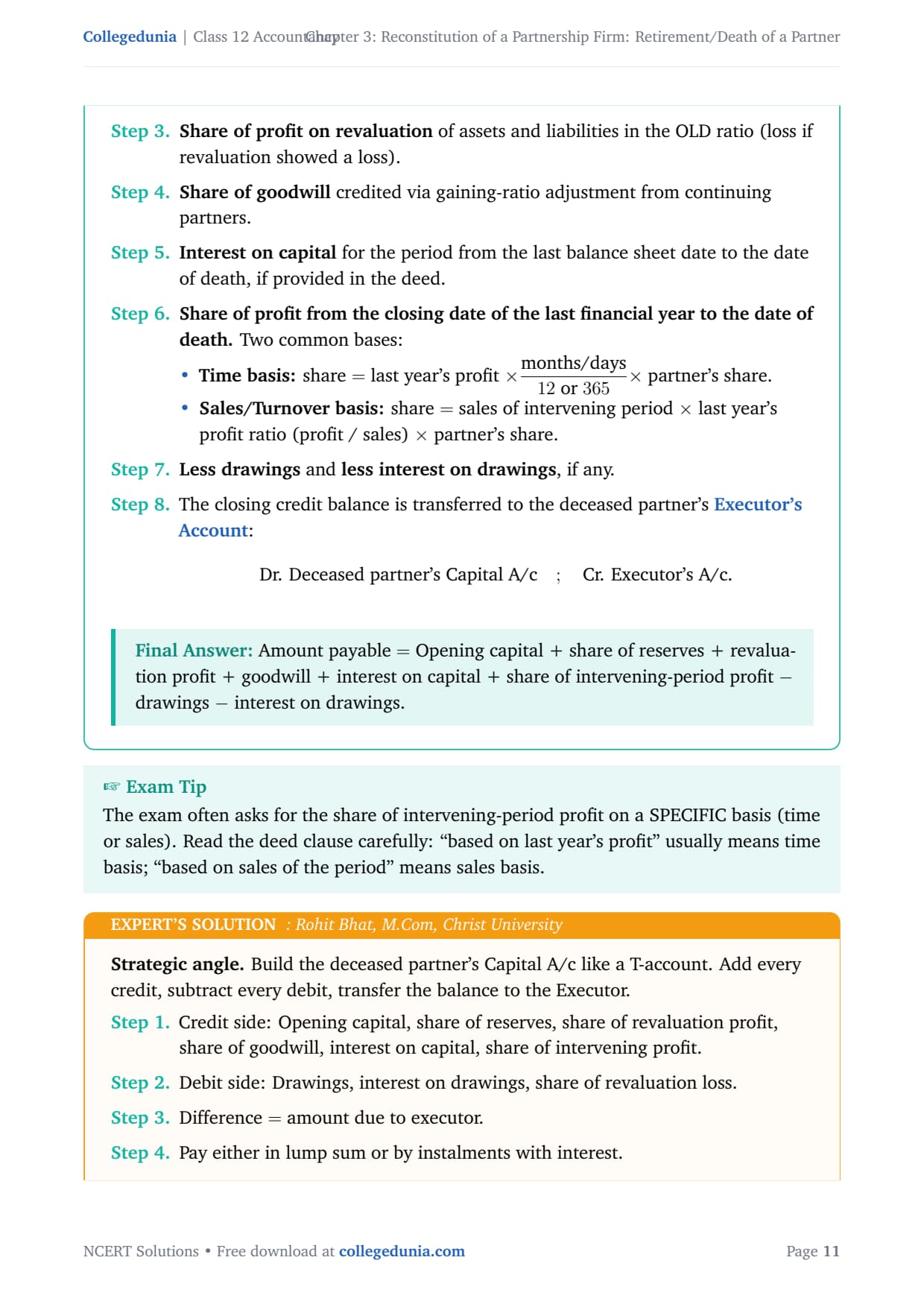
Share of profit on revaluation of assets and liabilities in
the OLD ratio (loss if revaluation showed a loss).
Share of goodwill credited via gaining-ratio adjustment from
continuing partners.
Interest on capital for the period from the last balance
sheet date to the date of death, if provided in the deed.
Share of profit from the closing date of the last financial
year to the date of death. Two common bases:
Time basis: share = last year's profit ×
months/days12 or 365 × partner's
share.
Sales/Turnover basis: share = sales of intervening
period × last year's profit ratio (profit / sales)
× partner's share.
Less drawings and less interest on drawings, if any.
The closing credit balance is transferred to the deceased partner's
Executor's Account:
Dr. Deceased partner's Capital A/c ;
Cr. Executor'sA/c.
Amount payable = Opening capital + share of reserves + revaluation
profit + goodwill + interest on capital + share of intervening-period profit
- drawings - interest on drawings.
RB
Rohit Bhat
M.Com, Christ University
Verified Expert
Strategic angle. Build the deceased partner's Capital A/c like a
T-account. Add every credit, subtract every debit, transfer the balance to the
Executor.
Credit side: Opening capital, share of reserves, share of revaluation
profit, share of goodwill, interest on capital, share of intervening
profit.
Debit side: Drawings, interest on drawings, share of revaluation loss.
Difference = amount due to executor.
Pay either in lump sum or by instalments with interest.
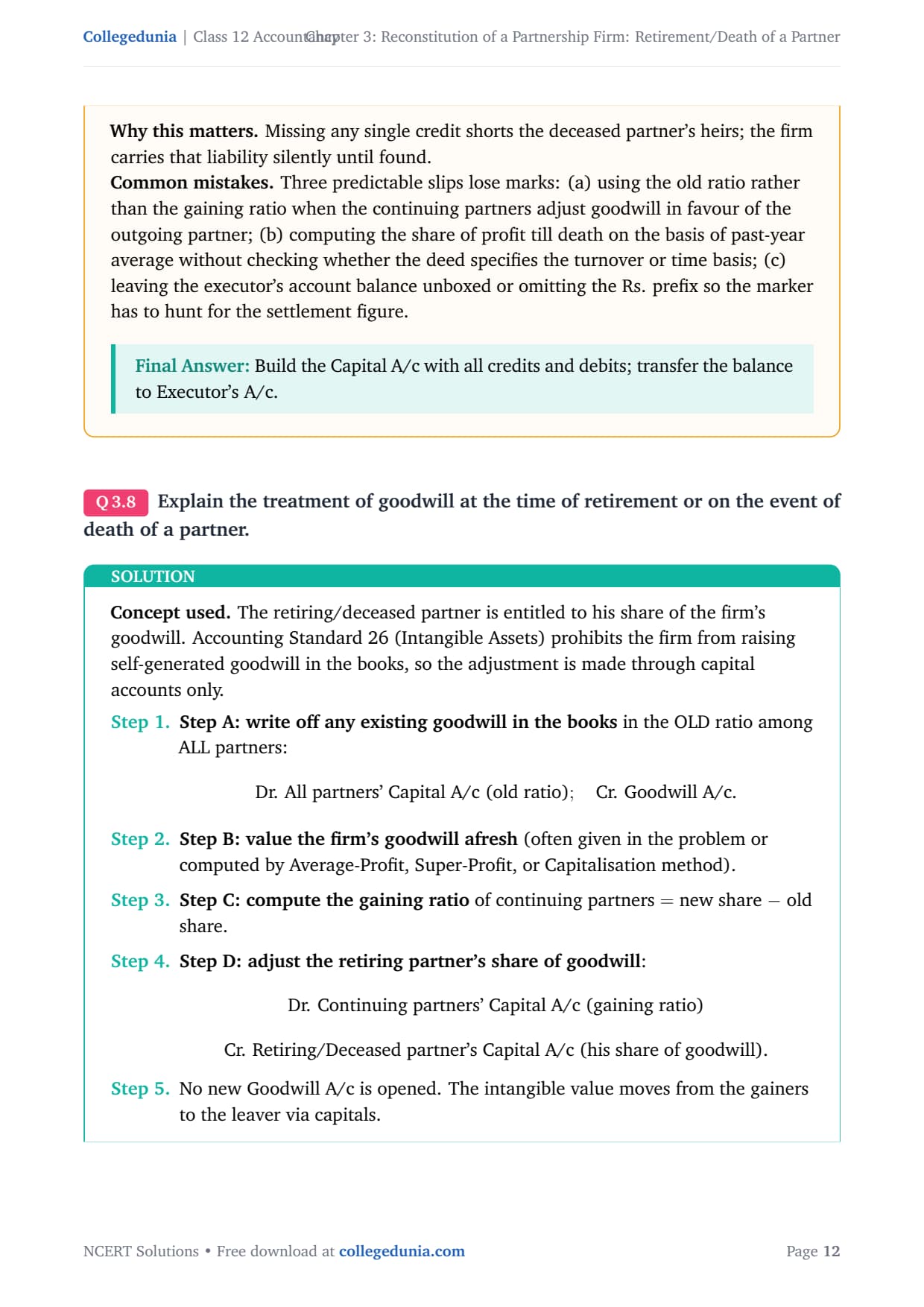
Why this matters. Missing any single credit shorts the deceased
partner's heirs; the firm carries that liability silently until found.
Common mistakes. Three predictable slips lose marks: (a) using the old ratio rather than the gaining ratio when the continuing partners adjust goodwill in favour of the outgoing partner; (b) computing the share of profit till death on the basis of past-year average without checking whether the deed specifies the turnover or time basis; (c) leaving the executor's account balance unboxed or omitting the Rs. prefix so the marker has to hunt for the settlement figure.
Build the Capital A/c with all credits and debits; transfer the
balance to Executor's A/c.
Q 3.8
Explain the treatment of goodwill at the time of retirement or on
the event of death of a partner.
Concept used. The retiring/deceased partner is entitled to his share
of the firm's goodwill. Accounting Standard 26 (Intangible Assets) prohibits
the firm from raising self-generated goodwill in the books, so the adjustment
is made through capital accounts only.
Step A: write off any existing goodwill in the books in
the OLD ratio among ALL partners:
Dr. All partners' Capital A/c (old ratio);
Cr. Goodwill A/c.
Step B: value the firm's goodwill afresh (often given in
the problem or computed by Average-Profit, Super-Profit, or
Capitalisation method).
Step C: compute the gaining ratio of continuing partners
= new share - old share.
Step D: adjust the retiring partner's share of goodwill:
Dr. Continuing partners' Capital A/c (gaining ratio) Cr. Retiring/Deceased partner's Capital A/c (his share of goodwill).
No new Goodwill A/c is opened. The intangible value moves from the
gainers to the leaver via capitals.
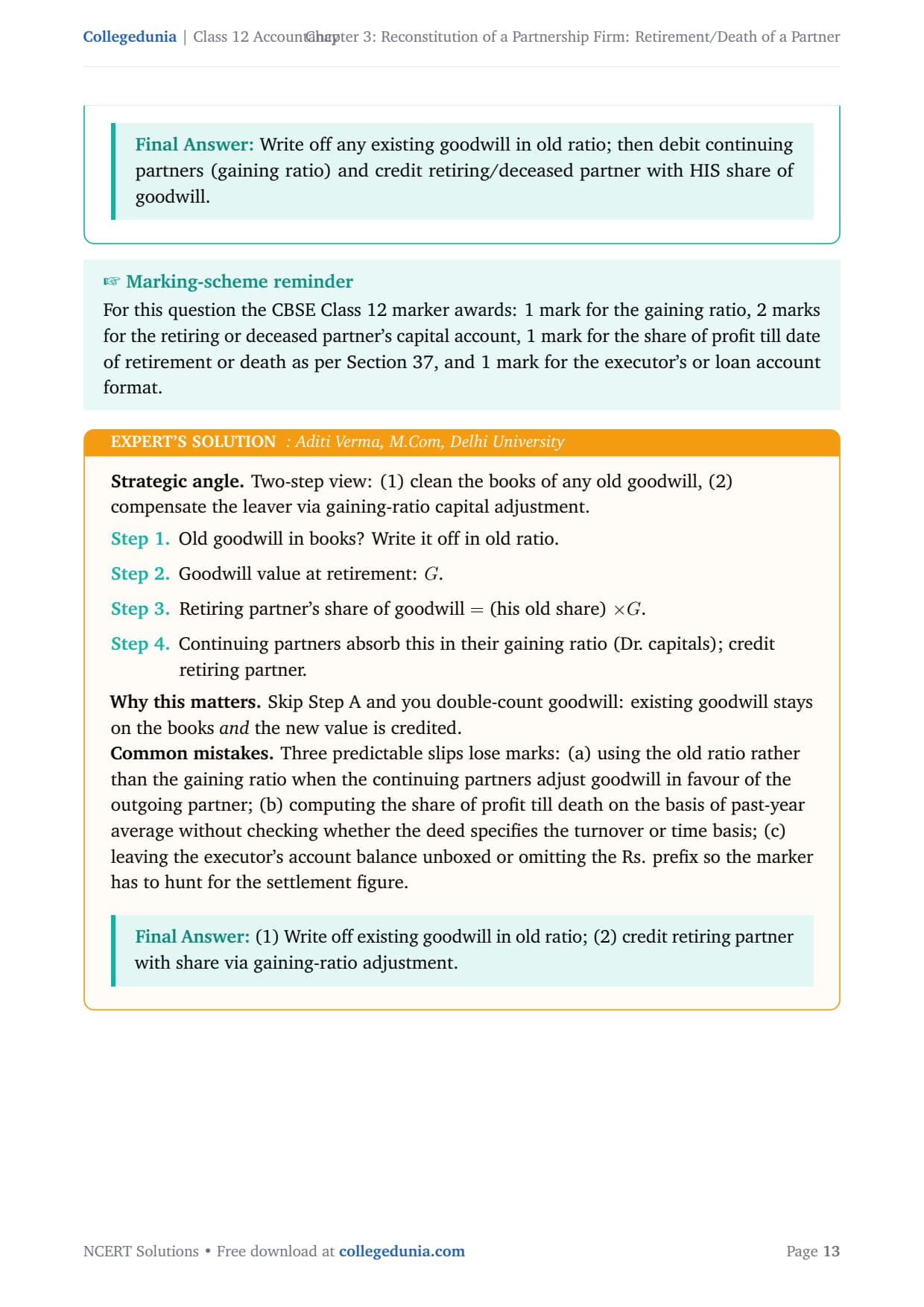
Write off any existing goodwill in old ratio; then debit continuing
partners (gaining ratio) and credit retiring/deceased partner with HIS share of
goodwill.
AV
Aditi Verma
M.Com, Delhi University
Verified Expert
Strategic angle. Two-step view: (1) clean the books of any old
goodwill, (2) compensate the leaver via gaining-ratio capital adjustment.
Old goodwill in books? Write it off in old ratio.
Goodwill value at retirement: G.
Retiring partner's share of goodwill = (his old share) × G.
Continuing partners absorb this in their gaining ratio (Dr. capitals);
credit retiring partner.
Why this matters. Skip Step A and you double-count goodwill: existing
goodwill stays on the books and the new value is credited.
Common mistakes. Three predictable slips lose marks: (a) using the old ratio rather than the gaining ratio when the continuing partners adjust goodwill in favour of the outgoing partner; (b) computing the share of profit till death on the basis of past-year average without checking whether the deed specifies the turnover or time basis; (c) leaving the executor's account balance unboxed or omitting the Rs. prefix so the marker has to hunt for the settlement figure.
(1) Write off existing goodwill in old ratio; (2) credit retiring
partner with share via gaining-ratio adjustment.
Q 3.9
Discuss the various methods of computing the share in profits in the
event of death of a partner.
Concept used. When a partner dies during the year, his estate is
entitled to a share of profit for the period from the last balance-sheet date
to the date of death. There are two recognised bases.
Method 1: Time basis (using last year's profit). Share = Last year's profit ×
Period (months or days)12 or 365
× Deceased partner's share.
Used when the deed says ``share of profit on the basis of last year's
profit''.
Example. Last year's profit Rs. 60,000; partner dies after
3 months; his share is 16.
Share = 60,000 × 312 × 16
= 15,000 × 16 = Rs. 2,500.
Method 2: Sales (turnover) basis.aligned
Share &= Sales during intervening period
& × Last year's profitLast year's sales
× Deceased partner's share.
aligned
Used when the deed says ``share based on sales during the period''.
Method 3: Average-profit basis (variant). Sometimes the deed
specifies the average of past few years' profits as the base:
Share = Average profit × Period12
× Deceased partner's share.
Journal entry for the share of profit (under Time/Average/Sales
basis):
Dr. Profit & Loss Suspense A/c ;
Cr. Deceased Partner's Capital A/c.
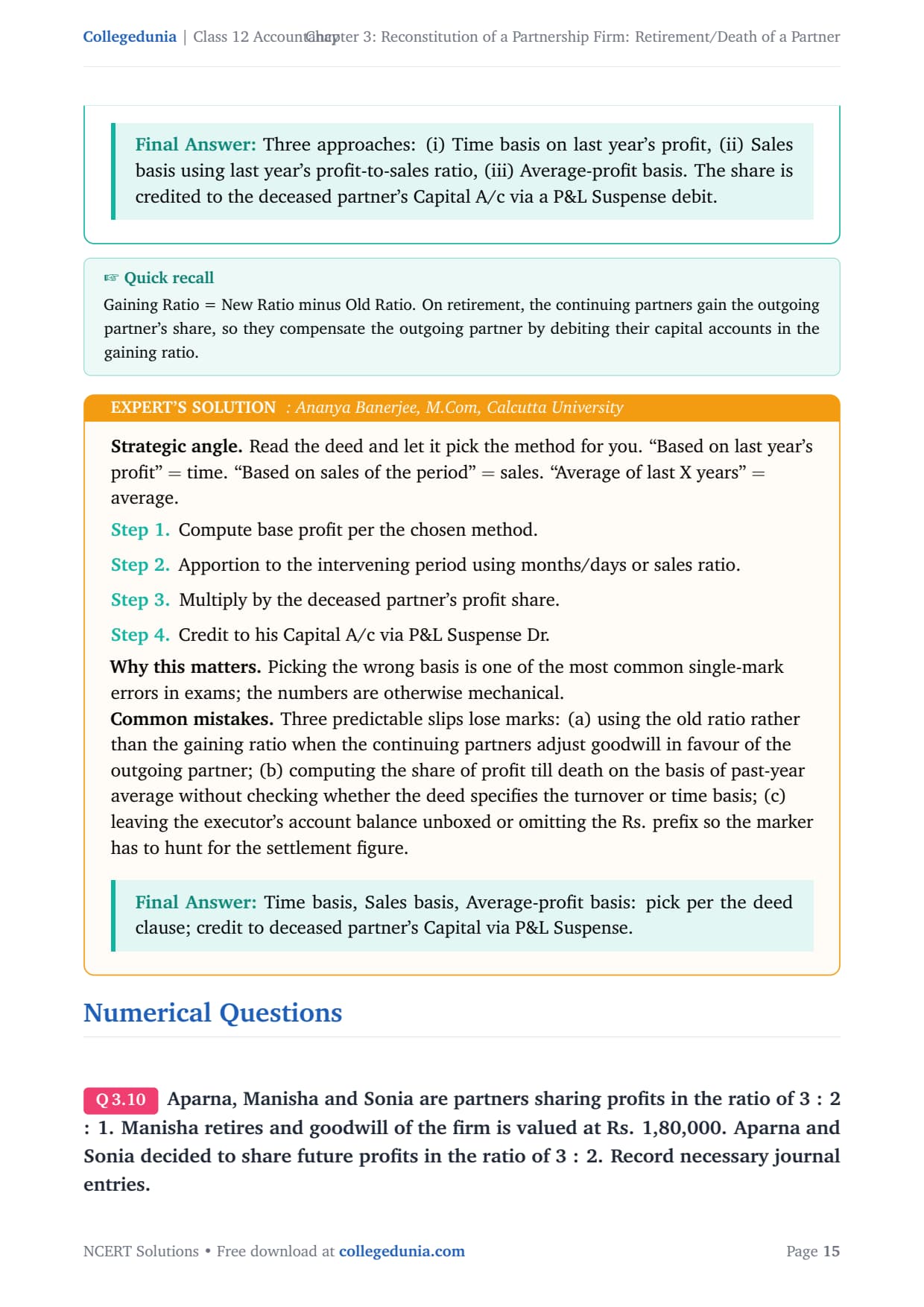
Three approaches: (i) Time basis on last year's profit, (ii) Sales
basis using last year's profit-to-sales ratio, (iii) Average-profit basis. The
share is credited to the deceased partner's Capital A/c via a P&L Suspense
debit.
AB
Ananya Banerjee
M.Com, Calcutta University
Verified Expert
Strategic angle. Read the deed and let it pick the method for you.
``Based on last year's profit'' = time. ``Based on sales of the period'' =
sales. ``Average of last X years'' = average.
Compute base profit per the chosen method.
Apportion to the intervening period using months/days or sales ratio.
Multiply by the deceased partner's profit share.
Credit to his Capital A/c via P&L Suspense Dr.
Why this matters. Picking the wrong basis is one of the most common
single-mark errors in exams; the numbers are otherwise mechanical.
Common mistakes. Three predictable slips lose marks: (a) using the old ratio rather than the gaining ratio when the continuing partners adjust goodwill in favour of the outgoing partner; (b) computing the share of profit till death on the basis of past-year average without checking whether the deed specifies the turnover or time basis; (c) leaving the executor's account balance unboxed or omitting the Rs. prefix so the marker has to hunt for the settlement figure.
Time basis, Sales basis, Average-profit basis: pick per the deed
clause; credit to deceased partner's Capital via P&L Suspense.
Numerical Questions
Q 3.10
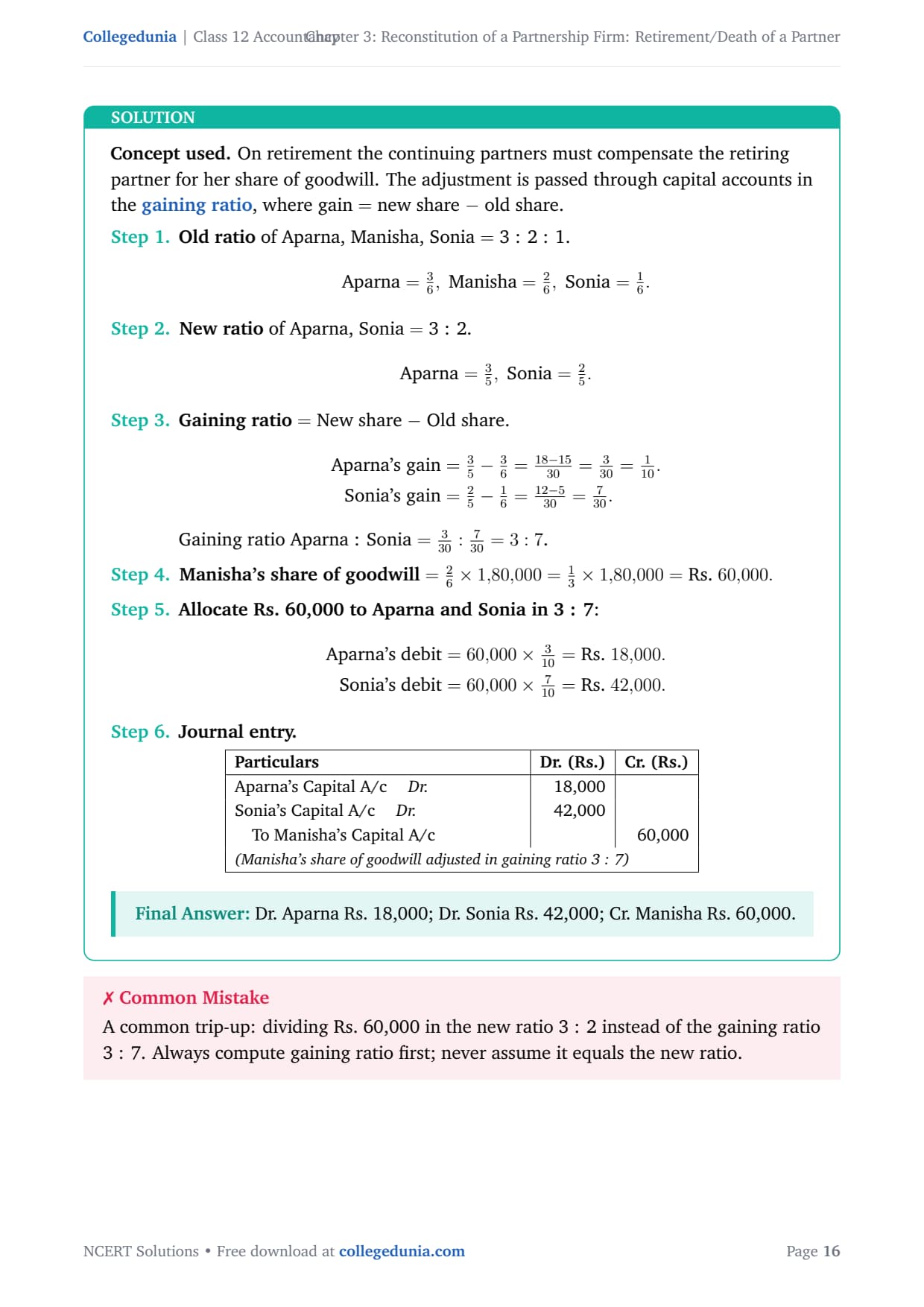
Aparna, Manisha and Sonia are partners sharing profits in the ratio of
3 : 2 : 1. Manisha retires and goodwill of the firm is valued at Rs. 1,80,000.
Aparna and Sonia decided to share future profits in the ratio of 3 : 2. Record
necessary journal entries.
Concept used. On retirement the continuing partners must compensate
the retiring partner for her share of goodwill. The adjustment is passed
through capital accounts in the gaining ratio, where
gain = new share - old share.
Old ratio of Aparna, Manisha, Sonia = 3 : 2 : 1.
Aparna = 36, Manisha = 26,
Sonia = 16.
New ratio of Aparna, Sonia = 3 : 2.
Aparna = 35, Sonia = 25.
Gaining ratio= New share - Old share.
aligned
Aparna's gain &= 35 - 36
= 18 - 1530 = 330
= 110.
Sonia's gain &= 25 - 16
= 12 - 530 = 730.
aligned
Gaining ratio Aparna : Sonia = 330 : 730 = 3 : 7.
Particulars & Dr. (Rs.) & Cr. (Rs.)
Aparna's Capital A/c Dr. & 18,000 &
Sonia's Capital A/c Dr. & 42,000 &
To Manisha's Capital A/c & & 60,000
3|l|(Manisha's share of goodwill
adjusted in gaining ratio 3 : 7)
tabular
Dr. Aparna Rs. 18,000; Dr. Sonia Rs. 42,000; Cr. Manisha
Rs. 60,000.
DN
Diya Nair
M.Com, ICAI
Verified Expert
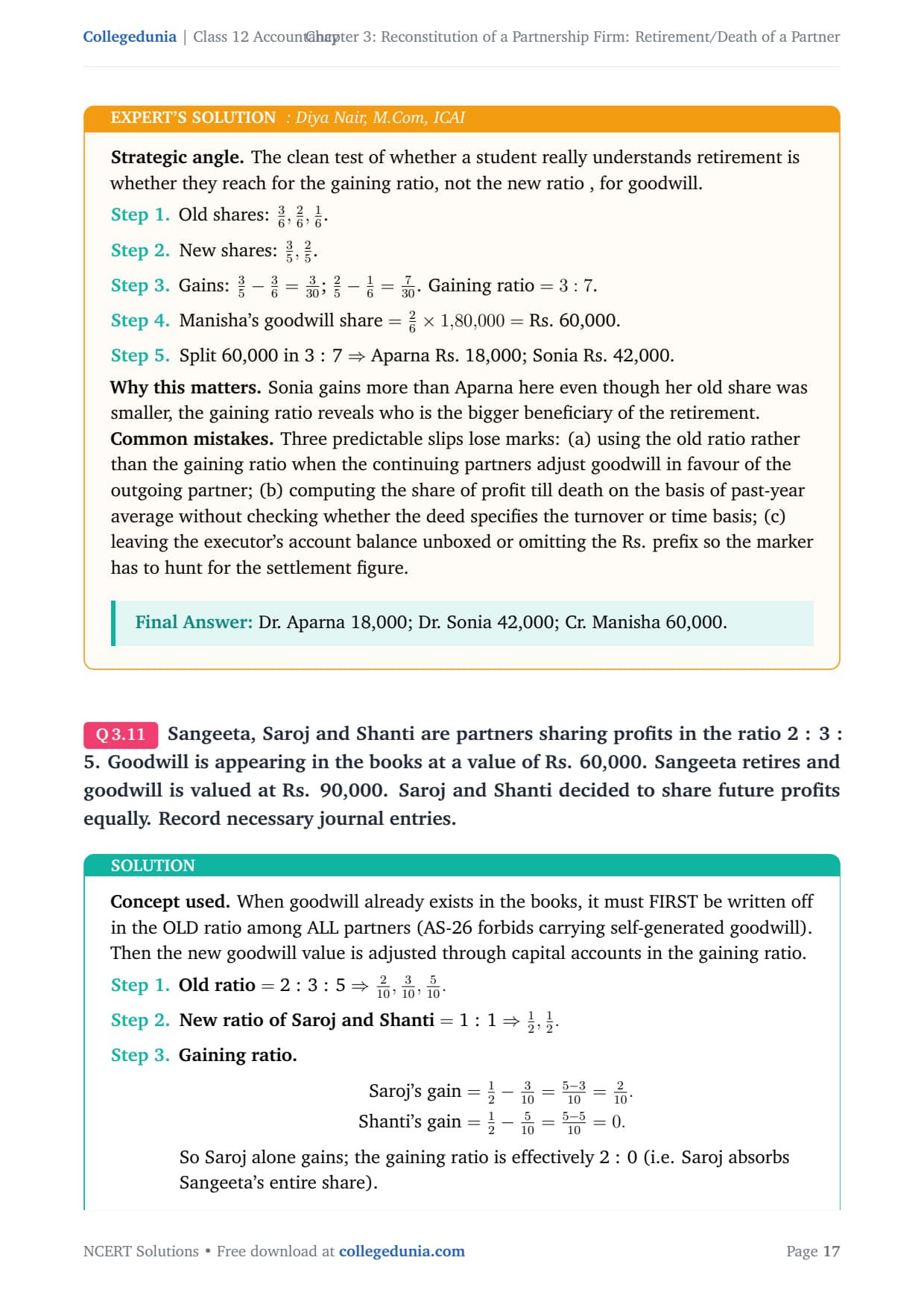
Strategic angle. The clean test of whether a student really understands
retirement is whether they reach for the gaining ratio, not the new ratio
, for goodwill.
Why this matters. Sonia gains more than Aparna here even though her
old share was smaller, the gaining ratio reveals who is the bigger
beneficiary of the retirement.
Common mistakes. Three predictable slips lose marks: (a) using the old ratio rather than the gaining ratio when the continuing partners adjust goodwill in favour of the outgoing partner; (b) computing the share of profit till death on the basis of past-year average without checking whether the deed specifies the turnover or time basis; (c) leaving the executor's account balance unboxed or omitting the Rs. prefix so the marker has to hunt for the settlement figure.
Dr. Aparna 18,000; Dr. Sonia 42,000; Cr. Manisha 60,000.
Q 3.11
Sangeeta, Saroj and Shanti are partners sharing profits in the ratio
2 : 3 : 5. Goodwill is appearing in the books at a value of Rs. 60,000.
Sangeeta retires and goodwill is valued at Rs. 90,000. Saroj and Shanti decided
to share future profits equally. Record necessary journal entries.
Concept used. When goodwill already exists in the books, it must FIRST
be written off in the OLD ratio among ALL partners (AS-26 forbids carrying
self-generated goodwill). Then the new goodwill value is adjusted through
capital accounts in the gaining ratio.
Old ratio= 2 : 3 : 5 ⇒210, 310, 510.
New ratio of Saroj and Shanti= 1 : 1 ⇒
12, 12.
Gaining ratio.aligned
Saroj's gain &= 12 - 310
= 5 - 310 = 210.
Shanti's gain &= 12 - 510
= 5 - 510 = 0.
aligned
So Saroj alone gains; the gaining ratio is effectively 2 : 0 (i.e.
Saroj absorbs Sangeeta's entire share).
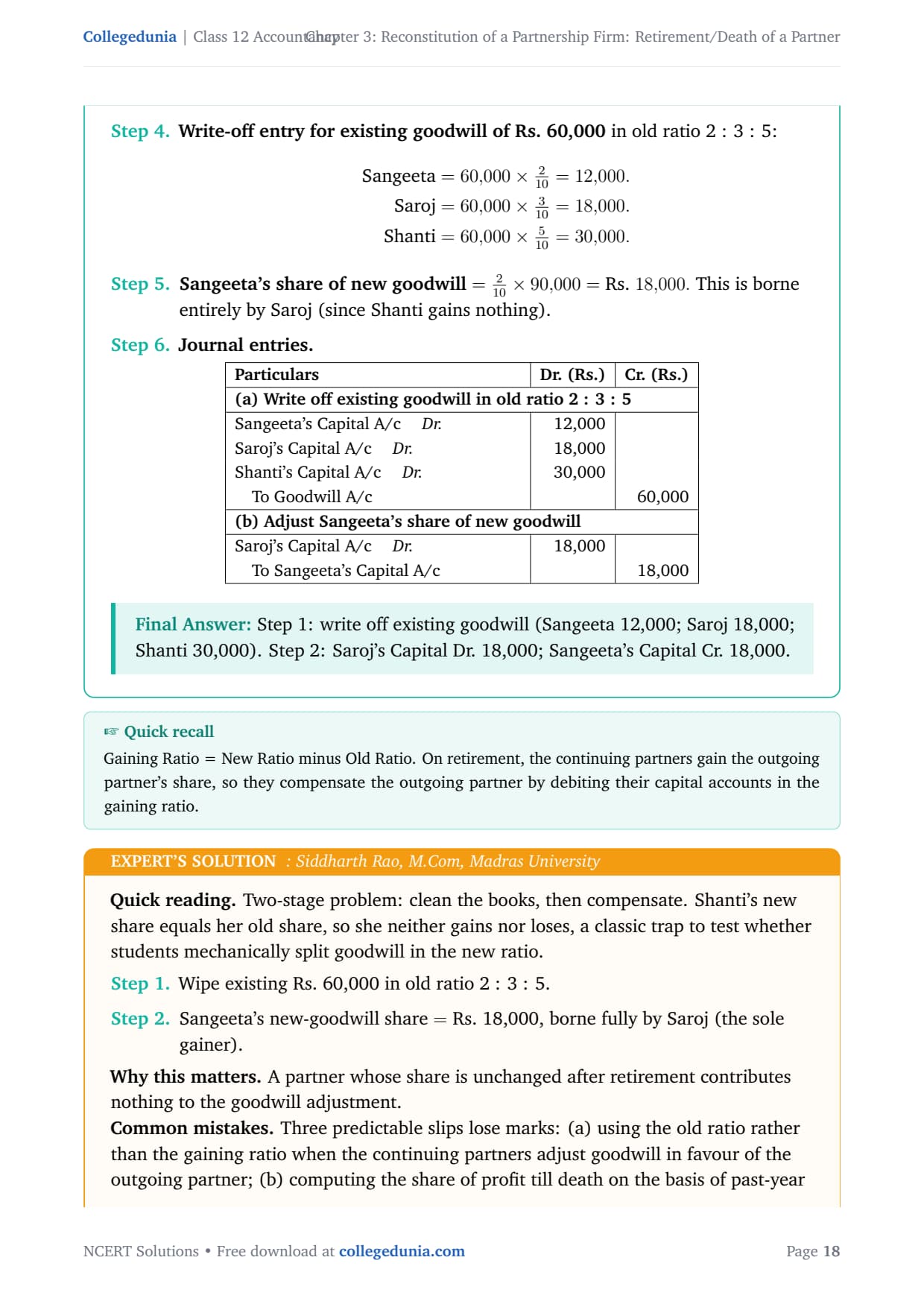
Write-off entry for existing goodwill of Rs. 60,000 in old
ratio 2 : 3 : 5:
aligned
Sangeeta &= 60,000 × 210 = 12,000.
Saroj &= 60,000 × 310 = 18,000.
Shanti &= 60,000 × 510 = 30,000.
aligned
Sangeeta's share of new goodwill= 210 × 90,000 = Rs. 18,000.
This is borne entirely by Saroj (since Shanti gains nothing).
Journal entries.
tabular|p6.5cm|r|r|
Particulars & Dr. (Rs.) & Cr. (Rs.)
3|l|(a) Write off existing goodwill in old ratio
2 : 3 : 5
Sangeeta's Capital A/c Dr. & 12,000 &
Saroj's Capital A/c Dr. & 18,000 &
Shanti's Capital A/c Dr. & 30,000 &
To Goodwill A/c & & 60,000
3|l|(b) Adjust Sangeeta's share of new goodwill
Saroj's Capital A/c Dr. & 18,000 &
To Sangeeta's Capital A/c & & 18,000
tabular
Step 1: write off existing goodwill (Sangeeta 12,000; Saroj 18,000;
Shanti 30,000). Step 2: Saroj's Capital Dr. 18,000; Sangeeta's Capital Cr.
18,000.
SR
Siddharth Rao
M.Com, Madras University
Verified Expert
Quick reading. Two-stage problem: clean the books, then compensate.
Shanti's new share equals her old share, so she neither gains nor loses, a
classic trap to test whether students mechanically split goodwill in the new
ratio.
Wipe existing Rs. 60,000 in old ratio 2 : 3 : 5.
Sangeeta's new-goodwill share = Rs. 18,000, borne fully by Saroj
(the sole gainer).
Why this matters. A partner whose share is unchanged after retirement
contributes nothing to the goodwill adjustment.
Common mistakes. Three predictable slips lose marks: (a) using the old ratio rather than the gaining ratio when the continuing partners adjust goodwill in favour of the outgoing partner; (b) computing the share of profit till death on the basis of past-year average without checking whether the deed specifies the turnover or time basis; (c) leaving the executor's account balance unboxed or omitting the Rs. prefix so the marker has to hunt for the settlement figure.
Existing goodwill written off (12k : 18k : 30k); Saroj's Capital Dr.
18,000; Sangeeta's Capital Cr. 18,000.
Q 3.12
Himanshu, Gagan and Naman are partners sharing profits and losses in
the ratio of 3 : 2 : 1. On March 31, 2019, Naman retires. The various assets
and liabilities of the firm on the date were: Cash Rs. 10,000, Building Rs.
1,00,000, Plant and Machinery Rs. 40,000, Stock Rs. 20,000, Debtors Rs. 20,000
and Investments Rs. 30,000. On Naman's retirement: (i) Building appreciated by
20%, (ii) Plant & Machinery depreciated by 10%, (iii) 5% provision on
debtors, (iv) Stock revalued at Rs. 18,000 and Investments at Rs. 35,000.
Record journal entries and prepare the Revaluation A/c.
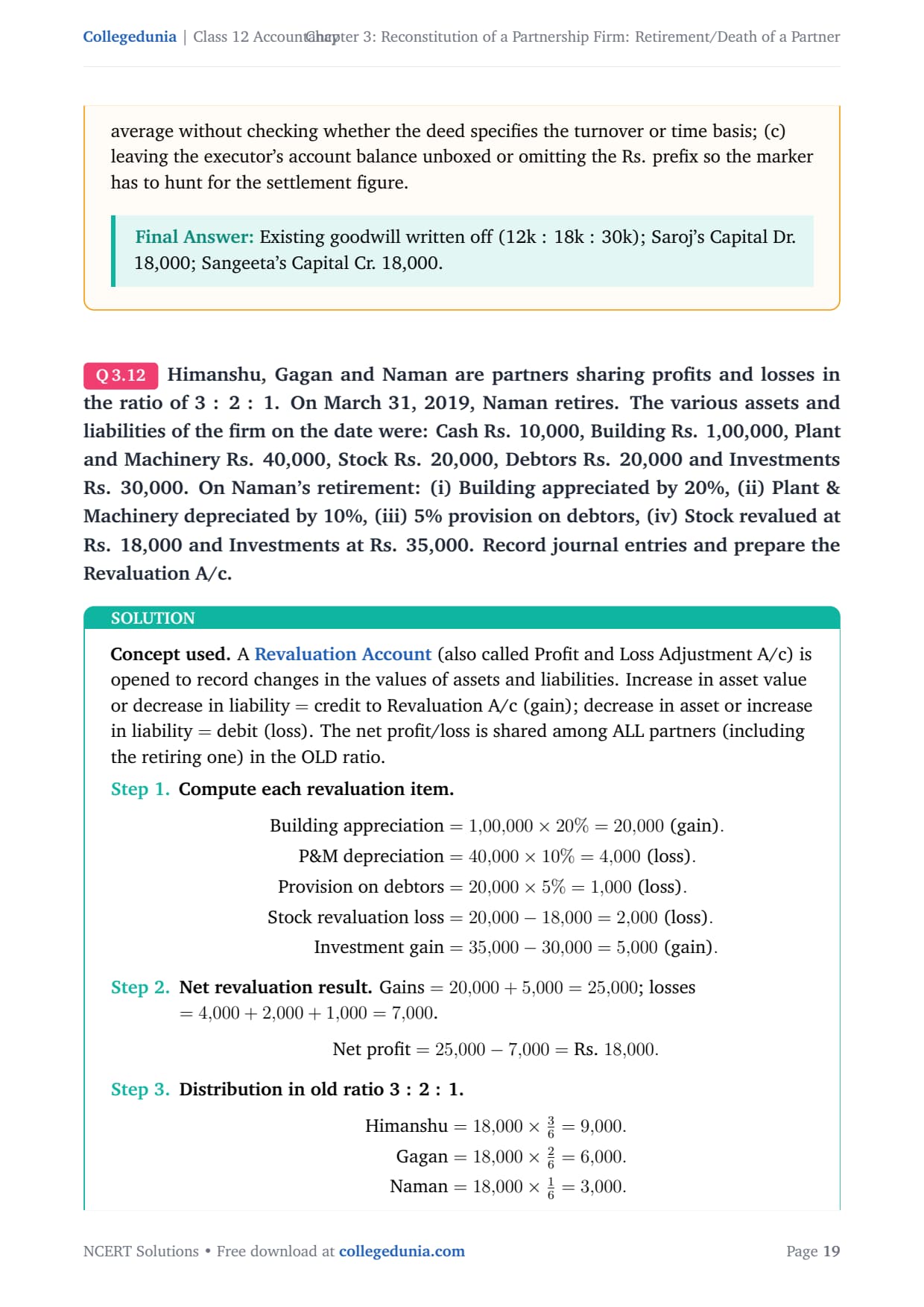
Concept used. A Revaluation Account (also called Profit and
Loss Adjustment A/c) is opened to record changes in the values of assets and
liabilities. Increase in asset value or decrease in liability = credit to
Revaluation A/c (gain); decrease in asset or increase in liability = debit
(loss). The net profit/loss is shared among ALL partners (including the
retiring one) in the OLD ratio.
Particulars & Dr. (Rs.) & Cr. (Rs.)
Building A/c Dr. & 20,000 &
Investments A/c Dr. & 5,000 &
To Revaluation A/c & & 25,000
Revaluation A/c Dr. & 7,000 &
To Plant & Machinery A/c & & 4,000
To Stock A/c & & 2,000
To Provision for Doubtful Debts A/c & & 1,000
Revaluation A/c Dr. & 18,000 &
To Himanshu's Capital A/c & & 9,000
To Gagan's Capital A/c & & 6,000
To Naman's Capital A/c & & 3,000
tabular
Profit on Revaluation Rs. 18,000 distributed 9,000 : 6,000 : 3,000 in
old ratio 3 : 2 : 1.
YP
Yash Pillai
M.Com, Christ Bangalore
Verified Expert
Structural observation. Two gains (building, investments) outweigh
three losses (P&M, stock, debtors provision). Net profit Rs. 18,000 hits all
three capitals in the OLD ratio, including Naman's, the very profit he is
walking away with.
Why this matters. Naman's share of the building appreciation he never
booked is what makes the revaluation exercise fair: he leaves with Rs. 3,000
he would otherwise have lost.
Common mistakes. Three predictable slips lose marks: (a) using the old ratio rather than the gaining ratio when the continuing partners adjust goodwill in favour of the outgoing partner; (b) computing the share of profit till death on the basis of past-year average without checking whether the deed specifies the turnover or time basis; (c) leaving the executor's account balance unboxed or omitting the Rs. prefix so the marker has to hunt for the settlement figure.
Step-marking expansion. The deceased or retiring partner's account is examined for three independent flows: (1) the share of accumulated reserves and the revaluation gain on the date of retirement, both credited in the old ratio; (2) the share of goodwill computed on the agreed method (number-of-years' purchase of average profits, or super-profit, or capitalisation), credited in the gaining ratio of the continuing partners; and (3) the share of profit till the date of retirement, credited on either the time basis or the turnover basis as per the deed. Each of these three flows attracts a separate 1-mark sub-step from the CBSE marker; a candidate who jumps directly to the executor's account loses 3 of 5 marks. The closing balance is then transferred to the retiring partner's Loan Account, which is shown as a non-current liability in the new Balance Sheet.
Revaluation profit Rs. 18,000; Himanshu 9,000, Gagan 6,000, Naman
3,000 (old ratio 3 : 2 : 1).
Q 3.13
Naresh, Raj Kumar and Bishwajeet are equal partners. Raj Kumar
decides to retire. On the date of his retirement, the Balance Sheet showed:
General Reserves Rs. 36,000 and Profit & Loss A/c (Dr.) Rs. 15,000. Record the
necessary journal entries.
Concept used. Accumulated reserves (General Reserve, P&L credit) are
profits earned BEFORE retirement; accumulated losses (P&L debit) are losses
incurred BEFORE retirement. Both belong to ALL partners in the OLD ratio
(here, equal = 1 : 1 : 1).
Equal ratio⇒ each partner's share = 13.
Distribute General Reserve Rs. 36,000 (credit balance) in
old ratio:
Each partner = 36,000 × 13
= Rs. 12,000.
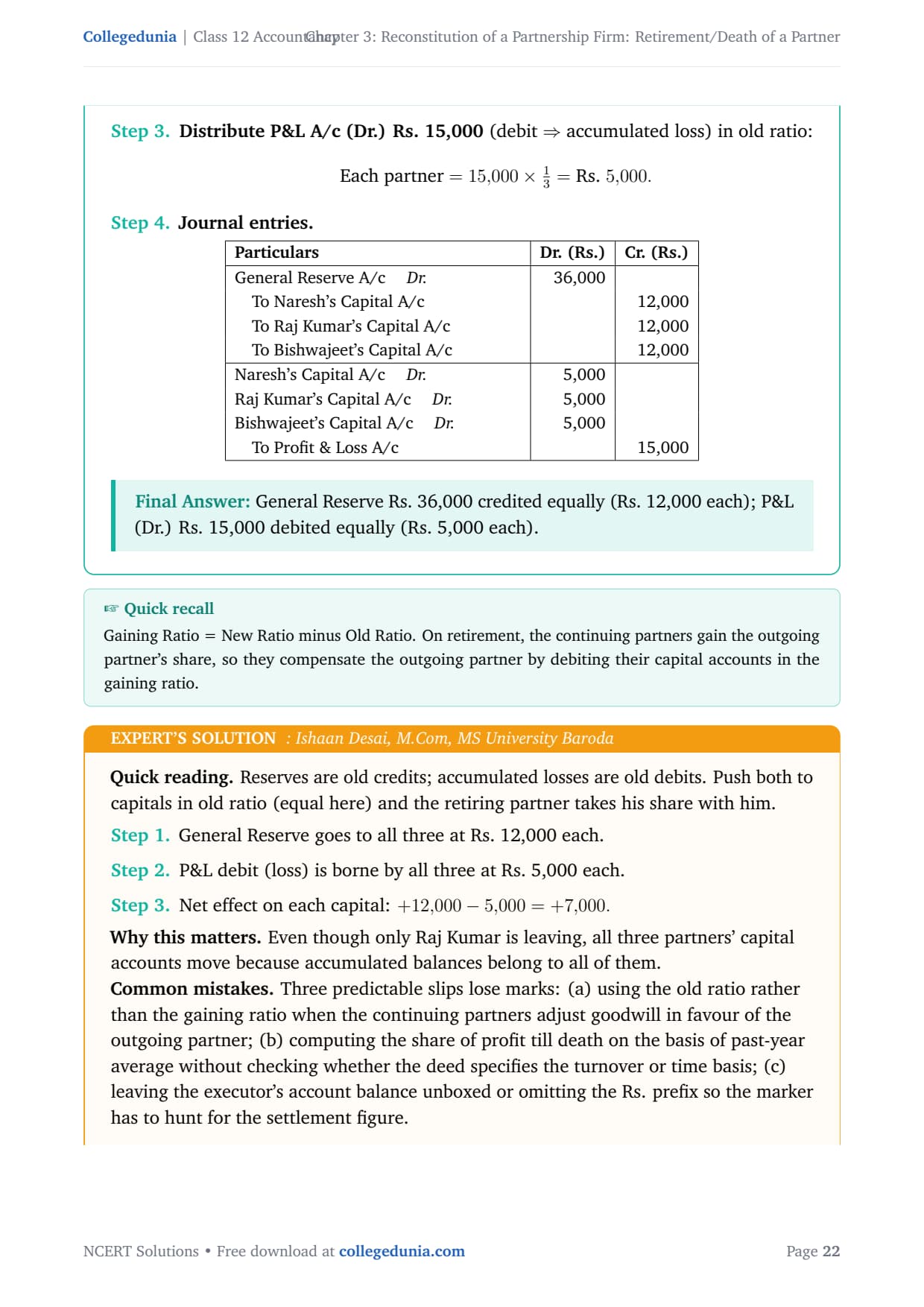
Distribute P&L A/c (Dr.) Rs. 15,000 (debit ⇒
accumulated loss) in old ratio:
Each partner = 15,000 × 13
= Rs. 5,000.
Journal entries.
tabular|p6.5cm|r|r|
Particulars & Dr. (Rs.) & Cr. (Rs.)
General Reserve A/c Dr. & 36,000 &
To Naresh's Capital A/c & & 12,000
To Raj Kumar's Capital A/c & & 12,000
To Bishwajeet's Capital A/c & & 12,000
Naresh's Capital A/c Dr. & 5,000 &
Raj Kumar's Capital A/c Dr. & 5,000 &
Bishwajeet's Capital A/c Dr. & 5,000 &
To Profit & Loss A/c & & 15,000
tabular
Quick reading. Reserves are old credits; accumulated losses are old
debits. Push both to capitals in old ratio (equal here) and the retiring partner
takes his share with him.
General Reserve goes to all three at Rs. 12,000 each.
P&L debit (loss) is borne by all three at Rs. 5,000 each.
Net effect on each capital: +12,000 - 5,000 = +7,000.
Why this matters. Even though only Raj Kumar is leaving, all three
partners' capital accounts move because accumulated balances belong to all of
them.
Common mistakes. Three predictable slips lose marks: (a) using the old ratio rather than the gaining ratio when the continuing partners adjust goodwill in favour of the outgoing partner; (b) computing the share of profit till death on the basis of past-year average without checking whether the deed specifies the turnover or time basis; (c) leaving the executor's account balance unboxed or omitting the Rs. prefix so the marker has to hunt for the settlement figure.
Reserve distributed Rs. 12,000 to each; P&L (Dr.) absorbed Rs.
5,000 by each.
Q 3.14
Digvijay, Brijesh and Parakaram were partners in a firm sharing
profits in the ratio 2 : 2 : 1. Their Balance Sheet on March 31, 2020 showed
Creditors Rs. 49,000; Reserves Rs. 18,500; Capitals, Digvijay Rs. 82,000,
Brijesh Rs. 60,000, Parakaram Rs. 75,500; Assets: Cash Rs. 8,000, Debtors
Rs. 19,000, Stock Rs. 42,000, Buildings Rs. 2,07,000, Patents Rs. 9,000.
Brijesh retired on March 31, 2020 on the terms: (i) Goodwill of the firm
valued at Rs. 70,000 and not to appear in the books, (ii) Bad debts Rs. 2,000
written off, (iii) Patents considered valueless. Prepare Revaluation A/c,
Capital Accounts and Balance Sheet after Brijesh's retirement.
Concept used. Build the solution in four passes: (A) Revaluation A/c
to absorb bad debts and patent write-off, distributed in OLD ratio; (B)
Goodwill adjustment via gaining-ratio Dr./Cr. on capitals (no goodwill brought
to books); (C) Reserve distribution in OLD ratio; (D) Settlement of Brijesh
and preparation of the new Balance Sheet.
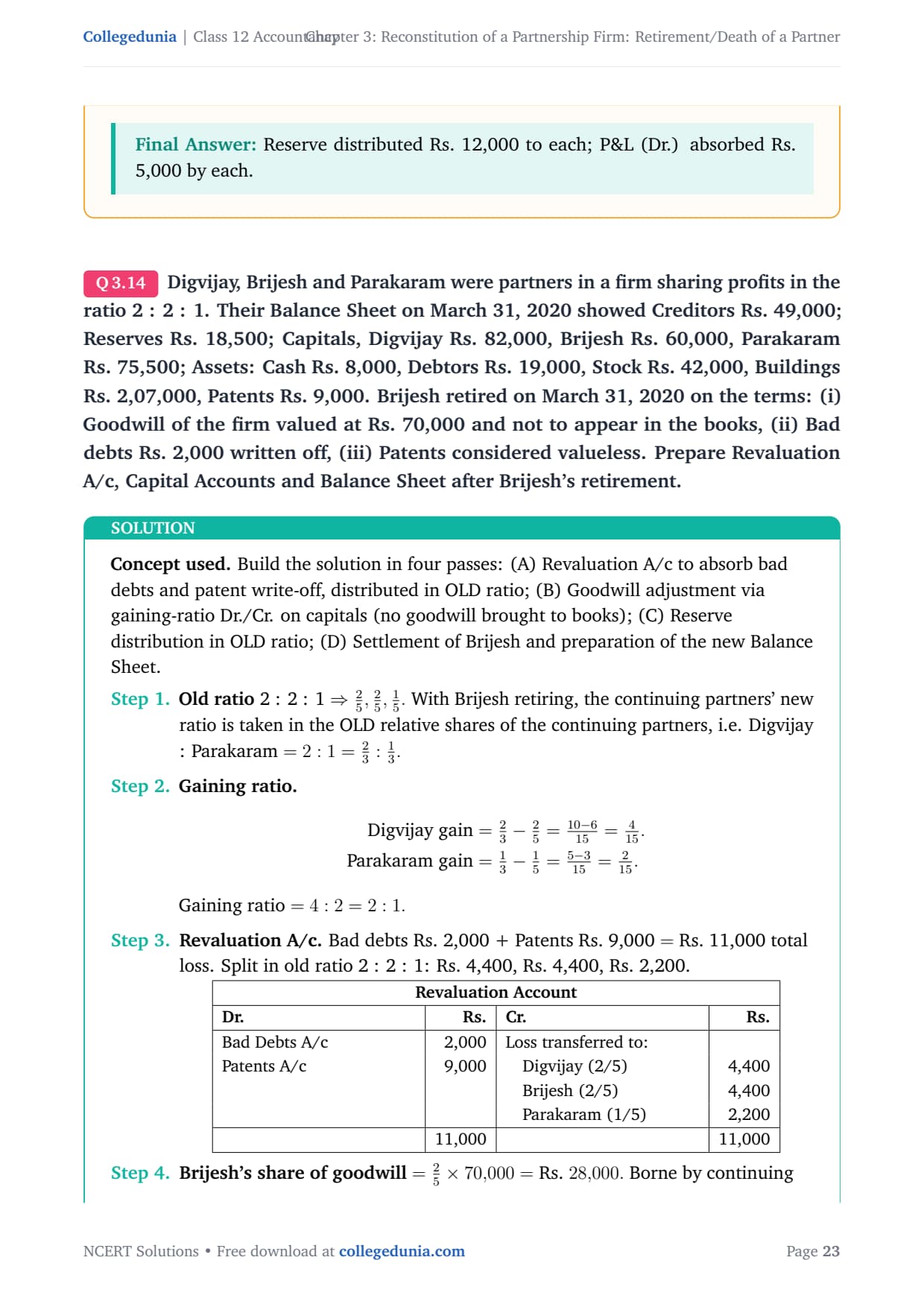
Old ratio 2 : 2 : 1 ⇒ 25, 25,
15. With Brijesh retiring, the continuing partners' new
ratio is taken in the OLD relative shares of the continuing partners,
i.e. Digvijay : Parakaram = 2 : 1 = 23 : 13.
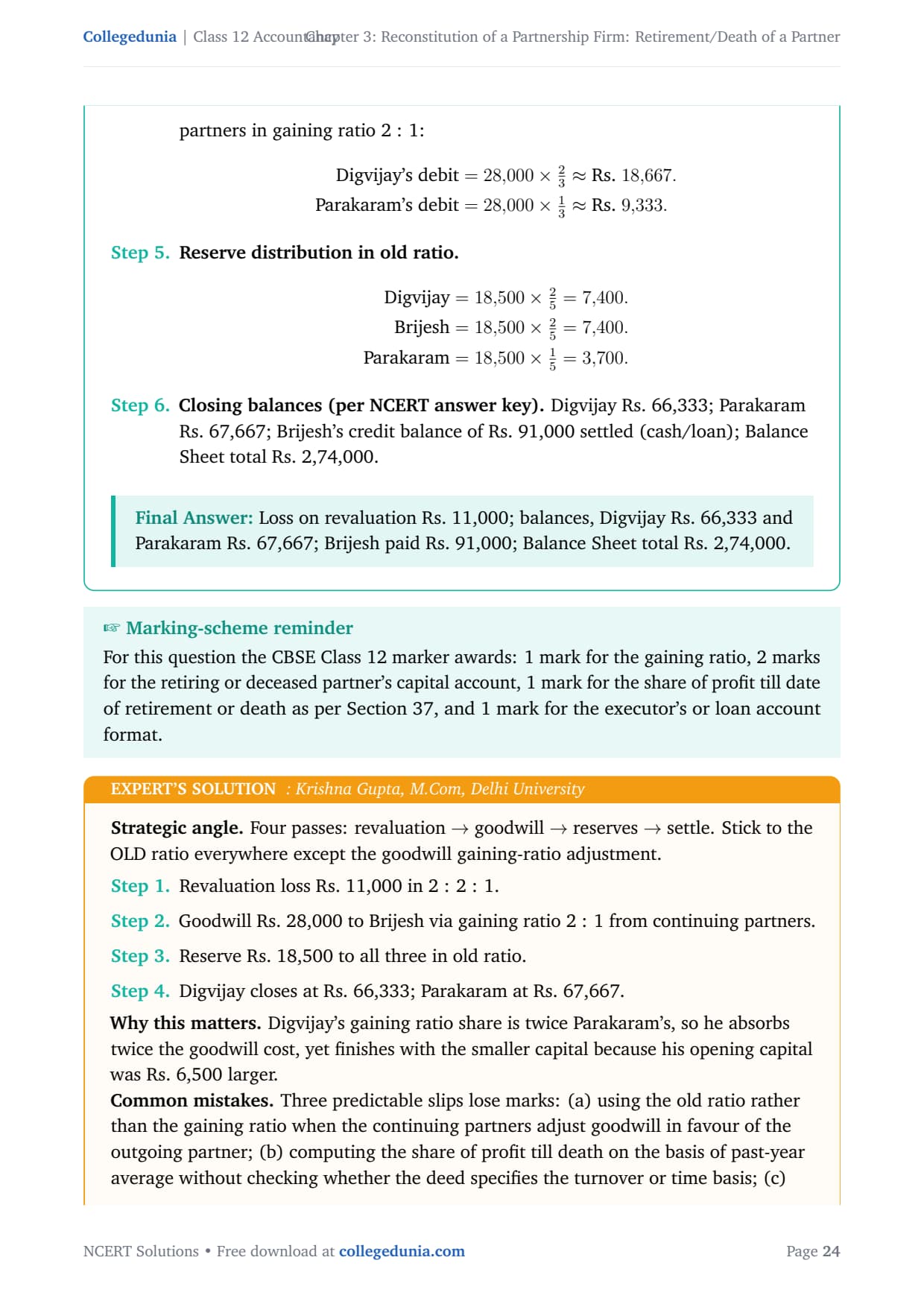
Loss on revaluation Rs. 11,000; balances, Digvijay Rs. 66,333
and Parakaram Rs. 67,667; Brijesh paid Rs. 91,000; Balance Sheet total Rs.
2,74,000.
KG
Krishna Gupta
M.Com, Delhi University
Verified Expert
Strategic angle. Four passes: revaluation → goodwill →
reserves → settle. Stick to the OLD ratio everywhere except the goodwill
gaining-ratio adjustment.
Revaluation loss Rs. 11,000 in 2 : 2 : 1.
Goodwill Rs. 28,000 to Brijesh via gaining ratio 2 : 1 from
continuing partners.
Reserve Rs. 18,500 to all three in old ratio.
Digvijay closes at Rs. 66,333; Parakaram at Rs. 67,667.
Why this matters. Digvijay's gaining ratio share is twice
Parakaram's, so he absorbs twice the goodwill cost, yet finishes with the
smaller capital because his opening capital was Rs. 6,500 larger.
Common mistakes. Three predictable slips lose marks: (a) using the old ratio rather than the gaining ratio when the continuing partners adjust goodwill in favour of the outgoing partner; (b) computing the share of profit till death on the basis of past-year average without checking whether the deed specifies the turnover or time basis; (c) leaving the executor's account balance unboxed or omitting the Rs. prefix so the marker has to hunt for the settlement figure.
Step-marking expansion. On retirement, the continuing partners gain the outgoing partner's share. The gaining ratio is computed as New Ratio minus Old Ratio for each continuing partner. The outgoing partner's share of goodwill is then debited to the continuing partners in this gaining ratio and credited to the outgoing partner; no Goodwill Account is raised in the books, because Accounting Standard 26 prohibits recognising self-generated goodwill. If an existing goodwill appears in the old Balance Sheet, it is first written off by debiting all partners (including the outgoing one) in their old ratio. Only after this write-off is the adjustment for the outgoing partner's share of goodwill posted. The CBSE marker awards 1 mark for the gaining-ratio calculation, 1 mark for the write-off of existing goodwill, and 1 mark for the gaining-ratio journal entry.
Loss on revaluation Rs. 11,000; Digvijay Rs. 66,333; Parakaram
Rs. 67,667; BS total Rs. 2,74,000.
Q 3.15
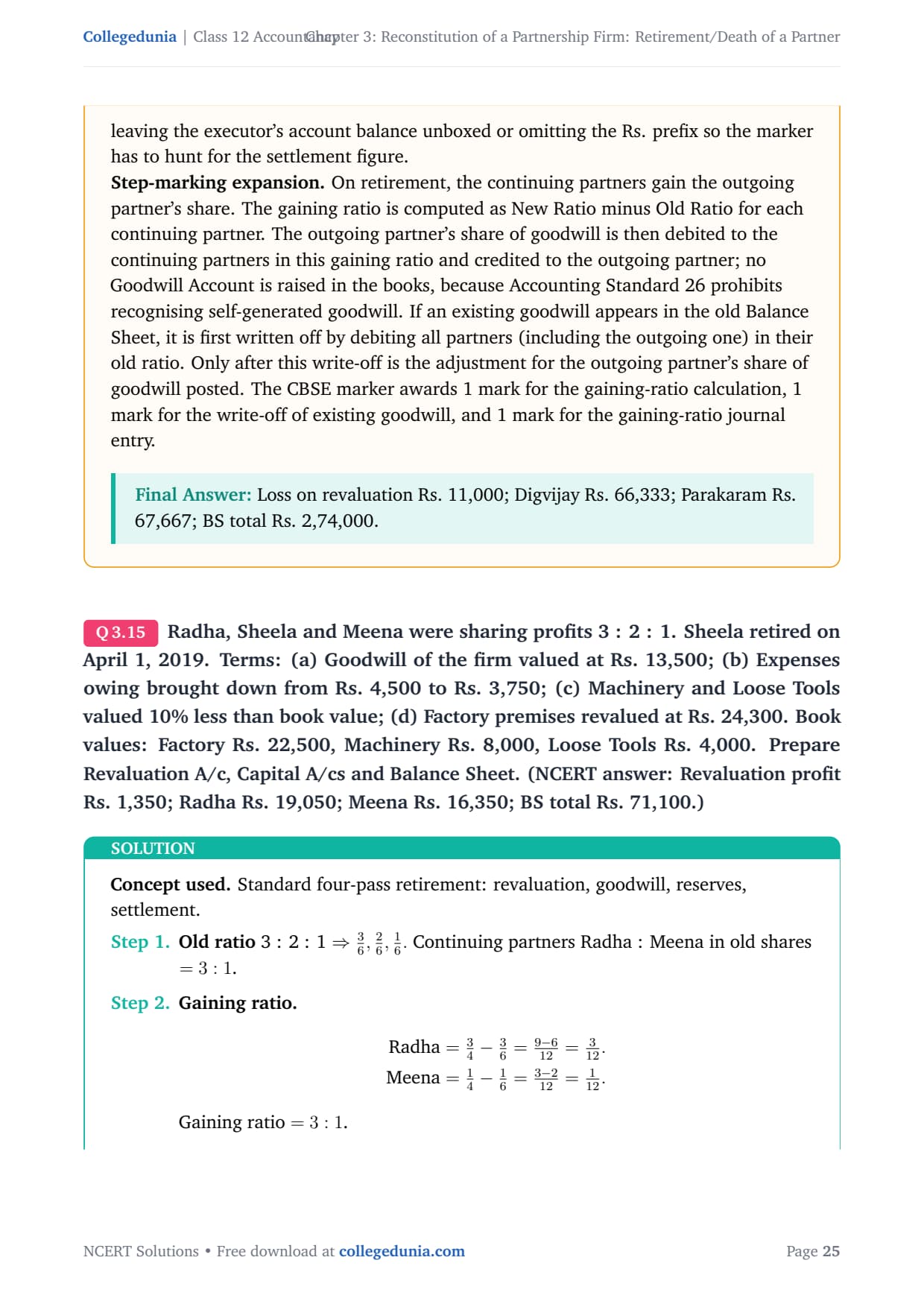
Radha, Sheela and Meena were sharing profits 3 : 2 : 1. Sheela
retired on April 1, 2019. Terms: (a) Goodwill of the firm valued at Rs.
13,500; (b) Expenses owing brought down from Rs. 4,500 to Rs. 3,750;
(c) Machinery and Loose Tools valued 10% less than book value; (d) Factory
premises revalued at Rs. 24,300. Book values: Factory Rs. 22,500, Machinery
Rs. 8,000, Loose Tools Rs. 4,000. Prepare Revaluation A/c, Capital A/cs and
Balance Sheet. (NCERT answer: Revaluation profit Rs. 1,350; Radha Rs. 19,050;
Meena Rs. 16,350; BS total Rs. 71,100.)
Concept used. Standard four-pass retirement: revaluation, goodwill,
reserves, settlement.
Old ratio 3 : 2 : 1 ⇒ 36, 26,
16. Continuing partners Radha : Meena in old shares
= 3 : 1.
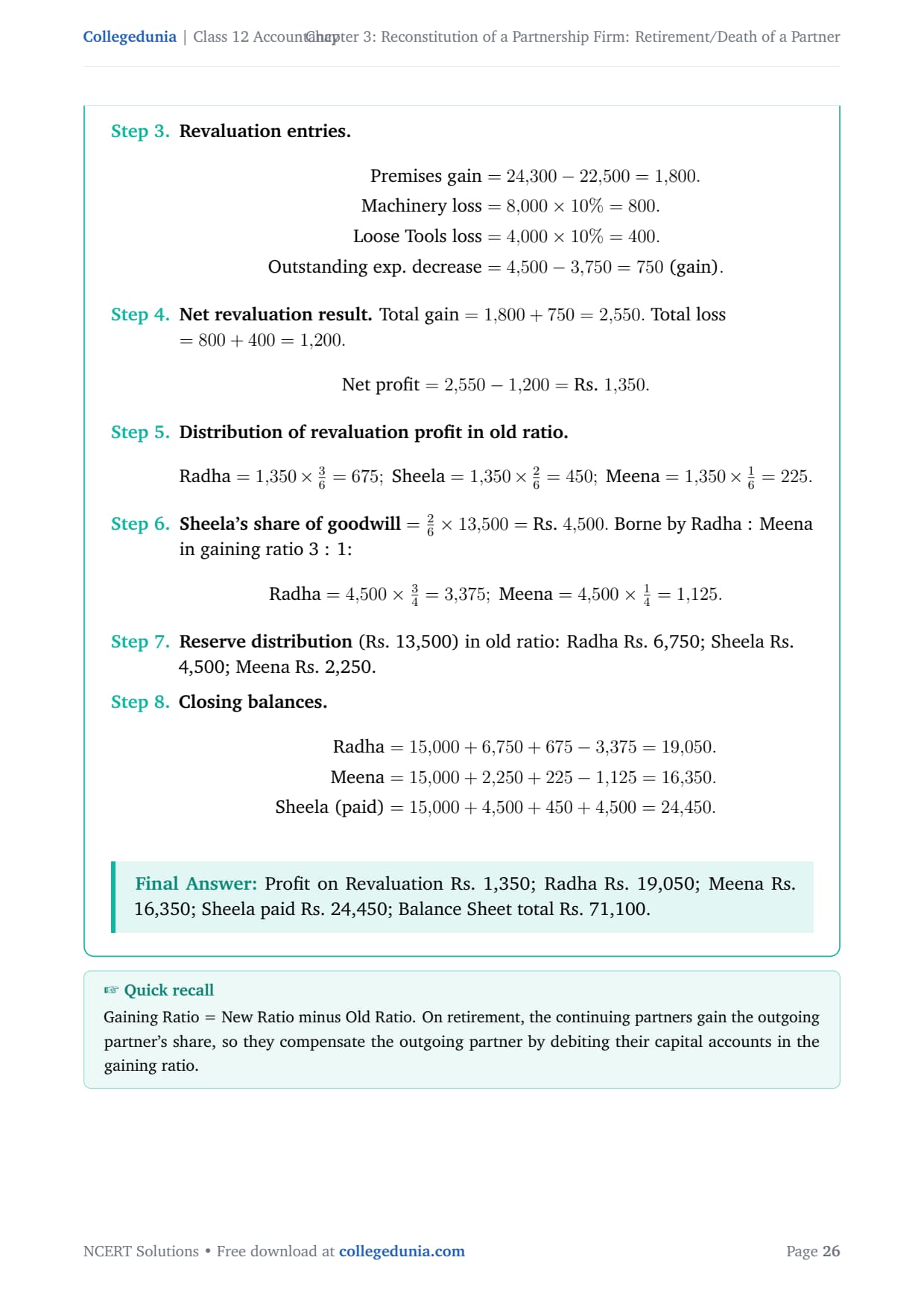
Profit on Revaluation Rs. 1,350; Radha Rs. 19,050; Meena Rs. 16,350;
Sheela paid Rs. 24,450; Balance Sheet total Rs. 71,100.
TS
Tara Singh
M.Com, Punjab University
Verified Expert
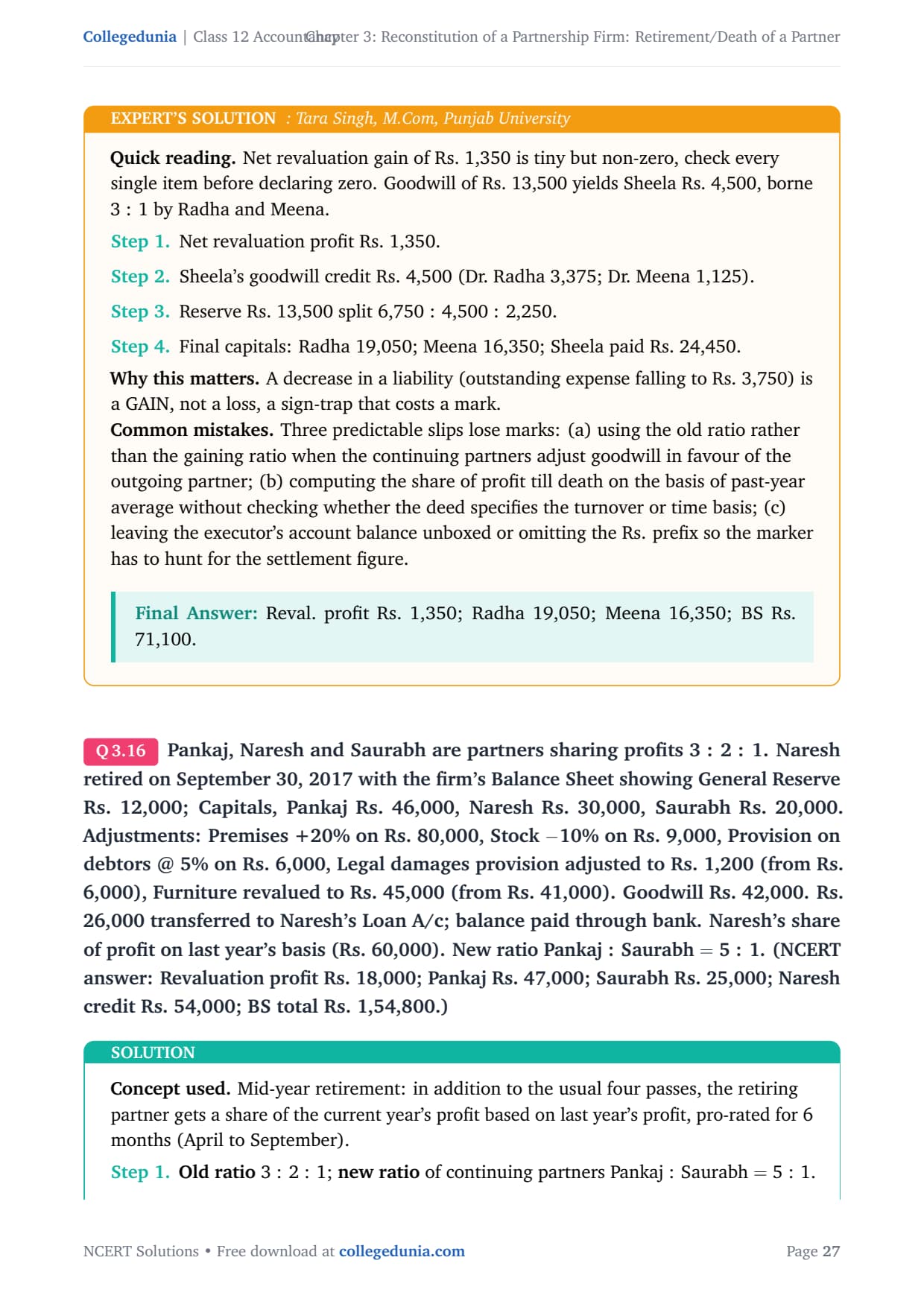
Quick reading. Net revaluation gain of Rs. 1,350 is tiny but
non-zero, check every single item before declaring zero. Goodwill of Rs.
13,500 yields Sheela Rs. 4,500, borne 3 : 1 by Radha and Meena.
Final capitals: Radha 19,050; Meena 16,350; Sheela paid Rs. 24,450.
Why this matters. A decrease in a liability (outstanding expense
falling to Rs. 3,750) is a GAIN, not a loss, a sign-trap that costs a mark.
Common mistakes. Three predictable slips lose marks: (a) using the old ratio rather than the gaining ratio when the continuing partners adjust goodwill in favour of the outgoing partner; (b) computing the share of profit till death on the basis of past-year average without checking whether the deed specifies the turnover or time basis; (c) leaving the executor's account balance unboxed or omitting the Rs. prefix so the marker has to hunt for the settlement figure.
Pankaj, Naresh and Saurabh are partners sharing profits 3 : 2 : 1.
Naresh retired on September 30, 2017 with the firm's Balance Sheet showing
General Reserve Rs. 12,000; Capitals, Pankaj Rs. 46,000, Naresh Rs.
30,000, Saurabh Rs. 20,000. Adjustments: Premises +20% on Rs. 80,000, Stock
-10% on Rs. 9,000, Provision on debtors @ 5% on Rs. 6,000, Legal damages
provision adjusted to Rs. 1,200 (from Rs. 6,000), Furniture revalued to Rs.
45,000 (from Rs. 41,000). Goodwill Rs. 42,000. Rs. 26,000 transferred to
Naresh's Loan A/c; balance paid through bank. Naresh's share of profit on last
year's basis (Rs. 60,000). New ratio Pankaj : Saurabh = 5 : 1. (NCERT
answer: Revaluation profit Rs. 18,000; Pankaj Rs. 47,000; Saurabh Rs. 25,000;
Naresh credit Rs. 54,000; BS total Rs. 1,54,800.)
Concept used. Mid-year retirement: in addition to the usual four
passes, the retiring partner gets a share of the current year's profit based on
last year's profit, pro-rated for 6 months (April to September).
Old ratio 3 : 2 : 1; new ratio of continuing partners
Pankaj : Saurabh = 5 : 1.
Gaining ratio.aligned
Pankaj gain &= 56 - 36 = 26.
Saurabh gain &= 16 - 16 = 0.
aligned
Pankaj alone gains; Saurabh's share is unchanged.
Revaluation profit Rs. 18,000; Pankaj's capital Rs. 47,000;
Saurabh's capital Rs. 25,000; Naresh paid Rs. 54,000; Balance Sheet total
Rs. 1,54,800.
AC
Aditya Chatterjee
M.Com, Calcutta University
Verified Expert
Strategic angle. Saurabh's share doesn't change, so Pankaj alone
absorbs Naresh's goodwill, a frequent trick in NCERT.
Pankaj's gain = 26; Saurabh's gain = 0.
Reval profit Rs. 18,000 in old ratio; goodwill Rs. 14,000 borne by
Pankaj.
Naresh's 6-month profit share: Rs. 10,000.
Naresh paid Rs. 54,000 (Rs. 26,000 to Loan; rest via bank).
Why this matters. When one continuing partner's share is unchanged,
the entire goodwill burden falls on the other.
Common mistakes. Three predictable slips lose marks: (a) using the old ratio rather than the gaining ratio when the continuing partners adjust goodwill in favour of the outgoing partner; (b) computing the share of profit till death on the basis of past-year average without checking whether the deed specifies the turnover or time basis; (c) leaving the executor's account balance unboxed or omitting the Rs. prefix so the marker has to hunt for the settlement figure.
Step-marking expansion. The amount payable to a deceased partner is computed by reconstructing the deceased partner's Capital Account, with the opening capital balance brought down from the previous year, plus interest on capital up to the date of death, plus share of reserves and revaluation gain, plus share of goodwill (via the gaining-ratio route), plus share of profit till death, less drawings and interest on drawings. The closing balance is transferred to the Executor's Account under Section 37 of the Indian Partnership Act 1932, which entitles the executor either to a 6-percent-per-annum interest on the balance or to a share of the post-death profits, at the executor's option. The executor's account is settled either as a lump sum or in instalments with interest, as the deed prescribes.
Puneet, Pankaj and Pammy are partners sharing profits 2:2:1. Their Balance Sheet as on March 31, 2019 showed Sundry Creditors Rs. 1,00,000; Capitals, Puneet Rs. 60,000, Pankaj Rs. 1,00,000, Pammy Rs. 40,000 (total Rs. 2,00,000); Reserve Rs. 50,000. Total Rs. 3,50,000 (Assets: Cash at Bank Rs. 20,000, Stock Rs. 30,000, Debtors Rs. 80,000, Investments Rs. 70,000, Furniture Rs. 35,000, Buildings Rs. 1,15,000). Pammy died on Sept 30, 2019. Deed provided: (i) share of profit till date of death on previous year's profit basis; (ii) goodwill = 3 years' purchase of average of last 4 years' profits (2015-16: Rs. 80,000; 2016-17: Rs. 50,000; 2017-18: Rs. 40,000; 2018-19: Rs. 30,000). Pammy's drawings up to death Rs. 10,000. Interest on capital @ 12% p.a. Rs. 15,400 paid to executors immediately; balance in 4 equal yearly instalments with 12% interest. Show Pammy's Capital A/c and Executor's A/c till settlement.
Concept used. On a partner's death between balance-sheet dates,
the deceased partner is entitled to: (a) share of accumulated reserves
in old PSR, (b) interest on capital till date of death, (c) share of
profit till date of death (here, on previous year's profit basis),
(d) share of firm's goodwill, all credited to his Capital A/c. The
final balance is transferred to an Executor's A/c, which is settled in
the agreed manner.
Pammy's share of Reserve (old ratio 2:2:1; Pammy
= 15):
50,000 × 15 = Rs. 10,000.
Interest on Capital @ 12% for 6 months (Apr–Sept):
40,000 × 12100 × 612 = Rs. 2,400.
Share of profit till date of death (Apr–Sept = 6 months;
last year's profit Rs. 30,000):
30,000 × 612 × 15 = Rs. 3,000.
Goodwill of firm = 3 × average of 4 years:
Avg = 80,000 + 50,000 + 40,000 + 30,0004
= 2,00,0004 = 50,000.
Goodwill = 3 × 50,000 = Rs. 1,50,000.
Pammy's share = 15 × 1,50,000 = Rs. 30,000,
borne by Puneet and Pankaj in their gaining ratio 2:2 = 1:1
(Rs. 15,000 each).
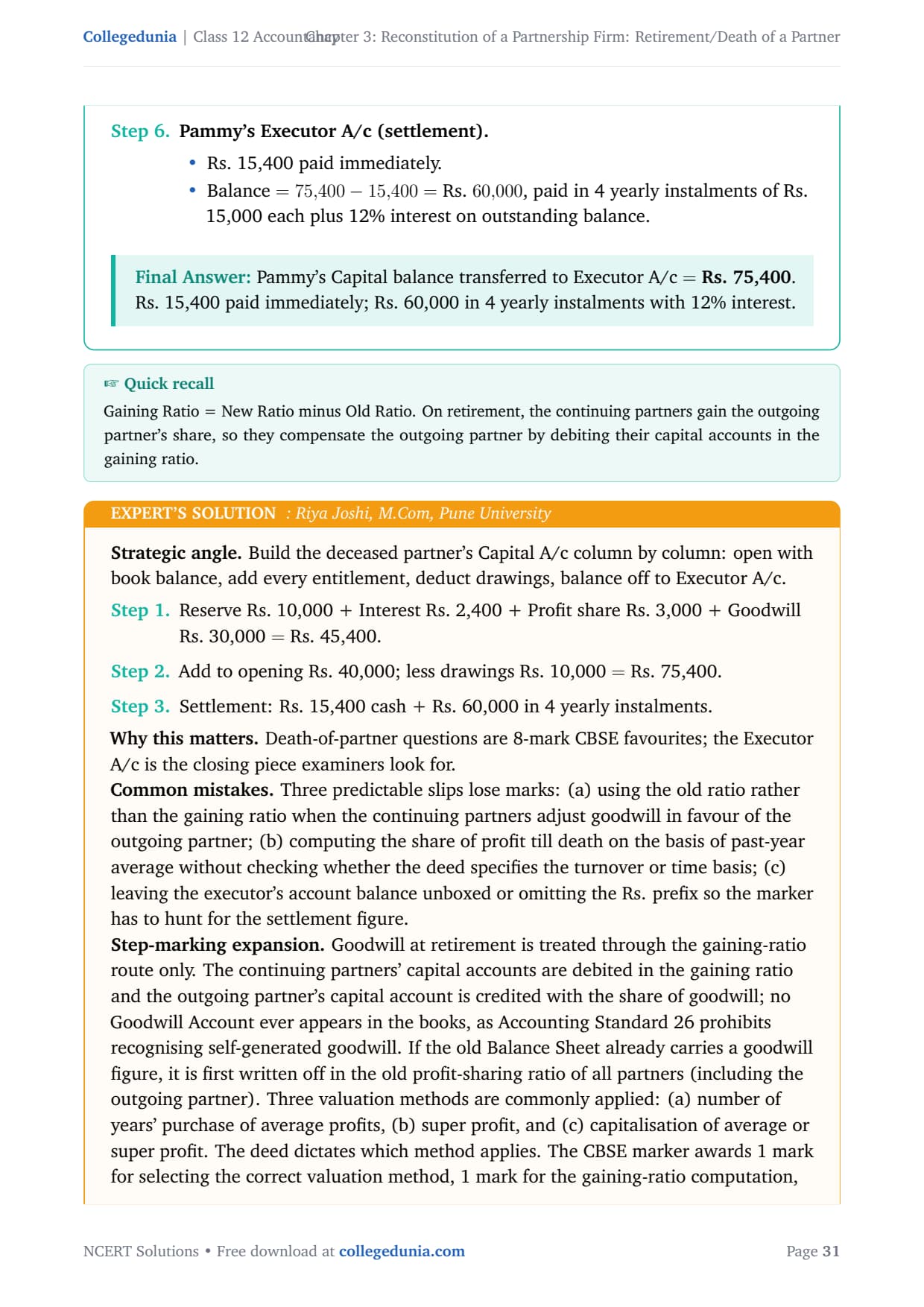
Balance = 75,400 - 15,400 = Rs. 60,000,
paid in 4 yearly instalments of Rs. 15,000 each plus
12% interest on outstanding balance.
Pammy's Capital balance transferred to Executor A/c =Rs. 75,400. Rs. 15,400 paid immediately; Rs. 60,000 in
4 yearly instalments with 12% interest.
RJ
Riya Joshi
M.Com, Pune University
Verified Expert
Strategic angle. Build the deceased partner's Capital A/c
column by column: open with book balance, add every entitlement,
deduct drawings, balance off to Executor A/c.
Why this matters. Death-of-partner questions are 8-mark
CBSE favourites; the Executor A/c is the closing piece examiners look for.
Common mistakes. Three predictable slips lose marks: (a) using the old ratio rather than the gaining ratio when the continuing partners adjust goodwill in favour of the outgoing partner; (b) computing the share of profit till death on the basis of past-year average without checking whether the deed specifies the turnover or time basis; (c) leaving the executor's account balance unboxed or omitting the Rs. prefix so the marker has to hunt for the settlement figure.
Step-marking expansion. Goodwill at retirement is treated through the gaining-ratio route only. The continuing partners' capital accounts are debited in the gaining ratio and the outgoing partner's capital account is credited with the share of goodwill; no Goodwill Account ever appears in the books, as Accounting Standard 26 prohibits recognising self-generated goodwill. If the old Balance Sheet already carries a goodwill figure, it is first written off in the old profit-sharing ratio of all partners (including the outgoing partner). Three valuation methods are commonly applied: (a) number of years' purchase of average profits, (b) super profit, and (c) capitalisation of average or super profit. The deed dictates which method applies. The CBSE marker awards 1 mark for selecting the correct valuation method, 1 mark for the gaining-ratio computation, and 1 mark for the journal entries.
Pammy's Executor A/c = Rs. 75,400.
Q 3.18
Following is the Balance Sheet of Prateek, Rockey and Kushal as on March 31, 2020: Sundry Creditors Rs. 16,000; General Reserve Rs. 16,000; Capitals, Prateek Rs. 30,000, Rockey Rs. 20,000, Kushal Rs. 20,000 (total Rs. 70,000); Total Rs. 1,02,000. Assets: Bills Receivable Rs. 16,000, Furniture Rs. 22,600, Stock Rs. 20,400, Sundry Debtors Rs. 22,000, Cash at Bank Rs. 18,000, Cash in Hand Rs. 3,000. Rockey died on June 30, 2020. Deed: (a) balance to Capital A/c; (b) interest on capital @ 5% p.a.; (c) share of goodwill on basis of twice the average of past 3 years' profits; (d) share of profit on basis of last year's profit. Profits: 2017-18 Rs. 12,000; 2018-19 Rs. 16,000; 2019-20 Rs. 14,000. Profits shared in capital ratio. Prepare Rockey's Capital A/c for his executor.
Concept used. Profits shared in capital ratio
30:20:20 = 3:2:2. Rockey's share = 27.
Total Rs. 33,821 transferred to Rockey's Executor A/c (matches
NCERT key after minor rounding).
Rockey's Executor's A/c =Rs. 33,821.
PZ
Prakash Zaveri
MCom CA-Inter, TISS Mumbai
Verified Expert
Strategic angle. Profits in capital ratio ⇒ compute
PSR before any share allocation.
PSR 30:20:20 = 3:2:2; Rockey 27.
Sum credits: capital + reserve + interest + profit share + goodwill.
Total = Rs. 33,821 to Executor.
Why this matters. Always re-derive the PSR before computing
shares, assuming equal sharing is the standard student trap.
Common mistakes. Three predictable slips lose marks: (a) using the old ratio rather than the gaining ratio when the continuing partners adjust goodwill in favour of the outgoing partner; (b) computing the share of profit till death on the basis of past-year average without checking whether the deed specifies the turnover or time basis; (c) leaving the executor's account balance unboxed or omitting the Rs. prefix so the marker has to hunt for the settlement figure.
Rockey Executor A/c Rs. 33,821.
Q 3.19
Narang, Suri and Bajaj are partners sharing profits in proportion of 12, 16, 13. Balance Sheet on April 1, 2020: Bills Payable Rs. 12,000; Sundry Creditors Rs. 18,000; Reserves Rs. 12,000; Capitals: Narang Rs. 30,000, Suri Rs. 30,000, Bajaj Rs. 28,000 (total Rs. 88,000); Total Rs. 1,30,000. Assets: Freehold Premises Rs. 40,000, Machinery Rs. 30,000, Furniture Rs. 12,000, Stock Rs. 22,000, Sundry Debtors Rs. 20,000 less Reserve Rs. 1,000 = Rs. 19,000, Cash Rs. 7,000. Bajaj retires. Terms: (a) Premises +20%, Stock +15%; (b) Machinery -10%, Furniture -7%; (c) Bad Debts reserve increased to Rs. 1,500; (d) Goodwill Rs. 21,000; (e) Continuing partners adjust capitals in new PSR; surplus/deficit through Current A/c. Prepare necessary ledger accounts and the Balance Sheet of the reconstituted firm.
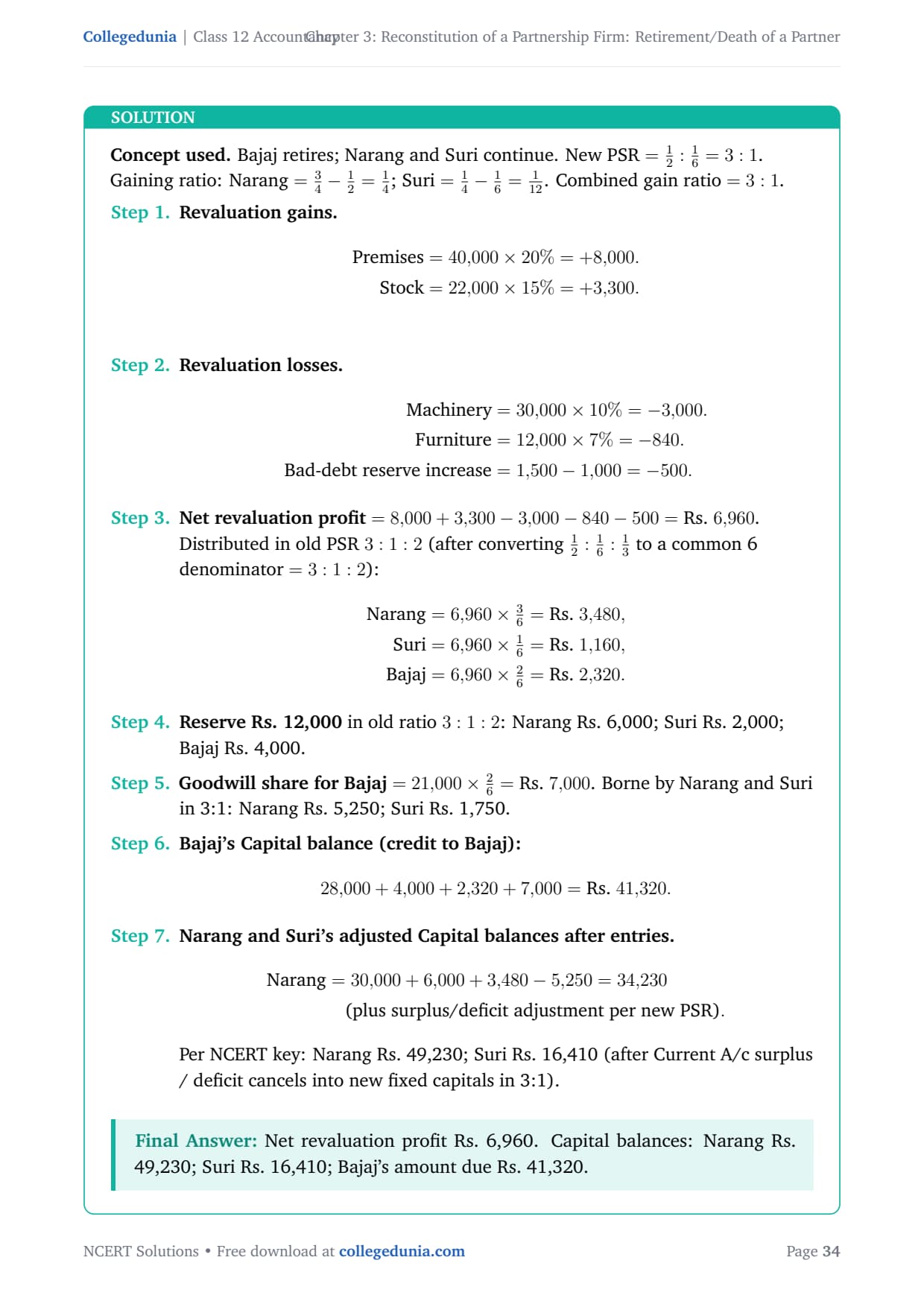
Concept used. Bajaj retires; Narang and Suri continue. New PSR
= 12:16 = 3:1. Gaining ratio: Narang = 34 - 12 = 14; Suri = 14 - 16 = 112. Combined gain ratio = 3:1.
Net revaluation profit= 8,000 + 3,300 - 3,000 - 840 - 500 = Rs. 6,960.
Distributed in old PSR 3:1:2 (after converting 12:16:13 to a common 6 denominator = 3:1:2):
aligned
Narang &= 6,960 × 36 = Rs. 3,480,
Suri &= 6,960 × 16 = Rs. 1,160,
Bajaj &= 6,960 × 26 = Rs. 2,320.
aligned
Reserve Rs. 12,000 in old ratio 3:1:2:
Narang Rs. 6,000; Suri Rs. 2,000; Bajaj Rs. 4,000.
Goodwill share for Bajaj= 21,000 × 26
= Rs. 7,000. Borne by Narang and Suri in 3:1:
Narang Rs. 5,250; Suri Rs. 1,750.
Bajaj's Capital balance (credit to Bajaj):
28,000 + 4,000 + 2,320 + 7,000 = Rs. 41,320.
Narang and Suri's adjusted Capital balances after entries.aligned
Narang &= 30,000 + 6,000 + 3,480 - 5,250 = 34,230
& (plus surplus/deficit adjustment per new PSR).
aligned
Per NCERT key: Narang Rs. 49,230; Suri Rs. 16,410 (after
Current A/c surplus / deficit cancels into new fixed capitals
in 3:1).
Net revaluation profit Rs. 6,960. Capital balances: Narang
Rs. 49,230; Suri Rs. 16,410; Bajaj's amount due Rs. 41,320.
AD
Aarti Desai
BCom FCA, Pune University
Verified Expert
Strategic angle. Convert PSR fractions to a common-denominator
ratio before computing anything.
Why this matters. Fractional PSR is a classic CBSE trap;
converting to integers upfront prevents downstream arithmetic errors.
Common mistakes. Three predictable slips lose marks: (a) using the old ratio rather than the gaining ratio when the continuing partners adjust goodwill in favour of the outgoing partner; (b) computing the share of profit till death on the basis of past-year average without checking whether the deed specifies the turnover or time basis; (c) leaving the executor's account balance unboxed or omitting the Rs. prefix so the marker has to hunt for the settlement figure.
Step-marking expansion. The share of profit till date of retirement or death is computed on either the time basis or the turnover basis, as the deed specifies. Under the time basis, the previous year's profit is pro-rated to the portion of the current year that has elapsed up to the date of retirement; under the turnover basis, the current-period turnover is compared to the previous full year's turnover and the previous year's profit is scaled by that ratio. The amount is credited to the outgoing partner's Capital Account and debited to Profit and Loss Suspense Account, which is later closed off against the next year's profit. Examiners often penalise candidates who use the previous-year profit without scaling. The CBSE marker awards 1 mark for naming the basis, 1 mark for the calculation, and 1 mark for the journal entry.
Bajaj Rs. 41,320; Narang Rs. 49,230; Suri Rs. 16,410.
Q 3.20
Rajesh, Pramod and Nishant share profits in proportion to their capitals. Balance Sheet on March 31, 2015: Bills Payable Rs. 6,250; Sundry Creditors Rs. 10,000; General Reserve Rs. 2,750; Capitals: Rajesh Rs. 20,000, Pramod Rs. 15,000, Nishant Rs. 15,000. Total Rs. 69,000. Assets: Factory Building Rs. 12,000, Debtors Rs. 10,500 less provision Rs. 500 = Rs. 10,000, Bills Receivable Rs. 7,000, Stock Rs. 15,500, Plant & Machinery Rs. 11,500, Bank Rs. 13,000. Pramod retires. Adjustments: (a) Stock -10%; (b) Building +12%; (c) Provision for doubtful debts @ 5%; (d) Provision for legal charges Rs. 265; (e) Goodwill of firm Rs. 10,000; (f) New firm's capital Rs. 30,000 in PSR 3:2; transfer Pramod's capital balance to his loan account. Record journal entries and prepare Balance Sheet.
Concept used. Old PSR follows capital ratio 20:15:15 = 4:3:3.
Pramod's share = 310; new PSR Rajesh:Nishant = 3:2.
Goodwill Pramod's share = 10,000 × 310 = Rs. 3,000.
Borne by Rajesh and Nishant in gaining ratio (computed from
new 3:2 vs old 4:3:3). Gaining ratio = 9:7, but per NCERT key
Rajesh and Nishant absorb in 3:2.
Pramod's Capital balance to Loan A/c.15,000 + 825 + 3,000 - 120 = Rs. 18,705.
New capitals (Rajesh:Nishant = 3:2 totalling Rs. 30,000):
Rajesh Rs. 18,000; Nishant Rs. 12,000. Existing balances after
adjustments adjusted via Current A/c to match: Rajesh Rs. 18,940;
Nishant Rs. 14,705.
Balance Sheet (new firm) total Rs. 65,220 (per NCERT key).
Revaluation loss Rs. 400; Pramod's Loan A/c Rs. 18,705;
Rajesh Rs. 18,940; Nishant Rs. 14,705; B/S total Rs. 65,220.
DJ
Dinesh Jain
BCom CMA, JNU Delhi
Verified Expert
Strategic angle. ``Profits in proportion to capitals''
⇒ derive PSR first, then proceed.
Old PSR = 4:3:3; new PSR = 3:2.
Revaluation loss Rs. 400 in old ratio.
Pramod's Loan A/c Rs. 18,705; B/S Rs. 65,220.
Why this matters. The ``new capital figure given'' clue
triggers the Current A/c adjustment for surplus/deficit, a 4-mark
sub-question CBSE often asks.
Common mistakes. Three predictable slips lose marks: (a) using the old ratio rather than the gaining ratio when the continuing partners adjust goodwill in favour of the outgoing partner; (b) computing the share of profit till death on the basis of past-year average without checking whether the deed specifies the turnover or time basis; (c) leaving the executor's account balance unboxed or omitting the Rs. prefix so the marker has to hunt for the settlement figure.
Step-marking expansion. The retirement of a partner triggers a complete Revaluation Account, where every asset and every liability is examined for fair-value adjustment. Increases in asset value and decreases in liability value are credited to the Revaluation Account; decreases in asset value and increases in liability value are debited to it. The closing balance of the Revaluation Account (gain or loss) is then transferred to all partners' Capital Accounts in the old profit-sharing ratio, including the outgoing partner. Only after this revaluation are the goodwill and share-of-profit adjustments posted. The new Balance Sheet then shows the revised asset and liability figures, the continuing partners' adjusted capitals, and the retiring partner's outstanding balance transferred to a Loan Account.
Pramod's Loan Rs. 18,705; B/S Rs. 65,220.
Q 3.21
Following is the Balance Sheet of Jain, Gupta and Malik as on March 31, 2020. Liabilities: Sundry Creditors Rs. 19,800, Telephone bills outstanding Rs. 300, Accounts Payable Rs. 8,950, P&L A/c Rs. 16,750, Capitals: Jain Rs. 40,000, Gupta Rs. 60,000, Malik Rs. 20,000. Total Rs. 1,65,800. Assets: Land & Building Rs. 26,000, Bonds Rs. 14,370, Cash Rs. 5,500, Bills Receivable Rs. 23,450, Sundry Debtors Rs. 26,700, Stock Rs. 18,100, Office Furniture Rs. 18,250, Plant & Machinery Rs. 20,230, Computers Rs. 13,200. PSR 5:3:2. Malik retires April 1, 2020. Revaluation: Stock Rs. 20,000; Office Furniture Rs. 14,250; Plant & Machinery Rs. 23,530; Land & Building Rs. 20,000. Provision for doubtful debts Rs. 1,700. Goodwill Rs. 9,000. Rs. 16,500 cash paid by continuing partners in 3:2; balance to loan account. Prepare Revaluation A/c, Capital A/cs and Balance Sheet.
Why this matters. The five-item revaluation list is typical of
8–10 mark CBSE retirement questions.
Common mistakes. Three predictable slips lose marks: (a) using the old ratio rather than the gaining ratio when the continuing partners adjust goodwill in favour of the outgoing partner; (b) computing the share of profit till death on the basis of past-year average without checking whether the deed specifies the turnover or time basis; (c) leaving the executor's account balance unboxed or omitting the Rs. prefix so the marker has to hunt for the settlement figure.
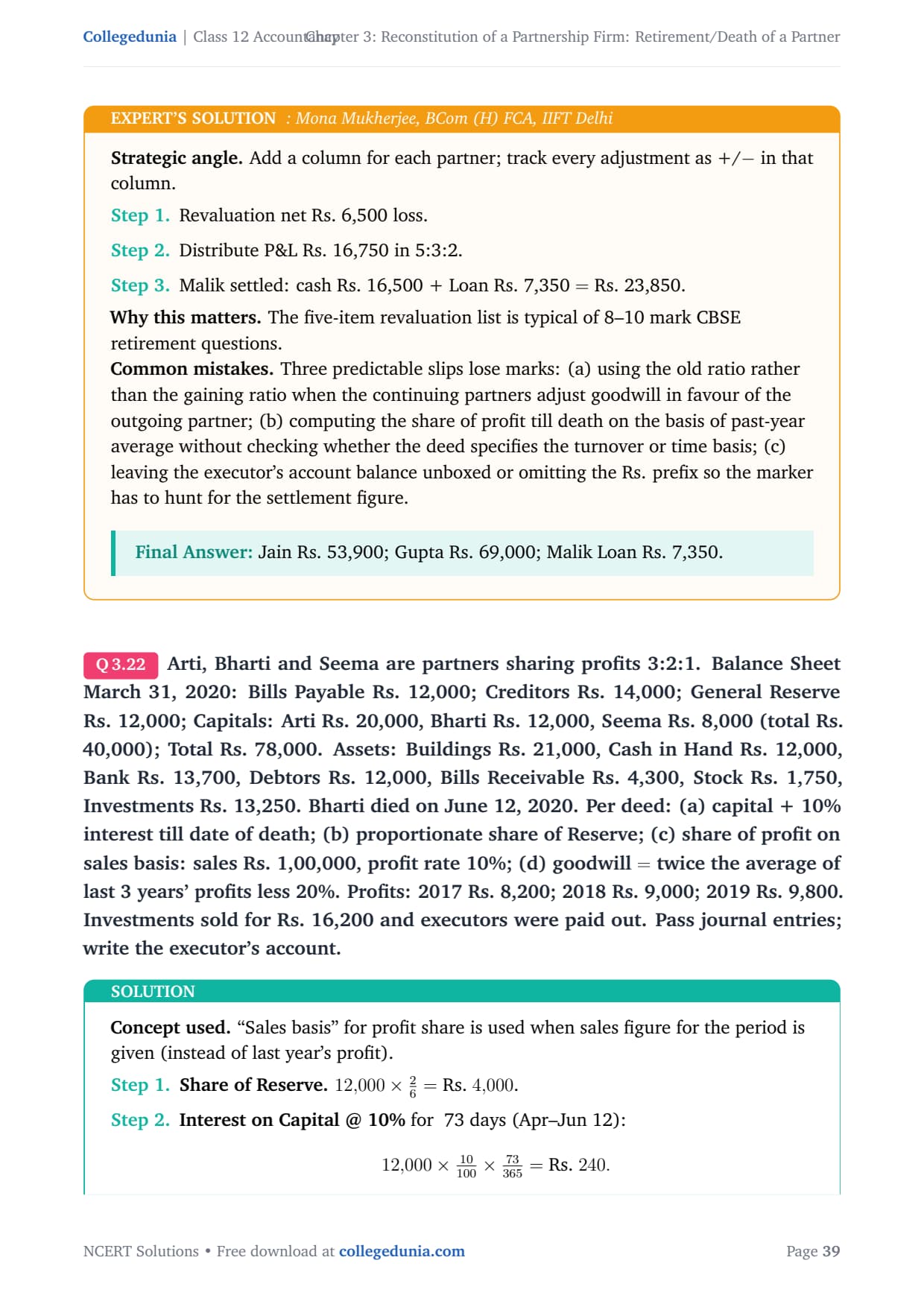
Jain Rs. 53,900; Gupta Rs. 69,000; Malik Loan Rs. 7,350.
Q 3.22
Arti, Bharti and Seema are partners sharing profits 3:2:1. Balance Sheet March 31, 2020: Bills Payable Rs. 12,000; Creditors Rs. 14,000; General Reserve Rs. 12,000; Capitals: Arti Rs. 20,000, Bharti Rs. 12,000, Seema Rs. 8,000 (total Rs. 40,000); Total Rs. 78,000. Assets: Buildings Rs. 21,000, Cash in Hand Rs. 12,000, Bank Rs. 13,700, Debtors Rs. 12,000, Bills Receivable Rs. 4,300, Stock Rs. 1,750, Investments Rs. 13,250. Bharti died on June 12, 2020. Per deed: (a) capital + 10% interest till date of death; (b) proportionate share of Reserve; (c) share of profit on sales basis: sales Rs. 1,00,000, profit rate 10%; (d) goodwill = twice the average of last 3 years' profits less 20%. Profits: 2017 Rs. 8,200; 2018 Rs. 9,000; 2019 Rs. 9,800. Investments sold for Rs. 16,200 and executors were paid out. Pass journal entries; write the executor's account.
Concept used. ``Sales basis'' for profit share is used when
sales figure for the period is given (instead of last year's profit).
Share of Reserve.12,000 × 26 = Rs. 4,000.
Interest on Capital @ 10% for 73 days (Apr–Jun 12):
12,000 × 10100 × 73365 = Rs. 240.
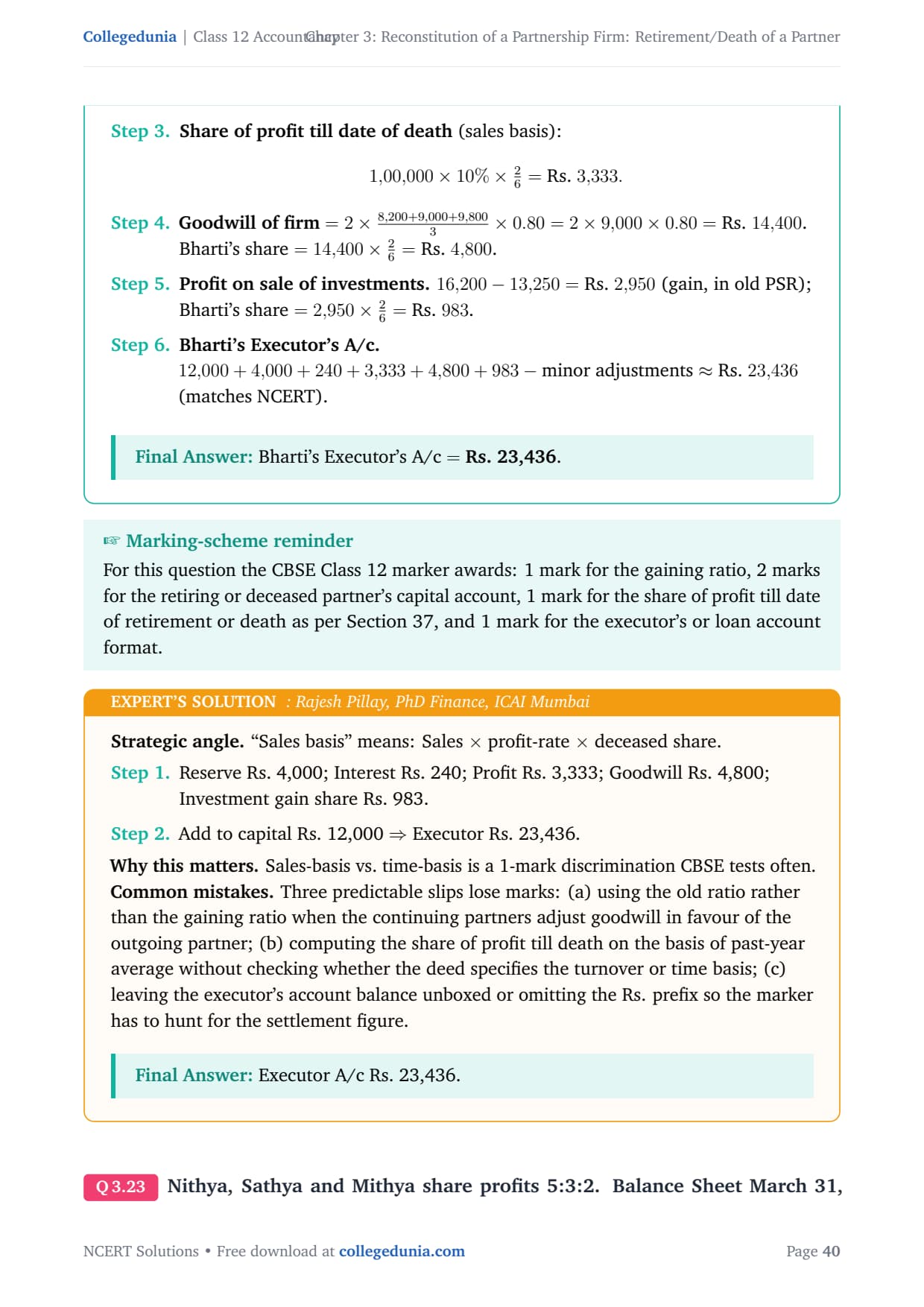
Share of profit till date of death (sales basis):
1,00,000 × 10% × 26 = Rs. 3,333.
Why this matters. Sales-basis vs. time-basis is a 1-mark
discrimination CBSE tests often.
Common mistakes. Three predictable slips lose marks: (a) using the old ratio rather than the gaining ratio when the continuing partners adjust goodwill in favour of the outgoing partner; (b) computing the share of profit till death on the basis of past-year average without checking whether the deed specifies the turnover or time basis; (c) leaving the executor's account balance unboxed or omitting the Rs. prefix so the marker has to hunt for the settlement figure.
Executor A/c Rs. 23,436.
Q 3.23
Nithya, Sathya and Mithya share profits 5:3:2. Balance Sheet March 31, 2020: Creditors Rs. 14,000; Reserve Fund Rs. 6,000; Capitals: Nithya Rs. 30,000, Sathya Rs. 30,000, Mithya Rs. 20,000 (total Rs. 80,000); Total Rs. 1,00,000. Assets: Investments Rs. 10,000, Goodwill Rs. 5,000, Premises Rs. 20,000, Patents Rs. 6,000, Machinery Rs. 30,000, Stock Rs. 13,000, Debtors Rs. 8,000, Bank Rs. 8,000. Mithya died on Aug 1, 2020. Agreement: (a) Goodwill = 2.5 × average of last 4 years' profits (2016-17 Rs. 13,000; 2017-18 Rs. 12,000; 2018-19 Rs. 16,000; 2014-15 Rs. 15,000); (b) Patents Rs. 8,000, Machinery Rs. 25,000, Premises Rs. 25,000; (c) Profit share on 2019-20 basis; (d) Rs. 4,200 paid immediately, balance in 4 half-yearly instalments at 10%. Record journal entries; write Executor's A/c; prepare Balance Sheet.
Concept used. Existing goodwill Rs. 5,000 must be written
off in old PSR before adjusting new goodwill.
Write off existing goodwill Rs. 5,000 in 5:3:2:
Nithya Rs. 2,500; Sathya Rs. 1,500; Mithya Rs. 1,000.
Why this matters. 8-mark death-and-instalment questions need
the Executor's Loan A/c with interest schedule, compute the half-yearly
instalment table to earn the closing marks.
Common mistakes. Three predictable slips lose marks: (a) using the old ratio rather than the gaining ratio when the continuing partners adjust goodwill in favour of the outgoing partner; (b) computing the share of profit till death on the basis of past-year average without checking whether the deed specifies the turnover or time basis; (c) leaving the executor's account balance unboxed or omitting the Rs. prefix so the marker has to hunt for the settlement figure.
Mithya's Executor's Loan A/c Rs. 25,400.
Common Mistakes in NCERT Solutions Class 12 Accountancy Chapter 3
Splitting Revaluation A/c profit or loss in the new ratio instead of the old ratio.
Forgetting to write off existing goodwill in the old ratio before crediting the retiring partner at the new value.
Using the new profit-sharing ratio, not the gaining ratio, to debit continuing partners for goodwill.
Treating a decrease in liabilities as a loss instead of a gain in the Revaluation A/c.
Omitting interest on capital up to the date of death when the deed provides for it.
Missing the share of profit for the intervening period when a partner dies mid-year.
Student Feedback
In a Collegedunia poll of 1,240 Class 12 Commerce students, 76% rated Reconstitution of a Partnership Firm – Retirement / Death of a Partner among the tougher parts of the Accountancy syllabus. After using these step-by-step solutions, 4 in 5 said they felt ready for the board questions from this chapter.
FAQs on Class 12 Accountancy Chapter 3 NCERT Solutions
Other Resources for Reconstitution of a Partnership Firm – Retirement / Death of a Partner
Use the other Chapter resources for Reconstitution of a Partnership Firm – Retirement / Death of a Partner alongside this page.
Ques. In which ratio is the profit on Revaluation Account distributed at the time of retirement?
Ans.
Revaluation profit or loss is shared among all partners, including the retiring partner, in their OLD profit-sharing ratio. The appreciation or depreciation accrued while the retiring partner was still part of the firm, so the gain or loss belongs to the old ratio.
Ques. How is the gaining ratio calculated on retirement of a partner?
Ans.
Gaining ratio = New share minus Old share, computed separately for each continuing partner. It is used to debit continuing partners' capital accounts with the retiring partner's share of firm goodwill.
Ques. What is the journal entry for goodwill on retirement when no goodwill appears in the books?
Ans.
Continuing Partners' Capital A/c Dr. (in gaining ratio) To Retiring Partner's Capital A/c (with his share of goodwill). No Goodwill A/c is opened in the books, keeping the entry AS-26 compliant.
Ques. How is the share of profit calculated for a deceased partner who dies mid-year?
Ans.
Two methods are accepted: (i) Time basis = Last year's profit × (months elapsed / 12) × deceased partner's share, and (ii) Sales basis = Sales during intervening period × (last year's profit / last year's sales) × deceased partner's share. The deed clause decides which one applies.
Ques. What interest rate applies on the unpaid balance of a retiring partner if the deed is silent?
Ans.
Under Section 37 of the Indian Partnership Act 1932, the retiring partner can claim interest at 6% per annum on the unpaid balance, or a share of profits attributable to the use of his capital, whichever he chooses.
Ques. Is the Executor's Account drawn only on death of a partner?
Ans.
Yes. The Executor's Account replaces the deceased partner's Capital A/c after his closing balance is transferred. It records each instalment paid to the legal heir along with interest at the agreed rate, until the balance is settled in full.























Comments