The NCERT Solutions for Class 12 Biotechnology Chapter 13 Entrepreneurship cover all 21 exercise questions for the 2026-27 session. The chapter explains entrepreneurs, startup funding, biotech enterprise setup, IPR, patents and biopiracy. Use this page with the PDF when you want short NCERT keywords, then open the solved cards for fuller step-by-step answers.
Question count: 11 descriptive answers and 10 MCQs from the NCERT exercise.
Best for revision: startup funds, IPR types, patent criteria and TKDL.
PDF support: download the full solved PDF and revise offline before boards.
Student Pulse: In a Collegedunia poll of Class 12 students, most said this chapter becomes easier after making one page for funds, IPR and biopiracy examples.
Each answer in this Collegedunia NCERT solution set is checked against the 2026-27 NCERT Biotechnology chapter and written for board-style revision.
Entrepreneurship Class 12 Biotechnology Exercise Pattern
Entrepreneurship is a theory chapter, so most marks come from definitions, differences and short explanations. The MCQs test direct NCERT lines. Keep the funding sources and IPR list ready before you start the exercise.
Questions 1 to 11 need textbook keywords and short examples.
Questions 12 to 21 test MCQs from funding, patents, copyright and TKDL.
The safest revision order is entrepreneur basics, startup funds, biotech enterprise, IPR and biopiracy.
Biotech Enterprise Setup Steps Every Student Should Know
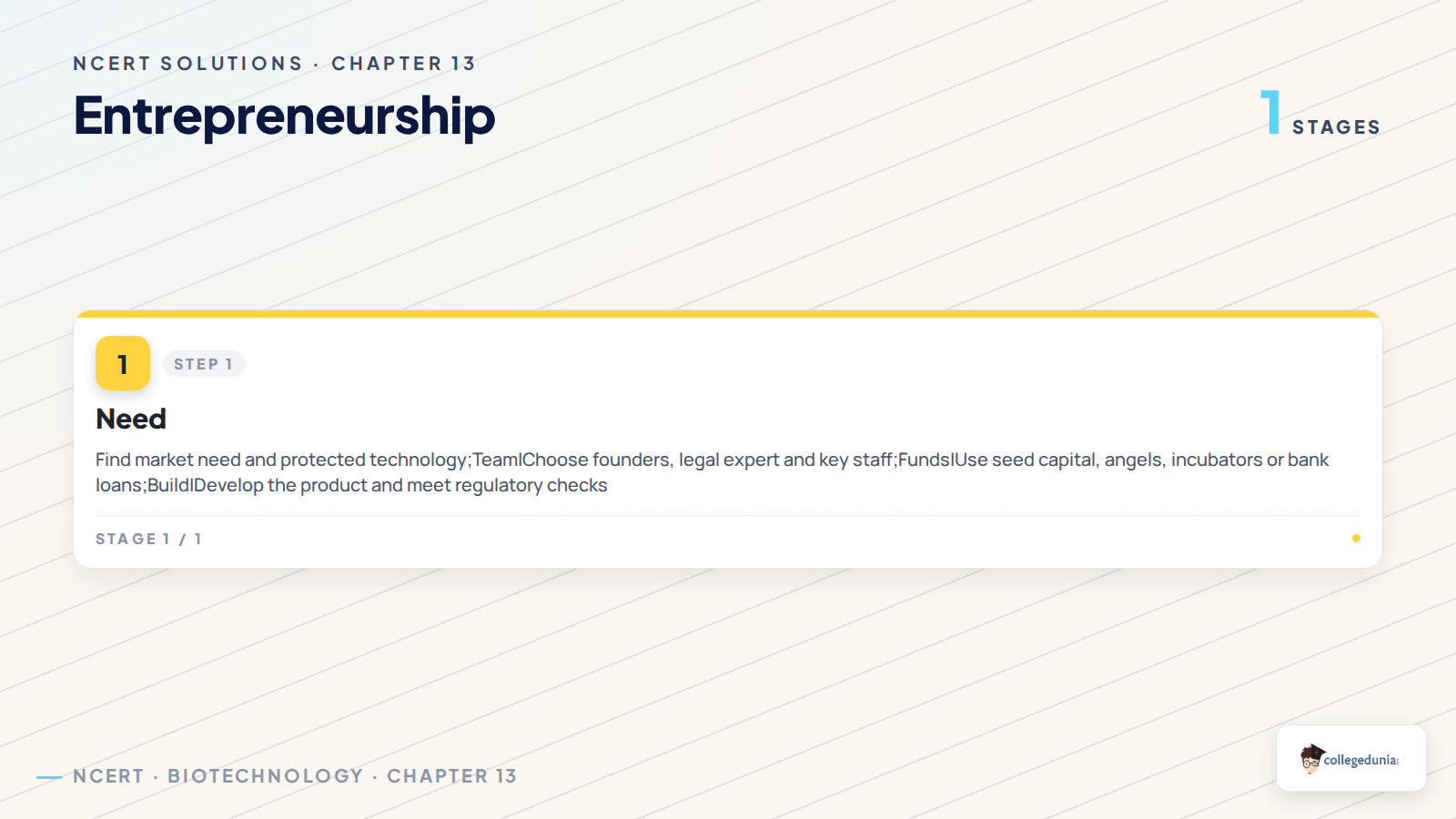
A biotechnology enterprise needs more planning than a normal small business. The founder must check the market need, protect the technology and arrange funds. Seed capital usually supports the first working stage.
Start with need assessment and protected technology.
Build a team with science, legal and business skills.
Use angels, incubators, grants, bank loans or venture capital.
Keep product development and regulatory checks on schedule.
Entrepreneur and Intrapreneur Difference for Boards
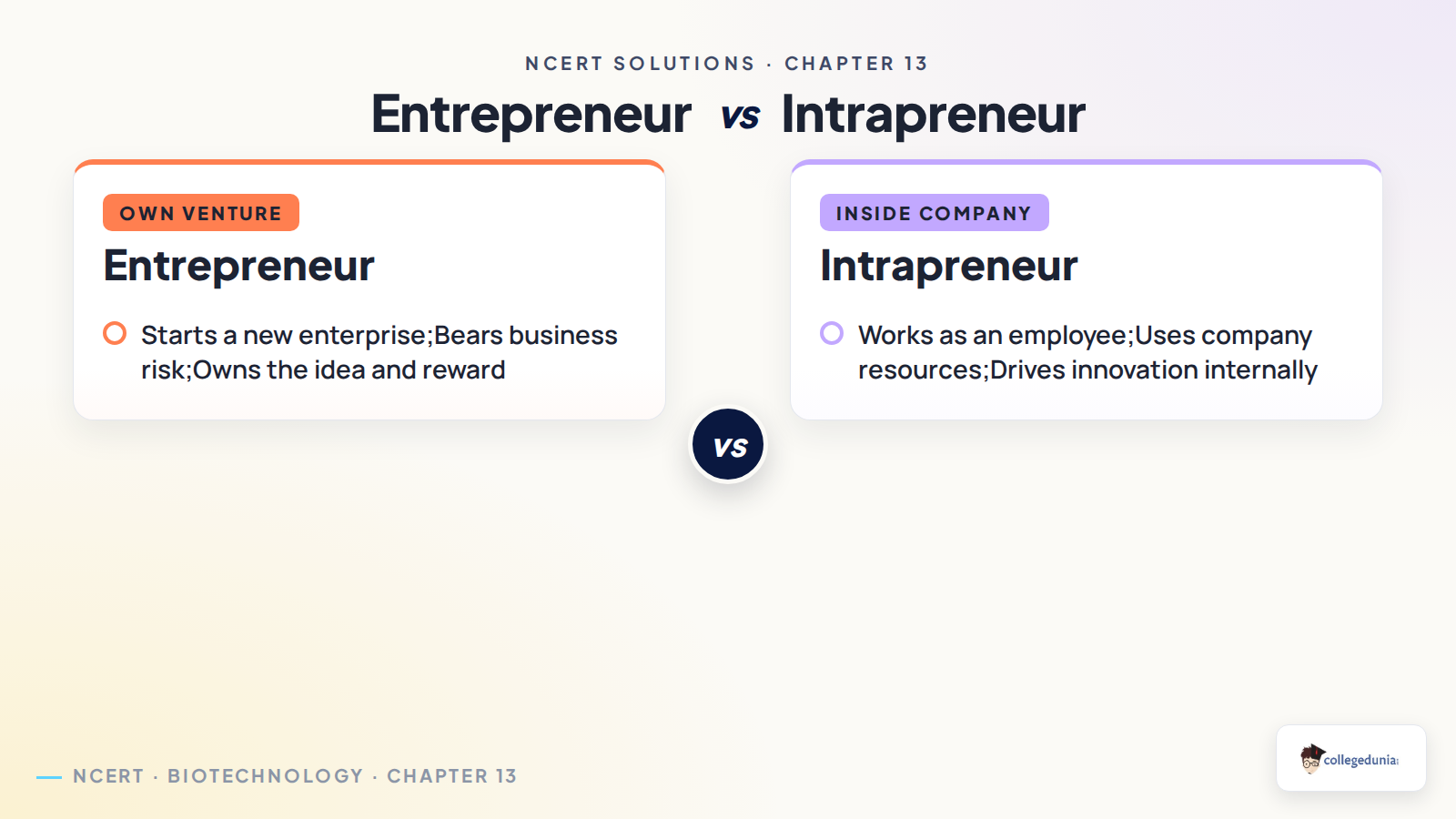
This is a common comparison question. An entrepreneur starts a new enterprise and bears risk. An intrapreneur works inside an existing organisation and builds new ideas there.
Point
Entrepreneur
Intrapreneur
Position
Owner or founder
Employee inside a firm
Risk
Bears business risk
Risk is shared by the organisation
Reward
Profit and ownership value
Salary, recognition or internal growth
IPR and Biopiracy Points in Entrepreneurship
IPR means legal rights over useful ideas, inventions and creative work. In biotechnology, it protects products, processes, plant varieties, brand names and trade secrets. TKDL is the key Indian example for stopping biopiracy.
Patent protects a new invention for a limited time.
Copyright protects original expression, not computer hardware.
Trademark protects brand identity.
Trade secret protects confidential business information.
Entrepreneurship MCQ Answer Key for Quick Revision
Question
Correct option
Why
12
(b) Equity
Angel investors usually take ownership-linked capital.
13
(c) To limit monopoly
A patent is temporary, so monopoly is not permanent.
14
(c) Fixed assets
Fixed assets are not a short-term working capital source.
15
(a) Creative and research-oriented
A researcher entrepreneur enjoys research and innovation.
16
(a) SWOT analysis
SWOT is strategic analysis, not a financial projection item.
17
(b) Computer hardware
Copyright protects expression, not hardware.
18
(b)
A startup usually needs a business plan for finance.
19
(d)
All three statements match NCERT.
20
(b) Initial assistance
Seed capital is early support.
21
(a) TKDL
TKDL helps prevent misuse of traditional medicinal knowledge.
Other Class 12 Biotechnology Entrepreneurship Resources
All NCERT Solutions for Class 12 Biotechnology Chapter 13 Entrepreneurship with Step-by-Step Solutions
All 21 questions with collapsible Solution and Expert Solution. Tap a button to reveal the working.
Exercises
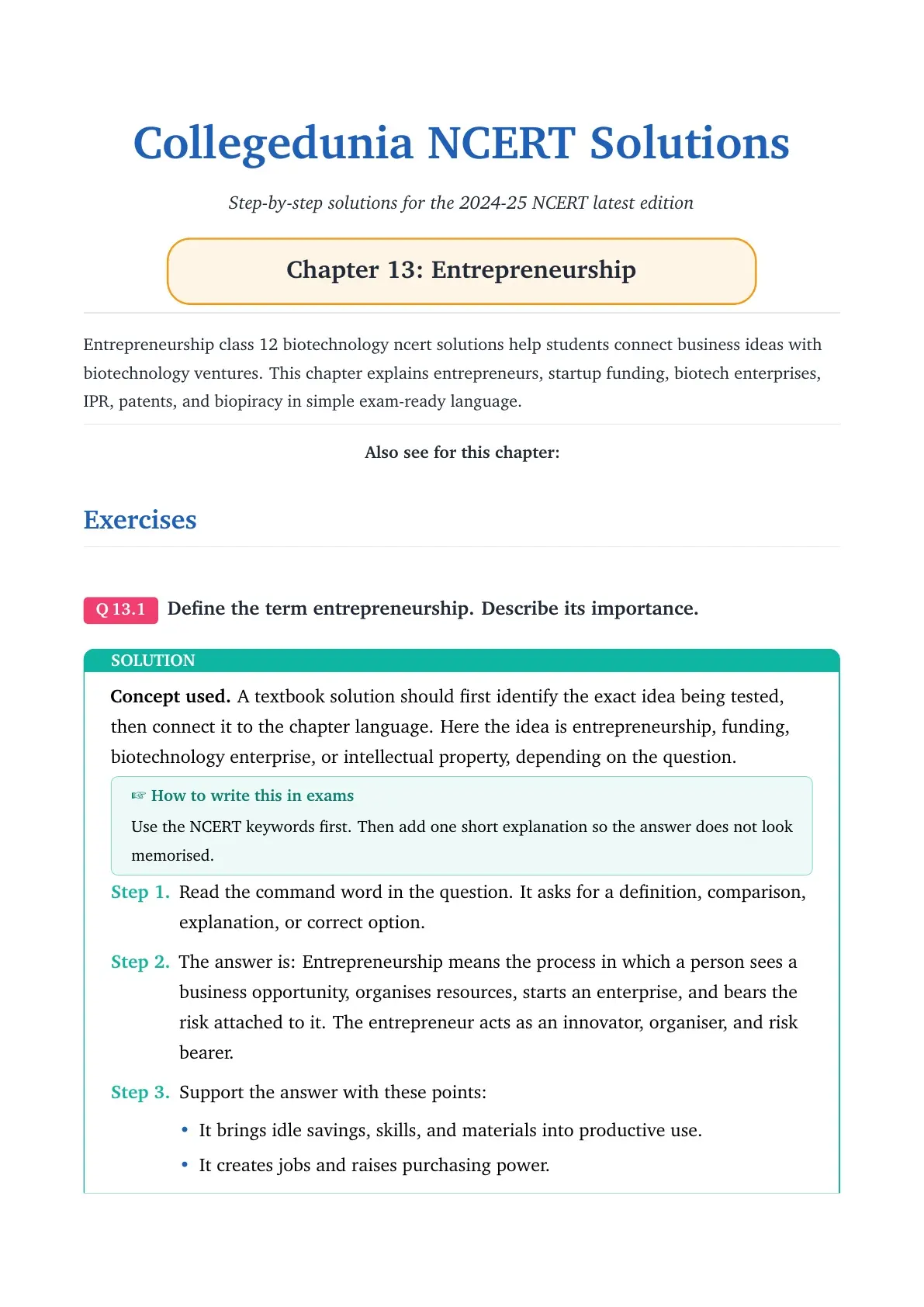
Q 13.1
Define the term entrepreneurship. Describe its importance.
Concept used. A textbook solution should first identify the exact idea being tested, then connect it to the chapter language. Here the idea is entrepreneurship, funding, biotechnology enterprise, or intellectual property, depending on the question.
How to write this in exams
Use the NCERT keywords first. Then add one short explanation so the answer does not look memorised.
Read the command word in the question. It asks for a definition, comparison, explanation, or correct option.
The answer is: Entrepreneurship means the process in which a person sees a business opportunity, organises resources, starts an enterprise, and bears the risk attached to it. The entrepreneur acts as an innovator, organiser, and risk bearer.
Support the answer with these points:
It brings idle savings, skills, and materials into productive use.
It creates jobs and raises purchasing power.
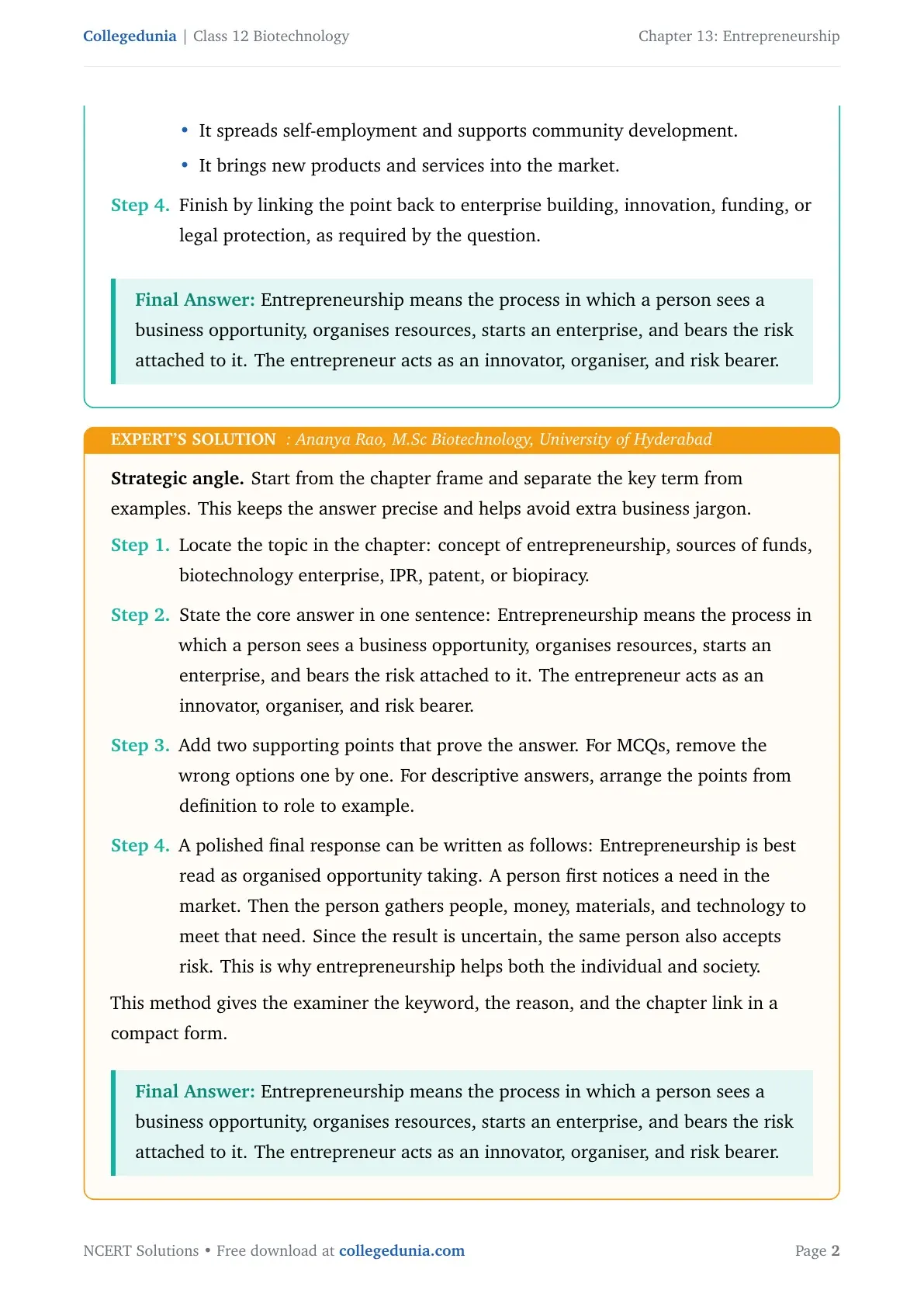
It spreads self-employment and supports community development.
It brings new products and services into the market.
Finish by linking the point back to enterprise building, innovation, funding, or legal protection, as required by the question.
Entrepreneurship means the process in which a person sees a business opportunity, organises resources, starts an enterprise, and bears the risk attached to it. The entrepreneur acts as an innovator, organiser, and risk bearer.
AR
Ananya Rao
M.Sc Biotechnology, University of Hyderabad
Verified Expert
Strategic angle. Start from the chapter frame and separate the key term from examples. This keeps the answer precise and helps avoid extra business jargon.
Locate the topic in the chapter: concept of entrepreneurship, sources of funds, biotechnology enterprise, IPR, patent, or biopiracy.
State the core answer in one sentence: Entrepreneurship means the process in which a person sees a business opportunity, organises resources, starts an enterprise, and bears the risk attached to it. The entrepreneur acts as an innovator, organiser, and risk bearer.
Add two supporting points that prove the answer. For MCQs, remove the wrong options one by one. For descriptive answers, arrange the points from definition to role to example.
A polished final response can be written as follows: Entrepreneurship is best read as organised opportunity taking. A person first notices a need in the market. Then the person gathers people, money, materials, and technology to meet that need. Since the result is uncertain, the same person also accepts risk. This is why entrepreneurship helps both the individual and society.
This method gives the examiner the keyword, the reason, and the chapter link in a compact form.
Entrepreneurship means the process in which a person sees a business opportunity, organises resources, starts an enterprise, and bears the risk attached to it. The entrepreneur acts as an innovator, organiser, and risk bearer.
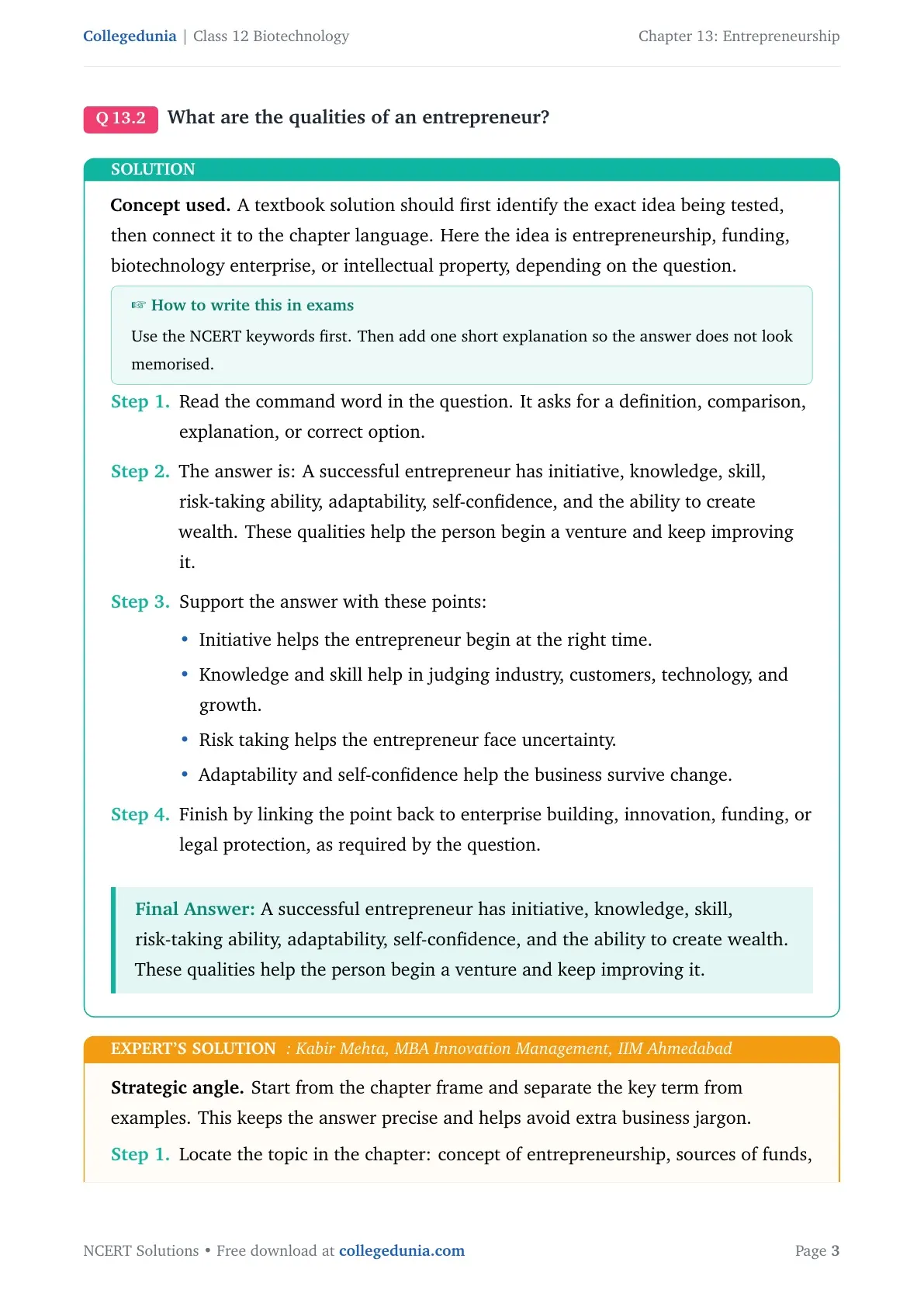
Q 13.2
What are the qualities of an entrepreneur?
Concept used. A textbook solution should first identify the exact idea being tested, then connect it to the chapter language. Here the idea is entrepreneurship, funding, biotechnology enterprise, or intellectual property, depending on the question.
How to write this in exams
Use the NCERT keywords first. Then add one short explanation so the answer does not look memorised.
Read the command word in the question. It asks for a definition, comparison, explanation, or correct option.
The answer is: A successful entrepreneur has initiative, knowledge, skill, risk-taking ability, adaptability, self-confidence, and the ability to create wealth. These qualities help the person begin a venture and keep improving it.
Support the answer with these points:
Initiative helps the entrepreneur begin at the right time.
Knowledge and skill help in judging industry, customers, technology, and growth.
Risk taking helps the entrepreneur face uncertainty.
Adaptability and self-confidence help the business survive change.
Finish by linking the point back to enterprise building, innovation, funding, or legal protection, as required by the question.
A successful entrepreneur has initiative, knowledge, skill, risk-taking ability, adaptability, self-confidence, and the ability to create wealth. These qualities help the person begin a venture and keep improving it.
KM
Kabir Mehta
MBA Innovation Management, IIM Ahmedabad
Verified Expert
Strategic angle. Start from the chapter frame and separate the key term from examples. This keeps the answer precise and helps avoid extra business jargon.
Locate the topic in the chapter: concept of entrepreneurship, sources of funds, biotechnology enterprise, IPR, patent, or biopiracy.
State the core answer in one sentence: A successful entrepreneur has initiative, knowledge, skill, risk-taking ability, adaptability, self-confidence, and the ability to create wealth. These qualities help the person begin a venture and keep improving it.
Add two supporting points that prove the answer. For MCQs, remove the wrong options one by one. For descriptive answers, arrange the points from definition to role to example.
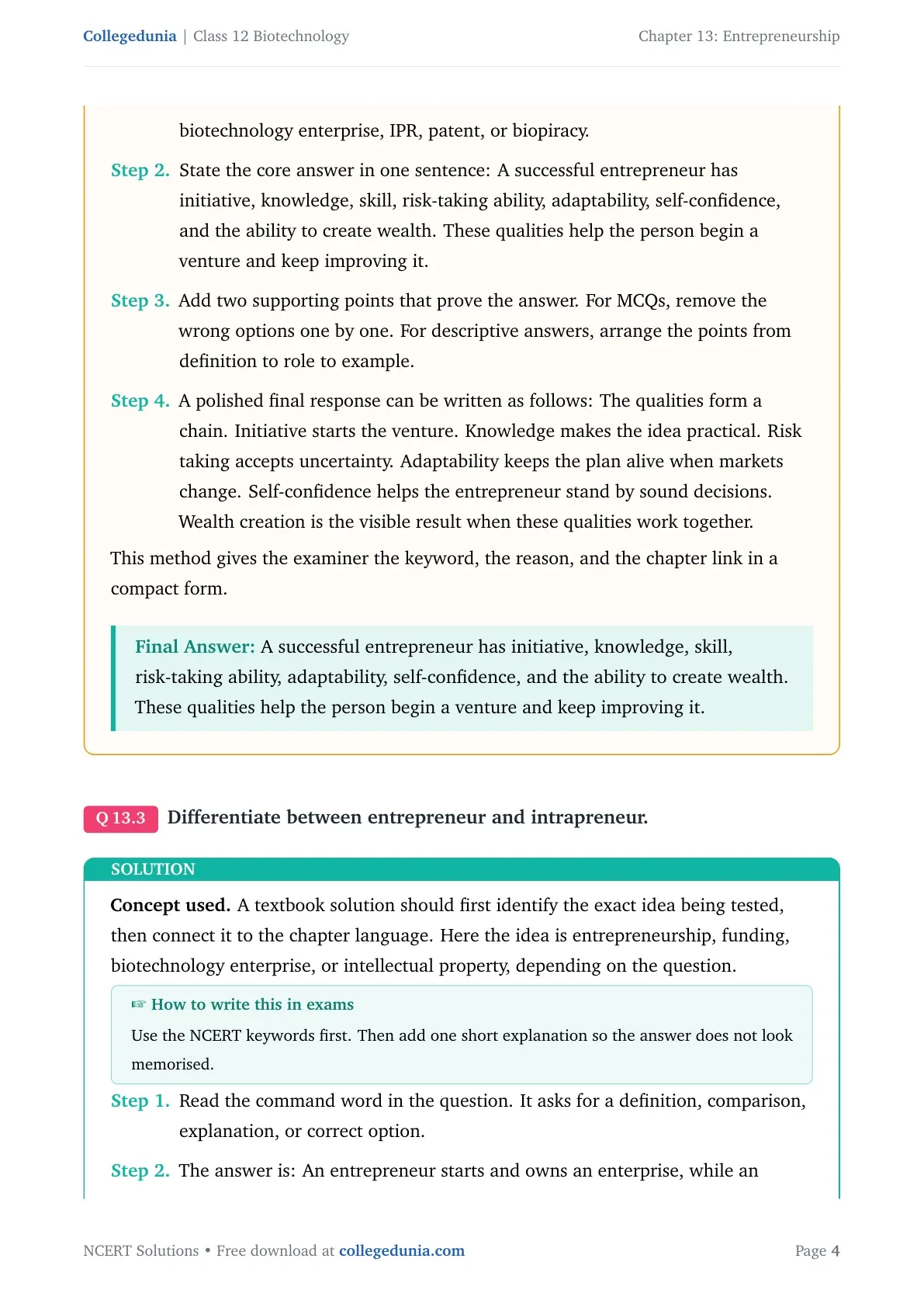
A polished final response can be written as follows: The qualities form a chain. Initiative starts the venture. Knowledge makes the idea practical. Risk taking accepts uncertainty. Adaptability keeps the plan alive when markets change. Self-confidence helps the entrepreneur stand by sound decisions. Wealth creation is the visible result when these qualities work together.
This method gives the examiner the keyword, the reason, and the chapter link in a compact form.
A successful entrepreneur has initiative, knowledge, skill, risk-taking ability, adaptability, self-confidence, and the ability to create wealth. These qualities help the person begin a venture and keep improving it.
Q 13.3
Differentiate between entrepreneur and intrapreneur.
Concept used. A textbook solution should first identify the exact idea being tested, then connect it to the chapter language. Here the idea is entrepreneurship, funding, biotechnology enterprise, or intellectual property, depending on the question.
How to write this in exams
Use the NCERT keywords first. Then add one short explanation so the answer does not look memorised.
Read the command word in the question. It asks for a definition, comparison, explanation, or correct option.
The answer is: An entrepreneur starts and owns an enterprise, while an intrapreneur works inside an existing organisation. Both value innovation, but their risk, authority, and reward differ.
Support the answer with these points:
An entrepreneur bears the business risk personally.
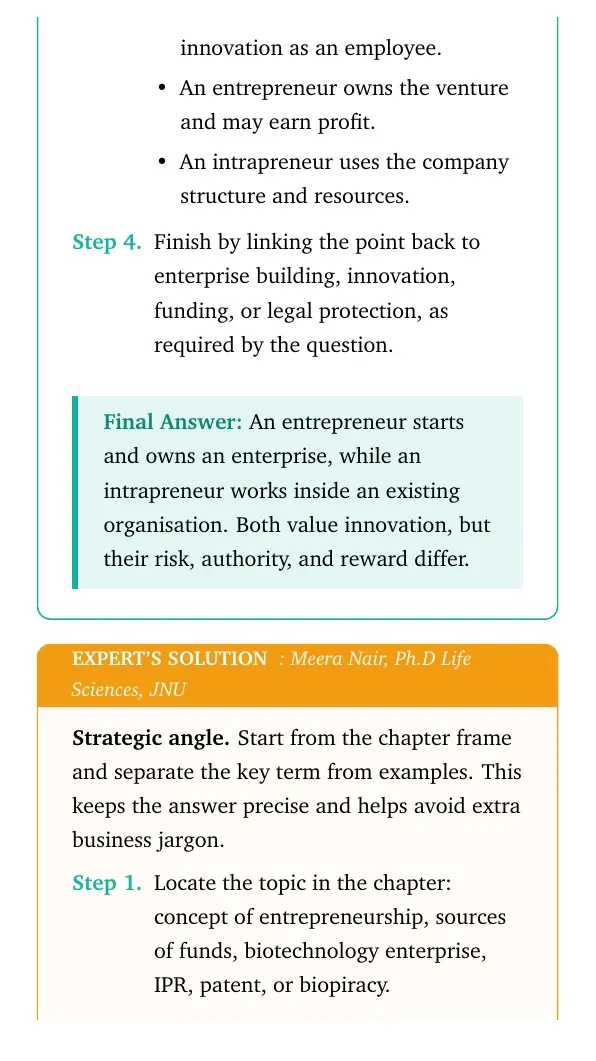
An intrapreneur promotes innovation as an employee.
An entrepreneur owns the venture and may earn profit.
An intrapreneur uses the company structure and resources.
Finish by linking the point back to enterprise building, innovation, funding, or legal protection, as required by the question.
An entrepreneur starts and owns an enterprise, while an intrapreneur works inside an existing organisation. Both value innovation, but their risk, authority, and reward differ.
MN
Meera Nair
Ph.D Life Sciences, JNU
Verified Expert
Strategic angle. Start from the chapter frame and separate the key term from examples. This keeps the answer precise and helps avoid extra business jargon.
Locate the topic in the chapter: concept of entrepreneurship, sources of funds, biotechnology enterprise, IPR, patent, or biopiracy.
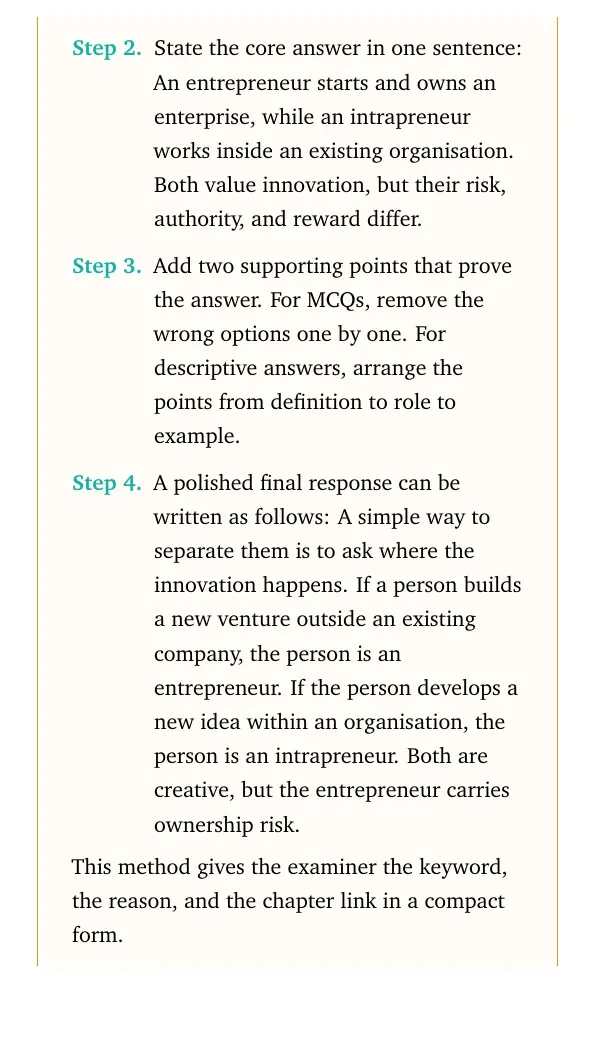
State the core answer in one sentence: An entrepreneur starts and owns an enterprise, while an intrapreneur works inside an existing organisation. Both value innovation, but their risk, authority, and reward differ.
Add two supporting points that prove the answer. For MCQs, remove the wrong options one by one. For descriptive answers, arrange the points from definition to role to example.
A polished final response can be written as follows: A simple way to separate them is to ask where the innovation happens. If a person builds a new venture outside an existing company, the person is an entrepreneur. If the person develops a new idea within an organisation, the person is an intrapreneur. Both are creative, but the entrepreneur carries ownership risk.
This method gives the examiner the keyword, the reason, and the chapter link in a compact form.
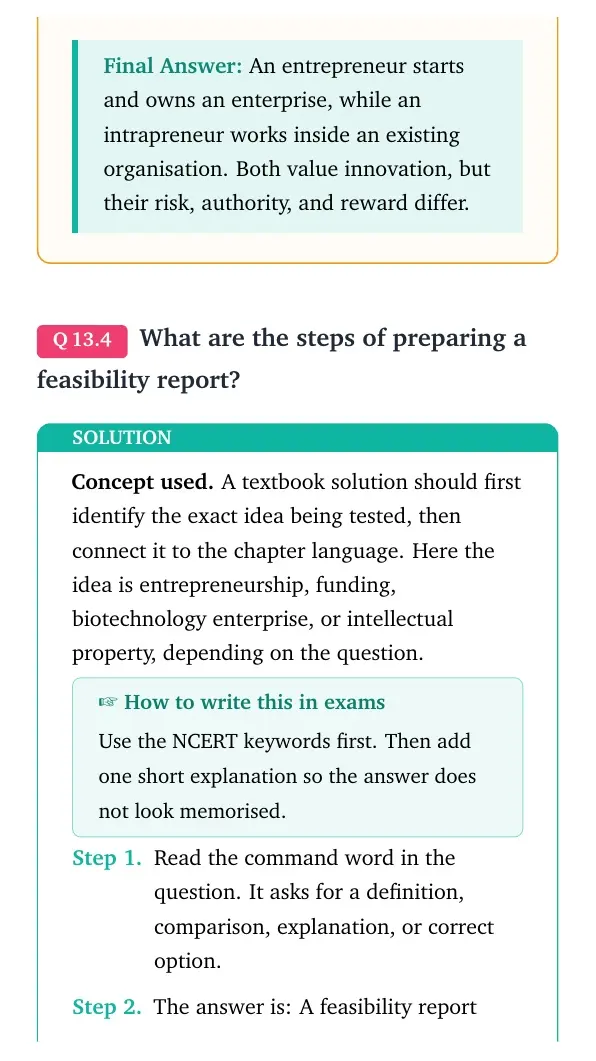
An entrepreneur starts and owns an enterprise, while an intrapreneur works inside an existing organisation. Both value innovation, but their risk, authority, and reward differ.
Q 13.4
What are the steps of preparing a feasibility report?
Concept used. A textbook solution should first identify the exact idea being tested, then connect it to the chapter language. Here the idea is entrepreneurship, funding, biotechnology enterprise, or intellectual property, depending on the question.
How to write this in exams
Use the NCERT keywords first. Then add one short explanation so the answer does not look memorised.
Read the command word in the question. It asks for a definition, comparison, explanation, or correct option.
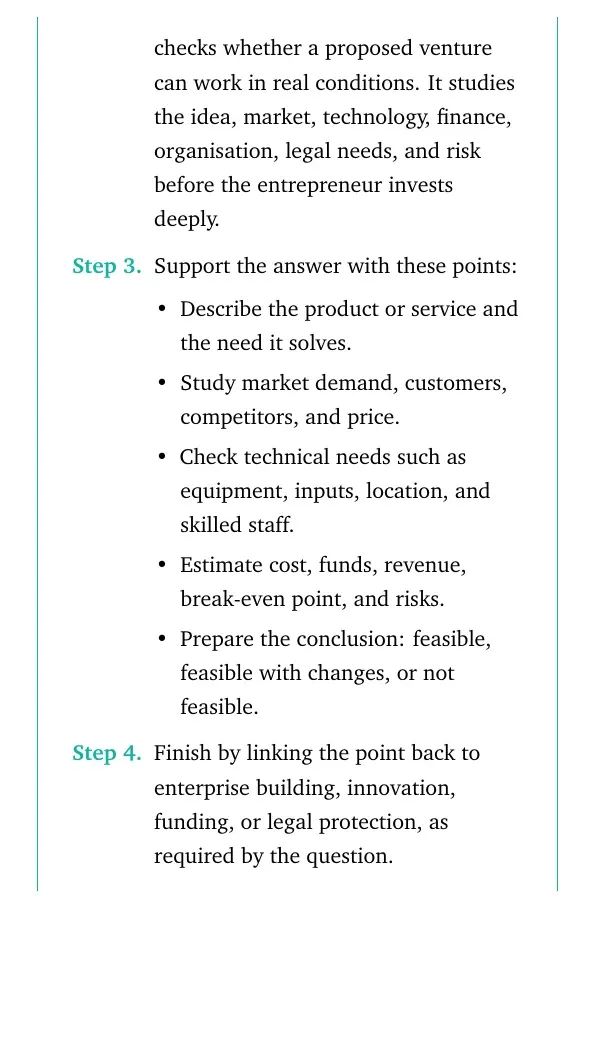
The answer is: A feasibility report checks whether a proposed venture can work in real conditions. It studies the idea, market, technology, finance, organisation, legal needs, and risk before the entrepreneur invests deeply.
Support the answer with these points:
Describe the product or service and the need it solves.
Study market demand, customers, competitors, and price.
Check technical needs such as equipment, inputs, location, and skilled staff.
Estimate cost, funds, revenue, break-even point, and risks.
Prepare the conclusion: feasible, feasible with changes, or not feasible.
Finish by linking the point back to enterprise building, innovation, funding, or legal protection, as required by the question.
A feasibility report checks whether a proposed venture can work in real conditions. It studies the idea, market, technology, finance, organisation, legal needs, and risk before the entrepreneur invests deeply.
AS
Arjun Sen
M.Tech Bioprocess Engineering, IIT Delhi
Verified Expert
Strategic angle. Start from the chapter frame and separate the key term from examples. This keeps the answer precise and helps avoid extra business jargon.
Locate the topic in the chapter: concept of entrepreneurship, sources of funds, biotechnology enterprise, IPR, patent, or biopiracy.
State the core answer in one sentence: A feasibility report checks whether a proposed venture can work in real conditions. It studies the idea, market, technology, finance, organisation, legal needs, and risk before the entrepreneur invests deeply.
Add two supporting points that prove the answer. For MCQs, remove the wrong options one by one. For descriptive answers, arrange the points from definition to role to example.
A polished final response can be written as follows: A feasibility report is a reality check before a business plan. It asks whether the opportunity can be converted into a working enterprise. For a biotechnology venture, the report must also test laboratory scale-up, regulatory approval, intellectual property position, and funding needs. A strong report prevents costly mistakes.
This method gives the examiner the keyword, the reason, and the chapter link in a compact form.
A feasibility report checks whether a proposed venture can work in real conditions. It studies the idea, market, technology, finance, organisation, legal needs, and risk before the entrepreneur invests deeply.
Q 13.5
Define a startup. What are the sources of funds for a new venture?
Concept used. A textbook solution should first identify the exact idea being tested, then connect it to the chapter language. Here the idea is entrepreneurship, funding, biotechnology enterprise, or intellectual property, depending on the question.
How to write this in exams
Use the NCERT keywords first. Then add one short explanation so the answer does not look memorised.
Read the command word in the question. It asks for a definition, comparison, explanation, or correct option.
The answer is: A startup is a young enterprise formed to develop an innovative product, service, or process with the possibility of growth. The NCERT discussion lists several fund sources for a new venture.
Support the answer with these points:
Personal investment by founders.
Venture capital from professional investors.
Angel investors who fund early-stage firms.
Business incubators that provide support and facilities.
Government grants, subsidies, and bank loans.
Finish by linking the point back to enterprise building, innovation, funding, or legal protection, as required by the question.
A startup is a young enterprise formed to develop an innovative product, service, or process with the possibility of growth. The NCERT discussion lists several fund sources for a new venture.
NK
Nisha Kapoor
M.Sc Microbiology, Panjab University
Verified Expert
Strategic angle. Start from the chapter frame and separate the key term from examples. This keeps the answer precise and helps avoid extra business jargon.
Locate the topic in the chapter: concept of entrepreneurship, sources of funds, biotechnology enterprise, IPR, patent, or biopiracy.
State the core answer in one sentence: A startup is a young enterprise formed to develop an innovative product, service, or process with the possibility of growth. The NCERT discussion lists several fund sources for a new venture.
Add two supporting points that prove the answer. For MCQs, remove the wrong options one by one. For descriptive answers, arrange the points from definition to role to example.
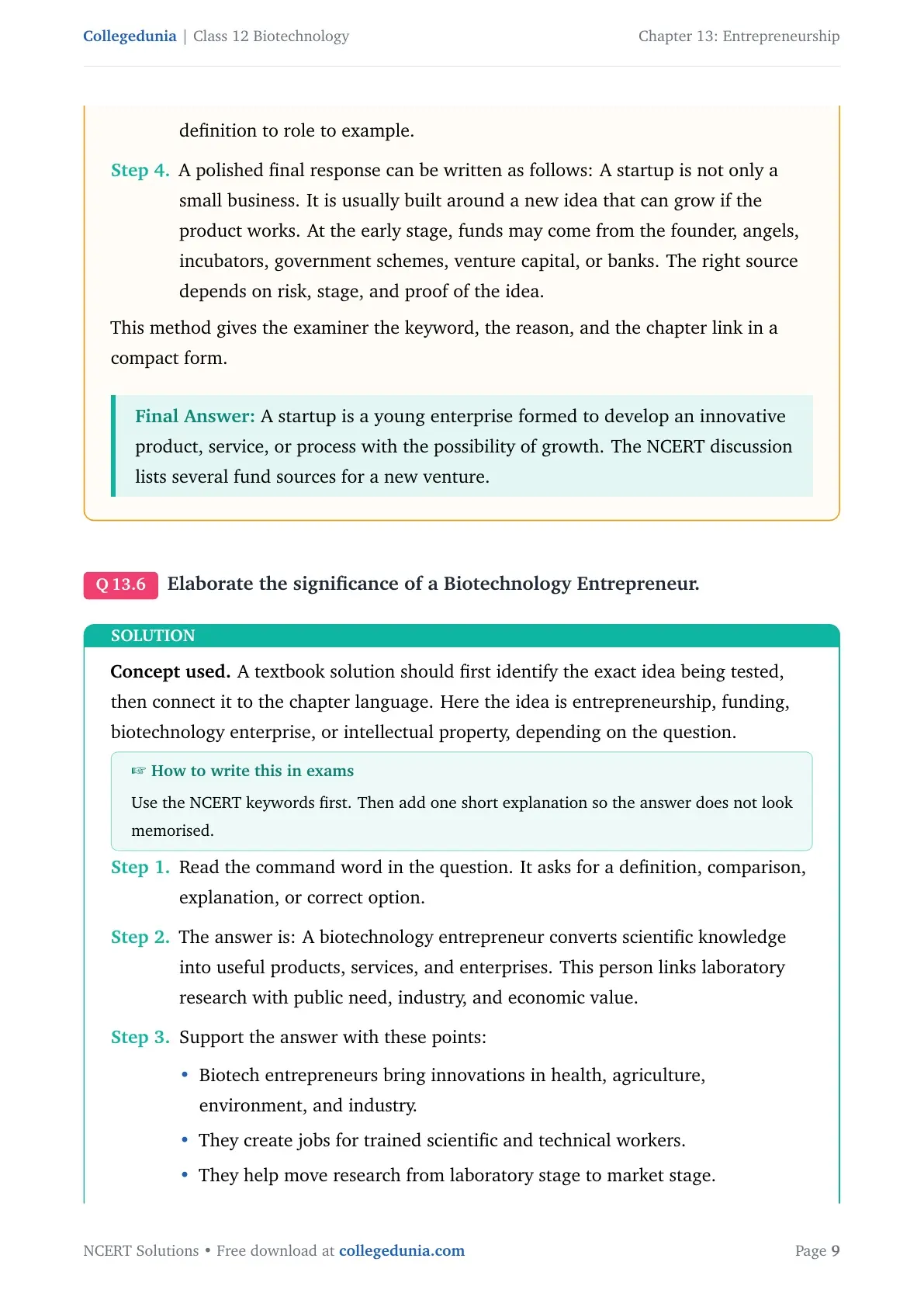
A polished final response can be written as follows: A startup is not only a small business. It is usually built around a new idea that can grow if the product works. At the early stage, funds may come from the founder, angels, incubators, government schemes, venture capital, or banks. The right source depends on risk, stage, and proof of the idea.
This method gives the examiner the keyword, the reason, and the chapter link in a compact form.
A startup is a young enterprise formed to develop an innovative product, service, or process with the possibility of growth. The NCERT discussion lists several fund sources for a new venture.
Q 13.6
Elaborate the significance of a Biotechnology Entrepreneur.
Concept used. A textbook solution should first identify the exact idea being tested, then connect it to the chapter language. Here the idea is entrepreneurship, funding, biotechnology enterprise, or intellectual property, depending on the question.
How to write this in exams
Use the NCERT keywords first. Then add one short explanation so the answer does not look memorised.
Read the command word in the question. It asks for a definition, comparison, explanation, or correct option.
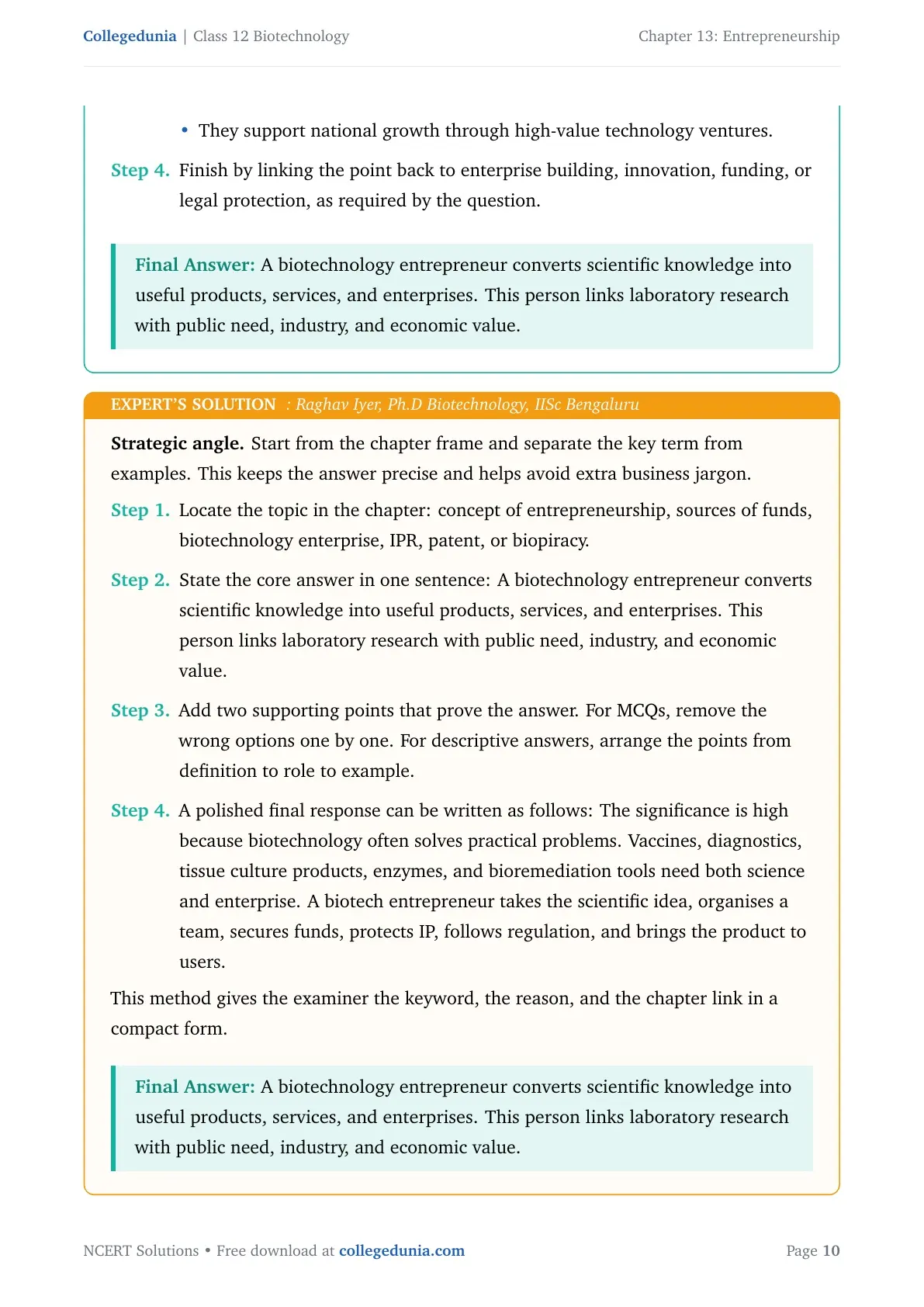
The answer is: A biotechnology entrepreneur converts scientific knowledge into useful products, services, and enterprises. This person links laboratory research with public need, industry, and economic value.
Support the answer with these points:
Biotech entrepreneurs bring innovations in health, agriculture, environment, and industry.
They create jobs for trained scientific and technical workers.
They help move research from laboratory stage to market stage.
They support national growth through high-value technology ventures.
Finish by linking the point back to enterprise building, innovation, funding, or legal protection, as required by the question.
A biotechnology entrepreneur converts scientific knowledge into useful products, services, and enterprises. This person links laboratory research with public need, industry, and economic value.
RI
Raghav Iyer
Ph.D Biotechnology, IISc Bengaluru
Verified Expert
Strategic angle. Start from the chapter frame and separate the key term from examples. This keeps the answer precise and helps avoid extra business jargon.
Locate the topic in the chapter: concept of entrepreneurship, sources of funds, biotechnology enterprise, IPR, patent, or biopiracy.
State the core answer in one sentence: A biotechnology entrepreneur converts scientific knowledge into useful products, services, and enterprises. This person links laboratory research with public need, industry, and economic value.
Add two supporting points that prove the answer. For MCQs, remove the wrong options one by one. For descriptive answers, arrange the points from definition to role to example.
A polished final response can be written as follows: The significance is high because biotechnology often solves practical problems. Vaccines, diagnostics, tissue culture products, enzymes, and bioremediation tools need both science and enterprise. A biotech entrepreneur takes the scientific idea, organises a team, secures funds, protects IP, follows regulation, and brings the product to users.
This method gives the examiner the keyword, the reason, and the chapter link in a compact form.
A biotechnology entrepreneur converts scientific knowledge into useful products, services, and enterprises. This person links laboratory research with public need, industry, and economic value.
Q 13.7
Identify the similarities and differences between General Entrepreneur and Biotechnology Entrepreneur.
Concept used. A textbook solution should first identify the exact idea being tested, then connect it to the chapter language. Here the idea is entrepreneurship, funding, biotechnology enterprise, or intellectual property, depending on the question.
How to write this in exams
Use the NCERT keywords first. Then add one short explanation so the answer does not look memorised.
Read the command word in the question. It asks for a definition, comparison, explanation, or correct option.
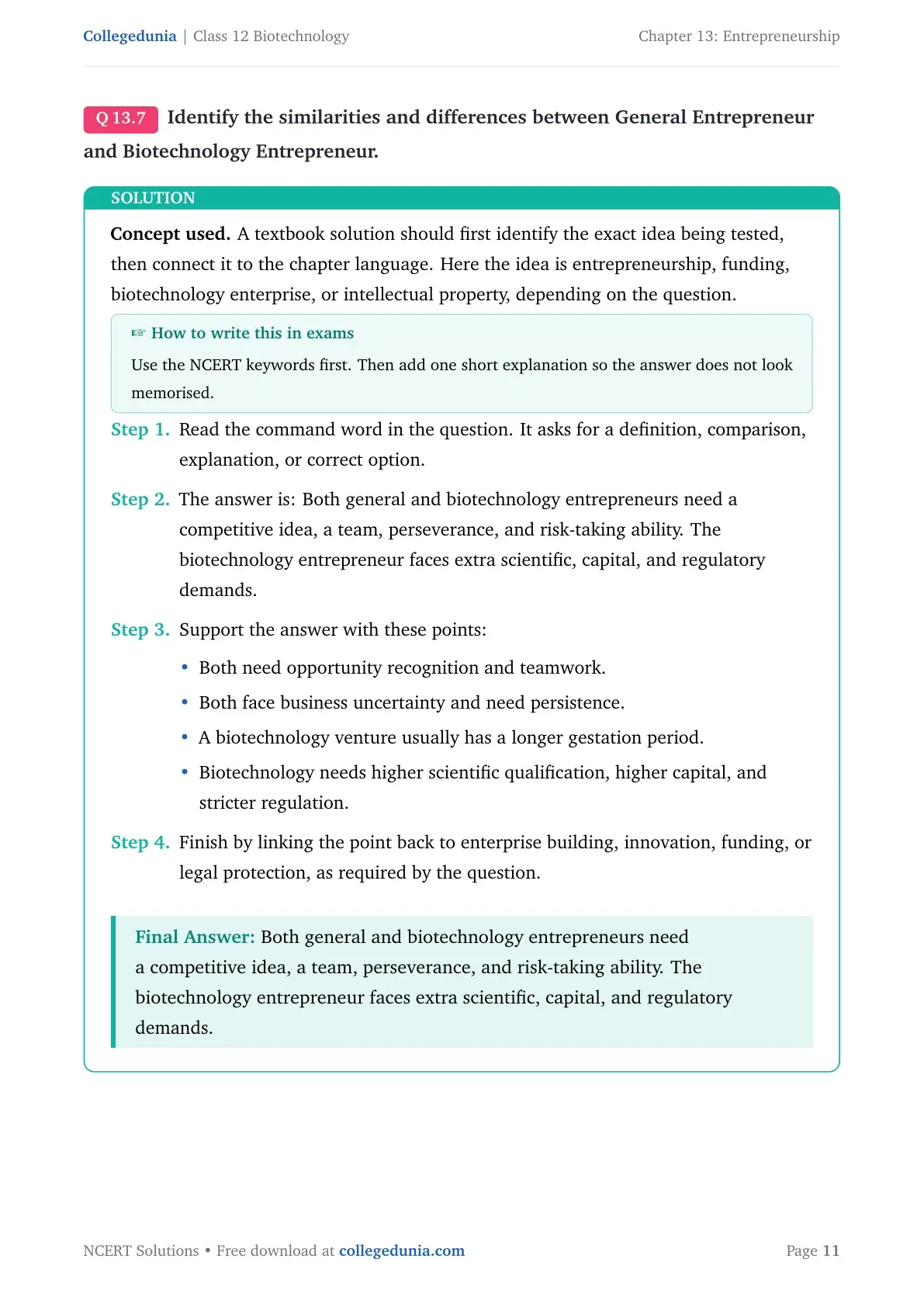
The answer is: Both general and biotechnology entrepreneurs need a competitive idea, a team, perseverance, and risk-taking ability. The biotechnology entrepreneur faces extra scientific, capital, and regulatory demands.
Support the answer with these points:
Both need opportunity recognition and teamwork.
Both face business uncertainty and need persistence.
A biotechnology venture usually has a longer gestation period.
Biotechnology needs higher scientific qualification, higher capital, and stricter regulation.
Finish by linking the point back to enterprise building, innovation, funding, or legal protection, as required by the question.
Both general and biotechnology entrepreneurs need a competitive idea, a team, perseverance, and risk-taking ability. The biotechnology entrepreneur faces extra scientific, capital, and regulatory demands.
FK
Farah Khan
M.Sc Bioenterprise, Jamia Millia Islamia
Verified Expert
Strategic angle. Start from the chapter frame and separate the key term from examples. This keeps the answer precise and helps avoid extra business jargon.
Locate the topic in the chapter: concept of entrepreneurship, sources of funds, biotechnology enterprise, IPR, patent, or biopiracy.
State the core answer in one sentence: Both general and biotechnology entrepreneurs need a competitive idea, a team, perseverance, and risk-taking ability. The biotechnology entrepreneur faces extra scientific, capital, and regulatory demands.
Add two supporting points that prove the answer. For MCQs, remove the wrong options one by one. For descriptive answers, arrange the points from definition to role to example.
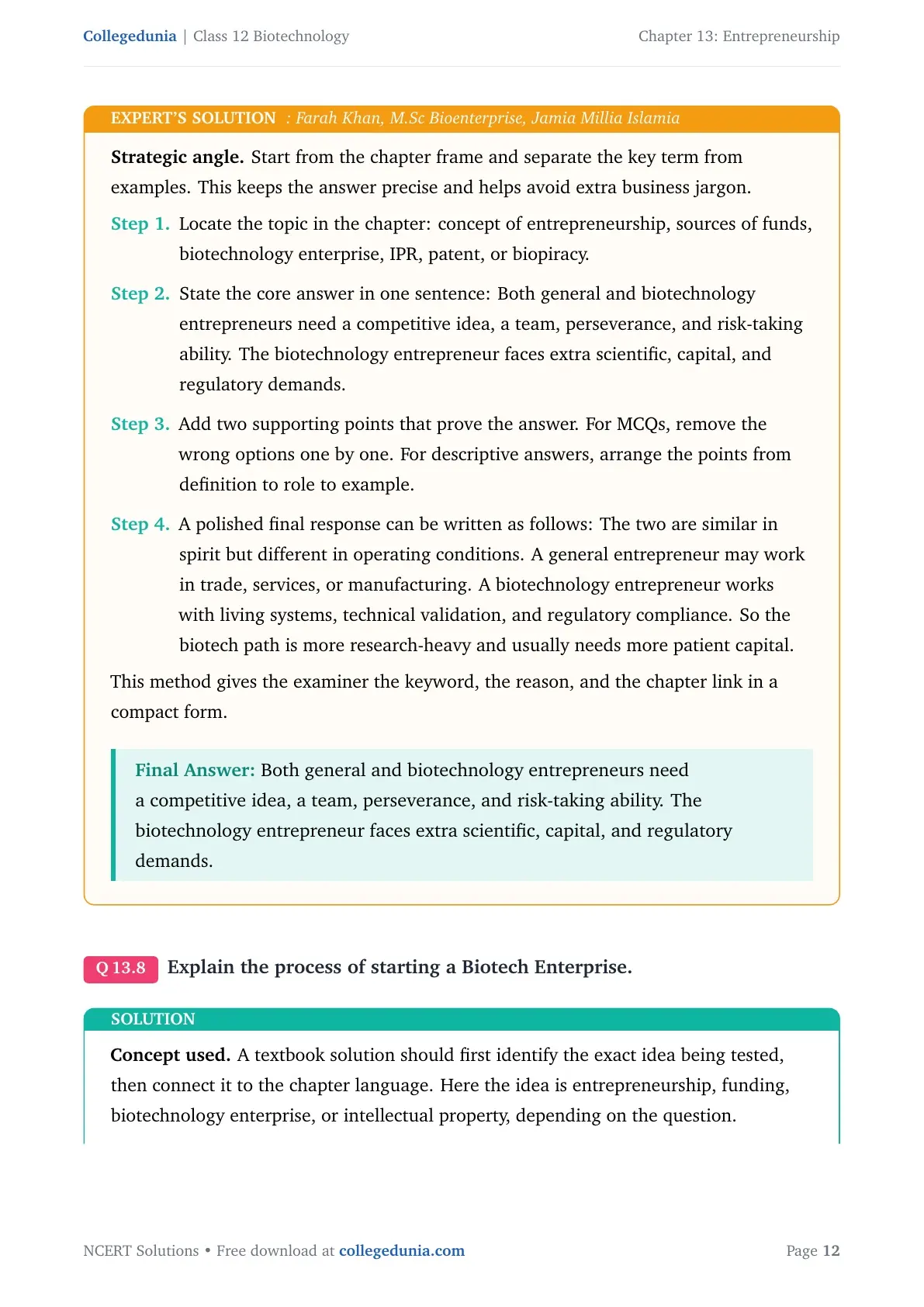
A polished final response can be written as follows: The two are similar in spirit but different in operating conditions. A general entrepreneur may work in trade, services, or manufacturing. A biotechnology entrepreneur works with living systems, technical validation, and regulatory compliance. So the biotech path is more research-heavy and usually needs more patient capital.
This method gives the examiner the keyword, the reason, and the chapter link in a compact form.
Both general and biotechnology entrepreneurs need a competitive idea, a team, perseverance, and risk-taking ability. The biotechnology entrepreneur faces extra scientific, capital, and regulatory demands.
Q 13.8
Explain the process of starting a Biotech Enterprise.
Concept used. A textbook solution should first identify the exact idea being tested, then connect it to the chapter language. Here the idea is entrepreneurship, funding, biotechnology enterprise, or intellectual property, depending on the question.
How to write this in exams
Use the NCERT keywords first. Then add one short explanation so the answer does not look memorised.
Read the command word in the question. It asks for a definition, comparison, explanation, or correct option.
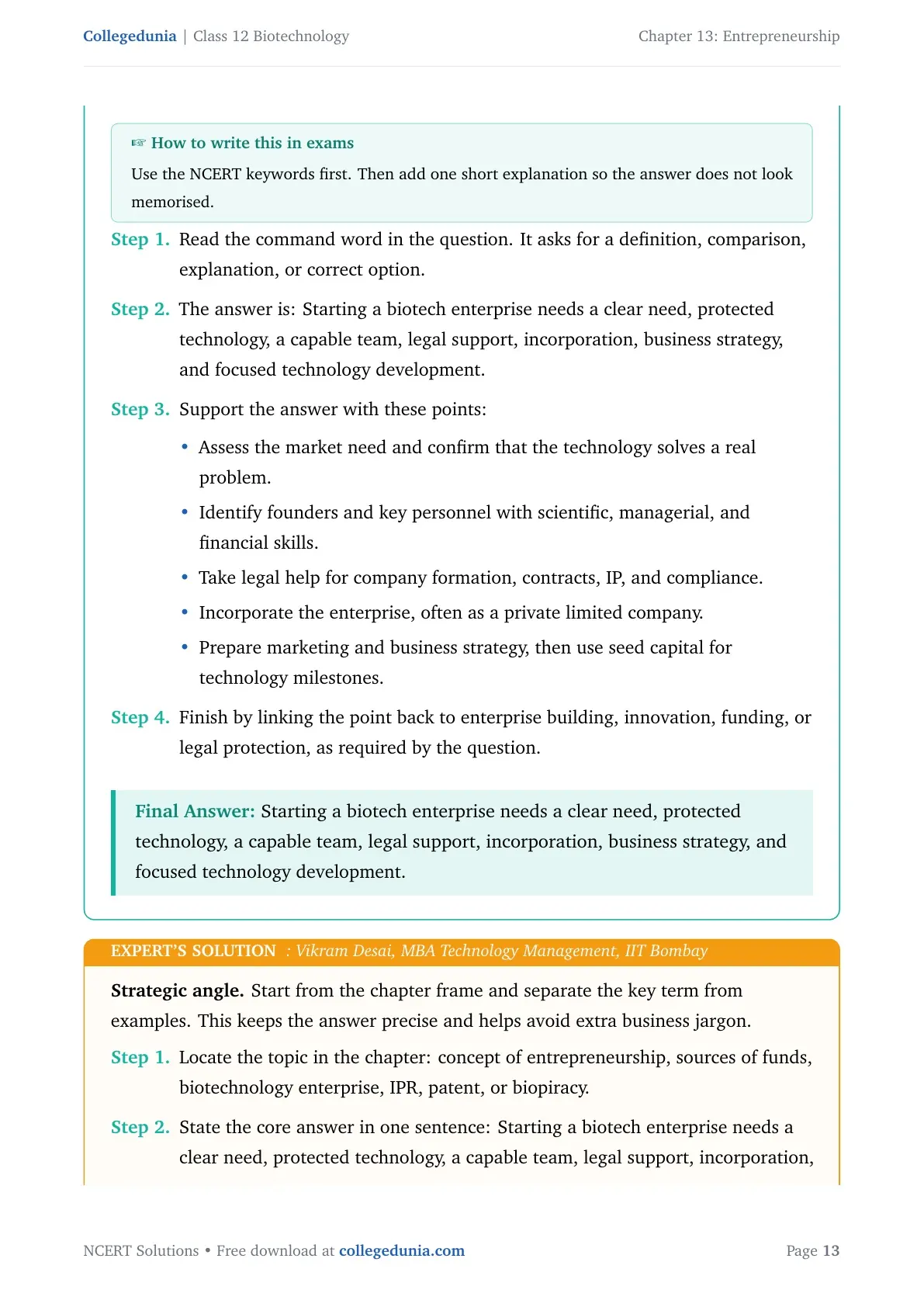
The answer is: Starting a biotech enterprise needs a clear need, protected technology, a capable team, legal support, incorporation, business strategy, and focused technology development.
Support the answer with these points:
Assess the market need and confirm that the technology solves a real problem.
Identify founders and key personnel with scientific, managerial, and financial skills.
Take legal help for company formation, contracts, IP, and compliance.
Incorporate the enterprise, often as a private limited company.
Prepare marketing and business strategy, then use seed capital for technology milestones.
Finish by linking the point back to enterprise building, innovation, funding, or legal protection, as required by the question.
Starting a biotech enterprise needs a clear need, protected technology, a capable team, legal support, incorporation, business strategy, and focused technology development.
VD
Vikram Desai
MBA Technology Management, IIT Bombay
Verified Expert
Strategic angle. Start from the chapter frame and separate the key term from examples. This keeps the answer precise and helps avoid extra business jargon.
Locate the topic in the chapter: concept of entrepreneurship, sources of funds, biotechnology enterprise, IPR, patent, or biopiracy.
State the core answer in one sentence: Starting a biotech enterprise needs a clear need, protected technology, a capable team, legal support, incorporation, business strategy, and focused technology development.
Add two supporting points that prove the answer. For MCQs, remove the wrong options one by one. For descriptive answers, arrange the points from definition to role to example.
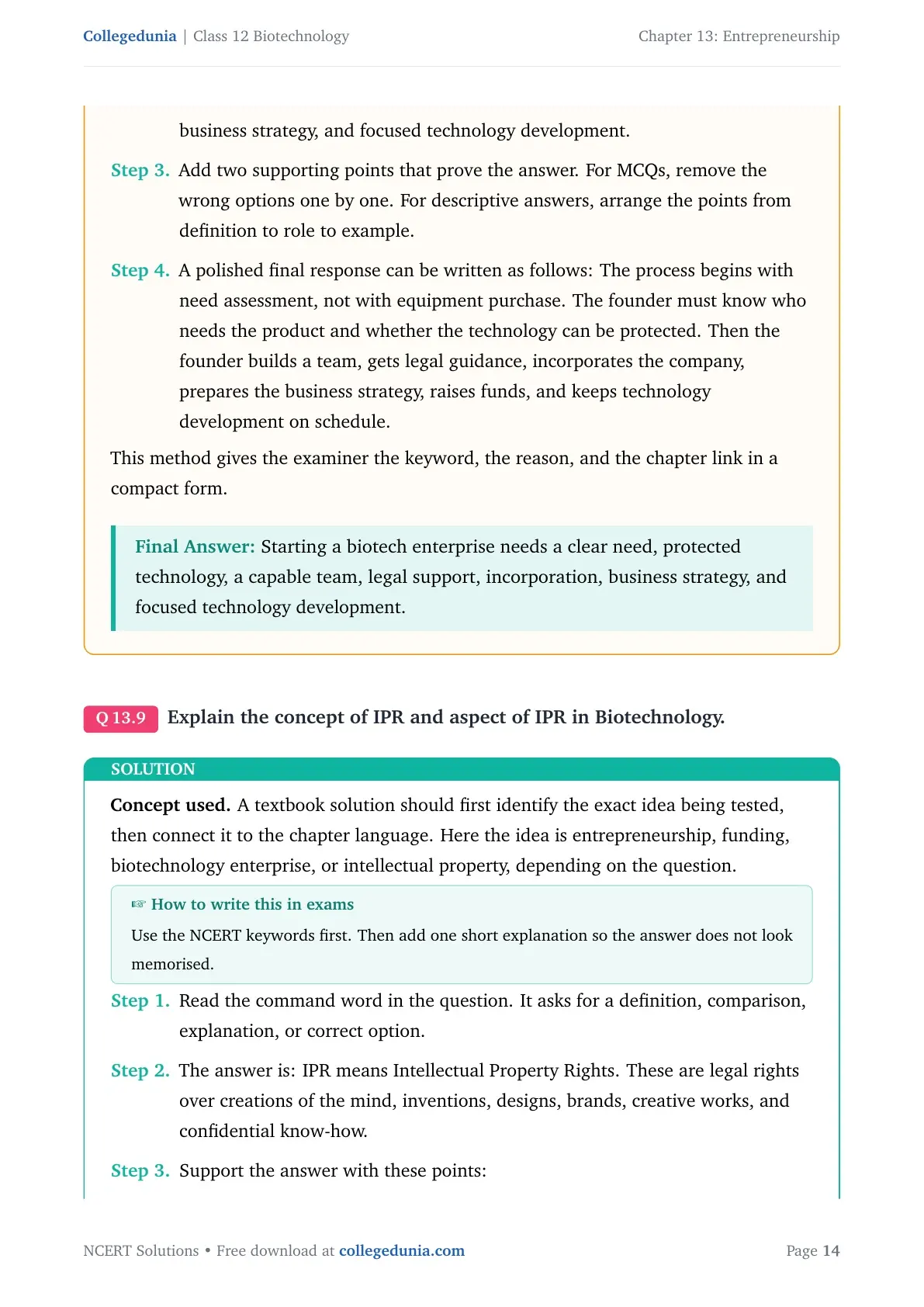
A polished final response can be written as follows: The process begins with need assessment, not with equipment purchase. The founder must know who needs the product and whether the technology can be protected. Then the founder builds a team, gets legal guidance, incorporates the company, prepares the business strategy, raises funds, and keeps technology development on schedule.
This method gives the examiner the keyword, the reason, and the chapter link in a compact form.
Starting a biotech enterprise needs a clear need, protected technology, a capable team, legal support, incorporation, business strategy, and focused technology development.
Q 13.9
Explain the concept of IPR and aspect of IPR in Biotechnology.
Concept used. A textbook solution should first identify the exact idea being tested, then connect it to the chapter language. Here the idea is entrepreneurship, funding, biotechnology enterprise, or intellectual property, depending on the question.
How to write this in exams
Use the NCERT keywords first. Then add one short explanation so the answer does not look memorised.
Read the command word in the question. It asks for a definition, comparison, explanation, or correct option.
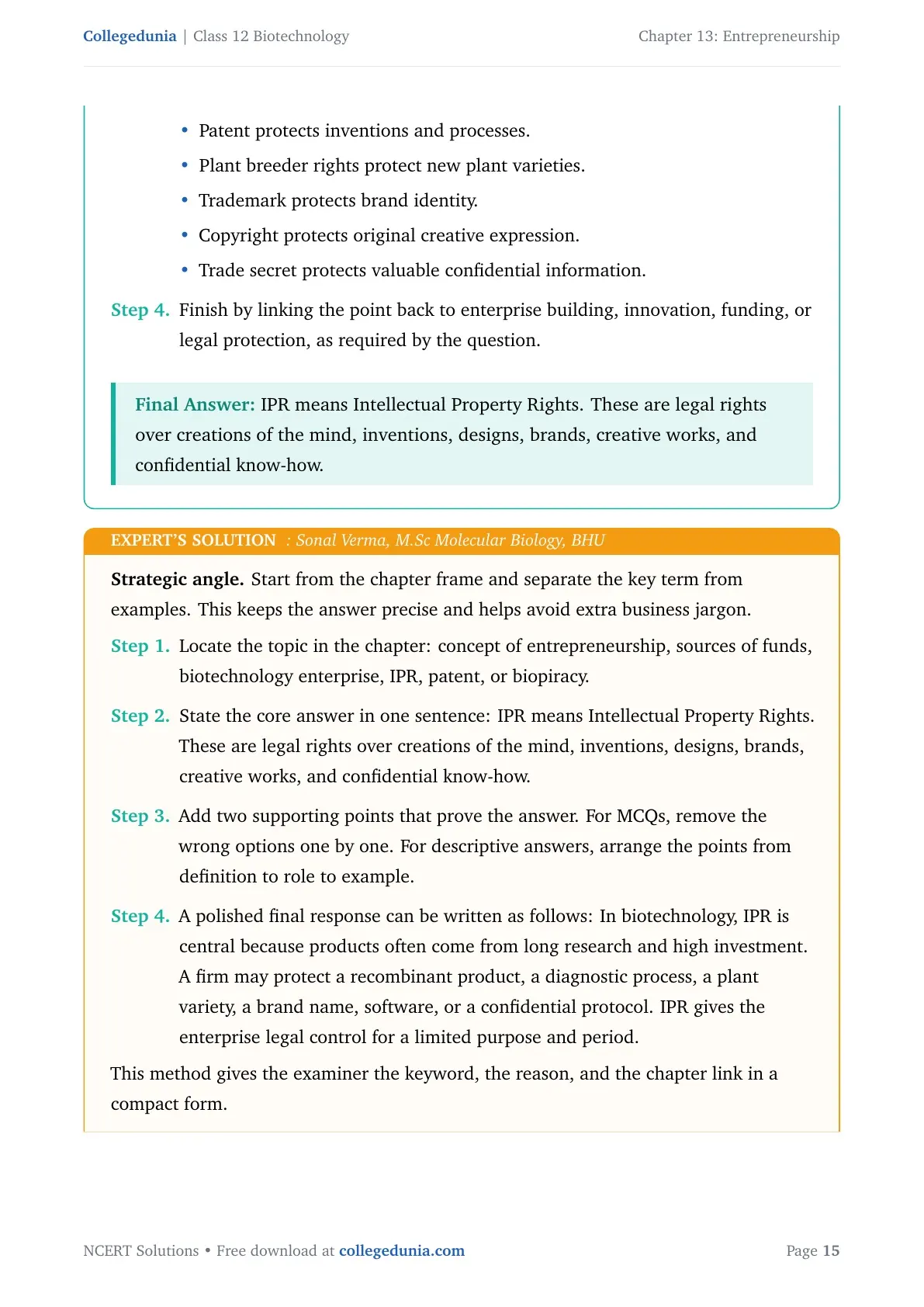
The answer is: IPR means Intellectual Property Rights. These are legal rights over creations of the mind, inventions, designs, brands, creative works, and confidential know-how.
Finish by linking the point back to enterprise building, innovation, funding, or legal protection, as required by the question.
IPR means Intellectual Property Rights. These are legal rights over creations of the mind, inventions, designs, brands, creative works, and confidential know-how.
SV
Sonal Verma
M.Sc Molecular Biology, BHU
Verified Expert
Strategic angle. Start from the chapter frame and separate the key term from examples. This keeps the answer precise and helps avoid extra business jargon.
Locate the topic in the chapter: concept of entrepreneurship, sources of funds, biotechnology enterprise, IPR, patent, or biopiracy.
State the core answer in one sentence: IPR means Intellectual Property Rights. These are legal rights over creations of the mind, inventions, designs, brands, creative works, and confidential know-how.
Add two supporting points that prove the answer. For MCQs, remove the wrong options one by one. For descriptive answers, arrange the points from definition to role to example.
A polished final response can be written as follows: In biotechnology, IPR is central because products often come from long research and high investment. A firm may protect a recombinant product, a diagnostic process, a plant variety, a brand name, software, or a confidential protocol. IPR gives the enterprise legal control for a limited purpose and period.
This method gives the examiner the keyword, the reason, and the chapter link in a compact form.
IPR means Intellectual Property Rights. These are legal rights over creations of the mind, inventions, designs, brands, creative works, and confidential know-how.
Q 13.10
Explain the role of IPR in Biotechnology Enterprise.
Concept used. A textbook solution should first identify the exact idea being tested, then connect it to the chapter language. Here the idea is entrepreneurship, funding, biotechnology enterprise, or intellectual property, depending on the question.
How to write this in exams
Use the NCERT keywords first. Then add one short explanation so the answer does not look memorised.
Read the command word in the question. It asks for a definition, comparison, explanation, or correct option.
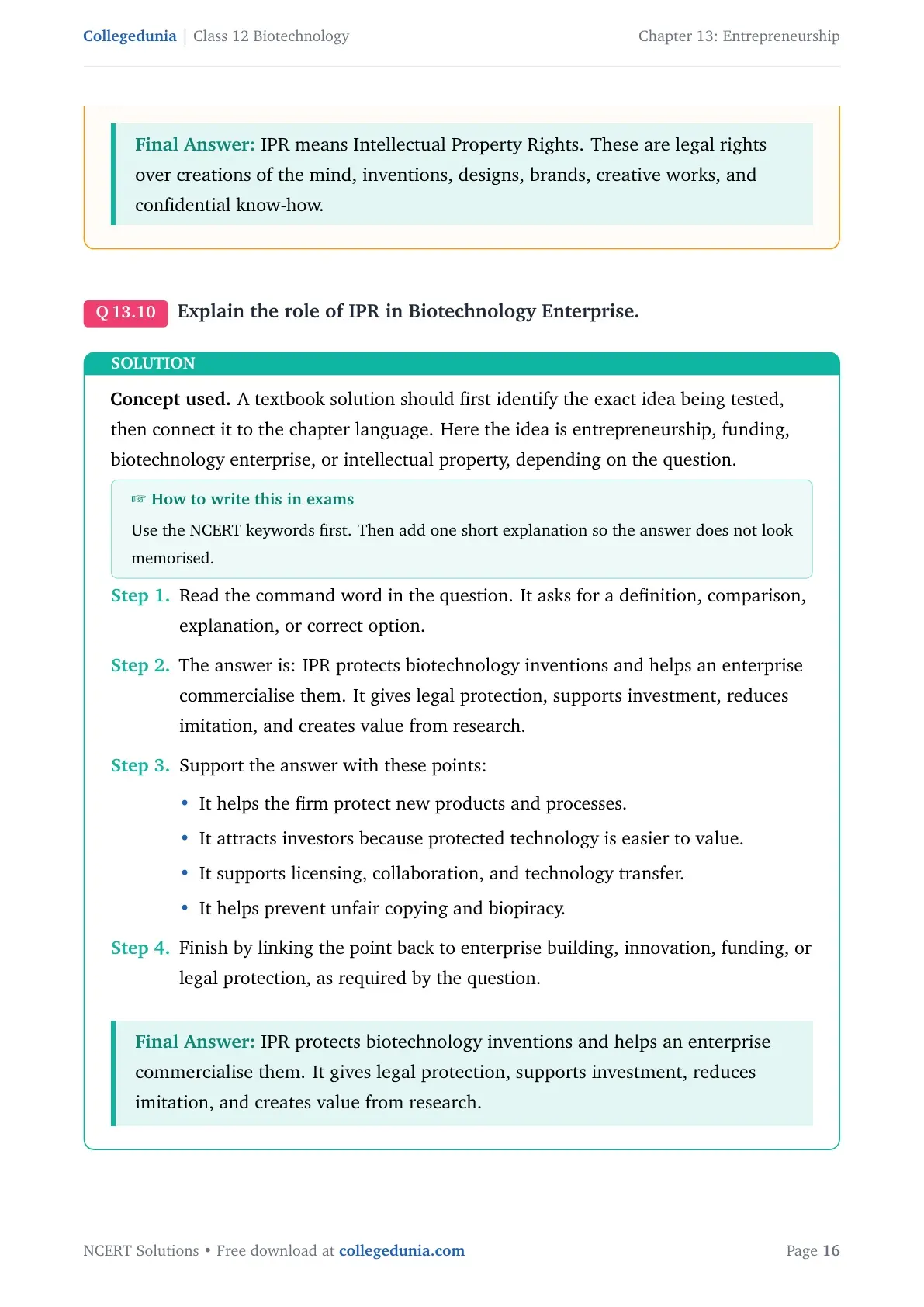
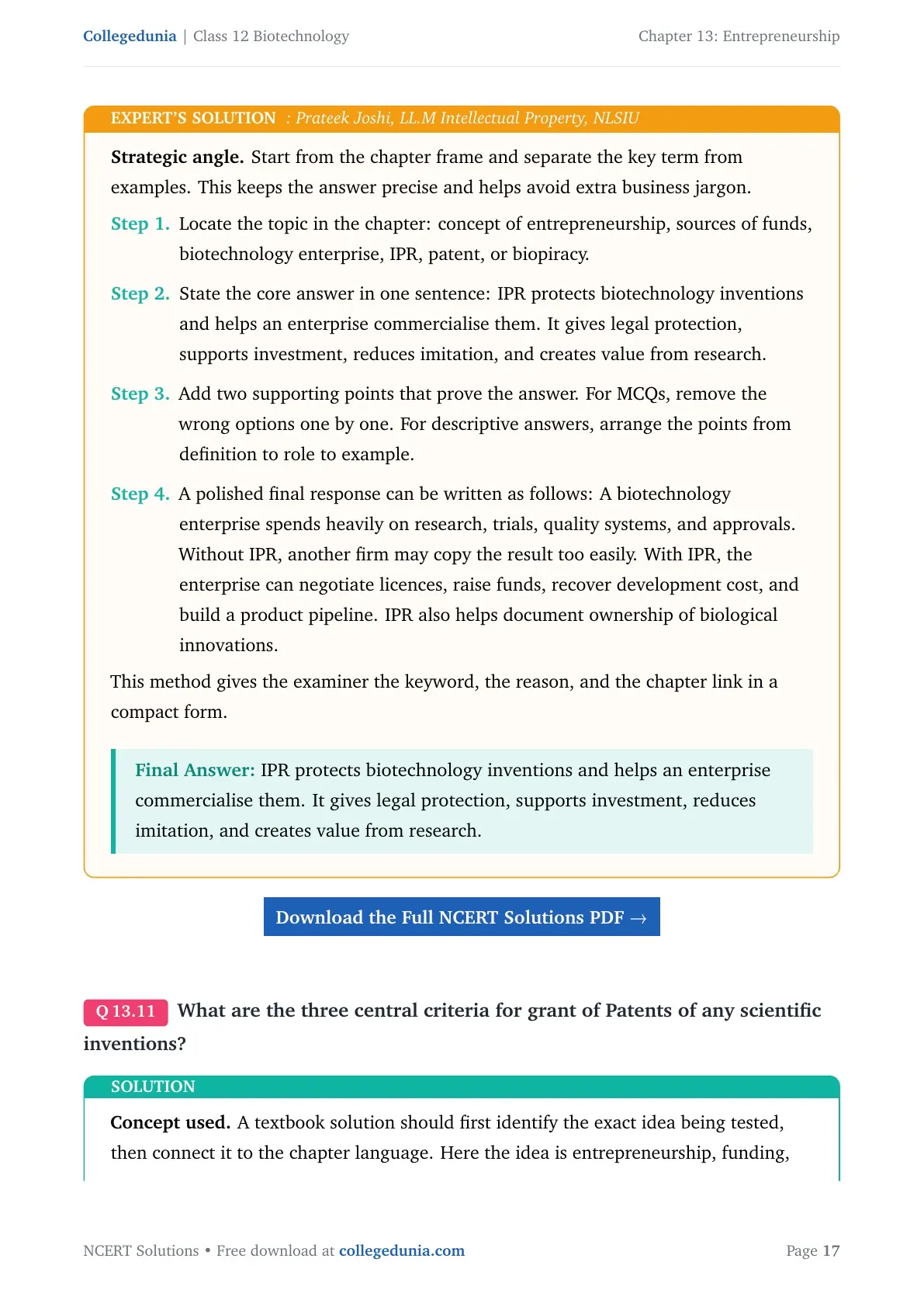
The answer is: IPR protects biotechnology inventions and helps an enterprise commercialise them. It gives legal protection, supports investment, reduces imitation, and creates value from research.
Support the answer with these points:
It helps the firm protect new products and processes.
It attracts investors because protected technology is easier to value.
It supports licensing, collaboration, and technology transfer.
It helps prevent unfair copying and biopiracy.
Finish by linking the point back to enterprise building, innovation, funding, or legal protection, as required by the question.
IPR protects biotechnology inventions and helps an enterprise commercialise them. It gives legal protection, supports investment, reduces imitation, and creates value from research.
PJ
Prateek Joshi
LL.M Intellectual Property, NLSIU
Verified Expert
Strategic angle. Start from the chapter frame and separate the key term from examples. This keeps the answer precise and helps avoid extra business jargon.
Locate the topic in the chapter: concept of entrepreneurship, sources of funds, biotechnology enterprise, IPR, patent, or biopiracy.
State the core answer in one sentence: IPR protects biotechnology inventions and helps an enterprise commercialise them. It gives legal protection, supports investment, reduces imitation, and creates value from research.
Add two supporting points that prove the answer. For MCQs, remove the wrong options one by one. For descriptive answers, arrange the points from definition to role to example.
A polished final response can be written as follows: A biotechnology enterprise spends heavily on research, trials, quality systems, and approvals. Without IPR, another firm may copy the result too easily. With IPR, the enterprise can negotiate licences, raise funds, recover development cost, and build a product pipeline. IPR also helps document ownership of biological innovations.
This method gives the examiner the keyword, the reason, and the chapter link in a compact form.
IPR protects biotechnology inventions and helps an enterprise commercialise them. It gives legal protection, supports investment, reduces imitation, and creates value from research.
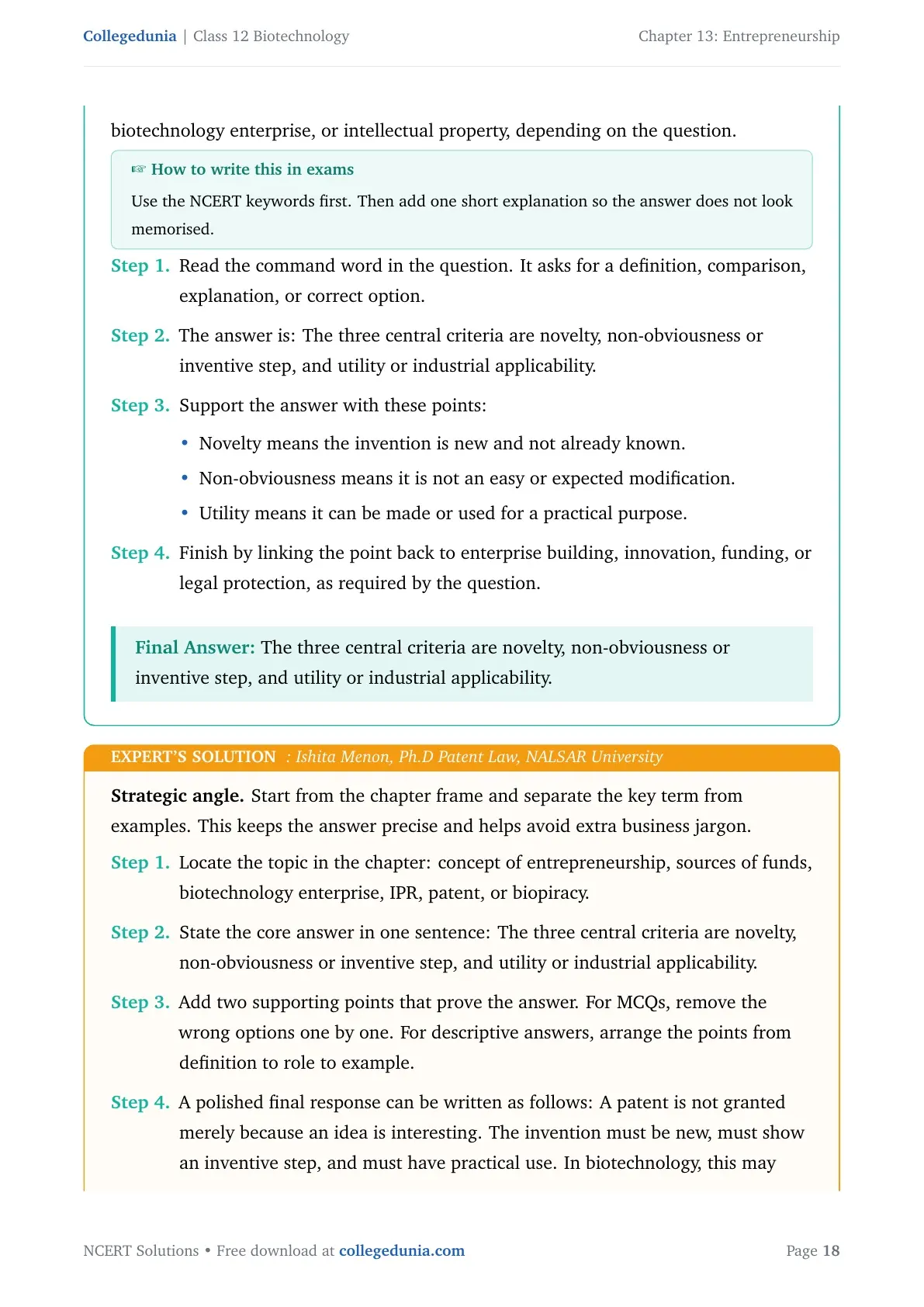
Q 13.11
What are the three central criteria for grant of Patents of any scientific inventions?
Concept used. A textbook solution should first identify the exact idea being tested, then connect it to the chapter language. Here the idea is entrepreneurship, funding, biotechnology enterprise, or intellectual property, depending on the question.
How to write this in exams
Use the NCERT keywords first. Then add one short explanation so the answer does not look memorised.
Read the command word in the question. It asks for a definition, comparison, explanation, or correct option.
The answer is: The three central criteria are novelty, non-obviousness or inventive step, and utility or industrial applicability.
Support the answer with these points:
Novelty means the invention is new and not already known.
Non-obviousness means it is not an easy or expected modification.
Utility means it can be made or used for a practical purpose.
Finish by linking the point back to enterprise building, innovation, funding, or legal protection, as required by the question.
The three central criteria are novelty, non-obviousness or inventive step, and utility or industrial applicability.
IM
Ishita Menon
Ph.D Patent Law, NALSAR University
Verified Expert
Strategic angle. Start from the chapter frame and separate the key term from examples. This keeps the answer precise and helps avoid extra business jargon.
Locate the topic in the chapter: concept of entrepreneurship, sources of funds, biotechnology enterprise, IPR, patent, or biopiracy.
State the core answer in one sentence: The three central criteria are novelty, non-obviousness or inventive step, and utility or industrial applicability.
Add two supporting points that prove the answer. For MCQs, remove the wrong options one by one. For descriptive answers, arrange the points from definition to role to example.
A polished final response can be written as follows: A patent is not granted merely because an idea is interesting. The invention must be new, must show an inventive step, and must have practical use. In biotechnology, this may apply to a process, product, or technical application, provided it is not excluded by patent law.
This method gives the examiner the keyword, the reason, and the chapter link in a compact form.
The three central criteria are novelty, non-obviousness or inventive step, and utility or industrial applicability.
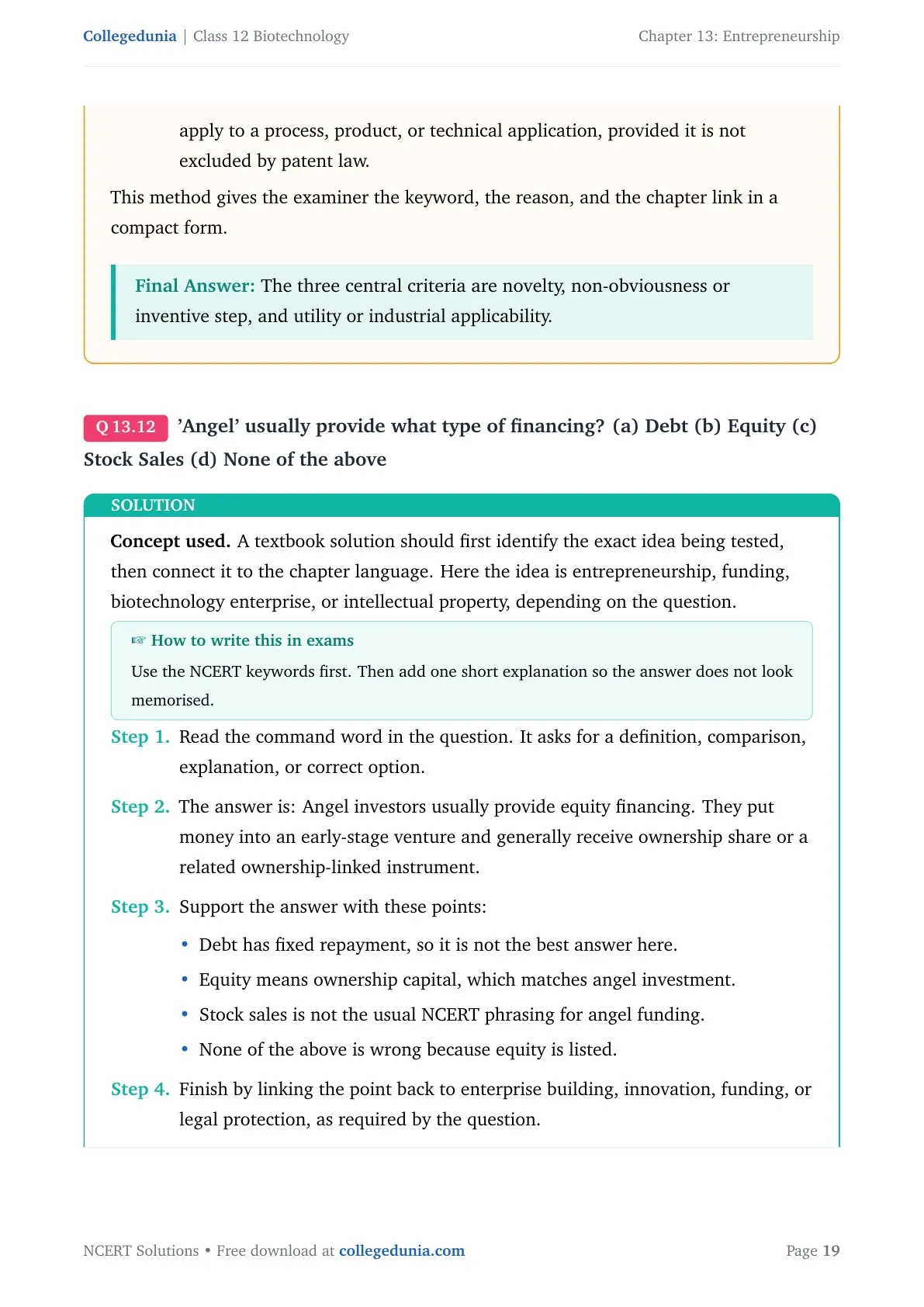
Q 13.12
'Angel' usually provide what type of financing? (a) Debt (b) Equity (c) Stock Sales (d) None of the above
Concept used. A textbook solution should first identify the exact idea being tested, then connect it to the chapter language. Here the idea is entrepreneurship, funding, biotechnology enterprise, or intellectual property, depending on the question.
How to write this in exams
Use the NCERT keywords first. Then add one short explanation so the answer does not look memorised.
Read the command word in the question. It asks for a definition, comparison, explanation, or correct option.
The answer is: Angel investors usually provide equity financing. They put money into an early-stage venture and generally receive ownership share or a related ownership-linked instrument.
Support the answer with these points:
Debt has fixed repayment, so it is not the best answer here.
Equity means ownership capital, which matches angel investment.
Stock sales is not the usual NCERT phrasing for angel funding.
None of the above is wrong because equity is listed.
Finish by linking the point back to enterprise building, innovation, funding, or legal protection, as required by the question.
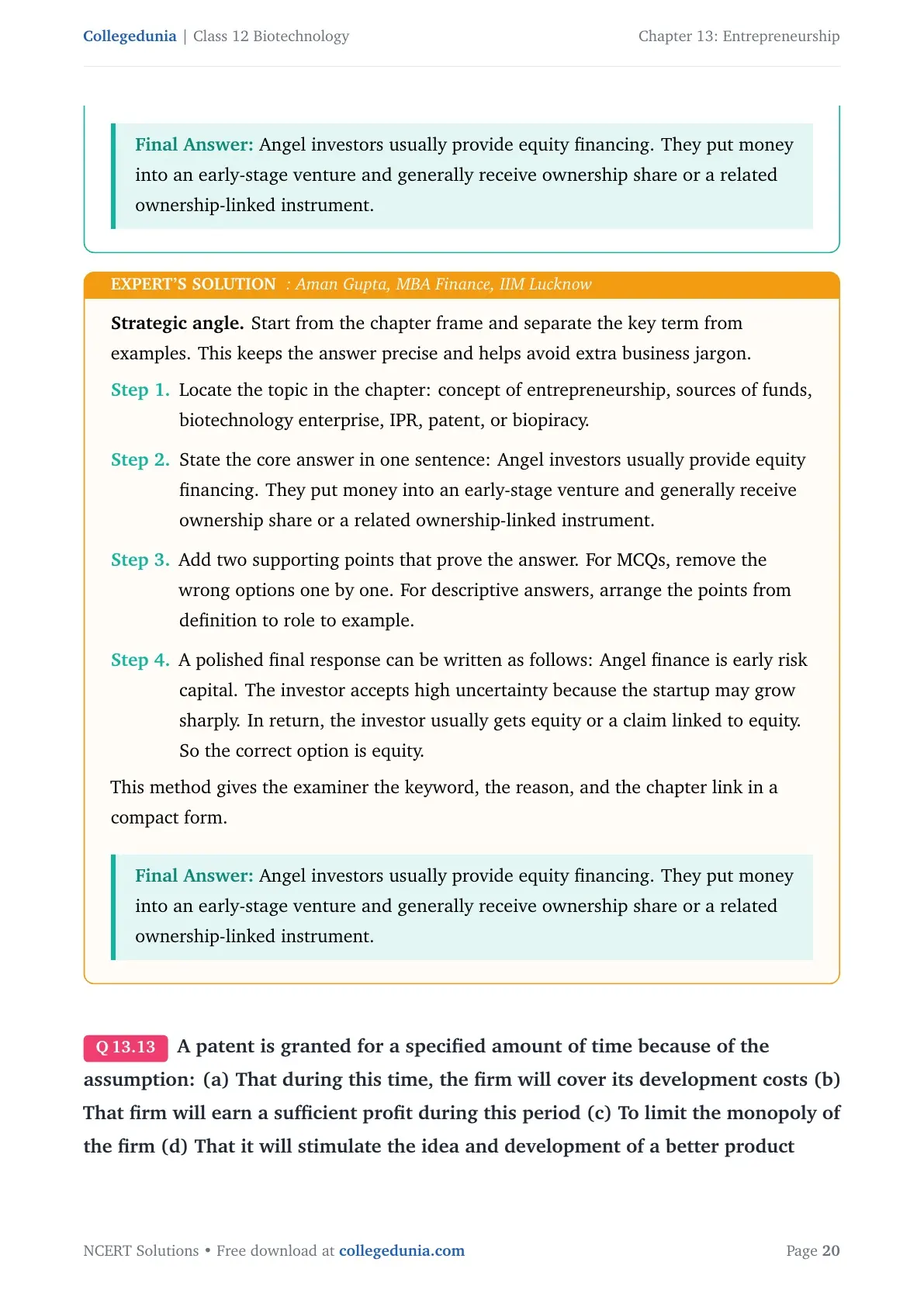
Angel investors usually provide equity financing. They put money into an early-stage venture and generally receive ownership share or a related ownership-linked instrument.
AG
Aman Gupta
MBA Finance, IIM Lucknow
Verified Expert
Strategic angle. Start from the chapter frame and separate the key term from examples. This keeps the answer precise and helps avoid extra business jargon.
Locate the topic in the chapter: concept of entrepreneurship, sources of funds, biotechnology enterprise, IPR, patent, or biopiracy.
State the core answer in one sentence: Angel investors usually provide equity financing. They put money into an early-stage venture and generally receive ownership share or a related ownership-linked instrument.
Add two supporting points that prove the answer. For MCQs, remove the wrong options one by one. For descriptive answers, arrange the points from definition to role to example.
A polished final response can be written as follows: Angel finance is early risk capital. The investor accepts high uncertainty because the startup may grow sharply. In return, the investor usually gets equity or a claim linked to equity. So the correct option is equity.
This method gives the examiner the keyword, the reason, and the chapter link in a compact form.
Angel investors usually provide equity financing. They put money into an early-stage venture and generally receive ownership share or a related ownership-linked instrument.
Q 13.13
A patent is granted for a specified amount of time because of the assumption: (a) That during this time, the firm will cover its development costs (b) That firm will earn a sufficient profit during this period (c) To limit the monopoly of the firm (d) That it will stimulate the idea and development of a better product
Concept used. A textbook solution should first identify the exact idea being tested, then connect it to the chapter language. Here the idea is entrepreneurship, funding, biotechnology enterprise, or intellectual property, depending on the question.
How to write this in exams
Use the NCERT keywords first. Then add one short explanation so the answer does not look memorised.
Read the command word in the question. It asks for a definition, comparison, explanation, or correct option.
The answer is: A patent gives a temporary legal monopoly. The time limit exists so that the monopoly does not continue forever.
Support the answer with these points:
The patent period rewards invention for a fixed time.
After that period, the public can use the disclosed knowledge more freely.
This balances private reward with public interest.
Therefore, the best option is to limit monopoly.
Finish by linking the point back to enterprise building, innovation, funding, or legal protection, as required by the question.
A patent gives a temporary legal monopoly. The time limit exists so that the monopoly does not continue forever.
RS
Ritu Sharma
M.Sc Biotechnology, Delhi University
Verified Expert
Strategic angle. Start from the chapter frame and separate the key term from examples. This keeps the answer precise and helps avoid extra business jargon.
Locate the topic in the chapter: concept of entrepreneurship, sources of funds, biotechnology enterprise, IPR, patent, or biopiracy.
State the core answer in one sentence: A patent gives a temporary legal monopoly. The time limit exists so that the monopoly does not continue forever.
Add two supporting points that prove the answer. For MCQs, remove the wrong options one by one. For descriptive answers, arrange the points from definition to role to example.
A polished final response can be written as follows: The patent system is a balance. Society gives the inventor limited exclusive rights for disclosure of the invention. If the right had no time limit, competition would remain blocked. A specified period prevents permanent monopoly and allows wider use later.
This method gives the examiner the keyword, the reason, and the chapter link in a compact form.
A patent gives a temporary legal monopoly. The time limit exists so that the monopoly does not continue forever.
Q 13.14
A short-term, internal source of funds can be obtained by reducing all of the following EXCEPT 2.4cm0.4pt. (a) short-term assets (b) cash (c) fixed assets (d) Inventory
Concept used. A textbook solution should first identify the exact idea being tested, then connect it to the chapter language. Here the idea is entrepreneurship, funding, biotechnology enterprise, or intellectual property, depending on the question.
How to write this in exams
Use the NCERT keywords first. Then add one short explanation so the answer does not look memorised.
Read the command word in the question. It asks for a definition, comparison, explanation, or correct option.
The answer is: Short-term internal funds are usually released by managing working capital. Fixed assets are long-term assets, so reducing them is not the typical short-term internal source.
Support the answer with these points:
Short-term assets and inventory belong to working capital.
Cash management can release short-term funds.
Fixed assets are plant, machinery, or long-term property.
So fixed assets are the exception.
Finish by linking the point back to enterprise building, innovation, funding, or legal protection, as required by the question.
Short-term internal funds are usually released by managing working capital. Fixed assets are long-term assets, so reducing them is not the typical short-term internal source.
NS
Neel Shah
MBA Entrepreneurship, NMIMS Mumbai
Verified Expert
Strategic angle. Start from the chapter frame and separate the key term from examples. This keeps the answer precise and helps avoid extra business jargon.
Locate the topic in the chapter: concept of entrepreneurship, sources of funds, biotechnology enterprise, IPR, patent, or biopiracy.
State the core answer in one sentence: Short-term internal funds are usually released by managing working capital. Fixed assets are long-term assets, so reducing them is not the typical short-term internal source.
Add two supporting points that prove the answer. For MCQs, remove the wrong options one by one. For descriptive answers, arrange the points from definition to role to example.
A polished final response can be written as follows: The clue is the word short-term. Working capital items can be adjusted quickly. Inventory can be reduced, receivables can be managed, and cash can be controlled. Fixed assets are not normally reduced for a short-term internal funding need.
This method gives the examiner the keyword, the reason, and the chapter link in a compact form.
Short-term internal funds are usually released by managing working capital. Fixed assets are long-term assets, so reducing them is not the typical short-term internal source.
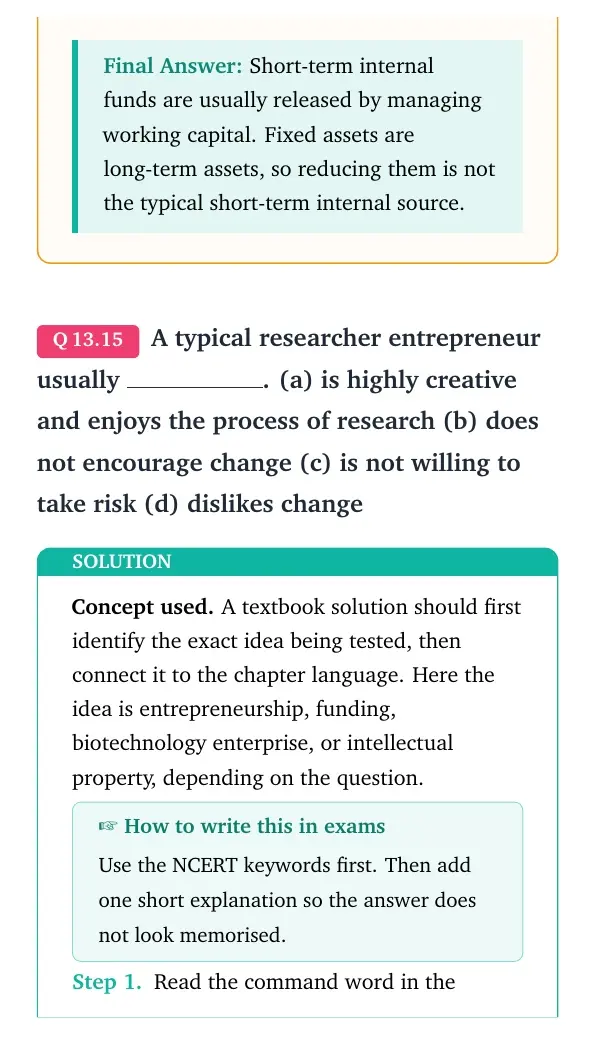
Q 13.15
A typical researcher entrepreneur usually 2.4cm0.4pt. (a) is highly creative and enjoys the process of research (b) does not encourage change (c) is not willing to take risk (d) dislikes change
Concept used. A textbook solution should first identify the exact idea being tested, then connect it to the chapter language. Here the idea is entrepreneurship, funding, biotechnology enterprise, or intellectual property, depending on the question.
How to write this in exams
Use the NCERT keywords first. Then add one short explanation so the answer does not look memorised.
Read the command word in the question. It asks for a definition, comparison, explanation, or correct option.
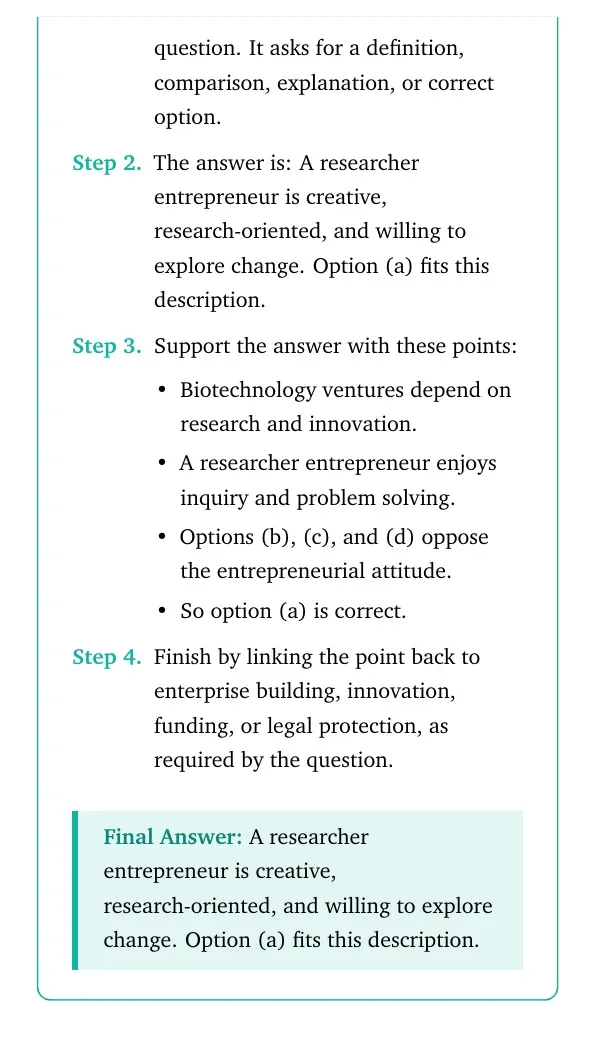
The answer is: A researcher entrepreneur is creative, research-oriented, and willing to explore change. Option (a) fits this description.
Support the answer with these points:
Biotechnology ventures depend on research and innovation.
A researcher entrepreneur enjoys inquiry and problem solving.
Options (b), (c), and (d) oppose the entrepreneurial attitude.
So option (a) is correct.
Finish by linking the point back to enterprise building, innovation, funding, or legal protection, as required by the question.
A researcher entrepreneur is creative, research-oriented, and willing to explore change. Option (a) fits this description.
KR
Kavya Reddy
Ph.D Innovation Studies, IIT Madras
Verified Expert
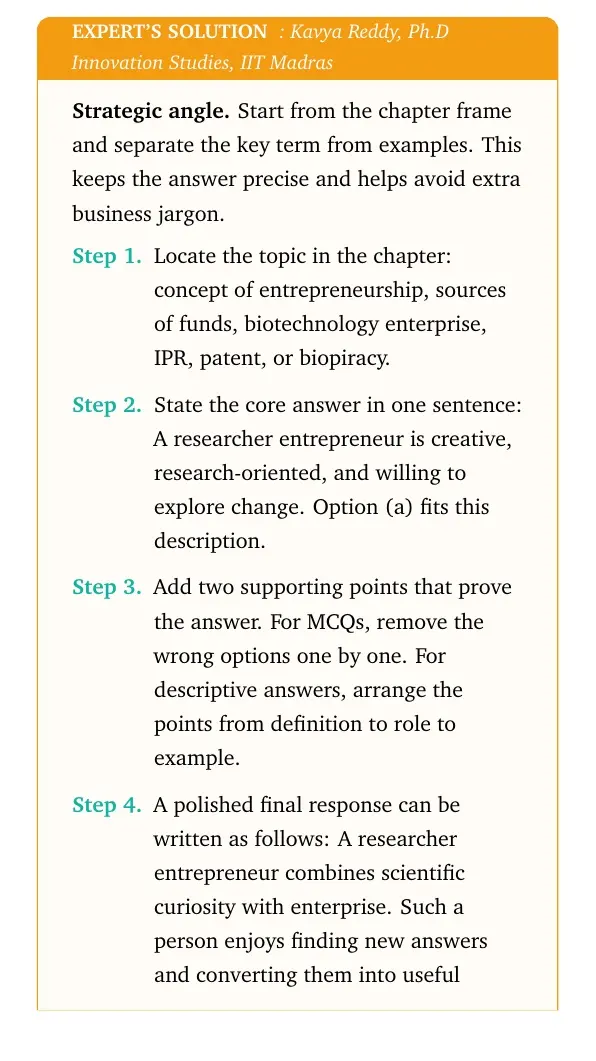
Strategic angle. Start from the chapter frame and separate the key term from examples. This keeps the answer precise and helps avoid extra business jargon.
Locate the topic in the chapter: concept of entrepreneurship, sources of funds, biotechnology enterprise, IPR, patent, or biopiracy.
State the core answer in one sentence: A researcher entrepreneur is creative, research-oriented, and willing to explore change. Option (a) fits this description.
Add two supporting points that prove the answer. For MCQs, remove the wrong options one by one. For descriptive answers, arrange the points from definition to role to example.
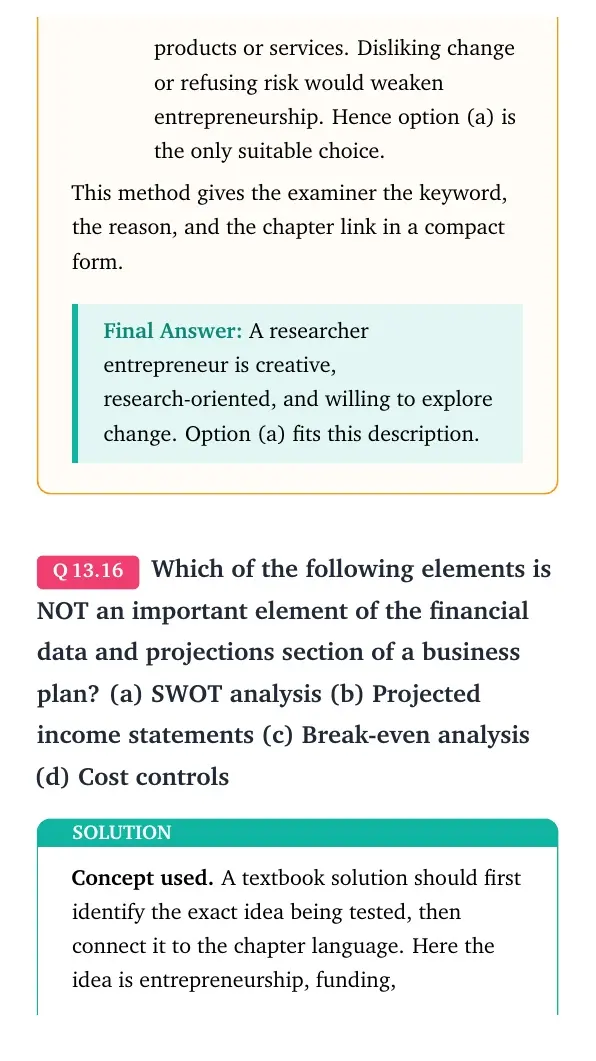
A polished final response can be written as follows: A researcher entrepreneur combines scientific curiosity with enterprise. Such a person enjoys finding new answers and converting them into useful products or services. Disliking change or refusing risk would weaken entrepreneurship. Hence option (a) is the only suitable choice.
This method gives the examiner the keyword, the reason, and the chapter link in a compact form.
A researcher entrepreneur is creative, research-oriented, and willing to explore change. Option (a) fits this description.
Q 13.16
Which of the following elements is NOT an important element of the financial data and projections section of a business plan? (a) SWOT analysis (b) Projected income statements (c) Break-even analysis (d) Cost controls
Concept used. A textbook solution should first identify the exact idea being tested, then connect it to the chapter language. Here the idea is entrepreneurship, funding, biotechnology enterprise, or intellectual property, depending on the question.
How to write this in exams
Use the NCERT keywords first. Then add one short explanation so the answer does not look memorised.
Read the command word in the question. It asks for a definition, comparison, explanation, or correct option.
The answer is: Projected income statements, break-even analysis, and cost controls are financial projection tools. SWOT analysis is a strategic analysis tool, not a financial data projection element.
Support the answer with these points:
Projected income statements estimate future profit.
Break-even analysis finds the sales level where cost is recovered.
Cost controls belong to financial planning.
SWOT studies strengths, weaknesses, opportunities, and threats.
Finish by linking the point back to enterprise building, innovation, funding, or legal protection, as required by the question.
Projected income statements, break-even analysis, and cost controls are financial projection tools. SWOT analysis is a strategic analysis tool, not a financial data projection element.
HV
Harsh Vardhan
MBA Finance, FMS Delhi
Verified Expert
Strategic angle. Start from the chapter frame and separate the key term from examples. This keeps the answer precise and helps avoid extra business jargon.
Locate the topic in the chapter: concept of entrepreneurship, sources of funds, biotechnology enterprise, IPR, patent, or biopiracy.
State the core answer in one sentence: Projected income statements, break-even analysis, and cost controls are financial projection tools. SWOT analysis is a strategic analysis tool, not a financial data projection element.
Add two supporting points that prove the answer. For MCQs, remove the wrong options one by one. For descriptive answers, arrange the points from definition to role to example.
A polished final response can be written as follows: The financial section deals with numbers: income, cost, cash need, break-even point, and controls. SWOT is useful in a business plan, but it belongs to strategic assessment. Since the question asks what is not part of financial data and projections, the answer is SWOT analysis.
This method gives the examiner the keyword, the reason, and the chapter link in a compact form.
Projected income statements, break-even analysis, and cost controls are financial projection tools. SWOT analysis is a strategic analysis tool, not a financial data projection element.
Q 13.17
Which of the following cannot be covered under the copyright protection? (a) Computer software (b) Computer hardware (c) Poems and songs (d) Models and sculpture
Concept used. A textbook solution should first identify the exact idea being tested, then connect it to the chapter language. Here the idea is entrepreneurship, funding, biotechnology enterprise, or intellectual property, depending on the question.
How to write this in exams
Use the NCERT keywords first. Then add one short explanation so the answer does not look memorised.
Read the command word in the question. It asks for a definition, comparison, explanation, or correct option.
The answer is: Copyright protects original expression such as software code, poems, songs, artistic works, and sculptures. Computer hardware is a physical device, so it is not covered by copyright.
Support the answer with these points:
Software can be protected as a literary work.
Poems and songs are creative works.
Models and sculpture are artistic works.
Hardware is a functional physical object.
Finish by linking the point back to enterprise building, innovation, funding, or legal protection, as required by the question.
Copyright protects original expression such as software code, poems, songs, artistic works, and sculptures. Computer hardware is a physical device, so it is not covered by copyright.
LT
Leena Thomas
LL.M Technology Law, NLU Delhi
Verified Expert
Strategic angle. Start from the chapter frame and separate the key term from examples. This keeps the answer precise and helps avoid extra business jargon.
Locate the topic in the chapter: concept of entrepreneurship, sources of funds, biotechnology enterprise, IPR, patent, or biopiracy.
State the core answer in one sentence: Copyright protects original expression such as software code, poems, songs, artistic works, and sculptures. Computer hardware is a physical device, so it is not covered by copyright.
Add two supporting points that prove the answer. For MCQs, remove the wrong options one by one. For descriptive answers, arrange the points from definition to role to example.
A polished final response can be written as follows: Copyright protects expression, not the physical machine itself. The design or working of hardware may relate to patents, design rights, or trade secrets depending on the case. Among the options, computer hardware is therefore the item not covered by copyright protection.
This method gives the examiner the keyword, the reason, and the chapter link in a compact form.
Copyright protects original expression such as software code, poems, songs, artistic works, and sculptures. Computer hardware is a physical device, so it is not covered by copyright.
Q 13.18
Which of the following is false? (a) A business plan is often prepared by an existing company to ensure that growth is properly managed. (b) A business plan is usually not required when obtaining finance for a startup. (c) If a business plan is completed for a startup, it may help the entrepreneur avoid costly mistakes. (d) All of the above.
Concept used. A textbook solution should first identify the exact idea being tested, then connect it to the chapter language. Here the idea is entrepreneurship, funding, biotechnology enterprise, or intellectual property, depending on the question.
How to write this in exams
Use the NCERT keywords first. Then add one short explanation so the answer does not look memorised.
Read the command word in the question. It asks for a definition, comparison, explanation, or correct option.
The answer is: Statement (b) is false. A startup usually needs a business plan when it seeks finance, because lenders and investors want to see the idea, market, cost, and return.
Support the answer with these points:
Statement (a) is true because existing companies also plan growth.
Statement (b) is false because finance providers expect a business plan.
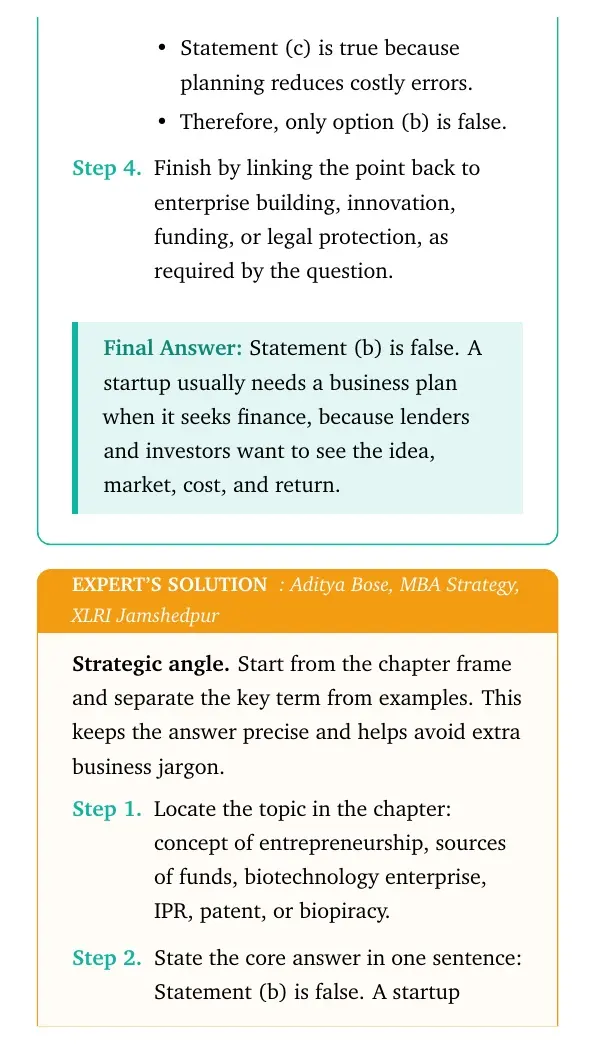
Statement (c) is true because planning reduces costly errors.
Therefore, only option (b) is false.
Finish by linking the point back to enterprise building, innovation, funding, or legal protection, as required by the question.
Statement (b) is false. A startup usually needs a business plan when it seeks finance, because lenders and investors want to see the idea, market, cost, and return.
AB
Aditya Bose
MBA Strategy, XLRI Jamshedpur
Verified Expert
Strategic angle. Start from the chapter frame and separate the key term from examples. This keeps the answer precise and helps avoid extra business jargon.
Locate the topic in the chapter: concept of entrepreneurship, sources of funds, biotechnology enterprise, IPR, patent, or biopiracy.
State the core answer in one sentence: Statement (b) is false. A startup usually needs a business plan when it seeks finance, because lenders and investors want to see the idea, market, cost, and return.
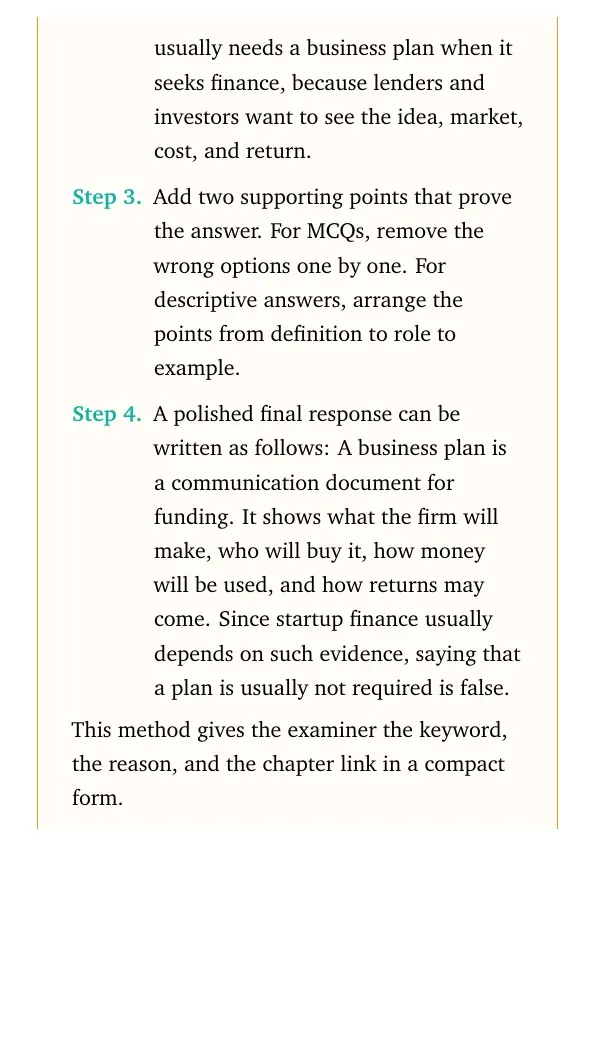
Add two supporting points that prove the answer. For MCQs, remove the wrong options one by one. For descriptive answers, arrange the points from definition to role to example.
A polished final response can be written as follows: A business plan is a communication document for funding. It shows what the firm will make, who will buy it, how money will be used, and how returns may come. Since startup finance usually depends on such evidence, saying that a plan is usually not required is false.
This method gives the examiner the keyword, the reason, and the chapter link in a compact form.
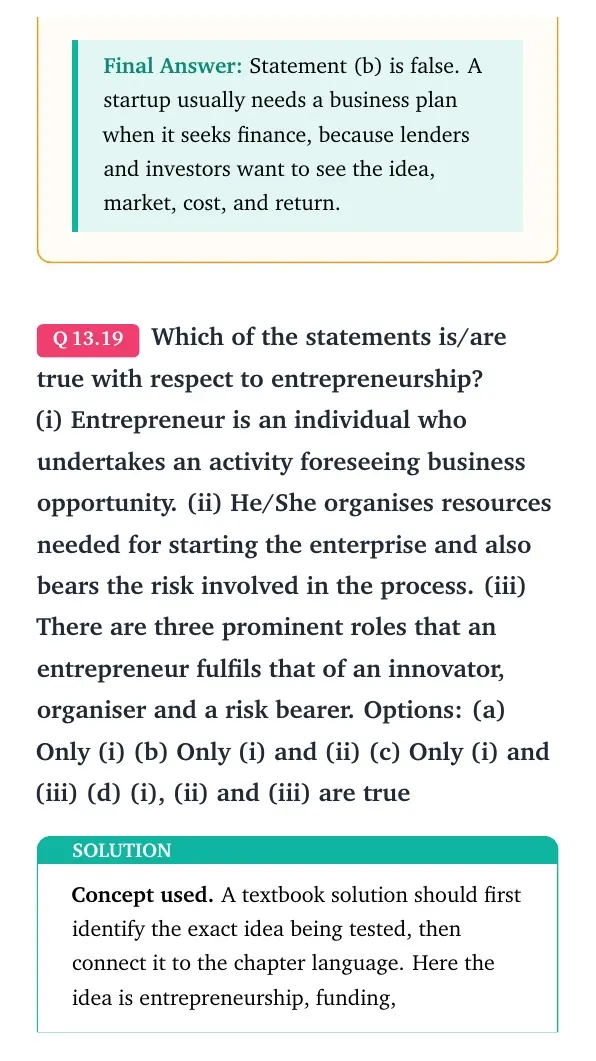
Statement (b) is false. A startup usually needs a business plan when it seeks finance, because lenders and investors want to see the idea, market, cost, and return.
Q 13.19
Which of the statements is/are true with respect to entrepreneurship? (i) Entrepreneur is an individual who undertakes an activity foreseeing business opportunity. (ii) He/She organises resources needed for starting the enterprise and also bears the risk involved in the process. (iii) There are three prominent roles that an entrepreneur fulfils that of an innovator, organiser and a risk bearer. Options: (a) Only (i) (b) Only (i) and (ii) (c) Only (i) and (iii) (d) (i), (ii) and (iii) are true
Concept used. A textbook solution should first identify the exact idea being tested, then connect it to the chapter language. Here the idea is entrepreneurship, funding, biotechnology enterprise, or intellectual property, depending on the question.
How to write this in exams
Use the NCERT keywords first. Then add one short explanation so the answer does not look memorised.
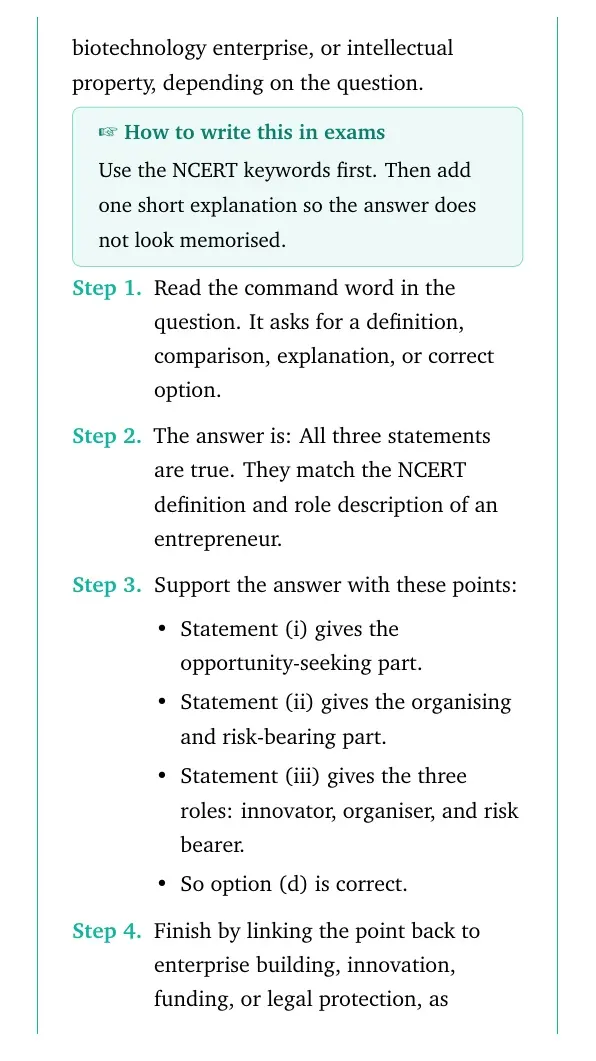
Read the command word in the question. It asks for a definition, comparison, explanation, or correct option.
The answer is: All three statements are true. They match the NCERT definition and role description of an entrepreneur.
Support the answer with these points:
Statement (i) gives the opportunity-seeking part.
Statement (ii) gives the organising and risk-bearing part.
Statement (iii) gives the three roles: innovator, organiser, and risk bearer.
So option (d) is correct.
Finish by linking the point back to enterprise building, innovation, funding, or legal protection, as required by the question.
All three statements are true. They match the NCERT definition and role description of an entrepreneur.
PM
Pooja Malhotra
M.Sc Biotechnology, Savitribai Phule Pune University
Verified Expert
Strategic angle. Start from the chapter frame and separate the key term from examples. This keeps the answer precise and helps avoid extra business jargon.
Locate the topic in the chapter: concept of entrepreneurship, sources of funds, biotechnology enterprise, IPR, patent, or biopiracy.
State the core answer in one sentence: All three statements are true. They match the NCERT definition and role description of an entrepreneur.
Add two supporting points that prove the answer. For MCQs, remove the wrong options one by one. For descriptive answers, arrange the points from definition to role to example.
A polished final response can be written as follows: The question repeats the core idea of the first section. An entrepreneur notices opportunity, gathers resources, and bears risk. The chapter also names three roles. Since all three statements are consistent with the text, the answer is option (d).
This method gives the examiner the keyword, the reason, and the chapter link in a compact form.
All three statements are true. They match the NCERT definition and role description of an entrepreneur.
Q 13.20
Seed capital assistance is 2.4cm0.4pt. (a) a long-term assistance. (b) initial assistance (c) a help for the purchase of seeds. (d) a short-term assistance.
Concept used. A textbook solution should first identify the exact idea being tested, then connect it to the chapter language. Here the idea is entrepreneurship, funding, biotechnology enterprise, or intellectual property, depending on the question.
How to write this in exams
Use the NCERT keywords first. Then add one short explanation so the answer does not look memorised.
Read the command word in the question. It asks for a definition, comparison, explanation, or correct option.
The answer is: Seed capital assistance means initial financial help given at the earliest stage of a venture. It is not about agricultural seeds.
Support the answer with these points:
Seed stage means the beginning stage of a venture.
The support helps the founder test and start the idea.
It is not a long-term loan label in this question.
So option (b), initial assistance, is correct.
Finish by linking the point back to enterprise building, innovation, funding, or legal protection, as required by the question.
Seed capital assistance means initial financial help given at the earliest stage of a venture. It is not about agricultural seeds.
SK
Sameer Kulkarni
MBA Startup Finance, SPJIMR Mumbai
Verified Expert
Strategic angle. Start from the chapter frame and separate the key term from examples. This keeps the answer precise and helps avoid extra business jargon.
Locate the topic in the chapter: concept of entrepreneurship, sources of funds, biotechnology enterprise, IPR, patent, or biopiracy.
State the core answer in one sentence: Seed capital assistance means initial financial help given at the earliest stage of a venture. It is not about agricultural seeds.
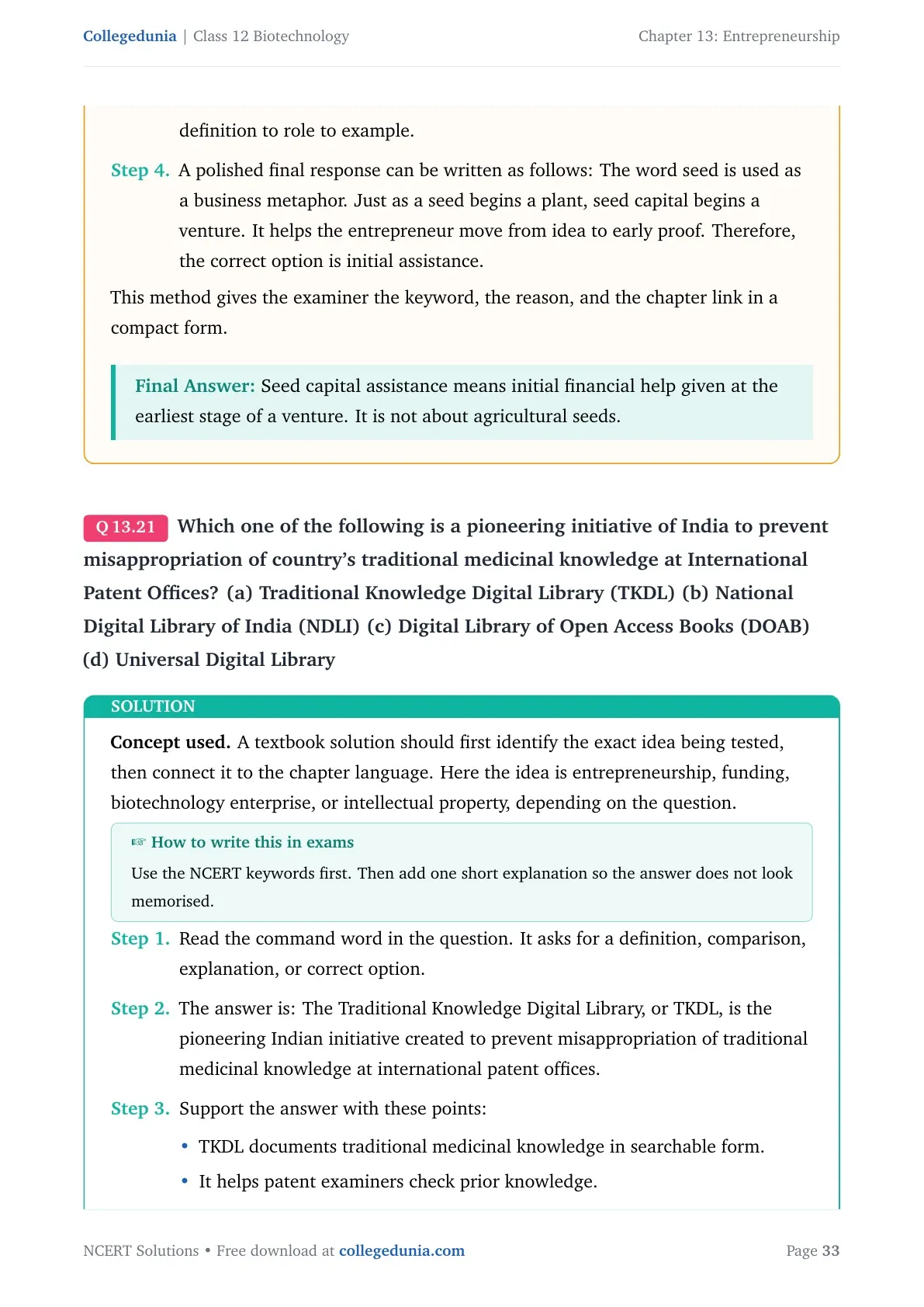
Add two supporting points that prove the answer. For MCQs, remove the wrong options one by one. For descriptive answers, arrange the points from definition to role to example.
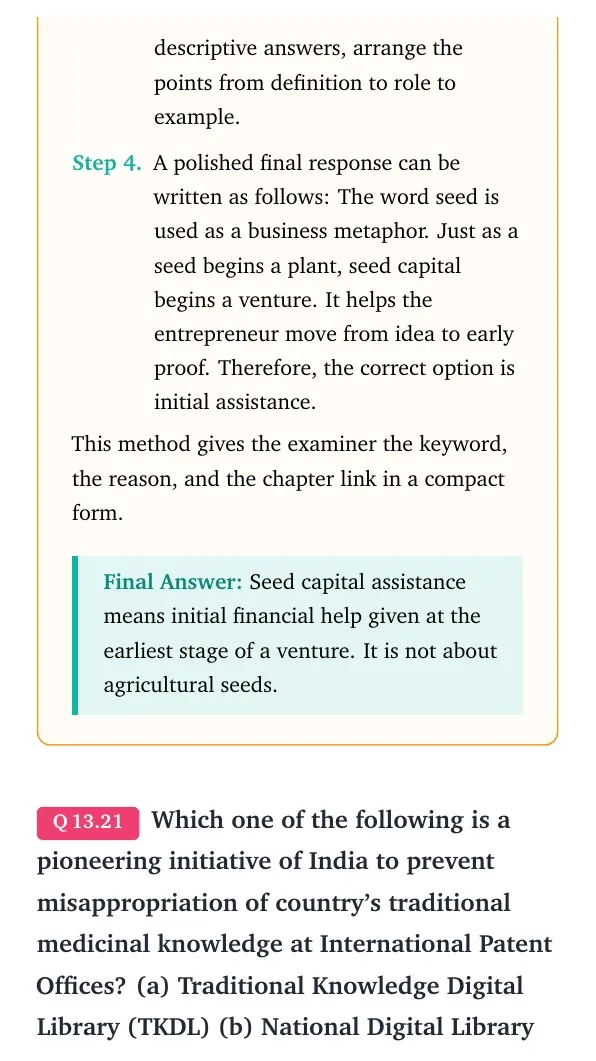
A polished final response can be written as follows: The word seed is used as a business metaphor. Just as a seed begins a plant, seed capital begins a venture. It helps the entrepreneur move from idea to early proof. Therefore, the correct option is initial assistance.
This method gives the examiner the keyword, the reason, and the chapter link in a compact form.
Seed capital assistance means initial financial help given at the earliest stage of a venture. It is not about agricultural seeds.
Q 13.21
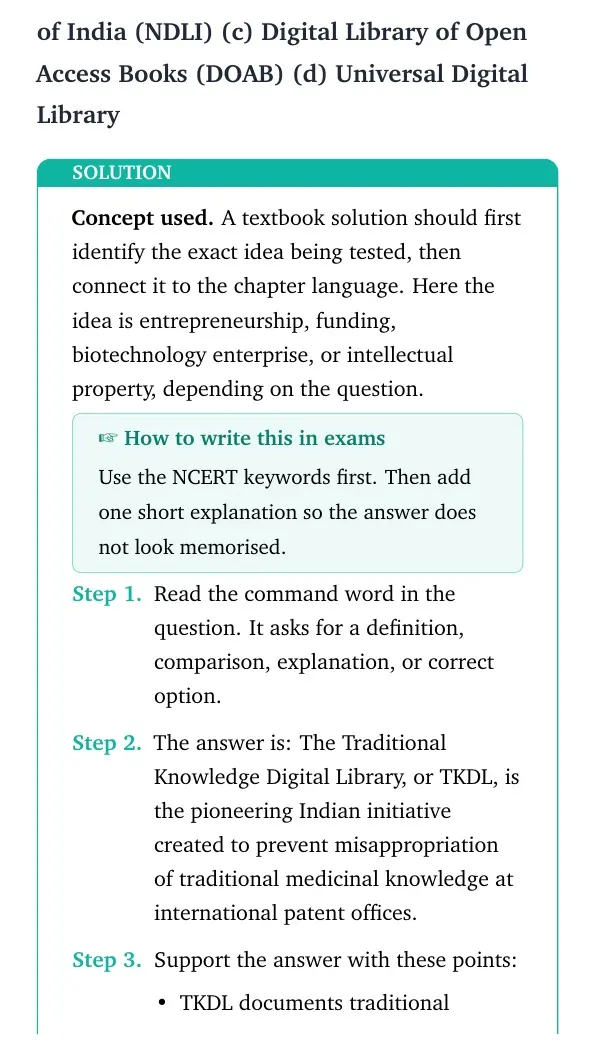
Which one of the following is a pioneering initiative of India to prevent misappropriation of country's traditional medicinal knowledge at International Patent Offices? (a) Traditional Knowledge Digital Library (TKDL) (b) National Digital Library of India (NDLI) (c) Digital Library of Open Access Books (DOAB) (d) Universal Digital Library
Concept used. A textbook solution should first identify the exact idea being tested, then connect it to the chapter language. Here the idea is entrepreneurship, funding, biotechnology enterprise, or intellectual property, depending on the question.
How to write this in exams
Use the NCERT keywords first. Then add one short explanation so the answer does not look memorised.
Read the command word in the question. It asks for a definition, comparison, explanation, or correct option.
The answer is: The Traditional Knowledge Digital Library, or TKDL, is the pioneering Indian initiative created to prevent misappropriation of traditional medicinal knowledge at international patent offices.
Support the answer with these points:
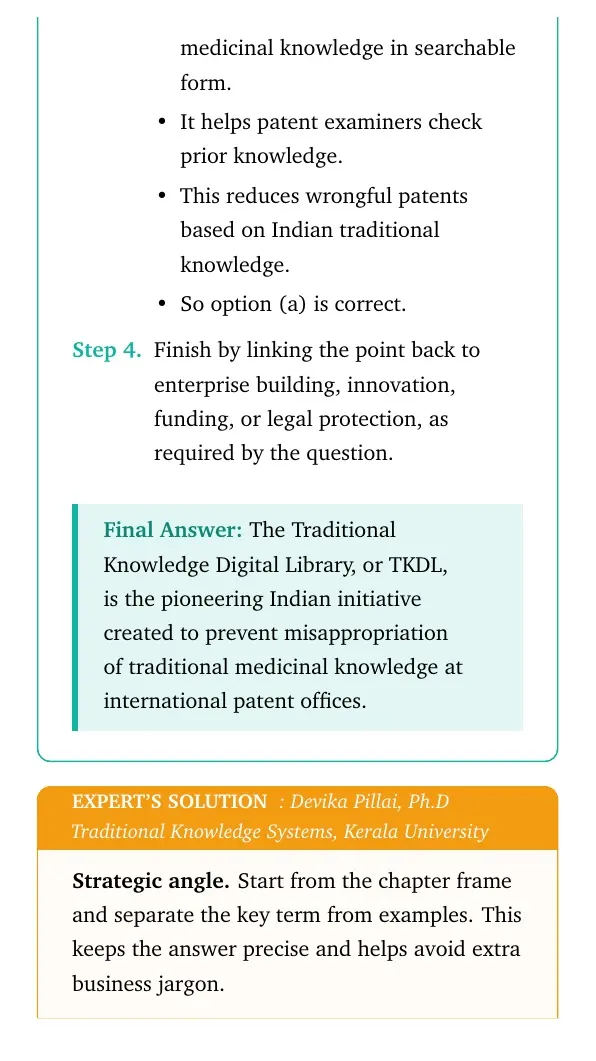
TKDL documents traditional medicinal knowledge in searchable form.
It helps patent examiners check prior knowledge.
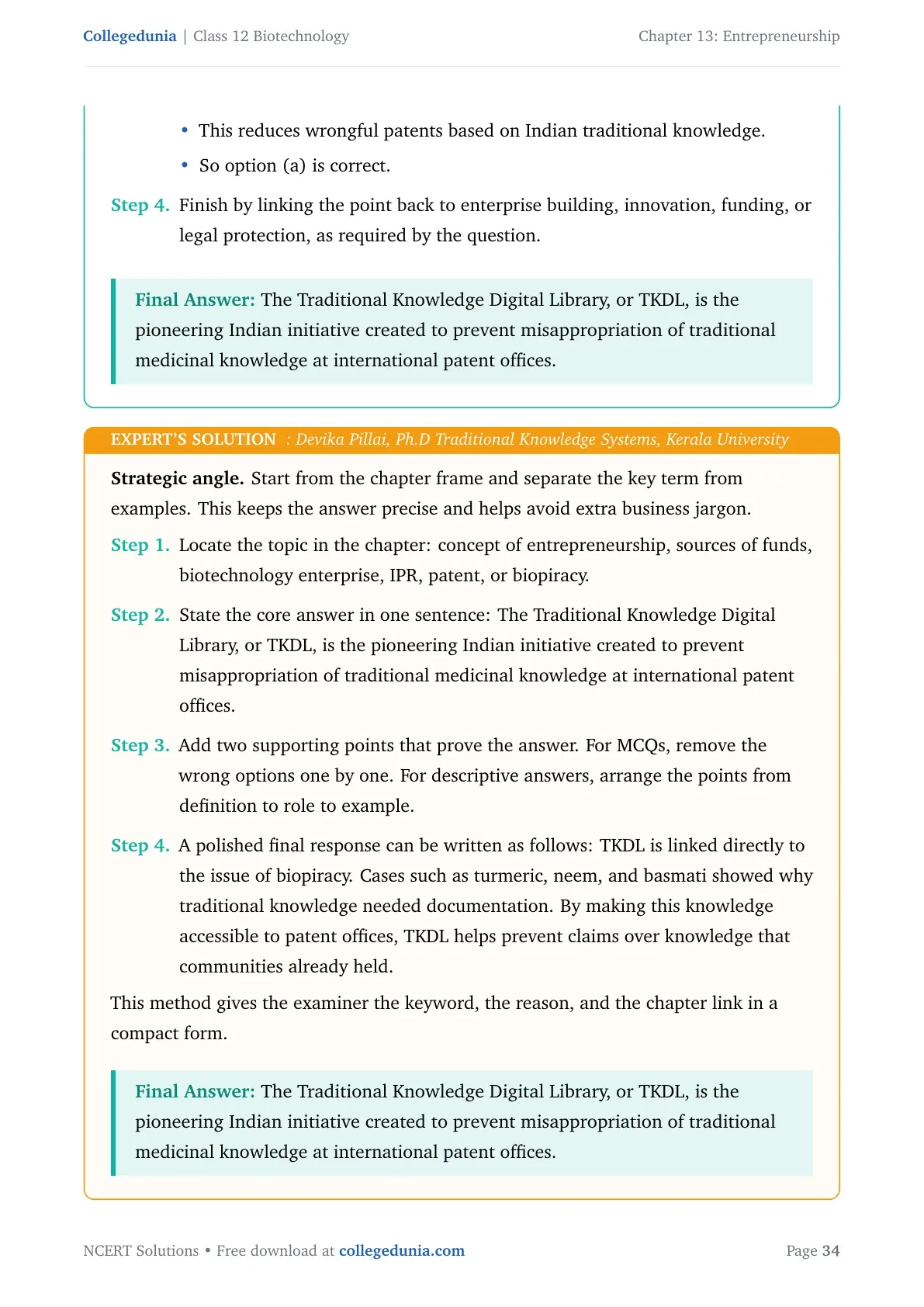
This reduces wrongful patents based on Indian traditional knowledge.
So option (a) is correct.
Finish by linking the point back to enterprise building, innovation, funding, or legal protection, as required by the question.
The Traditional Knowledge Digital Library, or TKDL, is the pioneering Indian initiative created to prevent misappropriation of traditional medicinal knowledge at international patent offices.
DP
Devika Pillai
Ph.D Traditional Knowledge Systems, Kerala University
Verified Expert
Strategic angle. Start from the chapter frame and separate the key term from examples. This keeps the answer precise and helps avoid extra business jargon.
Locate the topic in the chapter: concept of entrepreneurship, sources of funds, biotechnology enterprise, IPR, patent, or biopiracy.
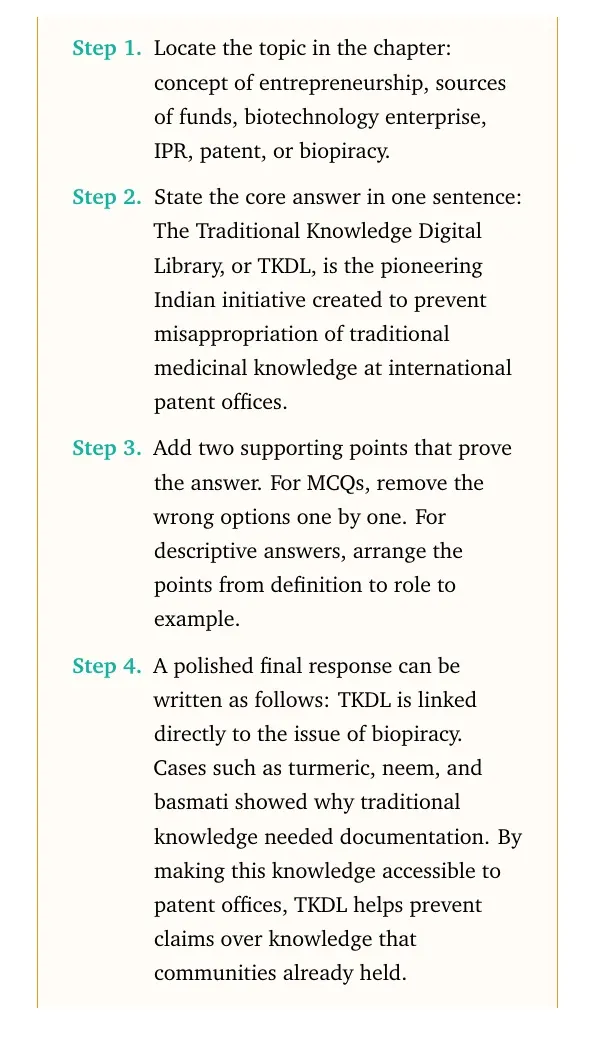
State the core answer in one sentence: The Traditional Knowledge Digital Library, or TKDL, is the pioneering Indian initiative created to prevent misappropriation of traditional medicinal knowledge at international patent offices.
Add two supporting points that prove the answer. For MCQs, remove the wrong options one by one. For descriptive answers, arrange the points from definition to role to example.
A polished final response can be written as follows: TKDL is linked directly to the issue of biopiracy. Cases such as turmeric, neem, and basmati showed why traditional knowledge needed documentation. By making this knowledge accessible to patent offices, TKDL helps prevent claims over knowledge that communities already held.
This method gives the examiner the keyword, the reason, and the chapter link in a compact form.
The Traditional Knowledge Digital Library, or TKDL, is the pioneering Indian initiative created to prevent misappropriation of traditional medicinal knowledge at international patent offices.
Entrepreneurship Class 12 Biotechnology NCERT Solutions FAQs
Ques. How many questions are solved in Class 12 Biotechnology Chapter 13 Entrepreneurship?
Ans. The chapter has 21 exercise questions. The PDF covers 11 descriptive answers and 10 MCQs.
Ques. Which Entrepreneurship topics should I revise first?
Ans. Revise entrepreneur roles, startup funds, biotech enterprise steps, IPR types, patent criteria and TKDL.
Ques. What is the answer to the angel financing MCQ?
Ans. The correct answer is equity. Angel investors usually provide early ownership-linked finance.
Ques. Why is TKDL important in this chapter?
Ans. TKDL helps stop biopiracy by documenting India's traditional medicinal knowledge for patent offices.







Comments