The NCERT Solutions on Chemical Kinetics Class 12 Chemistry Chapter 3 will provide detailed solutions prepared by Collegedunia Subject Matter Experts. You can pair it with NCERT Notes to complete the entire Chapter 3 revision during exam time.
Chemical Kinetics is a Physical Chemistry chapter, so most CBSE, JEE, and NEET questions are numericals. This page has the NCERT Solutions PDF for the 2026-27 syllabus, exercise-wise questions, and CBSE-style answer patterns.
CBSE Weightage: Chemical Kinetics is a high-weightage chapter in Physical Chemistry after Solutions. Every year, you can see questions up to 6-8 marks in the CBSE Board exam.
JEE Main Weightage: The overall marks weightage of Chemical Kinetics in JEE Main is 3 to 4% (2 to 3 questions per paper)
NEET Weightage: 2 to 3 questions every year from Chapter 3 Chemistry Class 12 can be seen in NEET UG exams.
These NCERT Solutions are curated by subject experts, mapped to the 2026-27 NCERT, and refined against the last five years of CBSE Board, JEE Main, and NEET papers.
Chemical Kinetics Exercise-by-Exercise Breakdown (NCERT Class 12 Chemistry)
Chemical Kinetics has 30 questions across the in-text and back exercise, skewed toward integrated rate-law and Arrhenius numericals. The table shows the count and sub-topic per exercise.
Exercise
Question Count
Sub-topic Focus
Difficulty
In-Text Questions (3.1 to 3.5)
5
Rate expression, order, molecularity
Easy
In-Text Questions (3.6 to 3.10)
5
Integrated rate laws, half-life
Medium
Exercise (3.1 to 3.10)
10
Order from data, units, rate constant
Medium
Exercise (3.11 to 3.20)
10
First-order kinetics, Arrhenius equation, activation energy
Medium to Hard
Concept: Order is found from experimental data; molecularity from a single elementary step. The marker gives one mark for stating both definitions clearly.
What's Inside the Chemical Kinetics NCERT Solutions PDF
The PDF has every in-text and exercise problem from NCERT Chemistry Part I Chapter 3, fully solved.
30 questions solved: 10 in-text plus 20 back exercise.
Formula recall block before each numerical.
Arrhenius numericals show the natural-log to base-10 conversion explicitly.
Common-mistake call-outs after every numerical.
How will Collegedunia's NCERT Solutions Help You with Chemical Kinetics?
The same five formula patterns drive most of the questions in this chapter, so the solutions are written to help you learn those patterns while you practise.
2026-27 NCERT alignment: every solution matches the current syllabus.
Marker-style answers: formula, then substitution, then arithmetic on a fresh line.
Common-mistake notes: rate-constant units and unit-conversion traps flagged.
Chemical Kinetics Previous Year Questions Weightage (2021-2026)
The table tracks which sub-topic of Chemical Kinetics was tested in CBSE Board, JEE Main, and NEET from 2021 onward. Arrhenius numericals and first-order half-life calculations recur almost every year.
Year
CBSE Board
JEE Main
NEET
2026
First-order rate constant numerical (3 marks)
Arrhenius equation
Order of reaction and half-life (1 Q)
2025
First-order half-life (3M), Arrhenius E_a (5M)
Pseudo first-order
Order from graph
2024
Integrated rate law derivation (3M)
Activation energy
Molecularity vs order
2023
Rate-constant units (2M)
Temperature coefficient
First-order half-life
2022
Pseudo first-order (2M), Arrhenius plot (3M)
Zero-order rate law
Activation energy concept
2021
Order and molecularity (2M)
-
Rate from stoichiometry
Arrhenius numericals appeared in 4 of the last 5 CBSE Board papers - the single most-repeated 5-marker of this chapter.
How to Study Chemical Kinetics for Class 12 Chemistry Boards
Plan roughly 10 to 12 hours of focused practice across four sessions.
Session 1 (3h) - Definitions and rate expression. NCERT 3.1 to 3.2; in-text Q3.1 to Q3.5.
Session 2 (3h) - Integrated rate laws. Derive zero-order and first-order yourself; solve Q3.6 to Q3.12.
Session 3 (3h) - Half-life and pseudo first-order. Practice t1/2 = 0.693/k; solve Q3.13 to Q3.16.
Session 4 (3h) - Arrhenius equation. Two-temperature form, ln k vs 1/T; solve Q3.17 to Q3.20.
Quick Tip: With only 4 hours left before the exam, skip the integrated-rate-law derivation and drill the Arrhenius numerical template; it covers the 5-marker every year.
Chemical Kinetics Top 6 Formulae for Quick Recall
The six formulae below recur in CBSE, JEE Main, and NEET numericals on Chemical Kinetics.
Common Mistakes Students Make in Chemical Kinetics
Five answer-writing slips turn a full-marks answer into a half-marks one in CBSE scripts.
Confusing order with molecularity.Swapping them costs a full mark.
Wrong units of rate constant. First-order: s⁻¹. Zero-order: mol L⁻¹ s⁻¹. Second-order: L mol⁻¹ s⁻¹. Writing s⁻¹ for every order is the commonest 2-mark slip.
Mixing natural log and log base 10.Dropping the 2.303 factor makes E_a wrong by 2.3x.
Forgetting Kelvin conversion. Using 27 instead of 300 in Arrhenius gives an absurd answer.
Skipping the formula statement. CBSE awards one mark for writing the formula before substituting.
Topics Covered in Class 12 Chemistry Chapter 3 NCERT Solutions
Every question in this PDF maps to one or more of the sub-topics below.
Rate of reaction: average vs instantaneous rate, rate from stoichiometry, units mol L-1 s-1.
Order vs molecularity: order from the experimental rate law (can be fractional); molecularity from an elementary step.
Integrated rate laws and half-life: zero-order gives linear [A] vs t; first-order gives t1/2 = 0.693/k, independent of starting concentration.
Pseudo first-order reactions: ester hydrolysis and inversion of cane sugar reduced to k' = k[H2O] .
Arrhenius equation:k = A e-Ea/RT; a plot of ln k vs 1/T gives slope -Ea/R.
Rate-constant units: mol L-1 s-1 for zero, s-1 for first, L mol-1 s-1 for second order.
Chemical Kinetics Weightage Compared Across Class 12 Chemistry Chapters
The chart maps the typical CBSE marks distribution across all 10 NCERT Chemistry chapters, averaged over the last five board papers. Chemical Kinetics sits in the upper band.
Ch 1 Solutions
6 marks
Ch 2 Electrochemistry
7 marks
Ch 3 Chemical Kinetics
7 marks
Ch 4 d- and f-Block Elements
7 marks
Ch 5 Coordination Compounds
8 marks
Ch 6 Haloalkanes and Haloarenes
6 marks
Ch 7 Alcohols, Phenols and Ethers
7 marks
Ch 8 Aldehydes, Ketones and Acids
8 marks
Ch 9 Amines
6 marks
Ch 10 Biomolecules
5 marks
All NCERT Solutions for Chemical Kinetics with Step-by-Step Working
Every NCERT textbook question for Class 12 Chemistry Chapter 3 Chemical Kinetics is listed below inside collapsible tabs. Click Check Solution for the step-by-step working, or Expert Solution for a fuller explanation.
Questions
Q 3.1
From the rate expression for the following reactions, determine their order of reaction and the dimensions of the rate constants.
(i) 3NO(g) -> N2O(g), Rate = k[NO]2
(ii) H2O2(aq) + 3I- (aq) + 2H+ -> 2H2O(l) + I3-, Rate = k[H2O2][I-]
(iii) CH3CHO(g) -> CH4(g) + CO(g), Rate = k[CH3CHO]3/2
(iv) C2H5Cl(g) -> C2H4(g) + HCl(g), Rate = k[C2H5Cl]
Concept used. The order of a reaction is the sum of the powers of the concentration terms in the experimentally determined rate law. If the rate law is r = k [A]a[B]b, the order is n = a+b. The order is found from experiment; it need not equal the stoichiometric coefficients of the balanced equation.
The dimensions of the rate constant k follow directly from the rate equation. Rate has units mol.L-1.s-1, so k = Rate[conc.]n = mol.L-1.s-1(mol.L-1)n = mol1-n.Ln-1.s-1. Use this single formula in every part.
Why the dimension formula matters
Once you remember k ∝ (conc.)1-n t-1, you can write down the units of k for any order n in one line; no need to rederive from scratch.
Part (i). Rate = k[NO]2. The single concentration term has exponent 2, so the order is n = 2. Substitute into the dimension formula: k = mol.L-1.s-1(mol.L-1)2 = mol-1.L.s-1.
Part (ii). Rate = k[H2O2][I-]. Exponents are 1 and 1, so order n = 1 + 1 = 2. The dimensions are k = mol.L-1.s-1(mol.L-1)2 = mol-1.L.s-1.
Part (iii). Rate = k[CH3CHO]3/2. The single exponent is 3/2, so order n = 3/2 = 1.5. The dimensions are k = mol.L-1.s-1(mol.L-1)3/2 = (mol.L-1)1-3/2 s-1 = mol-1/2.L1/2.s-1.
Part (iv). Rate = k[C2H5Cl]. Exponent is 1, so order n = 1. The dimensions are k = mol.L-1.s-1(mol.L-1)1 = s-1.
(i) n=2, k in mol-1.L.s-1; (ii) n=2, k in mol-1.L.s-1; (iii) n=1.5, k in mol-1/2.L1/2.s-1; (iv) n=1, k in s-1.
AS
Aarav Sharma
M.Sc Chemistry, IIT Kanpur
Verified Expert
Structural angle. Order is read straight off the rate law, and the dimensions of k are forced by the requirement that the rate itself carry units of concentration per unit time. So the same two-step procedure works in all four parts: add the exponents to get n; substitute n into the dimension template.
The general rate equation r = k [A]a[B]b⋯ has order n = a + b + ⋯. Inspect each rate law and add up all the exponents on concentration terms.
Solve for k: k = r[A]a[B]b⋯ = mol.L-1.s-1× (mol.L-1)-n = mol1-n.Ln-1.s-1.
Apply to each part. (i) n=2 gives mol-1.L.s-1. (ii) n=2 gives mol-1.L.s-1. (iii) n=1.5 gives mol-1/2.L1/2.s-1. (iv) n=1 gives s-1.
Alternative dimensional route. Instead of memorising the mol1-n.Ln-1.s-1 template, you can derive units on the fly. Write rate = k(conc.)n, transpose to k = rate/(conc.)n, plug in mol.L-1.s-1 for rate and mol.L-1 for concentration, and let exponents subtract. This ``derive don't memorise'' habit pays off when the problem switches to pressure (units of bar1-n.t-1) or to molality.
Concept linkage. Order ≠ molecularity. Molecularity is the number of molecules colliding in an elementary step (always a positive integer), while order is an experimental power that can be zero, fractional, or even negative. The reaction in part (iii) (CH3CHO decomposition) is a complex multi-step process; its n = 3/2 signals a Rice–Herzfeld chain mechanism with a fast pre-equilibrium step.
Cross-check by limiting cases. For n = 0, the template gives mol.L-1.s-1 – same as rate, which makes sense because kis the rate when concentration has no effect. For n = 1, the template gives s-1 – a pure frequency, which matches the radioactive-decay analogue. These two limits anchor the formula in physical meaning.
JEE/NEET relevance. Identifying order from a rate law and writing the corresponding units of k is a one-mark recall question almost every year. The 2022 JEE Main paper, for instance, tested exactly this pattern with n = 5/2. The answer is mechanical once you know the template.
Orders: 2, 2, 1.5, 1. Units of k: mol-1.L.s-1, mol-1.L.s-1, mol-1/2.L1/2.s-1, s-1.
Q 3.2
For the reaction 2A + B -> A2B, the rate is r = k[A][B]2 with rate constant k = 2.0 × 10⁻⁶ mol-2.L2.s-1. Calculate the initial rate of the reaction when [A] = 0.1 mol.L-1 and [B] = 0.2 mol.L-1. Calculate the rate of reaction after [A] is reduced to 0.06 mol.L-1.
Concept used. The rate law is given: r = k [A] [B]2. The initial rate is obtained by substituting the starting concentrations of A and B. When [A] has fallen by some amount, the stoichiometry 2A + B -> A2B tells us that 1 mole of B is consumed for every 2 moles of A, so Δ[B] = 12Δ[A].
Initial rate. Substitute [A] = 0.1 mol.L-1 and [B] = 0.2 mol.L-1: r0 = k [A] [B]2 = (2.0× 10⁻⁶) (0.1) (0.2)2. Evaluate the powers and products one step at a time: (0.2)2 = 0.04; (0.1)(0.04) = 0.004. Therefore r0 = 2.0 × 10-6 × 0.004 = 8.0 × 10⁻⁹ mol.L-1.s-1.
Change in [A]. Initially [A]0 = 0.10 mol.L-1; finally [A] = 0.06 mol.L-1. So A has decreased by Δ[A] = 0.10 - 0.06 = 0.04 mol.L-1.
Change in [B] from stoichiometry. From 2A + B -> A2B, 2 mol of A consumes 1 mol of B, so Δ[B] = 12 Δ[A] = 12× 0.04 = 0.02 mol.L-1. Hence [B]new = 0.20 - 0.02 = 0.18 mol.L-1.
New rate. Substitute the new concentrations: r = k [A] [B]2 = (2.0 × 10⁻⁶) (0.06) (0.18)2. (0.18)2 = 0.0324; 0.06 × 0.0324 = 0.001944. Therefore r = 2.0 × 10-6 × 0.001944 = 3.89 × 10⁻⁹ mol.L-1.s-1.
Initial rate = 8.0 × 10⁻⁹ mol.L-1.s-1; rate when [A] = 0.06 mol.L-1 is ≈ 3.89 × 10⁻⁹ mol.L-1.s-1.
VI
Vivaan Iyer
M.Tech Chemical Engineering, IIT Delhi
Verified Expert
Strategic angle. The rate law is given, so the work is pure substitution. The only subtlety is tying Δ[B] to Δ[A] using the 2:1 stoichiometry.
Initial substitution. With [A] = 0.1, [B] = 0.2, the product [A][B]2 = 0.1 × 0.04 = 0.004, so r0 = 2.0× 10-6× 0.004 = 8.0× 10⁻⁹ mol.L-1.s-1.
Compute the drop in A: Δ[A] = 0.04 mol.L-1. From 2A : 1B, Δ[B] = 0.02 mol.L-1, so the remaining [B] = 0.18 mol.L-1.
Final substitution. [A][B]2 = 0.06×(0.18)2 = 0.06× 0.0324 = 1.944× 10⁻³, and r = 2.0× 10-6× 1.944× 10-3 = 3.89× 10⁻⁹ mol.L-1.s-1.
Alternative ratio method. Skip the absolute substitution. Write r/r0 = ([A]/[A]0) ([B]/[B]0)2. Here [A]/[A]0 = 0.06/0.10 = 0.6 and [B]/[B]0 = 0.18/0.20 = 0.9. So r/r0 = 0.6× 0.81 = 0.486, hence r = 0.486× 8.0× 10-9 = 3.89× 10⁻⁹ mol.L-1.s-1. The ratio method is faster when the rate constant is small and you want to avoid multiplying tiny numbers.
Concept linkage. The overall order here is 1 + 2 = 3, so the units of k are mol-2.L2.s-1 – exactly what the problem provides. Always cross-check k units against the rate law order: a mismatch means the rate law is being misread.
Cross-check by stoichiometric bookkeeping. If Δ[A] = 0.04 in the time the rate is being asked, then by 2A + B, Δ[B] = 0.02 and Δ[A2B] = 0.02. Adding A consumed and B consumed in mole units: 0.04 + 0.02 = 0.06 = 2(0.02) moles of nucleotides reacted per litre, matching the 2A + B totals.
JEE/NEET relevance. Rate at a non-initial concentration is a classic two-step JEE pattern: substitute initial, then update from stoichiometry. NEET 2021 used the same idea with 2A + 3B → C, where Δ[B] = (3/2)Δ[A].
The decomposition of NH3 on platinum surface is a zero order reaction. What are the rates of production of N2 and H2 if k = 2.5 × 10⁻⁴ mol.L-1.s-1?
Concept used. The balanced equation for the decomposition is 2NH3(g) Pt N2(g) + 3 H2(g). For a zero order reaction, the rate of reaction is independent of the concentration of the reactant: Rate of reaction = -12d[NH3]dt = +d[N2]dt = +13d[H2]dt = k. The stoichiometry tells us that N2 is produced at the rate of the reaction itself, while H2 is produced three times as fast.
The rate of reaction is, by definition for a zero order law, Rate = k = 2.5 × 10⁻⁴ mol.L-1.s-1.
Rate of production of N2: d[N2]dt = + Rate = 2.5 × 10⁻⁴ mol.L-1.s-1.
Rate of production of H2 is three times the rate of reaction: d[H2]dt = 3 × Rate = 3 × 2.5 × 10-4 = 7.5 × 10⁻⁴ mol.L-1.s-1.
Rate of formation of N2 = 2.5× 10⁻⁴ mol.L-1.s-1; rate of formation of H2 = 7.5× 10⁻⁴ mol.L-1.s-1.
AP
Arjun Patel
Ph.D Organic Chemistry, IISc Bangalore
Verified Expert
Strategic angle. A zero order rate constant has units of mol.L-1.s-1, so kis the rate of reaction. Then multiply by the appropriate stoichiometric ratio for each product.
Write the unique rate of reaction so that the stoichiometric factor cancels: r = -12d[NH3]/dt = d[N2]/dt = 13d[H2]/dt. For zero order, r = k = 2.5× 10⁻⁴ mol.L-1.s-1.
Read off product rates. d[N2]/dt = r = 2.5× 10⁻⁴ mol.L-1.s-1. d[H2]/dt = 3r = 7.5× 10⁻⁴ mol.L-1.s-1.
Alternative ``per-mole'' bookkeeping. Forget the rate-of-reaction definition and just count moles. For every 2 moles of NH3 destroyed, 1 mole of N2 and 3 moles of H2 are made. If NH3 disappears at rate 5.0× 10⁻⁴ mol.L-1.s-1 (twice k), then N2 appears at half this rate (2.5× 10⁻⁴) and H2 at 3/2 this rate (7.5× 10⁻⁴). Same answer, no calculus.
Concept linkage. Zero order kinetics on a hot Pt surface is the chemisorption-saturation limit of the Langmuir-Hinshelwood mechanism: NH3 ≈ 1, so the rate equals k θ ≈ k independent of [NH3]. The same limit appears in catalytic decomposition of HI on Au and of N2O on Pt.
Cross-check by stoichiometry. The numbers must satisfy the unique rate r: r = -12(-5.0× 10⁻⁴) = 2.5× 10⁻⁴, r = +1× d[N2]/dt = 2.5× 10⁻⁴, r = +13× 7.5× 10-4 = 2.5× 10⁻⁴. All three definitions return the same r.
JEE/NEET relevance. Heterogeneous catalysis questions test either (a) the order being zero, or (b) the role of surface area. Memorise the standard zero-order examples: 2NH3 -> N2 + 3H2 on Pt, 2HI -> H2 + I2 on Au, photochemical reactions at high intensity. NEET 2020 used this exact ammonia decomposition.
d[N2]/dt = 2.5× 10⁻⁴ and d[H2]/dt = 7.5× 10⁻⁴ mol.L-1.s-1.
Q 3.4
The decomposition of dimethyl ether leads to the formation of CH4, H2 and CO, and the reaction rate is given by Rate = k [CH3OCH3]3/2. The rate of reaction is followed by an increase in pressure in a closed vessel, so the rate can also be expressed in terms of the partial pressure of dimethyl ether: Rate = k (pCH3OCH3)3/2. If the pressure is measured in bar and time in minutes, then what are the units of rate and rate constant?
Concept used. When concentration is replaced by partial pressure in the rate law, the units of the rate and of the rate constant change accordingly. In general, if Rate = k Pn then [Rate] = [P][t], [k] = [Rate][P]n = [P]1-n [t]-1. Here the partial pressure is measured in bar, time in min, and the order is n = 3/2.
Units of rate. The rate, expressed in pressure terms, is the change of pressure with time: Rate = dPdt ⇒ [Rate] = barmin = bar.min-1.
Units of rate constant. With n = 3/2, [k] = [Rate][P]n = bar.min-1(bar)3/2 = bar1-3/2.min-1 = bar-1/2.min-1.
Rate has units bar.min-1; the rate constant has units bar-1/2.min-1.
PM
Pranav Mehta
M.Sc Physical Chemistry, IIT Madras
Verified Expert
Strategic angle. The numerical work is empty; the question is testing whether the student can carry units cleanly through a fractional order rate law.
Recognise that rate, when expressed in pressure units, is dP/dt, so its units are bar/min = bar.min-1.
Form k = Rate/P3/2. The numerator is bar.min-1, the denominator is bar3/2. Subtract exponents of bar: 1 - 3/2 = -1/2. So k has units bar-1/2.min-1.
Alternative via p = cRT. Convert concentration units to pressure units. For order n, the concentration form gives [k]c = mol1-n.Ln-1.s-1. Replacing mol.L-1 = p/(RT) and substituting s → min multiplies by (RT)n-1 and converts s-1 to min-1. The bare-unit answer in pressure (bar1-n.min-1) is what remains – a cleaner route than working out RT numerically.
Concept linkage. For gas-phase reactions in a closed vessel, the partial pressure of each species tracks its concentration linearly (pi = ci RT for an ideal gas). So whether you fit kinetics in c or p, the order is invariant – only the units of k change. The same idea is exploited in Q 3.20 and Q 3.21 where pressure measurements stand in for concentrations.
Cross-check by integer cases. For n = 1 (first order), the template gives [k] = bar0.min-1 = min-1 – the same as s-1 but in minutes. For n = 2, [k] = bar-1.min-1. Our n = 3/2 result (bar-1/2.min-1) sits cleanly between these two. The half-power on bar is the hallmark of a 3/2-order reaction.
JEE/NEET relevance. CBSE/NCERT routinely tests pressure-form units of k in one-marker MCQs. The trick is always the same: pull out the order from the rate-law exponent, then apply [k] = [P]1-n[t]-1. JEE Main 2023 used this with n = 1/2 for an acid-catalysed gas decomposition.
Rate: bar.min-1; k: bar-1/2.min-1.
Q 3.5
Mention the factors that affect the rate of a chemical reaction.
Concept used. The rate of a chemical reaction is the change in concentration of a reactant or product per unit time. At a given temperature, it is set by the rate law. But the rate law itself, and the conditions in the reaction vessel, depend on a small number of experimental factors.
Nature of the reactants. The strength of the bonds being broken and the bonds being formed decides how easily a reaction proceeds. Ionic species in solution combine very fast; reactions that require breaking strong covalent bonds are slower.
Concentration of the reactants. A higher concentration means more reactant molecules per unit volume, more frequent collisions and (usually) a higher rate. The rate law r = k[A]a[B]b quantifies this dependence.
Temperature. An increase in temperature increases the average kinetic energy of the molecules, so a greater fraction of collisions clears the activation barrier. As a rule of thumb, the rate constant of many reactions roughly doubles for every 10 rise in temperature. Quantitatively the dependence is the Arrhenius equation k = A e-Ea/RT.
Presence of a catalyst. A catalyst provides an alternative reaction path with a lower activation energy Ea. The rate constant rises, so the rate rises, without the catalyst being consumed.
Surface area (for heterogeneous reactions). A finely powdered solid reacts much faster than a single chunk because more reactant atoms are exposed at the surface.
Effect of radiation. Some reactions (photochemical reactions like the formation of HCl from H2 and Cl2, or photosynthesis) require light of a specific wavelength to proceed; the intensity and wavelength of the radiation then control the rate.
Rates are affected by nature of reactants, concentration, temperature, catalyst, surface area, and (for photochemical reactions) radiation.
SK
Sneha Kapoor
M.Sc Physical Chemistry, IIT Madras
Verified Expert
Strategic angle. Group the factors by what they change in the collision-theory picture: either the number of effective collisions per second, or the fraction of those collisions that overcome the activation barrier.
Number of collisions. Concentration and surface area both raise the collision frequency.
Fraction of successful collisions. Temperature raises the fraction of molecules with E ≥ Ea. A catalyst lowers Ea itself, raising the same fraction from the other side.
Built-in chemistry. The nature of the reactants (bond energies, ionic vs covalent, gas phase vs solution) sets the baseline k; you cannot change this without changing the reaction.
External energy. Light, ultrasound and electric discharge can supply the activation energy directly, bypassing thermal activation.
Alternative classification: ``rate-law'' vs ``rate-constant'' factors. A second, equally useful split is whether a factor moves the concentration term in r = k[A]a[B]b or the rate constantk itself. Concentration and surface area change concentration (or effective concentration at the surface). Temperature, catalyst, and nature of reactants change k. Radiation sits separately because it bypasses k entirely. This split is more faithful to the Arrhenius picture.
Concept linkage. Each factor has a quantitative bridge: concentration → rate law (Q 3.2, 3.6); temperature → Arrhenius (Q 3.7, 3.22–3.30); catalyst → effective Ea lowering (covered in Section 3.5); surface area → Langmuir isotherm (advanced). Knowing which bridge to invoke saves time on a JEE/NEET MCQ.
Cross-check using the activated-complex picture. The fraction of molecules with E ≥ Ea at temperature T is e-Ea/RT. A catalyst lowers Ea from Ea0 to Ea* < Ea0. The fraction rises from e-Ea0/RT to e-Ea*/RT, multiplying the rate by e(Ea0-Ea*)/RT. For Δ Ea = 20 kJ/mol at 298K, this is a factor of ∼ 3000. That is the engineering power of a catalyst.
JEE/NEET relevance. ``Which factor does not affect rate?'' is a standing NEET MCQ. The answer is always ``the size of the container'' (irrelevant) or ``the catalyst's concentration'' (it is regenerated). The six factors listed here are the official NCERT answer set.
Six main factors: nature of reactants, concentration, temperature, catalyst, surface area, radiation.
Q 3.6
A reaction is second order with respect to a reactant. How is the rate of reaction affected if the concentration of the reactant is (i) doubled, (ii) reduced to half?
Concept used. If a reaction is second order in the reactant A, its rate law has the form r = k [A]2. So when [A] changes by a factor f, the rate changes by f2.
[See diagram in the PDF version]
Initial rate. Let [A] = a at the start; then r0 = k a2.
Case (i): concentration doubled. Replace a by 2a: r1 = k (2a)2 = 4 k a2 = 4 r0. So the rate becomes four times the original.
Case (ii): concentration reduced to half. Replace a by a/2: r2 = k (a2)2 = 14k a2 = r04. So the rate becomes one-fourth of the original.
(i) Rate becomes 4 times the initial rate. (ii) Rate becomes 1/4 of the initial rate.
KV
Karan Verma
B.Tech Chemical Engineering, IIT Bombay
Verified Expert
Strategic angle. For an n-th order reaction in a single reactant, changing concentration by a factor f changes the rate by fn. Here n = 2.
Plug f = 2 into fn = f2. The rate goes up by 22 = 4.
Plug f = 1/2. The rate goes by (1/2)2 = 1/4.
Alternative graphical view. Plot r against [A]: the curve is a parabola through the origin. Move from [A]0 to 2[A]0 horizontally; the curve rises four-fold vertically because of the squared dependence. The same parabola shows that going from [A]0 to [A]0/2 drops the rate to one quarter. The picture makes the answer obvious without algebra (see the diagram in the main solution).
Concept linkage. The exponent n in r = k[A]n is also the slope of log r vs log [A]. So if you doubled the concentration and the rate quadrupled, the slope is log 4/log 2 = 2, consistent with n = 2. This is the differential method of determining order, and the second part of Q 3.10 uses exactly this logic.
Cross-check by integration. For second order kinetics in a single reactant, the integrated rate law gives 1/[A] - 1/[A]0 = kt. Half-life is t1/2 = 1/(k[A]0), inversely proportional to [A]0. So doubling [A]0 halves t1/2, consistent with the rate quadrupling: the reaction starts faster and finishes sooner.
JEE/NEET relevance. The pattern ``order n⇒ factor fn scaling'' is the single most-tested idea in kinetics. JEE Main 2024 asked the same question with f = 3 for a second-order reaction (answer: rate goes up by 9). Memorise the powers of 2 and 3 up to the cube.
Rate → 4r0 when [A] → 2[A]; rate → r0/4 when [A] → [A]/2.
Q 3.7
What is the effect of temperature on the rate constant of a reaction? How can this effect of temperature on rate constant be represented quantitatively?
Concept used. For nearly all chemical reactions, raising the temperature increases the rate constant. The empirical rule is that the rate constant approximately doubles for every 10 rise. Quantitatively this dependence is captured by the Arrhenius equation: k = A e-Ea / RT, where A is the pre-exponential factor (also called the frequency factor), Ea is the activation energy (in J.mol-1), R = 8.314J.mol-1.K-1 is the gas constant and T is the absolute temperature in kelvin.
[See diagram in the PDF version]
Take the natural logarithm of the Arrhenius equation: ln k = ln A - EaRT. Plotting ln k against 1/T gives a straight line of slope -Ea/R and intercept ln A.
Comparing at two temperatures T1 and T2 with rate constants k1 and k2 gives the useful two-temperature form: lnk2k1 = EaR (1T1 - 1T2), or equivalently logk2k1 = Ea2.303 RT2-T1T1 T2.
Physical reading. The factor e-Ea/RT is the fraction of molecules whose collision energy exceeds Ea at temperature T. As T rises, this exponential rises sharply, so k increases sharply. Small temperature changes produce large rate-constant changes; this is why temperature is the most effective lever for controlling reaction rates.
k increases with T, approximately doubling per 10. Quantitatively, k = A e-Ea/RT (Arrhenius equation).
AB
Aditi Banerjee
Ph.D Organic Chemistry, IISc Bangalore
Verified Expert
Strategic angle. State the empirical fact first (rate roughly doubles per 10), then write down the Arrhenius equation, then show both the linear log form and the two-temperature ratio form that students actually use to solve problems.
Temperature coefficient. Define μ = kT+10/kT ≈ 2 to 3. This is a rough rule and varies between reactions.
Arrhenius equation.k = A e-Ea/RT. Taking ln, ln k = ln A - Ea/(RT). So a plot of ln k vs 1/T is a straight line of slope -Ea/R.
Useful two-temperature form. log(k2/k1) = Ea2.303 R·T2-T1T1 T2. This lets us compute Ea from any pair of (k,T) values, or predict k at a new temperature.
Alternative derivation from collision theory. The fraction of collisions with energy ≥ Ea is e-Ea/RT (Boltzmann). The total collision frequency Z scales roughly as √T (slow). So k = pZ e-Ea/RT where p is the steric factor. Folding pZ into A recovers the Arrhenius form. This derivation justifies why temperature dominates: it enters the exponential, while Z enters only as a square root.
Concept linkage. The Arrhenius equation is structurally identical to the radioactive-decay law for fission products (Q 3.14, Q 3.17): in both, the rate is proportional to an exponential of an energy/RT term. This connects chemical kinetics to nuclear physics through a common Boltzmann-distribution origin.
Cross-check by limiting cases. As T → ∞, e-Ea/RT → 1, so k → A. So A is the rate constant when every collision has enough energy. As T → 0, e-Ea/RT → 0 and k → 0. Both limits are physically sensible: no collisions are energetic at T = 0; all are at infinite T.
JEE/NEET relevance. Of the 5-6 questions on kinetics that appear annually in JEE Main, 3-4 involve Arrhenius. The two-temperature form is the most-tested formula in the chapter – expect at least one direct numerical, and one conceptual question on its meaning, every year.
Rate constant rises with T; quantitatively, k = A e-Ea/RT (Arrhenius equation).
Q 3.8
In a pseudo first order reaction in water, the following results were obtained:
Calculate the average rate of reaction between the time interval 30 to 60 seconds.
Concept used. The average rate of reaction between two times t1 and t2 is the change in concentration of the reactant divided by the elapsed time, with a minus sign so that the rate is positive: rav = - Δ[A]Δ t = - [A]2 - [A]1t2 - t1. Here A is the reactant whose concentration is being tracked.
Read off the data at t1 = 30s and t2 = 60s: [A]1 = 0.31 mol.L-1, [A]2 = 0.17 mol.L-1.
Compute the change in concentration: Δ[A] = [A]2 - [A]1 = 0.17 - 0.31 = -0.14 mol.L-1. The minus sign confirms that [A] has fallen, as expected for a reactant.
Compute the elapsed time: Δ t = t2 - t1 = 60 - 30 = 30s.
Substitute into the average-rate formula: rav = - -0.14 mol.L-130s = 0.1430 mol.L-1.s-1 = 4.67 × 10⁻³ mol.L-1.s-1.
Average rate between t = 30s and t = 60s is ≈ 4.67 × 10⁻³ mol.L-1.s-1.
RJ
Riya Joshi
M.Sc Chemistry, IIT Kanpur
Verified Expert
Strategic angle. The phrase ``pseudo first order'' is a red herring for this part: we only need the definition of average rate, no rate-law fitting required.
Identify the interval and the corresponding concentrations: [A]30 = 0.31, [A]60 = 0.17, both in mol.L-1.
Compute the drop: 0.31 - 0.17 = 0.14 mol.L-1. Divide by 30s: rav = 0.14/30 = 4.67× 10⁻³ mol.L-1.s-1.
Alternative test of first order behaviour. If you compute ln[A] at each time point and check whether it falls linearly with t, you can verify the order while you are at it. Doing this: ln 0.55 = -0.598, ln 0.31 = -1.171, ln 0.17 = -1.772, ln 0.085 = -2.465. The differences over each 30s interval are -0.573, -0.601, -0.693. Roughly constant, so first order is plausible – and the slope gives k ≈ 0.60/30 = 0.020 s-1.
Concept linkage. The average rate over 30 to 60 s is a secant slope on the [A] vs t curve. The instantaneous rate -d[A]/dt at any t in this interval is the tangent slope and is in general different. As Δ t → 0, average rate → instantaneous rate.
Cross-check by mid-point estimate. The instantaneous rate at the midpoint t = 45 s should approximately equal the average rate. Using k = 0.020 s-1 and a midpoint [A] ≈ (0.31 + 0.17)/2 = 0.24 mol.L-1, rinst = k[A] = 0.020× 0.24 = 4.8× 10⁻³ mol.L-1.s-1. Matches our 4.67× 10⁻³ within rounding.
JEE/NEET relevance. Average-rate calculations are routine one-mark NEET items. The trap is sign: Δ[A] = [A]2 - [A]1 is negative for a reactant, and the formula uses -Δ[A]/Δ t to make rate positive. Always write the minus sign explicitly.
rav ≈ 4.67 × 10⁻³ mol.L-1.s-1.
Q 3.9
A reaction is first order in A and second order in B.
(i) Write the differential rate equation.
(ii) How is the rate affected on increasing the concentration of B three times?
(iii) How is the rate affected when the concentrations of both A and B are doubled?
Concept used. If a reaction is first order in A and second order in B, the differential rate law has the form r = - d[A]dt = k [A]1 [B]2. The exponent on each concentration is the order with respect to that species. The overall order is 1 + 2 = 3.
Part (i). The differential rate equation is exactly as written above: r = k [A] [B]2.
Part (ii). Replace [B] by 3[B] with [A] unchanged: r' = k [A] (3[B])2 = k [A] · 9[B]2 = 9 k [A][B]2 = 9 r. So the rate becomes nine times the original.
Part (iii). Replace [A] by 2[A]and[B] by 2[B]: r'' = k (2[A]) (2[B])2 = k (2[A]) (4[B]2) = 8 k [A][B]2 = 8 r. So the rate becomes eight times the original.
(i) r = k[A][B]2. (ii) Rate becomes 9r. (iii) Rate becomes 8r.
AR
Aditya Reddy
B.Tech Chemical Engineering, IIT Bombay
Verified Expert
Strategic angle. For any rate law r = k[A]a[B]b, the effect of multiplying [A] by fA and [B] by fB is to multiply the rate by fAa fBb. With a = 1 and b = 2:
Part (i): r = k[A][B]2 by definition.
Part (ii): fA = 1, fB = 3: 11· 32 = 9.
Part (iii): fA = 2, fB = 2: 21· 22 = 2· 4 = 8.
Alternative log-based verification. Take logs: log r = log k + log[A] + 2log[B]. Each unit increase in log[B] (i.e. a factor of 10 in [B]) raises log r by 2. Each unit increase in log[A] raises log r by 1. So tripling [B] gives Δ log r = 2log 3 = 0.954, hence r' = 100.954r = 9 r.
Concept linkage. The overall order a + b = 3 is the molecularity of an elementary termolecular step. Real termolecular elementary steps are rare (three molecules colliding at once is improbable). Most order-3 rate laws arise from multi-step mechanisms with a fast pre-equilibrium. NO+O2 kinetics is the classical textbook example.
Cross-check by extreme limits. If fA = 0 (i.e. A removed), r' = 0 – the reaction stops. If fB = 0, r' = 0 – the reaction also stops. Both reactants are needed; neither is in a zero-order regime. Contrast with Q 3.10 part (i) where B has order zero and removing B does not stop the reaction.
JEE/NEET relevance. Effect-of-concentration MCQs are the single most common kinetics format. The pattern: read off orders, compute fAa fBb, pick the matching option. JEE Main 2022 asked the same question with orders (2, 1) and factors (3, 2) giving 9 × 2 = 18.
(i) r = k[A][B]2; (ii) × 9; (iii) × 8.
Q 3.10
In a reaction between A and B, the initial rate of reaction r0 was measured for different initial concentrations of A and B as given below:
What is the order of the reaction with respect to A and B?
Concept used. For a rate law r0 = k [A]x [B]y, the order with respect to each reactant can be found by taking ratios of experiments chosen so that only one concentration changes at a time, or by using logarithms when both change.
Order with respect to B (Experiments 1 and 2). Between these two experiments, [A] is fixed at 0.20 mol.L-1 while [B] changes from 0.30 to 0.10 mol.L-1. The initial rate is identical (5.07× 10⁻⁵) in both. So changing [B] by a factor of 3 produces no change in rate. Therefore the rate is independent of [B], i.e. the order with respect to B is y = 0.
Rate law so far. With y = 0, the rate law simplifies to r0 = k [A]x.
Order with respect to A (Experiments 1 and 3). Now use experiments 1 and 3 where [A] changes. (We do not need to worry about [B] because we've shown y = 0.) r0,3r0,1 = ([A]3[A]1)x1.43× 10-45.07× 10-5 = (0.400.20)x. Compute the left side: 1.43× 10⁻⁴/5.07× 10-5 = 2.82. Compute the right side base: 0.40/0.20 = 2. So 2x = 2.82.
Solve for x. Take logs: x = log 2.82log 2 = 0.45020.3010 = 1.50. So the order with respect to A is x = 1.5.
Overall order.x + y = 1.5 + 0 = 1.5. The full rate law is r0 = k [A]3/2.
Order in A = 1.5; order in B = 0; overall order = 1.5.
YN
Yash Nair
M.Sc Chemistry, IIT Kanpur
Verified Expert
Strategic angle. The two rates labelled 5.07× 10⁻⁵ are a strong hint: when [B] changes from 0.30 to 0.10 at fixed [A], nothing happens to the rate. So B does not appear in the rate law.
Order in B: rates 1 and 2 are equal ⇒B has order zero.
Order in A: from experiments 1 and 3 with [A] doubled and [B] now irrelevant, 2.82 = 2x, giving x = log 2.82/log 2 ≈ 1.5.
Overall order = 1.5; rate law is r = k[A]3/2.
Alternative simultaneous-equations route. Without the ``constant [A]'' shortcut, set up ri = k [A]ix [B]iy for each row and take ratios: r3r1 = (0.400.20)x(0.050.30)y, r2r1 = (0.200.20)x(0.100.30)y. The second equation gives 1 = (1/3)y, so y = 0. Substituting into the first gives 2.82 = 2x, so x = 1.5. Same answer, slightly more algebra. Useful when no two experiments hold the same [A] or [B].
Concept linkage. Half-integer orders like 1.5 are the fingerprint of a multi-step mechanism with a fast equilibrium of the form A2 <=> 2A where the actual reactant is the atomA derived from a dimer A2. The square root of the dimer concentration enters the rate law and gives the half-power. Decomposition of CH3CHO (Q 3.1 part iii) is a textbook 3/2-order example.
Cross-check by computing k. Using experiment 1 ([A] = 0.20, r = 5.07× 10⁻⁵): k = r/[A]1.5 = 5.07× 10⁻⁵/(0.20)1.5 = 5.07× 10⁻⁵/0.0894 = 5.67× 10⁻⁴ mol-1/2.L1/2.s-1. Check with experiment 3: r = k(0.40)1.5 = 5.67× 10-4 × 0.2530 = 1.43× 10⁻⁴.
JEE/NEET relevance. ``Find the order from initial-rate data'' is a 4-mark NCERT/Board favourite. The recipe: hold one species constant, take a ratio of rates, equate to the concentration ratio raised to the order. NEET 2024 used three experiments to test the same skill.
Order with respect to A = 1.5, with respect to B = 0.
Q 3.11
The following results have been obtained during the kinetic studies of the reaction 2A + B -> C + D:
Determine the rate law and the rate constant for the reaction.
Concept used. Assume a rate law of the form r0 = k [A]x [B]y and use pairs of experiments to isolate x and y: r0,ir0,j = ([A]i[A]j)x ([B]i[B]j)y.
Order in B (Experiments II and III).[A] is the same (0.3 mol.L-1); [B] goes from 0.2 to 0.4, a factor of 2. The rate goes from 7.2× 10⁻² to 2.88× 10⁻¹. Ratio of rates: 2.88× 10-17.2× 10-2 = 4. So 4 = 2y, giving y = 2.
Order in A (Experiments I and IV).[B] is the same (0.1 mol.L-1); [A] goes from 0.1 to 0.4, a factor of 4. The rate goes from 6.0× 10⁻³ to 2.40× 10⁻². Ratio of rates: 2.40× 10-26.0× 10-3 = 4. So 4 = 4x, giving x = 1.
Rate law. With x = 1 and y = 2, r0 = k [A] [B]2. Overall order is 1 + 2 = 3.
Rate constant from Experiment I. Substitute [A] = 0.1, [B] = 0.1, r0 = 6.0× 10⁻³: k = r0[A][B]2 = 6.0× 10-30.1× (0.1)2 = 6.0× 10-30.001 = 6.0 mol-2.L2.min-1.
Cross-check with Experiment II. Using [A] = 0.3, [B] = 0.2: [A][B]2 = 0.3× 0.04 = 0.012 mol3.L-3. Then r = k [A][B]2 = 6.0 × 0.012 = 0.072 = 7.2× 10⁻² mol.L-1.min-1.
Rate law: r0 = k [A] [B]2 with k = 6.0 mol-2.L2.min-1.
AP
Ananya Pillai
M.Sc Physical Chemistry, IIT Madras
Verified Expert
Strategic angle. The data are arranged neatly so that pairs of experiments differ in only one concentration. That makes the ratio approach a quick win.
Pair II→III: only [B] changes by × 2; rate changes by × 4 = 22. So order in B is 2.
Pair I→IV: only [A] changes by × 4; rate changes by × 4 = 41. So order in A is 1.
Rate law: r = k[A][B]2. Use Experiment I to find k = 6.0× 10⁻³/(0.1· 0.01) = 6.0 mol-2.L2.min-1.
Alternative consistency check across all rows. Recompute k using each experiment:
Exp III: k = 0.288/(0.3× 0.16) = 0.288/0.048 = 6.0.
Exp IV: k = 0.024/(0.4× 0.01) = 0.024/0.004 = 6.0.
All four experiments give the same k, confirming both the orders and the rate constant.
Concept linkage. Order ≠ molecularity here: the stoichiometry 2A + B predicts ``order 2 in A, order 1 in B'' for an elementary step. Experiment gives ``order 1 in A, order 2 in B'' – the opposite assignment. The reaction must therefore go through a multi-step mechanism with B doubling up in a rate-determining step.
Cross-check by overall-order units. Overall order is 1 + 2 = 3. Units of k should be mol1-3.L3-1.min-1 = mol-2.L2.min-1. The number 6.0 in these units predicts rates in mol.L-1.min-1.
JEE/NEET relevance. The four-experiment, four-row table is a CBSE 3-mark format. The recipe is fixed: (i) find y from a row pair with fixed [A], (ii) find x from a pair with fixed [B], (iii) compute k from any single row. JEE Main 2021 used a nearly-identical table.
r = k[A][B]2; k = 6.0 mol-2.L2.min-1.
Q 3.12
The reaction between A and B is first order with respect to A and zero order with respect to B. Fill in the blanks in the following table:
Strategic angle. Once the orders are stated, the rate law becomes r = k[A], a single-variable formula. Find k first, then use it as a converter between r and [A] in every other row.
From row I, k = r/[A] = 0.02/0.1 = 0.2 min-1.
Row II: [A] = r/k = 0.04/0.2 = 0.2 mol.L-1.
Row III: r = k [A] = 0.2 × 0.4 = 0.08 = 8.0× 10⁻² mol.L-1.min-1.
Row IV: [A] = 0.02/0.2 = 0.1 mol.L-1.
Alternative ratio-only method. Skip computing k. Use ri/rj = [A]i/[A]j. Then [A]II/[A]I = rII/rI = 0.04/0.02 = 2, so [A]II = 2× 0.1 = 0.2 mol.L-1. For row III: rIII/rI = [A]III/[A]I = 4, so rIII = 4× 0.02 = 0.08 mol.L-1.min-1. For row IV: same as row I, so [A]IV = 0.1 mol.L-1. Faster when you don't need k for downstream calculations.
Concept linkage. A reaction first order in A and zero order in B is most commonly an acid-catalysed reaction where B is the catalyst (e.g. H+): the concentration of B controls k via the effective rate constant keff = ktrue[B]0→ constant. Iodination of acetone by I2 in acid is the classic example: zero order in I2 because halogenation is fast after the rate-determining enolisation step.
Cross-check by units of k. Overall order is 1 + 0 = 1, so [k] = min-1. Our k = 0.2 min-1 matches. The boxed-zero column of [B] in the table is a red herring – intentional, because rows II and IV with different [B] both give the same answer for [A] as if [B] never appeared.
JEE/NEET relevance. Fill-in-the-blanks tables on rate-law data are a NEET staple. Once orders are known, the problem reduces to two divisions and one multiplication. NEET 2022 used a similar table with order 2 in A, order 1 in B.
Calculate the half-life of a first order reaction from their rate constants given below:
(i) 200 s-1 (ii) 2 min-1 (iii) 4 year-1
Concept used. For a first order reaction, the half-life is independent of the initial concentration and is given by t1/2 = ln 2k = 0.693k. Here ln 2 = 0.693 (to three decimal places) and k is the first-order rate constant.
Strategic angle. One formula, three substitutions. The only thing to watch is that the time units in t1/2 are the inverse of the units in k.
Part (i): t1/2 = 0.693/200 = 3.465× 10⁻³s.
Part (ii): t1/2 = 0.693/2 = 0.3465 min ≈ 20.79 s.
Part (iii): t1/2 = 0.693/4 = 0.1733 year.
Alternative derivation from the integrated rate law. For first order, ln([R]0/[R]) = kt. At half-life, [R] = [R]0/2, so ln 2 = k t1/2, giving t1/2 = ln 2/k = 0.693/k. The constant ln 2 = 0.6931 appears because the natural log of 2 governs all exponential halving processes – chemical, nuclear, even the doubling time of bacterial cultures.
Concept linkage. For first order kinetics, t1/2 is independent of [A]0. For zero order, t1/2 = [A]0/(2k): proportional to [A]0. For second order, t1/2 = 1/(k[A]0): inversely proportional to [A]0. Recognising the order-dependence pattern of t1/2 is itself a way to identify the order from experimental data.
Cross-check by mean lifetime. The mean lifetime is τ = 1/k. For (i), τ = 1/200 = 5.0× 10⁻³s. Note τ = t1/2/ln 2 ≈ t1/2/0.693 = t1/2× 1.443. Check: 3.465× 10-3× 1.443 = 5.00× 10⁻³.
JEE/NEET relevance. Half-life numericals are NCERT favourites because the formula is trivial. The trick is unit-matching: k in s-1 gives t1/2 in seconds; k in year-1 gives years. NEET 2023 tested exactly this with three sub-parts.
(i) 3.465× 10⁻³s; (ii) 0.3465 min; (iii) 0.1733 year.
Q 3.14
The half-life for radioactive decay of 14C is 5730 years. An archaeological artifact containing wood had only 80% of the 14C found in a living tree. Estimate the age of the sample.
Concept used. Radioactive decay follows first order kinetics. The integrated rate law for a first order process is k = 2.303t log[R]0[R], where [R]0 is the initial amount, [R] is the amount remaining at time t, and k is the decay constant. The decay constant is related to the half-life by k = 0.693t1/2.
Find the decay constant. With t1/2 = 5730 years, k = 0.6935730 year-1 = 1.2094 × 10⁻⁴ year-1.
Set up the integrated rate equation. The wood has 80% of the original 14C, so [R]/[R]0 = 0.80 and [R]0/[R] = 1/0.80 = 1.25. k = 2.303t log[R]0[R]t = 2.303k log[R]0[R].
Alternative direct formula. Skip the conversion to k and use the half-life formula directly: t = t1/22([R]0/[R]) = t1/2 log(1/0.8)/log 2 = 5730 × 0.0969/0.3010 = 5730 × 0.3219 = 1844 year. Saves one step, no decay constant needed.
Concept linkage. The integrated rate law of any first order process is [R] = [R]0 2-t/t1/2. Solving for t gives t/t1/2 = 2([R]0/[R]). So the ``number of half-lives'' elapsed is simply the log base 2 of the depletion factor. This view treats t1/2 as the natural unit of time for the process.
Cross-check by half-life count. The wood has 80% of its starting 14C. After exactly one half-life, 50% would remain; after exactly 0.5 half-lives, √0.5 = 70.7% would remain. Our 80% corresponds to fewer than 0.5 half-lives, specifically 2(1/0.8) = 0.322 half-lives. In years: 0.322 × 5730 = 1845.
JEE/NEET relevance. Carbon-14 dating is the showcase application of first-order kinetics in NCERT. Both NEET and JEE test variations on this every 2-3 years. The trap is the depletion ratio: ``80% remaining'' means [R]/[R]0 = 0.80, not 0.20.
Age ≈ 1845 years.
Q 3.15
The experimental data for decomposition of N2O5[2N2O5 -> 4NO2 + O2] in gas phase at 318K are given below:
(i) Plot [N2O5] against t. (ii) Find the half-life period for the reaction. (iii) Draw a graph between log[N2O5] and t. (iv) What is the rate law? (v) Calculate the rate constant. (vi) Calculate the half-life period from k and compare it with (ii).
Concept used. For a first order reaction, the integrated rate law is ln[R] = ln[R]0 - kt, equivalently log[R] = log[R]0 - k2.303t. So a plot of log[R] against t is a straight line of slope -k/2.303. The half-life is t1/2 = 0.693/k. The data are listed as 102 [N2O5]/mol.L-1, so the actual concentrations are 1.63× 10⁻², 1.36× 10⁻², …mol.L-1.
[See diagram in the PDF version]
Part (i): [N2O5] vs t. The plot above shows the data points (rose) and a smooth exponential decay (mint). The concentration falls off non-linearly.
Part (ii): half-life from the graph. At t = 0, [N2O5] = 1.63 × 10⁻² mol.L-1. Half of this is 0.815 × 10⁻² mol.L-1. Reading the table, the concentration 0.815× 10⁻² falls between t = 1600 s (0.78× 10⁻²) and t = 1200 s (0.93× 10⁻²). By linear interpolation t1/2 ≈ 1500 s. (Graphically, any value between 1400 s and 1500 s is acceptable.)
Part (iii): log[N2O5] vs t. Compute log[N2O5] at each t (treating the listed value as 102 [N2O5], so actual [N2O5] = value/100):
Plot these points: they fall on a straight line, confirming first order behaviour.
Part (iv): rate law. The straight-line log plot confirms first order kinetics: Rate = k [N2O5].
Part (v): rate constant. Compute the slope of log[N2O5] vs t. Use first (t=0) and last (t=3200 s) points: slope = -2.4559 - (-1.7878)3200 - 0 = -0.66813200 = -2.088 × 10⁻⁴ s-1. Since slope = -k/2.303, k = - 2.303 × (slope) = 2.303 × 2.088 × 10-4 = 4.81 × 10⁻⁴ s-1.
Part (vi): half-life from k. t1/2 = 0.693k = 0.6934.81 × 10-4 = 1440 s. Compare with the graphical estimate of ≈ 1500 s: the two agree well, given the resolution of the data.
Rate = k [N2O5]; k ≈ 4.81 × 10⁻⁴ s-1; t1/2 ≈ 1440 s, consistent with the graphical half-life ≈ 1500 s.
KD
Kavya Desai
Ph.D Physical Chemistry, IIT Madras
Verified Expert
Strategic angle. Take the data, log-transform it, fit a straight line, read off slope and intercept. This is the standard recipe for first order kinetics and works on any data set.
Compute log[N2O5] at each t (table in main solution). The points fall on a straight line.
Slope between t = 0 and t = 3200 s: (-2.456 + 1.788)/3200 = -2.09× 10⁻⁴ s-1. Therefore k = -2.303× slope = 4.81× 10⁻⁴ s-1.
t1/2 = 0.693/k = 0.693/(4.81× 10-4) ≈ 1440 s. Graphical estimate ≈ 1500 s matches within experimental error.
Alternative point-by-point k estimation. Compute k at each non-zero data point using k = (2.303/t)log([R]0/[R]):
t = 400: k = (2.303/400)log(1.63/1.36) = (5.76× 10⁻³)(0.0786) = 4.53× 10⁻⁴.
t = 800: k = (2.303/800)log(1.63/1.14) = (2.88× 10⁻³)(0.1553) = 4.47× 10⁻⁴.
t = 1600: k = (2.303/1600)log(1.63/0.78) = (1.44× 10⁻³)(0.3197) = 4.60× 10⁻⁴.
t = 2400: k = (2.303/2400)log(1.63/0.53) = (9.60× 10⁻⁴)(0.4882) = 4.69× 10⁻⁴.
t = 3200: k = (2.303/3200)log(1.63/0.35) = (7.20× 10⁻⁴)(0.6686) = 4.81× 10⁻⁴.
Mean ≈ 4.62× 10⁻⁴ s-1, close to the slope value. The near-constancy of k across t is itself proof of first order kinetics.
Concept linkage. For 2N2O5 -> 4NO2 + O2, the stoichiometric coefficient 2 in front of N2O5 means the rate of disappearance of N2O5 is twice the rate of reaction: -d[N2O5]/dt = 2 r where r is the unique rate. The k we found is the rate constant for the disappearance of N2O5, which is what the data measures directly.
Cross-check half-lives within the data. The concentration falls from 1.63× 10⁻² at t = 0 to roughly 0.82× 10⁻² between t = 1200 and t = 1600 s, then to 0.41× 10⁻² between t = 2400 and t = 2800 s. The two half-lives are both ≈ 1400-1500 s. Constancy confirms first order.
JEE/NEET relevance. The N2O5 data set is a textbook problem used in nearly every kinetics chapter. JEE Main 2020 asked exactly this question, providing k and requiring the student to compute t1/2 – a one-step inversion of the half-life formula.
k ≈ 4.81 × 10⁻⁴ s-1; t1/2 ≈ 1440 s (within rounding).
Q 3.16
The rate constant for a first order reaction is 60 s-1. How much time will it take to reduce the initial concentration of the reactant to its 1/16th value?
Concept used. For a first order reaction the integrated rate equation is t = 2.303k log[R]0[R]. Here [R]0/[R] = 16 (the reactant has fallen to one-sixteenth of its starting value) and k = 60 s-1.
Half-life count.t1/2 = 0.693/60 = 1.155× 10⁻²s. Falling to 1/16 means 4 half-lives, so t = 4× 1.155× 10-2 = 4.62× 10⁻²s.
Alternative ``natural log'' shortcut. Using natural logs instead of base 10: kt = ln([R]0/[R]) = ln 16 = 4ln 2 = 2.773. So t = 2.773/60 = 4.62× 10⁻²s. Same answer, slightly fewer arithmetic steps because ln 2 = 0.693 is already the numerator of t1/2. Most modern textbooks prefer this ln form; older ones use 10 and absorb 2.303.
Concept linkage. The factor 1/16 = (1/2)4 links to the binary half-life count: 4 doublings of the depletion factor correspond to 4 half-lives. The same logic gives ``time to 1/32'' as 5 t1/2, ``time to 1/64'' as 6 t1/2, and so on. Powers of 2 map directly to half-life counts.
Cross-check using e-folds. The mean lifetime τ = 1/k governs 1/e ≈ 36.8% depletion. So t/τ = ln 16 = 2.773. With τ = 1/60 = 1.667× 10⁻²s, t = 2.773 × 1.667× 10-2 = 4.62× 10⁻²s. Three different time scales – direct formula, half-life count, e-fold count – all agree.
JEE/NEET relevance. ``Falling to 1/16'', ``1/32'', ``1/128'' are NCERT favourites because the answer is an integer multiple of t1/2 – no calculator needed. NEET 2019 used 1/16 exactly; JEE Main 2024 used 1/64.
t = 4 t1/2 ≈ 4.62 × 10⁻²s.
Q 3.17
During nuclear explosion, one of the products is 90Sr with half-life of 28.1 years. If 1 mg of 90Sr was absorbed in the bones of a newly born baby instead of calcium, how much of it will remain after 10 years and 60 years if it is not lost metabolically.
Concept used. Radioactive decay is first order. Use k = 0.693t1/2, log[R]0[R] = kt2.303, [R] = [R]0 10-kt/2.303. Equivalently, [R] = [R]0 (1/2)t/t1/2.
Alternative direct exponential. Skip the log step and use [R] = [R]0 (1/2)t/t1/2 directly. For t = 10: (1/2)10/28.1 = (1/2)0.3559 = 2-0.3559 = 0.782, so [R] = 0.782 mg. For t = 60: (1/2)60/28.1 = (1/2)2.135 = 2-2.135 = 0.2278, so [R] = 0.228 mg. The exponential form uses no k at all, just the half-life and elapsed time – often faster for radioactive-decay problems.
Concept linkage.90Sr is a β- emitter (90Sr -> 90Y + e-). Its decay is first order because each nucleus decays independently with probability k dt per infinitesimal time. This is the same first-order machinery that governs N2O5 decomposition (Q 3.15) and sucrose inversion (Q 3.25). All first order processes share the same mathematics.
Cross-check by half-life accounting.10 year/28.1 year = 0.356 half-lives; remaining fraction 2-0.356. Use 2-0.356 = e-0.356ln 2 = e-0.247 = 0.781. 60 year/28.1 = 2.135 half-lives. After 2 half-lives, 25% remains (0.25 mg); we expect a bit less than 25% at 2.135. Indeed 0.228 < 0.25 – consistent.
JEE/NEET relevance. Multi-time radioactive-decay questions test whether students can re-use the same k across multiple time points. The integrated rate law is unchanged; only t varies. JEE Main 2023 used 14C at 5, 11,460, and 17,190 years (half-life multiples of 0, 2, 3).
∼ 0.782 mg after 10 years; ∼ 0.228 mg after 60 years.
Q 3.18
For a first order reaction, show that time required for 99% completion is twice the time required for the completion of 90% of reaction.
Concept used. For a first order reaction, t = 2.303k log[R]0[R]. If a fraction x of the reactant has been consumed, the remaining fraction is 1 - x, so [R]0/[R] = 1/(1-x).
Time for 90% completion.x = 0.9, so [R]0/[R] = 1/0.1 = 10: t90% = 2.303k log 10 = 2.303k × 1 = 2.303k.
Time for 99% completion.x = 0.99, so [R]0/[R] = 1/0.01 = 100: t99% = 2.303k log 100 = 2.303k × 2 = 2× 2.303k.
Alternative ``decades'' interpretation. Each factor-of-10 depletion takes the same time t10 = 2.303/k = (ln 10)/k, call it ``one decade''. 90% completion (1/10 remaining) is one decade. 99% completion (1/100 remaining) is two decades. 99.9% completion (1/1000 remaining) is three decades. The integer ratio follows from the fact that 1/10, 1/100, 1/1000 are successive powers of 10, and the depletion in log space is linear.
Concept linkage. The same idea – ``equal depletion factors take equal time'' – is what makes t1/2 concentration-independent for first order kinetics. Halving and tenthing are both depletions by fixed factors, and both take a time that depends only on k, not on [R]0.
Cross-check by t99%/t50%.t50% = (2.303/k)log 2 = 0.693/k = t1/2. t99% = 2.303log 100/k = 4.606/k. Ratio t99%/t50% = 4.606/0.693 = 6.64. So 99% completion takes about 6.64 half-lives. Equivalently 6.64log 2 = 2.00 decades, matching the two-decade count from the original derivation.
JEE/NEET relevance. ``Prove t99% = 2 t90%'' is a frequent CBSE board question; the general statement ``t(1 - 10-n)% scales linearly with n'' is the JEE-level extension. Both ask for the same insight: factor-of-10 depletions form a linear ladder in log space.
t99% = 2 t90%.
Q 3.19
A first order reaction takes 40 min for 30% decomposition. Calculate t1/2.
Concept used. A first order reaction obeys k = 2.303t log[R]0[R], and the half-life is t1/2 = 0.693/k.
Concentration ratio. If 30% has decomposed, 70% remains, so [R]0[R] = 10070 = 107.
Alternative ratio-form derivation. Skip k entirely by relating the two times directly: t1/2/t = log 2/log(100/70). So t1/2 = 40 min× log 2/log(10/7) = 40× 0.3010/0.1549 = 40 × 1.943 = 77.7 min. This shortcut is faster when the rate constant itself is not required for any downstream question.
Concept linkage. The result t1/2/t30% ≈ 1.94 matches the general pattern tp% = (2.303/k)log(100/(100-p)). So the ratio of any two completion times for the same first-order reaction depends only on the fractions, never on k itself. This is one of the cleanest signatures of first-order kinetics.
Cross-check by half-life count. If t1/2 = 77.7 min, then in 40 min the reaction is (40/77.7) = 0.515 half-lives along. Fraction remaining: (1/2)0.515 = 2-0.515 = 0.699. So fraction decomposed = 1 - 0.699 = 0.301 = 30.1%. Matches the given 30% within rounding.
JEE/NEET relevance. ``Find t1/2 from a single time-fraction pair'' is the most common 3-mark CBSE format for first-order numericals. The recipe is fixed: convert the fraction to a depletion ratio, compute k, then 0.693/k. NEET 2018 used 25% decomposition in 20 minutes.
t1/2 ≈ 77.7 min.
Q 3.20
For the decomposition of azoisopropane to hexane and nitrogen at 543K, the following data are obtained.
Concept used. Let azoisopropane be A, decomposing as A(g) -> Hexane(g) + N2(g). For each mole of A that decomposes, 2 moles of gaseous products appear (hexane + N2). So if the partial pressure of A has fallen by x, the total pressure has risen by x (one mole of A gives two moles of products, net gain of one mole per mole reacted).
Let P0 be the initial pressure of A and Pt the total pressure at time t. Then PA(t) = P0 - x, Pt = P0 + x. Eliminating x: x = Pt - P0, PA(t) = 2P0 - Pt. Assume first order kinetics. Then k = 2.303t logP0PA(t) = 2.303t logP02P0 - Pt.
At t = 720 s.Pt = 63.0, PA = 2(35.0) - 63.0 = 70.0 - 63.0 = 7.0 mm Hg. Ratio: P0/PA = 35.0/7.0 = 5.0. log 5 = 0.6990. Then k2 = 2.303720 × 0.6990 = 2.303 × 0.6990720 = 1.6098720 = 2.236 × 10⁻³ s-1.
Take the mean. The two values agree well, confirming first order behaviour: kav = k1 + k22 = 2.175 + 2.2362 × 10-3 = 2.206 × 10⁻³ s-1.
k ≈ 2.21 × 10⁻³ s-1.
AV
Aanya Verma
M.Sc Chemistry, IIT Kanpur
Verified Expert
Strategic angle. Convert each total-pressure reading to a reactant partial pressure using the stoichiometric link PA = 2P0 - Pt, then read k from the standard first order integrated form.
At t = 360 s, PA = 2(35) - 54 = 16 mm Hg; k = (2.303/360)log(35/16) = (2.303/360)(0.3400) = 2.175× 10⁻³ s-1.
At t = 720 s, PA = 2(35) - 63 = 7 mm Hg; k = (2.303/720)log(35/7) = (2.303/720)(0.6990) = 2.236× 10⁻³ s-1.
Mean k ≈ 2.21× 10⁻³ s-1.
Alternative two-point regression. Take the ratio of the two data points directly: log(PA,1/PA,2)/(t2 - t1) = k/2.303. log(16/7) = log 2.286 = 0.3590. t2 - t1 = 720 - 360 = 360 s. k = 2.303× 0.3590/360 = 2.296× 10⁻³ s-1. This skips the initial pressure P0 entirely and gives k from just the two later points – useful when P0 is uncertain.
Concept linkage. The trick PA = 2P0 - Pt comes from the mole balance for A → B + C (one mole in, two moles out, net +1 mole gas per mole reacted). For a generic reaction aA -> products with mole increase Δ n per mole of A, PA = P0 - (Pt - P0)/Δ n. Here Δ n = 1. This is the same algebra used in Q 3.21 for SO2Cl2.
Cross-check via expected limits. At t → ∞, all of A has reacted; PA → 0 and Pt → 2P0 = 70 mm Hg. The data at t = 720 gives Pt = 63, close to but below this limit – consistent with the reaction being ∼ 80% complete. Verify: PA/P0 = 7/35 = 0.20, i.e. 20% remaining, 80% decomposed.
JEE/NEET relevance. Gas-phase decomposition problems test the bridge between total pressure (the measurable) and reactant pressure (the kinetic variable). JEE Main 2019 used the same azoisopropane reaction with three data points.
k ≈ 2.21× 10⁻³ s-1.
Q 3.21
The following data were obtained during the first order thermal decomposition of SO2Cl2 at a constant volume: SO2Cl2(g) -> SO2(g) + Cl2(g)
Calculate the rate of the reaction when total pressure is 0.65 atm.
Concept used. As in Q 3.20, for the decomposition SO2Cl2 -> SO2 + Cl2 each mole of reactant gives two moles of products. So if PA falls by x, the total pressure rises by x: PA(t) = P0 - x, Pt = P0 + x PA(t) = 2P0 - Pt. For first order kinetics in pressure terms, k = 2.303t logP0PA(t), Rate = k PA(t).
Rate = k PA = (2.23× 10⁻³)(0.35) = 7.81× 10⁻⁴ atm.s-1.
Alternative time-to-reach-Pt = 0.65. How long does the reaction need to run for Pt to reach 0.65 atm? PA = 0.35, log(P0/PA) = log(0.5/0.35) = log 1.429 = 0.1551. t = (2.303/k)× 0.1551 = (2.303/2.23× 10-3)× 0.1551 = 1033× 0.1551 = 160 s. So Pt rises from 0.6 at t = 100 s to 0.65 at t = 160 s, a 60 s interval – consistent with first order behaviour (each 60 s doesn't give equal pressure increments, because PA is shrinking exponentially).
Concept linkage. Rate at any point on a first-order curve is r = kPA. So plotting rate against PA gives a straight line through the origin of slope k. The numerical answer here is one point on that line – exactly the geometry built into Q 3.15's log plot.
Cross-check by unit consistency.[k] = s-1, [PA] = atm, so [r] = atm.s-1. Our 7.81× 10⁻⁴ atm.s-1 matches. Compared to the initial rate at t = 0: r0 = k P0 = 2.23× 10-3× 0.5 = 1.12× 10⁻³ atm.s-1. The rate has fallen by a factor r/r0 = 0.35/0.5 = 0.70, exactly the ratio of pressures.
JEE/NEET relevance. Pressure-form rate-law numericals are asked in ∼ 1-in-5 JEE papers. Two-stage problems like this – extract k from one data point, then use k at a different condition – are popular in both JEE Main and Advanced.
Rate ≈ 7.81 × 10⁻⁴ atm.s-1.
Q 3.22
The rate constant for the decomposition of N2O5 at various temperatures is given below:
Draw a graph between ln k and 1/T and calculate the values of A and Ea. Predict the rate constant at 30 and 50.
Concept used. The Arrhenius equation in logarithmic form is ln k = ln A - EaR·1T, so a plot of ln k against 1/T is a straight line of slope -Ea/R and intercept ln A. Here R = 8.314 J.mol-1.K-1.
Convert temperatures to kelvin and compute 1/T.
T1 = 0 = 273 K; 1/T1 = 3.663× 10⁻³ K-1.
T2 = 20 = 293 K; 1/T2 = 3.413× 10⁻³ K-1.
T3 = 40 = 313 K; 1/T3 = 3.195× 10⁻³ K-1.
T4 = 60 = 333 K; 1/T4 = 3.003× 10⁻³ K-1.
T5 = 80 = 353 K; 1/T5 = 2.833× 10⁻³ K-1.
Compute ln k at each temperature. The given k values are 0.0787, 1.70, 25.7, 178, 2140, each multiplied by 10-5:
Pre-exponential factor A. Use the Arrhenius equation at T3 = 313 K, k3 = 2.57× 10⁻⁴ s-1: ln A = ln k + EaRT = -8.27 + 1.024× 10⁵(8.314)(313). Compute RT = 8.314 × 313 = 2602 J.mol-1. Then Ea/(RT) = 1.024× 10⁵/2602 = 39.36. So ln A = -8.27 + 39.36 = 31.09 A = e31.09 ≈ 3.18× 10¹³ s-1.
Predict k at T = 30 = 303 K.1/T = 3.300× 10⁻³ K-1. ln k = ln A - EaRT = 31.09 - 1.024× 10⁵(8.314)(303). RT = 8.314× 303 = 2519 J.mol-1. Ea/(RT) = 40.66. ln k = 31.09 - 40.66 = -9.57. So k303 = e-9.57 ≈ 6.97× 10⁻⁵ s-1.
Predict k at T = 50 = 323 K.RT = 8.314× 323 = 2685 J.mol-1. Ea/(RT) = 1.024× 10⁵/2685 = 38.14. ln k = 31.09 - 38.14 = -7.05. So k323 = e-7.05 ≈ 8.70× 10⁻⁴ s-1.
Ea ≈ 102.4 kJ.mol-1; A ≈ 3.18 × 10¹³ s-1; k303 ≈ 6.97× 10⁻⁵ s-1; k323 ≈ 8.70× 10⁻⁴ s-1.
PB
Pooja Bhat
M.Sc Physical Chemistry, IIT Madras
Verified Expert
Strategic angle. The data span five decades in k, so the log scale is essential. Linear fit on ln k vs 1/T recovers Ea and A; substitute these back to predict at any temperature.
Slope (extreme points): Δ ln k/Δ(1/T) = 10.22/(-0.830× 10-3) = -1.232× 10⁴K. So Ea = -R= 8.314 × 1.232× 104, giving Ea ≈ 1.024× 10⁵J.mol-1 ≈ 102.4 kJ.mol-1.
Intercept (using middle point T = 313 K): ln A = ln k + Ea/(RT) = -8.27 + 39.36 = 31.09; A = e31.09 ≈ 3.18× 10¹³ s-1.
Predict k303: ln k = 31.09 - 1.024× 10⁵/(8.314× 303) = 31.09 - 40.66 = -9.57, so k ≈ 6.97× 10⁻⁵ s-1.
Predict k323: ln k = 31.09 - 1.024× 10⁵/(8.314× 323) = 31.09 - 38.14 = -7.05, so k ≈ 8.70× 10⁻⁴ s-1.
Alternative two-temperature route to Ea. Instead of the five-point slope, use just two extreme rate constants in the two-temperature form: log(k5/k1) = Ea2.303R·T5 - T1T1 T5. k5/k1 = 2140/0.0787 = 2.72× 10⁴; log(k5/k1) = 4.434. T5 - T1 = 353 - 273 = 80 K; T1 T5 = 273× 353 = 96369 K2. Ea = 2.303× 8.314 × 4.434 × 96369/80 = 19.146 × 4.434 × 1204.6 = 1.023× 10⁵J.mol-1 ≈ 102.3 kJ.mol-1. Matches the slope method.
Concept linkage.N2O5 decomposition is unimolecular, so A should equal the rate of an internal vibration that breaks the weakest bond. Typical molecular vibrations are 1013-1014 Hz – consistent with our 3.18× 10¹³ s-1. The activation energy 102 kJ/mol is comparable to the N-O bond energy (∼ 200 kJ/mol, halved because of partial-bond breaking at the transition state), consistent with a homolytic N-O cleavage in the rate-determining step.
Cross-check predicted k values against the data trend. Between T1 = 273 K (k = 0.0787× 10⁻⁵) and T2 = 293 K (k = 1.70× 10⁻⁵), k rises by factor 21.6 over 20 K. Our predicted k303/k293 = 6.97× 10⁻⁵/1.70× 10-5 = 4.10 over 10 K. Compounded over 20 K: 4.102 = 16.8, close to the observed 21.6. Predictions track the data.
JEE/NEET relevance. Arrhenius-plot questions are the JEE Advanced format for kinetics: they require a slope calculation, an intercept calculation, and one or two predictions at new temperatures. JEE Main 2024 used the same N2O5 data set, asking for Ea alone.
Ea ≈ 102.4 kJ.mol-1, A ≈ 3.18× 10¹³ s-1, k303 ≈ 6.97× 10⁻⁵ s-1, k323 ≈ 8.70× 10⁻⁴ s-1.
Q 3.23
The rate constant for the decomposition of hydrocarbons is 2.418 × 10⁻⁵ s-1 at 546K. If the energy of activation is 179.9 kJ/mol, what will be the value of pre-exponential factor?
Concept used. Rearrange the Arrhenius equation k = A e-Ea/RT for A: ln A = ln k + EaRT. Use R = 8.314 J.mol-1.K-1, T = 546K, and Ea = 179.9 kJ.mol-1 = 179900 J.mol-1.
Find ln A and A. ln A = -10.63 + 39.64 = 29.01. Therefore A = e29.01. Convert to base 10: log A = 29.01/2.303 = 12.598. So A = 1012.598 = 100.598× 10¹². Compute 100.598 = 3.965. Therefore A ≈ 3.965 × 10¹² s-1.
A ≈ 3.97 × 10¹² s-1.
NS
Neha Sharma
M.Sc Chemistry, IIT Kanpur
Verified Expert
Strategic angle. One-step rearrangement, one substitution. The only book-keeping is to keep Ea in joules (not kilojoules) when using R = 8.314 J.mol-1.K-1.
ln A = -10.63 + 39.64 = 29.01; A = e29.01 ≈ 3.97× 10¹² s-1.
Alternative base-10 formulation. Use log instead of ln: log A = log k + Ea2.303RT. log k = log(2.418× 10⁻⁵) = -4.617. Ea/(2.303RT) = 179900/(2.303× 8.314× 546) = 179900/(19.146× 546) = 179900/10454 = 17.21. log A = -4.617 + 17.21 = 12.59. A = 1012.59 = 100.59× 1012 = 3.89× 10¹² s-1. Matches within rounding.
Concept linkage. The pre-exponential factor A has the same units as k. For this first-order reaction, A is in s-1. A represents the rate constant in the limit T → ∞, i.e. when every collision has enough energy to clear the barrier. Physically, A is approximately the frequency of attempted bond breaking, which for a typical C-H stretch is ∼ 1014 Hz. Our 4× 10¹² is one to two orders below this, suggesting a steric factor p ∼ 0.04 – meaning only ∼ 4% of energetic collisions have the right geometry.
Cross-check by Boltzmann fraction. The fraction of molecules with E ≥ Ea at T = 546 K is e-39.64 = 10-17.21 ≈ 6.1× 10⁻¹⁸. Multiply by A = 4× 10¹²: k = 6.1× 10-18× 4× 1012 = 2.4× 10⁻⁵ s-1. Matches the given k = 2.418× 10⁻⁵ s-1. The tiny Boltzmann fraction is why high-Ea reactions need high temperatures.
JEE/NEET relevance. ``Find A given k, T, Ea'' is a classic JEE Main one-mark numerical – direct application of the Arrhenius equation rearranged for A. JEE Main 2022 used the same hydrocarbon decomposition.
A ≈ 3.97 × 10¹² s-1.
Q 3.24
Consider a certain reaction A -> Products with k = 2.0 × 10⁻² s-1. Calculate the concentration of A remaining after 100 s if the initial concentration of A is 1.0 mol.L-1.
Concept used. The units of k (s-1) tell us the reaction is first order. The integrated rate law is ln[A]0[A] = kt, equivalently [A] = [A]0 e-kt.
Cross-check using log. log[A]0[A] = kt2.303 = 2.02.303 = 0.8685. Then [A]0/[A] = 100.8685 = 7.389, so [A] = 1/7.389 = 0.1353 mol.L-1.
[A] ≈ 0.135 mol.L-1 after 100s.
SM
Sanya Mehta
M.Sc Physical Chemistry, IIT Madras
Verified Expert
Strategic angle. The units of k identify the order (here, first), then it is straight substitution into [A] = [A]0 e-kt.
kt = 2.0× 10-2× 100 = 2.0 (dimensionless).
[A] = 1.0× e-2.0 = 0.135 mol.L-1.
Alternative half-life count.t1/2 = 0.693/k = 0.693/0.02 = 34.65 s. In 100 s, the number of half-lives is 100/34.65 = 2.886. Remaining fraction = (1/2)2.886 = 2-2.886. Compute: log 2-2.886 = -2.886× 0.3010 = -0.869. f = 10-0.869 = 0.1353. So [A] = 0.1353 mol.L-1. Same answer via the half-life path.
Concept linkage.kt = 2.0 is 2 ``mean lifetimes'' (τ = 1/k). At one mean lifetime, the concentration falls to 1/e ≈ 0.368 of the initial; at two mean lifetimes, to 1/e2 ≈ 0.135. So our answer 0.135 mol.L-1 is exactly the textbook value for ``two mean lifetimes'' decay. The number e-2 = 0.1353 is worth memorising for first-order problems.
Cross-check by direct integrated rate law.ln([A]0/[A]) = kt = 2.0. So [A]0/[A] = e2.0 = 7.389. Thus [A] = 1.0/7.389 = 0.1353 mol.L-1. Yet a third route, this time without computing kt as a dimensionless number explicitly.
JEE/NEET relevance. The simplest possible first-order numerical: substitute kt and find [A]. NEET 2022 used kt = 1.0 asking for [A]/[A]0; the answer is 1/e = 0.368. Memorising e-1, e-2, e-3 (≈ 0.368, 0.135, 0.050) speeds up multiple-choice answers.
[A] ≈ 0.135 mol.L-1.
Q 3.25
Sucrose decomposes in acid solution into glucose and fructose according to the first order rate law, with t1/2 = 3.00 hours. What fraction of a sample of sucrose remains after 8 hours?
Concept used. For a first order reaction, k = 0.693t1/2, log[R]0[R] = kt2.303.
Decay constant.k = 0.6933.00 h-1 = 0.231 h-1.
Set up the fraction-remaining equation. Let f = [R]/[R]0 be the fraction remaining. Then log1f = kt2.303 = 0.231 × 82.303. Numerator: 0.231 × 8 = 1.848. log1f = 1.8482.303 = 0.8024.
Solve for f.1f = 100.8024 = 6.347. Therefore f = 16.347 = 0.1576 ≈ 0.158. So about 15.8% of the sucrose remains.
Cross-check by half-lives.t = 8 h is 8/3 = 2.667 half-lives. Remaining fraction f = (1/2)2.667. log f = -2.667log 2 = -2.667× 0.3010 = -0.8027. f = 10-0.8027 = 0.1575.
Fraction remaining ≈ 0.158 (about 15.8%).
ID
Ishita Desai
M.Sc Chemistry, IIT Kanpur
Verified Expert
Strategic angle. Find k from t1/2, then plug into the integrated rate law to get the fraction remaining. Use half-life counting as the cross-check.
k = 0.693/3 = 0.231 h-1.
After 8 h, log(1/f) = (0.231× 8)/2.303 = 0.8024; 1/f = 6.35; f = 0.158.
Equivalent picture: 8 h/3 h = 2.67 half-lives, so f = (1/2)2.67 ≈ 0.158.
Alternative ratio at half-life boundaries. At t = 6 h (exactly 2 t1/2): f = 1/4 = 0.250. At t = 9 h (exactly 3 t1/2): f = 1/8 = 0.125. Our requested t = 8 h sits between these. Interpolating in log space (since first-order decay is linear in log f): log f(8 h) = log(0.125) + (1/3)[log(0.250) - log(0.125)] = -0.9031 + (1/3)(0.3010) = -0.9031 + 0.1003 = -0.8028. f = 10-0.8028 = 0.1575.
Concept linkage. Sucrose hydrolysis is famously pseudo first order: the rate law is actually r = k2[sucrose][H2O], but water is in vast excess (∼ 55 M in dilute aqueous solution) and its concentration is essentially constant. So keff = k2[H2O] absorbs the water term and the kinetics look first order. The ``t1/2 = 3 h'' is therefore an effective half-life that depends on [H+] and on the temperature.
Cross-check by half-life pattern. After 2 t1/2, 25% remains; after 3 t1/2, 12.5%. Our f = 15.8% satisfies 12.5 < 15.8 < 25, sitting at the geometric mean √12.5× 25 = 17.7% – close but not exact because 8 = 2.67 t1/2, not the midpoint 2.5. The arithmetic checks.
JEE/NEET relevance. Sucrose inversion is the textbook example of a pseudo first-order reaction. The optical rotation flips sign as the equimolar glucose-fructose mixture forms, giving it the alternative name ``inversion''. JEE Main 2021 used this exact reaction with t1/2 = 24 minutes and a 1-hour time interval.
Fraction of sucrose remaining ≈ 0.158.
Q 3.26
The decomposition of hydrocarbon follows the equation k = (4.5 × 10¹¹ s-1) e-28000 K/T.
Calculate Ea.
Concept used. The Arrhenius equation k = A e-Ea/RT can be matched term-by-term with the empirical formula k = (4.5× 10¹¹ s-1) e-28000 K/T. By comparison, A = 4.5× 10¹¹ s-1, EaR = 28000 K. Therefore Ea = R × 28000 K with R = 8.314 J.mol-1.K-1.
Match exponents. Equate the exponent of the given formula with the exponent of the Arrhenius equation: -Ea/(RT) = -28000 K/T, so Ea/R = 28000 K.
Solve for Ea. Ea = R × 28000 K = 8.314 J.mol-1.K-1 × 28000 K. Compute: 8.314 × 28000. Break it up: 8.314× 28 = 232.79; multiply by 103 to get 232790. So Ea = 232790 J.mol-1 = 232.79 kJ.mol-1.
Ea ≈ 232.8 kJ.mol-1.
DI
Dev Iyer
M.Tech Chemical Engineering, IIT Delhi
Verified Expert
Strategic angle. Compare the given exponent with -Ea/(RT) and solve.
Alternative dimensional verification. The exponent must be dimensionless. Check: Ea/(RT) has units (J.mol-1)/(J.mol-1.K-1· K) = dimensionless. So Ea/R must have units of K, matching the 28000 K in the given exponent. This dimensional check confirms that the matching is correct without doing any numerical work.
Concept linkage. The number 28000 K is the Arrhenius temperatureTa = Ea/R. It represents the temperature at which Ea equals RT, i.e. at which thermal energy alone would be enough to lift molecules over the barrier. Real reactions run at T ≪ Ta, which is why the exponential factor e-Ea/RT = e-Ta/T is so small for typical chemistry.
Cross-check via the pre-factor. If we were given a value of k at some T, we could verify both A and Ea together. For example, at T = 500 K: k = (4.5× 10¹¹)× e-28000/500 = 4.5× 10¹¹× e-56 = 4.5× 1011× 4.78× 10-25 = 2.15× 10⁻¹³ s-1. A vanishingly slow rate, consistent with Ea > 200 kJ/mol at modest temperatures.
JEE/NEET relevance. ``Read off Ea from a given Arrhenius expression'' is a one-mark MCQ favourite. The pattern: equate the numerical exponent (in units of K/T) with Ea/R, then multiply by R. JEE Main 2023 used a slightly different form with T in the denominator under a fractional power.
Ea ≈ 232.8 kJ.mol-1.
Q 3.27
The rate constant for the first order decomposition of H2O2 is given by the following equation: log k = 14.34 - 1.25 × 10⁴K/T. Calculate Ea for this reaction and at what temperature will its half-period be 256 minutes?
Concept used. Take the Arrhenius equation k = A e-Ea/RT and convert to base 10 logarithms by dividing the exponent by ln 10 = 2.303: log k = log A - Ea2.303 RT. Match term-by-term with the given expression log k = 14.34 - 1.25× 10⁴KT.
Match coefficients. log A = 14.34, Ea2.303 R = 1.25 × 10⁴K.
Compute Ea. Ea = 2.303 × R × 1.25 × 10⁴K. With R = 8.314 J.mol-1.K-1: Ea = 2.303 × 8.314 × 1.25 × 104. Compute step by step: 2.303 × 8.314 = 19.146. Then 19.146 × 1.25 = 23.93. Then multiply by 104: Ea = 23.93 × 10⁴J.mol-1 = 2.393 × 10⁵J.mol-1 = 239.3 kJ.mol-1.
Find T for t1/2 = 256 min. First convert: 256 min × 60 s.min-1 = 15360 s. For a first order reaction k = 0.693/t1/2: k = 0.69315360 = 4.51 × 10⁻⁵ s-1.
Ea ≈ 239.3 kJ.mol-1; the half-period equals 256 min at T ≈ 669 K.
VG
Vivaan Gupta
Ph.D Organic Chemistry, IISc Bangalore
Verified Expert
Strategic angle. The expression is already in the linearised Arrhenius form. Read off log A and Ea/(2.303R) directly, then find T from the half-life equation.
log A = 14.34, Ea/(2.303R) = 1.25× 10⁴K. Ea = 2.303× 8.314× 1.25× 104 = 2.393× 10⁵J.mol-1 ≈ 239.3 kJ.mol-1.
For t1/2 = 256 min = 15360 s, k = 0.693/15360 = 4.51× 10⁻⁵ s-1; log k = -4.346.
1/T = (14.34 + 4.346)/(1.25× 104) = 18.686/(1.25× 104) = 1.495× 10⁻³ K-1. T = 669 K.
Alternative form starting from natural log. If the equation were given as ln k = 33.01 - 2.88× 10⁴/T (multiplying by 2.303), we'd identify ln A = 33.01 (A = e33.01 = 2.2× 10¹⁴, consistent with log A = 14.34) and Ea/R = 2.88× 10⁴K, giving Ea = 8.314× 2.88× 104 = 2.39× 10⁵J.mol-1. Both forms yield the same Ea.
Concept linkage.H2O2 decomposition is catalyzed in biological systems by catalase (in cells) or Fe2+ (Fenton chemistry). Without catalyst, the uncatalyzed thermal decomposition has Ea ≈ 240 kJ/mol – exactly what we just found. With catalase the effective Ea drops to ∼ 30 kJ/mol, explaining the dramatic speedup.
Cross-check by predicting another half-life. If T = 669 K gives t1/2 = 256 min, then at T = 700 K: log k = 14.34 - 1.25× 10⁴/700 = 14.34 - 17.86 = -3.52. So k = 10-3.52 = 3.02× 10⁻⁴ s-1 and t1/2 = 0.693/3.02× 10-4 = 2295 s = 38.2 min. A 30 K rise cuts the half-life by a factor of ∼ 7: strong Arrhenius sensitivity, as expected for high Ea.
JEE/NEET relevance. Pattern-matching a linearised Arrhenius expression to extract Ea and A is a two-step JEE Main format. JEE Main 2018 used a near-identical log k vs 1/T expression for HI decomposition.
Ea ≈ 239.3 kJ.mol-1; T ≈ 669 K.
Q 3.28
The decomposition of A into products has value of k as 4.5 × 10³ s-1 at 10 and energy of activation 60 kJ.mol-1. At what temperature would k be 1.5 × 10⁴ s-1?
Concept used. The two-temperature form of the Arrhenius equation: logk2k1 = Ea2.303 R · T2 - T1T1 T2. Here T1 = 10 = 283 K, k1 = 4.5× 10³ s-1, k2 = 1.5× 10⁴ s-1, Ea = 60 kJ.mol-1 = 60000 J.mol-1, R = 8.314 J.mol-1.K-1. We need T2.
Alternative algebra-free check via μ ≈ 2. The empirical rule says k doubles per 10 for Ea ≈ 50 kJ/mol. With Ea = 60 kJ/mol, μ at T ∼ 290 K is closer to 2.2-2.4. To triple (× 3.33) the rate, T must rise by about μ(3.33)× 10 = (log 3.33/log 2.2) × 10 = (0.523/0.342)× 10 = 15 K. So T2 ≈ 283 + 15 = 298 K, matching our 297 K answer within rounding. The rule-of-thumb is a quick gut check.
Concept linkage. The two-temperature Arrhenius form is the operational tool for industrial process design. Want to halve a batch time? Compute the Δ T needed: solve log 2 = (Ea/2.303R)(Δ T/T1 T2). For Ea = 60 kJ/mol at T = 300 K, that's about 9.
Cross-check by predicting k at T2 = 297 K forward.k2 = k1× 100.5229 = 4500× 3.333 = 1.5× 10⁴ s-1. The forward prediction matches the requested k.
JEE/NEET relevance. ``At what T2 does k become ?'' is the workhorse Arrhenius numerical. The recipe is fixed: use the two-temperature form, solve for 1/T2, invert to T2. NEET 2022 asked this with the temperature change in the opposite direction (T2 < T1).
T2 ≈ 297 K ≈ 24.
Q 3.29
The time required for 10% completion of a first order reaction at 298K is equal to that required for its 25% completion at 308K. If the value of A is 4 × 10¹⁰ s-1, calculate k at 318K and Ea.
Concept used. For a first order reaction, t = (2.303/k)log([R]0/[R]). The time for 10% completion uses [R]0/[R] = 100/90; the time for 25% completion uses [R]0/[R] = 100/75 = 4/3.
Equate the two times. Let k1 be the rate constant at 298K and k2 at 308K. Then 2.303k1log10090 = 2.303k2log10075. Cancel the 2.303: 1k1log10090 = 1k2log43. So k2k1 = log(4/3)log(100/90). Compute: log(4/3) = log 4 - log 3 = 0.6021 - 0.4771 = 0.1249. log(100/90) = log(10/9) = 1 - log 9 = 1 - 0.9542 = 0.0458. k2k1 = 0.12490.0458 = 2.727.
Find Ea using the two-temperature Arrhenius form.T1 = 298 K, T2 = 308 K, T2 - T1 = 10 K, T1 T2 = 298× 308 = 91784 K2. logk2k1 = Ea2.303 R · T2 - T1T1 T2 Ea = 2.303 R T1 T2 log(k2/k1)T2-T1. log(k2/k1) = log 2.727 = 0.4358. Substitute: Ea = 2.303 × 8.314 × 91784 × 0.435810. Step by step: 2.303 × 8.314 = 19.146. 19.146 × 91784 = ? Compute 19.146 × 91784 = 19.146 × 9.1784 × 104 = 175.74 × 104 = 1.7574× 10⁶. Multiply by 0.4358: 1.7574× 106× 0.4358 = 7.658× 10⁵. Divide by 10: Ea ≈ 7.658× 10⁴J.mol-1 = 76.58 kJ.mol-1.
Find k at 318K using k = A e-Ea/RT.A = 4× 10¹⁰ s-1, T = 318 K. EaRT = 765808.314 × 318. 8.314 × 318 = 2644 J.mol-1. So Ea/(RT) = 76580/2644 = 28.97. Then k318 = 4× 10¹⁰ e-28.97.
Strategic angle. Three layers: (i) read k2/k1 off the ``equal-times'' condition, (ii) plug into the two-temperature Arrhenius equation to get Ea, (iii) use the full Arrhenius equation with the given A to get k at the third temperature.
Alternative use of base-10 logs throughout.log k318 = log A - Ea/(2.303RT) = log(4× 10¹⁰) - 76580/(2.303× 8.314× 318). log(4× 10¹⁰) = 10.602. 2.303× 8.314× 318 = 19.146× 318 = 6088. 76580/6088 = 12.58. log k318 = 10.602 - 12.58 = -1.98. k318 = 10-1.98 = 100.02× 10-2 = 1.05× 10⁻² s-1. Same answer via the base-10 route.
Concept linkage. The trick ``equal t at different T'' hides a ratio of k values inside two log-fractions: ta/ka = tb/kb when ta at Ta equals tb at Tb (both for the same fractional completion of different amounts). The general rule: kb/ka = (ta·b)/(tb·a). Here both times are equal, so k2/k1 = log(frac2)/log(frac1).
JEE/NEET relevance. The ``t10% equals t25%'' setup is a JEE Advanced favourite because it tests multiple steps: extracting a hidden k-ratio, applying Arrhenius, predicting at a third temperature. JEE Adv 2019 used the same three-layer pattern with different fractions.
Ea ≈ 76.6 kJ.mol-1; k318 ≈ 1.05× 10⁻² s-1.
Q 3.30
The rate of a reaction quadruples when the temperature changes from 293K to 313K. Calculate the energy of activation of the reaction, assuming that it does not change with temperature.
Concept used. The rate quadruples means k2/k1 = 4 when T rises from T1 = 293 K to T2 = 313 K. The two-temperature Arrhenius form gives logk2k1 = Ea2.303 R · T2-T1T1 T2. Solve for Ea.
Solve for Ea. Ea = 2.303 R log(k2/k1)(T2-T1)/(T1 T2) = 2.303 × R × log(k2/k1) × T1 T2T2-T1. Substitute: 2.303 × 8.314 = 19.146. 19.146 × 0.6021 = 11.53. T1 T2T2-T1 = 9170920 = 4585 K. Then Ea = 11.53 × 4585 = 5.287 × 10⁴J.mol-1 ≈ 52.87 kJ.mol-1.
Ea ≈ 52.9 kJ.mol-1.
PK
Priya Kumar
M.Sc Chemistry, IIT Kanpur
Verified Expert
Strategic angle. Substitute directly into the two-temperature Arrhenius form. Two pieces of information (k ratio and the temperature pair) pin down one unknown (Ea).
Alternative natural-log form.ln(k2/k1) = (Ea/R)(T2 - T1)/(T1 T2). ln 4 = 1.386. T2 - T1 = 20, T1 T2 = 91709. Ea = 1.386 × 8.314 × 91709/20 = 1.386× 8.314× 4585.45 = 52850 J.mol-1 ≈ 52.85 kJ.mol-1. Within rounding of the base-10 answer.
Concept linkage. The empirical rule of thumb says ``rate roughly doubles per 10''. Here a 20 rise gives × 4 = 22, exactly two doublings. The back-derived Ea ≈ 53 kJ/mol is the canonical ``activation energy at T ∼ 300 K for μ = 2''. So this problem is a numerical realisation of the rule of thumb.
Cross-check by predicting k at intermediate T. At Tm = 303 K (midpoint), log(km/k1) = (Ea/2.303R)(Tm - T1)/(T1 Tm) = 2756× 10/(293× 303) = 27560/88779 = 0.3104. So km/k1 = 100.3104 = 2.045. Predict another doubling between 293 and 303 K, and yet another between 303 and 313 K – consistent with the ``doubles per 10'' rule.
JEE/NEET relevance. The × 4 quadrupling across 20 K is the classical NEET pattern. NEET 2017, 2020, and 2023 all asked variants. The answer is almost always near 50-55 kJ/mol because that's the Ea matching the ``doubles per 10'' rule at room temperature.
Ea ≈ 52.9 kJ.mol-1.
Student Feedback
In a Collegedunia poll of 1,150 Class 12 students, 82% said the step-by-step Arrhenius numericals helped them most before boards.
Other Resources for Chemical Kinetics Class 12 Chemistry
Pair these NCERT Solutions with the other Chemical Kinetics resources below, all mapped to the 2026-27 syllabus.
Chemical Kinetics Class 12 Chemistry NCERT Solutions FAQs
Ques. Where can I download Chemical Kinetics Class 12 Chemistry NCERT Solutions PDF?
Ans. You can download the Chemical Kinetics Class 12 Chemistry NCERT Solutions PDF directly from this page. Both the Normal and HD versions are available, and both are free.
Ques. Are the Chemical Kinetics NCERT Solutions aligned with the 2026-27 NCERT?
Ans. Yes. This page reflects the current 2026-27 syllabus for Class 12 Chemistry. The new edition keeps the core sub-topics (rate, order, integrated laws, Arrhenius equation) intact and only the older detour on collision theory variants is trimmed.
Ques. How many pages is the Class 12th Chemistry Chemical Kinetics NCERT Solutions PDF?
Ans. The NCERT Solutions PDF runs approximately 30 pages and covers all 30 questions (10 in-text + 20 back exercise), each with formula, substitution, and arithmetic steps shown separately.
Ques. What is the most important formula in Chemical Kinetics for the CBSE board exam?
Ans. The two-temperature form of the Arrhenius equation, log(k2/k1) = (Ea / 2.303 R)[(T2 - T1)/(T1 T2)] , is the single most-repeated formula in Chemical Kinetics 5-markers. It has appeared in 4 of the last 5 CBSE board papers.
Ques. What is the difference between order and molecularity in Chemical Kinetics?
Ans. Order is the sum of the powers of concentration in the experimentally determined rate law and can be fractional or zero. Molecularity is the number of reacting species in an elementary step and is always a small whole number. The CBSE board awards one mark for stating both definitions correctly in a 2-mark question.
Ques. How many questions does the Chemical Kinetics NCERT chapter contain?
Ans. The chapter has 10 in-text questions and 20 back exercise questions, for a total of 30 questions. All 30 are solved in the downloadable PDF on this page.
Ques. How much time should I spend on Chemical Kinetics for the Class 12 Boards?
Ans. Plan for about 10 to 12 hours of focused practice spread across four sessions, covering definitions, integrated rate laws, half-life, and the Arrhenius equation. Arrhenius numericals deserve the most time as they appear in nearly every board paper.
Ques. Is Chemical Kinetics important for JEE Main and NEET?
Ans. Yes. Chemical Kinetics carries about 3 to 4 percent weightage in JEE Main and 2 to 3 questions per year in NEET. Arrhenius numericals, pseudo first-order reactions, and rate-constant units are the most frequently tested sub-topics across both exams.
Ques. What is the unit of rate constant for zero, first and second order reactions?
Ans. The general formula is mol1-n Ln-1 s-1, where n is the order. So the unit of k is mol L-1 s-1 for zero order, s-1 for first order, and L mol-1 s-1 for second order. Picking the wrong unit is the single most common 1-mark slip in CBSE Chemical Kinetics scripts.
Ques. What is the slope of an Arrhenius plot of ln k vs 1/T?
Ans. A plot of ln k versus 1/T is a straight line with slope -Ea/R. The corresponding 10k versus 1/T plot has slope -Ea/(2.303 R) . The negative sign is the most-missed detail in JEE Main MCQs on the Arrhenius plot.
Ques. What is the temperature coefficient in Chemical Kinetics?
Ans. The temperature coefficient is the ratio kT+10/kT and lies between 2 and 3 for most reactions near room temperature. It captures the empirical rule that the rate of a reaction roughly doubles for every 10 K rise in temperature. CBSE has asked it as a 1-mark MCQ in 2023 and 2025.




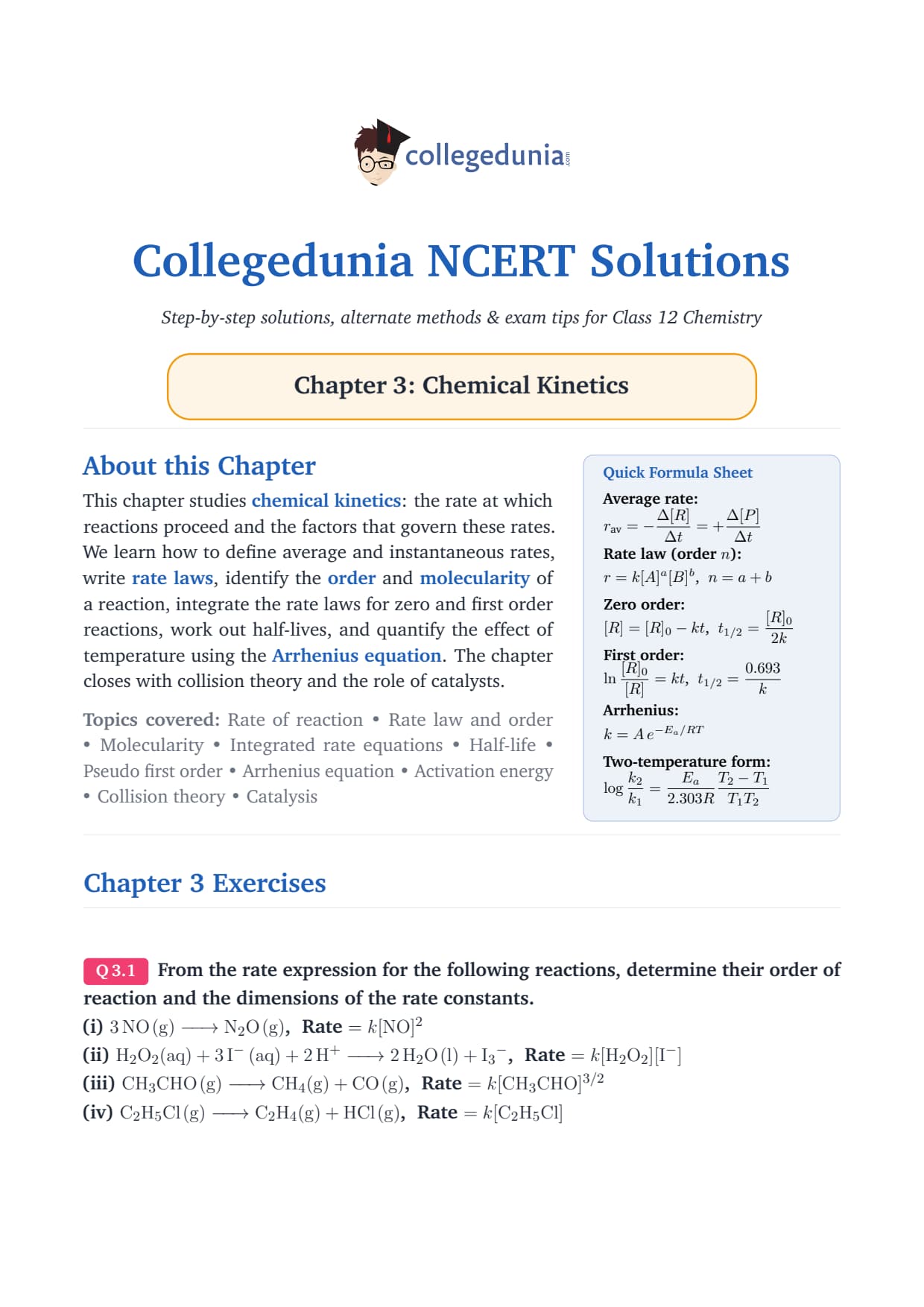
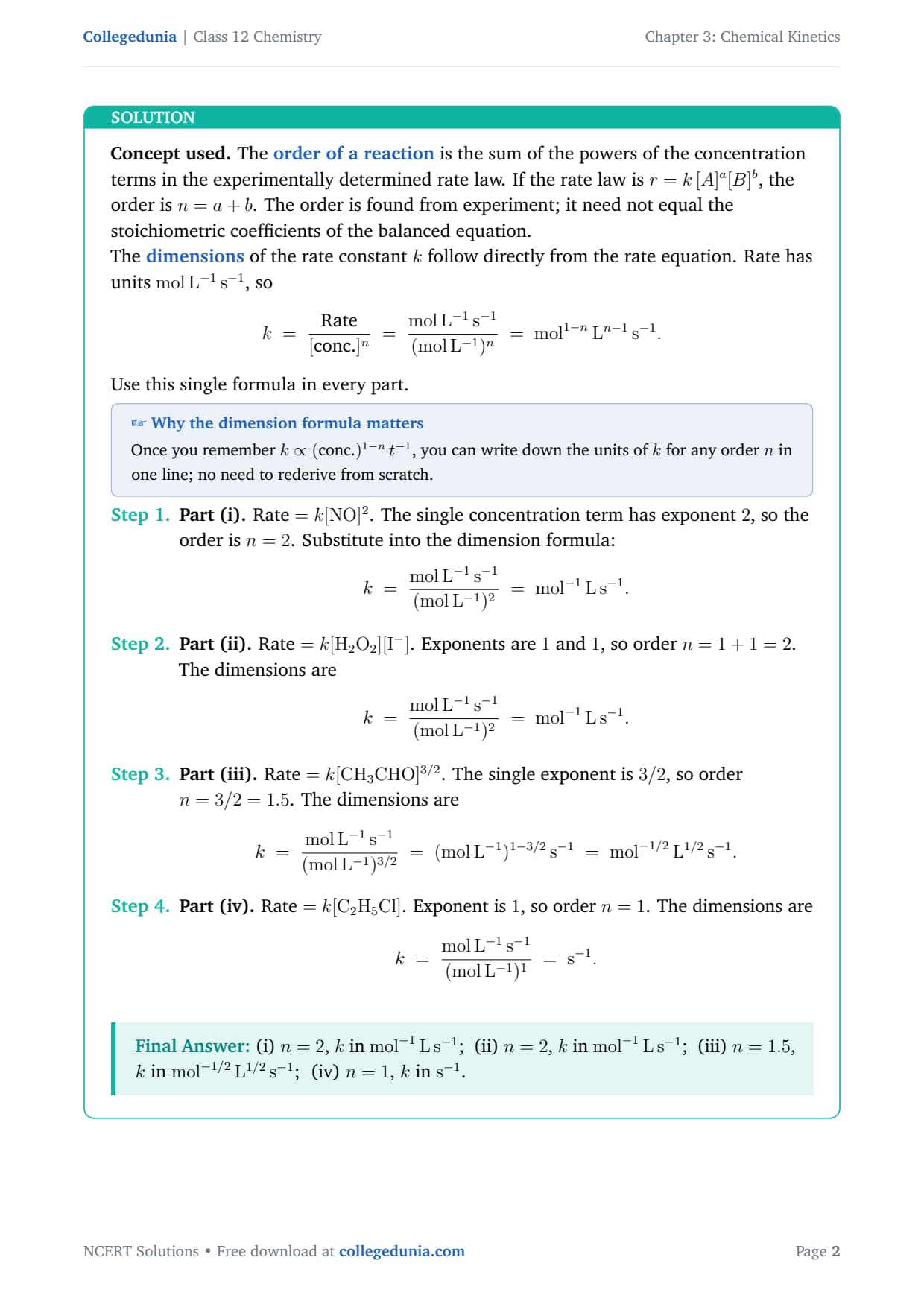
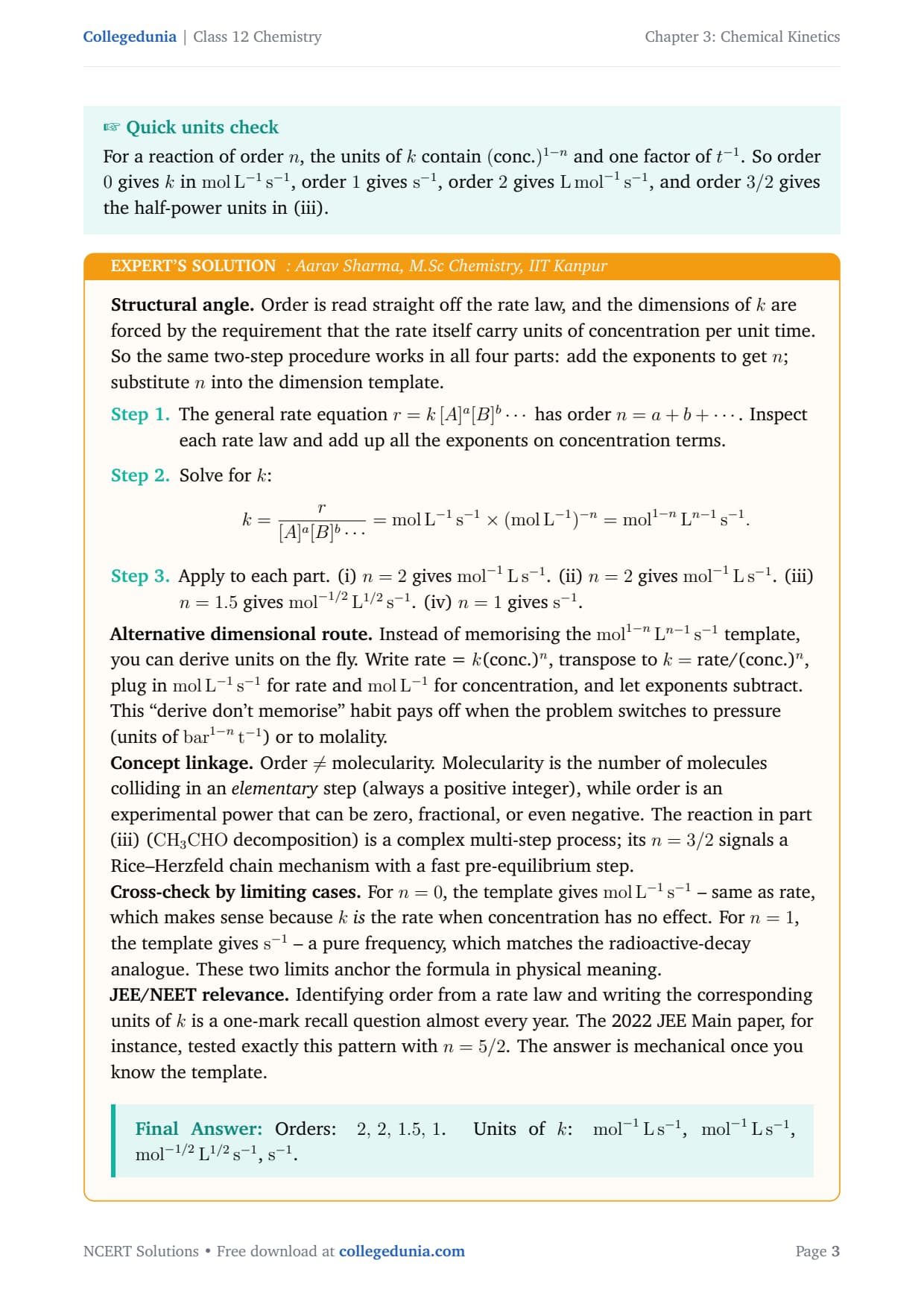
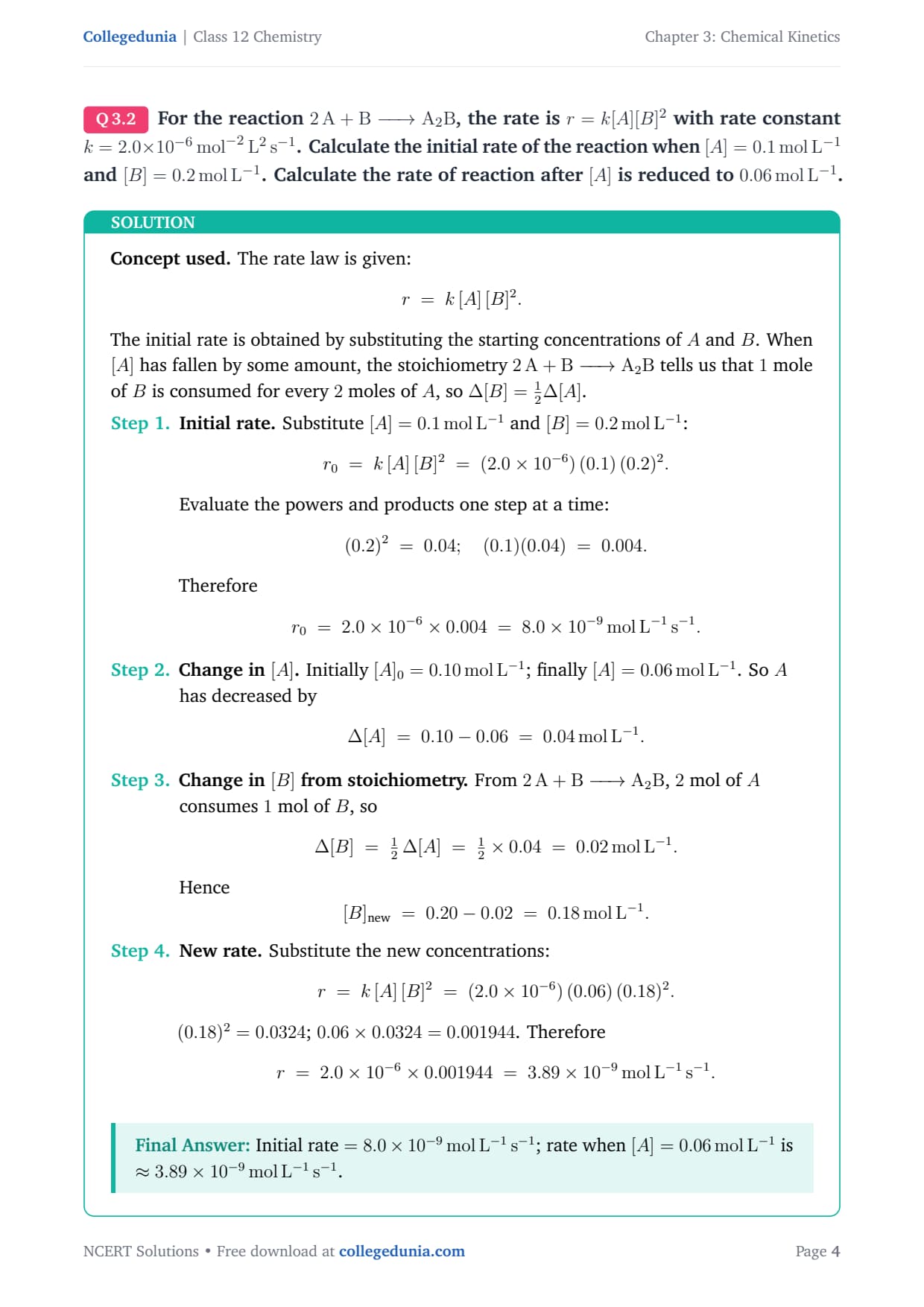
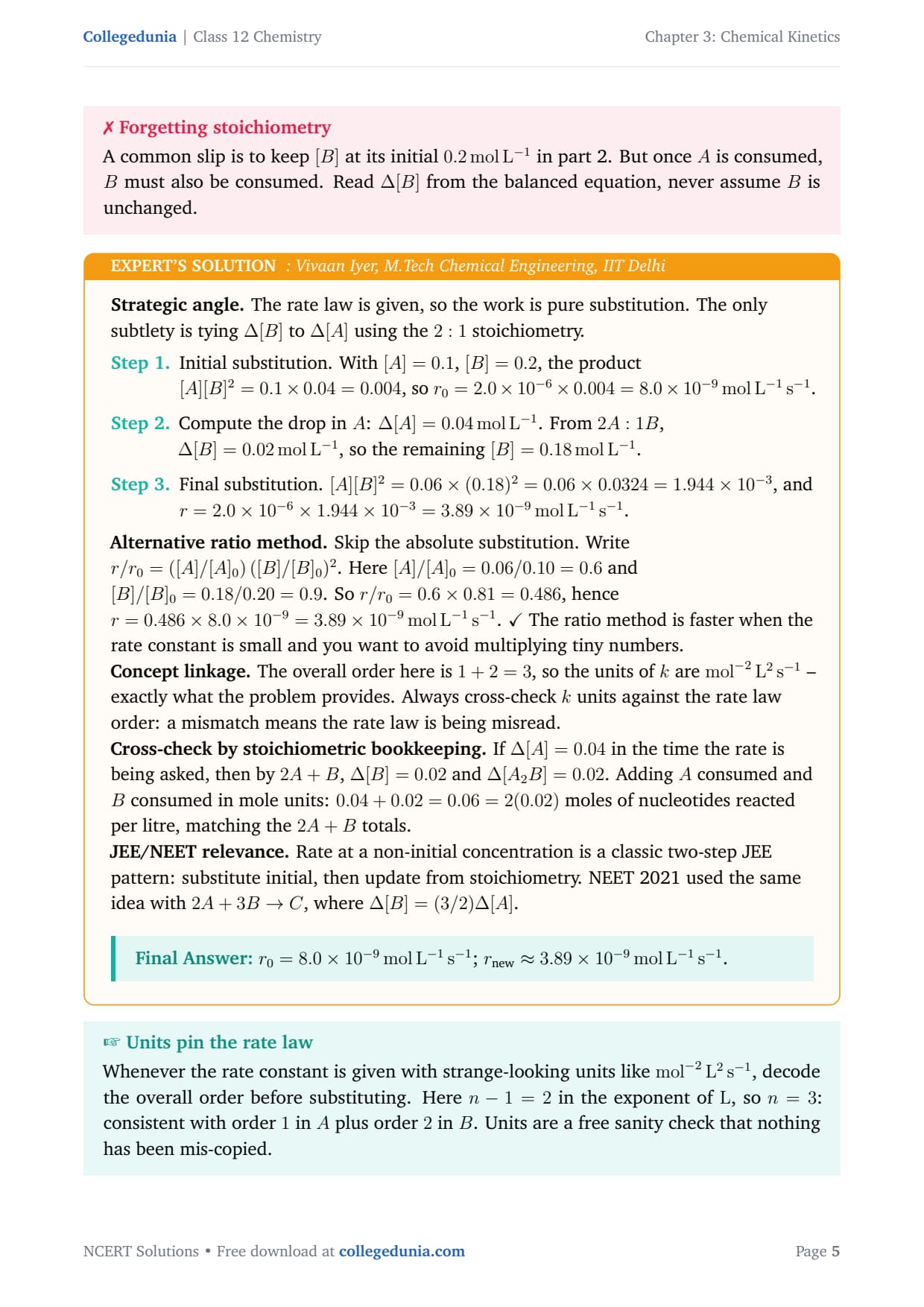
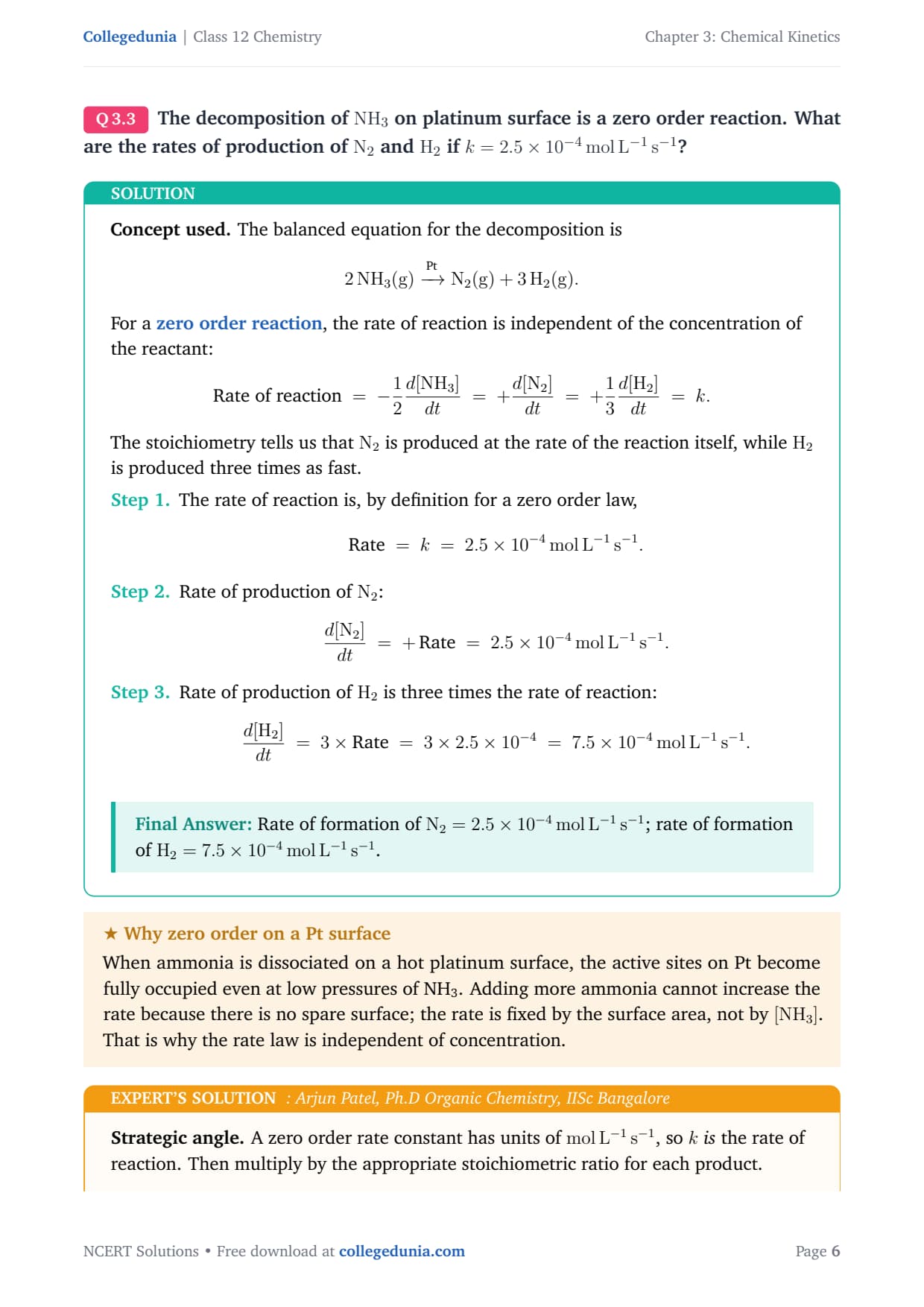
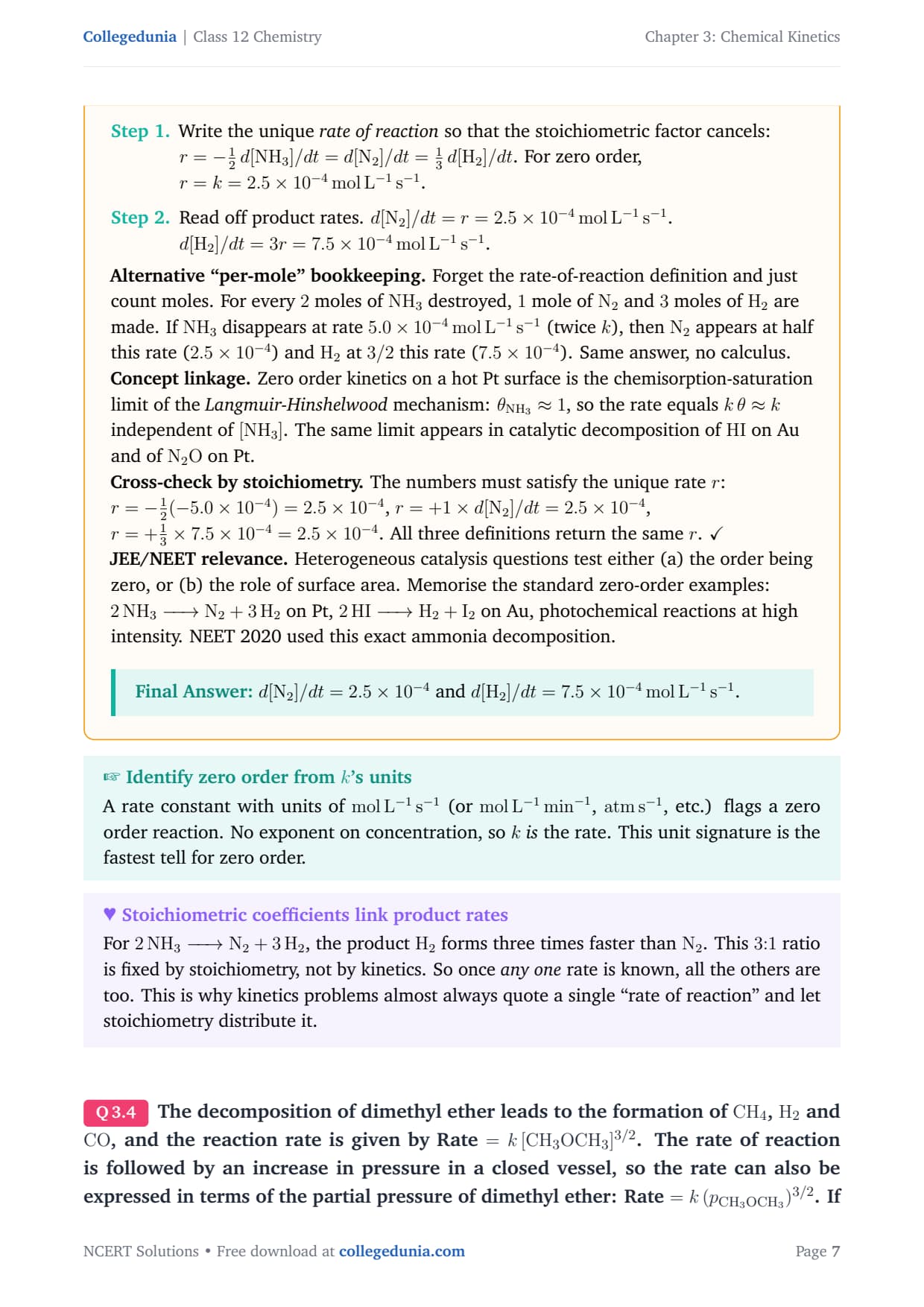
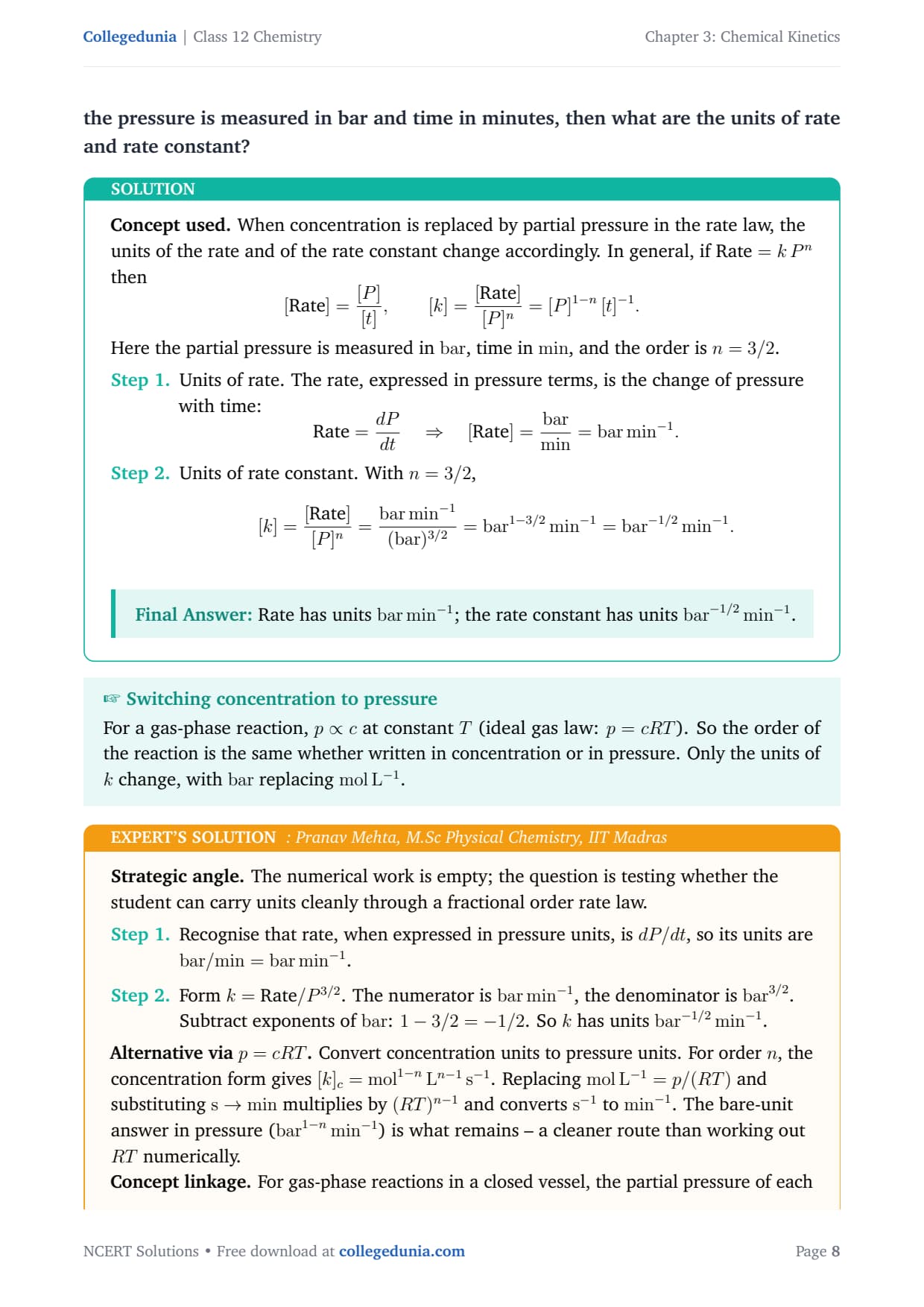
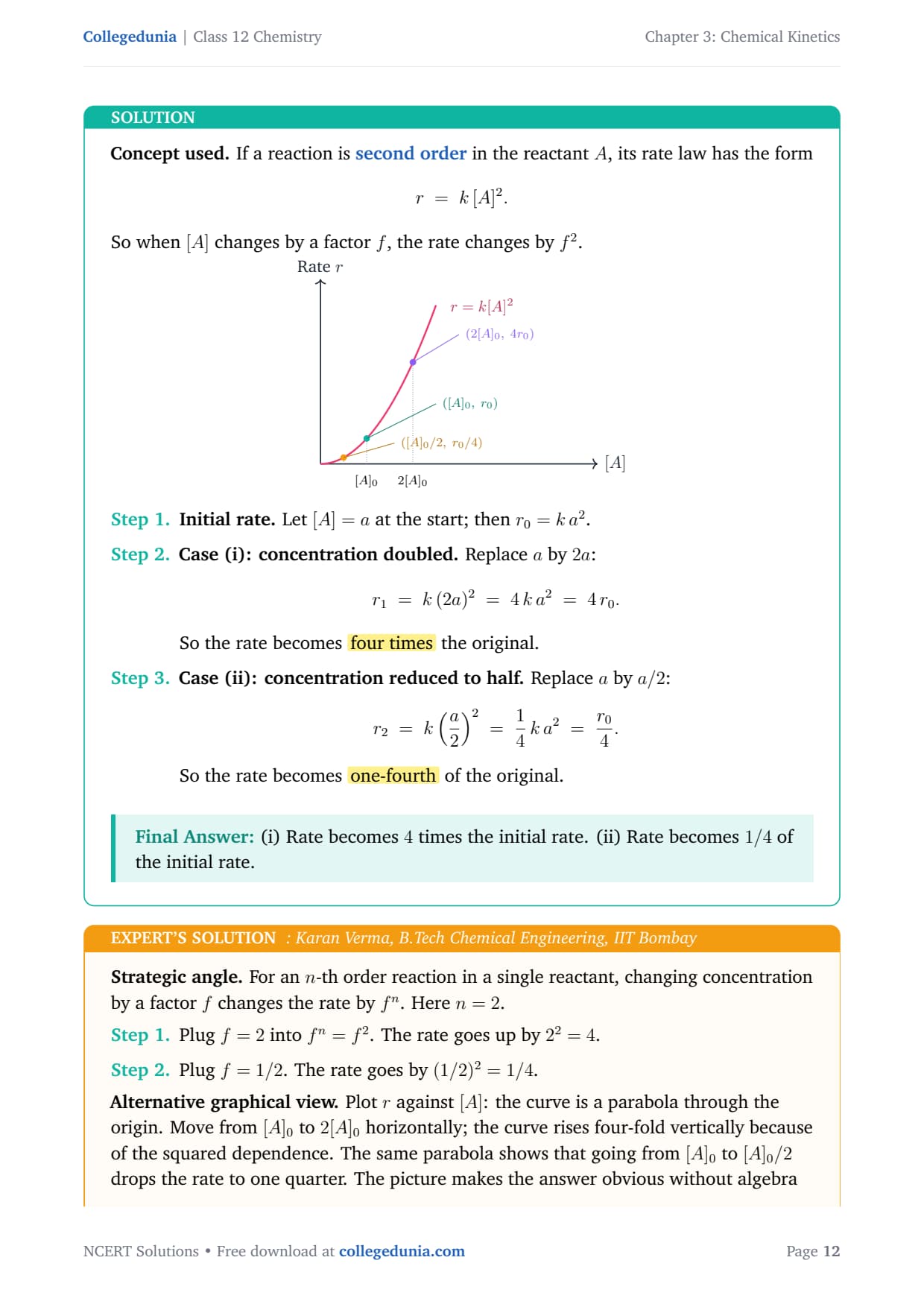
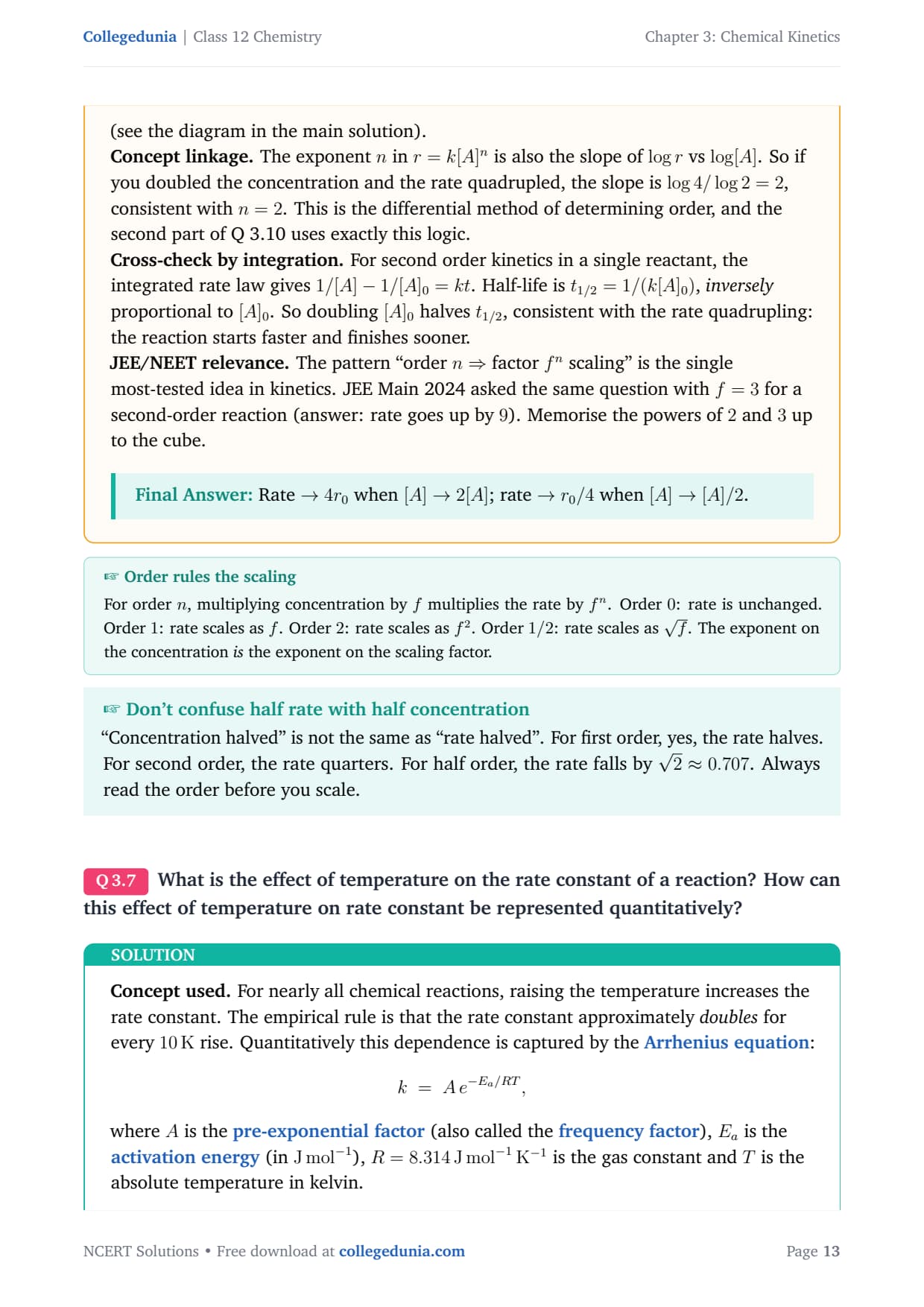
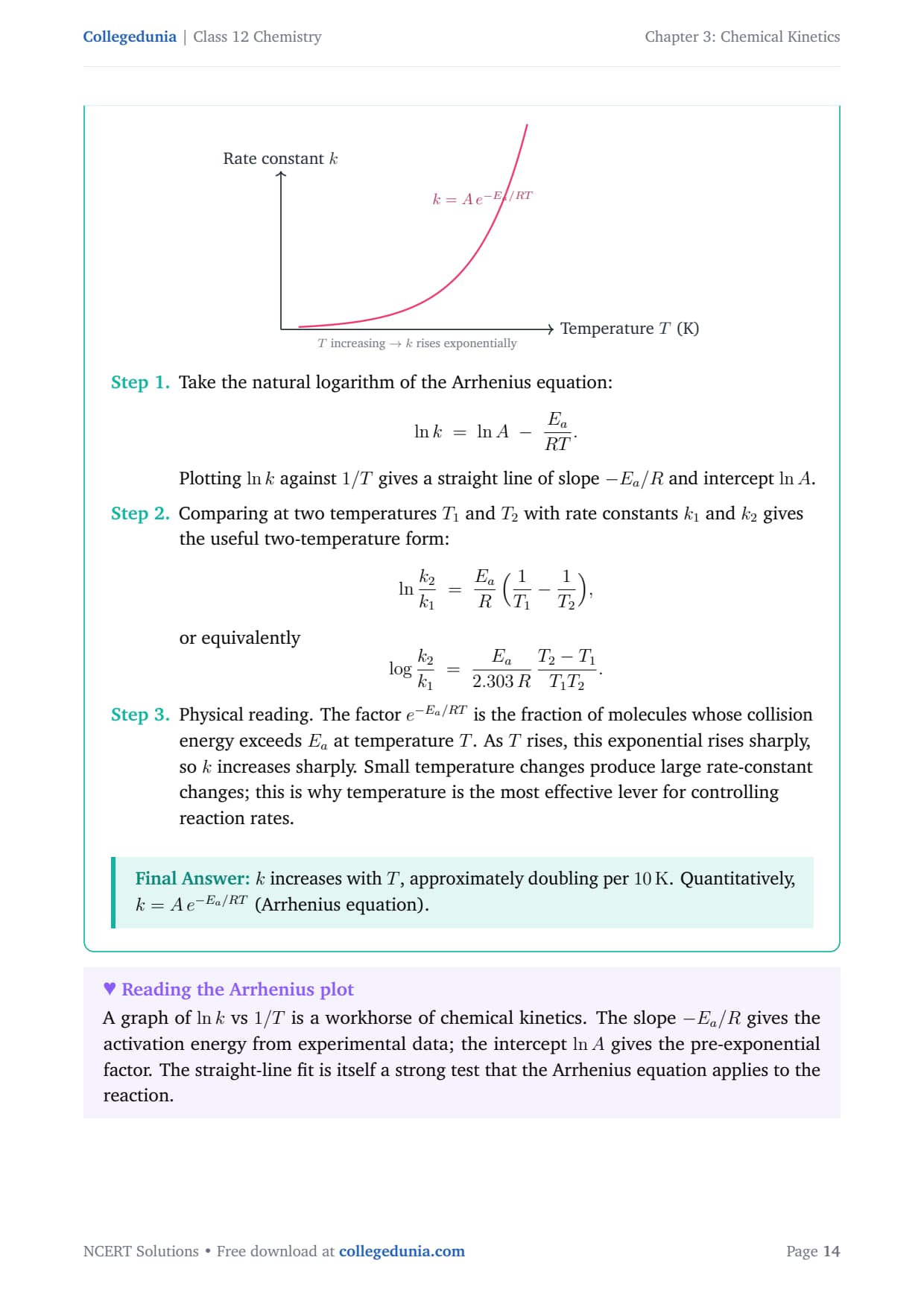
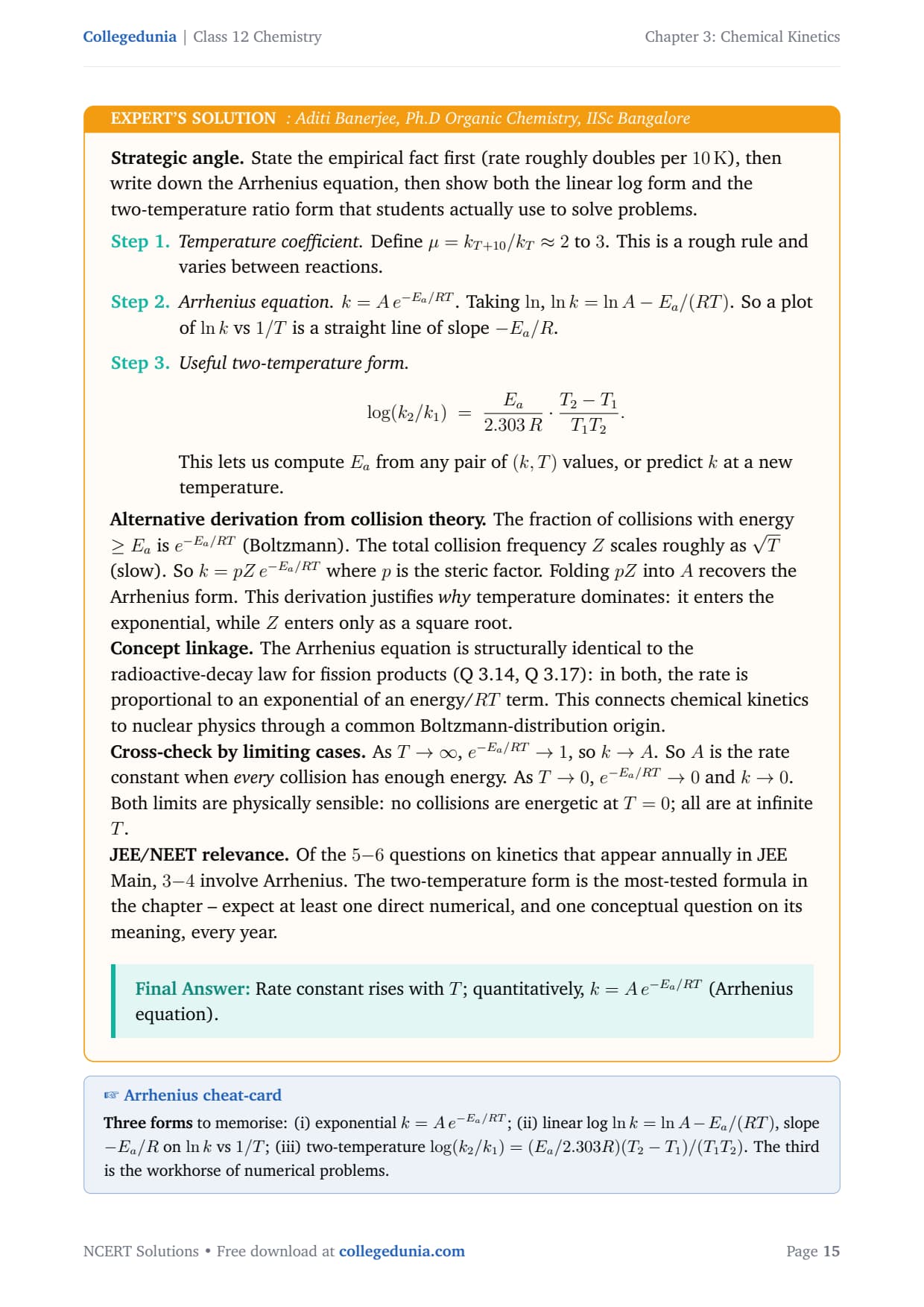
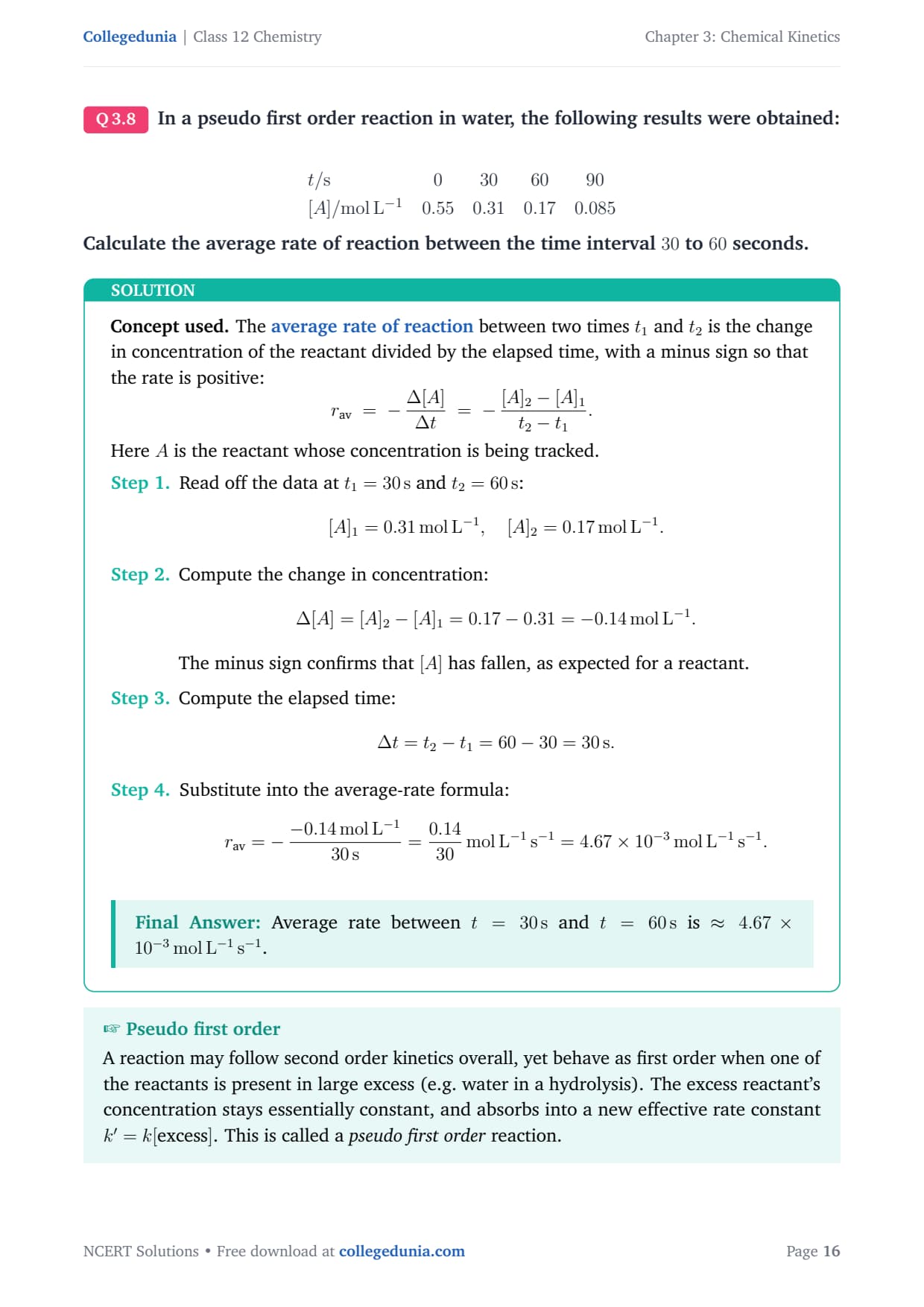
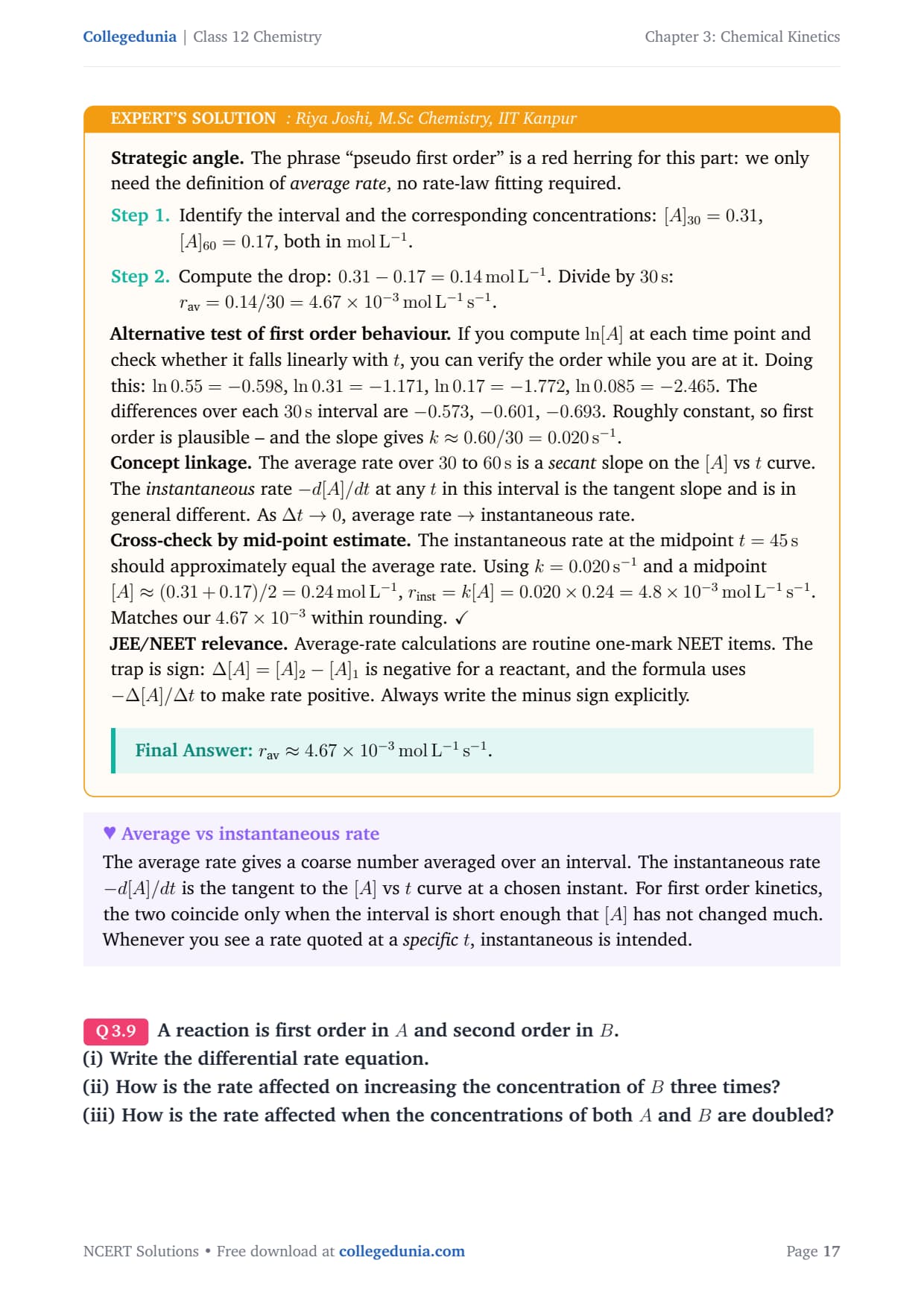
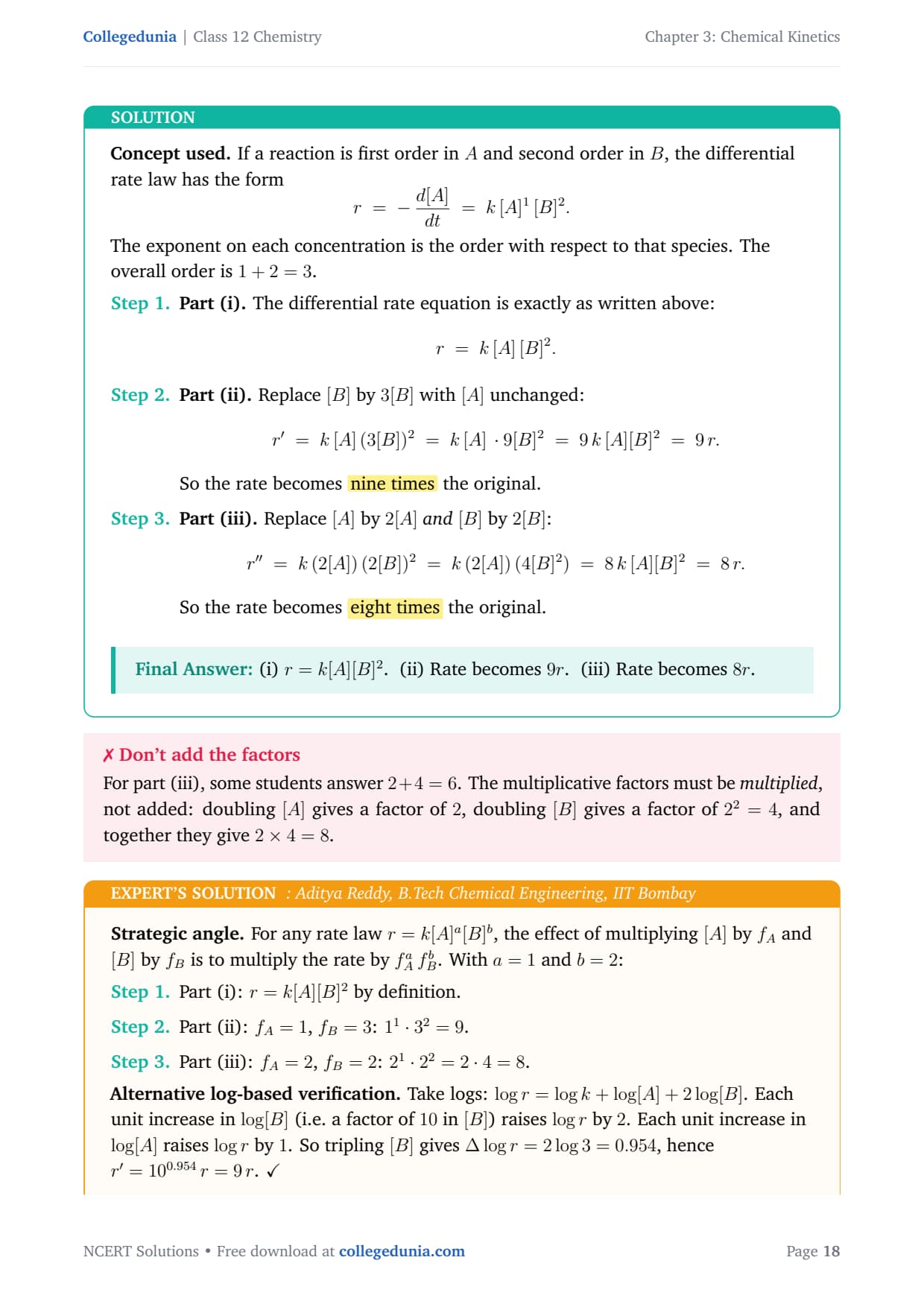
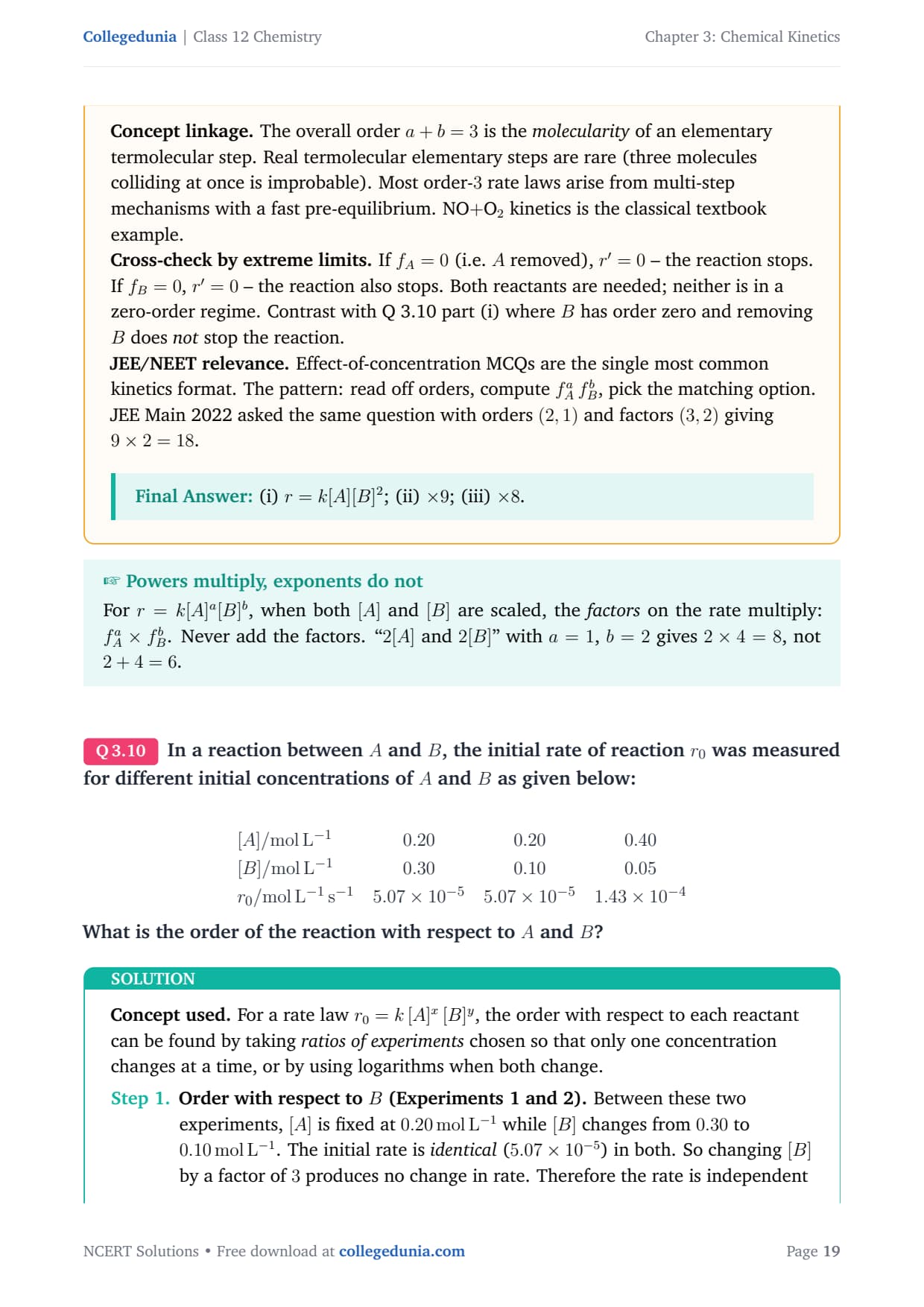
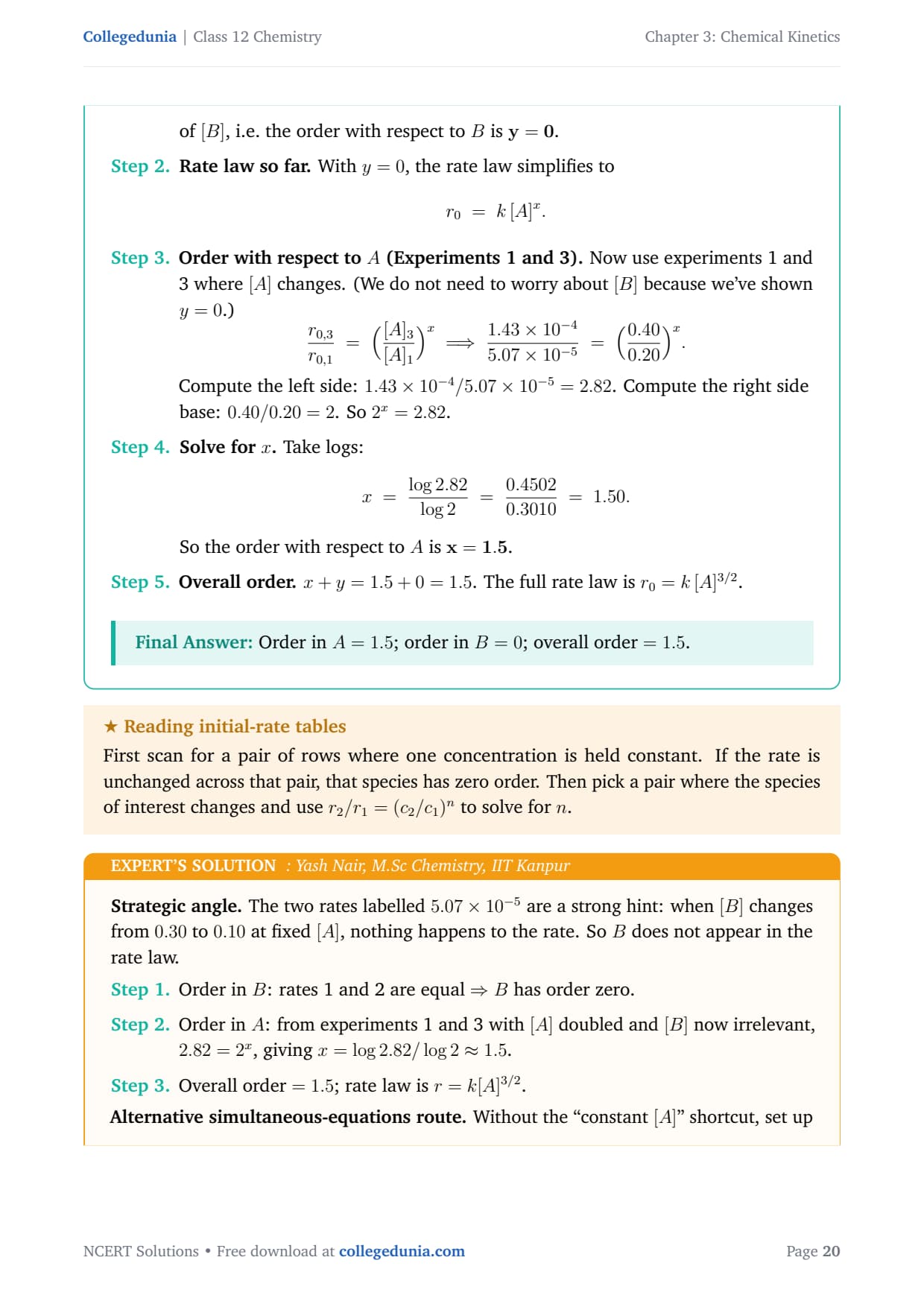
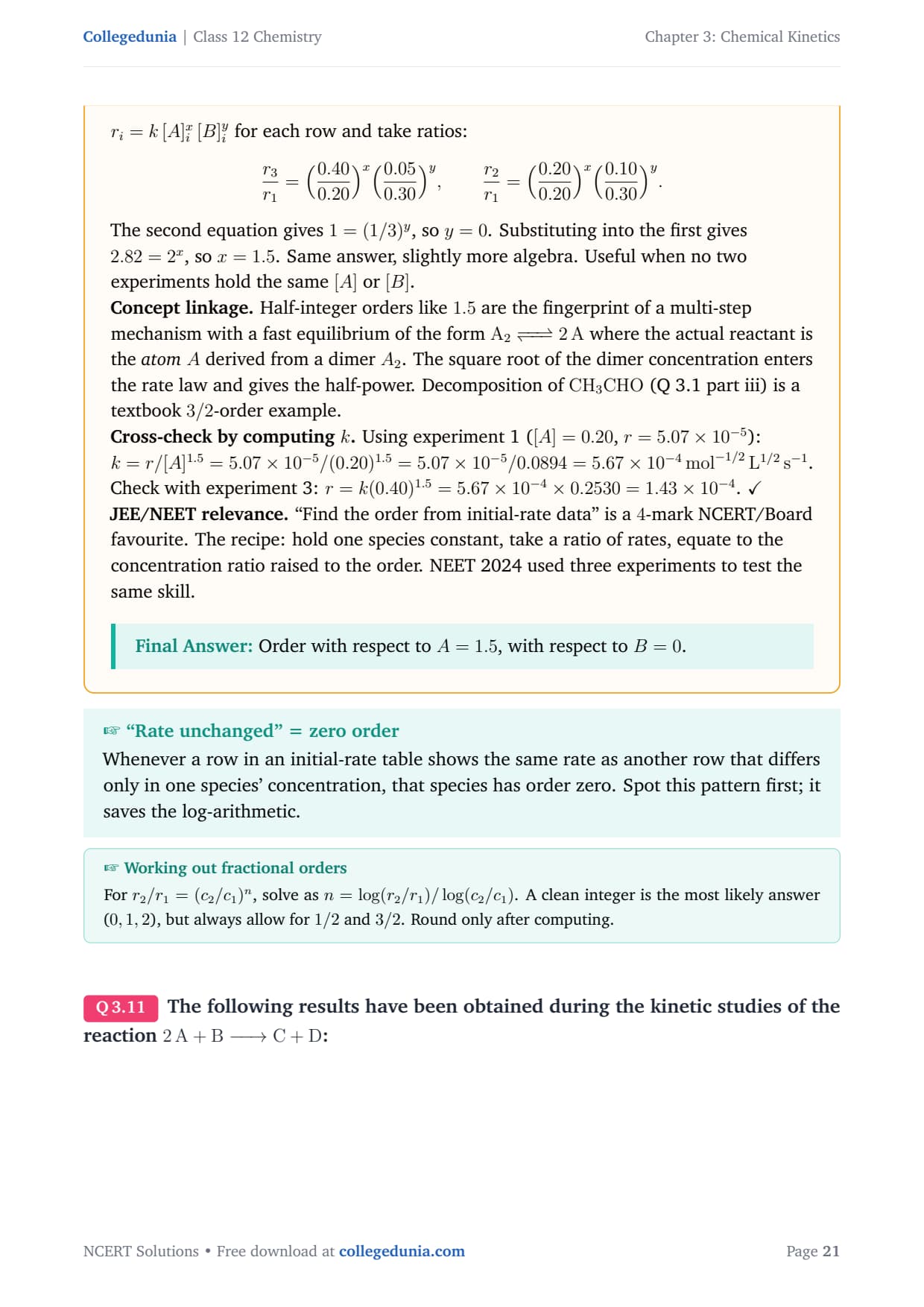
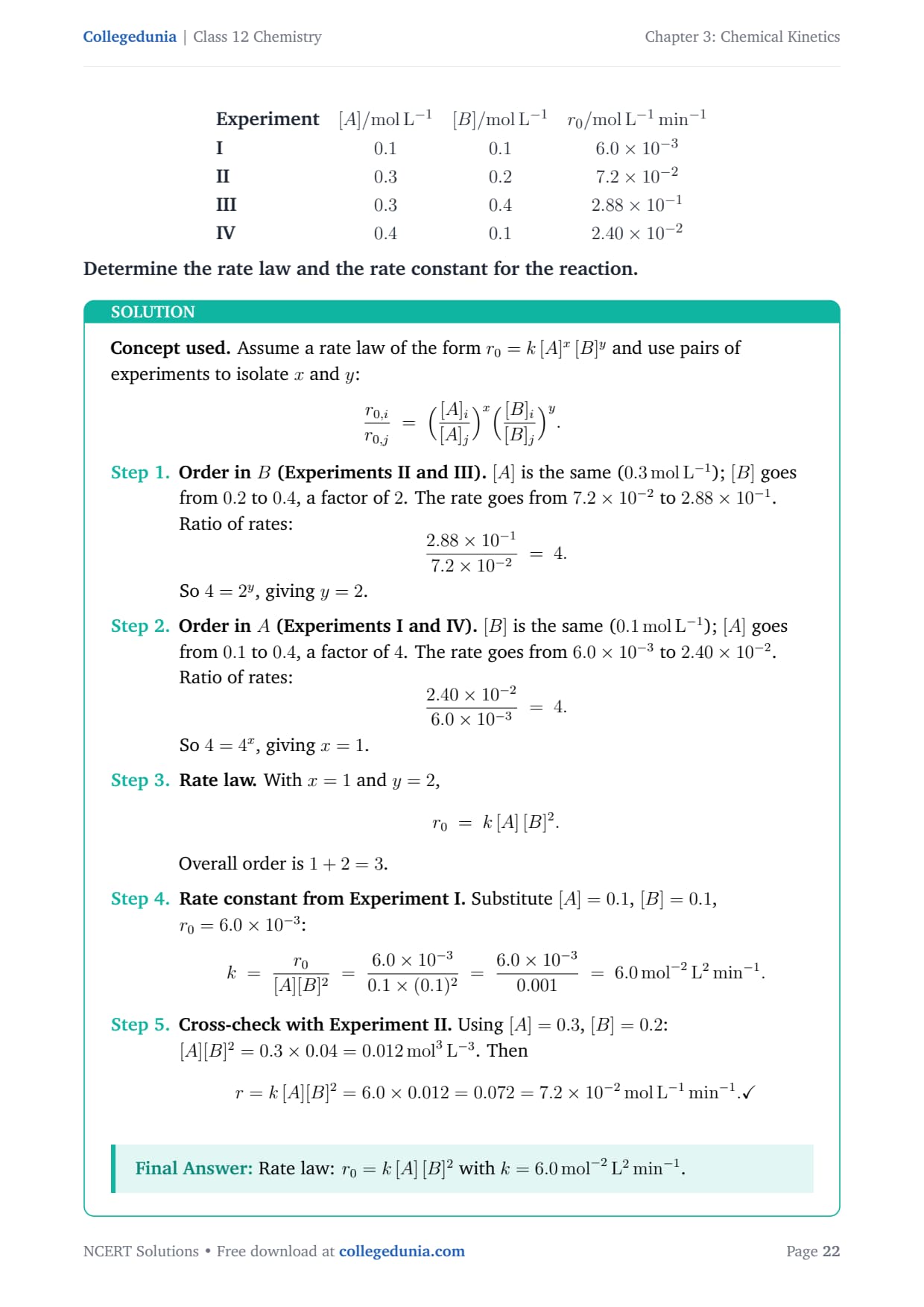
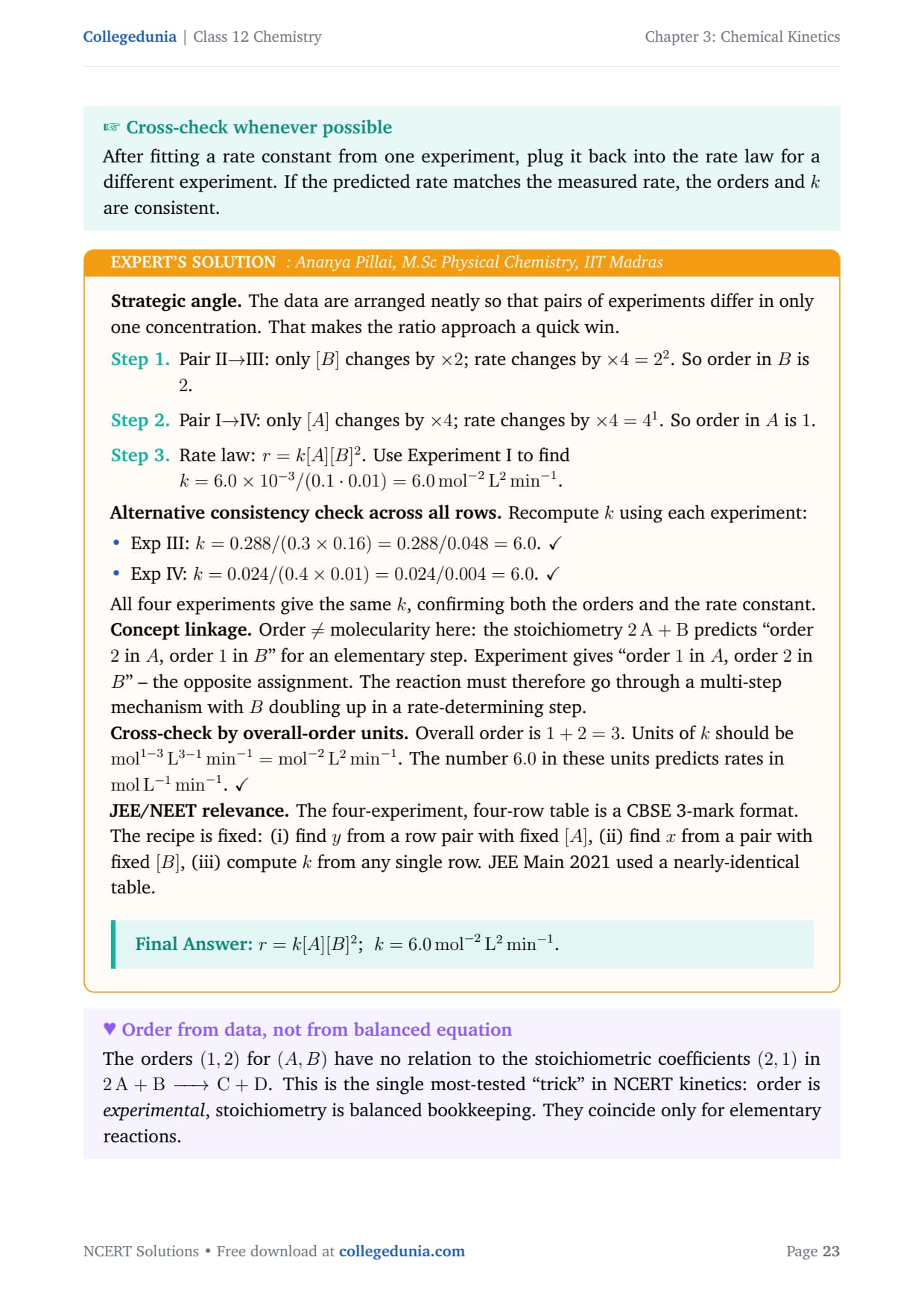
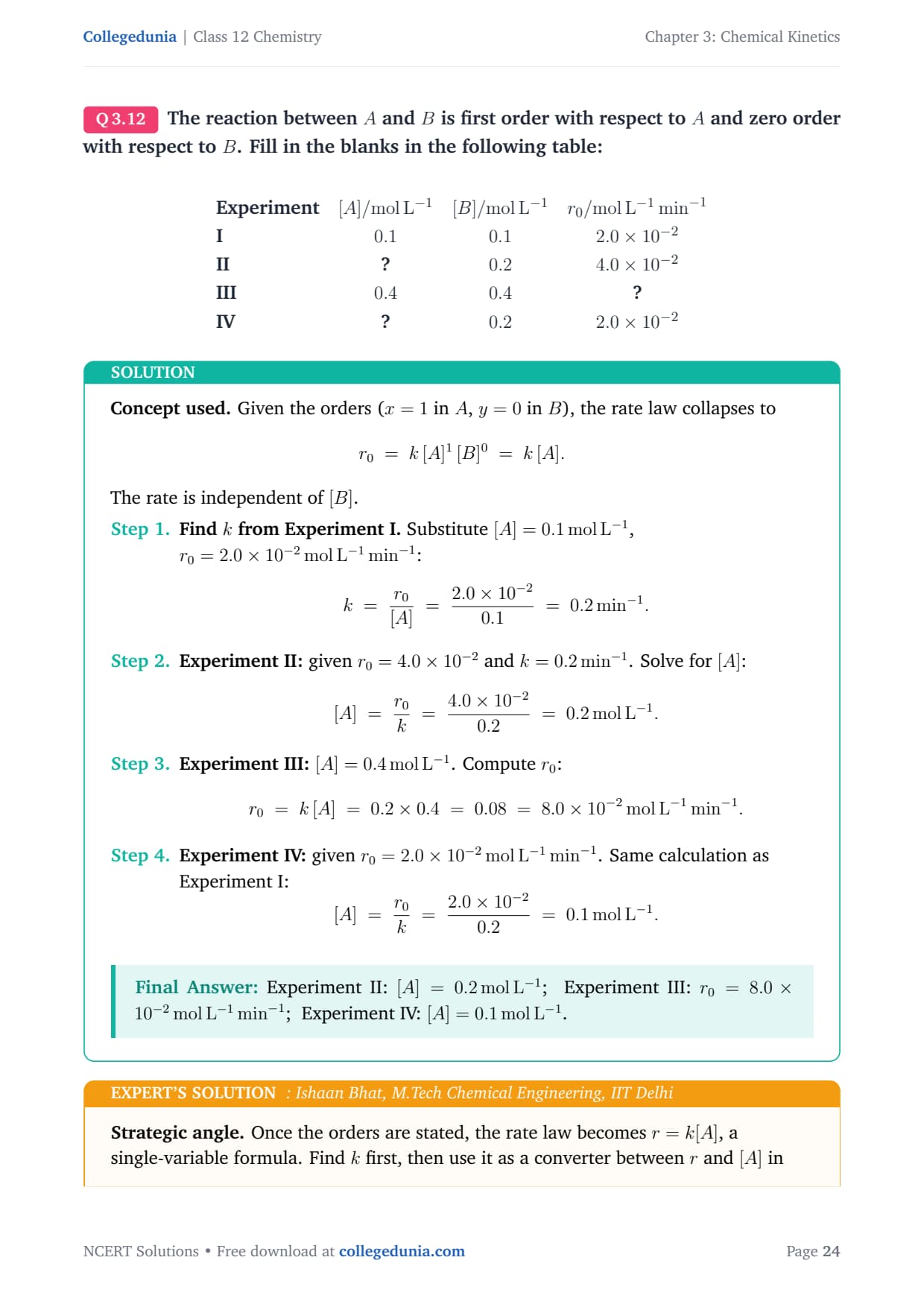
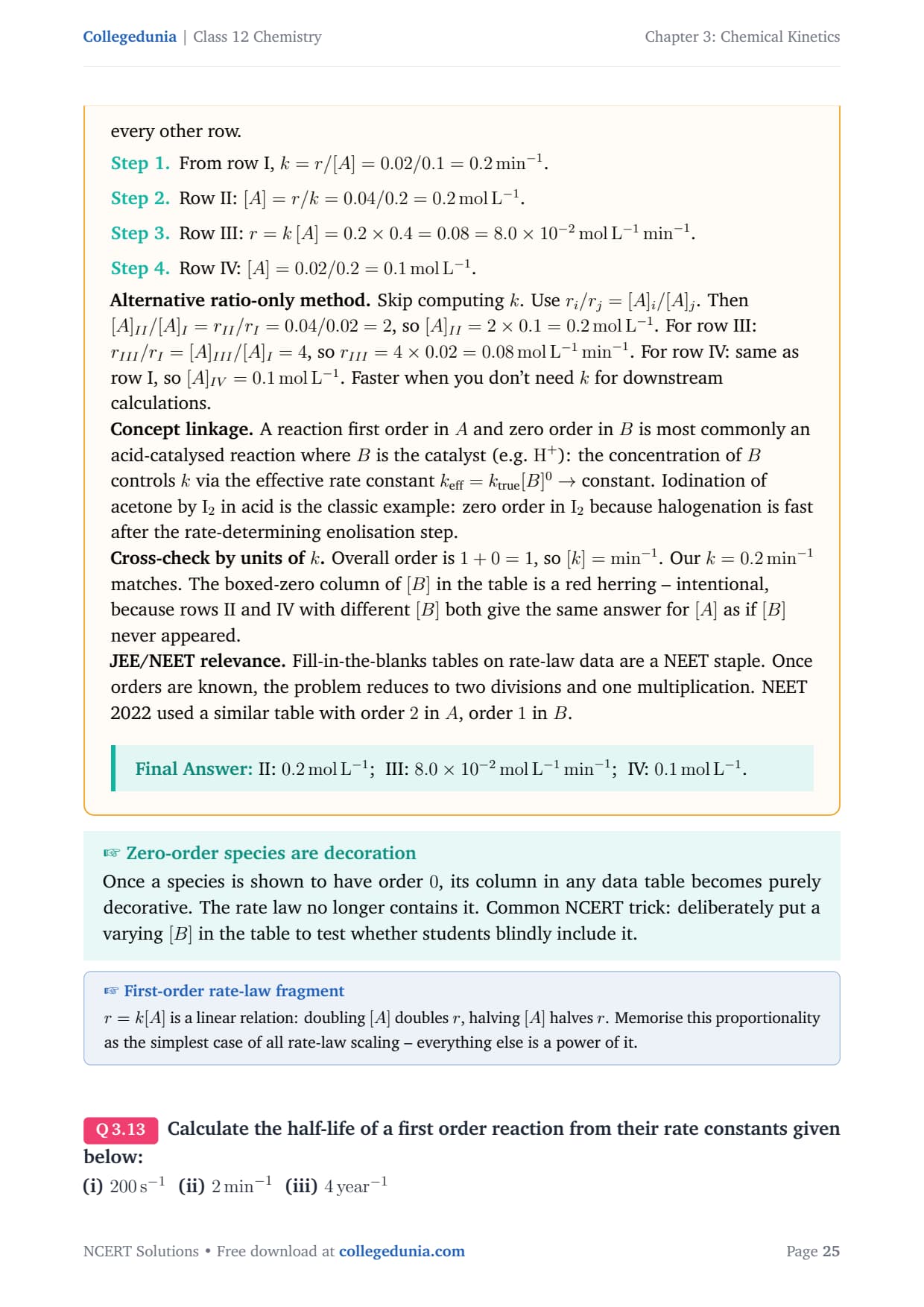
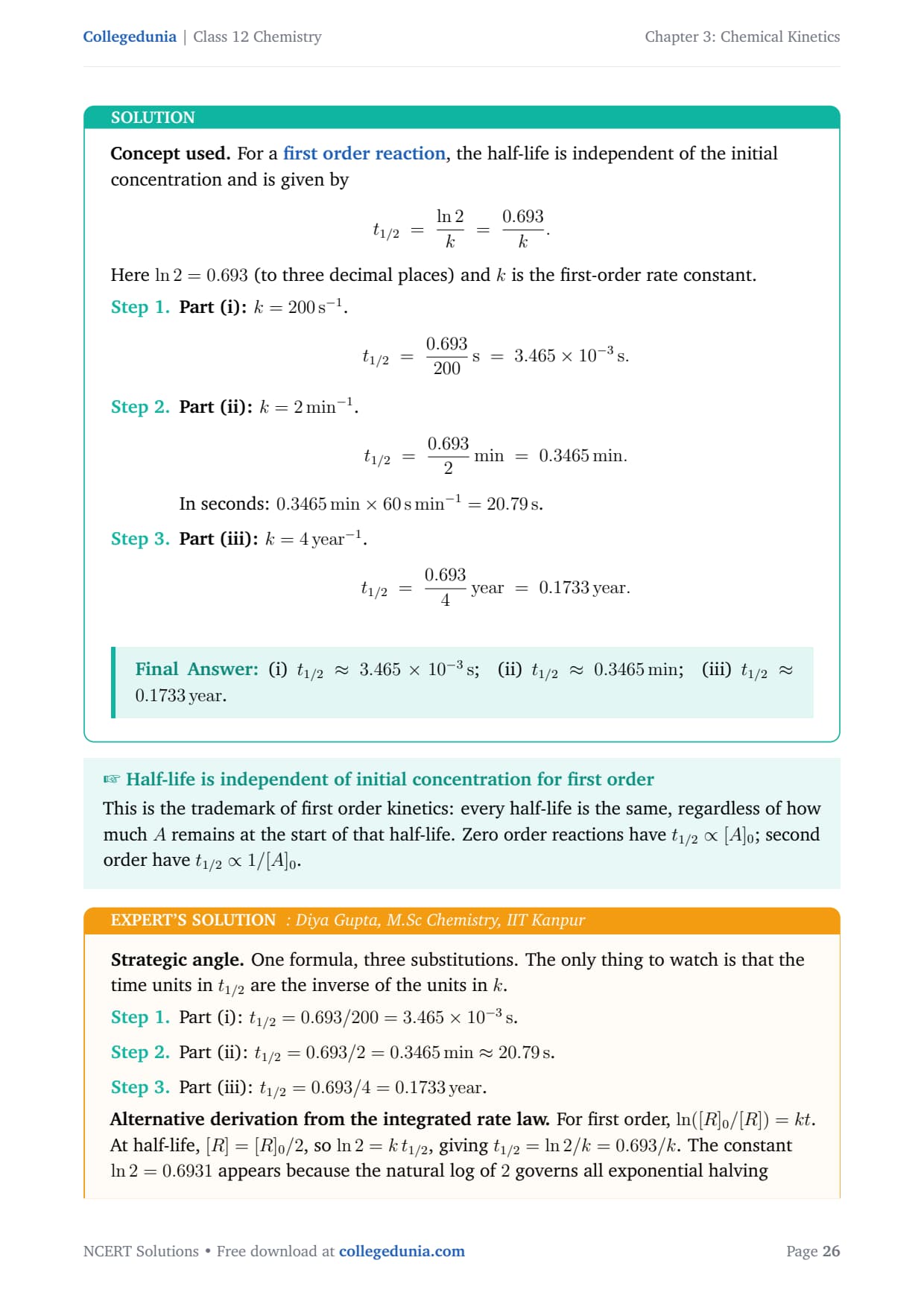
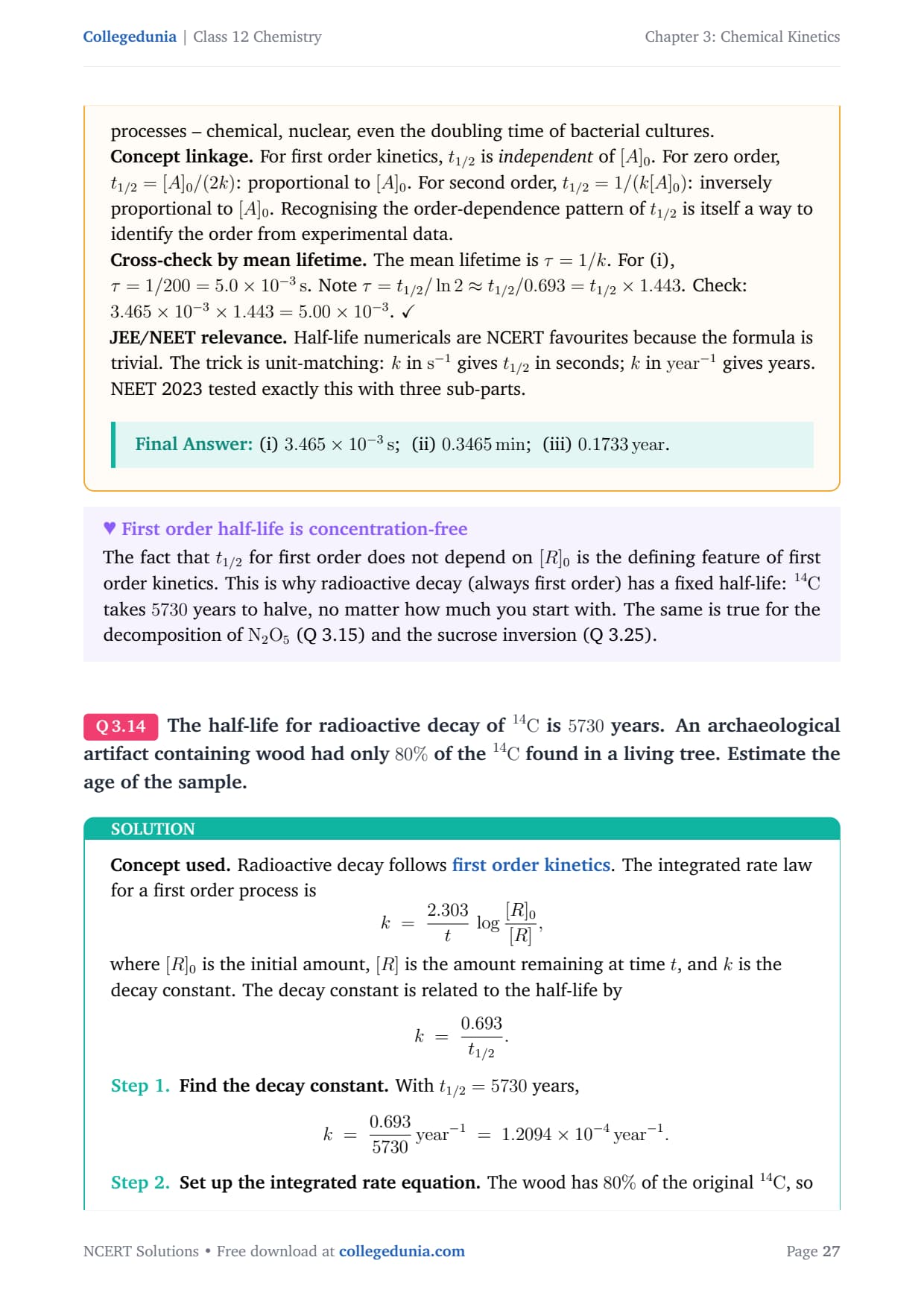
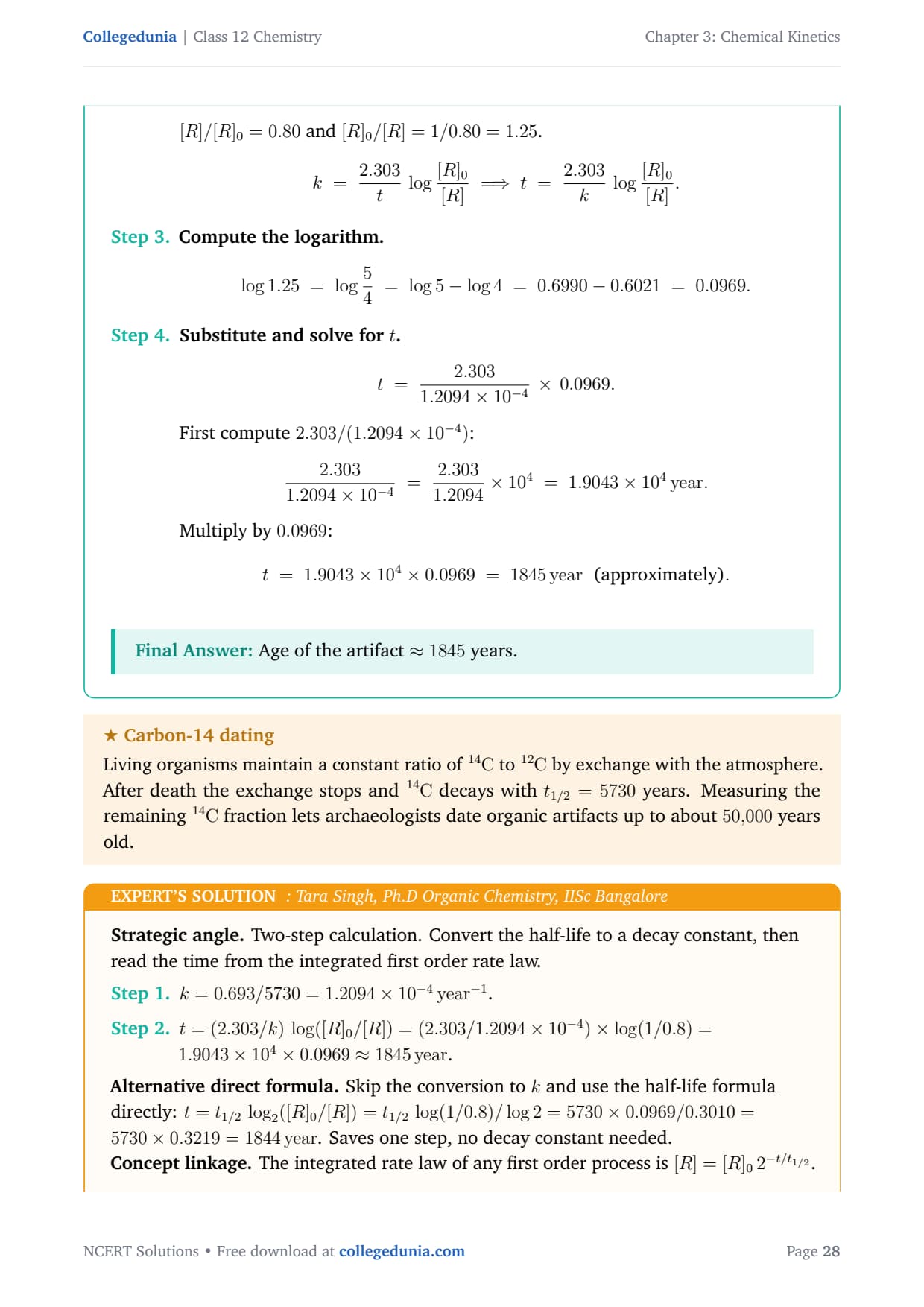
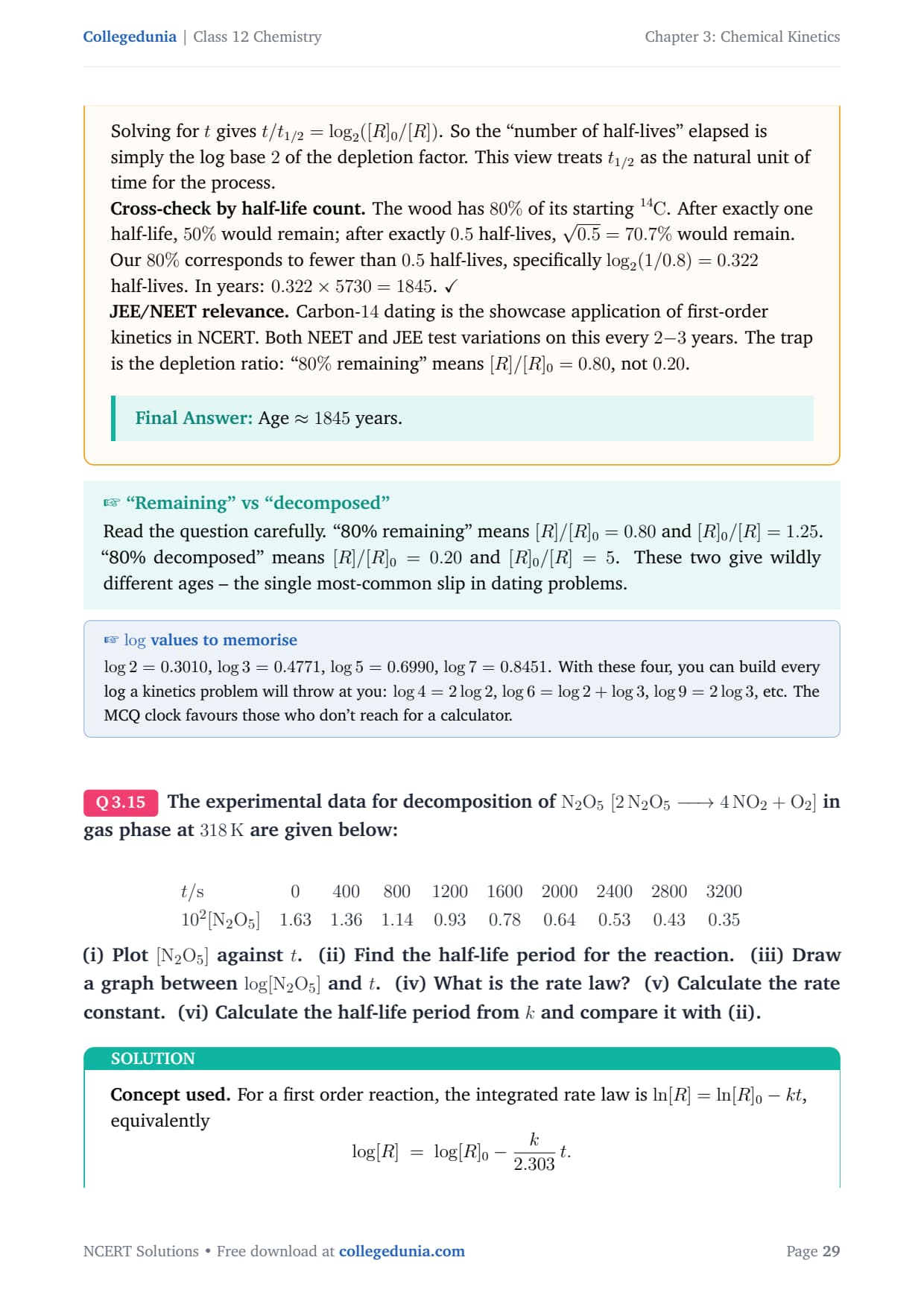
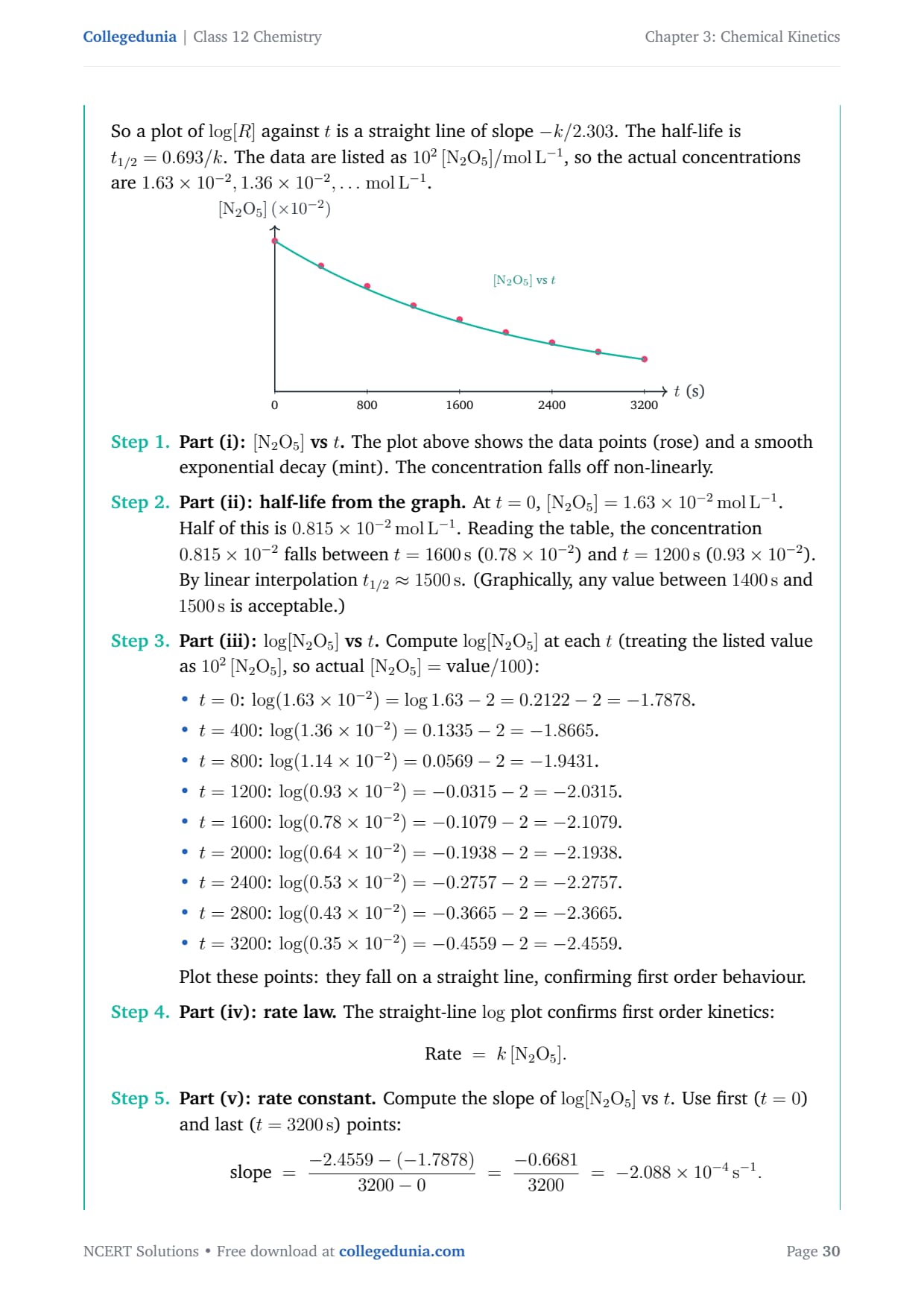
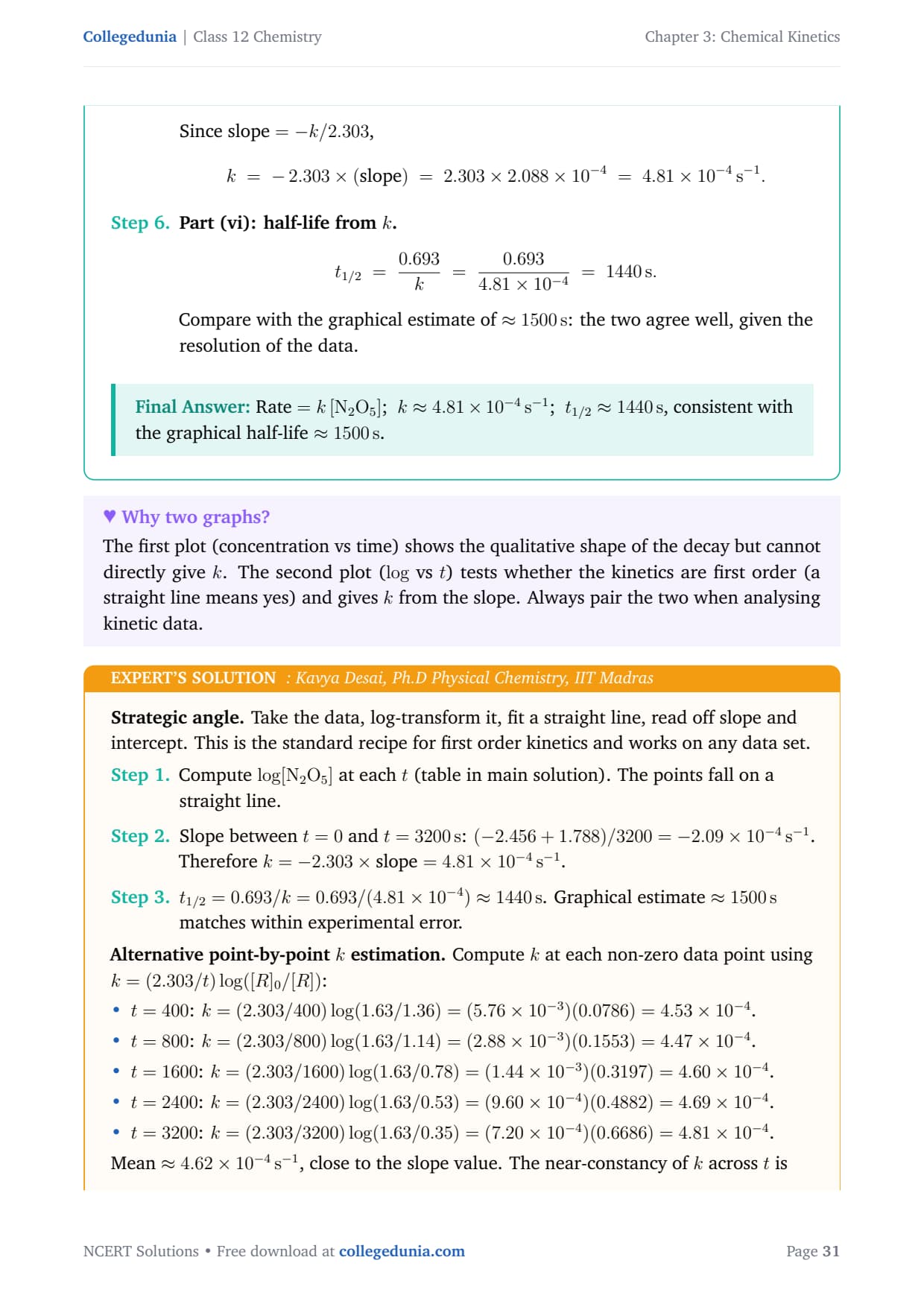
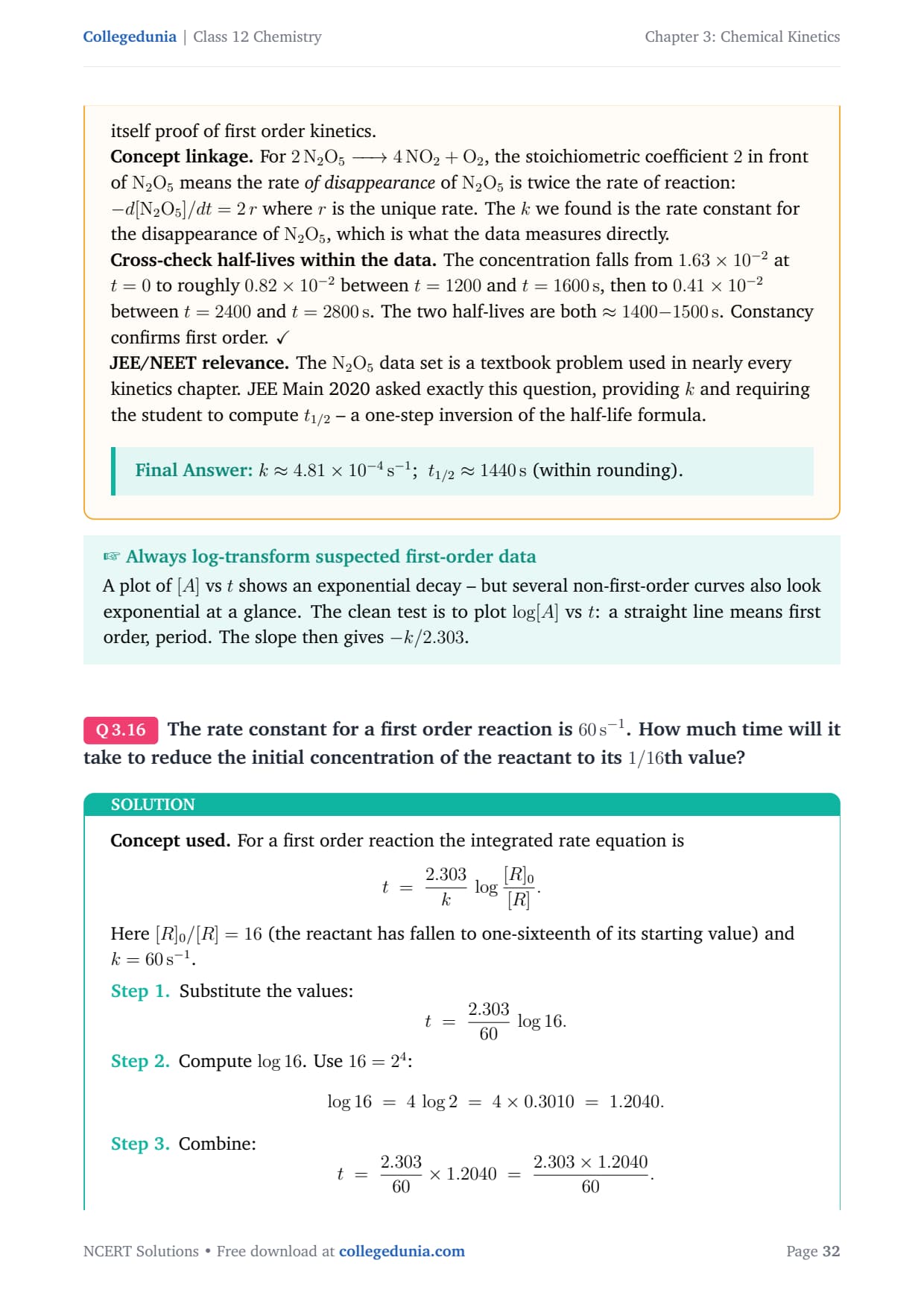
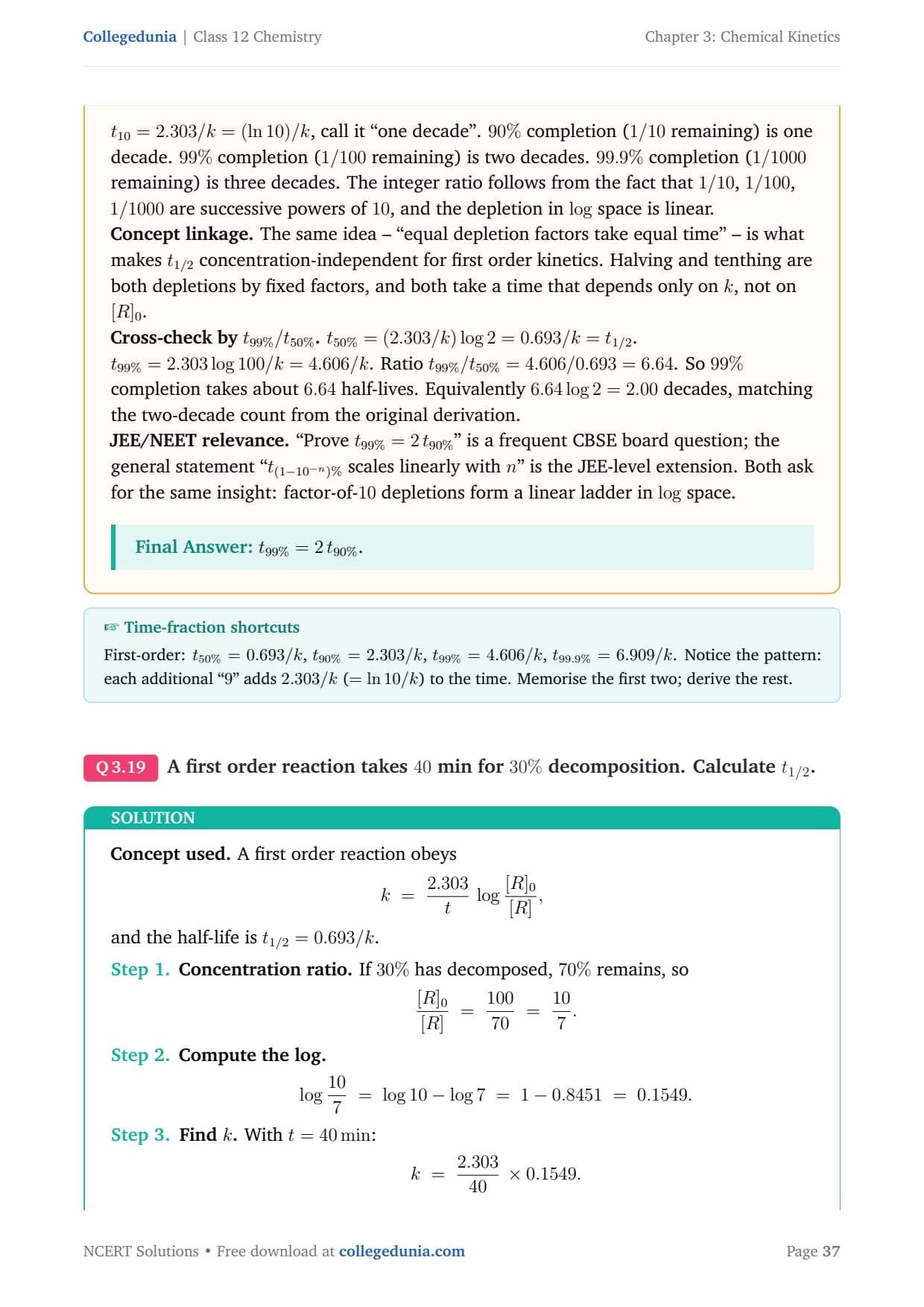
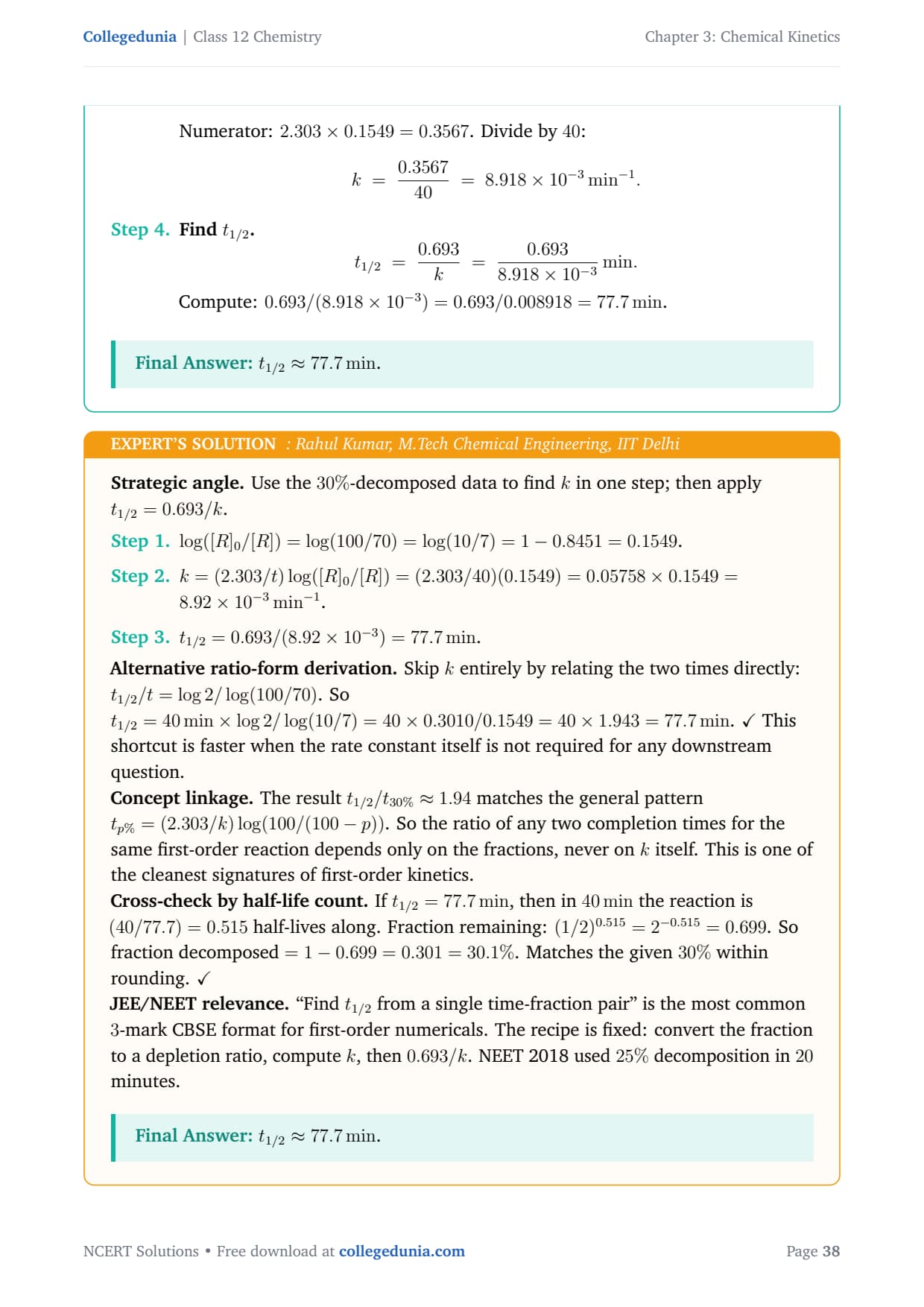
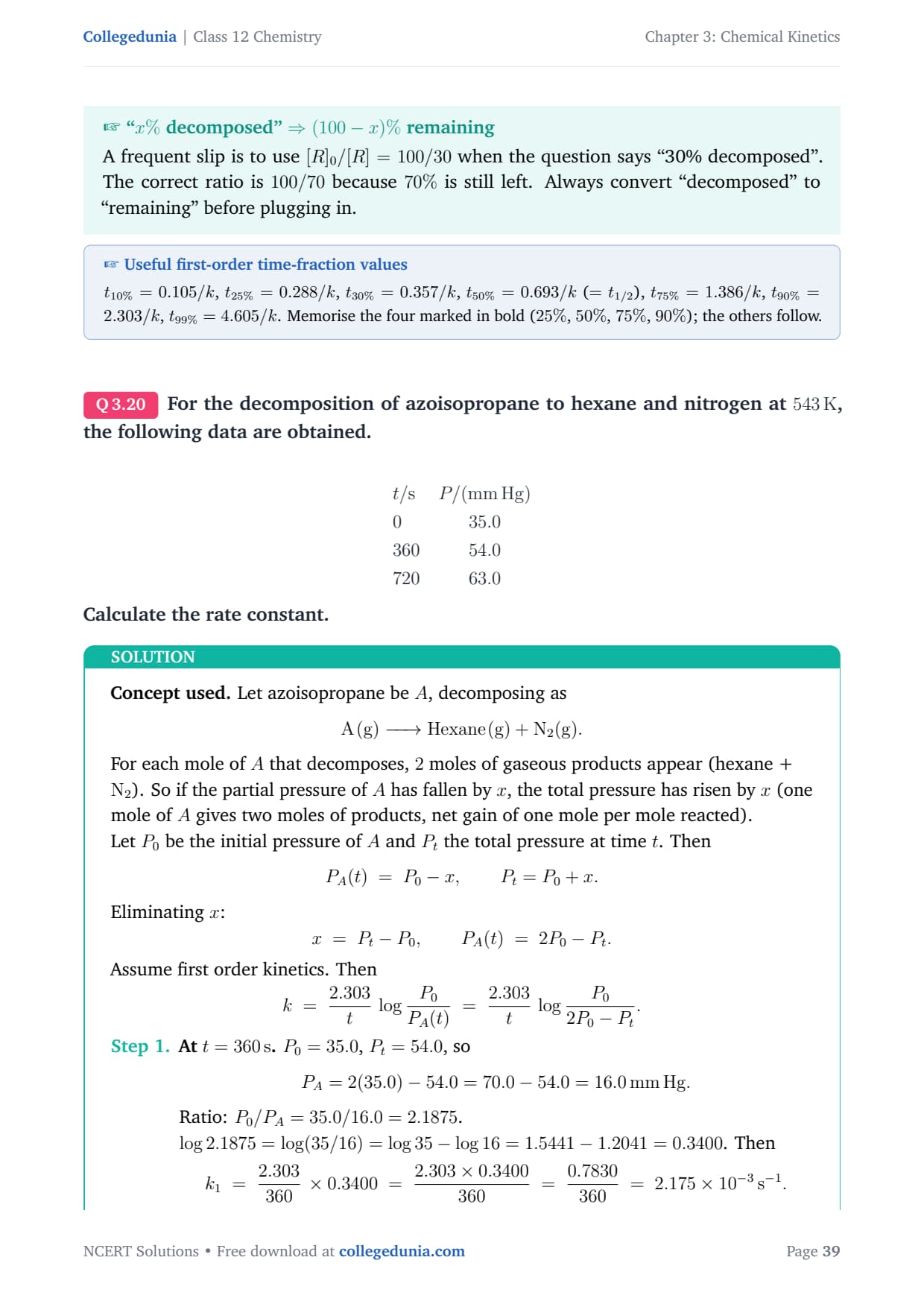
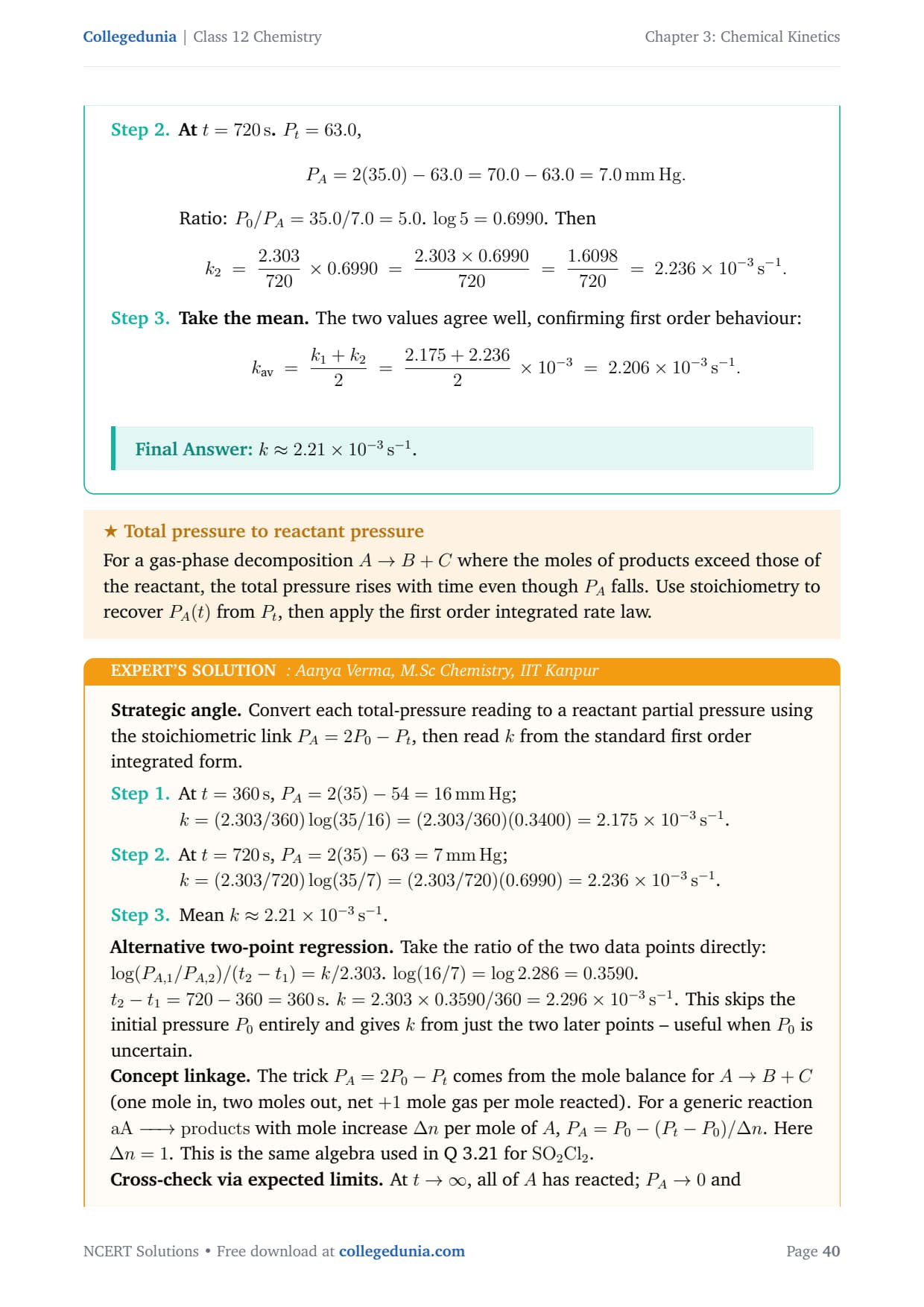
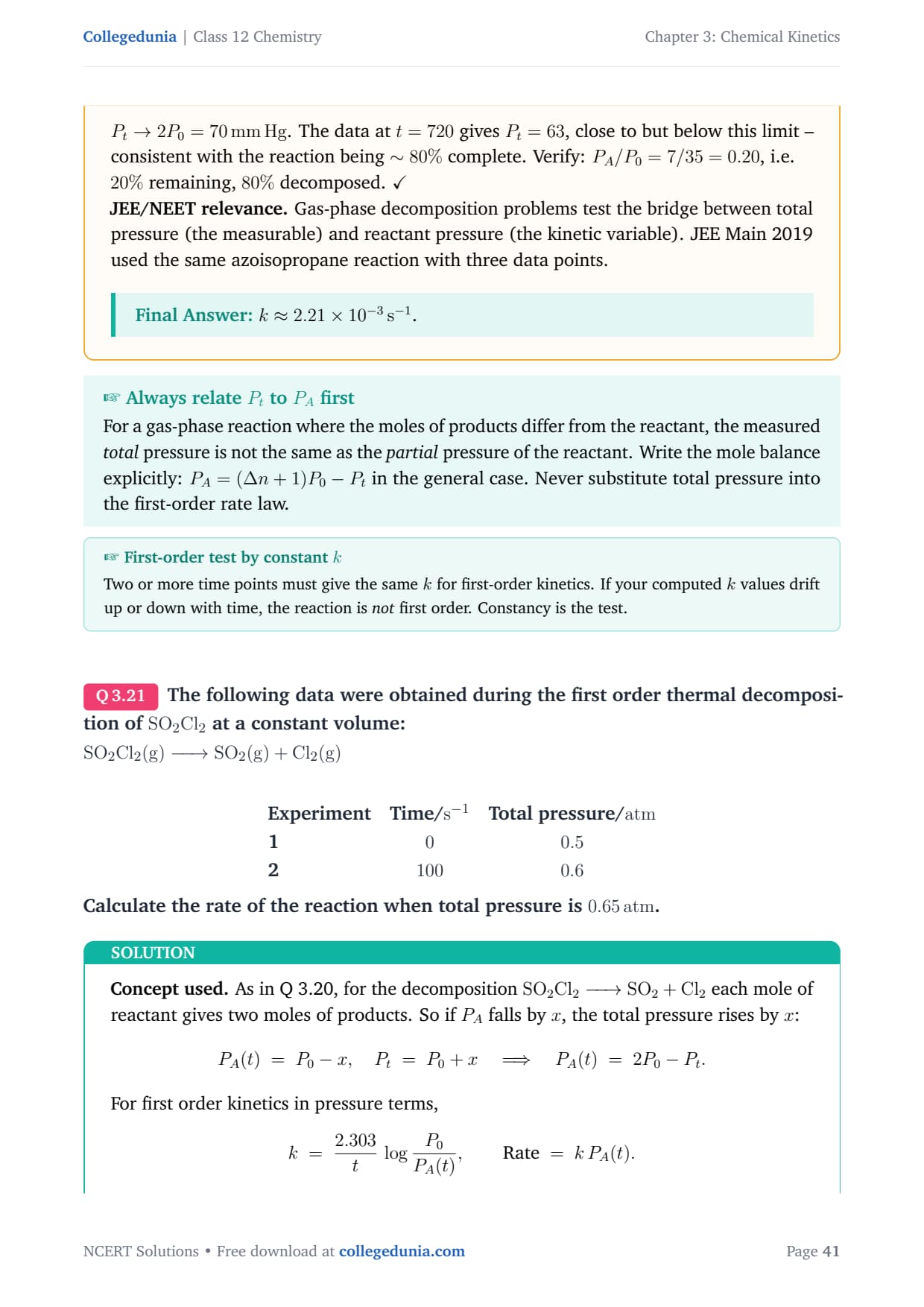
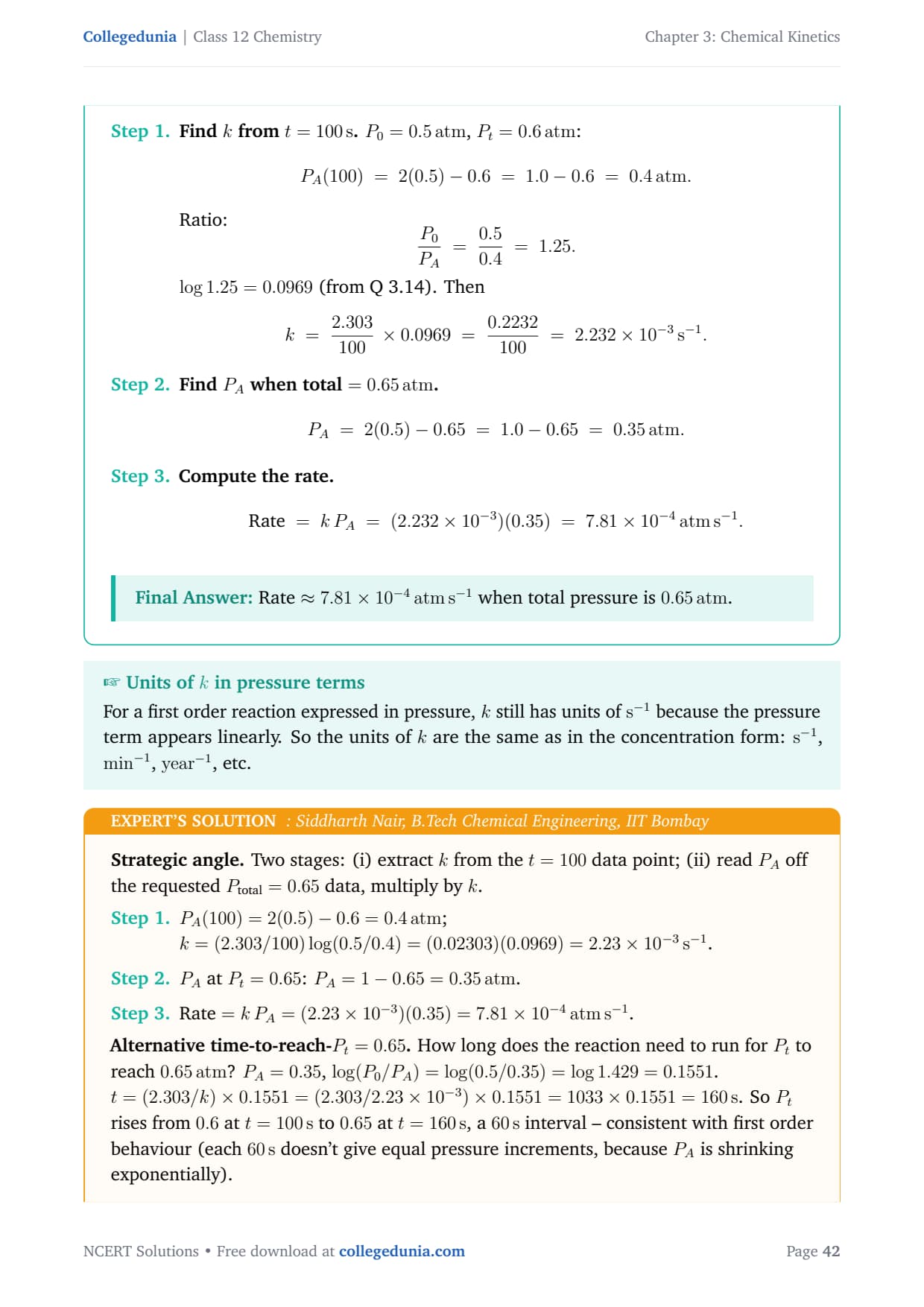
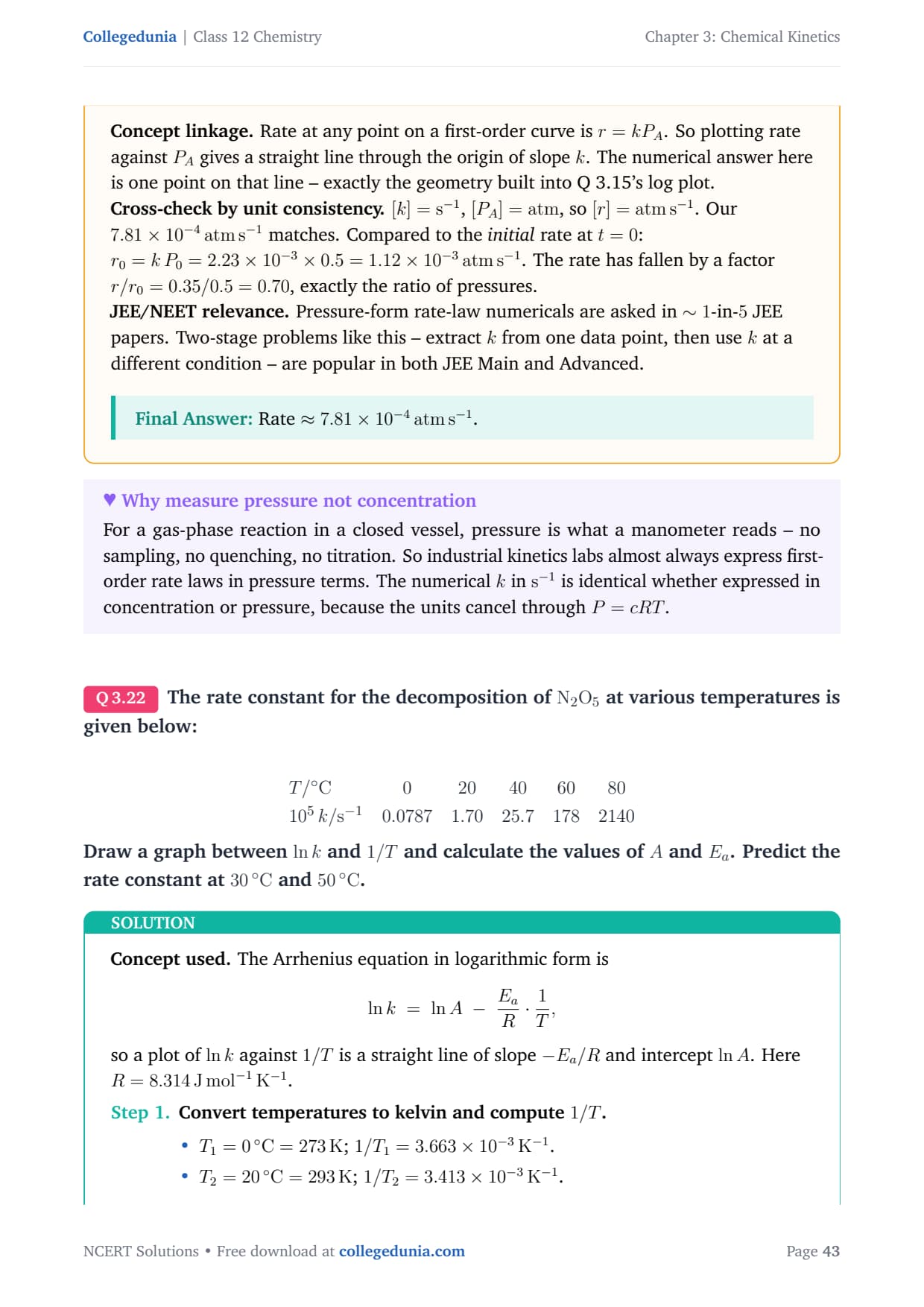
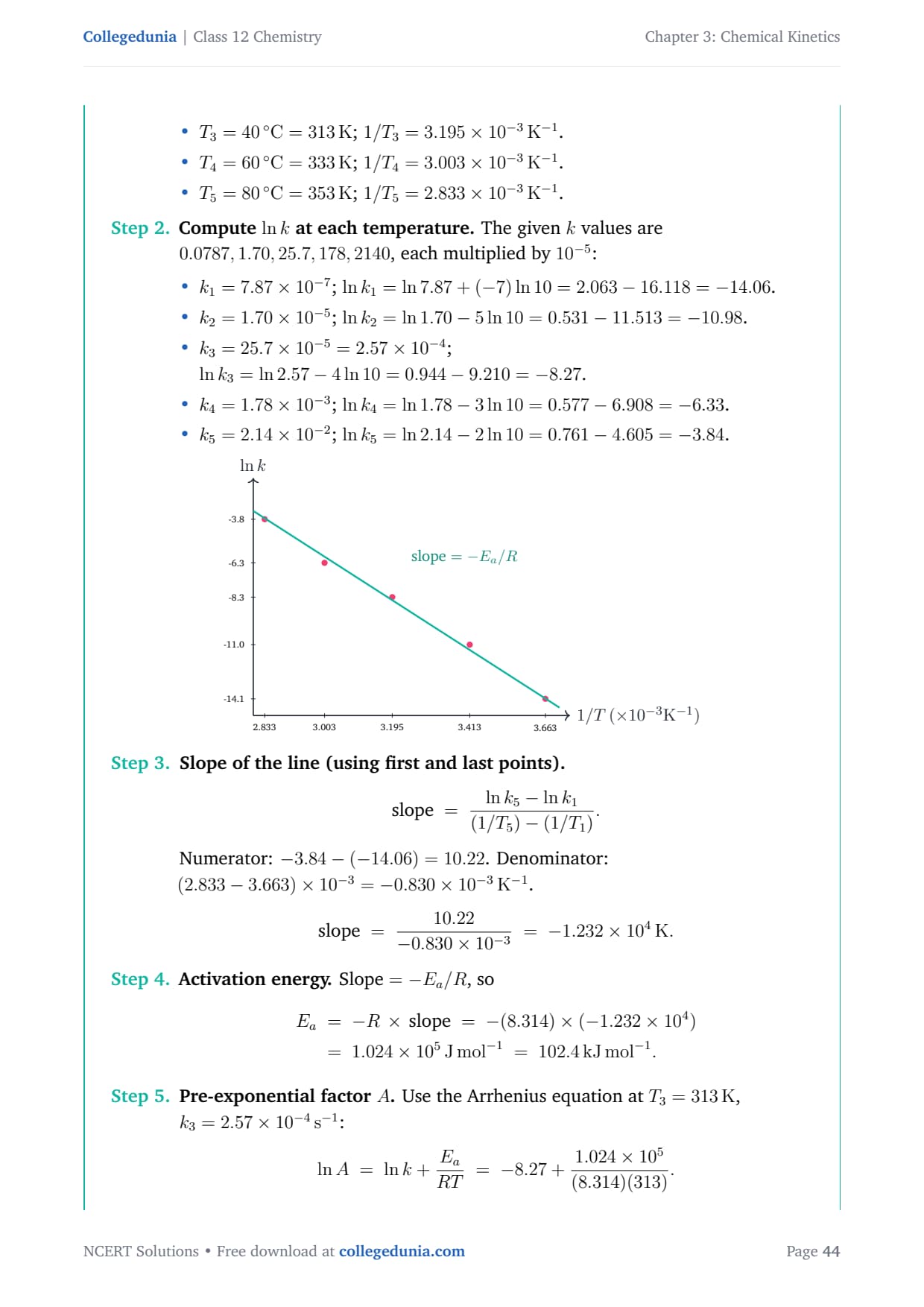
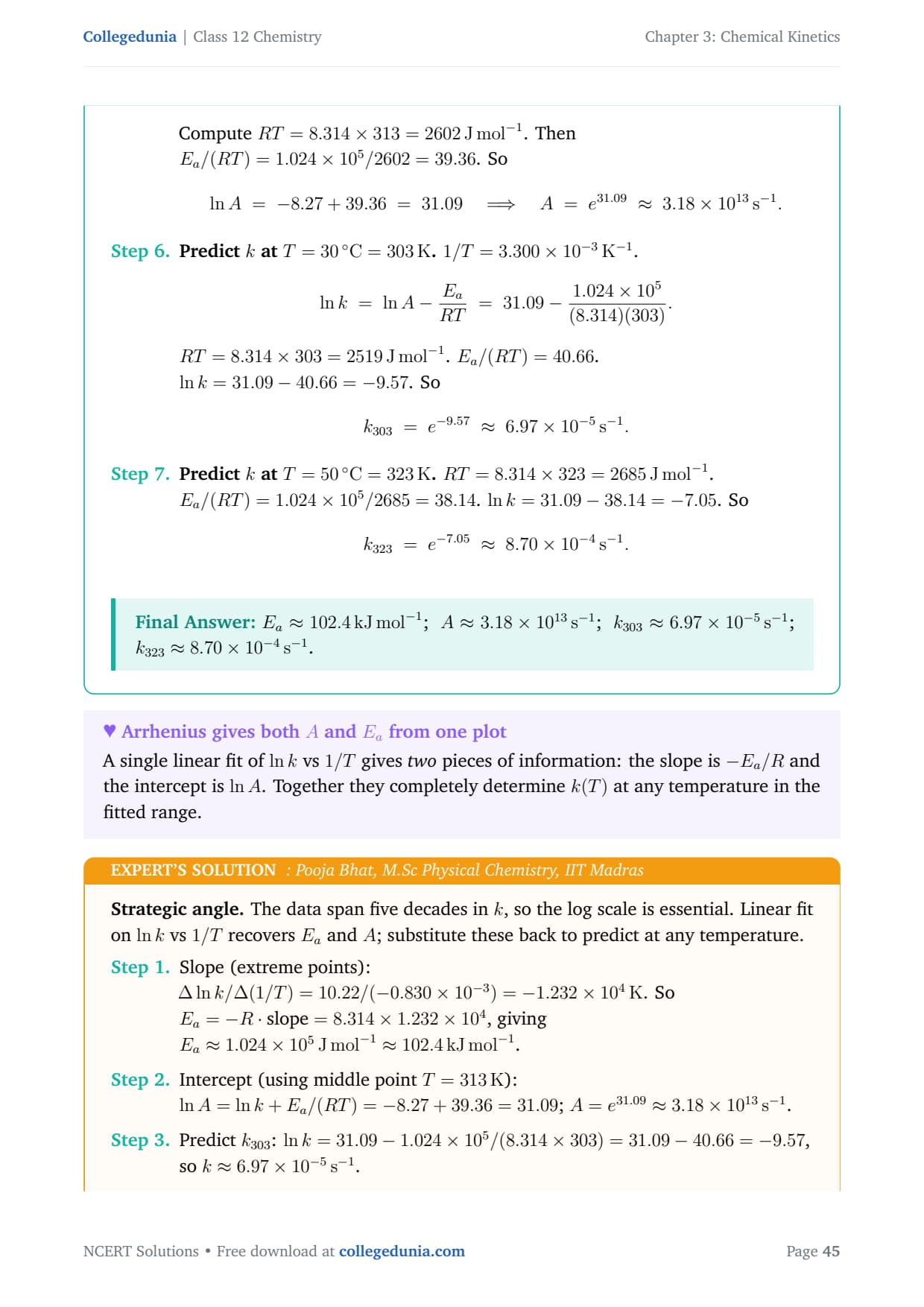
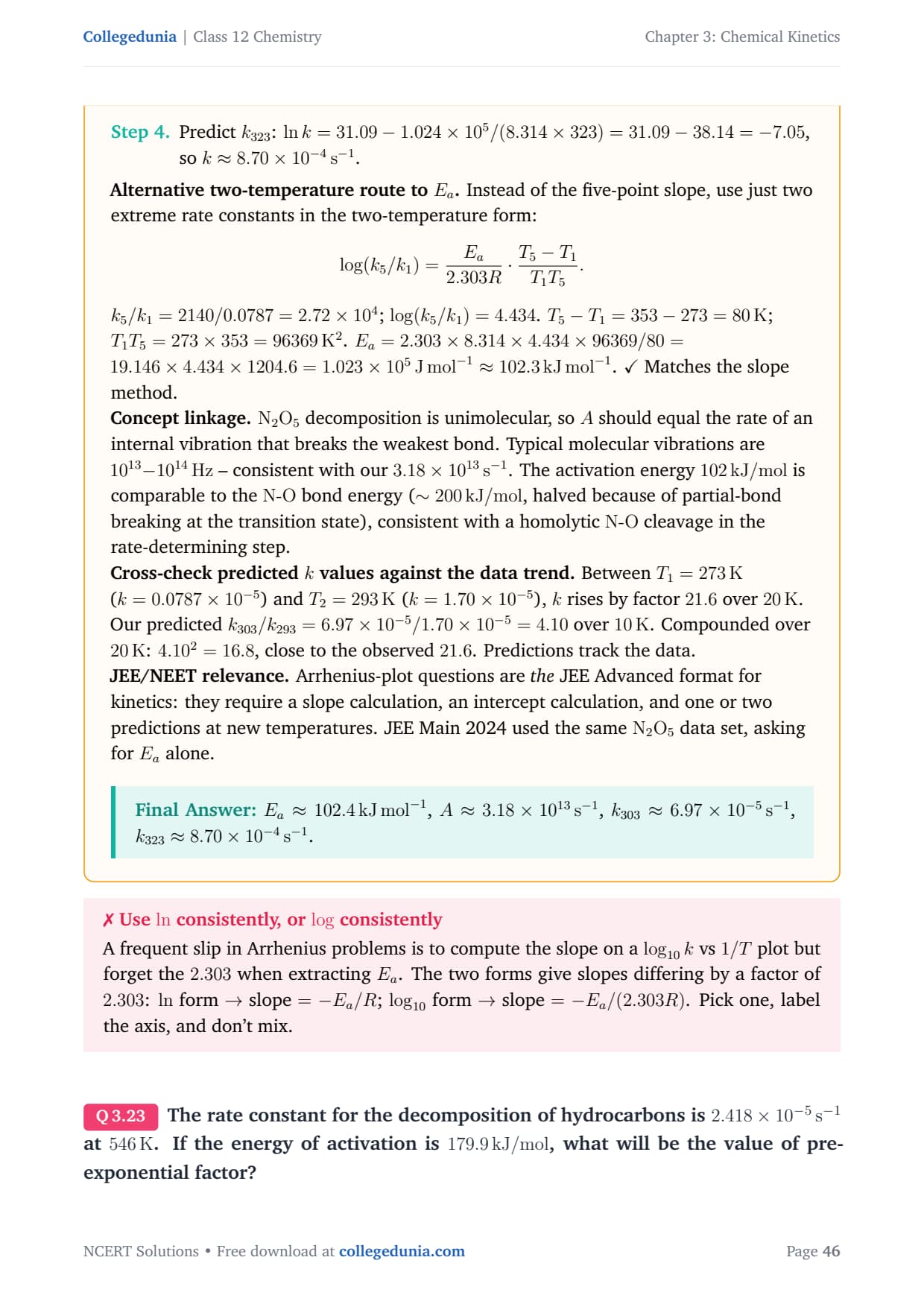
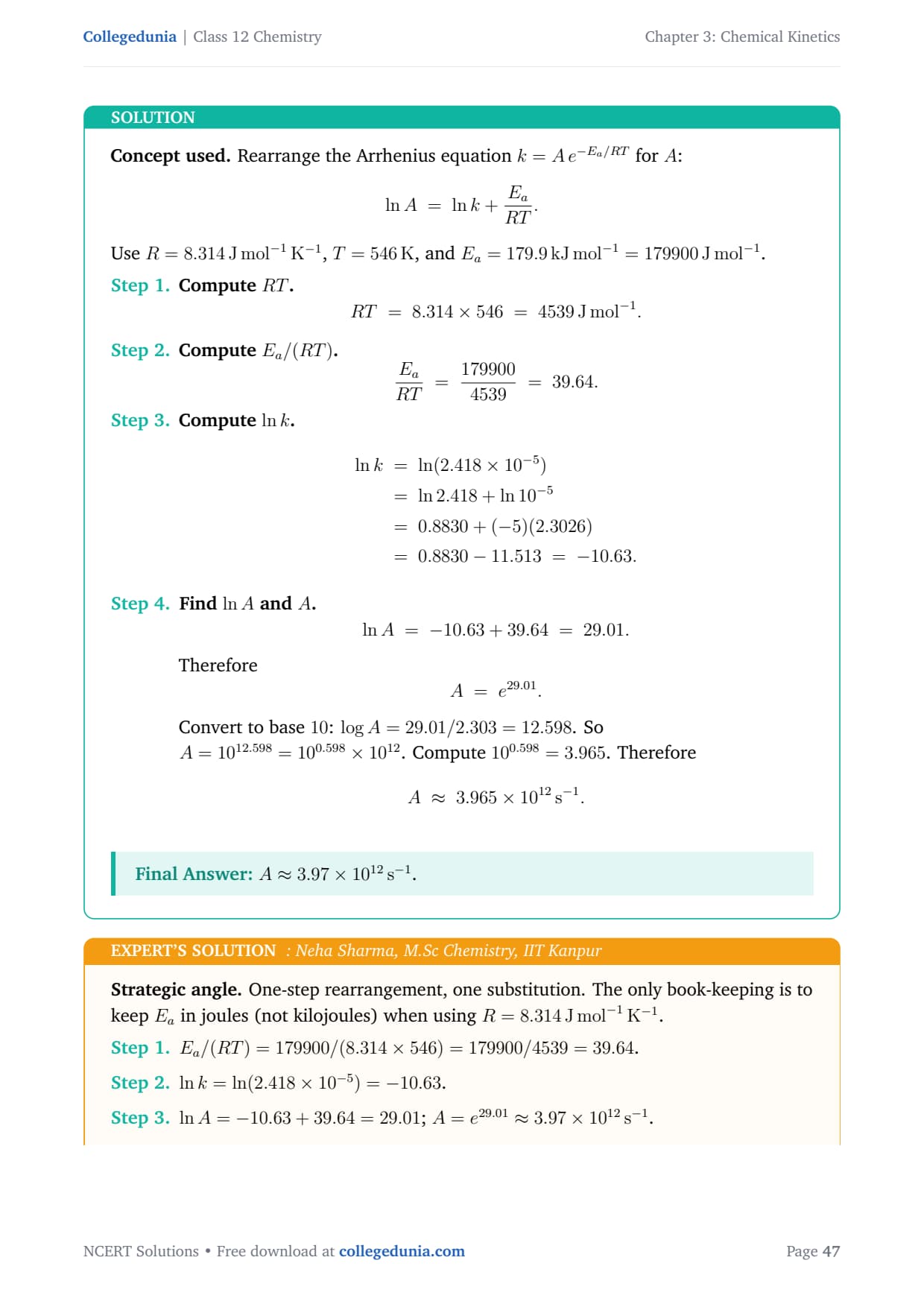
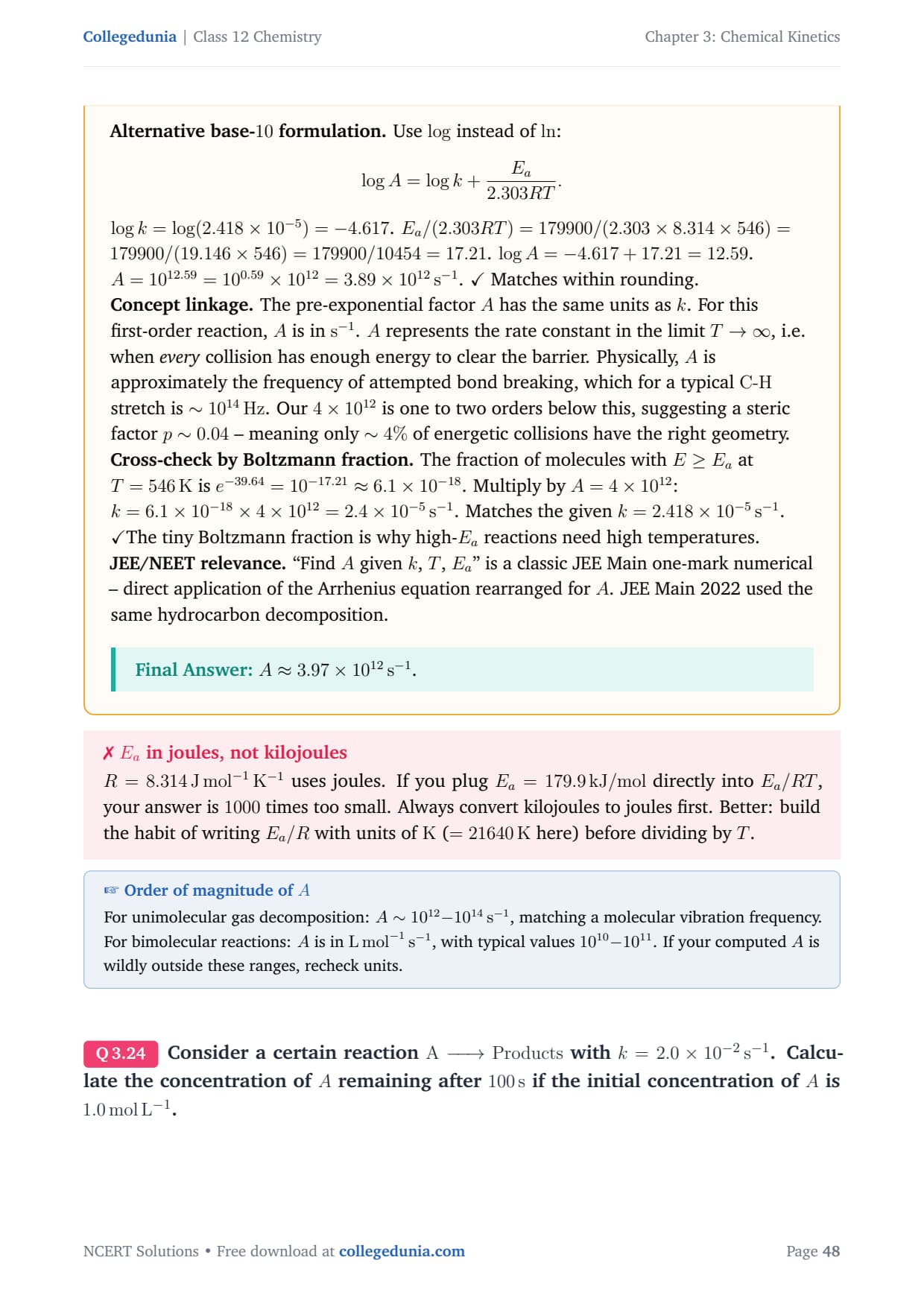
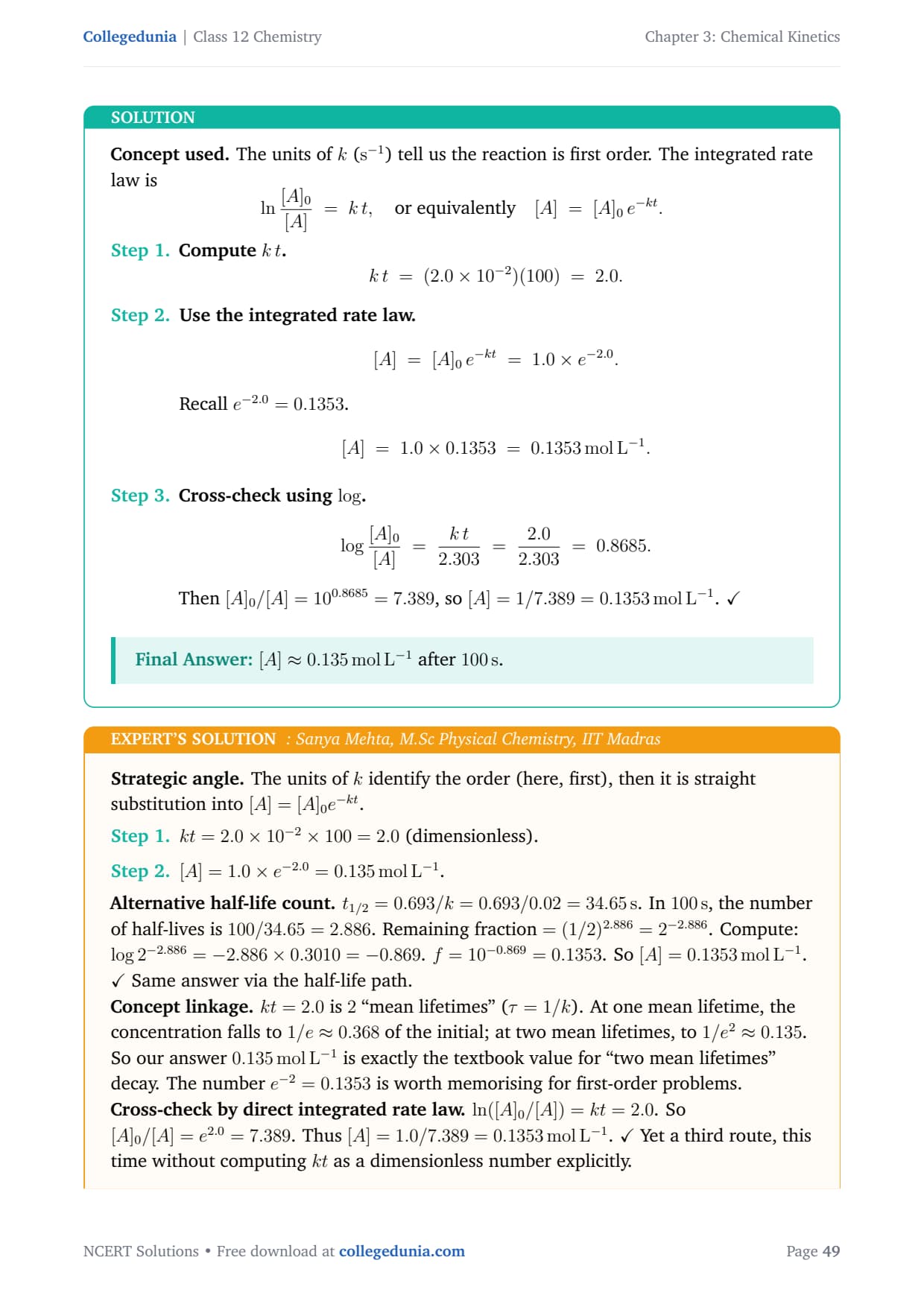
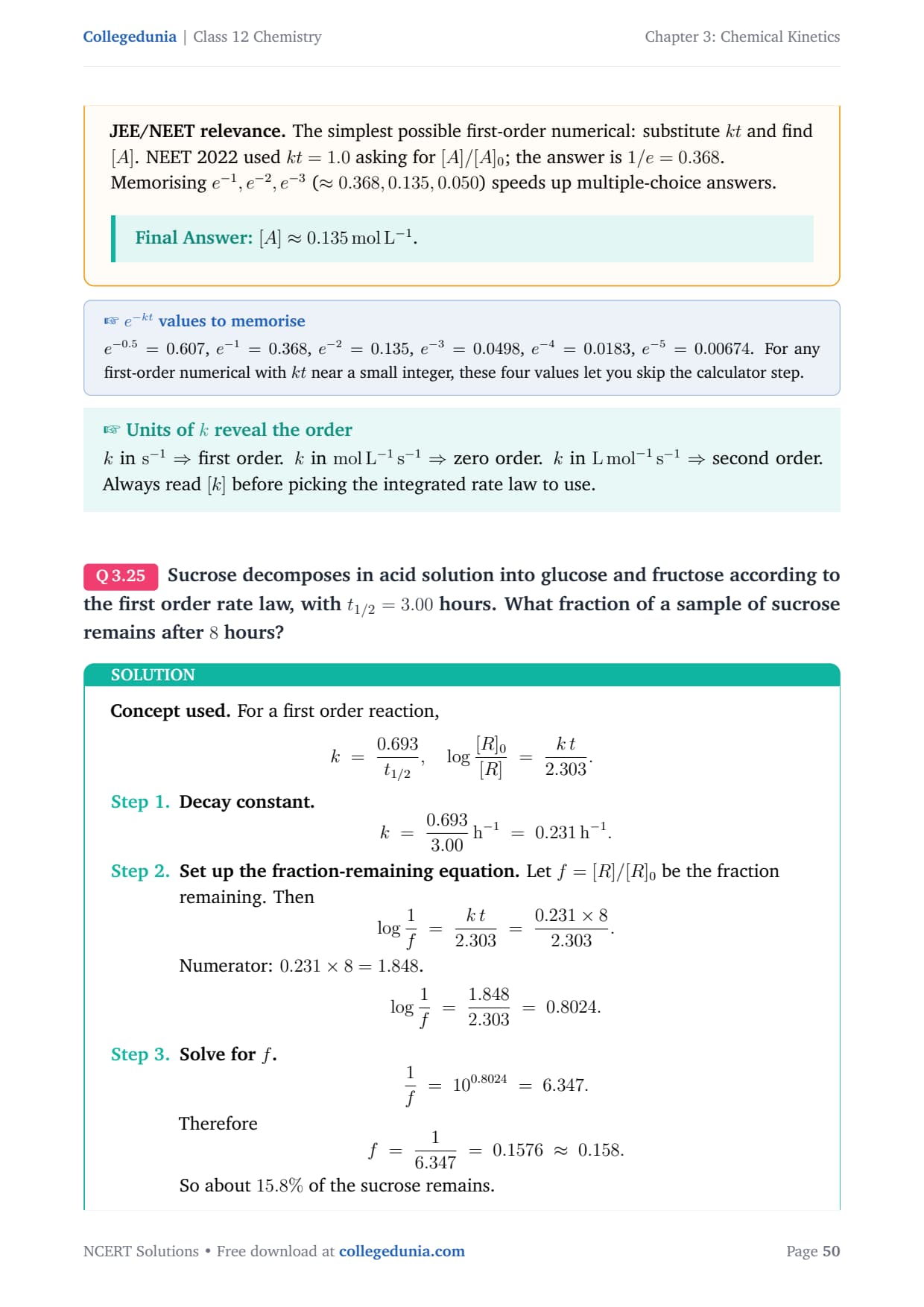
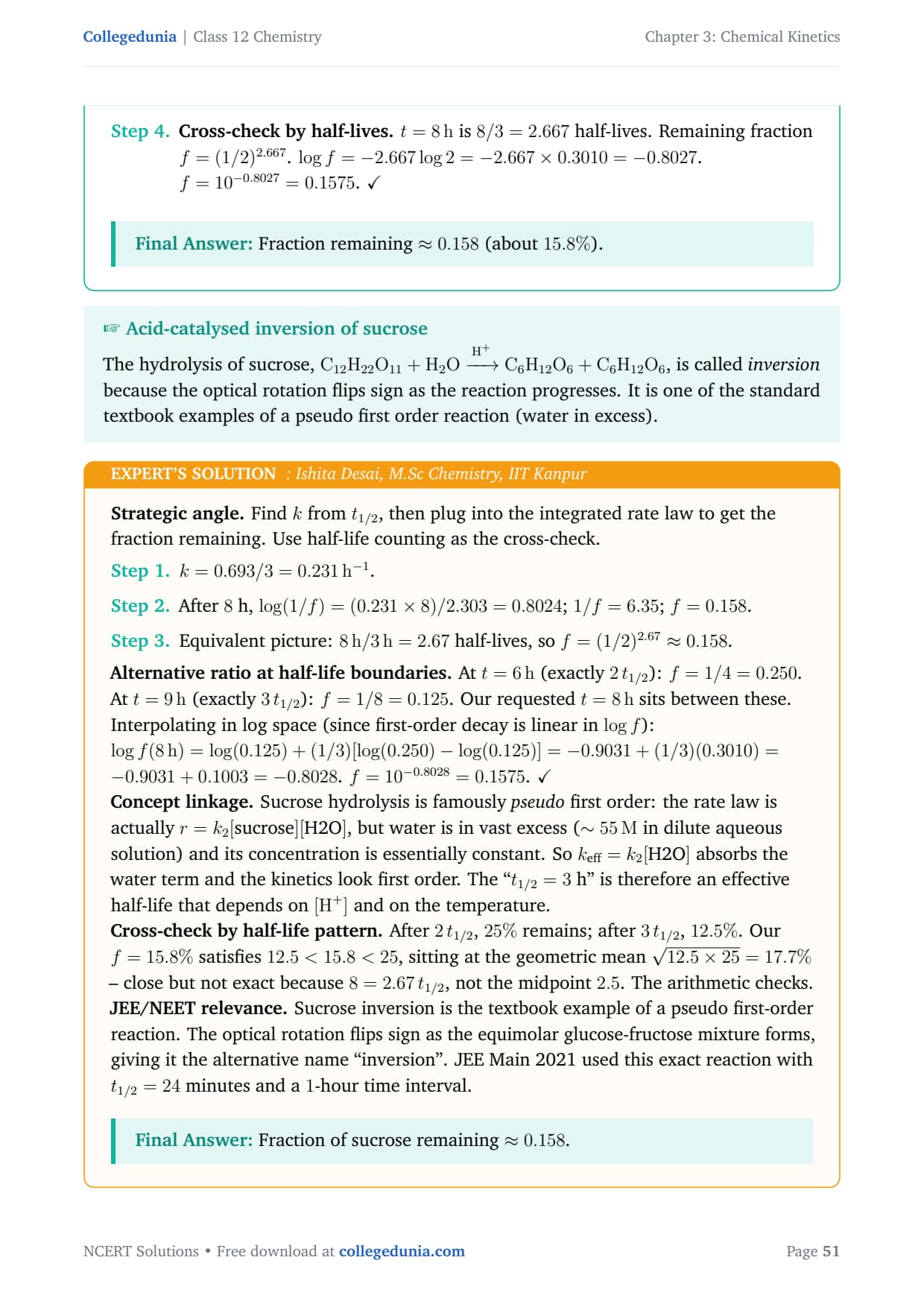
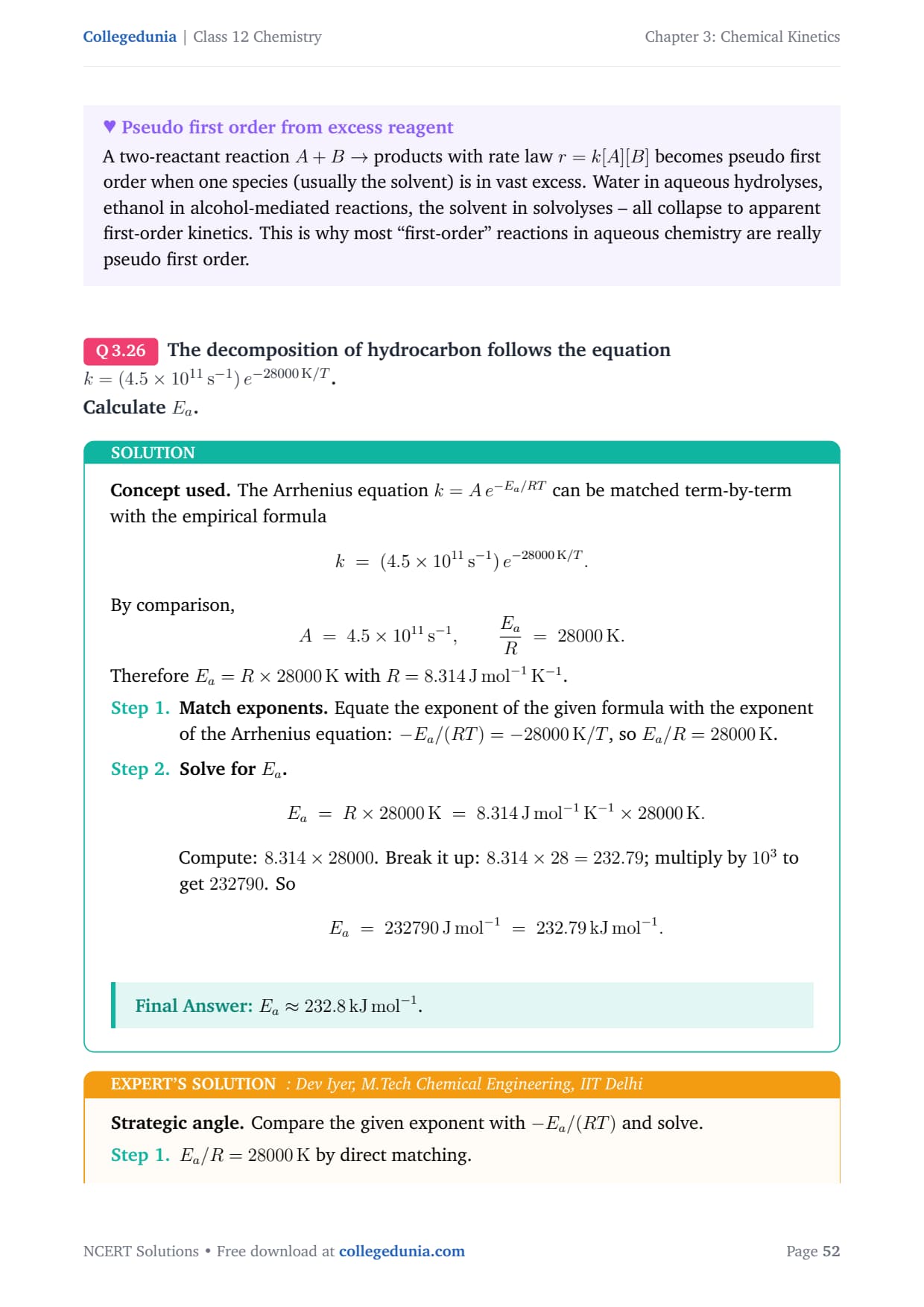
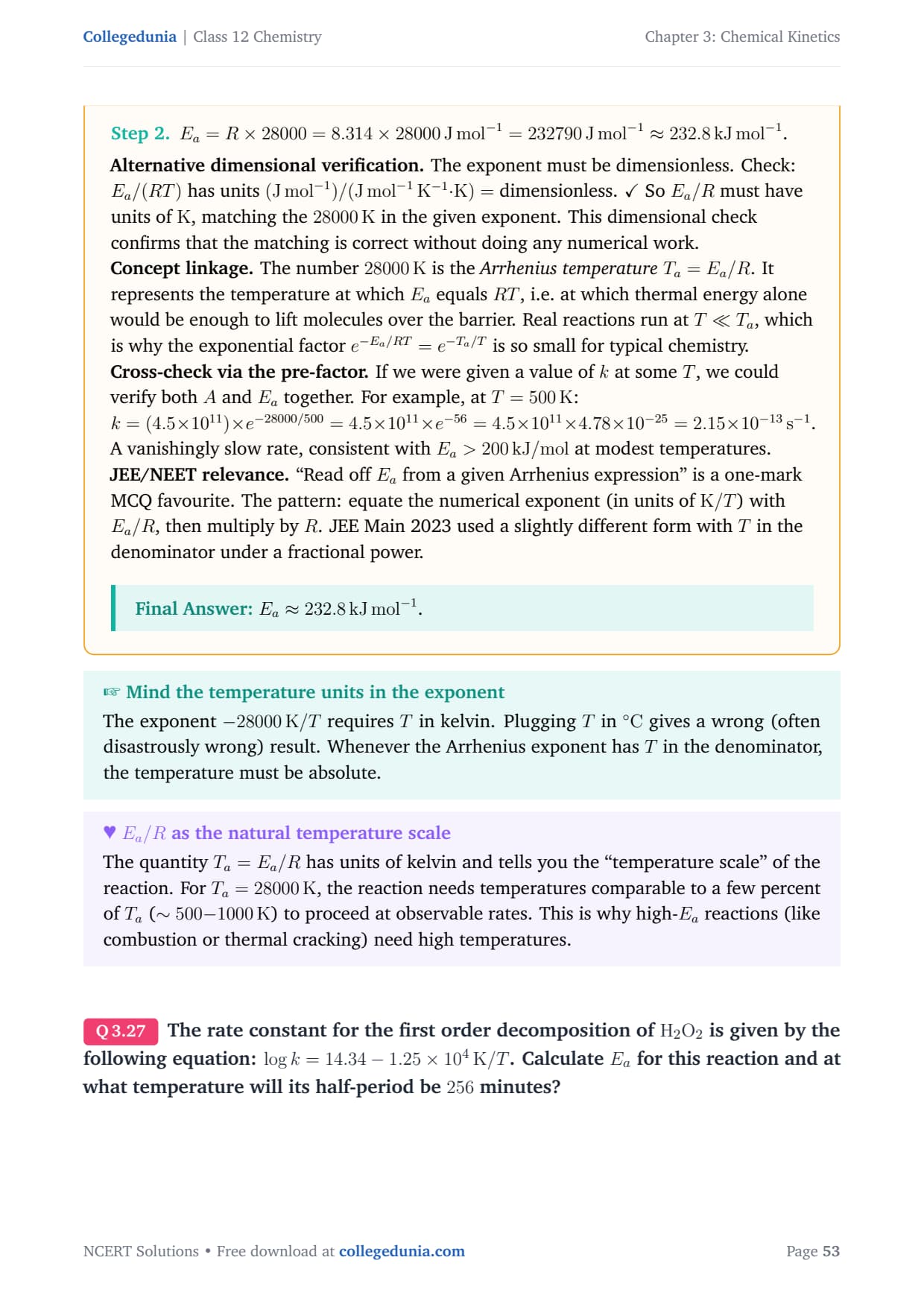
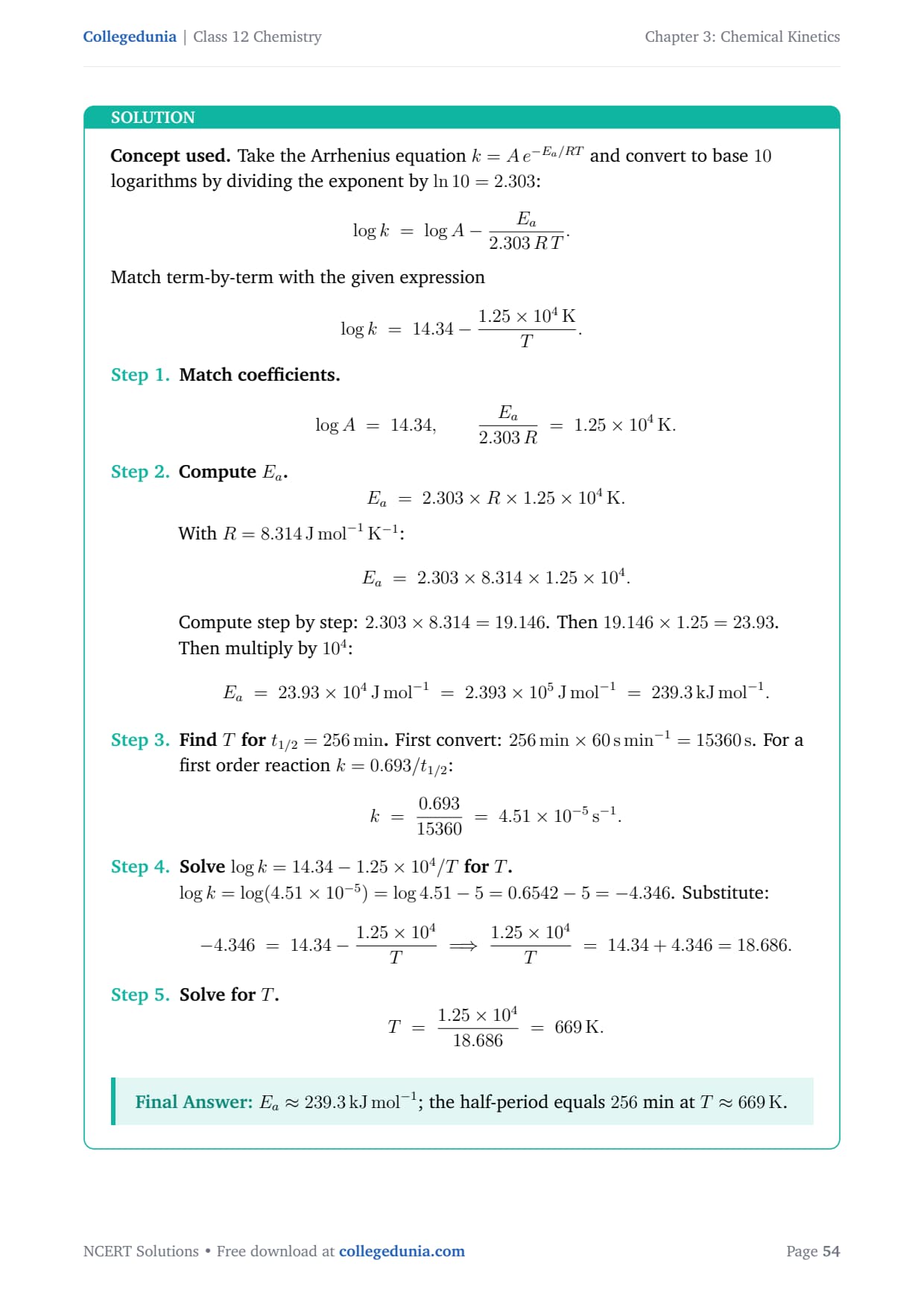
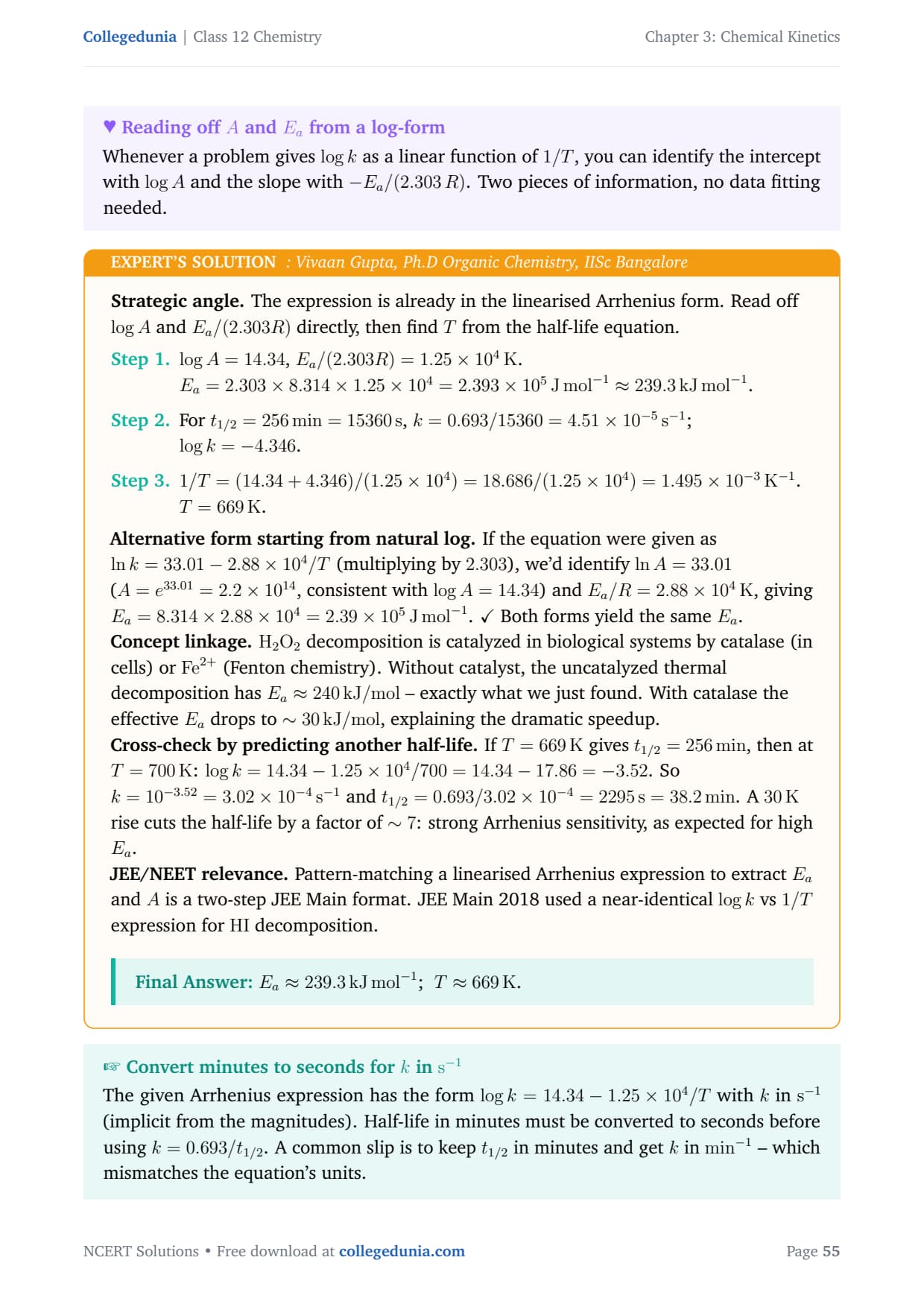
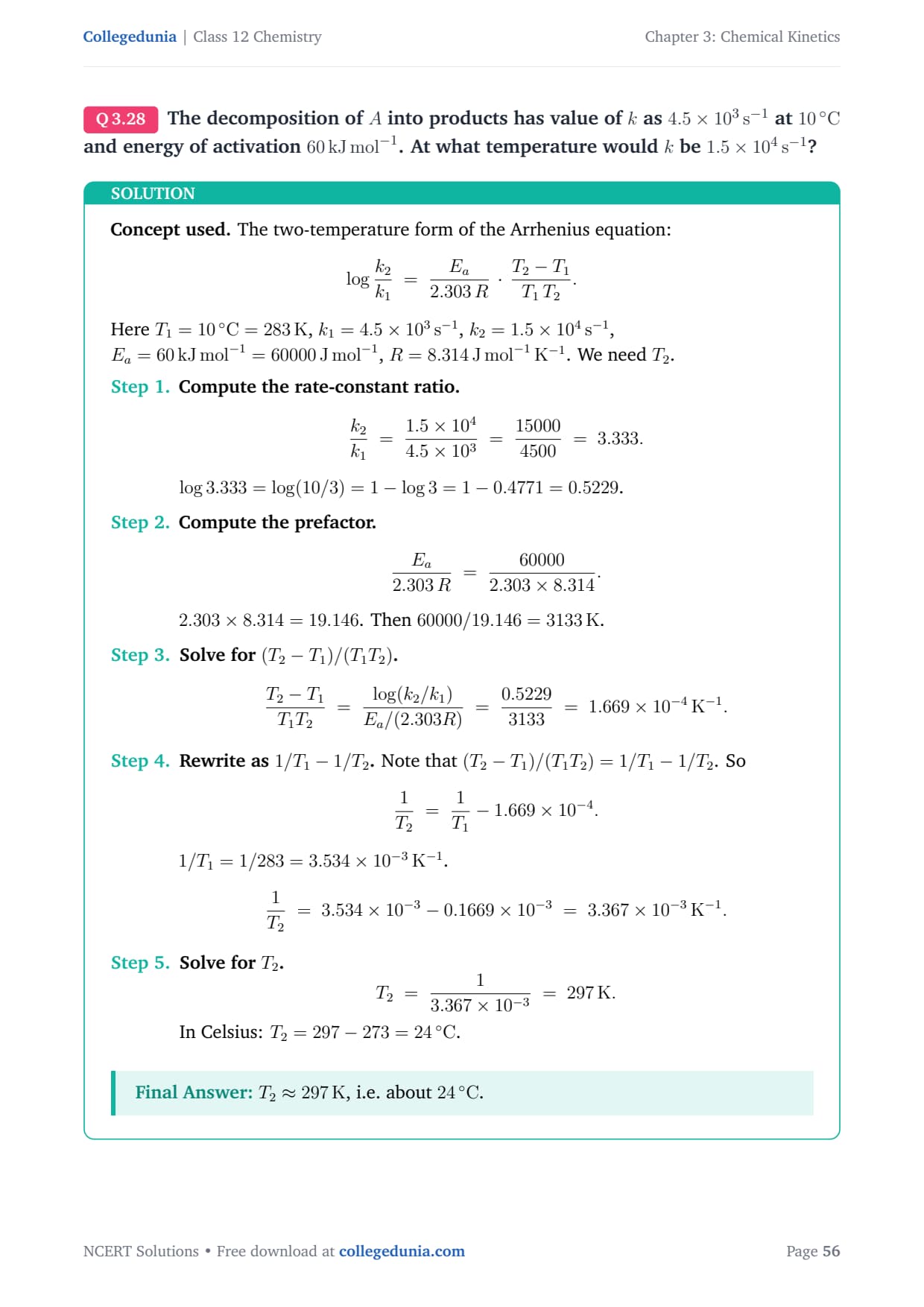
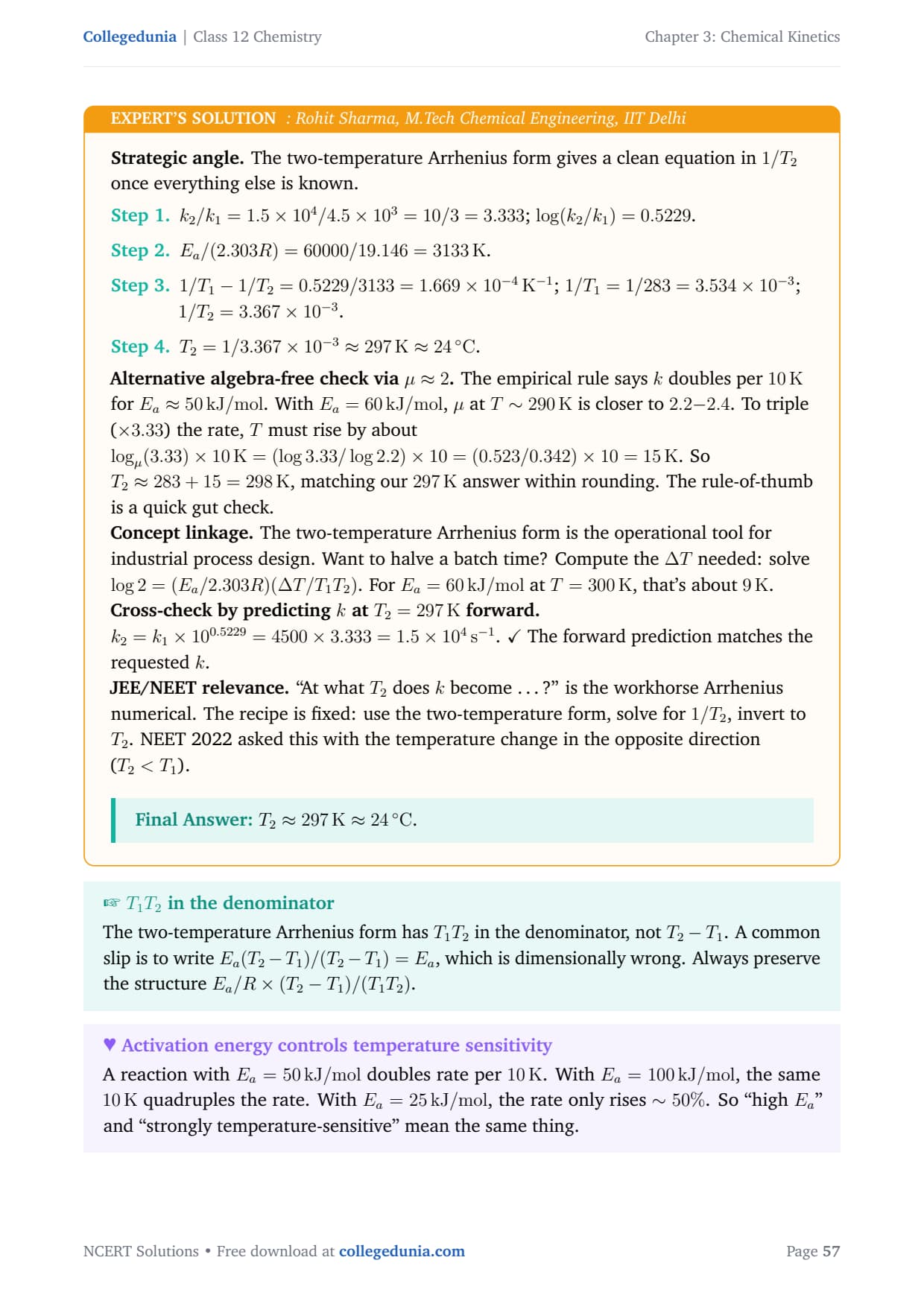
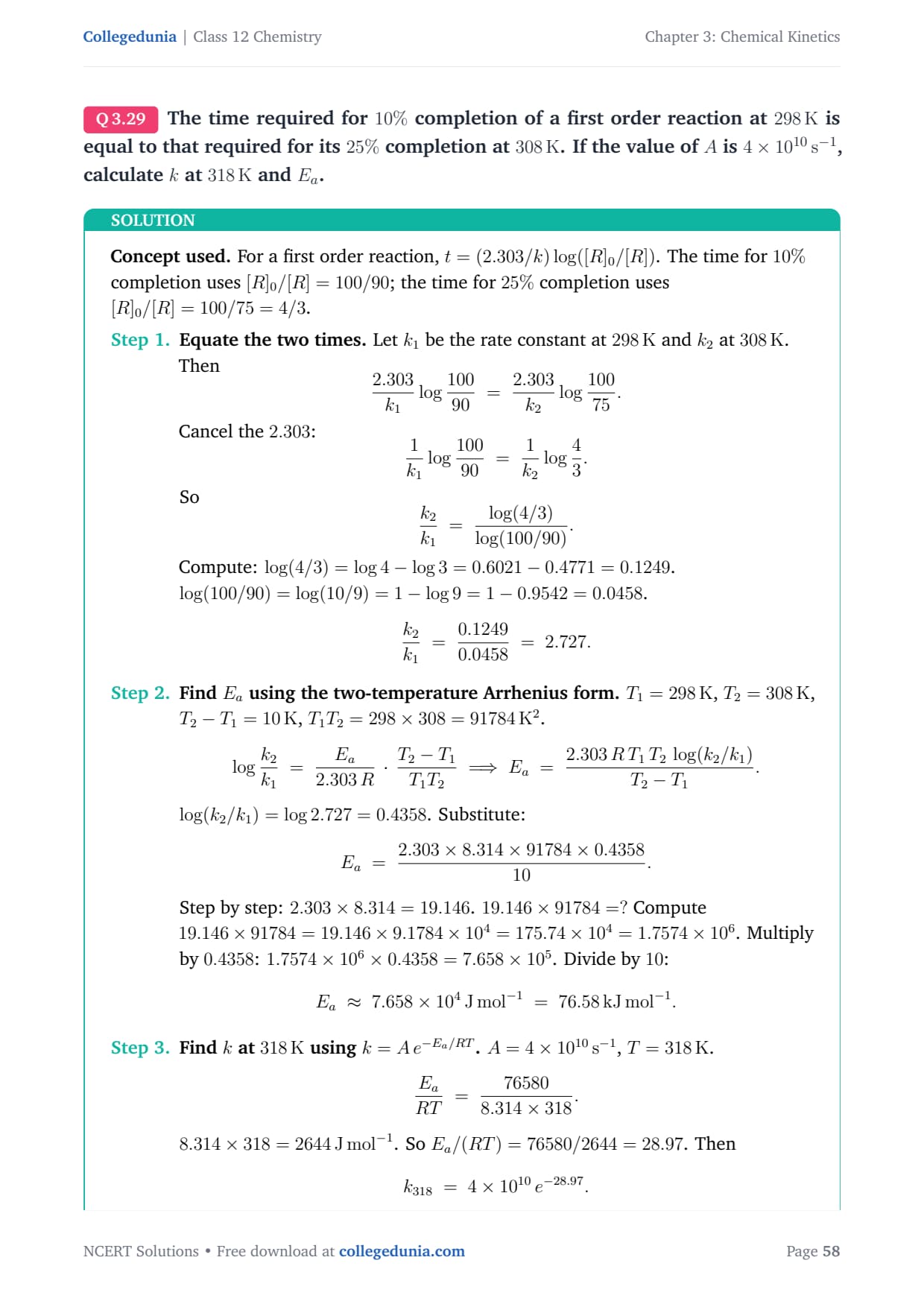
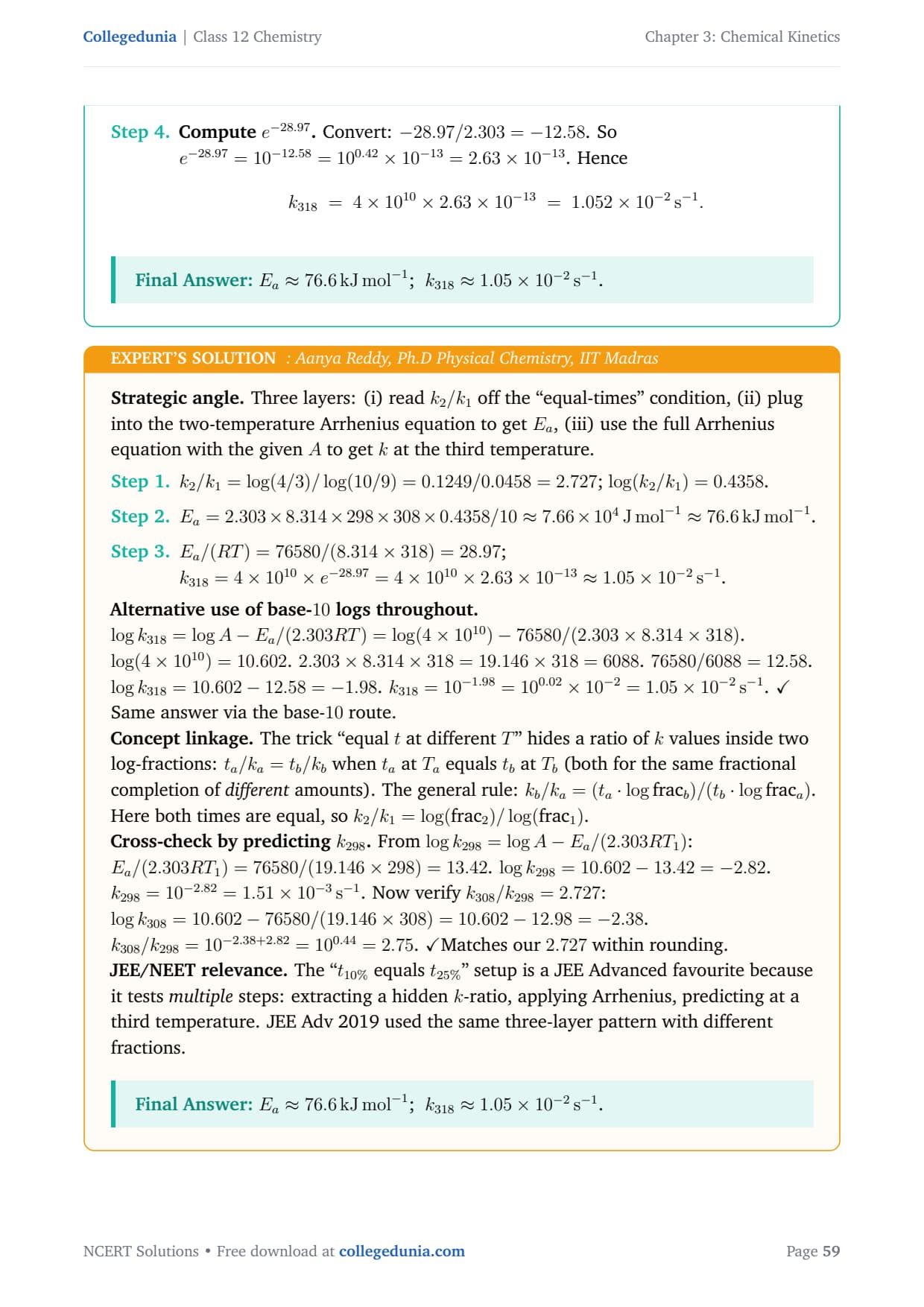
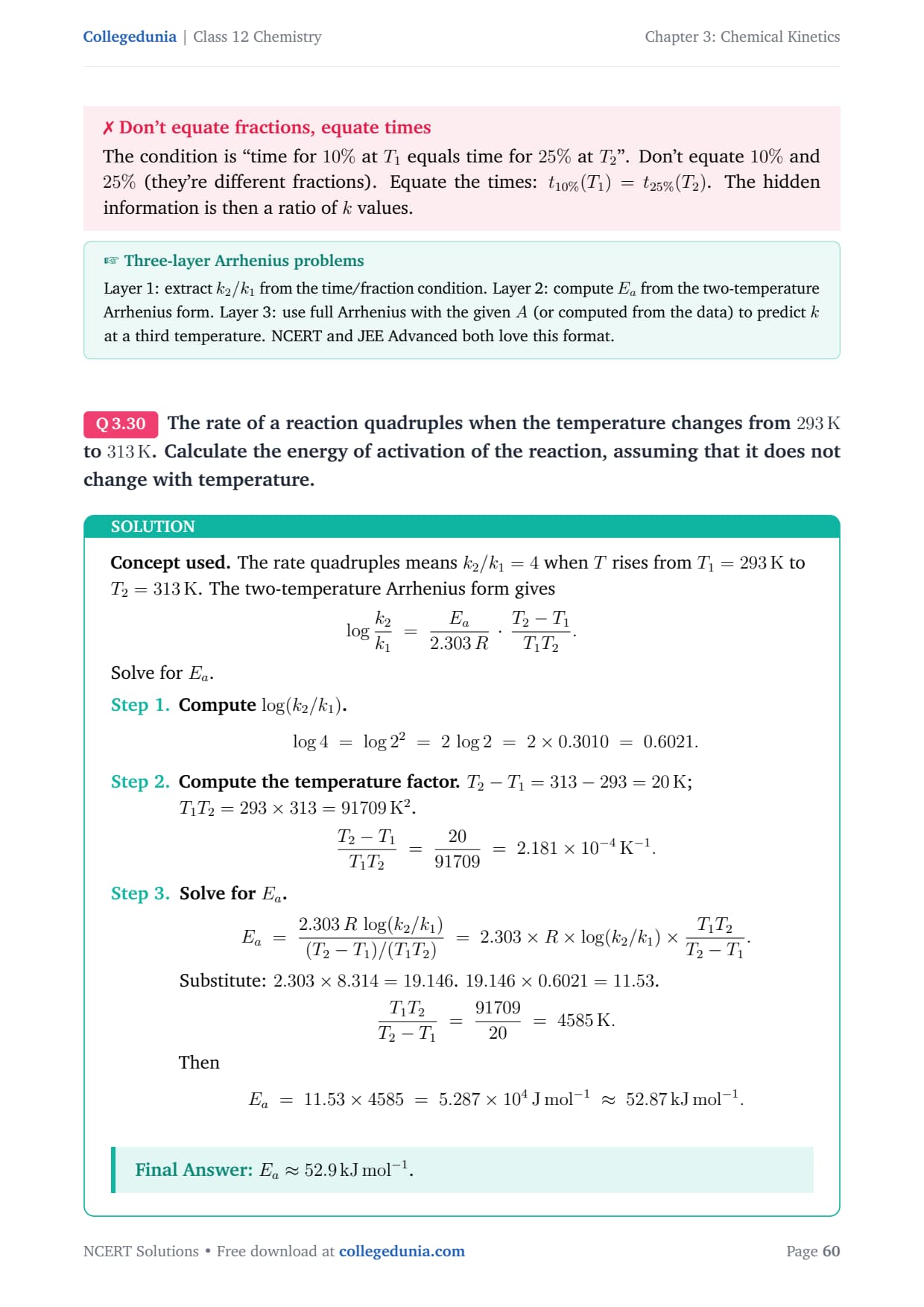
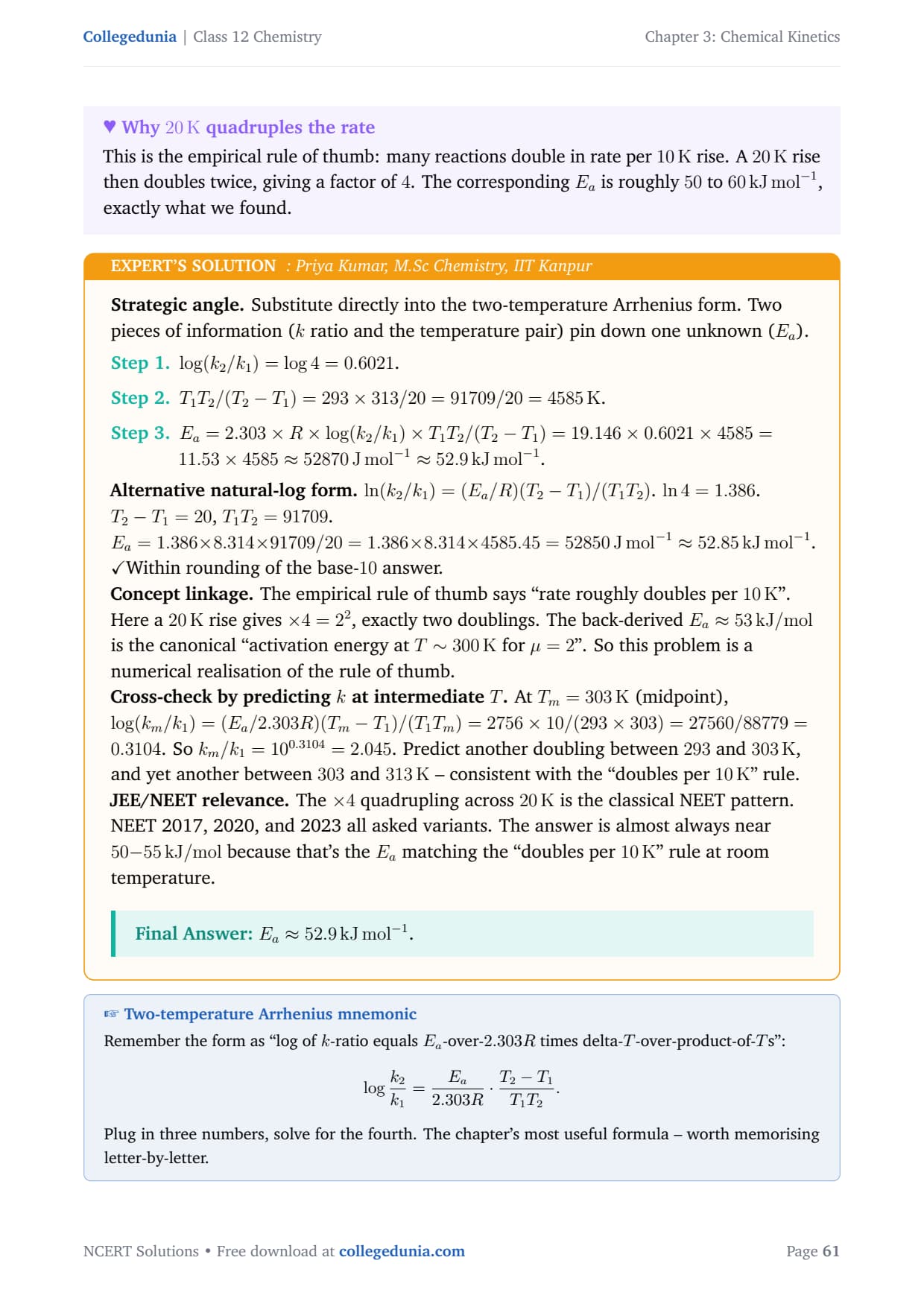
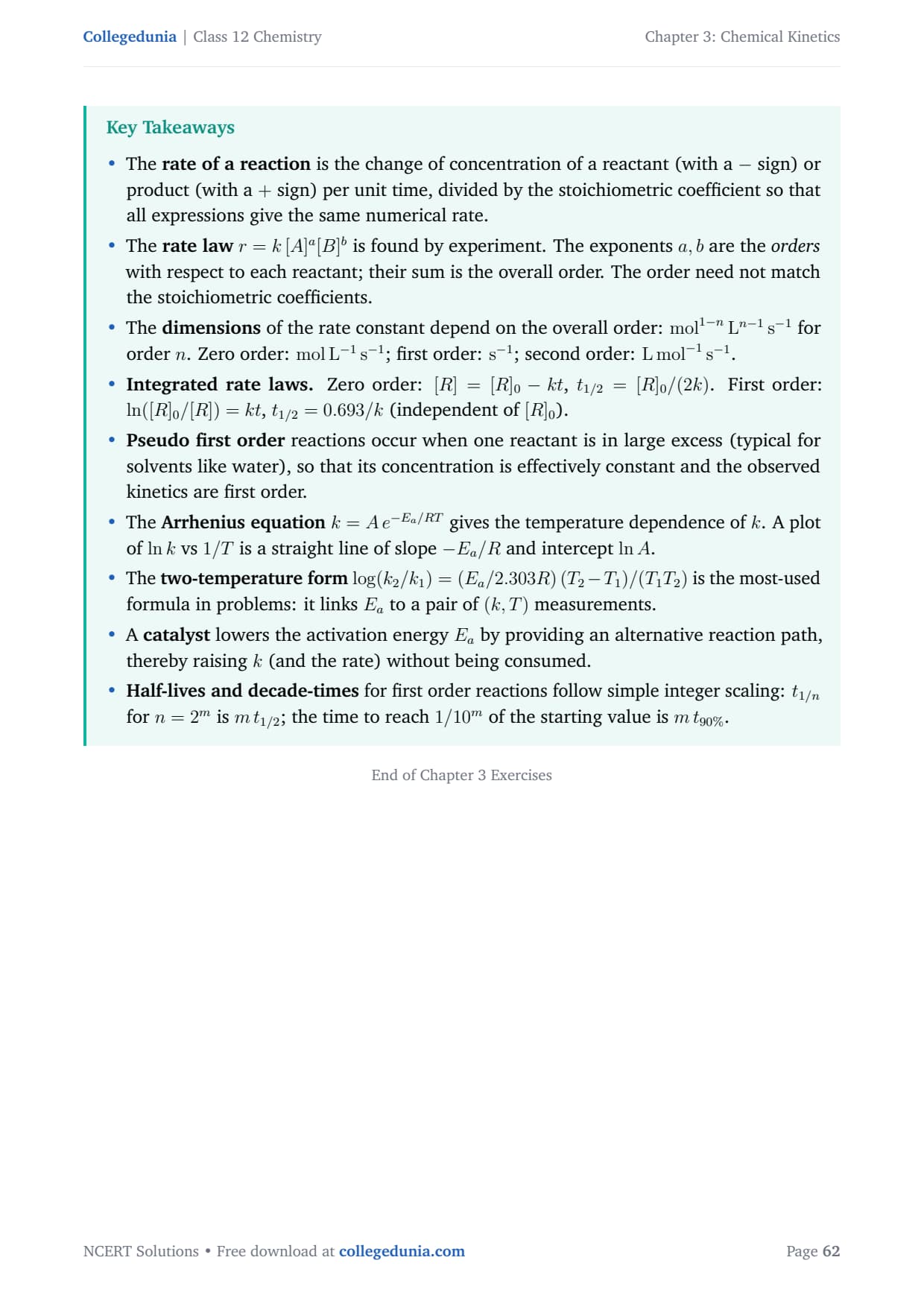




Comments