




These Chemical Kinetics Class 12 notes cover the key topics, derivations, and numericals asked in CBSE, JEE, and NEET. Chapter 3 carries about 6-8 marks in CBSE and 4-6% in JEE Main.
This page hosts the notes PDF, sub-topic weightage, key derivations, and the PYQ trend.
- CBSE Boards: 6 to 8 marks a year, usually a 3-mark rate-constant numerical plus a 5-mark answer on order, half-life, or Arrhenius.
- JEE Main: 4 to 6%, with 2 to 3 questions per shift on integrated rate laws, half-life, and temperature coefficient.
- NEET: 2 to 3 questions a year on order, pseudo-first-order, and Arrhenius numericals.
The notes below follow the order examiners test: rate, order and molecularity, integrated rate laws, then collision and Arrhenius theory, each ending with the formula or graph CBSE rewards.
Most Important Sub-Topics in Chemical Kinetics and Their Mark Distribution
Across CBSE, JEE Main and NEET papers from 2021 to 2025, the marks sit on a few sub-topics. The table ranks them by frequency.
| Sub-topic | Weightage | CBSE Frequency |
|---|---|---|
| Integrated rate law for first order reactions and half-life | High | Almost every year |
| Order of reaction from initial rate data | High | 4 of 5 years |
| Arrhenius equation and activation energy | High | 4 of 5 years |
| Rate, average vs instantaneous rate | Medium | 3 of 5 years |
| Zero order reactions and pseudo first order | Medium | 3 of 5 years |
| Collision theory and effective collisions | Low | 1 of 5 years |
Chemical Kinetics Class 12 Chemistry Video Lecture
Source: Magnet Brains on YouTube
Chemical Kinetics Topic-by-Topic Notes for Class 12 Chemistry
Rate sets up order, order the integrated rate law, and that the half-life. Arrhenius then explains how k changes with temperature.
Rate of a Chemical Reaction: Average and Instantaneous Rate
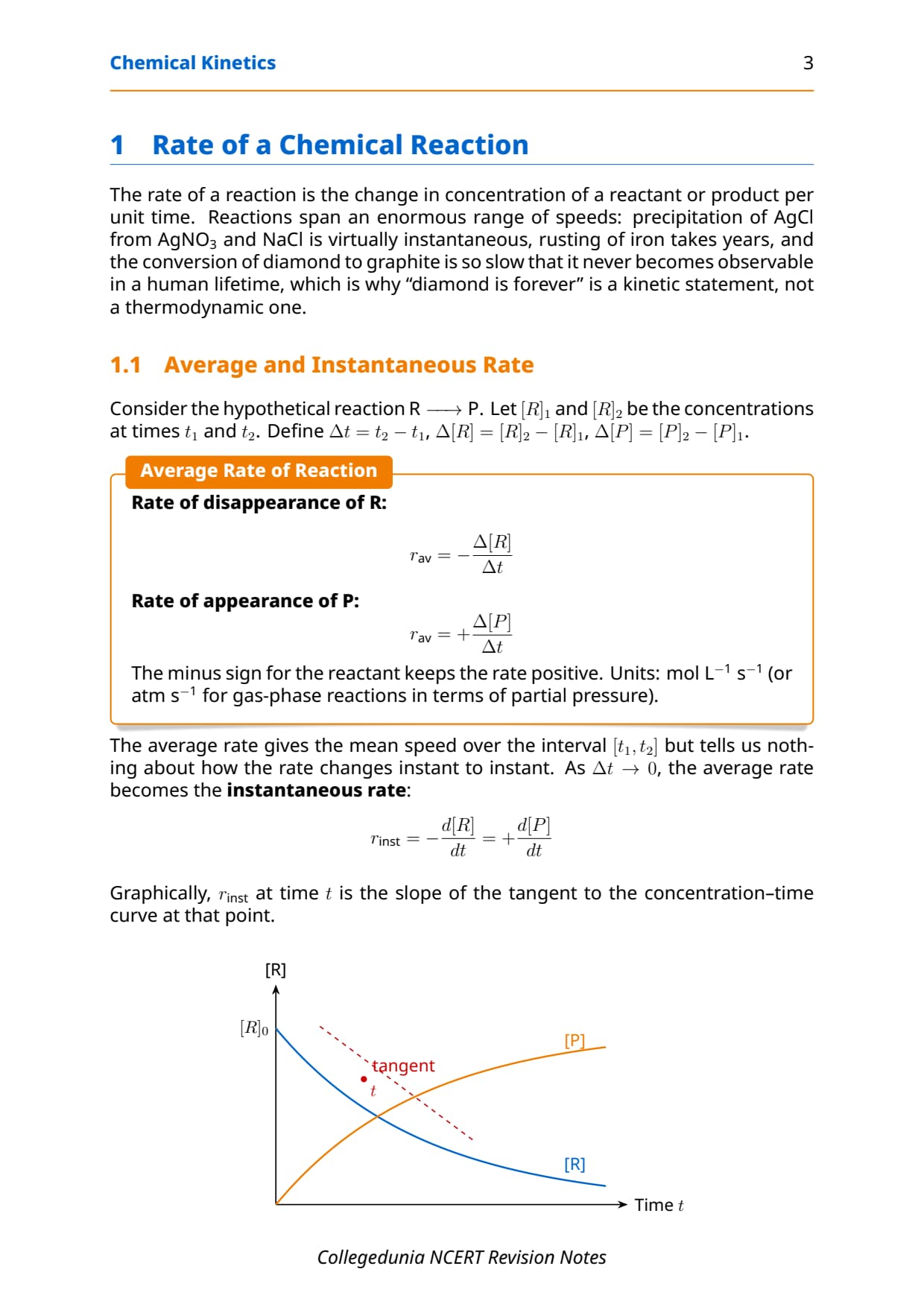
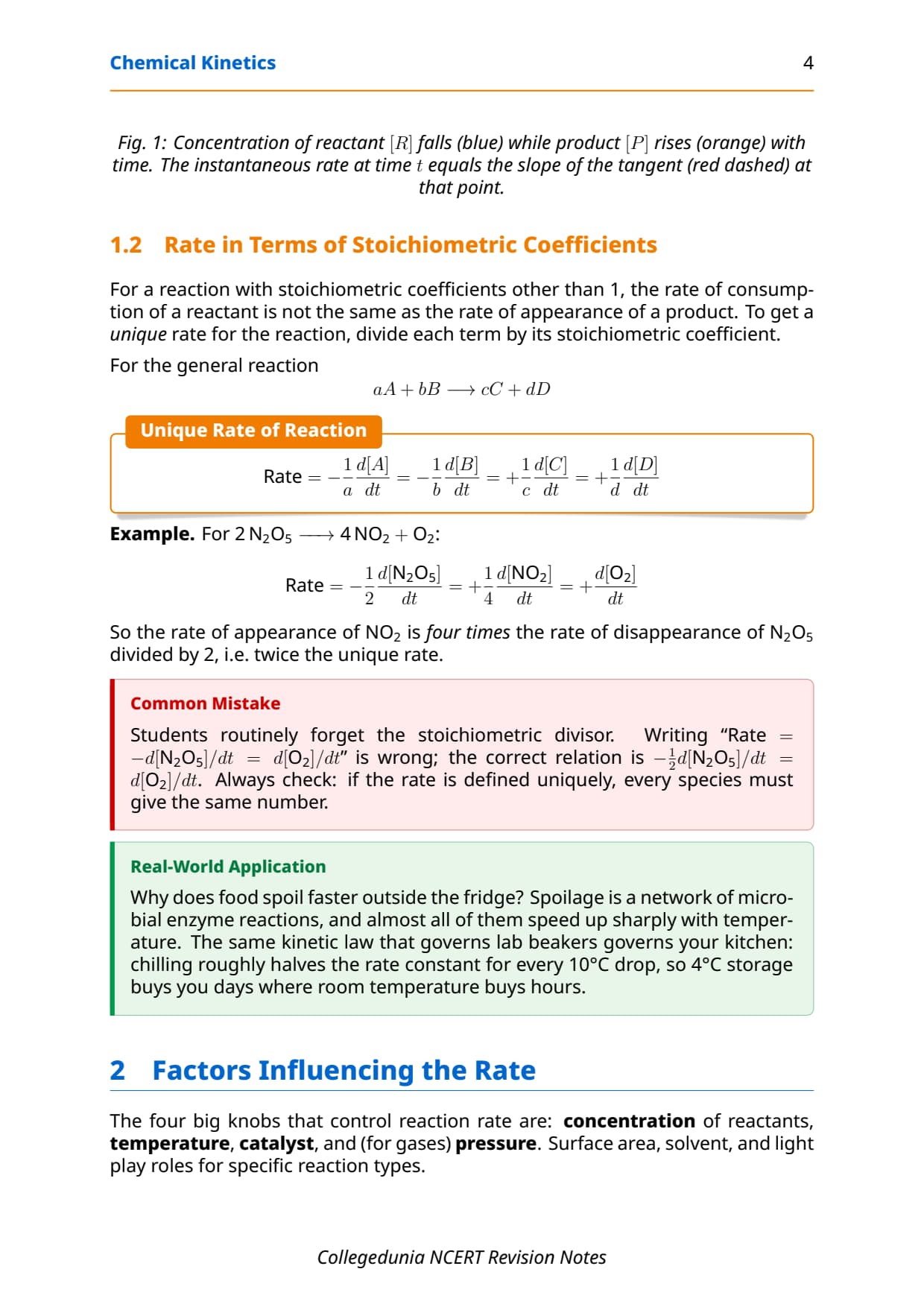
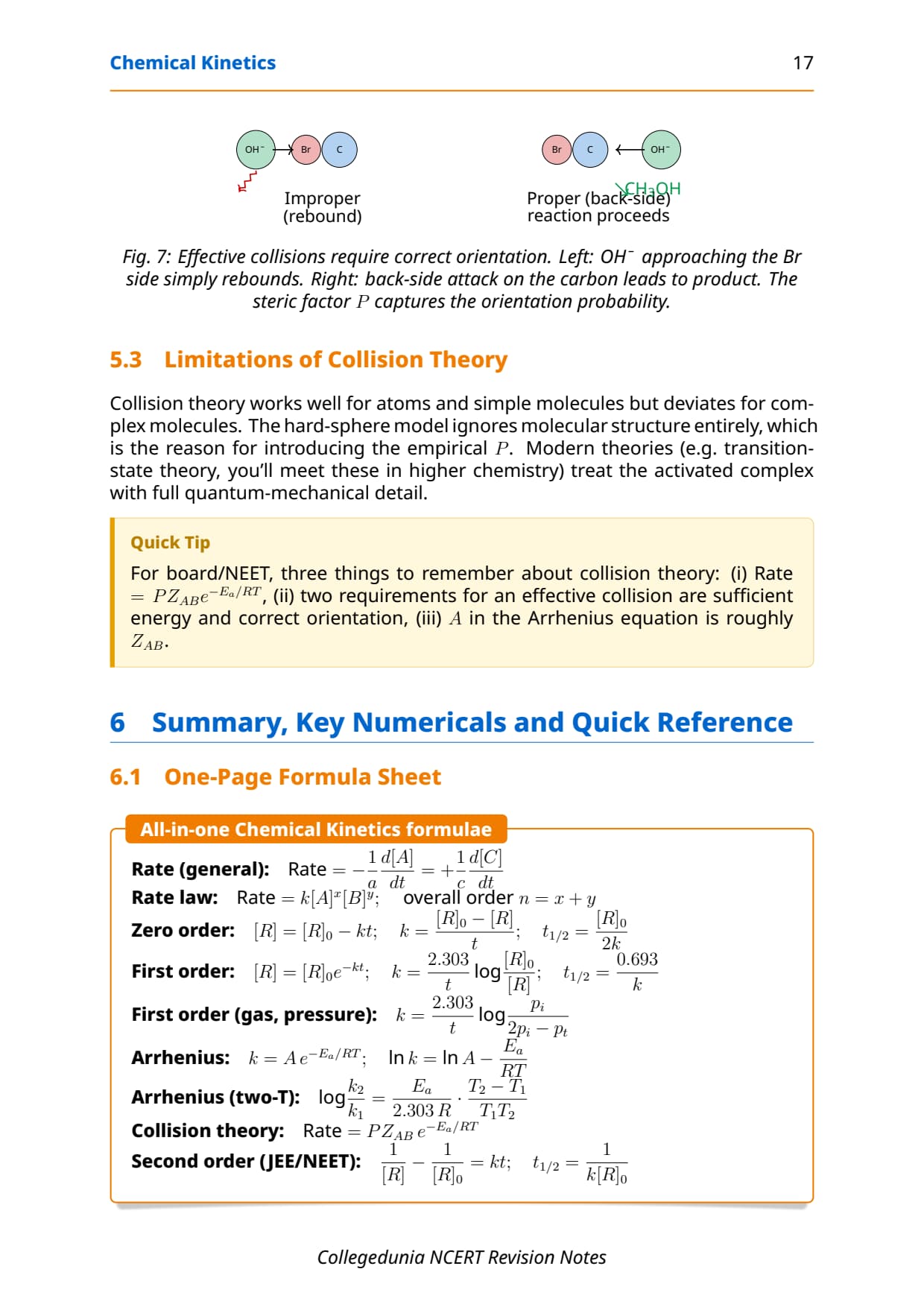
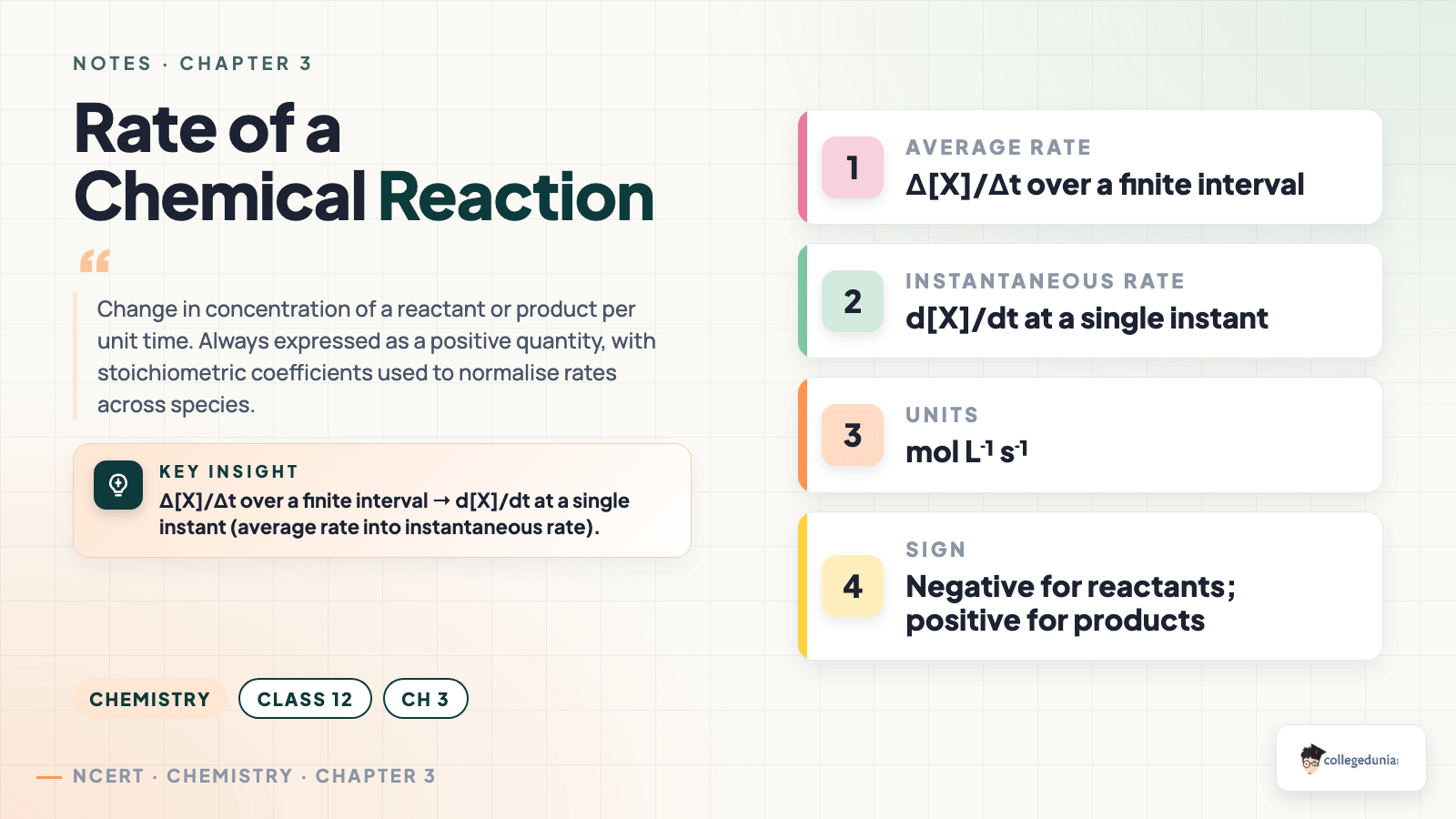
For aA + bB → cC + dD , the rate is the concentration change per unit time over the stoichiometric coefficient: rate = -1ad[A]dt = +1cd[C]dt . Average rate is the change over an interval; instantaneous rate is the graph's slope at an instant.
Rate Law, Rate Constant and the Difference Between Order and Molecularity
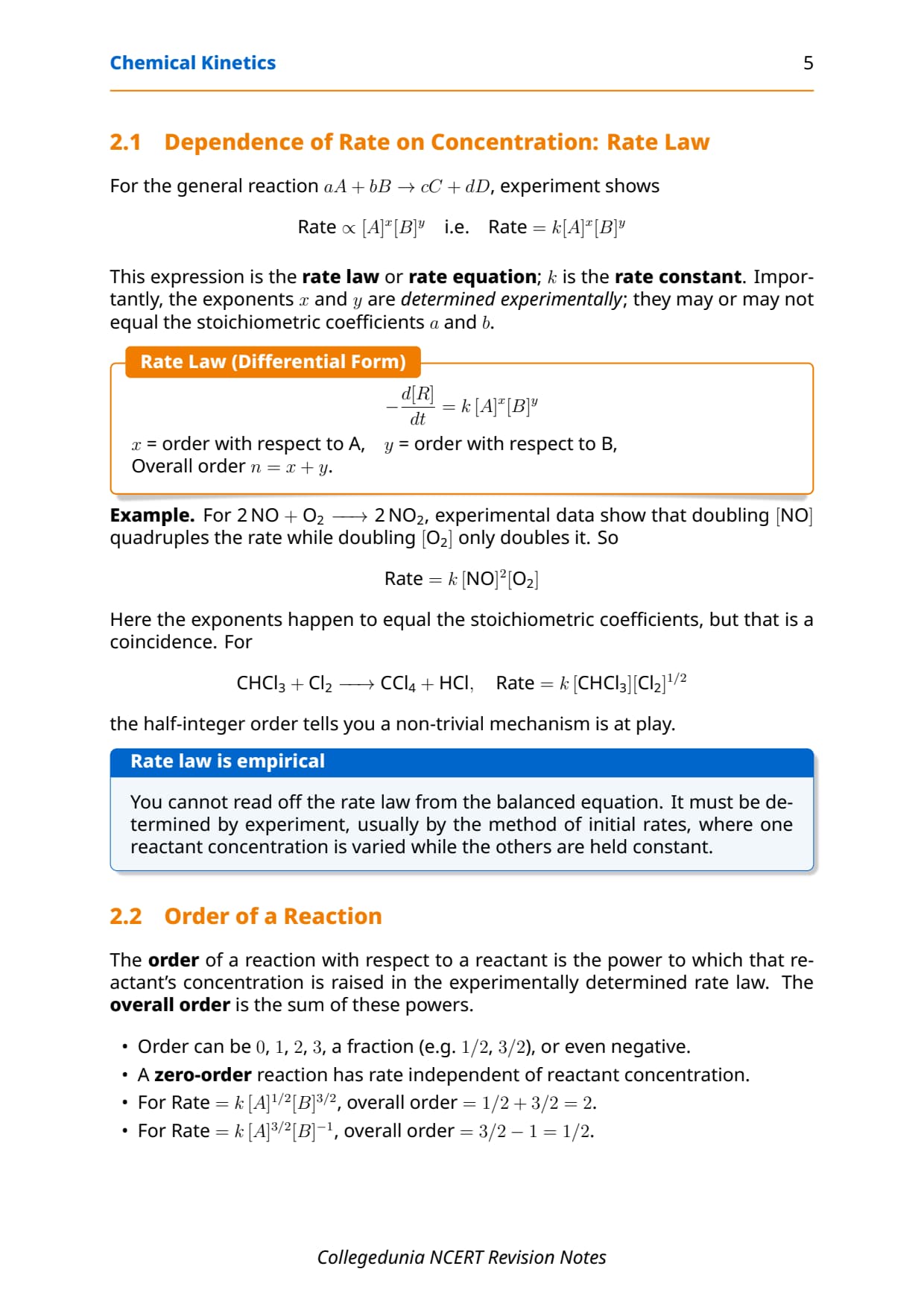
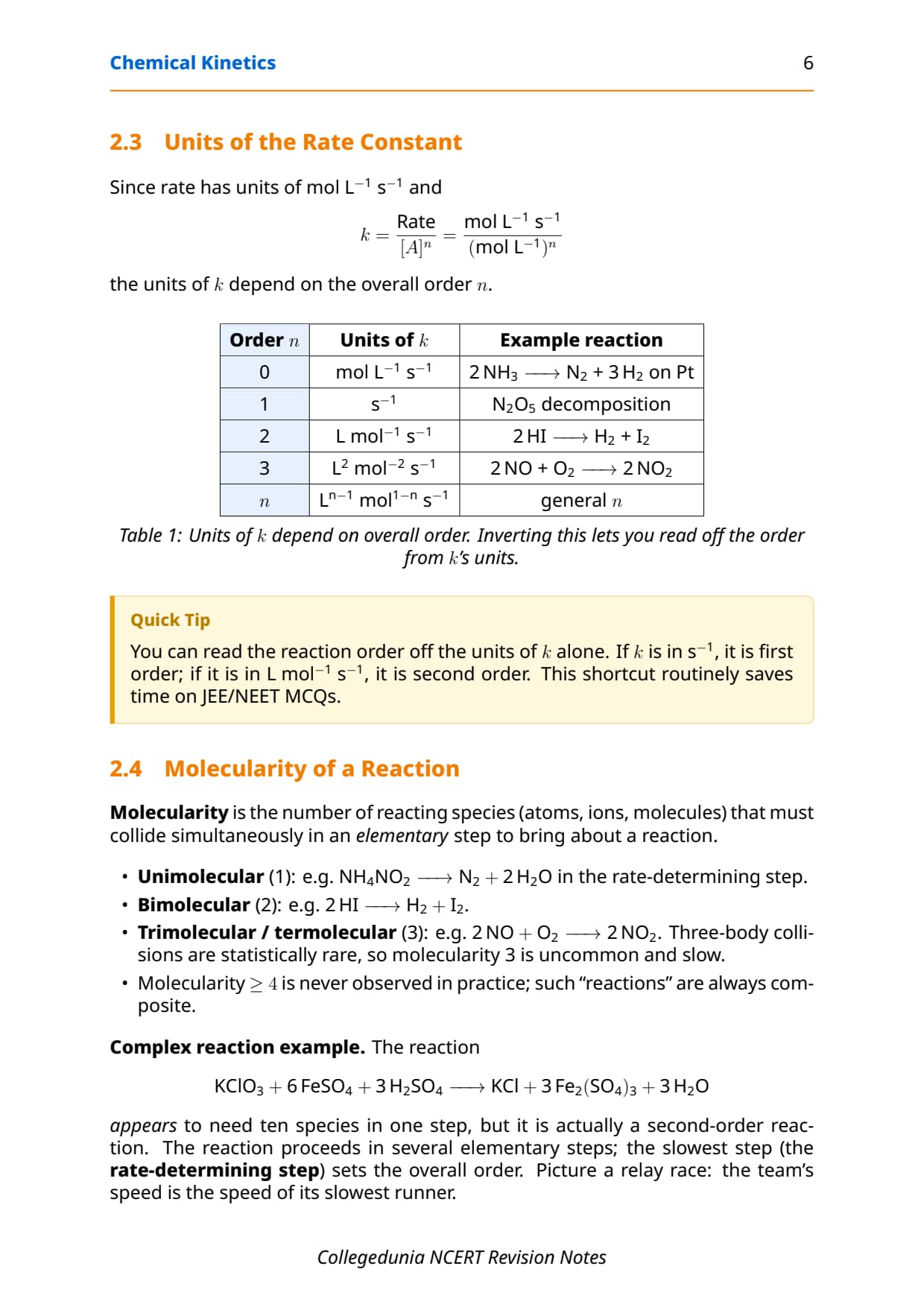
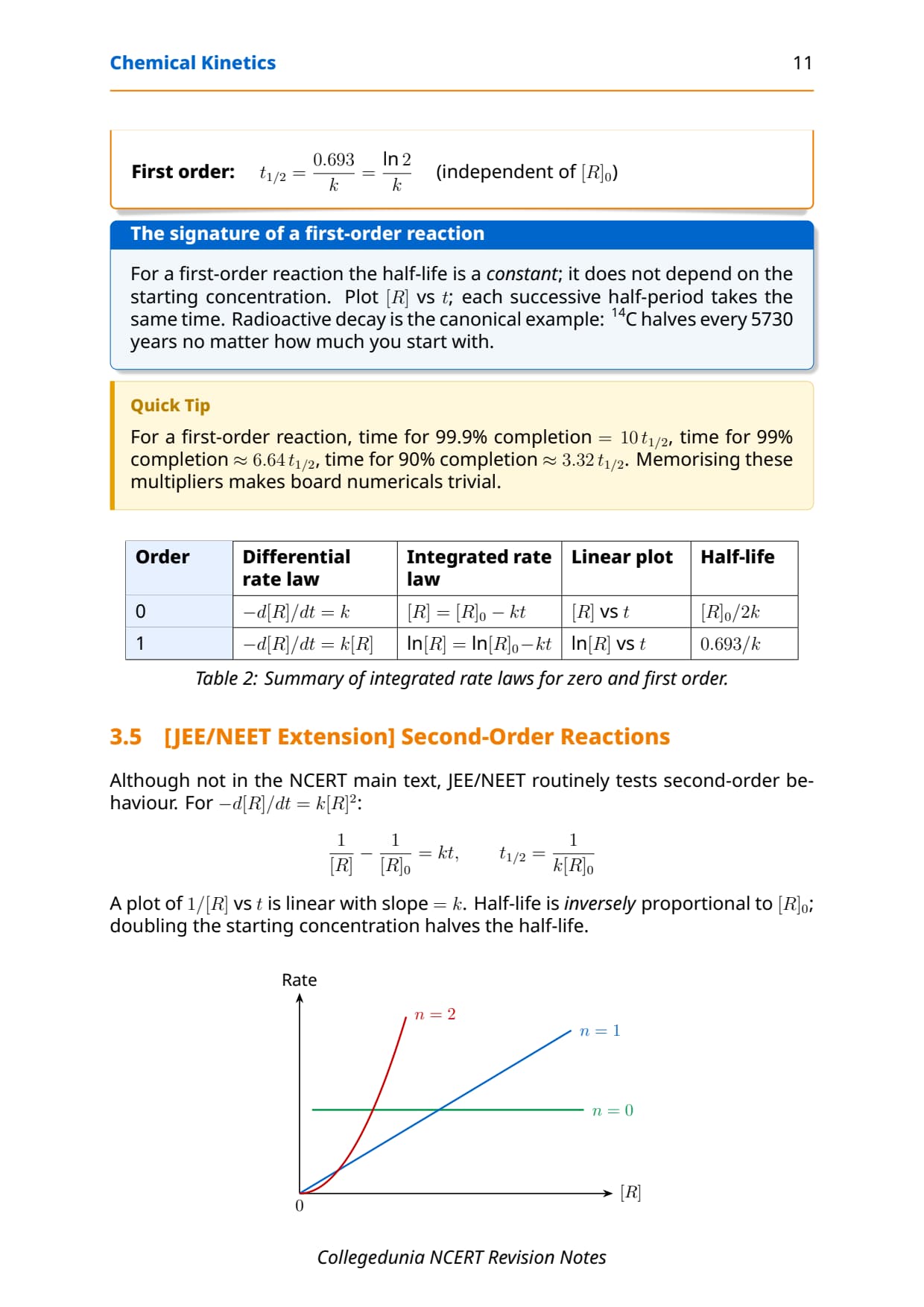
The rate law writes rate as rate = k[A]x[B]y , where the exponents are experimental, not stoichiometric, and their sum is the order. The rate constant k has order-dependent units: mol L-1s-1 (zero), s-1 (first), mol-1L s-1 (second).
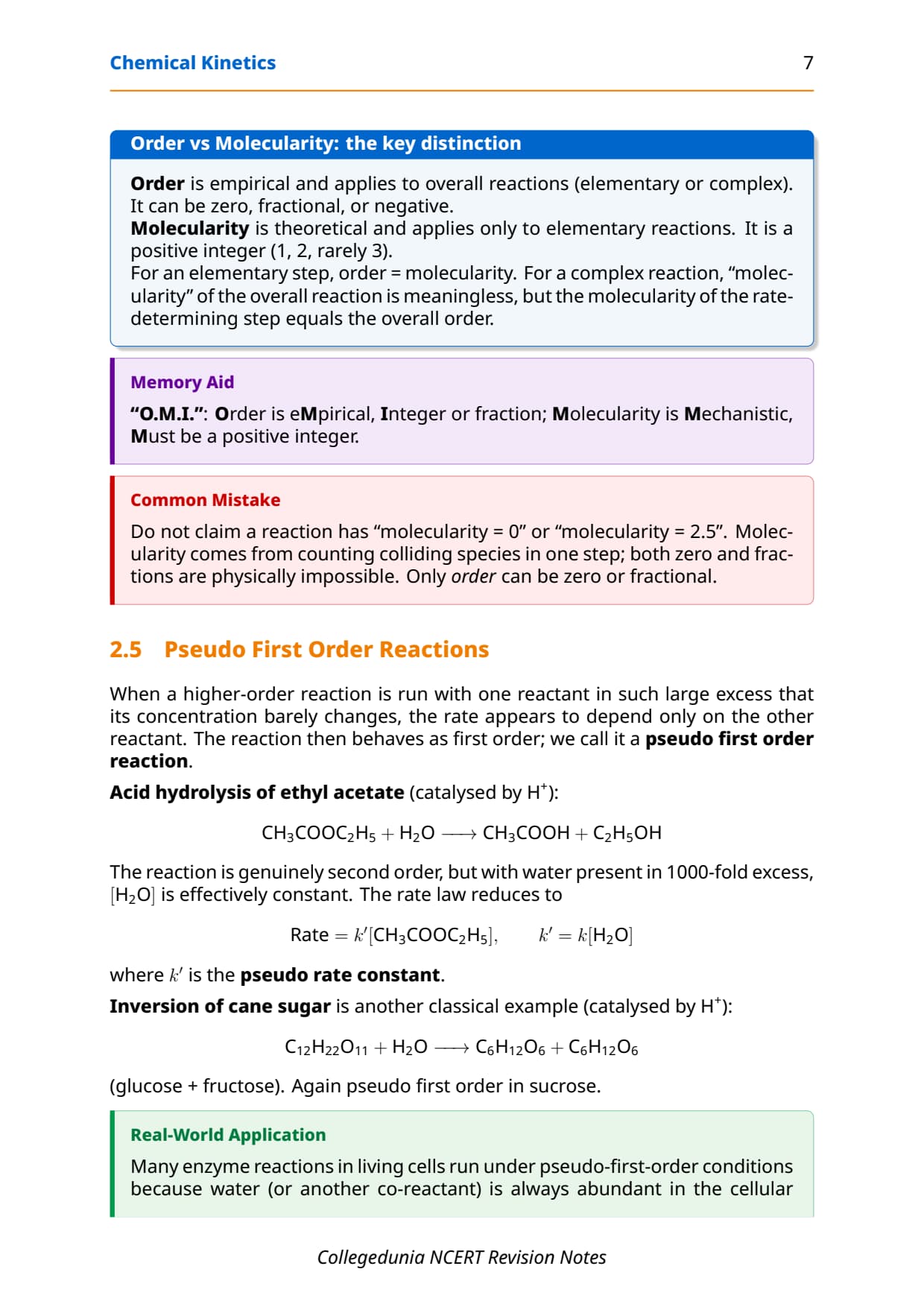
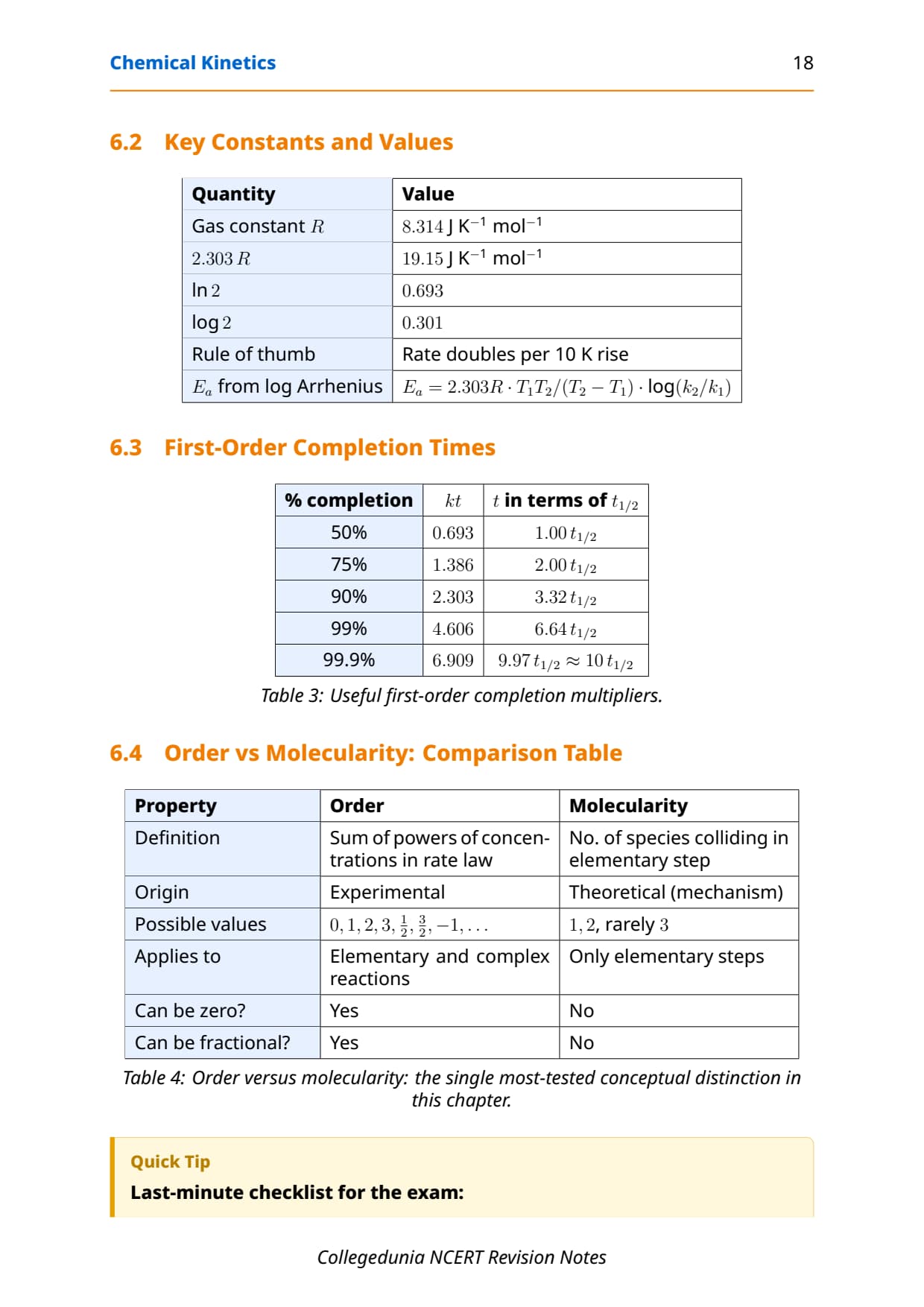
Order is experimental and can be zero, fractional or negative. Molecularity is the count of molecules in an elementary step, always a positive integer, applying only to elementary steps.
Integrated Rate Equation for Zero Order Reactions
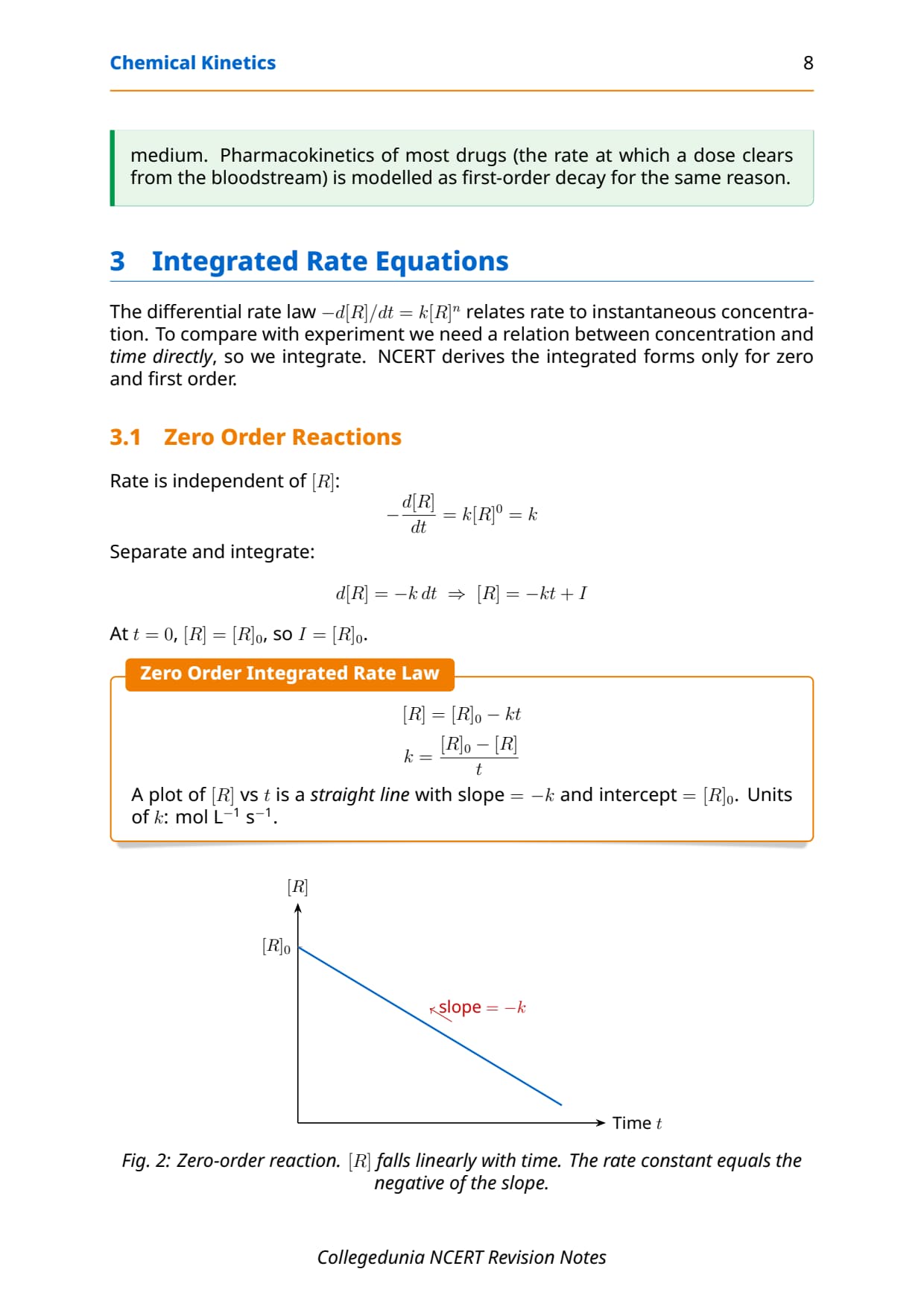
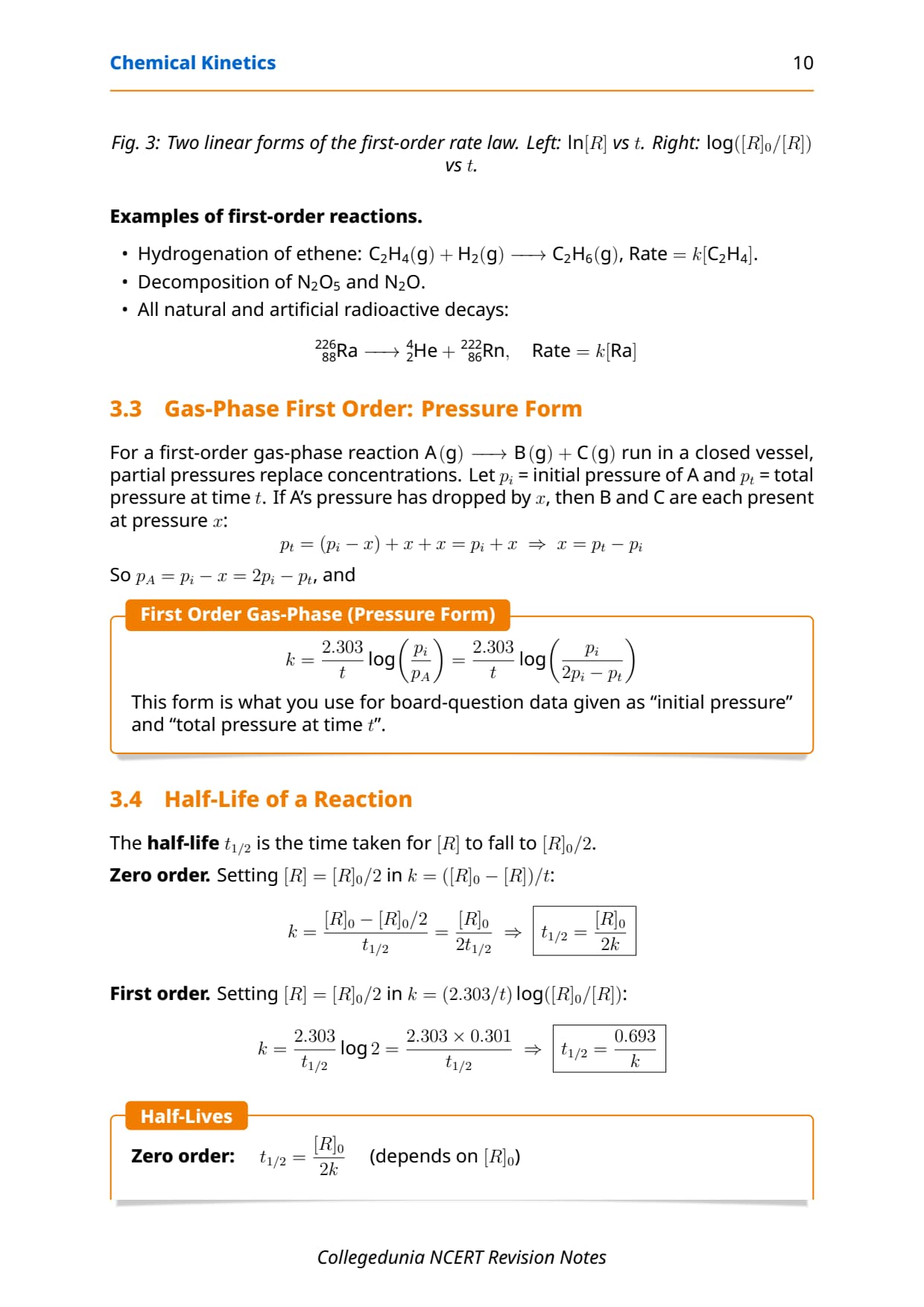
For a zero order reaction with rate = k , integration gives [A] = [A]0 - kt . Concentration falls linearly and the half-life is t1/2 = [A]02k , proportional to initial concentration (e.g. HI decomposition on gold).
Integrated Rate Equation for First Order Reactions and Half-Life
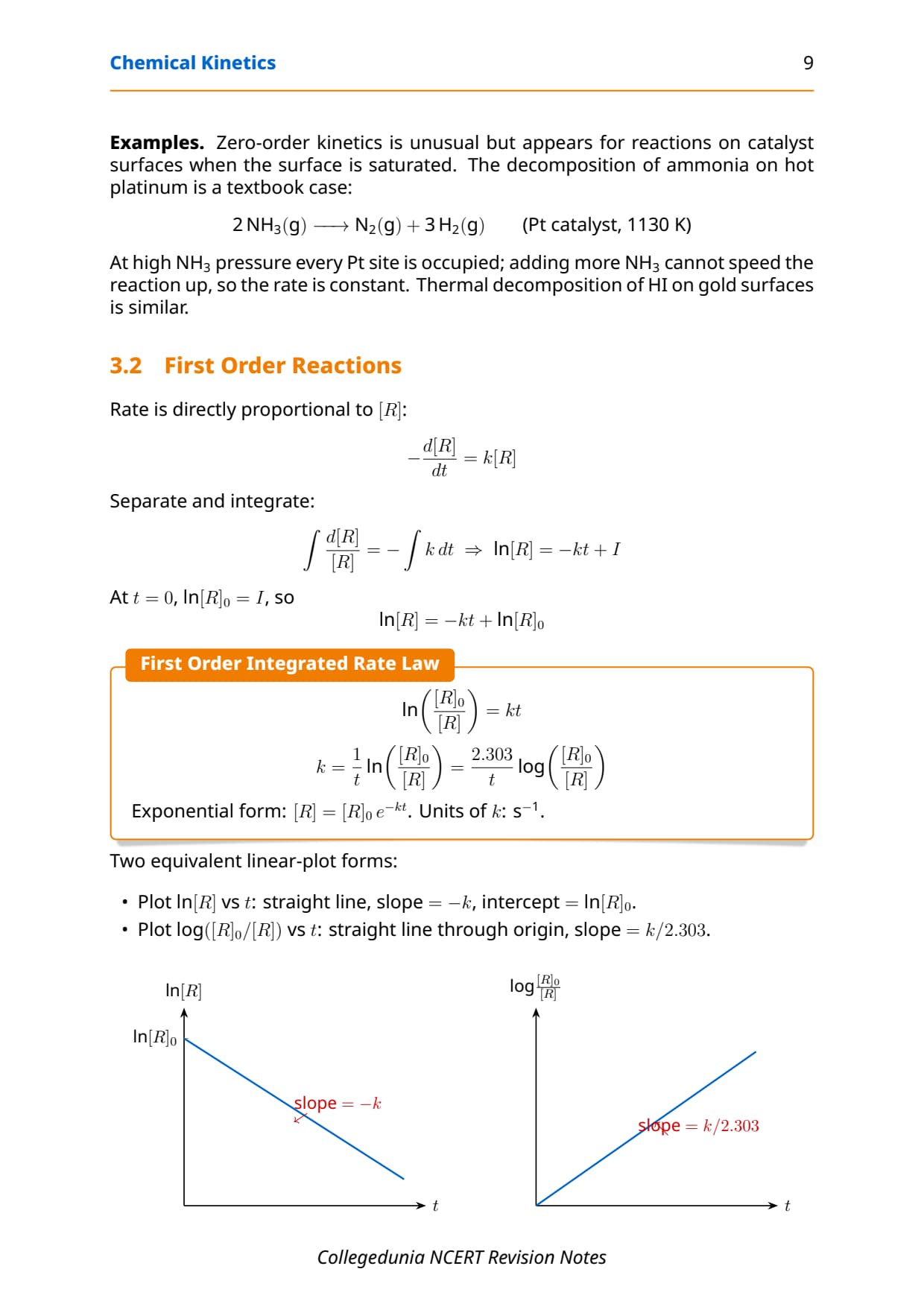
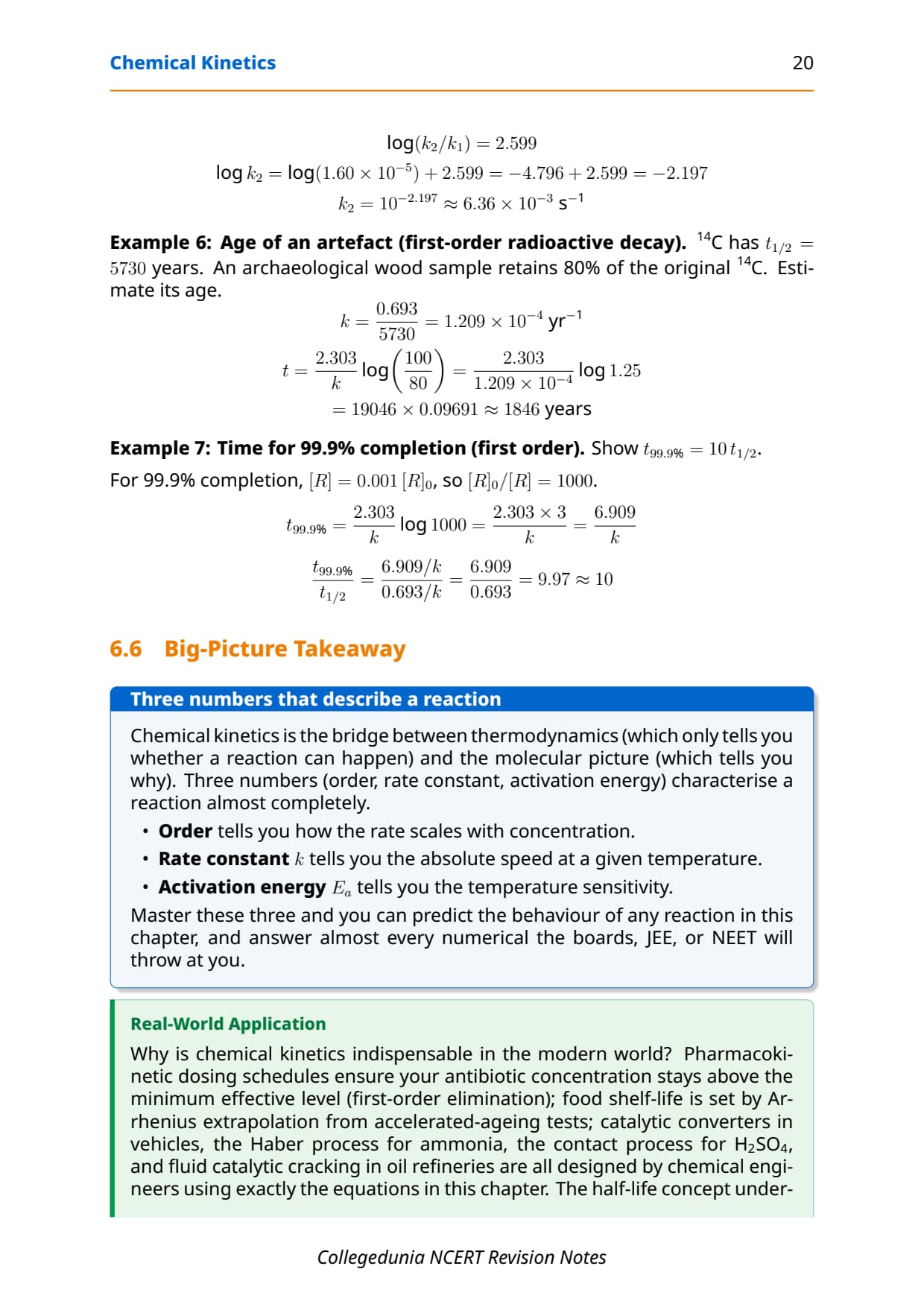
For a first order reaction with rate = k[A] , integration gives k = 2.303tlog[A]0[A] , so log[A] vs t is linear with slope -k/2.303 . The half-life t1/2 = 0.693k is independent of initial concentration, the signature of first order. Radioactive decay and N2O5 decomposition are standard examples.
Arrhenius Equation, Activation Energy and Collision Theory
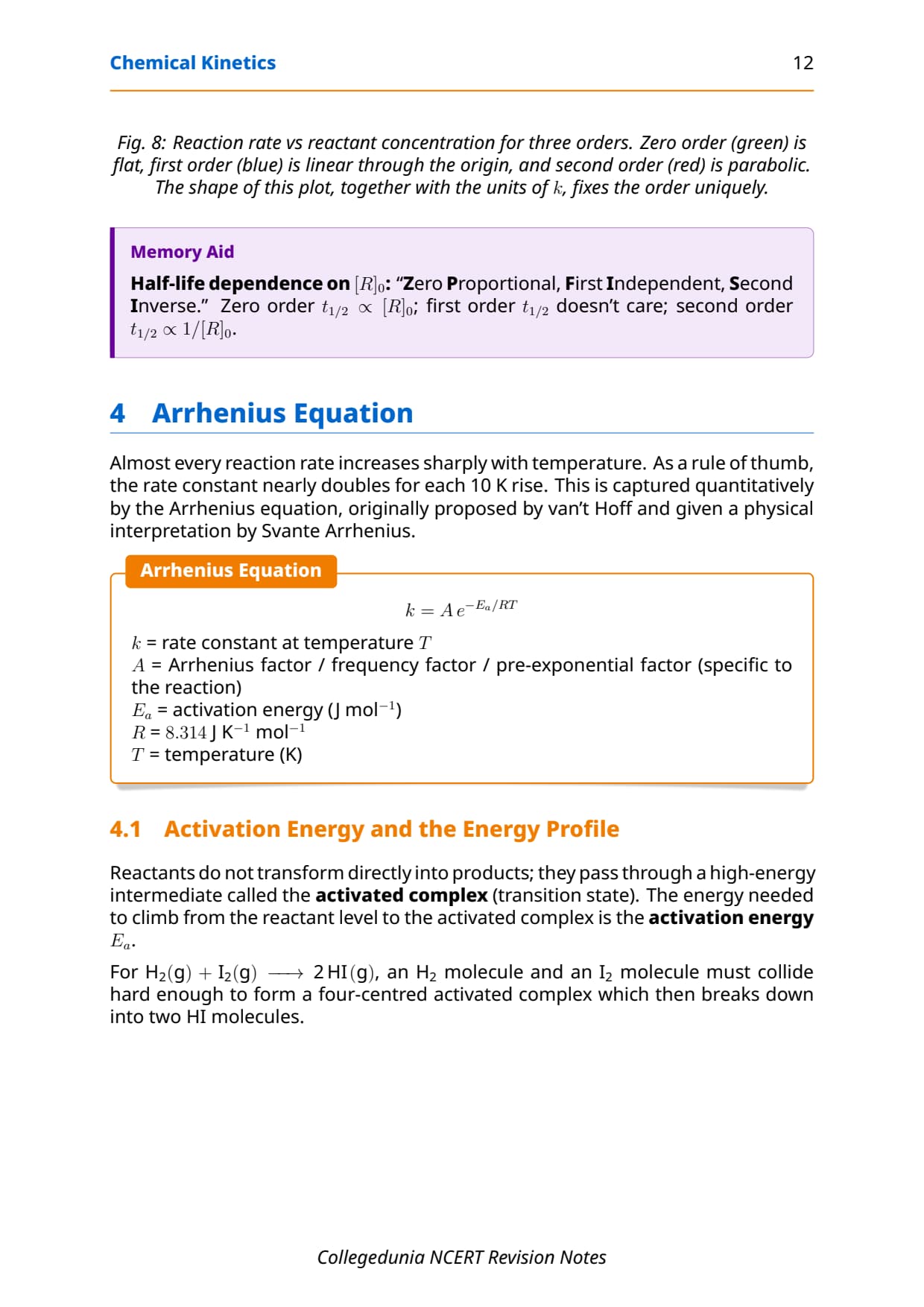
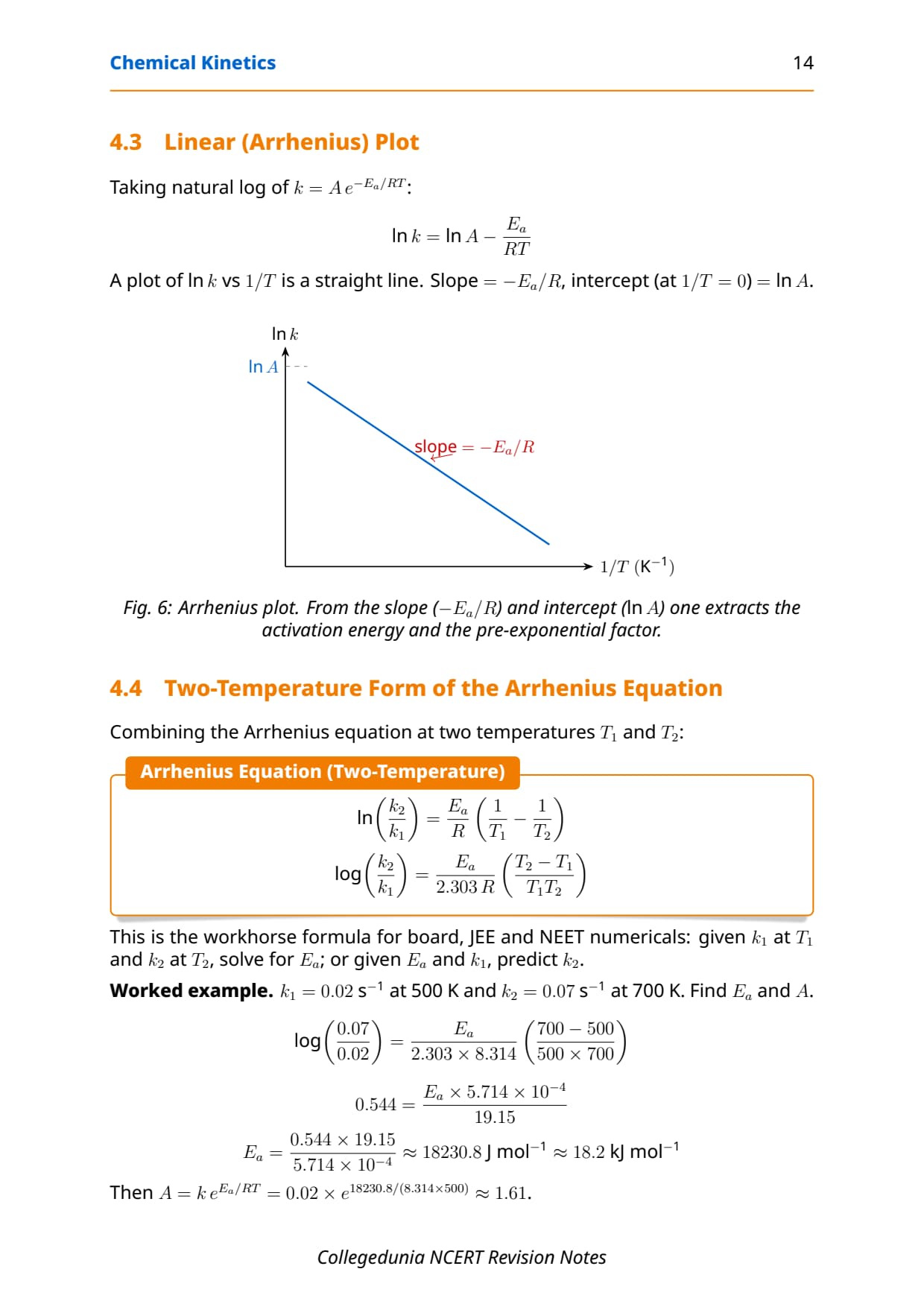
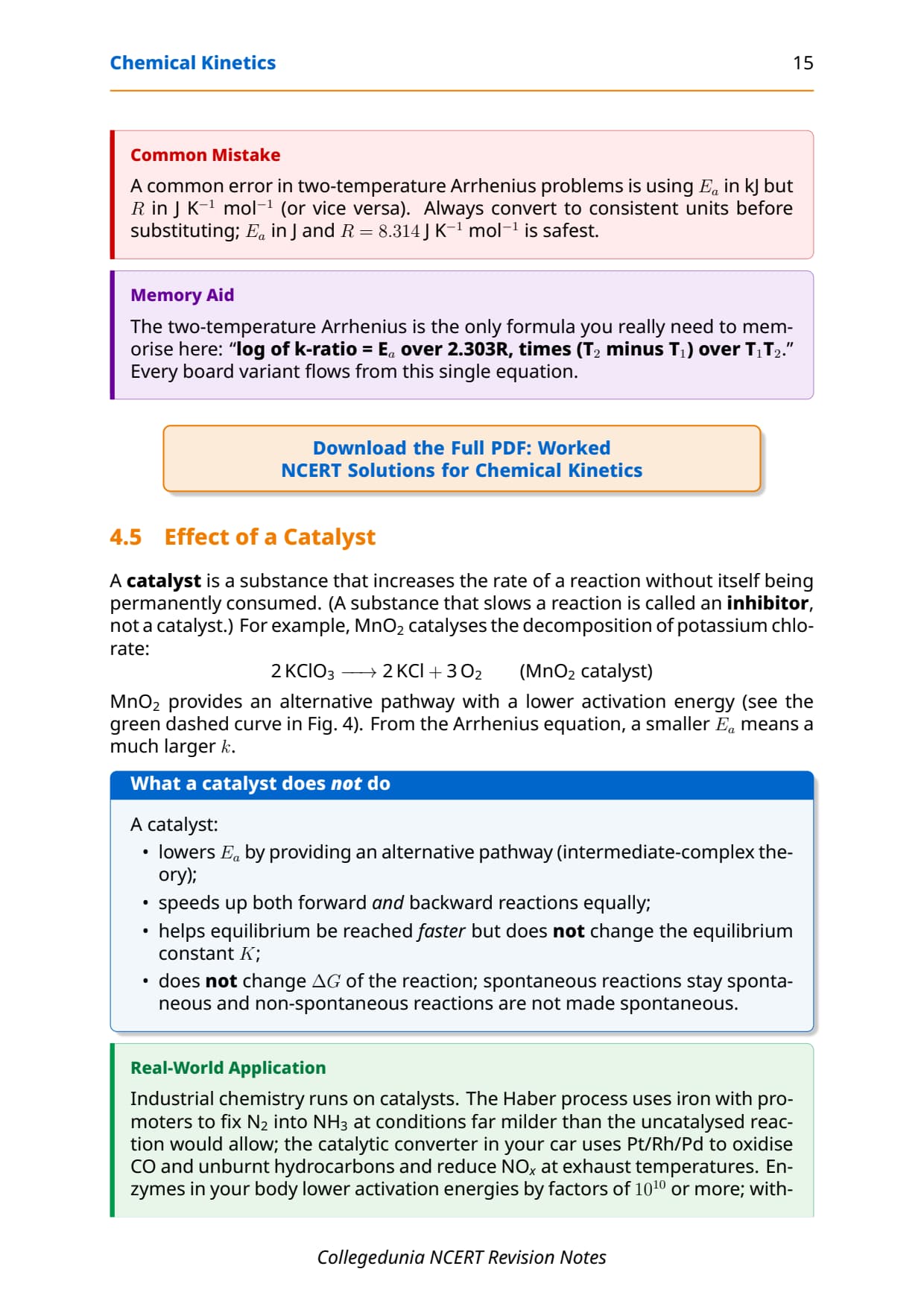
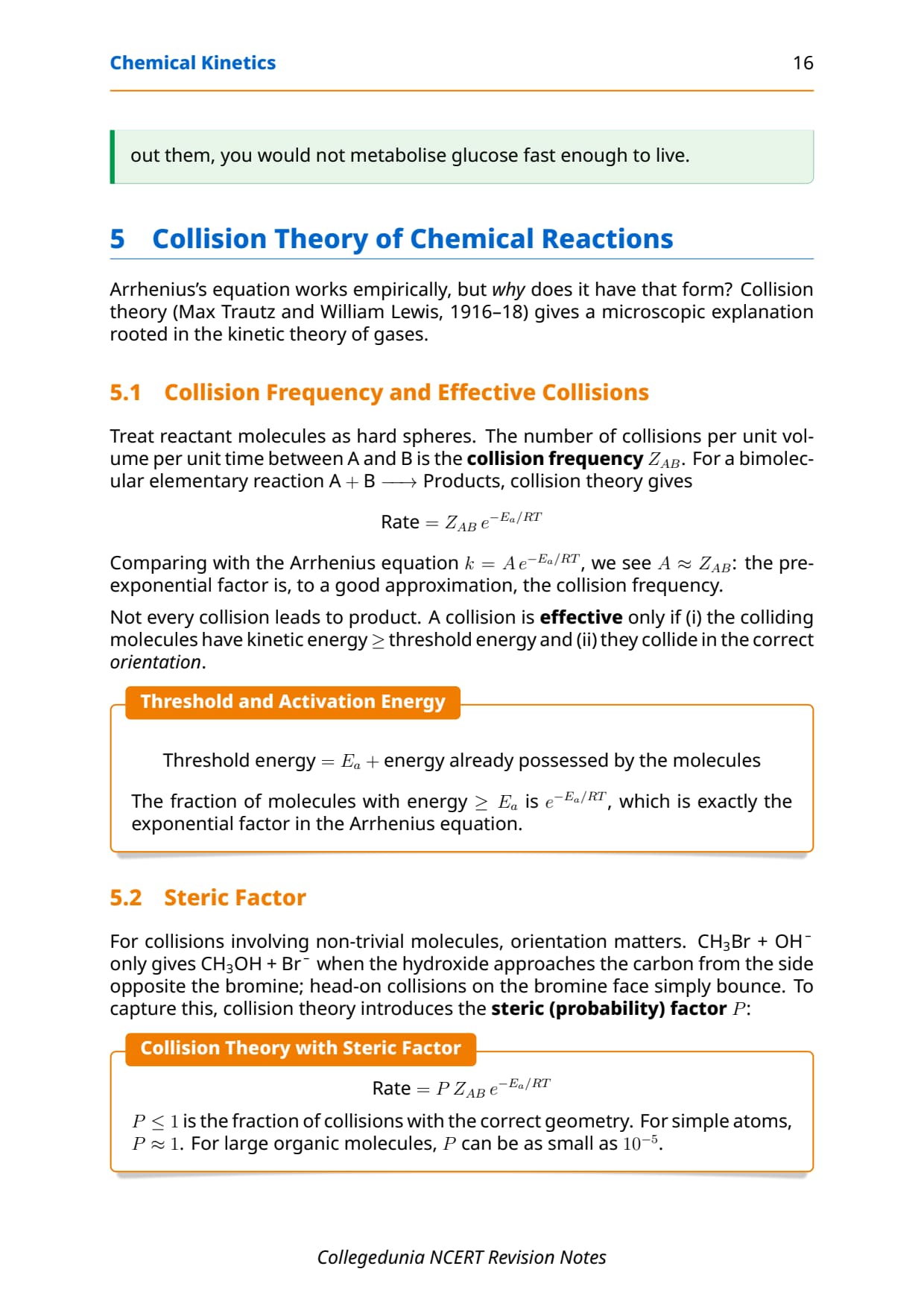
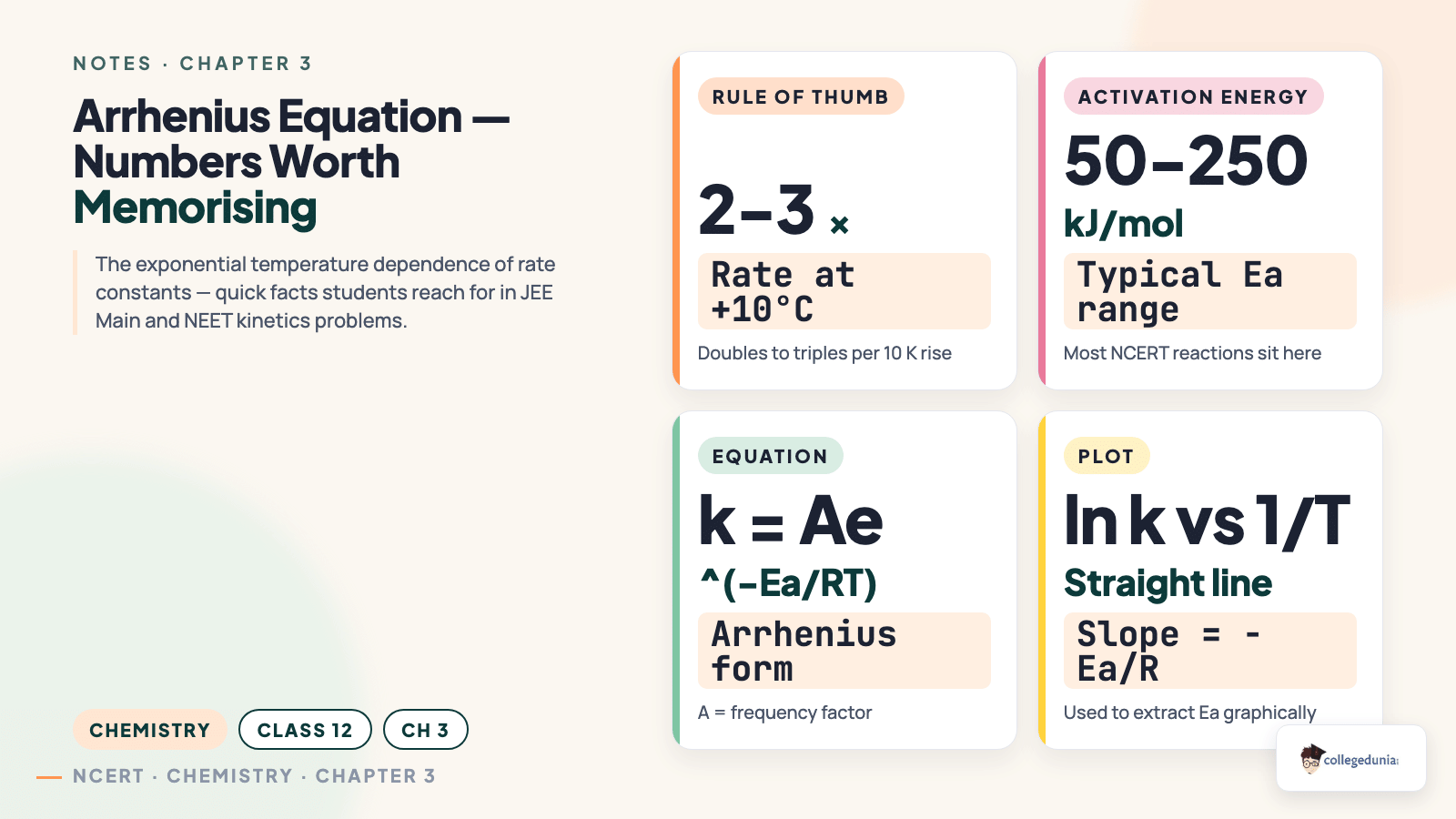
The Arrhenius equation k = A e-Ea / RT captures temperature dependence, so ln k vs 1/T is linear with slope -Ea/R . The two-temperature form logk2k1 = Ea2.303 R[T2 - T1T1 T2] is what CBSE numericals use. A 10 K rise roughly doubles the rate (the temperature coefficient). Collision theory frames this as rate = collision frequency × steric factor × e-Ea/RT .
Chemical Kinetics Important Derivations for Class 12 Boards
Four derivations recur on CBSE and JEE Main, with the years each surfaced.
- Integrated rate law for first order k = 2.303tlog[A]0[A] : derives the log-form rate constant from d[A]dt = -k[A] by separation of variables. CBSE 2022, 2024; JEE 2023, 2025.
- Half-life of a first order reaction t1/2 = 0.693/k : sets [A] = [A]0/2 in the integrated law. CBSE 2021, 2023; NEET 2024.
- Integrated rate law for zero order [A] = [A]0 - kt : integrates d[A]/dt = -k directly, used to prove half-life is proportional to [A]0 . CBSE 2023; JEE 2024.
- Two-temperature form of Arrhenius equation: takes the log of k = A e-Ea/RT at two temperatures, then subtracts to eliminate A . CBSE 2022, 2025 and most JEE Main shifts.
Chemical Kinetics Top 6 Formulae for Quick Recall
These six cover most CBSE and JEE Main numericals here. The full master sheet is on the Formula Sheet.
| Quantity | Formula |
|---|---|
| Average rate | ravg = -Δ[A]Δ t |
| Instantaneous rate | r = -d[A]dt |
| First order rate constant | k = 2.303tlog[A]0[A] |
| First order half-life | t1/2 = 0.693k |
| Zero order half-life | t1/2 = [A]02k |
| Arrhenius two-temperature | logk2k1 = Ea2.303R[T2-T1T1 T2] |
Full master table: Chemical Kinetics Class 12 Chemistry Formula Sheet
Class 12 Chemistry Chapter 3 Previous Year Questions Snapshot
Where Chemical Kinetics surfaced across CBSE, JEE Main and NEET, year by year. The fuller tagged map is on the NCERT Solutions page.
| Year | CBSE Board | JEE Main | NEET |
|---|---|---|---|
| 2026 | - | Arrhenius two-temperature | Pending (exam rescheduled) |
| 2025 | First order half-life numerical (3M) | Order from initial rate data | Pseudo first order MCQ |
| 2024 | Zero order derivation (3M) | Activation energy from log k vs 1/T | Half-life ratio MCQ |
| 2023 | 30% decomposition first order (3M) | - | Arrhenius numerical |
| 2022 | Order vs molecularity (2M) | Pseudo first order | Rate law expression |
| 2021 | Arrhenius two-temperature (3M) | - | - |
Full year-wise PYQ map: Chemical Kinetics Class 12 Chemistry NCERT Solutions
Common Misconceptions Students Hold in 12th Chemistry Chapter 3
These four beliefs cost the most marks here. Fix them before the board paper.
- Order = molecularity. They agree only for single-step elementary reactions. A 1-mark loss every cycle since 2022.
- Rate constant depends on concentration. Rate depends on concentration; k depends only on temperature and catalyst.
- Half-life is half the total time. It is the time to fall to half the initial value, and stays constant for first order.
- Dropping the 2.303 factor. The CBSE log-form first order law keeps 2.303 when converting from ln .
Student Feedback
In a Collegedunia poll of 1,080 Class 12 students, 81% said the integrated rate law and Arrhenius numericals were the parts they revisited most, and 3 in 4 rated the yellow-marked last-day anchors as their top revision aid.
Other Resources for Chemical Kinetics Class 12 Chemistry
| Resource | Link |
|---|---|
| NCERT Solutions | Chemical Kinetics Class 12 Chemistry NCERT Solutions |
| Formula Sheet | Chemical Kinetics Class 12 Chemistry Formula Sheet |
| NCERT Book PDF | Chemical Kinetics Class 12 Chemistry NCERT Book PDF |
| NCERT Exemplar Book PDF | Chemical Kinetics Class 12 Chemistry NCERT Exemplar Book PDF |
| NCERT Exemplar Solutions | Chemical Kinetics Class 12 Chemistry NCERT Exemplar Solutions |
| Handwritten Notes | Chemical Kinetics Class 12 Chemistry Handwritten Notes |
| Notes | Chemical Kinetics Class 12 Chemistry Notes |
NCERT Notes for Class 12 Chemistry: All Chapters
Jump to any other Class 12 Chemistry chapter's Notes below.
| Chapter | Resource |
|---|---|
| Chapter 1 | Solutions Notes |
| Chapter 2 | Electrochemistry Notes |
| Chapter 3 | Chemical Kinetics Notes |
| Chapter 4 | The d- and f-Block Elements Notes |
| Chapter 5 | Coordination Compounds Notes |
| Chapter 6 | Haloalkanes and Haloarenes Notes |
| Chapter 7 | Alcohols, Phenols and Ethers Notes |
| Chapter 8 | Aldehydes, Ketones and Carboxylic Acids Notes |
| Chapter 9 | Amines Notes |
| Chapter 10 | Biomolecules Notes |
Chemical Kinetics Class 12 Chemistry Notes FAQs
Ques. Where can I download Chemical Kinetics Class 12 Chemistry Notes PDF?
Ans. You can download the Chemical Kinetics Class 12 Chemistry Notes PDF directly from this page. Both the Normal and HD versions are available, and both are free.
Ques. Are these notes aligned with the 2026-27 NCERT for Class 12 Chemistry?
Ans. Yes. The notes reflect the current 2026-27 syllabus for Class 12 Chemistry. The new NCERT edition retains all major sub-topics of Chemical Kinetics, including rate law, integrated rate equations, half-life, and the Arrhenius equation.
Ques. How many pages is the Class 12th Chemistry Chemical Kinetics Notes PDF?
Ans. The Notes PDF runs approximately 24 pages and covers rate of reaction, order and molecularity, integrated rate laws for zero and first order, half-life, pseudo first order, the Arrhenius equation and collision theory.
Ques. How much weightage does Chemical Kinetics carry in Class 12 Chemistry Board Exam 2026?
Ans. Chemical Kinetics carries 6 to 8 marks in the CBSE Class 12 Chemistry Board paper. The standard split is one 3-mark numerical on the rate constant or half-life and one 2 or 5-mark question on the Arrhenius equation or zero order kinetics.
Ques. What is the difference between order and molecularity of a reaction?
Ans. Order is the experimentally determined sum of the powers of concentration terms in the rate law and can be zero, fractional or even negative. Molecularity is the theoretical count of molecules colliding in an elementary step and is always a positive integer.
Ques. Why is the half-life of a first order reaction independent of initial concentration?
Ans. Setting [A] = [A]0/2 in the first order integrated rate law gives t1/2 = 0.693/k , an expression that contains only k . Because k depends on temperature, not on the starting concentration, the half-life is constant for any starting amount of the reactant.
Ques. How do I solve a typical Arrhenius two-temperature numerical asked by CBSE?
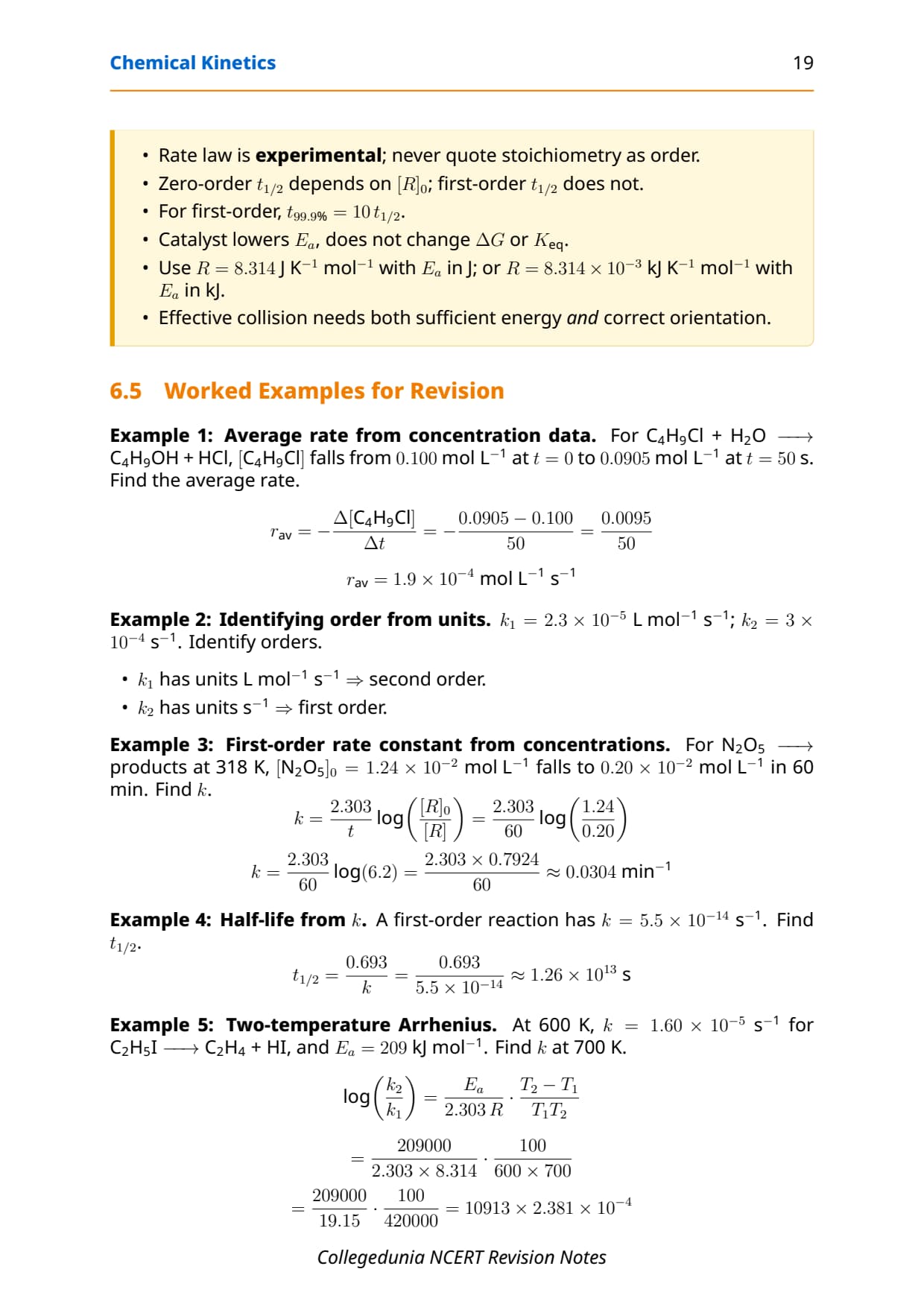
Ans. Apply log(k2/k1) = Ea2.303 R[(T2 - T1)/(T1 T2)] . Substitute the two rate constants, the two temperatures and R = 8.314 J K-1mol-1 , then solve for Ea in kilojoules per mole.
Ques. Which derivations should I revise the night before the Class 12 Chemistry board exam?
Ans. Revise four derivations: the integrated rate law for a first order reaction, the half-life expression t1/2 = 0.693/k , the integrated rate law for a zero order reaction along with its half-life, and the two-temperature form of the Arrhenius equation. Together they cover every derivation-based question CBSE has asked since 2021.
Ques. What is a pseudo first order reaction in Chemical Kinetics class 12?
Ans. A pseudo first order reaction follows first order kinetics even though its true molecularity is higher, because one reactant is in such large excess that its concentration stays effectively constant. The standard NCERT examples are the acid-catalysed hydrolysis of ethyl acetate (water in excess) and the inversion of cane sugar. The observed rate constant k' = k[H2O] .
Ques. How does a catalyst affect the activation energy of a reaction?
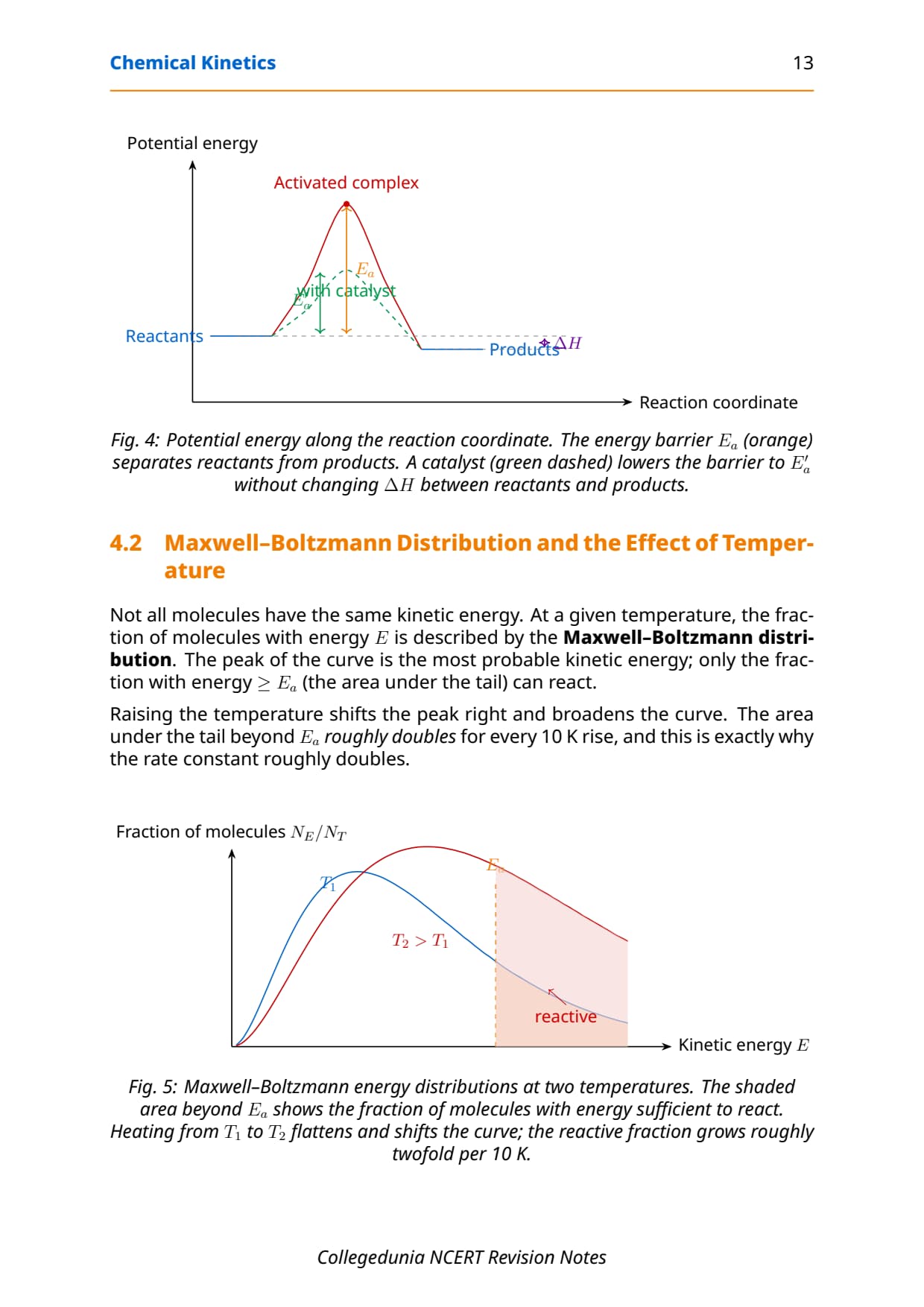
Ans. A catalyst provides an alternative reaction path with a lower activation energy Ea . It does not alter Δ H or the equilibrium constant Keq , and it accelerates the forward and backward reactions equally. The potential energy profile shows two humps - the uncatalysed barrier and the lower catalysed barrier - sharing the same reactant and product wells.
Ques. What is the slope of the ln k vs 1/T Arrhenius plot?
Ans. Taking the natural log of k = A e-Ea/RT gives ln k = ln A - Ea/(RT) . A plot of ln k on the y-axis versus 1/T on the x-axis is therefore a straight line with slope -Ea/R and intercept ln A . If the y-axis uses 10 k instead, the slope becomes -Ea/(2.303 R) .



Comments