



The transition elements from Groups 3 to 12 make up the d-block. This page has the complete Class 12 Chemistry Chapter 4 d- and f-Block Elements NCERT Solutions PDF for the 2026-27 syllabus, plus the latest CBSE, JEE and NEET questions.
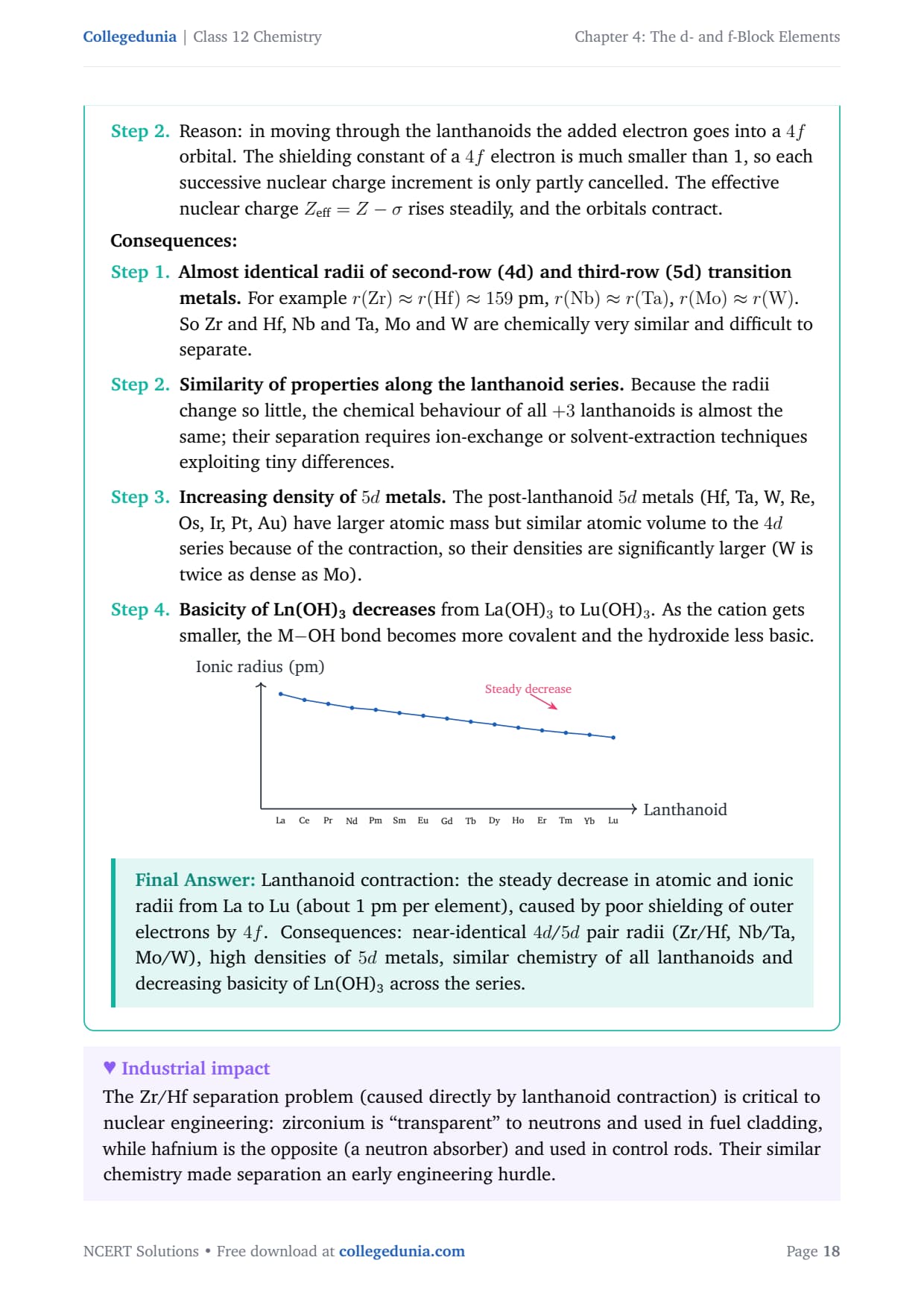
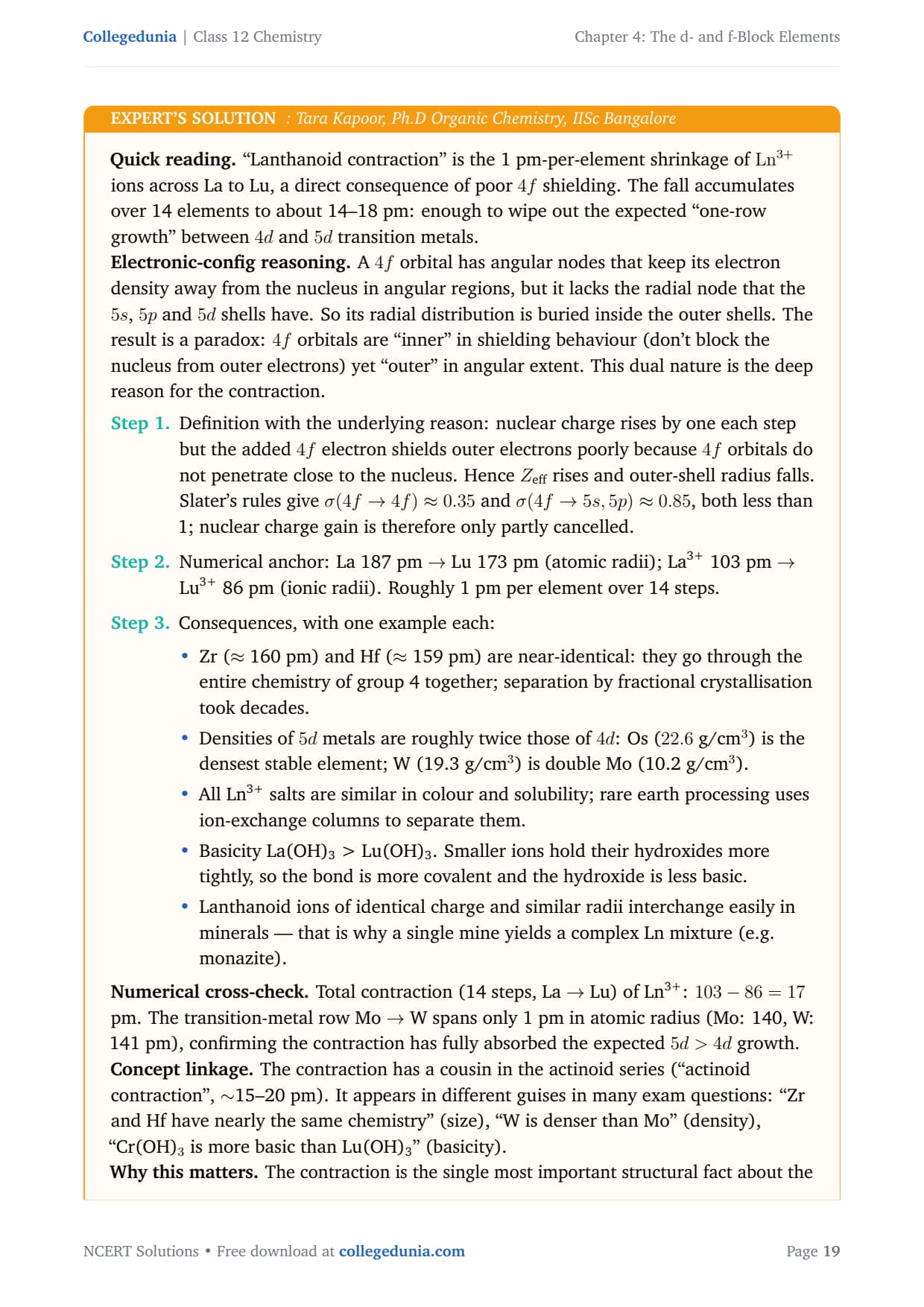
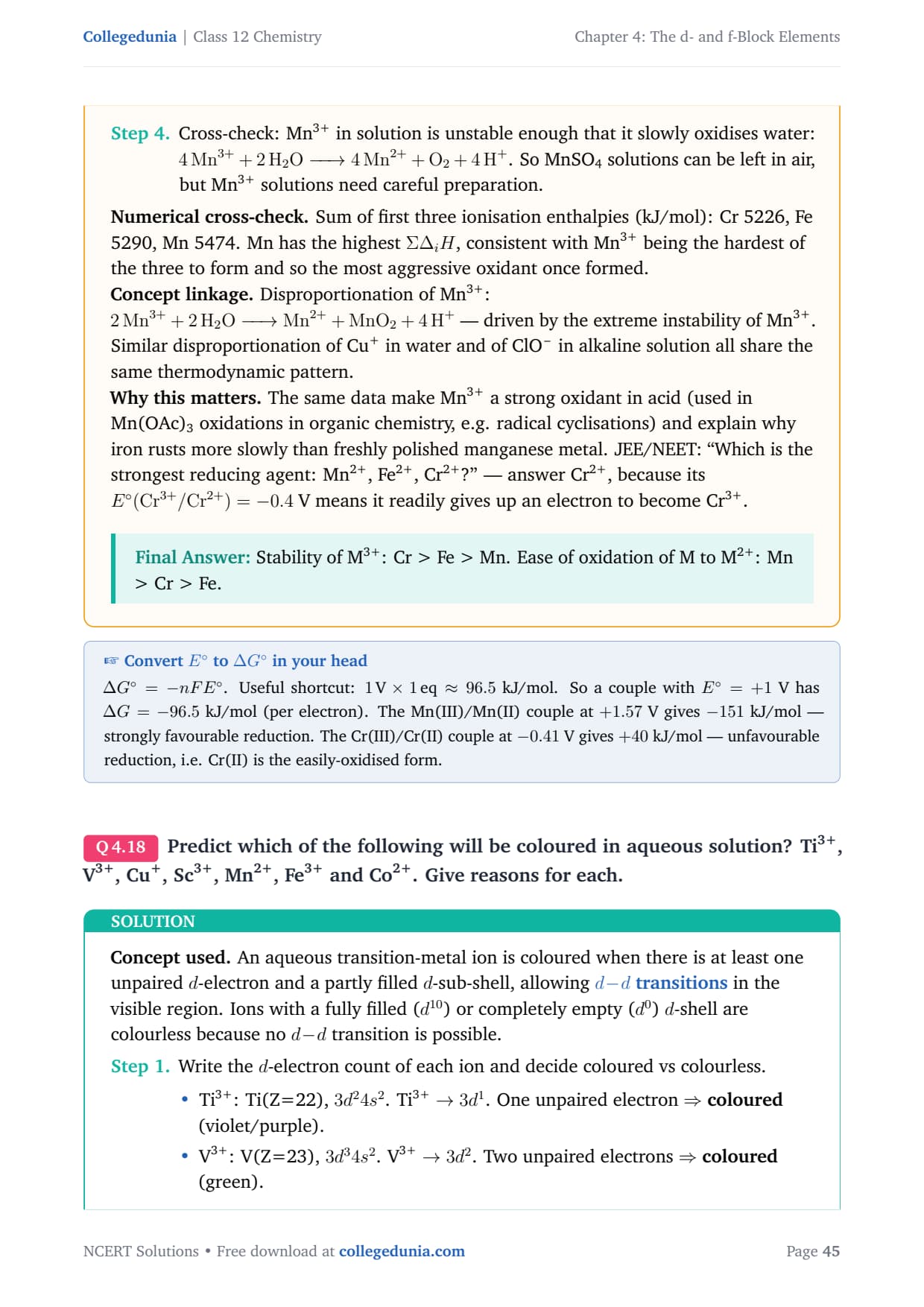
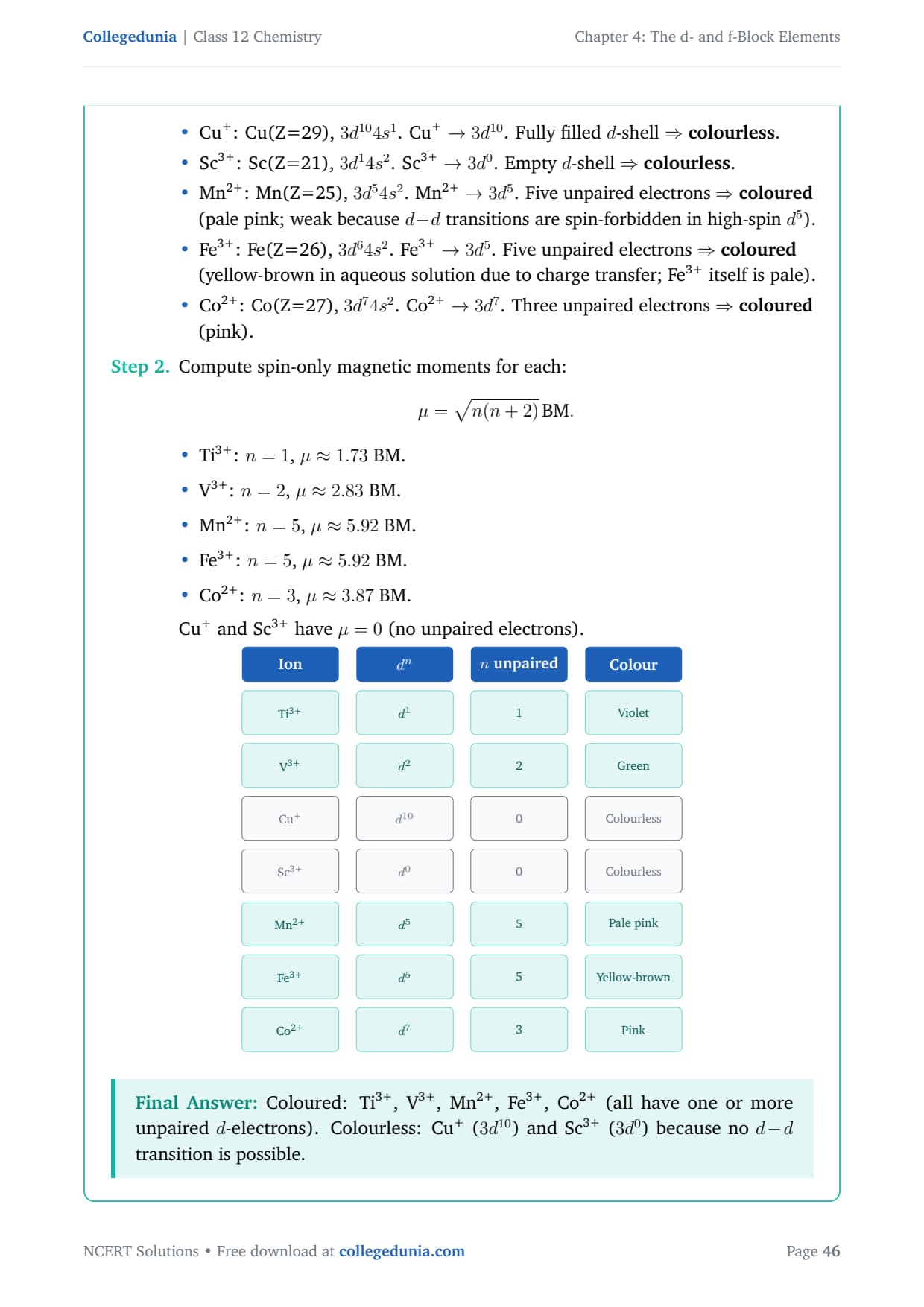
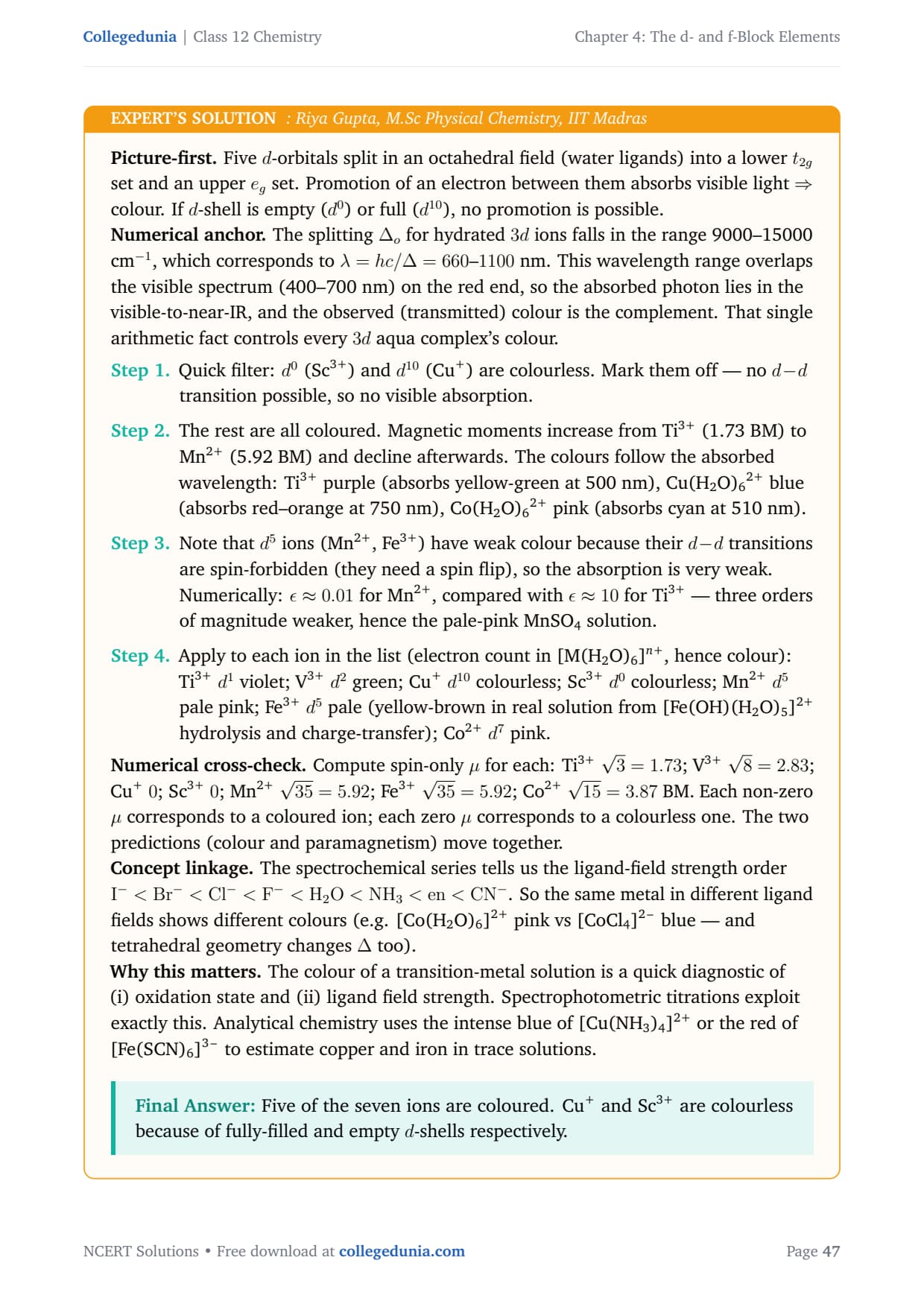
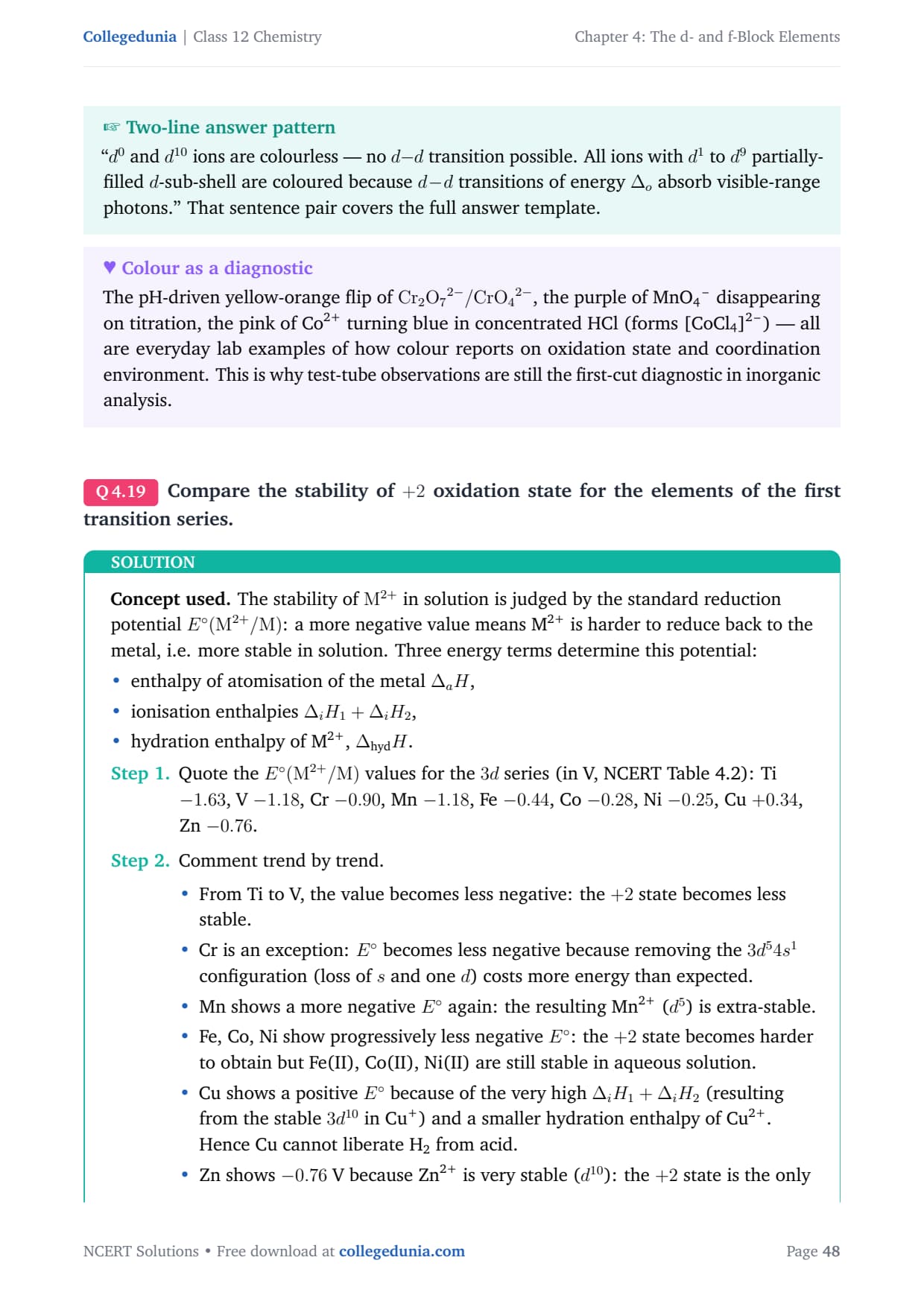
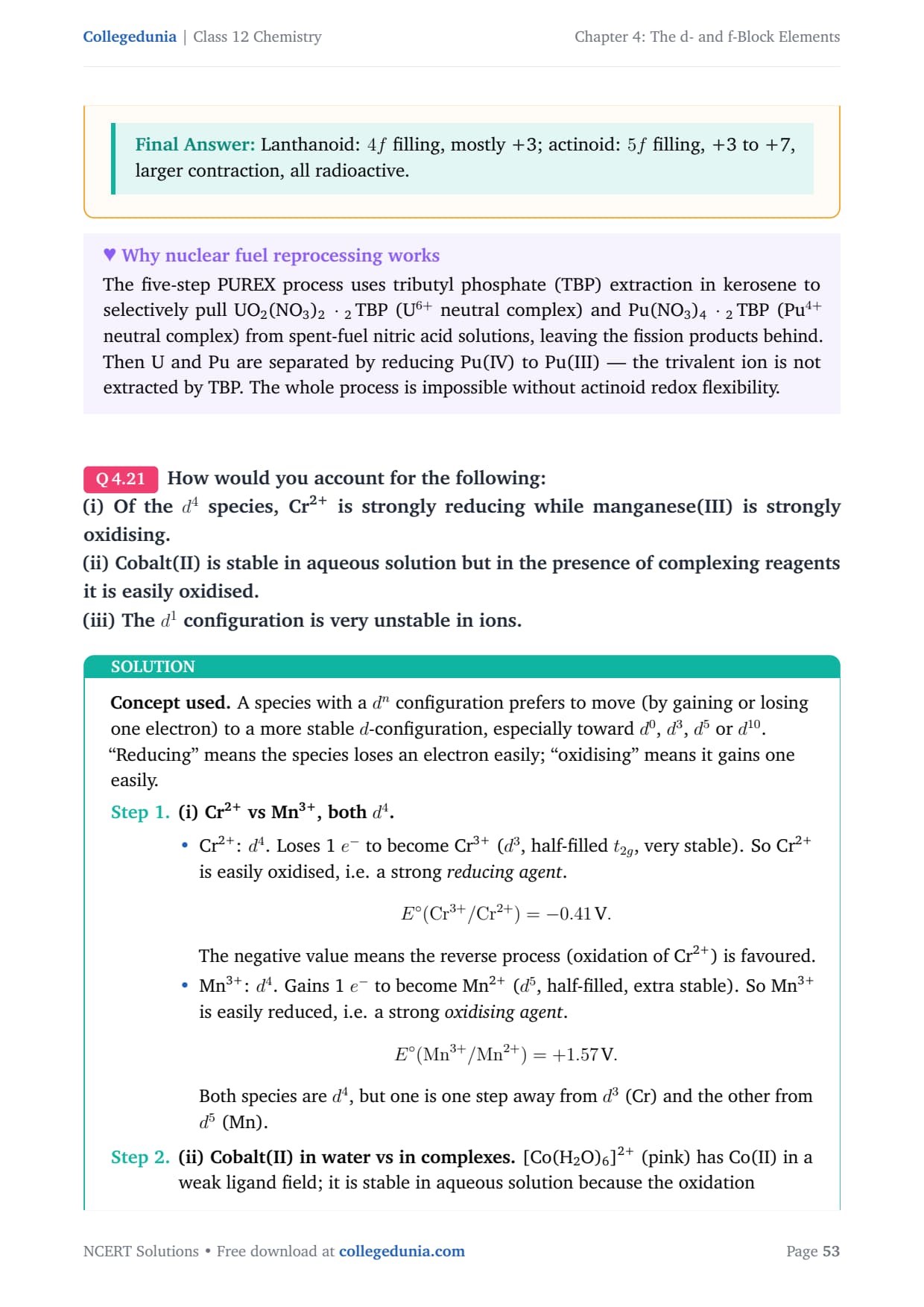
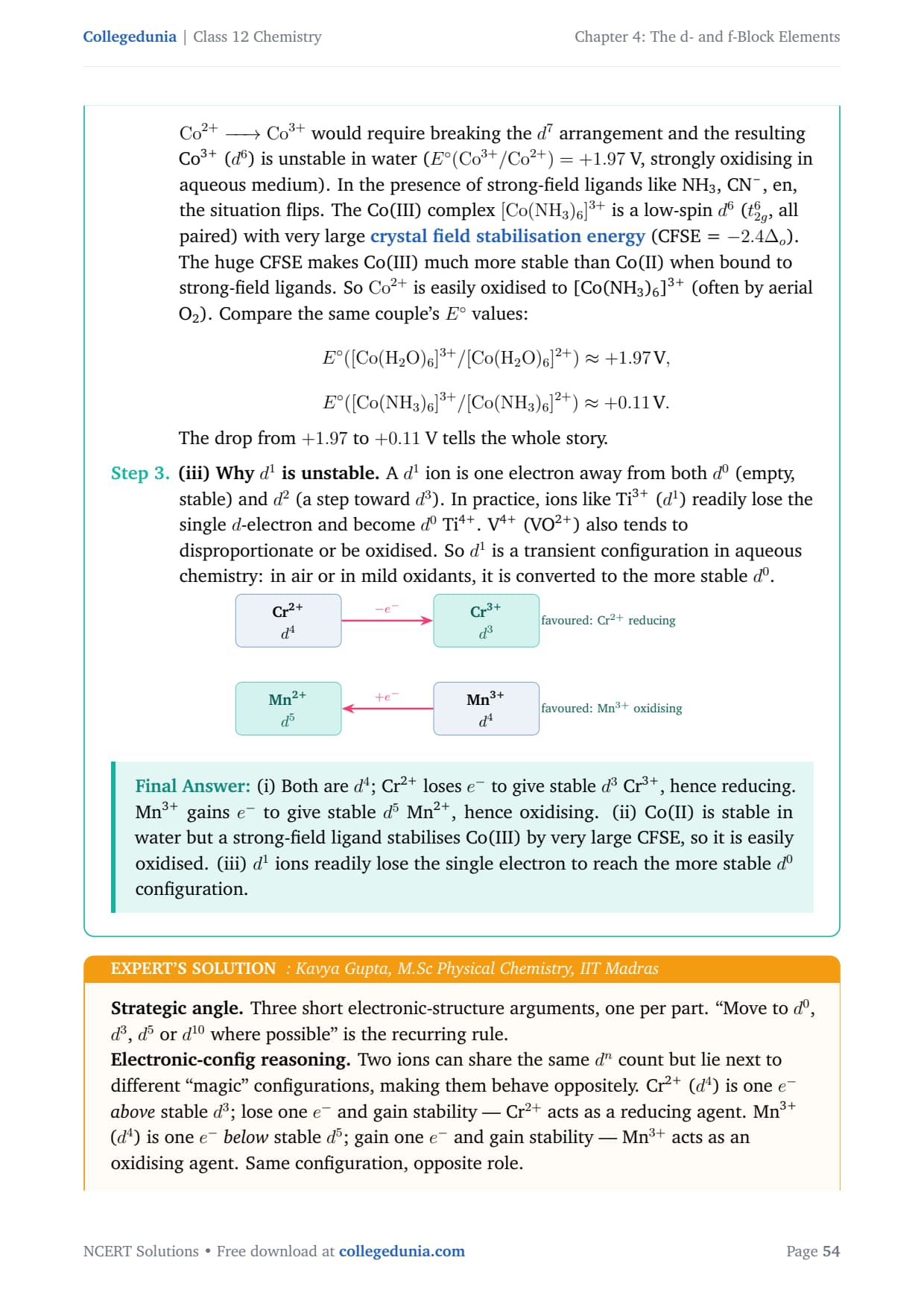
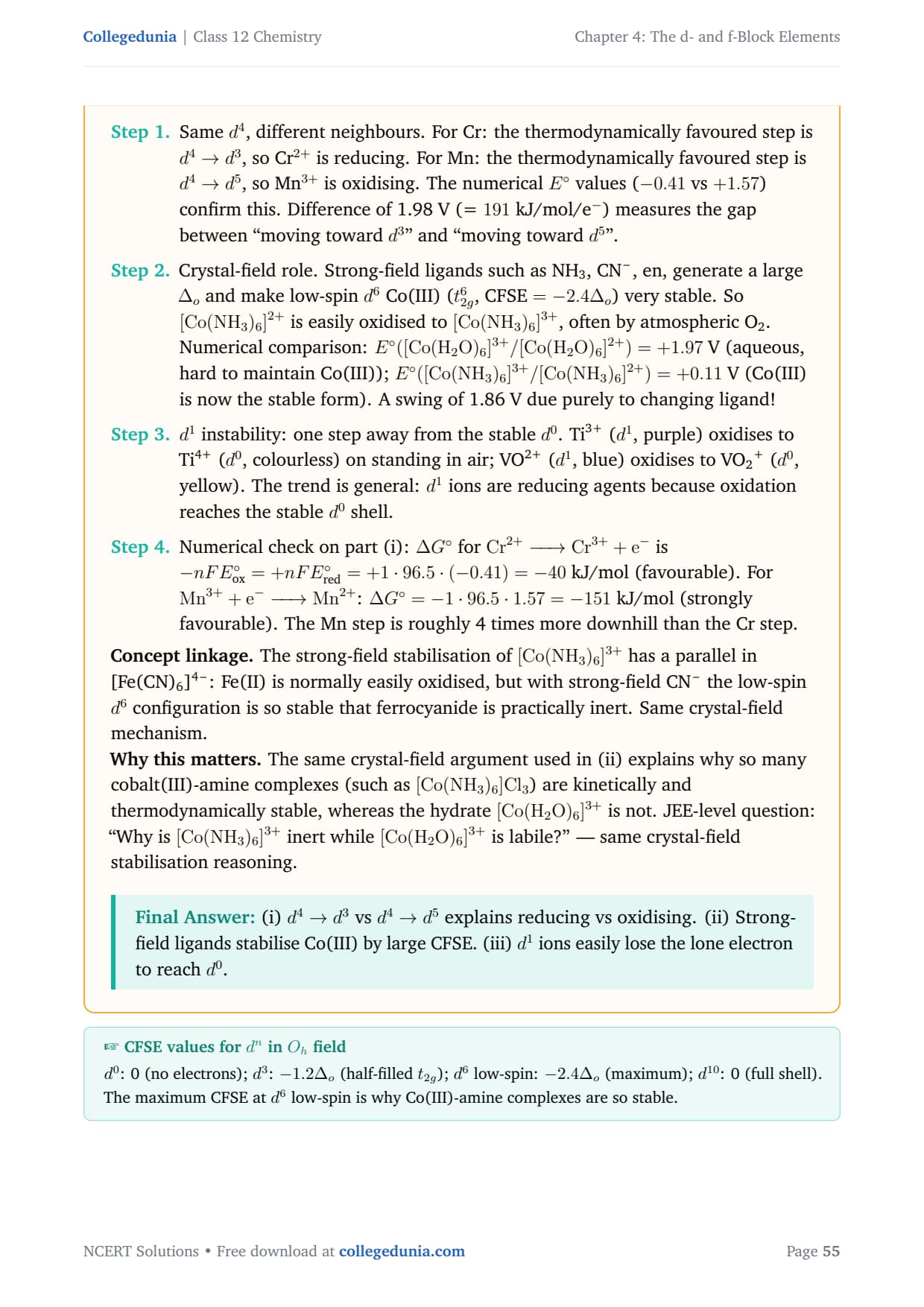
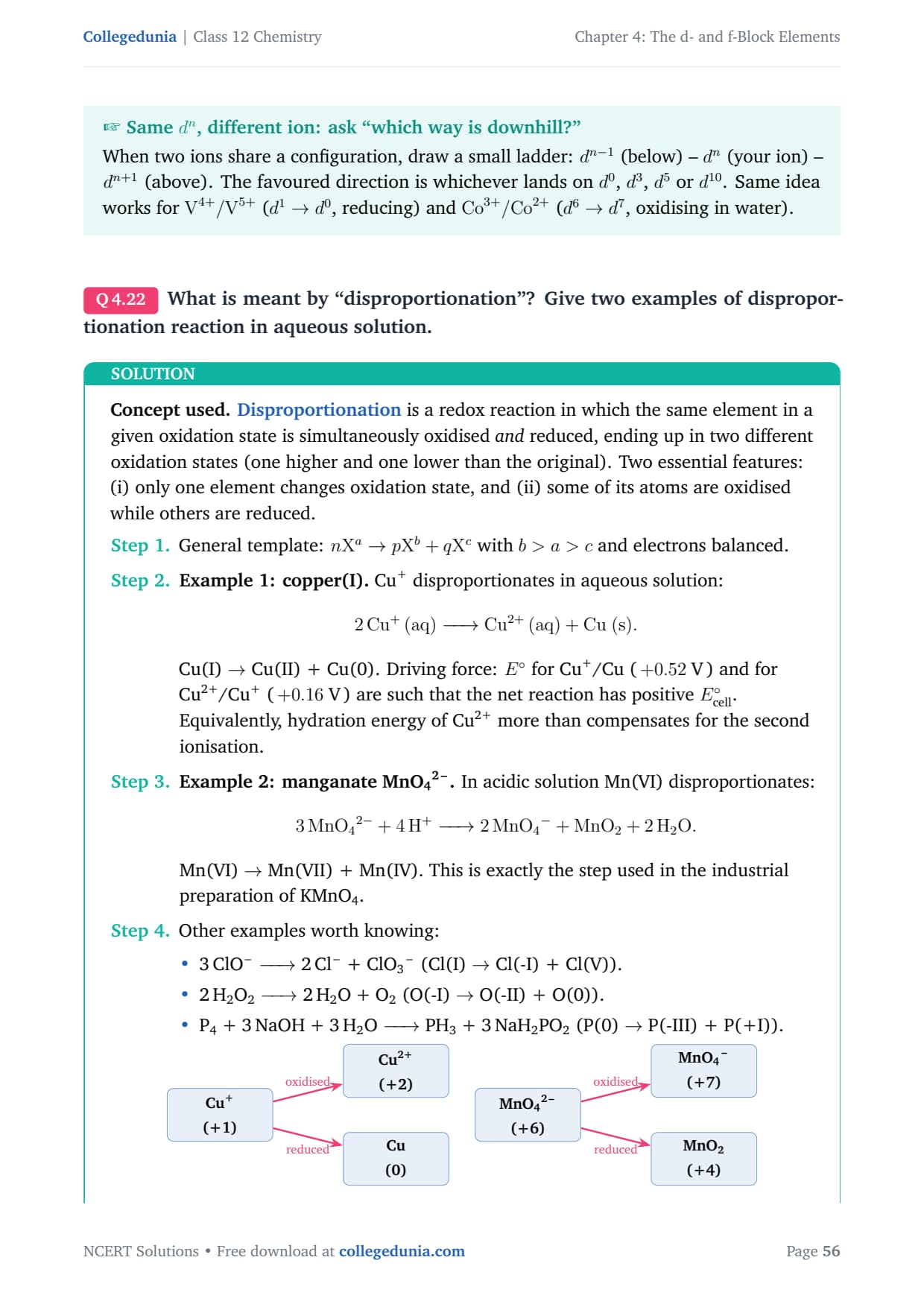
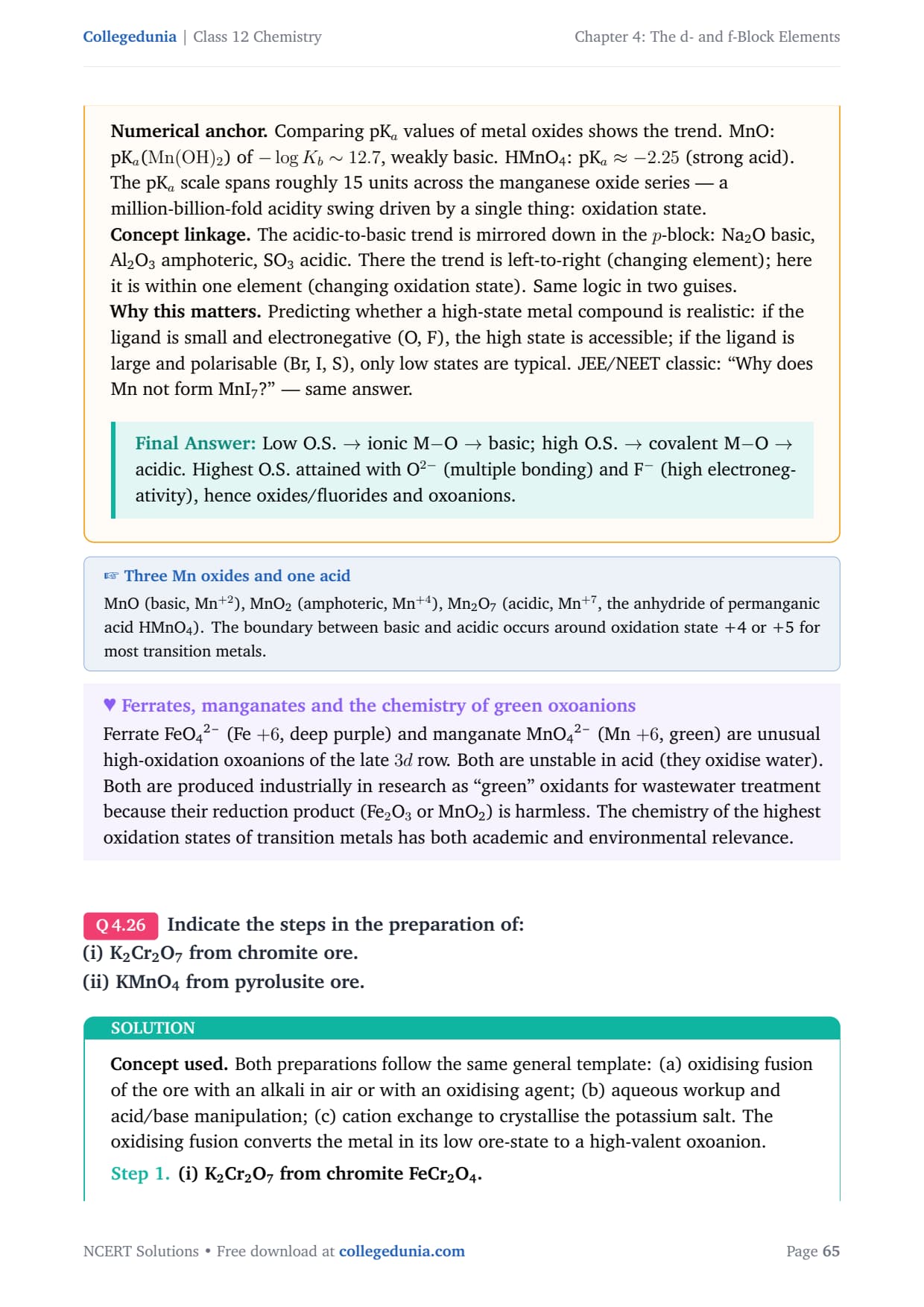
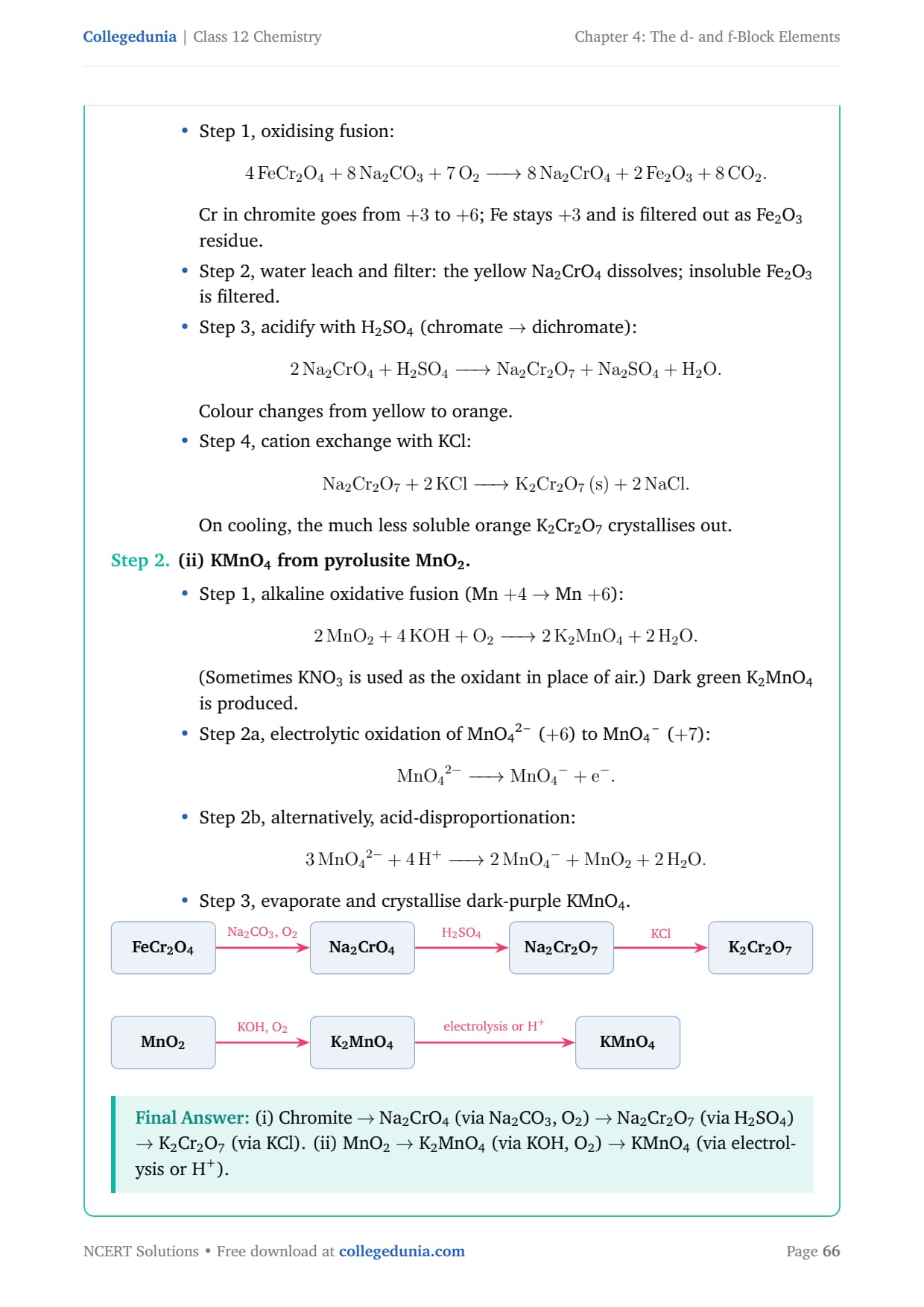
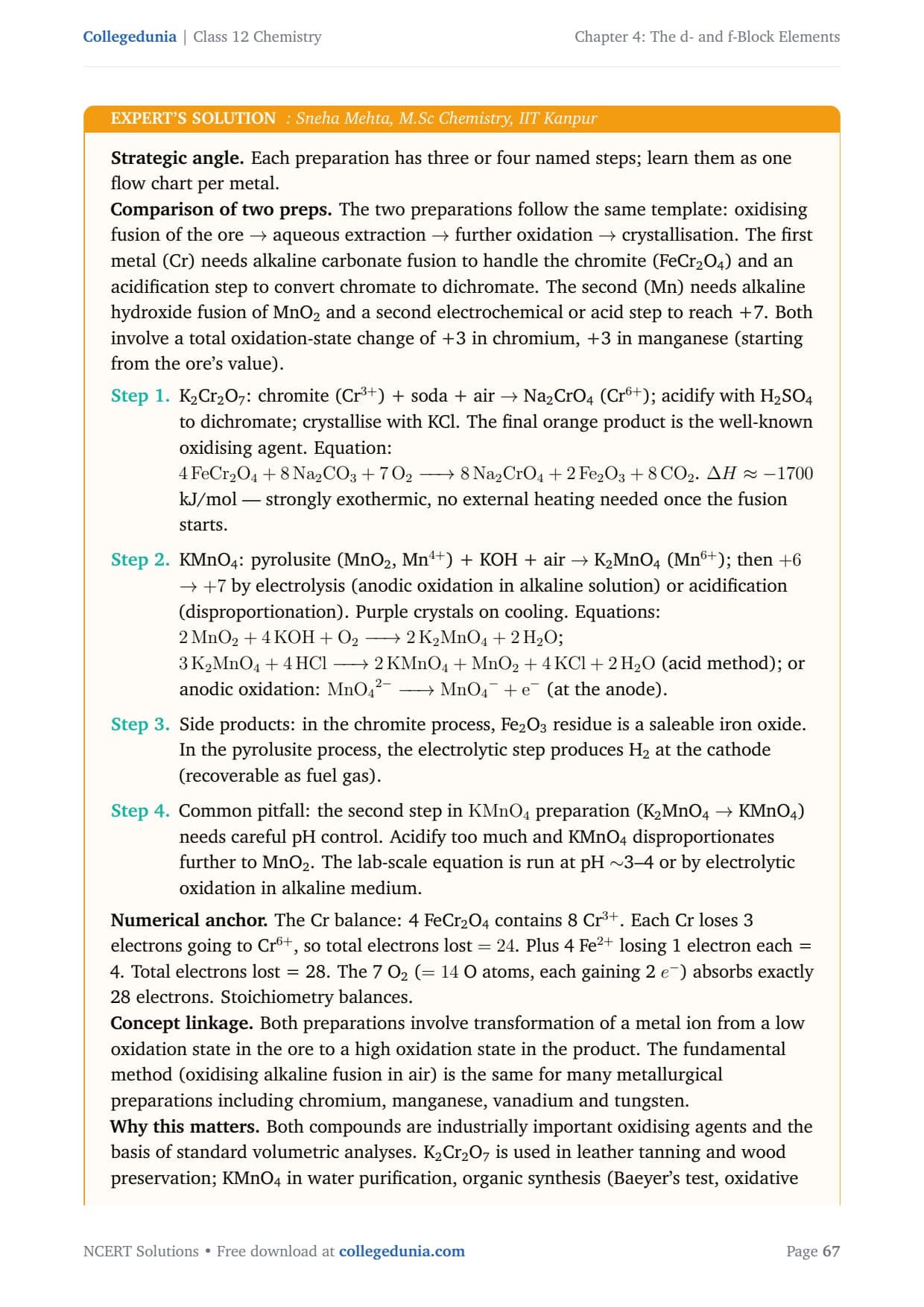
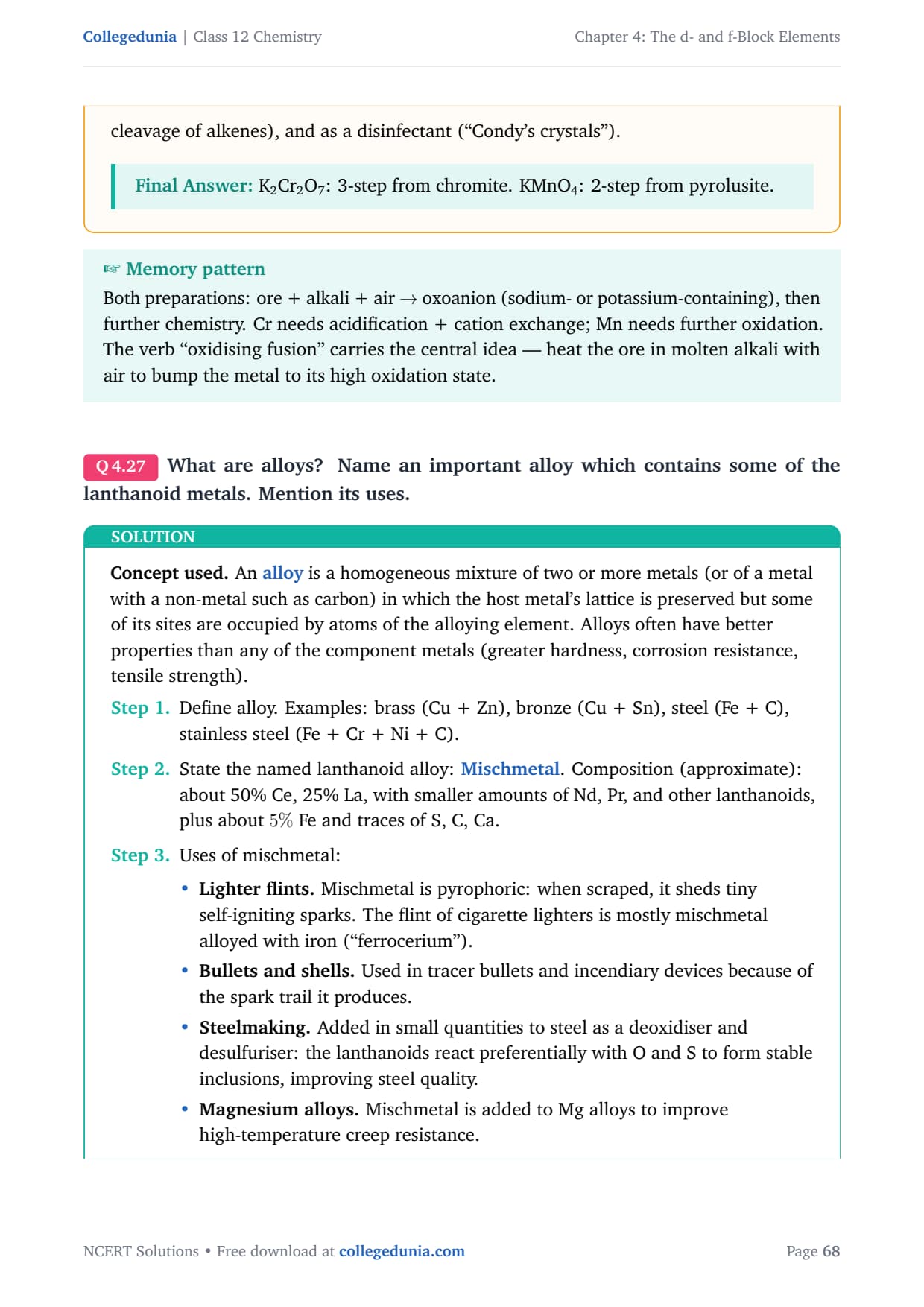
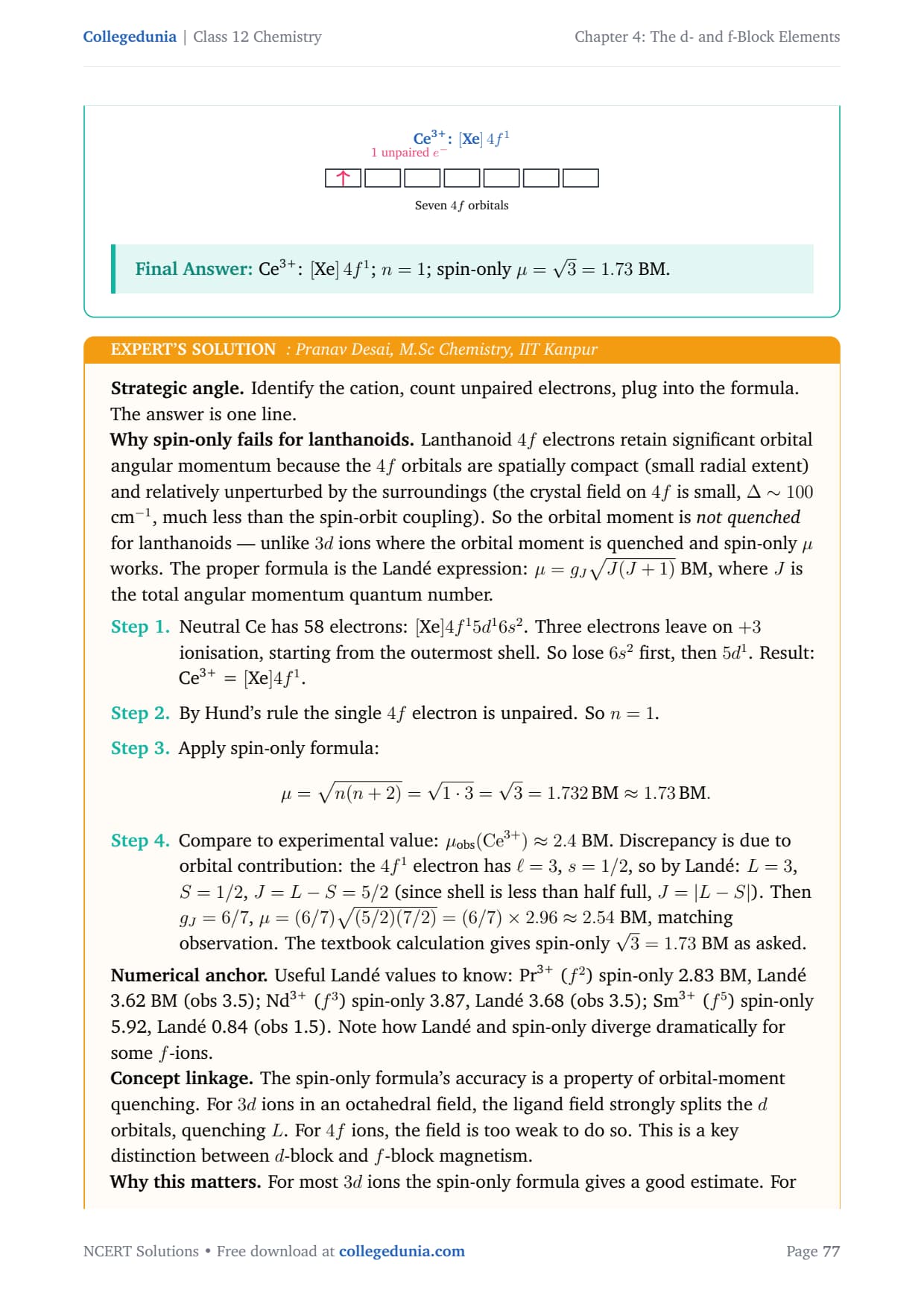
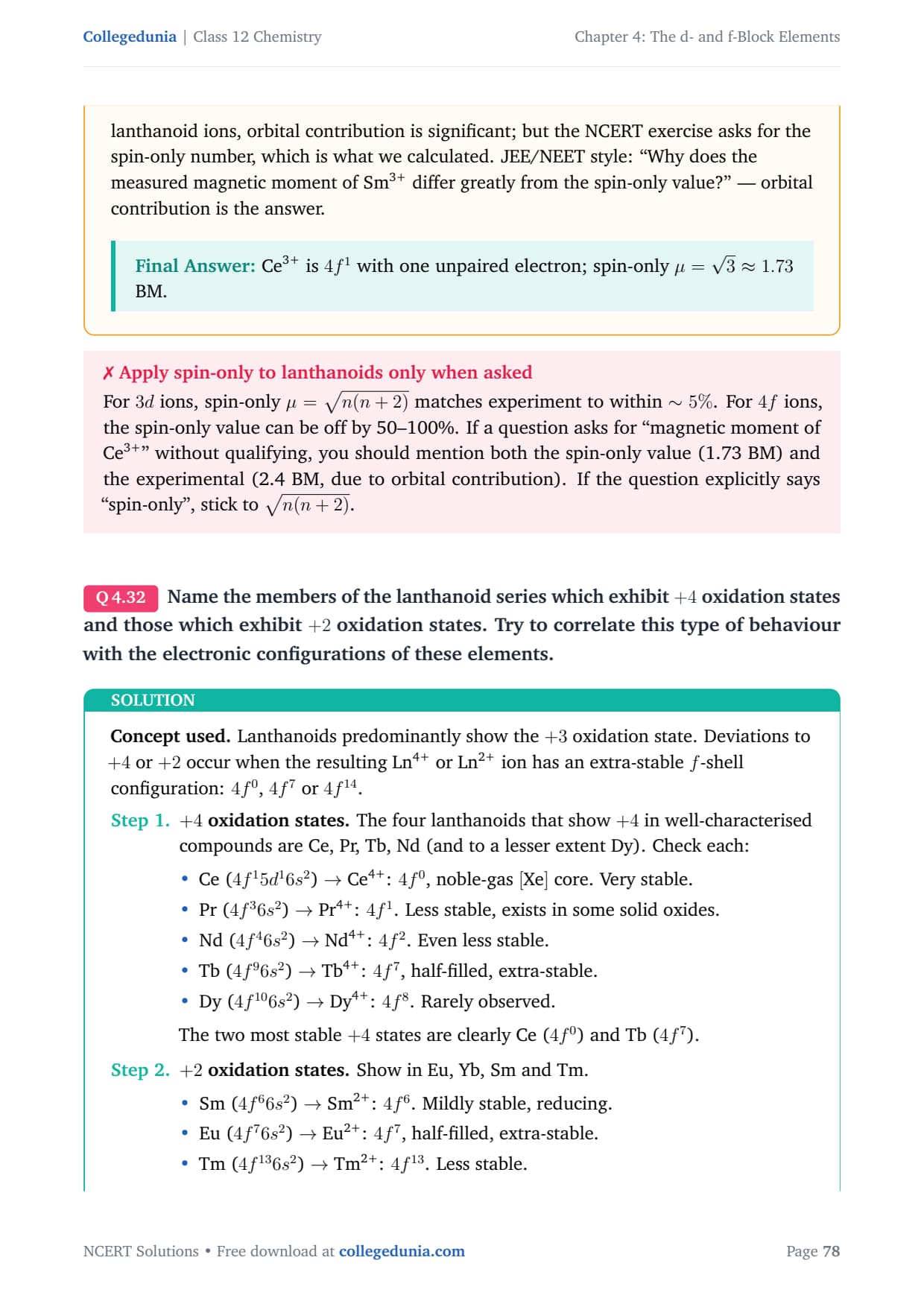
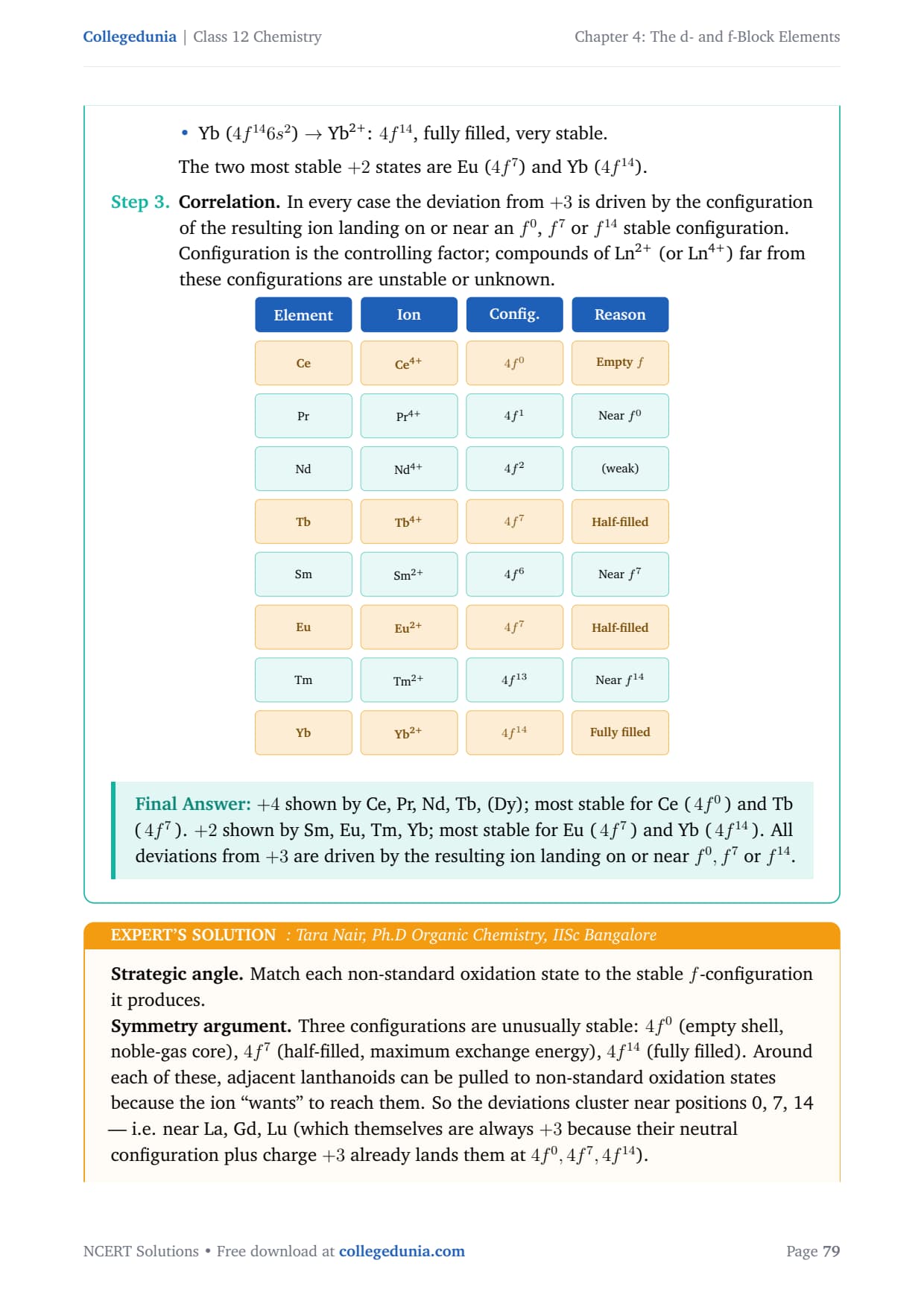
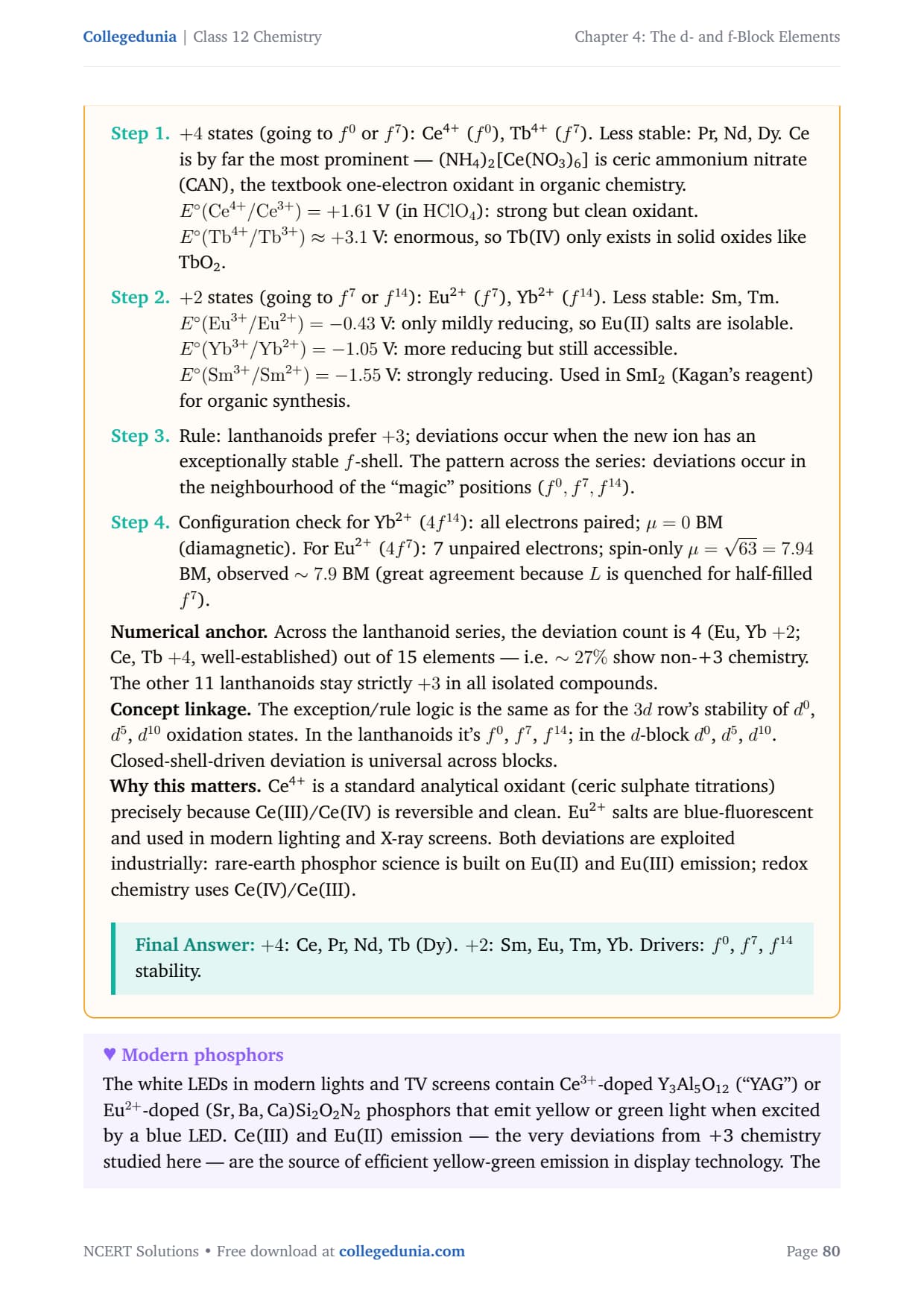
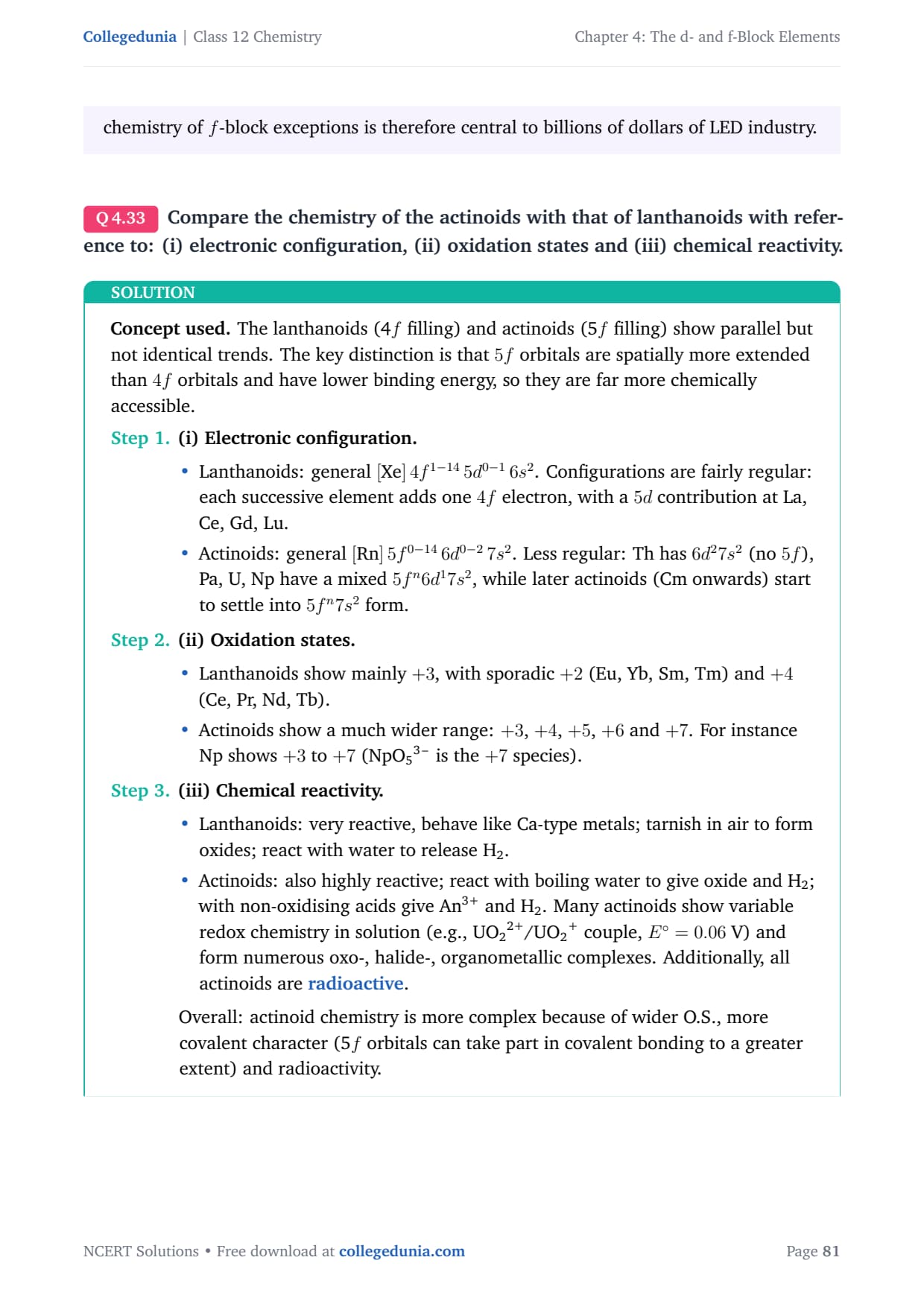
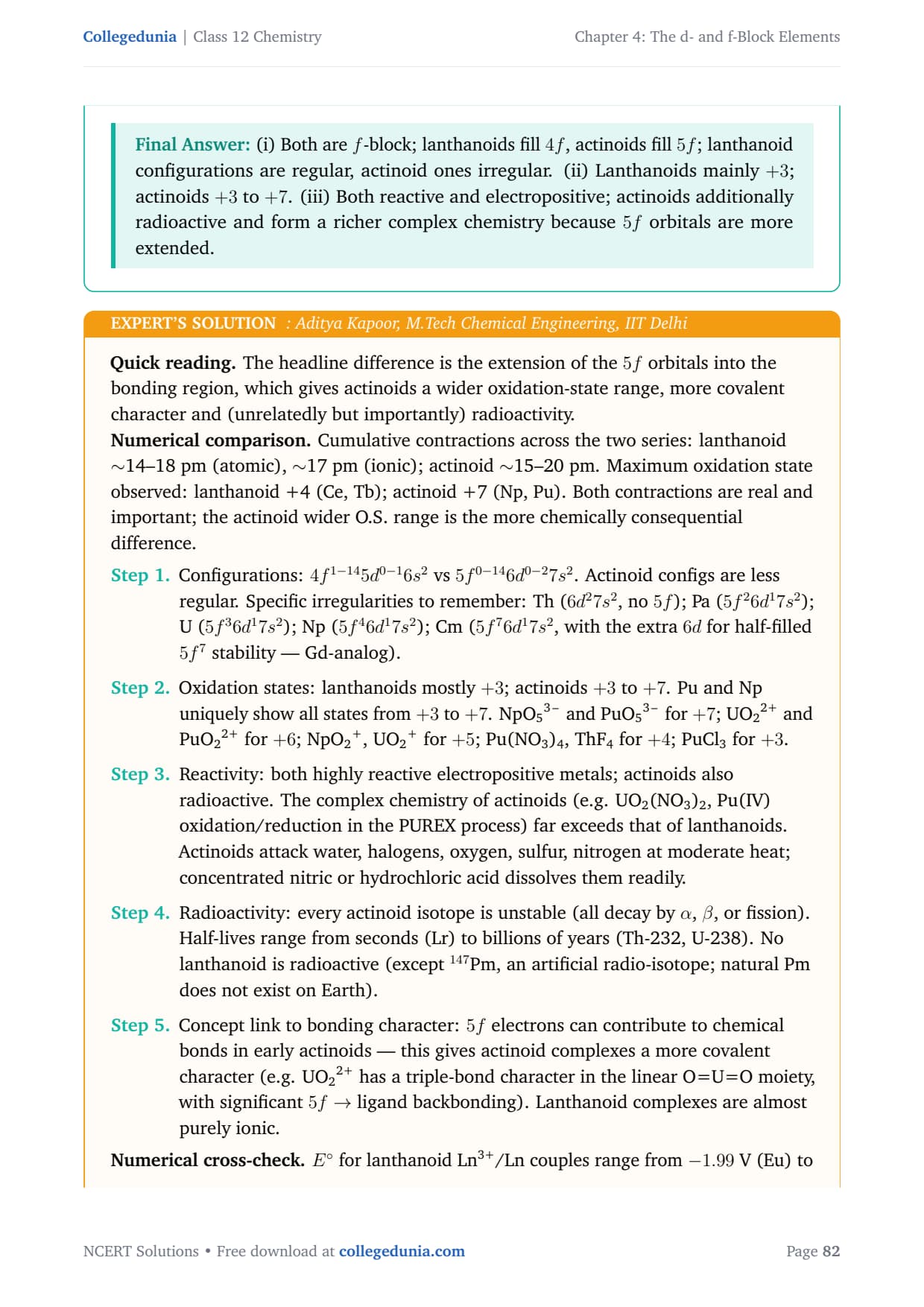
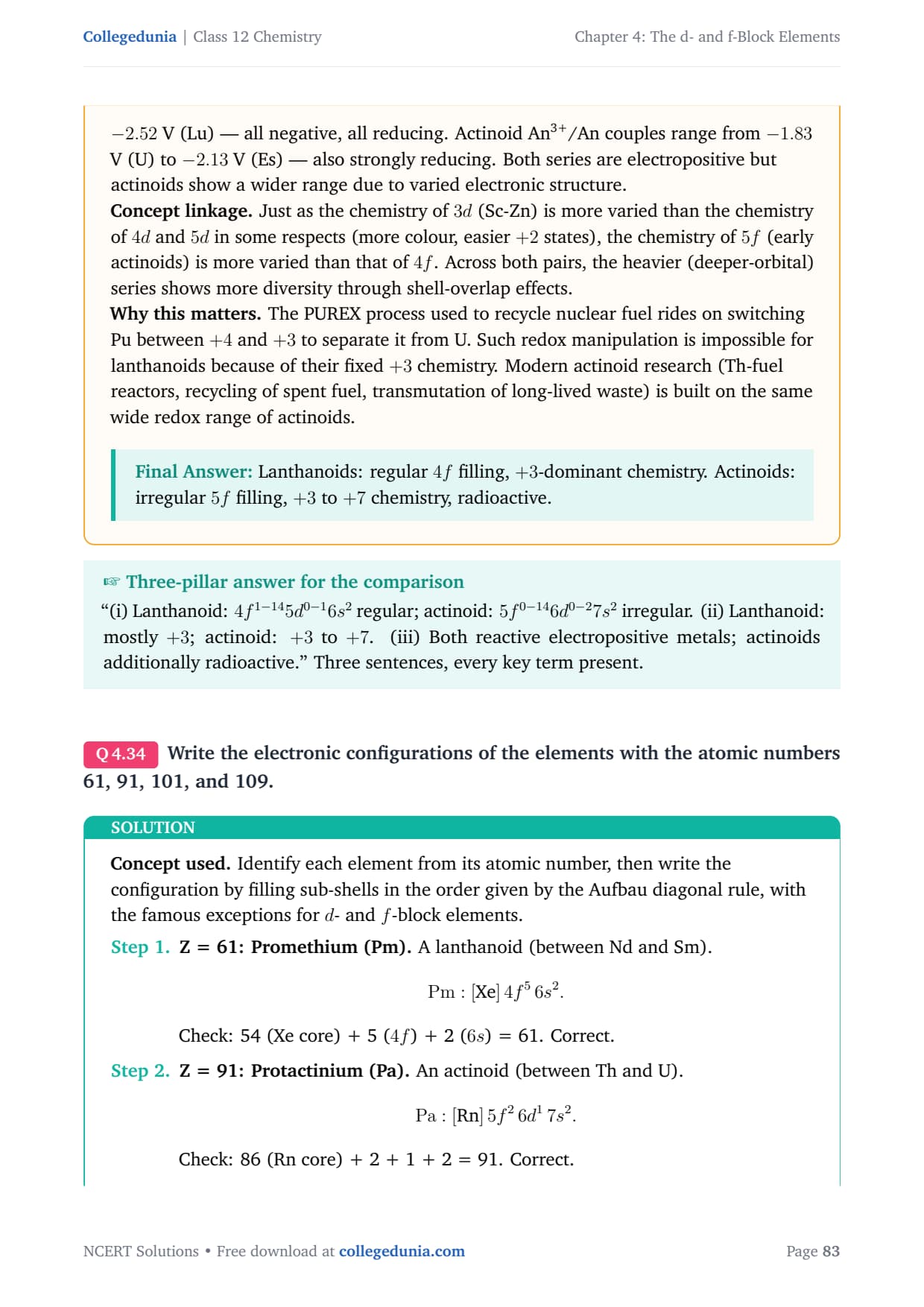
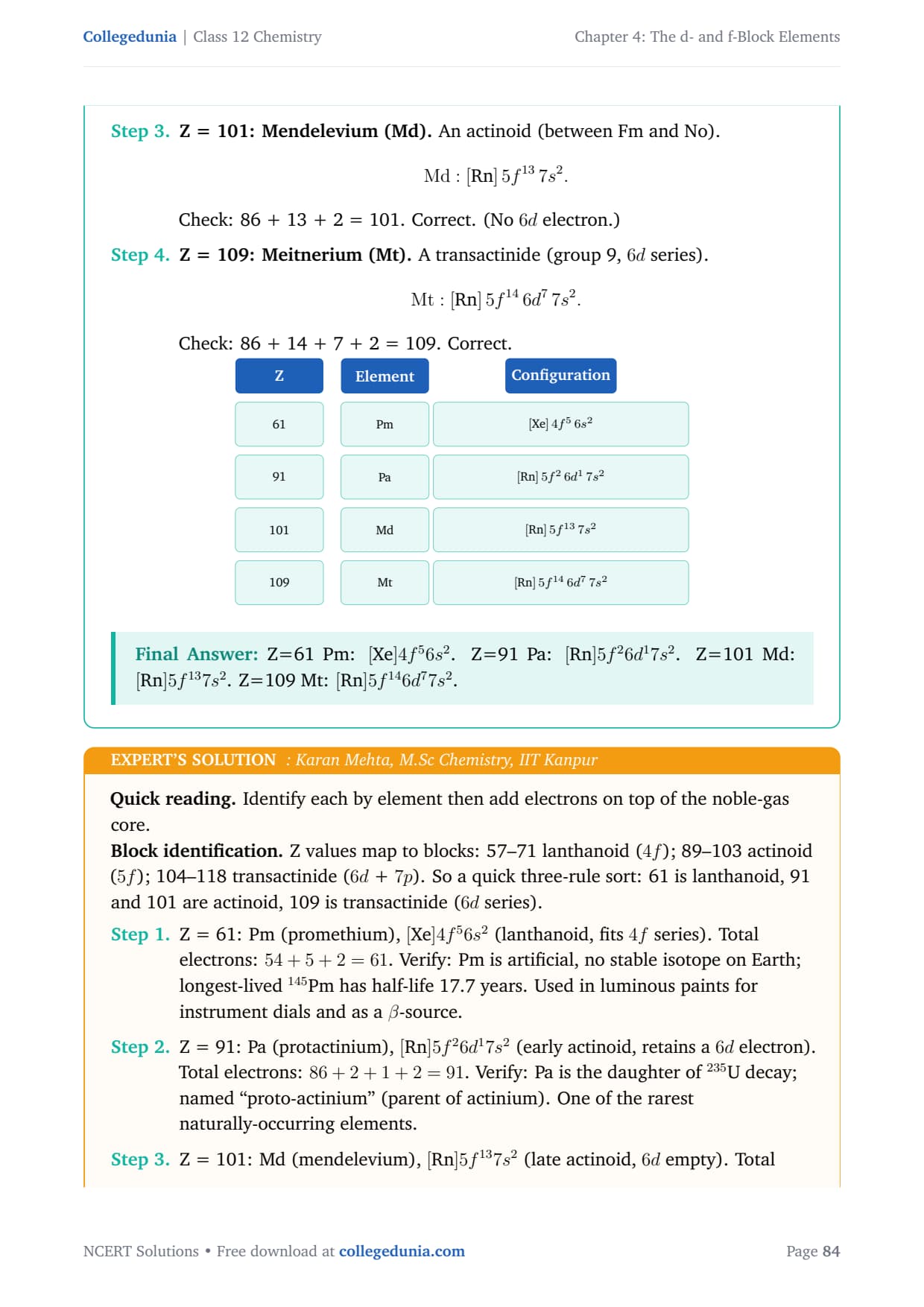
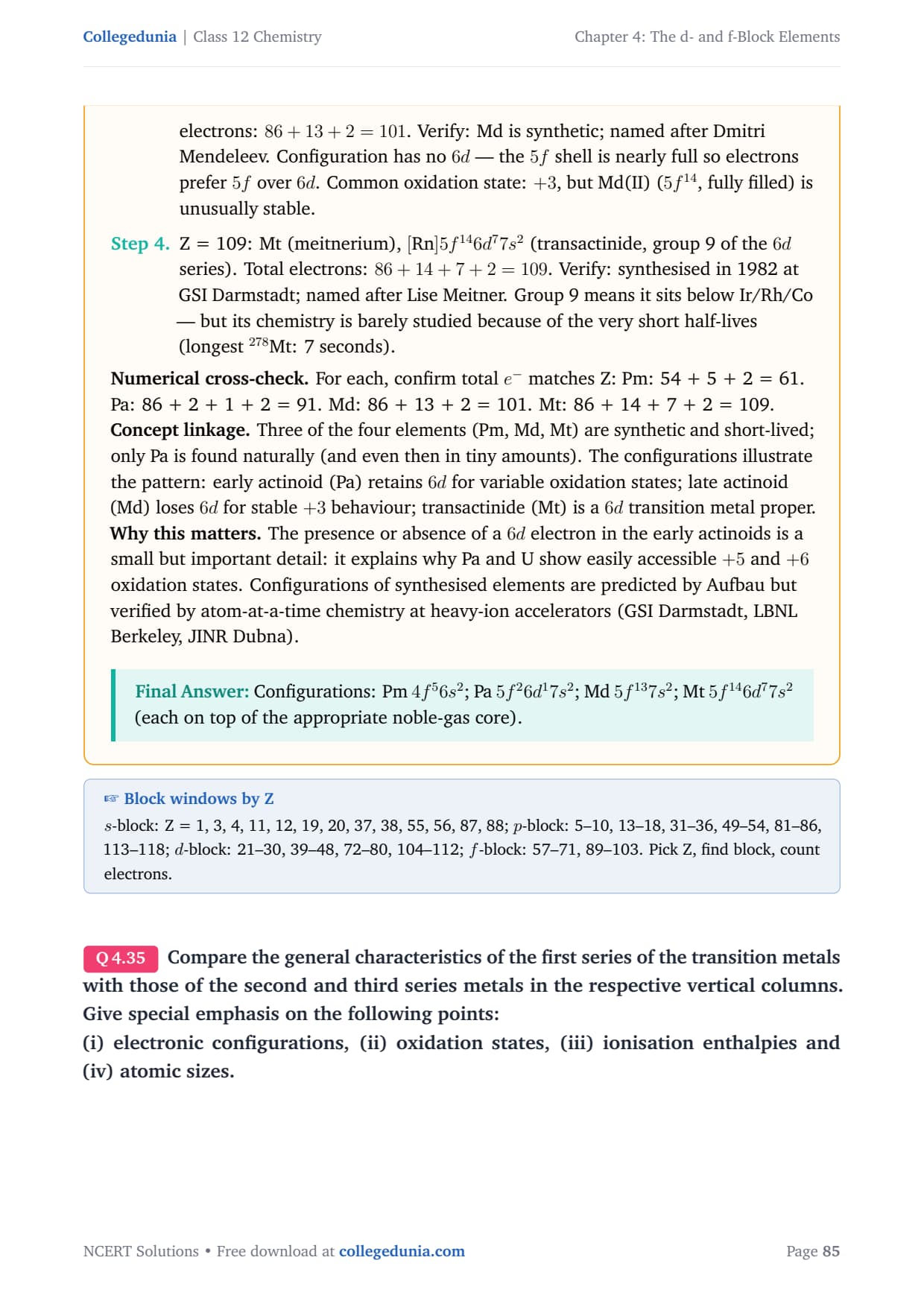
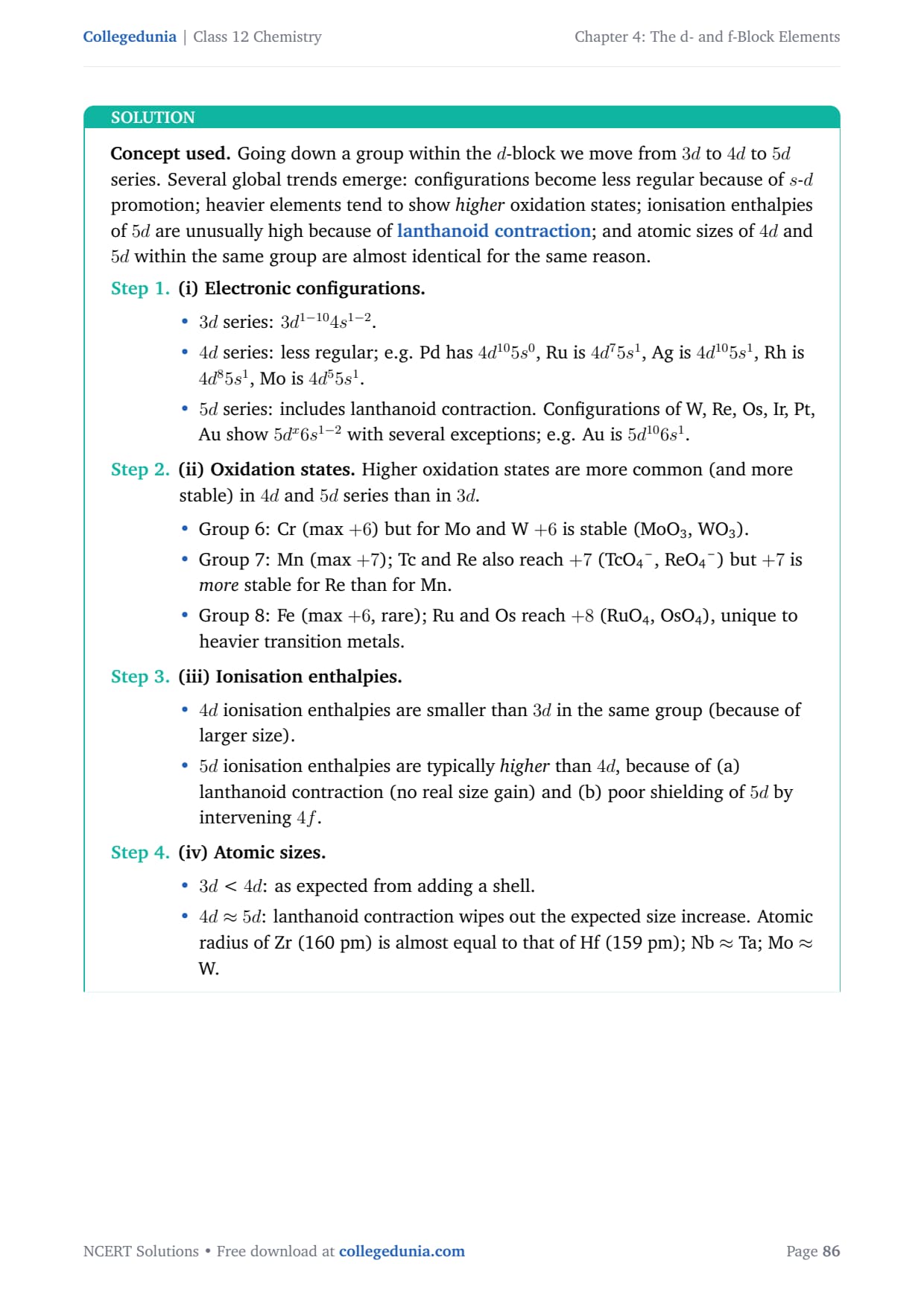
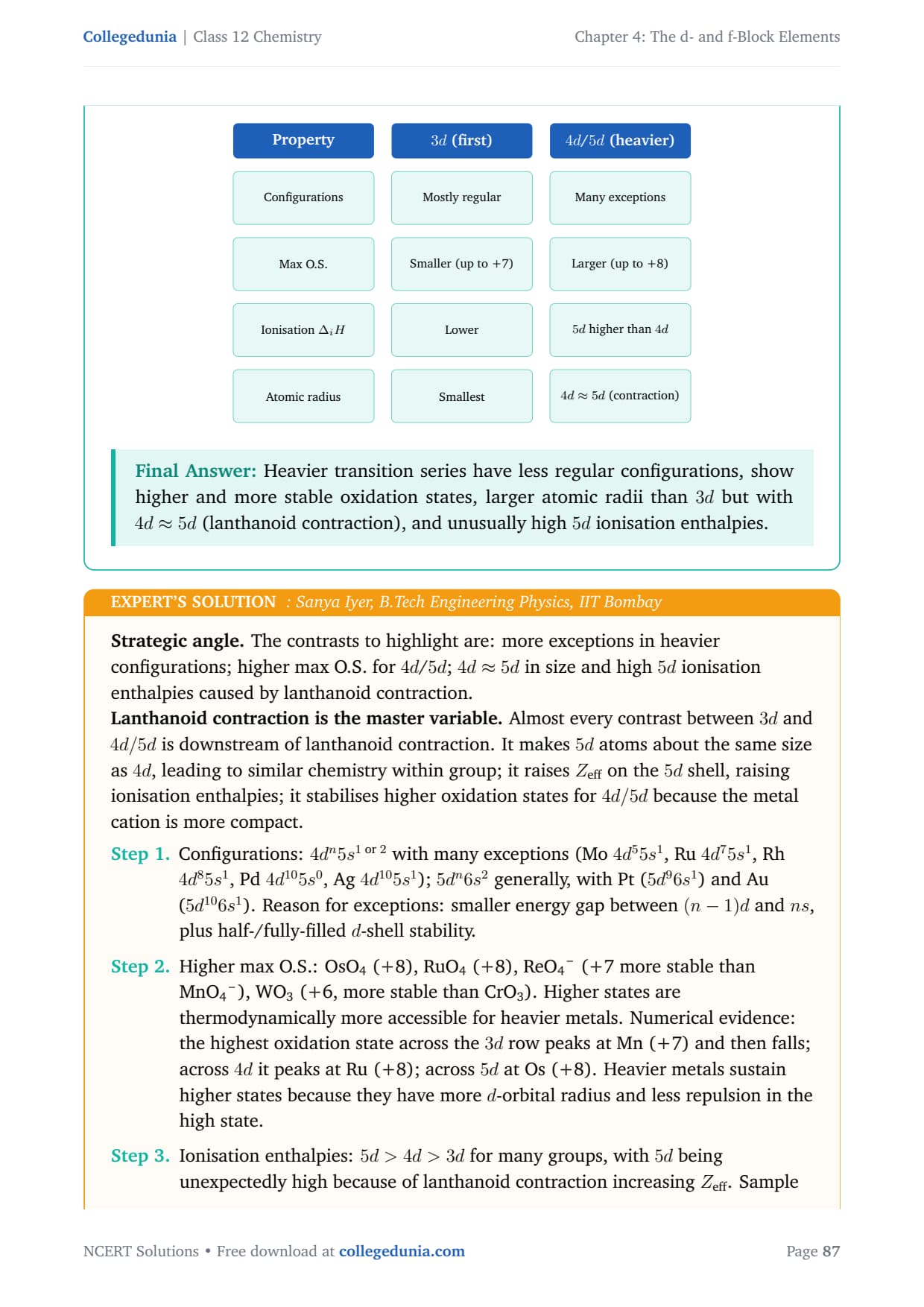
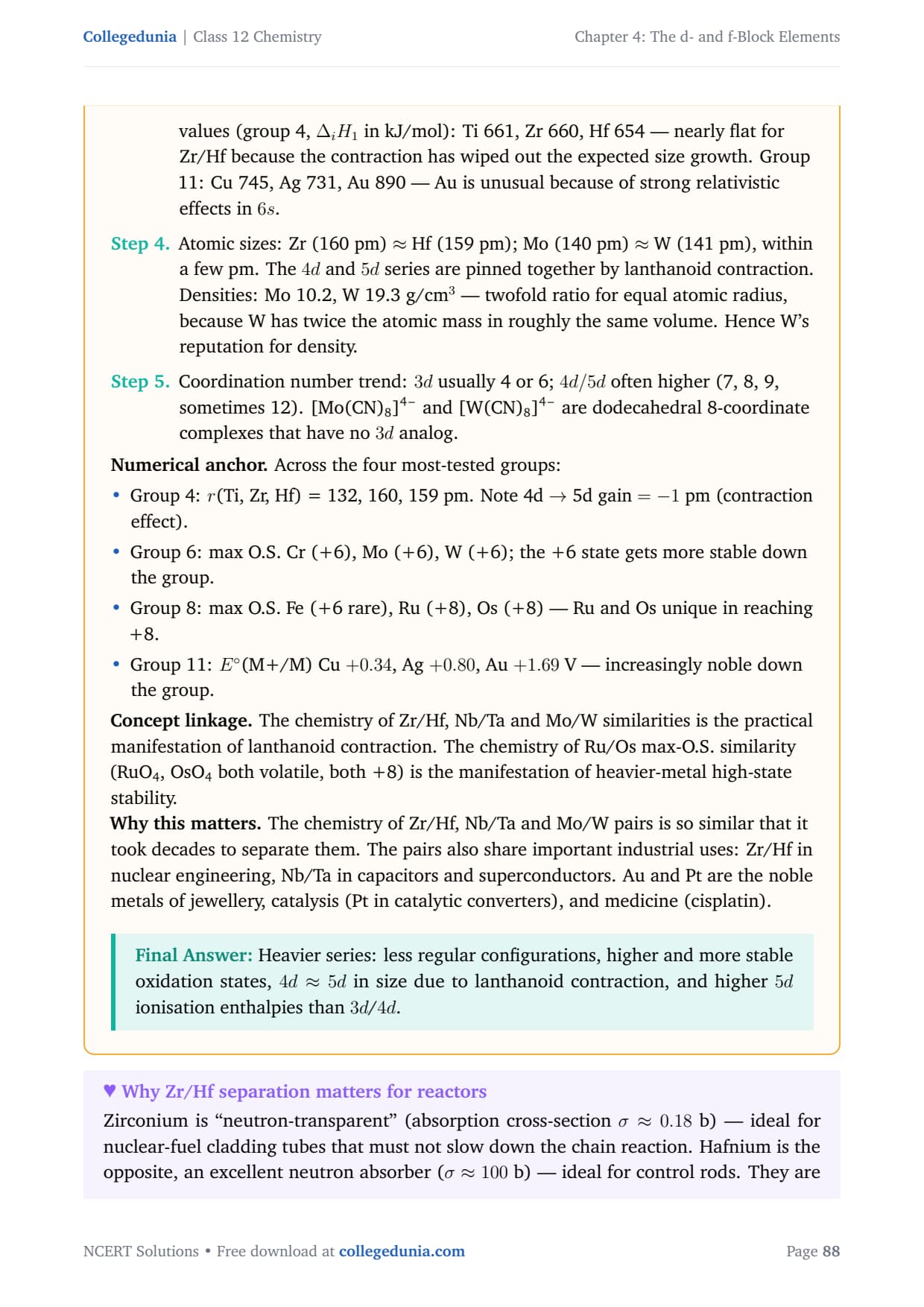
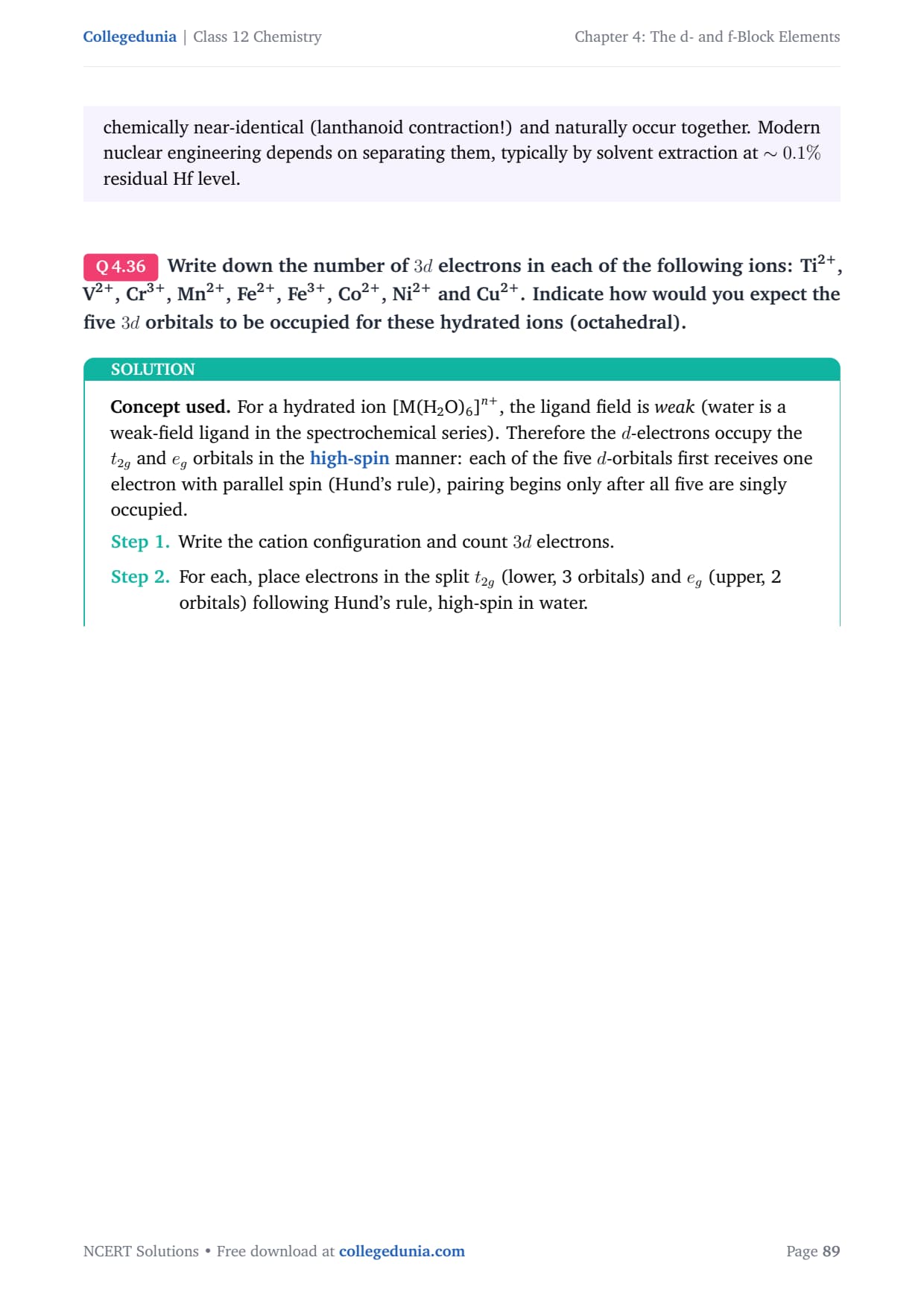
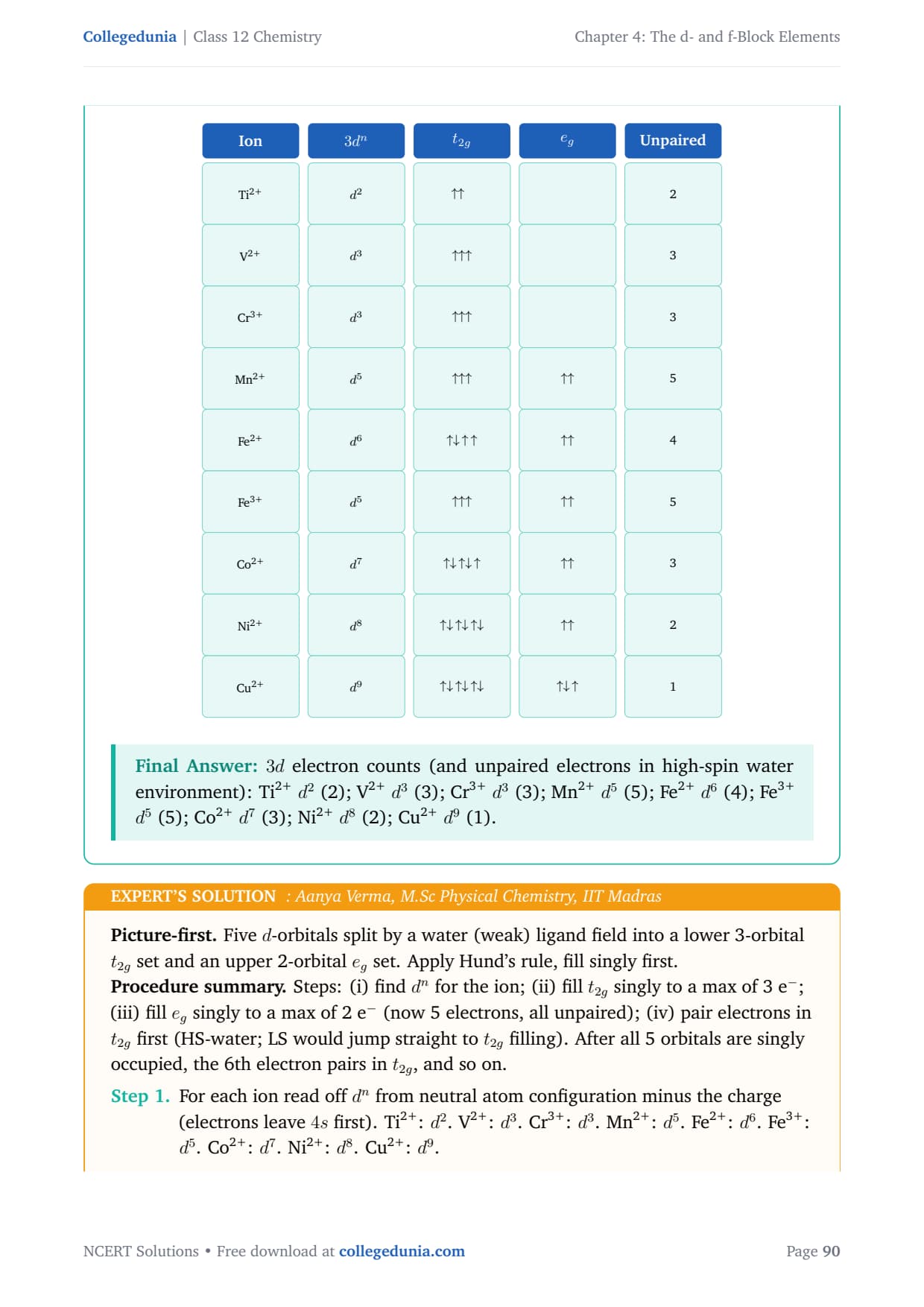
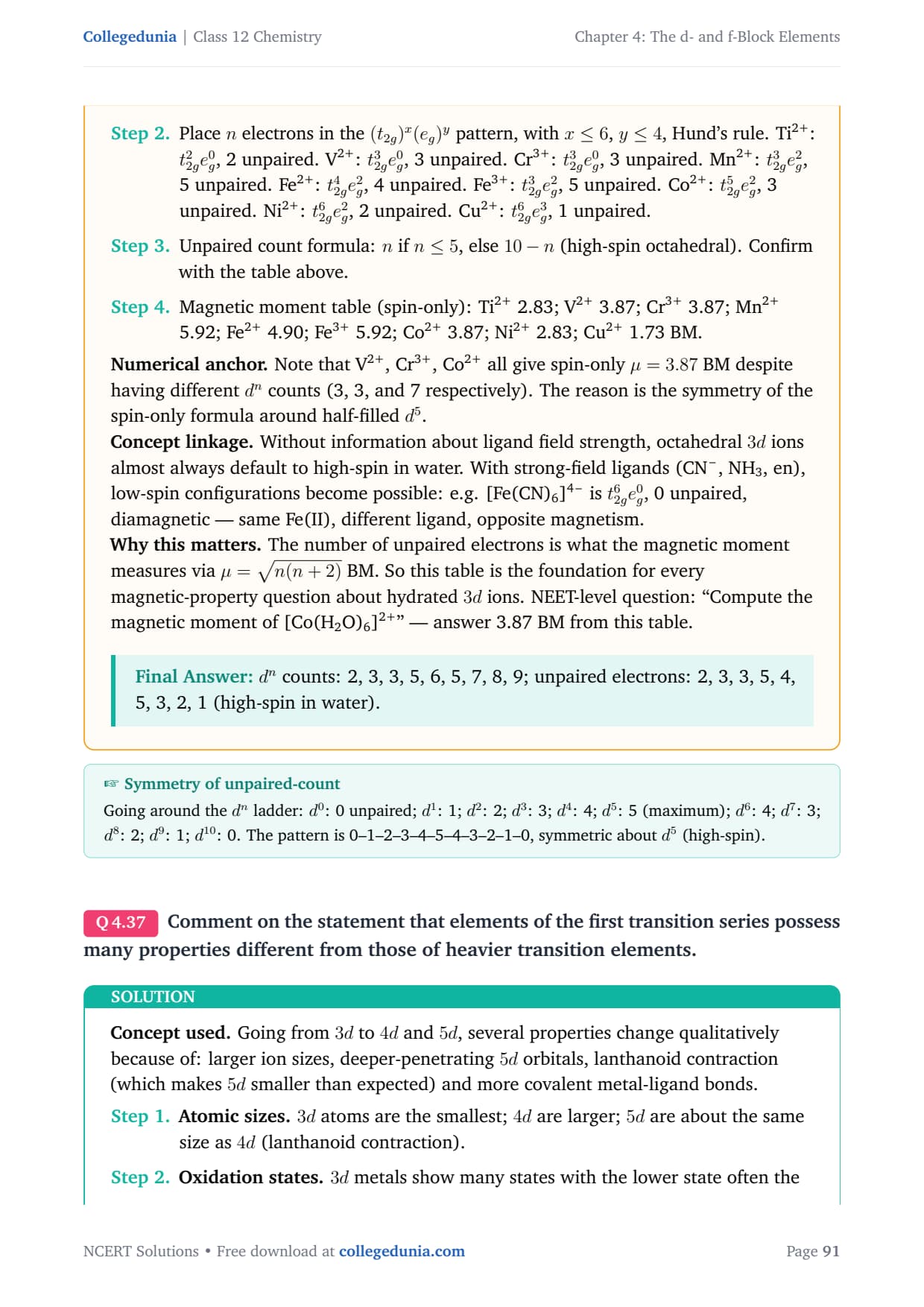
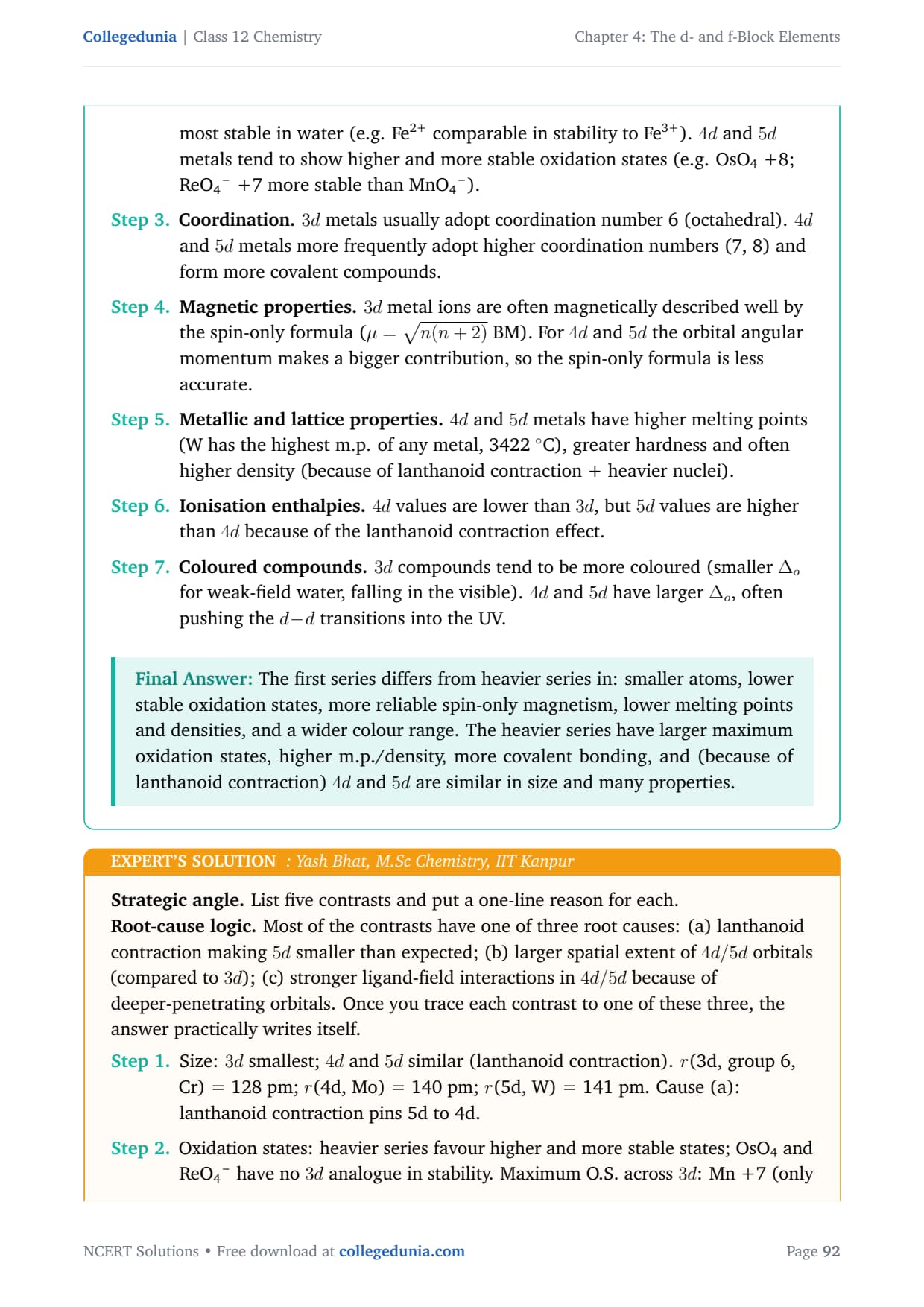
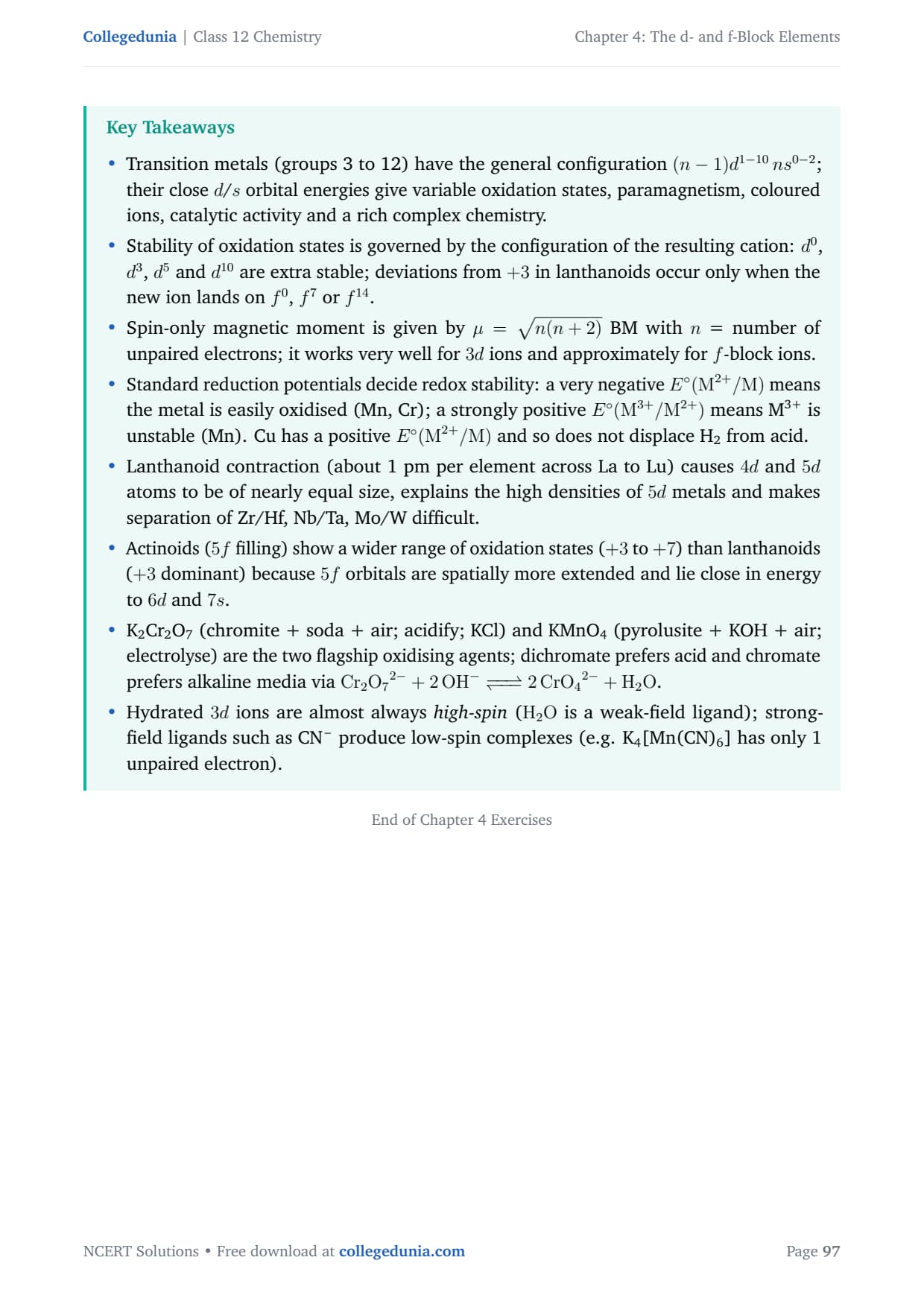
- CBSE Weightage: 6 to 8 marks, usually one KMnO4/K2Cr2O7 short answer plus a reasoning question on lanthanoid contraction.
- JEE Main Weightage: 3 to 4%, about 1 question per shift on magnetic moment, oxidation states or coloured ions.
- NEET Weightage: 2 to 3 questions per year on magnetic moment, coloured ions or lanthanoid contraction.
These NCERT Solutions are curated by subject experts, mapped to the 2026-27 NCERT, and refined against the last five years of CBSE Board, JEE Main and NEET papers.

Why Class 12 Chemistry Chapter 4 The d- and f-Block Elements Carries Such a Heavy Mark Share
Chapter 4 sits in the Inorganic Chemistry unit (Chapters 4 and 5) that carries 19 marks in the CBSE Board paper, and it is the biggest contributor in that unit. Its reasoning questions on lanthanoid contraction, magnetic moment and oxidation states come back almost every year. CBSE 2025 carried two questions from this chapter for 8 marks, and JEE Main 2025 used it in 3 of 13 shifts.
- Concept density: one chapter spans general trends, KMnO4, K2Cr2O7, lanthanoids and actinoids.
- Reasoning premium: CBSE awards 2 marks for the "why Mn(II) is more stable than Mn(III)" explanation, and ion colours and magnetic moments feed direct NEET MCQs.
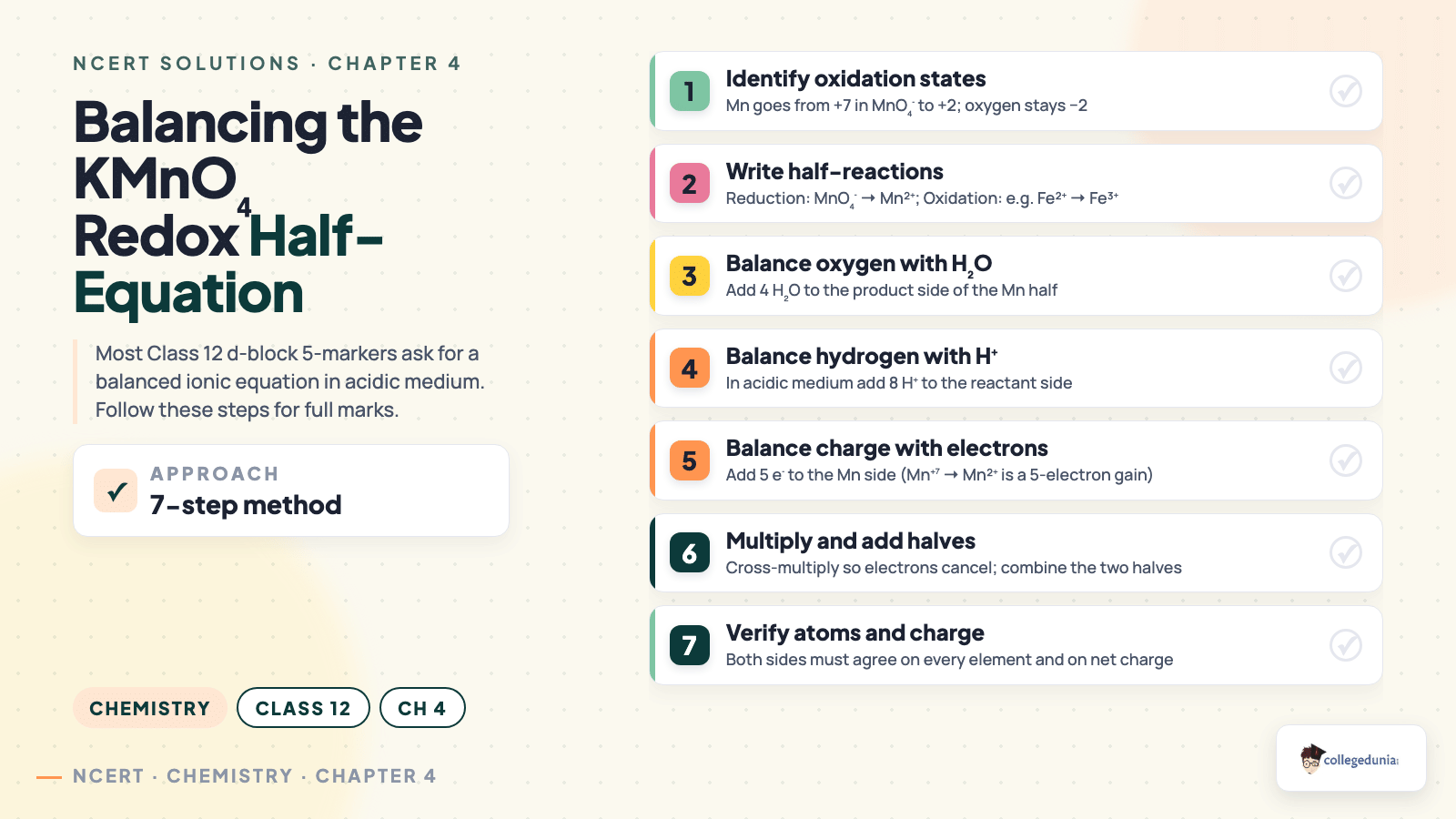
Marks Budget Table for a Typical 5-Marker on KMnO4 Preparation
CBSE awards each mark of a 5-mark answer for a specific step or keyword, so knowing the split tells you where to spend your writing.
| Step | What to Write | Marks |
|---|---|---|
| 1 | Fusion of MnO2 with KOH in presence of air or KNO3 giving K2MnO4 (green) | 1 |
| 2 | Balanced equation: 2MnO2 + 4KOH + O2 → 2K2MnO4 + 2H2O | 1 |
| 3 | Disproportionation of K2MnO4 in neutral or acidic medium to KMnO4 (purple) | 1 |
| 4 | Balanced equation: 3MnO42- + 4H+ → 2MnO4- + MnO2 + 2H2O | 1 |
| 5 | Oxidation states change (+4 → +6 → +7) clearly indicated | 1 |
Students who skipped the oxidation-state tracking in step 5 lost 1 mark in CBSE 2024.
The d- and f-Block Elements Class 12 Chemistry Video Walkthrough
Source: Magnet Brains on YouTube
The d- and f-Block Elements Exercise-by-Exercise Breakdown (NCERT Class 12 Chemistry)
The chapter has 30 exercises plus 11 intext questions, roughly half short reasoning answers and half equation-writing, configuration and magnetic-moment numericals.
| Set | Question Count | Sub-topic Focus | CBSE Relevance |
|---|---|---|---|
| Intext Q (4.1 to 4.11) | 11 | Configurations, oxidation states, magnetic moment, lanthanoid contraction | VSA 1-2 markers |
| Exercise 4.1 to 4.10 | 10 | General trends in d-block: melting point, density, oxidation states, colour | SA 2-3 markers |
| Exercise 4.11 to 4.20 | 10 | KMnO4, K2Cr2O7, magnetic moment numericals, interstitial compounds | LA 5 markers |
| Exercise 4.21 to 4.30 | 10 | Lanthanoid contraction, actinoid chemistry, comparison Ln vs An | SA 2-3 markers |
The d- and f-Block Elements Previous Year Questions Weightage (2021-2026)
The table below maps Chapter 4 appearances across CBSE, JEE Main and NEET from 2021 to 2026. The two most-repeated topics are KMnO4/K2Cr2O7 and lanthanoid contraction.
| Year | CBSE Board | JEE Main | NEET |
|---|---|---|---|
| 2026 | Lanthanoid contraction and its consequences (2 marks) | Magnetic moment of Fe3+ / 1 Q | Colour and magnetic moment of transition ions (1 Q) |
| 2025 | KMnO4 preparation 3M + Lanthanoid contraction 2M | Oxidation states of Mn / 1 Q | Magnetic moment, Coloured ions / 2 Qs |
| 2024 | K2Cr2O7 reactions 3M + Why Cu+ colourless 2M | Configuration of Cr / 1 Q | Actinoid contraction / 1 Q |
| 2023 | Lanthanoid contraction effects 5M | Cu+ vs Cu2+ colour / 1 Q | Coloured ions of Ti, V / 1 Q |
| 2022 | KMnO4 as oxidising agent 3M | Spin-only magnetic moment / 1 Q | Lanthanoid chemistry / 1 Q |
| 2021 | General properties of transition metals 5M | K2Cr2O7 equilibrium / 1 Q | Configuration of Fe2+ / 1 Q |
KMnO4 or K2Cr2O7 chemistry appeared in four of the last five CBSE papers; lanthanoid contraction in three of five.
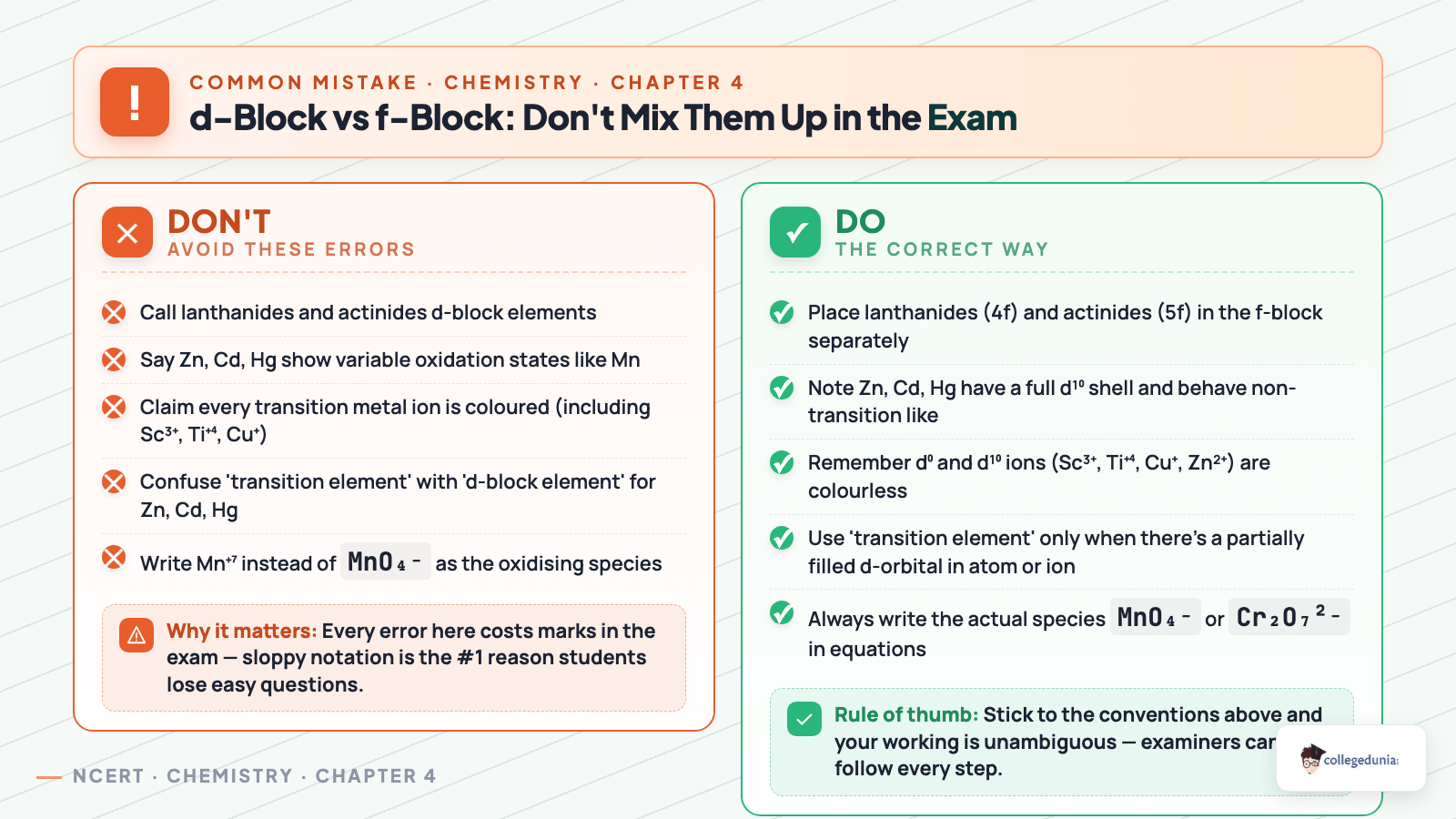
Common Mistakes Students Make in The d- and f-Block Elements
The traps below cost the most marks in recent CBSE and NEET papers.
- Writing Cu as [Ar] 3d9 4s2 instead of [Ar] 3d10 4s1: Cr and Cu are anomalies because half-filled and fully-filled d sub-shells are extra stable.
- Confusing lanthanoid with actinoid contraction: actinoid contraction is greater because 5f electrons shield even less than 4f.
- Forgetting the colour switch: K2Cr2O7 is orange in acid and K2CrO4 yellow in base, a frequent 2-mark MCQ.
- Using √n(n+1) instead of μ = √n(n+2) BM: the spin-only formula uses (n+2).
- Calling Mn2+ strongly coloured: its high-spin d5 makes d-d transitions spin-forbidden, so it is only pale pink.
The d- and f-Block Elements Top 5 Formulae for Quick Recall
The five formulae below carry almost every numerical from Chapter 4. The full master table with units sits on the Collegedunia Formula Sheet.
| Quantity | Formula |
|---|---|
| Spin-only magnetic moment | μ = √n(n+2) BM, where n = number of unpaired electrons |
| Effective atomic number | EAN = Z - oxidation state + 2 × ligand count |
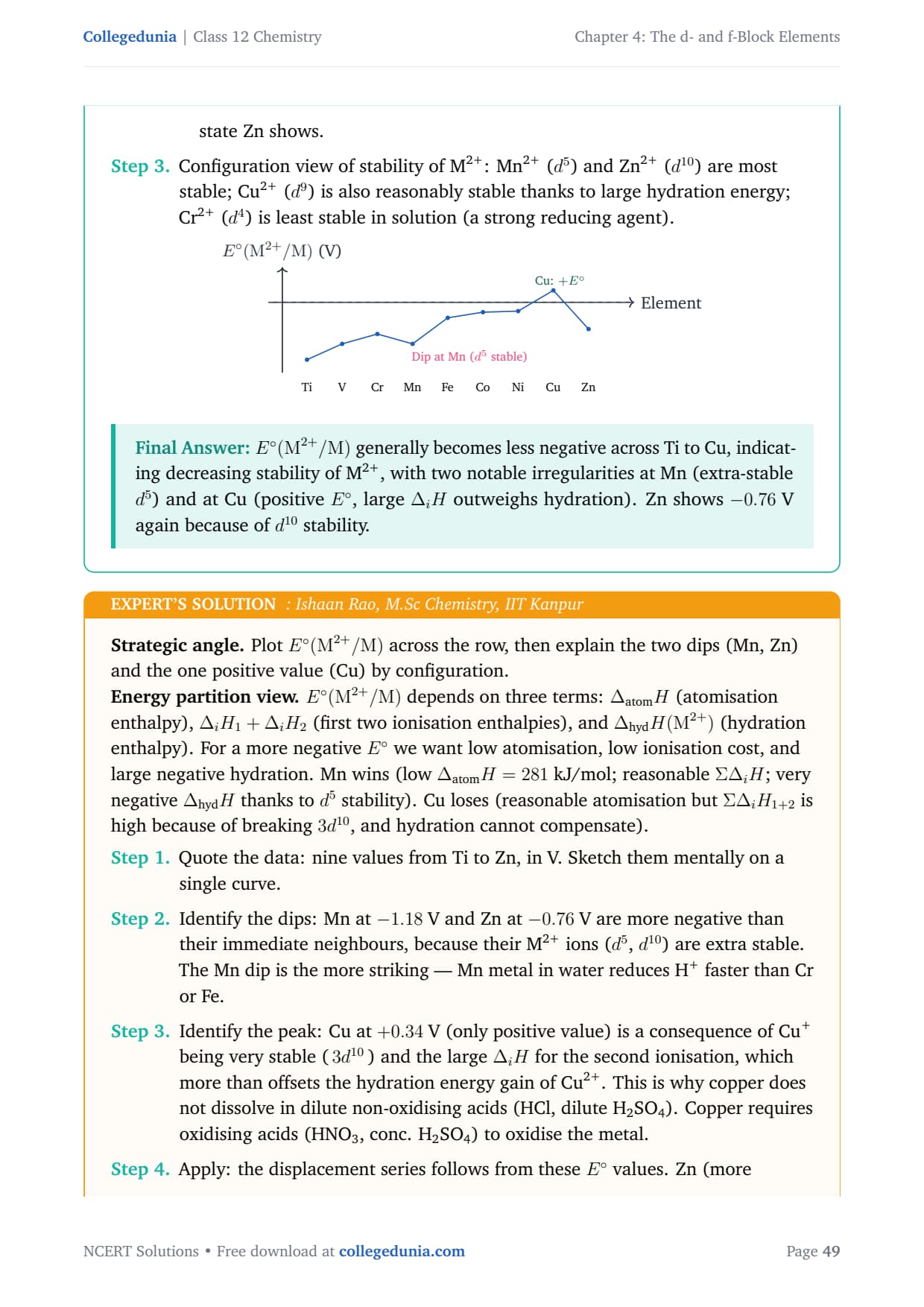
| Standard reduction potential trend | E° (M2+/M) becomes less negative left to right across 3d series |
| Chromate-dichromate equilibrium | 2CrO42- + 2H+ ⇌ Cr2O72- + H2O |
| Lanthanoid contraction | Decrease in atomic / ionic radius from La to Lu ≈ 0.18 Å |
Full master table: The d- and f-Block Elements Class 12 Chemistry Formula Sheet
How to Study The d- and f-Block Elements for Class 12th Chemistry Boards
The one-week plan below balances fact retention with the reasoning answers CBSE awards 2 to 3 marks for.
- Day 1-2: read NCERT sections 4.1 to 4.3, write the 3d, 4d, 5d configurations, and learn the Cr and Cu anomalies.
- Day 3-4: memorise the ion-colour table and solve 10 magnetic-moment numericals.
- Day 5: write the full KMnO4 and K2Cr2O7 preparation, structure and three oxidation reactions of each.
- Day 6: learn the contraction logic, its consequences and the Ln vs An comparison.
- Day 7: solve the last 5 years of CBSE Chapter 4 questions in one timed sitting.
Total time: about 12 to 14 hours gets the chapter board-ready.
All NCERT Solutions for The d- and f-Block Elements with Step-by-Step Working
Every NCERT textbook question for Class 12 Chemistry Chapter 4 The d- and f-Block Elements is listed below with its full Solution and Expert Solution in collapsible tabs. Click Check Solution for the working and Expert Solution for the expanded explanation.
Questions
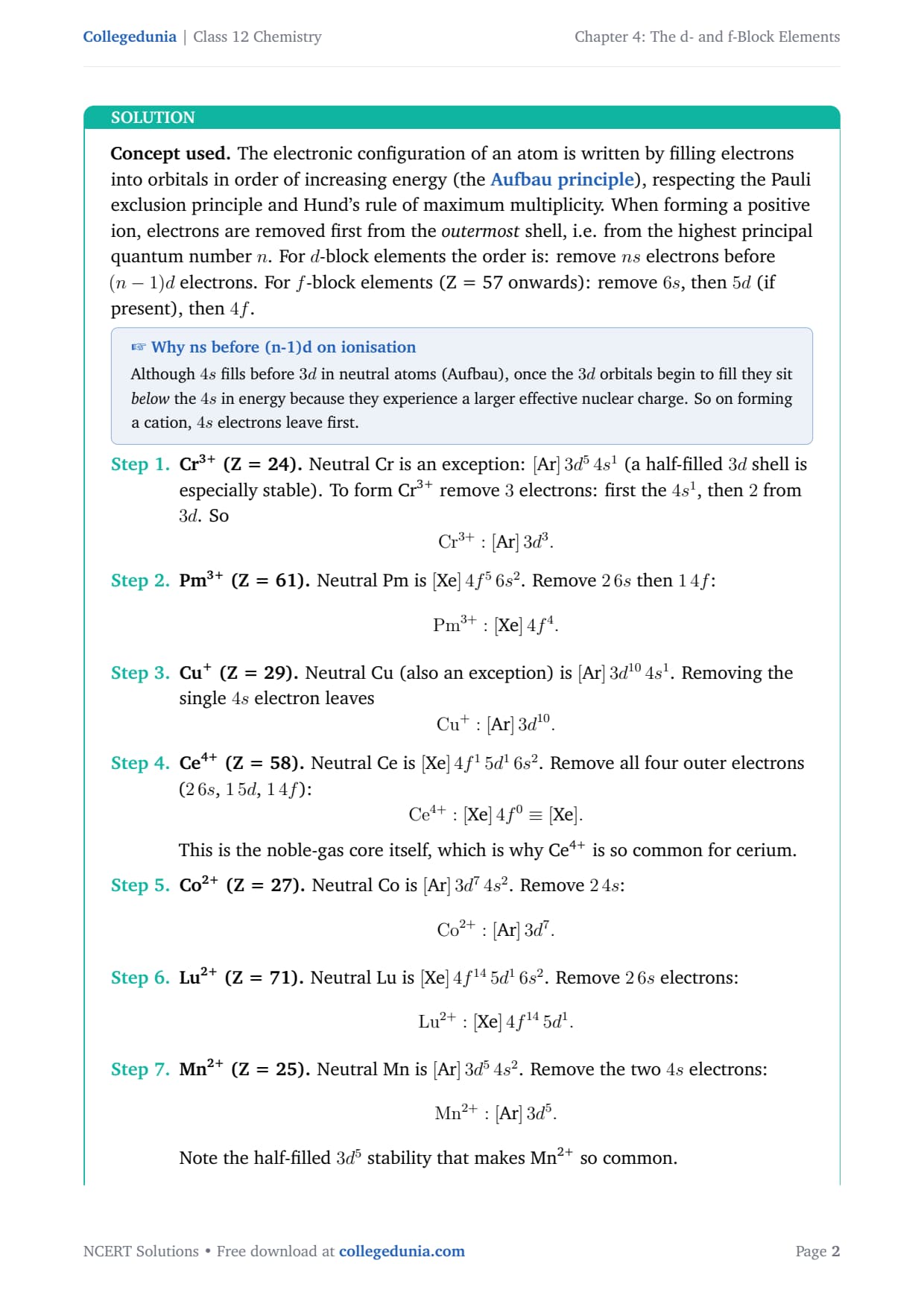
Write down the electronic configuration of:
(i) Cr^3+ (ii) Pm^3+ (iii) Cu+ (iv) Ce^4+
(v) Co^2+ (vi) Lu^2+ (vii) Mn^2+ (viii) Th^4+
Concept used. The electronic configuration of an atom is written by filling electrons into orbitals in order of increasing energy (the Aufbau principle), respecting the Pauli exclusion principle and Hund's rule of maximum multiplicity. When forming a positive ion, electrons are removed first from the outermost shell, i.e. from the highest principal quantum number n. For d-block elements the order is: remove ns electrons before (n-1)d electrons. For f-block elements (Z = 57 onwards): remove 6s, then 5d (if present), then 4f.
Why ns before (n-1)d on ionisation
Although 4s fills before 3d in neutral atoms (Aufbau), once the 3d orbitals begin to fill they sit below the 4s in energy because they experience a larger effective nuclear charge. So on forming a cation, 4s electrons leave first.- Cr^3+ (Z = 24). Neutral Cr is an exception: [Ar] 3d5 4s1 (a half-filled 3d shell is especially stable). To form Cr^3+ remove 3 electrons: first the 4s1, then 2 from 3d. So Cr3+: [Ar] 3d3.
- Pm^3+ (Z = 61). Neutral Pm is [Xe] 4f5 6s2. Remove 2 6s then 1 4f: Pm3+: [Xe] 4f4.
- Cu+ (Z = 29). Neutral Cu (also an exception) is [Ar] 3d10 4s1. Removing the single 4s electron leaves Cu+: [Ar] 3d10.
- Ce^4+ (Z = 58). Neutral Ce is [Xe] 4f1 5d1 6s2. Remove all four outer electrons (2 6s, 1 5d, 1 4f): Ce4+: [Xe] 4f0≡[Xe]. This is the noble-gas core itself, which is why Ce^4+ is so common for cerium.
- Co^2+ (Z = 27). Neutral Co is [Ar] 3d7 4s2. Remove 2 4s: Co2+: [Ar] 3d7.
- Lu^2+ (Z = 71). Neutral Lu is [Xe] 4f14 5d1 6s2. Remove 2 6s electrons: Lu2+: [Xe] 4f14 5d1.
- Mn^2+ (Z = 25). Neutral Mn is [Ar] 3d5 4s2. Remove the two 4s electrons: Mn2+: [Ar] 3d5. Note the half-filled 3d5 stability that makes Mn^2+ so common.
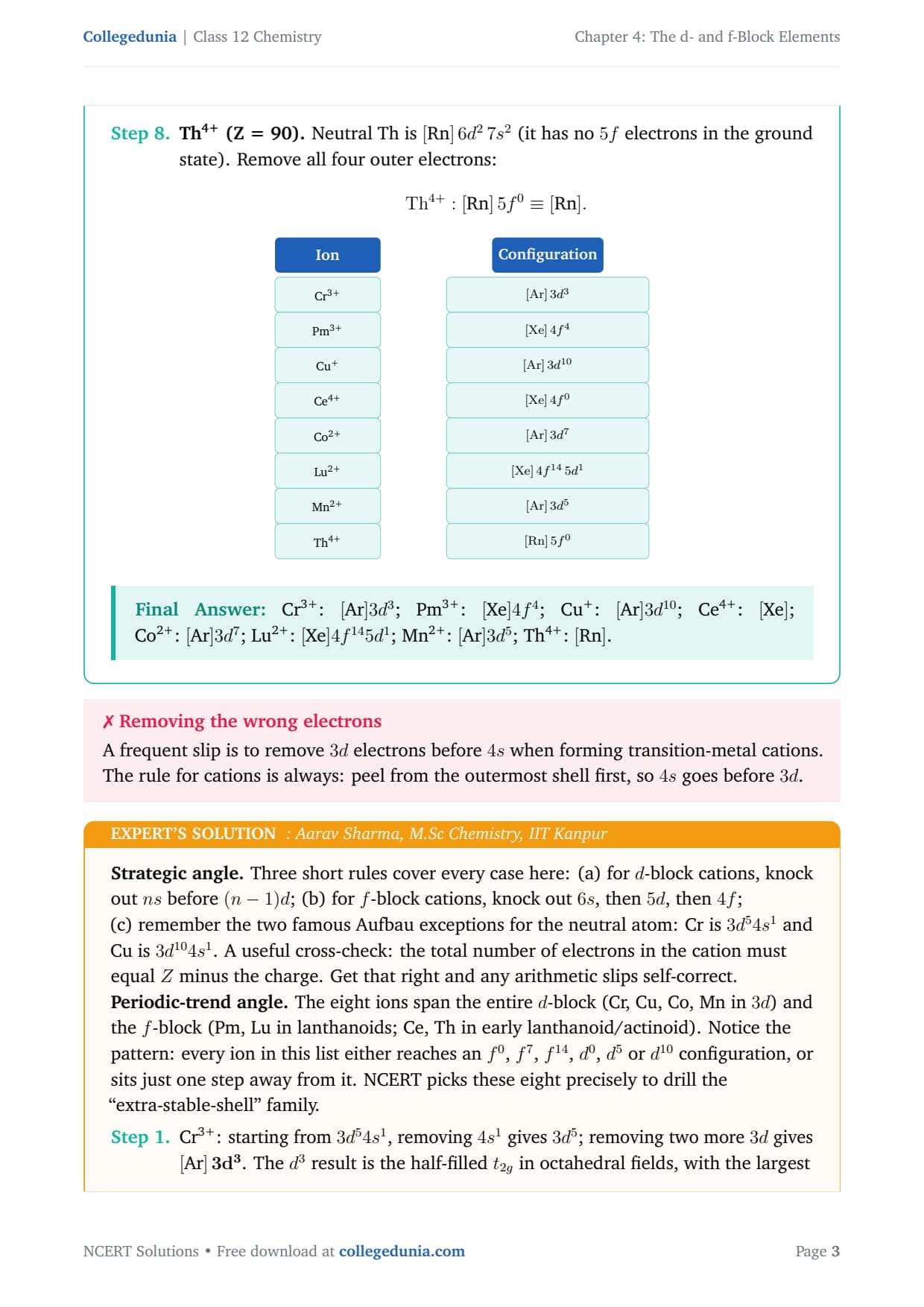
- Th^4+ (Z = 90). Neutral Th is [Rn] 6d2 7s2 (it has no 5f electrons in the ground state). Remove all four outer electrons: Th4+: [Rn] 5f0≡[Rn].
Cr^3+: [Ar]3d3; Pm^3+: [Xe]4f4; Cu+: [Ar]3d10; Ce^4+: [Xe]; Co^2+: [Ar]3d7; Lu^2+: [Xe]4f145d1; Mn^2+: [Ar]3d5; Th^4+: [Rn].
Strategic angle. Three short rules cover every case here: (a) for d-block cations, knock out ns before (n-1)d; (b) for f-block cations, knock out 6s, then 5d, then 4f; (c) remember the two famous Aufbau exceptions for the neutral atom: Cr is 3d54s1 and Cu is 3d104s1. A useful cross-check: the total number of electrons in the cation must equal Z minus the charge. Get that right and any arithmetic slips self-correct.
Periodic-trend angle. The eight ions span the entire d-block (Cr, Cu, Co, Mn in 3d) and the f-block (Pm, Lu in lanthanoids; Ce, Th in early lanthanoid/actinoid). Notice the pattern: every ion in this list either reaches an f0, f7, f14, d0, d5 or d10 configuration, or sits just one step away from it. NCERT picks these eight precisely to drill the ``extra-stable-shell'' family.
- Cr^3+: starting from 3d54s1, removing 4s1 gives 3d5; removing two more 3d gives [Ar] 3d3. The d3 result is the half-filled t2g in octahedral fields, with the largest CFSE per d-electron (-1.2 o total): this is why Cr^3+ dominates Cr chemistry in water.
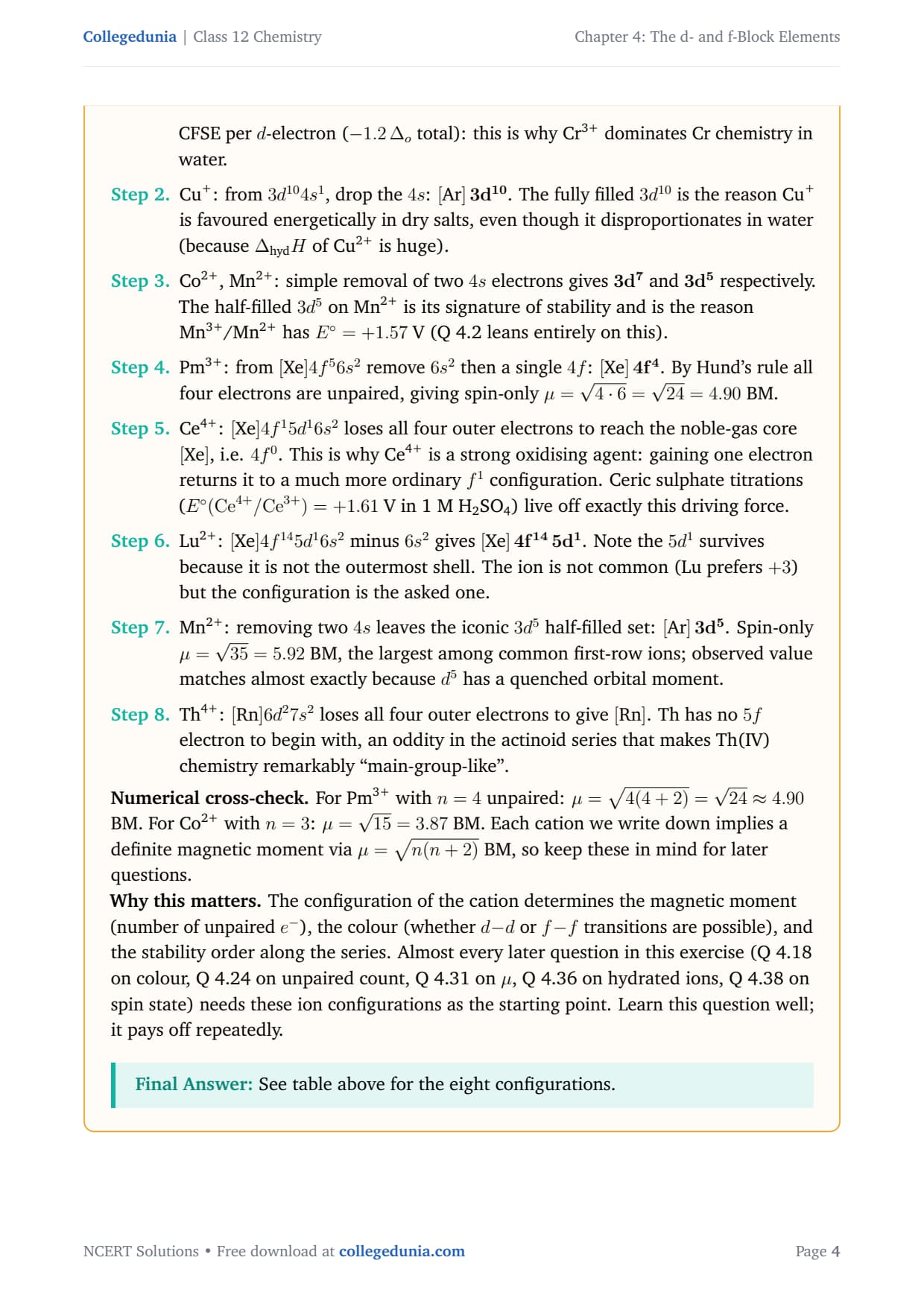
- Cu+: from 3d104s1, drop the 4s: [Ar] 3d10. The fully filled 3d10 is the reason Cu+ is favoured energetically in dry salts, even though it disproportionates in water (because hydH of Cu^2+ is huge).
- Co^2+, Mn^2+: simple removal of two 4s electrons gives 3d7 and 3d5 respectively. The half-filled 3d5 on Mn^2+ is its signature of stability and is the reason Mn^3+/Mn^2+ has E∘ = +1.57 V (Q 4.2 leans entirely on this).
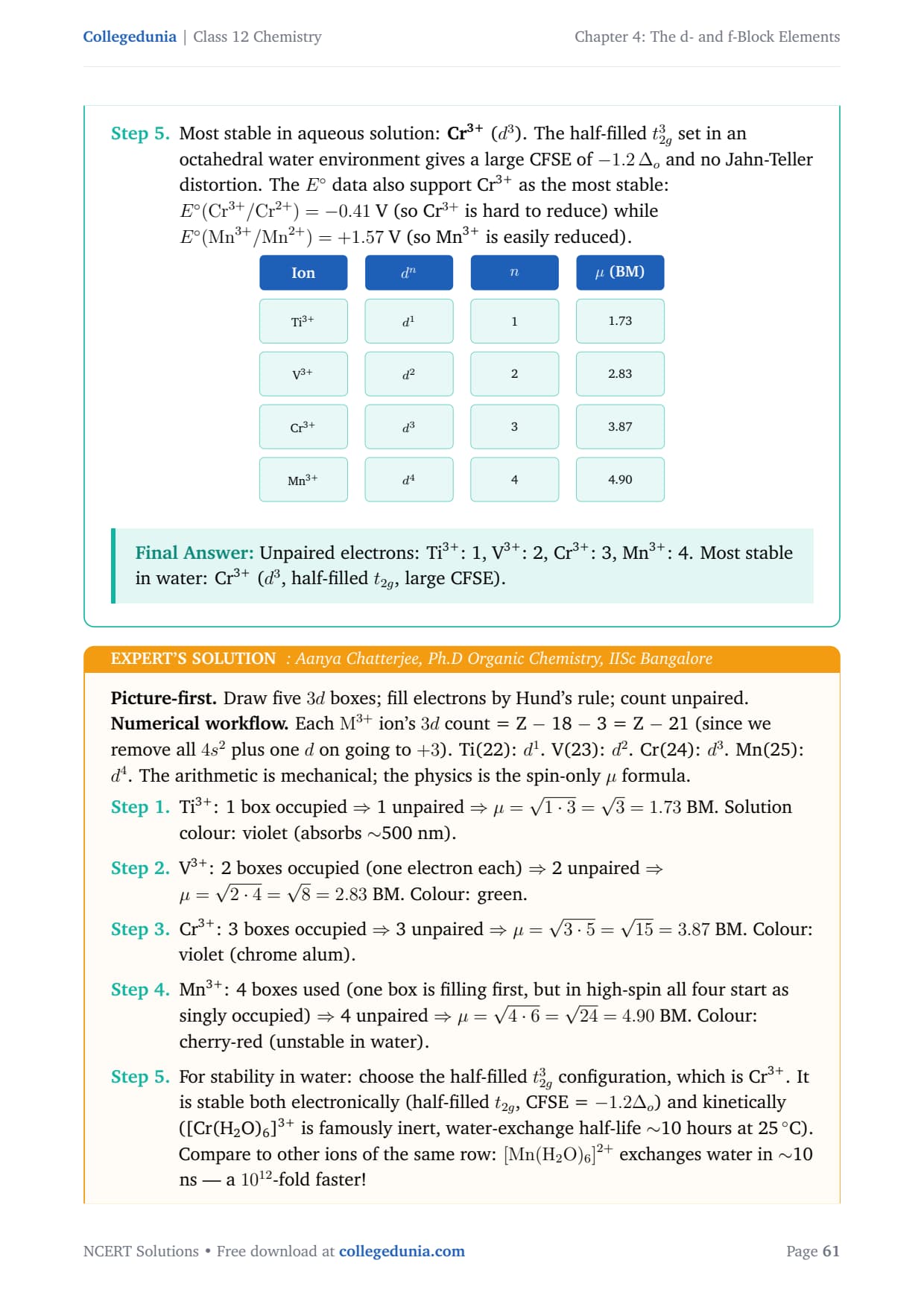
- Pm^3+: from [Xe]4f56s2 remove 6s2 then a single 4f: [Xe] 4f4. By Hund's rule all four electrons are unpaired, giving spin-only μ = √4 · 6 = √24 = 4.90 BM.
- Ce^4+: [Xe]4f15d16s2 loses all four outer electrons to reach the noble-gas core [Xe], i.e. 4f0. This is why Ce^4+ is a strong oxidising agent: gaining one electron returns it to a much more ordinary f1 configuration. Ceric sulphate titrations (E∘(Ce4+/Ce3+) = +1.61 V in 1 M H2SO4) live off exactly this driving force.
- Lu^2+: [Xe]4f145d16s2 minus 6s2 gives [Xe] 4f14 5d1. Note the 5d1 survives because it is not the outermost shell. The ion is not common (Lu prefers +3) but the configuration is the asked one.
- Mn^2+: removing two 4s leaves the iconic 3d5 half-filled set: [Ar] 3d5. Spin-only μ = √35 = 5.92 BM, the largest among common first-row ions; observed value matches almost exactly because d5 has a quenched orbital moment.
- Th^4+: [Rn]6d27s2 loses all four outer electrons to give [Rn]. Th has no 5f electron to begin with, an oddity in the actinoid series that makes Th(IV) chemistry remarkably ``main-group-like''.
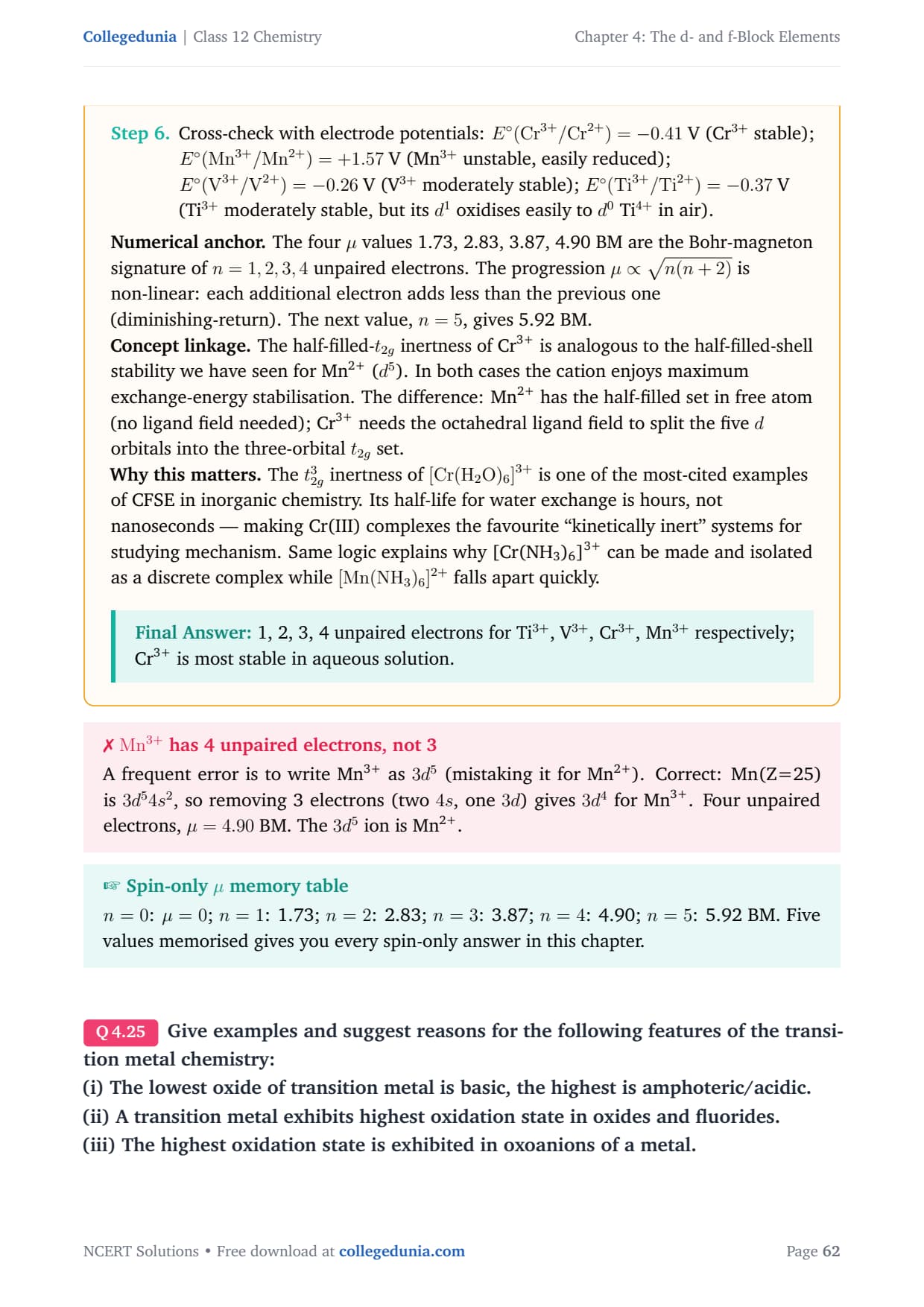
Numerical cross-check. For Pm^3+ with n=4 unpaired: μ = √4(4+2) = √24 ≈ 4.90 BM. For Co^2+ with n=3: μ = √15 = 3.87 BM. Each cation we write down implies a definite magnetic moment via μ = √n(n+2) BM, so keep these in mind for later questions.
Why this matters. The configuration of the cation determines the magnetic moment (number of unpaired e-), the colour (whether d-d or f-f transitions are possible), and the stability order along the series. Almost every later question in this exercise (Q 4.18 on colour, Q 4.24 on unpaired count, Q 4.31 on μ, Q 4.36 on hydrated ions, Q 4.38 on spin state) needs these ion configurations as the starting point. Learn this question well; it pays off repeatedly.
See table above for the eight configurations.
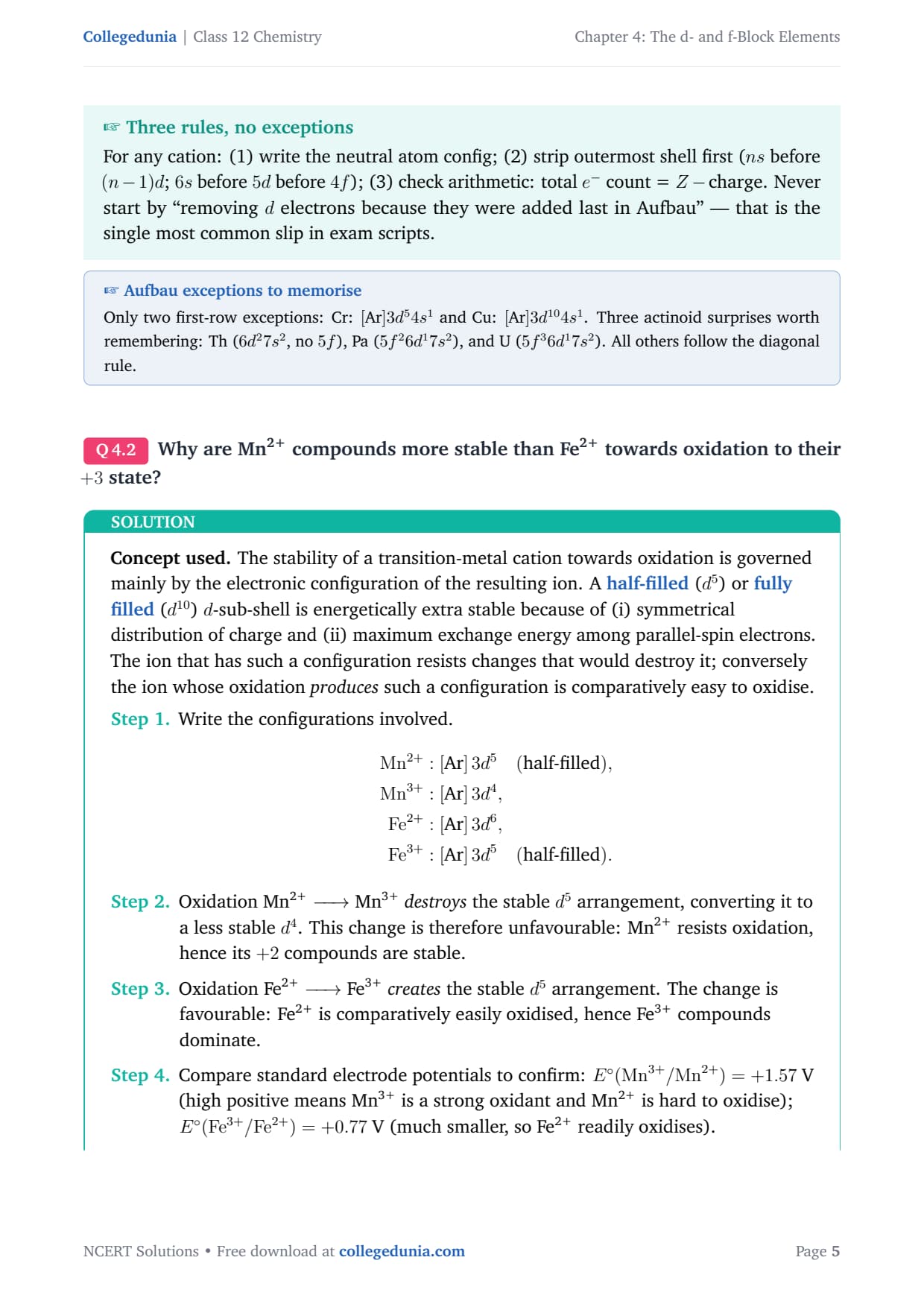
Why are Mn^2+ compounds more stable than Fe^2+ towards oxidation to their +3 state?
Concept used. The stability of a transition-metal cation towards oxidation is governed mainly by the electronic configuration of the resulting ion. A half-filled (d5) or fully filled (d10) d-sub-shell is energetically extra stable because of (i) symmetrical distribution of charge and (ii) maximum exchange energy among parallel-spin electrons. The ion that has such a configuration resists changes that would destroy it; conversely the ion whose oxidation produces such a configuration is comparatively easy to oxidise.
- Write the configurations involved. aligned Mn2+ &: [Ar] 3d5 (half-filled),
Mn3+ &: [Ar] 3d4,
Fe2+ &: [Ar] 3d6,
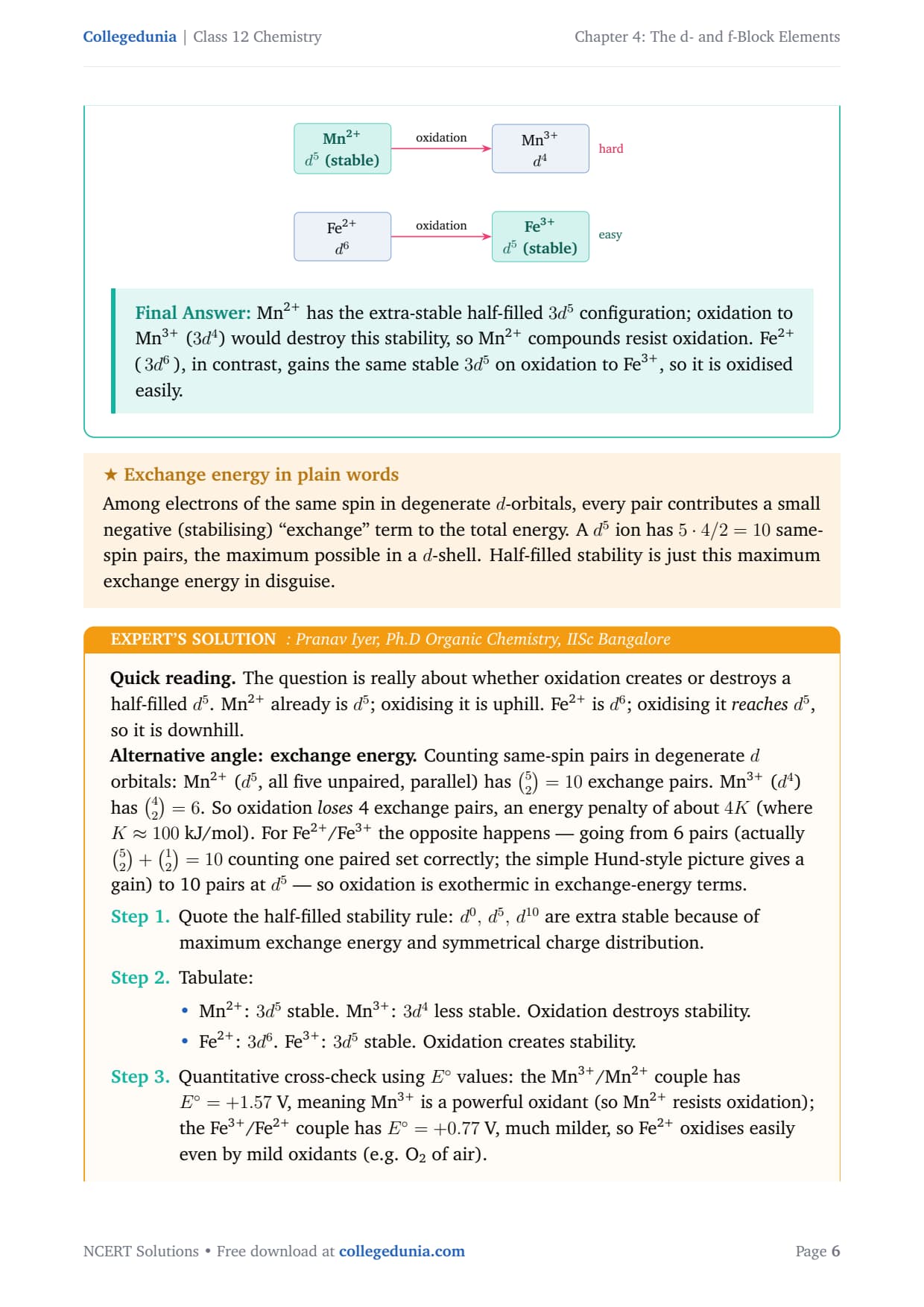
Fe3+ &: [Ar] 3d5 (half-filled). aligned - Oxidation Mn^2+ -> Mn^3+ destroys the stable d5 arrangement, converting it to a less stable d4. This change is therefore unfavourable: Mn^2+ resists oxidation, hence its +2 compounds are stable.
- Oxidation Fe^2+ -> Fe^3+ creates the stable d5 arrangement. The change is favourable: Fe^2+ is comparatively easily oxidised, hence Fe^3+ compounds dominate.
- Compare standard electrode potentials to confirm: E∘(Mn3+/Mn2+) = +1.57 V (high positive means Mn^3+ is a strong oxidant and Mn^2+ is hard to oxidise); E∘(Fe3+/Fe2+) = +0.77 V (much smaller, so Fe^2+ readily oxidises).
Mn^2+ has the extra-stable half-filled 3d5 configuration; oxidation to Mn^3+ (3d4) would destroy this stability, so Mn^2+ compounds resist oxidation. Fe^2+ ( 3d6 ), in contrast, gains the same stable 3d5 on oxidation to Fe^3+, so it is oxidised easily.
Quick reading. The question is really about whether oxidation creates or destroys a half-filled d5. Mn^2+ already is d5; oxidising it is uphill. Fe^2+ is d6; oxidising it reaches d5, so it is downhill.
Alternative angle: exchange energy. Counting same-spin pairs in degenerate d orbitals: Mn^2+ (d5, all five unpaired, parallel) has 52=10 exchange pairs. Mn^3+ (d4) has 42=6. So oxidation loses 4 exchange pairs, an energy penalty of about 4K (where K ≈ 100 kJ/mol). For Fe^2+/Fe^3+ the opposite happens - going from 6 pairs (actually 52+12=10 counting one paired set correctly; the simple Hund-style picture gives a gain) to 10 pairs at d5 - so oxidation is exothermic in exchange-energy terms.
- Quote the half-filled stability rule: d0, d5, d10 are extra stable because of maximum exchange energy and symmetrical charge distribution.
- Tabulate:
- Mn^2+: 3d5 stable. Mn^3+: 3d4 less stable. Oxidation destroys stability.
- Fe^2+: 3d6. Fe^3+: 3d5 stable. Oxidation creates stability.
- Quantitative cross-check using E∘ values: the Mn^3+/Mn^2+ couple has E∘ = +1.57 V, meaning Mn^3+ is a powerful oxidant (so Mn^2+ resists oxidation); the Fe^3+/Fe^2+ couple has E∘ = +0.77 V, much milder, so Fe^2+ oxidises easily even by mild oxidants (e.g. O2 of air).
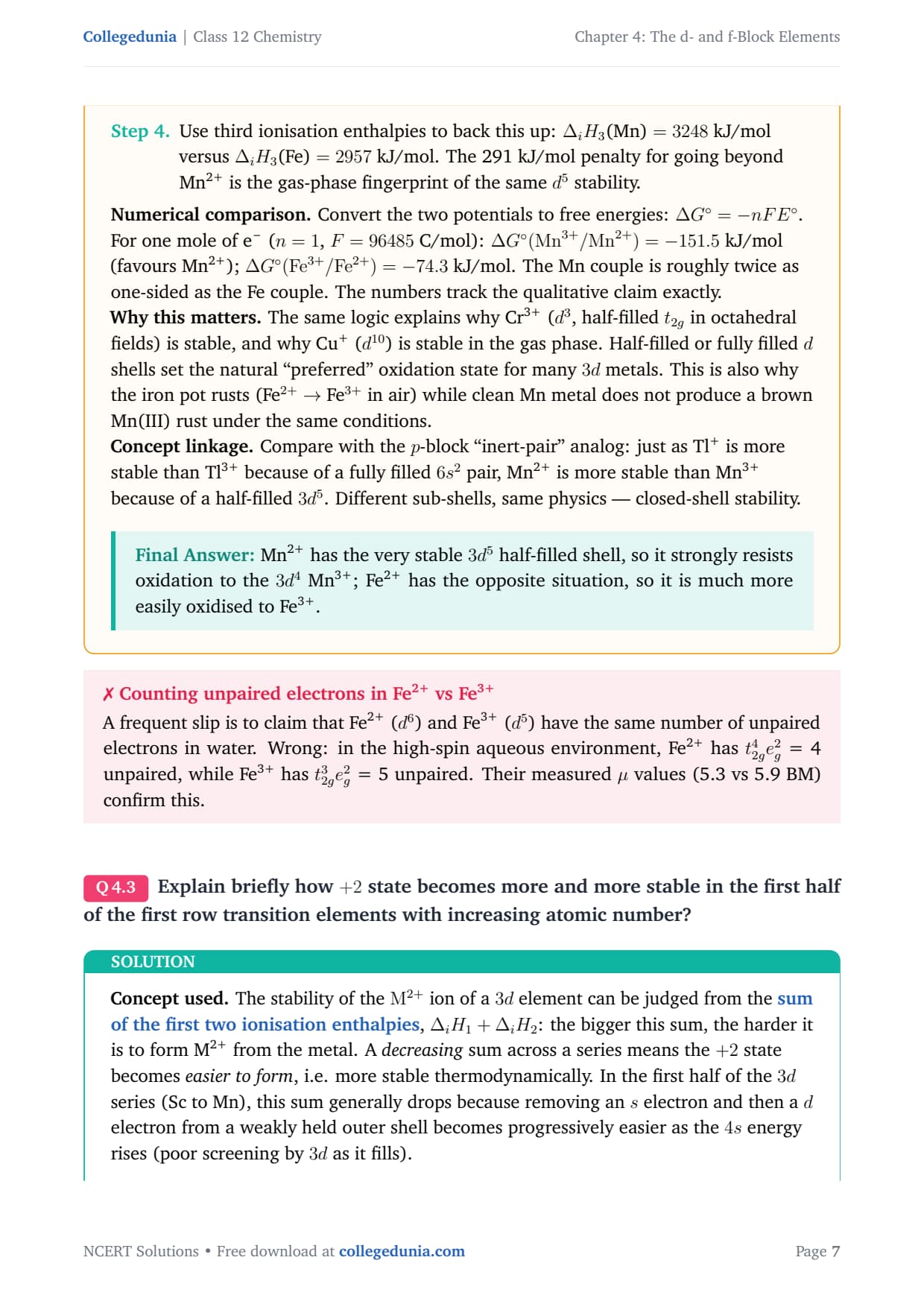
- Use third ionisation enthalpies to back this up: iH3(Mn) = 3248 kJ/mol versus iH3(Fe) = 2957 kJ/mol. The 291 kJ/mol penalty for going beyond Mn^2+ is the gas-phase fingerprint of the same d5 stability.
Numerical comparison. Convert the two potentials to free energies: Δ G∘ = -nFE∘. For one mole of e^- (n=1, F = 96485 C/mol): Δ G∘(Mn3+/Mn2+) = -151.5 kJ/mol (favours Mn^2+); Δ G∘(Fe3+/Fe2+) = -74.3 kJ/mol. The Mn couple is roughly twice as one-sided as the Fe couple. The numbers track the qualitative claim exactly.
Why this matters. The same logic explains why Cr^3+ (d3, half-filled t2g in octahedral fields) is stable, and why Cu+ (d10) is stable in the gas phase. Half-filled or fully filled d shells set the natural ``preferred'' oxidation state for many 3d metals. This is also why the iron pot rusts (Fe2+ → Fe3+ in air) while clean Mn metal does not produce a brown Mn(III) rust under the same conditions.
Concept linkage. Compare with the p-block ``inert-pair'' analog: just as Tl+ is more stable than Tl^3+ because of a fully filled 6s2 pair, Mn^2+ is more stable than Mn^3+ because of a half-filled 3d5. Different sub-shells, same physics - closed-shell stability.
Mn^2+ has the very stable 3d5 half-filled shell, so it strongly resists oxidation to the 3d4 Mn^3+; Fe^2+ has the opposite situation, so it is much more easily oxidised to Fe^3+.
Explain briefly how +2 state becomes more and more stable in the first half of the first row transition elements with increasing atomic number?
Concept used. The stability of the M2+ ion of a 3d element can be judged from the sum of the first two ionisation enthalpies, iH1 + iH2: the bigger this sum, the harder it is to form M^2+ from the metal. A decreasing sum across a series means the +2 state becomes easier to form, i.e. more stable thermodynamically. In the first half of the 3d series (Sc to Mn), this sum generally drops because removing an s electron and then a d electron from a weakly held outer shell becomes progressively easier as the 4s energy rises (poor screening by 3d as it fills).
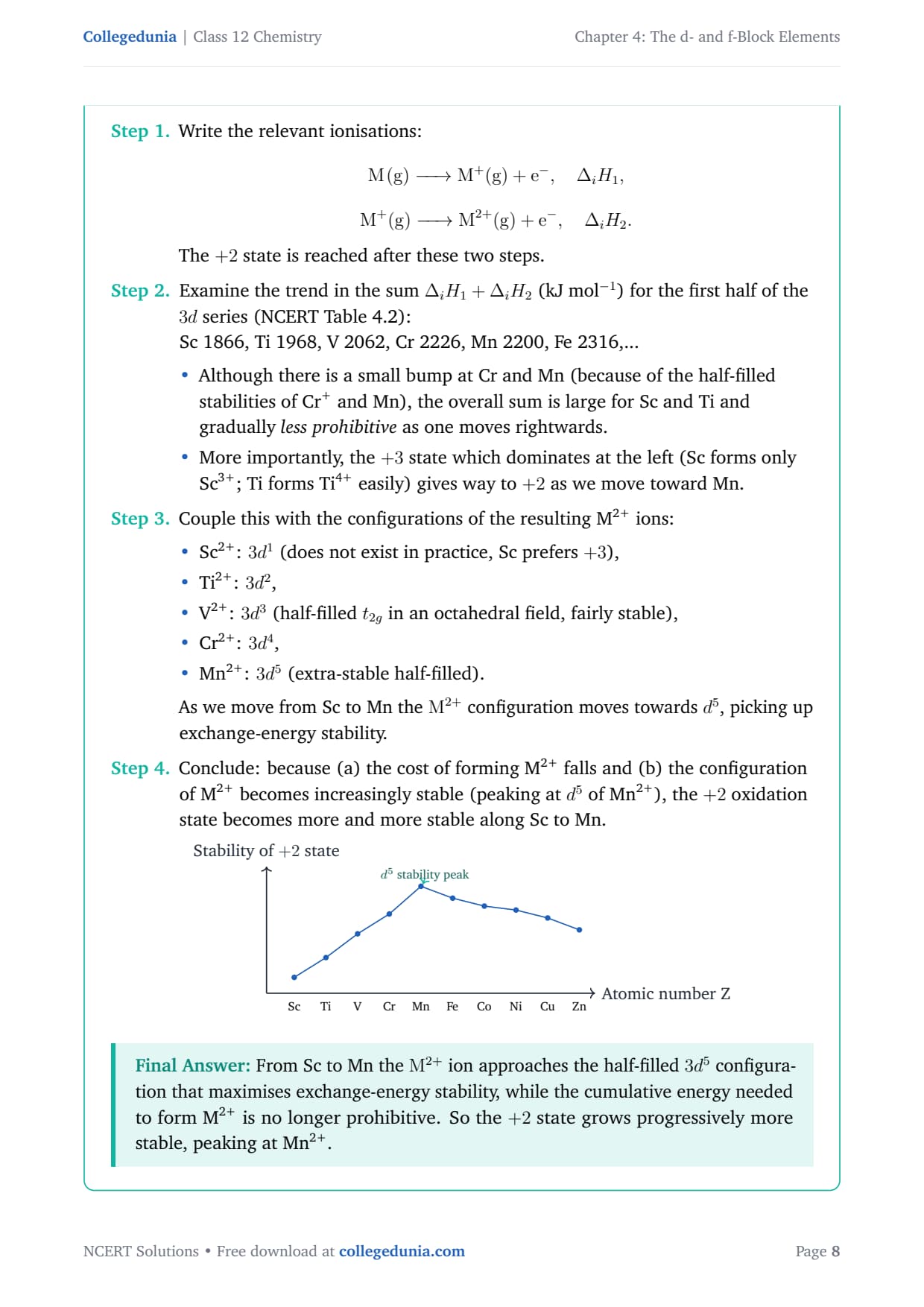
- Write the relevant ionisations: M(g) -> M+(g) + e-, iH1, M+(g) -> M2+(g) + e-, iH2. The +2 state is reached after these two steps.
- Examine the trend in the sum iH1 + iH2 (kJ mol-1) for the first half of the 3d series (NCERT Table 4.2):
Sc 1866, Ti 1968, V 2062, Cr 2226, Mn 2200, Fe 2316,...- Although there is a small bump at Cr and Mn (because of the half-filled stabilities of Cr+ and Mn), the overall sum is large for Sc and Ti and gradually less prohibitive as one moves rightwards.
- More importantly, the +3 state which dominates at the left (Sc forms only Sc^3+; Ti forms Ti^4+ easily) gives way to +2 as we move toward Mn.
- Couple this with the configurations of the resulting M^2+ ions:
- Sc^2+: 3d1 (does not exist in practice, Sc prefers +3),
- Ti^2+: 3d2,
- V^2+: 3d3 (half-filled t2g in an octahedral field, fairly stable),
- Cr^2+: 3d4,
- Mn^2+: 3d5 (extra-stable half-filled).
- Conclude: because (a) the cost of forming M^2+ falls and (b) the configuration of M^2+ becomes increasingly stable (peaking at d5 of Mn^2+), the +2 oxidation state becomes more and more stable along Sc to Mn.
From Sc to Mn the M2+ ion approaches the half-filled 3d5 configuration that maximises exchange-energy stability, while the cumulative energy needed to form M^2+ is no longer prohibitive. So the +2 state grows progressively more stable, peaking at Mn^2+.
Strategic angle. Two factors operate together: a thermodynamic one (ionisation enthalpies) and an electronic-structure one (exchange-energy stabilisation as we approach d5). Discuss both, then combine.
Periodic-trend angle. Across any transition row the effective nuclear charge Zeff on the 3d shell increases slowly because each added 3d electron is itself a poor shielder (σ ≈ 0.35 per inner-row electron, by Slater's rules). So the 3d electrons become progressively easier to ``hold'' inside the cation, but the 4s ones remain easy to remove. This sets up the sweet spot in the middle of the row where +2 is most accessible.
- State the ionisation cost: across Sc to Mn the iH1 + iH2 does not rise dramatically; with the gain in lattice/hydration energy of M^2+ salts, the +2 state becomes accessible. Numerical evidence: hydH of Mn^2+ is -1841 kJ/mol; this more than offsets the +2200 kJ/mol cost of double ionisation.
- Look at the resulting d-electron count for M^2+: Ti(d2), V(d3), Cr(d4), Mn(d5). The number of unpaired electrons climbs from 2 to 5; exchange-energy stabilisation ∝ K n2 where K is the exchange constant and n is the number of parallel spins. Going from n=2 to n=5 multiplies the exchange contribution from 22=1 pair to 52=10 pairs, a tenfold rise. This single factor essentially explains the trend.
- Note the maximum: at Mn^2+ (d5) the +2 state is at peak stability. Past Mn the +2 state has d6, d7, … which lose the half-filled symmetry, so its stability falls slightly even though it is still the dominant state through Fe and Ni.
- Confirmation from E∘(M2+/M) data: values become less negative on average from Sc to Cu but show a clear dip (more negative) at Mn (-1.18 V) compared with the rough trend, exactly because Mn^2+ has extra d5 stability.
Numerical cross-check. Spin-only μ = √n(n+2) for Mn^2+: √5 · 7 = 5.92 BM (observed ≈ 5.9 BM). Such a clean match also confirms five unpaired electrons in the ground state of Mn^2+, which is the source of its stability.
Concept linkage. The same exchange-energy argument predicts the half-filled stability of Cr^2+/Cr^3+ (Cr3+ is d3, half-filled t2g) and the d5 stability of Fe^3+ (next chapter, Q 4.21). One rule, three applications.
Why this matters. This trend is why MnSO4, FeSO4, CoSO4, NiSO4 are all common laboratory salts of +2 oxidation, but Sc^2+ salts are not isolable. It also explains why Mohr's salt ((NH4)2Fe(SO4)2.6H2O) and Mn-based primary standards exist while Sc(II) standards do not.
Combination of decreasing ionisation cost and increasing exchange-energy stabilisation (peaking at d5, i.e. Mn^2+) makes the +2 state progressively more stable from Sc to Mn.
To what extent do the electronic configurations decide the stability of oxidation states in the first series of the transition elements? Illustrate your answer with examples.
Concept used. The stability of an oxidation state of a 3d transition metal correlates strongly with the resulting d-electron configuration of the cation, because:
- Half-filled (d5) and fully filled (d10) configurations are unusually stable (maximum exchange energy / fully paired symmetric charge).
- Empty d0 is also fairly stable (often achieved by the leftmost elements: Sc as d0, Ti as d0, V as d0).
- Configurations far from these benchmarks are typically less stable.
- Sc (Z = 21): configuration 3d14s2. Only Sc^3+ (d0) is observed in compounds because +3 empties the d shell completely (very stable). Sc^2+ (d1) is essentially unknown.
- Ti (Z = 22): 3d24s2. +4 (d0) is the dominant state (TiO2, TiCl4); +3 (d1, in TiCl3, violet) is less stable and is a reducing agent.
- V (Z = 23): 3d34s2. Stable in +5 (d0: V2O5), +4 (d1: VO^2+), +3 (d2) and even +2 (d3, half-filled t2g).
- Cr (Z = 24): 3d54s1. +3 (Cr^3+, d3, half-filled t2g in octahedral fields with strong CFSE) is the most stable; +6 (d0) is also prominent (Cr2O7^2-, CrO4^2-).
- Mn (Z = 25): 3d54s2. Mn^2+ (d5) is the most stable state; Mn^7+ (d0, in MnO4-) is also distinct, but a strong oxidant.
- Fe (Z = 26): 3d64s2. +2 and +3 are both common; +3 (d5, half-filled) is somewhat more stable than +2 (d6).
- Cu (Z = 29): 3d104s1. Cu+ (d10) is very stable in solid salts and gas phase but disproportionates in water because of large hydration energy of Cu^2+: 2 Cu+ -> Cu2+ + Cu. So in aqueous solution Cu^2+ (d9) dominates anyway, showing that configuration alone does not decide the answer.
- Zn (Z = 30): 3d104s2. Zn^2+ (d10) is the only stable state. The full d10 is so stable that higher oxidation is essentially unknown for Zn.
Electronic configuration is the primary factor: oxidation states that leave the cation with d0, d5 or d10 tend to be most stable. So Sc favours +3 ( d0 ), Mn favours +2 ( d5 ), Fe favours +3 ( d5 ), Zn favours +2 ( d10 ) and Cu favours +1 ( d10 ) in solids. Hydration and ligand-field effects can then shift the preference in solution.
Structural observation. Group the 3d elements into three ``configuration zones'' and pick one example per zone:
- Zone 1 (left, d0 favourable): Sc only +3, Ti mainly +4, V often +5.
- Zone 2 (middle, d5 favourable): Mn +2, Fe +3, Cr +3.
- Zone 3 (right, d10 favourable): Cu +1 (solid), Zn +2 only.
Periodic-trend angle. Look at the maximum oxidation state along the row: Sc (+3), Ti (+4), V (+5), Cr (+6), Mn (+7), then it falls - Fe (+6, rare), Co (+4, rare), Ni (+4, rare). The rise to Mn matches loss of all valence electrons; the fall after Mn is because beyond d5 each further ionisation breaks the half-filled shell and costs increasingly more energy. So the oxidation-state ladder traces the cation's distance from d0, d5 and d10.
- Use TiO2 as the Zone-1 example: Ti in +4 has [Ar]3d0. Empty d is colourless, diamagnetic, and chemically robust. Ti^3+ (d1) is purple and a reducing agent - exactly because it is one e- away from the stable d0.
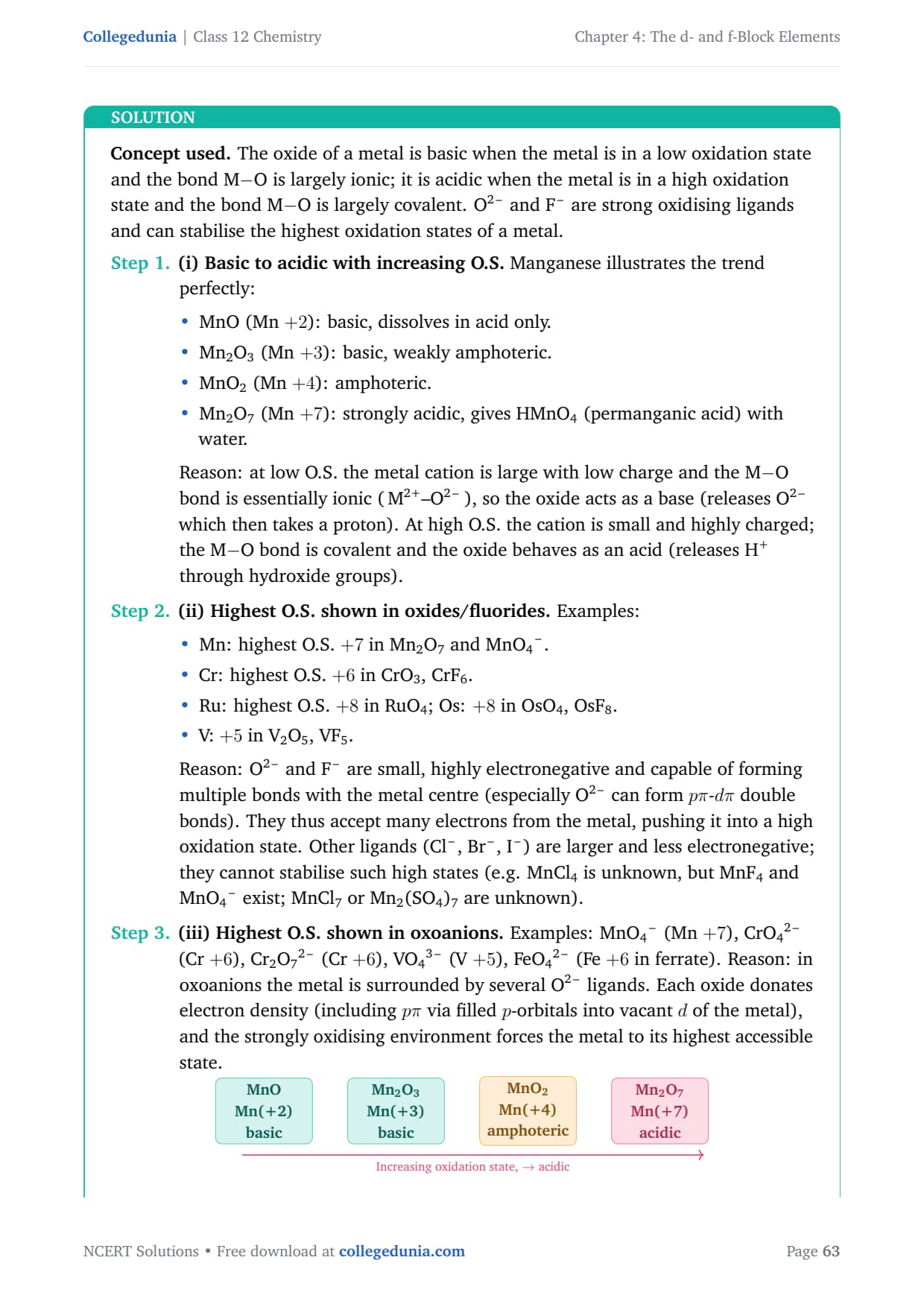
- Use MnO4- versus Mn^2+ for Zone 2: MnO4- has Mn in +7 (d0, strongly oxidising in acidic medium), Mn^2+ has d5 (very stable, pale pink, weakly coloured). Two stable extremes, both configuration-driven on the same atom.
- Use ZnSO4 for Zone 3: Zn^2+ is d10, colourless, diamagnetic, monolithic oxidation state. Zn^2+ simply has no chemistry above +2 - the d10 shell is so stable that further ionisation is prohibitive.
- Note exceptions where environment overrides configuration: Cu+ (d10) is unstable in water (disproportionates) even though configuration says it should be stable. The culprit is the very large hydH(Cu^2+) of -2099 kJ/mol versus -582 kJ/mol for Cu+, which more than offsets the second ionisation cost.
- Configuration also rules out unstable states. For example Cr^4+ (d2) and Mn^5+ (d2) are not common because they sit awkwardly between the two configuration-stable poles (d0 and d5).
Numerical anchor. For Mn^2+: E∘(Mn3+/Mn2+) = +1.57 V, indicating Mn^3+ is a powerful oxidant. For Sc^3+: E∘(Sc3+/Sc) = -2.08 V, the most negative in the 3d row, marking Sc as a strongly electropositive metal whose only ion is d0. The data and the rule agree.
Concept linkage. The same ``approach a closed shell'' logic operates in the f-block: Ce^4+ (f0), Eu^2+ (f7), Yb^2+ (f14). And in the p-block: Tl+ (inert 6s2 pair), Pb^2+, Bi^3+. The unifying idea is that closed and half-closed shells set the preferred oxidation state.
Why this matters. On a board exam the marker rewards both the rule and one or two concrete examples. The rule alone is not enough; pair it with two or three named cases. JEE/NEET further test this with ``why is Mn^3+ a stronger oxidant than Cr^3+'' or ``predict the most stable oxidation state of 3dx4s2'' type questions - all variants of the same configuration argument.
Configurations d0, d5, d10 confer extra stability on the corresponding oxidation state; this picks out Sc3+, Mn2+, Fe3+, Zn2+, Cu+ as preferred states across the first series.
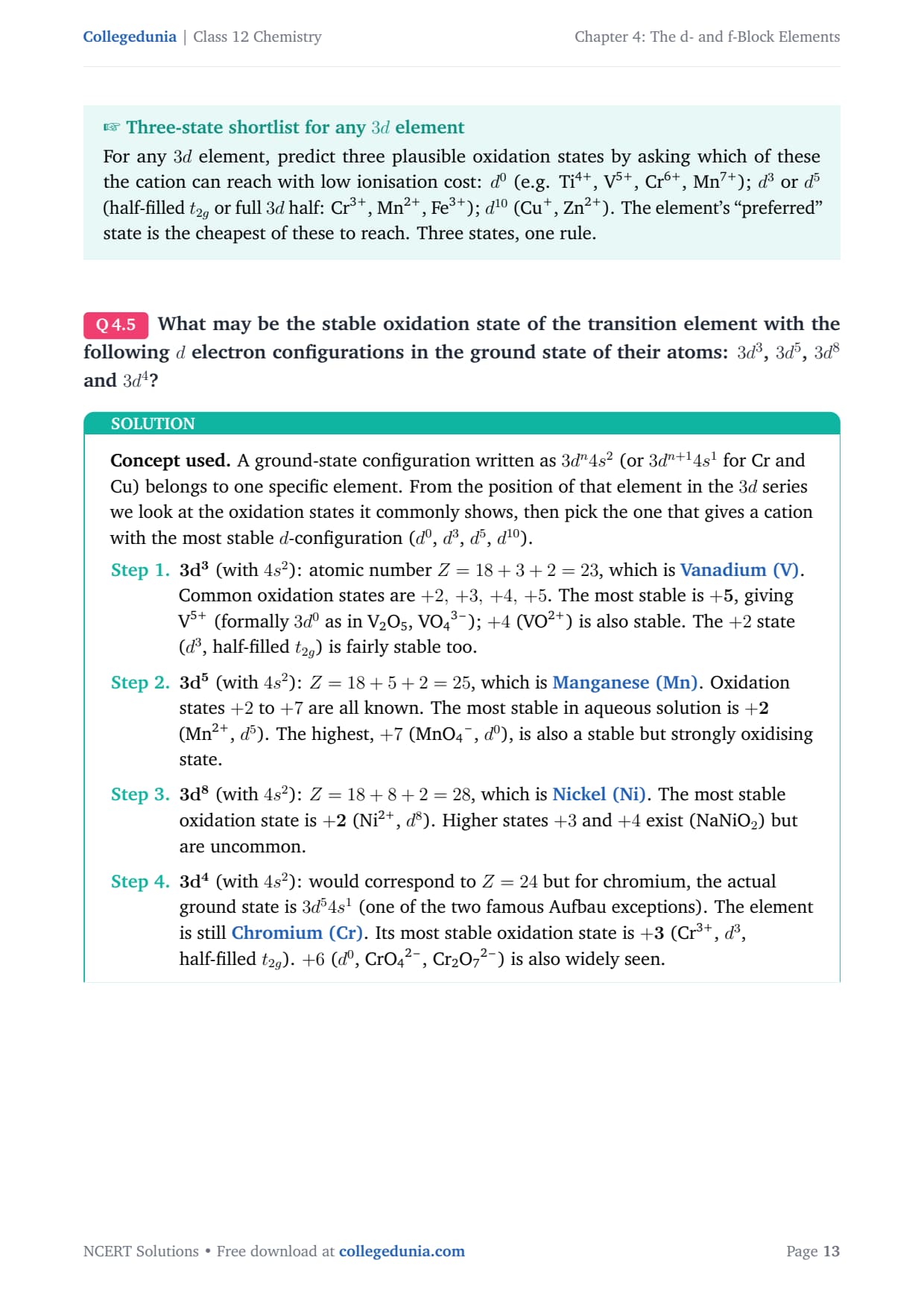
What may be the stable oxidation state of the transition element with the following d electron configurations in the ground state of their atoms: 3d3, 3d5, 3d8 and 3d4?
Concept used. A ground-state configuration written as 3dn4s2 (or 3dn+14s1 for Cr and Cu) belongs to one specific element. From the position of that element in the 3d series we look at the oxidation states it commonly shows, then pick the one that gives a cation with the most stable d-configuration (d0, d3, d5, d10).
- 3d3 (with 4s2): atomic number Z = 18 + 3 + 2 = 23, which is Vanadium (V). Common oxidation states are +2, +3, +4, +5. The most stable is +5, giving V^5+ (formally 3d0 as in V2O5, VO4^3-); +4 (VO^2+) is also stable. The +2 state (d3, half-filled t2g) is fairly stable too.
- 3d5 (with 4s2): Z = 18 + 5 + 2 = 25, which is Manganese (Mn). Oxidation states +2 to +7 are all known. The most stable in aqueous solution is +2 (Mn^2+, d5). The highest, +7 (MnO4-, d0), is also a stable but strongly oxidising state.
- 3d8 (with 4s2): Z = 18 + 8 + 2 = 28, which is Nickel (Ni). The most stable oxidation state is +2 (Ni^2+, d8). Higher states +3 and +4 exist (NaNiO2) but are uncommon.
- 3d4 (with 4s2): would correspond to Z = 24 but for chromium, the actual ground state is 3d54s1 (one of the two famous Aufbau exceptions). The element is still Chromium (Cr). Its most stable oxidation state is +3 (Cr^3+, d3, half-filled t2g). +6 (d0, CrO4^2-, Cr2O7^2-) is also widely seen.
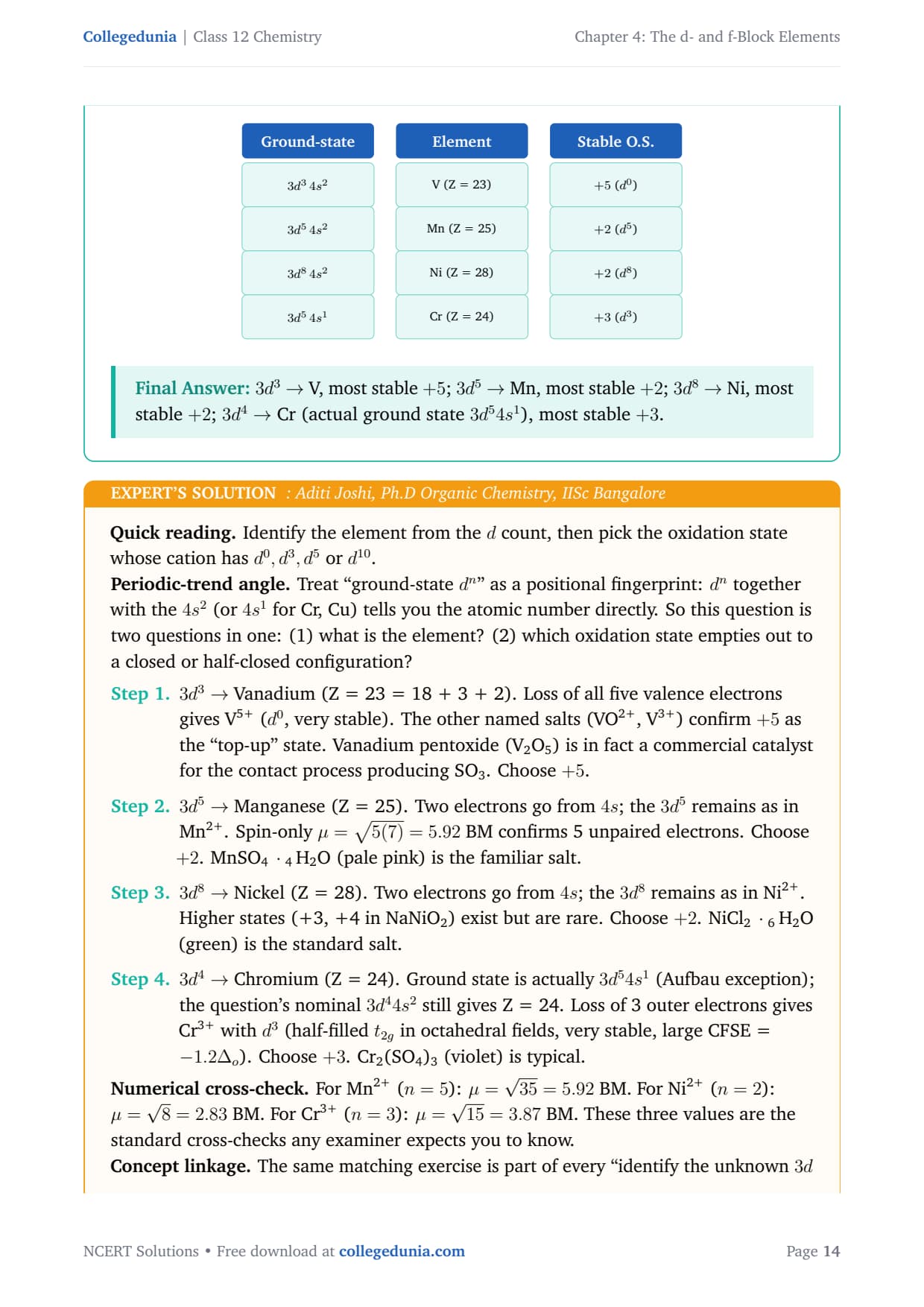
3d3 → V, most stable +5; 3d5 → Mn, most stable +2; 3d8 → Ni, most stable +2; 3d4 → Cr (actual ground state 3d54s1), most stable +3.
Quick reading. Identify the element from the d count, then pick the oxidation state whose cation has d0, d3, d5 or d10.
Periodic-trend angle. Treat ``ground-state dn'' as a positional fingerprint: dn together with the 4s2 (or 4s1 for Cr, Cu) tells you the atomic number directly. So this question is two questions in one: (1) what is the element? (2) which oxidation state empties out to a closed or half-closed configuration?
- 3d3 → Vanadium (Z = 23 = 18 + 3 + 2). Loss of all five valence electrons gives V^5+ (d0, very stable). The other named salts (VO^2+, V^3+) confirm +5 as the ``top-up'' state. Vanadium pentoxide (V2O5) is in fact a commercial catalyst for the contact process producing SO3. Choose +5.
- 3d5 → Manganese (Z = 25). Two electrons go from 4s; the 3d5 remains as in Mn^2+. Spin-only μ = √5(7) = 5.92 BM confirms 5 unpaired electrons. Choose +2. MnSO4 4 H2O (pale pink) is the familiar salt.
- 3d8 → Nickel (Z = 28). Two electrons go from 4s; the 3d8 remains as in Ni^2+. Higher states (+3, +4 in NaNiO2) exist but are rare. Choose +2. NiCl2 6 H2O (green) is the standard salt.
- 3d4 → Chromium (Z = 24). Ground state is actually 3d54s1 (Aufbau exception); the question's nominal 3d44s2 still gives Z = 24. Loss of 3 outer electrons gives Cr^3+ with d3 (half-filled t2g in octahedral fields, very stable, large CFSE = -1.2o). Choose +3. Cr2(SO4)3 (violet) is typical.
Numerical cross-check. For Mn^2+ (n=5): μ = √35 = 5.92 BM. For Ni^2+ (n=2): μ = √8 = 2.83 BM. For Cr^3+ (n=3): μ = √15 = 3.87 BM. These three values are the standard cross-checks any examiner expects you to know.
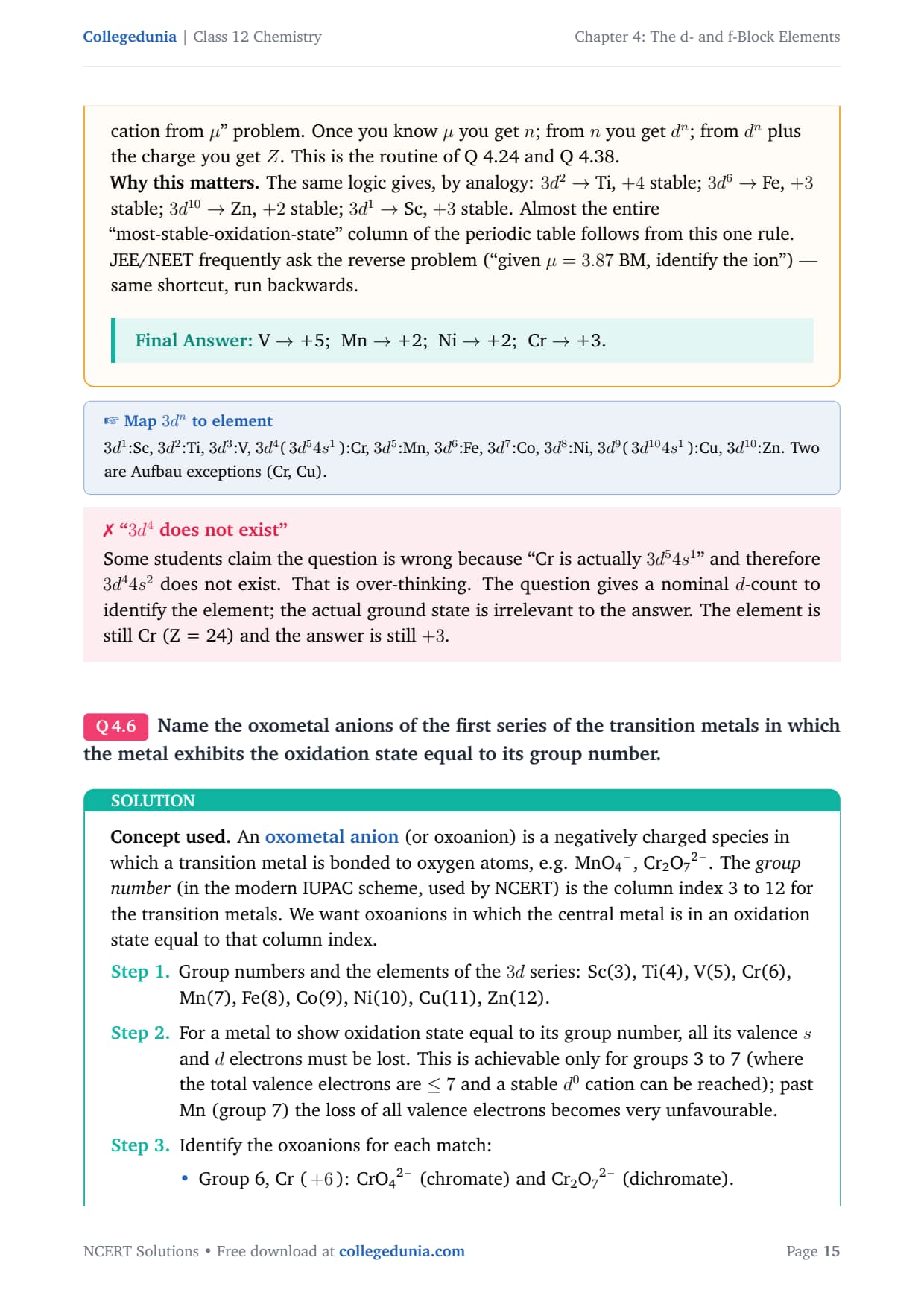
Concept linkage. The same matching exercise is part of every ``identify the unknown 3d cation from μ'' problem. Once you know μ you get n; from n you get dn; from dn plus the charge you get Z. This is the routine of Q 4.24 and Q 4.38.
Why this matters. The same logic gives, by analogy: 3d2 → Ti, +4 stable; 3d6 → Fe, +3 stable; 3d10 → Zn, +2 stable; 3d1 → Sc, +3 stable. Almost the entire ``most-stable-oxidation-state'' column of the periodic table follows from this one rule. JEE/NEET frequently ask the reverse problem (``given μ = 3.87 BM, identify the ion'') - same shortcut, run backwards.
V → +5; Mn → +2; Ni → +2; Cr → +3.
Name the oxometal anions of the first series of the transition metals in which the metal exhibits the oxidation state equal to its group number.
Concept used. An oxometal anion (or oxoanion) is a negatively charged species in which a transition metal is bonded to oxygen atoms, e.g. MnO4-, Cr2O7^2-. The group number (in the modern IUPAC scheme, used by NCERT) is the column index 3 to 12 for the transition metals. We want oxoanions in which the central metal is in an oxidation state equal to that column index.
- Group numbers and the elements of the 3d series: Sc(3), Ti(4), V(5), Cr(6), Mn(7), Fe(8), Co(9), Ni(10), Cu(11), Zn(12).
- For a metal to show oxidation state equal to its group number, all its valence s and d electrons must be lost. This is achievable only for groups 3 to 7 (where the total valence electrons are ≤ 7 and a stable d0 cation can be reached); past Mn (group 7) the loss of all valence electrons becomes very unfavourable.
- Identify the oxoanions for each match:
- Group 6, Cr ( +6 ): CrO4^2- (chromate) and Cr2O7^2- (dichromate).
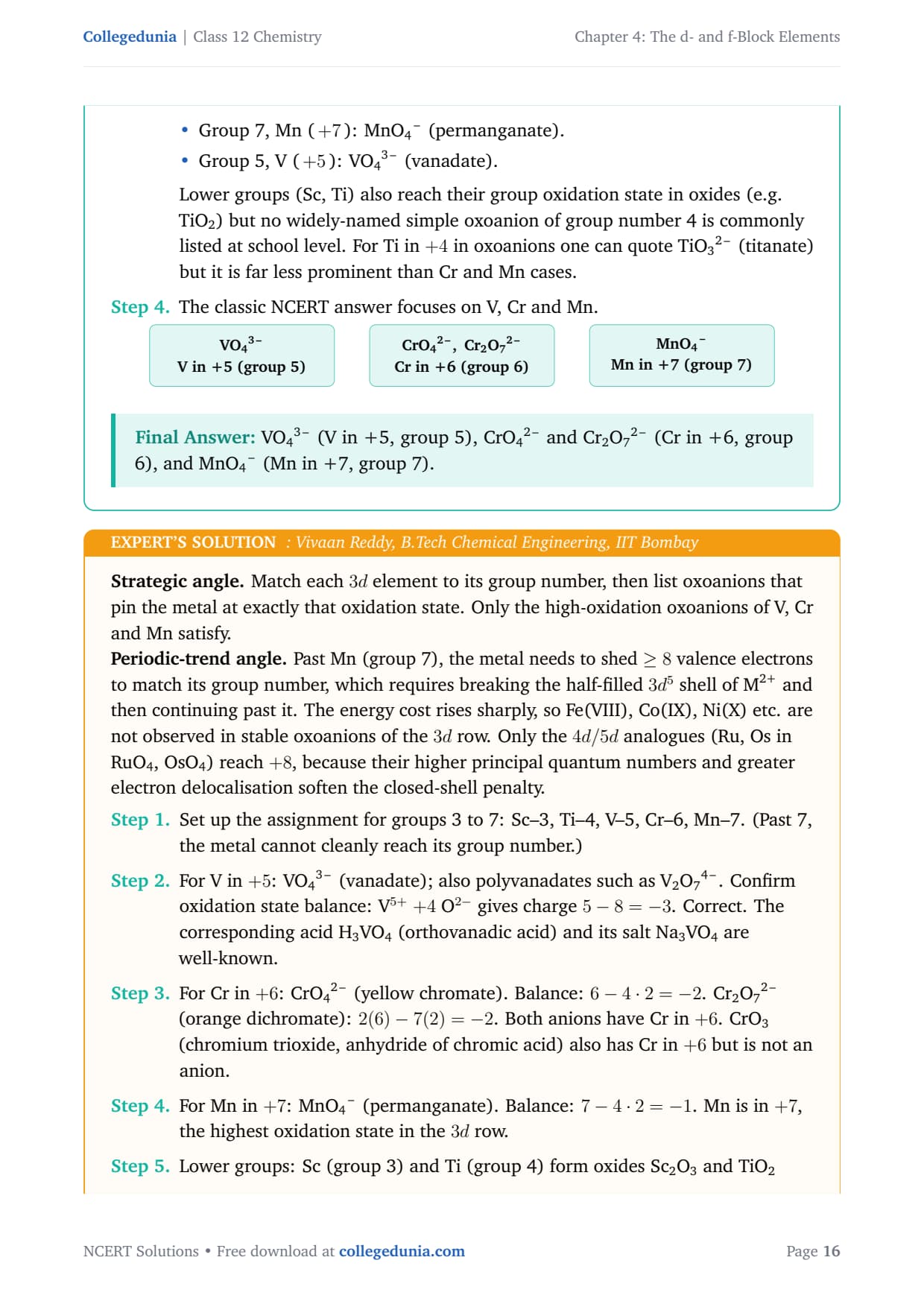
- Group 7, Mn ( +7 ): MnO4- (permanganate).
- Group 5, V ( +5 ): VO4^3- (vanadate).
- The classic NCERT answer focuses on V, Cr and Mn.
VO4^3- (V in +5, group 5), CrO4^2- and Cr2O7^2- (Cr in +6, group 6), and MnO4- (Mn in +7, group 7).
Strategic angle. Match each 3d element to its group number, then list oxoanions that pin the metal at exactly that oxidation state. Only the high-oxidation oxoanions of V, Cr and Mn satisfy.
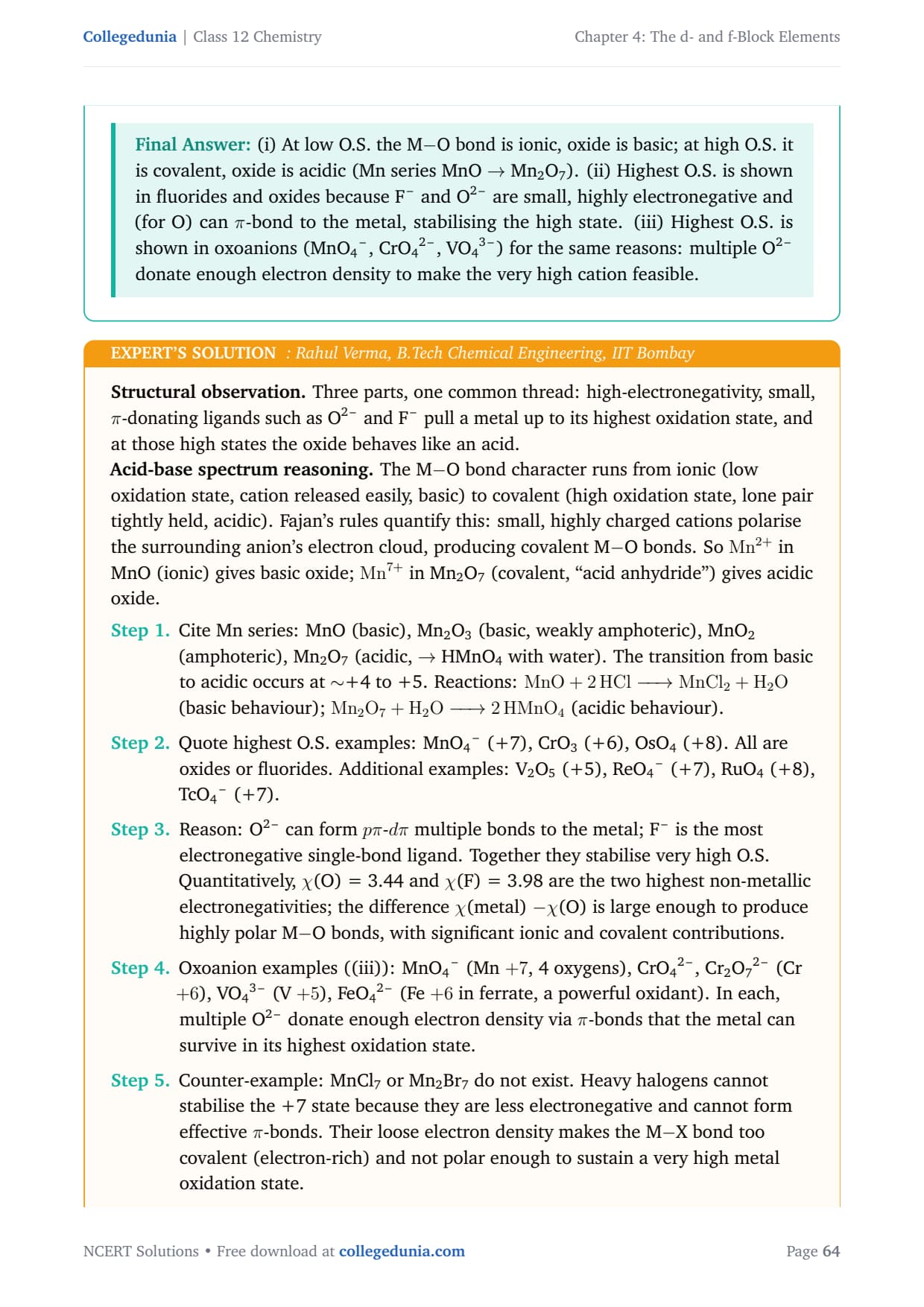
Periodic-trend angle. Past Mn (group 7), the metal needs to shed ≥ 8 valence electrons to match its group number, which requires breaking the half-filled 3d5 shell of M^2+ and then continuing past it. The energy cost rises sharply, so Fe(VIII), Co(IX), Ni(X) etc. are not observed in stable oxoanions of the 3d row. Only the 4d/5d analogues (Ru, Os in RuO4, OsO4) reach +8, because their higher principal quantum numbers and greater electron delocalisation soften the closed-shell penalty.
- Set up the assignment for groups 3 to 7: Sc–3, Ti–4, V–5, Cr–6, Mn–7. (Past 7, the metal cannot cleanly reach its group number.)
- For V in +5: VO4^3- (vanadate); also polyvanadates such as V2O7^4-. Confirm oxidation state balance: V5+ + 4 O2- gives charge 5 - 8 = -3. Correct. The corresponding acid H3VO4 (orthovanadic acid) and its salt Na3VO4 are well-known.
- For Cr in +6: CrO4^2- (yellow chromate). Balance: 6 - 4 · 2 = -2. Cr2O7^2- (orange dichromate): 2(6) - 7(2) = -2. Both anions have Cr in +6. CrO3 (chromium trioxide, anhydride of chromic acid) also has Cr in +6 but is not an anion.
- For Mn in +7: MnO4- (permanganate). Balance: 7 - 4 · 2 = -1. Mn is in +7, the highest oxidation state in the 3d row.
- Lower groups: Sc (group 3) and Ti (group 4) form oxides Sc2O3 and TiO2 where the metal is in the group oxidation state, but the corresponding simple oxoanions ScO3^3- or TiO3^2- are uncommon at the school level and so are usually omitted. The classic answer focuses on V, Cr, Mn.
Numerical cross-check. Oxidation state of metal × 1 + ∑(O charges) = net charge of the anion. For Cr2O7^2-: 2(+6) + 7(-2) = -2. For MnO4-: (+7) + 4(-2) = -1. For VO4^3-: (+5) + 4(-2) = -3. All check out.
Concept linkage. Higher group numbers reachable by heavier d-block: Ru(VIII) in RuO4, Os(VIII) in OsO4, Tc(VII) in TcO4-, Re(VII) in ReO4-. The capacity to reach group number grows down the group because larger atoms can accommodate more bonded oxygens.
Why this matters. These are exactly the oxoanions whose chemistry the chapter studies in detail (K2Cr2O7, KMnO4). Their oxidising power follows from the very high formal oxidation state of the metal: a small, highly charged Cr(VI) or Mn(VII) centre is hungry for electrons.
VO4^3-, CrO4^2-, Cr2O7^2-, MnO4-.
What is lanthanoid contraction? What are the consequences of lanthanoid contraction?
Concept used. Lanthanoid contraction is the steady, almost regular decrease in atomic and ionic radii of the lanthanoids (Z = 57 to 71) as the atomic number rises. The cause is poor shielding by the 4f electrons: as one moves through Ce to Lu the nuclear charge increases by one each step, but the added 4f electron screens the outer 5d / 6s electrons only weakly because 4f orbitals are very diffuse in the angular direction yet penetrate poorly. So the effective nuclear charge experienced by the outer electrons rises and the outer shell pulls in.
- Quantify the contraction. Atomic radius drops from ≈ 187 pm (La) to ≈ 173 pm (Lu); ionic radius of Ln^3+ drops from ≈ 103 pm (La^3+) to ≈ 86 pm (Lu^3+). A total fall of about 14–18 pm across 14 elements: roughly 1 pm per element.
- Reason: in moving through the lanthanoids the added electron goes into a 4f orbital. The shielding constant of a 4f electron is much smaller than 1, so each successive nuclear charge increment is only partly cancelled. The effective nuclear charge Zeff = Z - σ rises steadily, and the orbitals contract.
Consequences:
- Almost identical radii of second-row (4d) and third-row (5d) transition metals. For example r(Zr) ≈ r(Hf) ≈ 159 pm, r(Nb) ≈ r(Ta), r(Mo) ≈ r(W). So Zr and Hf, Nb and Ta, Mo and W are chemically very similar and difficult to separate.
- Similarity of properties along the lanthanoid series. Because the radii change so little, the chemical behaviour of all +3 lanthanoids is almost the same; their separation requires ion-exchange or solvent-extraction techniques exploiting tiny differences.
- Increasing density of 5d metals. The post-lanthanoid 5d metals (Hf, Ta, W, Re, Os, Ir, Pt, Au) have larger atomic mass but similar atomic volume to the 4d series because of the contraction, so their densities are significantly larger (W is twice as dense as Mo).
- Basicity of Ln(OH)3 decreases from La(OH)3 to Lu(OH)3. As the cation gets smaller, the M-OH bond becomes more covalent and the hydroxide less basic.
Lanthanoid contraction: the steady decrease in atomic and ionic radii from La to Lu (about 1 pm per element), caused by poor shielding of outer electrons by 4f. Consequences: near-identical 4d/5d pair radii (Zr/Hf, Nb/Ta, Mo/W), high densities of 5d metals, similar chemistry of all lanthanoids and decreasing basicity of Ln(OH)3 across the series.
Quick reading. ``Lanthanoid contraction'' is the 1 pm-per-element shrinkage of Ln3+ ions across La to Lu, a direct consequence of poor 4f shielding. The fall accumulates over 14 elements to about 14–18 pm: enough to wipe out the expected ``one-row growth'' between 4d and 5d transition metals.
Electronic-config reasoning. A 4f orbital has angular nodes that keep its electron density away from the nucleus in angular regions, but it lacks the radial node that the 5s, 5p and 5d shells have. So its radial distribution is buried inside the outer shells. The result is a paradox: 4f orbitals are ``inner'' in shielding behaviour (don't block the nucleus from outer electrons) yet ``outer'' in angular extent. This dual nature is the deep reason for the contraction.
- Definition with the underlying reason: nuclear charge rises by one each step but the added 4f electron shields outer electrons poorly because 4f orbitals do not penetrate close to the nucleus. Hence Zeff rises and outer-shell radius falls. Slater's rules give σ(4f → 4f) ≈ 0.35 and σ(4f → 5s,5p) ≈ 0.85, both less than 1; nuclear charge gain is therefore only partly cancelled.
- Numerical anchor: La 187 pm → Lu 173 pm (atomic radii); La^3+ 103 pm → Lu^3+ 86 pm (ionic radii). Roughly 1 pm per element over 14 steps.
- Consequences, with one example each:
- Zr (≈ 160 pm) and Hf (≈ 159 pm) are near-identical: they go through the entire chemistry of group 4 together; separation by fractional crystallisation took decades.
- Densities of 5d metals are roughly twice those of 4d: Os (22.6 g/cm3) is the densest stable element; W (19.3 g/cm3) is double Mo (10.2 g/cm3).
- All Ln^3+ salts are similar in colour and solubility; rare earth processing uses ion-exchange columns to separate them.
- Basicity La(OH)3 > Lu(OH)3. Smaller ions hold their hydroxides more tightly, so the bond is more covalent and the hydroxide is less basic.
- Lanthanoid ions of identical charge and similar radii interchange easily in minerals - that is why a single mine yields a complex Ln mixture (e.g. monazite).
Numerical cross-check. Total contraction (14 steps, La → Lu) of Ln^3+: 103 - 86 = 17 pm. The transition-metal row Mo → W spans only 1 pm in atomic radius (Mo: 140, W: 141 pm), confirming the contraction has fully absorbed the expected 5d > 4d growth.
Concept linkage. The contraction has a cousin in the actinoid series (``actinoid contraction'', ∼15–20 pm). It appears in different guises in many exam questions: ``Zr and Hf have nearly the same chemistry'' (size), ``W is denser than Mo'' (density), ``Cr(OH)3 is more basic than Lu(OH)3'' (basicity).
Why this matters. The contraction is the single most important structural fact about the lanthanoids. Almost every later exam question that says ``why are properties of 4d and 5d groups so similar?'' has lanthanoid contraction as its answer. Industrially, it is why Hf must be removed from Zr before Zr is used as fuel cladding in nuclear reactors - Hf is a strong neutron absorber and would shut down the reactor.
Steady shrinkage from La to Lu due to poor 4f shielding, leading to similar radii of 4d/5d metals, high densities of 5d metals and similar lanthanoid chemistry.
What are the characteristics of the transition elements and why are they called ``transition elements''? Which of the d-block elements may not be regarded as the transition elements?
Concept used. A transition element is, by IUPAC definition, an element whose atom has an incomplete d-sub-shell or which can give rise to cations with an incomplete d-sub-shell. The d-block elements that fail this test are not regarded as transition elements.
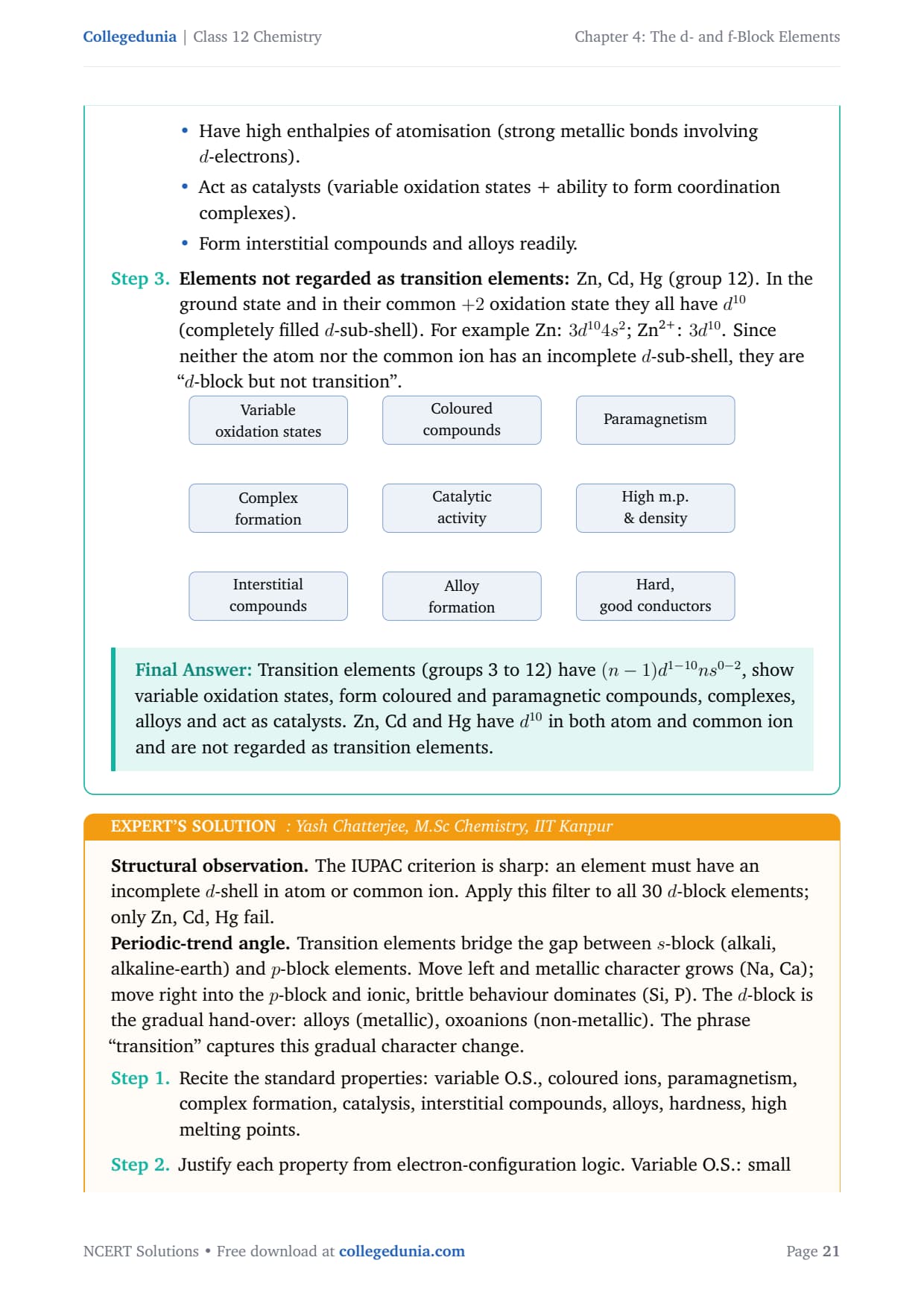
- Position. They occupy groups 3 to 12 of the periodic table, between the s-block and p-block. Their general outer configuration is (n-1)d1-10 ns0-2. They mark the gradual transition in properties from the highly electropositive s-block metals to the much less metallic p-block elements, which is why they are called transition elements.
- Characteristic properties:
- All are typical metals: hard, high-melting, good conductors of heat and electricity.
- Show variable oxidation states (because (n-1)d and ns are close in energy, electrons can be lost in varying numbers).
- Form coloured compounds (because of d-d electronic transitions in partially filled d shells).
- Form complexes readily (small, highly charged cations with vacant low-energy d-orbitals).
- Are often paramagnetic (unpaired d electrons).
- Have high enthalpies of atomisation (strong metallic bonds involving d-electrons).
- Act as catalysts (variable oxidation states + ability to form coordination complexes).
- Form interstitial compounds and alloys readily.
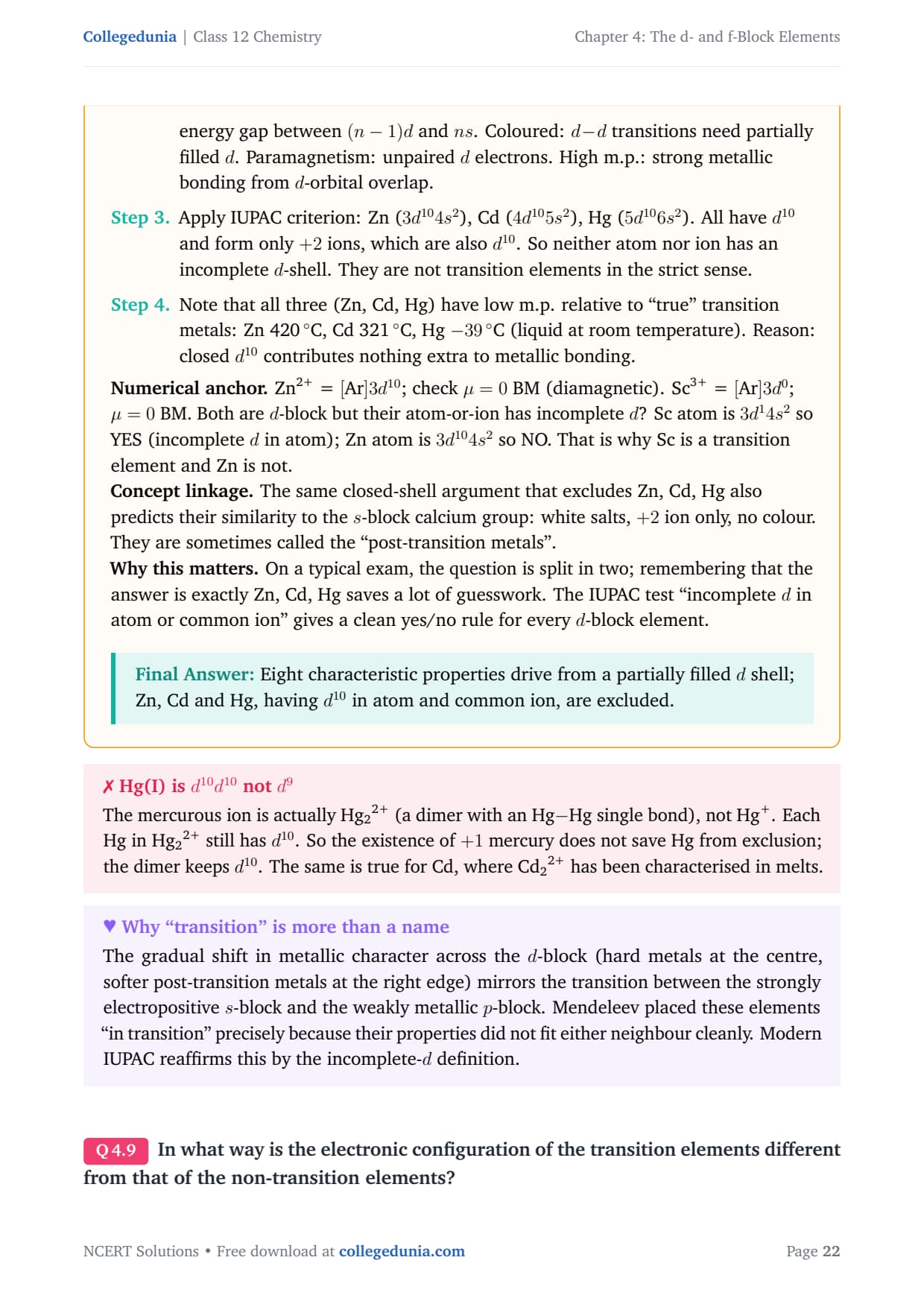
- Elements not regarded as transition elements: Zn, Cd, Hg (group 12). In the ground state and in their common +2 oxidation state they all have d10 (completely filled d-sub-shell). For example Zn: 3d104s2; Zn^2+: 3d10. Since neither the atom nor the common ion has an incomplete d-sub-shell, they are ``d-block but not transition''.
Transition elements (groups 3 to 12) have (n-1)d1-10ns0-2, show variable oxidation states, form coloured and paramagnetic compounds, complexes, alloys and act as catalysts. Zn, Cd and Hg have d10 in both atom and common ion and are not regarded as transition elements.
Structural observation. The IUPAC criterion is sharp: an element must have an incomplete d-shell in atom or common ion. Apply this filter to all 30 d-block elements; only Zn, Cd, Hg fail.
Periodic-trend angle. Transition elements bridge the gap between s-block (alkali, alkaline-earth) and p-block elements. Move left and metallic character grows (Na, Ca); move right into the p-block and ionic, brittle behaviour dominates (Si, P). The d-block is the gradual hand-over: alloys (metallic), oxoanions (non-metallic). The phrase ``transition'' captures this gradual character change.
- Recite the standard properties: variable O.S., coloured ions, paramagnetism, complex formation, catalysis, interstitial compounds, alloys, hardness, high melting points.
- Justify each property from electron-configuration logic. Variable O.S.: small energy gap between (n-1)d and ns. Coloured: d-d transitions need partially filled d. Paramagnetism: unpaired d electrons. High m.p.: strong metallic bonding from d-orbital overlap.
- Apply IUPAC criterion: Zn (3d104s2), Cd (4d105s2), Hg (5d106s2). All have d10 and form only +2 ions, which are also d10. So neither atom nor ion has an incomplete d-shell. They are not transition elements in the strict sense.
- Note that all three (Zn, Cd, Hg) have low m.p. relative to ``true'' transition metals: Zn 420 ∘C, Cd 321 ∘C, Hg -39 ∘C (liquid at room temperature). Reason: closed d10 contributes nothing extra to metallic bonding.
Numerical anchor. Zn^2+ = [Ar]3d10; check μ = 0 BM (diamagnetic). Sc^3+ = [Ar]3d0; μ = 0 BM. Both are d-block but their atom-or-ion has incomplete d? Sc atom is 3d14s2 so YES (incomplete d in atom); Zn atom is 3d104s2 so NO. That is why Sc is a transition element and Zn is not.
Concept linkage. The same closed-shell argument that excludes Zn, Cd, Hg also predicts their similarity to the s-block calcium group: white salts, +2 ion only, no colour. They are sometimes called the ``post-transition metals''.
Why this matters. On a typical exam, the question is split in two; remembering that the answer is exactly Zn, Cd, Hg saves a lot of guesswork. The IUPAC test ``incomplete d in atom or common ion'' gives a clean yes/no rule for every d-block element.
Eight characteristic properties drive from a partially filled d shell; Zn, Cd and Hg, having d10 in atom and common ion, are excluded.
In what way is the electronic configuration of the transition elements different from that of the non-transition elements?
Concept used. An atom's electronic configuration shows how electrons fill the available orbitals. Transition metals are distinguished by having their valence electrons spread across two sub-shells of different principal quantum numbers, the (n-1)d and ns. Non-transition (representative) elements have their valence electrons confined to the outermost shell only.
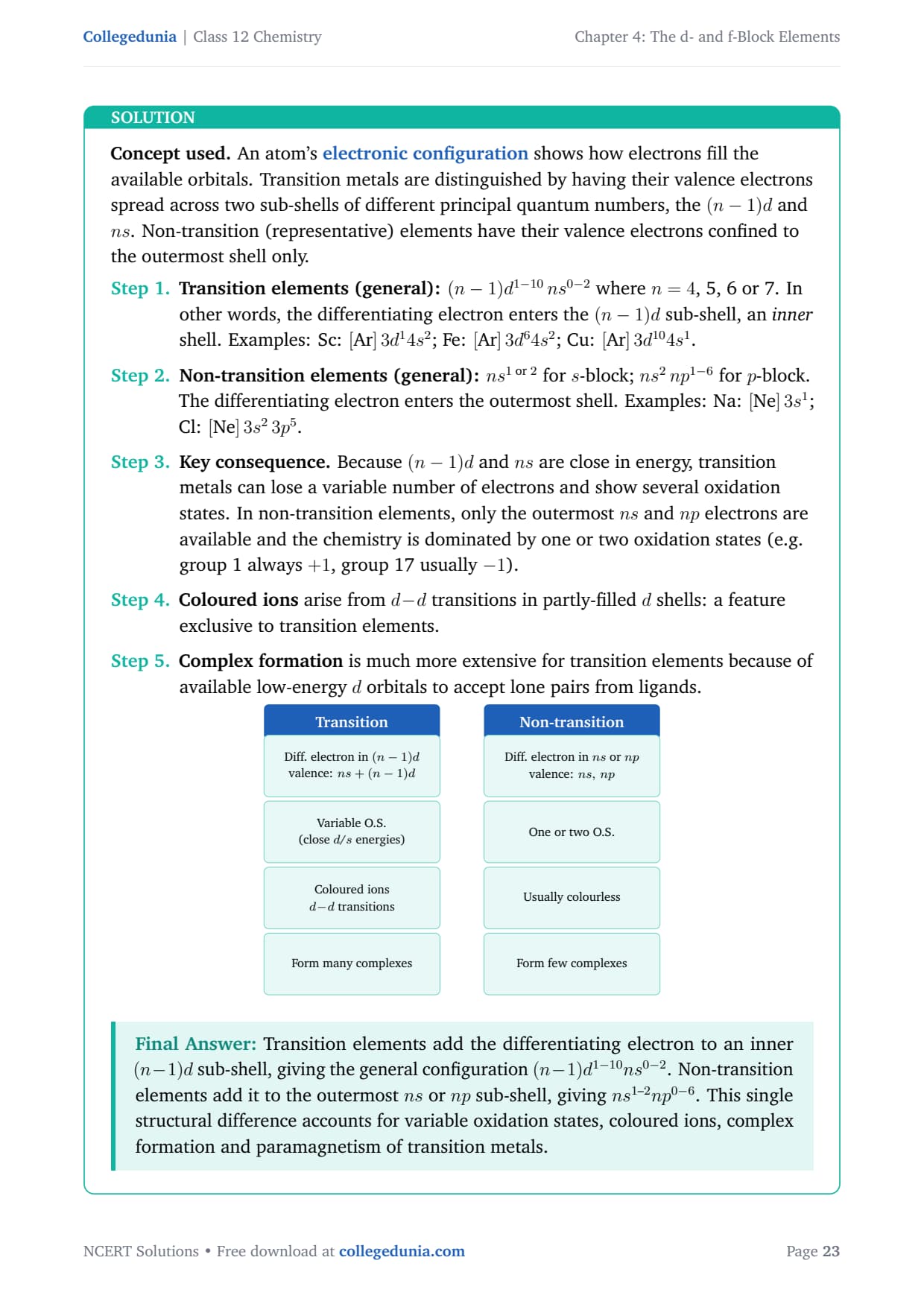
- Transition elements (general): (n-1)d1-10 ns0-2 where n = 4, 5, 6 or 7. In other words, the differentiating electron enters the (n-1)d sub-shell, an inner shell. Examples: Sc: [Ar] 3d14s2; Fe: [Ar] 3d64s2; Cu: [Ar] 3d104s1.
- Non-transition elements (general): ns1 or 2 for s-block; ns2 np1-6 for p-block. The differentiating electron enters the outermost shell. Examples: Na: [Ne] 3s1; Cl: [Ne] 3s2 3p5.
- Key consequence. Because (n-1)d and ns are close in energy, transition metals can lose a variable number of electrons and show several oxidation states. In non-transition elements, only the outermost ns and np electrons are available and the chemistry is dominated by one or two oxidation states (e.g. group 1 always +1, group 17 usually -1).
- Coloured ions arise from d-d transitions in partly-filled d shells: a feature exclusive to transition elements.
- Complex formation is much more extensive for transition elements because of available low-energy d orbitals to accept lone pairs from ligands.
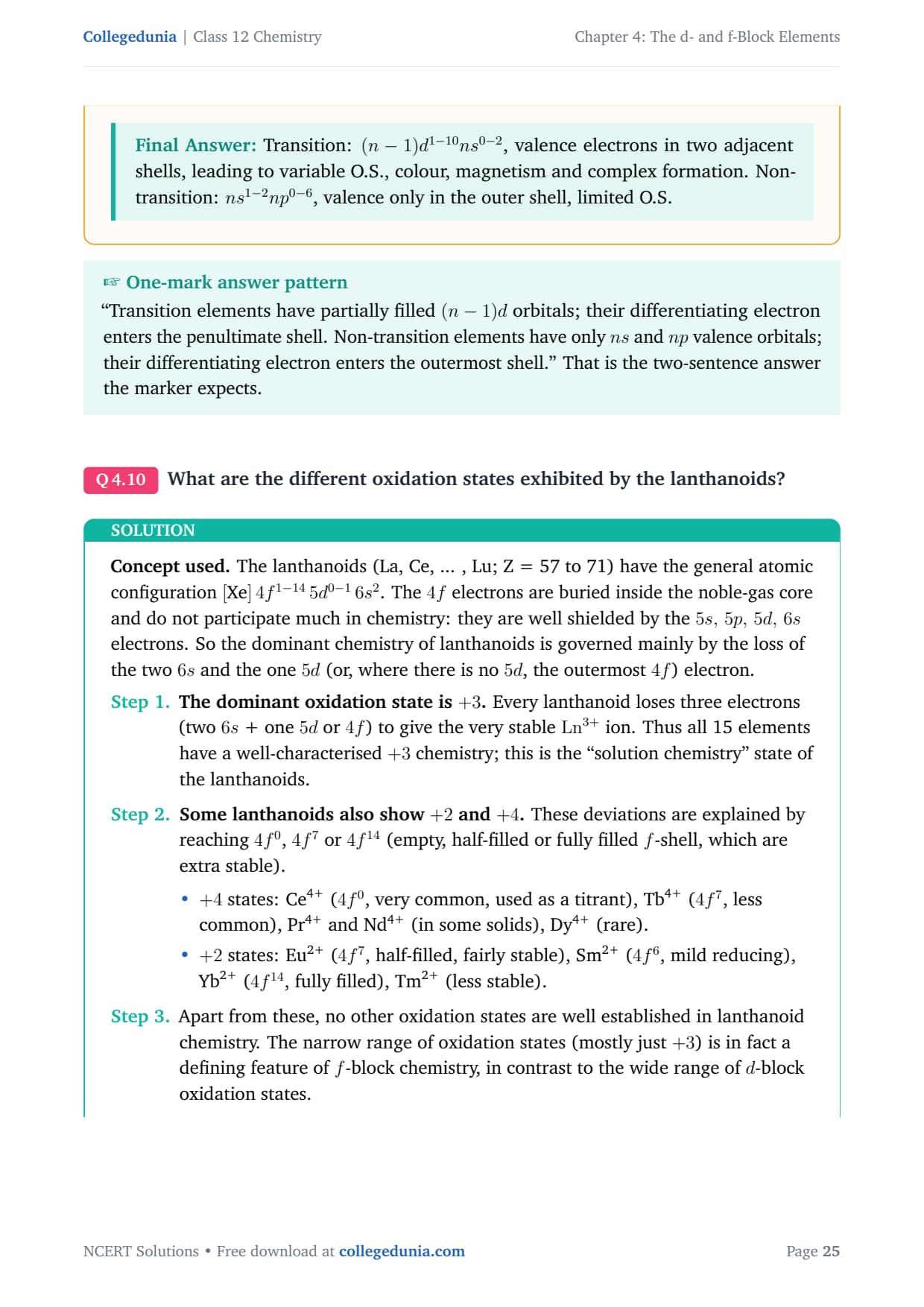
Transition elements add the differentiating electron to an inner (n-1)d sub-shell, giving the general configuration (n-1)d1-10ns0-2. Non-transition elements add it to the outermost ns or np sub-shell, giving ns1--2np0-6. This single structural difference accounts for variable oxidation states, coloured ions, complex formation and paramagnetism of transition metals.
Picture-first. Picture two layers of orbitals in a transition-metal atom: an outer ns shell and an inner (n-1)d shell, with very similar energies. In a non-transition atom there is only one valence layer.
Electronic-config reasoning. Energy-level diagram: the (n-1)d and ns orbitals lie within ∼ 100 kJ/mol of each other across the transition series. By contrast the gap between ns and np (representative elements) or between two adjacent shells ns and (n+1)s is several hundred kJ/mol. The closeness of d and s is what makes the chemistry rich.
- For the transition row write the generic configuration (n-1)d1-10 ns0-2 and note that both (n-1)d and ns electrons are chemically active. So variable oxidation states emerge naturally: lose only ns, get +2; lose ns plus one d, get +3; and so on.
- For non-transition elements, the configuration is ns1-2 np0-6. Only one shell is active, so oxidation states are limited to the group number (or group number -2 for the inert-pair effect in heavier p-block).
- Map the four characteristic-property differences directly to the configuration difference: partially filled d → colour; unpaired d → paramagnetism; multiple d/s ionisations → variable O.S.; vacant low-energy d → complex formation and catalysis.
- Differentiating-electron rule (a quick mnemonic): the differentiating electron is the last electron added on moving from element (Z-1) to element Z. For transition elements it enters (n-1)d (inner penultimate shell). For representative elements it enters ns or np (outermost shell). This is the textbook definition of ``inner'' vs ``representative''.
- Concept check: Cu is 3d104s1, an Aufbau exception. The differentiating electron (going from Ni Z=28 to Cu Z=29) is treated as a 3d electron, which is why Cu remains a transition element.
Concept linkage. The differentiating-electron rule is a universal periodic-table principle. s-block: differentiating in ns. p-block: in np. d-block: in (n-1)d. f-block: in (n-2)f. So our four blocks reflect exactly four kinds of differentiating electrons. The chemistry of each block follows from this single classification.
Numerical anchor. Fe: [Ar]3d64s2. Total valence electrons (4s + 3d): 8. Maximum oxidation state achievable: +6 (in FeO4^2-, ferrate); common: +2 and +3. Compare Ca: [Ar]4s2. Total valence: 2. Maximum oxidation state: +2. The disparity in available oxidation states scales directly with the number of accessible valence electrons.
Why this matters. Once the configuration distinction is clear, every other property of transition metals becomes a corollary. This question is essentially asking students to read the configuration as the root cause of all of transition-metal chemistry.
Transition: (n-1)d1-10ns0-2, valence electrons in two adjacent shells, leading to variable O.S., colour, magnetism and complex formation. Non-transition: ns1-2np0-6, valence only in the outer shell, limited O.S.
What are the different oxidation states exhibited by the lanthanoids?
Concept used. The lanthanoids (La, Ce, ... , Lu; Z = 57 to 71) have the general atomic configuration [Xe] 4f1-14 5d0-1 6s2. The 4f electrons are buried inside the noble-gas core and do not participate much in chemistry: they are well shielded by the 5s, 5p, 5d, 6s electrons. So the dominant chemistry of lanthanoids is governed mainly by the loss of the two 6s and the one 5d (or, where there is no 5d, the outermost 4f) electron.
- The dominant oxidation state is +3. Every lanthanoid loses three electrons (two 6s + one 5d or 4f) to give the very stable Ln3+ ion. Thus all 15 elements have a well-characterised +3 chemistry; this is the ``solution chemistry'' state of the lanthanoids.
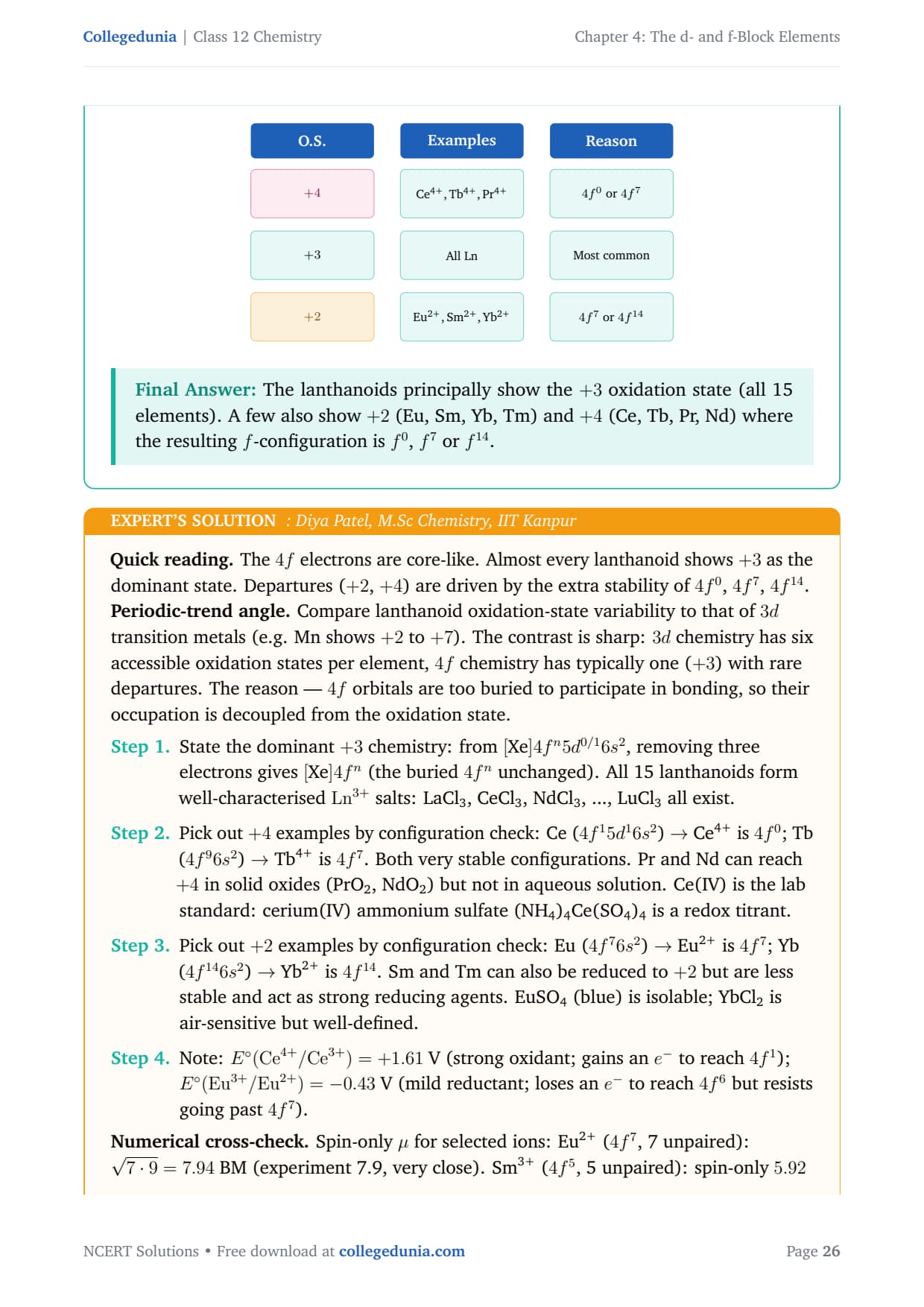
- Some lanthanoids also show +2 and +4. These deviations are explained by reaching 4f0, 4f7 or 4f14 (empty, half-filled or fully filled f-shell, which are extra stable).
- +4 states: Ce^4+ (4f0, very common, used as a titrant), Tb^4+ (4f7, less common), Pr^4+ and Nd^4+ (in some solids), Dy^4+ (rare).
- +2 states: Eu^2+ (4f7, half-filled, fairly stable), Sm^2+ (4f6, mild reducing), Yb^2+ (4f14, fully filled), Tm^2+ (less stable).
- Apart from these, no other oxidation states are well established in lanthanoid chemistry. The narrow range of oxidation states (mostly just +3) is in fact a defining feature of f-block chemistry, in contrast to the wide range of d-block oxidation states.
The lanthanoids principally show the +3 oxidation state (all 15 elements). A few also show +2 (Eu, Sm, Yb, Tm) and +4 (Ce, Tb, Pr, Nd) where the resulting f-configuration is f0, f7 or f14.
Quick reading. The 4f electrons are core-like. Almost every lanthanoid shows +3 as the dominant state. Departures (+2, +4) are driven by the extra stability of 4f0, 4f7, 4f14.
Periodic-trend angle. Compare lanthanoid oxidation-state variability to that of 3d transition metals (e.g. Mn shows +2 to +7). The contrast is sharp: 3d chemistry has six accessible oxidation states per element, 4f chemistry has typically one (+3) with rare departures. The reason - 4f orbitals are too buried to participate in bonding, so their occupation is decoupled from the oxidation state.
- State the dominant +3 chemistry: from [Xe]4fn 5d0/16s2, removing three electrons gives [Xe]4fn (the buried 4fn unchanged). All 15 lanthanoids form well-characterised Ln3+ salts: LaCl3, CeCl3, NdCl3, ..., LuCl3 all exist.
- Pick out +4 examples by configuration check: Ce (4f15d16s2) → Ce^4+ is 4f0; Tb (4f96s2) → Tb^4+ is 4f7. Both very stable configurations. Pr and Nd can reach +4 in solid oxides (PrO2, NdO2) but not in aqueous solution. Ce(IV) is the lab standard: cerium(IV) ammonium sulfate (NH4)4Ce(SO4)4 is a redox titrant.
- Pick out +2 examples by configuration check: Eu (4f76s2) → Eu^2+ is 4f7; Yb (4f146s2) → Yb^2+ is 4f14. Sm and Tm can also be reduced to +2 but are less stable and act as strong reducing agents. EuSO4 (blue) is isolable; YbCl2 is air-sensitive but well-defined.
- Note: E∘(Ce4+/Ce3+) = +1.61 V (strong oxidant; gains an e- to reach 4f1); E∘(Eu3+/Eu2+) = -0.43 V (mild reductant; loses an e- to reach 4f6 but resists going past 4f7).
Numerical cross-check. Spin-only μ for selected ions: Eu^2+ (4f7, 7 unpaired): √7 · 9 = 7.94 BM (experiment 7.9, very close). Sm^3+ (4f5, 5 unpaired): spin-only 5.92 BM, but observed only 1.5 BM (orbital contribution in lanthanoids is large; here it nearly cancels spin). So spin-only μ works well for f7 (orbital quenched) but not for f5.
Concept linkage. The configurations 4f0, 4f7, 4f14 are exactly the empty, half-filled, fully-filled milestones - same idea as d0, d5, d10 in the 3d row. The narrow lanthanoid oxidation-state range gives way to a wider range only in the early actinoids where 5f orbitals are more accessible (Q 4.29).
Why this matters. The narrow range of lanthanoid oxidation states is exactly why their separation is difficult: chemistry on the Ln3+ ions is almost the same for all 15 elements. Solvent extraction and ion exchange exploit only minute size differences. Industrially, Eu(II) salts find application in phosphors for white LEDs and X-ray screens, and Ce(IV) is the redox titrant used in quantitative analysis of Fe^2+ and H2O2.
Mostly +3; with +4 for Ce, Tb, Pr, Nd and +2 for Eu, Sm, Yb, Tm where 4f0, 4f7, 4f14 stability is reached.
Explain giving reasons:
(i) Transition metals and many of their compounds show paramagnetic behaviour.
(ii) The enthalpies of atomisation of the transition metals are high.
(iii) The transition metals generally form coloured compounds.
(iv) Transition metals and their many compounds act as good catalysts.
Concept used. Each of the four observations stems from one underlying feature: a partially-filled d-sub-shell provides unpaired electrons, strong metallic bonding, d-d electronic transitions in the visible region, and vacant low-energy d-orbitals to bind reactants. So a single structural fact explains all four.
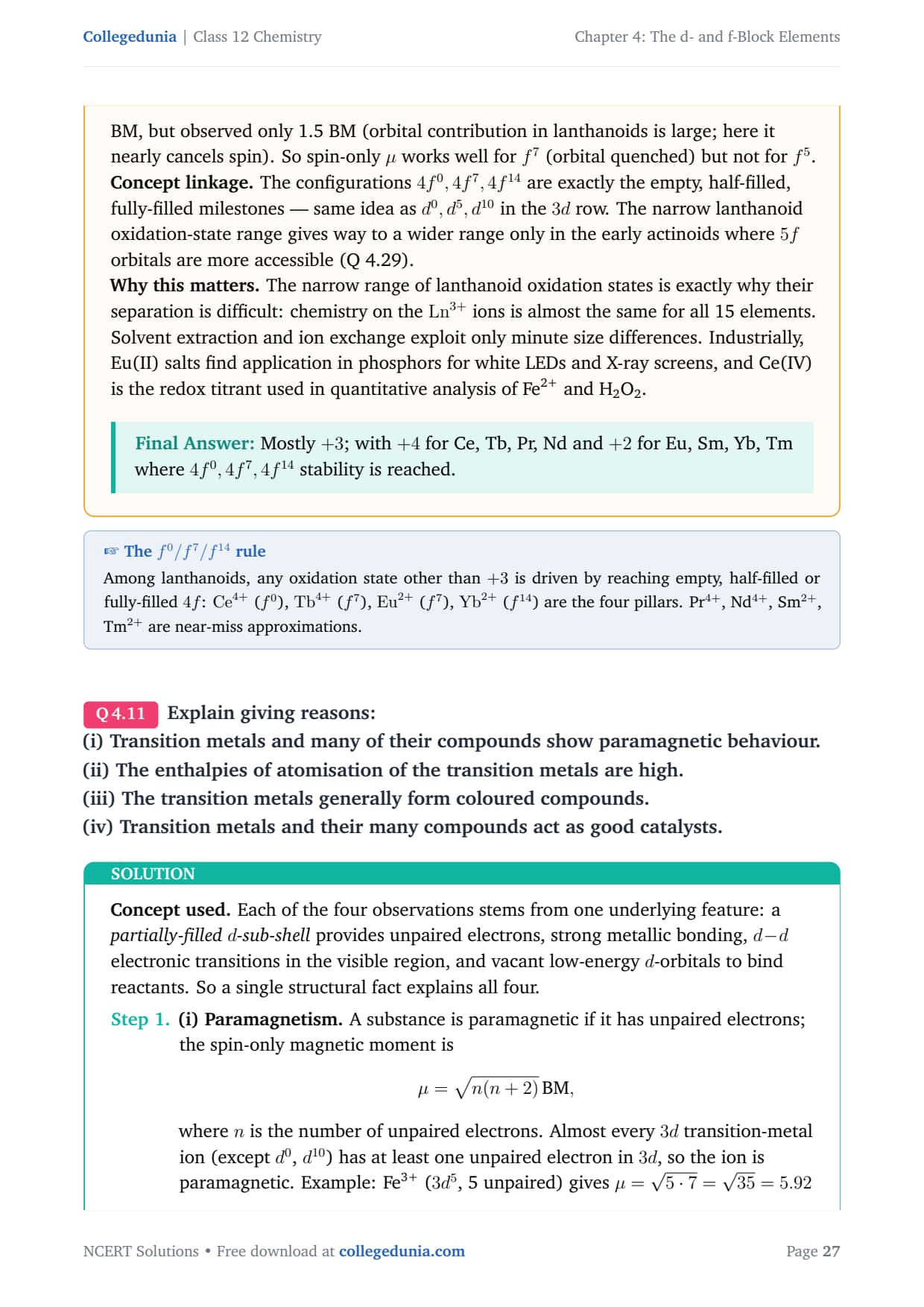
- (i) Paramagnetism. A substance is paramagnetic if it has unpaired electrons; the spin-only magnetic moment is μ = √n(n+2) BM, where n is the number of unpaired electrons. Almost every 3d transition-metal ion (except d0, d10) has at least one unpaired electron in 3d, so the ion is paramagnetic. Example: Fe^3+ (3d5, 5 unpaired) gives μ = √5 · 7 = √35 = 5.92 BM.
- (ii) High enthalpies of atomisation. Transition metals have a large number of valence electrons in (n-1)d and ns that participate in metallic bonding. The more unpaired d-electrons available for bonding, the stronger the metallic bond and the higher the enthalpy of atomisation. So values such as aH = 326 kJ/mol for Sc and 397 kJ/mol for Cr greatly exceed values for s- and p-block metals.
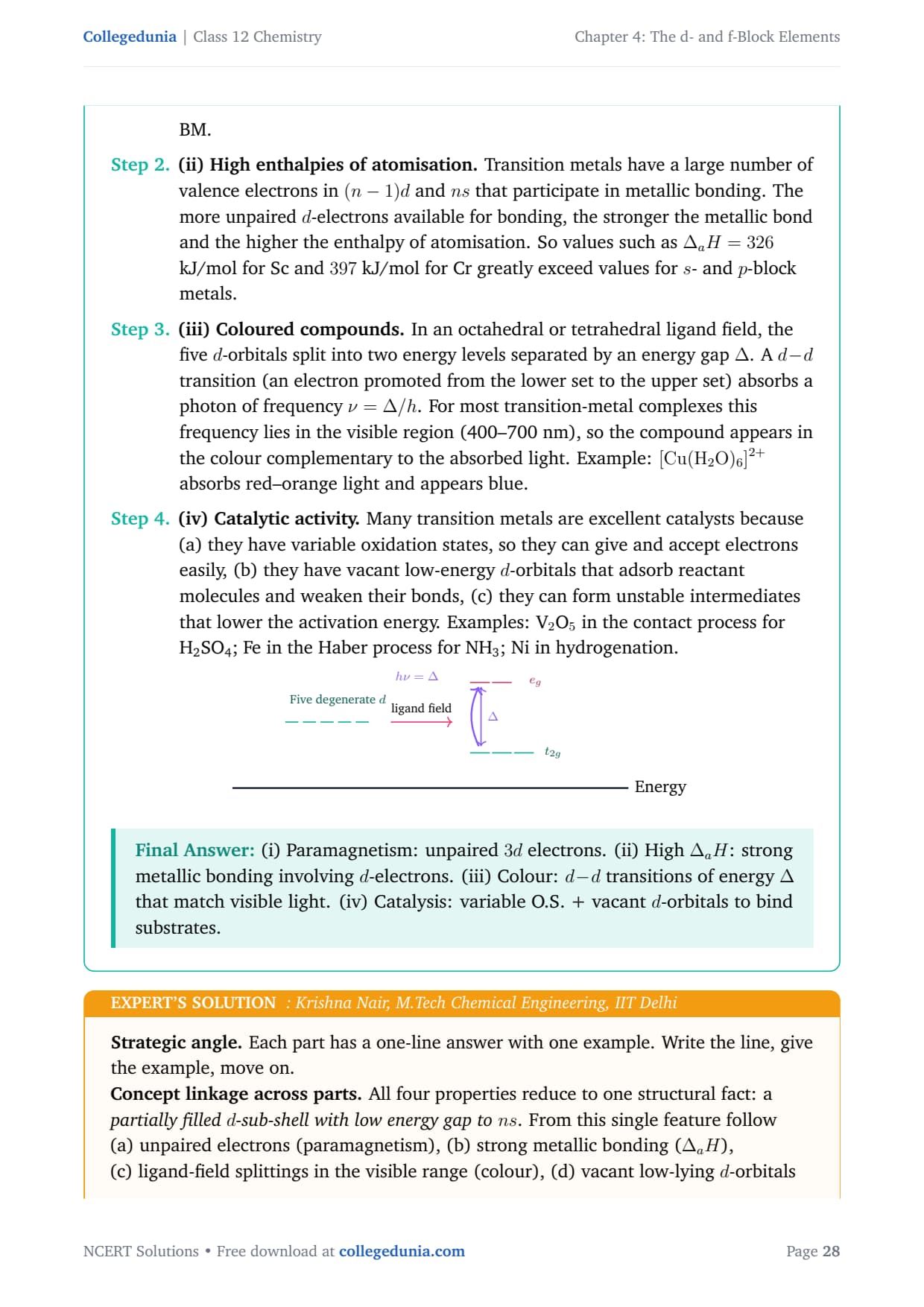
- (iii) Coloured compounds. In an octahedral or tetrahedral ligand field, the five d-orbitals split into two energy levels separated by an energy gap Δ. A d-d transition (an electron promoted from the lower set to the upper set) absorbs a photon of frequency ν = Δ/h. For most transition-metal complexes this frequency lies in the visible region (400–700 nm), so the compound appears in the colour complementary to the absorbed light. Example: [Cu(H2O)6]2+ absorbs red–orange light and appears blue.
- (iv) Catalytic activity. Many transition metals are excellent catalysts because (a) they have variable oxidation states, so they can give and accept electrons easily, (b) they have vacant low-energy d-orbitals that adsorb reactant molecules and weaken their bonds, (c) they can form unstable intermediates that lower the activation energy. Examples: V2O5 in the contact process for H2SO4; Fe in the Haber process for NH3; Ni in hydrogenation.
(i) Paramagnetism: unpaired 3d electrons. (ii) High aH: strong metallic bonding involving d-electrons. (iii) Colour: d-d transitions of energy Δ that match visible light. (iv) Catalysis: variable O.S. + vacant d-orbitals to bind substrates.
Strategic angle. Each part has a one-line answer with one example. Write the line, give the example, move on.
Concept linkage across parts. All four properties reduce to one structural fact: a partially filled d-sub-shell with low energy gap to ns. From this single feature follow (a) unpaired electrons (paramagnetism), (b) strong metallic bonding (aH), (c) ligand-field splittings in the visible range (colour), (d) vacant low-lying d-orbitals (catalysis). The chapter packs four sub-parts into one structural concept.
- Paramagnetism arises from unpaired d-electrons. Use μ = √n(n+2) BM. Ti^3+ (d1): n=1, μ = √3 = 1.73 BM. V^2+ (d3): n=3, μ = √15 = 3.87 BM. Mn^2+ (d5): n=5, μ = 5.92 BM (maximum for 3d).
- Enthalpy of atomisation is large because d- and s- electrons participate in metallic bonding. Cr and Mo, with d5s1, give the strongest bonds in their rows. The trend across a row peaks in the middle (Cr, Mo, W). Numerical values for aH (kJ/mol): Cr 397, Mn 281, Fe 416, Cu 339, Zn 130 - note the dip at Mn (half-filled d5 is hard to disrupt for bonding) and at Zn (closed d10 contributes nothing).
- Colour comes from d-d transitions. For Sc^3+ (d0) or Zn^2+ (d10) no d-d transition is possible and the ion is colourless. Energy gap Δ depends on the ligand (spectrochemical series: I- < Br- < Cl- < F- < H2O < NH3 < en < CN- < CO) and on the geometry. Same metal can give different colours in different ligand fields: [Co(H2O)6]2+ pink vs [CoCl4]2- blue.
- Catalysis: variable O.S. lets the metal go through oxidation/reduction cycles cheaply. Vacant d-orbitals adsorb reactants. Examples: Fe in N2 + 3 H2 -> 2 NH3 (Haber), V2O5 in 2 SO2 + O2 -> 2 SO3 (Contact), Ni in R--CH=CH--R' + H2 → R--CH2--CH2--R' (Sabatier hydrogenation), TiCl3 + Et3Al in polyethylene (Ziegler-Natta).
Numerical cross-check. For Co^2+ (d7): n=3, μ = √15 = 3.87 BM. Observed in [Co(H2O)6]2+: ∼ 4.7–5.2 BM (orbital contribution adds to spin-only). For high-spin Fe^3+ (d5): μ = √35 = 5.92 BM, observed 5.9 BM (almost perfect match because d5 has a quenched L).
Periodic-trend angle. All four properties weaken at the two edges of the d-block: Sc (only d1 in atom) and Zn (full d10). Sc compounds are pale/colourless because Sc3+ is d0. Zn compounds are diamagnetic, colourless and chemically unremarkable. The middle of the row is where transition-metal chemistry shines.
Why this matters. All four properties are board favourites. They all reduce to ``partially filled d shell + close d/s energies'' as the single causative factor. JEE/NEET tend to combine them: ``which of the following 3d ions is the worst catalyst?'' (answer: Sc^3+ or Zn^2+, because no partial d).
Same answers: unpaired d electrons (paramagnetism); d-bonding metallic lattice (high aH); d-d transitions (colour); variable O.S. + vacant d orbitals (catalysis).
What are interstitial compounds? Why are such compounds well known for transition metals?
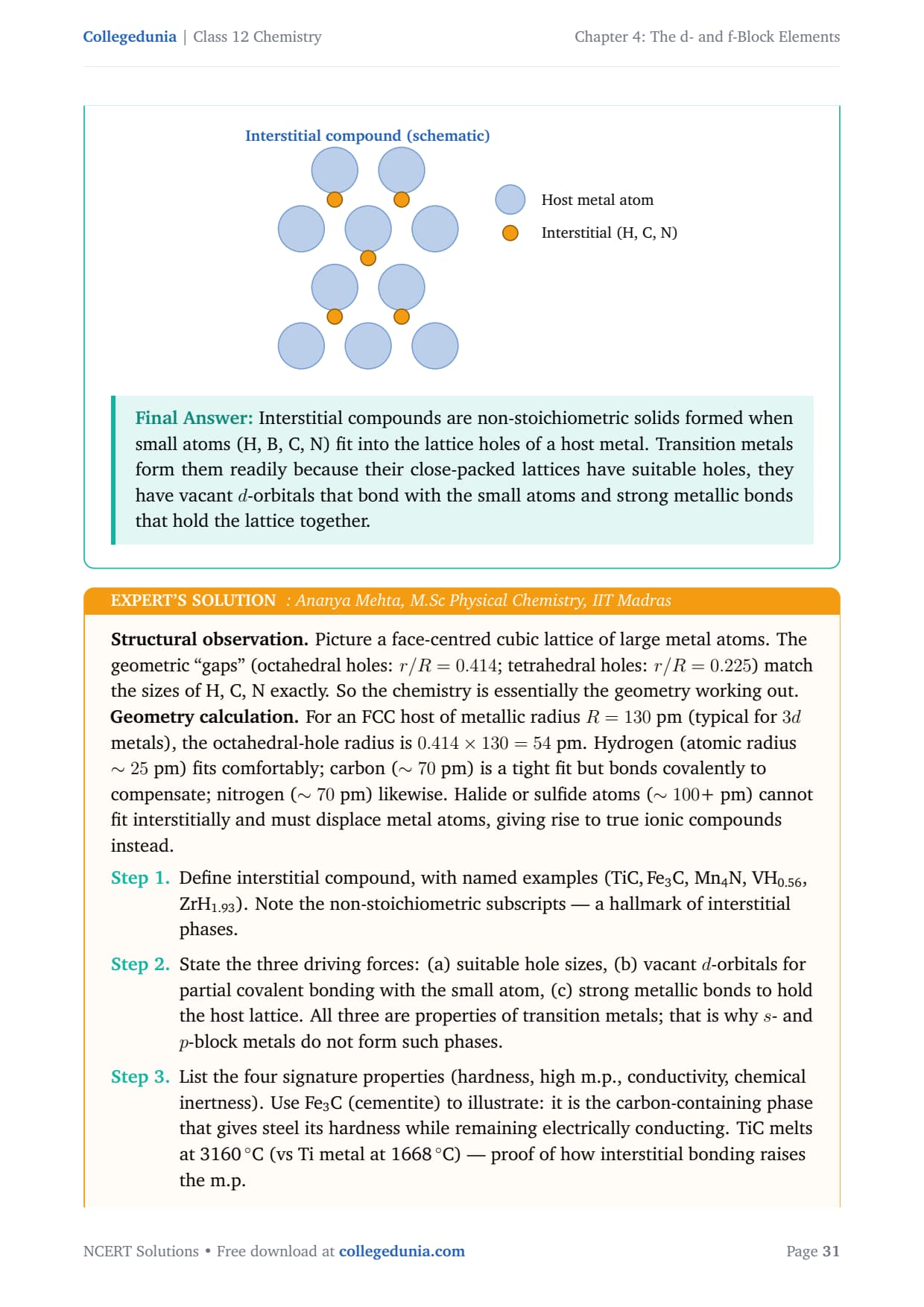
Concept used. Interstitial compounds are non-stoichiometric materials in which small atoms (H, B, C, N) lodge themselves in the empty interstitial sites of a host metal lattice. The host's crystal structure is essentially preserved; only the interstices are partly occupied.
- Define and exemplify. Important interstitial compounds of transition metals include TiH1.7, VH0.56, TiC, Mn4N, Fe3H, Fe3C (cementite, in steel). The composition is usually not a whole-number ratio, hence ``non-stoichiometric''. Hydrides of palladium absorb many times their volume of H2.
- Recognise the key properties of these compounds: (a) They are very hard (often harder than the pure metal); some approach diamond hardness, e.g. TiC. (b) They have high melting points, often higher than the host metal. (c) They retain metallic conductivity. (d) They are chemically inert.
- Why transition metals form them so well:
- Their crystal lattices are close-packed but still have octahedral and tetrahedral holes large enough to accommodate small atoms like H (r ≈ 25 pm), C (r ≈ 70 pm) or N (r ≈ 70 pm).
- Empty (n-1)d orbitals can form bonds with the incoming small atom (a partial covalent contribution).
- Transition-metal lattices have strong metallic bonds (high aH), so the host stays intact even when interstices are partly filled.
Interstitial compounds are non-stoichiometric solids formed when small atoms (H, B, C, N) fit into the lattice holes of a host metal. Transition metals form them readily because their close-packed lattices have suitable holes, they have vacant d-orbitals that bond with the small atoms and strong metallic bonds that hold the lattice together.
Structural observation. Picture a face-centred cubic lattice of large metal atoms. The geometric ``gaps'' (octahedral holes: r/R = 0.414; tetrahedral holes: r/R = 0.225) match the sizes of H, C, N exactly. So the chemistry is essentially the geometry working out.
Geometry calculation. For an FCC host of metallic radius R = 130 pm (typical for 3d metals), the octahedral-hole radius is 0.414 × 130 = 54 pm. Hydrogen (atomic radius ∼ 25 pm) fits comfortably; carbon (∼ 70 pm) is a tight fit but bonds covalently to compensate; nitrogen (∼ 70 pm) likewise. Halide or sulfide atoms (∼ 100+ pm) cannot fit interstitially and must displace metal atoms, giving rise to true ionic compounds instead.
- Define interstitial compound, with named examples (TiC, Fe3C, Mn4N, VH_0.56, ZrH_1.93). Note the non-stoichiometric subscripts - a hallmark of interstitial phases.
- State the three driving forces: (a) suitable hole sizes, (b) vacant d-orbitals for partial covalent bonding with the small atom, (c) strong metallic bonds to hold the host lattice. All three are properties of transition metals; that is why s- and p-block metals do not form such phases.
- List the four signature properties (hardness, high m.p., conductivity, chemical inertness). Use Fe3C (cementite) to illustrate: it is the carbon-containing phase that gives steel its hardness while remaining electrically conducting. TiC melts at 3160 ∘C (vs Ti metal at 1668 ∘C) - proof of how interstitial bonding raises the m.p.
- Hydrogen storage example: Pd metal can absorb up to 935 times its volume of H2 gas at room temperature, storing it as PdH0.7. This is the basis of fuel-cell hydrogen storage research.
Numerical anchor. For an FCC lattice, the number of octahedral holes equals the number of atoms (N); tetrahedral holes = 2N. So an interstitial compound like TiC can have C:Ti ratio up to 1:1 (filling all octahedral holes) without disturbing the host lattice geometry. Above ratio 1:1, the structure has to change.
Concept linkage. Interstitial alloys (small atoms in holes) contrast with substitutional alloys (similar-size atoms replacing host atoms; e.g. brass, bronze). Both are alloys, but the geometry is opposite. The transition metals provide both, depending on the partner.
Why this matters. Industrially, the entire steel industry rides on the formation of Fe3C (and similar carbides in tool steels). Interstitial hydrides of Pd are the basis of hydrogen storage and the hydrogenation catalysis you see in margarine production. TiC, ZrC, HfC are used in rocket-nozzle ceramics. WC (tungsten carbide) is the cutting edge of every machine-tool drill.
Small atoms in metal-lattice holes give hard, high-melting, conducting, inert non-stoichiometric phases. Transition metals are perfect hosts because of geometry plus vacant d-orbitals.
How is the variability in oxidation states of transition metals different from that of the non-transition metals? Illustrate with examples.
Concept used. Variability in oxidation state means the ability of an element to exist in more than one positive oxidation state in its compounds. In transition metals the variability is wide and the consecutive states differ by 1, while in non-transition metals the variability is narrow and consecutive states usually differ by 2 (the inert-pair effect).
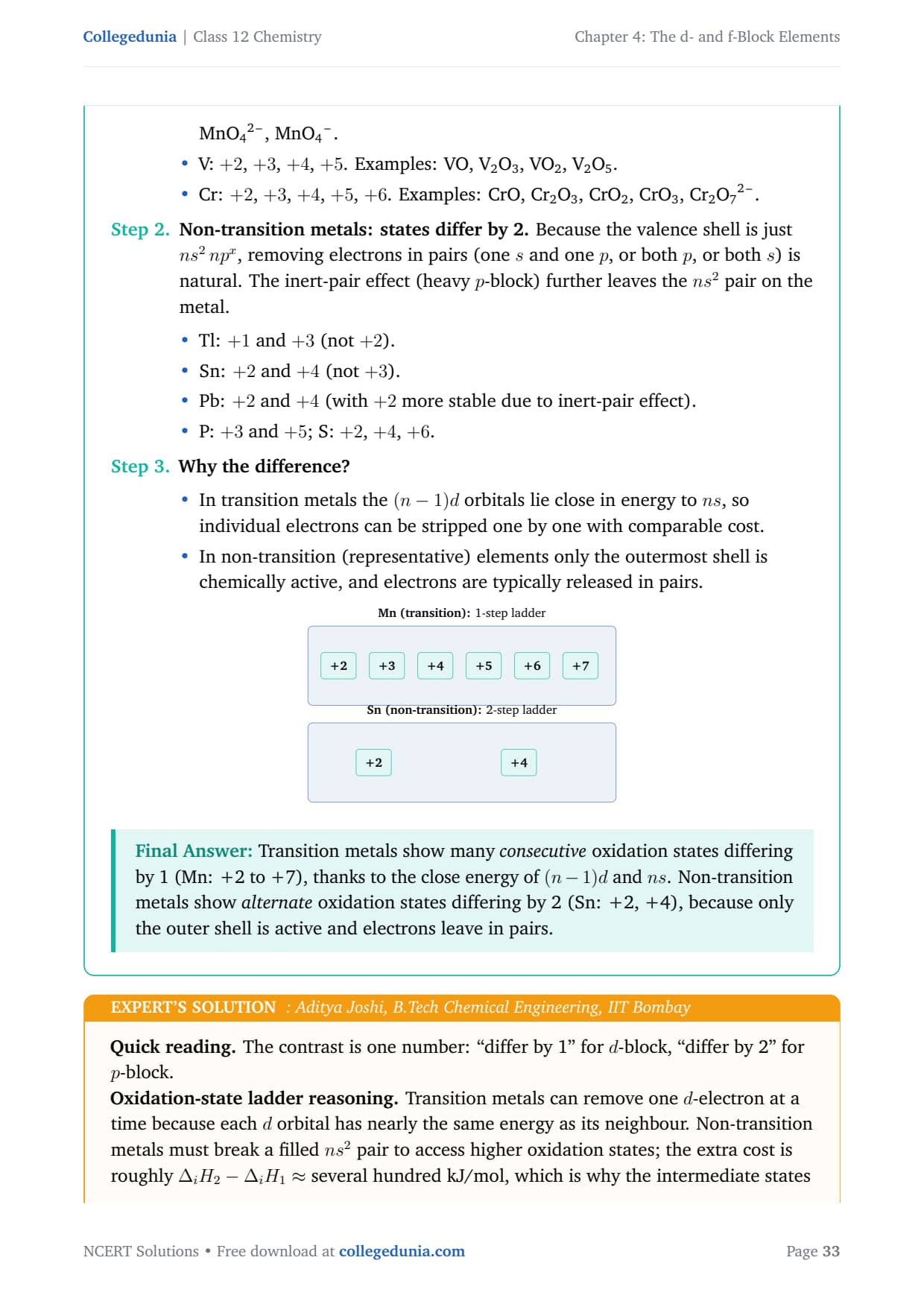
- Transition metals: consecutive states (differ by 1). Because (n-1)d and ns are close in energy, electrons can be removed one at a time. So a single element exhibits a ladder of oxidation states.
- Mn: +2, +3, +4, +5, +6, +7. Examples: MnO, Mn2O3, MnO2, MnO4^3-, MnO4^2-, MnO4-.
- V: +2, +3, +4, +5. Examples: VO, V2O3, VO2, V2O5.
- Cr: +2, +3, +4, +5, +6. Examples: CrO, Cr2O3, CrO2, CrO3, Cr2O7^2-.
- Non-transition metals: states differ by 2. Because the valence shell is just ns2 npx, removing electrons in pairs (one s and one p, or both p, or both s) is natural. The inert-pair effect (heavy p-block) further leaves the ns2 pair on the metal.
- Tl: +1 and +3 (not +2).
- Sn: +2 and +4 (not +3).
- Pb: +2 and +4 (with +2 more stable due to inert-pair effect).
- P: +3 and +5; S: +2, +4, +6.
- Why the difference?
- In transition metals the (n-1)d orbitals lie close in energy to ns, so individual electrons can be stripped one by one with comparable cost.
- In non-transition (representative) elements only the outermost shell is chemically active, and electrons are typically released in pairs.
Transition metals show many consecutive oxidation states differing by 1 (Mn: +2 to +7), thanks to the close energy of (n-1)d and ns. Non-transition metals show alternate oxidation states differing by 2 (Sn: +2, +4), because only the outer shell is active and electrons leave in pairs.
Quick reading. The contrast is one number: ``differ by 1'' for d-block, ``differ by 2'' for p-block.
Oxidation-state ladder reasoning. Transition metals can remove one d-electron at a time because each d orbital has nearly the same energy as its neighbour. Non-transition metals must break a filled ns2 pair to access higher oxidation states; the extra cost is roughly iH2 - iH1 ≈ several hundred kJ/mol, which is why the intermediate states are skipped.
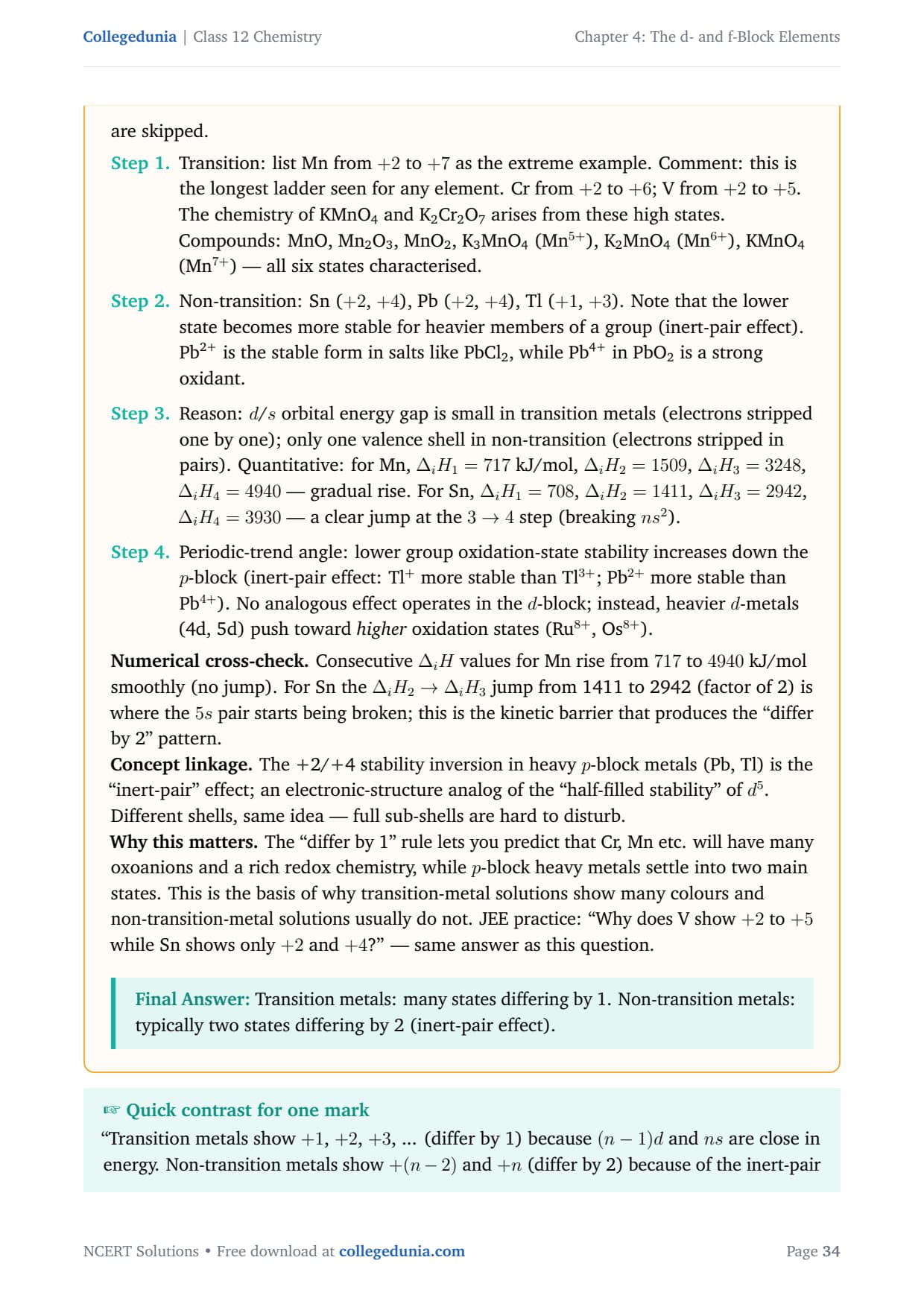
- Transition: list Mn from +2 to +7 as the extreme example. Comment: this is the longest ladder seen for any element. Cr from +2 to +6; V from +2 to +5. The chemistry of KMnO4 and K2Cr2O7 arises from these high states. Compounds: MnO, Mn2O3, MnO2, K3MnO4 (Mn5+), K2MnO4 (Mn6+), KMnO4 (Mn7+) - all six states characterised.
- Non-transition: Sn (+2, +4), Pb (+2, +4), Tl (+1, +3). Note that the lower state becomes more stable for heavier members of a group (inert-pair effect). Pb^2+ is the stable form in salts like PbCl2, while Pb^4+ in PbO2 is a strong oxidant.
- Reason: d/s orbital energy gap is small in transition metals (electrons stripped one by one); only one valence shell in non-transition (electrons stripped in pairs). Quantitative: for Mn, iH1 = 717 kJ/mol, iH2 = 1509, iH3 = 3248, iH4 = 4940 - gradual rise. For Sn, iH1 = 708, iH2 = 1411, iH3 = 2942, iH4 = 3930 - a clear jump at the 3 → 4 step (breaking ns2).
- Periodic-trend angle: lower group oxidation-state stability increases down the p-block (inert-pair effect: Tl+ more stable than Tl3+; Pb2+ more stable than Pb4+). No analogous effect operates in the d-block; instead, heavier d-metals (4d, 5d) push toward higher oxidation states (Ru8+, Os8+).
Numerical cross-check. Consecutive iH values for Mn rise from 717 to 4940 kJ/mol smoothly (no jump). For Sn the iH2 → iH3 jump from 1411 to 2942 (factor of 2) is where the 5s pair starts being broken; this is the kinetic barrier that produces the ``differ by 2'' pattern.
Concept linkage. The +2/+4 stability inversion in heavy p-block metals (Pb, Tl) is the ``inert-pair'' effect; an electronic-structure analog of the ``half-filled stability'' of d5. Different shells, same idea - full sub-shells are hard to disturb.
Why this matters. The ``differ by 1'' rule lets you predict that Cr, Mn etc. will have many oxoanions and a rich redox chemistry, while p-block heavy metals settle into two main states. This is the basis of why transition-metal solutions show many colours and non-transition-metal solutions usually do not. JEE practice: ``Why does V show +2 to +5 while Sn shows only +2 and +4?'' - same answer as this question.
Transition metals: many states differing by 1. Non-transition metals: typically two states differing by 2 (inert-pair effect).
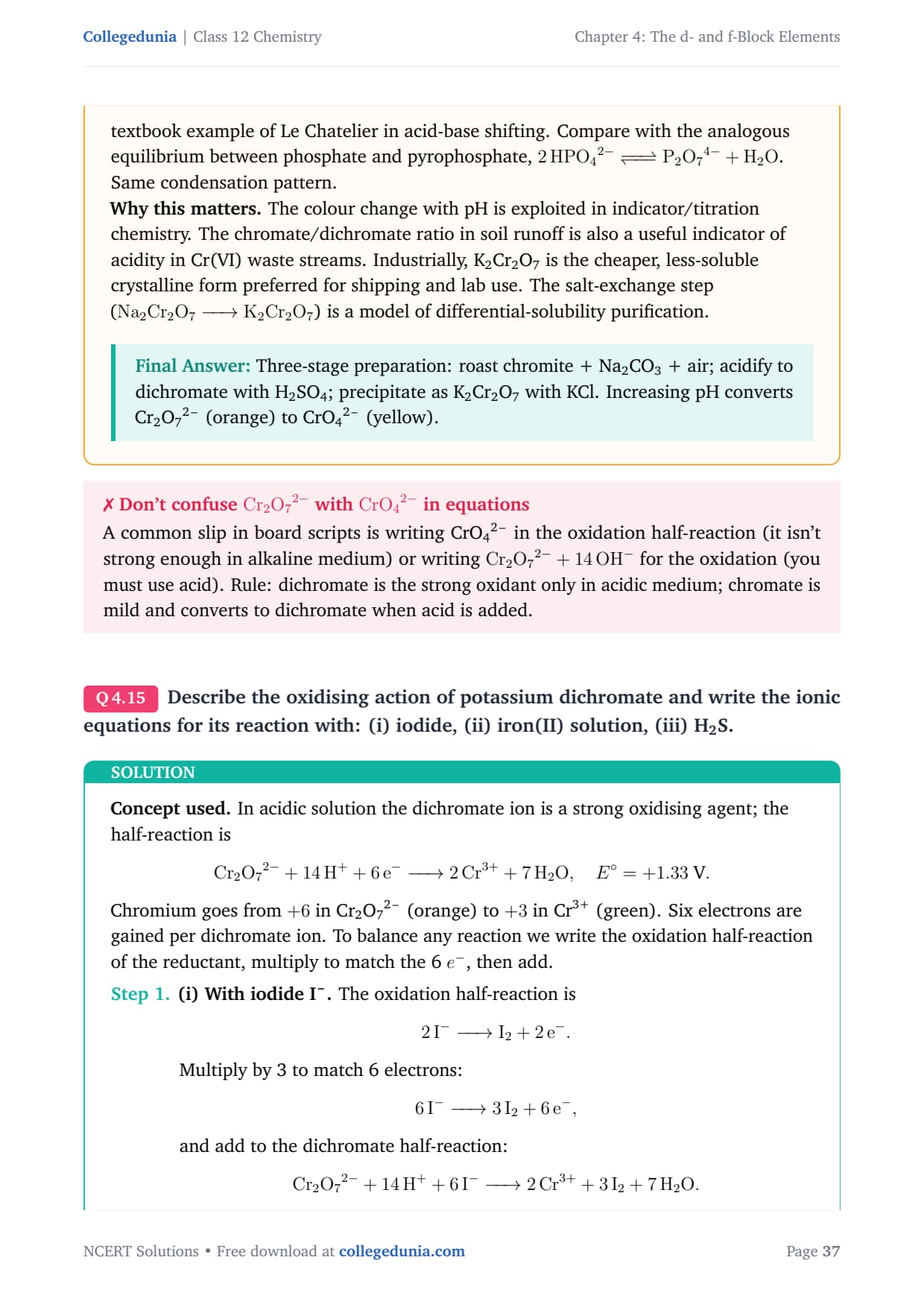
Describe the preparation of potassium dichromate from iron chromite ore. What is the effect of increasing pH on a solution of potassium dichromate?
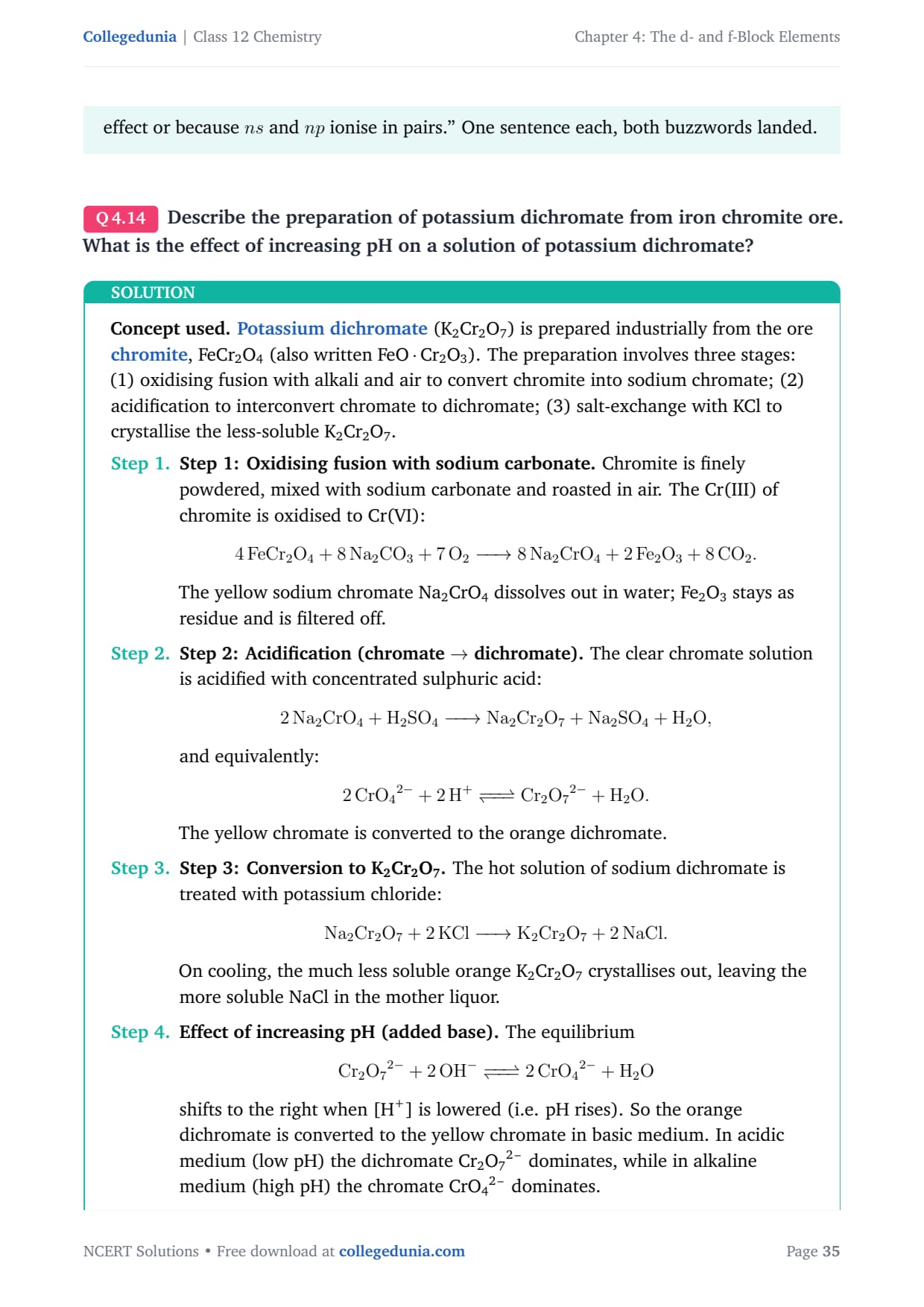
Concept used. Potassium dichromate (K2Cr2O7) is prepared industrially from the ore chromite, FeCr2O4 (also written FeO.Cr2O3). The preparation involves three stages: (1) oxidising fusion with alkali and air to convert chromite into sodium chromate; (2) acidification to interconvert chromate to dichromate; (3) salt-exchange with KCl to crystallise the less-soluble K2Cr2O7.
- Step 1: Oxidising fusion with sodium carbonate. Chromite is finely powdered, mixed with sodium carbonate and roasted in air. The Cr(III) of chromite is oxidised to Cr(VI): 4 FeCr2O4 + 8 Na2CO3 + 7 O2 -> 8 Na2CrO4 + 2 Fe2O3 + 8 CO2. The yellow sodium chromate Na2CrO4 dissolves out in water; Fe2O3 stays as residue and is filtered off.
- Step 2: Acidification (chromate → dichromate). The clear chromate solution is acidified with concentrated sulphuric acid: 2 Na2CrO4 + H2SO4 -> Na2Cr2O7 + Na2SO4 + H2O, and equivalently: 2 CrO42- + 2 H+ <=> Cr2O72- + H2O. The yellow chromate is converted to the orange dichromate.
- Step 3: Conversion to K2Cr2O7. The hot solution of sodium dichromate is treated with potassium chloride: Na2Cr2O7 + 2 KCl -> K2Cr2O7 + 2 NaCl. On cooling, the much less soluble orange K2Cr2O7 crystallises out, leaving the more soluble NaCl in the mother liquor.
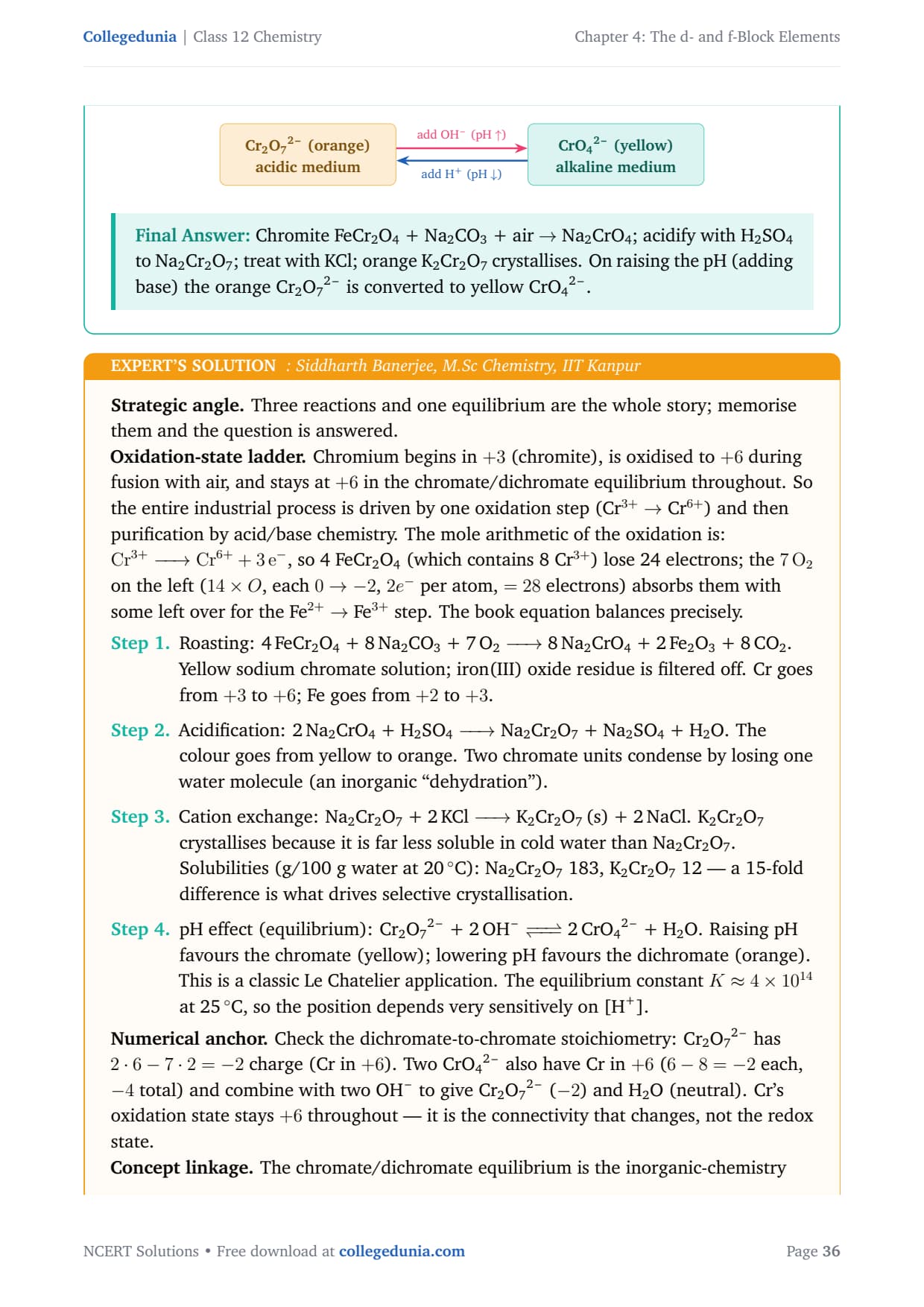
- Effect of increasing pH (added base). The equilibrium Cr2O72- + 2 OH- <=> 2 CrO42- + H2O shifts to the right when [H+] is lowered (i.e. pH rises). So the orange dichromate is converted to the yellow chromate in basic medium. In acidic medium (low pH) the dichromate Cr2O7^2- dominates, while in alkaline medium (high pH) the chromate CrO4^2- dominates.
Chromite FeCr2O4 + Na2CO3 + air → Na2CrO4; acidify with H2SO4 to Na2Cr2O7; treat with KCl; orange K2Cr2O7 crystallises. On raising the pH (adding base) the orange Cr2O7^2- is converted to yellow CrO4^2-.
Strategic angle. Three reactions and one equilibrium are the whole story; memorise them and the question is answered.
Oxidation-state ladder. Chromium begins in +3 (chromite), is oxidised to +6 during fusion with air, and stays at +6 in the chromate/dichromate equilibrium throughout. So the entire industrial process is driven by one oxidation step (Cr3+ → Cr6+) and then purification by acid/base chemistry. The mole arithmetic of the oxidation is: Cr3+ -> Cr6+ + 3 e-, so 4 FeCr2O4 (which contains 8 Cr3+) lose 24 electrons; the 7 O2 on the left (14 × O, each 0 → -2, 2 e- per atom, = 28 electrons) absorbs them with some left over for the Fe2+ → Fe3+ step. The book equation balances precisely.
- Roasting: 4 FeCr2O4 + 8 Na2CO3 + 7 O2 -> 8 Na2CrO4 + 2 Fe2O3 + 8 CO2. Yellow sodium chromate solution; iron(III) oxide residue is filtered off. Cr goes from +3 to +6; Fe goes from +2 to +3.
- Acidification: 2 Na2CrO4 + H2SO4 -> Na2Cr2O7 + Na2SO4 + H2O. The colour goes from yellow to orange. Two chromate units condense by losing one water molecule (an inorganic ``dehydration'').
- Cation exchange: Na2Cr2O7 + 2 KCl -> K2Cr2O7 (s) + 2 NaCl. K2Cr2O7 crystallises because it is far less soluble in cold water than Na2Cr2O7. Solubilities (g/100 g water at 20 ∘C): Na2Cr2O7 183, K2Cr2O7 12 - a 15-fold difference is what drives selective crystallisation.
- pH effect (equilibrium): Cr2O7^2- + 2 OH- <=> 2 CrO4^2- + H2O. Raising pH favours the chromate (yellow); lowering pH favours the dichromate (orange). This is a classic Le Chatelier application. The equilibrium constant K ≈ 4 × 10¹⁴ at 25 ∘C, so the position depends very sensitively on [H+].
Numerical anchor. Check the dichromate-to-chromate stoichiometry: Cr2O7^2- has 2 · 6 - 7 · 2 = -2 charge (Cr in +6). Two CrO4^2- also have Cr in +6 (6 - 8 = -2 each, -4 total) and combine with two OH- to give Cr2O7^2- (-2) and H2O (neutral). Cr's oxidation state stays +6 throughout - it is the connectivity that changes, not the redox state.
Concept linkage. The chromate/dichromate equilibrium is the inorganic-chemistry textbook example of Le Chatelier in acid-base shifting. Compare with the analogous equilibrium between phosphate and pyrophosphate, 2 HPO42- <=> P2O74- + H2O. Same condensation pattern.
Why this matters. The colour change with pH is exploited in indicator/titration chemistry. The chromate/dichromate ratio in soil runoff is also a useful indicator of acidity in Cr(VI) waste streams. Industrially, K2Cr2O7 is the cheaper, less-soluble crystalline form preferred for shipping and lab use. The salt-exchange step (Na2Cr2O7 -> K2Cr2O7) is a model of differential-solubility purification.
Three-stage preparation: roast chromite + Na2CO3 + air; acidify to dichromate with H2SO4; precipitate as K2Cr2O7 with KCl. Increasing pH converts Cr2O7^2- (orange) to CrO4^2- (yellow).
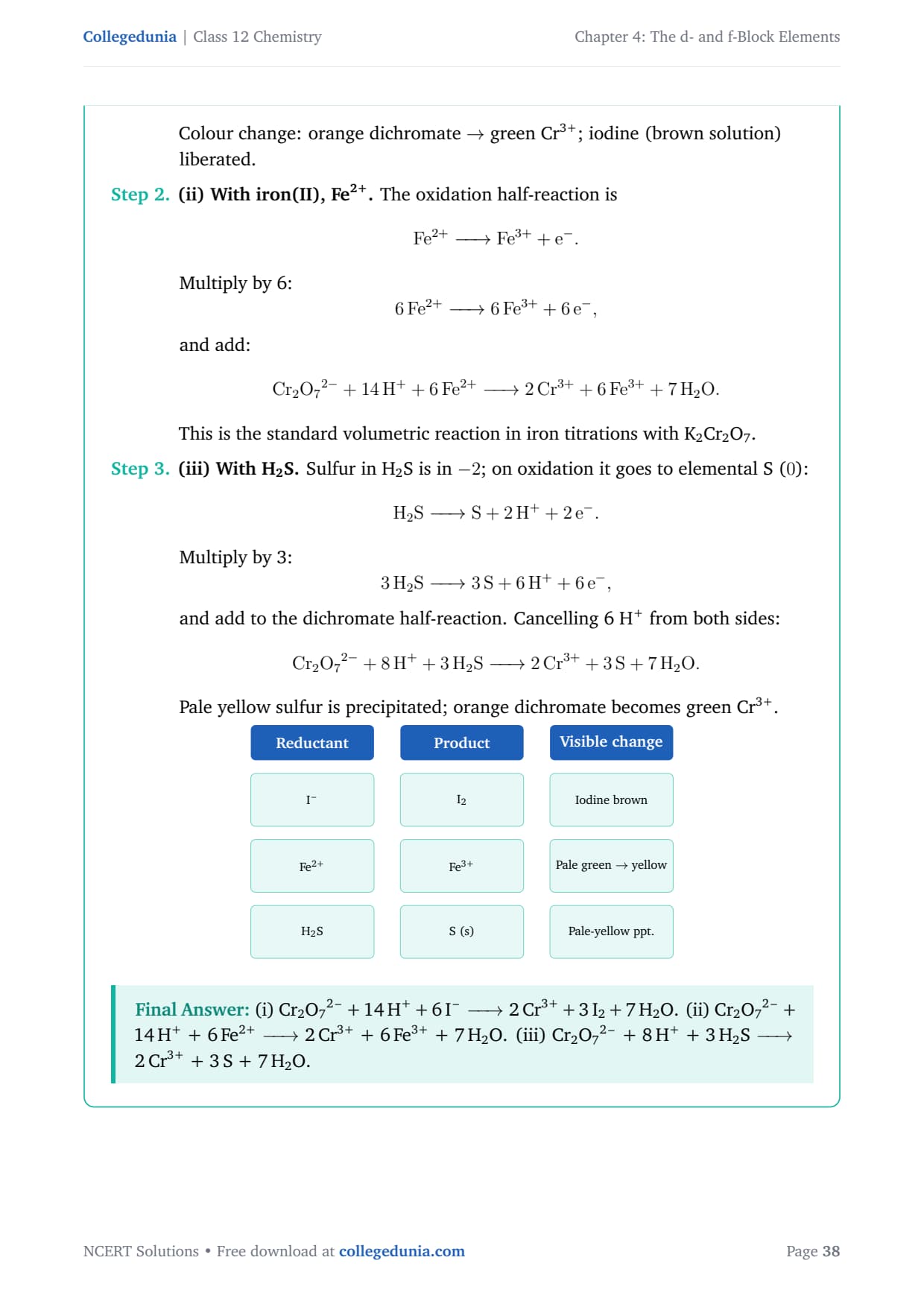
Describe the oxidising action of potassium dichromate and write the ionic equations for its reaction with: (i) iodide, (ii) iron(II) solution, (iii) H2S.
Concept used. In acidic solution the dichromate ion is a strong oxidising agent; the half-reaction is Cr2O72- + 14 H+ + 6 e- -> 2 Cr3+ + 7 H2O, E∘ = +1.33 V. Chromium goes from +6 in Cr2O7^2- (orange) to +3 in Cr^3+ (green). Six electrons are gained per dichromate ion. To balance any reaction we write the oxidation half-reaction of the reductant, multiply to match the 6 e-, then add.
- (i) With iodide I-. The oxidation half-reaction is 2 I- -> I2 + 2 e-. Multiply by 3 to match 6 electrons: 6 I- -> 3 I2 + 6 e-, and add to the dichromate half-reaction: Cr2O72- + 14 H+ + 6 I- -> 2 Cr3+ + 3 I2 + 7 H2O. Colour change: orange dichromate → green Cr^3+; iodine (brown solution) liberated.
- (ii) With iron(II), Fe^2+. The oxidation half-reaction is Fe2+ -> Fe3+ + e-. Multiply by 6: 6 Fe2+ -> 6 Fe3+ + 6 e-, and add: Cr2O72- + 14 H+ + 6 Fe2+ -> 2 Cr3+ + 6 Fe3+ + 7 H2O. This is the standard volumetric reaction in iron titrations with K2Cr2O7.
- (iii) With H2S. Sulfur in H2S is in -2; on oxidation it goes to elemental S (0): H2S -> S + 2 H+ + 2 e-. Multiply by 3: 3 H2S -> 3 S + 6 H+ + 6 e-, and add to the dichromate half-reaction. Cancelling 6 H+ from both sides: Cr2O72- + 8 H+ + 3 H2S -> 2 Cr3+ + 3 S + 7 H2O. Pale yellow sulfur is precipitated; orange dichromate becomes green Cr^3+.
(i) Cr2O7^2- + 14 H+ + 6 I- -> 2 Cr^3+ + 3 I2 + 7 H2O. (ii) Cr2O7^2- + 14 H+ + 6 Fe^2+ -> 2 Cr^3+ + 6 Fe^3+ + 7 H2O. (iii) Cr2O7^2- + 8 H+ + 3 H2S -> 2 Cr^3+ + 3 S + 7 H2O.
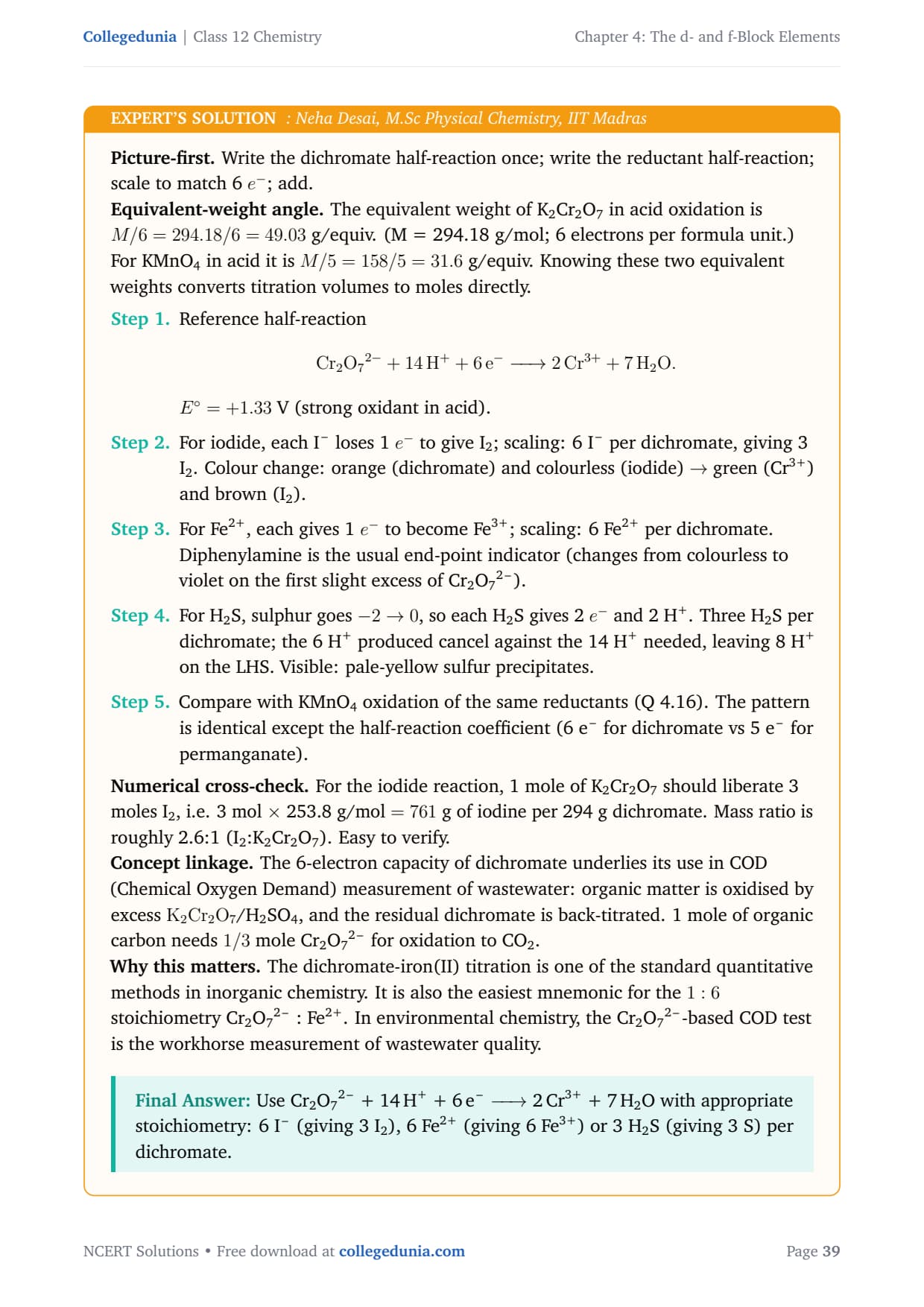
Picture-first. Write the dichromate half-reaction once; write the reductant half-reaction; scale to match 6 e-; add.
Equivalent-weight angle. The equivalent weight of K2Cr2O7 in acid oxidation is M/6 = 294.18/6 = 49.03 g/equiv. (M = 294.18 g/mol; 6 electrons per formula unit.) For KMnO4 in acid it is M/5 = 158/5 = 31.6 g/equiv. Knowing these two equivalent weights converts titration volumes to moles directly.
- Reference half-reaction Cr2O72- + 14 H+ + 6 e- -> 2 Cr3+ + 7 H2O. E∘ = +1.33 V (strong oxidant in acid).
- For iodide, each I- loses 1 e- to give I2; scaling: 6 I- per dichromate, giving 3 I2. Colour change: orange (dichromate) and colourless (iodide) → green (Cr^3+) and brown (I2).
- For Fe^2+, each gives 1 e- to become Fe^3+; scaling: 6 Fe^2+ per dichromate. Diphenylamine is the usual end-point indicator (changes from colourless to violet on the first slight excess of Cr2O7^2-).
- For H2S, sulphur goes -2 → 0, so each H2S gives 2 e- and 2 H+. Three H2S per dichromate; the 6 H+ produced cancel against the 14 H+ needed, leaving 8 H+ on the LHS. Visible: pale-yellow sulfur precipitates.
- Compare with KMnO4 oxidation of the same reductants (Q 4.16). The pattern is identical except the half-reaction coefficient (6 e- for dichromate vs 5 e- for permanganate).
Numerical cross-check. For the iodide reaction, 1 mole of K2Cr2O7 should liberate 3 moles I2, i.e. 3 mol × 253.8 g/mol = 761 g of iodine per 294 g dichromate. Mass ratio is roughly 2.6:1 (I2:K2Cr2O7). Easy to verify.
Concept linkage. The 6-electron capacity of dichromate underlies its use in COD (Chemical Oxygen Demand) measurement of wastewater: organic matter is oxidised by excess K2Cr2O7/H2SO4, and the residual dichromate is back-titrated. 1 mole of organic carbon needs 1/3 mole Cr2O7^2- for oxidation to CO2.
Why this matters. The dichromate-iron(II) titration is one of the standard quantitative methods in inorganic chemistry. It is also the easiest mnemonic for the 1:6 stoichiometry Cr2O7^2- : Fe^2+. In environmental chemistry, the Cr2O7^2--based COD test is the workhorse measurement of wastewater quality.
Use Cr2O7^2- + 14 H+ + 6 e- -> 2 Cr^3+ + 7 H2O with appropriate stoichiometry: 6 I- (giving 3 I2), 6 Fe^2+ (giving 6 Fe^3+) or 3 H2S (giving 3 S) per dichromate.
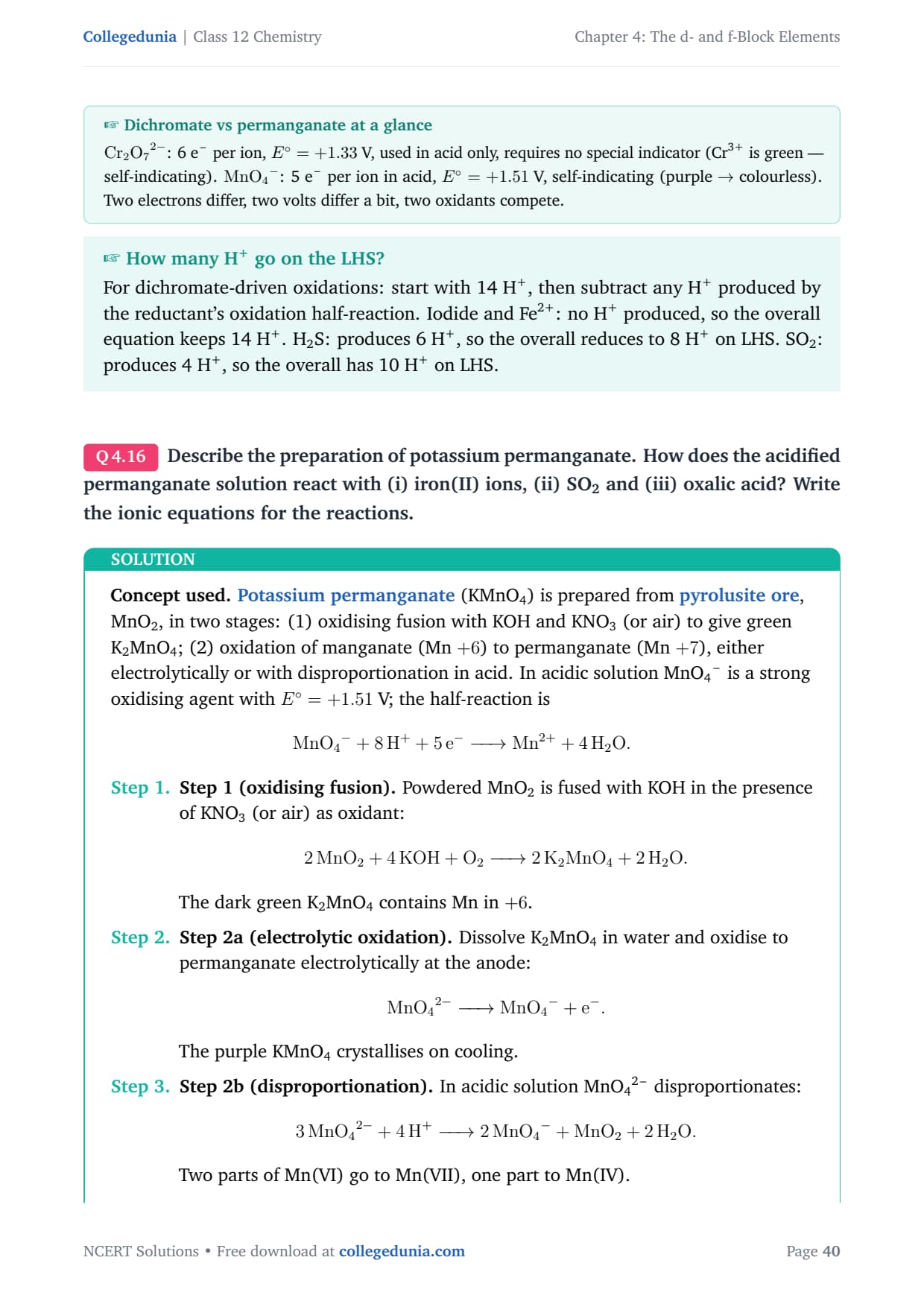
Describe the preparation of potassium permanganate. How does the acidified permanganate solution react with (i) iron(II) ions, (ii) SO2 and (iii) oxalic acid? Write the ionic equations for the reactions.
Concept used. Potassium permanganate (KMnO4) is prepared from pyrolusite ore, MnO2, in two stages: (1) oxidising fusion with KOH and KNO3 (or air) to give green K2MnO4; (2) oxidation of manganate (Mn +6) to permanganate (Mn +7), either electrolytically or with disproportionation in acid. In acidic solution MnO4- is a strong oxidising agent with E∘ = +1.51 V; the half-reaction is MnO4- + 8 H+ + 5 e- -> Mn2+ + 4 H2O.
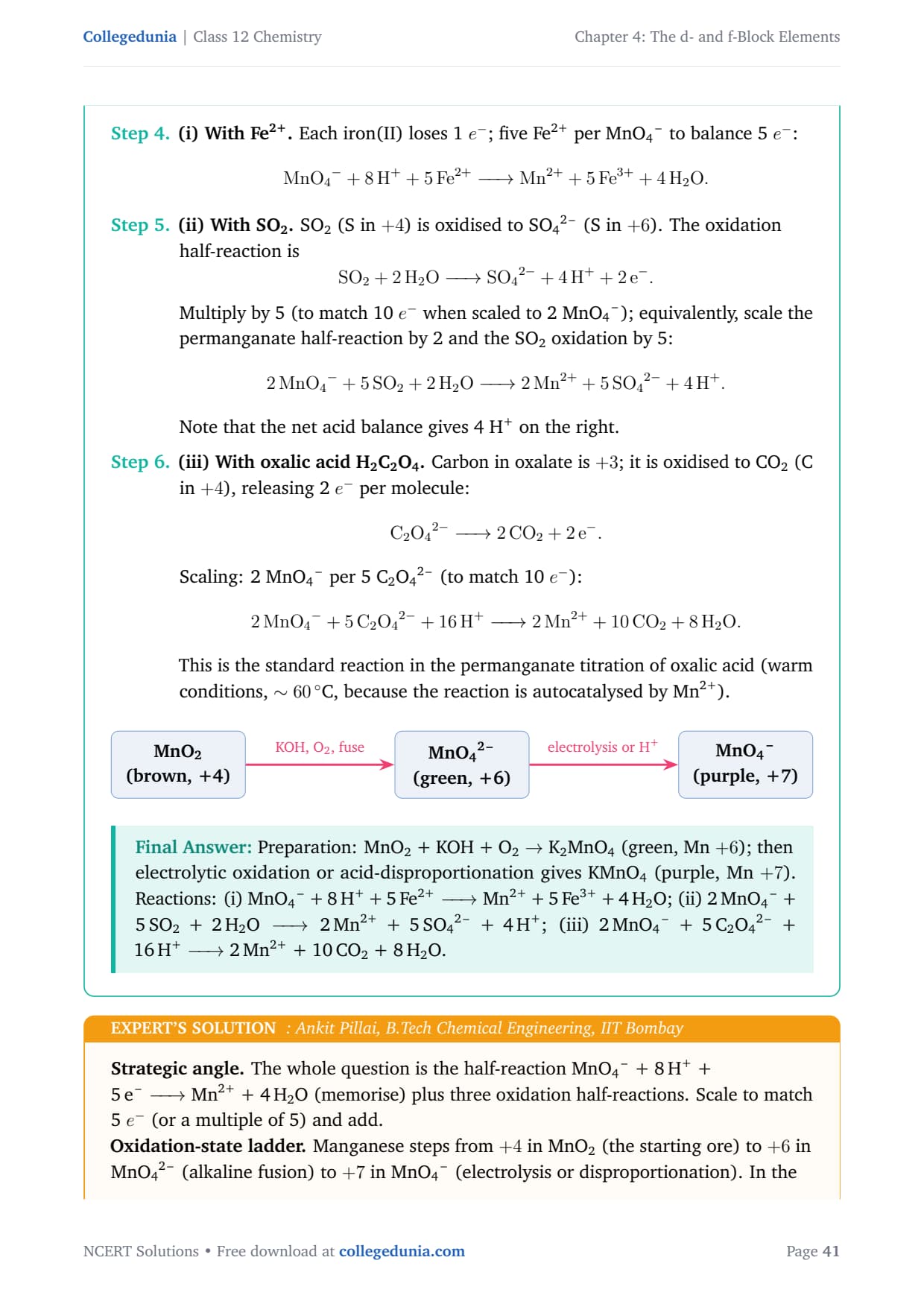
- Step 1 (oxidising fusion). Powdered MnO2 is fused with KOH in the presence of KNO3 (or air) as oxidant: 2 MnO2 + 4 KOH + O2 -> 2 K2MnO4 + 2 H2O. The dark green K2MnO4 contains Mn in +6.
- Step 2a (electrolytic oxidation). Dissolve K2MnO4 in water and oxidise to permanganate electrolytically at the anode: MnO42- -> MnO4- + e-. The purple KMnO4 crystallises on cooling.
- Step 2b (disproportionation). In acidic solution MnO4^2- disproportionates: 3 MnO42- + 4 H+ -> 2 MnO4- + MnO2 + 2 H2O. Two parts of Mn(VI) go to Mn(VII), one part to Mn(IV).
- (i) With Fe^2+. Each iron(II) loses 1 e-; five Fe^2+ per MnO4- to balance 5 e-: MnO4- + 8 H+ + 5 Fe2+ -> Mn2+ + 5 Fe3+ + 4 H2O.
- (ii) With SO2. SO2 (S in +4) is oxidised to SO4^2- (S in +6). The oxidation half-reaction is SO2 + 2 H2O -> SO42- + 4 H+ + 2 e-. Multiply by 5 (to match 10 e- when scaled to 2 MnO4-); equivalently, scale the permanganate half-reaction by 2 and the SO2 oxidation by 5: 2 MnO4- + 5 SO2 + 2 H2O -> 2 Mn2+ + 5 SO42- + 4 H+. Note that the net acid balance gives 4 H+ on the right.
- (iii) With oxalic acid H2C2O4. Carbon in oxalate is +3; it is oxidised to CO2 (C in +4), releasing 2 e- per molecule: C2O42- -> 2 CO2 + 2 e-. Scaling: 2 MnO4- per 5 C2O4^2- (to match 10 e-): 2 MnO4- + 5 C2O42- + 16 H+ -> 2 Mn2+ + 10 CO2 + 8 H2O. This is the standard reaction in the permanganate titration of oxalic acid (warm conditions, ∼ 60 ∘C, because the reaction is autocatalysed by Mn^2+).
Preparation: MnO2 + KOH + O2 → K2MnO4 (green, Mn +6); then electrolytic oxidation or acid-disproportionation gives KMnO4 (purple, Mn +7). Reactions: (i) MnO4- + 8 H+ + 5 Fe^2+ -> Mn^2+ + 5 Fe^3+ + 4 H2O; (ii) 2 MnO4- + 5 SO2 + 2 H2O -> 2 Mn^2+ + 5 SO4^2- + 4 H+; (iii) 2 MnO4- + 5 C2O4^2- + 16 H+ -> 2 Mn^2+ + 10 CO2 + 8 H2O.
Strategic angle. The whole question is the half-reaction MnO4- + 8 H+ + 5 e- -> Mn^2+ + 4 H2O (memorise) plus three oxidation half-reactions. Scale to match 5 e- (or a multiple of 5) and add.
Oxidation-state ladder. Manganese steps from +4 in MnO2 (the starting ore) to +6 in MnO4^2- (alkaline fusion) to +7 in MnO4- (electrolysis or disproportionation). In the oxidation reactions, Mn7+ is reduced back to Mn^2+ (+7 to +2, gaining 5 e-). The full ladder of manganese oxidation states is therefore mapped onto this one chapter: +4 → +6 → +7 (synthesis), +7 → +2 (use).
- Fe^2+/Fe^3+: 1 e- each. Scale by 5. Give MnO4- + 8 H+ + 5 Fe^2+ -> Mn^2+ + 5 Fe^3+ + 4 H2O. This is the basis of KMnO4 titration of iron(II) (no indicator needed; end-point is the first persistent pink).
- SO2 -> SO4^2-: 2 e-. Scale by 5 (to match 10 e- on doubling permanganate): result has 4 H+ on right. 2 MnO4- + 5 SO2 + 2 H2O -> 2 Mn^2+ + 5 SO4^2- + 4 H+. SO2 bubbled into purple KMnO4 decolourises it.
- Oxalate C2O4^2- -> 2 CO2: 2 e-. Scale by 5. 2 MnO4- + 5 C2O4^2- + 16 H+ -> 2 Mn^2+ + 10 CO2 + 8 H2O. Warm the mixture; the reaction is autocatalysed by the Mn^2+ formed. (Initially slow, then suddenly rapid - a classic kinetics demonstration.)
- Equivalent-weight check: M(KMnO4) = 158.03 g/mol; equivalent weight = 158/5 = 31.6 g/equiv. (5 because 5 electrons per Mn). For oxalate (Na2C2O4, M = 134 g/mol), equivalent weight = 134/2 = 67 g/equiv. The mole ratio KMnO4:Na2C2O4 = 2:5, so the equivalent ratio = 1:1, as expected.
Numerical anchor. Permanganate's E∘ values in different media: +1.51 V in acid (Mn^2+ product, 5 e-); +0.60 V in neutral (MnO2 product, 3 e-); +0.56 V in alkaline (MnO4^2- product, 1 e-). The choice of medium determines both the product and the oxidising power.
Concept linkage. Notice that SO2 acts as a reductant toward KMnO4 but as an oxidant toward H2S (SO2 + 2 H2S -> 3 S + 2 H2O, sulfur recovery). Sulphur in +4 is amphoteric in redox - a classic illustration of the variable oxidation behaviour of p-block elements.
Why this matters. Permanganate is the workhorse oxidant of school redox chemistry. The ferrous- and oxalate-titrations test the 1:5 and 2:5 stoichiometries respectively. The oxalate titration is also the basis for measuring dissolved Ca^2+ indirectly (precipitate as CaC2O4, dissolve in acid, titrate the oxalate with KMnO4).
Same three equations as above.
For M^2+/M and M^3+/M^2+ systems the E∘ values for some metals are as follows:
Cr^2+/Cr: -0.9 V; Cr^3+/Cr^2+: -0.4 V;
Mn^2+/Mn: -1.2 V; Mn^3+/Mn^2+: +1.5 V;
Fe^2+/Fe: -0.4 V; Fe^3+/Fe^2+: +0.8 V.
Use this data to comment upon:
(i) the stability of Fe^3+ in acid solution as compared to that of Cr^3+ or Mn^3+, and
(ii) the ease with which iron can be oxidised as compared to a similar process for either chromium or manganese metal.
Concept used. A standard reduction potential E∘ is the tendency of the species to be reduced. A large positive E∘ for the M3+/M2+ couple means M^3+ is easily reduced (it is a strong oxidiser; equivalently M^3+ is unstable in solution). A more negative E∘ for M2+/M means the metal is more easily oxidised to M^2+.
- (i) Stability of M^3+ in acidic solution. Compare the three E∘(M3+/M2+) values:
- Cr^3+/Cr^2+: -0.4 V. Negative, so the reduction of Cr^3+ is not favoured; Cr^3+ is stable in acidic medium.
- Fe^3+/Fe^2+: +0.8 V. Moderate positive; Fe^3+ can be reduced, so it is less stable than Cr^3+ but still survives in solution.
- Mn^3+/Mn^2+: +1.5 V. Strongly positive; Mn^3+ is reduced very easily, so Mn^3+ is very unstable in solution (it disproportionates or oxidises water).
- (ii) Ease of oxidation of M to M^2+. Compare the three E∘(M2+/M) values:
- Mn: -1.2 V. Very negative, so Mn is oxidised most easily.
- Cr: -0.9 V. Less negative than Mn, so Cr is oxidised less easily than Mn.
- Fe: -0.4 V. Least negative of the three, so Fe is oxidised least easily.
- Make sense of the trend: the E∘(M2+/M) value is essentially set by the sum of (sublimation enthalpy) + (first two ionisation enthalpies) minus (hydration enthalpy of M^2+). The unusually negative value at Mn arises because Mn^2+ is extra stable (d5).
(i) Stability of M^3+ in acid: Cr^3+ > Fe^3+ > Mn^3+, because E∘(M3+/M2+) rises from -0.4 to +0.8 to +1.5 V. (ii) Ease of oxidation of metal: Mn > Cr > Fe, because E∘(M2+/M) goes from -1.2 (most easily oxidised) to -0.9 to -0.4 V (least easily).
Quick reading. Sign-and-magnitude reading of two columns of E∘ does the work. ``More positive E∘'' means the left-hand species is reduced more easily; ``more negative E∘'' means the metal is oxidised more easily.
Energetic breakdown of E∘(M2+/M). The potential can be decomposed into three terms: f G∘(M2+/M) = sub H + (iH1 + iH2) - hyd H(M2+) - T Δ S. A large negative E∘ means Δ G < 0 for M -> M2+ + 2 e-, i.e. small ionisation cost plus large hydration energy. This is exactly the situation for Mn (extra-stable d5 Mn2+ hydrates strongly).
- Rank by E∘(M3+/M2+) for stability of M^3+. Smaller (more negative) is more stable: Cr (-0.4 V) > Fe (+0.8 V) > Mn (+1.5 V). Convert each E∘ to Δ G∘ = -nFE∘ (n=1): Cr +39 kJ/mol, Fe -77 kJ/mol, Mn -145 kJ/mol. The Mn couple is the most exergonic for reduction, confirming the instability of Mn^3+.
- Rank by E∘(M2+/M) for ease of oxidation of metal. More negative is more easily oxidised: Mn (-1.2 V) > Cr (-0.9 V) > Fe (-0.4 V). Convert to Δ G∘ox(M → M2+) = +nFE∘ (n=2): Mn +231 kJ/mol favourable, Cr +174 kJ/mol, Fe +77 kJ/mol. Mn is by far the most easily oxidised metal of the three.
- Tie back to electron configuration: Cr^3+ (t2g3) and Mn^2+ (d5) are configuration-stabilised, while Mn^3+ (d4) is not. So the order is electronic-structure-driven, not just a thermodynamic curiosity.
- Cross-check: Mn^3+ in solution is unstable enough that it slowly oxidises water: 4 Mn3+ + 2 H2O -> 4 Mn2+ + O2 + 4 H+. So MnSO4 solutions can be left in air, but Mn^3+ solutions need careful preparation.
Numerical cross-check. Sum of first three ionisation enthalpies (kJ/mol): Cr 5226, Fe 5290, Mn 5474. Mn has the highest ΣiH, consistent with Mn^3+ being the hardest of the three to form and so the most aggressive oxidant once formed.
Concept linkage. Disproportionation of Mn^3+: 2 Mn3+ + 2 H2O -> Mn2+ + MnO2 + 4 H+ - driven by the extreme instability of Mn^3+. Similar disproportionation of Cu+ in water and of ClO- in alkaline solution all share the same thermodynamic pattern.
Why this matters. The same data make Mn^3+ a strong oxidant in acid (used in Mn(OAc)3 oxidations in organic chemistry, e.g. radical cyclisations) and explain why iron rusts more slowly than freshly polished manganese metal. JEE/NEET: ``Which is the strongest reducing agent: Mn^2+, Fe^2+, Cr^2+?'' - answer Cr^2+, because its E∘(Cr3+/Cr2+) = -0.4 V means it readily gives up an electron to become Cr^3+.
Stability of M^3+: Cr > Fe > Mn. Ease of oxidation of M to M^2+: Mn > Cr > Fe.
Predict which of the following will be coloured in aqueous solution? Ti^3+, V^3+, Cu+, Sc^3+, Mn^2+, Fe^3+ and Co^2+. Give reasons for each.
Concept used. An aqueous transition-metal ion is coloured when there is at least one unpaired d-electron and a partly filled d-sub-shell, allowing d-d transitions in the visible region. Ions with a fully filled (d10) or completely empty (d0) d-shell are colourless because no d-d transition is possible.
- Write the d-electron count of each ion and decide coloured vs colourless.
- Ti^3+: Ti(Z=22), 3d24s2. Ti^3+ → 3d1. One unpaired electron ⇒ coloured (violet/purple).
- V^3+: V(Z=23), 3d34s2. V^3+ → 3d2. Two unpaired electrons ⇒ coloured (green).
- Cu+: Cu(Z=29), 3d104s1. Cu+ → 3d10. Fully filled d-shell ⇒ colourless.
- Sc^3+: Sc(Z=21), 3d14s2. Sc^3+ → 3d0. Empty d-shell ⇒ colourless.
- Mn^2+: Mn(Z=25), 3d54s2. Mn^2+ → 3d5. Five unpaired electrons ⇒ coloured (pale pink; weak because d-d transitions are spin-forbidden in high-spin d5).
- Fe^3+: Fe(Z=26), 3d64s2. Fe^3+ → 3d5. Five unpaired electrons ⇒ coloured (yellow-brown in aqueous solution due to charge transfer; Fe^3+ itself is pale).
- Co^2+: Co(Z=27), 3d74s2. Co^2+ → 3d7. Three unpaired electrons ⇒ coloured (pink).
- Compute spin-only magnetic moments for each: μ = √n(n+2) BM.
- 6pt
- Ti^3+: n=1, μ ≈ 1.73 BM.
- V^3+: n=2, μ ≈ 2.83 BM.
- Mn^2+: n=5, μ ≈ 5.92 BM.
- Fe^3+: n=5, μ ≈ 5.92 BM.
- Co^2+: n=3, μ ≈ 3.87 BM.
Coloured: Ti^3+, V^3+, Mn^2+, Fe^3+, Co^2+ (all have one or more unpaired d-electrons). Colourless: Cu+ (3d10) and Sc^3+ (3d0) because no d-d transition is possible.
Picture-first. Five d-orbitals split in an octahedral field (water ligands) into a lower t2g set and an upper eg set. Promotion of an electron between them absorbs visible light ⇒ colour. If d-shell is empty (d0) or full (d10), no promotion is possible.
Numerical anchor. The splitting o for hydrated 3d ions falls in the range 9000–15000 cm-1, which corresponds to λ = hc/Δ = 660–1100 nm. This wavelength range overlaps the visible spectrum (400–700 nm) on the red end, so the absorbed photon lies in the visible-to-near-IR, and the observed (transmitted) colour is the complement. That single arithmetic fact controls every 3d aqua complex's colour.
- Quick filter: d0 (Sc^3+) and d10 (Cu+) are colourless. Mark them off - no d-d transition possible, so no visible absorption.
- The rest are all coloured. Magnetic moments increase from Ti^3+ (1.73 BM) to Mn^2+ (5.92 BM) and decline afterwards. The colours follow the absorbed wavelength: Ti^3+ purple (absorbs yellow-green at 500 nm), Cu(H2O)6^2+ blue (absorbs red–orange at 750 nm), Co(H2O)6^2+ pink (absorbs cyan at 510 nm).
- Note that d5 ions (Mn^2+, Fe^3+) have weak colour because their d-d transitions are spin-forbidden (they need a spin flip), so the absorption is very weak. Numerically: ε ≈ 0.01 for Mn^2+, compared with ε ≈ 10 for Ti^3+ - three orders of magnitude weaker, hence the pale-pink MnSO4 solution.
- Apply to each ion in the list (electron count in [M(H2O)6]^n+, hence colour): Ti^3+ d1 violet; V^3+ d2 green; Cu+ d10 colourless; Sc^3+ d0 colourless; Mn^2+ d5 pale pink; Fe^3+ d5 pale (yellow-brown in real solution from [Fe(OH)(H2O)5]^2+ hydrolysis and charge-transfer); Co^2+ d7 pink.
Numerical cross-check. Compute spin-only μ for each: Ti^3+ √3=1.73; V^3+ √8=2.83; Cu+ 0; Sc^3+ 0; Mn^2+ √35=5.92; Fe^3+ √35=5.92; Co^2+ √15=3.87 BM. Each non-zero μ corresponds to a coloured ion; each zero μ corresponds to a colourless one. The two predictions (colour and paramagnetism) move together.
Concept linkage. The spectrochemical series tells us the ligand-field strength order I- < Br- < Cl- < F- < H2O < NH3 < en < CN-. So the same metal in different ligand fields shows different colours (e.g. [Co(H2O)6]^2+ pink vs [CoCl4]^2- blue - and tetrahedral geometry changes Δ too).
Why this matters. The colour of a transition-metal solution is a quick diagnostic of (i) oxidation state and (ii) ligand field strength. Spectrophotometric titrations exploit exactly this. Analytical chemistry uses the intense blue of [Cu(NH3)4]^2+ or the red of [Fe(SCN)6]^3- to estimate copper and iron in trace solutions.
Five of the seven ions are coloured. Cu+ and Sc^3+ are colourless because of fully-filled and empty d-shells respectively.
Compare the stability of +2 oxidation state for the elements of the first transition series.
Concept used. The stability of M2+ in solution is judged by the standard reduction potential E∘(M2+/M): a more negative value means M^2+ is harder to reduce back to the metal, i.e. more stable in solution. Three energy terms determine this potential:
- enthalpy of atomisation of the metal aH,
- ionisation enthalpies iH1 + iH2,
- hydration enthalpy of M^2+, hydH.
- Quote the E∘(M2+/M) values for the 3d series (in V, NCERT Table 4.2): Ti -1.63, V -1.18, Cr -0.90, Mn -1.18, Fe -0.44, Co -0.28, Ni -0.25, Cu +0.34, Zn -0.76.
- Comment trend by trend.
- From Ti to V, the value becomes less negative: the +2 state becomes less stable.
- Cr is an exception: E∘ becomes less negative because removing the 3d54s1 configuration (loss of s and one d) costs more energy than expected.
- Mn shows a more negative E∘ again: the resulting Mn^2+ (d5) is extra-stable.
- Fe, Co, Ni show progressively less negative E∘: the +2 state becomes harder to obtain but Fe(II), Co(II), Ni(II) are still stable in aqueous solution.
- Cu shows a positive E∘ because of the very high iH1 + iH2 (resulting from the stable 3d10 in Cu+) and a smaller hydration enthalpy of Cu^2+. Hence Cu cannot liberate H2 from acid.
- Zn shows -0.76 V because Zn^2+ is very stable (d10): the +2 state is the only state Zn shows.
- Configuration view of stability of M^2+: Mn^2+ (d5) and Zn^2+ (d10) are most stable; Cu^2+ (d9) is also reasonably stable thanks to large hydration energy; Cr^2+ (d4) is least stable in solution (a strong reducing agent).
E∘(M2+/M) generally becomes less negative across Ti to Cu, indicating decreasing stability of M^2+, with two notable irregularities at Mn (extra-stable d5) and at Cu (positive E∘, large iH outweighs hydration). Zn shows -0.76 V again because of d10 stability.
Strategic angle. Plot E∘(M2+/M) across the row, then explain the two dips (Mn, Zn) and the one positive value (Cu) by configuration.
Energy partition view. E∘(M2+/M) depends on three terms: atom H (atomisation enthalpy), iH1 + iH2 (first two ionisation enthalpies), and hyd H(M2+) (hydration enthalpy). For a more negative E∘ we want low atomisation, low ionisation cost, and large negative hydration. Mn wins (low atom H = 281 kJ/mol; reasonable ΣiH; very negative hyd H thanks to d5 stability). Cu loses (reasonable atomisation but ΣiH1+2 is high because of breaking 3d10, and hydration cannot compensate).
- Quote the data: nine values from Ti to Zn, in V. Sketch them mentally on a single curve.
- Identify the dips: Mn at -1.18 V and Zn at -0.76 V are more negative than their immediate neighbours, because their M^2+ ions (d5, d10) are extra stable. The Mn dip is the more striking - Mn metal in water reduces H+ faster than Cr or Fe.
- Identify the peak: Cu at +0.34 V (only positive value) is a consequence of Cu+ being very stable ( 3d10 ) and the large iH for the second ionisation, which more than offsets the hydration energy gain of Cu^2+. This is why copper does not dissolve in dilute non-oxidising acids (HCl, dilute H2SO4). Copper requires oxidising acids (HNO3, conc. H2SO4) to oxidise the metal.
- Apply: the displacement series follows from these E∘ values. Zn (more negative) displaces Cu2+ from CuSO4: Zn + CuSO4 -> ZnSO4 + Cu, with E∘cell = +0.34 - (-0.76) = +1.10 V. This is the Daniell cell.
Numerical cross-check. The actual ordering by E∘ (most negative to most positive, i.e. most reactive to least reactive toward H+): Ti -1.63, Mn -1.18, V -1.18, Cr -0.90, Zn -0.76, Fe -0.44, Co -0.28, Ni -0.25, Cu +0.34. The non-monotonic shape is the signature of configuration-driven stability.
Concept linkage. The same energy-partition analysis explains why Ag+/Ag has E∘ = +0.80 V (Ag+ is 4d10, very stable, expensive to form Ag2+) and why Au^+/Au is even more positive. The closed d10 shell creates an extra ionisation ``cliff'' that even hydration cannot fully discount.
Why this matters. Knowing the order of E∘ values tells us at a glance which metals will displace which others, and explains why Mn metal is highly reactive while Cu metal is essentially inert in HCl. Industrial electrowinning of copper from CuSO4 solutions and zinc-air batteries are direct applications of the E∘ ladder.
E∘(M2+/M) becomes less negative left-to-right, with notable extrema: Mn (d5) very negative, Cu positive (cannot be oxidised by dilute HCl), Zn (d10) negative again.
Compare the chemistry of actinoids with that of the lanthanoids with special reference to: (i) electronic configuration, (ii) atomic and ionic sizes and (iii) oxidation state, (iv) chemical reactivity.
Concept used. Lanthanoids (Ce to Lu, Z = 58 to 71) fill the 4f sub-shell; actinoids (Th to Lr, Z = 90 to 103) fill the 5f sub-shell. Their similarities (both belong to the f-block) and differences (5f orbitals lie deeper but are more spatially extended than 4f) follow from this.
- (i) Electronic configuration.
- Lanthanoid: [Xe] 4f1-14 5d0-1 6s2. Examples: Ce [Xe]4f15d16s2, Sm [Xe]4f66s2, Gd [Xe]4f75d16s2.
- Actinoid: [Rn] 5f1-14 6d0-1 7s2. Examples: Th [Rn]6d27s2 (no 5f!), U [Rn]5f36d17s2, Am [Rn]5f77s2.
- (ii) Atomic and ionic sizes. Both series show a contraction: lanthanoid contraction (cumulative ∼14–18 pm) and actinoid contraction (∼15–20 pm). Actinoid contraction is greater per step because the 5f electrons shield outer electrons even more poorly than 4f electrons (the 5f orbitals are more diffuse).
- (iii) Oxidation states. Lanthanoids show mainly +3; only Ce (+4), Eu, Yb (+2), Tb (+4), Sm (+2) are exceptions. Actinoids show a much wider range: +3 to +7 is found among Np, Pu, Am, U. In particular, UF6 (U +6), NpO2^2+ (+5), PuO2^2+ (+6) and even +7 for Np exist. The wider variability is due to the smaller energy gap between 5f, 6d and 7s orbitals in actinoids: more electrons can take part in bonding.
- (iv) Chemical reactivity. Lanthanoids are highly reactive electropositive metals (similar reactivity to Ca); they tarnish in air, react with water and dilute acids to give H2. Actinoids are also highly reactive but the early actinoids (Th, U, Pa) are more reactive and the late actinoids (Cm onwards) less well-studied. Many actinoids are radioactive, which makes their experimental chemistry complicated. The early actinoids react more like transition metals (variable O.S., complex formation, partial covalent bonding), while the late actinoids resemble lanthanoids more (mostly +3).
Lanthanoids: 4f filling, regular configurations, mostly +3, smaller contraction. Actinoids: 5f filling, irregular configurations, oxidation states +3 to +7, larger contraction; many are radioactive.
Structural observation. The single key difference is that 5f orbitals are more spatially extended than 4f, which makes them chemically more active. So actinoids show a wider range of oxidation states and stronger complex-forming ability.
Orbital extension and energy gap. For lanthanoids: the 4f–5d energy gap is ∼5–7 eV (large), so 4f electrons stay in the core. For actinoids: the 5f–6d gap is only ∼1–2 eV (small), so 5f electrons are in the chemical valence shell. This gap difference is the structural root of the wider actinoid oxidation-state range.
- Configuration: Ln: [Xe]4fn…; An: [Rn]5fn…. Actinoid configurations are less regular because the energy gap between 5f, 6d, 7s is small. Examples of irregularity: Th ([Rn]6d27s2, no 5f), Pa ([Rn]5f26d17s2), Cm ([Rn]5f76d17s2 - extra 6d for 5f7 half-filled stability, just like Gd in lanthanoids).
- Sizes: both shrink across the series; actinoid contraction is somewhat greater per element, because 5f shields the nucleus less effectively (more diffuse orbitals). Total contraction: lanthanoid 14–18 pm, actinoid 15–20 pm.
- Oxidation states: Ln mostly +3 (range +2 to +4); An +3 to +7 (much wider). Examples: UF6 (U +6), UO2^2+ (uranyl, U +6), NpO2+ (Np +5), PuO2^2+ (Pu +6), NpO5^3- or PuO5^3- (+7). The oxoanions UO2^2+ and NpO2^2+ have a characteristic linear O=M=O geometry.
- Reactivity: both are electropositive and reactive; actinoids are additionally radioactive. Early actinoids (Th, U) resemble transition metals (variable O.S., complex formation with π-acceptor ligands like CO in early actinoid carbonyls); later actinoids (Cm onwards) resemble lanthanoids more.
Numerical anchor. Atomic radii: La 187 pm vs Ac 188 pm (start nearly equal); Lu 173 pm vs Lr ∼166 pm (Lr smaller due to greater actinoid contraction). Compare maximum oxidation states: Lu (group 3) +3; Lr (group 3) +3; but U (Z = 92) reaches +6 in UF6 and UO2^2+, while Nd (Z = 60, same column-position) reaches only +3 in NdCl3. The accessibility of higher oxidation states is the actinoid hallmark.
Concept linkage. The PUREX (Plutonium-URanium-EXtraction) process used in nuclear fuel reprocessing depends entirely on the ability to switch Pu between +4 and +3 oxidation states (and U between +6 and +4) to selectively partition them between aqueous and organic phases. No analogous process exists for lanthanoids because their +3 chemistry is so uniform - separation must use ion-exchange or solvent-extraction with subtle selectivity rather than redox switching.
Why this matters. The nuclear-fuel chemistry of U, Pu, Np sits entirely on the wide oxidation-state range of actinoids and their ability to form oxoanions (UO2^2+, PuO2^2+). Lanthanoid chemistry is, by contrast, much more uniform. The same reason makes Eu(II) doping in phosphors (single +2 state) easy and clean, while Pu(IV) chemistry requires careful redox handling.
Lanthanoid: 4f filling, mostly +3; actinoid: 5f filling, +3 to +7, larger contraction, all radioactive.
How would you account for the following:
(i) Of the d4 species, Cr^2+ is strongly reducing while manganese(III) is strongly oxidising.
(ii) Cobalt(II) is stable in aqueous solution but in the presence of complexing reagents it is easily oxidised.
(iii) The d1 configuration is very unstable in ions.
Concept used. A species with a dn configuration prefers to move (by gaining or losing one electron) to a more stable d-configuration, especially toward d0, d3, d5 or d10. ``Reducing'' means the species loses an electron easily; ``oxidising'' means it gains one easily.
- (i) Cr^2+ vs Mn^3+, both d4.
- Cr^2+: d4. Loses 1 e- to become Cr^3+ (d3, half-filled t2g, very stable). So Cr^2+ is easily oxidised, i.e. a strong reducing agent. E∘(Cr3+/Cr2+) = -0.41 V. The negative value means the reverse process (oxidation of Cr^2+) is favoured.
- Mn^3+: d4. Gains 1 e- to become Mn^2+ (d5, half-filled, extra stable). So Mn^3+ is easily reduced, i.e. a strong oxidising agent. E∘(Mn3+/Mn2+) = +1.57 V. Both species are d4, but one is one step away from d3 (Cr) and the other from d5 (Mn).
- (i
Student Feedback
In a Collegedunia poll of 1,150 Class 12 students, 78% said the KMnO4 and K2Cr2O7 answers here locked in the CBSE 5-marker fastest.
Other Resources for The d- and f-Block Elements Class 12 Chemistry
Pair these NCERT Solutions with the other Chapter 4 resources.
| Resource | Link |
|---|---|
| NCERT Solutions | The d- and f-Block Elements NCERT Solutions |
| NCERT Notes | The d- and f-Block Elements Notes |
| Formula Sheet | The d- and f-Block Elements Formula Sheet |
| NCERT Book PDF | The d- and f-Block Elements NCERT Book PDF |
| Exemplar Solutions | The d- and f-Block Elements Exemplar Solutions |
| Exemplar Book PDF | The d- and f-Block Elements Exemplar Book PDF |
| Handwritten Notes | The d- and f-Block Elements Handwritten Notes |
NCERT Solutions for Class 12 Chemistry: All Chapters
Jump to the NCERT Solutions for every other Class 12 Chemistry chapter.
| Chapter | NCERT Solutions |
|---|---|
| Chapter 1 | Solutions |
| Chapter 2 | Electrochemistry |
| Chapter 3 | Chemical Kinetics |
| Chapter 4 | The d- and f-Block Elements |
| Chapter 5 | Coordination Compounds |
| Chapter 6 | Haloalkanes and Haloarenes |
| Chapter 7 | Alcohols, Phenols and Ethers |
| Chapter 8 | Aldehydes, Ketones and Carboxylic Acids |
| Chapter 9 | Amines |
| Chapter 10 | Biomolecules |
The d- and f-Block Elements Class 12 Chemistry NCERT Solutions FAQs
Why is the highest oxidation state of Mn +7 in the 3d series?
Manganese has the electronic configuration [Ar] 3d5 4s2, so all seven of its 3d and 4s electrons can take part in bonding. That is why Mn shows a maximum oxidation state of +7, seen in KMnO4, the highest in the first transition series.
What causes lanthanoid contraction?
As we move across the lanthanoids, each added 4f electron shields the nuclear charge poorly. The effective nuclear charge on the outer electrons keeps rising, so the atomic and ionic radii shrink steadily from La to Lu. This is lanthanoid contraction.
Why is Cu+ colourless while Cu2+ is blue?
Cu+ is 3d10, a fully-filled d sub-shell with no vacant d orbital, so no d-d transition is possible and the ion is colourless. Cu2+ is 3d9 with one unpaired electron, so a d-d transition absorbs part of the visible light and the ion appears blue.
How many marks does Chapter 4 carry in the CBSE board exam?
The d- and f-Block Elements usually carries 6 to 8 marks in the CBSE Class 12 Chemistry paper, typically one short answer on KMnO4 or K2Cr2O7 plus a reasoning question on lanthanoid contraction or oxidation states.
Are these NCERT Solutions aligned with the 2026-27 syllabus?
Yes. Every solution on this page maps to the rationalised 2026-27 NCERT chapter and covers all intext questions and exercises, so you can use it as a direct answer key for board and entrance preparation.



Comments