




These Class 12 Chemistry Chapter 4, d- and f-Block Elements notes summarise the whole chapter in a simple way, aligned to the NCERT book and the latest CBSE pattern.
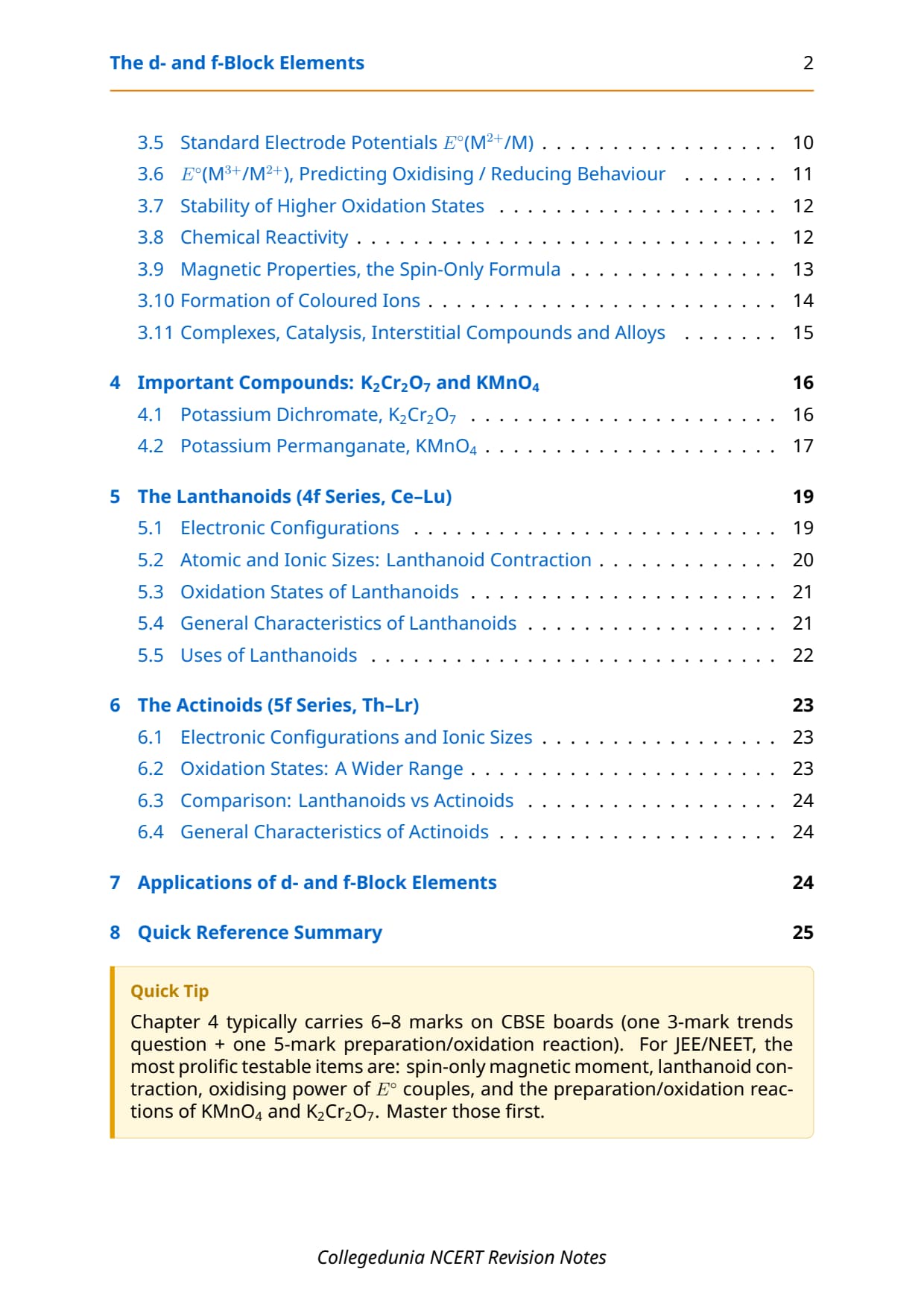
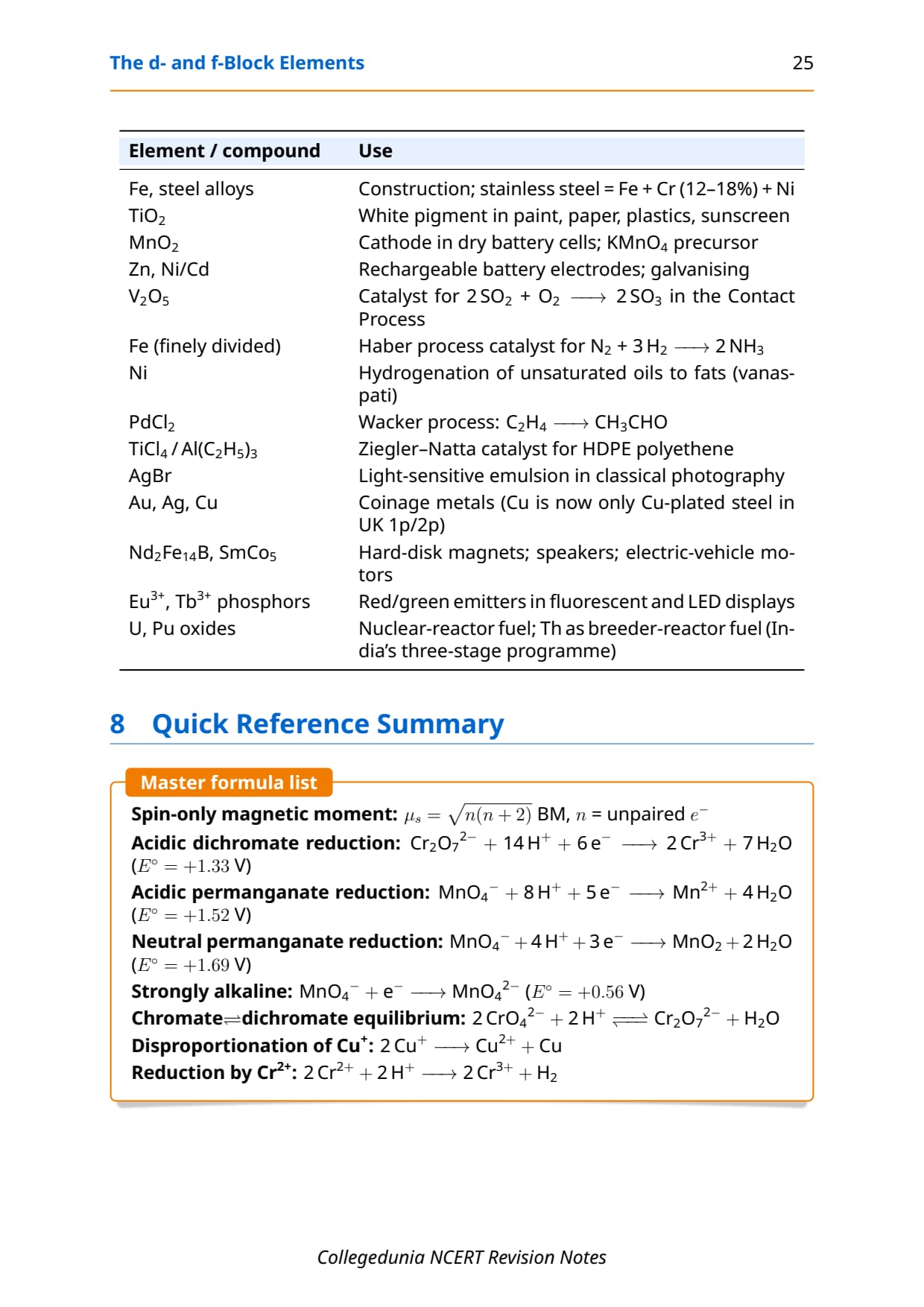
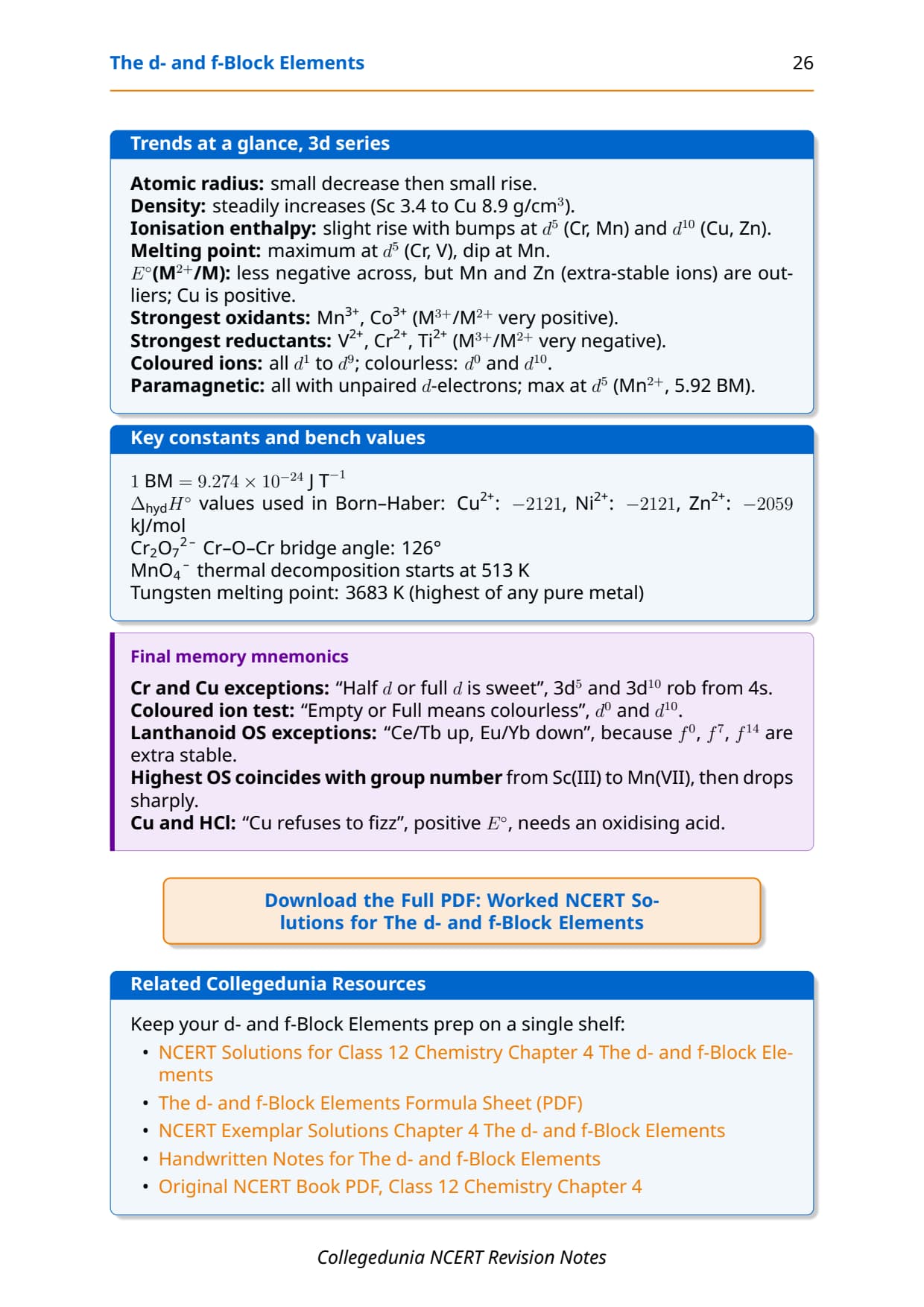
This page holds the 26-page Notes PDF, the weightage table and the chapter's highest-yield trends.
- CBSE Boards: 4 to 6 marks a year, usually a 3-mark question on lanthanoid contraction or KMnO4 plus an assertion-reason MCQ on colour or magnetism.
- JEE Main: 2 to 3% of the paper on Cr and Cu configurations, magnetic moment and 3d oxidation states.
- NEET: 2 to 3 questions a year on lanthanoid contraction, the spin-only formula or KMnO4/K2Cr2O7 chemistry.
Why d- and f-Block Elements Matter for CBSE, JEE and NEET
Transition metals fill groups 3 to 12, where the last electron enters the (n-1)d sub-shell while ns stays filled. That one fact explains their variable oxidation states, paramagnetism, colour and catalytic activity, the four properties CBSE and NEET test yearly. The f-block runs parallel, with lanthanoids (4f) and actinoids (5f). So the chapter rewards trends, not formulae.
The d- and f-Block Elements Class 12 Chemistry Video Lecture
Source: Magnet Brains on YouTube
How will Collegedunia's NCERT Notes Help You with The d- and f-Block Elements?
Written by inorganic-chemistry specialists from five years of CBSE marking schemes, so what you revise here is what earns marks.
- 2026-27 NCERT alignment: every topic matches the current syllabus, including KMnO4 and K2Cr2O7 preparation.
- Trend tables, not walls of text: radii, ionisation enthalpy and oxidation-state ladders sit in one-glance tables, each ending with the reason markers reward.
Most Important Sub-Topics in The d- and f-Block Elements and Their Mark Distribution
An audit of CBSE, JEE Main and NEET papers (2021 to 2025) shows the marks cluster on a few sub-topics, ranked below by frequency.
| Sub-topic | Weightage | CBSE Frequency |
|---|---|---|
| Lanthanoid contraction and its consequences | High | Almost every year |
| Preparation and properties of KMnO4 and K2Cr2O7 | High | 4 out of last 5 years |
| Variable oxidation states (especially Mn and Fe) | High | 4 out of last 5 years |
| Magnetic moment using the spin-only formula | Medium | 3 out of last 5 years |
| Anomalous electronic configurations of Cr and Cu | Medium | 3 out of last 5 years |
| Colour of transition metal ions (d-d transitions) | Medium | 3 out of last 5 years |
| Catalytic property and interstitial compounds | Low | 2 out of last 5 years |
| Actinoid contraction and comparison with lanthanoids | Low | 2 out of last 5 years |
The d- and f-Block Elements Topic-by-Topic Notes for Class 12 Chemistry
Position in the Periodic Table and General Electronic Configuration
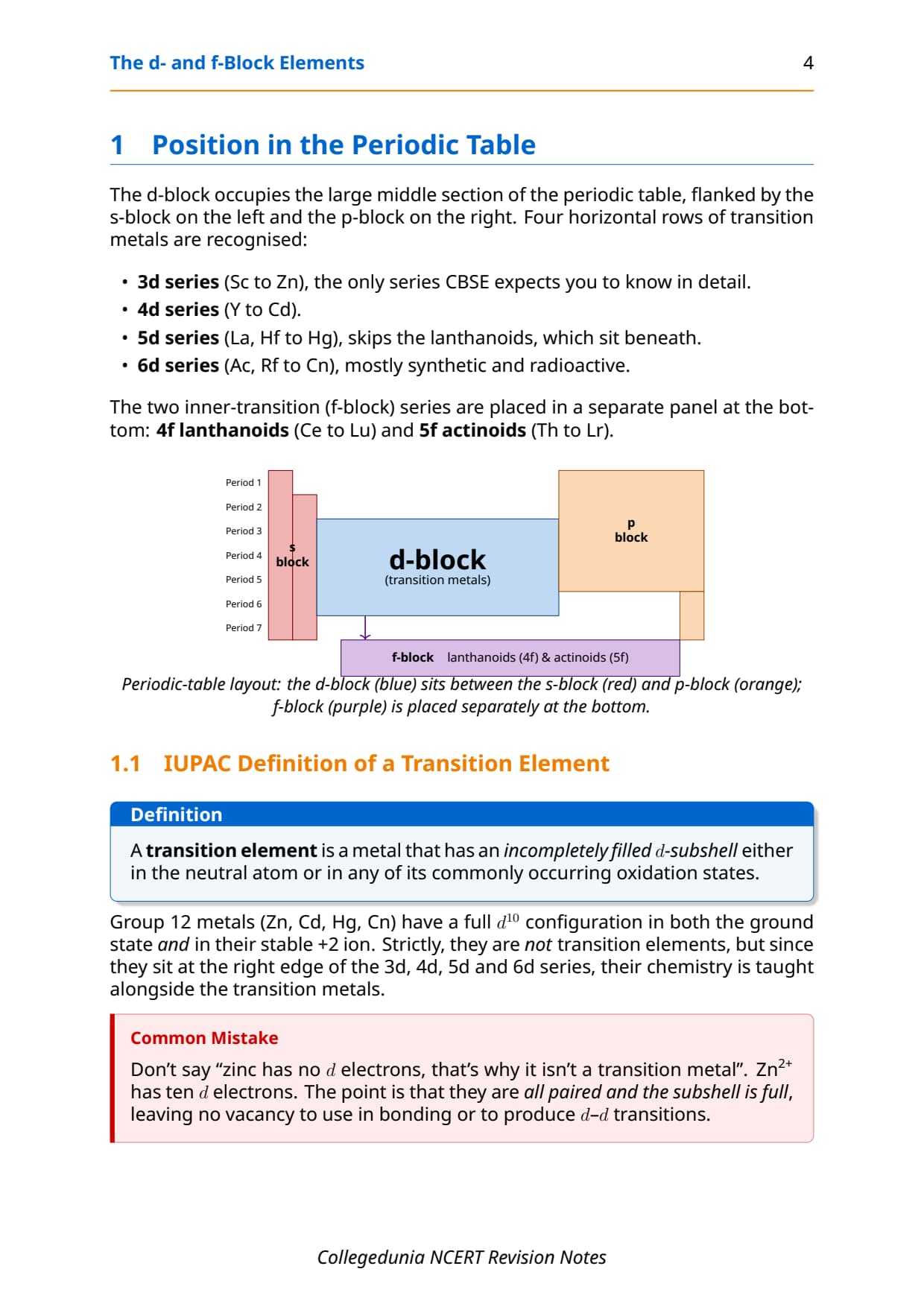
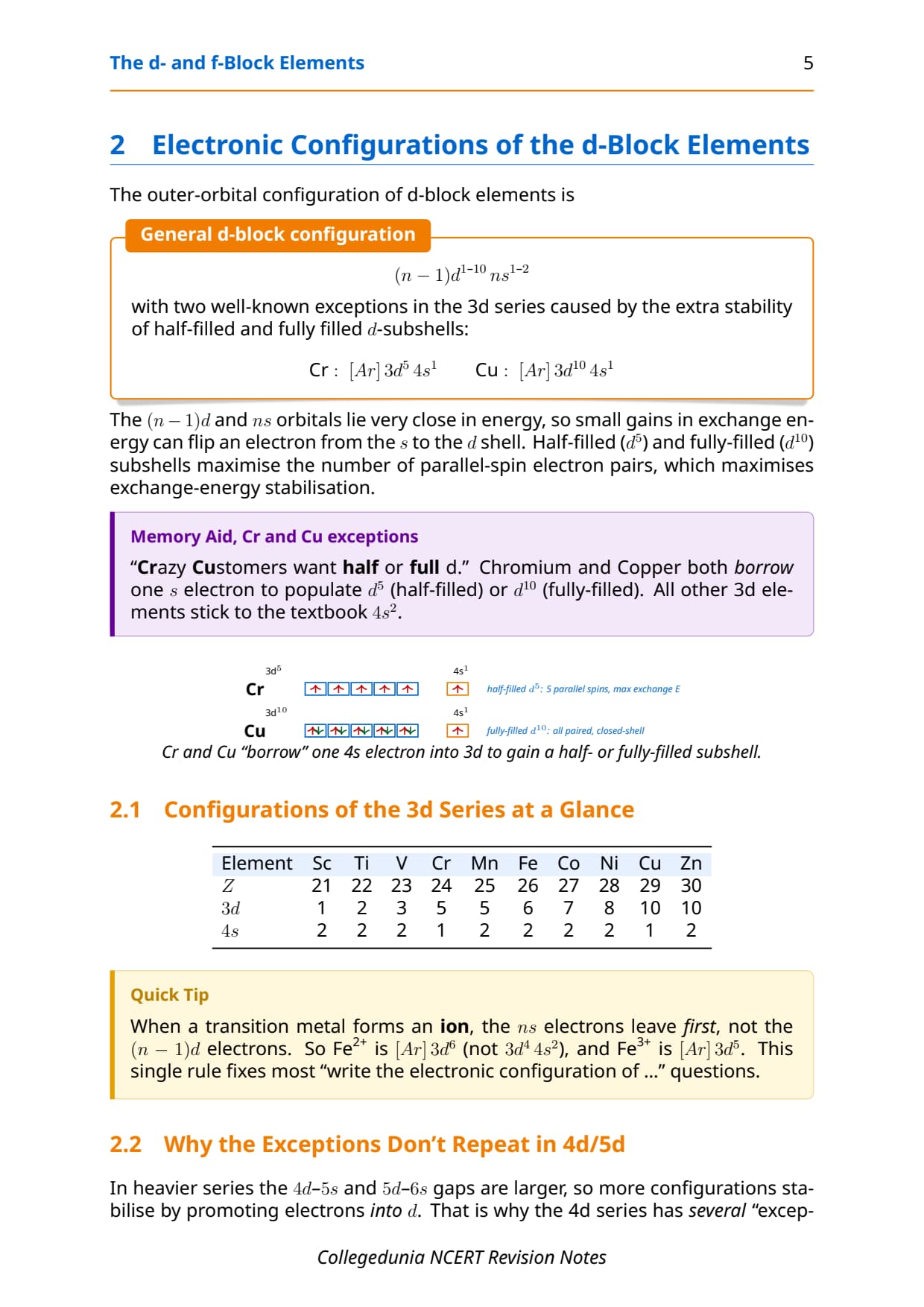
The d-block fills groups 3 to 12 in four series: 3d (Sc to Zn), 4d (Y to Cd), 5d (La, Hf to Hg) and 6d (Ac, Rf onwards). Its general outer configuration is (n-1)d1-10 ns0-2 . Cr (Z = 24) is [Ar] 3d5 4s1 and Cu (Z = 29) is [Ar] 3d10 4s1 , as half-filled and fully filled d-orbitals gain stability from symmetry and exchange energy.
Atomic and Ionic Radii Trend Across the 3d Series
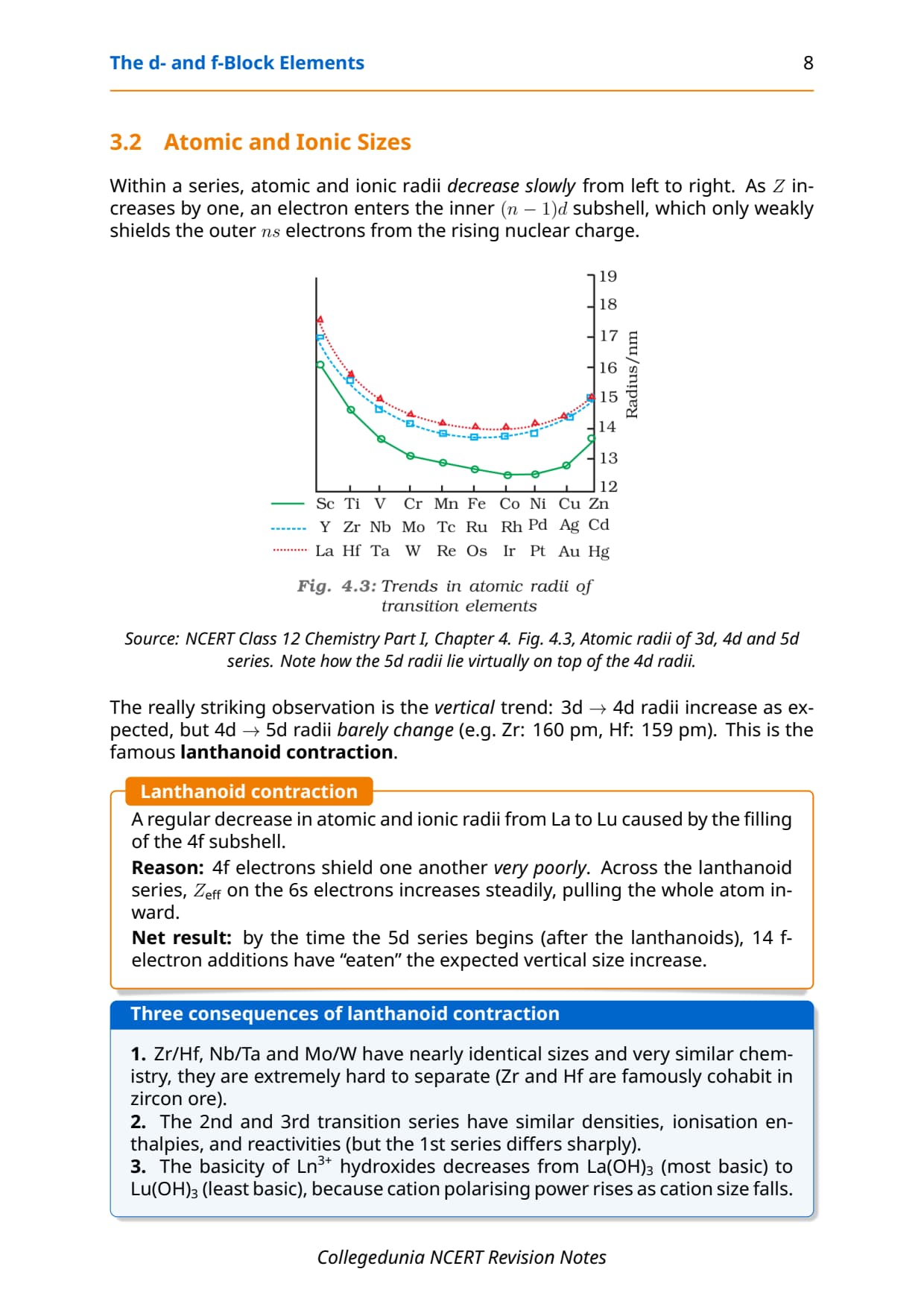
Atomic radius first decreases (Sc to Cr), stays nearly constant (Cr to Cu), then rises at Zn: the drop is rising nuclear charge, the plateau is screening by added d-electrons, the Zn rise is repulsion in the filled 3d10 shell. The 4d and 5d radii are nearly identical, from lanthanoid contraction.
Ionisation Enthalpy, Oxidation States and Standard Electrode Potentials
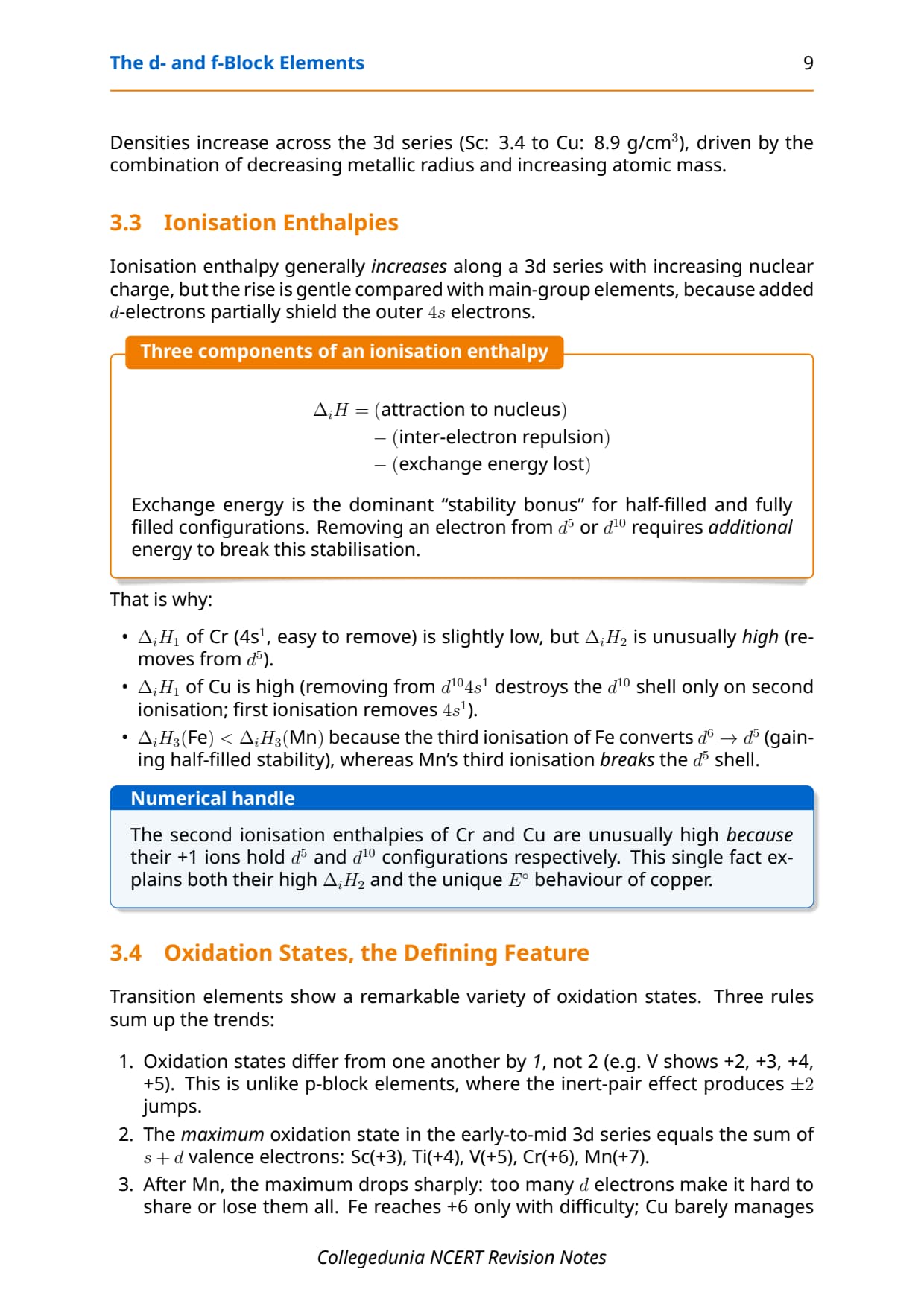
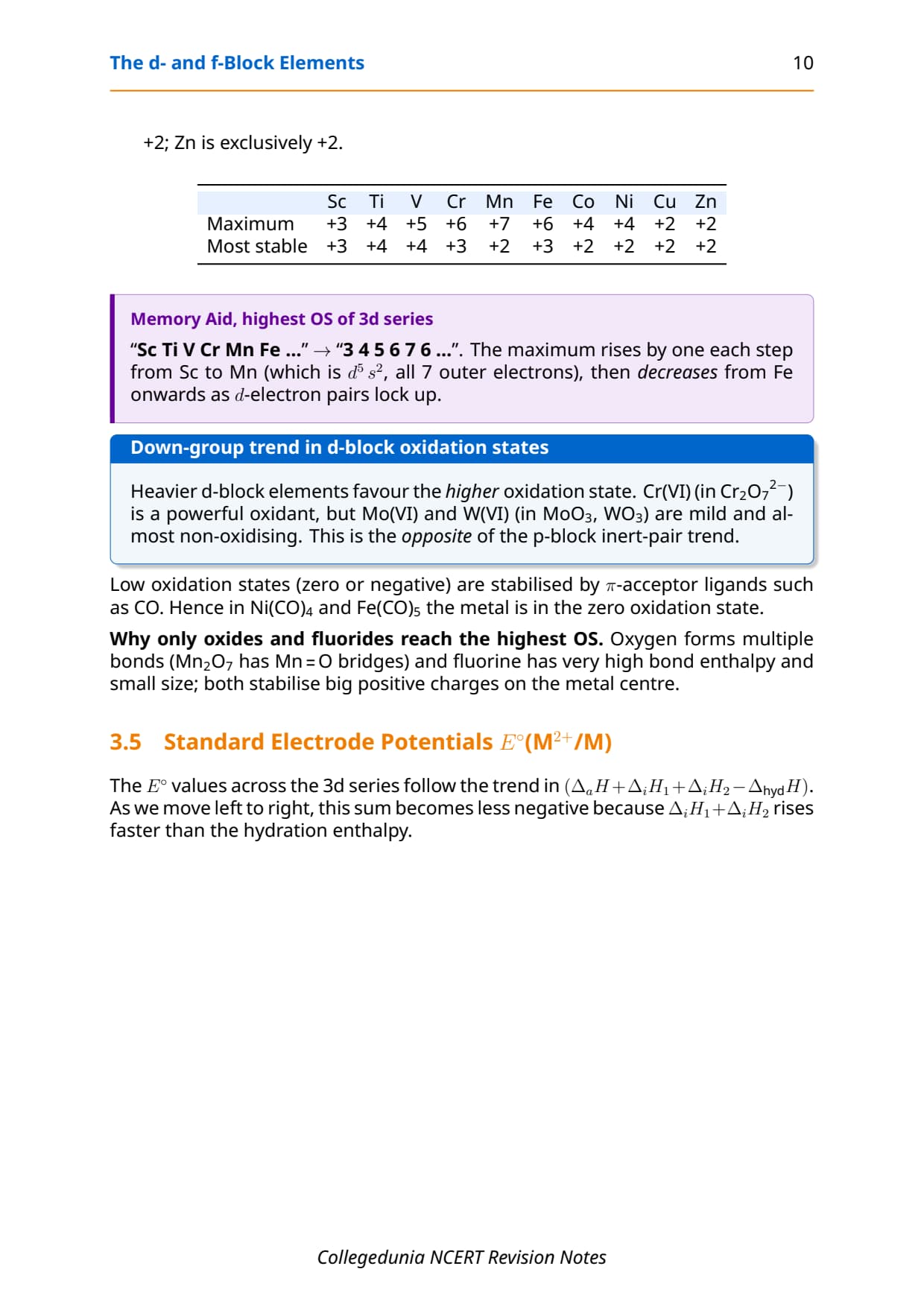
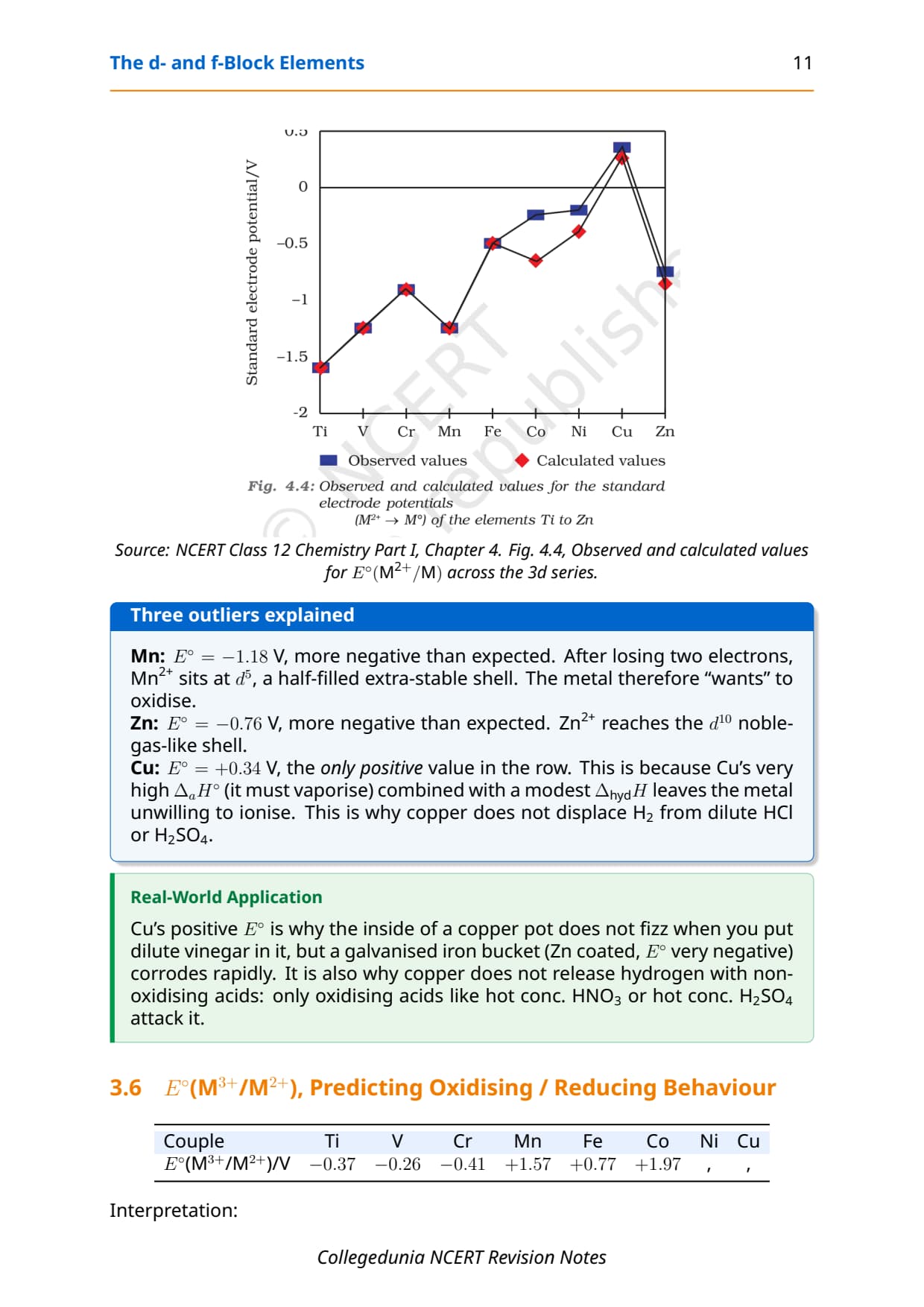
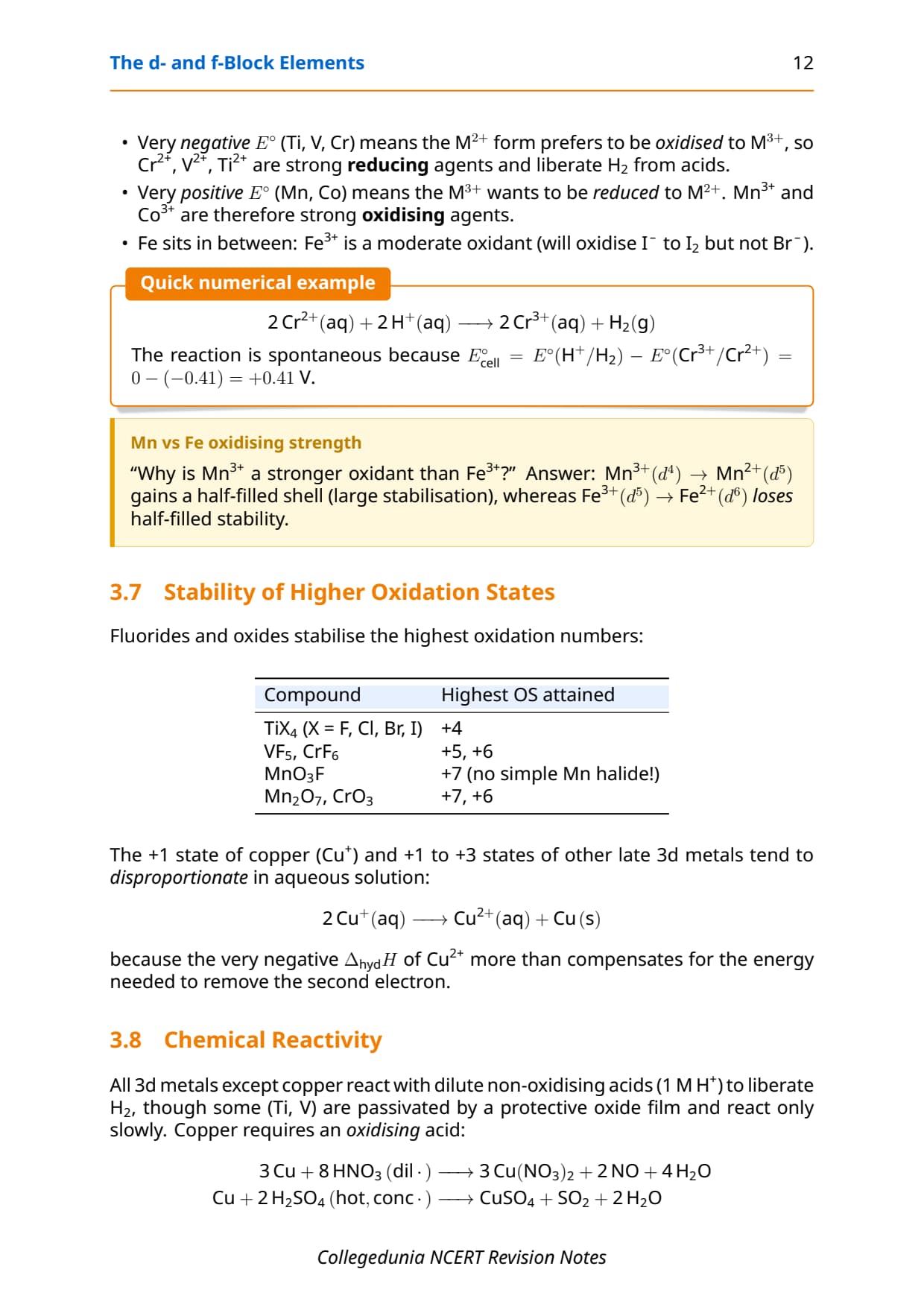
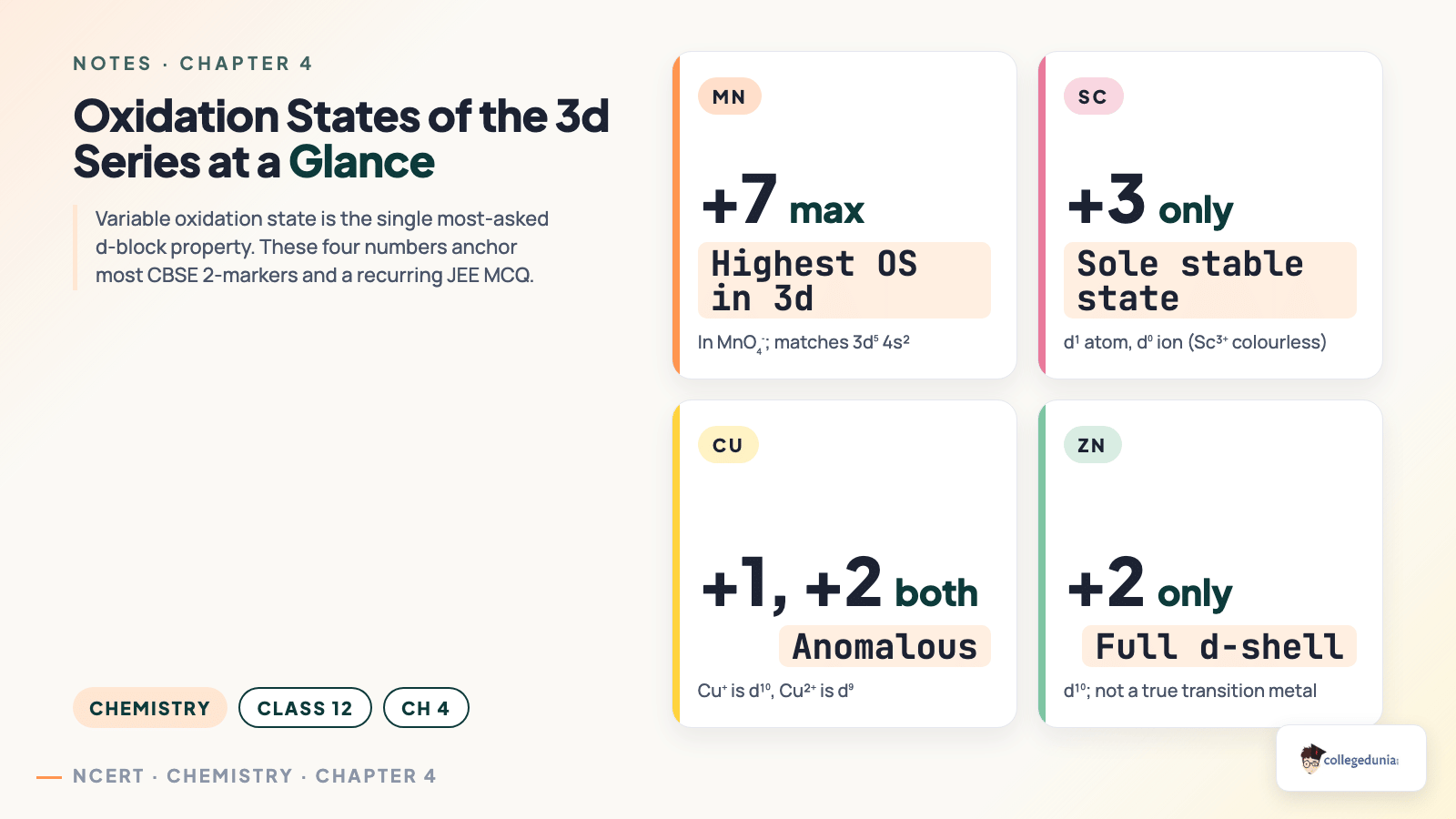
Ionisation enthalpy rises across each series with irregularities at d5 and d10 . Variable oxidation states are the headline property: Mn spans +2 to +7 (the highest for any 3d element), and Fe shows +2 and +3. Standard potentials E∘(M2+/M) become less negative across the period, with Mn, Ni and Zn as exceptions.
Magnetic Properties and the Spin-Only Formula
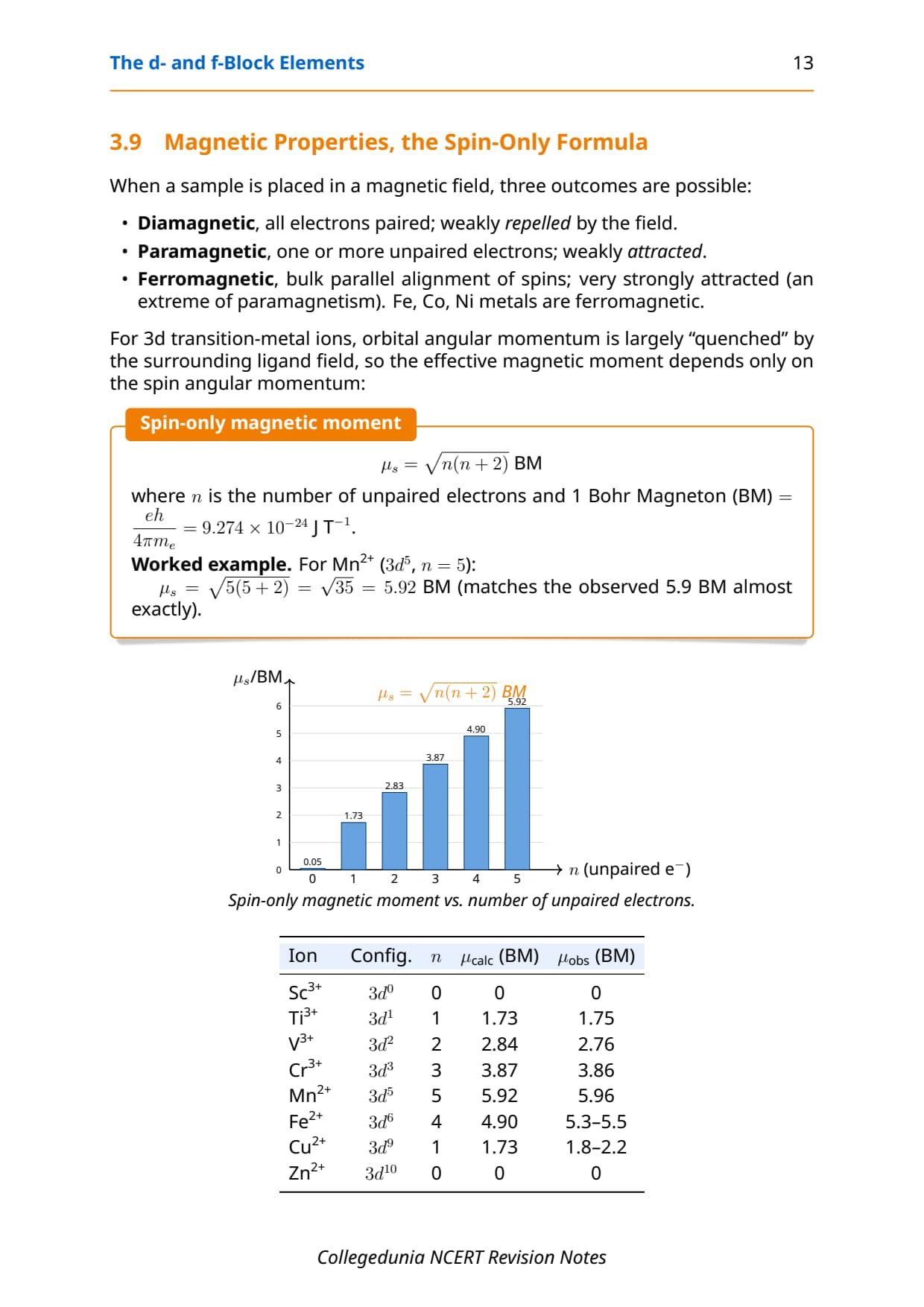
Most transition metal ions are paramagnetic from unpaired d-electrons. The spin-only moment is μ = √n(n+2) BM, with n unpaired electrons. For Mn2+ ( 3d5 , n = 5 ), μ ≈ 5.92 BM, the maximum for any 3d ion, while Zn2+ ( 3d10 ) has n = 0 and μ = 0 .
Colour, Catalysis and Interstitial Compounds
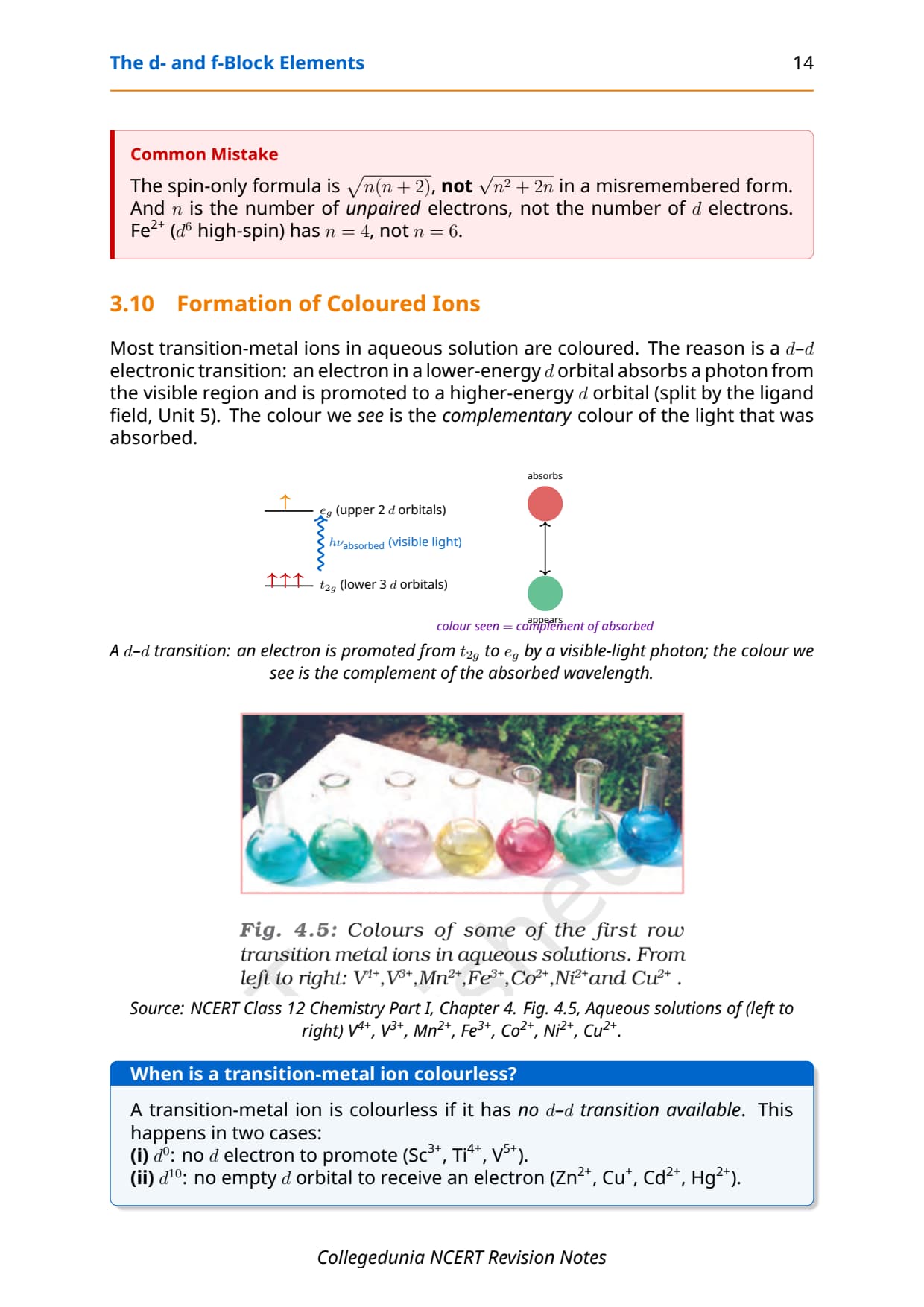
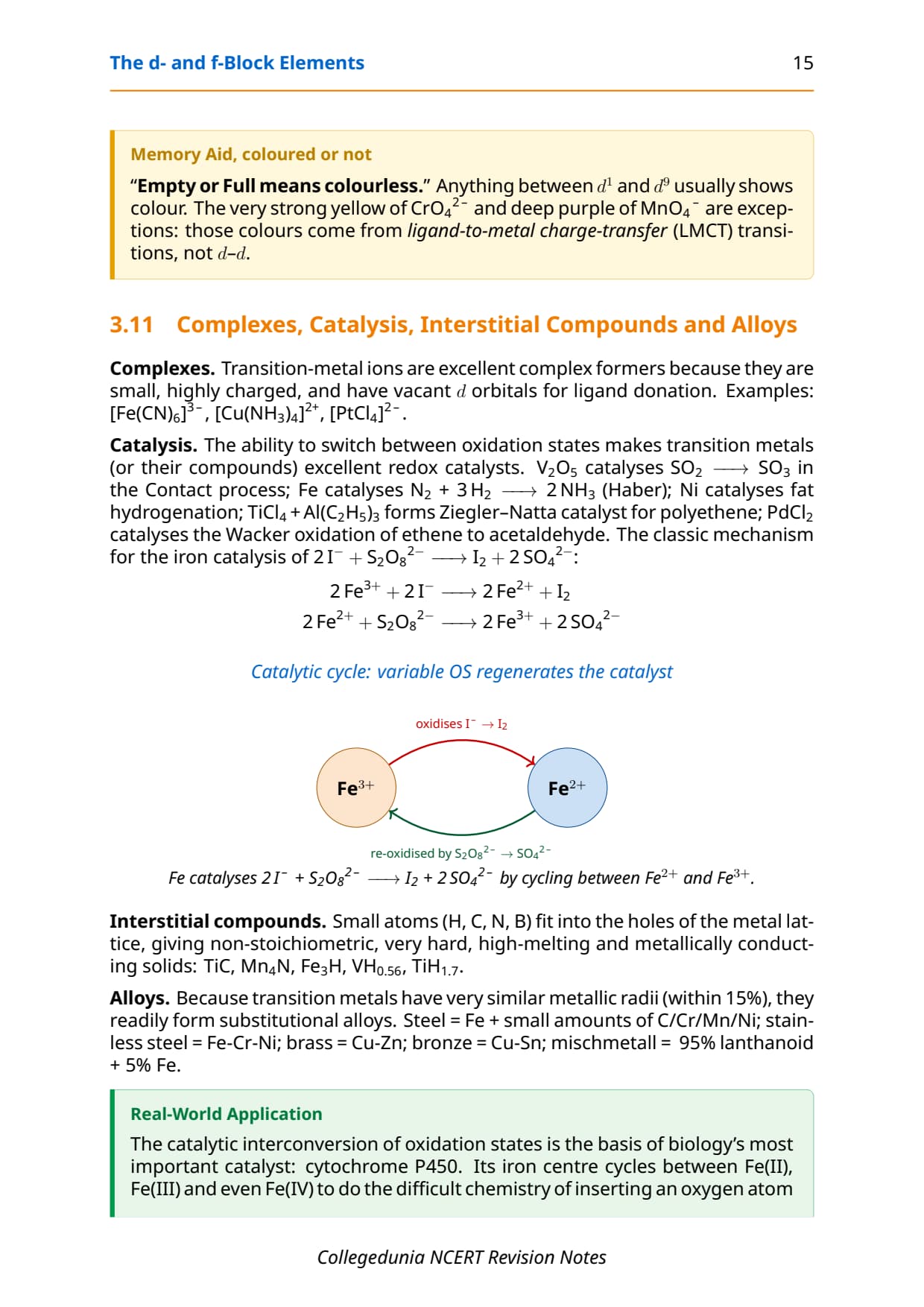
Transition metal ions are coloured by d-d transitions: an electron absorbs visible light and jumps to a higher d-orbital, so the colour seen is complementary to the wavelength absorbed. Ions with d0 (Sc3+, Ti4+) or d10 (Zn2+, Cu+) are colourless. The same partly filled d-orbitals make fine catalysts: V2O5 in Contact, Fe in Haber, Ni in hydrogenation, Pt in converters. Small atoms (H, C, N, B) trapped in lattice voids give hard, inert interstitial compounds.
Preparation and Properties of KMnO4 and K2Cr2O7
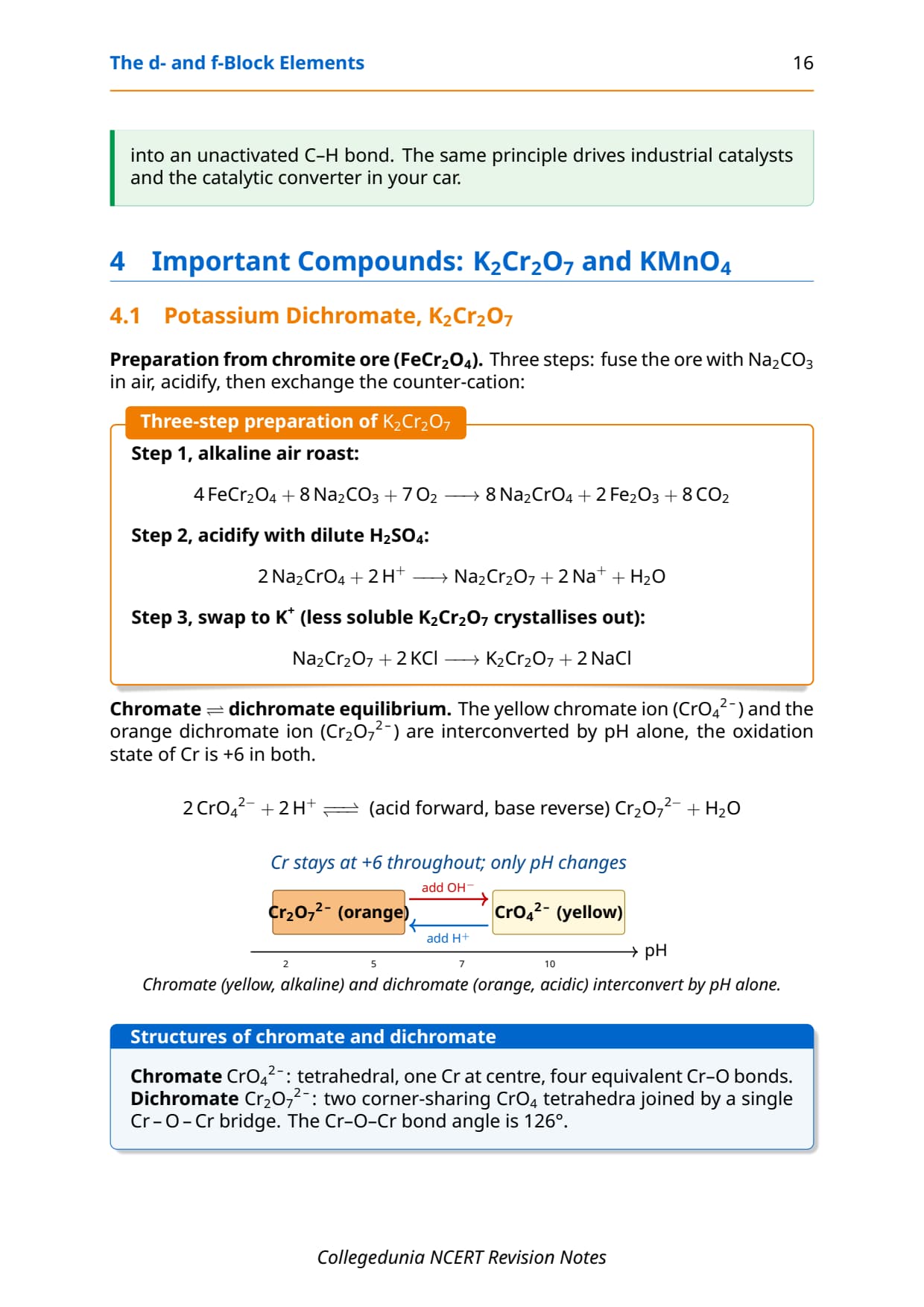
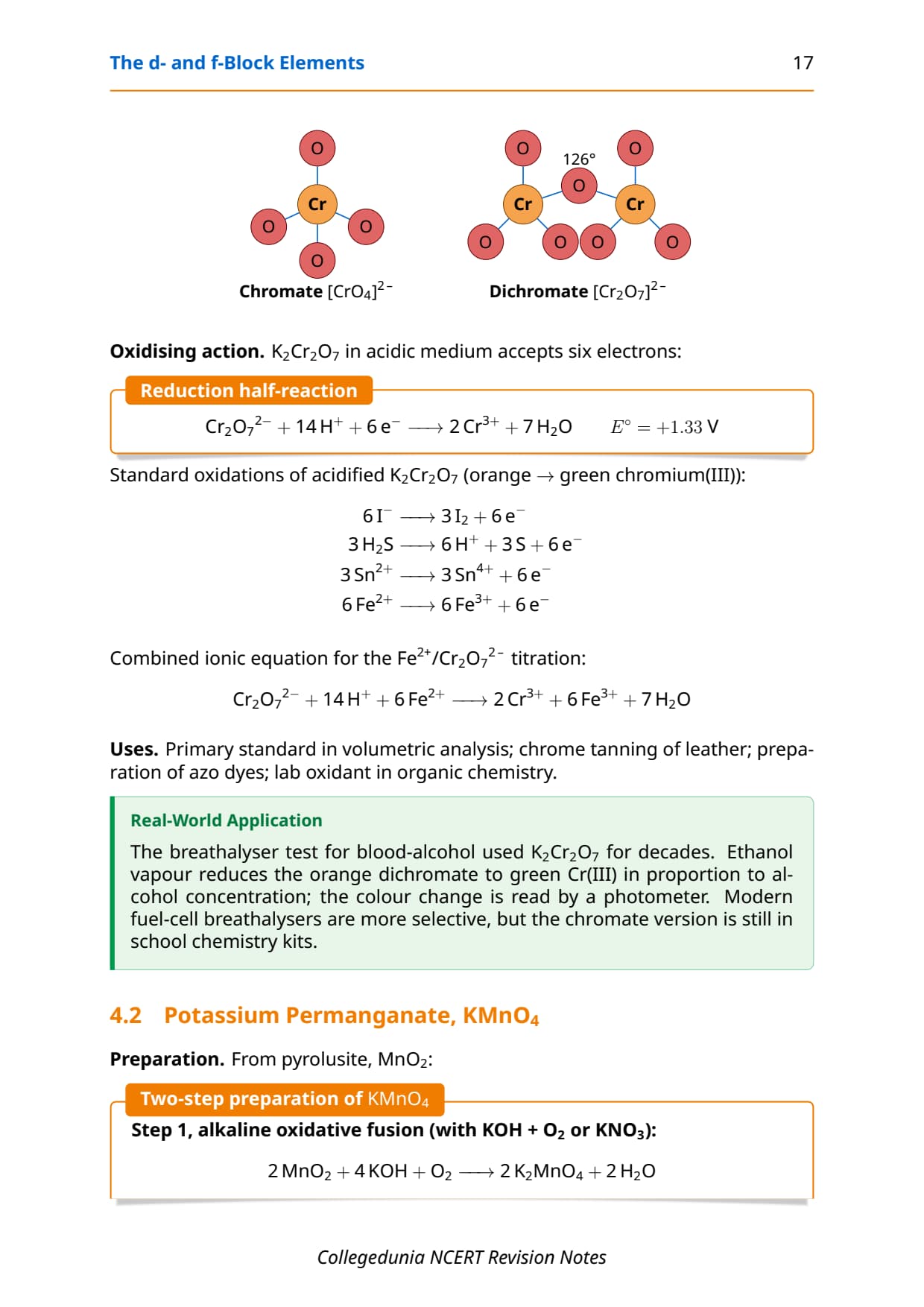
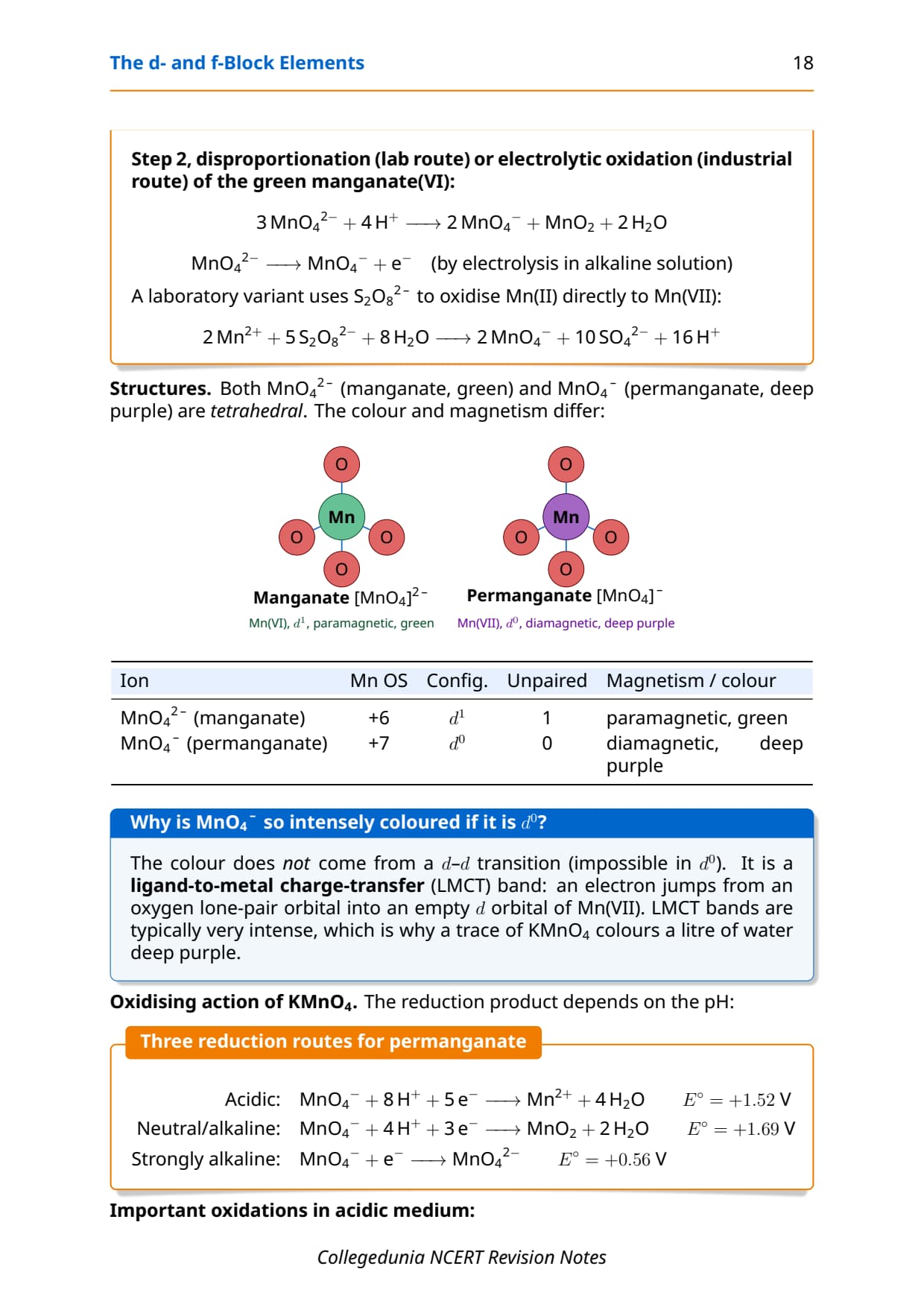
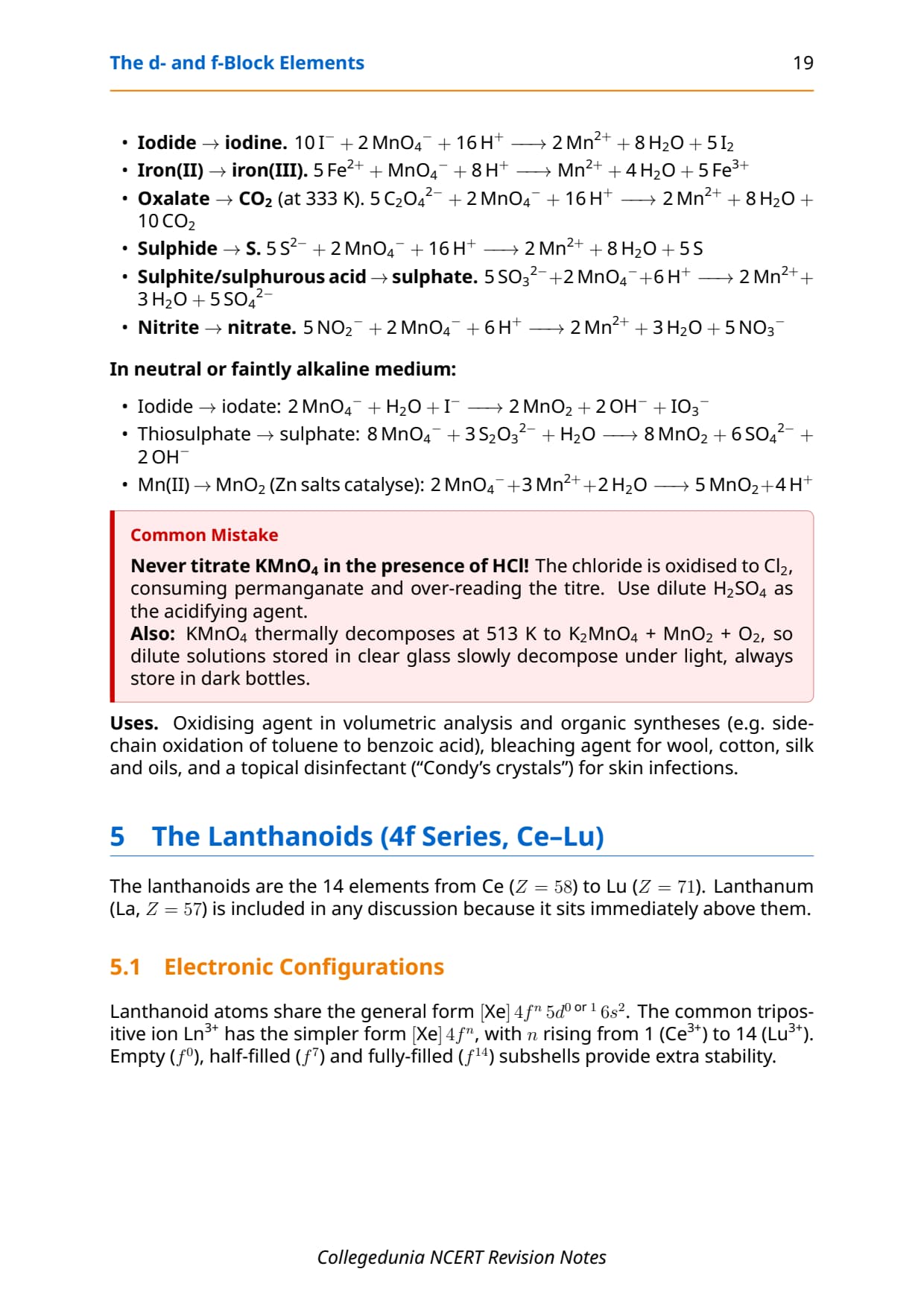
KMnO4 comes from pyrolusite (MnO2): fusion with KOH in air to K2MnO4, then oxidation to KMnO4. In acidic medium it is a strong oxidiser: MnO4- + 8H+ + 5e- → Mn2+ + 4H2O . K2Cr2O7 comes from chromite ore (FeCr2O4) by fusion with Na2CO3 in air; in acidic medium it oxidises Fe2+ to Fe3+ and I- to I2 .
The Lanthanoids, Lanthanoid Contraction and Its Consequences
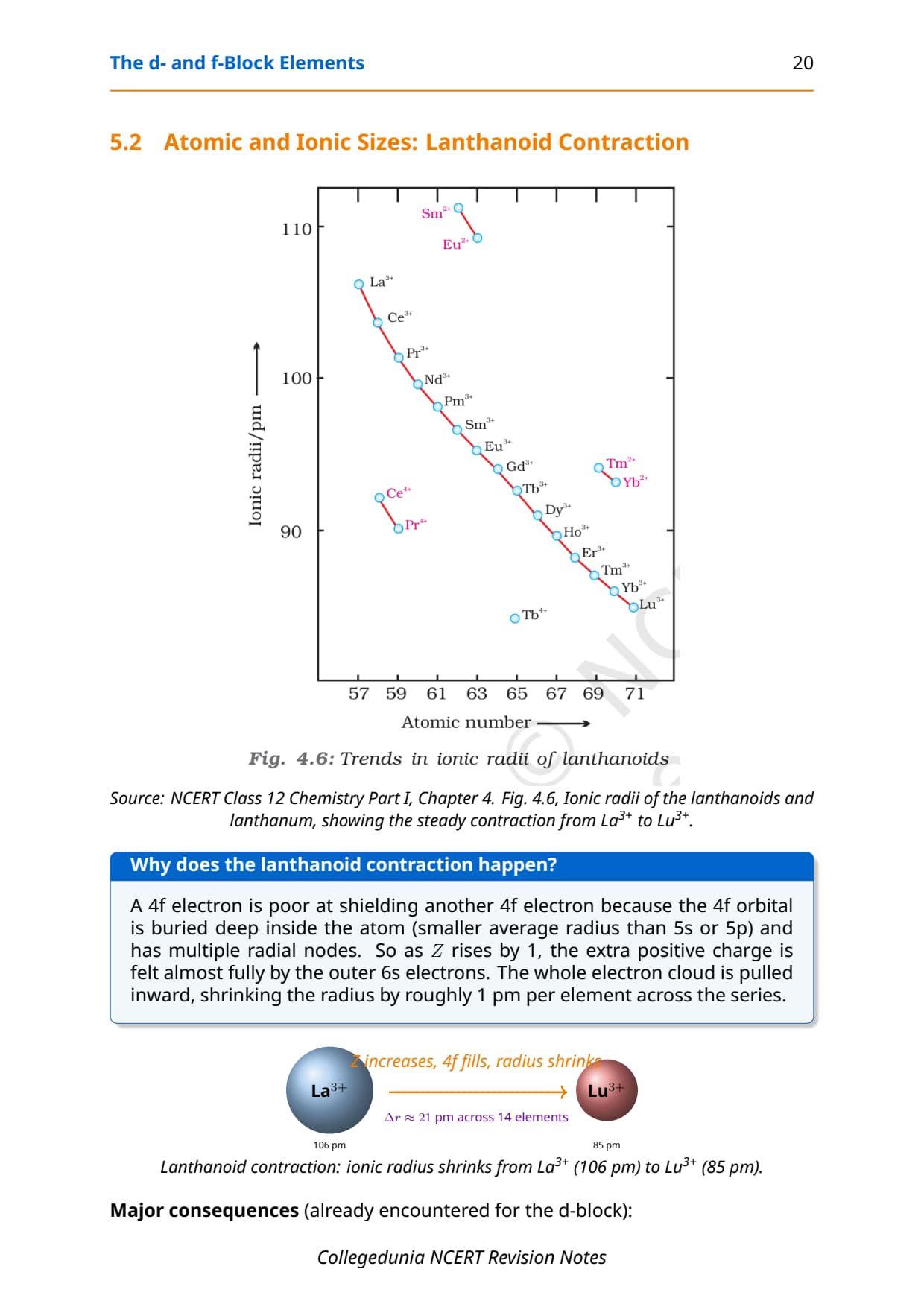
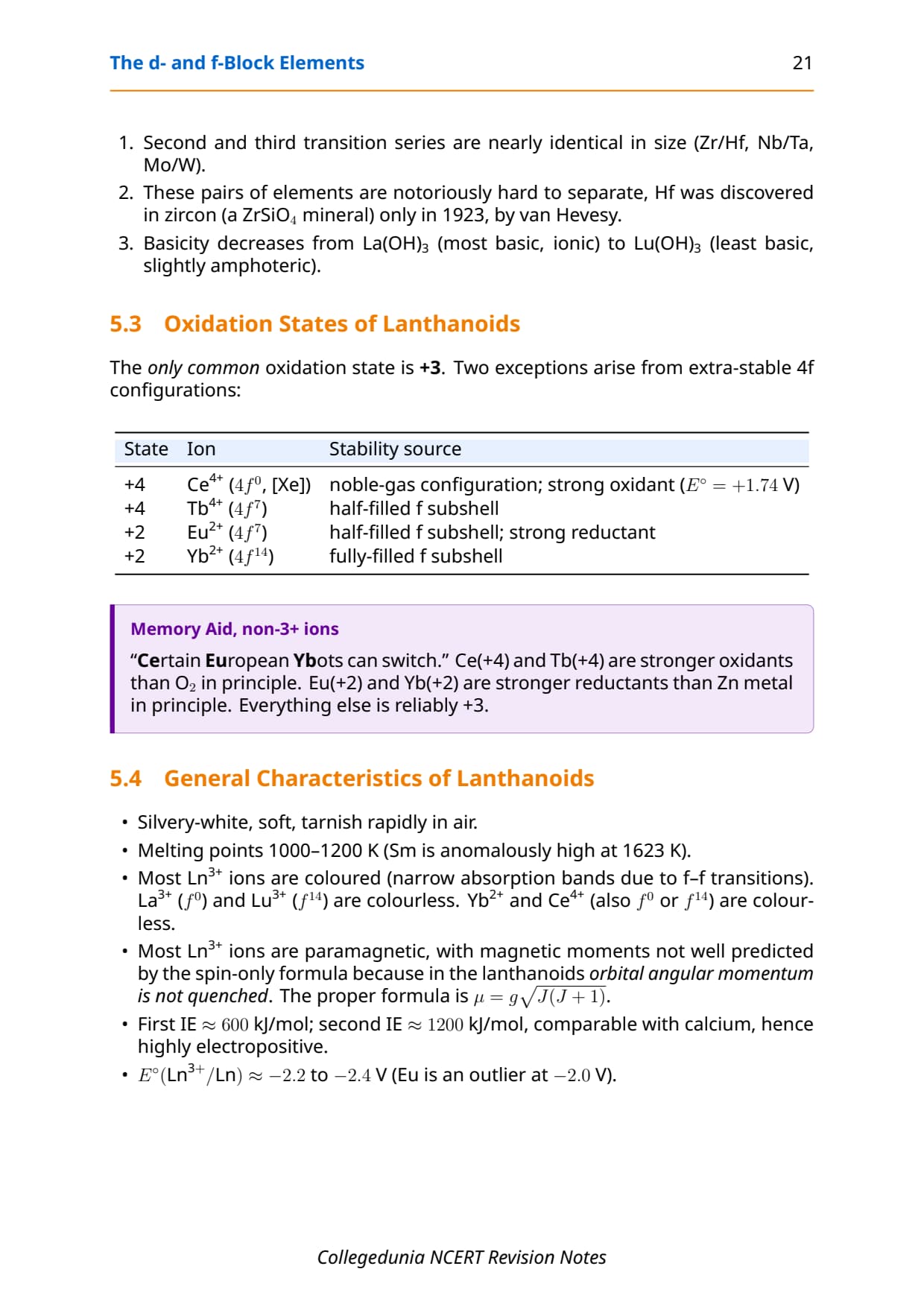
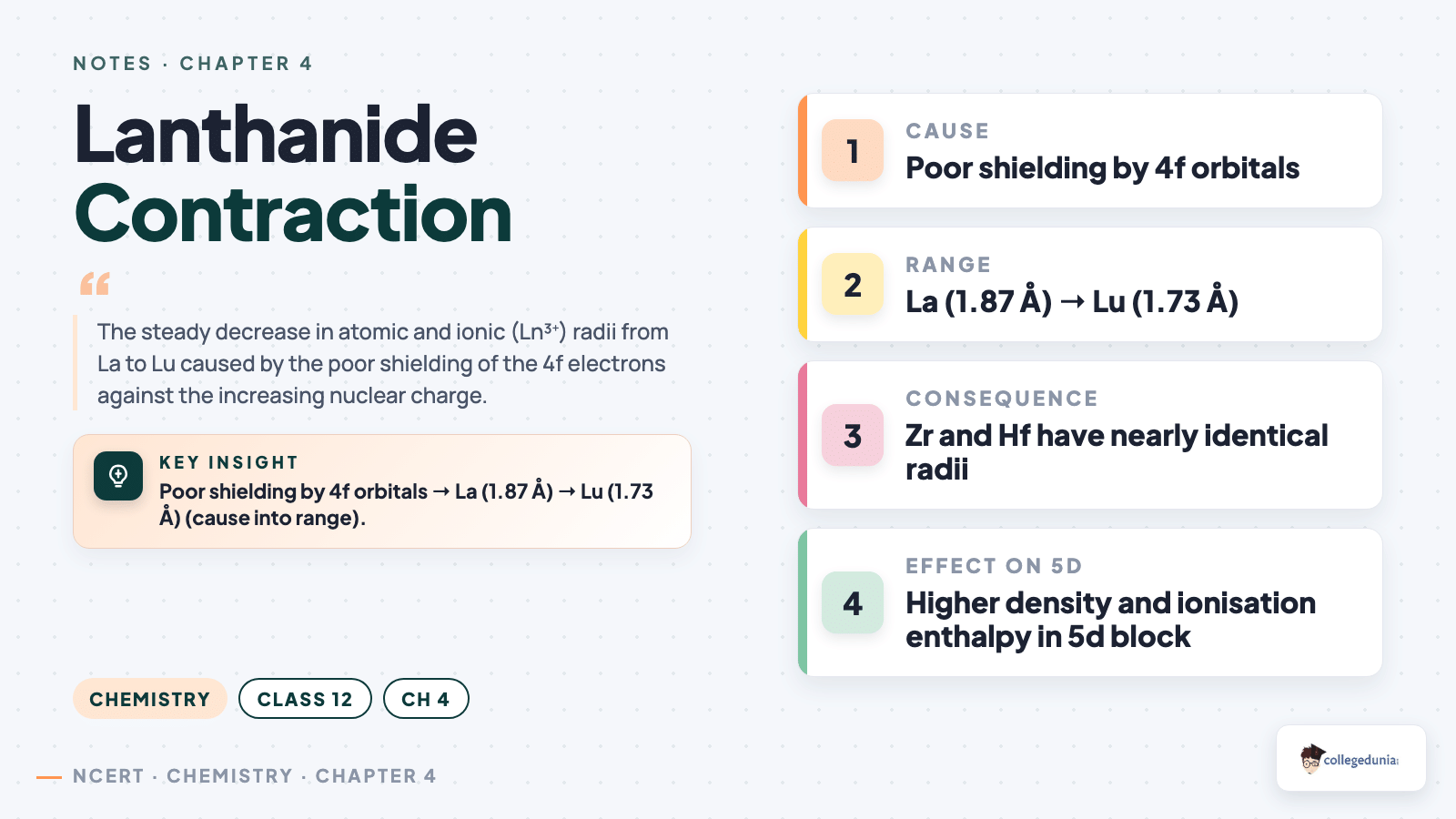
The 14 lanthanoids (Ce to Lu) show a steady drop in radii from La3+ to Lu3+, the lanthanoid contraction, from poor 4f shielding that lets effective nuclear charge rise across the series. Its three exam-mandatory consequences: (i) near-identical sizes of 4d and 5d metals (Zr/Hf, Nb/Ta), (ii) hard separation of the lanthanoids, (iii) basicity falls from La(OH)3 to Lu(OH)3. The common state is +3, with Ce(+4), Eu(+2) and Yb(+2) as exceptions.
The Actinoids and a Quick Comparison with Lanthanoids
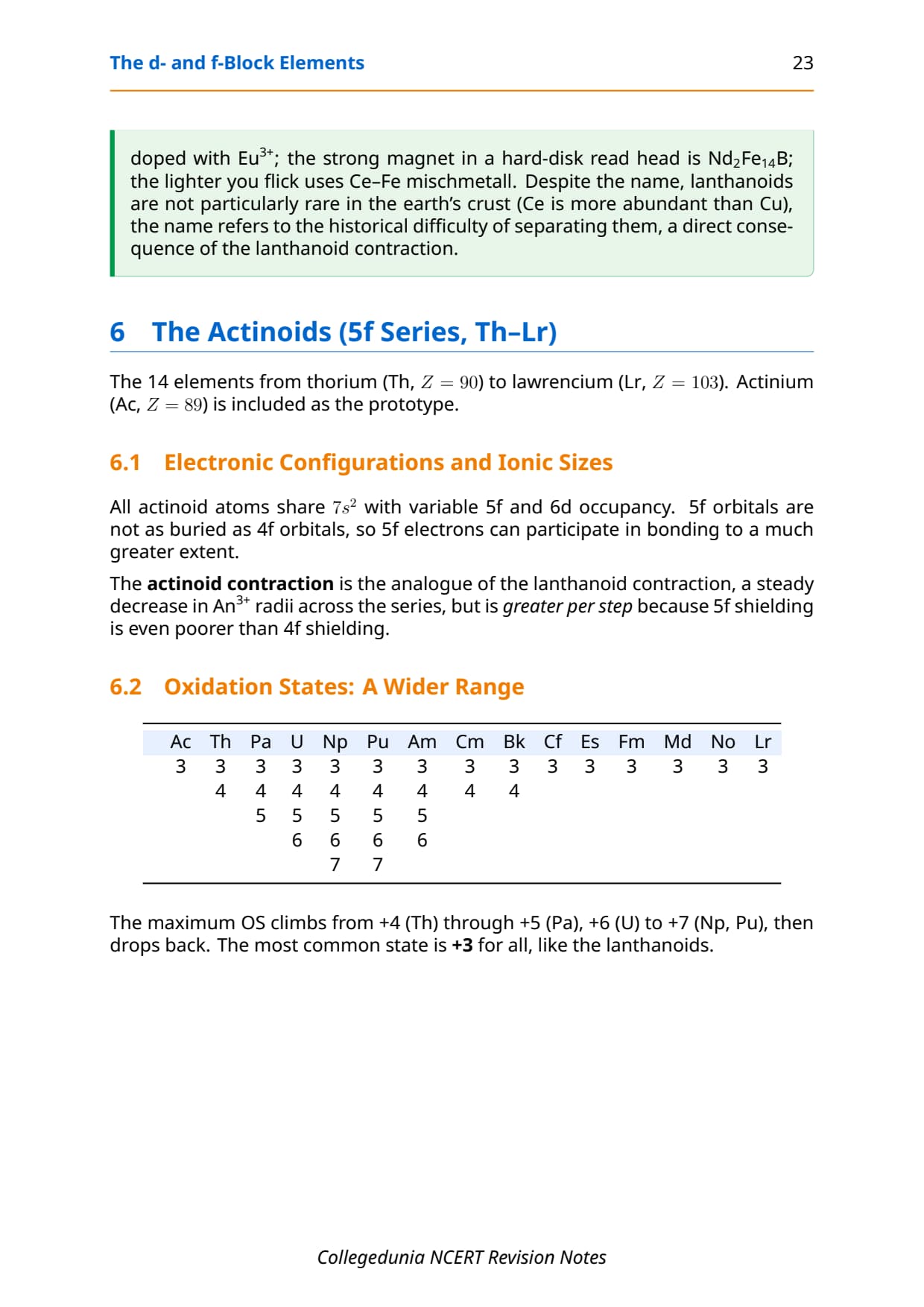
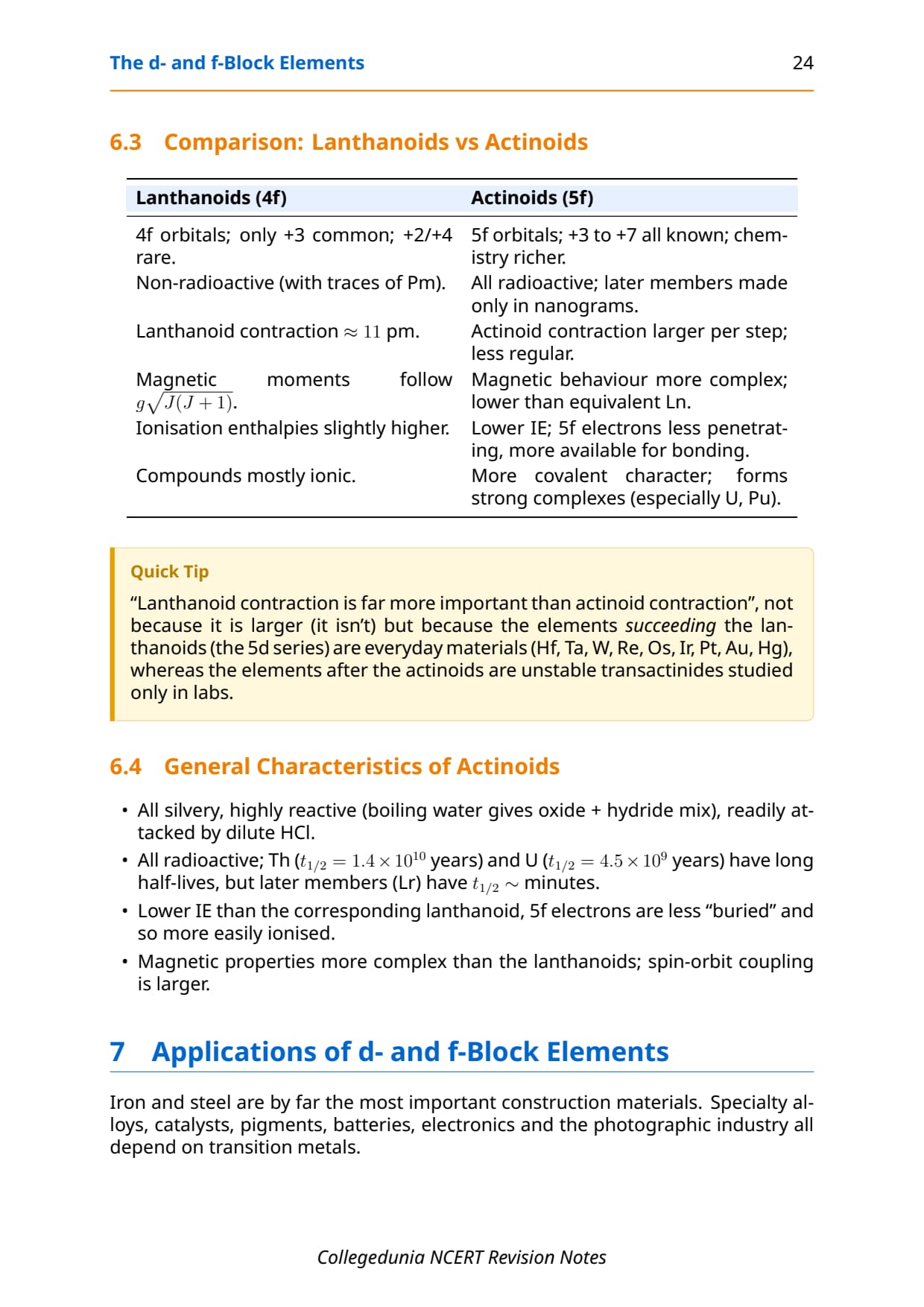
The 14 actinoids (Th to Lr) show actinoid contraction too, more pronounced as 5f shields even less than 4f. They show many more oxidation states (up to +7 for Np, Pu) since 5f, 6d and 7s lie close in energy. All are radioactive; only Th and U occur naturally in quantity.
The d- and f-Block Elements Key Formulae for Quick Recall
The formulae and reactions used most in CBSE and JEE Main numericals on this chapter.
| Quantity / Reaction | Expression |
|---|---|
| Spin-only magnetic moment | μ = √n(n+2) BM |
| KMnO4 in acidic medium | MnO4- + 8H+ + 5e- → Mn2+ + 4H2O |
| KMnO4 in neutral or basic medium | MnO4- + 2H2O + 3e- → MnO2 + 4OH- |
| K2Cr2O7 in acidic medium | Cr2O72- + 14H+ + 6e- → 2Cr3+ + 7H2O |
Student Feedback
In a Collegedunia poll of 1,148 Class 12 students, 71% said the oxidation-state and colour tables were the fastest way to revise Chapter 4, and 64% rated the lanthanoid-contraction summary their most-used board-day recall.
Other Resources for The d- and f-Block Elements Class 12 Chemistry
Links to the other resource pages for this chapter.
| Resource | Link |
|---|---|
| Notes (this page) | The d- and f-Block Elements Class 12 Chemistry Notes |
| NCERT Solutions | NCERT Solutions |
| Formula Sheet | Formula Sheet |
| NCERT Book PDF | NCERT Book PDF |
| Exemplar Book PDF | Exemplar Book PDF |
| Exemplar Solutions | Exemplar Solutions |
| Handwritten Notes | Handwritten Notes |
NCERT Notes for Class 12 Chemistry: All Chapters
Open the revision notes for any other chapter of Class 12 Chemistry below.
| Chapter | Resource |
|---|---|
| Chapter 1 | Solutions Notes |
| Chapter 2 | Electrochemistry Notes |
| Chapter 3 | Chemical Kinetics Notes |
| Chapter 4 | The d- and f-Block Elements Notes |
| Chapter 5 | Coordination Compounds Notes |
| Chapter 6 | Haloalkanes and Haloarenes Notes |
| Chapter 7 | Alcohols, Phenols and Ethers Notes |
| Chapter 8 | Aldehydes, Ketones and Carboxylic Acids Notes |
| Chapter 9 | Amines Notes |
| Chapter 10 | Biomolecules Notes |
The d- and f-Block Elements Class 12 Chemistry Notes FAQs
Ques. Where can I download The d- and f-Block Elements Class 12 Chemistry Notes PDF?
Ans. You can download The d- and f-Block Elements Class 12 Chemistry Notes PDF directly from this page. Both the Normal and HD versions are available, and both are free.
Ques. Are these notes aligned with the 2026-27 NCERT for Class 12 Chemistry?
Ans. Yes. The notes reflect the current 2026-27 syllabus for Class 12 Chemistry. The new NCERT edition retains all major sub-topics of the d- and f-Block Elements, including electronic configurations, oxidation states, lanthanoid contraction, and the preparation of KMnO4 and K2Cr2O7.
Ques. How many pages is the Class 12th Chemistry d and f Block Elements Notes PDF?
Ans. The Notes PDF runs approximately 26 pages and covers position in the periodic table, electronic configurations, atomic and ionic radii trends, oxidation states, magnetic moment, colour, catalysis, KMnO4 and K2Cr2O7 chemistry, the lanthanoids and the actinoids.
Ques. How much weightage does d and f Block Elements carry in Class 12 Chemistry Board Exam 2026?
Ans. The d- and f-Block Elements carries 4 to 6 marks in the CBSE Class 12 Chemistry Board paper. The standard split is one 3-mark conceptual question on lanthanoid contraction or KMnO4, plus one 2-mark question on magnetic moment or anomalous configurations.
Ques. What is lanthanoid contraction and why does it happen?
Ans. Lanthanoid contraction is the steady decrease in atomic and ionic radii across the lanthanoid series from La to Lu. It happens because the 4f electrons shield the outer electrons poorly, so the effective nuclear charge experienced by the outer shell increases progressively across the series.
Ques. Why is Zn not considered a typical transition element?
Ans. Zinc has the configuration [Ar] 3d10 4s2 and forms only the Zn2+ ion with a completely filled 3d10 configuration. Because it never has a partially filled d-orbital in its elemental state or any common oxidation state, it does not satisfy the IUPAC definition of a transition element.
Ques. How do I calculate magnetic moment using the spin-only formula?
Ans. Apply μ = √n(n+2) Bohr Magneton, where n is the number of unpaired d-electrons in the ion. For Cr3+ ( 3d3 , n = 3 ), μ = √15 ≈ 3.87 BM. For Mn2+ ( 3d5 , n = 5 ), μ = √35 ≈ 5.92 BM.
Ques. Which sub-topics should I revise the night before the Class 12 Chemistry board exam?
Ans. Revise five sub-topics: lanthanoid contraction and its three consequences, balanced redox equations for KMnO4 and K2Cr2O7 in acidic medium, the spin-only magnetic moment formula with three or four worked examples, anomalous electronic configurations of Cr and Cu, and the basic actinoid versus lanthanoid comparison table.
Ques. What is the chromate-dichromate equilibrium?
Ans. The chromate-dichromate equilibrium is the pH-controlled interconversion 2CrO42- + 2H+ Cr2O72- + H2O . Yellow CrO42- dominates in alkaline medium; orange Cr2O72- dominates in acidic medium. The colour shift on adding H+ or OH- is a CBSE 1-mark MCQ favourite.
Ques. What are the most common Mn oxidation states and why is +2 the most stable?
Ans. Mn shows the widest range in the 3d series with oxidation states from +2 to +7, the +7 state appearing in KMnO4. Mn(+2) is the most stable because removing the two 4s electrons gives the 3d5 high-spin half-filled configuration, which has maximum exchange energy. This is why Mn3+ in solution rapidly disproportionates to Mn2+ and Mn4+.
Ques. Why are transition metal compounds coloured and how do d-d transitions explain it?
Ans. Colour of transition metal compounds arises from d-d transitions: an electron absorbs visible-light energy and jumps from a lower-energy d-orbital to a higher-energy d-orbital in the crystal field. The transmitted colour is complementary to the absorbed wavelength. Ions with d0 (Sc3+, Ti4+) or d10 (Cu+, Zn2+) lack a possible d-d transition and are colourless.
Ques. Why are transition metals good catalysts?
Ans. Catalytic activity of transition metals comes from two features. First, variable oxidation states let the metal accept and donate electrons during a reaction cycle (e.g. Fe2+/Fe3+ in Haber). Second, partially filled d-orbitals provide adsorption sites for reactant molecules on the catalyst surface. Standard examples are Fe in Haber, V2O5 in Contact, Ni in catalytic hydrogenation and Pt in catalytic converters.
Ques. What are interstitial compounds and how do transition metals form alloys?
Ans. Interstitial compounds form when small atoms like H, C, N or B occupy octahedral or tetrahedral voids in transition-metal lattices, giving non-stoichiometric, hard, high-melting, chemically inert solids (TiC, Mn4N, VH). Alloy formation is favoured because transition metals have similar atomic radii so they substitute freely in the lattice. Brass (Cu-Zn), bronze (Cu-Sn), stainless steel (Fe-Cr-Ni) and misch metal (95% Ln + 5% Fe) are textbook alloys.
Ques. What is the difference between actinoids and lanthanoids?
Ans. Actinoids vs lanthanoids: actinoids (Th to Lr) show many more oxidation states (up to +7 in Np, Pu) because 5f, 6d and 7s orbitals are close in energy, while lanthanoids (Ce to Lu) are predominantly +3. All actinoids are radioactive; lanthanoids are not. The actinoid contraction is more pronounced than the lanthanoid contraction because 5f electrons shield even less effectively than 4f.



Comments