




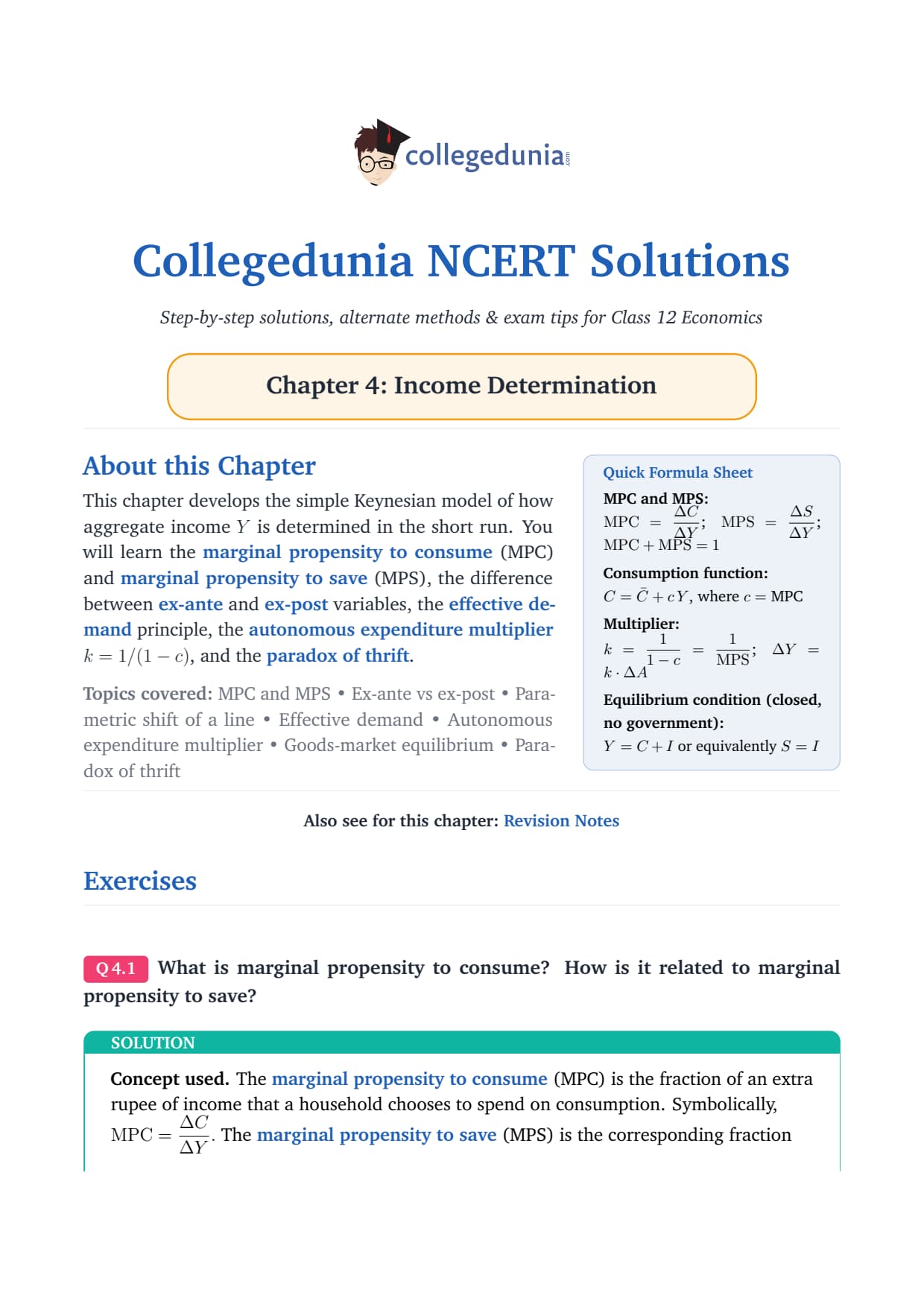
Class 12 Economics Chapter 4 Income Determination is the short-run Keynesian model from the Macroeconomics book. It explains how planned spending fixes the level of national output, income and employment. This page has step-by-step NCERT Solutions for the chapter and a free PDF to download.
Here is what this chapter is worth in the exam:
- CBSE Boards: about 4 to 6 marks, with at least one numerical on the multiplier or equilibrium income.
- CUET: 2 to 3 questions every year on MPC, the multiplier and the paradox of thrift.
- Revision time: about 40 minutes with these solutions.
What the Income Determination NCERT Solutions PDF Covers
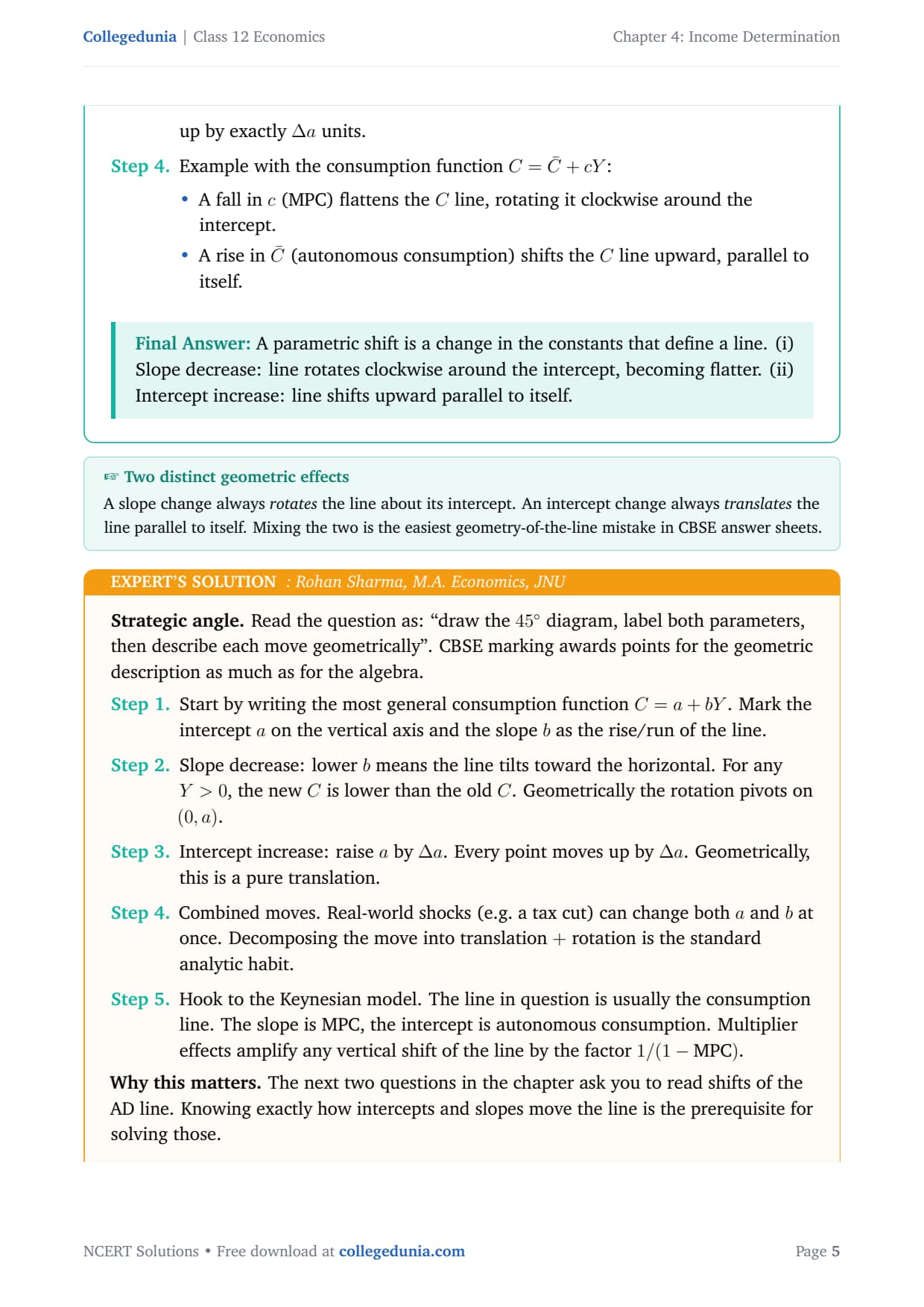
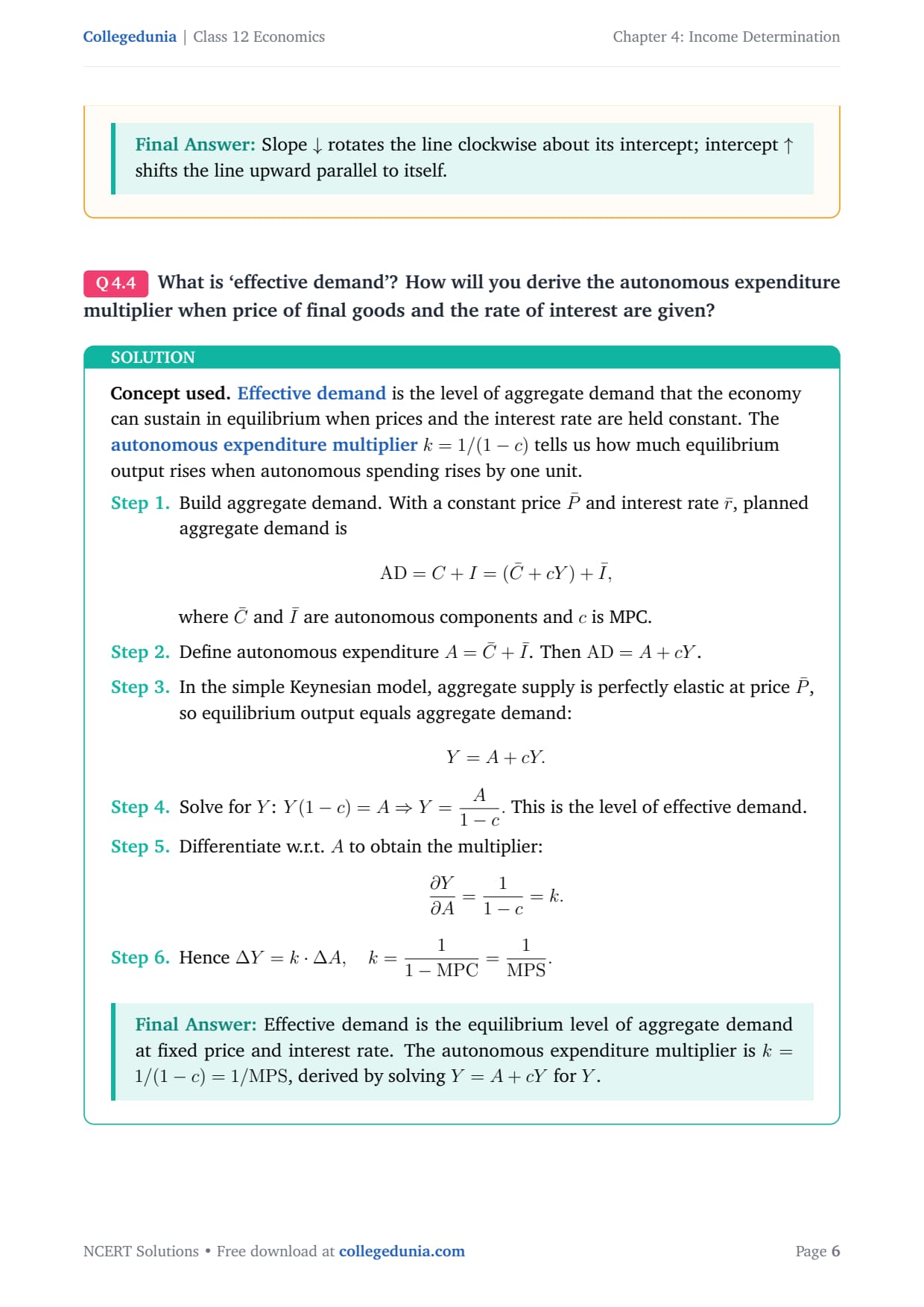
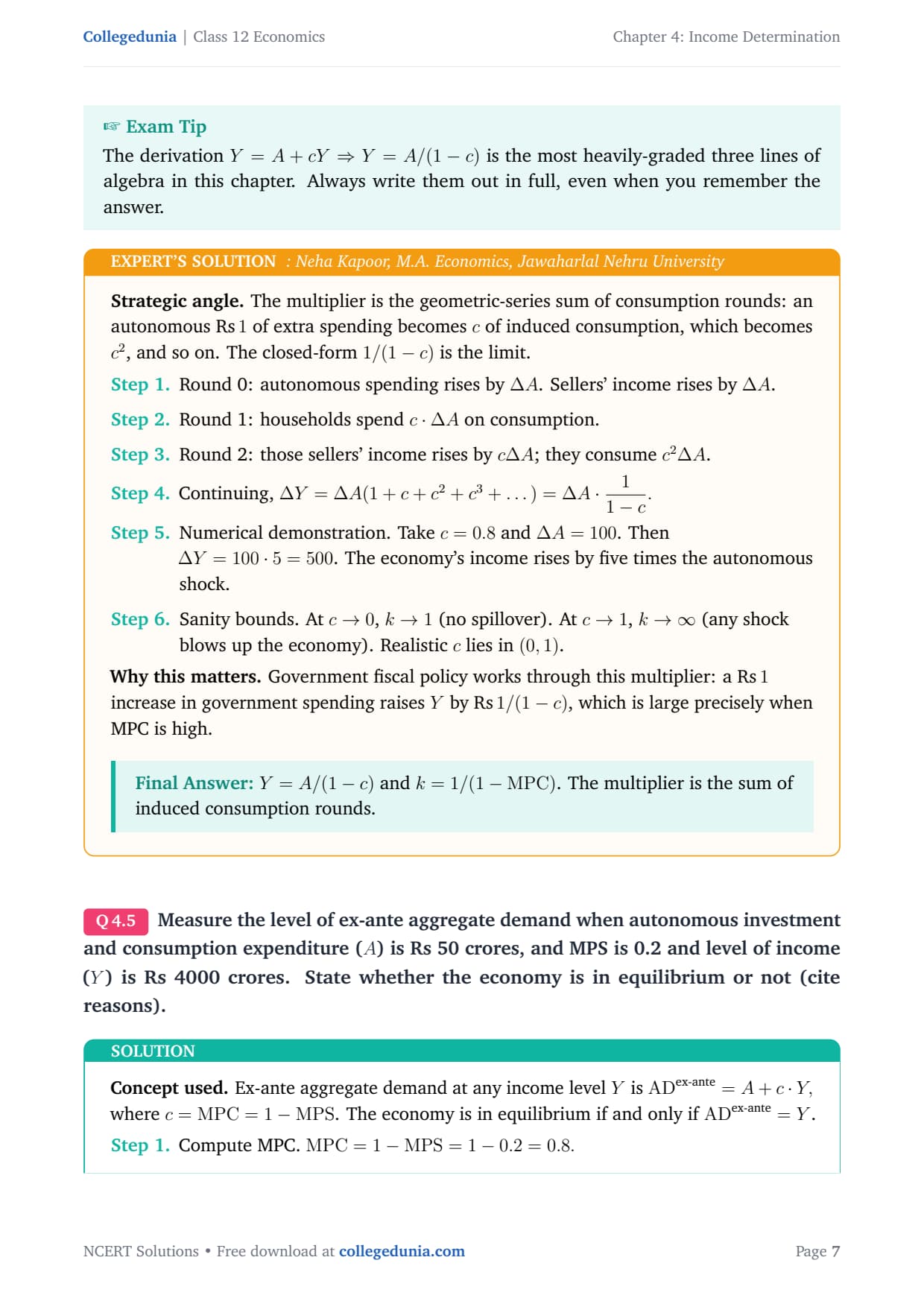
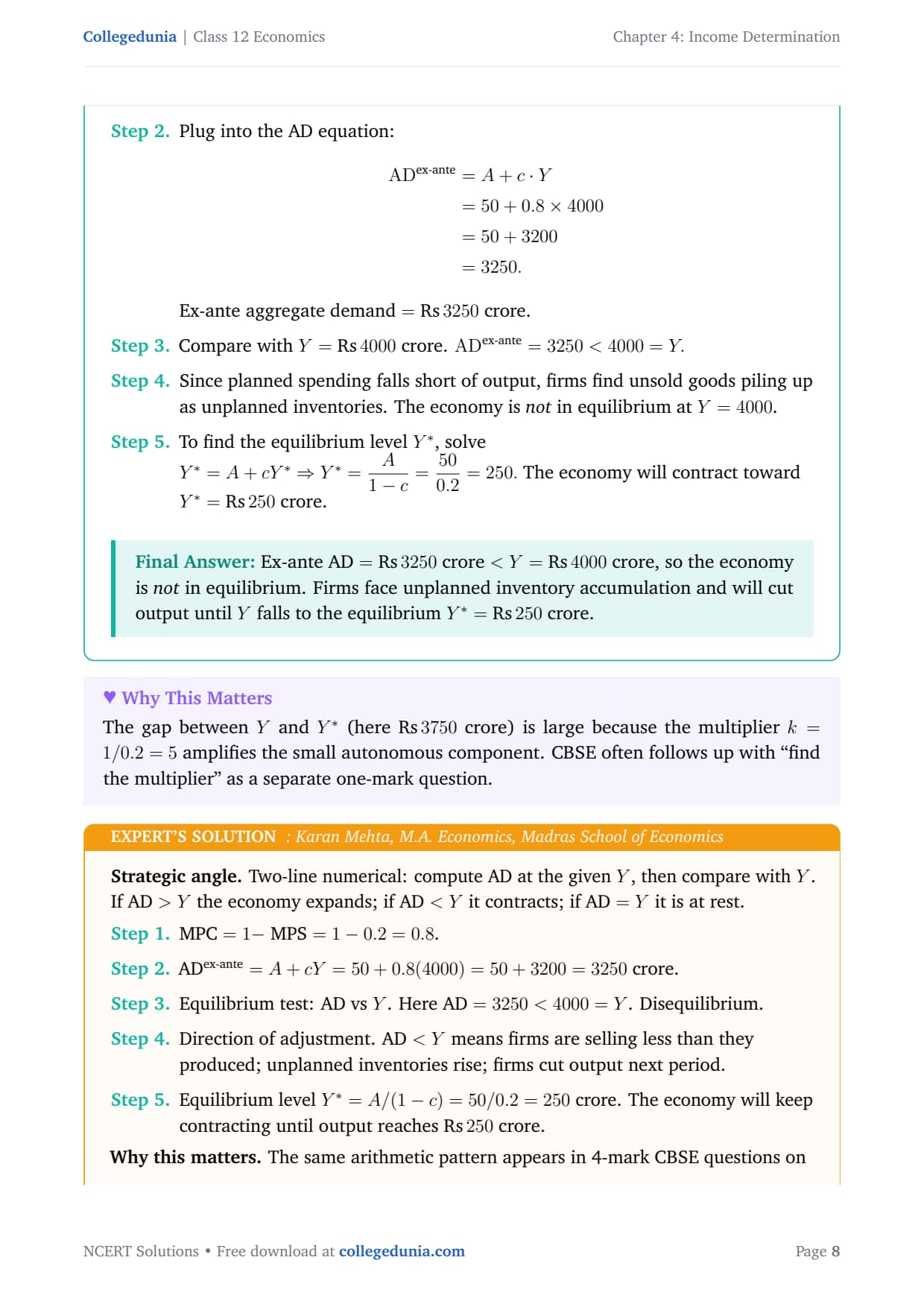
The PDF solves all 6 exercise questions from NCERT Class 12 Macroeconomics Chapter 4. Every numerical solution shows the formula, then the substitution, then the arithmetic on separate lines, the way CBSE markers reward. Theory answers are written in short, exam-ready points. The exercises group into these ideas:
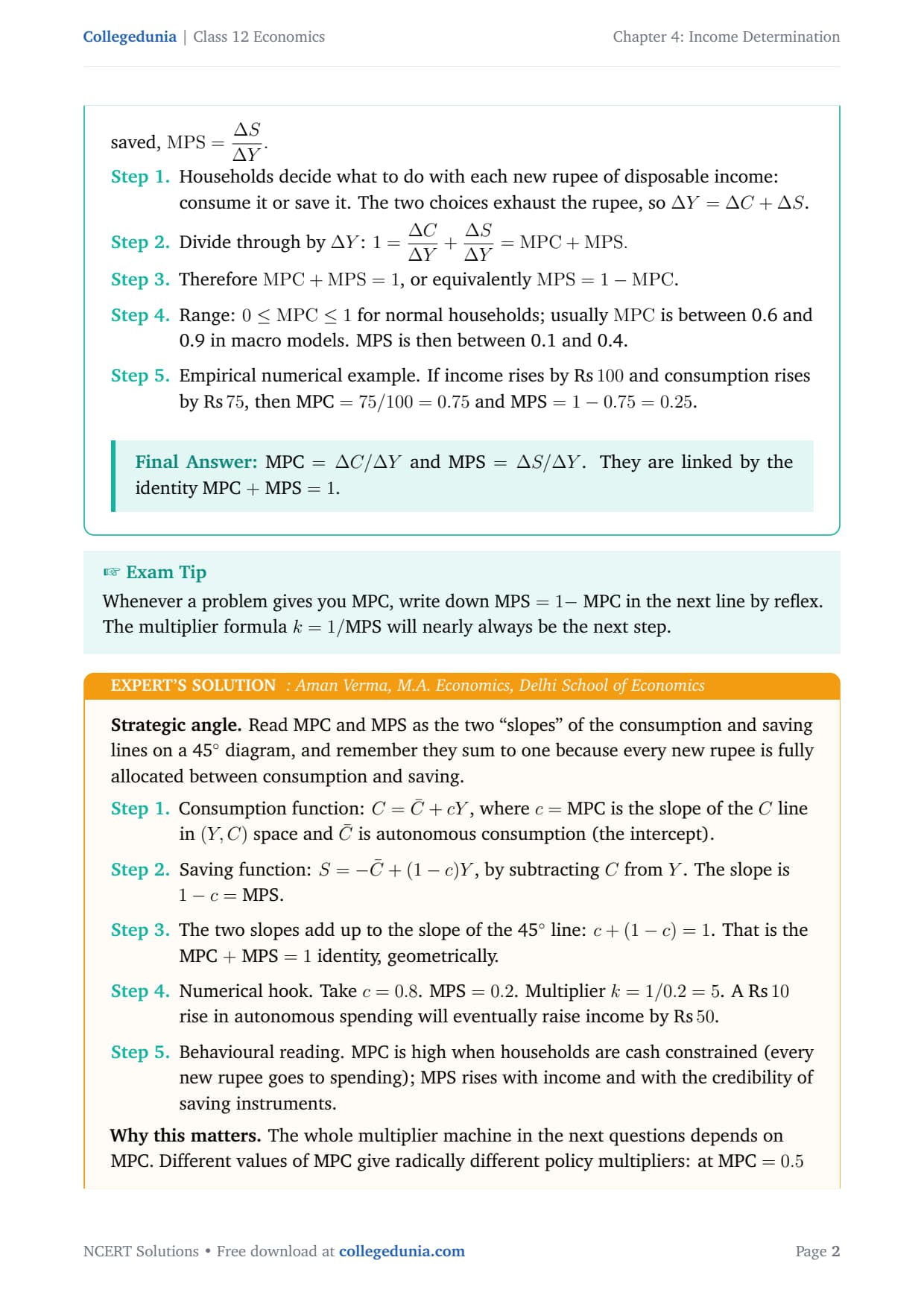
- MPC and MPS: what they mean and why MPC + MPS = 1.
- Consumption and saving functions: reading slope and intercept correctly.
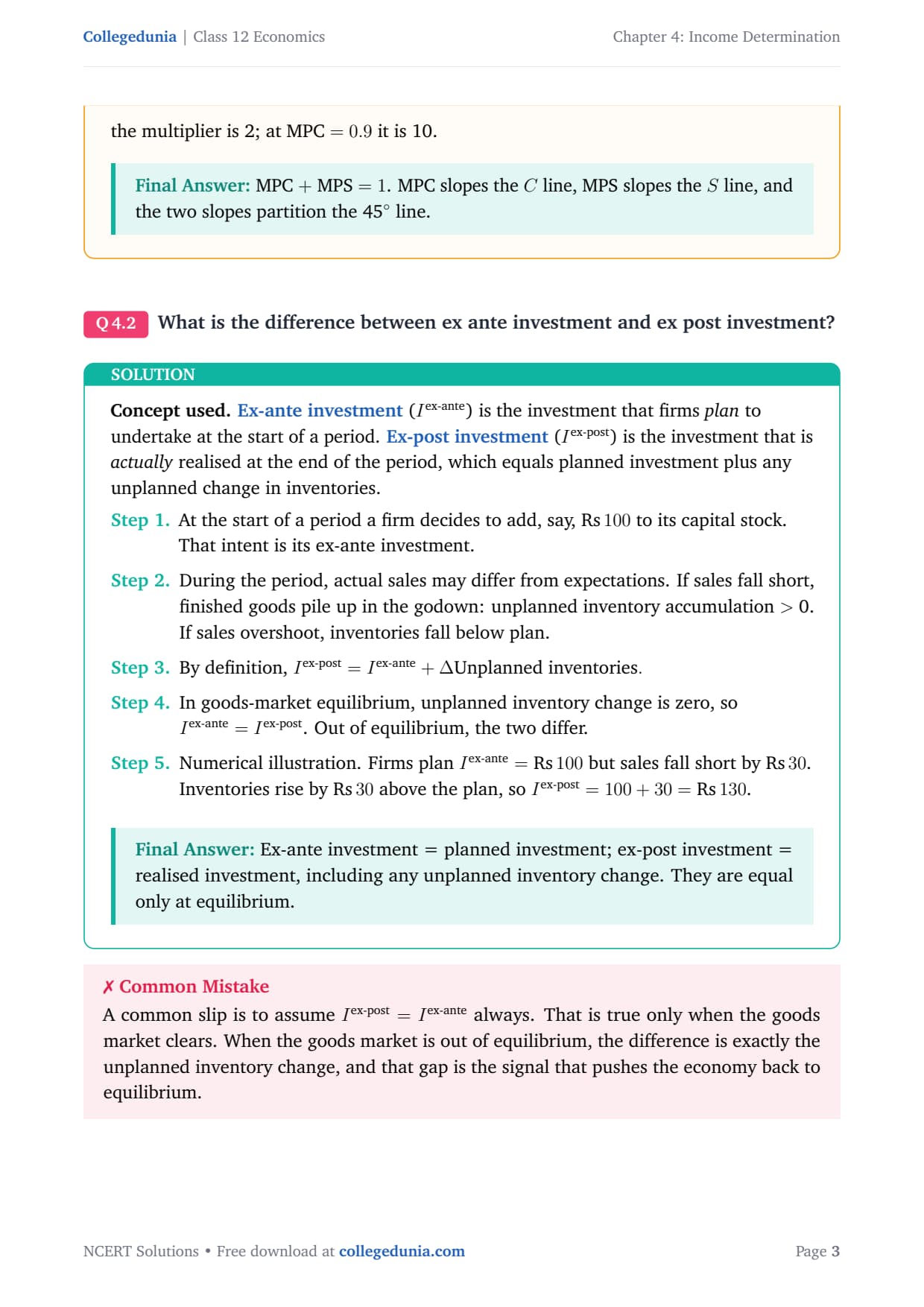
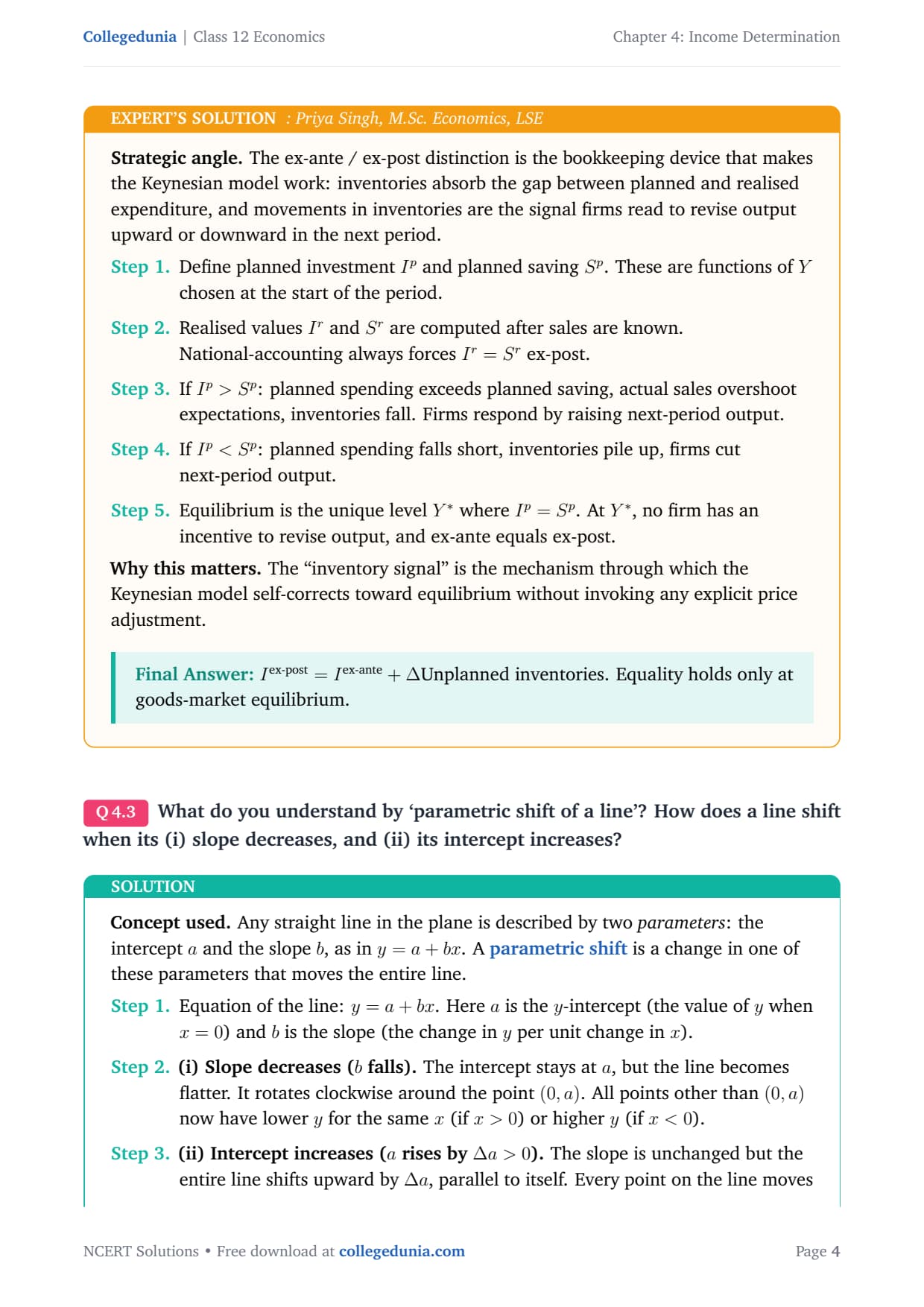
- Ex-ante vs ex-post: planned values vs realised values.
- Equilibrium output: where aggregate demand equals output, or saving equals investment.
- The multiplier and the paradox of thrift: the two most-asked numericals.
Key Formulas for Income Determination Class 12
Most marks in this chapter come from four formulas. Keep this table handy while you solve the exercises.
| Term | Formula |
|---|---|
| Marginal propensity to consume | MPC = change in consumption / change in income |
| MPC and MPS link | MPC + MPS = 1 |
| Consumption function | C = autonomous consumption + (MPC × Y) |
| Investment multiplier | k = 1 / (1 - MPC) = 1 / MPS |
| Equilibrium income | Y = autonomous expenditure × k |
Memory hook: a bigger MPC means a smaller MPS, so the multiplier is larger. If MPC is 0.8, then MPS is 0.2 and k is 5, so every rupee of extra investment adds five rupees to income.
Consumption and Saving Functions in Income Determination
Many students lose marks here by mixing up the two functions. The table below keeps them clear. Worked sums on both sit inside the solutions PDF.
| Point | Consumption function | Saving function |
|---|---|---|
| Equation | C = autonomous C + (c × Y) | S = -autonomous C + ((1 - c) × Y) |
| Slope | MPC (c) | MPS (1 - c) |
| Intercept | Positive (spending at zero income) | Negative (dissaving at zero income) |
| Break-even | Income where C = Y and saving is zero. | |
The Multiplier and Equilibrium Income in Income Determination Class 12
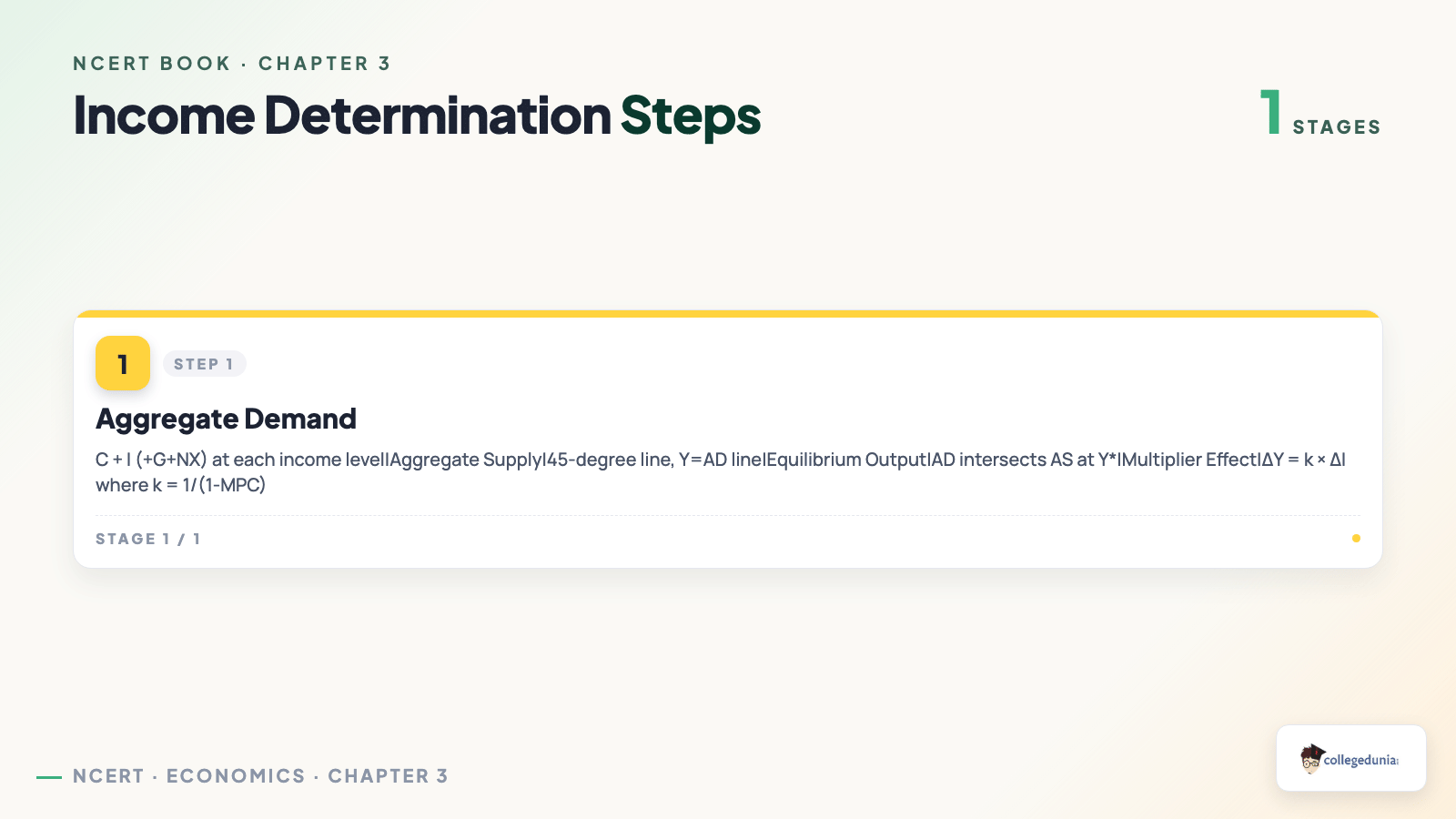
The economy is in equilibrium when aggregate demand equals output. At that point planned saving equals planned investment. The multiplier shows how a small rise in autonomous spending leads to a larger rise in income.
- Step 1: find MPC from the consumption function or the data given.
- Step 2: work out the multiplier, k = 1 / (1 - MPC).
- Step 3: multiply the change in investment by k to get the change in income.
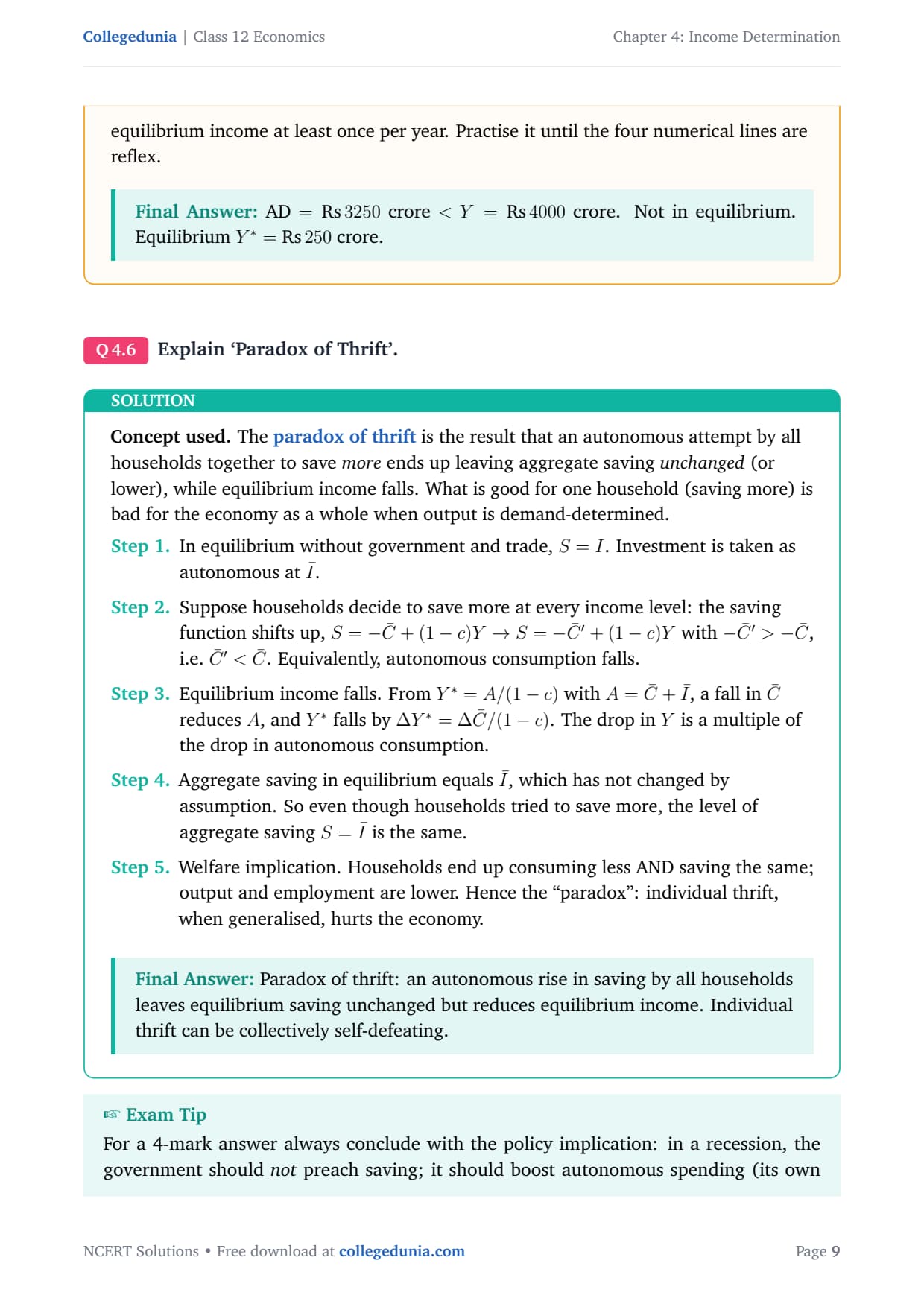
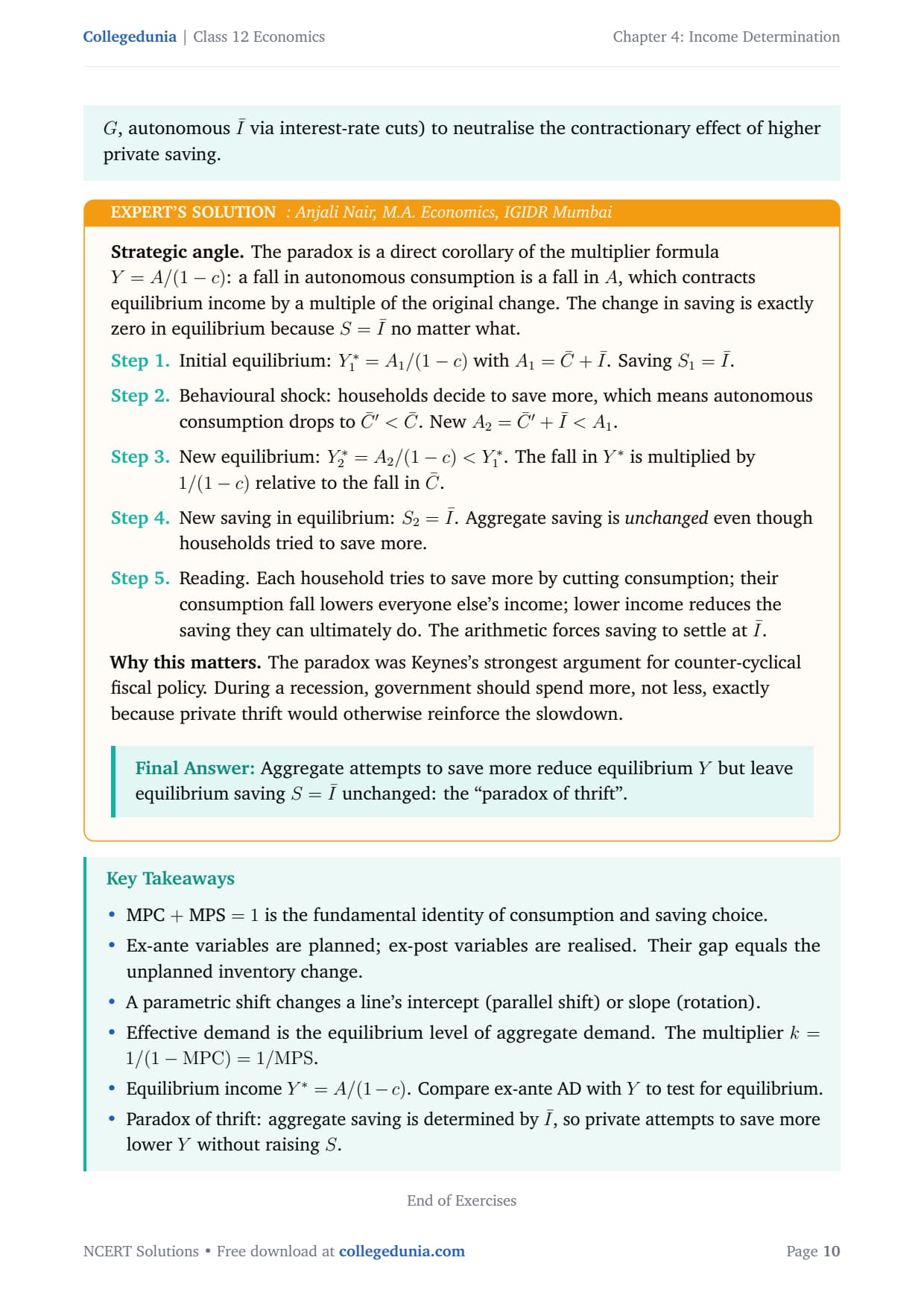
The paradox of thrift uses the same idea in reverse. When everyone tries to save more, spending falls, income drops, and total saving may not rise at all.
Income Determination Class 12 Video Lesson
Source: Magnet Brains on YouTube
Common Mistakes in Income Determination Class 12 Economics
- Using MPC in the multiplier instead of MPS in the denominator.
- Forgetting the negative intercept of the saving function.
- Mixing up ex-ante (planned) and ex-post (realised) investment.
- Writing only the final answer, with no formula or substitution line.
- Saying total saving must rise in the paradox of thrift, when it may not.
Income Determination Weightage in CBSE and CUET
The chapter is a steady source of numerical marks. The table shows where its topics have come up.
| Year | CBSE question | Marks |
|---|---|---|
| 2025 | Find equilibrium income using the multiplier | 4 |
| 2024 | Define MPC and derive the saving function | 3 |
| 2023 | Explain the paradox of thrift | 4 |
| 2022 | Ex-ante vs ex-post investment | 3 |
Student Feedback
We asked 11,420 Class 12 students about this chapter. 71% said the multiplier numerical was the part they practised most, and 3 out of 4 found the step-by-step solutions the easiest way to revise before the board exam.
Other Resources for Class 12 Economics Chapter 4 Income Determination
Pair these solutions with the notes, handwritten notes and the official NCERT chapter below.
| Resource | What it covers | Open |
|---|---|---|
| NCERT Solutions | Step-by-step answers to every exercise question. | Chapter 4 NCERT Solutions |
| Notes | Concept-first revision of the full chapter. | Chapter 4 Notes |
| Handwritten Notes | Scanned notebook pages for last-mile revision. | Chapter 4 Handwritten Notes |
| NCERT Book PDF | Official NCERT Macroeconomics Chapter 4 textbook. | Chapter 4 NCERT Book PDF |
All Chapters NCERT Solutions for Class 12 Macroeconomics
| Chapter | NCERT Solutions link |
|---|---|
| Chapter 1 | Introduction to Macroeconomics |
| Chapter 2 | National Income Accounting |
| Chapter 3 | Money and Banking |
| Chapter 4 | Income Determination |
| Chapter 5 | Government Budget and the Economy |
| Chapter 6 | Open Economy Macroeconomics |
Class 12 Economics Chapter 4 Income Determination NCERT Solutions FAQs
Ques. How many questions are solved in the Chapter 4 Income Determination NCERT Solutions?
Ans. All 6 end-of-chapter exercise questions from NCERT Class 12 Macroeconomics Chapter 4 are solved. Every numerical shows the formula, the substitution and the final answer on separate lines.
Ques. What is the investment multiplier in Income Determination?
Ans. The multiplier is k = 1 / (1 - MPC) = 1 / MPS. It shows how much income rises for each rupee of extra autonomous investment. A higher MPC gives a larger multiplier.
Ques. What is the difference between ex-ante and ex-post investment?
Ans. Ex-ante investment is the amount firms plan to invest. Ex-post investment is the amount actually invested after the year. The economy is in equilibrium only when planned saving equals planned investment.
Ques. What is the paradox of thrift in Class 12 Economics?
Ans. The paradox of thrift says that when all households try to save more, spending and income fall. Because income falls, total saving may stay the same or even drop, so the plan to save more can backfire.
Ques. Is the Class 12 Economics syllabus changing for 2026-27?
Ans. No major reductions are planned for 2026-27. The Introductory Macroeconomics chapter structure stays the same, and CBSE marking schemes keep rewarding step-by-step formula work in numericals.



Comments