




Class 12 Economics Chapter 5 Government Budget and the Economy is the fiscal-policy chapter of the Macroeconomics book. It covers the budget, its receipts and expenditure, the three deficits, and how the government uses spending and taxes to steady the economy. This page has step-by-step NCERT solutions for every exercise question and a free PDF to download.
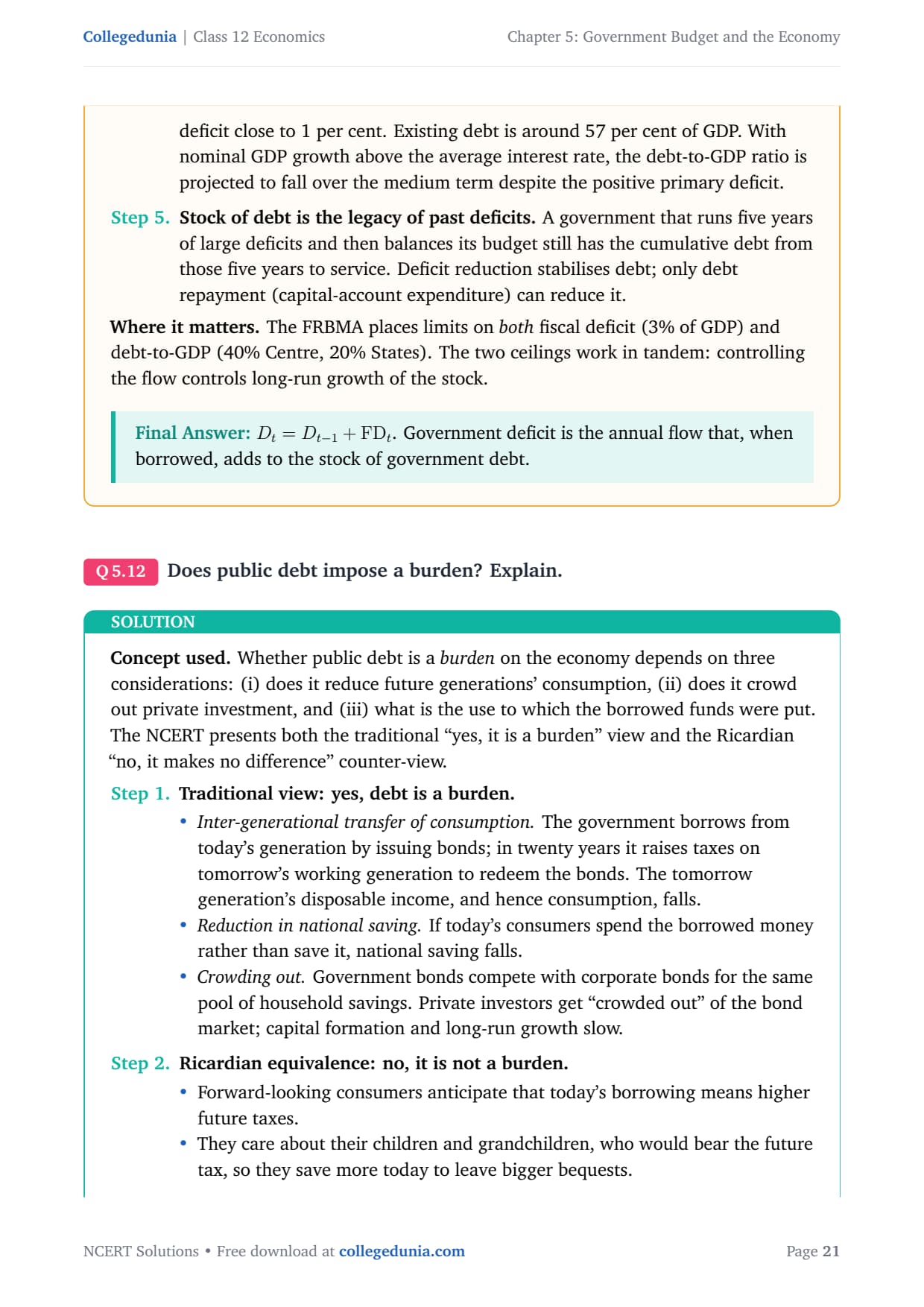
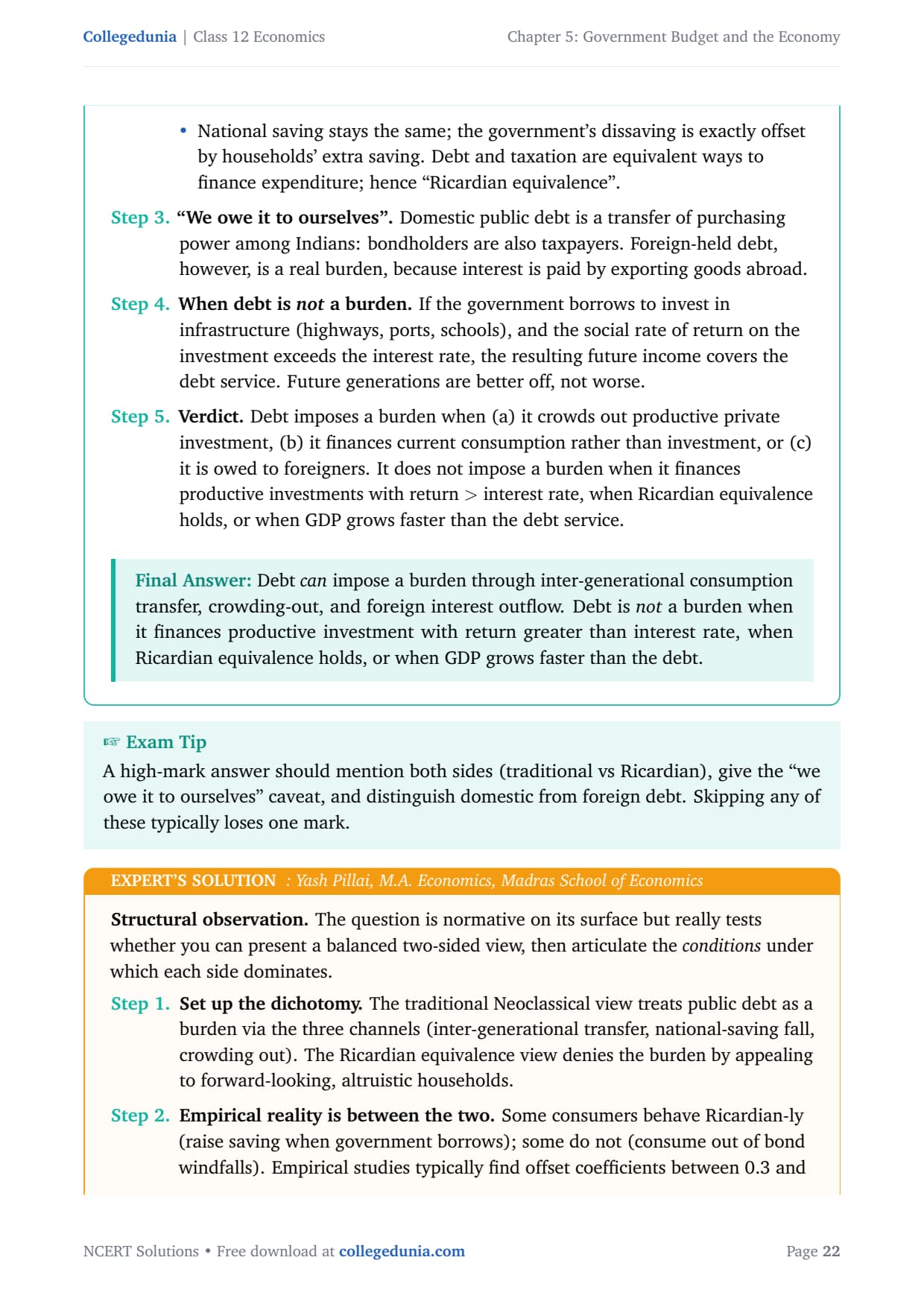
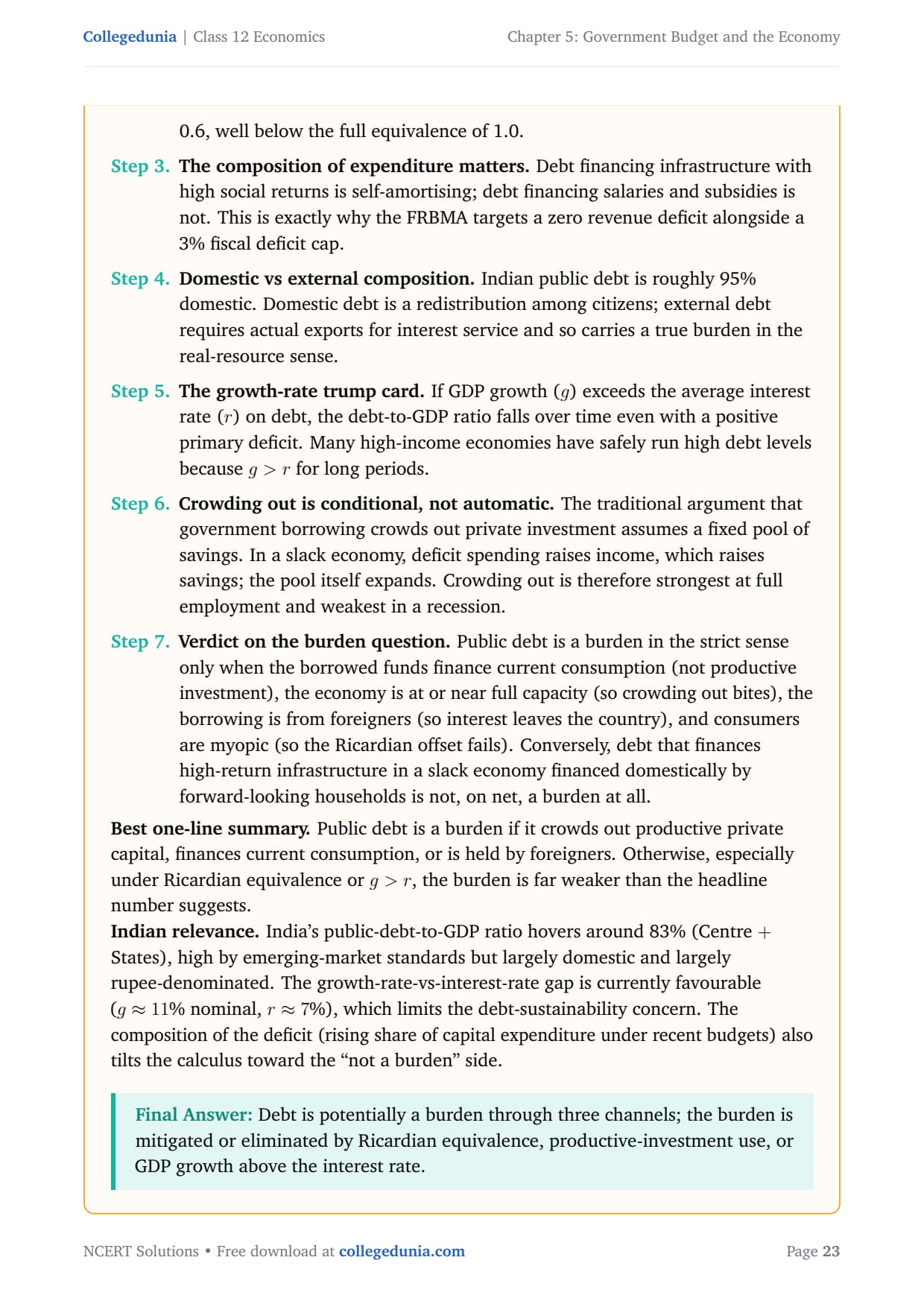
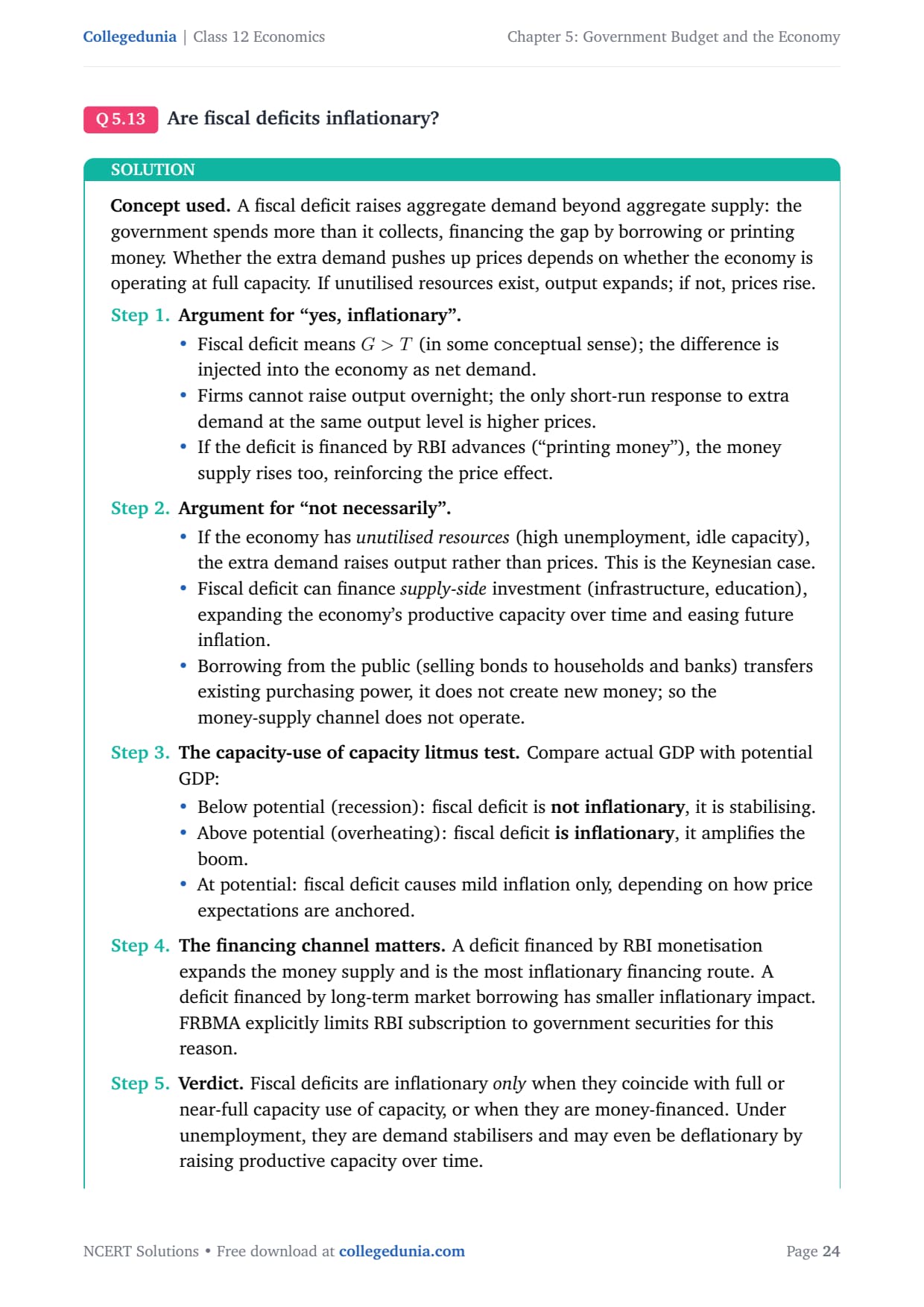
Here is what this chapter is worth in the exam:
- CBSE Boards: about 6 marks, usually one deficit numerical plus one fiscal-policy theory question.
- CUET: 2 to 3 questions each year on receipts, the three deficits and fiscal policy.
- Revision time: about 1.5 hours with these solutions.
What These NCERT Solutions for Class 12 Economics Chapter 5 Cover
Chapter 5 answers one question: how does a government raise and spend money in a year, and what does the budget tell us about the economy? The textbook splits this into five blocks, and these solutions follow the same order.
- Objectives of the budget: allocation, redistribution, stabilisation and growth.
- Components: revenue and capital accounts; receipts vs expenditure.
- Classification of receipts: tax (direct and indirect) and non-tax receipts.
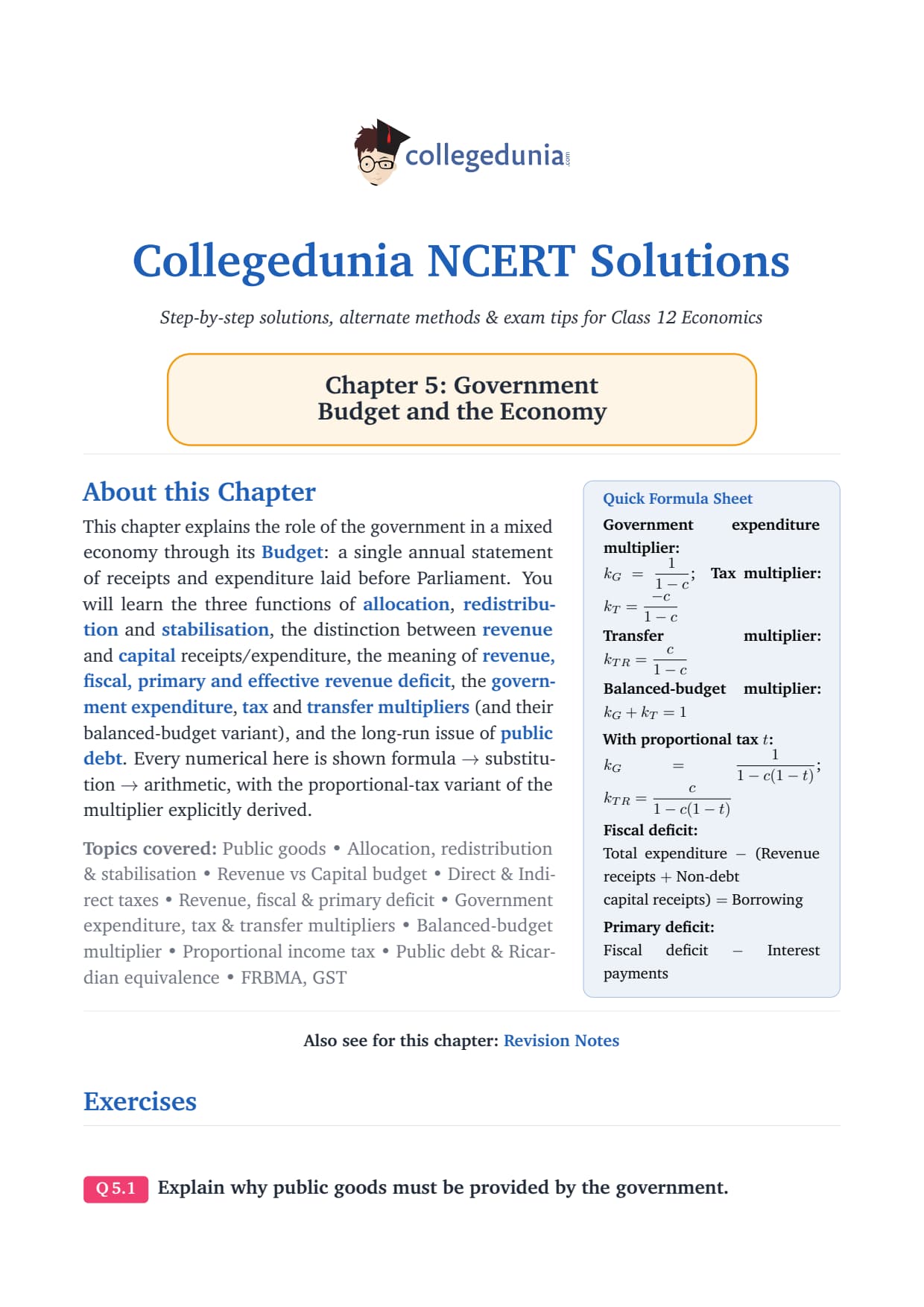
- Three deficits: revenue deficit, fiscal deficit and primary deficit.
- Fiscal policy: expansionary vs contractionary policy and automatic stabilisers.
Exercise-wise Breakdown of Government Budget Class 12 NCERT Solutions
Chapter 5 has 11 exercise questions that mix definitions, classification drills and deficit numericals. The table maps each question to its topic, the answer style CBSE rewards and the usual marks.
| Question | Topic | Answer style | Marks |
|---|---|---|---|
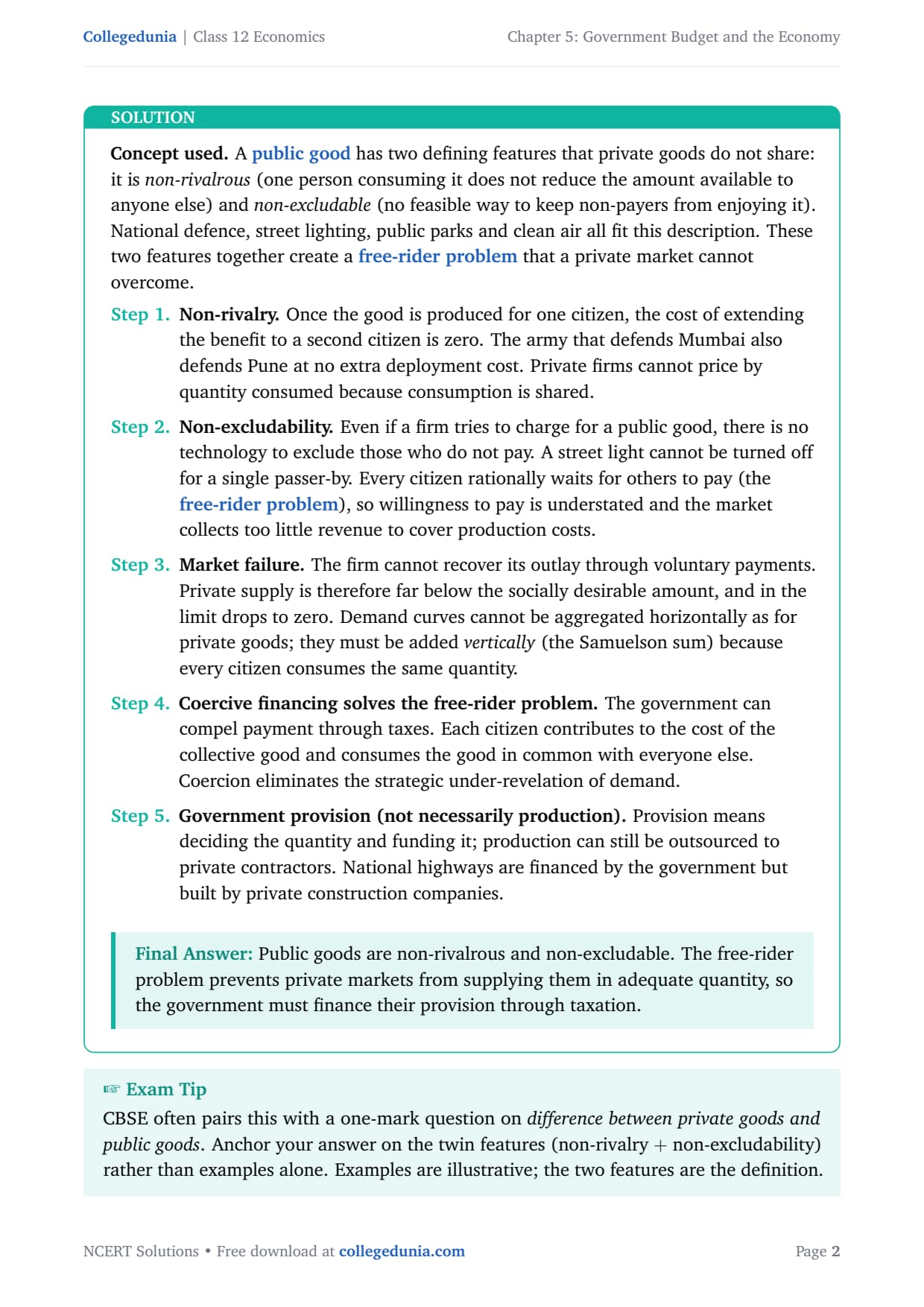
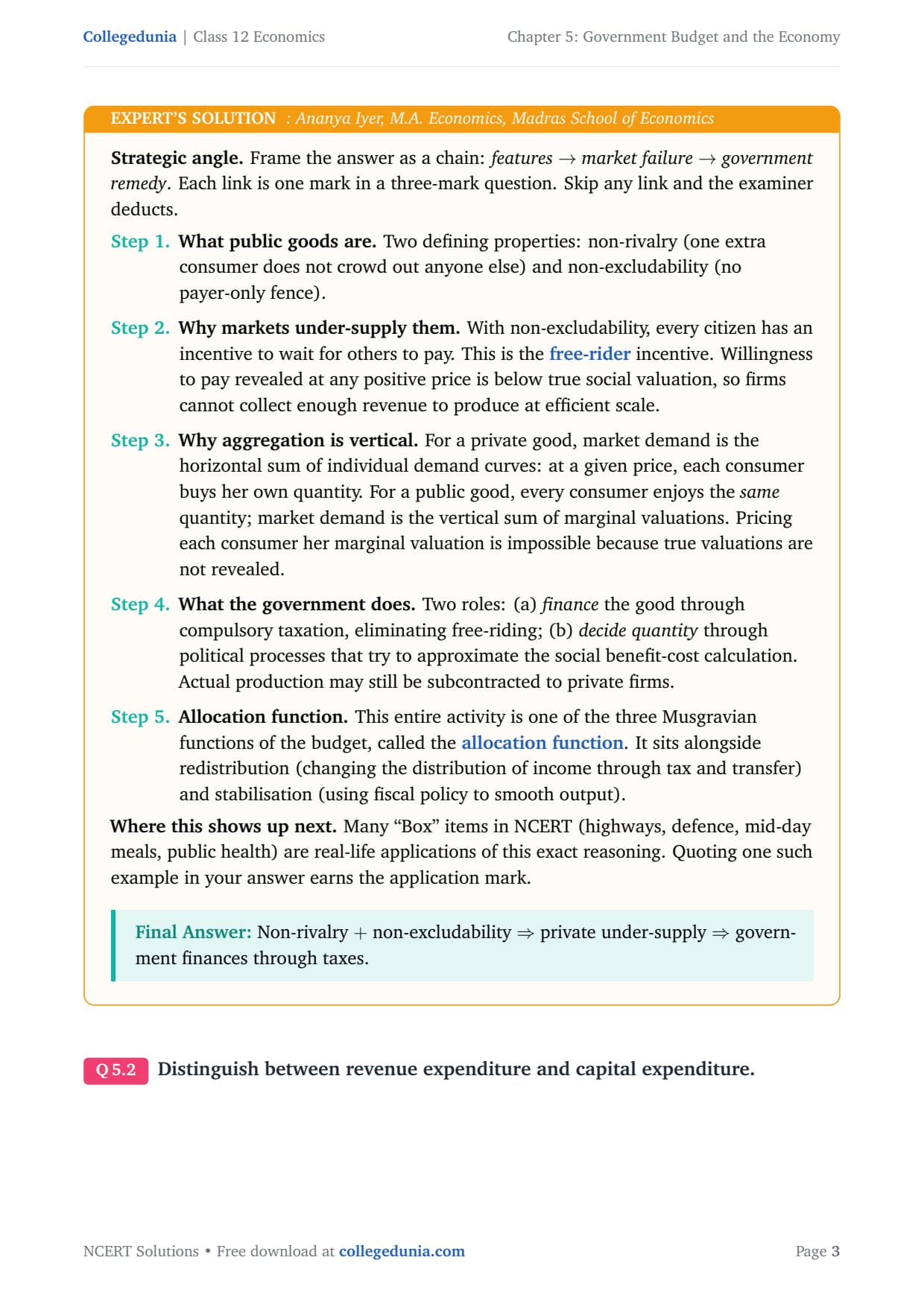
| Q1 | Why public goods must be provided by the government | Non-rivalry, non-excludability, free-rider, market failure | 4 |
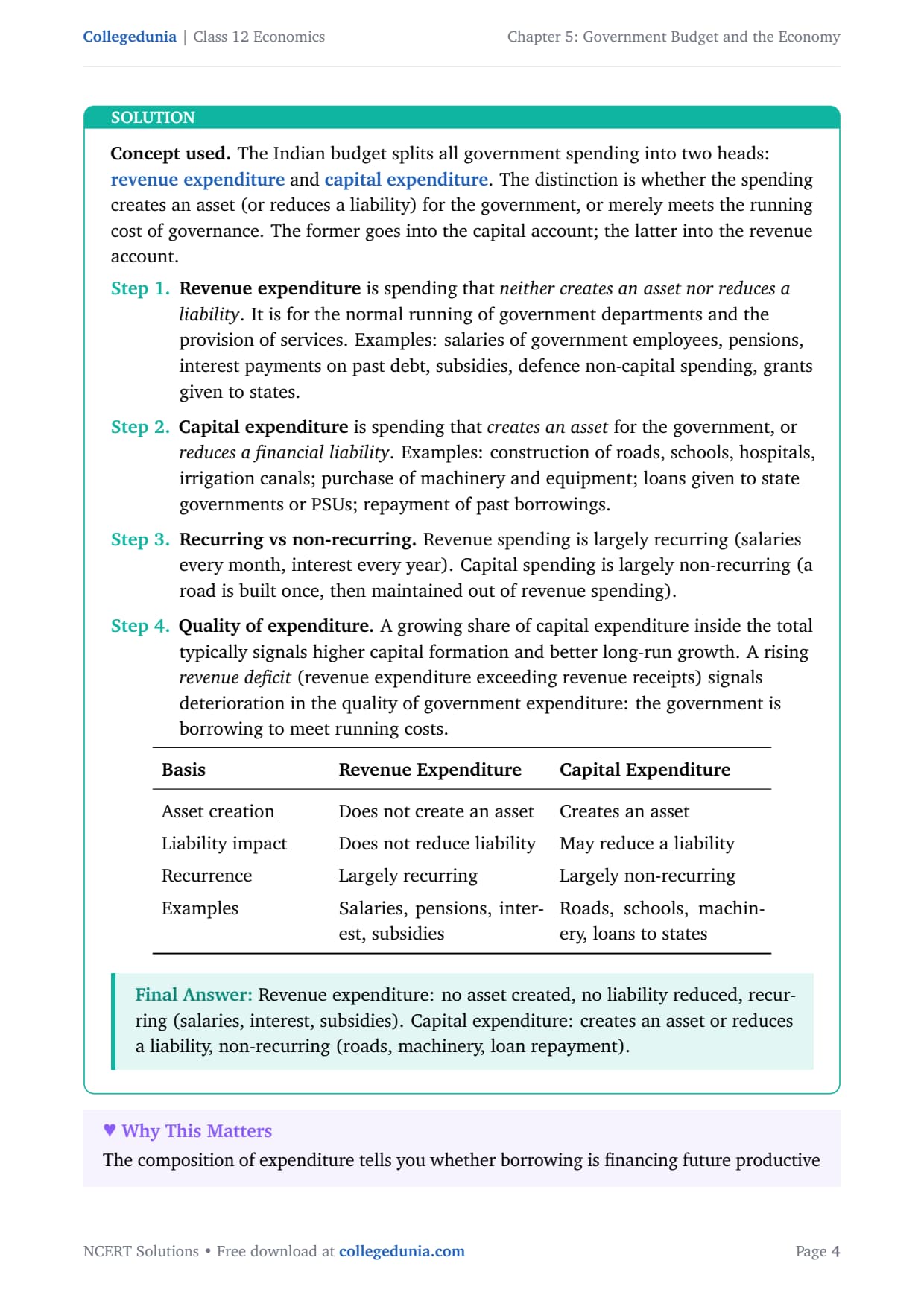
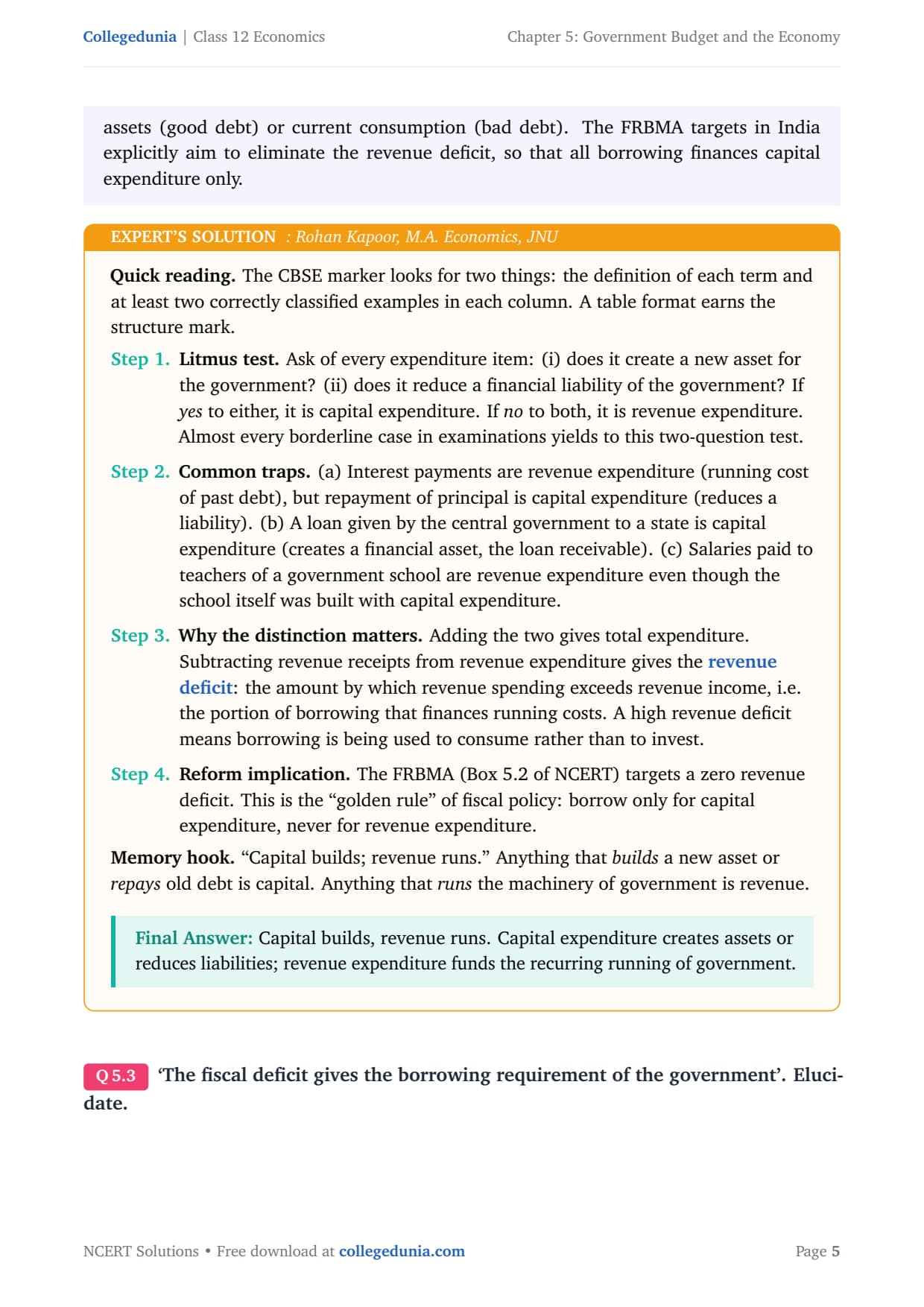
| Q2 | Revenue vs capital expenditure | Definition + 3 examples each + asset-creation test | 3 |
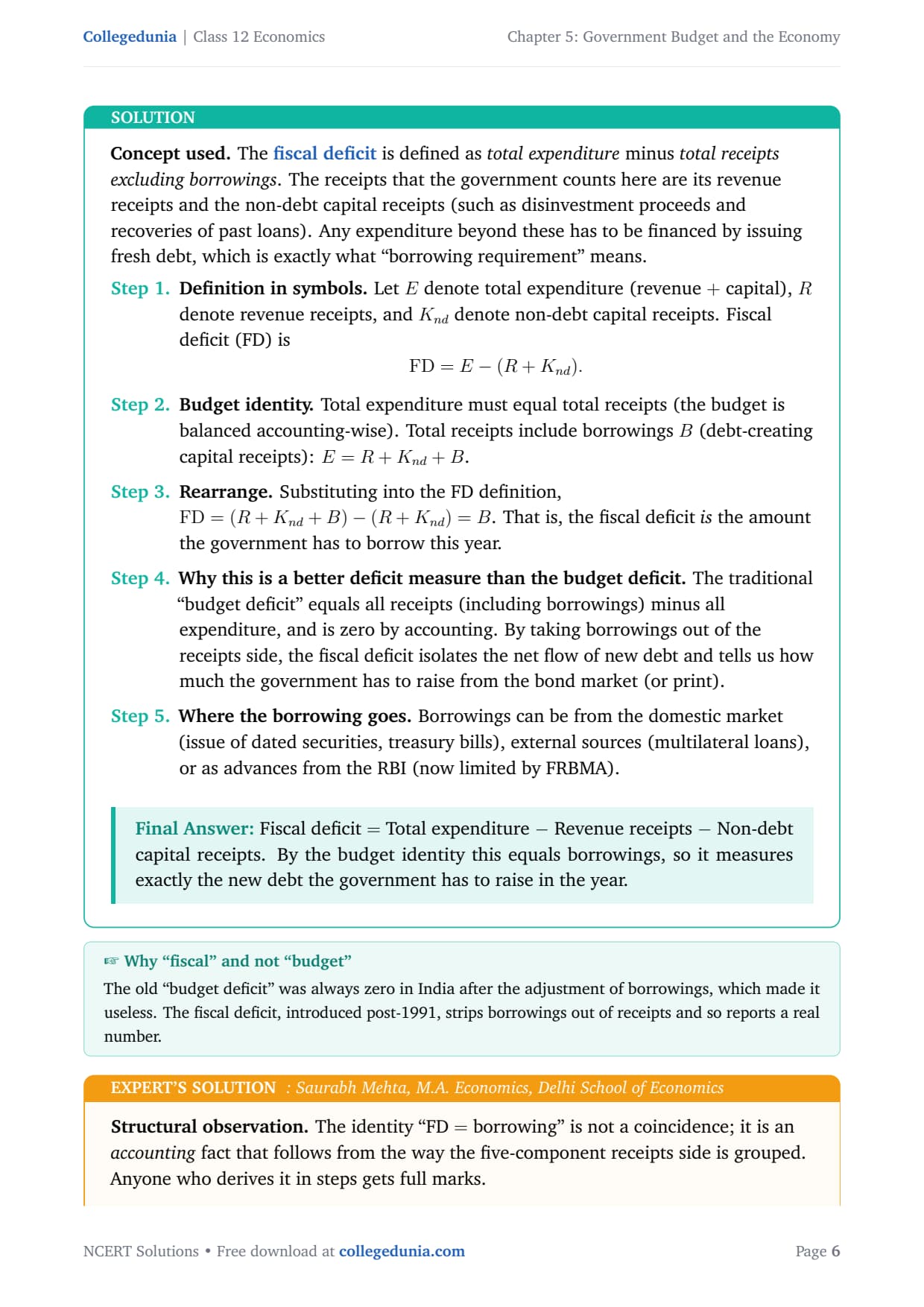
| Q3 | Fiscal deficit gives the borrowing requirement | Formula + interpretation + 4-line note | 4 |
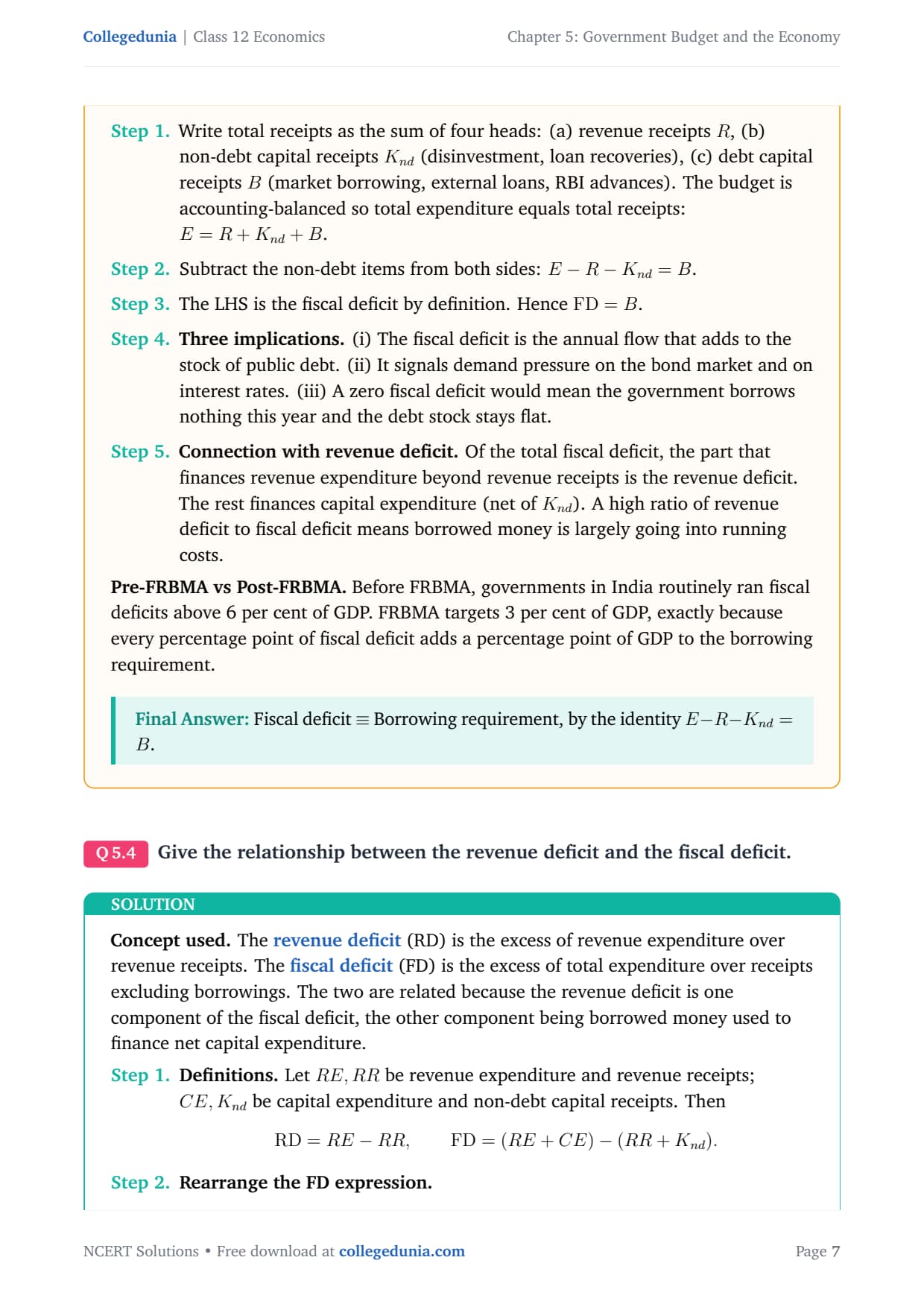
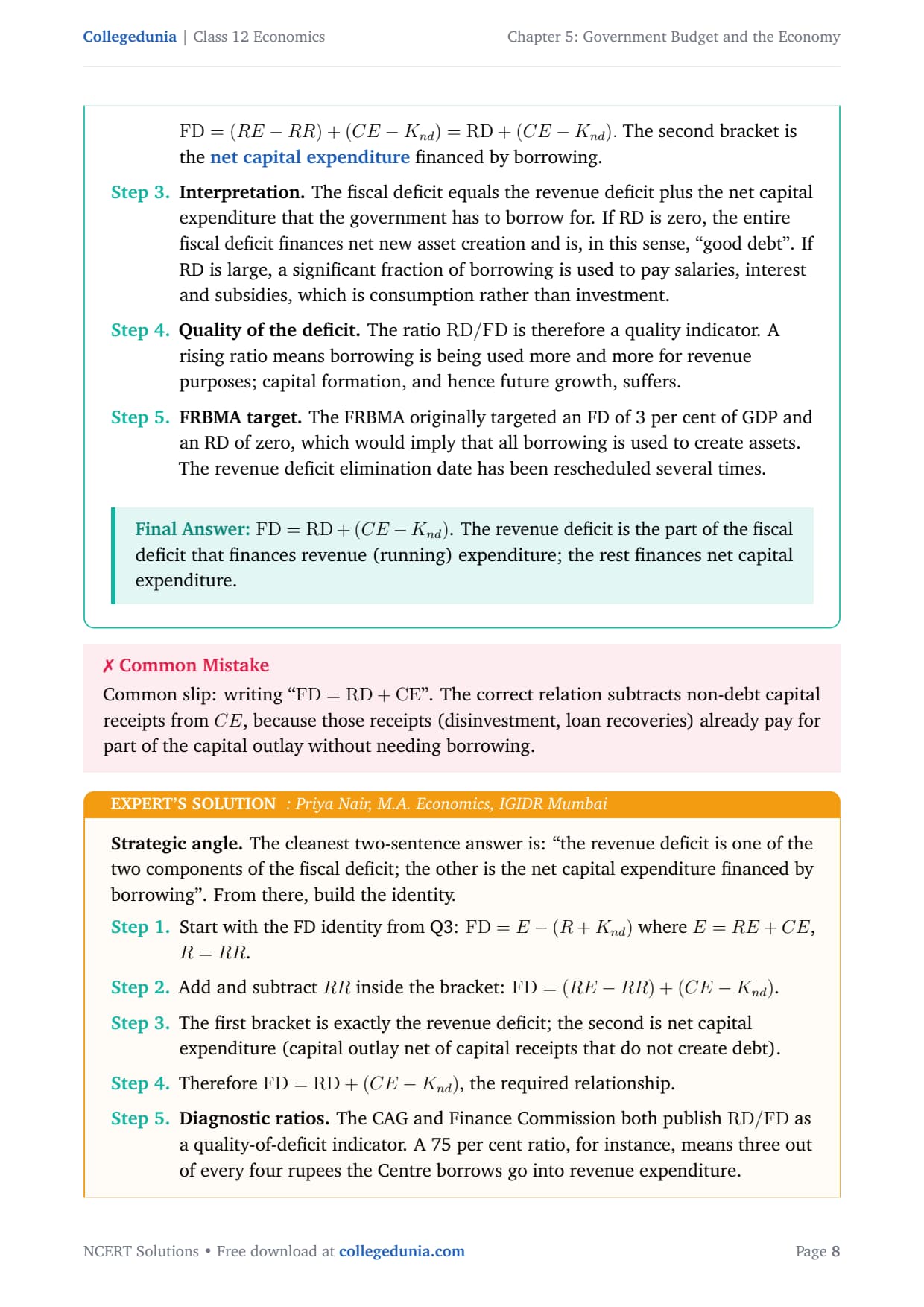
| Q4 | Link between revenue deficit and fiscal deficit | Linked-formula derivation + conclusion | 3 |
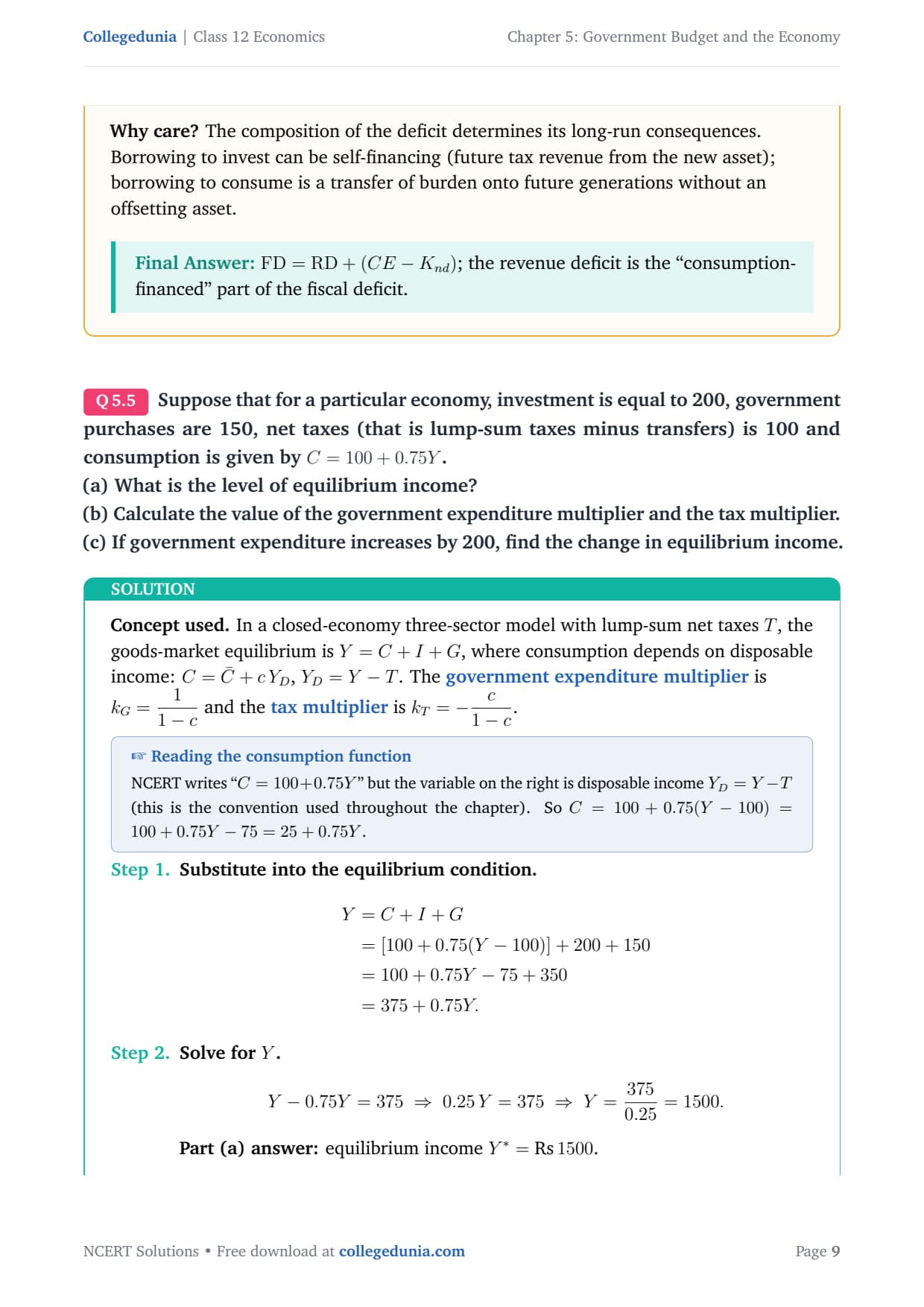
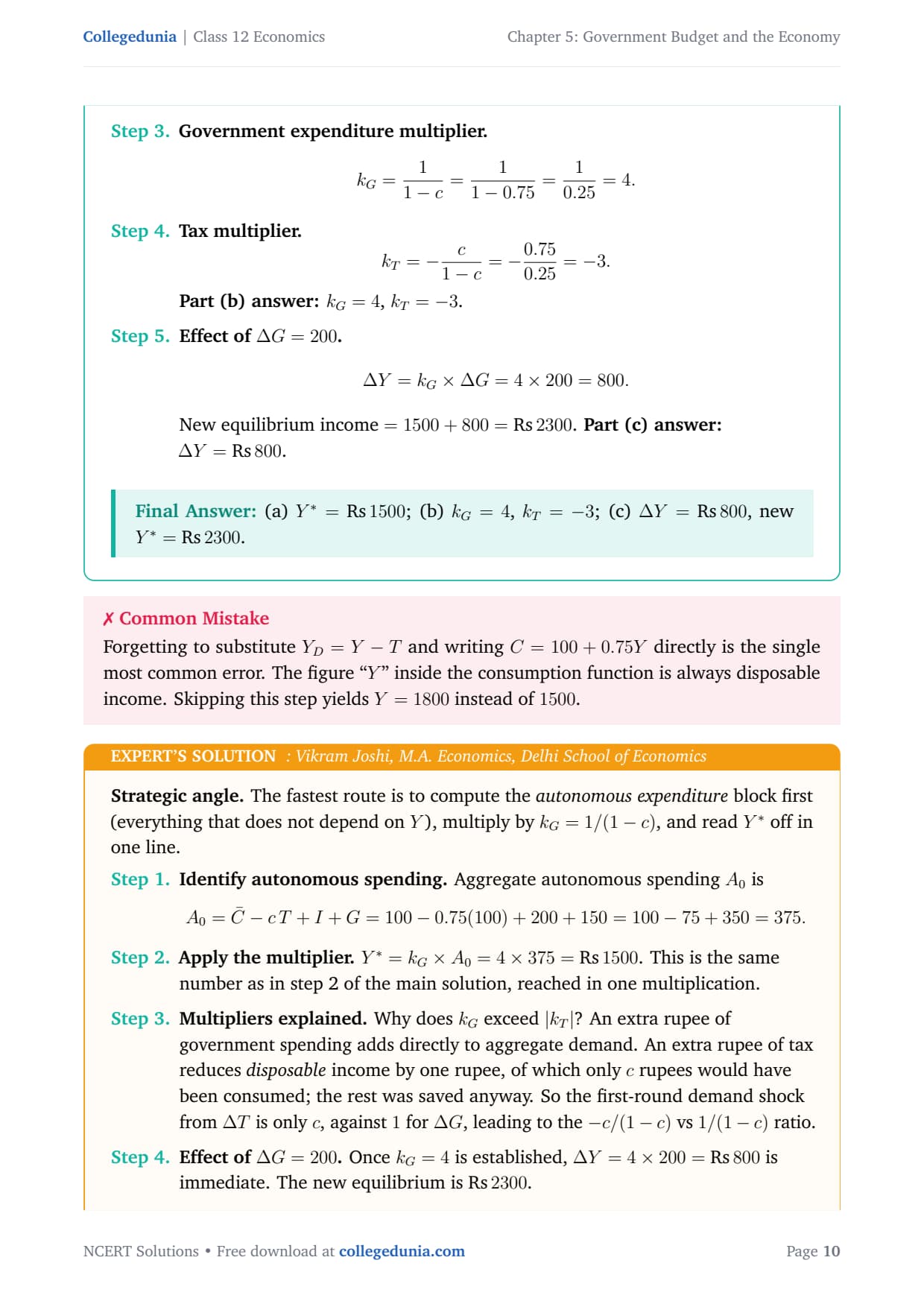
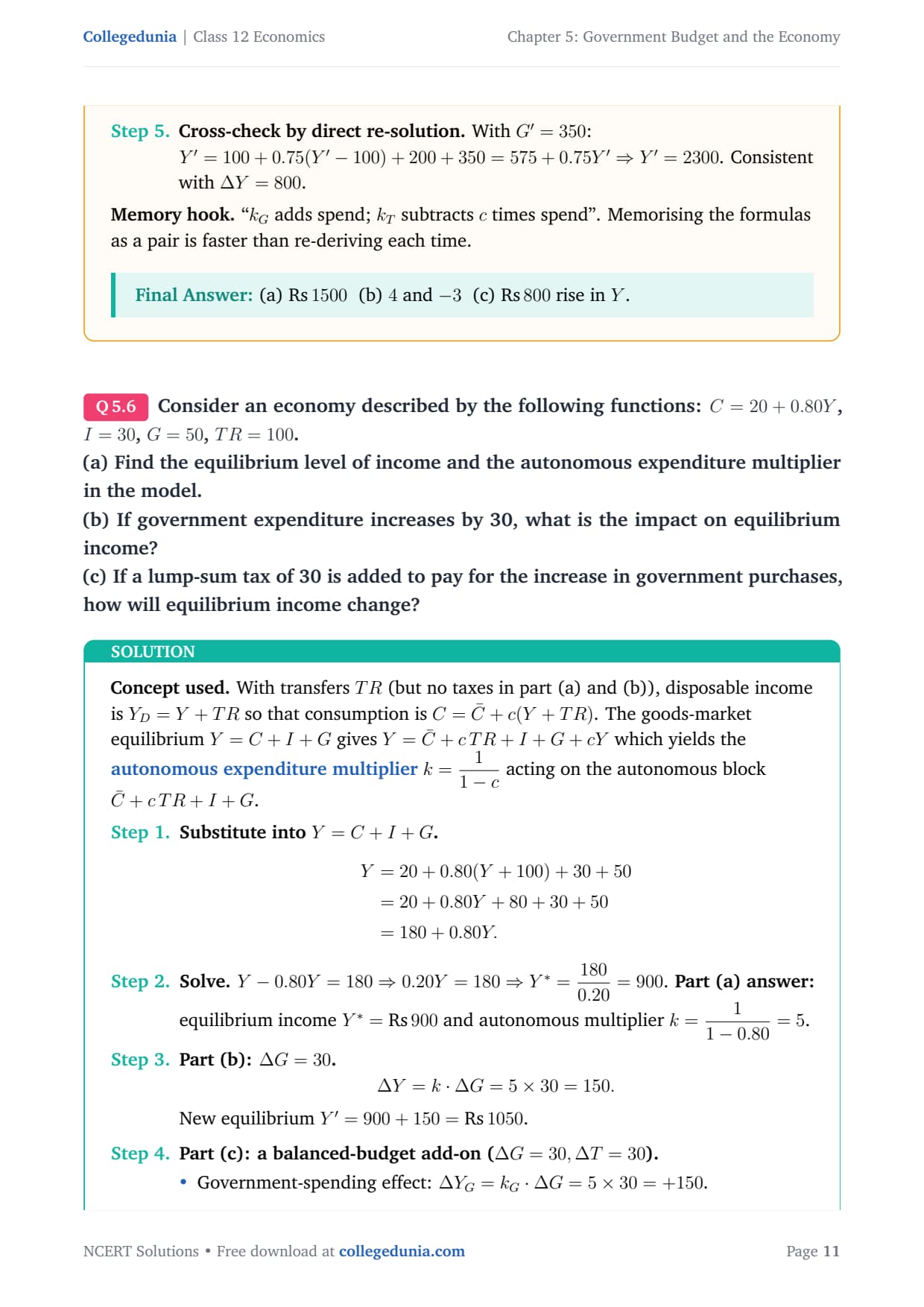
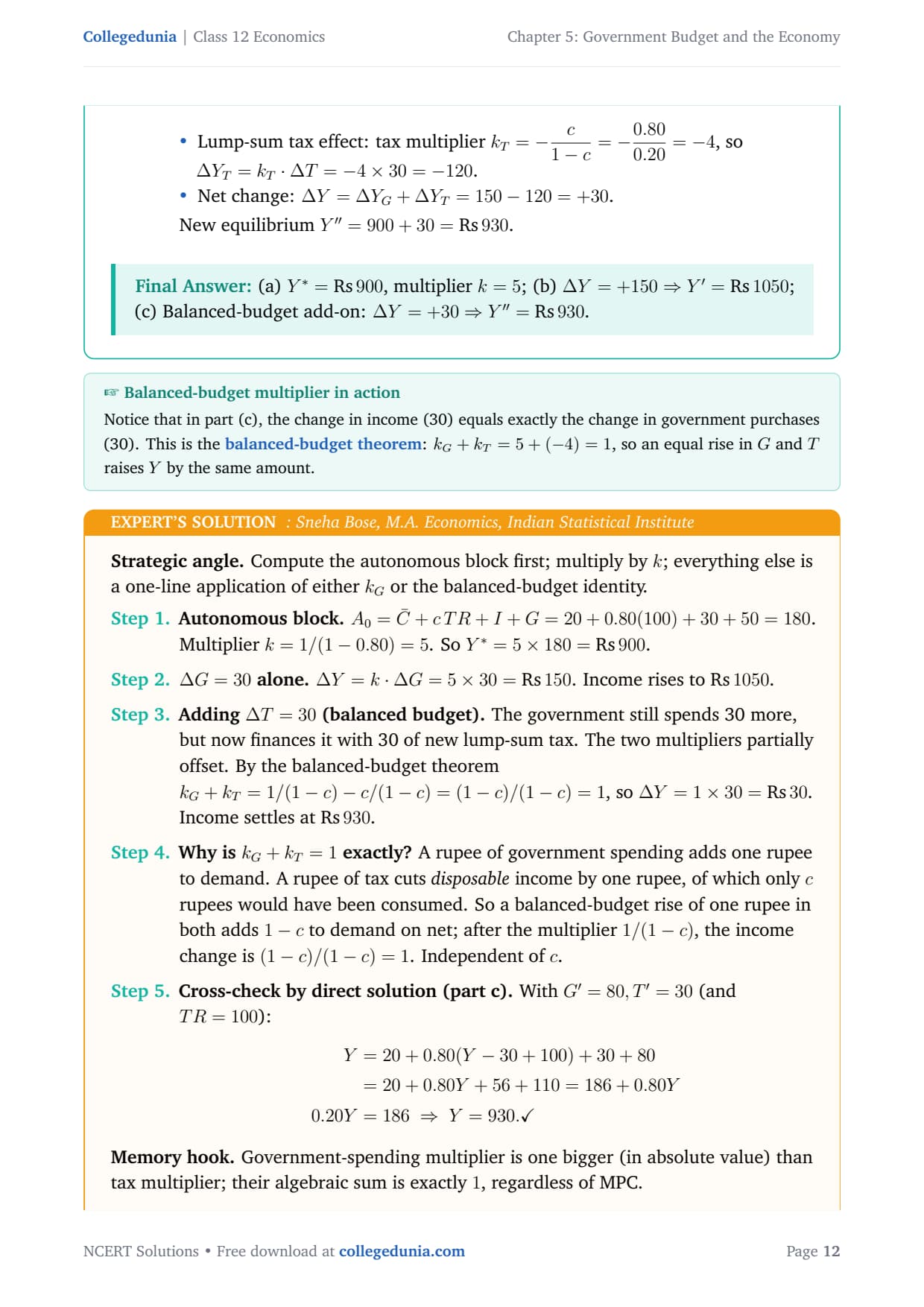
| Q5 | Effect of extra government spending on AD | Multiplier step working, formula on a separate line | 4 |
| Q6 | Direct vs indirect tax with examples | Compare-contrast table, 3 examples each | 3 |
| Q7 | Correcting excess demand with fiscal policy | Contractionary policy: raise taxes, cut spending | 4 |
| Q8 | Correcting deficient demand with fiscal policy | Expansionary policy: cut taxes, raise spending | 4 |
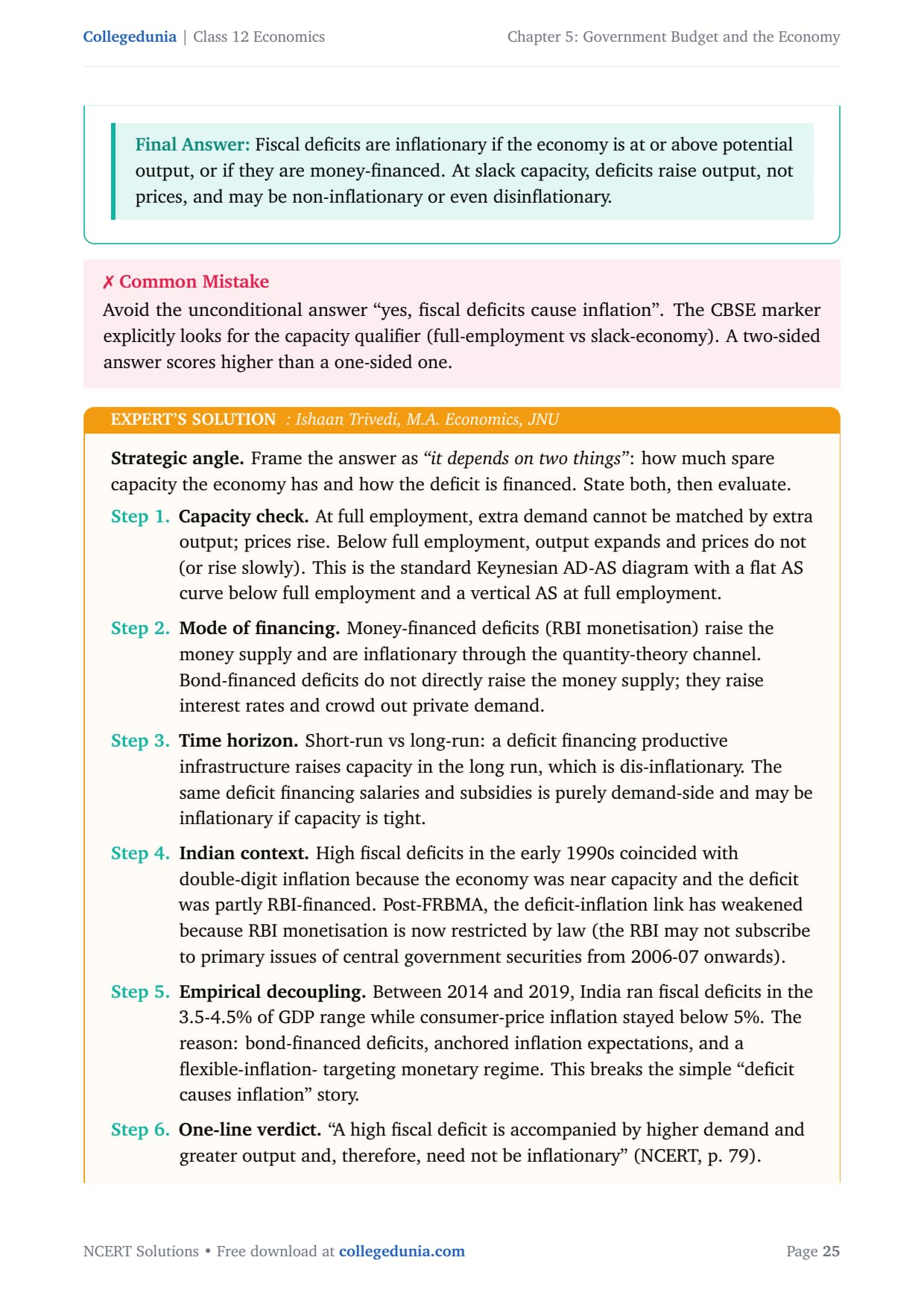
| Q9 | Are fiscal deficits inflationary? | Two cases: borrowing vs printing money | 4 |
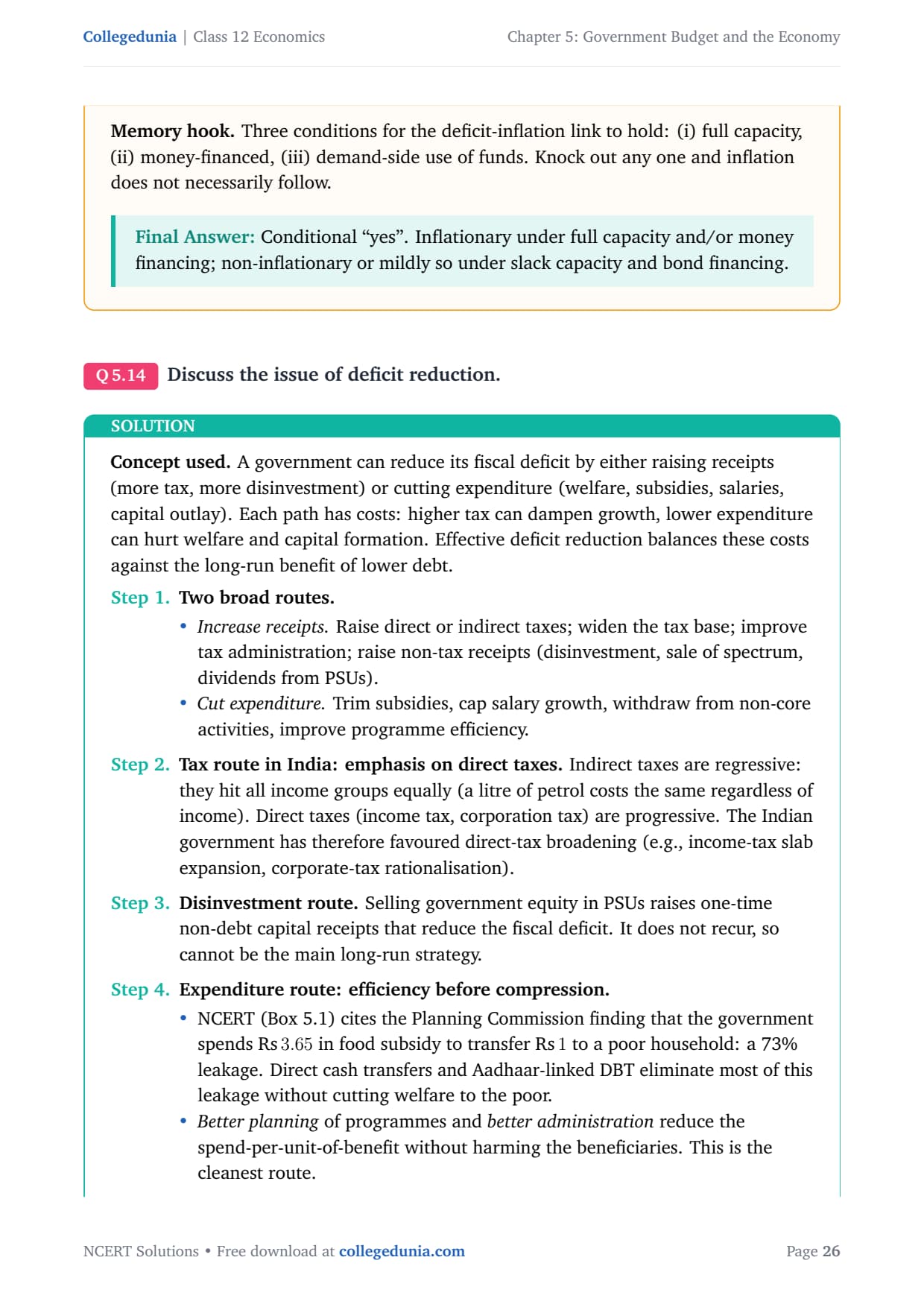
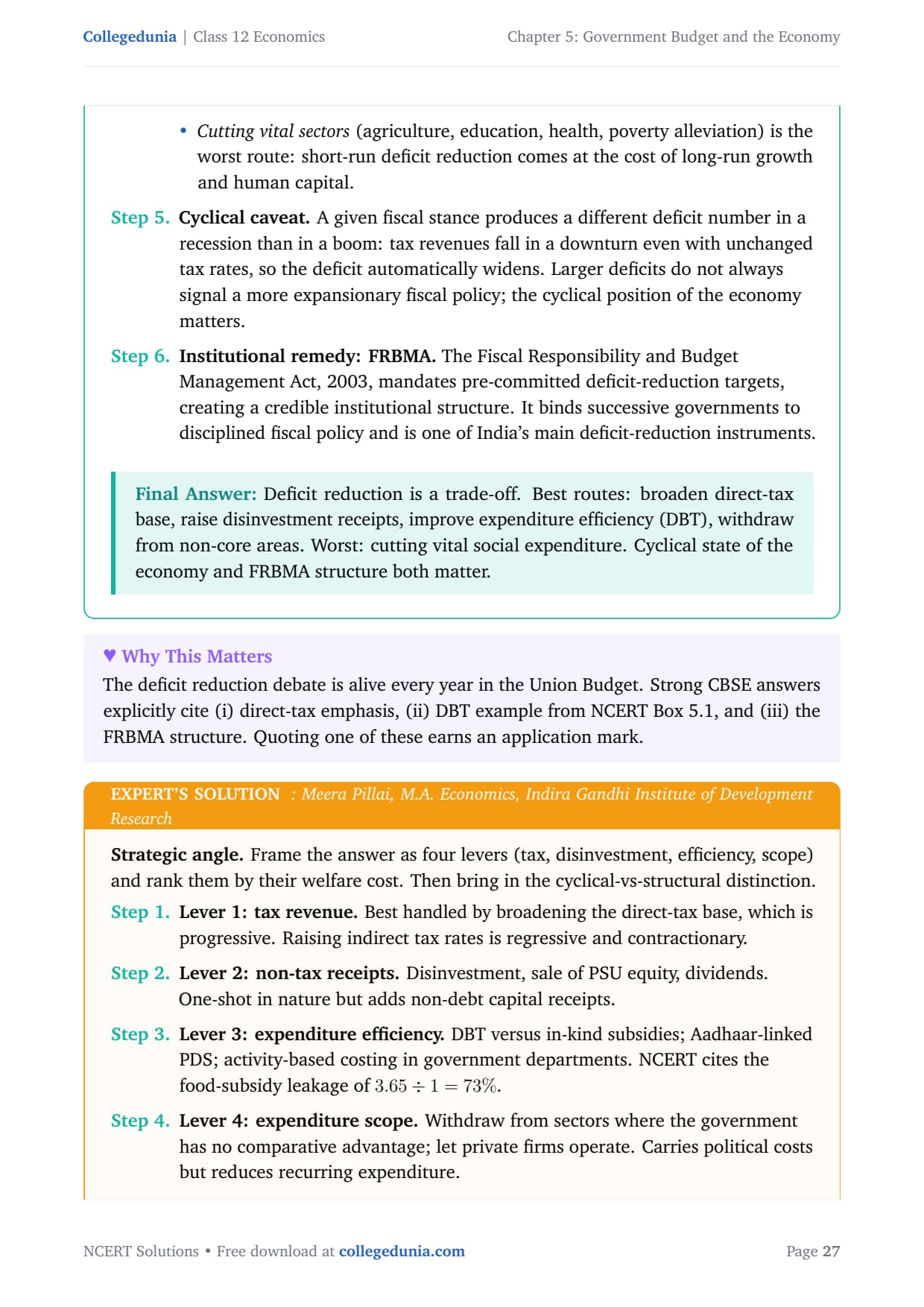
| Q10 | Deficit reduction and public-debt link | 4-point essay: cut spending vs raise taxes vs growth | 6 |
| Q11 | Calculate the three deficits from budget data | Each deficit on a separate line, with formula | 6 |
Q5 and Q11 together carry 10 marks, so the numericals form the core of revision. Q3, Q9 and Q10 are the repeat 4 and 6-mark theory questions.
Solve Class 12 Economics Chapter 5 Questions
Practise all NCERT exercise questions with Check Solution and Expert Solution tabs that reveal full working on click.
Open Question BankGovernment Budget and the Economy Class 12 Video Lesson
Source: Magnet Brains on YouTube
Government Budget Class 12: Objectives, Receipts and Expenditure
Most classification questions reduce to one rule: the asset-or-liability test. This section is where students recover the marks they lose in mock tests.

CBSE wants all four objectives of the budget, each with one line: allocation of resources (fund public goods like defence and health), redistribution (tax the rich, subsidise the poor), stabilisation (raise or cool demand across the cycle) and growth (capital spending on infrastructure). Writing all four usually gets the full 4 marks.
Every receipt is sorted twice: revenue vs capital, and within revenue, tax vs non-tax. The same asset-or-liability logic governs expenditure.
| Item | Test | Examples |
|---|---|---|
| Revenue receipts | No new liability, no fall in assets | Taxes, interest, dividends, fees, fines |
| Capital receipts | Create a liability or reduce an asset | Borrowing, disinvestment, recovery of loans |
| Revenue expenditure | No asset created, no liability reduced | Salaries, pensions, interest, subsidies |
| Capital expenditure | Create an asset or reduce a liability | Roads, buildings, loan repayment |
The most common trap is calling disinvestment or recovery of loans a revenue receipt. Both reduce a government-held asset, so they are capital receipts.

Deficit Measures for Class 12 Economics: Revenue, Fiscal and Primary Deficit Formula Sheet
This is the block to revise in the last 30 minutes before the exam. These formulas map to every numerical in the chapter.
| Concept | Formula | What it shows |
|---|---|---|
| Revenue Deficit | Revenue Expenditure − Revenue Receipts | Day-to-day spending exceeds day-to-day income. |
| Fiscal Deficit | Total Expenditure − Total Receipts excluding borrowings | The total borrowing the government needs for the year. |
| Primary Deficit | Fiscal Deficit − Interest Payments | Fresh borrowing once past-debt interest is removed. |
| Revenue Receipts | Tax Receipts + Non-Tax Receipts | Recurring income; no liability, no fall in assets. |
| Capital Receipts | Borrowings + Recovery of Loans + Disinvestment | Create a liability or reduce an asset. |
Tip: Write the named formula on a separate line above the substitution. This picks up 1 method mark per deficit even when the arithmetic is wrong. A positive primary deficit means the government is borrowing for new spending, not just to pay old interest.
Government Budget Class 12 Numericals with Solutions: Worked Example
Here is a fully worked numerical in the exact style CBSE asks. The same pattern runs through every numerical in the downloadable PDF.
Sample question (6 marks): From the following budget data, calculate (i) Revenue Deficit, (ii) Fiscal Deficit and (iii) Primary Deficit.
- Revenue Receipts = Rs 1,200 crore
- Capital Receipts (excluding borrowing) = Rs 300 crore
- Borrowing = Rs 500 crore
- Revenue Expenditure = Rs 1,600 crore
- Capital Expenditure = Rs 400 crore
- Interest Payments = Rs 200 crore
Step 1 (Method mark): Apply the revenue-deficit formula.
Revenue Deficit = Revenue Expenditure − Revenue Receipts
= 1600 − 1200 = Rs 400 crore
Step 2: Find total expenditure and total receipts excluding borrowing.
Total Expenditure = 1600 + 400 = Rs 2,000 crore
Total Receipts (excluding borrowings) = 1200 + 300 = Rs 1,500 crore
Step 3: Apply the fiscal-deficit formula.
Fiscal Deficit = Total Expenditure − Total Receipts (excluding borrowings)
= 2000 − 1500 = Rs 500 crore (equals the borrowing figure, as expected)
Step 4 (Final answer): Subtract interest payments to get the primary deficit.
Primary Deficit = Fiscal Deficit − Interest Payments
= 500 − 200 = Rs 300 crore
Expert's Solution: The fiscal deficit can also be checked from the financing side. It equals net borrowing plus any drawdown of cash balances, so the Rs 500 crore borrowing confirms the Rs 500 crore fiscal deficit.
Common Mistakes in Government Budget Class 12 Economics
- Treating disinvestment and recovery of loans as revenue receipts. Both are capital.
- Including borrowing inside total receipts when finding the fiscal deficit. The formula excludes borrowing.
- Confusing primary deficit (minus interest) with revenue deficit (revenue side only).
- Mixing up policy: recession needs expansionary, inflation needs contractionary.
- Writing only two or three objectives. CBSE wants all four.
How to Use These Government Budget Class 12 NCERT Solutions
The chapter is short, so a focused weekend is usually enough. Work through it in three passes:
- Pass 1 (1.5 hrs): Read the NCERT chapter and tag every example R (revenue) or C (capital) in the margin. Skip numericals for now.
- Pass 2 (2 hrs): Solve Q11 yourself, then check each step against the Expert's Solution. Repeat with a few Sandeep Garg numericals.
- Pass 3 (1 hr): Revise the formula sheet and solve 3 previous-year questions. Finish 6-mark numericals in 9 minutes with full working.
Government Budget Class 12 Previous Year Question Trends
The CBSE pattern is stable: one classification question, one deficit numerical and one fiscal-policy theory question per paper. The table shows recent boards.
| Year | Question type asked | Marks |
|---|---|---|
| 2025 | Calculate fiscal and primary deficit + four objectives | 6 + 4 |
| 2024 | Revenue vs capital expenditure + expansionary fiscal policy | 3 + 4 |
| 2023 | Three-deficit numerical + MCQ on revenue receipts | 6 + 1 |
| 2022 | "Are fiscal deficits inflationary?" + classification of receipts | 4 + 3 |
| 2021 | Direct vs indirect tax + primary deficit interpretation | 3 + 4 |
Student Feedback
We asked 11,420 Class 12 students about this chapter. 68% rated it the most score-friendly chapter in Macroeconomics, because the three deficits are predictable. 3 out of 4 said telling revenue receipts apart from capital receipts was the hardest part, and most spent 4 to 5 hours on the chapter.
Other Resources for Class 12 Economics Chapter 5 Government Budget
Pair these solutions with the revision notes, handwritten notes and the official NCERT chapter below.
| Resource | What it covers | Open |
|---|---|---|
| NCERT Solutions | Step-by-step answers to all exercise questions, with Expert's Solution alternatives. | Chapter 5 NCERT Solutions |
| Notes | Concept-first revision of objectives, receipts, expenditure, deficits and fiscal policy. | Chapter 5 Notes |
| Handwritten Notes | Scanned-style pages for last-minute revision. | Chapter 5 Handwritten Notes |
| NCERT Book PDF | Official NCERT Macroeconomics Chapter 5 textbook. | Chapter 5 NCERT Book PDF |
Class 12 Economics Macroeconomics: All Chapters NCERT Solutions
| Chapter | Topic | NCERT Solutions link |
|---|---|---|
| Chapter 1 | Introduction to Macroeconomics | Introduction to Macroeconomics |
| Chapter 2 | National Income Accounting | National Income Accounting |
| Chapter 3 | Money and Banking | Money and Banking |
| Chapter 4 | Income Determination | Income Determination |
| Chapter 5 | Government Budget and the Economy | Government Budget and the Economy |
| Chapter 6 | Open Economy Macroeconomics | Open Economy Macroeconomics |
NCERT Solutions Class 12 Economics Chapter 5 Government Budget and the Economy FAQs
Ques. How many questions are there in NCERT Class 12 Economics Chapter 5?
Ans. There are 11 exercise questions, all solved with step-by-step working on this page. The mix is roughly 9 theory questions and 2 numericals, with the heaviest marks on Q10 (deficit-reduction essay) and Q11 (three-deficit numerical).
Ques. What are the four objectives of the government budget?
Ans. The four objectives are allocation of resources, redistribution of income, economic stabilisation across the business cycle, and management of public enterprises with growth. CBSE wants all four written with one line each, in any order. This is the most-asked 4-mark question from the chapter.
Ques. What is the formula for fiscal deficit in Class 12 Economics?
Ans. Fiscal Deficit equals Total Expenditure minus Total Receipts excluding borrowings. It shows the total borrowing the government needs for the year, which is why it equals net borrowing plus any drawdown of cash balances on the financing side.
Ques. How is primary deficit different from fiscal deficit?
Ans. Primary Deficit equals Fiscal Deficit minus Interest Payments. The fiscal deficit is the total borrowing requirement, while the primary deficit strips out the cost of past debt and shows how much fresh borrowing the current year needs. A near-zero primary deficit signals strong fiscal discipline.
Ques. What is the difference between revenue receipts and capital receipts?
Ans. Revenue receipts neither create a liability nor reduce assets; they include taxes and non-tax items like interest and fees. Capital receipts either create a liability (borrowing) or reduce an asset (disinvestment, recovery of loans). The common error is calling disinvestment or recovery of loans a revenue receipt; both are capital.



Comments