NCERT Solutions for Class 12 English (Suppl.) Chapter 2 Kaleidoscope: Eveline help students answer James Joyce's story with clear textual support. The PDF below follows the 2026-27 NCERT question order and explains Eveline's memory, family duty, fear, paralysis and final choice in exam-ready language.
Student Feedback: More than 12,000 students asked for Eveline answers that separate plot summary from interpretation. This page therefore shows where to quote the story, where to explain a symbol, and where to connect Eveline's silence with the larger theme of paralysis.
Includes all 21 solved questions from the PDF with Solution and Expert Solution tabs.
Useful for CBSE 2026-27 English Elective revision, classroom discussion and notebook completion.
Highlights family duty, escape, memory, fear, narrative point of view and Joyce's use of epiphany.
What Class 12 English Chapter 2 Eveline Solutions Cover
Chapter 2 of the Class 12 English supplementary Kaleidoscope short story section asks students to read a quiet crisis. Eveline sits by a window, remembers her childhood, weighs her promise to her mother, thinks of Frank and then freezes at the moment of departure. These NCERT Solutions keep every answer tied to that emotional movement.
The central task is to explain why Eveline cannot leave, not merely to say that she stays. The answers show how duty, habit, fear, social pressure and memory work together. The chapter also needs attention to Joyce's narrative method: the story stays close to Eveline's thoughts, so small details such as dust, music, letters and the dock scene become important evidence.
Question area
What to focus on
Answer cue
Stop and Think
Direct story incidents and quoted clues
Answer from the scene before adding interpretation.
Understanding the Text
Choice, fear, family duty and paralysis
Connect Eveline's action to her inner conflict.
Appreciation
Point of view, symbol and narrative style
Name the device, then show its effect in the story.
Joyce presents Eveline at a threshold. She has a plan to leave Dublin with Frank, but the story begins with stillness rather than action. The house, the familiar street, her father's violence, her dead mother's final words and her fear of the unknown all press on her at once. That is why the final scene at the station feels inevitable even though escape is physically possible.
For answer writing, students should track three movements. First, Eveline remembers a past that contains both warmth and pain. Second, she imagines a future with Frank as a chance for respect and freedom. Third, she reaches the dock and becomes unable to act. The best answers show how the story turns an external choice into an inner paralysis.
How to Use These NCERT Solutions for Better Answers
The PDF is useful for quick revision as well as detailed written practice. Begin with the Stop and Think questions to settle the events of the story. Then use the longer answers to understand why Eveline's silence at the end is not emptiness, but a sign of fear, conditioning and emotional exhaustion.
Underline story evidence: the window, dust, the promise to her mother, Frank's songs and the final dock scene.
Separate event from meaning: state what happens first, then explain what it reveals about Eveline.
Use literary terms carefully: paralysis, stream of consciousness, epiphany and symbol are enough for this chapter.
A strong answer usually begins with a direct point, adds one exact detail from the story, and then explains the emotional or literary effect. The Expert Solution tabs add a second route so students can compare a compact school answer with a fuller interpretation of Joyce's craft.
Duty, Escape and Paralysis in Eveline
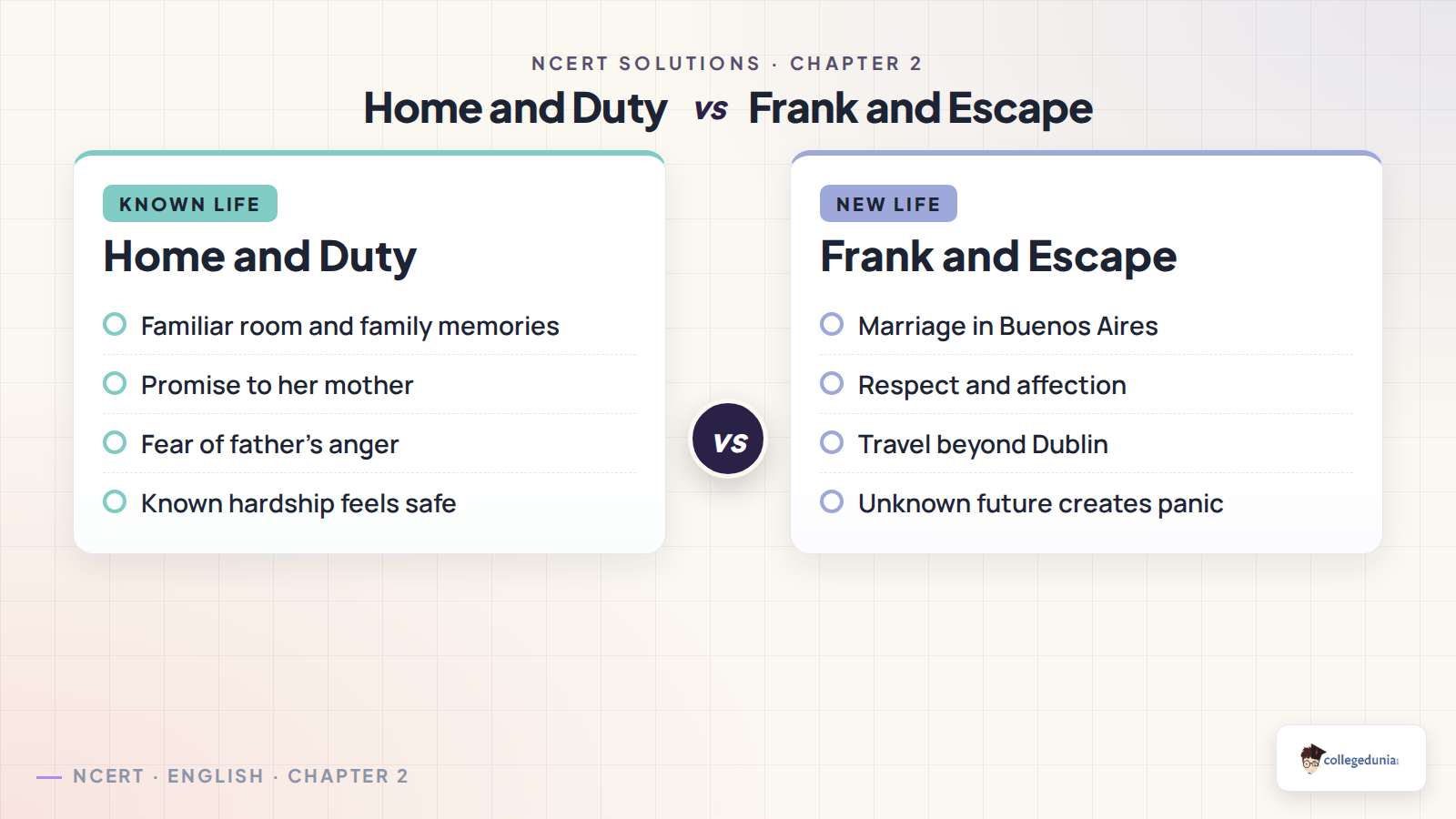
The conflict in the story is not a simple fight between love and fear. Eveline's wish to leave is real, but so is her attachment to home, her responsibility toward younger children and her memory of a promise made to her dying mother. Joyce makes the decision difficult because each side carries an emotional claim.
Paralysis is the most important idea for the chapter. It does not mean that Eveline has no feeling. It means that feeling, duty and fear combine so strongly that she cannot move when movement is required. The ending at the ship barrier therefore becomes the visible form of an invisible struggle.
Force acting on Eveline
Story evidence
How to use it in answers
Duty
Her promise to keep the home together
Explain why leaving feels like betrayal.
Escape
Frank offers travel, marriage and a new life
Show that the future is attractive but uncertain.
Fear
The final dock scene freezes her action
Connect her body language with inner paralysis.
Common Mistakes Students Should Avoid
Many weak answers reduce Eveline to a person who simply lacks courage. That is too narrow. The story shows a girl shaped by poverty, duty, violence, memory and social expectation. Students should also avoid treating Frank as a complete solution, because Joyce gives only Eveline's limited view of him.
Do not retell the plot without explaining Eveline's inner conflict.
Do not say she stays only because she dislikes Frank; the story shows a deeper paralysis.
Do not ignore the promise to her mother, since it is central to Eveline's sense of duty.
Do not use a literary term unless the next sentence explains how it works in the chapter.
Class 12 English Supplementary Chapter 2 Resource Links
Use these related resources when you want the same chapter in another format. The links are kept above the FAQ so students can move from solutions to notes, book PDF and handwritten revision without losing the chapter context.
All NCERT Solutions for Class 12 English Supplementary Chapters
The table below keeps the same resource type together, so students can move chapter by chapter through the Class 12 English supplementary Kaleidoscope question set.
All NCERT Solutions for Class 12 English (Suppl.) Chapter 2 Kaleidoscope: Eveline with Step-by-Step Solutions
The expandable cards below reproduce the full solution set from the PDF. Use the Solution tab for a direct exam-ready answer and the Expert Solution tab for a deeper explanation of theme, narrative method and character psychology.
Questions
Q 2.1
Why did Eveline review all the familiar objects at home?
Concept used. In a character-based answer, an action should be
connected with the feeling behind it. Eveline reviews the objects because she
is about to leave and is measuring the emotional cost of that departure.
Text clue
Joyce places Eveline beside the window, not on the road. This shows that she is
still attached to the room even while thinking of escape.
Eveline looks around the room she has cleaned for many years.
The familiar objects remind her of home, family history, duty, and
routine.
She wonders whether she will ever see these objects again if she leaves
with Frank.
Her review of the room shows that home is not only a place of hardship.
It is also a place of memory, habit, and emotional attachment.
Eveline reviews the familiar objects because she is preparing to
leave home, and each object makes her feel the weight of memory, duty, and
possible loss.
AR
Ananya Rao
M.A English Literature, University of Delhi
Verified Expert
Strategic angle. Treat the room as a map of Eveline's mind. The
objects are ordinary, but they carry the force of her past.
The dusted objects represent long years of domestic work and routine.
The priest's photograph, the harmonium, and the familiar room connect
Eveline to family history.
Her possible escape is therefore not a clean break. It feels like
tearing herself away from a whole life.
This explains why she hesitates even before the final scene at the quay.
The answer should mention both fear of loss and attachment to habit.
She reviews the objects because leaving home means leaving the
memories, duties, and familiar identity built around them.
Q 2.2
Where was Eveline planning to go?
Concept used. A direct plot question should answer the place first,
then add the purpose and companion. Eveline plans to leave Dublin with Frank
and begin married life in Buenos Aires.
Answer focus
Do not stop at "abroad." Name Buenos Aires and connect it with Frank's promise
of a home.
Eveline is planning to go away with Frank by the night boat.
Frank has a home waiting for her in Buenos Aires.
She imagines that marriage to Frank will give her respect and a new
life.
The plan is therefore both geographical and emotional: she wants to
leave Dublin and escape her harsh routine.
Eveline was planning to go to Buenos Aires with Frank, to become his
wife and begin a new life there.
RM
Rohan Menon
M.Phil English, Jadavpur University
Verified Expert
Strategic angle. The place matters because it stands for distance.
Buenos Aires is not only a city in the story; it is Eveline's image of escape.
Frank has travelled widely and speaks of distant countries.
Buenos Aires seems to offer Eveline marriage, respect, and safety.
It is far from Dublin, her father, the Stores, and the domestic burden
placed on her.
That distance makes the plan attractive, but it also makes it
frightening.
The answer is strongest when it names the place and explains its emotional
value.
She planned to sail with Frank to Buenos Aires, where he said a home
was waiting for them.
Q 2.3
Who was Frank? Why did Eveline's father quarrel with him?
Concept used. A character-identification answer should give the
character's role and the conflict linked to that role. Frank is Eveline's
lover, and her father quarrels with him because he distrusts sailor men and
opposes the relationship.
Frank's role
Frank is shown as kind, open-hearted, musical, and experienced in travel. This
contrast makes him appear unlike Eveline's cramped home life.
Frank is a sailor who has travelled to places such as Canada,
Patagonia, and Buenos Aires.
He courts Eveline, meets her outside the Stores, sings to her, and
plans to marry her.
Eveline's father discovers the affair and forbids her to meet Frank.
He quarrels with Frank because he has a low opinion of sailors and says
he knows "these sailor chaps."
Frank was Eveline's sailor-lover. Her father quarrelled with him
because he distrusted sailors and wanted to stop Eveline's relationship with
him.
MS
Meera Sanyal
M.A Comparative Literature, EFLU Hyderabad
Verified Expert
Strategic angle. Frank represents movement and possibility, while
Eveline's father represents control and fear.
Frank offers Eveline a route out of Dublin through marriage and travel.
His stories of ships and distant countries make him exciting to her.
Her father sees Frank as a threat to his authority over Eveline.
The quarrel therefore comes from suspicion, possessiveness, and class
prejudice against sailors.
This conflict prepares the secrecy of Eveline and Frank's later meetings.
It also explains why Frank is never only a romantic figure in the story. To
Eveline, he is the practical route out of a controlled household, while to her
father he is a stranger who may take away labour, obedience, and authority.
Frank was the sailor Eveline loved; her father fought with him
because he distrusted him and opposed Eveline's escape through marriage.
Q 2.4
What significance does Eveline find in the organ-player's appearance on the day she had decided to leave?
Concept used. A symbol becomes significant when it connects the
present moment with a powerful memory. The organ-player's music reminds
Eveline of her mother's deathbed and of the promise to keep the home together.
Memory trigger
The sound from the street does not merely add background. It unlocks the
memory that weakens Eveline's resolve to leave.
On the evening of her planned departure, Eveline hears a street organ
playing in the avenue.
The tune reminds her of the night of her mother's last illness.
She remembers her promise to her mother to keep the home together as
long as she could.
This memory turns escape into guilt and duty, making her decision much
harder.
The organ-player is significant because his music reminds Eveline of
her dying mother and of the promise that binds her to home.
KI
Kavya Iyer
Ph.D English, University of Hyderabad
Verified Expert
Strategic angle. Joyce uses sound as a doorway into memory. The organ
turns the street into a reminder of family obligation.
Eveline is already torn between Frank and home.
The organ music recalls the earlier scene of her mother's suffering and
final words.
That memory gives moral weight to staying, because Eveline has promised
to preserve the household.
The coincidence of hearing the tune that night feels like a warning to
her troubled mind.
This is why a small external sound changes her inner state.
The organ-player matters because the music revives her mother's
deathbed memory and makes Eveline feel bound by duty.
Q 2.5
Name the two characters in this story whom Eveline liked and loved, and two she did not. What were the reasons for her feelings towards them?
Concept used. A character-response answer should separate affection,
love, dislike, and fear, then support each feeling with evidence from the text.
Organise the answer
Use a pair structure: liked or loved characters first, then disliked or feared
characters. This keeps the answer clear.
Eveline loves Frank because he is kind, manly, open-hearted, and offers
her marriage in Buenos Aires.
She likes Harry, her brother, because he helps the family by sending
money when he can. She also remembers Ernest fondly as her favourite
brother.
She does not like Miss Gavan because Miss Gavan has an edge on her and
humiliates her at the Stores.
She fears and resents her father because he threatens her, quarrels
over money, and makes her domestic life hard.
Eveline loved Frank and liked Harry or Ernest. She disliked Miss
Gavan's harshness and feared her father because of his violence, control, and
money quarrels.
PS
Pranav Sharma
M.A English, Banaras Hindu University
Verified Expert
Strategic angle. Do not divide the story into good and bad people
too simply. Eveline's father also has occasional tender moments, but fear
dominates her experience of him.
Frank represents affection, attention, music, travel, and possible
respect.
Harry and Ernest represent family bonds. Ernest is remembered as a
favourite, while Harry contributes financially.
Miss Gavan represents public humiliation at work.
The father represents danger at home, especially through threats,
drunken anger, and control over money.
This balanced answer shows why Eveline's feelings are mixed but readable.
She loves Frank and feels affection for her brothers; she dislikes
Miss Gavan and fears her father because they make her work and home life
painful.
Q 2.6
Describe the conflict of emotions felt by Eveline on the day she had decided to elope with Frank.
Concept used. Inner conflict means two strong feelings pull a
character in opposite directions. Eveline wants escape and happiness, but she
also feels fear, guilt, duty, and attachment to home.
Key contrast
Frank means possible life. Home means known hardship, but also memory and
promise. Eveline cannot easily reject either side.
Eveline feels hope because Frank offers love, marriage, respect, and a
new home in Buenos Aires.
She feels fear because the journey is unknown and the sea, ship, and
crowd overwhelm her.
She feels guilt because she promised her mother to keep the home
together.
She feels attachment because the familiar room and memories of family
still hold her.
She also feels exhaustion from hard work, threats from her father, and
humiliation at the Stores.
Eveline's conflict is between the desire to escape with Frank and
the pull of duty, fear, memory, guilt, and familiar home life.
LB
Leela Banerjee
Ph.D English, University of Calcutta
Verified Expert
Strategic angle. Eveline is not simply indecisive. She is under
pressure from competing forms of loyalty and fear.
Her desire for personal happiness is real, because she believes she has
a right to live.
Her fear is also real, because leaving means crossing into an unknown
world with Frank.
Her guilt comes from her mother's suffering and the promise made at the
deathbed.
Her paralysis at the end grows from all these emotions meeting at once.
Joyce makes the conflict intense by keeping the narration close to Eveline's
mind.
She is torn between hope for freedom and the binding emotions of
fear, duty, guilt, habit, and family memory.
Q 2.7
Why do you think Eveline let go of the opportunity to escape?
Concept used. A "why" answer should combine immediate cause and
deeper cause. Eveline stays because the immediate moment terrifies her, and
because years of duty and fear have trained her not to act for herself.
Common slip
Do not write that Eveline suddenly stops loving Frank. The final line says her
eyes show no love or farewell because she is emotionally frozen.
Eveline believes Frank can save her, but the actual act of leaving
becomes frightening at the station.
The boat, crowd, bell, sea, and Frank's urgency create panic in her.
Memories of her mother and the promise to keep the home together make
escape feel like betrayal.
Her life has been shaped by control, poverty, domestic duty, and fear
of her father.
At the barrier, she cannot transform desire into action. She grips the
iron railing and lets Frank go.
Eveline lets the chance go because fear, duty, guilt, habit, and
panic overpower her desire for a new life with Frank.
SD
Samarjit Das
M.A English, Presidency University
Verified Expert
Strategic angle. Read the ending as paralysis, not a free and calm
choice. Eveline's body refuses movement when her mind cannot decide.
Throughout the story, Eveline thinks rather than acts.
She lists reasons to go and reasons to stay, but neither side gives
her peace.
At the quay, the abstract idea of escape becomes a physical leap into
the unknown.
Her grip on the iron railing shows that safety, even painful safety,
wins over risk.
This makes the ending tragic because the possibility of freedom was real.
The iron railing is important here because it converts her inner refusal into
a visible action. She does not argue with Frank or give a reason. Her body
chooses immobility before her mind can form a final explanation.
She does not escape because emotional paralysis defeats her will at
the very moment action is required.
Q 2.8
What are the signs of Eveline's indecision that we see as the hour of her departure with Frank neared?
Concept used. Indecision appears through repeated weighing, delayed
action, bodily distress, and contradictory memories. Eveline shows all four as
departure nears.
Signs to track
Window, letters, dusty room, organ music, prayer, pallor, nausea, and the iron
railing all point to hesitation.
She sits at the window and reviews the familiar objects instead of
acting quickly.
She tries to weigh each side of the question: home against marriage
with Frank.
She writes letters to Harry and her father, which shows that she has
not fully cut herself off.
She keeps remembering her mother, her father's occasional kindness,
and the promise to keep the home together.
At the station, she becomes pale, prays silently, feels nausea, and
finally clutches the railing.
Her indecision appears in her delay, her weighing of choices, her
letters, her memories, her prayer, her physical distress, and her final grip
on the iron railing.
NB
Niharika Bose
M.A English, St. Xavier's College Kolkata
Verified Expert
Strategic angle. Joyce turns hesitation into a sequence of images.
Each image shows Eveline closer to departure but less able to move.
The window scene shows mental suspension between inside and outside.
The two letters show that she is preparing to leave, yet still seeking
emotional permission from family ties.
The organ music pulls her back into the past.
The prayer and nausea at the quay show that decision has become bodily
crisis.
The last sign is the strongest: her hands choose the railing when her voice
cannot explain the choice.
Eveline's indecision is shown through delay, memory, prayer, bodily
panic, and the final gesture of holding the railing.
Q 2.9
Deciding between filial duty and the right to personal happiness is problematic. Discuss.
Concept used. A discussion answer should present both sides of a
problem and then connect them to the chapter. Filial duty is loyalty to family,
while personal happiness is the individual's right to live with dignity and
choice.
Discussion method
Use "on one hand" and "on the other hand" thinking, but avoid making either
side look simple.
Filial duty matters because family members often depend on one another
for care, money, and emotional support.
In Eveline's case, she has promised her mother to keep the home
together and cares for the children.
Personal happiness also matters because a person should not be trapped
in fear, violence, and endless sacrifice.
Eveline's home gives her shelter and memory, but it also gives her
exhaustion, threats, and little respect.
The problem becomes painful because both duty and happiness make moral
claims on her at the same time.
The choice is problematic because family duty can be noble, but it
can also trap a person; personal happiness is necessary, but pursuing it may
create guilt and loss.
AM
Aarav Mukherjee
Ph.D English, JNU
Verified Expert
Strategic angle. The question is not whether duty is good or freedom
is good. The problem is what happens when one seems possible only by betraying
the other.
Eveline's duty is not imaginary. Her household does depend on her.
Her need for happiness is also not selfish. She lives with fear,
poverty, and emotional neglect.
The story refuses a neat solution because Joyce keeps both pressures
active until the final moment.
Eveline's failure to leave shows how social and family pressure can
make personal choice feel morally impossible.
A mature answer should recognise the tragedy of the conflict, not blame
Eveline too quickly.
The conflict is difficult because duty can protect family bonds, but
when duty destroys personal dignity, the right to happiness becomes equally
urgent.
Q 2.10
Share with your partner any instance of your personal experience where you, or somebody you know, had to make a difficult choice.
Concept used. A personal-response answer should be relevant, clear,
and reflective. It should describe the situation, the two choices, the final
decision, and what was learned from it.
Safe response
If the question is used in class discussion, students may share a small and
respectful example instead of a private family matter.
A student may describe a friend who had to choose between joining a
preferred course in another city and staying near home to support a
family member.
The first choice promised personal growth, new friends, and better
opportunities.
The second choice protected family comfort and reduced worry at home.
After discussion, the friend chose the course but arranged regular
visits and online help for the family.
The experience showed that difficult choices are easier when people
communicate honestly instead of deciding in fear.
A suitable personal example should show a real conflict between two
important values and explain the decision with sensitivity.
IK
Ishita Kapoor
M.A English, University of Mumbai
Verified Expert
Strategic angle. Link the personal example back to Eveline. The best
response shows how pressure, love, fear, and responsibility can exist together.
Like Eveline, many people face a choice between family expectation and
self-development.
A good answer should avoid blaming either side harshly.
It should explain what made the choice painful.
It should end with a small reflection, such as the value of planning,
dialogue, or courage.
This keeps the response thoughtful and classroom-ready.
The example also shows a difference from Eveline's case: the friend speaks,
plans, and negotiates, while Eveline remains isolated inside fear. That
comparison helps students see why difficult choices need support, not only
private courage.
One may write about choosing between an opportunity and a family
responsibility, then reflect on how honest planning helped reduce guilt.
Q 2.11
The description in this story has symbolic touches. What do the window, the gathering dusk, the dusty cretonne and its odour symbolise?
Concept used. Symbolism means that an object or detail carries a
meaning beyond its literal presence. Joyce uses the room and evening details
to show Eveline's trapped mind.
Symbol cluster
The symbols work together. The window suggests a boundary, dusk suggests
uncertainty, and dusty cretonne suggests stagnation.
The window symbolises Eveline's position between two worlds: the home
behind her and the outside life she may enter.
The gathering dusk suggests uncertainty, decline, and the fading of
clear judgement.
The dusty cretonne suggests old routine, neglect, stale domestic life,
and the heaviness of the past.
Its odour becomes a physical reminder of the home she both knows and
wants to escape.
The window symbolises Eveline's threshold, dusk symbolises
uncertainty and fading hope, and dusty cretonne symbolises stale domestic
routine and the weight of the past.
DN
Devika Narain
Ph.D English, University of Delhi
Verified Expert
Strategic angle. Joyce's symbols are quiet. They do not announce
meaning loudly; they build the emotional weather around Eveline.
Eveline sits at the window, so she can see the outside without joining
it.
Evening invades the avenue, which makes the future feel dim and
pressing.
The dusty cretonne is intimate because she smells it. The past is not
abstract; it is in her body.
Together, these details create a mood of paralysis before the plot
reaches the station.
The symbols therefore prepare the ending long before it occurs.
They symbolise threshold, uncertainty, stagnation, and the suffocating
familiarity of Eveline's domestic world.
Q 2.12
Note how the narrative proceeds through the consciousness of Eveline.
Concept used. A narrative-consciousness answer explains how the story
follows a character's thoughts, memories, sensations, and feelings rather than
only outside events.
Narrative method
The story often moves by association: one object or sound leads Eveline into a
memory, and that memory shapes her decision.
The story begins with Eveline sitting by the window, and the narration
stays close to what she notices.
Her mind moves from the present avenue to childhood games, her father,
her mother, work at the Stores, and Frank.
The narrative does not simply list events in order. It follows memory,
fear, and association.
At the station, the narration records her bodily distress, prayer, and
panic from inside her experience.
The narrative proceeds through Eveline's consciousness by following
her memories, sensory impressions, fears, hopes, and emotional shifts.
SD
Soham Dutta
M.A English, University of Calcutta
Verified Expert
Strategic angle. The plot is small, but the inner movement is large.
Joyce makes Eveline's mind the real setting of the story.
The external action is limited: she sits, remembers, goes to the quay,
and fails to board.
The inner action is complex: she compares past and future, duty and
desire, fear and hope.
Details such as smell, music, letters, and the bell trigger emotional
reactions.
This inward narration helps students understand her paralysis rather
than judge it from outside.
The technique is close to stream of consciousness, but it remains controlled
and readable.
Joyce shapes the story through Eveline's inner flow of memory,
association, sensation, and fear.
Q 2.13
What emotions are evoked by the expressions "A bell clanged upon her heart", "All the seas of the world tumbled about her heart", "Her hands clutched the iron in frenzy", and "She set her white face to him, passive, like a helpless animal"?
Concept used. Imagery links emotion with sensory or physical detail.
These expressions show Eveline's panic, dread, helplessness, and emotional
numbness.
Quote use
Mention the phrase and the feeling it creates. Do not paraphrase all four
phrases as only "sadness."
"A bell clanged upon her heart" evokes shock, alarm, and the sudden
pressure of decision.
"All the seas of the world tumbled about her heart" evokes terror of
travel, drowning, and being overwhelmed by the unknown.
"Her hands clutched the iron in frenzy" evokes panic, resistance, and
desperate refusal to move.
"Passive, like a helpless animal" evokes numbness, powerlessness, and
loss of human agency.
The images evoke alarm, fear, panic, helplessness, emotional
paralysis, and the sense that Eveline is overwhelmed by escape itself.
FA
Farah Ali
M.A English, Jamia Millia Islamia
Verified Expert
Strategic angle. The imagery moves from sound, to sea, to metal, to
animal passivity. That movement shows Eveline losing control step by step.
The bell makes decision feel like a blow to the heart.
The seas turn Frank's promised journey into a threat of drowning.
The iron railing becomes her last physical anchor.
The animal comparison shows that language, love, and farewell have
left her. She can only stare.
The emotional effect is tragic because Eveline is alive but unable to act.
They evoke shock, dread, panic, and frozen helplessness at the moment
when Eveline should choose freedom.
Q 2.14
Do you think the author indicates his judgement of Eveline in the story?
Concept used. Authorial judgement may be direct or indirect. Joyce
does not openly condemn Eveline, but his presentation invites sympathy while
also showing the tragedy of her paralysis.
Balanced reading
Avoid writing that Joyce either fully blames or fully excuses Eveline. The
story is more subtle.
Joyce gives detailed reasons for Eveline's fear: her father, money
quarrels, work pressure, and her mother's memory.
This detail makes students understand her hesitation with sympathy.
At the same time, the ending shows the cost of not acting. Frank leaves
and Eveline remains frozen.
The final description, "passive, like a helpless animal," is painful,
but it does not mock her. It shows how deeply trapped she is.
Joyce does not directly judge Eveline; he presents her with sympathy
and shows the tragic consequences of emotional paralysis.
RS
Ritika Sen
Ph.D English, University of Hyderabad
Verified Expert
Strategic angle. Joyce's judgement is ethical but not harsh. He
exposes the forces that crush Eveline's will.
If Joyce wanted to condemn Eveline, he would not spend so much time
revealing her burden.
If he wanted to celebrate her staying, he would not make the final
scene so bleak.
The story therefore judges the conditions that produce paralysis more
than the young woman herself.
Eveline becomes a figure of human fear under social, family, and
religious pressure.
The most convincing answer calls the tone sympathetic, restrained, and tragic.
The author indicates a sympathetic tragic view, not a simple
condemnation of Eveline.
Q 2.15
Underline the parallel parts in the sentence: "She had consented to go away, to leave her home."
Concept used. Parallelism means that two or more sentence parts use a
similar grammatical form. Here, both parallel parts are infinitive phrases
beginning with "to."
Grammar clue
Look for repeated structure, not only repeated words. Both actions use
"to + verb."
The sentence has two linked infinitive phrases.
The first phrase is "to go away."
The second phrase is "to leave her home."
Both phrases explain what Eveline had consented to do.
She had consented to go away, to leave her
home.
NT
Neha Thomas
M.A Linguistics, University of Kerala
Verified Expert
Strategic angle. The parallelism works because both phrases have the
same grammatical job after "consented."
"To go away" names the broad action.
"To leave her home" repeats the infinitive form and makes the action
more emotionally specific.
The repeated form balances movement with loss.
This makes the sentence simple but forceful.
The parallel parts are to go away and to leave
her home.
Q 2.16
Underline the parallel parts in the sentence: "Strange that it should come that very night to remind her of the promise to her mother, her promise to keep the home together as long as she could."
Concept used. Parallelism can appear through repeated noun phrases.
Here, the sentence balances "the promise to her mother" with "her promise to
keep the home together."
Grammar focus
Underline the two matching promise phrases. The second phrase explains the
first more fully.
The sentence first mentions "the promise to her mother."
It then repeats the idea as "her promise to keep the home together."
Both phrases refer to the same duty and reinforce its emotional weight.
The repetition makes the promise sound unavoidable to Eveline.
Strange that it should come that very night to remind her of
the promise to her mother, her promise to keep the home
together as long as she could.
KB
Kabir Bedi
M.A English, University of Pune
Verified Expert
Strategic angle. Parallelism here is not exact word-for-word
repetition. It is balanced repetition of one idea in two forms.
The first phrase names the relationship: a promise to her mother.
The second phrase names the duty: keeping the home together.
The two phrases are placed side by side, so the duty feels inseparable
from the mother.
This is why the line presses so strongly on Eveline's conscience.
The parallel parts are the promise to her mother and
her promise to keep the home together as long as she could.
Q 2.17
Underline the parallel parts in the sentence: "She prayed to God to direct her, to show her what was her duty."
Concept used. Parallel infinitive phrases often show two related
actions with the same structure. Here, "to direct her" and "to show her" are
parallel.
Pattern
Both phrases begin with "to" and ask God for guidance.
The main action is "She prayed to God."
The first purpose phrase is "to direct her."
The second purpose phrase is "to show her what was her duty."
Both phrases express Eveline's desire for moral guidance.
She prayed to God to direct her, to show her
what was her duty.
MK
Maya Krishnan
M.A Linguistics, EFLU Hyderabad
Verified Expert
Strategic angle. This is a clean example because the repeated
infinitive structure is visible.
"To direct her" gives the general request.
"To show her what was her duty" develops the same request in moral
terms.
The parallel structure shows Eveline seeking one clear command in a
confused moment.
The grammatical balance mirrors her wish for inner balance.
The parallel parts are to direct her and to
show her what was her duty.
Q 2.18
Underline the parallel parts in the sentence: "Frank would take her in his arms, fold her in his arms."
Concept used. Parallelism may use repeated verb phrases. Here,
"take her in his arms" and "fold her in his arms" are parallel because they
share a similar verb-object-prepositional pattern.
Meaning effect
The repeated structure makes Frank's imagined protection feel comforting and
physical.
The first parallel part is "take her in his arms."
The second parallel part is "fold her in his arms."
Both phrases describe Frank protecting Eveline.
The repetition strengthens the feeling that Frank might save her.
Frank would take her in his arms, fold her in
his arms.
RK
Rhea Kapoor
M.A English, University of Mumbai
Verified Expert
Strategic angle. The parallelism also shows Eveline's fantasy of
rescue. The sentence repeats the physical embrace because she wants safety.
"Take" and "fold" are both verbs of holding.
"Her in his arms" is repeated, which gives the line rhythm.
The structure turns Frank into the image of protection inside
Eveline's mind.
This is why the grammar and emotion support each other.
The parallel parts are take her in his arms and
fold her in his arms.
Q 2.19
Underline the parallel parts in the sentence: "Her time was running out but she continued to sit by the window, leaning her head against the window curtain, inhaling the odour of dusty cretonne."
Concept used. Participial phrases ending in "-ing" can create
parallel action. Here, "leaning" and "inhaling" are parallel because they show
simultaneous actions.
Where to underline
The main action is "continued to sit." The parallel added actions are the two
"-ing" phrases after it.
Eveline continues to sit by the window.
The first parallel participial phrase is "leaning her head against the
window curtain."
The second parallel participial phrase is "inhaling the odour of dusty
cretonne."
Both phrases show her stillness and sensory attachment to the room.
Her time was running out but she continued to sit by the window,
leaning her head against the window curtain, inhaling
the odour of dusty cretonne.
OP
Om Prakash
M.A Linguistics, Banaras Hindu University
Verified Expert
Strategic angle. The parallel participles slow the sentence down.
They make Eveline's waiting feel heavy.
"Leaning" shows her body's tired posture.
"Inhaling" shows the smell of home entering her senses.
The matching forms keep the focus on continuing stillness.
The grammar therefore supports the story's theme of delayed action.
Both phrases also keep Eveline physically close to the room. Her head rests on
the curtain, and the smell enters her body. The parallel form makes the moment
feel suspended.
The parallel parts are leaning her head against the window
curtain and inhaling the odour of dusty cretonne.
Q 2.20
Underline the parallel parts in the sentence: "Not long before, when she had been laid up for a day, he had read her out a ghost story and made toast for her at the fire."
Concept used. Parallel verb phrases can share the same subject and
helping verb. Here, Eveline's father "had read" and "made" two kindly actions
in sequence.
Sentence balance
The two actions balance memory of care: reading a story and making toast.
The subject is Eveline's father, referred to as "he."
The first parallel action is "had read her out a ghost story."
The second parallel action is "made toast for her at the fire."
Both actions show one of his gentler moments.
Not long before, when she had been laid up for a day, he had
read her out a ghost story and made toast for her at the
fire.
TG
Tanya George
M.A English, University of Madras
Verified Expert
Strategic angle. This sentence is important because it complicates
the father. Parallel structure presents two caring actions side by side.
"Read her out a ghost story" gives emotional comfort.
"Made toast for her" gives physical care.
The parallel actions explain why Eveline's feelings about home are not
completely simple.
The grammar helps Joyce show a mixed memory.
The parallel parts are read her out a ghost story and
made toast for her at the fire.
Q 2.21
Mark the stressed syllables in these words: photograph, escape, changes, threaten, excitement, farewell, illumined, sailor, sacrifice, invariable.
Concept used. In pronunciation, the stressed syllable is spoken with
greater force, length, or clarity than the other syllables. Dictionaries mark
stress to guide correct speech.
How to mark
Write the stressed syllable in bold or capital letters. The answer below uses
bold text for the stressed part.
pho-to-graph has stress on the first syllable.
es-cape has stress on the second syllable.
chan-ges has stress on the first syllable.
threat-en has stress on the first syllable.
ex-cite-ment has stress on the second syllable.
fare-well is usually stressed on the second syllable.
Strategic angle. Stress is best checked by saying the word naturally
and listening for the syllable that carries the strongest beat.
Short two-syllable words such as "changes," "threaten," and "sailor"
usually carry first-syllable stress here.
Words with prefixes, such as "escape" and "excitement," often shift
stress away from the first light syllable.
"Invariable" is longer, but its main stress falls on "var."
Students should still consult a dictionary because regional speech may
slightly change secondary stress.
The task is about hearing relative prominence, not counting letters.
The bold syllables should be spoken a little more strongly than the others.
For example, "photograph" starts with the heavy beat, while "escape" keeps its
main beat on the second syllable. This difference is why dictionary checking
is useful.
The main stresses are PHO, CAPE, CHAN, THREAT, CITE, WELL, LU, SAI,
SAC, and VAR.
Frequently Asked Questions on Class 12 English Eveline NCERT Solutions
Ques. How many questions are solved in the Class 12 English Eveline PDF?
Ans. The PDF solves 21 questions from Chapter 2, including Stop and Think, Understanding the Text, Talking about the Text, Appreciation, language work and pronunciation tasks.
Ques. Are these NCERT Solutions useful for the 2026-27 syllabus?
Ans. Yes. The article and PDF are prepared for the 2026-27 NCERT Class 12 English supplementary Kaleidoscope chapter and keep the answers aligned with the official question order.
Ques. What is the main theme of Eveline?
Ans. Eveline mainly explores family duty, escape, fear and paralysis. The story shows how memory and obligation can stop a person from taking a possible new path.
Ques. How should students write long answers for this chapter?
Ans. Students should begin with a direct point, add precise story evidence, and then explain how the detail reveals Eveline's inner conflict or Joyce's narrative technique.





Chapter2Kaleidoscope:EvelineSolutions.pdf?page=1&dpi=150)
Chapter2Kaleidoscope:EvelineSolutions.pdf?page=2&dpi=150)
Chapter2Kaleidoscope:EvelineSolutions.pdf?page=3&dpi=150)
Chapter2Kaleidoscope:EvelineSolutions.pdf?page=4&dpi=150)
Chapter2Kaleidoscope:EvelineSolutions.pdf?page=5&dpi=150)
Chapter2Kaleidoscope:EvelineSolutions.pdf?page=6&dpi=150)
Chapter2Kaleidoscope:EvelineSolutions.pdf?page=7&dpi=150)
Chapter2Kaleidoscope:EvelineSolutions.pdf?page=8&dpi=150)
Chapter2Kaleidoscope:EvelineSolutions.pdf?page=9&dpi=150)
Chapter2Kaleidoscope:EvelineSolutions.pdf?page=10&dpi=150)
Chapter2Kaleidoscope:EvelineSolutions.pdf?page=11&dpi=150)
Chapter2Kaleidoscope:EvelineSolutions.pdf?page=12&dpi=150)
Chapter2Kaleidoscope:EvelineSolutions.pdf?page=13&dpi=150)
Chapter2Kaleidoscope:EvelineSolutions.pdf?page=14&dpi=150)
Chapter2Kaleidoscope:EvelineSolutions.pdf?page=15&dpi=150)
Chapter2Kaleidoscope:EvelineSolutions.pdf?page=16&dpi=150)
Chapter2Kaleidoscope:EvelineSolutions.pdf?page=17&dpi=150)
Chapter2Kaleidoscope:EvelineSolutions.pdf?page=18&dpi=150)
Chapter2Kaleidoscope:EvelineSolutions.pdf?page=19&dpi=150)
Chapter2Kaleidoscope:EvelineSolutions.pdf?page=20&dpi=150)
Chapter2Kaleidoscope:EvelineSolutions.pdf?page=21&dpi=150)
Chapter2Kaleidoscope:EvelineSolutions.pdf?page=22&dpi=150)
Chapter2Kaleidoscope:EvelineSolutions.pdf?page=23&dpi=150)
Chapter2Kaleidoscope:EvelineSolutions.pdf?page=24&dpi=150)
Chapter2Kaleidoscope:EvelineSolutions.pdf?page=25&dpi=150)
Chapter2Kaleidoscope:EvelineSolutions.pdf?page=26&dpi=150)
Chapter2Kaleidoscope:EvelineSolutions.pdf?page=27&dpi=150)
Chapter2Kaleidoscope:EvelineSolutions_flat_MobileCard.pdf?page=1&dpi=150)
Chapter2Kaleidoscope:EvelineSolutions_flat_MobileCard.pdf?page=2&dpi=150)
Chapter2Kaleidoscope:EvelineSolutions_flat_MobileCard.pdf?page=3&dpi=150)
Chapter2Kaleidoscope:EvelineSolutions_flat_MobileCard.pdf?page=4&dpi=150)
Chapter2Kaleidoscope:EvelineSolutions_flat_MobileCard.pdf?page=5&dpi=150)
Chapter2Kaleidoscope:EvelineSolutions_flat_MobileCard.pdf?page=6&dpi=150)
Chapter2Kaleidoscope:EvelineSolutions_flat_MobileCard.pdf?page=7&dpi=150)
Chapter2Kaleidoscope:EvelineSolutions_flat_MobileCard.pdf?page=8&dpi=150)
Chapter2Kaleidoscope:EvelineSolutions_flat_MobileCard.pdf?page=9&dpi=150)
Chapter2Kaleidoscope:EvelineSolutions_flat_MobileCard.pdf?page=10&dpi=150)
Chapter2Kaleidoscope:EvelineSolutions_flat_MobileCard.pdf?page=11&dpi=150)
Chapter2Kaleidoscope:EvelineSolutions_flat_MobileCard.pdf?page=12&dpi=150)
Chapter2Kaleidoscope:EvelineSolutions_flat_MobileCard.pdf?page=13&dpi=150)
Chapter2Kaleidoscope:EvelineSolutions_flat_MobileCard.pdf?page=14&dpi=150)
Chapter2Kaleidoscope:EvelineSolutions_flat_MobileCard.pdf?page=15&dpi=150)
Chapter2Kaleidoscope:EvelineSolutions_flat_MobileCard.pdf?page=16&dpi=150)
Chapter2Kaleidoscope:EvelineSolutions_flat_MobileCard.pdf?page=17&dpi=150)
Chapter2Kaleidoscope:EvelineSolutions_flat_MobileCard.pdf?page=18&dpi=150)
Chapter2Kaleidoscope:EvelineSolutions_flat_MobileCard.pdf?page=19&dpi=150)
Chapter2Kaleidoscope:EvelineSolutions_flat_MobileCard.pdf?page=20&dpi=150)
Chapter2Kaleidoscope:EvelineSolutions_flat_MobileCard.pdf?page=21&dpi=150)
Chapter2Kaleidoscope:EvelineSolutions_flat_MobileCard.pdf?page=22&dpi=150)
Chapter2Kaleidoscope:EvelineSolutions_flat_MobileCard.pdf?page=23&dpi=150)
Chapter2Kaleidoscope:EvelineSolutions_flat_MobileCard.pdf?page=24&dpi=150)
Chapter2Kaleidoscope:EvelineSolutions_flat_MobileCard.pdf?page=25&dpi=150)
Chapter2Kaleidoscope:EvelineSolutions_flat_MobileCard.pdf?page=26&dpi=150)
Chapter2Kaleidoscope:EvelineSolutions_flat_MobileCard.pdf?page=27&dpi=150)
Chapter2Kaleidoscope:EvelineSolutions_flat_MobileCard.pdf?page=28&dpi=150)
Chapter2Kaleidoscope:EvelineSolutions_flat_MobileCard.pdf?page=29&dpi=150)
Chapter2Kaleidoscope:EvelineSolutions_flat_MobileCard.pdf?page=30&dpi=150)
Chapter2Kaleidoscope:EvelineSolutions_flat_MobileCard.pdf?page=31&dpi=150)
Chapter2Kaleidoscope:EvelineSolutions_flat_MobileCard.pdf?page=32&dpi=150)
Chapter2Kaleidoscope:EvelineSolutions_flat_MobileCard.pdf?page=33&dpi=150)
Chapter2Kaleidoscope:EvelineSolutions_flat_MobileCard.pdf?page=34&dpi=150)
Chapter2Kaleidoscope:EvelineSolutions_flat_MobileCard.pdf?page=35&dpi=150)
Chapter2Kaleidoscope:EvelineSolutions_flat_MobileCard.pdf?page=36&dpi=150)
Chapter2Kaleidoscope:EvelineSolutions_flat_MobileCard.pdf?page=37&dpi=150)
Chapter2Kaleidoscope:EvelineSolutions_flat_MobileCard.pdf?page=38&dpi=150)
Chapter2Kaleidoscope:EvelineSolutions_flat_MobileCard.pdf?page=39&dpi=150)
Chapter2Kaleidoscope:EvelineSolutions_flat_MobileCard.pdf?page=40&dpi=150)
Chapter2Kaleidoscope:EvelineSolutions_flat_MobileCard.pdf?page=41&dpi=150)
Chapter2Kaleidoscope:EvelineSolutions_flat_MobileCard.pdf?page=42&dpi=150)
Chapter2Kaleidoscope:EvelineSolutions_flat_MobileCard.pdf?page=43&dpi=150)
Chapter2Kaleidoscope:EvelineSolutions_flat_MobileCard.pdf?page=44&dpi=150)
Chapter2Kaleidoscope:EvelineSolutions_flat_MobileCard.pdf?page=45&dpi=150)
Chapter2Kaleidoscope:EvelineSolutions_flat_MobileCard.pdf?page=46&dpi=150)
Chapter2Kaleidoscope:EvelineSolutions_flat_MobileCard.pdf?page=47&dpi=150)
Chapter2Kaleidoscope:EvelineSolutions_flat_MobileCard.pdf?page=48&dpi=150)
Chapter2Kaleidoscope:EvelineSolutions_flat_MobileCard.pdf?page=49&dpi=150)
Chapter2Kaleidoscope:EvelineSolutions_flat_MobileCard.pdf?page=50&dpi=150)
Chapter2Kaleidoscope:EvelineSolutions_flat_MobileCard.pdf?page=51&dpi=150)
Chapter2Kaleidoscope:EvelineSolutions_flat_MobileCard.pdf?page=52&dpi=150)




Comments