NCERT Solutions for Class 12 English (Suppl.) Chapter 6 Kaleidoscope: A Lecture upon the Shadow help students answer John Donne's poem with clear textual support. The PDF below follows the 2026-27 NCERT question order and explains morning shadows, noon clarity, declining love, old spellings and Donne's central image.
Includes all 9 solved questions from Understanding the Poem, Language Work and Try this out.
Useful for full NCERT 2026-27 English Elective revision, class discussion and notebook completion.
Highlights metaphysical conceit, shadow imagery, love as light, archaic spelling and adjective meaning.
The downloadable PDF keeps the NCERT sequence intact and adds expert solution tabs for fuller poetry interpretation.
Student Feedback: More than 10,600 students asked for this poem in a format that separates Donne's image from the poem's language work. This page therefore marks what morning shadows mean, why noon is important, and how to answer the old-spelling questions.
Scope note: This page is for full NCERT Kaleidoscope Chapter 6 practice. If your school follows a board-only chapter shortlist, confirm whether A Lecture upon the Shadow is included before using it as exam-only revision.
What A Lecture upon the Shadow Class 12 Solutions Cover
Chapter 6 of the Class 12 English supplementary Kaleidoscope poetry section asks students to read a compact Donne poem. The poem begins with two lovers walking in sunlight, then turns that simple scene into a lesson about love, disguise and decline.
The main task is to explain the shadow image without reducing it to a plain weather detail. Morning shadows show early caution, noon shows open clarity, and afternoon shadows warn that weakening love can blind the lovers themselves. The shadow is the poem's main argument.
Question area
What to focus on
Answer cue
Understanding the Poem
Shadow, light and love's stages
Explain the image first, then connect it to feeling.
Language Work
Old spellings and possessive use
Write the modern form beside the older form.
Try this out
Adjective meaning in context
Give isolation meaning and phrase meaning separately.
A Lecture upon the Shadow Image Map for Class 12 Students
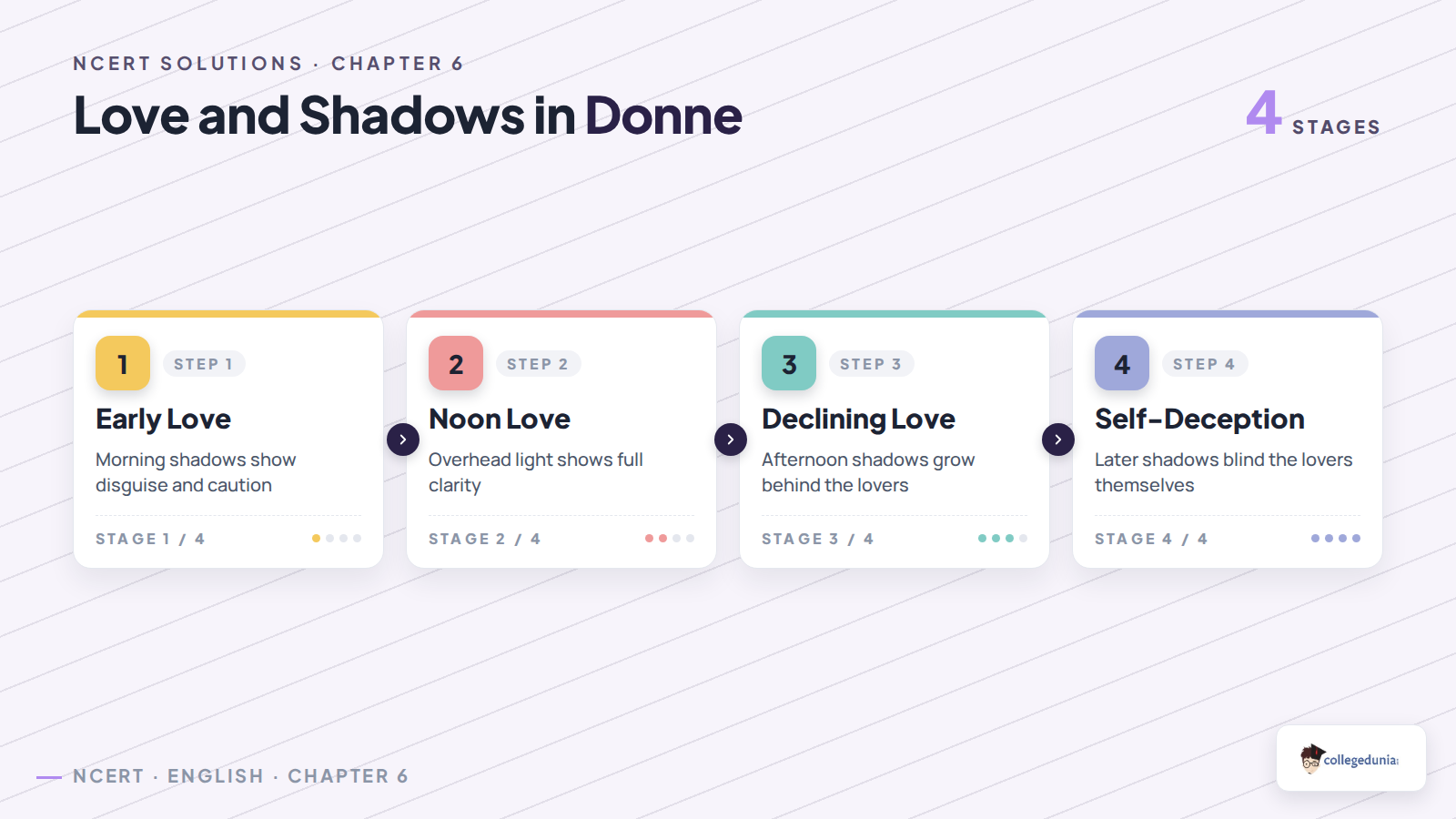
Donne's poem works through a simple day-map. Love begins with morning caution, reaches noon clarity, and may decline into longer shadows. This is why the poem feels like a lecture: the speaker teaches his beloved through a visible image.
The answer should name each stage clearly. Morning shadows are not the same as afternoon shadows. The first kind hides the lovers from other people. The second kind hides truth from the lovers themselves.
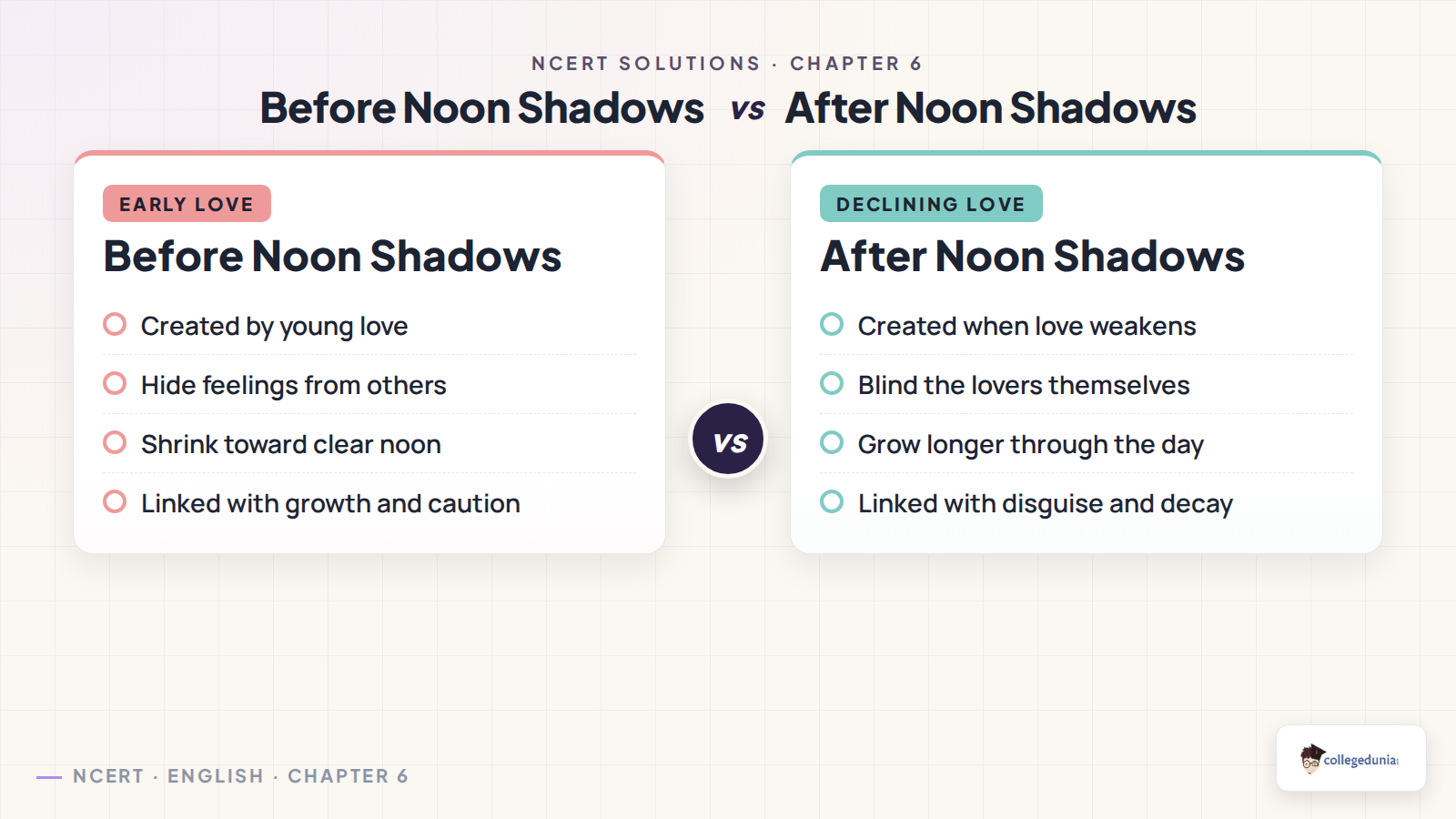
Before Noon and After Noon Shadows in Donne's Poem
The strongest answers compare the two shadow types directly. Before noon, love is young and still guarded. After noon, love begins to fall away from its highest point. The poem's warning is that later deception becomes inward and more dangerous.
Before noon: shadows suggest caution, secrecy and young love.
At noon: overhead light suggests brave clearness and full honesty.
After noon: shadows suggest decline, disguise and self-deception.
How to Use These NCERT Solutions for Better Poetry Answers
Begin with the PDF if you need direct NCERT-order answers. Then use the question cards below to compare the Solution tab with the Expert Solution tab. A strong poetry answer usually starts with the image, adds one line reference, and closes with the larger idea.
Track the conceit: sunlight and shadow carry the poem's whole argument.
Use simple terms: light means clarity; shadow means disguise or decline.
Answer both parts: many NCERT questions ask for image and idea together.
Common Mistakes Students Should Avoid in A Lecture upon the Shadow
Many weak answers say only that shadows are dark. That misses Donne's method. The shadows change direction and meaning as the sun moves. Students should also avoid writing that the poem is only romantic, because it is also a warning about truthfulness.
Do not treat morning and afternoon shadows as the same symbol.
Do not ignore noon, because it is the point of full clarity.
Do not call old spellings wrong; they belong to Donne's period.
Do not explain infant loves and brave clearnesse without context.
Class 12 English Supplementary Chapter 6 Resource Links
Use these related resources when you want the same chapter in another format. The table is placed above the FAQ so students can move from solutions to notes, book PDF and handwritten revision without losing the chapter context.
All NCERT Solutions for Class 12 English Supplementary Chapters
The table below keeps the same resource type together, so students can move chapter by chapter through the Class 12 English supplementary Kaleidoscope question set.
All NCERT Solutions for Class 12 English (Suppl.) Chapter 6 Kaleidoscope: A Lecture upon the Shadow with Step-by-Step Solutions
The expandable cards below reproduce the full solution set from the PDF. Use the Solution tab for a direct exam-ready answer and the Expert Solution tab for a deeper reading of Donne's image, message and language.
Questions
Q 6.1
How do the shadows before noon differ from the shadows after noon? What do the two kinds of shadow represent?
Concept used. Chapter: A Lecture upon the Shadow. Donne uses the sun's movement as a love image. Before noon, shadows fall before or beside the lovers. After noon, shadows fall the other way and keep lengthening.
Two shadow stages
Morning shadows come from the lovers' early fears. Afternoon shadows come from decline, distrust, and self-deception.
Before noon, the sun is rising. The lovers' shadows move with them while love is still growing.
These early shadows suggest the disguises and careful behaviour of new love.
The lovers hide their feelings because they fear what others may see.
At noon, the sun is overhead. The shadows shrink under their feet.
Noon therefore suggests open clarity, when love has no need for disguise.
After noon, the sun declines. New shadows form behind the lovers and grow longer.
These later shadows do not merely hide them from others. They blind the lovers themselves.
So the second kind of shadow represents failing love, mistrust, and false behaviour between lovers.
Before noon, shadows represent early disguises used to hide love from others. After noon, shadows represent the darker self-deception that appears when love begins to decline.
AR
Ananya Rao
M.A English, University of Delhi
Verified Expert
Structural observation. The poem divides love's day into growth, noon, and decline. The shadow image changes meaning at each stage.
In the morning stage, love is young. It is not secure enough to appear fully in public.
The first shadows are therefore social masks. They protect the lovers from outside eyes.
Noon is the ideal point. Light falls straight down and the shadows are almost erased.
This is the point of brave clearness, where love becomes honest and mutual.
The afternoon stage is more dangerous because the shadow turns inward.
The lovers may now deceive each other, not just the world around them.
Donne's warning is sharp: once love passes noon, even small falseness grows quickly.
The morning shadow is protective disguise; the afternoon shadow is inner blindness. Donne uses this change to show love's movement from growth to possible decay.
Q 6.2
Love is described as light. What makes the poet talk about shadows?
Concept used. Metaphysical poetry often explains an emotion through a striking physical image. Here, love is light because true love should be clear, direct, and constant. The poet talks about shadows because imperfect love creates concealment.
Image logic
Write both sides of the image: light means truth; shadow means disguise or decline.
The poem presents ideal love as full, constant light.
Light helps us see clearly. In the same way, true love removes doubt and pretence.
Yet the lovers are not always in that perfect state.
In early love, they create shadows through secrecy and fear of public judgement.
In declining love, they create shadows through false action and mutual suspicion.
The poet therefore needs shadows to show where love falls short of full light.
Without the shadow image, the poem would lose its warning about love's fragility.
The poet talks about shadows because love is not always pure light. Shadows show secrecy at the beginning and self-deception when love declines.
RS
Ritwik Sen
M.A English, Jadavpur University
Verified Expert
Strategic angle. Think of light as the standard and shadow as the test. Love is judged by how much shadow it still produces.
Donne starts with walking lovers under the sun, a simple outdoor scene.
He then turns that scene into an argument about emotional truth.
If love is growing but immature, it makes small shadows of hesitation.
If love reaches noon, it stands in full clarity.
If love declines, the shadows lengthen and become more harmful.
This makes shadow the visible sign of love's weakness.
The image also lets Donne teach a lesson without sounding abstract.
Shadow enters the poem because Donne wants to measure love against clarity. Whatever hides, distorts, or weakens love becomes a shadow.
Q 6.3
Comment on the use of the image of the shadows for the idea that the poet wants to convey.
Concept used. A metaphysical conceit joins unlike things through careful reasoning. Donne joins the sun's daily movement with the stages of love. This makes the shadow image central to the poem's argument.
Metaphysical conceit
The image is not decoration. It is the structure through which the poem thinks.
The poem begins with a real scene: two lovers walking for three hours.
Their shadows first accompany them, then disappear beneath them at noon.
Donne turns this physical fact into an emotional idea.
Morning shadows suggest new love's disguises and caution.
Noon suggests love at its highest point, where everything is reduced to clear truth.
Afternoon shadows suggest decline, because they grow longer as light weakens.
The same image therefore carries time, love, fear, truth, and decay together.
This makes the poem compact but intellectually rich.
The shadow image works as a conceit. It shows that love grows towards clarity, but may decline into longer and more dangerous shadows of deception.
MI
Meera Iyer
Ph.D English, University of Hyderabad
Verified Expert
Close reading. Donne chooses a visual image that every student understands. He then gives it moral force.
A shadow depends on light, so it can only exist when light is blocked.
This fits the poem's idea that falsehood exists only where love is not fully clear.
Morning shadows are understandable because love is still growing.
Noon is the poem's desired state, with no serious shadow left.
Afternoon shadows are troubling because they grow when the sun is already past its height.
In love, that means distrust grows after the first fullness has begun to fade.
The image is powerful because a daily natural process becomes a warning about emotional honesty.
The image helps Donne say that love must remain in noon-like clarity. If it declines, deception grows as naturally as afternoon shadows lengthen.
Q 6.4
The poet seems to be addressing his beloved in the poem. What is the message he wishes to convey to her?
Concept used. The poem is a direct address, or apostrophe, to the beloved. The speaker asks her to stand still and listen to a lesson about love. His message is that their love must remain honest and constant at its noon.
Use the title
The word Lecture tells us that the speaker is giving a lesson, not just describing a walk.
The speaker addresses his beloved as Love and asks her to listen.
He tells her that early love may need disguises because it is still growing.
He then says their love has reached a clear noon-like state.
At this point, they should not fall into fresh disguise.
If their love begins to decline, they will make new shadows.
These shadows will blind them to each other.
The speaker therefore warns her to keep love constant, open, and truthful.
The speaker tells his beloved that their love should stay in clear noon-like honesty. If it declines, mutual disguise will blind them both.
DM
Devika Menon
M.A English, EFLU Hyderabad
Verified Expert
Quick reading. The beloved is not given a romantic compliment alone. She receives a warning about the discipline needed by love.
The opening line makes the scene intimate: the speaker speaks directly to one person.
He calls the poem a lecture because he wants to reason with her.
The first part admits that young love may hide itself from others.
The middle part celebrates a point where love becomes clear.
The final part warns that love can become false after its noon.
The speaker wants both lovers to avoid that decline.
His message is therefore ethical as much as emotional.
He asks his beloved to preserve love's clearness and constancy, so that neither of them has to hide actions from the other.
Q 6.5
Instead of 'A Lecture Upon Love' the poet calls the poem 'A Lecture Upon the Shadow'. What is the effect that this has on our reading of the poem?
Concept used. A title guides interpretation. If the poem were called A Lecture Upon Love, we might expect a direct definition of love. The actual title directs us to the shadow image, so we read love through its signs of concealment and decline.
Title effect
Explain how the title changes the student's focus. Do not only repeat the title.
A title about love would make the poem sound like a general love lesson.
The title about shadow makes the image of shadow the key to the poem.
It prepares us to watch how shadows change during the walk.
It also makes us ask what emotional shadows mean.
The title keeps attention on the dangers that threaten love.
We read the poem as a warning about disguise, blindness, and decay.
This makes the poem sharper than a simple praise of love.
The title makes us read the poem through the shadow image. It shifts focus from love in general to the hidden disguises and dangers within love.
AM
Aarav Mehta
M.A English, University of Mumbai
Verified Expert
Structural observation. The title names the method of the poem. Donne teaches love by teaching the behaviour of shadows.
Love is the subject, but shadow is the argument.
The title tells us to notice the physical details first.
Once we notice them, the poem's emotional lesson becomes clearer.
Morning, noon, and afternoon become stages in love's life.
The word shadow also adds unease to the poem.
Even when love is bright, it can produce concealment if it is not steady.
The title therefore deepens the poem from a love lyric into a reflective warning.
The effect is to make shadow the poem's controlling conceit. We understand love by studying what blocks, darkens, or distorts it.
Q 6.6
Notice the spelling of houres, shadowes, Sunne, noone, clearnesse, and behinde. The final e used in Donne's period later got dropped. Pick out other words in the poem with this feature.
Concept used. Language Work: historical spelling. Early modern English spellings often kept a final e that modern English later dropped. Donne's poem has several such spellings.
Look at endings
Search especially for words ending in e after a consonant, where modern spelling no longer keeps that e.
The given examples already include houres, shadowes, Sunne, noone, clearnesse, and behinde.
Other clear examples in the poem are doe, blinde, and worke.
Their modern forms are do, blind, and work.
Apostrophe forms such as produc'd, reduc'd, and attain'd show a different old spelling habit, so they should not be counted as final-e examples here.
These forms show that Donne's printed text belongs to an earlier stage of English spelling.
Other examples are doe, blinde, and worke. Their modern forms are do, blind, and work.
SR
Sahana Roy
M.A Linguistics, University of Calcutta
Verified Expert
Close reading. The point of the exercise is not to modernise every word. It is to notice that English spelling was less fixed in Donne's time.
Start with the words NCERT gives as models.
Match the pattern in lines such as We doe those shadowes tread.
Doe is now written do.
Blinde is now written blind.
Worke is now written work.
Behind is now written without the final e, but NCERT already gives behinde as a model word in the question.
Forms such as produc'd and attain'd are useful to notice, but they belong to apostrophe contraction, not the final-e pattern asked here.
The clearest answers are doe, blinde, and worke. In modern spelling they become do, blind, and work.
Q 6.7
Take note that the apostrophe is not used for indicating the possessive form in loves philosophy. Explain this usage in the poem.
Concept used. Language Work: possessive apostrophe. Modern English usually writes the possessive with an apostrophe, as in love's philosophy. Donne's text writes loves philosophy without the apostrophe.
Do not call it a mistake
This is an older spelling convention, not a printing error in the NCERT text.
In modern English, love's philosophy would mean the philosophy of love.
Donne's line prints it as loves philosophy.
The missing apostrophe reflects older spelling and punctuation practice.
Early printed texts did not always mark possession in the modern way.
We should still read the phrase as possessive.
So the meaning is the philosophy or lesson of love.
Loves philosophy means love's philosophy, or the philosophy of love. The apostrophe is absent because Donne's period used different spelling and punctuation conventions.
NV
Nikhil Varma
M.A Linguistics, EFLU Hyderabad
Verified Expert
Quick reading. The grammar is familiar, but the punctuation is historical. The student supplies the possessive relation from meaning.
The speaker says he will read a lecture in loves philosophy.
A lecture cannot literally belong to many loves in this line.
The phrase means a lesson about love, or love's philosophy.
Modern editors would usually add an apostrophe.
Donne's spelling keeps the older printed form.
This reminds us that punctuation conventions change over time.
Read loves philosophy as love's philosophy. The line shows older punctuation, where possession was not always marked with an apostrophe.
Q 6.8
Explain the old spellings in these examples: 'How neatly doe we give one onely name' and 'To parents issue and the sunnes bright starre!'
Concept used. Language Work: older spelling and possessive marking. The examples show forms that modern English would spell differently, such as doe, onely, sunnes, and starre.
Modern equivalents
Give the old word first, then write the modern form beside it.
Doe is now written do.
Onely is now written only.
Parents issue means parents' issue, or the children born to parents.
Sunnes means sun's in modern possessive spelling.
Starre is now written star.
These examples show that vowel spellings, final e, doubled consonants, and apostrophe use were not fixed as they are now.
The modern forms are do, only, parents' issue, the sun's bright star, and star. The examples show older spelling and possessive practice.
IB
Ishita Banerjee
M.A English, Presidency University
Verified Expert
Structural observation. Both examples work like a small spelling laboratory. They show sound, final letters, and possession together.
Doe keeps an e that modern spelling drops.
Onely has an older vowel spelling that became only.
Parents issue needs an apostrophe in modern school grammar.
Sunnes bright starre also needs modern possessive marking: sun's bright star.
Starre keeps a doubled r and final e that modern spelling removes.
The exercise trains us to read older poetry without treating every difference as strange.
These spellings should be read as older forms of do, only, parents' issue, sun's, and star.
Q 6.9
Notice the adjectives in phrases such as infant loves and brave clearnesse. What is the meaning of these adjectives in isolation and as part of these phrases?
Concept used. Language Work: contextual meaning. An adjective may have one broad meaning by itself and a sharper meaning inside a phrase. Donne uses infant and brave in this way.
Context changes force
Do not translate the adjective alone. Explain what it does to the noun beside it.
In isolation, infant means very young, newly born, or at an early stage.
In infant loves, the phrase means loves that are young and still growing.
Such love is tender, unsure, and not yet fully clear.
In isolation, brave can mean courageous, bold, or splendid.
In brave clearnesse, it means bright, confident, open clarity.
The phrase suggests a state where love no longer needs disguise.
The two phrases therefore mark a movement from early growth to fearless openness.
Infant alone means very young; infant loves means young, growing love. Brave alone means bold or splendid; brave clearnesse means confident, fearless clarity.
PN
Pooja Nair
M.Phil English, University of Calicut
Verified Expert
Close reading. Donne's adjectives are compressed. Each one carries both a literal meaning and an emotional stage.
Infant is normally used for a baby or a beginning.
When applied to loves, it turns emotion into something alive and growing.
This makes early love seem delicate and incomplete.
Brave is normally linked with courage or splendour.
When applied to clearness, it makes openness sound active and strong.
The lovers need courage to stand in such clarity.
The phrases therefore support the poem's larger contrast between disguise and truth.
In context, infant stresses immature growth, while brave stresses strong and fearless openness. Together they map the poem's movement from young love to clear love.
A Lecture upon the Shadow Class 12 English NCERT Solutions FAQs
Ques. How many questions are solved in the Class 12 English A Lecture upon the Shadow PDF?
Ans. The PDF solves 9 NCERT questions from Understanding the Poem, Language Work and Try this out for the 2026-27 Kaleidoscope chapter.
Ques. What do the shadows before noon represent?
Ans. The shadows before noon represent early love's disguises. The lovers hide their feelings from others because their love is still growing.
Ques. What do the shadows after noon represent?
Ans. The shadows after noon represent decline, self-deception and mistrust. Donne warns that these shadows can blind the lovers themselves.
Ques. Why is the title A Lecture upon the Shadow important?
Ans. The title makes the shadow image the key to the poem. It shifts the focus from love in general to the disguises and dangers inside love.




Chapter6Kaleidoscope:ALectureupontheShadowSolutions.pdf?page=1&dpi=150)
Chapter6Kaleidoscope:ALectureupontheShadowSolutions.pdf?page=2&dpi=150)
Chapter6Kaleidoscope:ALectureupontheShadowSolutions.pdf?page=3&dpi=150)
Chapter6Kaleidoscope:ALectureupontheShadowSolutions.pdf?page=4&dpi=150)
Chapter6Kaleidoscope:ALectureupontheShadowSolutions.pdf?page=5&dpi=150)
Chapter6Kaleidoscope:ALectureupontheShadowSolutions.pdf?page=6&dpi=150)
Chapter6Kaleidoscope:ALectureupontheShadowSolutions.pdf?page=7&dpi=150)
Chapter6Kaleidoscope:ALectureupontheShadowSolutions.pdf?page=8&dpi=150)
Chapter6Kaleidoscope:ALectureupontheShadowSolutions.pdf?page=9&dpi=150)
Chapter6Kaleidoscope:ALectureupontheShadowSolutions.pdf?page=10&dpi=150)
Chapter6Kaleidoscope:ALectureupontheShadowSolutions.pdf?page=11&dpi=150)
Chapter6Kaleidoscope:ALectureupontheShadowSolutions.pdf?page=12&dpi=150)
Chapter6Kaleidoscope:ALectureupontheShadowSolutions.pdf?page=13&dpi=150)
Chapter6Kaleidoscope:ALectureupontheShadowSolutions_flat_MobileCard.pdf?page=1&dpi=150)
Chapter6Kaleidoscope:ALectureupontheShadowSolutions_flat_MobileCard.pdf?page=2&dpi=150)
Chapter6Kaleidoscope:ALectureupontheShadowSolutions_flat_MobileCard.pdf?page=3&dpi=150)
Chapter6Kaleidoscope:ALectureupontheShadowSolutions_flat_MobileCard.pdf?page=4&dpi=150)
Chapter6Kaleidoscope:ALectureupontheShadowSolutions_flat_MobileCard.pdf?page=5&dpi=150)
Chapter6Kaleidoscope:ALectureupontheShadowSolutions_flat_MobileCard.pdf?page=6&dpi=150)
Chapter6Kaleidoscope:ALectureupontheShadowSolutions_flat_MobileCard.pdf?page=7&dpi=150)
Chapter6Kaleidoscope:ALectureupontheShadowSolutions_flat_MobileCard.pdf?page=8&dpi=150)
Chapter6Kaleidoscope:ALectureupontheShadowSolutions_flat_MobileCard.pdf?page=9&dpi=150)
Chapter6Kaleidoscope:ALectureupontheShadowSolutions_flat_MobileCard.pdf?page=10&dpi=150)
Chapter6Kaleidoscope:ALectureupontheShadowSolutions_flat_MobileCard.pdf?page=11&dpi=150)
Chapter6Kaleidoscope:ALectureupontheShadowSolutions_flat_MobileCard.pdf?page=12&dpi=150)
Chapter6Kaleidoscope:ALectureupontheShadowSolutions_flat_MobileCard.pdf?page=13&dpi=150)
Chapter6Kaleidoscope:ALectureupontheShadowSolutions_flat_MobileCard.pdf?page=14&dpi=150)
Chapter6Kaleidoscope:ALectureupontheShadowSolutions_flat_MobileCard.pdf?page=15&dpi=150)
Chapter6Kaleidoscope:ALectureupontheShadowSolutions_flat_MobileCard.pdf?page=16&dpi=150)
Chapter6Kaleidoscope:ALectureupontheShadowSolutions_flat_MobileCard.pdf?page=17&dpi=150)
Chapter6Kaleidoscope:ALectureupontheShadowSolutions_flat_MobileCard.pdf?page=18&dpi=150)
Chapter6Kaleidoscope:ALectureupontheShadowSolutions_flat_MobileCard.pdf?page=19&dpi=150)
Chapter6Kaleidoscope:ALectureupontheShadowSolutions_flat_MobileCard.pdf?page=20&dpi=150)
Chapter6Kaleidoscope:ALectureupontheShadowSolutions_flat_MobileCard.pdf?page=21&dpi=150)
Chapter6Kaleidoscope:ALectureupontheShadowSolutions_flat_MobileCard.pdf?page=22&dpi=150)
Chapter6Kaleidoscope:ALectureupontheShadowSolutions_flat_MobileCard.pdf?page=23&dpi=150)
Chapter6Kaleidoscope:ALectureupontheShadowSolutions_flat_MobileCard.pdf?page=24&dpi=150)
Chapter6Kaleidoscope:ALectureupontheShadowSolutions_flat_MobileCard.pdf?page=25&dpi=150)
Chapter6Kaleidoscope:ALectureupontheShadowSolutions_flat_MobileCard.pdf?page=26&dpi=150)



Comments