



Class 12 Entrepreneurship Chapter 1 Entrepreneurial Opportunity NCERT Solutions cover 32 solved questions from the 2026-27 syllabus. The chapter trains students to identify a workable business opportunity by reading needs, problems, information sources, creativity, innovation and idea fields. These solutions keep the textbook order and add expert explanations for sharper board-style answers.
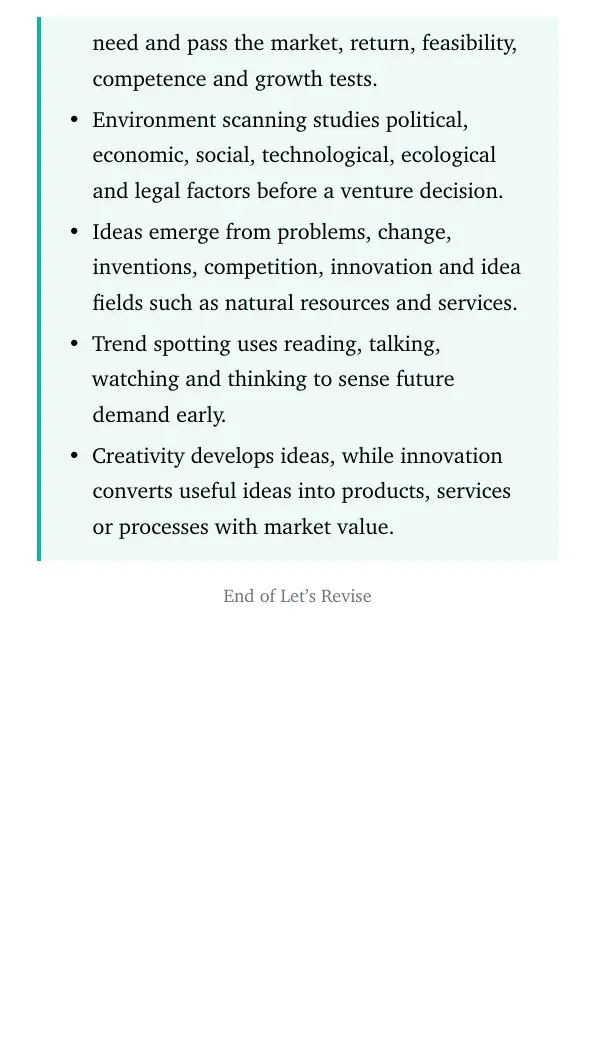
- 32 solved questions include short answer, long answer, HOTS, application and case-based prompts.
- The PDF explains opportunity sensing, creativity, innovation, environmental scanning and idea fields in board-answer format.
- Question cards below let students compare direct solutions with fuller expert explanations.
Student Feedback on Class 12 Entrepreneurship Chapter 1
In the 2026-27 Collegedunia Entrepreneurship review log, 10,240 Class 12 students marked Entrepreneurial Opportunity as a chapter that needs clear examples because many answers look similar unless each textbook term is separated.
- 71% wanted opportunity sensing and idea fields explained with separate points.
- 66% confused creativity with innovation until the answer linked creativity to ideas and innovation to useful application.
- 6 out of 10 students asked for case-study answers that show how to move from observation to business decision.
Source: 2026-27 Class 12 Entrepreneurship student feedback sample recorded for Collegedunia NCERT resource planning.
Every answer here is checked against the Entrepreneurial Opportunity unit of the official CBSE Class 12 Entrepreneurship textbook used for this NCERT resource workflow.
Entrepreneurial Opportunity Questions Covered in the PDF
The PDF follows the chapter sequence so that students can revise definitions first and then move into application questions. The table below shows how the solved set is organised.
| Question Set | Focus Area | Answer Skill |
|---|---|---|
| Let's Revise | Business opportunity, sensing factors, entrepreneurship | Definition plus point-wise explanation |
| Very Short Answer Type Questions | Entrepreneurial opportunity, environment, sensing sources | Precise two to four line answers |
| Short Answer Type Questions | Creative effort, market information, product or service ideas | Brief explanation with textbook terms |
| Long Answer Type Questions | Creativity and innovation, ideas from natural resources | Structured paragraph and examples |
| HOTS and Application Questions | Environmental scanning, adaptation, trend spotting | Reasoned answer with business context |
Entrepreneurial Opportunity Class 12 Revision Video
Source: Rajat Arora on YouTube
Opportunity Sensing Process for Class 12 Entrepreneurship
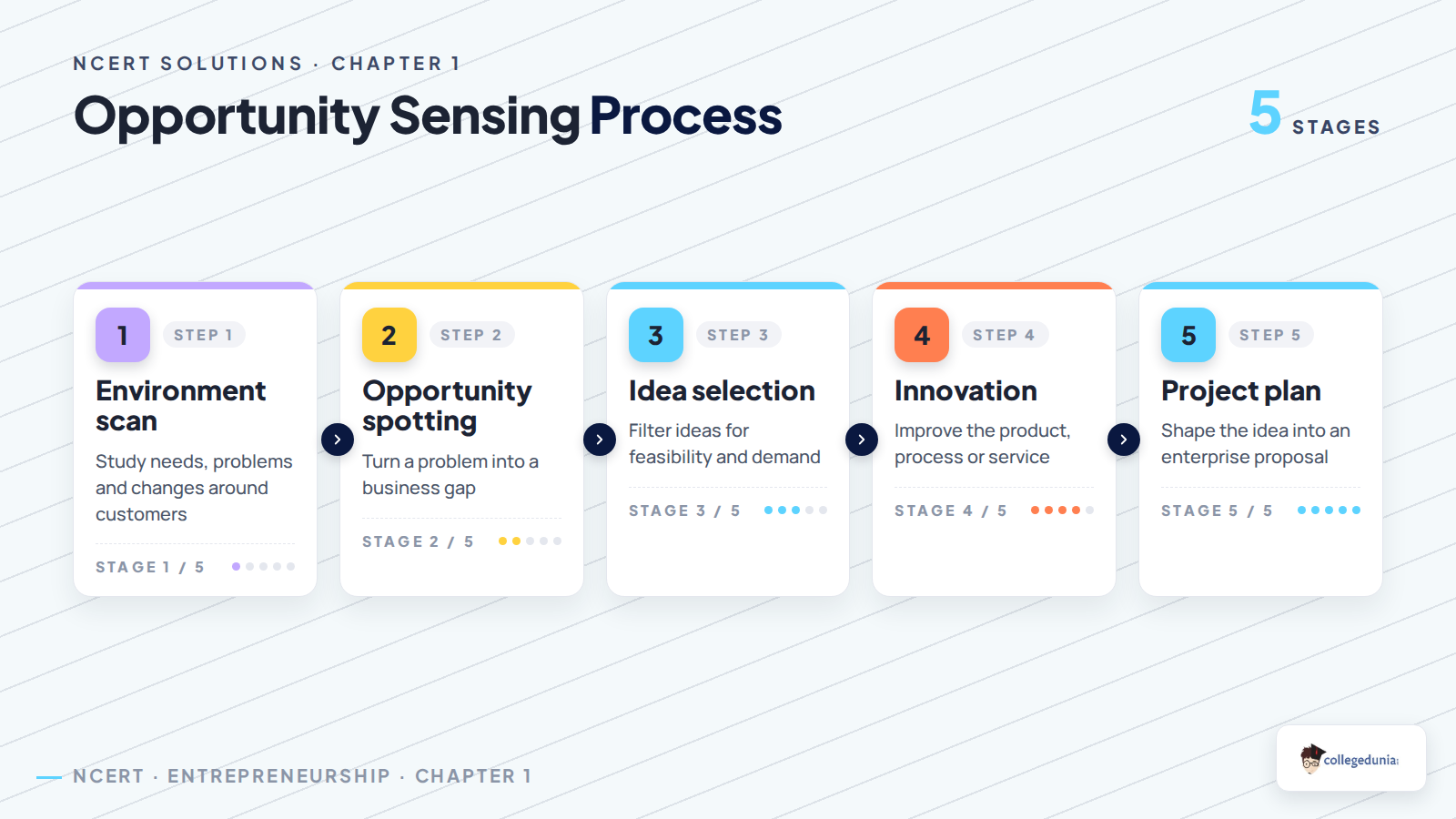
Opportunity sensing begins when an entrepreneur observes the environment and notices a need, problem, change or gap. The chapter asks students to connect this observation with information gathering, vision, creativity and final enterprise action.
- Perception of ideas: the entrepreneur notices small signals such as customer inconvenience, new demand or an unused local resource.
- Information sources: journals, trade shows, customers, family, friends and competitors help test whether the idea has real scope.
- Vision and creativity: a workable idea becomes a business opportunity when it is shaped into a product, process or service with value.
Idea Fields in Entrepreneurial Opportunity Answers
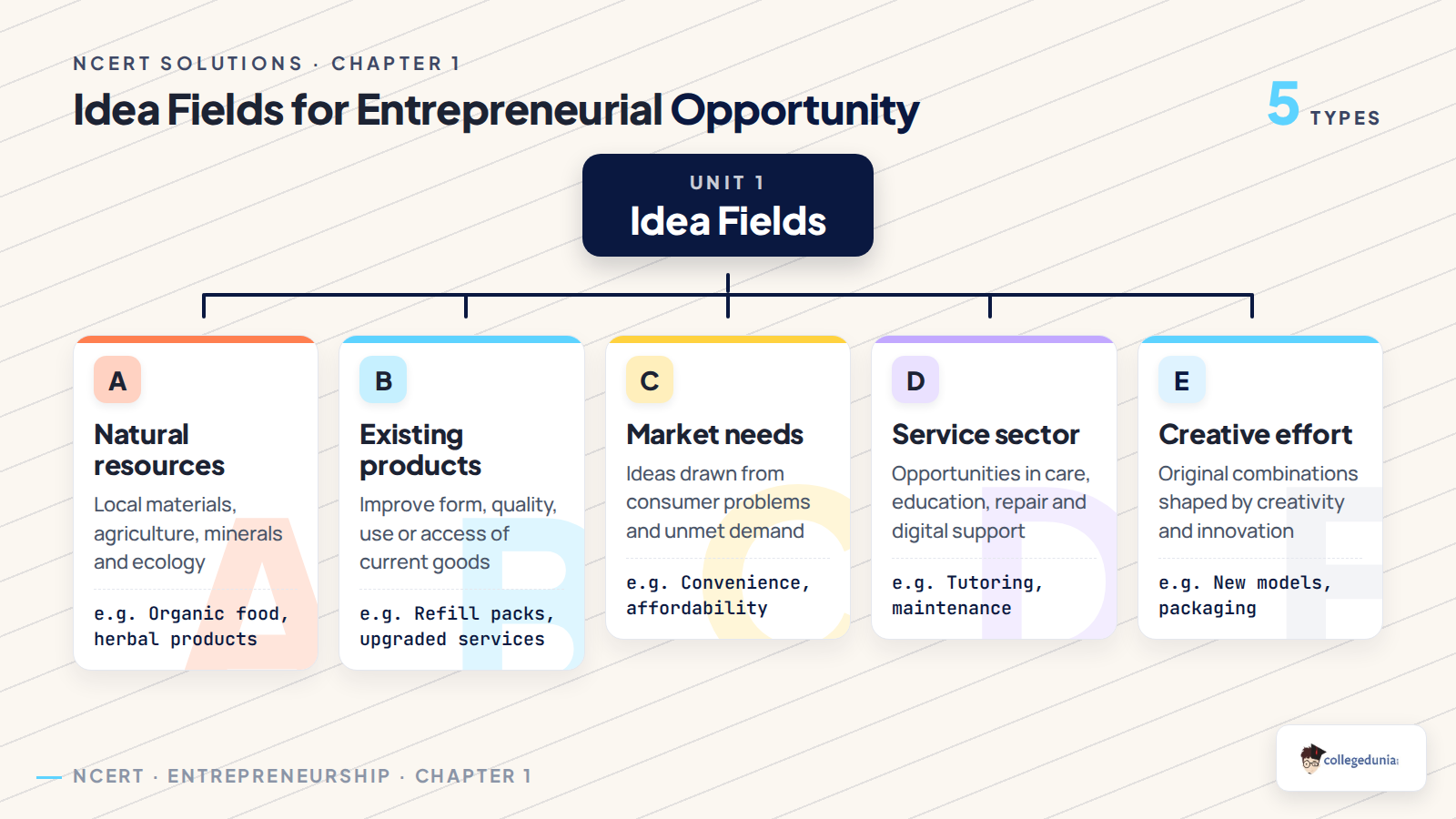
The chapter explains that business ideas do not appear from one fixed source. Students should group examples under idea fields, then write how each field can lead to an opportunity.
| Idea Field | How it Creates Opportunity | Example Direction |
|---|---|---|
| Natural resources | Local materials are converted into useful goods or services. | Agri-products, herbal items, eco-friendly goods |
| Existing products | An old product is improved in design, quality, packaging or access. | Refill packs, better delivery, improved service |
| Market driven ideas | Consumer needs and problems point to an unsatisfied demand. | Convenience services, affordable variants |
| Service sector ideas | Care, education, repair and digital support become enterprise areas. | Tutoring, maintenance, local support service |
Entrepreneurial Opportunity Common Mistakes in Board Answers
Most errors in this chapter happen when students write broad business language without anchoring it to textbook terms. Use the checklist before final revision.
- Do not merge creativity and innovation: creativity produces ideas, while innovation applies useful new methods, products or services.
- Do not write opportunity as only profit: profit matters, but market scope, practicality, entrepreneur ability and future growth are also required.
- Do not ignore environment: opportunity sensing depends on scanning social, economic, technological, political and competitive changes.
- Do not over-expand examples: one short example is enough when the question asks for a textbook definition or factor.
Class 12 Entrepreneurship Chapter 1 Related Resources
Use these companion resources when revising the same chapter in a different format.
| Resource | Best Use | Link |
|---|---|---|
| NCERT Notes | Quick concept revision before solving questions | Class 12 Entrepreneurship Chapter 1 Notes |
| Handwritten Notes | Visual revision of definitions and examples | Class 12 Entrepreneurship Chapter 1 Handwritten Notes |
| NCERT Book PDF | Original chapter reading and textbook context | Class 12 Entrepreneurship Chapter 1 Book PDF |
NCERT Solutions for Class 12 Entrepreneurship All Chapters
The same chapter-wise solutions series helps students revise the full Entrepreneurship syllabus in order.
| Chapter | Chapter Name | NCERT Solutions |
|---|---|---|
| Chapter 1 | Entrepreneurial Opportunity | View solutions |
| Chapter 2 | Entrepreneurial Planning | View solutions |
| Chapter 3 | Enterprise Marketing | View solutions |
| Chapter 4 | Enterprise Growth Strategies | View solutions |
| Chapter 5 | Business Arithmetic | View solutions |
| Chapter 6 | Resource Mobilisation | View solutions |
All NCERT Solutions for Class 12 Entrepreneurship Chapter 1 Entrepreneurial Opportunity with Step-by-Step Solutions
The embedded cards below mirror the PDF questions. Open Check Solution for the direct answer and Expert Solution for a fuller explanation.
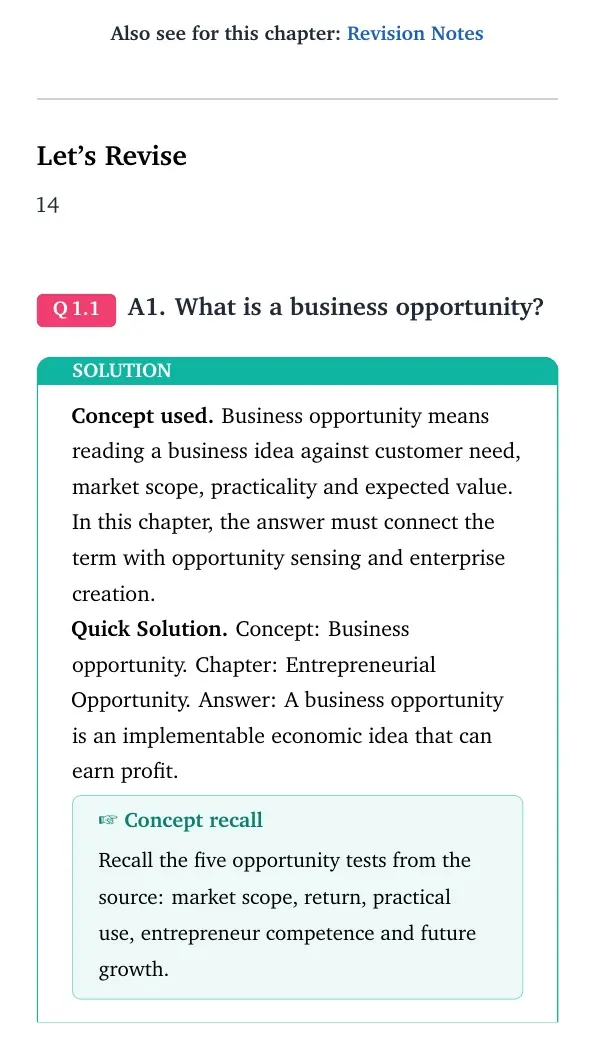
A1. What is a business opportunity?
Concept used. Business opportunity means reading a business idea against customer need, market scope, practicality and expected value. In this chapter, the answer must connect the term with opportunity sensing and enterprise creation.
Quick Solution. Concept: Business opportunity. Chapter: Entrepreneurial Opportunity. Answer: A business opportunity is an implementable economic idea that can earn profit.
Concept recall
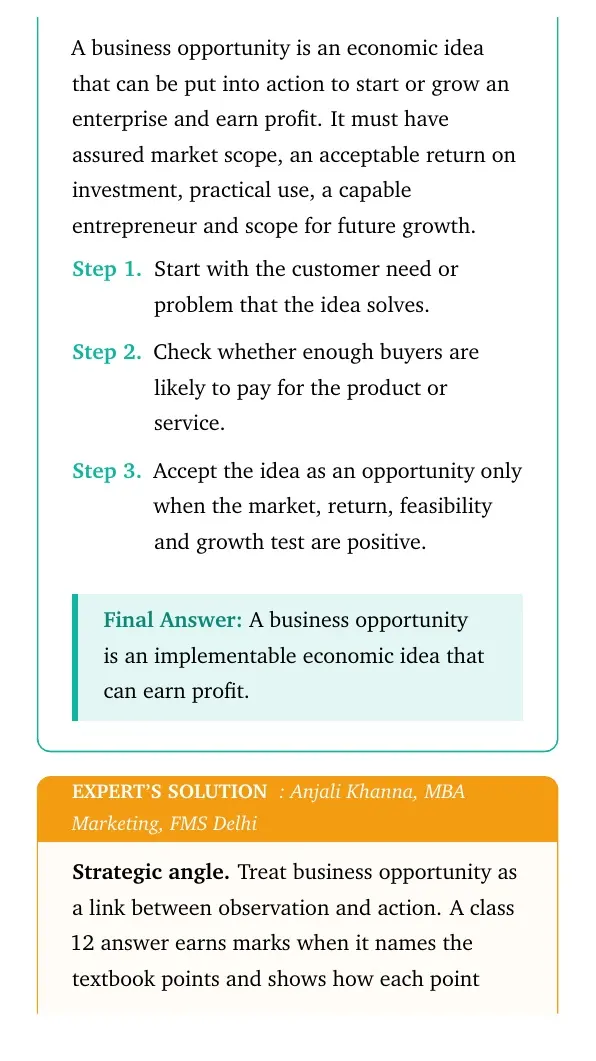
Recall the five opportunity tests from the source: market scope, return, practical use, entrepreneur competence and future growth.A business opportunity is an economic idea that can be put into action to start or grow an enterprise and earn profit. It must have assured market scope, an acceptable return on investment, practical use, a capable entrepreneur and scope for future growth.
- Start with the customer need or problem that the idea solves.
- Check whether enough buyers are likely to pay for the product or service.
- Accept the idea as an opportunity only when the market, return, feasibility and growth test are positive.
A business opportunity is an implementable economic idea that can earn profit.
Strategic angle. Treat business opportunity as a link between observation and action. A class 12 answer earns marks when it names the textbook points and shows how each point helps an entrepreneur choose wisely.
- Start from the environment: people face needs, problems, changes or new preferences. An entrepreneur observes these signals before selecting an idea.
- Test the idea through information, customer demand, cost, price, competition, legal limits and the entrepreneur's own capability.
- Write the final answer as a practical business conclusion, not as a memorised list alone. This keeps the response aligned with the chapter.
A business opportunity is an economic idea that can be put into action to start or grow an enterprise and earn profit. It must have assured market scope, an acceptable return on investment, practical use, a capable entrepreneur and scope for future growth.
A business opportunity is an implementable economic idea that can earn profit.
A2. What factors are involved in the process of sensing an entrepreneurial opportunity?
Concept used. Opportunity sensing means reading a business idea against customer need, market scope, practicality and expected value. In this chapter, the answer must connect the term with opportunity sensing and enterprise creation.
Quick Solution. Concept: Opportunity sensing. Chapter: Entrepreneurial Opportunity. Answer: Perception of ideas, information sources, and creative vision help sense opportunities.
Concept recall
Map opportunity sensing to three source headings: basic ideas, information sources, and vision with creativity.The main factors are the ability to perceive and preserve basic ideas, the ability to harness different sources of information, and vision with creativity. These help an entrepreneur notice needs, combine information and shape a useful business idea.
- Observe problems, changes, inventions, competition and innovation around the market.
- Collect information from customers, journals, trade shows, friends, family and other sources.
- Use vision and creativity to turn the information into a product or service idea.
Perception of ideas, information sources, and creative vision help sense opportunities.
Strategic angle. Treat opportunity sensing as a link between observation and action. A class 12 answer earns marks when it names the textbook points and shows how each point helps an entrepreneur choose wisely.
- Start from the environment: people face needs, problems, changes or new preferences. An entrepreneur observes these signals before selecting an idea.
- Test the idea through information, customer demand, cost, price, competition, legal limits and the entrepreneur's own capability.
- Write the final answer as a practical business conclusion, not as a memorised list alone. This keeps the response aligned with the chapter.
The main factors are the ability to perceive and preserve basic ideas, the ability to harness different sources of information, and vision with creativity. These help an entrepreneur notice needs, combine information and shape a useful business idea.
Perception of ideas, information sources, and creative vision help sense opportunities.
A3. Define the term environment scanning.
Concept used. Environment scanning means reading a business idea against customer need, market scope, practicality and expected value. In this chapter, the answer must connect the term with opportunity sensing and enterprise creation.
Quick Solution. Concept: Environment scanning. Chapter: Entrepreneurial Opportunity. Answer: Environment scanning monitors internal and external factors for opportunities and threats.
Concept recall
Link environment scanning with monitoring internal and external forces before choosing an opportunity or avoiding a threat.Environment scanning means carefully monitoring the internal and external business environment to spot opportunities, threats, trends, customer needs and changes. It helps the entrepreneur understand what is happening before choosing a business idea.
- Look at factors inside and outside the proposed business.
- Study customer behaviour, competition, laws, technology, social change and economic conditions.
- Use the information to choose a suitable opportunity and avoid avoidable risk.
Environment scanning monitors internal and external factors for opportunities and threats.
Strategic angle. Treat environment scanning as a link between observation and action. A class 12 answer earns marks when it names the textbook points and shows how each point helps an entrepreneur choose wisely.
- Start from the environment: people face needs, problems, changes or new preferences. An entrepreneur observes these signals before selecting an idea.
- Test the idea through information, customer demand, cost, price, competition, legal limits and the entrepreneur's own capability.
- Write the final answer as a practical business conclusion, not as a memorised list alone. This keeps the response aligned with the chapter.
Environment scanning means carefully monitoring the internal and external business environment to spot opportunities, threats, trends, customer needs and changes. It helps the entrepreneur understand what is happening before choosing a business idea.
Environment scanning monitors internal and external factors for opportunities and threats.
A4. List the environmental factors affecting external environment.
Concept used. External environment means reading a business idea against customer need, market scope, practicality and expected value. In this chapter, the answer must connect the term with opportunity sensing and enterprise creation.
Quick Solution. Concept: External environment. Chapter: Entrepreneurial Opportunity. Answer: Political, economic, social, technological, ecological and legal factors affect external environment.
Concept recall
Use PESTEL order for external environment: political, economic, social, technological, ecological and legal.External environment is affected by political, economic, social, technological, ecological or environmental, and legal factors. These are often remembered through the PESTEL model.
- Political factors include policy, tax and government stability.
- Economic factors include income, inflation, demand, savings and cost of capital.
- Social, technological, ecological and legal factors affect tastes, production methods, sustainability and permissions.
Political, economic, social, technological, ecological and legal factors affect external environment.
Strategic angle. Treat external environment as a link between observation and action. A class 12 answer earns marks when it names the textbook points and shows how each point helps an entrepreneur choose wisely.
- Start from the environment: people face needs, problems, changes or new preferences. An entrepreneur observes these signals before selecting an idea.
- Test the idea through information, customer demand, cost, price, competition, legal limits and the entrepreneur's own capability.
- Write the final answer as a practical business conclusion, not as a memorised list alone. This keeps the response aligned with the chapter.
External environment is affected by political, economic, social, technological, ecological or environmental, and legal factors. These are often remembered through the PESTEL model.
Political, economic, social, technological, ecological and legal factors affect external environment.
A5. What is the meaning of trend spotting?
Concept used. Trend spotting means reading a business idea against customer need, market scope, practicality and expected value. In this chapter, the answer must connect the term with opportunity sensing and enterprise creation.
Quick Solution. Concept: Trend spotting. Chapter: Entrepreneurial Opportunity. Answer: Trend spotting means identifying new market patterns before they become common.
Concept recall
Think of a trend as a repeated market direction shown through tastes, technology, fashion or buying habits.Trend spotting means identifying new patterns in markets, lifestyles, technology, fashion, incomes or customer habits before they become common. It helps an entrepreneur sense future demand early.
- Notice repeated changes in what people buy, discuss and prefer.
- Compare the change with market data, competitor moves and customer feedback.
- Use the trend to shape a product, service or process before others move in.
Trend spotting means identifying new market patterns before they become common.
Strategic angle. Treat trend spotting as a link between observation and action. A class 12 answer earns marks when it names the textbook points and shows how each point helps an entrepreneur choose wisely.
- Start from the environment: people face needs, problems, changes or new preferences. An entrepreneur observes these signals before selecting an idea.
- Test the idea through information, customer demand, cost, price, competition, legal limits and the entrepreneur's own capability.
- Write the final answer as a practical business conclusion, not as a memorised list alone. This keeps the response aligned with the chapter.
Trend spotting means identifying new patterns in markets, lifestyles, technology, fashion, incomes or customer habits before they become common. It helps an entrepreneur sense future demand early.
Trend spotting means identifying new market patterns before they become common.
A6. What is required to convert an idea into opportunity?
Concept used. Idea conversion means reading a business idea against customer need, market scope, practicality and expected value. In this chapter, the answer must connect the term with opportunity sensing and enterprise creation.
Quick Solution. Concept: Idea conversion. Chapter: Entrepreneurial Opportunity. Answer: Knowledge, skills, competencies, creativity and market orientation convert an idea into opportunity.
Concept recall
Anchor idea conversion in strategic positioning: knowledge, skills, competencies, creative thinking and market orientation.To convert an idea into an opportunity, strategic positioning is required. The entrepreneur should use knowledge, skills, competencies, creative thinking and market orientation to test whether the idea can serve a real market. Demand, cost, competition and return are supporting checks, not substitutes for these source-listed requirements.
- Build knowledge of the customer need, market conditions and possible product use.
- Match the idea with the entrepreneur's skills, competencies and available resources.
- Use creative thinking and market orientation to position it as a practical opportunity.
Knowledge, skills, competencies, creativity and market orientation convert an idea into opportunity.
Strategic angle. Treat idea conversion as a link between observation and action. A class 12 answer earns marks when it names the textbook points and shows how each point helps an entrepreneur choose wisely.
- Start from the environment: people face needs, problems, changes or new preferences. An entrepreneur observes these signals before selecting an idea.
- Test the idea through information, customer demand, cost, price, competition, legal limits and the entrepreneur's own capability.
- Write the final answer as a practical business conclusion, not as a memorised list alone. This keeps the response aligned with the chapter.
To convert an idea into an opportunity, the entrepreneur must test market demand, feasibility, resource fit, cost, competition, return and future growth. The idea must solve a real need and must be practical to execute.
Knowledge, skills, competencies, creativity and market orientation convert an idea into opportunity.
A7. What is Idea generation?
Concept used. Idea generation means reading a business idea against customer need, market scope, practicality and expected value. In this chapter, the answer must connect the term with opportunity sensing and enterprise creation.
Quick Solution. Concept: Idea generation. Chapter: Entrepreneurial Opportunity. Answer: Idea generation creates, develops and communicates abstract, concrete or visual ideas.
Concept recall
Use the NCERT verb trio for idea generation: create, develop and communicate; then add abstract, concrete or visual forms.Idea generation is the process of creating, developing and communicating ideas. These ideas may be abstract, concrete or visual. In entrepreneurship, such ideas become the starting material for sensing and screening business opportunities.
- Create possible ideas from observation, problems, needs, change or imagination.
- Develop the idea by adding information, form, use and market relevance.
- Communicate and screen the idea before selecting a business opportunity.
Idea generation creates, develops and communicates abstract, concrete or visual ideas.
Strategic angle. Treat idea generation as a link between observation and action. A class 12 answer earns marks when it names the textbook points and shows how each point helps an entrepreneur choose wisely.
- Start from the environment: people face needs, problems, changes or new preferences. An entrepreneur observes these signals before selecting an idea.
- Test the idea through information, customer demand, cost, price, competition, legal limits and the entrepreneur's own capability.
- Write the final answer as a practical business conclusion, not as a memorised list alone. This keeps the response aligned with the chapter.
Idea generation is the process of producing possible business ideas from needs, problems, changes, inventions, competition, innovation and information sources. It is the starting point of opportunity sensing.
Idea generation creates, develops and communicates abstract, concrete or visual ideas.
B1. What is the purpose to scan the environment?
Concept used. Purpose of scanning means reading a business idea against customer need, market scope, practicality and expected value. In this chapter, the answer must connect the term with opportunity sensing and enterprise creation.
Quick Solution. Concept: Purpose of scanning. Chapter: Entrepreneurial Opportunity. Answer: The purpose of scanning the environment is to understand opportunities and threats before starting or expanding a venture.
Concept recall
Focus on why scanning is done: uncertainty reduction, opportunity discovery, threat warning and better venture planning.The purpose of scanning the environment is to understand opportunities and threats before starting or expanding a venture. It reduces uncertainty, reveals customer needs, shows competitor moves, and helps the entrepreneur choose the right product, market and timing.
- Identify changes in demand, taste, technology, policy and competition.
- Separate promising opportunities from ideas that only look attractive at first.
- Plan resources, pricing, promotion and risk control with better information.
The purpose of scanning the environment is to understand opportunities and threats before starting or expanding a venture. It reduces uncertainty, reveals customer needs, shows competitor moves, and helps the entrepreneur choose the right product, market and timing.
Strategic angle. Treat purpose of scanning as a link between observation and action. A class 12 answer earns marks when it names the textbook points and shows how each point helps an entrepreneur choose wisely.
- Start from the environment: people face needs, problems, changes or new preferences. An entrepreneur observes these signals before selecting an idea.
- Test the idea through information, customer demand, cost, price, competition, legal limits and the entrepreneur's own capability.
- Write the final answer as a practical business conclusion, not as a memorised list alone. This keeps the response aligned with the chapter.
The purpose of scanning the environment is to understand opportunities and threats before starting or expanding a venture. It reduces uncertainty, reveals customer needs, shows competitor moves, and helps the entrepreneur choose the right product, market and timing.
The purpose of scanning the environment is to understand opportunities and threats before starting or expanding a venture. It reduces uncertainty, reveals customer needs, shows competitor moves, and helps the entrepreneur choose the right product, market and timing.
B2. What are the factors involved in sensing opportunities?
Concept used. Opportunity sensing factors means reading a business idea against customer need, market scope, practicality and expected value. In this chapter, the answer must connect the term with opportunity sensing and enterprise creation.
Quick Solution. Concept: Opportunity sensing factors. Chapter: Entrepreneurial Opportunity. Answer: Opportunity sensing depends on three connected factors: preserving basic ideas, gathering information and applying vision with creativity.
Concept recall
Separate the three sensing factors into raw idea observation, information harnessing, and creative vision.Opportunity sensing depends on three connected factors: preserving basic ideas, gathering information and applying vision with creativity. A good entrepreneur notices raw ideas, checks them through information, and then shapes them into a workable opportunity.
- Perceive basic ideas from problems, changes, inventions, competition and innovation.
- Harness information from magazines, journals, seminars, customers, family and friends.
- Apply vision and creativity to connect the idea with a real product or service.
Opportunity sensing depends on three connected factors: preserving basic ideas, gathering information and applying vision with creativity. A good entrepreneur notices raw ideas, checks them through information, and then shapes them into a workable opportunity.
Strategic angle. Treat opportunity sensing factors as a link between observation and action. A class 12 answer earns marks when it names the textbook points and shows how each point helps an entrepreneur choose wisely.
- Start from the environment: people face needs, problems, changes or new preferences. An entrepreneur observes these signals before selecting an idea.
- Test the idea through information, customer demand, cost, price, competition, legal limits and the entrepreneur's own capability.
- Write the final answer as a practical business conclusion, not as a memorised list alone. This keeps the response aligned with the chapter.
Opportunity sensing depends on three connected factors: preserving basic ideas, gathering information and applying vision with creativity. A good entrepreneur notices raw ideas, checks them through information, and then shapes them into a workable opportunity.
Opportunity sensing depends on three connected factors: preserving basic ideas, gathering information and applying vision with creativity. A good entrepreneur notices raw ideas, checks them through information, and then shapes them into a workable opportunity.
B3. Draw the enterprise process diagram.
Concept used. Enterprise process means reading a business idea against customer need, market scope, practicality and expected value. In this chapter, the answer must connect the term with opportunity sensing and enterprise creation.
Quick Solution. Concept: Enterprise process. Chapter: Entrepreneurial Opportunity. Answer: The enterprise process begins with the environment, where needs and problems are noticed.
Concept recall
Draw the flow from environment to problems, opportunity spotting, creativity, innovation and project business.The enterprise process diagram shows how the environment produces problems and needs, which lead to opportunity spotting, creativity and ideas, innovation and product, and finally project business.
- Environment is scanned to find problems and needs.
- Those needs create opportunity spotting, followed by creative ideas.
- Ideas move through innovation and product choice into a project business.
The enterprise process begins with the environment, where needs and problems are noticed. These lead to opportunity spotting, then creativity and ideas, then innovation and product or service selection, and finally a project or business enterprise.
Strategic angle. Treat enterprise process as a link between observation and action. A class 12 answer earns marks when it names the textbook points and shows how each point helps an entrepreneur choose wisely.
- Start from the environment: people face needs, problems, changes or new preferences. An entrepreneur observes these signals before selecting an idea.
- Test the idea through information, customer demand, cost, price, competition, legal limits and the entrepreneur's own capability.
- Write the final answer as a practical business conclusion, not as a memorised list alone. This keeps the response aligned with the chapter.
The enterprise process begins with the environment, where needs and problems are noticed. These lead to opportunity spotting, then creativity and ideas, then innovation and product or service selection, and finally a project or business enterprise.
The enterprise process begins with the environment, where needs and problems are noticed. These lead to opportunity spotting, then creativity and ideas, then innovation and product or service selection, and finally a project or business enterprise.
B4. What is PESTEL model? Explain it.
Concept used. PESTEL model means reading a business idea against customer need, market scope, practicality and expected value. In this chapter, the answer must connect the term with opportunity sensing and enterprise creation.
Quick Solution. Concept: PESTEL model. Chapter: Entrepreneurial Opportunity. Answer: PESTEL is a model used to scan the external environment.
Concept recall
Expand every PESTEL letter before explaining; political and legal are different, while ecological covers environment.PESTEL is a model used to scan the external environment. It studies Political, Economic, Social, Technological, Ecological or Environmental, and Legal factors so that an entrepreneur can judge how outside forces may affect a business idea.
- Political and legal factors cover policies, rules, licenses, tax and compliance.
- Economic and social factors cover income, demand, values, lifestyle and population change.
- Technological and ecological factors cover new methods, digital change, resource use and environmental responsibility.
PESTEL is a model used to scan the external environment. It studies Political, Economic, Social, Technological, Ecological or Environmental, and Legal factors so that an entrepreneur can judge how outside forces may affect a business idea.
Strategic angle. Treat pestel model as a link between observation and action. A class 12 answer earns marks when it names the textbook points and shows how each point helps an entrepreneur choose wisely.
- Start from the environment: people face needs, problems, changes or new preferences. An entrepreneur observes these signals before selecting an idea.
- Test the idea through information, customer demand, cost, price, competition, legal limits and the entrepreneur's own capability.
- Write the final answer as a practical business conclusion, not as a memorised list alone. This keeps the response aligned with the chapter.
PESTEL is a model used to scan the external environment. It studies Political, Economic, Social, Technological, Ecological or Environmental, and Legal factors so that an entrepreneur can judge how outside forces may affect a business idea.
PESTEL is a model used to scan the external environment. It studies Political, Economic, Social, Technological, Ecological or Environmental, and Legal factors so that an entrepreneur can judge how outside forces may affect a business idea.
C1. Enlist the various sources which lead to the emergence of basic ideas.
Concept used. Sources of ideas means reading a business idea against customer need, market scope, practicality and expected value. In this chapter, the answer must connect the term with opportunity sensing and enterprise creation.
Quick Solution. Concept: Sources of ideas. Chapter: Entrepreneurial Opportunity. Answer: Basic ideas emerge from problems, change, inventions, competition and innovation.
Concept recall
Recall the idea-source list: problems, change, inventions, competition and innovation; give one short use for each.Basic ideas emerge from problems, change, inventions, competition and innovation. A problem suggests a solution, change creates fresh needs, inventions open new uses, competition pushes improvement, and innovation adds value.
- Problems reveal what customers want solved.
- Change in social, legal, economic or technological conditions creates new demand.
- Inventions, competition and innovation help entrepreneurs improve existing products or create new ones.
Basic ideas emerge from problems, change, inventions, competition and innovation. A problem suggests a solution, change creates fresh needs, inventions open new uses, competition pushes improvement, and innovation adds value.
Strategic angle. Treat sources of ideas as a link between observation and action. A class 12 answer earns marks when it names the textbook points and shows how each point helps an entrepreneur choose wisely.
- Start from the environment: people face needs, problems, changes or new preferences. An entrepreneur observes these signals before selecting an idea.
- Test the idea through information, customer demand, cost, price, competition, legal limits and the entrepreneur's own capability.
- Write the final answer as a practical business conclusion, not as a memorised list alone. This keeps the response aligned with the chapter.
Basic ideas emerge from problems, change, inventions, competition and innovation. A problem suggests a solution, change creates fresh needs, inventions open new uses, competition pushes improvement, and innovation adds value.
Basic ideas emerge from problems, change, inventions, competition and innovation. A problem suggests a solution, change creates fresh needs, inventions open new uses, competition pushes improvement, and innovation adds value.
C2. Write the meaning of product identification in terms of business opportunity.
Concept used. Product identification means reading a business idea against customer need, market scope, practicality and expected value. In this chapter, the answer must connect the term with opportunity sensing and enterprise creation.
Quick Solution. Concept: Product identification. Chapter: Entrepreneurial Opportunity. Answer: Product identification means deciding the product or service that will satisfy the spotted need and can be offered to customers.
Concept recall
Connect product identification with choosing a need-based product and checking practical viability before launch.Product identification means deciding the product or service that will satisfy the spotted need and can be offered to customers. It connects the idea with its use, target market, value and business feasibility.
- Start from the opportunity and ask what can solve the need.
- Define the product or service, its use, users, features and value.
- Check whether it can be produced, priced, supplied and sold profitably.
Product identification means deciding the product or service that will satisfy the spotted need and can be offered to customers. It connects the idea with its use, target market, value and business feasibility.
Strategic angle. Treat product identification as a link between observation and action. A class 12 answer earns marks when it names the textbook points and shows how each point helps an entrepreneur choose wisely.
- Start from the environment: people face needs, problems, changes or new preferences. An entrepreneur observes these signals before selecting an idea.
- Test the idea through information, customer demand, cost, price, competition, legal limits and the entrepreneur's own capability.
- Write the final answer as a practical business conclusion, not as a memorised list alone. This keeps the response aligned with the chapter.
Product identification means deciding the product or service that will satisfy the spotted need and can be offered to customers. It connects the idea with its use, target market, value and business feasibility.
Product identification means deciding the product or service that will satisfy the spotted need and can be offered to customers. It connects the idea with its use, target market, value and business feasibility.
C3. What are the factors an entrepreneur has to keep in mind whilst assessing the market?
Concept used. Market assessment means reading a business idea against customer need, market scope, practicality and expected value. In this chapter, the answer must connect the term with opportunity sensing and enterprise creation.
Quick Solution. Concept: Market assessment. Chapter: Entrepreneurial Opportunity. Answer: While assessing the market, an entrepreneur should study demand, supply and nature of competition, cost and price of the product, and project innovation or change.
Concept recall
Keep market assessment concrete: demand, supply, competition, cost, price and scope for innovation or change.While assessing the market, an entrepreneur should study demand, supply and nature of competition, cost and price of the product, and project innovation or change. These factors show whether customers will buy and whether the venture can earn profit.
- Estimate demand by studying customer need, income and buying behaviour.
- Study supply and competition to know substitutes, rivals and market gaps.
- Compare cost, selling price, innovation and expected change before selecting the opportunity.
While assessing the market, an entrepreneur should study demand, supply and nature of competition, cost and price of the product, and project innovation or change. These factors show whether customers will buy and whether the venture can earn profit.
Strategic angle. Treat market assessment as a link between observation and action. A class 12 answer earns marks when it names the textbook points and shows how each point helps an entrepreneur choose wisely.
- Start from the environment: people face needs, problems, changes or new preferences. An entrepreneur observes these signals before selecting an idea.
- Test the idea through information, customer demand, cost, price, competition, legal limits and the entrepreneur's own capability.
- Write the final answer as a practical business conclusion, not as a memorised list alone. This keeps the response aligned with the chapter.
While assessing the market, an entrepreneur should study demand, supply and nature of competition, cost and price of the product, and project innovation or change. These factors show whether customers will buy and whether the venture can earn profit.
While assessing the market, an entrepreneur should study demand, supply and nature of competition, cost and price of the product, and project innovation or change. These factors show whether customers will buy and whether the venture can earn profit.
C4. What are the various ways in which an entrepreneur spots trends?
Concept used. Ways to spot trends means reading a business idea against customer need, market scope, practicality and expected value. In this chapter, the answer must connect the term with opportunity sensing and enterprise creation.
Quick Solution. Concept: Ways to spot trends. Chapter: Entrepreneurial Opportunity. Answer: An entrepreneur spots trends by reading trends, talking trends, watching trends and thinking trends.
Concept recall
Use the four trend-spotting actions from the source order: read, talk, watch and think trends.An entrepreneur spots trends by reading trends, talking trends, watching trends and thinking trends. This means studying publications and data, speaking to customers and experts, observing markets, and reflecting on what the changes may mean.
- Read newspapers, journals, reports, websites and market data.
- Talk to customers, suppliers, dealers, experts, friends and family.
- Watch behaviour in markets and then think about the long term business meaning.
An entrepreneur spots trends by reading trends, talking trends, watching trends and thinking trends. This means studying publications and data, speaking to customers and experts, observing markets, and reflecting on what the changes may mean.
Strategic angle. Treat ways to spot trends as a link between observation and action. A class 12 answer earns marks when it names the textbook points and shows how each point helps an entrepreneur choose wisely.
- Start from the environment: people face needs, problems, changes or new preferences. An entrepreneur observes these signals before selecting an idea.
- Test the idea through information, customer demand, cost, price, competition, legal limits and the entrepreneur's own capability.
- Write the final answer as a practical business conclusion, not as a memorised list alone. This keeps the response aligned with the chapter.
An entrepreneur spots trends by reading trends, talking trends, watching trends and thinking trends. This means studying publications and data, speaking to customers and experts, observing markets, and reflecting on what the changes may mean.
An entrepreneur spots trends by reading trends, talking trends, watching trends and thinking trends. This means studying publications and data, speaking to customers and experts, observing markets, and reflecting on what the changes may mean.
D1. "An opportunity may be derived from the needs and problems of the society." Comment.
Concept used. Needs and problems means reading a business idea against customer need, market scope, practicality and expected value. In this chapter, the answer must connect the term with opportunity sensing and enterprise creation.
Quick Solution. Concept: Needs and problems. Chapter: Entrepreneurial Opportunity. Answer: This statement is correct because many business opportunities begin when people face a real problem or an unmet need.
Concept recall
Begin with needs and problems as market signals, then show how the entrepreneur turns them into an opportunity.This statement is correct because many business opportunities begin when people face a real problem or an unmet need. If an entrepreneur can solve that problem at a price customers accept, the solution can become a business opportunity.
- Society shows needs such as better food, transport, safety, convenience, education or health.
- A problem becomes a business idea when the entrepreneur designs a useful solution.
- The idea becomes an opportunity only after market demand, cost, return and growth are found acceptable.
This statement is correct because many business opportunities begin when people face a real problem or an unmet need. If an entrepreneur can solve that problem at a price customers accept, the solution can become a business opportunity.
Strategic angle. Treat needs and problems as a link between observation and action. A class 12 answer earns marks when it names the textbook points and shows how each point helps an entrepreneur choose wisely.
- Start from the environment: people face needs, problems, changes or new preferences. An entrepreneur observes these signals before selecting an idea.
- Test the idea through information, customer demand, cost, price, competition, legal limits and the entrepreneur's own capability.
- Write the final answer as a practical business conclusion, not as a memorised list alone. This keeps the response aligned with the chapter.
This statement is correct because many business opportunities begin when people face a real problem or an unmet need. If an entrepreneur can solve that problem at a price customers accept, the solution can become a business opportunity.
This statement is correct because many business opportunities begin when people face a real problem or an unmet need. If an entrepreneur can solve that problem at a price customers accept, the solution can become a business opportunity.
D2. "Sensitivity to environmental factors is essential for an entrepreneur." In light of above statement explain the importance of environment scanning.
Concept used. Importance of scanning means reading a business idea against customer need, market scope, practicality and expected value. In this chapter, the answer must connect the term with opportunity sensing and enterprise creation.
Quick Solution. Concept: Importance of scanning. Chapter: Entrepreneurial Opportunity. Answer: The statement is valid because an entrepreneur works in a changing environment.
Concept recall
Recall six benefits of sensitivity: first mover, strategy, resources, performance, rapid-change awareness and image building.The statement is valid because environment scanning helps an entrepreneur adapt to change and use opportunities early. Its importance includes first mover advantage, strategy and policy formation, tapping useful resources, better performance, sensitisation to rapid changes, and image building.
- It identifies opportunities early so the firm can get first mover advantage.
- It supports strategies and policies, taps useful raw material, technology and finance, and improves performance.
- It sensitises entrepreneurs to rapid change and builds image by meeting customer requirements on time.
The statement is valid because an entrepreneur works in a changing environment. Scanning helps identify opportunities, threats, customer needs, competitor actions, legal changes, technology shifts and economic signals before they affect the venture.
Strategic angle. Treat importance of scanning as a link between observation and action. A class 12 answer earns marks when it names the textbook points and shows how each point helps an entrepreneur choose wisely.
- Start from the environment: people face needs, problems, changes or new preferences. An entrepreneur observes these signals before selecting an idea.
- Test the idea through information, customer demand, cost, price, competition, legal limits and the entrepreneur's own capability.
- Write the final answer as a practical business conclusion, not as a memorised list alone. This keeps the response aligned with the chapter.
The statement is valid because an entrepreneur works in a changing environment. Scanning helps identify opportunities, threats, customer needs, competitor actions, legal changes, technology shifts and economic signals before they affect the venture.
The statement is valid because an entrepreneur works in a changing environment. Scanning helps identify opportunities, threats, customer needs, competitor actions, legal changes, technology shifts and economic signals before they affect the venture.
D3. Entrepreneurship does not emerge and grow spontaneously. Rather it is dependent upon several various environmental factors. Explain them.
Concept used. Environmental factors means reading a business idea against customer need, market scope, practicality and expected value. In this chapter, the answer must connect the term with opportunity sensing and enterprise creation.
Quick Solution. Concept: Environmental factors. Chapter: Entrepreneurial Opportunity. Answer: Entrepreneurship grows when the environment supports initiative, risk taking and market exchange.
Concept recall
Answer with environment dependence: first micro actors, then macro PESTEL forces, then their effect on venture growth.Entrepreneurship depends on both micro and macro environmental factors. Micro factors include suppliers, customers, intermediaries, competitors and the general public. Macro factors include political, economic, social, technological, ecological and legal conditions. Together they shape demand, resources, cost, rules and acceptance.
- Micro factors directly affect daily business through supply, customers, channels, competition and public opinion.
- Macro PESTEL factors decide policy, income, lifestyles, technology, sustainability and legal permissions.
- A venture grows when these factors support initiative, risk taking and market exchange.
Entrepreneurship grows when the environment supports initiative, risk taking and market exchange. Important factors are political, economic, social, technological, ecological or environmental, and legal conditions. Together they influence demand, resources, cost, rules and public acceptance.
Strategic angle. Treat environmental factors as a link between observation and action. A class 12 answer earns marks when it names the textbook points and shows how each point helps an entrepreneur choose wisely.
- Start from the environment: people face needs, problems, changes or new preferences. An entrepreneur observes these signals before selecting an idea.
- Test the idea through information, customer demand, cost, price, competition, legal limits and the entrepreneur's own capability.
- Write the final answer as a practical business conclusion, not as a memorised list alone. This keeps the response aligned with the chapter.
Entrepreneurship grows when the environment supports initiative, risk taking and market exchange. Important factors are political, economic, social, technological, ecological or environmental, and legal conditions. Together they influence demand, resources, cost, rules and public acceptance.
Entrepreneurship grows when the environment supports initiative, risk taking and market exchange. Important factors are political, economic, social, technological, ecological or environmental, and legal conditions. Together they influence demand, resources, cost, rules and public acceptance.
D4. Explain creative process.
Concept used. Creative process means reading a business idea against customer need, market scope, practicality and expected value. In this chapter, the answer must connect the term with opportunity sensing and enterprise creation.
Quick Solution. Concept: Creative process. Chapter: Entrepreneurial Opportunity. Answer: The creative process is the way an entrepreneur develops a fresh and useful idea.
Concept recall
Use the creativity sequence: preparation, incubation, illumination and verification; explain each as a stage.The creative process is the way an entrepreneur develops a fresh and useful idea. It includes idea germination, preparation, incubation, illumination and verification. Each stage moves the idea from a vague thought to a tested possibility.
- Idea germination is the first appearance of a possible idea from a need or problem.
- Preparation gathers facts, skills and information; incubation lets the mind connect them over time.
- Illumination gives the clear solution, and verification tests whether it is useful, practical and marketable.
The creative process is the way an entrepreneur develops a fresh and useful idea. It includes idea germination, preparation, incubation, illumination and verification. Each stage moves the idea from a vague thought to a tested possibility.
Strategic angle. Treat creative process as a link between observation and action. A class 12 answer earns marks when it names the textbook points and shows how each point helps an entrepreneur choose wisely.
- Start from the environment: people face needs, problems, changes or new preferences. An entrepreneur observes these signals before selecting an idea.
- Test the idea through information, customer demand, cost, price, competition, legal limits and the entrepreneur's own capability.
- Write the final answer as a practical business conclusion, not as a memorised list alone. This keeps the response aligned with the chapter.
The creative process is the way an entrepreneur develops a fresh and useful idea. It includes idea germination, preparation, incubation, illumination and verification. Each stage moves the idea from a vague thought to a tested possibility.
The creative process is the way an entrepreneur develops a fresh and useful idea. It includes idea germination, preparation, incubation, illumination and verification. Each stage moves the idea from a vague thought to a tested possibility.
D5. What is Innovation and explain the elements of innovation process?
Concept used. Innovation process means reading a business idea against customer need, market scope, practicality and expected value. In this chapter, the answer must connect the term with opportunity sensing and enterprise creation.
Quick Solution. Concept: Innovation process. Chapter: Entrepreneurial Opportunity. Answer: Innovation means introducing something new or improving an existing product, service or process in a way that adds value.
Concept recall
Frame innovation as planned commercial change covering analysis, resources, implementation and market application.Innovation means introducing something new or improving an existing product, service or process in a way that adds value. The innovation process includes analytical planning, organising resources, implementation and commercial application.
- Analytical planning studies the idea, market, technology, cost and expected benefit.
- Organising resources brings together people, finance, material, information and skills.
- Implementation turns the idea into action, and commercial application brings it to the market for use and profit.
Innovation means introducing something new or improving an existing product, service or process in a way that adds value. The innovation process includes analytical planning, organising resources, implementation and commercial application.
Strategic angle. Treat innovation process as a link between observation and action. A class 12 answer earns marks when it names the textbook points and shows how each point helps an entrepreneur choose wisely.
- Start from the environment: people face needs, problems, changes or new preferences. An entrepreneur observes these signals before selecting an idea.
- Test the idea through information, customer demand, cost, price, competition, legal limits and the entrepreneur's own capability.
- Write the final answer as a practical business conclusion, not as a memorised list alone. This keeps the response aligned with the chapter.
Innovation means introducing something new or improving an existing product, service or process in a way that adds value. The innovation process includes analytical planning, organising resources, implementation and commercial application.
Innovation means introducing something new or improving an existing product, service or process in a way that adds value. The innovation process includes analytical planning, organising resources, implementation and commercial application.
E1. Elaborate the factors involved in sensing opportunities.
Concept used. Sensing opportunities means reading a business idea against customer need, market scope, practicality and expected value. In this chapter, the answer must connect the term with opportunity sensing and enterprise creation.
Quick Solution. Concept: Sensing opportunities. Chapter: Entrepreneurial Opportunity. Answer: Sensing opportunities needs alert observation, information use and creative vision.
Concept recall
For the long answer, make each sensing factor a mini-section: ideas, information, then vision and creativity.Sensing opportunities needs alert observation, information use and creative vision. The entrepreneur first notices needs, problems and changes, then gathers information from many sources, and then combines the facts into a practical product or service idea.
- The ability to perceive and preserve basic ideas helps the entrepreneur capture ideas from problems, change, inventions, competition and innovation.
- The ability to harness information helps compare customer need, competitor activity, market reports, supplier inputs and personal experience.
- Vision and creativity help the entrepreneur imagine a solution, test it and convert it into a business opportunity.
Sensing opportunities needs alert observation, information use and creative vision. The entrepreneur first notices needs, problems and changes, then gathers information from many sources, and then combines the facts into a practical product or service idea.
Strategic angle. Treat sensing opportunities as a link between observation and action. A class 12 answer earns marks when it names the textbook points and shows how each point helps an entrepreneur choose wisely.
- Start from the environment: people face needs, problems, changes or new preferences. An entrepreneur observes these signals before selecting an idea.
- Test the idea through information, customer demand, cost, price, competition, legal limits and the entrepreneur's own capability.
- Write the final answer as a practical business conclusion, not as a memorised list alone. This keeps the response aligned with the chapter.
Sensing opportunities needs alert observation, information use and creative vision. The entrepreneur first notices needs, problems and changes, then gathers information from many sources, and then combines the facts into a practical product or service idea.
Sensing opportunities needs alert observation, information use and creative vision. The entrepreneur first notices needs, problems and changes, then gathers information from many sources, and then combines the facts into a practical product or service idea.
E2. Examine the sources from where business ideas emerge.
Concept used. Business idea sources means reading a business idea against customer need, market scope, practicality and expected value. In this chapter, the answer must connect the term with opportunity sensing and enterprise creation.
Quick Solution. Concept: Business idea sources. Chapter: Entrepreneurial Opportunity. Answer: Business ideas emerge from problems, change, inventions, competition, innovation and idea fields such as natural resources, existing products, market driven needs, trading links, services, funds related ideas and the creative effort of the entrepreneur.
Concept recall
Group idea sources by trigger: customer problems, changing conditions, inventions, competitor gaps and innovation.Business ideas emerge from problems, change, inventions, competition, innovation and idea fields such as natural resources, existing products, market driven needs, trading links, services, funds related ideas and the creative effort of the entrepreneur.
- Problems and changes reveal gaps that customers want solved.
- Inventions, competition and innovation suggest better products, better processes or new uses.
- Idea fields give organised areas to search, such as natural resources, existing products, services, market needs, trading possibilities and finance linked opportunities.
Business ideas emerge from problems, change, inventions, competition, innovation and idea fields such as natural resources, existing products, market driven needs, trading links, services, funds related ideas and the creative effort of the entrepreneur.
Strategic angle. Treat business idea sources as a link between observation and action. A class 12 answer earns marks when it names the textbook points and shows how each point helps an entrepreneur choose wisely.
- Start from the environment: people face needs, problems, changes or new preferences. An entrepreneur observes these signals before selecting an idea.
- Test the idea through information, customer demand, cost, price, competition, legal limits and the entrepreneur's own capability.
- Write the final answer as a practical business conclusion, not as a memorised list alone. This keeps the response aligned with the chapter.
Business ideas emerge from problems, change, inventions, competition, innovation and idea fields such as natural resources, existing products, market driven needs, trading links, services, funds related ideas and the creative effort of the entrepreneur.
Business ideas emerge from problems, change, inventions, competition, innovation and idea fields such as natural resources, existing products, market driven needs, trading links, services, funds related ideas and the creative effort of the entrepreneur.
E3. Discuss the steps involved in the investigation of ideas.
Concept used. Idea investigation means reading a business idea against customer need, market scope, practicality and expected value. In this chapter, the answer must connect the term with opportunity sensing and enterprise creation.
Quick Solution. Concept: Idea investigation. Chapter: Entrepreneurial Opportunity. Answer: Investigation of ideas means testing an idea before accepting it as an opportunity.
Concept recall
Follow investigation from idea selection to product, market, resource and feasibility checks.Investigation of ideas means testing an idea before accepting it as an opportunity. The important steps are product identification, application and use, level of operation, cost, competition, technical complexity, and expected annual turnover with profit margin.
- Identify the product or service and state the exact use for customers.
- Decide the level of operation, cost, technology and resources needed to run it.
- Study competition, expected sales, annual turnover and profit margin before choosing the opportunity.
Investigation of ideas means testing an idea before accepting it as an opportunity. The important steps are product identification, application and use, level of operation, cost, competition, technical complexity, and expected annual turnover with profit margin.
Strategic angle. Treat idea investigation as a link between observation and action. A class 12 answer earns marks when it names the textbook points and shows how each point helps an entrepreneur choose wisely.
- Start from the environment: people face needs, problems, changes or new preferences. An entrepreneur observes these signals before selecting an idea.
- Test the idea through information, customer demand, cost, price, competition, legal limits and the entrepreneur's own capability.
- Write the final answer as a practical business conclusion, not as a memorised list alone. This keeps the response aligned with the chapter.
Investigation of ideas means testing an idea before accepting it as an opportunity. The important steps are product identification, application and use, level of operation, cost, competition, technical complexity, and expected annual turnover with profit margin.
Investigation of ideas means testing an idea before accepting it as an opportunity. The important steps are product identification, application and use, level of operation, cost, competition, technical complexity, and expected annual turnover with profit margin.
E4. What do you understand by Trend Spotting? What are the ways by which entrepreneurs can spot trends?
Concept used. Trend spotting means reading a business idea against customer need, market scope, practicality and expected value. In this chapter, the answer must connect the term with opportunity sensing and enterprise creation.
Quick Solution. Concept: Trend spotting. Chapter: Entrepreneurial Opportunity. Answer: Trend spotting is the practice of noticing new patterns in customer behaviour, technology, fashion, income, policy or lifestyle before they become obvious.
Concept recall
Define trend spotting first, then use read, talk, watch and think trends as the four answer headings.Trend spotting is the practice of noticing new patterns in customer behaviour, technology, fashion, income, policy or lifestyle before they become obvious. Entrepreneurs spot trends by reading trends, talking trends, watching trends and thinking trends.
- Read trends through newspapers, journals, reports, surveys, websites and trade publications.
- Talk trends with customers, suppliers, dealers, experts, friends and family to hear early signals.
- Watch trends in markets and media, then think trends by asking which changes can create a profitable opportunity.
Trend spotting is the practice of noticing new patterns in customer behaviour, technology, fashion, income, policy or lifestyle before they become obvious. Entrepreneurs spot trends by reading trends, talking trends, watching trends and thinking trends.
Strategic angle. Treat trend spotting as a link between observation and action. A class 12 answer earns marks when it names the textbook points and shows how each point helps an entrepreneur choose wisely.
- Start from the environment: people face needs, problems, changes or new preferences. An entrepreneur observes these signals before selecting an idea.
- Test the idea through information, customer demand, cost, price, competition, legal limits and the entrepreneur's own capability.
- Write the final answer as a practical business conclusion, not as a memorised list alone. This keeps the response aligned with the chapter.
Trend spotting is the practice of noticing new patterns in customer behaviour, technology, fashion, income, policy or lifestyle before they become obvious. Entrepreneurs spot trends by reading trends, talking trends, watching trends and thinking trends.
Trend spotting is the practice of noticing new patterns in customer behaviour, technology, fashion, income, policy or lifestyle before they become obvious. Entrepreneurs spot trends by reading trends, talking trends, watching trends and thinking trends.
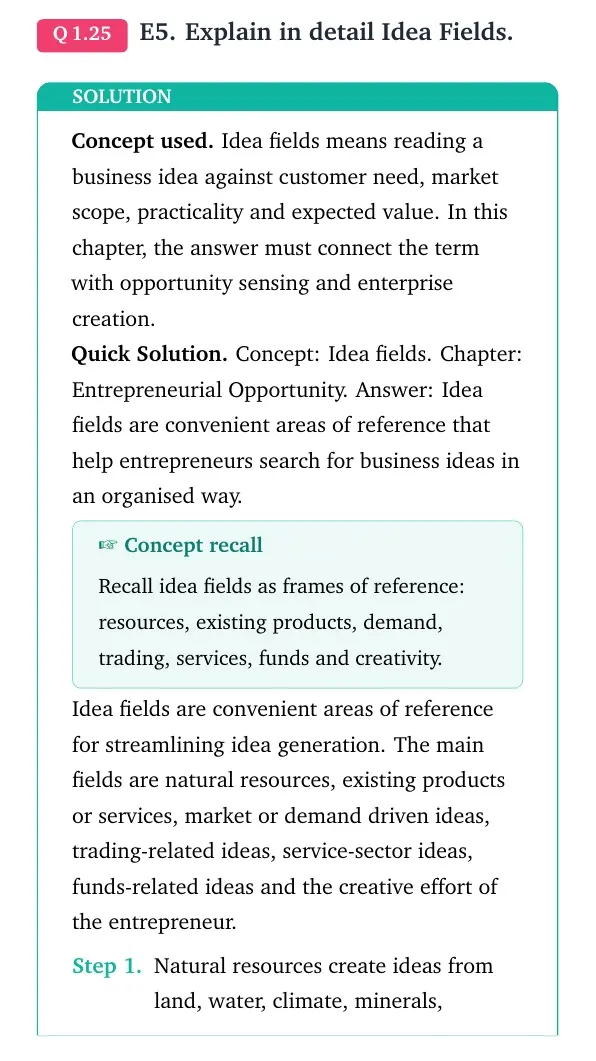
E5. Explain in detail Idea Fields.
Concept used. Idea fields means reading a business idea against customer need, market scope, practicality and expected value. In this chapter, the answer must connect the term with opportunity sensing and enterprise creation.
Quick Solution. Concept: Idea fields. Chapter: Entrepreneurial Opportunity. Answer: Idea fields are convenient areas of reference that help entrepreneurs search for business ideas in an organised way.
Concept recall
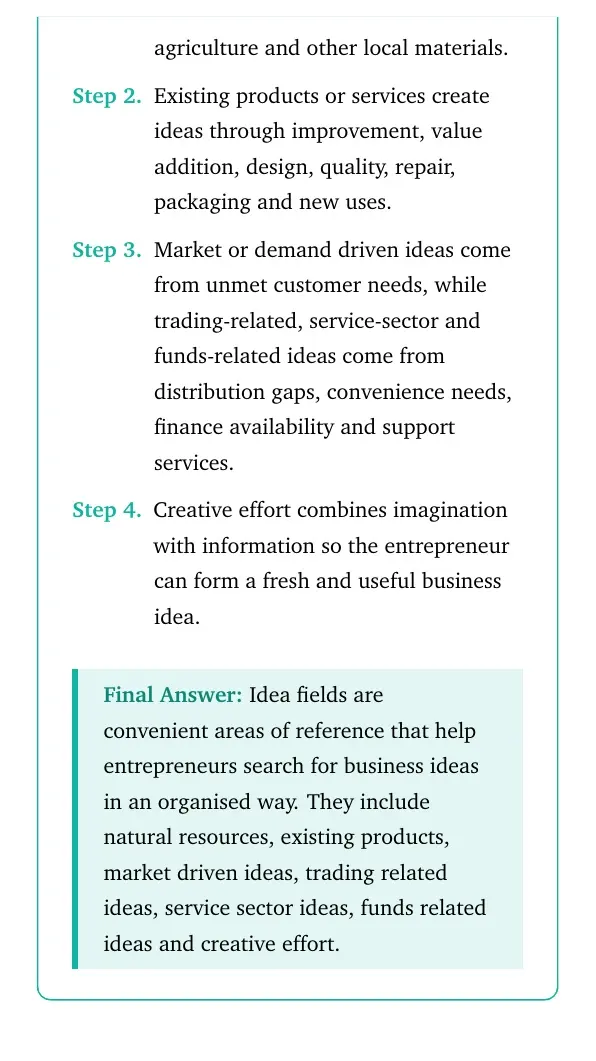
Recall idea fields as frames of reference: resources, existing products, demand, trading, services, funds and creativity.Idea fields are convenient areas of reference for streamlining idea generation. The main fields are natural resources, existing products or services, market or demand driven ideas, trading-related ideas, service-sector ideas, funds-related ideas and the creative effort of the entrepreneur.
- Natural resources create ideas from land, water, climate, minerals, agriculture and other local materials.
- Existing products or services create ideas through improvement, value addition, design, quality, repair, packaging and new uses.
- Market or demand driven ideas come from unmet customer needs, while trading-related, service-sector and funds-related ideas come from distribution gaps, convenience needs, finance availability and support services.
- Creative effort combines imagination with information so the entrepreneur can form a fresh and useful business idea.
Idea fields are convenient areas of reference that help entrepreneurs search for business ideas in an organised way. They include natural resources, existing products, market driven ideas, trading related ideas, service sector ideas, funds related ideas and creative effort.
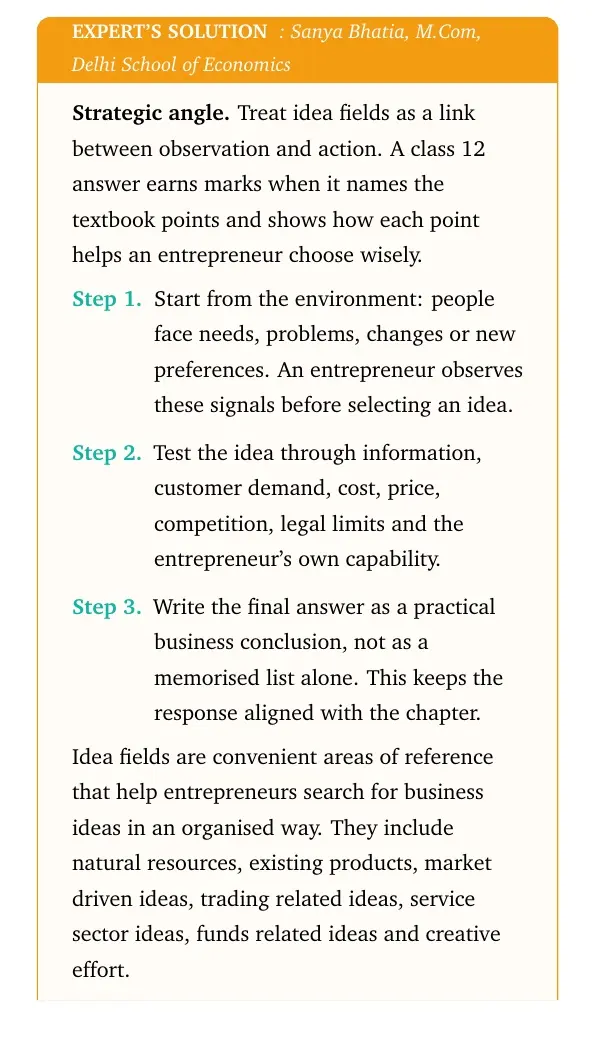
Strategic angle. Treat idea fields as a link between observation and action. A class 12 answer earns marks when it names the textbook points and shows how each point helps an entrepreneur choose wisely.
- Start from the environment: people face needs, problems, changes or new preferences. An entrepreneur observes these signals before selecting an idea.
- Test the idea through information, customer demand, cost, price, competition, legal limits and the entrepreneur's own capability.
- Write the final answer as a practical business conclusion, not as a memorised list alone. This keeps the response aligned with the chapter.
Idea fields are convenient areas of reference that help entrepreneurs search for business ideas in an organised way. They include natural resources, existing products, market driven ideas, trading related ideas, service sector ideas, funds related ideas and creative effort.
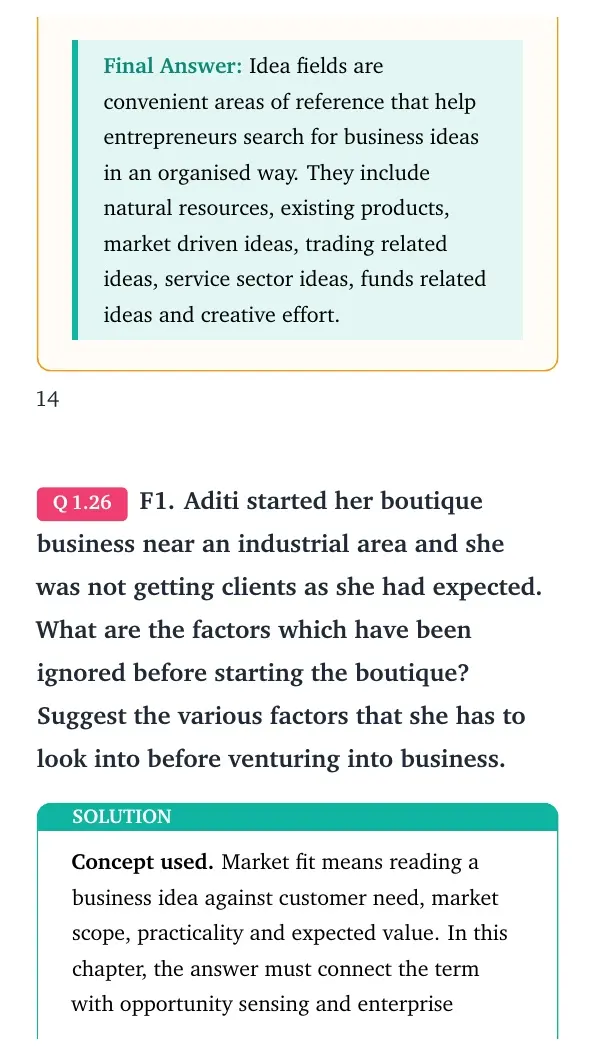
Idea fields are convenient areas of reference that help entrepreneurs search for business ideas in an organised way. They include natural resources, existing products, market driven ideas, trading related ideas, service sector ideas, funds related ideas and creative effort.
F1. Aditi started her boutique business near an industrial area and she was not getting clients as she had expected. What are the factors which have been ignored before starting the boutique? Suggest the various factors that she has to look into before venturing into business.
Concept used. Market fit means reading a business idea against customer need, market scope, practicality and expected value. In this chapter, the answer must connect the term with opportunity sensing and enterprise creation.
Quick Solution. Concept: Market fit. Chapter: Entrepreneurial Opportunity. Answer: Aditi ignored market assessment and location fit.
Concept recall
Identify the local opportunity signal first: a cluster of working customers can create demand for boutique services.Aditi ignored market assessment and location fit. A boutique needs customers who value design, tailoring, fashion and discretionary spending. An industrial area may not provide that customer base, so she should study demand, competition, cost, price, location and customer profile before venturing.
- Identify the ignored factors: demand, target customers, location, competition, cost, price and suitability of the product.
- Study whether nearby customers need boutique services and whether they can pay the planned price.
- Before venturing, assess demand, supply and competition, project innovation, cost, selling price, accessibility and promotion.
Aditi ignored market assessment and location fit. A boutique needs customers who value design, tailoring, fashion and discretionary spending. An industrial area may not provide that customer base, so she should study demand, competition, cost, price, location and customer profile before venturing.
Strategic angle. Treat market fit as a link between observation and action. A class 12 answer earns marks when it names the textbook points and shows how each point helps an entrepreneur choose wisely.
- Start from the environment: people face needs, problems, changes or new preferences. An entrepreneur observes these signals before selecting an idea.
- Test the idea through information, customer demand, cost, price, competition, legal limits and the entrepreneur's own capability.
- Write the final answer as a practical business conclusion, not as a memorised list alone. This keeps the response aligned with the chapter.
Aditi ignored market assessment and location fit. A boutique needs customers who value design, tailoring, fashion and discretionary spending. An industrial area may not provide that customer base, so she should study demand, competition, cost, price, location and customer profile before venturing.
Aditi ignored market assessment and location fit. A boutique needs customers who value design, tailoring, fashion and discretionary spending. An industrial area may not provide that customer base, so she should study demand, competition, cost, price, location and customer profile before venturing.
F2. Mr. Raghav had always wanted to manufacture an innovative, energy efficient fan. He was looking into various options and has finally narrowed it down to one option. He understands that the entire idea would have to follow a process. Identify and explain the process.
Concept used. Innovation process means reading a business idea against customer need, market scope, practicality and expected value. In this chapter, the answer must connect the term with opportunity sensing and enterprise creation.
Quick Solution. Concept: Innovation process. Chapter: Entrepreneurial Opportunity. Answer: The process is the innovation process.
Concept recall
Treat innovation as solving a changing customer need through a better product, not merely inventing something new.The process is the innovation process. Since Raghav wants an energy efficient fan, he must move from a selected idea to a marketable product through analytical planning, organising resources, implementation and commercial application.
- Analytical planning checks customer need, energy saving claims, design, cost, price and competition.
- Organising resources arranges finance, technology, raw material, skilled people, suppliers and production facilities.
- Implementation develops and tests the fan, while commercial application launches it for customers and earns revenue.
The process is the innovation process. Since Raghav wants an energy efficient fan, he must move from a selected idea to a marketable product through analytical planning, organising resources, implementation and commercial application.
Strategic angle. Treat innovation process as a link between observation and action. A class 12 answer earns marks when it names the textbook points and shows how each point helps an entrepreneur choose wisely.
- Start from the environment: people face needs, problems, changes or new preferences. An entrepreneur observes these signals before selecting an idea.
- Test the idea through information, customer demand, cost, price, competition, legal limits and the entrepreneur's own capability.
- Write the final answer as a practical business conclusion, not as a memorised list alone. This keeps the response aligned with the chapter.
The process is the innovation process. Since Raghav wants an energy efficient fan, he must move from a selected idea to a marketable product through analytical planning, organising resources, implementation and commercial application.
The process is the innovation process. Since Raghav wants an energy efficient fan, he must move from a selected idea to a marketable product through analytical planning, organising resources, implementation and commercial application.
F3. These are convenient frames of reference for streamlining the process of generation of ideas. Identify them and explain any three briefly.
Concept used. Idea fields means reading a business idea against customer need, market scope, practicality and expected value. In this chapter, the answer must connect the term with opportunity sensing and enterprise creation.
Quick Solution. Concept: Idea fields. Chapter: Entrepreneurial Opportunity. Answer: The convenient frames of reference are idea fields.
Concept recall
The clue is frames of reference; connect it to idea fields that organise where business ideas can come from.The convenient frames of reference are idea fields. They help streamline idea generation by giving the entrepreneur clear areas to search. Three examples are natural resources, existing products and market driven ideas.
- Natural resources generate ideas from locally available material, climate, land, water or agricultural output.
- Existing products generate ideas through improvement, new design, better packaging, repair, value addition or new uses.
- Market driven ideas come from customer demand, unsatisfied needs, changing tastes and gaps seen in the market.
The convenient frames of reference are idea fields. They help streamline idea generation by giving the entrepreneur clear areas to search. Three examples are natural resources, existing products and market driven ideas.
Strategic angle. Treat idea fields as a link between observation and action. A class 12 answer earns marks when it names the textbook points and shows how each point helps an entrepreneur choose wisely.
- Start from the environment: people face needs, problems, changes or new preferences. An entrepreneur observes these signals before selecting an idea.
- Test the idea through information, customer demand, cost, price, competition, legal limits and the entrepreneur's own capability.
- Write the final answer as a practical business conclusion, not as a memorised list alone. This keeps the response aligned with the chapter.
The convenient frames of reference are idea fields. They help streamline idea generation by giving the entrepreneur clear areas to search. Three examples are natural resources, existing products and market driven ideas.
The convenient frames of reference are idea fields. They help streamline idea generation by giving the entrepreneur clear areas to search. Three examples are natural resources, existing products and market driven ideas.
F4. Varun decided to start his own venture and was looking into various ideas. Explain to him various sources from where he can get some good business ideas.
Concept used. Sources for ideas means reading a business idea against customer need, market scope, practicality and expected value. In this chapter, the answer must connect the term with opportunity sensing and enterprise creation.
Quick Solution. Concept: Sources for ideas. Chapter: Entrepreneurial Opportunity. Answer: Varun can get business ideas from problems, changes, inventions, competition, innovation, customers, suppliers, trade shows, magazines, journals, books, seminars, family, friends and personal experience.
Concept recall
Classify the search through idea sources such as problems, change, inventions, competition and innovation before selecting.Varun can get business ideas from problems, changes, inventions, competition, innovation, customers, suppliers, trade shows, magazines, journals, books, seminars, family, friends and personal experience. He should collect many ideas and then screen them.
- Study problems faced by people and changes in social, legal, economic and technological life.
- Observe inventions, competitor weaknesses, customer complaints, supplier suggestions and market gaps.
- Use magazines, journals, books, seminars, trade fairs, family, friends and personal experience to build a list of possible ideas.
Varun can get business ideas from problems, changes, inventions, competition, innovation, customers, suppliers, trade shows, magazines, journals, books, seminars, family, friends and personal experience. He should collect many ideas and then screen them.
Strategic angle. Treat sources for ideas as a link between observation and action. A class 12 answer earns marks when it names the textbook points and shows how each point helps an entrepreneur choose wisely.
- Start from the environment: people face needs, problems, changes or new preferences. An entrepreneur observes these signals before selecting an idea.
- Test the idea through information, customer demand, cost, price, competition, legal limits and the entrepreneur's own capability.
- Write the final answer as a practical business conclusion, not as a memorised list alone. This keeps the response aligned with the chapter.
Varun can get business ideas from problems, changes, inventions, competition, innovation, customers, suppliers, trade shows, magazines, journals, books, seminars, family, friends and personal experience. He should collect many ideas and then screen them.
Varun can get business ideas from problems, changes, inventions, competition, innovation, customers, suppliers, trade shows, magazines, journals, books, seminars, family, friends and personal experience. He should collect many ideas and then screen them.
G1. Environmental factors exert influence upon each other and do not operate in isolation. Discuss.
Concept used. Environmental interaction means reading a business idea against customer need, market scope, practicality and expected value. In this chapter, the answer must connect the term with opportunity sensing and enterprise creation.
Quick Solution. Concept: Environmental interaction. Chapter: Entrepreneurial Opportunity. Answer: The statement is correct because external factors are connected.
Concept recall
Show interdependence with examples: economic change can alter technology, law, society and competition together.The statement is correct because external factors are connected. A political decision can change law and taxes, which affects costs and demand. Technology can change social habits, employment and competition. Ecological concerns can lead to legal rules and new customer preferences.
- A change in one factor often produces change in another factor.
- For example, a legal ban on plastic can create social awareness, raise costs and create demand for eco friendly packaging.
- So an entrepreneur should scan all factors together before accepting a business opportunity.
The statement is correct because external factors are connected. A political decision can change law and taxes, which affects costs and demand. Technology can change social habits, employment and competition. Ecological concerns can lead to legal rules and new customer preferences.
Strategic angle. Treat environmental interaction as a link between observation and action. A class 12 answer earns marks when it names the textbook points and shows how each point helps an entrepreneur choose wisely.
- Start from the environment: people face needs, problems, changes or new preferences. An entrepreneur observes these signals before selecting an idea.
- Test the idea through information, customer demand, cost, price, competition, legal limits and the entrepreneur's own capability.
- Write the final answer as a practical business conclusion, not as a memorised list alone. This keeps the response aligned with the chapter.
The statement is correct because external factors are connected. A political decision can change law and taxes, which affects costs and demand. Technology can change social habits, employment and competition. Ecological concerns can lead to legal rules and new customer preferences.
The statement is correct because external factors are connected. A political decision can change law and taxes, which affects costs and demand. Technology can change social habits, employment and competition. Ecological concerns can lead to legal rules and new customer preferences.
G2. "If you don't adapt, you don't endure" Evaluate the validity of the statement.
Concept used. Adaptation means reading a business idea against customer need, market scope, practicality and expected value. In this chapter, the answer must connect the term with opportunity sensing and enterprise creation.
Quick Solution. Concept: Adaptation. Chapter: Entrepreneurial Opportunity. Answer: The statement is valid for entrepreneurship because markets, technology, law, competition and customer tastes keep changing.
Concept recall
Use adaptation logic: scanning fast change protects survival by helping a venture adjust products, prices and methods.The statement is valid for entrepreneurship because markets, technology, law, competition and customer tastes keep changing. A business that refuses to adapt may lose customers, while an alert entrepreneur can convert change into opportunity.
- Adaptation starts with environment scanning and trend spotting.
- When needs or technology change, the entrepreneur modifies the product, process, price, channel or promotion.
- A venture endures when it keeps solving current customer problems and does not cling to outdated assumptions.
The statement is valid for entrepreneurship because markets, technology, law, competition and customer tastes keep changing. A business that refuses to adapt may lose customers, while an alert entrepreneur can convert change into opportunity.
Strategic angle. Treat adaptation as a link between observation and action. A class 12 answer earns marks when it names the textbook points and shows how each point helps an entrepreneur choose wisely.
- Start from the environment: people face needs, problems, changes or new preferences. An entrepreneur observes these signals before selecting an idea.
- Test the idea through information, customer demand, cost, price, competition, legal limits and the entrepreneur's own capability.
- Write the final answer as a practical business conclusion, not as a memorised list alone. This keeps the response aligned with the chapter.
The statement is valid for entrepreneurship because markets, technology, law, competition and customer tastes keep changing. A business that refuses to adapt may lose customers, while an alert entrepreneur can convert change into opportunity.
The statement is valid for entrepreneurship because markets, technology, law, competition and customer tastes keep changing. A business that refuses to adapt may lose customers, while an alert entrepreneur can convert change into opportunity.
H1. Vinay was a young entrepreneur who wanted to start a new business with an initial investment of 25 lakhs. He was not sure of what business he has to undertake. His friend suggested seeking the help of professionals who would spot the latest trends in the market and give him an idea, but Vinay decided to do it by himself. Suggest the various ways by which he can do it.
Concept used. Trend spotting by entrepreneur means reading a business idea against customer need, market scope, practicality and expected value. In this chapter, the answer must connect the term with opportunity sensing and enterprise creation.
Quick Solution. Concept: Trend spotting by entrepreneur. Chapter: Entrepreneurial Opportunity. Answer: Vinay can spot trends himself by reading trends, talking trends, watching trends and thinking trends.
Concept recall
Read the case clue before naming the method, then match it with reading, talking, watching or thinking trends.Vinay can spot trends himself by reading trends, talking trends, watching trends and thinking trends. Since he is investing Rs. 25 lakhs, he should use these methods carefully before choosing the business.
- Read trends through newspapers, trade journals, industry reports, business websites and government data.
- Talk trends with customers, suppliers, dealers, entrepreneurs, bankers, family and friends to know real needs.
- Watch trends in markets, malls, online platforms and daily life, then think trends by matching the signal with his budget, skills and expected return.
Vinay can spot trends himself by reading trends, talking trends, watching trends and thinking trends. Since he is investing Rs. 25 lakhs, he should use these methods carefully before choosing the business.
Strategic angle. Treat trend spotting by entrepreneur as a link between observation and action. A class 12 answer earns marks when it names the textbook points and shows how each point helps an entrepreneur choose wisely.
- Start from the environment: people face needs, problems, changes or new preferences. An entrepreneur observes these signals before selecting an idea.
- Test the idea through information, customer demand, cost, price, competition, legal limits and the entrepreneur's own capability.
- Write the final answer as a practical business conclusion, not as a memorised list alone. This keeps the response aligned with the chapter.
Vinay can spot trends himself by reading trends, talking trends, watching trends and thinking trends. Since he is investing Rs. 25 lakhs, he should use these methods carefully before choosing the business.
Vinay can spot trends himself by reading trends, talking trends, watching trends and thinking trends. Since he is investing Rs. 25 lakhs, he should use these methods carefully before choosing the business.
Entrepreneurial Opportunity Class 12 Entrepreneurship NCERT Solutions FAQs
Ques. How many questions are solved in Class 12 Entrepreneurship Chapter 1 Entrepreneurial Opportunity NCERT Solutions?
Ans. The PDF includes 32 solved questions from Chapter 1, covering very short answer, short answer, long answer, HOTS, application and case-based formats.
Ques. What is the main concept of Entrepreneurial Opportunity in Class 12 Entrepreneurship?
Ans. The main concept is that an entrepreneur converts a need, problem or change in the environment into a feasible business opportunity through information, creativity and planning.
Ques. Does the PDF include expert explanations for Class 12 Entrepreneurship Chapter 1?
Ans. Yes. Each question has a direct solution and an expert solution so students can compare the textbook answer with a fuller board-exam explanation.
Ques. Is this Class 12 Entrepreneurship Chapter 1 solution set aligned with the 2026-27 syllabus?
Ans. Yes. The article and PDF are prepared for the 2026-27 syllabus cycle and follow the Entrepreneurial Opportunity unit sequence.



Comments