




Inside the NCERT Solutions for Class 12 KTPI Chapter 1 Astronomy in India you will find all 13 Exercise questions and all 4 Project Ideas solved, according to the latest 2026-27 syllabus. The answers rest on four ideas the chapter keeps returning to. The lunisolar calendar with its tithi and nakshatra. The line of nodes that controls every eclipse. Aryabhata and the Kerala School. And modern India, from the GMRT to LIGO-India.
- Astronomy in India is Chapter 1 of the Class 12 Knowledge Traditions and Practices of India course.
- 17 questions in total: 13 in the Exercise and 4 Project Ideas at the end.
- Names, places and years you must quote: Aryabhata, Varahamihira, Nilakantha, Jyeshthadeva, Sawai Jai Singh, GMRT, Devasthal, Hanle and Hingoli.
Every answer on this page is written by subject experts and checked line by line against the Astronomy in India chapter of the NCERT Knowledge Traditions and Practices of India textbook.
What the Class 12 KTPI Astronomy in India Solutions Cover, Question by Question
The chapter does not use exercise numbers like a Maths chapter. It puts one Exercise block at the end, followed by a Project Ideas block. Students often finish the Exercise and stop, and then lose the project marks. The table below shows both blocks in the order the book prints them.
| Block | Questions | What it tests |
|---|---|---|
| Exercise, Questions 1 to 3 | 3 long answers | Development of Indian astronomy, Aryabhata's contribution, the Kerala School |
| Exercise, Questions 4 to 7 | 4 reasoning answers | Eclipse conditions, tithi, solar and lunar eclipse geometry, circular shadows |
| Exercise, Questions 8 to 10 | 3 modern astronomy answers | Radio astronomy institutions, large optical telescopes, LIGO |
| Exercise, Questions 11 to 13 | 2 short answers and 1 matching set | Astronomy as the study of the past, Jai Singh's city, the 7 pair matching exercise |
| Project Ideas 1 to 4 | 4 project tasks | Jantar Mantar instruments, ten Indian astronomers, a timeline, a night sky log |
Questions 8 to 10 are the easiest marks in the chapter because every answer is a named list. Questions 4 and 7 are the ones that separate a full answer from a half answer, since both want a reason and not a fact.
Open the full solved question set
All 17 questions written out as complete answers, each with a short Solution and a longer Expert Solution, sit on the companion page.
How Astronomy Developed in India from the Vedic Calendar to the Modern Observatory
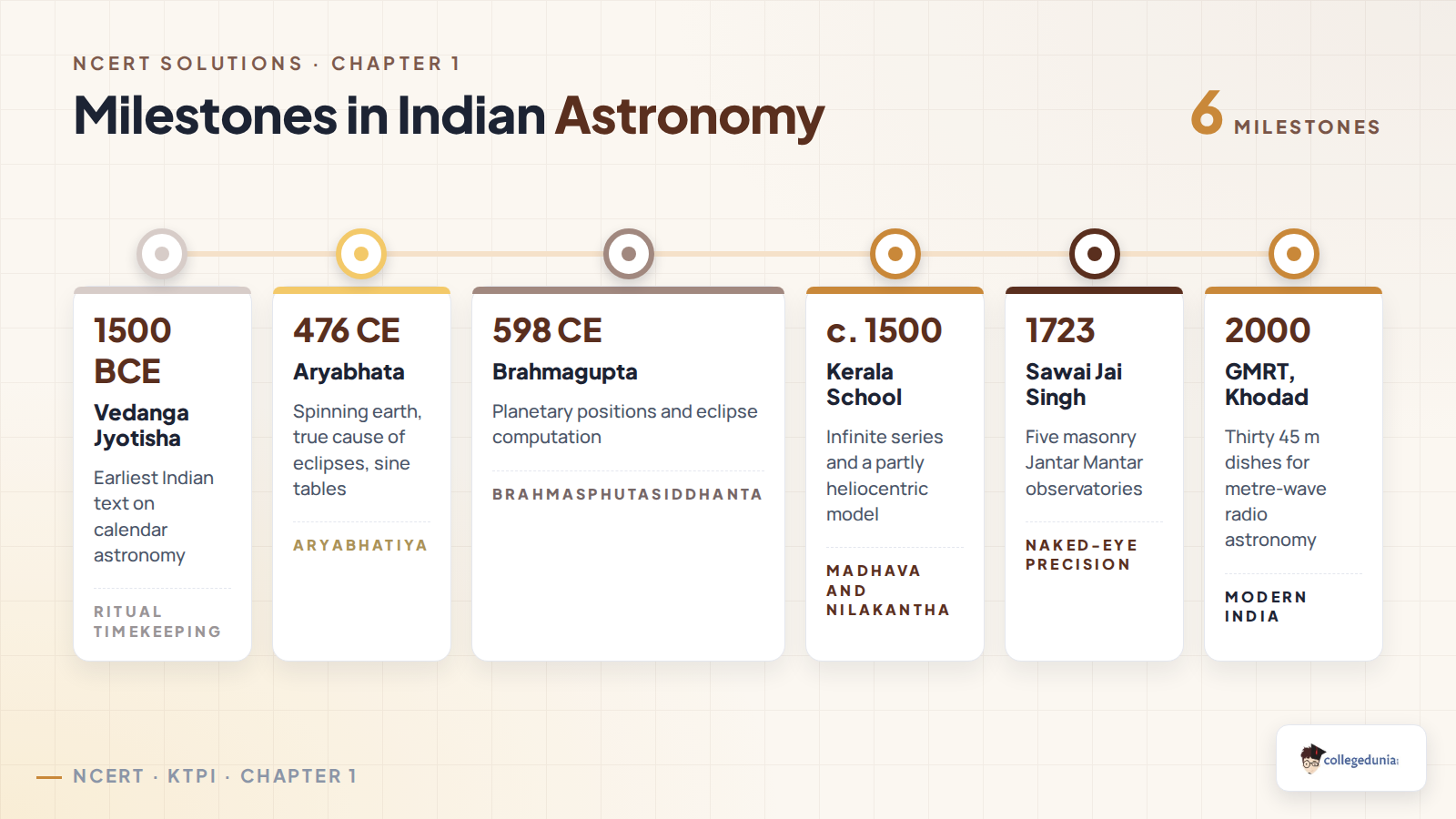
Question 1 asks you to write a few sentences on how astronomy grew in India. The safe way to answer is by stages. Each stage answers a different need, and naming the need is what earns the mark. Do not simply list astronomers.
| Stage | Period | The need it answered | Names to quote |
|---|---|---|---|
| Vedic and practical | Earliest texts onward | When to sow, fast and celebrate; eclipse and comet warnings for kings | Vedanga Jyotisha |
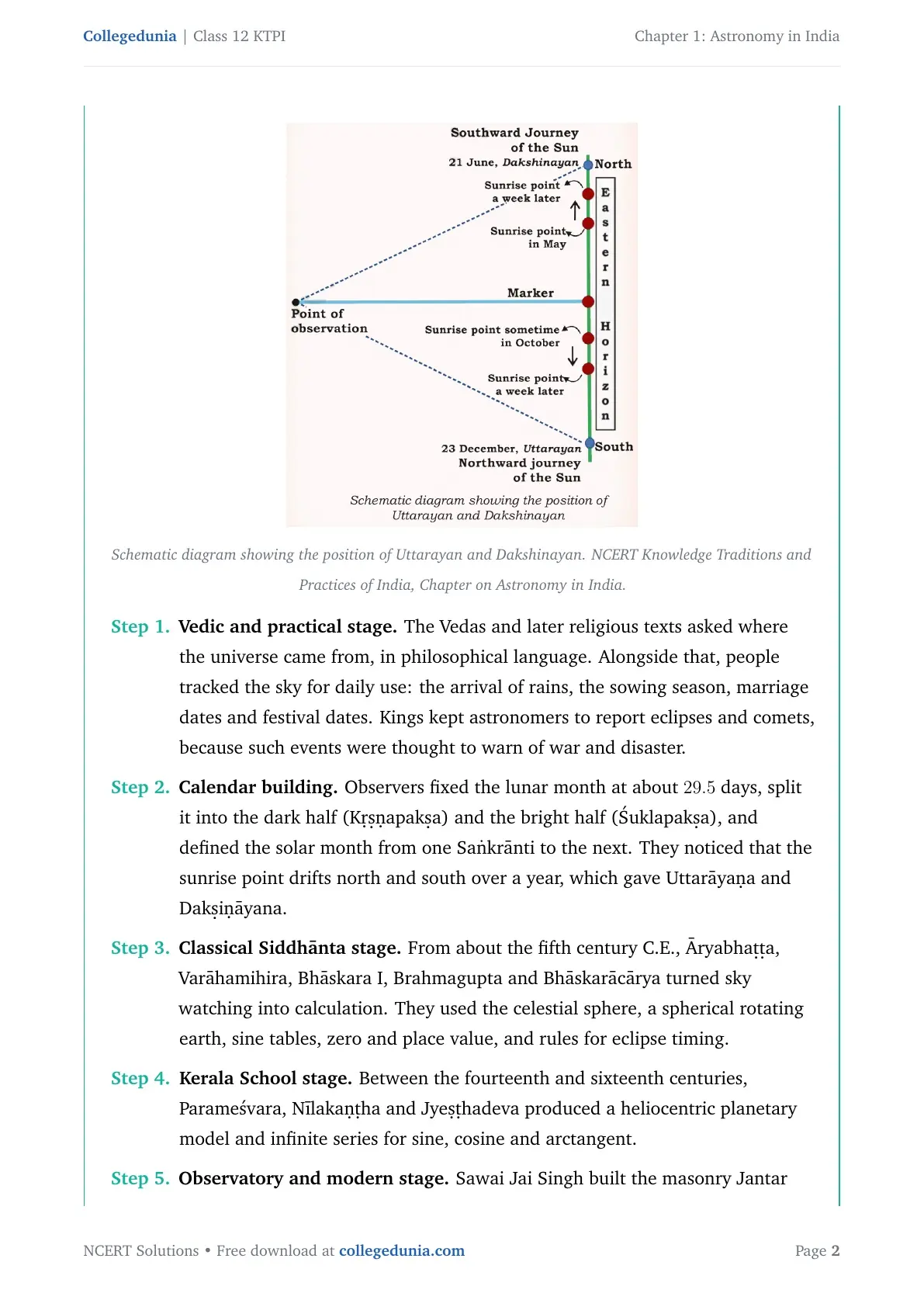
| Calendar building | Pre-Siddhantic | Fixing the lunar month at about 29.5 days and the two half months | Krishnapaksha and Shuklapaksha, Uttarayana and Dakshinayana |
| Classical Siddhantic | From about the 5th century C.E. | Where will the Sun and moon be, and when | Aryabhata, Varahamihira, Bhaskara I, Brahmagupta, Bhaskaracharya |
| Kerala School | 14th to 16th century C.E. | Sharper sine tables and a better planetary model | Parameshvara, Nilakantha, Jyeshthadeva |
| Observatory and modern | 1723 onward | Public instruments, then astrophysics | Sawai Jai Singh, GMRT, Devasthal, LIGO-India |
A useful way to hold the whole story is to ask one question at each stage: what instrument was available. The eye gave the calendar. Mathematics gave prediction. Stone yantras gave precision. Telescopes gave modern astrophysics. Read as a chain of instruments, the chapter stops being a list of dates.
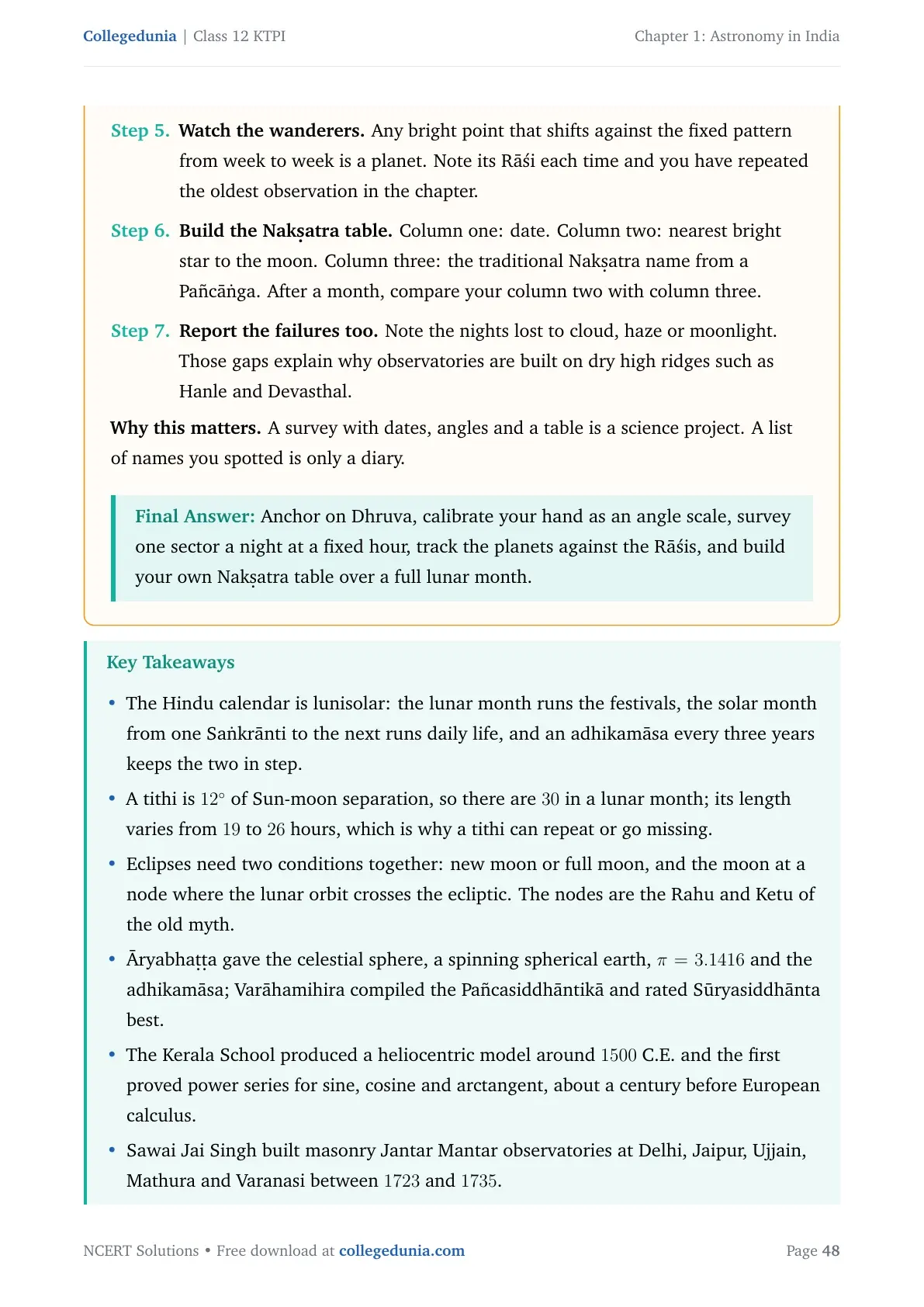
Aryabhata's Contribution to Astronomy: A Spinning Spherical Earth and Pi as 3.1416
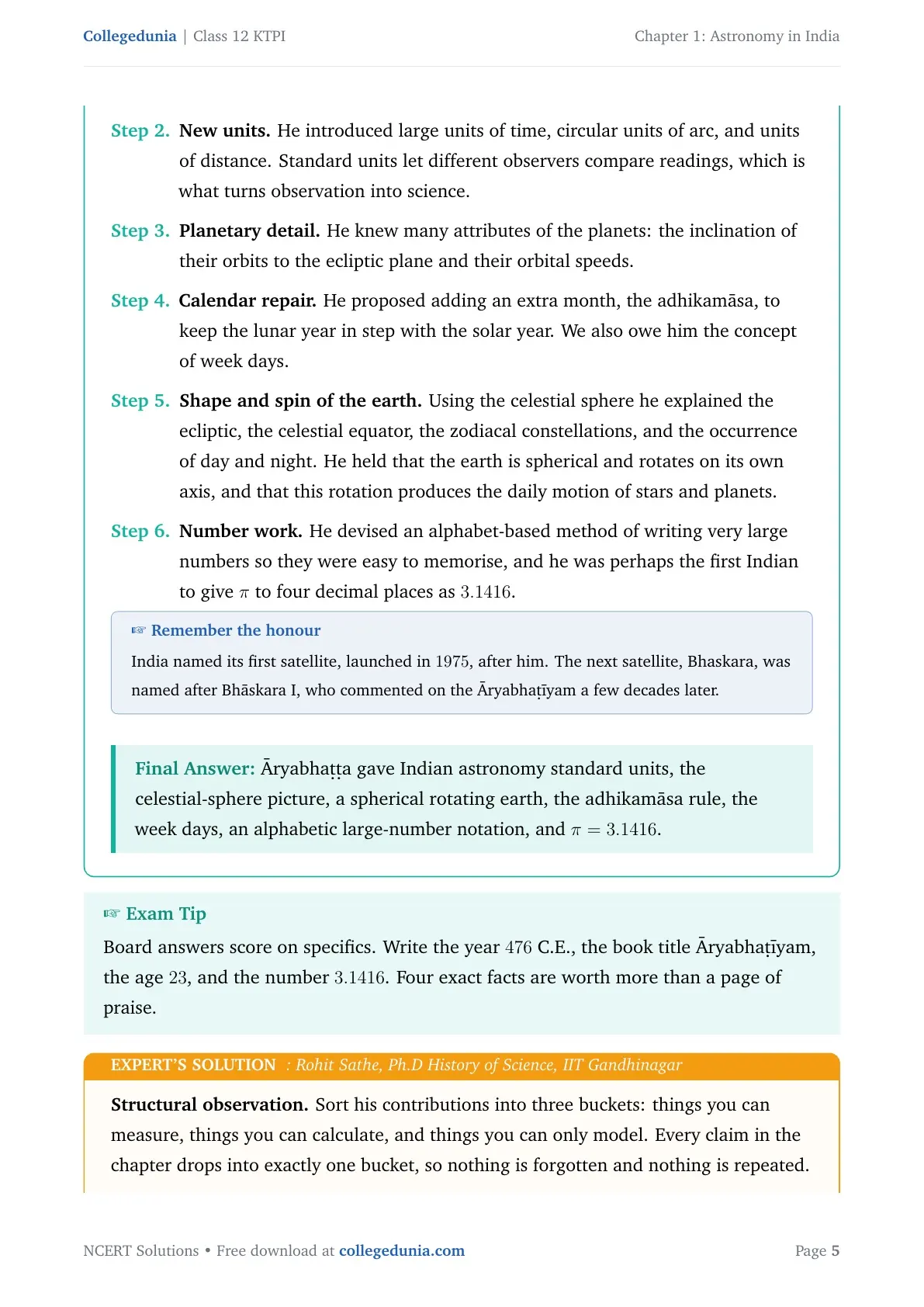
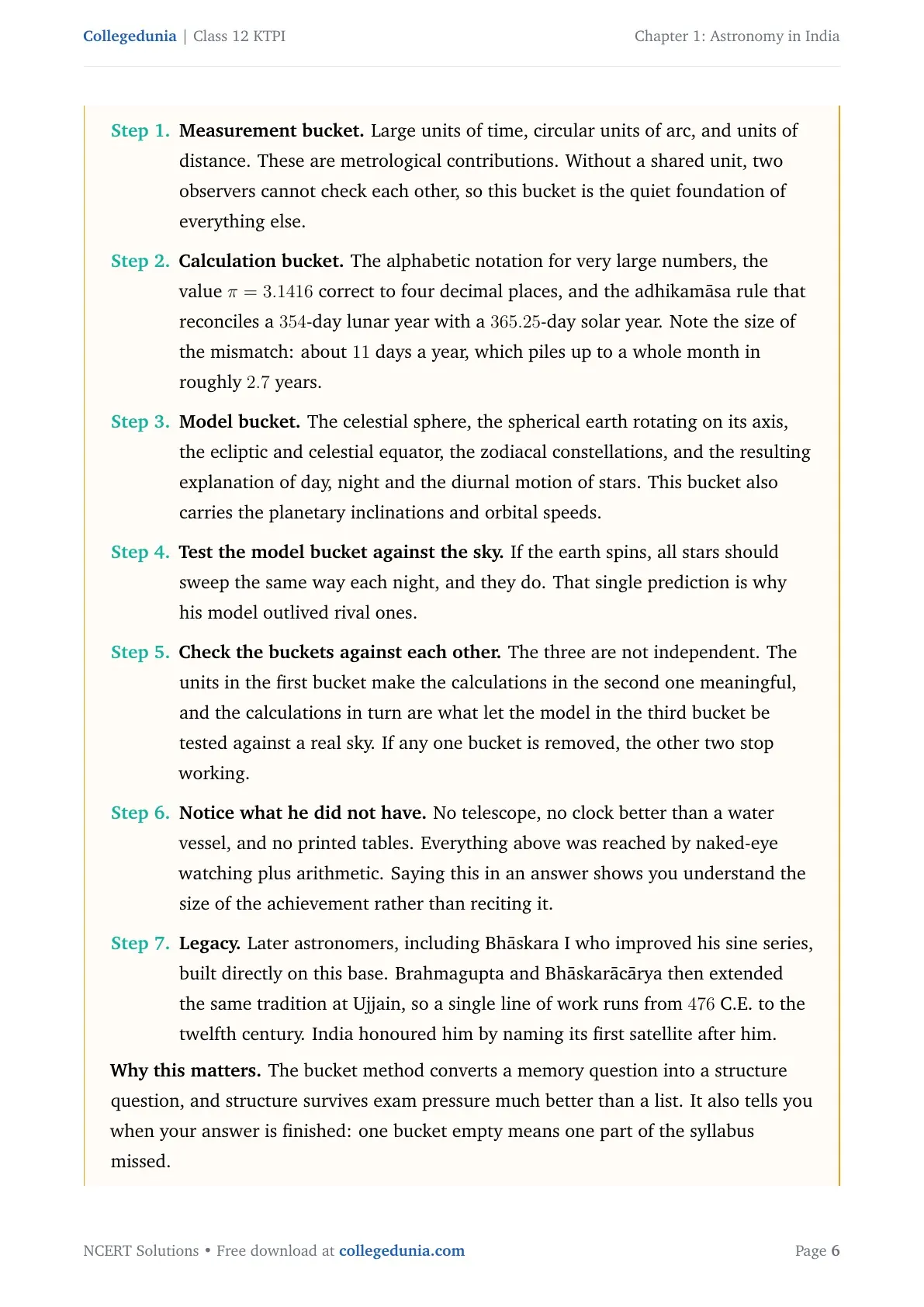
Question 2 is the highest scoring long answer in the chapter. Aryabhata was born in 476 C.E. near modern Patna and wrote the Aryabhatiyam at the age of 23. That book stayed the most influential astronomy text in India for centuries.
- New units. He introduced large units of time, circular units of arc, and units of distance, so different observers could compare readings.
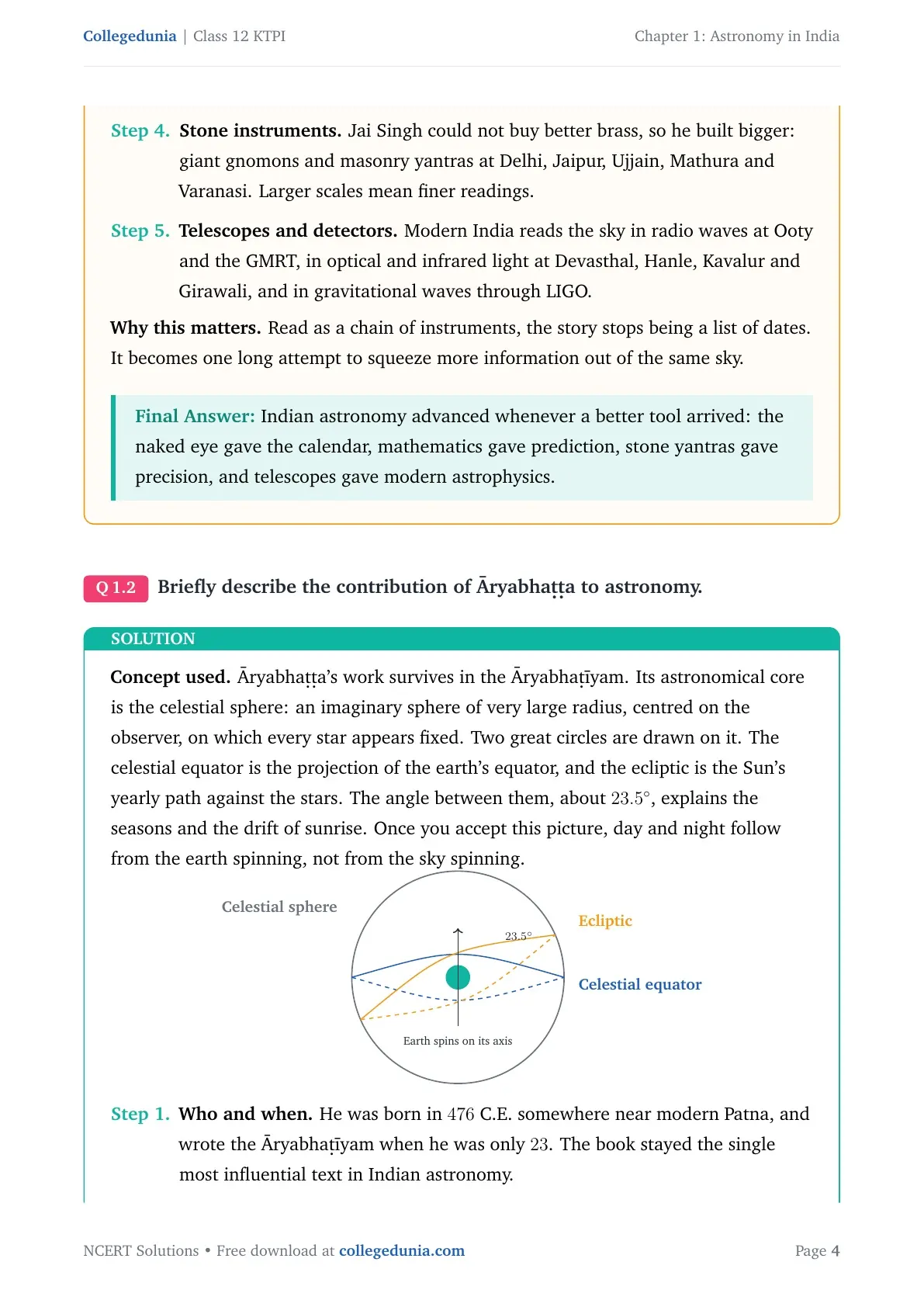
- The celestial sphere. He used it to explain the ecliptic, the celestial equator, the zodiacal constellations, and the occurrence of day and night.
- A spherical, rotating earth. He held that the earth spins on its own axis, and that this spin causes the daily motion of the stars and planets.
- Planetary detail. He knew the inclination of planetary orbits to the plane of the ecliptic and their orbital speeds.
- Calendar repair. He proposed the adhikamasa, an extra month that keeps the lunar year in step with the solar year. The concept of week days is also credited to him.
- Number work. He devised an alphabet based notation for very large numbers, and gave pi as 3.1416, correct to four decimal places.
India named its first satellite, launched in 1975, after him. The satellite that followed was named Bhaskara, after Bhaskara I, who wrote a commentary on the Aryabhatiyam a few decades after Aryabhata.
The Kerala School of Astronomy: Infinite Series and a Heliocentric Model Before Copernicus
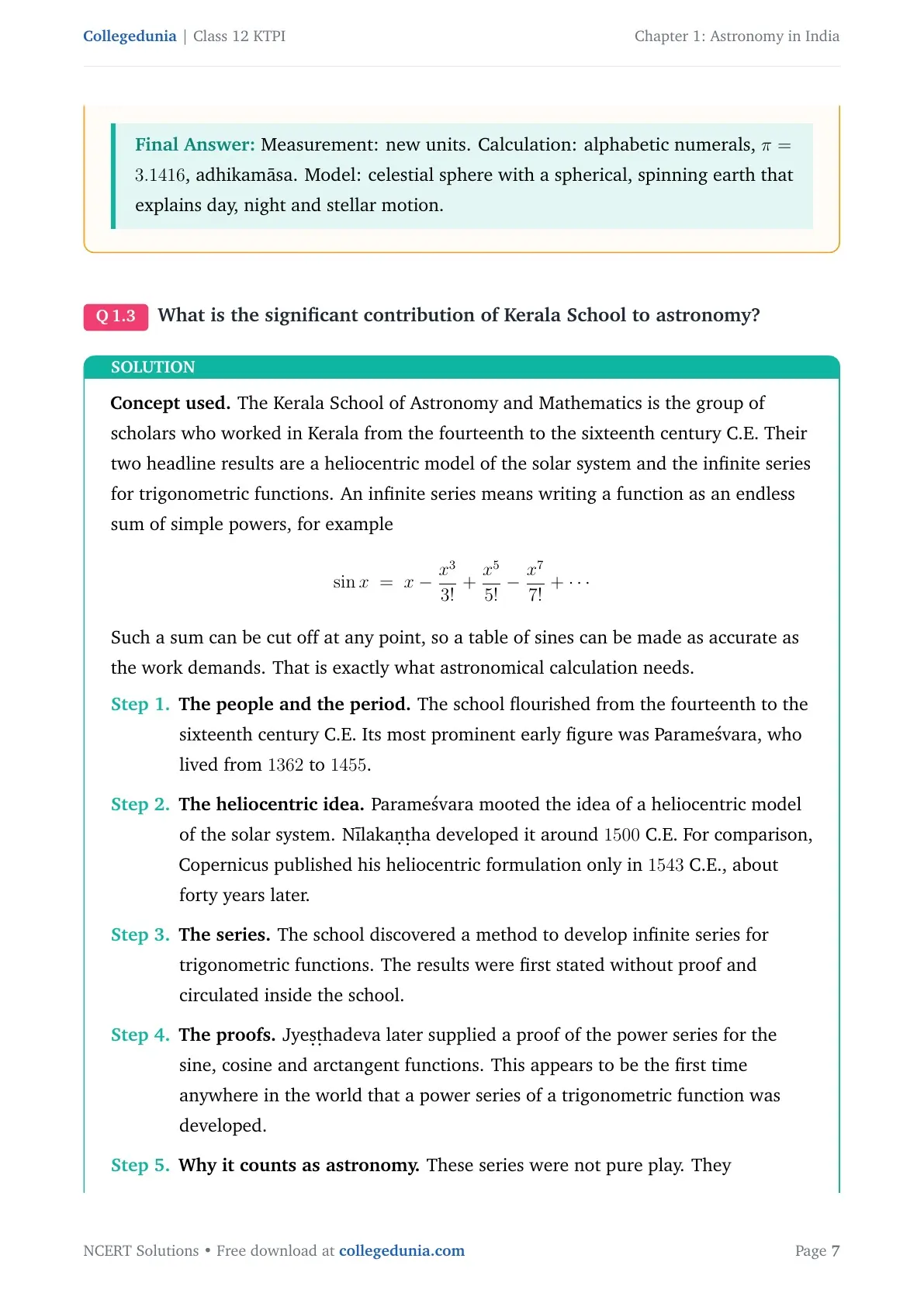
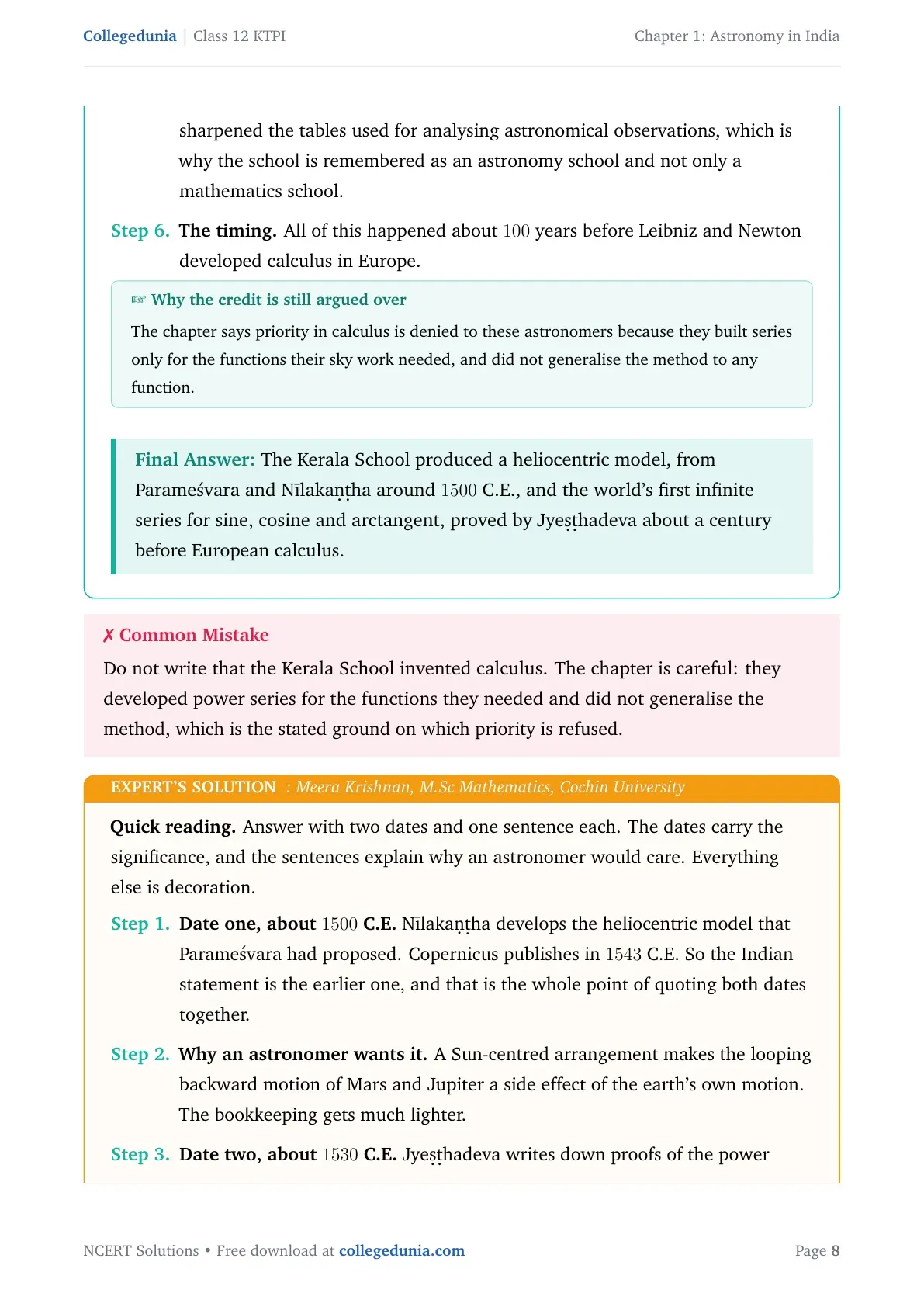
Question 3 wants two headline results, not a general description. The Kerala School worked from the fourteenth to the sixteenth century C.E. It had no new instrument, so it improved the mathematics instead.
- A partially heliocentric model. Parameshvara, who lived from 1362 to 1455, first put the idea forward. Nilakantha Somayaji developed it around 1500 C.E. Copernicus published his own formulation only in 1543 C.E., about forty years later.
- Infinite series for trigonometric functions. The school found a method to write sine, cosine and arctangent as endless sums of powers. A sum like that can be cut off anywhere, so a sine table can be made as accurate as the work demands.
- The proofs. Jyeshthadeva supplied the proof of the power series for sine, cosine and arctangent. This appears to be the first time anywhere in the world that a power series of a trigonometric function was developed.
- The timing. All of it happened about 100 years before Leibniz and Newton developed calculus in Europe.
The chapter is honest about why priority in calculus is still denied to these astronomers. They built series only for the functions their sky work needed, and did not generalise the method. The series were astronomy tools first and mathematics second.
Eclipse Geometry Explained in Under Ten Minutes
Source: Khan Academy on YouTube
Why Eclipses Happen Only on a New Moon or Full Moon Day and What the Line of Nodes Means
Question 4 needs two conditions, and most students write only the first one. An eclipse needs one body to block sunlight from reaching another, so the Sun, earth and moon must lie on one straight line.
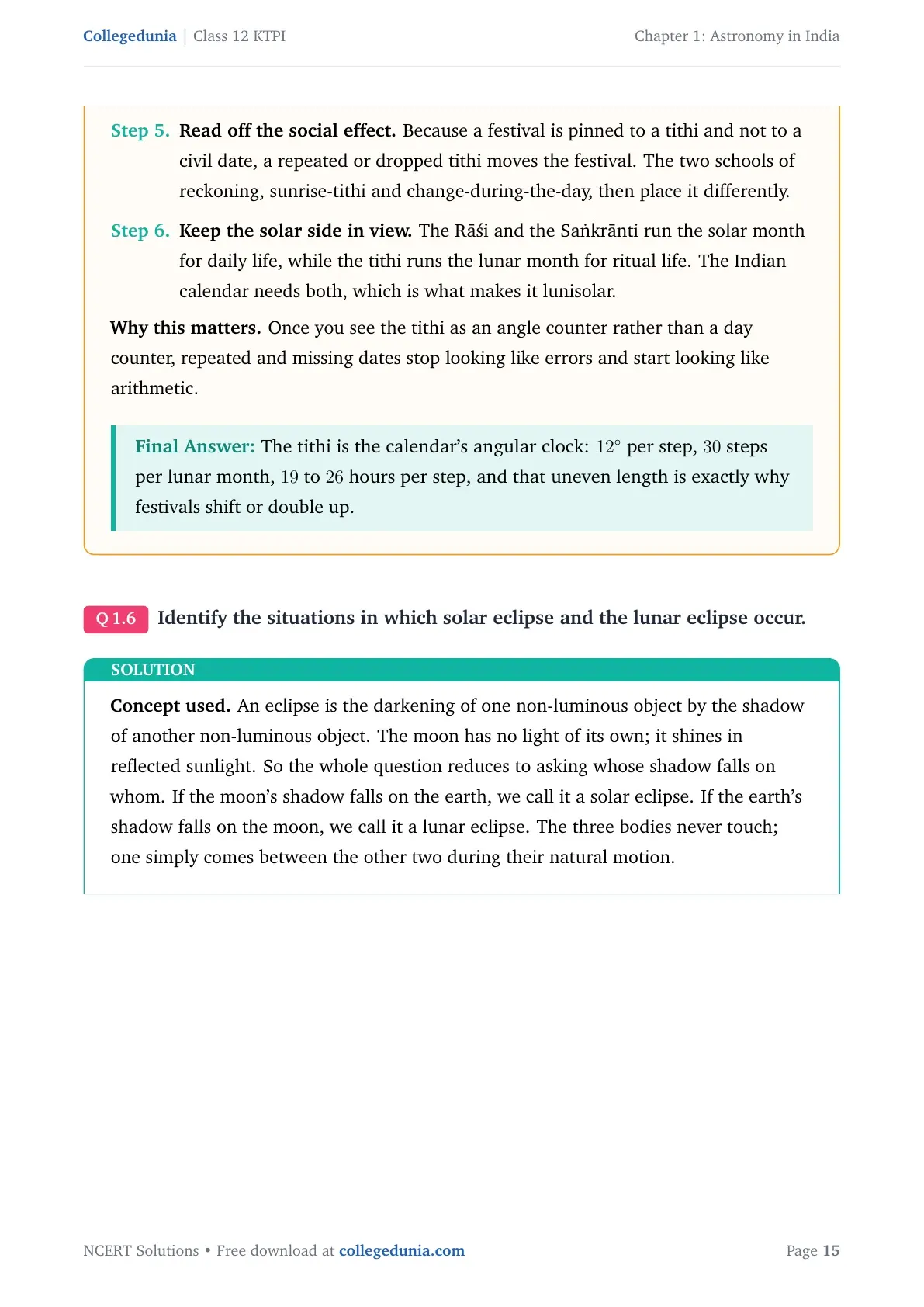
- First condition, the line up. The moon lines up with the Sun and the earth only twice a lunar month. At new moon it sits between the earth and the Sun. At full moon the earth sits between the Sun and the moon.
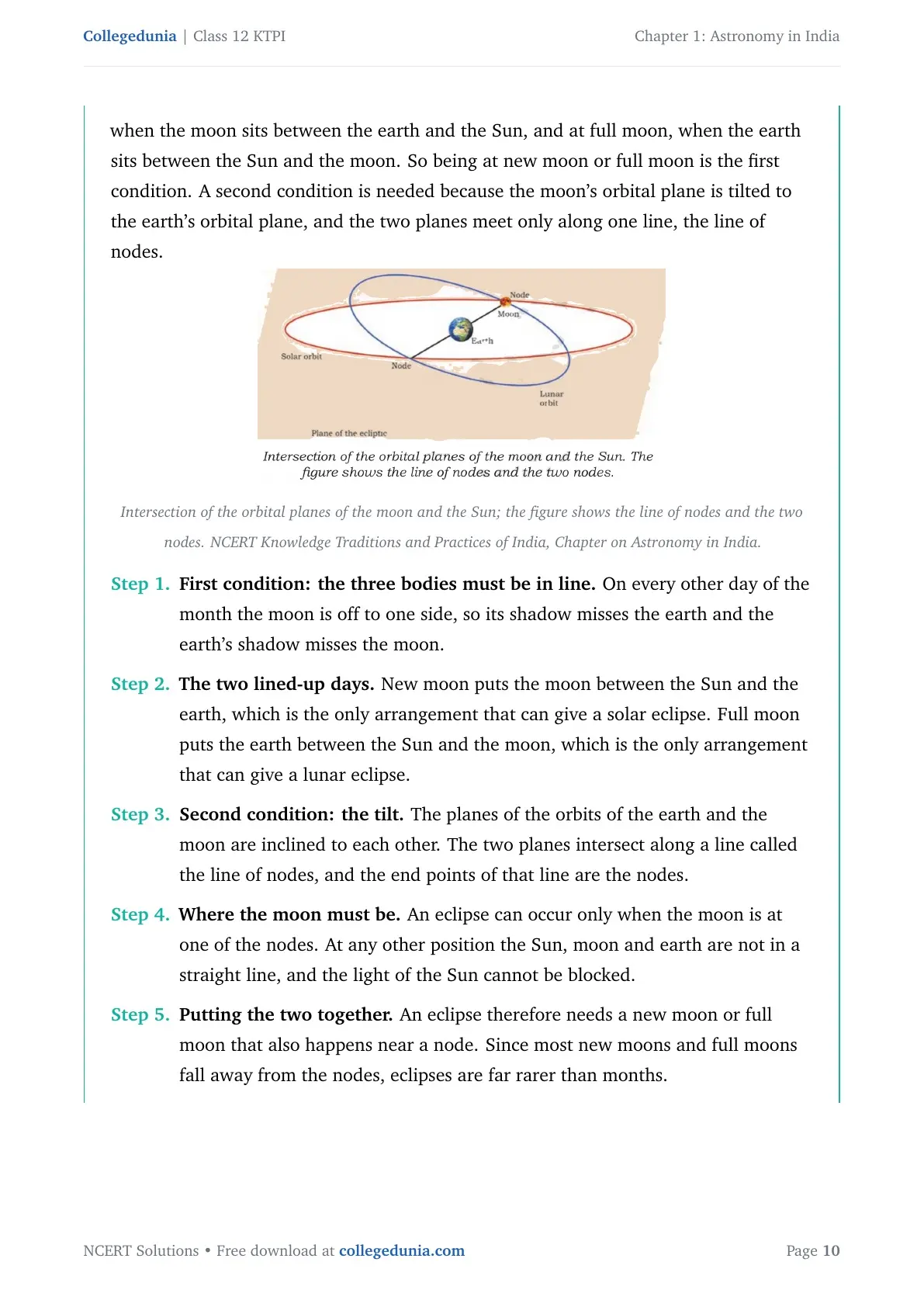
- Second condition, the tilt. The moon's orbital plane is tilted by about 5 degrees to the earth's orbital plane. The two planes meet along one line, called the line of nodes, and its end points are the nodes.
- Where the moon must be. An eclipse can happen only when the moon is at or very near a node. Anywhere else the three bodies are not truly in a straight line.
- Why eclipses are rare. Most new moons and full moons fall away from the nodes, so there are far fewer eclipses than there are months.
The chapter also settles an old confusion. Rahu and Ketu are the names given to the two nodes. They are geometrical points where two orbital planes cross, not demons that swallow the Sun.
Solar Eclipse and Lunar Eclipse Geometry and Why Eclipse Shadows Are Always Circular
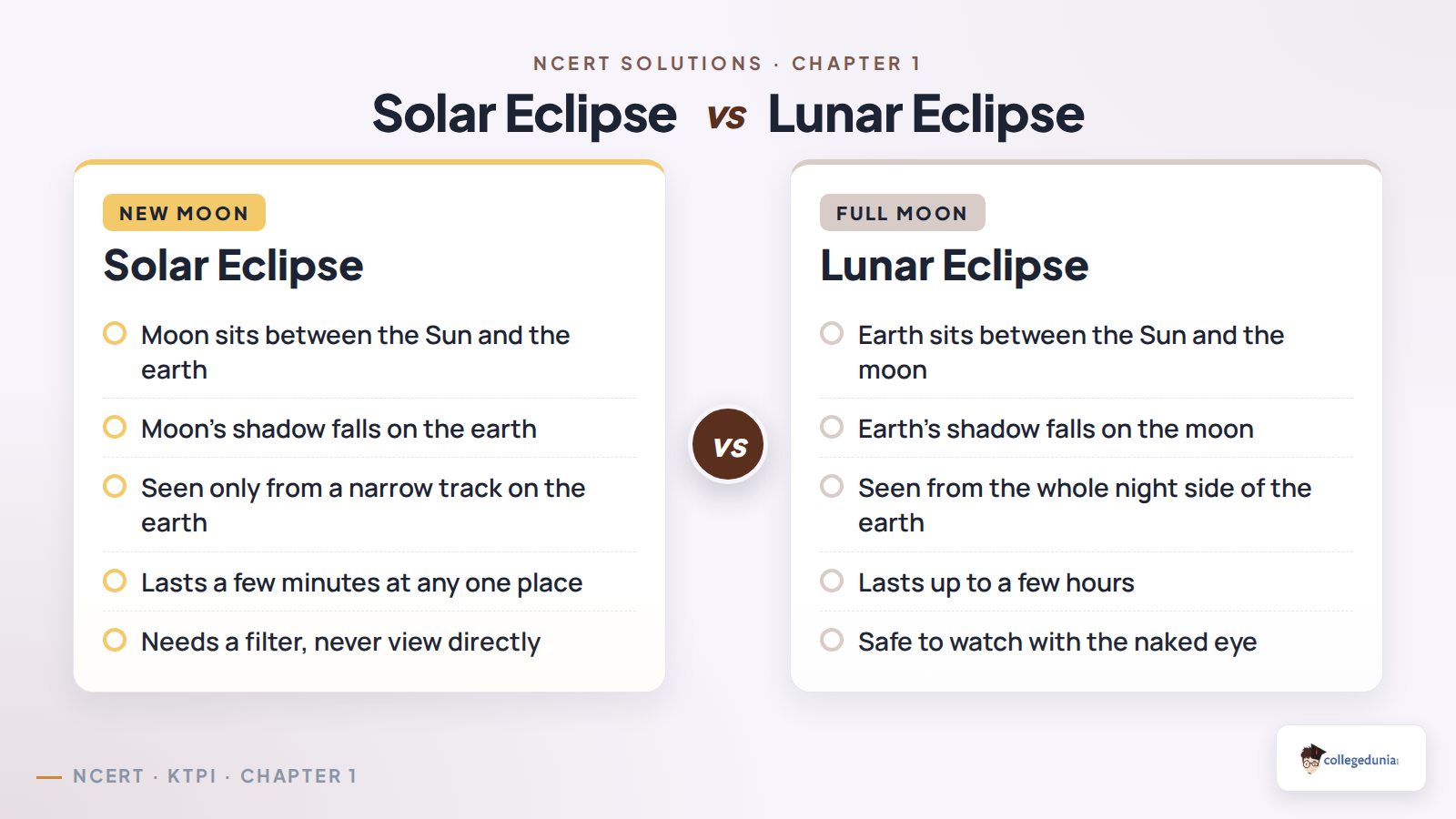
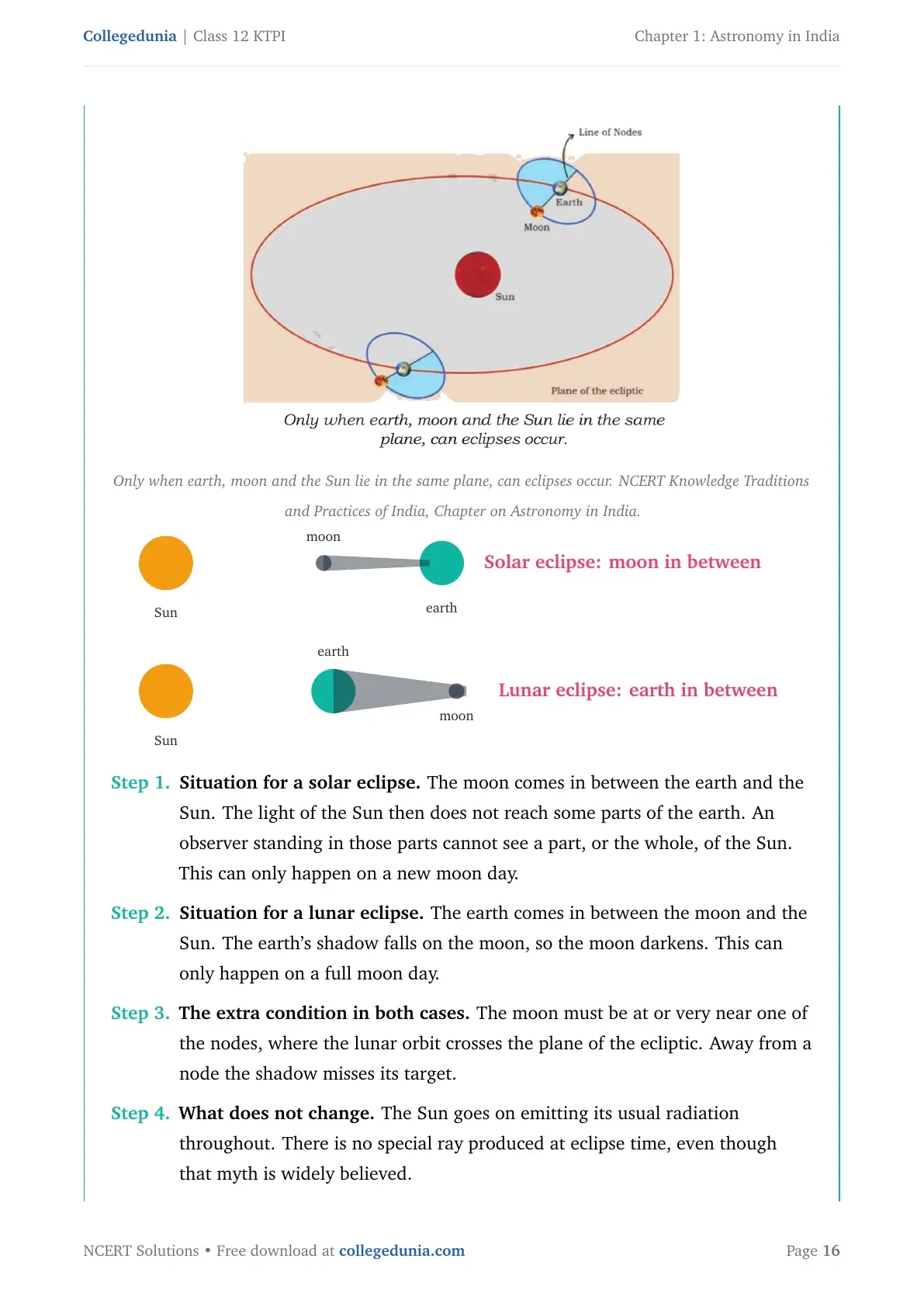
Questions 6 and 7 sit together because both are answered from the same picture. Get the order of the three bodies right and the rest follows.
| Point of comparison | Solar eclipse | Lunar eclipse |
|---|---|---|
| Order of bodies | Sun, moon, earth | Sun, earth, moon |
| Day of the lunar month | New moon day | Full moon day |
| Whose shadow falls where | The moon's shadow falls on the earth | The earth's shadow falls on the moon |
| Who can see it | Only from a narrow track on the earth | From the whole night side of the earth |
| Extra condition | Moon near a node | Moon near a node |
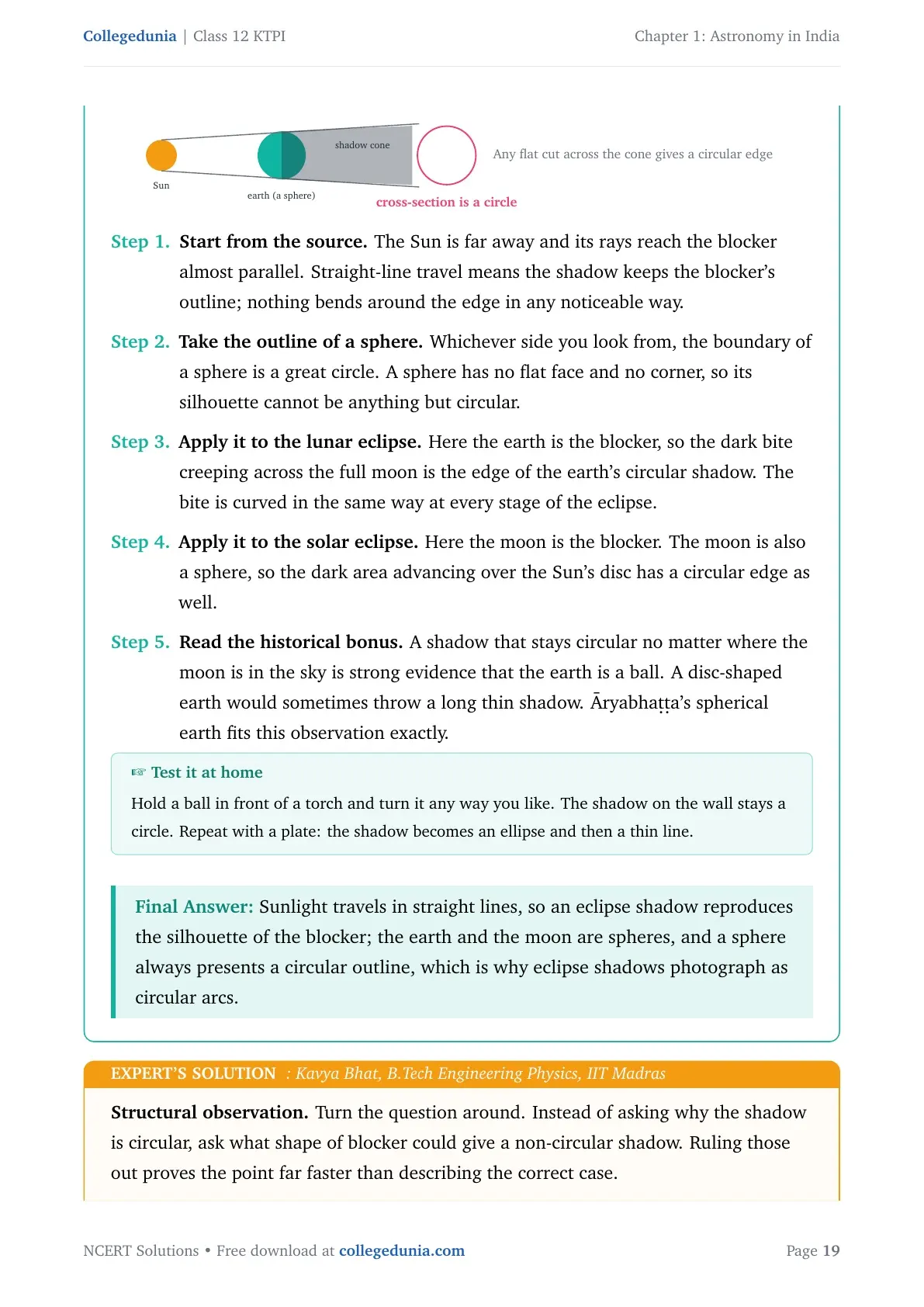
Question 7 asks why the shadows photographed during an eclipse are circular. The answer has two halves. Sunlight travels in straight lines, so a shadow reproduces the outline of whatever blocks the light. The earth and the moon are spheres, and a sphere presents a circular outline from every direction. So the shadow edge photographs as a circular arc every time.
Tithi in the Indian Calendar: The 12 Degree Step That Fixes Every Festival Date
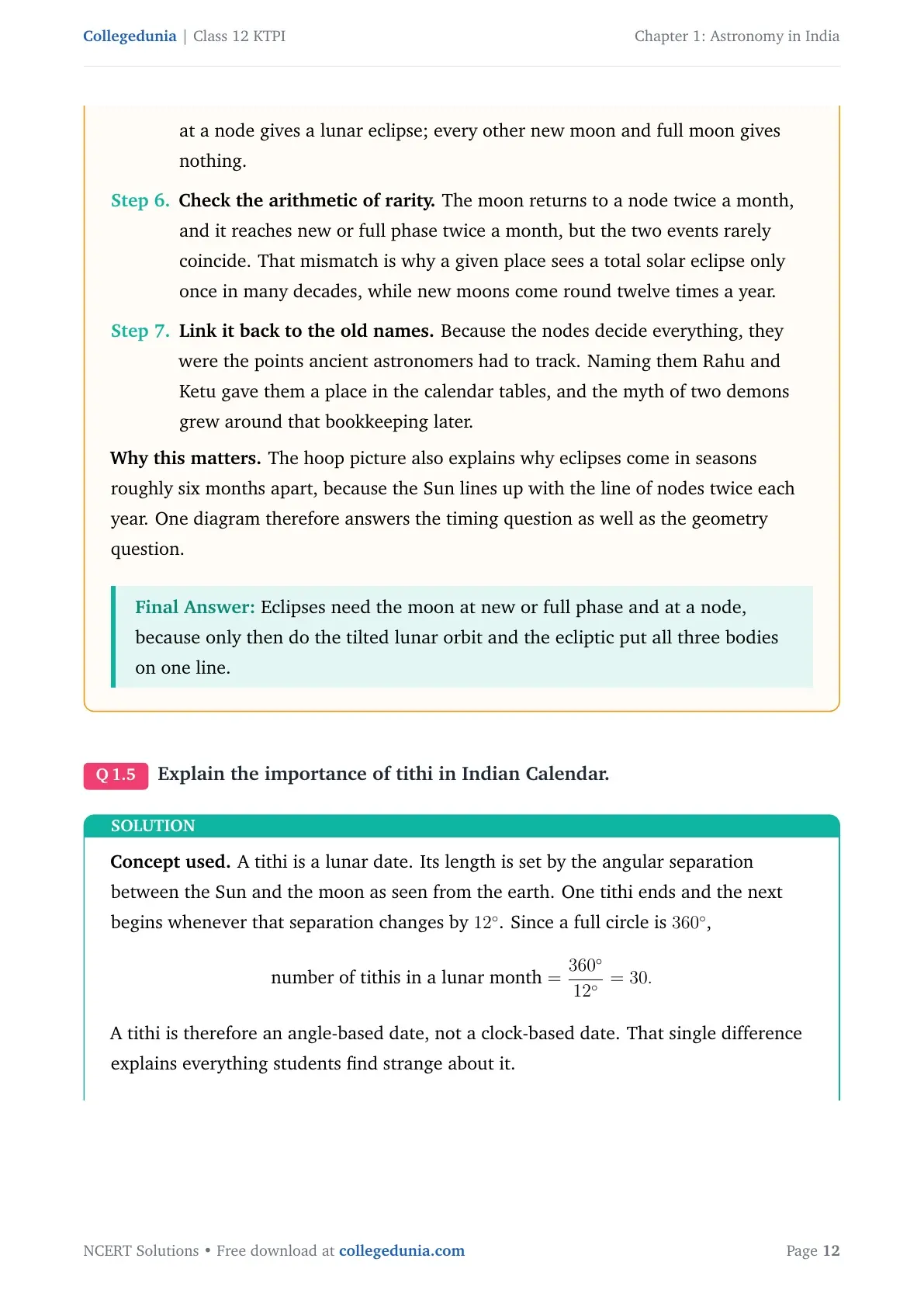
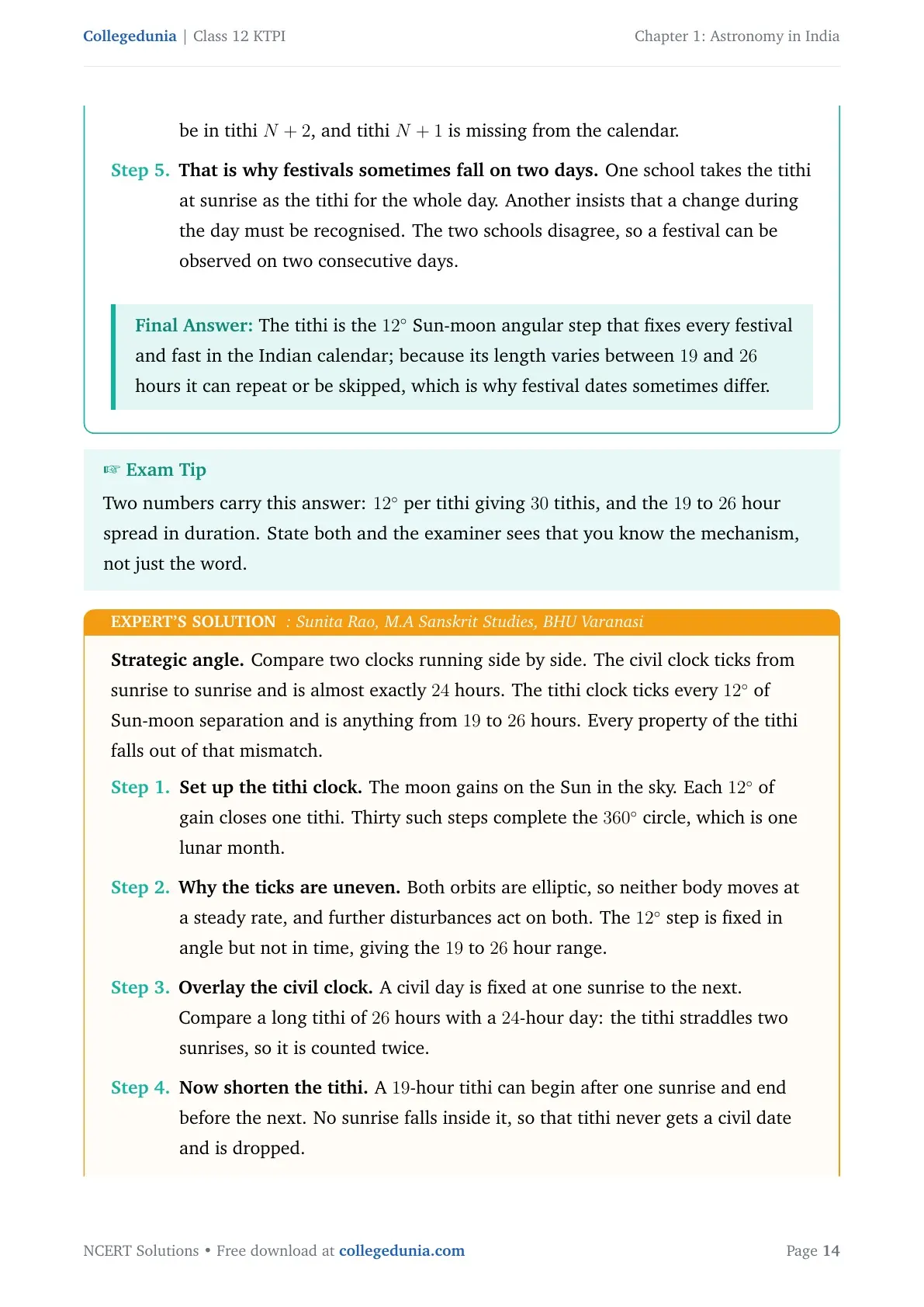
Question 5 is the one students get wrong most often, because a tithi is an angle and not a clock reading. One tithi ends and the next begins whenever the angle between the Sun and the moon, seen from the earth, changes by 12 degrees. A full circle is 360 degrees, so 360 divided by 12 gives 30 tithis in one lunar month.
- It fixes the religious and social calendar. Festivals, fasting days and special worships are all decided by the phases of the moon, and the tithi is the unit those phases are counted in.
- It does not depend on sunrise. A tithi can change at any moment of the day. The civil day, by contrast, runs from one sunrise to the next.
- Its length varies. Because the orbits are elliptic and orbital speed changes, a tithi can last anywhere from 19 to 26 hours.
- So a tithi can repeat or vanish. A long tithi can cover two sunrises and appear twice. A short one can be skipped by sunrise altogether and go missing from the calendar.
That uneven length is exactly why the same festival is sometimes marked on two different days. One school takes the tithi at sunrise as the tithi for the whole day. Another insists that a change during the day must be counted.
Radio Astronomy in India: NCRA Pune, the GMRT at Khodad, Ooty and Gauribidanur
Question 8 is a list question, but a bare list scores poorly. Pair every institution with the telescope it runs and the place that telescope stands in. Answer in that order and the list writes itself.
| Institution | Telescope | Facts worth quoting |
|---|---|---|
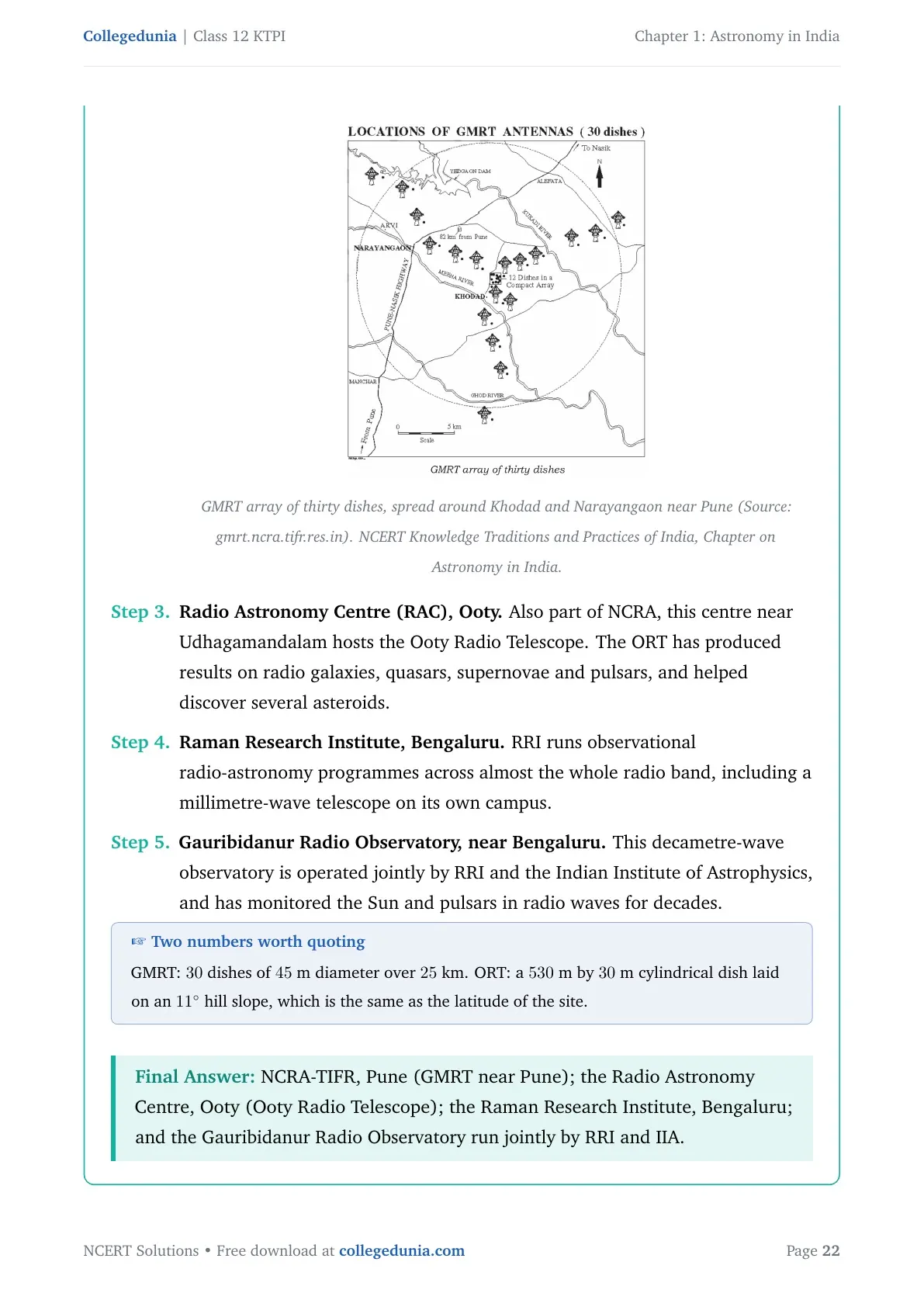
| NCRA-TIFR, Pune | Giant Metrewave Radio Telescope at Khodad | 30 steerable dishes, each 45 m across, in a Y shaped array over about 25 km. Routine work began in 2000. It found the galaxy supercluster named Saraswati. |
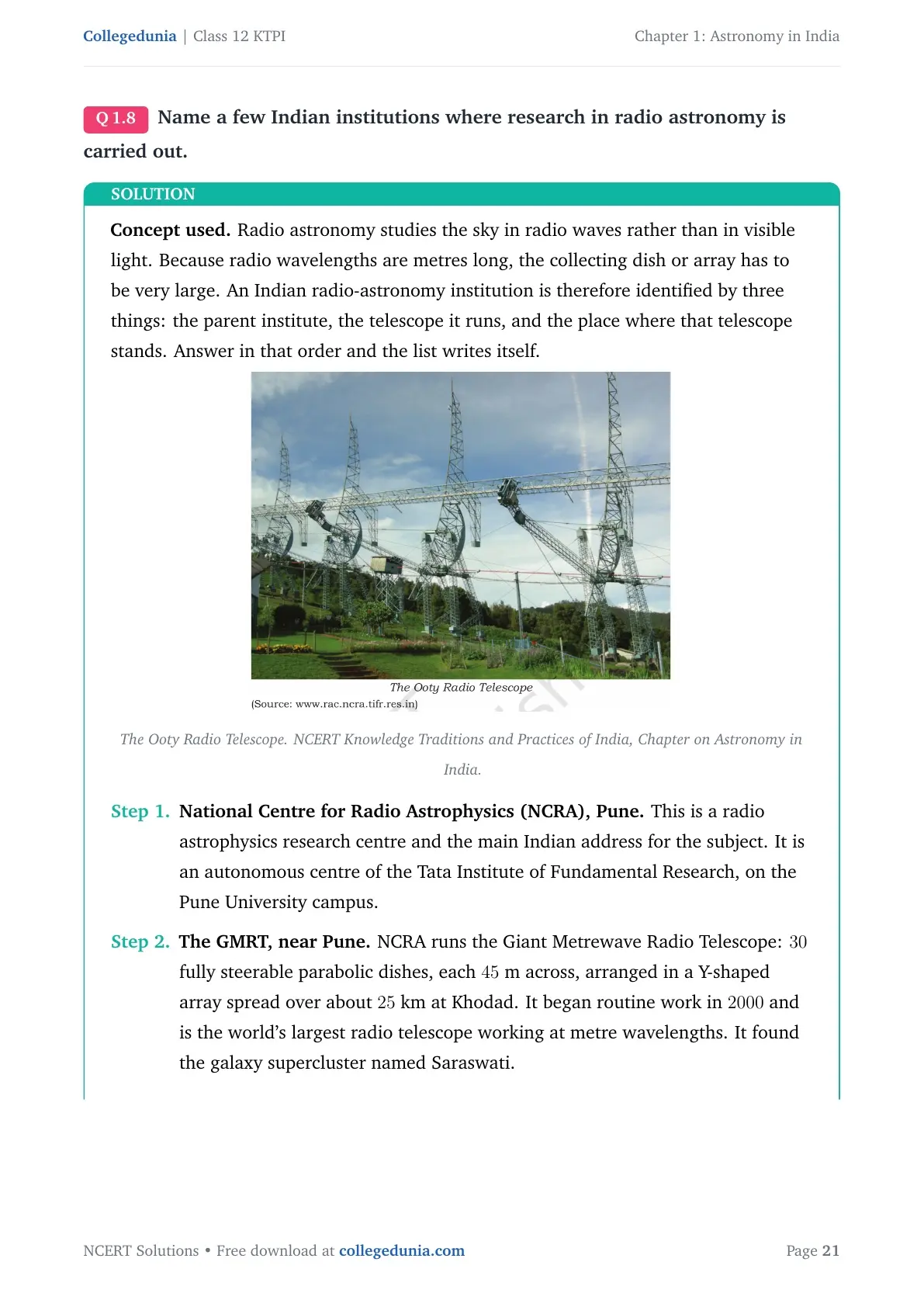
| Radio Astronomy Centre, Ooty | Ooty Radio Telescope | A cylindrical dish 530 m by 30 m laid on a hill slope of 11 degrees, matching the latitude of the site. Results on radio galaxies, quasars, supernovae and pulsars. |
| Raman Research Institute, Bengaluru | Millimetre wave telescope on campus | Runs observational programmes across almost the whole radio band. |
| Gauribidanur Radio Observatory | Decametre wave array | Operated jointly by the Raman Research Institute and the Indian Institute of Astrophysics. Long running solar and pulsar monitoring. |
NCRA is an autonomous centre of the Tata Institute of Fundamental Research, on the Pune University campus. Writing "NCRA, Pune" alone is a weak answer. Writing "NCRA, Pune, which runs the GMRT at Khodad" shows you know the chapter.
Large Optical Telescopes in India from Devasthal near Nainital to Hanle and Kavalur
Question 9 asks for locations. Each site was picked for a reason: height, darkness, dry air or steady daytime air. Add the reason and a 2 mark answer becomes a 4 mark answer.
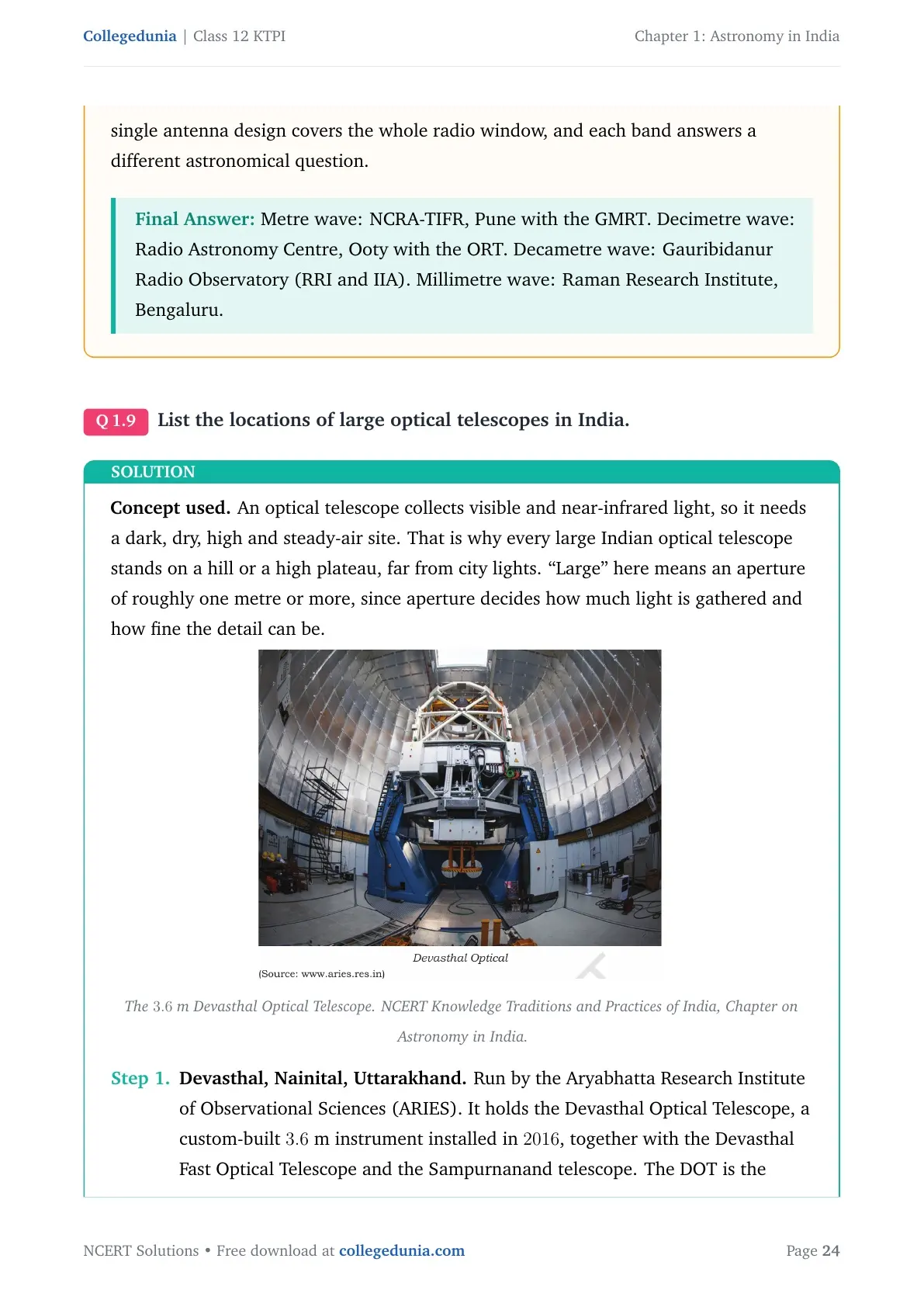
- Devasthal, near Nainital. The 3.6 m Devasthal Optical Telescope, the largest optical telescope in India.
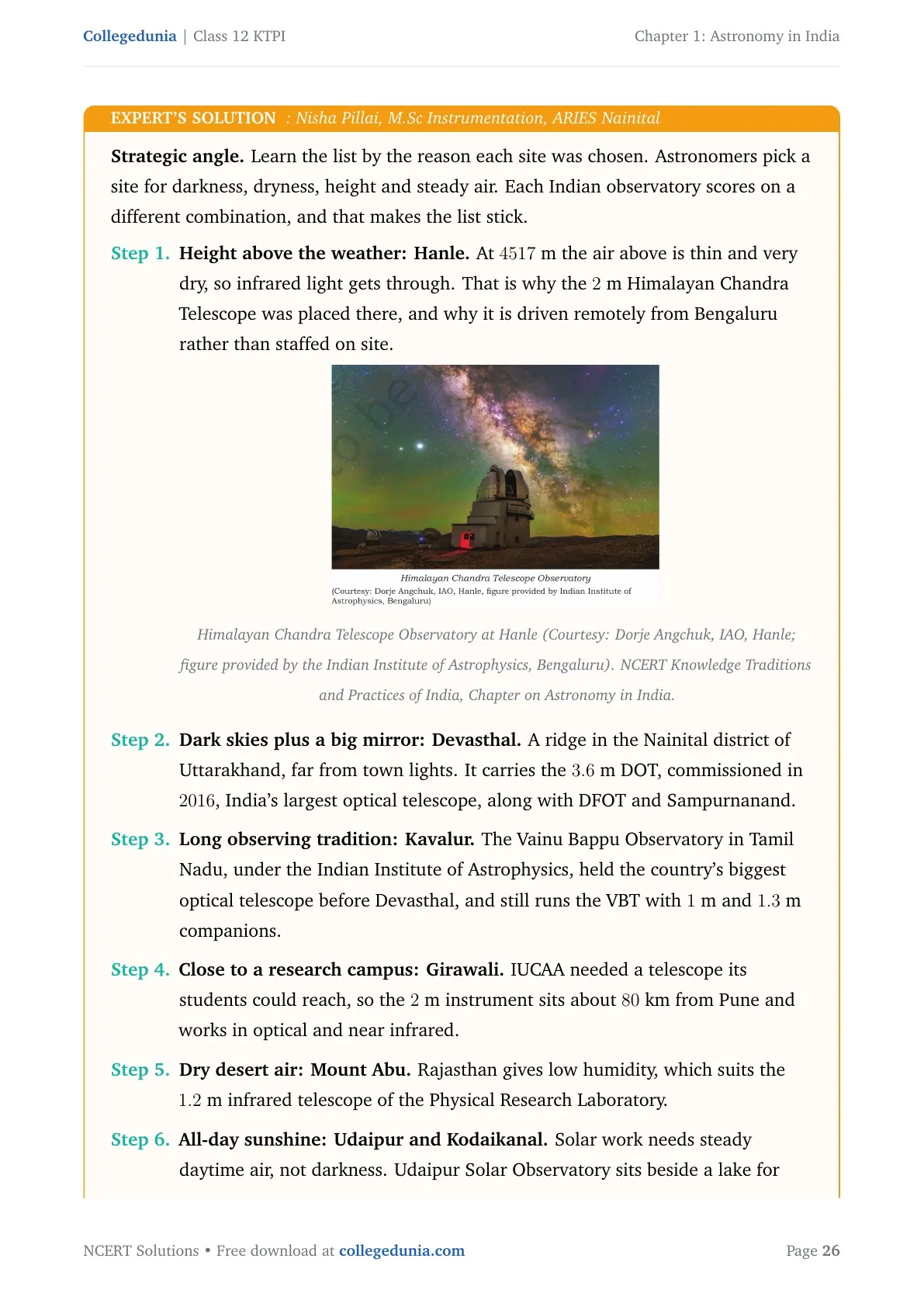
- Hanle, Ladakh. The 2 m Himalayan Chandra Telescope, standing at about 4517 m, one of the highest observatory sites in the world.
- Kavalur, Tamil Nadu. The Vainu Bappu Telescope, run by the Indian Institute of Astrophysics.
- Girawali, near Pune. A 2 m telescope operated by IUCAA.
- Mount Abu, Rajasthan. A 1.2 m infrared telescope.
- Udaipur and Kodaikanal. Solar observatories, including a 50 cm solar telescope at Udaipur.
India also takes part in the Thirty Meter Telescope project and the Square Kilometre Array. Mentioning one of these at the end of the answer shows that the chapter's story continues into the present.
LIGO, Gravitational Waves and What LIGO-India at Hingoli Will Add
Question 10 wants the full form and then the importance. LIGO stands for Laser Interferometer Gravitational-Wave Observatory. A gravitational wave is a ripple in space itself, sent out when very heavy objects such as black holes or neutron stars spiral into each other. Einstein predicted them.
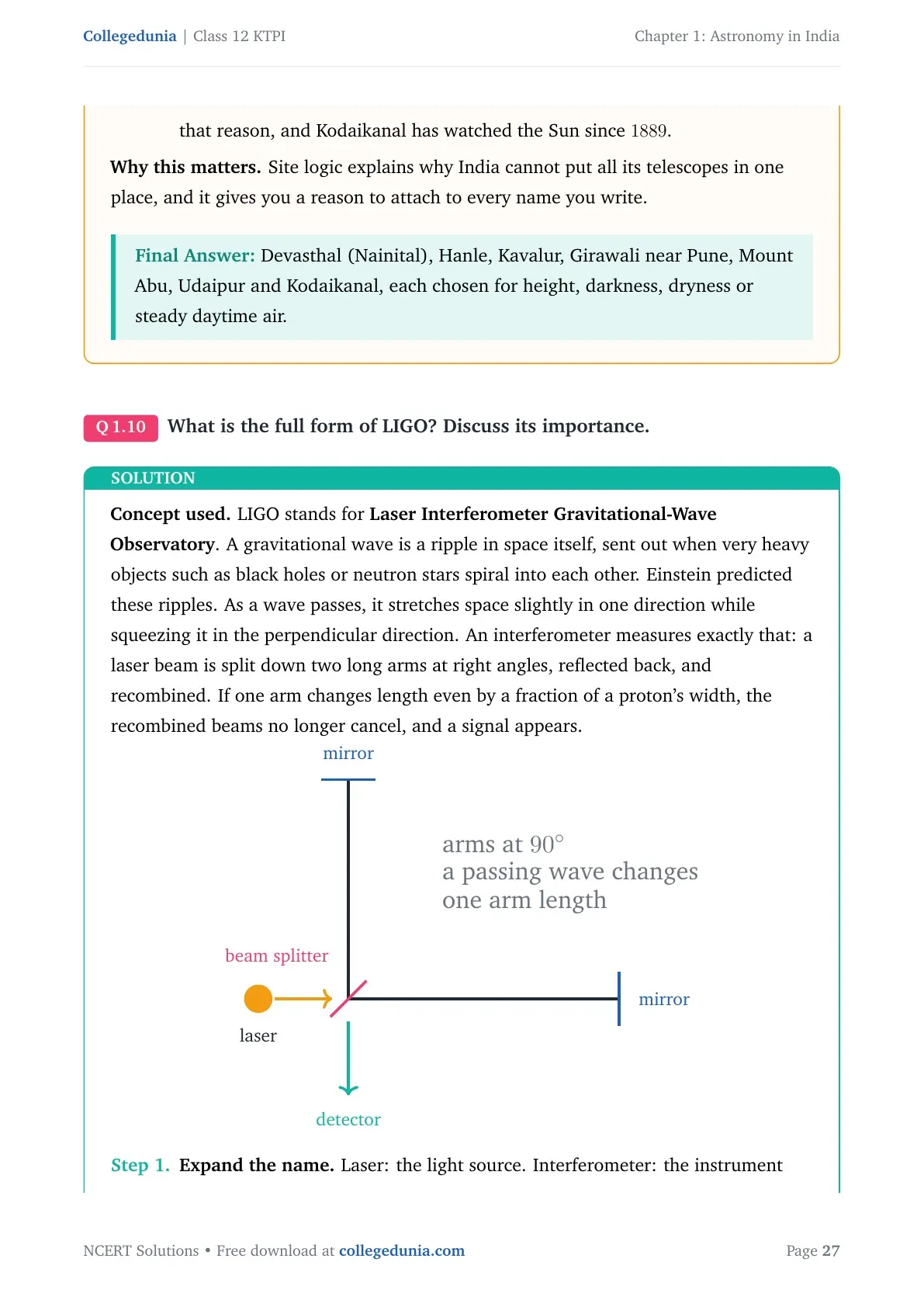
- How the instrument works. A laser beam is split down two long arms set at right angles, reflected back, and recombined. A passing wave stretches one arm and squeezes the other, so the recombined beams no longer cancel and a signal appears.
- How small the change is. The change in a kilometre long arm is smaller than the width of a proton.
- Why it matters. Every earlier telescope collected some form of light, whether visible, radio or gamma. Gravitational waves are not light at all, so LIGO opens a completely new channel of information about the universe.
- India's part. Indian scientists shared in the 2016 announcement of the first detection. LIGO-India is being built at Aundha Nagnath in Hingoli district, Maharashtra, and a third widely separated detector will help pinpoint where each signal comes from.
Three Short Questions: Astronomy as the Study of the Past, Jai Singh's City and the Matching Set
Questions 11 to 13 are quick marks if you know the exact wording the book uses. Question 11 asks you to comment on the claim that astronomy is the study of the past.
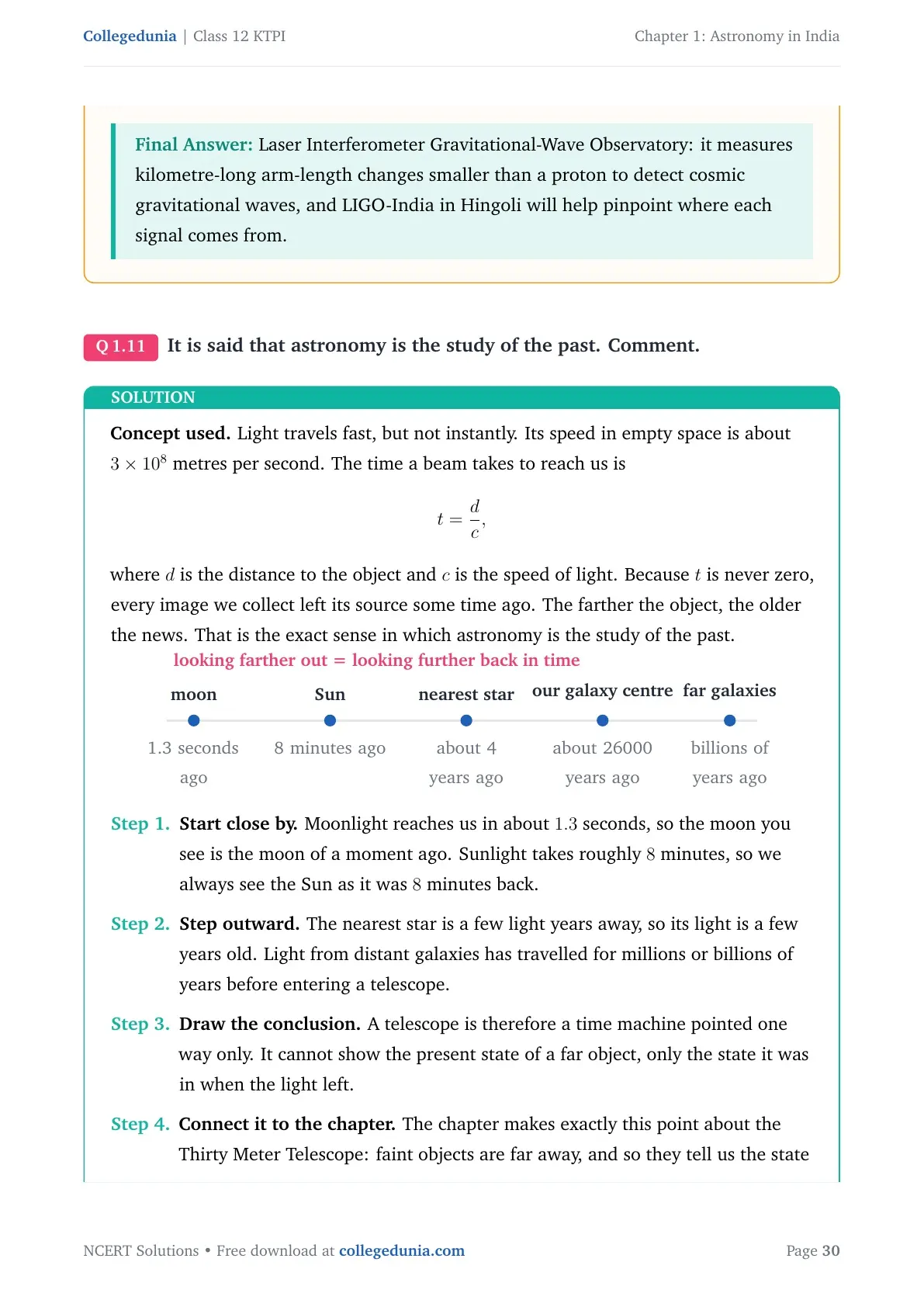
- The claim is correct, in two senses. Light takes time to arrive, so every observation shows an object as it was, and the farther the object the older the view.
- The second sense. Old Indian sky records, such as the position of a star or an eclipse note, let scholars date ancient texts.
- Add the qualification. The purpose of that study is prediction, so the claim is right but incomplete. This one line lifts the answer.
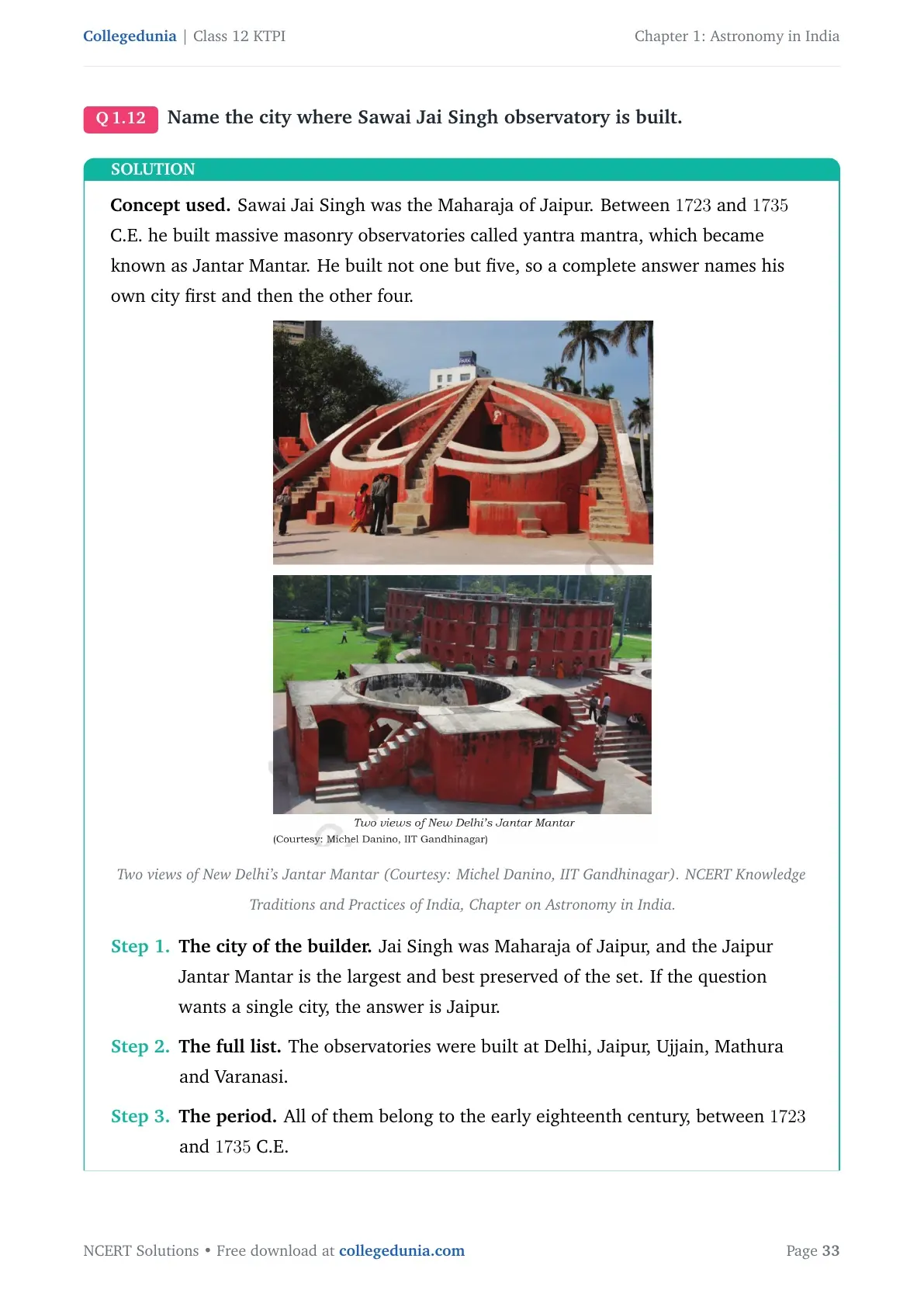
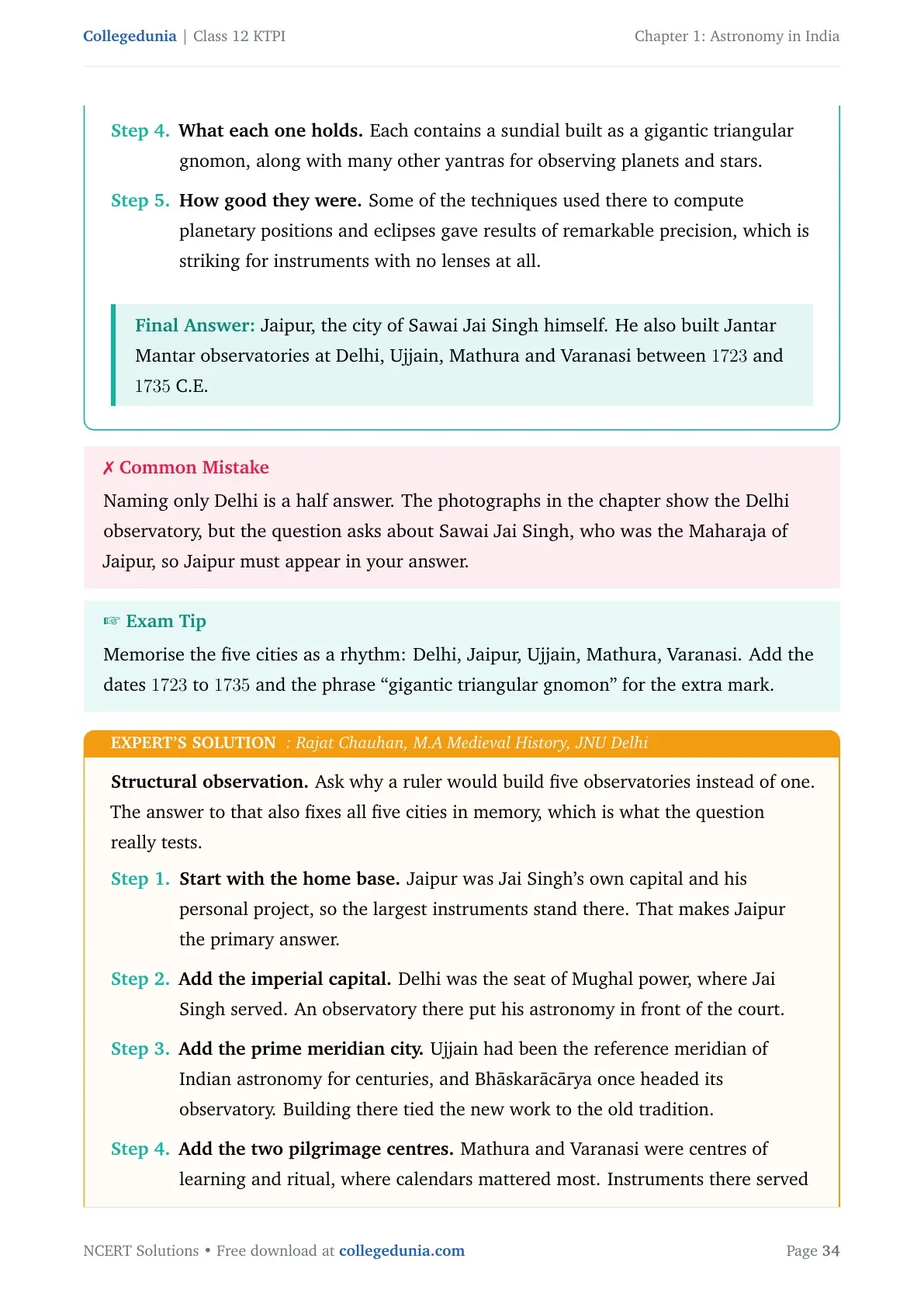
Question 12 asks the city of the Sawai Jai Singh observatory. The answer is Jaipur, his own capital. He also built Jantar Mantar observatories at Delhi, Ujjain, Mathura and Varanasi, all between 1723 and 1735 C.E. Question 13 is a matching set, and the seven pairs are fixed.
| Column A | Column B |
|---|---|
| Suryasiddhanta | Varahamihira |
| Lunar Year | 354 days |
| Nakshatras | Moon |
| Nilakantha | Heliocentric solar system |
| Rasi | Ecliptic |
| GONG | Udaipur |
| Jai Singh | Jantar Mantar observatories |
Sawai Jai Singh's Jantar Mantar Instruments and How to Plan the Four Project Ideas
Project Idea 1 asks you to study the main instruments of a Jantar Mantar. Build the whole project around one principle: fixed geometry aligned to the earth's axis, read at giant scale. Jai Singh could not buy finer brass instruments, so he built bigger ones in stone.
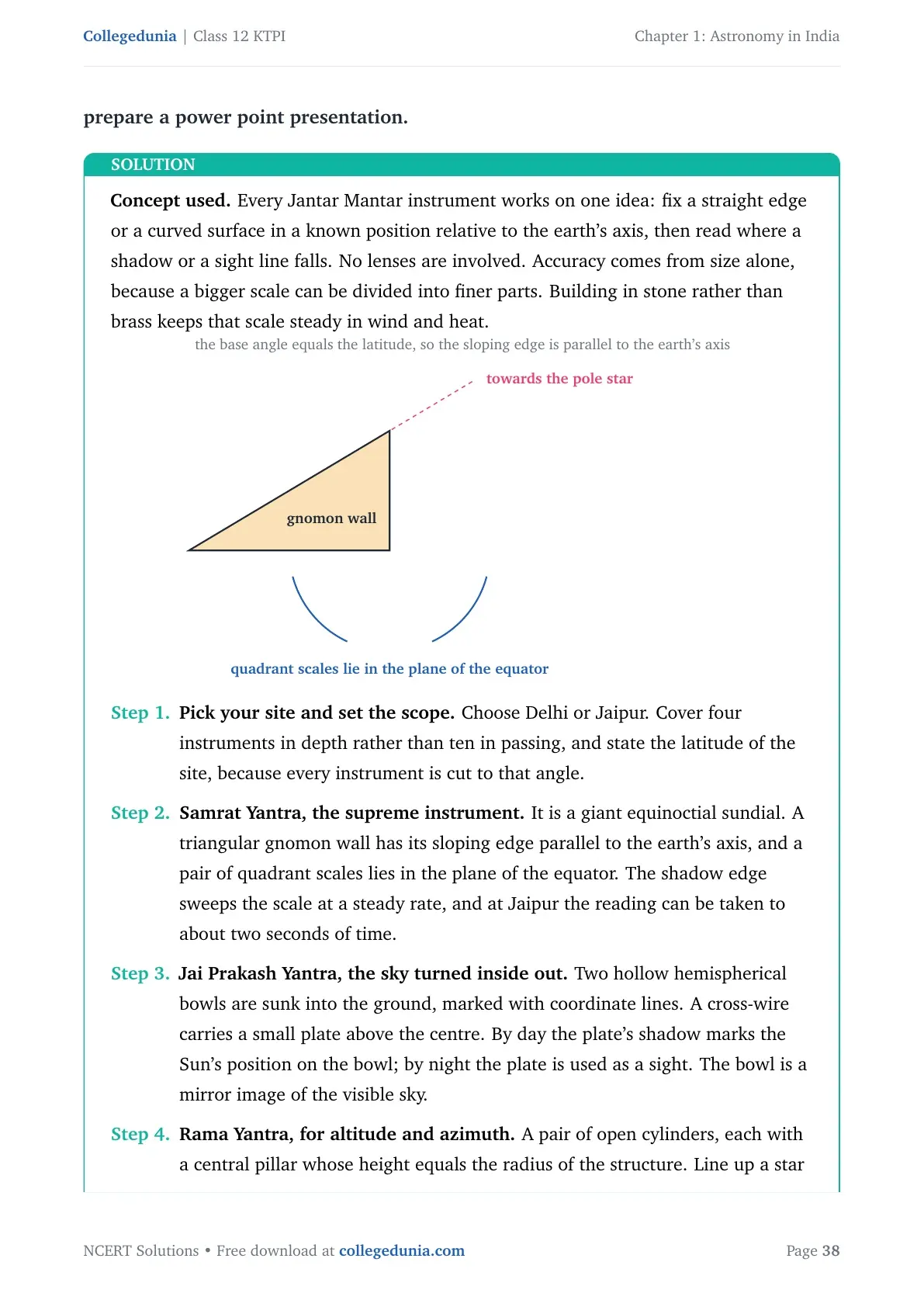
- Samrat Yantra. A giant sundial. Its shadow casting edge lies parallel to the earth's axis, and the quadrant scales lie in the plane of the equator. At Jaipur the reading can be taken to about two seconds of time.
- Jai Prakash Yantra. Two hollow hemispherical bowls sunk into the ground and marked with coordinate lines. A cross wire above the centre casts a shadow that marks the Sun's position directly on the sky map.
- Rama Yantra. A pair of cylindrical structures used to read the altitude and the bearing of a body.
- Mishra Yantra. A composite instrument at Delhi, used among other things to compare noon at different cities.
The remaining three projects are lighter, and each one has a safe shape you can plan in ten minutes.
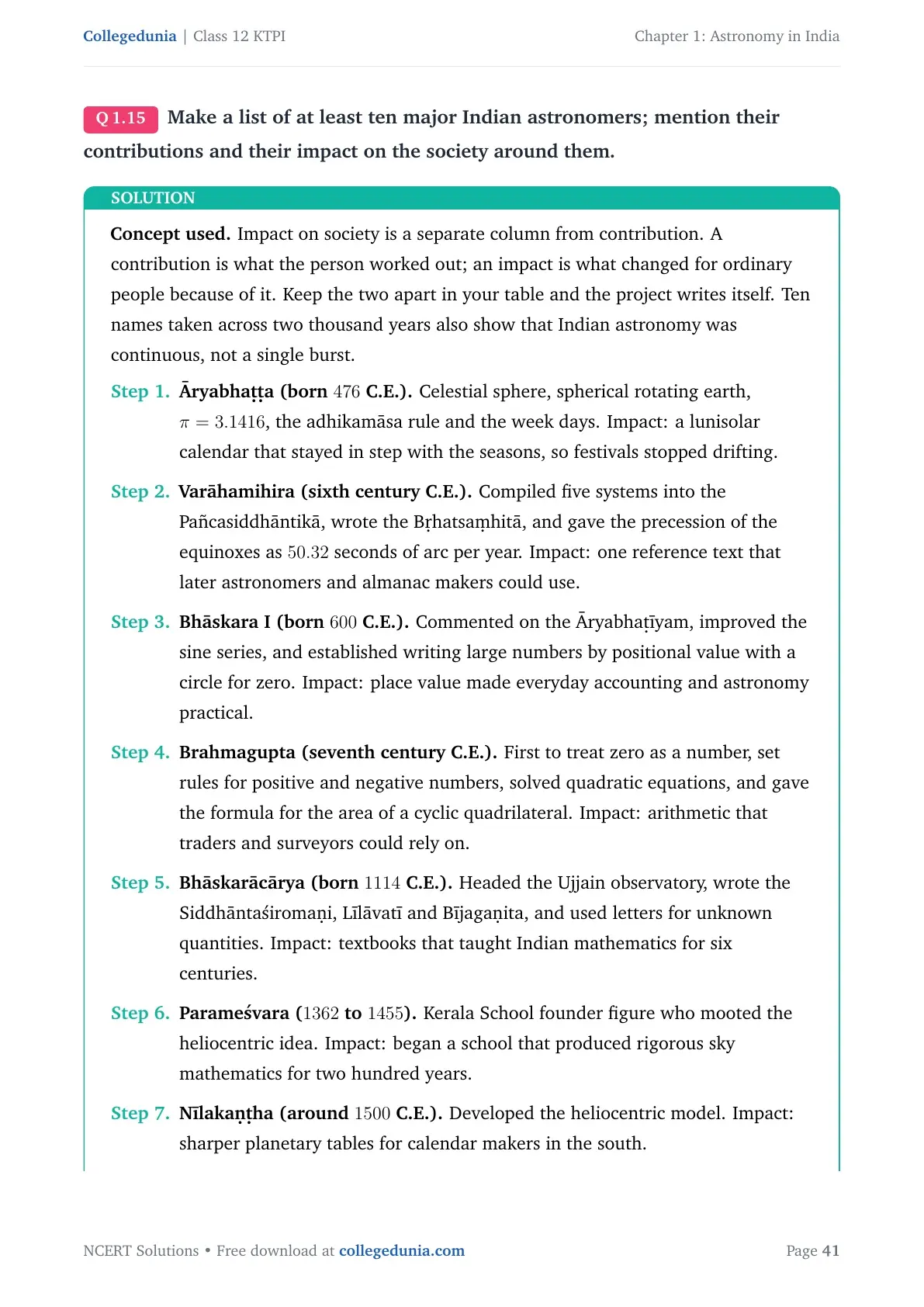
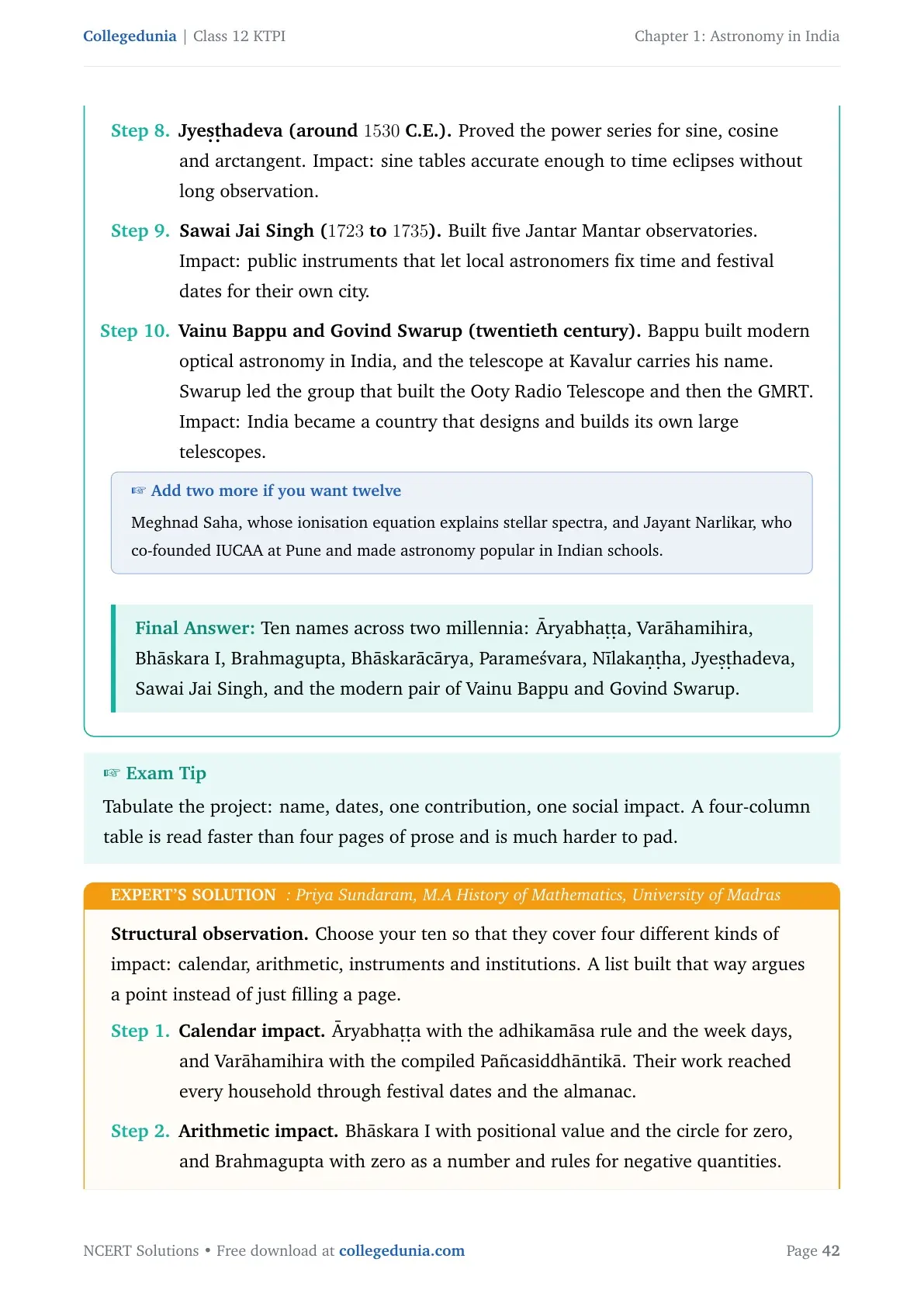
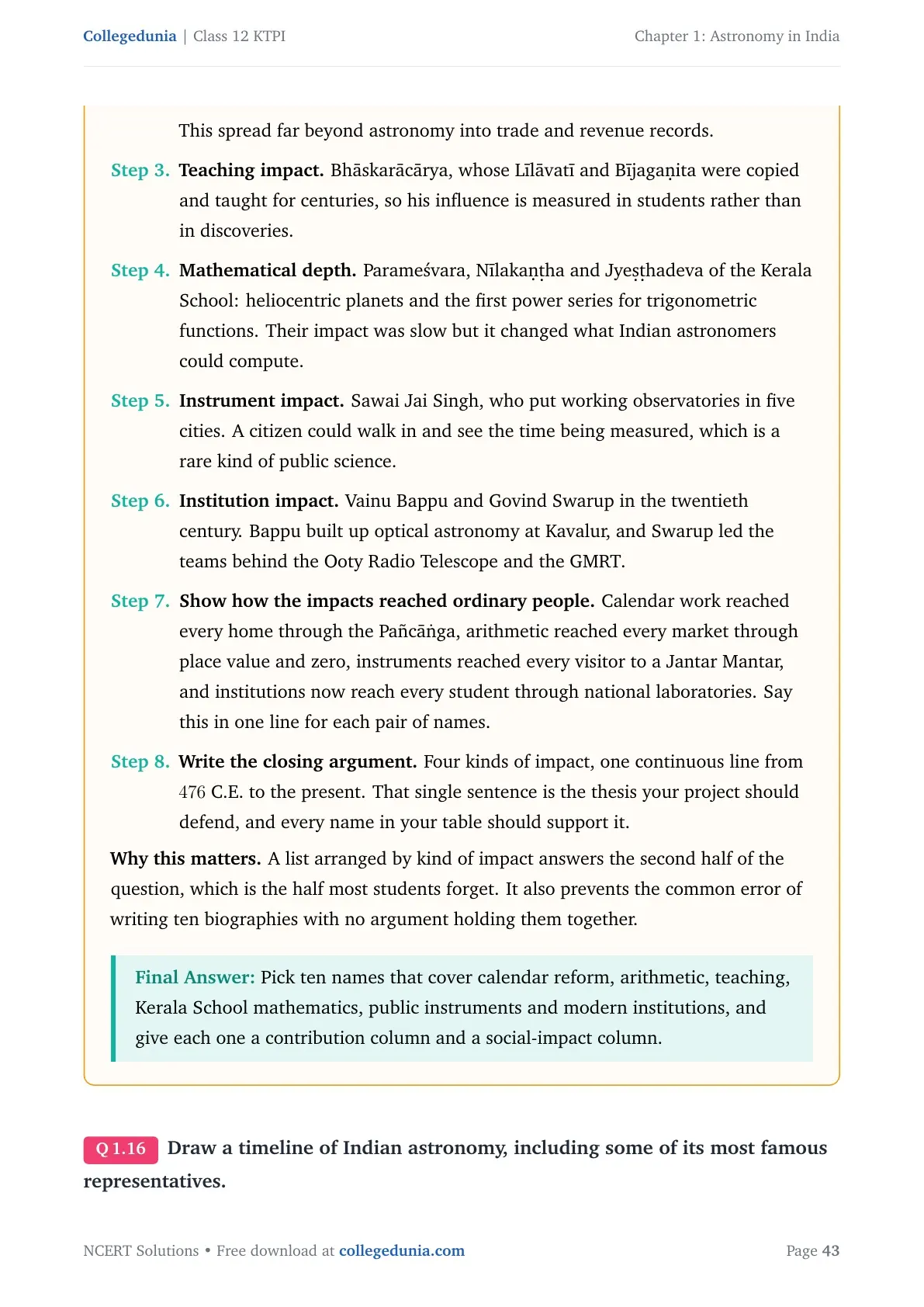
- Project 2. Ten Indian astronomers with a contribution column and a social impact column. The safe ten are Aryabhata, Varahamihira, Bhaskara I, Brahmagupta, Bhaskaracharya, Parameshvara, Nilakantha, Jyeshthadeva, Sawai Jai Singh, and the modern pair of Vainu Bappu and Govind Swarup.
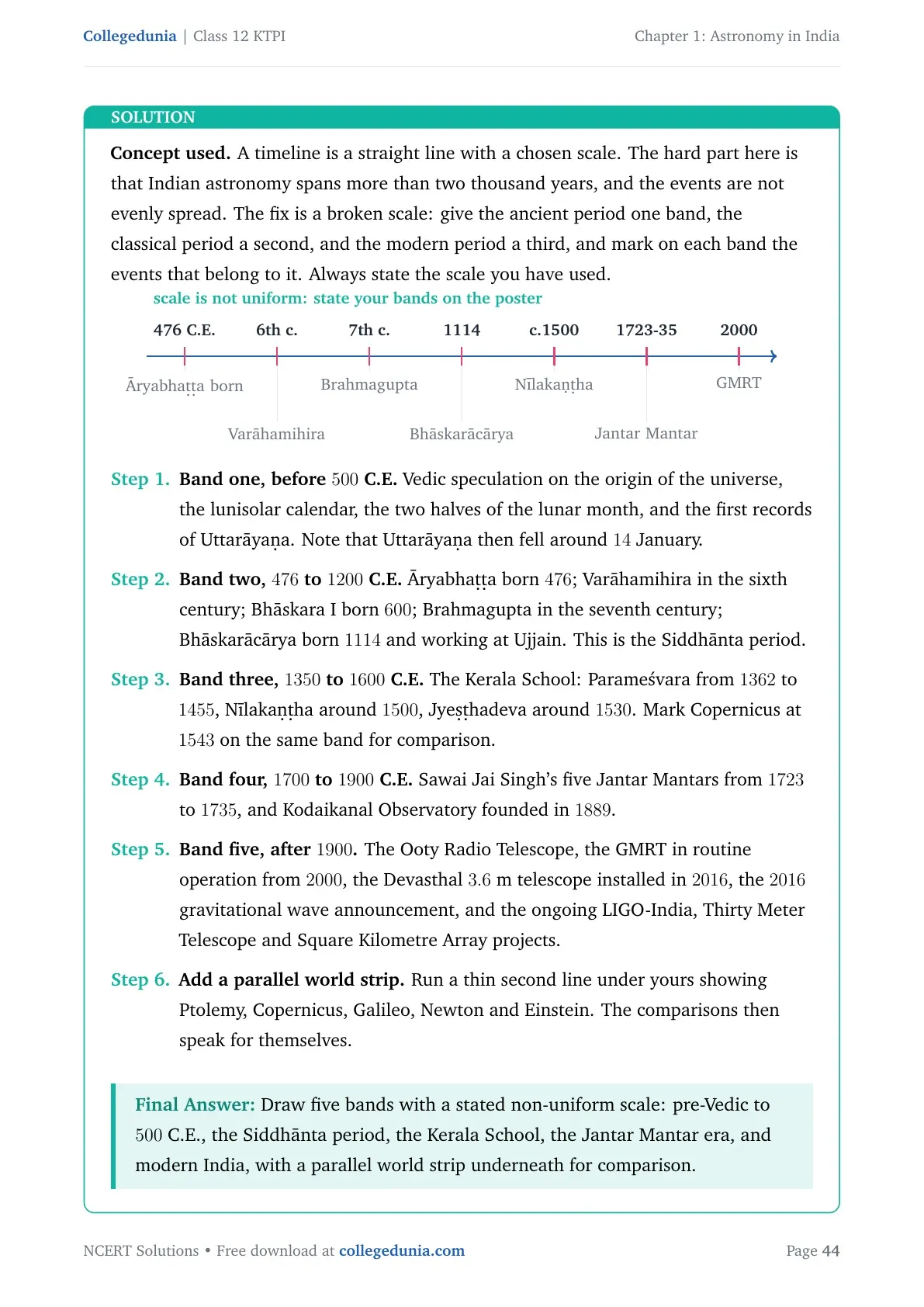
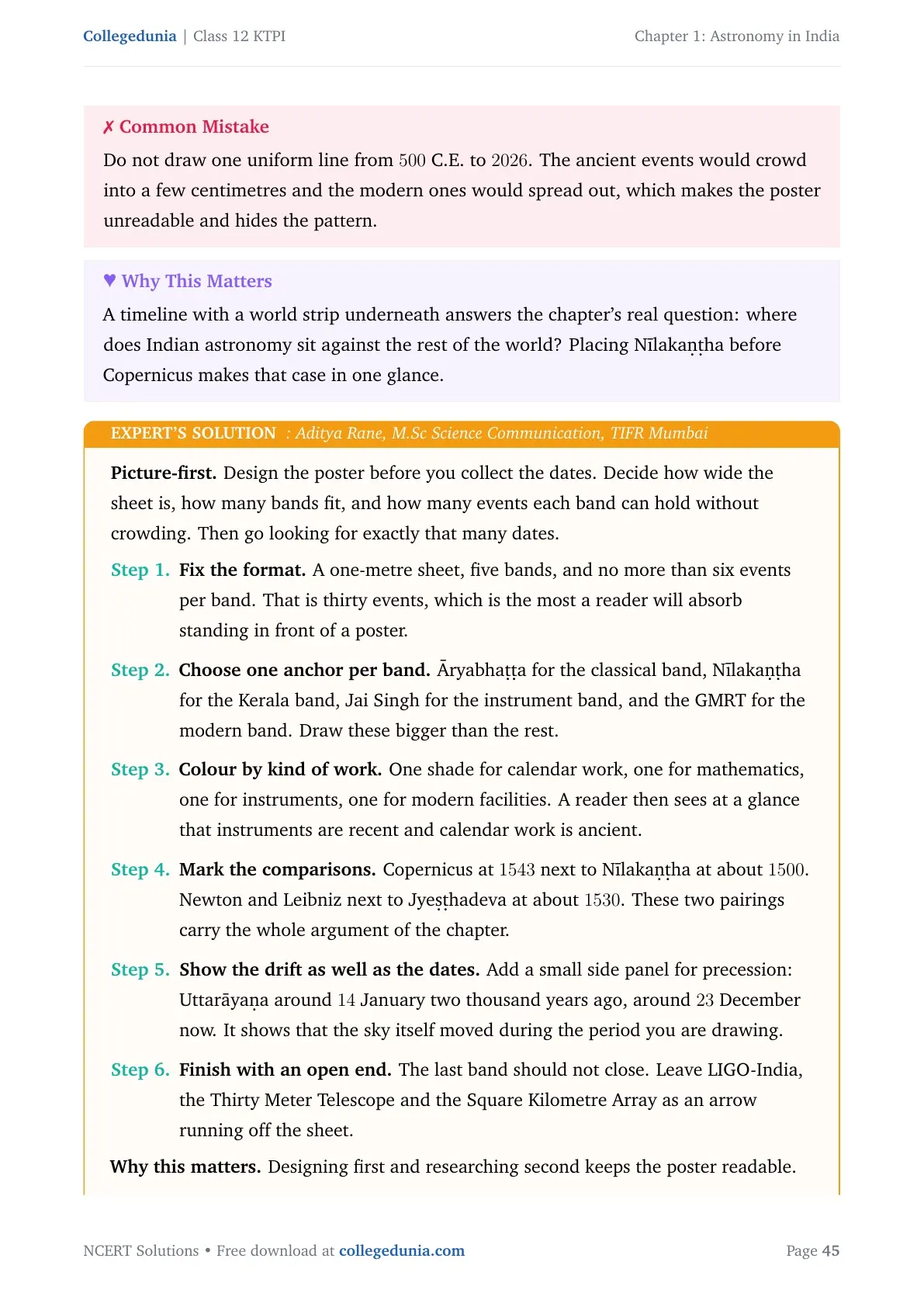
- Project 3. A timeline in five bands with a stated non uniform scale, and a parallel world strip underneath so Copernicus and Newton sit beside their Indian counterparts.
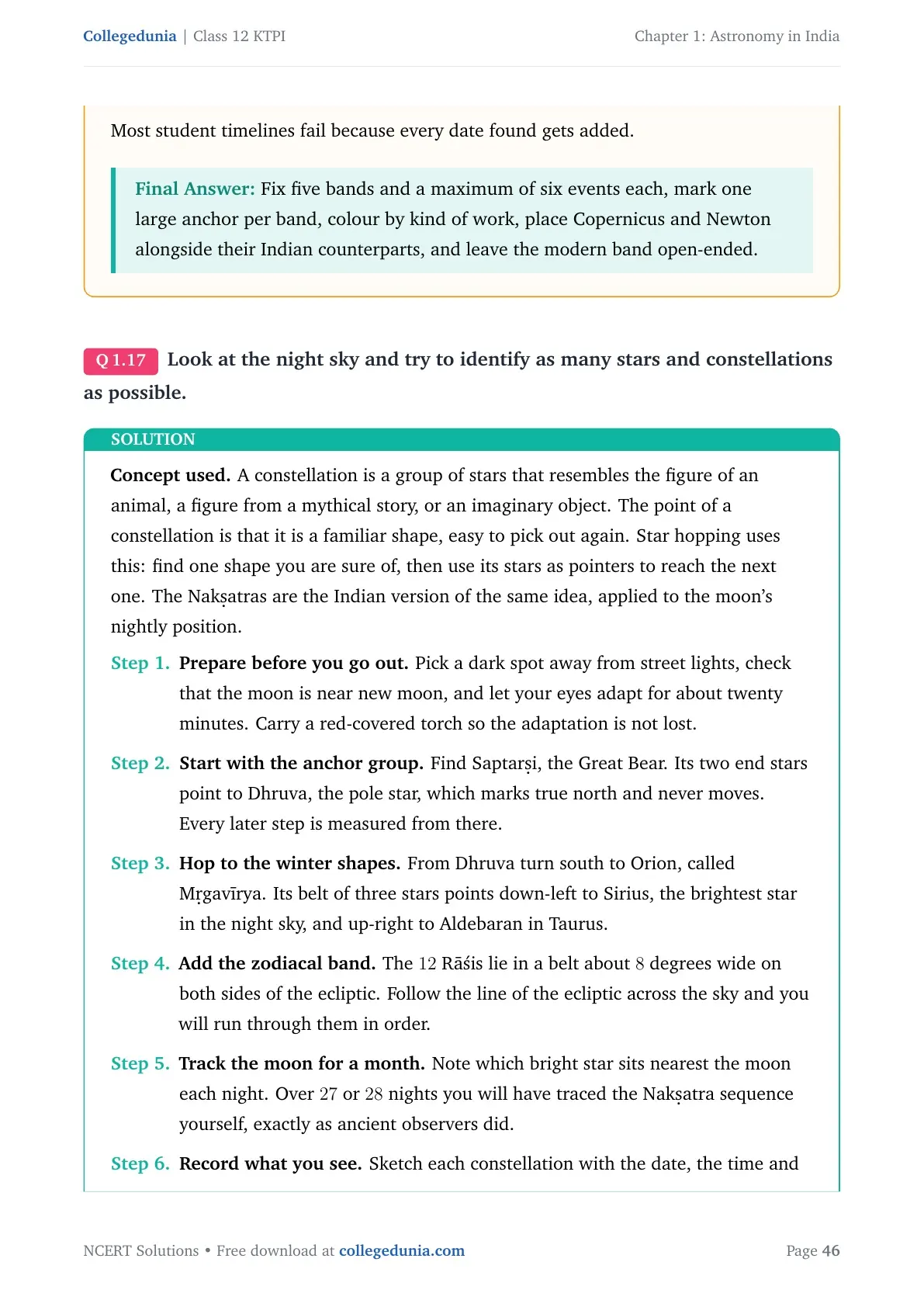
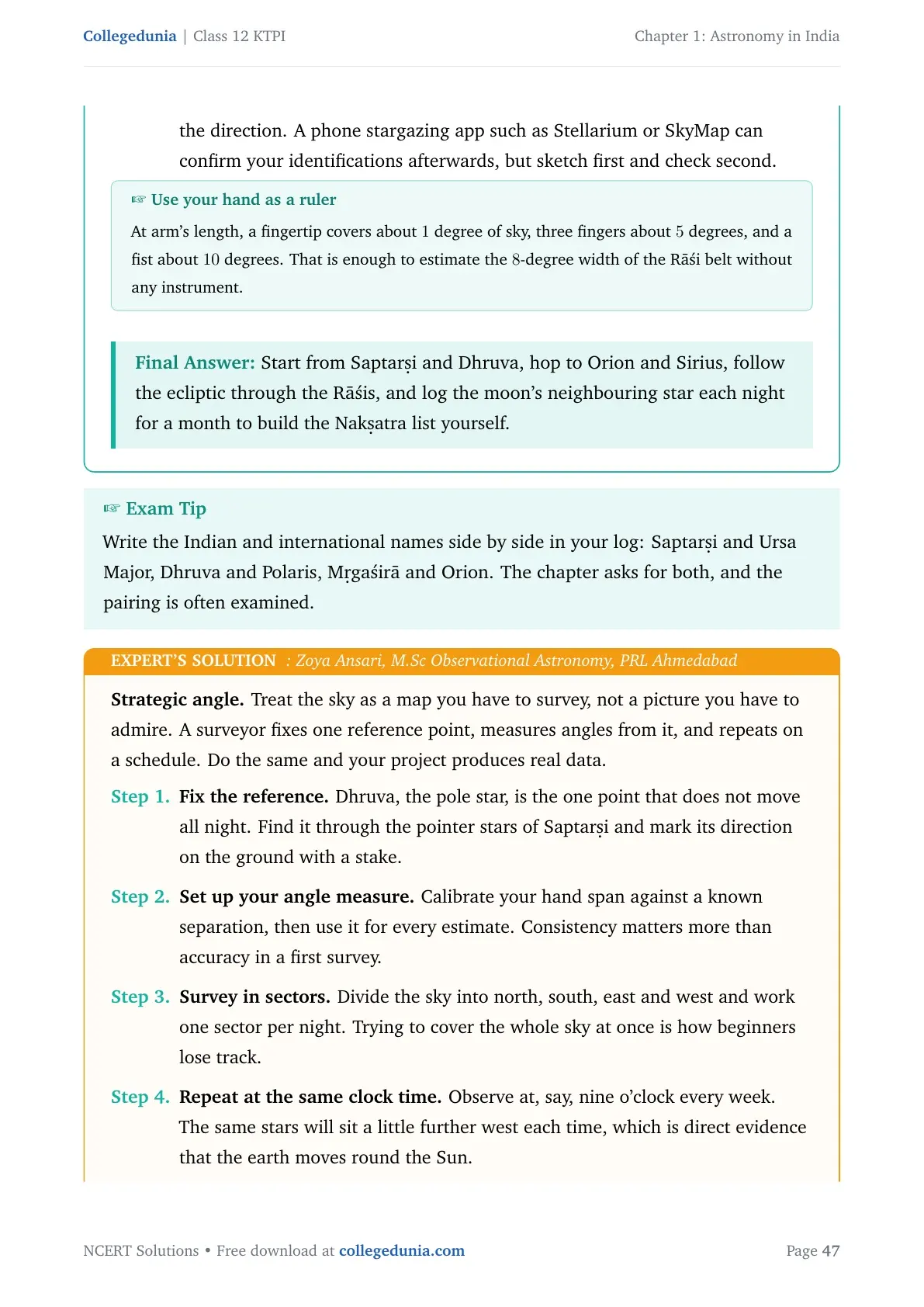
- Project 4. A night sky log. Start from Saptarshi and Dhruva, hop to Orion and Sirius, then note the star nearest the moon each night. Over 27 or 28 nights you will have traced the nakshatra sequence yourself.
Common Mistakes Students Make in the Astronomy in India Chapter
Avoid these six in the answer sheet:
- Answering the eclipse question with only the new moon and full moon condition. The tilt of about 5 degrees and the line of nodes are half the answer.
- Calling a tithi a day. It is a 12 degree angular step between the Sun and the moon, and it can run from 19 to 26 hours.
- Giving the Kerala School credit for calculus. The chapter says priority is denied because the series were built only for the functions the sky work needed.
- Swapping the eclipse order. Solar is Sun, moon, earth on a new moon day. Lunar is Sun, earth, moon on a full moon day.
- Naming institutions without their telescopes in Question 8. NCRA goes with the GMRT, the Radio Astronomy Centre goes with the Ooty Radio Telescope.
- Writing Rahu and Ketu as demons. The chapter is clear that they are the two nodes, which are geometrical points.
A quick fix for the numbers: put 476 C.E., 3.1416, 1500 C.E., 1543 C.E., 30 tithis, 12 degrees, 19 to 26 hours, 1723 to 1735, 3.6 m and 4517 m on one card and recite it before the paper.
Student Feedback on the Class 12 KTPI Astronomy in India Chapter
What 11,540 Class 12 students told us about the Astronomy in India chapter
Collected in a Collegedunia poll run ahead of the 2026-27 board session:
- 64% named the tithi question as the hardest part of the chapter, mostly because they had learnt a tithi as a day and not as an angle.
- 8 out of 10 students said the radio astronomy and optical telescope lists were the easiest marks in the whole module.
- 47% lost marks on the eclipse question by leaving out the line of nodes.
- Students who drew a small tilted orbit sketch beside the eclipse answer reported scoring a full mark more than those who wrote prose alone.
Source: 2026-27 Class 12 KTPI student poll. Sample of 11,540 students from CBSE schools across 14 states.
Where Astronomy in India Sits in the Class 12 KTPI Course and Paper
Astronomy in India is the opening chapter of the Class 12 Knowledge Traditions and Practices of India course. It is one of the most quotable chapters in the book, because it is full of names, places and years. Treat the spread below as a planning guide, not as an official blueprint.
| Chapter | Topic | Indicative weight |
|---|---|---|
| Chapter 1 | Astronomy in India | High |
| Chapter 2 | Chemistry in India | Medium |
| Chapter 3 | Mathematics in India | High |
| Chapter 5 | Medicine in India | High |
| Chapter 7 | Metallurgy in India | Medium |
| Chapter 10 | Indian Philosophical Systems | Medium |
Inside this chapter, the heaviest sub-topics are the development of Indian astronomy, Aryabhata's contribution and the Kerala School. All three attract long answers. The eclipse and tithi questions usually appear as reasoning questions of 3 to 4 marks.
How to Revise Astronomy in India in a Three Block Plan
This chapter is fact heavy but short. About three hours of focused work makes it exam ready, and the order printed in the book gives you the sequence for free.
- Block 1, 60 minutes. Read the calendar section and the eclipse section. Then write the tithi answer and the eclipse answer from memory, with a sketch of the tilted lunar orbit in both.
- Block 2, 60 minutes. Cover the astronomers: Aryabhata, Varahamihira, the Siddhantic writers and the Kerala School. Write the six point Aryabhata list and the four point Kerala School list without looking.
- Block 3, 60 minutes. Cover Jantar Mantar and modern India. Write out the institution and telescope pairs, the optical telescope sites, and the LIGO answer, then attempt the matching set.
Repeat Block 3 a week before the paper. Students who wrote the institution and telescope pairs by hand twice reported the fastest recall in the modern astronomy questions.
How the Astronomy in India Solutions Work with the Chapter PDF and the Solved Question Set
The solutions give you model answers. They do not give you the full chapter text or the figures the book prints. Those sit on the other Collegedunia pages for the same chapter, and using them together is faster than reading any one of them alone.
| Resource | What it adds beyond these solutions | Link |
|---|---|---|
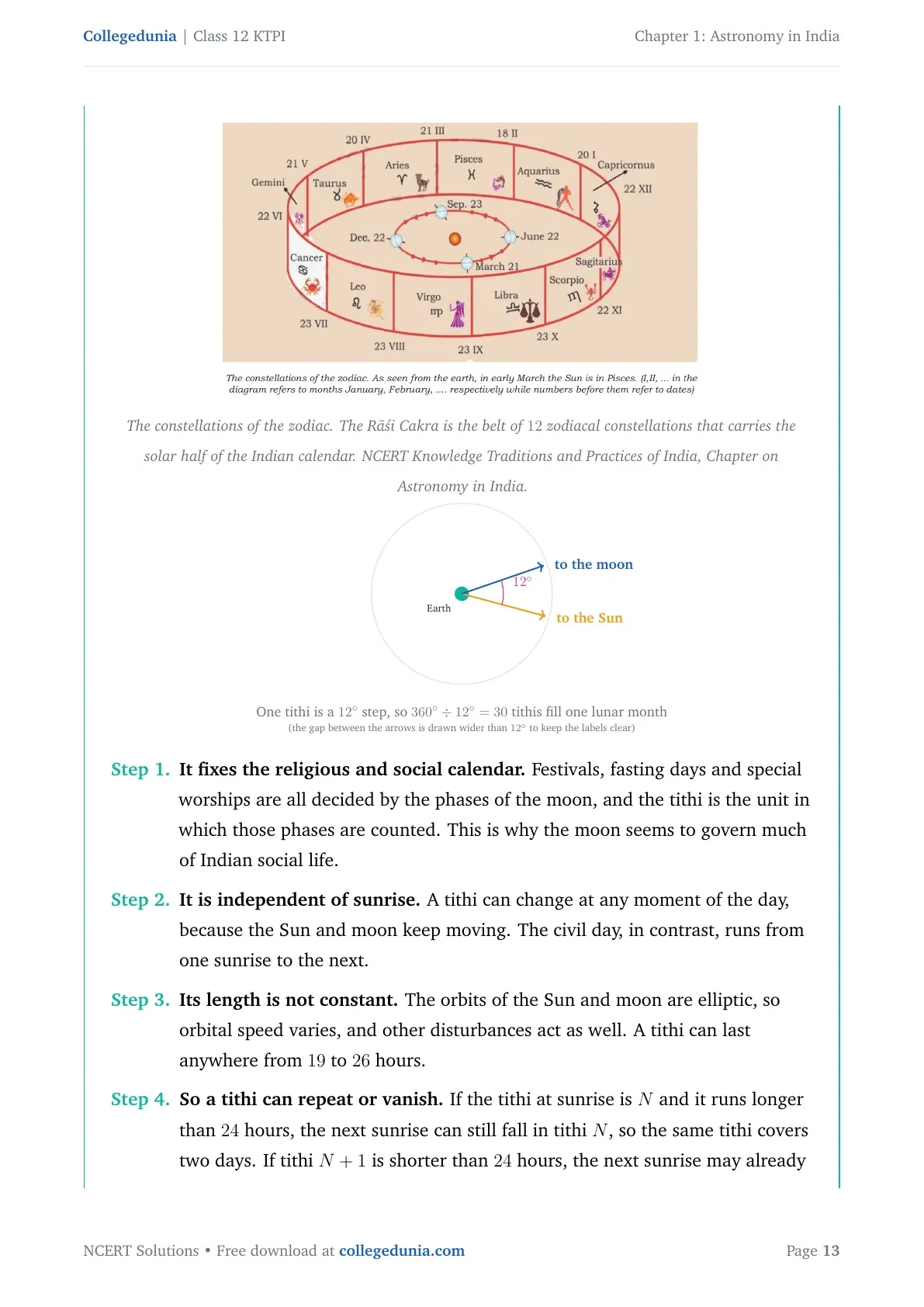
| Chapter PDF | The full chapter text with the zodiac figure, the line of nodes figure, the Ooty Radio Telescope photograph and the GMRT array map | Astronomy in India Class 12 Chapter PDF |
| Solved question set | All 13 Exercise questions and all 4 Project Ideas written out as complete answers, each with a Solution and an Expert Solution | Astronomy in India Class 12 Solved Questions |
| Next chapter | The chapter that follows this one and reuses the same period wise structure you learn here | Chemistry in India Class 12 NCERT Solutions |
Also Check: the Mathematics in India Class 12 NCERT Solutions, which carries the sine table and infinite series story further than the Astronomy chapter does.
All 10 Chapters of Class 12 KTPI with NCERT Solutions
The Class 12 Knowledge Traditions and Practices of India course runs across ten chapters. Every link below opens the solved question set for that chapter, written for the 2026-27 session.
| Chapter | NCERT Solutions |
|---|---|
| Chapter 1 | Astronomy in India Class 12 NCERT Solutions |
| Chapter 2 | Chemistry in India Class 12 NCERT Solutions |
| Chapter 3 | Mathematics in India Class 12 NCERT Solutions |
| Chapter 4 | Life Sciences Class 12 NCERT Solutions |
| Chapter 5 | Medicine in India Class 12 NCERT Solutions |
| Chapter 6 | Agriculture Class 12 NCERT Solutions |
| Chapter 7 | Metallurgy in India Class 12 NCERT Solutions |
| Chapter 8 | Architecture, Engineering and Technology Class 12 NCERT Solutions |
| Chapter 9 | Indian Languages and Grammar Class 12 NCERT Solutions |
| Chapter 10 | Indian Philosophical Systems Class 12 NCERT Solutions |
Astronomy in India Class 12 KTPI Chapter 1 NCERT Solutions FAQs
Questions Class 12 Students Ask Most About the Astronomy in India Chapter
Ques. How many questions are there in Class 12 KTPI Chapter 1 Astronomy in India?
Ans. There are 17 in total. The Exercise block has 13 questions and the Project Ideas block at the end has 4. All 17 are solved on this page for the 2026-27 session, and the downloadable PDF carries the same answers with the chapter figures.
Ques. What is a tithi?
Ans. A tithi is a lunar date fixed by the angle between the Sun and the moon as seen from the earth. One tithi ends and the next begins every time that angle changes by 12 degrees, so a lunar month holds 30 tithis. Because the orbits are elliptic, a tithi lasts anywhere from 19 to 26 hours, which is why the same festival is sometimes marked on two days.
Ques. What is the line of nodes?
Ans. The moon's orbital plane is tilted by about 5 degrees to the earth's orbital plane. The two planes cross along a single straight line called the line of nodes, and the two end points of that line are the nodes. An eclipse can happen only when the moon is at or very near a node. In Indian tradition the two nodes were named Rahu and Ketu, and the chapter is clear that these are geometrical points and not creatures.
Ques. What are nakshatras?
Ans. Nakshatras are the star groups the moon passes in front of as it moves through the sky, so the nakshatra is a moon based marker in the Indian calendar. They lie in a belt on either side of the ecliptic. In the matching exercise of Question 13, nakshatras pair with the moon, while rasi pairs with the ecliptic.
Ques. Why do eclipses occur only on a new moon or full moon day?
Ans. Two conditions must be met together. The Sun, earth and moon must be in a straight line, which happens only at new moon and full moon. The moon must also be at or near a node, because its orbit is tilted by about 5 degrees. Most new moons and full moons fall away from the nodes, which is why eclipses are much rarer than months.
Ques. What was Aryabhata's main contribution to astronomy?
Ans. He held that the earth is spherical and rotates on its own axis, and that this rotation causes the daily motion of the stars. He also gave standard units of time, arc and distance, the celestial sphere picture, the adhikamasa rule for keeping the lunar year in step with the solar year, the concept of week days, an alphabet based notation for large numbers, and the value of pi as 3.1416. He was born in 476 C.E. and wrote the Aryabhatiyam at the age of 23.
Ques. What did the Kerala School contribute to astronomy?
Ans. Two headline results. Parameshvara put forward a heliocentric idea and Nilakantha developed it around 1500 C.E., about forty years before Copernicus published in 1543 C.E. The school also found infinite series for sine, cosine and arctangent, and Jyeshthadeva supplied the proofs. That appears to be the first power series for a trigonometric function developed anywhere, about 100 years before calculus in Europe.
Ques. Which Indian institutions carry out radio astronomy research?
Ans. The National Centre for Radio Astrophysics at Pune, an autonomous centre of the Tata Institute of Fundamental Research, which runs the Giant Metrewave Radio Telescope at Khodad. The Radio Astronomy Centre at Ooty, which runs the Ooty Radio Telescope. The Raman Research Institute at Bengaluru. And the Gauribidanur Radio Observatory, run jointly by the Raman Research Institute and the Indian Institute of Astrophysics.
Ques. Where are the largest optical telescopes in India located?
Ans. The 3.6 m Devasthal Optical Telescope near Nainital is the largest. The 2 m Himalayan Chandra Telescope stands at Hanle in Ladakh at about 4517 m. The Vainu Bappu Telescope is at Kavalur, IUCAA runs a 2 m telescope at Girawali near Pune, and there is a 1.2 m infrared telescope at Mount Abu. Udaipur and Kodaikanal host solar observatories.
Ques. What is the full form of LIGO and why does it matter?
Ans. LIGO stands for Laser Interferometer Gravitational-Wave Observatory. It detects ripples in space sent out when black holes or neutron stars spiral into each other, by measuring a change in a kilometre long arm that is smaller than a proton. It matters because gravitational waves are not light at all, so they open a new channel of information about the universe. LIGO-India is being built at Aundha Nagnath in Hingoli district, Maharashtra.
Ques. In which cities did Sawai Jai Singh build his observatories?
Ans. Jaipur is his own city and the answer to Question 12. He also built Jantar Mantar observatories at Delhi, Ujjain, Mathura and Varanasi, all between 1723 and 1735 C.E. The main instruments include the Samrat Yantra, the Jai Prakash Yantra, the Rama Yantra and the Mishra Yantra.
Ques. Why is astronomy called the study of the past?
Ans. Light takes time to travel, so every object is seen as it was when the light left it, and the farther the object the older the view. There is a second sense as well. Ancient Indian sky records let scholars date old texts by matching the star or eclipse positions they describe. A complete answer adds that the purpose of all this study is prediction, so the claim is correct but incomplete.
Ques. Is Astronomy in India part of the 2026-27 Class 12 KTPI syllabus?
Ans. Yes. Astronomy in India is Chapter 1 of the Class 12 Knowledge Traditions and Practices of India course for the 2026-27 session. It covers the lunisolar calendar with tithi, nakshatra and rasi, eclipses and the line of nodes, the Siddhantic astronomers, the Kerala School, the Jantar Mantar observatories, and modern Indian astronomy from the GMRT to LIGO-India.



Comments