




The NCERT Solutions for Class 12 KTPI Chapter 4 Life Sciences cover all 7 Exercise questions and all 8 Activities and Projects, according to the latest 2026-27 syllabus. Every answer is built on the same framework the chapter uses from start to finish: Ayurveda as the science of life, its three divisions for humans, animals and plants, and the tridosa theory of Vata, Pitta and Kapha.
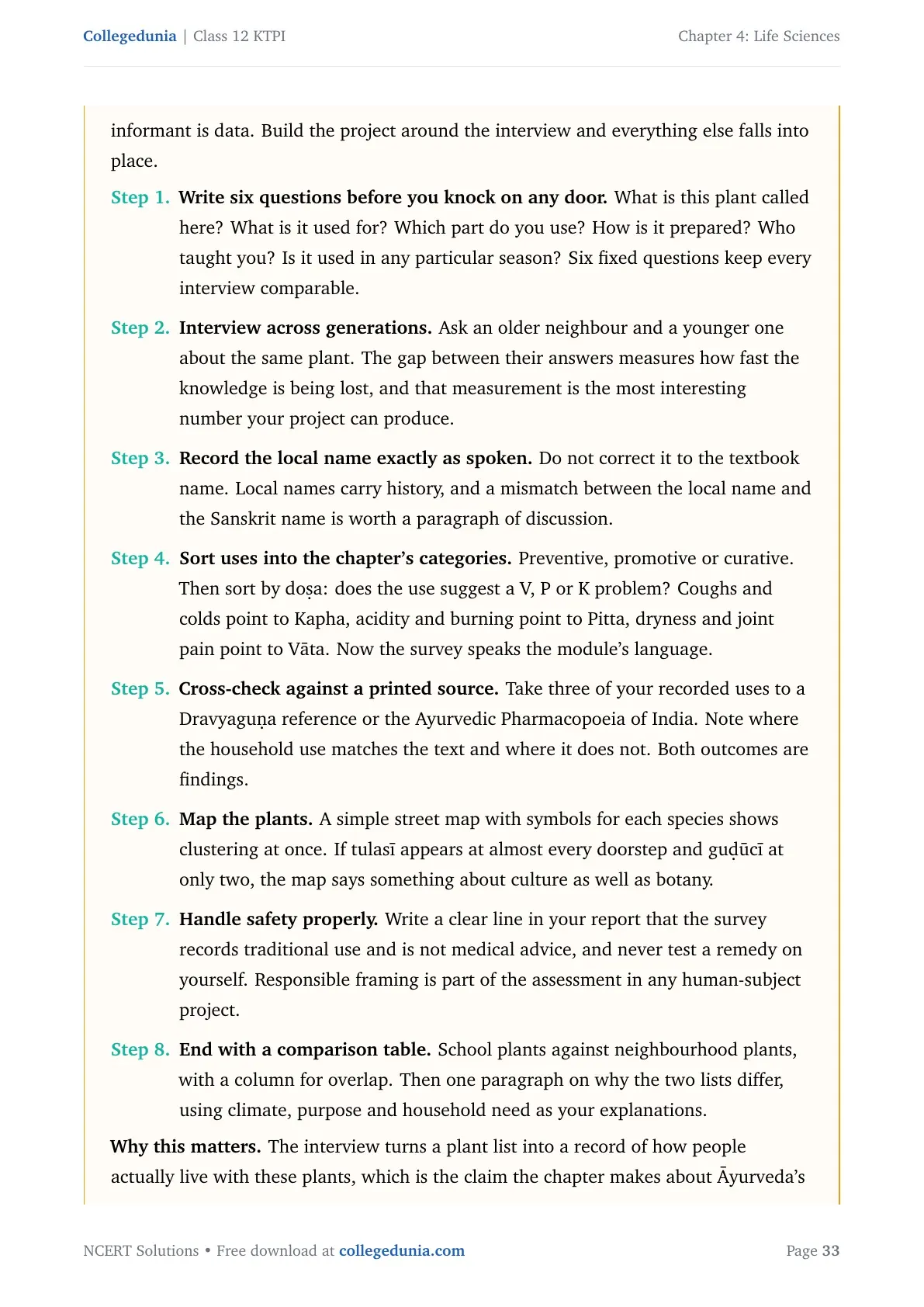
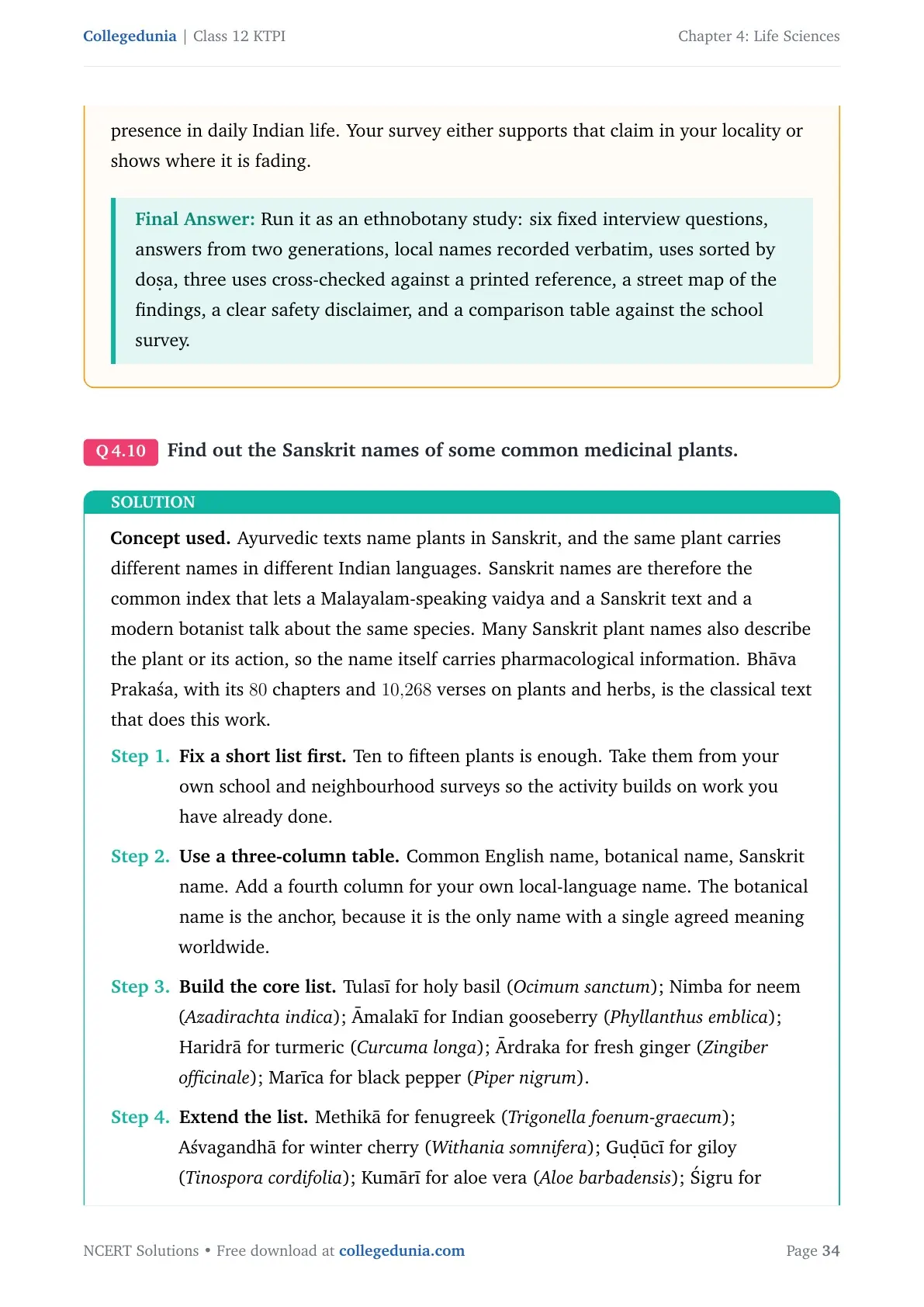
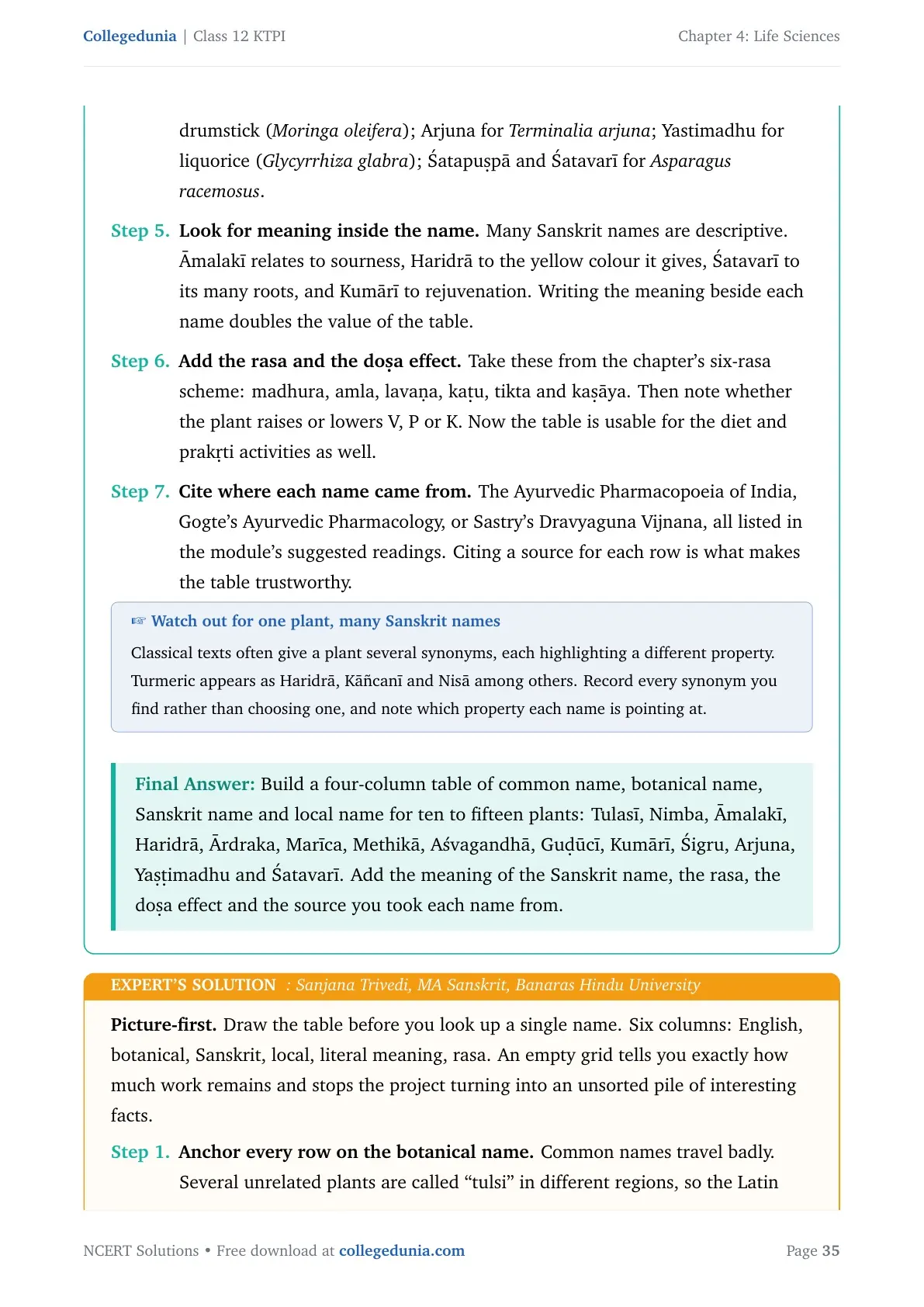
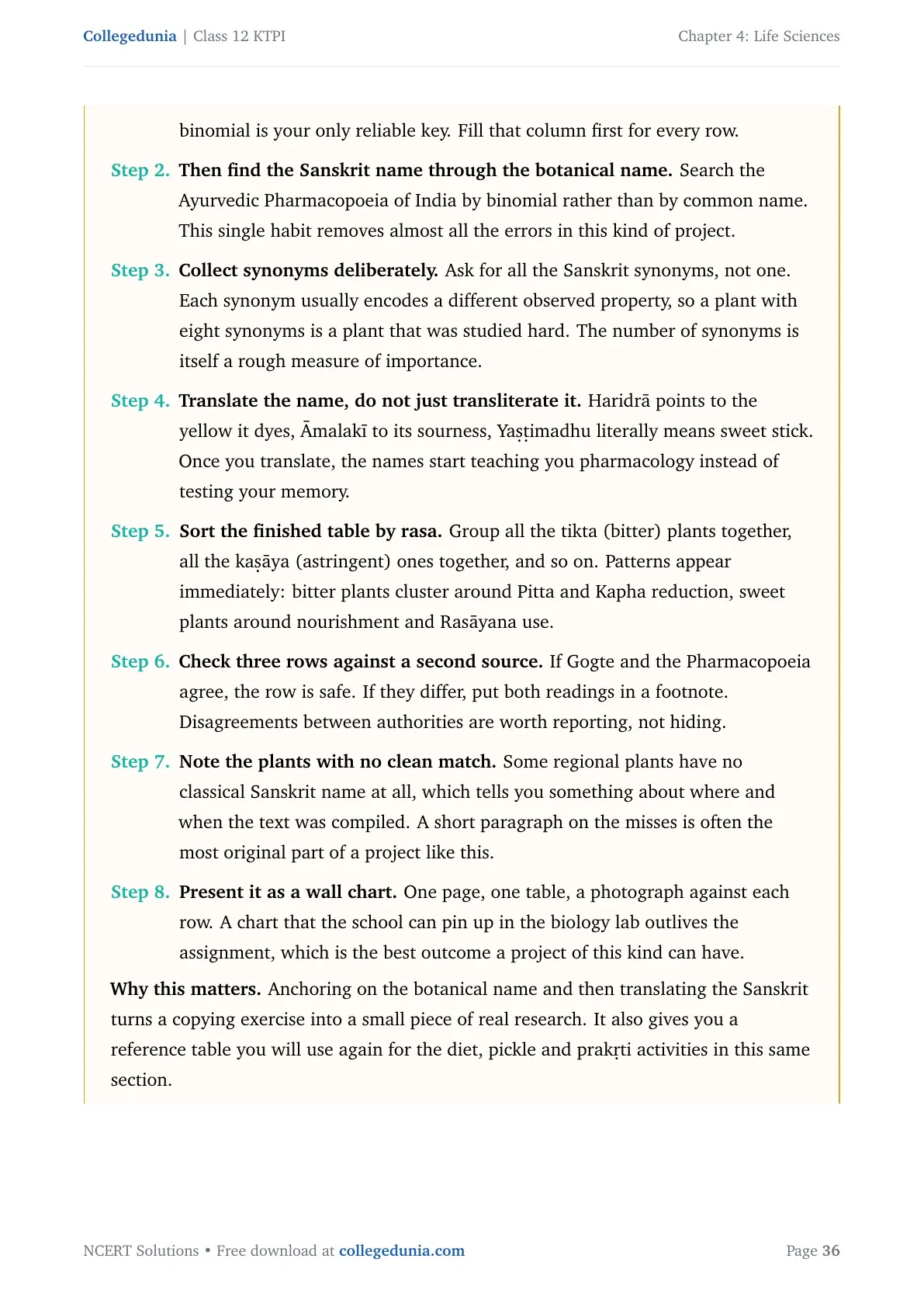
- Life Sciences is Chapter 4 of the Class 12 Knowledge Traditions and Practices of India course.
- 15 questions in total: 7 in the Exercise and 8 Activities and Projects.
- Names you must quote: Susruta, Caraka, Vagbhata, Salihotra, Palakapya and Bhava Misra.
Every answer on this page is written by subject experts and checked line by line against the Life Sciences chapter of the NCERT Knowledge Traditions and Practices of India textbook.
What the Class 12 KTPI Life Sciences Solutions Cover, Question by Question
The chapter does not number its exercises the way a Physics chapter does. It prints one Exercise block at the end, then a longer Activities and Projects block. Students often answer the seven Exercise questions and stop, and then lose the project marks. The table below lists both blocks in the order the book prints them.
| Block | Questions | What it tests |
|---|---|---|
| Exercise, Questions 1 and 2 | 2 long answers | Manusya and Mrga Ayurveda, the eight branches of Astanga Ayurveda |
| Exercise, Questions 3 and 5 | 2 theory answers | Tridosa theory, and the role of Vata, Pitta and Kapha in the biological cycle |
| Exercise, Question 4 | 1 one line answer | The ayurvedic surgeon whom modern surgery still acknowledges |
| Exercise, Questions 6 and 7 | 2 list based answers | Diet and nutrition, and ayurvedic texts written before and after the Common Era |
| Activities and Projects 1 to 8 | 8 project tasks | Medicinal plants, Sanskrit plant names, kitchen ingredients, prakrti, surviving texts |
Questions 4 and 7 are the quickest marks in the chapter because both answers are simply names. Questions 3 and 5 look alike but are not: one wants the definition of tridosa, the other wants the daily and seasonal cycle. Answering them the same way costs marks.
Open the full solved question set
All 15 questions written out as complete answers, each with a short Solution and a longer Expert Solution, sit on the companion page.
Susruta and Ancient Indian Surgery Explained
Source: StudyIQ IAS on YouTube
Ayurveda as the Science of Life and Its Three Divisions for Humans, Animals and Plants
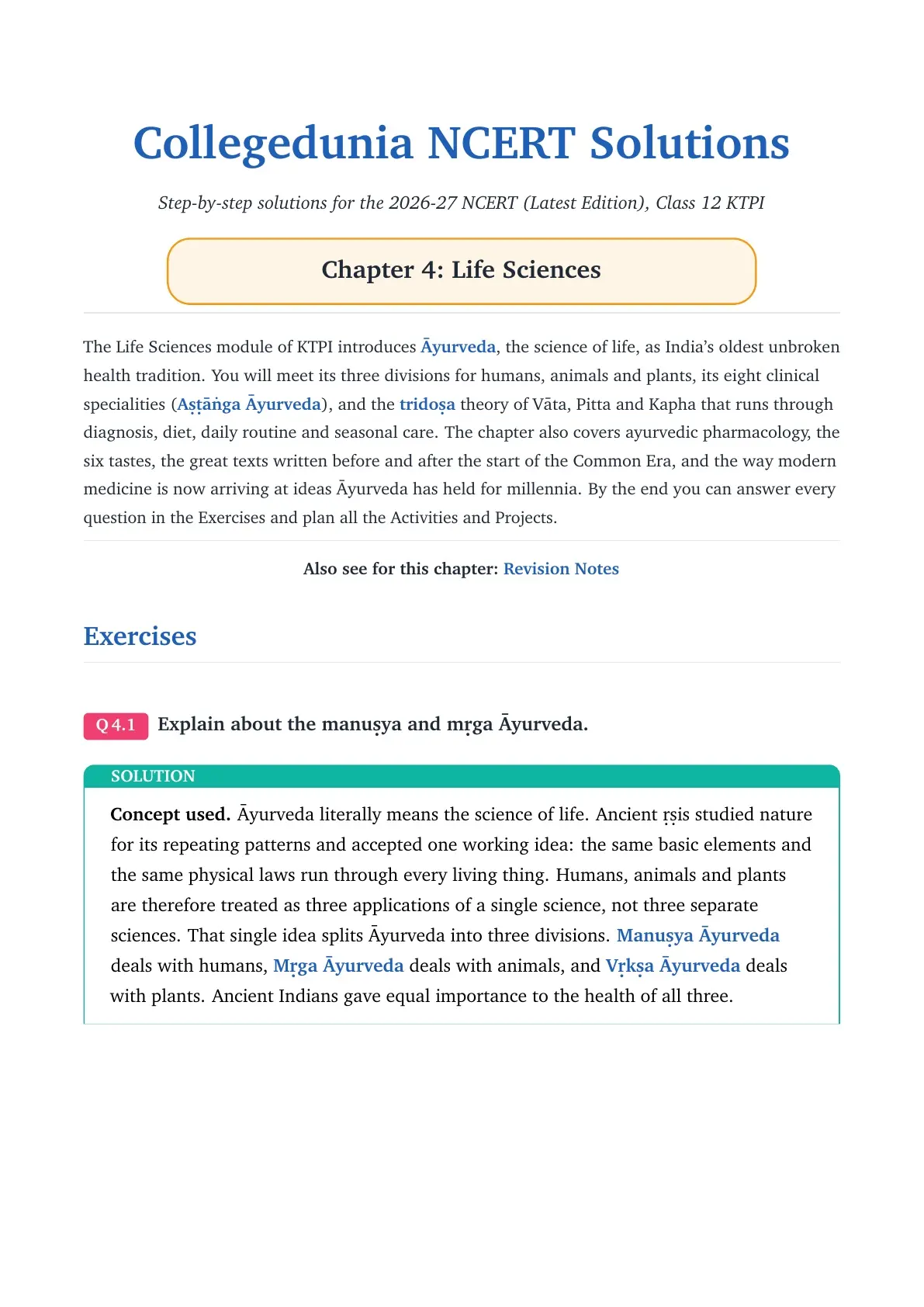
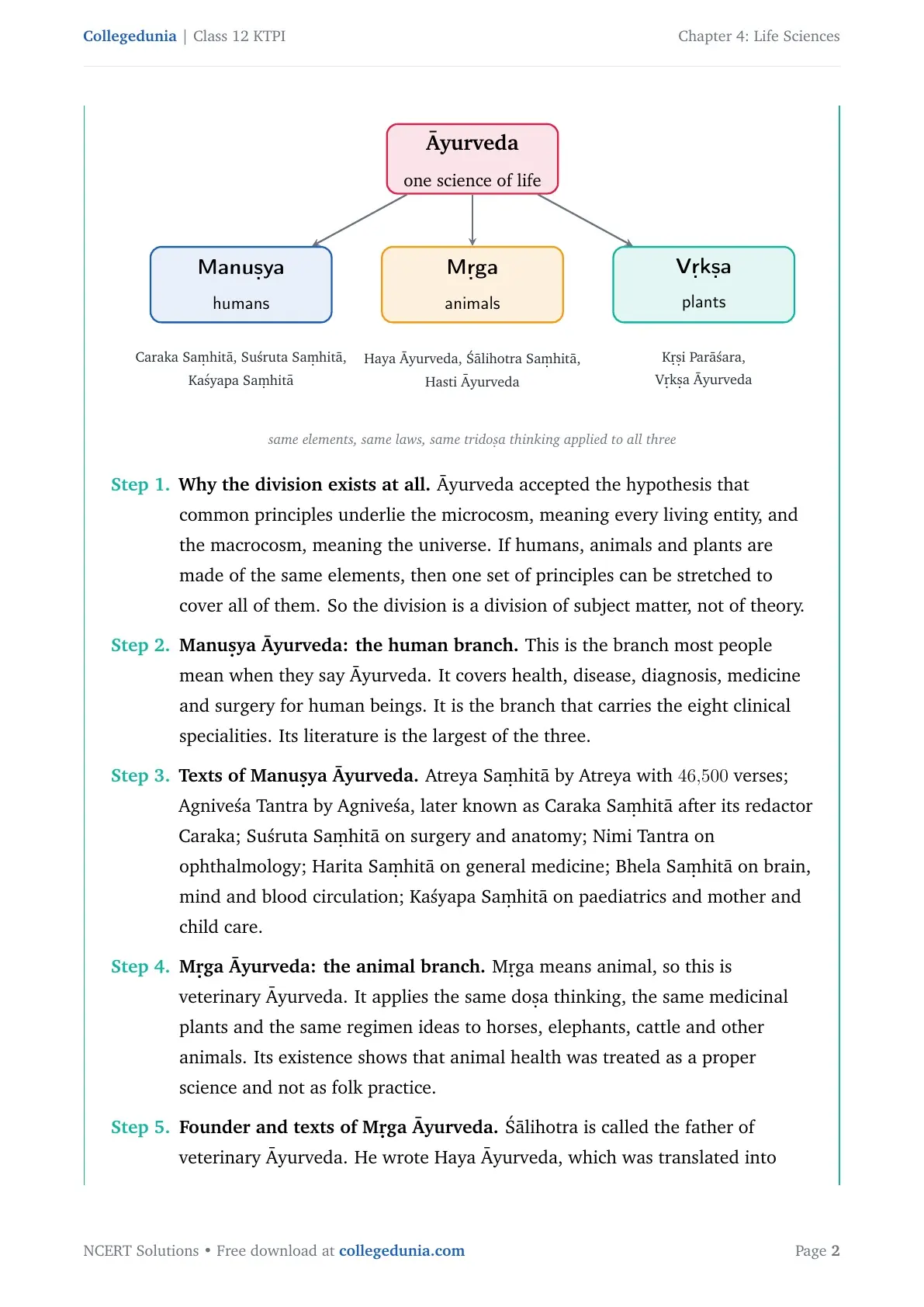
Question 1 asks about Manusya and Mrga Ayurveda. Start one step earlier, with the reason those divisions exist. Ancient rsis studied nature for its underlying patterns and concluded that humans, animals, plants and the universe are made of the same basic elements and follow the same physical laws. So one science could serve all three.
- Manusya Ayurveda. Human medicine. The largest of the three divisions, and the one the rest of the chapter describes in detail.
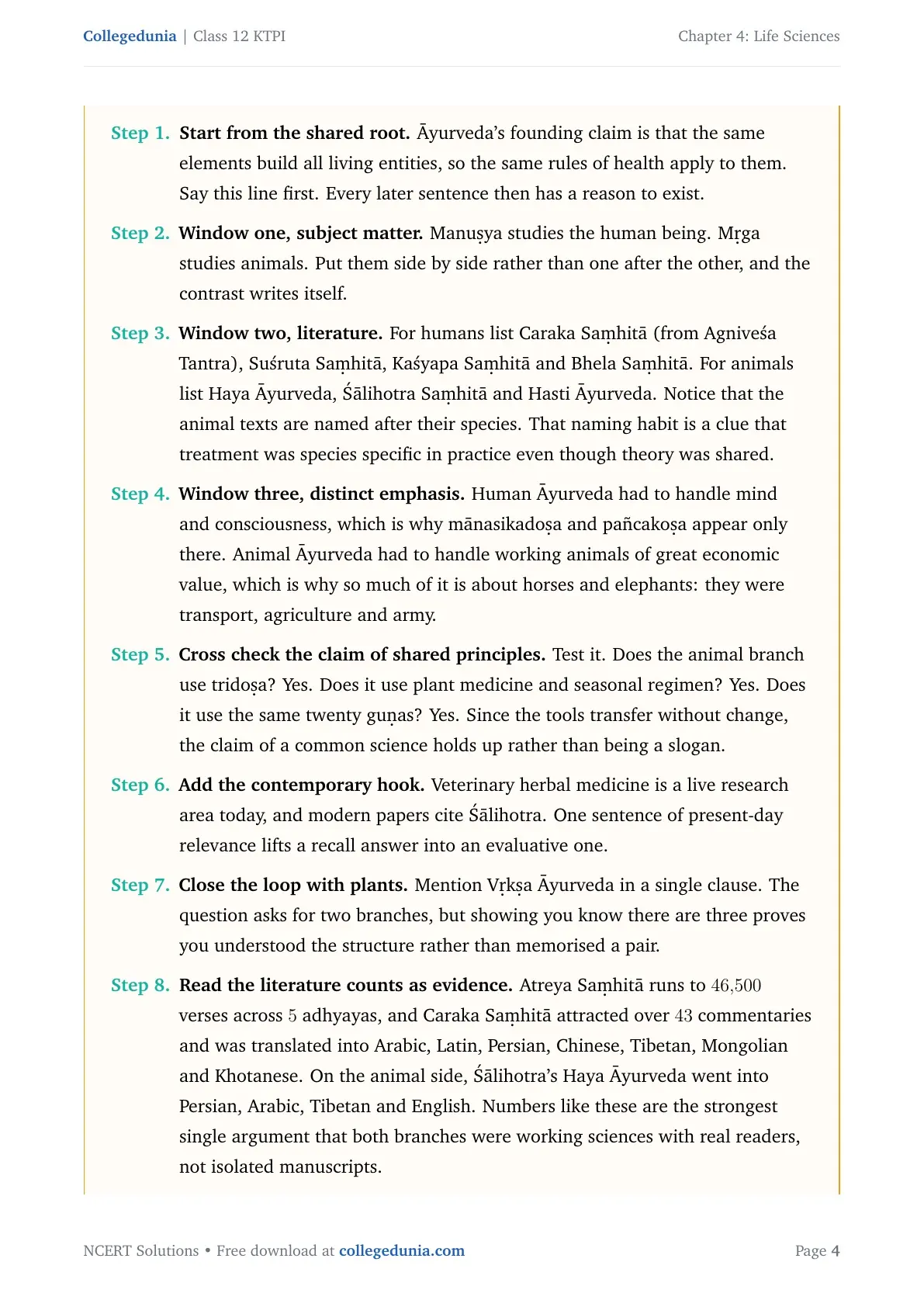
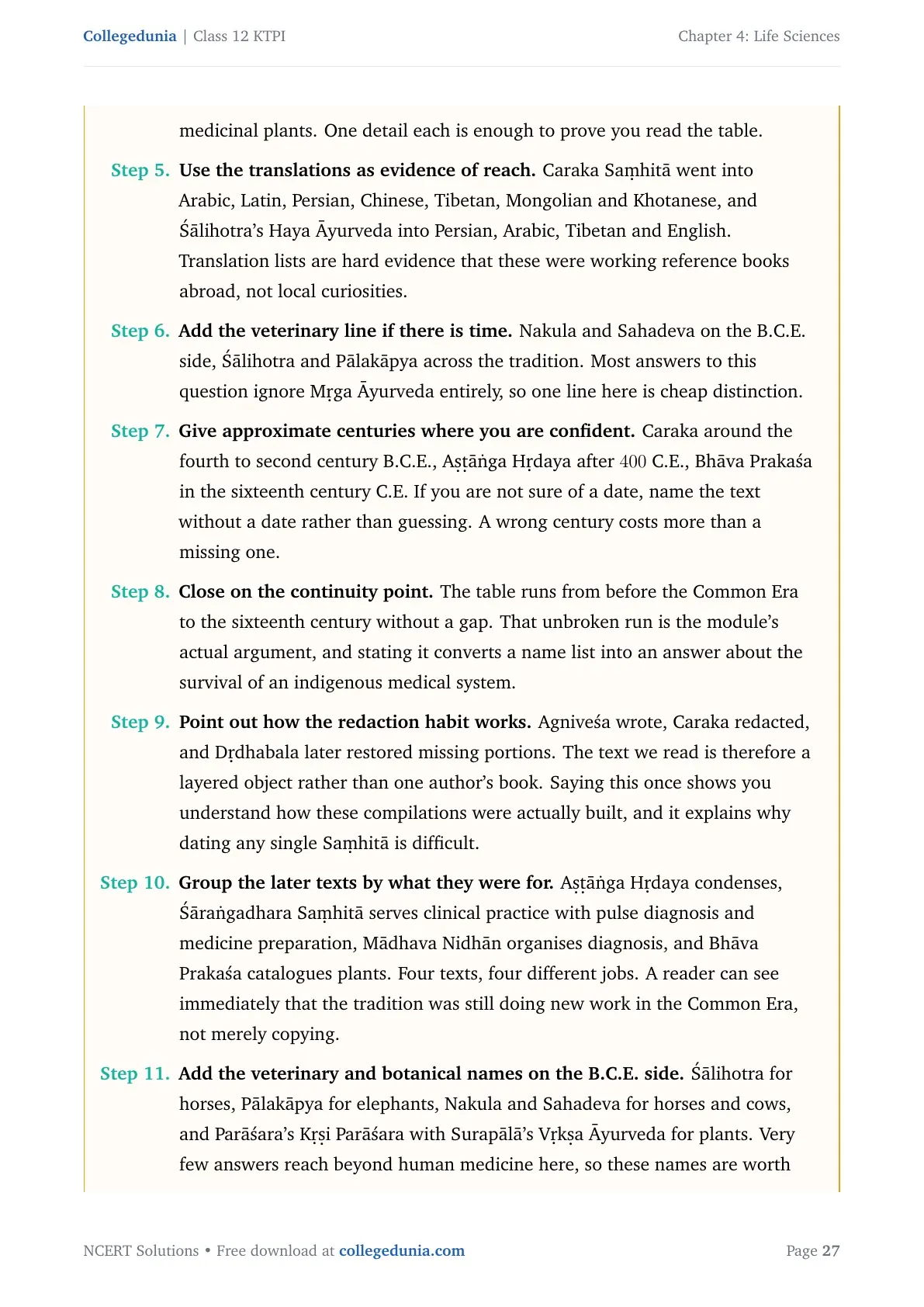
- Mrga Ayurveda. Veterinary science. Salihotra is called the father of veterinary Ayurveda and wrote Haya Ayurveda, which was translated into Persian, Arabic, Tibetan and English.
- Vrksa Ayurveda. Plant science, covering the life cycle of plants and the prevention and treatment of plant diseases.
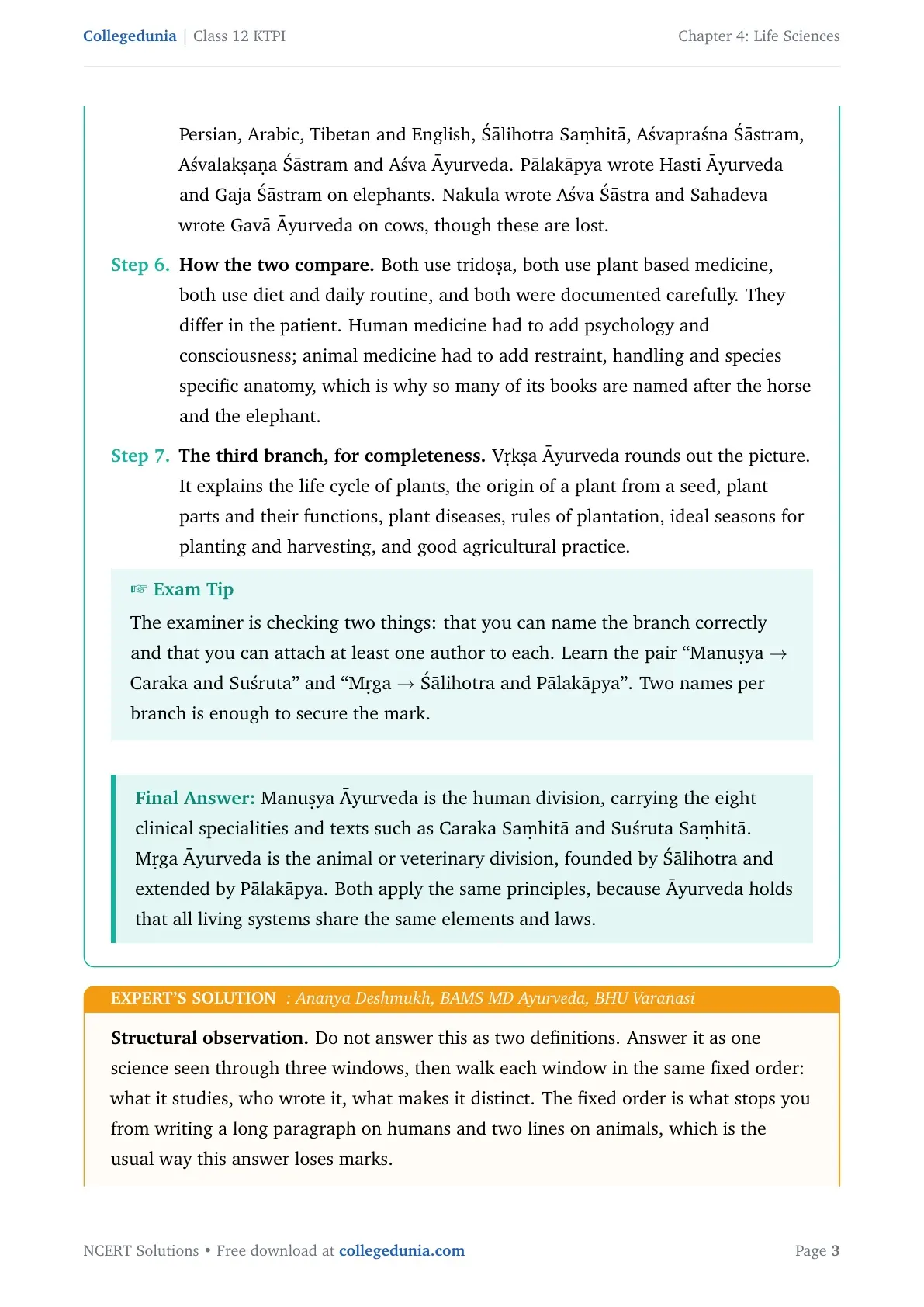
For Mrga Ayurveda, name the books as well as the authors. Salihotra also wrote the Salihotra Samhita, an early Indian treatise on veterinary medicine, along with Asvaprasna Sastram, Asvalaksana Sastram and Asva Ayurveda. Palakapya wrote Hasti Ayurveda and Gaja Sastram on elephants. Nakula wrote an Asva Sastra on horses and Sahadeva a Gava Ayurveda on cows.
Vrksa Ayurveda earns a mark if you list what it actually studies: the origin of the plant from seed, the parts of a plant, their structure and functions, the diseases that affect them, rules of plantation, the right seasons for planting and harvesting, and good agricultural practice. The two books to quote are Krsi Parasara by Parasara and Vrksa Ayurveda by Surapala.
Astanga Ayurveda: The Eight Clinical Specialities Every Answer to Question 2 Must Name
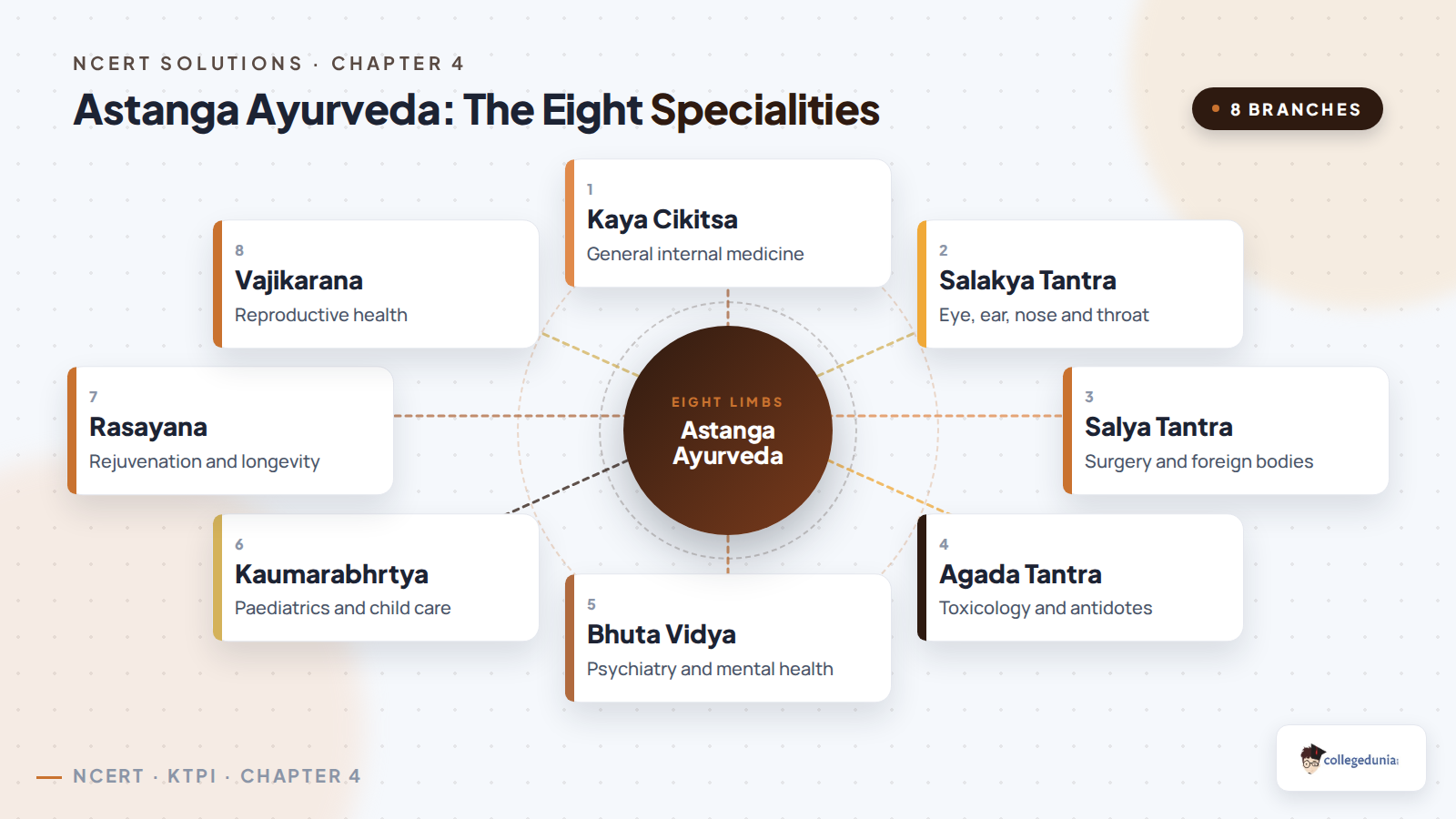
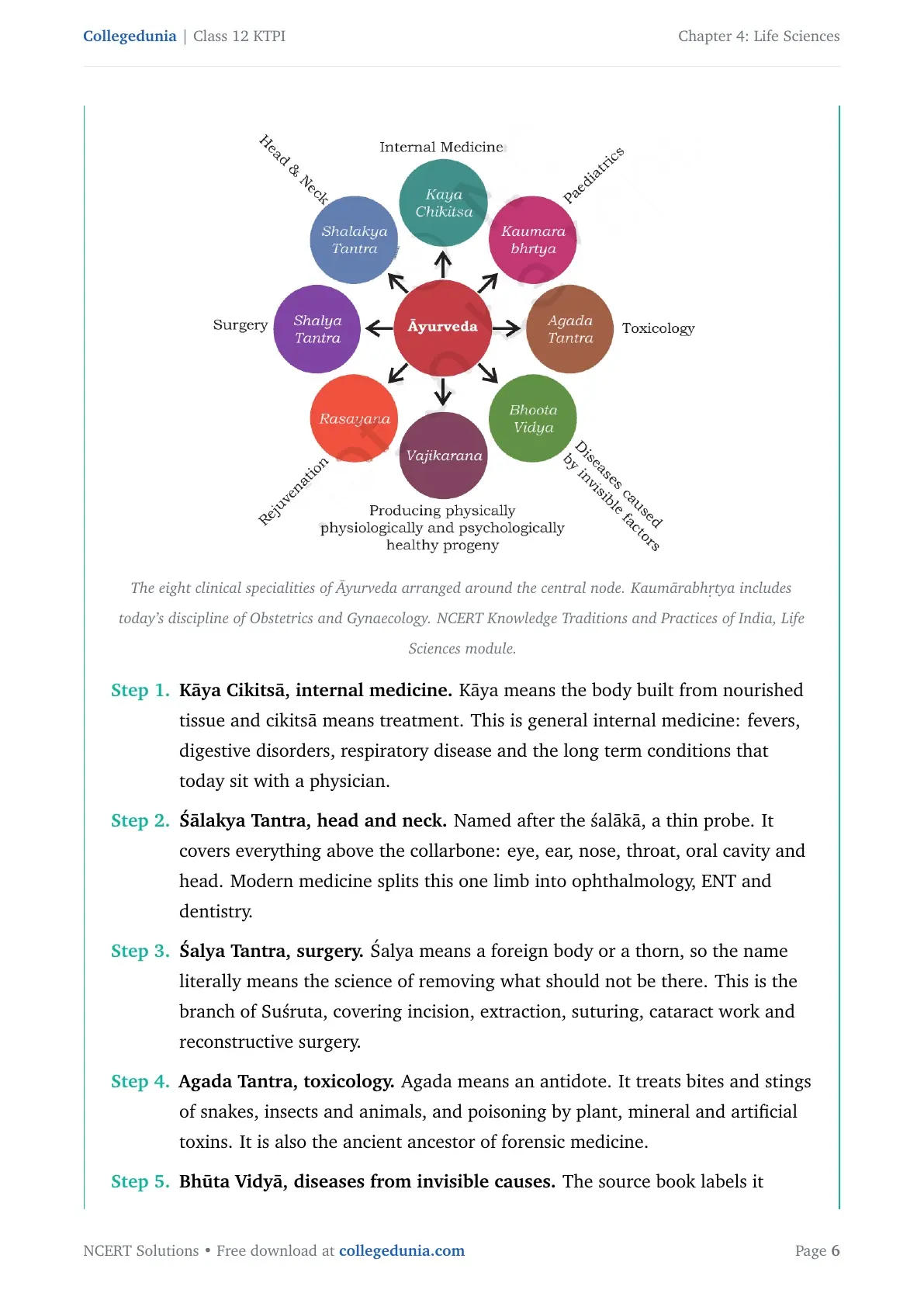
Question 2 is the most predictable question in the chapter. Ayurveda has recognised eight clinical specialities from the time of its inception, which is why it is called Astanga Ayurveda. Write the Sanskrit name and the modern equivalent side by side. A bare Sanskrit list scores about half.
| Branch | What it deals with |
|---|---|
| Kaya Cikitsa | Internal medicine, the treatment of the body as a whole |
| Salakya Tantra | Diseases of the head and neck, including the eye, ear, nose and throat |
| Salya Tantra | Surgery, including the removal of foreign bodies |
| Agada Tantra | Toxicology, the study and treatment of poisons |
| Bhuta Vidya | Diseases caused by invisible factors, close to today's psychiatry |
| Kaumarabhrtya | Paediatrics, and it also takes in today's obstetrics and gynaecology |
| Rasayana | Rejuvenation, longevity and the strengthening of immunity |
| Vajikarana | Producing physically, physiologically and psychologically healthy progeny |
Two details lift this answer. Kaumarabhrtya covers mother and child together, not the child alone, which is why the chapter maps it onto obstetrics and gynaecology. And Bhuta Vidya is not superstition in the chapter's framing: it names the group of disorders whose causes could not be seen.
The Tridosa Theory of Vata, Pitta and Kapha and the Twenty Gunas
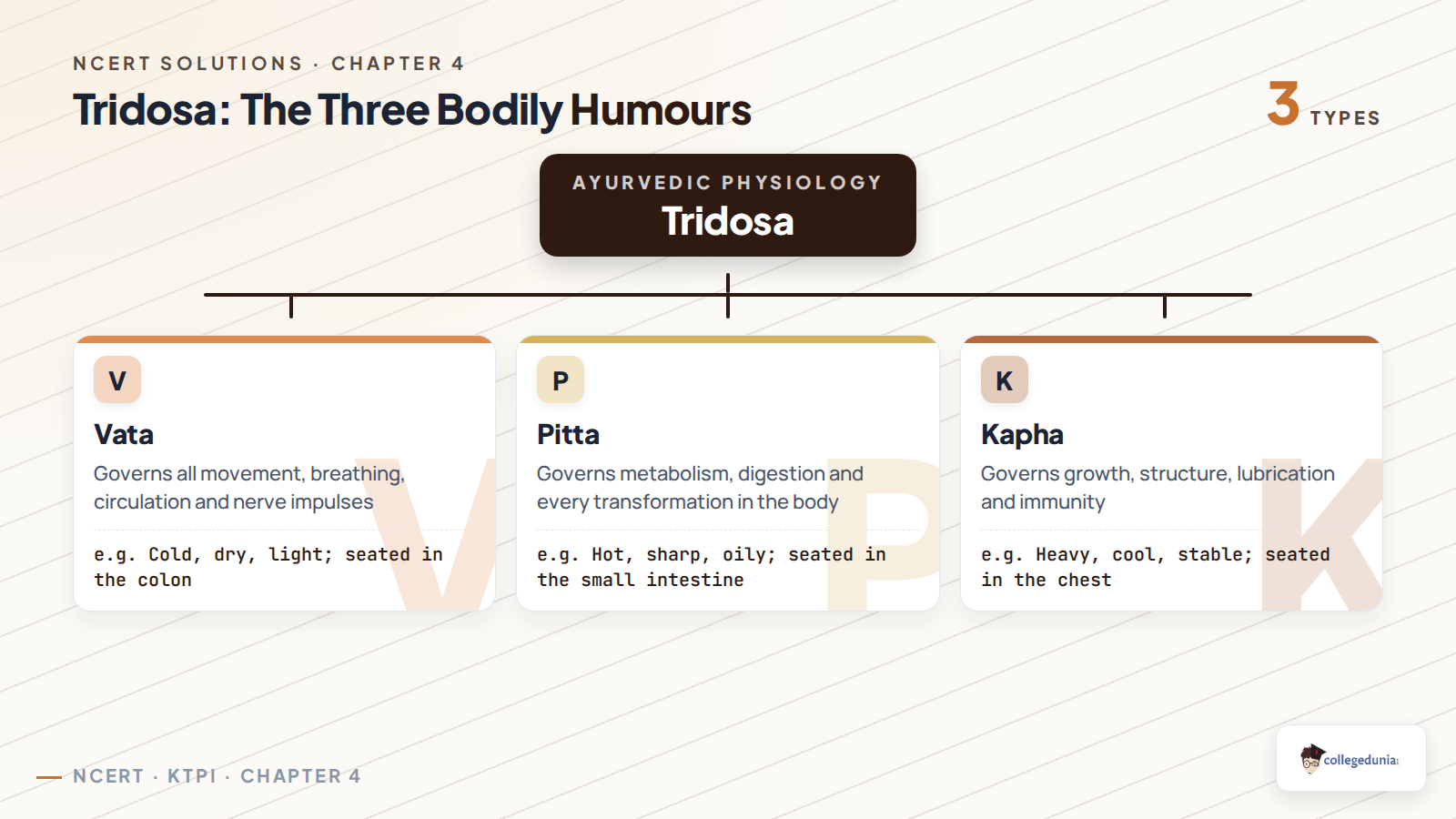
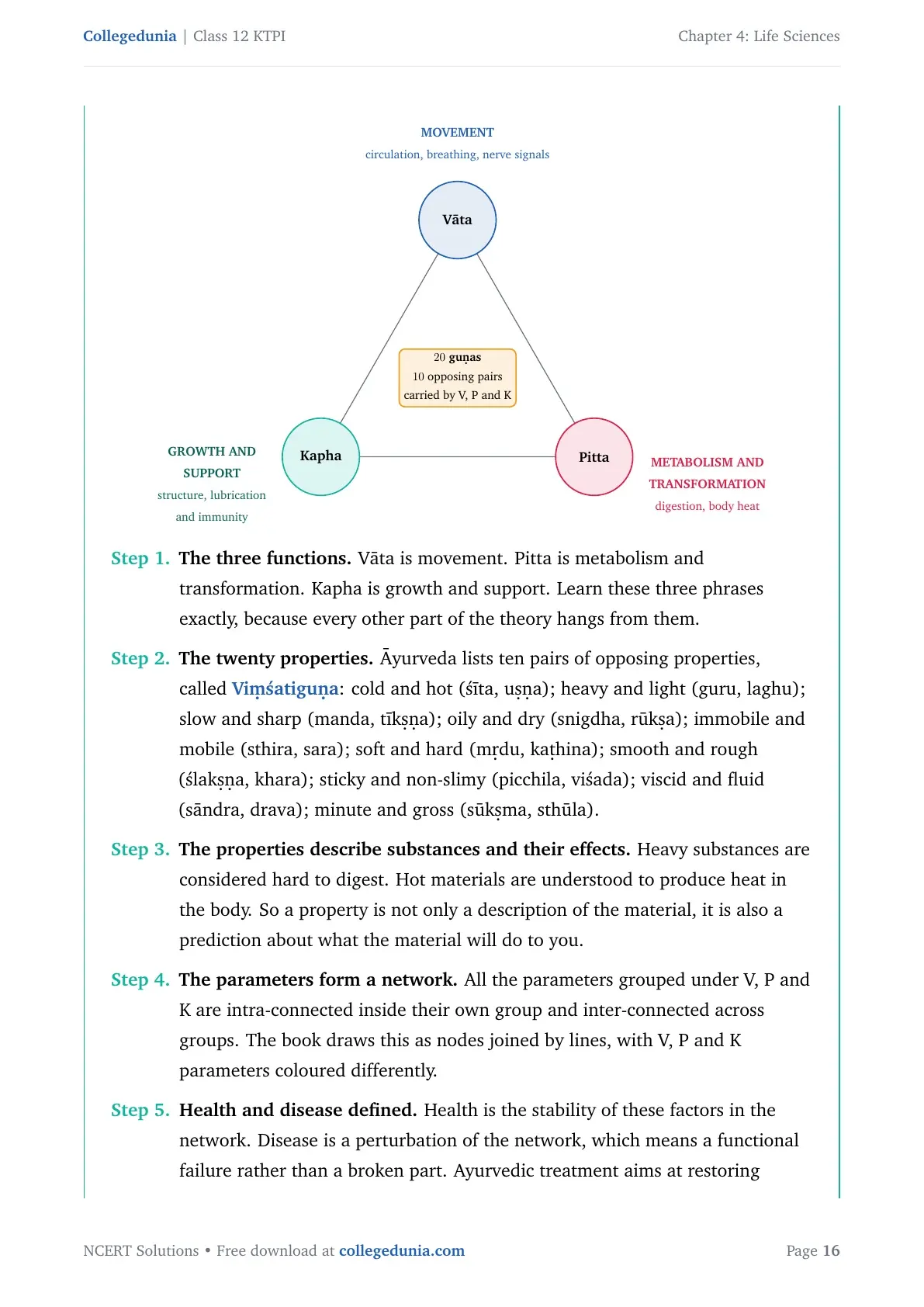
Question 5 asks what the tridosa theory is. Ayurveda's approach is functional, not structural. Instead of breaking the body into smaller and smaller parts, it classifies every living system by three functions. That single sentence should open your answer.
- Vata is movement. Every transport and every motion in the body sits under it.
- Pitta is metabolism and transformation. Digestion, heat and every chemical change belong here.
- Kapha is growth and support. Structure, lubrication and stability belong here.
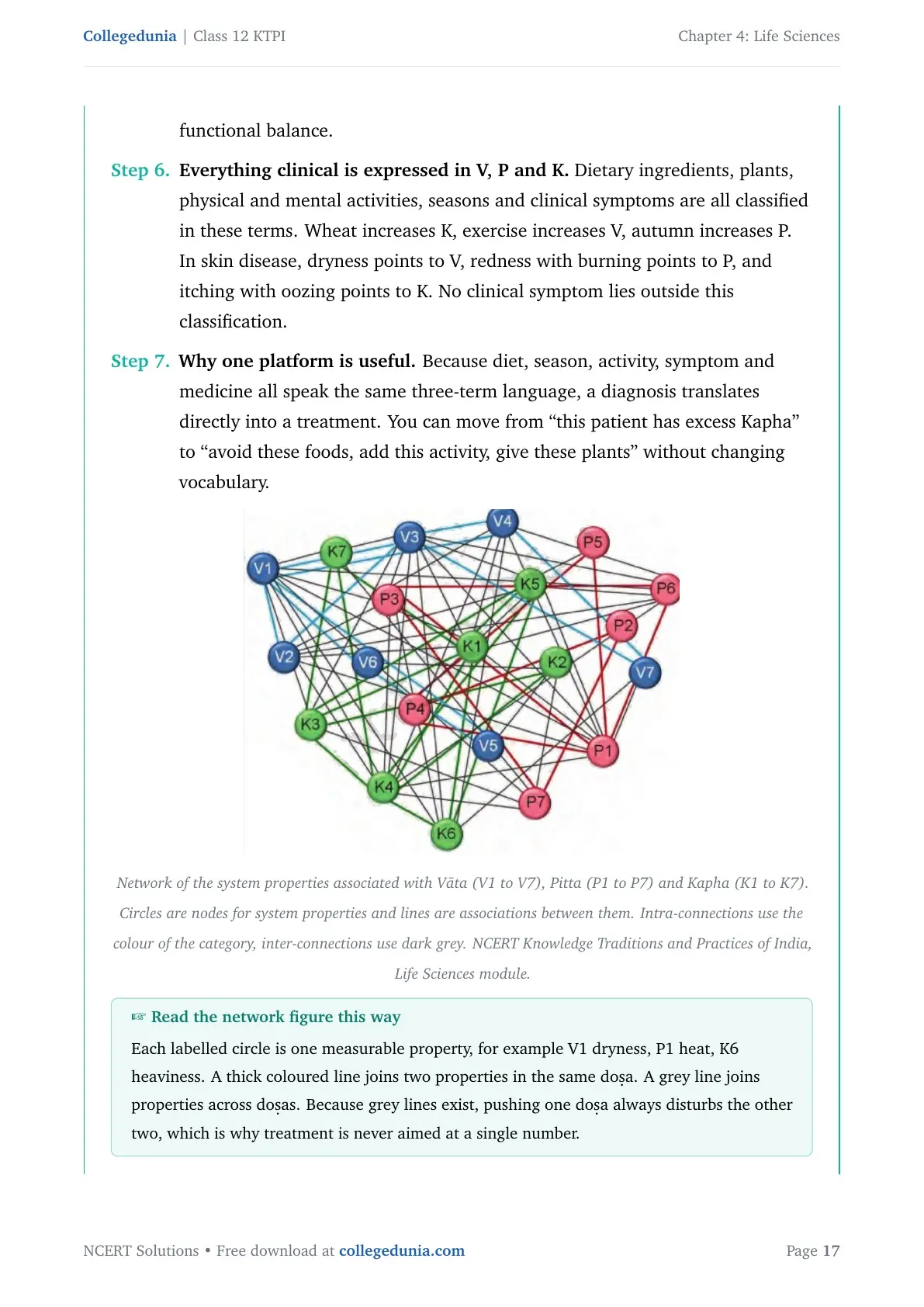
Vata, Pitta and Kapha are not organs. They are sets of biophysical, chemical and physiological parameters, and Ayurveda describes them using ten pairs of opposing properties, the twenty gunas. Each pair is a continuum with a material body sitting somewhere along it.
| Pair | Sanskrit | Pair | Sanskrit |
|---|---|---|---|
| Cold and hot | sita, usna | Soft and hard | mrdu, kathina |
| Heavy and light | guru, laghu | Smooth and rough | slaksna, khara |
| Slow and sharp | manda, tiksna | Sticky and non slimy | picchila, visada |
| Oily and dry | snigdha, ruksa | Viscid and fluid | sandra, drava |
| Immobile and mobile | sthira, sara | Minute and gross | suksma, sthula |
Close the answer with the health definition. All the parameters under Vata, Pitta and Kapha are connected to each other and form a network. Health is the stability of that network, and disease is a disturbance of it. Ayurvedic treatment therefore aims at restoring the functional balance rather than at attacking one part.
How Vata, Pitta and Kapha Control the Daily and Seasonal Biological Cycle
Question 3 asks for the role of Vata, Pitta and Kapha in maintaining the biological cycle. This is the answer that needs the clock and the calendar, not the definitions. Ayurveda works with two rhythms: the circadian rhythm of 24 hours and the circa annual rhythm of one year.
| Time of day | Dominant dosa | Repeat window |
|---|---|---|
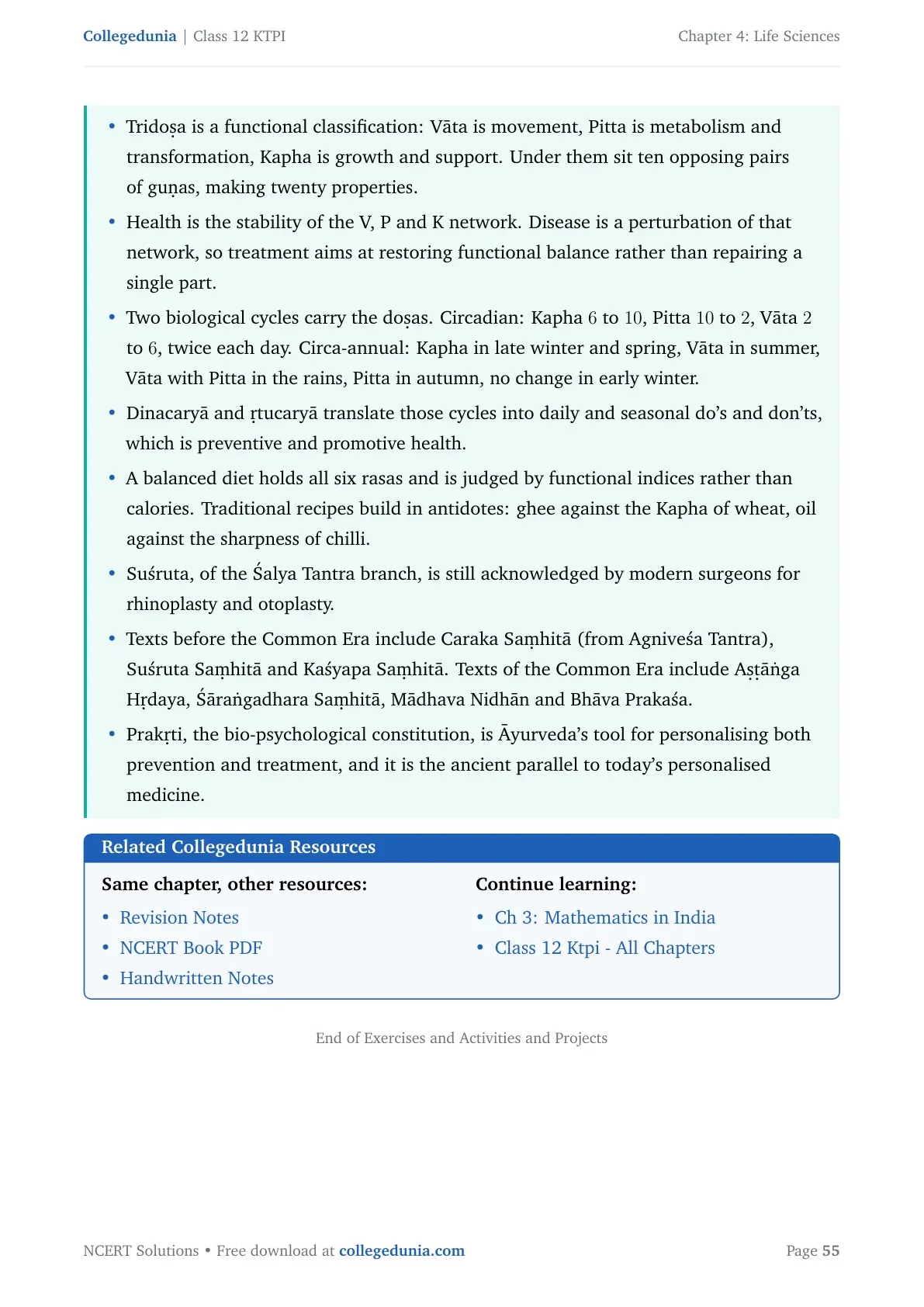
| 6 am to 10 am | Kapha | 6 pm to 10 pm |
| 10 am to 2 pm | Pitta | 10 pm to 2 am |
| 2 pm to 6 pm | Vata | 2 am to 6 am |
The year works the same way. Kapha rises in late winter and spring, Vata in the rainy season, and Pitta in autumn, while early winter shows little change. Two regimens are built directly on these rhythms, and both are worth naming in the answer.
- Dinacarya, the daily regimen. The do's and don'ts of a single day, arranged around the times when each dosa is strongest.
- Rtucarya, the seasonal regimen. The same idea across the year, which is how seasonal diseases are prevented rather than treated.
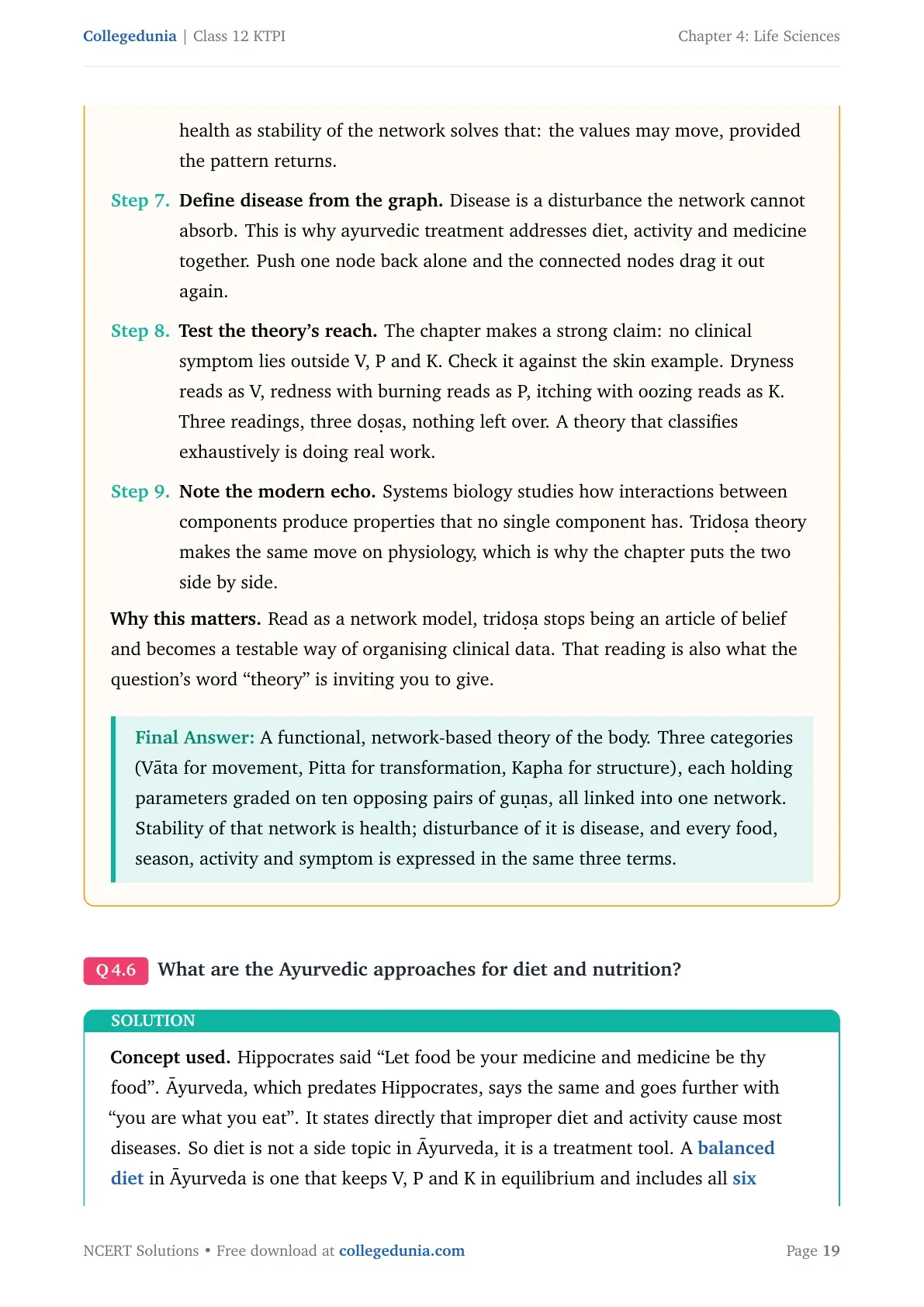
Finish with the clinical link, because it is the part examiners look for. Diet, plants, activity, season and symptom are all classified as Vata, Pitta or Kapha. Wheat increases Kapha, exercise increases Vata and autumn increases Pitta. On the skin, dryness points to Vata, redness and burning to Pitta, itching and oozing to Kapha. No clinical symptom lies outside this classification.
Susruta and Ancient Indian Surgery: The One Name Question 4 Wants
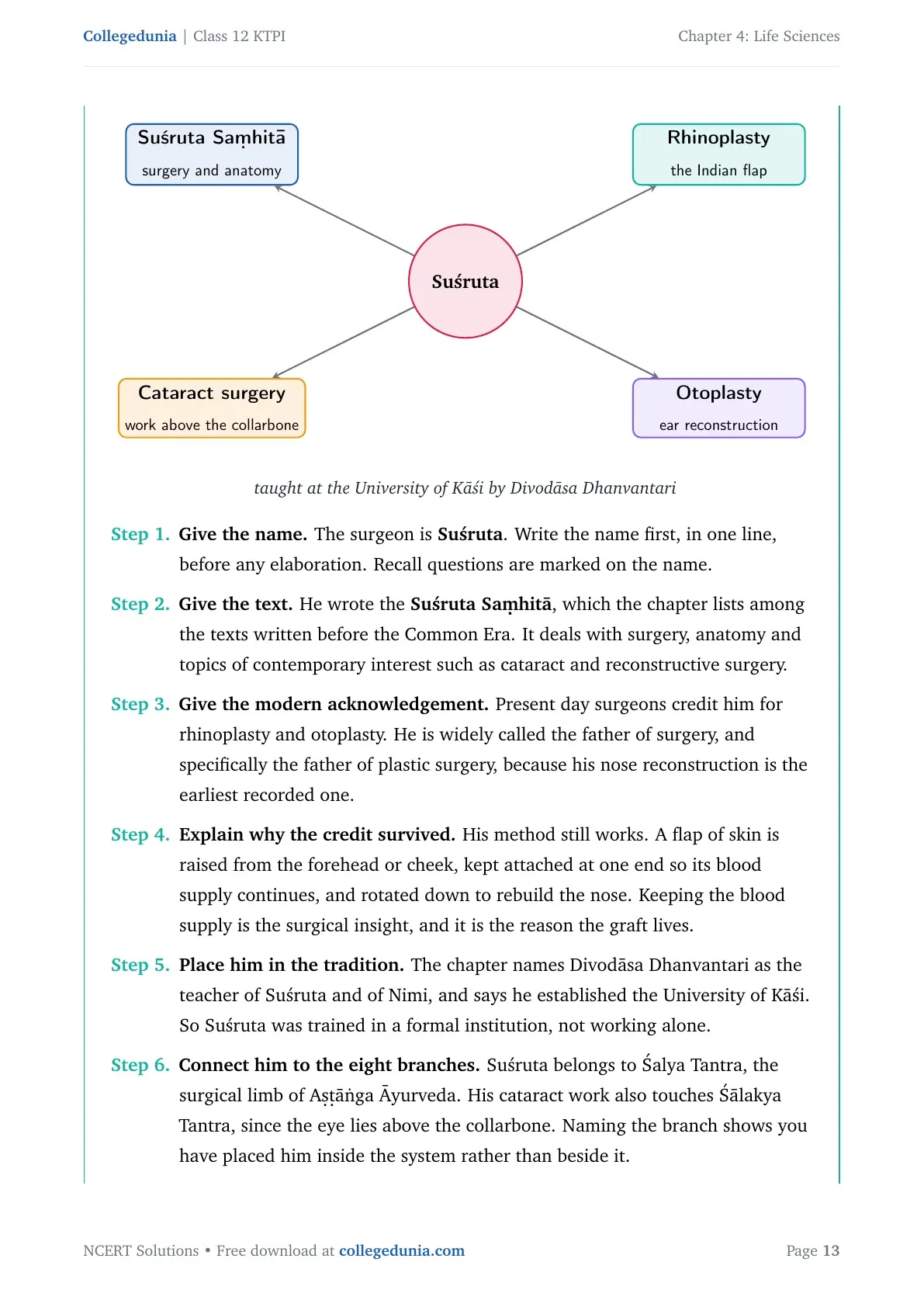
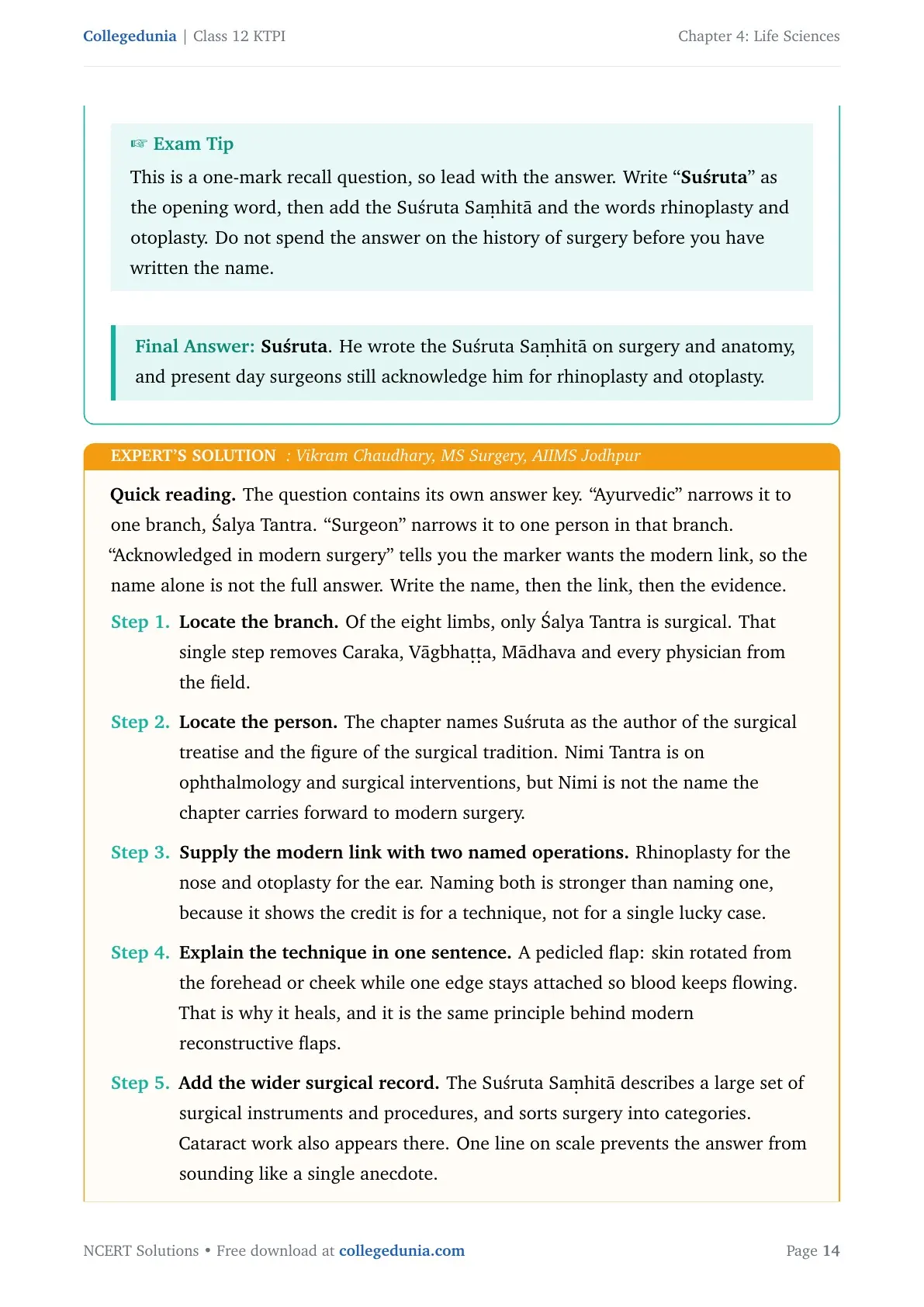
Question 4 asks you to name the ayurvedic surgeon whom modern surgery still acknowledges. The answer is Susruta, and it is worth two more lines than most students give it.
- The text. The Susruta Samhita deals with surgery and anatomy, and covers topics still current today, such as cataract operations and reconstructive surgery.
- The procedures. Present day surgeons acknowledge him for rhinoplasty, the reconstruction of the nose, and otoplasty, the reconstruction of the ear.
- His teacher. Susruta and Nimi were taught by Divodasa Dhanvantari, who established the University of Kashi.
- Why it matters. A well developed surgery shows that Ayurveda respected the mechanical side of the body as well as its functional side.
Nimi is worth one line too. The Nimi Tantra focuses on ophthalmology and surgical work on the eye, which shows that specialisation inside surgery already existed.
The Ayurvedic Approach to Diet and Nutrition and the Six Tastes
Question 6 is a wide question, so answer it as a set of principles rather than as a list of foods. Ayurveda states plainly that improper diet and activity are the causative factors for most diseases, and it predates the same idea in Greek medicine.
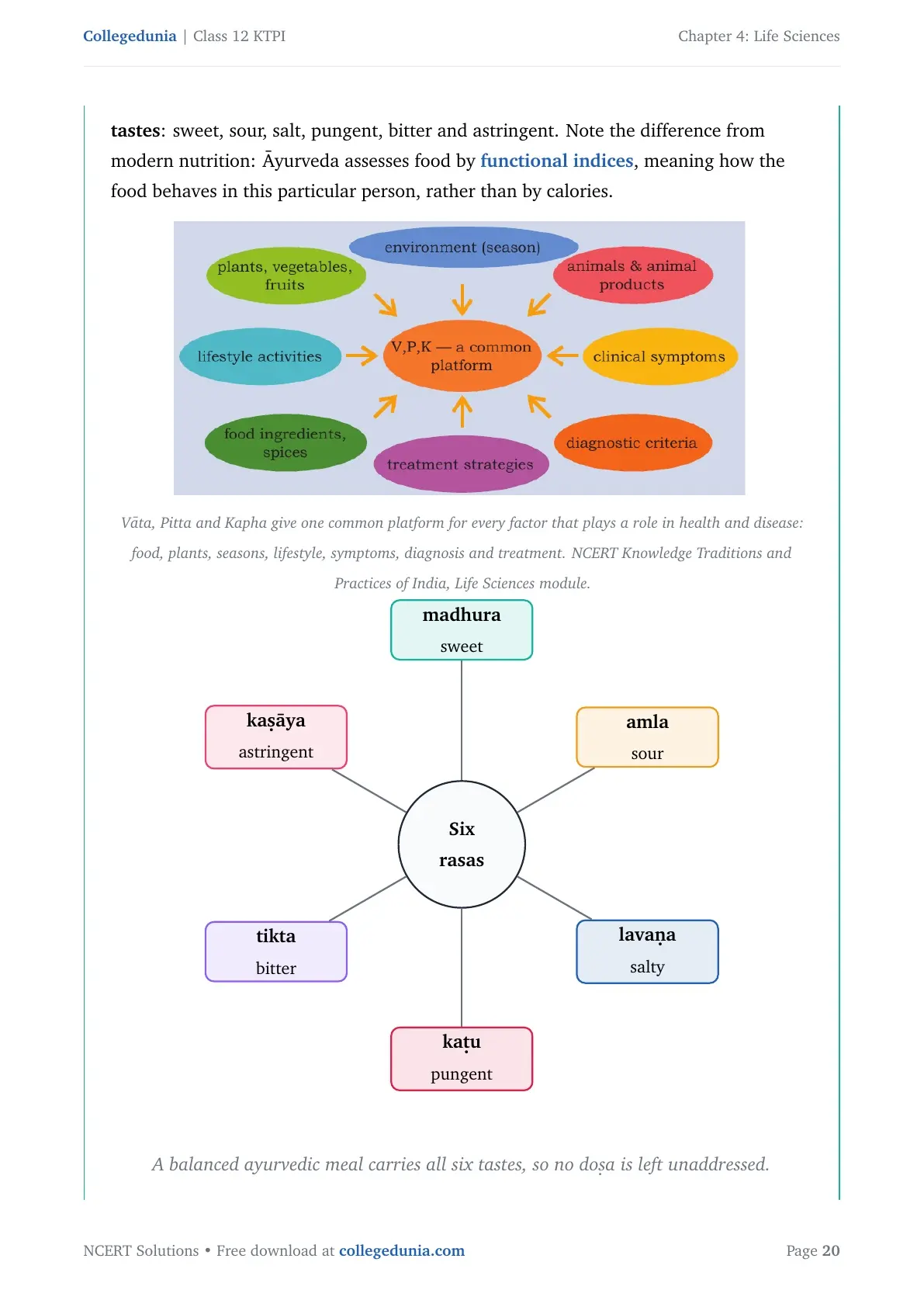
- All six tastes in every balanced diet. Sweet, sour, salt, pungent, bitter and astringent, chosen so that Vata, Pitta and Kapha stay in equilibrium.
- Functional indices, not calories. Nutrition is judged by taste, heat producing property, how digestible the food is, and how strong the eater's digestion is.
- Personalised eating. Ayurveda answers who can eat what, what to eat, how much, when, how, and what to eat in which season.
- Spices as medicine. Ginger, pepper, turmeric and fenugreek go into Indian cooking for their medicinal value, not only for flavour.
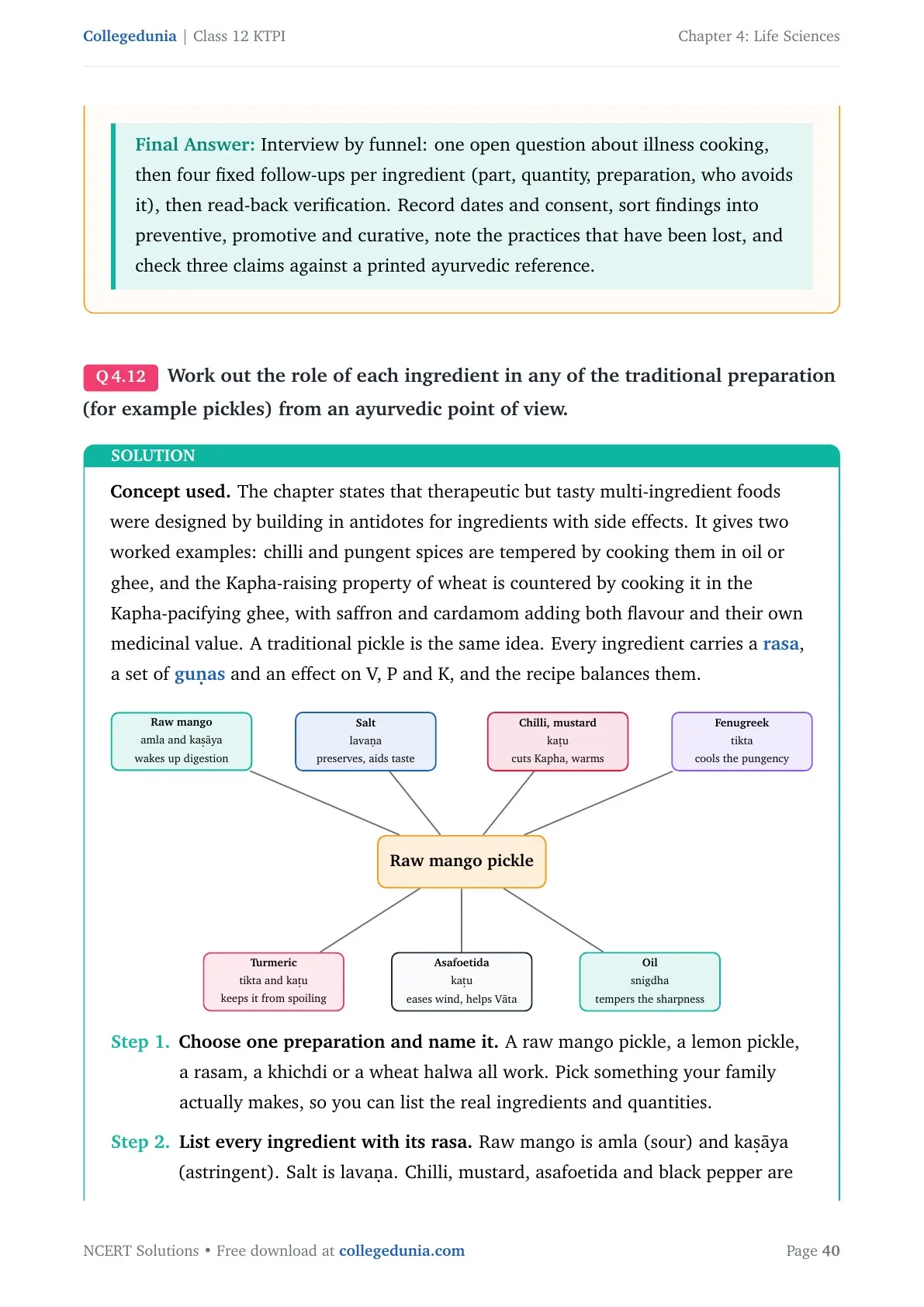
The highest scoring part of this answer is the antidote idea. Traditional recipes were built with a counterweight inside them. The Kapha increasing property of wheat is countered by cooking wheat halwa in ghee, which pacifies Kapha, and saffron and cardamom both reduce Kapha and flavour the dish. The sharpness of chilli is tempered by cooking it in oil or ghee while its medicinal value is kept.
Ayurvedic pharmacology, called Dravyaguna Vijnana, runs on the same six tastes: madhura, amla, lavana, katu, tikta and kasaya. Taken with the physical properties of a plant, the guna, and its potency, the virya, the taste of a plant predicts nearly 80% of its pharmacological action. Ayurveda also uses whole plant parts rather than single molecules, so its medicines are usually multi ingredient formulations.
Ayurvedic Texts Written Before and After the Start of the Common Era
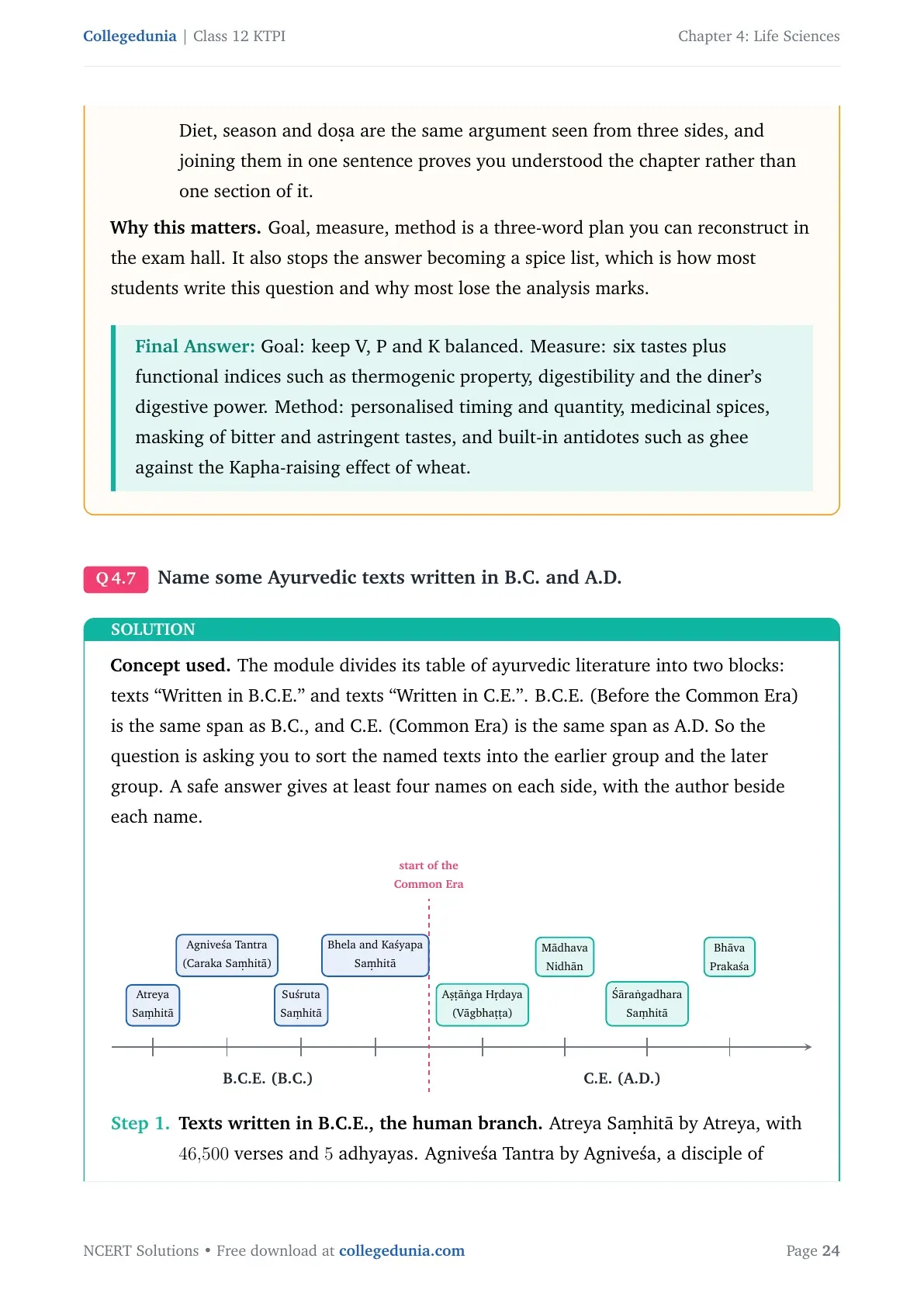
Question 7 asks you to name texts from both periods. The safe answer is a short table with the author and one identifying detail. Two texts in each column, with details, beats eight bare names.
| Period | Text and author | Detail worth quoting |
|---|---|---|
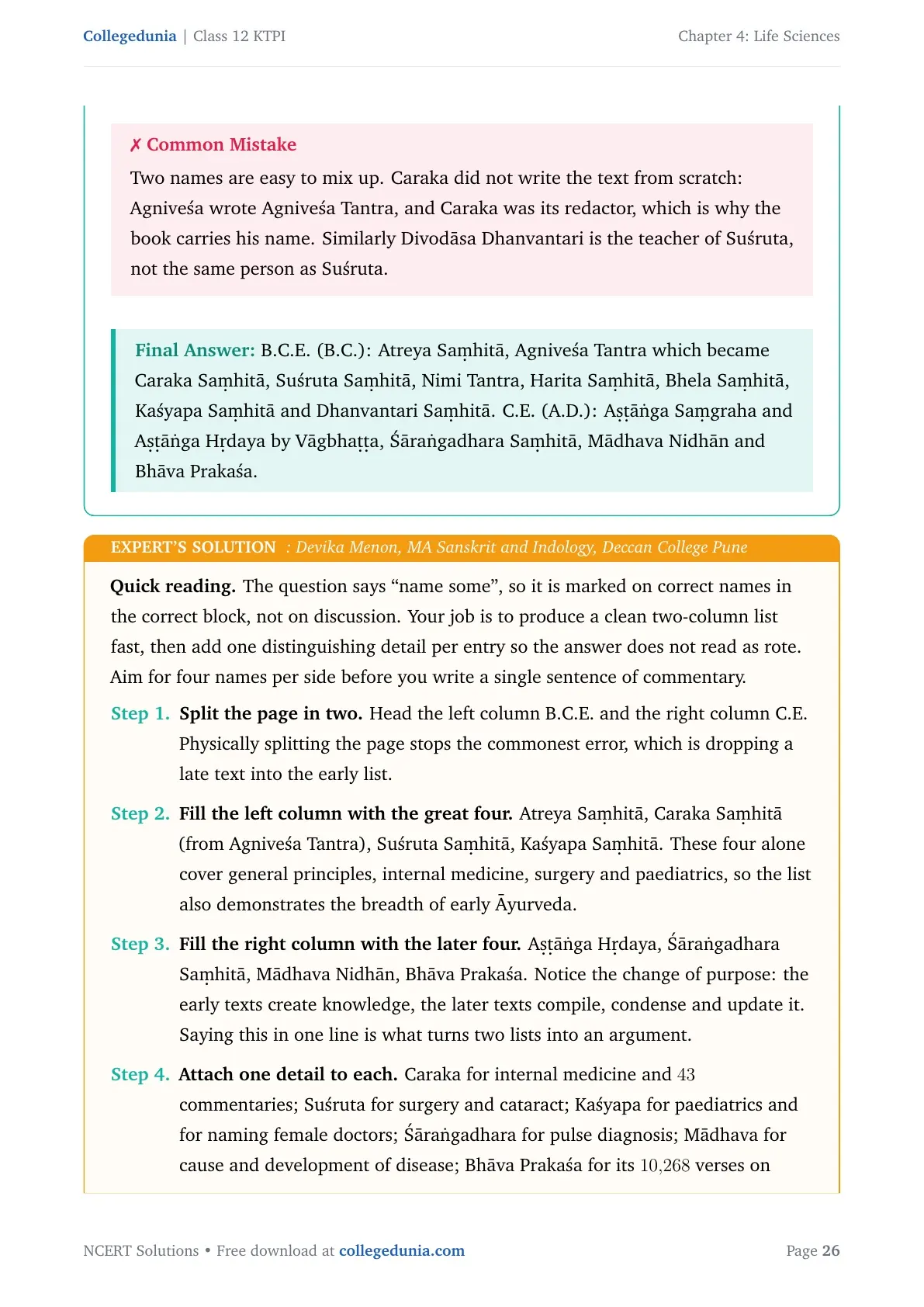
| Before the Common Era | Atreya Samhita by Atreya | 46,500 verses in 5 adhyayas |
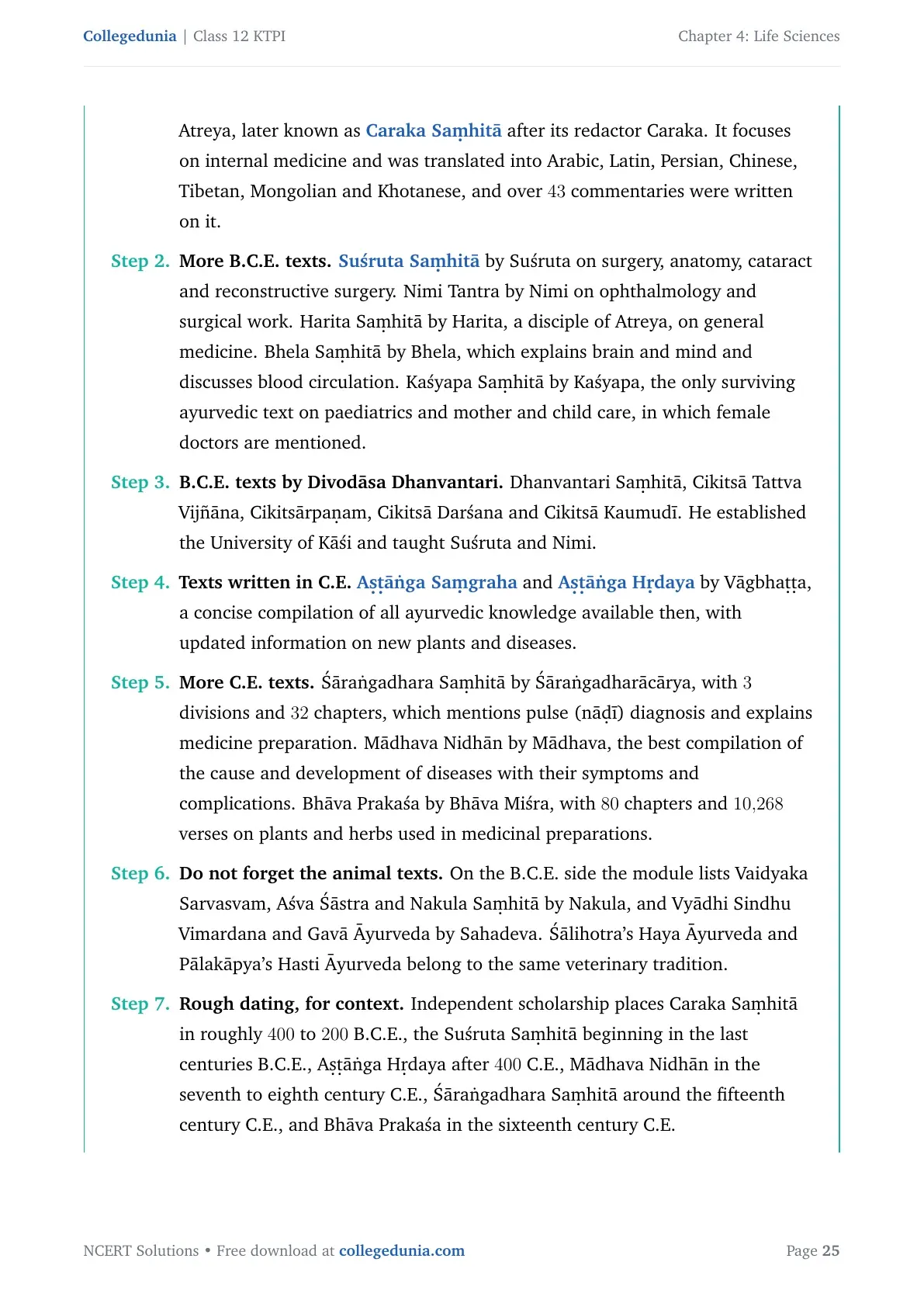
| Before the Common Era | Agnivesa Tantra by Agnivesa, known today as the Caraka Samhita | Internal medicine. Renamed after its redactor Caraka. Translated into Arabic, Latin, Persian, Chinese, Tibetan, Mongolian and Khotanese, with over 43 commentaries |
| Before the Common Era | Susruta Samhita by Susruta | Surgery, anatomy, cataract and reconstructive surgery |
| Before the Common Era | Kasyapa Samhita by Kasyapa | Only 78 of 200 chapters survive. The only available text on paediatrics and mother and child care, and it mentions female doctors |
| Common Era | Astanga Samgraha and Astanga Hrdaya by Vagbhata | A concise compilation of all ayurvedic knowledge then available, plus new plants and diseases |
| Common Era | Sarangadhara Samhita by Sarangadharacarya | 3 divisions and 32 chapters. Mentions pulse or nadi diagnosis and how medicines are prepared |
| Common Era | Madhava Nidana by Madhava | The best compilation of the cause, development, symptoms and complications of diseases |
| Common Era | Bhava Prakasa by Bhava Misra | 80 chapters and 10,268 verses on plants and herbs used in medicines |
Two more names are useful if the question asks for range. Bhela Samhita by Bhela explains the brain and the mind and discusses blood circulation, and the Harita Samhita by Harita is on general medicine. Both authors were disciples of Atreya, which is a neat way to show the chain of teaching.
How to Plan the Eight Activities and Projects on Medicinal Plants and Prakrti
The eight tasks look scattered but they fall into three groups, and planning them as groups saves half the work. Do the plant tasks together, the kitchen tasks together, and the library task last.
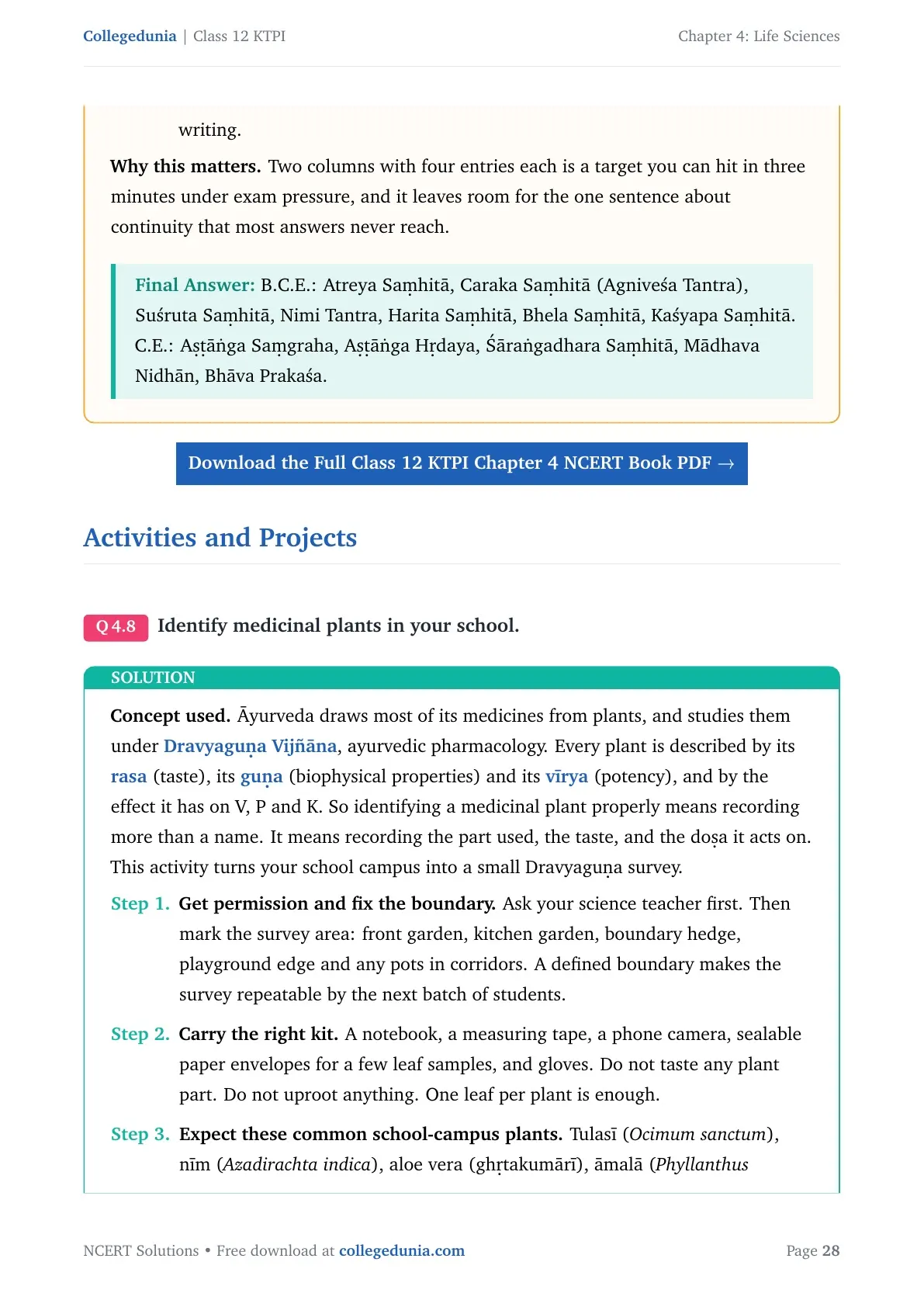
- Projects 1, 2 and 7, the plant survey. One table serves all three: plant, where found, part used, ayurvedic use. Collect the same plant from two regions and note the difference in size, leaf and smell.
- Project 3, the Sanskrit names. Add a column to the same table. Safe entries are haridra for turmeric, ardraka for ginger, tulasi for holy basil, nimba for neem and amalaki for Indian gooseberry.
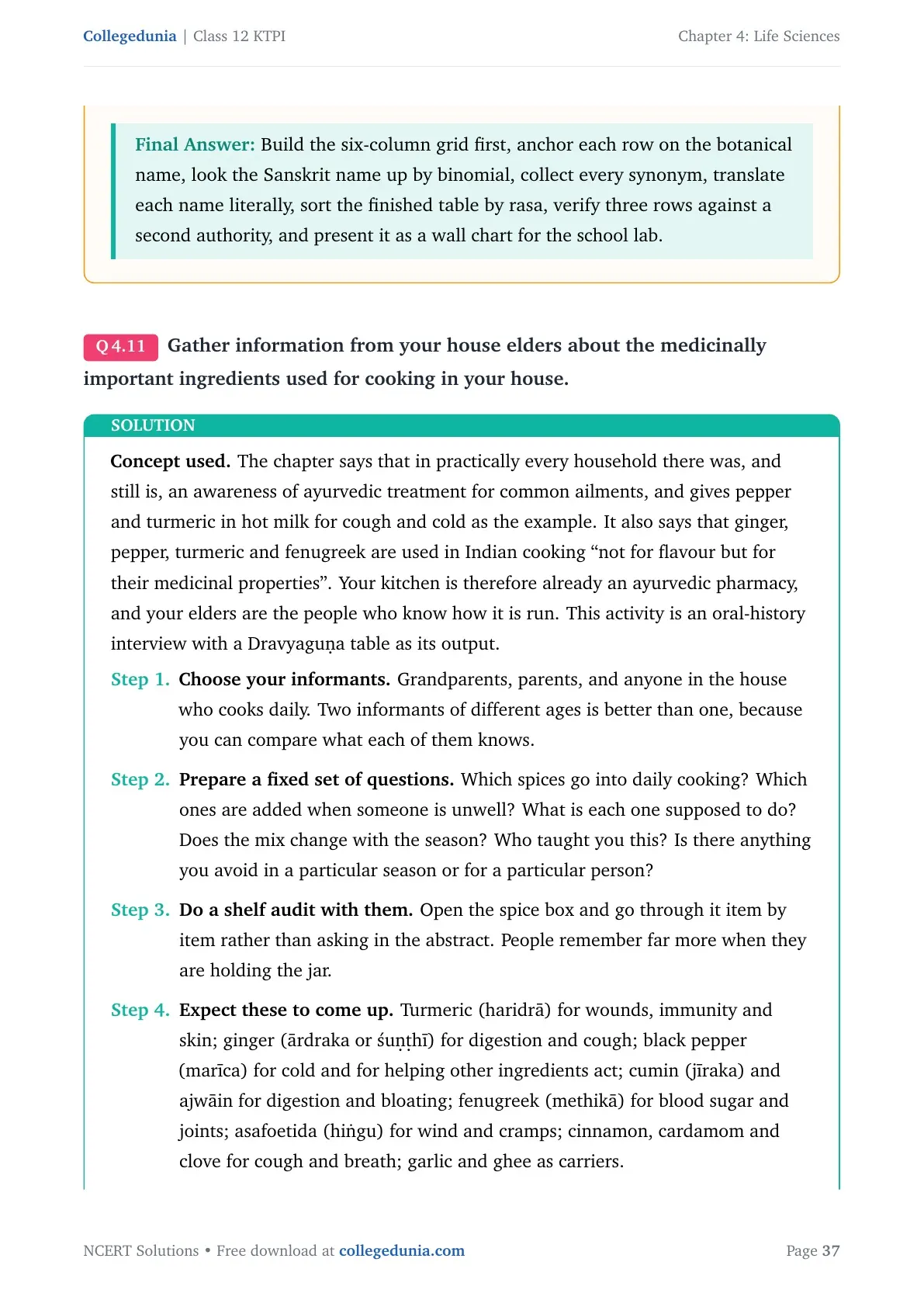
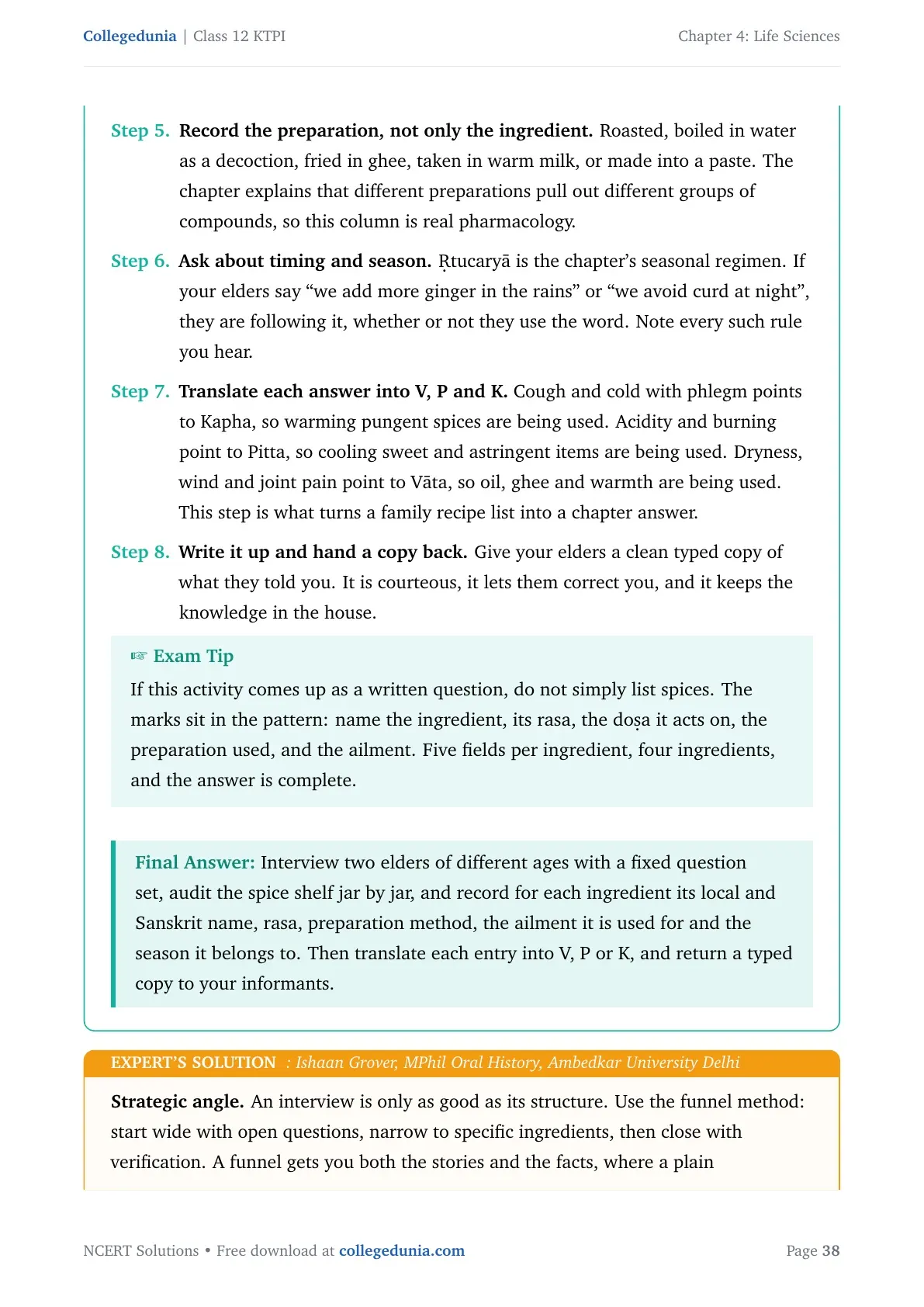
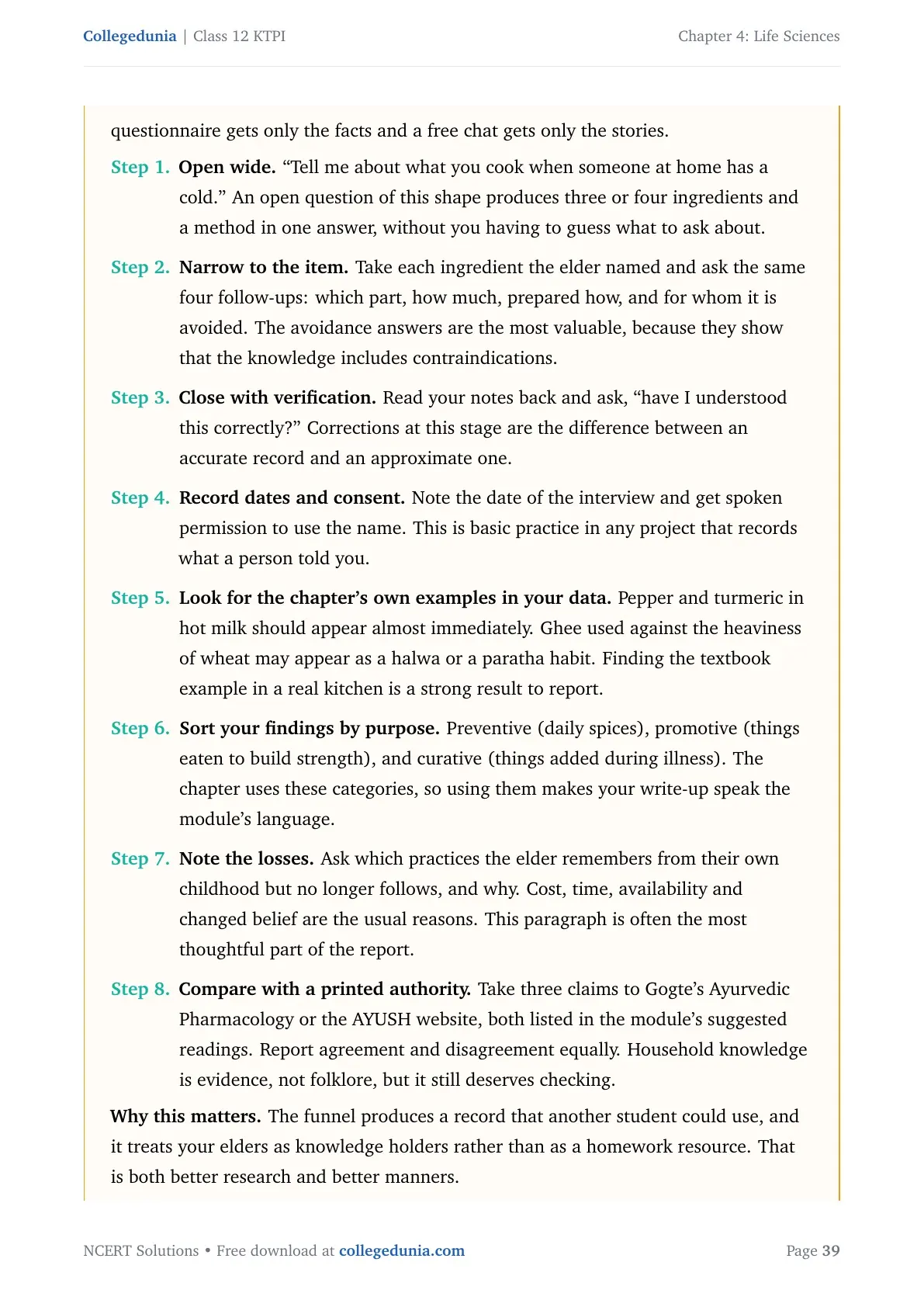
- Projects 4 and 5, the kitchen. Ask elders at home which cooking ingredients are used for health, then take one preparation such as a pickle and give each ingredient a role, using taste and the Vata, Pitta or Kapha effect.
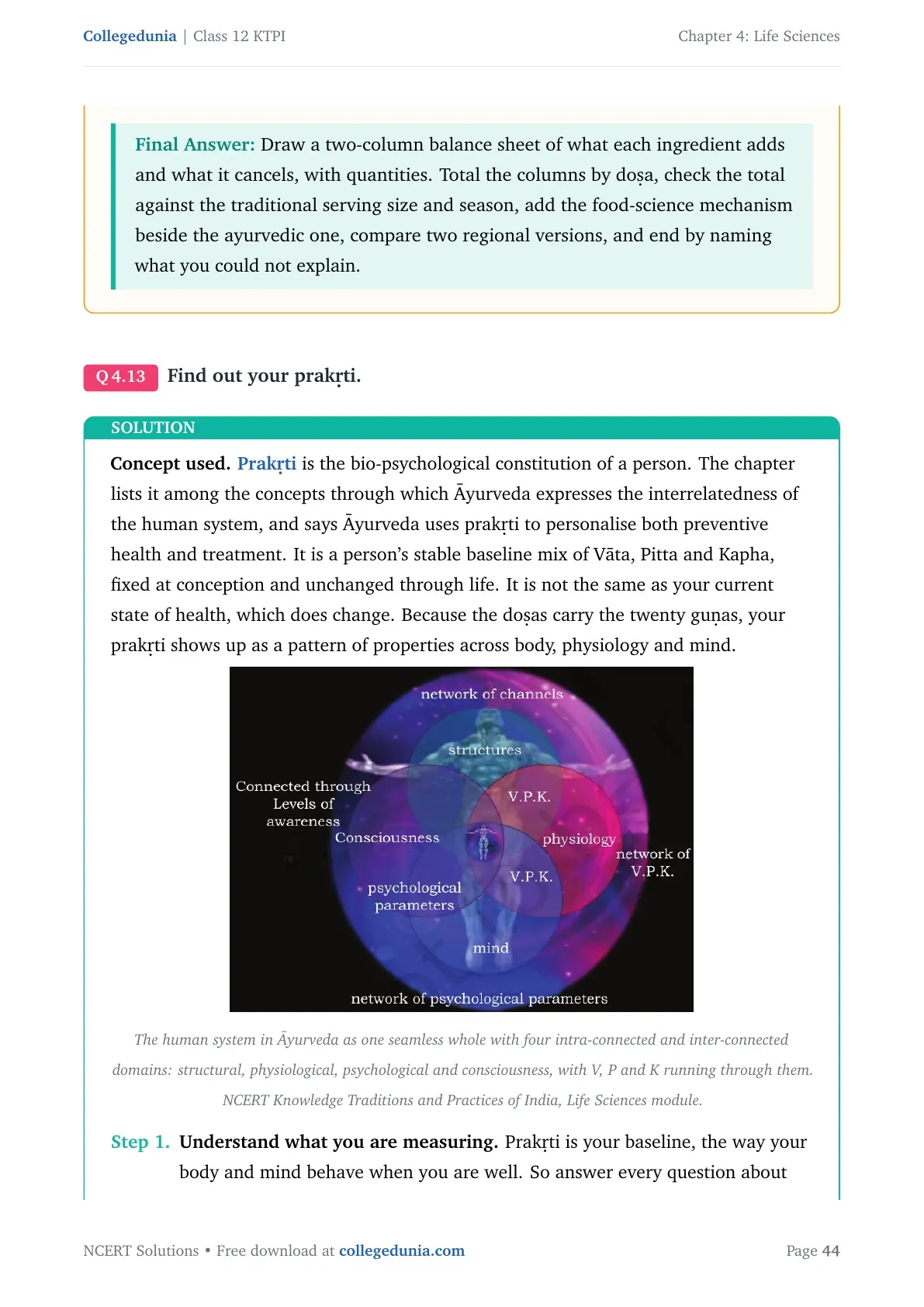
- Project 6, your prakrti. Prakrti is the bio psychological constitution Ayurveda uses to personalise treatment. Describe your own using the twenty gunas, and say clearly that a qualified vaidya makes the real assessment.
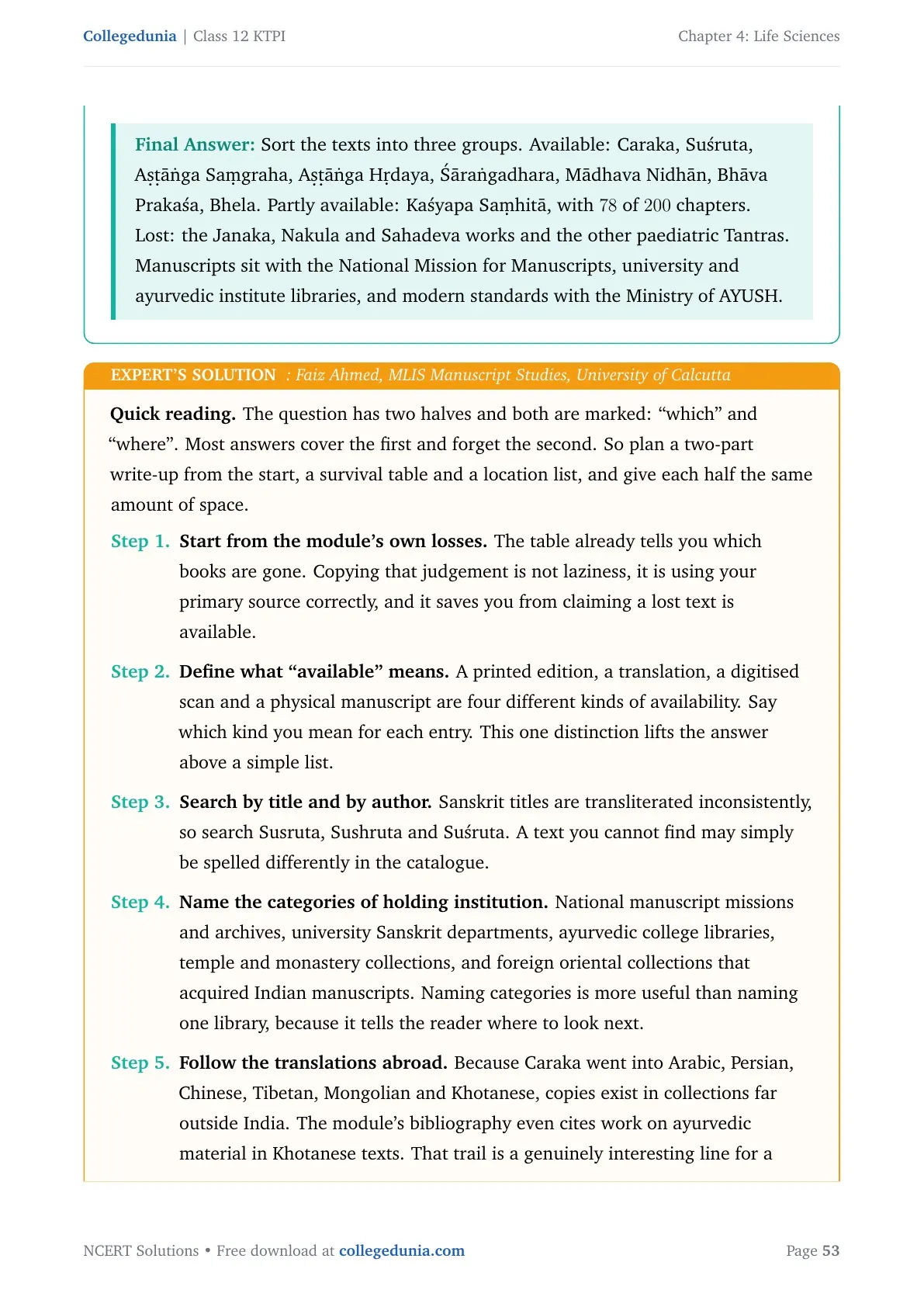
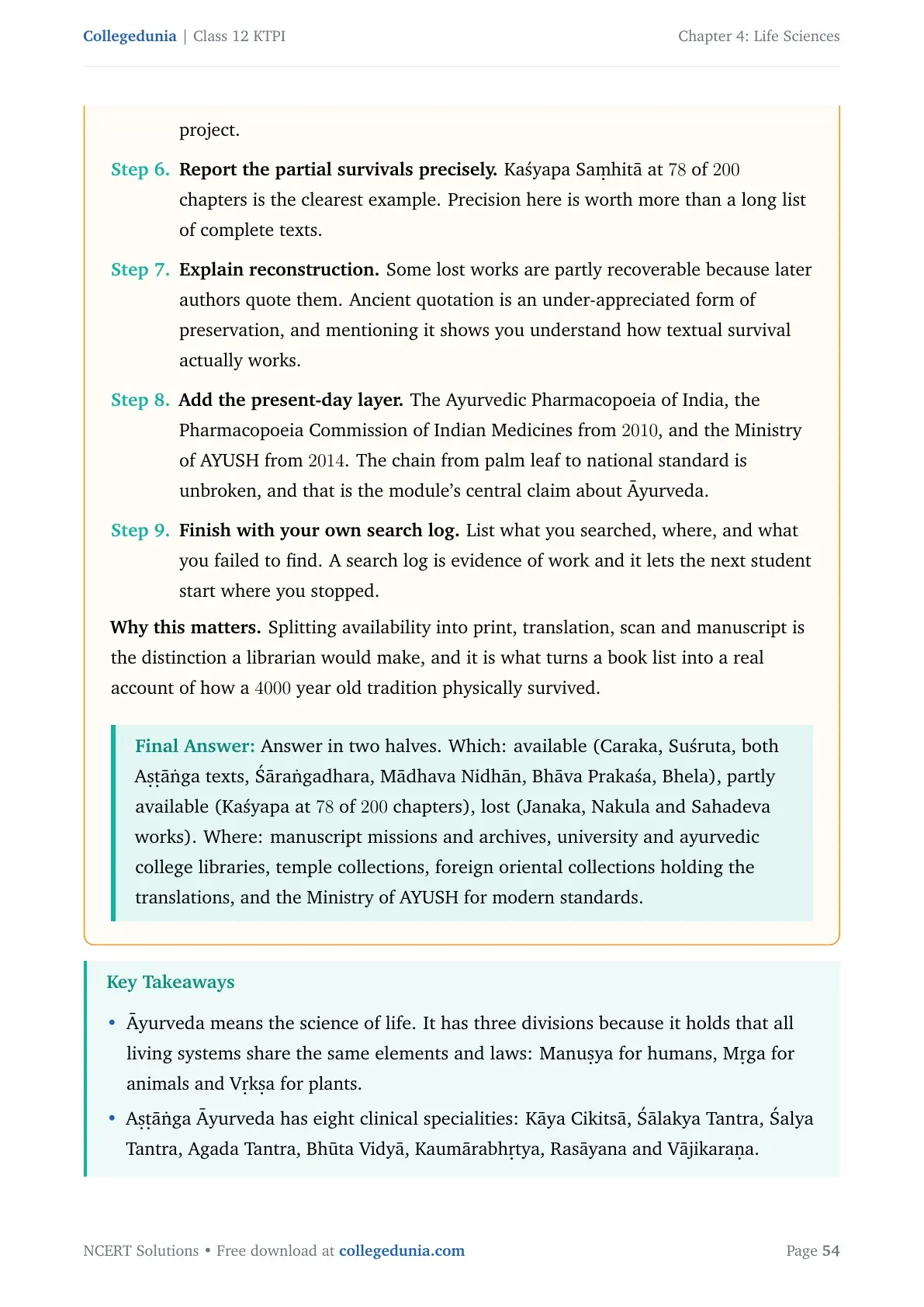
- Project 8, surviving texts. The Caraka Samhita, the Susruta Samhita, the Astanga Hrdaya, the Madhava Nidana and the Bhava Prakasa are all available. Note that several early texts, including the Vaidyaka Sarvasvam, are lost.
Tip: Project 5 is the one that carries the chapter's central idea. If you can explain why oil is added to a chilli pickle, you have understood the antidote principle behind traditional Indian cooking.
Ayurveda Today: The AYUSH Timeline the Chapter Ends With
The chapter closes with a short timeline, and a single sentence from it can be used to finish almost any long answer. Ayurveda is presented not as past glory but as a living system with growing relevance.
| Milestone | What happened |
|---|---|
| An ayurvedic course begins | Started at the Government Sanskrit College, Calcutta, and discontinued by the British six years later |
| Colleges established | The Ayurveda and Unani Tibbia College at Karol Bagh in Delhi, and an Ayurveda college at Banaras Hindu University |
| Regulation | The Indian Medicine Central Council Act brought in uniform standards of practice and education |
| AYUSH | The department for Indian systems of medicine was renamed AYUSH and later upgraded to a full Ministry |
Two numbers from this section are easy to quote and hard to forget. India has more than 250 ayurvedic colleges, and the BAMS degree, the Bachelor of Ayurvedic Medicine and Surgery, is a five and a half year course taken after Class 12 with science subjects. Postgraduate study takes another three years.
Common Mistakes Students Make in the Life Sciences Chapter
Avoid these six in the answer sheet:
- Writing the same answer for Questions 3 and 5. Question 5 wants the definition of tridosa. Question 3 wants the daily and seasonal cycle.
- Calling Vata, Pitta and Kapha organs or fluids. They are functional categories: movement, transformation, and growth with support.
- Listing the eight branches in Sanskrit only. Add the modern equivalent for each, or the answer stays incomplete.
- Forgetting that Ayurveda has three divisions. Manusya and Mrga are asked for, but naming Vrksa Ayurveda shows the full picture.
- Naming ayurvedic texts without a single identifying detail. One detail per text is what separates a full answer from a half answer.
- Answering the diet question with a food list. The marks are in the six tastes, functional indices and the antidote principle.
A quick fix for the numbers: put 3 divisions, 8 branches, 20 gunas, 6 tastes, 80% of pharmacological action, 46,500 verses and 10,268 verses on one card and recite it before the paper.
Student Feedback on the Class 12 KTPI Life Sciences Chapter
What 12,860 Class 12 students told us about the Life Sciences chapter
Collected in a Collegedunia poll run ahead of the 2026-27 board session:
- 61% named the twenty gunas as the hardest part of the chapter, mostly because they tried to learn all twenty as single words instead of ten pairs.
- 9 out of 10 students said the eight branches of Astanga Ayurveda were the easiest marks in the whole module.
- 44% lost marks by giving the same answer for the tridosa question and the biological cycle question.
- Students who drew a small 24 hour clock beside the biological cycle answer reported scoring a full mark more than those who wrote prose alone.
Source: 2026-27 Class 12 KTPI student poll. Sample of 12,860 students from CBSE schools across 14 states.
Where Life Sciences Sits in the Class 12 KTPI Course and Paper
Life Sciences is the fourth chapter of the Class 12 Knowledge Traditions and Practices of India course, and it pairs closely with Medicine in India. It is a high value chapter because almost every answer is a named list. Treat the spread below as a planning guide, not as an official blueprint.
| Chapter | Topic | Indicative weight |
|---|---|---|
| Chapter 1 | Astronomy in India | High |
| Chapter 3 | Mathematics in India | High |
| Chapter 4 | Life Sciences | High |
| Chapter 5 | Medicine in India | High |
| Chapter 6 | Agriculture | Medium |
| Chapter 10 | Indian Philosophical Systems | Medium |
Inside the chapter, the heaviest sub topics are the three divisions of Ayurveda, the eight branches and the tridosa theory. All three attract long answers. Diet and nutrition and the list of texts usually appear as 3 to 4 mark questions.
How to Revise Life Sciences in a Three Block Plan
The chapter is short but dense with names. About three hours of focused work makes it exam ready, and the order printed in the book gives you the sequence for free.
- Block 1, 60 minutes. Read the history and literature sections. Then write the Manusya and Mrga answer and the text table from memory, with one detail against each text.
- Block 2, 60 minutes. Cover the eight branches and the tridosa theory. Write the eight branches with their modern equivalents, then the ten pairs of gunas, without looking.
- Block 3, 60 minutes. Cover the daily and seasonal cycle, diet and pharmacology. Draw the 24 hour dosa clock, then write the six tastes and two antidote examples.
Repeat Block 2 a week before the paper. Students who wrote the eight branches by hand twice reported the fastest recall in the long answer questions.
How the Life Sciences Solutions Work with the Chapter PDF and the Solved Question Set
The solutions give you model answers. They do not give you the full chapter text or the figures the book prints. Those sit on the other Collegedunia pages for the same chapter, and using them together is faster than reading any one of them alone.
| Resource | What it adds beyond these solutions | Link |
|---|---|---|
| Chapter PDF | The full chapter text with the Astanga Ayurveda wheel, the four domains figure, the Vata, Pitta and Kapha network map and the circadian and seasonal rhythm figures | Life Sciences Class 12 Chapter PDF |
| Solved question set | All 7 Exercise questions and all 8 Activities and Projects written out as complete answers, each with a Solution and an Expert Solution | Life Sciences Class 12 Solved Questions |
| Next chapter | The chapter that continues the medical story and reuses the same texts and the same authors you learn here | Medicine in India Class 12 NCERT Solutions |
Also Check: the Agriculture Class 12 NCERT Solutions, which carries the Vrksa Ayurveda and Krsi Parasara story further than the Life Sciences chapter does.
All 10 Chapters of Class 12 KTPI with NCERT Solutions
The Class 12 Knowledge Traditions and Practices of India course runs across ten chapters. Every link below opens the solved question set for that chapter, written for the 2026-27 session.
| Chapter | NCERT Solutions |
|---|---|
| Chapter 1 | Astronomy in India Class 12 NCERT Solutions |
| Chapter 2 | Chemistry in India Class 12 NCERT Solutions |
| Chapter 3 | Mathematics in India Class 12 NCERT Solutions |
| Chapter 4 | Life Sciences Class 12 NCERT Solutions |
| Chapter 5 | Medicine in India Class 12 NCERT Solutions |
| Chapter 6 | Agriculture Class 12 NCERT Solutions |
| Chapter 7 | Metallurgy in India Class 12 NCERT Solutions |
| Chapter 8 | Architecture, Engineering and Technology Class 12 NCERT Solutions |
| Chapter 9 | Indian Languages and Grammar Class 12 NCERT Solutions |
| Chapter 10 | Indian Philosophical Systems Class 12 NCERT Solutions |
Life Sciences Class 12 KTPI Chapter 4 NCERT Solutions FAQs
Questions Class 12 Students Ask Most About the Life Sciences Chapter
Ques. How many questions are there in Class 12 KTPI Chapter 4 Life Sciences?
Ans. There are 15 in total. The Exercise block has 7 questions and the Activities and Projects block at the end has 8. All 15 are solved on this page for the 2026-27 session, and the downloadable PDF carries the same answers with the chapter figures.
Ques. What is Ayurveda?
Ans. Ayurveda literally means the science of life. It is a health system that covers physical, physiological, psychological, environmental and ecological well being, and it puts as much weight on preventing illness as on treating it. Codified Ayurveda is at least 4000 years old, which places it about 1500 years before Hippocrates, and it has its roots in the Vedas.
Ques. What are the three divisions of Ayurveda?
Ans. Manusya Ayurveda for humans, Mrga Ayurveda for animals and Vrksa Ayurveda for plants. The three exist because Ayurveda holds that humans, animals, plants and the universe are made of the same basic elements and follow the same physical laws, so one set of principles can serve all of them. Ancient Indians gave equal importance to the health of humans, animals and plants.
Ques. What are the eight branches of Ayurveda?
Ans. Kaya Cikitsa is internal medicine, Salakya Tantra covers the head and neck, Salya Tantra is surgery, Agada Tantra is toxicology, Bhuta Vidya deals with diseases caused by invisible factors, Kaumarabhrtya is paediatrics and also takes in obstetrics and gynaecology, Rasayana is rejuvenation, and Vajikarana deals with producing physically, physiologically and psychologically healthy progeny. Together they are called Astanga Ayurveda.
Ques. What is the tridosa theory?
Ans. Tridosa is the theory that every living system can be classified by three functions: Vata is movement, Pitta is metabolism and transformation, and Kapha is growth and support. They are described using ten pairs of opposing properties, the twenty gunas, such as cold and hot or heavy and light. All these parameters form one connected network. Health is the stability of that network and disease is a disturbance of it.
Ques. Who is the ayurvedic surgeon acknowledged in modern surgery?
Ans. Susruta. Present day surgeons still acknowledge him for rhinoplasty, the reconstruction of the nose, and otoplasty, the reconstruction of the ear. His text, the Susruta Samhita, deals with surgery and anatomy and covers cataract operations and reconstructive surgery. He was taught by Divodasa Dhanvantari, who established the University of Kashi.
Ques. What are the six tastes in Ayurveda?
Ans. Sweet or madhura, sour or amla, salty or lavana, pungent or katu, bitter or tikta, and astringent or kasaya. A balanced diet in Ayurveda includes all six so that Vata, Pitta and Kapha stay in equilibrium. In ayurvedic pharmacology, the taste of a plant taken together with its physical properties and its potency predicts nearly 80% of its pharmacological action.
Ques. What are dinacarya and rtucarya?
Ans. Dinacarya is the daily regimen and rtucarya is the seasonal regimen. Both are built on the biological rhythms of the body, the 24 hour circadian rhythm and the one year circa annual rhythm. By following their do's and don'ts a person keeps Vata, Pitta and Kapha in balance through the day and through the year, which prevents seasonal illness rather than treating it later.
Ques. Which ayurvedic texts were written before the Common Era?
Ans. The Atreya Samhita by Atreya, with 46,500 verses in 5 adhyayas. The Agnivesa Tantra by Agnivesa, known today as the Caraka Samhita after its redactor Caraka. The Susruta Samhita by Susruta on surgery and anatomy. The Nimi Tantra on ophthalmology, the Harita Samhita on general medicine, the Bhela Samhita on the brain and blood circulation, and the Kasyapa Samhita on paediatrics.
Ques. Which ayurvedic texts were written in the Common Era?
Ans. The Astanga Samgraha and the Astanga Hrdaya by Vagbhata, which compile the ayurvedic knowledge then available and add new plants and diseases. The Sarangadhara Samhita by Sarangadharacarya, which has 3 divisions and 32 chapters and describes pulse diagnosis. The Madhava Nidana by Madhava on the causes and symptoms of diseases. And the Bhava Prakasa by Bhava Misra, with 80 chapters and 10,268 verses on medicinal plants.
Ques. What is Vrksa Ayurveda?
Ans. Vrksa Ayurveda is the plant branch. It explains the life cycle of plants and the prevention and treatment of plant diseases, and it covers the origin of a plant from seed, the parts of a plant, their structure and functions, the rules of plantation, the best seasons for planting and harvesting, and good agricultural practice. Krsi Parasara by Parasara and Vrksa Ayurveda by Surapala are the books to name.
Ques. Who is the father of veterinary Ayurveda?
Ans. Salihotra. He wrote Haya Ayurveda, which was translated into Persian, Arabic, Tibetan and English, along with the Salihotra Samhita, Asvaprasna Sastram, Asvalaksana Sastram and Asva Ayurveda. Palakapya wrote Hasti Ayurveda and Gaja Sastram on elephants, Nakula wrote an Asva Sastra on horses and Sahadeva wrote a Gava Ayurveda on cows.
Ques. Is Life Sciences part of the 2026-27 Class 12 KTPI syllabus?
Ans. Yes. Life Sciences is Chapter 4 of the Class 12 Knowledge Traditions and Practices of India course for the 2026-27 session. It covers Ayurveda as the science of life, its three divisions, the eight branches of Astanga Ayurveda, the tridosa theory and the twenty gunas, ayurvedic pharmacology and the six tastes, diet, dinacarya and rtucarya, Susruta and ancient Indian surgery, and the major ayurvedic texts.



Comments