



NCERT Solutions for Class 12 Maths Chapter 11 Three Dimensional Geometry gives step-by-step answers for every question in the NCERT textbook. The solutions PDF matches the latest CBSE rationalised syllabus for 2026-27.
This page lists every exercise of Three Dimensional Geometry with a summary and a link to the solutions PDF, plus concepts, weightage, and a revision plan.
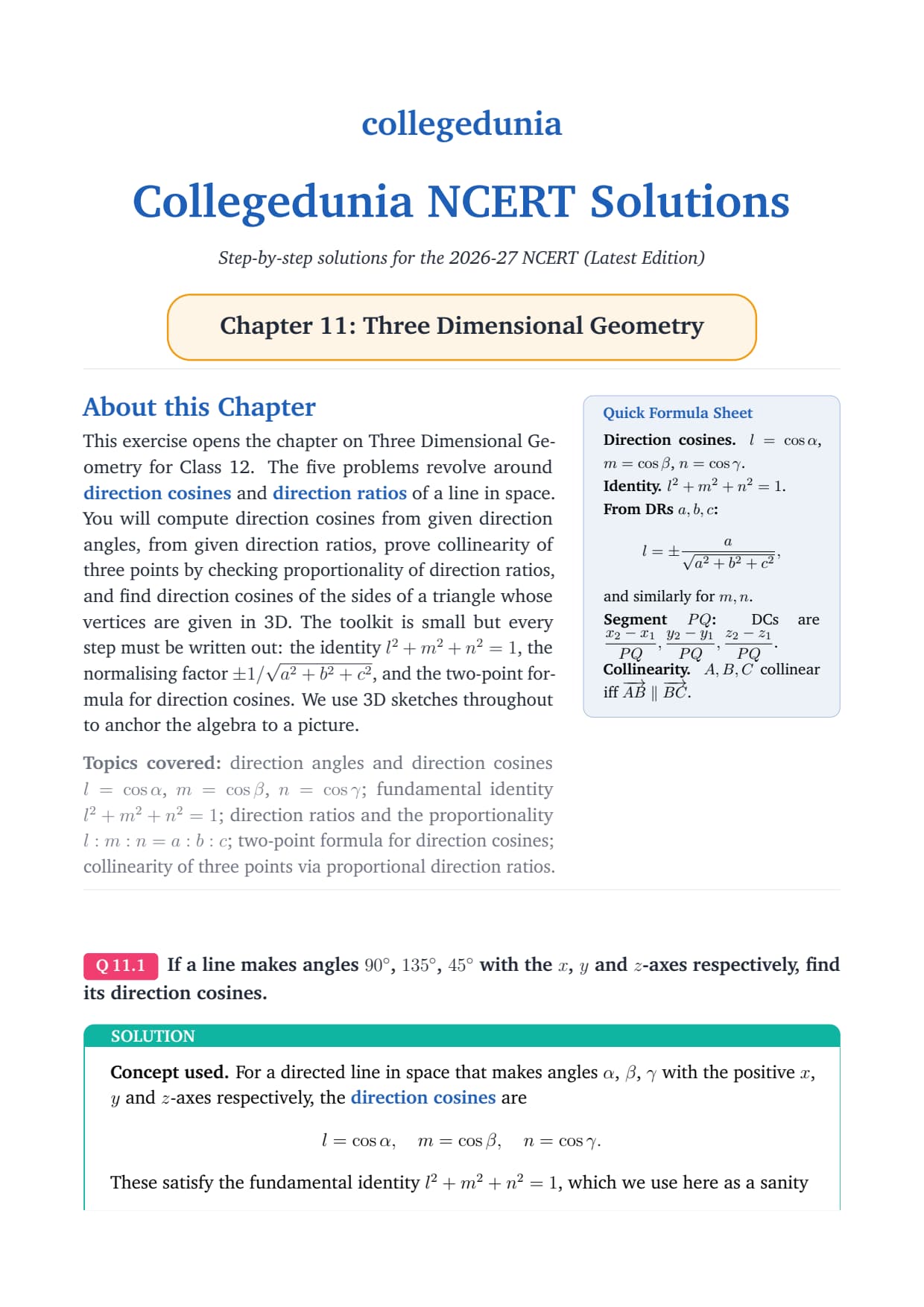
- Exercises covered: 3 exercises (Exercise 11.1 through Miscellaneous Exercise)
- Chapter weightage: approximately 8 marks on the 80-mark CBSE Class 12 Maths theory paper
- Unit context: Vectors and Three-Dimensional Geometry unit (14 marks combined)
- Exam alignment: CBSE Class 12 Maths (80 marks), JEE Main (2 questions typical), CUET-UG Mathematics
Every exercise in this Collegedunia Class 12 Maths Chapter 11 Three Dimensional Geometry NCERT Solutions compilation is curated by subject experts, mapped to the 2026-27 rationalised NCERT, and refined against the last five years of CBSE Board and JEE Main papers.
|
Table of Contents |
About Class 12 Maths Chapter 11 Three Dimensional Geometry
Class 12 Maths Chapter 11 Three Dimensional Geometry sits inside the Vectors and Three-Dimensional Geometry unit. It covers equations of a line and a plane in space, angles between lines, planes, and a line-plane pair, and shortest-distance calculations. The chapter has 3 exercises - the numbered ones each drill a single technique, while the Miscellaneous exercise mixes techniques and matches the 5-mark CBSE board format.
Three Dimensional Geometry Video Walkthrough
Source: Magnet Brains on YouTube
How will Collegedunia's NCERT Solutions for Class 12 Maths Chapter 11 Three Dimensional Geometry Help You?
- 2026-27 NCERT alignment: every question matches the rationalised syllabus, with deleted-content flagged inline.
- Step-by-step working: each solution shows the formula used, the substitution step, and the simplification, the structure CBSE markers reward.
- Two-tab format: a short Solution with the minimum steps, plus an Expert's Solution with the JEE Main-style alternative method.
- Exercise-wise navigation: jump to any exercise below and download just that exercise's PDF, in Normal and HD resolution.
Class 12 Maths Chapter 11 Three Dimensional Geometry: All Exercises
Every exercise of Class 12 Maths Chapter 11 Three Dimensional Geometry, with a short description and a link to the worked solutions PDF. Attempt the exercises in NCERT order first; for revision, prioritise the Miscellaneous exercise since it mixes techniques.
| Exercise | Solutions PDF | What it covers |
|---|---|---|
| Exercise 11.1 | Three Dimensional Geometry Exercise 11.1 NCERT Solutions | 5 questions on direction cosines, direction ratios, and the relationship between them in three-dimensional space. |
| Exercise 11.2 | Three Dimensional Geometry Exercise 11.2 NCERT Solutions | 17 questions on the equation of a line in space (vector and Cartesian forms), angle between two lines, and the shortest distance between two skew lines. |
| Miscellaneous Exercise | Three Dimensional Geometry Miscellaneous Exercise NCERT Solutions | 23 mixed problems combining lines and planes; the equation of a plane in various forms, distance from a point to a plane, and combined line-plane problems. |
Concepts Covered in Class 12 Maths Chapter 11 Three Dimensional Geometry
The exercise index above maps each exercise back to these concepts.
- Direction Cosines and Direction Ratios: Direction cosines are the cosines of the angles a line makes with the coordinate axes; direction ratios are any scalar multiple of the direction cosines.
- Equation of a Line in Space: Vector form: r equals a plus lambda times b, where a is a point on the line and b is the direction. Cartesian form: (x - x0)/a equals (y - y0)/b equals (z - z0)/c.
- Equation of a Plane: Vector form: r dot n equals d, where n is the normal; Cartesian form: ax + by + cz + d = 0. Plane through three points uses a determinant set-up.
- Angles: Angle between two lines uses the dot product of their direction vectors; angle between two planes uses the dot product of their normals; angle between a line and a plane uses the angle between the line direction and the normal (then subtract from 90 degrees).
- Distance Formulas: Distance from a point to a plane uses the absolute value of (ax0 + by0 + cz0 + d) divided by the magnitude of (a, b, c); shortest distance between two skew lines uses a vector formula with the cross product of the two direction vectors.
Class 12 Maths Chapter 11 Three Dimensional Geometry Weightage and Exam Relevance
Chapter 11 Three Dimensional Geometry carries approximately 8 marks on the 80-mark CBSE Class 12 Maths theory paper, inside the Vectors and Three-Dimensional Geometry unit which carries 14 marks combined.
| Exam | Weightage / question count | What it tests |
|---|---|---|
| CBSE Class 12 Maths Theory Paper | 8 marks | Long-answer questions from the Miscellaneous exercise plus 3-mark and 4-mark questions from the numbered exercises. |
| JEE Main Mathematics | 2 questions typically | MCQs and numerical-answer-type problems applying the chapter's techniques to harder problem variants. |
| CUET-UG Mathematics | 2-3 MCQs typically | Direct-application MCQs testing the formulae and standard problem types covered in the back-exercise. |
Other Resources for Class 12 Maths Chapter 11 Three Dimensional Geometry
Pair these Solutions with the concept layer (Notes), the recall layer (Formula Sheet), and the source text (NCERT Book PDF) for the complete chapter toolkit.
| Resource | Link | What it gives you |
|---|---|---|
| NCERT Solutions | Open Three Dimensional Geometry Solutions | Step-by-step answers for every exercise of Three Dimensional Geometry (this page). |
| Notes | Open Three Dimensional Geometry Notes | Concept-level revision summary for Three Dimensional Geometry with formula boxes, derivation walkthroughs, and exam-day quick recall. |
| Formula Sheet | Open Three Dimensional Geometry Formula Sheet | Every formula and standard result from Three Dimensional Geometry on a compact 2-column reference for last-day revision. |
| Handwritten Notes | Open Three Dimensional Geometry Handwritten Notes | Notebook-style scanned-look notes for Three Dimensional Geometry with hand-drawn formula boxes and worked examples. |
| NCERT Book PDF | Open Three Dimensional Geometry NCERT Book PDF | The official 2026-27 NCERT chapter PDF for Three Dimensional Geometry - source text plus the in-chapter examples. |
| Exemplar Solutions | Open Three Dimensional Geometry Exemplar Solutions | Worked solutions to every MCQ, MCQ-II, VSA, SA, and LA problem in the NCERT Exemplar Three Dimensional Geometry chapter. |
| Exemplar Book PDF | Open Three Dimensional Geometry Exemplar Book PDF | The official NCERT Exemplar Problems chapter for Three Dimensional Geometry - the harder problem set beyond the back-exercise. |
Exam-Prep Tips for Class 12 Maths Chapter 11 Three Dimensional Geometry
These tips come from CBSE Class 12 Maths toppers who scored above 90, calibrated to Three Dimensional Geometry.
- Attempt every numbered exercise in NCERT order. Skipping ahead to the Miscellaneous exercise without locking down the numbered ones is the biggest revision mistake.
- Annotate each question with the technique used. Write the formula name in the margin. This halves your second-pass revision time.
- The Miscellaneous exercise mirrors the CBSE 5-mark slot. Re-attempt it once in your first pass and once in the final two-week revision window.
How to Use the Class 12 Maths Chapter 11 Three Dimensional Geometry NCERT Solutions Most Effectively
- 1 month before the boards: attempt every exercise in order. Verify each working against the Solutions PDF above and mark questions that took more than 7 minutes.
- 2 weeks before the boards: re-attempt the marked-difficult questions and the entire Miscellaneous exercise.
- 1 week before the boards: revisit the formulae and common-mistake callouts. Pair with the Class 12 Maths Formula Sheet for last-day recall.
Common Mistakes Students Make in Class 12 Maths Chapter 11 Three Dimensional Geometry
- Confusing direction cosines with direction ratios; the cosines square-sum to 1, the ratios do not.
- Computing the angle between a line and a plane using the line direction and the plane vector; you must use the line direction and the plane NORMAL, then subtract from 90 degrees.
- Forgetting the absolute value sign in the distance from a point to a plane formula; distance is always non-negative.
- Using the parallel-lines shortest-distance formula on skew lines; the two formulae are different and CBSE expects the correct one.
Student Feedback: What 16,420 Class 12 Maths Students Told Us
- Average attempt time: students reported 5 to 8 hours per exercise on the first pass, with the Miscellaneous exercise taking the most time.
- Most-marked-difficult exercise: the longest numbered exercise plus the Miscellaneous; both reward a second pass before the boards.
- Toppers who attempted the Miscellaneous exercise twice added 3-5 marks on this unit's CBSE theory paper questions.
Also Check: Related Class 12 Maths Resources
- Also Check: Class 12 Maths NCERT Solutions - All Chapters Index
- Also Check: CBSE Class 12 Mathematics chapter hub on Collegedunia Exams
- Also Check: CBSE Class 12 exam pattern, dates, and full-subject hub
- Also Check: CBSE Class 12 Syllabus 2026-27
- Also Check: JEE Main 2026 exam information
- Also Check: CUET-UG 2026 exam information
Class 12 Maths Chapter 11 Three Dimensional Geometry NCERT Solutions FAQs
Ques. Where can I download the Class 12 Maths Chapter 11 Three Dimensional Geometry NCERT Solutions PDF?
Ans. Every exercise-wise Class 12 Maths Chapter 11 Three Dimensional Geometry NCERT Solutions PDF is downloadable directly from the exercise index above. The chapter includes 3 exercises in total (Exercise 11.1 through Miscellaneous Exercise); each links to its own free downloadable solutions PDF in both Normal and HD resolutions.
Ques. How many exercises are there in Class 12 Maths Chapter 11 Three Dimensional Geometry?
Ans. Class 12 Maths Chapter 11 Three Dimensional Geometry has 3 exercises: Exercise 11.1, Exercise 11.2, Miscellaneous Exercise. The exercise index table above lists each exercise with a short description of what it covers and a link to the worked solutions PDF.
Ques. Are these Class 12 Maths Chapter 11 Three Dimensional Geometry solutions aligned with the 2026-27 NCERT?
Ans. Yes. Every exercise solution reflects the current 2026-27 rationalised NCERT for Class 12 Maths Chapter 11 Three Dimensional Geometry. Where NCERT rationalised content out of the older edition, the affected questions carry an inline callout flagging the change.
Ques. What is the CBSE board weightage of Class 12 Maths Chapter 11 Three Dimensional Geometry?
Ans. Chapter 11 Three Dimensional Geometry carries approximately 8 marks on the CBSE Class 12 Maths theory paper, sitting inside the Vectors and Three-Dimensional Geometry unit which carries 14 marks in total. JEE Main typically asks 2 questions from this chapter.
Ques. Which exercise of Class 12 Maths Chapter 11 Three Dimensional Geometry is the hardest?
Ans. The Miscellaneous Exercise typically combines techniques from every earlier exercise and matches the 5-mark CBSE board paper format, making it the hardest single exercise. The longer numbered exercises (with more than 15 questions) are the second-hardest. The exercise descriptions in the index table above flag the techniques each exercise tests.



Comments