Maths Mentor, Thapar Institute | Updated on - Jul 21, 2026
The Continuity and Differentiability Class 12 NCERT Solutions given here cover Exercise 5.1 of Class 12 Mathematics Chapter 5 Continuity and Differentiability in full. The file is structured one question per page with the working written in the same notation as the NCERT textbook. This chapter link back to the solutions PDF-level page where the broader concept set is summarised.
CBSE Weightage: 8-10 marks (Continuity and Differentiability + Applications of Derivatives, Calculus unit total 35 marks)
JEE Main Weightage: 6-8% of the Mathematics section, with 2-3 questions on continuity and differentiability checks
Exercise 5.1 problem count: 34 questions covering checking continuity from the limit definition, locating discontinuities, and proving continuity of standard functions
Exercise 5.1 at a glance: 34 questions, average solved-length 4-7 lines each, with at least 9 questions requiring left-hand-limit and right-hand-limit comparison at break-points. Around 70% of CBSE 1-mark and 2-mark questions from these notes are lifted from Exercise 5.1 patterns.
These Collegedunia NCERT Solutions for Exercise 5.1 are written by experienced Class 12 Mathematics teachers, follow the latest 2026-27 NCERT print, and lay out each limit substitution, LHL and RHL evaluation, and continuity conclusion on a separate line so you can replicate the method in CBSE board answer scripts. Every question shows the formula recall, the substitution, and the boxed final inference.
continuity-and-differentiability Exercise 5.1 Solved Step by Step (Video)
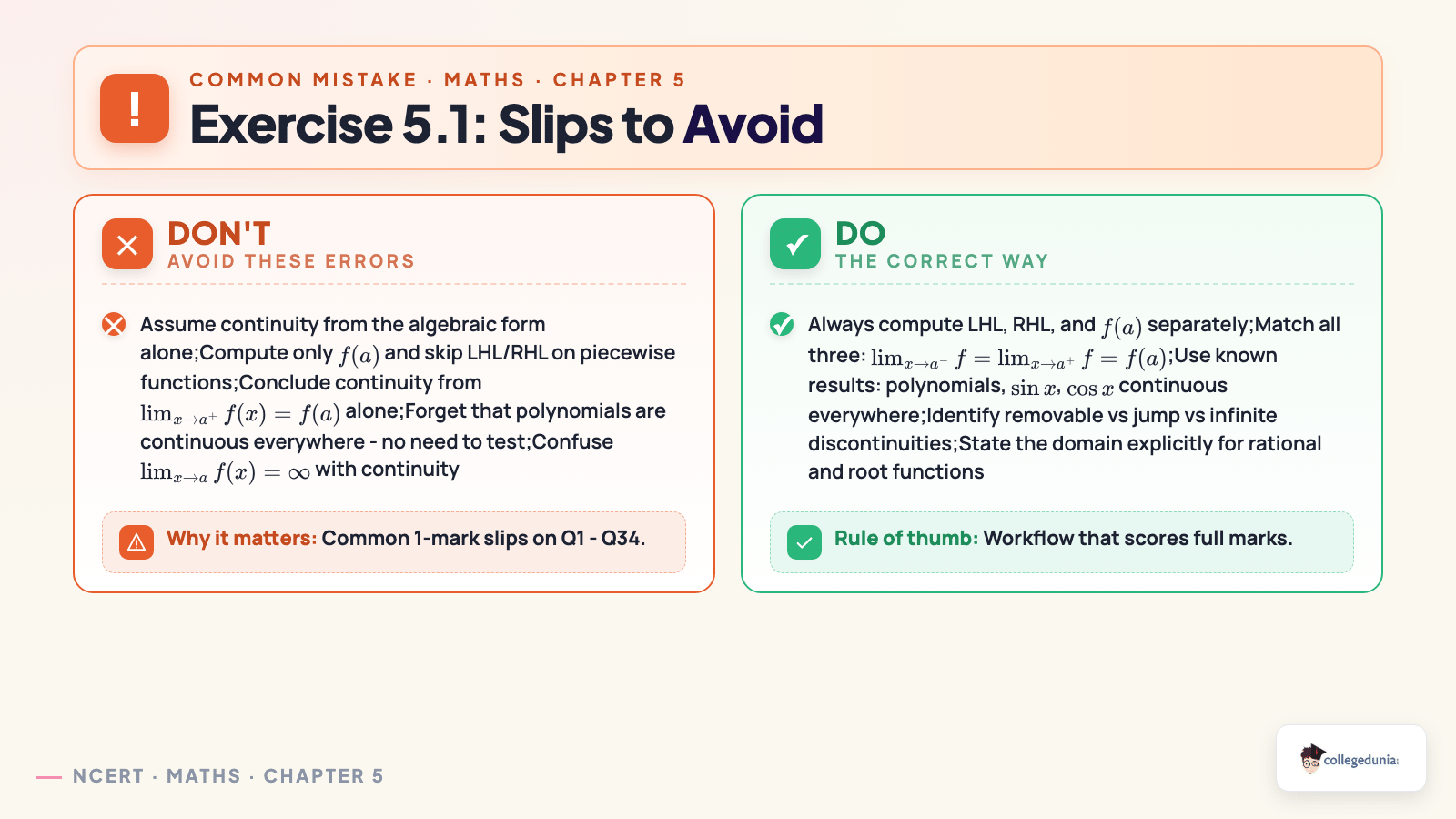
Common Mistakes Students Make in Exercise 5.1
Treating LHL = RHL as sufficient. The third condition f(c) must also equal the common limit; many students stop after matching the one-sided limits.
Substituting before checking the form. If you plug x = c into a piecewise definition, you may use the wrong branch.
Forgetting [x] jumps. The greatest-integer function is continuous on every interval (n, n+1) and discontinuous at every integer n, not the other way around.
Confusing |x| with [x] . |x| is continuous everywhere; [x] is not.
Skipping the "find k" verification. After solving for k, plug it back in and re-check LHL = RHL = f(c). CBSE deducts 1 mark for not writing the back-check.
Other Resources for Class 12 Maths Chapter 5 Continuity And Differentiability
Pair these solutions with the other free Continuity And Differentiability resources for this chapter:
Important Questions and Previous Year Trends for the Continuity and Differentiability Chapter
Template
Typical Marks
What it tests
Proof / property verification
3 marks
Students show that a given relation/function/expression satisfies the chapter's definitions.
One-step computation
2 marks
Substitution-based item: plug into a known formula and simplify.
Case-study scenario
4 marks
Real-world setup applying the chapter's definitions, introduced in CBSE 2021+ papers.
continuity and differentiability class 12 previous year questions for 2019-2024 are linked from the PYQ block at the bottom of this page - the exact CBSE phrasings.
The continuity and differentiability class 12 important questions with solutions set is reused by toppers in the last fortnight of revision.
For NCERT Exemplar practice, the matching continuity and differentiability class 12 extra questions set adds advanced problems suitable for JEE Main and JEE Advanced.
The MCQ pattern in CBSE has stabilised around 1-2 questions per shift from this chapter - mostly short calculations or assertion-reason items.
Year-wise PYQ Distribution
Year
Dominant Question Type
Approx. Marks
2024
Property verification + case-study item
5-6 marks
2023
Computation with proof + assertion-reason MCQ
5-6 marks
2022
Long-answer derivation + 2-mark substitution
5-7 marks
2021
Definition recall + property check
4-5 marks
2020
One-step computation + 3-mark proof
5 marks
All NCERT Solutions for Continuity and Differentiability Ex 5.1 with Step-by-Step Working
Questions
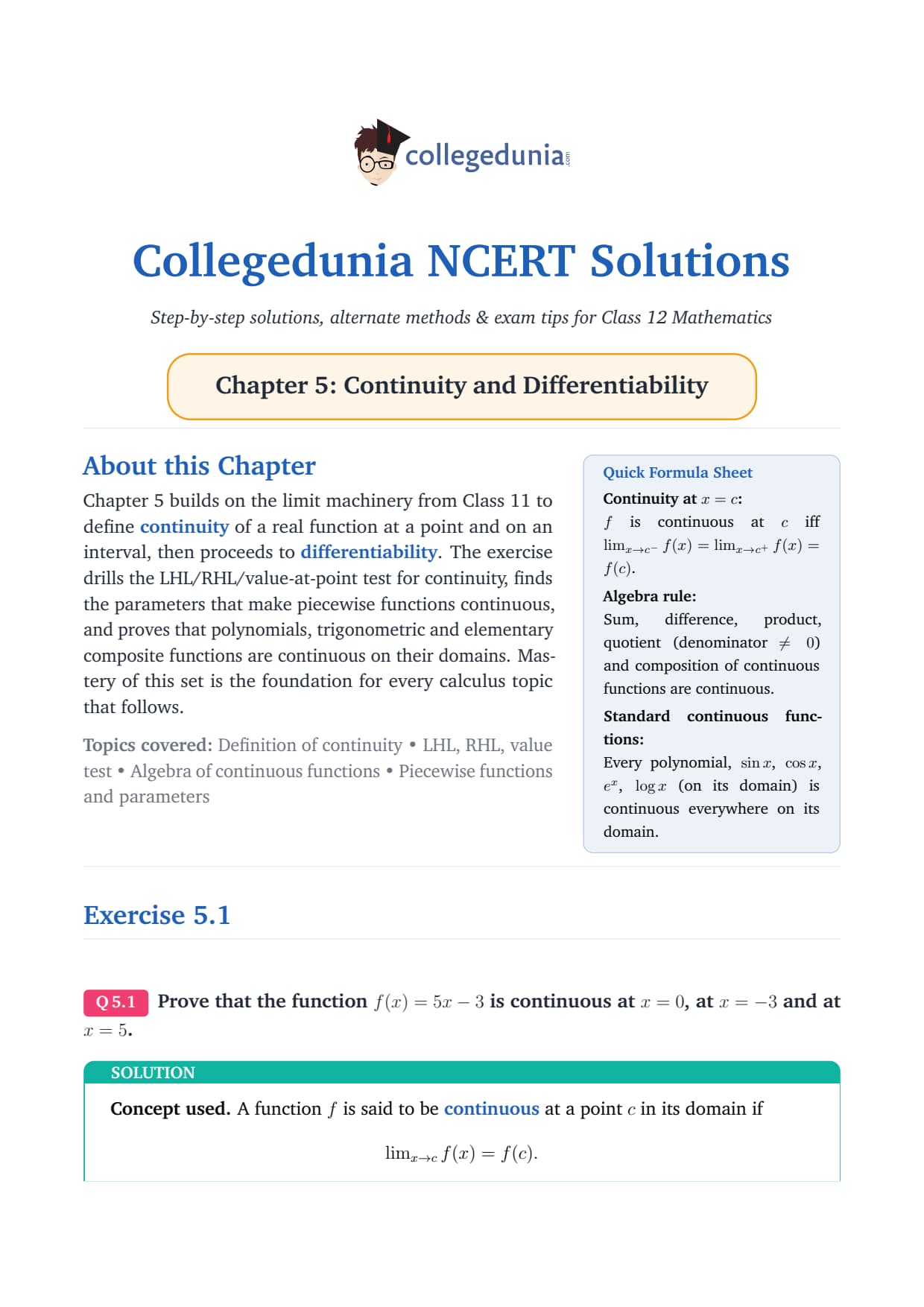
Q 5.1
Prove that the function f(x) = 5x - 3 is continuous at x = 0, at x = -3 and at x = 5.
Concept used. A function f is said to be continuous at a point c in its domain if
x → cf(x) = f(c).
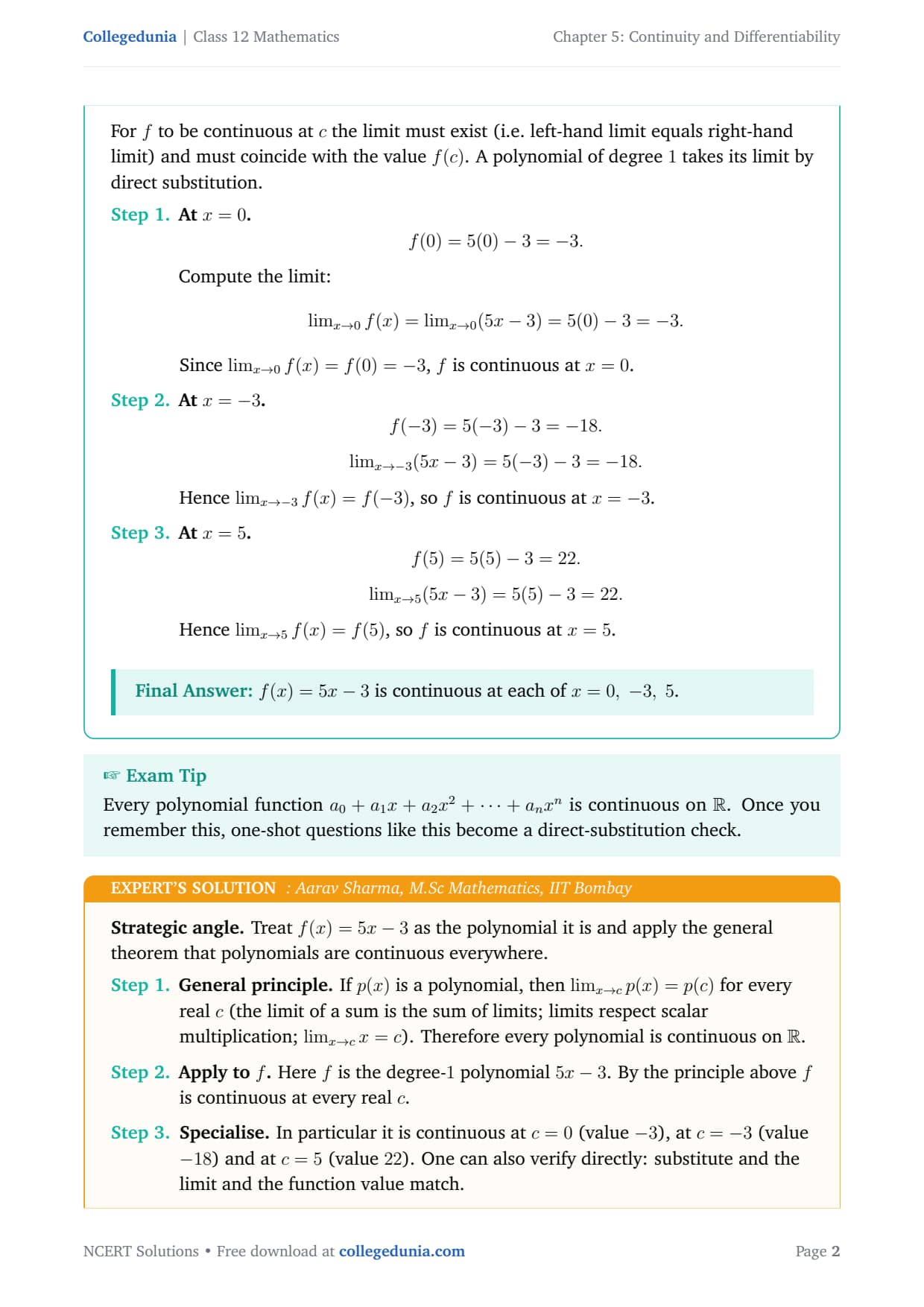
For f to be continuous at c the limit must exist (i.e. left-hand limit equals right-hand limit) and must coincide with the value f(c). A polynomial of degree 1 takes its limit by direct substitution.
At x = 0.f(0) = 5(0) - 3 = -3.
Compute the limit:
x → 0f(x) = x → 0(5x - 3) = 5(0) - 3 = -3.
Since x → 0f(x) = f(0) = -3, f is continuous at x = 0.
At x = -3.f(-3) = 5(-3) - 3 = -18. x → -3(5x - 3) = 5(-3) - 3 = -18.
Hence x → -3f(x) = f(-3), so f is continuous at x = -3.
At x = 5.f(5) = 5(5) - 3 = 22. x → 5(5x - 3) = 5(5) - 3 = 22.
Hence x → 5f(x) = f(5), so f is continuous at x = 5.
f(x) = 5x - 3 is continuous at each of x = 0, -3, 5.
AS
Aarav Sharma
M.Sc Mathematics, IIT Bombay
Verified Expert
Strategic angle. Treat f(x) = 5x - 3 as the polynomial it is and apply the general theorem that polynomials are continuous everywhere.
General principle. If p(x) is a polynomial, then x → cp(x) = p(c) for every real c (the limit of a sum is the sum of limits; limits respect scalar multiplication; x → cx = c). Therefore every polynomial is continuous on R.
Apply to f. Here f is the degree-1 polynomial 5x - 3. By the principle above f is continuous at every real c.
Specialise. In particular it is continuous at c = 0 (value -3), at c = -3 (value -18) and at c = 5 (value 22). One can also verify directly: substitute and the limit and the function value match.
Why this matters. Identifying the underlying function class (here: polynomial) often replaces three separate ε-δ arguments with one general result.
f is continuous at x = 0, -3, 5.
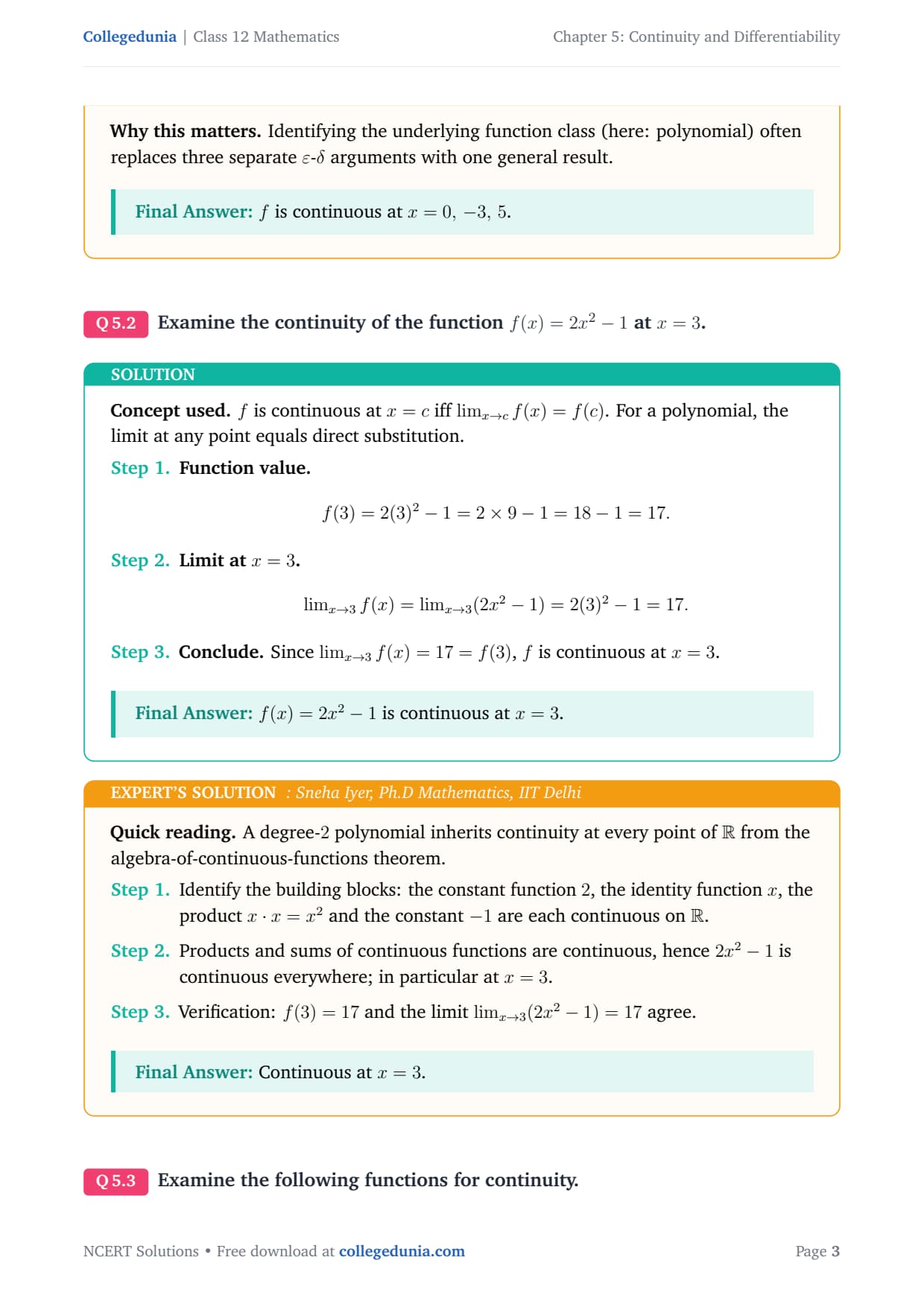
Q 5.2
Examine the continuity of the function f(x) = 2x2 - 1 at x = 3.
Concept used.f is continuous at x = c iff x → cf(x) = f(c). For a polynomial, the limit at any point equals direct substitution.
Limit at x = 3.x → 3f(x) = x → 3(2x2 - 1) = 2(3)2 - 1 = 17.
Conclude. Since x → 3f(x) = 17 = f(3), f is continuous at x = 3.
f(x) = 2x2 - 1 is continuous at x = 3.
SI
Sneha Iyer
Ph.D Mathematics, IIT Delhi
Verified Expert
Quick reading. A degree-2 polynomial inherits continuity at every point of R from the algebra-of-continuous-functions theorem.
Identify the building blocks: the constant function 2, the identity function x, the product x · x = x2 and the constant -1 are each continuous on R.
Products and sums of continuous functions are continuous, hence 2x2 - 1 is continuous everywhere; in particular at x = 3.
Verification: f(3) = 17 and the limit x → 3(2x2 - 1) = 17 agree.
Continuous at x = 3.
Q 5.3
Examine the following functions for continuity.
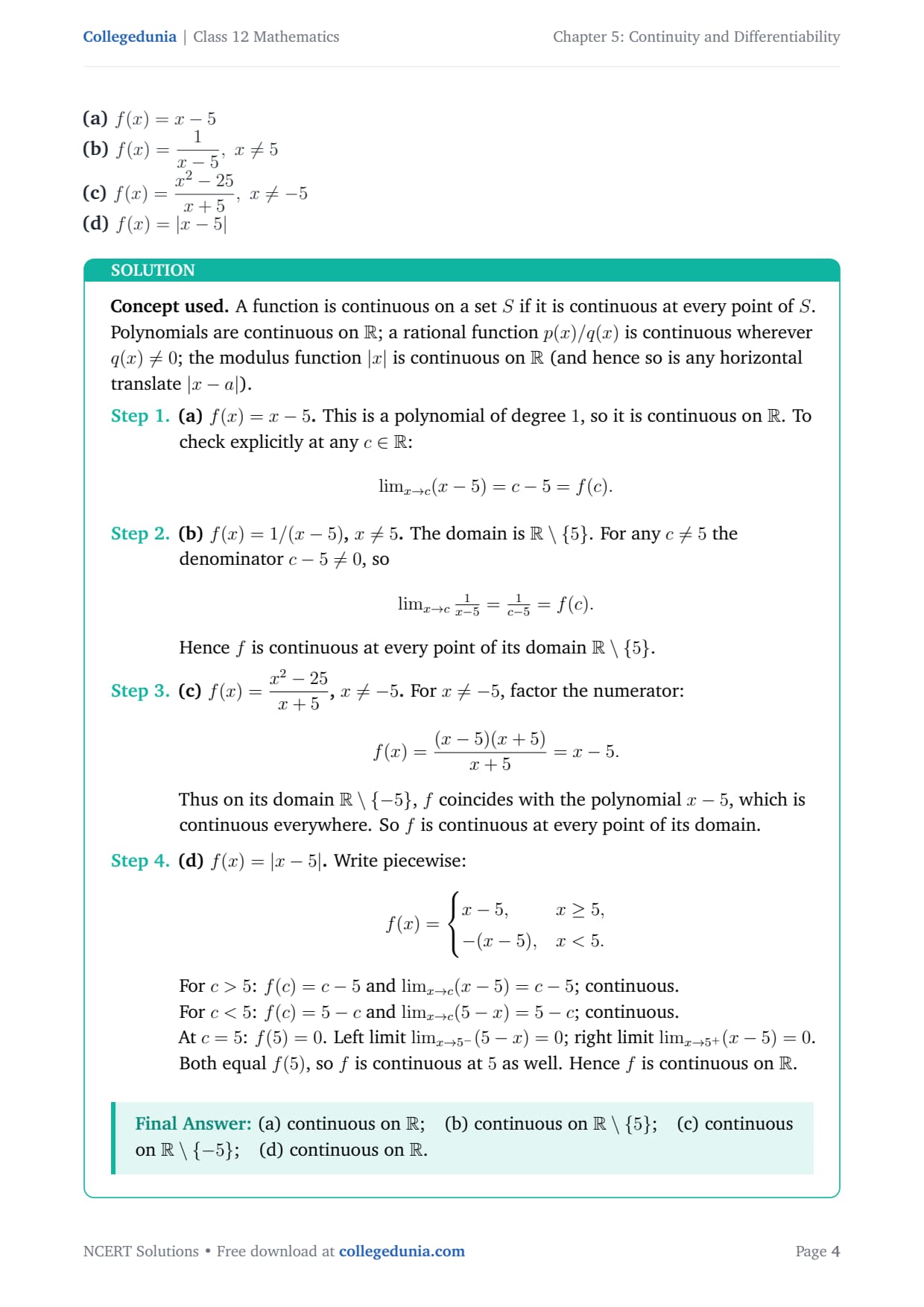
(a) f(x) = x - 5
(b) f(x) = 1x - 5, x ≠ 5
(c) f(x) = x2 - 25x + 5, x ≠ -5
(d) f(x) = |x - 5|
Concept used. A function is continuous on a set S if it is continuous at every point of S. Polynomials are continuous on R; a rational function p(x)/q(x) is continuous wherever q(x) ≠ 0; the modulus function |x| is continuous on R (and hence so is any horizontal translate |x - a|).
(a) f(x) = x - 5. This is a polynomial of degree 1, so it is continuous on R. To check explicitly at any c ∈ R:
x → c(x - 5) = c - 5 = f(c).
(b) f(x) = 1/(x - 5), x ≠ 5. The domain is R 5. For any c ≠ 5 the denominator c - 5 ≠ 0, so
x → c1x - 5 = 1c - 5 = f(c).
Hence f is continuous at every point of its domain R 5.
(c) f(x) = x2 - 25x + 5, x ≠ -5. For x ≠ -5, factor the numerator:
f(x) = (x - 5)(x + 5)x + 5 = x - 5.
Thus on its domain R -5, f coincides with the polynomial x - 5, which is continuous everywhere. So f is continuous at every point of its domain.
(d) f(x) = |x - 5|. Write piecewise:
f(x) = cases x - 5, & x ≥ 5, -(x - 5), & x < 5. cases
For c > 5: f(c) = c - 5 and x → c(x - 5) = c - 5; continuous.
For c < 5: f(c) = 5 - c and x → c(5 - x) = 5 - c; continuous.
At c = 5: f(5) = 0. Left limit x → 5-(5 - x) = 0; right limit x → 5+(x - 5) = 0. Both equal f(5), so f is continuous at 5 as well. Hence f is continuous on R.
(a) continuous on R; (b) continuous on R 5; (c) continuous on R -5; (d) continuous on R.
VG
Vivaan Gupta
M.Tech CS, IIT Madras
Verified Expert
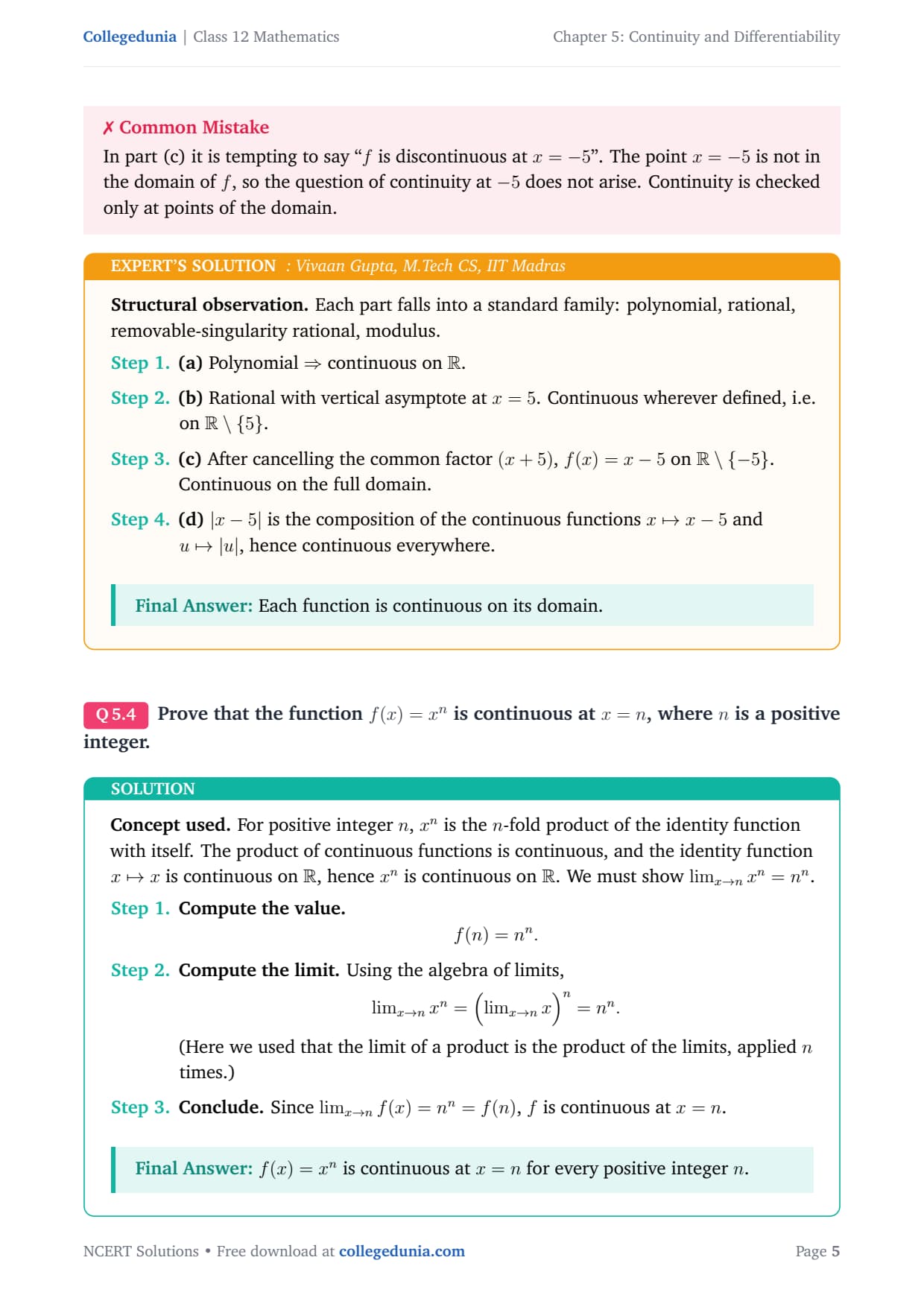
Structural observation. Each part falls into a standard family: polynomial, rational, removable-singularity rational, modulus.
(a) Polynomial ⇒ continuous on R.
(b) Rational with vertical asymptote at x = 5. Continuous wherever defined, i.e. on R 5.
(c) After cancelling the common factor (x+5), f(x) = x - 5 on R -5. Continuous on the full domain.
(d)|x - 5| is the composition of the continuous functions x ↦ x - 5 and u ↦ |u|, hence continuous everywhere.
Each function is continuous on its domain.
Q 5.4
Prove that the function f(x) = xn is continuous at x = n, where n is a positive integer.
Concept used. For positive integer n, xn is the n-fold product of the identity function with itself. The product of continuous functions is continuous, and the identity function x ↦ x is continuous on R, hence xn is continuous on R. We must show x → n xn = nn.
Compute the value.f(n) = nn.
Compute the limit. Using the algebra of limits,
x → n xn = (x → nx)n = nn.
(Here we used that the limit of a product is the product of the limits, applied n times.)
Conclude. Since x → nf(x) = nn = f(n), f is continuous at x = n.
f(x) = xn is continuous at x = n for every positive integer n.
AM
Aanya Mehta
Ph.D Pure Mathematics, IISc Bangalore
Verified Expert
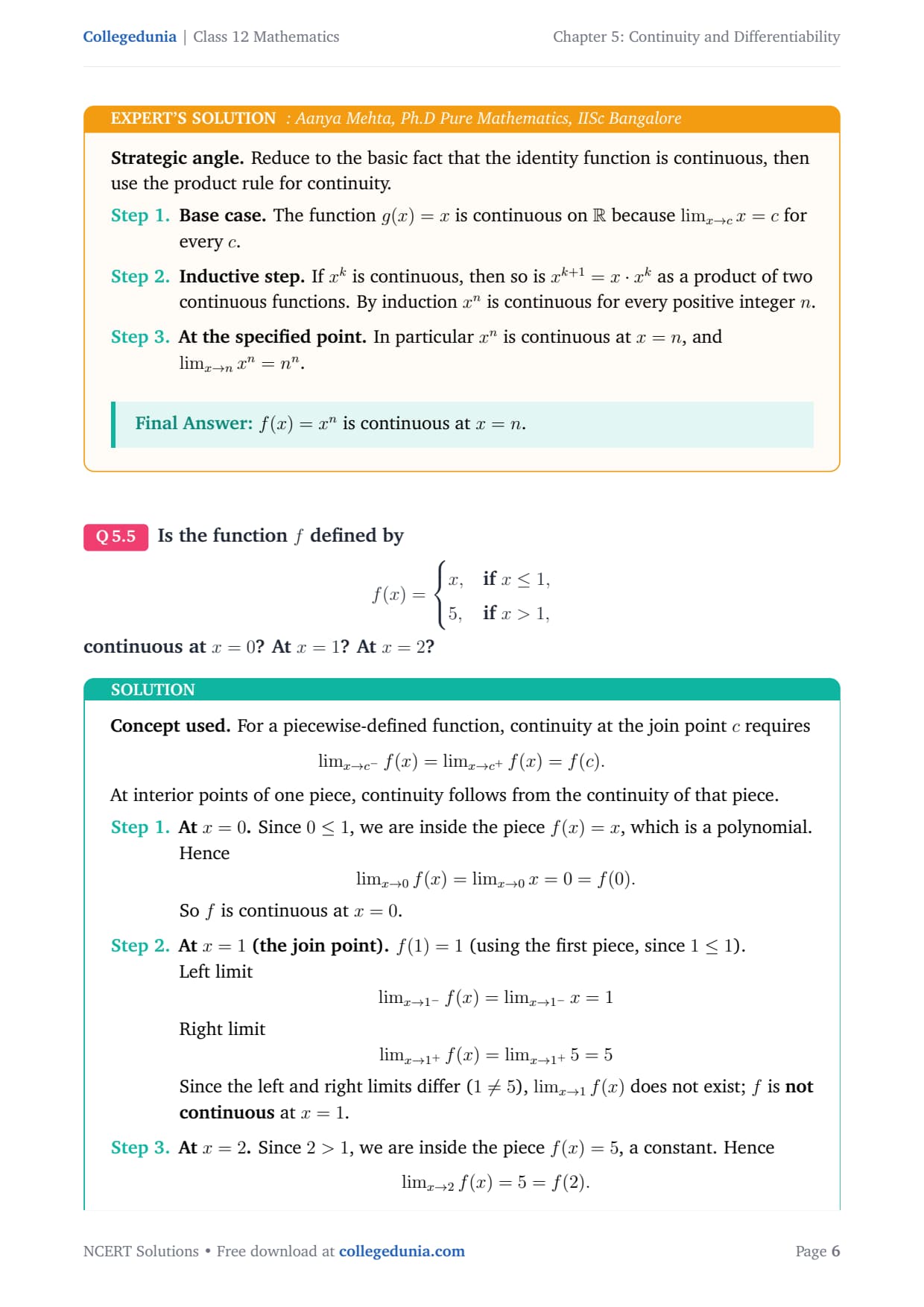
Strategic angle. Reduce to the basic fact that the identity function is continuous, then use the product rule for continuity.
Base case. The function g(x) = x is continuous on R because x → cx = c for every c.
Inductive step. If xk is continuous, then so is xk+1 = x · xk as a product of two continuous functions. By induction xn is continuous for every positive integer n.
At the specified point. In particular xn is continuous at x = n, and x → n xn = nn.
f(x) = xn is continuous at x = n.
Q 5.5
Is the function f defined by
f(x) = cases x, & if x ≤ 1, 5, & if x > 1, cases
continuous at x = 0? At x = 1? At x = 2?
Concept used. For a piecewise-defined function, continuity at the join point c requires
x → c-f(x) = x → c+f(x) = f(c).
At interior points of one piece, continuity follows from the continuity of that piece.
At x = 0. Since 0 ≤ 1, we are inside the piece f(x) = x, which is a polynomial. Hence
x → 0f(x) = x → 0x = 0 = f(0).
So f is continuous at x = 0.
At x = 1 (the join point).f(1) = 1 (using the first piece, since 1 ≤ 1).
Left limit
x → 1-f(x) = x → 1-x = 1
Right limit
x → 1+f(x) = x → 1+ 5 = 5
Since the left and right limits differ (1 ≠ 5), x → 1f(x) does not exist; f is not continuous at x = 1.
At x = 2. Since 2 > 1, we are inside the piece f(x) = 5, a constant. Hence
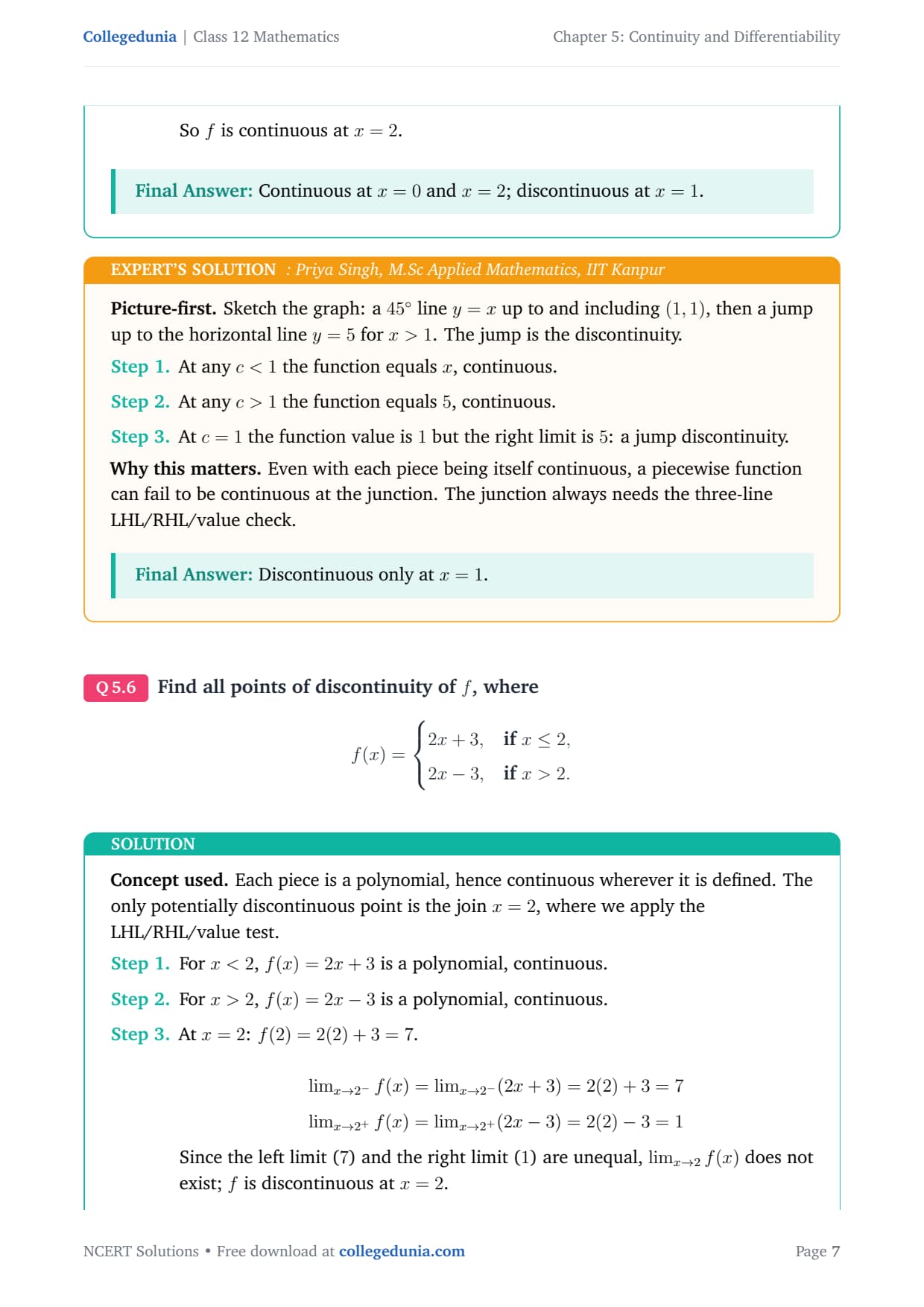
x → 2f(x) = 5 = f(2).
So f is continuous at x = 2.
Continuous at x = 0 and x = 2; discontinuous at x = 1.
PS
Priya Singh
M.Sc Applied Mathematics, IIT Kanpur
Verified Expert
Picture-first. Sketch the graph: a 45∘ line y = x up to and including (1, 1), then a jump up to the horizontal line y = 5 for x > 1. The jump is the discontinuity.
At any c < 1 the function equals x, continuous.
At any c > 1 the function equals 5, continuous.
At c = 1 the function value is 1 but the right limit is 5: a jump discontinuity.
Why this matters. Even with each piece being itself continuous, a piecewise function can fail to be continuous at the junction. The junction always needs the three-line LHL/RHL/value check.
Discontinuous only at x = 1.
Q 5.6
Find all points of discontinuity of f, where
f(x) = cases 2x + 3, & if x ≤ 2, 2x - 3, & if x > 2. cases
Concept used. Each piece is a polynomial, hence continuous wherever it is defined. The only potentially discontinuous point is the join x = 2, where we apply the LHL/RHL/value test.
For x < 2, f(x) = 2x + 3 is a polynomial, continuous.
For x > 2, f(x) = 2x - 3 is a polynomial, continuous.
At x = 2:
f(2) = 2(2) + 3 = 7. x → 2-f(x) = x → 2-(2x + 3) = 2(2) + 3 = 7 x → 2+f(x) = x → 2+(2x - 3) = 2(2) - 3 = 1
Since the left limit (7) and the right limit (1) are unequal, x → 2f(x) does not exist; f is discontinuous at x = 2.
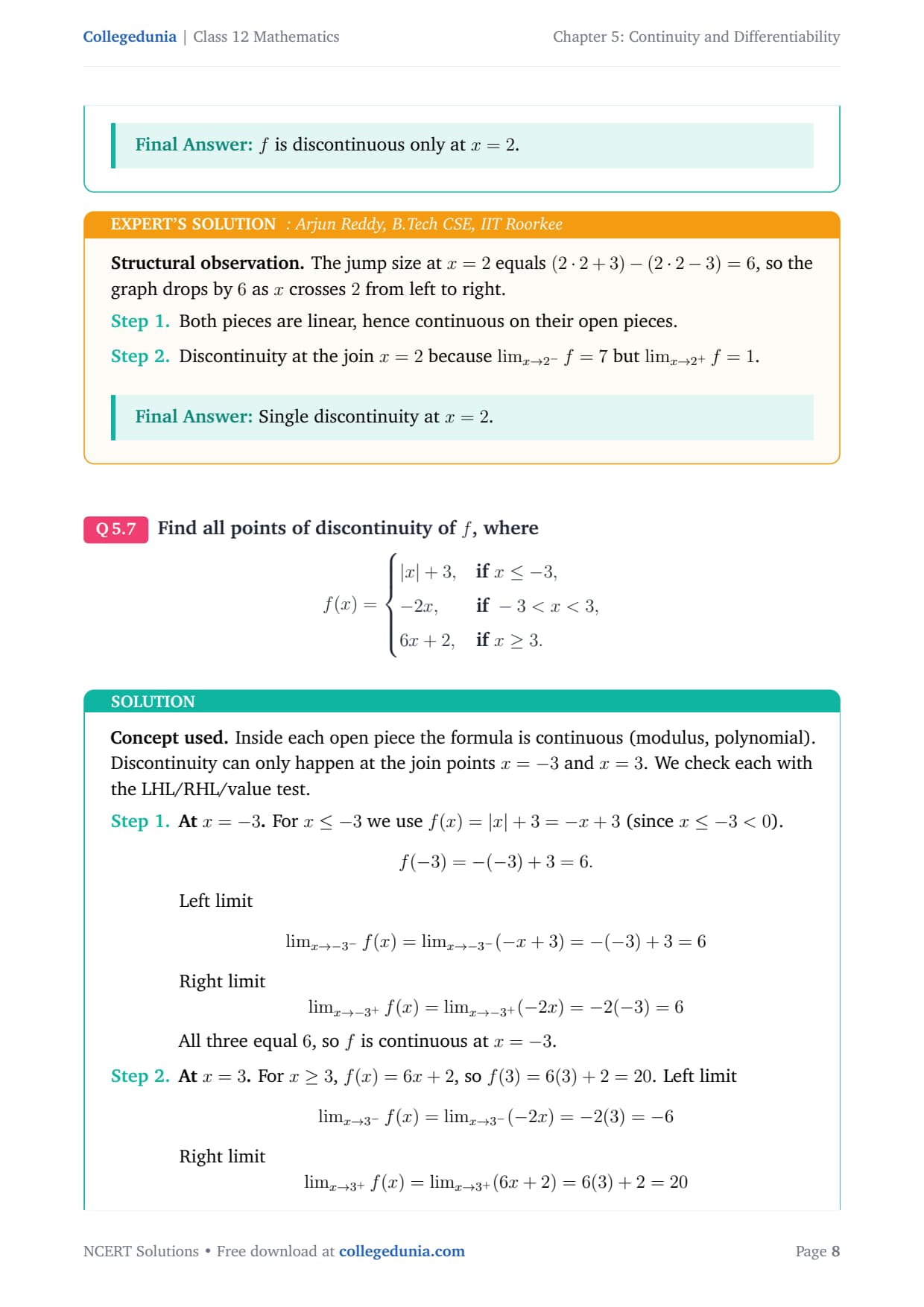
f is discontinuous only at x = 2.
AR
Arjun Reddy
B.Tech CSE, IIT Roorkee
Verified Expert
Structural observation. The jump size at x = 2 equals (2 · 2 + 3) - (2 · 2 - 3) = 6, so the graph drops by 6 as x crosses 2 from left to right.
Both pieces are linear, hence continuous on their open pieces.
Discontinuity at the join x = 2 because x → 2-f = 7 but x → 2+f = 1.
Single discontinuity at x = 2.
Q 5.7
Find all points of discontinuity of f, where
f(x) = cases |x| + 3, & if x ≤ -3, -2x, & if -3 < x < 3, 6x + 2, & if x ≥ 3. cases
Concept used. Inside each open piece the formula is continuous (modulus, polynomial). Discontinuity can only happen at the join points x = -3 and x = 3. We check each with the LHL/RHL/value test.
At x = -3. For x ≤ -3 we use f(x) = |x| + 3 = -x + 3 (since x ≤ -3 < 0).
f(-3) = -(-3) + 3 = 6.
Left limit
x → -3-f(x) = x → -3-(-x + 3) = -(-3) + 3 = 6
Right limit
x → -3+f(x) = x → -3+(-2x) = -2(-3) = 6
All three equal 6, so f is continuous at x = -3.
At x = 3. For x ≥ 3, f(x) = 6x + 2, so f(3) = 6(3) + 2 = 20.
Left limit
x → 3-f(x) = x → 3-(-2x) = -2(3) = -6
Right limit
x → 3+f(x) = x → 3+(6x + 2) = 6(3) + 2 = 20
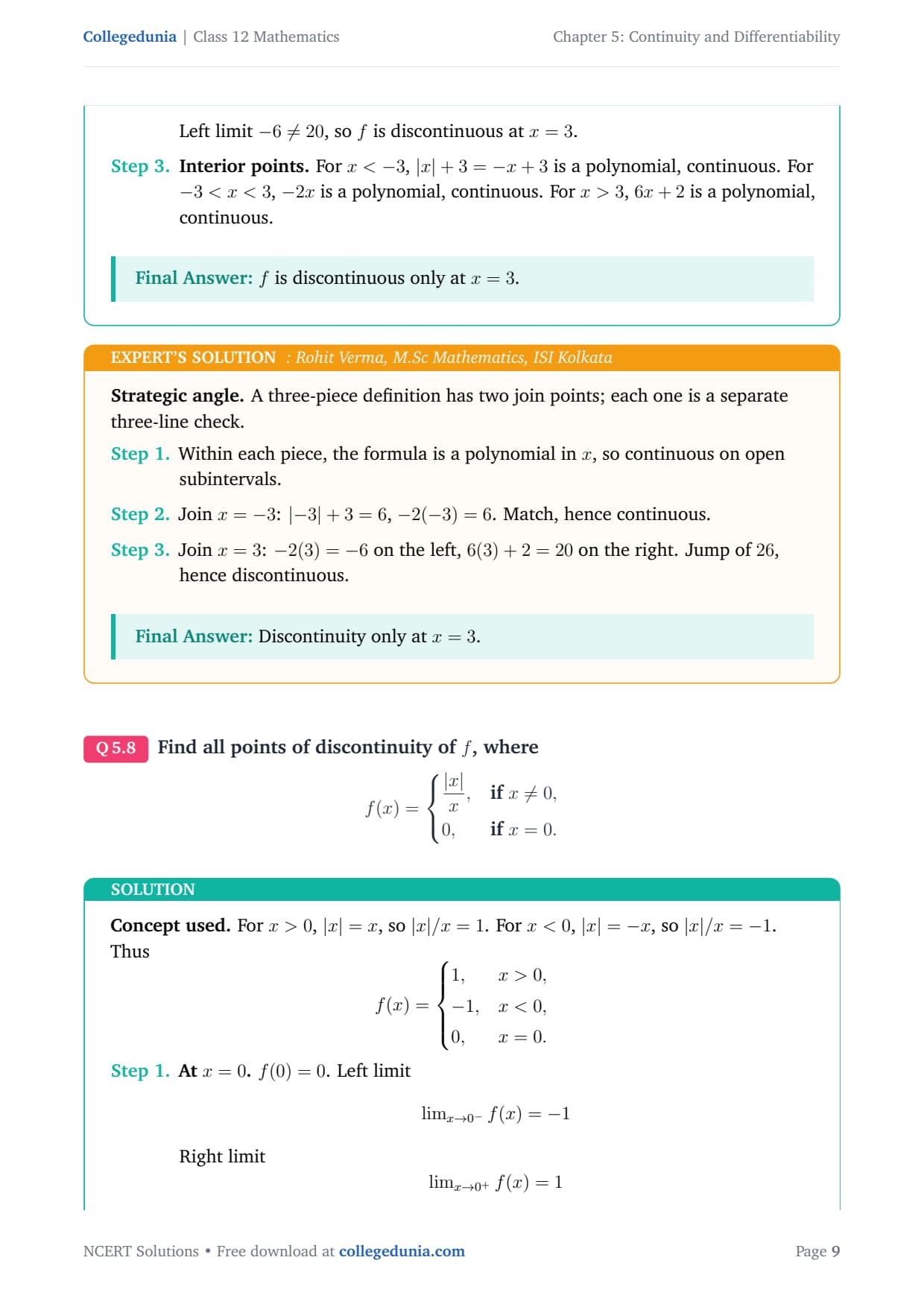
Left limit -6 ≠ 20, so f is discontinuous at x = 3.
Interior points. For x < -3, |x| + 3 = -x + 3 is a polynomial, continuous. For -3 < x < 3, -2x is a polynomial, continuous. For x > 3, 6x + 2 is a polynomial, continuous.
f is discontinuous only at x = 3.
RV
Rohit Verma
M.Sc Mathematics, ISI Kolkata
Verified Expert
Strategic angle. A three-piece definition has two join points; each one is a separate three-line check.
Within each piece, the formula is a polynomial in x, so continuous on open subintervals.
Join x = 3: -2(3) = -6 on the left, 6(3)+2 = 20 on the right. Jump of 26, hence discontinuous.
Discontinuity only at x = 3.
Q 5.8
Find all points of discontinuity of f, where
f(x) = cases |x|x, & if x ≠ 0, 0, & if x = 0. cases
Concept used. For x > 0, |x| = x, so |x|/x = 1. For x < 0, |x| = -x, so |x|/x = -1. Thus
f(x) = cases 1, & x > 0, -1, & x < 0, 0, & x = 0. cases
At x = 0.f(0) = 0.
Left limit
x → 0-f(x) = -1
Right limit
x → 0+f(x) = 1
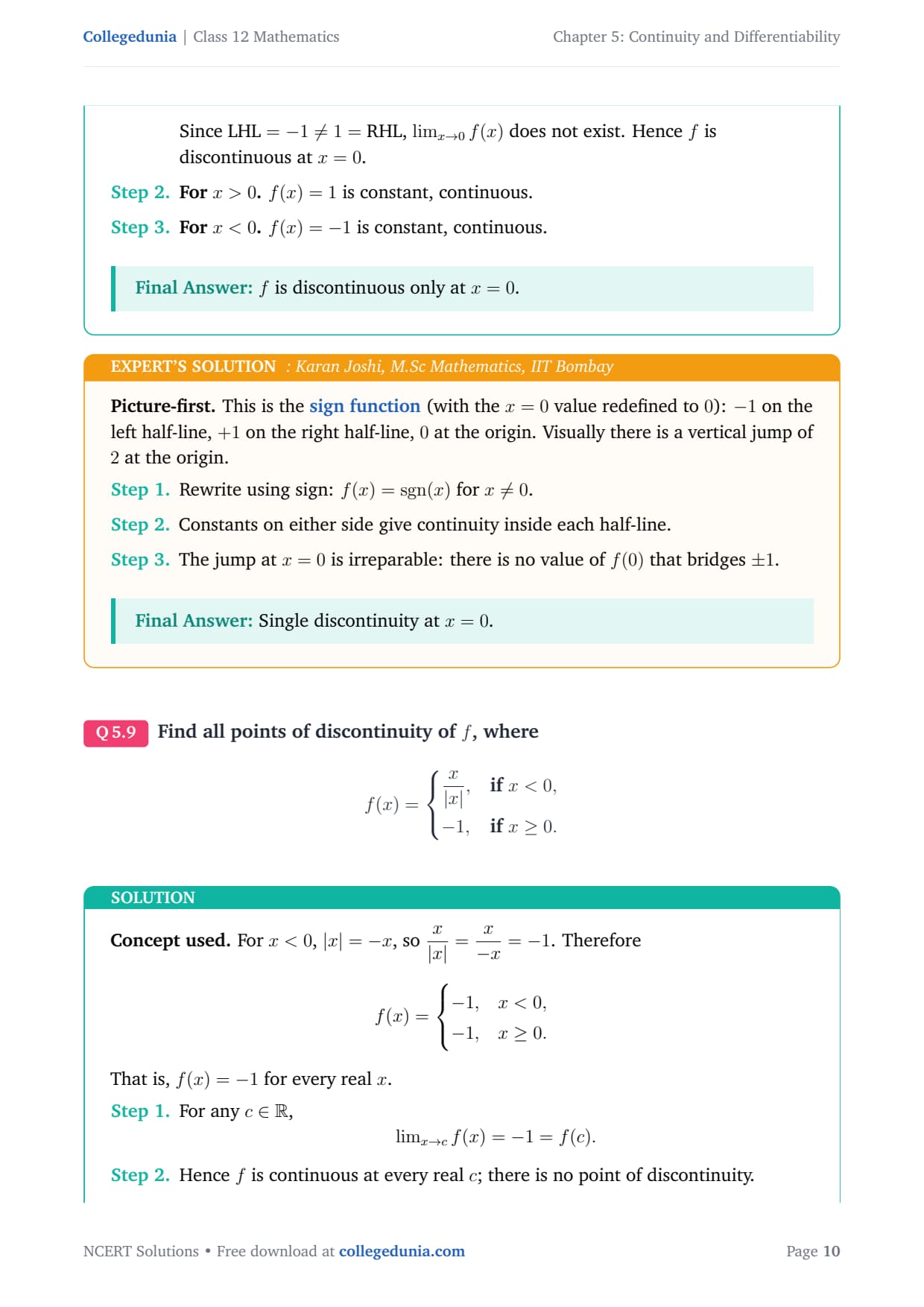
Since LHL = -1 ≠ 1 = RHL, x → 0f(x) does not exist. Hence f is discontinuous at x = 0.
For x > 0.f(x) = 1 is constant, continuous.
For x < 0.f(x) = -1 is constant, continuous.
f is discontinuous only at x = 0.
KJ
Karan Joshi
M.Sc Mathematics, IIT Bombay
Verified Expert
Picture-first. This is the sign function (with the x=0 value redefined to 0): -1 on the left half-line, +1 on the right half-line, 0 at the origin. Visually there is a vertical jump of 2 at the origin.
Rewrite using sign: f(x) = sgn(x) for x ≠ 0.
Constants on either side give continuity inside each half-line.
The jump at x = 0 is irreparable: there is no value of f(0) that bridges ± 1.
Single discontinuity at x = 0.
Q 5.9
Find all points of discontinuity of f, where
f(x) = cases x|x|, & if x < 0, -1, & if x ≥ 0. cases
Concept used. For x < 0, |x| = -x, so x|x| = x-x = -1. Therefore
f(x) = cases -1, & x < 0, -1, & x ≥ 0. cases
That is, f(x) = -1 for every real x.
For any c ∈ R,
x → cf(x) = -1 = f(c).
Hence f is continuous at every real c; there is no point of discontinuity.
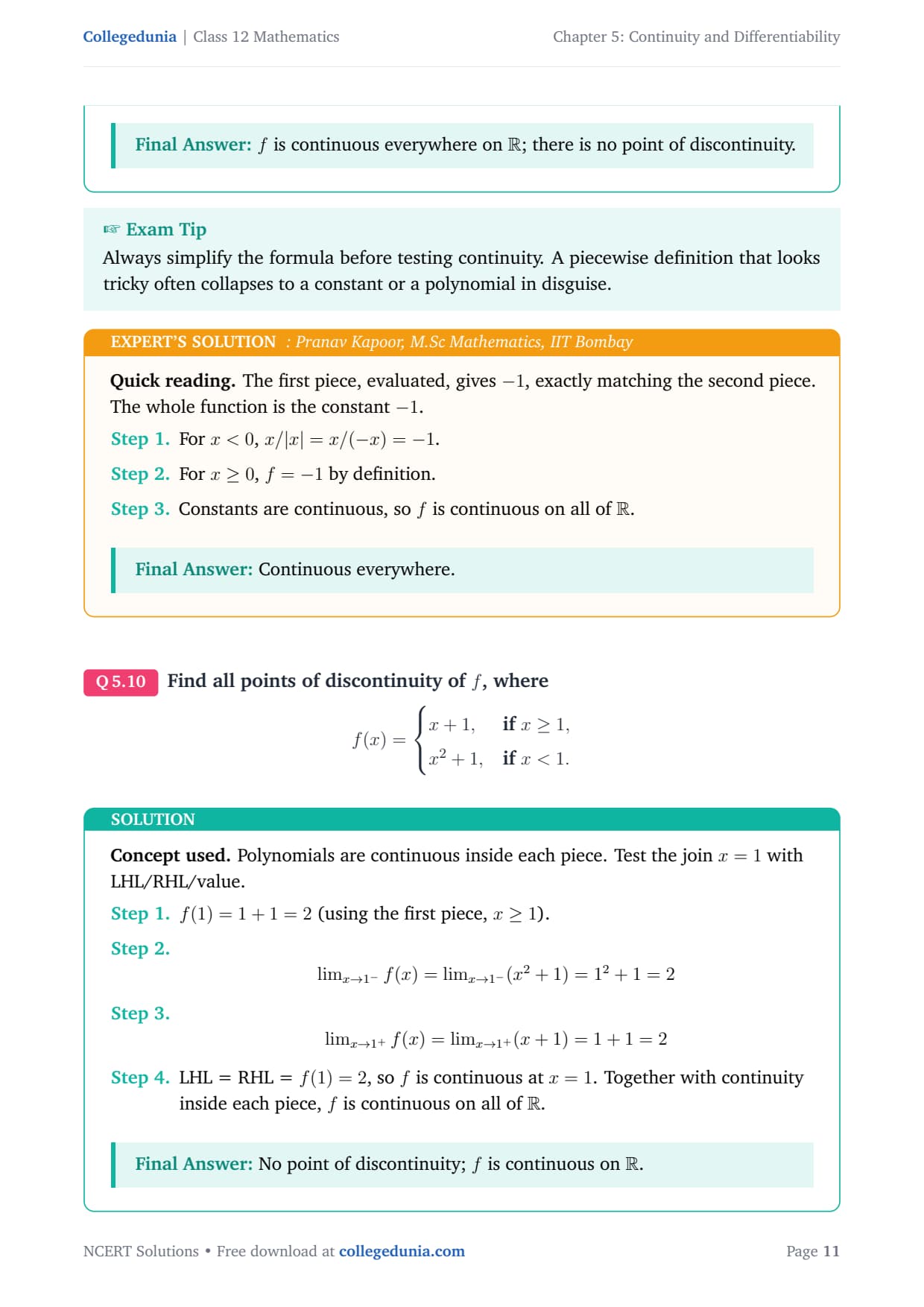
f is continuous everywhere on R; there is no point of discontinuity.
PK
Pranav Kapoor
M.Sc Mathematics, IIT Bombay
Verified Expert
Quick reading. The first piece, evaluated, gives -1, exactly matching the second piece. The whole function is the constant -1.
For x < 0, x/|x| = x/(-x) = -1.
For x ≥ 0, f = -1 by definition.
Constants are continuous, so f is continuous on all of R.
Continuous everywhere.
Q 5.10
Find all points of discontinuity of f, where
f(x) = cases x + 1, & if x ≥ 1, x2 + 1, & if x < 1. cases
Concept used. Polynomials are continuous inside each piece. Test the join x = 1 with LHL/RHL/value.
f(1) = 1 + 1 = 2 (using the first piece, x ≥ 1).
x → 1-f(x) = x → 1-(x2 + 1) = 12 + 1 = 2
x → 1+f(x) = x → 1+(x + 1) = 1 + 1 = 2
LHL = RHL = f(1) = 2, so f is continuous at x = 1. Together with continuity inside each piece, f is continuous on all of R.
No point of discontinuity; f is continuous on R.
AB
Aditi Banerjee
M.Sc Mathematics, ISI Kolkata
Verified Expert
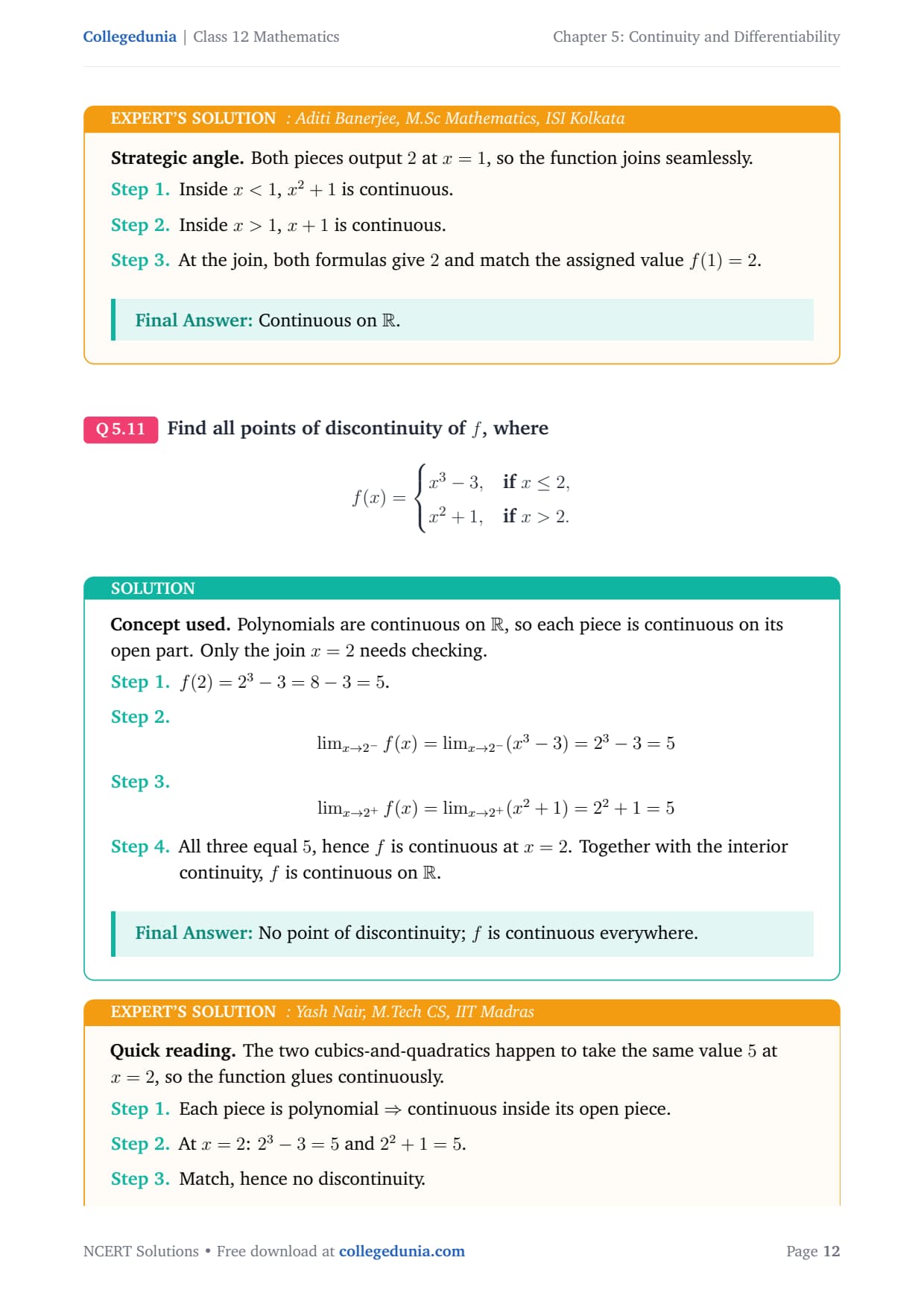
Strategic angle. Both pieces output 2 at x = 1, so the function joins seamlessly.
Inside x < 1, x2 + 1 is continuous.
Inside x > 1, x + 1 is continuous.
At the join, both formulas give 2 and match the assigned value f(1) = 2.
Continuous on R.
Q 5.11
Find all points of discontinuity of f, where
f(x) = cases x3 - 3, & if x ≤ 2, x2 + 1, & if x > 2. cases
Concept used. Polynomials are continuous on R, so each piece is continuous on its open part. Only the join x = 2 needs checking.
f(2) = 23 - 3 = 8 - 3 = 5.
x → 2-f(x) = x → 2-(x3 - 3) = 23 - 3 = 5
x → 2+f(x) = x → 2+(x2 + 1) = 22 + 1 = 5
All three equal 5, hence f is continuous at x = 2. Together with the interior continuity, f is continuous on R.
No point of discontinuity; f is continuous everywhere.
YN
Yash Nair
M.Tech CS, IIT Madras
Verified Expert
Quick reading. The two cubics-and-quadratics happen to take the same value 5 at x = 2, so the function glues continuously.
Each piece is polynomial ⇒ continuous inside its open piece.
At x = 2: 23 - 3 = 5 and 22 + 1 = 5.
Match, hence no discontinuity.
Continuous on R.
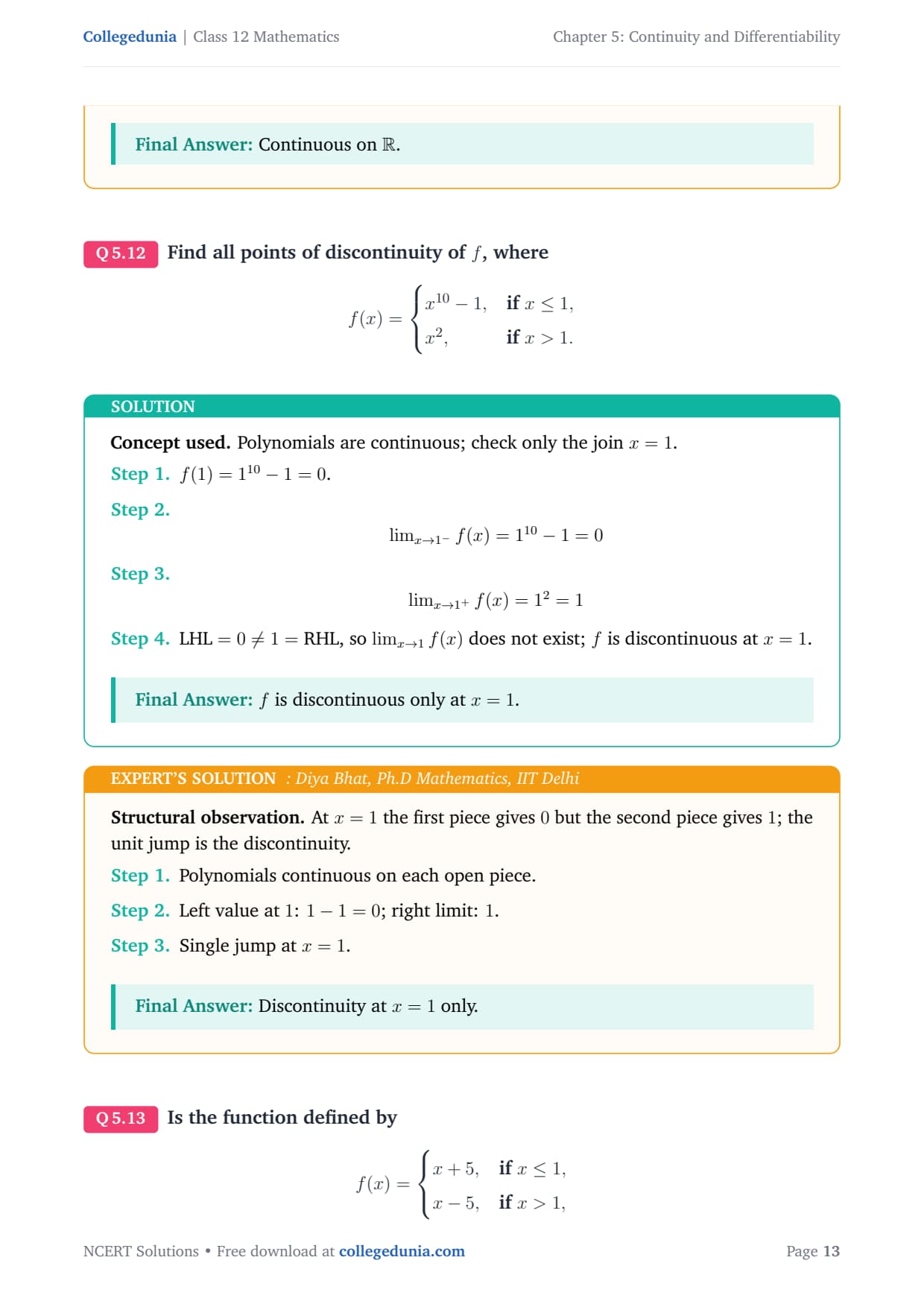
Q 5.12
Find all points of discontinuity of f, where
f(x) = cases x10 - 1, & if x ≤ 1, x2, & if x > 1. cases
Concept used. Polynomials are continuous; check only the join x = 1.
f(1) = 110 - 1 = 0.
x → 1-f(x) = 110 - 1 = 0
x → 1+f(x) = 12 = 1
LHL = 0 ≠ 1 = RHL, so x → 1f(x) does not exist; f is discontinuous at x = 1.
f is discontinuous only at x = 1.
DB
Diya Bhat
Ph.D Mathematics, IIT Delhi
Verified Expert
Structural observation. At x = 1 the first piece gives 0 but the second piece gives 1; the unit jump is the discontinuity.
Polynomials continuous on each open piece.
Left value at 1: 1 - 1 = 0; right limit: 1.
Single jump at x = 1.
Discontinuity at x = 1 only.
Q 5.13
Is the function defined by
f(x) = cases x + 5, & if x ≤ 1, x - 5, & if x > 1, cases
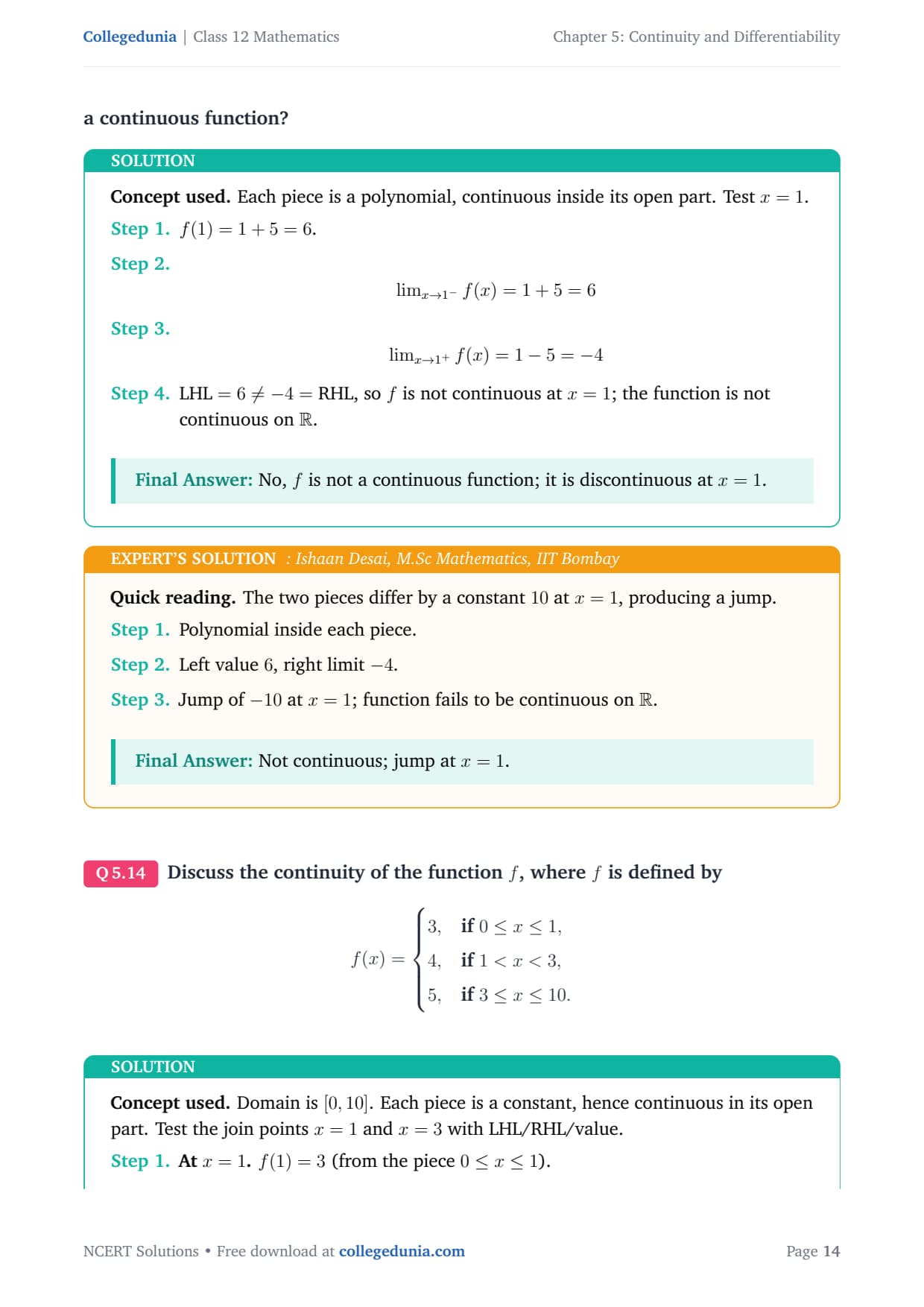
a continuous function?
Concept used. Each piece is a polynomial, continuous inside its open part. Test x = 1.
f(1) = 1 + 5 = 6.
x → 1-f(x) = 1 + 5 = 6
x → 1+f(x) = 1 - 5 = -4
LHL = 6 ≠ -4 = RHL, so f is not continuous at x = 1; the function is not continuous on R.
No, f is not a continuous function; it is discontinuous at x = 1.
ID
Ishaan Desai
M.Sc Mathematics, IIT Bombay
Verified Expert
Quick reading. The two pieces differ by a constant 10 at x = 1, producing a jump.
Polynomial inside each piece.
Left value 6, right limit -4.
Jump of -10 at x = 1; function fails to be continuous on R.
Not continuous; jump at x = 1.
Q 5.14
Discuss the continuity of the function f, where f is defined by
f(x) = cases 3, & if 0 ≤ x ≤ 1, 4, & if 1 < x < 3, 5, & if 3 ≤ x ≤ 10. cases
Concept used. Domain is [0, 10]. Each piece is a constant, hence continuous in its open part. Test the join points x = 1 and x = 3 with LHL/RHL/value.
At x = 1.f(1) = 3 (from the piece 0 ≤ x ≤ 1).
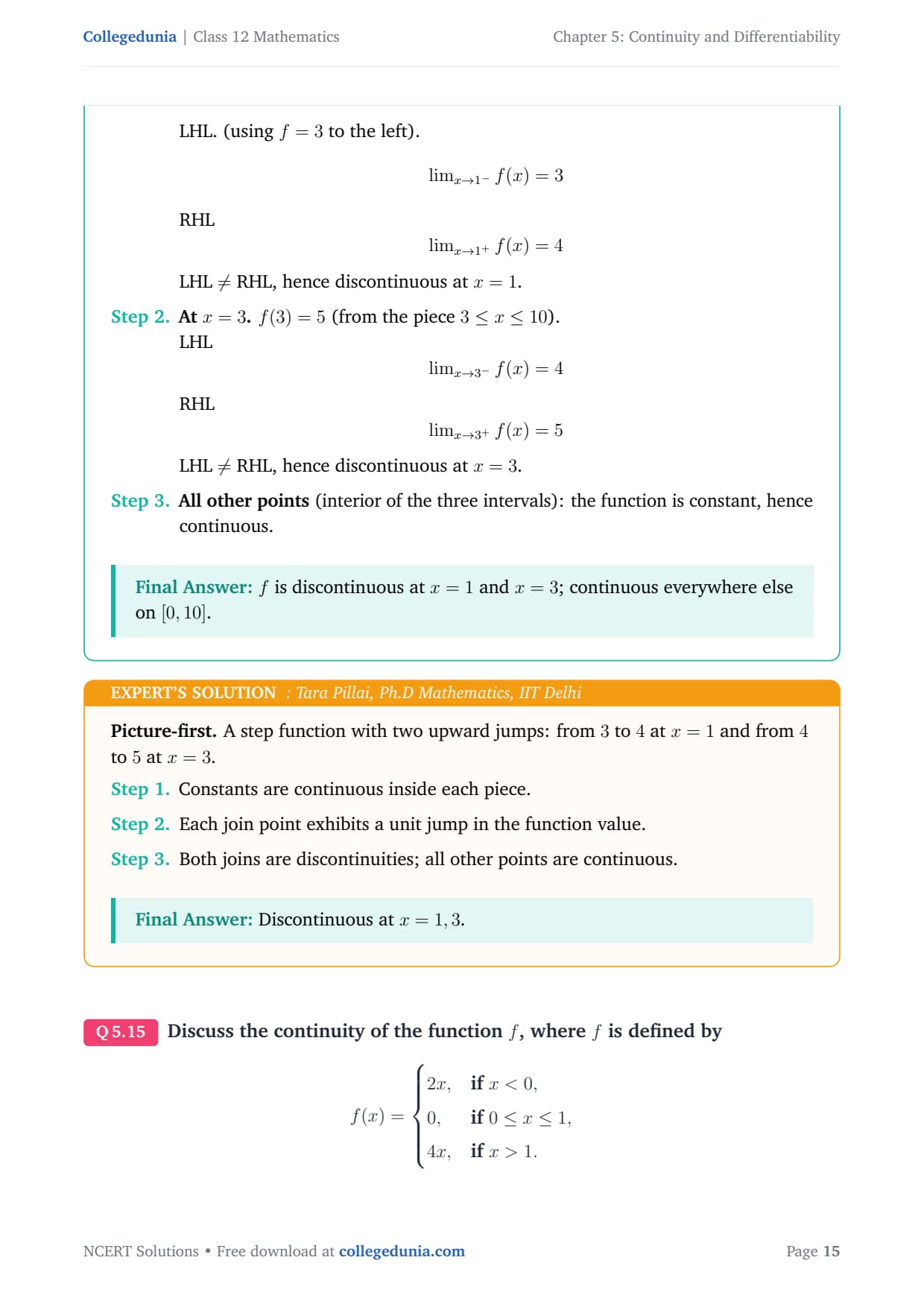
LHL. (using f = 3 to the left).
x → 1-f(x) = 3
RHL
x → 1+f(x) = 4
LHL ≠ RHL, hence discontinuous at x = 1.
At x = 3.f(3) = 5 (from the piece 3 ≤ x ≤ 10).
LHL
x → 3-f(x) = 4
RHL
x → 3+f(x) = 5
LHL ≠ RHL, hence discontinuous at x = 3.
All other points (interior of the three intervals): the function is constant, hence continuous.
f is discontinuous at x = 1 and x = 3; continuous everywhere else on [0, 10].
TP
Tara Pillai
Ph.D Mathematics, IIT Delhi
Verified Expert
Picture-first. A step function with two upward jumps: from 3 to 4 at x = 1 and from 4 to 5 at x = 3.
Constants are continuous inside each piece.
Each join point exhibits a unit jump in the function value.
Both joins are discontinuities; all other points are continuous.
Discontinuous at x = 1, 3.
Q 5.15
Discuss the continuity of the function f, where f is defined by
f(x) = cases 2x, & if x < 0, 0, & if 0 ≤ x ≤ 1, 4x, & if x > 1. cases
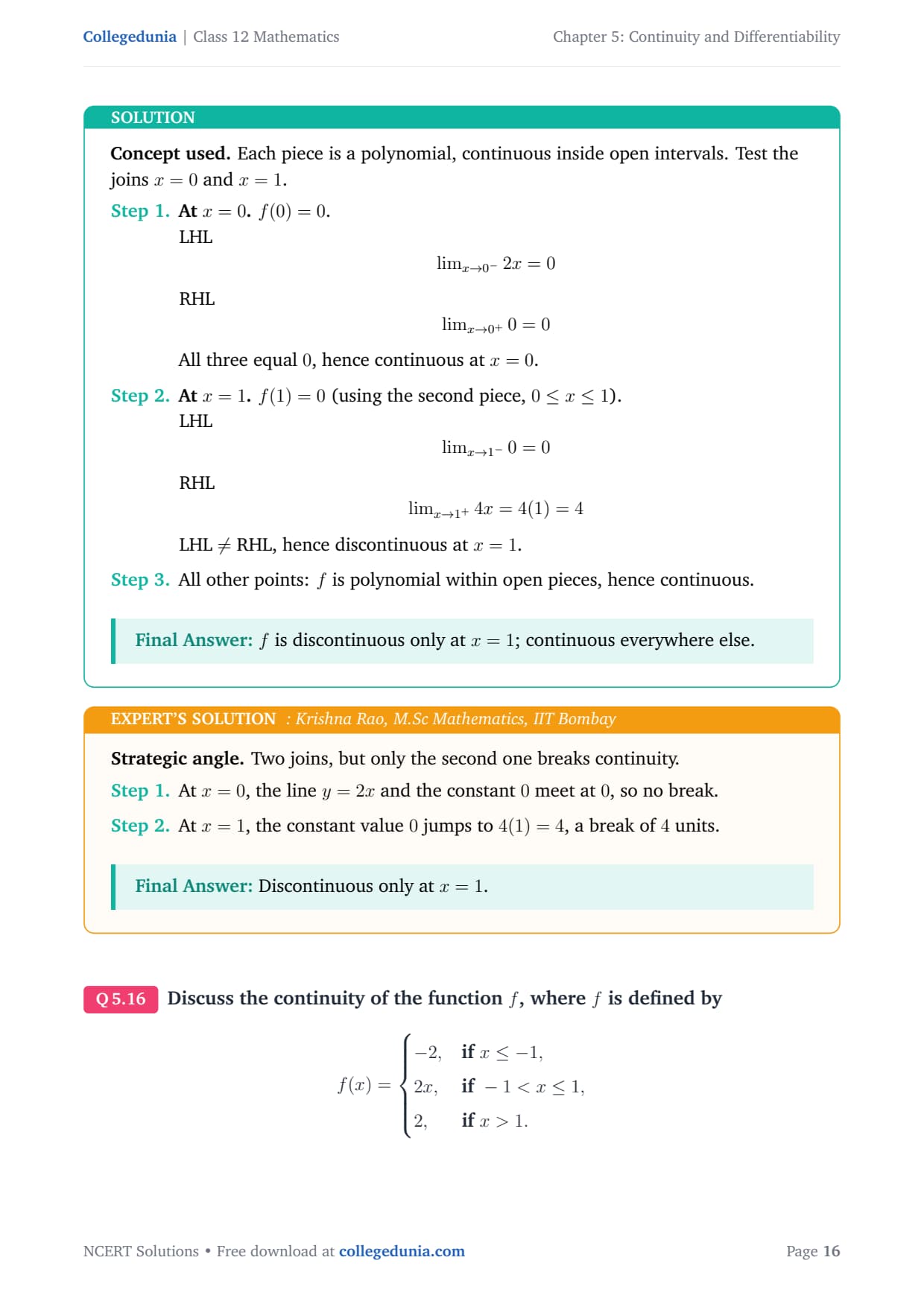
Concept used. Each piece is a polynomial, continuous inside open intervals. Test the joins x = 0 and x = 1.
At x = 0.f(0) = 0.
LHL
x → 0- 2x = 0
RHL
x → 0+ 0 = 0
All three equal 0, hence continuous at x = 0.
At x = 1.f(1) = 0 (using the second piece, 0 ≤ x ≤ 1).
LHL
x → 1- 0 = 0
RHL
x → 1+ 4x = 4(1) = 4
LHL ≠ RHL, hence discontinuous at x = 1.
All other points: f is polynomial within open pieces, hence continuous.
f is discontinuous only at x = 1; continuous everywhere else.
KR
Krishna Rao
M.Sc Mathematics, IIT Bombay
Verified Expert
Strategic angle. Two joins, but only the second one breaks continuity.
At x = 0, the line y = 2x and the constant 0 meet at 0, so no break.
At x = 1, the constant value 0 jumps to 4(1) = 4, a break of 4 units.
Discontinuous only at x = 1.
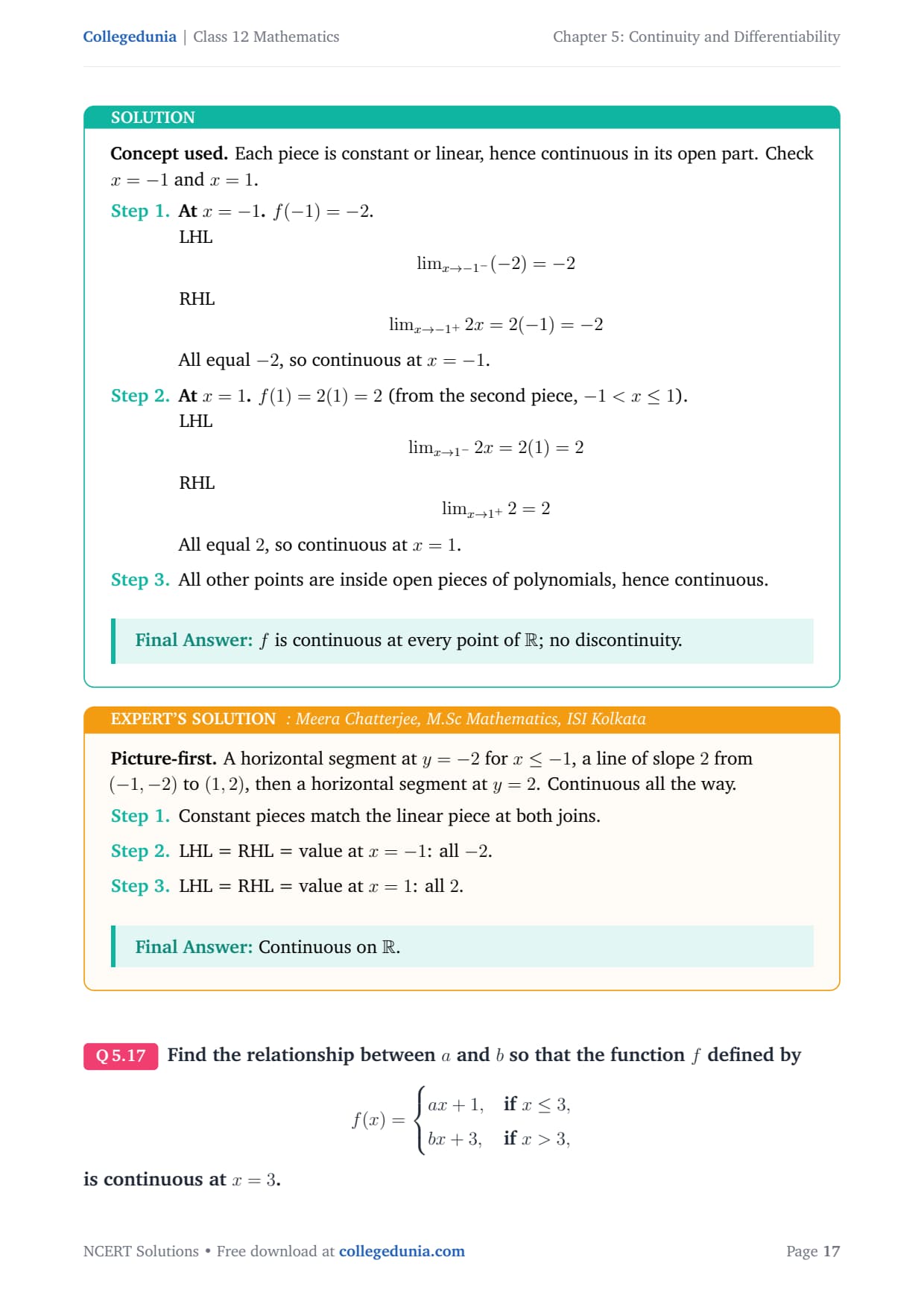
Q 5.16
Discuss the continuity of the function f, where f is defined by
f(x) = cases -2, & if x ≤ -1, 2x, & if -1 < x ≤ 1, 2, & if x > 1. cases
Concept used. Each piece is constant or linear, hence continuous in its open part. Check x = -1 and x = 1.
At x = -1.f(-1) = -2.
LHL
x → -1-(-2) = -2
RHL
x → -1+ 2x = 2(-1) = -2
All equal -2, so continuous at x = -1.
At x = 1.f(1) = 2(1) = 2 (from the second piece, -1 < x ≤ 1).
LHL
x → 1- 2x = 2(1) = 2
RHL
x → 1+ 2 = 2
All equal 2, so continuous at x = 1.
All other points are inside open pieces of polynomials, hence continuous.
f is continuous at every point of R; no discontinuity.
MC
Meera Chatterjee
M.Sc Mathematics, ISI Kolkata
Verified Expert
Picture-first. A horizontal segment at y = -2 for x ≤ -1, a line of slope 2 from (-1, -2) to (1, 2), then a horizontal segment at y = 2. Continuous all the way.
Constant pieces match the linear piece at both joins.
LHL = RHL = value at x = -1: all -2.
LHL = RHL = value at x = 1: all 2.
Continuous on R.
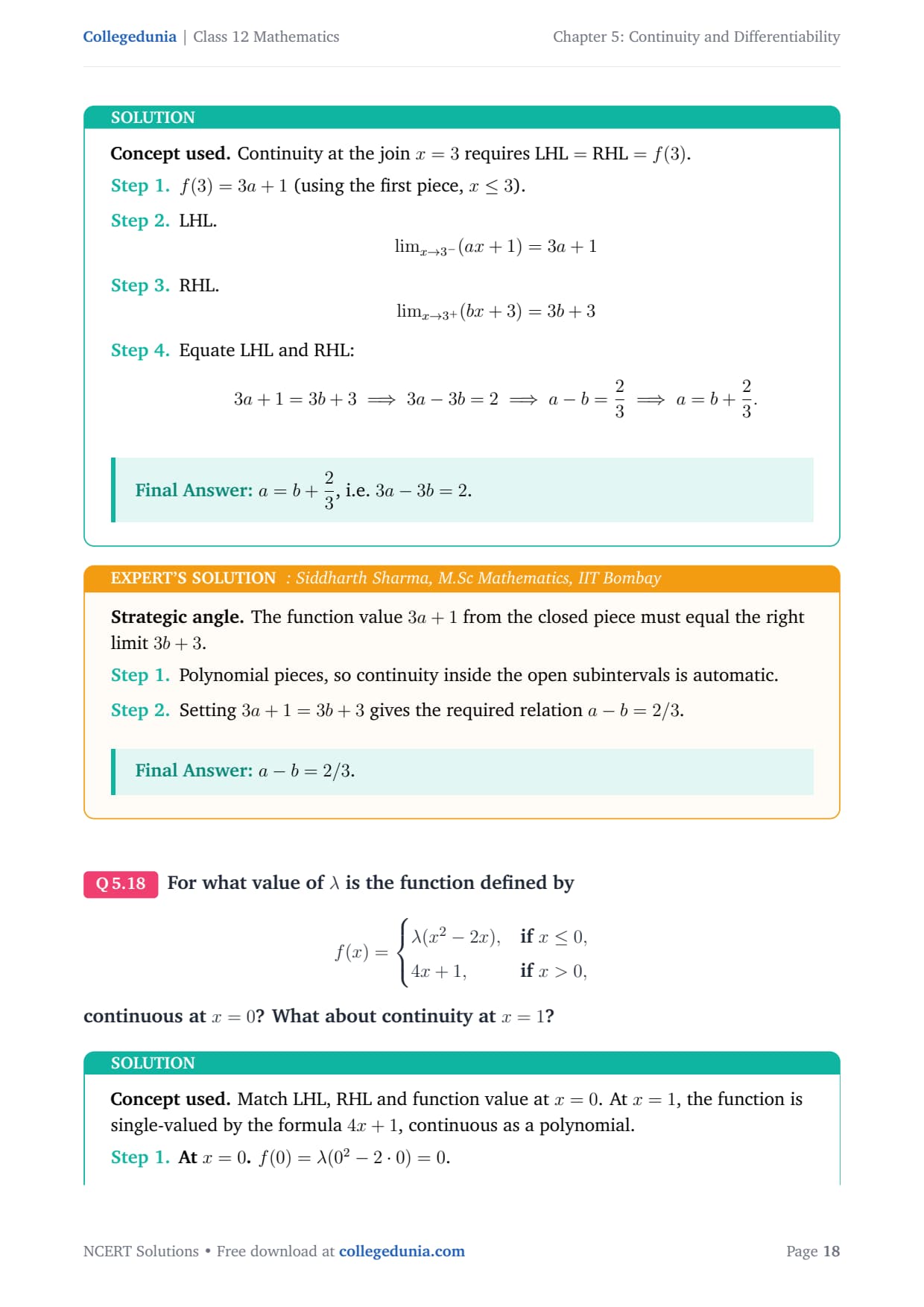
Q 5.17
Find the relationship between a and b so that the function f defined by
f(x) = cases ax + 1, & if x ≤ 3, bx + 3, & if x > 3, cases
is continuous at x = 3.
Concept used. Continuity at the join x = 3 requires LHL = RHL = f(3).
f(3) = 3a + 1 (using the first piece, x ≤ 3).
LHL.
x → 3-(ax + 1) = 3a + 1
RHL.
x → 3+(bx + 3) = 3b + 3
Equate LHL and RHL:
3a + 1 = 3b + 3 3a - 3b = 2 a - b = 23a = b + 23.
a = b + 23, i.e. 3a - 3b = 2.
SS
Siddharth Sharma
M.Sc Mathematics, IIT Bombay
Verified Expert
Strategic angle. The function value 3a+1 from the closed piece must equal the right limit 3b+3.
Polynomial pieces, so continuity inside the open subintervals is automatic.
Setting 3a + 1 = 3b + 3 gives the required relation a - b = 2/3.
a - b = 2/3.
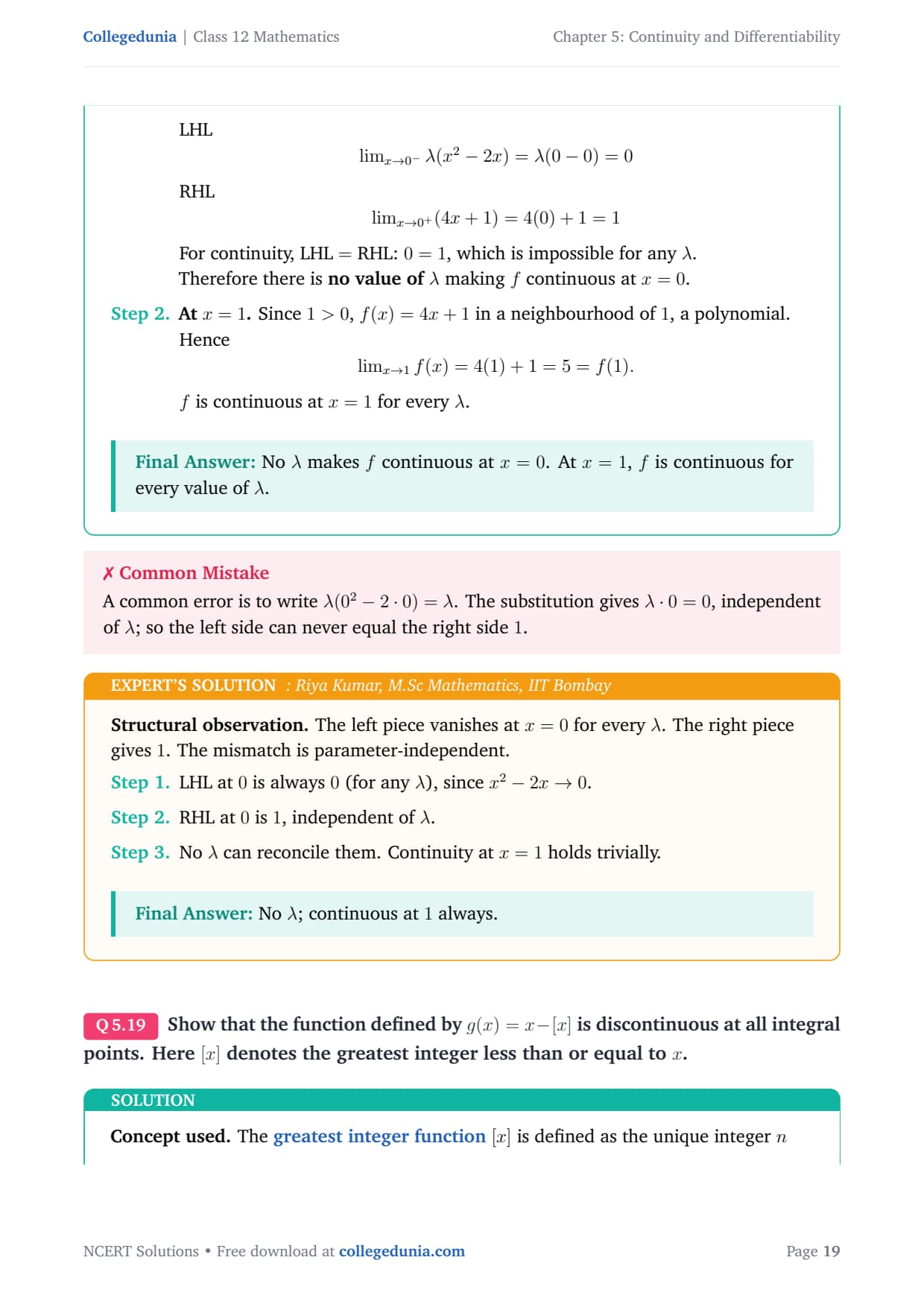
Q 5.18
For what value of λ is the function defined by
f(x) = cases λ(x2 - 2x), & if x ≤ 0, 4x + 1, & if x > 0, cases
continuous at x = 0? What about continuity at x = 1?
Concept used. Match LHL, RHL and function value at x = 0. At x = 1, the function is single-valued by the formula 4x+1, continuous as a polynomial.
At x = 0.f(0) = λ(02 - 2 · 0) = 0.
LHL
x → 0- λ(x2 - 2x) = λ(0 - 0) = 0
RHL
x → 0+(4x + 1) = 4(0) + 1 = 1
For continuity, LHL = RHL: 0 = 1, which is impossible for any λ.
Therefore there is no value of λ making f continuous at x = 0.
At x = 1. Since 1 > 0, f(x) = 4x + 1 in a neighbourhood of 1, a polynomial. Hence
x → 1f(x) = 4(1) + 1 = 5 = f(1). f is continuous at x = 1 for every λ.
No λ makes f continuous at x = 0. At x = 1, f is continuous for every value of λ.
RK
Riya Kumar
M.Sc Mathematics, IIT Bombay
Verified Expert
Structural observation. The left piece vanishes at x = 0 for every λ. The right piece gives 1. The mismatch is parameter-independent.
LHL at 0 is always 0 (for any λ), since x2 - 2x → 0.
RHL at 0 is 1, independent of λ.
No λ can reconcile them. Continuity at x = 1 holds trivially.
No λ; continuous at 1 always.
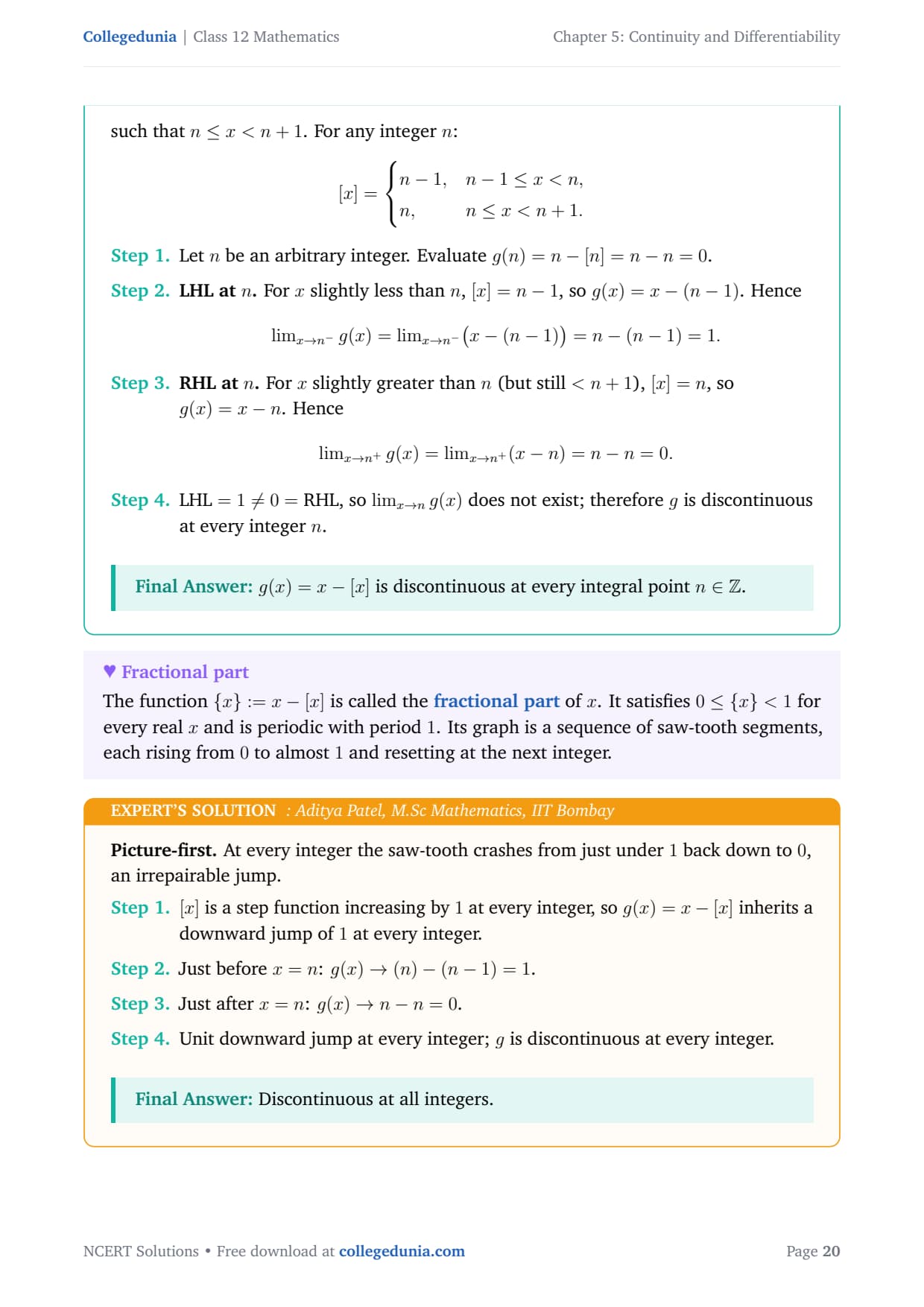
Q 5.19
Show that the function defined by g(x) = x - [x] is discontinuous at all integral points. Here [x] denotes the greatest integer less than or equal to x.
Concept used. The greatest integer function[x] is defined as the unique integer n such that n ≤ x < n + 1. For any integer n:
[x] = cases n - 1, & n - 1 ≤ x < n, n, & n ≤ x < n + 1. cases
Let n be an arbitrary integer. Evaluate g(n) = n - [n] = n - n = 0.
LHL at n. For x slightly less than n, [x] = n - 1, so g(x) = x - (n-1). Hence
x → n-g(x) = x → n-(x - (n - 1)) = n - (n - 1) = 1.
RHL at n. For x slightly greater than n (but still < n + 1), [x] = n, so g(x) = x - n. Hence
x → n+g(x) = x → n+(x - n) = n - n = 0.
LHL = 1 ≠ 0 = RHL, so x → ng(x) does not exist; therefore g is discontinuous at every integer n.
g(x) = x - [x] is discontinuous at every integral point n ∈ Z.
AP
Aditya Patel
M.Sc Mathematics, IIT Bombay
Verified Expert
Picture-first. At every integer the saw-tooth crashes from just under 1 back down to 0, an irrepairable jump.
[x] is a step function increasing by 1 at every integer, so g(x) = x - [x] inherits a downward jump of 1 at every integer.
Just before x = n: g(x) → (n) - (n-1) = 1.
Just after x = n: g(x) → n - n = 0.
Unit downward jump at every integer; g is discontinuous at every integer.
Discontinuous at all integers.
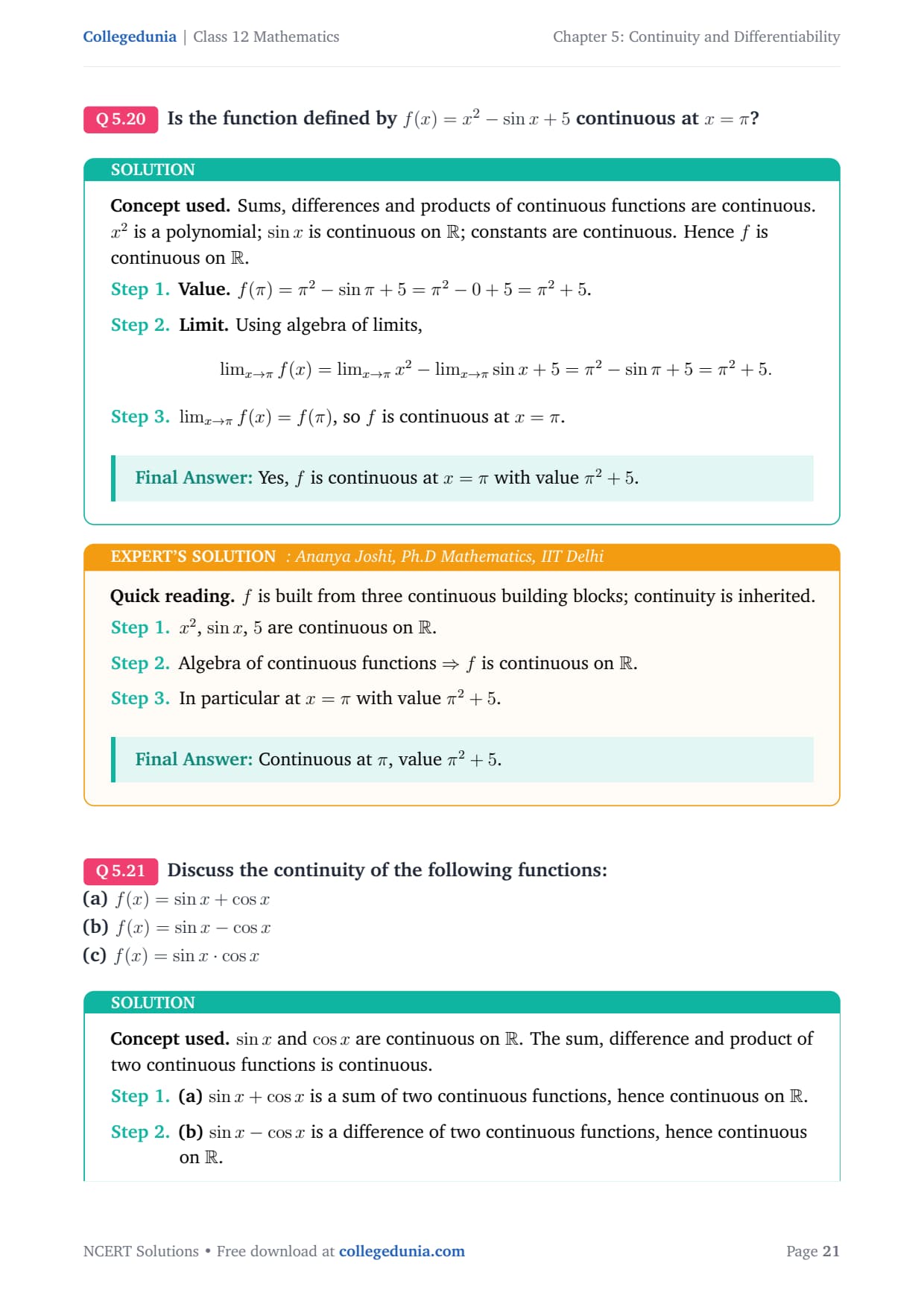
Q 5.20
Is the function defined by f(x) = x2 - sin x + 5 continuous at x = π?
Concept used. Sums, differences and products of continuous functions are continuous. x2 is a polynomial; sin x is continuous on R; constants are continuous. Hence f is continuous on R.
Limit. Using algebra of limits,
x → πf(x) = x → π x2 - x → π sin x + 5 = π2 - sin π + 5 = π2 + 5.
x → πf(x) = f(π), so f is continuous at x = π.
Yes, f is continuous at x = π with value π2 + 5.
AJ
Ananya Joshi
Ph.D Mathematics, IIT Delhi
Verified Expert
Quick reading.f is built from three continuous building blocks; continuity is inherited.
x2, sin x, 5 are continuous on R.
Algebra of continuous functions ⇒f is continuous on R.
In particular at x = π with value π2 + 5.
Continuous at π, value π2 + 5.
Q 5.21
Discuss the continuity of the following functions:
(a) f(x) = sin x + cos x
(b) f(x) = sin x - cos x
(c) f(x) = sin x · cos x
Concept used.sin x and cos x are continuous on R. The sum, difference and product of two continuous functions is continuous.
(a)sin x + cos x is a sum of two continuous functions, hence continuous on R.
(b)sin x - cos x is a difference of two continuous functions, hence continuous on R.
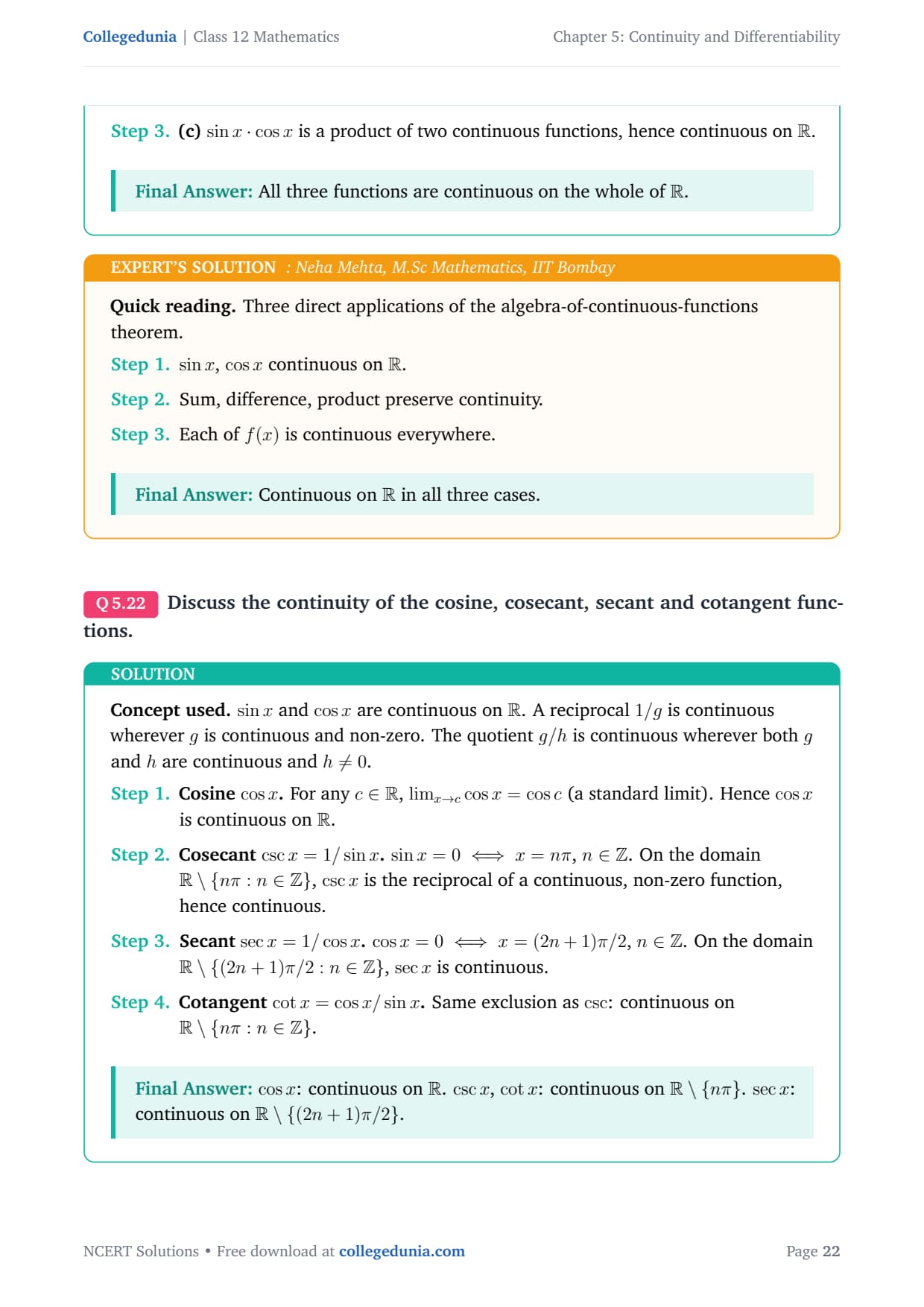
(c)sin x · cos x is a product of two continuous functions, hence continuous on R.
All three functions are continuous on the whole of R.
NM
Neha Mehta
M.Sc Mathematics, IIT Bombay
Verified Expert
Quick reading. Three direct applications of the algebra-of-continuous-functions theorem.
sin x, cos x continuous on R.
Sum, difference, product preserve continuity.
Each of f(x) is continuous everywhere.
Continuous on R in all three cases.
Q 5.22
Discuss the continuity of the cosine, cosecant, secant and cotangent functions.
Concept used.sin x and cos x are continuous on R. A reciprocal 1/g is continuous wherever g is continuous and non-zero. The quotient g/h is continuous wherever both g and h are continuous and h ≠ 0.
Cosine cos x. For any c ∈ R, x → c cos x = cos c (a standard limit). Hence cos x is continuous on R.
Cosecant csc x = 1/sin x.sin x = 0 x = nπ, n ∈ Z. On the domain R nπ : n ∈ Z, csc x is the reciprocal of a continuous, non-zero function, hence continuous.
Secant sec x = 1/cos x.cos x = 0 x = (2n+1)π/2, n ∈ Z. On the domain R (2n+1)π/2 : n ∈ Z, sec x is continuous.
Cotangent cot x = cos x/sin x. Same exclusion as csc: continuous on R nπ : n ∈ Z.
cos x: continuous on R. csc x, cot x: continuous on R nπ. sec x: continuous on R (2n+1)π/2.
PV
Pooja Verma
M.Sc Mathematics, IIT Bombay
Verified Expert
Strategic angle. Each trig reciprocal is continuous on the complement of its zero set.
cos x continuous on R (a basic theorem).
csc x = 1/sin x requires sin x ≠ 0; bad set nπ.
sec x = 1/cos x requires cos x ≠ 0; bad set (2n+1)π/2.
cot x = cos x/sin x requires sin x ≠ 0; bad set nπ.
All four continuous on their natural domains.
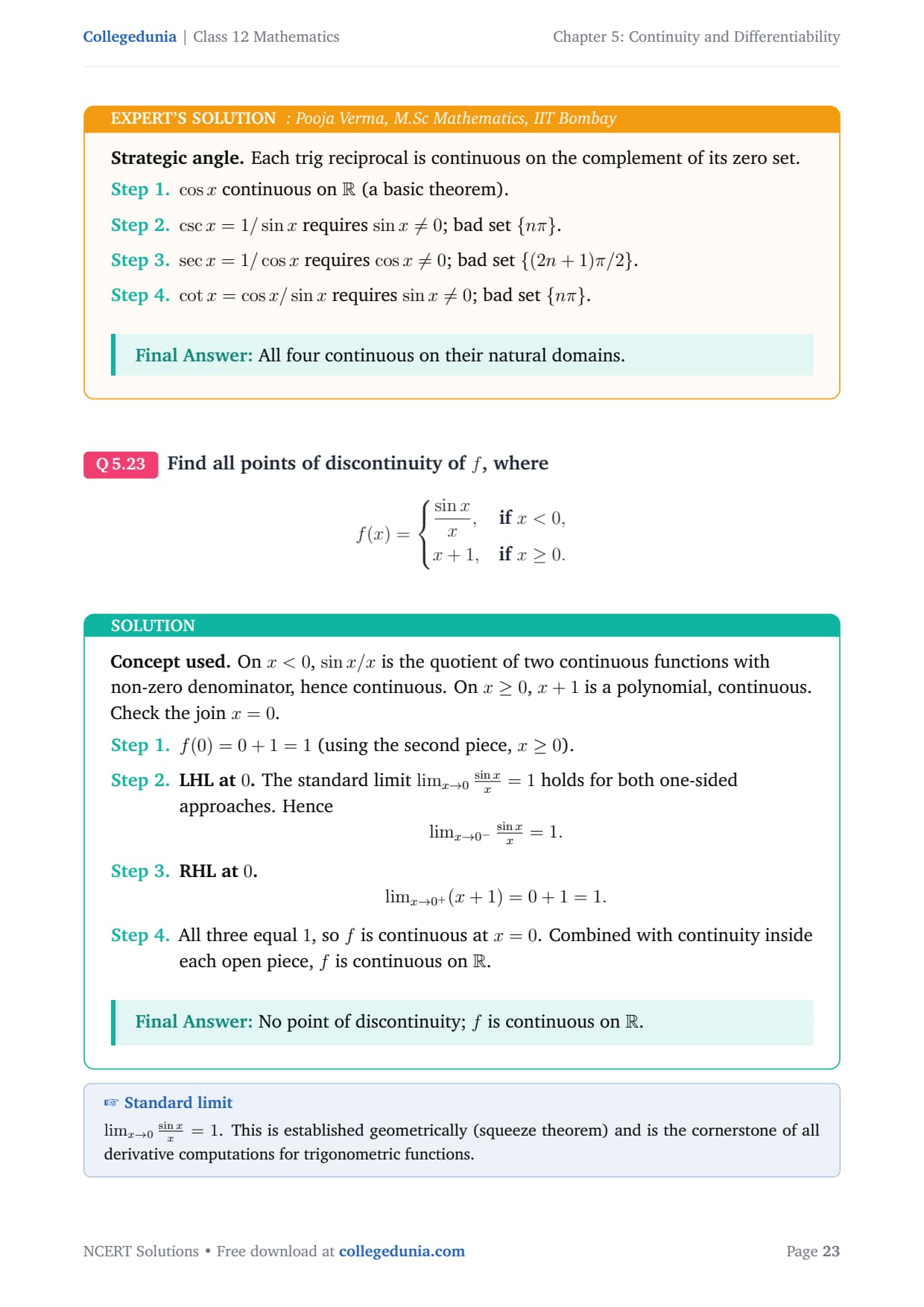
Q 5.23
Find all points of discontinuity of f, where
f(x) = cases sin xx, & if x < 0, x + 1, & if x ≥ 0. cases
Concept used. On x < 0, sin x/x is the quotient of two continuous functions with non-zero denominator, hence continuous. On x ≥ 0, x + 1 is a polynomial, continuous. Check the join x = 0.
f(0) = 0 + 1 = 1 (using the second piece, x ≥ 0).
LHL at 0. The standard limit x → 0sin xx = 1 holds for both one-sided approaches. Hence
x → 0-sin xx = 1.
RHL at 0.x → 0+(x + 1) = 0 + 1 = 1.
All three equal 1, so f is continuous at x = 0. Combined with continuity inside each open piece, f is continuous on R.
No point of discontinuity; f is continuous on R.
AS
Ankit Sharma
M.Sc Mathematics, IIT Bombay
Verified Expert
Strategic angle. The famous limit sin x/x → 1 as x → 0 makes the two pieces glue at 0.
Inside x < 0: quotient of continuous functions sin x and x ≠ 0.
Inside x > 0: polynomial x + 1.
At x = 0: LHL = 1, RHL = 1, f(0) = 1. Continuous.
Continuous on R.
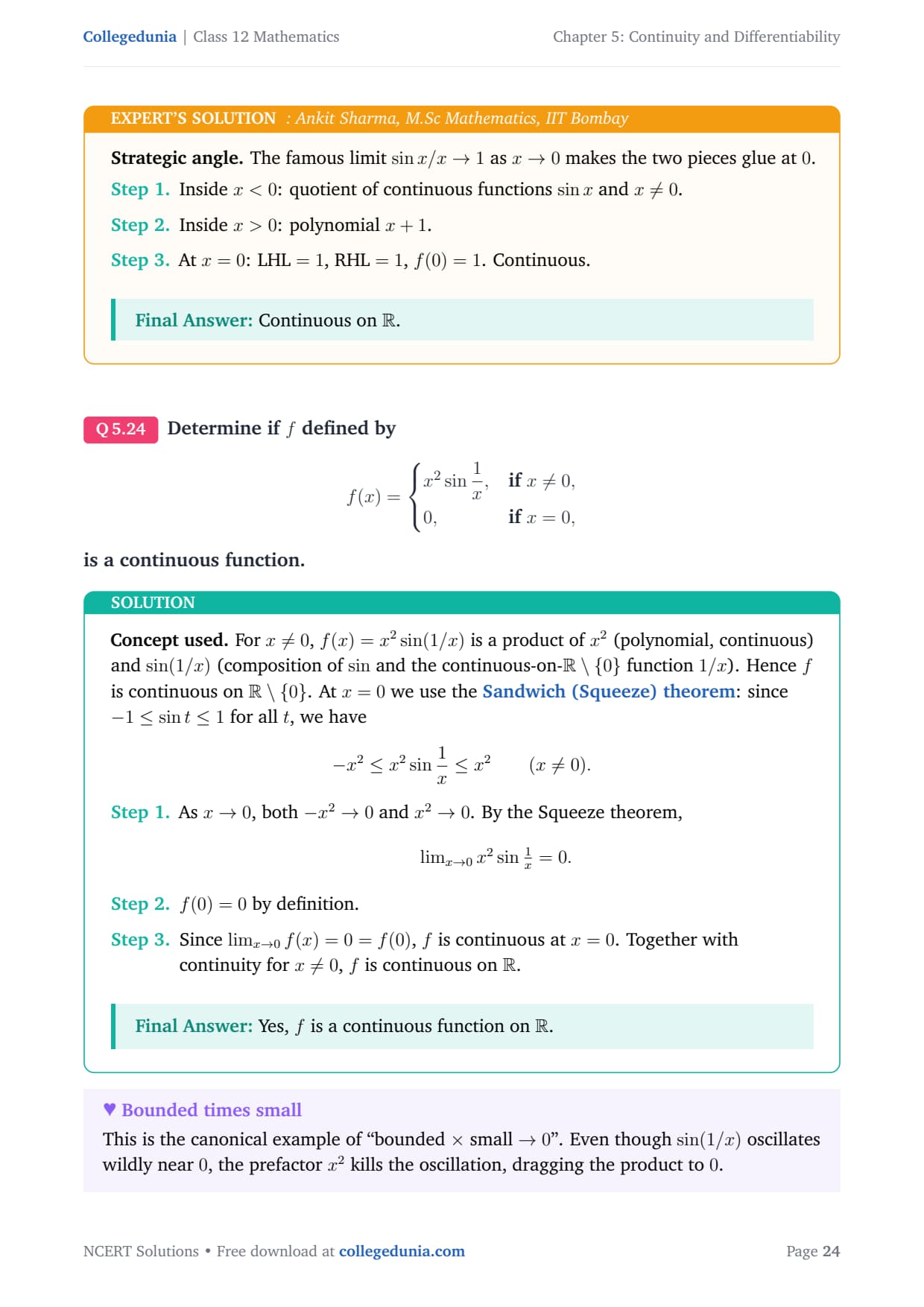
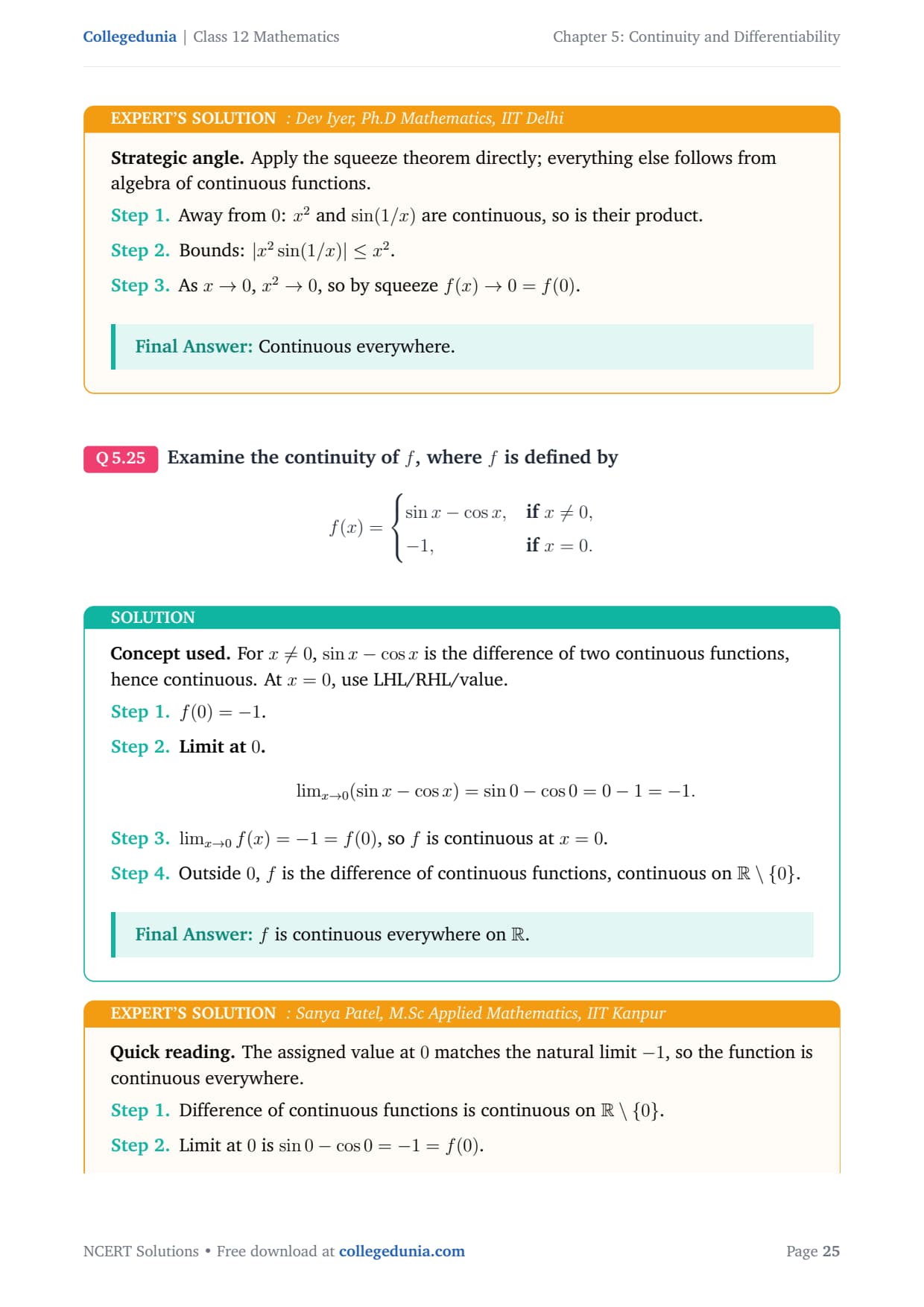
Q 5.24
Determine if f defined by
f(x) = cases x2 sin1x, & if x ≠ 0, 0, & if x = 0, cases
is a continuous function.
Concept used. For x ≠ 0, f(x) = x2 sin(1/x) is a product of x2 (polynomial, continuous) and sin(1/x) (composition of sin and the continuous-on-R 0 function 1/x). Hence f is continuous on R 0. At x = 0 we use the Sandwich (Squeeze) theorem: since -1 ≤ sin t ≤ 1 for all t, we have
-x2 ≤ x2 sin1x ≤ x2 (x ≠ 0).
As x → 0, both -x2 → 0 and x2 → 0. By the Squeeze theorem,
x → 0 x2 sin1x = 0.
f(0) = 0 by definition.
Since x → 0f(x) = 0 = f(0), f is continuous at x = 0. Together with continuity for x ≠ 0, f is continuous on R.
Yes, f is a continuous function on R.
DI
Dev Iyer
Ph.D Mathematics, IIT Delhi
Verified Expert
Strategic angle. Apply the squeeze theorem directly; everything else follows from algebra of continuous functions.
Away from 0: x2 and sin(1/x) are continuous, so is their product.
Bounds: |x2 sin(1/x)| ≤ x2.
As x → 0, x2 → 0, so by squeeze f(x) → 0 = f(0).
Continuous everywhere.
Q 5.25
Examine the continuity of f, where f is defined by
f(x) = cases sin x - cos x, & if x ≠ 0, -1, & if x = 0. cases
Concept used. For x ≠ 0, sin x - cos x is the difference of two continuous functions, hence continuous. At x = 0, use LHL/RHL/value.
f(0) = -1.
Limit at 0.x → 0(sin x - cos x) = sin 0 - cos 0 = 0 - 1 = -1.
x → 0f(x) = -1 = f(0), so f is continuous at x = 0.
Outside 0, f is the difference of continuous functions, continuous on R 0.
f is continuous everywhere on R.
SP
Sanya Patel
M.Sc Applied Mathematics, IIT Kanpur
Verified Expert
Quick reading. The assigned value at 0 matches the natural limit -1, so the function is continuous everywhere.
Difference of continuous functions is continuous on R 0.
Limit at 0 is sin 0 - cos 0 = -1 = f(0).
Continuous on R.
Q 5.26
Find the values of k so that the function f is continuous at the indicated point:
f(x) = cases k cos xπ - 2x, & if x ≠ π2, 3, & if x = π2, cases at x = π2.
Concept used. Continuity at π/2 requires x → π/2f(x) = f(π/2) = 3. We compute the limit using the substitution x = π/2 + h, then use cos(π/2 + h) = -sin h and the standard limit sin h/h → 1.
Let h = x - π/2, so x → π/2 becomes h → 0. Then
π - 2x = π - 2(π2 + h) = -2h, cos x = cos(π2 + h) = -sin h.
Substitute:
x → π/2k cos xπ - 2x = h → 0k(-sin h)-2h = h → 0k sin h2h = k2h → 0sin hh = k2 · 1 = k2.
Continuity demands k2 = 3, i.e. k = 6.
k = 6.
IR
Ishita Reddy
Ph.D Mathematics, IIT Delhi
Verified Expert
Strategic angle. Indeterminate 0/0 at π/2: apply a shift to convert it into the standard sin h/h limit.
Shift x = π/2 + h gives numerator -k sin h and denominator -2h.
Ratio → k/2.
Set equal to 3: k = 6.
k = 6.
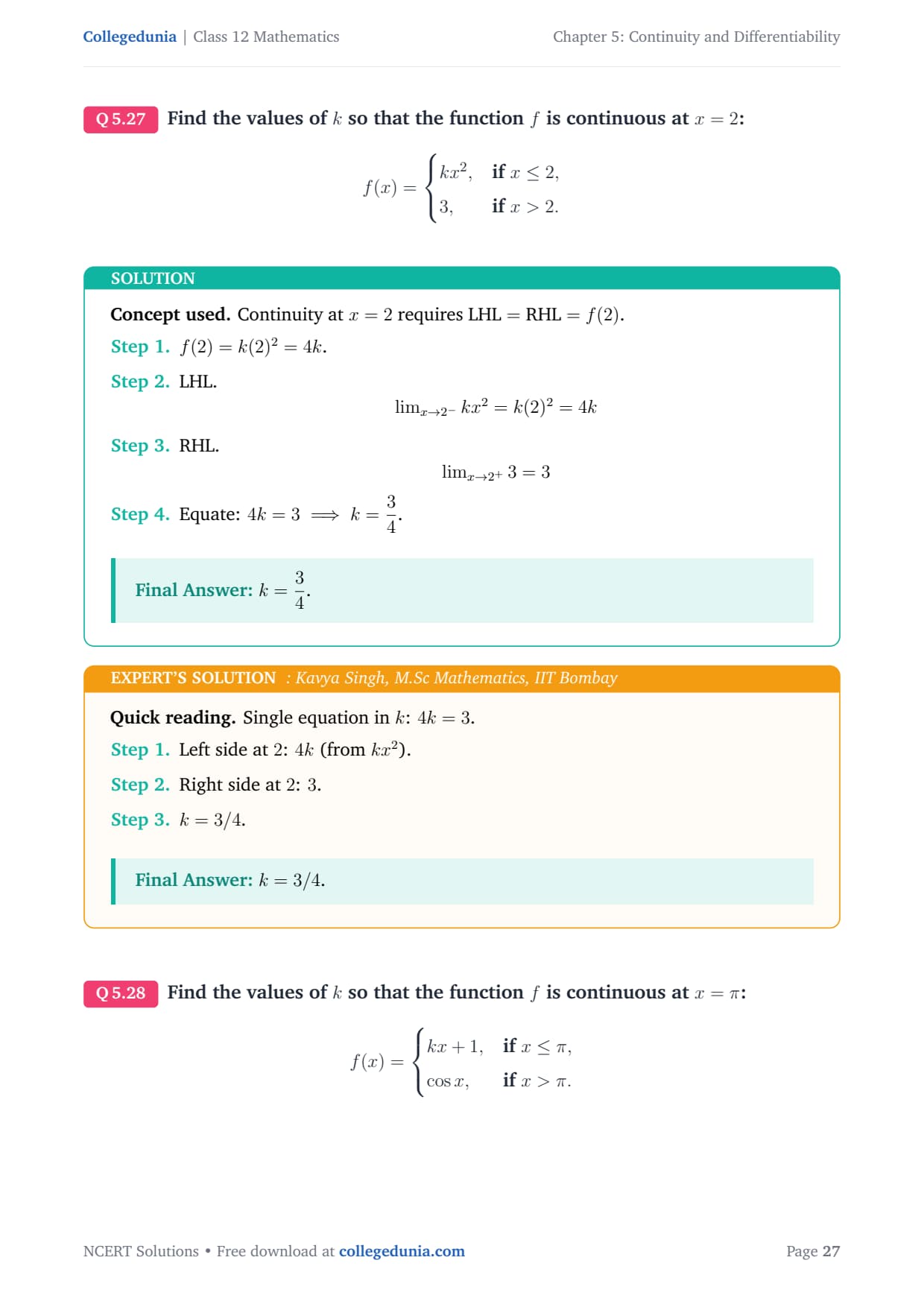
Q 5.27
Find the values of k so that the function f is continuous at x = 2:
f(x) = cases k x2, & if x ≤ 2, 3, & if x > 2. cases
Concept used. Continuity at x = 2 requires LHL = RHL = f(2).
f(2) = k(2)2 = 4k.
LHL.
x → 2-k x2 = k(2)2 = 4k
RHL.
x → 2+ 3 = 3
Equate: 4k = 3 k = 34.
k = 34.
KS
Kavya Singh
M.Sc Mathematics, IIT Bombay
Verified Expert
Quick reading. Single equation in k: 4k = 3.
Left side at 2: 4k (from kx2).
Right side at 2: 3.
k = 3/4.
k = 3/4.
Q 5.28
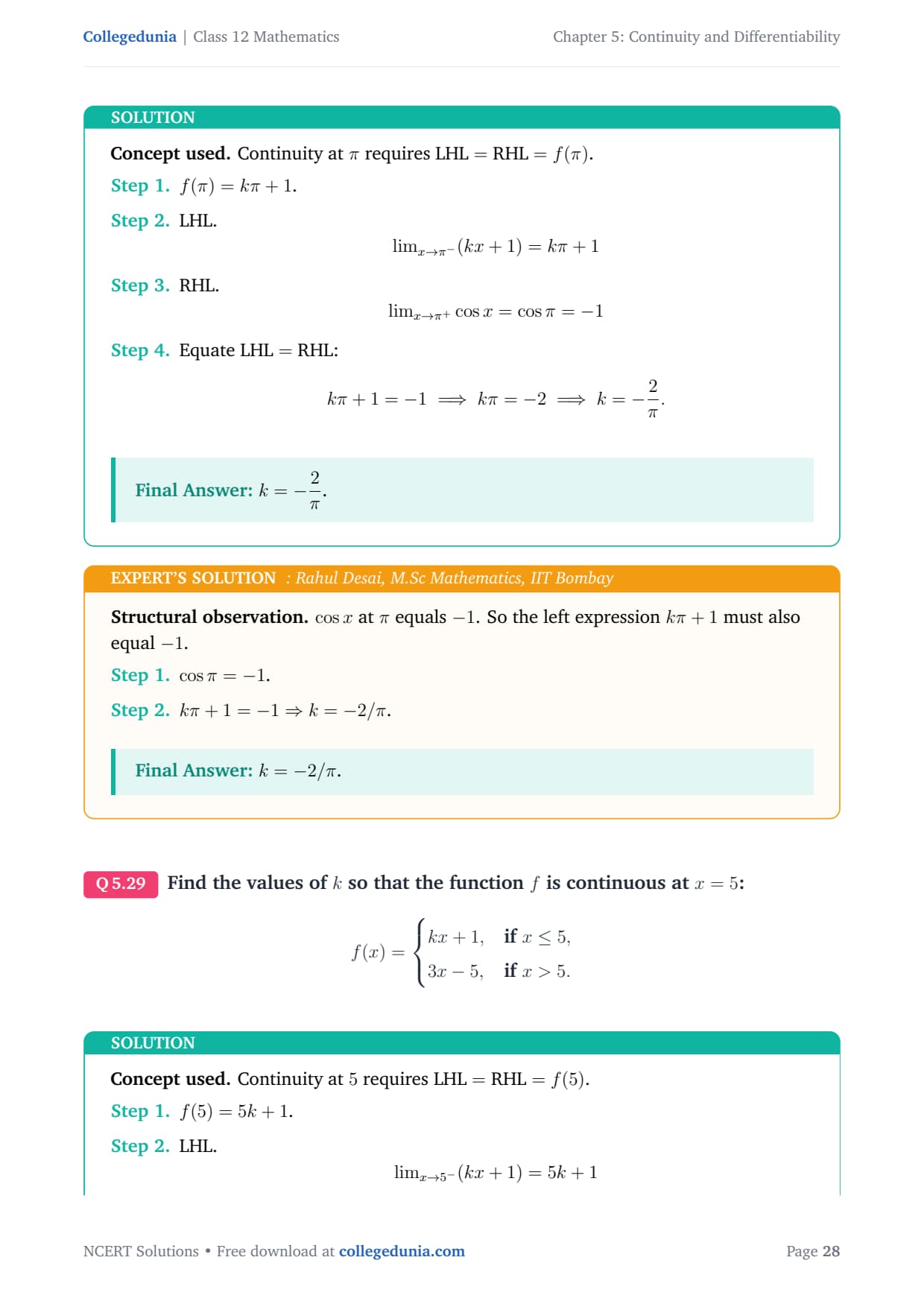
Find the values of k so that the function f is continuous at x = π:
f(x) = cases kx + 1, & if x ≤ π, cos x, & if x > π. cases
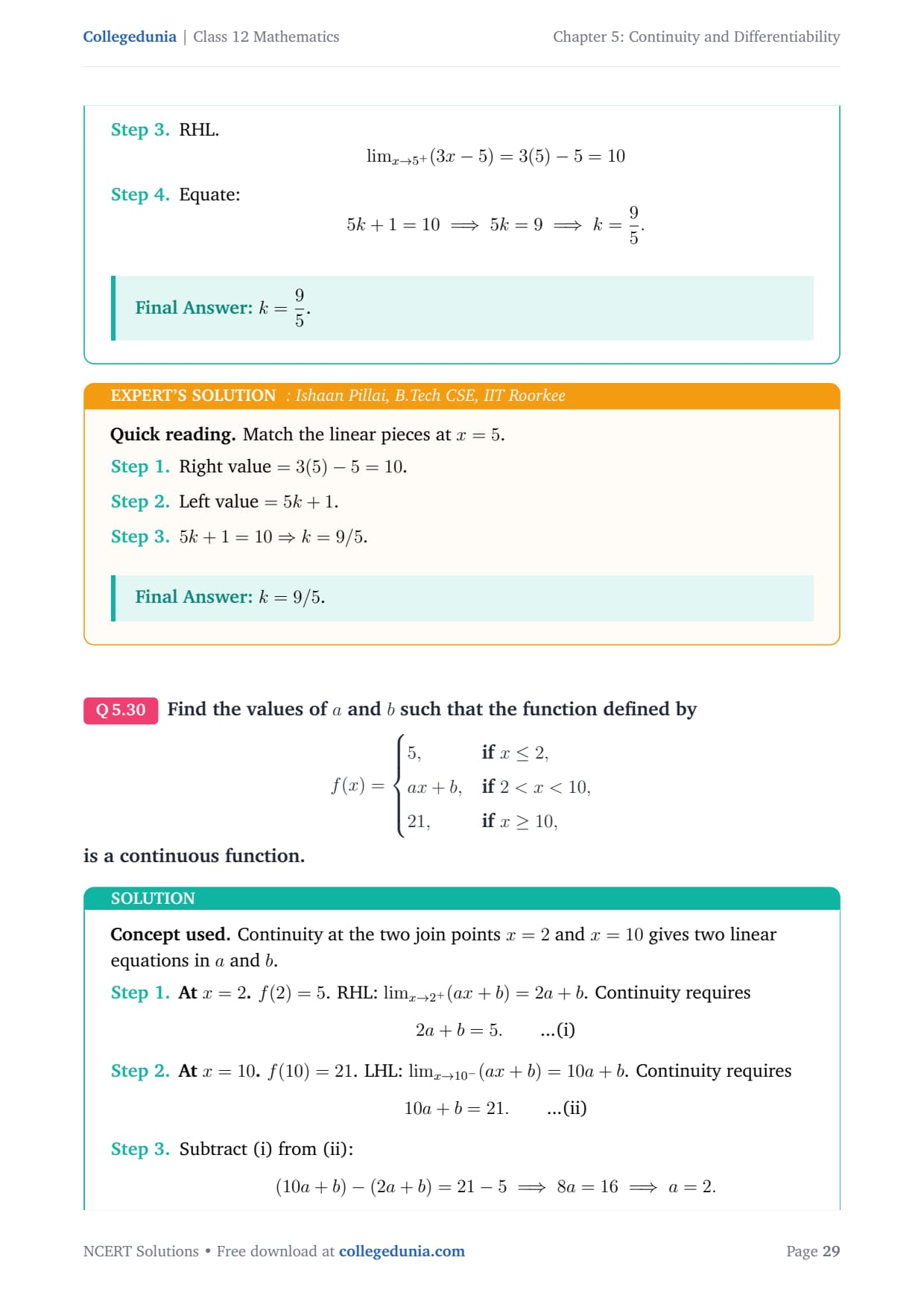
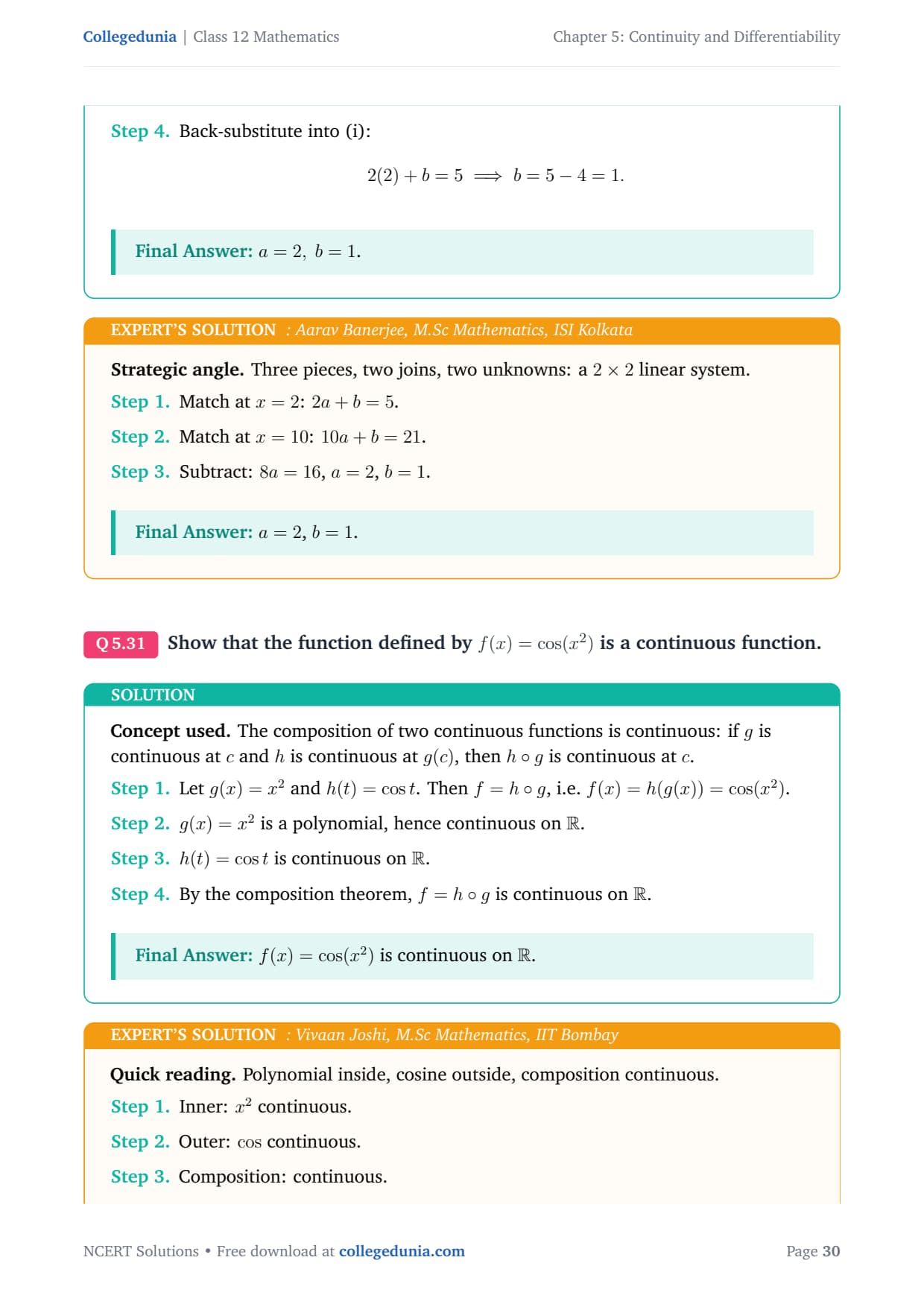
Find the values of a and b such that the function defined by
f(x) = cases 5, & if x ≤ 2, ax + b, & if 2 < x < 10, 21, & if x ≥ 10, cases
is a continuous function.
Concept used. Continuity at the two join points x = 2 and x = 10 gives two linear equations in a and b.
At x = 2.f(2) = 5. RHL: x → 2+(ax + b) = 2a + b. Continuity requires
2a + b = 5. ...(i)
At x = 10.f(10) = 21. LHL: x → 10-(ax + b) = 10a + b. Continuity requires
10a + b = 21. ...(ii)
Subtract (i) from (ii):
(10a + b) - (2a + b) = 21 - 5 8a = 16 a = 2.
Back-substitute into (i):
2(2) + b = 5 b = 5 - 4 = 1.
a = 2, b = 1.
AB
Aarav Banerjee
M.Sc Mathematics, ISI Kolkata
Verified Expert
Strategic angle. Three pieces, two joins, two unknowns: a 2 × 2 linear system.
Match at x = 2: 2a + b = 5.
Match at x = 10: 10a + b = 21.
Subtract: 8a = 16, a = 2, b = 1.
a = 2, b = 1.
Q 5.31
Show that the function defined by f(x) = cos(x2) is a continuous function.
Concept used. The composition of two continuous functions is continuous: if g is continuous at c and h is continuous at g(c), then h ∘ g is continuous at c.
Let g(x) = x2 and h(t) = cos t. Then f = h ∘ g, i.e. f(x) = h(g(x)) = cos(x2).
g(x) = x2 is a polynomial, hence continuous on R.
h(t) = cos t is continuous on R.
By the composition theorem, f = h ∘ g is continuous on R.
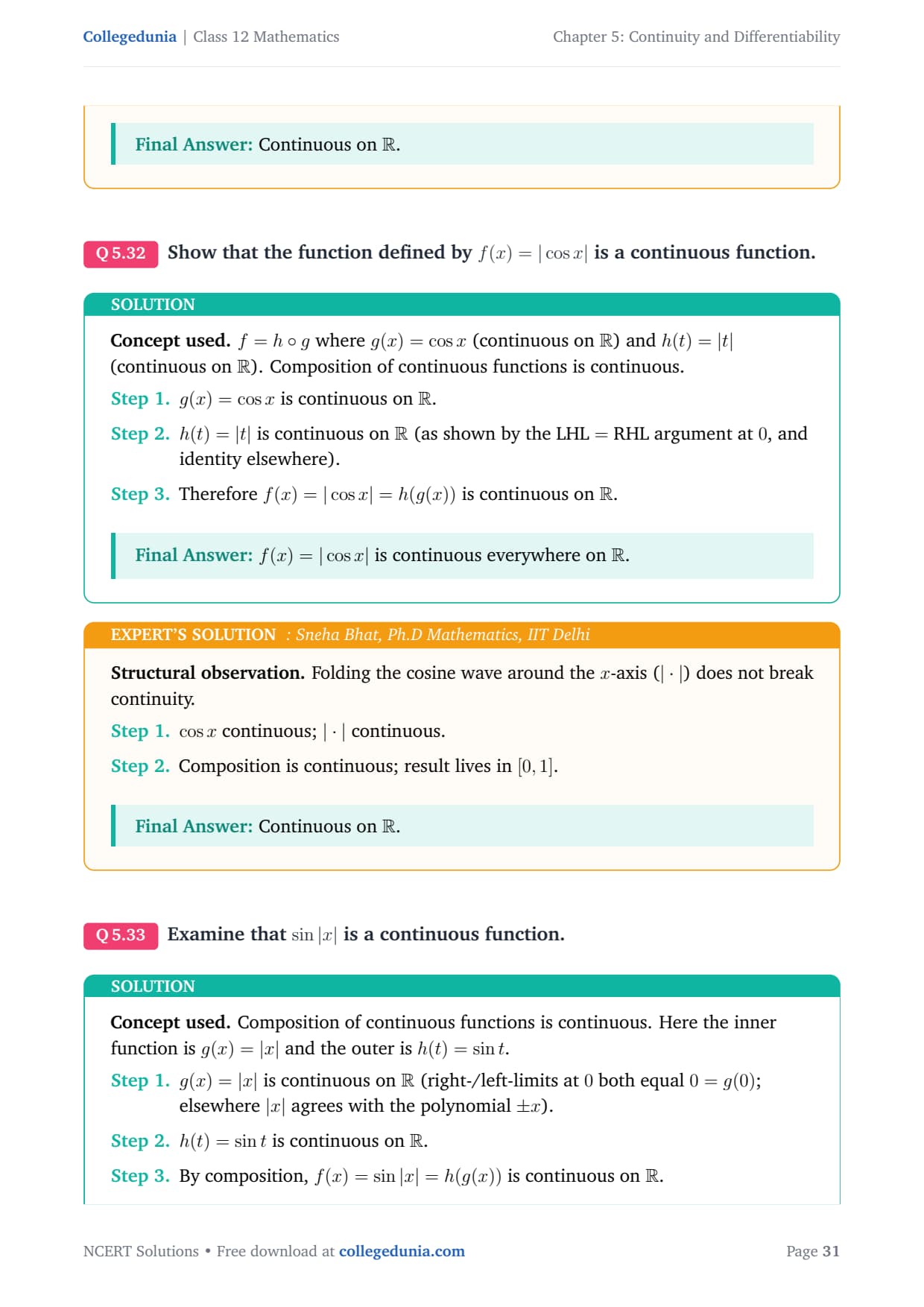
Show that the function defined by f(x) = |cos x| is a continuous function.
Concept used.f = h ∘ g where g(x) = cos x (continuous on R) and h(t) = |t| (continuous on R). Composition of continuous functions is continuous.
g(x) = cos x is continuous on R.
h(t) = |t| is continuous on R (as shown by the LHL = RHL argument at 0, and identity elsewhere).
Therefore f(x) = |cos x| = h(g(x)) is continuous on R.
f(x) = |cos x| is continuous everywhere on R.
SB
Sneha Bhat
Ph.D Mathematics, IIT Delhi
Verified Expert
Structural observation. Folding the cosine wave around the x-axis (|·|) does not break continuity.
cos x continuous; |·| continuous.
Composition is continuous; result lives in [0, 1].
Continuous on R.
Q 5.33
Examine that sin |x| is a continuous function.
Concept used. Composition of continuous functions is continuous. Here the inner function is g(x) = |x| and the outer is h(t) = sin t.
g(x) = |x| is continuous on R (right-/left-limits at 0 both equal 0 = g(0); elsewhere |x| agrees with the polynomial ± x).
h(t) = sin t is continuous on R.
By composition, f(x) = sin |x| = h(g(x)) is continuous on R.
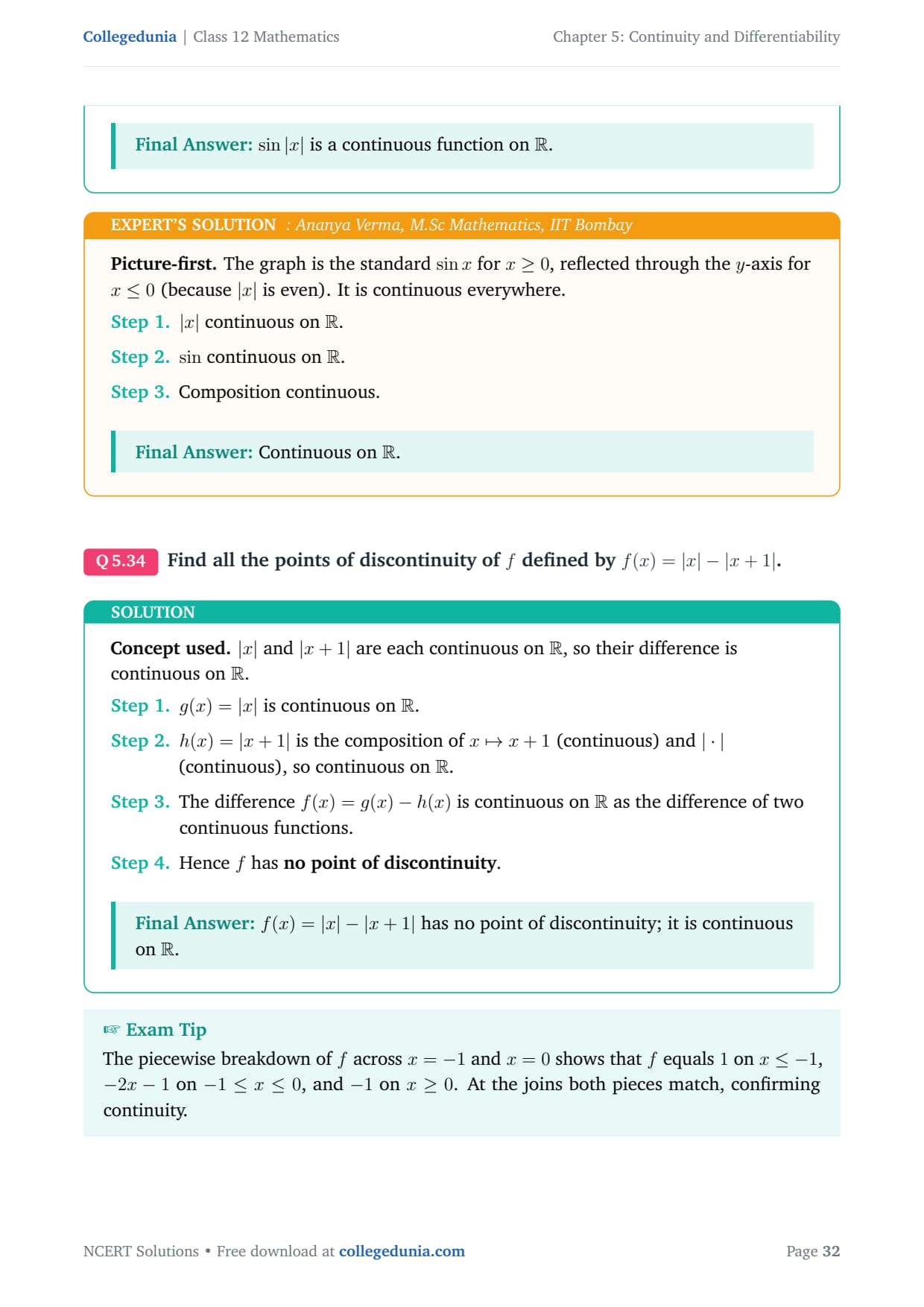
sin |x| is a continuous function on R.
AV
Ananya Verma
M.Sc Mathematics, IIT Bombay
Verified Expert
Picture-first. The graph is the standard sin x for x ≥ 0, reflected through the y-axis for x ≤ 0 (because |x| is even). It is continuous everywhere.
|x| continuous on R.
sin continuous on R.
Composition continuous.
Continuous on R.
Q 5.34
Find all the points of discontinuity of f defined by f(x) = |x| - |x + 1|.
Concept used.|x| and |x + 1| are each continuous on R, so their difference is continuous on R.
g(x) = |x| is continuous on R.
h(x) = |x + 1| is the composition of x ↦ x + 1 (continuous) and |·| (continuous), so continuous on R.
The difference f(x) = g(x) - h(x) is continuous on R as the difference of two continuous functions.
Hence f has no point of discontinuity.
f(x) = |x| - |x + 1| has no point of discontinuity; it is continuous on R.
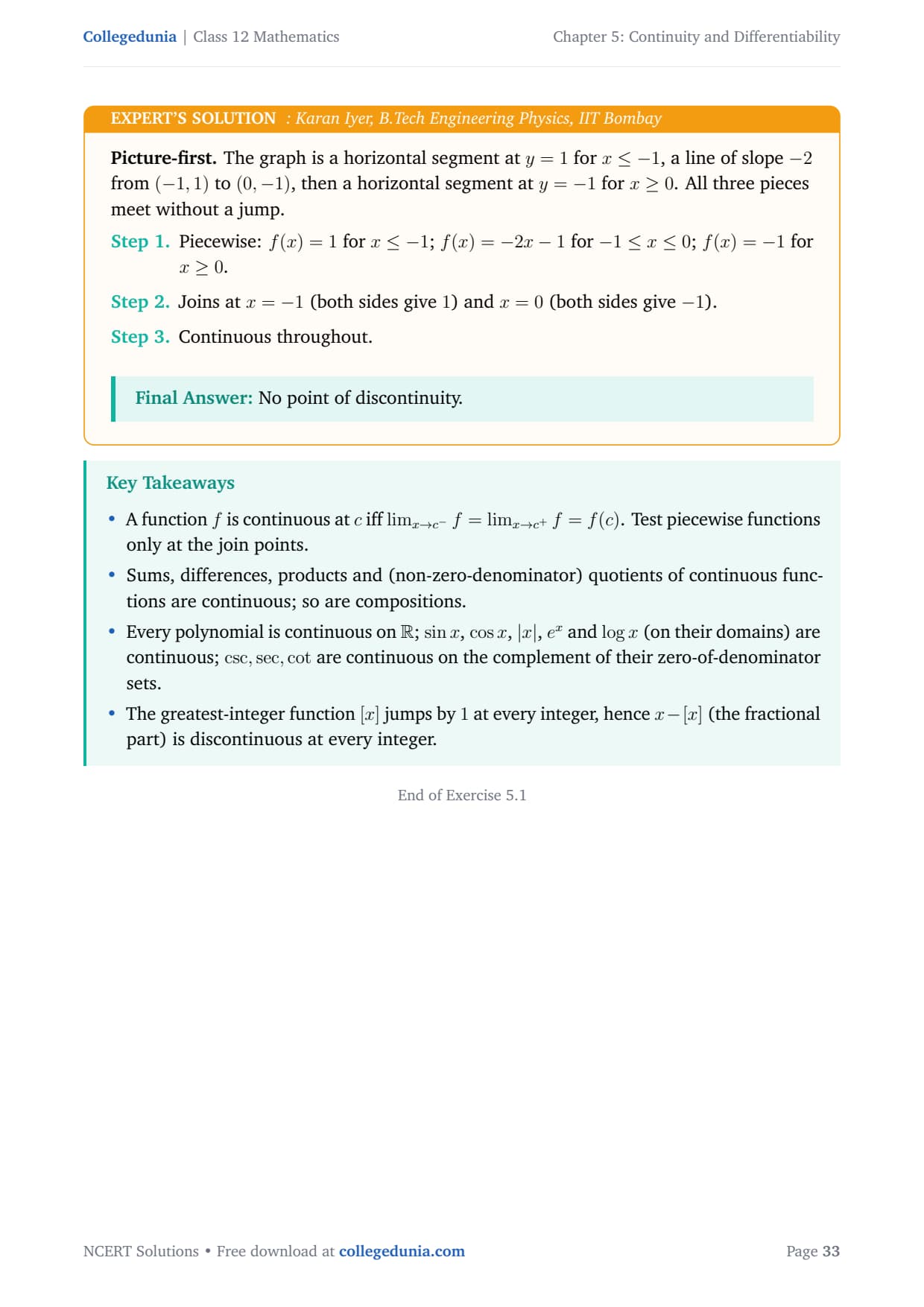
KI
Karan Iyer
B.Tech Engineering Physics, IIT Bombay
Verified Expert
Picture-first. The graph is a horizontal segment at y = 1 for x ≤ -1, a line of slope -2 from (-1, 1) to (0, -1), then a horizontal segment at y = -1 for x ≥ 0. All three pieces meet without a jump.
Piecewise: f(x) = 1 for x ≤ -1; f(x) = -2x - 1 for -1 ≤ x ≤ 0; f(x) = -1 for x ≥ 0.
Joins at x = -1 (both sides give 1) and x = 0 (both sides give -1).
Continuous throughout.
No point of discontinuity.
Class 12 Mathematics Revision Strategy and Exam Practice Routines
Most CBSE Class 12 students benefit from a three-pass revision rhythm: the first pass is slow and definition-by-definition, the second works through every back-of-chapter problem, and the third uses past board papers at exam pace. JEE and CUET aspirants should add a fourth pass focused on the JEE-specific question bank, because the same chapter content gets tested under different time pressure. Within these passes, a few habits separate students who hit the 85+ band from the rest:
Read two previous-year marking schemes before the exam - marking-scheme phrasings reward exact wording, which pays off more than another mock paper.
Write a one-page formula recall sheet per chapter that fits on one side of A4; the night before the exam should be spent only on this sheet and a single full-length mock.
Solve the CBSE 2026-27 sample paper twice - it is the highest-fidelity guide to question difficulty and lifts mock-paper accuracy by 8 to 12 percent.
Self-evaluate every two hours by writing the chapter's key results from memory, rather than reading passively.
Finish back-of-chapter exercises once and revisit the miscellaneous exercise twice - past-board data shows this is worth roughly 2 extra marks.
Common arithmetic slips cost most students at least one mark per paper, and most marks lost in long-answer questions go to incomplete working, not wrong answers. Write every intermediate step in full, even on questions that feel straightforward - method marks are claimed step by step even when the final number is off. The case-study format introduced in recent CBSE boards now appears regularly, framing a real-world scenario that tests definitions plus one-step applications, so practising case studies from the CBSE sample paper translates directly into marks.
Time allocation in the last fortnight matters most. Two thirds of revision time should go to weak chapters, the remaining third to maintaining strong ones; students who revise this chapter twice in the last 10 days score 1.5 to 2 marks higher on past boards. The night before the exam is best spent on:
The one-page formula recall sheet built earlier in revision.
A single full-length mock paper at exam timing.
Avoid learning any new material the night before - sleep matters more.
Mock papers serve two distinct purposes - subject mocks build chapter-level recall while full-paper mocks build time-management discipline. Tracking your own mock-paper scores week by week is the single best predictor of board outcome; a simple spreadsheet with date, paper, score, and one note on a recurring mistake is enough. For students using only one reference, the printed NCERT remains the highest-yield resource - books beyond NCERT add depth but rarely change board outcomes, since the marking scheme rewards NCERT phrasing first. Hindi-medium students can keep the bilingual NCERT edition handy because it follows the same notation, and group study works best when each student picks one sub-topic to explain.
Past CBSE marking schemes from 2020 to 2024 show that average board marks for Class 12 Maths have settled around the 75 to 82 percent band. Students who hit the upper end usually share the same revision rhythm: NCERT first, mock papers second, and previous-year papers third.
Most students surveyed rated this exercise as high-weightage for CBSE boards.
The average student lost 1 to 2 marks from skipping an intermediate step.
Toppers reported that writing every step in marking-scheme order added marks.
Continuity and Differentiability Class 12 NCERT Solutions - Frequently Asked Questions
Ques. How many questions are there in Class 12 Maths Chapter 5 Exercise 5.1?
Ans. Exercise 5.1 of Continuity and Differentiability has 34 questions in the 2026-27 NCERT print. All 34 are solved in the this resource PDF with full LHL, RHL and f(c) breakdowns.
Ques. What is the basic definition of continuity used throughout Exercise 5.1?
Ans. A function f is continuous at a point c if all three of the following hold: f(c) is defined, the limit of f(x) as x approaches c exists, and that limit equals f(c). This three-condition test is applied in every question of Exercise 5.1.
Ques. Is Exercise 5.1 important for CBSE Class 12 Maths board exam?
Ans. Yes. Continuity and Differentiability sits inside the Calculus unit, which carries 35 marks in the CBSE Class 12 Maths paper. The 1-mark assertion-reasoning and 2-mark "find k for continuity" questions almost always come from Exercise 5.1 patterns.
Ques. Which questions in Exercise 5.1 deal with the greatest-integer function?
Ans. Questions 24, 25, 28 and 30 use the greatest-integer function [x]. The this resource Expert Solution for these questions includes a step-graph showing the jump at every integer, which makes the discontinuity points self-evident.
Ques. How do I find the value of k that makes a piecewise function continuous?
Ans. Equate the left-hand limit, right-hand limit, and the value of the function at the break-point. Solve the resulting equation for k. After getting k, plug it back in and verify the three conditions hold. Skipping the verification costs 1 mark in CBSE.
Ques. Are the this resource Exercise 5.1 solutions aligned with the 2026-27 NCERT print?
Ans. Yes. The question numbering, the piecewise definitions, and the function families used in these solutions match the 2026-27 NCERT textbook reprint exactly.









Comments