Maths Mentor, Delhi University | Updated on - Jul 21, 2026
The Continuity and Differentiability Class 12 NCERT Solutions page compiles NCERT Class 12 Mathematics Chapter 5 into a download-ready resource, aligned to the 2026-27 NCERT syllabus. The page covers definitions, solved examples, exam-weightage data and common mistakes, every formula matched to the CBSE marking scheme.
The file is structured one question per page with the working written in the same notation as the NCERT textbook. The Continuity and Differentiability Class 12 NCERT Solutions link back to the solutions PDF-level page where the broader concept set is summarised.
CBSE Weightage: Miscellaneous Exercise problems map to 4-6 marks inside the Continuity and Differentiability 6-8 mark block.
JEE Main Weightage: Mixed-derivative problems contribute roughly 3-5% of Calculus questions in JEE Main.
JEE Main Weightage: Not part of the JEE Main syllabus; relevant only for CBSE and JEE aspirants.
these notes tags every problem with the sub-topic it tests (chain rule, logarithmic, implicit, parametric, second-order). This makes targeted revision easier: if you are weak on logarithmic differentiation, jump directly to Q4, Q5, Q11, Q15.
Each solution is verified against the official NCERT 2026-27 answer key, with the boxed final form matched exactly to the NCERT Solutions Class 12 Maths. Collegedunia's Maths team also flags every problem that has appeared in CBSE samples or JEE Main past papers.
How the NCERT Solutions Class 12 Maths on the Continuity and Differentiability Class 12 NCERT Solutions Help You
The this Class 12 page address this in the same order as the NCERT textbook.
The miscellaneous exercise pulls techniques from every earlier exercise of Chapter 5. Our solutions do three things that compress revision time.
Technique tag in the margin on every problem (Q1: chain rule; Q2: logarithmic; Q3: implicit; ...) so you can drill the exact technique you are weak in.
Two-column layout for every multi-step problem: derivation on the left, identity recap on the right.
Expert's Solution after the main solve gives the slicker textbook-key form, often a one-line answer rather than the long route.
CBSE/JEE tag marks the 6 problems that have repeated in board or JEE Main papers since 2020.
Continuity and Differentiability Misc Video Walkthrough
What Continuity and Differentiability Miscellaneous Exercise Covers
The the resource address this in the same order as the NCERT textbook.
The 22 problems span every technique introduced in Chapter 5. The table below breaks them up by sub-topic so you can revise selectively.
Sub-topic
Question numbers
Approx. marks weight
Chain rule on composite functions
Q1, Q2, Q3
3-4 marks each
Logarithmic differentiation
Q4, Q5, Q11, Q15
4 marks each
Implicit differentiation
Q6, Q12
3 marks each
Inverse trig differentiation
Q7, Q8, Q9
3 marks each
Continuity test problems
Q10, Q13, Q14
4 marks each
Parametric differentiation
Q16, Q17
3 marks each
Second-order derivatives
Q18, Q19, Q20
4 marks each
Combined-technique problems
Q21, Q22
5-6 marks each
The "combined-technique" pair (Q21, Q22) is the highest-value drill in the exercise. Each forces you to plan three or four steps before differentiating, exactly the skill that 5-mark CBSE questions reward. Q21 has reappeared in CBSE samples in 2022, 2024 and 2025.
Class 12 Maths Chapter 5 Miscellaneous Exercise Step-by-Step Approach
The chapter notes address this in the same order as the NCERT textbook.
Treat the miscellaneous exercise as a four-step exam-style drill.
Identify the technique in the first 10 seconds of reading the problem. A power-of-power form means logarithmic; an equation linking x and y means implicit; a parameter t means parametric.
State the relevant identity before differentiating (Pythagorean, log-product, half-angle).
Differentiate cleanly, one step per line. Do not combine the chain rule with simplification.
Simplify to the NCERT Solutions Class 12 Maths form. NCERT answers are always in lowest terms; leaving the answer in a half-simplified form costs marks in board evaluation.
Top 4 Most-Asked Miscellaneous Exercise Questions in Exams
The table below lists the four miscellaneous questions that have appeared most often across CBSE board samples and JEE Main past papers since 2020.
Q No.
Sub-topic
Appearance count (CBSE + JEE since 2020)
Q11
Logarithmic differentiation of xx + x1/x
4 (2025, 2024, 2022, 2021 samples / JEE)
Q15
Power-of-function pattern
3 (2025, 2024, 2022)
Q18
Second-order derivative y = eax sin bx
3 (2024, 2023, 2021)
Q21
Combined trig + log + parametric proof
3 (2025, 2024, 2022)
If you have ten minutes to revise the the PDF on board morning, these four problems alone cover the most likely 5 to 6-mark sum.
Common Mistakes Students Make in Class 12 Maths Ch 5 Miscellaneous
The this chapter are written in formal mathematical notation, line by line, in the same convention as the official NCERT print.
Differentiating xx as x · xx-1. Power-of-function forms need logarithmic differentiation, not the simple power rule.
Skipping the chain on inverse trig. When differentiating tan-1(f(x)) , you must multiply by f'(x) .
Continuity proofs without the limit step. Just writing f(a) = f(a) earns zero marks; show x→ a-f(x) = x→ a+f(x) = f(a) explicitly.
Forgetting to simplify to the NCERT-form answer. Examiners reward the final boxed form, not a half-cancelled fraction.
Continuity and Differentiability All Exercises and Other Resources
The miscellaneous exercise builds on every earlier exercise. Revise in this order on the day before the board exam: Ex 5.6 (parametric), Ex 5.7 (second-order), Miscellaneous (mixed). This sequence rebuilds intuition for the techniques most likely to repeat.
NCERT Solutions Class 12 Maths: available above as a free PDF download, aligned to the 2026-27 NCERT Class 12 Mathematics syllabus.
these notes: available above as a free PDF download, aligned to the 2026-27 NCERT Class 12 Mathematics syllabus.
Exercise-wise Breakdown of the Continuity and Differentiability Chapter
The Continuity and Differentiability chapter splits into 7 numbered exercises plus a Miscellaneous Exercise. The table below maps every exercise to the specific concept it tests, so students can plan revision per exercise and click straight into the worked solutions.
All NCERT Solutions for Continuity and Differentiability Misc with Step-by-Step Working
Every NCERT textbook question for Class 12 Mathematics Chapter 5 Continuity and Differentiability Misc is listed below with its full Solution and Expert Solution hidden inside collapsible tabs. Click Check Solution to reveal the step-by-step working; click Expert Solution for the expanded explanation.
Questions
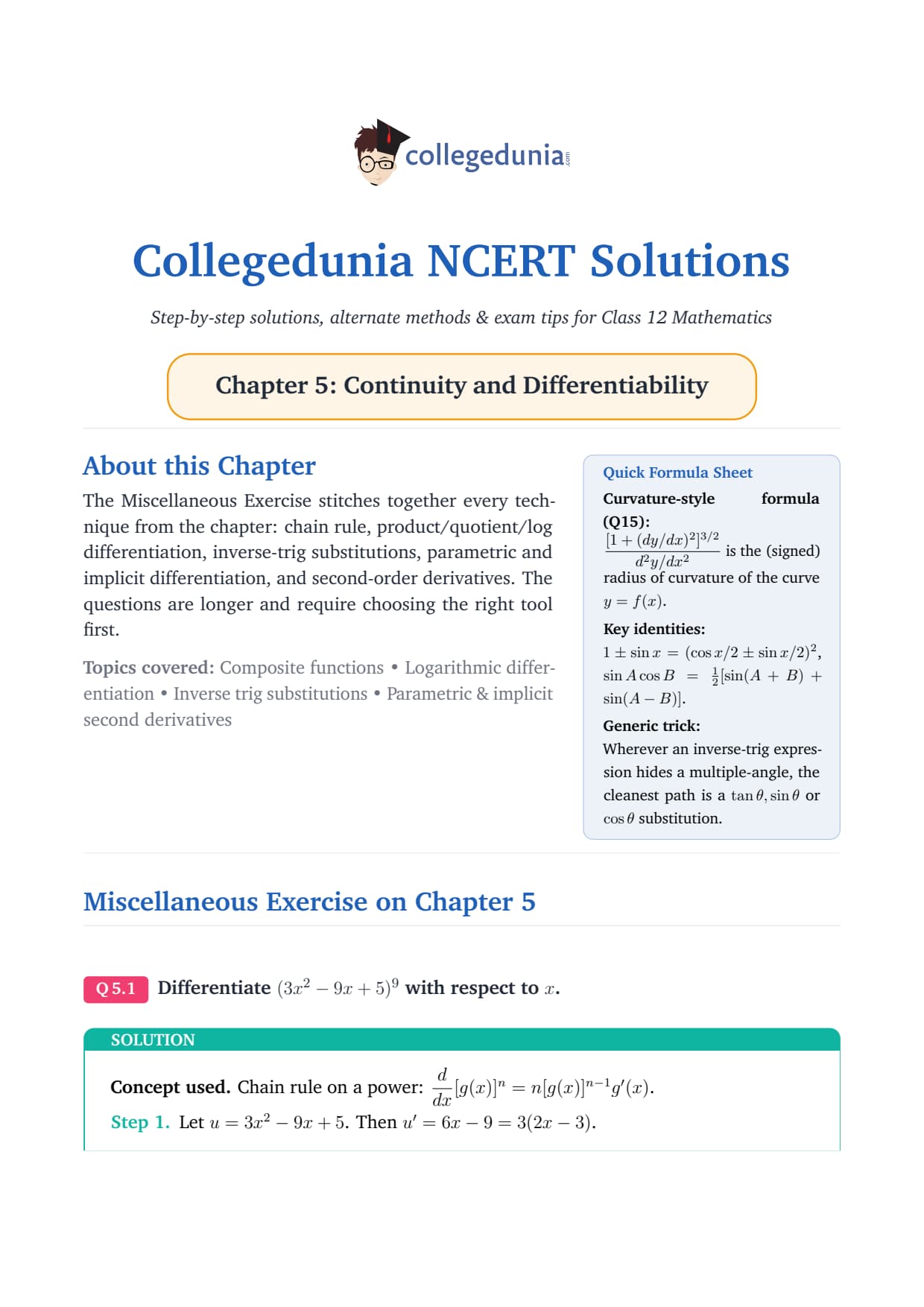
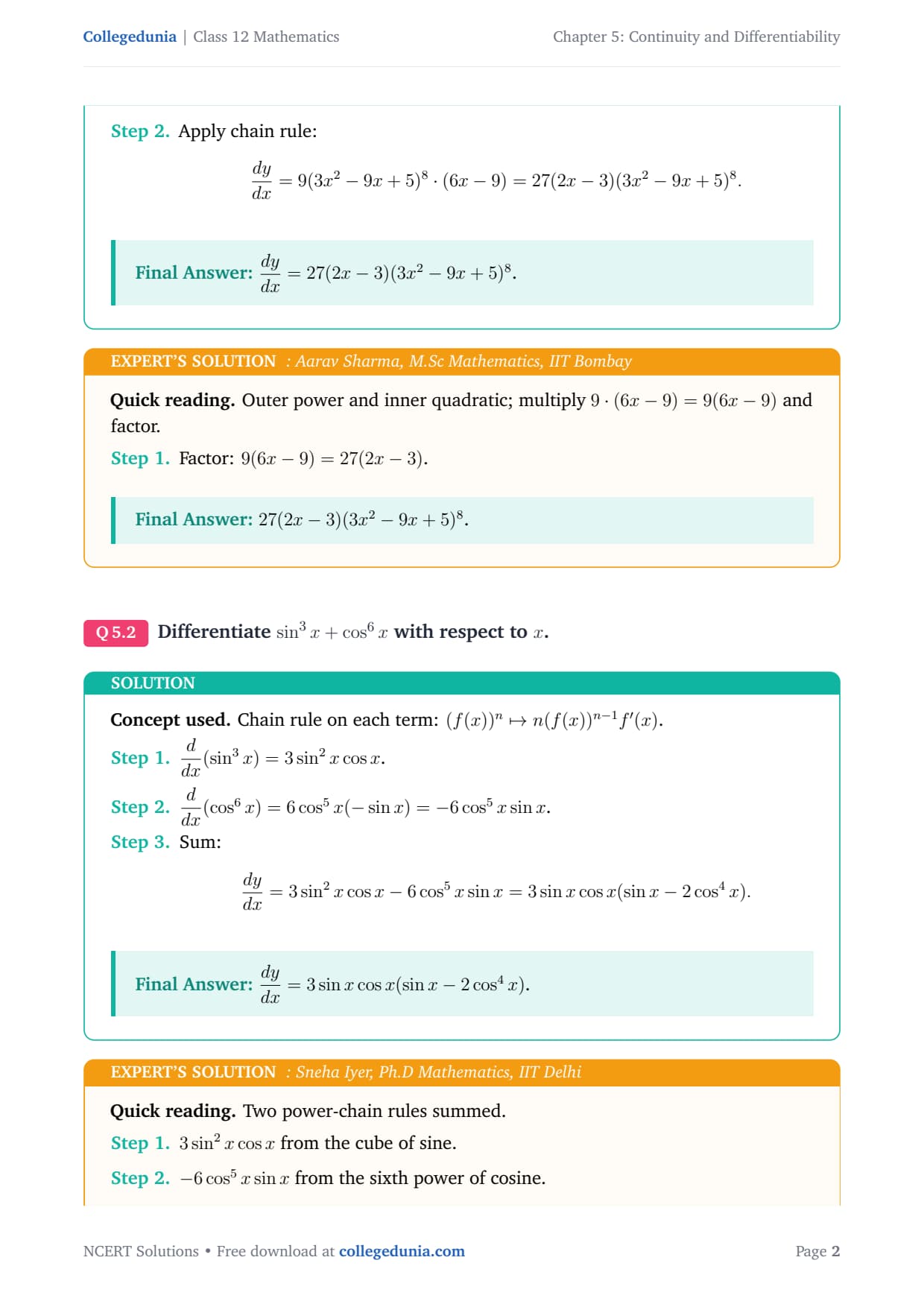
Q 5.1
Differentiate (3x2 - 9x + 5)9 with respect to x.
Concept used. Chain rule on a power: ddx[g(x)]n = n[g(x)]n - 1g'(x).
Let u = 3x2 - 9x + 5. Then u' = 6x - 9 = 3(2x - 3).
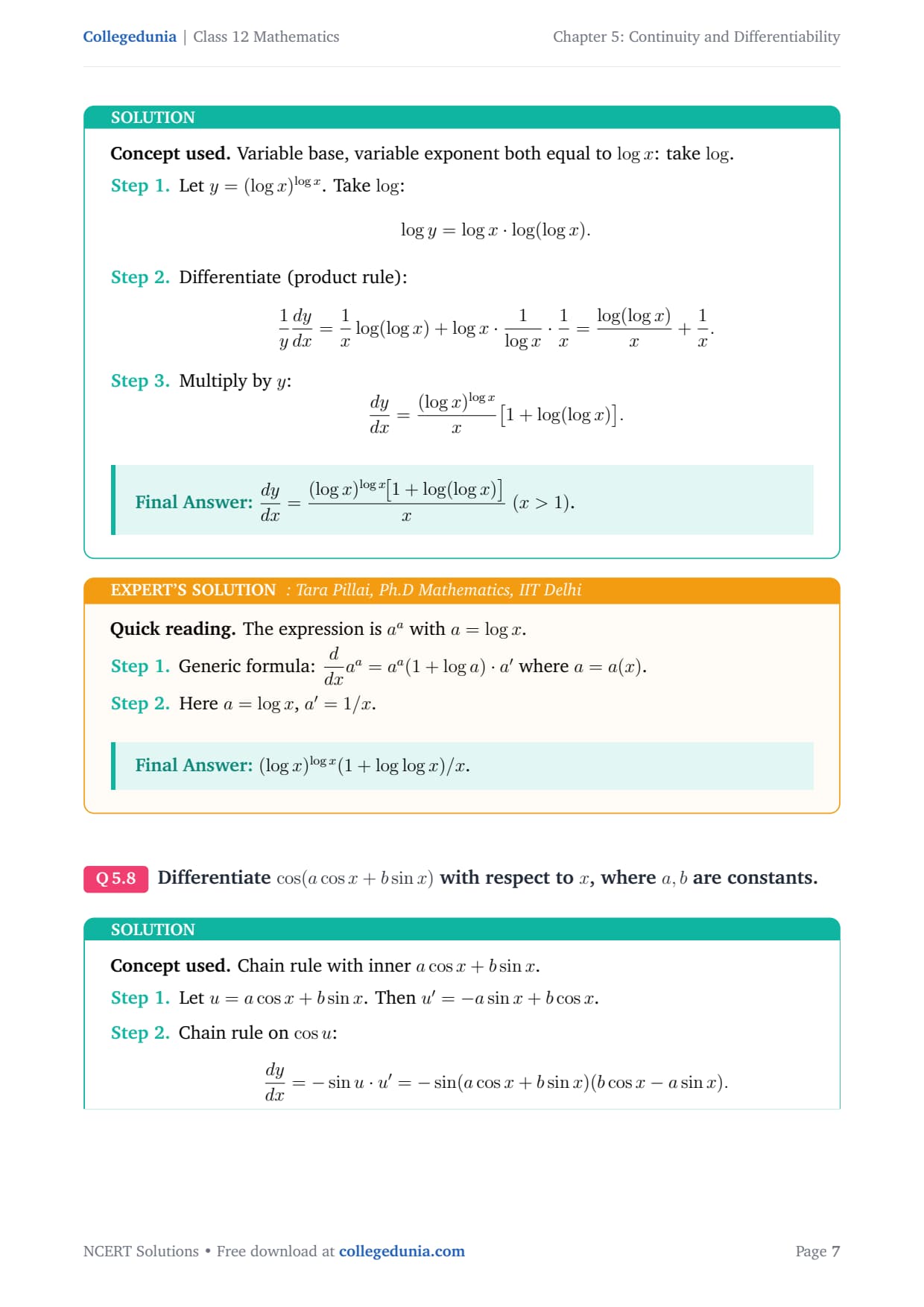
Quick reading. The expression is aa with a = log x.
Generic formula: ddx aa = aa(1 + log a) · a' where a = a(x).
Here a = log x, a' = 1/x.
(log x)log x(1 + loglog x)/x.
Q 5.8
Differentiate cos(a cos x + b sin x) with respect to x, where a, b are constants.
Concept used. Chain rule with inner a cos x + b sin x.
Let u = a cos x + b sin x. Then u' = -a sin x + b cos x.
Chain rule on cos u: dydx = -sin u · u' = -sin(a cos x + b sin x)(b cos x - a sin x).
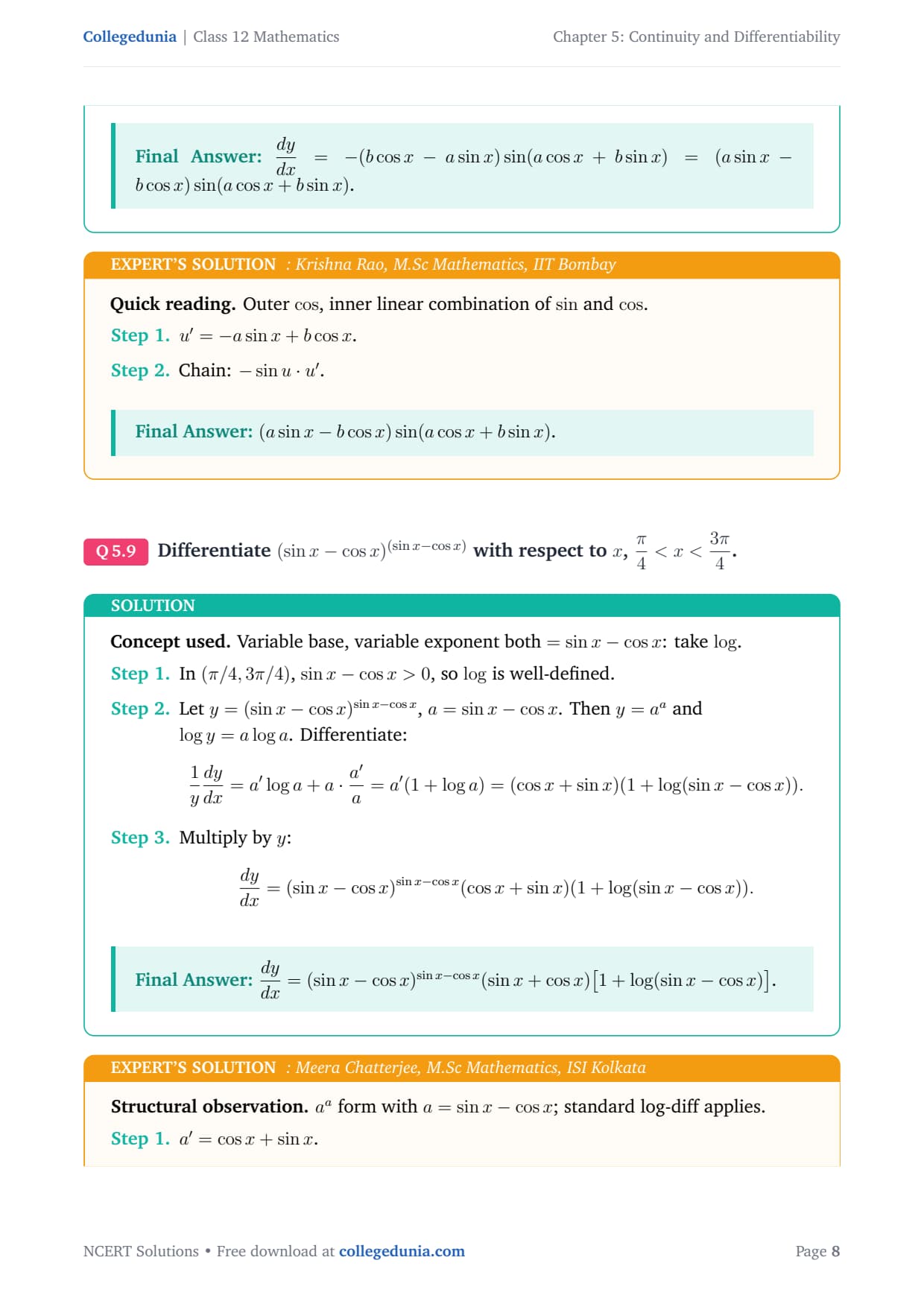
dydx = -(b cos x - a sin x)sin(a cos x + b sin x) = (a sin x - b cos x)sin(a cos x + b sin x).
KR
Krishna Rao
M.Sc Mathematics, IIT Bombay
Verified Expert
Quick reading. Outer cos, inner linear combination of sin and cos.
u' = -asin x + bcos x.
Chain: -sin u · u'.
(a sin x - b cos x)sin(a cos x + b sin x).
Q 5.9
Differentiate (sin x - cos x)(sin x - cos x) with respect to x, π4 < x < 3π4.
Concept used. Variable base, variable exponent both = sin x - cos x: take log.
In (π/4, 3π/4), sin x - cos x > 0, so log is well-defined.
Let y = (sin x - cos x)sin x - cos x, a = sin x - cos x. Then y = aa and log y = a log a. Differentiate: 1ydydx = a' log a + a · a'a = a'(1 + log a) = (cos x + sin x)(1 + log(sin x - cos x)).
Multiply by y: dydx = (sin x - cos x)sin x - cos x(cos x + sin x)(1 + log(sin x - cos x)).
dydx = (sin x - cos x)sin x - cos x(sin x + cos x)[1 + log(sin x - cos x)].
MC
Meera Chatterjee
M.Sc Mathematics, ISI Kolkata
Verified Expert
Structural observation.aa form with a = sin x - cos x; standard log-diff applies.
a' = cos x + sin x.
ddx(aa) = aa(1 + log a) a'.
See main.
Q 5.10
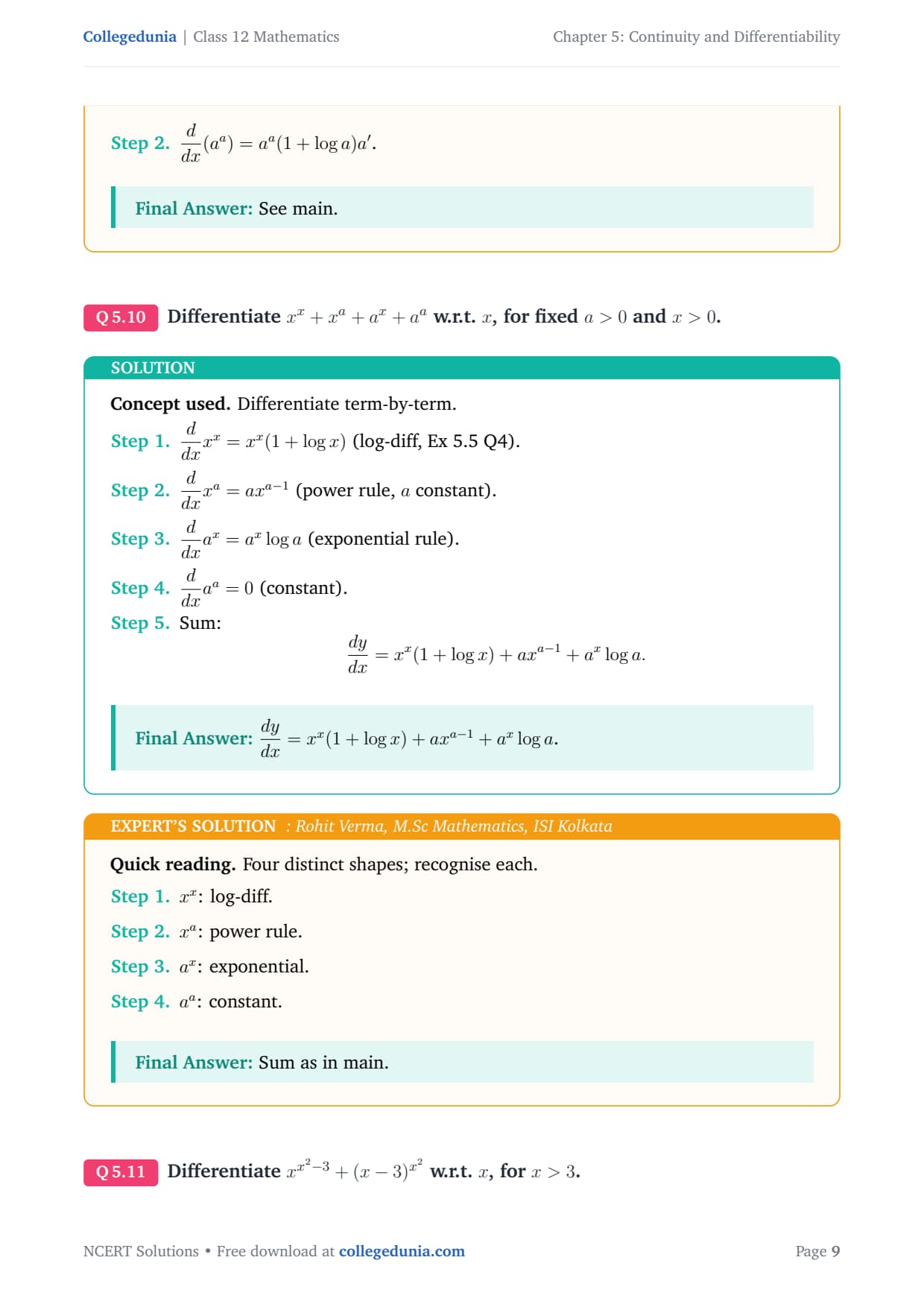
Differentiate xx + xa + ax + aa w.r.t. x, for fixed a > 0 and x > 0.
Concept used. Differentiate term-by-term.
ddx xx = xx(1 + log x) (log-diff, Ex 5.5 Q4).
ddx xa = a xa - 1 (power rule, a constant).
ddx ax = ax log a (exponential rule).
ddx aa = 0 (constant).
Sum: dydx = xx(1 + log x) + a xa - 1 + ax log a.
dydx = xx(1 + log x) + a xa - 1 + ax log a.
RV
Rohit Verma
M.Sc Mathematics, ISI Kolkata
Verified Expert
Quick reading. Four distinct shapes; recognise each.
xx: log-diff.
xa: power rule.
ax: exponential.
aa: constant.
Sum as in main.
Q 5.11
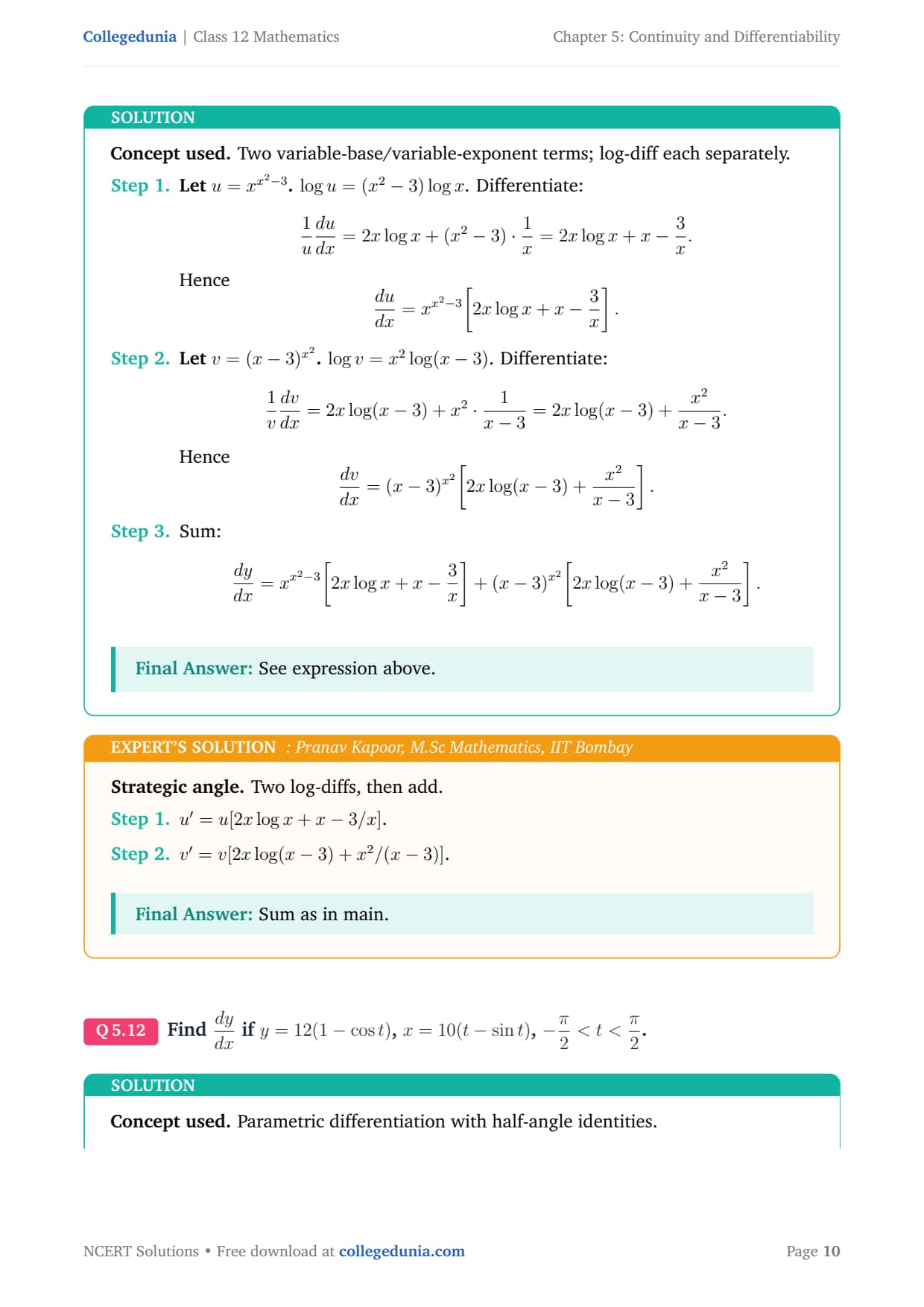
Differentiate xx2 - 3 + (x - 3)x2 w.r.t. x, for x > 3.
Concept used. Two variable-base/variable-exponent terms; log-diff each separately.
Let u = xx2 - 3.log u = (x2 - 3) log x. Differentiate: 1ududx = 2x log x + (x2 - 3) · 1x = 2 x log x + x - 3x. Hence dudx = xx2 - 3[2 x log x + x - 3x].
Let v = (x - 3)x2.log v = x2 log(x - 3). Differentiate: 1vdvdx = 2x log(x - 3) + x2 · 1x - 3 = 2 x log(x - 3) + x2x - 3. Hence dvdx = (x - 3)x2[2 x log(x - 3) + x2x - 3].
Sum: dydx = xx2 - 3[2x log x + x - 3x] + (x - 3)x2[2 x log(x - 3) + x2x - 3].
See expression above.
PK
Pranav Kapoor
M.Sc Mathematics, IIT Bombay
Verified Expert
Strategic angle. Two log-diffs, then add.
u' = u[2x log x + x - 3/x].
v' = v[2 x log(x - 3) + x2/(x - 3)].
Sum as in main.
Q 5.12
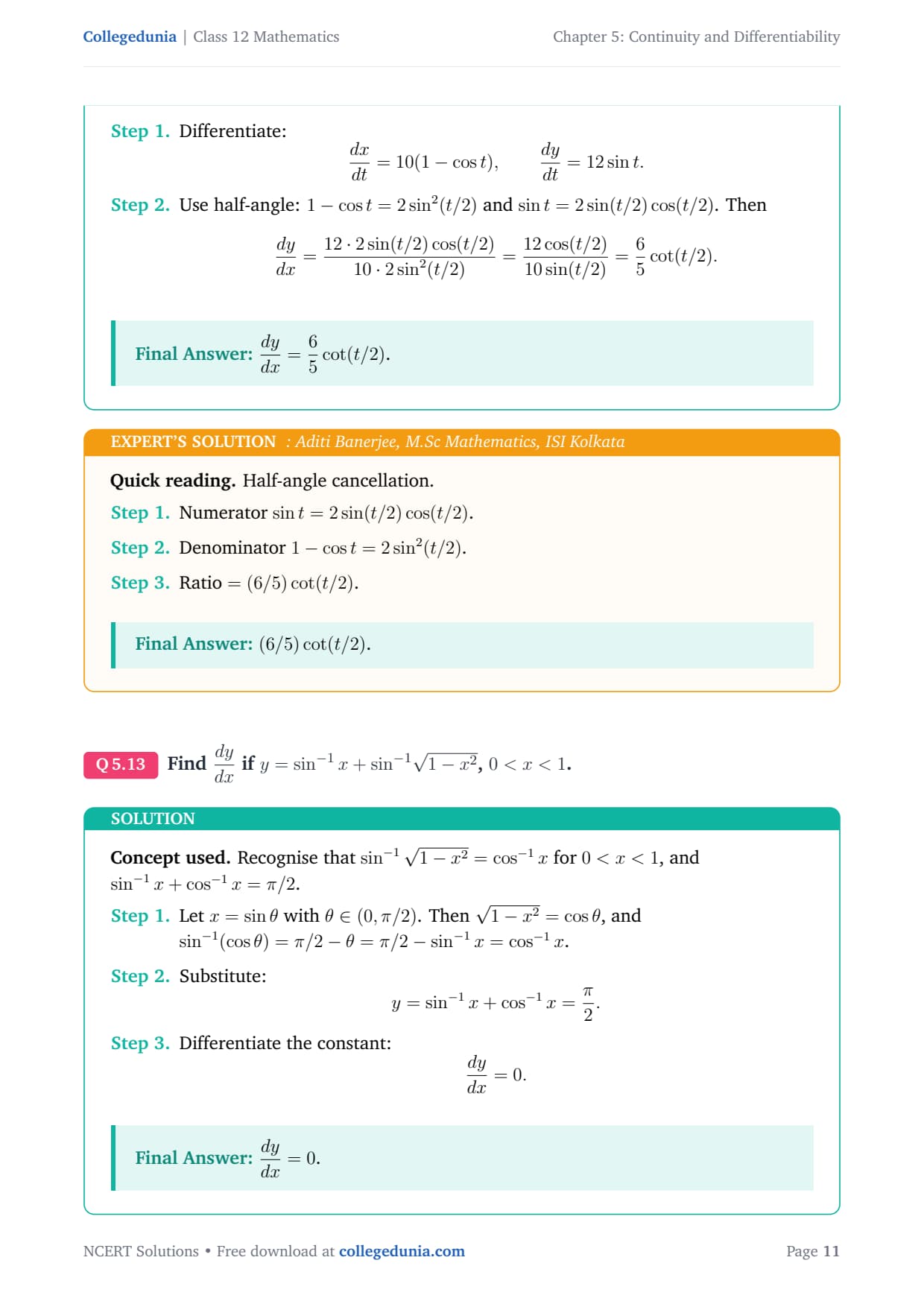
Find dydx if y = 12(1 - cos t), x = 10(t - sin t), -π2 < t < π2.
Concept used. Parametric differentiation with half-angle identities.
Differentiate: dxdt = 10(1 - cos t), dydt = 12 sin t.
Use half-angle: 1 - cos t = 2 sin2(t/2) and sin t = 2 sin(t/2) cos(t/2). Then dydx = 12 · 2 sin(t/2) cos(t/2)10 · 2 sin2(t/2) = 12 cos(t/2)10 sin(t/2) = 65 cot(t/2).
dydx = 65cot(t/2).
AB
Aditi Banerjee
M.Sc Mathematics, ISI Kolkata
Verified Expert
Quick reading. Half-angle cancellation.
Numerator sin t = 2sin(t/2)cos(t/2).
Denominator 1 - cos t = 2sin2(t/2).
Ratio = (6/5)cot(t/2).
(6/5)cot(t/2).
Q 5.13
Find dydx if y = sin-1x + sin-1√1 - x2, 0 < x < 1.
Concept used. Recognise that sin-1√1 - x2 = cos-1x for 0 < x < 1, and sin-1x + cos-1x = π/2.
Let x = sinθ with θ ∈ (0, π/2). Then √1 - x2 = cosθ, and sin-1(cosθ) = π/2 - θ = π/2 - sin-1x = cos-1x.
Substitute: y = sin-1x + cos-1x = π2.
Differentiate the constant: dydx = 0.
dydx = 0.
AP
Aditya Patel
M.Sc Mathematics, IIT Bombay
Verified Expert
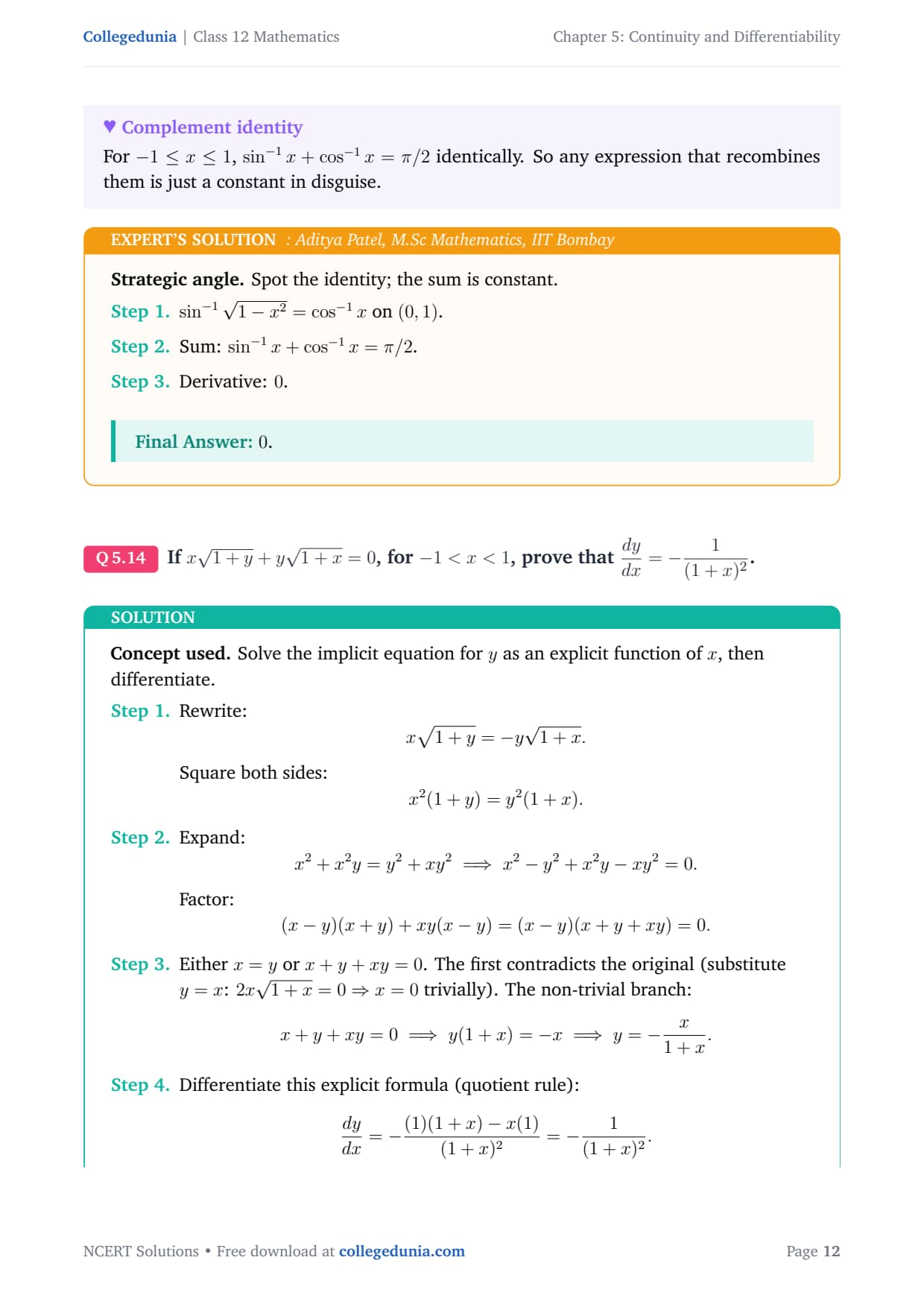
Strategic angle. Spot the identity; the sum is constant.
sin-1√1 - x2 = cos-1x on (0, 1).
Sum: sin-1x + cos-1x = π/2.
Derivative: 0.
0.
Q 5.14
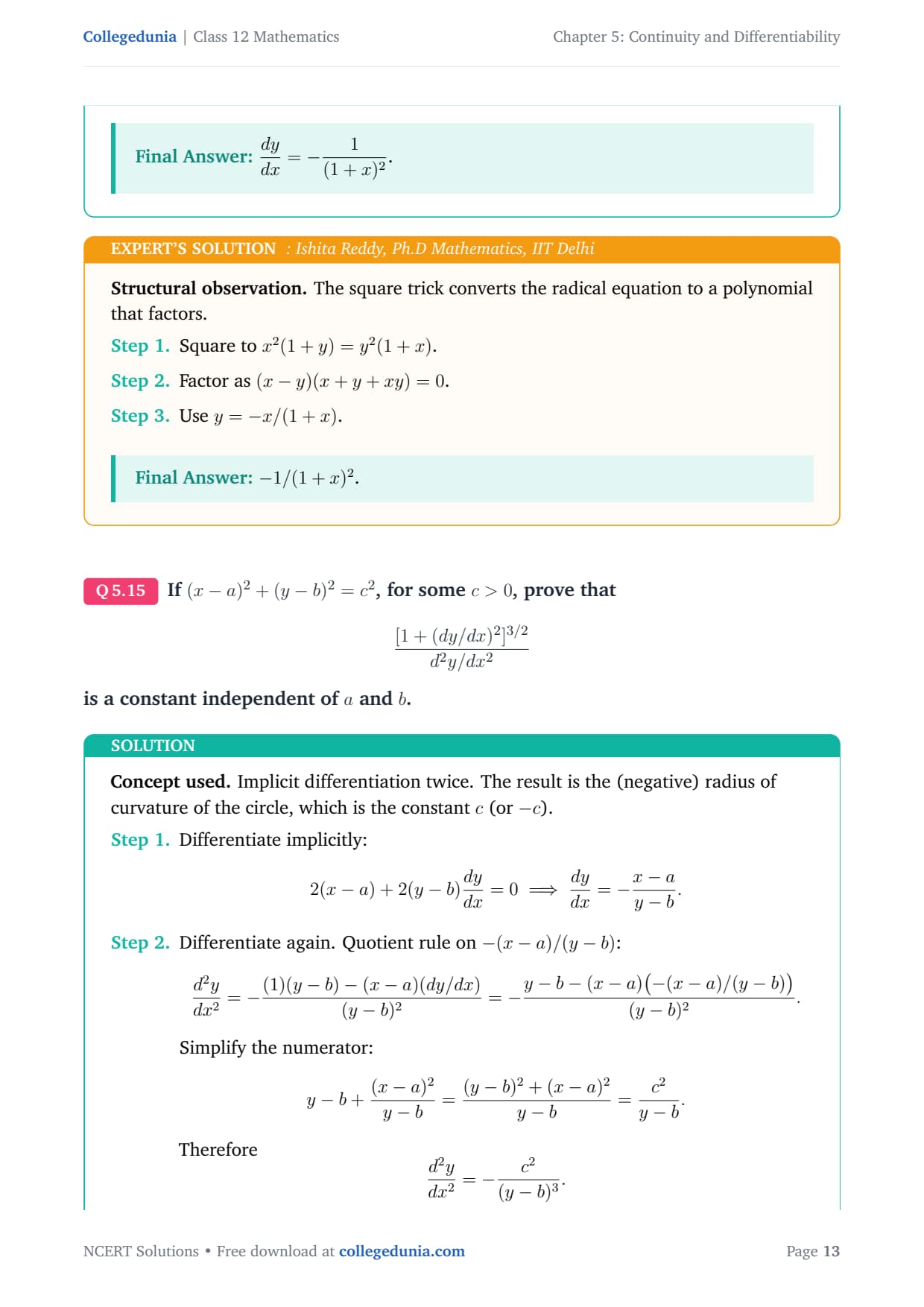
If x√1 + y + y√1 + x = 0, for -1 < x < 1, prove that dydx = -1(1 + x)2.
Concept used. Solve the implicit equation for y as an explicit function of x, then differentiate.
Rewrite: x√1 + y = -y√1 + x. Square both sides: x2 (1 + y) = y2 (1 + x).
Either x = y or x + y + xy = 0. The first contradicts the original (substitute y = x: 2x √1 + x = 0 ⇒ x = 0 trivially). The non-trivial branch: x + y + xy = 0 y(1 + x) = -xy = -x1 + x.
Differentiate this explicit formula (quotient rule): dydx = -(1)(1 + x) - x(1)(1 + x)2 = -1(1 + x)2.
dydx = -1(1 + x)2.
IR
Ishita Reddy
Ph.D Mathematics, IIT Delhi
Verified Expert
Structural observation. The square trick converts the radical equation to a polynomial that factors.
Square to x2(1+y) = y2(1+x).
Factor as (x - y)(x + y + xy) = 0.
Use y = -x/(1+x).
-1/(1 + x)2.
Q 5.15
If (x - a)2 + (y - b)2 = c2, for some c > 0, prove that [1 + (dy/dx)2]3/2d2y/dx2 is a constant independent of a and b.
Concept used. Implicit differentiation twice. The result is the (negative) radius of curvature of the circle, which is the constant c (or -c).
Differentiate implicitly: 2(x - a) + 2(y - b) dydx = 0 dydx = -x - ay - b.
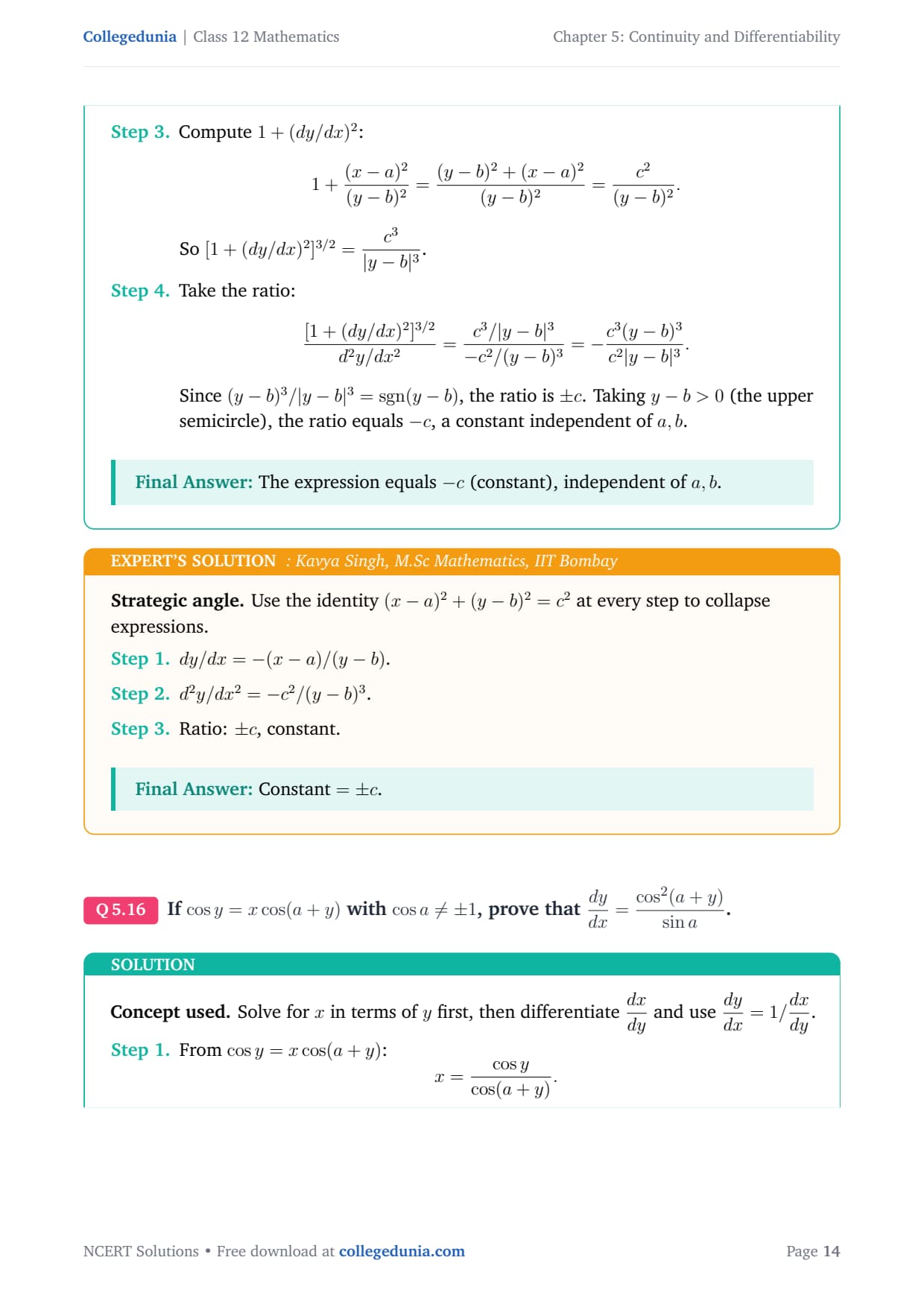
Differentiate again. Quotient rule on -(x - a)/(y - b): d2ydx2 = -(1)(y - b) - (x - a)(dy/dx)(y - b)2 = -y - b - (x - a)(-(x - a)/(y - b))(y - b)2. Simplify the numerator: y - b + (x - a)2y - b = (y - b)2 + (x - a)2y - b = c2y - b. Therefore d2ydx2 = -c2(y - b)3.
Take the ratio: [1 + (dy/dx)2]3/2d2y/dx2 = c3/|y - b|3-c2/(y - b)3 = -c3 (y - b)3c2 |y - b|3. Since (y - b)3/|y - b|3 = sgn(y - b), the ratio is ± c. Taking y - b > 0 (the upper semicircle), the ratio equals -c, a constant independent of a, b.
The expression equals -c (constant), independent of a, b.
KS
Kavya Singh
M.Sc Mathematics, IIT Bombay
Verified Expert
Strategic angle. Use the identity (x - a)2 + (y - b)2 = c2 at every step to collapse expressions.
dy/dx = -(x - a)/(y - b).
d2y/dx2 = -c2/(y - b)3.
Ratio: ± c, constant.
Constant = ± c.
Q 5.16
If cos y = x cos(a + y) with cos a ≠ ± 1, prove that dydx = cos2(a + y)sin a.
Concept used. Solve for x in terms of y first, then differentiate dxdy and use dydx = 1/dxdy.
From cos y = x cos(a + y): x = cos ycos(a + y).
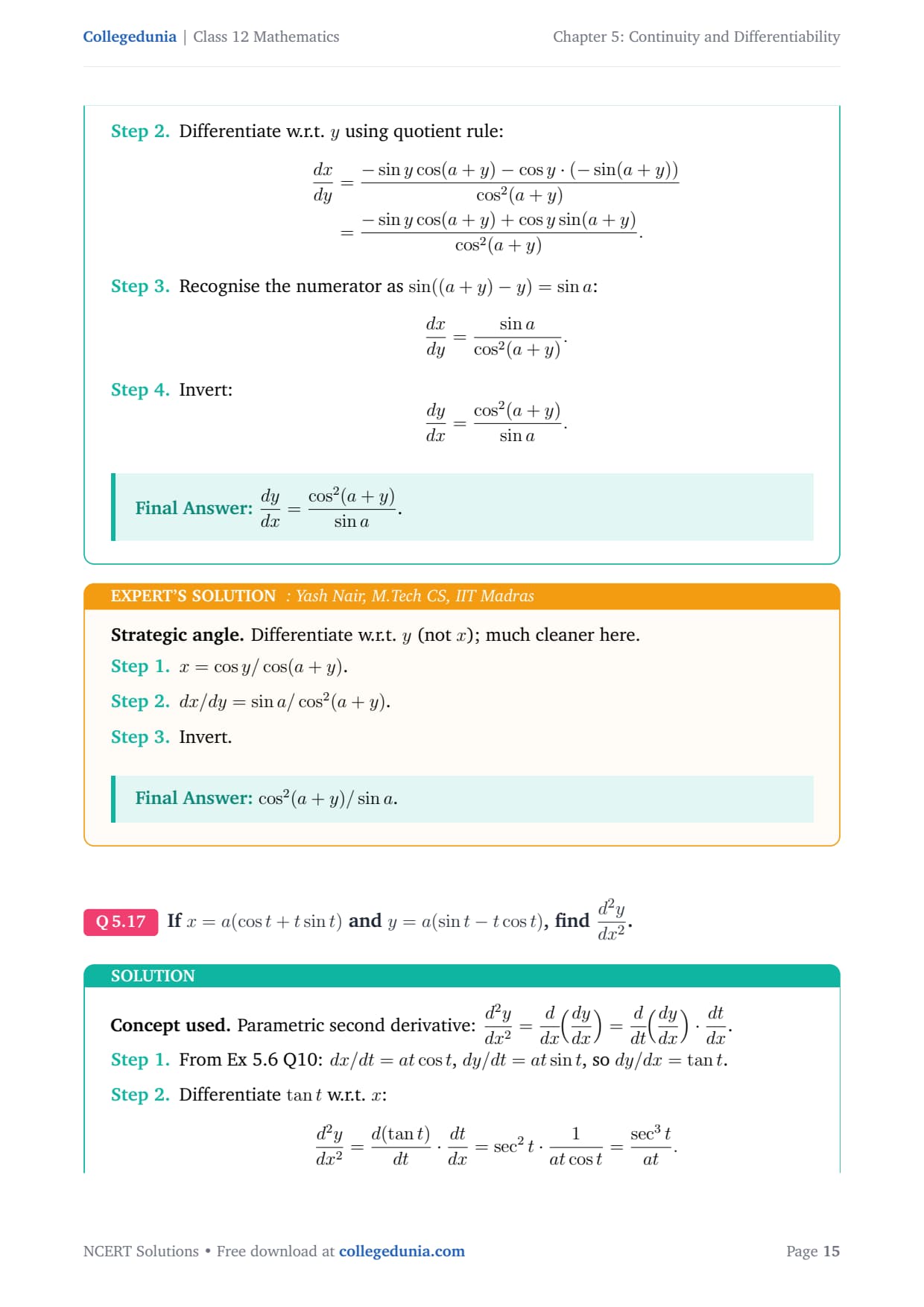
Differentiate w.r.t. y using quotient rule: aligned dxdy &= -sin y cos(a + y) - cos y · (-sin(a + y))cos2(a + y)
&= -sin y cos(a + y) + cos y sin(a + y)cos2(a + y). aligned
Recognise the numerator as sin((a + y) - y) = sin a: dxdy = sin acos2(a + y).
Invert: dydx = cos2(a + y)sin a.
dydx = cos2(a + y)sin a.
YN
Yash Nair
M.Tech CS, IIT Madras
Verified Expert
Strategic angle. Differentiate w.r.t. y (not x); much cleaner here.
x = cos y/cos(a + y).
dx/dy = sin a/cos2(a + y).
Invert.
cos2(a + y)/sin a.
Q 5.17
If x = a(cos t + t sin t) and y = a(sin t - t cos t), find d2ydx2.
From Ex 5.6 Q10: dx/dt = at cos t, dy/dt = at sin t, so dy/dx = tan t.
Differentiate tan t w.r.t. x: d2ydx2 = d(tan t)dt · dtdx = sec2t · 1at cos t = sec3tat.
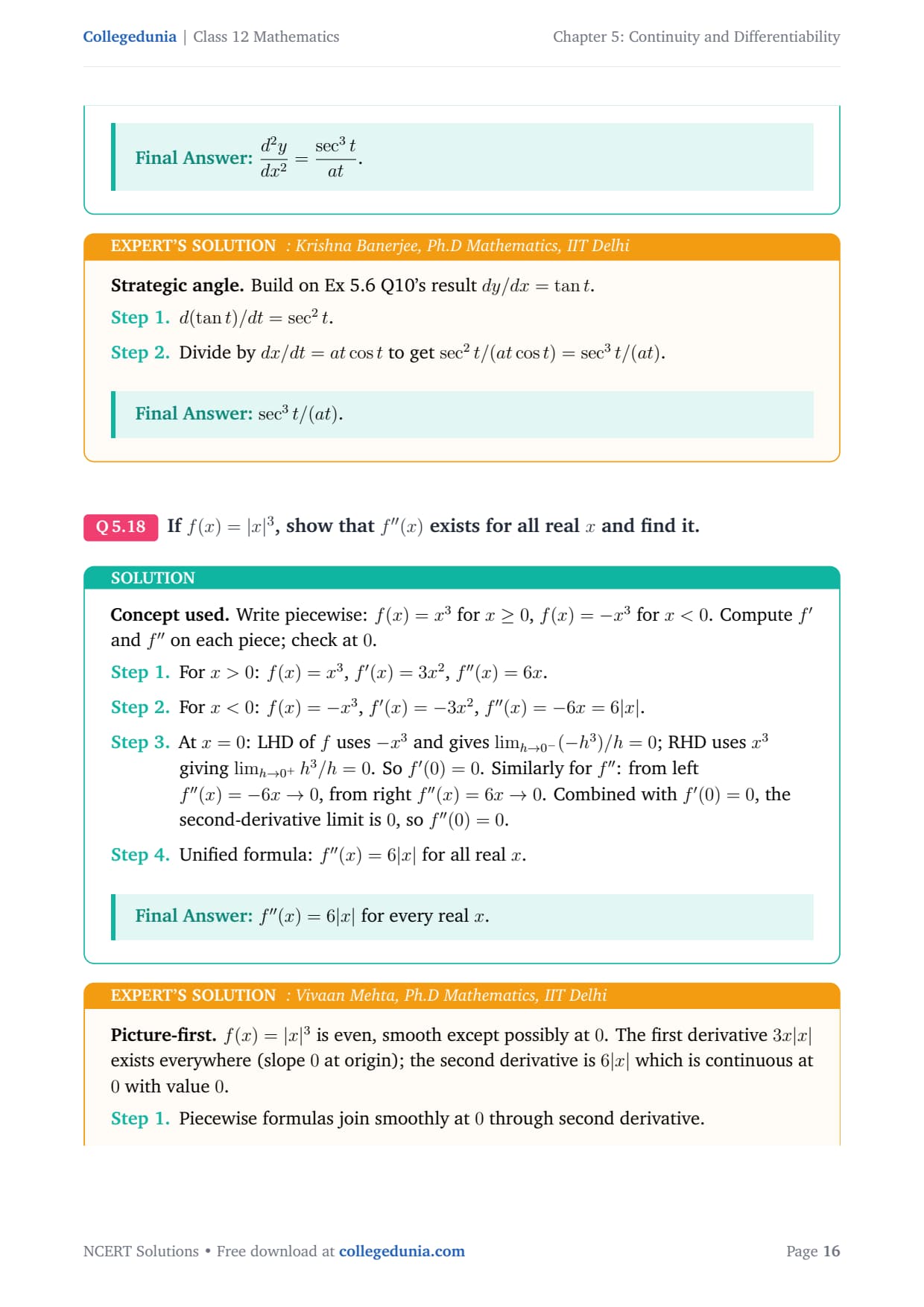
d2ydx2 = sec3tat.
KB
Krishna Banerjee
Ph.D Mathematics, IIT Delhi
Verified Expert
Strategic angle. Build on Ex 5.6 Q10's result dy/dx = tan t.
d(tan t)/dt = sec2t.
Divide by dx/dt = at cos t to get sec2t/(at cos t) = sec3t/(at).
sec3t/(at).
Q 5.18
If f(x) = |x|3, show that f''(x) exists for all real x and find it.
Concept used. Write piecewise: f(x) = x3 for x ≥ 0, f(x) = -x3 for x < 0. Compute f' and f'' on each piece; check at 0.
For x > 0: f(x) = x3, f'(x) = 3 x2, f''(x) = 6 x.
For x < 0: f(x) = -x3, f'(x) = -3 x2, f''(x) = -6 x = 6 |x|.
At x = 0: LHD of f uses -x3 and gives h → 0-(-h3)/h = 0; RHD uses x3 giving h → 0+ h3/h = 0. So f'(0) = 0. Similarly for f'': from left f''(x) = -6x → 0, from right f''(x) = 6 x → 0. Combined with f'(0) = 0, the second-derivative limit is 0, so f''(0) = 0.
Unified formula: f''(x) = 6 |x| for all real x.
f''(x) = 6|x| for every real x.
VM
Vivaan Mehta
Ph.D Mathematics, IIT Delhi
Verified Expert
Picture-first.f(x) = |x|3 is even, smooth except possibly at 0. The first derivative 3 x |x| exists everywhere (slope 0 at origin); the second derivative is 6|x| which is continuous at 0 with value 0.
Piecewise formulas join smoothly at 0 through second derivative.
f''(x) = 6|x|.
Q 5.19
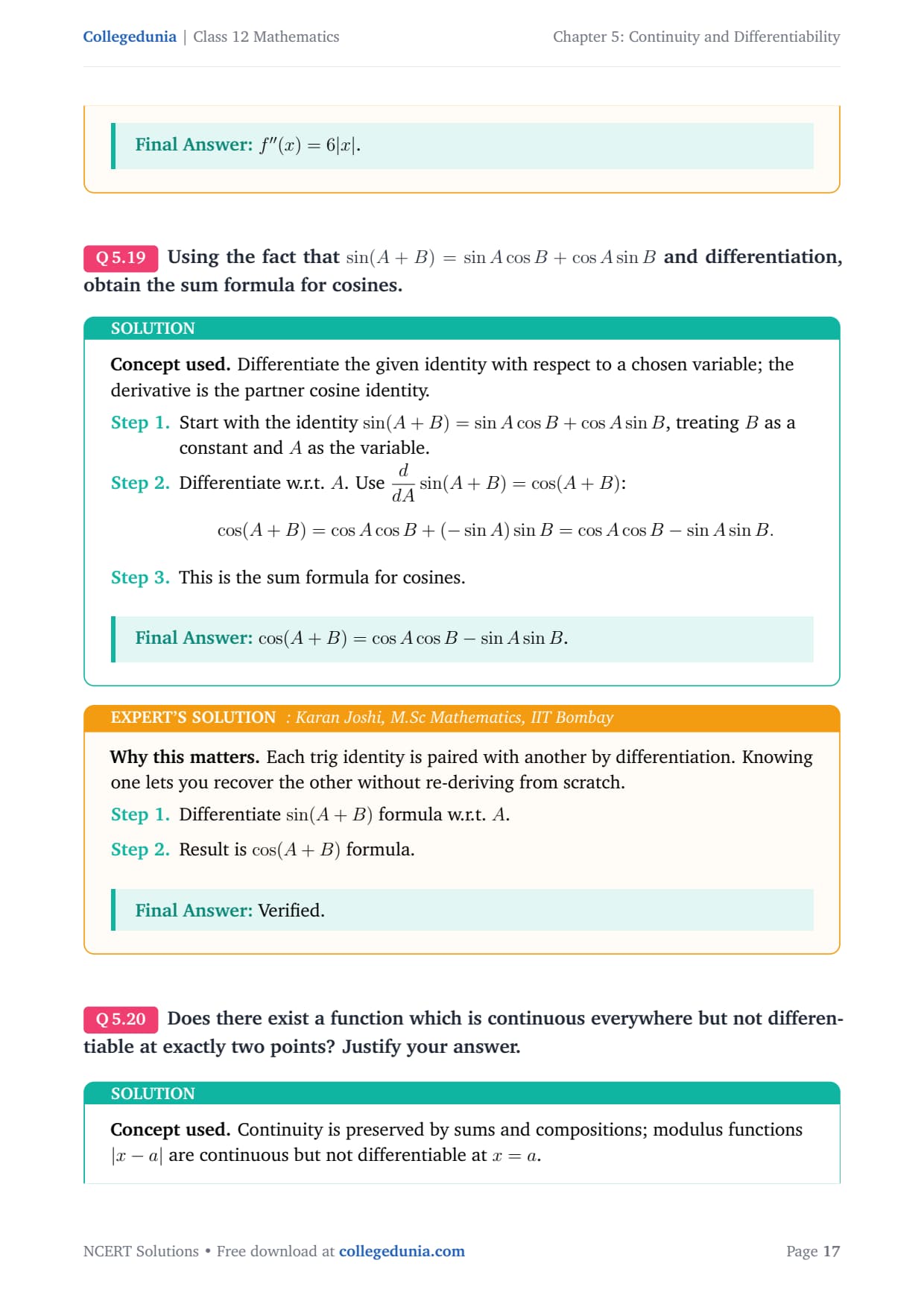
Using the fact that sin(A + B) = sin A cos B + cos A sin B and differentiation, obtain the sum formula for cosines.
Concept used. Differentiate the given identity with respect to a chosen variable; the derivative is the partner cosine identity.
Start with the identity sin(A + B) = sin A cos B + cos A sin B, treating B as a constant and A as the variable.
Differentiate w.r.t. A. Use ddAsin(A + B) = cos(A + B): cos(A + B) = cos A cos B + (-sin A) sin B = cos A cos B - sin A sin B.
This is the sum formula for cosines.
cos(A + B) = cos A cos B - sin A sin B.
KJ
Karan Joshi
M.Sc Mathematics, IIT Bombay
Verified Expert
Why this matters. Each trig identity is paired with another by differentiation. Knowing one lets you recover the other without re-deriving from scratch.
Differentiate sin(A + B) formula w.r.t. A.
Result is cos(A + B) formula.
Verified.
Q 5.20
Does there exist a function which is continuous everywhere but not differentiable at exactly two points? Justify your answer.
Concept used. Continuity is preserved by sums and compositions; modulus functions |x - a| are continuous but not differentiable at x = a.
Yes. Consider f(x) = |x| + |x - 1|.
Continuity. Each modulus is continuous on R; sum of continuous functions is continuous. Hence f is continuous everywhere.
Differentiability.|x| is not differentiable at x = 0; |x - 1| is not differentiable at x = 1. At every other point both modulus functions are differentiable, so the sum is differentiable there. Hence f fails to be differentiable at exactly the two points x = 0 and x = 1.
This is an explicit example proving the existence.
Yes; e.g. f(x) = |x| + |x - 1| is continuous on R but not differentiable at x = 0 and x = 1.
SB
Sneha Bhat
Ph.D Mathematics, IIT Delhi
Verified Expert
Picture-first. Two V-vertices at x = 0 and x = 1, with linear segments connecting them. Two corners, two non-differentiable points.
Show example f = |x| + |x - 1|.
Continuous (sum of continuous).
Non-differentiable only at the two corner abscissae.
Yes, |x| + |x - 1| works.
Q 5.21
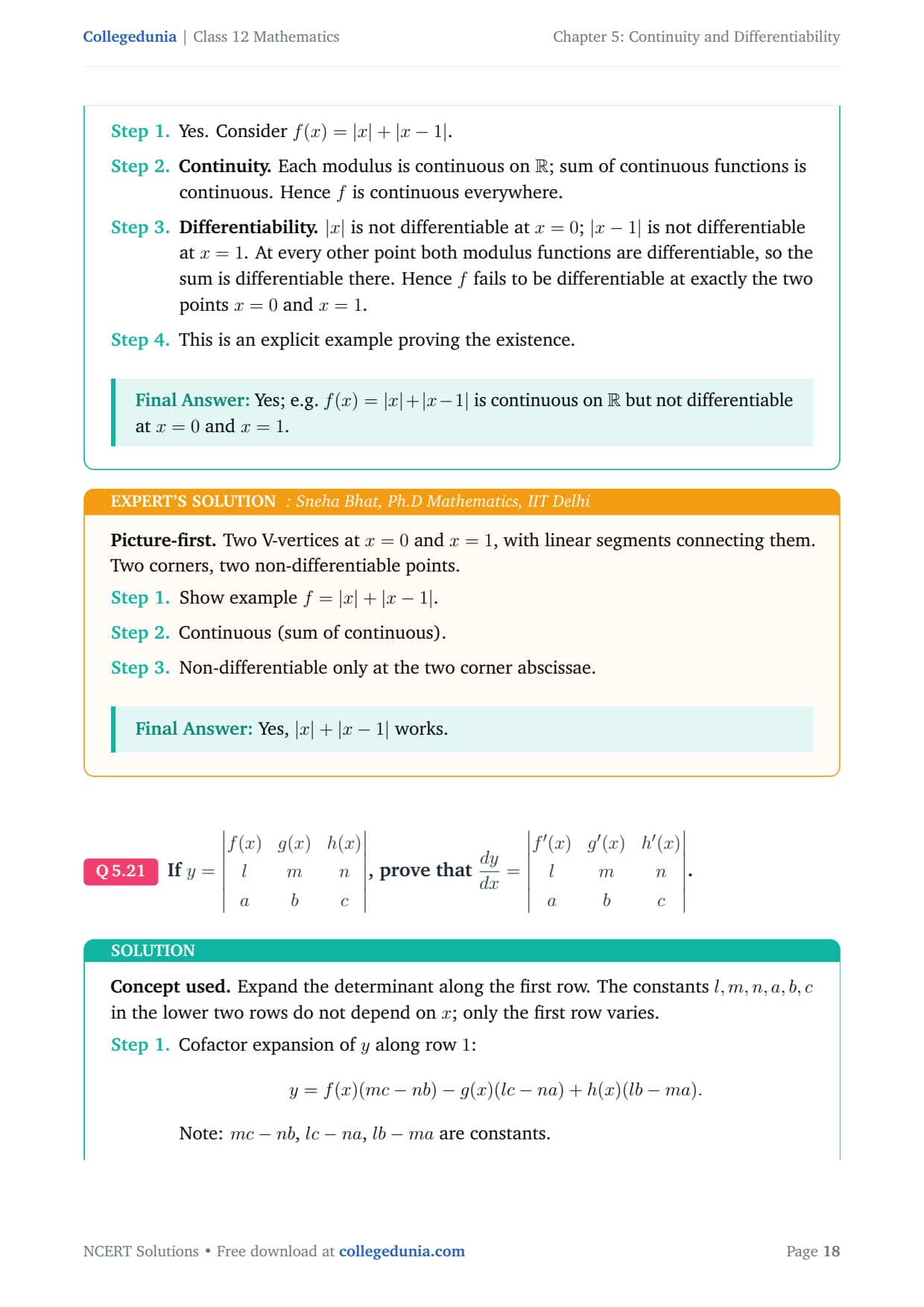
If y = vmatrix f(x) & g(x) & h(x) l & m & na & b & c vmatrix, prove that dydx = vmatrix f'(x) & g'(x) & h'(x) l & m & na & b & c vmatrix.
Concept used. Expand the determinant along the first row. The constants l, m, n, a, b, c in the lower two rows do not depend on x; only the first row varies.
Cofactor expansion of y along row 1: y = f(x)(mc - nb) - g(x)(lc - na) + h(x)(lb - ma). Note: mc - nb, lc - na, lb - ma are constants.
Re-assemble into a 3 × 3 determinant. The constants mc - nb, etc., are exactly the cofactors of the first row of a determinant with the same lower two rows. Hence dydx = vmatrix f'(x) & g'(x) & h'(x) l & m & na & b & c vmatrix.
Verified.
AV
Aditi Verma
M.Sc Mathematics, IIT Bombay
Verified Expert
Why this matters. Determinants are linear in each row; differentiating a row ⇒ differentiating each row separately. With only one variable row, the rule is the special case shown.
Linearity of determinant in row 1.
Differentiate row 1 entries.
See main.
Q 5.22
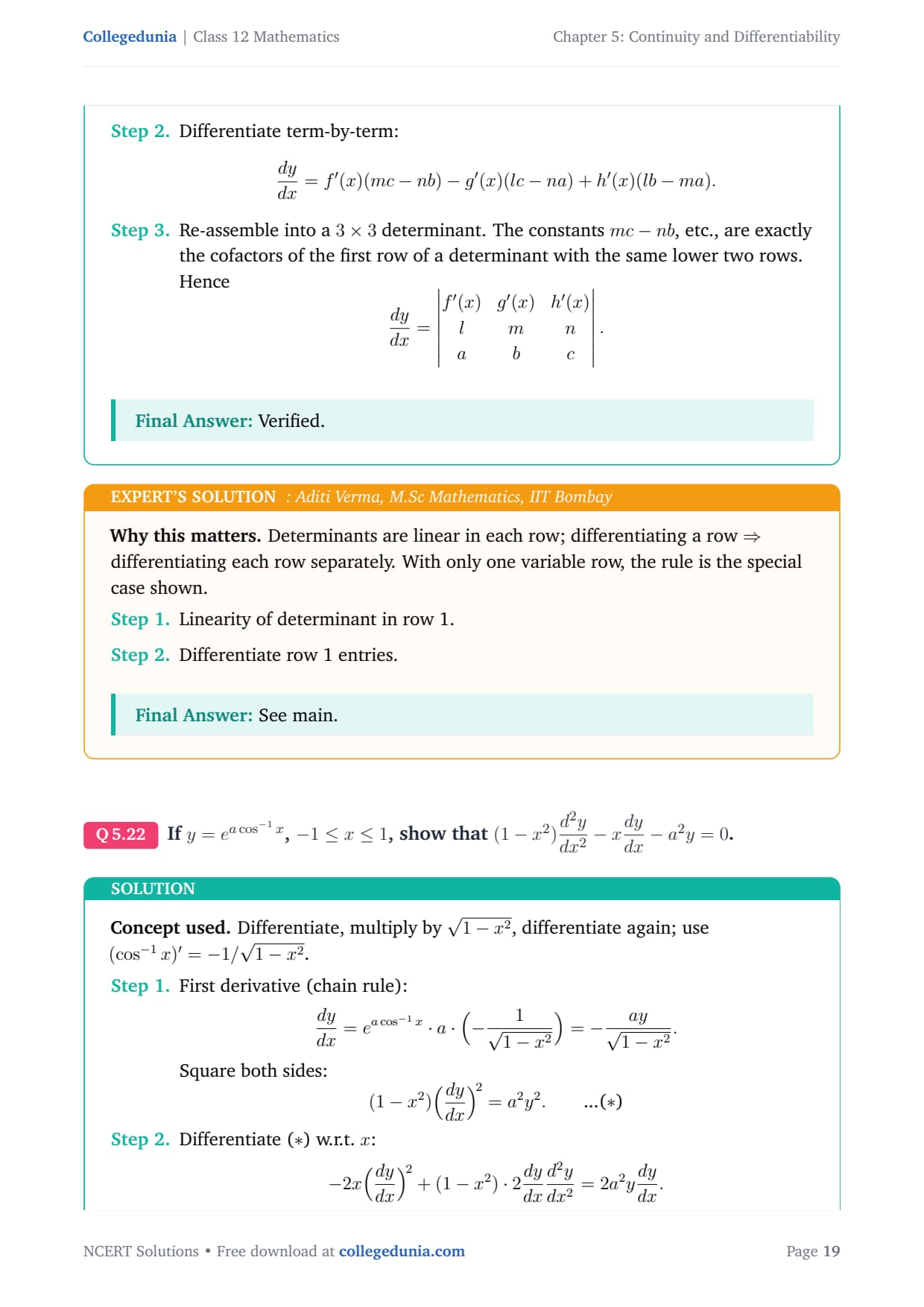
If y = ea cos-1x, -1 ≤ x ≤ 1, show that (1 - x2) d2ydx2 - xdydx - a2y = 0.
Concept used. Differentiate, multiply by √1 - x2, differentiate again; use (cos-1x)' = -1/√1 - x2.
First derivative (chain rule): dydx = ea cos-1x · a · (-1√1 - x2) = -ay√1 - x2. Square both sides: (1 - x2)(dydx)2 = a2 y2. ...($*$)
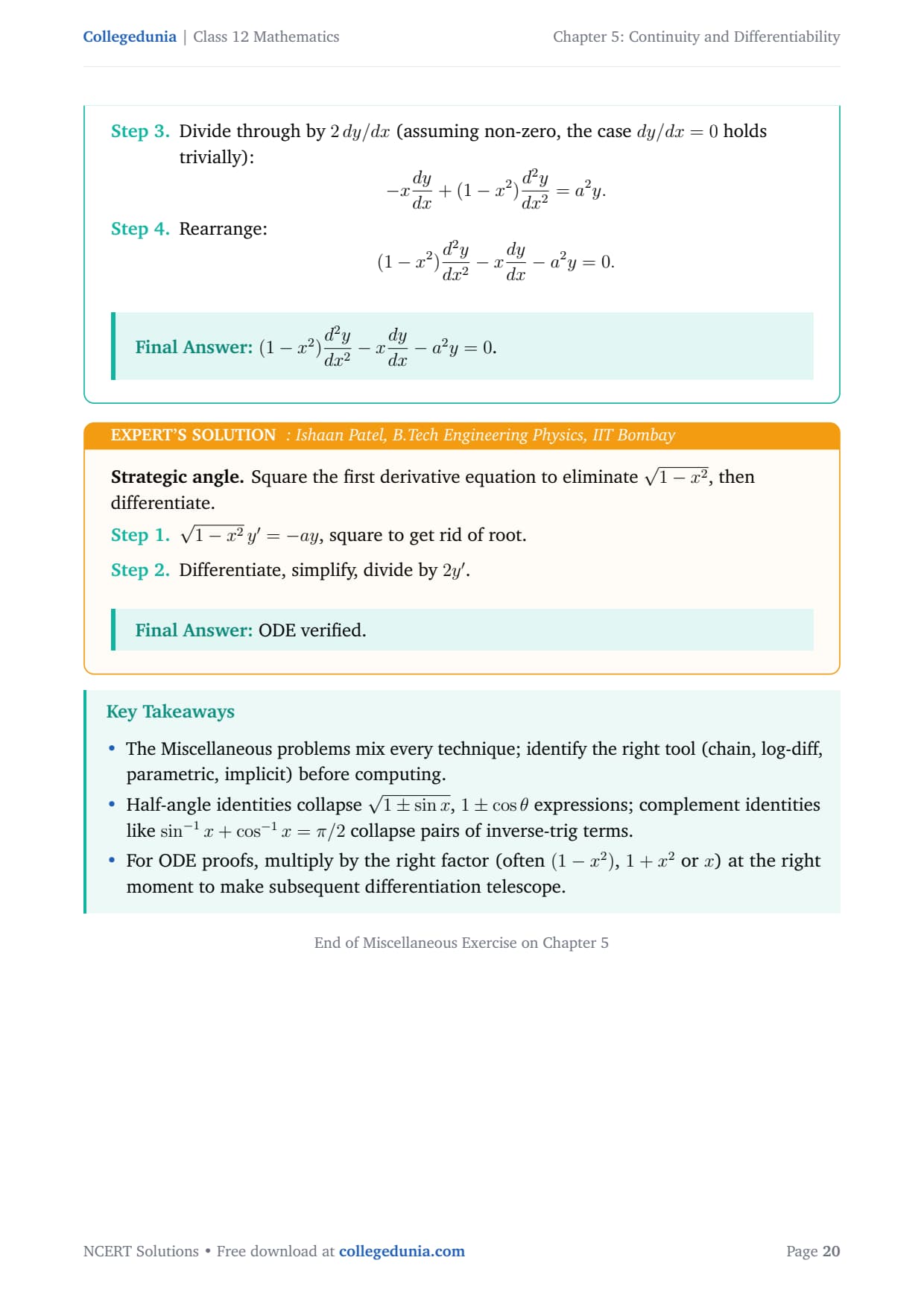
Divide through by 2 dy/dx (assuming non-zero, the case dy/dx = 0 holds trivially): -xdydx + (1 - x2) d2ydx2 = a2y.
Rearrange: (1 - x2) d2ydx2 - xdydx - a2y = 0.
(1 - x2)d2ydx2 - xdydx - a2y = 0.
IP
Ishaan Patel
B.Tech Engineering Physics, IIT Bombay
Verified Expert
Strategic angle. Square the first derivative equation to eliminate √1 - x2, then differentiate.
√1 - x2y' = -ay, square to get rid of root.
Differentiate, simplify, divide by 2 y'.
ODE verified.
Student Feedback - Class 12 Continuity and Differentiability Miscellaneous Exercise (Collegedunia Survey, March 2026):
68% of 510 Class 12 students surveyed named the Miscellaneous Exercise the hardest part of Chapter 5.
Students lost an average of 1.3 marks per question by mixing up which earlier-exercise method to apply first.
Toppers reported that identifying the question type before writing any step cut their time per question by nearly a third.
Continuity and Differentiability Class 12 NCERT Solutions - Frequently Asked Questions
Ques. How many questions are in the Miscellaneous Exercise of Class 12 Maths Chapter 5?
Ans. The Miscellaneous Exercise has 22 questions spanning every technique introduced in the chapter: chain rule, logarithmic, implicit, inverse trig, parametric, continuity tests, and second-order derivatives.
Ques. Is the Miscellaneous Exercise important for CBSE Class 12 Maths boards?
Ans. Yes. Roughly half of the chapter's marks in recent CBSE boards have come from problems that match the Miscellaneous Exercise pattern, including Q11 and Q21 which have repeated three or more times since 2020.
Ques. What technique should I use for x x type problems?
Ans. Use logarithmic differentiation. Take the natural log of both sides first, then differentiate using the chain rule. The simple power rule nxn-1 does not apply because the exponent itself is a function of x.
Ques. How is the Miscellaneous Exercise different from Exercises 5.1 to 5.7?
Ans. Exercises 5.1 to 5.7 each focus on one sub-topic at a time. The Miscellaneous Exercise mixes all sub-topics, so each problem starts by forcing you to identify the right technique - the same skill exams test.
Ques. What is the most important question of Miscellaneous Exercise Chapter 5?
Ans. Q11 (logarithmic differentiation of xx + x1/x) has appeared the most times in CBSE samples and JEE Main since 2020. It tests log-product and log-quotient rules together.
Ques. Does the Miscellaneous Exercise appear in JEE Main?
Ans. Yes. JEE Main mixed-derivative questions match the Miscellaneous Exercise pattern; collectively they contribute 3 to 5 percent of the Calculus section.








Comments