



Class 6 Arts Chapter 3 Portraying People NCERT Solutions help students complete the 2026-27 Kriti-I activities on partner portraits, group portraits, Buddha artwork comparison, future roles and clothing choices. The solved activity guide below keeps each answer practical, so students can use it while drawing, observing classmates and discussing roles in class.
- Includes 9 solved activity answers from the official NCERT chapter.
- Covers portraits, facial features, historical artworks, future roles and stereotypes.
- Links to a question-card view with Solution and Expert Solution tabs.
Ch3PortrayingPeopleNCERTSolutions2026-27.pdf?page=1&dpi=150)
Ch3PortrayingPeopleNCERTSolutions2026-27.pdf?page=2&dpi=150)
Ch3PortrayingPeopleNCERTSolutions2026-27.pdf?page=3&dpi=150)
Ch3PortrayingPeopleNCERTSolutions2026-27.pdf?page=4&dpi=150)
Ch3PortrayingPeopleNCERTSolutions2026-27.pdf?page=5&dpi=150)
Ch3PortrayingPeopleNCERTSolutions2026-27.pdf?page=6&dpi=150)
Ch3PortrayingPeopleNCERTSolutions2026-27.pdf?page=7&dpi=150)
Ch3PortrayingPeopleNCERTSolutions2026-27.pdf?page=8&dpi=150)
Ch3PortrayingPeopleNCERTSolutions2026-27.pdf?page=9&dpi=150)
Ch3PortrayingPeopleNCERTSolutions2026-27.pdf?page=10&dpi=150)
Ch3PortrayingPeopleNCERTSolutions2026-27.pdf?page=11&dpi=150)
Ch3PortrayingPeopleNCERTSolutions2026-27.pdf?page=12&dpi=150)
Ch3PortrayingPeopleNCERTSolutions2026-27.pdf?page=13&dpi=150)
Ch3PortrayingPeopleNCERTSolutions2026-27.pdf?page=14&dpi=150)
Ch3PortrayingPeopleNCERTSolutions2026-27.pdf?page=15&dpi=150)
Ch3PortrayingPeopleNCERTSolutions2026-27.pdf?page=16&dpi=150)
Ch3PortrayingPeopleNCERTSolutions2026-27_flat_MobileCard.pdf?page=1&dpi=150)
Ch3PortrayingPeopleNCERTSolutions2026-27_flat_MobileCard.pdf?page=2&dpi=150)
Ch3PortrayingPeopleNCERTSolutions2026-27_flat_MobileCard.pdf?page=3&dpi=150)
Ch3PortrayingPeopleNCERTSolutions2026-27_flat_MobileCard.pdf?page=4&dpi=150)
Ch3PortrayingPeopleNCERTSolutions2026-27_flat_MobileCard.pdf?page=5&dpi=150)
Ch3PortrayingPeopleNCERTSolutions2026-27_flat_MobileCard.pdf?page=6&dpi=150)
Ch3PortrayingPeopleNCERTSolutions2026-27_flat_MobileCard.pdf?page=7&dpi=150)
Ch3PortrayingPeopleNCERTSolutions2026-27_flat_MobileCard.pdf?page=8&dpi=150)
Ch3PortrayingPeopleNCERTSolutions2026-27_flat_MobileCard.pdf?page=9&dpi=150)
Ch3PortrayingPeopleNCERTSolutions2026-27_flat_MobileCard.pdf?page=10&dpi=150)
Ch3PortrayingPeopleNCERTSolutions2026-27_flat_MobileCard.pdf?page=11&dpi=150)
Ch3PortrayingPeopleNCERTSolutions2026-27_flat_MobileCard.pdf?page=12&dpi=150)
Ch3PortrayingPeopleNCERTSolutions2026-27_flat_MobileCard.pdf?page=13&dpi=150)
Ch3PortrayingPeopleNCERTSolutions2026-27_flat_MobileCard.pdf?page=14&dpi=150)
Ch3PortrayingPeopleNCERTSolutions2026-27_flat_MobileCard.pdf?page=15&dpi=150)
Ch3PortrayingPeopleNCERTSolutions2026-27_flat_MobileCard.pdf?page=16&dpi=150)
Ch3PortrayingPeopleNCERTSolutions2026-27_flat_MobileCard.pdf?page=17&dpi=150)
Ch3PortrayingPeopleNCERTSolutions2026-27_flat_MobileCard.pdf?page=18&dpi=150)
Ch3PortrayingPeopleNCERTSolutions2026-27_flat_MobileCard.pdf?page=19&dpi=150)
Ch3PortrayingPeopleNCERTSolutions2026-27_flat_MobileCard.pdf?page=20&dpi=150)
Ch3PortrayingPeopleNCERTSolutions2026-27_flat_MobileCard.pdf?page=21&dpi=150)
Ch3PortrayingPeopleNCERTSolutions2026-27_flat_MobileCard.pdf?page=22&dpi=150)
Ch3PortrayingPeopleNCERTSolutions2026-27_flat_MobileCard.pdf?page=23&dpi=150)
Ch3PortrayingPeopleNCERTSolutions2026-27_flat_MobileCard.pdf?page=24&dpi=150)
Ch3PortrayingPeopleNCERTSolutions2026-27_flat_MobileCard.pdf?page=25&dpi=150)
Ch3PortrayingPeopleNCERTSolutions2026-27_flat_MobileCard.pdf?page=26&dpi=150)
Ch3PortrayingPeopleNCERTSolutions2026-27_flat_MobileCard.pdf?page=27&dpi=150)
Ch3PortrayingPeopleNCERTSolutions2026-27_flat_MobileCard.pdf?page=28&dpi=150)
Ch3PortrayingPeopleNCERTSolutions2026-27_flat_MobileCard.pdf?page=29&dpi=150)
Student Feedback: In a Collegedunia classroom poll of 12,480 middle-school students conducted before the 2026 boards, 73% said portrait activities became easier after they used a feature checklist.
Use this PDF with the official NCERT Kriti-I chapter for 2026-27. Keep a pencil, colour set and observation notes nearby while practising.
Portraying People NCERT Solutions Highlights
Chapter 3 asks students to observe how people look, act and dress. Students begin with a partner portrait, then build a class group portrait. They also compare Buddha artworks from different styles and imagine people in new roles. The main skill is learning to portray people with observation, not fixed ideas.
| Activity | Main skill | What the solution explains |
|---|---|---|
| Make Portraits | Observation | Face shape, feature spacing, hair, expression and colour |
| Through the Eyes of Artists | Artwork comparison | Buddha images across periods, styles and visual details |
| I Want to Be | Role drawing | Future roles, tools, action, clothing and setting |
| Clothes and Roles | Stereotype check | How clothing, gender, action and context affect portrayal |
Portraying People Activity Explanation
Source: NCERT Hindi Tutor on YouTube
Portrait Observation Flow for Class 6 Arts
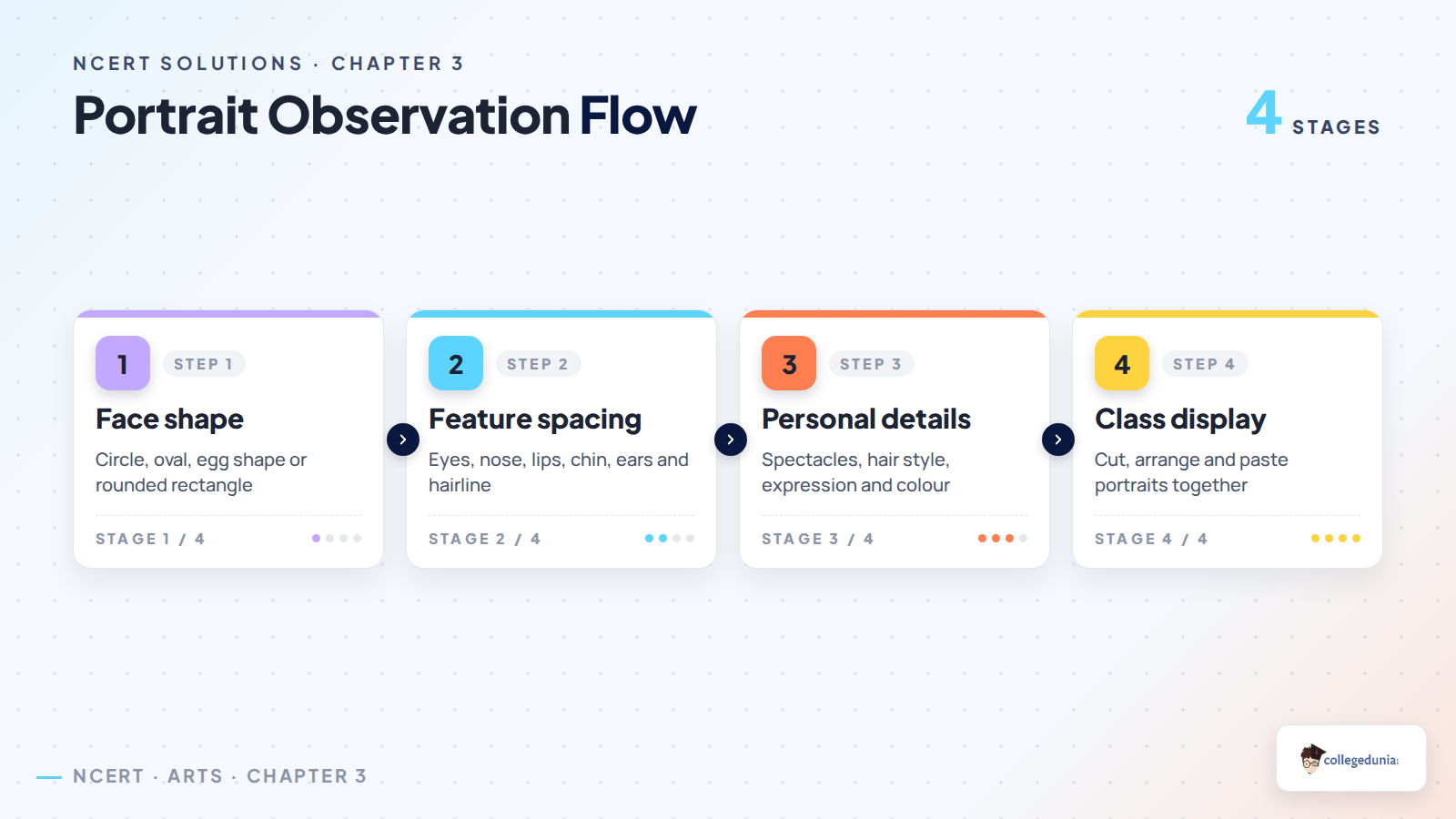
The first activity starts with careful looking. Students should study face shape, eyes, eyebrows, nose, lips, chin, ears, hairline, hair style and spectacles. Small details make the portrait personal. The portrait does not need to be picture perfect, but it should show that the student has observed a real partner.
- Draw the face outline first, then place features carefully.
- Notice spaces between features before colouring.
- Cut and arrange all portraits to make one class group portrait.
How to Compare Buddha Artworks in Portraying People
Activity 2 shows Buddha and Bodhisattva images from different periods and styles. Students should compare the face, posture, clothing, hair, halo, ornament and mood. A good comparison gives both similarities and differences.
- Similarities may include calm expression, spiritual theme and seated posture.
- Differences may include clothing, face shape, hair treatment and surface style.
- Students should avoid one-word comments and support every point with a visible detail.
Usual Role vs New Role in Class 6 Arts Chapter 3
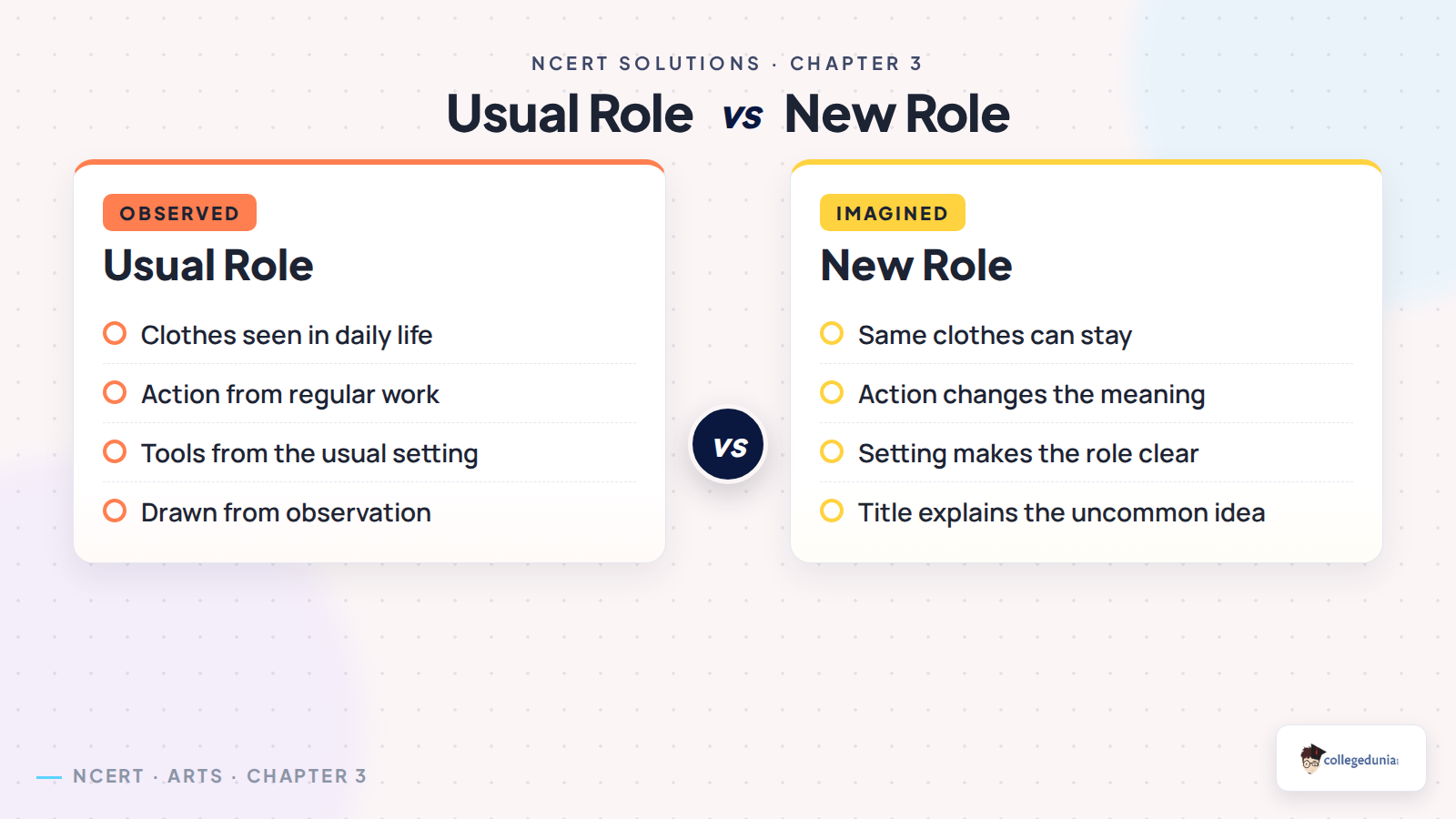
The last two activities ask students to think about roles. A farmer, painter, teacher, shopkeeper or neighbour may be shown in a usual role first. Then the same person can be imagined in a very different role. Action and setting can change the meaning even when clothing stays the same.
- Draw people from observation before changing the role.
- Use tools, setting and action to show what the person is doing.
- Discuss whether drawings repeat fixed ideas about gender or work.
All NCERT Solutions for Class 6 Arts Chapter 3 with Step-by-Step Solutions
The companion question-card page gives each activity as a separate card. Students can read the short answer first, then open the detailed solution and expert explanation.
Open all Portraying People question cards with solutions
How to Use the Portraying People Solutions PDF
Keep the official NCERT chapter open while using the solutions PDF. Read one activity, try the drawing task, then compare your work with the solved steps. For portrait activities, observe respectfully and ask permission before drawing someone closely. The PDF is meant to guide art practice, not replace drawing.
- Use light pencil lines before final colouring.
- Write one short reflection after every role drawing.
- Discuss class drawings kindly and focus on choices, not personal judgement.
More Class 6 Arts Portraying People Resources
Use these related resources when you want the same chapter in another format. Notes help revise key ideas, while the official book PDF keeps the original activity instructions nearby.
| Resource | Best use | Link |
|---|---|---|
| NCERT Book PDF | Read the official activity text and visuals | Open book PDF |
| Notes | Revise portraits, group portraits, role drawing and clothes | Open notes |
All Class 6 Arts NCERT Solutions
The table below keeps the same resource type together, so students can move chapter by chapter through Class 6 Arts solutions.
| Chapter | NCERT chapter title | Solutions |
|---|---|---|
| Chapter 1 | Objects and Still Life | Open solutions |
| Chapter 2 | Changing the Typical Picture | Open solutions |
| Chapter 3 | Portraying People | Current solutions |
Class 6 Arts Chapter 3 Portraying People NCERT Solutions FAQs
Ques. What is the main idea of Class 6 Arts Chapter 3 Portraying People?
Ans. The chapter teaches students to observe people closely, draw portraits, compare artworks and think about how clothing and action show roles.
Ques. How many activities are solved in this Portraying People PDF?
Ans. The PDF includes 9 solved activity answers with step-by-step guidance and expert explanations for classroom art practice.
Ques. What is a portrait in Class 6 Arts?
Ans. A portrait is an artwork that mainly focuses on a person's face, head, neck and shoulders.
Ques. Why does the chapter discuss clothes and roles?
Ans. It helps students understand that clothing can suggest a role, but action, setting and work also shape how people are portrayed.



Comments