



Patterns in Mathematics introduces number sequences, picture patterns, and simple rules through the 2026-27 NCERT Ganita Prakash book. These Class 6 solutions show each step clearly, so students can check an answer and understand how the pattern grows.
- Core ideas: number sequences, shape patterns, and growing arrangements
- Practice focus: finding rules, filling gaps, and explaining observations
- Useful format: clear working followed by a short final answer
Chapter1PatternsinMathematicsSolutions.pdf?page=1&dpi=150)
Chapter1PatternsinMathematicsSolutions.pdf?page=2&dpi=150)
Chapter1PatternsinMathematicsSolutions.pdf?page=3&dpi=150)
Chapter1PatternsinMathematicsSolutions.pdf?page=4&dpi=150)
Chapter1PatternsinMathematicsSolutions.pdf?page=5&dpi=150)
Chapter1PatternsinMathematicsSolutions.pdf?page=6&dpi=150)
Chapter1PatternsinMathematicsSolutions.pdf?page=7&dpi=150)
Chapter1PatternsinMathematicsSolutions.pdf?page=8&dpi=150)
Chapter1PatternsinMathematicsSolutions.pdf?page=9&dpi=150)
Chapter1PatternsinMathematicsSolutions.pdf?page=10&dpi=150)
Chapter1PatternsinMathematicsSolutions.pdf?page=11&dpi=150)
Chapter1PatternsinMathematicsSolutions.pdf?page=12&dpi=150)
Chapter1PatternsinMathematicsSolutions.pdf?page=13&dpi=150)
Chapter1PatternsinMathematicsSolutions.pdf?page=14&dpi=150)
Chapter1PatternsinMathematicsSolutions.pdf?page=15&dpi=150)
Chapter1PatternsinMathematicsSolutions.pdf?page=16&dpi=150)
Chapter1PatternsinMathematicsSolutions.pdf?page=17&dpi=150)
Chapter1PatternsinMathematicsSolutions.pdf?page=18&dpi=150)
Chapter1PatternsinMathematicsSolutions.pdf?page=19&dpi=150)
Chapter1PatternsinMathematicsSolutions.pdf?page=20&dpi=150)
Chapter1PatternsinMathematicsSolutions.pdf?page=21&dpi=150)
Chapter1PatternsinMathematicsSolutions.pdf?page=22&dpi=150)
Chapter1PatternsinMathematicsSolutions.pdf?page=23&dpi=150)
Chapter1PatternsinMathematicsSolutions.pdf?page=24&dpi=150)
Chapter1PatternsinMathematicsSolutions.pdf?page=25&dpi=150)
Chapter1PatternsinMathematicsSolutions.pdf?page=26&dpi=150)
Chapter1PatternsinMathematicsSolutions.pdf?page=27&dpi=150)
Chapter1PatternsinMathematicsSolutions.pdf?page=28&dpi=150)
Chapter1PatternsinMathematicsSolutions.pdf?page=29&dpi=150)
Chapter1PatternsinMathematicsSolutions.pdf?page=30&dpi=150)
Chapter1PatternsinMathematicsSolutions.pdf?page=31&dpi=150)
Chapter1PatternsinMathematicsSolutions.pdf?page=32&dpi=150)
Chapter1PatternsinMathematicsSolutions.pdf?page=33&dpi=150)
Chapter1PatternsinMathematicsSolutions.pdf?page=34&dpi=150)
Chapter1PatternsinMathematicsSolutions.pdf?page=35&dpi=150)
Chapter1PatternsinMathematicsSolutions.pdf?page=36&dpi=150)
Chapter1PatternsinMathematicsSolutions.pdf?page=37&dpi=150)
Chapter1PatternsinMathematicsSolutions.pdf?page=38&dpi=150)
Chapter1PatternsinMathematicsSolutions.pdf?page=39&dpi=150)
Chapter1PatternsinMathematicsSolutions.pdf?page=40&dpi=150)
Chapter1PatternsinMathematicsSolutions.pdf?page=41&dpi=150)
Chapter1PatternsinMathematicsSolutions.pdf?page=42&dpi=150)
Chapter1PatternsinMathematicsSolutions.pdf?page=43&dpi=150)
Chapter1PatternsinMathematicsSolutions.pdf?page=44&dpi=150)
Chapter1PatternsinMathematicsSolutions_flat_MobileCard.pdf?page=1&dpi=150)
Chapter1PatternsinMathematicsSolutions_flat_MobileCard.pdf?page=2&dpi=150)
Chapter1PatternsinMathematicsSolutions_flat_MobileCard.pdf?page=3&dpi=150)
Chapter1PatternsinMathematicsSolutions_flat_MobileCard.pdf?page=4&dpi=150)
Chapter1PatternsinMathematicsSolutions_flat_MobileCard.pdf?page=5&dpi=150)
Chapter1PatternsinMathematicsSolutions_flat_MobileCard.pdf?page=6&dpi=150)
Chapter1PatternsinMathematicsSolutions_flat_MobileCard.pdf?page=7&dpi=150)
Chapter1PatternsinMathematicsSolutions_flat_MobileCard.pdf?page=8&dpi=150)
Chapter1PatternsinMathematicsSolutions_flat_MobileCard.pdf?page=9&dpi=150)
Chapter1PatternsinMathematicsSolutions_flat_MobileCard.pdf?page=10&dpi=150)
Chapter1PatternsinMathematicsSolutions_flat_MobileCard.pdf?page=11&dpi=150)
Chapter1PatternsinMathematicsSolutions_flat_MobileCard.pdf?page=12&dpi=150)
Chapter1PatternsinMathematicsSolutions_flat_MobileCard.pdf?page=13&dpi=150)
Chapter1PatternsinMathematicsSolutions_flat_MobileCard.pdf?page=14&dpi=150)
Chapter1PatternsinMathematicsSolutions_flat_MobileCard.pdf?page=15&dpi=150)
Chapter1PatternsinMathematicsSolutions_flat_MobileCard.pdf?page=16&dpi=150)
Chapter1PatternsinMathematicsSolutions_flat_MobileCard.pdf?page=17&dpi=150)
Chapter1PatternsinMathematicsSolutions_flat_MobileCard.pdf?page=18&dpi=150)
Chapter1PatternsinMathematicsSolutions_flat_MobileCard.pdf?page=19&dpi=150)
Chapter1PatternsinMathematicsSolutions_flat_MobileCard.pdf?page=20&dpi=150)
Chapter1PatternsinMathematicsSolutions_flat_MobileCard.pdf?page=21&dpi=150)
Chapter1PatternsinMathematicsSolutions_flat_MobileCard.pdf?page=22&dpi=150)
Chapter1PatternsinMathematicsSolutions_flat_MobileCard.pdf?page=23&dpi=150)
Chapter1PatternsinMathematicsSolutions_flat_MobileCard.pdf?page=24&dpi=150)
Chapter1PatternsinMathematicsSolutions_flat_MobileCard.pdf?page=25&dpi=150)
Chapter1PatternsinMathematicsSolutions_flat_MobileCard.pdf?page=26&dpi=150)
Chapter1PatternsinMathematicsSolutions_flat_MobileCard.pdf?page=27&dpi=150)
Chapter1PatternsinMathematicsSolutions_flat_MobileCard.pdf?page=28&dpi=150)
Chapter1PatternsinMathematicsSolutions_flat_MobileCard.pdf?page=29&dpi=150)
Chapter1PatternsinMathematicsSolutions_flat_MobileCard.pdf?page=30&dpi=150)
Chapter1PatternsinMathematicsSolutions_flat_MobileCard.pdf?page=31&dpi=150)
Chapter1PatternsinMathematicsSolutions_flat_MobileCard.pdf?page=32&dpi=150)
Chapter1PatternsinMathematicsSolutions_flat_MobileCard.pdf?page=33&dpi=150)
Chapter1PatternsinMathematicsSolutions_flat_MobileCard.pdf?page=34&dpi=150)
Chapter1PatternsinMathematicsSolutions_flat_MobileCard.pdf?page=35&dpi=150)
Chapter1PatternsinMathematicsSolutions_flat_MobileCard.pdf?page=36&dpi=150)
Chapter1PatternsinMathematicsSolutions_flat_MobileCard.pdf?page=37&dpi=150)
Chapter1PatternsinMathematicsSolutions_flat_MobileCard.pdf?page=38&dpi=150)
Chapter1PatternsinMathematicsSolutions_flat_MobileCard.pdf?page=39&dpi=150)
Chapter1PatternsinMathematicsSolutions_flat_MobileCard.pdf?page=40&dpi=150)
Chapter1PatternsinMathematicsSolutions_flat_MobileCard.pdf?page=41&dpi=150)
Chapter1PatternsinMathematicsSolutions_flat_MobileCard.pdf?page=42&dpi=150)
Chapter1PatternsinMathematicsSolutions_flat_MobileCard.pdf?page=43&dpi=150)
Chapter1PatternsinMathematicsSolutions_flat_MobileCard.pdf?page=44&dpi=150)
Chapter1PatternsinMathematicsSolutions_flat_MobileCard.pdf?page=45&dpi=150)
Chapter1PatternsinMathematicsSolutions_flat_MobileCard.pdf?page=46&dpi=150)
Chapter1PatternsinMathematicsSolutions_flat_MobileCard.pdf?page=47&dpi=150)
Chapter1PatternsinMathematicsSolutions_flat_MobileCard.pdf?page=48&dpi=150)
Chapter1PatternsinMathematicsSolutions_flat_MobileCard.pdf?page=49&dpi=150)
Chapter1PatternsinMathematicsSolutions_flat_MobileCard.pdf?page=50&dpi=150)
Chapter1PatternsinMathematicsSolutions_flat_MobileCard.pdf?page=51&dpi=150)
Chapter1PatternsinMathematicsSolutions_flat_MobileCard.pdf?page=52&dpi=150)
Chapter1PatternsinMathematicsSolutions_flat_MobileCard.pdf?page=53&dpi=150)
Chapter1PatternsinMathematicsSolutions_flat_MobileCard.pdf?page=54&dpi=150)
Chapter1PatternsinMathematicsSolutions_flat_MobileCard.pdf?page=55&dpi=150)
Chapter1PatternsinMathematicsSolutions_flat_MobileCard.pdf?page=56&dpi=150)
Chapter1PatternsinMathematicsSolutions_flat_MobileCard.pdf?page=57&dpi=150)
Chapter1PatternsinMathematicsSolutions_flat_MobileCard.pdf?page=58&dpi=150)
Chapter1PatternsinMathematicsSolutions_flat_MobileCard.pdf?page=59&dpi=150)
Chapter1PatternsinMathematicsSolutions_flat_MobileCard.pdf?page=60&dpi=150)
Chapter1PatternsinMathematicsSolutions_flat_MobileCard.pdf?page=61&dpi=150)
Chapter1PatternsinMathematicsSolutions_flat_MobileCard.pdf?page=62&dpi=150)
Chapter1PatternsinMathematicsSolutions_flat_MobileCard.pdf?page=63&dpi=150)
Chapter1PatternsinMathematicsSolutions_flat_MobileCard.pdf?page=64&dpi=150)
Chapter1PatternsinMathematicsSolutions_flat_MobileCard.pdf?page=65&dpi=150)
Chapter1PatternsinMathematicsSolutions_flat_MobileCard.pdf?page=66&dpi=150)
Chapter1PatternsinMathematicsSolutions_flat_MobileCard.pdf?page=67&dpi=150)
Chapter1PatternsinMathematicsSolutions_flat_MobileCard.pdf?page=68&dpi=150)
Chapter1PatternsinMathematicsSolutions_flat_MobileCard.pdf?page=69&dpi=150)
Chapter1PatternsinMathematicsSolutions_flat_MobileCard.pdf?page=70&dpi=150)
Each solution follows the 2026-27 NCERT Ganita Prakash chapter and explains the thinking behind the answer.
Patterns in Mathematics Ideas Every Class 6 Student Should Know
A pattern is an arrangement that follows a rule. The rule may use numbers, shapes, movements, or positions. Finding the rule is more important than guessing the next term. Students should compare nearby terms and note what changes each time.
| Pattern type | What to check | Simple example |
|---|---|---|
| Repeating | A fixed group appears again | circle, square, circle, square |
| Growing | The same amount is added | 3, 6, 9, 12 |
| Shrinking | The same amount is removed | 20, 16, 12, 8 |
| Shape-based | Figures grow by a clear rule | 1, 3, 6, 10 dots |
The difference between two nearby terms often reveals the rule. Some patterns need a second check because their differences also form a pattern.
Patterns in Mathematics Chapter Overview
Source: Magnet Brains on YouTube
How to Solve Patterns in Mathematics Questions Step by Step
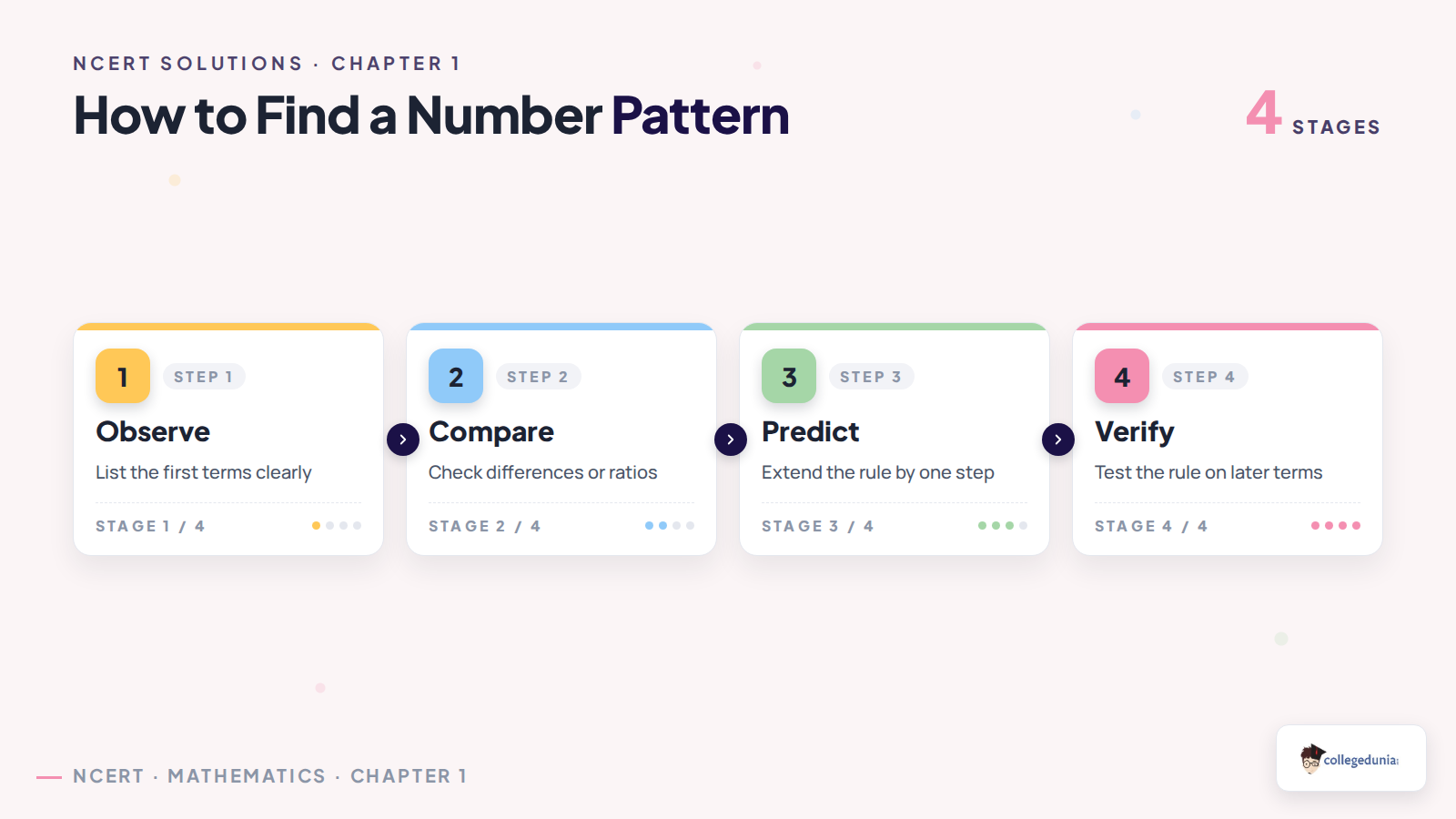
Start by writing the terms neatly. Compare each term with the next one. Then test one possible rule on the full sequence. A correct rule must work at every step.
- Read all numbers or figures before answering.
- Check addition, subtraction, multiplication, and division.
- Look for alternating rules when one rule does not fit.
- Write the rule in words before finding missing terms.
- Check the completed pattern from the beginning.
For shape patterns, count visible parts such as dots, sticks, or squares. A small table can connect the figure number with its total parts.
Important Number and Shape Patterns in Ganita Prakash Chapter 1
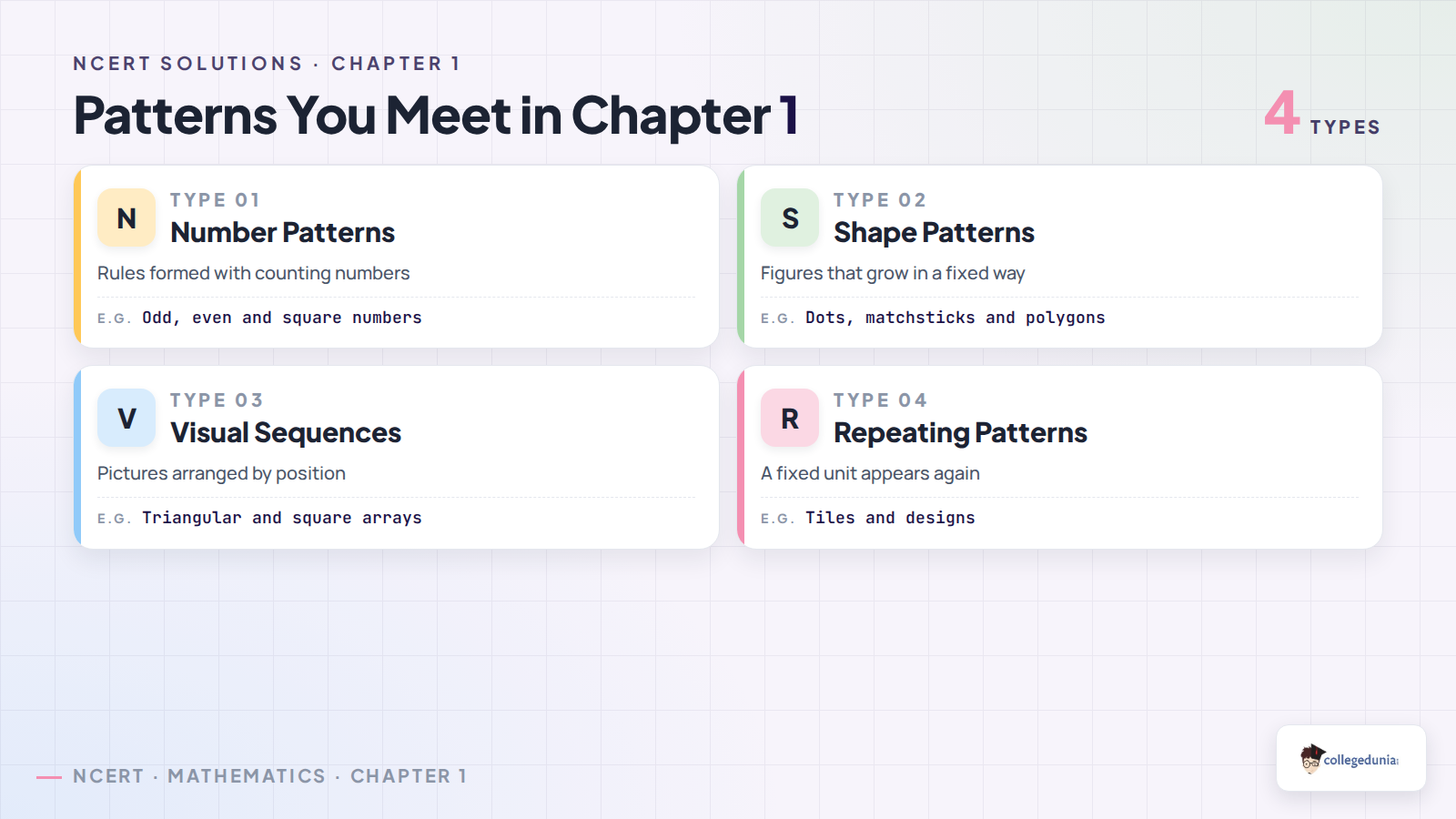
The chapter uses familiar sequences to build observation skills. Students meet natural numbers, odd and even numbers, square numbers, triangular numbers, and arrangements made with shapes. Each sequence has its own construction rule.
- Odd numbers grow by adding 2: 1, 3, 5, 7.
- Even numbers grow by adding 2: 2, 4, 6, 8.
- Square numbers are 1, 4, 9, 16, and 25.
- Triangular numbers are 1, 3, 6, 10, and 15.
- Powers of 2 begin 1, 2, 4, 8, and 16.
Do not assume every sequence uses the same difference. A sequence may multiply, alternate, or grow through a picture rule.
Common Mistakes in Patterns in Mathematics Solutions
Most errors happen when a student decides the rule after checking only two terms. Another common mistake is counting a shared side twice in a matchstick figure.
- Check at least three moves in a number sequence.
- Count shared parts only once in connected figures.
- Keep the term number separate from the term value.
- Explain the rule instead of writing only the next number.
Use a quick table when the picture becomes crowded. It keeps the figure number and total count clear.
How These Class 6 Mathematics Solutions Help with Practice
The worked answers help students compare their method with a clear solution. They also show how to explain a visual observation in words. This is useful when a question asks for both the next term and the rule.
- Attempt each question before opening the answer.
- Circle the step where your rule changes.
- Draw the next figure when mental counting feels difficult.
- Redo incorrect questions after one day.
Student Feedback on Patterns in Mathematics
In a Collegedunia poll of 10,420 students conducted before the 2026 school exams, most students found picture patterns easier after making a term table.
Source: 2026-27 Class 6 Mathematics student poll
Related Resources for Patterns in Mathematics Class 6
| Resource | What it offers |
|---|---|
| Patterns in Mathematics Class 6 Notes | Concept recap and examples |
| Patterns in Mathematics NCERT Book | Official chapter reading |
| Patterns in Mathematics Handwritten Notes | Quick revision points |
NCERT Solutions for Class 6 Mathematics Ganita Prakash: All Chapters
| Chapter | NCERT Solutions |
|---|---|
| Chapter 1 | Patterns in Mathematics Solutions |
| Chapter 2 | Lines and Angles Solutions |
| Chapter 3 | Number Play Solutions |
| Chapter 4 | Data Handling and Presentation Solutions |
Practice questions: Open the Patterns in Mathematics step-by-step question cards.
Patterns in Mathematics Class 6 NCERT Solutions FAQs
Ques. What is a pattern in mathematics?
Ans. A pattern is an ordered arrangement that follows a rule. The rule may involve numbers, shapes, or repeated actions.
Ques. How can students find the next term in a sequence?
Ans. Compare nearby terms, test a possible rule on every term, and then apply it once more.
Ques. What are triangular numbers?
Ans. Triangular numbers can be arranged as dots forming a triangle. The sequence begins 1, 3, 6, 10, and 15.
Ques. Why should students explain the pattern rule?
Ans. The explanation proves that the answer follows a consistent rule and is not only a guess.
Ques. Are these solutions based on the 2026-27 Ganita Prakash book?
Ans. Yes. The answers follow Class 6 Ganita Prakash Chapter 1 for the 2026-27 session.



Comments