




Number Play teaches students to spot patterns in numbers, use place value, and solve number puzzles from the 2026-27 NCERT Ganita Prakash book. These Class 6 solutions explain each answer in short steps and show why the method works.
- Core ideas: digit sums, number patterns, palindromes, and divisibility
- Practice focus: conjectures, Kaprekar steps, and systematic checking
- Useful format: clear working with reasons and final answers
Chapter3NumberPlaySolutions.pdf?page=1&dpi=150)
Chapter3NumberPlaySolutions.pdf?page=2&dpi=150)
Chapter3NumberPlaySolutions.pdf?page=3&dpi=150)
Chapter3NumberPlaySolutions.pdf?page=4&dpi=150)
Chapter3NumberPlaySolutions.pdf?page=5&dpi=150)
Chapter3NumberPlaySolutions.pdf?page=6&dpi=150)
Chapter3NumberPlaySolutions.pdf?page=7&dpi=150)
Chapter3NumberPlaySolutions.pdf?page=8&dpi=150)
Chapter3NumberPlaySolutions.pdf?page=9&dpi=150)
Chapter3NumberPlaySolutions.pdf?page=10&dpi=150)
Chapter3NumberPlaySolutions.pdf?page=11&dpi=150)
Chapter3NumberPlaySolutions.pdf?page=12&dpi=150)
Chapter3NumberPlaySolutions.pdf?page=13&dpi=150)
Chapter3NumberPlaySolutions.pdf?page=14&dpi=150)
Chapter3NumberPlaySolutions.pdf?page=15&dpi=150)
Chapter3NumberPlaySolutions.pdf?page=16&dpi=150)
Chapter3NumberPlaySolutions.pdf?page=17&dpi=150)
Chapter3NumberPlaySolutions.pdf?page=18&dpi=150)
Chapter3NumberPlaySolutions.pdf?page=19&dpi=150)
Chapter3NumberPlaySolutions_flat_MobileCard.pdf?page=1&dpi=150)
Chapter3NumberPlaySolutions_flat_MobileCard.pdf?page=2&dpi=150)
Chapter3NumberPlaySolutions_flat_MobileCard.pdf?page=3&dpi=150)
Chapter3NumberPlaySolutions_flat_MobileCard.pdf?page=4&dpi=150)
Chapter3NumberPlaySolutions_flat_MobileCard.pdf?page=5&dpi=150)
Chapter3NumberPlaySolutions_flat_MobileCard.pdf?page=6&dpi=150)
Chapter3NumberPlaySolutions_flat_MobileCard.pdf?page=7&dpi=150)
Chapter3NumberPlaySolutions_flat_MobileCard.pdf?page=8&dpi=150)
Chapter3NumberPlaySolutions_flat_MobileCard.pdf?page=9&dpi=150)
Chapter3NumberPlaySolutions_flat_MobileCard.pdf?page=10&dpi=150)
Chapter3NumberPlaySolutions_flat_MobileCard.pdf?page=11&dpi=150)
Chapter3NumberPlaySolutions_flat_MobileCard.pdf?page=12&dpi=150)
Chapter3NumberPlaySolutions_flat_MobileCard.pdf?page=13&dpi=150)
Chapter3NumberPlaySolutions_flat_MobileCard.pdf?page=14&dpi=150)
Chapter3NumberPlaySolutions_flat_MobileCard.pdf?page=15&dpi=150)
Chapter3NumberPlaySolutions_flat_MobileCard.pdf?page=16&dpi=150)
Chapter3NumberPlaySolutions_flat_MobileCard.pdf?page=17&dpi=150)
Chapter3NumberPlaySolutions_flat_MobileCard.pdf?page=18&dpi=150)
Chapter3NumberPlaySolutions_flat_MobileCard.pdf?page=19&dpi=150)
Chapter3NumberPlaySolutions_flat_MobileCard.pdf?page=20&dpi=150)
Chapter3NumberPlaySolutions_flat_MobileCard.pdf?page=21&dpi=150)
Chapter3NumberPlaySolutions_flat_MobileCard.pdf?page=22&dpi=150)
Chapter3NumberPlaySolutions_flat_MobileCard.pdf?page=23&dpi=150)
Chapter3NumberPlaySolutions_flat_MobileCard.pdf?page=24&dpi=150)
Chapter3NumberPlaySolutions_flat_MobileCard.pdf?page=25&dpi=150)
Chapter3NumberPlaySolutions_flat_MobileCard.pdf?page=26&dpi=150)
Chapter3NumberPlaySolutions_flat_MobileCard.pdf?page=27&dpi=150)
Chapter3NumberPlaySolutions_flat_MobileCard.pdf?page=28&dpi=150)
Chapter3NumberPlaySolutions_flat_MobileCard.pdf?page=29&dpi=150)
Chapter3NumberPlaySolutions_flat_MobileCard.pdf?page=30&dpi=150)
Chapter3NumberPlaySolutions_flat_MobileCard.pdf?page=31&dpi=150)
Chapter3NumberPlaySolutions_flat_MobileCard.pdf?page=32&dpi=150)
Chapter3NumberPlaySolutions_flat_MobileCard.pdf?page=33&dpi=150)
Chapter3NumberPlaySolutions_flat_MobileCard.pdf?page=34&dpi=150)
Chapter3NumberPlaySolutions_flat_MobileCard.pdf?page=35&dpi=150)
Each solution follows the 2026-27 NCERT Ganita Prakash chapter and keeps every number step easy to check.
Number Play Ideas Every Class 6 Student Should Know
Number Play is about finding a rule, testing it, and explaining it. You may reverse digits, add digit values, or compare several cases. A pattern becomes useful only after you check that it works.
| Idea | What to do | Example |
|---|---|---|
| Digit sum | Add all digits | 4 + 7 + 2 = 13 |
| Palindrome | Read the same number both ways | 5445 |
| Reverse and add | Reverse the digits, then add | 68 + 86 = 154 |
| Divisibility | Use a number rule before dividing | A digit sum divisible by 3 |
Write every changed number on a new line. This prevents digits from moving into the wrong place.
Number Patterns Explained
Source: Magnet Brains on YouTube
How to Solve Number Play Questions Step by Step
Start by reading the action word in the question. It may ask you to find, test, reverse, arrange, or explain. Next, record each trial neatly. Your working should make the pattern visible.
- Underline the numbers and the action word.
- Write the first trial without skipping a step.
- Test the same rule with another number.
- Compare the results and state the pattern.
- Check the final answer using the original condition.
If a claim fails for one example, it is not true for all numbers. That failed example is called a counterexample.
Number Play Patterns, Palindromes and Kaprekar Steps
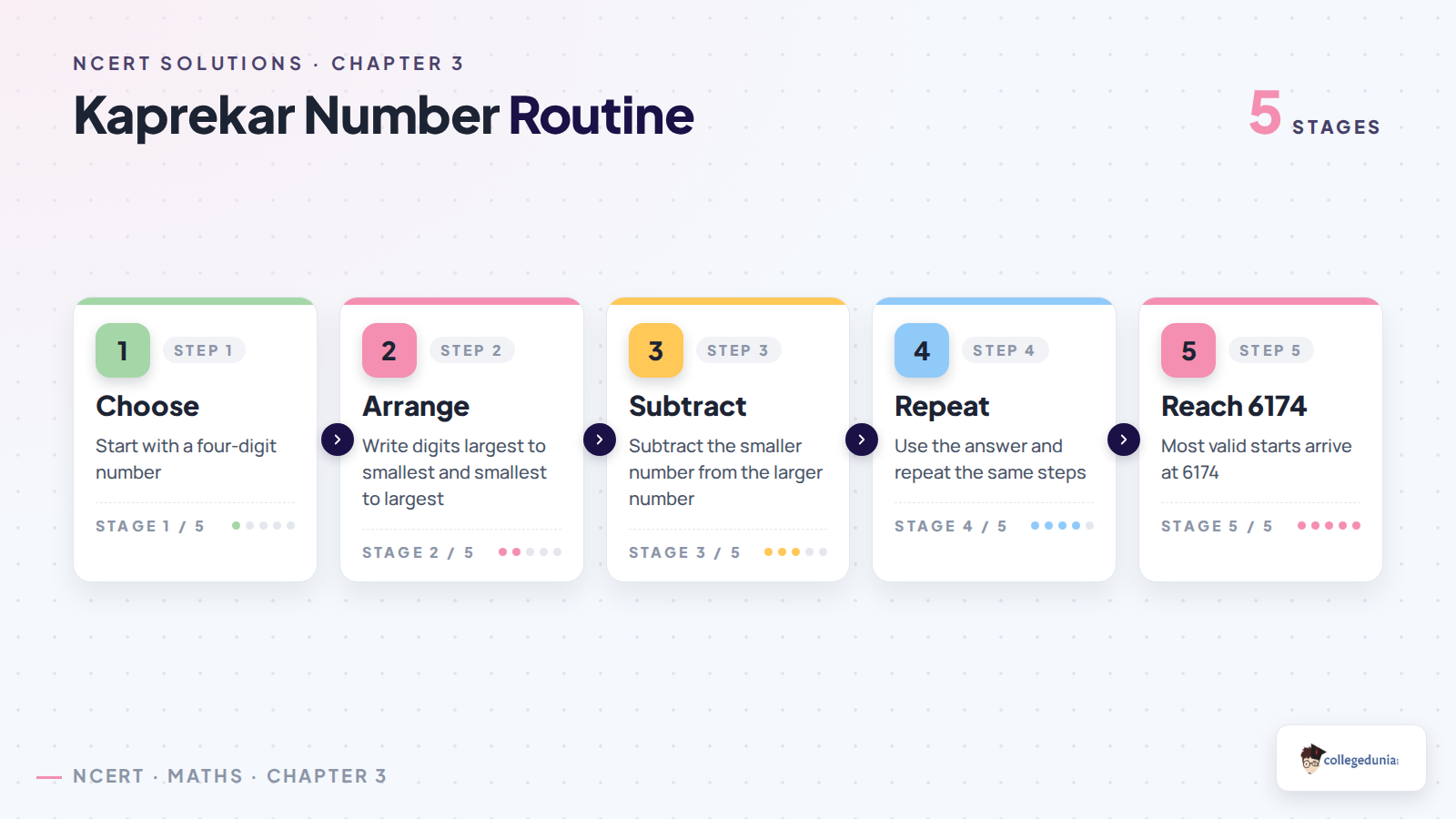
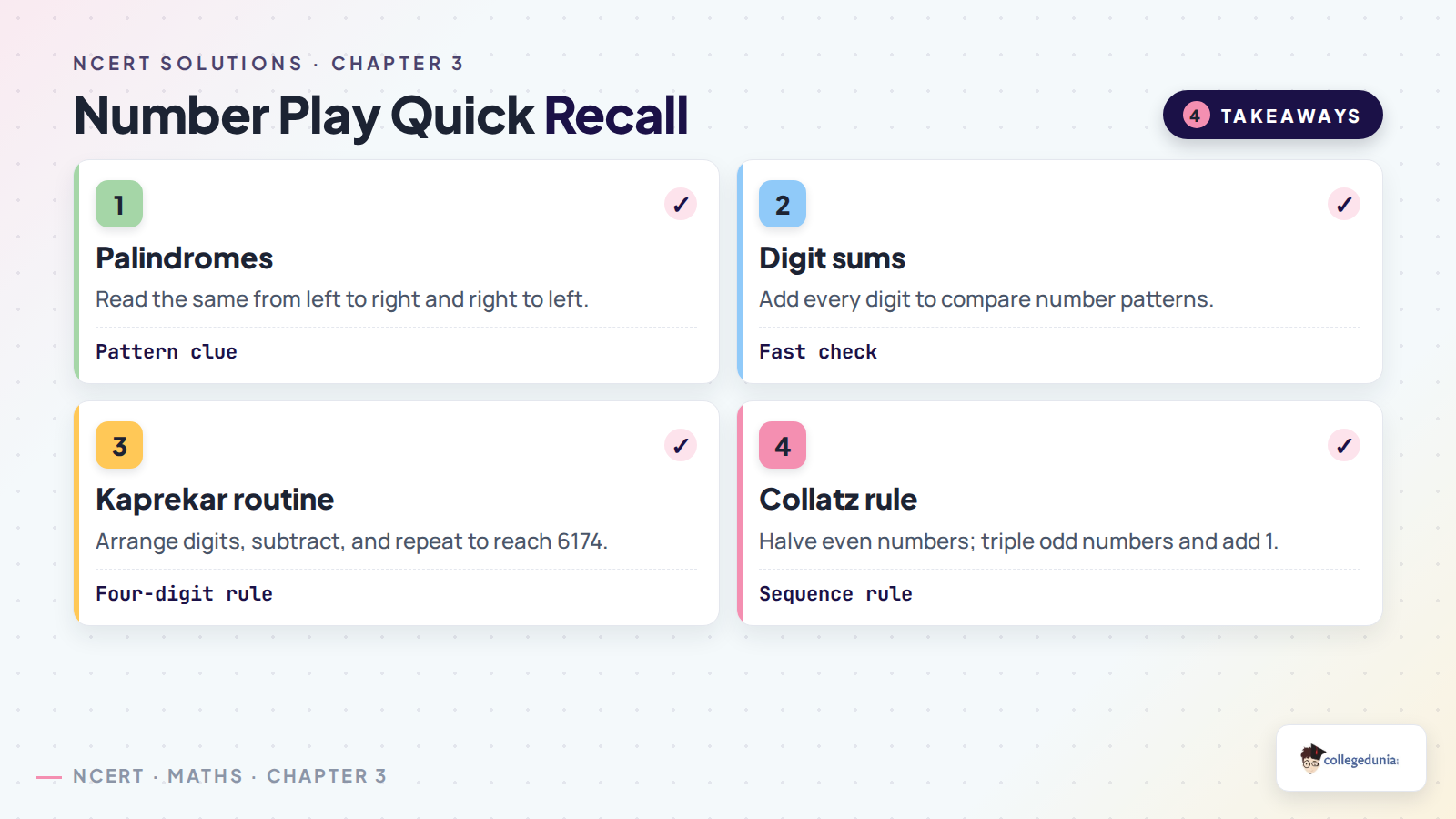
A palindrome reads the same from left to right and right to left. The chapter also uses repeated number operations. Kaprekar steps begin by arranging digits in descending and ascending order.
- Use every given digit, including zero when it appears.
- Place larger digits first for the descending number.
- Place smaller digits first for the ascending number.
- Subtract the smaller number from the larger number.
- Repeat with the new result until a pattern appears.
Keep leading zeroes when arranging digits. They hold a place and affect the next subtraction.
Common Mistakes in Number Play Solutions
Most mistakes come from rushed digit work. Students may drop a zero, reverse only part of a number, or claim a rule after one trial.
- Do not change the number of digits during an arrangement.
- Check subtraction before starting the next step.
- Test a pattern with more than one example.
- Write a reason after deciding whether a claim is true.
Quick check: read each arranged number aloud by place value. This makes a missing zero easier to notice.
How Number Play Solutions Help with Daily Practice
Try each question before reading the answer. Then compare your method, not only your final number. A correct answer with unclear working can hide a lucky guess.
- Keep a separate column for each trial.
- Circle the step where a pattern first appears.
- Use a counterexample to disprove a false claim.
- Redo one puzzle without looking at the solution.
Student Feedback on Number Play
In a Collegedunia poll of 10,420 students before the 2026 school exams, most students found number puzzles easier after writing each trial separately.
Source: 2026-27 Class 6 Mathematics student poll
Related Resources for Number Play Class 6
Use these Collegedunia resources to study the same chapter in different ways.
| Resource | What it offers |
|---|---|
| Number Play Class 6 Notes | Rules, examples, and quick revision |
| Number Play NCERT Book | Official chapter reading and activities |
| Number Play Handwritten Notes | Fast revision of patterns and rules |
NCERT Solutions for Class 6 Mathematics Ganita Prakash: All Chapters
Move between these solution pages while working through the Ganita Prakash textbook.
| Chapter | NCERT Solutions |
|---|---|
| Chapter 1 | Patterns in Mathematics Solutions |
| Chapter 2 | Lines and Angles Solutions |
| Chapter 3 | Number Play Solutions |
| Chapter 4 | Data Handling and Presentation Solutions |
Practice questions: Open the Number Play step-by-step question cards.
Number Play Class 6 NCERT Solutions FAQs
Ques. What is a palindrome number?
Ans. A palindrome number reads the same from left to right and right to left, such as 1221.
Ques. What is a digit sum?
Ans. A digit sum is found by adding every digit in a number. The digit sum of 472 is 13.
Ques. How should students test a number pattern?
Ans. Apply the same rule to several numbers. Record each result, compare them, and look for a counterexample.
Ques. Why are leading zeroes important in Kaprekar steps?
Ans. A leading zero keeps the correct number of places when digits are rearranged for the next subtraction.
Ques. Are these Number Play solutions based on the 2026-27 book?
Ans. Yes. The answers follow Class 6 Ganita Prakash Chapter 3 Number Play for the 2026-27 session.



Comments