



Lines and Angles introduces points, line segments, rays, intersecting lines, and angle types through the 2026-27 NCERT Ganita Prakash book. These Class 6 solutions show each construction and comparison in short steps, so students can check both the answer and the drawing.
- Core ideas: points, lines, rays, segments, and angles
- Practice focus: naming figures, comparing turns, and spotting angle types
- Useful format: neat diagrams with clear reasons and final answers
Chapter2LinesandAnglesSolutions.pdf?page=1&dpi=150)
Chapter2LinesandAnglesSolutions.pdf?page=2&dpi=150)
Chapter2LinesandAnglesSolutions.pdf?page=3&dpi=150)
Chapter2LinesandAnglesSolutions.pdf?page=4&dpi=150)
Chapter2LinesandAnglesSolutions.pdf?page=5&dpi=150)
Chapter2LinesandAnglesSolutions.pdf?page=6&dpi=150)
Chapter2LinesandAnglesSolutions.pdf?page=7&dpi=150)
Chapter2LinesandAnglesSolutions.pdf?page=8&dpi=150)
Chapter2LinesandAnglesSolutions.pdf?page=9&dpi=150)
Chapter2LinesandAnglesSolutions.pdf?page=10&dpi=150)
Chapter2LinesandAnglesSolutions.pdf?page=11&dpi=150)
Chapter2LinesandAnglesSolutions.pdf?page=12&dpi=150)
Chapter2LinesandAnglesSolutions.pdf?page=13&dpi=150)
Chapter2LinesandAnglesSolutions.pdf?page=14&dpi=150)
Chapter2LinesandAnglesSolutions.pdf?page=15&dpi=150)
Chapter2LinesandAnglesSolutions.pdf?page=16&dpi=150)
Chapter2LinesandAnglesSolutions.pdf?page=17&dpi=150)
Chapter2LinesandAnglesSolutions.pdf?page=18&dpi=150)
Chapter2LinesandAnglesSolutions.pdf?page=19&dpi=150)
Chapter2LinesandAnglesSolutions.pdf?page=20&dpi=150)
Chapter2LinesandAnglesSolutions.pdf?page=21&dpi=150)
Chapter2LinesandAnglesSolutions.pdf?page=22&dpi=150)
Chapter2LinesandAnglesSolutions.pdf?page=23&dpi=150)
Chapter2LinesandAnglesSolutions.pdf?page=24&dpi=150)
Chapter2LinesandAnglesSolutions.pdf?page=25&dpi=150)
Chapter2LinesandAnglesSolutions.pdf?page=26&dpi=150)
Chapter2LinesandAnglesSolutions.pdf?page=27&dpi=150)
Chapter2LinesandAnglesSolutions.pdf?page=28&dpi=150)
Chapter2LinesandAnglesSolutions.pdf?page=29&dpi=150)
Chapter2LinesandAnglesSolutions.pdf?page=30&dpi=150)
Chapter2LinesandAnglesSolutions.pdf?page=31&dpi=150)
Chapter2LinesandAnglesSolutions.pdf?page=32&dpi=150)
Chapter2LinesandAnglesSolutions.pdf?page=33&dpi=150)
Chapter2LinesandAnglesSolutions.pdf?page=34&dpi=150)
Chapter2LinesandAnglesSolutions.pdf?page=35&dpi=150)
Chapter2LinesandAnglesSolutions.pdf?page=36&dpi=150)
Chapter2LinesandAnglesSolutions.pdf?page=37&dpi=150)
Chapter2LinesandAnglesSolutions.pdf?page=38&dpi=150)
Chapter2LinesandAnglesSolutions.pdf?page=39&dpi=150)
Chapter2LinesandAnglesSolutions.pdf?page=40&dpi=150)
Chapter2LinesandAnglesSolutions.pdf?page=41&dpi=150)
Chapter2LinesandAnglesSolutions.pdf?page=42&dpi=150)
Chapter2LinesandAnglesSolutions.pdf?page=43&dpi=150)
Chapter2LinesandAnglesSolutions.pdf?page=44&dpi=150)
Chapter2LinesandAnglesSolutions.pdf?page=45&dpi=150)
Chapter2LinesandAnglesSolutions.pdf?page=46&dpi=150)
Chapter2LinesandAnglesSolutions.pdf?page=47&dpi=150)
Chapter2LinesandAnglesSolutions.pdf?page=48&dpi=150)
Chapter2LinesandAnglesSolutions.pdf?page=49&dpi=150)
Chapter2LinesandAnglesSolutions.pdf?page=50&dpi=150)
Chapter2LinesandAnglesSolutions.pdf?page=51&dpi=150)
Chapter2LinesandAnglesSolutions.pdf?page=52&dpi=150)
Chapter2LinesandAnglesSolutions.pdf?page=53&dpi=150)
Chapter2LinesandAnglesSolutions.pdf?page=54&dpi=150)
Chapter2LinesandAnglesSolutions.pdf?page=55&dpi=150)
Chapter2LinesandAnglesSolutions.pdf?page=56&dpi=150)
Chapter2LinesandAnglesSolutions.pdf?page=57&dpi=150)
Chapter2LinesandAnglesSolutions.pdf?page=58&dpi=150)
Chapter2LinesandAnglesSolutions.pdf?page=59&dpi=150)
Chapter2LinesandAnglesSolutions.pdf?page=60&dpi=150)
Chapter2LinesandAnglesSolutions.pdf?page=61&dpi=150)
Chapter2LinesandAnglesSolutions.pdf?page=62&dpi=150)
Chapter2LinesandAnglesSolutions.pdf?page=63&dpi=150)
Chapter2LinesandAnglesSolutions.pdf?page=64&dpi=150)
Chapter2LinesandAnglesSolutions.pdf?page=65&dpi=150)
Chapter2LinesandAnglesSolutions.pdf?page=66&dpi=150)
Chapter2LinesandAnglesSolutions.pdf?page=67&dpi=150)
Chapter2LinesandAnglesSolutions.pdf?page=68&dpi=150)
Chapter2LinesandAnglesSolutions.pdf?page=69&dpi=150)
Chapter2LinesandAnglesSolutions.pdf?page=70&dpi=150)
Chapter2LinesandAnglesSolutions.pdf?page=71&dpi=150)
Chapter2LinesandAnglesSolutions.pdf?page=72&dpi=150)
Chapter2LinesandAnglesSolutions.pdf?page=73&dpi=150)
Chapter2LinesandAnglesSolutions.pdf?page=74&dpi=150)
Chapter2LinesandAnglesSolutions.pdf?page=75&dpi=150)
Chapter2LinesandAnglesSolutions.pdf?page=76&dpi=150)
Chapter2LinesandAnglesSolutions.pdf?page=77&dpi=150)
Chapter2LinesandAnglesSolutions.pdf?page=78&dpi=150)
Chapter2LinesandAnglesSolutions.pdf?page=79&dpi=150)
Chapter2LinesandAnglesSolutions.pdf?page=80&dpi=150)
Chapter2LinesandAnglesSolutions.pdf?page=81&dpi=150)
Chapter2LinesandAnglesSolutions_flat_MobileCard.pdf?page=1&dpi=150)
Chapter2LinesandAnglesSolutions_flat_MobileCard.pdf?page=2&dpi=150)
Chapter2LinesandAnglesSolutions_flat_MobileCard.pdf?page=3&dpi=150)
Chapter2LinesandAnglesSolutions_flat_MobileCard.pdf?page=4&dpi=150)
Chapter2LinesandAnglesSolutions_flat_MobileCard.pdf?page=5&dpi=150)
Chapter2LinesandAnglesSolutions_flat_MobileCard.pdf?page=6&dpi=150)
Chapter2LinesandAnglesSolutions_flat_MobileCard.pdf?page=7&dpi=150)
Chapter2LinesandAnglesSolutions_flat_MobileCard.pdf?page=8&dpi=150)
Chapter2LinesandAnglesSolutions_flat_MobileCard.pdf?page=9&dpi=150)
Chapter2LinesandAnglesSolutions_flat_MobileCard.pdf?page=10&dpi=150)
Chapter2LinesandAnglesSolutions_flat_MobileCard.pdf?page=11&dpi=150)
Chapter2LinesandAnglesSolutions_flat_MobileCard.pdf?page=12&dpi=150)
Chapter2LinesandAnglesSolutions_flat_MobileCard.pdf?page=13&dpi=150)
Chapter2LinesandAnglesSolutions_flat_MobileCard.pdf?page=14&dpi=150)
Chapter2LinesandAnglesSolutions_flat_MobileCard.pdf?page=15&dpi=150)
Chapter2LinesandAnglesSolutions_flat_MobileCard.pdf?page=16&dpi=150)
Chapter2LinesandAnglesSolutions_flat_MobileCard.pdf?page=17&dpi=150)
Chapter2LinesandAnglesSolutions_flat_MobileCard.pdf?page=18&dpi=150)
Chapter2LinesandAnglesSolutions_flat_MobileCard.pdf?page=19&dpi=150)
Chapter2LinesandAnglesSolutions_flat_MobileCard.pdf?page=20&dpi=150)
Chapter2LinesandAnglesSolutions_flat_MobileCard.pdf?page=21&dpi=150)
Chapter2LinesandAnglesSolutions_flat_MobileCard.pdf?page=22&dpi=150)
Chapter2LinesandAnglesSolutions_flat_MobileCard.pdf?page=23&dpi=150)
Chapter2LinesandAnglesSolutions_flat_MobileCard.pdf?page=24&dpi=150)
Chapter2LinesandAnglesSolutions_flat_MobileCard.pdf?page=25&dpi=150)
Chapter2LinesandAnglesSolutions_flat_MobileCard.pdf?page=26&dpi=150)
Chapter2LinesandAnglesSolutions_flat_MobileCard.pdf?page=27&dpi=150)
Chapter2LinesandAnglesSolutions_flat_MobileCard.pdf?page=28&dpi=150)
Chapter2LinesandAnglesSolutions_flat_MobileCard.pdf?page=29&dpi=150)
Chapter2LinesandAnglesSolutions_flat_MobileCard.pdf?page=30&dpi=150)
Chapter2LinesandAnglesSolutions_flat_MobileCard.pdf?page=31&dpi=150)
Chapter2LinesandAnglesSolutions_flat_MobileCard.pdf?page=32&dpi=150)
Chapter2LinesandAnglesSolutions_flat_MobileCard.pdf?page=33&dpi=150)
Chapter2LinesandAnglesSolutions_flat_MobileCard.pdf?page=34&dpi=150)
Chapter2LinesandAnglesSolutions_flat_MobileCard.pdf?page=35&dpi=150)
Chapter2LinesandAnglesSolutions_flat_MobileCard.pdf?page=36&dpi=150)
Chapter2LinesandAnglesSolutions_flat_MobileCard.pdf?page=37&dpi=150)
Chapter2LinesandAnglesSolutions_flat_MobileCard.pdf?page=38&dpi=150)
Chapter2LinesandAnglesSolutions_flat_MobileCard.pdf?page=39&dpi=150)
Chapter2LinesandAnglesSolutions_flat_MobileCard.pdf?page=40&dpi=150)
Chapter2LinesandAnglesSolutions_flat_MobileCard.pdf?page=41&dpi=150)
Chapter2LinesandAnglesSolutions_flat_MobileCard.pdf?page=42&dpi=150)
Chapter2LinesandAnglesSolutions_flat_MobileCard.pdf?page=43&dpi=150)
Chapter2LinesandAnglesSolutions_flat_MobileCard.pdf?page=44&dpi=150)
Chapter2LinesandAnglesSolutions_flat_MobileCard.pdf?page=45&dpi=150)
Chapter2LinesandAnglesSolutions_flat_MobileCard.pdf?page=46&dpi=150)
Chapter2LinesandAnglesSolutions_flat_MobileCard.pdf?page=47&dpi=150)
Chapter2LinesandAnglesSolutions_flat_MobileCard.pdf?page=48&dpi=150)
Chapter2LinesandAnglesSolutions_flat_MobileCard.pdf?page=49&dpi=150)
Chapter2LinesandAnglesSolutions_flat_MobileCard.pdf?page=50&dpi=150)
Chapter2LinesandAnglesSolutions_flat_MobileCard.pdf?page=51&dpi=150)
Chapter2LinesandAnglesSolutions_flat_MobileCard.pdf?page=52&dpi=150)
Chapter2LinesandAnglesSolutions_flat_MobileCard.pdf?page=53&dpi=150)
Chapter2LinesandAnglesSolutions_flat_MobileCard.pdf?page=54&dpi=150)
Chapter2LinesandAnglesSolutions_flat_MobileCard.pdf?page=55&dpi=150)
Chapter2LinesandAnglesSolutions_flat_MobileCard.pdf?page=56&dpi=150)
Chapter2LinesandAnglesSolutions_flat_MobileCard.pdf?page=57&dpi=150)
Chapter2LinesandAnglesSolutions_flat_MobileCard.pdf?page=58&dpi=150)
Chapter2LinesandAnglesSolutions_flat_MobileCard.pdf?page=59&dpi=150)
Chapter2LinesandAnglesSolutions_flat_MobileCard.pdf?page=60&dpi=150)
Chapter2LinesandAnglesSolutions_flat_MobileCard.pdf?page=61&dpi=150)
Chapter2LinesandAnglesSolutions_flat_MobileCard.pdf?page=62&dpi=150)
Chapter2LinesandAnglesSolutions_flat_MobileCard.pdf?page=63&dpi=150)
Chapter2LinesandAnglesSolutions_flat_MobileCard.pdf?page=64&dpi=150)
Chapter2LinesandAnglesSolutions_flat_MobileCard.pdf?page=65&dpi=150)
Chapter2LinesandAnglesSolutions_flat_MobileCard.pdf?page=66&dpi=150)
Chapter2LinesandAnglesSolutions_flat_MobileCard.pdf?page=67&dpi=150)
Chapter2LinesandAnglesSolutions_flat_MobileCard.pdf?page=68&dpi=150)
Chapter2LinesandAnglesSolutions_flat_MobileCard.pdf?page=69&dpi=150)
Chapter2LinesandAnglesSolutions_flat_MobileCard.pdf?page=70&dpi=150)
Chapter2LinesandAnglesSolutions_flat_MobileCard.pdf?page=71&dpi=150)
Chapter2LinesandAnglesSolutions_flat_MobileCard.pdf?page=72&dpi=150)
Chapter2LinesandAnglesSolutions_flat_MobileCard.pdf?page=73&dpi=150)
Chapter2LinesandAnglesSolutions_flat_MobileCard.pdf?page=74&dpi=150)
Chapter2LinesandAnglesSolutions_flat_MobileCard.pdf?page=75&dpi=150)
Chapter2LinesandAnglesSolutions_flat_MobileCard.pdf?page=76&dpi=150)
Chapter2LinesandAnglesSolutions_flat_MobileCard.pdf?page=77&dpi=150)
Chapter2LinesandAnglesSolutions_flat_MobileCard.pdf?page=78&dpi=150)
Chapter2LinesandAnglesSolutions_flat_MobileCard.pdf?page=79&dpi=150)
Chapter2LinesandAnglesSolutions_flat_MobileCard.pdf?page=80&dpi=150)
Chapter2LinesandAnglesSolutions_flat_MobileCard.pdf?page=81&dpi=150)
Chapter2LinesandAnglesSolutions_flat_MobileCard.pdf?page=82&dpi=150)
Chapter2LinesandAnglesSolutions_flat_MobileCard.pdf?page=83&dpi=150)
Chapter2LinesandAnglesSolutions_flat_MobileCard.pdf?page=84&dpi=150)
Chapter2LinesandAnglesSolutions_flat_MobileCard.pdf?page=85&dpi=150)
Chapter2LinesandAnglesSolutions_flat_MobileCard.pdf?page=86&dpi=150)
Chapter2LinesandAnglesSolutions_flat_MobileCard.pdf?page=87&dpi=150)
Chapter2LinesandAnglesSolutions_flat_MobileCard.pdf?page=88&dpi=150)
Chapter2LinesandAnglesSolutions_flat_MobileCard.pdf?page=89&dpi=150)
Chapter2LinesandAnglesSolutions_flat_MobileCard.pdf?page=90&dpi=150)
Chapter2LinesandAnglesSolutions_flat_MobileCard.pdf?page=91&dpi=150)
Chapter2LinesandAnglesSolutions_flat_MobileCard.pdf?page=92&dpi=150)
Chapter2LinesandAnglesSolutions_flat_MobileCard.pdf?page=93&dpi=150)
Chapter2LinesandAnglesSolutions_flat_MobileCard.pdf?page=94&dpi=150)
Chapter2LinesandAnglesSolutions_flat_MobileCard.pdf?page=95&dpi=150)
Chapter2LinesandAnglesSolutions_flat_MobileCard.pdf?page=96&dpi=150)
Chapter2LinesandAnglesSolutions_flat_MobileCard.pdf?page=97&dpi=150)
Chapter2LinesandAnglesSolutions_flat_MobileCard.pdf?page=98&dpi=150)
Chapter2LinesandAnglesSolutions_flat_MobileCard.pdf?page=99&dpi=150)
Chapter2LinesandAnglesSolutions_flat_MobileCard.pdf?page=100&dpi=150)
Chapter2LinesandAnglesSolutions_flat_MobileCard.pdf?page=101&dpi=150)
Chapter2LinesandAnglesSolutions_flat_MobileCard.pdf?page=102&dpi=150)
Chapter2LinesandAnglesSolutions_flat_MobileCard.pdf?page=103&dpi=150)
Chapter2LinesandAnglesSolutions_flat_MobileCard.pdf?page=104&dpi=150)
Chapter2LinesandAnglesSolutions_flat_MobileCard.pdf?page=105&dpi=150)
Chapter2LinesandAnglesSolutions_flat_MobileCard.pdf?page=106&dpi=150)
Chapter2LinesandAnglesSolutions_flat_MobileCard.pdf?page=107&dpi=150)
Chapter2LinesandAnglesSolutions_flat_MobileCard.pdf?page=108&dpi=150)
Chapter2LinesandAnglesSolutions_flat_MobileCard.pdf?page=109&dpi=150)
Chapter2LinesandAnglesSolutions_flat_MobileCard.pdf?page=110&dpi=150)
Chapter2LinesandAnglesSolutions_flat_MobileCard.pdf?page=111&dpi=150)
Chapter2LinesandAnglesSolutions_flat_MobileCard.pdf?page=112&dpi=150)
Chapter2LinesandAnglesSolutions_flat_MobileCard.pdf?page=113&dpi=150)
Chapter2LinesandAnglesSolutions_flat_MobileCard.pdf?page=114&dpi=150)
Chapter2LinesandAnglesSolutions_flat_MobileCard.pdf?page=115&dpi=150)
Chapter2LinesandAnglesSolutions_flat_MobileCard.pdf?page=116&dpi=150)
Chapter2LinesandAnglesSolutions_flat_MobileCard.pdf?page=117&dpi=150)
Chapter2LinesandAnglesSolutions_flat_MobileCard.pdf?page=118&dpi=150)
Chapter2LinesandAnglesSolutions_flat_MobileCard.pdf?page=119&dpi=150)
Chapter2LinesandAnglesSolutions_flat_MobileCard.pdf?page=120&dpi=150)
Chapter2LinesandAnglesSolutions_flat_MobileCard.pdf?page=121&dpi=150)
Chapter2LinesandAnglesSolutions_flat_MobileCard.pdf?page=122&dpi=150)
Chapter2LinesandAnglesSolutions_flat_MobileCard.pdf?page=123&dpi=150)
Chapter2LinesandAnglesSolutions_flat_MobileCard.pdf?page=124&dpi=150)
Chapter2LinesandAnglesSolutions_flat_MobileCard.pdf?page=125&dpi=150)
Chapter2LinesandAnglesSolutions_flat_MobileCard.pdf?page=126&dpi=150)
Chapter2LinesandAnglesSolutions_flat_MobileCard.pdf?page=127&dpi=150)
Chapter2LinesandAnglesSolutions_flat_MobileCard.pdf?page=128&dpi=150)
Chapter2LinesandAnglesSolutions_flat_MobileCard.pdf?page=129&dpi=150)
Chapter2LinesandAnglesSolutions_flat_MobileCard.pdf?page=130&dpi=150)
Chapter2LinesandAnglesSolutions_flat_MobileCard.pdf?page=131&dpi=150)
Chapter2LinesandAnglesSolutions_flat_MobileCard.pdf?page=132&dpi=150)
Chapter2LinesandAnglesSolutions_flat_MobileCard.pdf?page=133&dpi=150)
Chapter2LinesandAnglesSolutions_flat_MobileCard.pdf?page=134&dpi=150)
Chapter2LinesandAnglesSolutions_flat_MobileCard.pdf?page=135&dpi=150)
Chapter2LinesandAnglesSolutions_flat_MobileCard.pdf?page=136&dpi=150)
Chapter2LinesandAnglesSolutions_flat_MobileCard.pdf?page=137&dpi=150)
Chapter2LinesandAnglesSolutions_flat_MobileCard.pdf?page=138&dpi=150)
Chapter2LinesandAnglesSolutions_flat_MobileCard.pdf?page=139&dpi=150)
Chapter2LinesandAnglesSolutions_flat_MobileCard.pdf?page=140&dpi=150)
Chapter2LinesandAnglesSolutions_flat_MobileCard.pdf?page=141&dpi=150)
Chapter2LinesandAnglesSolutions_flat_MobileCard.pdf?page=142&dpi=150)
Chapter2LinesandAnglesSolutions_flat_MobileCard.pdf?page=143&dpi=150)
Chapter2LinesandAnglesSolutions_flat_MobileCard.pdf?page=144&dpi=150)
Chapter2LinesandAnglesSolutions_flat_MobileCard.pdf?page=145&dpi=150)
Chapter2LinesandAnglesSolutions_flat_MobileCard.pdf?page=146&dpi=150)
Chapter2LinesandAnglesSolutions_flat_MobileCard.pdf?page=147&dpi=150)
Chapter2LinesandAnglesSolutions_flat_MobileCard.pdf?page=148&dpi=150)
Each solution follows the 2026-27 NCERT Ganita Prakash chapter and explains how to read every geometric figure.
Lines and Angles Ideas Every Class 6 Student Should Know
A point marks an exact position. A line extends without end in both directions. A ray has one endpoint, while a line segment has two. The endpoint count helps you name each figure correctly.
| Figure | Key feature | How to name it |
|---|---|---|
| Point | An exact position | Use one capital letter |
| Line segment | Two endpoints | Use both endpoint letters |
| Ray | One endpoint and one direction | Write the endpoint first |
| Line | Extends in both directions | Use any two points on it |
A ray's first letter must name its endpoint. Reversing the letters can describe a different ray.
Lines and Angles Quick Revision
Source: Magnet Brains on YouTube
How to Solve Lines and Angles Questions Step by Step
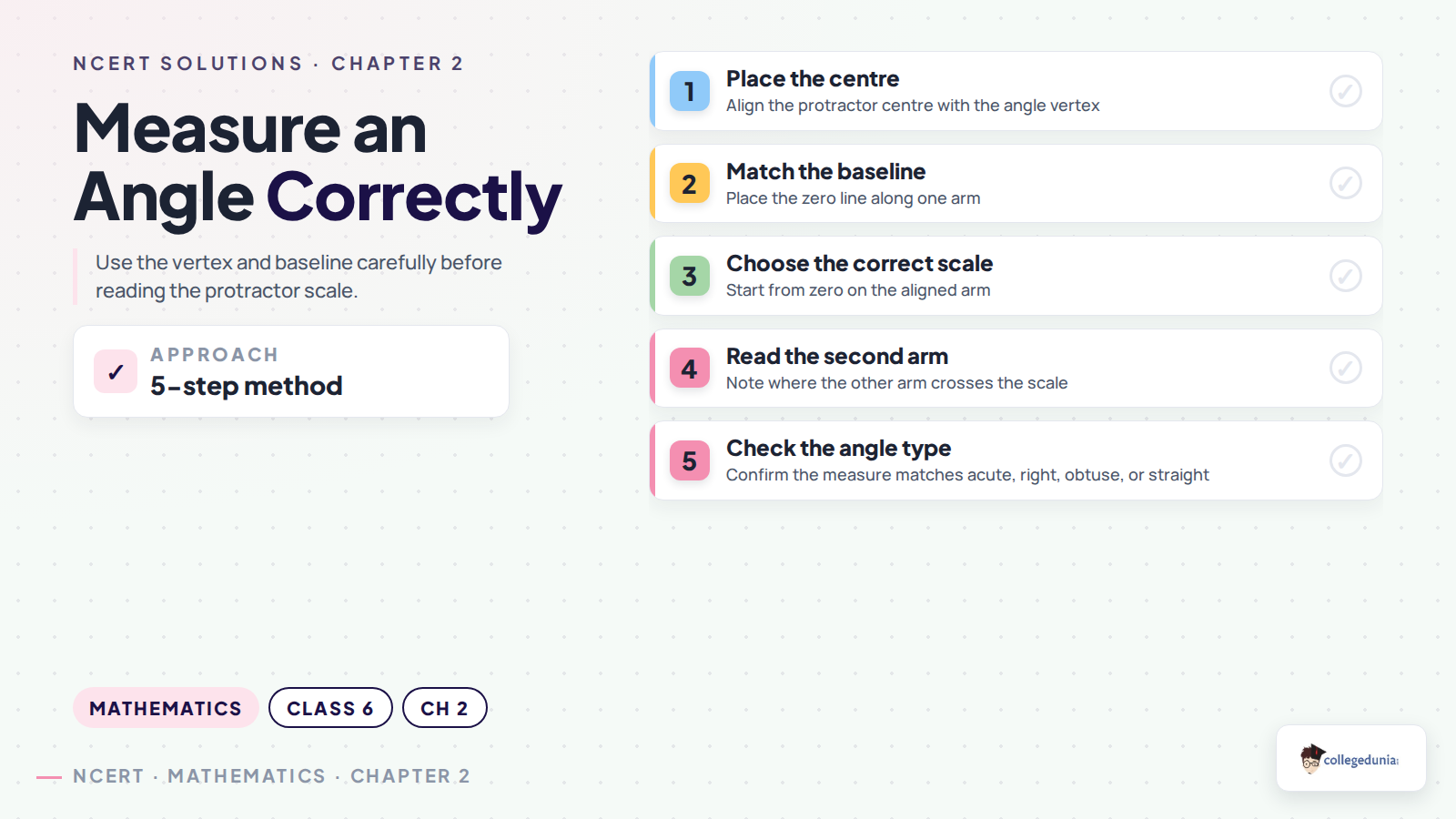
Read the labels before judging the figure. Find endpoints and arrowheads first. For an angle, identify its vertex and its two arms. The middle letter in an angle name is always the vertex.
- Mark every labelled point in the figure.
- Check whether each end has an endpoint or an arrowhead.
- Name a ray with its endpoint letter first.
- Name an angle with its vertex letter in the middle.
- Compare the opening, not the arm lengths.
A ruler helps with line segments. A set square or a paper corner helps you compare an angle with a right angle.
Angle Types in Ganita Prakash Chapter 2
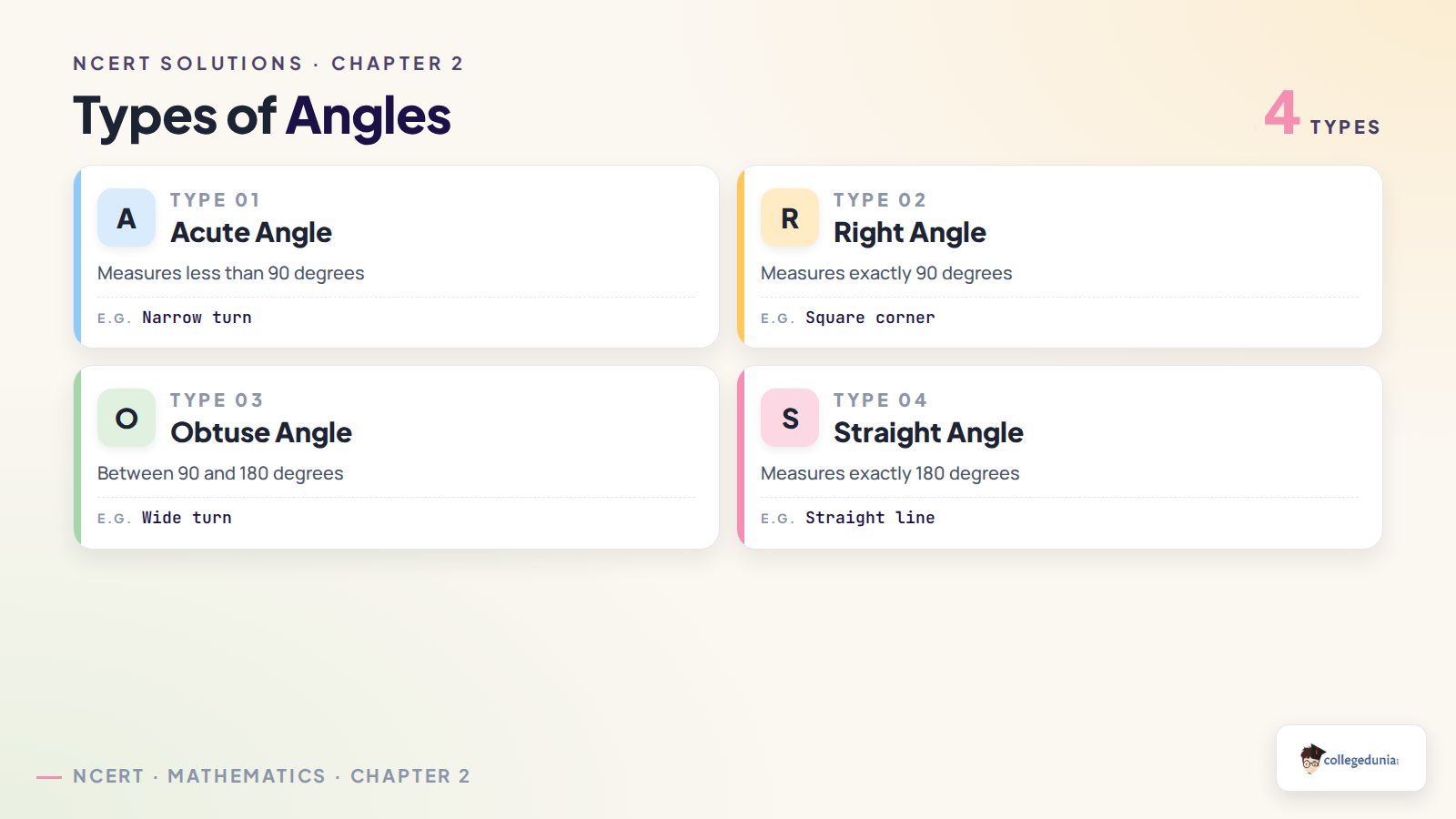
An angle shows the amount of turn between two rays with a common endpoint. The common endpoint is the vertex. Angle size depends on the opening between its arms.
- An acute angle is smaller than a right angle.
- A right angle matches the corner of a square.
- An obtuse angle is larger than a right angle but smaller than a straight angle.
- A straight angle forms a straight line.
- A reflex angle is larger than a straight angle but smaller than a full turn.
Longer arms do not make a larger angle. Only the turn or opening matters.
Common Mistakes in Lines and Angles Solutions
Students often swap the letters while naming a ray. They may also judge an angle from its arm lengths. Use the marks and arrowheads shown in the question.
- Do not call a line segment a line when it has two endpoints.
- Write the vertex in the middle of a three-letter angle name.
- Compare openings rather than the drawn arm lengths.
- Check whether two lines meet before calling them intersecting.
Quick check: place a paper corner on the angle. A smaller opening is acute, an exact match is right, and a larger opening is obtuse.
How These Class 6 Mathematics Solutions Help with Practice
The worked answers show the correct naming order and the reason behind each angle type. Try the question first. Then compare your diagram and explanation with the solution.
- Draw figures with a sharp pencil and ruler.
- Circle the vertex before naming an angle.
- Use arrows clearly for lines and rays.
- Redo any question where the name order was wrong.
Student Feedback on Lines and Angles
In a Collegedunia poll of 10,680 students conducted before the 2026 school exams, most students found angle naming easier after circling the vertex first.
Source: 2026-27 Class 6 Mathematics student poll
Related Resources for Lines and Angles Class 6
Use these Collegedunia chapter resources to revise the same ideas in different formats.
| Resource | What it offers |
|---|---|
| Lines and Angles Class 6 Notes | Concept recap and labelled examples |
| Lines and Angles NCERT Book | Official chapter reading |
| Lines and Angles Handwritten Notes | Quick revision points |
NCERT Solutions for Class 6 Mathematics Ganita Prakash: All Chapters
Move between the chapter solution pages as you work through the Ganita Prakash textbook.
| Chapter | NCERT Solutions |
|---|---|
| Chapter 1 | Patterns in Mathematics Solutions |
| Chapter 2 | Lines and Angles Solutions |
| Chapter 3 | Number Play Solutions |
| Chapter 4 | Data Handling and Presentation Solutions |
Practice questions: Open the Lines and Angles step-by-step question cards.
Lines and Angles Class 6 NCERT Solutions FAQs
Ques. What is a line segment?
Ans. A line segment is part of a line with two fixed endpoints. Its length can be measured.
Ques. How is a ray different from a line?
Ans. A ray starts at one endpoint and extends in one direction. A line extends in both directions.
Ques. What is the vertex of an angle?
Ans. The vertex is the common endpoint where the two arms of an angle meet.
Ques. How can students identify a right angle?
Ans. Compare the angle with a square corner or set square. An exact match is a right angle.
Ques. Are these solutions based on the 2026-27 Ganita Prakash book?
Ans. Yes. The answers follow Class 6 Ganita Prakash Chapter 2 for the 2026-27 session.



Comments