




The NCERT Solutions for Class 6 Mathematics Chapter 7 Fractions explain equal parts, number-line positions, mixed numbers, equivalent fractions, comparison, addition, and subtraction through the 2026-27 Ganita Prakash activities. Each answer keeps the fraction model visible, so students can see why the numerator and denominator change.
- Core ideas: fractional units, equal shares, mixed numbers, equivalent fractions, and comparison
- Useful methods: fraction strips, number lines, LCM, simplification, and denominator matching
- Practice style: picture-based reasoning, real-life sharing, and step-by-step arithmetic checks
Chapter7FractionsSolutions.pdf?page=1&dpi=150)
Chapter7FractionsSolutions.pdf?page=2&dpi=150)
Chapter7FractionsSolutions.pdf?page=3&dpi=150)
Chapter7FractionsSolutions.pdf?page=4&dpi=150)
Chapter7FractionsSolutions.pdf?page=5&dpi=150)
Chapter7FractionsSolutions.pdf?page=6&dpi=150)
Chapter7FractionsSolutions.pdf?page=7&dpi=150)
Chapter7FractionsSolutions.pdf?page=8&dpi=150)
Chapter7FractionsSolutions.pdf?page=9&dpi=150)
Chapter7FractionsSolutions.pdf?page=10&dpi=150)
Chapter7FractionsSolutions.pdf?page=11&dpi=150)
Chapter7FractionsSolutions.pdf?page=12&dpi=150)
Chapter7FractionsSolutions.pdf?page=13&dpi=150)
Chapter7FractionsSolutions.pdf?page=14&dpi=150)
Chapter7FractionsSolutions.pdf?page=15&dpi=150)
Chapter7FractionsSolutions.pdf?page=16&dpi=150)
Chapter7FractionsSolutions.pdf?page=17&dpi=150)
Chapter7FractionsSolutions.pdf?page=18&dpi=150)
Chapter7FractionsSolutions.pdf?page=19&dpi=150)
Chapter7FractionsSolutions.pdf?page=20&dpi=150)
Chapter7FractionsSolutions.pdf?page=21&dpi=150)
Chapter7FractionsSolutions.pdf?page=22&dpi=150)
Chapter7FractionsSolutions.pdf?page=23&dpi=150)
Chapter7FractionsSolutions.pdf?page=24&dpi=150)
Chapter7FractionsSolutions.pdf?page=25&dpi=150)
Chapter7FractionsSolutions.pdf?page=26&dpi=150)
Chapter7FractionsSolutions.pdf?page=27&dpi=150)
Chapter7FractionsSolutions.pdf?page=28&dpi=150)
Chapter7FractionsSolutions.pdf?page=29&dpi=150)
Chapter7FractionsSolutions.pdf?page=30&dpi=150)
Chapter7FractionsSolutions.pdf?page=31&dpi=150)
Chapter7FractionsSolutions.pdf?page=32&dpi=150)
Chapter7FractionsSolutions.pdf?page=33&dpi=150)
Chapter7FractionsSolutions.pdf?page=34&dpi=150)
Chapter7FractionsSolutions_flat_MobileCard.pdf?page=1&dpi=150)
Chapter7FractionsSolutions_flat_MobileCard.pdf?page=2&dpi=150)
Chapter7FractionsSolutions_flat_MobileCard.pdf?page=3&dpi=150)
Chapter7FractionsSolutions_flat_MobileCard.pdf?page=4&dpi=150)
Chapter7FractionsSolutions_flat_MobileCard.pdf?page=5&dpi=150)
Chapter7FractionsSolutions_flat_MobileCard.pdf?page=6&dpi=150)
Chapter7FractionsSolutions_flat_MobileCard.pdf?page=7&dpi=150)
Chapter7FractionsSolutions_flat_MobileCard.pdf?page=8&dpi=150)
Chapter7FractionsSolutions_flat_MobileCard.pdf?page=9&dpi=150)
Chapter7FractionsSolutions_flat_MobileCard.pdf?page=10&dpi=150)
Chapter7FractionsSolutions_flat_MobileCard.pdf?page=11&dpi=150)
Chapter7FractionsSolutions_flat_MobileCard.pdf?page=12&dpi=150)
Chapter7FractionsSolutions_flat_MobileCard.pdf?page=13&dpi=150)
Chapter7FractionsSolutions_flat_MobileCard.pdf?page=14&dpi=150)
Chapter7FractionsSolutions_flat_MobileCard.pdf?page=15&dpi=150)
Chapter7FractionsSolutions_flat_MobileCard.pdf?page=16&dpi=150)
Chapter7FractionsSolutions_flat_MobileCard.pdf?page=17&dpi=150)
Chapter7FractionsSolutions_flat_MobileCard.pdf?page=18&dpi=150)
Chapter7FractionsSolutions_flat_MobileCard.pdf?page=19&dpi=150)
Chapter7FractionsSolutions_flat_MobileCard.pdf?page=20&dpi=150)
Chapter7FractionsSolutions_flat_MobileCard.pdf?page=21&dpi=150)
Chapter7FractionsSolutions_flat_MobileCard.pdf?page=22&dpi=150)
Chapter7FractionsSolutions_flat_MobileCard.pdf?page=23&dpi=150)
Chapter7FractionsSolutions_flat_MobileCard.pdf?page=24&dpi=150)
Chapter7FractionsSolutions_flat_MobileCard.pdf?page=25&dpi=150)
Chapter7FractionsSolutions_flat_MobileCard.pdf?page=26&dpi=150)
Chapter7FractionsSolutions_flat_MobileCard.pdf?page=27&dpi=150)
Chapter7FractionsSolutions_flat_MobileCard.pdf?page=28&dpi=150)
Chapter7FractionsSolutions_flat_MobileCard.pdf?page=29&dpi=150)
Chapter7FractionsSolutions_flat_MobileCard.pdf?page=30&dpi=150)
Chapter7FractionsSolutions_flat_MobileCard.pdf?page=31&dpi=150)
Chapter7FractionsSolutions_flat_MobileCard.pdf?page=32&dpi=150)
Chapter7FractionsSolutions_flat_MobileCard.pdf?page=33&dpi=150)
Chapter7FractionsSolutions_flat_MobileCard.pdf?page=34&dpi=150)
Chapter7FractionsSolutions_flat_MobileCard.pdf?page=35&dpi=150)
Chapter7FractionsSolutions_flat_MobileCard.pdf?page=36&dpi=150)
Chapter7FractionsSolutions_flat_MobileCard.pdf?page=37&dpi=150)
Chapter7FractionsSolutions_flat_MobileCard.pdf?page=38&dpi=150)
Chapter7FractionsSolutions_flat_MobileCard.pdf?page=39&dpi=150)
Chapter7FractionsSolutions_flat_MobileCard.pdf?page=40&dpi=150)
Chapter7FractionsSolutions_flat_MobileCard.pdf?page=41&dpi=150)
Chapter7FractionsSolutions_flat_MobileCard.pdf?page=42&dpi=150)
Chapter7FractionsSolutions_flat_MobileCard.pdf?page=43&dpi=150)
Chapter7FractionsSolutions_flat_MobileCard.pdf?page=44&dpi=150)
Chapter7FractionsSolutions_flat_MobileCard.pdf?page=45&dpi=150)
Chapter7FractionsSolutions_flat_MobileCard.pdf?page=46&dpi=150)
Chapter7FractionsSolutions_flat_MobileCard.pdf?page=47&dpi=150)
Chapter7FractionsSolutions_flat_MobileCard.pdf?page=48&dpi=150)
Chapter7FractionsSolutions_flat_MobileCard.pdf?page=49&dpi=150)
Chapter7FractionsSolutions_flat_MobileCard.pdf?page=50&dpi=150)
Chapter7FractionsSolutions_flat_MobileCard.pdf?page=51&dpi=150)
Chapter7FractionsSolutions_flat_MobileCard.pdf?page=52&dpi=150)
Chapter7FractionsSolutions_flat_MobileCard.pdf?page=53&dpi=150)
Chapter7FractionsSolutions_flat_MobileCard.pdf?page=54&dpi=150)
Chapter7FractionsSolutions_flat_MobileCard.pdf?page=55&dpi=150)
Chapter7FractionsSolutions_flat_MobileCard.pdf?page=56&dpi=150)
Chapter7FractionsSolutions_flat_MobileCard.pdf?page=57&dpi=150)
Chapter7FractionsSolutions_flat_MobileCard.pdf?page=58&dpi=150)
Chapter7FractionsSolutions_flat_MobileCard.pdf?page=59&dpi=150)
These solutions follow the NCERT Ganita Prakash Reprint 2026-27 chapter and keep every fraction step easy to verify.
Student Feedback on Fractions Class 6 Mathematics
In a Collegedunia poll of 10,680 students before the 2026 school exams, 76% of students said fraction questions became easier after drawing equal parts before calculating.
Source: 2026-27 Class 6 Mathematics student poll
Fractions Ideas Every Class 6 Student Should Know
Fractions are numbers that show parts of a whole. The denominator names how many equal parts the whole is divided into, and the numerator tells how many of those parts are taken. A fraction is meaningful only when the parts are equal. This is why the chapter begins with unit fractions and visual models before moving to operations.
| Idea | Meaning | Where it appears in Chapter 7 |
|---|---|---|
| Unit fraction | One equal part of a whole | Halves, thirds, fourths, and other basic shares |
| Mixed number | A whole number plus a proper fraction | Lengths, food sharing, and number-line positions |
| Equivalent fraction | Different names for the same value | Fraction strips, grids, and simplification checks |
| Common denominator | Same-sized parts for two fractions | Comparison, addition, and subtraction |
Always check that the whole is divided into equal parts before naming a fraction. This one habit prevents many wrong answers in Chapter 7.
Fractions Class 6 Video Explanation
Source: Magnet Brains on YouTube
Equivalent Fractions in NCERT Solutions Class 6 Chapter 7
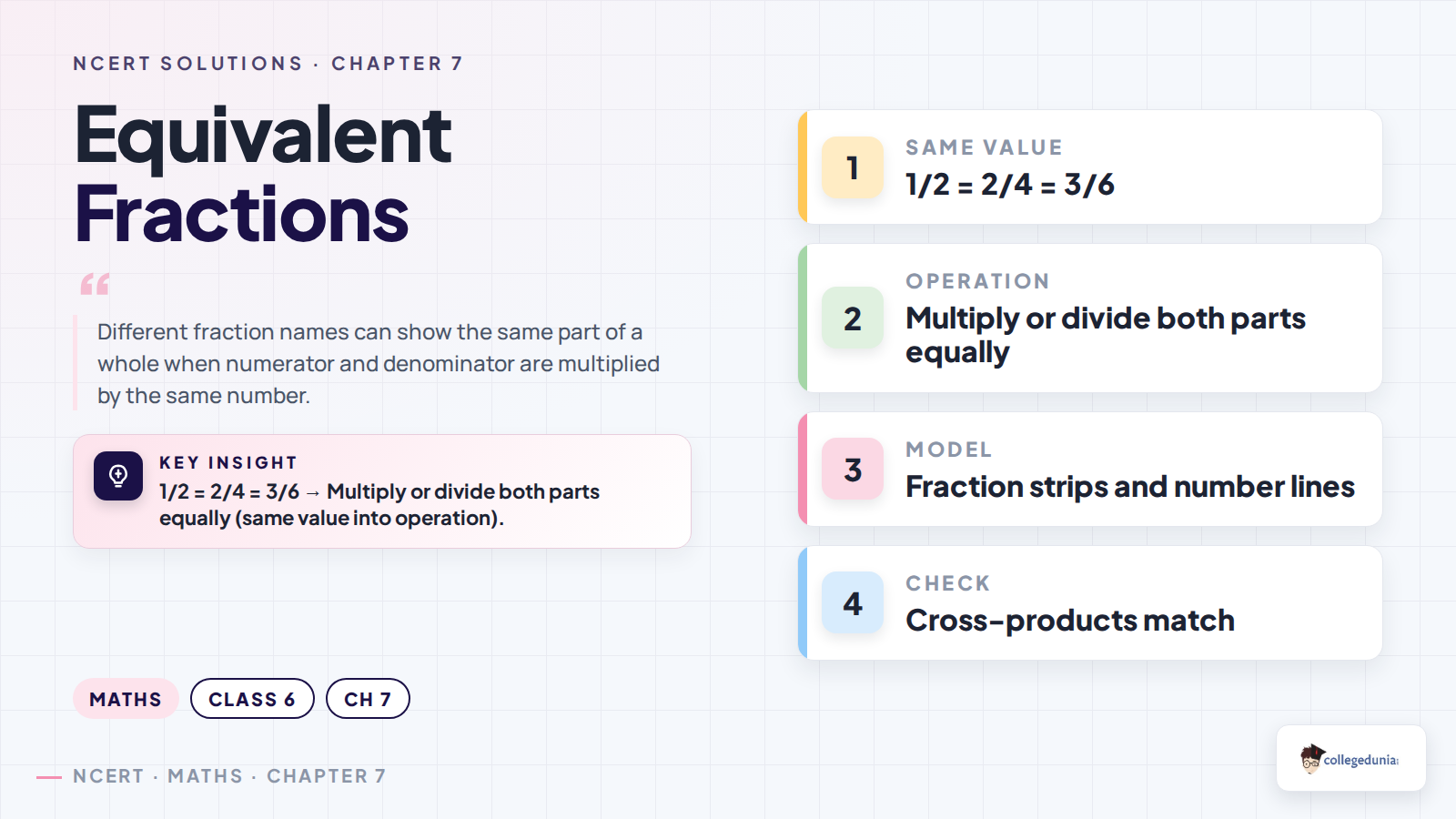
Equivalent fractions look different but represent the same amount. For example, 1/2, 2/4, and 3/6 all occupy the same position on a number line. In the solution PDF, equivalent fractions are used to compare unlike fractions and to prepare fractions for addition or subtraction.
- Multiply numerator and denominator by the same number to make an equivalent fraction.
- Divide numerator and denominator by the same factor to simplify a fraction.
- Use a number line or fraction strip when two written forms seem different.
- Cross-products help check equality when drawings are not available.
If only the numerator changes, the value of the fraction has changed. The denominator must change in the same way for the value to stay equal.
Adding and Subtracting Fractions in Chapter 7
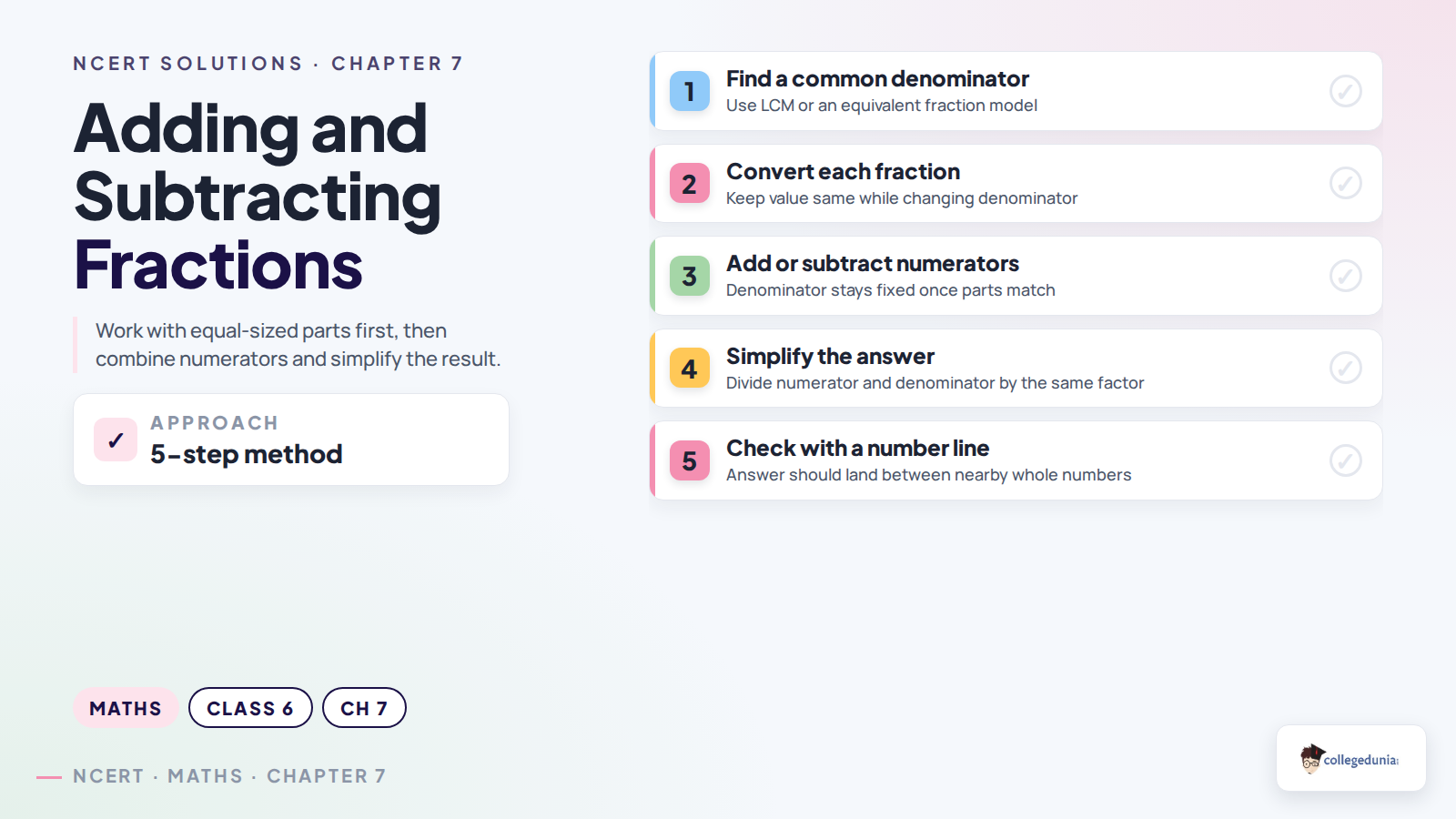
Fraction operations work best when the parts are the same size. Like fractions can be added or subtracted directly because their denominators already match. Unlike fractions first need a common denominator. The denominator records the size of each part, so it stays fixed after parts are matched.
- Find a common denominator using a common multiple.
- Write equivalent fractions with that denominator.
- Add or subtract only the numerators.
- Simplify the answer if both numerator and denominator have a common factor.
- Check the answer with an estimate or a number-line position.
These NCERT Solutions show each arithmetic step instead of jumping to the answer. That makes the method useful for school homework, classroom correction, and 2026-27 revision.
How the Chapter 7 Solution PDF Helps with Homework
The Fractions chapter has activity-style questions, comparison tasks, and arithmetic practice. Some questions ask students to colour parts or describe a sharing situation. Others require clean calculation. The PDF separates the method into short steps so students can match the official NCERT idea with their own notebook work.
| Question type | Best first step | Common check |
|---|---|---|
| Picture or grid fraction | Count equal total parts first | Parts must be equal in size |
| Mixed number | Separate whole and fractional part | Fraction part must be less than one whole |
| Comparison | Make denominators equal or use a number line | Greater fraction lies farther right |
| Addition or subtraction | Match denominators before combining | Numerator changes, denominator stays |
The worked answers also include expert explanations for the calculation-heavy tasks. Students should read the reasoning line before copying the final value, because the same idea returns in later chapters on decimals, ratios, and percentages.
Practice question cards for Fractions
Use the step-by-step question cards after reading the PDF solutions.
Common Mistakes in Fractions NCERT Solutions
Most mistakes in this chapter come from treating fractions like whole numbers. A larger denominator does not always mean a larger value, because the denominator names the size of each part. For unit fractions, a larger denominator means smaller pieces.
- Do not compare fractions by looking only at the numerator.
- Do not add denominators when adding like fractions.
- Do not simplify by subtracting the same number from numerator and denominator.
- Do not convert a mixed number without multiplying the whole number by the denominator.
- Do not ignore the diagram when the question is based on a picture or grid.
Quick check: after adding two proper fractions, ask whether the answer should be less than one, exactly one, or more than one.
Related Resources for Fractions Class 6
Use these Collegedunia resources to read, revise, and practise the same chapter in different ways.
| Resource | What it offers |
|---|---|
| Fractions Class 6 Notes | Definitions, examples, and quick revision points |
| Fractions NCERT Book | Official chapter activities and source questions |
| Fractions Handwritten Notes | Fast revision of rules, models, and common checks |
| Fractions Question Cards | Expandable solutions and expert explanations for every question |
NCERT Solutions for Class 6 Mathematics Ganita Prakash: All Chapters
Move between these solution pages while working through the Ganita Prakash textbook.
| Chapter | NCERT Solutions |
|---|---|
| Chapter 1 | Patterns in Mathematics Solutions |
| Chapter 2 | Lines and Angles Solutions |
| Chapter 3 | Number Play Solutions |
| Chapter 4 | Data Handling and Presentation Solutions |
| Chapter 5 | Prime Time Solutions |
| Chapter 6 | Perimeter and Area Solutions |
| Chapter 7 | Fractions Solutions |
| Chapter 8 | Playing with Constructions Solutions |
| Chapter 9 | Symmetry Solutions |
| Chapter 10 | The Other Side of Zero Solutions |
Fractions Class 6 Mathematics NCERT Solutions FAQs
Ques. What is covered in Class 6 Mathematics Chapter 7 Fractions NCERT Solutions?
Ans. The solutions cover fractional units, mixed numbers, equivalent fractions, comparison, addition, subtraction, picture-based tasks, and number-line reasoning from the 2026-27 Ganita Prakash chapter.
Ques. How should students compare unlike fractions in Chapter 7?
Ans. Students should write equivalent fractions with a common denominator or place both fractions on a number line. Once the parts are the same size, comparison becomes direct.
Ques. Why are equivalent fractions important in this chapter?
Ans. Equivalent fractions help students compare, simplify, add, and subtract fractions without changing the actual value. They connect visual models with arithmetic steps.
Ques. Does the PDF include step-by-step answers for all Fractions questions?
Ans. Yes. The PDF gives step-by-step answers for all 28 question groups, with long answers and expert solution explanations for the calculation and reasoning tasks.



Comments