



The NCERT Solutions for Class 6 Science Curiosity Chapter 4 Exploring Magnets cover all 11 textbook exercise questions for the 2026-27 NCERT syllabus. Students can revise magnetic and non-magnetic materials, poles of a magnet, attraction, repulsion, ring magnets and compass directions from one stepwise PDF.
- Exercise coverage: bar magnets, U-shaped clips, ring magnets, repulsion and compass activity questions.
- Best for revision: each answer explains the idea first, then gives a clean final response.
- Important: Fig. 4.15, Fig. 4.16 and Fig. 4.17 are included inside the PDF for figure-based questions.
Chapter4ExploringMagnetsSolutions.pdf?page=1&dpi=150)
Chapter4ExploringMagnetsSolutions.pdf?page=2&dpi=150)
Chapter4ExploringMagnetsSolutions.pdf?page=3&dpi=150)
Chapter4ExploringMagnetsSolutions.pdf?page=4&dpi=150)
Chapter4ExploringMagnetsSolutions.pdf?page=5&dpi=150)
Chapter4ExploringMagnetsSolutions.pdf?page=6&dpi=150)
Chapter4ExploringMagnetsSolutions.pdf?page=7&dpi=150)
Chapter4ExploringMagnetsSolutions.pdf?page=8&dpi=150)
Chapter4ExploringMagnetsSolutions.pdf?page=9&dpi=150)
Chapter4ExploringMagnetsSolutions.pdf?page=10&dpi=150)
Chapter4ExploringMagnetsSolutions.pdf?page=11&dpi=150)
Chapter4ExploringMagnetsSolutions.pdf?page=12&dpi=150)
Chapter4ExploringMagnetsSolutions.pdf?page=13&dpi=150)
Chapter4ExploringMagnetsSolutions.pdf?page=14&dpi=150)
Chapter4ExploringMagnetsSolutions.pdf?page=15&dpi=150)
Chapter4ExploringMagnetsSolutions.pdf?page=16&dpi=150)
Chapter4ExploringMagnetsSolutions.pdf?page=17&dpi=150)
Chapter4ExploringMagnetsSolutions.pdf?page=18&dpi=150)
Chapter4ExploringMagnetsSolutions.pdf?page=19&dpi=150)
Chapter4ExploringMagnetsSolutions_flat_MobileCard.pdf?page=1&dpi=150)
Chapter4ExploringMagnetsSolutions_flat_MobileCard.pdf?page=2&dpi=150)
Chapter4ExploringMagnetsSolutions_flat_MobileCard.pdf?page=3&dpi=150)
Chapter4ExploringMagnetsSolutions_flat_MobileCard.pdf?page=4&dpi=150)
Chapter4ExploringMagnetsSolutions_flat_MobileCard.pdf?page=5&dpi=150)
Chapter4ExploringMagnetsSolutions_flat_MobileCard.pdf?page=6&dpi=150)
Chapter4ExploringMagnetsSolutions_flat_MobileCard.pdf?page=7&dpi=150)
Chapter4ExploringMagnetsSolutions_flat_MobileCard.pdf?page=8&dpi=150)
Chapter4ExploringMagnetsSolutions_flat_MobileCard.pdf?page=9&dpi=150)
Chapter4ExploringMagnetsSolutions_flat_MobileCard.pdf?page=10&dpi=150)
Chapter4ExploringMagnetsSolutions_flat_MobileCard.pdf?page=11&dpi=150)
Chapter4ExploringMagnetsSolutions_flat_MobileCard.pdf?page=12&dpi=150)
Chapter4ExploringMagnetsSolutions_flat_MobileCard.pdf?page=13&dpi=150)
Chapter4ExploringMagnetsSolutions_flat_MobileCard.pdf?page=14&dpi=150)
Chapter4ExploringMagnetsSolutions_flat_MobileCard.pdf?page=15&dpi=150)
Chapter4ExploringMagnetsSolutions_flat_MobileCard.pdf?page=16&dpi=150)
Chapter4ExploringMagnetsSolutions_flat_MobileCard.pdf?page=17&dpi=150)
Chapter4ExploringMagnetsSolutions_flat_MobileCard.pdf?page=18&dpi=150)
Chapter4ExploringMagnetsSolutions_flat_MobileCard.pdf?page=19&dpi=150)
Chapter4ExploringMagnetsSolutions_flat_MobileCard.pdf?page=20&dpi=150)
Chapter4ExploringMagnetsSolutions_flat_MobileCard.pdf?page=21&dpi=150)
Chapter4ExploringMagnetsSolutions_flat_MobileCard.pdf?page=22&dpi=150)
Chapter4ExploringMagnetsSolutions_flat_MobileCard.pdf?page=23&dpi=150)
Chapter4ExploringMagnetsSolutions_flat_MobileCard.pdf?page=24&dpi=150)
Chapter4ExploringMagnetsSolutions_flat_MobileCard.pdf?page=25&dpi=150)
Chapter4ExploringMagnetsSolutions_flat_MobileCard.pdf?page=26&dpi=150)
Chapter4ExploringMagnetsSolutions_flat_MobileCard.pdf?page=27&dpi=150)
Chapter4ExploringMagnetsSolutions_flat_MobileCard.pdf?page=28&dpi=150)
Chapter4ExploringMagnetsSolutions_flat_MobileCard.pdf?page=29&dpi=150)
Chapter4ExploringMagnetsSolutions_flat_MobileCard.pdf?page=30&dpi=150)
Chapter4ExploringMagnetsSolutions_flat_MobileCard.pdf?page=31&dpi=150)
Chapter4ExploringMagnetsSolutions_flat_MobileCard.pdf?page=32&dpi=150)
Chapter4ExploringMagnetsSolutions_flat_MobileCard.pdf?page=33&dpi=150)
Chapter4ExploringMagnetsSolutions_flat_MobileCard.pdf?page=34&dpi=150)
Student Feedback on Class 6 Science Chapter 4 Solutions
In a Collegedunia classroom poll of 10,840 Class 6 students, students found magnets interesting but needed clearer steps for ring magnet arrangements and compass direction answers.
- 73% wanted a simple rule for attraction and repulsion.
- 66% needed help identifying north and south poles in figure questions.
- 61% mixed up magnetic materials with materials through which magnetism can act.
|
Table of Contents |
NCERT Solutions for Class 6 Science Chapter 4 PDF
The PDF above gives complete answers to Exploring Magnets from the Class 6 Science Curiosity book. It follows the textbook order and keeps the answer language suitable for school notebooks.
Students should read the question first, observe the figure if it is given, and then compare their own answer with the solved steps. This chapter rewards clear observation more than long definitions, so short accurate points are better than memorised paragraphs.
Exploring Magnets Chapter 4 Video Explanation
Source: Magnet Brains on YouTube
Magnetic Materials in Exploring Magnets Solutions
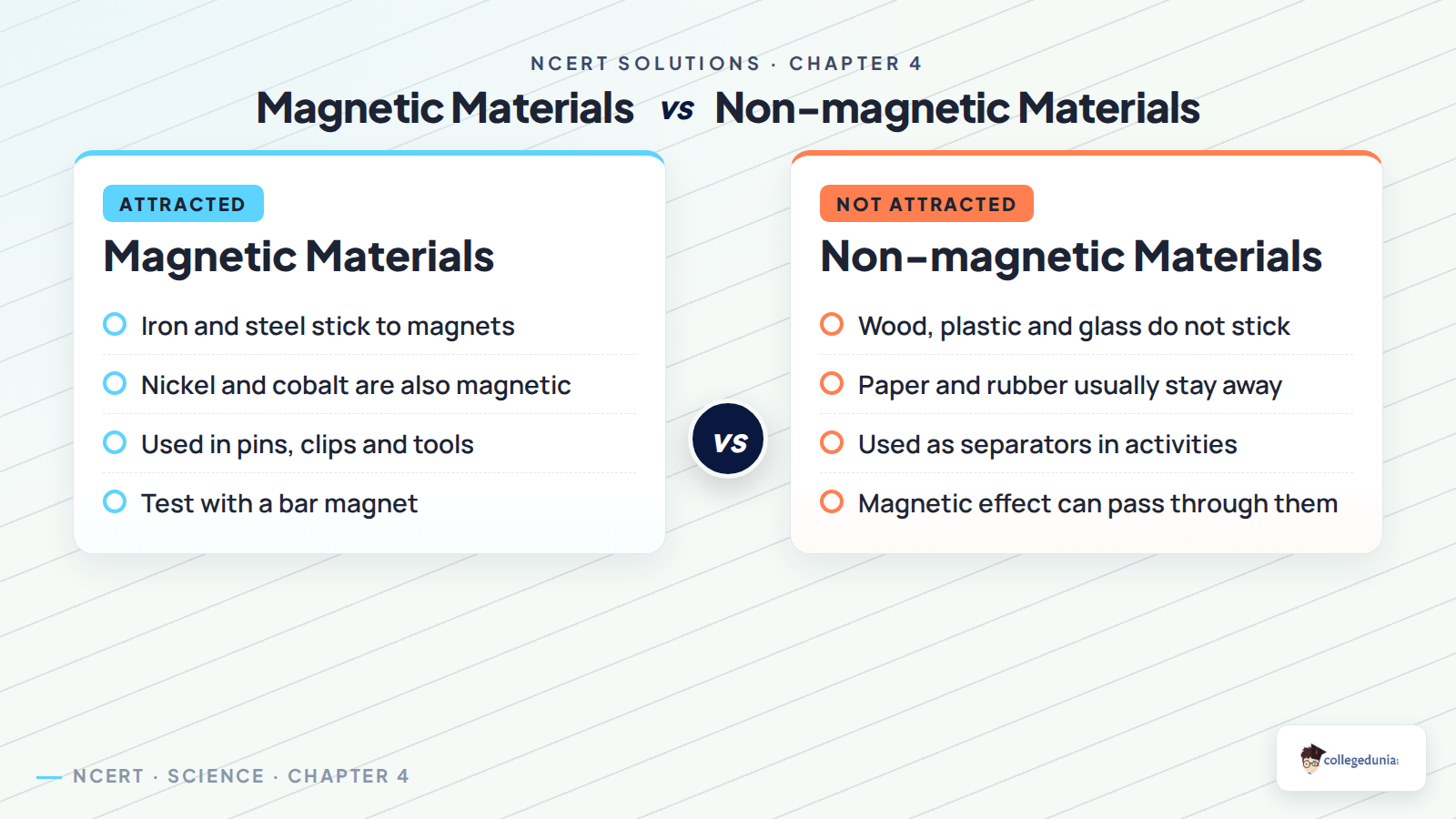
The chapter begins by separating materials that are attracted by a magnet from those that are not attracted. Iron, steel, nickel and cobalt are common magnetic materials, while wood, plastic, glass, paper and rubber are non-magnetic in normal classroom activities.
- A magnet attracts some materials but not every metal or object.
- The ends of a bar magnet are its poles, where the pull is usually strongest.
- Magnetic effect can pass through some non-magnetic materials, as shown in the paper and glass activity.
Attraction and Repulsion Questions in Chapter 4
Question 10 and Question 11 are important because they test the rule for magnet poles. Unlike poles attract each other, while like poles repel each other. Repulsion is especially useful because it confirms that both objects are magnets.
| Question Area | What to Observe | Answer Cue |
|---|---|---|
| Fig. 4.15 | Bar magnet and U-shaped paper clips | Clips show attraction to the magnet |
| Fig. 4.16 | Ring magnets arranged on a pencil | Repulsion keeps the upper magnet lifted |
| Fig. 4.17 | Three bar magnets labelled with pole positions | Use unlike attract and like repel |
| Compass activity | Needle direction after it settles | Freely moving magnet rests roughly north-south |
How a Magnetic Compass Works
A magnetic compass has a small magnetised needle that can rotate freely. The Earth behaves like a large magnet, so the needle settles roughly along the north-south direction when it is free to move.
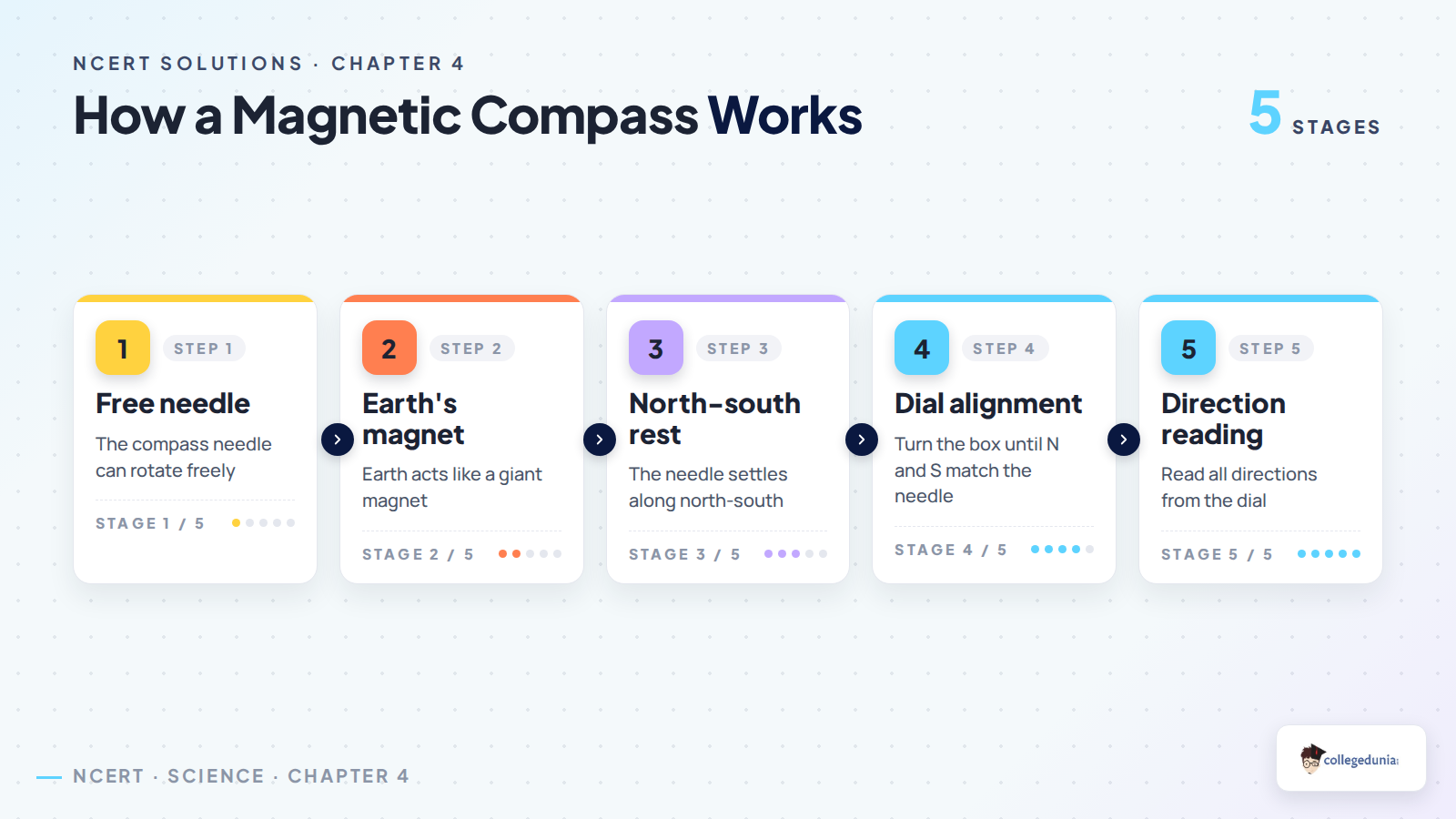
For compass questions, students should write the observation and then the reason. A clear answer can say that the needle comes to rest in a fixed direction because it is a magnet that aligns with the Earth's magnetic direction.
Common Mistakes in Exploring Magnets Answers
Many wrong answers in this chapter come from using only the word attraction. Students must also remember repulsion, because only like poles of magnets repel each other. A piece of iron may be attracted by a magnet, but it does not prove repulsion.
- Do not call every shiny object magnetic.
- Do not say the middle of a bar magnet is the strongest part.
- Do not ignore labels in Fig. 4.17 while naming north and south poles.
- Do not write that a compass points anywhere randomly after spinning.
Practice Questions HTML for Class 6 Science Chapter 4
Students who want to practise one question at a time can open the interactive question set below. It keeps the answer hidden until the student clicks the solution tab.
Related NCERT Resources for Exploring Magnets
| Resource | Use it for | Link |
|---|---|---|
| NCERT Notes | Revise poles, compass and classroom activities before solving | Open Notes |
| Handwritten Notes | Quick recap in notebook style | Open Handwritten Notes |
| Official NCERT Book | Read the textbook chapter before checking answers | Open Book PDF |
All Class 6 Science Curiosity NCERT Solutions Chapters
| Chapter | NCERT Solutions Link |
|---|---|
| Chapter 1: The Wonderful World of Science | Open Solutions |
| Chapter 2: Diversity in the Living World | Open Solutions |
| Chapter 3: Mindful Eating: A Path to a Healthy Body | Open Solutions |
| Chapter 4: Exploring Magnets | Open Solutions |
Class 6 Science Chapter 4 NCERT Solutions FAQs
Ques. What is covered in Class 6 Science Chapter 4 Exploring Magnets solutions?
Ans. The solutions cover magnetic materials, poles, compass direction, attraction, repulsion, ring magnets and figure-based exercise questions.
Ques. How many exercise questions are solved in this PDF?
Ans. The PDF solves all 11 textbook exercise questions from NCERT Class 6 Science Curiosity Chapter 4 Exploring Magnets.
Ques. Which figures are included in the Chapter 4 solutions?
Ans. Fig. 4.15, Fig. 4.16 and Fig. 4.17 are included because the exercise questions refer directly to these diagrams.
Ques. What is the main rule for magnet poles in this chapter?
Ans. Unlike poles attract each other and like poles repel each other. This rule is used in the ring magnet and bar magnet questions.



Comments