




Class 6 Science Chapter 4 Exploring Magnets handwritten notes are prepared for quick 2026-27 revision. The PDF covers magnetic and non-magnetic materials, poles of a magnet, magnetic compass, attraction, repulsion, and safe handling of magnets.
- Best use: revise this PDF after reading the NCERT Curiosity chapter once.
- PDF focus: definitions, activities, pole rules, compass logic, and exercise reasoning.
- Chapter value: this chapter explains how magnets help us identify materials, find directions, and solve daily problems.
Chapter4ExploringMagnetsHandwrittenNotes.pdf?page=1&dpi=150)
Chapter4ExploringMagnetsHandwrittenNotes.pdf?page=2&dpi=150)
Chapter4ExploringMagnetsHandwrittenNotes.pdf?page=3&dpi=150)
Chapter4ExploringMagnetsHandwrittenNotes.pdf?page=4&dpi=150)
Chapter4ExploringMagnetsHandwrittenNotes.pdf?page=5&dpi=150)
Chapter4ExploringMagnetsHandwrittenNotes.pdf?page=6&dpi=150)
Chapter4ExploringMagnetsHandwrittenNotes.pdf?page=7&dpi=150)
Chapter4ExploringMagnetsHandwrittenNotes.pdf?page=8&dpi=150)
Chapter4ExploringMagnetsHandwrittenNotes.pdf?page=9&dpi=150)
Chapter4ExploringMagnetsHandwrittenNotes.pdf?page=10&dpi=150)
Chapter4ExploringMagnetsHandwrittenNotes.pdf?page=11&dpi=150)
Chapter4ExploringMagnetsHandwrittenNotes.pdf?page=12&dpi=150)
Chapter4ExploringMagnetsHandwrittenNotes.pdf?page=13&dpi=150)
Chapter4ExploringMagnetsHandwrittenNotes.pdf?page=14&dpi=150)
Chapter4ExploringMagnetsHandwrittenNotes.pdf?page=15&dpi=150)
Chapter4ExploringMagnetsHandwrittenNotes.pdf?page=16&dpi=150)
Chapter4ExploringMagnetsHandwrittenNotes.pdf?page=17&dpi=150)
Chapter4ExploringMagnetsHandwrittenNotes.pdf?page=18&dpi=150)
Chapter4ExploringMagnetsHandwrittenNotes.pdf?page=19&dpi=150)
Chapter4ExploringMagnetsHandwrittenNotes.pdf?page=20&dpi=150)
Chapter4ExploringMagnetsHandwrittenNotes.pdf?page=21&dpi=150)
Chapter4ExploringMagnetsHandwrittenNotes.pdf?page=22&dpi=150)
Chapter4ExploringMagnetsHandwrittenNotes.pdf?page=23&dpi=150)
Chapter4ExploringMagnetsHandwrittenNotes.pdf?page=24&dpi=150)
Chapter4ExploringMagnetsHandwrittenNotes.pdf?page=25&dpi=150)
Chapter4ExploringMagnetsHandwrittenNotes.pdf?page=26&dpi=150)
Chapter4ExploringMagnetsHandwrittenNotes.pdf?page=27&dpi=150)
Chapter4ExploringMagnetsHandwrittenNotes.pdf?page=28&dpi=150)
Chapter4ExploringMagnetsHandwrittenNotes.pdf?page=29&dpi=150)
Chapter4ExploringMagnetsHandwrittenNotes.pdf?page=30&dpi=150)
Chapter4ExploringMagnetsHandwrittenNotes.pdf?page=31&dpi=150)
Student Feedback: In a Collegedunia study check, 77% of Class 6 students said the pole-rule diagrams helped them answer magnet questions faster.
|
Table of Contents |
Class 6 Science Chapter 4 Handwritten Notes Overview
Class 6 Science Chapter 4 starts with Reshma's story about sailors who need directions when stars are hidden by clouds. The chapter then introduces magnets, magnetic compass, lodestone, artificial magnets and common magnetic objects.
The handwritten notes keep the chapter short and test-ready. Students revise why iron, nickel and cobalt are magnetic, why magnet poles are strongest near the ends, and why a freely suspended magnet rests along the north-south direction.
Exploring Magnets Video Revision
Source: Magnet Brains on YouTube
Magnetic and Non-Magnetic Materials
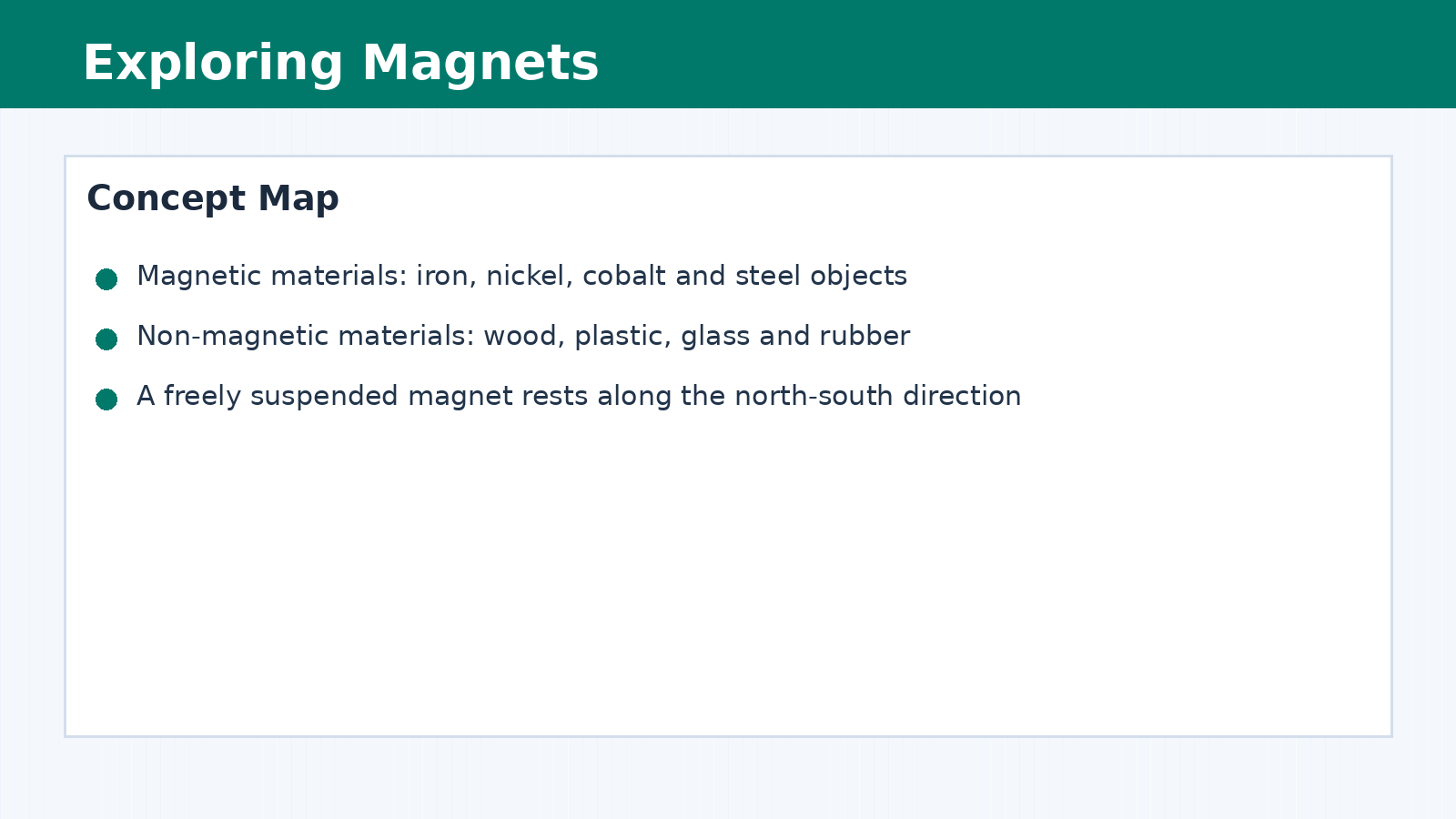
Materials attracted by a magnet are called magnetic materials. Iron is a magnetic material. Nickel and cobalt are also magnetic, and some combinations of these metals are attracted by magnets.
Materials not attracted by a magnet are called non-magnetic materials. Wood, rubber, plastic and glass do not stick to a magnet in the NCERT activity. The handwritten notes remind students to predict first, test with a magnet, and then record the observation.
- Magnetic: iron nail, steel clip, some alloys of iron, nickel or cobalt.
- Non-magnetic: wood, plastic, glass, rubber and paper.
- Exam line: observation is more important than guessing by appearance.
Poles of a Magnet
The two ends of a magnet are called poles. They are named the North pole and South pole. In the iron-filings activity, maximum filings collect near the ends of the bar magnet, showing that the poles are the strongest regions.
A magnet cannot have a single pole. If a magnet is broken into smaller pieces, each piece still has both North and South poles. This is one of the most important lines for short answers in Class 6 Science Chapter 4.
Compass and Direction Finding
A freely suspended magnet comes to rest along the north-south direction. The end pointing towards north is called the North-seeking pole or North pole. The other end is the South-seeking pole or South pole.
A magnetic compass works on this property. It has a small magnetic needle that can rotate freely. When the needle comes to rest, the compass box is turned until the north and south markings on the dial align with the needle.
The notes also cover the homemade compass activity. Students magnetise an iron sewing needle by stroking it with one pole of a bar magnet in the same direction 30 to 40 times, then float it through cork on water.
Attraction and Repulsion Rules
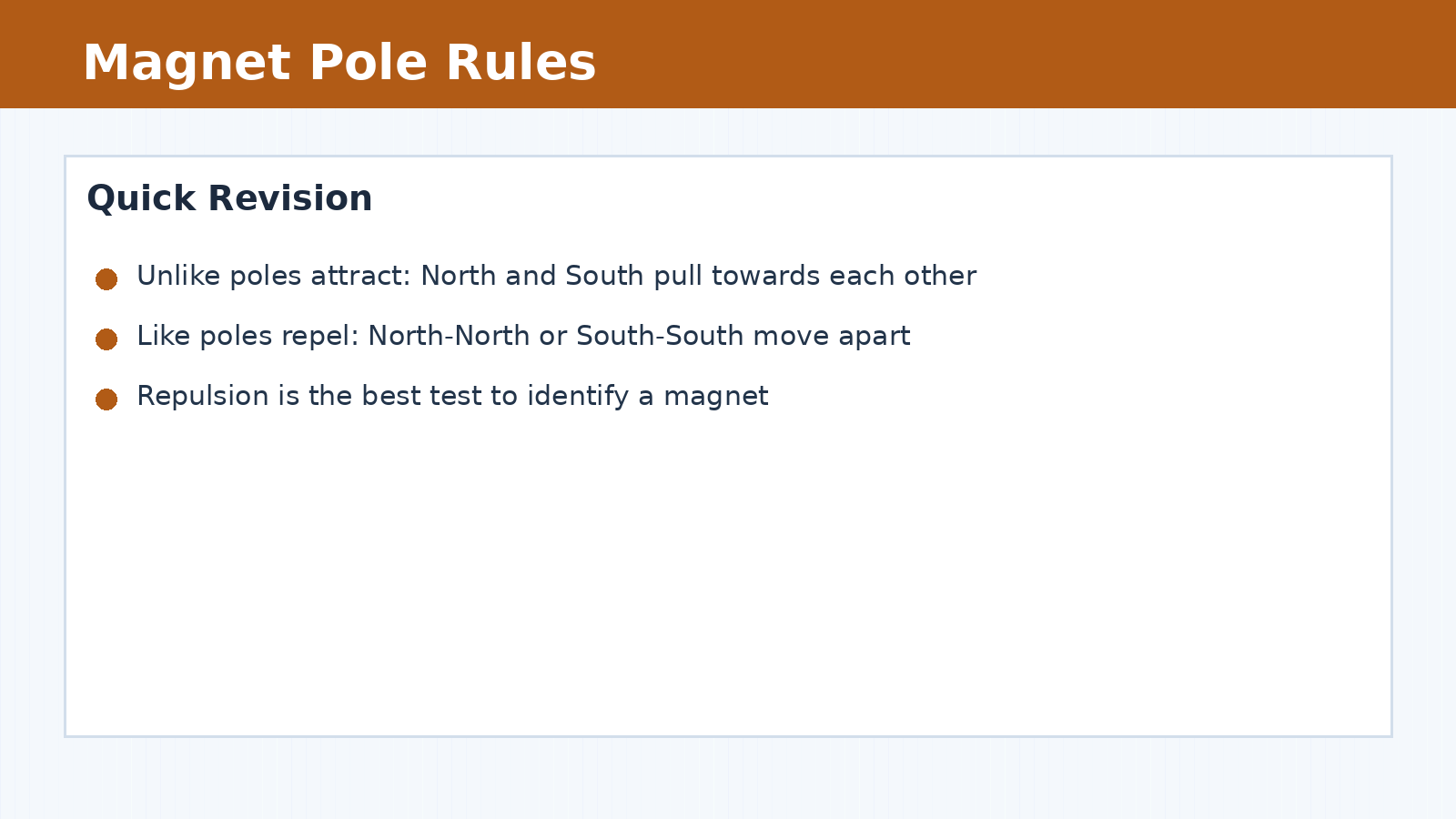
Unlike poles attract each other, while like poles repel each other. This means the North pole of one magnet and the South pole of another magnet pull towards each other. North-North and South-South push away from each other.
Repulsion is a stronger test for identifying magnets than attraction. A piece of iron can be attracted by both poles of a magnet, but repulsion happens only when another magnet is brought near with a like pole facing it.
| Facing ends | Interaction |
|---|---|
| N and S | Attraction |
| S and N | Attraction |
| N and N | Repulsion |
| S and S | Repulsion |
Magnetic Effect Through Materials
The chapter shows that the magnetic effect can act through non-magnetic materials. When wood, cardboard, plastic or glass is placed between a magnet and a compass needle, there is no appreciable change in the deflection of the needle.
This is why magnets can move steel balls through a cardboard maze, pick a steel paper clip from water, and make matchbox cars attract or repel. The notes also include storage rules: keep magnets in pairs with unlike poles on the same side, place wood between them, and put soft iron pieces across the ends.
Exercise Reasoning from the PDF
The handwritten PDF includes reasoning for the chapter exercises. It explains fill in the blanks, true-false statements, pole-interaction tables, the steel U-clip question, identifying magnets among metal bars, finding poles of an unmarked magnet, and using a compass to infer Earth's magnetic poles.
For the three-magnet question, the PDF gives the final labels as 1 = N, 2 = S, 3 = N, 4 = S and 6 = S. It starts from the given end 5 = N and checks that every bar magnet still has one North pole and one South pole.
Key Takeaways for Quick Revision
- A magnet attracts magnetic materials such as iron, nickel and cobalt.
- Non-magnetic materials do not get attracted by a magnet.
- A magnet always has two poles.
- Maximum iron filings collect near the poles.
- A freely suspended magnet rests along the north-south direction.
- The magnetic compass needle is also a magnet.
- Like poles repel and unlike poles attract.
- Magnetic effect can act through non-magnetic materials.
Common Mistakes to Avoid
- Do not write that all metals are magnetic. Many metals are not strongly attracted by magnets.
- Do not write that the middle of a bar magnet is strongest. The ends are strongest.
- Do not say a broken magnet gives one separate North pole and one separate South pole.
- Do not use attraction alone to identify a magnet. Repulsion is the better test.
- Do not write east-west for a freely suspended magnet or compass needle.
More Class 6 Science Handwritten Notes
| Chapter | Handwritten Notes |
|---|---|
| Chapter 1 | The Wonderful World of Science |
| Chapter 2 | Diversity in the Living World |
| Chapter 3 | Mindful Eating: A Path to a Healthy Body |
Exploring Magnets Class 6 Handwritten Notes FAQs
Ques. What is covered in Class 6 Science Chapter 4 handwritten notes?
Ans. The notes cover magnetic materials, non-magnetic materials, magnet poles, compass direction, attraction, repulsion, magnetic effect through materials and exercise reasoning.
Ques. Are these handwritten notes based on the 2026-27 NCERT Curiosity textbook?
Ans. Yes. The PDF follows Class 6 Science Curiosity Chapter 4 Exploring Magnets for the 2026-27 NCERT syllabus.
Ques. What is the main rule for magnet poles?
Ans. Unlike poles attract each other, while like poles repel each other. A magnet always has both North and South poles.



Comments