



The NCERT Solutions for Class 6 Science Curiosity Chapter 9 Methods of Separation in Everyday Life cover all exercise answers for the 2026-27 textbook. The PDF explains handpicking, sorting, churning, filtration, decantation, masks as filters and multi-step separation of mixtures.
- Resource: Class 6 Science Chapter 9 NCERT Solutions PDF.
- Chapter focus: separation methods used at home, farms, kitchens and water cleaning.
- Question type: MCQ, true-false, matching, reasoning and procedure writing.
Chapter9MethodsofSeparationinEverydayLifeSolutions.pdf?page=1&dpi=150)
Chapter9MethodsofSeparationinEverydayLifeSolutions.pdf?page=2&dpi=150)
Chapter9MethodsofSeparationinEverydayLifeSolutions.pdf?page=3&dpi=150)
Chapter9MethodsofSeparationinEverydayLifeSolutions.pdf?page=4&dpi=150)
Chapter9MethodsofSeparationinEverydayLifeSolutions.pdf?page=5&dpi=150)
Chapter9MethodsofSeparationinEverydayLifeSolutions.pdf?page=6&dpi=150)
Chapter9MethodsofSeparationinEverydayLifeSolutions.pdf?page=7&dpi=150)
Chapter9MethodsofSeparationinEverydayLifeSolutions.pdf?page=8&dpi=150)
Chapter9MethodsofSeparationinEverydayLifeSolutions.pdf?page=9&dpi=150)
Chapter9MethodsofSeparationinEverydayLifeSolutions.pdf?page=10&dpi=150)
Chapter9MethodsofSeparationinEverydayLifeSolutions.pdf?page=11&dpi=150)
Chapter9MethodsofSeparationinEverydayLifeSolutions.pdf?page=12&dpi=150)
Chapter9MethodsofSeparationinEverydayLifeSolutions.pdf?page=13&dpi=150)
Chapter9MethodsofSeparationinEverydayLifeSolutions.pdf?page=14&dpi=150)
Chapter9MethodsofSeparationinEverydayLifeSolutions.pdf?page=15&dpi=150)
Chapter9MethodsofSeparationinEverydayLifeSolutions_flat_MobileCard.pdf?page=1&dpi=150)
Chapter9MethodsofSeparationinEverydayLifeSolutions_flat_MobileCard.pdf?page=2&dpi=150)
Chapter9MethodsofSeparationinEverydayLifeSolutions_flat_MobileCard.pdf?page=3&dpi=150)
Chapter9MethodsofSeparationinEverydayLifeSolutions_flat_MobileCard.pdf?page=4&dpi=150)
Chapter9MethodsofSeparationinEverydayLifeSolutions_flat_MobileCard.pdf?page=5&dpi=150)
Chapter9MethodsofSeparationinEverydayLifeSolutions_flat_MobileCard.pdf?page=6&dpi=150)
Chapter9MethodsofSeparationinEverydayLifeSolutions_flat_MobileCard.pdf?page=7&dpi=150)
Chapter9MethodsofSeparationinEverydayLifeSolutions_flat_MobileCard.pdf?page=8&dpi=150)
Chapter9MethodsofSeparationinEverydayLifeSolutions_flat_MobileCard.pdf?page=9&dpi=150)
Chapter9MethodsofSeparationinEverydayLifeSolutions_flat_MobileCard.pdf?page=10&dpi=150)
Chapter9MethodsofSeparationinEverydayLifeSolutions_flat_MobileCard.pdf?page=11&dpi=150)
Chapter9MethodsofSeparationinEverydayLifeSolutions_flat_MobileCard.pdf?page=12&dpi=150)
Chapter9MethodsofSeparationinEverydayLifeSolutions_flat_MobileCard.pdf?page=13&dpi=150)
Chapter9MethodsofSeparationinEverydayLifeSolutions_flat_MobileCard.pdf?page=14&dpi=150)
Chapter9MethodsofSeparationinEverydayLifeSolutions_flat_MobileCard.pdf?page=15&dpi=150)
Chapter9MethodsofSeparationinEverydayLifeSolutions_flat_MobileCard.pdf?page=16&dpi=150)
Chapter9MethodsofSeparationinEverydayLifeSolutions_flat_MobileCard.pdf?page=17&dpi=150)
Chapter9MethodsofSeparationinEverydayLifeSolutions_flat_MobileCard.pdf?page=18&dpi=150)
Chapter9MethodsofSeparationinEverydayLifeSolutions_flat_MobileCard.pdf?page=19&dpi=150)
Chapter9MethodsofSeparationinEverydayLifeSolutions_flat_MobileCard.pdf?page=20&dpi=150)
Chapter9MethodsofSeparationinEverydayLifeSolutions_flat_MobileCard.pdf?page=21&dpi=150)
Chapter9MethodsofSeparationinEverydayLifeSolutions_flat_MobileCard.pdf?page=22&dpi=150)
Chapter9MethodsofSeparationinEverydayLifeSolutions_flat_MobileCard.pdf?page=23&dpi=150)
Chapter9MethodsofSeparationinEverydayLifeSolutions_flat_MobileCard.pdf?page=24&dpi=150)
Chapter9MethodsofSeparationinEverydayLifeSolutions_flat_MobileCard.pdf?page=25&dpi=150)
Chapter9MethodsofSeparationinEverydayLifeSolutions_flat_MobileCard.pdf?page=26&dpi=150)
Chapter9MethodsofSeparationinEverydayLifeSolutions_flat_MobileCard.pdf?page=27&dpi=150)
Chapter9MethodsofSeparationinEverydayLifeSolutions_flat_MobileCard.pdf?page=28&dpi=150)
Student Feedback: Most students score better in Chapter 9 after linking each method to one property difference.
In This Article
Methods of Separation in Everyday Life Solutions Overview
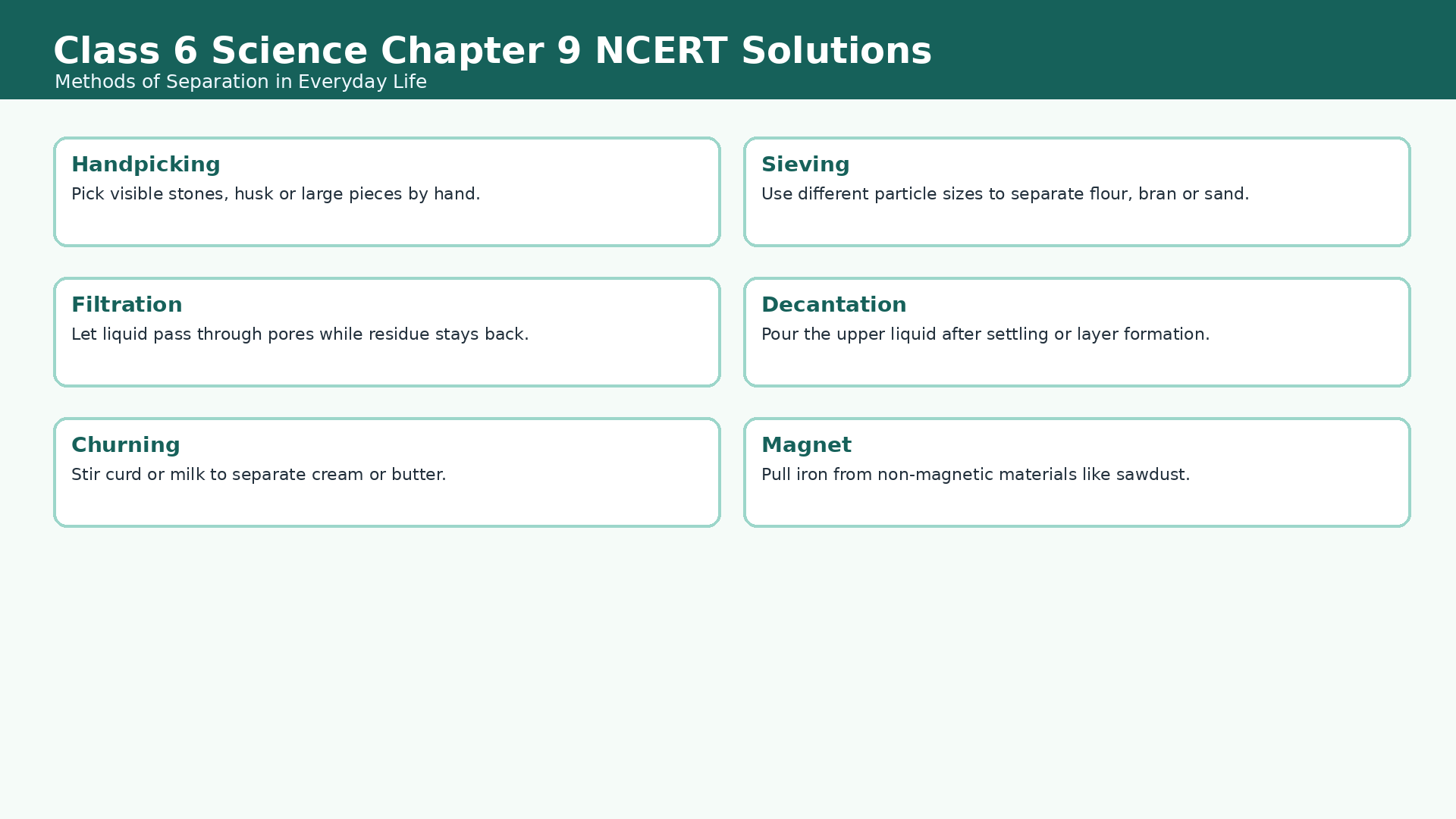
Chapter 9 explains why mixtures are separated and how the correct method depends on the difference between components. Handpicking uses visible size or colour, winnowing uses weight, sieving uses particle size, filtration uses pore size, decantation uses settling or layers, and magnetic separation uses magnetism.
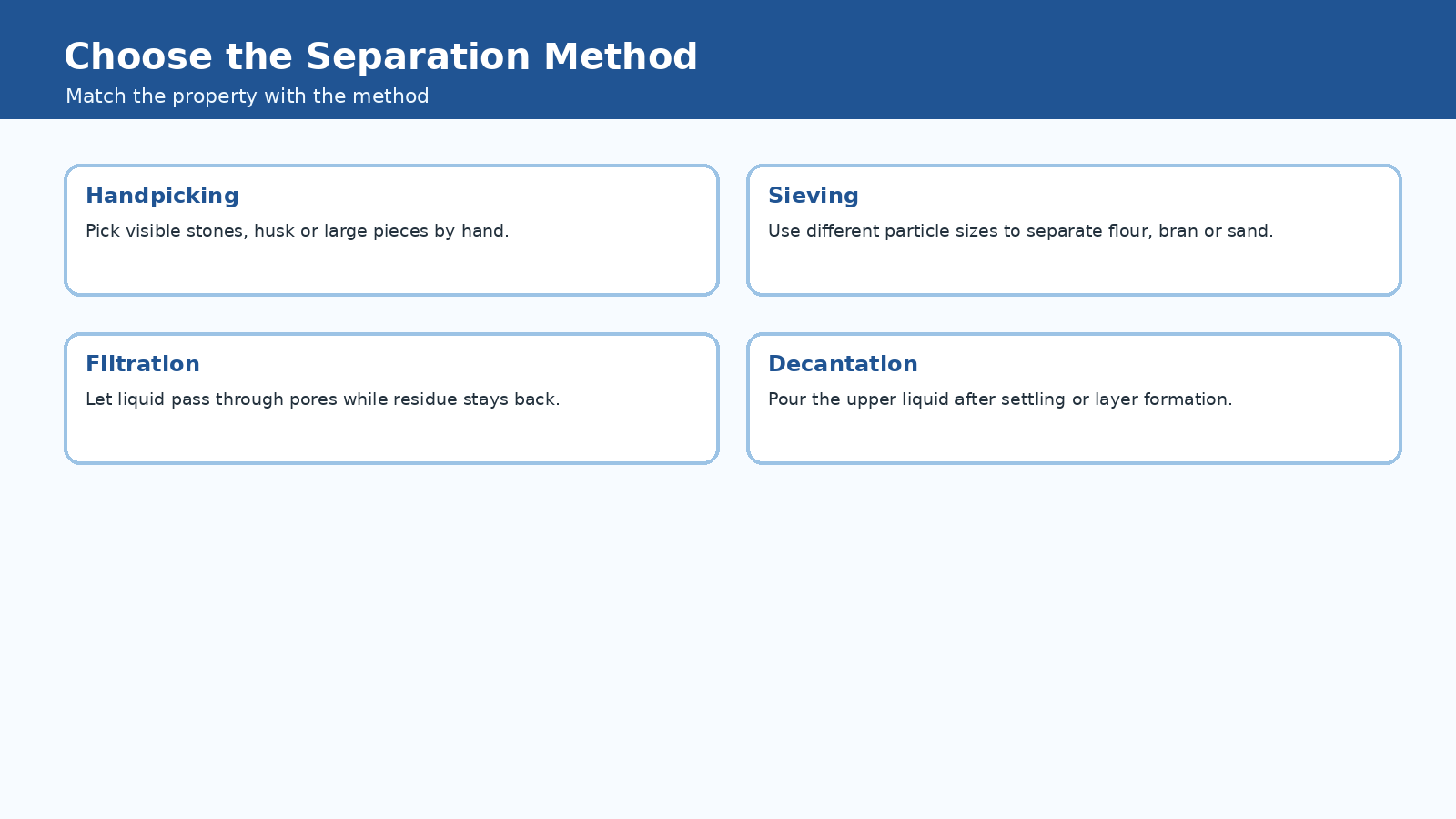
| Method | Property used | Example |
|---|---|---|
| Handpicking | visible size, colour or shape | stones from grains |
| Sieving | different particle sizes | bran from flour |
| Filtration | pore size | chalk powder from water |
| Decantation | settling or separate layers | oil from water |
| Magnetic separation | magnetism | iron powder from sawdust |
How to Separate a Three-Part Mixture in Chapter 9
The potato, salt and sawdust question needs more than one method. First remove the large visible potato pieces, then use water to dissolve salt, separate sawdust, and finally evaporate the salt solution.
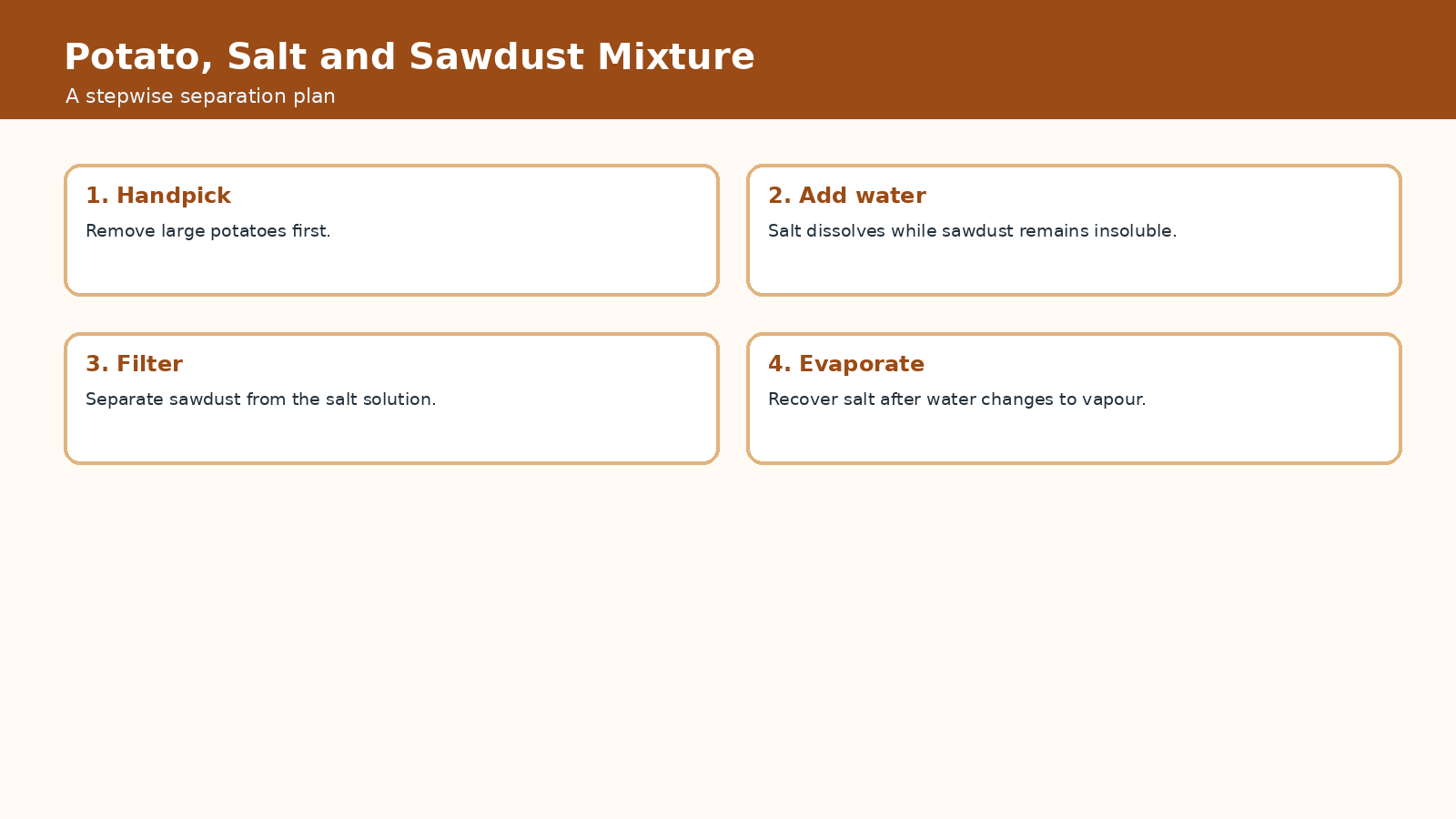
- Large solid: potatoes can be handpicked.
- Soluble solid: salt dissolves in water.
- Insoluble solid: sawdust can be filtered or skimmed.
- Recovery: evaporation leaves salt behind.
Methods of Separation in Everyday Life Video Lesson
Source: Chapter 9 Methods of Separation question bank and NCERT answers on YouTube
All Chapter 9 Question Cards with Solutions
The companion question-card page gives each Chapter 9 exercise prompt with a Check Solution panel and an Expert Solution panel. Use it for quick answer practice before downloading the PDF.
Open question cards: Class 6 Science Chapter 9 step-by-step solutions
Related Class 6 Science Chapter 9 Resources
| Resource | Class 6 Science Chapter 9 Link |
|---|---|
| Notes | Revise Chapter 9 with notes |
| Handwritten Notes | Open handwritten revision notes |
| NCERT Book PDF | Download the textbook chapter |
Class 6 Science Curiosity NCERT Solutions for All Chapters
| Chapter | NCERT Solutions |
|---|---|
| Chapter 1 | The Wonderful World of Science Solutions |
| Chapter 2 | Diversity in the Living World Solutions |
| Chapter 3 | Mindful Eating: A Path to a Healthy Body Solutions |
| Chapter 4 | Exploring Magnets Solutions |
| Chapter 5 | Measurement of Length and Motion Solutions |
| Chapter 6 | Materials Around Us Solutions |
| Chapter 7 | Temperature and its Measurement Solutions |
| Chapter 8 | A Journey through States of Water Solutions |
| Chapter 9 | Methods of Separation in Everyday Life Solutions |
| Chapter 10 | Living Creatures: Exploring their Characteristics Solutions |
| Chapter 11 | Nature's Treasures Solutions |
| Chapter 12 | Beyond Earth Solutions |
Class 6 Science Chapter 9 NCERT Solutions FAQs
Ques. What is covered in Class 6 Science Chapter 9 NCERT Solutions?
Ans. The PDF covers handpicking, churning, filtration, decantation, sieving, magnetic separation and all exercise answers.
Ques. Are these answers based on the 2026-27 NCERT book?
Ans. Yes. The answers follow the 2026-27 NCERT Class 6 Science Curiosity Chapter 9 Methods of Separation in Everyday Life.
Ques. What is the answer to the handpicking MCQ?
Ans. Handpicking serves the purpose of sorting because visible unwanted pieces are picked out by hand.
Ques. How are salt and sawdust separated?
Ans. Add water to dissolve salt, filter or skim sawdust, and evaporate the salt solution to recover salt.



Comments