




The handwritten notes on Class 6 Science Chapter 9 Methods of Separation in Everyday Life are prepared for quick 2026-27 revision. The PDF covers handpicking, threshing, winnowing, sieving, evaporation, sedimentation, decantation, filtration, churning, and magnetic separation.
- Best use: revise this PDF after reading the NCERT Curiosity chapter once.
- PDF focus: separation method, property used, daily example, and exam clue.
- Chapter value: this chapter connects kitchen, farm, water, and recycling examples with science ideas.
Chapter9MethodsofSeparationinEverydayLifeHandwrittenNotes.pdf?page=1&dpi=150)
Chapter9MethodsofSeparationinEverydayLifeHandwrittenNotes.pdf?page=2&dpi=150)
Chapter9MethodsofSeparationinEverydayLifeHandwrittenNotes.pdf?page=3&dpi=150)
Chapter9MethodsofSeparationinEverydayLifeHandwrittenNotes.pdf?page=4&dpi=150)
Chapter9MethodsofSeparationinEverydayLifeHandwrittenNotes.pdf?page=5&dpi=150)
Chapter9MethodsofSeparationinEverydayLifeHandwrittenNotes.pdf?page=6&dpi=150)
Chapter9MethodsofSeparationinEverydayLifeHandwrittenNotes.pdf?page=7&dpi=150)
Chapter9MethodsofSeparationinEverydayLifeHandwrittenNotes.pdf?page=8&dpi=150)
Chapter9MethodsofSeparationinEverydayLifeHandwrittenNotes.pdf?page=9&dpi=150)
Chapter9MethodsofSeparationinEverydayLifeHandwrittenNotes.pdf?page=10&dpi=150)
Chapter9MethodsofSeparationinEverydayLifeHandwrittenNotes.pdf?page=11&dpi=150)
Chapter9MethodsofSeparationinEverydayLifeHandwrittenNotes.pdf?page=12&dpi=150)
Chapter9MethodsofSeparationinEverydayLifeHandwrittenNotes.pdf?page=13&dpi=150)
Chapter9MethodsofSeparationinEverydayLifeHandwrittenNotes.pdf?page=14&dpi=150)
Chapter9MethodsofSeparationinEverydayLifeHandwrittenNotes.pdf?page=15&dpi=150)
Chapter9MethodsofSeparationinEverydayLifeHandwrittenNotes.pdf?page=16&dpi=150)
Chapter9MethodsofSeparationinEverydayLifeHandwrittenNotes.pdf?page=17&dpi=150)
Chapter9MethodsofSeparationinEverydayLifeHandwrittenNotes.pdf?page=18&dpi=150)
Chapter9MethodsofSeparationinEverydayLifeHandwrittenNotes.pdf?page=19&dpi=150)
Chapter9MethodsofSeparationinEverydayLifeHandwrittenNotes.pdf?page=20&dpi=150)
Chapter9MethodsofSeparationinEverydayLifeHandwrittenNotes.pdf?page=21&dpi=150)
Chapter9MethodsofSeparationinEverydayLifeHandwrittenNotes.pdf?page=22&dpi=150)
Chapter9MethodsofSeparationinEverydayLifeHandwrittenNotes.pdf?page=23&dpi=150)
Chapter9MethodsofSeparationinEverydayLifeHandwrittenNotes.pdf?page=24&dpi=150)
Chapter9MethodsofSeparationinEverydayLifeHandwrittenNotes.pdf?page=25&dpi=150)
Chapter9MethodsofSeparationinEverydayLifeHandwrittenNotes.pdf?page=26&dpi=150)
Chapter9MethodsofSeparationinEverydayLifeHandwrittenNotes.pdf?page=27&dpi=150)
Chapter9MethodsofSeparationinEverydayLifeHandwrittenNotes.pdf?page=28&dpi=150)
Chapter9MethodsofSeparationinEverydayLifeHandwrittenNotes.pdf?page=29&dpi=150)
Chapter9MethodsofSeparationinEverydayLifeHandwrittenNotes.pdf?page=30&dpi=150)
Chapter9MethodsofSeparationinEverydayLifeHandwrittenNotes.pdf?page=31&dpi=150)
Chapter9MethodsofSeparationinEverydayLifeHandwrittenNotes.pdf?page=32&dpi=150)
Student Feedback: In a Collegedunia study check, 78% of Class 6 students said the method-property table helped them choose the right separation process faster.
|
Table of Contents |
Class 6 Science Chapter 9 Handwritten Notes Overview
Class 6 Science Chapter 9 follows Malli and Valli as they observe separation methods in different parts of India. The chapter begins with stones and husk being removed from grains, then moves to farms, kitchens, salt pans, tea strainers, river nets, butter churning, and magnets in recycling.
The handwritten PDF turns these examples into a revision map. Students can quickly learn what each method separates, which property it uses, and where the method appears in everyday life.
Methods of Separation Video Revision
Source: Magnet Brains on YouTube
Why We Separate Substances
We separate substances when a mixture has useful and unwanted components together. A mixture of rice and stones must be cleaned before cooking. Tea leaves must be removed from tea. Iron nails can be removed from sawdust with a magnet.
NCERT shows that the method is chosen by observing a difference between the components. The property decides the separation method. The difference may be size, colour, shape, weight, solubility, settling behaviour, or magnetic nature.

Handpicking, Threshing and Winnowing
Handpicking is used when the unwanted pieces are few and can be picked by hand. NCERT gives examples like stones from grains and whole black peppers from pulao.
Threshing separates grains from harvested stalks. Farmers beat the stalks or use threshers so the grains detach. Winnowing then uses wind or moving air to blow away lighter husk while heavier grains fall nearby.
| Method | Property used | NCERT example |
|---|---|---|
| Handpicking | Size, colour or shape | Small stones from grains |
| Threshing | Grains attached to stalk | Wheat grains from stalks |
| Winnowing | Weight difference | Light husk from heavier grains |
Sieving and Evaporation
Sieving separates solid particles based on size. Fine flour passes through sieve holes, while bran and small stones remain on the sieve. The sieve must have suitable hole size for the mixture.
Evaporation separates a dissolved solid from a liquid. When salt solution is heated or kept in sunlight, water changes into vapour and salt remains behind. This idea explains how salt is obtained from seawater.
- Use sieving when the mixture has dry solid particles of different sizes.
- Use evaporation when a solid is dissolved in a liquid and the solid is needed.
- Simple evaporation gives back salt, but not the water.
Sedimentation, Decantation and Filtration
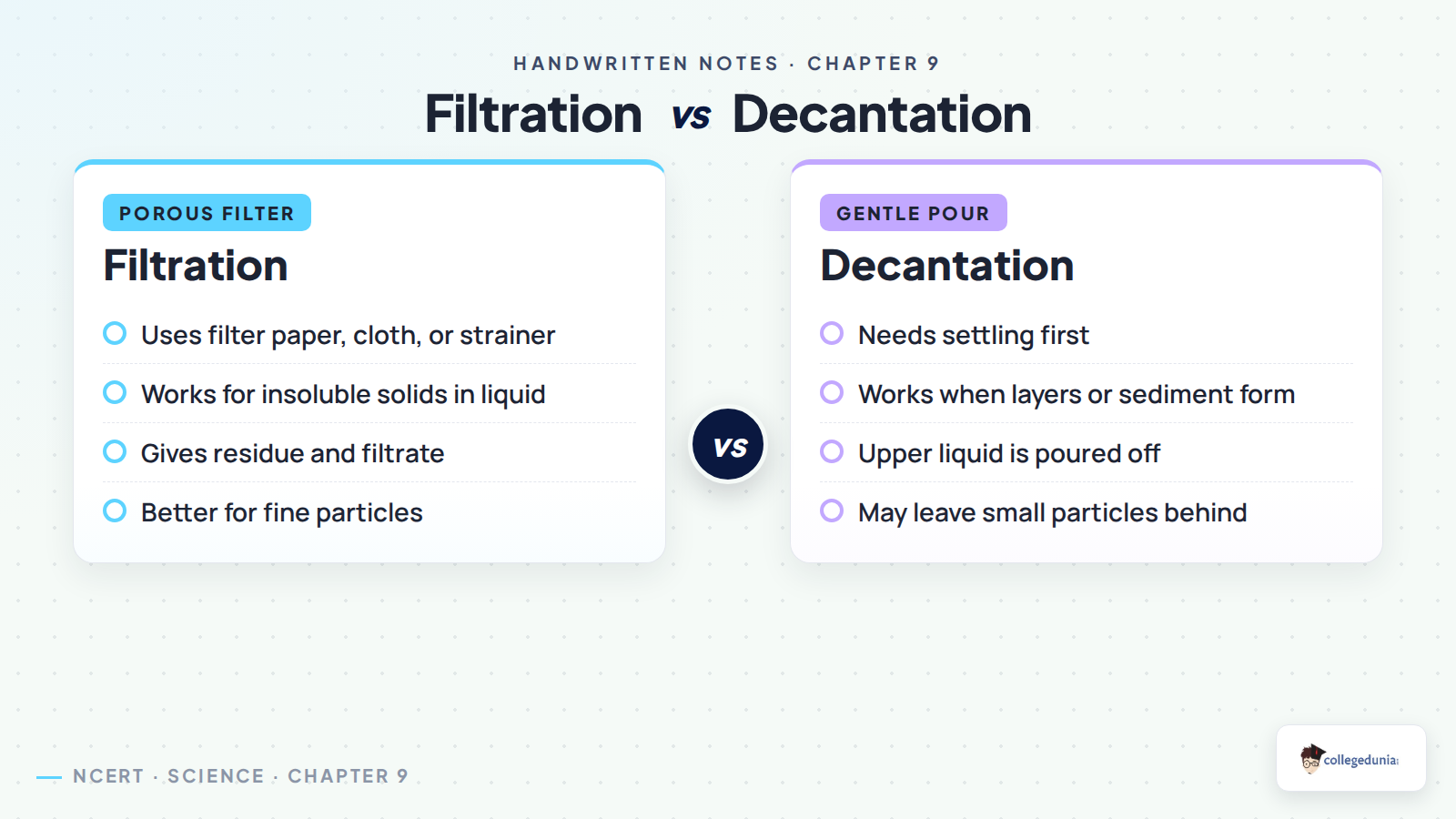
Sedimentation is the settling of a heavier insoluble component at the bottom of a liquid. If muddy water is left undisturbed, mud settles below.
Decantation means gently pouring out the upper liquid after sedimentation. It works for rice washing, partly settled tea leaves, and liquids like oil and water that form layers.
Filtration uses a porous material such as cloth, strainer, or filter paper. The insoluble solid remains as residue, and the liquid that passes through is called filtrate.
Churning and Magnetic Separation
Churning separates butter from curd or cream. The butter is lighter and floats at the top, while buttermilk stays behind. NCERT connects this with the traditional mathni and with kitchen appliances used for buttermilk.
Magnetic separation separates magnetic substances from non-magnetic ones. A magnet can remove iron nails from sawdust because iron is magnetic and sawdust is not. Recyclers also use magnets to separate scrap iron from waste.
Choosing the Correct Method
The fastest way to choose a separation method is to ask what is different between the components. If the particles are visibly different and few, handpicking works. If one part is lighter, winnowing may work. If one part is magnetic, use a magnet.
Some mixtures need many steps. For a mixture of potatoes, salt, and sawdust, students may handpick potatoes, dissolve salt in water, filter sawdust, and then evaporate water to recover salt.
| Mixture | Best method | Reason |
|---|---|---|
| Oil and water | Decantation | They form separate layers |
| Muddy water | Sedimentation then filtration | Mud is insoluble |
| Iron nails and sawdust | Magnetic separation | Iron is magnetic |
| Salt solution | Evaporation | Salt is dissolved in water |
Key Takeaways for Quick Revision
- Handpicking is useful when one component is present in small quantity.
- Threshing separates grains from stalks.
- Winnowing separates lighter husk from heavier grains using wind.
- Sieving separates solids based on particle size.
- Evaporation separates a dissolved solid from a liquid.
- Sedimentation and decantation work when heavier particles settle.
- Filtration separates insoluble solids from liquids using pores.
- Churning separates butter from curd or cream.
- Magnetic separation works only when one component is magnetic.
More Class 6 Science Handwritten Notes
| Chapter | Handwritten Notes |
|---|---|
| Chapter 5 | Measurement of Length and Motion |
| Chapter 6 | Materials Around Us |
| Chapter 7 | Temperature and its Measurement |
| Chapter 8 | A Journey through States of Water |
Quick Questions for Revision
Methods of Separation in Everyday Life Class 6 Handwritten Notes FAQs
Ques. What is covered in Class 6 Science Chapter 9 handwritten notes?
Ans. The notes cover handpicking, threshing, winnowing, sieving, evaporation, sedimentation, decantation, filtration, churning and magnetic separation.
Ques. Are these handwritten notes based on the 2026-27 NCERT Curiosity textbook?
Ans. Yes. The PDF follows Class 6 Science Curiosity Chapter 9 Methods of Separation in Everyday Life for the 2026-27 NCERT syllabus.
Ques. How should students choose a separation method?
Ans. First identify the property that is different in the mixture, such as size, weight, solubility, settling, or magnetic nature. Then choose the matching method.



Comments