The NCERT Solutions for Class 6 Social Science Chapter 8 Unity in Diversity, or 'Many in the One' answer all five textbook tasks for 2026-27. The answers connect India's languages, foods, textiles, festivals and epics with the shared patterns that unite them.
Main idea: explain how great variety can exist with an underlying unity.
Key evidence: use chapter figures, examples and maps in every answer.
Answer skill: compare visible differences with the shared thread beneath them.
Each solution follows the 2026-27 NCERT chapter and uses clear, age-appropriate language for Class 6 students.
Student Feedback
In a Collegedunia study poll of 13,480 students, most students said a comparison table made this chapter easier to revise.
Unity in Diversity Ideas Used in the NCERT Solutions
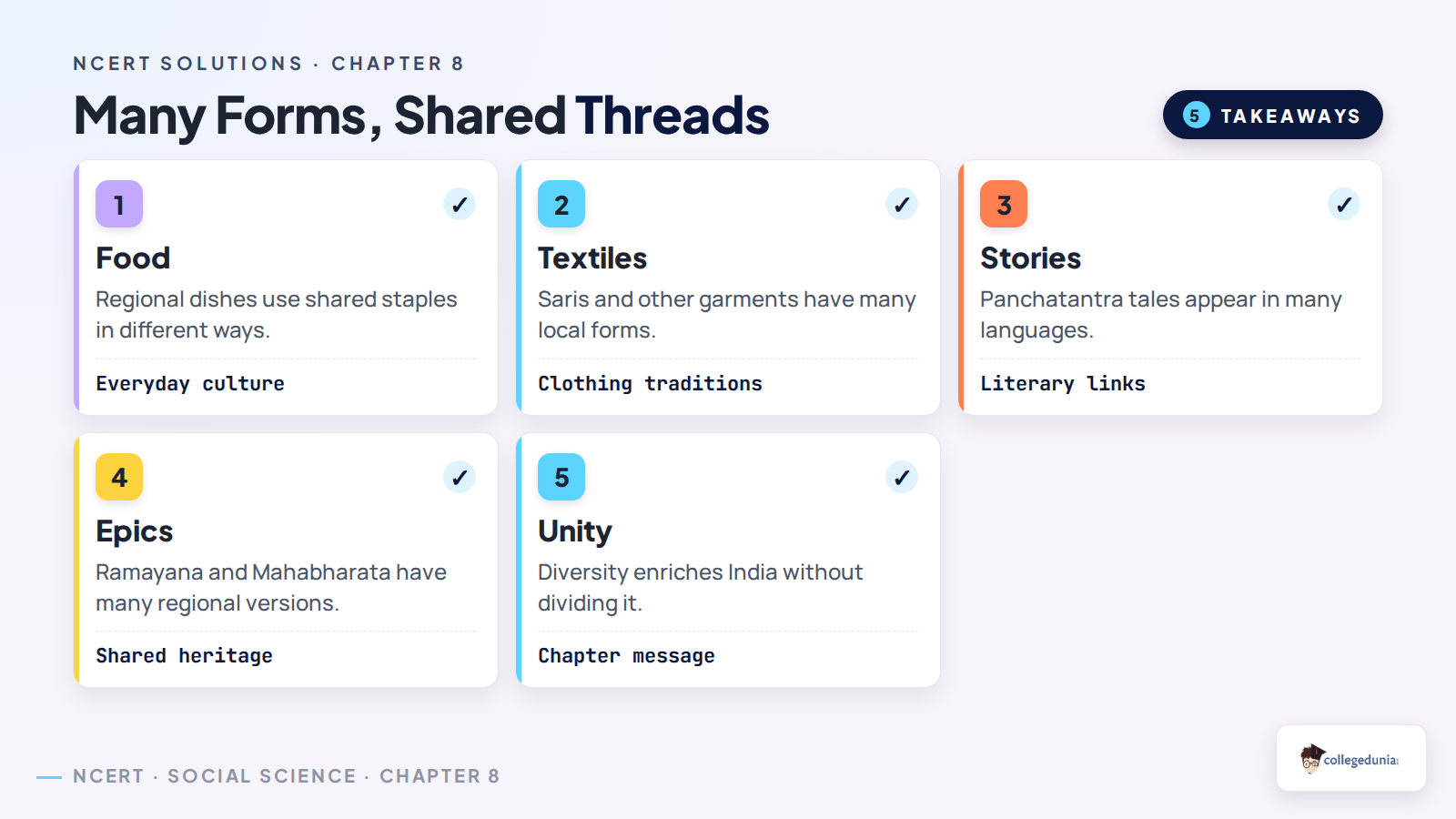
India's diversity appears in everyday life. People speak many languages and wear different clothes. Their foods, festivals and stories also vary across regions. The chapter asks students to find unity within these visible differences.
Chapter example
Diversity
Underlying unity
Food
Many regional dishes
Shared grains, pulses and spices
Clothing
Many sari styles and designs
One unstitched form of cloth
Festivals
Different names and customs
Shared seasons and harvests
Stories
Many local versions
Common characters and values
A strong answer names both the differences and the common link.
Food, Clothing and Festivals as Examples of Many in the One
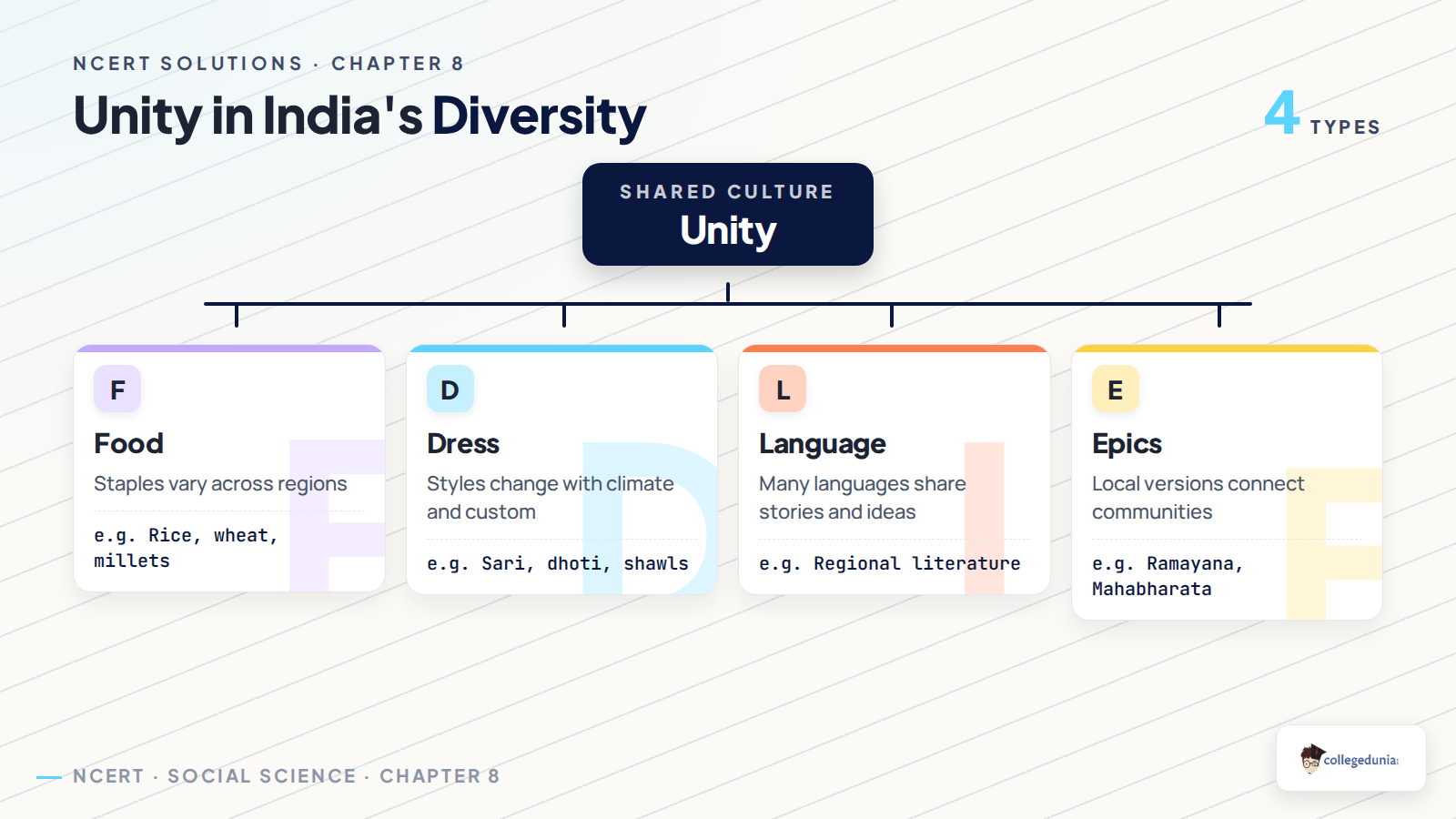
The chapter begins with familiar things. Rice, wheat, millets and pulses appear in many regional meals. Cooks combine them differently with common spices. This creates variety without removing the shared base.
Saris use different fabrics, colours, designs and draping styles.
Makara Sankranti has different names across Indian regions.
Harvest celebrations connect communities with seasons and farming.
Local customs change while the wider meaning remains familiar.
The sari is a useful example because one basic garment supports hundreds of regional styles.
People of India Project Facts for Class 6 Social Science Answers
The People of India project gives clear evidence of India's diversity. The Anthropological Survey of India carried out this large study. Use the exact figures only when the question asks for evidence.
Fact
Figure from the chapter
What it shows
Communities studied
4,635
India has many social communities.
Languages counted
325
People communicate in many languages.
Scripts counted
25
Many languages share a smaller set of scripts.
The figures show diversity, while shared scripts point to links among communities.
Indian Epics and the Shared Cultural Thread
The Ramayana and Mahabharata travelled across India for centuries. Communities retold them in their own languages and styles. Tribal groups also created versions suited to local life.
The main stories remain widely recognised across regions.
Local versions may change events, characters or settings.
Retelling keeps stories alive and meaningful for each community.
Variety enriches the shared tradition instead of weakening it.
Use the epics to show that unity does not mean complete sameness.
How to Write Strong Unity in Diversity Answers
Begin with a direct meaning of unity in diversity. Then choose one chapter example and explain both sides of it. Collegedunia's solutions model this evidence-based answer pattern.
Read whether the task asks you to discuss, list, compare or explain.
Name the example clearly, such as food, sari, festival or epic.
Add an exact fact from the textbook where useful.
Explain the common thread instead of listing differences only.
Keep each point short and support it with evidence.
Common Mistakes in Unity in Diversity Class 6 Answers
Most weak answers list India's variety but forget to explain unity. Others treat every regional practice as identical. Both approaches miss the chapter's central message.
Do not define unity as everyone following one custom.
Do not write the project figures without explaining their meaning.
Do not present local epic versions as incorrect copies.
Do not confuse a language with the script used to write it.
Do not describe diversity as a problem to be removed.
Watch Out: Unity here means connection among differences, not the absence of differences.
Related Unity in Diversity Class 6 Resources
Use the textbook for the full maps, pictures and activities. Use the solutions for direct answers built from those chapter details.
All Unity in Diversity Questions with Step-by-Step Solutions
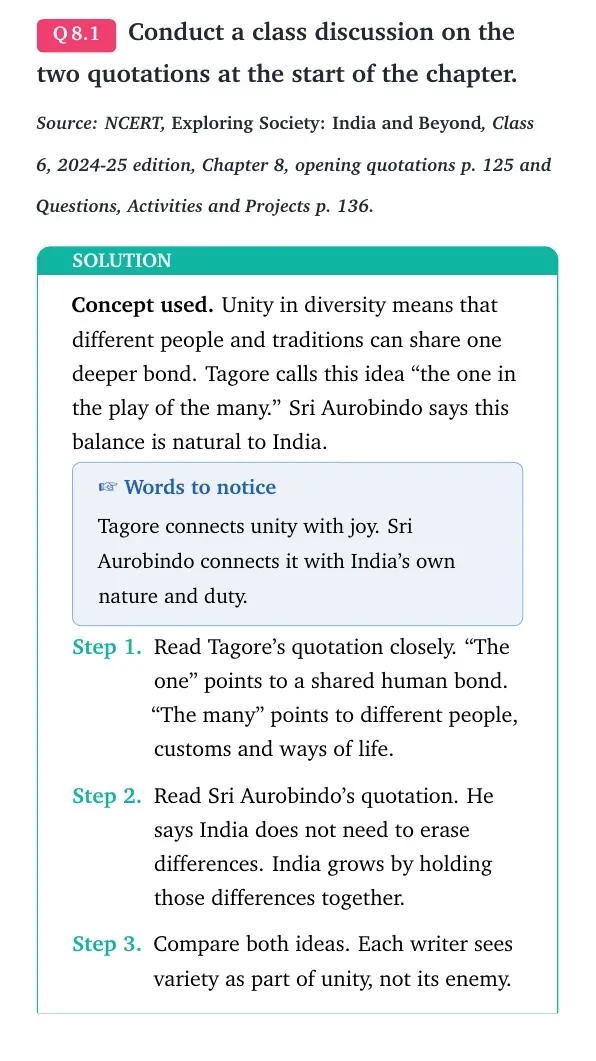
Q 8.1
Conduct a class discussion on the two quotations at the start of the chapter. Source: NCERT, Exploring Society: India and Beyond, Class 6 edition, Chapter 8, opening quotations p. 125 and Questions, Activities and Projects p. 136.
Concept used. Unity in diversity means that different people and traditions can share one deeper bond. Tagore calls this idea ``the one in the play of the many.'' Sri Aurobindo says this balance is natural to India.
Words to notice
Tagore connects unity with joy. Sri Aurobindo connects it with India's own nature and duty.
Read Tagore's quotation closely. ``The one'' points to a shared human bond. ``The many'' points to different people, customs and ways of life.
Read Sri Aurobindo's quotation. He says India does not need to erase differences. India grows by holding those differences together.
Compare both ideas. Each writer sees variety as part of unity, not its enemy.
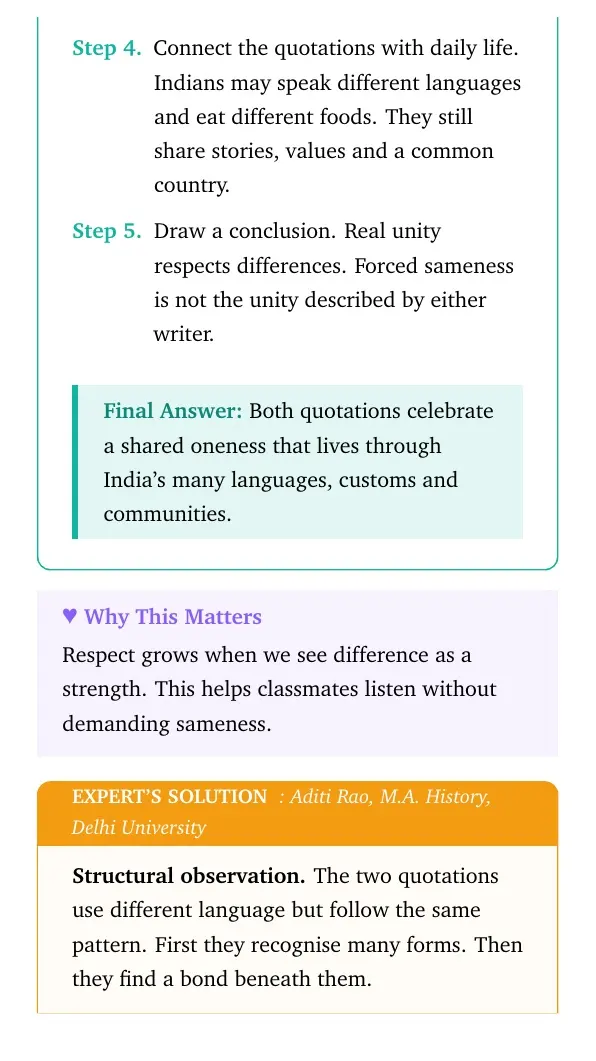
Connect the quotations with daily life. Indians may speak different languages and eat different foods. They still share stories, values and a common country.
Draw a conclusion. Real unity respects differences. Forced sameness is not the unity described by either writer.
Both quotations celebrate a shared oneness that lives through India's many languages, customs and communities.
AR
Aditi Rao
M.A. History, Delhi University
Verified Expert
Structural observation. The two quotations use different language but follow the same pattern. First they recognise many forms. Then they find a bond beneath them.
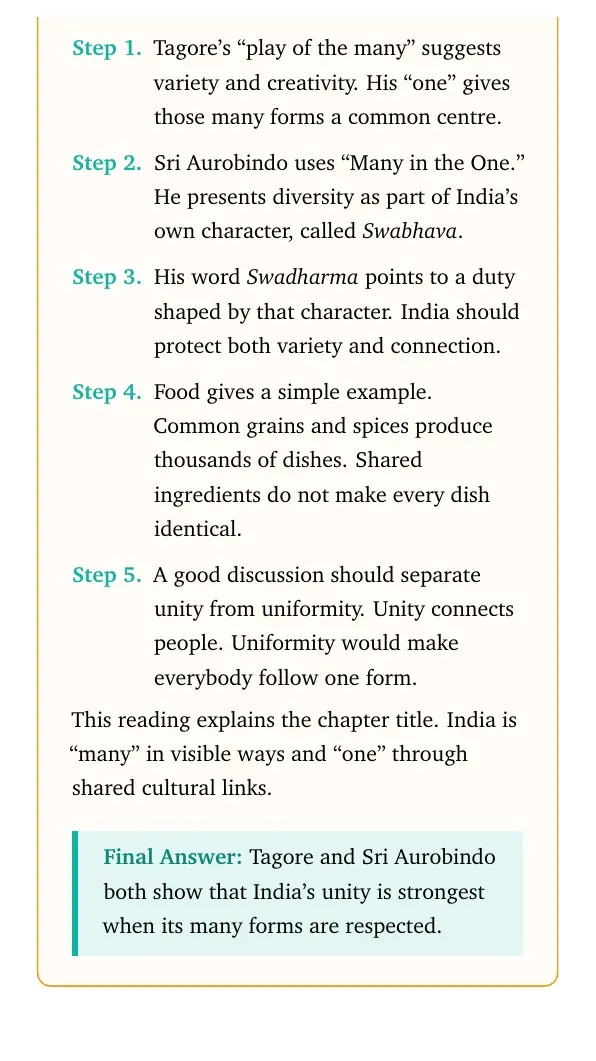
Tagore's ``play of the many'' suggests variety and creativity. His ``one'' gives those many forms a common centre.
Sri Aurobindo uses ``Many in the One.'' He presents diversity as part of India's own character, called Swabhava.
His word Swadharma points to a duty shaped by that character. India should protect both variety and connection.
Food gives a simple example. Common grains and spices produce thousands of dishes. Shared ingredients do not make every dish identical.
A good discussion should separate unity from uniformity. Unity connects people. Uniformity would make everybody follow one form.
This reading explains the chapter title. India is ``many'' in visible ways and ``one'' through shared cultural links.
Tagore and Sri Aurobindo both show that India's unity is strongest when its many forms are respected.
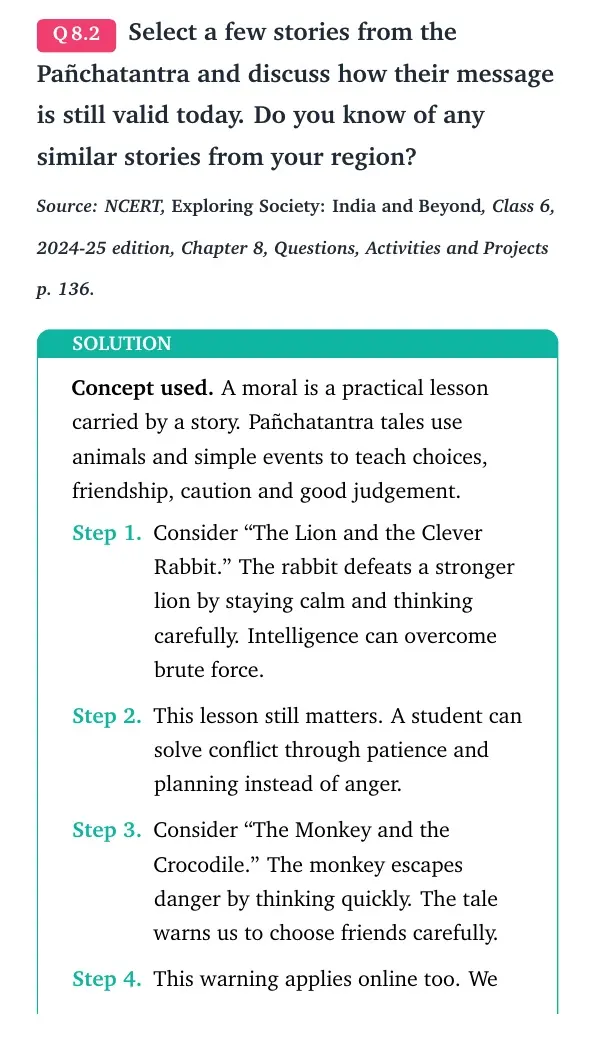
Q 8.2
Select a few stories from the Pañchatantra and discuss how their message is still valid today. Do you know of any similar stories from your region? Source: NCERT, Exploring Society: India and Beyond, Class 6 edition, Chapter 8, Questions, Activities and Projects p. 136.
Concept used. A moral is a practical lesson carried by a story. Pa nchatantra tales use animals and simple events to teach choices, friendship, caution and good judgement.
Consider ``The Lion and the Clever Rabbit.'' The rabbit defeats a stronger lion by staying calm and thinking carefully. Intelligence can overcome brute force.
This lesson still matters. A student can solve conflict through patience and planning instead of anger.
Consider ``The Monkey and the Crocodile.'' The monkey escapes danger by thinking quickly. The tale warns us to choose friends carefully.
This warning applies online too. We should not trust every message or share private information without checking.
Consider ``The Four Friends.'' Different animals cooperate and save one another. Teamwork joins different strengths.
Similar regional tales may change the animals, place or language. Their lessons about wit, trust and cooperation often remain the same.
A named regional example is the Assamese tale of Tejimola. Tejimola survives cruelty through courage and renewal. Like the clever rabbit, she shows that cruelty need not win.
These examples also explain unity in diversity. The plots and characters vary across regions. Yet people use them to teach familiar values. A class can compare local tales with these examples and find both shared lessons and special regional details.
The clever rabbit defeats a cruel lion through thought. Tejimola's Assamese story defeats cruelty through courage and endurance. Both give hope, but they use different characters and settings.
Pa nchatantra stories remain useful because their lessons about wisdom, trust and teamwork fit modern life.
RN
Rohit Nair
M.A. Sociology, JNU
Verified Expert
Strategic angle. Test each old story against a modern situation. A lesson remains valid when it guides a choice we still face today.
In ``The Lion and the Clever Rabbit,'' the rabbit studies the lion's pride. It uses the reflection in a well to stop the lion. The lesson supports careful thinking.
In ``The Monkey and the Crocodile,'' false friendship creates danger. The monkey notices the threat and responds quickly. The lesson supports cautious trust.
In ``The Four Friends,'' no animal can solve every problem alone. Their different abilities become useful through cooperation.
Regional animal tales often carry matching lessons. A local fox, jackal, crow or tortoise may play a role found elsewhere under another name.
Assam's tale of Tejimola offers a clear comparison. Its young heroine faces cruelty and returns through several forms. Her endurance matches the clever rabbit's refusal to surrender to a stronger enemy.
Compare the moral rather than only the plot. Shared morals show cultural unity. Changed characters and settings show regional diversity.
The stories travelled across languages because their problems are familiar. People still face fear, pride, dishonesty and the need for friendship.
The two tales teach that strength alone does not decide the ending. The Pa nchatantra praises quick thought. Tejimola's tale praises courage, patience and the victory of goodness.
The tales stay relevant through lasting moral lessons, while regional versions add local colour and detail.
Q 8.3
Collect a few folk tales from your region and discuss their message. Source: NCERT, Exploring Society: India and Beyond, Class 6 edition, Chapter 8, Questions, Activities and Projects p. 136.
Concept used. A folk tale is a story passed through a community, often by speech. It carries local memory, beliefs and practical values from one generation to another.
Ask grandparents, neighbours or local storytellers for two or three tales. Record the title, place, main characters and storyteller's name.
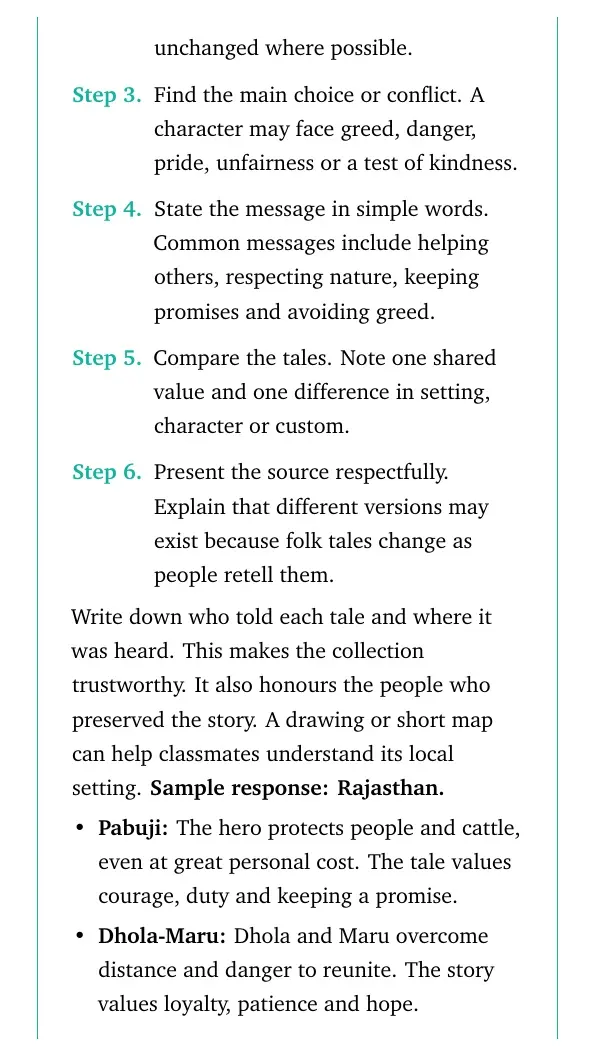
Retell each story in a short paragraph. Keep its main events and local words unchanged where possible.
Find the main choice or conflict. A character may face greed, danger, pride, unfairness or a test of kindness.
State the message in simple words. Common messages include helping others, respecting nature, keeping promises and avoiding greed.
Compare the tales. Note one shared value and one difference in setting, character or custom.
Present the source respectfully. Explain that different versions may exist because folk tales change as people retell them.
Write down who told each tale and where it was heard. This makes the collection trustworthy. It also honours the people who preserved the story. A drawing or short map can help classmates understand its local setting.
Sample response: Rajasthan.
Pabuji: The hero protects people and cattle, even at great personal cost. The tale values courage, duty and keeping a promise.
Dhola-Maru: Dhola and Maru overcome distance and danger to reunite. The story values loyalty, patience and hope.
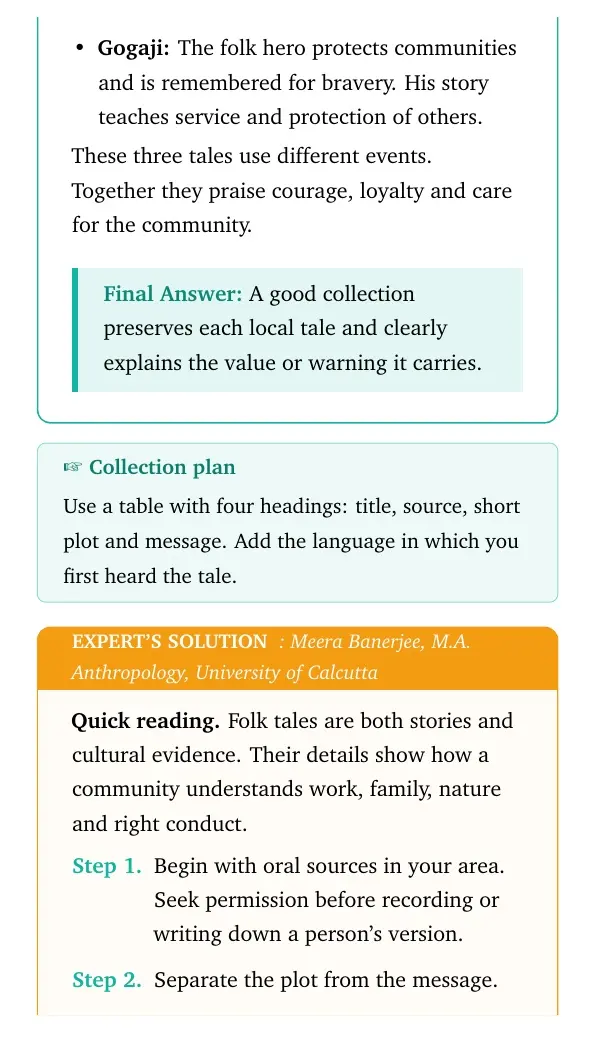
Gogaji: The folk hero protects communities and is remembered for bravery. His story teaches service and protection of others.
These three tales use different events. Together they praise courage, loyalty and care for the community.
A good collection preserves each local tale and clearly explains the value or warning it carries.
MB
Meera Banerjee
M.A. Anthropology, University of Calcutta
Verified Expert
Quick reading. Folk tales are both stories and cultural evidence. Their details show how a community understands work, family, nature and right conduct.
Begin with oral sources in your area. Seek permission before recording or writing down a person's version.
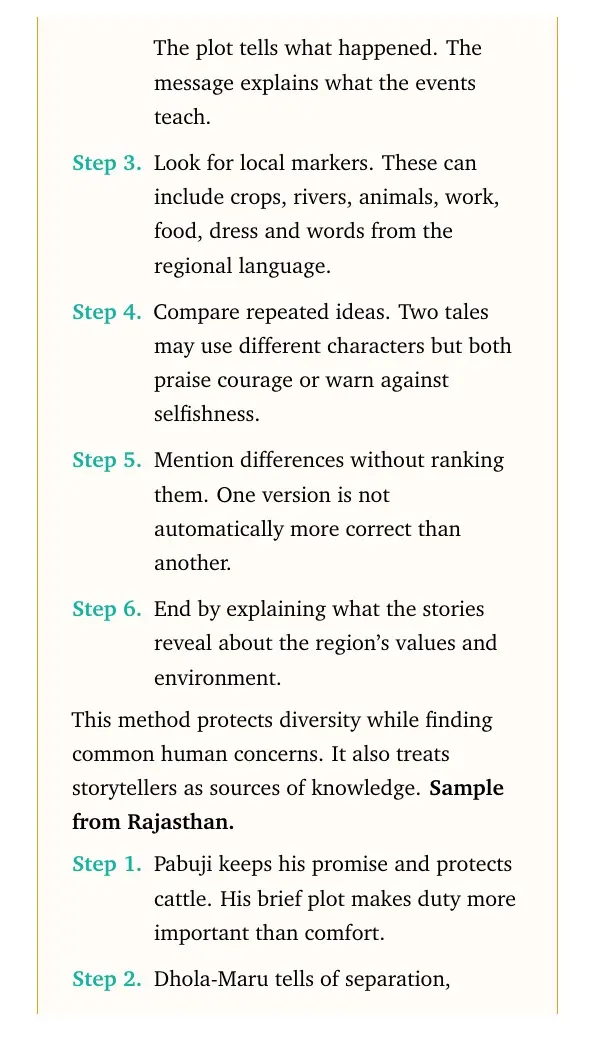
Separate the plot from the message. The plot tells what happened. The message explains what the events teach.
Look for local markers. These can include crops, rivers, animals, work, food, dress and words from the regional language.
Compare repeated ideas. Two tales may use different characters but both praise courage or warn against selfishness.
Mention differences without ranking them. One version is not automatically more correct than another.
End by explaining what the stories reveal about the region's values and environment.
This method protects diversity while finding common human concerns. It also treats storytellers as sources of knowledge.
Sample from Rajasthan.
Pabuji keeps his promise and protects cattle. His brief plot makes duty more important than comfort.
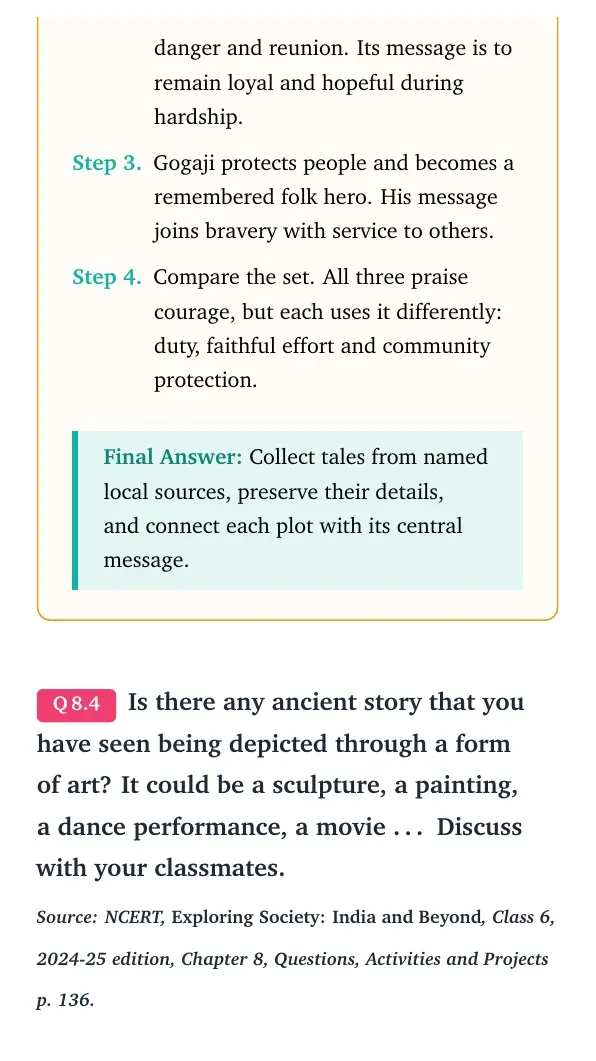
Dhola-Maru tells of separation, danger and reunion. Its message is to remain loyal and hopeful during hardship.
Gogaji protects people and becomes a remembered folk hero. His message joins bravery with service to others.
Compare the set. All three praise courage, but each uses it differently: duty, faithful effort and community protection.
Collect tales from named local sources, preserve their details, and connect each plot with its central message.
Q 8.4
Is there any ancient story that you have seen being depicted through a form of art? It could be a sculpture, a painting, a dance performance, a movie … Discuss with your classmates. Source: NCERT, Exploring Society: India and Beyond, Class 6 edition, Chapter 8, Questions, Activities and Projects p. 136.
Concept used. Adaptation means presenting an existing story in another form. Art can turn a spoken or written story into movement, colour, music, stone or film.
One example is the episode of Rama's return to Ayodhya from the Ramayana. It appears in paintings, Ramlila theatre, dance and films.
A painting may show lamps, crowds and royal clothing in one still scene. Colour and position guide the viewer's attention.
A dance performance uses gesture, facial expression, costume and music. These features show feelings and actions without long explanations.
A movie adds dialogue, changing locations and close views. It can present more events but may also change details for its viewers.
Compare what remains common. The main characters, return to Ayodhya and public welcome usually stay recognisable.
Compare what changes. Language, costume, music and small events may follow regional traditions.
During discussion, classmates can choose other examples from the Mahabharata, the Jataka tales or regional legends. They should name the art form and point to its special tools. This keeps the comparison based on evidence.
The story of Rama's return shows how one ancient episode can take many artistic forms while keeping its core meaning.
AI
Arjun Iyer
M.A. Art History, MS University Baroda
Verified Expert
Picture-first. Start by identifying the story from visible clues. Then study how the art form changes the way we experience it.
In a Ramlila performance, actors, songs and a live crowd make the story a community event.
In a miniature painting, one arranged scene can show clothing, buildings and important characters together.
In classical dance, hand gestures and facial expressions carry much of the meaning. Regional music gives the episode a local voice.
In a film, editing joins many scenes. The camera can focus on a face or show a large procession.
Across these forms, the central event remains Rama's return and welcome. This common thread creates unity.
Each form adds its own materials and style. Those differences create diversity.
Students may choose another ancient story. The strongest discussion names both the shared story and the special tools of its art form.
An ancient story can remain recognisable across sculpture, painting, dance and film, even when each form presents it differently.
Q 8.5
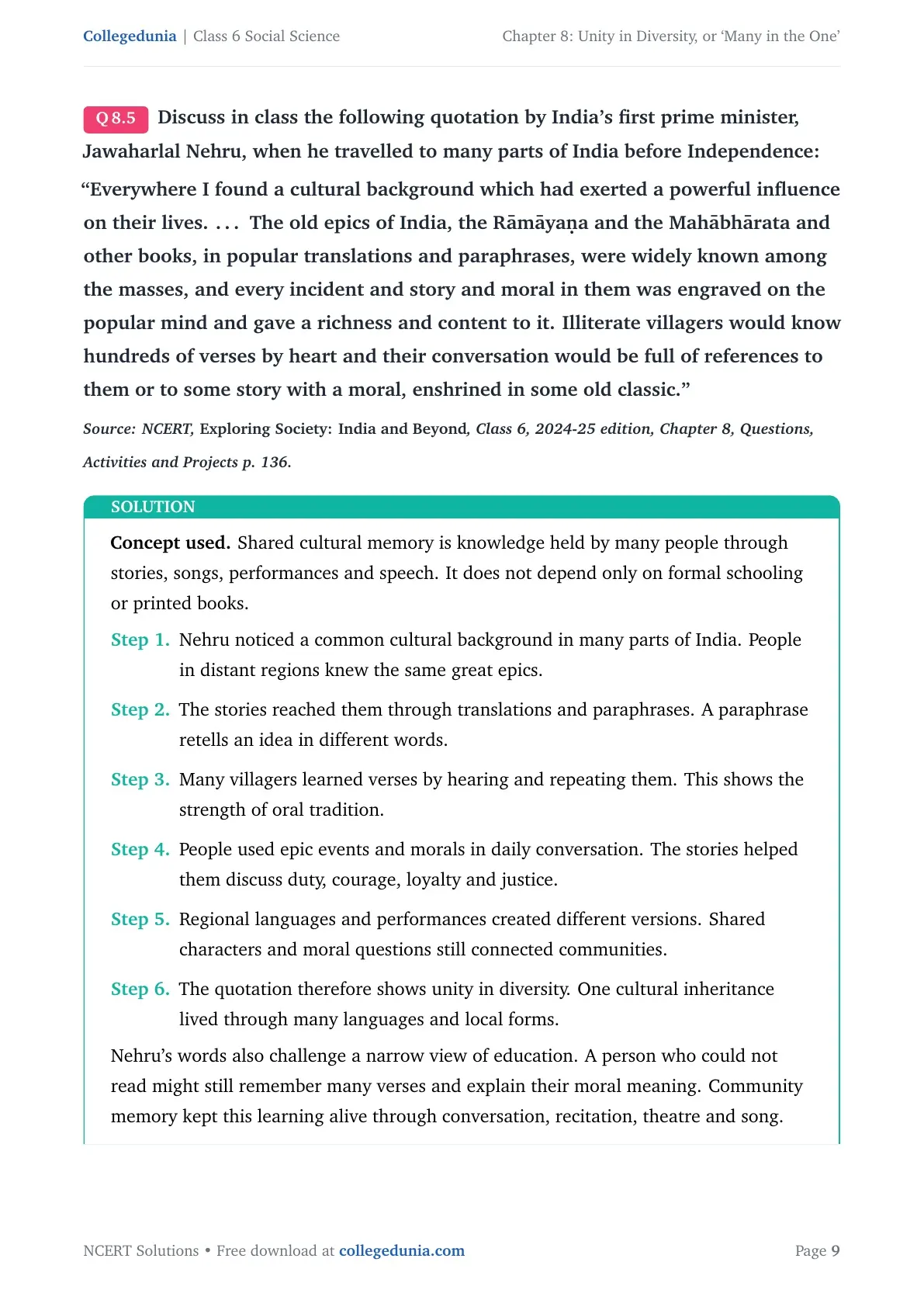
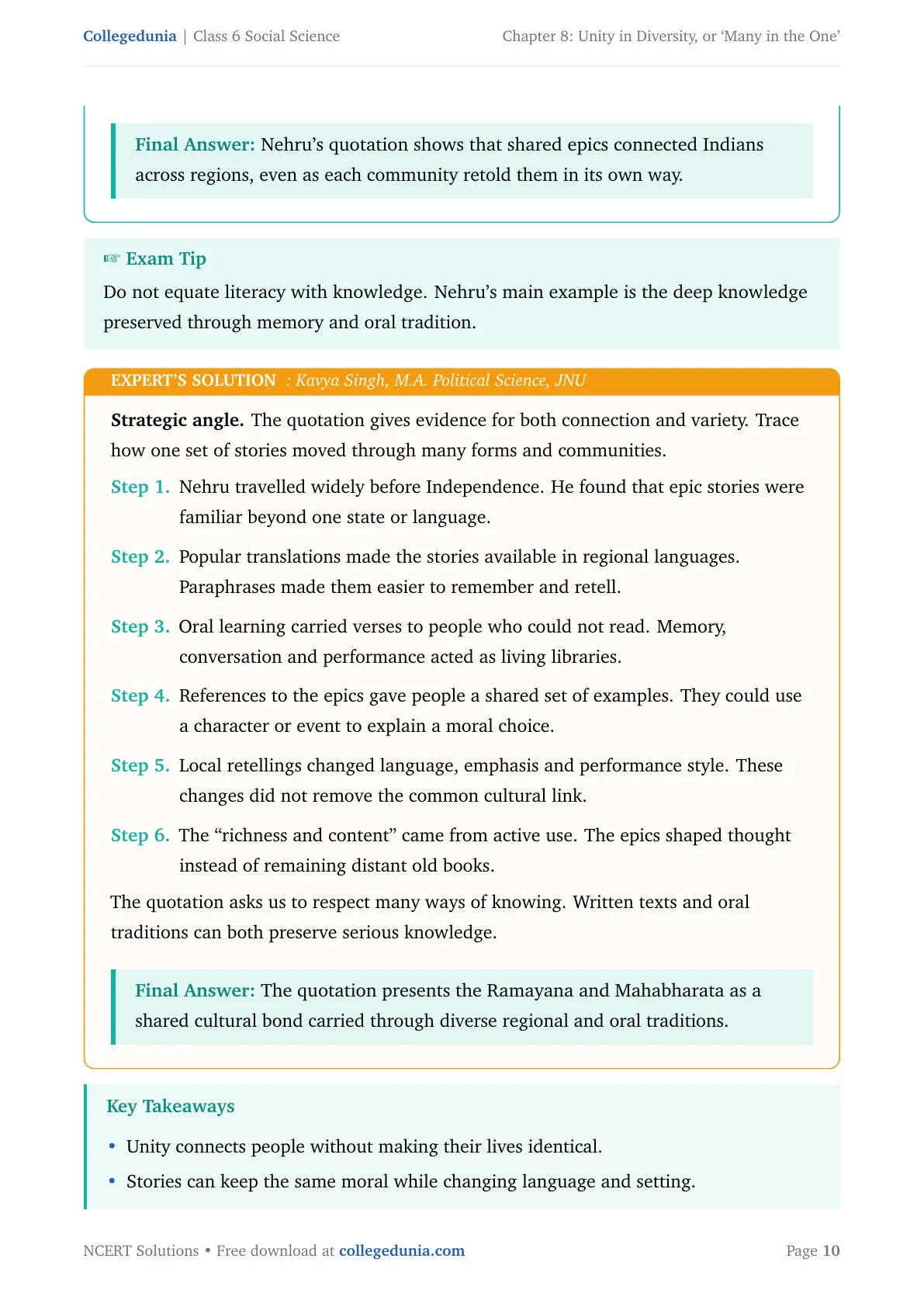
Discuss in class the following quotation by India's first prime minister, Jawaharlal Nehru, when he travelled to many parts of India before Independence: “Everywhere I found a cultural background which had exerted a powerful influence on their lives. … The old epics of India, the Rāmāyaṇa and the Mahābhārata and other books, in popular translations and paraphrases, were widely known among the masses, and every incident and story and moral in them was engraved on the popular mind and gave a richness and content to it. Illiterate villagers would know hundreds of verses by heart and their conversation would be full of references to them or to some story with a moral, enshrined in some old classic.” Source: NCERT, Exploring Society: India and Beyond, Class 6 edition, Chapter 8, Questions, Activities and Projects p. 136.
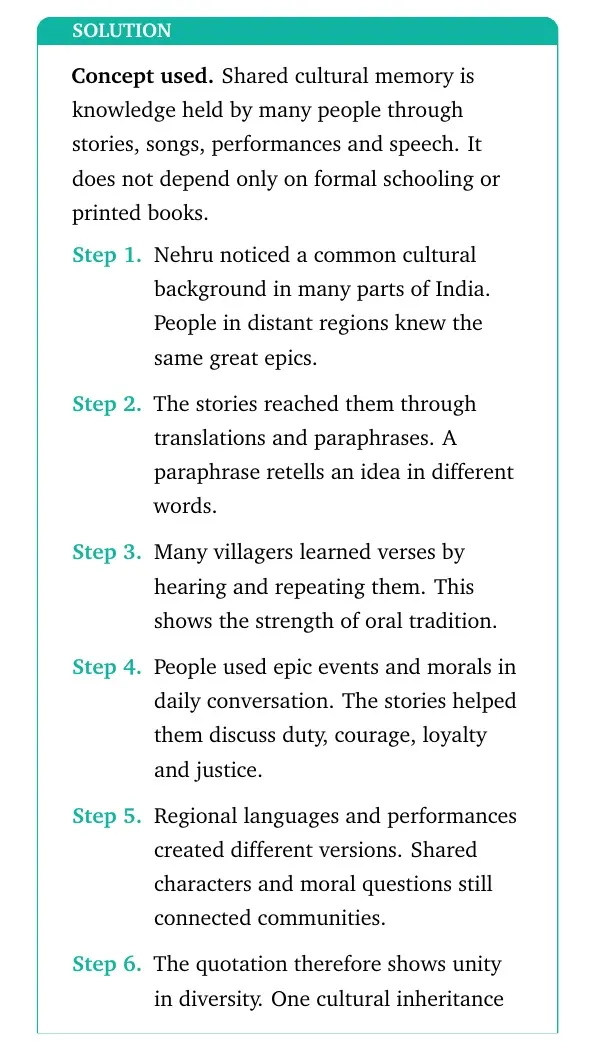
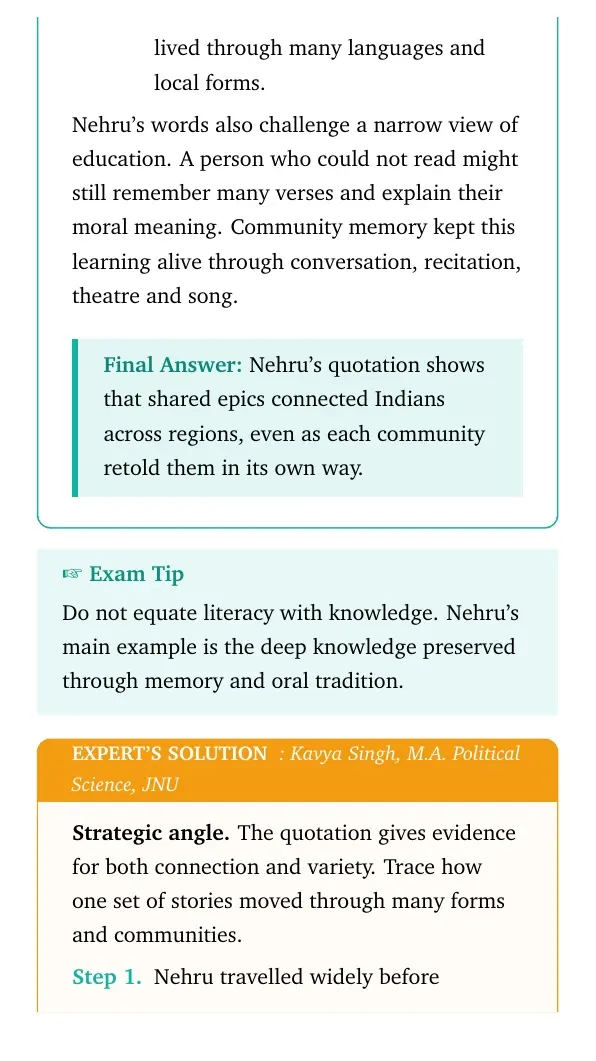
Concept used. Shared cultural memory is knowledge held by many people through stories, songs, performances and speech. It does not depend only on formal schooling or printed books.
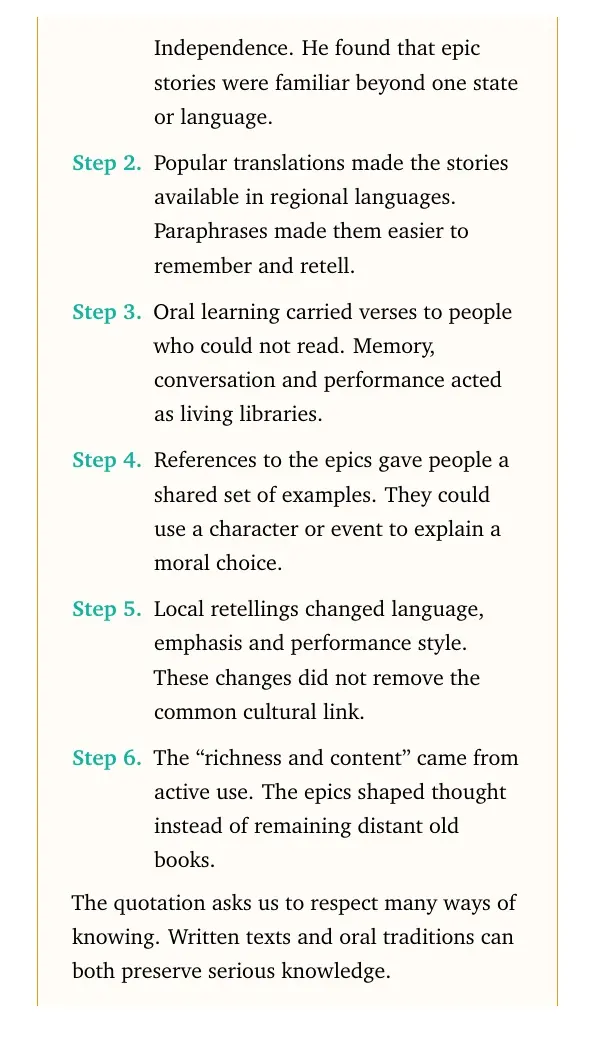
Nehru noticed a common cultural background in many parts of India. People in distant regions knew the same great epics.
The stories reached them through translations and paraphrases. A paraphrase retells an idea in different words.
Many villagers learned verses by hearing and repeating them. This shows the strength of oral tradition.
People used epic events and morals in daily conversation. The stories helped them discuss duty, courage, loyalty and justice.
Regional languages and performances created different versions. Shared characters and moral questions still connected communities.
The quotation therefore shows unity in diversity. One cultural inheritance lived through many languages and local forms.
"@type": "Answer",
"text": "Concept used. Shared cultural memory is knowledge held by many people through stories, songs, performances and speech. It does not depend only on formal schooling or printed books. Nehru noticed a common cultural background in many parts of India. People in distant regions knew t"
}
}
]
}







Comments