




Inside the NCERT Class 6 Social Science Chapter 8 Unity in Diversity, or 'Many in the One' PDF you will find the two opening quotations, the People of India project figures, the shared staple grains, the sari, the Makara Sankrānti festival map and India's two epics. This is the full printed chapter from Exploring Society: India and Beyond for the 2026-27 session, with nothing shortened or reworded.
- 12-page official file: Chapter 8 runs from printed page 125 to printed page 136 of the Class 6 textbook.
- Covers A Rich Diversity, Food for All, Textiles and Clothing, Festivals Galore and An Epic Spread.
- Carries 6 LET'S EXPLORE boxes, 1 DON'T MISS OUT box, 7 figures, 2 margin words and 5 end questions.
This is the unedited NCERT chapter file for the 2026-27 print run, checked page by page against the official Exploring Society: India and Beyond release before it was put on this page.
Student Feedback
What 13,480 students told us about the Unity in Diversity chapter, in a Collegedunia poll taken during the 2026-27 session.
- 64% of students said the People of India project numbers were the part they got wrong in class tests.
- Most-mixed-up pair: the two opening quotations, with Tagore and Sri Aurobindo swapped by about 4 in 10 students.
- Students reported that copying the festival map names into one list fixed the Makara Sankrānti answer in a single sitting.
Source: 2026-27 Class 6 Social Science student poll. Sample of 13,480 students from CBSE schools across 19 states.
What the Unity in Diversity Class 6 PDF Contains, Page by Page
The file is the printed chapter in full, not a summary sheet. It opens with two quotations, one from Rabindranath Tagore and one from Sri Aurobindo, and closes with the five end questions on printed page 136. Use the table below to jump straight to the part you need.
| Section in the PDF | Printed pages | What is on these pages |
|---|---|---|
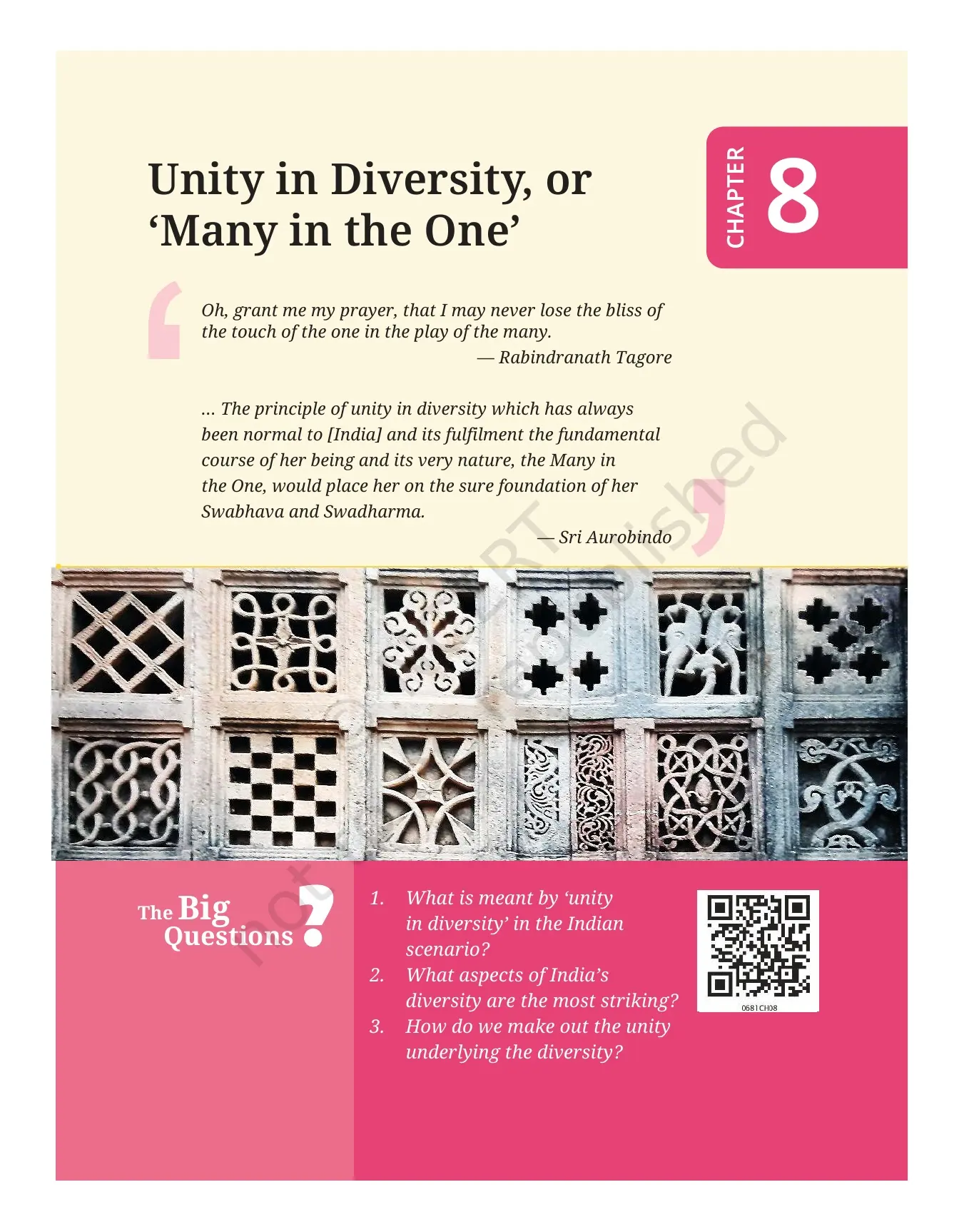
| Chapter opener | 125 | The Tagore quotation on the one in the play of the many, the Sri Aurobindo quotation on Swabhava and Swadharma, and the three Big Questions |
| A Rich Diversity | 126 | The train journey opening, the 1.4 billion population figure, the People of India project, a LET'S EXPLORE box and the Vincent Smith quotation |
| Food for All | 127 and 128 | Fig. 8.1 with the cereals and pulses of different regions, the staple grains list, the four common spices and a LET'S EXPLORE box |
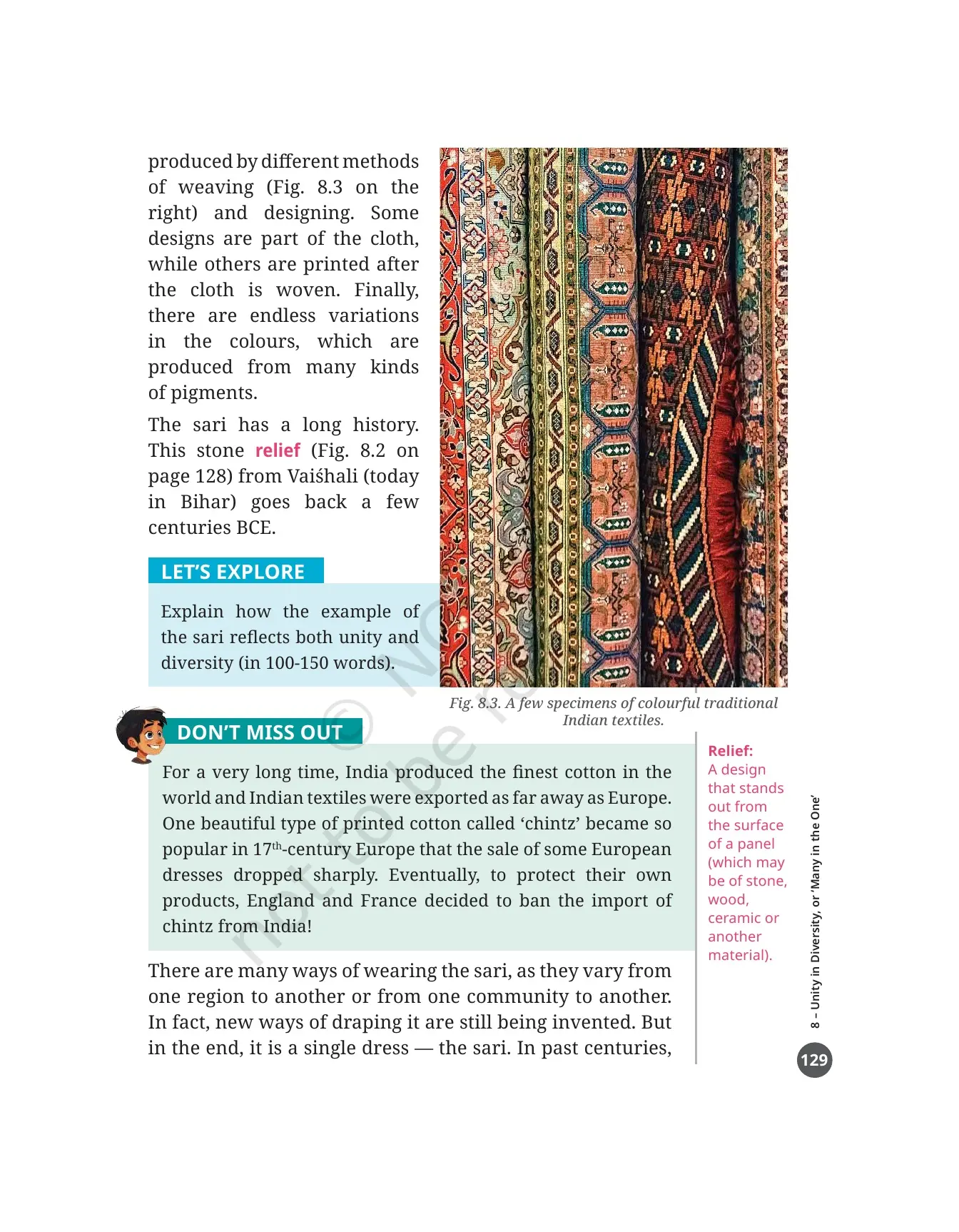
| Textiles and Clothing | 128 and 129 | The sari as an unstitched length of cloth, the famous silk saris, Fig. 8.2, Fig. 8.3, the margin word Relief and a LET'S EXPLORE box |
| The chintz box | 129 | The DON'T MISS OUT box on Indian cotton, chintz and the 17th-century European import ban |
| Many ways of wearing the sari | 130 and 131 | Fig. 8.4 with six pictures from south India, the travellers who marvelled at the sari, and the LET'S EXPLORE box on sari uses and the dhoti |
| Festivals Galore | 131 and 132 | Makara Sankrānti on or around January 14, Fig. 8.5 with the map of names, and a LET'S EXPLORE box on your favourite festival |
| An Epic Spread | 133 | The Pañchatantra, its 200 adaptations, the two Sanskrit epics, the story of the Pāṇḍavas and of Rāma, and the margin word Epic |
| The Ramayana painting | 134 | Fig. 8.6 from Mewar dated 1652, a LET'S EXPLORE box on the episode, and the Tamil Nadu folklore survey of the Mahābhārata |
| Tribal versions of the epics | 135 | The Bhils, the Gonds and the Mundas, Fig. 8.7 from the Nilgiris, the K.S. Singh quotation and the closing line on diversity as enrichment |
| Before we move on and the questions | 136 | A three-point recap, 5 numbered questions, activities and projects, and the Jawaharlal Nehru quotation |
Also Check:
The Two Quotations on Page 125 That Frame the Unity in Diversity Chapter
The chapter does not open with a definition. It opens with two quotations, and end question 1 asks you to discuss both in class. Learn who wrote which one, because that is the single most common slip in this chapter.
| Who | What the quotation says | What to take from it |
|---|---|---|
| Rabindranath Tagore | "Oh, grant me my prayer, that I may never lose the bliss of the touch of the one in the play of the many." | A prayer. The many is the visible variety of India, the one is the thread running under it |
| Sri Aurobindo | "The principle of unity in diversity which has always been normal to [India] and its fulfilment the fundamental course of her being and its very nature, the Many in the One, would place her on the sure foundation of her Swabhava and Swadharma." | A statement about India's nature. It gives the chapter its subtitle, 'Many in the One' |
The three Big Questions printed beside them set the plan for the whole chapter, and every section answers one of them.
- What is meant by 'unity in diversity' in the Indian scenario?
- What aspects of India's diversity are the most striking?
- How do we make out the unity underlying the diversity?
Languages, Food, Textiles and Festivals in One Overview
Source: Magnet Brains on YouTube
A Rich Diversity: 4,635 Communities, 325 Languages and 25 Scripts in the People of India Project
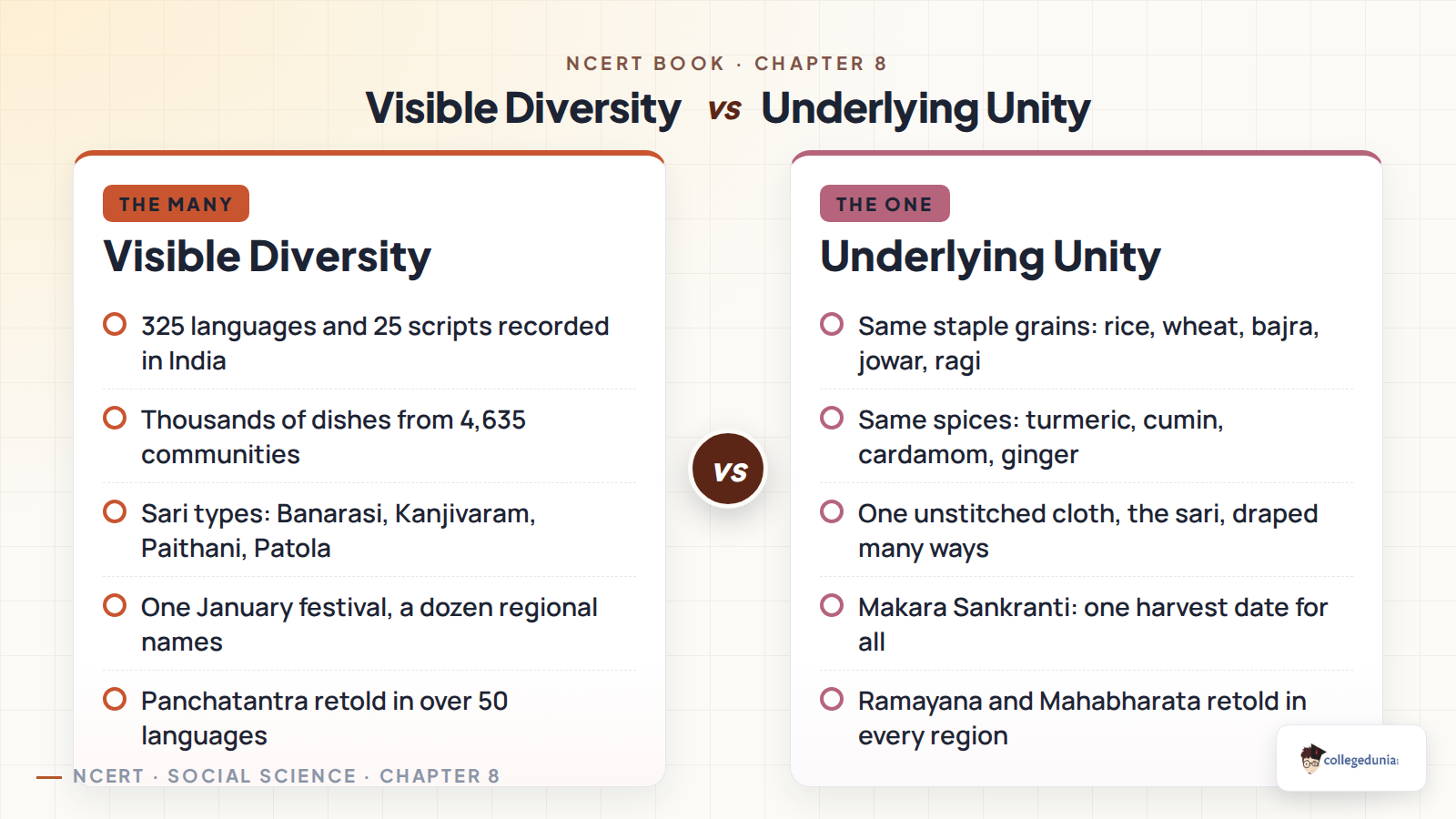
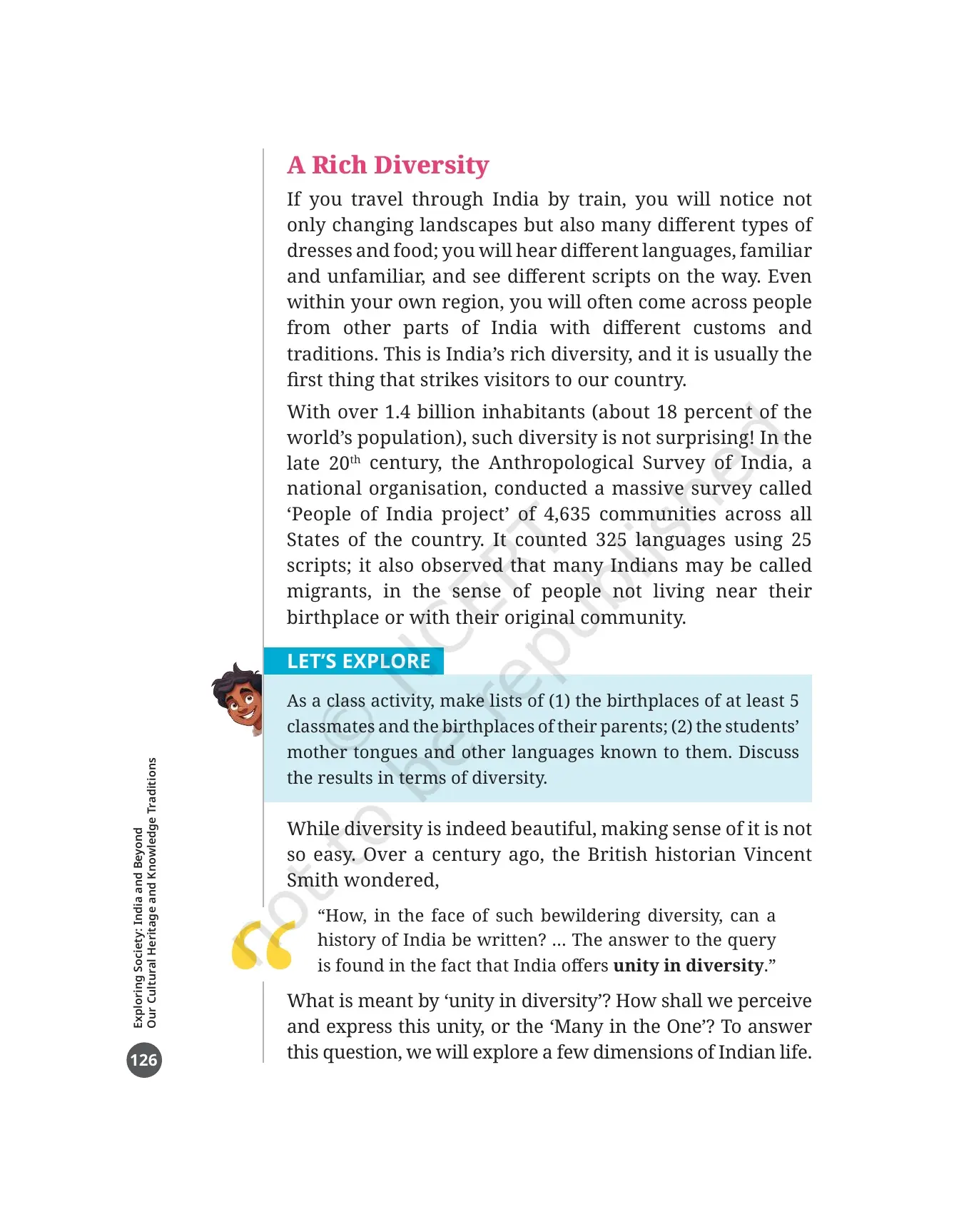
The chapter starts with a train journey. Travel across India and you notice changing landscapes, different dresses and food, unfamiliar languages and different scripts. The book says this rich diversity is usually the first thing that strikes visitors to our country.
Then come the numbers, and these are the ones the class test asks for.
| Figure on printed page 126 | What the chapter says |
|---|---|
| Over 1.4 billion | India's inhabitants, which is about 18 percent of the world's population |
| Anthropological Survey of India | The national organisation that ran the survey, in the late 20th century |
| People of India project | The name of the massive survey, covering all States of the country |
| 4,635 communities | The number of communities the project covered |
| 325 languages and 25 scripts | What the project counted. 325 languages, written in only 25 scripts |
| Migrants | The project observed that many Indians may be called migrants, meaning people not living near their birthplace or with their original community |
The book then admits the hard part. Diversity is beautiful, but making sense of it is not easy. Over a century ago the British historian Vincent Smith asked how a history of India could be written in the face of such bewildering diversity, and answered himself: "The answer to the query is found in the fact that India offers unity in diversity." The rest of the chapter tests that answer against four everyday things: food, clothing, festivals and stories.
Food for All: The Staple Grains and Spices Shared Across Every Region of India
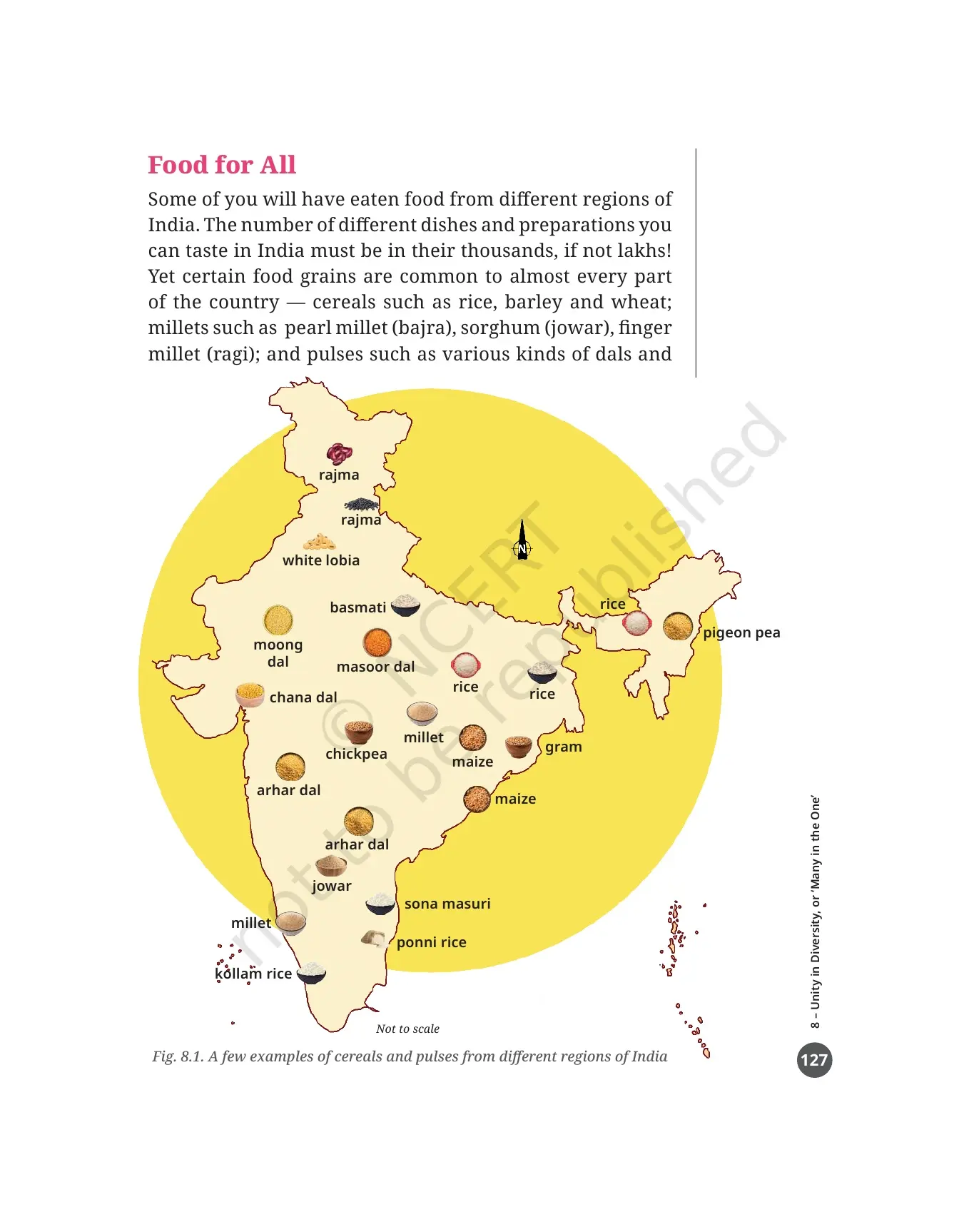
The number of dishes you can taste in India runs into thousands, and the book says it may be lakhs. Yet the raw material barely changes. Fig. 8.1 on printed page 127 spreads the grains of different regions across a map outline, and the labels are worth reading once.
| Group | What the chapter names |
|---|---|
| Cereals | Rice, barley and wheat |
| Millets | Pearl millet (bajra), sorghum (jowar) and finger millet (ragi) |
| Pulses | Various kinds of dals and grams |
| Labels on Fig. 8.1 | Rajma, white lobia, basmati, sona masuri, ponni rice, kollam rice, pigeon pea, moong dal, masoor dal, chana dal, arhar dal, chickpea, gram, jowar, millet and maize |
| Common spices | Turmeric, cumin, cardamom and ginger, used throughout the country |
| Staple grains | The chapter's term for all of these, because they are the basic food for most Indians |
The one-line conclusion is the answer the marker wants: the same ingredients (unity) are used in a number of combinations (diversity) to prepare an endless variety of dishes. The LET'S EXPLORE box on printed page 128 turns this into homework. List the grains and spices used in your own home, then take one vegetable and count how many dishes you can make from it.
Textiles and Clothing: How One Sari Comes in Hundreds of Varieties
Every region and community in India has its own styles of clothing. The book picks one example and stays with it for three pages, because the sari proves the whole argument on its own. It is a plain, unstitched length of cloth, worn in most parts of India, made from cotton, silk and nowadays synthetic fabrics too.
- Famous silk saris named: Banarasi, Kanjivaram, Paithani, Patan Patola, Muga and Mysore. Many more kinds of cotton saris exist.
- Where the variety comes from: different methods of weaving, different designs, and endless variations in colour from many kinds of pigments.
- Designs: some are part of the cloth itself, others are printed after the cloth is woven.
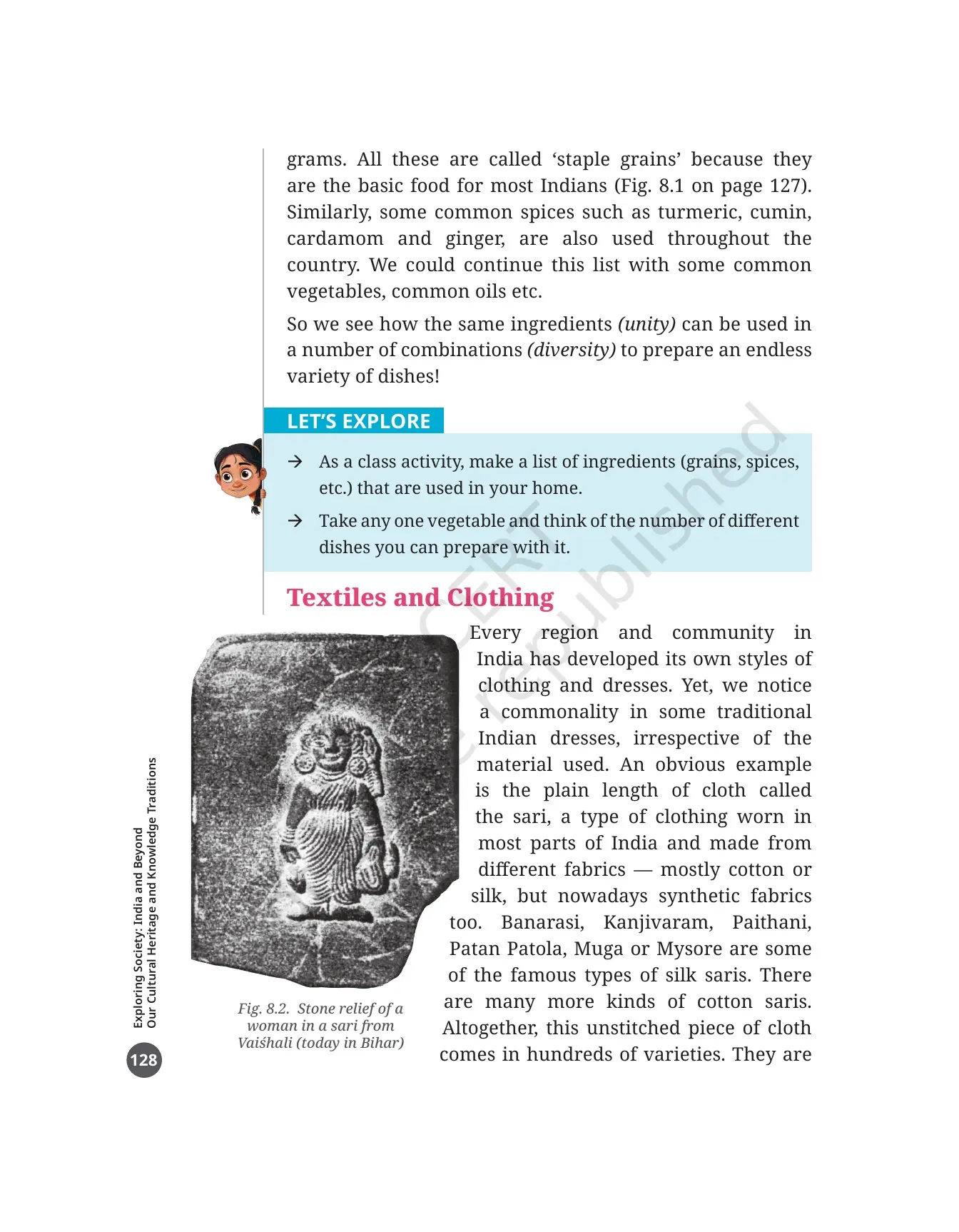
- Age: the stone relief in Fig. 8.2, from Vaiśhali in today's Bihar, goes back a few centuries BCE.
- Relief (margin word): a design that stands out from the surface of a panel, which may be of stone, wood, ceramic or another material.
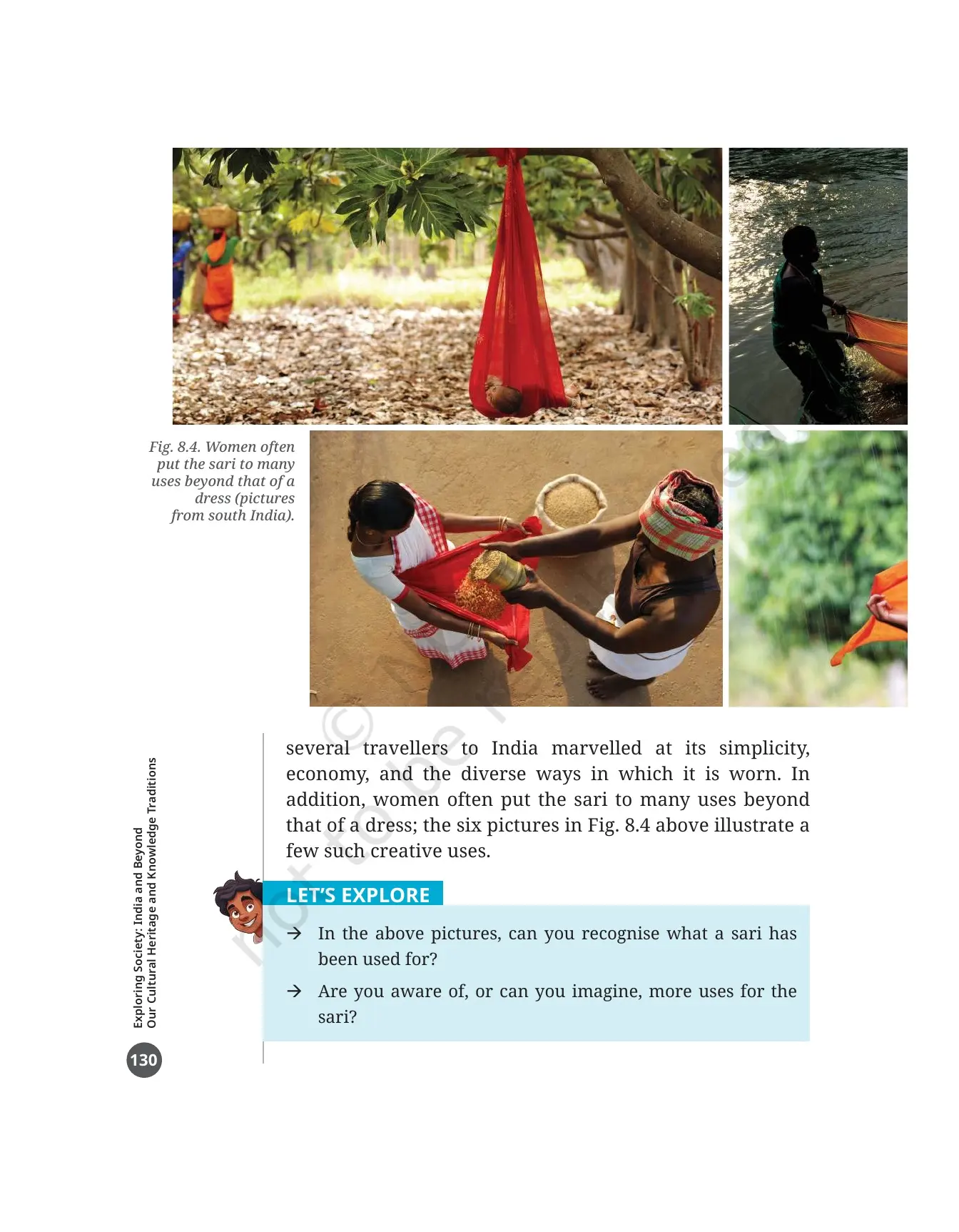
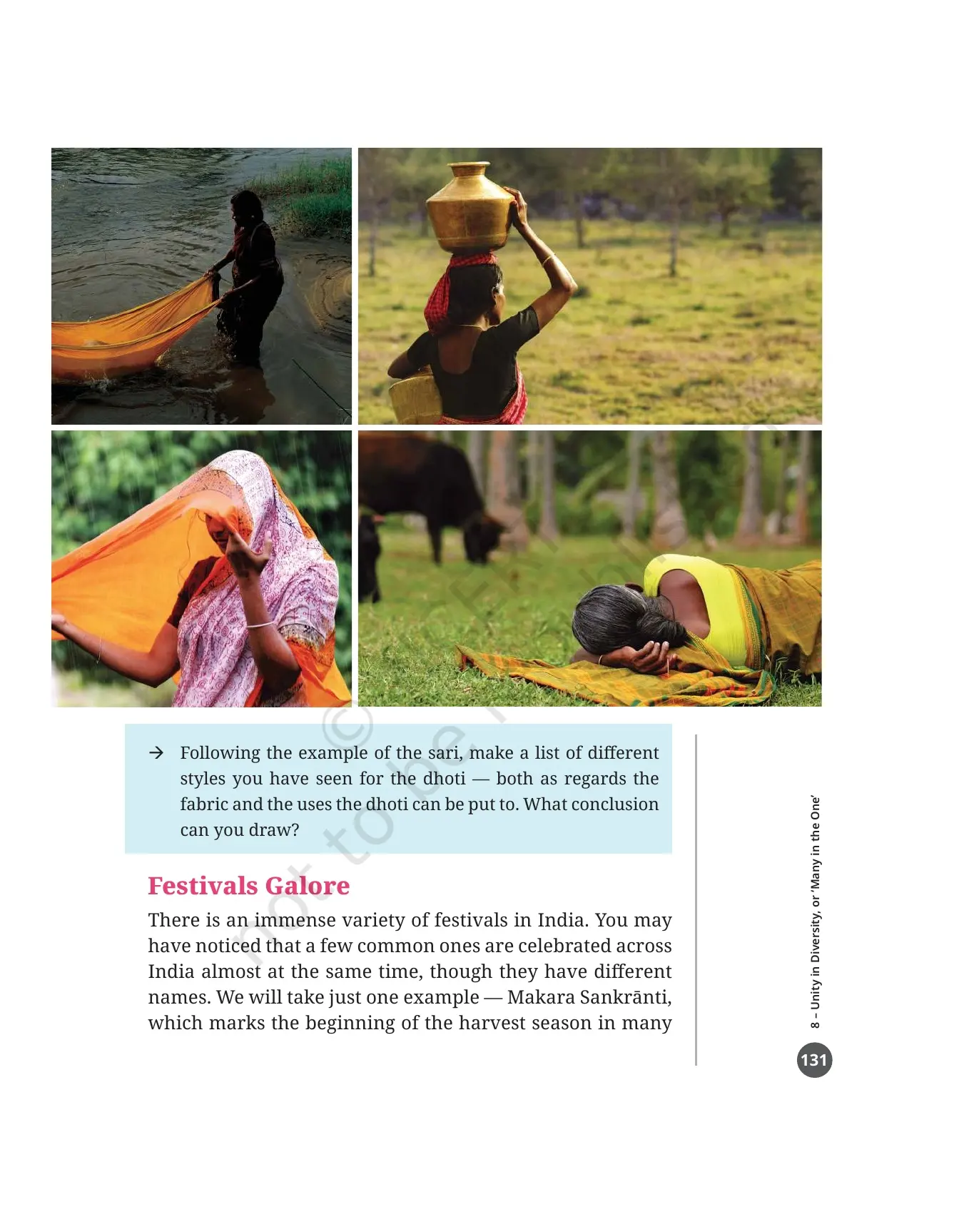
There are many ways of wearing the sari, and they change from one region to another and from one community to another. New ways of draping it are still being invented. In the end it is still a single dress, the sari. In past centuries several travellers to India marvelled at its simplicity, its economy and the diverse ways it is worn. Fig. 8.4 on printed page 130 adds six pictures from south India showing uses of the sari beyond that of a dress, and the LET'S EXPLORE box asks you to name them and then repeat the exercise for the dhoti.
Festivals Galore: Makara Sankrānti Under Thirteen Different Names
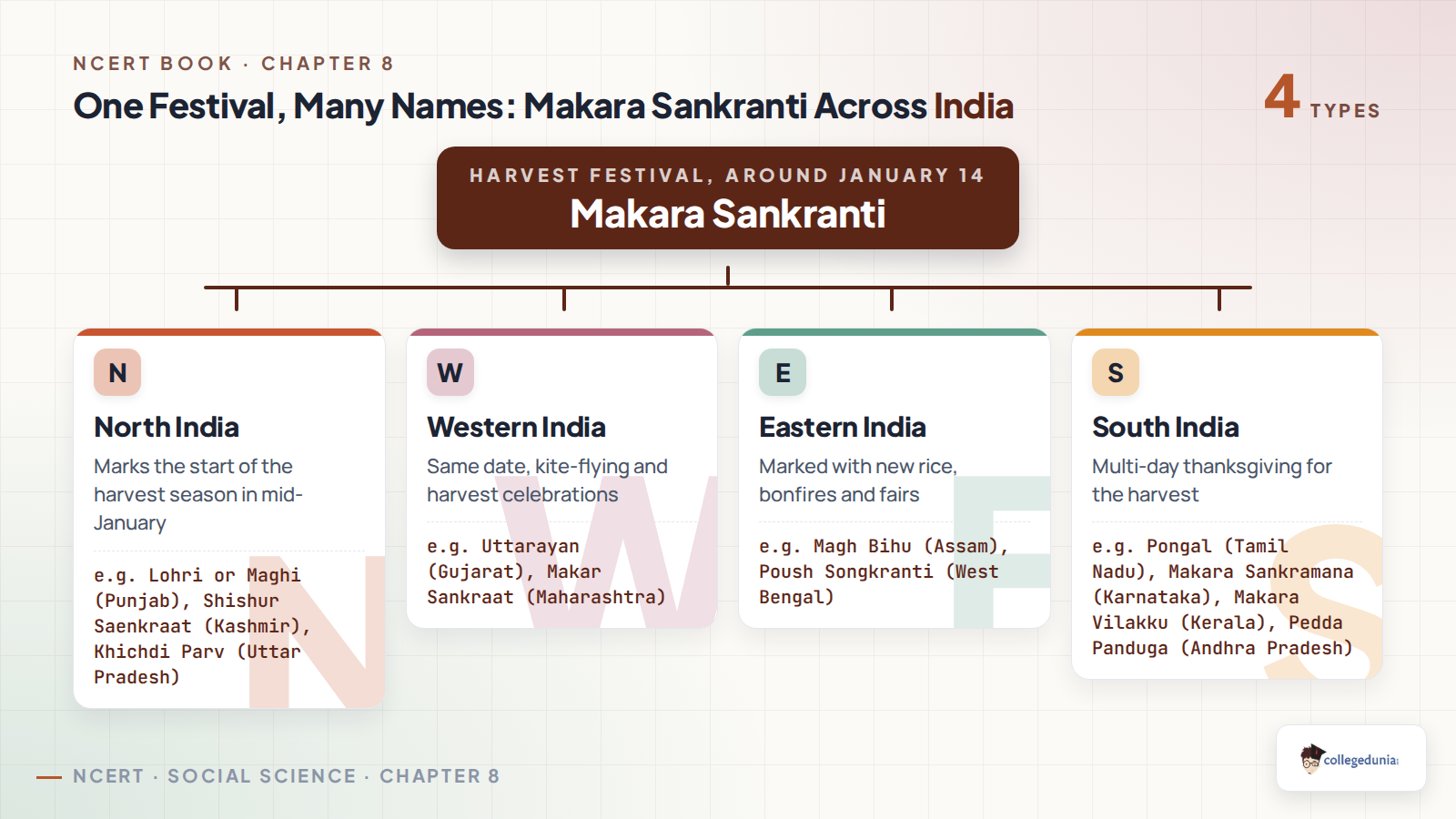
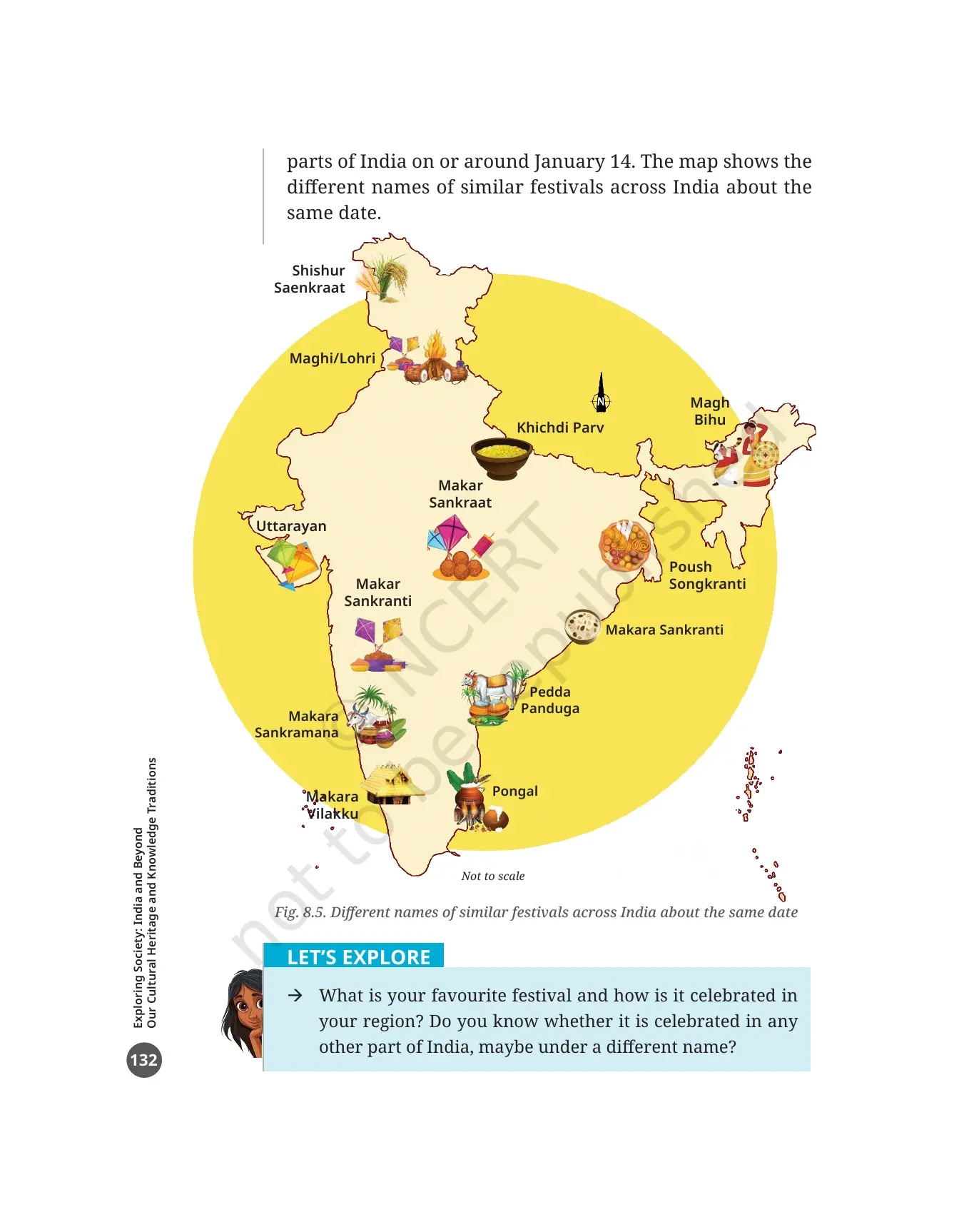
India has an immense variety of festivals, and the chapter takes just one example to make its point. Makara Sankrānti marks the beginning of the harvest season in many parts of India, on or around January 14. The map in Fig. 8.5 on printed page 132 prints the different names of similar festivals falling about the same date.
| Name printed on the map | Where the map places it |
|---|---|
| Shishur Saenkraat | The far north of the map |
| Maghi / Lohri | The northwest |
| Khichdi Parv | The northern plains |
| Magh Bihu | The far northeast |
| Uttarayan | The western coast |
| Makar Sankraat | The western Deccan |
| Makar Sankranti | Central India |
| Poush Songkranti | The east |
| Makara Sankranti | The eastern coast |
| Pedda Panduga | The southeast |
| Makara Sankramana | The southwest Deccan |
| Makara Vilakku | The southwest coast |
| Pongal | The far south |
Thirteen names, one date and one harvest. That is the whole idea of the chapter in a single figure, which is why the map is the most-quoted page in class tests. The LET'S EXPLORE box then asks two things: name your favourite festival and say how it is celebrated in your region, and list the main October and November festivals with their various names across the country.
An Epic Spread: The Pañchatantra, the Rāmāyaṇa and the Mahābhārata
Literature gives the chapter its strongest example. Indian literatures are among the most abundant in the world and are extremely diverse, yet over centuries they have shared important themes and concerns despite differences of language and technique. The first proof is a story collection every student already knows.
- The Pañchatantra is a collection of delightful stories with animals as the main characters, and it teaches important life skills.
- The original Sanskrit text is at least 2,200 years old, but its stories were adapted in almost every Indian language.
- They travelled to Southeast Asia, the Arab world and Europe, inspiring new collections of stories along the way.
- About 200 adaptations of the Pañchatantra exist in more than 50 languages. One collection has become many.
The most striking case, the book says, is India's two epics. Epic is the margin word on printed page 133, defined as a long poem that generally narrates the adventures of heroes and other great figures of the past.
| Epic | What the chapter says happens in it |
|---|---|
| The Mahābhārata | The Pāṇḍavas, with Kṛiṣhṇa's help, fight their own cousins the Kauravas to recover their kingdom |
| The Rāmāyaṇa | Rāma, helped by his brother Lakṣhmaṇa and by Hanuman, defeats the demon Rāvaṇa, who had kidnapped his wife Sītā |
| Both together | Might fill some 7,000 pages in their original Sanskrit versions. They narrate the stories of heroes who fight to re-establish dharma, and contain many shorter stories that focus on values and keep asking what is right and what is wrong |
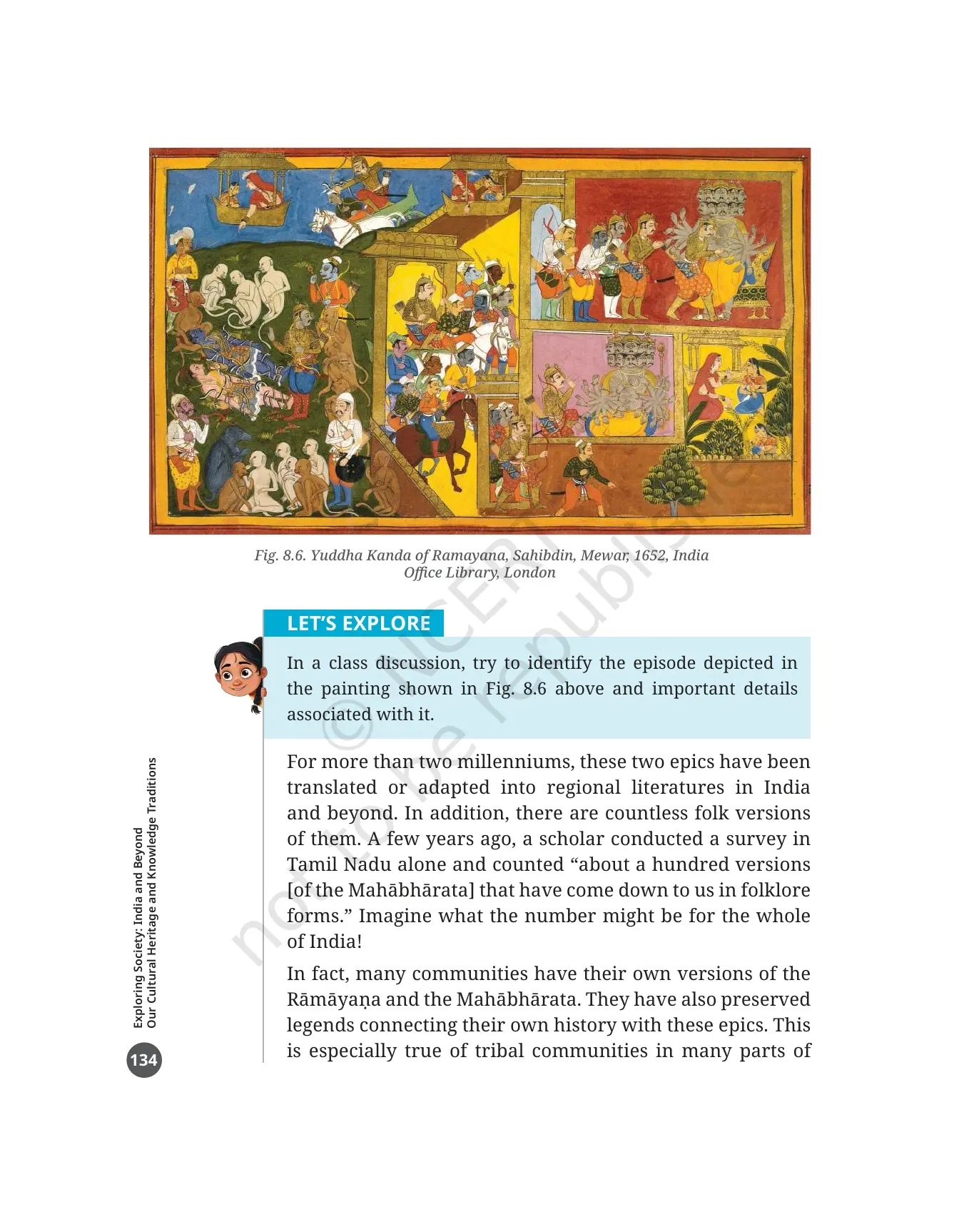
Fig. 8.6 on printed page 134 is a painting of the Yuddha Kanda of the Ramayana by Sahibdin, made in Mewar in 1652 and now in the India Office Library, London. The LET'S EXPLORE box beside it asks the class to identify the episode shown and the important details tied to it.
Tribal Versions of the Epics and What K.S. Singh Observed
For more than two millenniums the two epics have been translated or adapted into regional literatures in India and beyond, and countless folk versions exist alongside them. A scholar surveyed Tamil Nadu alone a few years ago and counted "about a hundred versions [of the Mahābhārata] that have come down to us in folklore forms." The book asks you to imagine the number for the whole of India.
Many communities also hold their own versions of the epics, and have preserved legends tying their own history to them. This is especially true of tribal communities.
- Named tribes: the Bhils, the Gonds, the Mundas and many more.
- Where else: most tribes of India's northeast and Himalayan regions, including Kashmir, have their own version of one epic or the other, or of both.
- How they travel: these tribal adaptations are transmitted orally, along with legends about the heroes visiting the tribes' own regions.
- Which heroes: generally any or all of the five Pāṇḍavas and their wife Draupadī, and sometimes even their cousin and adversary Duryodhana.
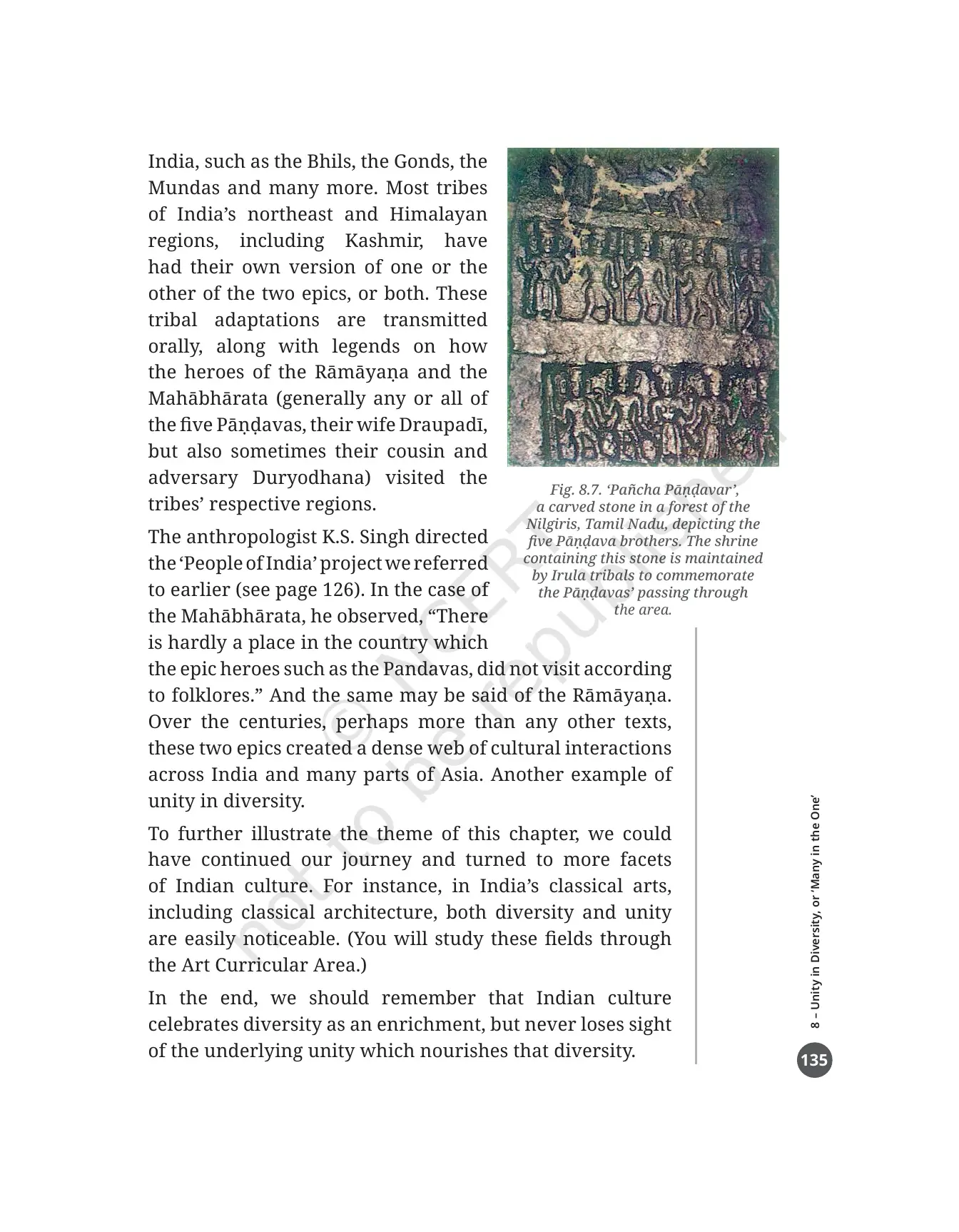
- Fig. 8.7 on printed page 135: 'Pañcha Pāṇḍavar', a carved stone in a forest of the Nilgiris in Tamil Nadu showing the five Pāṇḍava brothers. The shrine holding it is maintained by Irula tribals to mark the Pāṇḍavas' passing through the area.
The anthropologist K.S. Singh, who directed the People of India project named earlier in the chapter, put it in one sentence about the Mahābhārata: "There is hardly a place in the country which the epic heroes such as the Pandavas, did not visit according to folklores." The book adds that the same may be said of the Rāmāyaṇa, and that over the centuries the two epics created a dense web of cultural interactions across India and many parts of Asia. It closes by pointing to India's classical arts and architecture as one more field where both diversity and unity are easy to notice, and with the line to remember: Indian culture celebrates diversity as an enrichment, but never loses sight of the underlying unity which nourishes that diversity.
Every Figure, Activity Box and Margin Word Inside the Unity in Diversity PDF
This chapter numbers its images, so quote the figure number when an answer needs one. Seven figures, six LET'S EXPLORE boxes, one DON'T MISS OUT box and two margin words carry the whole chapter. Tick them off as you read.
| Figure or box | Printed page | What it shows or asks |
|---|---|---|
| The two quotations | 125 | Rabindranath Tagore on the one in the play of the many, and Sri Aurobindo on the Many in the One |
| The Big Questions | 125 | What 'unity in diversity' means in the Indian scenario, which aspects of India's diversity are most striking, and how we make out the unity underneath |
| Fig. 8.1 | 127 | A few examples of cereals and pulses from different regions of India, laid out across the country and marked 'Not to scale' |
| Fig. 8.2 | 128 | A stone relief of a woman in a sari from Vaiśhali, today in Bihar, dating back a few centuries BCE |
| Fig. 8.3 | 129 | A few specimens of colourful traditional Indian textiles |
| Fig. 8.4 | 130 | Six pictures from south India showing the many uses women put the sari to beyond that of a dress |
| Fig. 8.5 | 132 | The map of different names of similar festivals across India about the same date, from Shishur Saenkraat to Pongal |
| Fig. 8.6 | 134 | Yuddha Kanda of Ramayana, by Sahibdin, Mewar, 1652, India Office Library, London |
| Fig. 8.7 | 135 | 'Pañcha Pāṇḍavar', a carved stone in a Nilgiris forest in Tamil Nadu, maintained as a shrine by Irula tribals |
| LET'S EXPLORE boxes | 126, 128, 129, 130 with 131, 132 and 134 | Classmates' birthplaces and mother tongues, ingredients at home and one vegetable, the sari in 100 to 150 words, uses of the sari and the dhoti, your favourite festival and the October and November list, and the episode in the Mewar painting |
| DON'T MISS OUT box | 129 | Indian cotton, chintz in 17th-century Europe, and the English and French ban on its import |
| Margin words | 129 and 133 | Relief, a design that stands out from the surface of a panel, and Epic, a long poem narrating the adventures of heroes and other great figures of the past |
| Before we move on ... | 136 | A three-point recap on India's immense diversity, the unity underlying it, and diversity that enriches instead of dividing |
Questions, Activities and Projects at the End of the Unity in Diversity Chapter
Printed page 136 carries 5 numbered items, and school tests are built straight out of them. There is no true or false set in this chapter, which surprises students who have just finished Chapter 7. Every question is open-ended, so the marks go to students who quote a detail from the chapter instead of writing a general answer.
- Conduct a class discussion on the two quotations at the start of the chapter, the Tagore prayer and the Sri Aurobindo statement.
- Select a few stories from the Pañchatantra and discuss how their message is still valid today. Add any similar stories from your own region.
- Collect a few folk tales from your region and discuss their message.
- Name an ancient story you have seen shown through a form of art, such as a sculpture, a painting, a dance performance or a movie, and discuss it with your classmates.
- Discuss the Jawaharlal Nehru quotation printed with the question, on the cultural background he found everywhere he travelled before Independence.
Question 5 quotes India's first prime minister on how the old epics, in popular translations and paraphrases, were widely known among the masses. Nehru writes that illiterate villagers would know hundreds of verses by heart and that their conversation was full of references to them. Pair this answer with the K.S. Singh line on printed page 135, because the two make the same point from different directions.
Common Mistakes Students Make in the Unity in Diversity Chapter
- Swapping the two opening quotations. The prayer about the play of the many is Tagore. The statement about Swabhava and Swadharma is Sri Aurobindo.
- Writing that the People of India project counted 325 scripts. It counted 325 languages using 25 scripts, across 4,635 communities.
- Calling the sari a stitched dress. The book calls it a plain, unstitched length of cloth, and that is the point of the example.
- Saying Makara Sankrānti falls on different dates in different states. The names change. The date stays on or around January 14.
- Giving the Pañchatantra's age as 200 years. The Sanskrit original is at least 2,200 years old. The number 200 is the count of adaptations, in more than 50 languages.
- Crediting the 'unity in diversity' line to the survey. It comes from the British historian Vincent Smith, writing over a century ago.
Related Links:
How to Read the Class 6 Unity in Diversity PDF in Two Sittings
This is a 12-page chapter, shorter than the one before it, but it carries a lot of names and figures. Split it into two sittings of about 25 minutes each, and keep a rough sheet beside you for the numbers and the festival names.
- Sitting 1, minutes 0 to 10: read printed pages 125 and 126, then write both quotations with the correct author beside each.
- Sitting 1, minutes 10 to 18: copy the People of India project figures, 4,635 communities, 325 languages and 25 scripts, and the Vincent Smith line.
- Sitting 1, minutes 18 to 25: read Food for All on printed pages 127 and 128, and list the cereals, the three millets and the four spices.
- Sitting 2, minutes 0 to 10: read the sari pages 128 to 131 and write the six silk saris plus the chintz box in one line each.
- Sitting 2, minutes 10 to 16: copy the thirteen festival names from the map on printed page 132 into a single column.
- Sitting 2, minutes 16 to 25: read An Epic Spread on printed pages 133 to 135 and write the Pañchatantra numbers, the 7,000 pages and the K.S. Singh line.
Come back the next day for the five end questions on printed page 136. Answering them after you know the names is what makes the chapter stick, because every question wants a detail from the text rather than a general opinion. That second pass is what turns a chapter you have read into a chapter you can answer.
More Unity in Diversity Class 6 Resources
The book PDF gives you the printed chapter. These pages give you the answers, the revision layer and the last-day recap for the same chapter.
| Resource | What it gives you |
|---|---|
| Unity in Diversity Class 6 NCERT Solutions | Step-by-step answers to all 5 end questions and every LET'S EXPLORE box, including the 100 to 150 word sari task |
| Unity in Diversity Class 6 Revision Notes | The People of India figures, the staple grains list, the festival map names and the two epics in one short read |
| Unity in Diversity Class 6 Handwritten Notes | A topper's handwritten pages with the names and numbers in colour-coded boxes for a last-day recap |
| Unity in Diversity Class 6 NCERT Book PDF | This page. The official 2026-27 chapter file, printed pages 125 to 136 of Exploring Society: India and Beyond |
NCERT Book PDF for Class 6 Social Science: All 14 Chapters
Exploring Society: India and Beyond runs to 14 chapters across five themes. Download the ones your school has taught, or take the full set in one go.
| Chapter | Resource |
|---|---|
| Chapter 1 | Locating Places on the Earth NCERT Book PDF |
| Chapter 2 | Oceans and Continents NCERT Book PDF |
| Chapter 3 | Landforms and Life NCERT Book PDF |
| Chapter 4 | Timeline and Sources of History NCERT Book PDF |
| Chapter 5 | India, That Is Bharat NCERT Book PDF |
| Chapter 6 | The Beginnings of Indian Civilisation NCERT Book PDF |
| Chapter 7 | India's Cultural Roots NCERT Book PDF |
| Chapter 8 | Unity in Diversity, or 'Many in the One' NCERT Book PDF (this page) |
| Chapter 9 | Family and Community NCERT Book PDF |
| Chapter 10 | Grassroots Democracy Part 1: Governance NCERT Book PDF |
| Chapter 11 | Grassroots Democracy Part 2: Local Government in Rural Areas NCERT Book PDF |
| Chapter 12 | Grassroots Democracy Part 3: Local Government in Urban Areas NCERT Book PDF |
| Chapter 13 | The Value of Work NCERT Book PDF |
| Chapter 14 | Economic Activities Around Us NCERT Book PDF |
Unity in Diversity Class 6 Social Science NCERT Book PDF FAQs
Common Questions on the Class 6 Social Science Chapter 8 File
Ques. Where can I download the NCERT Class 6 Social Science Chapter 8 Unity in Diversity PDF?
Ans. You can download it directly from this page. It is the official NCERT chapter file for the 2026-27 print of Exploring Society: India and Beyond, and it is free.
Ques. How many pages is the Unity in Diversity chapter PDF?
Ans. The file runs to 12 pages. It covers printed pages 125 to 136 of the textbook, from the two opening quotations to the five end questions.
Ques. What does 'unity in diversity' mean in the Indian scenario?
Ans. It means that India's visible variety of landscapes, languages, dresses, foods and festivals rests on a shared base. The chapter shows it through four examples: the same staple grains cooked in endless ways, one unstitched sari draped in hundreds of styles, one harvest festival celebrated under many names, and two epics retold in every region.
Ques. Who wrote the two quotations at the start of the chapter?
Ans. The first is by Rabindranath Tagore, a prayer never to lose the bliss of the touch of the one in the play of the many. The second is by Sri Aurobindo, on the principle of unity in diversity and the Many in the One placing India on the sure foundation of her Swabhava and Swadharma.
Ques. What was the People of India project?
Ans. It was a massive survey conducted in the late 20th century by the Anthropological Survey of India, a national organisation. It covered 4,635 communities across all States of the country.
Ques. How many languages and scripts did the People of India project count?
Ans. It counted 325 languages using 25 scripts. It also observed that many Indians may be called migrants, in the sense of people not living near their birthplace or with their original community.
Ques. Which staple grains and spices are common across India?
Ans. Cereals such as rice, barley and wheat, millets such as pearl millet (bajra), sorghum (jowar) and finger millet (ragi), and pulses such as various dals and grams. Turmeric, cumin, cardamom and ginger are the four spices the chapter names as common throughout the country.
Ques. Why is the sari used as an example of unity in diversity?
Ans. The sari is a single unstitched length of cloth worn in most parts of India, which is the unity. The fabrics, weaves, prints, colours and ways of draping run into hundreds of varieties, which is the diversity. Famous silk types named are Banarasi, Kanjivaram, Paithani, Patan Patola, Muga and Mysore.
Ques. What is chintz, and why did England and France ban it?
Ans. Chintz is a beautiful type of printed cotton from India. It became so popular in 17th-century Europe that the sale of some European dresses dropped sharply, so England and France banned its import to protect their own products.
Ques. On what date is Makara Sankrānti celebrated?
Ans. On or around January 14. It marks the beginning of the harvest season in many parts of India, and the map on printed page 132 shows similar festivals falling about the same date under different names.
Ques. What are the different names of Makara Sankrānti across India?
Ans. The map in Fig. 8.5 prints Shishur Saenkraat, Maghi or Lohri, Khichdi Parv, Magh Bihu, Uttarayan, Makar Sankraat, Makar Sankranti, Poush Songkranti, Makara Sankranti, Pedda Panduga, Makara Sankramana, Makara Vilakku and Pongal.
Ques. How old is the Pañchatantra and how many adaptations does it have?
Ans. The original Sanskrit text is at least 2,200 years old. It is estimated that about 200 adaptations of the Pañchatantra exist in more than 50 languages, and the stories travelled as far as Southeast Asia, the Arab world and Europe.
Ques. What is an epic, according to the margin word in the chapter?
Ans. The margin word on printed page 133 defines an epic as a long poem that generally narrates the adventures of heroes and other great figures of the past.
Ques. How long are the Rāmāyaṇa and the Mahābhārata?
Ans. Together the two Sanskrit epics might fill some 7,000 pages in their original versions. Both narrate the stories of heroes who fight to re-establish dharma, and both contain many shorter stories that focus on values.
Ques. Which tribal communities have their own versions of the epics?
Ans. The chapter names the Bhils, the Gonds and the Mundas, and adds that most tribes of India's northeast and Himalayan regions, including Kashmir, have their own version of one epic or the other, or of both. These versions are transmitted orally.
Ques. What did K.S. Singh say about the Mahābhārata?
Ans. K.S. Singh, the anthropologist who directed the People of India project, observed: "There is hardly a place in the country which the epic heroes such as the Pandavas, did not visit according to folklores." The chapter adds that the same may be said of the Rāmāyaṇa.
Ques. How many questions are there at the end of the Unity in Diversity chapter?
Ans. Printed page 136 carries 5 numbered questions, activities and projects. There is no true or false set in this chapter. Question 5 asks you to discuss a quotation by Jawaharlal Nehru on the cultural background he found across India before Independence.
Ques. Do I need the NCERT Solutions if I already have the book PDF?
Ans. The book PDF carries the questions but not the answers. Use the Unity in Diversity Class 6 NCERT Solutions to check all 5 end questions and every activity box.



Comments