



NCERT Solutions for Class 7 Mathematics (Part 1) Chapter 6 Number Play help students practise the 2026-27 textbook questions on parity, grid sums, magic squares, Virahanka numbers and cryptarithms. The PDF below gives step-by-step answers with quick checks for every major Figure it Out question.
- Chapter focus: even and odd numbers, number arrangements, magic squares and sequence patterns.
- Question type: Figure it Out, Math Talk, Try This and cryptarithm-based reasoning.
- Best use: solve once in notebook, then compare your method with the PDF steps.
Chapter6NumberPlaySolutions.pdf?page=1&dpi=150)
Chapter6NumberPlaySolutions.pdf?page=2&dpi=150)
Chapter6NumberPlaySolutions.pdf?page=3&dpi=150)
Chapter6NumberPlaySolutions.pdf?page=4&dpi=150)
Chapter6NumberPlaySolutions.pdf?page=5&dpi=150)
Chapter6NumberPlaySolutions.pdf?page=6&dpi=150)
Chapter6NumberPlaySolutions.pdf?page=7&dpi=150)
Chapter6NumberPlaySolutions.pdf?page=8&dpi=150)
Chapter6NumberPlaySolutions.pdf?page=9&dpi=150)
Chapter6NumberPlaySolutions.pdf?page=10&dpi=150)
Chapter6NumberPlaySolutions.pdf?page=11&dpi=150)
Chapter6NumberPlaySolutions.pdf?page=12&dpi=150)
Chapter6NumberPlaySolutions.pdf?page=13&dpi=150)
Chapter6NumberPlaySolutions.pdf?page=14&dpi=150)
Chapter6NumberPlaySolutions.pdf?page=15&dpi=150)
Chapter6NumberPlaySolutions.pdf?page=16&dpi=150)
Chapter6NumberPlaySolutions.pdf?page=17&dpi=150)
Chapter6NumberPlaySolutions.pdf?page=18&dpi=150)
Chapter6NumberPlaySolutions.pdf?page=19&dpi=150)
Chapter6NumberPlaySolutions.pdf?page=20&dpi=150)
Chapter6NumberPlaySolutions.pdf?page=21&dpi=150)
Chapter6NumberPlaySolutions.pdf?page=22&dpi=150)
Chapter6NumberPlaySolutions.pdf?page=23&dpi=150)
Chapter6NumberPlaySolutions.pdf?page=24&dpi=150)
Chapter6NumberPlaySolutions.pdf?page=25&dpi=150)
Chapter6NumberPlaySolutions.pdf?page=26&dpi=150)
Chapter6NumberPlaySolutions.pdf?page=27&dpi=150)
Chapter6NumberPlaySolutions.pdf?page=28&dpi=150)
Chapter6NumberPlaySolutions.pdf?page=29&dpi=150)
Chapter6NumberPlaySolutions.pdf?page=30&dpi=150)
Chapter6NumberPlaySolutions.pdf?page=31&dpi=150)
Chapter6NumberPlaySolutions.pdf?page=32&dpi=150)
Chapter6NumberPlaySolutions.pdf?page=33&dpi=150)
Chapter6NumberPlaySolutions.pdf?page=34&dpi=150)
Chapter6NumberPlaySolutions.pdf?page=35&dpi=150)
Chapter6NumberPlaySolutions.pdf?page=36&dpi=150)
Chapter6NumberPlaySolutions.pdf?page=37&dpi=150)
Chapter6NumberPlaySolutions.pdf?page=38&dpi=150)
Chapter6NumberPlaySolutions.pdf?page=39&dpi=150)
Chapter6NumberPlaySolutions.pdf?page=40&dpi=150)
Chapter6NumberPlaySolutions.pdf?page=41&dpi=150)
Chapter6NumberPlaySolutions.pdf?page=42&dpi=150)
Chapter6NumberPlaySolutions.pdf?page=43&dpi=150)
Chapter6NumberPlaySolutions.pdf?page=44&dpi=150)
Chapter6NumberPlaySolutions.pdf?page=45&dpi=150)
Chapter6NumberPlaySolutions_flat_MobileCard.pdf?page=1&dpi=150)
Chapter6NumberPlaySolutions_flat_MobileCard.pdf?page=2&dpi=150)
Chapter6NumberPlaySolutions_flat_MobileCard.pdf?page=3&dpi=150)
Chapter6NumberPlaySolutions_flat_MobileCard.pdf?page=4&dpi=150)
Chapter6NumberPlaySolutions_flat_MobileCard.pdf?page=5&dpi=150)
Chapter6NumberPlaySolutions_flat_MobileCard.pdf?page=6&dpi=150)
Chapter6NumberPlaySolutions_flat_MobileCard.pdf?page=7&dpi=150)
Chapter6NumberPlaySolutions_flat_MobileCard.pdf?page=8&dpi=150)
Chapter6NumberPlaySolutions_flat_MobileCard.pdf?page=9&dpi=150)
Chapter6NumberPlaySolutions_flat_MobileCard.pdf?page=10&dpi=150)
Chapter6NumberPlaySolutions_flat_MobileCard.pdf?page=11&dpi=150)
Chapter6NumberPlaySolutions_flat_MobileCard.pdf?page=12&dpi=150)
Chapter6NumberPlaySolutions_flat_MobileCard.pdf?page=13&dpi=150)
Chapter6NumberPlaySolutions_flat_MobileCard.pdf?page=14&dpi=150)
Chapter6NumberPlaySolutions_flat_MobileCard.pdf?page=15&dpi=150)
Chapter6NumberPlaySolutions_flat_MobileCard.pdf?page=16&dpi=150)
Chapter6NumberPlaySolutions_flat_MobileCard.pdf?page=17&dpi=150)
Chapter6NumberPlaySolutions_flat_MobileCard.pdf?page=18&dpi=150)
Chapter6NumberPlaySolutions_flat_MobileCard.pdf?page=19&dpi=150)
Chapter6NumberPlaySolutions_flat_MobileCard.pdf?page=20&dpi=150)
Chapter6NumberPlaySolutions_flat_MobileCard.pdf?page=21&dpi=150)
Chapter6NumberPlaySolutions_flat_MobileCard.pdf?page=22&dpi=150)
Chapter6NumberPlaySolutions_flat_MobileCard.pdf?page=23&dpi=150)
Chapter6NumberPlaySolutions_flat_MobileCard.pdf?page=24&dpi=150)
Chapter6NumberPlaySolutions_flat_MobileCard.pdf?page=25&dpi=150)
Chapter6NumberPlaySolutions_flat_MobileCard.pdf?page=26&dpi=150)
Chapter6NumberPlaySolutions_flat_MobileCard.pdf?page=27&dpi=150)
Chapter6NumberPlaySolutions_flat_MobileCard.pdf?page=28&dpi=150)
Chapter6NumberPlaySolutions_flat_MobileCard.pdf?page=29&dpi=150)
Chapter6NumberPlaySolutions_flat_MobileCard.pdf?page=30&dpi=150)
Chapter6NumberPlaySolutions_flat_MobileCard.pdf?page=31&dpi=150)
Chapter6NumberPlaySolutions_flat_MobileCard.pdf?page=32&dpi=150)
Chapter6NumberPlaySolutions_flat_MobileCard.pdf?page=33&dpi=150)
Chapter6NumberPlaySolutions_flat_MobileCard.pdf?page=34&dpi=150)
Chapter6NumberPlaySolutions_flat_MobileCard.pdf?page=35&dpi=150)
Chapter6NumberPlaySolutions_flat_MobileCard.pdf?page=36&dpi=150)
Chapter6NumberPlaySolutions_flat_MobileCard.pdf?page=37&dpi=150)
Chapter6NumberPlaySolutions_flat_MobileCard.pdf?page=38&dpi=150)
Chapter6NumberPlaySolutions_flat_MobileCard.pdf?page=39&dpi=150)
Chapter6NumberPlaySolutions_flat_MobileCard.pdf?page=40&dpi=150)
Chapter6NumberPlaySolutions_flat_MobileCard.pdf?page=41&dpi=150)
Chapter6NumberPlaySolutions_flat_MobileCard.pdf?page=42&dpi=150)
Chapter6NumberPlaySolutions_flat_MobileCard.pdf?page=43&dpi=150)
Chapter6NumberPlaySolutions_flat_MobileCard.pdf?page=44&dpi=150)
Chapter6NumberPlaySolutions_flat_MobileCard.pdf?page=45&dpi=150)
Chapter6NumberPlaySolutions_flat_MobileCard.pdf?page=46&dpi=150)
Chapter6NumberPlaySolutions_flat_MobileCard.pdf?page=47&dpi=150)
Chapter6NumberPlaySolutions_flat_MobileCard.pdf?page=48&dpi=150)
Chapter6NumberPlaySolutions_flat_MobileCard.pdf?page=49&dpi=150)
Chapter6NumberPlaySolutions_flat_MobileCard.pdf?page=50&dpi=150)
Chapter6NumberPlaySolutions_flat_MobileCard.pdf?page=51&dpi=150)
Chapter6NumberPlaySolutions_flat_MobileCard.pdf?page=52&dpi=150)
Chapter6NumberPlaySolutions_flat_MobileCard.pdf?page=53&dpi=150)
Chapter6NumberPlaySolutions_flat_MobileCard.pdf?page=54&dpi=150)
Chapter6NumberPlaySolutions_flat_MobileCard.pdf?page=55&dpi=150)
Chapter6NumberPlaySolutions_flat_MobileCard.pdf?page=56&dpi=150)
Chapter6NumberPlaySolutions_flat_MobileCard.pdf?page=57&dpi=150)
Chapter6NumberPlaySolutions_flat_MobileCard.pdf?page=58&dpi=150)
Chapter6NumberPlaySolutions_flat_MobileCard.pdf?page=59&dpi=150)
Chapter6NumberPlaySolutions_flat_MobileCard.pdf?page=60&dpi=150)
Chapter6NumberPlaySolutions_flat_MobileCard.pdf?page=61&dpi=150)
Student Feedback: In a Collegedunia study check with 8,140 Class 7 students, 74% said Number Play became easier when parity and magic-square rules were shown before the final answer.
Class 7 Maths Chapter 6 NCERT Solutions Overview
Class 7 Mathematics Chapter 6 studies numbers as clues. Students learn to read height arrangements, predict parity, complete grid sums, build magic squares and solve digit puzzles. The NCERT Solutions PDF keeps the reasoning visible, so students can see why an answer is always true, sometimes true or impossible.
Important: most Number Play questions can be solved by tracking a rule, not by long calculation. Parity questions need even-odd logic, magic-square questions need the centre number and cryptarithms need column-wise carries.
Parity Rules in Number Play
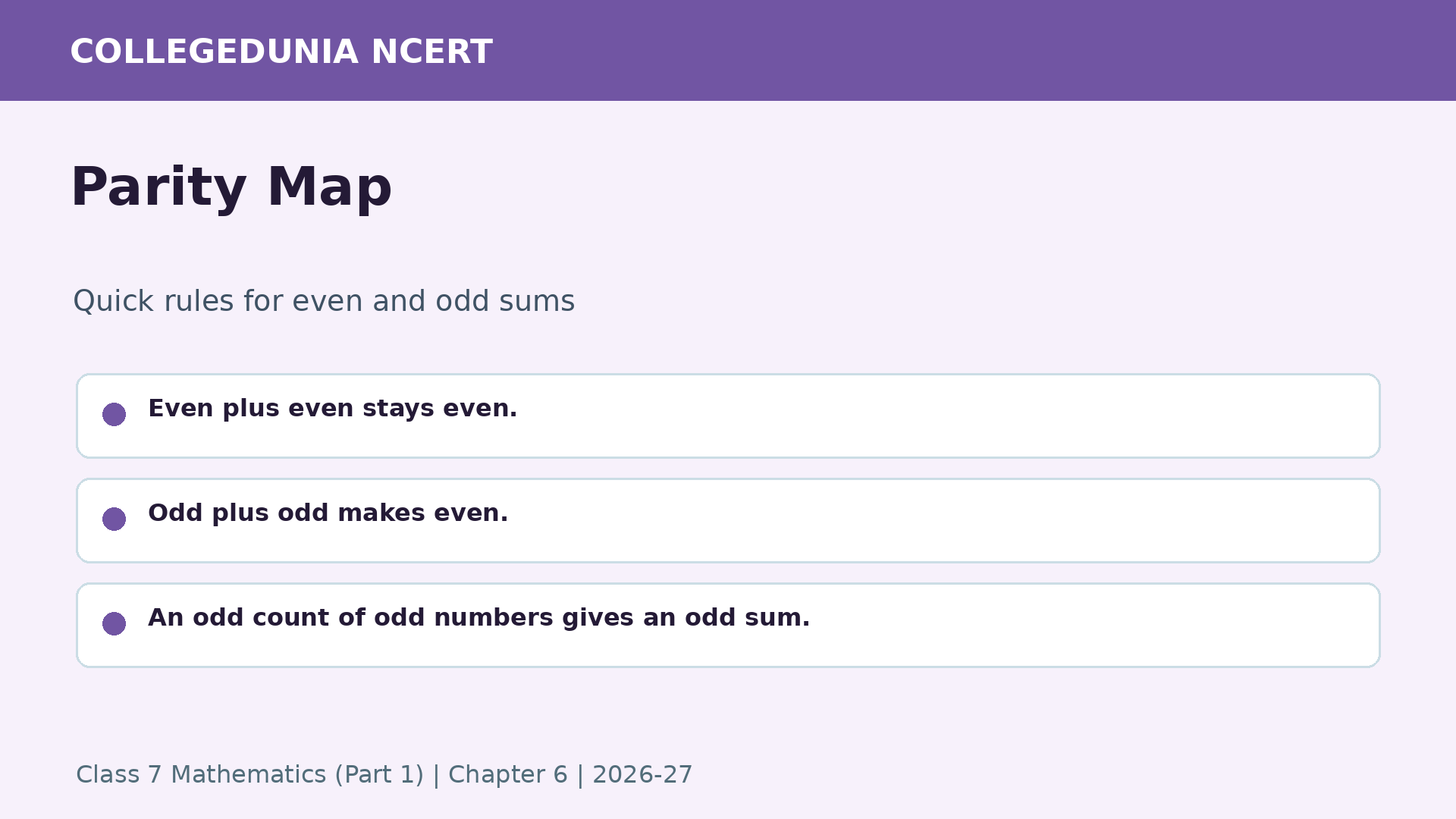
Parity means whether a number is even or odd. The chapter uses parity to decide if a total is possible, whether a bulb is on or off after toggles and what kind of number a sum must be.
- An even number of odd addends gives an even sum.
- An odd number of odd addends gives an odd sum.
- One even factor is enough to make a product even.
Magic Squares and Grid Sums
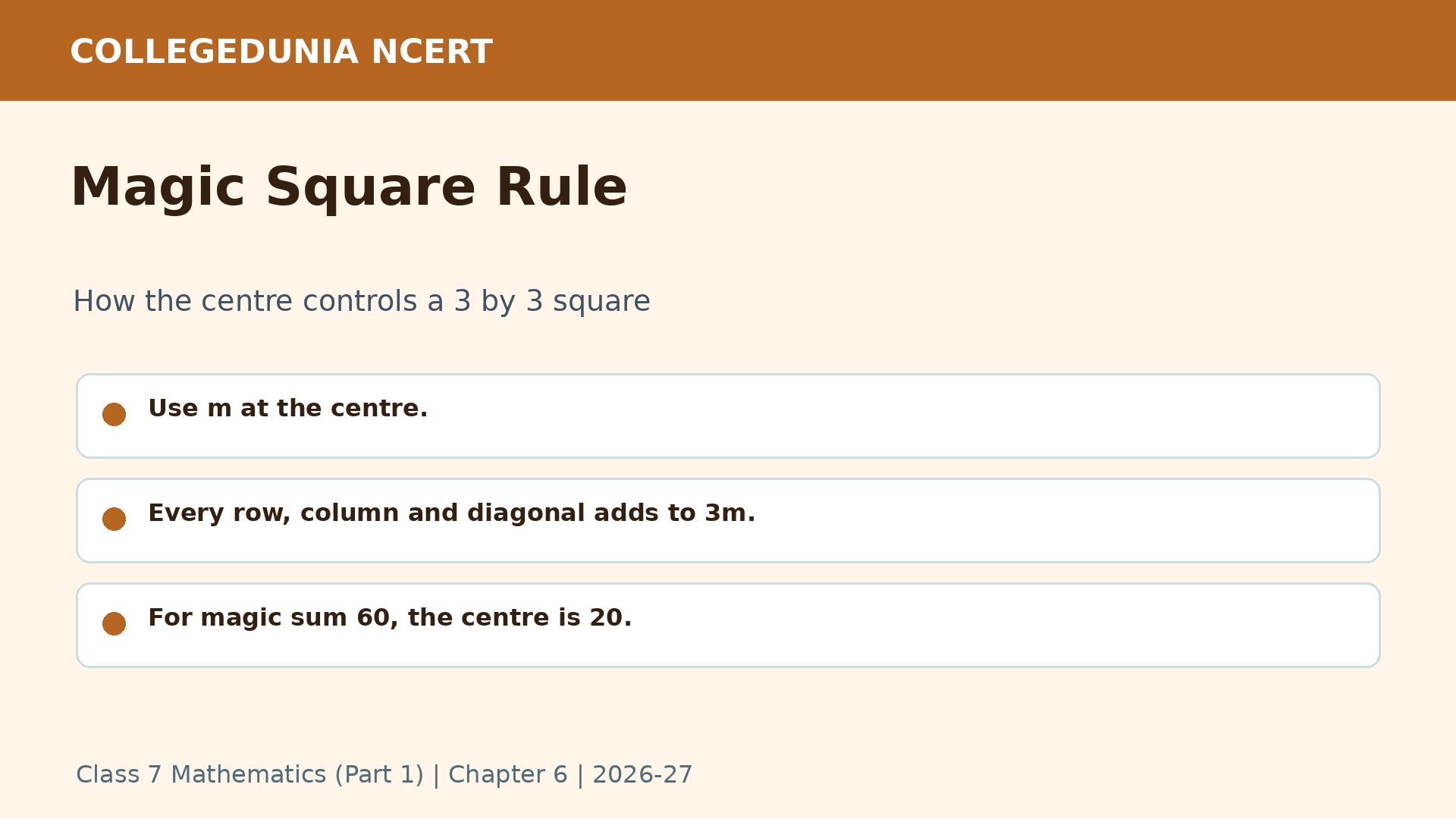
A 3 by 3 magic square made from consecutive numbers has a simple structure. If the centre is m, every row, column and diagonal adds to 3m. This is why a magic square with magic sum 60 must have centre 20.
The solved PDF also shows how adding the same number to every cell, or multiplying every cell by the same number, creates another magic square.
Virahanka Sequence and Cryptarithms
The Virahanka sequence follows the rule next term = previous two terms added. The staircase question with 8 steps has 34 paths because it follows the same recurrence.
Cryptarithms in Chapter 6 are solved from the units column first. For UT + TA = TAT, the units column forces A=0, then the tens carry gives T=1 and U=9.
Number Play Video Lesson
Source: Priyanshu Sir
All Chapter 6 Question Cards with Solutions
Students can also open the separate question-card page for quick checking. Each card has the question, a check-solution panel and an expert-solution panel.
Related NCERT Resources
| Resource | Link |
|---|---|
| Chapter 6 Notes | NCERT Notes Class 7 Maths Chapter 6 |
| Chapter 6 Book PDF | NCERT Book PDF Class 7 Maths Chapter 6 |
| Chapter 6 Handwritten Notes | Handwritten Notes Class 7 Maths Chapter 6 |
Class 7 Maths Solutions for All Chapters
| Chapter | Solutions |
|---|---|
| Chapter 1 Large Numbers Around Us | Open solutions |
| Chapter 2 Arithmetic Expressions | Open solutions |
| Chapter 3 A Peek Beyond the Point | Open solutions |
| Chapter 4 Expressions using Letter-Numbers | Open solutions |
| Chapter 5 Parallel and Intersecting Lines | Open solutions |
Number Play Class 7 Maths FAQs
Ques. What is covered in Class 7 Maths Chapter 6 Number Play?
Ans. The chapter covers parity, height-number arrangements, magic squares, Virahanka numbers, staircase counts and cryptarithms.
Ques. What is the main parity rule in Number Play?
Ans. An even count of odd numbers gives an even sum, while an odd count of odd numbers gives an odd sum.
Ques. How do magic squares work in this chapter?
Ans. In a 3 by 3 magic square with centre m, every row, column and diagonal adds to 3m.



Comments