



The Class 7 Maths Chapter 3 NCERT Solutions for Finding Common Ground help students practise HCF, LCM, prime factorisation and word problems according to the 2026-27 NCERT textbook.
- 28 solved questions are covered in the PDF with Solution and Expert Solution steps.
- HCF vs LCM decisions are explained for tiles, packing, cycles and divisibility problems.
- Prime factorisation is used throughout, so students can check each answer quickly.
Chapter3FindingCommonGroundSolutions.pdf?page=1&dpi=150)
Chapter3FindingCommonGroundSolutions.pdf?page=2&dpi=150)
Chapter3FindingCommonGroundSolutions.pdf?page=3&dpi=150)
Chapter3FindingCommonGroundSolutions.pdf?page=4&dpi=150)
Chapter3FindingCommonGroundSolutions.pdf?page=5&dpi=150)
Chapter3FindingCommonGroundSolutions.pdf?page=6&dpi=150)
Chapter3FindingCommonGroundSolutions.pdf?page=7&dpi=150)
Chapter3FindingCommonGroundSolutions.pdf?page=8&dpi=150)
Chapter3FindingCommonGroundSolutions.pdf?page=9&dpi=150)
Chapter3FindingCommonGroundSolutions.pdf?page=10&dpi=150)
Chapter3FindingCommonGroundSolutions.pdf?page=11&dpi=150)
Chapter3FindingCommonGroundSolutions.pdf?page=12&dpi=150)
Chapter3FindingCommonGroundSolutions.pdf?page=13&dpi=150)
Chapter3FindingCommonGroundSolutions.pdf?page=14&dpi=150)
Chapter3FindingCommonGroundSolutions.pdf?page=15&dpi=150)
Chapter3FindingCommonGroundSolutions.pdf?page=16&dpi=150)
Chapter3FindingCommonGroundSolutions.pdf?page=17&dpi=150)
Chapter3FindingCommonGroundSolutions.pdf?page=18&dpi=150)
Chapter3FindingCommonGroundSolutions.pdf?page=19&dpi=150)
Chapter3FindingCommonGroundSolutions.pdf?page=20&dpi=150)
Chapter3FindingCommonGroundSolutions.pdf?page=21&dpi=150)
Chapter3FindingCommonGroundSolutions.pdf?page=22&dpi=150)
Chapter3FindingCommonGroundSolutions.pdf?page=23&dpi=150)
Chapter3FindingCommonGroundSolutions.pdf?page=24&dpi=150)
Chapter3FindingCommonGroundSolutions.pdf?page=25&dpi=150)
Chapter3FindingCommonGroundSolutions.pdf?page=26&dpi=150)
Chapter3FindingCommonGroundSolutions.pdf?page=27&dpi=150)
Chapter3FindingCommonGroundSolutions.pdf?page=28&dpi=150)
Chapter3FindingCommonGroundSolutions.pdf?page=29&dpi=150)
Chapter3FindingCommonGroundSolutions.pdf?page=30&dpi=150)
Chapter3FindingCommonGroundSolutions.pdf?page=31&dpi=150)
Chapter3FindingCommonGroundSolutions.pdf?page=32&dpi=150)
Chapter3FindingCommonGroundSolutions.pdf?page=33&dpi=150)
Chapter3FindingCommonGroundSolutions.pdf?page=34&dpi=150)
Chapter3FindingCommonGroundSolutions.pdf?page=35&dpi=150)
Chapter3FindingCommonGroundSolutions.pdf?page=36&dpi=150)
Chapter3FindingCommonGroundSolutions.pdf?page=37&dpi=150)
Chapter3FindingCommonGroundSolutions.pdf?page=38&dpi=150)
Chapter3FindingCommonGroundSolutions.pdf?page=39&dpi=150)
Chapter3FindingCommonGroundSolutions.pdf?page=40&dpi=150)
Chapter3FindingCommonGroundSolutions.pdf?page=41&dpi=150)
Chapter3FindingCommonGroundSolutions.pdf?page=42&dpi=150)
Chapter3FindingCommonGroundSolutions.pdf?page=43&dpi=150)
Chapter3FindingCommonGroundSolutions.pdf?page=44&dpi=150)
Chapter3FindingCommonGroundSolutions.pdf?page=45&dpi=150)
Chapter3FindingCommonGroundSolutions.pdf?page=46&dpi=150)
Chapter3FindingCommonGroundSolutions.pdf?page=47&dpi=150)
Chapter3FindingCommonGroundSolutions.pdf?page=48&dpi=150)
Chapter3FindingCommonGroundSolutions.pdf?page=49&dpi=150)
Chapter3FindingCommonGroundSolutions_flat_MobileCard.pdf?page=1&dpi=150)
Chapter3FindingCommonGroundSolutions_flat_MobileCard.pdf?page=2&dpi=150)
Chapter3FindingCommonGroundSolutions_flat_MobileCard.pdf?page=3&dpi=150)
Chapter3FindingCommonGroundSolutions_flat_MobileCard.pdf?page=4&dpi=150)
Chapter3FindingCommonGroundSolutions_flat_MobileCard.pdf?page=5&dpi=150)
Chapter3FindingCommonGroundSolutions_flat_MobileCard.pdf?page=6&dpi=150)
Chapter3FindingCommonGroundSolutions_flat_MobileCard.pdf?page=7&dpi=150)
Chapter3FindingCommonGroundSolutions_flat_MobileCard.pdf?page=8&dpi=150)
Chapter3FindingCommonGroundSolutions_flat_MobileCard.pdf?page=9&dpi=150)
Chapter3FindingCommonGroundSolutions_flat_MobileCard.pdf?page=10&dpi=150)
Chapter3FindingCommonGroundSolutions_flat_MobileCard.pdf?page=11&dpi=150)
Chapter3FindingCommonGroundSolutions_flat_MobileCard.pdf?page=12&dpi=150)
Chapter3FindingCommonGroundSolutions_flat_MobileCard.pdf?page=13&dpi=150)
Chapter3FindingCommonGroundSolutions_flat_MobileCard.pdf?page=14&dpi=150)
Chapter3FindingCommonGroundSolutions_flat_MobileCard.pdf?page=15&dpi=150)
Chapter3FindingCommonGroundSolutions_flat_MobileCard.pdf?page=16&dpi=150)
Chapter3FindingCommonGroundSolutions_flat_MobileCard.pdf?page=17&dpi=150)
Chapter3FindingCommonGroundSolutions_flat_MobileCard.pdf?page=18&dpi=150)
Chapter3FindingCommonGroundSolutions_flat_MobileCard.pdf?page=19&dpi=150)
Chapter3FindingCommonGroundSolutions_flat_MobileCard.pdf?page=20&dpi=150)
Chapter3FindingCommonGroundSolutions_flat_MobileCard.pdf?page=21&dpi=150)
Chapter3FindingCommonGroundSolutions_flat_MobileCard.pdf?page=22&dpi=150)
Chapter3FindingCommonGroundSolutions_flat_MobileCard.pdf?page=23&dpi=150)
Chapter3FindingCommonGroundSolutions_flat_MobileCard.pdf?page=24&dpi=150)
Chapter3FindingCommonGroundSolutions_flat_MobileCard.pdf?page=25&dpi=150)
Chapter3FindingCommonGroundSolutions_flat_MobileCard.pdf?page=26&dpi=150)
Chapter3FindingCommonGroundSolutions_flat_MobileCard.pdf?page=27&dpi=150)
Chapter3FindingCommonGroundSolutions_flat_MobileCard.pdf?page=28&dpi=150)
Chapter3FindingCommonGroundSolutions_flat_MobileCard.pdf?page=29&dpi=150)
Chapter3FindingCommonGroundSolutions_flat_MobileCard.pdf?page=30&dpi=150)
Chapter3FindingCommonGroundSolutions_flat_MobileCard.pdf?page=31&dpi=150)
Chapter3FindingCommonGroundSolutions_flat_MobileCard.pdf?page=32&dpi=150)
Chapter3FindingCommonGroundSolutions_flat_MobileCard.pdf?page=33&dpi=150)
Chapter3FindingCommonGroundSolutions_flat_MobileCard.pdf?page=34&dpi=150)
Chapter3FindingCommonGroundSolutions_flat_MobileCard.pdf?page=35&dpi=150)
Chapter3FindingCommonGroundSolutions_flat_MobileCard.pdf?page=36&dpi=150)
Chapter3FindingCommonGroundSolutions_flat_MobileCard.pdf?page=37&dpi=150)
Chapter3FindingCommonGroundSolutions_flat_MobileCard.pdf?page=38&dpi=150)
Chapter3FindingCommonGroundSolutions_flat_MobileCard.pdf?page=39&dpi=150)
Chapter3FindingCommonGroundSolutions_flat_MobileCard.pdf?page=40&dpi=150)
Chapter3FindingCommonGroundSolutions_flat_MobileCard.pdf?page=41&dpi=150)
Chapter3FindingCommonGroundSolutions_flat_MobileCard.pdf?page=42&dpi=150)
Chapter3FindingCommonGroundSolutions_flat_MobileCard.pdf?page=43&dpi=150)
Chapter3FindingCommonGroundSolutions_flat_MobileCard.pdf?page=44&dpi=150)
Chapter3FindingCommonGroundSolutions_flat_MobileCard.pdf?page=45&dpi=150)
Chapter3FindingCommonGroundSolutions_flat_MobileCard.pdf?page=46&dpi=150)
Chapter3FindingCommonGroundSolutions_flat_MobileCard.pdf?page=47&dpi=150)
Chapter3FindingCommonGroundSolutions_flat_MobileCard.pdf?page=48&dpi=150)
Chapter3FindingCommonGroundSolutions_flat_MobileCard.pdf?page=49&dpi=150)
Chapter3FindingCommonGroundSolutions_flat_MobileCard.pdf?page=50&dpi=150)
Chapter3FindingCommonGroundSolutions_flat_MobileCard.pdf?page=51&dpi=150)
Chapter3FindingCommonGroundSolutions_flat_MobileCard.pdf?page=52&dpi=150)
Chapter3FindingCommonGroundSolutions_flat_MobileCard.pdf?page=53&dpi=150)
Chapter3FindingCommonGroundSolutions_flat_MobileCard.pdf?page=54&dpi=150)
Chapter3FindingCommonGroundSolutions_flat_MobileCard.pdf?page=55&dpi=150)
Chapter3FindingCommonGroundSolutions_flat_MobileCard.pdf?page=56&dpi=150)
Chapter3FindingCommonGroundSolutions_flat_MobileCard.pdf?page=57&dpi=150)
Chapter3FindingCommonGroundSolutions_flat_MobileCard.pdf?page=58&dpi=150)
Chapter3FindingCommonGroundSolutions_flat_MobileCard.pdf?page=59&dpi=150)
Chapter3FindingCommonGroundSolutions_flat_MobileCard.pdf?page=60&dpi=150)
Chapter3FindingCommonGroundSolutions_flat_MobileCard.pdf?page=61&dpi=150)
Chapter3FindingCommonGroundSolutions_flat_MobileCard.pdf?page=62&dpi=150)
Chapter3FindingCommonGroundSolutions_flat_MobileCard.pdf?page=63&dpi=150)
Chapter3FindingCommonGroundSolutions_flat_MobileCard.pdf?page=64&dpi=150)
Chapter3FindingCommonGroundSolutions_flat_MobileCard.pdf?page=65&dpi=150)
Chapter3FindingCommonGroundSolutions_flat_MobileCard.pdf?page=66&dpi=150)
Chapter3FindingCommonGroundSolutions_flat_MobileCard.pdf?page=67&dpi=150)
Chapter3FindingCommonGroundSolutions_flat_MobileCard.pdf?page=68&dpi=150)
Chapter3FindingCommonGroundSolutions_flat_MobileCard.pdf?page=69&dpi=150)
Chapter3FindingCommonGroundSolutions_flat_MobileCard.pdf?page=70&dpi=150)
Chapter3FindingCommonGroundSolutions_flat_MobileCard.pdf?page=71&dpi=150)
Chapter3FindingCommonGroundSolutions_flat_MobileCard.pdf?page=72&dpi=150)
Chapter3FindingCommonGroundSolutions_flat_MobileCard.pdf?page=73&dpi=150)
Chapter3FindingCommonGroundSolutions_flat_MobileCard.pdf?page=74&dpi=150)
Chapter3FindingCommonGroundSolutions_flat_MobileCard.pdf?page=75&dpi=150)
Chapter3FindingCommonGroundSolutions_flat_MobileCard.pdf?page=76&dpi=150)
Chapter3FindingCommonGroundSolutions_flat_MobileCard.pdf?page=77&dpi=150)
Chapter3FindingCommonGroundSolutions_flat_MobileCard.pdf?page=78&dpi=150)
Chapter3FindingCommonGroundSolutions_flat_MobileCard.pdf?page=79&dpi=150)
Chapter3FindingCommonGroundSolutions_flat_MobileCard.pdf?page=80&dpi=150)
Chapter3FindingCommonGroundSolutions_flat_MobileCard.pdf?page=81&dpi=150)
Chapter3FindingCommonGroundSolutions_flat_MobileCard.pdf?page=82&dpi=150)
Chapter3FindingCommonGroundSolutions_flat_MobileCard.pdf?page=83&dpi=150)
Chapter3FindingCommonGroundSolutions_flat_MobileCard.pdf?page=84&dpi=150)
Chapter3FindingCommonGroundSolutions_flat_MobileCard.pdf?page=85&dpi=150)
Chapter3FindingCommonGroundSolutions_flat_MobileCard.pdf?page=86&dpi=150)
Chapter3FindingCommonGroundSolutions_flat_MobileCard.pdf?page=87&dpi=150)
Chapter3FindingCommonGroundSolutions_flat_MobileCard.pdf?page=88&dpi=150)
Chapter3FindingCommonGroundSolutions_flat_MobileCard.pdf?page=89&dpi=150)
Chapter3FindingCommonGroundSolutions_flat_MobileCard.pdf?page=90&dpi=150)
Chapter3FindingCommonGroundSolutions_flat_MobileCard.pdf?page=91&dpi=150)
Chapter3FindingCommonGroundSolutions_flat_MobileCard.pdf?page=92&dpi=150)
Each Class 7 Maths Chapter 3 NCERT solution is written from the latest Ganita Prakash Part 2 chapter and checked against HCF, LCM and prime-factorisation rules.
Student Feedback: In a Collegedunia poll of 10,840 Class 7 students, 71% said they confuse HCF and LCM mainly in word problems. Students found the tile, rice-bag and star-pattern examples most useful before tests.
Finding Common Ground Topics Covered in Class 7 Maths Chapter 3
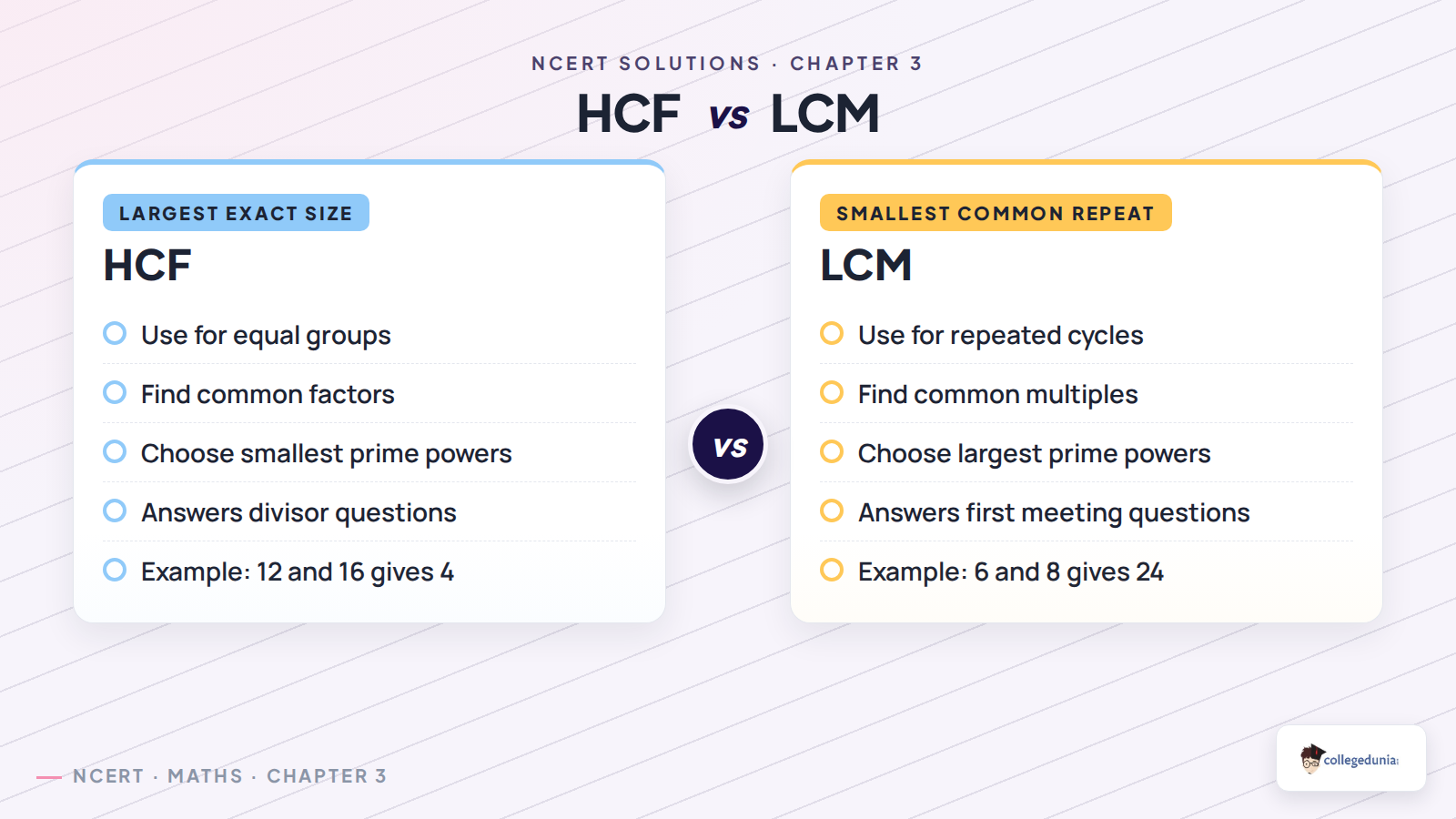
Finding Common Ground teaches students to break numbers into prime factors and then choose the right tool. HCF gives the largest exact divisor, while LCM gives the first common repeat. This distinction is the heart of the chapter.
| Topic | What students practise |
|---|---|
| Highest Common Factor | Largest tile size, biggest equal bag weight and common divisors. |
| Lowest Common Multiple | First common meeting point in strips, games, cycles and divisibility problems. |
| Prime Factorisation | Writing numbers as prime powers before finding HCF or LCM. |
HCF and LCM Prime Factor Rule for Finding Common Ground
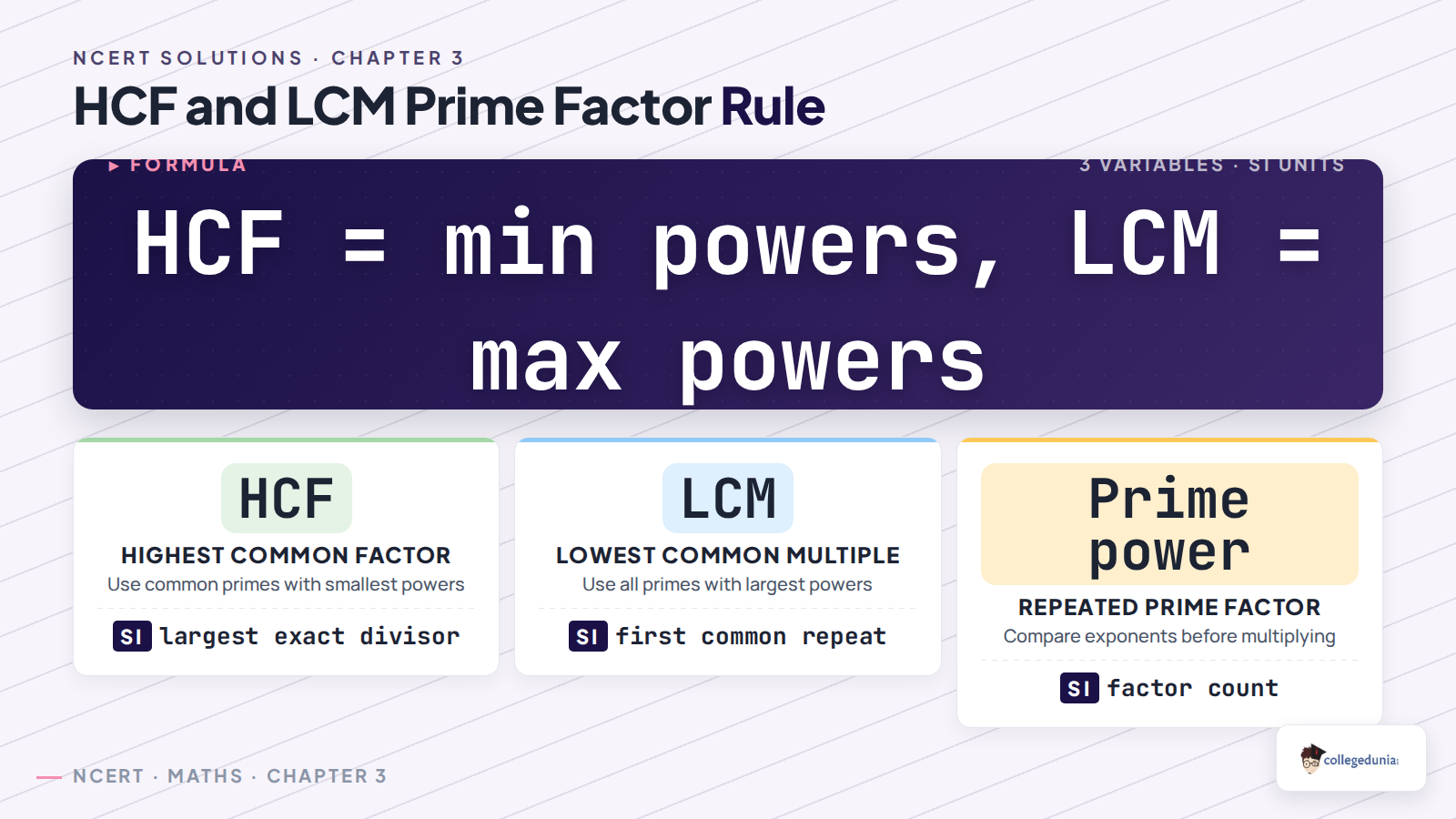
Use HCF when a problem asks for the largest possible size that divides all given numbers. Use LCM when a problem asks when two or more patterns meet again.
Finding Common Ground Class 7 Maths Video Recap
Source: Magnet Brains on YouTube
How to Use the Finding Common Ground Solutions PDF
- Start with the question statement and decide whether it asks for HCF or LCM.
- Check the prime factorisation before writing the final number.
- Use the Expert Solution tab for a second route when the word problem feels unclear.
Related Class 7 Maths Chapter 3 Resources
| Resource | Use it for | Link |
|---|---|---|
| NCERT Book PDF | Read the official Finding Common Ground chapter. | Class 7 Maths Chapter 3 NCERT Book PDF |
| Notes | Revise HCF, LCM and prime factorisation quickly. | Finding Common Ground Notes |
| Handwritten Notes | Use neat revision notes before class tests. | Finding Common Ground Handwritten Notes |
Class 7 Maths Part 2 NCERT Solutions for All Chapters
| Chapter | NCERT Solutions |
|---|---|
| Chapter 1 | Geometric Twins NCERT Solutions |
| Chapter 2 | Operations with Integers NCERT Solutions |
| Chapter 3 | Finding Common Ground NCERT Solutions |
| Chapter 4 | Another Peek Beyond the Point NCERT Solutions |
All NCERT Solutions for Class 7 Maths Chapter 3 Finding Common Ground with Step-by-Step Solutions
Finding Common Ground Solution Cards
All 28 questions with collapsible Solution and Expert Solution. Tap a button to reveal the working.
What this PDF covers
Sameeksha has a 12 ft by 16 ft room. What largest whole-number side should each square tile have? How many such tiles are needed? Would allowing fractional feet change the largest side?
Lekhana bought 84 kg and 108 kg of rice from two farms. Each bag must contain rice from only one farm, all bags must have the same whole-number weight, and the number of bags must be as small as possible. What should each bag weigh?
For the Jump Jackpot pairs (14, 30), (7, 11), (30, 50), and (28, 42), find the longest jump size starting from 0 that lands on both treasure numbers. Is this longest jump size the HCF?
Write the prime factorisation of 105 and 30 using the division method. Also find the prime factorisation of 1200.
Using the prime factorisation of 840, decide whether 14, 8, and 27 are factors of 840.
List all the factors of 90, 105, 132, 360, and 840.
Find the common factors and the HCF of 50 and 60; 140 and 275; 77 and 725; 370 and 592; 81 and 243.
Find the HCF of 24 and 180; 42, 75, and 24; 240 and 378; 400 and 2500; 300 and 800. Also explain why 72 and 144 do have common factors even if they are factorised as 6 x 12 and 8 x 18.
In the Idli-Vada game, find the first number for which idli-vada is called for the pairs (4, 6), (7, 11), (14, 30), and (15, 55). Is the answer always the LCM?
Find the LCM of the following numbers: (a) 30, 72; (b) 36, 54; (c) 105, 195, 65; (d) 222, 370.
Make general statements about HCF for consecutive even numbers, consecutive odd numbers, two even numbers, consecutive numbers, and co-prime numbers.
Make general statements about LCM when the LCM is one of the two numbers, for two multiples of 3, two consecutive even numbers, two consecutive numbers, and two co-prime numbers.
Find the HCF of 18 x 10 and 18 x 15; 10 x 38 and 10 x 21; 5 x 13 and 5 x 20; 12 x 16 and 12 x 20. When is the HCF the same as the common multiplier?
Use the efficient procedure to find HCF and LCM for 84 and 180; 300 and 150; 630 and 770. Also try 90 and 150, and 84 and 132.
Show that HCF x LCM equals the product for 45 and 105; 275 and 352; 222 and 370. Does the same property hold for three numbers?
In the two colour rows, the top row has blue stars at positions 4, 10, 16, ... (repeat gap 6), and the bottom row has blue stars at positions 4, 8, 12, 16, ... (repeat gap 4). When will the blue stars meet next?
Is 5 x 7 x 11 x 11 a multiple of 5 x 7 x 7 x 11 x 2? Is it a factor of that number?
Find the HCF and LCM of 3 x 3 x 5 x 7 x 7 and 12 x 7 x 11; also of 45 and 36. State answers as prime factorisations.
Find two numbers whose HCF is 1 and LCM is 66.
A cowherd has fewer than 200 cows. The cows can be divided equally through 3 gates, then 5 gates, then 7 gates. How many cows did he have?
A box has length 12 cm, width 18 cm, and height 36 cm. Which cube side lengths from 9 cm, 6 cm, 4 cm, 3 cm, and 2 cm can be packed without gaps?
Among 36, 612, 18, 3, 2, and 360, which is the largest number that perfectly divides both 306 and 36?
Find the smallest number divisible by 3, 4, 5, and 7, but leaving remainder 10 when divided by 11.
In Fire in the Mountain, number 6 caused no one to get out, number 9 caused no one to get out, but number 10 caused some people to get out. Which options could be the initial number of children: 72, 90, 45, 3, 36, or none?
Tick the correct statement. The LCM of two different prime numbers m and n can be: (a) less than both numbers; (b) in between the two numbers; (c) greater than both numbers; (d) less than m x n; (e) greater than m x n.
A dog chases a rabbit with a head start of 150 feet. The dog jumps 9 feet whenever the rabbit jumps 7 feet. In how many leaps does the dog catch the rabbit?
What is the smallest number that is a multiple of 1, 2, 3, 4, 5, 6, 8, 9, and 10?
Add 815, 120, 736, 1163, and 121 efficiently.
Finding Common Ground Class 7 Maths NCERT Solutions FAQs
Ques. What does Finding Common Ground Class 7 Maths teach?
Ans. It teaches HCF, LCM, prime factorisation, common factors, common multiples and the relation between HCF, LCM and product.
Ques. When should students use HCF in Finding Common Ground?
Ans. Use HCF when the question asks for the largest exact size, largest equal group or biggest common divisor.
Ques. When should students use LCM in Finding Common Ground?
Ans. Use LCM when the question asks for the first common repeat, smallest shared multiple or next meeting point.
Ques. Is the Class 7 Maths Chapter 3 PDF updated for 2026-27?
Ans. Yes. The PDF follows the 2026-27 Ganita Prakash Part 2 chapter and includes all main Figure it Out answers.



Comments