



The NCERT Solutions for Class 7 Science Chapter 1 The Ever-Evolving World of Science cover the chapter activity and its main ideas. The answers follow the 2026-27 NCERT Curiosity textbook. They help students ask useful questions, connect fields of science, and understand why experiments often lead to fresh questions.
- Chapter focus: curiosity, observation, questioning, experiments, and responsible science.
- Activity focus: creating several sensible questions for one given answer.
- Study tip: explain the reason behind each answer in your own words.
Chapter1TheEver-EvolvingWorldofScienceSolutions.pdf?page=1&dpi=150)
Chapter1TheEver-EvolvingWorldofScienceSolutions.pdf?page=2&dpi=150)
Chapter1TheEver-EvolvingWorldofScienceSolutions.pdf?page=3&dpi=150)
Chapter1TheEver-EvolvingWorldofScienceSolutions.pdf?page=4&dpi=150)
Chapter1TheEver-EvolvingWorldofScienceSolutions.pdf?page=5&dpi=150)
Chapter1TheEver-EvolvingWorldofScienceSolutions.pdf?page=6&dpi=150)
Chapter1TheEver-EvolvingWorldofScienceSolutions.pdf?page=7&dpi=150)
Chapter1TheEver-EvolvingWorldofScienceSolutions.pdf?page=8&dpi=150)
Chapter1TheEver-EvolvingWorldofScienceSolutions_flat_MobileCard.pdf?page=1&dpi=150)
Chapter1TheEver-EvolvingWorldofScienceSolutions_flat_MobileCard.pdf?page=2&dpi=150)
Chapter1TheEver-EvolvingWorldofScienceSolutions_flat_MobileCard.pdf?page=3&dpi=150)
Chapter1TheEver-EvolvingWorldofScienceSolutions_flat_MobileCard.pdf?page=4&dpi=150)
Chapter1TheEver-EvolvingWorldofScienceSolutions_flat_MobileCard.pdf?page=5&dpi=150)
Chapter1TheEver-EvolvingWorldofScienceSolutions_flat_MobileCard.pdf?page=6&dpi=150)
Chapter1TheEver-EvolvingWorldofScienceSolutions_flat_MobileCard.pdf?page=7&dpi=150)
Chapter1TheEver-EvolvingWorldofScienceSolutions_flat_MobileCard.pdf?page=8&dpi=150)
Chapter1TheEver-EvolvingWorldofScienceSolutions_flat_MobileCard.pdf?page=9&dpi=150)
Chapter1TheEver-EvolvingWorldofScienceSolutions_flat_MobileCard.pdf?page=10&dpi=150)
Chapter1TheEver-EvolvingWorldofScienceSolutions_flat_MobileCard.pdf?page=11&dpi=150)
Chapter1TheEver-EvolvingWorldofScienceSolutions_flat_MobileCard.pdf?page=12&dpi=150)
Chapter1TheEver-EvolvingWorldofScienceSolutions_flat_MobileCard.pdf?page=13&dpi=150)
Chapter1TheEver-EvolvingWorldofScienceSolutions_flat_MobileCard.pdf?page=14&dpi=150)
Each solution is written from the 2026-27 NCERT Curiosity chapter and checked for clear, age-appropriate explanations.
Student Feedback
In a Collegedunia learning poll of 10,000+ middle-school students, most students preferred short answers followed by one clear reason. This page uses that simple pattern.
The Ever-Evolving World of Science: What the Chapter Teaches
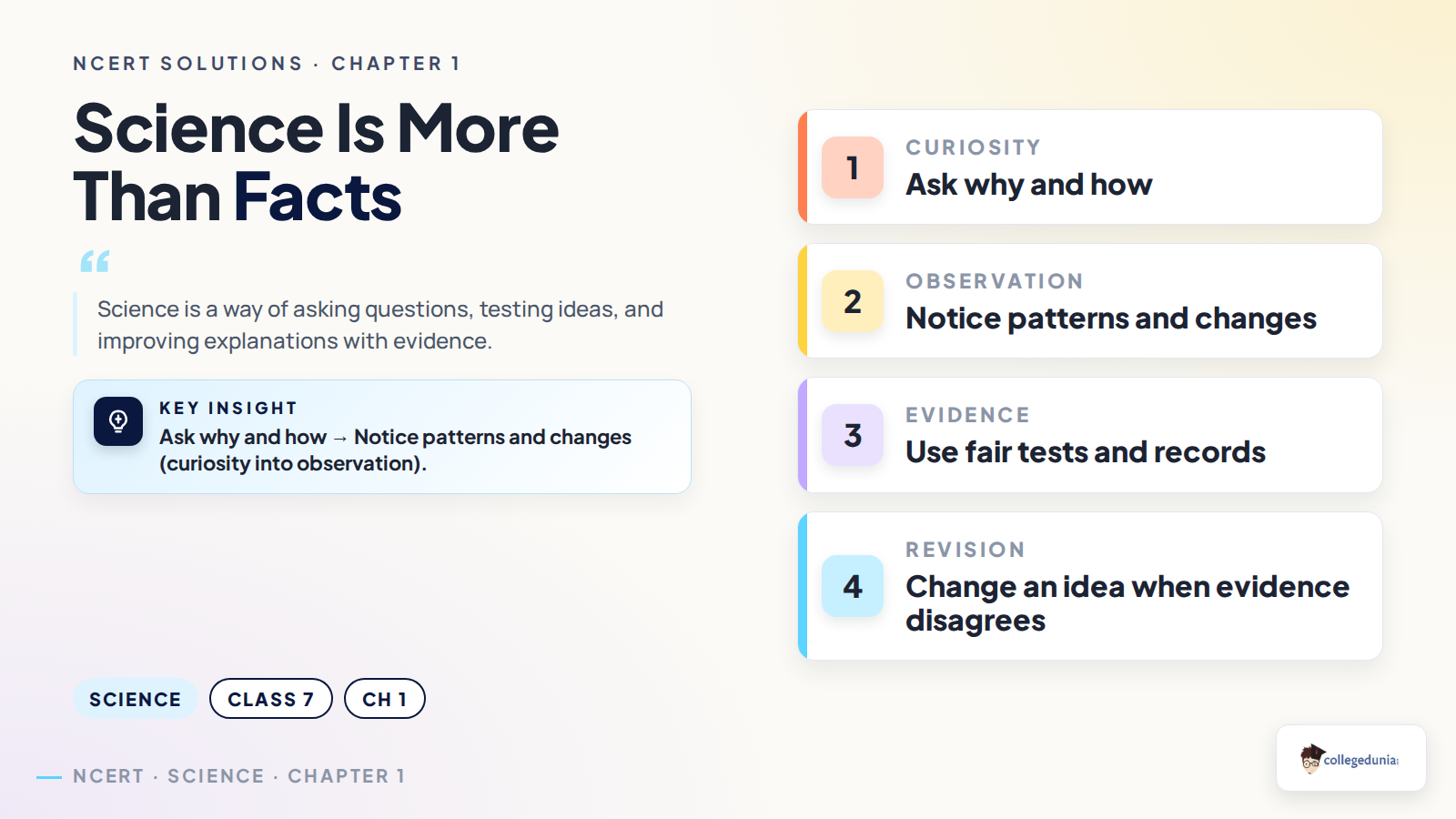
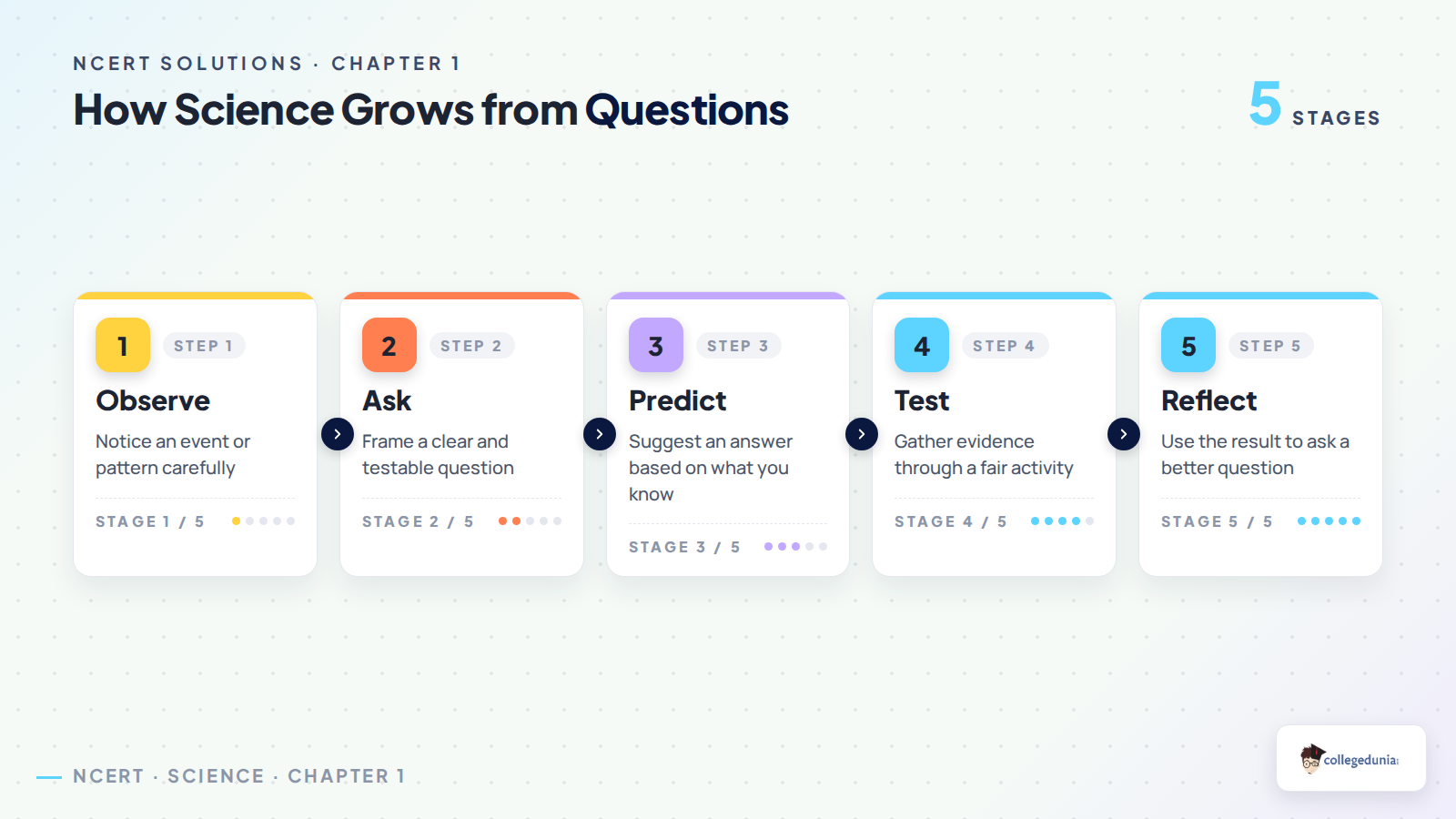
Science is more than a collection of facts. It is a way of thinking that begins with curiosity. Students observe events, ask questions, test ideas, and study patterns. An answer may also create a new question. This keeps scientific understanding open to change.
- Curiosity helps us notice details and ask why something happens.
- Observation gives us information that can be recorded and compared.
- Experiments help us test an idea through planned actions.
- Evidence helps us accept, change, or reject an explanation.
A scientific answer is not always the end of an enquiry. New evidence can improve an older explanation. This is why science keeps evolving.
The Ever-Evolving World of Science Questions Explained
Source: Magnet Brains on YouTube
How Class 7 Science Ideas Connect Across the Curiosity Textbook
The chapter previews the topics students will study during the year. Physics, chemistry, biology, and Earth science may have separate names. Yet questions from one field often connect with another. The table shows these links in simple terms.
| Area of science | Questions introduced in the chapter | Where the idea leads |
|---|---|---|
| Materials and chemistry | Why are some fruits sour? What happens to a turmeric stain? | Acids, bases, metals, non-metals, and changes |
| Electricity and physics | Which materials make a lamp glow? | Circuits, conductors, light, heat, time, and motion |
| Biology | How do animals and plants get food and breathe? | Growth and life processes |
| Earth and space science | How do shadows, eclipses, day, and night occur? | Earth, the Moon, and the Sun |
These fields support one another. For example, sunlight affects heat, water, plants, shadows, and life on Earth.
Question the Answer Activity with Possible Responses
Activity 1.1 reverses the usual classroom task. Instead of finding an answer, students create a question for it. Many questions can match the same answer. The aim is to be curious, sensible, and creative.
| Given answer | One possible question | Why it works |
|---|---|---|
| Just add some milk. | How can I make this hot cocoa less strong? | Milk can soften its taste. |
| Because the cat's teeth were crooked. | Why did the cat visit the animal dentist? | The question gives a fitting reason. |
| Don't panic, I have my towel. | What would you say after water spilled on the desk? | A towel can help clean the spill. |
| 42 | What is the product of six and seven? | Six multiplied by seven equals 42. |
These are sample responses, not the only correct responses. Students may write different questions if the questions match the given answers.
How These Solutions Help You Think Like a Scientist
Good science answers show the thinking behind a claim. The solutions use short steps and connect each response to the chapter. They also show when more than one answer can be accepted.
- Read the exact instruction before answering.
- Use an observation or example to support your point.
- Keep creative responses relevant to the given answer.
- Ask a fresh question when an explanation creates doubt.
- Use safe, simple tests for classroom activities.
Science also brings responsibility. Students should consider how human actions affect nature and society. A useful discovery should support a safer and more sustainable world.
Common Mistakes in The Ever-Evolving World of Science Answers
The activity rewards imagination, but the answer must still make sense. Students often lose clarity when they copy a question from the example or give an unrelated response. Use this quick check before finishing.
- Do not treat science as a fixed list of facts.
- Do not write a question that cannot lead to the given answer.
- Do not claim that every experiment proves an idea.
- Do not separate science from its effects on people and nature.
Best check: read your question and answer together. They should sound like a natural exchange.
Related Class 7 Science Resources for The Ever-Evolving World of Science
| Resource | Best used for |
|---|---|
| The Ever-Evolving World of Science Class 7 Notes | Concept recap and key terms |
| The Ever-Evolving World of Science NCERT Book PDF | Official chapter reading and Activity 1.1 |
| The Ever-Evolving World of Science Handwritten Notes | Quick revision before class tests |
NCERT Solutions for Class 7 Science Curiosity: All Chapters
All NCERT Solutions for Class 7 Science Chapter 1 The Ever-Evolving World of Science with Step-by-Step Solutions
Look at the answers below. Your task is to come up with a curious, creative, and fun question or situations that could lead to these answers. There are never any wrong questions, so let your imagination run wild!
[4pt]Question: 0.720.4pt?
[4pt]Answer: Just add some milk.
Look at the answers below. Your task is to come up with a curious, creative, and fun question or situations that could lead to these answers. There are never any wrong questions, so let your imagination run wild!
[4pt]Question: 0.720.4pt?
[4pt]Answer: Because the cat's teeth were crooked.
Look at the answers below. Your task is to come up with a curious, creative, and fun question or situations that could lead to these answers. There are never any wrong questions, so let your imagination run wild!
[4pt]Question: 0.720.4pt?
[4pt]Answer: Don't panic, I have my towel.
Look at the answers below. Your task is to come up with a curious, creative, and fun question or situations that could lead to these answers. There are never any wrong questions, so let your imagination run wild! (Please ask a more interesting, and not obvious questions like ``What is 32+10?'', or even ``What is the answer to life, the universe, and everything?'')
[4pt]Question: 0.720.4pt?
[4pt]Answer: 42
The Ever-Evolving World of Science Class 7 Science NCERT Solutions FAQs
Ques. What is the main idea of The Ever-Evolving World of Science?
Ans. Science is an ongoing process. People observe, ask questions, test ideas, study evidence, and improve explanations.
Ques. Why is science called an ever-evolving field?
Ans. New observations and experiments can add details or change older explanations. Scientific knowledge grows with evidence.
Ques. What does Activity 1.1 Question the Answer teach?
Ans. It teaches students to create questions from given answers. It shows that curiosity can produce several sensible questions.
Ques. Are there fixed answers for Activity 1.1?
Ans. No. Different questions can be accepted when they match the given answer and form a meaningful exchange.
Ques. Which fields of science appear in this chapter?
Ans. The chapter introduces ideas from physics, chemistry, biology, and Earth and space science. It also shows their links.
Ques. Are these solutions based on the 2026-27 NCERT Curiosity book?
Ans. Yes. The explanations follow Chapter 1 of the Class 7 Science Curiosity textbook reprint for 2026-27.



Comments