



The NCERT solutions for Class 7 Science Chapter 7 Heat Transfer in Nature explain all 10 textbook exercises in clear steps. The answers follow the 2026-27 Curiosity book and connect conduction, convection, radiation, breezes, the water cycle, and groundwater to daily life.
- Core skill: Identify the correct mode of heat transfer from evidence.
- Nature link: Explain breezes, rainfall, infiltration, and aquifers.
- Answer focus: Give a reason with every observation or choice.
Chapter7HeatTransferinNatureSolutions.pdf?page=1&dpi=150)
Chapter7HeatTransferinNatureSolutions.pdf?page=2&dpi=150)
Chapter7HeatTransferinNatureSolutions.pdf?page=3&dpi=150)
Chapter7HeatTransferinNatureSolutions.pdf?page=4&dpi=150)
Chapter7HeatTransferinNatureSolutions.pdf?page=5&dpi=150)
Chapter7HeatTransferinNatureSolutions.pdf?page=6&dpi=150)
Chapter7HeatTransferinNatureSolutions.pdf?page=7&dpi=150)
Chapter7HeatTransferinNatureSolutions.pdf?page=8&dpi=150)
Chapter7HeatTransferinNatureSolutions.pdf?page=9&dpi=150)
Chapter7HeatTransferinNatureSolutions.pdf?page=10&dpi=150)
Chapter7HeatTransferinNatureSolutions.pdf?page=11&dpi=150)
Chapter7HeatTransferinNatureSolutions.pdf?page=12&dpi=150)
Chapter7HeatTransferinNatureSolutions.pdf?page=13&dpi=150)
Chapter7HeatTransferinNatureSolutions.pdf?page=14&dpi=150)
Chapter7HeatTransferinNatureSolutions.pdf?page=15&dpi=150)
Chapter7HeatTransferinNatureSolutions.pdf?page=16&dpi=150)
Chapter7HeatTransferinNatureSolutions.pdf?page=17&dpi=150)
Chapter7HeatTransferinNatureSolutions.pdf?page=18&dpi=150)
Chapter7HeatTransferinNatureSolutions.pdf?page=19&dpi=150)
Chapter7HeatTransferinNatureSolutions.pdf?page=20&dpi=150)
Chapter7HeatTransferinNatureSolutions.pdf?page=21&dpi=150)
Chapter7HeatTransferinNatureSolutions.pdf?page=22&dpi=150)
Chapter7HeatTransferinNatureSolutions.pdf?page=23&dpi=150)
Chapter7HeatTransferinNatureSolutions.pdf?page=24&dpi=150)
Chapter7HeatTransferinNatureSolutions_flat_MobileCard.pdf?page=1&dpi=150)
Each Collegedunia answer follows the 2026-27 NCERT Curiosity chapter and uses language suited to Class 7 revision.
|
Table of Contents |
Heat Transfer in Nature Important Ideas for Class 7
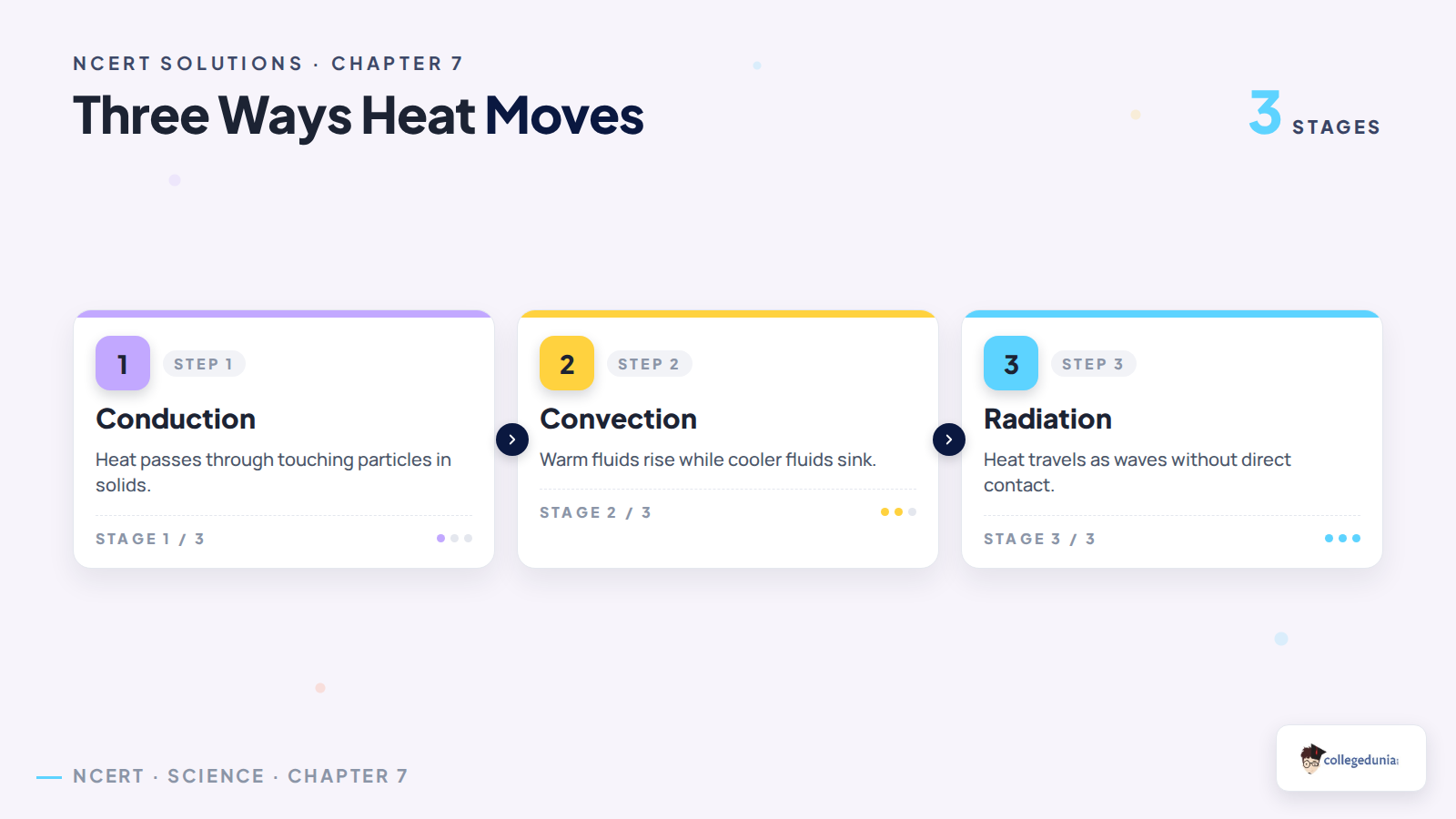
Heat always moves from a hotter region to a colder region. The method depends on the material and whether particles move from place to place.
| Process | How heat moves | Example |
|---|---|---|
| Conduction | Neighbouring particles pass heat without changing positions | A metal pan becomes hot |
| Convection | Warm liquid or gas rises while cooler material sinks | Water circulates while heating |
| Radiation | Heat travels without needing a material medium | Sunlight warms the Earth |
Solids mainly transfer heat by conduction. Liquids and gases mainly transfer heat by convection. Radiation can travel through empty space.
Heat Transfer in Nature Chapter Overview
Source: Magnet Brains on YouTube
Conductors and Insulators in the Heat Transfer Chapter
Metals let heat pass easily, so they make useful cooking utensils. Wood, glass, clay, porcelain, and air pass heat slowly.
- Metal saucepan: transfers heat quickly from the flame to food.
- Wooden handle: slows heat transfer and protects the hand.
- Woollen clothes: trap air, which reduces heat loss from the body.
- Hollow bricks: trap air and reduce unwanted heat transfer.
How Convection Produces Sea Breeze and Land Breeze
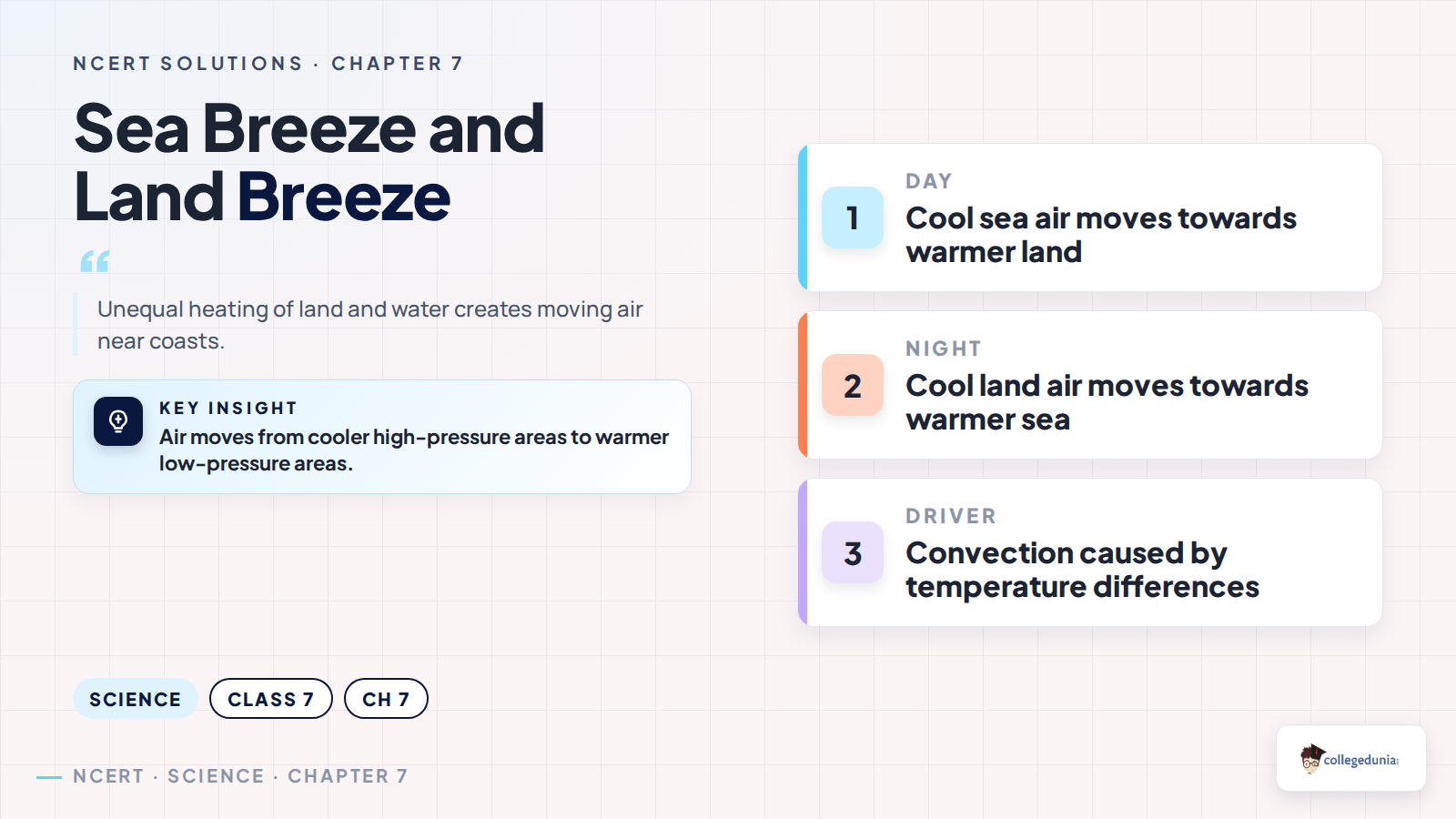
Land heats and cools faster than seawater. This difference changes air pressure near a coast and reverses the wind direction between day and night.
| Time | What warms faster | Air movement | Breeze |
|---|---|---|---|
| Day | Land | Cooler air moves from sea to land | Sea breeze |
| Night | Sea remains warmer | Cooler air moves from land to sea | Land breeze |
Warm air expands, becomes lighter, and rises. Cooler, heavier air moves in to replace it and forms a convection current.
Water Cycle, Infiltration, and Aquifers in Heat Transfer in Nature
The Sun supplies heat for evaporation. Water vapour rises, cools, and condenses into clouds. Rain, snow, or hail then returns water to the ground.
- Water evaporates from water bodies and leaves plants through transpiration.
- Water vapour cools and condenses to form clouds.
- Precipitation brings water back to the Earth's surface.
- Some water flows into rivers, while some enters the ground.
Water entering soil and rocks is called infiltration. It moves fastest through gravel, slower through sand, and slowest through clay. Underground layers that store groundwater are called aquifers.
Common Mistakes in Heat Transfer in Nature Answers
Most errors happen when students name a process without checking particle movement or the need for a medium.
- Do not say particles travel along a solid during conduction.
- Do not describe sea breeze as air moving from land to sea.
- Do not say radiation needs air to carry heat.
- Do not confuse infiltration with evaporation.
- Do not say clay allows faster seepage than gravel.
Heat Transfer in Nature Student Feedback
What 11,460 students told us about learning heat transfer
In a Collegedunia student poll before the 2026 exams, most students found a three-process comparison table useful for revision.
Source: 2026-27 Class 7 Science student poll of 11,460 students.
Best Way to Use the Heat Transfer in Nature Solutions PDF
Try each textbook question before opening the solution. Draw arrows for heat or air movement whenever the question describes a process.
- Underline the hotter and colder regions in the question.
- Decide whether particles stay in place or move.
- Check whether heat needs a medium.
- Label arrows clearly in breeze and smoke diagrams.
- Compare your reason with the step-by-step answer.
Other Class 7 Heat Transfer in Nature Resources
Use the chapter resources below for reading, revision, and quick recall. Each link keeps the same chapter context.
| Resource | How it helps |
|---|---|
| Heat Transfer in Nature Class 7 Notes | Revise key terms, activities, and process differences. |
| Heat Transfer in Nature NCERT Book PDF | Read the official activities, figures, and exercise questions. |
| Heat Transfer in Nature Handwritten Notes | Use a short visual recap before a test. |
NCERT Solutions for Class 7 Science Curiosity: All Chapters
Continue with the same solution format across the Curiosity textbook. Use the nearby chapters to connect materials, life processes, light, motion, and Earth science.
| Chapter | NCERT Solutions |
|---|---|
| Chapter 1 | The Ever-Evolving World of Science Solutions |
| Chapter 2 | Exploring Substances: Acidic, Basic, and Neutral Solutions |
| Chapter 3 | Electricity: Circuits and their Components Solutions |
| Chapter 4 | The World of Metals and Non-metals Solutions |
| Chapter 5 | Changes Around Us: Physical and Chemical Solutions |
| Chapter 6 | Adolescence: A Stage of Growth and Change Solutions |
| Chapter 7 | Heat Transfer in Nature Solutions |
| Chapter 8 | Measurement of Time and Motion Solutions |
| Chapter 9 | Life Processes in Animals Solutions |
| Chapter 10 | Life Processes in Plants Solutions |
| Chapter 11 | Light, Shadows and Reflections Solutions |
| Chapter 12 | Earth, Moon, and the Sun Solutions |
All NCERT Solutions for Heat Transfer in Nature with Step-by-Step Answers
Need every textbook question in one place?
The question cards let you compare the short solution with the detailed expert explanation.
Heat Transfer in Nature Science NCERT Solutions FAQs
Ques. What is conduction?
Ans. Conduction transfers heat from a hotter part to a colder part through neighbouring particles. The particles do not change positions.
Ques. How is convection different from conduction?
Ans. Convection transfers heat through the movement of liquid or gas particles. During conduction, particles stay in their positions.
Ques. Does radiation need a medium?
Ans. No. Radiation can transfer heat through empty space. This is how heat from the Sun reaches the Earth.
Ques. What causes a sea breeze?
Ans. Land heats faster during the day. Warm air above land rises, so cooler air moves from the sea toward land.
Ques. What is infiltration?
Ans. Infiltration is the process in which surface water enters soil and rocks through open, connected spaces.
Ques. What is an aquifer?
Ans. An aquifer is an underground layer of sediment or rock that stores groundwater in its pore spaces and openings.
Ques. Are these solutions based on the 2026-27 NCERT Curiosity book?
Ans. Yes. The answers follow the Class 7 Science Curiosity chapter prescribed for the 2026-27 session.



Comments