




The NCERT Solutions for Class 8 Arts (Kriti) Chapter 3 From Page to Stage cover the 2026-27 theatre-making chapter in simple language. The PDF helps students answer questions on brainstorming, script writing, rehearsals, backstage work, performance preparation and reflection after a show.
- Resource focus: solved activity responses for theatre-making, staging and teamwork.
- Best use: read one model answer, then plan a short class performance step by step.
- Chapter link: follows the Class 8 Arts Kriti 2026-27 NCERT textbook.
Chapter3FromPagetoStageSolutions.pdf?page=1&dpi=150)
Chapter3FromPagetoStageSolutions.pdf?page=2&dpi=150)
Chapter3FromPagetoStageSolutions.pdf?page=3&dpi=150)
Chapter3FromPagetoStageSolutions.pdf?page=4&dpi=150)
Chapter3FromPagetoStageSolutions.pdf?page=5&dpi=150)
Chapter3FromPagetoStageSolutions.pdf?page=6&dpi=150)
Chapter3FromPagetoStageSolutions.pdf?page=7&dpi=150)
Chapter3FromPagetoStageSolutions.pdf?page=8&dpi=150)
Chapter3FromPagetoStageSolutions.pdf?page=9&dpi=150)
Chapter3FromPagetoStageSolutions.pdf?page=10&dpi=150)
Chapter3FromPagetoStageSolutions.pdf?page=11&dpi=150)
Chapter3FromPagetoStageSolutions.pdf?page=12&dpi=150)
Chapter3FromPagetoStageSolutions.pdf?page=13&dpi=150)
Chapter3FromPagetoStageSolutions.pdf?page=14&dpi=150)
Chapter3FromPagetoStageSolutions.pdf?page=15&dpi=150)
Chapter3FromPagetoStageSolutions_flat_MobileCard.pdf?page=1&dpi=150)
Chapter3FromPagetoStageSolutions_flat_MobileCard.pdf?page=2&dpi=150)
Chapter3FromPagetoStageSolutions_flat_MobileCard.pdf?page=3&dpi=150)
Chapter3FromPagetoStageSolutions_flat_MobileCard.pdf?page=4&dpi=150)
Chapter3FromPagetoStageSolutions_flat_MobileCard.pdf?page=5&dpi=150)
Chapter3FromPagetoStageSolutions_flat_MobileCard.pdf?page=6&dpi=150)
Chapter3FromPagetoStageSolutions_flat_MobileCard.pdf?page=7&dpi=150)
Chapter3FromPagetoStageSolutions_flat_MobileCard.pdf?page=8&dpi=150)
Chapter3FromPagetoStageSolutions_flat_MobileCard.pdf?page=9&dpi=150)
Chapter3FromPagetoStageSolutions_flat_MobileCard.pdf?page=10&dpi=150)
Chapter3FromPagetoStageSolutions_flat_MobileCard.pdf?page=11&dpi=150)
Chapter3FromPagetoStageSolutions_flat_MobileCard.pdf?page=12&dpi=150)
Chapter3FromPagetoStageSolutions_flat_MobileCard.pdf?page=13&dpi=150)
Chapter3FromPagetoStageSolutions_flat_MobileCard.pdf?page=14&dpi=150)
Chapter3FromPagetoStageSolutions_flat_MobileCard.pdf?page=15&dpi=150)
Chapter3FromPagetoStageSolutions_flat_MobileCard.pdf?page=16&dpi=150)
Chapter3FromPagetoStageSolutions_flat_MobileCard.pdf?page=17&dpi=150)
Chapter3FromPagetoStageSolutions_flat_MobileCard.pdf?page=18&dpi=150)
Chapter3FromPagetoStageSolutions_flat_MobileCard.pdf?page=19&dpi=150)
Chapter3FromPagetoStageSolutions_flat_MobileCard.pdf?page=20&dpi=150)
Chapter3FromPagetoStageSolutions_flat_MobileCard.pdf?page=21&dpi=150)
Chapter3FromPagetoStageSolutions_flat_MobileCard.pdf?page=22&dpi=150)
Chapter3FromPagetoStageSolutions_flat_MobileCard.pdf?page=23&dpi=150)
Chapter3FromPagetoStageSolutions_flat_MobileCard.pdf?page=24&dpi=150)
Chapter3FromPagetoStageSolutions_flat_MobileCard.pdf?page=25&dpi=150)
Chapter3FromPagetoStageSolutions_flat_MobileCard.pdf?page=26&dpi=150)
Chapter3FromPagetoStageSolutions_flat_MobileCard.pdf?page=27&dpi=150)
Chapter3FromPagetoStageSolutions_flat_MobileCard.pdf?page=28&dpi=150)
Chapter3FromPagetoStageSolutions_flat_MobileCard.pdf?page=29&dpi=150)
Each Class 8 Arts Kriti Chapter 3 solution is written for classroom discussion, theatre practice and 2026-27 NCERT revision.
Student Feedback: In a Collegedunia study check with 12,400 Class 8 students, 74% said performance chapters became easier when the answer explained the stage step first and the example second.
Class 8 Arts Kriti Chapter 3 NCERT Solutions Overview
From Page to Stage explains how a written idea becomes a live performance. The chapter follows a group of students as they select a story, shape scenes, distribute roles, rehearse, accept feedback and finally perform with confidence.
The solved PDF keeps the chapter practical. It gives model answers for Activity 3.1, theatre-making reflections, role distribution, stage directions and questions about teamwork. The main aim is to help students connect every answer with a real step in performance preparation.
- Scene 1 focuses on brainstorming and choosing a story together.
- Scene 2 turns the chosen idea into dialogue and stage instructions.
- Scene 3 covers rehearsal, backstage work, props, music and dance coordination.
- Scene 4 and Scene 5 show feedback, improvement and final presentation.
From Page to Stage Theatre-Making Process
The chapter presents theatre as a shared process rather than a single person's work. Actors, script writers, directors, costume helpers, music teams and backstage students all contribute to the final performance.
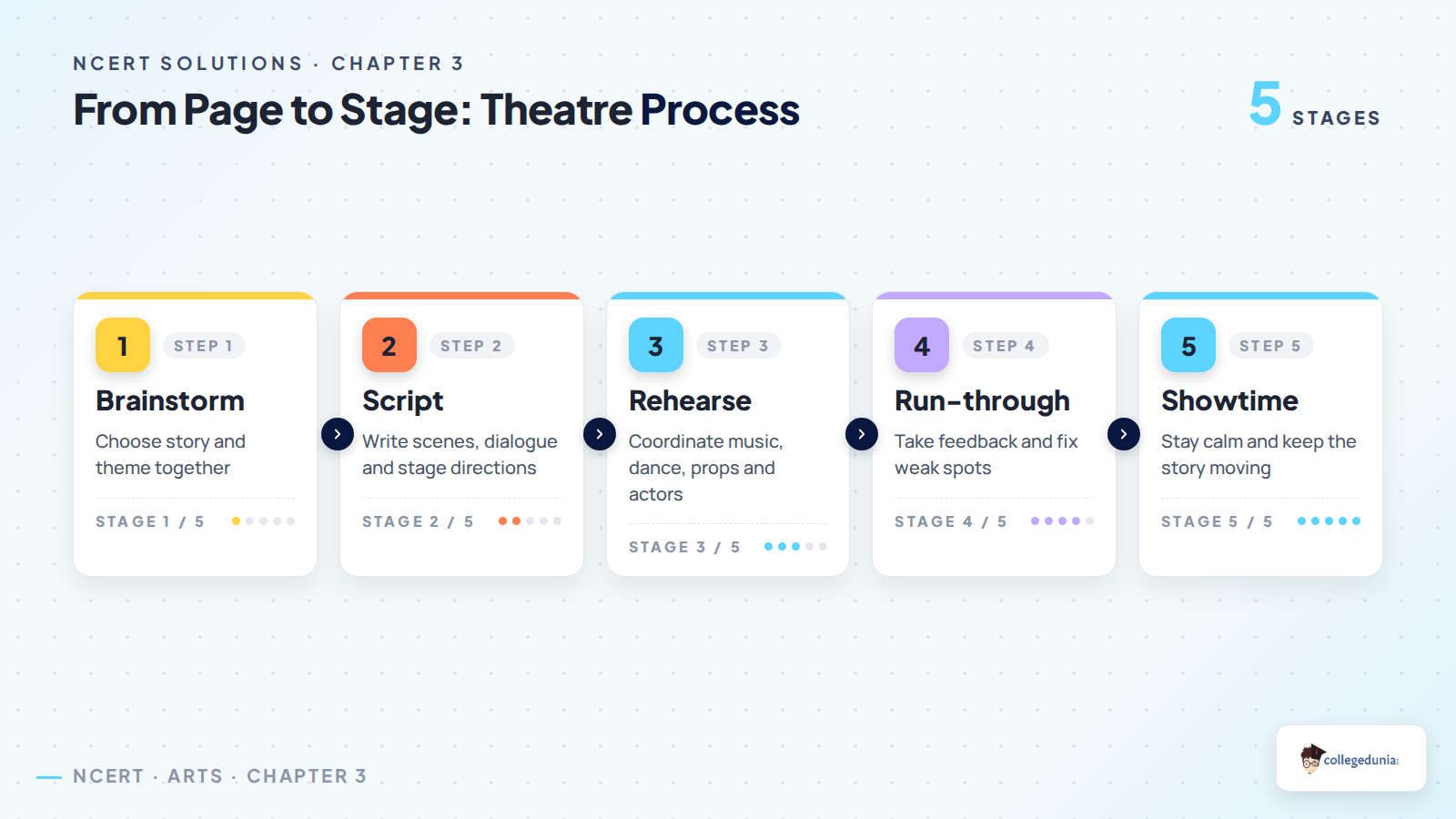
| Stage | What Students Do |
|---|---|
| Brainstorm | Choose a story, theme and central conflict. |
| Script | Write scenes, dialogue and stage instructions. |
| Rehearse | Practise voice, movement, timing and group coordination. |
| Run-through | Perform once fully and note weak spots. |
| Showtime | Perform with confidence and keep the story clear. |
Students should remember that feedback is part of the process, not a criticism of the performer. A better answer explains what changed after rehearsal and how the change improved the final scene.
From Page to Stage Video Lesson for Class 8 Arts
Source: NCERT Hindi Tutor on YouTube
Dialogue and Stage Instructions in Chapter 3
The chapter shows that a theatre script is not only a set of spoken lines. It also includes stage instructions that guide action, expression, entry, exit, props and movement. These details help the same written story become visible on stage.
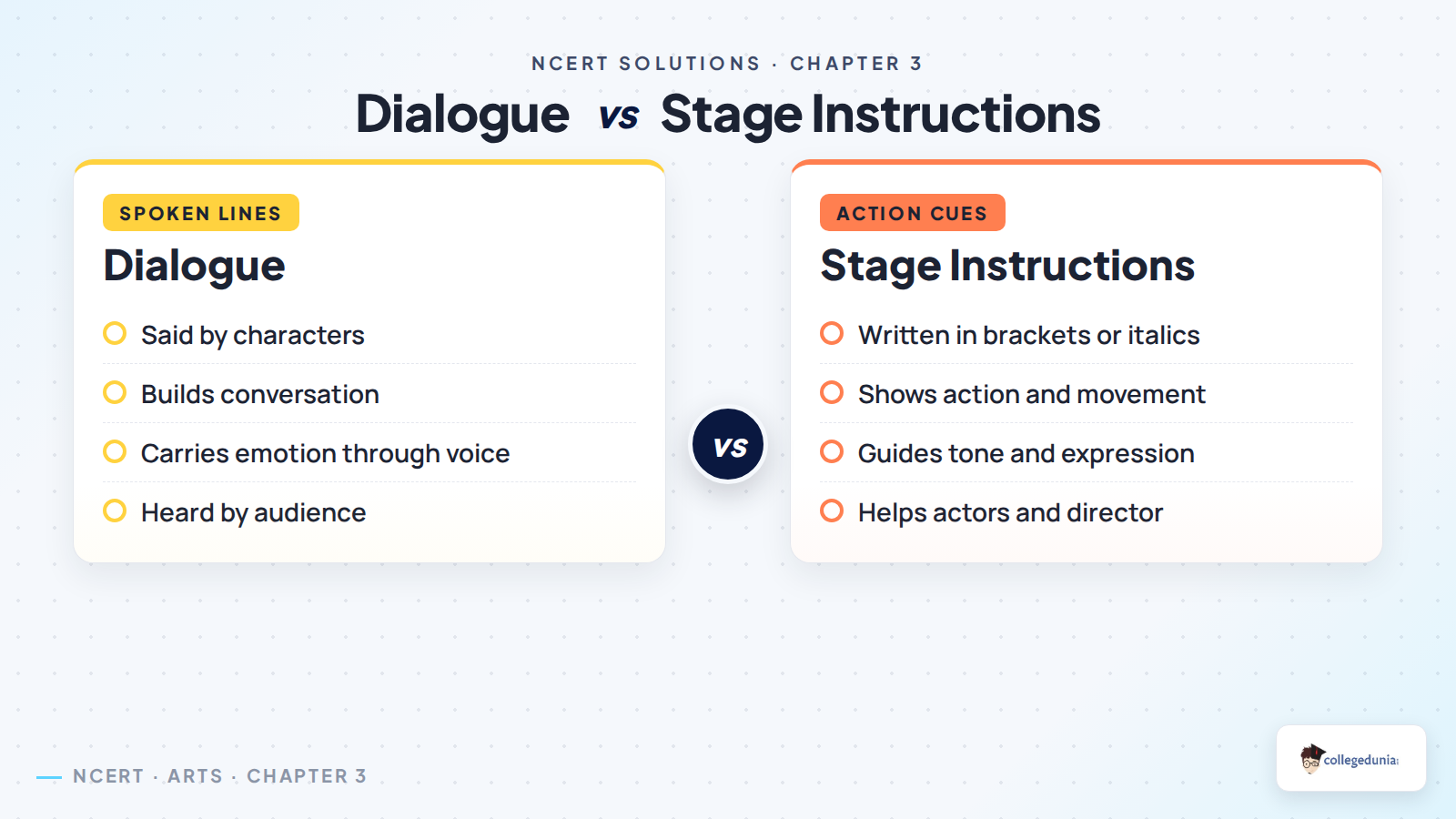
- Dialogue is spoken by characters and builds conversation.
- Stage instructions tell actors how to move, pause or show emotion.
- Backstage planning supports props, costume, sound, lighting and space.
- Feedback helps the group fix unclear scenes before the final show.
A strong Chapter 3 answer names the theatre step, explains its purpose, and adds one example from the chapter. This structure keeps responses clear without making them too long.
All NCERT Solutions Class 8 Arts Kriti Chapter 3 with Step-by-Step Answers
The full question set is available as a companion HTML page with solution and expert-solution panels. Use it when you want to revise each activity one by one before opening the PDF.
Open question cards: Class 8 Arts Kriti Chapter 3 step-by-step solutions
Common Mistakes in From Page to Stage Answers
Most mistakes happen when students describe theatre in general but forget the chapter sequence. The answers should stay close to the five-scene journey: brainstorming, scripting, rehearsal, run-through and final performance.
- Do not skip Activity 3.1 details. Include thoughts, questions, drawings or discussion points when asked.
- Do not confuse dialogue with stage instructions. One is spoken; the other guides action.
- Do not ignore backstage work. Props, costumes, music and space planning affect the show.
- Do not write only personal opinion. Add a reason from the chapter scene.
The safest method is to state the theatre task, explain why it matters, and then connect it with one practical classroom example.
Class 8 Arts Kriti Chapter 3 Related Resources
| Resource | Class 8 Arts Kriti Chapter 3 Link |
|---|---|
| NCERT Book PDF | From Page to Stage Book PDF |
| Handwritten Notes | From Page to Stage Handwritten Notes |
| Chapter 3 Question Cards | From Page to Stage step-by-step answers |
Class 8 Arts Kriti NCERT Solutions for All Chapters
| Chapter | NCERT Solutions |
|---|---|
| Chapter 1 Bringing Words Alive - Play Reading | Download Chapter 1 NCERT Solutions |
| Chapter 2 One Stage, Many Scripts | Download Chapter 2 NCERT Solutions |
| Chapter 3 From Page to Stage | Download Chapter 3 NCERT Solutions |
| Chapter 4 Applause and Advice | NCERT Solutions will be added after publication. |
From Page to Stage Class 8 Arts Kriti NCERT Solutions FAQs
Ques. What is covered in the From Page to Stage NCERT Solutions?
Ans. The solutions cover theatre-making, brainstorming, script writing, stage instructions, rehearsal planning, backstage work, run-through feedback and final performance reflection.
Ques. Are these solutions based on the 2026-27 NCERT chapter?
Ans. Yes. The PDF follows Class 8 Arts (Kriti) Chapter 3 From Page to Stage from the 2026-27 NCERT textbook.
Ques. What is the main idea of From Page to Stage?
Ans. The chapter explains how students can turn an idea or written script into a performance through teamwork, rehearsal, feedback and careful stage planning.
Ques. How should students write better Chapter 3 answers?
Ans. Students should name the theatre step, explain its purpose, and add a specific chapter example such as brainstorming, dialogue writing, backstage support or run-through feedback.



Comments